Bursting Bubbles – Robert Walters, and Some Thoughts on the Grower Champagne Philosophy

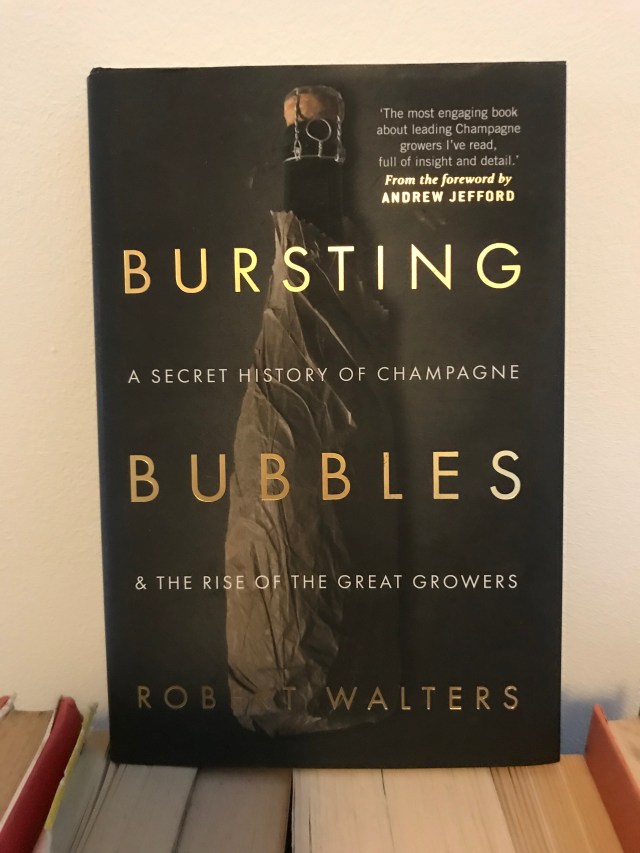
You will recall that I made Champagne by Peter Liem my wine book of last year. That expertly written book which puts terroir at its heart was the outstanding work on wine, in my view, in the whole of 2017. Bursting Bubbles by Australian author Robert Walters follows a similar route, but with perhaps a more radical message.

Liem’s work is highly detailed, and comprehensive, but it is not over critical of the negociant producers, the so-called Grandes Marques. Walters, in focusing on the small number of committed, high quality, producers he imports and works with, questions the whole focus of the Champagne region, and gets to the heart of what is Champagne.

In his Foreword, Andrew Jefford describes Bursting Bubbles as “The most engaging book about Champagne growers I’ve read…”. Let’s see whether we agree.
EDD51511-E523-45D3-8B8A-5AF702B4D868

What kind of Champagne do you want to drink? This is the question that Walters asks, and it is perhaps one which most Champagne drinkers have never considered. What he points out is a simple but often overlooked fact. Throughout the rest of France, the finest wines (and he often turns to Burgundy as an example) are expressions of place. They are also wines which use the best grapes, ripe and cropped at reasonable levels and turned, in the winery, into fine artisanal wines which express the nuance of where they come from: Gevrey or Chambolle, Morgon or Fleurie, Saumur-Champigny or Chinon, or Eguisheim or Bergheim, to name just a few examples of my own.

Champagne’s history, and its worldwide market, is one created by the negociant. There were clear historical reasons for this, which Walters outlines. Nevertheless, this has led to two clear differences between Champagne and the rest of “Fine Wine France”. The first relates to production methods, not just the (as some would say) semi-industrial nature of production for the vast majority of Champagne produced, but in blending. The market for grapes has led to Champagne Houses blending their wines from all over the region, from north of Reims right down to the Aube, which borders Burgundy. In effect, they are, it might be argued, blending away terroir.

The other major difference relates to the marketing of Champagne as “a festive drink or, at best, a high-quality aperitif that should not be taken as seriously as the great wines of the world”. How often do wine lovers demote Champagne to the mere prelude to an evening drinking the serious stuff? To a certain extent the new owners of the Grandes Marques, the luxury goods companies, have been changing this perception through their expensive prestige cuvées, but for the vast majority who drink Champagne, it remains, as Walters puts it, “a bubbly drink for bubbly people”.

So how do the “growers” differ? Well, to begin with, we need to destroy any idea that Grower producers make better Champagne than the negociants. There are hundreds of families making wine in the region (aside from those who get an allocation back from the co-operative of which they are a member and stick their own label on it). Some of these wines are among the worst in the region, purely because, whilst using the same methods as the negociants use for the volume side of their production, they don’t possess the expertise, nor the vineyards, nor the equipment, to match them.

There are, however, a group of vignerons working in the wider Champagne Region for whom quality comes naturally, a product of dedication, attention to detail, very hard work, and sticking to a philosophy that is based upon a clear idea of how they want their wines to reflect their place. The father of the movement is Anselme Selosse, and it is no coincidence that he studied, unusually for a son of a Champagne producer, in Burgundy. Several of the producers covered in Bursting Bubbles were mentored by Selosse and his influence, if not always his production methods, has been immense.

In a north-south journey through Champagne Walters’ first stop is to visit Jérôme Prévost, whose own journey to become a producer was directly influenced by Selosse, in whose winery he made wine in his early years. Prévost used to make wine only from Pinot Meunier, which is all he originally had planted in his vineyard at Gueux, on the northern slopes of the Petite Montagne. “Les Béguines” is planted with Meunier vines over forty years old. Rather than crop this later flowering (frost avoiding) variety at the high levels usually produced for the big houses, Prévost keeps yields low.

The soils here are not the cliche of chalk, but express the deeper, unspoken, nuance of the region’s geology – here it’s alluvial sand and clay with marine fossils, covered with a thin layer of topsoil. It isn’t all that hard to see how a unique terroir, an unusual single variety approach using the so-called lesser of the three major Champagne grapes, and a methodology which values working the land, rejecting chemicals, and making sparkling wine with a similar approach and philosophy to a producer of still wines, will lead to something very different.

Indeed, Prévost’s wonderful wines are a paradigm of ageworthy, terroir expresssive, Champagne. More than that, they have become, like Selosse, a symbol of status for a bar or restaurant which has something from La Closerie on its list, and for the Champagne geek who has some in his/her cellar. As Walters says, ordering one “has become almost a badge of honour, a secret sign that affirms your initiation into an exclusive club of those in the know”. But he also goes on to point out the problem we chasers of Grower Champagnes of quality have. The guy makes around 13,000 bottles per year…not a lot to go around.
image

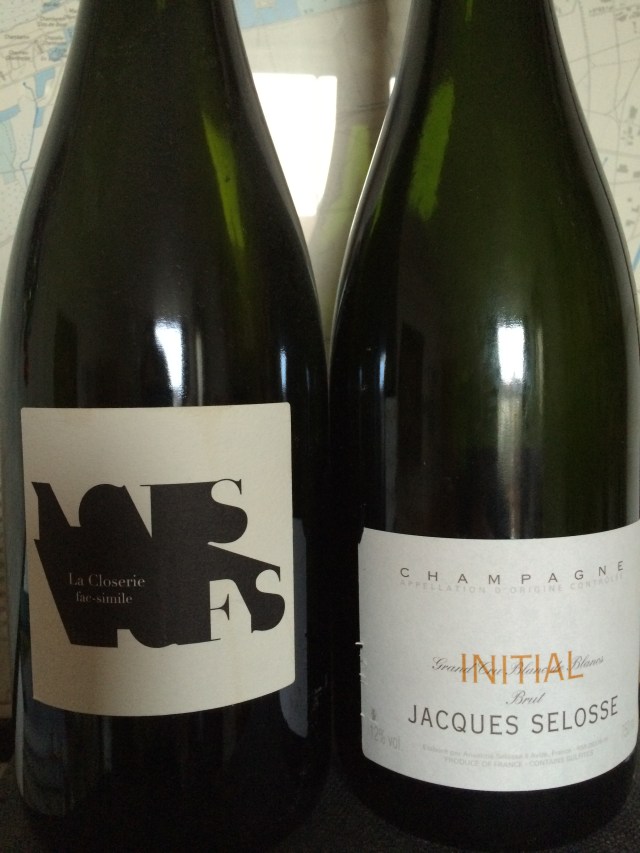
Fac-simile is Jérôme Prévost’s wonderful rosé, one of the finest in all Champagne. Initial is Selosse’s entry level cuvée, which costs not much less than many a “prestige” 

I don’t plan to go through all the producers visited in the book, of which there are not that many. Actually, Walters reckons that the really good grower-producers can be counted on your fingers and toes. I think he’s being a little unfair, and this is where Peter Liem’s book comes in handy. He lists more, in particular a new band of quality-focused growers who are trying to make this “grower movement” into the grower revolution that it half promises to be. It would be impossible to talk about this movement, however, without a visit to Anselme Selosse, the “most significant figure in the great grower movement” (I like Walters’ modification, adding the word “great” to distinguish the stars).

Selosse, according to Robert Walters, was always an outsider as a child, and had a difficult upbringing. This led him to go away to school from age twelve, and to study wine in Beaune from age fifteen. It was a pilot ecology course at the Beaune Lycée which fired up Selosse’s passion, along with his discovery of the solera system whilst gaining work experience in Spain. It was his experimental nature, one of careful observation of the results of his actions, which led him first to abandon herbicides, and then to change his winery methods (abandoning filtration and the very important but still controversial technique of cutting back on the dosage, etc).

Selosse, and his impact, is a perfect reflection of how the region works in relation to the dominant houses and their grape growing suppliers. When his wines began to get noticed there was a lot of animosity. People didn’t like his challenge on quality and identity, because grape prices are high enough to make a farmer a good living, cropping high and keeping disease and pests down with synthetic products, without having to strive for perfection. He was accused of many things, including that he was “a fraud”. The “great growers” continue to face such animosity. One such producer I know a little (not one featured in the book) told me some of the things the head of a Grande Marque had said about these grower-producers at an event they were both attending. Arrogant and not pleasant.

Selosse, and all the other great growers for that matter, have always given credit to the Grandes Marques for creating a worldwide market for Champagne. Some of the negociants will (if grudgingly at times) credit these sought after growers with creating a renewed interest in Champagne as a fine wine, beyond the “festive fizz” image, as something more serious, and something to accompany food throughout a meal. In my view, these impacts have benefited the Grandes Marques, but some don’t quite see it that way. They merely see any idea of a “grower revolution” as a threat to their grape supplies, and their control of the market. This, despite the fact that growers in total produce a mere 5% of Champagne, and the “great growers” of the type we are talking about here produce a tiny proportion of that 5%.

I’d like to look at one final grower covered in Bursting Bubbles, Cédric Bouchard. Bouchard is in many ways the archetypal exemplar of the methods we are focusing on. His production comprises, with every wine he makes, of a single grape variety from a single plot. It comes from a total focus on terroir, allied to complete perfectionism. He looks for richness in his wines, and to achieve this he crops insanely low for the region (c26 h/hl in some cases), without any chemicals. This gives him ripe grapes (with potential alcohol of at least 11%, sometimes as high as 13%, where levels for Champagne are more commonly around 9% before chaptalisation, as Walters points out).

Bouchard clearly makes wine first and Champagne second. He tells Walters that he’d rather make still wine but he hasn’t yet been able to produce still wine of a quality sufficiently stunning for his perfectionist approach. Bubbles, he suggests, just get in the way!

I want to use a quote from Bouchard in Bursting Bubbles which for me sums up the region perfectly. “The great problem with Champagne is very simple. You have over-production and it’s a great pity, because we have…an enormously important terroir…when people have in their minds mostly money…it’s hard to see this situation changing”.
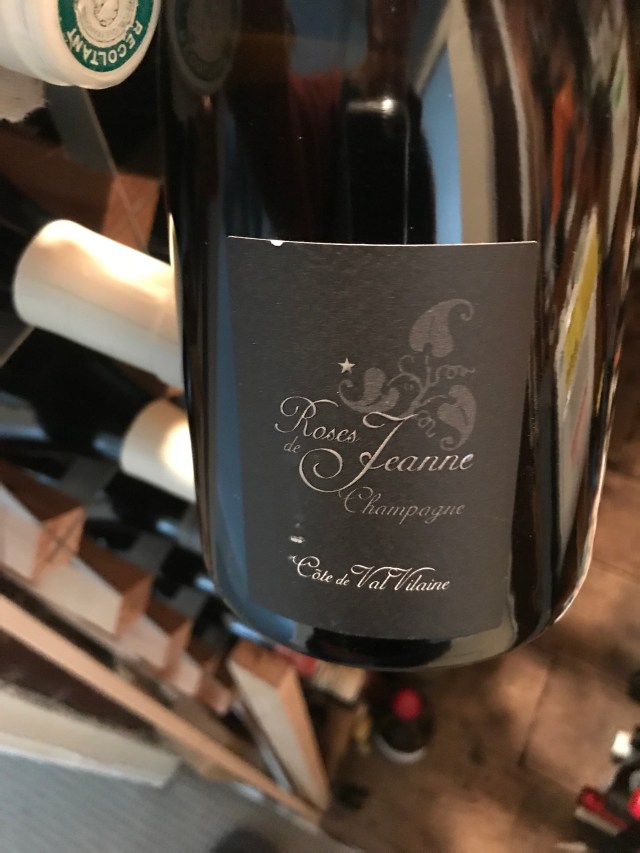
47706D85-0874-4B41-8C1F-520A52A2A24F

Côte de Val Vilaine comes from a 1.4 hectare plot of Pinot Noir at Polisy, and was once called Inflorescence

The fear is that this movement, of which Prévost, Selosse, Bouchard and others are part, will fizzle out. Many vested interests would very possibly like that to happen. Despite the obvious benefits of having a group of producers in a bright spotlight, bringing kudos to a region for their “fine wine” interpretations of the genre, they are too often seen as a commercial threat, which is ludicrous. Perhaps it is more the challenge to the way in which Champagne is produced by the majority, and the challenge to the whole philosophy behind this sparkling wine, which really upsets people – it hits a raw nerve.

I’ve only really given a flavour of Bursting Bubbles here. There are also chapters on Champagne Myths in which Walters burst a few more bubbles, which I shall allow readers of the book to enjoy on their own. Quoting Andrew Jefford again, “No wine is promoted more pretentiously or mythologically than Champagne”.

Bursting Bubbles is, in my opinion, an important contribution to Champagne writing. It’s an easy read as well, less dense and technical than most books on the Region. As Walters says in his Introductory “Disclaimers”, it isn’t a wine guide. Nor, he admits, is it impartial, and nor is it intended as “an excercise in Grandes Marques bashing”. But it will without doubt help you to answer that question I posed, taken from Robert Walters himself, at the top of my article – What kind of Champagne do you want to drink?

My wife is currently reading a book by an American physician, Michael Greger, called “How Not To Die”. Perhaps you’ve heard of it? It’s a book which both advocates a plant-based diet from a health benefits point of view, whilst at the same time pointing out the very real potential harm to humans which can result from eating industrially farmed and chemically treated meat and dairy products.

This book would be likely to cause a number of different reactions, aside from that of “I’m not going to read that!”. First you might reject his arguments, possibly out of prejudice, or a refusal to consider their validity. If you are an American meat lover (EU regulation currently saves British consumers from some of the methods he mentions, which are outlawed within the EU) it is probably a tough read.

Second, you might read the book and leave with a nuanced viewpoint and a desire maybe to try a few of his ideas (eat more beans and pulses, for example). The third result might be a “Road to Damascus” experience, whereby you feel a light has been shone in a dark place. All of these possible reactions are equally valid for Bursting Bubbles. If you are happy with your bottle of NV Champagne at Christmas or on a birthday, fair enough. If your indifference to Champagne is based on it being, well, not quite a fine wine, then Bursting Bubbles might make you look again.

I think that for me, it is none of the above, purely because the inner geek in me got interested in (Great) Grower Champagne many years ago. My introduction was actually via the wines of Francis Boulard, Egly-Ouriet, Larmandier-Bernier and Pierre Péters, and my long standing passion for growers such as Bérêche is well known. I was lucky, because these wines were far more affordable back then, and I have been able to try bottles from all but a few of the more recent people to come onto the scene. Bursting Bubbles simply reinforces and focuses some of my views and experiences, yet does so in a clear sighted and entertaining way.

The heart of the problem is this. For there to be a “Great Grower Revolution” these wines have to be tasted by lovers of fine wine, or perhaps I should say by those who like their wine to be an expression of the place where it comes from. People need to be able to judge them as such, and appreciate their uniqueness within the world of Champagne. Yet with tiny production, and doubling or tripling of prices in the past several years, they are in some cases no less expensive than the prestige cuvées of the Grandes Marques with which they now compete.

It is also sadly true that where such wines do appear on the shelves of wine stores, or on the wine lists of hip restaurant-bars (especially in Paris), their sale is occasionally refused to mere mortals deemed not worthy. I guess they don’t like the cherry pickers, and Champagne is not alone in this respect, as anyone who has got prematurely excited at seeing some Overnoy on a list will attest when the bartender or sommelier says “no!”.

All I can say is that if you read Bursting Bubbles there is a fair chance that you will be enticed into spending even more money than you can afford on the producers Robert Walters mentions…and if you spend considerably more on Peter Liem’s “Champagne” book as well, then the damage may be considerably worse. I think that’s a good thing. These wines (I use the term “wine” very deliberately) deserve our attention. Walters has done a great job in shining his own spotlight here.

If you have got this far I’m certain you will enjoy the book, or at the very least it will make you think. I’m sure it will be a book I revisit fairly soon. I really enjoyed it.

Robert Walters, Bursting Bubbles (A Secret History Of Champagne & The Rise Of The Great Growers) was first published in Australia in 2016 by Bibendum Wine Co. This edition was published in the UK in 2017 by Quiller Publishing, RRP £18.99 (hardback).

My article on Peter Liem’s Champagne can be found via this link here.

Below, a small selection of Grower bottles from the archive, all worth exploring, as are dozens more, all trying in their own way to reflect a different aspect of Champagne terroir


Posted in Champagne, Sparkling Wine, Wine, Wine Books, Wine Writing | Tagged , , , , , , , , , , , , | 3 Comments

The Great German Pinot Noir Tasting

Pretty much every time I go to a Tasting of German wines we see a few reds tacked on to the end, and I suppose that’s how reds have been seen in the past when it comes to the UK market for German wine. This is not the case in Germany, of course. Though I’m loath to talk about the phenomenon in these terms, climate change has probably been kind to those wishing to produce red wine in Germany, and the ability to count on ripe grapes is increasingly feeding a culture that has transformed to drinking a lot more red wine at table.

There are many red varieties grown in Germany, from local varieties like Dornfelder, Lemberger and Frühburgunder to international grapes such as Syrah, and even pockets of Cabernet Sauvignon. But Pinot Noir, or Spätburgunder (labelling is a personal choice, and some producers as we shall see use both) has long been Germany’s most promising red variety. It has also been grown in Germany for over 700 years, planted originally in Rheingau, by the same monastic orders who established the variety’s nobility in the Duchy of Burgundy.

Germany has one thing going for it perhaps above all others when it comes to Pinot Noir, and that is terroirs. I use the plural deliberately. In Burgundy, the Cru system of classification allows for nuance between similar plots and lieux-dits to show through. In Germany part of the fun is in comparing the same variety from different regions. Pinot Noir is often called the “Red Riesling” for its ability to adapt to different terroirs and to express those terroirs in the glass.

F21E6635-84C3-4114-97BC-AD999472AEFE

Although a vast oversimplification, as well as the limestone of the Pfalz and much of Baden, you have major pockets of Pinot Noir grown on sandstone (Franken), volcanic bedrock covered in wind blown loess (Baden’s Kaiserstuhl Massif), and the Ahr Region’s famous slate, to name just a few highly diverse terroirs.

Another factor which I must bring up is clones. Dijon clones have increasingly been planted by serious producers of red wines, purely for qualitative reasons. That is not to put down the German clones, but the wines produced (even when taking into account terroirs), are usually very different. Some producers prefer French clones and some prefer the German ones (and even Swiss clones too, in the case of our final producer here).

And finally, another twist – a couple of the producers at this tasting have, like Fritz Becker who I visited last October in Schweigen (Pfalz), their finest Pinot Noir vineyards in France.

So when a taster asked a producer which Burgundy domaines he is trying to emulate (hopefully with his tongue in his cheek), you can imagine the answer. German Pinot Noir, or Spätburgunder, is distinctive.

So from this Tasting at Chandos House, off Oxford Street in London, a collaboration between Howard Ripley and ABS Wine Agencies, I think it is fair to say that people could take away a sense of that distinctive variety in German Pinot Noir, and also the leap in quality which producers have made across the board in the past decade. This, as far as I’m aware, was the first ever Tasting in the UK to consist only of German Pinot Noir. I think its time has arrived.

Eleven estates were showing their wines. Four from Baden, two from the Pfalz, and one each from Württemberg, Rheinhessen, Ahr, Franken and Ruwer. Almost a full house of red wine producing regions. There was not a single wine I did not like. I will save my own very personal favourite producer until last, one that ranks in my own top two producers of German red wine. The other wasn’t there, but if you’ve been reading carefully you will have deduced who that is.

MAXIMIN GRÜNHAUS (Mertesdorf, Ruwer)

I’ve known and loved Carl Von Schubert’s wines, with their equally attractive jugenstil labels, since the 1980s, but it is only in the past several years that I’ve been enjoying his reds. Carl’s Spätburgunder is grown in the centre of the Abtsberg, the estate’s finest site, on a plot where there is more topsoil, around a metre-and-a-half deep over the slate. He has a mix of German and French clones, and made his first harvest in 2010, when just a single barrique was produced. Yields are low, around 30 hl/ha, and the aim is to produce elegant wines which are mineral, and fresh.

Spätburgunder 2014 is a lovely wine with which to begin a Tasting, especially as the scent emanating from the glass is so beautiful. It’s a fragrant, lighter style, which one could call pretty, so long as that is not seen as damning with faint praise. It’s elegant as well…but definitely pretty too.

Pinot Noir 2015 is interesting. I only need to say once that 2015 was a hot vintage throughout Germany, as in France. But hot means different things when we are in some of Germany’s more marginal regions, and those of us who can recall the steely Rieslings from the Ruwer back in the day will know that this is not remotely a warm region to begin with. So there’s a deeper nose here and a bit more weight, but it’s not a big wine.

Pinot Noir 2016 was a cask sample, due to be bottled in May or June, and very promising.

I’ve not really made a quality assessment of these wines, have I. I am not going to argue that these are the most potentially complex wines of the day, but I will say that I like them a lot. There is always elegance here and, although the fruit is bright and fresh, there is subtlety too. I’ve written only positive things about the Grünhaus reds in the past, and tasting three together only served to reinforce my desire to drink them more often.


FÜRST (Bürgstadt, Franken)

The Fürsts began producing wine here in the Seventeenth Century, and that tradition carries on today. Weingut Rudolf Fürst is named after Sebastian Fürst’s grandfather. Sebastian now helps his parents, Paul and Monika, and their reputation grows by the year. This is based on attention to detail at the smallest level, and a recognition that they have some great terroirs to bring out.

Sebastian is now in charge of all the red wine production, having developed both his expertise and passion at Domaine Marc Kreydenweiss (Alsace) and Domaine L’Arlot      (Nuits). Despite a reasonably large holding of just under 20 ha of vineyard, production here is emphatically artisanal. Foot treading, barriques, minimal sulphuring, all aim to transfer the grapes into wines which display the nuance of the soils, mainly red bundsandstein with pockets of water-retaining clays, warm soils which assist ripening.

Spätburgunder Tradition 2016 comes from 100% estate fruit off 7.5ha of either younger vines, or lesser sites. Don’t discount it, it’s pleasant everyday drinking, and refreshingly light. Spätburgunder Bürgstadter 2014 is what they call their “village wine”. There’s a definite increase in depth and it represents good value at around £30 RRP.

There were three of the crus on show, conforming to the VDP Grosses Gewächs classification, which I suppose the organisation would like to be seen as a Grand Cru equivalent. Each of the next three wines represents a step up in quality.

Centgrafenberg Pinot Noir GG 2014 uses more whole bunches, and there’s great freshness here in 2014, as well as more depth and latent complexity. The GG wines do require ageing, perhaps at least a decade, and it is a big mistake to treat them as wines to open soon after bottling.

Schlossberg Spätburgunder GG 2014 comes from a walled vineyard, about three kilometres of walls protecting what is already a south facing site of red compressed sandstone. There is indeed a touch more ripeness, and the wine has a very appealing dusty or grainy texture.

Hundsrück Spätburgunder GG 2014 is made from fruit grown in the central part of the Centgrafenberg vineyard. When Germany botched its Wine Law in the 1970s, old sites like this were subsumed into the larger named vineyards, and Hundsrück had to be re-registered in recent years. But it is clearly a terroir of genuine class, again south facing, and producing ripe fruit with potential for great complexity. This is a fine 2014, but it should be given the respect of ageing, just like its Burgundian counterparts. Expect to be divested of around £115 for a bottle.


JEAN STODDEN (Rech, Ahr)

The River Ahr is a Rhine tributary, 50 km south of Köln. As it is such a northerly wine region, it surprises some that of all wine regions in Germany, it is the one whose fame lies mostly with red wine (indeed, Stodden is not just a “Weingut”, it is a “Rotweingut”). It is also the region which has the distinction of it’s famous Greywacke slate, on steeply terraced hillsides, where the ripeness of the fruit derives (as with Riesling in the Mosel) from the reflected and stored sunshine and heat of the river and the vineyard (assisted in part by the terrace walls made from the same material).

It’s so warm there that some authors have used the term “Mediterranean” to describe the climate. I’m not sure it is quite like Tuscany, or Priorat, (perhaps it is?) but the region does see more than 1,500 hours of sunlight in an average year, and an average temperature approaching 10 degree celsius. It’s also a dry region.

Gerhard and his son Alexander run one of the region’s most highly regarded estates (the other is Meyer-Näkel), farming around 6.5 ha near Rech, with many vines over 80 years in age, some (on the Sonnenberg GG) ungrafted. Alexander was one of the first in Germany to use new French barriques (currently Tronçais oak from François Frères), but it is only the exceptional sites and the ripeness they give which makes this possible.

Four wines, in increasing price and complexity, were offered to taste. Spätburgunder 2016 is all estate fruit, aged in old wood. It’s pale and fragrant, simple and fruity. Like all the 2016s at the tasting, it was promising. Spätburgunder JS 2015 comes at quite a step up in price (from £24 to £38). It is aged in new oak and, although still a pale wine, it has a bigger, rounder, nose with more depth. You can feel the new wood but it isn’t too intrusive, although the ripeness of 2015 no doubt helps.

Recher Herrenberg Spätburgunder 2014 is fresher and benefits from an extra year’s age, but we are getting up to £50-a-bottle here. It still has a slatey intensity of dark fruits and their slight bitterness. Top of the range here was the almost £90 Neuenahrer Sonnenberg Spätburgunder 2015, one of Stodden’s Grosses Gewächs, but it’s quite a different wine. From lower down the river, where the valley is wider and there is more loess and less slate, it has a plumpness to it, and an extraordinary bouquet. It has a lot more body than I was expecting.

I generally find Stodden’s wines very different to those of Meyer-Näkel (which I know much better), but they are absolutely among the most interesting producers of Pinot Noir in Germany, and the Ahr style (to the degree one exists) is a benchmark contrast to much of the rest of the world’s efforts with this variety.


KELLER (Flörsheim-Dalsheim, Rheinhessen)

Klaus-Peter Keller needs no introduction, I’m sure. This estate was founded in the year of the French Revolution, but when I began drinking wine Rheinhessen seemed almost a sleepy backwater of industrial production. Now it is one of Germany’s most exciting regions. This is in large part down to Keller more than anyone else (without taking anything away from Philipp Wittmann in Westhofen).

Klaus-Peter is, of course, famous not for Spätburgunder, but for Riesling, some of Germany’s finest and most expensive. But as with Riesling (and the inexpensive Von der Fels), there is a red wine which offers amazing value. The red wine quality here is unsurprising when one realises that this Riesling genius interned at Domaines Armand Rousseau and Hubert Lignier, in Burgundy. His first barrels came from DRC.

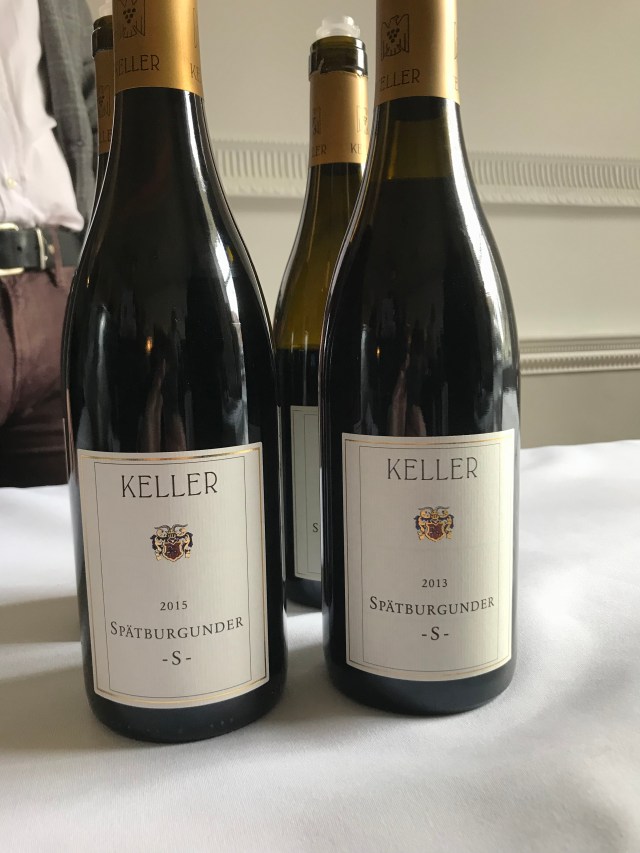
There are Grosses Gewächs reds, and Klaus-Peter even grafted some Pinot Noir onto old Silvaner in his treasured Morstein vineyard six or seven years ago, but Spätburgunder “S” is eminently affordable and well worth tracking down. 2013 (£29 RRP) is a fragrant wine which should peak in five-or-so years. It isn’t what I’d call tannic, but it does have a spine of fresh acidity, which seems precise, within it. 2015 (£35) is riper but there are similarities between the two vintages, which I’d put down to freshness and elegance. I said “riper”, but clearly Keller is avoiding any hint of over ripe fruit in a hot year. Like his whites, he’s aiming for the stars. I have this back to 2012, which tells you what I think. They will keep, the best vintages for a good decade if you wish.

A5F6B982-C7F9-421C-8BE1-EA22D452401D

WEINGUT BERNHART (Schweigen-Rechtenbach, Pfalz)

This is the first producer here whose wines I’d never tried, but the keen eyed reader will spot the fact that I know this village, having visited Fritz Becker here last October (yes, Fritz Becker is that other favourite German red winemaker). And if you read my article back in November you will also know that the producers of the border village of Schweigen farm their Pinot Noir, or certainly the best of it, on the hillside slopes over in France, in the former monastic vineyards of the Abbey of Wissembourg. Bernhart owns eleven hectares, of which 60% are over the border, in France.

There is a frustrating anomaly for producers of wine from these French sites. Although the grapes come from France, the wines are made in Germany and have to conform to German wine regulation. The German authorities won’t allow the producers to use the French vineyard names, vineyards which in France are arguably Grand Cru quality (were they under Alsace regulation). The growers of Schweigen have to find another way to label them. Some go for fantasy names, but the most common way is to use a single denoting letter.

There’s a basic wine here, labelled simply as Spätburgunder which in 2015 was very ripe, fruity and tastySchweigen Spätburgunder 2015 is the village wine, with a more high-toned bouquet, but again, fruity.

The quality leap comes with the single vineyard wines from the Sonnenberg, which range from £25 to £45 a bottle and, as such, are pretty good value. Spätburgunder “S” 2014 was described by Gerd Bernhart as an Erste Lage, a premier cru. It sees 50% new oak and has good mineral depth and a touch of salinity. Spätburgunder “R” 2013 is the reserve wine from the same site. It’s Gerd’s oldest parcel with vines planted in 1977. It sees 100% new oak, but that surprisingly doesn’t dominate, and there is lovely smooth fruit underneath.

Spätburgunder “Rg” 2014 is a parcel on the west of the steep slope which rises from the Abbey, called Rädling. This spends 18 months in new oak, and the oak here is more obvious. But the fruit is sweet, and the oak does enhance this.

I’m not so keen on 100% new oak with most Pinot Noir as a rule, but I can’t say that the wines here are not balanced. And they certainly represent good value.


WEINGUT JÜLG (Schweigen-Rechtenbach, Pfalz)

I’ve drunk Johannes Jülg’s red wines on several occasions, and it was the homely, atmospheric, Weinstube, which the family runs in the village, where we headed for lunch last year, after our morning with Fritz Becker. Whilst I think the previous producer, Bernhart, represents good value, I think I’d have to emphasise that value for money even more at this address. But it’s all personal choice.

Johannes is another German winemaker who fell under the influence of a Burgundian, in this case Thierry Brouin at Domaine des Lambrays. What he says he took from his time there was to look for elegance and complexity in his wines.

We begin, as at other addresses, with a Spätburgunder 2015, plain and simple (bottled under screwcap, like it Johannes!). Super fruity with a smidgen of spice, this is almost ridiculously priced with a RRP of £12.20 according to the sheet we were given. The reserve Spätburgunder “R” 2012 is from vines exclusively on the French side of the border. It sees a little new wood. A 2013 “R” hails from a cooler vintage, and I’d have to be tricked into using that old chestnut “mineral” here, despite that voice inside my head telling me I shouldn’t.

Pinot Noir 2012 is so-labelled  because these vines are French clones. The style is slightly meatier, but there’s great length and acidity to match. The 2013 version is noticeably different, slightly paler and brighter, as befitting a cooler vintage. The difference in labeling is wholly valid, and it’s nice in fact to see the two styles, “Pinot Noir” and “Spätburgunder”, side by side.

The Jülg wines may have less complexity than some, but they do have a vibrancy, and even with the oak, an approachability. The added bonus is that everything here comes at less than £40/bottle.


RAINER SCHNAITMANN (Fellbach, Württemburg)

Schnaitmann is a new addition to the ABS roster, and a relatively new member of the German VDP. Rainer is described as a dynamic young guy, “articulate, intelligent, caring, passionate, detailed (sic)”, a lot of praise. A shame I didn’t get to meet this former architecture student into music and art, as he shares some of my own interests outside of wine.

I’ve never tasted Rainer’s wines before, but the fame of this young man precedes him. Stephan Reinhardt wrote (in The Finest Wines of Germany, Aurum, 2012) that his Fellbach Lämmler Spätburgunder GG 2009 was rated by some opinion leaders “as highly as any other German Pinot Noir”, and describes him as “the most prominent and rapidly rising newcomer of the past decade”.

The wines really live up to that praise from Germany’s most knowledgeable wine writer. More than anything here, you get silky smooth wines with concentrated fruit, giving them instant appeal. Other tasters were impressed by their magic too.

Spätburgunder “Junge Reben” 2015 (£25) is from young vines in this ripe, warm, vintage. The colour is vibrant and the fruit is concentrated. Simonroth Spätburgunder 2014 is from older vines (45-50 years of age) from a single site. Again, the simple description “tasty” is all you need, really. There’s certainly a greater freshness here than with the Simonroth 2015, where the fruit is riper and the tannins softer. The opulence of the 2015 is really appealing, but then so is the freshness of the ’14. Both single vineyard wines here are recommended to be sold at £40, although I have mentioned the GG (not shown), which is presumably a little more upmarket in pricing.


KARL H JOHNER (Vogtsburg-Bischoffingen, Kaiserstuhl, Baden)

Karl Heinz and his wife Irene used to run Lamberhurst Vineyard in Kent, but they returned to Germany way back in 1985 to found their Baden domaine. Ever restless, in 2001 they also began farming in Wairarapa at the foot of North Island, in Neuseeland, where they spend about four-and-a-half months of their year.

Karl Heinz is one of the few German wine producers who openly admits his red wines aspire to emulate Burgundy, yet he is no copycat producer. In fact he’s fiercely independent, going his own way on so many issues. Their son Patrick is now working in the business and continues with the fine work being done here, especially with Pinot Noir/Spätburgunder.

Spätburgunder Kaiserstuhl 2014 is a fruit-driven entry level wine. Spätburgunder 2014 is off loess soils and is fresher. A 2016 cask sample of this wine (just ready for bottling) tasted very nice, with slightly more breadth. Spätburgunder 2015 (unfined, unfiltered, matured in wood, 20% new) was a richer version.

Pinot Noir Steinbuck 2013 is made from Burgundy Dijon clones, vines which yield bunches with lots of small berries, and which were planted in 1998. It has a slightly darker cherry colour, and still has some tannins.

The top wine on show was Spätburgunder “SJ” 2013. This is made from vines on the eastern side of the Kaiserstuhl, the volcanic massif which rises to just over 550 metres above sea level from the Rhine Graben, more or less opposite Colmar. This, says Karl Heinz, is their Grand Cru, though he’s way too independent to join any organisation which would allow him to label it as such. There’s a lot of concentration here, but there’s also a good degree of approachability.


HOLGER KOCH (Vogstburg-Bickensohl, Baden)

This is another estate at the heart of the Kaiserstuhl, where Holger farms 8.5 ha. His first love, when it comes to wine, was Bordeaux, thanks to a stage at Canon La Gaffelière under Stefan (Graf Von) Niepperg, in Saint-Emilion. Thankfully, Holger didn’t come home and graft all his vines over to Merlot. But he did return with a new found enthusiasm for terroir-driven wine, and he did replant the family vineyard with improved Pinot clones.

There is an interesting philosophy at work here, which differs from some of the estates making Pinot Noir in Germany today. It seems that Holger isn’t afraid of fashioning wines of power, although he looks for freshness too. Unlike some Saint-Emilion, the oak doesn’t dominate completely (which is just as well with Pinot Noir), and Holger has an experimental nature as well. The wines were shown by Holger’s wife, Gabriele.

Pinot Noir Herrenstück 2015 is one of the bigger entry level wines at this Tasting, and it has some structure too. The 2016 version of this wine was deliciously fruity. It’s also tighter and more precise, from what is shaping up to be a vintage of freshness all around Germany.

Pinot Noir * (one star) 2015 comes from a parcel within the Herrenstück, facing southwest. It’s quite different, with very acute freshness and concentration. Pinot Noir *** (three stars) 2015 is another step up. The parcel site here is at 370 metres altitude in a valley which is notably windy. As a result you seem to get the richness of the vintage from what is a south facing site, but tempered by freshness in the fruit, perhaps somehow the result of that wind. A nice wine. Nothing here appears to cost more than £40 (for the 2015 three star).


SHELTER WINERY (Kenzingen, Baden)

Hans-Berte Espe met his future wife Silke Wolf at Geisenheim. Hans-Berte cut his teeth in Oregon whilst Silke worked for the State Wine Institute in Freiburg, before they bought their Baden estate, which now comprises 5 ha.

Although this is not a “natural” wine producer, no insecticides nor herbicides are used on the vines. They believe in low yields and hand harvesting, with destemming, wood fermenting in cuve and ageing in a mix of new and old barriques.

Their five hectares is planted to 95% Pinot Noir, along with a little Chardonnay (the latter planted 2009), on soils of mainly loess over limestone. A young vine Spätburgunder 2015 starts us off. It sees oak, but 100% used, and it is still very fruit-driven. Pinot Noir 2014 gave a more elegant version of the grape variety, although there’s still a good degree of concentration. Pinot Noir 2015 has a high-toned bouquet and, for the vintage, is pretty elegant too. The cuvée labelled Pinot Noir is from their eldest vineyards, planted in 1977 and 1978.

It’s interesting that Kenzingen is over on the eastern side of the region and to the north of the Kaiserstuhl, close to the backdrop of the Black Forest. Here, they get quite cold winds which not only reduce the threat of disease, but also seem somehow to keep a certain freshness in the wines.


ZIEREISEN (Efringen-Kirchen, Baden)

The three Baden names we’ve tasted so far are probably not among the most famous in the region. Wine is a personal thing. There are some very well known and highly regarded names in Baden, mainly producers who group around the Kaiserstuhl. I’m thinking of Huber, Bercher, Dr Heger, and Franz Keller of Schwarzer Adler fame. But of all of them, Ziereisen is my own favourite.

Hanspeter Ziereisen and his wife, Edel, are only just Baden producers. Their 15 ha estate is only 4km from Switzerland, with vineyards actually overlooking the city of Basel. Hanspeter is a convert to a different way of doing things. He speaks with horror of how he used to chaptalise his wines, and his wines today generally have a good 2% lower alcohol than they reached in the 1990s.

Pinot Noir is a mainstay here, and indeed my introduction to these wines could not have been better, via one of the Jaspis Pinots many years ago. There are other varieties equally worth exploring, though. Hanspeter makes a really excellent Syrah in the Jaspis range (Jaspis is a selection of the best barrels for each wine), from vines planted in 1999. It has a Northern Rhône quality to it, a freshness.

Hanspeter’s vines are relatively protected from the north by the forests around Basel, but he places a lot of importance on the role of the Belfort Gap to the south, which allows ventilating winds to sweep up and over the vines, which grow at between 250 to 400 metres. These cooling winds slow down the ripening process. Seek out the Syrah if you can.

Also seek out Hanspeter’s Chasselas (known as Gutedel in these parts), which is a really thought-provoking wine, made with just short of a year on lees in large old wood. Chasselas is underrated, but its relatively poor reputation is largely justified in this part of Germany and over the border in Switzerland. Yet it is capable of something finer, whether on the terraces of Lavaux, in the finest Fendant of the Valais, or indeed in the hands of Dominique Lucas at the up-and-coming Vignes de Paradis estate south of Lac Léman, near Geneva (see my next article on Recent Wines). But here, it produces something different again, with quite rich stone fruit flavours and a touch of herbiness, allied to a frisky salinity.

But I digress, do I not! We are here for the Pinot. Spätburgunder Tschuppen 2012 is, for me at least, one of the very best sub-£20 reds you’ll fnd anywhere in Germany. A great every day wine.

We get a bit more serious with Spätburgunder Schulen 2015. Hanspeter achieves genuine freshness in a hot vintage, but it’s not just the wind. He told me that the thing they really learnt from the scorcher that was 2003 was canopy management. “The grapes should see the sun but the sun shouldn’t see the grapes”. 50-55% whole bunches also helped retain freshness, as did very gentle extraction, and this wine has just 13% abv.

Spätburgunder Rhini 2015, like Schulen, is off limestone, but in a part of the vineyard with plenty of clay and iron. In 2015 the wine is bigger than in the recent past, a little meaty even (in flavour as much as weight), but is still remarkably fine.

When we get to the three Jaspis wines on show we can see a very clear step up in quality, but don’t let that put anyone off the Schulen and Rhini, which fall into the £20 to £30 range, more or less. Jaspis Spätburgunder 2010 is a fine wine made from old vines (planted in 1958). 2010 was a cool year here in Southern Baden, but this is maturing nicely with a superb bouquet and spicy fruit. Jaspis Spätburgunder Alte Reben 2009 was my favourite wine of the day. It gets an extra three years ageing before bottling over the other version. There is a mere 12.5% alcohol here and it is simply gorgeous.

But what do I know? Hanspeter’s favourite is Jaspis Pinot Noir Alte Reben 2013. To me it was just less developed, but then I know the wines far less intimately than their creator. It’s still bloody brilliant though!

These wines are all wonderful. I know I’m rating this estate above some more famous producers, but I think that the enthusiasm, knowledge, experience, and sheer personality of Hanspeter and Edel do a lot to foster my preference. I’ve loved these wines for years, and this Tasting only served to cement my opinion. I’d love to get down to Efringen-Kirchen one day. Especially as I hear Hanspeter has some Chasselas under flor (is this true?).


I’ve no doubt that I have shown a degree of enthusiasm here for the Pinot Noirs of Germany which might raise an eyebrow or two among some (perhaps older) readers. Yet (and it’s not the first time I’ve banged on about this) German red wine in general is in the process of a transformation.

There are plenty of tasty, fruity reds from several varieties, and from pretty much all of Germany’s regions…yes, even the Mosel. There are also some very fine wines being crafted from Pinot Noir/Spätburgunder. They are never cheap, but then when compared to fine Pinot from around the world, they are often surprisingly good value. Please go out and try them, but do give the best of them the honour of some cellar time before you drink them.

My own, wholly personal, selection from the estates tasted would be Ziereisen, Keller and Maximin Grünhaus, from which one can purchase a spread of different wines at different levels, with a variety of drinking dates. In addition, I do want to explore the wines of Rainer Schnaitmann, and to drink some more from Johannes Jülg. Let’s also not forget Fürst, whose wines I’m inclined to pick off the shelf somewhere like Fortnums, as I’m innocently passing through the basement wine department.

I will finally mention that London-based German MW Anne Krebiehl delivered a couple of booked-out masterclasses during the Tasting on Monday afternoon. I was sadly unable to attend one. I’d have loved to hear her speak. Her MW Dissertation was on “The Future of Premium German Pinot Noir” and there is no stronger, nor more compelling, advocate for the German iteration of this variety. In my humble opinion, the future for German Pinot is very bright indeed.

Fürst, Stodden, Schnaitmann and Johner are imported by ABS Wine Agencies. Contact kd@abswineagencies.co.uk

The remaining producers are imported via Howard Ripley Ltd. Contact Sebastian.Thomas@howardripley.com

59BC1EBE-80AF-4C4D-8122-AC8ACAC39E13

Posted in German Wine, Wine, Wine Agencies, Wine Tastings | Tagged , , , , , , , , , , , , , , , , , , , , , , , , | 6 Comments

Recent Wines (February 2018) #theglouthatbindsus

I’m a little bit behind again with my regular pieces on recent wines drunk at home, so here I’ll mention just eight stars from February, along with a clutch of wines we drank last Saturday night (which deserve not to be left behind). I’ll try to get up to date with some more wines in the next ten days.

I was reading Andrew Jefford in Decanter’s “April” edition. He was talking about the takeover in Burgundy by the big corporates and billionaires, and how the knock-on effect spells the end of small artisans making top-vineyard Grand Cru Burgundy. It’s pertinent to this series on what I drink at home because once upon a time I bought so-called fine Burgundy. I own a tiny bit, and of fine Bordeaux too. My journey outside the box kind of began from Burgundy, when we decided, on our then annual visit to the Côte d’Or, that Arbois looked interesting for a day trip (we never looked back, I can tell you). But I rarely drink it these days, and have not bought any Burgundy, other than a little from young growers and micro-negoces like Le Grappin, for a long time.

Instead, I drink amazing wine of such variety, excitement and quality, yet which, whilst often quite expensive, costs nothing remotely like that of the wines I once used to stretch to buying. The first eight wines here are a perfect illustration of that. Sometimes I think my drinking just gets better and better, wines freed from the shackles of the required typicity and expectations of classical styles. Yet there is still majesty in the classics, as you will see in the pair that took to dinner last weekend (though neither were from Bordeaux nor Burgundy, I must try harder). The third wine, taken by friends, is very much a new classic.

Côtes du Jura Pinot Noir 2016, Domaine des Marnes Blanches (Jura, France)

In the past couple of years this domaine, from the Southern Jura, at St Agnès (just a few k’s north of Rotalier) has become a firm favourite among the group of people I drink with. I do keep repeating that they are Southern Jura’s rising stars. What I didn’t realise until recently was that Pauline and Géraud Fromont were in their early twenties when they set up the domaine in 2006 – I only discovered them about three years or so ago, when Winemakers Club began working with them.

Whilst their whites benefit from a while in bottle to achieve their potential, this Pinot is a palish version of the variety, with low (11.5%) alcohol. The raspberry fruit is adorable now, and it is soft and ever so slightly smoky. Others have suggested that their winemaking allows their wines to age, and perhaps this Pinot would be no different to the whites, given the opportunity. But there’s a rare freshness here which just makes me think it’s fantastic now.

D3BBC7E5-44C9-4F23-A0E5-32125D7C5F65

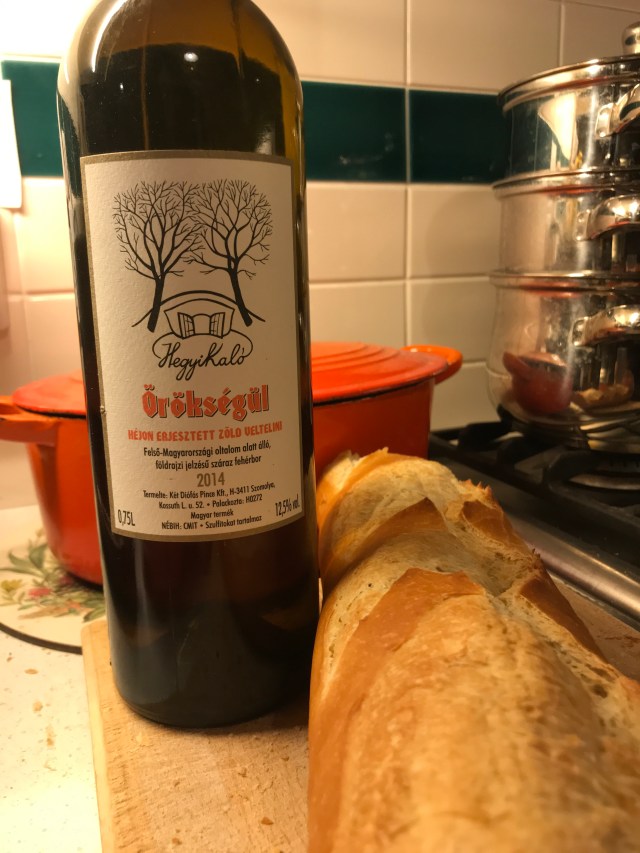
Örökségül 2014, Hegyikaló (Szomolya, Hungary)

Héjon Erjesztett Zöld Veltliner, or effectively Grüner to you and me. But with 60 days skin contact followed by a year in old wood. Golden-orange colour gives on to a bouquet and palate of honey and soft lemon. It kind of takes me back to some pleasant childhood memories. I say “soft”, but there’s a richness too, all underpinned with the texture of all that maceration, though it’s not intrusive.

I never know which is my favourite wine from Hegyikaló. Adam and Julia only make around 4,000 bottles a year, spread over several wines, but they seem equally gifted in all four colours. This wine is just brilliant, so long, unquestionably wonderful, and certainly my favourite…until I drink something else they made. This is the second of three wines sold by Winemakers Club here.

62625FE4-0D29-4C03-B6CE-E604BC1A3977

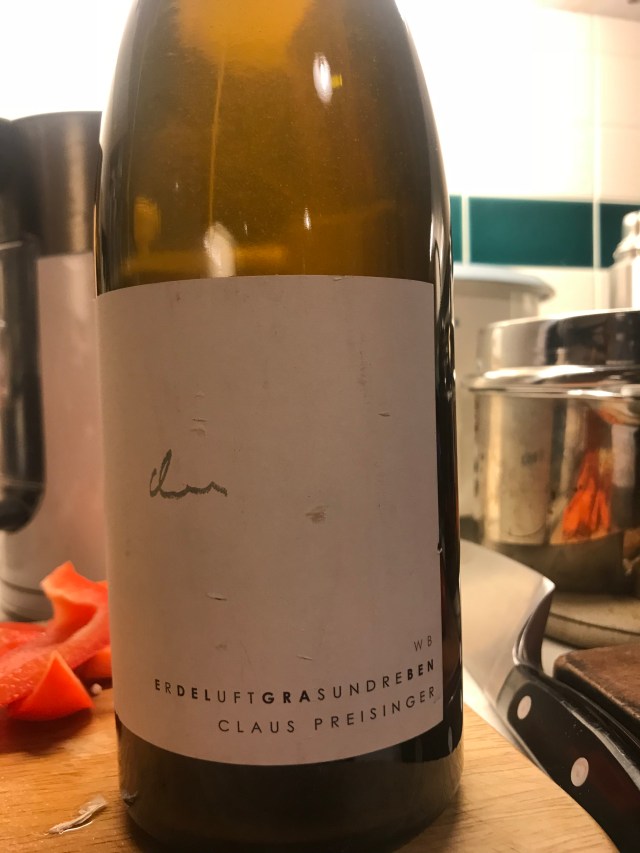
Weissburgunder Erdeluftgrasundreben 2013, Claus Preisinger (Burgenland, Austria)

You know Claus from Gols, up at the top of the Neusiedlersee, don’t you. Well this is the first of his orange wines I’ve drunk this year, and this 2013, with a touch of bottle age, was majestic. It comes unfiltered, and you can stand it up to let the deposits and sediment settle if you wish. Claus recommends that you shake it (like a polaroid picture, as the song goes), to enjoy it in its full, cloudy, textural, glory.

If you do decide to be brave, the flavour reward is complex, and you will certainly get more sour/bitter flavours. Nothing is obscured by the cloudiness. It’s rich, long, ever so slightly lactic, citric and probably karmic and cosmic too for all I know. But it ain’t no intellectual beast. Despite 13.5% abv on the label, it’s hard to put down. Almost a glugger! A serious wine, but with the life and joy of Claus’s cheaper wines.

Newcomer Wines at Dalston Junction bring Preisinger into the UK, and in fact he was one of their original producers back in the shipping container days.

1D96A0C7-B6A7-418C-BEBC-2745D25E6A45

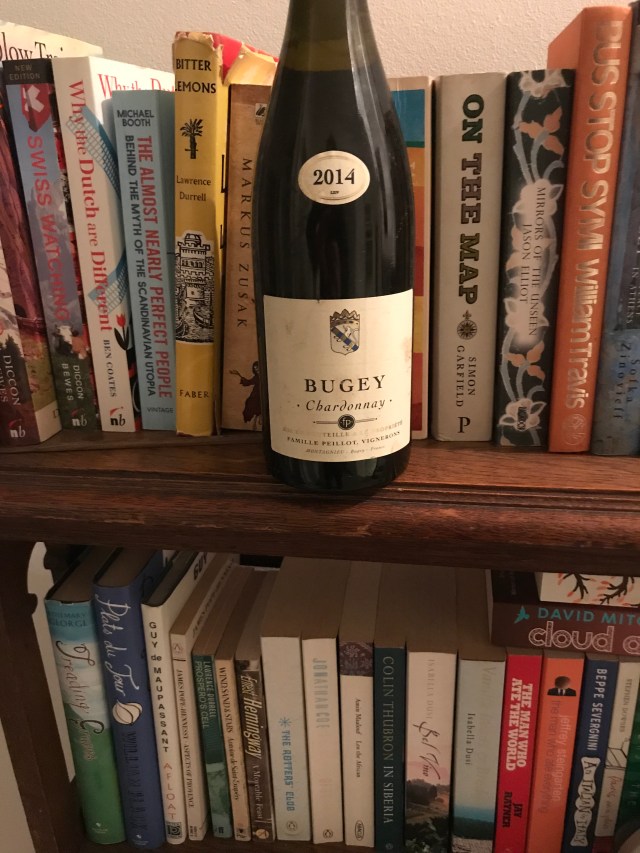
Bugey Chardonnay 2014, Famille Peillot (Bugey, France)

Pushing 2018 as the year of Alpine wines, this is another tasty Bugey, made by Franck Peillot at Montagnieu, which is thirty miles east of Lyon, where the pre-Alps begin, in the département of L’Ain. If you read Part 1 of my Raw Wine review published a little over a week ago, you’ll have read about another Montagnieu producer, Yves Duport.

This is pale for Chardonnay, but the nose clearly has varietal definition – you can tell what you are sniffing. It’s lightness carries through when you take a sip. It is balanced easy going, the acidity is fresh, and the alcohol is just 12% (low for a Chardonnay). I think you might make an educated guess that this is a mountain wine.

This was a sample from Winemakers Club (not a freebie, I did a swap with John as I wanted to try this). Peillot is probably better known as a bit of a Pinot Noir expert and, when it comes to white wine, for his Altesse, but this is an attractive Chardonnay. I’m not sure whether Winemakers will ship it? Vine Trail also sell some of Franck’s wines, but as far as I’m aware, not his Chardonnay. But it may turn up in the UK soon, as Savoie and Bugey get more publicity as the year goes on.

199F4549-887E-4F4C-A466-D6AB636CFD4F

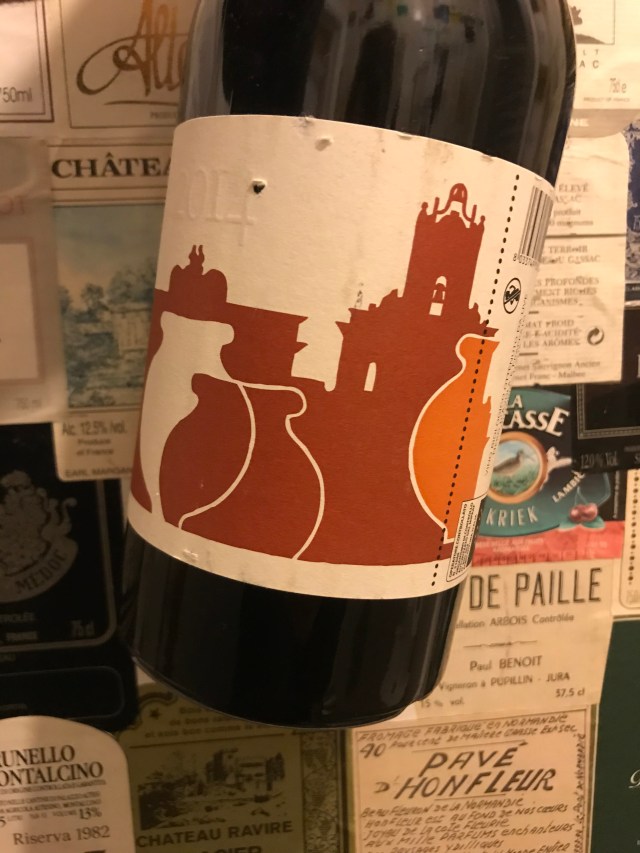
Pithos Rosso 2014, COS (Vittoria, Sicily, Italy)

The wines of COS go back a long way with me. We have history, one of seeking out these wines wherever I could find them. Although their Zibibbo in Pithos was one of my wines of 2018, I probably drink a fair bit less COS than I used to – there’s just so much that is new to explore. But every time I drink COS I remember how wonderful their wines are, and every time I drink this wine, I recall with utmost clarity why I got interested in amphora-fermented (in pithos) wines. Pithos Rosso was almost certainly my first.

The “pithos” in this case are 400 litre amphora, buried to the neck in the Georgian style. Into them go biodynamically farmed Nero d’Avola and Frappato grapes, the same blend, more or less, as the Cerasuolo di Vittoria of this part of Southeastern Sicily. Everything about this says terracotta, from the distinct whiff of brick dust on the nose, to the slightly bitter edge, to the concentrated nature of the dark and red fruits (morello cherry dominating). Then there’s the vibrant acidity which gives the wine such freshness. Finally texture, not a lot, but enough to slightly dry the tongue with a prickling sensation. Love it!

COS has always been, and remains, a stalwart of the Les Caves de Pyrene stable. I hear there’s some more Zibibbo in Pithos coming soon. Shhhh!

3BB7E615-75A2-4993-AC3A-AA682FA04D0B

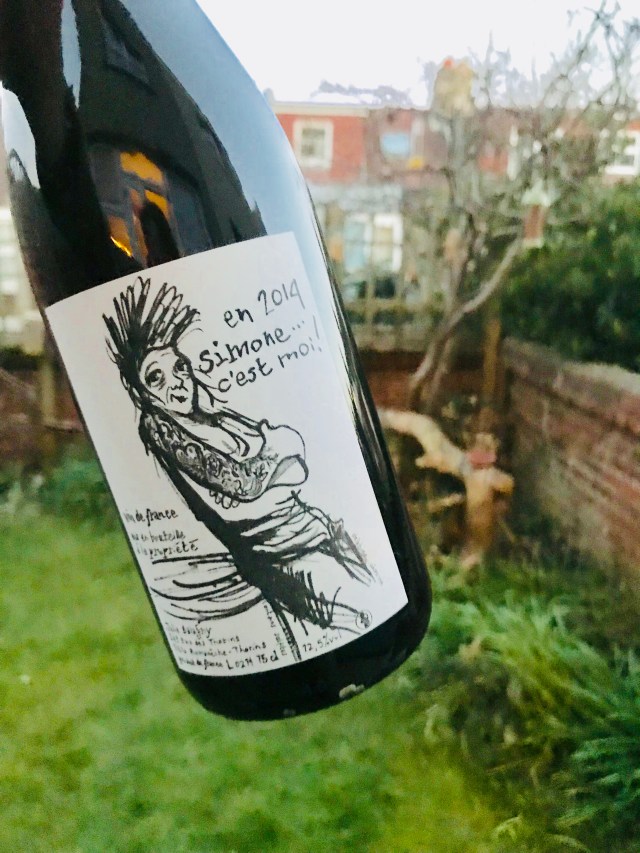
“Simone C’est Moi! 2014 Vin de France, Julie Balagny (Beaujolais, France)

Julie Balagny is a native of Paris, who somehow rocked up in Beaujolais in 2009 after making biodynamic and natural wine for others in Southwest France. She has a habit of being difficult to visit, and her wines are not easy to get hold of. I used to wear out the soles of my shoes in Paris before Tutto Wines began importing her, but the UK’s allocation is still pretty tiny.

Simone is unusual. It’s normally a Fleurie, but in 2014 the fermentation wouldn’t stop and it ended up being shipped in 2016 (if I recall?) as a Vin de France. It’s pretty pale, so it’s not a surprise to find the most ethereal scent of cherry rising like thin wisps of smoke from the glass, with strawberry joining in as you sniff deeper. The palate is soft and the wine has a calming nature. The acidity is perfectly judged almost as if, after all that extended fermentation, the wine said “ah, yes, that’s just right”. It’s damned near a perfect wine. I now have one bottle left…must share it. Is there a producer in the region whose wines I like more than Julie’s? Probably not.

C8A50AB4-08BA-4C27-BFDA-EF3FB889C830

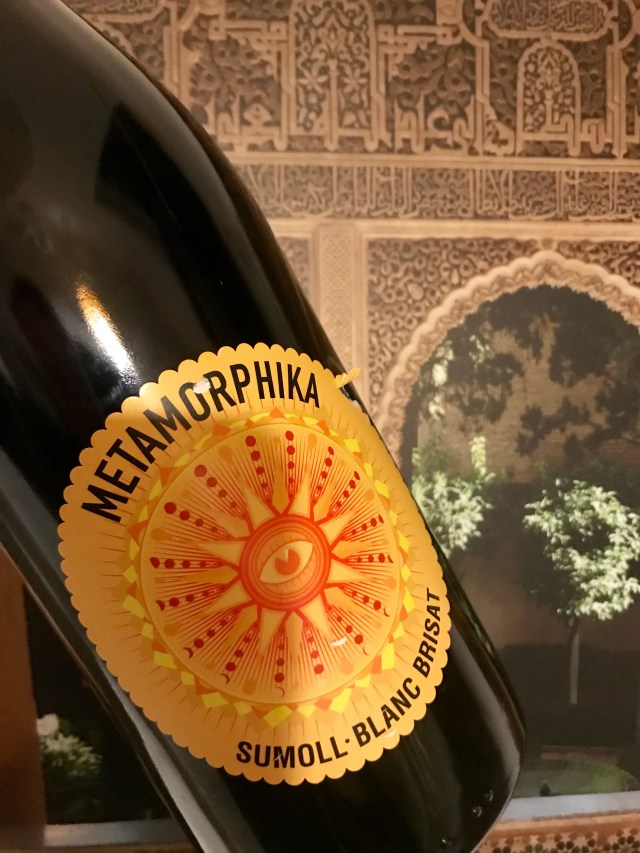
Sumoll Blanc Brisat 2014, Metamorphika/Costador Terroirs (Catalonia, Spain)

Here we are in Conca de Barberà, near Tarragona, up in the hills at 400 to 800 metres altitude. Sumoll is better known as a red variety making fabulous wines in Catalonia (try some), and occasionally vinified white as a blanc de noirs. This is the very rare vrai white Sumoll, from bush vines of about 80 years old. The grapes go into amphora for six weeks as whole bunches (so the grapes at the bottom are pressed by the weight of the fruit on top, as in Beaujolais sometimes). This makes for some skin contact, and a pale orange wine (“brisat” identifies skin contact in Catalan). The fermented juice then goes into 500 litre old oak for about seven months.

The bouquet is of flame raisins (sorry, pretentious but it just came out) and herbs (let’s not take it too far by being specific). The palate is quite different. It’s a little creamy and quite “mineral” at the same time, with a tad of citrus on the finish. Despite having skin contact in amphora, it tastes “clean”, and certainly mellow. Quite a wine for contemplation, despite coming in at a very low 10.5% alcohol. Otros Vinos is the man to see (well, Fernando Berry is his name).

5F62FF30-D93D-43BA-9E63-8A82EDC6AD5C

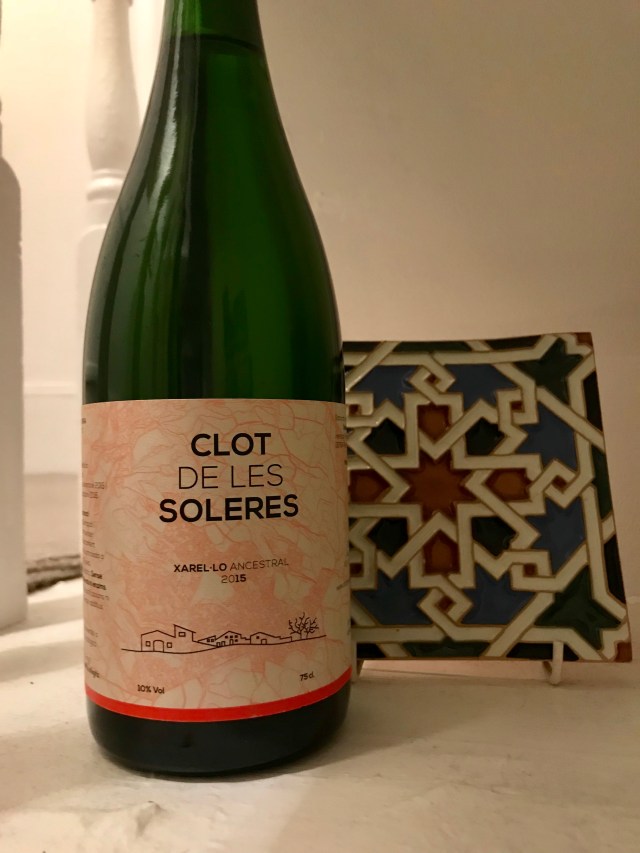
Xarel-lo Ancestral 2015, Clot de Les Soleres (Catalonia, Spain)

I first tasted this wine in March 2017, and in the intervening year it had lost none of its freshness, if perhaps a touch of its fizz, though as an off-dry wine with just 10% alcohol it might have made better summer sipping under the parasol than as an accompaniment to “the beast from the east” (which in the UK was a few days of late heavy snowfall, not one of Boris Johnson’s unhelpful quips about Vladimir Putin).

From Piera in Barcelona Province, it is a pure Xarel-lo, disgorged in October 2016. It’s completely natural with no added sulphur. The nose is quite grapey but if you were expecting any similarities to Muscat, not one bit. The palate has both richness and freshness, with the fruit being slightly candied with this level of sugar. The soils on which this Xarel-lo are grown are a mix of limestone and quartz, and I find it a little hard to dissociate that soil profile from the underlying structure and texture. It’s frothy too.

Clot de Les Soleres specialises in petnat wines, though not exclusively. As they are completely non-interventionists, each one will be allowed to turn out as it wishes, to do its own thing. This means you get different styles emerging every vintage and you just have to go with it. You can read about Carles and Montse Ferrer’s wines which I tasted at Raw Wine London 2018 in the previous article on this site. It’s another Spanish (Catalan) producer imported by Otros Vinos.

6674B35F-7BA4-4EE3-85A3-D96ECF9C517B


That’s the first batch of the “home consumed” wines, but as I mentioned above, we went to dinner in the New Forest again last weekend. The East End Arms is a nice old forest pub about fifteen minutes out of Lymington (just before you get to East End). It was bought in 1990 by John Illsley, bass player for Dire Straits, who wanted to preserve this lovely pub for the locals.

In fact the restaurant is pretty good, with nicely sourced ingredients, a step above “good pub food”, and it’s name has reached much further afield (I think it got a 9/10 from the Daily Telegraph, and they have rooms too). They were also able, with prior warning, to knock up three very good and inventive vegan courses. Those who have been reading my occasional pieces on New Forest dining should add The East End Arms to the list of restaurants to visit.

We were, as so often is the case, privileged to be allowed to take some wines. All three were right on top of their game, which is why they deserve a mention.

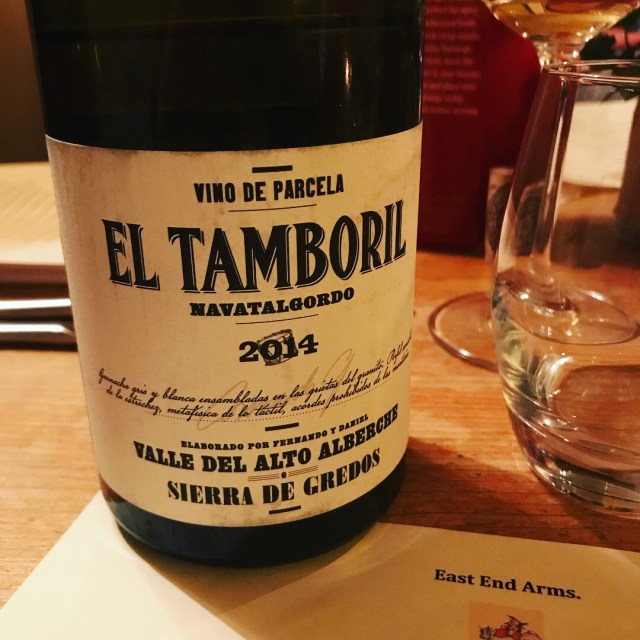
Vino de Parcela “El Tamboril”  2014, Comando G (Sierra de Gredos, Spain) – In the province of Avila, Fernando Garcia, Daniel Landi and Marc Isart got together a little over a decade ago to reinvent the classic wines of Garnacha (the “G”). I love those wines. They have become famous classics, but in some ways I like this white even more than the reds, perhaps for its rarity in coming my way. We are still with Garnacha here, just 90-year-old Garnachas Blanc and Gris. They are planted on a north facing slope of quartz-flecked granite in a tiny parcel (just 0.2ha), “El Tamboril”, at 1,230 metres altitude near the village of Navatalgordo. The great altitude, slightly water-stressed old bush vines and wild landscape produces late ripening fruit, which creates wines of genuine intensity.

1738DC51-DAC3-4EF5-941F-98EEF12AB2AF

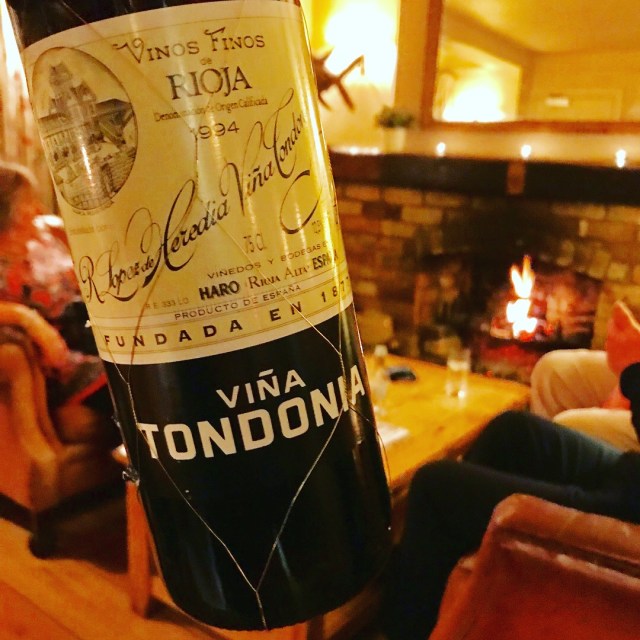
López de Heredia Viña Tondonia Rioja Reserva 1994 (Rioja, Spain) – Viña Tondonia is the flagship wine of the most traditional of all of Rioja’s great bodegas. Long wood ageing has given this wine, comprising around three-quarters Tempranillo with diminishing amounts of Garnacha, Mazuelo and Graciano, the organoleptic patina of an old mahogany table, cherished and polished for twenty-three years (don’t worry, it still looks deep red, not brown). Yet it doesn’t taste old, it tastes remarkably fresh. This is because wood at L de H is a seasoning, not the sauce that overwhelms the dish.

The 1994 vintage in Rioja produced wines capable of long ageing, and it has been said elsewhere that Viña Tondonia from this vintage is probably at the apex of that ageability. I think that despite the age of this wine, it has many years ahead of it. Alas, it was my solitary bottle from this vintage, although I have other Tondonia and Bosconia from the 1990s. Yet I will not complain about not keeping it for longer. This old wine was one of the finest classic bottles I have drunk for some months. Such experiences are genuinely moving.

51A73338-2E77-4B9B-ABC7-63D099CAADD7

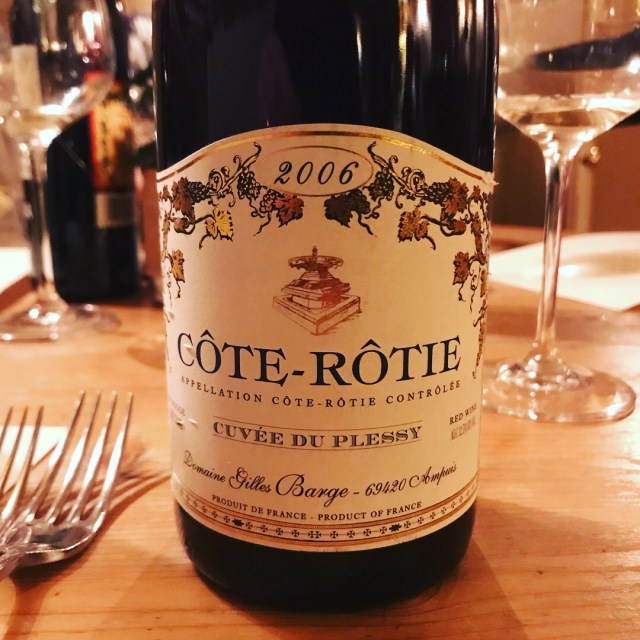
Côte Rôtie “Cuvée Du Plessy” 2006, Gilles Barge – I’d taken this as a backup for the Tondonia. Well, you never know, there have been some instances of perhaps poorly stored Lopez de Heredia wines on the UK market in recent years, as friends have experienced. We decided to open it anyway.

The Barge family is old school Northern Rhône. Well, not quite Chave longevity there, but making wine in the 19th Century, for sure. Winemaking is traditional, with tank fermentations before transfer to old oak of varying sizes. Cuvée Du Plessy is sourced from various parcels on the Côte Blonde, and the Syrah (vines now averaging around 50-years and older) has around 5% Viognier added. There is clearly lift and fragrance, which one presumes the Viognier enhances.

The bouquet of this 2006 cuvée is mature, but it doesn’t have any bacon fat or meat on it. There is a touch of peppery spice, but red berries dominate. It’s beautiful, that fragrance providing so much pleasure that you hardly notice the palate developing slowly as it breathes. I’d be pushed to say that it matched the Tondonia if forced to talk of relative quality, but that’s a pointless comment to make.

On its own merits this is a very fine wine indeed. I used to buy quite a bit of Côte-Rôtie, and I suppose that I slowed down when the wines I was buying went consistently over the £50/bottle mark. However, The Wine Society seems to still be listing the 2006 for £39-a-bottle. In terms of cost, it’s the bargain of the three wines we drank.

AFF09432-9A99-4543-8FAD-FF9E0E7DB7AB

I’ve still got several more wines to write up, but I’ll save them. Expect a second “recent wines” article in a week or so. Next up, we have Howard Ripley‘s German Reds on Monday, which I’m very much looking forward to.

Posted in Artisan Wines, Natural Wine, Wine | Tagged , , , , , , , , , , , , , , , , , , , , , , , | 4 Comments

Raw London 2018 Part 2

This is the second part of my selection from Raw Wine London 2018, the first part of which precedes this article. Here we have eleven more producers from the weekend before last’s event at The Store on London’s Strand. All but one are from Europe this time, it’s just the way things worked out I’m afraid. What I can say is that if you read on you’ll find one or two old favourites, but equally, some exciting new estates.

Finally, at the end of the Fair, I tasted some excellent Sake. Many readers will know of my interest in Japan, but I’m no expert when it comes to this wonderful product. Tasting such a wide range of styles here certainly broadened my knowledge and appreciation.

MEINKLANG (Burgenland, Austria)

Meinklang definitely fall into the “old favourites” category, and I’d without doubt place them in my own very subjective list of my favourite half-dozen Austrian producers. Their mixed farm is at Pamhagen, south of the Neusiedlersee, right by the border with Hungary.

What do I need to say for the few readers who do not already know Meinklang? Well, all their farming activities are biodynamic, they are at least as famous for their beef cattle in Austria itself, they make some wines from vines left wild (Graupert) and some in concrete eggs (Konkret), and they also have vineyards in Hungary, on the amazing volcanic cone of Somlò.

I know the whole range reasonably well, and have written about these wines many times, so I will concentrate on just four. Foam White 2017 is the new version of their excellent petnat. It’s actually more of a peach skin colour, rather than white. You have to revel in its cloudy frothiness, and freshness abounds. It’s a delicious wine, but there’s a variant on this petnat, Foam Somlò 2017. Here we have a wine with low pressure (around 1.5 to 2.0 bar), so that it is just slightly fizzy. The straight Foam is often made from Pinot Gris, but this Somlò version is 60% Hárslevelü and 40% Juhfark, two of the classic varieties on the Somlò massif. Fruity and soft but dry, this is exceptional petnat.

There’s a red version too, simply called Foam Red (2017). This sample was actually drawn from wine still fermenting, and it needs another two-to-three months. It’s an unusual blend of Gamaret and Blaufränkisch. Gamaret is a cross between Gamay and Reichensteiner, very common in Switzerland, especially in the vineyards of Geneva. It’s not a variety I’ve come across in Austria but here it adds a lot of fruit and a light touch. The wine is inky dark and Gamaret’s partner in the blend adds a touch of bitter, peppery spice. Even at this stage it’s delicious.

As well as their more elevated still wines, Meinklang produces a superb range of simpler varietal wines from their 70 hectares under vine. I’ve often come across these in restaurants specialising in vegetarian food, where they are an instant “go-to” on the wine list. But this wine is a blend I’ve not tried before. Blauburger-Pinot Noir 2017 isn’t in fact on the market yet, but for a simple wine it’s quite majestic. It’s just delicious Pamhagen fruit, vinified simply. Whilst the Graupert wines are a little different and the concrete eggs make wines of genuine energy, don’t discount trying Meinklang’s range of simple varietals and blends when you want something a bit cheaper.

Meinklang wines are available via Winemakers Club and one or two other retailers and importers.

ALEXANDER AND MARIA KOPPITSCH (Neusiedlersee, Austria)

Of all the Austrian producers at the wine fairs I go to, the Koppitsch family are perhaps one of the least well known in the UK. If I was attracted to their stand last year by some of their attractive labels, it was their beautiful wines which won me over. The wines are made biodynamically, and they are also proudly vegan (as all true natural wines will be).

The Koppitsch vineyards are right up to the north of the lake, at Neusiedl-am-See. The family has been farming here for 500 years, and Alex took over 5.5 hectares of vines in 2011. The aim is above all to express terroir through largely single-vineyard wines. There is no cellar manipulation, aside from a small amount of sulphur at bottling only for some of the “Authentisch” range (the orange wines see no added sulphur). As these wines are less well known, I’ll zip through all the wines Maria and Alex’s sister, Anna, had available to taste.

Zweigelt authentisch 2016 – dark, dense colour, sappy bitter cherry with good concentration and no added sulphur. 12.5% abv. The authentisch cuvées are all vinified either in stainless steel or old large wood, with the aim of leaving in the wine “lots of mineral character” and clean bright fruit. That’s what you get here. I’m a massive fan of Zweigelt like this.

Rot No 3 authentisch 2015 – a blend of Zweigelt, Blaufränkisch and St Laurent, a little less densely coloured than the pure Zweigelt but in the same vein.

Welschriesling Maischevergoren 2016 – skin fermented Welschriesling, two weeks on skins. It’s fruity and a little herby at the same time. The vines here are over 40 years old, off the famous limestone of the region, which is proving not only to be a perfect terroir for the Blaufränkisch variety, but proving here (and with others) that it makes for fascinating orange wines as well.

Gemischter Satz Maischevergoren 2016 – this is the Gemischter Satz blend turned orange. Although Vienna is the famed location for Gemischter Satz, with its very own DAC, the traditional field blend style can be found all over Austria. There are fifteen varieties in this cuvée, all picked together and fermented together. As is often the case, some varieties have never been identified. It’s a single site, planted in 1934 and rented by Alex. This is delicious, spicy, savoury, with a umami edge. A wonderful alternative GS.

Weissburgunder unfiltriert 2016 – stone fruits, a touch of apricot perhaps, great mouthfeel and texture.

Blaufränkisch unfiltriert 2015 – two yerars in eight-year-old barrique, there’s a lot of structure and depth, making a wine which will age well. There is some of the richness of the vintage, but with none of the wine’s definition taken away.

Pretty Nats 2017 – this is a Blaufränkisch petnat vinified pink, with no sulphur added. Off limestone, some of the qualities of the variety vinified red come through. It’s basically dry and packed with fruit. On my list! They also make versions from Pinot Noir and St Laurent, I believe.

Grüner Veltliner 2017 – amazing fruit, a kind of soft and gentle pineapple. A “must try” wine, if I can find a bottle.

Sauvignon Blanc – I think this was a 2017. The nose seemed a little reductive to me, but the palate was really concentrated. It was nicely balanced, not too much acidity.

I also tried a very pale Rosé autentisch 2017 blending the usual Burgenland triumvirate of Blaufränkisch, St Laurent and Zweigelt, which had an adorable sweet scent, and finally Zweigelt 2015. This had seen two years in 500 litre oak, and has a truly concentrated bouquet.

When I met the Koppitschs last year they had no UK importer, but they have since been picked up by Jascots. They deserve to begin to become much better known in the UK.

MAGULA FAMILY WINERY (Malokarpatská, Slovakia)

Vladimir and Lucia Magula’s wines were completely new to me, but I’m pleased to hear that they are joining the excellent Basket Press Wines portfolio very soon. They farm six hectares on alluvial soils and chalk and they don’t buy in any fruit. Their plan is to aim for expansion to 15 hectares, in a region of very low rainfall, which lies to the southeast of Czech Moravia. Their vines lie in two valleys, one producing wild wines (hence “wolf”) and the other, more gentle wines (“rose”).

Welschriesling 2016 is vinified in stainless steel on fine lees for seven months, bottled with only 14 mg/l of sulphur. It’s very characterful, but a gentle wine.

Oranzový vlk 2016 (orange wolf) is their only orange wine, with a nice label painted by Lucia’s sister. It blends a third each of Welschriesling, Grüner Veltliner and Devin (an autochthonous variety). It has a lovely bouquet and the kind of unusual and fascinating personality which has to be tried.

Frankovka 2014 was the first vintage of their Blaufränkisch I tasted. 2014 was as cold and wet in Slovakia as in Austria, but this is developing nicely as a subtle fruited red. Apparently it didn’t taste as they had wished a year ago, but in the last twelve months it has blossomed. The 2015 version is also very good, but different. It was actually an unsulphured sample (because adding sulphur would have put the sample totally out of balance for tasting at Raw). The fruit here is really good, without any overweight characteristics of a very hot vintage.

Frankovka “unplugged” 2015 is made from the same grapes but they are never touched by anything mechanical. Stems are included in the fermentation and it is aged on lees, giving a wine of gentle cherry fruit with a dusting of pepper. Vladimir said this is his “dearest baby”.

Carboniq 2017 is a youthful and simple wine made from Blauer Portugieser by carbonic maceration. Expect a Gamay-like red of 10.5% abv with very juicy, sappy, fruit. We will be tasting a Czech Blauer Portugieser later, but this part of Slovakia is well known as home for a variety which sounds as if it should be grown a long way to the west.

As a first foray outside the Czech Republic, the Magula wines will be a really excellent addition to the Basket Press Wines list.

BATIČ (Vipava, Slovenia)

Miha Batič carries on the tradition of 16th Century monks who made wine from this property at Sempas, near Nova Goricha in Western Slovenia, not far from the Italian border.

Only three Batič wines were on show, and I tasted the Batič Rosé 2015 and Angel Batič Rezerva 2011. The former is made from Cabernet Sauvignon and comes in one of the most unusual bottles on the market . It’s a shape that only a photo can describe (see below), rather like something I might come up with if I attempted to fashion a fluted bottle shape on a potter’s wheel. It doesn’t please everyone, but from experience I know it gets quite complex as it ages (I’ve purchased it a couple of times before as well as tasting at previous Raw events).

Angel Rezerva is the classic wine from Batič, a very special wine from a unique terroir. The Vogersko Hill near Brdce is surrounded by forest and well protected. Low yields produce a concentrated orange wine from around 40% Pinela, 20% each of Chardonnay and Malvazija, and lesser amounts of Retula, Laški Rizling, Zelen and Vitovska. Apple pie with ginger comes to mind. It’s a wine with immense potential to age.

I used to buy these wines from another source, but I see they are now imported by an agent I don’t know, World in Bottles.

143A4E83-7BFC-4580-8273-0ED424BEB1C5

DOBRÁ VINICE (Moravia, Czech Republic)

The USP for Petr Nejedlik’s wines is his five buried, unglazed qvevri of 1,000 litres capacity, although some wines are also made in oak barrels. Petr was the first winemaker in the Czech Republic to make wine in these amphora. Although uncertified, Petr uses organic methods and some biodynamic preps. The vineyards are mostly in the Podyji National Park, around Znojmo.

I began by tasting a nice blend of Chardonnay, Pinot Blanc, Pinot Gris and Pinot Noir (vinified white) called Quatre Cuvée 16 (2016) before moving on to a couple of more serious orange/skin contact wines. Velinské Zelené Qvevri Georgia 2012 sees nine months maceration on skins in qvevri. There’s plenty of texture resulting, but also amplified fruit acids, so the wine has a refreshing quality. Chardonnay Qvevri Georgia 2013 has a similar vinification, but is bigger in the mouth, with even more texture. Both wines benefit from age here.

Kambrium Cuvée 2014 is an attractive savoury blend of Veltlin (Grüner), Rizlink (Rhine Riesling) and Sauvignon Blanc. You get a hint at the qualities of each component, where the fruit is gooseberry, the spine is firm and the seasoning is pepper. I had already enjoyed this wine this year at the Plateau Brighton Tasting of Moravian wines (2 February article).

I missed out on the petnat, a blend of 60% Pinot Noir with Rhine Riesling…it was sadly all gone. I did however enjoy Petr’s Blanc de Blancs 2015 which he makes from Chardonnay, Pinot Blanc and Pinot Gris, very fruity. My knowledge of Czech sparkling wines grows by the week, and there is a lot of potential, it seems.

Last up, VDC 2015. Velké Dobré Červené is a late harvest wine made from Pinot Noir, Zweigeltrebe and Frankovka (Blaufränkisch), with the Pinot Noir vinified in qvevri and the other varieties in oak. It’s a red of structure, tannin and concentration. It wasn’t my immediate favourite from this excellent producer, but I’d like to try it with a bit more age. It so obviously has more to give.

Dobrá Vinice are on the roster of Basket Press Wines, of course.

VINARSTVI JAROSLAV OSIKA (Moravia, Czech Republic)

Jaroslav Osika is one of the founders of the natural wine movement in Moravia. The winery is tiny, with just 3 hectares under vine at Velké Bílovice in the far south of Moravia (we are 45km southeast of Brno and 80km northeast of Vienna). He doesn’t speak a word of English, and although these wonderful wines speak for themselves, I was pleased to have Jiri of Basket Press Wines on hand to translate.

I really do love this producer. It is probably in part because the techniques used here, long ageing in tandem with oxidative winemaking, remind me so much of the wines of the Jura Region in France. But there is nothing copycat about them.

Chardonnay 2012 is left on skins for six months, after which the juice stays on gross lees for a while before two years on fine lees in an old barrel. The wine shows 14% alcohol and is extremely rich (2012 was a warm vintage here). The oxidative quality is very much to the fore.

Modry Portugal 2016 is an Osika wine I tasted at Plateau Brighton at the beginning of February. Modry Portugal is the Moravian name for the Blauer Portugieser grape we came across in Slovakia (Magula’s “Carboniq”, above). It’s made in used wood, but then goes into fibreglass tanks, which helps retain freshness before bottling. Deep colour, crunchy fruit, a bit denser than the previous version of the variety, this is maybe a wine to glug slightly cool, or to pair with charcuterie and olives. I actually liked it even more on second meeting.

Pinot Gris 2015 starts its vinification with three days on skins in large oak (10% unbroken grapes are then added), is left for two-to-three months, then aged 21 months on lees. It is delicious. There’s no bitterness, just amplified fruit turned up to “11”.

Pinot Chardonnay 2014 is 60% Chardonnay/40% Pinot Gris, an interesting blend made slightly nutty in an oxidative style. Jaroslav then pulled out a couple of younger Chardonnays from 2013 and 2014. The 2013 was fresher, from a cooler vintage. It made a nice contrast to that rich 2012. For me it’s good to see each vintage appearing different to the others. What matters is what nature gives, not what the winemaker imposes. This is Jaroslav’s philosophy, but also that of all great winemakers.

Last of all there was a Gewurztraminer 2016, the youngest wine from Osika. It showed plenty of varietal character on the nose, but is much more mineral and less floral than what one might expect from Gewurz. It seems effectively dry, but there is a touch of richness as well. Alcohol comes in at 13%.

DOMAINE LIGAS (Macedonia, Greece)

Jason Ligas is the winemaker at what is very much my favourite Greek estate, but the wines are generally shown by his sister Meli, who lives in Paris. There are five autochthonous varieties grown: Assyrtiko, Kidonitsa, Xinomavro, Limniona and Roditis. Super-natural, Jason farms using the “Fukuoka” method (after Japanese farmer-philosopher Masanobu Fukuoka) of so-called “no-act” science. The vines are pretty much left to do as they wish (no tilling of the soil, no sprays etc) on the beautiful Paiko Mountain in this part of Northern Greece.

I tasted six wines this year. Kydonitsa Barrique 2015 sees a month’s maceration on skins, producing a deep orange wine which combines both texture and genuinely thrilling freshness. Roditis Barrique 2015 is a bit less orange, and even fresher all round. Very exciting stuff.

Xi-Ro 2015 is made from very gently extracted Xinomavro giving a red that is deliberately low in tannins, intentionally “drinkable” and in this context a total success. Pata Trava 2016 is a very different take on Xinomavro – as an orange(ish) wine. It’s quite dark in colour, perhaps as this was a warm vintage, even though it was directly pressed. But it only has 12.5% alcohol, and I was thrilled to find a bottle of this at the Burgess & Hall popup shop.

Lamda 2016 is a skin contact Assyrtiko (which is generally my favourite Greek red variety). It only sees four hours on skins before fermentation, but the vines are grown on pergolas. This makes for thin skins and the pigment is concentrated, so it doesn’t take a lot of extraction to get the colour. A fascinating “Vin de Table”.

Finally, a sip of Bucéphale 2016, presumably named after Alexander the Great’s beloved horse? This is a Xinomavro once again, but here vinified so as to make the kind of Xinomavro you are more likely to have come across. After a year in barrel it is a dark and concentrated red with amazing scents of olives and tasting of dark summer fruits. It’s only made in the best vintages.

Every wine from Ktima Ligas is different, and every one I have so far tasted is a gem. These are special wines, even in the context of all of the producers at Raw. They are part of the very dynamic portfolio at Dynamic Vines.

VINOS AMBIZ (Sierra de Gredos, Spain)

Fabio Bartolomei, son of Italian parents who emigrated to Scotland, is one of my favourite small “Spanish” wine producers, and if you read my Blog anything like regularly you’ve probably read a good bit about him already. No chemicals are used in either vineyard nor winery (which happens to be the big old co-operative cellar at El Tiemblo, which I imagine dwarfs Fabio’s small operation).

Fabio champions some very little known local varieties (like Doré, Malvar and Chelva along with Airén and Albillo), but he also uses more famous international and Spanish varieties (Sauvignon Blanc, Tempranillo, Garnacha). He’s also keen on amphora. When I somewhat ignorantly asked him where he sources these terracotta vessels, he told me they are just lying around the village. El Tiemblo used to have a amphora factory, which closed down in the 1950s. Apparently he picks them up fairly cheaply.

There were a lot more wines on taste than the three listed in the event catalogue. Anything here is worth grabbing if you see them on a shelf (Otros Vinos is the importer, or try Furanxo near Dalson Junction on Dalston Lane, or Burgess & Hall over in Leytonstone/Forest Gate, E7).

Malvar has a ten day skin maceration before going into amphora, and has decent tannic structure, even for an orange wine. Sauvignon Blanc makes a unique wine. Two weeks maceration before amphora, very high-toned with a herbal, even medicinal (but in a good way)…I did say unique, emphatically so.

Airén 2016 has a less dangerous personality for the more sensitive drinker. It has no skin contact and is made in stainless steel. Doris 2016 is one of my personal favourites (unfortunately it’s currently the only Ambiz wine I own). Made from the Doré variety, it gets just two days on skins in stainless steel and it has a slightly bitter texture. Nice label too!

Or do I prefer Alba? Two days on skins here is supplemented by amphora ageing. You get herbs, butterscotch and a lot more. It sounds unusual, and it is, but it’s also sheer genius if you just go with it.

The New Wave Girl 2017 is my first taste of this new wine. 90% Albillo and 10% Malvar, two days on skins again and then six months in amphora. It was one of the best wines on the stand. But it was topped by the craziest juice I drank all day, Tempranillo Carbonica 2016. It almost tastes like very funky fruit juice more than wine, but totally concentrated. I thought I’d bagged the last bottle at Burgess & Hall, but I stood aside for an Aussie whose birthday it was, and he was flying home the next day. Hoping one will come my way soon!!!

Finally, Garnacha 2016, a single vineyard wine fermented in stainless steel and aged in old oak for ten months. Proof that Fabio can turn his hand to something relatively traditional as well as the edge of the world stuff. I’m sure he’d think I was nuts to say it, but there’s certainly a touch of genius about Fabio’s winemaking. And bags of creativity too.

CLOT DE LES SOLERES (Catalonia, Spain)

Clot de les Soleres is the creation of Carles and Montse Ferrer, who took over family vineyards on the edge of the Valls de l’Anoia, not far from Barcelona, in 2008. They make a range of wines, specialising somewhat in a variety of petnats where they let the fermentations do their own thing. Nothing is done in the winery, pretty much, and certainly no sulphur is added.

Xarel-lo 2014 is a delicious example. It’s more like a still wine with a little CO2. The 2015 version didn’t even finish fermenting so it has some residual sugar, off-dry but with a spine running through it giving some tautness.

Don’t particularly expect “varietal definition” from Chardonnay 2015, but it does have fruit underpinning an intense mineral character. Macabeu 2014 is very fruity, whereas the same 2015 has a tiny bit of CO2 in the bottle and a little residual sugar. It’s very fresh, and makes a pleasant and interesting contrast to the character of the Xarel-lo wines.

I tasted two wines made from the French interloper here. Cabernet Sauvignon Anfora 2015 is actually fermented in stainless steel before being introduced into amphora for 13 months. It has a really interesting take on the usual Cabernet bouquet, a sort of iron filings and blackcurrant blend of fruit and spice. Round, rich, fairly tannic and 14% abv.

Cabernet Sauvignon Rosé 2015 is very different, and also very appealing (to me, but my wine tastes get more debauched by the day). Off-dry and frothy, and even better than the off-dry Xarel-lo “Ancestrale” I had from these guys a week or so ago. As far removed from the Bordeaux model as you can get with the variety, bravo!

This is another estate on the innovative Otros Vinos list.

ANDI FAUSTO (Lombardy, Italy)

These wines were something very different, and another producer who garnered diverse opinions from those I spoke to. I was at one with the person who had recommended I try them. I admire people who go their own way, and for this reason I am going to recommend you at least try some of these admittedly high alcohol, concentrated, wines. Wines for meditation, undoubtedly.

The Fausto vineyards are near Pavia, so around 50km south of Milan and east of Piemonte, in the region of Oltrepò Pavese. Winemaking is based on long macerations, making wines intended for extended ageing. It is easy to bandy around phrases like “unique”, and I’ve done so for individual wines even in this article. But I’m including the wines of Andi Fausto here because the whole range fits the bill.

Ardito 2015 was my intro, a blend of Barbera, Bonarda and others with a whole year skin maceration. A big, concentrated wine with 15.5% abv, and the power of an Amarone, albeit from different grapes. Ascaro 2015 is more of the same, if a degree less alcoholic, and 100% Barbera.

Estro 2016 comes in at a whopping 16.5% alcohol (that’s what the bottle says, the tech sheet says 15.5%), though I’ll admit that on a small tasting sample it didn’t quite taste that alcoholic. It’s made from Moradella, Croa (Croatina?), Vermiglio and Uva Della Cascina, fermented (fermented!) for 12 months in oak.

Sottosera 2016 is a Barbera Riserva, produced only in “a great year”. Quite a whopper again, with 15.5% alcohol, but such sweet fruit.

Frodo 2011 (apparently no Lord of the Rings connection) is possibly my first ever 100% Moradella. This also has massive fruit, but tannin too. Built for the long haul.

Crinale 2000 was the oldest wine on show. It had fifteen years in barrel and has a palish colour, a very deep nose, and yes, I could tell it is a Pinot Nero, though you don’t get many coming in at 14.5% in Italy (California may be a better reference point). It contrasted with Originaldo 2015, not in alcohol content (identical), but in complexity, though this younger Pinot Nero wine has a lovely bouquet.

Finally Giubilo 2017. Here, I enjoyed tasting a very young sample wine made in a totally different style to the rest, a Pinot Nero ancestral method petnat which underwent no disgorgement. Pale peach skin colour, around 25g/l residual sugar at the moment. Or at least that was what I took down in my notes. The technical data I picked up describes this 2017 as a “classic method” spumante made from a blend “not disclosed by Andi”. And rather confusingly, it also states something I’ve never seen before…”there is a second disgorgement or, if requested, the bottle is left in the upside down vertical position to be degorged (sic) by the customer”. Er…?

I’ve rarely been so confused as I was by these wines. They are some of the most concentrated wines immaginable. The Pinot Noir/Nero seems to attain levels of tannin here which I’ve never come across with the variety, yet in all the wines the fruit is sweetly ripe and rich. I can fully understand the shock of some tasters, but for anyone who wishes to explore something genuinely different, this is somewhere to come. The wines were astonishing on many levels.

Andi Fausto currently has no UK representation.

OKANAGAN CRUSH PAD (Okanagan Valley, British Columbia, Canada)

Okanagan Crush Pad produces two ranges, named “Haywire” and “Narrative”. The powerhouse team behind this venture consists of winemaker Matt Dumayne, with owners Steve Lornie and the globetrotting Christine Coletta, along with Alberto Antonini as winemaking consultant and the star soil scientist Pedro Parra on drums…I mean, er, soils.

This is another producer I’ve written about a lot, but I wanted to catch up with Christine, to find out what they are up to, and to try a few new cuvées.

Narrative Ancient Method 2016 is 100% sparkling Pinot Noir which, like many of the wines from this region, is amazingly fresh. It sees nine months on skins, yet is pale and light, with only a little texture. Love it!

Haywire Gamay is always one of my favourite Crush Pad wines. This 2016 is a very fruity varietal, given a touch of interest from its time in concrete. Concrete is used widely here for fermentation and ageing.

The Haywire Free Form wines have much more skin contact texture. My favourite is Free Form Red 2016, which is Pinot Noir having spent eight months in amphora. The nose strikes a high note, with super fruitiness underpinned with tannin and texture.

A final shout for the quite extraordinarily different Haywire Waters & Banks Sauvignon Blanc 2016. Terry Waters and Cathy Banks own the small Trout Creek Canyon Vineyard from where this cuvée comes. After fermentation in concrete tanks it undergoes malolactic before spending a period of seven months on gross lees with no racking. This wine is very concentrated, with a mixture of linear citrus acidity and herby textural notes. A lovely white wine of personality.

There’s quite a bit of planting taking place, including more Gamay, Pinot Noir and Chardonnay, but also Chenin Blanc, which Christine says she’s really very excited about. I can’t wait to try it in a few years. Red Squirrel is the lucky importer.

UENO GOURMET SAKE (Japan)

Ueno Gourmet sells premium sake via its online shop, www.japan-gourmet.com and they had a range of sake to taste. Having tried a good selection of different styles of sake in Japan, I was surprised at the variety here. There was straight, clean and soft through to sake of great intensity. There was a sweetish sparkling sake, an amazing red sake (made from unpolished red rice), one called “Dreamy Clouds” which was indeed cloudy and quite ethereal, and then something the like of which I’d never come across, although I’m told it is common – sake flavoured with yuzu fruit.

The red sake was Kameman Red Rice, in the Junmai category, fruity with mild acidity and a medium-sweet flavour. The “yuzu” was technically a liqueur made by Fukuju. It has a high proportion of fresh fruit, and is light and clean but also intensely fruity. It still manages 14% abv. The slight bitterness of the yuzu comes through. I’d love both of these, the former to drink with food and the latter as an aperitif. Ueno Gourmet suggests using it as a base for cocktails or sorbets, the latter being a particularly tempting suggestion.

I’m not really sure of any UK distribution other than online. The man I tasted with suggested Harvey Nichols in Knightsbridge, but I shall also return to The Japan Centre (Piccadilly) at the next opportunity. But if someone can point me to a good sake selection in the UK, and indeed to a good sake book, I’d be most grateful.


Posted in Artisan Wines, Canadian Wine, Czech Wine, Japan, Natural Wine, Wine, Wine Agencies, Wine Festivals, Wine Tastings | Tagged , , , , , , , , , , , , , , , , , , , , , , , , , , , , , , , , , | 5 Comments

Raw London 2018 Part 1

So Raw has been and gone for another year. Raw Wine seems now to be a real community – a group of artisans who know each other, so the vibe is always friendly and buzzing. If anyone doesn’t know Raw Wine, it is more than anything a platform for artisans making low impact and minimal intervention wines and other beverages. All the wines at Raw are almost additive free (some producers add a small amount of sulphur to stabilise their wine), and most should be vegan friendly too, a fact which demands promotion.

9D5CBA87-3F4B-4964-BB03-688A814F35B2

The Festival seems comfortable in its new home for the second year at The Store on The Strand, which is central and very convenient to many of us. I attended on the Trade/Press Day (Monday), which only got crowded by mid-afternoon, at which point a few of the exhibitors were noticeably flagging. But Raw seems to grow in confidence and the vibe is always great, even when there’s a crush around the better known producers. Getting there relatively early, I had a chance to focus on tasting in peace, if not quiet.

There’s a decent food offering upstairs at The Store, which is another reason I like the venue. Retreating up there to take stock over a decent coffee allows a rare moment of relaxation amid the bustle of the Fair. At the end of the day it was especially nice to be able to pick up a couple of bottles from the Burgess & Hall pop-up shop. Forest Gate E7 might not be the easiest place to get to for out-of-towners like me (though having lived there for a few months in my distant past, at least I know where it is), but their selection was enough to persuade me I must get out and visit them this summer.

As usual, I have tried to include quite a few new names along with some old friends, although I’ve missed out some of the big names, I’m afraid. They will probably get plenty of coverage elsewhere. In this Part 1 all the producers are French. Part 2 covers the rest of Europe, plus (randomly) Canada and Sake, and will be slightly longer.

A9FB3CB4-3846-4764-B4DF-BBB1CD7B68F3

The lady to whom we owe so much, Raw Wine founder Isabelle Legeron

DOMAINE GESCHICKT (Alsace)

This Ammerschwihr producer is run by Arnaud and Frédéric Geschickt and Aurélie Fayolle. They have been biodynamic since 1998, making “natural wines” since 2012, with a range of vineyards, including on the village’s great crus, Kaefferkopf and Wineck-Schlossberg.

Ten wines were on show, beginning with a fresh and very dry Crémant “Double Zero” 2015 from a blend of Chardonnay, Pinot Blanc and Riesling, through a couple of Grand Cru Kaefferkopf and an interesting Pinot Noir, to the orange wines.

Riesling Geschickt 2016 saw a slow eight hour press rather than strict skin contact, so the colour is a little darker. It’s round and rich but also mineral dry.

The two Grand Crus were very good, from a site which wasn’t named in the original Grand Cru designation, but which just about everyone screamed that it should have been. My favourite was a 2015 blend of Riesling with Pinot Gris and Gewurztraminer off the part of the Kaefferkopf vineyard on clay and limestone. Fruity and floral yet with good acid balance and structure, this wine is a little different. It will age a decade if you want. It was partnered with a Kaefferkopf Riesling, both 2015.

The skin contact wines were very much to my taste. Le Schlouk 2016 (the sip) is a very orange blend which everyone should try. Blending Gewurztraminer and Riesling, it’s both rich and dry, and would pair with salmon or trout, or possibly even better with soft cheeses.

Last but not least here, Obi Wine Keno Bulle 2017 is a complicated name for a deliciously simple Muscat/Pinot Auxerrois petnat. It’s hand disgorged so a little cloudy/hazy, quite acidic but with a biscuit character not usually associated with pétillant-naturel. The fruit is like refreshing pineapple, so it’s a real thirst quencher.

This is a really good range and I’m quite surprised they don’t have any UK representation…yet (I hope).

DOMAINE LAURENT (Stéphane) BANNWARTH (Alsace)

I won’t duck the issue, Bannwarth seemed to polarise opinion among those I spoke to. As I was extolling these wines, I experienced some agreement, and a little dissention. I’m not sure why, exactly. I thought these wines were brilliant, if slightly “out there”.

Based in Obermorschwihr (south of Colmar and Eguisheim), they make two types of wine, one based on the fruit of the traditional grape varieties, and one style produced in Georgian Qvevri (since 2011). Even the wines made in the qvevri show really good (and very obviously healthy) fruit, which is very much at the heart of viticulture at Bannwarth.

I began with Red Bild 2015. It’s not Pinot Noir, but the pink skinned Pinot Gris, which has undergone two weeks maceration. This ripe vintage yielded good colour from the skins, but it’s a lovely pale hue, almost like a dark partridge-eye. A bit of a one-off, but highly recommended. Riesling Coeur de Bild 2013 comes off chalky soil and has a real lime zest quality…depth, freshness and zip.

The three orange wines all show different winemaking techniques, and all of them are out there on the edge, but in my view were all very successful (if for the adventurous), thrilling even. La Vie en Rose 2016 might mislead a little. It’s not a rosé! Gewurztraminer has two weeks maceration on skins in stainless steel. The bouquet is beautiful, but the palate is as textured as one would expect.

Pinot Gris Qvevri 2014 does just what it says on the label…amphora-made orange wine which is lovely and full in the mouth. Synergie Qvevri 2015 mixes Pinot Gris with Gewurztraminer and Riesling with eight months on skins, all three varieties co-fermented in amphora. It begins as a softer, gentler, wine, but with more underlying skin contact texture.

Like Geschickt, Laurent Bannwarth has no UK importer. I hope someone wakes up to these really interesting, if possibly challenging, wines. They would be well worth a visit for anyone heading over to the region.

LE VIGNOBLE DU REVEUR (Alsace)

Le Vignoble du Rêveur is the domaine of Mathieu Deiss and Emmanuelle Milan, based at Bennwihr. Going his own way, although he still also works with his famous father, Mathieu (with Emmanuelle) has amassed seven hectares, largely from his maternal uncle and grandfather, on alluvial soils close to the northern edge of Colmar. The wine, around 40,000 bottles each vintage, is made at Domaine Marcel Deiss in Bergheim.

There are six wines produced under the “Rêveur” label. The first three are made by direct pressing, natural fermentations, and one year ageing in foudre on fine lees. Vibrations 2016 is a real terroir wine, Riesling off Bennwihr’s alluvial terrain. La Vie en Rose 2016 has the same name as the Bannwarth wine, and guess what, it’s also Gewurztraminer, in this case from 40-year-old vines. Pierres Sauvages 2016 is a blend of Pinot Gris, Pinot Blanc and Pinot Noir. The name kind of does the explaining, I think.

Singulier 2016 is a quite exotic Gewurztraminer aged in big oak after a short ten-day maceration, and no sulphur is added. It has a textured finish. Artisan 2016 is made the same way, but blends Gewurztraminer with Pinot Gris. It has a cloudy, peachy colour, and is rounded with a bittersweet skin texture. Possibly my favourite wine here.

Un Instant sur Terre 2016 is the other contender for me. It’s also made from a blend of Gewurztraminer and Pinot Gris but it sees six months on skins in amphora (interestingly, the vessels in which the Gewurz is aged are made from sandstone, and those for the Pinot Gris, clay). Then the components are aged together in stainless steel for six months to knit together. The alcohol in this 2016 is reasonably high at 14.5%, but the wine is balanced and already showing interesting hints at complexity.

Mathieu and Emmanuelle do have an importer, Roberson, so you should be able to find them. They are some of the most exciting wines coming out of Alsace from a young grower who has not taken the easy path of merely shadowing a famous parent. As the domaine name suggests, Mathieu has a dream.

DOMAINE DE VALMENGAUX (Bordeaux)

It’s not too often I write about natural wine from Bordeaux. David and Valérie Vallet make two wines (two vintages of each were shown), but the vines, just under two-and-a-half hectares, are owned by a group of fifty investor-friends. Valmengaux has only been in their hands since 2017, but they are clearly enjoying the challenge. Their primary aim is healthy grapes. Around 90% of the vines are Merlot (they are around 20km from Saint-Emilion, at Verac), with the remainder Cabernet Franc and Cabernet Sauvignon.

Domaine de Valmengaux is a “Bordeaux AOP” vinified fairly traditionally, and Valmengaux “En Jarre” is made in amphora under the same AOP. I tried both 2015 and 2016 vintages. The more traditional wine from both vintages is clearly an easy drinking natural wine, with delicate tannins, 2015 being (as one would expect) somewhat richer.

The amphora wines were more characterful, aromatic and with a more interesting (for me) texture, but that’s not in any way to dismiss the other cuvée. These are all “drinkers”. There is no pretence at making wine with tannin and oak, meant to sit in a cellar for a decade. Both wines will cost less than £20. It’s the kind of wine Bordeaux needs to produce – affordable wine for actually drinking, not trading.

Amphora Bordeaux is not new. I tried one several years ago (and some of the top châteaux are experimenting), but that one, although a natural wine, was very expensive. These wines aren’t. They currently have no importer in the UK and I think that they would sell.

DOMAINE PHILIPPE VIRET (Rhône)

There are plenty of big names in the natural wine world making wines in the Rhône Valley, but the Virets make wine using a method I’ve not come across before, “cosmoculture”. I am still not totally sure what “cosmotelluric changes” are or involve, but it is something to do with the vines generating their own defence to threats from disease etc. It sounds like a variation of biodynamics, but I think it also involves magnetic lines, underground water, the metal elements in the soil and the way in which earth and sky interact.

Whatever cosmoculture might be, the Virets are obviously doing something right in their vineyards between Gigondas and Châteauneuf. Seven wines were on show, and winemaking is dominated by amphora use. Philippe may have been the first producer in France to dedicate his production to amphora. He now has twenty or so, each holding 420 litres of wine. The move to amphora came after blind tasting Sicilian wines made by this method, but also because there are Roman remains on the property.

The wines all have different personalities, but the one I found immediately attractive was labelled Dolia Paradis Ambré 2, 2016. It’s a deliciously textured amphora wine with subtlety and delicacy, yet equally strong presence. It’s an amazing blend of (if I counted correctly) thirteen Rhône varieties off clay, sandstone and limestone. No sulphur, no temperature control, no intervention, no nothing. These wines are new to Winemakers Club.

E1FE6781-5AF4-4A48-8D31-F72EE2CC9231

KARIM VIONNET (Beaujolais)

It’s always a pleasure to taste Karim’s wines, and I get the opportunity to do so fairly regularly, and to write about them. But the reason for including him again here is that, when I’ve hardly begun tasting the 2016 vintage, Karim had some 2017 samples at Raw: Beaujolais-VillagesDu Beur dans les Pinards and Chiroubles “Vin de Kav”.

The 2017 vintage has been described as somewhere between 2015 and 2016. Or, as someone put it, “a bit like 2015 but still Beaujolais”. That might be a bit unfair to a few 2015s, but I’m sure Beaujolais fans know what they mean. Vintage 2017 was affected once again by hail, but the grapes that were spared were ripe and healthy at harvest. Alcohol levels are thankfully down on ’15.

All three of these wines will hopefully be on my list to buy when eventually bottled. The “Villages” is very fruity and silky, perfect glouglou, yet it’s not lacking in structure. “Du Beur” gives plenty of deeper, rounded cherry fruit. “Vin de Kav” always seems to over deliver for me. Not one of the famous crus, but it doubles up on great fruit and structure. It needs a little time, but not too much.

A treat to finish with, a delicious and very “off-dry” petnat, Grabuge. It’s a gorgeous bright pink, with quite high residual sugar and 7% abv. A perfect summer afternoon tipple which would also double as a perfect breakfast wine (oops, I see I’m not the first to suggest such debauchery with one of these) once it’s warm enough to stick the table on the patio. I somehow neglected to photograph this, but I think Winemakers Club is only getting around 36 bottles. I hope the promise of one for me is strictly adhered to. I know what some of you dear readers are like (vultures).

L’EPICURIEUX (Beaujolais)

Sébastien Congretel’s wines are not only new to me, but new to everyone I think. 2016 was his first vintage, and from what he was saying, he is totally new to winemaking. Sébastien has worked in the oil industry, being away from home for long periods. For him, it was all about a total change in lifestyle. Despite his inexperience, he’s crafted two lovely wines from his first attempt. Having a father-in-law who made wine in Lantignié helped, not least in providing a chais, but these are not the run of the mill wines of a back to the countryside city type. Sébastien has talent.

His Régnié “Chacha” 2016 is made from 40-year-old vines at 200 metres altitude on sand and alluvial soils. Morgon “Zelebrité” 2016 comes from even older (70-y-o) vines at the top of the Charmes lieu-dit at 450 metres, on pink granite. Both wines come in at 12%, from ten days carbonic maceration, two days pumping over and a gentle press. They are aged in 5 to 7-y-o oak and a 2,500 litre foudre with the assemblage a blend of the two sources for each cuvée. Sébastien adds 2 g/l suphur three weeks before bottling.

Both wines are delicious, the Régnié being the more forward, as expected. The Morgon has really tasty cherry fruit, and is plumper, but with more structure. Sébastien will get his organic certification through in 2019, but he is working using biodynamic principles. He has no UK representation, but I’m sure that will change – so many people were saying “have you tasted…?” and by luck I did as he was right next to Karim’s table. Annoyingly he was relieving himself of a few remaining bottles which he didn’t want to have to lug back to France. If I’d had space and no after party to go to, I’d have grabbed a couple, using my elbows.

9B5BA502-4DB7-4721-87FE-D884D5B88140

DOMAINE YVES DUPORT (Bugey)

Okay, I know I always taste these wines, but Bugey deserves a plug in the “Year of Savoie”, its near neighbour. Yves and his wife farm around ten hectares, and take grapes from other local growers, to make a relatively small production of 14,000 bottles per year. They are based at Groslée, though I’m sure some readers won’t even know where the AOP of Bugey is. We are effectively southwest of Geneva and Annecy, on the edge of the mountains which follow the right bank of the Rhône as it passes south from Lac Léman and then turns northwest, towards Lyon. We are on the eastern edge of the Bresse plain.

The Duports make a range of Bugey wines, including a nice bottle fermented traditional method sparkler, which takes up about 30% of their production. But it’s the still wines which are the serious business. Altesse de Montagnieu “en Chinvre” 2017 is my favourite white here, made from the Savoie variety (also known there under the Roussette de Savoie name). It makes mineral, floral, fresh wines which after a year or two in bottle take on a touch of beeswax.

There are two red wines from Mondeuse, as traditional here as it is in neighbouring Savoie. Mondeuse Tradition 2016 is a relatively simple wine which undergoes just a short maceration. Dominated by dark summer fruits, especially blackcurrant, it will nevertheless age. Mondeuse “Terre Brune” 2016 sees three weeks of skin contact followed by a year in old oak (approx 3-y-o). It is more structured, and intended to age. In my view, Mondeuse is an under rated variety. It makes wines at this level which are a very good accompaniment to mountain stews, yet more a wine of structure than power and alcohol. Mondeuse should always have bite and freshness.

Totem Wines import Domaine Yves Duport.

ERIC & BERENGERE THILL (Jura)

Eric Thill, along with his wife Bérengère, makes wine in the part of the Southern Jura known as the Sud Revermont, at Trenal, which is somewhat off the beaten track. Most of his vines are at the better known Gevigny, further east, where there is a clutch of better known producers. Eric comes originally from Alsace, where he studied. Bérengère is an oenology consultant. Together they farm a little over 5 ha, with Chardonnay (more than half their vines), Savagnin, Poulsard and Pinot Noir, but around two-fifths of the grapes are sold to the large Maison du Vigneron at Crançot. The domaine is certified organic, but Eric is working with no vineyard interventions.

Poulsard  2016 is a skin contact wine. The skins give it a bitter element, but the sheer fruitiness of the wine makes the balance exciting, rather than a negative influence. Fresh acidity makes for a great glugging Poulsard.

Chardonnay sur Montbouçon (MB) 2015 is tasty, but has the fatness of a warm year. 2016 is more complex, and (although I like both) I prefer it over the ’15. Cuvée Romane 2016 is a ouillé (topped-up) Savagnin which is floral and fruity, with nice definition. Cuvée S 2015 is both unusual and special. It’s made from Savagnin harvested late with around 13 g/l of sugar left after fermentation. Quite delicious. Eric suggests it hints at Alsace in character.

I know Eric also has a little Vin Jaune ageing away, and he makes a Liqueur de Chardonnay, a bit like a Macvin but without the restriction of being aged in oak. It was a thrill to taste the Thill wines. Eric remembered meeting me last year at Raw, when he only had the last drops of his Poulsard left. It was whilst chatting to him that someone walked off with my tasting glass, which he also recalled. Eric has no UK importer, and like those others in the same position here, fully deserves one. If anyone is looking for a Jura producer check them out, though as with many of the new Jura names, production is tiny.

EEF925A5-9F86-4609-A790-6A05825CD1BC

I look forward to continuing with Part 2 next week. My normal swiftness at getting the words out is being impaired by an unusually sociable week, which continues tomorrow at Noble Rot. In the meantime I thought I’d add in a few pictures of the pop-up shop from Burgess & Hall, which I mentioned above, and a few more from the after party dinner at The India Club, where everyone managed to bring along a delicious raw wine .

The exceptional selection at the Burgess & Hall pop-up shop at Raw this year

Raw After Party at The India Club – It’s party time and where the hell were you!

Posted in Alsace, Beaujolais, biodynamic wine, Bordeaux Wine, Jura, Natural Wine, Rhone, Wine, Wine Agencies, Wine Festivals, Wine Tastings | Tagged , , , , , , , , , , , , , , , , , , , , , | 5 Comments

Learning the Natural Way at Plateau

For those of us who have been interested in natural wine for some time, it may be hard to remember how we built our knowledge and understanding. For me, my journey began when someone recommended L’Insolite in Paris the first time I stayed in Oberkampf, but it was a long time ago. It is easy to take our knowledge for granted, but I recently found out about a great way into the whole subject at Plateau in Brighton.

Of course you could go out and buy Isabelle Legeron‘s book, and indeed you should. But if you are looking for a more hands on and personal lesson, then Plateau Events Manager, Ania (who was formerly at Sager & Wilde), will devote half an hour or so to taking you through five sample pours (a generous 25cl of each wine) on her #winewednesdays. You get the chance to try a diverse selection for £10 with some fantastic bread and oil, plus a dish of olives, to snack on. Having enjoyed the great atmosphere and vibe on a recent night at Plateau, I thought I’d give it a try.

B1D4D9D0-31E1-4516-8468-61FB10ECEA4D

We began with one of the classic natural wine sparklers, Vouvray “La Dilettante” from Catherine & Pierre Breton. The Bretons farm at Bourgueil, but also have a small vineyard at Vouvray, further east, down the Loire. This is not a petnat but a méthode traditionelle bottle fermented fizz, zippy, delicate and dry. This was one of the pioneer natural wine estates in the region (biodynamic since 1991) and I admit that in recent years I’ve not been drinking their wines too often. Just too much new stuff to try. So opening the evening with this palate cleanser was a delight, and indeed brought back memories of happy trips to visit Les Caves de Pyrene (must return soon, Doug).

1D07B3E0-9A80-48A1-9A9F-23DE9A9D09EE

Testalonga Baby Bandito “Keep on Punching” 2017 is, like the first wine, a Chenin Blanc, from vines planted in 1972 (but off granite here from Paardeburg/Swartland, South Africa). In fact there’s a kind of Loire quality to the fruit here, with perhaps just the rich plumpness on the middle palate (and a touch of peach) pointing away from France to a slightly warmer location. Craig Hawkins has made a cracker in 2017 and it was really nice to have my first taste of this new vintage.

Dinavolino Vino Bianco is a classic with which to introduce someone to natural orange wine. From Emilia Romagna and a blend including Malvasia di Candia, Ortrugo and Marsanne, just 11.5% alcohol, it sees two-to-three months on skins. It has texture, but, to steal a phrase from Christine Strohmeier at Newcomer’s RIBA Tasting this week, it’s not a “hard core orange wine”. You get gentle spice, apple-fresh acidity and then a waxy finish. There’s a gentleness about it that won’t scare a first timer, yet it has the colour. It’s also refreshing, not always a given with the genre.

7A578F96-A1DC-4A82-8C13-F916C7E2B234

Anathème was the first of two reds, made by Thierry Forrestier at Souvignargues in the Gard. Plateau take a lot of wine from Les Caves de Pyrene, but they also work with a number of smaller importers, and this comes from Wines Under the Bonnet. This is a blended wine, unusual in that 50% of it is made up from Aramon (with 30% Cinsault and 10% each of Carignan and Grenache). The vines range in age from 100 years plus for the Aramon to 60 years old for the Cinsault (the youngest vines by far), but the wine is still quite vibrant and not a wine attempting complexity (though it does have a little structure). As the only producer here not previously known to me, it was a nice off-beat selection.

4DFEC85C-3CE8-413C-936E-CD4A88416197

The final wine was a fantastic red from Barranco Oscuro in Andalucia, called Varetúo (2016). “Tinto Varetúa” (sic) is a local synonym for Tempranillo, a variety which Barranco Oscuro do well with. At 14% on the back label, it is surprisingly fresh, and tastes more like a wine with 12% abv. The key is altitude, with the vines for this cuvée growing between 1,250 and 1,300 metres in some of Europe’s highest vineyards. That freshness is retained through just one year ageing in old oak. I love the Barranco wines. Some can have quite high alcohol levels, but these high altitude sites, with their significant diurnal temperature shifts, can nevertheless produce stunning elegance.

4878951F-7D79-4E8D-B9DC-6A6B94BB3D85

I thought the selection was excellent. Ania is both knowledgeable and enthusiastic, and has the kind of warmth about her which does not always go hand-in-hand with wine education. She explained how she tries to understand the level of knowledge people already have and what they really want to know. She’s not going to go off on one about malolactic fermentation and exact sulphur levels if people would be put off by such geekery, but she knows her subject. More than anything, I can guarantee that tasting with her will be fun as well as an education.

We stayed on to dine at Plateau, eating a great miso and spinach dish, plus one based on roast beetroot and quinoa (both vegan, both delicious), followed by rhubarb ice cream with tofu and apple jam (a star dessert). As I said when I attended the Basket Press Wines tasting at Plateau recently, the food here is very good, based on fresh, local, and preferably bio local ingredients. The Head chef is Will Dennard.

We accompanied these dishes with a wine I tried back in February at that Basket Press Tasting, Krásná Hora Sekt 2014. It’s a blanc de noirs made from 100% Pinot Noir, fresh and palate cleansing, and it was just as good as it tasted a month ago. Try it if you haven’t had a Czech sparkler.

There’s one thing to add here before we leave Plateau, and it is very important. DO NOT go home without looking at the take away wine list. Prices are remarkably generous AND you might be surprised at what you see. I left with a bottle of Patrick Meyer (Domaine Julien Mayer) Zellberg Sylvaner. I was too restrained, on reflection…but I shall be back very soon.

Wine Wednesdays takes place every Wednesday between 5-7pm at Plateau Brighton, 1 Bartholomews, BN1 (right opposite Brighton Town Hall). Booking is preferred but not essential (though it can get busy early evening, with the more discerning post-work crowd). Telephone 01273 733085 (or book online at www.plateaubrighton.co.uk). Note that the wines selected by Ania will change every week, and usually feature bottles which have just become available by the glass. Plateau is open seven days a week for food, natural wines and cocktails. Well worth the effort, and only a little over an hour from London…and you can have a nice stroll by the sea before you head home.


Posted in Natural Wine, Tasting Wine, Wine, Wine Bars | Tagged , , , , , , , , , , , , | Leave a comment

Newcomer at RIBA

Already this year there have been some astoundingly good Tastings on the London circuit, but Newcomer Wines’ “The Old New World” at the Royal Institute of British Architects was right up there with the best.

I remember my first visit to Newcomer Wines soon after they had opened in a small shipping container in Shoreditch Boxpark. The shop was tiny, but I remember walking away with several bottles, and returning for more every time I passed by.

Now, Newcomer has moved to a larger store at Dalston Junction. I’m slowly getting used to the bus journey out there. Visits are less frequent, but I try to take a suitcase to make it worthwhile. It may be harder to get to but the new shop has allowed Newcomer to expand, not just in the number of producers they represent, but also to expand beyond their original focus, Austria. Austria remains their specialism, but now we have wines from the Czech Republic, Switzerland, NE Italy, Germany and Hungary.

The RIBA Tasting was the first major showcase for the whole range, and most of the producers were there (happy to be in London when there was a major artisan wine event on in Vienna at the same time). We were blessed. There were just so many astonishing wines to try.

F8E4E32D-2F0C-4B42-A9F9-0FE050F285CE

MARKUS ALTENBURGER (Burgenland)

Markus has 10 hectares on the slopes of the Leithaberg mountains, which ring the western and top part of the Neusiedlersee. His winery is at Jois, which is located pretty much directly north of the lake. These low mountains are mainly limestone, here known as Leithakalk (which the local Blaufränkisch variety loves), and mica schist.

Blaufränkisch is perhaps the signature variety at this domaine, yet Markus is also doing interesting things with white wines, the perfect example being his varietal Neuburger called Betont, fermented and aged in concrete eggs. It’s an easy drinker, whereas Kerne und Schalen (skin and stones) is a field blend (Traminer, Welschriesling, Grüner Veltliner and Neuberger) fermented in egg (two days on skins before pressing) but aged in the traditional 2,000 litre casks.

The three Blaufränkisch are well differentiated. Vom Kalk is a 2016 vintage from limestone, lighter in style and fruit driven. It’s a mix of old and young vines from six different sites, once again aged in 2,000 litre cask. Helden 2015 is half from limestone and half schist, which sees two years in mixed old oak. It gets a tiny bit of SO2 before bottling and has more structure.

Gritschenberg 2015 is a single vineyard on limestone planted with old vines. Here you get a beautiful floral, violet, perfume and great concentration. It’s a wine with the capacity to age, and currently has plenty of grip.

Markus is also quite well known for his Chardonnay, though there was none to taste yesterday. The reds here are very good, with genuine terroir expression, but that doesn’t mean you shouldn’t try the whites too.

JUTTA AMBROSITSCH (Vienna)

Jutta Ambrositsch is typical of pretty much every producer at yesterday’s tasting, in that she is vehemently against doing anything with her wine, other than watch it make itself, unless she absolutely has to. To achieve this, and thereby to achieve a true expression of terroir, requires perfectly healthy grapes.

Jutta came to wine in 2004 from a career in graphic design. She, along with her husband, farms around 4 hectares on the hills north of the city of Vienna. She has 3 ha in the 19th District around the Nussberg cru, and 1 ha over at Stammersdorf (near Bisamberg) in the 21st District. The city keeps these vineyards relatively warm and frosts are rare around Nussberg (but possible over the Danube in the 21st). Hail has been more of a problem in recent vintages.

Jutta brought with her four whites and one red. The whites are Kosmopolit (young vines from both sides of the Danube); Satellit (Jutta’s first site planted mainly with Grüner, Riesling, Sauvignon Blanc and Chardonnay); Sieveringer Ringelspiel (single vineyard, planted 1952 with 12 varieties, some unidentified) and Rosengartel (a site on the Nussberg cru). The first three of those whites are all Gemischter Satz field blends, picked together at different degrees of ripeness, and co-fermented. Rosengartel is a 100% Riesling.

The Rosengartel site is just eight rows next to vines owned by Fritz Wieninger. One thousand vines produce just one bottle each. It’s one of the best viewpoints in the vineyards, Vienna in the foreground surprisingly close, and on a clear day Jutta says you can see Bratislava down river.

I also had my first taste of Rakete, a pale but glowing red Gemischter Satz from Zweigelt, Merlot, St-Laurent and a little Blauburger, plus a smattering of co-planted white grapes. The wine is direct-filled into bottles from tank, so unfiltered, has a deposit. It’s light, fruity, and served chilled, will be a wonderful summer drink (on my “must buy” list).

These are brilliant “non-intervention” wines which are among the very best in the Vienna Region. Although Vienna can be the source of many excellent wines, Jutta is one of a handful of winemakers there who can be described as inspired. In fact , I’d say, none more so.

MYTHOPIA (Valais, Switzerland)

Mythopia was the creation of Hans-Peter Schmidt and his wife Romaine, located in the Swiss Valais Region, at Arbaz (up in the mountains above Sion). They specialise primarily in Fendant (Chasselas) and Pinot Noir (which makes up around 70% of plantings). A mixed ecosystem includes the introduction of bees, apricot trees (the Valais produces the best apricots known to man) and herbs, whilst the vines are all planted on steep calcerous schist at altitude. Hans-Peter says the wine is just grapes and air, and nothing else.

The two Fendant-based wines on taste were Jadis 2013 (blended with some Rèze, better known if at all for the Vins de Glacier it makes in nearby Sierre), which is orange, with an amazing scent of orange citrus and soft fruit with an acidic core, and Disobedience 2013. Both see a month on skins and then around four years in 400 litre oak. Disobedience has a bigger nose and something strangely like hickory. It’s mouthfilling with a very long finish, both nutty and smoky.

With Pinot Noir, we begin with the pale but vibrant Illusion 2013, which it must be said has an unusual nose. Pi-No 2014 is basically fermented on skins and left in barrel. It tastes fresher with a touch more acidity. Finally, Imago 2009 is quite pale and looks older. It’s a little cloudy, softer, and has some tannin still (it also sees a month on skins).

There is no question that these are quite difficult wines, and they divide opinion among people I know. I personally like the fact that they challenge preconceptions. Sometimes the zero sulphur regime might lead to some volatility on the nose, although the palate doesn’t seem affected. But these are exciting wines and the adventurous explorer will come to appreciate what Hans-Peter and Romaine are doing here. Their reputation suggests they have little to prove.

MILAN NESTAREC (Moravia, Czech Republic)

I’ve been tasting Milan’s wines for a few years, and until 2018 he was the only Moravian producer I knew well. This young guy farms on mainly windblown loess soils in Moravsky Zezkow and Velké Bílovice close to Austria’s northern border. Milan belongs to the Autentiste group of Czech wine producers, which I name checked in my article on Basket Press Wines recently. This group are trying to express a Moravian character through low intervention agriculture and winemaking, describing their philosophy as “making the most honest wines possible”.

There are two wines in the distictively, and colourfully, labelled Forks and Knives range. The white 2016 is Müller-Thurgau (off clay, 50% of the fruit undergoing carbonic maceration) and the red 2016, Pinot Noir. Both are light, easy drinkers, the Pinot showing pure, simple, cherry fruit with a bitter finish. Really fun wines.

The next white is even more fun. Danger 380 Volts 2016 is a cloudy blend of Müller-Thurgau, Neuburger and Gelber Muskateller…delicious, vinous, and zippy, which screams fresh pear juice. Killer Thurgau 2015 is a slightly more serious version of the grape, limestone soils adding to the mineral definition.

TRBLMKR 2015 (Troublemaker) is pure Neuburger which gets 8 days on skins. Really good and a little different, it’s mouthfillingly fruity, but there’s texture too, and a nice linear diminuendo as it fades out. Another under appreciated grape variety, perhaps.

CHRISTOPH NEUMEISTER (Graz, Steiermark)

Steiermark has a great reputation for Sauvignon Blanc, producing wines to rival the best of The Loire, but in a different style. Even in a land of fine SB, Christoph Neumeister is a true meister of the variety.

Four of them were on show, Steirische Klassik 2017Ried Klausen 2016Ried Moarfeitl 2015 and Alte Reben 2013.  The first is a scented introduction, the middle two are single vineyard wines, well differentiated (elegance versus complexity and concentration). The “old vine” cuvée is made from 60-to-80-year-old vines. Here, the bouquet is toned down and less open, yet you can see the complexity starting to build.

The essence of his wines is texture and mouthfeel, plus complexity. Healthy grapes are a prerequisite, and sorting is fanatical. The fine lees play their part to give that texture and complexity, producing Sauvignon like nothing you’ve tried before.

Christoph also produced a zippy Gemischter Satz blend from seven early ripening varieties of quite old vines, and a nice Gelber Muskateller (both 2017) which was grapey yet dry on the finish. But my interest was pricked by his Roter Traminer “Ried Steintal” 2016. It hints at Gewurztraminer (but is less spicy and with different aromatics) and also Roter Veltliner, but it finishes dry. It’s a plump wine but well balanced, and I thought it had something special, even though you are probably going to come here primarily for the very fine Sauvignon Blancs.

WEINGUT ODINSTAL (Pfalz, Germany)

When the original vines here were planted by a Mayor of Wachenheim, Johann Ludwig Wolf, locals thought him mad to plant at 350 metres, but what interested Wolf were the unique soils in a former basalt quarry, volcanic terroir of the finest sort. There are other soils here, calcarous clay, shell limestone and red sandstone, and Andreas Schumann uses these to fashion different site-specific expressions of fine Riesling (and Weißburgunder).

The first of four Rieslings, 120NN (2016), is named after its altitude, though it’s the lowest of the Odinstal sites. It’s fruit driven and juicy. Three of the higher altitude single vineyard wines, all 2016, showed how different wines can be off these different soil types (their names are self explanatory). Muschelkalk at 350 metres is so different to Buntsandstein (vines in the latter were planted in 1978 and 1983), which has a spine-tingling bitter streak, truly delicious.

Yet it’s Basalt which is the most singular wine, from that unique volcanic core of the ancient Pechsteinkopf volcano. These wines mature more slowly and the nose is noticeably more closed, but the Riesling fruit has great density and the wine is intense and fine. There is also a very fine Weißburgunder off basalt, clay and sandstone too, 350NN. 

Winemaking is biodynamic (since 2008) and the estate makes all its own biodynamic preps. Cows and bees make up a mixed polyculture, and agriculture is very much the focus, rather than “winemaking”. The wines are stunning and I’m glad a couple of people steered me to this producer.

WEINGUT PRANZEGG (Bozen, Südtirol, Italy)

Martin Gojer took over the family estate in 2008 and immediately began conversion to biodynamics. The passion here is for the traditional varieties of the South Tyrol, especially with the reds (Vernatsch and Lagrein). Here, close to Bozen, the vines are at altitude, with white varieties in the highest vineyards.

Tonsur 2016 comes from the highest site, at a lofty 700 metres, just one hectare exposed to the south. This is a field blend, with 70% Müller-Thurgau, all picked and fermented together and basically left to do its own thing for seven months (50% on skins with 25% stems). Caroline 2015 is a blend of Chardonnay, Sauvignon Blanc, Viognier and Manzoni Bianco. This site is only at 200 metres above sea level, exposure north on richer soils. Both wines have the crisp flavours of mountain wines.

Vino Rosso Leggero 2016 is a bit of a star in the glouglou sense. It’s made mostly from Vernatsch, fermented on the skins of “Caroline”, which gives a touch of texture and structure. It’s just 11% abv and lipsmackingly delicious.

Campill 2014 is 100% Vernatsch, and is the Gojers’ most important wine. Old vine fruit (up to 80 years old) undergoes a five week maceration with stems, ageing in a mix of concrete and old wood. There’s a lot more body here, but it is still elegant and fresh, a beautiful example of this once maligned Südtiroler variety. Laurenc 2014 uses the slightly better known Lagrein (40 to 50-year-old vines) to make a slightly more complex wine with a deep cherry bouquet, equally deep concentration, mouthfilling fruit and acidity. I prefer the Vernatsch, but only just.

One gets the impression that this young couple are brimming with enthusiasm for their biodynamic project. This type of approach is definitely a minority one in the region, although there are notable “bio” domaines to follow. It is especially their passion for the autochthonous varieties of the region which makes them so worthy of support…along with the quality of the wines. The Vernatsch was a revelation to me, and the  Leggero is something I hope to be glugging this summer.

CLAUS PREISINGER (Gols, Burgenland)

Claus was one of the producers I purchased back on that first Newcomer visit. I’m not sure how I’d heard about him, but his wines, at all levels, have been part of my drinking for quite a few years. He began his own venture only in 2000, but in that time he’s amassed 19 hectares from an original three. There’s a lot of variety in there, and his technique is totally instinctive, so that the more expensive wines are usually very interesting and sometimes a surprise. Claus was in fact the first producer in Austria to use Georgian amphora.

ErDELuftGRAsundreBEN is the label for the skin contact wines. Weißburgunder 2016 is superfresh and light, whereas the Grüner Veltliner version is quite different with a bit more depth. There is also a Blaufränkisch 2015 which is lightish for a 13% abv wine, but has great cherry depth. There’s also real texture, in part from the limestone soils, and also from amphora fermentation. This is a great amphora red to try if you’ve never had one.

At the cheaper end of the range Claus usually produces a number of single variety wines, of which I think the Zweigelt is my favourite, but yesterday we had Kalk und Kiesel 2016 to try. It’s a field blend of 70% red grapes (Zweigelt, Blaufränkisch) and 30% white (Müller-Thurgau and Welschriesling). A cherry-red fruit bomb with a little texture.

I love every wine of Claus Preisinger I’ve ever tried, but there’s a special place in my heart for Puszta Libre! as some readers may know. The inspiration here is the simple wine once sold in large bottles with a small label, which Claus describes as the sort of wine his grandfather drank. The 2016 version blends Zweigelt and St-Laurent. It is concentrated but light and therefore a great quaffing juice to be drunk slightly chilled. I know people who got through several bottles of this last summer, myself included.

RENNERSISTAS (Gols, Burgenland)

Stefanie and Susanne have only made three vintages (and aside from their petnat, the 2017s are not yet in bottle, due to be released in May, so the rest here are all 2016), but few Austrian  producers have created such a storm over the past couple of years. I’m sure this is in part down to the fact that their enthusiasm is really infectious, and they have a great sense of humour between them. You never see them not smiling or joking.

That solitary 2017 petnat is called In a Hell Mood and it’s a blanc de noirs made from Pinot Noir. This sample was disgorged a week ago. It’s fruity-fresh with a pale peachy colour to it, and a lively bead and frothy mousse. I adore it.

Of the still whites it’s hard to choose between Welschriesling (20 days on skins, 70% whole bunches and a tiny 2.5mg/litre of sulphur at bottling) and Weißburgunder (same 20 days on skins but no stems and no sulphur). But it’s even harder to choose between the reds.

Waiting for Tom is the Rennersistas cuvée I’ve drunk the most. Blaufränkisch (with some whole bunches) is joined by St-Laurent and Pinot Noir to give a light, crisp, slightly acidic red with lovely refreshing fruit.

Zweigelt is fermented with 50% whole bunches and is dark and full of vitality. In fact “full of life”, the wines seen unnervingly to reflect their makers. Blaufränkisch is very concentrated with high-toned fruit, but the fragrant cherry nose seals it for me in choosing this (but only just) as my favourite red here.

The sisters are really beginning to hit their stride, but they were well tutored, working with Toms Lubbe (Matassa) and Shobbrook (both, apparently, prone to lateness!), and now they have a close friendship with Claus Preisinger. With the lighthearted atmosphere when tasting with the “Rennersistas” it’s easy to miss what they are achieving in the bottle, though their success keeps growing and growing.

STROHMEIER (St Stefan, Steiermark)

Franz and Christine Strohmeier make wine in a part of Styria famous for an unusual grape variety, Blauer Wildbacher. This variety makes Schilcher and Schilcher Sekt, a speciality which until recently was pretty much unknown outside of Austria, unless, like me, you are blessed with friends there. Our Austrian friends love it, but they admit that most of their foreign friends they serve it to are less enamored. It is often searingly acidic. I like it, but you know I’m slightly “odd” when it comes to obscure wines and flavours.

The odd thing about the Strohmeiers is that they export around 95% of their production (Japan and the USA being their main markets), because Austrians on the whole, despite the notable natural wine movement in Styria, just don’t get what they are doing…and what they are doing is quite incredible. What was also interesting is that, meeting Franz and Christine for the first time, they turned out to be (like me) a little older than many of the “natural wine” crusaders in Austria.

The Blauer Wildbacher wines here are very fresh, undergoing no malolactic fermentation. Rosé Sekt sees no added sulphur and is an uncompromising sparkler. But that doesn’t have any negative connotation. It’s frothy, a little smoky and tastes of sour cherry. No true wine adventurer could fail to adore it. TLZ Karmin No 6 is a palish pink still wine from the same variety, strange in some ways, but where the bitter acidity is balanced by concentrated soft fruit. TLZ? Trauben (grapes), Liebe (love) and Zeit (time) – what it takes to make the wine here.

There is a nice sparkling Sekt made from Sauvignon Blanc to try for those seeking adventure from a better known grape variety, and Sauvignon is also the variety for TLZ – Wein der Stille No 8 (wine of silence). Nine months on whole bunches, which Christine called their “hard core orange wine”. Tannic structure and “pow!”. It may be hard core, but fans of hardcore will love it.

We finished with an off-list “Schilcher”, a Siassa No 7. Harvested on 2 November, it’s another Blauer Wildbacher but made sweet(ish). Riper fruit yielded just 300 litres which was made into a pale orange/pink wine which basically tastes like the most beautiful strawberry juice, but with 11% alcohol.

I have to say I am looking forward to adding to the single bottle of Strohmeier I currently have in the cellar. Wines of purity, excitement and soul.

CHRISTIAN TSCHIDA (Illmitz, Burgenland)

I’m going to try not to categorise Christian, even as someone who goes very much against the grain of local winemaking. He’s an individual, and he makes wines of genuine greatness. And he’s been doing so with vineyards which his family planted in the 19th Century. But when I say makes wines, I’m misleading you a little. Christian is one of the masters of “hands-off” wine production.

There is only one negative thing I can say about Christian’s wines, and that is that I can’t afford to buy them too often. At least the Himmel Auf Erden (Heaven on Earth, the Alfred Hrdlicka labels basically explain the name) range can be less expensive, and we began here with that line’s Maische II 2016. Scheurebe is the mainstay, with Pinot Blanc and Gelber Muskateller (…possibly). Anyway, it’s quite sensuous with citrus and herbs, dry on the finish, made from vines over 50-years-old with fermentation on skins.

As we rise through the whites they just gain in complexity. Non-Tradition 2015 is a pure (in every sense) Grüner Veltliner, Laissez-Faire 2015 has amazing ripe fruit but again finishes dry, with zest.

The reds Christian makes are quite imposing, but via their fruit more than anything. Cabernet Franc is the variety in the fairly tannic and structured Non Tradition 2015, but the fruit underneath shows it just needs time. Kapitel I 2016 also has lovely refined fruit with a textured, grippy, finish. Both wines are crushed by foot and left to do their thing in large barrels. Christian picks for acidity and he wants to make wines that age.

There’s a story, by the way, that the person who planted the Cabernet Franc thought he was planting Merlot. Christian, I think, was fortunate. The Franc is much more in the Tschida style than I imagine Merlot could ever be.

Blaufränkisch is the basis for Felsen I 2013, cloudy, tannic, but showing signs of development and nascent complexity. But it also tastes as if it has 300% concentrated fruit in there too, amazing juice!

To avoid stupid cliche I must stop there. It is easy to make the same comments as everyone else, but at the end of the day Christian is an ordinary bloke going his own way. It’s just that he knows exactly what he wants from his wine and achieves that magnificently. It was a privilege to meet him again.

WERLITSCH (Leutschach, Steiermark)

Ewald Tscheppe is another favourite producer of mine from the Newcomer stable. He is a proud member of the biodynamic association, Demeter, but his whole philosophy takes the idea of holistic farming as far as possible. The soils in this part of Styria are known as “Opok”, a sandy loam blown from the Alps. On a variety of complex soils, Ewald grows mainly Sauvignon Blanc and Morillon (the local Austrian name for Chardonnay) and, through various blends, fashions a range of expressive white (and orange) wines.

A pure Morillon 2015 starts off the range and is delicious with softer fruit and a savoury, almost saline quality. Vom Opok 2015 comes next, a pure Sauvignon Blanc. Then comes Ex Vero, which are a series of blends of the two varieties in varying proportions. Ex Vero I 2013 comes from vines at lower altitude and is fresh and mineral. Ex Vero II 2012 is from the mid-slope and has more Sauvignon Blanc to Ex Vero I’s greater Chardonnay content. Ex Vero III 2013 is from the highest vines, up to 500 metres altitude, and is dominated by Sauvignon Blanc. Ex Vero III 2006 is marvelous. It’s a wine of even greater concentration, a little nuttiness coming through, but with still fresh acidity at over a decade old.

All these wines range from really very good to exceptional, but the most singular example of the Werlitsch oeuvre is Gluck. We tasted the version from the tricky (in Austria) 2014 vintage. Gluck sees a couple of weeks on skins and is a lovely golden colour. It’s a fairly tentative wine, not as assertive as it looks in its by now famous brown flagon. Fresh and sour, a wine to contemplate over as much time as you can give. Possibly a legend in the making, although as with a wine like Vin Jaune (which it does not resemble), it won’t be to everyone’s tastes.

CHRISTOPH HOCH (Hollenburg, Kremstal)

Christoph makes what was once the weirdest wine I’d ever drunk, although in the few intervening years the sparkling Kalkspitz has been superseded for outright craziness (Tom Shobbrook’s cider and Mourvèdre blend has to be up there). Take some Grüner, Zweigelt, Sauvignon Blanc and Blauer Portugieser and apply for a patent on the blend. Kalkspitz is the non-vintage, Kalkreich is the vintage, in this case 2013. Here, Christoph gets to blend Weißburgunder, Grüner and Riesling.

Whilst the sparklers are slightly weird, I love them, not least for their shock value. But all Christoph is trying to do is to understand his terroir of chalk and gravel on Kremstal’s Hollenburg. His still wines, named for this site, are varietal examples of his two main grapes. Grüner Veltliner and Riesling not only blend grapes from around 40 different plots at different altitudes, and with different exposures. They also blend vintages. Some of the batches may also be aged under flor. What is going on here is complex and complicated, but it’s well worth paying attention.

ATTILA HOMONNA (Tokaj, Hungary)

Attila Homonna worked in advertising, then as a New York DJ, before turning to wine since 1999. His winery in the village of Erdöbénye produces tiny amounts of wine from Tokaj Region stalwarts Furmint and Hárslevelú. The focus is on dry wines from old vines with very small yields. I was really zipping through here, as you can tell (and it didn’t help that the table was somewhat blocked by expansive gesticulation on the public side), but the wines were impressive, and I shall have to take another look when the opportunity comes along.

E677E63E-A4A1-48F5-A207-A1623B8E889D

So, as I’ve said, an amazing Tasting. There are some wonderful producers covered here, and I hope my notes are useful. Do go out and try these wines. There are, if my counting is up to scratch, fourteen producers profiled, but a further eighteen I have missed out, and around half of those I’ve bought wine from. But if there is one I’m annoyed at leaving out, it is Rudolf Trossen. Rudolf, with his wife Rita, farms vines of up to a hundred years of age at the lesser known village of Kinheim in the Middle Mosel. The buzz around his wines made me cross I didn’t try them. In all my time reading about Mosel wines, I’d never come across his name, yet he’s been farming biodynamically since 1978 (one of the pioneers in Germany). Sulphur isn’t required because long lees ageing “stabilises” the wine. Another bit of detective work required, I think.


Posted in Austria, Austrian Wine, biodynamic wine, Czech Wine, German Wine, Hungarian Wine, Natural Wine, Neusiedlersee, Swiss Wine, Vienna, Wiener Gemischter Satz, Wine, Wine Agencies, Wine Tastings | Tagged , , , , , , , , , , , , , , , , , , , , , , , , , | 2 Comments

Raw Wine Week Events 2018

With Raw Wine London just over a week away (11/12 March), Raw Wine Week 2018 begins on 7 March. This week of natural wine, culminating in the 13th Raw Wine Fair, this year back at “The Store” on The Strand, sees a whole raft of exciting natural wine themed events, some in London and some outside. I thought you might be interested in a list of those which particularly appeal to me. It’s a completely personal choice, with apologies for any events which I just don’t know about.

IMG_2813

Antidote, just off Carnaby Street, is a great restaurant, but it is also one of the best bars in the West End. It has a healthy appreciation for artisan and natural wines, with possibly my favourite Jura domaine (Domaine de la Tournelle) having a financial interest (making it one of the few places in London you can find their wines).

Antidote will pour wines by the glass throughout the week (7-14 March) from producers at the Fair. Watch out especially for Karim Vionnet (on 10 March, 6pm), Radikon, Gravner, Meinklang, and the wonderful but rarely seen Domaine Ligas.

Sager & Wilde at their Paradise Row venue in Bethnal Green will be operating an amazing offer throughout Raw Week. You will be able to buy wine from selected growers attending the Fair at cost price. There are a couple of caveats though. First, the offer is open only to Raw Wine Fair wristband holders, and second, the offer is limited to one bottle between two people. Still, it’s a great offer. Eligible hours are Sun-Weds 12-3 and 5-12; Thurs-Sat 12-2, 5-7 and 9-12 (worth double checking those). S&W Paradise Row is just one minute from Bethnal Green Underground.

img_1962

Burgess & Hall Wines in Forest Gate (Arch 353 Winchelsea Road, E7), have one of my favourite producers imported by Otros Vinos taking over the bar on 9 March, 7.30pm. Fabio Bartolomei is the Scottish accented winemaker/owner at Vinos Ambiz in Spain’s Sierra de Gredos. Fabio is a great bloke (he actually grew up in Scotland, his parents having emigrated from Tuscany), and his wines are fantastic examples of high altitude viticulture in the New Spain.

The folks at B&H will be laying on cheese and cold meats, Fabio will be expostulating, and his wines will be available both by the glass, and by the bottle to take away. If you are able to get over there, this will be worth the effort.

BF3EDF78-ADE3-4CAD-8626-CBDF73C55281

Elliot’s is also having its Raw Wine event on the same night (9 March), and it’s a tough call between this and Burgess & Hall. Elliot’s is close to London Bridge, just south of the river, so it may be easier for the southerners.

Meli Ligas will be there, from Ktima Ligas, one of Greece’s best wineries (and probably their best natural wine producer). The domaine, in the Pella region of Northern Greece, not far from Thessaloniki, only uses autochthonous grape varieties (Xinomavro, Limniona, Assyrtiko, Roditis and Kydonitsa) and farms in a very special way, on which I’m sure Meli will elaborate. Everything about the wines is wonderful, even down to the presentation and labels. Naturally a selection of Meli’s wines will be available by the glass. These wines can be difficult to source, so this is a brilliant opportunity to taste a few.

Furanxo is somewhere I’ve written about several times, just up Dalston Lane from Dalston Junction (E8). It’s the easiest retail source for me for obtaining wines imported by Otros Vinos, a selection of which they stock. It’s also a fantastic place to stock up with Iberian delicacies.

Clot de Soleres, in the form of owners Montse and Charles, will be taking over the bar on 10 March from 7.30pm (although they’ll be heading to Dalston straight from the airport, so let’s hope the snow has gone by then). Clot de Soleres is based at Piera, in Catalonia. Whilst they talk about their journey towards natural wine, you will be able to buy the wines by the glass, along with a menu of small tapas made by Xabi.

Furanxo will be able to sell wines to go on the evening, and as well as listening to a couple who are making some of the loveliest natural wines in Catalonia, it’s a great chance to see what else Furanxo has on the shelves, and to stock up. They sell a selection of some of Spain’s finest natural wine producers.

Terroirs was London’s first bar/restaurant devoted to natural wines, and how we all flocked there when it first opened. It is rare to go there and not bump into someone I know or recognise, even today. It has lost none of its popularity over the years, even though it now has so many fantastic rivals.

Terroirs will be hosting what they are billing as the Raw Wine after party on 11 March (although I think I’ve been invited to one at The India Club). Terroirs is just a swift stroll along The Strand towards Trafalgar Square (at 5 William IV Street), so it must rank as the second most convenient place to head to when Raw closes.

From 5pm there will be wine, bistro food, and music, and they say no booking necessary, so hopefully they won’t be turning anyone away. I imagine it will get pretty crowded but these events here generally turn into great parties, usually involving some pretty cool magnums.

If you are outside of London and can’t make Raw, there are other events going on around the UK. My two picks would include the one at Timberyard in Edinburgh, Scotland’s most famous natural wine venue. They will be celebrating Raw Wine week between 6-9 March by poking around in their cellar to find what they say will be some special bottles. Knowing the wines Timberyard have served up in the past, there’s a good chance of a few unicorns in there.

The other event is closer to home, and to be honest I’m quite sorry to have to miss it. On the evening of Raw’s Public Day Plateau in Brighton’s Lanes will be putting on a Greek Wine tasting (11 March, 5.30 to 7.00pm), hosted by Southern Wine Roads. The Tasting costs just £15, which includes six wines plus “nibbles” (which, if those offered at their recent Czech Wine Tasting are anything to go by, are likely to be pretty tasty). After the Tasting you can grab some food at Plateau and sample a natural wine list that puts many London bars to shame. Booking for this is required – for more info call Plateau on 01273 733085.

F3594CAF-B546-4323-BDBF-11213237903A

Of course, Raw Wine 2018 has it’s day for the general public on Sunday 11th (Press/Trade Monday 12th), and tickets are selling fast. £45 allows you to taste the wines of 150 natural and low intervention producers, and includes a catalogue of all the wines at the Fair and a tasting glass to keep. I look forward to seeing many friends there on 12th.

If you can’t make the March date in London, there’s always  Raw Wine Berlin on 13-14 May.

Finally, although not strictly connected with Raw Wine Week, Newcomer Wines, Britain’s Austrian natural wine specialist, is having its “The New Old World” Tasting at the Royal Institute of British Architects (66 Portland St, London W1) on Monday (5 March, 10.00 to 18.00). Over 150 wines, not just from Austria but also Czech Republic, Switzerland, Germany, Italy and Hungary. Tickets are £25. I’d call it unmissable, but then I am a mega fan of Austrian wine. It’s also your only opportunity to taste the new wines from the likes of the Rennersistas and others who will not be at Raw this year.


Posted in Natural Wine, Wine, Wine Festivals, Wine Shops, Wine Tastings | Tagged , , , , , , , , , , , , , , , , , , , , , | Leave a comment

“I remember, Standing by the Wall” (Berlin Bars)

With Raw Wine Week coming up here in the UK, my attention was turned to Berlin’s own Raw Wine in May, when a friend said he was thinking of going over for it. I’ve just come back from a week in Berlin, and I thought I’d share a few bars with you all, just in case you are going too. I can’t claim them as my own discoveries – they came via Dave Stenton, who used to organise the Oddities lunches with me.

There is no doubt that Berlin is an exciting city, and one on the rise. In a sense, it comes as London’s Olympic glow is subsiding, and all too many Europeans I know are leaving. As one person in Berlin sadly told me of an Italian friend of theirs, they are “not feeling it any more”. There’s a lot of building going on in Berlin in the cultural sectors, but at the same time, there feels as if there’s a real influx of young people to the once impoverished parts of the city where the real cultural life seems to be happening, away from the tourist centre.

This isn’t surprising. In the most interesting districts, Eastern Kreuzberg and especially Neukölln, you can find an apartment for a fraction of the cost of the nastiest flats in London, and people tell me it’s a city where you can get by okay on a part time job, leaving time for some more creative pursuits. And there are plenty of those going on in Neukölln.

When people talk about Berlin bars, the first on most people’s lips is Cordobar, but that’s north of the centre, and probably full of tourists. Not that the three bars below won’t be, but they do have the advantage of being in the area around where Raw Wine Berlin will take place. They all share the fact that you will get a very warm welcome. The first two can certainly be called “natural wine bars”, and the third has many natural wines, and a very interesting selection from Germany itself.

Wild Things at Weserstraße 172 is in the heart of Neukölln, between Sonnenallee and the canal…and in fact just five minutes walk from where we were staying last week. It’s rather like a small English corner pub, with a bar room and a separate room with tables. You can eat the sort of small dishes common in Parisian and London bars, and drink a very small selection of natural wines (as the wine list shows in the pic below, just nine wines and a cider last week). We drank the Normandy Cidre from Fournier Frères, and Franco Terpin‘s Quinto Quarto ramato wine from Friuli (in fact, Terpin farms vineyards both in Italy and over the border in Slovenia).

Wild Things was fairly quiet on the days we visited, which gave the staff a chance to chat with us. I was even able to recommend Winemakers Club in London to one of them, who was heading over to DJ in a couple of days. Although you’ll spot some “usual suspect” natural wines as empties dotted around the bar (a large format Gut Oggau or some Partida Creus), don’t expect them necessarily to have any. Just go for the very relaxed, laid back, atmosphere and friendly service.

Take a look here.


JaJa is also in Neukölln, just off the Sonnenallee at Weichselstraße 7. We went here on Saturday night, without a reservation, and we were quite lucky to get a couple of seats at the bar. The place was humming. That didn’t stop the owners from being extra friendly, chatting to us as they dashed around the tables to serve a multi-national clientele.

We drank 2Naturkinder “Kleine Heimat” 2016. It’s the first vintage of this skin contact (10 days) Silvaner, so my first taste, and it’s delicious. It comes from a vineyard at Rödelsee, quite close to the winery, and one of the few actually owned by Melanie and Michael. Then we moved on to Alsace (JaJa seems to have a good selection from the region at the moment), with Jean Ginglinger Riesling Cuvée Bilh (from Pfaffenheim’s Steinert vineyard). Somehow some Banyuls appeared as we were paying the bill. Friendly hospitality of a very high order here.

You can eat at JaJa. The menu on the board doesn’t look much, but people were definitely getting an assortment of plates that I couldn’t see listed. Useful, because I could see myself settling down here for the night. Several nights, actually.

Take a look here.


Ottorink is a bit further northeast at Dresdener Straße 124, quite close to Oranienplatz. We approached from the Kottbusser Tor U-Bahn, and we had to resort to Google Maps to lead us through the shopping centre to find Dresdener Str. This is the Turkish district, which was in full jubilatory mode because the journalist Deniz Yucel had just been released from prison in Turkey.

Ottorink was founded by “Otto” (see photo below), who has a story so typical of many in the last century. Moving to Alsace as a child, he was forced to leave after WWI, when the region was returned to France, because he had been born in Germany. In WW2 he had to fight in the German Army, whereas his uncle, who had remained in France, had been conscripted into the French Army. One is never far from the reasons why the European Union was created when in Berlin.

Ottorink is less comprehensively “natural wine” focused than Wild Things and JaJa, but it does have an excellent and fairly wide selection of wines from which to choose. It is probably also fair to say that it is the most sedate of the three, but no less friendly.

We drank a refreshing orange wine made by Weingut Nigl from the heart of Kremstal, Austria. We noticed they had a good selection of bottles from the Pfalz producer we visited in October 2017, Fritz Becker (highly recommended). The selection of dishes on offer at Ottorink is perhaps a little wider too.

Take a look here.


Berlin is a great City to explore, and for people like us, an even greater one to dine in. My family is vegan, but the two places I’m going to mention below will appeal to anyone.

Brammibals not only sells the biggest selection of vegan donuts I’ve ever seen, but also the best donuts I’ve tasted, vegan or not. They also make the only vegan cheese toasty I’ve ever had where the cheese drips out of the bread. It’s a bit of a Neukölln institution.

Soy requires a trek out of Neukölln, to the area just north of Alexanderplatz and the Fernsehturm, to Rosa Luxembourg Straße. It’s a Vietnamese restaurant, right opposite the famous Volksbühne Theatre. No meat available, but brilliant food. Best to book on the weekend.

E35DFEAA-2022-424E-87FF-C9552854D11C

Naturally Berlin is full of things for the Tourist, but here are three offbeat ideas for places I really like.

East Side Gallery is a section of the old Wall which stretches over about two kilometres, and is covered in graffiti art. Easiest to get to (5 minutes) from the Ostbahnhof, follow the wall along the banks of the Spree eastwards until you hit the Oberbaum Bridge (where you are close to the well known boutique Michelberger Hotel, which is where I’m guessing a fair few Raw attendees will be residing).

The DDR Museum is on the banks of the River Spree just opposite the Cathedral (by Museum Island). We wandered in here one evening, on a whim, and thoroughly enjoyed it, especially the mock-up rooms and the Trabant. Fans of Goodbye Lenin will certainly enjoy it.

Grunewald is a large forest to the west of the city, accessible by both U-Bahn and S-Bahn (the suburban lines). You can combine a trip there with a visit to one of Berlin’s best small art galleries, the Brücke Museum (German Expressionism from the early 20th Century, including works by Kirchner, Schmidt-Rottluff, Heckel and Emil Nolde). It’s then a short walk through woodland to the Jagdschloss (where there is a cafe) and the Grunewaldsee lake. It’s where Berlin’s residents go to walk their dogs, and it does provide a bit of fresh air if you want to get out of the city. The other popular green spaces are found in the Tiergarten Park (west of the Brandenburg Gate) and the gardens behind Charlottenburg Palace.

My final tip – Get a Berlin Transport Pass (from the Berlin tourism desk at the airport). Berlin’s U-Bahn, suburban trains, trams and buses integrate so well. Once you get used to hopping between them, the city is simple to navigate. A Pass costs about €30 for seven days, so it not only makes financial sense, but saves the faff of finding change for the machine each time you hop on a tram.

9B5A9A2A-34AA-4E8E-AC5F-1114F574AF2A

Even Berlin has vines 😉

Posted in Artisan Wines, Natural Wine, Wine, Wine Bars | Tagged , , , , , , , , , , , , | Leave a comment

Mood Indigo – Indigo Wines Portfolio 2018

The Vinyl Factory is a nostalgic venue for any music lover. Even the entrance has its charm because you go in via Phonica Records on Soho’s Poland Street, past the vinyl and CDs, before descending. I always enjoy an event there, and the Indigo Wine Portfolio Tasting yesterday was the best yet. Indigo’s portfolio contains so many brilliant wines that I was forced to leave out some old favourites. You’ll have read about some of Indigo’s stars several times on this Blog before, so whereas a few old friends appear below, I’ve tried to introduce many new names as well.

I plan to run through the producers in the order in which I tasted them, but some of the best discoveries are towards the end. Javier Revert was massively impressive in his first solo vintage, and Eulogio Pomares makes some of the best Albariño wines I’ve tasted…ever. A wine of the day is really difficult to isolate, but Frederick Stevenson (aka Steve Crawford) makes some particularly impressive stuff, and his Barossa Grenache gets my vote among a host of great wines snapping at his heels.


Hoffmann & Rathbone, East Sussex

We begin close to home with an impressive small producer of English Sparkling Wine, based at Mountfield in East Sussex. They make an excellent Classic Cuvée 2013 from the three main Champagne varieties (60%PN, 30%CH, 10%PM) which sees around three years on lees. There are nicely developed flavours of orchard fruits with a touch of the more exotic peach and ginger spice.

Rosé Réserve 2011 blends 85% Pinot Noir with 15%  barrique fermented Chardonnay, and this has been given 40 months on lees. The lovely salmon pink colour comes from a little skin contact. It combines genuine depth with massively impressive freshness. The fruit has a little plump weight, but is well balanced with lifted red fruit flavours on top, and real length. It retails for around £50. Whilst it is so much more difficult to judge a wine on two sips than on a bottle with food (I see this as an excellent gastronomic sparkler), I was extremely impressed by the quality here, and the attention to detail. Definitely one to watch, and try.

There is also a Blanc de Blancs which was not on taste.


Fossil Vale Da Capucha, Lisbon

Pedro Marques makes lovely, terroir driven, wines, so I won’t hold it against him that he has seemed a little bored and disengaged on both occasions when I have tasted with him (here, and at Real Wine last year). The wines are also very inexpensive, and come from a part of Portugal from which we rarely see wines with this much interest.

Fossil Branco 2016 blends Arinto, Gouveio and a little Fernão Pires into a very mineral white with a bitter herby twist on the finish. Fossil Tinto 2015 is largely composed of Touriga Nacional and Tinta Roriz, with 10% Syrah. Dark coloured, it has nice peppery fruit with a touch of tannin and texture. Again, this is a wine focused on savoury minerality, with a bit of grip.

D2436A49-8ADD-4091-8965-D6B6E904ADA0


Eduardo Torres Acosta, Etna, Sicily

Eduardo has a fascinating CV. Born on Tenerife, he decided to make wine on Sicily after a stage with Arianna Ochipinti, followed by a winemaking stint at Passopisciaro. I tried three superb wines, all Terre Siciliane IGT (the vines are all parcels on Etna but the wine is made outside of the DOCG).

Versante Nord 2016 white is made from a mix of co-planted varieties up to 700 metres on volcanic ash – five north facing sites, as the name suggests. This is a typical Etna white with zip and a herby focus.

The red Versante Nord is a year older, from 2015. It is made from 80% Nerello Mascalese with 20% Nerello Cappuccio (with a few stray old vines from other varieties in the mix). This has nice high-toned cherry fruit in a tasty pale red. Pirrera 2015 is a single vineyard wine, again at altitude on the slopes of Etna. The varietal mix is the same, but with the Nerello Mascalese upped to 90%. It has a deeper and more powerful nose, bigger tannins at present, and a bit more concentration. Potentially impressive but needs a little time.

These are wines to watch. An interesting guy with a clear talent, who knows what he wants to achieve. Probably Tenerife’s loss and Sicily’s gain.

BB50A1AF-0FCC-471E-8B1F-27AA9CE714BF


Vina Čotar, Kras, Slovenia

Many will probably have tried these beautiful wines from the chalky hills of Slovenia, mirrored in Friuli’s Carso Sub-Region, over the Italian border. A large range is produced here, from both local and international varieties. All of them are good. If you want to taste a very different interpretation of Merlot and Cabernet Sauvignon, you could very well find the Čotar versions, always sold with a decent amount of bottle age, a perfect place to start.

This producer makes an additional interesting red from the local variety, Teran (also found in Croatia and, as Terrano, in Italy). Teran 2015 saw ten days on skins followed by thirty months in big old oak. A deep colour gives out a bouquet of perfumed blackcurrant, gorgeous but easy fruit on the palate, matched with high acidity and low (11.5%) alcohol. Perfect with fatty dishes.

The reds are very good but for me it is the whites which hold the greatest interest. Malvazija 2016 (a sample) saw a week on skins. Its nose is exquisite, already showing plenty going on in there. Rich but dry, textured rather than tannic. Vitovska 2015 is less fragrant with a greater citrus element, but like the Malvzija, it is dry and textured from one week’s skin contact. I finished with a Malvazija 2015, which seemed a little paler than the 2016 but had already developed more depth.

All of these wines taste super pure. The terroir clearly dominates, but they are all unsulphured and their vibrancy is in part down to that. They are classic examples of how no-sulphur wines can age. All of these would go 20 years…but why would you wait?


Weingut Georg Breuer, Rüdesheim, Rheingau

I’ve been a fan of this estate for some years, and I won’t deny that it was exciting to meet Theresa, who had to take over the estate in sad circumstances in 2004, aged just twenty. Her story is one of determination leading to well earned success. The philosophy here is no herbicides, organic manures, low yields and largely old casks made from German oak. Every wine in the range exhibits a vibrancy which one doesn’t always find in the Rheingau, yet they don’t lose their regional identity, especially at “Grand Cru” level.

The entry level village white is simple but refreshing, dry and 11.5% abv, setting the tone for Terra Montosa 2016. This cuvée is a dry blend of the “second best barrels” from Theresa’s top sites. Here you get more weight, depth and texture and, if I’m honest, great value too.

The single site dry wines are a big step up in quality, of course, and the price leap isn’t as significant as it might be, but you do have to pay for the best. Two of them were available to try. Berg Rottland 2015 is pale and green-flecked, has a well defined Riesling nose, and crystal clear fruit, with even a hint of lime. It’s both mouthfilling and delicious.

Nonnenberg 2015 is a Rauenthal site, a monopole of just under six hectares on loam over slate, planted with old vines. For me this is Theresa’s most impressive wine, but of course it needs time and yesterday the nose was, as one would expect, more muted. The slate seems to give this dry wine a firmness and structure, but it will develop more exotic notes with the years. Of course, I’m speaking subjectively, as a fan.


Birgit Braunstein, Purbach, Burgenland

I’d not tried Birgit Braunstein’s wines before, but I knew her as a member of an Austrian Association of women in wine. Heidi Schroeck, who I have visited, is also a member, and I wasn’t aware that they are good friends (both have twin sons, another point of contact). I could really see some acute similarities between the two women.

Birgit runs a little over 20 hectares in the part of the Leithagabirge on the northwestern side of the Neusiedlersee. She farms organically and biodynamically, using minimal sulphur at bottling. Indigo don’t import her range of exciting looking amphora wines (perhaps they will…hopefully), which see eight months in Tuscan terracotta buried in her garden. The wines on taste were described by Birgit as her “more classic range”.

Welschriesling 2017 was a lovely start, fresh and zippy, perfect summer drinking (as this variety often is from this region). Chardonnay Felsenstein 2017 is a mineral, dry, savoury wine made interestingly on a similar latitude to Chablis (hint!). With Pinot Blanc 2017 you get even more of that terroir texture, but the fruit is more rounded here. The finish has bite.

A very nice Rosé 2016 is made from a blend of equal proportions of Blaufränkisch and Zweigelt. I think this simple wine has the fruit and zip to make a perfect summer sipper, though I’m quite a fan of pairing Austrian pinks like this with a plein-air schnitzel.

Pinot Vom Berg 2015 is of the lighter, cherry-fruited style of Pinot Noir, hand punched with minimum cellar work. A nice wine, but I could not help finding Birgit’s Blaufränkisch Heide 2015 even more impressive. White pepper and cherry fruit from vines planted on that chalky limestone which this variety so loves. A characteristic purity is always found in these Burgenland Blaus, with great acids and freshness. Gorgeous.

The final red, Wildwux 2015, is a project on biodiversity, where cherry trees are being planted at the end of vine rows, chickens roam the vineyard and nesting birds are encouraged, among a raft of measures to enhance nature. This Zweigelt/Blaufränkisch blend is lovely and precise.

I was very happy to make Birgit’s aquaintance. I felt a positive passion coming through for what she describes as a “perfect place to live”, which is something that I can honestly agree with one hundred percent.


B4A494CA-F082-43E2-8528-32259FB0E74F


Peter Wetzer, Sopron, Hungary

Peter Wetzer farms just five kilometres from the Austrian border, and I realised we have therefore cycled so close inside Hungary that we could have visited him. I’d previously tried his Kékfrankos (the Hungarian name for the Burgenland classic, Blaufränkisch), so it was great to meet him and try a few more wines. Peter pretty much uses natural winemaking techniques, an old family press and open-top fermenters, and there is no doubt that his wines have real personality.

Furmint 2016 is slightly unusual – whilst this Hungarian grape can be found all over Burgenland (of which Sopron is geographically part), the grapes here come from friends in the Tokaj Region. The wine is fermented in new oak and is pale and fresh, with a mix of herbs and underlying citrus. Very good.

Kékfrankos 2016 has more bitter cherry fruit and less of the pepper than some versions. It’s a grape that can perform as well in Sopron as it does in Austrian Burgenland. Very characterful and quite an individual expression of the variety, plus a natural wine vitality.

There were two vintages of Pinot Noir. The cuvée comes from two sites, on limestone and slate, which both add very different characteristics to the wine. The fruit (30% whole bunches used in the fermentation) is clean and precise in the 2015. The 2016 definitely seems younger on the nose but has a translucent quality to it. The tannins are more youthful and grippy.

Peter says he just wants to make wine as naturally as possible, wine which exhibits a sense of place. He surely achieves this.

A1FF64AD-590E-4C1E-9DDA-B2B4A701E436


Pax, California

Pax Mahle, with his wife Pam, source fruit from organic vineyards largely in Mendocino and California’s North Coast. Winemaking is based on low intervention, letting old vine fruit speak for itself.

Buddha’s Dharma Chenin Blanc 2015 is a good example. It doesn’t really taste like a lot of Loire Chenin. It is very fresh, acidic and bitter-savoury (it comes off volcanic soils, which of course you don’t find in The Loire). It’s a wine full of life, which sees just a tiny bit of sulphur added at bottling.

Carignan 2016, like the Chenin, comes from Mendocino fruit, this time from the single site Testa Vineyard. Again, we have very old vine material, planted in 1912 on light volcanic sand. A touch of earthy/iron texture complements carbonically macerated fruit. A lovely wine, I really like it.

There were three Syrah on show. The Hermit 2014 is from the North Coast. It’s amazingly fresh with a bouquet of violets and lavender. Sonoma Hillsides 2016 is a carbonic maceration cuvée which has been aged in concrete. It has a dark, dense but vibrant colour and real fruit intensity. Both are different but equally exciting. The one bottle of Griffins Lair 2013 had all gone, but Pax told me this was 100% whole clusters off alluvium (coarse sand and gravel) at San Pablo Bay (Sonoma Coast), crushed by foot. It used to be a Wind Gap wine, which is Pax’s other label (and some of you will know I’m very partial to the Wind Gap wines). Superb low intervention winemaking characterises all of Pax Mahle’s cuvées.


Raúl Pérez and César Márquez, Bierzo

This set of wines spans the Castro Ventosa label (the Pérez family estate), those made by Pérez and Márquez as a joint venture, and the wines César makes on his own. César was there to show them all.

From Castro Ventosa you get two extremes in a way. El Castro de Valtuille Mencía Joven 2016 may come in at 13.5% abv, yet it happens to be an excellent, refreshing, example of this fantastic grape variety, and makes lovely summer drinking with berry fruits to the fore and just a slightly bitter texture on the finish. In contrast, Valtuille Cepas Centenarias 2014 is a classic old vine cuvée where the concentration comes through. At 14% abv it only has half a degree more alcohol, but it feels a bigger wine, albeit more tamed than some of Raúl’s other efforts.

Of the joint project, there are three 2015 single vineyard Mencía reds (La Palousa, El Rapolao and Las Gundiñas), all finely crafted with textured acidity and tannins, almost chiseled in fact, and all capable of a rest before drinking. There is also a white from Godello, La Vizcaína “La del Vivo” 2015 which struck me as very refreshing, but with a little depth to it as well.

César Márquez’s family vineyards are at Villafranca del Bierzo. Their first vintage was 1989, which by coincidence was the year I visited this beautiful part of Northern Spain, when the wines of Bierzo, and the Mencía variety, had no profile beyond the region.

Tasting César’s Godello, La Salvación 2016, was a good contrast to the jointly-produced white. It is slightly more fruity with a nice citrus finish. The name reflects the old and almost lost strains of the variety rediscovered by César and the vines here are as old as 120 years of age. All four Mencía reds are equally good, my favourite being El Llano 2016. Velvety texture in the mouth finishes with a tannic bite.

All César’s wines are microvinifications from tiny vineyard parcels which reflect the different soil types around Villafranca and Valtuille, and as others have said, this young man is a rising star of the region.


Eulogio Pomares, Rias Baixas

Eulogio Pomares is the winemaker at Bodegas Zárate, and Indigo imports some of those wines. The wines below are Eulogio’s personal project.

There was a very nice pair of reds here, Caiño Tinto 2015 (zippy acidity and ribena fruit) and Penapedre 2015 (blending Mencía, Palomino and others, fermented in open-topped vats, just 1,600 bottles, really vibrant and also grippy). Fine and interesting wines, both of them (and worthy of exploration).

Eulogio has been called the “King of Albariño”, an epithet of which in my humble opinion he is wholly deserving. Carralcoba Albariño 2016 is the wine I’ve tried before. Made from 70-year-old vines it is magnificent. Good as that wine is (and it is extremely good), Maceración con Pieles 2016 was a revelation. Four weeks on skins, then nine months in acacia barrels, it’s a wine of some complexity and real presence, with a fascinatingly soft sour note on an incredibly long finish. I’m not a wine scorer, but these would be up there with the best of the best. In some ways it’s pointless to say more. The wines speak eloquently enough for themselves.


Envínate (Tenerife, Almansa, Ribeira Sacra)

Envínate is pretty well known now. The projects of four friends who met at university in Alicante centre on “Atlantic” wines. Roberto Santana leads the Tenerife winemaking and produces wines which highlight what the Canaries are capable of just as well as Suertes del Marques, the bodega which put the island on the viticultural map. All wines shown were 2016 vintage.

There are red and white wines named Táganan, which is a vineyard on the north side of Tenerife, on volcanic soils close to the Atlantic Ocean. Both are blends of several local grapes from vines grown between 100 to 500 metres altitude, and both see 8 months ageing in stainless steel and neutral oak. They are fantastic drinking wines.

Benje also comes as white and red. The white is mainly Listán Blanco and the red, mainly Listán Negro, from old vines grown at even higher altitude, up to 1,000 metres. Like Táganan, these are wild vines, untrained. Fermentation is as natural as possible, using ambient yeasts.

They are characteristically textured like all volcanic wines, but they are also complex. If you look at the photos of the wild landscape of Tenerife in John Szabo’s book, Volcanic Wines, you can almost taste the terroir. If you haven’t tried them (and I’m guessing many readers will have), then do so.


Javier Revert, València

Javi Revert was my “producer find” of the day. He’s the winemaker at Celler del Roure, but 2016 is the first vintage for his solo project. He was showing four wines, though sadly Clausus (amphora aged Tortosi and Trepadell varieties) was all gone when I got to his table.

Micalet is a five grape field blend which Javi’s grandfather planted in 1948 on white chalk. There is citrus here, but the overwhelming quality is salinity. It is one of the most arresting first tastes of a producer I’ve had for some time, I think.

Sensal is made from Garnacha Tintorera with Monastrell. It’s a one hectare single parcel of old vines on limestone aged in neutral old oak. Only 1,200 bottles made. Simeta, by contrast, is a parcel on sandy soils planted in 1970 at around 650 metres. The grape here is 100% Arcos, which I don’t think I’d ever tasted before. Ageing is in demijohns and earthenware jars. The fruit intensity is superb, acidity is fairly high, but there is a nice roundness as well.

Javi is a new grower for Indigo, and his production is fairly small so I don’t know how much wine they will be allocated. But he is a real find for the importer and I have no doubt he will be just as big a star in the future as some of their bigger names. Pricing is currently pretty reasonable, especially for the quality. The labels, not that it should matter, are fantastic too. As well thought out as the wines themselves. Again, I should caution that a few sips are not the best circumstances in which to make a reasoned judgement like this, but I feel sure these wines will be highly sought after in a year or so.


The final tables at this Tasting were lined up with “free pour” wines – a selection of bottles where the producer wasn’t present. These tables were crowded, but rightly so because there were more gems here. I tasted through a lot, and feel bad that I can’t list them all. But in a long piece like this, the few wines mentioned below deserve a big plug.

Mother Rock Force Majeure Semillon 2017 gets a mention for delicious Swartland fruit, more concentrated than the wine’s sub-£10 trade price suggests.

A wine of contrast to the fruit in the above is Channing Daughters “Clones” 2013 from Long Island, New York State. Pinot Gris, Gewurztraminer, Tocai Friulano and Muscat Ottonel makes for an interesting blend aged in French and Slovenian oak hoggsheads, and majors on spice and texture.

Ochota Barrels is a fantastic Adelaide Hills producer who seems fairly well represented in UK independents and you can’t go wrong with their innovative wines. Three wines were on show. Weird Berries in the Woods 2017 is Gewurztraminer from Ironstone and red clay with two-to-three days on skins. It’s dry but with some weight (but just 11% alcohol), and rather than the more traditional flavours of the variety, it majors on nutmeg and ginger.

Texture Like Sun 2017 is presumably Taras Ochota’s ode to the substance described in the lyrics of the Stranglers song “Golden Brown”? Another unusual blend of Pinot Noir, Merlot, Grenache and Gewurztraminer. It’s a field blend off clay over limestone, just 12.2% alcohol, and it really maxes on full fruit refreshment.

The Green Room 2017 blends 82% Grenache with 18% Syrah from a McLaren Vale single site (planted 1947) of mixed red loamy clay and ironstone sitting above a limestone base. Fermentation is 85% whole bunches which, depending on batches, see between 30 to 90 days on skins. It’s another massively fruity wine, but with a little more depth and spice than “Texture Like Sun”. You cannot go wrong with Ochota.


I’m finishing here with the wine I’ve already described as my “WOTD”, Frederick Stevenson Hongell Grenache 2016. This is classic Barossa old vine Grenache from a vineyard south of Tanunda, off clay. It’s initially very fruity, then a hint of pepper, then a snapping crocodile of a bite and grip as it pulls you under. At 14.3% abv it has punch, but it’s in perfect balance and doesn’t taste at all that strong on account of the bright fruit. A fantastic wine, as is everything of Steve’s I’ve ever tried. The label here is also beautiful. It’s designed by Lucy Bonnin, but all of the Frederick Stevenson labels are excitingly different.

497835B8-F6F4-4B84-9ADA-898D41A65B4A

I’m very impressed with the wide range imported by Indigo, who continue to seek out innovative new producers when, with some stars in the portfolio, they could easily rest on their laurels. A lot of importers might look at them with a degree of jealousy. I will end with a list of  Indigo producers I’ve not mentioned here, but who I think are special. Some you may know better than others:

António Madeira, Alvaro Castro, Evening Land, Coto de Gomariz, Fedellos de Couto, Daniel Landi, Celler Pardas, Nin-Ortiz, Terroir Al Limit, 4 Kilos, Jamsheed, Rafael Palacios and (I had no idea Indigo imported his wines) Antoine Sunier, whose 2016 Morgon I somehow forgot to taste. I’m sure there are other producers in the portfolio who I have criminally forgotten to mention.


Posted in Artisan Wines, Volcanic Wines, Wine, Wine Agencies, Wine Merchants, Wine Tastings | Tagged , , , , , , , , , , , , , , , , , , , , , , , , | 2 Comments