Butter or Marge, Daz or Dreft?

“We don’t know which one is best?” as the words of the song go! Well, to put two world class wines in the same bracket as washing detergents is obviously unfair, but a while ago a small disagreement broke out among Equipo Navazos-loving friends about the relative merits of two of the Equipo Navazos Amontillados (numbered 31 and 61). As I was absent at the dinner where they tried to resolve these differences I was kindly sent samples of each in order to add my opinion. Of course they have ended up sitting here for a month whilst I’ve been either travelling, or neglecting my duty, but now I can tell you what I think. Of course, I’m sure some of you will think it’s a bit geeky arguing the toss between a pair like these, and some people will rightly think themselves lucky if they have either of the two in their racks. But it does give me another opportunity to extol the virtues of Equipo Navazos, not that they require my help.

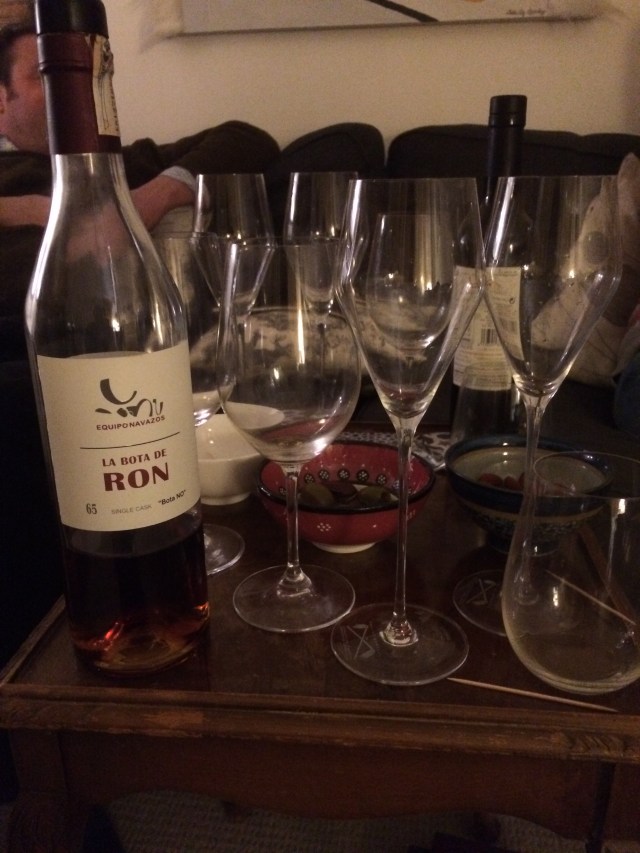
The wines were brought up to room temperature this morning, although my dining room is not very warm right now after this morning’s frost. I decided to taste the wines in two different glasses. I usually drink wines like this from a Riedel Sangiovese/Riesling glass, the most versatile in the range (I’ve used it for Champagne as well on many occasions). This time I thought it would be fun, and possibly instructive, to try out a Zalto Universal as well.

img_2024

The Wines’ Origins

Both La Bota 31 de Amontillado “Bota No” and La Bota 61 de Amontillado “Bota No” emanate from the same source, the cellars of La Guita, on the Jerez road just outside Sanlúcar, to where these butts were moved in 1980. The solera labelled 1/10 contains, in the view of the EN team, the most balanced and elegant wine. It goes without saying that it is also of a high average age, and the “Bota No” designation does, of course, denote that it is drawn from especially distinctive barrels which have not been refreshed, in order to preserve those distinctive qualities, a by-product of which is a raising of that average age of the wine inside them.

The Tech

  • La Bota 31: Four butts selected (just under 900 litres, making around 1,700 to 1,800 50cl bottles)
  • Saca of October 2011
  • Alcohol – 20%
  •  La Bota 61: slightly more bottled here, 1,000 litres (making 2,000 50cl bottles)
  • Saca of August 2015
  • Alcohol – 20%

There were no EN bottlings from this solera between these two releases.

Tasting (details from the Riedels)

La Bota 31 – It’s hard to believe that this wine, poured from a small sample bottle, could fill a small room so quickly with its profound bouquet. The nose is both saline and nutty. After a few moments you begin to get spice (cinnamon), and something akin to dark brown sugar.

The palate is dry, but there’s a glycerin texture. It’s smooth as a result, although there’s also a tangy, nutty, acidity. The salinity on the nose is there on the palate, but it isn’t intrusive. The wine has real depth, almost as if you are looking down a dark well. You do get a sense of the age of this wine. The complexity is astounding, and at the time of release the 31 got glowing references, many writers suggesting it was clearly the best EN Amontillado release so far.

I understand that at the dinner the 31 was a touch cloudy initially, which was caused by the sediment it had thrown. There was no such issue with the wine I was sent.

La Bota 61 – Around four years later EN revisited the same solera. The wines look almost identical. If I can see a difference (and to be frank I’m fed up trying to distinguish them), the 61 looks to be a tiny bit darker, although they are both a lovely burnished brown, glinting in the winter sunlight. The nose has a less deep tone, a touch more lifted, although it’s no less pronounced. Quite figgy, and that higher tone shows a little iodine in the background.

The palate is dry. The acidity for me is more pronounced and there’s much less of that glycerin smoothness. I’m also getting a touch of orange citrus. There’s a more youthful freshness to it, although I’ve no idea why that should be. Yup, that salinity comes through here, and also more of what seems almost like wood tannin than with the 31. I’m not sure why.  Although it doesn’t intrude for my palate, I can see why some might think it makes this wine the more angular of the two – it surely does.

The Outcome

Boy this is difficult. These wines retail for about 50€ for a half-litre bottle (but be warned, you can pay quite a lot more), and at that price I assume that few people will have the chance to measure them up side-by-side. They are both great wines, and I don’t use the word lightly. As they grow in the glass they do become more distinctive of each other, or at least perhaps the palate becomes attuned to their differences.

I’m going to be honest here and say that I made things over complicated for myself by going for the two glass trick. The Riedel seems to emphasise the deeper notes of the wine, making it seem more concentrated but also seeming to narrow the profile a little. The Zalto loses some of that concentration, but as the aromas leave the glass you don’t lose the precision. The results in each glass are so different that it becomes as much a test of the glasses as much as the wine, but I can’t go back…and that’s why I’ve only reproduced my tasting notes from the Riedels.

On which glass to choose, my conservative side suggests that most people will prefer the Riedel Sangiovese/Riesling glass, and indeed a larger Riedel bowl would surely work too. My more rebellious side was intrigued by the difference the Zalto made (whether because of its wider brim or the more angular shape of the bowl). The wines almost tasted lighter, or perhaps more fleet of foot is a better way of putting it.

As for my assistance in the debate, I’m not really going to help move it along a great deal. For me, the 31 is a wine I’d sip in the chair in front of a log fire (not that I have one). I wonder whether the 61 would be the better suited to food? I don’t just mean hard cheeses, which both might satisfy. I mean something like that Amontillado favourite, lobster. If I had the chance to try it with something like the lovely partridge I had at The Glasshouse in Kew a week ago, I’d jump at it as well.

But if I had a 50€ note in my pocket? Probably the 31. Age before beauty, always! Although now I’m not so sure…

Posted in Sherry, Spanish Wine, Wine, Wine Glasses, Wine Tastings | Tagged , , , , , , | Leave a comment

Tuscan Raiders

There’s a group of aficionados of all things Toscana which meets several times a year to drink frankly far too much wine in impressive restaurants. It has been a while since I’ve been able to join them, so I was very pleased that a change in travel plans left me free to do so last Friday.

It has also been some years since I visited Tuscany. Despite several trips to Piemonte in recent years, it’s a good many since I’ve luxuriated in the sunshine of the Chiantigiana, or walked Montalcino’s medieval walls. Tuscany was one of the wine regions which became very dear to me in the early years of my wine passion, and much as Burgundy supplanted Bordeaux, I guess that Piemonte, with its pattern of ownership and vineyard designations more resembling Burgundy, came more recently to play a larger part in my cellar than Tuscany. This has certainly been the case in the past decade and this lunch served to remind me that I own all too few of these lovely wines.

The venue for lunch was The Glasshouse, on Station Approach, by Kew Gardens. It may be the least well known restaurant in the Nigel Platts-Martin stable (The Ledbury, Chez Bruce, La Trompette, and formerly The Square), but it has been open since 1999, and provides an experience combining fine dining with the kind of unimpeachable service typical of the other venues in the group. More on the food later.

Seven people drank thirteen wines, two of them magnums (I did say we drank far too much, though I do appear to have lived to tell the tale), so don’t expect an essay on each, but we did drink some lovely wines, none of which disappointed me. There’s normally a theme which loosens as the day approaches. Our theme for 25th was ostensibly “Montalcino”, but we began with a couple of very good whites, threw in a couple of non-Montalcino reds, and finished with a couple of Vin Santos from Chianti.

The two whites could not have been more contrasting, yet both were exemplars of their type, and without question the two best Tuscan dry white wines I’ve drunk so far this year, with the possible exception of Tim Manning’s ever astounding Vinochisti Erbaluce. Montenidoli “Carato” Vernaccia di San Gimignano 2009 is very fine. Big legs and a lick of oak, it is radiant with green flecks, and a palate of herby lemon acidity balanced by great texture. It’s the kind of wine which gives an often under performing DOCG a good name.

It contrasted nicely with Il Torchio “Stralunato” Vermentino 2015, from Liguria’s Colli di Luni, right up on the Tuscan border. This is a pale wine, also with lovely green glints. Refined on nose and palate, yet there’s a salinity which gives a savoury edge. Vermentino rarely gets taken seriously, except perhaps from Sardinia sometimes, but this wine is both delicate and delicious. Oddly enough, I find both of these wines very easy to recall quite vivdly as I type.

The first of the reds was served blind, and it did take a little while to tease out its identity. I think that the Sassotondo Ciliegiolo “San Lorenzo” 2010, Maremma, was a touch young, not that Ciliegiolo is a grape for long ageing but this is Sassotondo’s top bottling of this rare autochthonous grape variety. Garnet in colour, it’s juicy and spicy, with some balsamic notes. It still retains the grippy tannins of youth. Personally, I’d recommend this to anyone seeking something a bit different from the region, although there’s plenty of exciting experimentation on the coastal side of Tuscany.

Next up, two Brunello’s from the same stable. Altesino Brunello di Montalcino 1975 and 1985 were both lovely at different times at the table. The ’75 started off as an old wine drinking well, and despite showing the colour of its age, and showing some caramel notes on the nose, it was still in very decent condition, a fine wine from a very fine vintage. Yet, as expected, it did fade.

Back in the 1980s I used to shop at Winecellars, the original wine warehouse run by David Gleave (now Liberty Wines) and Nicolas Belfrage (Enotria Winecellars, Vinexus). There were two tastings which ignited the spark for me, as far as Tuscan wines were concerned. One was with Paolo De Marchi of Isole e Olena, and the other was Altesino. After that tasting I bought some 1985 Altesino Brunello, along with their 1982 Riserva. Those 1985s are long gone from my cellar, and to be fair, Altesino entered a period some time later during which many wine writers were not praising this estate in the north of the DOCG as much as they had previously. It seems that whatever happened, the estate is on form today, so how was the 1985? Initially it seemed even older than the 1975, drying a tiny bit. Yet with time in the glass it blossomed as it opened out into a lovely wine. Very hard to say which I preferred, the 1975 or the 1985? Both were long and complex, and typical of mature Brunello.

The first flight was rounded off with a beauty, Poliziano “Asinone” 1997, Vino Nobile di Montepulciano (far right in the photos above). The wines of Montepulciano often get ignored just a little beside those of Montalcino, and to be frank, in many cases you can see why. But Asinone is a class act, a Riserva aged in a mixture of barrique and larger oak. It’s concentrated and quite powerful, and this 1997 is not fully mature by any means, still showing some oak influence. But saying that, it’s lovely as well as impressive, and best of all, it’s distinctive. I’ve never bought this wine, I’m not sure why? The desire to always reach for Brunello over Vino Nobile, I suppose. Something I ought to put right as far as Asinone goes.

The second red flight was all Brunello, albeit of differing stature. Sesti Brunello di Montalcino 2001 was a good start from this favourite biodynamic producer, located south of Montalcino. Full of fruit, fresh and flowery (intense violets), there’s always an elegance to this estate’s wines. We followed it with the same producer’s Riserva from magnum, Sesti Brunello di Montalcino Riserva “Phenomena” 2001. This might have been my “Wine of the Day”, and when someone mentioned that it probably has twenty years in the tank, that may be no exaggeration. This is on another level, still closed to begin with but offering enough over its time in the glass to show real class, with smoothness and depth. Phenomenal, of course, although the name celebrates a significant astronomical event in each harvest (in 2001, the Leonids shooting star shower). And all power to the magnum format, of course.

img_2174

Following that was a tough task for Il Marroneto Brunello di Montalcino 2004, quite a pretty wine by comparison, but wholly delicious. I’m always wary at lunches and dinners like this one, a cornucopia of vinous delights where those which seem to show less well would clearly shine, either in less exalted company or on their own. I think that this wine, and Sesti’s straight Brunello, both fall into that category.

This was emphasised by the wine which followed it, Col d’Orcia Brunello Riserva “Poggio al Vento” 2004. In giving this wine a score of 95 points, Parker and Galloni also gave this a drinking window of 2014 to 2044. Add to that, the fact that we were drinking another magnum, and you will guess that we were very much in the territory of youth, here. But there’s already spice, smoke, and mint, along with concentrated Sangiovese fruit, and from those descriptors you can understand how impressive this is, and will be. But this wine’s most outstanding feature in this vintage is that it is quite unique, quite different in nature to so many other Brunello Riservas.

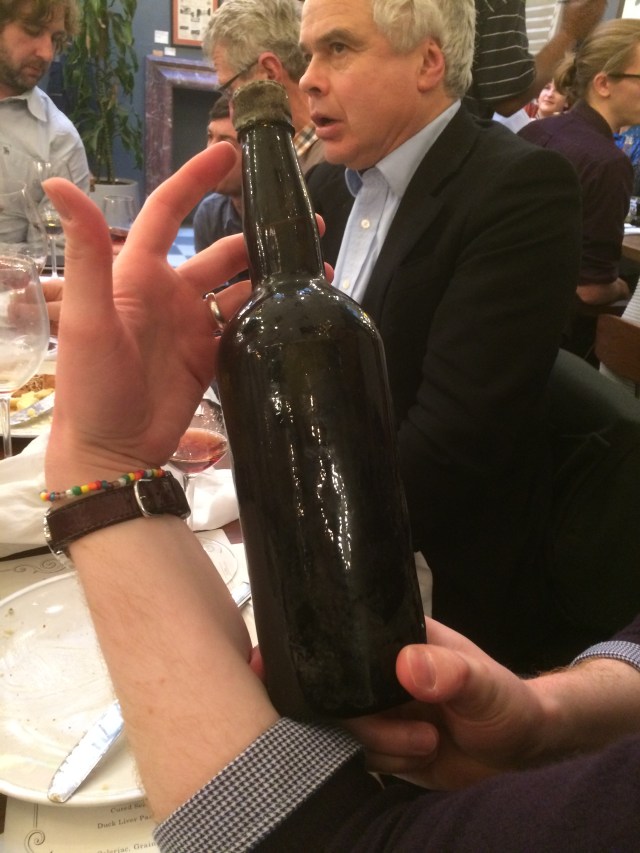
As is so often (I lie, always) the case at these gatherings, something appears from under the table. Served blind, I was pleased my tastebuds were on reasonable form, identifying what it was, but making a fool of myself over the vintage. Florio Marsala 1840 (I had guessed 1966, but to be fair, how many times do we all make similar mistakes with old Madeira, which like this Marsala, so often appear a couple of hundred years younger than they really are?). There’s little you can say about a wine like this (or at least, little that is printable). Wow! is polite, but inadequate. Some people have no idea how much their generosity is appreciated…so thanks, Chris. It went beautifully with the cheese course, …of course.

img_2178

We could perhaps have found some sweet wines from Montalcino (though Moscadello is not usually a wine that springs immediately to mind for such occasions), but instead we were treated to two very contrasting Vin Santos. Riecine “Sebastiano” Passito 2001 is not strictly a Vin Santo, rather an IGT Toscana made from Trebbiano and Malvasia, grown on chalky soils at up to 500 metres altitude near Giaole. It is both fermented and aged in barrique, probably the reason why it is the darker of the two wines. Notes of pear fruit with caramel and honey, very sweet. That made it not to everyone’s taste, but I like it, as I like this wonderful estate.

The contrasting wine was Selvapiana Vin Santo del Chianti Rufina 2007. This younger wine is a classic of the genre and, at least once Isole e Olena’s Vin Santo became so expensive, has been one of my more frequent purchases. This is a pure Trebbiano (grown on clay and limestone), and as it says on the label, it comes from the northern Tuscan Rufina sub-region. After drying and pressing, the grapes are vinified and aged in small caratelli. This is dryer than the Riecine. There’s still a touch of sweet caramel, but more dried fruits, and with more complexity than the sweeter passito. Personally, I rather wish I had either, I don’t mind which, to serve with the Christmas panatone. I wonder whether it’s too late…

I promised to mention the food at The Glasshouse. It was generally excellent, fully deserving individual photos so you can really see the dishes. We began with seared Orkney scallops with cauliflower, grapes and Italian truffle. This was “dish of the day” and one of the best handful of starters this year. A truly memorable dish.

img_2164

Next, red-legged partridge with Puy lentils, lardo di Colonnata, red cabbage and trompette de mort mushrooms – the partridge was beautiful and cooked to perfection dans son jus (as they say, please excuse obscure French pun), really very good indeed, though some of us found a few hard bits of bone in the wrapped element.

img_2170

The main course of Cornbury Estate fallow deer with roasted salsify, pine and beetroot was classic “NPM” – from The Ledbury to The Glasshouse you can pretty much rely on exceptional deer and this delivered.

img_2172

The cheese course – well, every one seemed in perfect condition so what more can you ask for?

img_2177

The dessert of warm apple and pecan brioche was delicious. The ginger ice cream accompaniment was good, although for my less educated palate I felt it was not a perfect match for the brioche, somewhat dominating. I love ginger, but I’m not a big sweet ginger fan, so I’m sure it was just me. By this stage in all honesty I’d probably reached the point where remembering to take a photo of the dessert was not at the forefront of my mind, though you’ll be pleased to know that there was no staggering,  no loud behaviour, at least from me, and all proper sense of decorum was completely observed. Have a pic of a few of the empties instead.

Thank you to all the staff at The Glasshouse for looking after us so well, both professional and friendly in equal measure. A long trek out on the District Line, but well worth it.

img_2181

Posted in Dining, Fine Wine, Italian Wine, Wine, Wine and Food, Wine Tastings | Tagged , , , , , , , , , , , , , , , , , , , | Leave a comment

Le Beaujolais Nouveau…Est Arrivé?

Is anyone here old enough to remember, back in the 1980s/90s, when the Beaujolais Nouveau marketing machine got into full swing? For most lovers of half-decent wine it was horrible to behold. The UK, a nation of beer drinkers, was really just getting into this wine drinking thing. As more of us explored our neighbours in the “European Economic Community” (remember those heady days?) in the 1970s and early 1980s, the new fangled foods we tried there (oh the croissant! oh the Camembert!) started to appear in restaurants and homes back here, and with those dishes went wine (well, maybe only accompanying the croissants in the most extreme of francophile homes, of course). It’s probably as impossible for some young wine lovers today to imagine an England without wine (for the masses) as it is to imagine a time without mobile phones, computers and the internet.

Wine isn’t an easy drink for the novice, at least not the tannins of young Bordeaux, or the complex bouquet of aged Burgundy. Even Champagne, with the relatively high dosage common back then, was a bit “dry” for palates weaned on German sugar water and “Spanish Sauternes”. What could be better suited to the tastes of the mass consumer who wishes to get to know red wine than nice fruity Gamay? And when it is rushed to market, just fermented, even better…perhaps.

Beaujolais Nouveau is a vin de primeur, fermented for just a few weeks, by the carbonic maceration method (whole berry fermentation in a sealed container filled with CO2, the fermentation starting within the grapes themselves). Such wines thus produced are low in tannin, so that they won’t often age well, but are potentially easy and pleasant to drink as soon as they are bottled.

A simple wine of this type was always made in the region to satisfy the locals, but it soon dawned on the producers and the authorities alike that it might be a good way to shift vast quantities of very ordinaire wine, from the broad and generic Beaujolais AOC, which didn’t have a quarter of the cachet of the finer Crus (such as Morgon and Fleurie) from the region’s northern granitic hills.

The real commercialisation of Nouveau began with the idea of a race to get the new wine, the first of the new vintage in France, to the bars of Paris, and quite naturally this rather good marketing idea gained a lot of publicity. An early release date of 15th November, stipulated by the Regional Body, was soon changed to the third Thursday of November, thus giving the cavistes a good long weekend to promote the wine.

The idea really caught on in the UK in the 1980s, with the Beaujolais Run, a mad dash of both merchants and consumers, down to Beaujolais and back with cases of the new wine. It all became a little tasteless, perhaps to match some of the wines. In fact, rather than being tasteless, some of them tasted rather unflattering. The vast sea of fairly unsaleable basic Beaujolais flowed out by the thousands of hectolitres into supermarket own brand labels. It was fun for some people, for a while, but by the mid 1990s “Nouveau” was a bit gauche, and consumers had moved on. The vast pallets of the stuff which once hogged supermarket aisles had gone, and perhaps a few cases stacked on a shelf was all you’d see.

At around this time the finer Crus of Beaujolais were stirring into life again. Today, the region is one of the most dynamic in France. The “Gang of Four” (Lapierre, Thévenet, Breton and Foillard, the original disciples of Jules Chauvet) were spreading their influence and the region’s reputation was slowly being restored, so that today it is possibly the trendiest wine region in the country, perhaps alongside Jura. This renaissance is being driven with increasing assistance from a host of new and younger producers who adorn the shelves of any self-respecting wine merchant, especially in Paris, London, New York, San Francisco, Tokyo and Berlin.

For the last couple of years these producers have been reviving Beaujolais Nouveau, albeit with fairly miniscule quantities of wine. Sure, it’s a great help to their cashflow at a time when they need tiding over until their Crus are bottled, perhaps in the spring. But these vignerons are committed to quality. They already produce exciting wines, and although their Nouveaux are still simple wines, intended for swift enjoyment among friends in any glass or beaker which is to hand, there’s no reason to expect anything less than good wine, devoid of any cynical desire to exploit the consumer.

In 2016 pretty much any bar in London known for selling natural wines had a Beaujolais Nouveau event on last Thursday. But I was in Paris, and the whole city appeared to be celebrating the event. Of course, the wines were not all good. The norm was perhaps exemplified by the “own label” Beaujolais Nouveau I tried in a branch of the Nicolas chain, far more ubiquitous in Paris than London. It was a vibrant purple, smelling slightly of cherries, tasting slightly more acidic than one might like, but overall it was drinkable, and only 4.50 € a bottle. Expect to pay between 9 € and 15 € for the good stuff in Paris, whilst the UK’s Duty regime makes most up towards the top end of that spread in a London wine shop.

Whilst much Nouveau still emanates from the south of the region, those cuvées made by the new producers are more likely to come from the granitic north, where the named Beaujolais Crus are located. One major difference between the two is often signified by a clue on the label, many of the better wines being “Beaujolais-Villages” Nouveau rather than straight Beaujolais. But you might equally find one of these wines labelled as a Vin de France.

Although it is commonly stated that Beaujolais Nouveau doesn’t age, these better wines will certainly keep fresh for at least six months if well stored, unlike in the old days when it was not unusual to find a bottle of supermarket Nouveau tasting tired by Christmas. So it might be helpful for me to list those producers I think are worth looking out for. Some of them are available in London, although with imported quantities being small, most wine shops will have sold through their stocks. If you find yourself in Paris there are plenty of bars and cavistes who stock the wines listed, but there are perhaps two which have a wider selection than others. Le Verre Volé (their wine shop), on Rue Oberkampf in the exciting 11th, and La Cave des Papilles on Rue Daguerre (14th). Irrespective of whether they have any Beaujolais Nouveau left, those two addresses should be in the little black book of any adventurous wine lover.

Of all the wines to look out for, one of the rarest, a unicorn wine among Beaujolais Nouveau, is that of Jean Foillard. It does exist! Karim Vionnet, whose wines I’ve written about recently, makes a really tasty version as well.

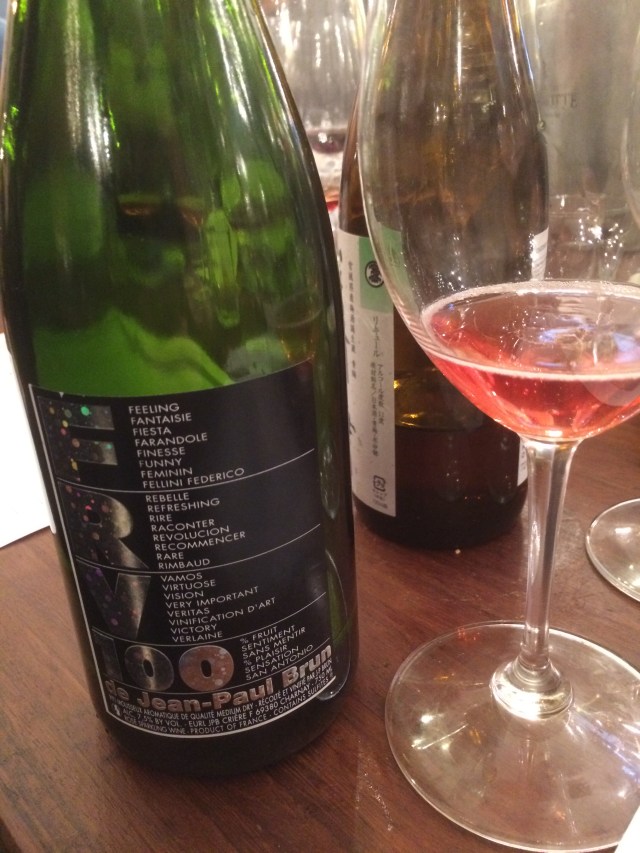
One of the most ubiquitous Nouveaux, to be found in several of the the Parisian natural wine cavistes is Jean-Claude Lapalu. Other producers whose wines graced parties at cavistes across Paris on the night of 17th include France Gonzalvez (you may still find some left at branches of The Sampler in London), Rémi Dufaitre, Château Chambon, Guy Breton and Xavier Benier. From the south of the Beaujolais, long-time star in what used to be a sea of mediocrity, Jean-Paul Brun, makes a Nouveau, though I haven’t tried it this year. Tasting notes suggest it has more bite and spice than most of the surrounding producers would be able to muster.

A good example of one of the “Vins de France” I was talking about is the “Brut de Cuve” of Romain des Grottes – although I’m not entirely sure why Romain doesn’t label this as a Beaujolais, his Domaine des Grottes being located at St-Etienne-des-Ouillères, near Vaux-en-Beaujolais, not far south of Odenas.

img_2088

There are many outsiders who are making wine from the Beaujolais region now, Jean-François Ganevat being perhaps the most famous. A couple of producers known for their Burgundies have turned to Beaujolais, and both have released a Nouveau this year. Philippe Pacalat’s version I have only seen in France, whereas conversely, that of Andrew and Emma Nielsen (Le Grappin/du Grappin) was all rushed over to the UK, most of it sold from the keg by the glass in selected London bars and restaurants. I believe a little was bottled, well worth grabbing if you can find it.

I’m sure there are plenty of other ” bojo noovos” you all tasted last week. I’d love to hear what you thought were the best, wines for my search list next year.

Finally, it is worth pointing out that “Nouveau”, or more accurately, “vins de primeur“, come from other regions too. To complement Beaujolais Nouveau we are seeing increasing numbers of Muscadets released as primeurs, although they don’t have the lees ageing that a really good sur lie version has undergone. The Côtes du Rhône also makes light and fruity primeurs, and so do a number of Loire producers, just to mention a few French regions from where such wines can be found. They may not get the publicity of the Beaujolais wines, but if you know the producer then it will be worth trying the wine. Drink them with friends and without ceremony. They prefer a noisy and animated environment, not the silence of worship. They are a different beast to the sea of plonk which makes many of the older wine writers rightly shudder when they think back.

Posted in Beaujolais, Natural Wine, Paris, Wine, Wine Festivals | Tagged , , , , , , , , , , , , , , , , , , | 3 Comments

Master of Fino

The wine pro of the 21st Century has to know a lot more than their Bordeaux and their Burgundy these days, but ironically a Master of Wine would, in the past, have known a lot more about his Sherry (I say “his” because they didn’t let in a lot of ladies back then) than many do today. Every time we think that this star among alcoholic beverages will break back into the limelight its moment is snatched away…by craft beer, craft gin, the New Beaujolais and whatever comes along next.

Yet to be fair, Sherry has made something of a comeback. Even in the 1990s, when Lustau started to market the Almacenista concept, there were tiny signs of a revival for a wine genre which had been pretty much destroyed by the commercial decisions and takeovers of the 60s and 70s. This century has seen a more concrete revival. Equipos Navazos deserves a very large medal, and the undying thanks of all Sherry lovers, for showing the world what vinous treasures, wines of world class finesse and complexity, still lie in the bodegas of Jerez, Sanlucar and the other regions producing sherry styles in the rest of Andalucía, in Southern Spain.

The Equipo Navazos bottlings are of necessity fairly low production, and as a consequence, expensive. But their undoubted success has led to others reevaluating their stocks, and the opportunities they might have to market such high quality wines. At the same time, we must not forget that there have always been gems, often selling for ridiculously meagre prices, lurking unloved on the dusty racks underneath some old fashioned wine shops, or in traditional Spanish bars and on Spanish restaurant wine lists.

This week has been International Sherry Week 2016 (7-13 November), though it may have passed you by. At least once a year a group of us get together to celebrate sherry in the convivial surroundings of Masters Superfish, one of London’s finest fish n chip restaurants, just down the road from Waterloo rail terminus. It seemed fitting that we were able to mark this week for celebrating all things Sherry with a very fine array of Fino and Manzanilla styles, plus one table wine made from Palomino Fino. It was wholly expected, but unlike many a wine tasting, every wine below was a star.

img_2050

Within these fairly anonymous four walls you’ll find some of the best battered fried fish in London

Navazos-Niepoort Vino Blanco 2014

This is a Palomino table wine coming in at 13% alcohol. This partnership with Niepoort is now in its sixth vintage and this wine, with its precision, delicacy and steely backbone yet soft finish, is drinking wonderfully now (though this cuvée usually ages very well, which is why I bought a few magnums). It is made from 100% Jerez Palomino (all from Macharnudo Alto), fermented in bota (40-year-old American oak of 600 litres) using local indigenous yeasts, and aged for eight months under flor. The 2014 was bottled in December 2015.

The freshness of the 2014 possibly exceeds that of any previous version I recall. There’s fruit under the flor, and a lightness of touch despite the 13% alcohol. It has body but you kind of don’t really notice it as the wine takes off. This went down very well with the Sherry aficionados and, I won’t lie, I’m glad I have a decent few bottles (and mags) of this vintage. It seemed a little tight on delivery, but it is now in a good place to try it with all that freshness. I might drink my bottles over the next twelve months and keep the magnums.

img_2057

Delicado Fino, Gonzalez Byass

This is a limited production wine made exclusively for the UK supermarket, Waitrose. It’s on sale for a bargain £13.99 (for 50cl). The name hints at the style. The wine in the blend is well aged and the flor has been maintained, yet the wine is relatively pale in colour and has a freshness and delicacy which is hard to retain in an aged fino. The elegant nose mirrors the palate. This is actually a great summer aperitif, being fairly light, yet with more complexity than you’ll find in a cheaper branded fino. Waitrose suggest tapas and paella, though my own choice with the latter dish might be something with more body. But this is a fine wine at an exceptional price, and with a nice label too.

img_2053

Classic Dry Fino, Rey Fernando de Castilla

“One of the most exciting producers in the region today” according to Peter Liem and Jesús Barquin (Sherry, Manzanilla and Montilla, Manutius Press 2012), and no one who knows Sherry is going to disagree with that sentiment. The Fernando de Castilla range divides between “Antique” and “Classic”, this wine being, obviously, from the latter category. Whilst these are not in the same league as the Antiques, the fino is perhaps the best of them. It is classic in both name and nature, very fresh, and combines both fruitiness and salinity. It retains that light chalky mineral texture all through its good length. It has that knack of showing a very slight sweetness on the palate (it’s the fruit, there’s no sugar), which can make it a good match with spicy food. At around £12 here in the UK, it’s about half the price of the exceptional Antiques, a very good everyday fino, yet way above the ordinary, and pretty perfect with fish & chips too.

img_2055

Fino, Bodega El Maestro Sierra (37.5cl)

This is an old family house (founded 1830) which created a stir at the time. The Sherry business was dominated by the nobility, and the idea of a barrel maker becoming an almacenista was quite shocking. Owning no vines, the company sources its wine from the Jerez co-operative, but everything is done traditionally. The fino is exceptional. The wines may average around five years of age, but the bodega’s good hilltop location provides good ventilated conditions for flor to thrive. Consequently you get a richness in this fino, with a depth and complexity assisted by minimal finishing (fining and filtration). It’s quite full on the nose yet there’s a lightness on the palate. A wine of character.

img_2056

Fino La Panesa, Hidalgo

The solera used for this wine was created in 1961 to mark the birth of Alfonso Rodriguez Hidalgo. This is a marvelous wine where the average age of the bottle’s contents will be 15 years. As Liem and Barquin point out, this represents the upper limits for biological ageing, so the wine is darker and quite rich. It is also perhaps the most complex fino we drank yesterday (though that would be challenged by the last wine of the day, a manzanilla). Of course, complexity and indeed richness, is not what we are always looking for in a fino style. We may want more of the refreshing clean lines of some of the lighter bottles. But sometimes we do like to taste a different style, and I must admit that on the rare occasions this wine comes my way, I’m always thrilled by its myriad flavours. Especial, as they say, though you may have to pay around £30 for the chance to sample a bottle.

img_2054

Tio Pepe Fino “En Rama”, Gonzalez Byass

Another wine from the Gonzalez Byass stable. The straight Tio Pepe fino must be the most recognisable brand of dry Sherry on the high street today, and a very decent drop it makes. It’s my mother’s favourite, so I know it well, drunk fresh from the fridge, not a month or two lurking on the sideboard. En rama wines are bottled directly from cask and usually, as is the case with this version, undergo minimal filtration, so that the wine can be somewhat cloudy. En rama wines are bottled in springtime, when the flor tends to be most active, and this is truly captured in the wine. The nose is pungent with flor‘s nutty character, yet even as a special cask selection, it doesn’t lose that elegance which the regular Tio Pepe, in its own way, always exhibits. The overriding experience when you drink this wine is one of naturalness. I don’t know how otherwise to describe it.

Because of the nature of en rama, it is released soon after bottling, and producers generally recommend consuming within three months in order to capture that moment of freshness and purity.

img_2058

Fino Chipiona “Los Madroñales”, Bodega Cooperativa Catolico Agricola 

This is a pale straw colour, with characteristic green olive flecks accenting. You might not expect it to be as rich as it is. There’s a yeasty, bready, nose with toasted almonds. Chipiona is a town situated on the coast southwest of Sanlucar, once famous for its pre-phylloxera Moscatels. It enjoys similar cooling sea breezes to Sanlucar, and so the wine retains a delicate lightness after around three years in solera. This wine was bottled in February this year and was lovely and fresh, without being at all insubstantial. We see very few Chipiona wines, and production there has almost disappeared, so it was a treat to have one.

img_2059

Manzanilla La Gitana “En Rama”, Hidalgo

Perhaps La Gitana doesn’t have the profile of Tio Pepe, but with a good distribution I would guess that many people who’ve drunk dry Sherry have tried it. Our second “en rama” wine was a nice foil to the Tio Pepe version, it being a Manzanilla. Like regular Tio Pepe, La Gitana is a fresh manzanilla fina these days, with about five years of age. The en rama version was originally released in 2011 in partnership with UK wine auction site, Bid For Wine. It is both richer and more complex than the regular release, quite full in the mouth in a dry and chalky sense. But it still shares with the Tio Pepe version that lovely tingle of natural freshness characteristic of the genre. It’s rare to be able to compare and contrast the two, and choosing which is the better is a difficult task best left to experts.

img_2052

Flor de Lebrija 12 Years, Gonzalez Palacios

Lebrija is, like Chipiona, one of the smaller towns in the wider Sherry production area, but Lebrija is way inland, twenty or so kilometres north of Jerez, on the road to Seville. Lebrija’s wines were not allowed into the Jerez-Manzanilla DO, so in 2009 it was given its own designation as a “Vino de Calidad”. Gonzales Palacios is another producer with a well chosen hilltop location, ensuring a well ventilated bodega, which means that the flor can survive as a fairly thick layer all year round. It also happens that Lebrija is, rather counter-intuitively, not only cooler than Jerez, but cooler than Sanlucar as well.

This is a well aged wine with about 12 years in barrel. The wine is probably bottled unfiltered as it’s a bit cloudy, and it has a darkness indicative of its age. It has a very distinctive nose, a sort of umami/mushroom note, but also a hint of whisky. What you get here is a more yeasty, nutty wine (a result of the enhanced flor), and the complexity of bottle age. An altogether different style to some of the paler, lighter, earlier finos, with more complexity if less elegance. Try hunting down a half bottle from Warren Edwardes’ Sticky Wines. At around £7 for a half-bottle, it’s a fairly cheap way to try this fuller style.

img_2060

Manzanilla Pasada Bota 59 “Capitaz Rivas”, Equipo Navazos

I’m sure everyone knows the Equipo Navazos story. Not a bodega, they are effectively a micro negociant which releases small quantities of special wines in a series of consecutively numbered botas throughout the year. Bota 59 is named after the  famous cellarmaster (Capitaz) for La Guita, Rafael Rivas. He started a solera in 1986, from which this wine (from Hijos de Raneira Pérez Marín) is drawn.

A manzanilla pasada, of which this is a true example, is a manzanilla which is potentially on the way to becoming an amontillado. The flor will, as a result of great age, be quite fragile. It is restrained from becoming an amontillado by topping up of the butts, which are filled not to the usual 5/6 full, but to a mere “finger” from the top. This keeps the flor alive. With age, the power and influence of the flor decreases, yet the tiny area of the wine’s surface, and the regular topping up, keep it alive and protected from the air at the top of the cask. As it ages, the alcohol in the wine actually increases. This bottling has reached 16%, and as I said earlier, this is at the true limit of biological ageing.

This is a powerful wine, no question. The oxidisation is gentle and the nutty notes are accentuated, balanced by a remarkably fine acidity. The wines extracted for this bota come from a solera founded in 1986, and will average 15 years of age, so you really get a remarkable degree of complexity, and indeed a smoothness rare in Sherry without sacrificing acidity. There’s almost a whisky note coming through, bags of salinity (salted nuts) and something gently woody, but it’s the kind of wine which will go through many changes in the glass as you contemplate and sip it. Don’t drink it too cold. I personally recommend it with food, and it’s a rare biologically aged wine that I would always use with food as opposed to as an aperitif (rich lobster or crab would go nicely). It’s also a match for the cheese board. Whereas with hard cheeses I would open an amontillado, a palo cortado or perhaps an oloroso, this will do nicely for some well matured runny cheeses.

I’m wholly biased. I’ve amassed a nice little stash of EN, though because of rarity and price I do have to ration them (I do try to share the pleasure with other Sherry lovers). But whilst these wines are relatively expensive for Sherry (you might pay £40 for the 59, more in some places), as fine wines they deliver a level of complexity which you’d have to pay three or four times more for, at least, from any of the other classic fine wine regions of the world. Just pointing that out to those who balk at a £40 sherry. And at least with this 59th bottling, a saca of June 2015, there were a reasonable 3,500 bottles to go round. If you can find one it will be magnificent.

img_2051

Posted in Sherry, Spanish Wine, Wine, Wine Tastings | Tagged , , , , , , , , , , , , , , , , , , , , , , , , , | 2 Comments

Jura Come to London

If you have read my wideworldofwine blog since I began posting you will know I visit the Jura Region every year, usually around harvest time, but you will also know that my focus is generally on the newer producers, the up-and-coming stars of the region, so to speak. And it’s fair to say that these, often younger, winemakers provide a good half of my Jura drinking throughout the year, supplemented by some of the international stars this region has produced: Stéphane Tissot, Ganevat, Puffeney, Labet and so on.

There is, of course, another side of the coin. A large group of domaines who are not such new kids on the block, who are not always experimenting with zero sulphur or amphorae. It is largely these producers who are brought to London by the Comité Interprofessionnel des Vins du Jura, in conjunction with the Comté Cheese producers, for what may become known as the Chandos House Tasting. It is perhaps ironic that the younger producers who usually attend the Nez dans le Vert tasting in spring each year, were actually exhibiting in Paris the day before this tasting. A shame I couldn’t be at both. The 2016 London tasting took place in the attractive, neo-classical, Robert Adam designed 18th Century Chandos House, once owned by the Royal Society of Medicine, and now a small hotel close to Oxford Circus.

img_2030

There were seventeen producers showing their wines, with what appeared to be a maximum of six wines each. I think one or two sneaked in a few extras, something I can sympathise with because this is a region known for multiple cuvées. In a small room, perhaps a little cramped with the number of visitors, it was too difficult to taste all the wines. That was a shame. I’d particularly have liked to taste the wines of the region’s historically pre-eminent negociant,  Henri Maire, because I haven’t done so for a long while, and not since the change of ownership. I only managed to taste one wine from Domaine Rolet too, generally one of the most reliable of the large family domaines in Arbois, with a wine shop in the centre of town. But I did taste the ranges of twelve out of seventeen, and those which appear below are my personal pick of the bunch. I will admit that as a seasoned Jura veteran (since the 1980s), I’m probably looking for some spark of something new, beyond “tradition”. Other tasters may well prefer other producers.

Domaine Pignier, Montaigu 

Pignier is based in the lovely village of Montaigu, just a few kilometres from Lons-le-Saunier. It’s one of the old Jura family estates, making wine here since the late 18th Century (their property used to belong to Carthusian monks up until the Revolution, when it was purchased by the ancestors of the same family as run the domaine today). They have been certified biodynamic by Demeter since 2002, so no standing still. Only a little sulphur is used and, for the past eight years, they have been producing a sulphur-free cuvée, their Trousseau “Les Gauthières”. The 2015, a deliciously fruity wine, was possibly my favourite of those on show on the Pignier table, though I loved their fresh, topped-up, Côtes du Jura Savagnin, “Sauvageon” 2014, made in a cement egg. The Chardonnay “La Percenette” 2014, which has twelve months in barrique, shows signs of complexity to come with the 2015 (from 25-year-old vines). This is one of an ever widening group of the best ouillé (non-oxidative) Chardonnays in the region. There’s also nice Crémant du Jura, 100% Chardonnay, which has ripe, almost sweet, fruit. The Vin Jaune 2009, the new vintage in the region, is good too.

Jean-Etienne Pignier was pouring the wines, assisted by Grant Butcher from their importer, Raeburn Fine Wines, in Edinburgh. Raeburn’s other domaine was at the Paris tasting the day before, the exceptional Domaine Buronfosse. Raeburn has bagged a couple of gems in the seemingly frantic fight of nearly every British importer of French wines to finally get in on the Jura act this year. But there are still gems to be dug up and polished.

img_2036


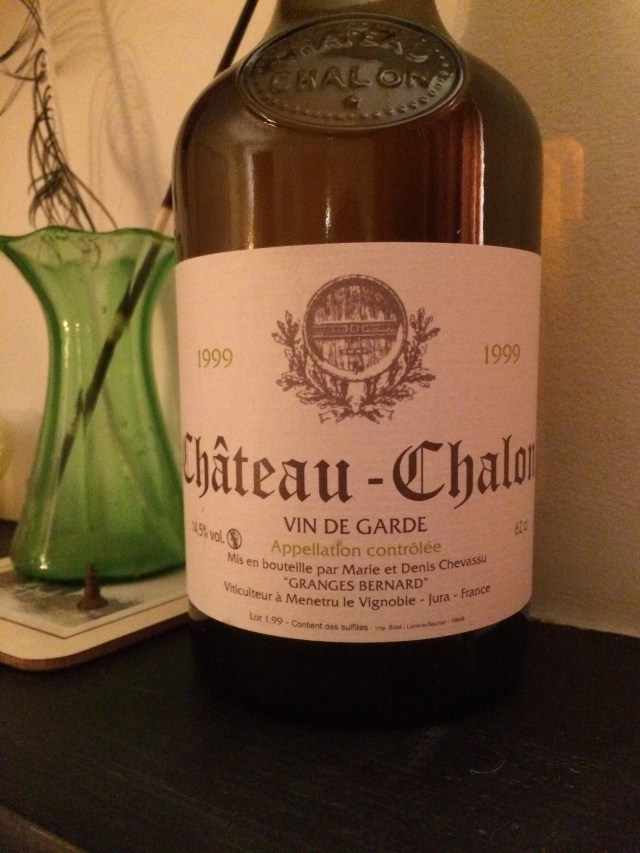
Domaine Berthet-Bondet, Château-Chalon

This is a domaine you may have heard of? Their Château-Chalon has a very high reputation in the region, and so it might come as something of a surprise that they have no UK importer. Surely that will soon change? Château-Chalon is a stunningly situated village, perched high on a rocky outcrop near the centre of the region, its best vineyards on a cliff-topped steep slope falling away below it. It is not only for this reason that photos of it appear in so much of the publicity you’ll see about the Jura. It is also, arguably, Jura’s most prestigious, and often most expensive, wine. For this reason, it can be difficult to enter that tiny world of vin jaune production here, but Jean and Chantal Berthet-Bondet have always had a reputation as two of the village’s most open producers. Their wines were poured by their daughter, Hélène.

If I were to attempt to describe the Berthet-Bondet range, I’d probably say “classic”, but in the best possible sense. The wines are correct, and perhaps risk free, but they go much further, with perfect balance, structure and elegance. From the light, pale, “Trio” 2015, which blends all three red varieties (Trousseau, Poulsard and Pinot Noir), through the Chardonnay “Balanoz” 2015 (1 year in mixed age oak), and the Savagnin “Savagnier” 2015, there’s a real line of freshness.

I ought to say something of the 2015 vintage. Throughout the region 2015 has been described in glowing terms. Some of the younger vignerons say it’s the best they’ve made, and as they are bottled one can’t help but agree – an exceptional year. But there is richness in 2015, and without attention to this, the wines do risk being out of balance. Jura wines are not blockbusters and even though it’s a vintage which should not be missed, a fill your boots opportunity, do beware of wines which may have sacrificed that all important freshness, which perhaps in 2014 was less easy to lose than in 2015. There are no such issues at this address.

There were two oxidatively aged whites on show, the lovely blend of 70% Chardonnay/30% Savagnin (“Tradition” 2013), and the varietal Savagnin 2011. This has real depth. When Vin Jaune or Château-Chalon is made, the individual barrels are checked over the long period (some 60 months) of ageing. Some Savagnin is kept aside from harvest for this cuvée, but to it are added barrels from the Château-Chalon cellar which may not go the distance to be included in the rigorous selection for the senior wine. This wine has real depth, and a long “flor” aged Savagnin can actually be almost a kind of mini Vin Jaune/Château-Chalon at a bargain price. Puffeney’s version is one of the classic examples. This is a very impressive wine, without quite the weight and complexity of the Château-Chalon.

The big brother wine is, as I intimated, one of the finest in the AOC in my view. The 2009 is a strapping youth, but even now you can see the potential for complexity which, in time, will go way beyond the lemon acidity and the hazelnuts and walnuts of a young version, destined to be consumed in some Michelin-starred restaurant before its time. Here, if you are patient, you will get more earthy notes of funghi and exotic spice, with a smokiness on the nose, but you will not lose that elegance.

Most Vin Jaune wines are indeed consumed way too young. Some don’t mind being consumed soon after release. Their freshness entices the drinker. But if you are going to pay €50 for a clavelin containing 62 precious centilitres of wine, it’s worth ageing it properly, as you would any other wine of that price. Releasing a wine close to seven years from the vintage in which it was made can confuse consumers. There are almost no 2009 (the current vintage as I write) Vin Jaune styles I would open now.

Good luck Hélène in finding an importer. It is remarkable that you don’t have one for the UK, and I hope someone appreciated your wines as much as I did. Having admired this Château-Chalon on several occasions over the years, it was nice to try this and the newer cuvées all together.


Vins Rijckaert, Villette-les-Arbois

Jean Rijckaert is a Belgian national, famous for his partnership with Jean-Marie Guffens in Domaine Verget in Southern Burgundy in the 1990s. He diversified into Jura and made a name as a white wine only producer, but in 2013 he made over the business to his partner, Florent Rouve who, it appears on the evidence of this tasting, is taking the domaine to new heights.

Florent is not a proponent of organic and biodynamic viticulture, but he does believe in intervening as little as he can in vineyard and winery, in order to express the main philosophy of the domaine, that terroir must shine through. So much so that all his wines undergo the same regime: a long, slow and gentle, press as in Champagne; seeking a low ph level in the must, ageing in inert wood (5-8 year old barrels); a natural and spontaneous malolactic; with all wines spending 23 months on their lees.

The six wines on show included one refreshing blended 2014 Chardonnay and five more single site whites. You could not fail to spot the terroir differences in these quite exceptionally pure and open cuvées. Of the five terroir-specific wines, “En Paradis” is a Chardonnay from old vines on a cold and wet northwest facing slope which is always the last site to be harvested. It contrasts with the weightier “Vignes des Voises” made from 55 year old vines on a warmer, south facing, slope. “Les Sarres” produces a complex Chardonnay and a pure, fruity, ouillé Savagnin. Finally, the “Grand Elevage” is a more complex Savagnin from three plots where the vines average 65 years, topping up the barrels every 3-4 weeks.

So these are not natural wines, and neither biodynamic nor organic. Yet they are some of the purest expressions of topped-up Jura whites I’ve tried all year, and I was very pleasantly surprised. I’ve never visited Rijckaert, and I’ve only had the wines in isolation before. As well as the freshness and directness of these wines, some have a lovely salinity which one occasionally finds in other producers, but it’s very marked here. I must try to drive out to Villette, just off the Route de Dôle, when I’m next in Arbois. This domaine impressed me, and also gained a mention from pretty much everyone I spoke to at the event.

img_2043

                                                                                Florent Rouve


The remaining domaines listed here,  I would maybe rank just a little below the three I have described above, but don’t view that as in any way negative. They are all looking for a UK importer and they would all sit well with any number of those agencies looking for a Jura domaine, perhaps one without the commercial risk for an importer who perhaps lacks a clientelle which might appreciate one of the natural wine domaines.


Domaine Baud, Le Vernois

This domaine is quite large, at a little over 20 hectares, based close to Château-Chalon, where their holding includes between two and three hectares which are “sustainably” farmed (certified by Terra Vitis) for Château-Chalon itself. My favourite wines were a Chardonnay “Cuvée Flor” which was quite steely-fresh of its type, though young (2015), and a very good sous voile blend of 50:50 Chardonnay and Savagnin, “Tradition”. The former is perhaps misleadingly named for an English speaking market. “Flor” here means “floral”. The wine is topped -up, or ouillé, and a wine aged under flor in French is, of course, described as sous voile…but you knew that…

Baud’s Château-Chalon is perhaps lighter, and maybe a little softer than some. It might not impress me quite as much as that of, say, Berthet-Bondet, but it’s certainly a nice one to try if you are new to the style. At around €20 ex-cellars, it’s also a relative bargain. I also liked the Crémant very much. It blends 70% Chardonnay with 30% Pinot Noir. Usually my own taste turns out to be for the pure Chardonnays in this category (and I’m a sucker for BdeB Champagne), but this is labelled Brut Sauvage, so a much drier style. I think the blend suits it. It’s very good indeed, and €7.60 ex-cellars, which deserves at least one of these…!


Domaine Daniel Dugois, Les Arsures

Les Arsures, not to be confused with the more famous Montigny-les-Arsures, lies in the northeastern section of the Arbois AOC. Beyond Les Arsures you move into the tiny enclave of vines which remain near Salins-les-Bains, and the up-and-coming sub-region towards Mouchard and Port-Lesney. There are ten hectares, located in Les Arsures, and near the more southerly Montigny-les-Arsures, which are farmed “sustainably”. Philippe, who was on hand to pour, has worked in Burgundy, South Africa and Australia, and seems to want to combine new ideas with the traditional approach of his parents.

Standouts include a very nice old vine Trousseau from the “Grévillière” vineyard, where many of the vines reach 70 years of age. This is, perhaps as a result of the old vine material, a wine with the potential to age. Young, it is already distinctive, showing quality potential, but it’s pretty tannic right now, even from 2013. The Arbois Savagnin has a gentle “Savagnin-sous voile” nose, and quite a bit of acidity but with a gentle nutty note on the palate. The Vin Jaune 2009 is very good indeed. Mushrooms and umami in evidence here as a complex addition to the usual notes.

Perhaps the labels here suggest that the wines are a little old fashioned. You may like them or you may not, but these bottles contain some nice wines.


Domaine Grand, Passenans

Passenans is another of those attractive Jura villages which I would say just scream out “La France Profonde”, except perhaps they are far too quiet to scream. I only know of two producers in the village. One is Les Dolomies, the tiny 4ha estate of  the elusive Céline Gormally, whose wines I’ve been trying to track down for two years, without success. The other is the somewhat larger Domaine Grand, whose wines from a much larger holding had, until yesterday, also eluded me.

Unlike Céline, who has only been around for eight years, there have been Grands growing grapes in Passenans since 1692. Again, viticulture is “traditional”, but the use of chemicals in the vineyard, and also of SO2 in the winery, are being decreased bit by bit. My favourite two wines here were the Savagnin “Floral Expression” 2014 and the Trousseau from the same vintage. The Savagnin is in a pure and fruity style. Those who know wines like Stéphane Tissot’s “Traminer” will know what I mean. There’s almost no telltale Savagnin nuttiness on the nose, and I really liked it. I didn’t see the alcohol content, but it tasted nice and refreshingly light.

The yield on the Trousseau is around 30 hl/ha, and the wine seems to blend a nice fruitiness with an already developing, attractive, sous bois note. They also make a single site Château-Chalon from the “En Beaumont” vineyard, in the sector towards Menétru-le-Vignoble (not all of the Château-Chalon vines lie on the slope below that village). The 2009, whilst not hitting quite the heights of a couple I tasted yesterday, is well above the average. I’ve no idea of the prices from Domaine Grand, so I can’t say whether they represent good value, but I can say that this is another domaine I can add to my list of wines to try again when I see them in a restaurant in the region. And if I can ever gain admittance at Les Dolomies, I’ll pay the Grands a visit as well.


And now for something completely different…

Some of you know, from reading this blog, that I spent an evening with Brad Hickey recently. Brad is one half of the married partnership behind the increasingly talked about McLaren Vale producer, Brash Higgins. Brad gave me a few wines to try, and his Riesling/Semillon was downed some days ago. I’d promised to take along a rare bottle of his “Bloom” on Tuesday. Where better than a Jura tasting to pour what I believe to be Australia’s only sous voile wine (the name Bloom is clever because, of course, the flor under which it ages is a bloom).

There’s plenty of Savagnin in Australia, most of which was actually thought to be, and labelled as, Albarino, the Spanish grape synonymous with Galicia and the Rias Baixas. But that is pretty much made as a normal table wine. Bloom is made from Chardonnay. It’s aged for a little longer under flor than a Vin Jaune (eight years for Bloom), so this first release is actually from the 2008 vintage.

What’s it like and what did they think? Well, to be fair it isn’t a copy of a Jura Vin Jaune. Where it differs most is in the richness of the ripe Chardonnay fruit, and the evident oak. I’d also say that, for whatever reason, the oxidative influence of the flor is less manifest. Perhaps the layer was thin (although in Jura it’s always much, much thinner than in Jerez and Sanlucar)? Perhaps the flor was not persistent throughout the whole ageing period? Perhaps a year less under flor might have actually produced, counter-intuitively, a more intensive flor effect, and perhaps that was not the intention anyway. But I’m digressing. This is a fantastic wine in its own right, and pretty complex when you get under the oak and fruit. With only 35 cases made from this inaugural vintage, it was a genuine privilege to be able to have a squat, not quite but almost clavelin-like, 700ml bottle. I won’t deny that a tiny part of me was jealous of sharing it with so many.

I ended up pouring samples for at least twenty people, a mix of a few wine journalists and MWs, some UK trade professionals and the Jura producers themselves. When one or two producers tasted it their friends were soon queuing up for a slug. I’d say a good 85% were really impressed. The producers could see it was not a faux Vin Jaune. They were thrilled to try it, seeing it as a compliment to their region that someone should make this experiment out of a love for a unique wine style. Those few who were not so keen were without exception of a slightly older generation. One Frenchman (not a producer) let out the sort of characteristic pouf! that you hear when you pop a quality English sparkler, or a great Californian Chardonnay. The sound of unassailable prejudice. It’s no challenge to Vin Jaune, it’s simply a brilliant attempt to create something purely Australian in the oxidative, flor-aged, style and the wine world is richer for Brad Hickey’s adventure down this path, one which I, and a good number of London wine folk, are hoping he continues to pursue. Thanks again Brad for giving us a taste of yet one more of the world’s unicorn wines.

img_2029

Bloomin’ marvellous!

I probably should not go without mentioning that the Tasting was also jointly held with the producers of Jura’s best known cheese, Comté. A stall giving us all the opportunity to sample three ages of Comté provided  a nice nibble with which to exit into the cold London late afternoon. I admit being extremely partial to Comté, and it is the perfect match for so many of the region’s wines, perhaps a coincidence, I’m not sure. In particular, one of life’s great pleasures is to have the time to sit with a bottle of Vin Jaune or Château-Chalon, a bowl of fresh walnuts, and a spread of three ages of Comté – a fruity young 8 month old, a middle aged 24 monther, and a venerable, crystal packed, 36 month version. Perfect to lower the heart rate after all the excitement of the second half of the year.

Posted in Jura, Wine, Wine Agencies, Wine Tastings | Tagged , , , , , , , , , , , , , , , , | 1 Comment

Catching up – Recent Wines

I haven’t written a roundup of “recent” wines since mid-September, so I’ve had to be fairly strict about how many I mention, and culling it down to a case-sized dozen seems reasonable. The fact that the wines below contain four Austrians and five from Jura suggest that my focus has been on those two favourite wine sources. It’s not strictly true, I’ve had a lot of wines from other places. But it’s these I think warrant most attention. All were drunk at home, except for the last one, which I had at Noble Rot on Wednesday.

THE AUSTRIANS

Sankt Laurent 2013, Burgenland, Meinklang – Both of the Meinklang wines featured here, and indeed all of these Austrians, are relatively inexpensive wines intended for enjoyment with friends. Austria makes some fine and expensive wines, and isn’t really known for cheap quaffers. But they are increasingly filling that gap in my house, even without a bottle from Claus Preisinger on the list. Sankt (or Saint) Laurent plays third fiddle to Blaufränkisch and Zweigelt these days, but this is dark in colour with lightish brambly fruit, and a bite to the finish which might remind you of the kind of effect a Dolcetto has, albeit with a different flavour profile. If you are buying Meinklang’s star wines for £40-£50, don’t neglect to try these entry level Burgenland cuvées.

Look for it at: Winemakers Club

img_1873

I thought the posh corks would make a neat contrast with this appealingly gluggable Sankt Laurent

“Secco-Frizzante Prosa” 2015, Österreicher Perlwein, Meinklang – Okay, so I’ve written about this before, but look at the lovely colour of this gently fizzy Pinot Noir. It was just made to go with paella, even #vegan paella – well, in colour at least. The strawberry and raspberry red fruits, not so much, but it’s just 10.5% alcohol and be assured, most of it was gone before we hit the food. Totally refreshing, almost a perfect aperitif. Nicely edging towards rusticity too.

Look for it at: Wholefoods (though it may be out of stock); Vintage Roots

img_1881

Blauer Zweigelt 2013, Wagram, Eschenhof Holzer – Another regular in our house. You’d think that obsessive wine lovers like me would drink posh wines all the time, wouldn’t you? When you can get such gems for not much more than a tenner, why would we? Arnold Holzer is another young guy whose wines can set you back £40 if you wish, but the dark fruits (blackberry, plus a little blackcurrant) here, along with a grippy finish, make this “basic” cuvée perfect for “quaffing” with food, rather than contemplating and pontificating over.

Look for it at: Red Squirrel; Solent Cellar

img_1933

Sieveringer Ringelspiel Gemischter Satz 2014, Jutta Ambrositsch, Wien – Jutta is a proudly independent natural winemaker, and you don’t see her in the conservative Austrian wine press too often, despite her apprenticeship with some of the saviours of Viennese Gemischter Satz wines. She has a couple of small holdings of old vines and this vineyard is, in the GS tradition, planted with a field blend, of no less than twelve varieties in Jutta’s case, which are co-fermented to create this individual and harmonious wine. Precise but fruity too.

Look for it at: Newcomer Wines; Solent Cellar, Lymington

img_1940

THE JURAS

Savagnin “Empreinte” 2011, Côtes du Jura, Domaine des Marnes Blanches – Pauline and Géraud Fromont are two of the rising stars from the south of the Jura region, where there is a vibrant scene fomented by the likes of the Labet family and Ganevat. “Empreinte” (which translates as it looks) is the label for their biologically aged wines (sous voile). Golden yellow, a whiff of flor (though the bouquet of Savagnin is often confused with the sherry-like smell of the ageing under a veil of yeast), but there’s also a serious lemon freshness and (I can’t avoid saying it) a direct in the mouth minerality, which you might get with the topped-up (ouillé) wines. There’s also a touch of nuttiness which suggests that as, for example, with a Puffeney ouillé Savagnin, we are on the way to a Vin Jaune style. But that freshness is amazing. It’s a young wine, but so hard to resist now. If you haven’t tried Marnes Blanches, I really recommend you do. The rest of the range is just as good.

Look for it at: Winemakers Club

img_1874

Dora Bella 2014, Vin de France, Domaine L’Octavin, Arbois – Dora Bella (sometimes you’ll see “Dorabella”) is a gently fruited (strawberries and cherries) Poulsard with a mineral-like streak and gentle tannic bite. It comes from vines over fifty years old, mainly from Arbois’ Le Mailloche vineyard, plus a bit from their “En Curon” holding just above Les Corvées (between Arbois and Montigny-les-Arsures). A producer whose wines will take you to the wild side, I find them stunning. Stunningly different, stunning your preconceptions when you first try them, but just stunning. If you love these wines I think you know you’ve overcome the hurdle of unconscious bias in wine appreciation.

Look for it at: I’m afraid that this came from the Domaine. However, Tutto Wines have begun importing L’Octavin into the UK. Contact them to see which of their wines they have left in stock.

img_1876

Arbois Pinot Noir “C’est Max” 2014, Domaine Les Bottes Rouge, Arbois – Jean-Baptiste Menigoz seems to be cementing his fast-growing reputation as one of the new kids in Arbois, or to be more precise, Abergement-le-Petit (off the Route de Dôle, not far from Vadans, where I wrote about the wine festival back in early October). If you want a cracking fruity Pinot with a vibrant colour, packed with “cherries”, low in alcohol (11.5%), then this is for you.

Look for it at: This is another bottle from my September Jura trip, but Les Caves de Pyrene are importing Jean-Baptiste now. I’m not sure whether they have this cuvée, but I noticed that Doug has been drinking a few Bottes Rouge bouteilles recently, a good sign.

img_1931

Savagnin-Chardonnay “Cuvée L’Automne” MV, Domaine de la Pinte, Arbois – This is quite an unusual cuvée. It contains 80% Savagnin from 2007 and 20% Chardonnay from 2009. The Savagnin is itself a blend of both ouillé and sous voile wines. It has that burnished yellow-gold colour of age and is wonderfully aromatic. The palate is quite exotic for Arbois too. I’d like to bang a gong for La Pinte. You may have read my tasting notes from my September visit. La Pinte is a fairly large producer, for the region, and they often get forgotten when we are gushing about the young guns. But they were one of the first organic domaines in the Jura, and their wines are improving all the time. The wines I chose to sample on that visit were all excellent.

Look for it at: Liberty Wines are the UK importer for Domaine de la Pinte, and so their wines have a reasonably good distribution around UK independents. However, they don’t, as far as I’m aware, import this wine. For that you’ll need to go to Arbois…but you were planning to anyway, were you not?

img_1984

Kopin! Vin de France 2014, A & J-F Ganevat – Glougueule (see label) is a French natural wine website, Kopin is (in this particular instance) a cartoon character. If you think that the wine above is unusual, this is even more so. You probably know that Ganevat has been making negociant wines to help ameliorate grape shortages from recent tough harvests (his Gamay from the Beaujolais will spring to mind). Well, here he’s blended around 70% Chardonnay from both Jura and Macon sources with near to 30% biodynamic Alsace Riesling. It’s an unusual blend but believe me, it’s brilliant. Made for knocking back, no more, no less.

Look for it at: Quite widely available around London, although one main stockist, Roberson, are clean out at the moment. My bottle came from Solent Cellar (Lymington).

img_2020

BEST OF THE REST

Beaujolais-Villages 2015, Karim Vionnet – We’re frankly spoilt for choice with new beaujolais producers. Karim is especially identified with continuing the philosopy of the original “gang of four” (Lapierre, Thévenet, Foillard and Breton) who, in many ways, were both behind this region’s undoubted revival in the 21st Century, as well as the natural wine movement itself (with a little help from the Loire etc). This cuvée is one of my favourites from this Morgon-based producer. It’s a pretty perfect “Villages” really. It’s packed with fruit, set off by lively acidity. Distinctive cherry notes combine with a little backbite, so absolutely no bubblegum softness here, and for my palate, it’s drinking perfectly now. The senior cuvées have a bit more structure, and those 2015s need keeping a bit longer. This one’s a cracker.

Look for it at: Outside of Paris, he’s hard to source, but Winemakers Club have some at the moment.

img_1879

R/SM 2016, Brash Higgins, McLaren Vale, Australia – Another unusual blend (Riesling and Semillon) from one of Australia’s most exciting wine regions. It’s a field blend where the two elements seem to mesh together perfectly. There’s the lime signature of classic South Australian dry Riesling which gives the lift of, as its maker says, a fresh margarita. Supporting this table top you have the legs of lemon-fresh Semillon, which also seems to give a little weight and just a tiny touch of puppy fat. Altogether very nice. There’s a salinity which refreshes the palate, and adds versatility – aperitif, or wine for white meat salads and freshly cooked fish, for example.

Look for it at: Well, sadly, you won’t find it in the UK as there is currently no UK importer. A work in progress which I think may hopefully have a positive result in 2017. If you are in America, you may well already know these wines as they are available in many US outlets, with good distribution back home as well. The label enjoys being quite well known over there, and well known here too, despite lack of distribution. Rarely have I heard so many sighs and pleas when I told people I had some of Brad Hickey’s wines to taste. Especially his sous voile Chardonnay, Bloom, but that’s a story for next week.

img_2015

Tête à Claques 2014, Mas Coutelou, Languedoc – This is the one wine not drunk at home from this set of notes. I was in Holborn on Wednesday, and couldn’t resist a cheeky lunch at Noble Rot in Lamb’s Conduit Street. I’m not generally in a habit of going to restaurants alone, but the friend I was meeting had to dash off, and Noble Rot have just started a brilliant value set lunch – two courses for £16, three for £20. On Wednesday the main course was a generous chunk of ox cheek with mash and leaves in a rich gravy.

This blend of Syrah with Grenache and Cinsault, from the village of Puimisson, not far from Béziers, was a perfect match. The Syrah is bright and, on the nose, quite obviously Syrah. Under this you have nice, plumply fruity, Grenache. The Cinsault adds perfume, and maybe a bit of herbs and spice. Colours to the mast here, I’m a very big fan of Jeff Coutelou’s wines. I’ve seen a review of this (limited edition, I believe, I don’t think it appears on the Mas Coutelou web site) cuvée which describes it as spritzy. None of that here, served in a nice big glass. In fact, Coutelou’s wines are usually exemplary and don’t display the so-called common faults associated with some (increasingly few, I find) natural wines. This has both elegance and body, and it’s actually the best Languedoc red I’ve had all year. I really have to get myself down there some time. £7 for a larger (125ml) glass, and an excellent lunch deal as well. I’m not sure there’s any left in the UK at the moment, so pop into Noble Rot…seats seem available at lunch time.

Posted in Austrian Wine, Jura, Natural Wine, Wiener Gemischter Satz, Wine | Tagged , , , , , , , , , , , , , , , , , , , , , , , , , , , , , , , , , , , , , , , , , , | 2 Comments

Drinking with Brad

I spent a pleasant evening with Brad Hickey last week. Brad is one part of the couple behind Brash Higgins, a McLaren Vale estate which has a good following in the USA, Scandinavia, and some other parts of Europe, but inexplicably has no UK importer. I have a tenuous link with Brad, and as he was over in the UK for a few days he suggested we get together for a beer. Usually, when an Aussie winemaker invites you for a beer you need to line up the medical support, but Brad is actually an American by birth, from the Windy City. Maybe that’s why I got off lightly with a few glasses of wine and the odd beer, and was home by eleven, though I think Brad had more people to drink with after me.

Our little jaunt took in Sager+Wilde Hackney Road, where I lurched for the Milan Nestarec 2014 Klasika Hibernal, from Moravia in the Czech Republic (just 15km from the Austrian border). I tasted the Nestarec range at Raw Wine this year, and was thrilled that he had recently found a UK importer in Newcomer Wines. This is pretty “orange”, though not his most orange wine. It’s full of the flavours of citrus peel and a slight marmalade note, and seemed wonderfully autumnal. Hibernal is the grape variety. I’m definitely grabbing some of Milan’s cuvées when I head up to Newcomer’s new Dalston shop and bar. Brad went for something more trad, a Leroy d’Auvenay Bourgogne Rouge, which the man behind the bar cheekily said was “Domaine Leroy”. Oh the language of wine!

Moving on to Winemakers Club, underneath Holborn Viaduct, we went straight for a Meinklang Urkorn-Bier, made from spelt and other ancient grains. I think you’ve seen enough photos of this to know I drink it whenever I can get hold of some. It’s just not heavy on the stomach, and it really cleanses the palate. We followed it up with a lovely Macle Côtes du Jura 2011. This is a Chardonnay/Savagnin blend (Macle began making a pure Chardonnay version as well in 2011), made sous voile. It’s quite nutty with a slightly saline finish which is very attractive. It accompanied one of Winemakers’ platters of charcuterie and cheese very well indeed. I still have a little 2010 left at home, but there’s no hurry to drink this, it will last at least another five years, getting more complex as we go.

What of Brash Higgins? Brad’s wine background began as a sommelier (and aspiring food writer) in New York. On his wine travels (working the 2007 vintage for Chris Ringland) he met Nicole, and fell in love with the lady and the land. They farm the Omensetter vineyard on the southwestern lip of the McLaren Vale wine region, around seven hectares of red clay over limestone on an east facing slope. The vineyard is currently undergoing organic conversion, certification expected in 2017. Brash Higgins is the nickname Brad was given by the locals, but although I know how the Aussies do like a nickname, and how brash an American might seem in a different cultural context, when you meet Brad you wouldn’t exactly call him brash.

The Brash Higgins label produces a grand selection of different wines, which range from what we might term “normal” to stuff on the outer fringes of experimentation. The reds include Cabernet Sauvignon, Shiraz, Grenache and Mataro (Mourvedre), along with Nero d’Avola. The white grape selection is pretty extensive, with Chardonnay, Riesling, Semillon, a little Viognier, Chenin and Zibibbo in the mix.

The “out of the box” thinking at Brash Higgins is exemplified by the Riesling/Semillon blend (labelled R/SM) which I drank at home this weekend. It’s a field blend, but obviously an unusual one, and the grapes are co-fermented. In some respects it reminded me ever so slightly of Ganevat’s Kopin, which we coincidentally drank last night. Kopin is a blend of Chardonnay (Jura and Macon) with Alsace Riesling, and you can quite clearly identify both grapes in the blend (at least when you have prior knowledge). The Riesling/Semillon is similar. Riesling forms the table top with all the dry character of that grape in Australia, whilst the Semillon sort of provides the legs which support it, a fresh lemony weight, though the wine is not heavy, and at just 12.6% (sic) alcohol, it is well balanced.

img_2015

At the outer limits of the range sits Brad and Nicole’s most famous wine. Bloom is a sous voile Chardonnay, aged for eight years under a thin veil of flor. Only 35 cases of this saw the light of day so it’s pretty rare, 2008 being the current vintage. Brad also has his “Amphora Project“. He has 24 of these vessels (I think – he told me the story of the worst day of his winemaking life, when he smashed a full one with a forklift truck, eek!). He fell in love with the amphora wines of Northeastern Italy and Sicily during his time as a sommelier, and he uses them for Zibibbo (ZBO), Nero d’Avola (NDV) and Merlot (MRLO). Brad found an Adelaide potter, John Bennett, who constructs and fires the pots, so there’s a whole new source of beeswax-lined vessels available now for the adventurous winemakers of South Australia. The Zibibbo is sourced in the Riverland, normally viewed as an irrigation district producing very cheap fruit for mass market blends. Brad says he’s made a “silk purse out of a sow’s ear”, which is how the wine was described by one of our most esteemed wine writers not that long ago. I’ve not tried this Amphora Zibibbo, nor the Bloom, but I hope to do so very soon. Watch this space.

As I mentioned earlier, Brad doesn’t have a UK importer, although I think there’s some interest, and I know that’s one reason why Brad was over in the UK. Where does the range sit? That’s a difficult one. Many of the wines would fit into the portfolio of any medium sized importer with a good Aussie selection. Yet some of the wines, as described above, are the result of really exciting projects and some radical thinking. As my son said on looking at the label, they look like “hipster” wines (I drink too many so-called hipster wines to know what one looks like), yet they are not biodynamic, nor are they sulphur free, which probably means they won’t be of interest to a certain section of the UK wine trade. But if a man comes to London and visits Sager+Wilde, Winemakers Club and 40 Maltby Street, you can see what’s going on in his head (and he was off to visit Raw in New York next, and hopefully Ten Bells). I have an idea or two where they might fit, but let’s see how things pan out. Brad’s a really nice bloke, and I hope he finds UK success soon. Every time I told a wine friend I was meeting up with him, they certainly knew who he was, and two of them asked whether he had any Bloom on him! So there you go, Brad.

img_2010

Brad Hickey, a man with a big heart (he needs it, he runs marathons)

Posted in Australian Wine, Jura, Wine | Tagged , , , , , , , , , , | Leave a comment

Cru Classy

London Cru is London’s first urban winery, importing grapes in refrigerated trucks straight after harvest and turning them into wine in a pretty much state of the art winemaking facility in West London, right underneath the offices of innovative London wine merchant, Roberson.

When you think of a winery you might think of one of those architect designed extravagances in Northern Spain or California, or maybe you might think of a few vats and barrels bubbling or snoozing in a little back street in Vosne or Sancerre. London Cru don’t have anything flashy, or quaint, like that to boast about from the outside. Once you leave the noise and bustle of South Kensington, the closer you get to West Brompton Station, the quieter and less salubrious it gets, and you kind of wonder why houses are so expensive in this part of London SW6, much of which is one big building site anyway. The winery is tucked behind a rather unattractive mid-20th Century building, down an access slope, but once inside, you could be in any modern, well maintained, wine domaine. Stainless steel tanks sit on a scrupulously clean concrete floor, and all the equipment gleams. A separate room contains racks of rather more barrels than I expected, from a nice assortment of famous name coopers. Altogether, impressive, indeed classy.

I’ll admit I had left it rather a long time to make a visit to London Cru. It must be a couple of years since I tried the first of their wines to come my way. Spirit of London was a blend winemaker Gavin Monery and the in-house team put together for UK supermarket Marks & Spencer. It was the 2013 vintage, a blend, if I remember correctly, of two thirds Cabernet Sauvignon from the Languedoc and one third Piemontese Barbera. Not as fine as the wines I was to taste yesterday, but it was good, and it was adventurous of Marks & Spencer to create the label. It was thanks to Roberson’s Paul Williamson, a frequent attendee at the Oddities Lunches, that I finally got to visit London Cru. Thanks Paul, and thanks Gavin for spending a good part of your afternoon with me.

The first part of the visit gave me a short opportunity to nose around the vats, and to get an explanation of how the winery gets its fruit. They work with people either known to Roberson, or recommended by their growers. In the past they have worked with people like star Languedoc producer Jeff Coutelou. For the 2016 harvest they used sources as diverse as Syrah from Calatayud in Spain, to Bacchus harvested in Essex and Kent. The fruit is picked into the grey plastic containers you can see winemaker Gavin Monery demonstrating in the photo below. Half to two thirds full, the grapes are not crushed at all. They travel as swiftly as possible to SW6 at a temperature of around five degrees celsius, and when they arrive they are dry, with no broken berries. This enables whole bunch fermentations when preferred, and there’s a modern basket press to press the grapes when required as well.

img_1994

If you think it’s a long way to truck in grapes from Spain or Italy, you have to remember that it is pretty normal to truck grapes across Australia, and that producers are letting grapes rest in a protective environment, or giving them a cold soak before fermentation and pressing more and more often. Of course, being made in London, the wines don’t have a designated region of origin in their own country. They are Wines of the European Union, but the main thing is their quality, so what are they like?

I got to taste three wines from bottle yesterday afternoon, and all were actually more impressive than I expected. I was expecting them to be good, but was perhaps surprised by how good. That’s down to two things. First, getting good grapes. They are not just grabbing anyone’s leftovers. For example, Luca Roagna recommended the grower and vineyard for the Barbera (and even helped pick it). Secondly, Gavin knows what he’s doing. His winemaking CV includes supervisory roles at Cullen and Moss Wood in his native Western Australia, and he’s done European harvests with several well known producers in Burgundy, and with Jean-Louis Chave in the Northern Rhone.

img_1987

2016 Syrah, just put in the pot

Charlotte Street 2015 is a Limoux Chardonnay of perfect freshness. It was barrel fermented (old oak) after cold whole bunch pressing, using 20% ambient yeasts and 80% Burgundian strains. It then had eight months resting on its gross lees for a touch of richness, enhancing flavour, before undergoing just a partial malolactic. You get creaminess, stone fruit like white peach, and a touch of citrus, but there’s great focus and clarity. At just 12% alcohol you really want to keep drinking it. Very successful. Apparently Richard Hemming MW reviewed this wine favourably in comparison to “most Chardonnay made in Burgundy”, if that isn’t a challenge to seek some out. I remember the excitement when I first tasted Limoux Chardonnay in the early 1990s, but I really think this is at another level.

Barbera 2014 was sourced from Giovanni Cordero, near the village of Priocca, in Cuneo Province (just west of the A33 Autostrada, between Alba and Asti). It is given a 3-4 day cold soak and a warm ferment at around 30 degrees. About 70-80% goes into old oak, and 20-30% into stainless steel (which helps give an aromatic lift to the final bottling). Indeed, the acidity and freshness balances the lush fruit rather well, and the tannins are particularly well managed. Brambly, but none of the weedy, stalky, bitterness you can get with some cooperative Barberas. It has the amplitude and drinkability of, say, a good juicy Gamay along with the grip and structure for ageing.

Syrah 2014 was sourced with the help of Norrel Robertson MW from Manuel Lashera’s vineyards in Calatayud, Spain. These vines are at 900 metres altitude, on thermally efficient decomposed granite, and the freshness that Gavin seems to look for in his wines is clearly the product of cool nights, and slightly early picking. Low rainfall is also key. The grapes are harvested with a PH of around 3.4, but they are not short of acidity. The fruit here is plummy, but it is overlaid with notes of coffee, chocolate and a little spice. The wine is attractive now, but give it five, even ten, years and it will definitely improve further. It clearly has that kind of potential.

I’m amazed at just how good the reviews of these wines have been from wine professionals, and I’m really looking forward to seeing how the range develops. I tried the 2016 Bacchus from tank. It has almost finished its fermentation, with just about 10g/l of sugar remaining. The juice was quite exotic, one of those musts you have no difficulty quenching your thirst on without spitting. This year the grapes were sourced from Essex as well as Kent. Gavin wants to preserve the nose, which has really lovely elderflower, and a little Sauvignonesque cut grass. He half joked that he’d love to try making a pét-nat from it. I really think that would work, and he should set aside a little to experiment. Bacchus can be dull and all about the acids, but if the bouquet is preserved as intended, this will be something altogether more exciting…didn’t think I’d ever say that about Bacchus, with profound apologies (yet again) to certain English vineyard consultants.

img_1995

Delicious, refreshing, cloudy Bacchus must

Then we repaired to the barrel room for a drop of Pinot Noir. This comes from Limoux, like the Chardonnay. It’s quite dark in colour right now, and it’s awaiting its malo (Gavin says it will get paler after the malolactic) as it rests in wood on its lees. It has that nice fruit of gently basket-pressed grapes, with a little tannin to give structure. I’m putting this, stylistically, somewhere between good Bourgogne Rouge and somewhere New World, maybe Mornington? I’m not feeling that we’ll be getting masses of complexity, but there will be juicy fruit in abundance with a bit of the grip demanded by food when it is finally bottled. But who am I to judge these things?

Pinot Noir from the barrel

London Cru’s expanding range demands attention. These are remarkably good wines, though voices far more experienced, and far more high profile, have said this long before I have. The full current range will be launched to press and consumers over the next month, and in fact I’m gutted to be over in Paris on the day of the November Press Launch (well, a little bit gutted). If you seek them out I promise, on the basis of what I tasted yesterday, that you will be very pleasantly surprised. Do look out for the 2015 Albermarle Street, a Rias Baixas Albarino from near Pontevedra, which has also had astonishingly good reviews, though it was not available to taste.

London Cru has a pretty decent web site – check it out here.


Posted in Wine | Tagged , , , , , , | 1 Comment

Oddities on Tour

I really have forgotten how many of these Oddities Lunches we’ve done now. I must look it up so we don’t miss an important anniversary, but this month was special because Oddities went on tour for the first time. The venue was Sager & Wilde‘s Paradise Row bar, a couple of minutes away from Bethnal Green Underground. I’ve been to S&W Hackney Road a few times, but this was my first visit to the Railway Arch. It’s a nice big space, and we had it all to ourselves. There’s no doubt that the folks there pulled out all the stops to make us very welcome. The food was very good and the service could not be faulted, especially their generosity in replenishing us with clean glasses through the meal. A very big thank you to the Sager & Wilde team for another brilliant lunch.

       Whelks in Bean Broth with Sorrel – Slow Roast Lamb, Black Trompettes and Cabbage

One first time Oddities attendee said, on the Wine Pages Forum, that it had taken him back to the early days of wine tasting, where it was all both daunting and exciting. I think the whole ethos behind these lunches is to bring excitement back into wine appreciation. Broadening horizons, challenging preconceptions, and challenging ourselves and our palates. The conclusion is almost always that what we are tasting is very good, sometimes very beautiful, and occasionally stunning. It’s such a relief that there are hundreds of brilliant wines out there made in strange places from unusual varieties, because the Bordeaux, Burgundy and Rhônes some of us drank in our youth are now mainly in the domain of the very wealthy.

LES VINS

“Kalkspitz” 2015, Christophe Hoch, Krems, Austria – This is made in a pétillant naturel style from a blend of mainly Grüner Veltliner, then Zweigelt, plus other varieties, just east of Krems, though of course this wine is labelled as a Landwein, not Kremstal. One Austrian retailer described it as like a cross between cider and root beer. One person at lunch said perry is more apt, and I agree. It’s a bit mean to serve a wine like this as a refreshing aperitif to an unsuspecting audience, but these people know what to expect (mostly). You usually have the choice of cloudy (due to the yeast still in the undisgorged bottle) or clean (by standing it up for a couple of days). Thanks to our wonderful railways I had been forced to leg-it from a far away rail terminus. Up and down the stairs of the London Underground it went, so (very) cloudy it had to be. But dry and refreshing it was…I was pretty thirsty. When I first wrote about this wine on my Blog I said it was one of the weirdest wines of the year. There you go – Newcomer Wines sell it, if you dare.

img_1958

Kayagatake Koshu 2012, Grace Vineyards, Yamanashi Prefecture, Japan – I’ve had quite a few Koshu, having been to Japan several times, and sought it out in the UK. It’s not impossible to find, as supermarket chain Marks & Spencer even had one some time ago (they may well still sell it). I like the grape variety, for me it’s the best of the Japanese grapes, but it can be a bit “dull” on the palate and mushroomy in its cheaper versions. This one was pale in colour, very fresh and with good acidity. I’m not sure I’ve had a better one. It really is a grape worth trying.

img_1959

Pinot Auxerrois “Schouwen-Druiveland” Barrique 2013, De Kleine Schorre, Netherlands – Like a Number 74 bus, none for ages and then two come along at once. No sooner have I drunk my first truly good Dutch wine (Apostelhoeve Riesling) and along comes another. Golden yellow in colour, it does have a PG nose to it, but I had wrongly guessed Semillon. It had that touch of richness.  It was also very fresh and clean, but with depth too.

img_1960

Clairette Blanche 2014, Craven Wines, Stellenbosch, South Africa – I’ve had two or three wines from Craven but not this one, and I’d been wanting to try it (as indeed the next wine as well). It had a smokiness on the nose, but the palate was clean, refreshing. We went all around the houses trying to identify this…well, you don’t often see Clairette vinified as a single varietal (do you ever?). A couple of people were kicking themselves for not guessing it. One of the nicest wines in an excellent, great value, range from this producer.

img_1963

“La Rapture” 2013 (Vin de France), Turner-Pageot, Languedoc – This would be a Faugères if Sauvignon Blanc were allowed in the AOC. I did guess the grape variety simply because it reminded me of some of the “natural wines” from Sancerre. As it opened in the glass it did in fact become more like the Sauvignon Blanc we are used to, but for a few minutes it seemed to cloak itself in a greater complexity (no, it wasn’t reduction!). Another nice and relatively inexpensive wine. I’m told Leon Stolarski Fine Wines may have some on special offer at the moment. Well worth a look (actually, if you like Languedoc-Roussillon you really should know this excellent importer of small producers from Southern France).

img_1964

Rufete Blanca 2014, Sierra de Salamanca, Vinas del Cambrico, Spain – Salamanca is one of my favourite cities in Spain, home to the country’s nicest “Plaza Mayor”, its oldest university (1134), and a spectacular double cathedral, yet I had no idea it possessed a wine region. Neither had I tried Rufete before, so it’s little wonder no one guessed the grape variety. This was the first of my “wines of the day”. I know what I thought it was. I was erring towards some Chenin Blanc in there, and I was willing to go out on a limb with an Eben Sadie Chenin Blend. Oh the pleasure of blind tasting! Oh the thrill of seeing your friends laugh at your ignorance. But I stand by the Chenin similarity, and the quality of this wine is little short of stunning. That’s why tasting this sort of thing blind is so exciting, you lose the chance to be influenced by your unconscious bias. Well done OW Loeb for sniffing this out. I think quantities are tiny.

img_1965

“Aspriu” 2012, Celler Pardas, Penedès – This producer is based in the hills inland from Sitges, in the Province of Barcelona. I have been lucky enough to drink their excellent red wine made from a local star variety of some obscurity, Sumoll (called Collita Roja, I’m glad I still have a bottle left). This white wine is made from a variety more often associated with sparkling Cava, Xarello (or Xarel-lo). Another lovely wine from Pardas, this comes from a 1.2 hectare plot at around 200 metres altitude. Grapes are picked, refrigerated, macerated on skins for 12 hours, then part (2/3) fermented in concrete egg, part (1/3) in Hungarian oak on lees. I don’t think you’ll find these wines in the UK but they have a nice web site at http://www.cellerpardas.com . Check it out. Nice wild boar on the label too.

img_1967

“Vinu Jancu” 2014, La Garagista, Vermont, USA – I tasted this domaine’s wines at the Real Wine Fair in London this year and liked them a lot – you can read about them in my first article on Real Wine 2016 here (I came away with a bottle of their pét-nat, “Grace & Favour”). This wine, made believe it or not from the hybrid variety, Crescent, spends five weeks in demijohns macerating on skins. It has an onion skin colour and is all quince and lemon. I looked back at my notes last night and it seems to have been my favourite wine from La Garagista back in April. This was another contender for Wine of the Day.

Pinela 2014, Vipava Valley, Batic, Slovenia – Pinela is the autochthonous grape variety which is a speciality of the Vipava Valley in Western Slovenia (north of both Kras and Trieste), and the mainstay grape of this producer. Batic are one of the regions best producers and the family claims to have been winemakers since the 1500s. This is the second Batic wine I’ve had this year and both have been very fine. The Pinela has had a little skin contact but it’s a long way from being an orange wine. Elegant and complex, a good match for firm fish and white meat, and another example of a completely unknown grape variety making wine as good as any classic variety.

Arbois 1988, Camille Loye, Jura – I hope that I’m using the correct tense here when I say that Camille Loye is in his nineties. He’s retired, but I do hope still going strong as I’m pretty sure the sign to his d0maine, which appears in a photo in Wink Lorch’s Jura book, was still there last month. Loye is one of the great old winemakers of Arbois, but not nearly as famous as Jacques Puffeney of Montigny-les-Arsures and Pierre Overnoy of Pupillin. When he started out in the 1950s I’m guessing he never dreamed how fashionable this corner of Eastern France would become. This wine tastes nothing like its age, a Loye trait, I understand, from what Wink says. It was a privilege to drink this brambly-smooth medium bodied Trousseau. You could be fooled into thinking it’s about a decade old, maybe fifteen years, but hardly twenty-eight. Lovely. If you ever see any, grab some. It’s not all about Puffeney and Overnoy, however masterful that pair can be.

img_1977

Gamay 2014, Cave Spring Cellars, Niagara Escarpment VQA, Canada – My second Cave Spring of the year. This Gamay is from fruit grown on the Escarpment at Beamsville and Twenty Mile Bench. The fruit is really pristine, almost as you imagine a nicely focused cool climate Gamay to be, but don’t read that as in any way under ripe – this is perfectly ripe. And I’m going to use the “M”-word again here, very mineral too. But nevertheless, definitely Gamay, especially on the nose. If it reminds me of anywhere, I’d guess Geneva. I like this. Of necessity, I imagine, it costs over £20 retail in the UK, but well worth a try if my description appeals. Try Theatre of Wine for a bottle.

img_1978

Rossese di Dolceaqua Superiore “Posau” 2012, Maccario Dringenberg – Rossese is the mainstay red grape of this DOC of Western Liguria, near the French border, and this is one of the finest examples made. There’s a touch of earthiness, but it’s bright, fragrant, with red and black fruits and as the grapes are grown at altitude (up to 500m) it clearly benefits from the cool nights, which remove any chance of it being a jammy, alcoholic, wine. I’m not sure whether this wine currently has a UK importer, but we are beginning to see more Ligurian wines in the UK (Red Squirrel has several), and they are increasingly worth making a detour for.

img_1973

Massandra Pink Muscat 1950, Ministry of Food of the USSR, Crimea – It was a privilege to drink this rare gem, but also a little chilling. Maybe very few of us were born when this was made, but I’m old enough to remember the USSR and the Cold War. Now, with Crimea de facto part of Russia again and an icy wind blowing once more from the East, this seems an uncomfortable blast from the past, culturally. But not uncomfortable to drink. It definitely had the characteristic nose of Muscat (Pink Muscat is always so gently aromatic). It had a lot of sediment but fortified to 15% it was still a magnificent wine, just scented, mouthfilling and very long. Perhaps fading a little, but not much. In the end, there was no contest. Despite Silver and Bronze medals to Vermont and Salamanca, it’s Gold to the Crimean. Now, anyone remember when it was the Russians who won all the Olympic Golds?

img_1982

img_1976

The full lineup

Just a quick mention for  Mother Kelly’s next door. We decanted for a swift beer and they have a very good selection. Several of us had the very good Estonian Session IPA, pump 5 on the list.

Posted in Oddities lunches, Wine, Wine Tastings | Tagged , , , , , , , , , , , , , , , , , , , , , , , , , , , , , , , , , , , | 5 Comments

Va Tutto…Bon

Tutto Wines held their French Portfolio Tasting at Ducksoup in Dean Street, Soho, yesterday (hence the linguistic mangling). Many of you will already have read my article which covered the (mainly) Italian side of their list, which they showed at the Vaults Tasting in Farringdon last week. As befits a small but adventurous importer, the French side of the list is pretty tiny, only seven producers on show, but it is very well formed. They also happen to work with a couple of producers whose wines I have loved for a few years, but who are hard enough to find in France, let alone in the UK. Their availability in London seems almost a miracle.

LA GRAPPERIE – Coteaux du Loir

You probably don’t need telling that the River Loir is a northern tributary of the Loire itself. The wines up there are not especially well known, but it does provide a young winemaker with an opportunity to grab some land for less than a small fortune. Reynaud Guettier, based in Bueil en Touraine, has done just that, around 4-5 hectares in numerous plots of old vines (most around 40 to 80 years old). He began work in 2004, but Tutto have just been working with him for a couple of vintages. The wines are all Vins de France and, like all the wines on show yesterday, no sulphur is added.

La Bueilloise 2013 is a pét-nat made from an even split between Chenin Blanc and Pineau d’Aunis. The latter is a terroir sensitive variety found mainly in Anjou and Touraine, which often produces palish, peppery, reds (and pinks) which can be surprisingly tannic if not handled well. It’s sometimes known locally as Chenin Noir. The grapes for La Bueilloise are direct pressed, so the colour is in the dark yellow to orange spectrum. It’s quite cloudy, though that may be the latter part of the bottle with its yeast sediment. It’s also very fresh and dry, quite precise and direct. Nicely savoury on the finish too. It comes off a mixture of red clay, limestone and some silex, and you get the impression that the terroir comes through the winemaking, not always common with the pét-nat genre.

Aphrodite 2010 is old vine Chenin (some vines are 100 years old), undergoing a direct gravity press into old barrels, lees ageing without stirring, for three years. Nice complexity from this six year old with its soft and gentle nose.

La Désirée 2011 is a Chenin selection with a five year élèvage in old oak. The nose is more varietally Chenin than the Aphrodite. It’s a bigger wine, perhaps less fresh but this is down to more body and complexity. Quite an imposing wine, in a positive way. Impressive.

Le Gravot 2011 is a blend of 75% Pineau d’Aunis with Gamay, Grolleau and Côt (aka Malbec), whole bunch fermented before a year’s ageing. It has nice fruit complementing a lovely pale red colour, but there is that characteristic tannic bite and peppery finish, so I definitely recommend it as a food wine. It could alternatively take being served cool.


JEAN-PIERRE ROBINOT – Jasnières

Robinot is pretty well known to lovers of Loire natural wines. He’s knocking on, in his sixties, but this unassuming man, described by some as a Loire Legend, has his wines served in some of the smartest and hippest bars and restaurants in Europe and beyond. He’s also a prominent member of the small SAINS group (Sans Aucun Intrant ni Sulfites Ajoutés), which is a strong signal as to what you are getting here. Jean-Pierre is also famous for his first career – he ran the well known bar, Ange Vin, in Paris before returning to the place of his birth, Chahaignes, to begin a new career as a winemaker in 2001. In fifteen years he has achieved miracles, but not without pretty much alienating the region’s wine authorities, who perhaps find the wines a little atypical, but more importantly, too intellectually challenging, at a guess.

L’As des Années Folles 2014 is Robinot’s beautiful pétillant-naturel, a blend of Chenin and Pineau d’Aunis, the latter adding a touch of colour after 15 months on lees. Frothy, fresh and clear, this is perhaps Robinot’s simplest wine, but boy is it good. Very clean as well, on nose and palate.

Bistrologie is the one I know best from this range. The 2013 is 30-y-o Chenin Blanc given a one year élèvage. The orange hue is not from skin contact, but from late picking with possibly a hint of botrytis. I like this wine a lot, very “drinkable”, if you know what I mean.

Charme 2013 gives you 20 year older vines and a longer ageing for a few more pounds. The main difference to me is in the nose, a higher tone and greater precision and concentration.

Le Regard 2014 has a nice “iron filings” nose with maybe a hint of violets or lavender. It’s 100% Pineau d’Aunis aged in fibreglass vats (must admit, the nose got me thinking concrete, it has a nice earthy element beneath the smooth fruit).

The last wine from Jean-Pierre is Nocturne 2014, his most expensive wine (this, and Le Regard, are both also available in magnum). It is made from very old Pineau d’Aunis (80-110-y-o) vines and this time aged in old wood, not fibreglass. Colour isn’t really deeper than Le Regard, but the nose is much more concentrated, quite lovely in fact. There’s also more tannin so it does seem to need ageing, but it has the whiff of potential about it. A very impressive bottling.


DOMAINE DE L’OCTAVIN – Arbois

Regular readers who go back a long way with me will know that I’ve visited Alice and Charles’ Arbois domaine, and love their wines. I’ve purchased them on all my recent visits to the region, but apart from a brief spell with another UK importer, they have been off our UK shelves for a while. Sad, because their wines are just so exciting and interesting. But they are also pretty scary for the traditionalists. They’ve had a hard time of it since starting out in 2005- originally calling themselves Opus Vinum, but hey, guess what, the folks at California’s Opus One didn’t like that and threatened all manner of nastiness through the corporation’s lawyers, so the story goes. It saddens me most because Alice Bouvot (I’ve only met Charles briefly) is such an amazingly nice, kind, person, as well as a talented and extremely hard working winemaker. Every other producer I know in Arbois always has nice things to say about them.

They renamed themselves as Domaine L’Octavin, retaining a link to their passion, Opera, and have built a range which seems to grow every year. They have been inspired and aided by Stéphane Tissot, and in fact they do seem to have plots of vines in locations quite close to some of his (and I’m sure the bubbling amphora in their winery has something to do with Stéphane – I think it came from Frank Cornelissen). Such is the demand for these wines that two of their five on the Tutto List had sold out in bottle before the tasting, but there is still a little of the Corvées Trousseau in magnum. The remaining three wines are available, but will probably sell out quickly.

Pamina 2014 is a Chardonnay from Le Mailloche, the site for possibly my favourite of Stéphane Tissot’s single vineyard bottlings. One reader I know will be interested in the fact that the vines used to be farmed by Domaine Villet, one of the very first organic domaines in the region. It has 18 months in old wood and is a very unusual Chardonnay, really taking you to a different territory. How you react will probably determine whether you are wary of this domaine or filled with enthusiasm. Personally, I’m in the latter camp, as you can see. An exciting wine, which in a quiet and understated way almost redefines the grape variety.

Ulm comes in both 2014 and 2015 vintages. 2014 is 85% Pinot Noir blended with 15% Chardonnay, whole bunch fermented for three months. Very appealing nose, dry, it has a chalky finish but smooth fruit as well. 2015 has a different blend, 55% Pinot Noir with 45% Chardonnay. That makes for a pale, light red so that you might think it’s a Poulsard. It is clearly quite youthful and has a little tannin, but there’s a really nice mouthfeel. It’s a very tasty wine in both vintages, but the 2015 blend somehow appeals more, although it’s slightly less approachable.

I found a bottle in the cellar with no vintage, possibly a 2013 from before the days when you could stick a year on a Vin de France. Must drink it soon. I have also drunk several other Octavin wines recently, mentioned somewhere in the “recent wines” posts on the Blog. One of them, the Dora Bella Poulsard, is one of the wines sold out by Tutto. Both that and the Trousseau, which they still have in magnums, are at least as good as those tasted here. Also look out for Cherubin, a Vin Jaune except that all L’Octavin wines are made outside the appellation system, and “Cul Rond…“, a blanc de noirs Poulsard, vinified as a white. Smells of Poulsard, has the texture of a Poulsard, but is white, so a nice visual challenge. Oh yes! Perhaps Tutto will get some in the future. I know Alice was working on a blend of Jura and Savoie grapes, a bit like Ganevat with his Jura/Beaujolais project. This couple never stand still.

img_1945


FREDERIC COSSARD – Saint-Romain

Frédéric Cossard makes wines under the Domaine de Chassorney label, and also operates as a micro-negoce, and I tasted a mix of the two yesterday. The USP chez-Cossard is a very long fermentation, with no cooling of the must, and when I say “long”, I mean at least 40 days, sometimes months. The wines undergo no burgundian batonnage, and are not racked, but attention to detail enables the fruit to be kept pristine. Frédéric makes a raft of wines, and Tutto were showing six.

Bourgogne Blanc Bigotes 2013 is, like its red cousin, a negoce bottling but it still comes from 40-year-old vines, near Puligny. Simple but savoury, and very fresh. These wines are not cheap, at this level of the AOP, but they are very good, as good as many domaine Bourgognes.

Combe Bazin 2014 is a village Saint-Romain, from a reasonably large lieu-dit up in the hills (on limestone, south of the village, above Sous le Château). The nose begins quite linear but the palate is nicely rounded yet fresh, not heavy. I do like this, a good leap from the Bourgogne (in quality, not price). It may be climate change, but have we not seen a real quality jump in both Saint-Romain and Saint-Aubin in the last few years? Of course, 2014 is generally excellent for Burgundy whites (not shabby for reds either, of course), so this is a relative bargain.

Bourgogne Rouge Bedeau 2013 is from three different vineyards near to Volnay, the fruit macerated for one month in open topped conical vats. Pale, fruity nose and smooth on the palate.

Saint-Romain Sous Roche 2014 is made from more old vine fruit from a site further north and next to Combe Bazin. This, however, is a rouge, and even this young, there are cherries and berries matched with intense (and cf my previous article, I’m going to use this word without shame) minerality.

Volnay 1er Cru 2013 is a blend of Frédéric’s two Premier Cru sites which suffered from hail in 2013, not surprisingly as Volnay copped it badly. Slightly hard and closed nose to start with but the nose develops in the glass. It needs a little time. The fruit is nice here, it’s just still grippy. A good effort in the circumstances, showing that attention to detail in a tough year will yield results. Not sure how much of this he made, but there can’t be a lot.

Nuits-Saint-Georges Les Damodes 2013 is, along with the two Bourgognes, a negociant wine, although I think the domaine may own some Nuits vines in the Clos des Argillières Premier Cru. It comes from a split site on the border with Vosne. South of the vineyard road is Premier Cru and north of it is the Village AOC. Presumably, as this is not labelled 1er Cru, it’s from the northern section. It’s another precise wine but bigger than the Volnay, and with more evident structure. It’s hard to read – it certainly has the fruit to age and I think it is going to be more impressive than the Volnay in time, for sure. Not quite as pretty, though.


DOMAINE SAUVETERRE – Macon

These wines are very much worth a look. To say they are good value perhaps does them a disservice, given their provenance in a region increasingly being noted for quality as well as well-priced wines. Jérôme Guichard bought his few hectares of vines from Guy Blanchard. Never heard of him? Well, his wines were served at the opening of Racines in Paris for starters.

Jérôme has a mix of about 1.5ha each of Chardonnay (the original parcel), plus Gamay planted on black volcanic soils in the 1940s, just after WW2. The Chardonnay, Vin d’Montbled 2014 is quite unusual, with a spectrum on the nose quite unlike what you’d expect of Chardonnay. Blanchard’s Chardonnays were said to smell like Savagnin (as a compliment), but this is something different. The wine on the palate is really vivant and fresh.

The Gamay is called Jus de Chaussette and I tasted the 2014 again. It is fermented long and slow as whole bunches. The nose is pure Gamay but, along with the cherry fruit on the tongue, there is a spiciness you don’t expect from this variety. Fascinating in a good way. Both of these are wines to try, the Gamay being remarkably cheap for such an artisan wine with a real point of difference.

JULIE BALAGNY – Fleurie

What can I say about Julie Balagny? I adore her wines, more than any other of the newer producers who are setting Beaujolais alight (and there are a good few). But her wines are harder to find than hens’ teeth, and I’m caught between a rock and a hard place. I’m sitting here typing this when I should have put in my order, and you lot are going to beat me to it. Not only that, my usual Parisian sources are, almost as we speak, being scoured by certain individuals and when I go in a couple of weeks, they will be cleaned out (my friends tell me they are even thinner on the ground there than a year ago).

Thankfully Julie doesn’t suffer fools, and I know people who’ve tried rocking up at her place and been given short shrift, so that method of procurement is probably not recommended. If these are all gone I may cry. But be warned. It’s not Bojo as we know it, Jim. Leave your expectations at the door…and wonder just how the Tutto boys managed to land a pallet (if probably a very small one)? The one advantage I have, I think, is that people who don’t know the wines might look at the prices and find them high for Beaujolais. You won’t find them cheaper anywhere else…in fact, I think you won’t find them hardly anywhere else.

Simone is the one with the punky lady on the label, although you can’t always go by labels here, which are prone to change. It is usually a Fleurie, but in 2014 the fermentation either got blocked or wouldn’t finish. So Simone in 2014 is a Vin de France, quite easy going, just 12.5% alcohol, and quite frankly, delicious.

Beaujolais 2015 is Julie’s straight cuvée from a parcel she only acquired last year. It’s a carbonic maceration wine, I think technically “Villages”, but the vines (near Fleurie but outside the Cru, not in the south of the region) are around 80 years old. Cherries and more cherries, a touch of high toned fruit, but its rounded mouthfeel makes this classic glugging.

Moulin-à-Vent “Mamouth” 2015 is made from some of Balagny’s oldest vines, over 100 years, planted on a steep, quartz-rich, slope. The nose is deep and serious, and so is the wine itself. Serious stuff, and seriously good, but very distinctive. This may actually be the finest cuvée I’ve tasted as yet from 2015, and I’ve had quite a number. But remember, I’m biased and this can’t possibly be seen as an objective statement!


VINYER DE LA RUCA – Banyuls

Manuel Di Vecchi Staraz doesn’t sound very French, and in fact he comes from Tuscany. I admit, I knew nothing about him until yesterday. He makes what looks like a red pét-nat with a name remarkably similar to Lambrusco, a wild looking Mourvèdre in a litre bottle, and a pink wine in a tetra-pak p0uch, called Judas.

On show at the tasting were two wines. Ellittico 2015 is a Grenache/Carignan blend (bottled as Vin de France, not a Collioure table wine) , foot trodden, 2-3 week maceration, old oak. Delicious! Plummy with perhaps a hint of violets.

Even better, but frustratingly bottled in a 40cl “vase” (albeit a very lovely one, just not much in the bottle) is Manuel’s Banyuls 2012. 16% alcohol, smooth, concentrated, long…the nose is stunning, kind of caramel/toffee with red plums with a bit of butter too. Every sniff is different as it evolves in the glass. It’s smooth, not at all spirity (Manuel distills his own spirit for fortification from Grenache), and has a lightness to go with the concentration. It’s hard to judge a wine like this on a mere “sip and spit”, you really need a contemplative glass, of which 40cl won’t provide many (maybe just enough to share, but preferably for solo consumption). But admitting that, it does seem exceptional, and a little different to the more classically produced Banyuls I’ve drunk. This is a barrel-aged version, no demijohns or carboys.

img_1947

For a nice touch, Alex of Tutto pulled a bottle from under the counter before a few of us left the tasting. It was made from one of those myriad but delicious Piemontese grape varieties which are now seeing a wider appreciation outside the region, Pelaverga. It’s not (I think) one of the wines they currently list from Olek Bondonio. Olek makes wine in Barbaresco and quite a few people commented positively (some extremely positively) on his Barbaresco Roncagliette 2013 at the Vaults Tasting last week. Pelaverga 2015 comes from the same site as the Barbaresco. It’s a simple, quirky, wine with predominantly red fruits (strawberry, mainly) but a touch of bramble in the texture on the finish. If you like your Freisa, Grignolino (Olek also makes one of these) or Ruché, then this is one to try.


Tutto Wines are:

Alex Whyte – alex@tuttowines.com ; Damiano Fiamma – damiano@tuttowines.com

http://www.tuttowines.com

For prices and availability contact Tutto.


Posted in biodynamic wine, Burgundy, Jura, Languedoc-Roussillon, Loire, Natural Wine, Wine, Wine Agencies, Wine Merchants, Wine Tastings | Tagged , , , , , , , , , , , , , , , , , , , , , , , | 2 Comments