Vienna for Adventurous Eating and Drinking

Plenty has been written about the Vienna wine scene, and a whole lot more plastered over social media. You don’t really need a guide to eating and drinking natural wines in Vienna (although, as always, the Raisin app is your friend). But after several trips to the Austrian capital I do have a couple of favourites when it comes to dining, and I’m going to tell you about those. Vienna has so much to interest the food and drink lover for such a relatively small city, so I’ll also mention one or two other places – a wine shop, a café and a few market stalls and so on, as well.

When people talk about natural wine in Vienna there are a number of “usual suspects”. Don’t worry, we’ll go to one of those next. But the reservation we had for our first night, on arrival, is one you don’t often hear about on Instagram and Twitter. It’s actually a restaurant recommended to us my Vienna friends and acquaintances alike, people who are not really into “natural wine” per se. But after a first encounter in 2015, I would say we are likely to return there on every visit to Vienna.

Glacis Beisl has been around for a while, much longer than the trendy Museum Quarter (housing Mumok and the Leopoldsmuseum in the former Imperial stables), but since the area on this edge of Mariahilf  (Vienna’s 6th District) has been redeveloped, it has reinvented itself. What was once merely a very traditional Beisl is now a vibrant restaurant full of young and old alike.

0E642A16-C69C-4DA2-9135-8EF67F658978

A Beisl is a traditional Viennese eatery offering local specialities, most often in an old and dark wood-panelled dining room. There is such a room ay Glacis, and one often suspects that its dark corners offer a certain degree of privacy and anonimity. In addition, Glacis now has a light and airy garden room and, even better if the weather is fine, a nice outdoor garden space. As well as giving the diner a range of options, it thankfully allows for more covers. It does get full and booking is pretty much essential, at least around the weekend.

Glacis Beisl offers a really well executed selection of local specialities which go well beyond the ubiquitous (but excellent) schnitzel and very good tafelspitz (usually boiled beef, sometimes veal, with minced apple and fiery horseraddish). Alongside the menu you will be given a wine list with a pretty decent selection of mainly Austrian, sometimes natural, wines with a small selection available by the glass.


Kopitsch Petnat, Preisinger KalkundKiesel 2016 and Nittnaus Zweigelt btg at Glacis

It took me a while to wise up to something which is common in Vienna, as in restaurants in all major cities – there’s always another wine list. As I was reminded by an Instagram comment from Glacis themselves, “ask for the red book”. It is there you should find enough to satisfy the geek inside you…though to be honest even the small list will give you plenty to enjoy if you don’t want to spend a long time about choosing.

I should also mention here that Vienna is well able to cater for vegetarian and vegan diets. Menu tweaking doesn’t seem to be a problem. At Glacis, a delicious vegan mushroom goulash was prepared, slightly adapted from the menu, and a vegan dessert with fresh fruits and sorbet was offered, though not on the menu. All this without any huffing and puffing whatsoever. Schnitzel, for the meat eater, comes as veal or pork, priced accordingly.


If anywhere deserves the praise heaped on it in this city, it is surely Mast, or Mast Weinbistro to give it its proper name, which does stress how important wine is at this establishment on Porzellangasse, in an up-and-coming neighbourhood to the north of the city centre, just  a ten minute walk outside The Ring. Mast has a small wine list, but as one would expect, there’s a twenty page list if you ask for it.


The Austrian section is a delight, packed with exactly what any discerning natural wine lover would expect (though the wine list is not exclusively “natural”). For those who want to stray, large groups, or those coming multiple times in a trip, the wines (and other beverages) from other countries are as wide and varied as anywhere – from Ganevat and Cidrerie du Vulcain to De Moor, Emidio Pepe, Testalonga, Pearl Morissette, Kutch and Equipo Navazos, to name just a few..

6146128D-7785-4540-BDDA-6E049699E051

We had to try this collaboration between Mast and Vienna’s own young star, Jutta Ambrositsch, Gemischter Satz Rechts der Donau

Matthias (Pitra) and Steve (Breitzke) have fashioned a wine list that has made Mast famous across Europe and beyond, but that doesn’t mean we should forget the food here. Rather than traditional, as at Glacis, I would characterise the food at Mast as inventive. Very inventive. Martin Schmid is in the kitchen and the style here is what is described as “modern and free”. The food is presented relatively simply to look at, no froths nor jellies as the web site says. But using perfect and fresh ingredients, locally sourced where possible, Schmid manages to conjure flavour combinations just a little out of the ordinary. Inventive, but not to shock. Mast fully deserves its Michelin Bib Gourmand.


E9FC4FF5-DD6D-4002-8C58-E4996F595F39

If, like us when we visit, you are renting an apartment, you might need to buy some wine to take home. The clear choice here is between one of the well known city stores or somewhere small and specialist. For the former, head to Vinifero. It’s at Gumpendorfer Strasse 36, the road which runs more or less parallel to Vienna’s big shopping street, Mariahilfer Strasse. The sign on the shop also says “Naturwein”, so you know what you are going to get – as their web site says, no chemicals, natural yeasts and low sulfur (sic).

1E1C6818-DFD6-471F-9BFD-80B321527E45

Vinifero is only a short trek from the centre of Vienna, and though small, worth the walk (though also worth checking opening times, “usually” 2-8pm Tues to Fri, 10-6pm Sat, closed Sun and Mon).

If you are pushed for time its worth paying a visit to Wein & Co. This is one of the bigger wine chains in Vienna with (I think) eight stores. Their flagship store is near St-Stephen’s Cathedral, at Jasomirgottstrasse 3 (it’s the small road which directly faces the front of the cathedral, upstairs is their restaurant and the shop is down the stairs on the left).

Wein & Co sell a very good range of Austrian wines. You will, for instance, find the Styrian speciality made from the Blauer Wildbacher grape, Schilcher (or Schichersekt) here. There is also a reasonably good natural wine section. If you are nearby, take a look at least.

C8A2768A-0322-4A7D-A812-8F9F41A72DAC

A good Schilchersekt at Wein & Co, the tart but very traditional Blauer Wildbacher sparkler from Western Styria

Another wine shop option is the wine department at Meinl, the smart department store at the top of the Graben (less than ten minutes’ walk from the cathedral). This is the place to find some of the more famous, and more obscure, Austrian bottles you’ll probably not find anywhere else.


All pics from Wein & Co, except bottom right, entrance to Meinl wine bar and wine shop

You can’t escape café culture in Vienna, and frankly why would you want to? To experience one of the famous cafés such as Café Central or Landtmann is pretty essential for any first time visitor, but you soon get slightly fed up with being seated with dozens of other tourists, and anyone who has queued for sachertorte at the Hotel Sacher will probably only wish to do so the once.

The Viennese café was not invented for mass tourism, but to offer a quiet refuge where you can go for breakfast, coffee, or an afternoon cake, where you can catch up with the newspaper or read a book. There are many options aside from the famous establishments, some modern, some from the 1930s, or 1950s, and others offering the same quiet wood-panelled rooms with their old world charm as the ones in the guidebooks.

I shall just mention a new discovery, which we found this last trip (August 2018) – Café Sperl. It was founded on the corner of Gumpendorf Strasse and Lehargasse in 1880. Originally Café Ronacher, it changed ownership and name in 1884. It’s the spitting image of the Ringstrasse cafés without the crowds. In fact it has popular outside tables, so in good weather the interior, with its dark wood tables, billiards and parquet flooring, will be relatively sparsely populated. It’s a true original (so much so that it has appeared several times in movies). If you fancy some peace and quiet, or shelter from the storm, take a look. It’s conveniently quite close to the Museum Quarter and the Naschmarkt.

You might hear some people describe Vienna’s permanent market, the Naschmarkt, as a bit touristy. I think that is a touch unfair. There are certainly many stalls aiming to appeal to the tourists who walk up and down every day, and you can’t get away without stallholders hawking their wares, offering tasty morsels which, once accepted, will almost certainly morally commit you to a purchase, in their eyes.

Among those selling baklava pastries and every kind of roasted and sweetened nuts you will also find wonderful and pristine fruit and vegetables (one stall sells what an older resident told me was “the best in Vienna, but three times more expensive than the supermarket”. If you walk past you will certainly know which one I mean).

Of even more interest might be Feinkost Gerhard Urbanek. It’s a tiny shop, as the photograph shows. It sells perhaps (no, “certainly”) the finest cheeses and cold meats on the Naschmarkt, and inside you can get plates of cheese and meats along with a glass of wine for a lunchtime snack. We went in here with Wieninger’s Georg Grohs after our morning spent with him.

We found about seven or eight people squeezed inside, cheek by jowl, doing exactly that. When one person leaves another squeezes in. Very high quality, and something of an experience to boot. The dry-aged T-bone ribeye was pretty damned good, although for a place that is focussed on meat and cheese they were also quite able to knock together a vegan platter: artichokes, olives and excellent bread.

Urbanek is not far from the bottom (city centre) end of the market on the right hand side of the left hand aisle, as you approach from the city/Karlsplatz. Don’t shout at me if I’m wrong, just ask around. The Naschmarkt is a warren of interesting food outlets…and fridge magnets.

A3775213-1468-456F-AA47-F26DB3FC9AAA

At the far end of the Naschmarkt, up near the Kettenbrükengasse U-bahn station, on a Saturday morning you’ll find the Flöhmarkt (flea market). Full of the most unwanted tat in parts, there are fascinating stalls of everything you can imagine from the days of empire and the jugenstil. Old musical instruments, religious paraphernalia, beer steins and military uniforms, along with cheap toys, antique toys and objects claiming Roman or Greek origin. Whether there are bargains to be had or just rip-offs to be made, I don’t know, but I love an early morning wander on a Saturday morning before breakfast.

Just two more tips. For vegans you’ll find an increasing number of options in Vienna. Probably the best we have found so far is Swing Kitchen, which describes itself as a vegan burger joint. There are three in Vienna. We found the location at Schottenfeldgasse 3, close to the Naschmarkt. The vegan cheesecake (below, centre) was very good.

Finally, for hard core Austrian wine lovers who frankly find Schilcher Sekt a little 2016 (I think I first saw Schilcher in the UK back then, but hardly anyone has tried it), there is this…

4B903B1B-20C9-42CE-B5CF-1EC8ABBFEA43

Uhudler (in this case a frizzante version) is made from the vitis labrusca grape variety, Isabella. It’s a speciality of Südburgenland. This is one of the better known examples from Weinhof Zieger. Pale red, or rosé, it tastes of very concentrated strawberries and blackcurrants.

If that doesn’t sound quite an unusual combination, you also get the classic foxy smell and flavour characteristic of vitis labrusca grapes (labrusca originated in North America and as it is resistant to phylloxera, it has been used for rootstocks in Europe ever since the late 19th Century… grapes for wine in Europe usually come from vines of the vitis vinifera grape family, grafted onto labrusca roots).

For those who don’t know it, “foxy” denotes a musky, earthy, aroma that to be honest might put a lot of people off. Once you do get used to the foxiness, as some North American wine drinkers are rediscovering, the wine is only a little unusual. Definitely one to say you’ve drunk when the assembled masses are knowingly name checking Schilcher, though Ströhmeier’s Schilcher Frizzante would be my choice between the two if I’m honest. But still, it’s wacky…it’s also the second wine from Isabella I’ve tried this year (the other being from the Azores Wine Company).

If you want to read more about where you can eat in and around Vienna, my article on the summer popup heurigen and buschenschanks on the Nussberg Hill might interest you (see here). It’s also worth checking out Mayer am Pfarrplatz, mentioned in the same article. It’s something of a Vienna institution.

I hope I’ve given you an idea of some of my favourite places in what I would probably say is the European Capital I’d most like to live in. Maybe there are a few recommendations there for the seasoned traveller, and perhaps a few will appeal to the first timer as well.

403DF787-7123-4FA2-BA22-A83069CC9595

Klimt frieze, Secession Building, Vienna


Posted in Austria, Austrian Wine, Dining, Vienna, Viennese Cafés, Wiener Beisl, Wine, Wine Shops, Wine Travel | Tagged , , , , , , , , , , , , , , , , , , , , | 4 Comments

Blank Bottle at Butler’s

I don’t often write about a single wine producer unless I’ve visited them, or at least met the producer at a wine event. I’ve known and enjoyed the wines made in South Africa by Pieter Walser, imported into the UK by Swig Wines,  for maybe a couple of years, but this summer the folks at Butler’s Wine Cellar in Brighton did something unusual – they chose Blank Bottle Winery for their own label red and white.

Many wine merchants have an “own label” range, but these are usually fairly simple wines which perhaps retail around the £10 mark. They expect to increase brand awareness by selling palate loads to customers who are looking for value and a certain dependability. Few of these customers are really after something unusual, maybe even a little challenging. Henry and Cassie at Butler’s are also looking to provide value, in fact amazing value for money. But it’s a different kind of value, that which gives you genuine quality at (here) a little over £20 a bottle. I must say, it was an inspired and brilliant idea.

Pieter Walser is at the cutting edge of South African wine. The story of Blank Bottle has been told many times but it bears telling again. In 2004 a customer came to the house to buy wine. “Anything but Shiraz”, she said. “I don’t drink Shiraz”. Having little red wine left to sell, and so pouring an unlabelled red for her to taste, she loved it and bought three cases. Of course, it was unblended, 100%, Shiraz.

Pieter is convinced that wine is a product of the terroir and vintage it comes from, not the grape variety. He was also determined to break down pre-conceived ideas about what the wines should taste like. Another tenet Pieter adheres to is that wine should not always be the same. When he makes a wine from one vintage, you can’t expect it to be made the next. If it is repeated (and several wines are), you can’t expect it to be the same blend. Another trick is to mix bottle types around, such as putting Shiraz in a traditional Riesling bottle. You just have to trust him, which isn’t hard. He’s an honest guy making honest wines.

When asked (on his web site) what is the best part of his job, Pieter answered “being able to tell stories through wine”. All you need to do is sit back and open your mind (and heart). Ha! I wrote that before I read almost the same thing on his web site!

So how did Butler’s manage a coup like this? Henry had met Pieter when he was travelling around the UK with his importer. I think they got on quite well and it prompted Henry (quite possibly feeling jolly and bold after a few glasses) to ask about an exclusive wine. Pieter had in fact done something similar, though one might say for more (to an outsider) prestigious clients, The Ledbury and Tate restaurants. When Pieter said yes, the deal was on, as was the job of finding what turned into a red and a white. They tasted twenty unlabelled wines and the following pair, exclusive to Butler’s, are those they selected.

It is What it Is 2016 is from vines grown in the Western Cape. As I explained, you won’t find the varieties on the label, but this is mainly Tempranillo, with some Nebbiolo and Carignan. The name refers to the fact that after Pieter harvested the Tempranillo the owner of the vineyard grubbed it all up to plant something else. A real shame on several levels. This is no Rioja lookalike. It’s a really gutsy red, with a little creamy oak, although you’d maybe not guess 14% alcohol. It’s smooth, but you get texture and a nice balance of acidity. Plenty of Tempranillo (and Nebbiolo?) fragrance comes through as well. It’s delicious.

88EA2CBD-0D4B-4FA7-8819-0CC4704EECC7

Give and Take 2017 is 100% Pinot Blank (sic) from Stellenbosch, and comes in at 14.5% abv, although on first sips you might think it a degree lower. Possibly not by the end of the bottle. It has a straw-gold colour with fresh green flecks, which are mirrored in the wine. The greenish bright flecks mirror its innate freshness, whilst the colour is mirrored in the wine’s richness. We are tasting stone fruit with a mineral texture on the finish, overlaid with a squeeze of bitter quince. The acidity lifts it and the alcohol rounds it out.

00A4B47C-7BB5-41B6-ADC4-53BA4C92F415

It’s almost impossible to say which of these I like the most. Both have labels drawn by Pieter, and whilst the red (a double sketch of Henry Butler) is interesting, I do prefer that on the white wine, depicting the iconic ruin of Brighton’s West Pier, hand drawn, black on white. That said, I hope to buy more of the pair of them.

Both wines retail at £22, and are worth grabbing quickly. Once the 348 bottles of each are gone, they are, as they say, gone. They provide a great opportunity for fans of new wave South African wine to sample a couple of Pieter Walser’s wines you’ll not find anywhere else. I’m guessing that for some people, £22 is a lot to pay for an own label wine. It isn’t a lot to pay for wines like these.

Of course Butler’s Wine Cellar has stocked Pieter’s Blank Bottle wines for a while. The first I bought from them was the classic Kortpad Kaaptoe (2016) made from the Portuguese variety, Fernão Pires. Importer, Swig, say of this that it “smells like luscious turkish delight and crystallised pineapple bashed with quartzy stones”. The vines are old, all over 50 years of age, off sandy soils in Swartland’s Darling fringe.

A93092A3-B8F1-42E0-B789-19D3D61BF505

They also have Rabbitsfoot 2017, a stunning 14.5% version of Sauvignon Blanc (because Pieter dislikes unripe Sauvignon Blanc) which I think is barrel-aged, and Im Hinterhofkabuff, a fruity dry Riesling from Stellenbosch, the latter of which I have in my cellar.

There is seemingly a never ending stream of different cuvées coming out of Blank Bottle Winery and you really need to go with the flow. For example, I haven’t been able to find any reference to Epileptic Inspiration 2016. Nor have I tasted it, but Henry and Cassie told me it’s drinking really well and so I grabbed one to add to my BBW stash. I’m told it is Semillon, and the bottle says it’s from Elgin. I’m sure it will appear in one of my “what I’ve been drinking” columns soon.

left hand photo, Im Hinterhofkabuff and Epileptic Inspiration and right hand pic, far right, Rabbitsfoot

Butler’s also stocks Jaa-Bru Malbec 2016 (great label) and A Moment of Silence 2017, the latter the cheapest of the Blank Bottle cuvées at £16.99 (a Wellington blend of Viognier, Chenin and (well) Grenache Blanc according to Swig, or it might be Chardonnay, according to Butler’s).

There are a couple of extra Blank Bottle Winery cuvées I’d like to mention, which I don’t think Butler’s has stocked, as they are those which I’ve known longest. The first of Pieter’s wines I ever tasted was Orbitofrontal Cortex. The 2016 version Swig currently list is a Western Cape Blend of Chenin, Grenache Blanc, Semillon, Fernão Pires and Clairette. The 2017 has Swartland Clairette and Verdelho with some Palomino, Grenache Blanc and Chenin. He likes to change things around, but for a reason. This wine is the expression of the best blend Pieter can make in any given vintage, so the fruit quality is what matters.

95C08216-BBCD-4D5D-B1A8-5F4BCA5613DB

Some Blank Bottles at “Out the Box” 2017 on the Swig table

My Koffer (currently 2016 on the Swig list but I’m sure that a 2018 has been made already) must be in something like its seventh or eighth vintage now. As a contrast to Orbitofrontal Cortex, this is a 100% varietal, made from Cinsault harvested in Breedekloof. It’s classic South African Cinsault, with cinnamon and nutmeg spice notes, quite intense, and only 13.5%, which if you know Pieter’s wines should suggest that it is usually super fresh.

The great thing about all of these wines, although not all of the Blank Bottle range, is that they should be available for around £30 or less. As I said, the range at Blank Bottle is large, but having sampled quite a few, I’d be happy to recommend trying any of them. You can generally find out what’s inside the bottle by going to either Swig’s, or Blank Bottle Winery’s, web sites. Or you can go in blind for a bit of fun.

Butler’s Wine Cellar has two shops in Brighton,  to the east and northeast of the city in Queen’s Park and Kemp Town. Check out their web site here. (they are closed today, Monday 3 September, for stocktaking).

It’s well worth checking out Butler’s in the flesh, so to speak. They have a really eclectic selection of wines (and beers), which tops out with an interesting fine wine offering alongside some Californian gems of the kind you almost never stumble across. The Queen’s Park shop (the original) often seems packed to the brim with bottles, and a good half hour or so is recommended for a good old browse. Other areas of interest include English Sparklers and Portugal, plus a lot more than just Blank Bottle from South Africa, but you’ll find genuinely interesting bottles from pretty much all regions.

Swig Wines is the UK importer for Blank Bottle Winery. To see which wines they currently stock, go to their web site here. If you are in the trade you can sample Swig’s portfolio at Out the Box 2018, a tasting of eight small, young, importers at Shoreditch Town Hall in London on Tuesday 28 September 2018. Highly recommended.

Pieter Walser’s Blank Bottle Winery web site is here.

Posted in Own Label Wines, South African Wines, Wine, Wine Agencies, Wine Merchants, Wine Shops | Tagged , , , , , , , , , , | 2 Comments

Heuriger, Heurigen, Buschenschanks and Popups: A Walk in the Woods and Vines

Vienna now ranks alongside cities like London, Paris and Berlin for adventurous winelovers to dine out in, but it is the only city among these to have its own vineyards, which begin literally at the garden fences of its northern suburbs, on both sides of the Danube. With these vineyards has grown up a very special wine culture, in my view integral to the soul of the city, that of the heuriger and the buschenschank.

BEFF9244-2122-452A-9B3E-5533AC874845

Gemischter Satz in hand, cheers from the Nussberg!

You will find web sites and forums which argue the detail of how a heuriger (plural – heurigen) differs from a buschenschank, and I don’t propose to fill half this article running through these arguments. Both are effectively wine taverns which serve simple food. Sometimes.

Josef II became ruler of the Habsburg lands in 1765, and along with encouraging the young Mozart, he enacted a law which regulated the Buschenschank, a farm inn (specifically, run by owners or tenants of a vineyard or orchard) serving home produced beverages and uncooked food. The law still applies to this day. You will often read that the Heuriger is a larger, commercial enterprise, serving wine and hot food. You will soon find that such a definition is an over simplification, but it doesn’t really matter to the tourist. If you see somewhere with a bunch of pine twigs or a branch over the door and you like the look of the place, then go in. The larger establishments will be well advertised.

Most of Vienna’s wine taverns are located on the edge of the vineyards, in suburbs which have maintained a chocolate box village feel, such as Grinzing and Stammersdorf (at least when you walk along Stammersdorfer Strasse up towards the Bisamberg vines). But one of the delights of Vienna is the ease of getting out into the Vienna Woods and the vineyards when the weather is nice. In this article we are going to travel up above the Nussberg and walk down to Vienna, through these woods and vines.

On the way we will explore the summer pop-up wine taverns which open in the vines, some with near perfect views over the city. At the end of our walk we will stop at perhaps the most famous inn of them all.

02CAAF51-4E0E-44ED-8D00-B3A6A114C0C5

You can reach the woods in under an hour from the city centre. The U-bahn/Metro line, U4, will take you to Heiligenstadt terminus (note that in summer 2018 engineering work saw the train terminate at the previous stop, Spittelau, with a short ride on Tram D up to Heiligenstadt). From Heiligenstadt, jump on the 38A Bus, which waits right outside Heiligenstadt Station. It will take you along Grinzinger Strasse, then through Grinzing village, before climbing into the woods.

If you alight at the stop before Kahlenberg and cross over the road, there is a chapel set well back in the trees (the Gnadenskapelle – the stop is marked with a red dot on the map below, just before the road name “Höhenstraße” towards the top left, and you can easily follow the bus route from Heiligenstadt on that map).

Before you reach the chapel there’s a nice café, around fifty metres from the bus stop, with outside tables, run by the nuns, where you can grab a coffee before you begin walking. Of course, the truly adventurous can walk up the Nussberg from any point on Grinzinger Strasse, or indeed Nussdorf (where Tram D continues to). If you take the bus up to this point, however, the walking is pretty much downhill all the way.

There is a perfect map of Vienna and its wider area which I would recommend for anyone visiting the city who would like to venture beyond the historic centre. It’s the 1:25 000 map called simply Vienna, by Freytag & Berndt (www.freytagberndt.com). I purchased mine at Stanfords on Long Acre in Covent Garden, London (http://www.stanfords.co.uk).

B6B2C4CB-AA24-4B21-A860-7F6125316175

Heading down the hill from the café, recross the road to where you got off the bus and the path into the trees is obvious. Keep right initially and you will reach a tiny stream, marked as the Wildgrube on the map. You merely follow it through the woods until you eventually almost reach the vines. As the map shows, you will have reached a three-pronged fork in the road. If you take the left fork, uphill a little, you’ll be right in the Nussberg vineyards in a couple of minutes. It is here, at the next junction, that you will then see a map (photo below) detailing the summer popups on the hill.


As the photo of the Freytag & Berndt 1:25 000 map shows, there are several options. If you really can’t wait, the famous Mayer am Pfarrplatz has a very nice popup Buschenschank, Mayer am Nussberg, on the corner of Wildgrubgasse and Kahlenberger Strasse (marked “M” on the map photo), with a big garden at a high point on the hill.


If you continue by taking a right turn onto Eichelhofweg you will soon reach our favourite of the summer popups, Wieninger am Nussberg (marked “W” on the map). Why our favourite? When you see photos taken from the Nussberg vines over the city, it is here that the picture was invariably taken. Sit at a table, or on one of the deckchairs, sip on a glass or two of Gemischter Satz, and wallow in the fresh air and the view.


The Eichelhofweg winds down from the Wieninger buschenschank around the edge of the Nussberg hill. Below is the wide Danube, and the suburb of Nussdorf itself. The last vineyard is Ulm, which if you read my previous article about my morning spent with Wieninger’s Georg Grohs, you will already be familiar with. If you are desperate to end your walk you can head right down into Nussdorf to get the Tram D back into Vienna.


If you are game for more, then keep following the road, keeping right. You can turn onto the Nussberggasse, but the map will show you a previous right turn (at the big wall!) which will take you on a more interesting route via a small track, away from any traffic, through the vines. What you are aiming for is the Eroica Gasse, which travels south from the cemetery marked by two crosses on the map, and which leads you directly to Pfarrplatz.

It is here that you’ll find what might be Vienna’s most famous wine tavern, Mayer am Pfarrplatz, located in the Beethovenhaus (marked “M&P” on the map photo). It gets its name because Beethoven lived in rooms here for a while, from 1817.


Mayer is famous, and as such it will be busy. We’d visited on a previous trip with friends, and they had booked a table. This time we just walked in, and we were quite lucky to find a space, mid-afternoon on a public holiday, at an outdoor table in the vine covered courtyard, although to be fair they will try hard to fit you in. Mayer make their own (very good) wine, including Wiener Gemischter Satz, both under the Mayer am Pfarrplatz label, and Rotes Haus.

F9D7653F-94E3-48BF-A8B1-46E3F533963F

To digress for a moment, the fame of the heurigen is perhaps greatest for the time of year after the harvest, sturmzeit (sturm time), when they invariably serve sturm. Sturm is the part-fermented young wine which traditionally cannot be bottled because it is still fermenting (you will find bottles labelled sturm in places like the Naschmarkt in Vienna…hmmm!).

The wine will be cloudy, a bit fizzy, acidic and, for many people, the source of gutrot and a hangover. But it really is a beverage to experience, though not to be precious about, whether at a heuriger/buschenschank in September/October, or at popup stalls around Vienna during the same time, where it is invariably served from half-pint mugs and drunk rather like a thirst quencher.

There was no sturm wine to be had at Mayer in August, but what does make a fantastic, lightly fermented, thirst quencher and re-hydration drink (especially in the unusually high temperatures experienced in August 2018) is himbeersturm. Himbeer is German for raspberry, and raspberry sturm is usually served in a large glass on ice. Few drinks will be more refreshing.


From here you are just two minutes walk from the 38A bus stop back to Heiligenstadt, although you can call for a taxi back to Vienna if you have consumed too much.

The vineyards of Nussberg are the most attractive around Vienna, and having the woods rise beyond is an added bonus here. If you are feeling fit you can even walk through the woods to the famous abbey of Klosterneuberg, with its own vineyards, which lies to the north. But whether you are there in the summer season when the popups operate, or on a cold but sunny day in winter, this is one of the nicest excursions you can make from the city centre, for those just wanting some fresh air and countryside, but especially for wine lovers.

As an alternative to Nussberg you may have made an appointment to go and visit Weingut Wieninger, Vienna’s best known producer, near Bisamberg on the opposite side of the Danube. Close to their winery and tasting room you will find the family’s Heuriger on Stammersdorfer Strasse (the winery is at number 31 and the heuriger at 78).

As I mentioned above, if you continue along Stammersdorfer Strasse you will find a number of heuriger, leading to increasingly small buschenschanks on the appropriately named Kellerweg, which rises into the vines. The Wieninger Heuriger will provide you with a more substantial meal and the chance to drink Wieninger’s range of Wiener Gemischter Satz. It is one of eighteen Viennese restaurants in the “Top-Class Heuriger” scheme.

Opening times are what you need to be on top of for visiting the heuriger and buschenschanks. Places like Wieninger and Mayer’s main locations will only be open Friday to Sunday for some of the year, and so it pays to check their web sites. The main Tourist Office in Central Vienna has leaflets which provide the same information, with more detailed opening times and, if you are quick and they have not all gone, heuriger maps. The summer popups are even more restricted, usually June to August. I was too late for Jutta Ambrositsch’s popup, which finished in July.

C89CD351-1B40-4786-9F73-C33B94B3D50D


Posted in Austria, Austrian Wine, Heurigen, Vienna, Wiener Gemischter Satz, Wieninger, Wine, Wine Agencies, Wine Bars | Tagged , , , , , , , , , , , , , , , , , | 4 Comments

Wieninger and Wiener Wein

It is no secret that I have a disproportionate passion for Wiener Gemischter Satz, compared that is to most sane wine obsessives. It’s not just the flavours, nor an interest in field blends in general. Once you’ve seen these unique, semi-urban, vineyards around Austria’s Capital City, it’s hard not to form an attachment. Once you get deeper into the terroir you are captivated…and captured for life. Gemischter Satz field blends can come from any part of Austria’s vineyards, but Wiener Gemischter Satz is, for me, the heart and soul of Vienna.

Fritz Wieninger runs the best known family winery in Vienna, and has done since his father generously stepped back in 1987. The domaine has an international reputation, largely based on serious wines made from the likes of Chardonnay and Pinot Noir, along with autochthonous Austrian varieties, so Wieninger is far from being all about Gemischter Satz (so nor will this article focus just on that wine), but it is symptomatic of the drive, energy and love for his region which Fritz demonstrates that he pretty much single-handedly revived this most traditional of Viennese wines. Before we taste some wines, the Gemischter Satz story is worth relating.

C3D7612A-614B-4AB7-A788-BE00D2ABFFD8

Oooh, magnums!

Wieninger farms around 50 hectares of vineyard biodynamically (certified by the Austrian biodynamic organisation, Respekt). In addition, Wieninger manages (since 2014) the smaller Grinzing-based producer, Hajszan Neumann (about 100,000 bottles a year), which is also biodynamic (with Demeter certification). Both companies are kept totally separate in terms of vineyards and production, and indeed have quite different identities (as we shall see, a little more experimentation is possible at the smaller operation). Wines for both are however now made at Wieninger’s facility at Stammersdorf, with the original Hajszan Neumann facility on Grinzinger Strasse used for storage.

BD8ADF7A-CB64-4D5D-B33F-6C2A17D5CD2D

Wieninger’s vines are situated in the two most prestigious parts of the Vienna vineyard, Nussberg (sometimes “Nußberg”) and Bisamberg, to the north of the city, just above Stammersdorf in the case of the latter, and they are separated from each other by the River Danube and its canal. Both have different soils and different climatic conditions. Nussberg is a true hill, with vines (between 230 and around 350 metres altitude) protected to the north by woodland (rising to around 500 metres), whereas Bisamberg is relatively flat in comparison, more of a very gentle incline. It sees more wind and sun, and 20% less rain.

Bisamberg is described as having mainly sandy loess soils with calcarous sub-soils, highly water permeable. Nussberg comprises various limestone types mixed with clay higher up. There is no doubt that the terroir of each (geology and topography, plus resulting micro-climates) gives quite distinct wine characteristics, the main one stated as being the creamier texture and deeper fruit in the Nussberg wines.

So back to the Gemischter Satz story. The single vineyards of both Nussberg and Bisamberg have become well known in more recent years, both for the traditional Gemischter Satz field blend and for single varietal wines. Rieds Herrenholz, Kaasgraben, Preussen, Rosengartel and Ulm, for example, are all bottled separately in one form or another.

It is the vineyard named Ulm that I would like to focus on for a moment. It sits on the eastern end of the Nussberg hill, before the terrain drops down to the river below. It’s also very close to the city outskirts and the suburban village of Nußdorf. When Fritz took over this vineyard it was full of different vine varieties, all mingled together and at first he considered grubbing the vines up and planting this special site to Riesling. But before jumping in he talked to various people with expertise in the history and terroir of Vienna’s vineyards, who helped him to realise what I think deep down he already knew,  that here he had a unique collection of vine varieties, all more than fifty years old. It would be crazy not to make a wine from what he had there.

Vienna, and Austria in general, is certainly cool climate viticulture, although you’d not think so because seven of the last vintages here have been classified as “hot”. Co-planting different varieties was always a good insurance against one variety failing to achieve ripeness. As well as more well known grapes like Grüner Veltliner, Weissburgunder (Pinot Blanc) and Welschriesling, there are rare autochthonous varieties like Rotgipfler, Zierfandler and Roter Veltliner, and the much planted crossing, Neuberger.

The traditional practice, now made law under the Wiener Gemischter Satz DAC regulations (2013), was to pick everything at the same time and to co-ferment all the grapes together (Wiener Gemischter Satz DAC must comprise at least three co-planted and co-fermented varieties). The result from Ulm was pretty much a revelation to Fritz. Not only was the wine wonderful, and indeed complex, but it was reviving a tradition which reflects Viennese culture, that of serving a blended wine with simple food in the city’s semi-rural heurigen and buschenschanks (which I shall explore in another article).

Fritz Wieninger has been responsible not only for initiating the rebirth of Gemischter Satz in Vienna, but in its active promotion worldwide. This wine style has, in a decade or more, grown an international reputation among wine aficionados, and it is largely down to Fritz’s tireless work that this has come about.

We spent five hours with Georg Grohs, who heads up marketing and sales at Wieninger, with Fritz popping into the mix from time to time. He’d just got back from a relaxing holiday and he was gearing up for the earliest ever Vienna harvest, checking on the equipment, the team, and then the vines, both for ripeness and any sign of disease or insects. After a tour of the winery, we settled down for an illuminating tasting.


Georg Grohs, our excellent, friendly, host heads up some pics of the Wieninger winemaking facility at Stammersdorf

We didn’t just run through the Wieninger list. There are way too many wines for that. We tasted a well thought out set of pairings, each designed to highlight different facets of the wines and vineyards. These pairings provided a remarkable focus and a genuine learning experience.

Wieninger Ried Herrenholz Grüner Veltliner 2017 (Bisamberg) vs Wieninger Nussberg Grüner Veltliner 2017 – These wines, despite one being a single vineyard, see the same treatment in the cellar, which includes six months on lees. The mineral texture and grip of the Bisamberg wine contrasts with the creamy weight of the Nussberg. Herrenholz has bright acidity typical of loess-grown, wind-exposed, Grüner Veltliner, with lemon fruit. The Nussberg wine, off chalky clay soils, has a touch more weight and gras, with a different, bitter, touch, which one would say helps with food pairing.

23B0D329-5819-4727-A5EA-8A0DB5D04948

Hajszan Neumann Ried Haarlocke Grüner Veltliner 2016 vs Wieninger Ried Kaasgraben Grüner Veltliner 2016 – The vintage here was one of the best ever for Grüner in the region. The Haarlocke site is at the western end off the Nussberg, and sees little morning sun (it tends to arrive around 13.30 in summer). It has amazing texture, with grapefruit and tea. Quite herby. Anyone mention pepper? No, none. Kaasgraben is a vineyard close to Sievering, above the village of Grinzing, with quite a lot of quartz. Vines are sixty years old, and the wine is really elegant. It is often mistaken for Riesling. Oh so good!

C0FDFADB-DF08-4AB5-B1F7-A8D1C1C99903

Wieninger Wiener Gemischter Satz DAC 2017 vs Wieninger Bisamberg Wiener Gemischter Satz DAC 2017 – Gemischter Satz has various styles. Wines labelled simply with the DAC are usually lighter, and those labelled with a single site are more weighty and complex, and will age. Between the two you will see wines labelled “Nussberg” and “Bisamberg” (their are, of course other designations, with wines from Mauer, Rodaun and Oberlaa south of the city, and other locations hardly known to foreign visitors, but Nussberg and Bisamberg are the great Vienna Crus).

F662841A-D409-43D2-93DE-766EB31AF59D

One fascinating difference between these two wines is the grape varietal composition. The straight bottling contains (on the left, above) eleven varieties, whereas the Bisamberg designated bottling in 2017 contains just three (Pinots Blanc and Gris plus Chardonnay), from 55-year old vines. Both are aged in stainless steel, and the former makes a perfect lighter lunch style.

Hajszan Neumann Wiener Gemischter Satz “Ried Weisleiten” 2016 vs Wieninger Wiener Gemischter Satz “Ried Rosengartel” 2017– Weisleiten is a NNE-facing site which has a very recognisable character in the bottle. Five varieties (Weissburgunder, Grauburgunder (Pinot Gris), Welschriesling, Grüner Veltliner and Neuberger (a Roter Veltliner x Silvaner cross) make a chalky-textured wine. Heinz Neumann originally grazed sheep between the vines here, and Wieninger is considering bringing them back.

4A031B3B-42DB-418F-A788-D9AD981D44E3

Ried Rosengartel is in some ways one of the most iconic of the Wieninger Gemischters, and this 13.5% 2017 is stonkingly good. The harvest was quite early and warm but the grapes were at peak phenolic ripeness when picked. There are five varieties here too, but this time it’s Grüner Veltliner, Weissburgunder, Neuberger, Riesling and Traminer. It has a slightly smoky note, and will certainly age…if allowed.

Wieninger Wiener Gemischter Satz Nussberg “Ried Ulm” 2013 vs Mystery Wine – The glorious Ulm is quite yellow in colour. The 2016 vintage of Ulm was voted one of the “Best in Show”, the top accolade at the Decanter World Wine Awards 2018, but in giving it a drinking date to 2021 the judging panel failed to understand the style, as our 2013 proves. This wine from that original site (which we talked about above) comprises nine varieties (I won’t list them). The Decanter judges did pick up on the sensual nature of this bottling, with a juicy richness, here in the 2013 enhanced by five years post harvest.

What was more remarkable, but educational, was that this 2013 had been open, albeit refrigerated, for three weeks. 2013 is a very good vintage, if you have any. The new 2017 when released will cost a bargain €25, the slightly more prestigious Rosengartel, €36.

The mystery wine? We did thankfully spot that it was a Riesling. Bisamberg Riesling 2004 was the wine, essentially a basic bottling, not a single vineyard. I can only say that this was shockingly good for such a supposedly lowly designation, which proves how even the basic level of wines will age if given an opportunity. Even today you’d pay less than €20 for this wine on release (the 2016 Nussberg equivalent is listed at €18).

Our final two pairings were very different, first a couple of the top Wieninger “Grand Select” cuvées, finishing with two of the experimental Hajszan Neumann bottlings.

Wieninger Grand Select Chardonnay 2016 & Wieninger Grand Select Pinot Noir 2015 – Vines for the Chardonnay are 40-years-old. The wine is super classy with rich buttery notes and a little oak, quite full-bodied The oak doesn’t dominate, and in fact the 2016 has been aged in only 10% new oak barrique, the rest being second or third fill.

The Pinot is from the hot 2015 vintage, where the growing season saw five weeks during which temperatures topped forty degrees. 25% of the stems were put back into the must, which helped bring freshness to the wine. It has good colour but this does not strike as a hot vintage wine. Georg was pleased with that comment. He said that Fritz had been told the same thing by sommeliers. This bottle had been open for eleven days, but still showed tannic structure and vivacity. The Grand Selects are on sale at the winery for €48/bottle.

FF36B673-5985-4AA5-9952-67A32E31FE04

Both of the Grand Select wines are fine wines in every sense. They are clearly wines which appeal to a certain type of collector and diners in Michelin-starred restaurants. If they are wines of a style I no longer buy, that is not a criticism in any way. What I do think is that it is a testament to Fritz Wieninger that, having produced wines like these, and gained great international praise for them, he still makes, and lavishes equal care on, wines made from autochthonous varieties, and especially the great traditional wines of his city. Neither one nor the other is more important, though what lies deep in Fritz’s heart I can only imagine.

I said that the last two wines were experimental. Wieninger has a certain international standing, and a home market set of expectations, which discourage going too far off piste. With the Hajszman Neumann wines, with their much smaller production, they can try new things. One such experiment has been in the use of concrete eggs and the gradual diminution in the use of sulphur, perhaps the final piece of the jigsaw that begins with biodynamics.


Hajszan Neumann “Natural” – Gemischter Satz 2015 & Traminer 2016 – Both of these wines see five months on skins in concrete egg before a gentle press into eight-year-old 500 litre barrels for just five days. They are bottled unfined and unfiltered. The Gemischter is a lovely pure orange colour. It has texture and a certain savoury quality, apricot fruit, with a touch of bitter orange citrus on the finish.

The Traminer is cloudier, a bit more textured, and a bit more raw, but that quality really enhances the wine. This was my favourite of the two for that very quality, though I really liked them both. I hope these wines reach the right audience because they remind me of the experiments of one of the larger biodynamic Jura producers, Domaine de la Pinte. It is also clear that, just like Friuli’s Ribolla Gialla, Traminer lends itself very well to skin contact.

AFA08884-1A69-4EC2-9FEC-9917C513A18A

We finished our long morning with Georg by taking a trip up into the vines, first to Bisamberg where we hooked up with Fritz again, and then over to Nussberg to get down and dusty in Ulm, and then Kaasgraben. The latter is a tiny, half-hectare, site with 55-year-old vines surrounded on two sides, and thus is well protected, by the villas which creep up the hill from Sievering (we are not far here from Jutta Ambrositch’s vines for her Sieveringer Ringenspiel with even older vines planted in 1952). In Ulm we could pick up oyster shell fragments from the chalky layer of a former sea. In Kaasgraben the ground is full of quartz. This is real terroir.


With Fritz and Georg at Bisamberg


Oyster shell with chalk and sandstone, Ulm vineyard


The half-hectare Kaasgraben, partly surrounded by the encroaching wealth of Sievering’s villas

I hope this article didn’t seem too long. For me, it was a genuine lesson about a region and wines I already love. Sometimes it’s nice to focus on smaller producers and bring their wines to the attention of a wider audience. Other times, though, the larger estates can teach us a lot. Their wider spread of vineyards tell the story of a wine region, as here at Wieninger.

Added to that, of course, there are not that many wine regions, and indeed capital cities with proximate vineyards, which owe such a debt to one man. For all the international accolades he has received, Fritz Wieninger will surely be most remembered a hundred years from now as the man who revived one of this great city’s greatest cultural traditions, Wiener Gemischter Satz. Vienna owes him.

In the next article I write on my recent trip to Austria we will travel up into the vines on the Nussberg, and discover Vienna’s traditional wine institutions, the heurigen and Buschenschanks, including those that pop up in the vines in summer, giving visitors a unique and wonderful view as they sip on their Gemischter Satz.

Weingut Wieninger is at Stammersdorfer Strasse 31. Take the Tram number 31 from outside Schottenring U-bahn station (U2, U4 lines) for 40 minutes to the Stammersdorf Terminus. From here the Wieninger Winery is a gentle 15 minute walk.

The Tasting Room is open Monday to Friday (8am – 4pm) and Saturday (10-4), but it is advisable to phone first before heading out all that way.

Link to Weingut Wieninger here

Wieninger’s UK agent is Liberty Wines

Wieninger has its own Stammersdorf Heuriger, just a few minutes from the winery, which is very well regarded, but it is only open Friday to Sunday in season. If you continue up Stammersdorfer Strasser before you reach the vineyards of the Bisamberg you will pass a number of other small Buschenschanks offering wine and simple food, though you cannot guarantee they will be open, and outside the summer months they probably won’t be. If they are then you may be in for a treat if you prefer authenticity to the larger tourist Heurigen you find in villages like Grinzing.


Posted in Austria, Austrian Wine, biodynamic wine, Heurigen, Vienna, Wiener Gemischter Satz, Wieninger, Wine, Wine Tastings, Wine Travel | Tagged , , , , , , , , , , , , , | 2 Comments

Sisters Are Doin’ It at Weingut Renner

Our trip to visit Rennersistas at Gols began very early with a forty-five minute train ride from Vienna Hauptbahnhof to Neusiedl-am-See, and an eleven kilometre cycle into the wind. It made us slightly late and very hot for our 10.30 appointment, but Stefanie’s suggestion that we move directly down into the cellar cooled us off in two minutes. It was a welcome start to a morning spent chatting and tasting with Stefanie Renner, all the more remarkable because it was the first day of the earliest ever harvest at Gols.

I’ve met Stefanie and her sister Susanne several times in London, and regular readers will know that the sisters are among my very favourite producers in Burgenland. The fact that the wines are so exciting is, for me, the prime reason, but at the same time I can’t help being infected by the sheer enthusiasm here.

927B5ADD-62E9-4CA8-9DED-981F804A5B89

Rennersistas has grown out of the wine business built up by Stefanie and Susanne’s father, Helmuth, who took over the Renner estate in 1988. He made good wines with, perhaps, a more conservative philosophy than his daughters, relevant to the time. Nevertheless, the domaine’s reputation grew and it joined the nine members of the Pannobile group of quality producers in the village, along with the likes of Preisinger, Beck, Heinrich, Pittnauer, Nittnaus etc (more on Pannobile later).

Eighty-five percent of production for the Rennersistas is currently from red grapes, although they are actively trying to rebalance this, particularly through selling their Merlot which they don’t feel makes good “natural” wine. The gleaming clean cellar, ready to receive the 2018 harvest, is crammed with a mixture of tanks – mainly stainless steel of varying sizes for flexibility, and some wooden fermentation vessels. Four amphorae (1,000 litres each) were due to be delivered days after our visit.

The next level down is the barrel cellar, constructed in 1961, a haven of cool after the building heat of the day outside. Here, rows of mostly used oak sit beneath sandstone quarried on the other side of the lake, providing perfect conditions for élevage. Production under the Rennersistas label began with the 2015 vintage at 5,000 bottles, and is increasing every year.

Stefanie, as many of you will know, trained abroad with Tom Shobbrook in Australia’s Barossa, and with Tom Lubbe (South Africa and Matassa in Roussillon). One or other of the Toms is the origin of the Rennersistas’ increasingly well known wines called Waiting for Tom.

Waiting for Tom White 2017 is a 12% abv blend of Pinot Blanc (Weissburgunder), and Chardonnay. It’s given three days on skins for a touch of colour and texture before being pressed into foudre and some old barriques. It hits you with what is undoubtedly a Rennersistas signature, massive and lively freshness. It has great acidity, but this is totally balanced by fruit. There’s a little spice there as well, perhaps a touch of liquorice.

The sisters began by making mainly single varietal wines. Stefanie said that they really wanted to get to know each variety very well, especially how it performs on its individual terroir, before trying to include them in a blend. But blends seem to be interesting them more and more.

3469D327-E4CC-4A61-95B3-2FAD066EB3C7

Weissburgunder 2017 is nevertheless a pretty good advert for their single varieties. It may just be a little more “fruity” than the WFT white blend, and maybe a touch “riper” (alcohol level is the same as WFT). This hits first as a hint of apricot but finishes with an equally faint touch of quince. There’s some slate in the soil and perhaps this is what gives the wine a nice edge.

I ought to mention that although freshness seems to be a key component in these wines, they don’t appear to fade. I wrote about their 2015 Weissburgunder almost exactly a year ago, back in August 2017, and it was still delicious, especially as a first attempt.

Waiting for Tom Rosé 2017 is this year a blend of 60% Zweigelt and 40% Blaufränkisch. The fruit again is sweet, but with added spice. And freshness…of course. That fruit is intense strawberry and raspberry, not always associated with Blaufränkisch. The grapes were 100% whole bunch pressed in the coolness of the night time, after picking very early the same morning. Of course, it’s a rosé, it’s not meant to be complex. But the fruit is exquisite, making it just a super nice wine.

Waiting for Tom Red 2017 blends Zweigelt and Blaufränkisch with St-Laurent. In 2016 the vintage was quite cold, with late frost affecting the vines, which stressed the sensitive St-Laurent more than the other varieties. As a result (according to Stefanie) the 2016 WFT red was quite reductive (a carafe to hand would be preferable). 2017 isn’t at all reductive. The St-Laurent was all destemmed for this blend, but a small proportion (around 10%) of the other two varieties went in as whole bunches with stems. It shows the same “gluggable” qualities as the rosé, but naturally with a touch more weight and body.

Blaufränkisch 2016 (technically “BL FR NK SCH” – you can guess the regulatory difficulties with putting a grape variety on the label) is a very interesting wine (note the change of vintage here). From perhaps the late 1980s, and through to the present at some addresses, Blaufränkisch came to be vinified as a quite powerful red in Burgenland, with plenty of extraction and invariably more than a few lashings of oak, much of it new.

There is by chance a very interesting article in the September 2018 Decanter Magazine by Stephen Brook on Blaufränkisch, where he highlights the different possibilities the variety gives the producer: a “weighty, powerful wine…further enhanced by oak ageing” or an unoaked, lighter wine with “bright, zesty sour cherry aromas and flavours”. Whilst I can sometimes appreciate the former style, for sure, it is the latter that I adore for normal drinking, and wines made in this style are often fantastic in their own right, not “lesser” versions of the variety.

The key to freshness is, of course, the avoidance of drowning the fruit in new oak, but equally important is to pick slightly earlier in order to avoid the higher alcohol levels too much hang time will give you. The Rennersistas 2016 Blaufränkisch is pretty much a textbook version of this style. It’s darker than the WFT red, and has thicker legs, but it reaches just 13% abv. It’s not significantly lower in alcohol than the oaky style usually gives us, but it’s enough to make a difference in balance. The bouquet is intense and reflects the darker colour, but don’t fear, freshness, that stamp of this winery, is there as well. Perfect. You can drink a bottle of this, no worries.

C3AA82B9-B521-4D0C-A694-EBEC9D7901B4

Stefanie is quite effusive at this point. She cares deeply about the wines and I think is quite pleased to experience our level of appreciation at close quarters, without the noise and bustle of the Wine Fairs. She says it’s all about the “positivity and love” you put into the wine, a statement which could seem trite coming from some, but in her case you do not doubt that she’s telling the truth. Effusive passion for the wine seems infectious around the lake. You hear exactly the same from Heidi Schröck, Judith Beck, Birgit Braunstein and Stephanie Tscheppe (of Gut Oggau), to name just a few other producers who seem steeped in empathy for their terroir.

Near the beginning of this article I mentioned the Pannobile Group. I should say a few words about them because it is relevant to the final Renner wine we tasted, one which I had never tried before. Pannobile Members submit one red and/or white wine per vintage to be sold under the Pannobile label. It must be made from three red varieties – Blaufränkisch, Zweigelt and/or St-Laurent and two white, Weissburgunder and Chardonnay, but it may be a blend or a single varietal. The stipulated vineyards form a list of the best sites which stretch from Straßäcker, west of Neusiedl’s rail station, to Äussere Söllner-Kranawitzl, east of Halbturn, covering the villages of Neusiedl, Weiden, Gols, Mönchhof and Halbturn.

96239B44-55ED-4138-9254-E06F4A23754B

Weingut Renner Pannobile 2015 comes from the sisters’ first vintage, and they made this prestigious wine with their father. 2015, you will recall, was a very warm vintage, and they persuaded their father to pick a little earlier. Stefanie is not alone in the Pannobile Group in wanting to bring more freshness into the wines, but things must move slowly. The market for this cuvée is overwhelmingly Austrian, and much more conservative than the natural wine loving fans of the Rennersistas wines in the rest of Europe. To symbolise that, it has a different, plain, label to the wonderful “Rennersistas” tractor label, which so perfectly seems to symbolise the sisters’ ethos.

The Pannobile wine, which as we remarked was picked earlier for more freshness, was half aged in 2,000 litre oak and half in smaller wood and barriques (500 litre and 225 litre) for a year. Then it was transferred to tank for six months and saw further bottle age for another six months before release. There are only one or two rackings so the wine here spends a long time on its full lees. The rule is that the Pannobile cuvées can only be sold two years after picking, and the big party that is Pannobile Day has always been held on the first Saturday in September (previously before the beginning of the harvest, but not in 2018!).

F5BA8AD0-910A-4877-AD0B-1EB04E1F0780

What do I think of this wine? Certainly impressive, though quite different to the Rennersistas other wines. In that respect it might shock some. Would I buy it? If the answer were no it would only be because I can’t get enough of their other wines. That said, I’d have bought a bottle to age at home had I not got another thirty-five miles or so to cycle in heat topping 33 Degrees…a decision I now regret.

I mentioned the vintage getting earlier, and the fact that Rennersistas were beginning harvesting on the very day we visited. We are not quite as bad people as it looks, because “harvesting” in this case meant bringing in some grapes for the wonderful petnat “In A Hell Mood”. They tasted ripe from the baskets, and before we left we were privileged to do something all wine writers and wine fanatics dream of. Stefanie scooped up a glass of Pinot Noir juice fresh from the press, and after her, we became only the second and third people to sample what will become the 2018 vintage. Like the sweetest fruit juice and, as is so often the case with just-pressed juice, a reviving glass.

It’s hard to imagine a welcome like that which Stefanie gave us (although another fabulous visit was to end our week in Austria, of which I shall write another time). I had been lucky to chat with Stefanie on several occasions before, so I felt I already had a connection, but I didn’t expect to be made to feel almost like a friend dropping in. Thanks so much, Stef!

We had an invitation to drop in “for a drink” at Claus Preisinger‘s modern winery too, just around a ten minute ride from Weingut Renner. Claus was obviously very busy, with a new team in the cellar receiving the grapes, but we still managed a glass of Kalk und Kiesel 2017, having drunk the 2016 version just three days before at Glacis Beisl in Vienna.

Preisinger is a special name for me. Before I stepped into Newcomer Wines (who import both Rennersistas and Claus into the UK) when they had a container at Shoreditch Boxpark in London, I’d been a fan of Austrian wine, but my focus was mostly on the more traditional whites of the Wachau. It’s probably true to say that Claus, more than any other producer, opened my eyes to the dynamism of the natural wine scene in Austria. Even a short visit was therefore a must, for me. Thanks Claus.

Rennersistas are at Weingut Renner, Obere Hauptstrasse 97, Gols (opposite the petrol station on the very western edge of the village).

Claus Preisinger is at Goldbergstrasse 60 to the north of Gols, and running along one of the village’s most presigious vineyards (Goldberg, of course).

Please make an appointment before visiting. Newcomer Wines at Dalston Junction in London import both producers’ wines.

As a postscript I’d like to give a plug to Neusiedlersee, Europe’s shallowest lake at an average of just 1.5 metres deep. At 315 square kilometres it’s also Europe’s largest endoheic lake (a drainage basin with no outflow). It’s surrounded by an area of reed beds twice the size of the lake itself, and is a haven for bird life. It’s also pretty flat, so ideal for cycling. To be sure, you get a stiff breeze from the southeast (hence the big wind farm north of Gols), but in the heat of a very hot August, this was a blessing.

From Gols we rode to Podersdorf, through flat vineyards (contrasting with the gentle hillsides to the north). From here you can put your bike on a ferry and cross the lake to Rust if you have time. At Rust you can hire small motor boats for an hour or two at the marina, or just cycle to the village to see the picturesque houses and the storks. Oggau is a few kilometres to the north! You can read about my 2015 trip to Rust (Rust Never Sleeps) here.

This time we rode along another cycle route (the region is littered with cycle tracks) back to Neusiedl-am-See and down to the See Bad. Here you’ll find the well known restaurant, Mole West. It sits on a small marina on the lake and whether you’ve cycled 40+ kilometres or not, is a very relaxing place to finish your day. Mole West, Seegelände 9, 7100 Neusiedl-am-See.

BDC0E4B2-1EAC-4698-9895-154C6054B307

We hired bikes (€15 a day each) from Fahrraeder Bucsis, who are right next door (50m) from Neusiedl Station. Direct trains to and from Vienna Hauptbahnhof run hourly, other services requiring a change. Be sure to get into the correct carriages at Vienna because the train splits en route. You can get to Gols by bus, and occasionally by train with a change.

Posted in Artisan Wines, Austria, Austrian Wine, Natural Wine, Neusiedlersee, Vienna, Wine, Wine Tastings, Wine Travel | Tagged , , , , , , , , , , , , , , | Leave a comment

Aligoté

Some years ago now I attended a “bring your own bottles” Burgundy Lunch, and was seated on a table with some genuine experts in the region’s wines. The red I took was a safe bet because I’d sourced it from a fellow diner, a wine merchant and writer on the region. The white was made by Coche-Dury, but it didn’t go down so well. You see, in my inimitable way I’d decided to mix it up a bit and had taken a Coche-Dury Aligoté. I’m positive one person used the term “battery acid”, and only slightly tongue in cheek.

Aligoté appears to have its origins in wine literature in the Eighteenth Century, as a natural crossing between Gouais Blanc and Pinot Noir, the former being also a parent of Chardonnay, so the two grapes are half-siblings. Burgundy is its home, and although its plantings (less than 2,000 hectares) are way less than Chardonnay (of which there is at least six times as many hectares), it remains relatively stable. This might surprise those who would assume it would give way to the much more profitable Chardonnay nowadays, but I think that in a region where traditions still hold, there is a desire to continue the tradition of a second white grape variety, albeit usually planted on the margins of any estate.

Although the comment I related above is indeed unfair in relation to Coche-Dury, there is no escaping the fact that Aligoté can be a very high acid grape, not least when cropped at high yields, as it can so easily. Many people still think it is only fit to be made into a kir by the addition of crème de cassis, its somewhat traditional use in the region. At best, Aligoté has been damned with faint praise. If I might quote Jancis Robinson from the seminal Vines, Grapes, Wines (Mitchell Beazley, 1986):

Aligoté is to Chardonnay what Silvaner is to Riesling: a poor copy…with notably more acid, less body and much less ageing capacity

I’d accept, to a degree, all but the last proposition. Jancis goes on to say (the faint praise):

That said, just as exceptionally fine Silvaners can be found in Germany, so Burgundy occasionally yields up a genuinely toothsome Aligoté“.

To be fair, this was written back in the 1980s, and was probably reasonable comment back then. But Aligoté is now on a roll, and in fact has almost become a cult grape variety. I wonder why?

I think that, aside from the admittedly sometimes nasty Aligoté made commercially from high yields, there are two kinds of wine being produced from the variety. There are those that have always been there, made with care by top producers. They’ve been hidden away. Bottled in relatively small quantity, they are not often shown to visiting wine writers, nor (often) a domaine’s overseas importers. The producer often thinks the visitor won’t be interested in Aligoté (they are often right), but it’s just as likely that they can easily sell all they have to knowing private clients. We’ll talk about some of these, and there are surprisingly many very good ones.

Anthony Hanson, in Burgundy (Faber and Faber, 1982, p74) does suggest that there are, or at least were, a few villages particularly noted for their Aligoté. He cites Pernand, Villers-la-Faye (remember that one), St-Aubin, Chagny, Rully and Bouzeron.

The second kind of wine has been popularised by a mix of the new and dynamic micro-negociants and the equally new breed of natural winemaker in the region. Aligoté has a reputation as a grape no one wants, and if Chardonnay is in very short supply, then it is much easier to pick up some (often unsprayed and old vine) Aligoté. If you can gain enough control over the vineyard to ensure yields are reduced, and if you then vinify the wine with as much care as you do your Premier Cru Chardonnay, then you may just find you’ve made a cracker…as one or two of them have.

Cropped low, Aligoté is capable of greater breadth and depth than we have been used to in the commercial examples we had previously seen. Not only that, the acidity which is the first thing every single critic mentioned in the past, can be toned down to something one would more likely describe as “zippy mineral/stone freshness”.

So where should we look? We have to start with Bouzeron. Even in the 1980s most lovers of Burgundy knew that the co-director of the Domaine de la Romanée-Conti, Aubert de Villaine, and his wife Pamela, had a big reputation for the variety in a Côte Challonaise village which gained its own AOC, Aligoté de Bouzeron in 1979. (It was inexplicably changed to just “Bouzeron” in 1998, presumably to mirror the rest of Burgundy’s village AOPs, but consumers need to be aware they are getting Aligoté, not Chardonnay).

Domaine A&P de Villaine is now (since 2000) run ably by Aubert’s nephew, Pierre de Benoist, who says he feels privileged to have responsibility for this second string variety. This estate does make the best wine in the village, though others would argue they have their equals. Bouzeron as an AOP has plantings of around 50 hectares of Aligoté, mostly planted on various types of limestone (there’s also marl), most definitely the variety’s preferred geology. De Benoist is also trying to preserve a particular strain of Aligoté they have in their vineyards, Aligoté Doré, which he considers superior to your run-of-the-mill Aligoté Vert. Other producers are proving him right.

So what of those older, hidden parcels from the famous domaines? Well the list is long, but worth putting in writing, although I’ll only write more specifically about one or two of them. The most famous Aligoté of all, and as far as I know the most expensive, is made by Ponsot from a plot right above the Morey Grand Cru, Clos de la Roche. The Clos des Monts Luisants would, for all I know, also be a Grand Cru were Aligoté allowed as a GC grape variety (it has to make do with a Premier Cru designation).

If you happen across wines from Hubert and (his son) Laurent Lignier, Arnaud Ente, François Mikulski, Domaine Lafarge (a personal favourite), Comte Armand, Paul Pillot, Domaine Arlaud and Pierre Morey, then take a good look. With Leroy D’Auvenay and Coche you’ll need to check with your bank manager first. In retrospect that Coche needed a lot longer in the cellar, but all of these wines will age a few years, more in a good many cases. They don’t tell you that on the WSET, do they?

Of all the classic Aligoté the one I adore most is that of Jean-Marc Roulot. Roulot may be known for Meursault of unbelievable purity, but he’s equally known among aficionados for brilliant wines from lesser terroirs. His Bourgogne Blanc is legendary, if increasingly unaffordable, and his Monthélie is a secret known only by a relative few. I drank a bottle of Roulot Aligoté 2015 at Noble Rot a few weeks ago. It’s still on the list at £52 (Pierre Morey’s Aligoté 2015 is a touch cheaper at £48), along with a few others in the “Other White Grapes” section: Ramonet (£58), Lafarge (£52), and De Moor (£57), five options in total, making a pretty tasty selection.

Although Roulot wines always have a characteristic rapier-like spine, which makes them stand out in tastings, the perceived acidity here is tempered by vine age and yields. Jean-Marc has just point eight of a hectare of Aligoté, planted by his grandfather. These old vines, up to 80 years old, are farmed organically and yields off clay and limestone kept down. The Aligoté here is both fermented and aged in stainless steel (the only Roulot wine made this way) and it is bottled after a year. For me, it’s a go-to wine to see what the grape is capable of, though as is often the case with restaurant wines, the one we drank was doubtless a shade too young.

My other go-to Aligoté producers from the Côte d’Or might be seen as quite different. Sylvain Pataille has built a domaine from scratch around Marsannay at the very north of the Côte, whilst Claire Naudin took over from her father at Magny-lès-Villers up in the Hautes-Côtes, between Aloxe and Comblanchien, in 1994.

Pataille is pretty much an all round genius considering what he’s achieved since he began vinifying his own wine in 2001. Sylvain is another fan of the lower yielding Aligoté Doré and from it he makes four single vineyard bottlings, namely Clos du Roy, La Charme aux Prêtres, Champ Forey and Auvonnes du Pépé. Vines are up to 80 years old, again, and yields range between 20 to 45 hl/ha (some of that high yielding Aligoté I mentioned yields 80 hl/ha).

Why does Pataille bottle these wines separately? After all, the largest of these sites (Auvonnes) is just 0.8 ha, the rest 0.3 ha approx. His biodynamic methods yield, he asserts, wines of real energy (greater than his Chardonnay in most cases), with an added salinity. Only a little sulphur is added at bottling, and despite their surprising cost they are truly great Côte d’Or wines. And Sylvain genuinely believes they are different enough to compare them, though I’ve not tried them all myself. What I have tried are exceptional.

Claire Naudin also introduced biodynamics at her domaine, and with her Aligoté “Le Clou 34” she goes a step further than Pataille. Bottled as a “Vin de France”, it has no added sulphur whatsoever. This is the Aligoté that many of the new vignerons cite as an inspiration, especially those outside of the immediate region, and of course those practising natural winemaking. It’s maybe broader than some, has perhaps a touch of natural wine baked apple, but it sits on a finely-toned skeleton. The 2016 might set you back a bargain €30/£30 or so, although I don’t personally know of a UK importer (do put me right if there is one).

Outside of the Côte d’Or there is a little Aligoté down south in Burgundy, though somewhat more in the north, in the area around Chablis. One of our favourite Chablis producers, Alice and Olivier De Moor (based in Courgis) makes outstanding Aligoté in, when frosts permit, two cuvées. These can be had, albeit in tiny quantities, via Les Caves de Pyrene. Their Aligoté is actually planted in the village which is the rather unlikely bastion for Sauvignon Blanc in Northern Burgundy, Saint-Bris. The key, again, is in old vines, their half a hectare being planted in 1902.

BF61FCA8-886F-4078-B26F-C62095D57D43

The domaine of Jean-Hugues and Guilhem Goisot is based in Saint-Bris, and their biodynamic Aligoté is no mere afterthought, sitting alongside fine Chardonnay, Sauvignon Blanc and red cuvées. It actually has some of the fresh mineral qualities often shown by Chardonnay in the region, and at around £17 (available from a good few smaller independents via, again, Les Caves) it’s one of the Aligoté bargains to be had. I bought the wines of this producer early on, when I first discovered Les Caves de Pyrene, but sadly in recent vintages frosts and hail have severely cut back what they have been able to produce.

IMG_0158

What of the new micro-negociants? Mark Haisma and Andrew and Emma Nielsen (Le Grappin) both produce exceptional versions. Mark’s has been good for as long as he’s been able to make it, and his 2016, tasted in January this year, is no exception. It’s quite fruity, though equally fresh. Someone said “New World-style” but that may be going too far. It comes in at just 12.5% abv. A very tasty drop.

507AD26C-C888-4A78-A356-06539BF3A3BF

For Andrew and Emma, Aligoté is a new departure for the 2017 vintage, and it has become one of the summer’s unicorn wines, so little of it was made. Andrew sourced his grapes from “Perelles-le-Haut” in the Macon village of La Roche-Vineuse, a south-facing slope of Bathonian limestone/marl. Again, the vines claim 80 years of age (is this a secret sweet spot?), giving “small yields of orange-tinged berries”.

Andrew’s technique here is a bit of foot stomping (said by some to be Emma’s speciality), basket press, and then moved into large oak for six months on full lees. There’s breadth despite a mere 11.5% alcohol, and you cannot escape “minerality” in its texture. It’s refreshing, yet the acidity is far from biting. A very lovely wine. A skin contact version, Aligoté Skin 2017 was just released at Wine Car Boot a couple of weekends ago. I’ve sadly not tried it, and probably telling you about it may mean it’s all gone by the time I’m back in the UK to get some (Emma, save me a bottle?). £20!

D4AD8C29-BDC4-4DA5-A38E-C884E3202DD4

Aligoté’s propensity to produce wines which seem alive when cropped low, farmed biodynamically, and when sulphur is not added, make the variety a godsend in many ways for Burgundy’s natural wine producers, and skin contact should be added to that list. The top of the natural wine producer list, at least for price, might well these days be considered Domaine Prieuré Roch, though I’m not sure where in the UK imports it (Berry Bros and one or two other merchants import a raft of Preuré Roch wines, but I’ve not yet seen Aligoté here. The domaine has its own bistro in Nuits, 22 rue Général de Gaulle).

Nicolas Vaulthier once worked (in fact he was one of the founders) in the famous Aux Crieurs de Vins natural wine bar in Troyes (where you will as likely as not find local star vigneron Emmanuel Laissagne sitting on his day off). Now he makes wine in Coulonges-la-Vineuse up towards Chablis (in fact the village is over the River Yonne from Irancy and Saint-Bris). He makes (as far as I know) two natural Aligoté, Cuvée M (two weeks on skins, minimal sulphur) and Aligoté Bréau (no skin contact).

Also look out for Aligoté from Fanny Sabre, but perhaps the real find when it comes to this oft-maligned grape variety is that made by Yann Durieux under his Love and Pif! label. Yann used to work at Domaine Prieuré Roch, but he now farms 3 ha at Villers-la-Faye in the Hautes Côtes, not so very far from Claire Naudin (I believe the winery is in Messanges, around fifteen minutes’ drive north).

The name? Pif is French slang for wine, so it’s a sort of play on Love and Peace/Love and Wine. Love for the grapes from bud to bottle is the absolute rule here. The wine I suggest you look out for is called Les Ponts Blanc…sometimes listed under the domaine name, Le Recrue des Sens. If you look on Cellartracker you’ll see the confusion people have over this wine. It’s fresh and alive, yet it has a kind of haunting quality. Easily misunderstood, but it’s a cult classic.

The vines are aged around 40 years, planted pretty much up in the hills above Romanée-Conti, not that this should really have any bearing but it’s always mentioned in the merchant blurbs so I thought I’d stick it in, what the heck! They never fail to tell you Yann has dreadlocks either…The vines are on clay-limestone and that is a running theme which perhaps has relevance here, and for Aligoté’s future in other locations. The fact that this super wine is fermented for a couple of weeks on skins has not escaped the eyes of many producers, a bit of a beacon. It’s very pure, even in the warmer 2015 vintage. No sulphur, of course.

FE47DC82-C7C0-4F94-A1BC-7F485F8DD5C1

Durrieux’s Aligoté alongside rarely seen De Moor at Newcomer Dalston a week ago

What about other locations? Aligoté hasn’t really translated to other parts of France very well. There is said to be a little around Die (Rhône-Alps) but the closest we get to significant (well, relatively) plantings is in the Swiss vineyards of Geneva. Many domaines and the co-operative make a fruity and fresh version, pleasant enough for me to buy but I’ve not yet found anything profound.

8269A7AE-C407-47D3-805C-3600E819FD42

Aligoté has translated to Eastern Europe, somehow. Romania has some noted plantings, as does Bulgaria (some readers might just be old enough to recall the wines made here before the fall of Communism where Aligoté was one of the cheaper offerings).

California professes to be home to some Aligoté, although a good proportion of the tiny amount of California-bottled Aligoté seems to come down from Washington State. Calera, which used to be a champion of lesser varieties to a degree (I remember their powerful Viognier in the 1990s), certainly used to bottle some Aligoté, presumably grown locally, but in micro-quantities only available here when a true wine geek brought one back.

Otherwise that’s about it, though the wonderful thing about my readership is that you generally know at least as much as I do, and I’m sure I’ll get a few weird and wonderful suggestions to seek out. Some is rumoured to be planted in Australia, but I’ve no idea where. What of England? I checked the list of varieties Ben Walgate has planted at Tillingham in Sussex, but if Aligoté was among them, I missed it.

Naturally a trip to Burgundy is by far your best bet for sampling Aligoté, but as I suggested above, Noble Rot in London Mid-Town’s Lamb’s Conduit Street has five fine examples on the list. Hardly a decent independent wine shop fails to have one of the wines I’ve mentioned here. The fact that they are few and far between in the supermarkets may be no bad thing. There’s plenty of “battery acid” out there, but more often than not, high cropped Aligoté will just taste of nothing much at all…until you transform it into a kir.

But find one of the wines mentioned above and you might conclude that you’ve hit upon a gem, one of wine’s little secrets that a certain type of wine lover will dismiss out of hand. More fool him (sic). I can assure you that the esteemed producers who make those wines know exactly the quality they have produced. You only need to throw aside prejudice and enjoy. You may also find that this summer quite a lot of other drinkers are doing just that.


Posted in Aligoté, Artisan Wines, Burgundy, Grape Varieties, Wine | Tagged , , , , , , , , , , , , , , , , , , | 10 Comments

Amber Revolution by Simon J Woolf

Every so often the near desert that is wine publishing comes up with something welcome and really interesting. Wink Lorch’s Jura Wine and John Szabo’s Volcanic Wines come to mind. Simon Woolf’s Amber Revolution fits firmly in that category, and has generated a massive amount of excitement already on social media since its publication a few weeks ago. A pic of its striking cover is almost as ubiquitous right now as a bottle of Ganevat (in this case it’s a good thing)

2F47EDF3-594B-46BC-A8FE-98300ADBA52A

In my review of Woolf’s book I have just one criticism, and I’ll get that out of the way first, although as you’ll see, it has nothing to do with the author. Like Wink Lorch’s book, Amber Revolution was self-published after a crowd funding campaign. I know Simon Woolf is not a well known author, though his work has appeared in Decanter Magazine and other drinks publications, and when his bio announces him as an “award winning” wine and drinks writer I do not doubt that assertion.

Nevertheless, it beggars belief that a book on this topic was not taken up by a specialist publisher, and as you will see, the sheer quality of this book on several levels only serves to reinforce that frustration. I only hope that the book achieves the success it deserves…and makes Woolf some money.

Before we delve into the book, let’s step back and look (fairly briefly) at what is Amber Wine and why we need a book about it. Amber Wine is the same as the wine we perhaps more commonly know as orange wine – note the lower case “o”, which ought not, pedantically speaking, offend the good growers of Orange in Australia (nor Orange County in California), but it seems that this small Aussie region of New South Wales has been a bit shirty about the term “orange wines”.

Amber, or orange, wine is wine made with skin contact. White wine is made without skins, from which the juice would pick up colour pigments. In that case, the grape skins are discarded after pressing. By leaving the skins in contact with the juice for anything between a couple of hours and several months (even years in extreme cases) the juice takes on a darker colour, which can range from a pale burnished gold to a deep browny orange, and a whole lot in between.

We are effectively talking about making a white wine in the same way, more or less, as you make a red wine. The result will show some typical red wine characteristics which are largely based around tannins, structure and mouthfeel (though experienced, of course, through our senses of sight and smell as well as taste).

I say sight, because the colour is what we see first, and this has led to one of the most erroneous criticisms of macerated skin contact wines – that they are oxidised. This mistake is usually made by older critics who are programmed to see darker colour as a sign of exposure to air. The irony is that in traditional skin contact wine making the skins form a cap over the juice, protecting it from oxidation (although submerging the cap regularly helps stop bacteria from appearing in the skins). Woolf will have quite a bit to say about the naysayers who so patently get this wrong.

We often think of orange wines in connection with amphora, and specifically the Georgian qvevri, a clay vessel with a small aperture, traditionally buried in the ground, in which the wine more or less makes itself. What we should remember is that amber/orange wine is actually made in a range of containers, even including epoxy tanks and stainless steel.

Slowly, since the 1990s, a movement has come together to create a rebirth for skin contact wines. I say “rebirth” because, of course, this is how “white” grapes would have been made into wine for many centuries since wine was first made, until the advent of so-called modern winemaking in the 20th Century. Those who travelled (mostly) from Italy to Georgia to see for themselves this dying tradition turned out to be very gifted and extremely driven individuals. The fact that we now have a fourth category for still, dry, wines (alongside red, white and pink) is ultimately down to them.

When we pick up Amber Revolution we are struck by its production values. It bears a resemblance in look and feel to a blend of Paul Strang’s 2009 work, The Wines of South-West France, Jon Bonné’s 2013 The New California Wine and Isabelle Legeron’s Natural Wine. I like the waxy texture of the cover and the stunning graphic by Studio Eyal & Myrthe. The text is very clear and easy to read, as are the useful info-inserts which are interspersed with the text, and which pick up on different mini-topics (how qvevri wine is made, misconceptions, matching food with orange wines etc).

The original photography, by Porto resident Ryan Opaz, is wonderful. It really makes the book, in the same way that Mick Rock’s photographs did for Wink Lorch’s Jura book. If you think a self-published work is always going to include a load of home snaps, think again.

The text itself reveals two things about Woolf. First, that this ex-musician, sound engineer, IT consultant and currency designer can write quite effortlessly and entertainingly. Second, that he knows how to do his research. The book shows a genuine depth of knowledge on a niche subject that is at times astounding. And secure in his expertise, he doesn’t pull any punches when better known so-called experts get it wrong. He obviously has a passion for the subject and is prepared to defend the wines.

014E16D8-A6D5-419D-A6C9-008C19A435C5

The book’s narrative begins not in Georgia, the place we think of as the home of orange/amber wine, but in Northeast Italy, and over the border in Slovenia. It is in Friuli that one man in particular made orange wine great again. Joško Gravner was the darling of the international wine critics until he began to question everything he was doing, following a trip to California in 1987. In 2000 Gravner visited Georgia, a country in a fairly lawless state following the breakup of the Soviet Union, and with local help he tasted some amazing qvevri wines…and was completely hooked.

2BFD8D37-4788-4B77-89FE-E6169A5EA9BF

Joško Gravner by Murizio Frullani (see picture credit notes below)

Gravner surrounded himself with other likeminded winemakers from both Friuli in Italy and (once the Iron Curtain came down) producers over the border in Slovenia, people like Stanko Radikon and others. They doubtless gave him a certain comfort during the time his wines were being panned by critics, and returned as “faulty” by customers. But he persevered, and slowly a small group of influential wine people (like French Laundry’s Master Sommelier Bobby Stuckey, the UK’s David Harvey, and Eric Asimov, the New York Times’ long-standing wine critic) began to get just what Gravner was doing, and, more importantly, to get the wines.

Woolf doesn’t forget the importance of Georgia in the story. He travelled there himself for the first time in 2012, having had his orange wine epiphany in the Carso cellars of Sandi Skerk the previous year. He details the tradition, and talks about those artisans who kept the flame alive. Yet he doesn’t dodge the importance of slightly more commercial producers, like Giorgi Dakishvili, who began slowly to find an export market for these wines. This was so important because the home markets in countries in the former Soviet Union’s sphere of influence were not, and to a certain extent still are not, interested in skin contact styles, which they see as old fashioned.

7B602E4C-1E07-4F24-BCA3-9039270857D7

Alaverdi Monastery, Georgia, by Ryan Opaz

Woolf covers a whole lot more in three hundred pages. He looks beyond the abovementioned core regions of skin contact production, to orange wines being made all over the world (the style is now quite prevalent in the USA, Canada, Australia, South Africa and has even taken off in a very small way in the UK).

He also entertainingly takes on the critics – I thoroughly enjoyed his gentle comments following a small tasting arranged with the English wine writer, Hugh Johnson (at 67 Pall Mall). I like a writer who stands up for the truth, and for what is factually correct, in the face of misleading comments from bigger guns. Let us not forget that there have always been extreme voices in the world of wine (Gluck on expensive wines, Bettane on natural wines), much as there are in politics. There is, of course, room for different tastes and opinions, but when such voices are factually wrong they do need to be put right.

If you either don’t believe the author knows what he’s talking about, or you’ve not realised yet that he seems like a witty but self-deprecating guy, read the Epilogue, where he details his attempts at making amber wine himself, or at least assisting in the process. I must say, I like someone who is prepared to have a go, not just talk.

Which reminds me, anyone know where I can find a small amphora? We have between forty and fifty bunches on the home vines this year and having failed with an allotment’s worth of unripe Seyval Blanc two years ago (including a cuvée with skin contact), I’d love to try again, without a plastic tank this time.

The final ninety pages of the book comprise a roll call of recommended producers, around three to a page with a short paragraph on what makes them special, plus address and contact details, all arranged alphabetically by country. This section really enhances what has gone before it. The bios are short, but they allow for our own further research.


There’s no way Woolf could have mentioned every possible decent producer of orange styles (so may I just add in the very compelling Špigle-Bočky from Richard Stavek and brought into the UK by Basket Press Wines, and Brash Higgins’ Amphora Project cuvées, especially the Zibibbo Amphora from old bush vines in Australia’s Riverland, which Vagabond imports)…but there are a heck of a lot he lists which I’d never heard of (check out Josip Brkič in Bosnia & Herzegovina if you can). Do not dismiss, or merely flick through, this section as it really will broaden your experience (more than 180 producers are listed as recommended from, I think, twenty countries).

Whilst, as the author makes clear, amber/orange wine does not equate to “natural wine”, much skin contact wine is made by producers following the natural wine path. It is for this reason that I think there is a good-sized market for this book, which I’d go so far as saying is essential reading for all adventurous young (and a few older, less prejudiced) wine lovers. Initially, I felt happy to support a worthwhile self-publishing project, but having read the book I am so pleased I did. The wine publishers have missed out and messed up big time here. Recommended reading, 100%!

Amber Revolution – How the World Learned to Love Orange Wine is written by Simon J Woolf, with a Foreword by Les Caves’ Doug Wregg, who has probably imported significantly more different orange wines into the UK than anyone else has, or will. The book is published in The Netherlands by Morning Claret (www.themorningclaret.com) at €35/£30, and in the USA by Interlink Books, Northampton, Massachusetts ($35). I understand that wider UK and European distribution will be forthcoming within a couple of months, but contact Simon Woolf on the above link for sales enquiries in the meantime.

Note on pictures – The photos in this article were all taken by me and, unless it is obvious they are not, were photographed directly from the book, including the photo of Joško Gravner with his qvevri, which was taken by Maurizio Frullani and appears in the book courtesy of the Gravner family, and Ryan Opaz’s photo of the Georgian Monastery of Alaverdi on the edge of the Caucasus Mountains. The photos below are mine. Please contact me with regard to any errors or omissions of attribution.


Skin contact selection, finishing with our first active English qvevris at Tillingham Vineyard, Sussex. You may even be able to spot my own not very successful first attempt among them, above.


Posted in Artisan Wines, Natural Wine, UNESCO World Heritage Sites, Wine, Wine Writing | Tagged , , , , , , | 6 Comments

Volcanic Wines – Foxlow (24 July)

Volcanic wines, by which we obviously mean wine made from vines grown directly on volcanic soils (or, in some cases, pretty much bare rock), have been a talking point for a few years. When John Szabo MS wrote his wonderful book on the subject (Jacqui Small/Aurum Press 2016, see my review here) there was obviously deemed to be a market for an in depth study. Somehow we all felt that “volcanic wines” were something a little bit special.

Volcanic terrain suitable for viticulture stretches right down the West Coast of America, from the Pacific Northwest, through California and down through Chile, where tectonic activity has been at its worst most recently. Europe has a whole host of regions with volcanic soils, but on the whole more recent activity has been limited. There are outcrops in Alsace and Germany, Italy, Greece and Hungary, as well as the islands off Europe’s Atlantic Coast grouped together as Macronesia (essentially Madeira, The Canary Isles and The Azores).

The big question, when we met at Foxlow Restaurant in London’s Soho last night, was can we find any distinguishing features in volcanic wines? It is perhaps timely to look at a question like this when the view that geology doesn’t have a direct influence on wine is in the news. There are a number of scientists who will state with certainty that the vine is not able to take up minerals from the rocks below, through its root system.

I have no issue with science, but I do observe that thing which all lovers of wine find self-evident – that the flavour and structure of wine can change in ways that our senses can detect over quite small distances (Burgundy’s Crus provide the classic example), and that these differences are reflected (surely not coincidentally) in often subtle changes in geology on the ground. The ultimate question, which Andrew Jefford asks in the Foreword to John Szabo’s book, is (to paraphrase) “do we believe the wine we experience is the result of winemaking, or do we also believe in terroir?” Do we believe, as the world’s best winemakers state almost without exception these days, that “wine is made in the vineyard”?

What have wine lovers previously noticed about volcanic wines? There is often (or sometimes) a certain mouthfeel and texture, which can occasionally be mistaken for tannin, and which does not appear to be a result of winemaking. There is often salinity too. Higher acidities are almost ubiquitous, which seem to give the wines freshness. Although we are not supposed to use the term “minerality” according to the scientists, the term is an apt descriptor if we allow ourselves a little license. The wines also often show a savoury, more than fruity, character (see the Gamays tasted below). This can be combined with a touch of earthiness.

That has been my experience. Let’s see how the wines shaped up. I must say that we tasted some lovely wines. There were one or two stars for me. Not necessarily the same as those everyone else (a table of eight) would have identified as such, but there was some broad agreement nevertheless. Sadly we didn’t have any American examples, so this dinner and tasting was confined to Europe. But we did cover some key regions.
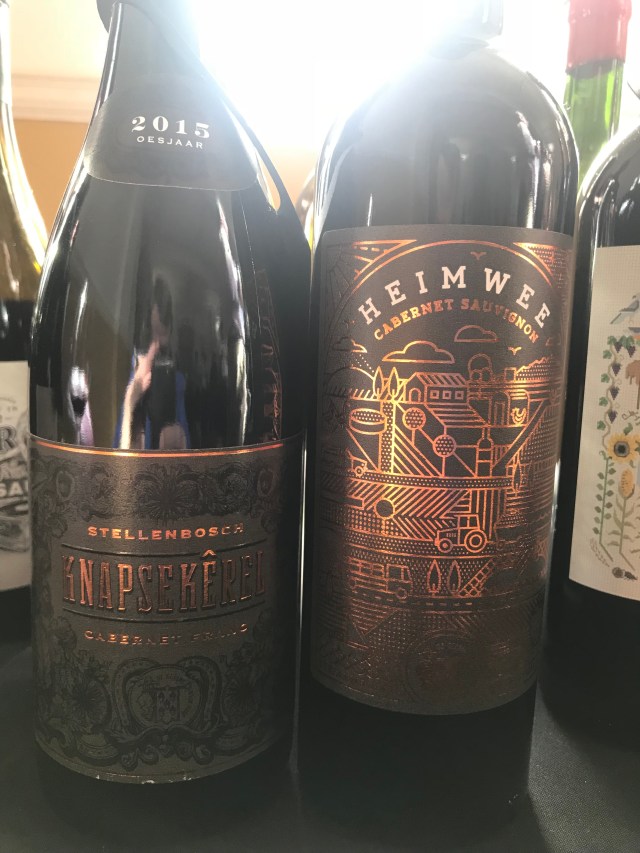
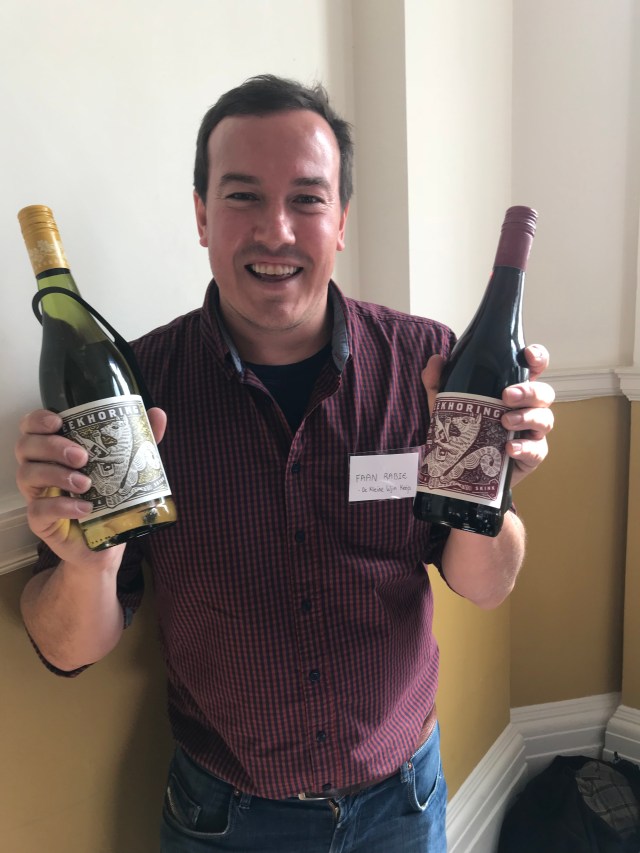
Foam Somló [2017], Meinklang, Somló (Hungary) – Meinklang is the Austrian producer based at Pamhagen at the southern end of the Neusiedlersee, but this wine comes from repurchased old family vineyards at Somló, where an ancient volcanic plug rises from the flat Hungarian plain between the Austrian border and Lake Balaton.

The grape varieties in this tasty petnat are Hárslevelü (a secondary Tokay variety) and Jühfark (a variety special to the Somló hill). A perfect aperitif on a very hot and quite humid day in London, this is more foamy than fully sparkling, with initially quite large bubbles which quickly dissipate, leaving a little spritz. Unfined/unfiltered, it’s cloudy near the bottom of the bottle, and it has a refreshing apple-like acidity with a tiny bit of a salty bite on the finish. This is one of several wines which Meinklang produce from their vineyards here.

EA61376C-D618-47AF-B1CE-35AC9112DAD5

Assyrtiko de Mylos Vieilles Vignes 2016, Hatzidakis, Santorini (Greece) – The idyllic holiday island of Santorini in the Greek Cyclades is an active volcano in what is known as the Hellenic Arc, which runs from Greece, across the Aegean to Turkey. It was the scene of one of ancient history’s cataclysmic eruptions in the Second Millennium BCE, an event which may have terminated the great Bronze Age Civilisation of Minoa.

The result today is a still potentially active crater sitting partly beneath the sea, the island of Santorini forming the edge of a classic caldera lake, semi-open as a bay to the west, partly closed by the island of Thirasia. Minoan Akrotiri was covered in a thick layer of ash during that great eruption, thus providing archeologists with a perfect opportunity to study this early civilisation intact.

Santorini may now be one of the most beautiful, and often expensive, of the Greek islands, but it undoubtedly produces its finest, and most ageworthy, white wines. Assyrtiko is the main grape, and makes up around 75% of plantings. It’s a unique variety, one capable of astonishing quality. The best Assyrtiko has body combined with fresh acidity, and we were tasting one of the very best, albeit quite young.

Deliciously limey, but also textured, one could loosely say “like Clare Valley Riesling with tannin”. The texture is palpable, but so is the freshness. There is no doubt that the old vines give this a great deal of extra depth. A fabulous wine, potentially, because I know this ages really well and really needs a bit more time. Yet it was still damned good.

D37B70CD-F767-4819-9C36-3CC4C2DBEE9E

Greco di Tufo 2015, Pietracupa, Campania (Italy) – Campania is the Italian region under the influence of perhaps her most famous volcano, Mount Vesuvius, another source of one of ancient history’s cataclysmic eruptions, which buried Pompeii and Herculaneum in the Roman era. Because it was witnessed by Pliny the Younger, whose accounts brought to life the horrors of the event (more than 1,500 bodies have been found in the ruins, but it is known that the combined populations of Pompeii and Herculaneum were around 20,000 people), we know so much about what happened here.

Sabino Loffredo makes wine in Montefredane, which sits near both the Greco di Tufo and Fiano di Avellino terroirs in Campania. As well as these whites of repute, he also makes a fine version of the regional red speciality, Taurasi. Fiano is often lauded above Greco down here, but Pietracupa Greco di Tufo is a delicious wine. If it has a “volcanic” characteristic, it is a touch of salinity, and a texture which adds depth, but this is overlaid with a creamy pear flavour and a squeeze of lemon freshness. The bottle age of this 2015 shows that the variety need not be one to drink immediately on release when from such a reputed producer.

78CFA6CF-FDB2-4044-B2FC-D7153E2FAEF8

Verdelho o Original 2015, Azores Wine Company, DO Pico, Azores/Açores (Portugal) – The Azores forms a remote archipelago roughly nine hundred or more miles off the coast of Portugal, direction America. The islands are part of the Mid-Atlantic Ridge of volcanic activity, where as America pulls away from Europe at a rate of around two centimetres a year, magma oozes up from the gap between the plates.

The Azores may be windswept and remote, but what a fortuitous location they provided for sailing ships crossing the Atlantic. After the advent of steam, viticulture declined, but didn’t die. Its commercial revival by António Maçanita and his Azores Wine Company, and the selection of the Azores as a UNESCO World Heritage Site for its unique viticulture, is a fascinating story. Pico is the largest island, and is basically a towering volcanic peak with viticulture possible from the shore (where vines are lashed by the Atlantic) up to around 200 metres above sea level.

The vines are planted low to the ground in fissures which look barely capable of harbouring any vegetation. They are protected by low stone walls, currais, which from above look more like the remains of an ancient civilisation. You can read about when I met António and tasted his wines in June this year here.

This Verdelho, which is not the same as Madeira’s Verdelho (some say it could be closer to Godello from Galicia) is dry, smooth, ever so slightly bitter. There is some “fruit”, but it is dominated by salinity. There is a stony mouthfeel and 13% abv. What ever you do, don’t over chill this wine otherwise its genuine personality won’t come through…and it is fairly unique on so many levels. It’s a shame that these wines just have to be expensive, a factor of their production costs. But they should be tried, truly. For me, this is a lovely, and fascinating, wine.

67284670-619A-4953-98F9-F327A3C9785F

Soave Classico DOC “Vignetti di Foscarino” 2015, Inama, Soave (Italy) – When people think about “Volcanic Italy” their eye naturally wanders southwards, but in fact much of Italy is of volcanic origin. In the Northeast, especially in the area where Soave (and Valpolicella) is made, there are outcrops of weathered black basalt (amid a limestone terroir resulting from the earlier shallow water lagoon, with additional clay deposits) which date from the time (broadly) when the Alps were formed, when Africa piled into Europe, in plate tectonic terms.

The resulting wines of Soave are capable of complexity and longevity, as attested by the region’s most famous single vineyard wines from top producers such as Pieropan, Tamellini, and Inama. Stephano Inama, whose father set up the estate in the 1960s, has been one of the drivers towards a rebirth of quality in Soave.

Vignetti di Foscarino is an old vine site of southeast-facing vines in the classico zone. It’s a rich wine, perhaps a facet enhanced by the vintage. It begins with some characteristic lemon freshness before the pear and stone fruit kicks in. It has that classic touch of almond on the finish. It’s clearly a multidimensional wine with many facets, but more than any other, it is surely one of those wines which tempts you, like the Child Catcher in Chitty Chitty Bang Bang with his candy, into using the “m” word – “minerality”. To which one would certainly need to prefix “complex”. But a wine to keep a while, even from 2015.

1D7281C3-6FD0-48B5-8380-E22E5F9EA20F

Vino Blanco 2000 “La Time”, Llanos Negros, DO La Palma, Canary Isles (Spain) – The Canary Islands are very much part of the wine consciousness of many wine lovers these days, but perhaps more for the wines of Tenerife than the smaller, more westerly, La Palma.

Although becoming Spanish in the 1400s, the Islas Canarias archipelago lies a mere 60 miles (100 km) off the coast of Morocco. The fortunes of wine here declined for roughly the same reasons as production similarly declined in the Azores, only recovering in the current century, with producers like Suertes del Marques and Envinate bringing Tenerife’s wines to international audiences. The wine which originally made the Canaries famous, Sack, is no longer produced.

Llanos Negros is a producer wholly new to me (and one that didn’t appear in Szabo’s book). La Time is made from sixty-year-old Listàn Blanco (aka Palomino in mainland Spain) grown on five contiguous plots which, although on volcanic rock, are on soils of sandy loam.

Winemaking involves skin contact (six days) and fermentation in concrete tank, then the juice was kept on lees until it was bottled a decade-and-a-half later, in 2015 (approximately 2,350 bottles). In keeping with the producer’s instructions this was decanted for three hours before being brought to the restaurant. It is golden yellow, tactile almost, in its rich mouthfeel and texture. A unique and brilliant wine, in my humble opinion. Almost Burgundian, certainly, in its complexity at almost eighteen years of age. Why have I not heard of this, and why does no one I know import it? I understand it costs less than €20 retail in Spain.

155D1D6A-CB8A-41E9-90E7-02047E792D99

Riesling Grand Cru Rangen de Thann 2009, Domaine Paul Zinck, Alsace (France) – There was another table at this dinner, but I naturally didn’t get to taste their wines…except for one. I want to mention this Rangen because it is Alsace’s only volcanic terroir, that despite the proximity of the ballons of the Vosges mountains.

The Vosges were pushed up around 500 million years ago when the Rhine Graben was formed, and they have since been weathered and eroded. They correspond to the area we now call the Black Forest, on the opposite, German, side of the Rhine, where vines sit on the lonely volcanic outcrop of the Kaiserstuhl.

The 600 metre high volcanic hill further south and west, in Alsace, is the Grand Cru Rangen, which rises above the small town of Thann. The site has shallow and complex soils over bedrock and the vineyard is often scattered with stones. These retain warmth, so that every wine I have tried from this cru has had a certain warmth and richness to it as well.

As far as I know there are only three proprietors of vines here. Perhaps the two best known are Domaine Zind-Humbrecht (whose Clos St-Urbain from here is one of the most famous wines in Alsace), followed by Domaine Schoffit. The third is Domaine Paul Zinck, which has had access to some of the fruit from a mere hectare of Rangen since the early 2000s.

The 2009 we tried last night had that characteristic richness, so much that a couple of us debated whether it was really a Vendanges Tardives (I gently demurred). It was powerful, for sure, and maturing. It was in some ways the least “volcanic” wine of the night for me, but that is a mere stylistic comment, certainly not qualitative. It was not my favourite style of Riesling either, but it was a privilege to try a wine which is not bottled every vintage, and when it is just a few hundred bottles are filled. I certainly missed the flintiness of some tasting notes in this richer and more softly mature example.

EA71CD31-5092-421E-9733-7FCAC5CA491D

Susucaru Rosato 2015, Frank Cornelissen, Etna, Sicily (Italy) – Etna! This is almost certainly why we are interested in Volcanic Wines. The journey to perhaps one might say “greatness” for the wines of the lower slopes of Mount Etna is one of the great wine stories of the past thirty years.

The ring of vineyards around Sicily’s famous crater look uncannily like the shape of Santorini, and John Szabo in fact calls Etna “like an island on the island”. Etna rises over 3,300 metres on the Sicily’s eastern side, built up over half a million years of successive eruptions, between Messina and Catania. Today those weathered and eroded volcanic soils, added to by more recent eruptions which continue today, make for some of the best viticultural land in Italy, land whose wines have achieved fast fame since quality production was instigated at the end of the 1980s.

Although several grape varieties thrive on Etna, including international varieties, the great red grape of the region has to be Nerello Mascalese. In Susucaru this Nerello strain is paired with three white varieties: Cattaratto (in other places you will read Insolia), Moscadella and Malvasia. The wine is made in exactly the same way as the other Cornelissen wines, which includes skin contact (ten days here, for texture and, as Frank says, “territorial identity”), fermentation in epoxy tanks/containers and no added sulphur. Remarkably (when you taste it) there are around 25,000 bottles of Susucaru.

Cornelissen has earned a reputation which sees him, unfairly, as the wild man of the mountain. He is a deep thinker, but wishes (and suceeds in doing so) to create wines with passion and soul. For those afraid of wine “as a living thing” it may also be fair to say that his wines show greater consistency these days – although I’m convinced that poor retail storage affected them in the early days, before cool shipping and aircon were deemed essential.

This wine is a real bad boy, clean and fresh with great acidity, but also with grip, a high toned bouquet, and so much going on. An excellent and complex (perhaps complicated) rosé (actually more of a light red in reality). I loved it. One of the most profound wines you will find labelled as a rosato in Italy.

7DE7EA11-A5A9-424B-B992-39EE97E3DAFF

Gamay sur Volcan “La Madone” 2016, Gilles Bonnefoy, Côtes du Forez (France) – Although many people won’t have come across this region, near the volcanic Massif Central, in the Upper Loire, but which in reality sits quite near the edge of Lyon, I can remember that the Sunday Times Wine Club sold an example of Forez as far back as the 1980s. Today the co-operative cellar is joined by a handful of independent vignerons, at least one of which is making a name for himself.

Bonnefoy farms around eleven hectares of Gamay biodynamically, the vines sitting on the slopes of two extinct volcanoes at Champdieu. La Madone is one of them. This 12% wine is bright but a little more “Pinot” in colour than what one might expect from Gamay here. The nose is fresh and fruity, but with a smoky edge.

The palate continues the Pinot Noir riff. The savouriness and depth of the fruit give more than a hint at a slightly structured Pinot, although nice rounded cherry flavours do come through as well. Winemaking does not include whole bunch/carbonic maceration, but is of a more classic red wine technique.

I think what we are seeing is a wine that is way more complex than its lowly AOP and price would suggest, but also a wine to enjoy without pomp. After all, at just £11.50 from The Wine Society this is probably the bargain of the day.

4EA6ED54-DD35-4C53-B32E-49CDD84F804D

Morgon Côte du Py 2015, Dominique Piron, Beaujolais (France) – We did have a discussion as to whether the Côte du Py is truly “volcanic”, a discussion I was embroiled in over the Côte de Brouilly cru at the 2018 London Beaujolais Tasting quite recently. Quibbling aside, I am happy to accept that the dominant terroir for this particular cuvée is on igneous rock.

This is not quite the contrast one might expect between these two Gamays. Piron’s is, thankfully, quite restrained, but nevertheless shows some of the characteristics of the atypical 2015 vintage in the region. It has also, thankfully once more, just 13.5% abv. It was served quite chilled, and of course is a young wine. It would not jump out as classic Gamay, having a hint of meaty steak with blueberries, which reminded one of our number of Cabernet Franc. Nevertheless, it’s an elegant wine with great purity, despite possibly a little oak influence yet to integrate. Hmm! My praise seems a little damp, but that is not what I intended.

DC910B0A-071F-4F0B-8E50-5643B2077E43

Etna Rosso “Guardiola” 2006, Tenute delle Terre Nere, Etna, Sicily (Italy) – Marc de Grazia fashioned a famous estate from extremely old vines, some being pre-phylloxera, on Etna’s north side, near Randazzo. In doing so he did as much as anyone else to promote this up-and-coming region. Terre Nere means “black earth”, and much of the topsoil here is fine volcanic ash mixed with stony basalt.

Although I’ve been a fan of this estate for many years, it is more often the generic entry level wines (red and white) which I’ve drunk. The Terre Nere single vineyard, or cru wines, are something else entirely. Complex wines, they all show the nuance of their site, all being demonstrably different.

This nicely aged Guardiola comes from the estate’s highest planted vines at above 1,000 metres. There are only three producers of this cru, and the vines sit behind a locked gate to try to protect the grapes from an increasingly common problem on Etna, theft. The cuvée is made from Nerello Mascalese, which has a reputation of being slow to evolve from this site, a wine of restraint. This 2006 was, for me, actually quite rich and lifted, with a slightly meaty edge. That mature palate combined with a complex bouquet make for a superb, joyful, wine. Excellent, and I felt very lucky to try it with decent bottle age.

AB1297F5-DCA2-44A5-9183-5CC825786031

So, as we are through with the wines, were there any conclusions to draw? The fact that the wines were all good sadly means nothing – we could easily have found some faulty or poor wines, but we were lucky. Yet certain descriptors did crop up throughout, which we had mentioned at the beginning: salinity, texture and freshness being three.

It’s still difficult to generalise, but on the balance of probability, given that some broad characteristics did run through the tasting, I think there is an argument for the proposition that volcanic soils or rocks can influence the resulting wine in some way. As the science appears to suggest I’m wrong in terms of the traditional “soil to glass transfer” idea, we shall need to look for other explanations.

In the meantime, I shall continue to drink these wines. You see, they are some of the most interesting and exciting wines around.

For interest, wines of the day (so difficult to choose) might be the Azores Verdelho, the Llanos Negros from La Palma (Canary Is.), Cornelissen’s Susucaru and the majestic Terre Nere cru, Guardiola. For sheer value for money, Gilles Bonnefoy’s Forez “La Madone” was a glugging miracle if it really does cost £11.50.

Foxlow deserves more than a throw away mention. With free corkage the meal came to a little over £30/head, way cheaper than the next cheapest meal I’ve had this year in Central London. As part of the Hawksmoor Group, the food was very good. Simple, yes, but simple is good when you want to concentrate on the wine…and that’s not to say it wasn’t really flavoursome, it was. Would I go back for another wine event? Like a shot.


Posted in Artisan Wines, Sicily, Volcanic Wines, Wine | Tagged , , , , , , , , , , , , , , , , , , , , , , , , , , | 5 Comments

New at Newcomer

I read recently, under the Decanter Magazine headline “Bordeaux becalmed”, that for the first time since Sotheby’s started selling wine in 1970 Bordeaux has dipped below 50% in sales. The decline in popularity of this once king of the wine regions is something for others to ponder, but at a wholly different level there have been few international success stories as swift as the rise, or maybe we should say rebirth, of Austrian wine. The pendulum swings…or is it just that even rich old people eventually go to another place and take their ideas on quality, and what makes for exciting wine, with them?

Austria makes plenty of old school classic wines, as the fine Rieslings and Grüners of the Wachau attest, but there’s no doubt that what is driving interest in Austria among the new, younger, wine drinkers are the young producers who are starting out, or taking over established parental estates. Of course, the fact that many of these are turning to “natural wines” doesn’t fit in with the parameters of taste established by the old guard. They don’t really like it up ’em, especially if it has undergone skin contact (the illiberal wine elite let out a shudder).

There’s no finer example than the Rennersistas in Gols, creating a buzz with their new wines and eye-catching labels, just doing something so very different. I mention the Rennersistas because I’ll be visiting them very soon, but it is no coincidence that you can find their wines in Newcomer Wines at Dalston Junction. As I’m off to Austria soon I thought I’d pop over to take a look at what’s new.

Since they moved up to Dalston Lane from Shoreditch Boxpark they have grown their range and grown in stature, but that doesn’t get around the fact that a special effort is required for me to get over to see them, and three or four times a year is all I manage now. I need to try harder, because this is one of the most exciting places to buy wine in London, with some of the friendliest staff.

It’s a really good time to make an effort to get there yourself because Newcomer seems to have taken delivery of a fair few new vintages of existing lines, plus a few new additions.

From Rennersistas in particular, now is the time to try their Waiting for Tom white blend (Chardonnay, Weissburgunder and Welschriesling), a worthy partner for the excellent red I have kept back from their first vintage (2015), just as an experiment. I left Dalston yesterday with a bottle of In a Hell Mood, Stefanie and Susanne’s petnat (75% Pinot Noir and 25% Chardonnay, Ancestral Method, seven months on lees, unfiltered). This producer is surely one of the most exciting in the vicinity of the Neusiedlersee in Burgenland, and there is actually a good, wide, selection of their wines on the shelves at the moment.

5D45D1BF-1EEE-4CB8-BF3F-BA2C0B00FF94

Claus Preisinger is, of course, closely associated with the Rennersistas. If you want a brilliant range of Gols wines, from cheap to expensive, Claus may well be the place to start. Somewhere in the middle of his range sits two sparkling wines, Ancestral (ancestral method with crown cap, not kept on yeast lees, £30) and Xtravaganza (mushroom cork, traditional method, £39). Both wines are made from Sankt-Laurent, and the prices here are pretty close to what you’d pay in Austria.

Since the 2015 vintage Claus has made one of the best “fun” wines in the country. Puszta Libre is a blend of mostly Zweigelt with (depending on vintage) 20% to 30% Sankt-Laurent. Part of the fruit undergoes carbonic maceration and part is direct pressed. The 2017 vintage is just in. I love this wine, a brilliant light glugger, quite inexpensive. I’ve not tasted the ’17 but I sensed real enthusiasm for the new vintage from the staff (“really fruity with more extract and texture than the ’16”). Needless to say, some went in my bag.

562E9AAB-9D27-495D-9994-D99D7DD31DB7

Michael Wenzel makes wine further down the Neusiedlersee on its western shore, at Rust. It was a shame I was quite unaware of Michael when I visited Rust in 2015. Michael’s focus is on Furmint. Historically it was always planted here, because we are just over the border from Hungary’s Sopron wine region, both of which sat firmly in the Austro-Hungarian Empire before the First World War. But it almost died out in Austria through the middle of the Twentieth Century, until Michael’s father, Robert, smuggled vines over the Iron Curtain from Sopron in the 1980s.

As well as the excellent Furmint 2017 which, coming off mica and gneiss, has ample fresh acidity and a mineral edge, don’t pass by the Gelber Muskateller 2017. This is a traditional variety of the western shore, off the same soils. It sees seven months on lees and is bottled without filtration. A very pure wine when I’ve tried it before, and I’m quite a fan of the wider dry expression of this grape from this part of Burgenland.

D7C0CE93-D84B-41E5-A83B-496D3FC31822

I’m not massively familiar with Baden producer Enderle & Moll. Sven and Florian have become something of a Pinot Noir specialist, in a region (and indeed, country) where the competition with this variety is hot. Some have even gone as far as to rank them number one in Germany, quite a shocking accolade, on which I’m not qualified to comment.

Newcomer has their Pinot Noir 2016 (only £21), but a step up is Liaison. This comes from vines of at least 45 years old and is considered a kind of Premier Cru. They use an old basket press and barrels from Dujac, yet all this care will only set you back around £30 (take-out price). Hardly a risk. Liaison is available from 2014, 2015 and 2016 vintages. And why not grab their fun Müller-Thurgau at the same time (£15).

2A1B73A2-D167-44A5-83DB-189435885991

FA885352-B53E-45EE-BBF3-832E00CFDAA0

Another new vintage just arrived is the magnums of Christian Tschida‘s amazing “Brutal” red blend cuvée. One of the best of the wines made and labelled after the bar of the same name in Barcelona for their Brutal Wine Co, this is quite rare and even at £78 for the 2016 should really be snapped up. The wine beside it in the photo is Sonja 2016, a bit of a labelling departure for Christian. But hey, Cabernet Franc from Neusiedlersee’s eastern shores is surely a must-try, even though Tschida’s wines never come cheap (£38).

6C2375A2-7EC0-427D-B719-1FD6D023D01D

Weinviertal isn’t an Austrian region I knew a lot about until I was struck almost dumb by the top wines of Poysdorf producer, Ebner-Ebenauer, earlier this year. About 20 minutes south of Poysdorf, in the village of Hohenruppersdorf, you will find Michael Grindl. I’ve never tried his wines, but I know I should – he’s a skin contact specialist whose wines sometimes have quite long periods on lees. Two labels I’d not spotted in Newcomer before were his Weissburgunder and Riesling Sodalis from the Sol vineyard.

D91E3B03-24CA-45D6-AC64-3AA2296F6000

Finally, from Austria, Vienna’s star natural winemaker Jutta Ambrositsch. There is a good full selection of her wines in stock right now. The one I took away was Rakete 2017 which she bottles as a Landwein but describes as a “Röter Gemischter Satz Rechts der Donau”. Gemischter Satz is the traditional Viennese field blend of which I am so enamoured (and, of course, a passion I’ll be pursuing when I visit Vienna soon).

I’ve truly adored Jutta’s wines ever since I bought her white Gemischter Satz, Sieveringer Ringelspiel, back in Newcomer’s Shoreditch Boxpark days. I tasted this red wine at the “New Old World” RIBA Tasting earlier this year, and this will be my first purchased bottle. As with Claus’ Puszta Libre, serve cool or (even better) lightly chilled.

870F7D0E-1ECF-42F4-B10C-CB26F8798631

Newcomer has a whole lot more these days than just Austrian wine. As far as I know they are the only place in the UK to stock a wide range of wines from Swiss Valais producer, Mythopia, who must surely be one of the most unique Pinot Noir specialists in the world – prices range from £49 up to £79 (for Wild Geboren 2012).

BB5D0969-FF76-42AD-9374-3AEBBDC4E665

I didn’t spot any bottles from Mosel’s Rudolf and Rita Trossen on the shelf yesterday (reclusive, near mythical, natural wines from the less lauded slopes of Kinheim in the Middle Mosel), but I did spot a very healthy Jura offering this time (Labet, Domaine des Cavarodes, J-B Ménigoz’s Bottes Rouges, Les Dolomies) and the same Domaine Giachino Savoie Apremont I bought in Paris a few weeks ago (again, at almost the same price in Euros, £21).

Other names to look for from France include De Moor AligotéYann Durieux (Love and Pif) and Jerôme Prévost, whose Meunier La Closerie Les Béguines can at least be had here, even if it now retails for over £70.

7297A243-5B33-45C4-8E56-5C35E00D721B

Back closer to Austria, don’t forget to check out the Czech/Moravian wines of “Autentisté Group” Member Milan Nestarec, whose crown capped Danger 380 Volts sees just two months on lees in bottle, and is a lovely grapefruity petnat in perhaps a lighter style than some. His Forks & Knives wines (green label below) have given a lot of pleasure here, too.

0B19510D-10E5-4E26-AFE3-D0C382C8E940

Do get yourself over to Newcomer this summer. I strongly suggest a small suitcase accompanies you. There’s still an awful lot I haven’t mentioned, like the Werlitsch and Strohmeier pictured below. Those who know me well know how I’ve been inspired by the wines of the wonderful Ewald Tscheppe, and his “tree and earth” labels.

The Strohmeier Schilcher Frizzante is a real Steiermark Region speciality, made from the Blauer Wildbacher grape. Tart yet creamy, with the flavour of tiny wild mountain strawberries. For devotees and initiates, and the most adventurous of wine lovers, until a year or so ago this was a purely Austrian delight. People like Newcomer’s Peter Honegger and one or two others are seeking to widen its appeal. I hope they succeed.

Werlitsch, Strohmeier, Preisinger Puszta Libre and Jutta’s Rakete red Gemischter

Newcomer Wines is at 5 Dalston Lane, London E8. Best options from Central London are either overground to Dalston Junction or the separate Dalston Kingsland stations (both very close), or by bus. Bus routes 56 (from St Bart’s Hospital near St Paul’s) and 76 (from Waterloo) stop close to Dalston Junction.

You can read about the large Newcomer Wines Tasting, “The Old New World” (March 2018, the the RIBA) here.

00E4BEF3-95BF-4F73-9D85-3B0523101885

Posted in Austria, Austrian Wine, Natural Wine, Neusiedlersee, Sparkling Wine, Wiener Gemischter Satz, Wine, Wine Agencies, Wine Merchants, Wine Shops | Tagged , , , , , , , , , , , , , , , , , , | 4 Comments

Recent Wines (June/July 2018) #theglouthatbindsus

Philippe Alliet is a mercurial vigneron who makes Chinon east of the town, in the back streets of Cravant-les-Côteaux. He is best known for his single vineyard Côteau de Noiré, but Chinon Vieilles Vignes 2008 comes from Cabernet Franc vines over fifty years old and is a gem. Perhaps 2008 was not the finest vintage here, but the old vines have produced a complex wine where the fruit on the nose is morphing into something leafy and smokey. There’s a plumpness as well as a lightness (I know…but it’s true). Very impressive and, in view of the vintage, pretty much ready to drink at around a decade old. I dare say more lauded vintages may go longer, and this 2008 is in no desperate need of drinking.

3DC1A865-3CE1-4F26-9CBD-1512916489E5

Txacoli is getting better known these days, but if you’ve never drunk this Basque wine, then this hot English summer is surely the time to do so. Getariako Txacolina 2017, Ametzoi is a showcase for the autochthonous Basque variety, Hondarrabi Zuri (with a little Hondarrabi Beltza for company). This small, golden grape produces wines in three DOs, of which Getariako is the one most often seen outside of the Pays Basque.

With just 10.5% alcohol, this version is apple fresh and frothy, with just a touch of salinity (maybe that Bay of Biscay influence). Ignacio Ametzoi’s Txacoli is always one of my favourites, full of youthful vigour when drunk soon after release, it has a crispness which reminds me of just picked, cool, apples, and a greenness reminiscent of the rolling Basque hills between San Sebastián and Bilbao. Re-freshing!

F1C929BD-9980-4AF7-A862-582A8B7C88E8

Bourgogne Aligoté 2017, Du Grappin is probably the unicorn wine of this batch. It proved hard to source any initially, and then I ended up, somewhat embarrassingly, with three bottles. Andrew and Emma Nielsen have really hit on something here. Eighty year old vines from the “Perelles” lieu-dit in the Macon village of La Roche-Vineuse provide the grapes. The soils, White Bathonian Limestone with marl give a mineral flavour and texture, but the acidity is in no way biting, as can be the case with Aligoté. It’s what you’d expect from vines this old.

Foot crushed, basket press, six months on lees, no fining nor filtration…in other words great care has been lavished on this. Beg a bottle if you can, or indeed the skin contact version which is about to be introduced to that salivating public very soon, at Wine Car Boot in London on 28 July. Sadly I won’t be there, but I think they will sell rather a lot of it.

D4AD8C29-BDC4-4DA5-A38E-C884E3202DD4

More recently I drank my first full bottle of Du Grappin Beaujolais-Villages “Nature” 2017. I admit that I’m finding that the amazing “Le Grappin” Côte d’Or wines are getting harder to afford, so it’s good to know that the “Du Grappin” label continues to provide amazing value with wines of quality coupled with genuine personality.

From La Pente in the village of Lancié, where the terrain is granite and schist, it undergoes a traditional whole bunch fermentation in concrete and wood. As with most of today’s wines, there’s no fining/filtration, and as the name suggests, no added sulphur. There is, however, a bit of CO2 to preserve freshness, and this really enlivens an already fruity wine. This bottle showed no reduction, nor spritz, although they recommend a carafe (not a bad idea, here).

This is just lovely, juicy cherry, “smashable ©”, bojo. #gogamaygo as they say.

5466B41F-FAA8-4335-98CD-0A0D41CABEB3

ZBO 2016, Riverland, Brash Higgins – Brash Higgins is the label of Chicago native Brad Hickey, who makes wine in South Australia’s McLaren Vale. He should be far better known. Perhaps his range is too wide for many importers, though his labels are striking. He is most famous for his sous voile masterpiece, Bloom. Although the variety there is Chardonnay, it is made almost exactly like a Vin Jaune, even down to ageing, and bottling in a 70cl clavelin look alike.

One of Brad’s loves is amphora, and he makes several wines in these vessels. ZBO is Zibibbo, sourced from Ricca Terra Farms in the Riverland Region on the Murray River, east of Barossa in South Australia. The region may not be known as a quality fruit source, but Brad has found 70-year-old bush vines here. He trucks the fruit to McLaren Vale, where it spends 150 days in amphora. Only 105 cases were made in 2016.

This is dry “Muscat” with a lovely apricot nose. The palate shows a little lemon extract and a touch of honey. There’s that lovely amphora texture too. As it is unfined/unfiltered you get a bit of cloudiness at the end, for me a pleasant contrast to the clearer first two-thirds of the bottle. Despite 13.5% abv, this is remarkably refreshing, and so long as well. Vagabond Wines is the exclusive UK importer of Brash Higgins. They should have stocks of the 2017.

528B252B-05FD-49B0-A2F7-F7471105370F

Pinot Noir “Sand” 2016, Jean Ginglinger, Pfaffenheim – Jean Ginglinger is a biodynamic producer whose family has been making wine in the region since the early 1600s. I’ve been drinking so much wine from “up north” in Alsace, that it’s nice to be reminded that the Haut-Rhin is just as good a source for exciting natural wines.

“Sand” is a Pinot Noir blended from all Jean’s different plots, because 2016 was no less a horribly small vintage in Alsace as anywhere else in France (although he did make an unusual blend of Pinot Gris and Pinot Noir that vintage as well). It ticks all the boxes for gluggable glou with strawberry and light raspberry fruit dominating. It actually manages 13% abv, yet has good acidity, and indeed a very tiny bit of volatility, but I loved it. Serve a little chilled. I bought this at Le Verre Volé in Paris.

08921D6B-E7C2-46CF-9983-A73A9722E69A

“Perfect Strangers” Artisan Cider, Charlie Herring Wines – Charlie Herring is the label under which Tim Phillips made wine first in South Africa, and now from his walled vineyard near Lymington in Hampshire. He has also begun making beer, but his largest crop comes from his old orchard behind the vineyard. You can read more about Tim (if you haven’t already) here…when the two of us visited Ben Walgate back in late May.

Perfect Strangers, with its lovely “A Humument”-inspired label, is actually a blend of apple cider and wine, rather like Tom Shobbrook’s “Cider”, except that this is somewhat more appley (the Shobbrook version, made with pears, has Mourvèdre added, which has a more prominent, rather than dominant, influence). So good, and if I’m honest you are probably more likely to get hold of some of this than the rarer wines Tim makes.

Artisan cider is surely underrated. The increasing propensity for small scale English winemakers to produce some cider to supplement their wine output is doing nothing but enhance the reputation of this beverage as a quality product, not merely a rather unsophisticated drink. Perfect Strangers (ie cider and wine) is far from being unsophisticated, but it is also a real thirst quencher. Contact www.charlieherring.com for stockists.

“Murmure” 2016, Domaine Rietsch, Mittelbergheim – I visited Jean-Pierre Rietsch last October, and he was kind enough to sell me a good selection of his wonderful Alsace wines. Murmure is a dry Muscat Ottonel, the fruit coming off Mittelbergheim’s marno-calcaire soils. The grapes undergo semi-carbonic maceration for seven days and the wine is aged six months on lees. This 2016 was bottled with 0.5 g/l of residual sugar and 9 mg/l sulphur.

I’d argue this is a genuine terroir wine with beautiful balance. As with Brad’s ZBO, this wine is slightly cloudy as it has no pre-bottling filtration, nor fining. There is lees texture and precision which, although Muscat doesn’t perhaps make wines to which one would always add this adjective, is very elegant. I think that is something which can generally be said of all of Jean-Pierre’s wines, and they also all show very considered winemaking.

I’m not sure Rietsch has a UK importer right now. Someone will put me right on that, if they indeed do. If it is true, it is quite unbelievable. He’s one of the best, if not the best, producers in the village…in Alsace even.

E71F7725-AD00-4B31-BD5B-21CF26DF14FF

Petnat 2015, Vol 4, Fuchs und Hase, Langenlois – Fuchs und Hase (which translates as “Fox and Hare”) is the joint label of Austrian Kamptal producers and good friends Alwin and Stefanie Jurtschitsch and Martin and Anna Arndorfer. These two top producers decided to work on this petnat-only project together.

Volume 4 is a blend of Müller-Thurgau and Grüner Veltliner, fermented in stainless steel undergoing a 12 day maceration on skins, and was bottled just three weeks after the harvest. It then spent twelve months ageing on lees in bottle before disgorgement. There is no added sulphur, and just 10.5% alcohol.

It is dry, and quite gentle for a petnat, but has lots of dry extract and acidity. Nice length too. I drank Vol 1 back in October last year, which blended the two varieties here with Gelber Muskateller, if I recall correctly. That was good, but the hot summer weather brought out another side to this wine. Only 1,000 bottles were made and it’s worth seeking out as a relatively inexpensive crown-topped fizz whilst you can still find it.

It’s imported by Les Caves de Pyrene and I understand that there is also another Volume I’ve not tried which blends Zweigelt and Cabernet Sauvignon. On the evidence of the first two Volumes, I really need to try some of that.

29191631-B1F0-4065-947A-D3669759AC89

This article has stretched a little more than I originally intended, but last night we had a lovely Al fresco dinner at home with friends, and I just can’t resist sharing something about what we drank.

Two lovely wines and one stunner. Käferberg DAC Reserve Grüner Veltliner 2011, Davis Weszeli comes (like the Fuchs und Hase wine above) from Langenlois in Austria’s Kamptal Region, just east of the Wachau, and is designated Erste Lage (rather like a Premier or Grand Cru). This terroir sits at around 300 metres altitude, comprised in different parts of sandy loam, clay and gneiss. The altitude, and cool valley location, allow for a long hang time, thereby allowing the Grüner to become fully ripe, although this wine doesn’t always attain the 14% abv reached by this 2011.

It was rich and smooth with relatively low acidity, but showed really delicious stone fruit and texture. It went down very well with a red rice salad with tamarind and soy dressing, and spanakopita. We didn’t carafe it as suggested on the back label, but we did serve it only cool (though maybe a tad cooler than the suggested 12-14 degrees because we knew it would quickly warm up on a sunny evening here). An impressive wine, more so for failing to display its alcohol overtly in any respect.

I bought this from Newcomer Wines back in the Boxpark days, but I think Vagabond (again) might import Weszeli now (they had a Weszeli free-pour event last week).

DA872B2C-838F-40B1-86A6-0B293180B32A

A wine which has been tucked away even longer in my cellar reminded me that I just do not drink enough sweet Chenin Blanc. Chaume 2005, Domaine des Forges is made by Claude and Stéphanie Branchereau, who farm a few hectares at St-Aubin-de-Luigné at the top end of the Layon tributary of the Loire. Dark hued, this is peachy and creamy (“peaches” our guests chimed, and they were right). It tasted rather like a peach tarte-tatin, rich, concentrated, long and moreish. Shame this was just a 50cl bottle.

These wines are not only indestructable, not only invariably delicious, but they don’t really cost all that much. I’d had this so long I can’t really recall where it came from, but interestingly (it may be the answer) an unspecified (doubtless recent) vintage appears on the Waitrose web site at under £10.

109D1FE2-36A9-41D9-ACEE-E79D1B02F096

I’ve told you those two were good, but I’ve saved the best until last…and this is a wine you can buy because I only got my bottle two weeks ago. Champagne Dehours Oeil de Perdrix Extra Brut is a palish pink made from mostly Meunier with 17% Chardonnay in this rendition – presumably 2015 fruit mise en cave in July 2016 and disgorged July 2017, with zero dosage.

Jerôme Dehours is based at Mareuil-le-Port, with vineyards centred round Cerseuil (one of Mareuil’s three constituent hamlets in the Marne Valley). It’s an area I know as Raphael Bérêche has vines here. Dehours is a Meunier specialist whose wines sit on the foundation of terroir with little dosage to “obscure” it. The terroir is indeed singular, being one of the coolest (no, let’s say “coldest”) in the region, but Meunier doesn’t resent a nip in the air as Pinot Noir and Chardonnay do.

The Oeil de Perdrix (partridge eye) has just a hint of pale pink colour which reflects a bronzed glint in the sunshine. The fruit is quite fresh and light, a rare whiff of strawberry here, but there’s also something more savoury. The Meunier gives it a little body and perhaps a slightly generous quality, but it is a truly appealing wine, really so good.

The wonderful thing about it is its price. This cost me £45, and whilst it might not quite match the amazing quality and individuality of Jerôme Dehours’ single vineyard wines (of which Peter Liem says “buy them without hesitation” (Champagne, Mitchell Beazley, 2017)), nor does it match their price. This came via Solent Cellar in Lymington. I know H2Vin import a few Dehours Champagnes, and I know this came via them, but they don’t list this particular Oeil de Perdrix on their web site. I think Solent Cellar may have half a dozen left.

573010C6-196D-43E8-B4AB-9A085AB4EF71

These articles are supposed to be restricted to wines we drink at home, but there are three other drinks that I must mention. The photos below show Karim Vionnet “Grabuge!”, a sort of demi-sec Sparkling Beaujolais with just 7.5% alcohol, which was THE most perfect evening beach drink a couple of weekends ago. Then, on Saturday, we drank the L’Anglore Tavel from Eric Pfifferling at Plateau in Brighton, with Starvecrow Petnat Cyder (and a mean negroni). The food included one of the best dishes I’ve had there, a spaetzle with broad beans and ricotta.

Posted in Alsace, Artisan Wines, Austrian Wine, Beaujolais, Champagne, Cider, English Cider, Loire, Natural Wine, Sparkling Wine, Wine, Wine Agencies | Tagged , , , , , , , , , , , , , , , , , , , , , , , , , | 6 Comments