Vineyards of Hampshire

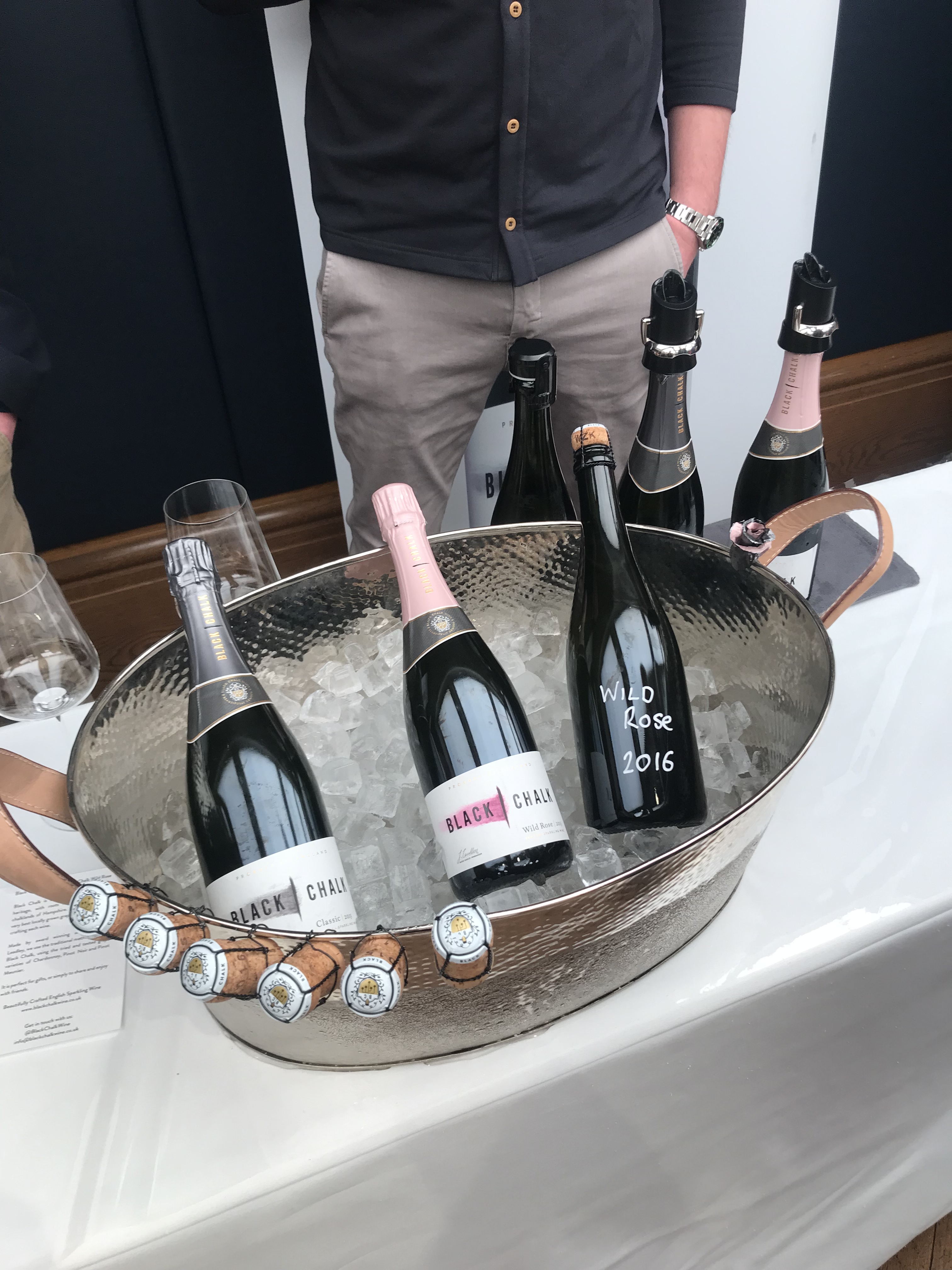
Vineyards of Hampshire is an umbrella organisation for what is now eight sparkling wine producers from the county, who seem to have got their act together for joint promotion. I say “now eight” because the original seven have recently been joined by Black Chalk, Jacob Leadley’s new project, who I believe may just be the most exciting English sparkling wine producer right now.

Vineyards of Hampshire consists of Black Chalk, Cottonworth, Danebury, Exton Park, Hambledon, Hattingley Valley, Jenkyn Place and Raimes, and they all came together earlier this month for a tasting in the basement at 67 Pall Mall. Whilst there were “stars” for sure, all of the producers showed some lovely wines.

I’d especially like to highlight those brave enough to try something a little different. I’ve always liked my local Sussex vineyard, Bolney Estate’s Cuvée Noir, made from Dornfelder. It may not quite hit the high notes of their best white and pink sparklers but it does add interest to the range. No Dornfelder here, but a few interesting wines outside the norm.

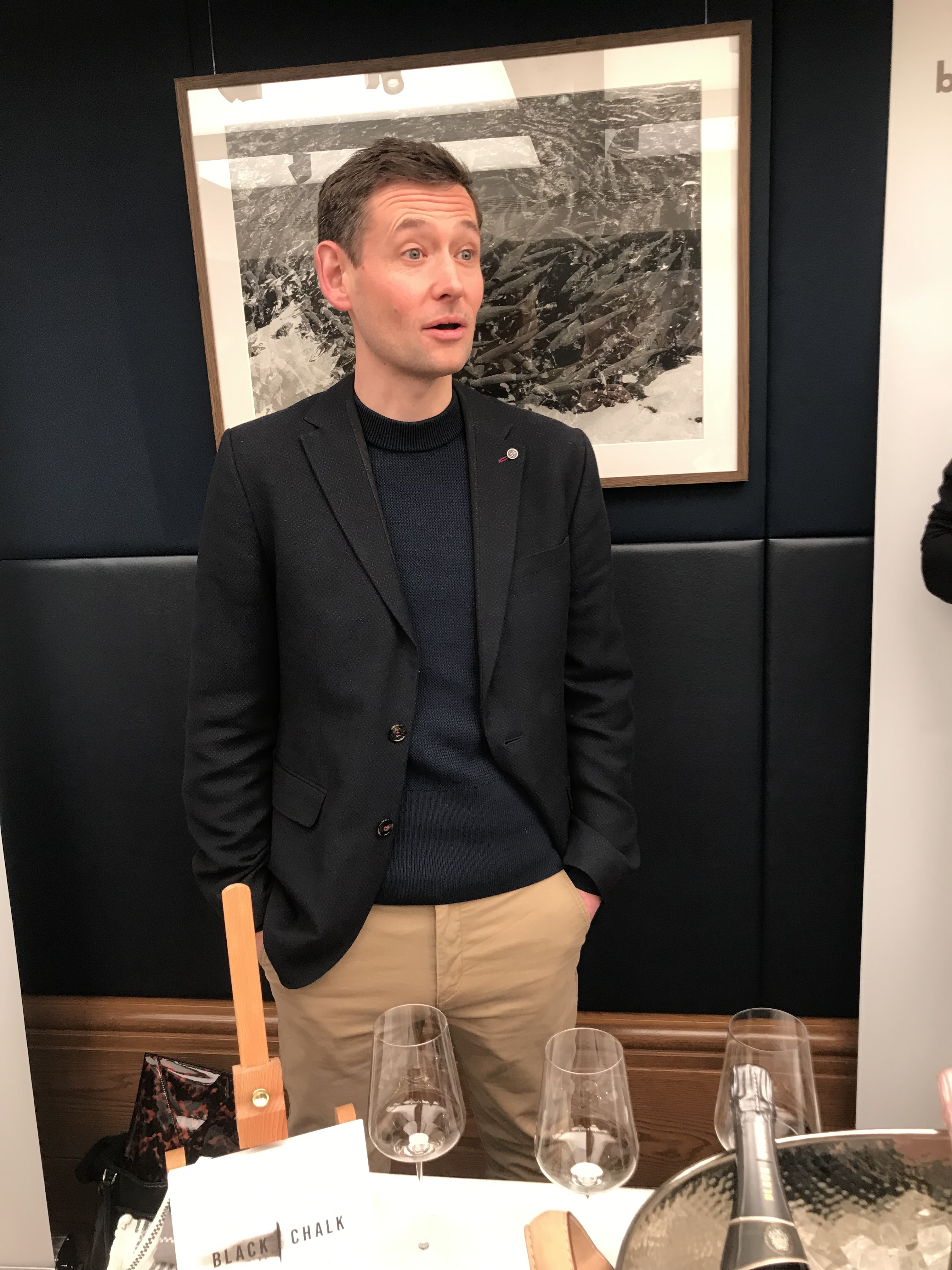
BLACK CHALK

Jacob Leadley spent eight years making sparkling wine in Hampshire and is best known as a former winemaker at Hattingley Valley. The Black Chalk project, which is now his full time occupation, produces small batches of finely honed wines from grapes sourced from top growers, on a unique terroir on the western edge of the South Downs.

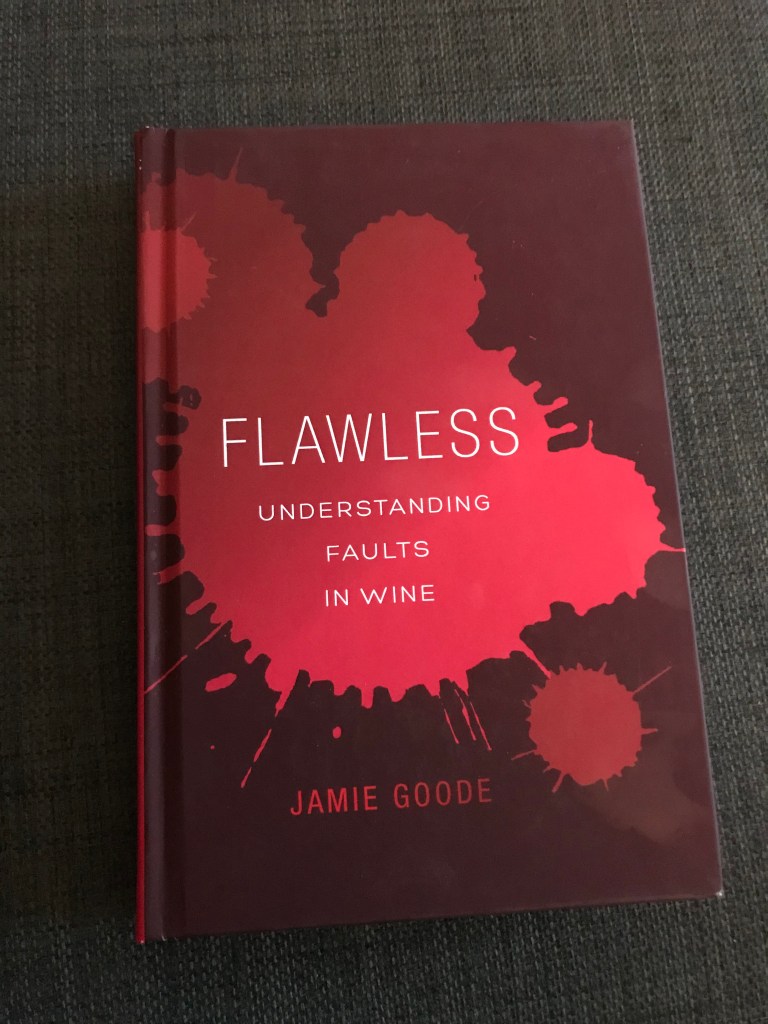
The praise heaped on Black Chalk, since the release of the first wines at the London Wine Fair in 2018 has been quite astonishing. Wine writers have been lining up to praise Jacob, and Jamie Goode is not wrong when he calls Black Chalk “one of the best UK Sparklers out there”. Fine praise for such a new estate.

Classic 2015 is the entry point here, 49% Chardonnay, 34% Meunier and 17% Pinot Noir. It should be noted that Jacob is rightly a fan of Pinot Meunier and here it adds ripeness to a gorgeous palate refresher which retails for around £35. The use of oak shows through but not in an intrusive way. The price is pretty good for a wine which has clearly benefited from extended lees ageing, and small batch production.

Wild Rose 2015 is a little more expensive (£40) and is a blend of 41% PN, 38% PM and 21% Ch. It has super red fruits (strawberry, raspberry), and is very clean, elegant and lifted. There is an abundance of very good English Rosé on the market now, wines which scream beautiful red fruits, but I can’t think of any which do so more than Wild Rose.

Wild Rose 2016 has a little more Pinot Noir and less Meunier than the 2015. This gives it just a lighter touch. It was only disgorged in November (6g/l dosage but there was a little residual sugar from the tirage, so it contains more like 7-8g/l). Fresh and ripe, this will certainly equal the 2015 when it is released.

This is my third time tasting with Jacob since the London Wine Fair last year and every time the wines seem to have grown in stature. It will come as no surprise that I tip them for the top.

Black Chalk’s UK agent is Red Squirrel.
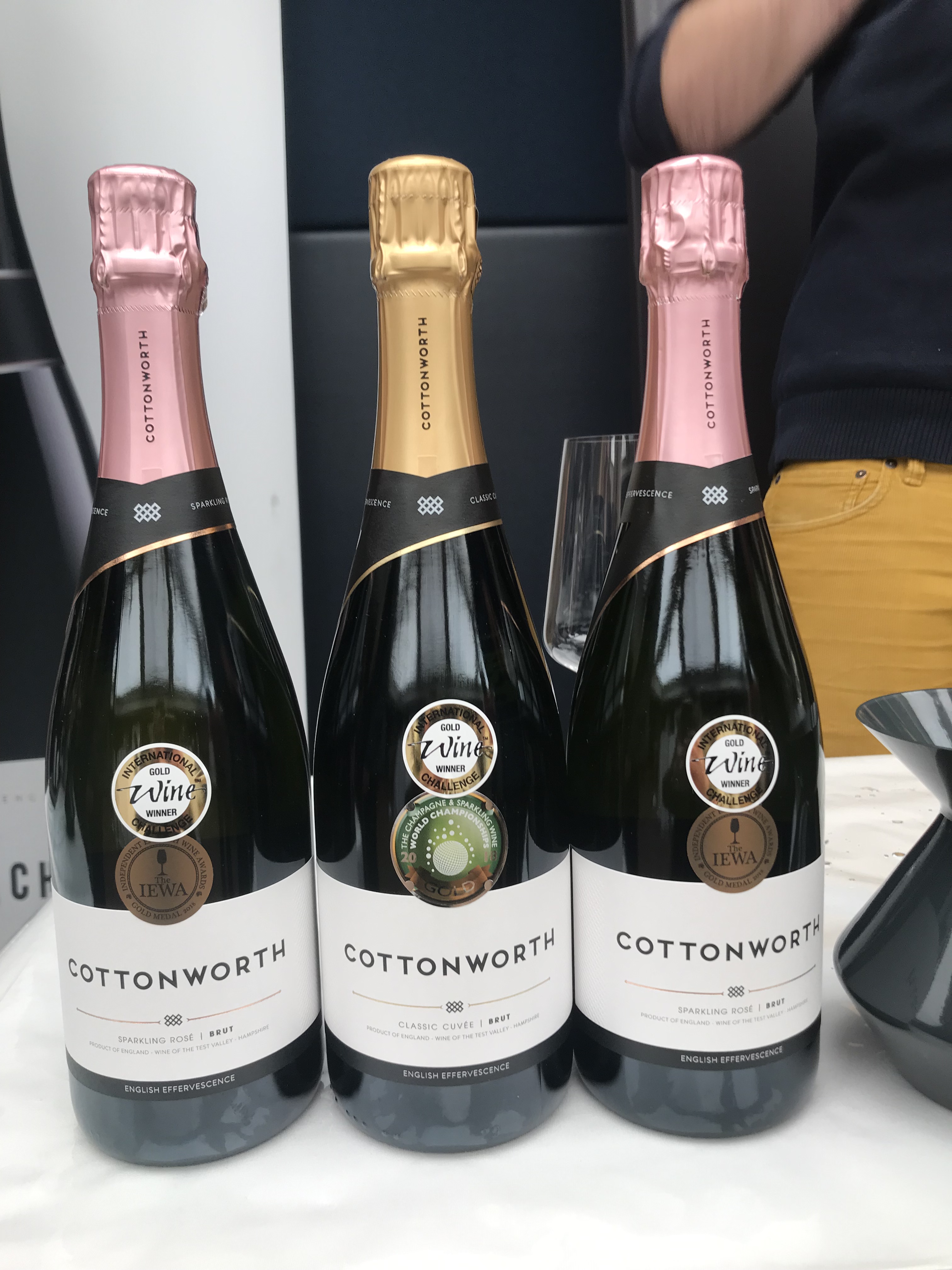
COTTONWORTH

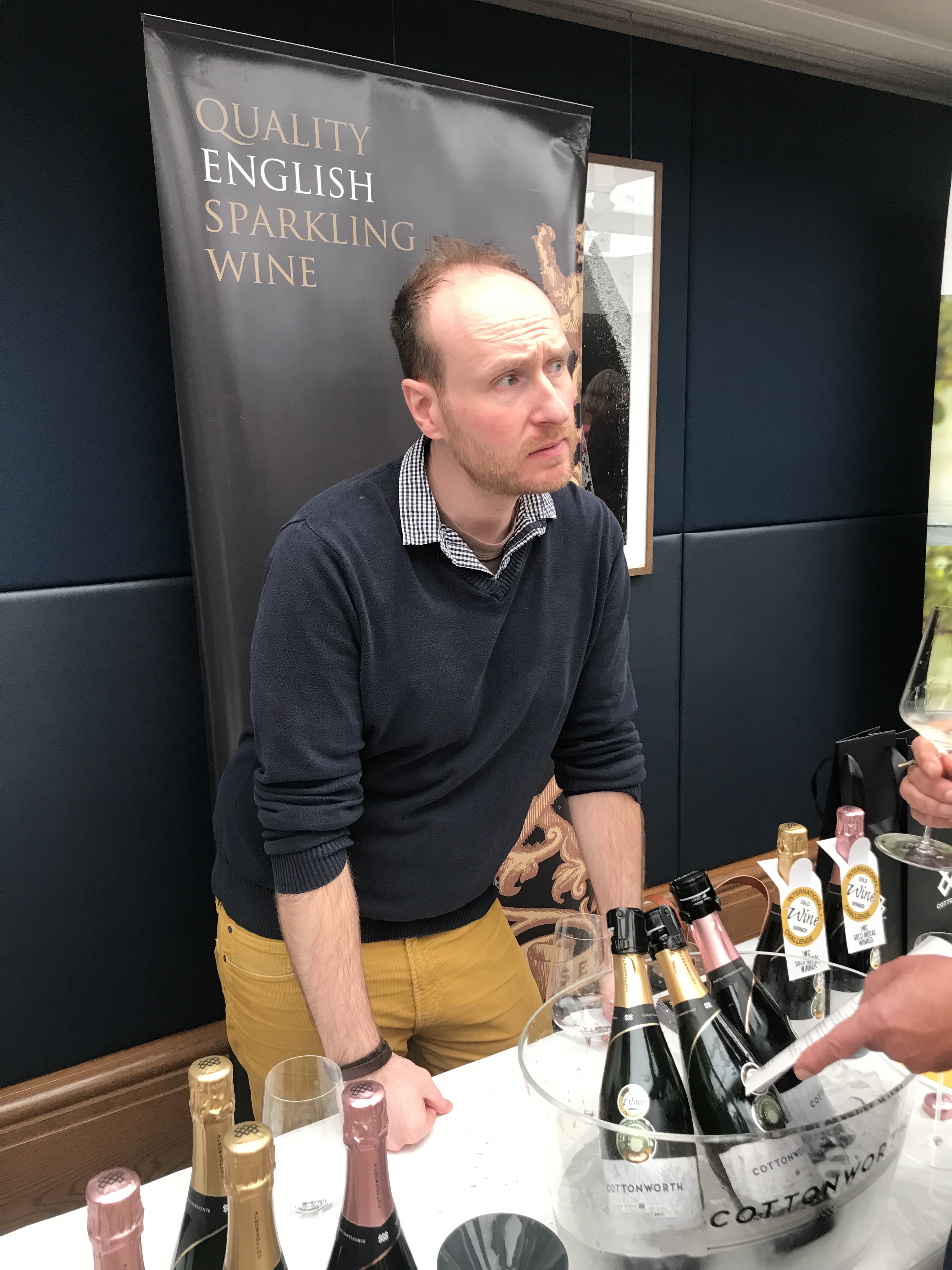
The Liddell family own thirty acres in the Test Valley between Andover and Stockbridge. As well as the two wines on show there are plans afoot for a Blanc de Blancs in the future.

Classic Cuvée NV is yet another expressive entry point wine, elegant and fresh in style. Made from almost equal parts Pinot Noir and Chardonnay, with a little under 10% Meunier, the Pinot fruit seems to dominate the style. Although Non-vintage, this saw 34 months on lees before being disgorged in February 2018.

Sparkling Rosé blends around 48% of both Pinot Meunier and Pinot Noir with a little Pinot Precoce (aka Frühburgunder in my garden), and no Chardonnay. This sees almost as long on lees (30 months), and although it is undoubtedly fruity, it also has an interesting savoury quality.

Cottonworth is another small producer, making only 10,000 bottles each year. Quality is extremely high, and these are excellent wines, which should retail for around £30.

Cottonworth wines are available through Berkmann Cellars.
DANEBURY VINEYARDS

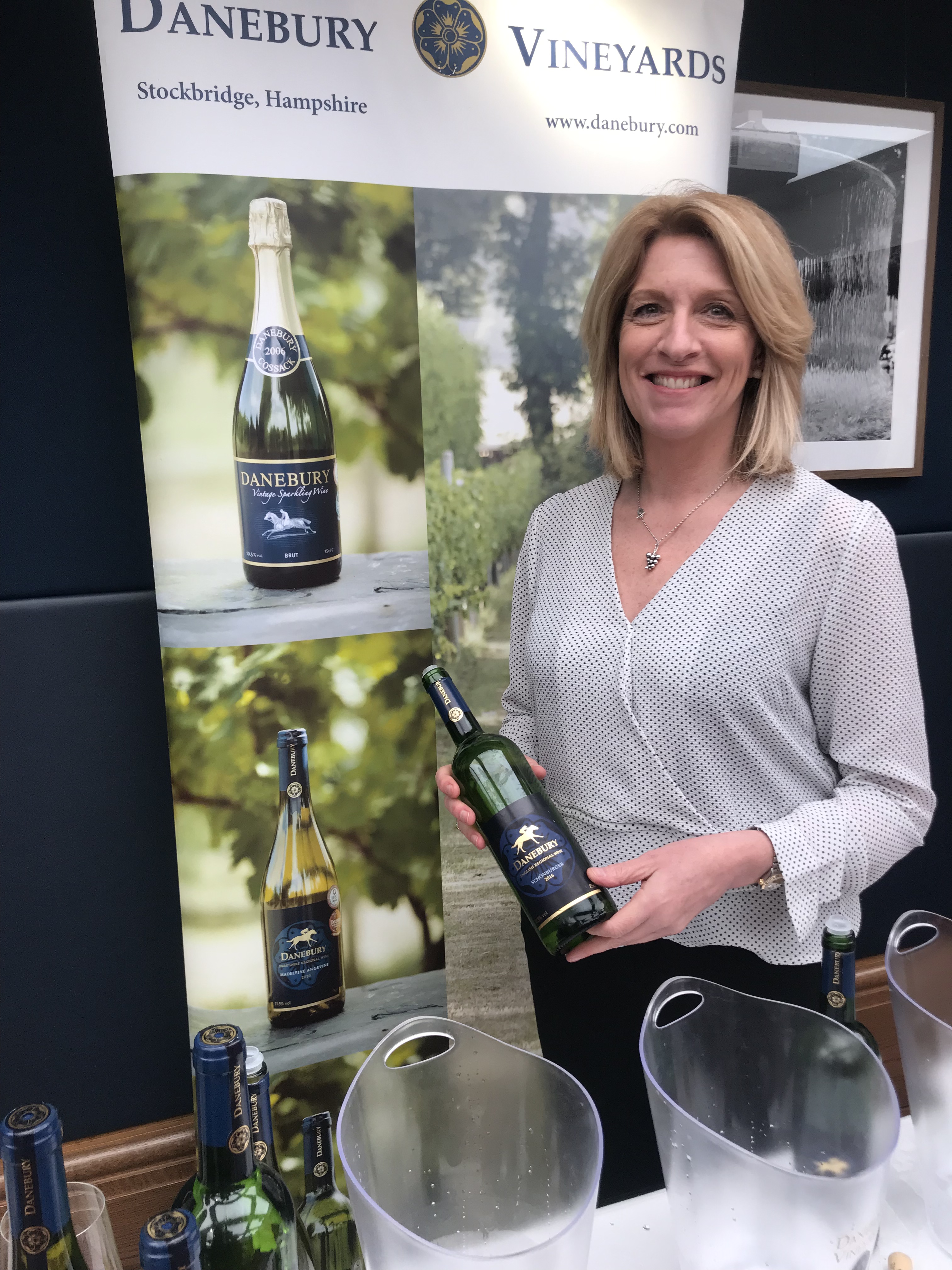
Danebury is also near to Stockbridge, at Nether Wallop, and is the most westerly of the group of eight. They own a single, seven acre, vineyard on a south facing slope within the former Stockbridge racecourse, which has been quietly producing sparkling wine for twenty years. Winemaker is Vince Gower.

Cossack Brut 2014 benefits from reasonably mature vines, 25 years old, but also four years extended lees ageing. Where it differs to many more recent English sparklers is the grape blend, 95% Auxerrois and 5% Pinot Gris (Rülander). The initial bouquet was slightly muted, but it opened out in a couple of minutes to something quite biscuit-like. The palate is broader than the wines based on the traditional Champagne varieties, and it’s quite savoury, but it’s nice to try something different. RRP £27. Cossack is the name of the Danebury-trained winner of the 1847 Epsom Derby.

Unusually among this group, Danebury were showing their three still white wines. Madeleine Angevine 2016 is dry with a floral bouquet and a pleasant texture. Schönburger 2016 is given a quick pressing to create a wine which is dry, softly textured, and very aromatic. The softness cushions a bright and broad grapefruit acidity. Both are delicate and refreshing wines.

Reserve 2016 blends all four varieties grown on the estate and mentioned above (proportions approx Auxerrois 38%, MA and Sch 30% each, and PG 2%). As with the two varietal wines above, alcohol is a low 11.5%. The nose is richer but the palate has fresh lemon citrus acidity. There’s a tiny bit of complexity which comes through the texture and mouthfeel.

We are just starting to see a glimmer of interest in English still wines. Always popular at the cellar door, I expect to see more working their way into independent wine shops and small restaurants, and whilst we are not looking at complex fine wines here, they undoubtedly express a pleasant English summer. All three retail for £12.50!

Danebury is available via Wineservice Ltd London.
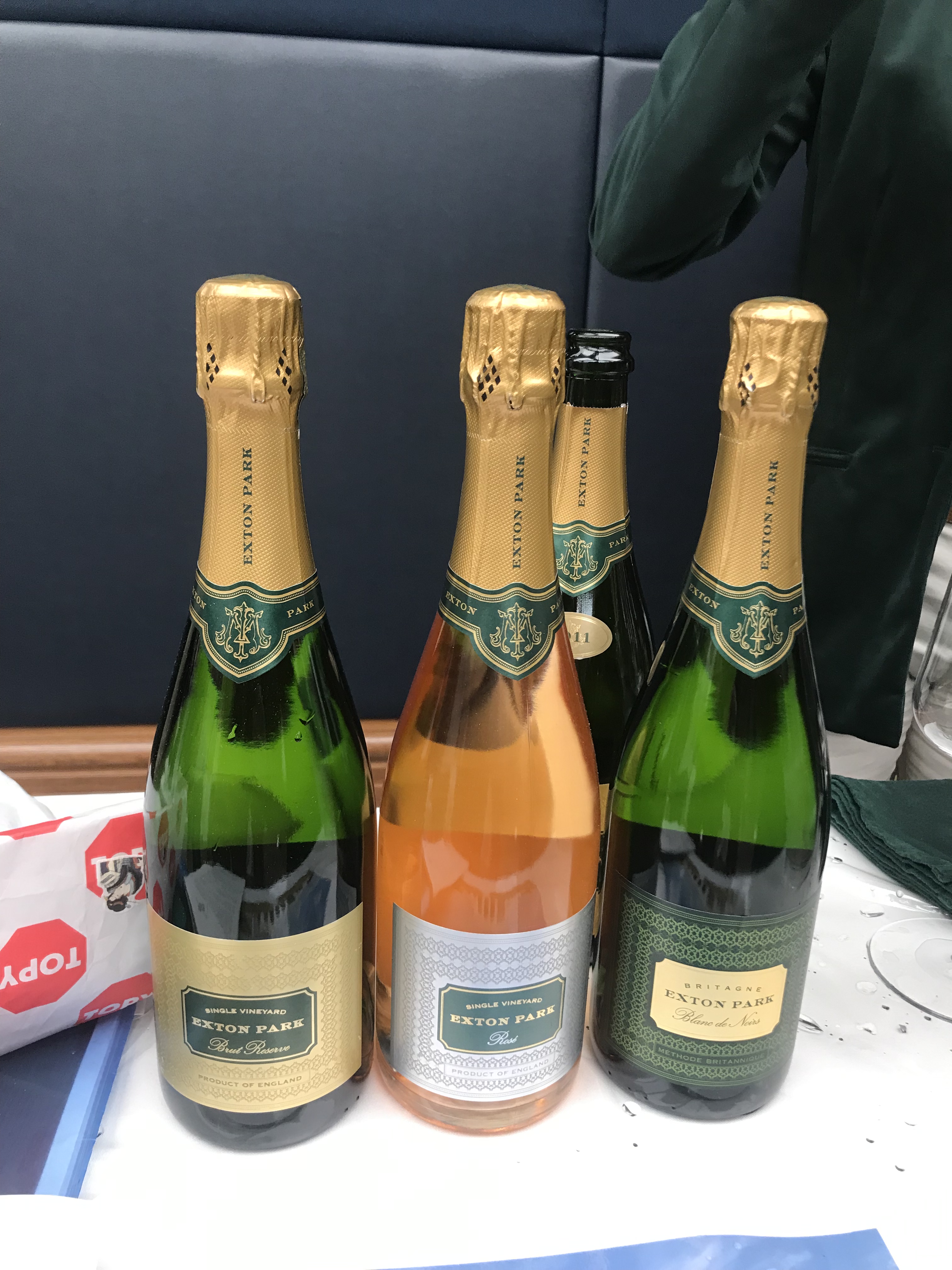
EXTON PARK

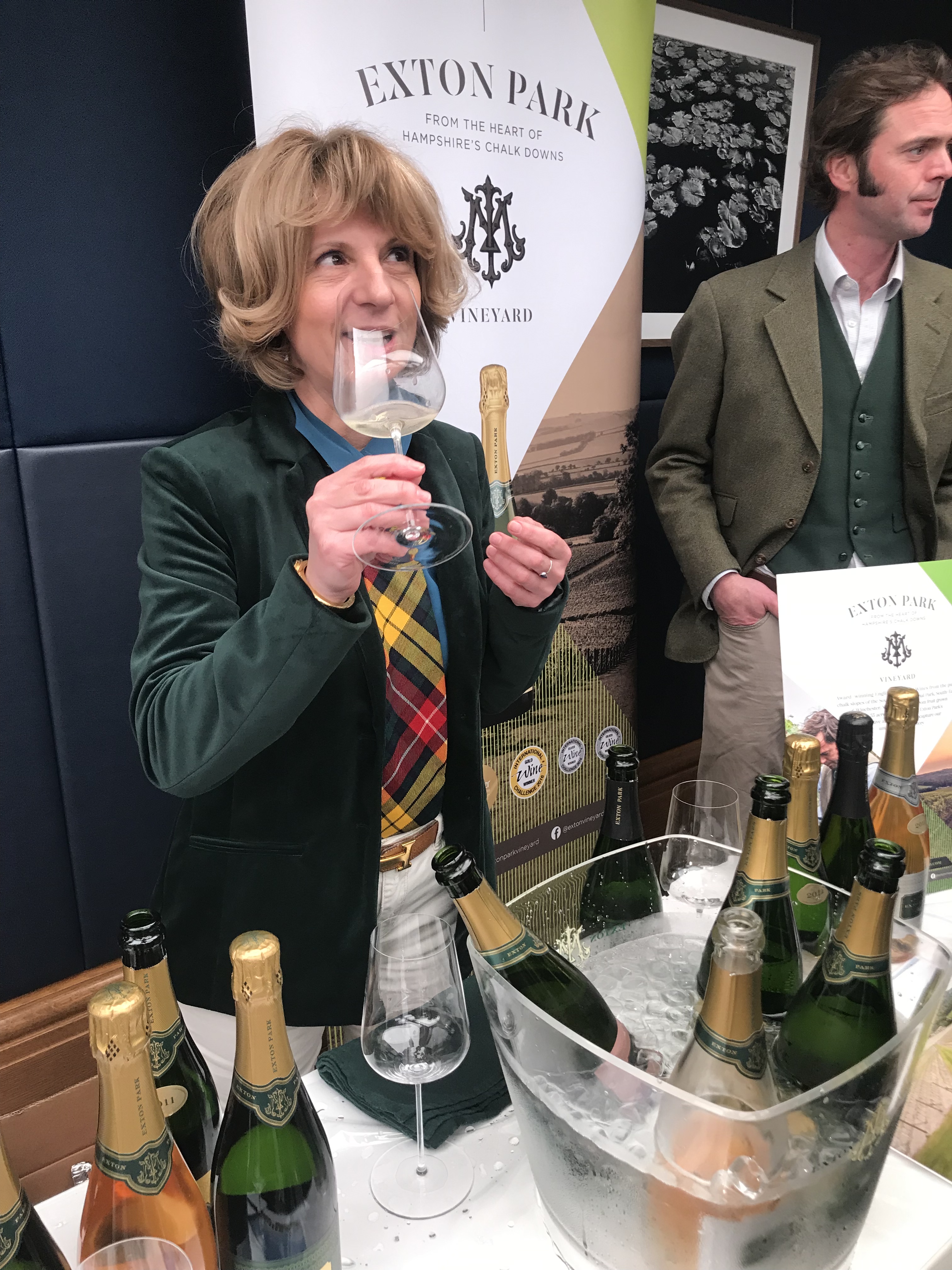
Perhaps Exton Park would be my second favourite producer here. They are larger than many, with 55 acres (22 ha) on one site, though divided for harvesting and batch fermenting into a number of delineated plots. This allows their accomplished head winemaker, Corinne Seely, to release a number of special cuvées when exceptional fruit permits, although the overall philosophy is “terroir expression” via predominantly non-vintage wines.

Brut Reserve NV is a Pinot Noir dominated (60%) wine with the rest of the blend being Chardonnay. It sees two years on lees, but then a further two on cork, which does mean that it is nicely bedded down on release. There is a nice bit of spice in this cuvée, more savoury than many, with soy and ginger notes adding complexity. This is available in magnums (and halves), which is an excellent move in my opinion. £65/magnum is a small premium above a RRP of £27.50 for a bottle.

Blanc de Noirs NV is 100% Pinot Noir and has nice red fruit aromatics. The big fruit is contrasted by a delicate crystalline acidity. There are plenty of reserve wines in here, with a library for Corinne to select from going back to 2011. It is this carefully built library of reserve wines which helps Exton Park stand out from the crowd in England. Some producers have been too slow to build such a library, perhaps due to the dictates of cash flow. This BdN sees two years on lees, but just one on cork before release.

Rosé Brut NV is a pale salmon pink made by whole bunch saignée, utilising the ripeness of the grape skins for colour. Pressing is very gentle, for just four-to-five hours. The blend is 70% Pinot Noir and 30% Meunier, the latter probably adding a little weight and ripeness. Yields are low and the wine is already a little complex, a good bet for food.

Blanc de Blancs 2011 is one of those special parcel wines I mentioned, and indeed it is pretty special. Just 3,000 bottles were made of this 100% Chardonnay. The bouquet is wonderful, quite complete, and the fruit is explosive. Although over seven years old I’d argue that it’s not yet fully mature. It may retail at £40 (the previous Exton wines all generally retail at under £30), but this is marvellous value for the quality.

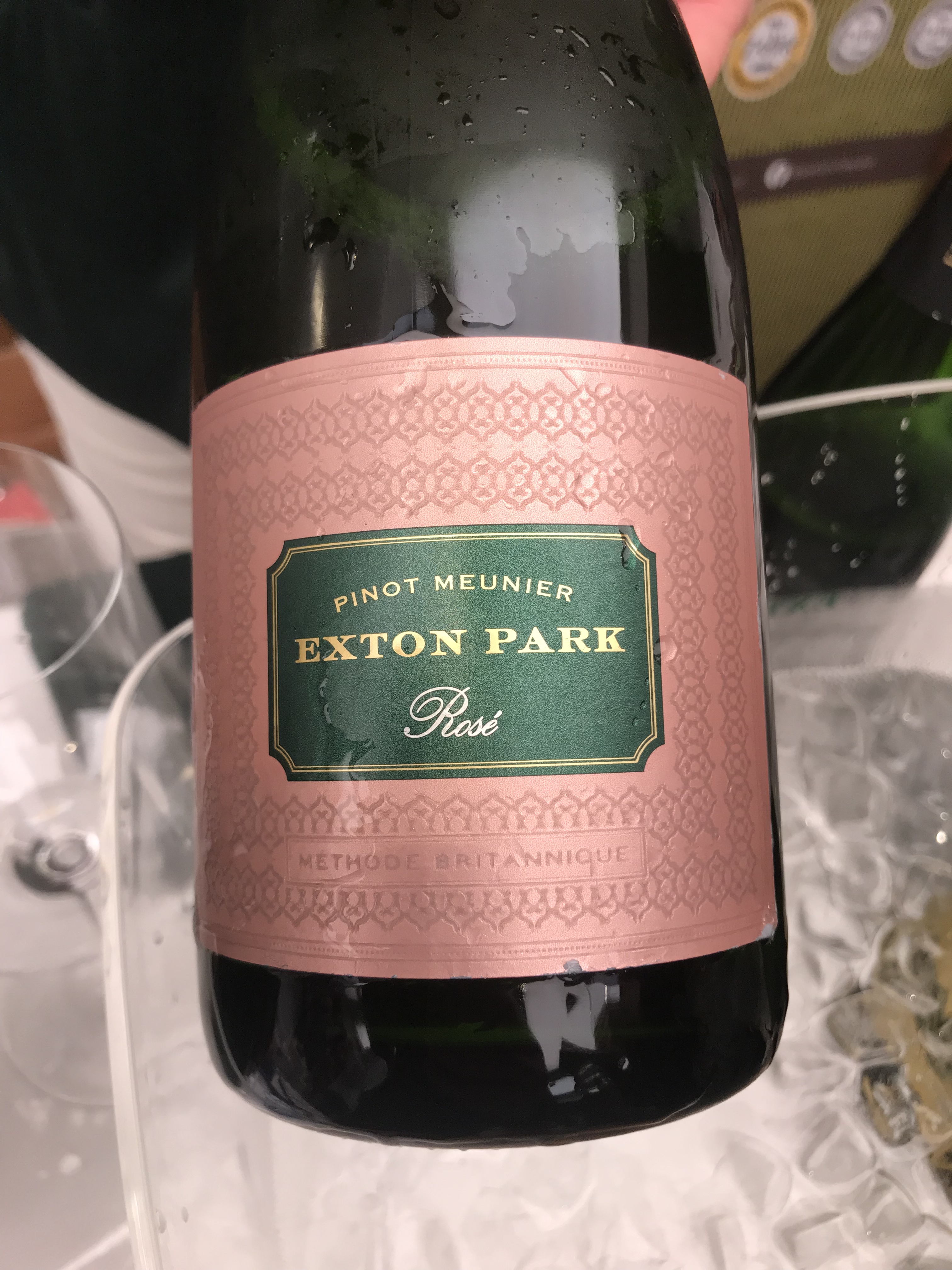
Pinot Meunier Rosé is a little different, but no less fine. It’s very pale with red fruits more in the pomegranate/cranberry spectrum this time, plus an attractive umami note. It’s a brilliant expression of Meunier fruit off a special terroir, perhaps one of the finest pink sparkling wines in the UK. Real zip and zest lift it up towards the stars.

Exton Park is represented by Friarwood Fine Wines.
HAMBLEDON VINEYARD

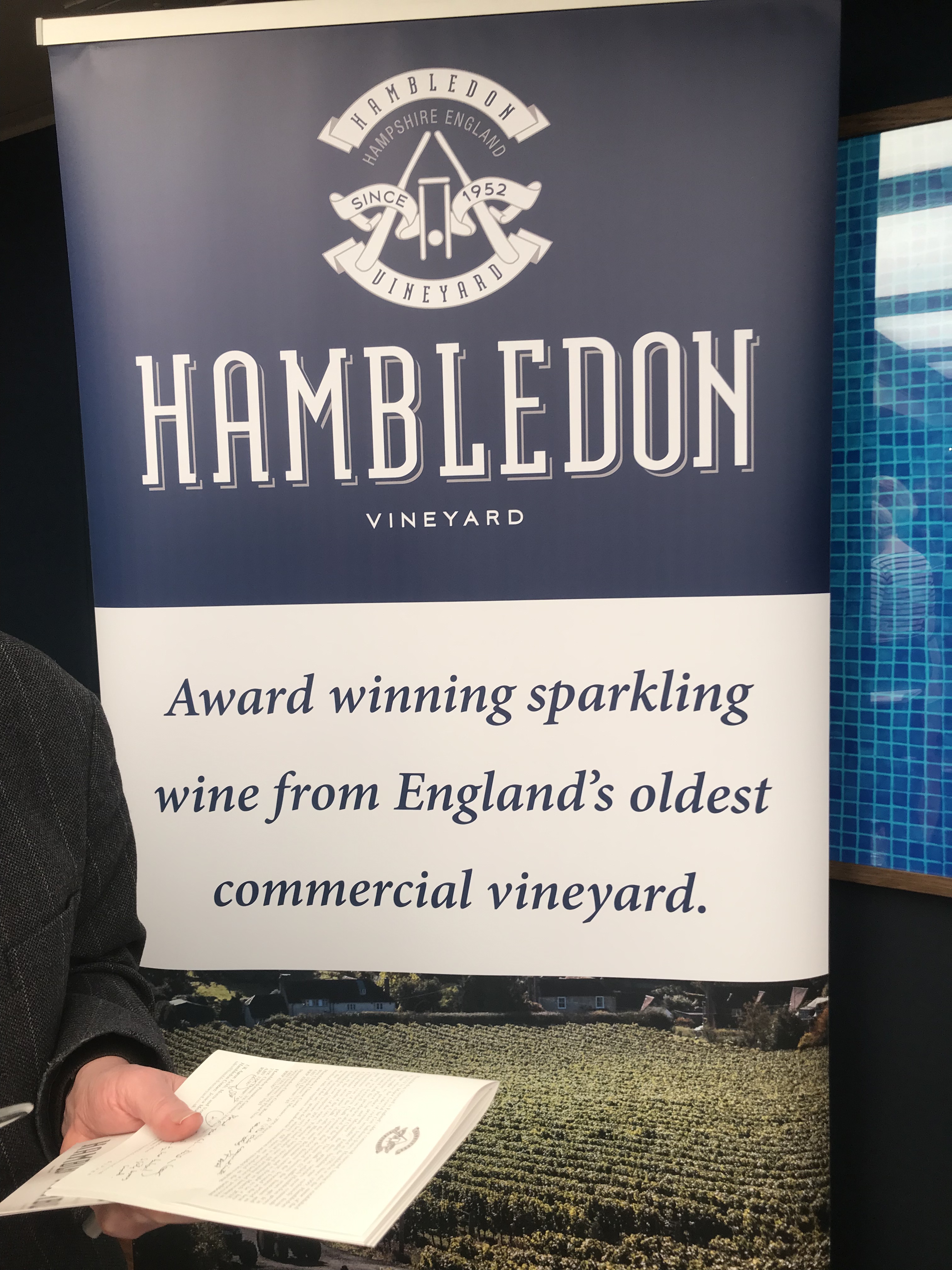
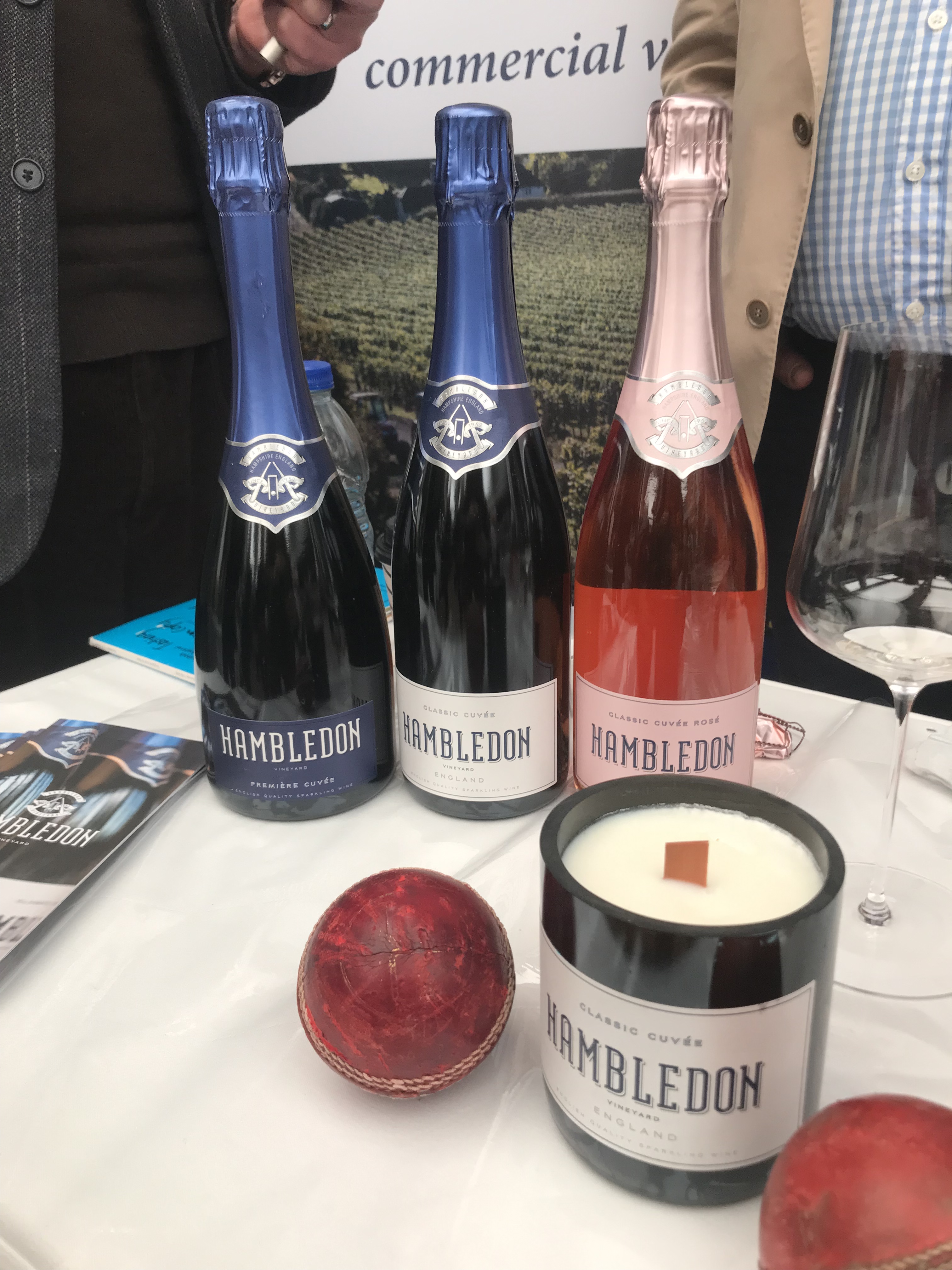
Hambledon is England’s oldest commercial vineyard, famous for having been established by Major-General Sir Guy Salisbury-Jones in 1952. I’m not sure what Sir Guy planted back then, before anyone imagined an English sparkling wine industry, but today the focus is on the classic varieties, Chardonnay, Pinot Noir and Meunier.

The soils at Hambledon are, of course, chalk, but more specifically the belemnite-rich chalk of the Newhaven Formation which closely mirrors that found in Champagne’s Côtes des Blancs. Hambledon, which it must be said has undergone something of a revival in recent years, has what for England can really be termed a massive area under vine, around 200 acres. The dominant variety is unsurprisingly Chardonnay, which dominates to one degree or another all of the Hambledon bottlings.

Hambledon Classic Cuvée doesn’t have a vintage, but the current release is mainly 2014 with reserves. It contains the least Chardonnay (40%) of the three wines with more or less equal proportions of the other two varieties. It sees a good eighteen months on lees and shows nice fruit in an accessible style.

Classic Cuvée Rosé is, surprisingly, 90% Chardonnay with 10% Pinot Noir, and it is dosed at a rather high 10 g/l. It has an orange-salmon hue from barrel aged Pinot Noir, from the 2010 vintage, the Chardonnay coming from 2014. You get strawberry and raspberry fruit with added spice, and the wine shows depth and weight. A bit of texture too makes it quite gourmande, an adaptable food wine despite (or maybe because of?) the dosage.

Première Cuvée tops the range at £45 RRP. The blend is 73% Chardonnay, 24% Pinot Noir and just 3% Meunier, and the dosage is back down to 7 g/l, the same as the Classic. The nose has that brioche/arrowroot biscuit note from the Chardonnay, and complexity is added by the inclusion of 2011 and 2013 reserves partly aged in oak. Around 45 months on lees, this of all the wines tried at the tasting has some oxidative, as well as autolytic, notes, which do add to the complexity even further. But it doesn’t lack freshness. Impressive.

Hambledon is distributed by Fields, Morris and Verdin.
HATTINGLEY VALLEY

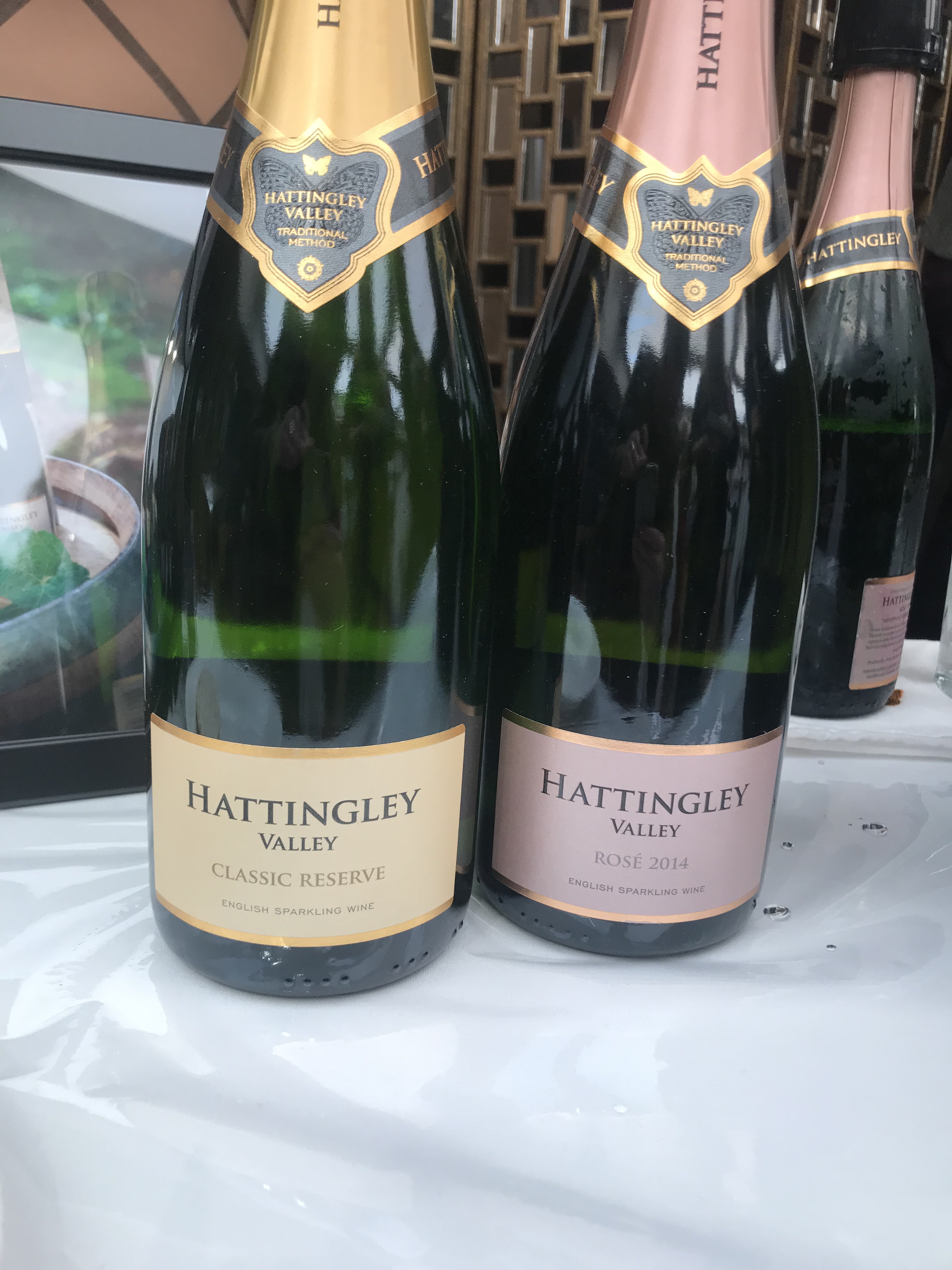
Established in 2008 at Lower Wield, near Alresford, Hattingley Valley has grown to 60 acres (24 ha) over two sites not far from Alton. Owned by Simon and Nicola Robinson, Chief Winemaker (and a director) is Plumpton College graduate, Emma Rice.

Classic Reserve won the Trophy for Outstanding Classic NV in the Wine GB Awards 2018. It’s an excellent entry point to the Hattingley Valley range. It comprises 50% Chardonnay with 30% PN, 19% Meunier and a dash of Pinot Gris. This wine actually deserves the term “classic” in that I’d describe it as a wine of wide appeal.

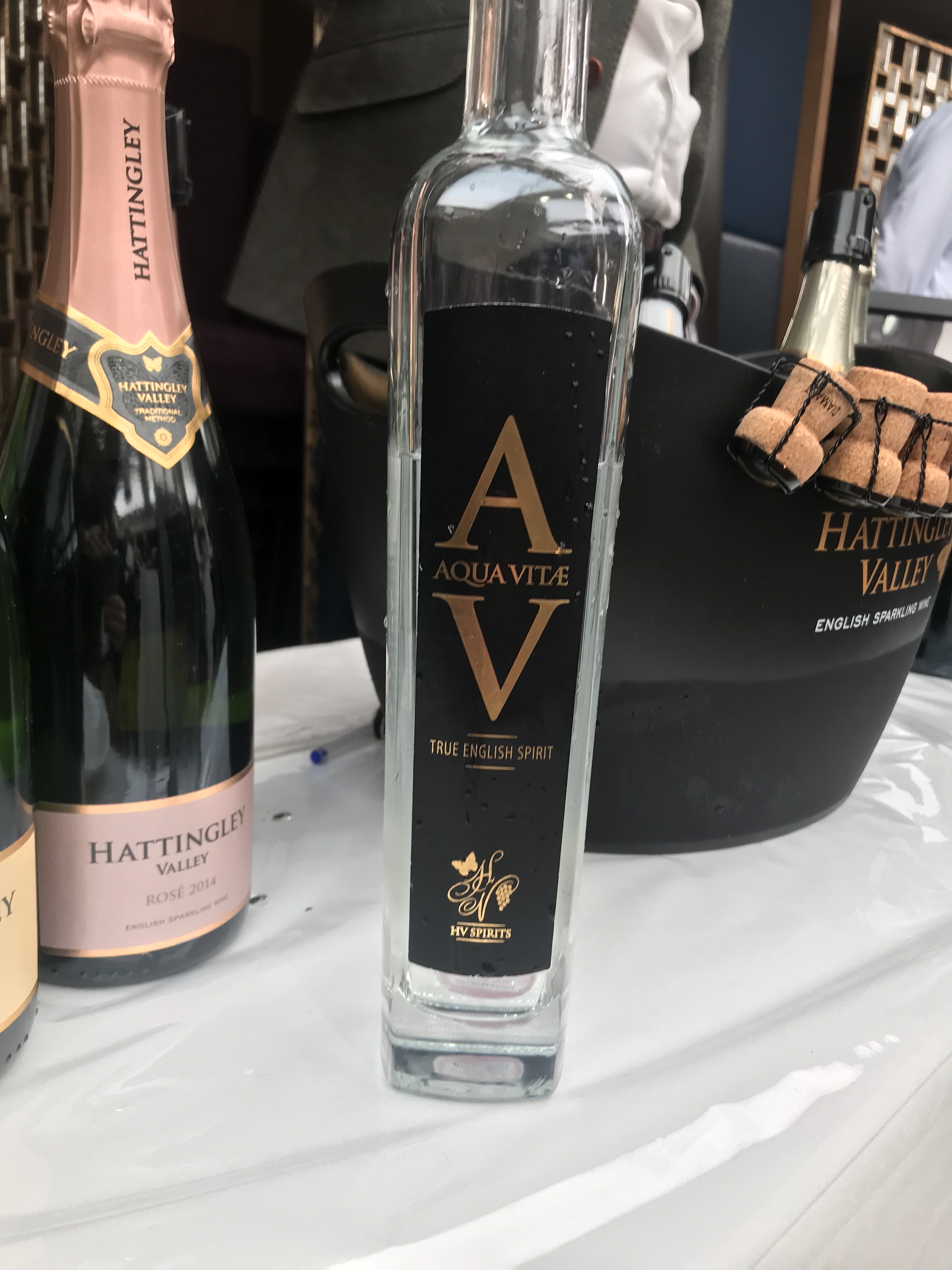
Rosé 2014 (60% PN, 38% PM and 2% Pinot Precoce) is another pink with a savoury touch adding to the appealing red fruits. The Meunier comes through as quite plush, erring towards a certain richness, and it has an extra half per cent of alcohol (12.5%) over the Classic white.

Demi-Sec 2013 is a brave wine, because connoisseurs tend to shun the style. Although it may have commercial appeal at the cellar door, I actually think this is very good. The grapes were initially selected for the Blanc de Noirs, but this parcel just had more sugar. Just 2,400 bottles were made, and the richness is nicely balanced with some fresh acidity. I’m not sure whether this will become a regular at Hattingley?

Blanc de Blancs 2013 is the new release here. 100% Chardonnay, four years on lees, and just 6 g/l dosage, right now it is much tighter than the Classic, and not a little expensive (£50 RRP), but it promises quite a lot.

Hattingley Valley Aqua Vitae is something very different, five times distilled Chardonnay from 2015 and 40% abv. It’s strong stuff and powerful on the nose, but complex, and frankly excellent.

Hattingley Valley is one of the busiest wineries in this part of Hampshire, with Emma making the wine for Raimes (see below), along with involvement in the projects by Cottonworth (including also managing the viticulture there), and Black Chalk. However, the experienced Hattingley team is producing some exciting wines and Hattingley Valley is in the top rank for English Sparkling Wine..

Hattingley Valley is represented by Enotria & Coe.
JENKYN PLACE

Jenkyn Place lies just off the A31, west of Farnham. Simon Bladon, a Yorkshire-born entrepreneur, moved in during 1997 but didn’t plant the first vines until 2004, converting the estate’s old hop gardens. The first vintage was 2006. The current acreage in production is twelve, with another 1.5 acres planted last year, which represents full capacity.

Classic Cuvée 2013 is dominated by Chardonnay (62%), with 24% PN and 14% PM. Alcohol is a relatively low 11.8% and dosage is on the higher side at 9 g/l. The bouquet is surprisingly floral and the wine itself shows a nice spine of rapier-like acidity, but within a fairly broad palate. It’s savoury and chalky.

Sparkling Rosé 2014 (52% PN, 32% Ch, 16% PM) is even lower in alcohol at 11.37% (very exact!). Dosage has sensibly been reduced here to 8 g/l allowing the fresh red fruit flavours to shine elegantly. This is another wine with a bit of umami adding a nice savoury edge. After tasting two Jenkyn Place wines, it seems that a core of elegant and crisp acidity is a style trait.

Blanc de Noirs 2010 is an equal blend of the two red varieties with five years on lees and a further couple of years on cork after disgorging (7 g/l). The style is broader and more developed, with slightly higher alcohol too, but still a nicely restrained 12%. If this does really retail for £35 it’s a bit of a bargain. Perhaps less commercial than the previous two wines, because I’d use it at the table rather than as an aperitif, but all the better for that, I think.

Jenkyn Place is represented by New Generation McKinley.
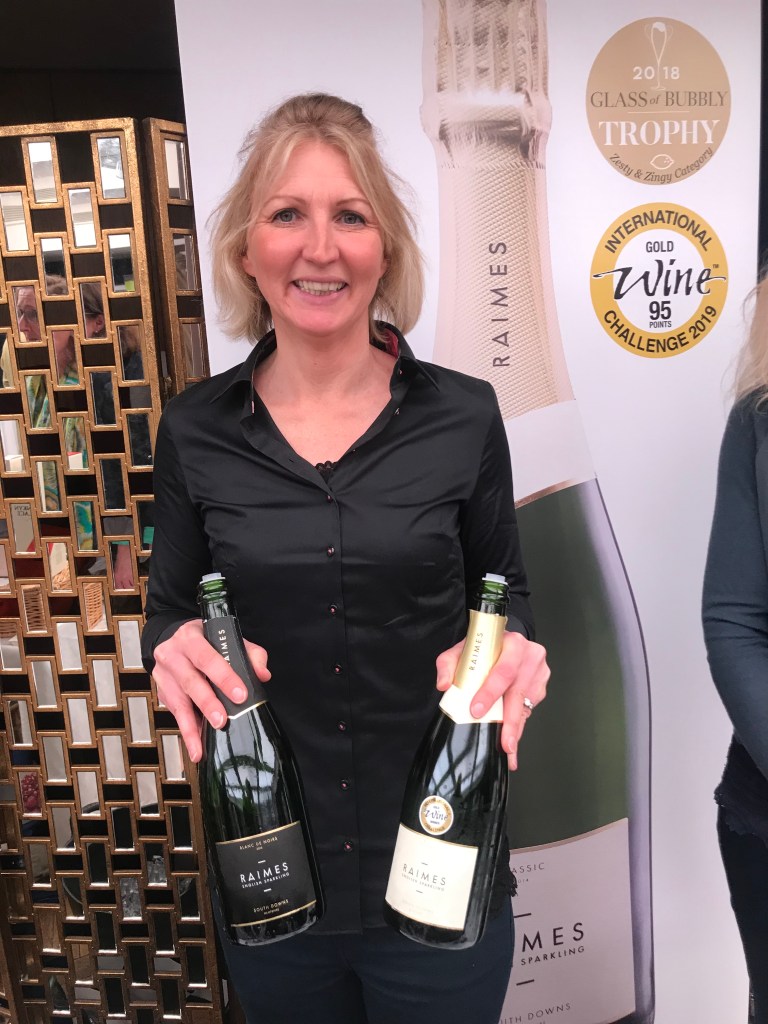
RAIMES

Robert and Augusta Raimes grow just ten acres of vines on their family farm and on the Tichborne Estate on the South Downs, just east of the M3 Motorway, not far from Black Chalk. The wine is made by Emma Rice at Hattingley Valley. Two cuvées are produced.

Raimes Classic 2014 (51% Chardonnay, 29% Pinot Noir and 20% Meunier) deservedly won a Gold Medal and Trophy at the last International Wine Challenge. The style is quite rounded and the acidity is less pronounced than in some wines here. I would say that the dosage tasted slightly higher than the 7 g/l listed for some reason, but that doesn’t detract in any way from the quality spotted by the IWC Panels.

Raimes Blanc de Noirs 2015 (69% PN, 31% PM) interestingly tastes as if the dosage is lower, yet it is 8 g/l. Part of this is perhaps down to the savoury aspect both on the bouquet and the palate, and a little dry texture. In some ways that makes it the more interesting wine to the connoisseur, if slightly less commercial. I’d never tasted the Raimes wines before, so I need to get to know them better, though as they produce just 1,000 bottles a year of this lovely BdN (out of a total annual production of around 7,000 bottles) that may not be all that easy. So worth seeking out.

As far as I’m aware, Raimes has no UK agent, hardly surprising with such low production. Contact Augusta Raimes via info@raimes.co.uk for trade enquiries.
Summing up

What are my conclusions? I have to say that I’ve never been in favour of classifying English Sparkling Wine by County, but we do see here a group of producers who all make wines off the chalk terroir of the South Downs. It is by no means the case that all English Sparkling Wine comes off chalk. I wonder whether some of the growers of Sussex and Kent will follow the same promotional path?

Whilst there are notable English producers who do grow vines on soils other than chalk, there is an argument that chalk produces the best wines. But here we should be very much aware that the chalk we see on the South Downs is by no means uniform. That is exactly the same as the situation in the wider Champagne Region.

This enables the producers here to exhibit one thing in common. Although they vary in size, from Danebury’s seven acres and Raimes’ ten acres to Hambledon’s 200 acres, all of them are engaged in trying to reflect their particular terroir. It is via this path that I think the English Sparkling Wine industry is coming of age.

Although a lot of total twaddle is expressed in the wider media about English fizz, the past fifteen-to-twenty years has seen a real refinement in what some producers are doing. Success can’t be founded on a single vintage in wine, but it is clear that success is being built over time, perhaps precariously in terms of the weather (especially late frosts) and increased costs, but the signs are wonderfully positive when you attend a tasting such as this.

The wines patently do not taste superior to the finest Champagnes, but they are very good indeed, and to an extent, an English style is developing off English chalk. There’s a lot of pristine fruit and freshness and lacelike wines often grip firm spines of lifted acidity.

The Vineyards of Hampshire web site (see here) lists events and cellar open days in 2019, including the Vineyards of Hampshire Fizz Fest at Exton Park on Sunday 21st July.

Posted in Artisan Wines, English Wine, Sparkling Wine, Wine, Wine Agencies, Wine Tastings | Tagged , , , , , , , , , , , , , , | 3 Comments

“…Yellow, Orange and Red” – the Diverse and Wonderful Indigo Portfolio

I used to think of Indigo Wine as a small-to-medium importer with a portfolio focused on Spain, but in truth they seem to have grown rather rapidly into something larger and much more diverse, but without loss of direction. There’s a lot of finger on the pulse stuff alongside names that have become quite established now.

On 12 February Indigo took over two floors of the increasingly popular China Exchange venue in London’s Soho. Twenty-one wine producers were present, most showing between four to half-a-dozen wines, approaching a hundred wines. I plan to mention around fifty. So many? I can tell you, I’d be happy to drink all of these, and more.

For those for whom it matters, Indigo states that the vast majority of its wines are suitable for vegans. It’s something they are hot on.

Indigo works with Biercraft, the small but very important beer merchant which supplies so many perfectly formed craft beers to the independent trade. Aside from deserving equal billing with Indigo, there’s nothing better at the end of a wine tasting than to sip on a few beers, I’m sure you’ll agree.

Hoffmann & Rathbone, Sussex, UK

This East Sussex producer, based in Mountfield north of Battle, has impressed me every time I taste their wines, and with a “Wines of Hampshire” tasting the following day, it felt good to try something from the home team, so to speak.

Their Classic Cuvée comprises 60% Pinot Noir with 30% Chardonnay and 10% Meunier, bottled with 7g/l dosage. The nose here is beautifully precise, but the palate has a bit more weight, definitely a wine with gastronomic possibilities. The base vintage here is 2013.

Blanc de Blancs 2011 won best English Wine at the London Wine Competition. With more than five years on lees it has a nascent complexity, yet a refreshing peach and floral dimension. Elegant yet with body.

Rosé Reserve 2011 is a salmon-pink blend of 85% PN with 15% Ch. The colour comes from a little skin contact. This is, once more, a food wine, showing red berry fruits which burst with flavour on the palate. As well as the obvious fish pairings I think this would stand up to game, paté and even dark chocolate.

These wines retail between £44 and £48, but they are nicely packaged and definitely worth seeking out. I find I like them more and more as I get to know them.

Hirsch, Kamptal, Austria

Johannes Hirsch makes wine around the Kamptal village of Kammern, east of the Wachau, working the two major varieties of the region, Grüner Veltliner and Riesling, the latter planted on the steeper slopes and the former beneath, where the soils are more fertile.

The entry level Grüner, Hirschvergnügen (2017) is nice, but the village wine, Kammern 2017, is a step up. The predominantly loess soils give a softness combined with a nice minerality. Kammern is pretty well known for its fine Grüner Veltliner, and Kammerner Lamm is the village’s best cru. Kammerner Lamm 2016 is spicy with a lovely bouquet, but the same wine from the 2012 vintage shows its class. It’s still youthful but the spice and mineral texture are impressive.

Two Rieslings prove Hirsch is not all about the Grüner. Riesling Zöbing 2015 is classic and juicy. It is drinking nicely, though the acids will enable it to age further. The single site Riesling Zöbinger Gaisberg 2015 has an even more complex bouquet and is finely honed, the best wine on the table, off the mica and schist soils which can produce such fine examples of Riesling, proving you should not always think Wachau.

Birgit Braunstein, Burgenland, Austria

Birgit is someone I warm to a lot. Burgenland seems to be well placed for exceptional female winemakers and Birgit is definitely one of the finest. Purbach is her base, near the top western corner of the Neusiedlersee, where her family (like so many in the area) has been making wine for 400 years.

There’s a cliché I always hear with Birgit’s wines, that they are sensual. Well, they are, I suppose, but there is so much more to her than this (and we don’t even see her famous amphora wines in the UK).

Birgit

First we go through the lovely, pure, varietals…Welschriesling and Pinot Blanc, and then the Rosé (all 2017). I particularly recommend the pink, a blend of Zweigelt and Blaufränkisch which has just a few hours on skins. It’s always delicious, and I do believe Zweigelt makes great sappy rosé.

Pinot Vom Berg 2016 does what it says on the label (hillside vines, actually around 17 years old). Aged in acacia, there’s a balance of tannin and red fruit. Give it a little while to settle.

Blaufränkisch Heide 2015 won Birgit a “Female Winemaker of Europe” Award. It’s a fabulous Leithaberg wine, with all the iron-freshness that the schist and chalky limestone soils of this particular site impart.

Wildwux 2016 is a blend of Zweigelt, Blaufränkisch, St. Laurent and Merlot. But its also a special project for Birgit, one of biodiversity. The site has herbs, bees, chickens and bird houses, so that the vines grow in as wild an environment as is possible for commercial viticulture. This is a lovely blend, far from being merely worthy. On my list!

Finally, from under the table, Blaufränkisch Leithaberg DAC 2015. This is made from old vines on very chalky limestone soils and is concentrated and fine. Wines for those who appreciate Judith Beck and Heidi Schröck. Highly recommended at all levels…but I still need to see these amphora wines in the country.

Péter Wetzer, Sopron and Tokaj, Hungary

Does Péter Wetzer know how good his wines are? He often seems a bit nonplussed by the attention, and equally, to be fair, I’m not sure how many people know his wines that well. Sometimes I’m the only one at his table. I’ve known them for long enough to appreciate them as some of the best from Hungary.

Three wines only here. The white Furmint 2016 comes from vines in the Tokaj Region, off dark volcanic terroir. Basket pressed and then fermented and aged in 500 litre Hungarian oak, the stunning bouquet is quite high-toned, whilst on the palate this is a gentle natural wine with a softness you don’t expect.

Of the two reds, the Kékfrankos (Austria’s Blaufränkisch) is the native grape. A brambly wine with big legs, it is initially soft and gentle, yet there’s a lick of tannin and a bitter peppery twist on the finish. Pinot Noir 2016 comes, like the previous wine, from Sopron, near the Austrian border at the southern end of the Neusiedlersee. The source is two vineyards, one on schist and the other, limestone. Thirty percent is fermented with stems, a third whole bunch. A vibrant cherry colour is matched with intense cherry on nose and palate. It’s very juicy, but with tannin too.

All of these wines are exceptional.

Eugenio Bocchino, Piemonte, Italy

This small Alba producer (around 5.5 hectares) isn’t well known to me at all, but beginning with his Langhe Nebbiolo “Roccabella” 2015 I was drawn to its floral bouquet. It’s a juicy Nebbiolo and an attractive version of a DOC that can so often disappoint.

Barbera d’Alba 2017 comes from vineyards at Verduno where the variety has managed to bag some promising hillside sites. It’s a dark Barbera which coats the glass, and proves that Nebbiolo isn’t the only variety worth pursuing in this part of Piemonte.

I’m not sure whether Indigo imports any Bocchino Barolo, but Perucca Nebbiolo d’Alba 2013 is a fine example of the variety, the estate’s signature wine from a monopole site overlooking the town of Alba itself. It is treated like a Barolo. The vineyard is clay and limestone at 250 metres, exposed southwest. Ageing is 24 months in oak cask then 24 months in bottle. This seems to me of no less quality than a fine Barolo, a bit of a hidden gem, perhaps.

Vitor Claro, Portalegre, Portugal

Portalegre? It’s in Alentejo. Vitor caught the wine bug whilst working in a restaurant for Dirk Niepoort, and Dirk (as always) provided lots of advice to get him started. The vines are at altitude (650 metres) and average 85 years old, so a promising start.

Of the six wines on show, three stood out for me. The white Dominó 2016 is a field blend from vineyards up near the Spanish border. Imagine a savoury, dry, softness.

Pulso Nat’cool 2017 is made from Castelão grown on the Lisbon seashore. It’s a pale red with a dusty, ethereal, scent, very restrained. The red version of Dominó (2015) is a bigger, classic Portuguese savoury red. A field blend of old varieties, it has tannic structure and a genuine food friendly quality which gets me every time. Goat would work! Yes, why don’t we drink more classic Portuguese reds?

Evening Land, Willamette Valley, USA

This is Raj Parr and Sashi Moorman’s famous collaboration, and it was great to see Sashi on hand to pour the wines, pretending to be no one famous at all. Each one of these wines is a star, even the least expensive among them (even more so as the top wines do cost an arm and a leg).

Seven Springs Willamette Valley Chardonnay is pretty damned good in both 2015 and 2016. La Source 2015 is a clearly big step up, but at double the price, a single parcel with low yields off shallow soils. It is aged, unusually, in 500 litre Austrian oak and the sweet fruit is classy and elegant.

Three Pinot Noirs are no less thrilling. The cheapest wine here (£17 to the trade), Salem Wine Company 2016, is fruity with a savoury nose (soy?). Seven Springs Pinot Noir 2016 is bigger, more tannic, needing time but very classy. Top of the tree is the remarkable Anden Pinot Noir 2016. 100% whole bunch from old vines, it has all the features of a Pinot that is built to age, but although it’s from a cool site the fruit still has a sunny disposition. The complexity of the Amity Hills terroir is evident. Occasionally I crave wealth, but only so I could afford to buy a wine like this. Wow, it’s good!

Gaintza, Getaria, Spain

Txacoli is one of the great summer wines, full of apple freshness, to be drunk more as an alcoholic long drink, as a thirst quencher. The Lazkano family has been making this Basque speciality for four generations since the 1920s. The vineyards are coastal, but protected by the Garate hill. The maritime climate gives amazing freshness to these wines.

Gaintza Txacolina 2018 is a classic Txacoli de Getaria with small bubbles adding zest and zip. Floral and appley-crisp. Aitako 2017 comes from one plot of 100-year-old vines, of which, along with the more traditional Hondarrabi Zuri and Hondarrabi Beltz, contains around 10% Chardonnay. With 12 months on lees, this has a bit more depth. The fruit is very ripe.

Much as I really like the two white wines, I was rather taken with the pink, Gaintza Roses 2018. The two Hondarrabi varieties are blended together (60% Hondarrabi Beltz, the red grape version, in this case). It has the characteristic tiny bubbles of some Txacoli, with pure-scented red fruits and perfectly judged acidity, making a perfect summer aperitif (I must source a couple of bottles).

I’m not much of a fan of scores, but when a Txacoli producers achieves scores in the 90s for all three wines at the 2018 International Wine Challenge, it is perhaps worthy of noting.

Coto de Gomariz, Ribeiro, Spain

Coto de Gomariz make the well known The Flower and The Bee wines, both of which are great bets if you see them on a restaurant list. The red (2016), made from Sousón is both tannic and even a tad bitter, but genuinely interesting.

For a few quid more, Coto de Gomariz Blanco 2016 off three sites is more complex, soft and savoury. Gomariz Xistos 2017 is 95% Albariño with Treixadura off schist. This is “inland” Albariño, very different. It has a textured, highly mineral, edge, definitely one for food.

Colleita Seleccionada 2016 is selected fruit aged 14 months in 500 litre French oak. A fine savoury white with more weight. This producer’s growing reputation is well deserved.

Fedellos do Couto, Ribeira Sacra, Spain

Ribeira Sacra boasts some of Spain’s most truly beautiful vineyards, but with that beauty comes a near impossibility to work them profitably. Backbreaking toil requires real dedication, but so often these high terraces yield wines which justify the work, as they do here.

I’ve written about Fedellos do Couto before, and the wines are reasonably well known, so I shall only mention one. This is not a Mencia. Bastarda 2017 is made from what is effectively Jura’s Trousseau, grown here on wild granite and slate rather than that region’s marls. Whole bunch macerated, this is so beautifully pale with a stunner of a dreamlike nose. It’s an unbelievable wine and one of my wines of the day. I adore it.

Bodegas Peixes, Galicia, Spain

Peixas is located just outside the Valdeorras region and this is, I think, their first vintage. It’s a side project by the chaps at Fedellos do Couto with old bush vines on terraces at serious altitude (up to 850 metres) above the river valley. The soils here are granite with a high mica content and every plot is treated separately.

The three wines are all red, all 2016, called Lacazan, Peixe da Estrada and Peixes da Rocha. The latter might be the best and incidentally is the most expensive, but it is only £17 to the trade. Every one of these is brilliant so get in there swiftly. Smooth and slightly bitter-sour wines of real personality and individuality with that characteristic northern crispness and bite.

César Márquez, Bierzo, Spain

Still in NW Spain, we finally get to Bierzo, where Mencia rules. But I’m going to highlight the white wine from César Márquez. This young guy is blessed with the region’s most famous uncle, Raul Pérez. He’s used his contacts well, working in Mendoza for the Michelini Brothers for a time, before returning to work 100-y-o vines at Valtuille de Abajo.

Everything is trad. Long macerations and 12 months in oak, using mainly Mencia for the reds, but with odds and ends which make up field blends, as was the way here in Bierzo. The Bierzo reds are not textbook…in that they have an elegance many lack these days. But the white here, from these very old vines, is complex and special. La Salvación 2017 comes from a mere 550 metres altitude, is made from Godello fermented in 500 litre oak, then aged 12 months in barrel. Due to hit the UK in March, a producer to watch closely.

Dominio del Águila, Ribera del Duero, Spain

You don’t often find me recommending Ribera del Duero wines. Their tannin heft doesn’t usually chime with my preference for more elegant fare. The producers in this region have, in many cases, taken a step back in Parkerised time to produce something more redolent of the 1990s. Jorge Monzón is different. His wines are more restrained and terroir-expressive, as you’d expect from a man whose first job was at DRC, and who worked a year more recently at Vega Sicilia.

Blanco 2015 is worth a look for its herby white fruit (from Albillo) made fresh by limestone in the soils. Expensive though. There’s a lovely rosado, Picaro del Águila Clarete 2016, made from Bobal, Garnacha and Albillo, and a similarly priced Tempranillo red, Picaro del Águila 2016, both around £18 to the trade. Then we more than double the price to the Reserva 2014. Leather and plum, quite tannic but with exceptional fruit.

Priced at £204, unless it was a misprint, Canta la Perdiz 2014 comes from a high altitude single vineyard on a rare form of limestone covered with a layer of sand. It’s 95% Tempranillo with a few co-planted interlopers. This is a very fine wine, although I would guess the UK market is pretty tiny.

Pamela Geddes – Lobban Wines, Regional Spain

Pamela’s location is vague because she sources fruit from Calatayud and Jumilla, but makes wine in Cava country, in the village of St Jaume Sesoliveres, near to St Sadurni d’Anoia. She’s always getting hassled by the authorities for her labels, but her wines are wonderful, handcrafted gems. I think their appeal is assisted in no small part by Pamela’s lovely Aberdeen accent.

Babito Brut is merely labelled as a Vino Espumoso de Calidad, but its a beautifully fresh Xarel-lo fermented in bottle. There are two more sparklers, La Rosita being a great take on ripe, red, Garnacha and La Pamelita, perhaps her best known wine, being a Syrah aged on lees for eight years (so this is really a 2010 vintage). There’s a sweetness to the fruit but the wine is dry, much more European than any Aussie sparkling Shiraz would taste. The wines are ridiculously cheap.

Suertes del Marqués, Tenerife, Spain

This producer may be the most famous of the Canary Island labels, but the quality remains just as astonishingly good as ever. Jonatan (Garcia Lima) managed to produce eight wines here in London, somehow. I won’t mention Trenzado, La Solana, nor 7 Fuentes, because I’ve written about them relatively recently.

Nat Cool 2017 is Listán Negro aged in concrete and bottled at just 11.5% abv, with very low sulphur, and it’s one of my wines of the moment from Suertes.

El Lance 2016 is a soft blend of five different red varieties which are fermented in a mix of concrete and plastic, and then aged in 228 litre and 500 litre oak. It has the grippy but fresh mouthfeel of a wine from volcanic terroir.

El Chibirique 2016 is a pale red parcel wine, textured and almost tea-like. It’s a lighter style of wine, yet sits over a fairly tannic base. I love this, though have drunk it rarely. But the 2016 is really on form. It’s 100% Listán Negro fermented in open plastic vats before seeing ten months ageing in mixed oak.

El Ciruelo 2016 is the same variety (with a tiny bit of co-planted Listán Blanco), but this time fermented in concrete. It’s a red with a clearly orange/brick tinge. It’s quite peppery. Named after an old plum tree in this vineyard.

Out from under the table came the final wine, a sample of La Floridita 2018. This is a new light red, showing the softness of Listán Negro fermented in concrete for four days on skins before transfer to barrel without skins. It’s mega-fruity, very much a wine to grab for this summer before it is all snapped up.

BIERCRAFT

It’s totally unfair that Biercraft draw the short straw, as a postscript, but I guess most readers are not here for an in-depth beer tasting. Nick and Theresa distribute a whole host of great craft beers: Lost & Grounded (Bristol), Cloudwater (Manchester), Verdant Brewing (Cornwall), Beavertown (Tottenham, London), The Kernel (Bermondsey, London celebrating their tenth anniversary this year), and Burning Sky (Firle, East Sussex) are all names I buy fairly regularly.

One of my new favourites, on account of them being based quite close to my parents’ home village, is Braybrooke Beer Co, from near Market Harborough, Leicestershire (where I pick them up at local wine merchant, Duncan Murray). Their ingredients are shipped from Bamberg in Germany and their lagers are all unfiltered and unpasteurised. Their Keller Lager is described as the UK’s most authentic, and I was enjoying their New Zealand Pilsner just this weekend.

Honey Märzen is a 5.9% abv collaboration Braybrooke has done with Beavertown as part of their “Seven Deadly Sins” project – one tank from each of seven brewers. This is a strong beer, but lovely and fresh with that honey(ed) nose. Rare, so if you see some…

I probably didn’t expect to be ending this article with an alcohol free beer. Most are frankly terrible in my opinion, but Lucky Saint, whose posters of beer drinking nuns in habits are appearing all over London, is different. This is also unpasteurised and unfiltered Bavarian lager which is brewed in the classic way before the alcohol is removed by distillation in a vacuum, so there is no heat damage. The beer then sees a six week cold storage before shipping.

I’m told this is made for the posh hotel market (my words), and is “reassuringly expensive”, but flavour-wise, I can’t fault it. They should have been handing out bottles on the door on the way out!

Posted in Artisan Wines, Beer, Portuguese wine, Spanish Wine, Vegan Wine, Wine Agencies, Wine Merchants, Wine Tastings | Tagged , , , , , , , , , , , , , , , , , , , , , , , , , , , | Leave a comment

Winemakers Club, Otros Vinos and Wines Under the Bonnet by Inna Sirota

Having made rash promises more than a week ago about all the articles I was going to write, I promptly got ill. Those promises will be met, eventually, but in the meantime I was unable to make it to the tasting at Antidote earlier this week. 

Help was at hand…Inna Sirota has provided some notes on her favourite  wines from this event. I hope that they provide some recompense for my own  inactivity. I’d like to thank her for generously giving of her time to provide a  record of this important tasting.

Inna spent fifteen years crunching numbers in New York (banking) and London (Google) before deciding to quit finance in order to concentrate on her passion for wine travel and photography (and hopefully a lot more wine writing). She began her real journey helping with the 2017 vintage in the Barossa, at Smallfry Wines, having already by 2016 achieved WSET Level 3. Inna says that she loves travelling to wine regions and hearing the winemakers’ stories, as well as connecting with everyone in wine. You will find her doing just that on Instagram as @poetryinawineglass.

Looks like pouring wines is thirsty work

Going to a new portfolio wine tasting must feel like entering the shop for a fashionista when the new season arrives – excitement and joy in the anticipation of all the new shiny, beautiful, trendy and exciting things the stores might have in wait for you.

That’s how I felt going into the trade tasting of The Winemakers Club, Otros Vinos, and Wines Under the Bonnet to sample their new arrivals in the airy room above Antidote Wine Bar near Oxford Circus.

What’s on trend? What’s new & exciting, what’s reassuringly beautiful but well known?

Below are my highlights from each importer. Turns out it is a very difficult exercise to write, taste and communicate at the same time!

THE WINEMAKERS CLUB

Ismael Gozalo of MicroBio Wines, Nieva, Rueda, Spain

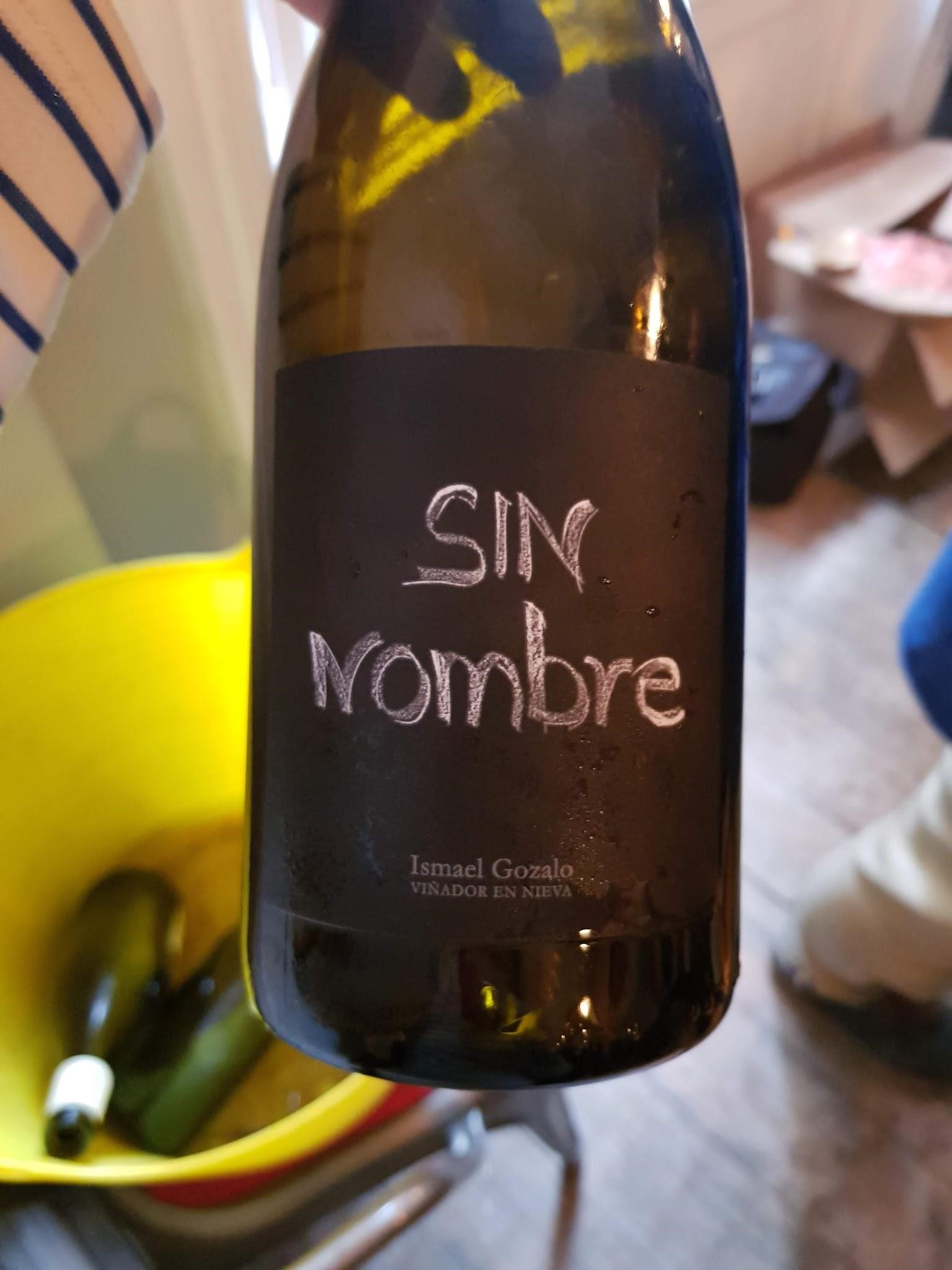
Sin Nombre 2016 from 100 year old pre-phylloxera Verdejo vines, 900 metres elevation, mixed soils of limestone and clay, sandy topsoil. Twenty months on its lees, half of the time in large format oak barrels, then transferred on its fine lees into stainless steel tanks.

It is a special wine, full of its uniqueness. The little these ancient vines produce make for a complex and concentrated wine, round yet fresh, tingling on the palate. On the nose Chardonnay-like, ripe citrus, yellow stone fruits, mineral and a touch of brioche and yeast. Only 1,200 bottles made.

Karim Vionnet, Villié-Morgon, Beaujolais, France

Good old Beaujolais, oh how much I love you! And so happy to taste Karim’s wines again.

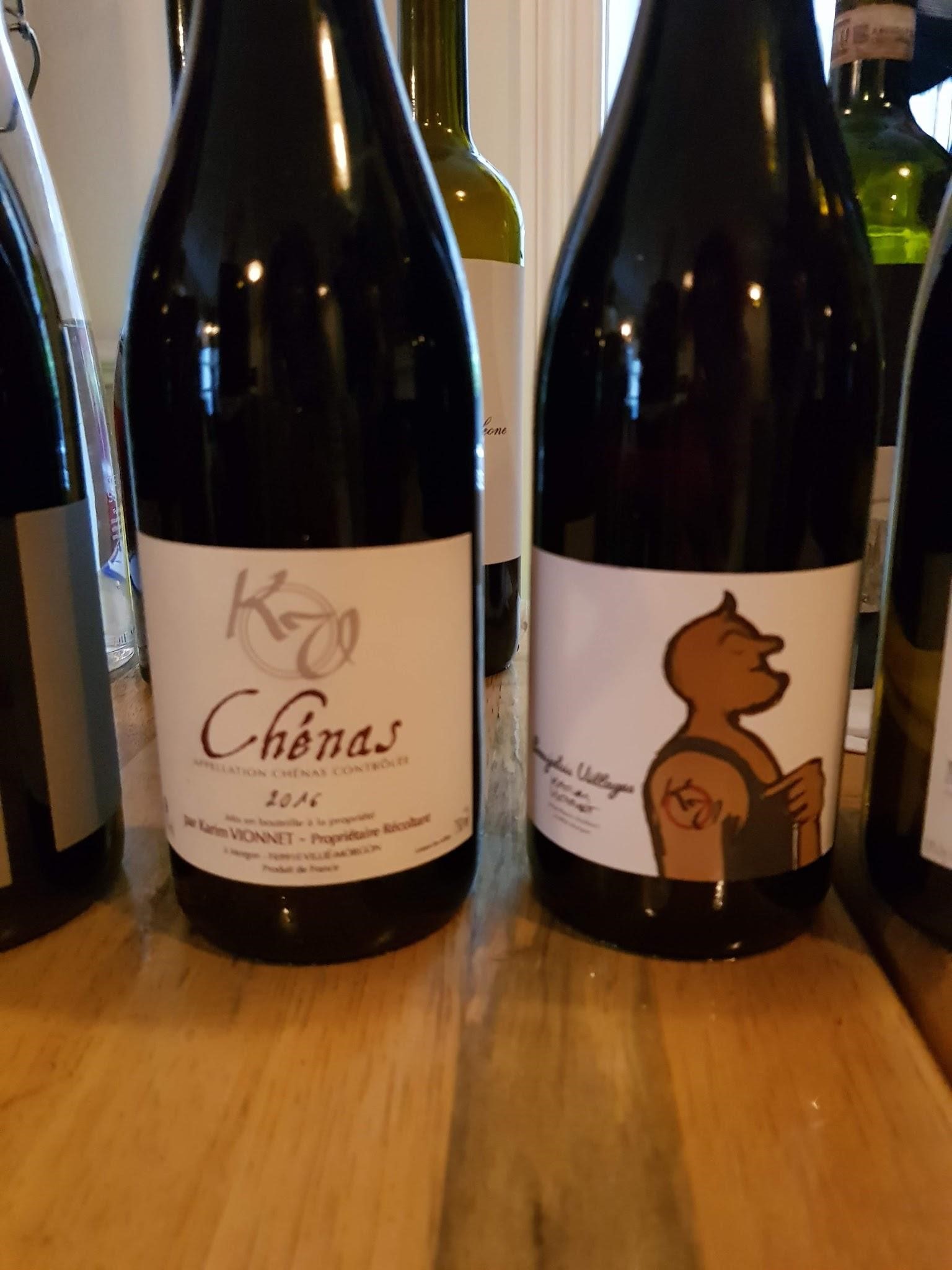
Beaujolais-Villages 2017 from two vineyards near Morgon, glass fibre vat fermentation, then 3 months in concrete tanks. Very well structured for Beaujolais-Villages. I could smell wet granite soils, super yummy red fruits. Delish!

Chénas 2016 aged for 3 months in Burgundian barrels. What a great nose, super sexy wine, complex aromas of fruits, rocks, minerality.

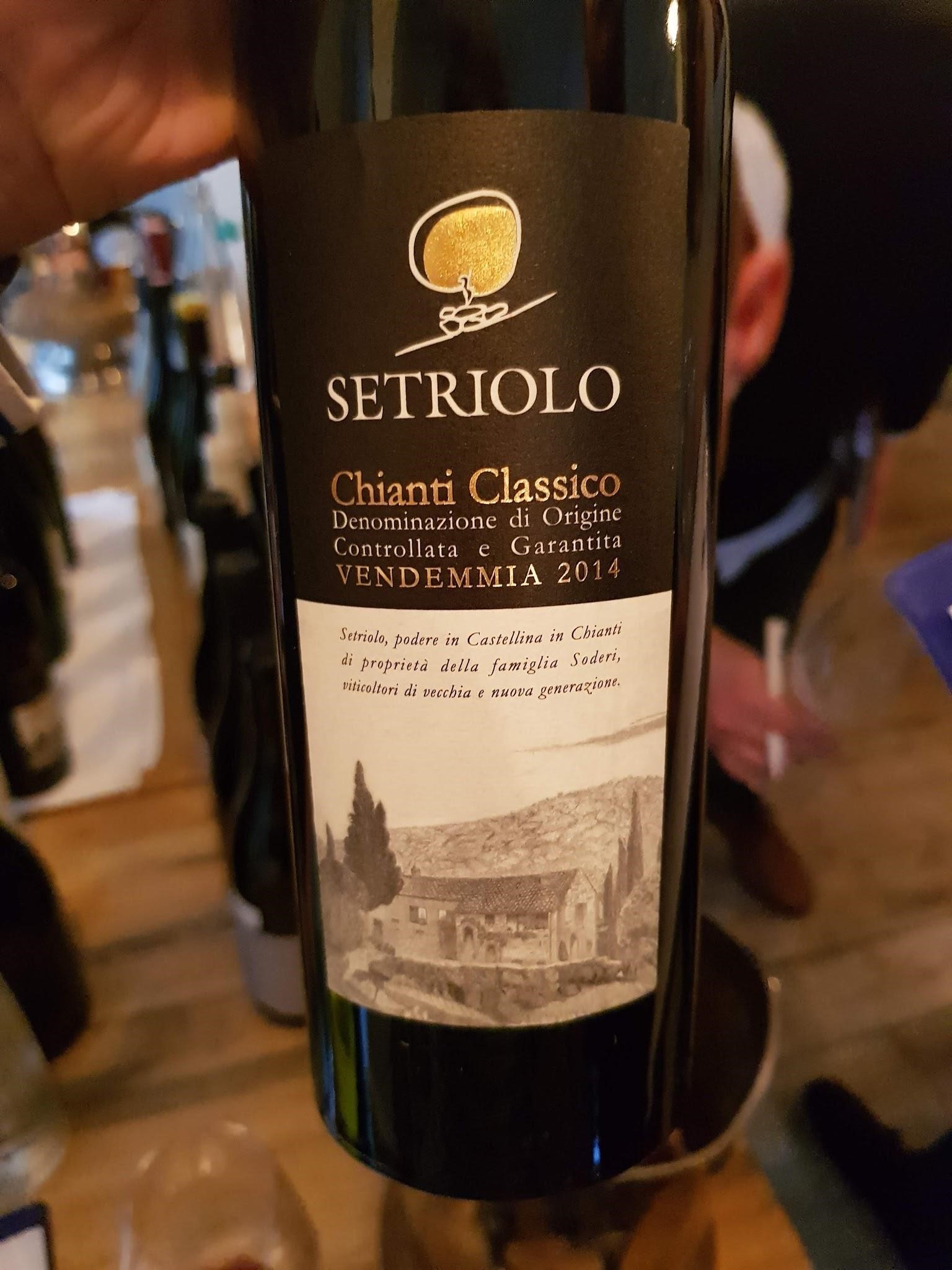
I don’t drink much Chianti these days for obvious reasons to natural wine lovers. But I’d throw in this one for the delight we sometimes need from a good old Chianti. Setriolo, Castellina in Chianti, Tuscany, Italy – mostly an olive farm, but now making their own wines from 4ha planted, organically farmed.

Chianti Classico 2014 – 95% Sangiovese, 5% Merlot. Fermented in steel and cement tanks with 15 days of skin maceration. Aged for 12 months predominantly in cement and steel with a small proportion in 2nd passage American oak barrels, and 6 months in bottle before release. A classic Chianti nose of dark cherries, smokey, almost cigar-like, meaty. Good muscular tannins to support the palate.

OTROS VINOS

Costador Terroirs Mediterrani, Conca de Barberà, Spain

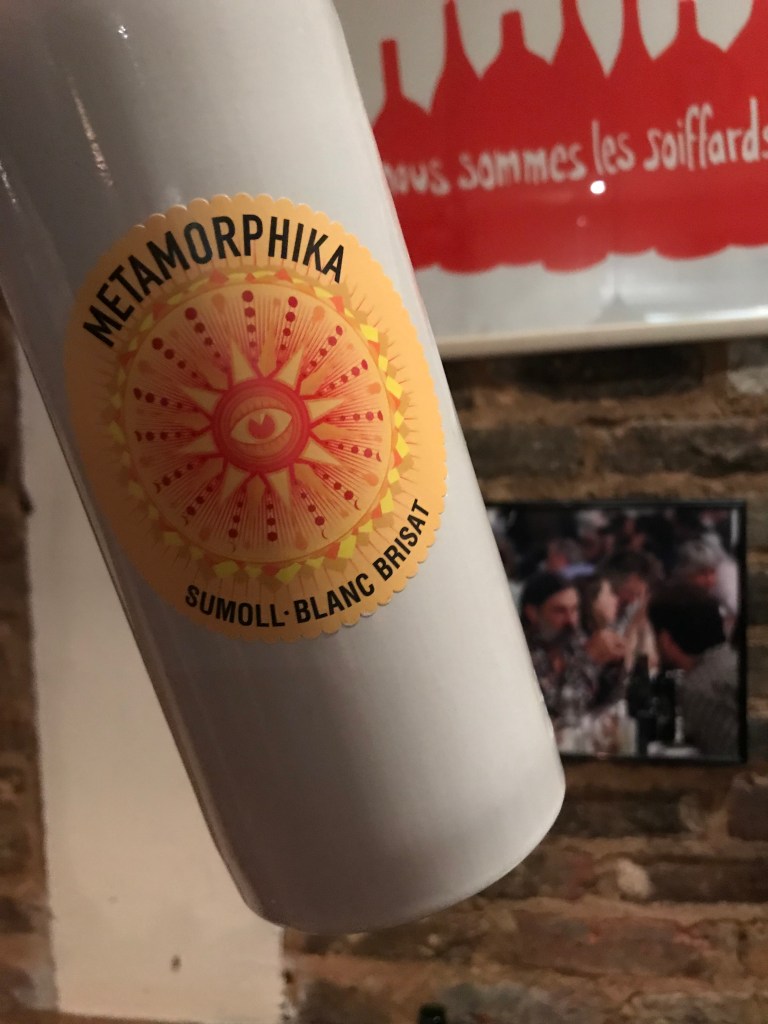
Sumoll Blanc Brisat 2016

Costador wines by Joan Franquet from the Conca de Barberà region of Spain are unique, and not only because they are bottled in the cool-looking, mighty ceramic bottles. Vines are 60 years old, tended organically, on soils of slate, clay and limestone. This is 100% rare Sumoll Blanc, 8 weeks whole berry maceration, 5 months in French oak and the result is this delicate flower that you cannot stop smelling and drinking. This lightness and effervescence is the trademark of Costador wines.

Bodega La Senda, Bierzo, Spain

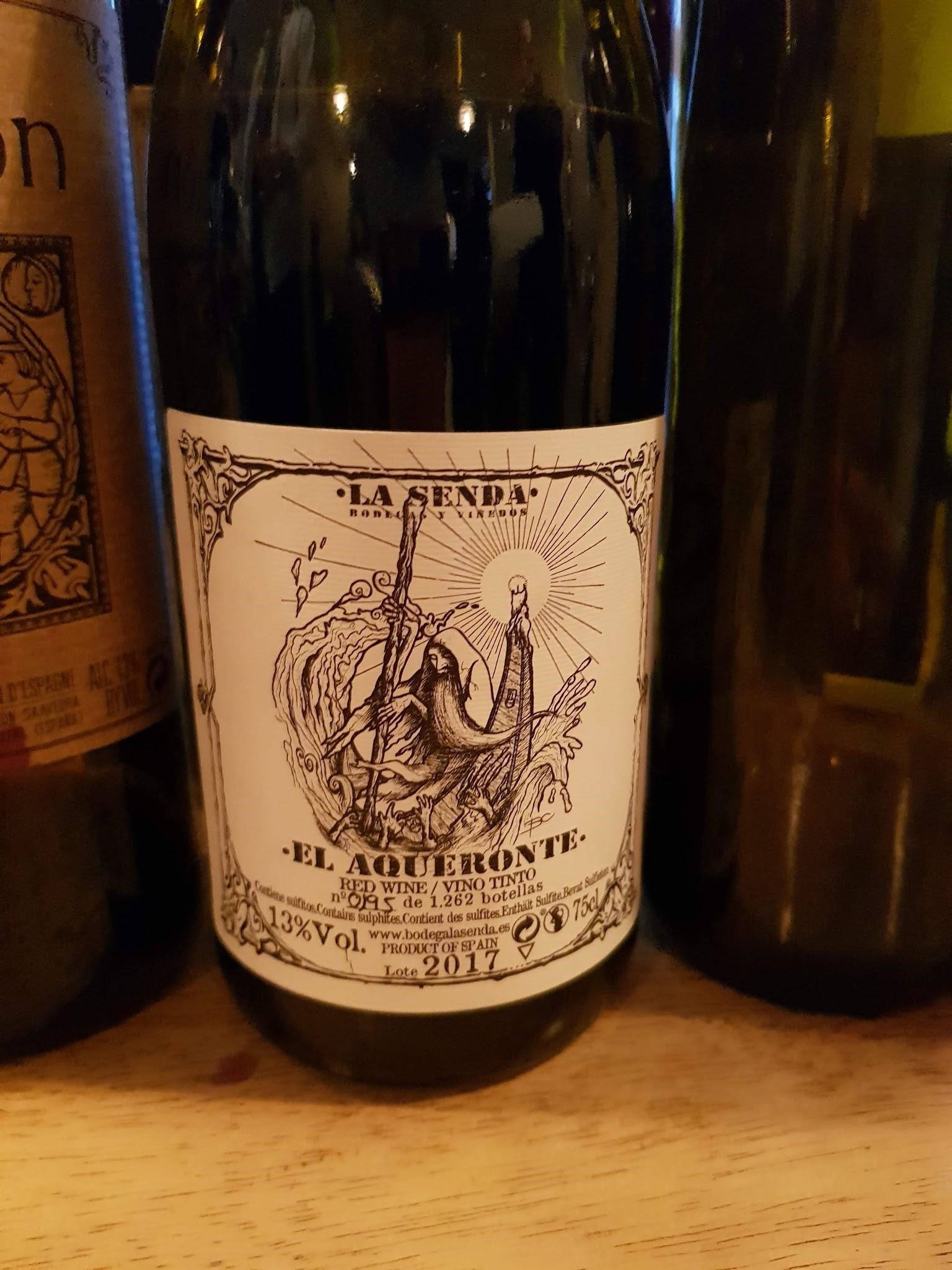
El Aqueronte 2017

Thirst crunching with great mouthfeel, 70-year-old Mencia vines, whole bunch fermentation, eight months in chestnut barrels. It was so good, finally a very good Mencia!

The winemaker Diego Losada was born and raised in Ponferrada, Bierzo. He started Bodega La Senda in 2012, apparently quite a rebel (comes through the labels too). Diego works with old vines, mineral rich (clay or calcareous with slate, iron, gold or quartz) but nutrient poor soils on steep slopes. The wine is pure & clean.


WINES UNDER THE BONNET

Yann, Anna & André Durrmann, Andlau, Alsace, France

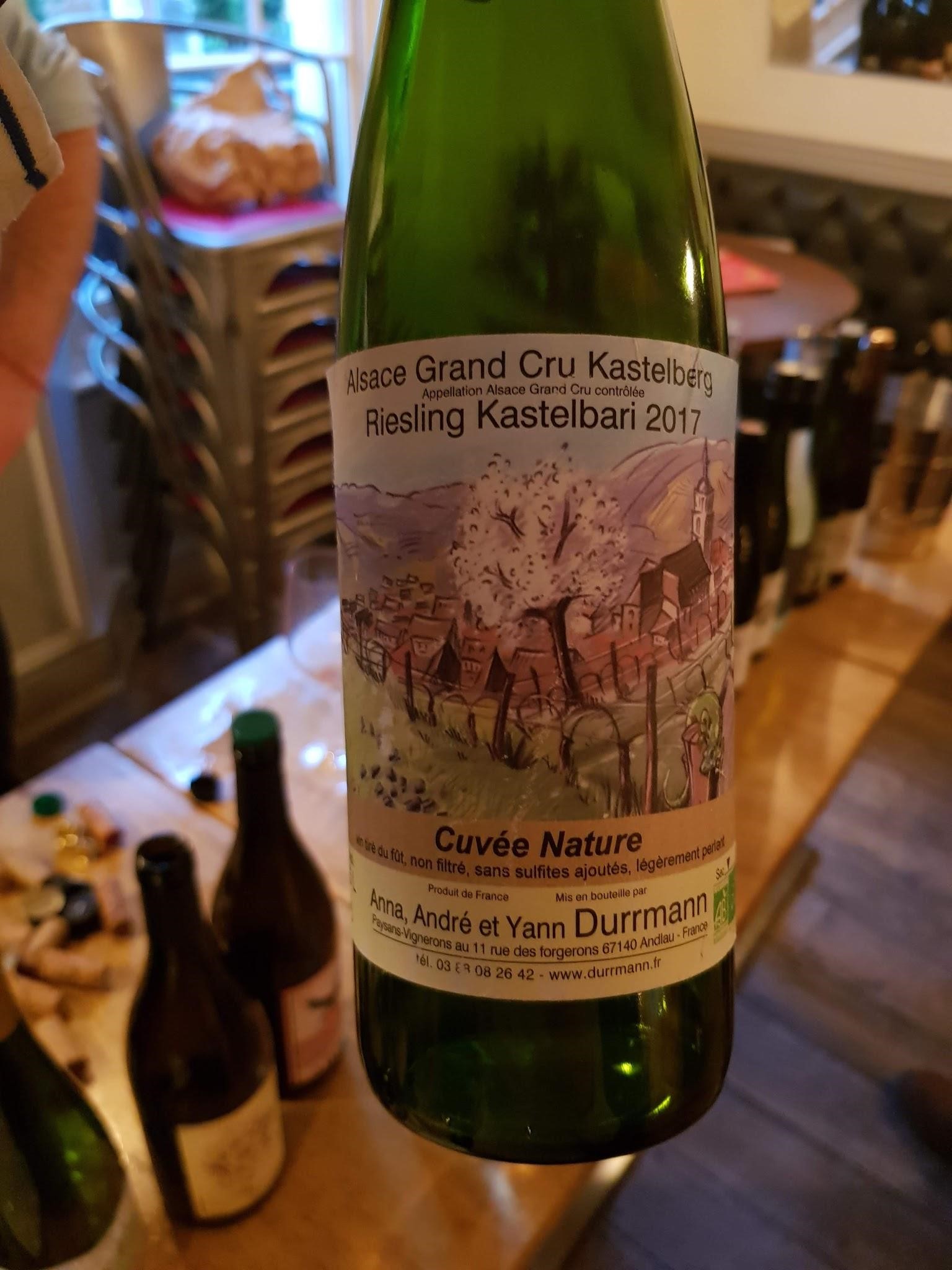
Kastelberg Riesling Nature 2017

New in Wines Under the Bonnet portfolio! I had to look up where Andlau actually was, while still in Alsace, it is a 30 minute drive south west of Strasbourg, further north than the well known regions of Haut-Rhin. André Durrmann took over his family estate in 1979, converted it to fully organic viticulture in 1998, and applied principles of permaculture to achieve the greatest possible biodiversity in the vineyards.

The vast majority of the production is sold to private individuals who buy at the cellar door. 28-year-old Yann, André’s son, is helping his father and they are now producing several ‘natural wine’ cuvees (labelled “Nature”). This Kastelberg is one of them – wine from the Grand Cru site which rises directly behind the town, a gorgeous Riesling, full of complexity on the nose and palate, a strong stand out.

Editor’s note – I’m so happy Inna liked the Durrmann wine. I’m going to claim that the UK had not heard about this producer until I visited in 2017.  If you’d like to read my article on  that visit, you will find it here.

Thomas Boutin, Rochefort-sur-Loire, Angers, France

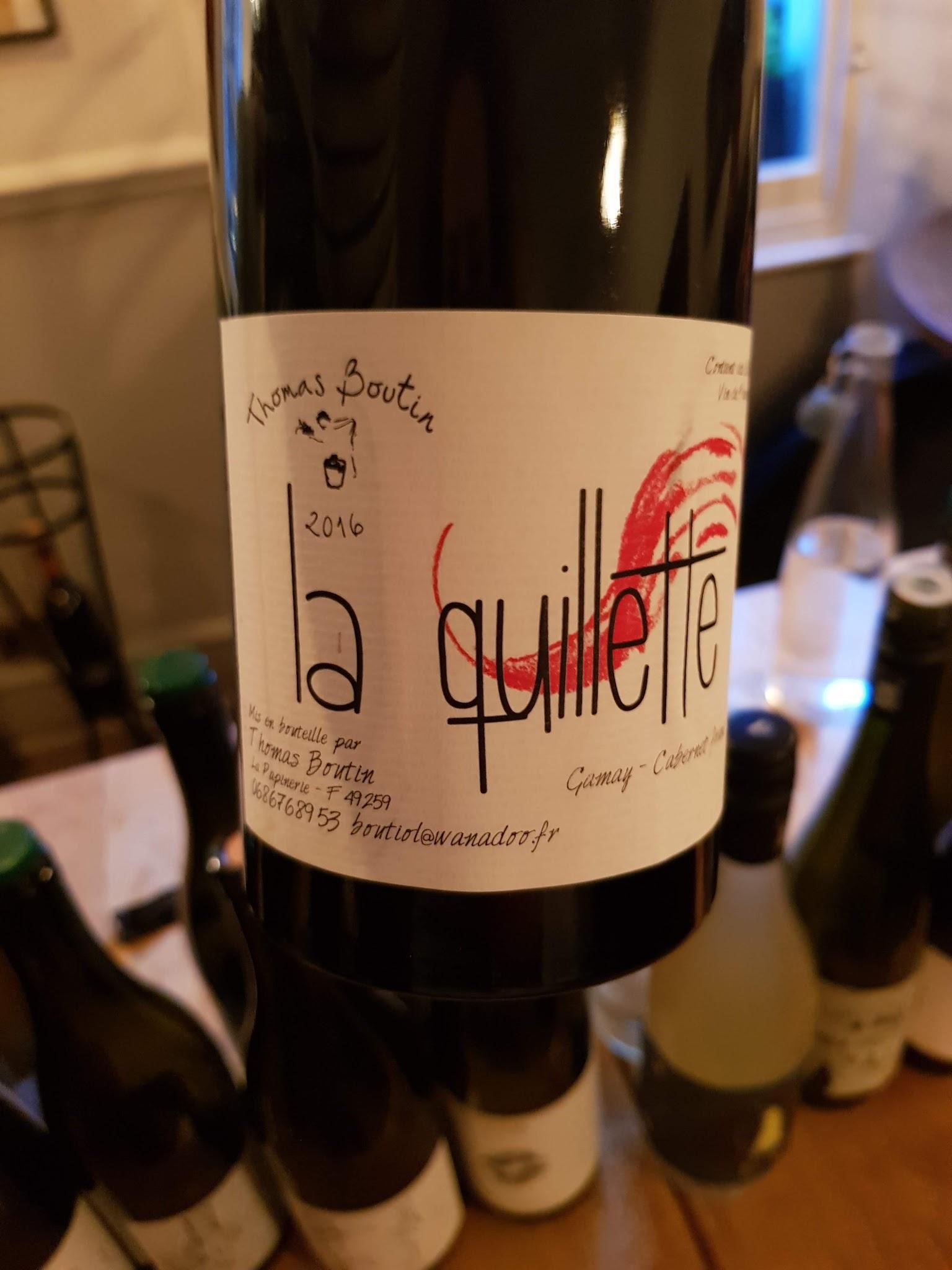
2016 Quillette – Gamay, Cabernet Franc, Grolleau

A tiny producer (3ha), Tom Boutin started in 2008 in Rochefort-sur-Loire (across the Loire river from the famous Savennières), practising minimal intervention, after having worked for many years in larger wineries. Quillette – Gamay (55%), Cabernet Franc (40%), Grolleau (5%), undergoes a separate eight day maceration and fermentation (whole bunch) before pressing. Assembled in fiberglass tanks, Super easy drinking, crunchy, fresh wine with complexity. Lovely! 13.5% abv

A mental note to myself – next time, arrive early when trade people & wine is fresh. But overall, a very fun compact tasting.

Posted in Inna Sirota, Natural Wine, Wine, Wine Agencies, Wine Merchants, Wine Tastings | Tagged , , , , , , , , , , , , , , , , , | 2 Comments

Nekter-Roland-Modal

February is the month when we suddenly begin to see calendar congestion. The Spring portfolio tastings come so thick and fast that it is unfortunately impossible to go to them all. I’ve tried to select a good variety. The first of these, which I’m bringing to you today, is a trio of tiny importers who I would suggest are bringing some stars of the future to the UK. All three of them I consider very important because they are pushing boundaries.

Nekter Wines specialises in the New World, effectively South Africa, North America and Australia, where they have deep knowledge. Nic Rizzi’s Modal Wines is hot on Central Europe, but also ventures into Spain, Germany, Italy and France. Roland Szimeiszter is the guy behind Roland Wines, and he’s focused on Central Europe, covering Hungary, Slovakia, Croatia and also Serbia.

As a heads-up of what is to follow in the next three weeks here on Wideworldofwine, we shall have write-ups for Indigo Wines, Wines of Hampshire (don’t look away, this was an excellent tasting at 67 Pall Mall), and another trio of wonderful small importers, Winemakers Club, Wines Under The Bonnet and Otros Vinos (who are presenting at Antidote next Tuesday). I also owe you “January Wines” , an article on the exciting Austrian spirits of Invivo, and an article on some new and interesting wine publications. That’s a lot to get through, so bear with me.

NEKTER

Imogen and Jonothan

It looks as if each importer was allowed fifteen wines on the table, plus another wine each on a food matching table. I started with Nekter, whose range has some superb simmering wines which may be new to many readers.

The Matthiasson Family may be well known, certainly as pioneers of organic viticulture out west, in California, but their Tendu wines, bottled in litres, are less well known. There’s a white (2016) Vermentino-Colombard, and a red (2017) Aglianico-Barbera-Montepulciano blend, both off the alluvial and pink gravel soils of the Dunnigan Hills AVA (Northeast of Napa, some way south of Colusa). Both are great palate cleansers, the white being particularly lovable for its 10.3% abv lightness, the red being a strong contender for hot summer barbecue duty (simple bitter cherry fruit and a heatwave-tolerant 11.7% abv).

Steve and Jill live a genuinely “back to the land” life in Napa, producing a lot of what they eat along with their wines. You’d be forgiven for forgetting that Steve worked for some of the biggest names in California wine before some of the ideas he soaked up as a philosophy grad made him rethink a few things. Especially the issue of ripeness and alcohol. This is why their wines are always ripe, fresh but shall we say higher in liquids than jammy solids (alcohols are restrained for California, to be sure). Pretty much anything they make is worth exploring, but these simple wines really exemplify so much of what these Californian pioneers of sustainability stand for.

Staying with alternative varieties, another interesting producer is somewhat less well known. Ferdinand Wines gave us an Albarino 2017 from Borden Ranch (an AVA straddling Sacramento and San Joaquin Counties), and a 2014 Tempranillo from Sierra Foothills.

Evan Frazier is the guy behind Ferdinand. He used to work for John Kongsgaard, and in fact he makes his wine in the Kongsgaard facility. The Albarino, which spends 18 months in barrel, has some tropical notes, but it also tastes a little like a Chablis-style Chardonnay, perhaps some influence from the superb Chardonnays he made for Kongsgaard.

The Tempranillo has a gentle strawberry/cherry bouquet and comes from the famous Shake Ridge Vineyard owned by Anne Kraemer in Amador County. The fruit is all destemmed and it goes into oak (a small proportion of which is new) for 22 months. It’s pure with lovely fruit and structure, but it does pack 14.1% alcohol.

There are also some wines in a can from Ferdinand. Don’t laugh, they are fun, and wine in a tinny has come a long way since I used to see the alcoholics guzzling the M&S cans on the early train to London Victoria.

Donkey and Goat is a label you may have come across as it has been getting a bit of social media coverage lately. Jared and Tracey Brandt make natural wines in Berkeley, California. When I say “natural”, they will use minimal sulphur, but nothing else is added at any stage. Perli Mendocino Ridge Chardonnay 2016 spends ten months in barrel but the fruit is picked early. This gives the wine real zip, but without too overt acidity. Stone Crusher El Dorado Roussanne 2017 sees 12 days on skins, giving some texture and a savoury, even sour, note, but it’s lovely. Hard to choose between the two, though the Roussanne is a fascinating wine.

Geyer Wines perhaps won my producer of the day award on the Nekter table. Dave Geyer is based in the Barossa and is making natural wines from varieties just outside the mainstream. The absolute freshness, wholly uncharacteristic of many old fashioned Barossas, is exemplified in his very lovely Barossa Semillon 2017. Forty-three year old vines, direct press with a little skin contact adding complexity and texture, silky fruit, and all for 11% abv.

Rosé 2017 is a blend of 55% Cinsault with Pinot Meunier and Grenache, the latter from 100-y-o vines. Pale with an ethereal strawberry/raspberry scent, it could have been a New World Poulsard. Lovely sour/savoury palate. Then we have Seaside Cabernet Franc. This is also a 2017, hailing from the Adelaide Hills. The nose is classic Cab Franc, and the violet scented fruit (whole bunch fermentation) is delicate, but still hitting 13% abv. Deliciously sappy and juicy.

We also had a couple of exemplary producers (the first new to me) from South Africa. Bryan MacRobert Wines is a producer in Abbotsdale, just southwest of Malmsbury (technically Swartland but off most vineyard maps). Chenin Blanc 2015 is remarkable value, tasting quite a bit more expensive than the price (maybe a little over a tenner) suggests. The vines grow on east-facing slopes, giving cooler evenings, so you get just 12.5% abv and a lovely fresh acidity along with obviously Chenin flavours. Abbotsdale Syrah 2015 is also good value, and both wines make excellent by the glass options for the restaurant trade.

Martin Smith owns Paserene with Ndabe Mareda. These are wines at the opposite end of the spectrum, in the luxury bracket, though it’s all relative. Luxury wines but not luxury prices.

Union 2015 is labelled Western Cape, but it is made from Martin’s Tulbagh fruit: 51% Syrah with Carignan and Mourvèdre which sees 20 months in old oak. A serious wine, yet approachable. Shiner 2016 starts with 80% Cabernet Franc, plus 13% Merlot, 6% Petit Verdot and a splash of Cabernet Sauvignon, all from Stellenbosch. It’s a big boy, and I quote, “a badass wine”. Marathon 2016 is heavy…I mean the bottle. Sourced in Stellenbosch, it has 53% Cabernet Sauvignon, 32% Petit Verdot and the rest Carmenère (I think this is the only Carmenère vineyard in South Africa). This flagship cuvée knocks out a big 14% abv, but you do get class and developing complexity for your money.

MODAL

Nic was showing the broadest spread of wines out of the three importers, so everything here was quite individual and different. The wines mentioned below were my own favourites, and this included four wines from my favourite Modal producer of all, Weingut Joiseph.

Nic

Based in Jois, near the top of the Neusiedlersee in Austria’s Burgenland, this is the project of Luka Zeichmann with Richard Artner and Xandl Kagl. They cultivate six hectares now, starting out with much less in 2015, on limestone and shale at the foot of the Leithaberg Range. Their work in the vineyard supercedes everything else. They are star wines, but not for the faint hearted I might add. They take more than a cursory swig.

Fogosch 2017 is the new vintage (I still have a ’16 left). It is always an edgy Grüner. Softer than many, it has texture and extract. There’s bags of interest. Also from the new 2017s, Welschriesling has twelve weeks’ skin contact. Sweet and sour, almost literally. One of the most singular versions of this grape you’ll find.

Roter Faden is a truly beautiful blend of Zweigelt (from Trift), Pinot Noir from the Langen Ohne site, and Blaufränkisch from Obersatz. It’s basically just amazingly fruity, and I have to have some for summer. Last but not least is BFF 2017. It can’t be called by its grape, Blaufränkisch, due to DAC complications, but it has the vibrant colour and freshness of limestone-grown Blau’ (from the Neuberg). The fruit and texture are delicate and it has a lingering mouthfeel that goes on and on. Not a heavy wine, yet it stains the glass.

Everything by Joiseph comes in tiny quantities (between 1,000 and 1,500 bottles and a few magnums from each cuvée), so they are fiendishly hard to get hold of, but well worth the effort. Wines for the adventurous connoisseur of Austrian natural wine.

Staffelter Hof is an old family farm based in one of the Mosel’s lesser known villages, Kröv, which you can look over the river towards if you are on the wonderful Mosel cycle path heading for Traben-Trarbach (it’s at the start of the big bend which almost encircles Wolf).

I’m not sure I remember tasting their wines before but they are quite different, as Little Bastard (2017) signals just by its name. It’s an unusual blend of Riesling, Sauvignon Blanc, Muller-Thurgau and Muscat in what I would call a gemischter satz style (both as a field bled and as a prickly fresh white). I thought it was brilliant fun, light and summery. I must admit, I couldn’t find this, nor the “Little Red Riding Wolf” on their web site, and I almost thought I’d got a different producer of the same name, but no, Modal links to the same producer. I suspect the younger generation is at work.

Silice Viticultores is a producer I’ve mentioned before, and again, one whose red wine I have in the cellar. Fredi Torres has worked internationally, and at Clos Mogador in Priorat. He’s the co-ordinator for a group of producers in Northern Spain’s beautiful Ribeira Sacra region. Blanco 2017 is new to me, and turns out to be just as exciting as the red. It’s Albariño (the inland version being quite different to the coastal strain) with Treixadura and Palomino, one third each. Just 11.5% abv, fresh and mineral with a nice roundness underneath.

Tinto 2017 is the wine I know from the previous vintage. Pure-fruited Mencia (80%) plus a field blend of other local varieties, and I mean pure. If you think Mencia has become big and ballsy, especially in Bierzo, give this a try. It’s more delicate. It’s a wine that helped me fall back in love with a grape variety I thought would be Spain’s big red hope a decade ago.

There follows a handful more wines that deserve exploration. Nibiru Grundstein Grüner Veltliner 2017 is from Kamptal, but is not DAC-labelled. Nice and juicy. Slobodne Cutis Deviner 2015 is a Slovakian rarity from the Hlohovec region, and is a blend of Roter Traminer and the autochthonous Devin variety.


The Slobodne story has been touched on before on this blog…a family who took part in the rebellion against Nazi occupation only to lose their land in the Communist era. The younger(ish) generation got it back in (I think) 2010, and have been making natural wines in Western Slovakia since then. If you really want something different this is your bottle. The nose alone is worth the entry, and the palate gives you a host of white and yellow fruits and a sourness. It’s very different, and I love it, I really do.

With Atelier Kramar we are in Slovenia, in the western part of Goriška Brda (Barbana to be exact). The wines, from 4.5 hectares, are effectively biodynamic (including attending rigidly to the phases of the moon). Primario 2016 is made from Rebula which saw three days skin maceration and six months in 1,000 litre oak (note that the 2017 saw a different method). This is another wonderfully textured wine with a nice plumpness.

Last but not least, Cascina Borgatta. This pioneer of organic wine production in the Alto Monferrato hills is based at Tagliolo, just east of Ovado. Production, since 1948, has been solely Dolcetto and Barbera, of which together they make under 10,000 bottles a year. Lamilla 2013 is 100% Dolcetto, perhaps not Piemonte’s most highly regarded grape, but something of a speciality in this part of the region (Ovado, Acqui Terme).

If you think the vines are quite old (over 40 years), then this is nothing compared to Emilio Oliveri, who is still making the wine in his eighties. This bottling is fermented in concrete and aged in stainless steel. It’s juicy, like all the best Dolcetto, but it also has a serious side, justifying the four years it has in bottle before release. Old school.

ROLAND

Roland

Roland wines may focus on less well known countries in Central Europe, but that’s not to say they don’t have a few well known producers. For me, their star wines come from Strekov1075. Sütó Zsolt cultivates 12 hectares of vines in a unique region of ponds and lakes amid marshland at Strekov in Slovakia. I will never forget the photo of Sütó on the Raw Wine website playing his drums to the vines, wearing a white sleeveless vest with inches of snow on the ground. Not just because I was a drummer in a former life, but because the photo made the man immediately worth investigating.

As it turns out (well, obviously), he makes brilliant wines. He’s an avid experimenter…with skin contact, wine under flor, and bottling unfiltered and sulphur free. Rizling/Veltlin 2016 is, of course, Welschriesling and Grüner Veltliner as we know them better. It’s a blend of the two white varieties which usually appear in separate cuvées. A singular wine, just try it! Fred #1 is a non-vintage field blend of local varieties, actually from 2016 and 2017, very savoury, made in open fermenters and no added sulphur. This is a great wine to choose if you want to find out what Strekov1075 is about.

Frankovka 2016 is that variety we know better as Blaufränkisch. This is perhaps slightly less wild than Fred, but it’s all relative. Great cherry fruit from very complex soils, but containing limestone, which all but guarantees a zippy freshness with this variety. All superb wines. Why 1075? The year the village of Strekov first appeared in manuscript. Why no space? No idea.

You may also have tried the wines of Klabjan. They are based in Slovenia’s province of Istria, and are lucky to possess some of the region’s oldest vines (up to 150 years old, the older ones ungrafted). Roland showed just one Klabjan wine, Refosk WL 2015 (one of two Refosco cuvées they make, there being a specifically old vine bottling). It’s a big wine, weighing in at 14% but the mouthfilling fruit and softening tannins suggest it will be more than merely interesting with a bit of age to it.

The Maurer family originated in Salzburg, but in the 19th Century, when this was all part of the Austro-Hungarian Empire, the moved south to what is now Serbia. The family farms 16 acres of vineyards, six of them just south of the Hungarian border at Szabadka in Serbia, with another ten acres in Fruška Gora, a mountain region below the Danube, about 40 miles north of Belgrade.

With so many wonderful wines coming out of Central Europe, it’s really exciting to taste Serbian wines. I’ve tasted some before, but (I won’t name names) without much of a thrill. Furmint 2016, made from one of Hungary’s best known varieties, was herby with a touch of mint, quite mineral (perhaps the volcanic soils of Szerémség), almost certainly the best Serbian wine I’d tasted to date.

Kadarka, a native of the Carpathian Basin, is a grape I like, especially off (the same) volcanic soils. Kadarka 2017 was light red with a bit of an orange glow, very easy to drink but with genuine personality and originality, and no less good than the Furmint. Serbia…who’d ‘ve thought.

Another potential star here was the Slovakian producer, Bott Frigyes, based in the Pohron Region. Again, the soils are volcanic. The range would actually ring bells with anyone familiar with traditional Hungarian varieties, not least Háslevelü 2017. Two thirds of the grapes see four days on skins with a further eight months on lees. The other third was fermented by carbonic maceration and the two parts were blended at bottling. The wine has a lovely lime freshness, but weight as well. Delicious.

Giorgio Clai is one of Croatia’s (and Istria in general) best known winemakers, and his wines feature on the lists of some smart restaurants worldwide. Roland showed his Ottocento Bijeli 2014, a white blend of Istrian Malvasia (70%), Pinot Gris, Chardonnay and Sauvignon Blanc off Istria’s singular chalk and clays. It’s a classic skin contact wine, golden in colour, aged in various sizes of oak, showing the chewy texture and mouthfeel of what is a classic orange wine style. There’s also a red Ottocento from the same vintage made, I believe, from Refosco and Merlot. It was the orange (golden?) wine which stood out for me.

Back to slightly more familiar territory, a word for Bencze Birtok Riesling 2017, a nice food-friendly Riesling from Hungary’s Badascony Region, immediately to the north of Lake Balaton in the west. And for a wine from even more familiar territory (for me), Grabenwerkstatt’s Grabenwerk 2017 from Austria’s Wachau no less.

Michael Leke and Franz Hofbauer farm in the far west of the Wachau region, beyond Spitz, with vines (Riesling and Grüner Veltliner) on the Spitzer Graben at around 500 metres altitude, probably the last vines in the valley. The winery is…a garage. They caught the biodynamics bug working at Pyramid Valley in New Zealand. This tasty Grüner Veltliner, delicious and approachable as it is, singles these guys out as producers to keep an eye on. The small production here makes this wine expensive (over £20 retail), but it is rather good.

That’s a lot of wine, but these three importers should be supported. In fact I’m happy seeing plenty of restaurant buyers at tastings like this. If we don’t support the small guys (and girls) who are unquestionably pushing the boundaries and discovering brand new, often small production, gems, then we’ll end up drinking the same old wines. That’s not a terrible thing, there’s so much out there that’s brilliant. But those wines were new once. The likes of David Geyer, Strekov1075 and Joiseph are tomorrow’s stars, perhaps.

The tasting was hosted by the Duke of Cambridge in Islington

Field Recordings Wonderwall Paso Robles Chardonnay 2016. It was quite lovely but didn’t get a note. Another wine from Nekter.

Posted in Austrian Wine, biodynamic wine, Californian Wine, Czech Wine, Hungarian Wine, Natural Wine, South African Wines, Wine, Wine Agencies, Wine Merchants, Wine Tastings | Tagged , , , , , , , , , , , , , , , , , , , , , , , , , , , , , , , , , , , | 1 Comment

Vienna Week 3 – Vinifero and a walk in the snow

In August I mentioned one of Vienna’s best natural wine shops, but as part of a roundup, and I didn’t go into any detail, so this time around I thought I should give Enrico a bit of a plug.

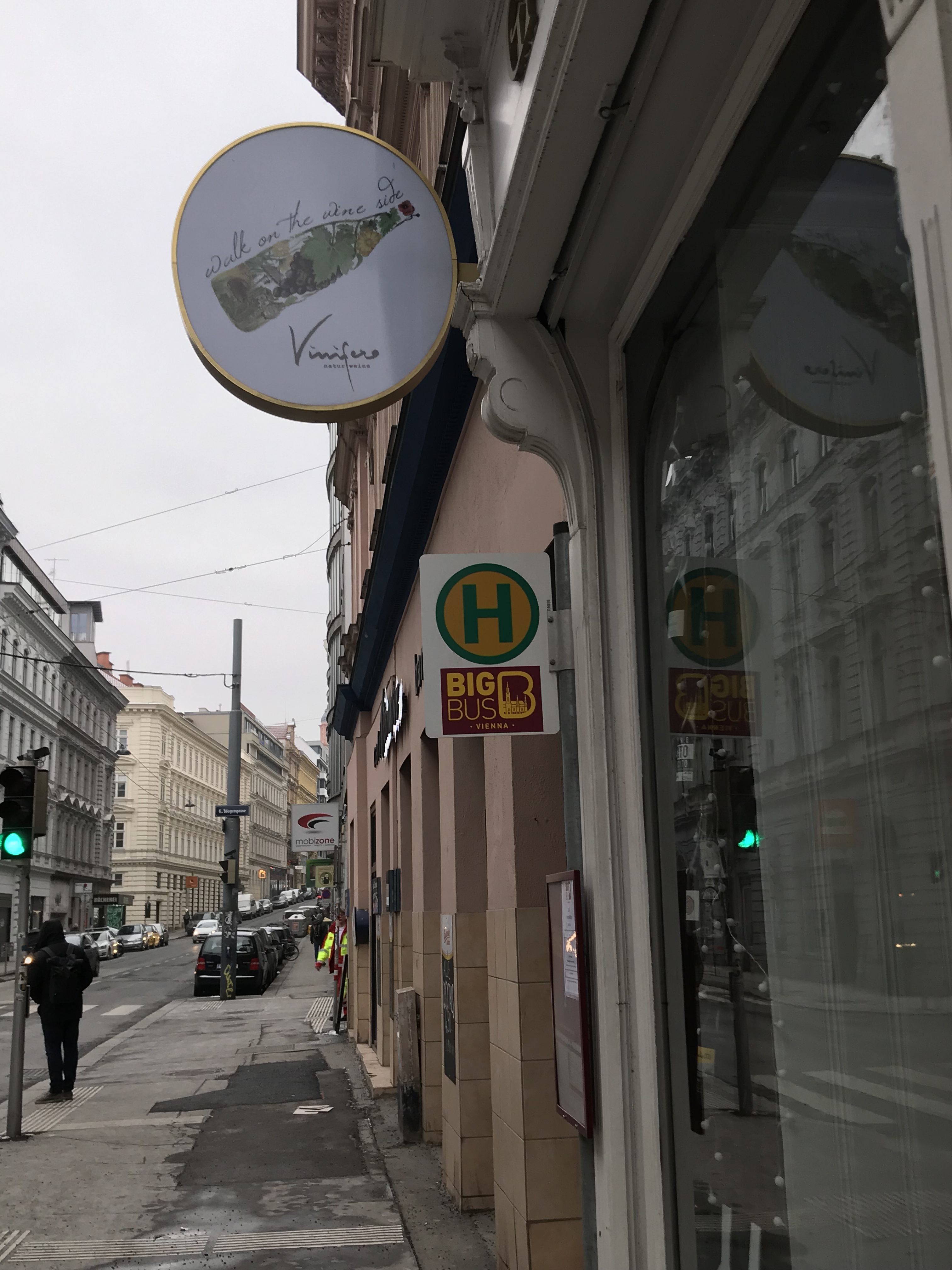
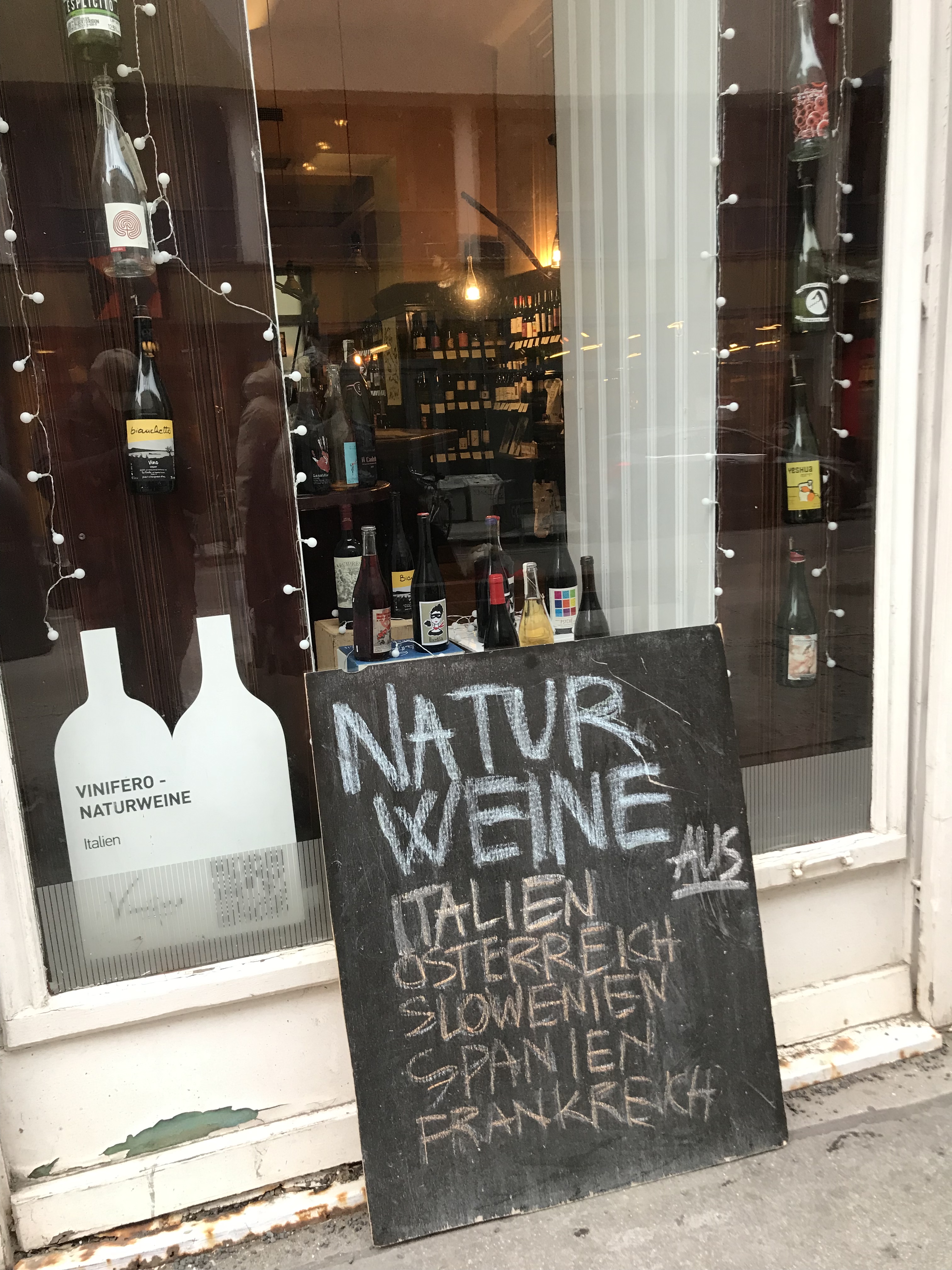
Vinifero occupies a narrow shop front on a road you’d probably never venture down were you not in search of a great selection of natural wine, although a few regular readers will note that it’s a mere few minutes from my favourite café in Vienna, Café Sperl.

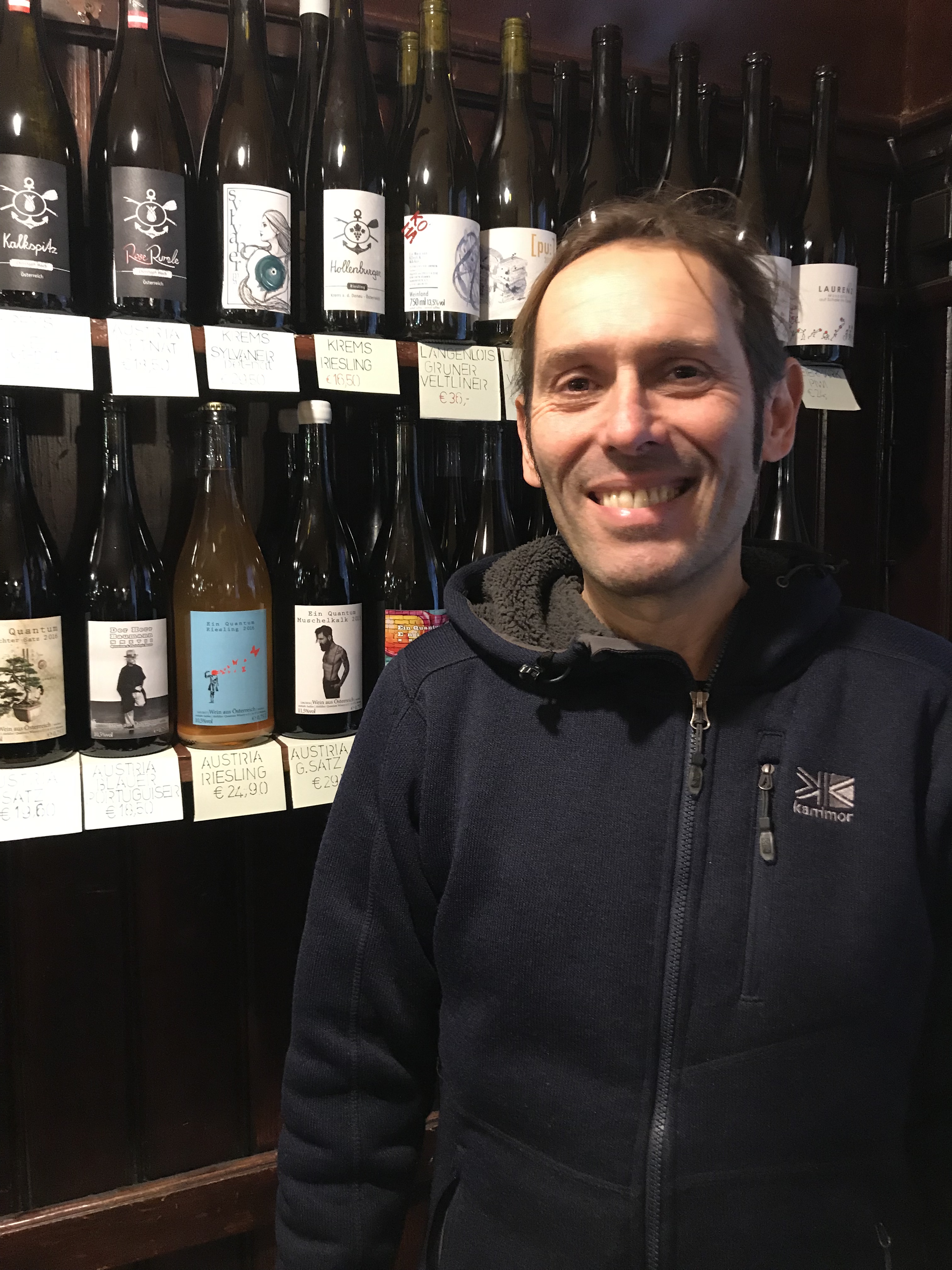
Enrico Bachechi describes himself as an Önologe, and as well as owning Vinifero he also consults for a number of wineries. You can tell Enrico isn’t Austrian, right? His shop has a very good selection of Italian natural wines, with perhaps a slight emphasis on Tuscany, but you’ll find familiar names beside less familiar ones from all over the world.

Enrico

One thing I particularly like about Vinifero is that the range of Austrian wines is less obvious than some stores. I’m not going to deny that my heart leaps every time I go in a wine shop and see Gut Oggau, Werlitsch, Rennersistas and the like, but here you’ll find some less well known labels.

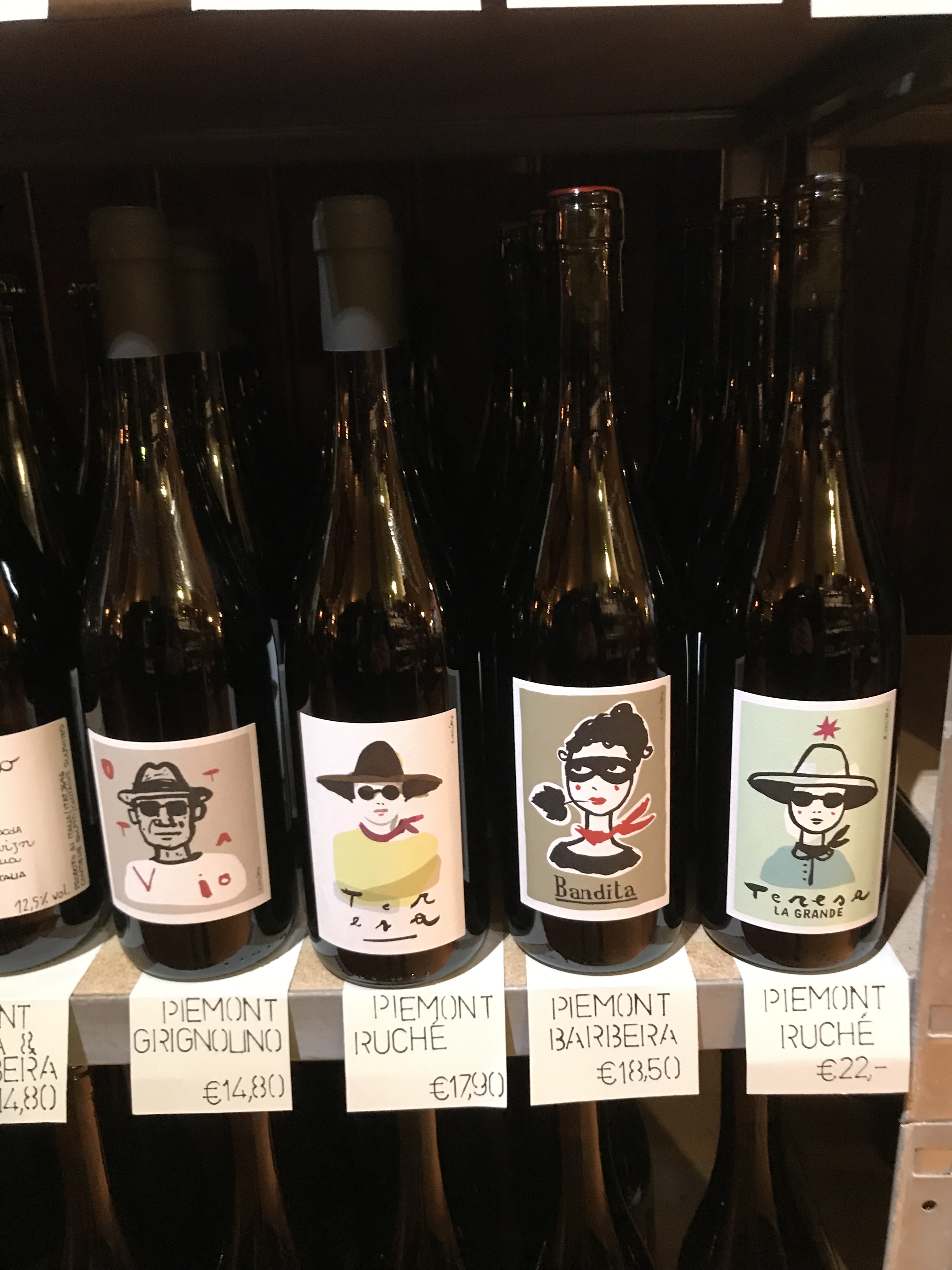
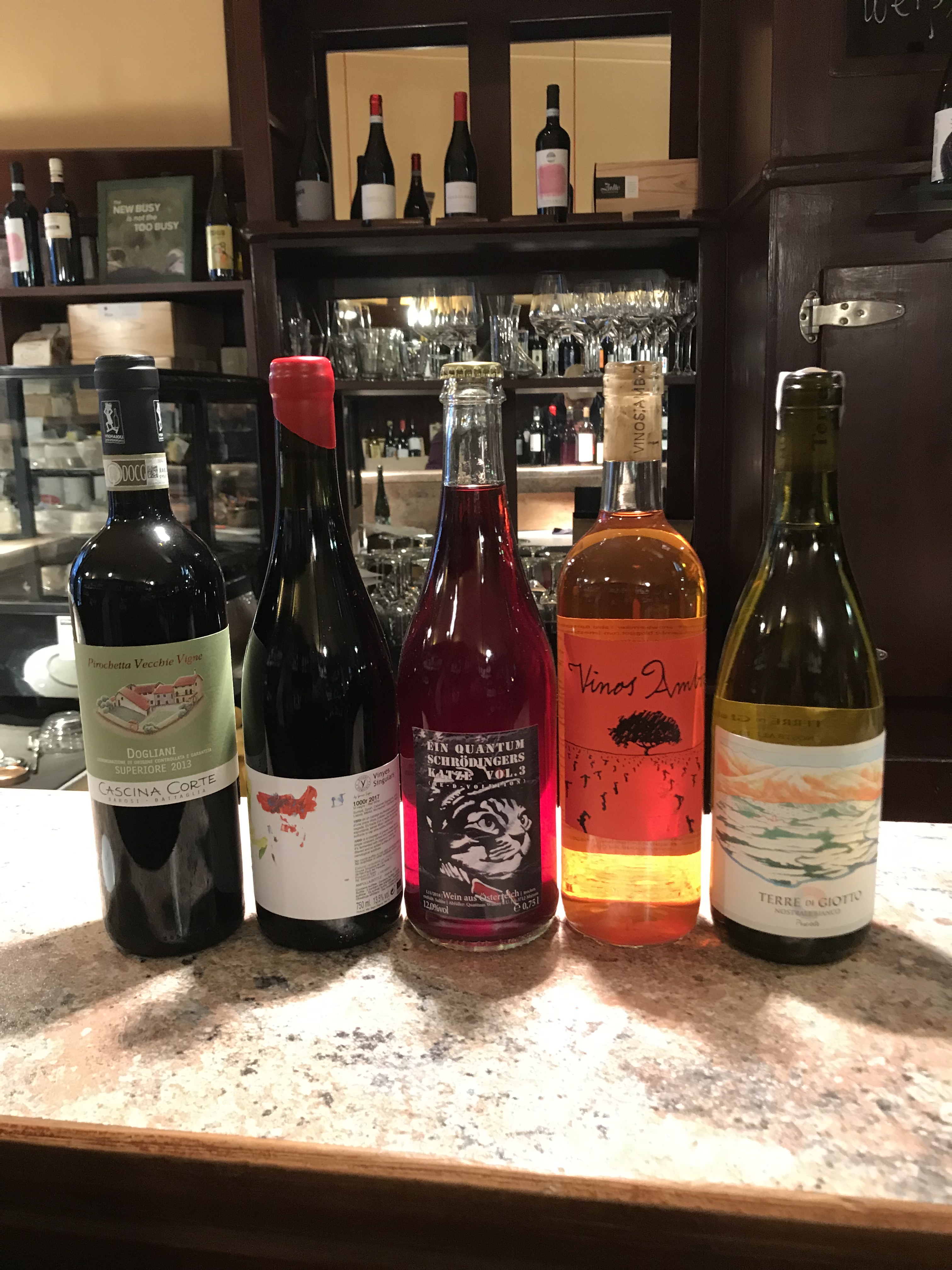
Top – some of the excellent international wines at Vinifero. 

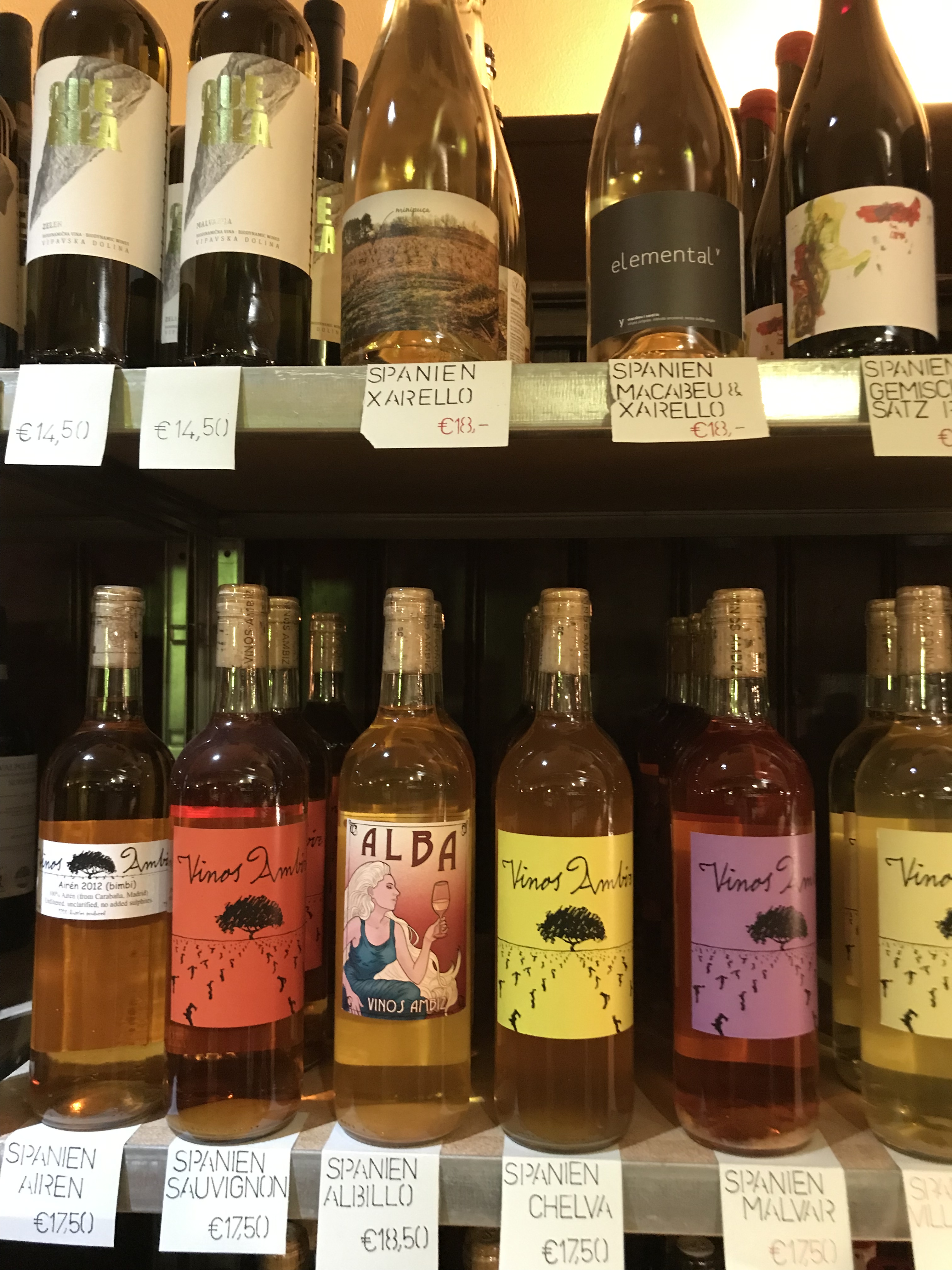
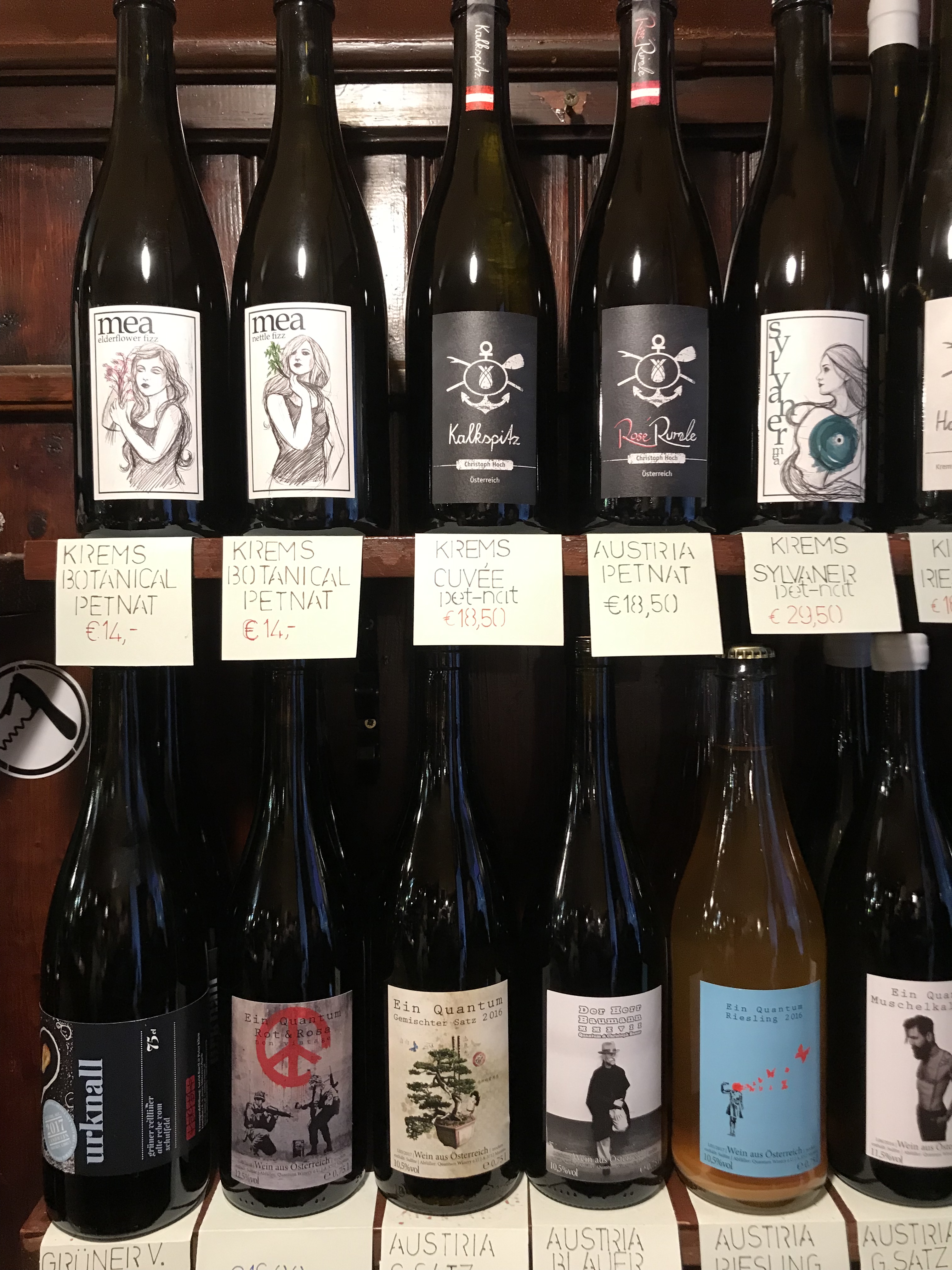
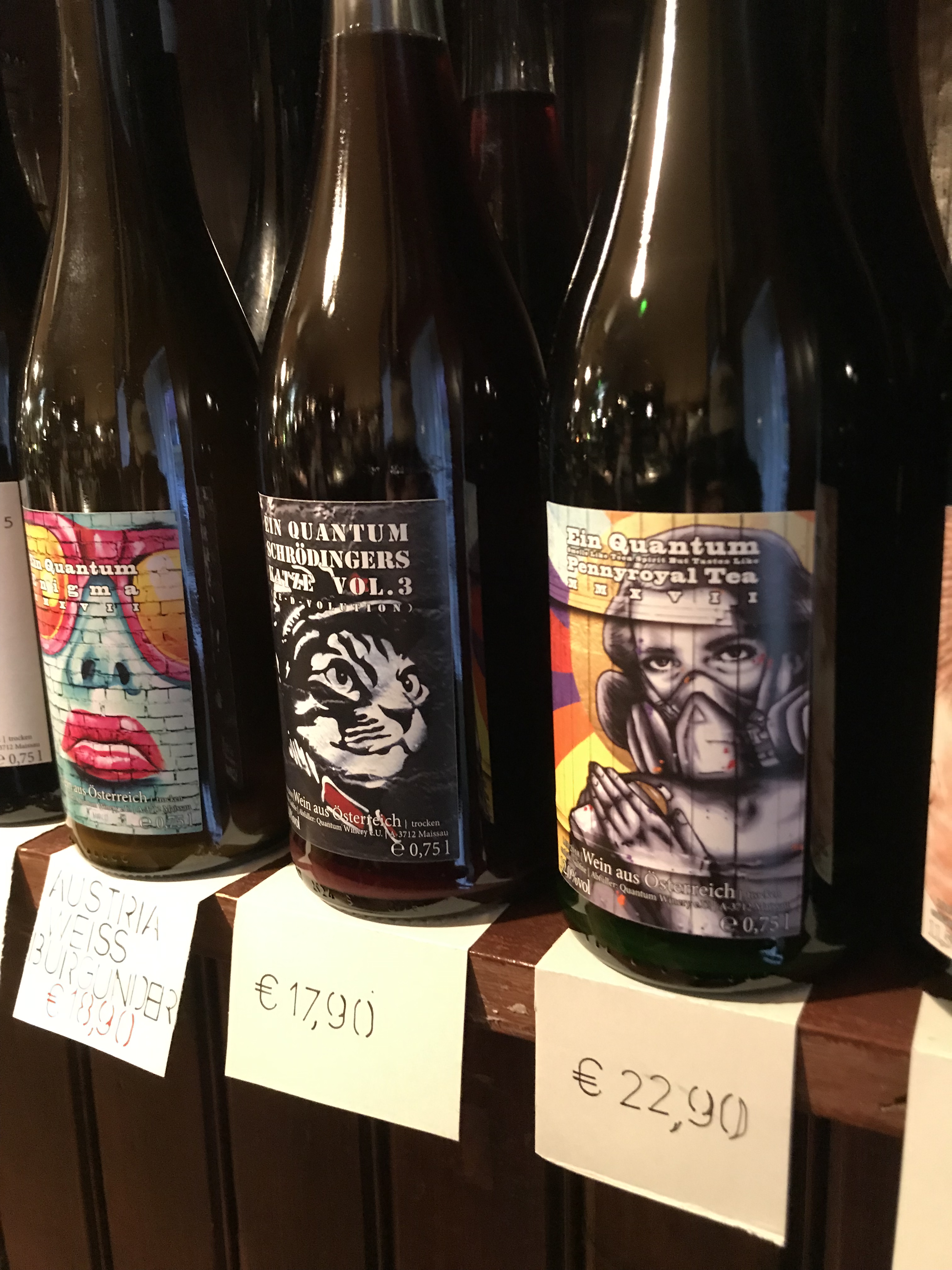
Bottom- some of the local bottles. The eclectic labels to the right and bottom shelf left are from Florian Schuhmann’s experimental Quantum Winery (Weinviertal in Lower Austria)

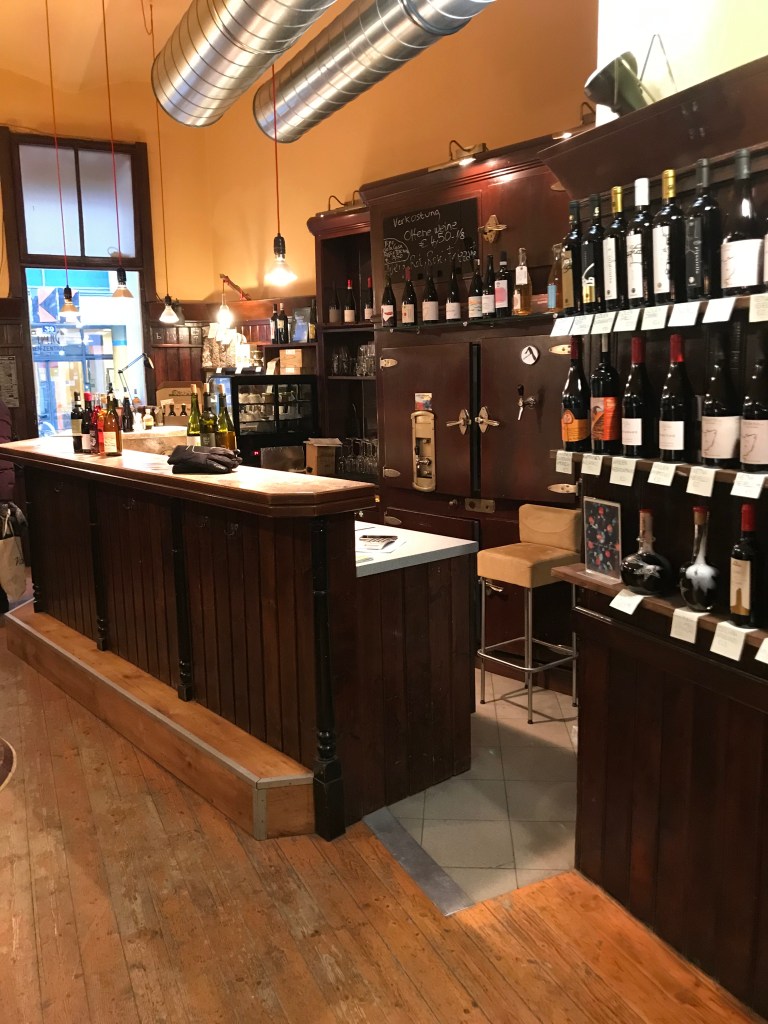
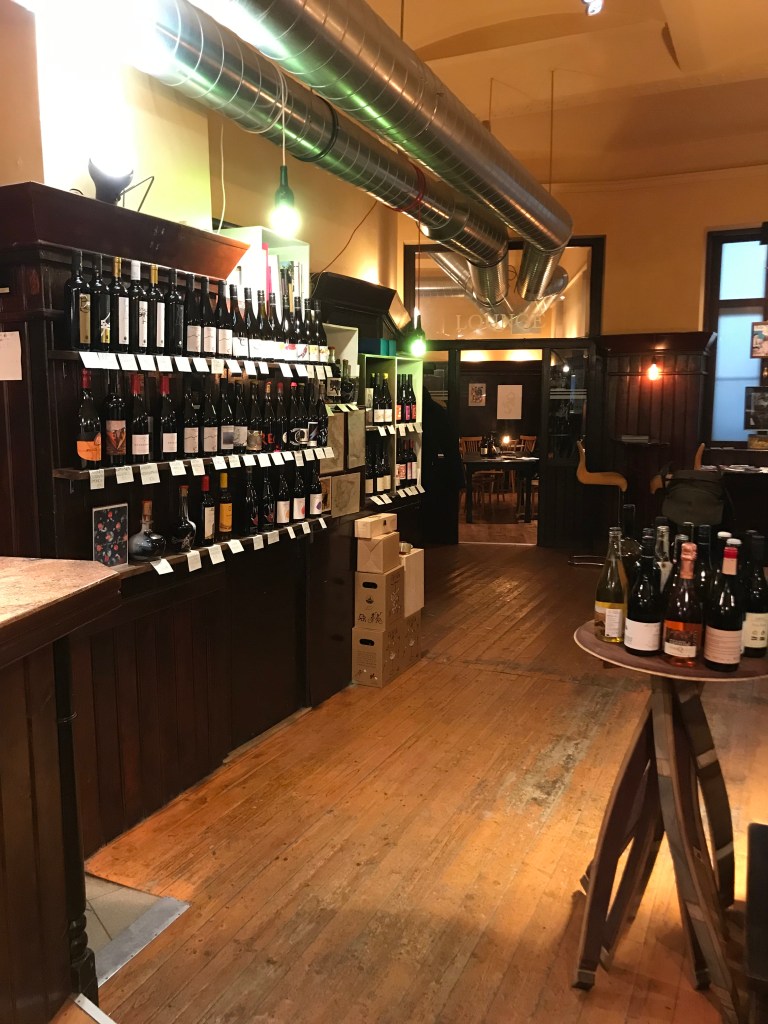
Vinifero used to be an old Beisl (neighbourhood restaurant) and aside from the ventilation ducts it retains a nice old feel.

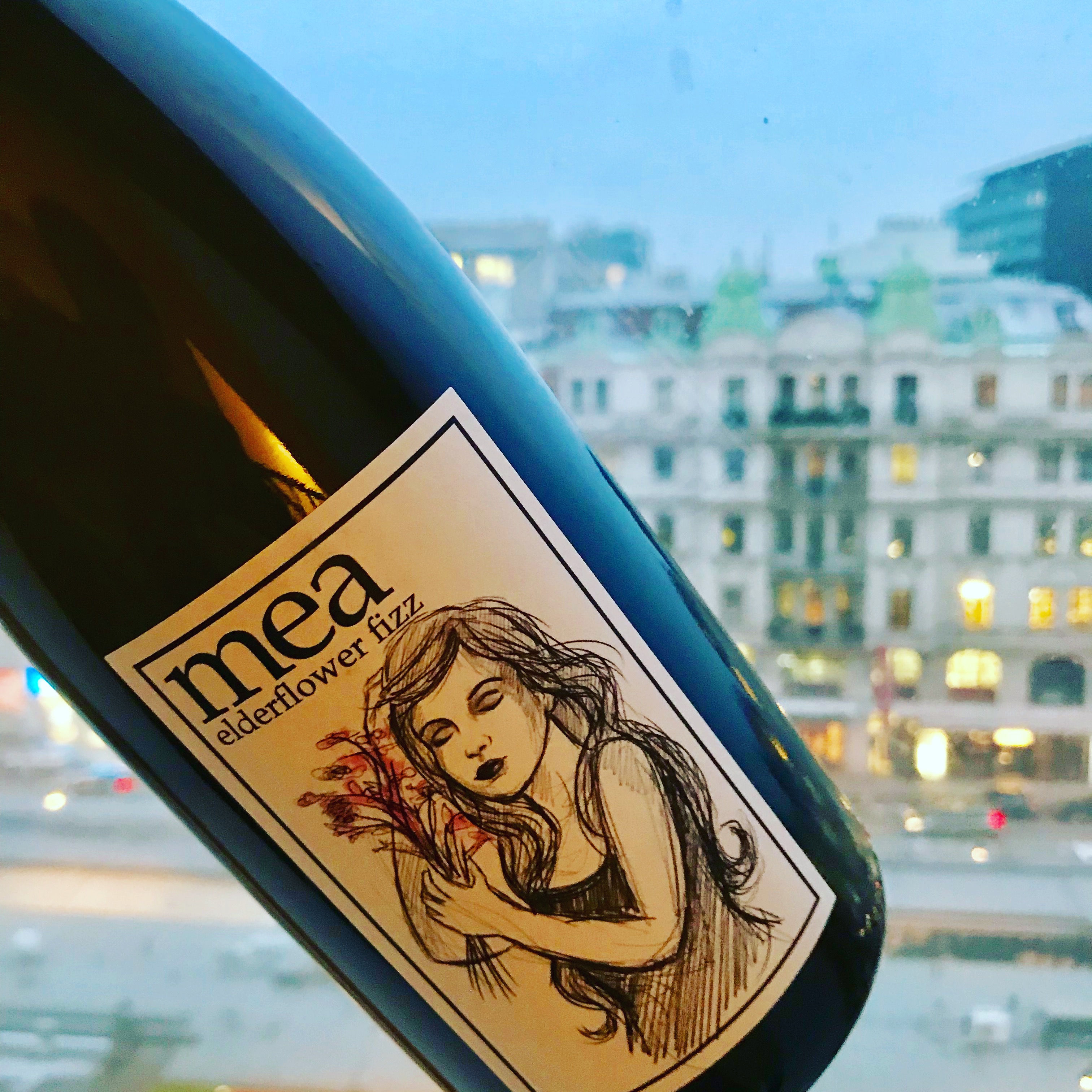
I brought back a few Austrian bottles, but the one we drank whilst in Vienna was quite unusual, “Mea” Elderflower Fizz by Hochdeutsch. Hochdeutsch is the label of Julie-Ann Hoch (whose partner, Christoph Hoch, might be known to readers of this blog and customers of Newcomer Wines). Julie-Ann is German, hence the play on words here.

Mea is not exactly a “wine”, partly because of its low (6%) alcohol content, but also because it’s a blend of wine and botanicals, in this case elderflower tea. This lightly sparkling drink is made by blending biodynamically grown grape must (Demeter certified) with biodynamically grown botanicals, both directly filled into bottle to ferment on natural yeasts, in a similar way to a petnat.

The result is super-refreshing, bone dry, and with the feel and weight of a sparkling cider. The elderflower scent and flavours are subtle, which adds to an attractive lightness.

Julie-Ann is based (with Christoph) at Hollenburg, south of the Danube not far from Krems, and around 35 miles west of Vienna. These drinks are very low production but well worth seeking out, just the sort of thing to be guzzling once the weather warms up, but none the worse for being sipped in a minus six-degree Vienna January.

Vinifero is at Gumpendorfer Straße 36, 1060 Wien. Note its limited opening hours, Tuesday to Friday 2pm to 8pm and Saturday 12pm until 6pm. They close Sunday and Monday.

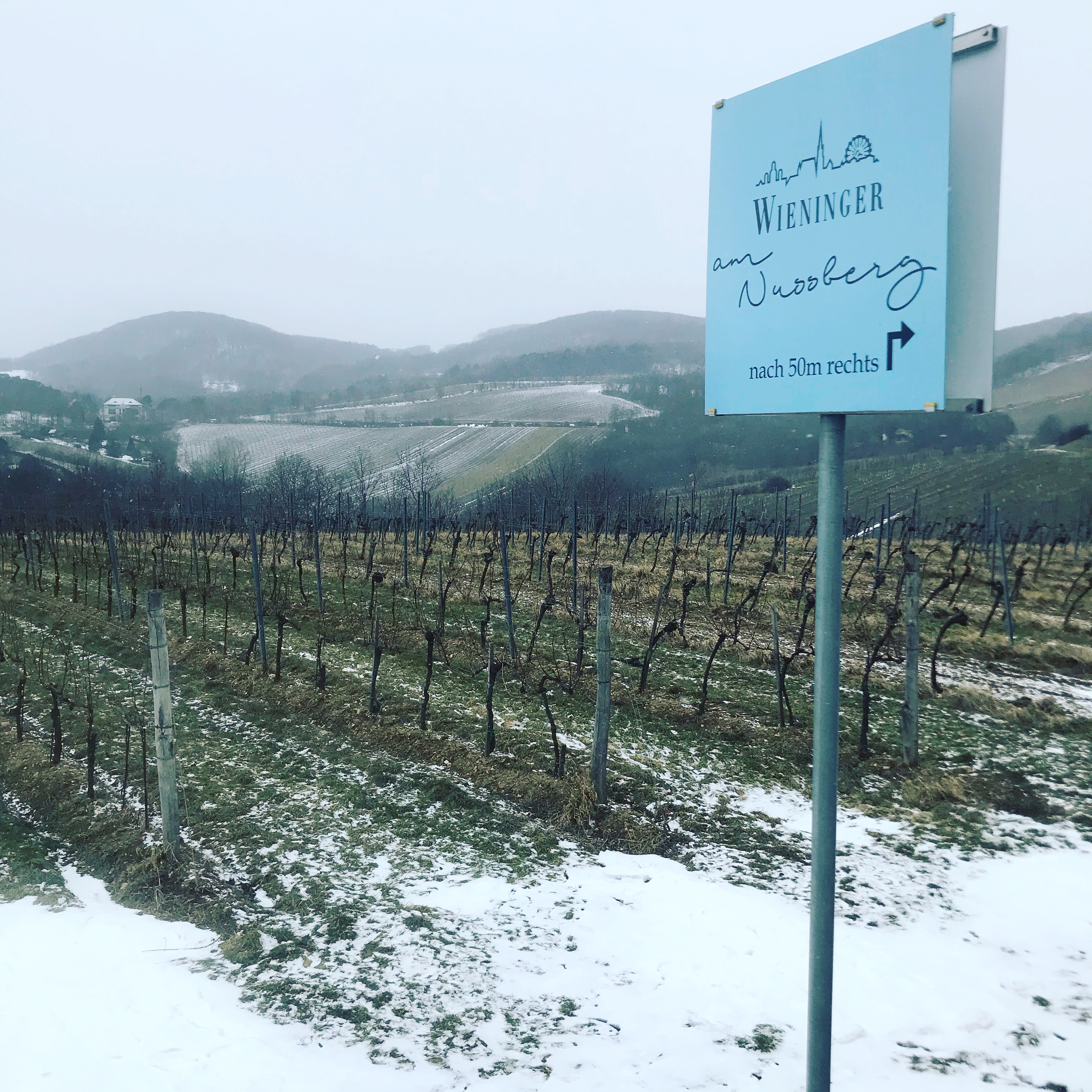
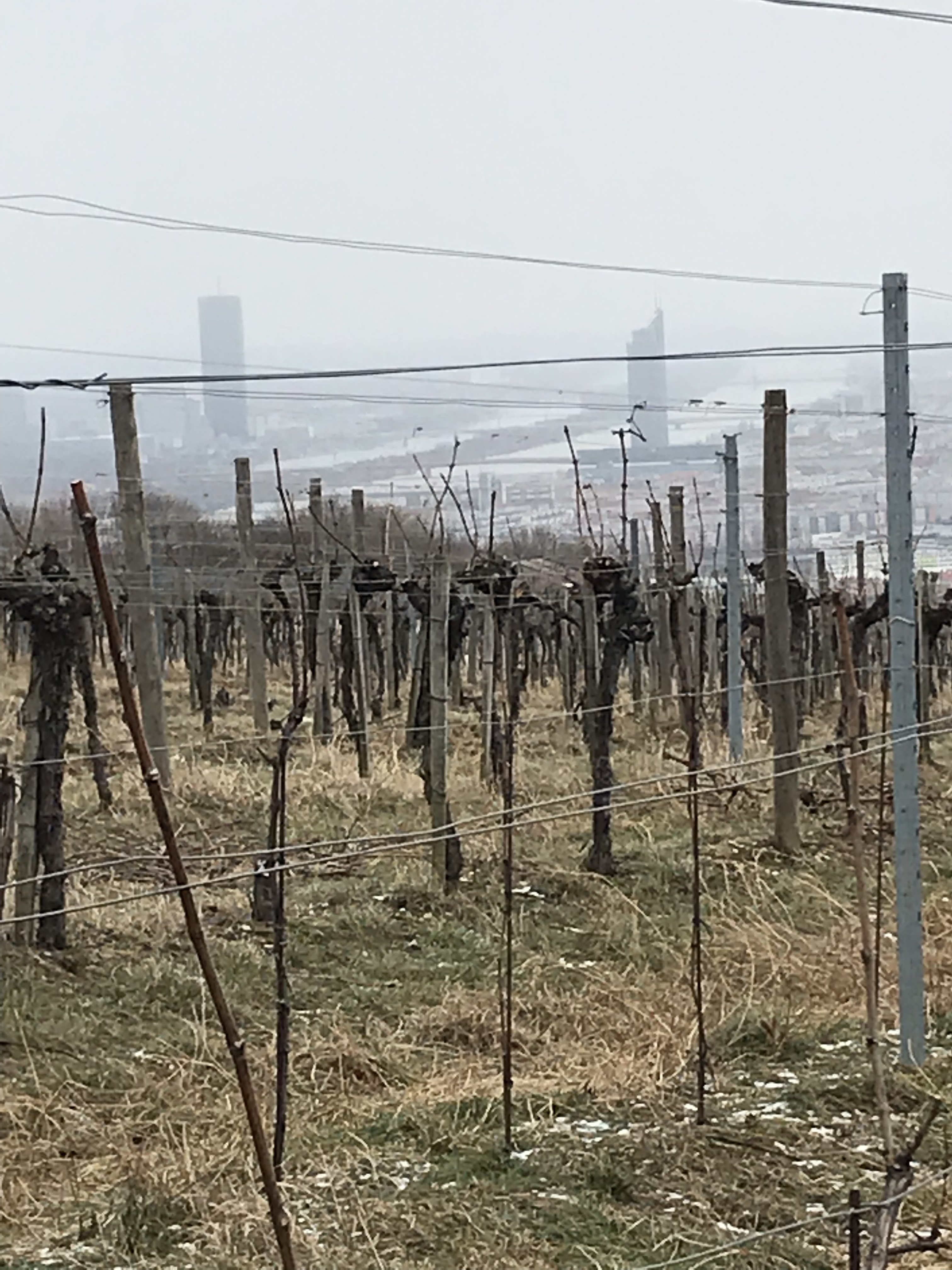
Whilst on the subject of cold Vienna temperatures, we made another trip up into the vineyards, via a walk in the woods. Of course, in winter all the pop-up Heuriger on the Nussberg are closed, even Sirbu which opens again in early springtime (and Mayer-am-Pfarrplatz, which is a good place to end your walk, at Pfarrplatz, before catching the 38A (see below) back to Heiligenstadt, generally opens at 4pm in the winter). It wasn’t always easy walking in a biting southerly wind blowing up from the Pannonian Plain, but worth it to see the vineyards in the winter.

It really is a great way to spend one of your days in Vienna. Just take the U4 Line to its final destination, Heiligenstadt. Directly outside the station exit is the stop for the 38A Bus, which will take you through Grinzing and up into the hills. Alight at the stop called Sulzwies (one stop before Kahlenberg – the bus has an electronic route screen). All you have to do is head down the path just to the right of the bus stop and you are into the Vienna Woods, eventually coming out into the Nussberg vines. There’s more information from our summer walk here. This includes details of a good, I’d say invaluable, map of Vienna and the surrounding woods and vineyards at 1:25,000, some ideas for summer lunches and information about a café at the start of the walk (that’s if you haven’t read it already).

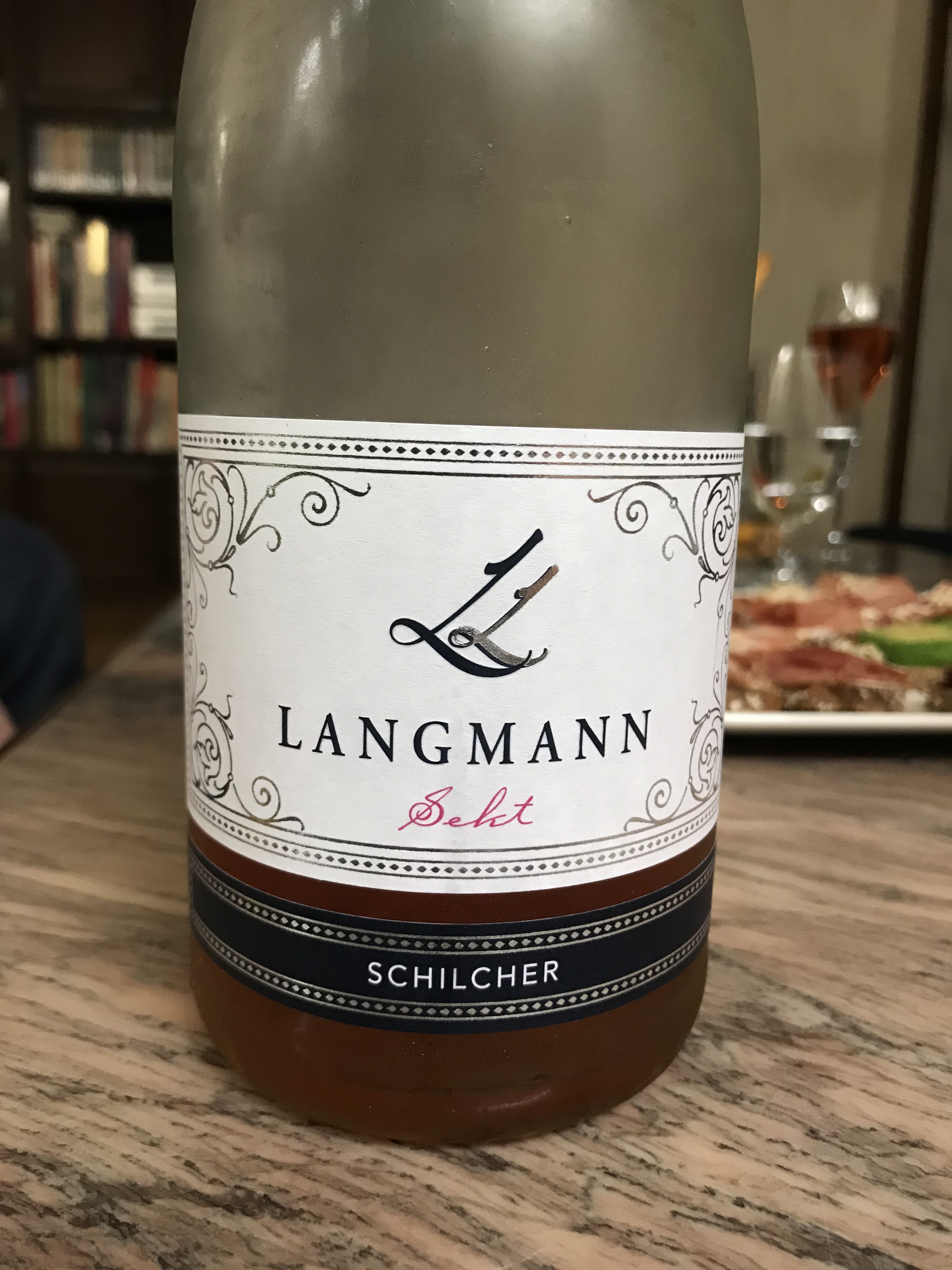
Finally, a photo of some Schilchersekt. If a trip to Vienna isn’t the same without a schnitzel, neither is it the same without a few glasses of this bracing Blauer Wildbacher speciality of raspberry-and-blueberry-tasting frivolity from Styria. Viennese friends can always be relied upon to open some before dinner.

Posted in Austria, Austrian Wine, Natural Wine, Vienna, Wine, Wine Shops, Wine Travel | Tagged , , , , , , | Leave a comment

Vienna Week 2 – Dining

If I were to make a personal recommendation for anyone looking to dine out in Vienna, assuming they share the same kind of wine obsessions as I do, then I suppose I’d have to go with Mast Weinbistro. However, Mast was closed during the week we were there in January, and if you ever find yourself in the same position, then the following pair of restaurants will not disappoint…far from it. The first was completely new to me (a friend suggested it for lunch together), whilst the second is a place I always go to, every visit, if I can.

TIAN

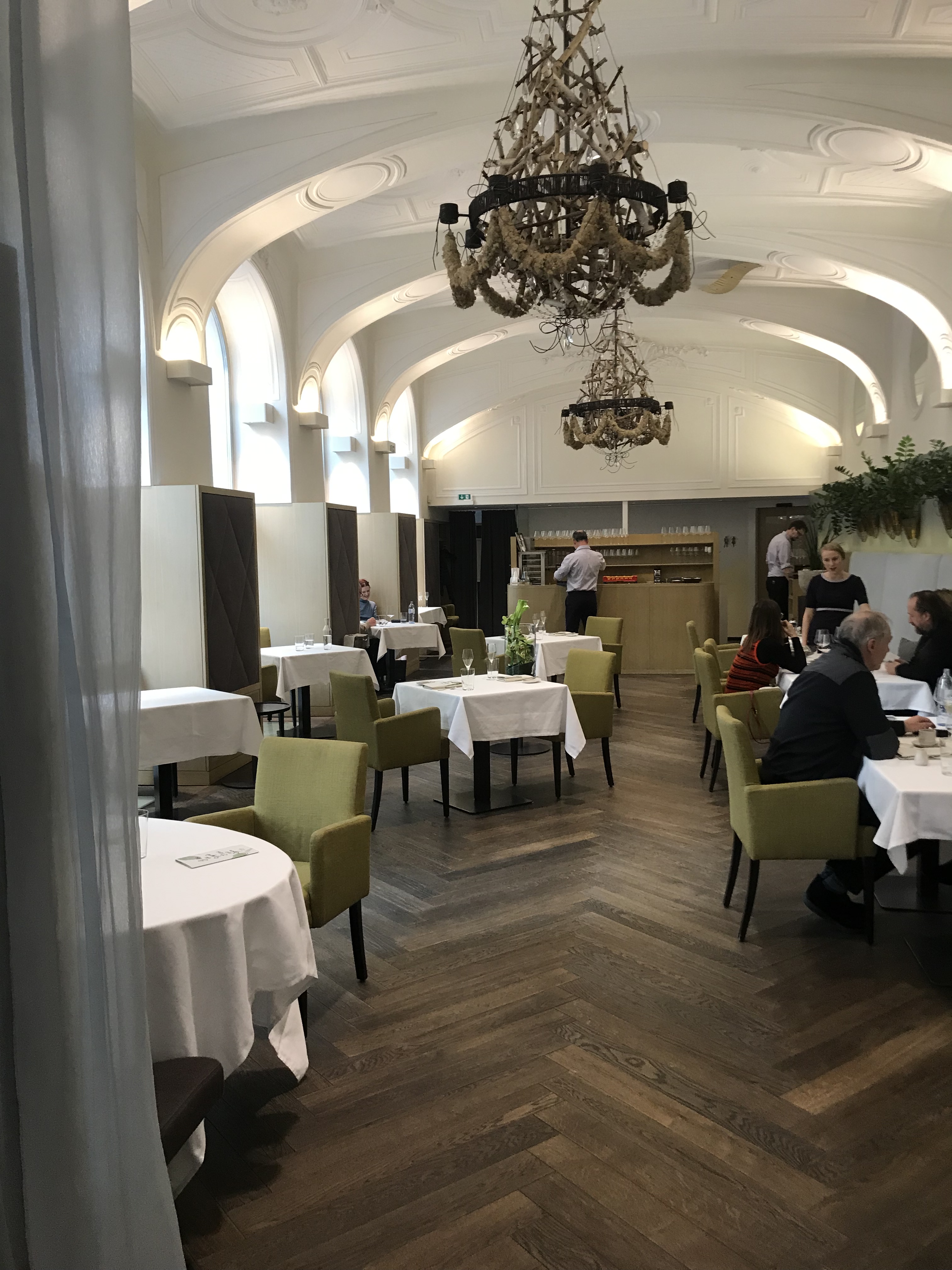
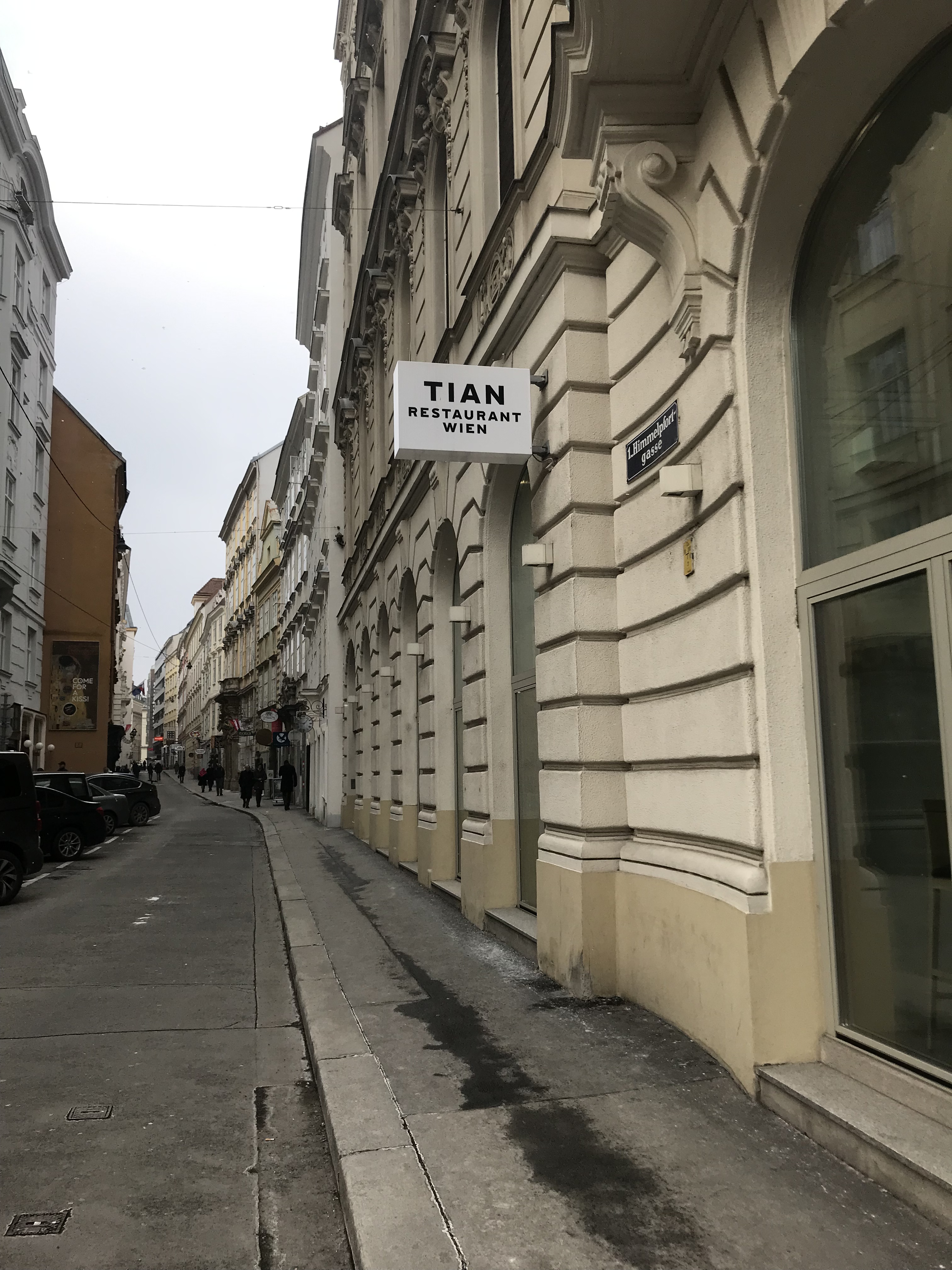
Tian Restaurant (there’s a bistro version as well) is Vienna’s first Vegetarian and Vegan restaurant to earn a Michelin Star, and I’d say that this accolade is more than deserved. It has very much the smart feel of a Michelin-starred restaurant, a clean white interior, fairly sparse, smart tables, comfortable chairs, etc.

Service is also impeccable, attentive but not intrusive, and unusually warm. There was never more than one waiter visiting the table, and none of that multiple hovering which can be off-putting in some smarter establishments when it’s a little bit quiet (no one really likes to be watched whilst they eat).

The format is simple. At lunch you get a menu of eight dishes, described quite simply but each based around a single vegetable, cheese or nut. You pay €89 for four courses, €109 for six courses, or €127 for all eight. We opted for four, but we seemed to get quite a few amuses bouches. The cooking is inventive and creative, and the ingredients are very fresh, as you would expect. What interested me was that our friend is an inveterate carnivore and he seemed to enjoy the experience as much as we did.

Tian describes itself as vegetarian, and the menu as listed does contain various forms of dairy in some courses. However, if you warn them when booking they are more than willing to accommodate a vegan diet with just the same degree of invention.

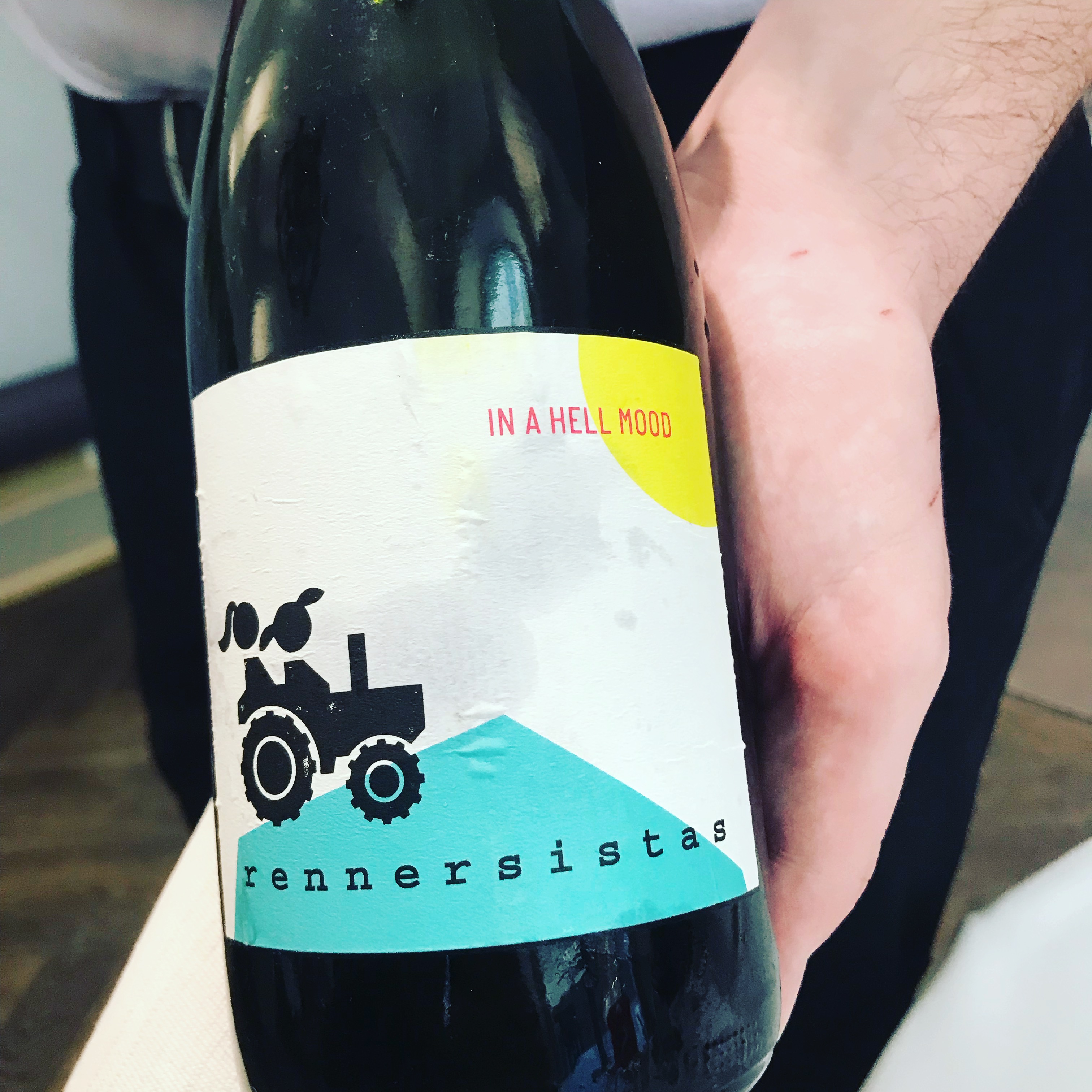
The best thing about Tian is that the wine list is just as good as the food. A wine (or juice) pairing is available with each menu option (€49/€69/€73), but the list itself covers most bases, from natural to classic, all wines which accompany what are generally lighter dishes. We just opted for our own type of lunch classic, Rennersistas In A Hell Mood (Pinot Noir-based  petnat from Gols in Burgenland…which needs no introduction to regular readers).

Tian is at Himmelpfortgasse 23, 1010 Wien, which is probably a ten minute walk around the back of Saint Stephan’s Cathedral. Tian Bistro Am Spittelberg is doubtless less expensive, at Schrankgasse 4, 1070 Wien. They also have another restaurant in Munich. If you fancy a splurge then check it out. Next time we shall probably check out the bistro.

GLACIS BEISL

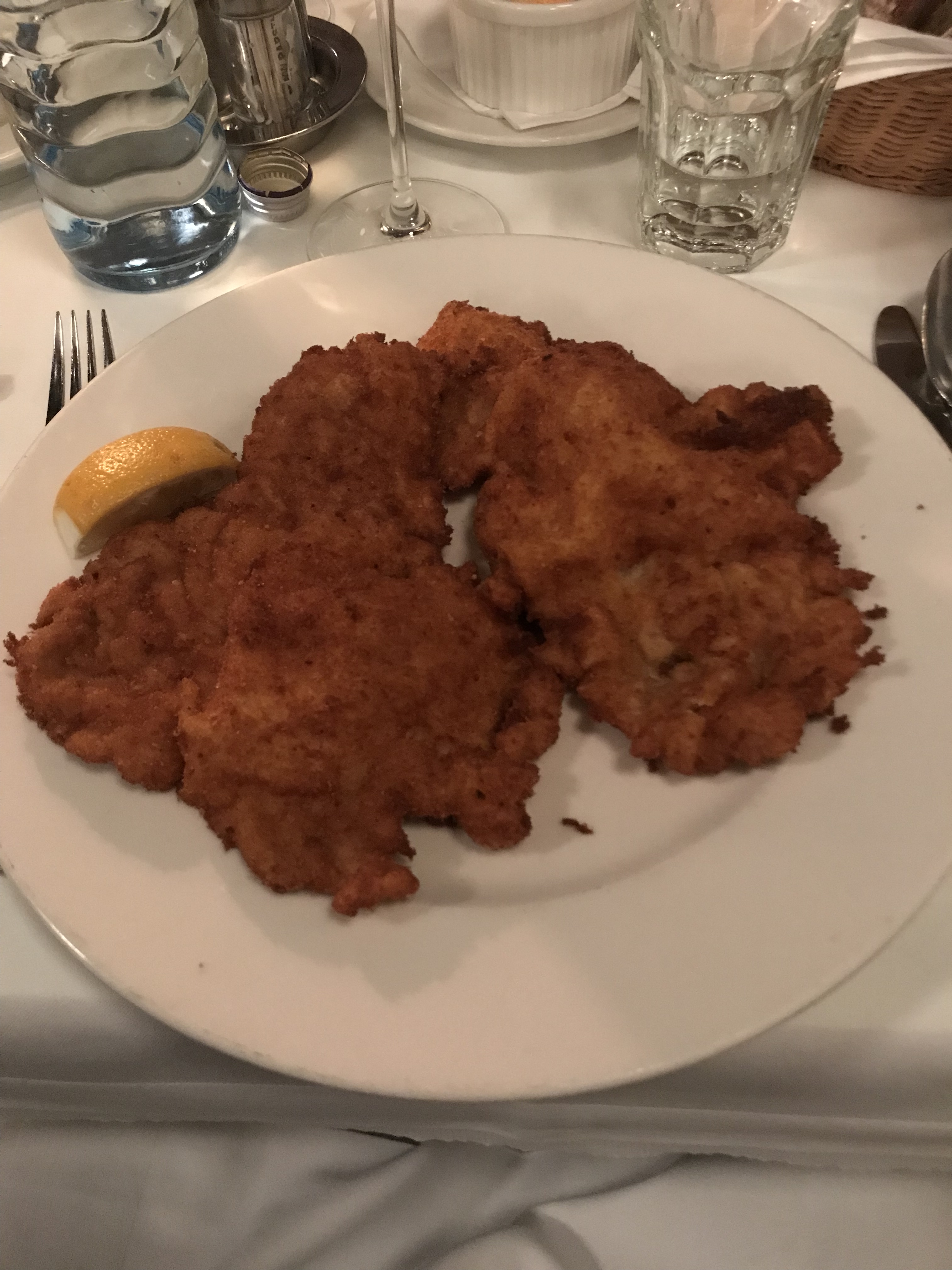
I’ve been to Glacis Beisl, tucked behind the Museumsquarter, in the old city walls just a short walk from the Ringstrasse, several times now. It is ideally my first port of call in the city, to satisfy my schnitzel craving, although on this trip it provided a nice, quiet, last night dinner for two.

I wrote about Glacis after our August visit, but it’s worth a second plug in order to talk a little more about the wine list. When I tell people that Glacis has an excellent selection of natural wines, they are often slightly surprised. The first reason is that Glacis is quite a Vienna institution, a great example of the Beisl format, which provides fairly simple but substantial food and a “local” atmosphere, but at the same time it is not unknown to tourists.

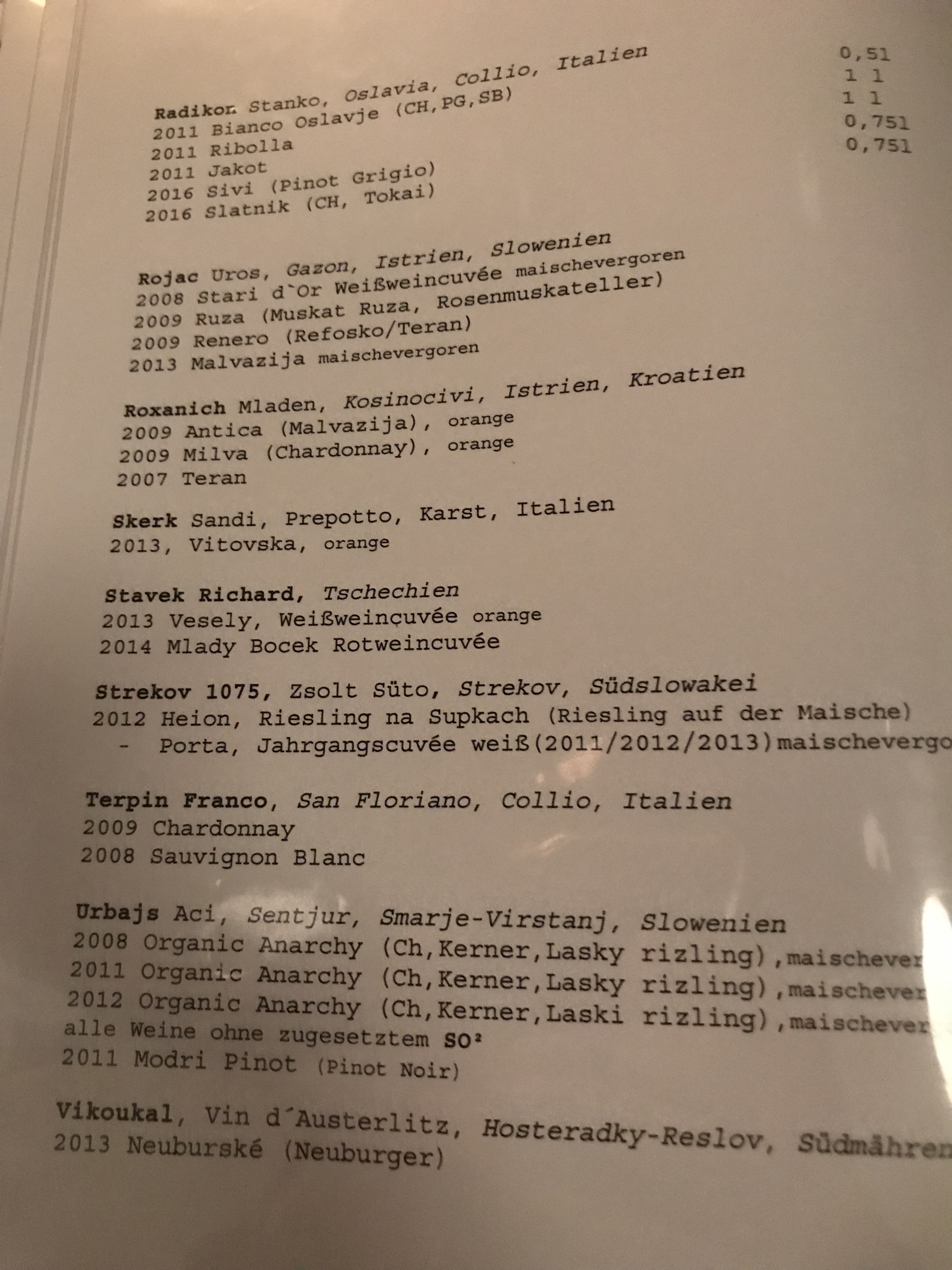
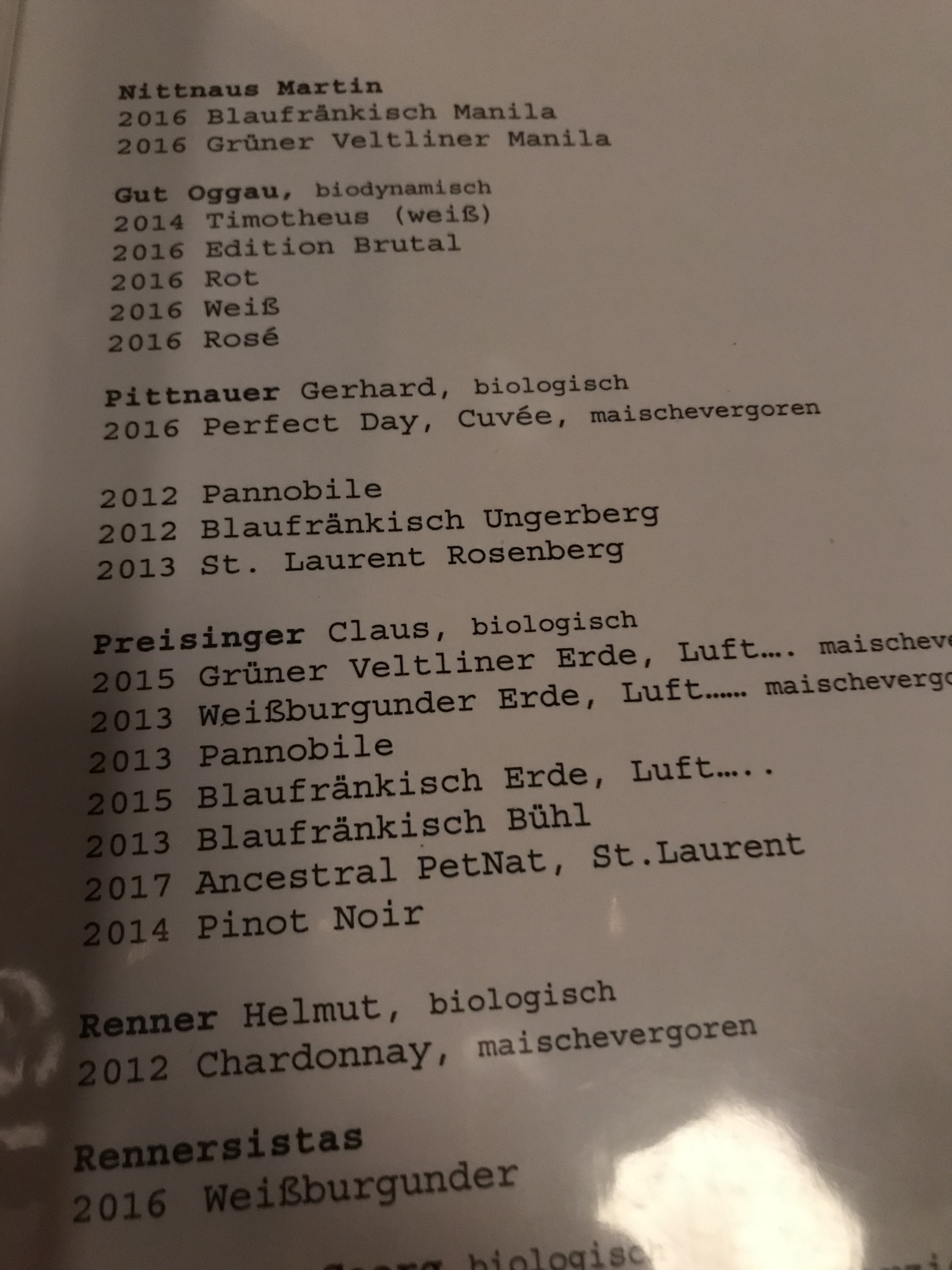
The second reason is that when you sit down you are presented with a fairly short and limited wine list, albeit one with a selection of wines by the glass, with which most people are satisfied. However, if you ask for the “red book”, you will not only find a more substantial and interesting offering, what’s more, the prices are pretty reasonable, some probably less than UK retail.

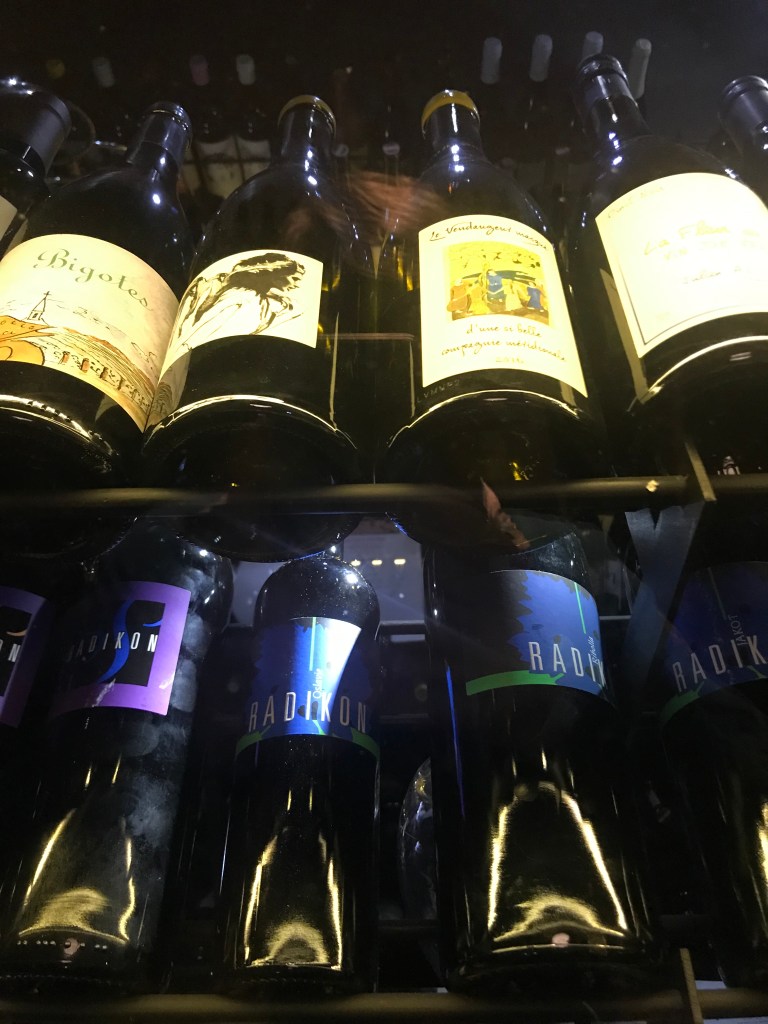
In particular, there’s a good multiple bottle selection from Gut Oggau, Claus Preisinger, Reinisch, Werlitsch, Muster and Strohmeier, plus other classic labels from Central Europe (Gravner and Radikon, for example). As in Mast, you can pretty much have a field day for natural wine at Glacis.

Although the photos are frankly not great, I thought I’d reproduce a few pages here to give a taste of what’s on offer. Click to enlarge.

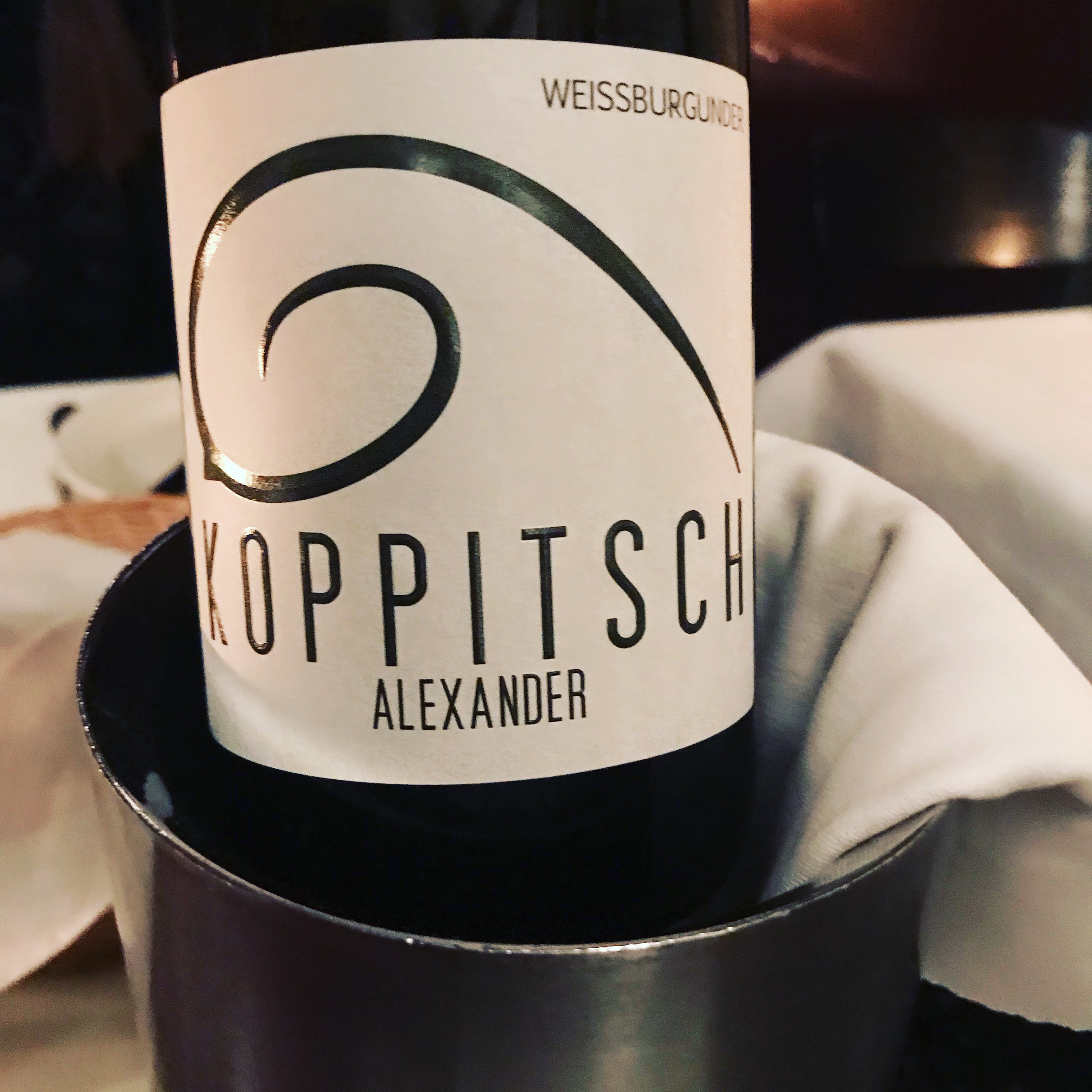
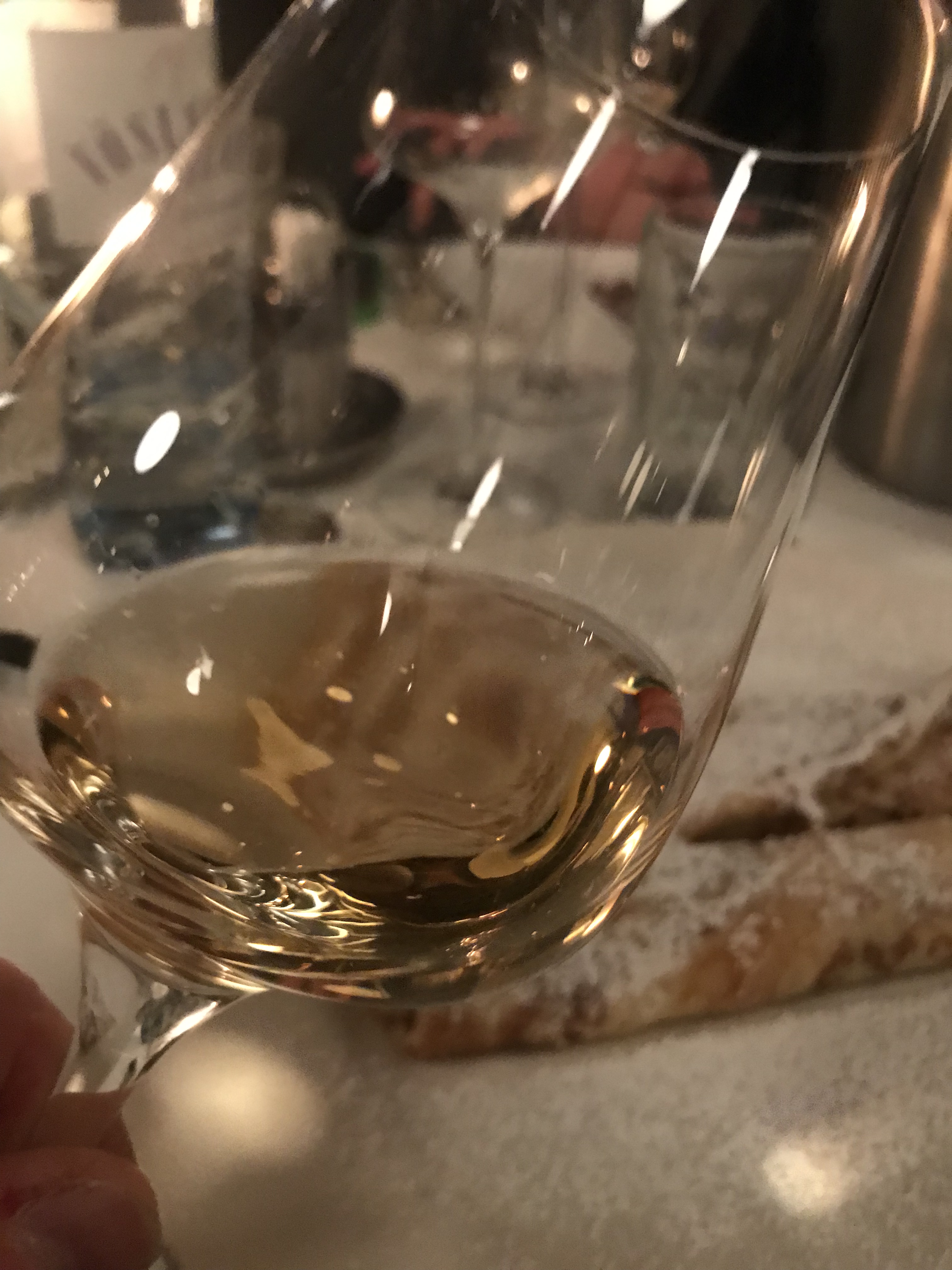
We drank a bottle of Alexander Koppitsch Weissburgunder 2017 (well, after the Koppitsch party a couple of days before I felt duty bound). It was beautifully aromatic, from old, low yielding vines, a natural fermentation, unfiltered and no additives (including zero sulphur added).

I remember that back in Alsace in 2017 I was drinking Pinot Blanc in restaurants and wondering why I’d more or less shunned the grape for so many years. This lightish Weissburgunder was a very good pairing with a simple but well cooked schnitzel with its traditional accompaniment of waxed boiled potatoes, beetroot and salad leaves. This Pinot Blanc is adorned with the simplest of the Koppitsch labels too, but it is lemony-fresh, with a little texture in the mouth, and very thirst quenching.

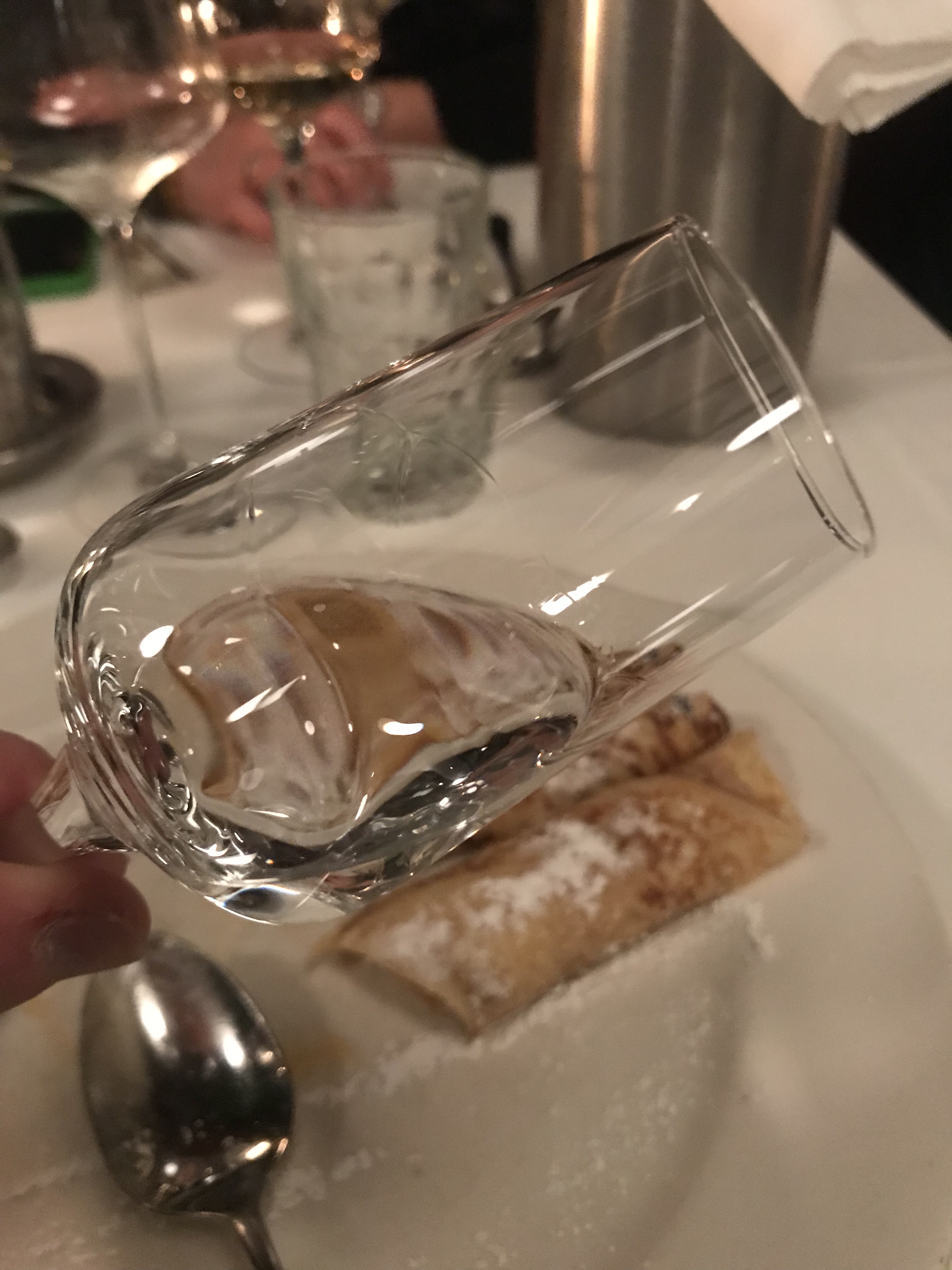
The regions around Vienna are particularly good for apricots, especially The Wachau, and you can easily be tempted to choose an apricot-based dessert. The traditional apricot dumplings are pretty filling, but the apricot pancakes at Glacis are just a little lighter. It’s always hard to choose what to drink with this dessert, so I decided on a Kracher Beerenauslese and an apricot schnapps, in the spirit of last night “in for a penny but I still have to get to the airport early tomorrow”.

A tip on apricot jam – I rarely fail to bring back some apricot jam from Vienna, but it is always the brand Staud’s. They come in a small 250g jar (usually with an attractive picture on the lid, maybe a Klimt, maybe the Hofburg) and are readily available, and cheaper in a supermarket like the Billa chain than in the tourist shops. They are less sweet than most brands, and contain a high fruit concentration (60g per 100g). Try some. A nice gift, except that I’m too greedy.

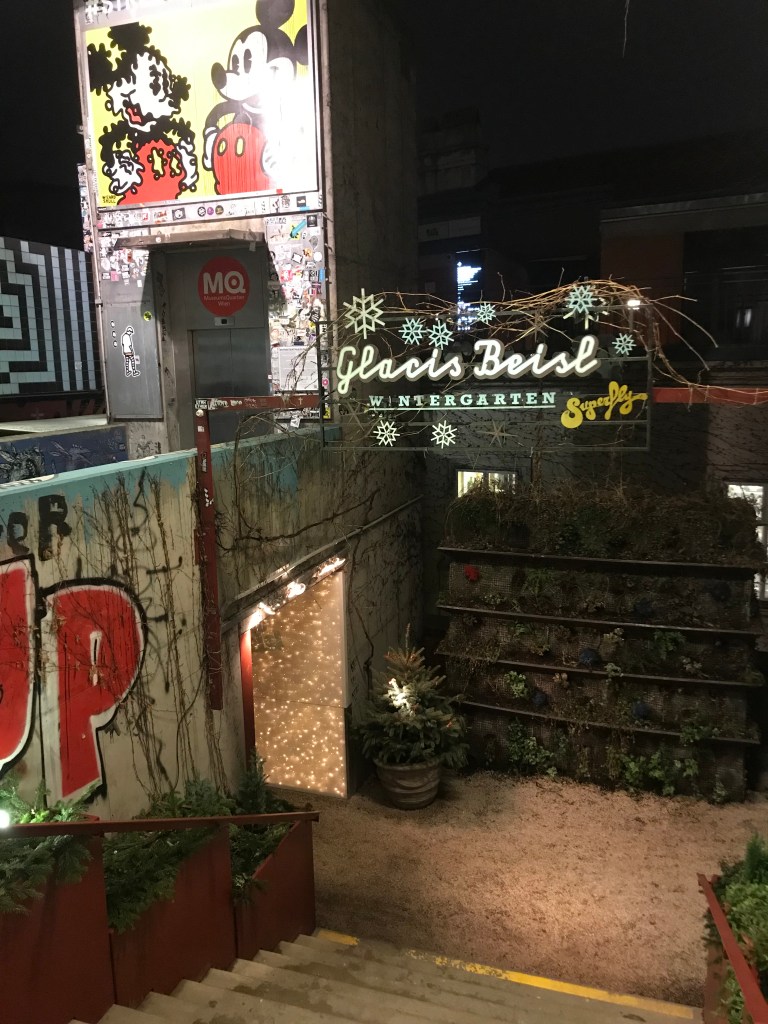
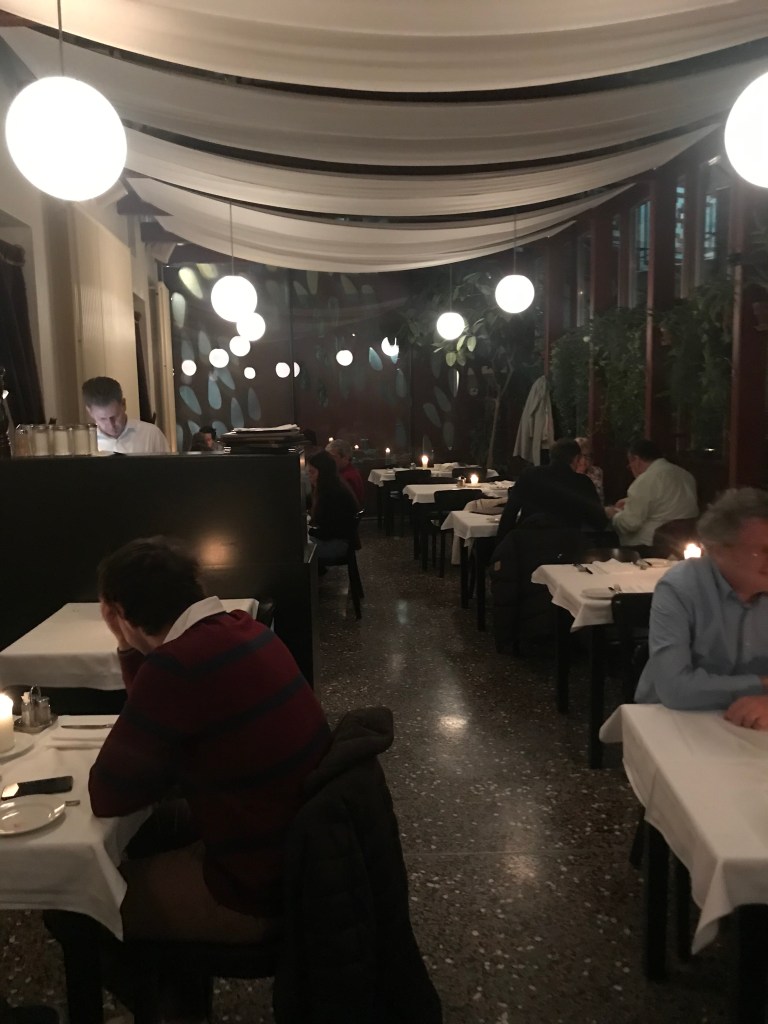
Glacis Beisl isn’t initially the easiest place to find, mainly because you have to descend some fairly unprepossessing steps to enter. The restaurant itself has a lovely garden for outdoor dining, though not recommended in winter, an attractive glass room and a darker inner sanctum more indicative of the traditional beisl style.

You can access it via the steps up the side of the MUMOK Museum in the Museumsquarter, or by the road behind – Glacis Beisl is at Breite Gasse 4, incidentally not too far from the Tian Bistro, and equally not very far from the natural wine shop, Vinifero, which will get a plug in my next Vienna article.

To read about my visits to Glacis Beisl and Mast Weinbistro last summer (and a few other Vienna recommendations), follow the link here.

Posted in Austria, Austrian Wine, Dining, Natural Wine, Vienna, Wiener Beisl, Wine, Wine and Food | Tagged , , , , , , | Leave a comment

Vienna Week 1 – Koppitsch Party!

If anyone wondered why I have been quiet, I’ve been enjoying a week in a very cold Vienna. I shall bring back a few tales over the next two or three weeks, but my first article is about a producer I’ve known for a while and always thought deserved a wider appreciation. I wanted to lose no time in giving them a well deserved shout.

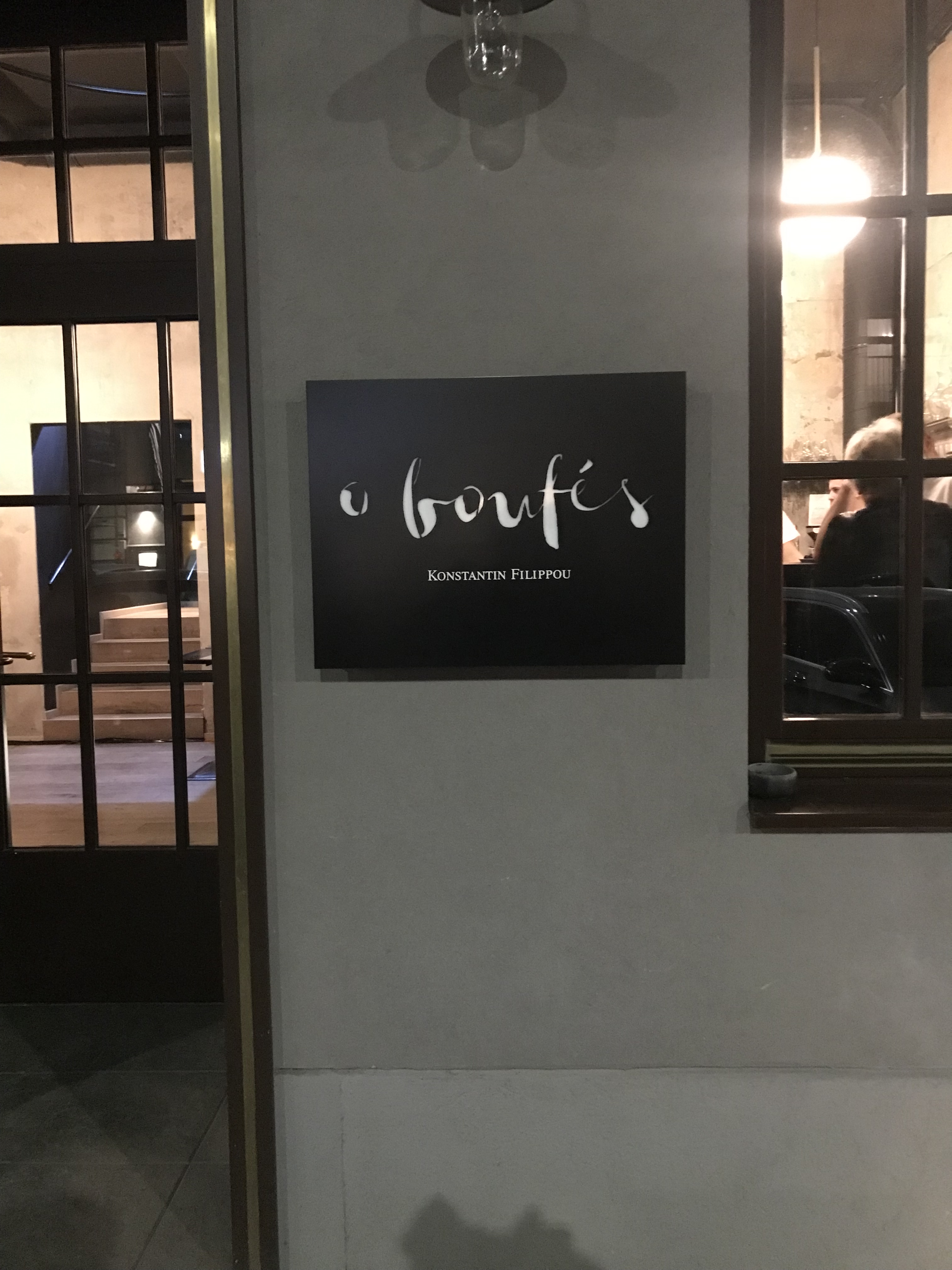
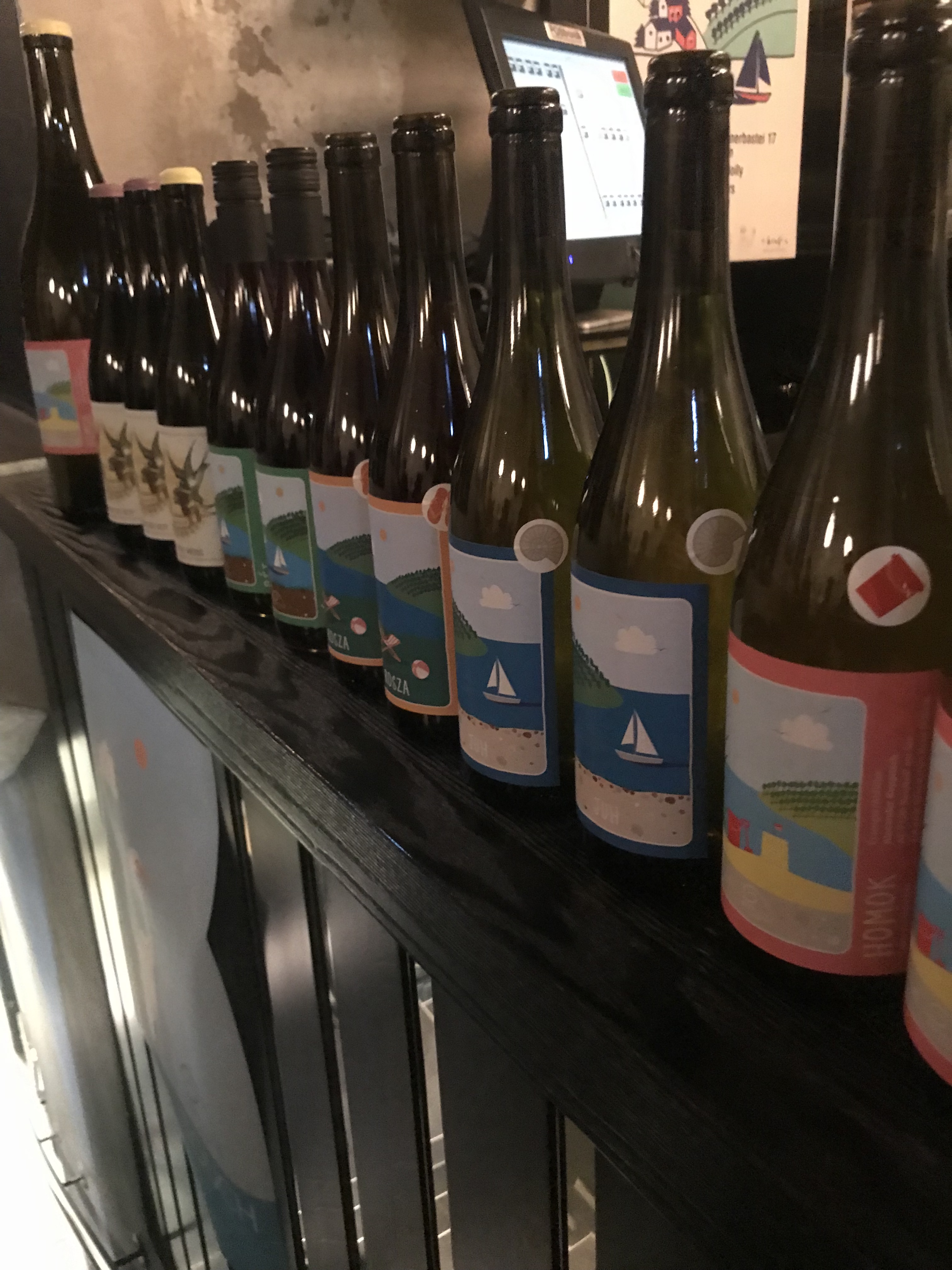
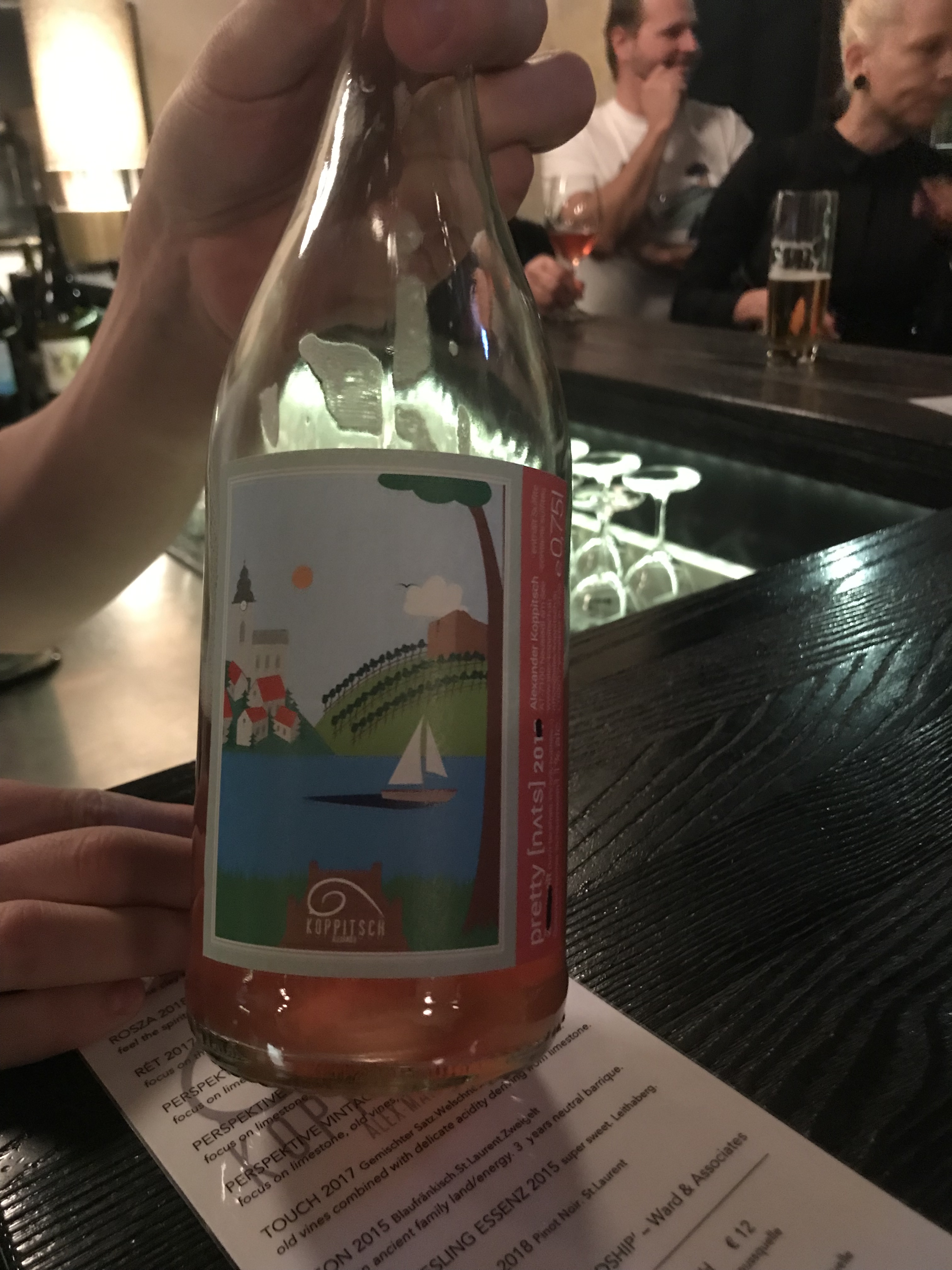
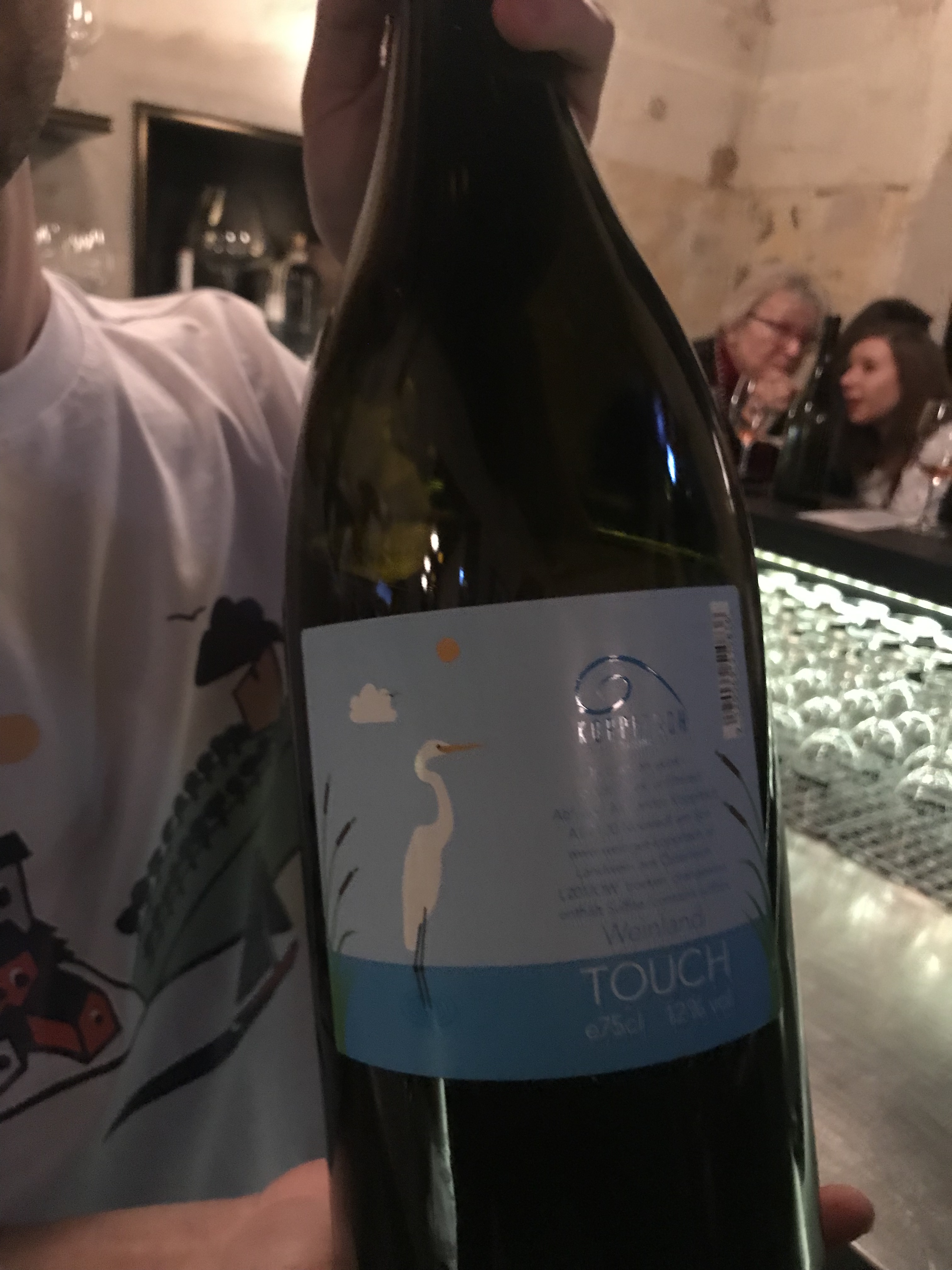
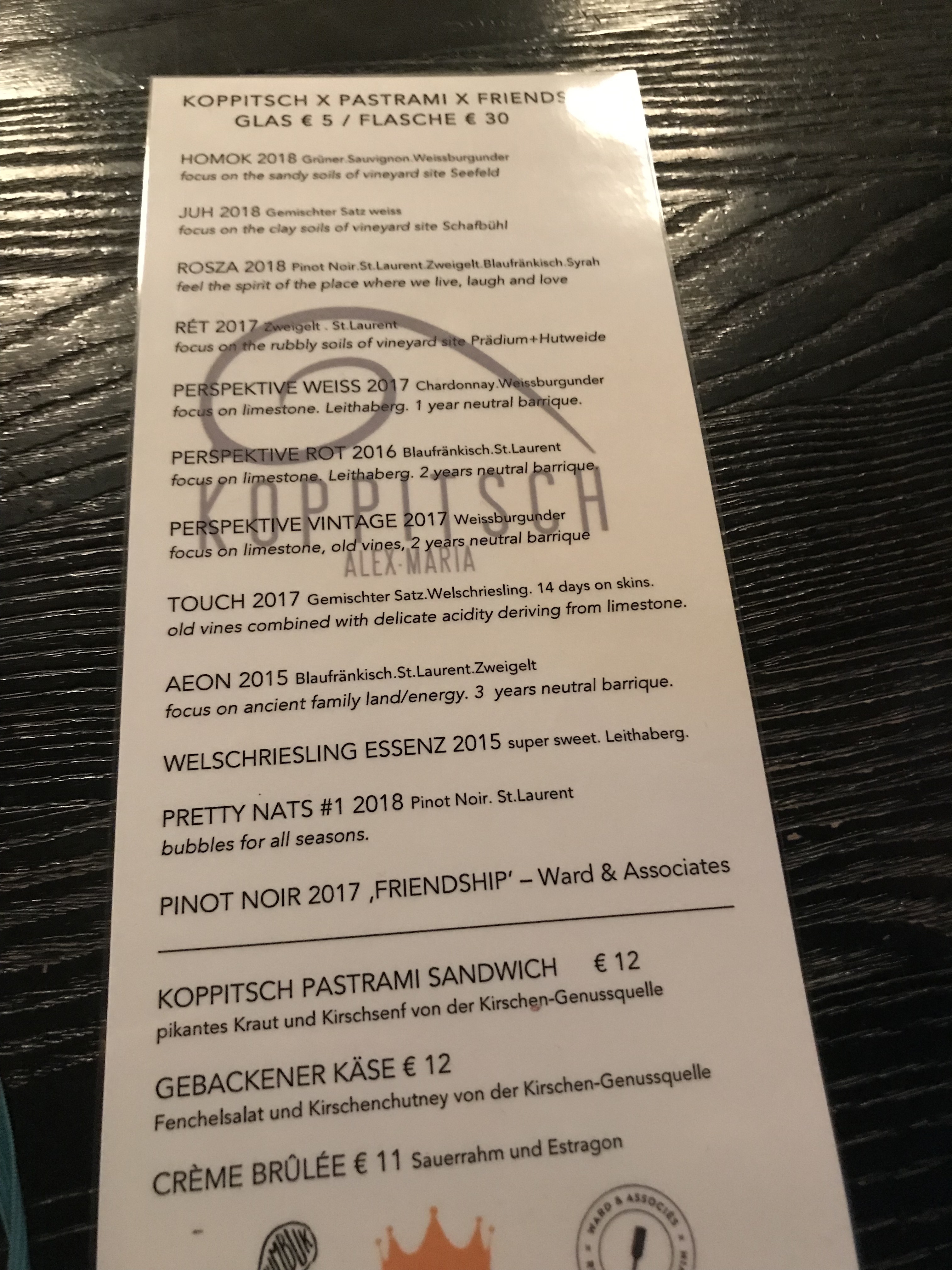
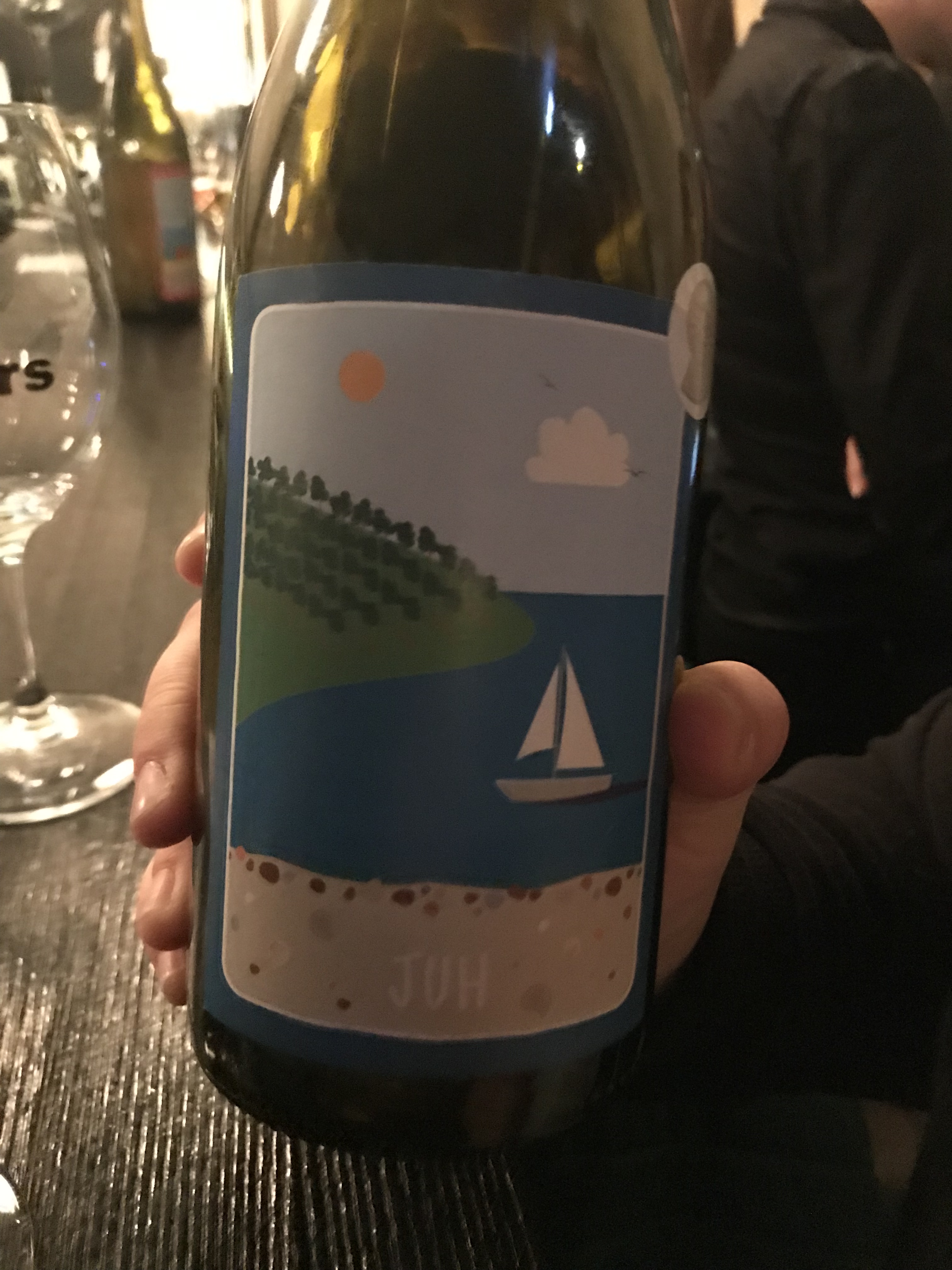
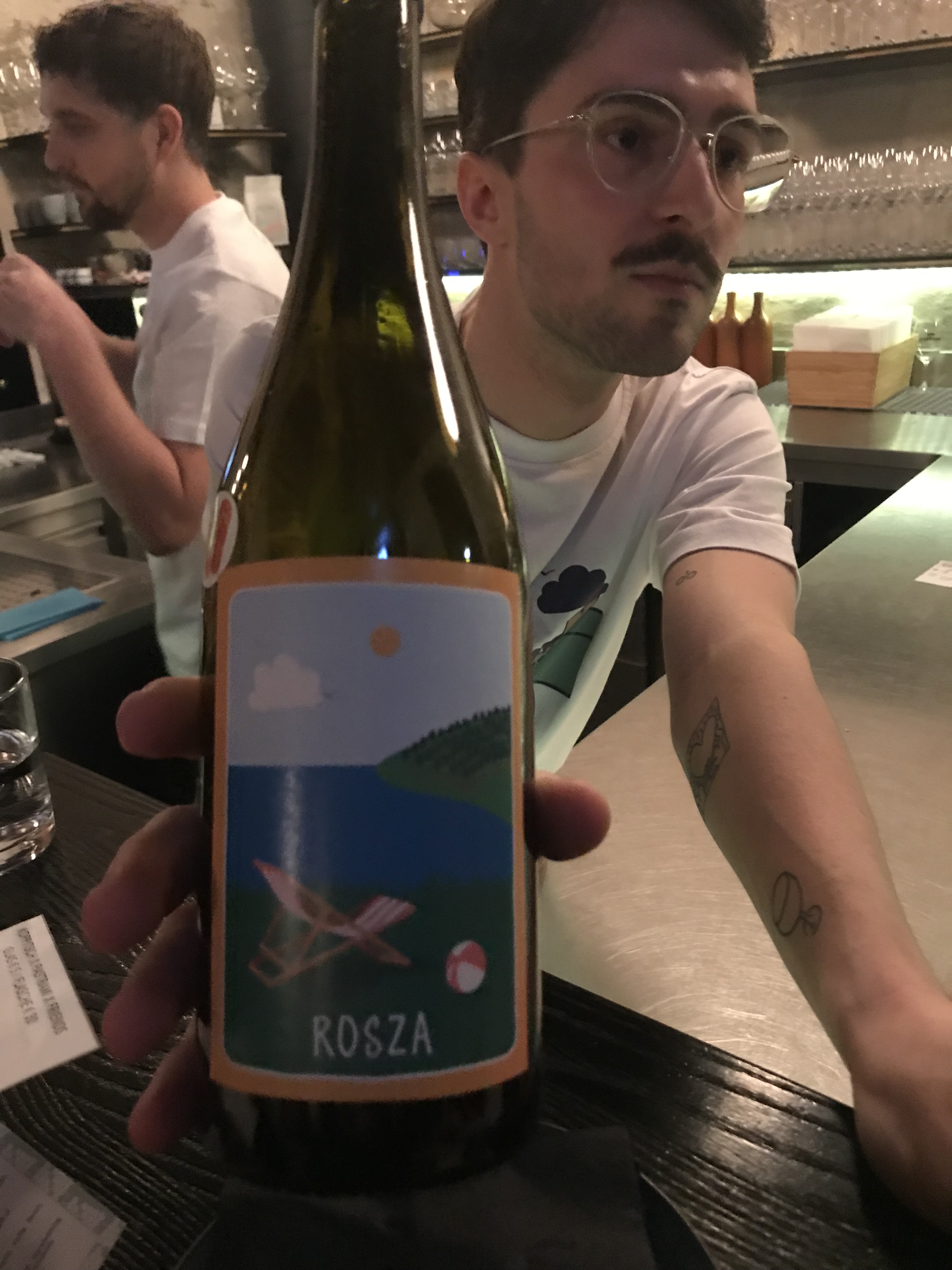
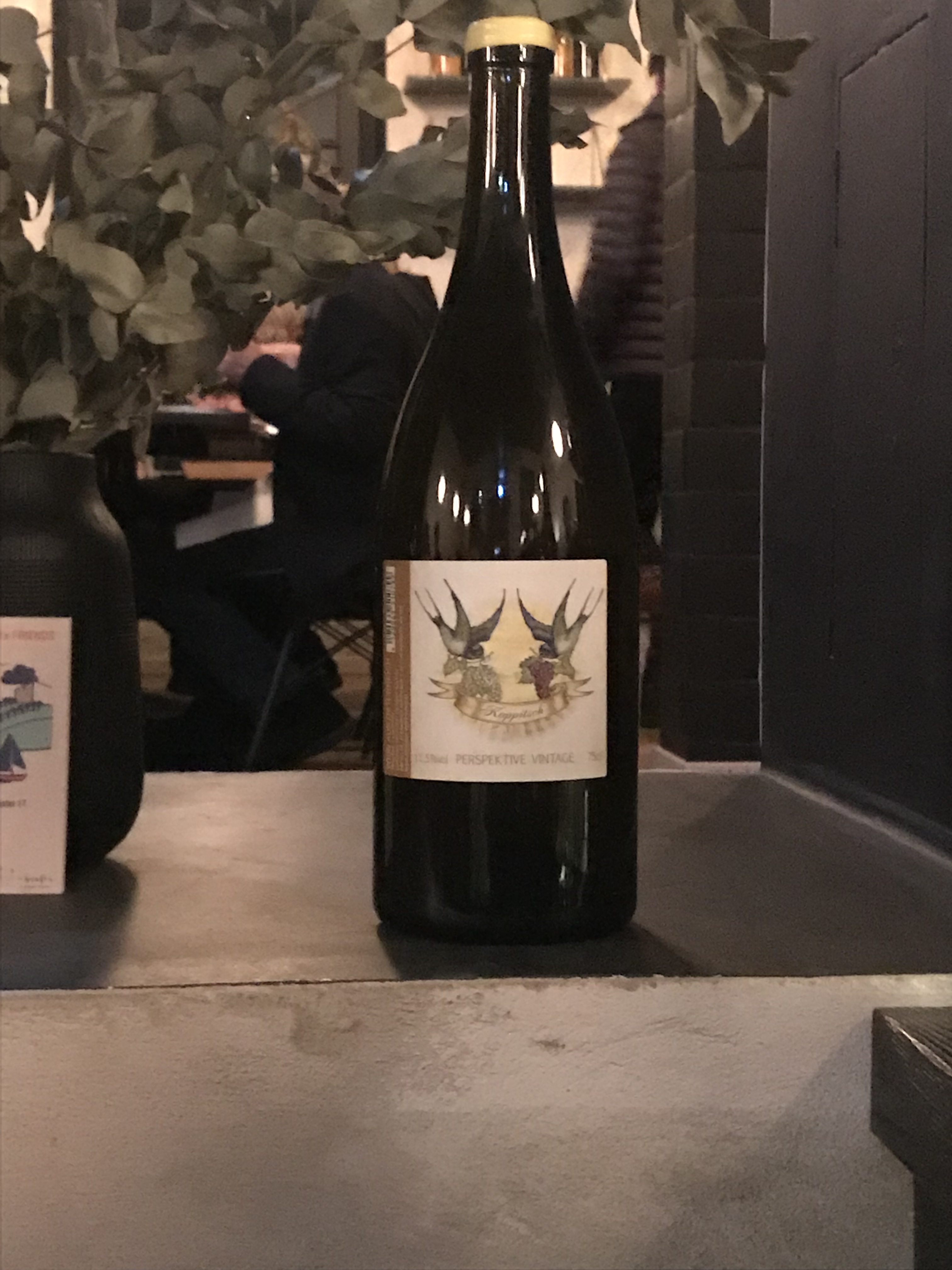
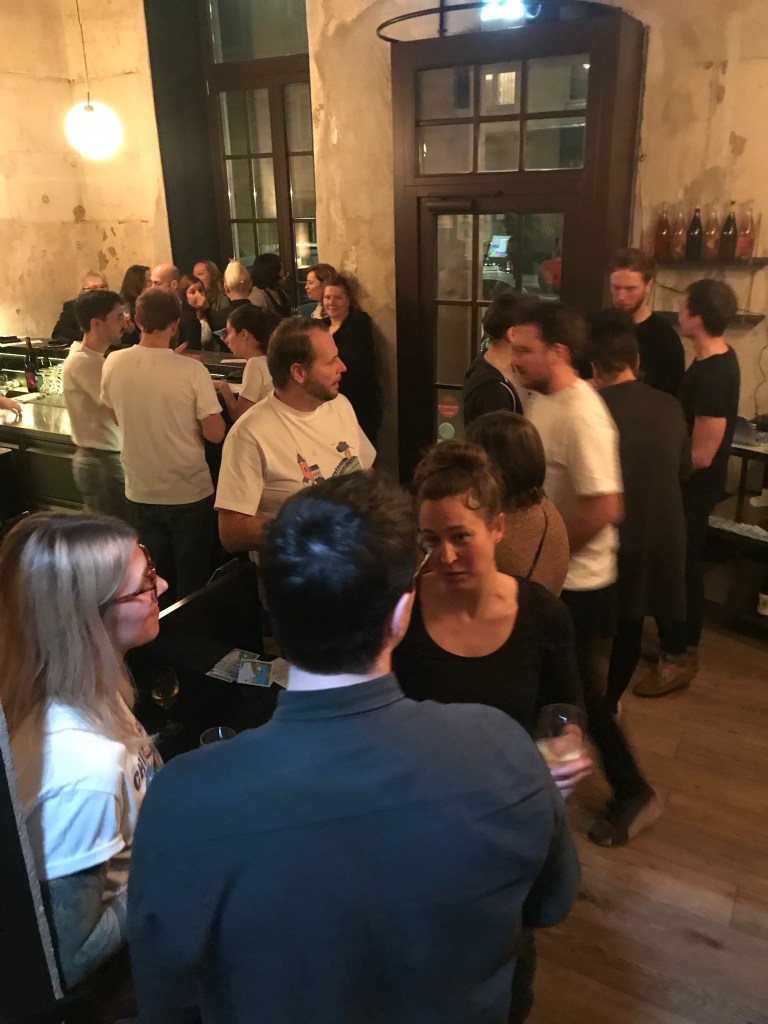
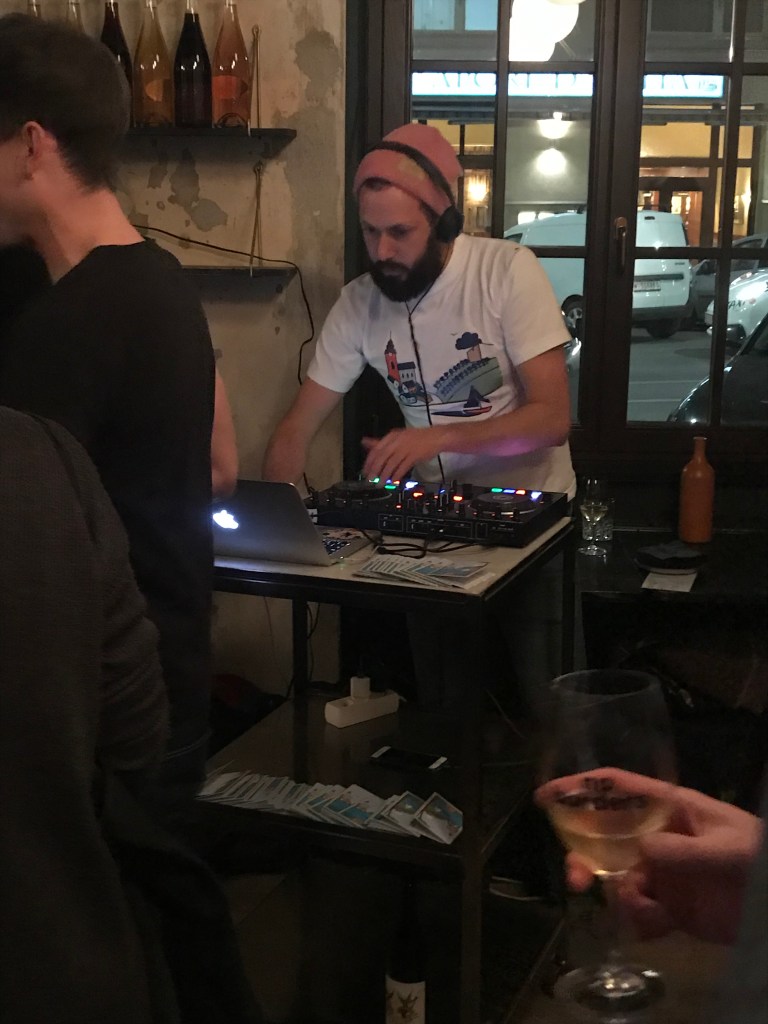
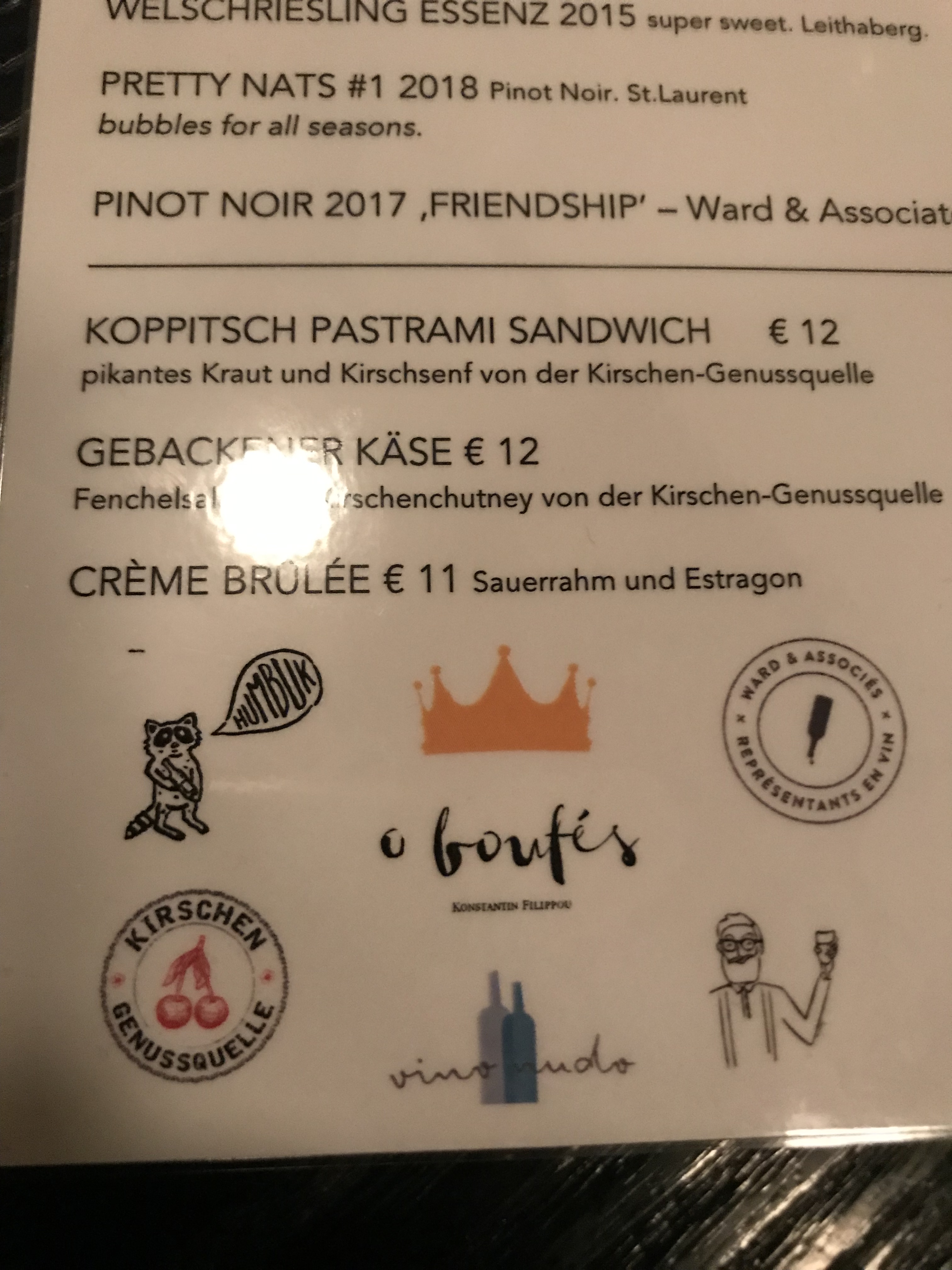
Alexander and Maria Koppitsch have given their wines a bit of a reboot, with new labels and a clearer message about their natural wine philosophy. I was happily in Vienna for their popup party at O’Boufés, Konstantin Filippou’s natural wine bar and bistro over near Schwedenplatz, which gave me an opportunity to sample a few of the new wines, as well as to say hello to their makers, and to rather a lot of young people from a host of different countries…O’Boufés was rammed full well before 9pm.

Before I talk about the wines themselves, I think I’ll give you a fairly lengthy introduction to the Koppitsch story. The family itself has been making wine for 500 years, and during that time they can claim to have been natural winemakers at Neusiedl am See, at the northern edge of the lake. In the past, synthetic chemical treatments were either unavailable or too expensive for most ordinary farmers, but when Alexander and Maria took over for their first vintage in 2011 they made a conscious choice to follow the chemical free, natural wine path.

The Koppitsch family farms 6.2 hectares biodynamically. At Koppitsch it is ALL about the soil. This is because they realised that whichever grape varieties were planted on their different sites, there was always a distinct similarity between the wines made from them. The evidence shows that the soils assert themselves, somehow.

As a small aside about the Koppitsch philosophy, I could, I suppose, give you a long list of everything they do to make their business more sustainable. It would be a very long list, but one example will suffice because it’s something I’ve not come across before. All of the boxes they use to ship their wine in are from recycled cardboard AND have no printing on the box. This may make it slightly more difficult for recipients to identify the boxes at a distance, but it clearly shows the depth of thought they are applying to every aspect of wine production.

There are five main family vineyard sites around Neusiedl. Seefeld is sandy, Neuberg on limestone and schist. Prädium and Hutweide have very rubbly topsoil, whilst Schafbühl is on clay.

From these sites the Koppitsch range is divided into five strands. First are the Basic wines, what they used to call Authentisch. These are given Hungarian names to reflect the region’s heritage and history. These wines are the most gluggable. Perspektive is the name for what are opaque wines with all their angles visible. They are wines you can easily dissect, I think. Their origin is off limestone soils, which always give a very distinctive, and often special, result in this region. Freshness with a “mineral” mouthfeel.

Touch is the name they give to the skin-contact wines. These are very much orange wines in the true sense, receiving around a couple of weeks on skins to give wines of texture. The results see a year or a little more in used barrique on gross lees. For these wines a small dose of sulphur is added at bottling. There’s no hard and fast rule for sulphur, though. Alex tastes the wine to determine whether he thinks it requires a small dose or not before bottling.

Aeon (used here to mean eternity) is focused on old family vine holdings. As some go back to the sixteenth century, Alex feels a deep and emotional connection with these sites. Currently, one red wine is produced, using Blaufränkisch and Syrah from Neuberg, and Zweigelt from Pradium, which are aged three years in used wood.

Then there’s Pretty Nuts (sic). This is the label for the bubbles, two wines (reduced from four), labelled #1 and #2. These are bottle-fermented petnats which are just amazing fun to swig. There are four different labels, reflecting the seasons, for each wine, but it’s the same wine. The fizz is all disgorged by hand by Alex.

Pretty Nat #1 was in fact the first wine we tried at O’Boufés, a 2018 sample. This pale pink Pinot Noir/St-Laurent blend is just so fresh, perfect for a hot summer on the beach, but frankly for any time. The fruit is light and fragrant and the wine is zippy with its nice acids licking the tongue.

Maria told me I was tasting the wines in the wrong order, really, but the bar was so full it was more or less a case of going in deaf and blind. I’ll just list them as we drank them.

Touch 2017 is, you’ll recall, a skin contact wine (14 days), and is a Gemischter Satz based on Welschriesling from Neuberg, the remainder of the blend from Schafbühl. The Neuberg site, limestone and schist, gives real mineral intensity and a brightness, which works perfectly for the orange style. Not for the nervous, but this may be my current favourite still wine from the family.

As an example of the entry level at Koppitsch we tried Juh 2018. Juh is “sheep” in Hungarian, the wine coming from the Schafbühl (sheep hill) site, off alluvial clay, to the northeast of the lake, where the Wagram Plateau rolls down towards Burgenland, mixed with a little limestone from the Leithaberg range (which sits to the west of Neusiedlersee). It’s another Gemischter Satz blend, from quite old vines. It has both a little body in the mouth, with a bright touch, presumably from the limestone which will always add a mineral tweak to any wine it appears in here.

Rosza (2018) is the one wine Alex makes from a mix of sites. This is a simple wine, uncomplicated, but the essence of a fresh and fruity rosé with a lick of acidity on the finish. Four grapes from four vineyards make up this blend: Blaufränkisch, Zweigelt, St-Laurent and Syrah. Alex planted Syrah thinking initially of making a modern, international red, yet it clearly wouldn’t fit into his overall philosophy, but it adds something to the blends it appears in.

Perspektive Rot 2016 blends Blaufränkisch and St-Laurent from the Leithaberg hills. Two years in used barrique gives it a degree of complexity already. The bouquet of camphor wood and spice is exquisite, the palate is ripe cherry with a classic Blaufränkisch peppery bite on the finish, which for me makes Blau such a refreshing red at all but the most obscene levels of alcohol. The tannins are ripe and this has genuine zip to it, yet it will certainly age if you wish. There are two additional white wines in the Perspektive range.

You only drank five glasses, the observant will complain. In my defence, we had been to lunch at an amazing restaurant that day (review to follow, of course), and the whole of this trip was one big festival of food and drink. In any case, the wines I’ve listed give quite a nice overview of what Alex and Maria are making.

Now we get to the tricky bit…trying some for yourself. The Koppitsch wines are exported to many countries. Alex Boily, who imports their wines into Québec, was DJ-ing. They have a new found popularity in the past months and there’s an exciting buzz around them. This is probably why you could hardly move in O’Boufés (I think Maria was genuinely shocked and moved by the massive turnout), but they are harder to find in the UK. Their importer here is Jascots, who are, as they say on their web site, suppliers to restaurants, hotels and caterers. What’s more, they only list four Koppitsch wines.

This means you are relatively unlikely to come across them here. If they are missing from the retail environment that’s a shame. Their eye-catching new labels are colourful and attention grabbing, but in terms of wine style they should clearly be sitting on a shelf next to any of the other hip natural wine names from the region. A retail presence would go a long way to increase their profile in the UK.

Alex and Maria are far from flash and pushy, rather they are genuine, modest, people who are not going to be seeking the limelight. They remind me of Alexis and Emilie at Domaine des Bodines in Arbois…young, humble, quietly going about improving their wines every year. I just want to be able to go into a shop and buy half-a-dozen of these lovely wines from time to time, folks!

The wonderful O’Boufés Bistro and Natural Wine Bar is at Dominikanerbastei 17, 1010 Wein, just three minutes from the Schwedenplatz Metro Station. Certainly it should be in your top three or four places to hit of an evening if you are in the capital.

Weingut Alexander Koppitsch is at Eisenstädterstraße 81, 7100 Neusiedl am See. Contact via office@alex-koppitsch.at for visits. You can get a train from Vienna to Neusiedl, and (as you will know if you read my summer articles following my August 2018 trip to Vienna) you can hire bicycles right by the station there. The Koppitsch winery is not too far from the station, but the lake itself and the surrounding bird sanctuary is great for cyclists.

Above left, Emily Campo and The Winestache; above right, Alex Boily from Montreal twisting the knobs.

The evening was organised by The Winestache, Humbuk (wine parties in Slovakia, Czech Republic and Austria), with Alex Boily (Ward & Associates, Montreal), Vino Nudo (Vienna natural wine importer/retailer) and Kirschen Genussquelle (cherry specialist). Check out http://www.thewinestache.com if you haven’t already. The pastrami, by the way, was stunningly good.
Posted in Artisan Wines, Austrian Wine, Natural Wine, Neusiedlersee, Wine, Wine Bars | Tagged , , , , , , , , , , | 1 Comment

Flawless…it pretty much is

Flawless is the latest book by Dr Jamie Goode. It’s slightly unusual. The book is, as its sub-title explains, about understanding wine faults. This is a highly technical subject, but one that is naturally of interest to keen amateurs as well as winemakers and other wine professionals. The question is how to make the subject accessible to those amateurs, and indeed wine pros, who lack a scientific background, whilst at the same time explaining the science, as it stands today, for those who make the stuff.

Flawless is actually a study of faults and taints. Why it is called Flawless, rather than “Flawed” will, I hope, soon become apparent. The distinction between faults and taints is easy to follow. The major faults covered in their own chapters are Brettanomyces (Brett), Oxidation, Volatile Acidity, and Reduction and Volatile Sulfur Compounds. Under taints we have a whole range, including eucalytus and smoke taint, which readers may have come across, although for me, the most important and/or interesting are cork taint (TCA), Ladybug (sic) taint and mousiness (a particular issue with some so-called natural wines).

The author also touches on one taint which is misunderstood, and often completely ignored by producers: light taint. We get just a few pages on light taint, but that’s all it needs. Easy to explain and even easier to avoid, yet Champagne and sparkling wine producers still insist on bottling in aesthetically pleasing clear glass when coloured glass will protect the wine at no extra cost (or faff!). This chapter should come with a free hammer to hammer it home, especially might I say, in Reims and Epernay.

Each of the subjects are covered in quite a bit of detail. The key to the book’s success is how well it explains the difficult science, whilst keeping the casual reader engaged in the wider perspective of the issues. I think Jamie managed to keep me on board almost all of the time, although I have not studied chemistry since the age of sixteen, so this achievement by the author was perhaps something of a feat in itself.

This would be a somewhat pedestrian review if I were to go into any detail about the science and explanations involved. What is more interesting is something the author introduces in the first few pages, something actually quite close to my heart as a lover of this country, the Japanese concept of wabi-sabi.

Put at its simplest, wabi-sabi is a world centred on the total acceptance of transience and imperfection, including the belief that far from spoiling, for example, an object, what is normally perceived as a flaw actually enhances the object, makes it more beautiful. The author uses several examples which show different aspects of the concept.

Take, for example, a walk in the forest. I was transported, when reading the Introduction, to the UNESCO biosphere ancient forest above Nagano in Japan’s Alps, or indeed more recently, on a freezing December day, above Arbois. Imagine the silence. It is so silent that when the birds begin to sing, their song is somehow more beautiful, more profound, than when heard in the bustle and traffic of the town, but we know that the silence will become shattered and the birds will flee.

Another example of wabi-sabi is in music. I love this aspect of the philosophy. The wrong note, whether in Wagner (the famous Liebestod in Tristan is an obvious example), or indeed in pop and rock, can have an unexplained emotional effect which transcends mere musical notation and theory. It’s not always for the good. I know people who almost can’t listen to some music because of its (sometimes dark) intensity, yet others find the same music wonderfully uplifting.

Wabi-sabi applies just as much to people too. Some people prefer conventional beauty, and personality, whilst others see something far more interesting in what others perceive as people’s flaws, especially in the way they look or dress. I sometimes like to think of so-called perceptions of classic beauty as being synonymous with a rigid taste for classic wines (Bordeaux in particular), but that is both unfair and too provocative, and of course I do like fine Bordeaux occasionally.

And so it is with wine faults. Some wines are deliberately oxidative. How many of us have now discovered the fabulous sous voile wines of Jura. What about Brett? A well aged Hermitage with a little brett can be a very (more, even) interesting wine, whilst those of us who like Château Musar have tended to have quite a high tolerance of brett. The reductive matchstick whiff of a Roulot Meursault is something I cherish. Even a modicum of volatile acidity can make a wine somehow more refreshing.

Whilst no one really likes, nor wants, the taints (although Jamie confirms that around 30% of tasters cannot actually taste that very nasty taint, mousiness, and my own experience shows that sensitivity to TCA around a table of wine lovers can vary one hell of a lot), there’s a lot of mileage in the suggestion that so-called wine faults can enhance a wine at lower levels. I think some of the most adventurous, and experienced, wine lovers have felt this for a long time.

What the author has to do in some respects, is to weave a path between what you might call the New World viewpoint, that which suggests any perceived fault (whether perceived by chemical laboratory analysis or by tasting) is to be considered a failure to be eliminated, and perhaps a more nuanced European view.

The classic example of the first approach is that of the Australian Show Judge, whose reaction to any perceived “fault” is the classic “computer says no!”. Their view is very much that European wines have for centuries been riddled with faults, and that the scientific approach of the New World has taught winemakers how it should be done. Of course, the Europeans simply point to the world’s finest wines without feeling the need to comment further.

One of the most controversial “faults” is that which we call minerality. I say “we”, but I know that many writers and wine scientists with a background in plant biology and/or geology get upset at the use of the term. What is most interesting (and enlightening) about the discussion of minerality here is that far from being a result of “soil to glass transfer”, it may actually be a result of reductive winemaking (shock horror).

The idea that minerality could be not something from the vineyard, but something resulting from chemical reactions inside the winery (as Sam Harrop, long time collaborator with Jamie, suggests) , changes the concept completely. It immediately puts minerality up for criticism by those who see reduction as a fault in all circumstances. I adore what I continue to call minerality (for me, a wholly apt sensory description, and not a scientific claim for stg-transfer). I think it can be one of the major complexing factors in wine, and one that can also add refreshment value. But the idea that it might not be the expression of the vine’s underlying geology in the wine is bound to disappoint many.

As I’ve already said, this is a book of science. The author goes deeply (for a lay reader) into the chemistry of what is going on by way of various reactions when these faults and taints affect the wine, although it’s not a true scientific work to the extent that the author does not back up every single contention with a footnote (there are just fewer than sixty footnotes in 214 pages).

Another achievement of this book is the avoidance of “the curse of knowledge”. There’s a really interesting section in Steven Pinker’s 2014 book, The Sense of Style (Chapter 3), where he elaborates on this tendency, which often plagues experts when they don’t remember (in fact, they often can’t possibly conceive) that the level of subject knowledge of the audience may well be way below their own. All writers should read it.

We’ve all been there, myself as a new School Governor faced with dozens of acronyms and a barrage of jargon from the Head Teacher in my first ever meeting. But as my wife rightly pointed out, we are all guilty…in my case using the word petnat at the neighbours recently, occasional wine drinkers who had probably never come close to one before (though at least I didn’t launch into a dissection of the méthode ancestrale versus the méthode traditionelle).

Anyway, Jamie treats us like adults, but he does go to some pains to explain the science without too many digressions into places we ordinary folk can’t follow. Almost without exception, you can read the book as prose, with the argument following a logical progression, so that if we concentrate we stay with him.

There is discussion of what can be done in the winery, from pre-fermentation up to bottling, in order to address these faults and taints. There is also a very interesting discussion of closures, conducted remarkably objectively considering the tone of the debate between cork suppliers and the screwcap manufacturers.

On the other hand, there’s not much discussion of what can be done after opening a bottle that one determines is faulty. I’ve never tried putting a copper penny in wine to rid it of sulfur smells. I have many times (after having been taught this by Wink Lorch) not only carafed a reductive young wine, but shaken it vigorously to get even more oxygen into it. I’d be interested to delve deeper into what happens here because I know it gets rid of reductive elements of most wines if I do this. I just don’t know what else it does to the wine. Things like this are not discussed.

There is some discussion of that thorny subject, natural wine. But not a lot, and here, Jamie plays quite a straight bat with no rash lunges outside the off stump and not a reverse sweep in sight (apologies to readers from non-cricketing nations are due at this point, but I know Jamie is also a big cricket fan). From his other writing, especially on his blog on the wineanorak.com site, we all know that Dr Goode, however much the scientist, is broadly supportive of the natural wine phenomena, and the excitement these wines can bring.

Of course he’s right to steer away from too much discussion of natural wines in the wider context of wine faults. The area is controversial in the extreme, with so much said about the genre which is not wholly based on fact and reality (especially the belief often ejaculated into the debate from some quarters that all natural wines taste of cider). Where there is likely to be prejudice rather than evidence is no place to go in a serious book like this.

So who should read this? Clearly just about anyone making wine who has a good grasp of English. It is also invaluable for a range of wine professionals, including sommeliers, wine buyers, and (of course) wine writers (so we actually have a clue about what we are writing when addressing these issues).

I would also add to this the interested wine lover, or perhaps the passionate wine lover. If the science turns you off, don’t go there, but if you are truly interested to get deeper into what happens inside that liquid as it’s transforming from grape juice into the nectar of the gods (or mere vinegar), then Flawless will not only be interesting, it will be like nothing you have read before.

There are, of course, other books touching on wine science which have been aimed at the ordinary reader. Hugh Johnson paired up with James Halliday in 1992 for “The Art and Science of Wine”, and Bordeaux Professor Emile Peynaud wrote “The Taste of Wine” back in 1983 (English translation, 1987). A quick search on Amazon throws up many more. Even the currently prolific Dr Goode has another book due out on 30 January this year, the Second Edition of The Science of Wine: From Vine to Glass (also University of California Press). But Flawless is unique in addressing in some detail what can go wrong in winemaking, and explaining how, when it does go wrong, it needn’t be the end of the world.

And I do agree wholeheartedly with Jamie when he suggests that wine faults are interesting. He suggests it’s “a rich, nuanced, complicated subject that strays from wine chemistry through microbiology to human perception and quality judgments (sic)”. I think that’s a pretty lucid advertisement as to why a wider audience than merely wine professionals will really enjoy this wonderful book. A book which I think is actually a major achievement. Pretty much flawless. But I shall need to read it a second time for some of the science to sink in more deeply.

Flawless by Jamie Goode was published in late 2018 by the University of California Press. It runs to 214pp and has a rrp of £20 (hardback). It can naturally be found a little cheaper online for those who do not wish to get hold of it via their local independent bookshop.

Flawless has been shortlisted for an André Simon Wine Book Award 2018.

Posted in Wine, Wine Books, Wine Science, Wine Writing | Tagged , , , , , , | 4 Comments

Recent Wines, December 2018 #theglouthatbindsus

Quite a lot of wines were consumed at home in December, no surprises there, then. I’ve managed to cull it down to fifteen bottles by chopping out those I’ve written about fairly recently, and those that didn’t quite manage to give of their potential. This selection is a little Jura-heavy, on account of pre-trip homework before we headed out to Arbois in the middle of the month, a couple of bottles drunk in the apartment there (which sort of counts under the “drunk at home” banner), and one or two since we got back. But there’s plenty of variety here as well.

Grüner Veltliner “Esper” 2015, Matthias Warnung, Kamptal, Austria

Matthias Warnung has been making the wines at the ten-hectare family estate in Austria’s northerly Kamptal region (just east of Wachau) since 2010. The soils, sited near Etsdorf-am-Kamp, are a typical mix of loess and gravel, making for wines of texture and mineral mouthfeel. Esper is from reasonably old vines, a cuvée of around only 1,300 bottles. The must is fermented in large old oak and then sees a further two years in the same before bottling.

There’s a definite richness to this, and a hint of some skin contact (especially in its golden colour). But it is certainly dry, and has a lovely mineral freshness which livens the palate. Daniel at Les Caves de Pyrene recommended it to me, and it was an excellent call.

Bourgogne Aligoté 2015, Alice & Olivier De Moor, Chablis, France

The De Moors have long made a delicious Aligoté, indeed long before this variety became super trendy. In fact it could probably be said that Alice and the Goisots in nearby Saint-Bris, have done more than most to bring this grape’s qualities to the attention of a younger audience. This 2015 was a bit of a unicorn wine on release, tiny quantities being snapped up and people desperate to secure two-or-three bottles.

You’d probably not expect this kind of freshness and acidity from a 2015, but it is all carefully judged. In any event, 2015 was actually a bit cold and rainy in Chablis, until a very fine September brought the grapes on. The other thing you notice in this wine is the relatively low, 12.5%, alcohol. It must be a contributing factor to how light on its feet this is. It’s a wonderful, fresh, wine (though lacking the acidity levels of old fashioned Aligoté) which definitely did live up to the hype.

En Passant Devant le Château 2015, Les Vignes de Paradis, Burgundy, France

This is another of the incredible wines Dominique Lucas makes, not from his vineyards in the old AOC of Crépy, to the south of Lac Léman and east of Geneva this time, but from the 2.5 hectares he farms in his family’s home region of Burgundy. To be specific, this cuvée comes from a small block right outside the Château de Pommard, hence its name. The biodynamically farmed vines here are over fifty years of age. This cuvée consists of a mere 835 bottles.

What we have, in actual fact, is essentially not very Burgundian. In fact you might easily miss its origin because it’s bottled as a Vin de France, and gives Lucas’s address at Balaison, in Savoie. The grapes undergo a rigorous sorting and this is why the fruit tastes super clean despite the natural winemaking at play here. When you look at the juice in the glass, I’m not sure you’d believe it is Pinot Noir, it’s so purple. It also has an almost gritty texture, but clearly in the fruit. Think smoky cherry with the kind of grippy tannins that are softened by food. It’s a wine of amazing concentration and length. So classy, but not at all snooty.

Côtes du Jura Chardonnay “La Chaux” 2015, François Rousset-Martin, Jura, France

François farms at Nevy-sur-Seille, just outside Château-Chalon. I’ll admit I didn’t know anything about him before this wine was recommended to me. He speciallises in wines from individual parcels. Les Chaux is a 0.4 ha block of 65-year-old vines close to Château-Chalon and this cuvée  is made ouillé, in a non-oxidative style. Nevertheless, it gets its lovely mouthfeel and tingly texture from 14 months ageing on fine lees.

Somehow what we have here is a wine that tastes both modern and old fashioned. I remember Chardonnay wines in the past from Jura which tasted a little like Savagnin, quite nutty. The general conclusion was that it was a factor of terroir. The geology of La Chaux is complex, with both limestone and at least two types of marl present in a tiny area. Perhaps the answer lies somewhere there?

I chose to include this wine because it is a little unusual in that respect. The nuttiness gives it something similar to slight oxidation (remember, it’s not made oxidatively), but at the same time it has a freshness which suggests complexity, not a fault. But the friend who recommended it did later tell me they had drank a bottle that was less beautiful than the first. But on a score of a 2-1 Home Win, it gets a mention, with the suggestion that you explore further for yourselves.

Beaujolais 2016, Pierre Cotton, Beaujolais, France

Pierre Cotton is a young grower in Brouilly who took over fully from his father in 2014. Most of his recently enlarged estate is in fact inside the two Brouilly crus, but he also has some vines classified as Beaujolais, further south.

Full carbonic vinification is Cotton’s preferred winemaking method, and he also prefers to use concrete tanks for vinification, but after that it goes into previously-used oak for ageing. The resulting wine is quite dark in colour, so that the juice, tasting of purest cherry, is quite a surprise. There’s a faint prickle of CO2, which lifts it even further. Although you’d certainly describe this wine as fairly light, it does open out to reveal a darker fruit side. It also has a little bit of a bite, well, perhaps just a nibble, on the finish.

It’s really nice, and not totally unlike the pure and juicy Beaujolais-Villages we had from Jean-Claude Lapalu last Monday night (see previous article), a near neighbour of Pierre. I’ve got some of the up-range cuvées from this producer, and I’m very much looking forward to trying them.

The Liberator Episode 16 “Perfectly Flawed”, Swartland, South Africa

The Liberator series of wines is a project of Richard Kelly MW, who owns the UK importer Dreyfus-Ashby, but is also something of a South Africa expert. Episode 16 is made from 2015 Chenin Blanc, found in Tulbagh and made at Table Mountain Vineyards. This wine was aged in concrete and for some reason developed a layer of flor. It must surely be mere coincidence that at 33º of latitude, nearby Cape Town is on the same latitude as Jerez!

Only 353 cases were made. Initially you get a slightly nutty, flor, note, but next a delicious Chenin richness builds and takes over. The flor gives it an added freshness, as with a Fino Sherry, but the qualities of the Chenin Blanc make it a very different beast. It’s light and refreshing, but with depth.

I was really pleased to be introduced to these wines, which all sound very interesting. Episode 17 is a tiny production Pinot Noir (less than a thousand bottles) from the Western Cape, Episode 18 is a somewhat more plentiful (650 cases) Petite Syrah from Stellenbosch. These are well priced wines with good labels, and thankfully they seem to have a pretty wide distribution here in London and the South of England.

Champagne Legras & Haas “Les Sillons” Derrière les Partelaines, Chouilly, France

Legras & Haas has been around for a few decades but I think it is fair to say that only now have they begun to make waves, at least in the UK. This particular cuvée is a blanc de blancs Chardonnay of which a mere 3,600 bottles were made of this 2012 (disgorged April 2017).

Aged for eight months in oak, there are clear hints of it both in the structure and the flavour. It is rich and smooth, and extremely moreish. Fruit flavours range from ripe pear to peach, but these are carried on a stream of fine acidity. A touch of breadiness suggests it is evolving, but it’s basically pretty fresh right now, still youthful with lots more to give. This gift seems to retail for around £70, quite a lot for a relative unknown, but worth it.

A Demûa 2014, Cascina Degli Ulivi, Piemonte, Italy

Okay, I’ve written about this wine from Stefano Bellotti before, but I opened this, my last from this particular vintage, to toast the man whose departure from our world brought a genuine sadness to so many people I know. It’s one thing to make great wine, another to make it within the context of so much stress and opposition from the authorities in Gavi and the wider region, all because you want to respect nature.

To do so whilst suffering from serious illness, an illness which ultimately killed him, does rather cloud my feelings towards those who did not appreciate what Stefano was doing and sought to thwart him. I was lucky enough to meet the man two or three times, and there is no doubt that he was a special spirit, if wholly unassuming and modest. Thankfully it looks as if his work will be continued.

A Demûa is a blend of one of the local varieties rediscovered of late (and known commercially via Walter Massa), Timorasso, along with Chasselas, Riesling Italico, Verdea and Bosco. It’s very much a skin contact wine, a ninety day maceration giving quite a tannic structure, albeit definitely softened with age. There are effectively two elements.

Orange wines often taste of orange, I have no idea why, but they do. In this wine it is unmistakable, that first element being orange citrus and orange peel. Added to this, you get a second element, garrigue-type herbs, which add a different twist of bitterness. I kind of think if you love drinking negronis you’ll adore this, but then my wife doesn’t really drink negroni and she enjoys this as much as I do.

If you don’t know these wines, you have to try them (Caves de Pyrene import), and this wine is quintessential Bellotti. If you didn’t ever meet Stefano, you can do so in Jonathan Nossiter’s film, “Natural Resistance”. His appearances are poignant.

Côtes du Jura Chardonnay “La Chaux” 2015, Les Dolomies, Jura, France

Les Dolomies is the wonderful four hectare estate created by Céline Gormally, working with husband Steve, near Passenans, in the Côtes du Jura southwest of Poligny. The wines are beginning to be sold in shops in the region, but Céline has built an enviable reputation overseas, where much of her small production is exported (Copenhagen’s Noma lists them, a fact that is highlighted every time I read about them, so let’s not stop here).

Winemaking at Les Dolomies is biodynamic and natural. Céline is a former organiser of the Nez dans le Vert organic, biodynamic and natural wine tastings held each year in the Jura region. The soils here, in this enclave south of Poligny, are mainly limestone, coincidentally similar to those at Vadans, where Céline formerly worked at Domaine Saint-Pierre.

This cuvée is very easy to drink and it slips down so well you don’t notice that it shows 13.5% abv on the label (tastes more like 12% to me). The limestone gives wines of pronounced minerality, but it isn’t what you’d call highly acidic. But there is a gentle citrus flavour with just a hint of nuts as well. The overall ambience is one of freshness. It’s just a lovely wine, approachable, slipping down rather easily.

Ploussard “Oeuvre L’Esprit” 2016, Tony Bornard, Jura, France

Tony has taken over the Bornard Domaine in Pupillin from his father, Philippe, but I think he plans to keep his own label going. These are very individual wines which, as a range, display a particular lightness which distinguishes them from Bornard Père’s bottles.

This Ploussard is flavoured with strawberry, raspberry and cherry freshness, which you’d call the epitome of glou. There’s not an awful lot more to say because it’s a simple wine, with only 11.2% alcohol. It’s a wine of rare purity, so delicious. A perfect summer Ploussard which did not disappoint in mid-December. One left, can I manage to hold off until summer?

Arbois Tradition 2016, Fumey-Chatelain, Jura, France

I’m technically cheating here, because I drank this wine in a restaurant, and these monthly roundups are supposed to be for wines I drank at home. I’ve even mentioned this wine before, in the last of my recent Jura articles. But I was very much taken with it, so I am giving it another plug.

Raphaël Fumey and Adeline Chatelain farm 15 hectares at their home village of Montigny-lès-Arsures (about ten minutes’ drive from Arbois) and around Arbois itself. At Montigny they have converted an old farmhouse for their cellars and since the end of the 1990s have been steadily making wines with fewer and fewer inputs.

“Tradition” is an opportunity to taste what is self-evidently the traditional blend of white grapes around Arbois, Chardonnay and Savagnin. In this particular cuvée it is 70% Chardonnay to 30% Savagnin. The Chardonnay is topped-up as it ages, coming off limestone with some clay, whilst the Savagnin is planted on marls and is aged sous voile, in an oxidative style.

The first thing to notice is how subtle this wine is. Both grapes in the blend can be identified. The Chardonnay is fruity and floral, but with a buttery note just creeping in, whereas the Savagnin brings definite hazelnuts and a sharp lick of lime citrus. Acidity is nicely balanced but not pronounced.

Visiting Arbois each year seems like devotion to duty, but I can tell you that there is never enough time and I hope to visit this domaine for the first time at some point in the future.


Arbois “Les Moulins” 2016, Domaine de la Touraize, Jura, France

This is another domaine I’ve yet to visit, although their wines have been on my radar for around three years now. Ever since some friends brought me André-Jean Morin’s petnat to try (really good) I’ve drunk and or purchased a few bottles from local wine shops on each subsequent visit.

This wine is another blend of Chardonnay and Savagnin, around two thirds Chardonnay, but blended at harvest and co-fermented after whole bunch pressing. It comes from a single 0.75ha plot on gravel over marl. Ageing is for one year on fine lees, but topped up (ouillé).

It’s another pleasantly understated wine which has plenty of citrus, but equally a nice savoury note. It’s quite light on the palate and fresh without having pronounced acidity, but it is labelled as 13% abv. It has a slightly lighter feel than the Fumey (not a qualitative comment), perhaps ever so slightly fresher.

André-Jean and his wife, Héléana (eighth generation winemakers here), are in the process of converting their vines to biodynamic farming. They do use sulphur, but only in small amounts, mainly for the whites. Their vineyards in springtime look a riot of wild flowers between the rows. Along with Fumey-Chatelain, if I’d had an extra couple of days in December I’d certainly have tried to pay them a visit (the domaine is on the edge of Arbois, but they also have a small shop in the town, open in summer, not far from the Pasteur Museum, if you are in the neighbourhood).

“Artisan” 2016, Vignoble du Rêveur, Alsace, France

This domaine is run by Mathieu Deiss (son of Jean-Michel Deiss) and Emmanuelle Milan, using grapes from parcels left to Mathieu by his grandfather at Bennwihr (near Kaysersberg). All the grapes are farmed biodynamically. Artisan is a blend of Gewurztraminer and Pinot Gris, given ten days on skins.

So this is truly an orange wine in all respects – colour and an abundance of texture, but not harsh tannins. The overall impression is one of gentle richness. Both of the grape varieties here generally react well to skin contact. The wine is rich but dry, and the three elements you notice on the palate are tropical fruits (especially orange and mango), peppery spice, and a zip of citrus acidity (soft grapefruit). This cuvée is also bursting with energy. I definitely plan to buy more of this, one of my wines of the month. Nice label too (shame about the photo, sorry).

Champagne Val Frison Blanc de Noirs Brut Nature  “Goustan”, Côte des Bar, France

Valerie Frison is an exciting new name to me. I tried her Blanc de Blancs “Lalore” for the first time back in June last year. I think I slightly preferred Lalore to this Pinot Noir cuvée, but that is only a slight personal preference. Goustan is still very good. She farms around six hectares of vines around Ville-sur-Arce, just east of the Seine, with just around one-and-a-quarter of those hectares being Chardonnay and the rest, Pinot Noir.

Goustan is a blend of grapes from several small Pinot parcels which are fermented in used oak (in this case, barrels from nearby Chablis). This wine spent six months in wood, on lees, and then 19 months, following its second fermentation, in bottle, before being disgorged in March 2016 (so it has also had a couple of years post-disgorgement ageing before I bought this in the summer of 2018). I am guessing that this is therefore from the 2014 vintage (how’s my maths?).

Initially served too cold, this was dry and firm, the zero dosage showing its teeth. On warming it became rounder, less angular, showing a little brioche, and when the red fruits revealed themselves, they were fresh, pretty and elegant. That initial hardness translated, as it warmed a little, into what many would term a fresh minerality.

I have another bottle of this, which I shall look forward to opening this year, perhaps making sure not to over chill it. I shall also look out for some more of the Lalore, and perhaps some other cuvées from Val Frison. The rosé, “Elion”, made with minimal sulphur, sounds very interesting when described by Peter Liem in his recent “Champagne” tome.

“Trenzado” 2016, Val de la Orotava, Suertes del Marqués, Tenerife  (Canary Is)

There are many occasions when a producer you drank quite regularly a few years ago slips out of your cellar purely because so much interesting new stuff comes along. As far as the Canary Isles are concerned, Suertes was my first discovery. Then came Envinate, and before long the volcanic islands theme had taken me further afield, to the Azores, and the fabulous wines of António Maçanita from Pico. I really should not forget Suertes del Marqués.

So what can we say about Trenzado? It is a white blend of mainly Listán Blanco (aka Palomino), with Vidueño and other ungrafted indigenous varieties, grown in the Orotava Valley on the island’s volcanic soils at altitude (300 to 700 metres), in a climate which is partly sub-tropical. Fermentation is 60% in stainless steel, but the other 40% of the must is fermented in concrete tanks, on skins. Ageing is eight months in concrete and eight months in old 500 litre oak casks.

The name “Trenzado” is worth explaining. The cordon trenzado is unique, and spectacular to see (the label doesn’t really do it justice, but photographs abound). A vine is trained to throw out tendrils from the trunk both up and down the slope. They almost hug the ground, twisted around one another in a line, supported by stakes. They are pruned so that fruit forms only at the end of these branches. From a distance a row of vines looks like an enormous millipede crawling across the landscape.

This is not a wine where you would jump to use fruit descriptors. It’s both mineral and herby. It has a fine edge to it, couterbalanced by a massive flavour profile, and I know this wine ages well. Now, in relative youth, however, it is also just so refreshing. Superb drinking now.

December is always a time for drinking lovely wines, but it seems that I enjoyed a lot of really good music as well. So you’ll notice a few CDs and LPs in one or two of the photos. They all come as highly recommended as the wines. As to the photos, some are less good, less in focus, than I would have hoped (if you are viewing them on a computer screen rather than a phone). I shall try harder, but hopefully it’s the text that counts.

Posted in Aligoté, Alsace, Arbois, Artisan Wines, biodynamic wine, Champagne, Jura, Natural Wine, Wine | Tagged , , , , , , , , , , , , , , , , , , , , , , , , , | 2 Comments

Plateau of Excellence

I was planning to write my review of December’s wines today, but last night six of us dined at Plateau in Brighton and it was such a good meal that I thought they deserved an unashamed plug.

Plateau is in Brighton’s Lanes, maybe a fifteen minute brisk walk from the station, and just a couple of minutes or so from the sea, right opposite Brighton Town Hall. They are best known for what must be one of a handful of natural wine lists worth travelling out of London for. This is no secret, and it was good to see the place reasonably full on a Monday night in January, when other places, especially the chains, looked empty.

The six of us ranged from vegan and vegetarian to carnivore, and Plateau is well able to cope with any requirements. It’s the sort of place where the chef will tweak a vegetarian dish to make it vegan without any suggestion that it’s awkward, and the result is always very good. Of the three sharing small plates we began with, based on shallots, butternut squash, and carrot, it was the last of these which had been tweaked to vegan that was actually my favourite.

For anyone who doesn’t know Plateau, the food is really quite similar to what you find in quite a few of the Parisian natural wine bars which aspire to something a lot more sophisticated than charcuterie and cheese. I know that most people reading this will be heading there primarily for the wine, but the food is actually some of the most appealing in Brighton. For me, it compares favourably to some of the city’s more vaunted eating places. There is little fuss over pretty plating, but the flavours range from delicious to sensational, at least in my opinion.

Our main courses ranged from bavette steak, bream and chicken to the most amazing cauliflower dish with toasted hazelnuts, hazelnut purée and kale. Most of us went for a cocktail for dessert, cocktails being something of a speciality at Plateau. My Bridgetown comprised Doorly’s 5-y-o rum, antica formula, yellow chartreuse and angostura bitters, quite boozy but pretty delicious. My heart (and soul) said order a second but my head said no! Those of us who went for sesame seed ice cream (non-dairy, as it happens) with a salted caramel sauce didn’t regret it. Cold ice cream and unctuous alcohol is rarely a poor match.

But perhaps the important bit is the wines. With two diners sticking to cocktails, four of us drank a couple of crackers. Petr Koráb is one of Czech Moravia’s natural wine pioneers. Plateau list a good few wines from Petr’s UK importer, Basket Press Wines, but this is one of the best on the whole Plateau list if you want an interesting sparkler to kick things off.

Future Sekt is a skin contact wine, and one where the term “orange wine” is very apt. Skin contact here does add texture, for sure, but it doesn’t taste tannic. The plentiful bubbles froth in the mouth, and the flavours lie somewhere between orange citrus, with ginger, a whiff of nutmeg and a few more tropical-type notes.

Choosing a wine to accompany both red meat, white meat, fish and that cauliflower dish might not necessarily be easy, but a not too structured Gamay seemed the consensus, another good choice. Jean-Claude Lapalu Beaujolais-Villages Vieilles Vignes 2017 is pure fruit juice. It’s very fresh, not heavy at all, yet the juice is pretty concentrated. The perfect freshness completely hides 13% alcohol. The old vines add just a little complexity. Should it be aged? I think it’s brilliant now, personally. Lapalu is perhaps best known for his Brouilly cuvées, but this Villages is always a gem.

Plateau is definitely worth the trip down to sunny Brighton, even in the depths of winter when the sunshine is limited, but the crowds of the summer months are absent. I did say that the restaurant was reasonably busy for a Monday night, but there were still one or two tables (it’s always a good idea to book rather than just rock up there). The other thing of note about a Monday is that the volume levels are lower. Some might like it loud, but it did mean we could hear the excellent choice of music quite clearly. They usually spin some decent sounds here.

Bridgetown

Never leave without having a good look at the takeaway wine list. The prices equate to a 25-30% discount on the restaurant list, and there are only a small number of bottles that aren’t on it. I came back with a bottle of Anna and André Durrmann Pinot Blanc Nature 2017, at £18. I visited the Durrmanns in 2017. When I wrote about their interesting approach (see here) shortly after that visit they had no UK importer, but since then those excellent chaps, Wines Under The Bonnet, have begun to bring them in, and Plateau list a couple.

Plateau is at 1 Bartholomews, Brighton BN1. Call for reservations on 01273 733085, and check out their web site here.

Posted in Artisan Wines, Czech Wine, Dining, Natural Wine, Wine, Wine Bars | Tagged , , , , , , | Leave a comment