Alsace/Germany Celebrating Common Ground with Newcomer Wines and Vine Trail (Part 2 – Germany)

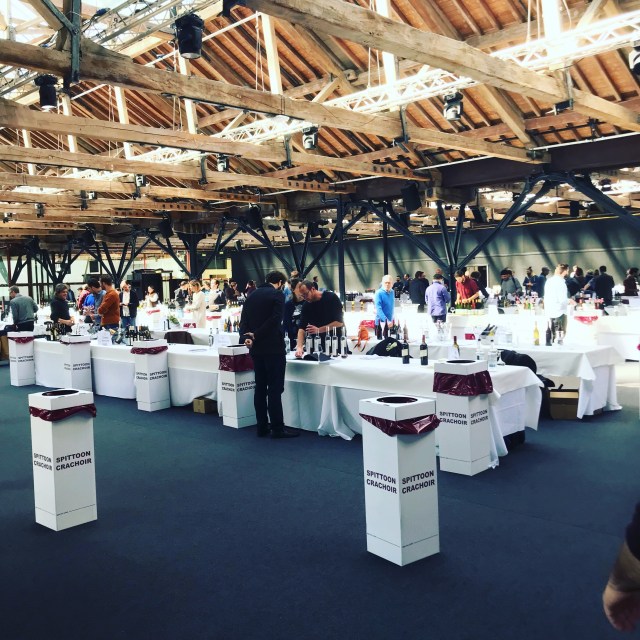
This is the second part of my article on the tasting held at Fare (Old Street, London) on 15 April, where Newcomer Wines and Vine Trail previewed the wines of ten producers from Alsace and Germany. Here we have the five German producers at the tasting. If you have not yet read Part 1 covering Alsace, follow the link here.

Whilst Alsace is at least a single region, albeit one with diverse terroirs, as we found out in Part 1, Germany in this case offers us wines from a far greater geographical area. The five producers covered come from Rheinhessen, Würtemburg, Baden, and two from the Mosel. Still, as with the Alsace producers, these importers are lucky to be able to import some pretty hot names, from the youth of Olympia and Hannes at Roterfaden to the wisdom of Rudolf and Rita Trossen. If I allow myself the subjective feeling that those two stood out here (for different reasons), all five are people I’d love to visit and whose wines I would buy – and in fact I already have bought and drunk the Schmitt wines, both in the UK and in Germany. It is here that we shall begin.

BIANKA & DANIEL SCHMITT (FLÖRSHEIM, RHEINHESSEN)

Fewer than 100 wine producers in Germany are certified biodynamic by Demeter, and the Schmitts are in that select group. But although biodynamic for a decade, they go further, reminding us that they make wine “just from grapes”. Their Natúr wines (see below) are bottled with no added sulphur. Their 16 hectare domaine is at Flörsheim-Dalsheim. It’s funny that at one time the Rheinhessen Region used to be considered a place to find commercial wine of little interest to connoisseurs, but nowadays there are fewer more famous villages in Germany. Klaus Peter Keller is a neighbour.

Natúr Riesling 2017 is the “entry” level. The wine is whole bunch pressed and spends a year in old 1,200-litre oak. As I already explained above, there’s no added sulphur. It’s slightly cloudy as they don’t fine or filter either, but it has delicious natural fruit combined with rounded acidity (ie it’s not sharp). It’s very lively and extremely moreish.

Natúr Müller Thurgau 2017 is made from Germany’s great workhorse grape of the later post-war period, except of course that “great” isn’t a word many would associate with the variety. Yet today we are seeing truly excellent versions on our shelves (let’s not forget from New Zealand via Hermit Ram as well, another country where Müller Thurgau was once ubiquitous).

The bouquet is fresh and almost (but not quite) exotic, and I reckon quite a few people with experience of MT might be fooled. It’s quite avant-garde. Fifty percent of the grapes see six weeks on skins and the other half are whole bunch pressed and go into old oak for around a year. Where it differs from the sugar water we remember Müller Thurgau producing is in its nicely balanced acidity and greater weight of body. This makes it especially food-friendly, it’s not a particularly light wine. The adventurous should give this a go.
Rosé 2017 is a blend of four varieties: (Blauer) Portugieser, Merlot, Dornfelder and Pinot Noir. All the juice is free run and it goes straight into big 2,400-litre oak casks (although Bianka and Daniel do work with amphora for some cuvées – look for Orpheus if Newcomer Wines have it). It’s one of those lovely dark rosé wines which almost become a light red, and as such is versatile. Chilled, it has refreshing lifted fruit and a very tasty sour cherry finish, making it an ideal summer red, or pink (whatever) to go with light dishes.

Natúr Spätburgunder 2016 – Wow! What a nose!. Passionfruit…on a red? Given four weeks skin contact and then a year in 600-litre oak, this is a super fresh natural wine, fairly high in acidity but extremely refreshing (just 12% abv). Whilst in the past I’ve complained that a lot of German Spätburgunder gets chugged too soon, this is another wine for summer drinking, pure joy.

Monsheimer Riesling Natúr 2016 – This was the most complex of the wines on show. The grapes were harvested late and after a week on skins were transferred to barrique for twelve months. There is a dominant floral character, but also something quite tropical (mango and kiwi fruit), a little wet stone minerality and, finally, a hint of petrol. So whereas I’d be happy to drink the other wines now, my intuition suggests this one might like to rest a while in a nice cool cellar.


WEINGUT ROTERFADEN (VAIHINGEN/ROßWAG, WÜRTEMBERG)

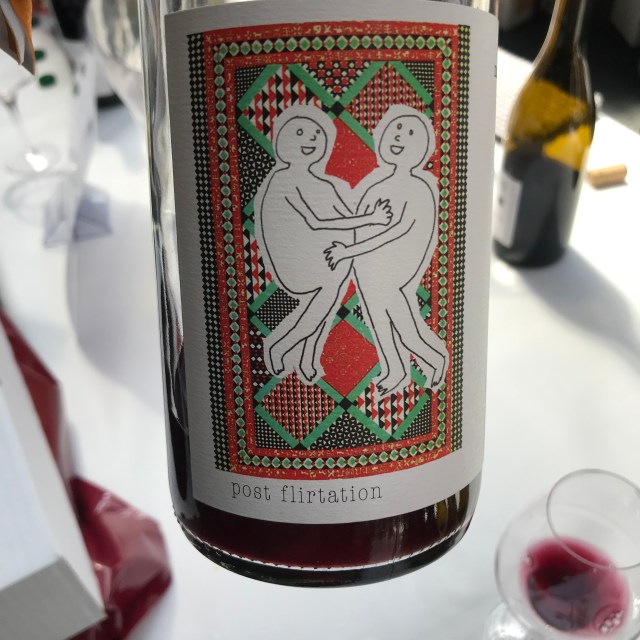
Olympia Samara and Hannes Hoffmann farm just two hectares of vines at Roßwag, which is about 30km from Stuttgart in the far northwest of the Württemberg Region, almost in Northern Baden. Olympia has previously worked with the relatively unsung great winemaker of Burgenland, Claus Preisinger, whilst Hannes had a very interesting career with Dirk Niepoort before the couple began to make wine for themselves in Hannes’ native country. These wines are quite special, and I don’t think many will have tasted anything quite like them in Germany, let alone forgotten Württemberg.

Riesling 2017 – The grapes for this cuvée, from a mix of 45-y-o and younger vines, grown on rare blue limestone, a hard rock that won’t shatter, ripen fairly quickly so they are harvested early. Before fermentation the grapes rest on skins for a week, and afterwards age in mixed old oak (300 litre and 600 litre barrels) on lees for ten months until bottling. The wine is very fresh and fragrant because of the early harvesting, but the grapes are placed in a vertical press, and pressed very gently, with no separation of juice. The must is allowed to oxidise a little, which makes the wine stable so that no sulphur needs to be added. A good food wine, with presence.

Endschleife Riesling 2017 – Like the wine above, the vines here grow on dry stone terraces ripening with the reflected sun and night time heat retention. The difference is that this wine comes from the oldest part of the vineyard and so has an extra intensity which warrants a higher price. The grapes are cooled for a week before pressing into 300 litre oak, with bottling in December/January (so it sees a little longer on lees). There’s a more mineral mouthfeel and more depth, signifying a wine which requires time to blossom…but it’s all there.

Pinot Noir 2017 – This red is fermented, after destemming, for three-to-four weeks with just gentle pushing down of the cap merely to keep the surface moist. It then also sees ageing on lees for ten months in 300-to-600 litre barrels, generally around four years old. It has a fleshy cherry bouquet and whilst the acids are quite prominent, it complements the fresh nose nicely because the fruit is ripe.

Lemberger 2016 – Lemberger is none other than Austria’s Blaufränkisch, and is something of a Roterfaden speciality. The regime is exactly the same as for the Pinot Noir. It has a lovely bright colour and a lifted, scented, floral nose. This combines nicely with the palate which has cherry fruit but an additional touch of earthiness in the texture. A sommelier friend of the couple described it as having “a solid earthiness with angel’s wings”. Olympia was rather taken with that. Me too. There is also an old vine Lemberger which wasn’t shown.

The wines here are all nice, but I’d go Lemberger as a point of difference if you have a choice. Otherwise, grab anything with their distinctive labels.


ENDERLE & MOLL (MÜNCHWEIER, BADEN)

Sven Enderle and Florian Moll are one of Germany’s most interesting winemaking duos. Their five hectares in the Black Forest make them small, but there are many smaller. This is why it amazes me that they rarely get more than a tiny mention in German wine books written in English when they are said, by some, to make the best Pinot Noir in Germany. They use what some may call “Burgundian methods” (both Florian and Sven worked in that region), and this includes getting their barrels from Domaine Dujac. However, these are not copycat Burgundies, as the terroir is different, with complex sandstone and limestone soils and a microclimate resulting from the forest and mountains to the east.

It’s worth noting here that the wines are classified as “tafelwein”. This is not primarily because they are biodynamic and “natural” wines, but because Sven and Florian don’t want higher alcohols. As we shall see with the reds below, they aim for transparency, and an almost ethereal quality results.

Weiss & Grau 2017 – a blend of Weissburgunder (Pinot Blanc) and Grauburgunder (Pinot Gris). The wine has a genuine freshness that is very appealing, and this combines with a little grip, texture and weight. There’s colour too, and it all comes from slow extraction of whole bunch juice in the basket press used for all of the E&M wines. Fermentation is in stainless steel.

Muschelkalk 2017 – this is a varietal Pinot Blanc/Weissburgunder off pure limestone, coming in at a refreshing 11.5% abv. You get the immense brightness which comes from the limestone, with some texture from the skins, but for me, this is the kind of wine where the terroir comes through. If the main deal here is the reds, this wine shines.

Pinot Noir 2017 – The first thing you notice is that this is pale. It’s that transparency I mentioned which makes this quite different, and appealing. The fruit has a pleasantly sour edge which gives the wine a more savoury quality, and there’s just a little grip too. Even at this level it’s impressive, but approachable.

Liaison 2016 – is also Pinot Noir, and is also pale, and alcohol is (as with the wine above) a very restrained 12.5%. The fruit comes from older vines on both sandstone and limestone, hence the name. 2016 was a less warm vintage here in Baden. This cuvée sees its ageing in Dujac barrels and is concentrated with great cherry fruit depth, but the overall impression is of opacity and clarity, making a wine of presence, but equally, elegance as well.

Other wines I’ve enjoyed from this pair are a fun Müller Thurgau, and an amazing Spätburgunder Rosé, both of which Newcomer has had in the past. Enderle & Moll should be far better known outside of Germany.

img_5924

THORSTEN MELSHEIMER (REIL, MOSEL)

Reil isn’t the best known village on the Mosel, but then neither is Kinheim where our next winemaker comes from. Thorsten has been in charge of this two-century-old estate since the mid-1990s, and he’s been fully Demeter Certified biodynamic since 2009. He has 11 hectares under vine, eight of which are on the slate/quartz soils of the Mullay-Hofberg, which is down river from Taben-Trarbach and Enkirch, and consequently off most detailed maps of the Middle-Mosel Region. Nevertheless, the terraces here, which Thorsten has had to restore, are as steep and formidable as any on the river.

Ancestral Rurale 2017 – what a marvellous way to start here, with a 100% Riesling vivacious sparkler made by the Ancestral method. It fermented incredibly slowly (in wood) so was bottled in early May last year, where it has been ageing on its undisgorged lees. It is beautifully clean, fresh and precise. There is no added sulphur and no reduction. Simple but amazing stuff in that context. Expect apples with ginger spice, a crown cap and around 10.5% abv.

Mullay-Hofberg Riesling Kabinett 2015 – A traditional, classic, Kab with around 35g/l residual sugar backed by good acidity and only 8.5% alcohol. A very slow fermentation stopped around Christmas 2015. It has a delicate floral bouquet, the fruit being rounded, quite exotic, and everything is nicely in balance. It has the presence to go with mildly spicy dishes.

Lentum 2015 – This is a Riesling which fermented for an incredible three years in old fuder (Lentum meaning slow one). It has a broader mouthfeel than the Kabinett, is effectively dry with lime and grapefruit on the palate. A much more serious wine, which would accompany a very wide range of dishes, depending on how adventurous you are prepared to go, although the wine seems young still.

Vade Retro 2016 – is also a Riesling Trocken, a fully natural wine with no additives. Its darker colour hints at the style, which is deliberately oxidative. This is the fifth vintage for this cuvée which is aged in barrique without skin contact and it is already garnering a reputation from those who are happy to see a bit of experimentation in what can be a very conservative region (though one which you know I love). The bouquet of baked apple I find really appealing. It has very low pH, so there’s less need for any sulphur addition. It’s still recognisably “Riesling”, but just very different. Thorsten also makes orange/skin contact Riesling too.

Goldlay Riesling Beerenauslese 2017 – There are not a lot of Demeter-Certified sweet pradikat wines in Germany. This beauty has a golden colour with a bouquet redolent of long summer sunshine. There’s a fair bit of botrytis in this 2017, but picking was in fine weather and the grapes were very ripe. Triage by an experienced team involves a special small bag for the berries with noble rot. Only 200 litres were made of this honey and lemon linctus syrup with intense citrus acidity, all bottled in halves. One to squirrel away.


img_5914

RITA AND RUDOLF TROSSEN (KINHEIM-KINDEL, MOSEL)

I’ve know the Trossen wines for a few years, but I’ve only drunk a few because they do sell out very quickly. As with Enderle & Moll, the Trossens are a bit of a cult producer, perhaps even more so. I always had a mistaken belief that they were further down river, but their vines are broadly between Erden and Kröv, and annoyingly I’ve cycled past them without knowing. Not that I imagine you can just pitch up here.

The Trossen vines are on steep weathered slate which helped keep phylloxera at bay, so many parcels remain ungrafted and around 100 years old. The reason their wines have such a cult following may be in part because they have been biodynamic since 1978, before most German growers knew the word and methodology existed. Their Purus wines are natural wines which are bottled without added sulphur (as well as unfined/unfiltered).

I lose track of the Trossen wines, the cuvées I have being different to those below, but these here are all “Purus” wines, all unsulphured, and all 100% Riesling.

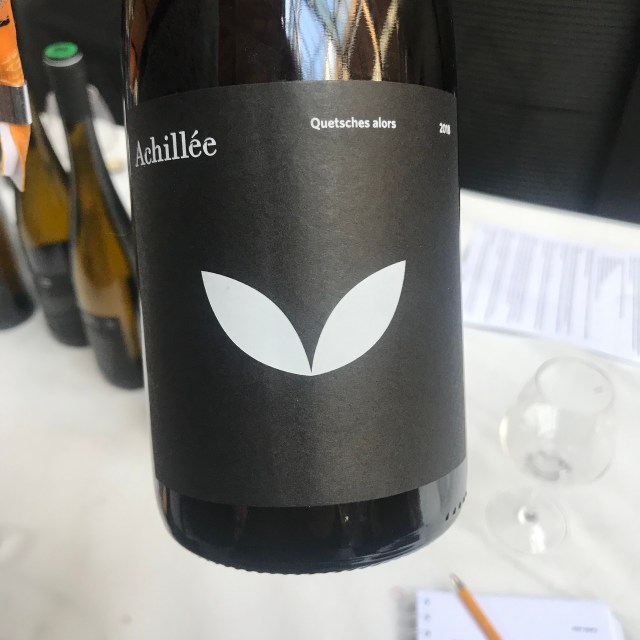
img_5919

Purellus 2018 – What a treat to try this, the first commercial vintage of the Trossen petnat. It’s 100% Riesling, bottled last December with a tiny bit of residual sugar. The bottle will be cloudy from the lees and the bouquet is full of exotic fruit. It has a softness, and an umami character, on the palate but doesn’t lack acidity. A young woman called it “savoury”, to which Rudolf countered “what do you mean by savoury?”, which I think caught her off balance. I wasn’t going to interrupt her, but I think it has a kind of hint of soy, and added to the texture/mouthfeel from the lees, I think maybe that’s what she meant. I made a note not to use the “s” word.

Eule Purus 2016 – is Riesling, 11.5% abv, with a faint prickle on the tongue, which adds to its dry mouthfeel. Aged for an extra year (over the 2017 below) it is really lovely, with a long finish. Yes, I know “lovely” is a lame choice of word, but if you allow yourself to savour (not savoury!) the wine, you may well come to a similar adjective.

Eule Purus 2017 – Eule comes from those very old pre-phylloxera, ungrafted, vines. The 2017 has a little more acidity over the ’16 but I don’t think it lacks any of the depth of that wine. Give it another year if you can resist, though I’m sure it deserves longer.

Pyramide Purus 2017 – We are up to 12.5% alcohol here. The Pyramide site has vines around 35 years old on grey/blue slate, facing south and southeast. The grapes are whole bunch fermented in stainless steel before ageing for eleven months. There’s more depth of colour and good depth to the nose. The palate has a delicious bitter or sour touch on the finish which makes the wine stand out. In a sense it seems hardly “Riesling”, and more perhaps an expression of the site in this unadulterated form?

Madonna Purus 2017 – This, like Pyramide, is a steep slate vineyard with grafted vines on American roots, and is also 12.5% abv. It’s similar in colour too, but this seems to me more mineral. The acidity is so well judged for ageing, and that mouthfeel and texture is so agreeable that whether to keep it or drink of its raw energy is a difficult choice, the former perhaps being the sensible option…but still.

Schiefergold Purus 2017 – To me, this is the complete wine. The vineyard is the neighbour of Madonna, but is incredibly steep, and we are back to those really old ungrafted vines. The grapes go into small, 350-litre, stainless steel fermenters, the process taking a long, slow, eight months. Ageing takes a further eleven before bottling. There is depth of fruit and there is the structure to age for a long time, which is what I’d do with it in this case, although it was a wonderful feeling tasting it…I could easily have drunk quite a lot of the bottle. It’s a wine which pretty much made itself, and I can’t help but feel that this shows.

I got a great thrill meeting Rudolf, which I’m sure he was unaware of and perhaps it would have made no impression if he knew. He does seem deeply thoughtful, maybe not so easy to get to know. But his wines are stunning, and I just want to get to know them better and better. They are not easy wines, but therein lies their attraction for the lover of fine Riesling. They seem almost as if the wines can think and ponder for themselves as they silently contemplate their slow evolution. The wines I tasted certainly live up to their name: Purus.


Thus ends Part 2. When a tasting is really good it leaves an impression long after, like a great film, book or concert. This was one such tasting, surely proving that many of the wines of Alsace, and Germany, deserve much wider recognition outside of and beyond the always supportive wine trade. If you trust your importer, and both Newcomer Wines and Vine Trail have chosen very well, you can’t go wrong. I hope you will consider trying some of these.

img_6040

Posted in Artisan Wines, German Wine, Natural Wine, Wine, Wine Agencies, Wine Tastings | Tagged , , , , , , , , , , , , , , , | 2 Comments

Alsace/Germany Celebrating Common Ground with Newcomer & Vine Trail (Part 1 – Alsace)

Newcomer Wines and Vine Trail came together on 15 April at Fare, on Old Street, London, to show five Alsace producers and five German producers from their respective ranges. I’m not sure that the common ground extended only to geography and grape varieties (to a degree). All of the producers here, without exception, show a commitment to excellence which comes through in the wines, which is common enough ground for me. With this tasting being jointly put on by two of my favourite merchants I was walking down Old Street in the unusually summery temperatures we had back before Easter with a particular spring in my step. The tasting lived up to expectations, despite the heat.

Of course, there are differences between these producers too. We have the philosophical demeanour of Rudolf Trossen, the big personality of Marc Tempé, the vibrant enthusiasm of young Hannes and Olympia at Weingut Roterfaden, and of course the extreme viticulture of Bruno Schloegel at Domaine Lissner. But at the end of the day, even tasting  in a crowded room lit by a wall of sun-heated glass, the sheer joy and quality of all these wines came through loud and clear.

For your ease of reading I plan to split this into two parts. This first part covers the Alsace producers and the second will cover the German crew. There’s no real reason for splitting it up this way aside from it being the order of the tasting booklet. In any case, if I’d confined this to one article you’d be getting towards 7,000 words, which is even over my acceptable limit.

I think trying to make too many comparisons between Alsace and the German regions covered would be pushing it a bit too far down the road of generalising. But I hope you enjoy reading about these wines as much as my enthusiasm will show that I enjoyed tasting them.

img_6040

DOMAINE LISSNER, WOLXHEIM

Bruno Schloegel makes wine in that up-and-coming Alsace sub-region north of Mutzig and Molsheim, just west of Strasbourg. I say “makes wine”, but maybe he’d prefer to suggest he gently encourages it to make itself. This Domaine is “Bio” in every sense, being focused on both biodynamics, and “biodiversity”, and minimal intervention here includes no added sulphur at the ten hectare domaine, and nothing is pumped, nor otherwise mechanically manipulated. Bruno possibly practises the most extreme form of “leave alone” viticulture I know, the closest being in the methods of Jason Ligas (following the principles of Masanobu Fukuoka) on the slopes of Mount Piako in Northern Greece.

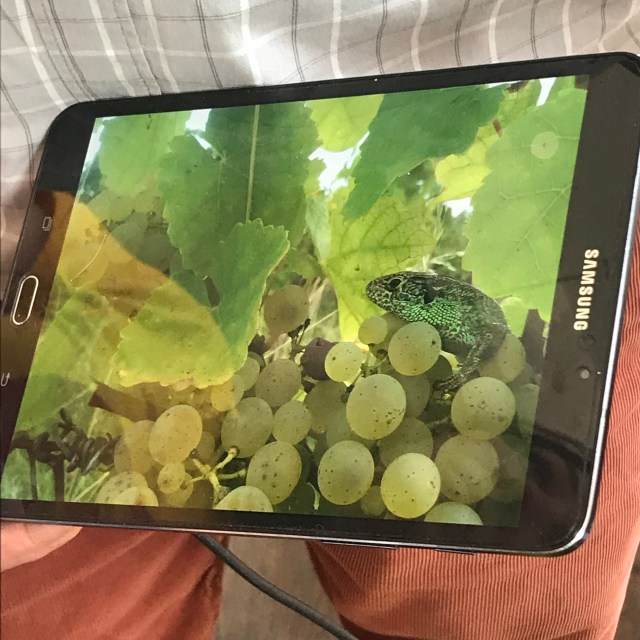
The vines at Domaine (they say “Maison”) Lissner are allowed to grow “wild and free”, meaning that there is no vineyard management in the way that most vine farmers would use the term. There is no cutting back of vegetation in the summer, and this includes no pruning (maybe a little shoot-repositioning). There is a “winter cut”, but vine branches are left where they fall. An equilibrium has been established (it took about eleven years) which also produces an environment full of biodiversity, both of flora and fauna. Bruno says there are plentiful rabbits, deer, birds, lizards, and more than two hundred species of insects.

Dionysiuskapelle Sylvaner 2017 – Like all the Lissner wines, this undergoes a gentle pneumatic press. It’s a very good value opener in a fresh style, with characteristic acidity which doesn’t, however, go too far as it can with less expensive Sylvaners. It also has a nice mineral mouthfeel, which adds considerable interest.

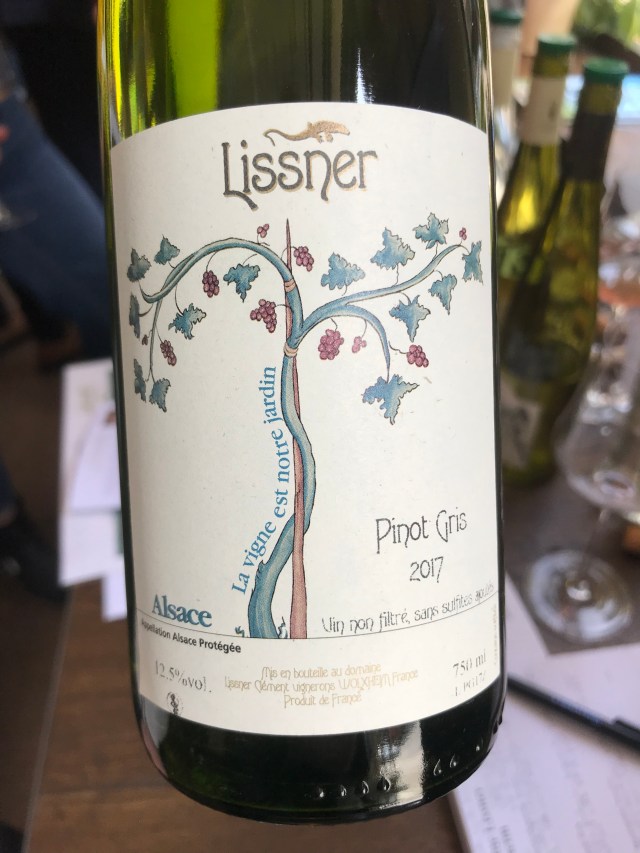
Pinot Gris 2017 – There’s a CO2 freshness to this Pinot Gris. Initially you are surprised by how beautifully lively it is, but its initial simplicity is countered by a smoky note which slowly creeps in. It comes off quite light soils. The finish is a hint of textured pear. Very nice.

img_5982

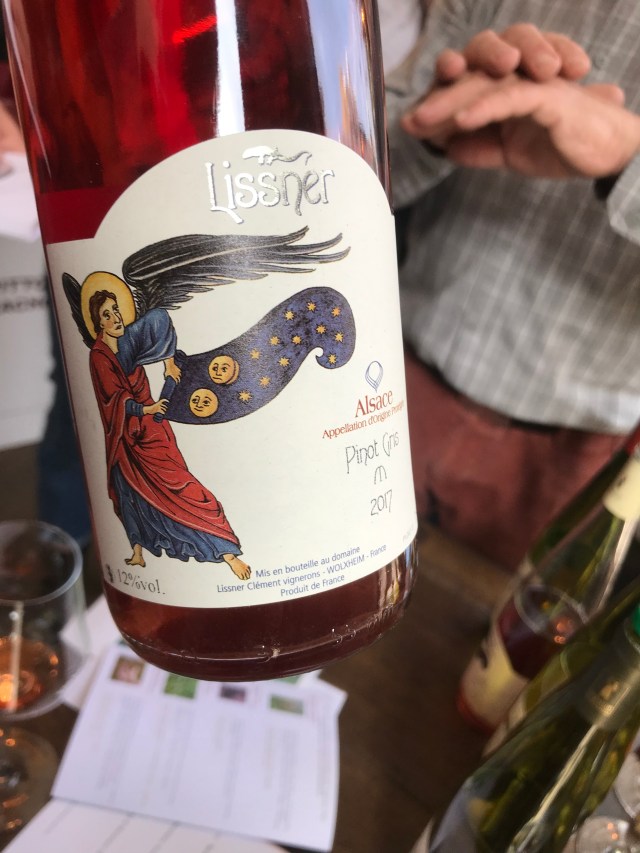
Macération Pinot Gris 2017 – this goes a step beyond the classic ramato, or perhaps I should say oeil de perdrix, colour from the grape’s pinkish hue (some might call it “onion skin”), but to me it’s far more red than that (though the photo below does accentuate the colour). The texture here is ramped up, which initially obscures the variety a little, but it becomes more obvious as you swirl and sip. A lovely wine, the label (as with the Pinot Gris above) is from a manuscript at the Abbey of Mont Saint-Odile, up in the hills to the southwest. The abbey had vines in Wolxheim in the twelfth century.

img_5981

Wolxheim Riesling 2017 – This Riesling was bottled early and kept in a cold cellar to preserve its natural CO2, which Bruno said was a key component in this village cuvée. The overall effect is perhaps to enhance the unusual degree of florality here, a floral beauty which reflects the uncut vineyard of vines and wild flowers on white chalk. It’s a Riesling to drink at perhaps three to five years old.

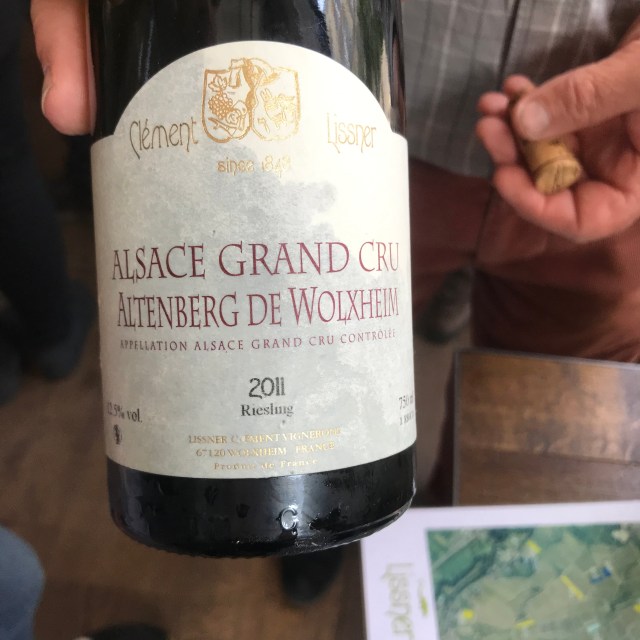
Altenberg de Wolxheim Riesling Grand Cru 2017 is a very different kind of wine. It needs a minimum of a decade to mature. The bouquet is far more muted than the wine which follows, but on the palate it tastes so alive in its youth.

Altenberg de Wolxheim Riesling Grand Cru 2011 gives an idea what is coming. This is only seven or so years old, but its indescribably beautiful bouquet is quite astonishing. The palate is beginning to round out and it is softer than the 2017, now. Hoping not to sound pretentious, and certainly making this comment outside the boundaries of a bland qualitative assessment, the wine is unquestionably profound. Yep, give that 2017 time!

img_5983

Bruno Schloegel is undoubtedly a deep thinker. For example, he can be critical of some natural winemaking. He sees the failings of the AOP system, yet he sees their boundaries as a positive, not a straightjacket. That makes him gently at odds with others pursuing a similar path. Yet to my mind, these wines (which I had never come across before) were some of the most truly interesting in the tasting. I would dearly love to visit Bruno and to see his vineyard. Bruno was happy to explain his methods at length, but as he rightly said, you need to stand in the vines to understand what he’s trying to achieve.

img_5980

A little Lissner fauna for you…

BERNARD & ARTHUR BOHN, REICHSFELD

Alsace is full of its well known villages and its Grand Crus, isn’t it. Few people know Reichsfeld, but its steep slopes, up in the hills to the southwest of Andlau, were famous for their wines in the Middle Ages, when the vineyards here were owned by the Counts of Andlau. The Bohn family vines are all between 330-to-400 metres altitude, and you can tell. The wines that result have a genuine freshness, but then at the same time no sulphur is added at this domaine (since 2010), so none of the wines are dulled by SO2. I tasted four wines.

L’Indigène Sylvaner 2017 – is a maceration wine which sees three weeks on skins. There’s a full texture and body not always associated with the variety, very much contrasting with the Lissner version. The firmness of the wine probably reflects the terroir, a mix of volcanic “redstones” and schist. The vines are seventy years old. Elevage is simple, in stainless steel with a little remontage. One to try with food.

Schieferberg Zéro Riesling/Pinot Gris 2016 – obviously off schist, skin maceration of the Pinot Gris gives the wine a pleasant pinkish tone. The aromatics are very interesting, with something like red fruits creeping in. It has great mouthfeel and mineral bite, more of the terroir than varietal flavours. The Schieferberg is arguably a unique (for Alsace) terroir of Pre-Cambrian shale/schist, with significant heat retention aiding ripeness. The name derives from the fact that this was Bernard’s first zero sulphur cuvée. It is just beginning to show well, still needing time, but I hope the briskness of the acids remains.

Muenchberg Riesling Grand Cru 2017 – this Grand Cru lies between Nothalten and Itterswiller, the latter being the first place I stayed in Alsace very many years ago. The soils here are pink-red sandy volcanic, which are said to warm up quickly in the morning. The site is pretty well known because quite a few prominent producers have vines there, including two personal favourites, Ostertag and Julien Meyer. The Bohn wine has a nice structure, elegant and fine. The minerality isn’t overplayed. The elegant bouquet of white flowers contrasts with a more exotic fruit palate.

Par Arthur Pinot Noir 2017 – Arthur looks very young, but he’s a fully trained oenologist, and presumably (I didn’t ask) this wine is his doing. I don’t think many reading this will have failed to notice how Alsace Pinot Noir has catapulted from (mostly) mediocrity to majestic in little over a decade. Climate change has seen dramatic changes in Alsace. I think Alsace reds are most successful when they attempt to emphasise the grape variety’s simpler side. It’s possibly pointless trying to reproduce Burgundy when you can make something like this: pale, bright, and lovely, with red fruits and cherry ripely filling the mouth.

If anyone finds themselves driving through the hills above the main wine route and comes to Reichsfeld, the Bohm residence is not easy to miss, the big pale blue chalet. A great tasting will surely await.


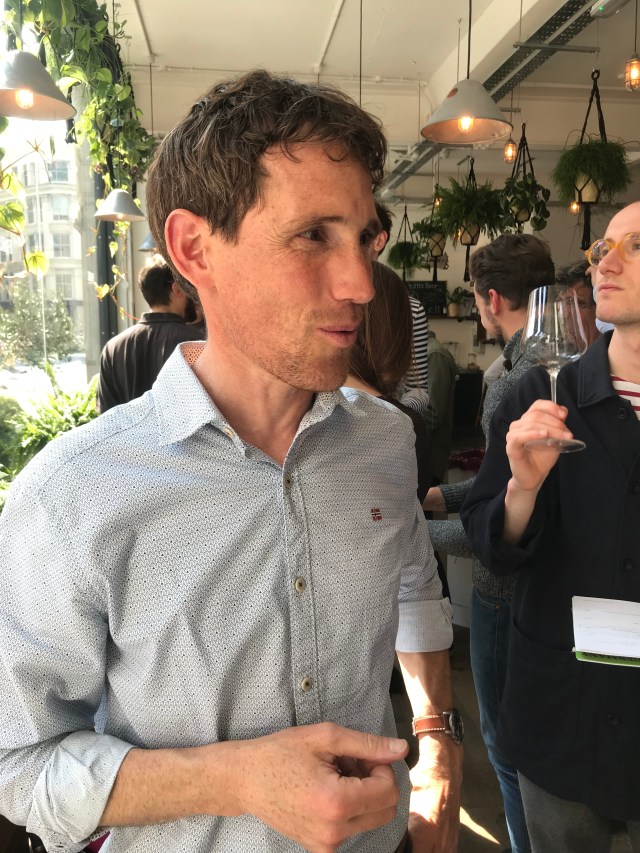
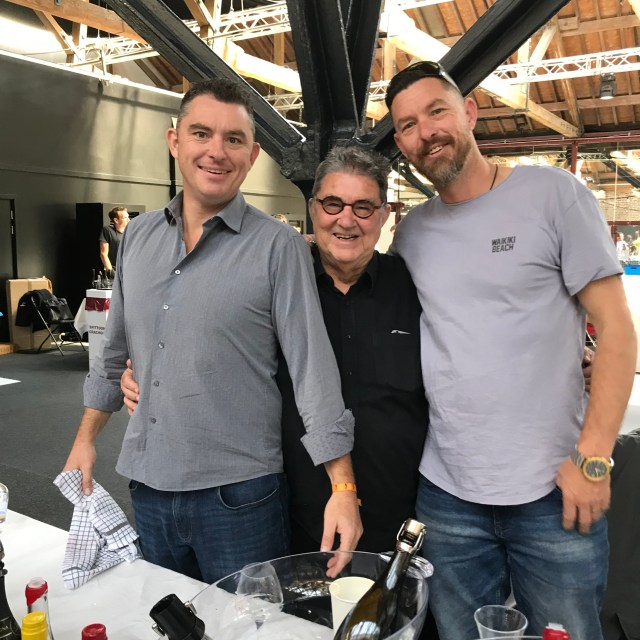
Bernard in grey, Arthur behind, in blue

FLORIAN & MATHILDE BECK-HARTWEG, DAMBACH-LA-VILLE

This is another zero-sulphur producer, based at Dambach, around the middle of the Alsace vignoble, just north of Sélestat. Florian has been working full time at the estate since 2009 and took over from his father, Michel, when he retired in 2010. The domaine is small, just six hectares, including holdings within the town’s Grand Cru, Frankstein.

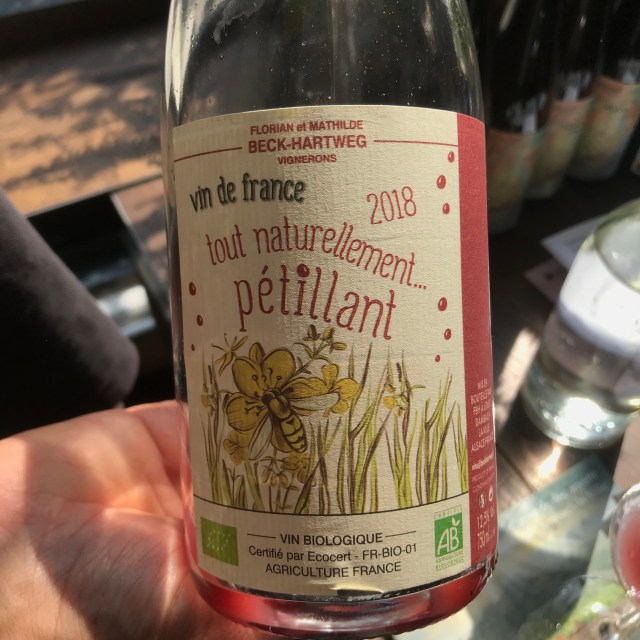
We began here with a wine so lovely that I heard several people describe it as their wine of the day, and it certainly burnt a hole on Instagram, so many times did its photo appear that evening. Tout Naturellement Pétillant 2018 is an unusual blend of Pinot Noir and Muscat. It’s cloudy (unfiltered, as with wines made from the méthode ancestrale), and is packed with exuberant red fruits, a tiny floral touch and a gentle fizz. It comes in at 12% abv, but tastes more like 8-10 degrees. Drink cool (and almost certainly swiftly).

img_5946

Dambach-la-Ville Riesling 2016 is fairly simple stuff, but very good. It’s off granite, and in its freshness there’s real salinity, and energy too.

Granit 2017 blends Riesling, Pinot Gris and Pinot Noir from the same terroir. It’s a juicy wine where none of the grape varieties seem to dominate the blend. Its another wine where you get pure terroir coming through, rather than varietal character. It’s very textured, mineral and direct, with lime-fresh acidity. Certainly ageable.

Pinot Gris Gand Cru Frankstein 2016 – this is Dambach’s special Grand Cru site, an arena of decomposed granite with high mica content with a south-to-southeast exposure, on the way to the Château de Bernstein. Pinot Gris here is quite plump and rich, with amplitude, but dry…it has good acids for a bigger style of Pinot Gris. There’s a bit of florality, and even more smokiness, and it’s surprisingly pure. But certainly a wine for food, quite rich food perhaps. As with almost all the Alsace Grand Cru wines, they are intended to age, so don’t treat them like Nouveau.

Riesling Grand Cru Frankstein 2016 – if Frankstein is the heart of the Beck-Hartweg vineyard, this wine may be the core of the range. With the Pinot Gris from this site you do get a tiny bit of salinity. Here, with the Riesling, you notice it a lot. It gives the wine a nice edge. It’s a Riesling of presence, a serious wine (not to suggest others are not serious). Again, you get the terroir…it has a granitic structure and a mouthfeel inescapably reminiscent of rocky texture. The bouquet of acacia flower and, unusually, fresh mint, rides above all this, for a wine of elegance and finesse, but which nevertheless requires cellaring.


DOMAINE MARC TEMPÉ, ZELLENBERG

Marc has a big personality and a strong following. He was surrounded several deep by young admirers and despite his wife, Anne-Marie, doing her level best to pour me samples at a long stretch, I was only able to taste three of his wines on this occasion. A shame.

Marc started his domaine at Zellenberg (between Riquewihr and Hunawihr) in 1993 after working for the INAO, first in the Lab, and then as part of the team delineating the Alsace Grand Cru sites. He immediately converted to biodynamics, and his attention to detail includes seeking out second hand oak from other biodynamic producers (such as Leflaive). Focus is 100% on quality at every stage. There’s just something a little different about Marc Tempé’s wines (I mean that very much as a compliment), and I think that despite the man’s laissez-faire and laid back demeanour, it’s that attention to the tiny details which help the wines stand out.

Zellenberg Pinot Blanc 2016 is in fact a blend of Pinot Blanc and its Pinot Auxerrois variant. It comes from the slopes around the village, a large handful of different plots with different exposures, perhaps a little over two hectares in total. The wine is made in large old oak. It has a lovely lift and hints of tropical fruit (maybe mango and honey to my palate), but it is grounded by a dry, mineral touch. I’ve said before how when in Alsace I’m gravitating more and more to drinking PB with lunch, and I’d snap this up if I saw it on a Weinstube‘s wine list.

Zellenberg Riesling 2016 is rich, with just the faintest hint of sweetness via the ripe Riesling fruit. This, again, is a result of the terroir. Marc’s description of the terrain here is worth repeating (from his web site): “The vines that cluster around the calcareous sandstone nipple are planted on a clay-marl soil of lias, consisting of dark gray (sic) schistose marls with fine white limestone beds, as well as carbonate and ferruginous elements” (excuse my translation). Complex! Winemaking is by pneumatic press followed by 24 hours juice settling. Ageing is 24 months in foudre. A tiny bit of sulphur is added at bottling.

Grafenreben Riesling 2013 comes from a site in the direction of Ribeauvillé. There’s a base of clay and sandy marl here, with sandy limestone up to a metre down, the soils being hard to work according to Marc. He has two Riesling plots here totalling just under three hectares, one plot planted in 1977 and the other in the 1950s. There’s real depth here, a nice rounded wine with apricot and mango fruit flavours, but as with all of these Rieslings, that is set off against texture and zippy acidity (even at over five years old). Vinification differs to the Zellenberg Riesling cuvée in that this one sees a 36-hour débourbage, whilst élevage is in used barrique, on lees, for three years. Depending on vintage, a wine to peak in ten years minimum from release.


Losing my Tempé a little – a popular guy inundated with questions

MATTHIEU BOESCH, WESTHALTEN

This producer will be better known from the label as Domaine Léon Boesch. The domaine itself, with its new Cave built in 2010, really sits between Westhalten and Soultzmatt, looking up to the slopes of the steep Grand Cru, Zinnkoepflé. The microclimate here is special as it has the protection of Alsace’s two great “Ballons” (Grand and Petit) which enhance the Vosges’ already significant rain shadow effect. Matthieu farms 14.5 hectares of vines all in this locale.

La Cabane 2017 – is a Pinot Blanc (70% Auxerrois) which produced a fresh, floral scent, with stone fruit (white peach and apricot, plus pear) and stony texture on the palate. Fresh and tasty, this has a lively attack but finishes with a lick of creamy texture which I really like.

img_5939

This might be a good place to comment on the 2017 vintage, from which many of the wines at this tasting came. Matthieu says it produced very precise wines here in the south of the region, with a good sized crop. Late frosts in early April struck many, but the valley here was well protected. There was little rain, but Marc believes that his biodynamic methods have enabled his vines to cope better with water stress.

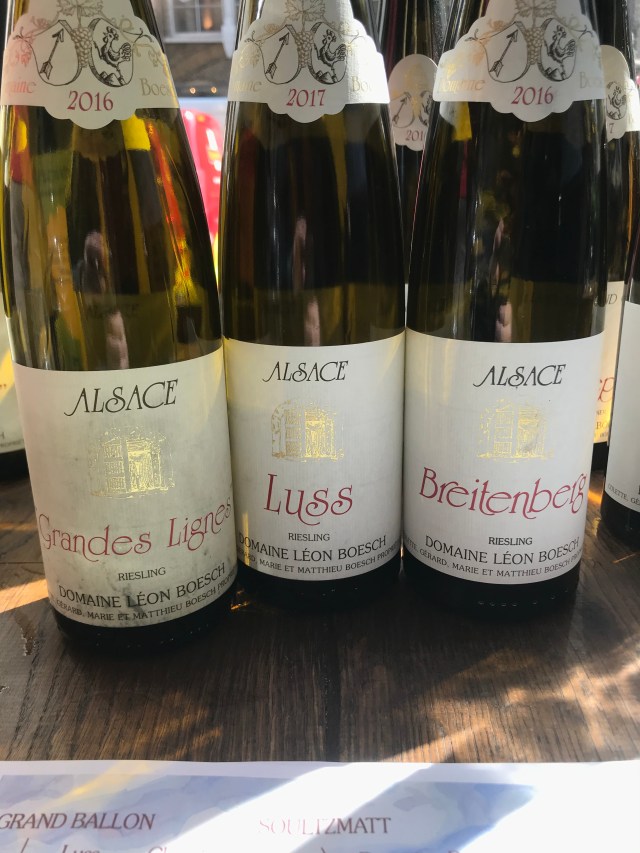
Les Grandes Lignes 2016 is Riesling grown on a 1.7 ha chalky plot, mostly planted in the early 1980s, in the valley. It has a fresh simplicity to its bouquet, quite open with apricot and a little cinnamon spice. But I’d hesitate to call it a simple wine just because its so drinkable.

Luss 2017 is also Riesling, and is the Boesch wine I have drunk by far the most times. It comes off limestone terroir which shows in its mineral bite and brightness. In fact this gorgeous 2017 is so bright it’s blinding. It’s a tiny site, under half a hectare planted between 1974 and 1989, and I believe may be the furthest vines from the winery. Like all the wines here, élevage is in old wood. This has mainly citrus aromas now, but time will develop them whilst (in my experience) that freshness of the limestone will take years to tone down (thank goodness).

img_5941

Breitenberg Riesling 2016 is a lieu-dit on the edge of the Zinnkoepflé Grand Cru, the furthest west in the Ohmbach Valley, with a southerly exposure. The soils are on sandstone, the top of the hill being close to the Vosges themselves, at 470 metres. The wine is totally different to Luss. The nose begins rounder and softer, but the palate is very big in flavour. Yellow fruits, still stony but not as bright as the former wine, and there’s a hint of orange citrus there as well, not your usual lemon or lime. At 12.8% abv, that’s also half a degree more than Luss.

Zinnkoepflé Gewürztraminer Grand Cru 2017 – Matthieu only grows this variety on the Grand Cru. He makes this dry version and the VT we ended with (below). This 2017 version is still ample and weighty, with an exotic floral bouquet, but despite the richness on the nose (stone fruit, citrus and deeper bass notes of caramelised sugar…just a hint…) there’s a lightness and finesse, and the more you sniff, the more subtly complex it becomes. And it only comes in at 12.2% abv, which (I won’t lie) is such a relief these days where Gewürztraminer is concerned.

Pinot Noir “Les Jardins” 2017 has warm, pale cherry fruit. It’s a wine I’d serve a little chilled so it warms in the glass. It does have a bit of texture, but it’s basically a wine that is quite “gluggy”. It’s one of the Alsace reds you can bank on for summer drinking, really nice, not complicated, but with just enough tannin to ground it.

Zinnkoepflé Gewürztraminer Vendanges Tardives Grand Cru 2015 – This hits 14% alcohol on the label (tech sheet says 13.4%), and contains 121.4 g/l of residual sugar, in reality somewhere between VT and SGN. Golden in colour, the nose is explosively rich in all manner of exotic fruits, but with a touch of spice running on top of everything. It’s sweet, for sure, but not at all cloying. In fact, for the variety and for a VT, the freshness approaches “magnificent”. The other point to note is that the alcohol doesn’t really show, which proves it is well balanced. A stunning wine, though I confess to something of a crush on VT Gewürz, despite drinking it fairly rarely.


img_5942

This is altogether a rather nice note on which to end Part 1 of this tasting. Matthieu Boesch’s wines are fairly easy to find in many retailers (though the labels don’t really stand out, do they), both in London and Paris. I don’t think I’ve had a bottle I’ve failed to enjoy and they have always been a sure bet in restaurants, so it was nice to have a chance to try seven in one go. Part 2, on the five German producers at the tasting, will appear, I hope, during the early part of next week.

img_6041


Posted in Alsace, biodynamic wine, Natural Wine, Wine, Wine Agencies, Wine Merchants, Wine Tastings | Tagged , , , , , , , , , , , , , , , , | 1 Comment

Poet and the Roots

Excuse my lack of restraint in using another musical reference, but the words seem apt here. The roots bring to mind the wonderful fallen oak at Tim Phillips’ winery on a brief visit there, a couple of weekends ago. This rather beautiful piece of chainsaw art was made by well known tree carver, Richard Austin. It now provides outdoor seating and somewhere to rest your glass, beside the pond and copse which Tim is lucky to have out the back of the winery. By coincidence, Roots is also the name of the surprisingly good restaurant we went to that evening.

Poet is possibly not a word Tim Phillips would use to describe himself. This is a man who, after all, is building his own motorbike from the ground up, as well as tending one of England’s smallest yet most beautiful vineyards, and its attached orchard which he has literally uncovered from an acre-or-so of brambles over the past couple of years. Yet poet he is, for the expression his English wines pour from the bottle. This time was just a visit to the winery, near Pennington (Lymington, Hampshire). If you want to see Tim’s “Clos du Paradis” walled garden, there’s a link to a previous article here. Tim’s English wines are bottled under the Charlie Herring label, under which he made wines in South Africa (Tim’s winemaking experience also extends to Australia and Italy, but if you want to know more, follow that link).

We began by tasting Tim’s sensational “cider”. I don’t use the word lightly, although it’s not technically a pure apple cider. The apples Tim uses are his own dessert varieties from the orchard, but to give it a bit of acidity, not to mention colour and a little something extra, Tim adds a splash of his South African Syrah. The only other person I know who does something similar is Tom Shobbrook in South Australia, who makes a pear cider and adds a little Mourvèdre. It might not be a coincidence that Tom and Tim got to know each other in Tuscany, at Riecine, under Sean O’Callaghan.

29c674b3-5d32-449a-865f-8a4dea5a3120

No disrespect to Tom, but Tim’s cider is absolutely gorgeous. The colour is like that of a light red natural wine. The bubbles are super small and hectic, the cider having a real palate cleansing freshness and a nice crystalline spine. eighteen months on lees gives it a little texture too. The dessert apples add a floating fragrance. All this, sealed under crown cap (at just about two-bar pressure, around a third of that for Champagne) in a clear, heavy, sparkling wine bottle with one of Tim’s exquisite “a humument“-style labels. Alcohol comes in at 7.5% and a bottle costs around £15 when there is any available for sale.

We were then able to look at some of Tim’s wines which are currently undergoing their élevage. Tim won’t release wines before they are ready. It might smack of perfectionism, and to be sure Tim is a bit of a perfectionist. But for a very small scale producer it does make sense that people try the wines for the first time when they are at, or close to, their best.

So we began with two Sparkling Rieslings, as far as I know the only sparkling version of this grape in England (not that I recall having drunk any English Riesling, come to think of it). Before you wonder how he ripens Riesling, don’t forget that the vineyard is walled. In fact I’d guess that the brick wall which surrounds the “clos” is nine or ten feet high, and it soaks up the sun into its orange-red clay, releasing it slowly to create a warm but well aired micro-climate. Tim has probably been right in his decision to hold these 2014 and 2015 wines back. They have very immediate freshness and a sort of apple crispness. The fruit is very appley too. By all accounts the 2013 is ready to drink, and I shall pop my bottle of Promised Land Riesling Brut Nature 2013 some time this summer. Just waiting for the right company.

Tim’s sparkling Chardonnay goes by the name of The Bookkeeper. I drank a 2013 last year, which was rather good after four years on lees. Despite the autolytic character and complexity that lees ageing brings, it was still as fresh as you imagine it was on the day on which it was bottled. The 2018 we tasted was ripe and at the same time, quite floral at this stage, a mixture of stone fruit and pear flavours coating the palate. Good as the 2013 has become, I can’t wait to try this 2018 when it’s eventually released.

We ended our tasting with a couple of 2018 Sauvignon Blancs. It’s fair to say that I think, for both of us, SB needs to be special to excite us, and there’s no way Tim was going to do anything ordinary with his. The first version saw five days on skins. That had already imparted a nice texture, and some good bass note phenolics which don’t normally come hand-in-hand with this variety.

Ever the experimenter, Tim then wanted us to taste another level of Sauvignon Blanc. He drew off the darker liquid which had seen three months maceration on skins. This was a lovely textured herbal wine, the like of which I’m sure has not been attempted in Southern England before. Whilst Tim has not gone down the buried qvevri route of Ben Walgate, he’s just as fascinated by texture and mouthfeel. What he will do with his Sauvignon Blanc, I’m not sure? He might decide to blend the two together. After all, quantities here are so tiny. But even if he does, I’d love him to bottle a little of this latter cuvée for a few aficionados to savour at some future lunch.

Tim’s walled vineyard is rather beautiful, and any wine trade members who have the chance to visit should grab it if Tim can find time to show you around. But the winery is also in an idyllic location. As we chatted outside before leaving, amid the sound of bird song, a deer wandered out of Tim’s copse, around fifty metres from us. It gave us a glance but, being used to Tim, it paid little attention and remained there for some minutes before ambling away. He told us she was one of four that pay him no heed when he’s there alone.

img_6027

Spot the deer

img_6028

Richard Austin’s work – chainsaw on oak and what were once deep roots

The Charlie Herring labels are exquisite. A man after my own heart, the winery is wallpapered with maps (all hygienically sealed for the food standards regs).

Roots Restaurant

That evening four of us headed out to dinner, and taking advantage of one of us not drinking and being happy to drive, we went a little beyond taxi distance this time, to Southbourne (on the outskirts of Bournemouth). This eighteen cover only restaurant is the kind of place you rarely find. It’s hardly unknown, as evidenced by the waiting list of several weeks to get a table, but I really did not expect somewhere this good to be found in a quiet neighbourhood near a Co-op store and a bed shop on the edge of one of Southern England’s fabled retirement towns. We were able to benefit from a cancellation, and the other two empty tables were the result of no-shows. It’s sad when this happens, even more sad for a small restaurant like this serving excellent food. Food that is probably the best for many miles around.

The deal is simple. There are two tasting menus (£56 and £66, IIRC) plus a vegan menu which is a variant on the first of the above with some modifications and substitutions. There are also added optional extras, like a cheese course. As far as the food itself goes, I’d put the meal we ate up there with most “one star” establishments, although we know that Michelin requirements go beyond the kitchen.

We were lucky to be able to arrange corkage, at a mighty reasonable £10/bottle (we tried to leave a tip which not only reflected the quality of the food and the friendly service, but also that generosity of spirit (not always seen in London)). The wine list at Roots is certainly adequate, from what one can deduce. The wines may be comfortably beyond the ordinary and dull, but there’s not the detail on the list one might wish for (producer names?), and neither would the selection satisfy someone for whom wine is a hobby or a profession. Saying that, if the food outplays the wines, then I think most diners would enjoy the wines well enough. There is a “sommelier-style” wine selection to accompany each dish, which one can take as an added extra.

We began with an aperitif before driving to Bournemouth, which I guess younger readers might better recognise as “pre-loading”. Philippe Bornard Tant-Mieux is an 8.5% petnat made from Poulsard grown in the Côtes du Jura vineyards just outside of Pupillin. It has a genuine lightness of touch from one of the masters of “Ploussard” (in my humble opinion), Tony Bornard. A lovely light red, fragrantly red-fruited with a lovely cranberry twist. It comes adorned with a new label too (see photo), one which perhaps suggests that the devil has all the best tunes.

img_5887

The first (BYO) wine at Roots was a bit of a revelation. Florent Giboulot Bourgogne Aligoté 2005 (check the vintage) was an Aligoté of real depth. Fresh for its age, but equally rounded out, it has retained just the right amount of acidity to suppose that it is currently at its peak. That suggestion might surprise anyone for whom the variety has always been consumed young, with acids to the fore. Imagine Aligoté with an injection of plumpness, so that you could easily imagine it was a blend containing 50% Chardonnay. Domaine Florent Giboulot is based at Auxey-Duresses.

img_5889

The second wine was no less pleasurable, with the added bonus that it is a bit of a unicorn for me. Although I consider myself reasonably au fait with all things Jura, our friends had managed to achieve what I have not yet done – a tasting with Catherine Hannoun at Domaine de la Loue, in the far north of the Jura Region at Port-Lesney.

Catherine farms a tiny area, probably no more than 1.5 hectares after giving up a site in Arbois, with vines as far apart as Pupillin and Salins-les-Bains (the latter being once a large viticultural area now diminished to a few hectares). Domaine de la Loue Cuvée Clémence 2017 is a Pinot Noir, just 12% abv, and showing quite a bit of dissolved CO2 (though it was not sparkling). It’s a fascinating wine.

Apparently Catherine said you have to drink it within two hours. We didn’t get the chance to find out whether it turns from a princess back into a pumpkin after that time because, let’s face it, wines as sappy and thirst quenching as this don’t hang around that long, even when opened (by the waiter) twenty minutes before we began emptying the bottle. It was just gorgeous and summery, and as a lighter red it suited the food very well.

All of Catherine’s wines are biodynamic, and she was originally mentored by Emmanuel Houillon. I am closely guarding a bottle of her petnat, awaiting very possibly the same people who would be keener to try Tim’s Sparkling Riesling than yet another Comtes or Dom.

img_5891

The food:

Asparagus Tasting…

img_5890

Goats Curd, Heirloom Tomatoes, Basil, Raspberry…

img_5893

“Berlin Supper” (with exceptional rye bread, mutton coppa, pickled herring, spiced cream cheese and duck Schmalz)

Winter Truffle Ice Cream, Hazelnut, Grapes, Truffle Shavings, Celeriac and Warmed Celeriac Juice

img_5898

Confit of Salmon, Peas, Shiso and Lemongrass

img_5900

Tasting of British Lamb, Aubergine Cannelloni, Bell Pepper and Black Garlic (note the small souvlaki, top left and the spiced lamb and tomato ragu, top right)

img_5902

Strawberry Soufflé, Yuzu Ice Cream and Elderflower Custard

img_5903

…and from the vegan menu…

img_5901


Roots is at 141 Belle Vue Road, Southbourne, Bournemouth BH6 3EN, Tel 01202 430005

or see https://restaurantroots.co.uk/

img_5899

Posted in Artisan Wines, Cider, English Cider, English Wine, Restaurants, Sparkling Wine, Wine | Tagged , , , , , , , , , , , , , , | Leave a comment

“Ugly Ducklings Can Be Swans” (Says Doug Wregg)

Ugly Ducklings can be Swans! That was the title of the tasting given by Doug Wregg at Solent Cellar in Lymington on Friday night. Doug’s company, Les Caves de Pyrene, has proved that statement a thousand times over in the thirty-odd years that they have been importing wines often made using less fashionable grape varieties from all over the world. The premise of this tasting was that the most maligned grape varieties more often than not turn out merely to have been misunderstood.

Doug and I share much of the same philosophy when it comes to wine (and I rather suspect in many other areas too). My manifesto is always drink the most interesting wine, not the wine which some critic states with total confidence and certainty (and often arrogance) is the best. Forget scores. Look for what is in the glass rather than what supposedly isn’t. And, perhaps most importantly, remember that wine isn’t just, if at all, about grape varieties. It’s about the terroir, absolutely everything that makes that patch of land unique…and its about how one winemaker interprets that patch of land, whether with a single variety or a blend.

All of the wines here use grape varieties which have certainly been maligned, some even banned from use for fear that they would lower the reputation of their region. Yet there are gifted artisans who show year on year, whilst embracing the variation which different vintages bring, that wines of purity, beauty, excitement and many other things besides, can be created from these so-called ugly ducklings. To illustrate this Mr Wregg chose seven very different wines, and we were lucky as all of them shone on the night.

All of the following wines are imported by Les Caves de Pyrene, and Solent Cellar were taking orders on the night. They can obtain any wines from the Les Caves list for onward dispatch by mail order. Alternatively, visit the importer itself at Pew Corner, Artington, just south of Guildford (next to the Park+Ride).

René Mosse, Moussamoussettes (Anjou/Loire, France)

This wine is labelled as a non-vintage Vin Mousseaux – Brut Nature. It is essentially a pétillant naturel, a wine in this case without the addition of a dosage (Brut Nature) and with no disgorgement of the lees before sale. The grape mix blends the beautiful red Pinot d’Aunis with local workhorse (supposedly) Grolleau, both traditional varieties in the vineyards René and Agnès Mosse own at St-Lambert du Lattay, close to the River Layon in Anjou.

I well remember getting to know Terroirs restaurant and bar near London’s Trafalgar Square, back in the days when petnats were far less numerous. Moussamoussettes was our regular aperitif. I loved it, but (as I was reminded of with several wines here) if you are always excited by so many new wines to try it’s all too easy to forget to buy old favourites from time to time.

The wine in the glass is a lovely glowing cloudy pink, cloudy from the lees in the bottle, which we should embrace by inverting the bottle before opening to allow the wine to reach its full texture and flavour. The bouquet of red fruits (mainly strawberry and raspberry) is beguiling in its purity. The fruit has a sweetness, but the wine tastes more or less dry. This is a result of the bubbles, the balancing acidity, and the little bit of lees texture, I guess. It’s refreshingly (in both senses of the word) frivolous, and a perfect, cool, summer aperitif. So much more a picnic wine than Champagne, in my view. Expect to pay circa £25 retail.

Domaine de la Senechalière, Melon “Miss Terre” 2016 (Muscadet/Loire, France)

Marc Pesnot runs this thirteen hectare domaine from the village of St-Julien-de-Conselles, east of Nantes in the Muscadet Region. Melon, or to give it its full name, Melon de Bourgogne, is the grape of Muscadet, and has been since it was ejected (well, not quite) from its Burgundian homeland by Duke Philip the Bold (as an aside, there are a few producers of Melon in Burgundy, largely around Vézelay, the most well regarded being the Montanet family’s Domaine de la Cadette).

This wine is less of a “Miss terre-y” than its name suggests. Of course, Marc has not labelled it as a Muscadet, but largely because he considers most Muscadet to be an industrial product with which he doesn’t wish to be associated. There is another reason too. After his very old vines (up to 80 years of age) growing on schist are harvested, with extremely low yields for the region, they are fermented long and slow (for months, rather than the Muscadet average of two weeks). Following this, the wine undergoes malolactic, unheard of for AOP Muscadet.

The wine is pale. When you sniff it yields up very little, with none of the aromatics which laboratory yeasts give to the region’s main wine. This is a wine which is pretty much all about the texture. This is accentuated by the wine’s body. Not a full body as such, but a lot plumper than the thin wine which high-cropped Melon usually produces.

As a result, Miss Terre was totally misunderstood in France, where Muscadet is expected to be but one thing, and to be sold cheaply. The wine consequently made its way to Japan, where an appreciation of its savoury, food-friendly, qualities allowed Marc to sell the lot. Thankfully, some comes over to the UK. The French have realised too late that they are missing out. Retailing for around £19/bottle.

img_5852

G & J-H Goisot, Bourgogne Aligoté 2017 (Auxerrois/Burgundy, France)

Guilhem and Jean-Hugues Goisot farm at Saint-Bris, near Chablis. The grape of AOP Saint-Bris is, of course, Sauvignon Blanc, but the Goisots also harvest the traditional Burgundian grapes of this northerly sub-region, namely Pinot Noir and Chardonnay, César and Aligoté.

Their other wines are very good indeed, and it would be hard to find a better Saint-Bris. But it was their Aligoté which piqued my interest in this variety perhaps twenty years ago. It was not remotely the acidic juice I’d found as a producer’s afterthought on the Côte d’Or, but something with genuine character and personality. I think it is Goisot’s Aligoté more than that of Monsieur de Villaine which spurred so many young artisans to make this grape variety into something exciting in recent years, perhaps “exciting” (with some notable exceptions) for the first time ever.

One of the keys to this Aligoté, as with so many superb wines from so-called lesser varieties, is old vines. In this case we have vines up to 90 years old, and none are much under fifty now. The yields of old vines are naturally low and so the juice will be concentrated. Pretty much nothing of note is done to the wine after hand harvesting. It ferments naturally in stainless steel vats, and is aged in the same material.

Even though this is a young wine (and I know it will age), it lacks any sense that it is an old style acidic Aligoté. It has a certain amplitude that would make you wonder whether they’d blended in 30% Chardonnay (of course, they didn’t). And there’s an abundance of elegance too. Yet at the end of the day it is also just a tasty gourmet wine, a far better accompaniment for river fish or a host of other dishes than a rich, buttery, oaked Chardonnay. It’s a wine which shares some of the mouthfeel of its neighbour in Chablis. Widely available for about £18.

img_5854

Jean-Pierre Frick, Sylvaner “Bergweingarten” 2012 (Alsace, France)

This is another producer I keep forgetting to buy, these days (though I’m putting that right in a small way). This was one of the first domaines in Alsace to go organic (1970s), then biodynamic (early 1980s), and is now at the forefront of natural winemaking in the region.

Bergweingarten is a lieu-dit near the village of Pfaffenheim (south of Colmar and Eguisheim), consisting mainly of brown limestone with a little sand. The grape variety is Sylvaner, so abused that it was not considered fit for Grand Cru sites when those regulations were originally drawn up (there is light at the end of the tunnel for the variety in that respect, but perhaps an explanation should be saved for another time).

Yet a Frick wine is first and foremost a Frick wine. The old vine stock yields small quantities of equally small and thick skinned grapes here and the vineyard has a warm microclimate. The must is fermented long and slow in big old oak without fear of oxygen. Add to this the vintage, 2012 being a hot one in Alsace, and this cuvée is pretty unique.

The bouquet is herbal more than fruity. There is a slight oxidative note that merely adds complexity, something like a hint of spicy baked apple with orange, nuts and spice (cinnamon?). Every vintage is different, but with around 16-17 g/l of residual sugar in 2012 there is richness, though the sweetness is masked by fresh acidity that is there, but in the background, not in your face. The mouthfeel is lovely. It’s a softer wine than perhaps most Sylvaner you’ll taste. It was a very popular wine on the night…who would have thought that?

It’s very much one of those wines where you are advised to have a carafe handy, and serve it slightly chilled, but hardly at all. This well aged vintage will cost you £24. More recent vintages may be knocking around, especially in Paris, for a few Euros less.

img_5855

Zorjan, Muskat Ottonel “Dolium” 2014 (Štajerska, Slovenia)

Yesterday I tasted wines from a unique producer, one who is a deep thinker. Wines can be unique for many reasons. In that case they were unique for the extreme type of natural viticulture used. In this case, the wines of Božidar and Marija Zorjan at Zgornja Ložnica, are unique for their ageing, and it is clear that Božidar Zorjan is also a very deep thinker.

At Zorjan, the “Dolium” wines are made in amphora (Dolium is a Roman word for this vessel). But Božidar believes that as wine begins life in the vineyard, that is where it should grow up. So the amphora (in fact, qvevri from Georgia) are buried out in the vineyard. Božidar also very much believes in the cosmic forces giving life to the wine as it rests below the planets and stars.

The Muskat Ottonel Dolium cuvée is made from vines which are 25-26 years old, planted on rolling hills at an altitude of between 400 and 450 metres. Božidar operates a closed farm. The idea is to create an ecosystem where everything works together. Manure comes from their own sheep, for example.

The wine is a pale orange, only just orange in fact. It does see a six month maceration, followed by 24 months ageing (twelve in buried qvevri and twelve in 1,200 litre old wood). In this vintage there were 1,000 bottles of Dolium Muscat made. The nose is complex, full of warmth. The palate has a genuine freshness, and it is unquestionably lovely, my wine of the night. Yet it is also a wine which confounds and confuses. Not an easy wine, you need to give it time to grow in the glass and to experience the changes which come.

This wine was pardonably served chilled. Personally I’d serve it cool at most, and certainly, as with the Frick above, pour it into a carafe if possible. This almost profound creation will retail for around £35.

img_5856

Julien Guillot, Beaujolais “Les Pierres Bleues” 2015 (Beaujolais, France)

Julien Guillot is very much a cult name in France. His famous Clos des Vignes in the Maconnais was one of the first vineyards planted by the monks of Cluny. In that region he has lifted the Gamay grape from obscurity and mediocrity. This cuvée is from Gamay’s heartland. I don’t just mean Beaujolais. The vines are situated on a fault line which climbs up to the famous Morgon lieu-dit, the Côte de Py. The vineyard is largely limestone and sandy clay, but the Pierres Bleues are the blue volcanic rocks around the fault.

This is a dark and intense wine, which befits grapes from vines which are a hundred years old. Barrel-fermentation adds a little spice to the fruit and it has the weight of a warm vintage. There’s also unquestionably a degree of salinity which is rare in a lot of Beaujolais, and it certainly accents the freshness of the wine. But where it really scores is in its alcohol content, 12.5% (very low for 2015). There’s a lick of tannin, but energy as well and a genuine concentration of dark, and sour cherry, fruit. You might not guess the vintage.

This is a wine to age, but one which will also give great pleasure if drunk now. It’s about £32 retail.

img_5857

Clos du Gravillas, Carignan “Lo Vièlh” 2015 (Languedoc, France)

Nicole and John Bojanowski farm their Domaine du Gravillas in the fortified wine country around the village of Saint-Jean-de-Minervois, yet they are not far, perhaps five kilometres, from the region’s famous red wines of Minervois. The wine is bottled as (for the English speaker) the charmingly named Côtes du Brian. The Domaine numbers around 8.5 hectares at just under 300 metres altitude on the Causse. The Clos itself is a white gravel moonscape, which Doug describes as “blinding” in the sunlight, dotted with the region’s elemental garrigue. The Carignan bush vines here were planted in 1911, so are now well over 100 years old. As so much Carrignan has been grubbed up and lost since the 1980s, this is a terrific viticultural resource which Nicole and John have preserved.

The beauty of this landscape lies in its close proximity to the Parc Naturel du Haut Languedoc, an area of protected mountain and garrigue hardly a stone’s throw from the vines, which benefit greatly from the cooling winds that descend from the peak of the Montagne Noir at night time, creating an unusually accentuated diurnal temperature range for a Languedoc vineyard.

Carignan’s reputation as a workhorse grape making high-yield red refreshment for northern factory workers belies its potential. With very low yields you can make good wine. With respect for the variety, John says, you can make great wine. Lo Vièlh sees the grapes destemmed and foot crushed, remaining on skins for six weeks. The result is a dark coloured wine, with an abundance of cherry and dark fruits, and then there’s a real hint of coffee and leather with spice adding an extra dimension. It’s also mineral and rugged. But at the same time there’s a smoothness which stretches throughout a long finish, somehow like rough and silky at the same time.

I used to buy this back in the early days of my affair with Les Caves, and it took Doug’s selection for this tasting to remind me what I’ve been missing for so long. I won’t deny that I’ve not bought a lot from Southern France in recent years. Lo Vièlh also has the advantage that, although not a cheap wine, [French] Carignan rarely commands the highest prices, however good they are. About £25 retail.

img_5858

When I saw the list of the seven wines for the tasting I remarked that I’d be happy to be passed a glass of any of these. On the night they all justified that comment. I did only order a couple for myself, but I’d be more than happy to buy any…and I’m kind of having second thoughts about omitting the others.

cf952396-f881-4370-93f5-abb6f42a5e9a

Les Caves de Pyrene’s Line Moullier and Doug Wregg after one of the best tutored tastings you will go to, and clutching my wine of the night, too!

Posted in Artisan Wines, Grape Varieties, Natural Wine, Slovenian Wine, Wine, Wine Agencies, Wine Merchants, Wine Shops, Wine Tastings | Tagged , , , , , , , , , , , , , , , , , | 2 Comments

Time for More Swiss Wine

Last night Wringer & Mangle just south of London Fields hosted a reception organised by Westbury Communications for four Swiss producers from the Valais Region. The space was packed with people who came for the wine and the exhibition of label art created for the producers. We were treated to excellent canapés and sounds, and the wines were flowing freely too. Not many people were spitting. There was even a Swiss TV team there to record our reactions.

The buzz in the venue made it quite difficult to have any meaningful conversation with the producers, but the wines were perfectly able to speak for themselves. The four producers were ProvinsDomaine Jean-René Germanier, Domaine des Muses and Domaine Thierry Constantin. I already knew the first three producers, who would certainly count in most people’s top dozen best known domaines from the region (I’ve got a couple of wines from Provins and Muses in the cellar), but Thierry Constantin was a bit of a discovery.

UK availability is not widespread. Provins wines are available via Alpine Wines, as are Domaine des Muses and Domaine Jean-René Germanier. Some Germanier is also available through Hedonism Wines in London’s Mayfair. I’m told that Oddbins carry two or three of the Provins wines. Thierry Constantin currently has no UK importer, but there was a note in the list of wines from the event to the effect “if interested please contact Thorman Hunt“.

A note on Tasting: These wines are, within their context, all young. Some of the reds, in particular, can taste slightly unripe. When wines are grown at altitude they aim to exhibit a purity, and lack of heaviness. The tannins can make them seem unripe (someone said green). Of course when they have aged (I’m talking about the best producers’ wines) and the tannins have softened, the purity of the fruit should come through. I’m sure we all know how to taste young wines, but I often find people expect Swiss reds to be more or less ready on release. This is rarely the case and we are in danger sometimes of judging them in the wrong context.

PROVINS VALAIS

Provins, founded in 1930 and headquartered in Sion, is actually the largest wine producer in Switzerland. Although that is very much relative, 10% of all Swiss wine is made by this organisation which, with 3,200 members, functions as a co-operative. They control 800 hectares of vines, but more importantly they produce 110 different wines. This means that whilst much of the Provins production is of everyday quality, and consumed in situ, they are able to produce several ranges of top quality cuvées.

In my view they are most effective when vinifying the traditional Valais varieties. Of the twenty-two ranges produced by Provins, “Les Domaines” are terroir wines which come from single sites, usually the terraced high altitude vineyards which make this region one of the world’s most beautiful to visit. The “Maître de Chais” range is Provins’ premium label (despite perhaps sounding generic to British drinkers). These are selections from the best plots. Both form the apex of the Provins quality pyramid.

Heida Chapitre 2017 (Les Domaines) – This is a single site wine, beautifully expressive of Swiss Heida. This variety is of course “Savagnin”. It is more towards the lighter style that some Jura producers would label “Traminer”, but even then you don’t quite get the full picture. Grown on the mountain terraces of the Valais, where you can find some of Europe’s highest vineyards, the variety takes on a purer air about it. It has a lightness. It is pale, crisp, clean, dry and mineral. A nice example.

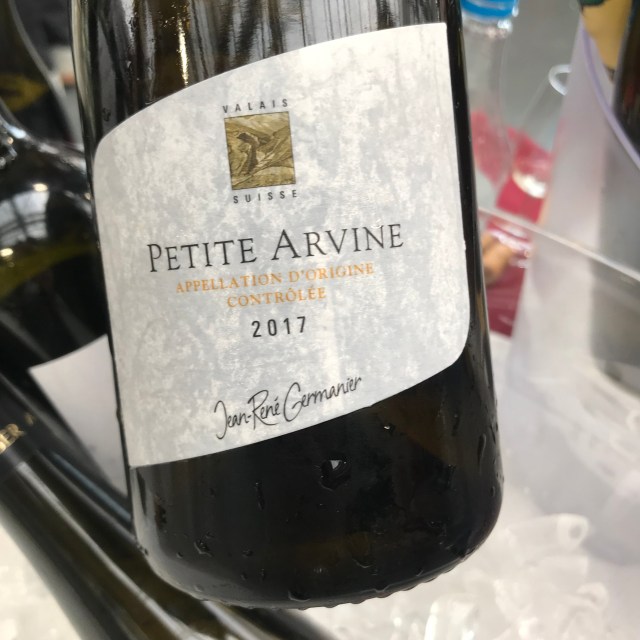
Petite Arvine 2017 (Maître de Chais) – Petite Arvine is possibly the most distinguished of the Valais white varieties. It also seems to me that it is the most consistent across producers, and I’ve been drinking Petite Arvine from the Valais and the Val d’Aosta for certainly over twenty years. The variety usually shows quite floral aromas (as this wine does). The palate is dominated by white peach, but the finish comes with spice, quince-dryness and a little grapefreuit acidity. It tastes clean and fresh but has a little body, fleshing it out.

Humagne Rouge 2015 (Maître de Chais) – The colour is a lovely, bright, ruby red. The bouquet has cherry fruit and a touch of earth. There’s still some tannic grip which will soften after a further year or two (although this is not particularly a vin de garde), and there’s bright (but not dominant) acidity. Along with Cornalin, Humagne Rouge is one of the most important, and interesting to connoisseurs, autochthonous red varieties in the Valais. You can tell by the wine’s lifted quality that it comes from altitude, and you need to understand that this is not a wine where the fruit will show surmaturité. In youth, it shows a more floral side, and with age it can develop a more animal nature. Expect to pay a little over £30/bottle for the Petite Arvine and Humagne Rouge.

img_5825

DOMAINE JEAN-RENÉ GERMANIER

The Germanier domaine, founded in 1886, is one of the Valais’ best known producers, including internationally, but you will see these wines in top restaurants and wine stores throughout Switzerland. They are based in the village of Balavaud, in the commune of Vétroz, just west of Sion. Jean-René currently runs the domaine with his nephew, Giles Besse. The domaine has always tried to produce wines with minimal pesticides but now they are in full conversion to organic viticulture.

Johannisberg Chamoson Grand Cru 2017 – Johannisberg is the Valais synonym for Silvaner (originally a Savagnin x Traminer cross, I believe), and this is a solid nod to that variety’s typical characteristics. It is a fresh, herby wine with a lifted bouquet which seems to reflect the glacial moraine on which the vines grow. The palate is also redolent of that minerality in a fine spine, finishing dry with slightly bitter quince. A fairly light wine, but as the Chamoson Grand Cru designation suggests, it has the potential to show a little more than it was showing on the night with perhaps an extra six months-to-a-year in the cellar. Retail approx £34.

Dôle Balavaud, Vétroz Grand Cru 2017 – This comes off gravels with alluvial deposits and large “galet” stones. Dôle is always a blend of Pinot Noir and Gamay (like a Bourgogne Passetoutgrain). Generally I have found it difficult to discover really satisfying Dôles, although the appellation is very popular throughout Switzerland. This one is better made than most, and I suspect yields are not so high as in many. The scent is high-toned cherry and the wine has a medium to light body, but it does not, I think, aim for great complexity. The fruit has a silky side and there’s a bit of grip. It’s only around £26 UK retail, a Swiss wine many of us can afford.

Cayas Reserve Syrah 2016 – It’s funny. I drank a bottle of this from an earlier vintage around a year ago, a bottle which Swiss friends had brought over among half-a-dozen stuffed into their suitcases. I had little idea that this wine retails at over £50 in the UK. It’s not that they are mean…they are very generous, but I doubted they would bring a £50 wine among a generous six bottle gift. What I find worrying is that this backs up everything that is said about Swiss wine being so expensive in the UK. The Germanier web site lists the 2016 for CHF42 (currently around £32).

In the Valais 2016 was a late vintage, saved by a long, fine and warm autumn. The grapes come off schist on slopes on the right bank of the Rhône. They see a 22-day maceration, and after fermentation, 24 months in barrique (50% new oak). The wine is coloured dark burgundy red. The fruits are more black than red, quite plush, and there’s a clear smokiness at this stage. The wine is young and still shows the wood not fully integrated. It needs time, perhaps a minimum of five years. It will be very good with longer in the cellar. It does show the brightness and structure you’d expect off schist. I think many would find this hard to judge because of the oak at this stage. Pop it away.

Cornalin Reserve 2015 – This off-list wine somehow appeared on the bar. This native variety is, to my mind, potentially as good as the perhaps better known Humagne Rouge. It also gets a different treatment to the Reserve Syrah, being fermented in 400-litre open top vats, and then aged 12 months in the same vessels (with a lid attached). It has a violet colour and more cherry fruit and smokiness on the nose. It’s also more animal and meaty on the palate than the Syrah, with a bit of texture too. A wine to age for less time, and one to pair with game.

img_5830

DOMAINE THIERRY CONSTANTIN

With all of these long-established producers, it’s quite nice to find someone more recently established doing well, although 2001 is not all that short a time to have been working the vines. Thierry makes wine at Pont-de-la-Morge, close to Vétroz (and therefore, to Sion). He only possesses 5.5 hectares of vines, but they are situated in some of those two communes’ finest locations. Quality is the only focus here, and as well as pursuing careful and thoughtful vineyard management, the domaine is noted for its very low yields. All the wines here fit the hand made, artisan, mould. Despite the small size of the estate, Thierry does manage to fashion around fifteen different wines each vintage.

Fendant 2018 – Fendant is the Valais synonym for Chasselas. Generally it is not a variety beloved of classical wine critics (who have clearly never tasted the versions made by Dominique Lucas, or Hanspieter Ziereisen). Swiss Chasselas performs remarkably well, both around Lake Geneva’s north shore (Vaud), and here in the Valais. It’s almost always a pale wine, bright and herbal with a dry acidity and a stony texture. The latter quality, which can sometimes remind me of stones inside the apricots for which this part of the Rhône Valley is justly famous, is particularly prominent here. It has crisp acidity and a quite light finish, but is an immediately attractive wine.

Petite Arvine 2017 – is a step up, with a deeper bouquet of lemon-lime citrus and pineapple. The wine shows a nice tension between nervosité and a little fat on the bone. The finish is nice and long, and there’s a good touch of salinity along with the stony texture. This, I think, will improve further with a little time in bottle.

Cornalin 2015 – was one of my wines of the day. The yield is around 35hl/ha, which is very low in a Swiss context. The nose has lifted dark cherry and a lick of red fruit acidity. The fruit is quite plump and plush (ripe too, 13.4% abv), but there is grip and tannin, which suggests that this will age well despite the attractiveness of the fruit. Thierry’s suggested food pairing? Saddle of deer. There you go.

All three of these wines retail in Switzerland for between 25 to 32 CHF, and seem good value at or near those prices, but as stated at the top of this article, they are not strictly available in the UK at the moment.

DOMAINE DES MUSES

This estate was founded in 1992 by Louis and Nicole Taramarcaz at Sierre, which is further up the Rhône Valley, below the twin ski resort of Crans-Montana. A decade later they were joined by their son, Robert, who has slowly taken over winemaking following his studies in Burgundy (Dijon). The vines are farmed ecologically, with minimal (but not no) use of synthetic applications, but they are committed to protecting indigenous flora and fauna.

Heida “Tradition” 2017 – is fermented, and then aged on lees, in stainless steel. The wine has a lovely lime citrus attack, showing nice balance between acidity and a little flesh. There’s a lightness to the wine, and yet I was told that this wine has ageing potential (conversely the Provins “Maître de Chais” Heida I own, not tasted here, is supposedly meant for consumption soon, so it can be hard to judge). Whatever its potential, I like it now, and I’ve been a fan of this domaine for several years.

Cornalin “Tradition” 2016 – As with the Heida above, this is a right bank wine. Imagine the sun-baked terraces above Sierre, perhaps facing the Val d’Anniviers on the other side of the river. Vinification is also in stainless steel, but here the similarities end. You get quite pure cherry and blackberry fruit which seems as lifted as the altitude at which the grapes are grown. There’s also a floral element, not so much with the bouquet, but oddly, on the palate. It adds something, neither herby nor mineral, but nice. There’s also a good lick of tannin, making this a wine to age for three or four years, if not a little longer.

Syrah “Réserve” 2016 – The four Reserve wines from the domaine are all made with French varieties, although both Syrah and Pinot Noir are very common in the Valais, and can produce fine wines. There are around 170 ha of Syrah planted in the Valais. This may be one of the smallest Syrah vignobles in any major Syrah-producing nation (there is little elsewhere in Switzerland) but it’s still not bad, and not massively behind the whole of New Zealand up until fairly recently.

This is a wine both fermented and aged in oak, with an élèvage of 18 months. It is quite dark-fruited, flavours accentuated by a little spice and a hint of liquorice. It’s a wine of depth and a wine (again) for ageing. It will certainly go a decade, I would suggest. But that said, it’s still a very attractive wine, a shame to open too soon but not a disaster if you did. Some Valais Syrahs get the oak wrong, in my opinion. This one doesn’t, unless you are perhaps very oak averse.

I’ve really concentrated on the wines. Some of the art is represented in the photos below, interspersed with some of the bottles. I always enjoy drinking Swiss wine, but there are far too few opportunities to actually taste Swiss wines in the UK. If the Swiss are serious about entering the UK market then tastings like this one are essential. They won’t crack things off the back of Alpine Wines‘ hard but lonely work, and the rare appearance of the wines of Domaine de Mythopia when occasionally shown by Newcomer Wines.

Of course, if you are the kind of adventurous wine drinker who I know reads my blog, you could always grab an exploratory six-pack from Alpine. That’s what my wife bought me for Christmas. If you do, go for the native varieties such as those tasted here, with some Chasselas from Lavaux’s steeply terraced Crus in the Vaud. It is time we encouraged more of them onto our market. Watch this space.

From top left, Joelle Nebbe-Mornod of Alpine Wines and a selection of the IWArtChallenge labels and assorted bottles at Wringer & Mangle 


Posted in Grape Varieties, Swiss Wine, Wine, Wine Labels, Wine Tastings | Tagged , , , , , , , , , , , , , , , , , , , , , , , | 3 Comments

Recent Wines March 2019 #theglouthatbindsus

I was overloaded with lovely bottles at home last month. Here are the fourteen I couldn’t leave out, wines from Catalonia, Jura, Côte-Rôtie, Burgenland, New Zealand, Alsace, McLaren Vale, Piemonte and Vienna, so let’s not hang about.

Sumoll Ferèstec Clos Lentiscus 2010, Bodegas Can Ramon (Catalonia, Spain)

The vineyard of Clos Lentiscus produces what for me are certainly the best Spanish sparkling wines I know, from Can Ramon’s base at Sant Pere de Ribes, inland from Sitges and southwest of Barcelona. Sumoll Ferèstec is made from the red Sumoll variety, grown biodynamically and vinified as a blanc de noirs. This bottle fermented wine spent thirty months on lees and was disgorged in April 2016 (just 720 bottles were made of this very special cuvée.).

The colour is something between pale pink and light bronze. It’s bottled as an extra-brut, so is dry, but local honey is used as a dosage at disgorgement. The red fruits are concentrated with a lifted iron-rich note on the bouquet. I last drank this same wine in April 2017, and it only seemed slightly more mature here than that previous bottle. I’m sure that this is because it has retained an elegant structure. Despite some notes of maturity, it equally remains very fresh. This proves that Sumoll is a remarkably versatile, and top quality, variety. This was stunning.

I’ve seen some Clos Lentiscus wines at Furanxo on Dalston Lane, although this cuvée came from Barcelona.

2ca1a952-80f0-4ddf-9bb4-c5bc59778e2f

Metamorphika Moscat Brisat 2015, Costador Terroirs Mediterranis (Catalonia, Spain)

Costador is Joan Franquet’s umbrella for a host of magical wines, including the Metamorphika range in their distinctive flagons. “Brisat” denotes a skin fermented wine in Catalan, and this one was a beautiful luminous yellow (not orange) colour. The bouquet has that obvious Muscat/Moscatel florality, but with an earthy, herby note as well. For me, beautifully scented. It’s dry, and has the firm structure of a wine which spent eight weeks on skins and then seven months in barrique, and the texture gives a solidity to a very smooth palate, surprisingly long for the variety. Adorable stuff.

This is available, along with a large range of Costador wines, via importer Otros Vinos.

70b921b2-f4f4-44bc-862d-c2210860f95c

Mont D’Alicante Vin de France, Domaine L’Octavin (Jura, France)

I can usually find out where Alice Bouvot sources her grapes for her negoce wines, but in this case I’m stumped. The blend is Alicante Bouschet (I know Alice sourced Muscat in Roussillon for Betty Bulles but there is a bull on the label), and the last time I saw her was the day after collecting some grapes from Savoie…the other variety here is Mondeuse.

This moderately alcoholic wine (12.5%) is just so alive it almost sets your mouth alight. Zippy-fresh, there was an initial volatile note but nothing scary, and it went with a shake. This wine is basically a pure fruit bomb, easy drinking but a tour de force of juicy simplicity. Wish I’d bought a six pack.

I’ve not see Mont d’Alicante in the UK, and I purchased this in Arbois in December last year.

c17493a6-cc09-4c0e-b3d8-aadeae48396c

Côte-Rôtie 2003, Michel & Stéphane Ogier (N. Rhône, France)

I have quite a few of the vintages of this wine from the 2000s. I was advised that I should drink the 2003 pretty soon, and as I recall it being a plump vintage (even a magnum of 2003 from Jasmin being ready a few years ago), I thought I should pop it open before the weather gets too summery. I was pleasantly surprised.

This is Stéphane’s blend of Côte Brune and Côte Blonde fruit, and hails from the period when he was taking over from his father and beginning to make a real name for himself. The wine is quite rich, with ripe plummy Syrah fruit. Perhaps the fact that this bottle hasn’t moved since purchase helped, as other drinkers suggest this peaked at the latest last year. It certainly has depth, though only a little meatiness. Intense, fragrant (violet top note) and long, not the best Ogier by any means but a very good bottle. Best to drink soon, though.

I bought pretty much all my Ogiers from Waitrose during 25%-off promos.

4daea3ae-b41d-4fc0-b314-f732f6acb843

[Wiener] Gemischter Satz 2017, Weinbau Sackl (Vienna, Austria)

This is the first of two Wiener Gemischter Satz in this month’s selection, but they are very different. What they do have in common is their derivation, from the Bisamberg hillside on the left bank of the Danube, just before it flows through Vienna. Patricia Sackl is the oenologist here, husband Florian (a trained geologist) generally looking after their biodynamic vineyard. The wines are made with minimal intervention at all stages.

This field blend has a slight initial spritz which dissipates quickly. It was also slightly reductive, and a carafing might be worth contemplating. Straw coloured, it has a straw-like bouquet too, also herby, and then a floral strand comes in. The palate is fresh and flowery as well. It’s a simple kind of Gemischter Satz, in what many call the “classic” style, with elderflower and apples combining nicely in a very glugable wine.

This came from Vinifero, one of Vienna’s “natural wine” shops.

img_5385

Müller-Thurgau “Skin Fermented” 2017, The Hermit Ram (Christchurch, Canterbury, New Zealand)

Another orange wine, and very orange this time (actually, more the colour of pale caramel when the lees are all shook up, but please don’t let that put you off). Someone described it to me as “brutal” but I’m massively impressed by everything Theo Coles is doing, and everything he does is “skin contact”. He takes a variety here that used to be New Zealand’s mainstay before Sauvignon Blanc was planted. I’d say he strips it of varietal character, but Müller-Thurgau never has a lot of that. Theo can therefore use it to express terroir. The vines are one of the oldest plantings of MT in NZ.

It’s a rugged wine, all apples and oranges with a bit of that terracotta whiff, slightly dusty (though it isn’t made in amphora but a mix of vessels including a concrete egg). Wine in an open top fermenter had six weeks on skins, after which it went into very old oak for malo, whilst that in the egg remained in contact with the skins for 168 days. There’s a good bit of zip, assisted by its cloudy lees, some texture and structure. At the same time it’s incredibly fresh, and surprisingly refreshing. It is ferociously cloudy, and here the lees certainly add to its character. It comes in at a mere 9.5% abv and is bottled under crown cap.

The Hermit Ram is easily one of my top dozen new (to me) producers of last year. Imported by Uncharted Wines. I’m not sure of retail outlets, but I know Vino Vero in Leigh-on-Sea (Essex) has some Hermit Ram. Pinot Noir is a speciality (several cuvées), and Theo makes a Sauvignon Blanc like no other in NZ. These are astonishing wines. Astonishingly different, to be sure, but astonishing!

aed2db8a-3d59-4477-8a6d-b43310b7eaf3

Pinot Blanc 2017 “Cuvée Nature”, Anna, André and Yann Durrmann (Alsace, France)

The Durrmann family occupies a winery on the edge of Andlau, in the less well know Bas Rhin, but Andlau is next door to the most vibrant village for Alsace natural wine, Mittelbergheim. The Durrmanns, with son Yann now taking over, have always been ecologically minded. If you read about my visit there in 2017 you would recall their electric cars, their use of sheep and encouraging bird life in the vineyard. But not all of their wines yet fit a stricter interpretation of the category “natural wine”. Those that do, and which are bottled with no added sulphur, are labelled “Cuvée Nature”.

That fact is interesting because a few people have suggested that this no added sulphur version of their Pinot Blanc is better than the other (which I have never bought). This is another wine that showed a little reduction on opening, but it blew off without need for a vigorous swirl. The acidity is quite high, but the wine is zippy and mineral, so it is very refreshing. Definitely more a summer wine than one for March, except that we did open it during a spell of very warm weather. You need to enjoy acidity to like this, and it is one of the lighter Pinot Blancs you will buy (just 11.5% alcohol), but obviously as I felt it worthy of making the cut for March, I enjoyed it very much.

This bottle came from the take away wine list at Plateau in Brighton, but the importer is Wines Under The Bonnet. Restaurant take away lists can be an excellent source for even more hard to find wines. Some wines are pretty much only distributed to restaurants, but the take away list often allows a few lucky punters to carry something exciting home with them after lunch or dinner. Always remember, as I said in my last article (on lunch at Silo), to take a long peek at the list if take away is an option. Plateau prices are, in my opinion, particularly generous (and intentionally so).

f40c5047-4ce5-4851-b741-ceb880c84413

NDV 2016, Brash Higgins (McLaren Vale, South Australia)

Brad Hickey continues to make some relatively undiscovered wines (on the UK market). Several are as exciting as any of those made by the younger guns of the Adelaide hinterland, if perhaps slightly less wild than some. NDV is the Brash Higgins acronym for Nero D’Avola, here sourced from Brad’s Omensetter Vineyard where it was grafted on to existing root stocks in 2009.

NDV is an amphora wine (a nod to COS, perhaps). It is kept on skins for 180 days in 200-litre, beeswax-lined, amphora which are made locally. Just as well when it comes to accidents – I remember seeing a photo a year or so ago after Brad had driven the fork lift into one. There’s bags of fruit here, which is dark and dense, but the amphora gives the wine an amazing freshness. Imagine a fruit smoothie with lavender, ginger and half a teaspoon of coffee grounds, but all blended together and lifted by nice acidity. At 13.5% abv it nevertheless, perhaps surprisingly, doesn’t taste remotely heavy or jammy.

It’s in my top three Brash Higgins wines. I just need to get near enough to a branch of Vagabond Wines in London to buy some more. All of Brad’s Amphora Project wines should definitely be on anyone’s list to try.

5749b9f0-2288-4332-a8a3-a22b575465a5

Barbera d’Alba “Reis” 2014, Marchesi di Barolo (Piemonte, Italy)

I had a phase in the 1990s and 2000s of going to Piemonte quite a few times. It’s one of Italy’s most beautiful wine regions, and completely overshadowed in terms of general tourism by Tuscany, unfairly I think. Those Piemonte lovers I know tend to think mainly of Barolo and Nebbiolo, but Barbera has long provided excellent food matching potential, as you will discover in any restaurant in the region.

Barbera tends to get second rate sites in the Langhe, where Barolo/Nebbiolo reigns. The material for Reis does come from the Barolo and Barbaresco zones, but it is a well thought out wine, quite commercial but well made, and that’s why I’ve included it here. Ripe grapes are aged in small French oak. I said “material” above because, in full conformity with the DOC rules, this wine is 85% Barbera and contains 15% Nebbiolo.

Reis is quite full-bodied for a Barbera, the oak filling it out, but it does have the grape’s characteristic lifted acidity. The dark fruits are crunchy and the finish bites. I’m not sure how the Nebbiolo contributes but perhaps it softens that finish a little.

I’m not sure whether this is available in the UK. I can only see German retailers online. This bottle came as a gift from a Norwegian visitor a couple of years ago, doubtless via Vinmonopolet. Retail in Europe is probably just sub-€15. For that price I thought it was pretty decent.

be447865-05c9-44d9-af12-b05cb36e35a5

Josephine Rot 2012, Gut Oggau (Burgenland, Austria)

I tried the new vintage of Josephine at Raw Wine London, and it was so good it made me crack open this 2012 from my stash of Gut Oggau in the cellar. I say it often enough, but this biodynamic estate in the village of Oggau, a kilometre or two north of Rust on the Neusiedlersee’s western shore, is one of my favourite in the whole world. This is one of the freshest and most alive reds you will find in Burgenland. The blend is Blaufränkisch with Roesler (a 1970 cross between Zweigelt x (Seyve Villard 18-402 x Blaufränkisch)).

Josephine’s vines are 35-to-40-years-old, off gravel. The grapes are simply fermented and then aged in large oak, and after around eight months are bottled with no sulphur added. Low intervention is the key, with not even any batonnage/lees stirring. Josephine is dark-hued and the fruit is super concentrated, mainly blackcurrant. The wine is, however, light on its toes whilst also pleasantly grippy. I find it the most refreshing of Gut Oggau’s red wines.

There are many biodynamic estates which provide solid evidence that the renewed life of the vines comes through loud and clear in their wines. There are a handful where this “life” is seemingly enhanced even further, somewhat fancifully perhaps, as if the obvious passion of the farmer, in this case Eduard and Stephanie Tscheppe, glows in the glass. This is one of those estates. I find drinking their wines life-enhancing. And if you think I’m on something (only caffeine, I assure you), then I can tell you, I’m not alone.

Bought from Dynamic Vines.

20f04115-e835-4b0b-984b-9fdeeb33dd41

Côtes du Jura Ploussard “Point Barre” 2016, Philippe Bornard (Jura, France)

Bottled as a Côtes du Jura, you can probably locate the Bornard winery to Pupillin by the choice of Ploussard rather than Poulsard on the label. The Bornards farm around 7 hectares, with a little under a hectare outside of the Arbois-Pupillin appellation, and therefore labelled Côtes du Jura, at Buvilly, down the road. Philippe has retired now, and winemaking is in the very capable hands of his son, Tony, but in 2016 they were a team. The quality of the Bornard wines has been up towards the top rank in the region for some years, evidenced by the rather elegant and fine 2011 Vin Jaune I drank a couple of weeks ago (see my “Sportsman” article of 2 April).

This is one of those Ploussards that are unimaginably attractive just to look at, a vibrant palish red-pink, verging on luminous, rather like looking through a cardinal’s cloak in the stained glass of a French abbey church on a sunny day. Of course, there is undeniable reduction on first sniff, but that is frequently the case with modern “natural” Ploussard. Whether you splash or merely swirl, the most lovely, almost exotic, fruit does come through. The mouthfeel is smooth but the “fruit acidity ” balances the wine perfectly. This is unashamedly a natural wine, but I’m just so glad I have more of this.

This came from Solent Cellar in Lymington.

2ecaa4b3-1d79-4b3e-a76d-e68b88b570ac

“Les Dentelles” 2017, Anne & Jean-François Ganevat (Jura, France)

As if J-F didn’t have enough to keep him busy farming his famous ten hectares at La Combe de Rotalier, way down south of Lons-le-Saunier in Jura’s Sud Revermont, he, and sister Anne, produce an astonishing array of different negociant cuvées based in some cases on Jura’s ancient grape varieties, and in others, on grapes from outside the region.

Les Dentelles is an equal blend of Syrah and Grenache. Ganevat has a strange knack of disguising alcohol, and although this bottle had 14%, it tasted remarkably fresh, nimble and even light(ish). The grapes spent twelve months in amphora, which is always the perfect vessel if freshness is at the top of your list of requirements, because if properly lined the terracotta has a degree of contact with the wine, allowing in air (micro-oxygenation), but also imparting an edge to the juice. No sulphur is added, which most of those who eschew its use feel mutes the wine somewhat. The fruit is massive, and that’s what shines here, mainly red fruits with violets and a bit of added spice.

Friends brought this when stopping over, actually before a trip to Arbois, this year. They seem to have censored the label. Maybe this isn’t the place to join the debate on Fanfan’s rude ones, but this one in the flesh is mild (and there’s minimal flesh).

I’ve mentioned before that Solent Cellar almost always has a selection of Ganevat. The importer is Les Caves de Pyrene.

465ba44b-c158-44ad-a033-8998436f1bb9

J12, Meinklang (Burgenland, Austria)

The “J” here stands for the Juhfark grape (and “12”, the vintage). Meinklang is a famous biodynamic mixed farm at Pamhagen to the south of Neusiedlersee, but Juhfark is a native variety of the small volcanic plug known as the Somló Massif, situated in Northwest Hungary pretty much between the Austrian border near Pamhagen and Tokaj. I’ve told the story (more than once, I’m sure) of how the Michlits family owned vines there before the Iron Curtain came down, and how the current generation bought land there to continue that tradition after the fall of communism.

The Meinklang holdings in this smallest (just over 800 hectares) of Hungary’s wine regions sit below towering lava columns. They have both Hárslevelű and Juhfark varieties planted. This was a bottle I’d owned for maybe three years and had forgotten about. I’m glad I had. This poured golden with a beautiful bouquet of lime and nuts. It had the mouthfeel of a Chardonnay and the acid bite of a Savagnin, with a bit of skin contact texture to ground it. The underlying fruit was quite rich. The variety seems perfectly suited to Somló’s volcanic soils, and on this evidence seems to age well too, perhaps age softening the grape variety’s innate acidity (Meinklang call Juhfark “fiercely masculine”). Stunningly different.

a86b2a81-2b40-4028-b768-cee678398a06

Wiener Gemischter Satz “Bisamberg” DAC 2015, Wieninger (Vienna, Austria)

Whilst the Gemischter Satz made by Patricia Sackl (see above) is a reflection of the old heuriger tradition of serving a simple field blend wine in the local inns, a wine of vivacity and simplicity, this is altogether different. Like Nussberg on the opposite side of the Danube, Bisamberg has a DAC. Wieninger is known for making the most serious of the wines from these two sites, wines with a fuller body than the “classic” version (which they also produce in greater quantity).

This is a wine to age at least a few years, as this 2015 shows. It blends Chardonnay (20%), Weissburgunder (40%) and Grauburgunder (40%). Bisamberg is covered in sandy loess on a base of chalky limestone, and the Wieninger vines, planted on a site called Ried Hochfeld here, have been farmed biodynamically since acquisition in 2012. As for all Gemischter Satz, the grapes are all harvested and vinified together.

The 2015 has delicate grapefruit aromas with a smoky note. The palate has stone fruits and herbs, with a soft mineral texture which may derive from the chalk content, the limestone giving brightness and lift. At 13% abv, higher than the “classic” Gemischter Satz wines, it is better suited to accompany food rather than as a summer thirst quencher. It’s a classic old vine cuvée, showing complexity, and also if you sample the other site-specific bottlings from Wieninger (Ried Rosengartel and Ried Ulm, for example, both off Nussberg) you will see very clear terroir differentiation. These are very fine wines, as well as the purest expression of a modern interpretation of the long Wiener Gemischter Satz tradition.

Wieninger’s UK agent is Liberty Wines. 

If you’d like to read my longer article about my visit to Wieninger in August 2018, follow the link here.

cca7a68d-5383-486e-b498-5bab4ccb8199

Posted in Artisan Wines, Wine | Tagged , , , , , , , , , , , , , , , , , , , , , , , , , , , , , , , , , , , , , , , , , , , , , | Leave a comment

Missile in the Silo

There’s a fantastic new restaurant heading to London later this summer. Brighton’s loss will be Hackney’s gain, because when Silo‘s lease ends they will be moving north. Silo is many things, but its claim to fame is as the UK’s first zero waste restaurant. Before I write about the lunch that three of us ate in the Brighton venue last Friday I think it’s worth telling their story, and outlining their philosophy too. It might not be easy for others to follow their lead in all its aspects, but many restaurants could incorporate some of these ideas.

The Silo motto is “Reuse, Reduce, Share, Repeat”. They aim to respect not only the environment, but the produce they use and cook. They make their own soft drinks, mill their own flour to make their own (wonderful) sourdough bread, churn their own butter and make almond milk. Silo also follows a nose-to-tail philosophy with meat and aims to source ingredients as locally as possible.

img_5751

All deliveries must be in reusable containers, and any waste is composted in Silo’s “aerobic digester” (which they share with commercial and residential neighbours), although the menu is conceived in a way which minimises waste, and surplus usable food goes to the charity FareShare, supporting local vulnerable people. Upcycling is another aspect of the Silo philosophy, to reuse rather than recycle where possible. Check out the tables and chairs.

The menu uses a changing array of in season (including foraged) and “cleanly farmed” ingredients, avoiding unnecessary processing, and where processing is required (for example, milling flour), it is carried out using pre-industrial methods, on site.

All of this is worthy, but would matter not one bit were the food not of the highest order. I went to Silo not all that long after it opened in Brighton, but I always felt that it didn’t quite stimulate my need for the wine offering to be just as exciting as the food. More recently, the wine list has been revamped with the help of Ania Smelskaya, ex-Sager & Wilde and Plateau. Silo now has a frankly stunning list of natural wines.

The dishes at Silo are half way between small plates and larger selections. One of our number is vegan, so we selected three vegan plates and two meat. Radicchio salad was a feast of sweet and bitter fresh leaves. Shitake mushrooms were firm and fresh, and chick peas with hispi cabbage and caramelised onions was sweet and substantial. The crispy breaded pig’s ear, which lit up the face of one guest, was frankly the best ear of pig I’ve ever tried. Pork belly was again more substantial but tender. The quality of the ingredients shone through here, but I think this was equalled by the kitchen, who cooked the food with great sensitivity to the dishes’ innate flavours and textures.


We drank what was a perfect aperitif on arrival, Rio Rocca Frisant Bianco, Il Farneto. Il Farneto is an eight hectare estate in Emilia-Romagna, and this white frizzante is a blend of Sauvignon Blanc with local variety, Spergola. The second fermentation is made with must from the same grapes and the wine is fragrant, light and dry, made cloudy from the lees. The alcohol level seems low, but is actually 11.5% on the label. I’d never tried this wine before, but Silo currently has it by the glass.

img_5733

The first wine gave us the chance to read through the now more substantial Silo list. The task was to select natural wines which would interest a friend who doesn’t drink a lot of natural wine, though is very open to try them. I went for a classic, despite having drunk this fairly recently, and having a bottle left at home. If Jura (okay, along with Burgenland) is where my wine heart lies, then this Arbois producer is certainly in my top half-dozen producers in that region.

Betty Bulles, Domaine L’Octavin is a petnat, a blend of direct press Gamay from the Ardèche with Muscat sourced near Perpignan in Roussillon. The wine has persistent tiny bubbles which carry the slightly bitter red fruit of the Gamay. The Muscat doesn’t dominate the bouquet, but it must add to the floral lift that is undoubtedly there. Alice Bouvot began making wine from grapes harvested outside the Jura region several years ago after some very small harvests, and she now makes a lot of negoce wines. The gnome motif is however home-based. Several live, and perhaps watch over her ageing wines, in the garage which serves for L’Octavin winery in the back streets of Arbois.

0dddcb70-6114-4554-9439-d2dfbed1509a

Our final wine was another from the by-the-glass selection. λ13, Ktima Ligas (the wine is generally called Lamda) is one of Thomas, Jason and Meli Ligas’s wines from Pella in Northern Greece, made using permaculture techniques which require almost no vineyard interventions (certainly no chemicals, and minimal if any pruning, just repositioning of shoots). The wonderful ecosystem Thomas has created does pretty much all the work.

This particular version of Lamda is a blend of 60% Assyrtiko and 40% Roditis. The fruit is gently peachy, underpinned with a gentle minerality, expressing the terroir, which is part limestone and part sand and clay. The grapes see a short three day maceration on skins before ageing in old oak, adding just a little texture.

img_5743

This is another wine with no added sulphur, yet it tastes (at least to me) clean and fresh without any frightening volatility. I genuinely believe that if you drink natural wine that has been shipped and cared for properly, there should be minimal issues with spoilage and volatility.

Two of us finished with a cheese selection (British, from Neal’s Yard…Silo does not yet have its own herd for cheese making), whilst the other enjoyed pumpkin ice cream.


Altogether, a spectacularly good lunch. Silo is at 39 Upper Gardner Street in Brighton’s North Laine, perhaps a ten minute stroll from Brighton Station. It seats 40, and serves lunch only on (currently) Friday, Saturday and Sunday. Dinner is served Wednesday to Saturday, 6pm to 9.30pm.

Booking recommended: http://www.silobrighton.com

I would strongly recommend a visit before Silo moves. They close in Brighton at the end of May (2019) and will open in Hackney perhaps in late July or August (follow them on Instagram for updates @silobrighton ). As for Londoners…I come up to London week-on-week for lunch. I think that it’s hardly any more difficult for Londoners to come to Brighton for the same. There’s Silo, and there’s Plateau. And there’s sunshine and there’s sea. Come on down. And whether at Silo or Plateau, don’t forget to raid the take away wine lists.


Posted in Artisan Wines, Dining, Natural Wine, Wine | Tagged , , , , , , , | Leave a comment

Sportsman March 2019

My annual trip to The Sportsman at Seasalter came early this year. I always look forward to lunch in this self-styled “grotty pub” in an out of the way location on the North Kent coast, which serves what for me is a tasting menu that hasn’t yet been surpassed anywhere I’ve eaten in the UK. The creativity in the kitchen, coupled with the quality of the ingredients, almost all sourced locally, is astonishing. It takes me more than three hours to get there, and usually longer to get home, probably not aided by a couple of bottles of wine, but it is wholly worth it.

img_5625

The group of us that headed down to Kent a little over a week ago was slightly smaller than usual, just five of us, taking two bottles each, although I took a bottle of Champagne plus the two halves at the end of the meal. We ended up with a really nice mix of classic wines and a couple of natural wines, from a group that drinks widely and is completely open to any style. The wines were quite fluid between courses, and especially with the whites we tried different things with different dishes to see which worked best. I’ll just weave the wines in as they came.

Thirsty from a long journey we popped open my Champagne to start with, Vouette & Sorbée Fidèle, Bertrand Gautherot’s Blanc de Noirs cuvée. Like all his wines it is biodynamic, vinified in oak, and bottled with minimal sulphur. This was disgorged in February 2017 (with a 2014 Lot number). The vines are on Kimmeridgian soils at Buxières-sur-Arce on the Côte des Bar. This cuvée is notoriously closed immediately following disgorgement, but after two years it has opened a lot, mouthfilling, with secondary autolytic character over red fruits.

img_5627

The first oyster course (there were two) was frozen oysters with brown butter, honey, lemon and apple. This dish was created knowing we were bringing a Chablis Montée de Tonnerre 1er Cru 2012, Raveneau, so we quickly switched to that bottle, which had been given a little time to breath. It was indeed a match made in heaven. Although not a Grand Cru, this 2012 was “classic Chablis” and very fine indeed.

Very mineral, with an almost Riesling-like spine of taut acidity from which hangs lean but vivacious stone fruit and pear flavours. You get a classic whiff of graphite and an equally classic oyster shell texture on the palate. Montée de Tonnerre is one of the larger Premier Cru sites in Chablis, and the wines don’t always live up to expectations from all producers, but in this case it did, and more. A reminder that top Chablis can be a remarkable drink.

img_5630

img_5629

Between the oyster courses we were treated to something with spice and bite, by way of pork belly with mustard, accompanied by an apple and sorrel foam. The pork belly was crispy and the mustard fresh and piquant, the foam providing a nice foil, drying, contrasting.


The second Champagne was a big contrast to the first, and oddly this was the only wine which two of us had independently suggested bringing. Jacques Lassaigne Les Vignes de Montgueux  Extra Brut is a Blanc de Blancs made by Emmanuel Lassaigne in the tiny region of Montgueux, effectively one hill of a little more than 200 hectares of vines to the east of Troyes. This is 100% Chardonnay, partly vinified in oak. It’s “big”, but more in the way it fills the mouth than the roundness and near opulence of the Vouette & Sorbée. It is quite linear and tight, but also amazingly fresh.

The vines at Lassaigne face mostly south and can get very ripe, sometimes exhibiting quite exotic fruits, but the acidity and structure are held in place by the class of old vines and Emmanuel’s careful winemaking. These are stunning Champagnes from a producer I rate really highly. “Les Vignes…” is the entry level NV here, but it is a true terroir wine. He also makes the House Champagne for the Cave des Papilles in Paris, another Blanc de Blancs which I think may have no added sulphur, and currently costs a mere €31, quite a bargain for a producer whose top cuvées cost five times that. Naturally stocks are limited.

img_5634

The second oyster course appeared as we were all vocally admiring the Lassaigne. Native oyster with chilli paired with a rock oyster with beurre blanc, cucumber and caviar was so well constructed, and so totally different to the frozen oyster we opened with. The chilli in the native oyster was perfectly judged to prick the palate like a needle, but not to coat it. The beurre blanc was smooth and heavenly.


We were a group who, none of us, regularly drink Sauvignon Blanc. This is not prejudice, but perhaps a reflection of our diverse interests in regions which don’t grow it. But when the opportunity comes along to drink a good one, whether from The Loire, Bordeaux, New Zealand or even Styria, then we are glad to take it. I certainly don’t own any Blanc Fumé de Pouilly “Silex” 2014, Didier Dagueneau. “Silex” is one of two barrel-fermented Sauvignons made by Didier’s son Louis-Benjamin (Didier of course died in a micro-light crash in 2008), and comes off pure slate (or silex).

It’s big for a Sauvignon Blanc, not just because of the oak, but it is very ripe too (13% abv). That said, the varietal character does meld with the obvious oak influence in what is a relatively young vintage for this wine, coming through as vivid freshness and firm minerality on the palate. The quality of the fruit, and the terroir, is perhaps reflected in the way that whilst you undoubtedly get oak on the nose, there is also what whiff of flint, so fine that it cuts right through it.

img_5638

The next two courses show so well how inventive the kitchen is at The Sportsman, although photos of the food do not come close to explaining the subtle but thrilling flavours of these two plates. Pot roast black cabbage on a bed of stewed apple purée and raw crème fraiche sounds simple, but it was a dish where everything was in perfect proportion and perfect harmony.

Mushroom tart with celeriac blends perfect, wafer-thin, buttery pastry, and rich meaty mushroom (dried ceps and chestnut mushrooms) in a celeriac foam. I think it was sprinkled with black truffle and possibly some cep powder. There’s a recipe for this posted by the chef, Stephen Harris, on the web site “thestaffcanteen.com”, but I’m not sure I could get close to this if I tried it out, one of The Sportsman’s most magical creations.


I think it was about then that the Ganevat came over. Les Cèdres 2015, J-F and Anne Ganevat is a negoce wine, despite wearing the domaine-style label. The Chardonnay vines are 80 years old, a limestone and marl parcel somewhere within the Côtes du Jura (nothing more forthcoming than that). Ageing was for 30 months, first in larger demi-muids and then in barrique.

It’s a beautiful Chardonnay, quite tight and young on opening, but it blossomed into a beautiful mixture of purity and concentrated fruit. Although the wine saw almost no sulphur, it didn’t have any volatility, nor really any reduction. Just an impressive old vine Chardonnay and I think in a unique style. You might still find the odd bottle of this around, even though it was not produced in anything but tiny quantity. Solent Cellar lists some (£40) and The Good Wine Shop (£44).

img_5641

The Ganevat, and the remainder of our preceding wines, with the exception of the Ravenneau, which had been drained by this stage, paired with the two fish courses. The first must be the classic signature dish here at The Sportsman, slip sole grilled in seaweed butter. This dish is almost embarrassingly good, cooked to absolute perfection every single time I eat it. It falls off the bone and melts in the mouth.

It is also the catalyst for a comparison with the Noble Rot version. The kitchens are overseen by the same man, Paul Weaver in charge in Lamb’s Conduit Street, with Stephen Harris from The Sportsman as Consultant Chef. The Noble Rot version is cooked in “smoked butter”, where the flavours are from sweet smoked paprika and a nip of chilli powder. I cannot decide between the two, and the pleasure comes in knowing you can have the same fish cooked two equally exciting, different, ways.


Although the slip sole is hard to beat, if anything were to surpass it I think my dish of the day might have been halibut braised in Vin Jaune with a single morille and an asparagus tip. The sauce here was so concentrated and of perfect consistency, and for a tasting menu the halibut was a nice, firm chunk. It made a lovely change to the turbot we usually eat here, much as I swoon over turbot. The Vin Jaune in the sauce was subtle, which didn’t overpower the fish.

440f704c-f1ce-4dda-9171-54ad92fcf52b

We started out with three reds with which to accompany the single red meat course, but sadly the first of these, Gevrey-Chambertin Vieilles Vignes 2011, Sylvie Esmonin, was corked.

img_5645

Barolo Bussia “Romirasco” 2004, Aldo Conterno had been waiting in a carafe and so was ready to leap in. Classic tar and (for me) violets rather than roses on the nose, the fruit was smooth and fresh, despite 14.5% alcohol. Even now it still has a youthful touch to it, assuming you like your Nebbiolo mature. This is a good example of the vintage. If you read my recent article on “Nebbiolo Day”, where all those young Nebbiolos were on show, you would appreciate how a wine like this reveals what all the fuss is about. This one took fifteen years to get to where it is, but such careful cellaring pays mighty dividends.

img_5646

The red meat course was not, for once, the Sportsman classic of lamb from the salt marshes, but rib of Sussex beef in a red wine sauce with powdered roast garlic and watercress purée. The beef was wonderful, and so good I could have gone for seconds. The seasoning gave it an umami note that added another dimension, but subtly.

img_5650

The second red wine, not in any way to diminish the Barolo, was a privilege to drink. Before trying to describe Brunello di Montalcino Riserva 1990, Casse Basse di Gianfranco Soldera sensibly, it would be wrong not to repeat my thoughts on my first sip, “holy mother of…”. A special wine on a special occasion is a winning combo, but will I drink a better classic red wine this year? I will be hard pushed (though I’ve got nine months left to give it my best shot).

This wine is nowadays labelled as an IGT Toscana, but back in the 1990s was still labelled as Brunello. A Riserva was only produced in top years at Casse Basse, and I dread to think what the bottle cost. 1990 is one of the estate’s most famous vintages. The wine was served from the bottle. The late Gianfranco Soldera always insisted that his wine should be tasted when the bottle is first opened, and then left to open out in the glass. This way, he said, you won’t miss anything.

The fruit is rich, both fresh and dried, with figgy, plummy, cherry complexity. The next level of tertiary flavours and aromas cover coffee and new leather, with a touch of spice, perhaps nutmeg. It’s complexity can be dissected, but to be honest the way this wine sits in your mouth is just so silky, that the experience is primarily a sensual one, in the most positive way. Some have said that this is one of the greatest wines of all time. It’s probably not far off the mark.

img_5649

The next course demonstrated The Sportsman’s inventiveness and willingness to perfect an idea. How to give these guys something different to go with their Vin Jaune? Home made hot cross bun with comté and black truffle proves tasting menus can leave you full. This astonishing dish could have been lunch on its own, almost, in other circumstances. Very intense, rich, flavours, contrasting sweet dried fruit with dripping cheese savouriness. Just look at it!

img_5652

Vin Jaune 2011, Philippe Bornard, Arbois-Pupillin was certainly a young wine, but one of those VJs which can be broached young. By this, I mean that the acidity and texture does not completely dominate the glass. I’d call it “light to medium”, with nice vibrant fruit. It has a savoury edge, but it isn’t wholly over in the nutty spectrum. The lightness and acidity made it a good match for the hot X bun, cutting the richness of the butter and melted Comté.

img_5651

The final two wines were served from halves to accompany the classic, ever successful, bramley apple soufflé with salted caramel ice cream, a dessert of the absolute highest order, with the purity of the slightly lifted bramley fruit coming through in a pure, clean, line to act as a foil for the richer, salty caramel. And then the cheese course.

img_5654

img_5657

Château Rieussec 1996, Sauternes looked somewhat darker than I’d expected it to when removed from the cellar. It’s not a top Rieussec vintage, but the bottle, with good provenance, didn’t concern me. It was reasonably mature, with some burnt toffee notes, perhaps molasses, but it had, by now, a restrained sweetness, a lightness of touch, an elegance, all demonstrating its pedigree.

img_5655

I did find it immensely enjoyable, but I would grant the coup de coeur for this pair to La Bota 51 Palo Cortado Viejísimo, Bota “GF”, Equipo Navazos. This was the oldest EN Palo Cortado currently in my posession. It is a saca of February 2014, originating in Sanlúcar and from Gaspar Florido (GF), moved later to the warehouse of Pedro Romero.

The key to this bottling’s amazing complexity is the age of the wines in the butt, between fifty and eighty years of age. It is very much in the style of similar EN releases, in that its alcohol content is certainly no less than the 22% on the label, and the wine’s intensity shocks many not used to wines like this. Perhaps I have grown to love them a little too much. Far from shocking my palate, I get one of the biggest thrills in wine when I taste them. This is a venerable wine, yet has all the freshness and acidity which you’d associate with youth. For me, it’s a stunning way to end a meal. Nothing can follow it, unless either highly fortified, or intensely caffeinated.

img_5656

It’s truly difficult to beat a meal at The Sportsman. The view, whether towards the sea over the shingle, or in our case usually over the salt marsh, adds an extra dimension to the meal. When you finally exit after four-and-a-half hours of gastronomic pleasure, a blast of fresh air and iodine is a lot more welcome than the exhaust fumes of Central London. All of which helps make a trip to Seasalter something which every food lover should try to experience.


Amuse and the beautiful bread which The Sportsman continues to perfect

Posted in Dining, Fine Wine, Wine, Wine and Food | Tagged , , , , , , , , , , , , , | 2 Comments

Howard Ripley’s Truly Great German Tasting

On 13 March 2019 Howard Ripley Wines held their biggest ever tasting at the China Exchange in Soho, London. For this tasting, thirty producers’ wines were on show, and I believe that twenty-six of them were actually there to pour for us. I think Sebastian and the team really surpassed themselves this time, giving press and private clients the opportunity to taste dozens of wines from a range of recent, and in a few cases not so recent, vintages, most of which are available to purchase now. There were even one or two 2018 samples to try in a few cases, and it was interesting to hear, for the first time, the producers’ enthusiasm for this vintage. A couple of them called it one of their very best in the past fifty years.

I worked hard for you, to bring a review of sixteen out of the thirty, not bad going for a long afternoon in Soho, but of course these wines are not difficult to taste, certainly easier than the young Nebbiolo tasting a week before, much as I love both. And on that subject, love of these wines, I truly hope the tasting was successful. These wines are more classical than many I drink these days (though look out for Andi Weigand from Iphofen towards the end of this article). But I find German wines, especially Riesling and Spätburgunder, impossible not to love. They shine like diamonds if you select the best in each style. I make no apologies for being evangelical.

JULIAN HAART (Piesport, Mosel)

A few years ago I might have called Julian “up-and-coming” but I think it’s fair to say he’s arrived. He owns just 5 hectares of vines in Piesport and Wintrich. He worked with Egon Müller and Klaus-Peter Keller, and despite remaining close friends with Klaus-Peter he makes classic Mosel. In his eighth vintage, Sebastian suggests that his wines are as exciting as any in the Mosel. Having discovered them in the 2011 vintage, from which I still have some Schubertslay Spätlese, I agree one hundred per cent.

Mosel Riesling 2013 is simple and fruity, as one would expect from an entry level wine, but its class comes through via good acids and a bit of backbone. For this level you get pretty decent length too. Look at the vintage!

Piesporter Riesling 2015 also has lovely fresh acidity, and is tighter, more mineral. For the Wintricher Riesling 2015 we move up a gear (and expect to pay £50 more for a case). It’s rounder than the Piesporter, and has a savoury note, perhaps one might say “sour”, but in a pleasant way that adds interest.

Piesporter Goldtröpchen 2016 is the magnificent conclusion to the J Haart wines on show. The nose is a little surly to begin with but a good swirl brings out grapefruit, soon followed by a whole lot more…nascent complexity from this famous site. On the palate the fruit is just beginning to meld with the slatey minerality which underpins the wine’s structure.

KELLER (Flörsheim-Dalsheim, Rheinhessen)

The Keller wines here are what some might call his “lesser” offerings, but in truth these are wines we should not ignore, far from it. If the top wines of Klaus-Peter are becoming both expensive and difficult to source, these wines represent amazing value, evidenced by the fact that some commentators openly rate Von der Fels as, in a good vintage, of the same quality as a GG.

The great thing about the wines below is that they are available in decent quantity. Klaus-Peter now farms around 20 ha, and produces 120,000 bottles a year. From top to bottom, K-P ensures every wine produced fits the estate’s current philosophy: elegance, purity and intensity.

Riesling 2016 might be simple compared to some Keller bottlings, but the quality is exceptional. The fruit is rounded, and even a little plush. For a Riesling, of course.

Riesling von der Fels 2016 is more mineral, and the nose is a little closed. But you sense that under the slate and mineral structure there is a flower about to unfurl. For a dry Riesling at just 12.5% abv, this is exceptional. Don’t be fooled into drinking it too soon, it needs a year or two.

Riesling Kabinett “Limestone” 2017 is a wine I’ve never got round to buying, but I should. It’s a little different. The terroir gives it a brightness and an edge. The fruit is quite ripe, almost like a pure fruit juice, and is surprisingly concentrated.

FORSTMEISTER GELTZ ZILLIKEN (Saarburg, Saar)

This 12 ha vineyard, focused mainly on the Saarburger Rausch, directly above Saarburg, was taken over by Dorothee Zilliken in 2016, and she’s the eleventh generation of the family to run this historic estate. These are classic wines off pure slate with pockets of basalt and quartz, made in a style which demands cellaring. It would be wrong to call them old fashioned, however. They are as bright and fresh as any modern producer, but perhaps potentially a little harder to judge in their youth.

This is an estate which compared their 2018s to their 2005s and 1976ers.

Butterfly 2018 is intended as an earlier drinking Riesling, off-dry with around 16-17 grams of residual sugar, well clothed in the Saar’s ample acidity so that it tastes much drier. It is quite mineral as well. This sample was bottled just a week-and-a-half before the tasting and will be released in June, as will the next wine…

Saarburger Alte Reben Trocken 2018 is made from vines ranging from sixty years old to a magnificent 130 years. With 11.5% abv it shows a nice dryness, but for a Saar wine actually seems quite ripe (and 2018 was certainly a year for ripeness). It’s textured and the fruit, from the old vines which have small berries, is very concentrated. Very impressive.

Saarburger Rausch Kabinett 2014, available in magnum for the wise, has fresh lime on the nose and a fine mineral palate. 50g/l r/s and only 7.5% abv, it’s a classic Saar Kabinett with some of that old school rapier-like thrust. Love it!

Rausch Auslese 1999 is also wonderful, and you don’t get to taste a 1999 Auslese at every wine tasting. I was religiously spitting but sometimes I do wonder why! An amazing bouquet has white flowers, apricots and honey just to begin with, along with an ever so tiny petrol note. The palate, sweet yet almost savoury as well, is sublime. Of course, it will get even better, or maybe just different. £113.52 on a magnum, inclusive of duty and VAT, would be money well spent.

Anyone spot the typo in the photo below?

img_5533

img_5534

VON HÖVEL (Konz, Saar)

Max von Kunow now runs Von Hövel, taking over from his father in 2010. He has instituted an organic regime which has benefited the wines, especially those from the most famous Saar sites. The future for this estate is looking good now and it may be an equally good time to revisit the wines.

Hütte GG 2017 is a 5.8 hectare monopole, owned by the estate in its entirety. The wine is dry with lots of savoury character.

I admit I found the bottle of Kanzem Hörecker Grosse Lage 2012 a little difficult to assess, but I did take a shine to Scharzhofberg Kabinett 2014. This wine can be long lived, perhaps not quite as long as Egon Müller’s (when should I pop a 2008 Müller?), but still, this is slatey, almost tannic in its grippiness, and young. Yet it is also pure and fine. Scharzhofberg Spätlese 2014 is even better right now, though. The extra sugars make it easier to judge, and potentially easier to drink early.

img_5541

HOFGUT FALKENSTEIN (Konz-Niedermennig, Saar)

This is a new Saar producer for me. Johannes was pouring and he’s the son of the estate’s founders, Erich and Marita Weber, who built up nine hectares mostly in a side valley at the beginning of the Saar. The vines are at altitude taking the force of the cold west winds, giving cool conditions even for the Saar. They are also blessed with old vine stock. All this leads to only one conclusion as to what the wines may be like, and if you add in an uncompromising search for quality, you have an exciting new name. Sebastian told me to visit this estate above any other when I’m next in the region.

Krettnacher Euchariusberg Kabinett 2018 comes from a site which seems almost unknown today, yet I’m assured was famous in the past. In any event, this wine is gorgeous, and also a brilliant reflection of the special conditions here in what was a hot vintage for those at lower altitudes in other regions. If you want a “racy” 2018 Kabinett, this is probably the place to come, when the wine is released in June.

Niedermenniger Herrenberg Spätlese Feinherb 2018 is elegant with excellent acidity to balance 20-30 g/l r/s. There’s a crystalline purity even at Spätlese level (though a feinherb, of course), and real elegance. Intervention is almost non-existent with these wines, and so you’d expect them to evolve slowly. However, I found them to be wines one could happily guzzle now, so hard to resist.

img_5545

PETER LAUER (Ayl, Saar)

Ayl come clean and say that Florian Lauer is my personal favourite winemaker in the wider Mosel, although that’s not to say that others are not snapping at his heels (not least the five producers which follow him in this article). His estate is relatively small at 9 ha, but he manages to produce a fine selection of wines, including (well, actually his dad made the older museum releases) Germany’s finest Riesling Sekt.

The Lauer estate benefits from some particularly old vines, which are able to reflect the nuance of terroir. I think this is Florian’s true aim. In succeeding he has won praise from the world’s foremost Riesling experts, propelling his estate into the very top rank in a mere decade-and-a-half. We begin with the fizz.

Saar Riesling Crémant Brut 2016 is 100% Riesling and has a lovely line and length, to borrow cricket terminology. Speaking of terminology, Florian is keen to point out that “Crémant” and “Brut” are terms applicable across the whole of the EU, and are chosen here to emphasise the style of wine he’s making. This would more than match most Crémant d’Alsace, and some of you know that I’m a particular fan of two or three of those wines, so I do not say that dismissively.

The Reserve Sekts are magnificent, truly on a whole new level. Florian was showing two. Reserve 1987 had around 30 years on lees with zero dosage. It is just a massively complex wine, with far too much going on to list at length, but expect to be guided down a gentle path towards caramel, coffee and walnuts. Reserve 1991 is somewhat fresher and may appeal to those who find the complexity of the ’87 just too much. Mind you, I still got a little bit of leather…

Saar Riesling Fass 16 is a delicious entry-level Riesling, simple but fruity, and elegant, all for less than £100/case. The next three wines, however, all grosses gewächs dry wines, are a significant step up (in both quality and price).

Saarfeilser Fass 13 GG 2016 is clean, dry, elegant and with real texture. Unusually for Lauer (and for the region) this comes off gravel soils.

Schonfels Fass 11 GG 2016 is from the Lauer family’s oldest site. It has a stony and peppery intensity right now, which age will lead into a deeper complexity.

Kupp Fass 18 GG 2016 is from Ayl’s most iconic vineyard (back in the day known as the Ayler Kupp, but these days the VDP prefers to stress the vineyard names in order to affirm their “Grand Cru” credentials). It’s even more strongly mineral, but floral too, the most approachable of the three, I’d say, at this stage.

On the subject of the Verband Deutscher Prädikatsweingüter (VDP), it has just published a directory of its members, via Dielmann Axel Verlag. This new book, titled simply “VDP Grosse Lage – The Book” was published in an English Language version in January 2019, £38.61 from a well know web site.

img_5546

CARL VON SCHUBERT/MAXIMIN GRÜNHAUS (Mertesdorf, Ruwer)

This 34 hectare estate, once the site of a monastery dating back to 966AD, has been in the von Schubert family since the nineteenth century. Carl’s son, Maximin, is now in charge of things, along with winemaker Stefan Kraml. This is a contigious estate, the vines occupying one strip of land, including the old monastic sites delineated for their potential quality as Bruderberg, Herrenberg and Abtsberg (the last being reserved for the abbot’s wines). This was one of the first German estates I focused interest on back in the 1990s.

Maximin Riesling 2017 is made from bought in grapes originating with neighbours, and is dry, and considering the care with which it is made is seriously cheap.

Maximin Riesling Alte Reben 2016 shows a bit more depth from older vines and an extra year in bottle. The Ruwer style here, cool climate yet with acidic fruit intensity, begins to show.

Abtsberg GG 2016 is a “now we’re talking” wine. With 12% abv, it has good structure, more length and you sense it needs time before complexity and elegance will flourish.

Herrenberg “Superior” 2010 has an almost surprising 11% alcohol and sugars are around 15 g/litre, well hidden of course. I used to buy this cuvée quite often, and tasting this reminds me I should do so again. In my experience it ages wonderfully, and although you get nice differentiated peach and gooseberry (ripe) fruit, with it comes an almost dusty minerality.

Herrenberg Kabinett 2016 has a more citrus line of acidity. It’s a light and summery wine at 7.5% abv. The acidity is balanced, and I will readily admit I can quite easily drink these young. Few wines better suit lunch in the garden when the sun is shining, as it is today.

Spätburgunder 2014 is our first red of the day. Anyone with a fabulous memory may recall that I always seem to have good things to say about the Grünhaus red. It may not be the most complex, but it does reflect what for German Pinot is a different sort of terroir. It has cherry fruit up front, but a savoury side as well. This 2014 shows a nicely rounded wine after a few years age, but it is still grippy, with bite.

img_5555

FRITZ HAAG (Brauneberg, Mosel)

The first of the Haag brothers here, Oliver, runs his famous estate with 20 hectares on the famous Brauneberg slate, with fortuitous holdings in the Juffer. Oliver manages to reflect this auspicious terroir at every level, from GG through all the prädikats, making his wines some of the most sought after in the Mosel.

Juffer GG 2015 Is a top class dry Riesling expressive of a vintage where quality is good but yields were down up to 10% in the Mosel. So there’s concentration and potential from this great site.

Brauneberger Juffer-Sonnenuhr GG 2015 is extremely mineral, and holds all the promise of vines grown on the famous “sundial” segment of the Juffer, which no doubt many others like me will have ridden past going downriver from Trier on the wonderful Mosel cycle trail.

Brauneberger Kabinett 2016 was slightly difficult to judge – there might have been a tad of reduction perhaps, but although you’d think this a step down (and it is half the price of the previous wine), it has some of the hallmarks of the vintage, generally higher acidity and lower alcohol. This makes it more like the leaner Kabs of old, which I like.

Brauneberger Juffer-Sonnenuhr Auslese 2012 is an increasingly rare example of a commercially available Auslese from this vintage, where the higher prädikats were made in much smaller quantities. An elegant Auslese, quite fresh with no heaviness, beautiful balance.

SCHLOSS LIESER (Lieser, Mosel)

The other brother, Thomas Haag, owns the estate of the rather dark and imposing schloss on the opposite bank to Bernkastel, a little way upstream from Kues. His vineyard now totals 23 ha, in 180 different plots. With all due respect to Oliver, it is Schloss Lieser which pushes Lauer hardest in the subjective world of German Riesling I inhabit.

Schloss Lieser Kabinett Trocken 2013 is an example of a style I only ever buy from Thomas Haag. This ’13, from a generally less lauded vintage  (by the generalists who generalise) screams lime and grapefruit. In this cool vintage the acidity is pronounced, for sure, but the wine has a savoury and saline twist as well, which for the acid hound gives it genuine interest. And the acidity is softening a little.

Niederberg Helden GG 2012 is a dry wine from a riper year. It has a creamy texture and strong minerality, with the (relative) weight and bone structure to carry it. It’s a favourite vineyard for me, ever avoiding the obvious when possible. I say that, but although it lacks general fame, it is probably Haag’s best site. It rises almost gently for the Mosel, to the top of the hill, with the higher parts being fairly flat, if only in comparison to the norm. The vineyard’s majestic sweep is best seen driving towards Lieser from the southwest. As a result, Helden has good water retention and avoids drought stress in a hot year. The fruit from it always has a touch of exoticism, if constrained by its slatey corset.

Schloss Lieser Kabinett 2013 is a true Kabinett, 8% alcohol, with quite ripe, lifted, fruit, mouthfilling acidity, and at this stage a decent amount of concentration, making it so utterly moreish.

Brauneberger Juffer-Sonnenuhr Spätlese 2012 tastes sweeter than some Spätlesen, in part because the acidity has diminished with time. This is very impressive, and for me, verging on “spectacular”. It’s lovely, and so long as well.

WILLI SCHAEFER (Graach, Mosel)

Christoph and Andrea Schaefer now run this domaine, and Andrea was on hand to pour. Their small 4.2 ha estate comprises vines in Graach’s two famous sites, from which the five wines on show were drawn. I used to buy these wines quite often but I seem to have stopped in recent years, for no explicable reason. I appear to have done so just as Willi Schaefer has been receiving greater acclaim than ever, especially in the most recent two or three vintages.

Graacher Himmelreich Kabinett 2016 was poured from magnum (about £50 each) and it’s a brilliant, classy, classic Kab with perfect balance, showing superbly even now from the large format, but I’d be in no hurry whatsoever. It is said, so the whispers go, that the following vintages are even better.

Graacher Domprobst Kabinett 2014 is another classic wine, elegant, delicate and precise. It has a zippiness to it, showing nice lemon-lime acidity, with an equally delicate floral bouquet.

Graacher Himmelreich Spätlese 2014 has a little more weight, as you’d expect, and a bit more texture. Longer too. Graacher Domprobst Spätlese 2018 (to be released in June) is quite bright, but at this stage is driven by the fruit ripeness of the warmer vintage. The potential for a mature wine of considerable richness for the prädikat is all there.

Finally, Graacher Domprobst Spätlese 2011 showed the greater complexity of just a little more age. There’s minerality and a saline twist, complex and a little savoury as well as a little sweetness. A wine to pair with duck.

JOH. JOS. PRÜM (Wehlen, Mosel)

There’s not really a lot I need to say about Prüm. I may have left them out in my listing of subjective favourites, Lauer and Thomas Haag (not forgetting Julian Haart), but you should know that I own a lot more Prüm than any other German producer. These are, as the Ripley team states, “the benchmark” for Mosel wine, by which we measure all the rest. They also retain a focus on the prädikat wines, eschewing the popular move to dry Riesling in their home country. It is partly for this reason that they have such a loyal and admiring following in the UK. Katharina Prüm is now slowly taking over from her father, Manfred, but there are no signs of change in the estate’s century-long traditions.

All of the JJ Prüm wines, at whatever level, benefit from, even demand, good long cellaring to show at their very best. They deserve that degree of respect. They also benefit from being given air. Open them as if they are a red wine, and don’t serve them over chilled.

I’ll let you into a small secret. If I was offered a visit to Prüm or DRC, neither of whom I have ever visited, I’d choose Prüm…shhh!

Graacher Himmelreich Kabinett 2015 is a good example of a wine that is still a little closed, and some consequently find the estate’s wines hard to read young. Some people prefer to stick to the Wehlen wines at this level, but I think that would be wholly misguided. This is a classic wine merely needing time.

Graacher Himmelreich Spätlese 2015 is a wine which illustrates how Prüm seems to truly excel at this prädikat. It’s not over sweet, like some modern versions in the age of global warming. It’s young, but more open than some (than the Kabinett). By way of contrast, Graacher Himmelreich Spätlese 2012 has a touch more maturity, but great purity. It still needs time.

Graacher Himmelreich Spätlese 2010 is just beginning to show its potential. There’s a little petrol developing on the nose, and all it needed was to be a little warmer, and to be given a bit more of a vigorous swirl in a good glass, to be broachable now.

Wehlener Sonnenuhr Auslese 2007 was a stupendous way to finish with JJP. It comes from Prüm’s most lauded site, perhaps, the other sundial just downstream from Bernkastel. The wine is quite gentle for Riesling, maybe “majestic” is a better choice. It’s certainly an elegant, smooth, Auslese, not yet fully mature but for most, drinking very nicely if pressed to open it. At least it gives an indication as to just how great this estate’s wines can be. I think it also shows the benefits of a long growing season which stretched into autumn, which always assists the Mosel’s slow burners.

DÖNNHOFF (Oberhausen, Nahe)

We finally move away (Keller excepted) from the Mosel and for our only Nahe estate today we select the best, Weingut Hermann Dönnhoff. Helmut Dönnhoff started to build the estate’s reputation through the 1970s, so that today it is probably the estate known by more people who are interested in German wine than any other, except perhaps that of Ernie Loosen. Today, the Dönnhoff estate is run by his son, Cornelius. There are 180,000 bottles of Dönnhoff wines to go around the world, and every one is of high quality, whether sweet or dry, generic or from the finest grosses gewächs site. Some of the lesser known sites here can be marvellous bargains.

Roxheimer Höllenpfad Trocken 2017 comes from an aptly named site which kind of  translates as “half way to hell”. It is a steep, hard to work, vineyard on red sandstone and it is very bright in the mouth and exhibits an interesting savoury, almost salty and certainly soily flavour. I like it because it’s a bit different. It does make some people sit up, though.

Kreuznacher Kahlenberg Trocken 2017 hails from a slightly better known site. It is also mineral and saline, but more so. The soils here are mainly loam with a bit of quartz. I’d say it is tighter, or “stricter”.

Norheimer Dellchen GG 2013 is a dry Riesling with a little bottle age. The soils here are volcanic, with slate. This makes the wine very fresh, with lifted acidity, but again it shares with the Kahlenberg a tight structure.

Niederhäuser Hermannshöhle Spätlese 2013 has both freshness and (within reason) a touch of sweetness. A very fine Spätlese.

The cream of the crop here was Oberhäuser Brücke Auslese Goldkapsel 2011. We are in a vintage which produced some remarkable sweeter wines. This one is both rich and zippy at the same time, probably the best Auslese of the day. Lemon, honey, herbs and so much more. You can have twelve half bottles for a touch less than £350. It may not be cheap but compare that to wines from some other regions.

img_5570

WITTMANN (Westhofen, Rheinhessen)

Philip Wittmann heads up an estate which certainly me and my friends feel is as good as the best in the region. Quality has almost certainly been taken to a new level since conversion to biodynamic viticulture in the mid-2000s. Four wines were shown.

Weisser Burgunder 2017 is our first non-Riesling white wine of the day. It’s beautifully fresh with a little stony texture. I’ve often reiterated recently that I’m drinking more and more Pinot Blanc as a food match in the warmer months, and you should try this classy example to see why I’m keen.

Riesling 2017 is quite steely, a good restaurant choice, I think, though I might actually go with the Weisser Burgunder myself. When we move up to Westhofener Riesling 2017 we do notice the difference. It’s effectively the “village wine” if following the Burgundian model. It comes from the younger vines in the Morstein “Grand Cru”. The fruit is given six-to-ten hours of skin contact (depending on which block is being vinified), fermentation being in traditional old oak vats. It has great structure.

Aulerde GG 2016 is from one of Philip’s four top sites, a “Grand Cru” of great presence and class. Structured with a fine backbone and the acidity to give a long life, it has the fruit too to keep going for years, long enough for the acidity to yield to it eventually.

ANDI WEIGAND (Iphofen, Franken)

Andi apprenticed with one of my favourite German winemakers, Hanspeter Ziereisen, in Southern Baden. He then muscled in on his family’s small vineyard and now works eight hectares at Iphofen. His neighbours are 2Naturkinder, well known as producers of German natural wines, and Andi is following a similar path. He is one example of the exciting revitalisation of vineyards in less expensive (to buy vines) parts of Germany, and of the trend for more and more exciting young producers to be seen on export markets. These are wine bar wines par excellence, but of course worthy of your table at home just as much.

Scheurebe “Der Wilde” 2018. The “Der Wilde” range are estate wines made fresh and lively for more or less immediate consumption. Scheurebe performs this task very well on the keuper soils around Iphofen, where citrus-fresh acidities are highlighted through the gypsum content.  It has a lovely flowery bouquet but the palate tastes quite dry. It tastes much “cleaner” to me than the commercial versions of this grape which were ubiquitous in the 1980s.

Silvaner “Der Wilde” 2016. Silvaner seems to be having something of a renaissance in Franken, where it has always been a speciality, especially a renaissance among the young naturalistas. Its lively acidity seems to suit low, or zero-sulphur wines. That said, I’m more of a fan of Silvaner (and indeed of Alsace Sylvaner) than most people. Some do find the acidities troubling. Here you get a bit of straw on the nose, a bit of spring hedgerow, but basically its a simple wine full of the joys of “glou“.

Silvaner “Der Küchenmeister” 2017 is next level. The vines average 45 years old and the wine is aged a year in oak, bottled unfiltered. It has an extra dimension, which includes a more savoury, gourmet, element. It’s also quite open.

Silvaner “Die Kalb” 2017 is made in the same way as the previous wine but comes from one of Andi’s best vineyards. Right now this is more closed than the “head chef”, more raw and herbal. I’ll bet this will be a cracking wine in a few years.

Andi was at Raw Wine London, but I enjoyed tasting with him in the relative quiet of the China Exchange. However, it was a shame his table was, at least during the hours I was there, a lot less busy than those of the usual “stars” of a Howard Ripley tasting. This is a great young talent, full of passion. His transformation of the family estate has the full support of his father, Werner, rather like the Renner sisters have the support of their father, Helmuth, in Burgenland. I strongly applaud Howard Ripley placing faith in such a talented young winemaker from Franken.

WEINGUT JÜLG (Schweigen-Rechtenbach, Pfalz)

Weingut Jülg is located about as far south in the Pfalz as it is possible to get without being in Alsace, and as with their neighbour Fritz Becker, they have vineyards within Germany, but also in France. The old monastic sites sloping down towards the abbey church at Wissembourg would almost certainly be classified “Grand Cru” were they owned by French producers. These sites make up 50% of the Jülg vignoble. 

The French connection is further enhanced because current young winemaker, Johannes Jülg, did a stint at Domaine des Lambrays, in Burgundy. Mind you, as at Becker, there is an interesting differentiation between the reds here, as we shall see.

Two whites were shown, both examples of how well the other “Pinot” grapes grow just inside Germany, in this part of the Pfalz. Grauburgunder 2016 is simple but fresh Pinot Gris with definite varietal flavour, and decent acidity for a wine from this grape with 13% abv. Weissburgunder Sonnenberg 2017 is a step up, being from a fine single vineyard. Plump, stony and lemony.

Spätburgunder 2015 is the tasty entry level red, but still from reasonably old vine fruit. Spätburgunder “R” 2013 is a reserve wine, grapes coming from the French vineyards (which are always bottled under German wine law, in Schweigen). It is palish in colour but has a much bigger bouquet and super fruit. There’s still a little tannin, even at five-and-a-half years old. It’s a warning not to assume German “Pinot Noir” can be consumed young at anything above the basic level.

Pinot Noir 2013 is so labelled because it is made from French clones, and it is a chance for Johannes to put into practice what he learnt in Burgundy. What he learnt was to search for elegance and complexity more than merely fruit. Seeing a mix of new (50%) and second use French oak, this wine retains its fruit, but also shows a little savoury meatiness. It has an elegant cherry bouquet and the fruit on the palate is super smooth, with equally silky tannins. It still has a bit of structure which suggests ageing it further, but with food it might open now.

I’m forever in the bad books of Jülg for not paying them a visit when I was in Schweigen, but I did have lunch in their restaurant. Truly home-cooked, hearty, food and a wonderful atmosphere (seemingly full to bursting with locals), I will surely go back, after making sure I taste some wine beforehand.

WEINGUT ZIEREISEN (Efringen-Kirchen, Baden)

The Ziereisen estate lies a (long, well 4km) stone’s throw from the Swiss border, and some of their vines do actually overlook Basel. Hanspeter and his wife Edel were not there to pour on this occasion (though family friends managed ably to deputise). That was a shame because they are two of my favourite people in German wine. In fact the aforementioned young friends told me that they are even more fun in their own home. Their wines are wonderful, and noting my subjective approach to favouritism, they certainly make as good red wines as anyone in Germany (top three, if not top, position at the very least).

Ziereisen has 19 ha of vines, all on slopes somewhere between 200 and 450 metres above sea level. The vines are partly protected by forest, but they are subject to the winds which blow north through the Belfort Gap, near Mulhouse. This ensures a long and cool growing season and slower ripening, usually resulting in wines of great elegance, whatever the grape variety. Winemaking can be summed up in one word: gentle. A little new wood is used, usually near to 10%, perhaps 20% for the top wines in a suitable year. This use of new oak has been considerably reduced over the years.

Huegumber Gutedel 2016. Hanspeter is famous for his reds, but we begin with a white. I overheard someone say they had never tried Gutedel, but it is none other than Chasselas (as it is called in France and Switzerland’s Vaud, and Fendant in the Valais/Wallis). It begins light and dry, but slowly some complexity builds.

Steingrüble Gutedel “Unfiltriert” 2014 has even more presence, with genuine mineral complexity and a stony/herbal and slightly salty mouthfeel, lean but I mean that in a good way…not an ounce of unwanted fat to mask the purity. It has almost a year on lees in large wood. This single vineyard is a high density planting, with 10,000 vines to the hectare. It is a terroir wine, and trust me, it is hard to find a better version of this unfairly maligned variety. I’d call it “stunning”, but I know you’d laugh. But you pays your money, as they say. And you can pay way more than £117/6 for a mediocre Swiss Chasselas…I know.

Spätburgunder “Tschuppen” 2015 is the Pinot to go for here if you want value. It doesn’t have the complexity of the finer Pinots (Rhini and Jaspis), but it does have the urgency of lovely fruit, which drives it.

Spätburgunder “Rhini” 2015 is off limestone with a fair bit of sand, in a site protected from those winds we mentioned. Although this cuvée can often see more new oak than the norm at Ziereisen, it is not what you’d expect. It has a somewhat haunting elegance, with lifted soft red fruits on the nose. But that does belie a structure which is built for ageing. It’s a really fine wine that tastes delicious now, but will transform itself in the cellar.

Syrah “Gestad” 2015. This is a great wine with which to end a German tasting. There cannot be a better German Syrah, and I say that emphatically as those of you with little faith snigger on the back row. It both looks and smells like Syrah, and some would say like a Côte-Rôtie. It has a bouquet perfectly split between plummy fruit and a developing savoury nature, though not approaching the full bacon sandwich by a long way. The palate has tannin…acidity…and POW! Fruit! Oh, and 13.5% alcohol. If I’m honest I would place it in olfactory terms exactly where it happens to be geographically: somewhere between a Côte-Rôtie and a Syrah from the Swiss Valais, where I might add you can find some very good Syrah.

As I said more than five-and-a-half thousand words ago, this was a brilliant tasting. Almost without exception, great wines. The standard of winemaking in Germany is universally high, though you need to like Riesling, I guess. I genuinely don’t get why some people don’t. But more than that, the number of truly thrilling wines is always higher than at most tastings, too.

What needs to be done to give these wines a much bigger audience, I’m not sure? One could argue that the future lies with the young iconoclasts, similar to those who have helped pull Austrian wine into the 21st Century. Yet in Germany we don’t need to smash the idols. The top estates making classic wines are doing their job better than ever. I’m rarely in favour with just plugging away, but in this case, maybe that’s just what we need to do.

img_5525


Posted in Artisan Wines, Fine Wine, German Wine, Mosel, Wine, Wine Agencies, Wine Tastings | Tagged , , , , , , , , , , , , , , , , , , , , , , , , , , , , | 1 Comment

Small Importers at Winemakers Club

On the Monday of Raw London 2019, Winemakers Club hosted a tasting of ten importers. I managed to get to taste a handful of wines from eight of them, before heading thirty minutes down the road to Raw on The Strand. It was brave to hold a tasting on the same day as Raw Wine, but then they did have the advantage that a lot of people were on hand. The tasting appeared to be pretty well attended, meaning a bit of a crush around some of the tables.

The importers I missed out were Roland Wines, who I included in a recent article, and Kiffe My Wines, who I unforgivably missed through a mixture of me running out of time and their table being just too crowded for me to push through (apologies there). I spent a little over two hours here, and these are the best of what I tasted. If this article feels like a fairly quick romp through the wines without the usual detail of background info, it’s because there are plenty of wines to get through. I hope I do the wines justice.

img_5391

A word on the photos here. Someone said to me the other day that my pics aren’t that good, which I thought was slightly mean, but to be honest I only use my iPhone. I like to show you the wine, but I’m more about the words if I’m honest. I find Winemakers Club continually hits the high notes whenever I go to these multi-agent tastings there, but it must surely be the darkest tasting venue in London. If the photos here fall below my usual moderate standard, I hope you will forgive me. I have tried to edit them a bit, but my hand is just not steady enough in poor light, in some cases.

WINEMAKERS CLUB

I tasted quite a few wines here, but then John had organised the tasting so it would have been rude not to.

MicroBio Verdejo 2017, Ismael Gozalo, Rueda was a perfect wine to begin with. This cuvée was both fermented and aged in the same old barrels. With medium weight and rounded fruit, this is a little bit mineral and grippy, but with total fruit purity.

Ammerschwihr 2016, La Grange de l’Oncle Charles is a blend of four white Alsace varieties, Gewurztraminer, Riesling, Pinot Gris and Muscat. It’s a new release from a producer I’ve tasted a few times but frustratingly have not yet bought. This saw a very slow and gentle press and nine hours’ skin contact, and no racking during élèvage. It has structure but is a delicious, mouth-filling blend with building complexity. Lots going on, and I will try to grab a bottle of this for home consumption if they have any left next time I go to Farringdon Street.

Rosé des Riceys “En Valingrain” 2014, Olivier Horiot is one of Olivier’s two single vineyard Pinot Noir rosés from this unique Aube terroir. As with every vintage of this wine, you need to allow them to age properly to understand what the fuss is about. This already shows gorgeous strawberry and cherry fruit, and also some depth of colour, but it has a way to go to achieve maximum value. There was also a touch of reduction, but even when this is mature, it will benefit from air. These wines are not mere oddities. They can become some of the more ethereal Pinots you can find.

Sputnik 1 2017, L’Acino is a new (this vintage) wine from San Marco Argentano, Calabria. Let’s face it, you’d try a wine called Sputnik 1 whatever, but this lives up to the fun label. It’s textured, with a certain bitterness which would lead me to match it with spicy, even robustly so, food. It’s only bottled and available in magnum. You have to admire that, truly.

A couple of wines were open from the wonderful Contra Soarda. The Gottardi family farm 12 hectares of vines in Breganze’s volcanic hills near Bassano del Grappa (Veneto). The highlight was a wine I’d not tried before, Musso Terra 2015. The blend is Marzemino with Pinot Nero and Merlot. The vineyards are at 350 metres altitude and are in the path of cold winds blowing down from the north. The vines enjoy a long growing season and the wine has clean, almost bitter, fruit and a textured mouthfeel. You sense a brambley acidity from the Marzemino, but the other grapes shine through adding a smoothness, and a Pinot noir fragrance. Smoky and spicy. Delicious.

img_5429

I’ve not tasted a lot of Loire wines this year for some inexplicable reason, but I enjoyed Tête Red NV, Les Têtes from Azay-le-Rideau. Blending Cabernet Franc, Grolleau, Merlot and Braucol (which I normally expect only to see in Southwest France), it was fairly simple (in a good way), majoring on tasty fruit. Another simple but attractive wine was Trebbianno d’Abruzzo “Fortuna” 2017, Caprera, a producer in Pietranico in, of course, the Abruzzo. It is more piquant than most of the Trebbiano you come across (of whatever clone), with a nice texture from what I would say is obvious maceration on skins (?).

Two remarkably brief comments to finish, on Karim Vionnet Beaujolais-Villages 2017 and Meinklang Graupert Rot 2015. Both were as superb as you’d expect from two of Winemakers Club’s finest producers.

John and Galahad

NEWCOMER WINES

Newcomer had plenty of new stuff on show which was impossible to pass by, despite this table being particularly crowded right from the off.

Weissburgunder 2016, Rennersistas, Burgenland is not strictly a new release, but Newcomer kept some back to give it a little more time. A good move. Dry and stony, it’s a delicious Pinot Blanc. I have a 2015 left which has been waiting for some spring weather, which appears to have arrived.

img_5425

Newcomer had brought along three wines from the increasingly lauded, fantastic, Styrian producer, Franz StrohmeierTrauben Liebe und Zeit “Weiss” No 8 is a blend of Pinot Blanc, Chardonnay and Sauvignon Blanc made via direct pressing with no skin contact. The wine is consequently super fresh, with a little citrus acidity and a nice twist of pear on a long finish.

Trauben Liebe und Zeit “Lysgerön” No 5 is made from the estate’s best Weissburgunder grapes grown on gneiss (with a high iron and silica content). As with everything at Strohmeier, it is made naturally, seeing a year in old 500 litre oak barrels before bottling. More complex than “No 8”, and consequently more expensive, this is a fine white from an often ignored variety.

Blauer Wildbacher “Lyserod” No 29 is one of the Strohmeier cuvées I’d not tried before, although I am a big fan of Strohmeier’s wines made from the Blauer Wildbacher grape, the classic Styrian red variety famous initially through Schilcher Sekt. This wine has the characteristics of the variety in abundance. Grippy, intense but still lightish dark fruit squash with more zip than you can imagine. A bit of a cult, not for the many but for the few…including me.

“Trauben, Liebe + Zeit”, by the way, translates as “grapes, love and time”, which is also exactly what the whole philosophy at this amazing producer stands for.

img_5420

Stepping out of Austria for a brief foray into Germany, Pinot Noir “Baden Nouveau” 2018, Wasenhaus (photo above, sort of) is exactly what you’d expect. Alexander Götze and Christoph Wolber worked at some posh Burgundian estates (De Montille, Leflaive and Comte Armand) and farm old vines at Staufen and on the Kaiserstuhl, which might lead you to expect wines of a certain style. I don’t yet know what their other wines taste like, but this one does exactly what it says on the label. You only need one word, and that’s “fruity”.

Kalk und Kiesel Rot 2017, Claus Preisinger, Burgenland. This might actually be the first wine from Claus that I’ve sipped since he became a dad, so cheers, Claus and Susanne! Claus first made this experimental red in 2015, from a field blend of Blaufränkisch, Zweigelt, plus lesser quantities of the white varieties Welschriesling, Muskat and Müller-Thurgau. He uses three different methods for fermentation – direct press, carbonic macerations and a three day maceration on skins. Then all three batches are blended together for ageing in 500 litre oak. This has very lively, fresh, fruit but seems just so perfectly balanced.

Martin Nittnaus, like Claus and the Rennersistas, is also from Gols on the northeastern edge of the Neusiedlersee, and he was on hand to show some of his own wines, bottled alongside those of his family (for whom he is also the winemaker).

Grüner Veltliner “Manila” 2017 begins fermenting in tank for two weeks on skins (no stems) and then gets pressed gently into 500 litre oak to finish. It has more structure than the more simple versions of Grüner many may be used to, and it even has some tannins. A wine for food.

Grüner Veltliner “Elektra” 2017 is a new project. The grapes come off limestone, and fermentation is in open vat with no skins. It spends ten months on lees. It has that bright freshness limestone imparts for Grüner (and Blaufränkisch), and it also has a waxed lemon texture. It’s very long, and aptly named, whether you have in mind electricity or the Richard Strauss opera.

Zweigelt “Fux” 2017 is from a single vineyard. Jeez this is interesting. Tank fermented, it is complex even now. Earthy, with forest fruits and a zippy freshness that I found massively attractive.

img_5417

Blaufränkisch “Manila” 2016 is from a single vineyard on slate, with quite young (15-y-o) vines. This didn’t taste or smell like your standard Burgenland Blau, with almost Provençal notes of lavender, lilac and black olive, which I wasn’t expecting. Martin said that despite the cool and wet 2016 vintage he harvested after the rain had finished. This unusual and fascinating wine is the result.

Altogether, a bunch of brilliant wines, both from Newcomer and from Martin Nittnaus. And I didn’t even try Christian Tschida’s “Kapitel” 2014!

img_5428

WINES UNDER THE BONNET

Having missed the WUTB guys at Antidote some weeks ago, I was pleased to have the chance to taste half-a-dozen of their wines here, especially as I was getting an opportunity to stray beyond my current UTB favourites.

Château Barouillet made classic, standard, Monbazillac, Bergerac and Pécharment wines until Vincent Alexis took over from his father and grandfather (who still both work in the winery) in 2010. He has injected a sense of fun via “Splash“, a Sémillon petnat. I tried this in its first vintage three years ago, when friends brought some back from a domaine visit. The 2018 vintage has seen production climb to 26,000 bottles on the back of its success. It’s dry, and a bit cloudy if you shake up the lees, which gives a bit more texture, and it’s basically a fun wine. That is all that’s intended. But a very good one.

img_5409

La Ferme des Sept Lunes is a producer I first came across several years ago in La Buvette de Camille in Paris. They have since found their way to the UK via WUTB, yet another excellent choice by this small setup. Jean Delobre owns ten hectares in the higher reaches of Saint-Joseph. He has all four of the main varieties of the Northern Rhône, plus Gamay.

Lune Rousse 2017 is Roussanne, no added sulphur, brilliantly redolent of fresh peach on a summer’s day. Simple, but gorgeously gluggable. St-Joseph Blanc 2016 blends Roussanne with Marsanne, which are fermented separately and blended together after a year in large old oak. It’s naturally more serious, waxy and mineral, with a dash of salinity on the finish. A St-Joseph Blanc 2012 was produced from behind the table, which was darker in colour and head-turning. It turns out that the wine developed flor as it aged in barrel for twelve months. Nutty and oxidative, but lighter than a Vin Jaune, intriguing, one for the connoisseur.

Finally I tasted the estate’s St-Joseph Rouge “Premier Quartier” 2015, a pure Syrah with nice fruit, but also good structure, built for ageing (I suspect in any event, aside from the vintage). Black fruits with a bit of a peppery finish. This is a blend of different parcels.

Laurent Roger and Melissa Ingrand are producers at Rivesaltes, in Roussillon. I’ve not come across them before and I’m pretty sure they are new to the WUTB portfolio. I was told that 2018 was their first vintage. Three wines were shown, but I particularly liked their Otium 2018, a pure (in both senses) Grenache, pale and bright. It had a lifted scent of sweet strawberry and cherry fruit with good acidity, making it one of those very refreshing Grenaches which the natural wine movement has almost invented. Well priced, this should prove popular.

Roberto Henriquez is a top-knotted genius who left commercial wine production to do his own thing in Chile’s Bio-Bio Valley. He farms just three hectares, but is able to buy in grapes from various different sites in the region to widen his portfolio. Roberto uses a very old and traditional method of winemaking known as pipenos, which involves, inter alia, skin maceration for the white wines.

Pais 2017 is a superb example of this traditional South American red variety (known as Criolla over in Argentina). It has been treated as a third-tier variety, good only for jug wine, but Roberto isn’t the first to recognise its perfect suitability for mimicking the glouglou of French natural wines. He manages somehow to get lovely fresh beetroot acidity from a low acid variety, making a light wine with texture and bite. He manages it via very old vines off alluvial soils, and gentle winemaking (in stainless steel) at every stage. Very successful.

img_5449

TUTTO WINES

Frédéric Cossard Saint-Romain “Combe Bazin” 2016 is a label known to many by now. Over the years the “lesser” villages of the Côte de Beaune have become better known as Meursault and Puligny have jumped in price, but Saint-Romain, high in the hills above Meursault and La Rochepot has taken longer than most. The climate here has always been that bit more marginal.

Frédéric Cossard began Domaine de Chassorney from scratch, without a background in wine, and now owns ten hectares. In addition, he produces a range of negoce wines under his own name. Combe Bazin is his most iconic wine, a single vineyard Chardonnay from high slopes with an equally high proportion of limestone in the soil. It helps give the wine genuine zip and a liveliness, balanced by the weight of fruit direct-pressed into barrel. Fine Burgundy, but also excellent value.

img_5442

Skerlj Malvasia 2014 comes from a tiny two-hectare estate hidden in the woods of Friuli’s Carso Region, just two kilometres from the Adriatic. This is a skin contact wine, macerated for five months without pigeage, then pressed into old tonneau for two years. 2014 was a cold and wet vintage, but oddly this wine has magnificent fruit, more so than it has the expected Carso minerality. A subtle, elegant, wine.

img_5443

Jean-Pierre Robinot Lumière des Sens 2015 comes from the natural wine legend of Jasnières. Here, he demonstrates his magic on that resurgent Loire red variety, Pineau d’Aunis. The wine is whole bunch fermented on skins before pressing into barrel for two years, perhaps a relatively short élèvage chez Robinot. The 2015 is quite spicy with a lovely bitter, sour-cherry, note. It shows freshness and also the nascent complexity of a wine that is just coming out of its shell. Worth putting into a carafe if you plan to serve it now.

img_5445

ArPePe Grumello “Rocca de Piro” 2015, Valtellina Superiore comes from what is not only my favourite producer in the region, but in my opinion one of the finest producers of Nebbiolo in Italy (yet how many Barolo drinkers have never heard of ArPePe?). The vines here rise to as high as 700 metres on steep granite terraces, which require serious dedication to work them.

Grumello is one of the Valtellina crus, and the vines for Rocca de Piro are situated at a mere 350 to 500 metres above sea level. Maceration on skins took place in 50 hectolitre wooden vats for 110 days in 2015, after which the wine was aged eighteen months in a mix of large oak and concrete. The wine is named after the spectacular fourteenth century castle under which the ArPePe winery is situated, and onto which the vines look down. The Grumellos usually drink sooner than some of their other crus, a softer wine, but still with a little grip. It’s not Gamay, after all.

img_5446

Gabrio Bini Agricola Serragghia, Fanino 2017, Pantelleria is a magical wine. If this producer’s name is not immediately familiar, then his vibrant “arrow” labels may well be, from social media. Fanino is not one of Pantelleria’s famed Zibibbo dried grape sweet wines, but a blend of red and white varieties, mainly Pignatello and Cattaratto, made in Spanish amphora buried under ground, outside in the vineyard. The soils here are the blackest of black volcanic, and they have a direct mineral spice which must come as a result. But the bouquet is just so exotic, that alone is worth the somewhat significant entry fee (over £40 to the trade). Crazy winemaking, crazy wines, yet unquestionably fabulous if you have joy in your heart.

dc0e85b6-f525-4055-a590-dcac06856bb0

img_5452

Who is that naughty man photo-bombing Ruth?

GERGOVIE WINES

I only tried a couple of wines from Gergovie. Their table was the first one in, manned by just one person, and time was sadly too short on a “Raw” day to queue for long. A shame because I can always recommend this “sulphur free” importer once I know the person I’m talking to has a sense of adventure and an open mind. Just head to 40 Maltby Street where you can try their wines (and take them away) at what I think is currently one of London’s finest kitchens. Gergovie sells the fine natural wines of Andalucia pioneer Barranco Oscuro, along with a remarkable selection from two of France’s hottest regions, Auvergne and Ardèche, just to mention a few.

Michel Guignier Fleurie “Au Bon Grès” 2014 comes from Gamay vines close to the village of Fleurie, and reminds me of the work of one or two of the region’s famous old timers. Michel’s 7 ha farm is also close to forest and his philosophy, based on biodiversity, is well served here. This 2014 is very fruity, light-ish but grippy, more so than many 2014s that I drink at the moment. A lovely iteration of purest Gamay.

Le Petit Gimios “Rouge Fruit” 2016 is the domaine of Anne-Marie Lavaysse and her son, Pierre, at St-Jean-de-Minervois in Languedoc. The limestone soils are rich in fossils, and the yields are incredibly low on this harsh terrain. “Rouge Fruit” is a blend of Aramon, Cinsault, Carignan, Grenache, Syrah, Muscat and other co-planted (in 1906) varieties, a field blend. It has bright lifted red fruits, a perfectly refreshing wine, but with a little backbone as well.

These were lovely wines, and it was great to try them, neither being wines I’d necessarily know to order at 40 Maltby Street.

TOTEM WINES

I was at my most pitiful here, trying just one wine from the Totem table, but then what a wine. Didier Grappe Savagnin Ouillé “Longefin” 2016 comes from Didier’s three-and-a-half hectares of vineyards around the Jura village of Saint-Lothian, southwest of Poligny. His wines are largely topped-up, rather than oxidative, and that is the case with this Savagnin from north facing vines on grey and red marl. I don’t see the Grappe wines an awful lot, but I always enjoy them. This 2016 did have a tiny bit of reduction on the nose, but I’m positive that will blow off. The palate shows the zingy, lemony, side of Savagnin amazingly well. All Grappe’s wines are thoughtfully made.

img_5437

MODAL WINES

Nik Rizzi’s portfolio is an exciting mixture of Central Europe and Spain, but several of the wines on show I had tasted and written about a few weeks before…there’s no point in repeating myself, no matter how amazing wines like Joiseph Fogosch and Silice’s Mencia may be. The first two wines below are from producers I tasted at that particular event, but wines that were not shown. The following two were from yet another new Kamptal producer.

Slobodne “Eggstasy” 2017 is a Riesling from Hlohovek in the Lower Carpathians region of Slovakia. Some readers will remember that I’m a big fan of this couple’s Cutis Deviner. Here we have a small production cuvée of just 1,400 bottles of Rhine Riesling, which underwent skin contact for ten days followed by nine months in concrete egg. The colour is very orange, with a nose both big and stunningly elegant. There is certainly texture, but also a smoothness, with fruit too. So good, so long, and sulphur free.

Nibiru Alte Reben Blauer Portugieser 2015 is an incredibly small cuvée, just 300 bottles, and is in its first vintage. This old vine bottling from Kamptal (but not bottled under the DAC) was fermented with 30% whole berries before gentle pressing into 300 litre oak. Concentrated, deeply fruited and a tiny bit spiky (in a nice way).

Malinga is a producer whose wines I’ve never tried. Christoph Heiss is a young man based in the Austrian region of Kamptal, but actually in Engabrunn, right on its eastern border with Wagram. He took over the family estate in 2013, and Malinga is his natural wine project, which is growing in success (and volume) every vintage.

Malinga Riesling 2016 is from a single vineyard just inside the Wagram Region, mainly on loess soils. The vines are 45 years old, so there is good fruit to work with. It is given a year-and-a-half in barrel on its lees following a long and slow fermentation, during which it has two rackings. Just a little sulphur is added at the time of the first of these. There’s a lot going on…great acidity, a creamy texture and a little structure, both of the latter from the mouthfeel created by the extended lees contact, no doubt. Some Kamptal Riesling can be a bit too plainly mineral (okay, some can be as complex as the best from Wachau too), but this seems a little different.

Malinga Zweigelt 2017 is made in an early drinking style, which frankly I think suits Zweigelt so much better than any attempt to make hyper-serious wine from the variety. Christoph says this wine is inspired by Beaujolais. It has just 11.8% abv and is totally “glou“. He succeeds in his stated aim magnificently. Both of these Malinga wines impressed me a lot for a first taste.

img_5435

CARTE BLANCHE

Carte Blanche had some seriously good kit on show, and the wines I’ve selected are really quite impressive. However, if I may I’d like to draw particular attention to the wines of Ancre Hill, from Monmouth in Wales. Ancre Hill first came to my attention quite a long time ago as a producer of Welsh sparkling wine, and they continue to make excellent wines from the “Champagne” varieties, albeit with a training system suited to their brave project, creating biodynamic wines in the Welsh climate. But over time they have diversified. The two wines below are examples of “out of the box” thinking, wonderful wines for a very different market. In fact the second of these was also a major hit down the road, at Raw.

Ancre Hill Triomphe is what I would call a slightly frizzante wine made from the hybrid vine more accurately called Triomphe d’Alsace. 40% of the grapes see carbonic maceration, the rest a classical fermentation, before bottling with 12 months on gross lees. The fizz is light and gentle but it accentuates the fruit, a blend of an array of sweet red fruits and bitter rhubarb on the finish to give a nice acidic kick. Frivolity like this is absolutely what you need for an English spring and summer, not to mention autumn. Buy some if you can, although I fear they only make around 1,000 bottles. Almost as bad as Ben Walgate!

img_5403

If you think that sounds good, I assure you this next wine is even better. First, I have to say that the label, depicting a lady’s head in Welsh National Costume in the style of A Clockwork Orange is genius. Ancre Hill Orange Wine is made from Albarino, in this case a blend of 2015 and 2017 vintages. It gets its orange colour from 45 days on skins and is both fermented and aged in oak (as I was told at the tasting), or in Stainless Steel as stated on the Raw Wine web site (I couldn’t find this wine on the Ancre Hill site).

Anyway, what matters is what it tastes like. “Gorgeously sour” would be my answer to that. I’d never tried an English or Welsh Albarino before, although I believe Chapel Down make one. I’m guessing it’s nothing like this little ripper (channelling my inner Adelaide Hills, because tasted blind, that’s where I might have guessed it originated).

img_5401

Bodegas Fulcro, Rias Baixas – Manuel Moldàs Murana farms around three hectares spread around 22 plots in Rias Baixas. Aliaxe Furtivo 2017 blends 60% Caiño with 20% each of Loureiro and Espadeiro off shale, granite and clay. It is a fresh, acidic and slightly bitter gourmande red, a wine to match with oily fish or even goat. It may not have pretensions but it does have genuine personality, like the best reds of this part of Spain.

Fabien Jouves, Cahors – I didn’t know the Fulcro wines, but I do know the wines of Fabien Jouves pretty well. This young producer has vines on Cahors’ plateau, on a mix of limestone causses and clay with some sand in places. Fabien Jouves Amphore 2017 is a beautiful example of the purity which runs through the full range of his wines, which are all biodynamic. This is full of dark fruits with the texture of amphore expressed through a very slight bitterness, reminding me of coffee grounds, though the grittiness is not really physical texture. These are wines that will age, but Fabien believes wines are for drinking, and his wines do drink superbly from the off, with food. Rather cheekily Fab has put the grape variety on the front label – Malbec, of course.

Manoir de la Tête Rouge, Saumur – this biodynamic estate run by Guillaume Raynouard is in the new Puy-Notre-Dame zone of Saumur, where the family farm 13 hectares of several local Loire grape varieties. Enchantoir is a fine Chenin Blanc from a single site on limestone and tufa, which was really singing, with waxy lime, quince and grapefruit with white flowers on the nose (quite complex but fresh) and a palate where honey and dried fruits come through. Despite its innate freshness, it seems like the type of Chenin Blanc that will age very well. Just 2,400 bottles are made. I’d definitely love to try more of the estate’s wines.

Mouthes le Bihan, Côtes du Duras – We finish with an estate I knew many years ago when they were imported by Adnams. Then Les Caves had them for a while, I think. Duras isn’t really known for great wine. It’s located sort of between Bergerac and the east side of the wider Bordeaux Region (Castillon and Ste-Foy). Nowadays the range is split between cuvées labelled “Apprentices”, made for keeping, and “Pie Colette” for glugging (whilst “Pie” is a magpie in French, “Pie Colette” means to “knock back a few”). The red is 80% Merlot plus Malbec and the white is 50% Sémillon with equal parts Chenin Blanc and Sauvignon Blanc, quite a pleasant if unusual blend. The red is juicy and fruity but it does show just a little tannin.

img_5404

If any of these wine importers had a portfolio tasting on their own, I would try to go along, and I was well rewarded for devoting some of the time I could have been at Raw to the arches under Holborn Viaduct. It was particularly worthwhile for the opportunity to try some new wines from familiar, and not so familiar, faces. I know that once again, there’s a lot to read here, but if you made it this far I hope you are inspired to explore some of these lovely and exciting wines.


Posted in Artisan Wines, biodynamic wine, Natural Wine, Wine, Wine Agencies, Wine Merchants, Wine Tastings | Tagged , , , , , , , , , , , , , , , , , , , , , , , , , , , , , , , , , , , , , , , , , , , , , | Leave a comment