Now This Really Is Weird!

It’s not often that I blog about a single wine. That’s not to say that there aren’t single wines worth focusing on. I mean, everyone was writing about the new vintage of Krug a couple of months ago, but that’s the point – you don’t need me to tell you about a wine like that when the real wine writers are all over it. The wine I’m going to tell you about today warrants attention not because it’s famous or expensive. It may be rare, in that Newcomer Wines in Shoreditch Boxpark might have sold out of it by the time you read this, but it’s getting the spotlight here for a different reason. By a very long way, it is the weirdest wine I have drunk this year, indeed, perhaps for several years.

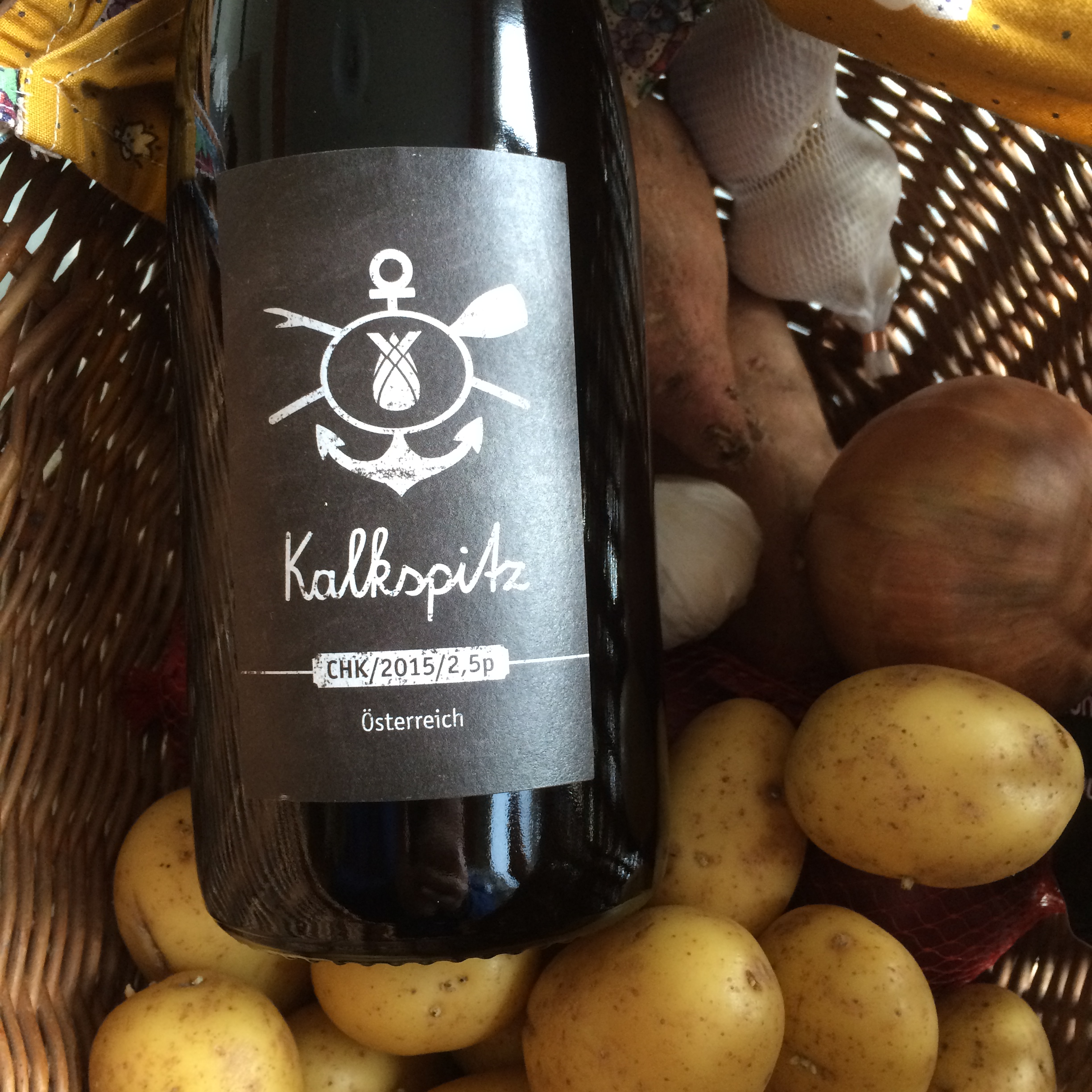
The wine is an Austrian pét-nat, made by the méthode ancestrale, from a blend of Riesling and Grüner Veltliner near Hollenburg (in the Kremstal, not far from the famous abbey of Stift Göttweig). The producer is Christoph Hoch. Christoph is an interesting guy. He makes still wines from his five hectares of chalky vineyard, but he’s got all sorts of interesting ideas about making sparkling wine, and this has led him to forge great friendships with some fine Champagne growers, principally Benoît Tarlant, and the Laherte and De Sousa families.

I’m fairly sure that even with these friendships, those Champenois would be fairly shocked at Christoph’s Kalkspitz. The first thing you notice is the crown cap seal. It’s common among pét-nats, and of course common in Champagne for the first fermentation. But Kalkspitz, in line with its production method, is not disgorged, so that the sediment of the first fermentation remains in the bottle. But it’s not the sediment as such which is shocking.

image

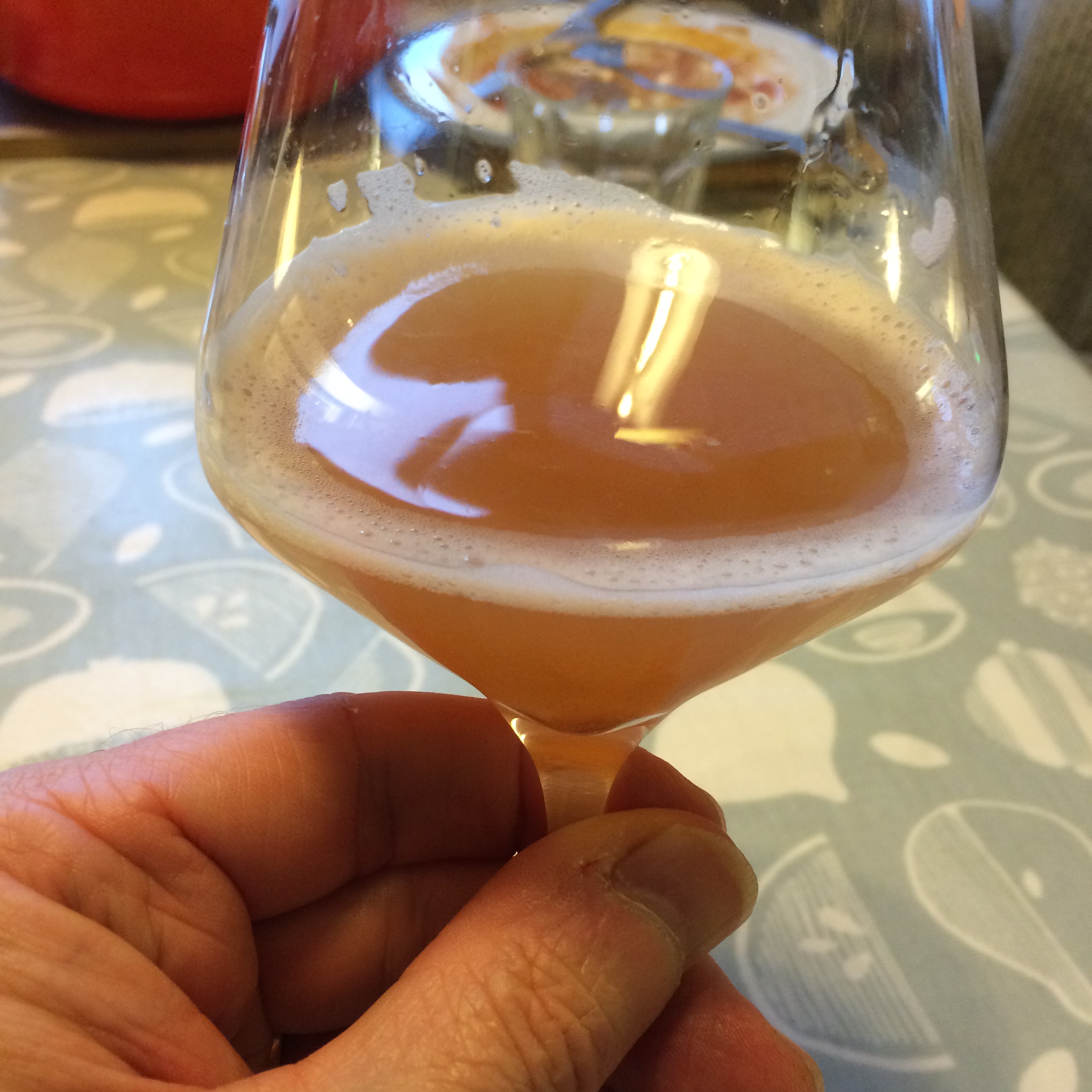
It’s quite common now for producers of pét-nat wines to offer two options for consuming them. The first is to stand them up for a few days so that the sediment falls to the base of the bottle. Careful opening and pouring will give a relatively clear and clean-tasting wine. Option two is to chill the bottle horizontally, or to invert the bottle before opening. The wine will then be cloudy, with the sediment being distributed in suspension. This gives an altogether different experience – the wine will taste a bit more yeasty and will have a very different texture.

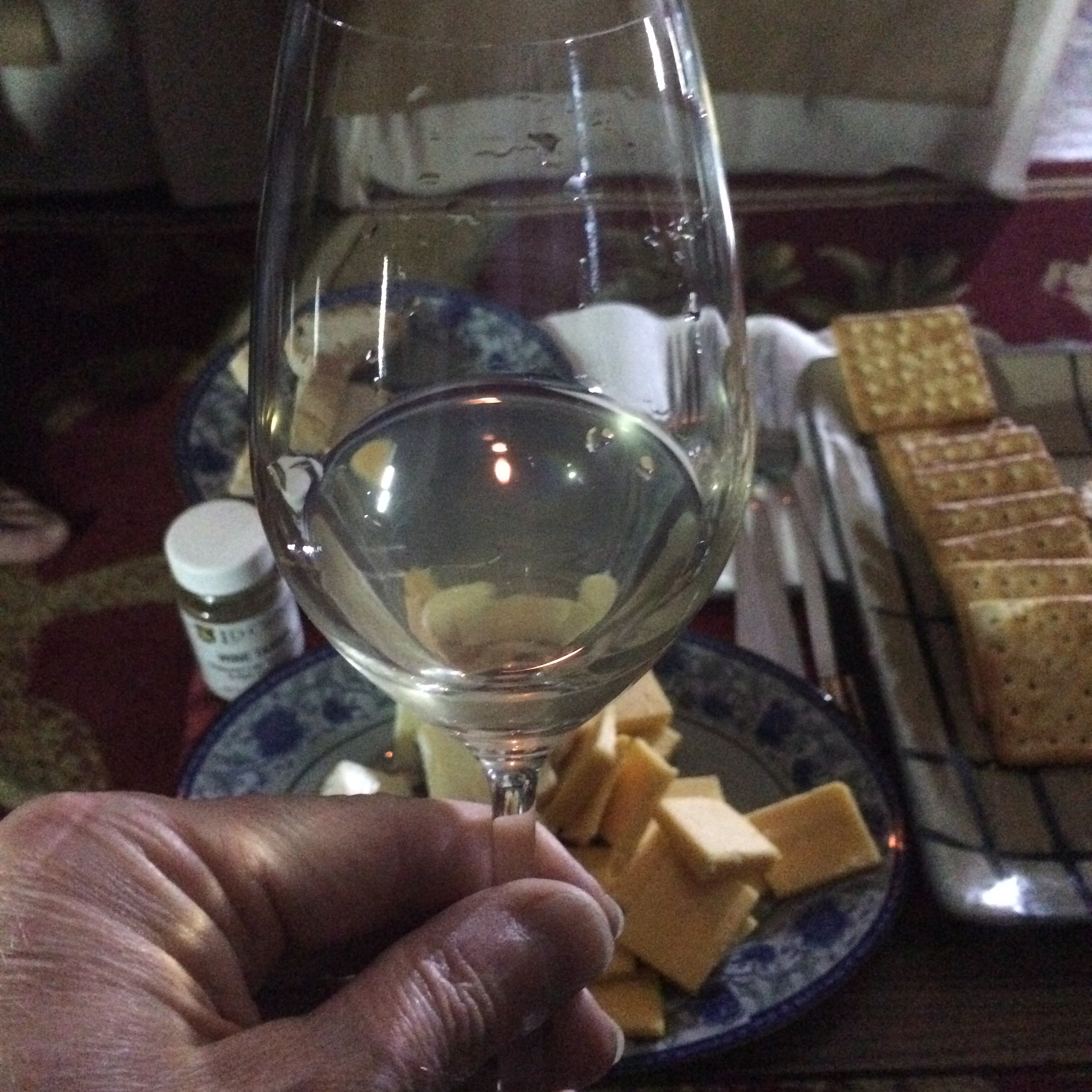
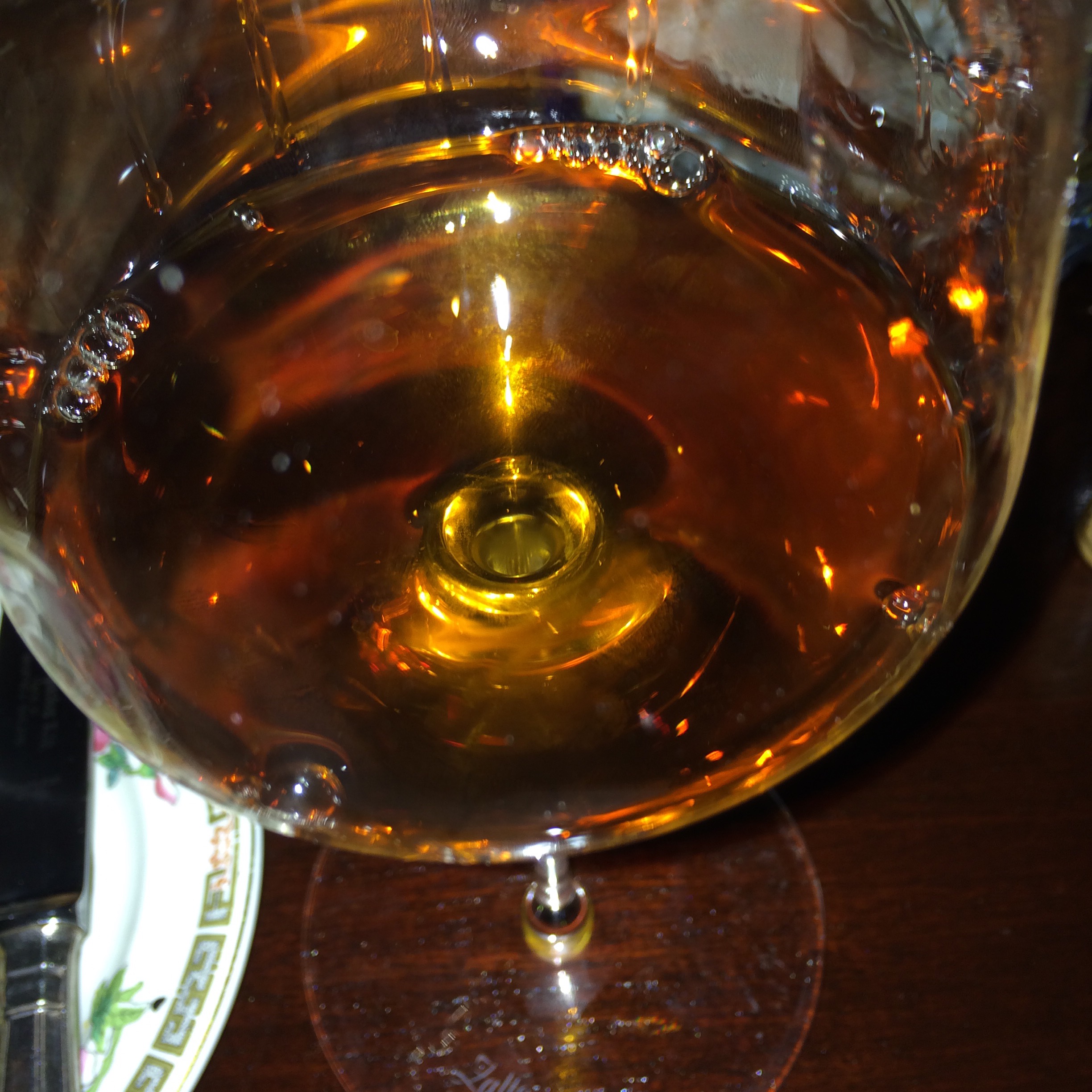
Well, in for a penny (did you expect less?), I went cloudy. The bubbles are nice and small and the wine smells a touch yeasty, but there’s also a clean citrus nose as well. On the palate the wine is fresh and palate cleansing, but also there’s a chalky texture (some might say earthy). On the one hand I can imagine Newcomer having some problems with this, despite their adventurous customer base. It’s clearly wine, but I described it at the time as a cross between wine, cider and beer (the cider comes through as an appley note and the beer perhaps from the yeast, the “wheat beer” look and the froth on top). And as to the look of it? Well, see the photo – is just looks wrong by most standards. In some countries they would not have allowed its release, but Austria isn’t as vinously conservative as you may think.

image

Yet saying that, there are no negatives about this wine, for me at least. In some ways it’s a simple wine, but it also has hidden depths. Whether you’d call them complexity is open to personal interpretation. It’s obviously made by someone who is experimenting from a position where he knows what he’s doing. What Hoch has made clearly pushes the boundaries of pét-nat winemaking just a little further than most people whose wines I’ve tasted. Kalkspitz won’t be for everyone, but for the adventurous it’s just something else to stimulate the palate.

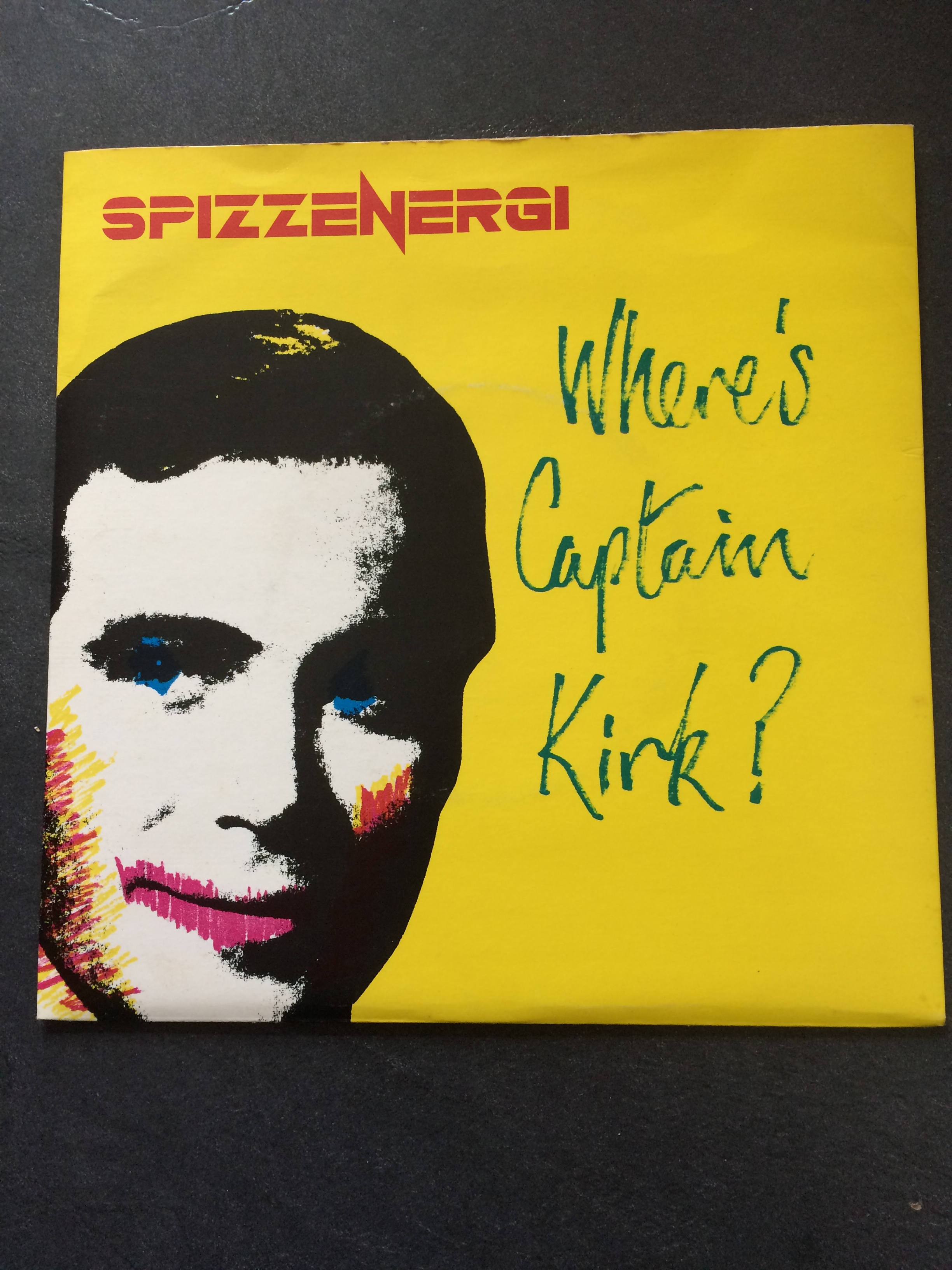
Regular readers will know I do like my musical puns. This one was felt too obscure to use as a title by the “editorial board”, but I can’t help it – Kalkspitz reminds me of Spizzenergi’s 1979 classic, Where’s Captain Kirk (“the best Star Trek song ever” – John Peel). It’s not just the name. It’s quirky and bursting with energy and life, if a little rough at the edges. For the new kind of wine drinker, that’s pretty much a fine recommendation in itself. But for the more conservative, approach with caution.

Christoph’s current project, due for release in 2017, is a méthode traditionelle sparkler with no non-wine additives (ie no added yeast or sugar). Can’t wait to see how that turns out.

Kalkspitz 2015 – Christoph Hoch, Hollenburg, Kremstal, 10.5%, Méthode Ancestrale. Contact Newcomer Wines via the web site link above (opening para) for UK availability.

image

Posted in Austria, Austrian Wine, Sparkling Wine, Wine | Tagged , , , , , , , , | 4 Comments

Is This the Outer Edge of the Wine World?

I’m just returned from spending the best part of March in Nepal (hence the lack of posts here). It’s my third trip there, and the second in two years. People like to know what it’s like, and I always answer along the lines that it’s both challenging and stimulating, but that the latter outweighs the former. You can get used to no hot water, even no water at times, along with the other privations and deviations from our pampered Western expectations (sixteen hour electricity outages are common every day in the capital). You can’t get used to the dust, and in Kathmandu, the terrible pollution, but you can put up with it. You can also show a philosophical resolve against the near inevitability of getting sick from something you ate. But little prepares the first time visitor for the sheer colour of the Nepal experience – people, temples and shrines, flora and fauna, landscapes, and above all, the astounding mountains.

Yet I do weep for Nepal, a country in which half the population earns less than a dollar a day (ranked 140th in terms of world poverty). After a decade or so of civil war, 2015 saw first a major earthquake, and then a blockade on the Indian border which deprived the country of gas, kerosene and petrol. The streets were quiet and people were cooking on open fires on their balconies and terraces. There is wealth, serious private wealth if you look beneath the veneer. The officials with whom the wealthy Western diplomats and employees of the NGOs mix live in almost hidden gated communities, drive 4WDs and dine in smart restaurants serving Western food and alcohol at highly taxed prices. But there’s little infrastructure. Kathmandu’s ring road is one long, wide, dirt track choked with traffic at a standstill – thousands of motor bikes jostling with taxis, buses, lorries and carts. There are no rules, apart from the occasional policeman’s whistle trying to bring order at traffic light free intersections.

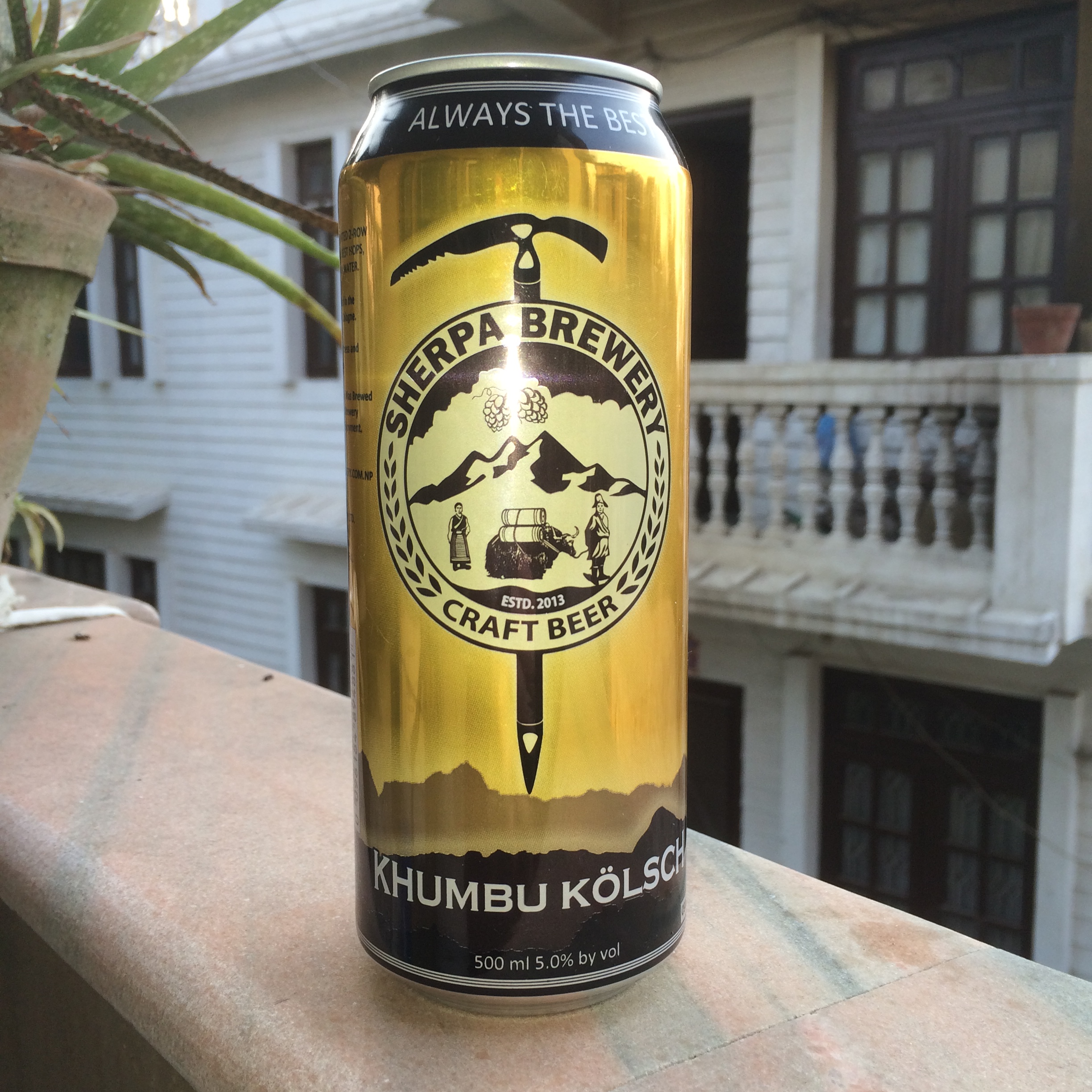
So don’t expect a wine industry here. There is one, of sorts, but not in the sense we understand. There’s a long tradition of commercial fruit wine production, based on fruits and herbs. It’s not the kind of thing to interest most wine lovers, but it can provide an occasional alternative to the more satisfying local beers, such as Gorkha, or Sherpa (billed as Nepal’s first ever craft beer, and my favourite thirst quencher there).

Dave's iphone 737  Dave's iphone 761

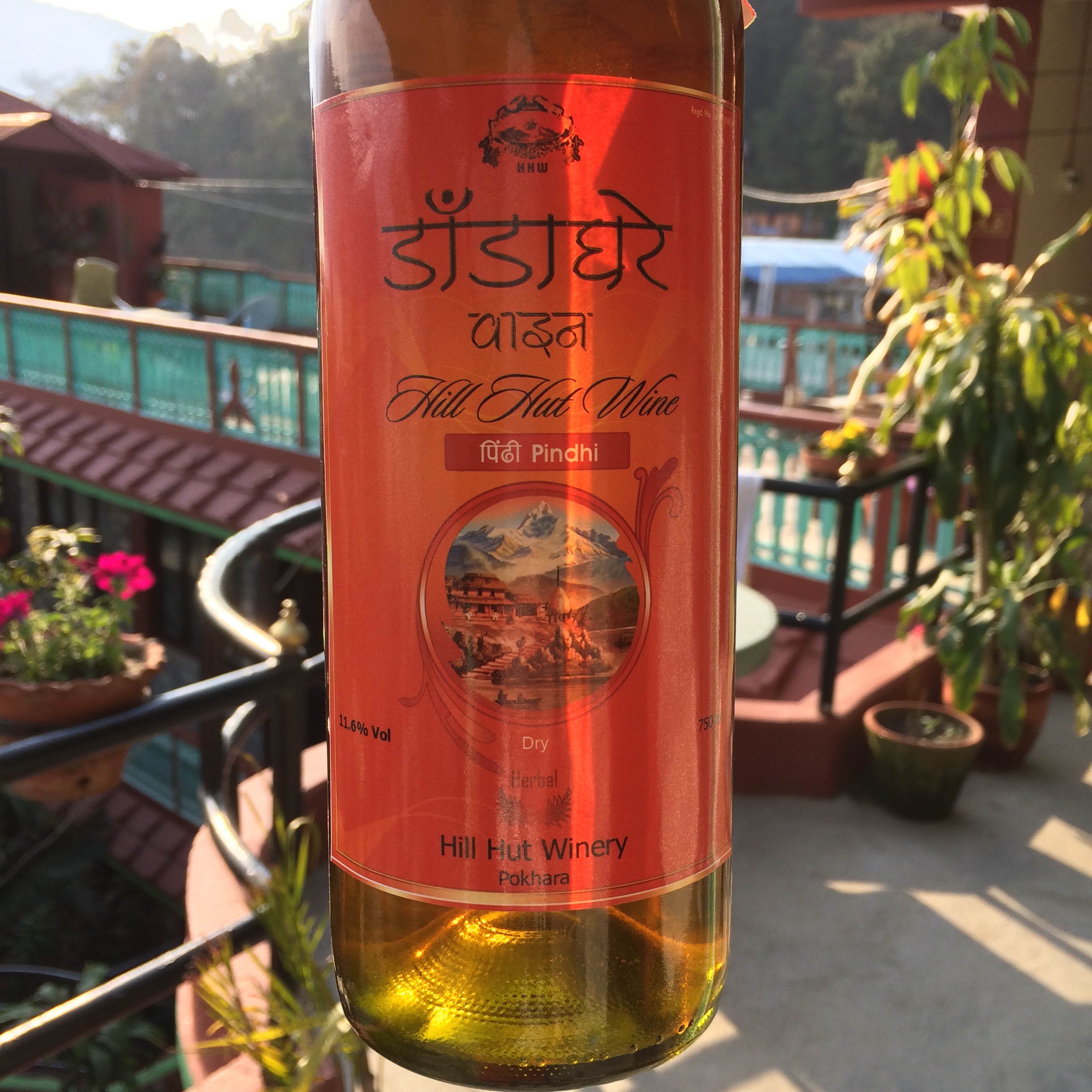
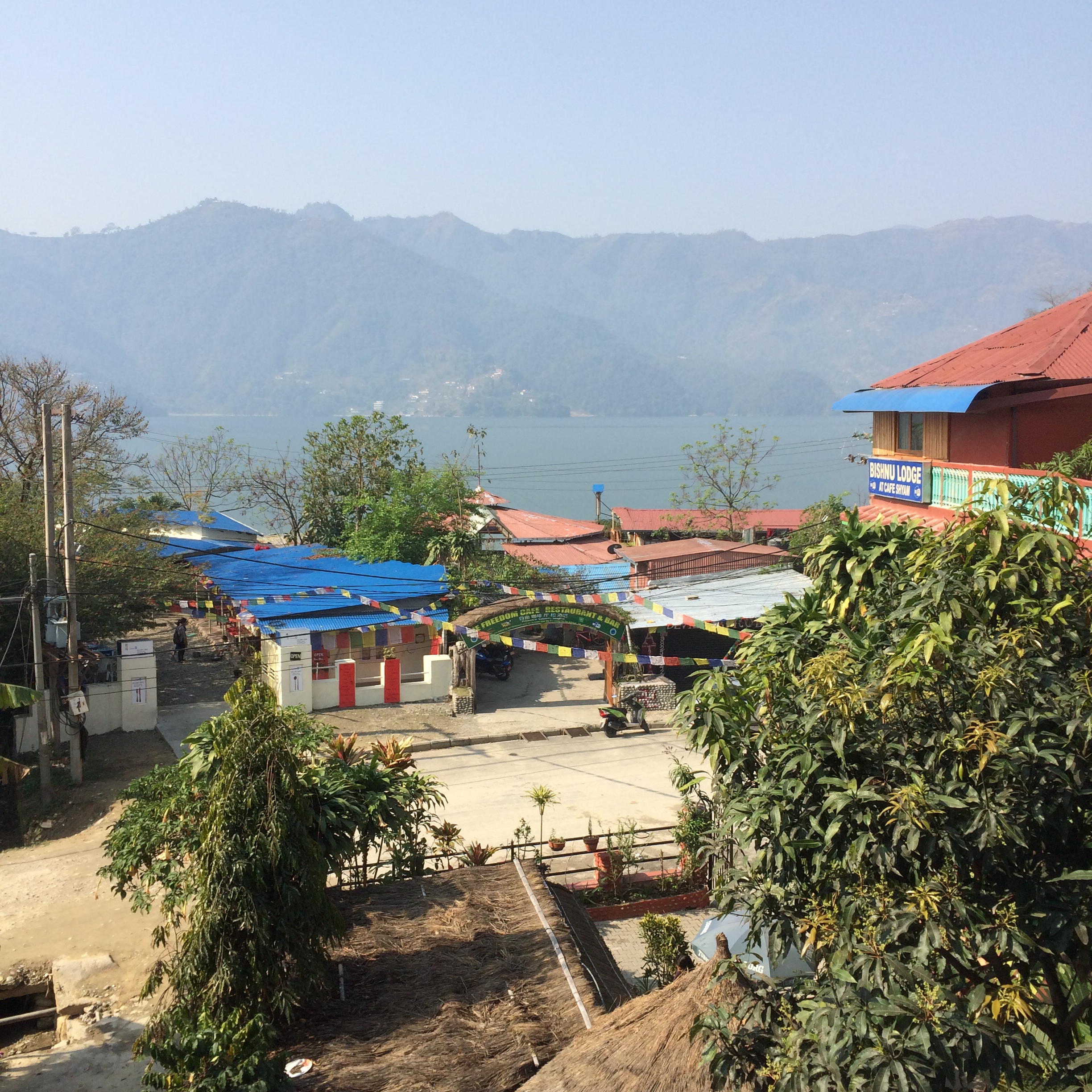
We spent a week on the lakeside at Pokhara, about a seven hour drive west, down the fertile Kathmandu Valley. It’s an idyllic place, a large lake surrounded by hills and, in the morning light, magnificent views of the Annapurnas and Machhapuchhare (“Mount Fishtail”). It was in what is probably Pokhara’s most expensive supermarket that we found Hill Hut Winery’s “Dandaghare Pindhi Herbal Dry”. They described it as a sweet red, made from “fruits, roots, herbs and honey”. To be more accurate, the colour was mid-tawny, not red, but it was reasonably drinkable. Imagine a Palomino table wine (not remotely like anything Equipo Navazos would make, I should say, though I am thinking unfortified Sherry) to which has been added a good large tablespoon of honey. Although it’s hard to be totally objective in such a beautiful location, you’d finish the bottle, though perhaps not dash out to buy more. They managed 11.6% alcohol. I will say, this was significantly nicer than any other fruit wine we’ve had in Nepal.

Dave's iphone 741  Dave's iphone 738

Pokhara Lakeside and Hill Hut Fruit Wine

When you return by road to Kathmandu you spend most of the day following the Trisuli river, well known in parts for its white water rafting. The valley is lush, even long before the monsoon rains turn it into a sea of rice terraces. Roadside stalls sell river fish and fruit. You pass beautiful villages up the valley sides, like Bandipur where, if you jump out of bed before dawn, you can go to watch the sun rise over the white peaks of the Manaslu Himal to the north.

If you stop at Manakamana you can ascend ten minutes in the modern cable car (made moderately famous by the 2014 “slowfilm” of the same name, by Stephanie Spray and Pacho Velez – “You could hardly ask for a more beautiful vision of souls in transit” : Time Out Magazine)  to the temple to the fearsome goddess, Bagwati (an incarnation of Parvati) whose power to grant newly weds a male child comes at the price of sacrifice. The Austrian-built cable car survived the 2015 earthquake. The temple didn’t, nor did those inside it at the time. The temple is being rebuilt, but the sacrifices are still taking place.

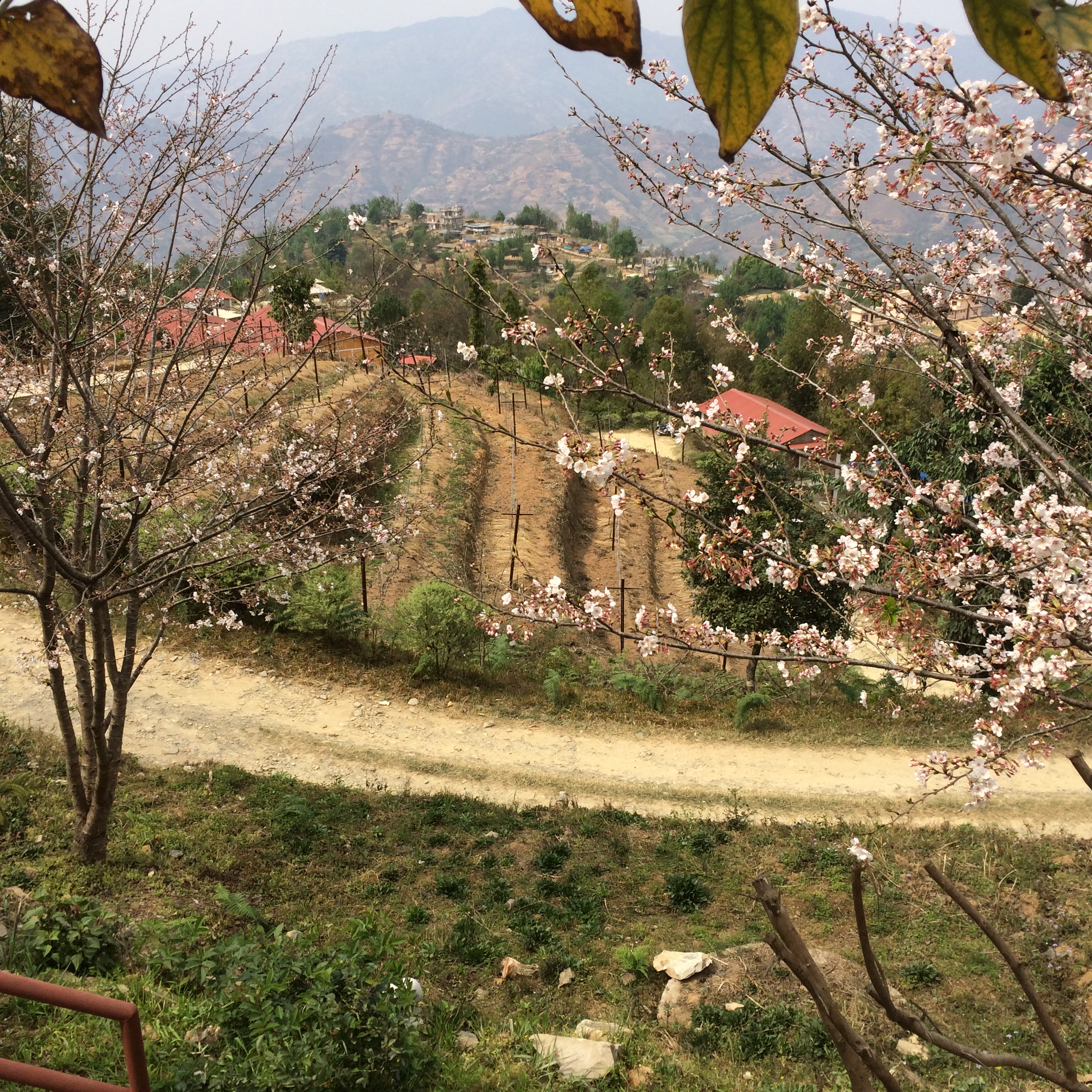
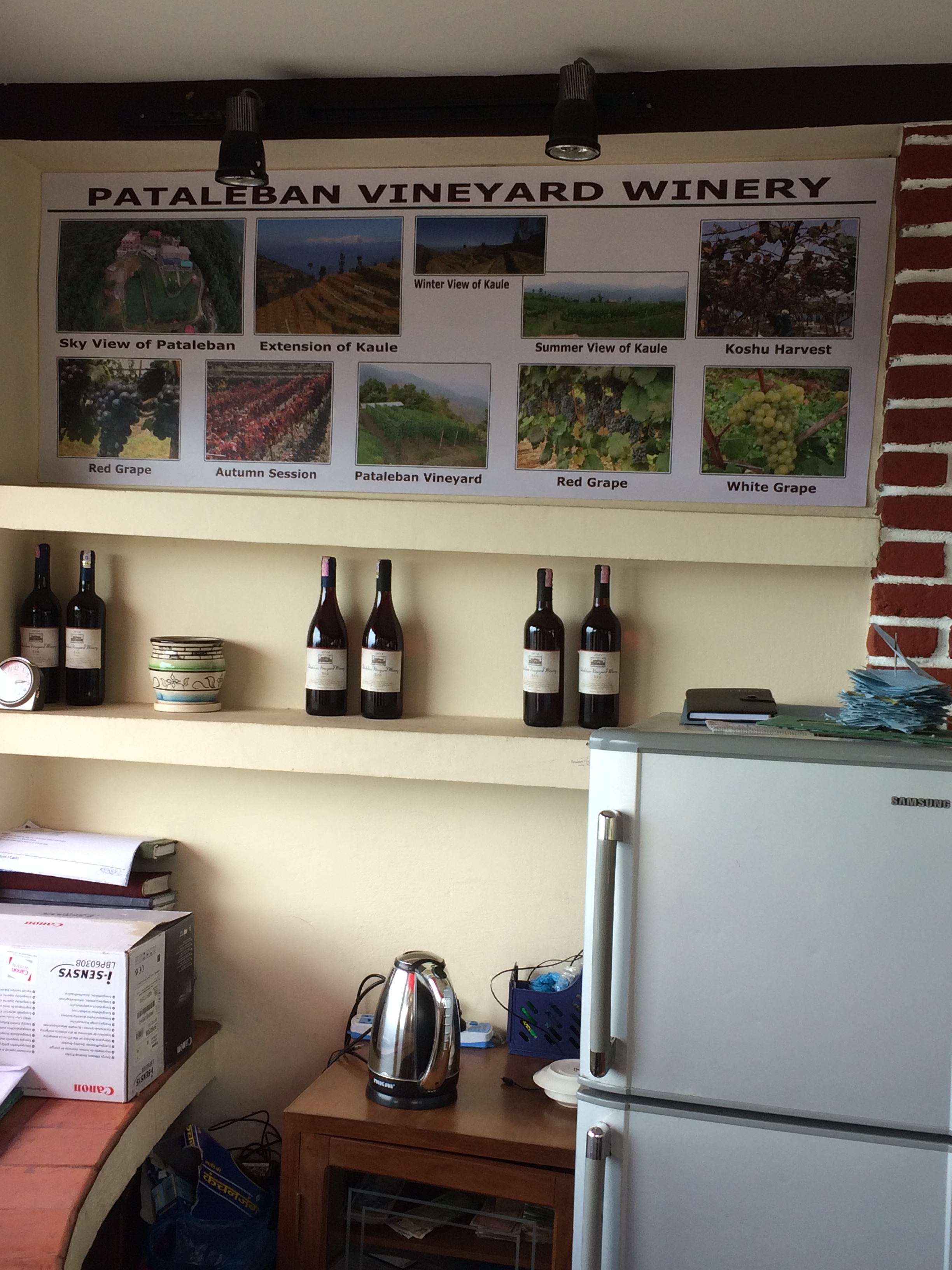
As you approach Kathmandu the road rises steeply between Naubise and Thankot. On these hairpins the inevitable breakdown of heavily laden lorries causes jams lasting hours. As you begin to crest the hill there is a turn-off to the settlement of Chisapani. Here you will find the Pataleban Resort and Vineyard. It’s the only commercial vineyard producing its own wine in the country.

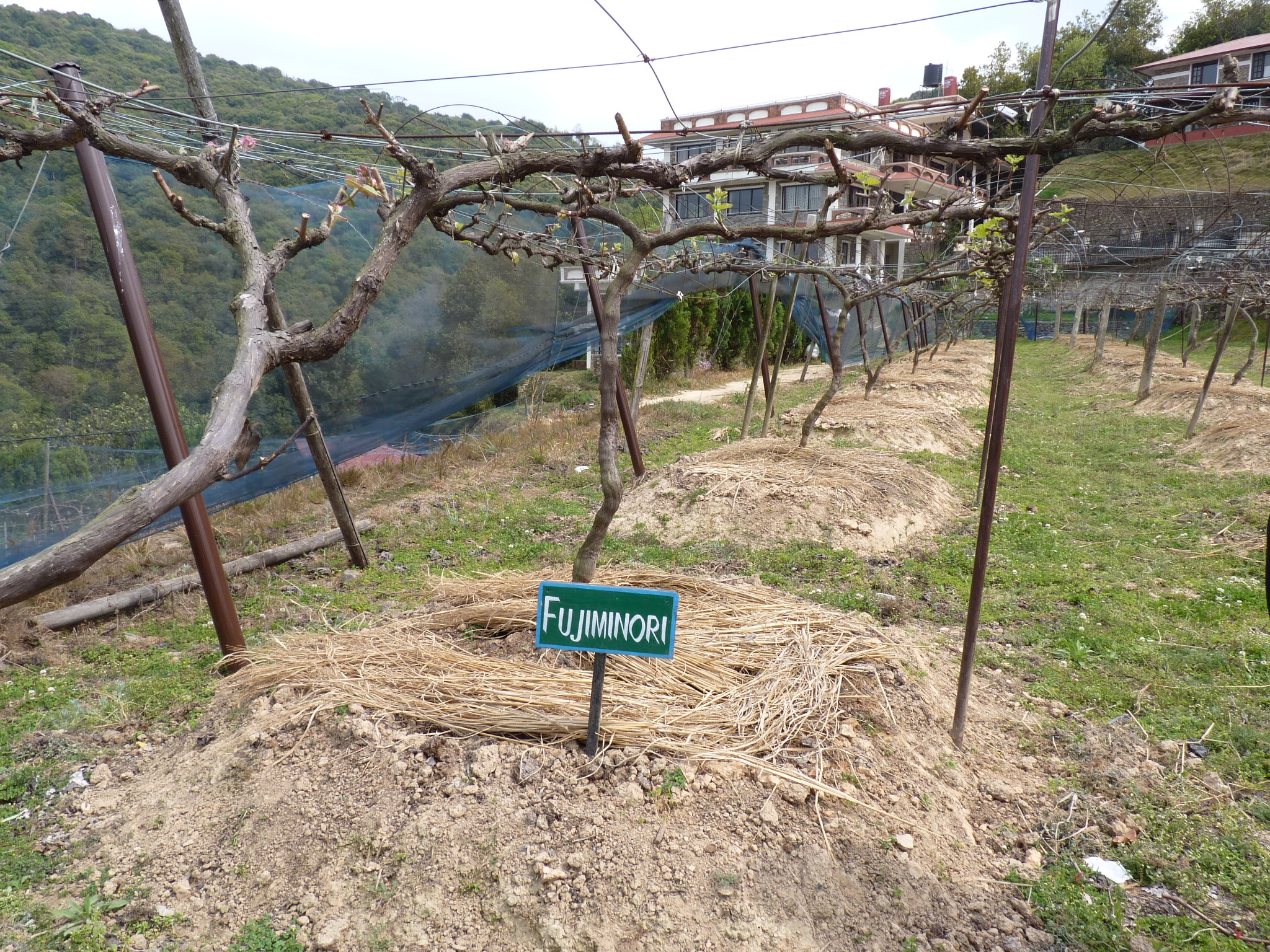
There are around 2ha of vines on the Chisapani site, but there are two other sites nearby. The vineyard was founded in 2007 by Kumar Karki, with strong involvement from Japan. This is why, among the seventeen grape varieties being trialled at Pataleban (everything from Delaware and Muscat Bailey A to Chardonnay) there are several Japanese varieties and crosses (including Koshu). They make a red, white and rosé, but production currently only stands at around 3,500 bottles per year, almost all sold to guests at the exclusive resort hotel.

Dave's iphone 747  Nepal 2016 171

Pataleban Vineyard Resort

The challenges faced by the staff here are considerable. The grapes are all trained on a widely spaced high cordon and netted against birds, monkeys, and the occasional leopard. Harvest (they only crop once a year, unlike some parts of India) comes at monsoon time. Imagine that, bearing in mind the stress to producers which a bit of rain causes on the Cote d’Or!

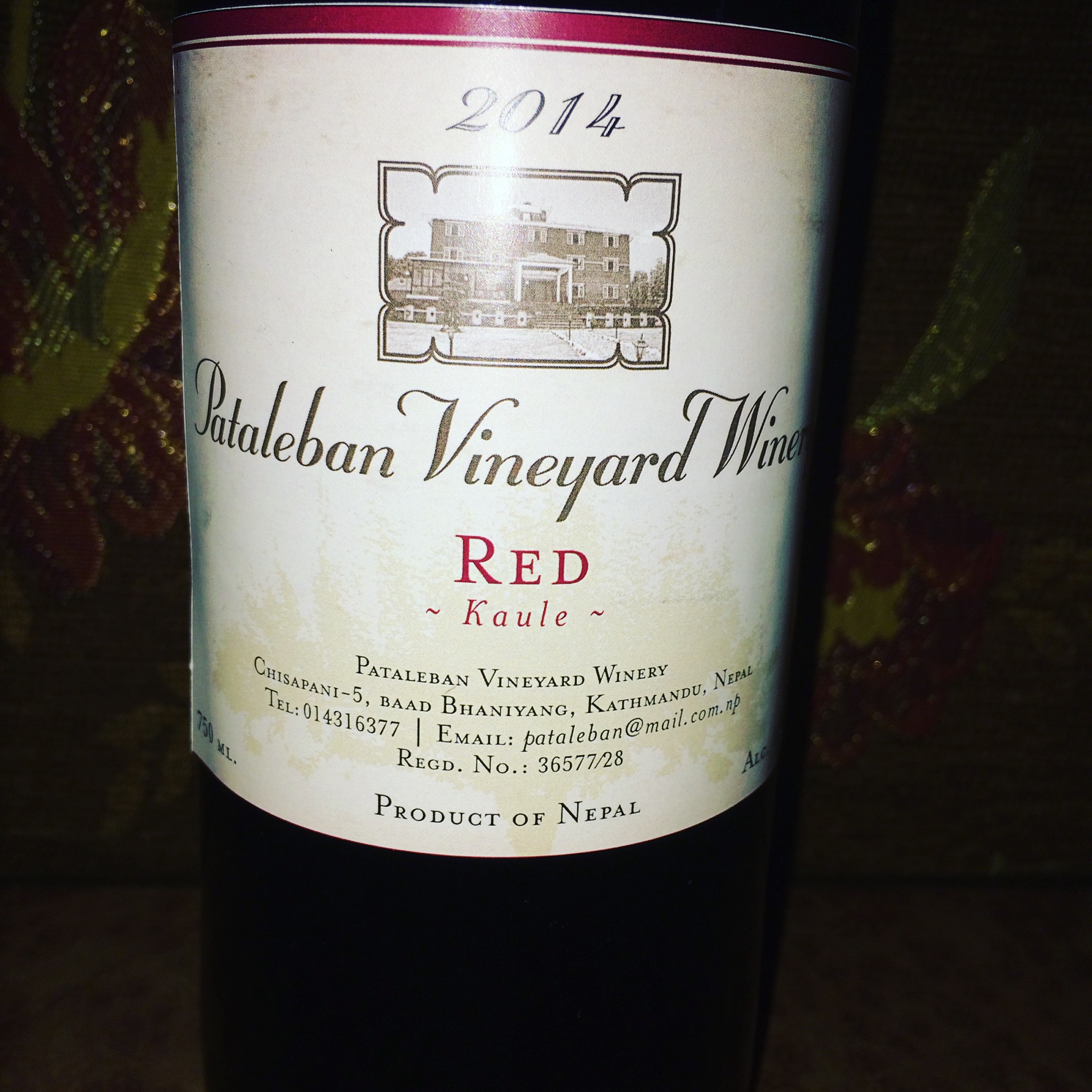
When we visited, the white and pink were sold out, but the red proved to be both palatable and interesting. All the winemaking equipment has to be imported. I think much comes from Germany. The wine is clearly well made, the grape variety being Khainori (a cross between Pinot Noir and Khaiji) grown in the estate’s Kaule vineyard. It has that kind of hybrid flavour you get so often with indigenous reds in Japan, a strawberry/raspberry fruit with a kind of foxy/woody note on the finish. It doesn’t lack balanced acidity and is refreshing and quite light. It costs 1,700Rs, a princely sum in Nepal, yet equating to about £11-£12. Vastly cheaper than an imported bottle of cheap, branded Chilean Cabernet from an air conditioned wine room in a smart Durbar Marg restaurant, and much more interesting. The 2014 we tried, and bought, has 12% alcohol.

Dave's iphone 753  Dave's iphone 750

The resort has a beautiful hilltop setting with more of those stunning mountain views when the air is fresh and the cloud lifts. They suffered damage to the hotel buildings during the earthquake, but repairs are well under way. As our guide, Sahishnu Shrestha, pointed out the embryonic “fine dining restaurant”, it is clear that there is real ambition here, and I wish them every success. What they have achieved so far, on the evidence of the red, albeit in a local context, is way beyond anything yet achieved viticulturally in Nepal, but perhaps not quite in terms of winemaking…

One of the pleasures of having a family member living in Nepal currently is the opportunity to meet people, both locals and Westerners. Our daughter is acquainted with a wonderful American called Laurie Lange, who is studying in Kathmandu for much of the year. Although her wider family has a long winemaking history, she has no direct experience herself, but she is both a creative and focussed individual with, seemingly, a genuine talent for anything she turns her hand to (successfully having grown mushrooms, for example, she also spends part of the year as a tour guide in Alaska).

Laurie makes wine in Kathmandu. In effect, it’s home winemaking. Most of her tools of the trade, including yeasts, hydrometer etc, came in a suitcase. For fermentation vessels she cleverly uses the ubiquitous drinking water containers so essential in Nepal. They hold around 20 litres of drinking water and you see them the world over, everywhere from airports to doctors’ surgeries, blue plastic attached to a levered tap (usually with a stack of plastic cups on the side). Onto these she affixes the air locks we normally see on demijohns, which seem to work well.

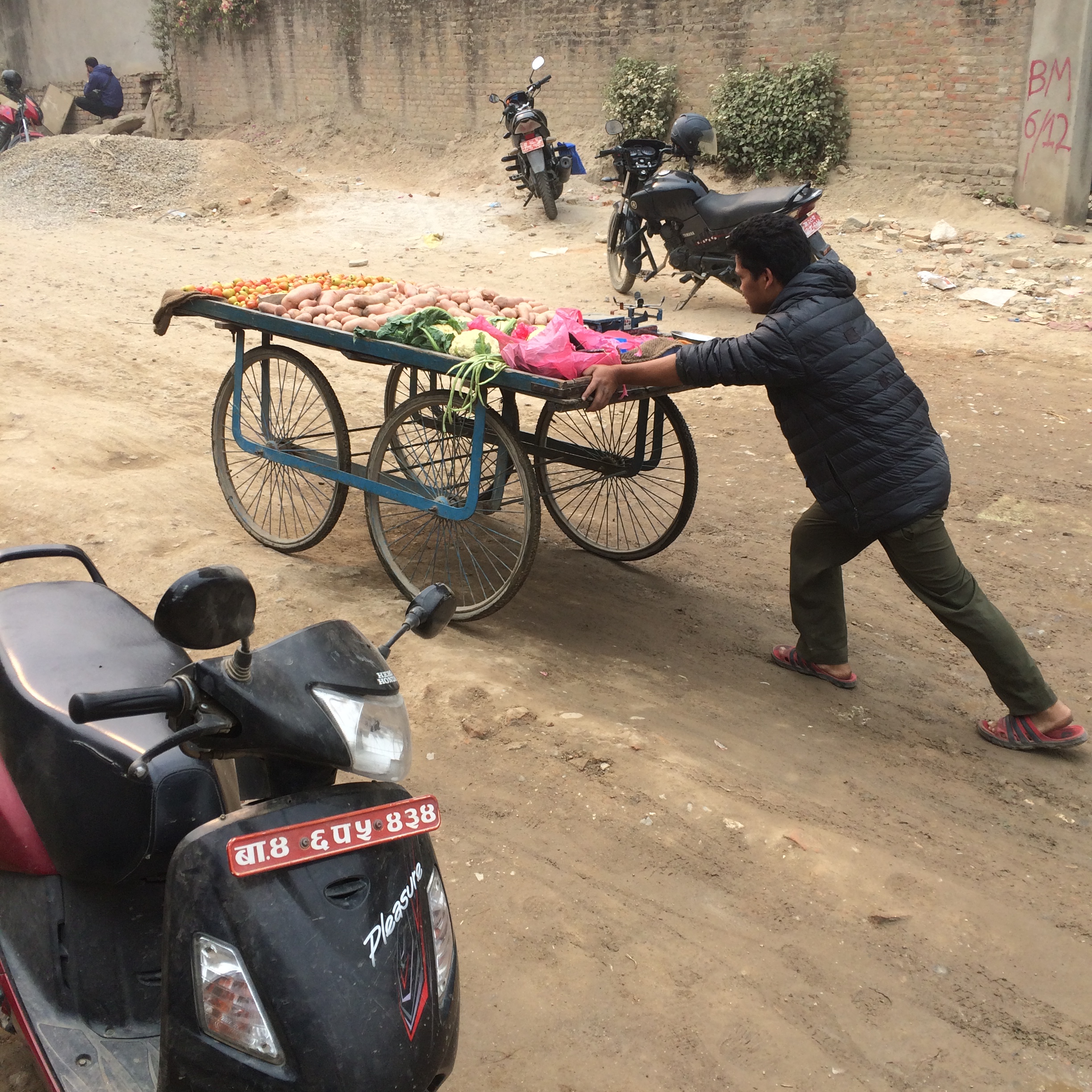
Laurie began by making a white wine from locally purchased grapes which, in Kathmandu, come in from India. March is a good time for grapes, and indeed for all fresh fruit which, despite a long overland journey on dusty roads, looks pristine on the street carts and in the fruit stalls. The grapes bear an uncanny resemblance to Thompson Seedless, although I’m afraid my ampelographical skills are wanting here. She’s calling the “brand” Chöying which is Tibetan and means “body of qualities: the basic state of all phenomena which holds all potentiality, all future qualities”.

Dave's iphone 782

The white is slightly hazy right now, but remarkably drinkable. I stress remarkably. The wine reminds me so much of a Fendant (Chasselas) from Switzerland’s Vaud (more specifically, La Côte on the north shore of Lac Léman between Geneva and Lausanne). I have no idea why it tastes like a Mont-sur-Rolle, but it does. That means high acidity, but not breaking the boundaries of acceptability. I’d have liked to talk to Laurie a lot more – I’m sure she could offer me some good advice on our own wine making efforts. She’s done her research meticulously, and her main worry is the haziness of the juice. I hope it will fall bright in time. She told me in an email this morning that she plans to bring over some bentonite for fining next time she’s back in the States. There’s also a rosé fermenting, semi-sweet with an “undertone of grapefruit”. Laurie’s not sure whether she likes it, but I wish I could taste it myself.

Dave's iphone 759

Laurie’s Chöying White

Maybe next year, Laurie? As I said at the top of this post, Nepal has its challenges. When you are spending an almost inevitable day in bed, when there’s no water for a shower in the morning, or when you are being followed by people wanting money, or to sell you trinkets, you do sometimes look forward to the luxury of getting home, I admit it. But when the time nears to leave, all such thoughts are banished. And when you do get home your thoughts immediately turn to when you might go back.

Dave's iphone 783  Dave's iphone 786

Typical Liquor Store, Kathmandu                 They do grow grapes in Nepal!

Nepal is stunningly beautiful and visiting the country is hard to beat as experiences go. The people have been truly shafted – by nature’s violent earth movements, by the global economy, by years of endemic corruption, and by the rivalry of the two emerging superpowers which hold Nepal like the filling in a hot dog, squeezed between India and China, who show petulant childish jealousy should the country appear to favour one over the other. Yet the many ethnic groups which make up Nepal are some of the friendliest people on the planet. And the country does not lack for people trying hard to improve things. Nepal welcomes tourists like few others, and boy does it need them. The former Maoist Leader, Prachanda (nom de guerre of Pushpa Kamal Dahal), said he wanted to turn Nepal into the “Switzerland of Asia”. There’s a hell of a way to go, but miracles are possible…

Dave's iphone 763


Posted in Nepal, UNESCO World Heritage Sites, Wine, Wine Travel | Tagged , , , , , , , , | 7 Comments

Jurable or Merely Fashionable?

When I first visited Jura in the 1980s only a few UK wine professionals seemed to have been there, and only one or two were extolling the virtues of the wines, principally the Vin Jaunes, from this attractive region. This despite its proximity to wine merchant home base, Beaune. Now, of course, there is no wine more fashionable, at least among younger drinkers, merchants and sommeliers. As I’ve said many times, when the classics become unaffordable, wine lovers need to look elsewhere. Jura combines the all important possibilities that can lead to stardom: some old time winemaking gurus, the return of some well travelled sons to established estates, a range of pretty unique wines, a few mavericks intent on quality, and reasonable prices. Only the last of those seems currently under threat, the product of this fame.

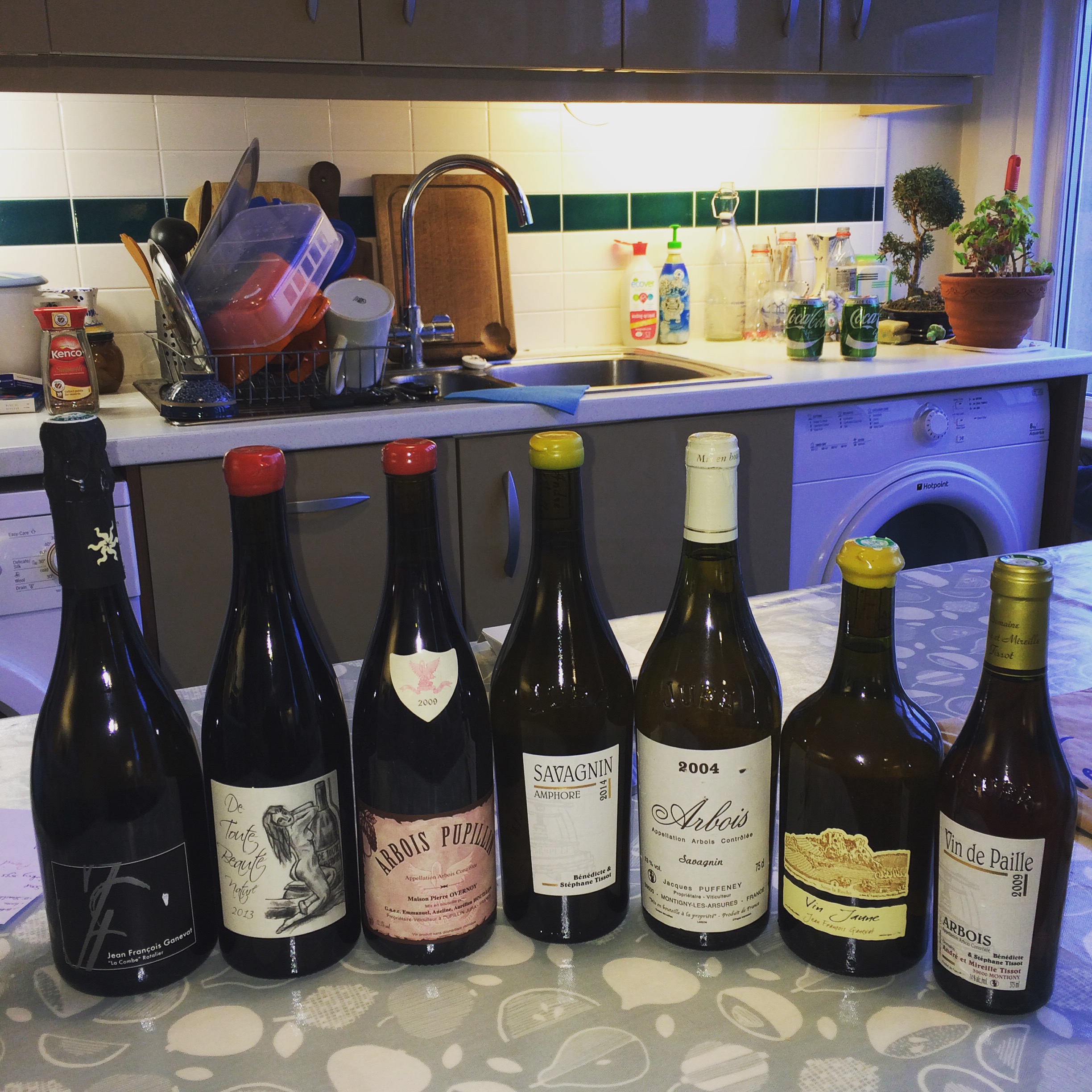
I organised a small dinner with the aim of establishing beyond doubt that Jura is able to make exciting wines of genuine quality. If the best wines can match the best from other regions, then Jura fashion will become lasting fame. But that’s a lot to ask of a region several French friends joke about, albeit perhaps less loudly now. Selecting which wines to take along to Quality Chop House last night was tough, and I settled on seven wines from just four producers: Stéphane Tissot is the well travelled son (Brown Bros in Australia, and South Africa), J-F Ganevat the maverick, and Puffeney and Overnoy/Houillon the gurus. No room for some of my favourite estates who have made a name for themselves more recently (La Tournelle, Hughes-Beguet, Bodines, L’Octavin etc). And the toughest call, no room for that classic Jura red variety, Trousseau (there’s only so much five can drink on a Monday night).

image

The Line-up 

I think the evening was an unqualified success. All the wines performed at least approaching what I’d hoped, and several of the wines I’d defy anyone to say were any less stunning than classic wines from classic regions. QCH as usual gave us a wonderful meal, my choices including a mutton starter and monkfish main. We took hard cheese with the Vin Jaune and blue with the Vin de Paille.

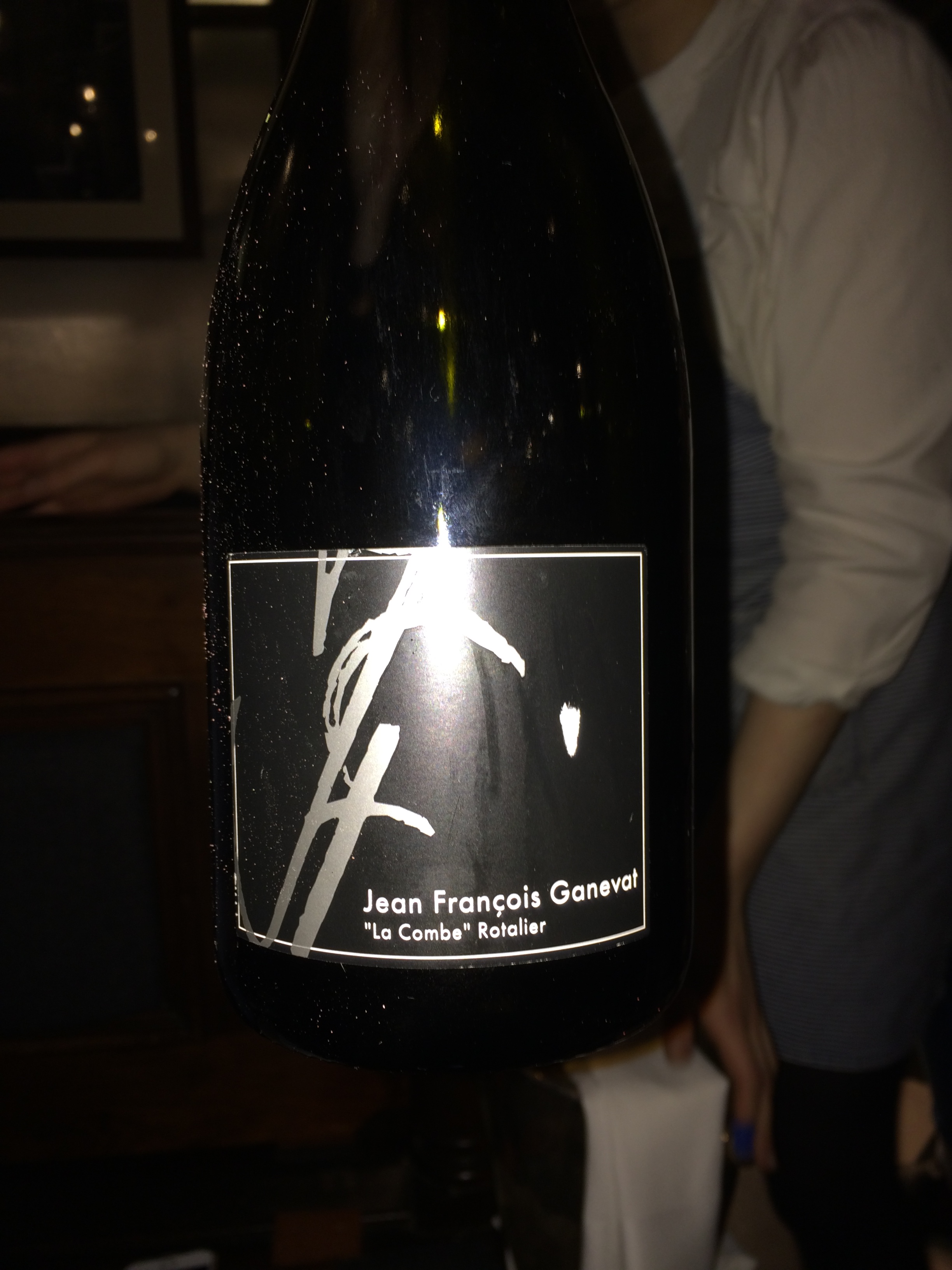
Crémant du Jura “La Combe de Rotalier”, J-F Ganevat is a 12% non-dosé Chardonnay sparkler of real class and interest. There is often something nutty in Jura crémants, you even find it in the famously cheap but decent version Aldi sell, from the Maison du Vigneron in Crançot. This wine was served as an aperitif last night, but it was more than that, setting the scene for the wines to follow. Although it’s one of the more expensive wines of this AOC, and fiendishly hard to find in the UK, it represents great value compared to average Champagne. Crémant du Jura quality is generally pretty high.

image

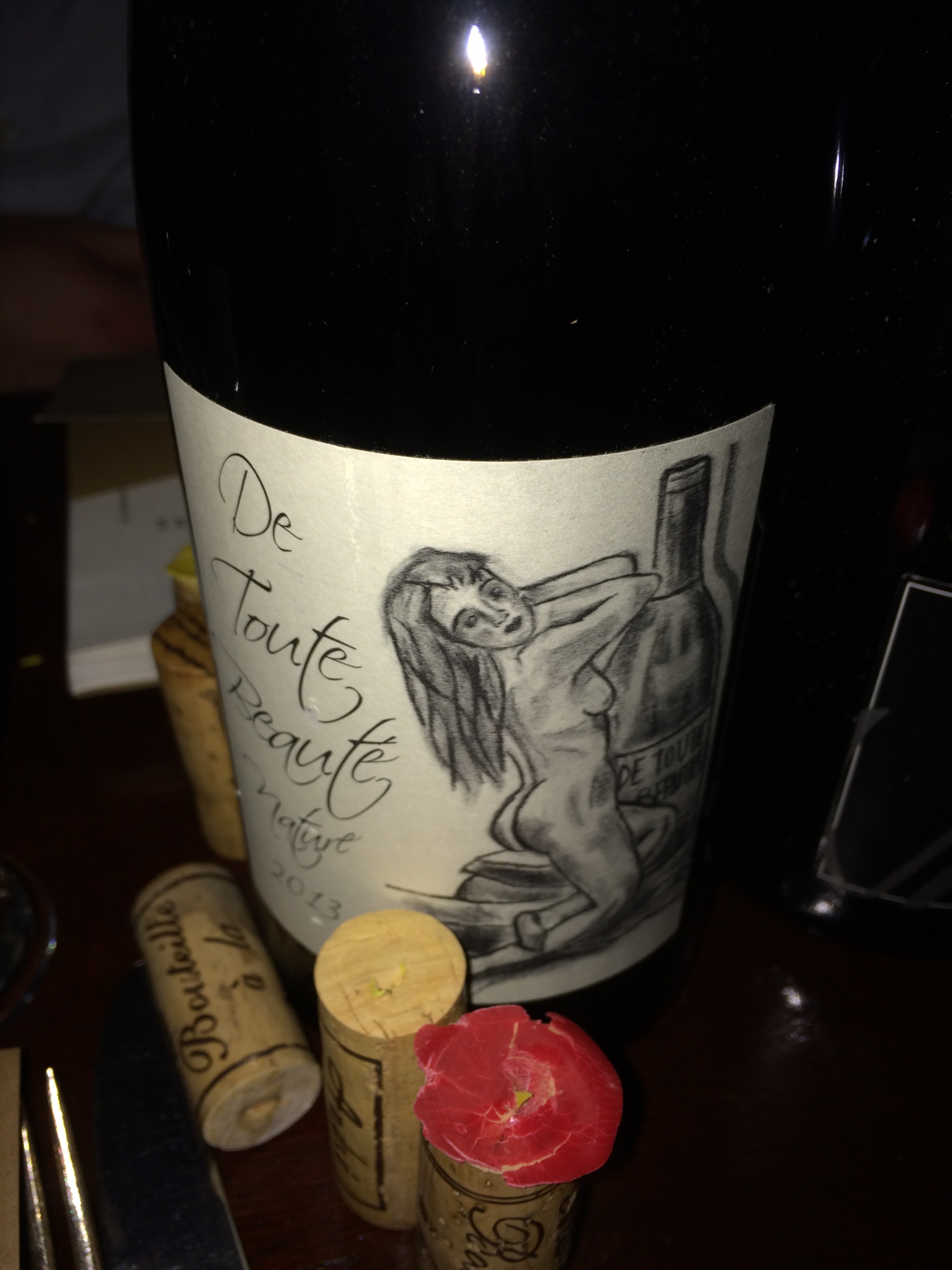
“De Toute Beauté Nature”, Vin de France 2013, J-F Ganevat is effectively the wine which edged out a Trousseau. Why? It’s a good example of natural winemaking by perhaps its best know protagonist in a region where non-intervention has almost become the norm among the internationally recognised producers (stress almost). It’s a wine of freshness and fruit, just 12.5% alcohol, and made from a blend of (usually) around 70% Gamay plus a list of ancient Jura grape varieties. This is clearly Gamay, but with a more savoury aspect and, as one person said, something of a Barbera-like finish. Not at all like cider either! Ganevat specialises in these once important but no longer AOC-listed vines. There’s a lovely vine conservatory you can visit if you are ever in Château-Chalon, a walled Clos above the Puits-St-Pierre vineyard, accessed from quite near to the back of the church (there’s a path snaking down). It contains some of the, believe it or not, 51 varieties now recorded in the region as a whole. [See Wink Lorch’s essential Jura Wine for a list and more information.]

image

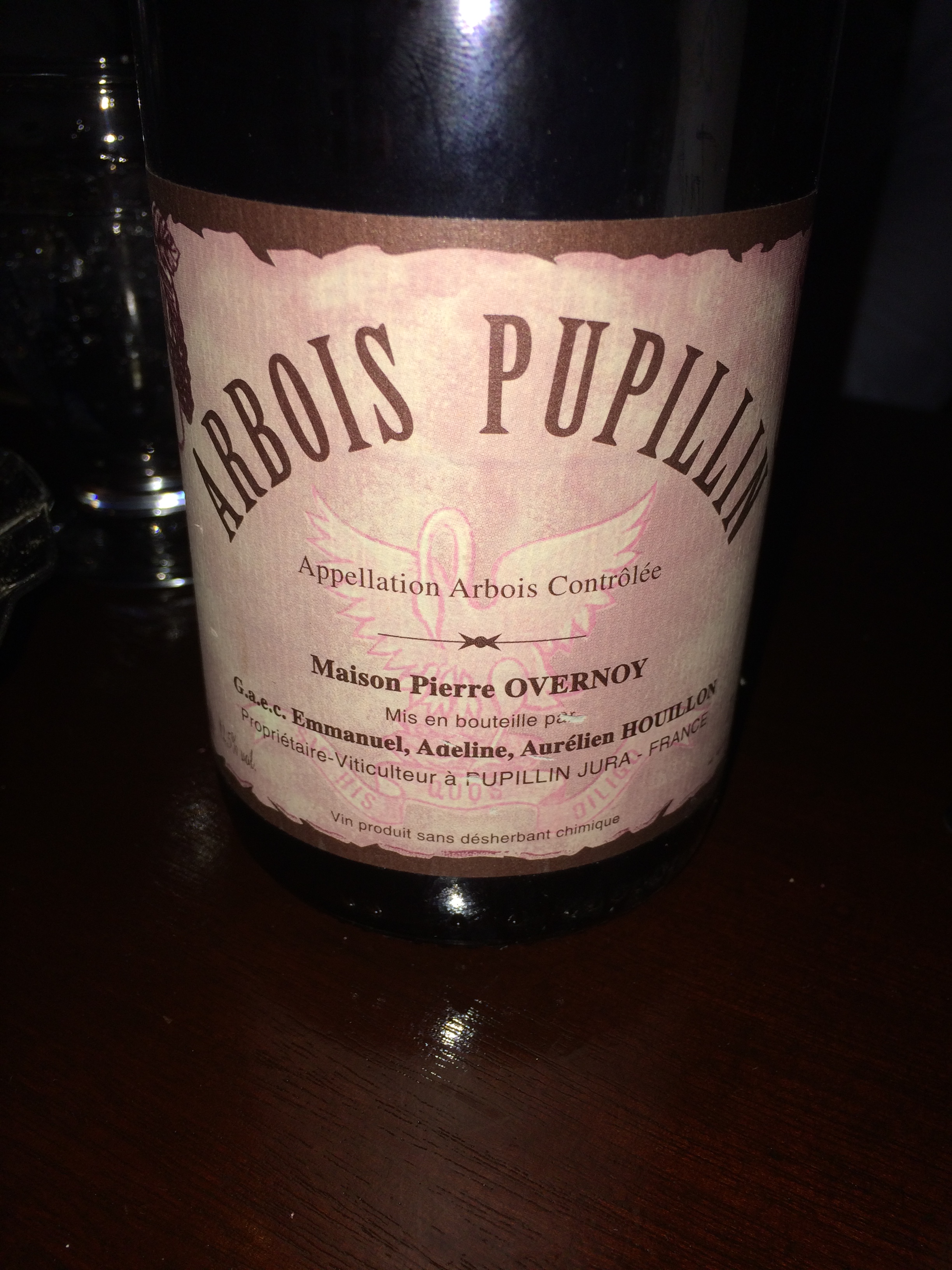
Arbois-Pupillin 2009, Domaine Pierre Overnoy is from one of the famous names of Jura wine, a sage to some and certainly a mentor to many younger producers. His total life commitment appears to be towards quality…and sourdough bread. Whilst Pierre bakes, and strolls through the vines, the wines are now made by Emmanuel Houillon and occasionally other members of that family (Adeline now makes her own wine with Renaud Bruyère, well worth looking out for). This wine is what Pupillin is famous for – Poulsard, or should I say Ploussard, for that is how they spell it in the world capital of this variety. Ploussard produces pale wines, this being no exception. There’s fruit for sure, even a hint of strawberry jam. But it’s an ethereal quality which makes it special, like (in the words of that obscure 1979 single by Teardrop Explodes) sleeping gas. Touch of tea leaf in there too! 12.5% alcohol.

image

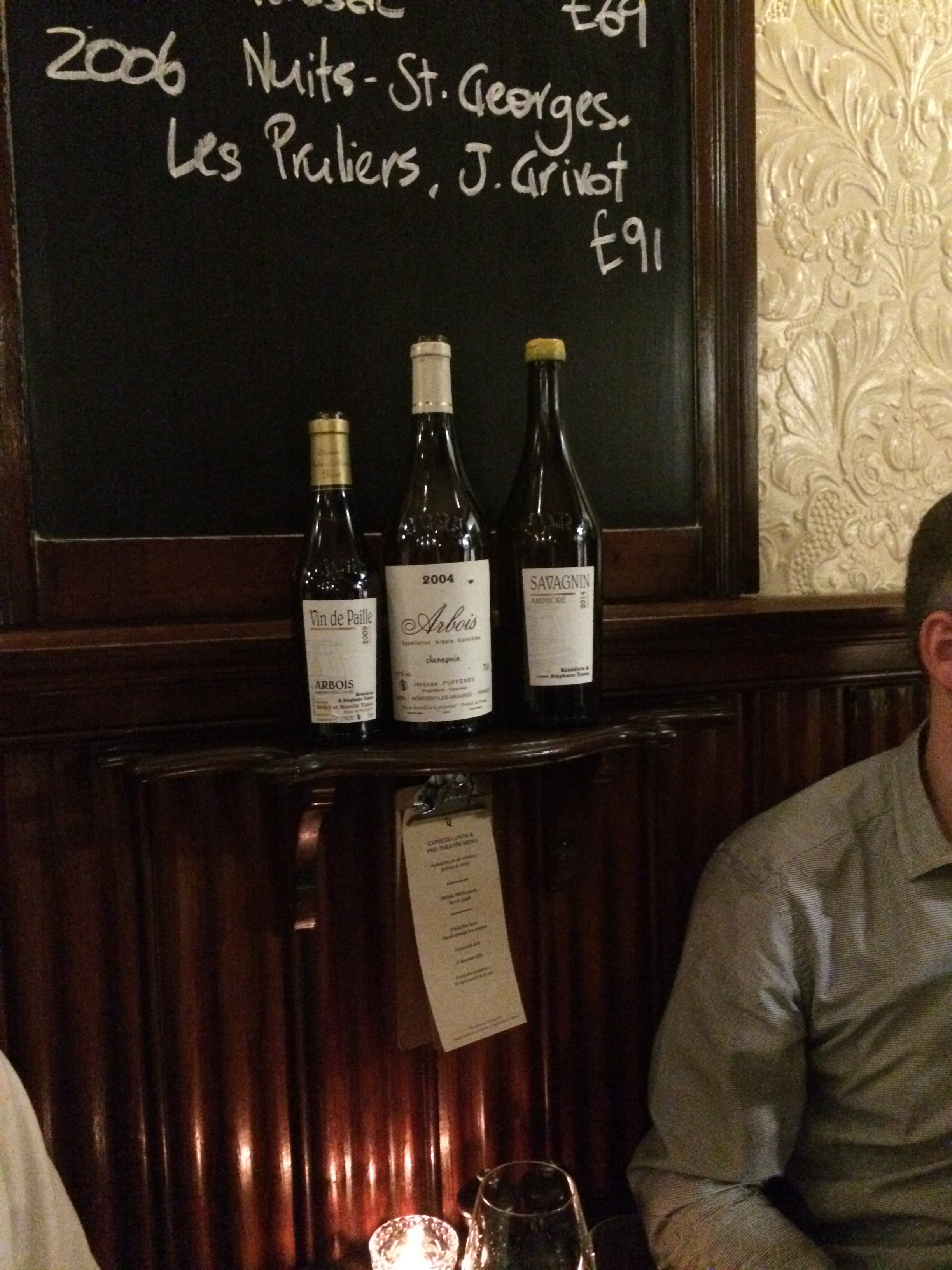
Savagnin Amphore 2014, Arbois, Stéphane & Bénédicte (Domaine A&M) Tissot is a little young, but also I think, a wine which is going to be stunning. For starters, at 12% alcohol it lacks the heft of the 15% 2009 we drank at La Balance in Arbois last September (see one of the links at the foot of this post). Sometimes wine tasting terms can be subjective and fanciful, a topic on which I’ve banged on about just recently. But I challenge anyone to say this wine doesn’t smell of curry. Curry leaf to one, but a jar of medium curry powder to me. It has the orange hue to match, and a nice bit of tannin-like texture too. Very limited availability but a tiny bit reaches London. This is probably the first producer in the region to use terracotta on any scale, and Stéphane has a nice line of receptacles in Montigny-les-Arsures (different types too, but we won’t get too technical). Now you can walk into almost any young vigneron’s cave and see one bubbling away, covered perhaps in a layer of cling film to keep the dust out. Stéphane’s is the benchmark.

image

Tissot’s Vin de Paille, Puffeney’s Savagnin, Tissot’s Amphore

Arbois Savagnin 2004, Jacques Puffeney is a wonder to behold, and although all good things come to an end, the fact that Jacques sold his vines (to the Burgundians at Domaine du Pélican) means that we won’t see its like again (because the current policy of the pelicans seems to be only to make topped-up wines, which might change but this wine sees no topping up). Some people call this a mini Vin Jaune, but that is perhaps to fail to see the uniqueness here. It has that Savagnin tang, softened by eleven years in bottle. Complexity and length (repeated and repeated). 13% alcohol.

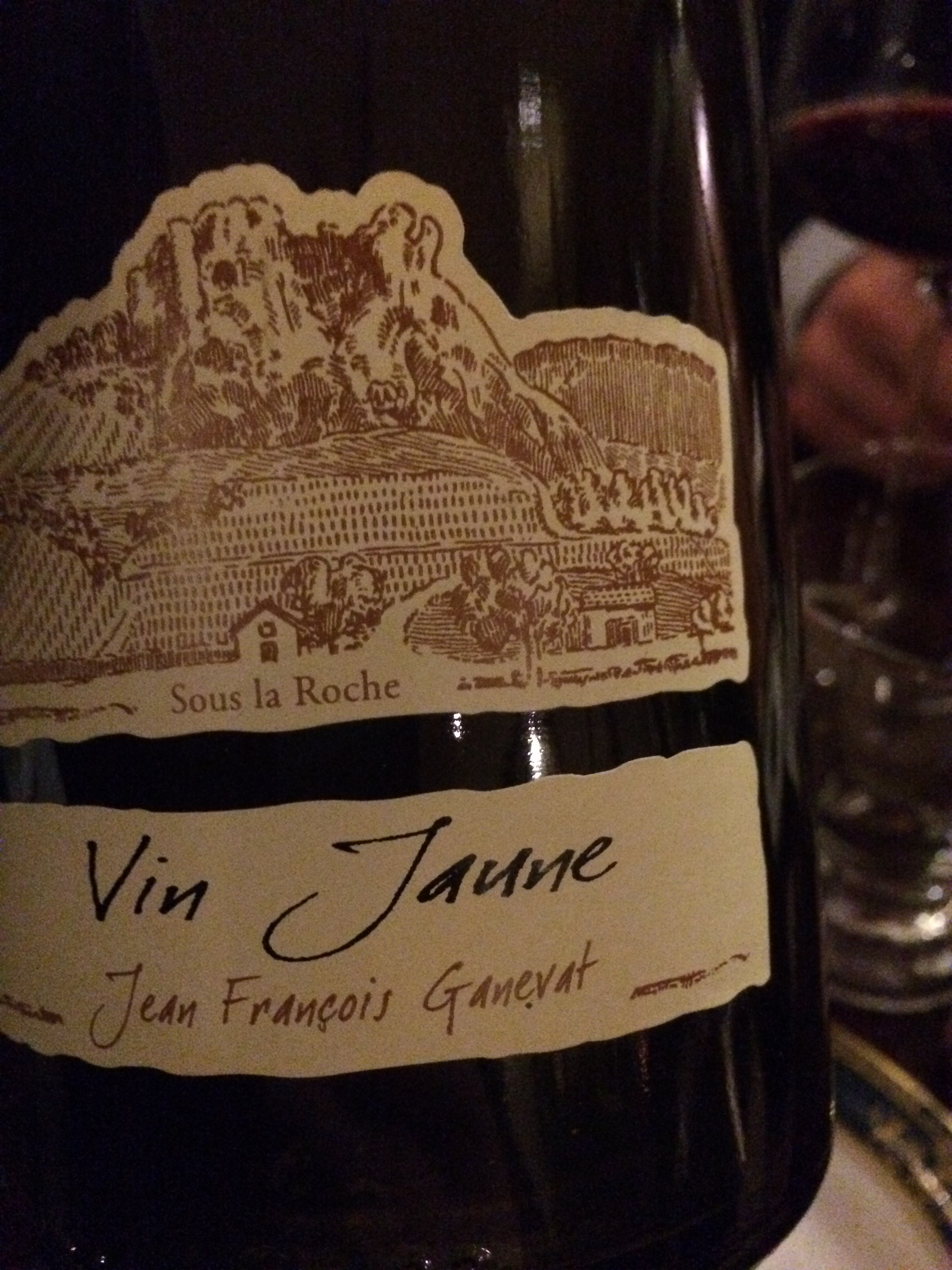
Côtes du Jura Vin Jaune 2003, J-F Ganevat is not a version of this Jura classic of classics from one of the established great names in this genre, but let’s face it, those who know Ganevat want to try his Vin Jaune. And as prices have risen, it’s nice to have this tucked away, bought at a price I could afford a few years ago (Vin Jaune is made purely from Savagnin aged under flor until 15 December of the sixth year following harvest, and is released the following February after the Percée du Vin Jaune, held just a couple of weeks ago in Lons Le Saunier this year, for the current 2009 vintage). This bottle is still a baby in Vin Jaune terms, as it was released six years ago and I’d normally suggest ten years in bottle to be worth aiming for. It has 13.5% alcohol, is nutty and is gaining smoothness, not yet having completely lost the acidity of youth. Of course, there’s Macle, or Berthet-Bondet, both of Château-Chalon, but I think this wine held up the reputation of Jura’s signature style very well indeed.

image

Vin de Paille 2009, Bénédicte and Stéphane (Domaine A&M) Tissot was the only way to finish a Jura wine dinner. Vin de Paille is made from grapes dried either in boxes or hanging from rafters for at least six weeks after harvesting, and then not released until the November, three years after harvest. The finished wine must contain between 320g/l and 420g/l of sugar and between 14%-19% alcohol (this had 14%), which is why so many producers, including this one, make so many “non-Vin de Paille” dessert wines. Vin de Paille is both rare and, usually, expensive (as now is Vin Jaune), but it’s a classy dessert wine. Sweet but not cloying, with a nice touch of complexity coming through. Jura is where straw wine originated in France (well, Chave fans might argue), and it’s now being tried all over the world – I’m sure some readers will have read about the Mullineux Straw Wine from South Africa I drank recently. This one is pretty much as good as it gets.

image

Vin de Paille in all its richness

So there we have the wines. We usually canvas opinions on Wine of the Night, and the Overnoy/Houillon Arbois-Pupillin was almost unanimously the winner, with the aged Puffeney Savagnin in second place. But I think all the wines did their bit for the region. Everyone seemed very happy. But these wines are all from some of the region’s best known producers. The task is to encourage people to get out and see what their wine shop has on the shelf. I have tens of different domaines’ wines at home, any number of which would have gone down well. Like Burgundy’s Côte d’Or just up the road, there are many producers, a few large, some medium-sized, and many very small. A lot of them reward exploration, as does the region itself. A trawl back through this Blog will reveal my notes on a couple of previous Jura trips, which if you are interested, can be accessed via the links below:

Between the Woodsmoke and the Water

The Contenders 

Fine Sense of Balance  

Watching Stéphane Tissot     


Posted in Jura, Wine, Wine Tastings | Tagged , , , , , , , , , , , , , , , , , , , | 1 Comment

Natural Resistance

Being a little beyond my youth now, I grew up in a world without home computing and without mobile phones. I also grew up in a world without organic wine. That’s not quite true. Plenty of producers avoided chemical applications in the vineyard and a range of additives and manipulations in the winery, but we didn’t really know about them. Wine was just wine. Most wine was made using at least some of these interventions. In the latter half of the Twentieth Century producers were told to use pesticides and other synthetic preparations by their governments, who did so in the belief that they would help create rural prosperity in their agricultural sectors in post-WW2 Europe, by cutting disease and increasing production. Later, this form of farming became part of the “modern” methodology which was promoted by the soon to be revered university wine schools of the New World – an integral part of the New World wine revolution. It went hand in hand, or so it seemed, with new oak, stainless steel, hygiene in the winery and machine harvesting in the vines.

Much of the work of colleges like UC Davis in California or Charles Sturt in Australia (NSW), and indeed the work of Bordeaux and Dijon Universities, helped transform wine quality. We went from a world of affordable fine wine plus a load of plonk, to one in which we may no longer be able to afford much classic fine wine, but at least the rest is usually pretty drinkable and much more of it, delicious. But what comes around, as they say…and in the past few months we have seen quite a lot of negative news about the use of agrochemicals in wine production.

Perhaps by coincidence the two main stories have come out of those most famous of French wine regions,  Bordeaux and Burgundy. Pesticides have been under scrutiny in the Gironde, the French département which encompasses the Bordeaux wine region, for some years. Back in 2014 twenty-three school children in Blaye suffered headaches and nausea when a vineyard next to their school was sprayed with pesticides, and an outcry followed. But the same issue in the same region came back into the news this year with a recent documentary on the French TV Channel, France2. The programme highlighted this most famous part of France’s wine patrimony as the most greedy consumer of pesticides in a country which itself ranks as Europe’s largest user. The issue has, as a consequence, been widely reported around the world. The programme, in focusing on the risk to children, has perhaps not done the region any publicity favours.

To be fair, the French Government has a plan to reduce pesticide use in agriculture by 2018, which is as admirable as it is perhaps necessary from a public health perspective. But by contrast, the other big story linked with agrochemicals is from France’s other great wine region, Burgundy. The vineyards of Burgundy have, in parts, been afflicted with a very serious vine disease, flavescence dorée. The regional authorities brought in mandatory use of a pesticide to fight the disease. Many organic producers are said to have purchased the pesticide but then tucked it away, without using it. To do so would negate their organic/biodynamic status.

Without debating all the issues surrounding flavescence dorée, how widespread and how much of a threat it really is over the whole region, and whether the proposed biodynamic remedies might be effective, one producer called Emmanuel Giboulot stated in public that he would not spray. He was pilloried by the authorities, and indeed by some fellow producers and members of the wider wine fraternity, but he received quite widespread support around the world (half a million people signed an online petition). In the end he received a fine of €1,000, half of which was suspended. Giboulot is a relative unknown, but another, much better known and very highly regarded, winemaker has since been charged with the same refusal to spray. Thibault Liger-Belair was acquitted of the same offence in relation to his Beaujolais domaine at Moulin-à-Vent, but on a technicality relating to procedure.

The way Bordeaux has reacted to the pesticide scandal has been to concentrate research on vines which are disease resistant. These vines, which I understand are not genetically modified, offer natural resistance to various diseases. I’m sure many of you know that Natural Resistance is the title of Jonathan Nossiter’s film about natural winemakers in Italy – a group of people dedicated to avoiding synthetic pesticides and fungicides, along with other winemaking manipulations. Although I accept that such practices may be problematic in the often damp maritime climate of the Gironde Estuary, this group of rebels (just a few of the ever increasing band of natural wine advocates around the world) are showing another route to avoid the effects of these applications.

Perhaps the star of Nossiter’s documentary is Piemontese contadini, Stefano Bellotti. Bellotti farms around 20 hectares of vines at his Cascina degli Ulivi estate in the Tassarolo Hills, close to Alessandria. This is better known as Gavi country, with the white Cortese grape playing the most important role in local viticulture. Whilst wine is Bellotti’s main preoccupation, his farm is mixed, with both cereals and livestock among a host of things he produces. In fact Monty Waldin has described the estate as “a vineyard which comes as close as possible to attaining the biodynamic ideal of a self-sustaining living organism” (Decanter Magazine’s Italy Supplement, February 2016).

image

Bellotti may come across as a bit of a conspiracy theorist in the film, believing that government is conspiring with the large multinationals which control food production in Europe, so that when we eat or consume rubbish, we become easier to manipulate by those who hold power. But he also, rather convincingly, argues that agrochemicals inhibit our intake of energy through plants. He also suggests that the EU is aiming to reduce the percentage of the population working in the agricultural sector, from the current 6% to the 2% which pertains in the USA, within its next ten year plan. That doubtless plays to the large multinationals who don’t really like the alternative competition to their food philosophy offered by small scale farmers. It would no doubt help cut agricultural subsidies too.

If Bellotti may seem an outsider prone to extreme views, perhaps he has good reason: just listen to this. In her book Natural Wine, Isabelle Legeron MW tells the story of how Bellotti, in order to increase biodiversity, planted some peach trees in one of his vineyards. According to the authorities, he had thereby “polluted” his land, and he was banned from selling the produce of this vineyard as wine. Does that sound like madness? For sure! To me, it even sounds like one act in a string of victimisation and bullying that wine producers like Bellotti face all the time. All over France and Italy, natural wine producers can no longer sell their wines under a local designation (DOC, AOC etc). True wines of terroir stripped of the chance to express that terroir on their label. Others fall foul of the wine police because they won’t add bags of sugar to boost the alcohol content of wines, which thereby are surely less reflective of their terroir and vintage than wines without this enforced chaptalisation. But I digress.

It seems to me that the wine world is in danger of polarising. Wine makers like Stefano Bellotti, and the other naturalistas around the world, may seem like outsiders to much of the wine establishment yet their influence is proving greater than you might think. As so often happens, those at the edges are not lost voices. Their philosophy resonates. Many small and medium-sized producers are rethinking their strategies. They begin with what is termed in France Lutte Raisonnée (literally “reasoned fight”). This pragmatic, as opposed to blanket, approach to spraying is often a beginning towards eventual organic certification.

Biodynamic viticulture, often the next step from organics, has really taken hold, especially among several of the finest producers in France, who have found that vines which have not been subjected to chemical spraying are able to create ecosystems (both in the life within the soils and the increase in beneficial fauna which can exist in a non-toxic environment) more able to resist disease, thus negating the need for these applications. Biodynamics scares many people who take a purely scientific approach, but the observations of its protagonists lead most who give it a try  to end up going for full conversion, eventually.

Viticulture and winemaking heavily dependent on synthetic chemical inputs may increasingly become the domaine of large scale, industrial, producers and co-operatives, though even here many of the bigger firms are stepping back. Big wine multinationals make sure they have labels within their ranges which appeal to the more conscious consumer. That may not go as far as making “those faulty sulfur free wines that all taste of cider“, but organics is a start in the right direction.

The difficulty those who would like to see at least a substantial reduction in the use of agrochemicals face is the certain opposition of the multinationals who produce these products. It’s a multi-billion dollar industry. And where large scale wine production is concerned, minimising disease and maximising yields maximises profit…as well as, in the eyes of these producers, avoiding potential catastrophe and ruin. It’s the insurance policy these products claim to provide. Unlike a world famous producer in Gevrey or Vosne, the producer of large quantities of cheap supermarket wine can’t put up their prices by a few euros per bottle when there’s yet another small harvest.

The world, certainly Europe, is growing ever more conscious of food safety. Indeed, in many respects the European Union has been responsible for introducing the best and most thorough food safety legislation anywhere in the world. But the wine industry lags behind, in terms of labelling and in terms of testing.

As Stefano Bellotti says in Natural Resistance, we are in effect what we eat. If the testing of European wine samples is anything to go by, what we drink may well contain illegal pesticide levels in some cases, and sadly this even extends to organic wines. No matter how conscientious a producer might be, she can do nothing to stop her neighbour’s sprays drifting over her vines, especially if the spraying is being done from a helicopter. Thankfully this method of indiscriminate spraying is being outlawed in some regions, but pesticide drift is a massive problem. At least awareness of the problem is growing. Educating the consumer will eventually force the producers to take a different course. Well, we live in hope.

Natural Resistance is a slow and thoughtful film. It follows four winemaking families in different parts of Italy, committed to a non-interventionist wine philosophy. But it seems to me it covers more than that – it’s about a different way of living and of interacting with our planet. You don’t need to be an outright advocate for natural wines to take something from watching it. I found it very thought-provoking, although some people with a shorter attention span, and less acceptance of sub-titles, might find it less enjoyable than I did. But I think that most readers who enjoy my Blog would enjoy the film. I’m sure many of you will have watched it already.

As an act of solidarity with the much persecuted Stefano Bellotti, we shall drink a bottle of his 2012 A Demûa tonight. It was recommended to me by a wine merchant as “the best orange wine I tried last year” (sadly it has now sold out, but we may see it again, for sure). Bellotti grows the local specialities of Cortese and Barbera, along with a unique local strain of Dolcetto. But this wine is a blend of Timorasso, Riesling, Bosco, Verdea and Chasselas Musqué (according to Waldin, describing the 2013 version of this wine in the abovementioned Decanter article). The grapes, from vines over a hundred years old, are made into wine with skin contact, to create a complex texture to a wine combining nuts, herbs and citrus in a harmonious whole. Well, that’s what I’m hoping. Saluti!

image

Posted in Italian Wine, Natural Wine, Piemonte, Wine, Wine and Health | Tagged , , , , , , , , , , , , | 2 Comments

Sicily’s Eastern Promise

I fell in love with Sicily a long time ago, not as you might imagine by visiting the island, but after reading a book. John Julius Norwich’s “The Normans in Sicily” is the story of how the Norman House of Hauteville, under Robert Guiscard, conquered Sicily in the 11th Century, and how, under King Roger II this kingdom became perhaps the greatest centre of culture in 12th Century Europe. The book certainly paints a picture of the ruthless, bloody, and very possibly psychopathic, knights who subdued the island, but it also paints a picture of a beautiful landscape and the wonderful architectural legacy left by those early Norman rulers (Roger II, whose father spent much of the time away fighting, grew up in a court dominated by Greek culture and he effectively had a Greek education).

Sicily is big! It’s a large island, measuring around 130 miles east to west and, on its eastern shore, around 90 miles from Faro at its northern tip to Pachino in the south. Almost every article you read calls it “a continent in itself”. It certainly possesses almost every microclimate imaginable, from the baking plains where vast fields of wheat attracted the Greek and Arab invaders and colonisers who were there long before the Normans, to the snow and freezing cold on Etna, not only in the depths of winter. Sicily, lest we forget, is in places further south than parts of North Africa, yet Mount Etna rises to over 3,800 metres above sea level.

So, if we are going to talk about wine on Sicily, perhaps we should limit ourselves. There are lovely wines throughout the island, in the far west where the late Marco de Bartoli’s son, Renato, carries on his father’s great work, to the offshore islands, especially Pantelleria, where unctuous passito wines of the highest imaginable quality are fashioned from wind tormented vines, to mention but two examples. Sicily first became associated, for many, with bulk wine, at best weighty reds of high alcohol, at worst, plonk to beef up weedy northern juice. Yet it is now considered among Italy’s finest wine regions, and rightly so. The part of Sicily which appeals most to me, at least viticulturally, is the east. It’s the bit which has gained today’s fine wine reputation, in an age where fortified Marsala only now retains its appeal among a few well informed connoisseurs. So I am going to talk about Etna, Vittoria and Faro.

There are vines on the slopes of Etna as old as over a hundred years. Old bush vines in scattered plots climbing as high as 1,000 metres in some places, once tended by local farmers for home consumption. Many of these have been revitalised, although there are modern vineyards too, with modern trellising. The renaissance in Etna winemaking took place in the early 1980s, when local families like Tasca d’Almerita and Benanti began to bottle wines from the slopes of the mountain. The Benantis were aided by the region’s most famous wine personality, Salvo Foti. His deep knowledge has since allowed him to consult for a number of growers, as well as producing the I Vigneri range of wines, which I’ve sadly not had an opportunity to try. No one has done more than he to put these wines on the map.

The main red grape here is Nerello Mascalese. It’s often the main constituent of a blend including other local eastern Sicilian varieties like Nerello Cappuccio and Nocera, and it is increasingly bottled on its own. Comparisons with Pinot Noir and Nebbiolo are tenuous, but it is unquestionably a fine grape. But like those two noble varieties, it does seem capable of illuminating terroir, and I think that’s what those writers using this comparison intend to convey. The terroir here, especially on the northern slopes of the volcano around the towns of Randazzo, Passopisciaro and Solicchiata, is often covered in ash from minor eruptions. The soils are naturally volcanic for the most part. It is often pretty cold too. As producers always stress, these are mountain wines blessed with the sunshine of the South.

Producers often start their range with a generic Etna Rosso (or Bianco), and then release a number of single vineyard wines. The latter can be magnificent expressions of this unique location, though at suitably magnificent prices in some cases. Whilst the reds are gaining most of the fame, the whites have been sneaking up behind. Carricante is the main local white variety. At altitude these wines seem elegant almost to the point of being delicate when young – tangy, with a dry mouthfeel. As they age they don’t lose texture, but can fatten up a bit. Of course, that’s a broad generalisation, but these wines certainly show a capacity to age. So who to look out for?

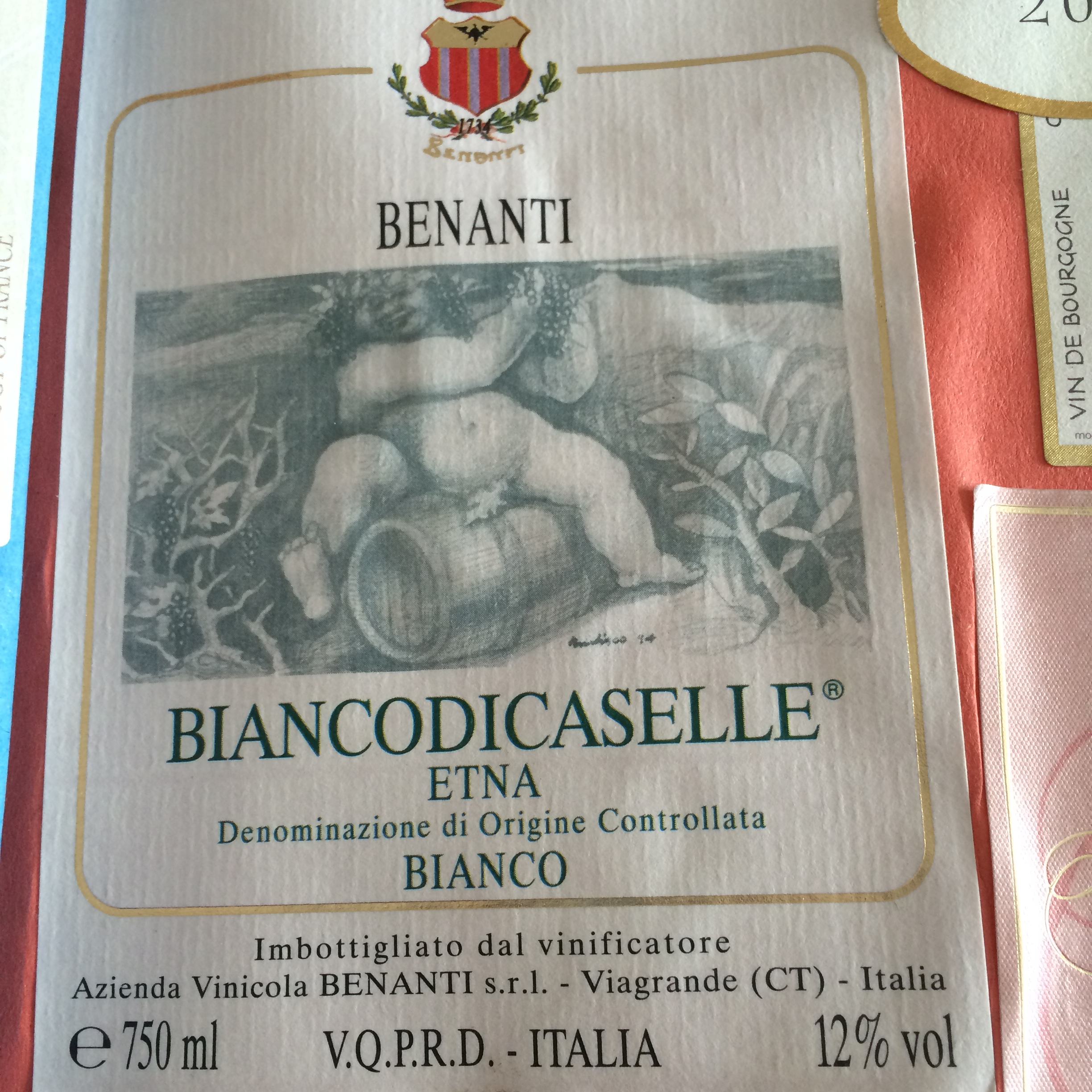
Benanti – of all their wines, it’s the Etna Bianco Superiore “Pietramarina” which I have drunk most of, but as with all these producers, try any, no all, of their wines if you can.

image

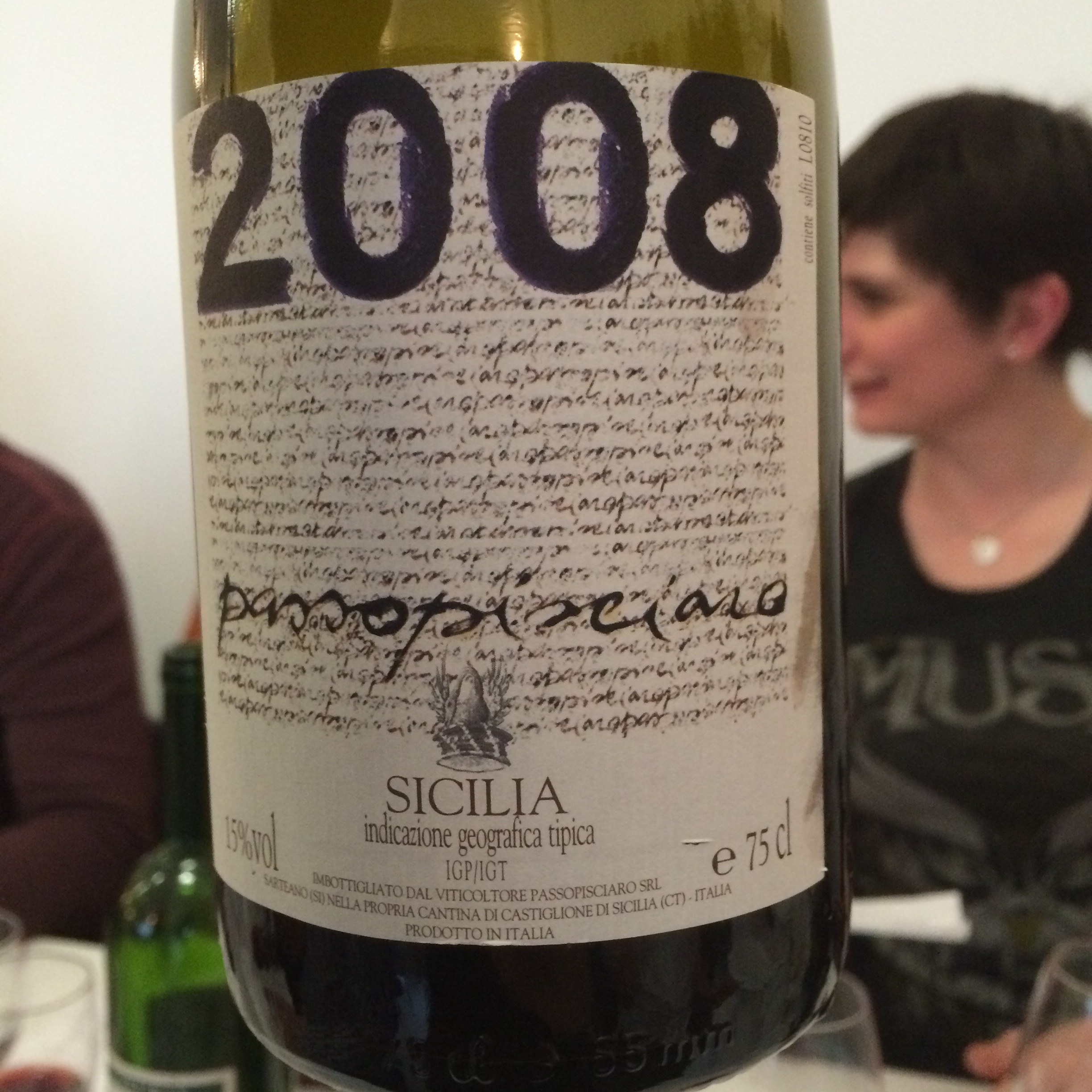
Passopisciaro – from the town of the same name. You may recall I took the 2008 to the Oddities Lunch last week. Complex Nerello Mascalese from very old vines is the hallmark of this estate.

image

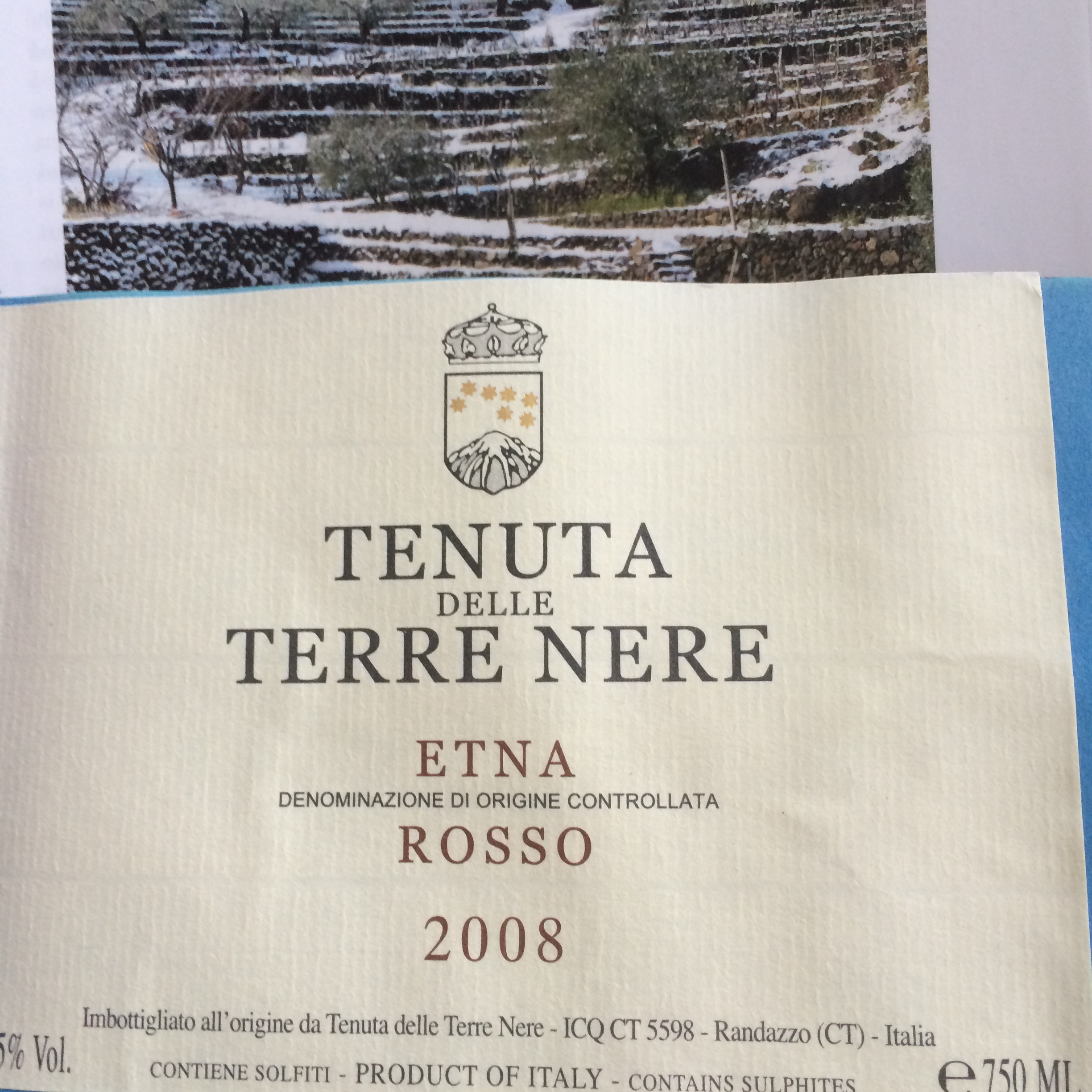
Terre Nere – from Randazzo, directly north of the crater. They are famous for their single vineyard wines which require age for them to express themselves fully. But I love their entry level white too. The first Etna wines I got to know really well.

image

Frank Cornelissen – this now famous Belgian began making wine here in 2001. He was a pioneer of sulphur free natural winemaking on the island. His wines are often mindblowing, from the simpler Contadino, through the majestic Munjabels, to the monumental Magma. I’ve also had disappointments, but I’m convinced this has been when retail storage was poor. Don’t display them under hot lighting, please.

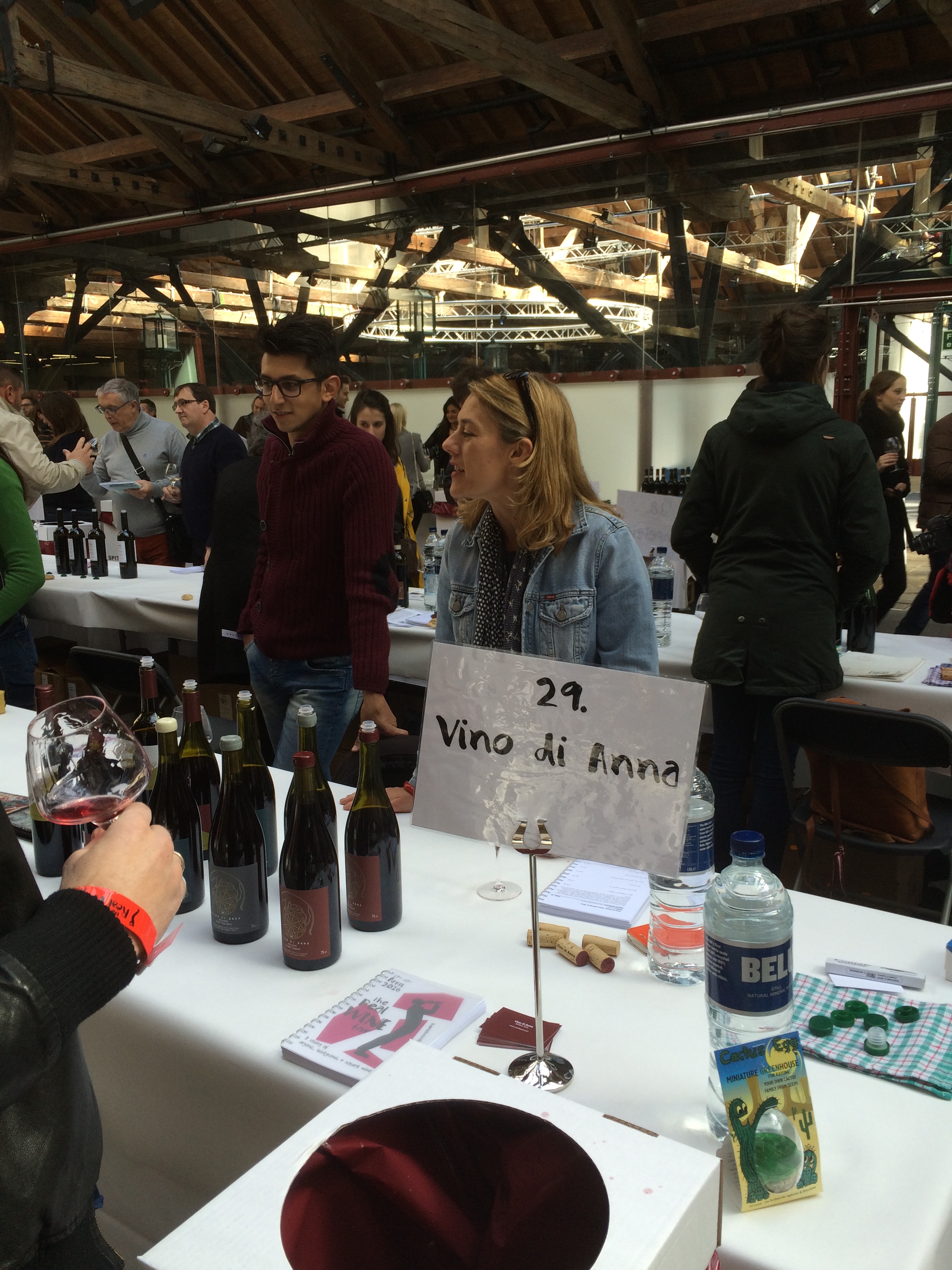
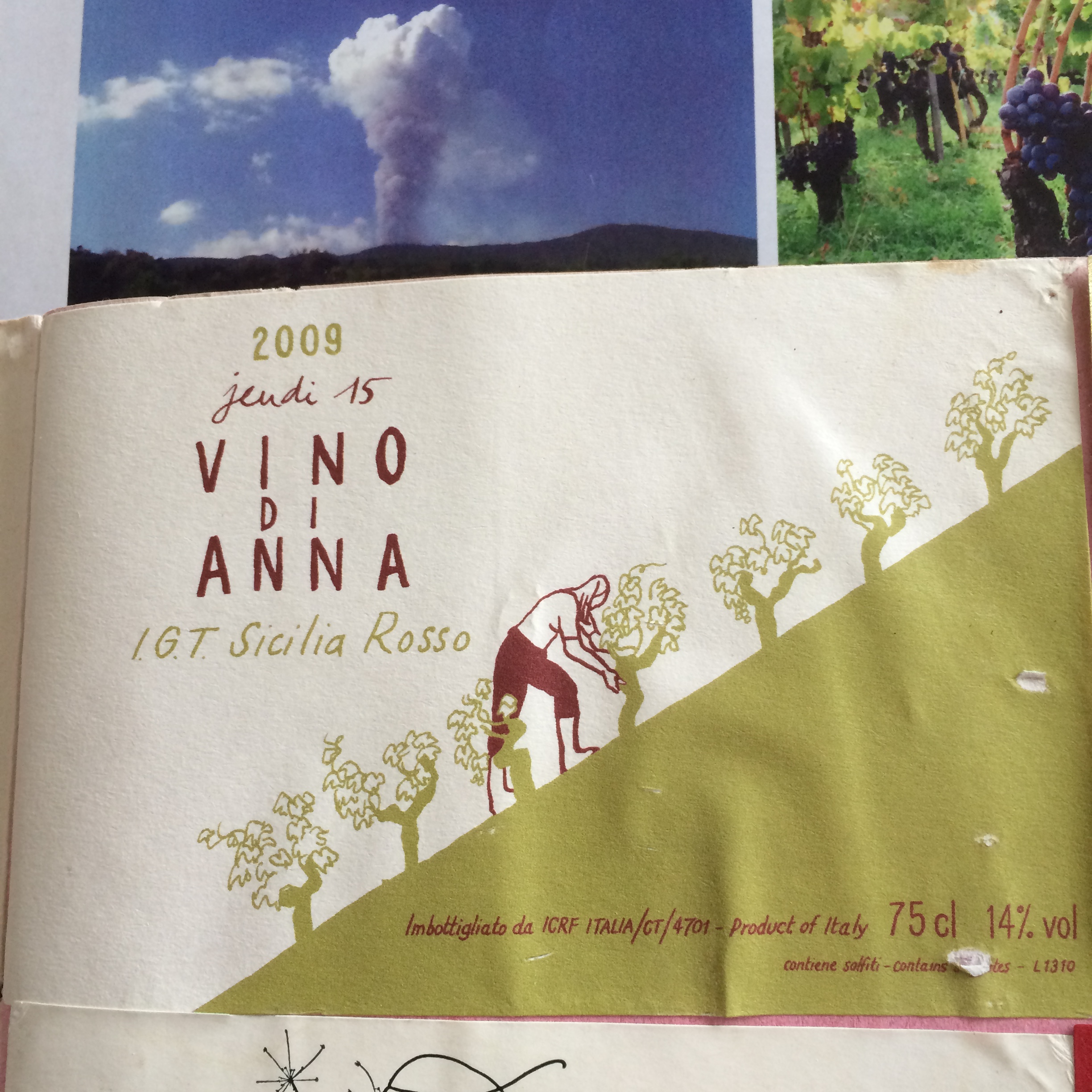
Vino di Anna – I first came across Australian Anna Martens’ earliest vintages of “Jeudi 15” via UK importer Caves de Pyrene, of which her partner, Eric Narioo, happens to have been one of the founders. Anna also makes wines in terracotta, or qveri in this case. More natural wines, and if you like this philosophy you’ll like these. Based near Solicciata.

image

Also look for Pietradolce (Solicciata) and Girolamo Russo (Passopisciaro). I want to try more of the Russo wines, they seem to be quite unique, more restrained and elegant than most, in a DOC not exactly known for the big and flabby.

My most recent discovery from Etna has been the wines of Fattorie Romeo del Castello, such as the Allegracore, below. Based in Randazzo, this is an old estate, rejuvenated by Rosanna Romeo and her daughter, Chiara Vigo. Their oenologist is Salvo Foti, so they are in good hands. On the basis of just two bottles, I’m very much keeping my eye on this mother and daughter team. They have around 14 hectares of vines, with some over 100 years of age (which just missed destruction in an eruption of 1981).

image

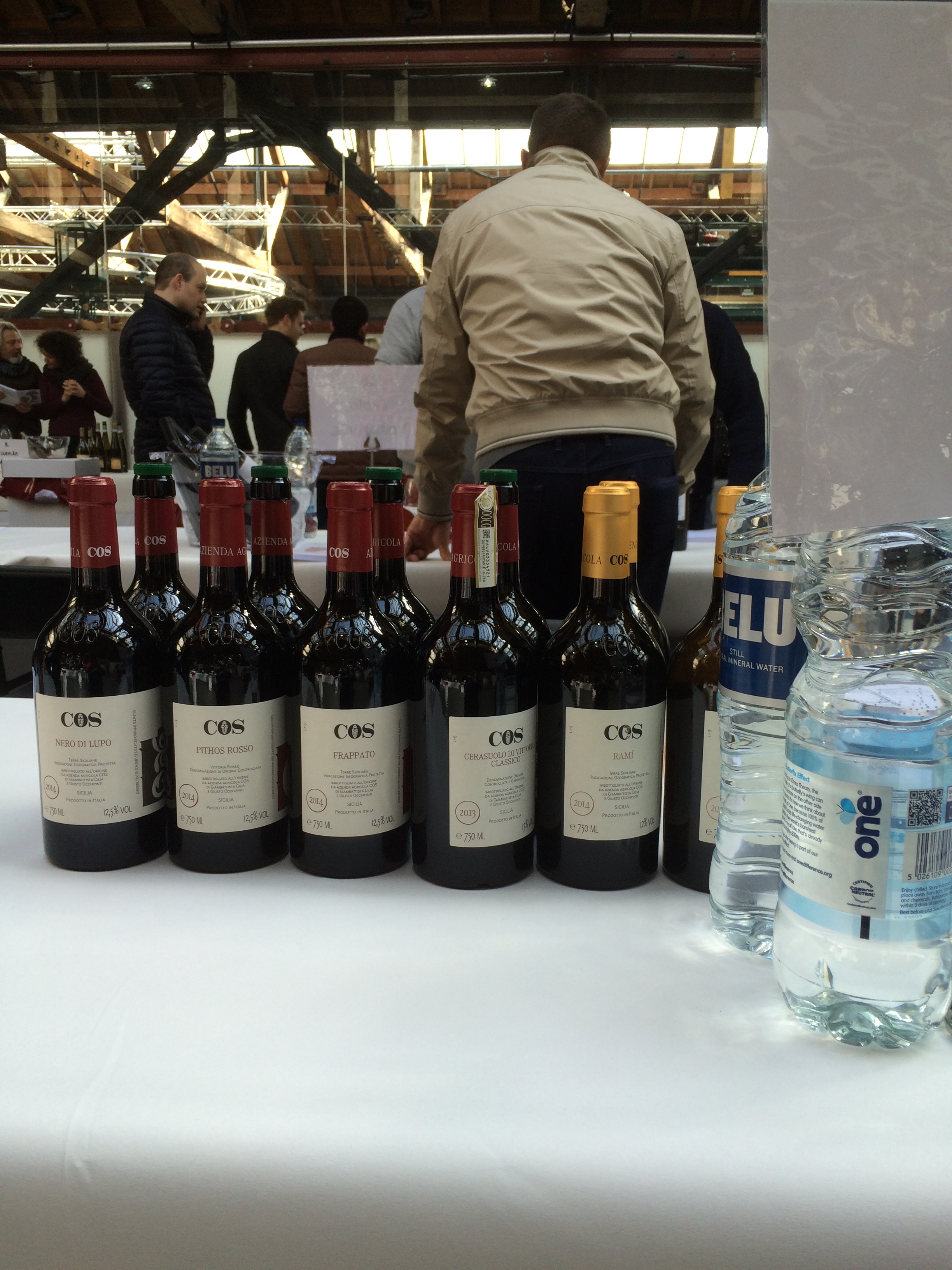
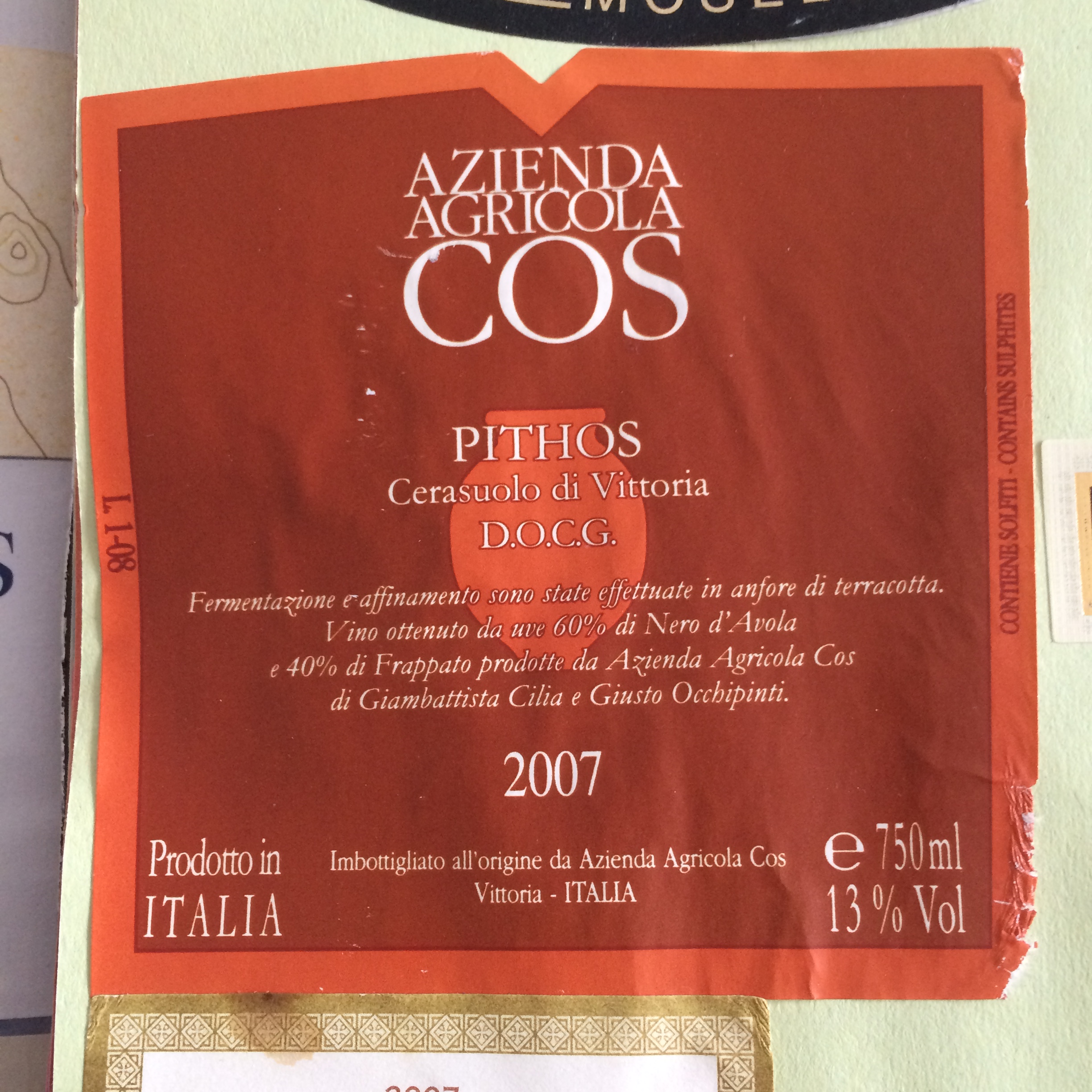
There are, of course, plenty of other producers around the mountain worthy of comment. But as we are on the eastern side of Sicily, I’d like to talk about some more of her wines. Wines occasionally hidden in the publicity shadow of the volcano, but which are every bit as exciting. The wines of Vittoria, a town on the Southeastern bulge of the island, have been made famous by one producer, COS. Note the capitals, which distinguish them from the nickname of one of Bordeaux’s finest addresses. The three letters stand for the surnames of the estate’s three founders – Titta Cilia, Giusto Occhipinti and Pinuccia Strano. These three young men were at a loose end the summer before they went off to university, so Titta’s father gave them two metric tons of Nero d’Avola and prodded them towards the palmento, the old stone-floored winemaking hut. COS was born.

COS produce a range of wines now. The wine they rejuvenated is Cerasuolo di Vittoria, now Sicily’s first DOCG wine. It’s made from Nero d’Avola blended with a lovely local grape, Frappato. The wine which made them famous perhaps, is Pithos. It’s a Cerasuolo fermented in terracotta giare, or amphora. It has amazing texture and is a fickle wine capable of true sublimity. But COS also bottle a varietal Frappato, among others. It’s bright and pale in colour with light strawberry fruit, and has become the COS wine I look forward most to drinking. In some ways simple, yet in other ways, not.

image   image

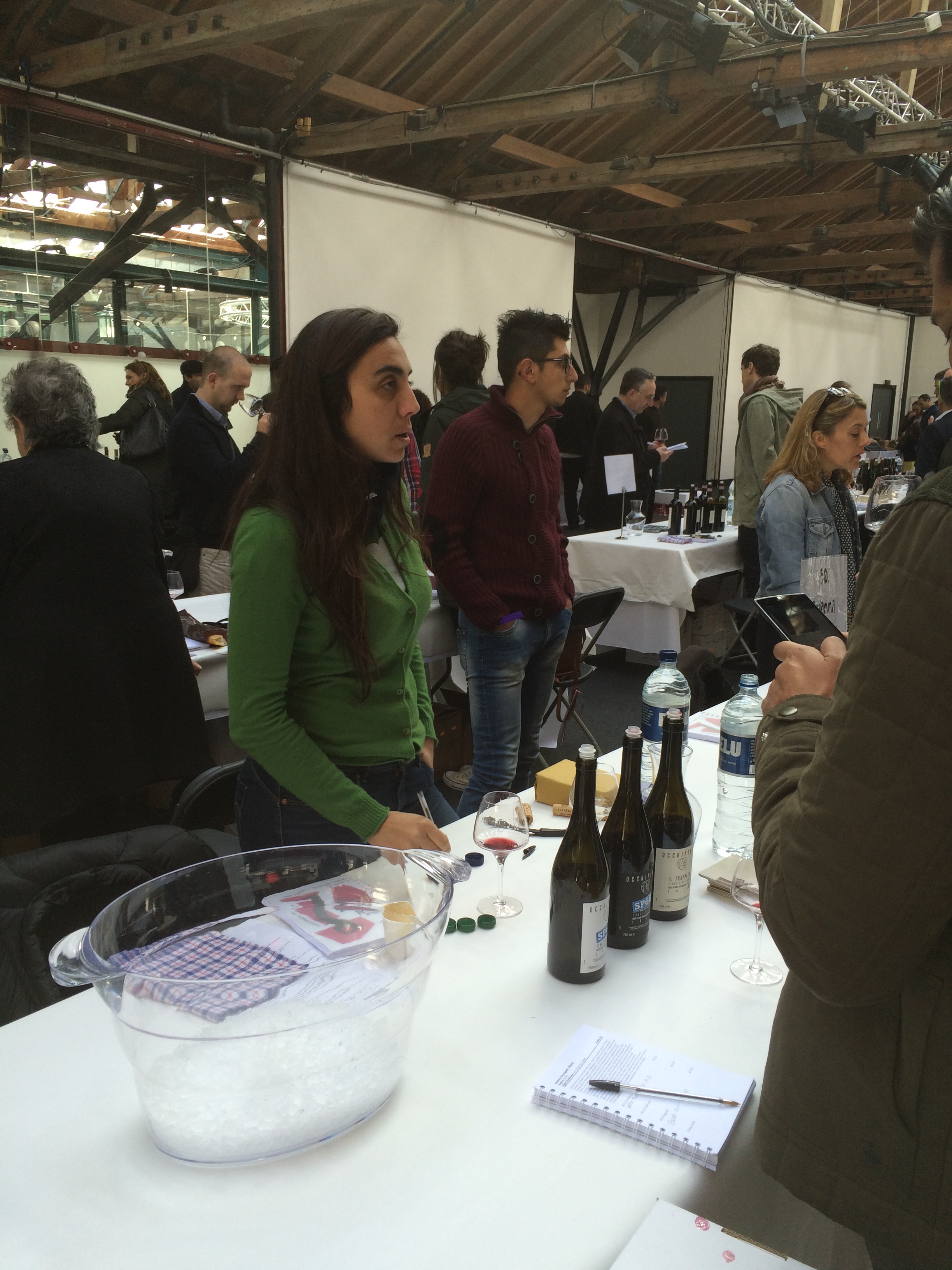
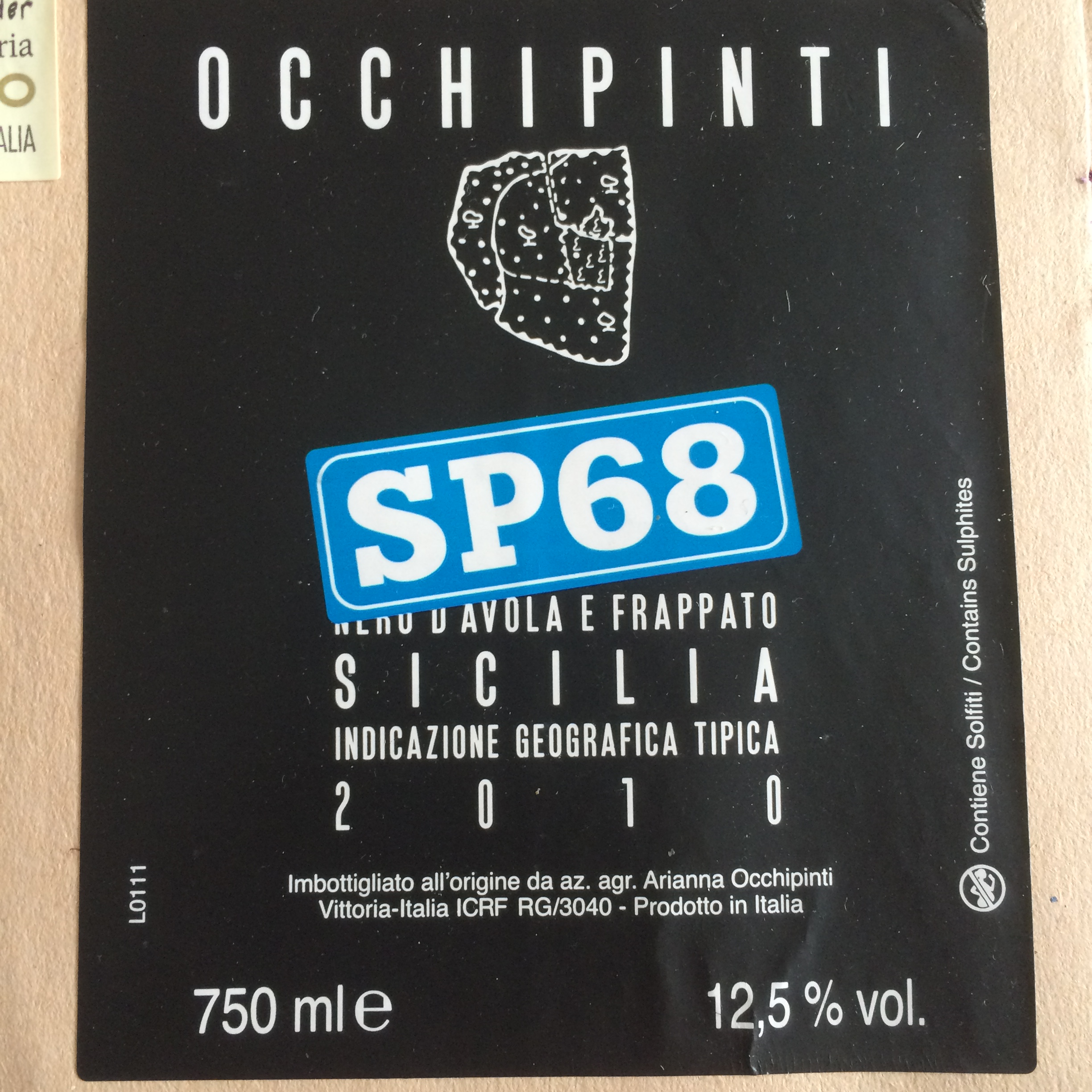
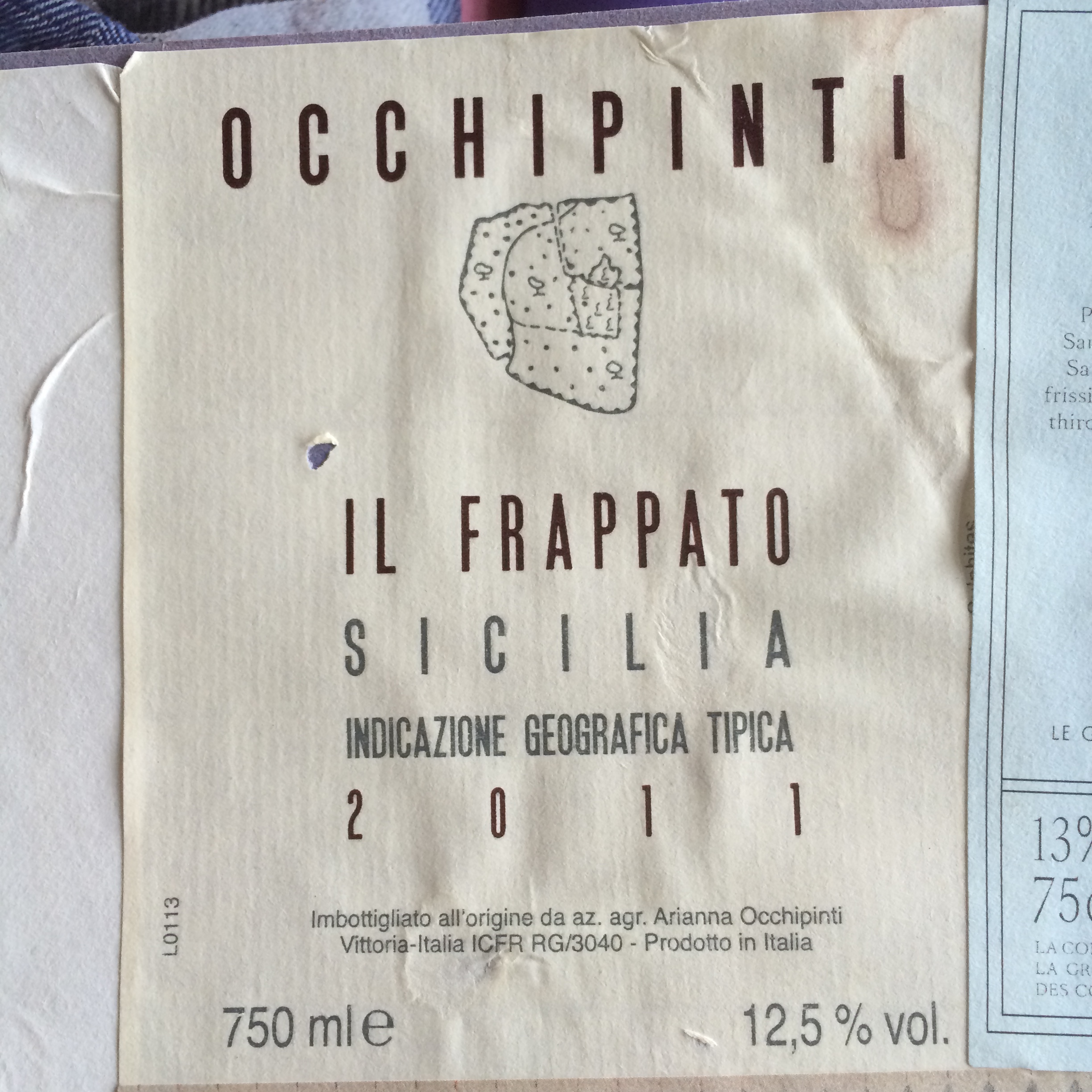
The Occhipinti family has another star in the region, Arianna (a cousin of Giusto from COS). I only know three of Arianna’s wines – a red and a white called SP68 (white = Muscat of Alexandria blended with 40% Albanello, red = Frappato with 30% Nero d’Avola, both IGT), and the most beautiful expression of the Frappato grape I know, bottled as a single variety. There are another three wines I need to try, but so far they all exhibit true purity.

image   image

As an introduction to Cerasuolo you can always seek out Planeta’s version. Planeta are a large producer, with wine farms in several locations. For many, they are Sicily’s highest profile wine family. They are often accused of making wines in an international style, and indeed some are, though their ability to fashion wines from International varieties which could match some of their more famous iterations did more than anything to put Sicily on the wine map back in the 1980s/1990s. Their Cerasulo di Vittoria is a very decent expression of the DOCG and may be easier to find than COS. Planeta have also invested on Etna, and have an interesting and relatively new white, Euruzione 1614, made from Carricante with 5% Riesling. Even cheaper, and very much cheaper than the versions by COS and Occhipinti, is a Frappato which UK supermarket Marks & Spencer sell for £8, made by Stefano and Marina Ginelli (though if you are there, I’d recommend their Perricone made by Caruso e Minini at the same price). M&S have an adventurous range which explores Sicily further, including red and white Etna wines.

image

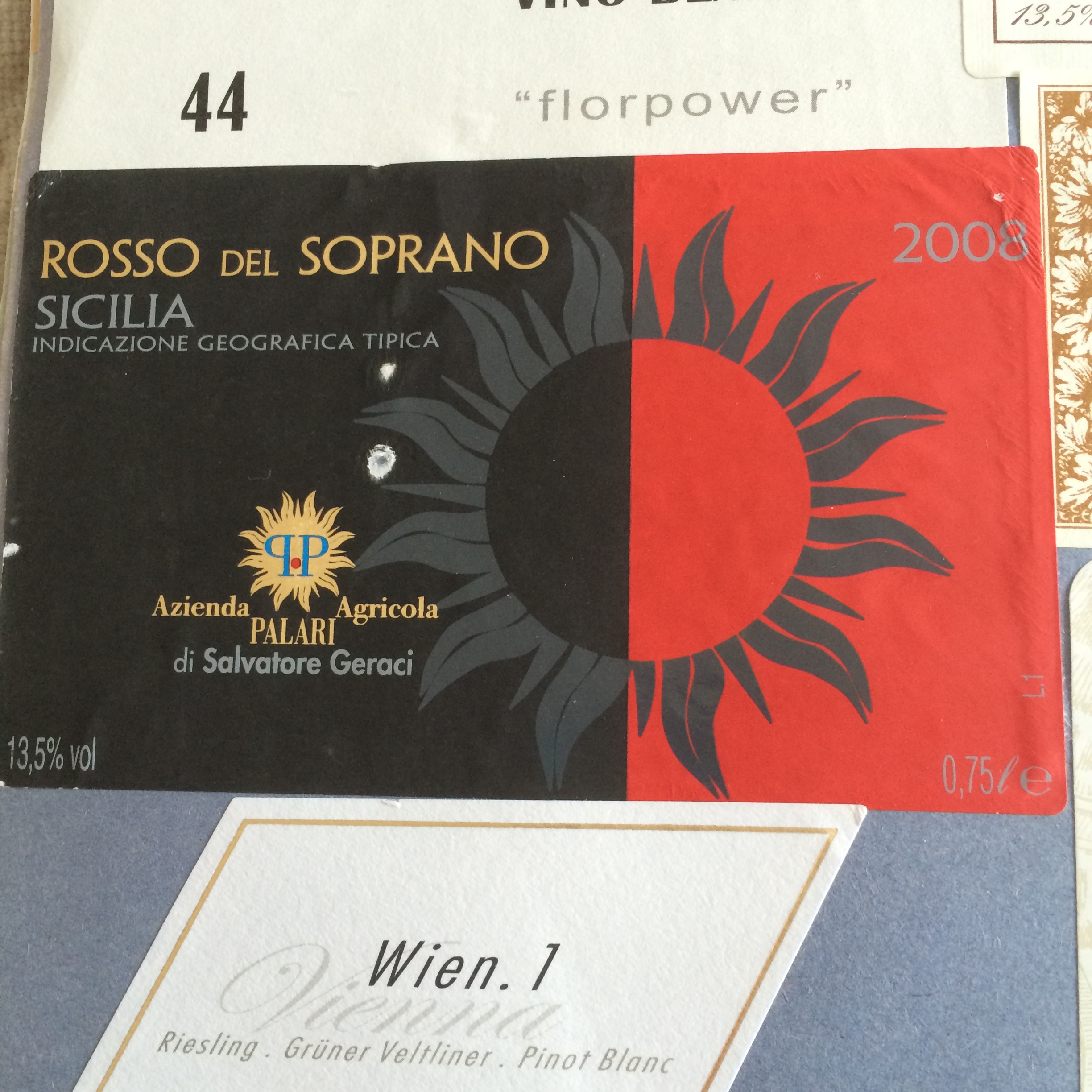
It feels as if time has almost run out, but if I can hold your attention just a little longer I’d like to take you to the extreme northeastern tip of Sicily, overlooking the Straits of Messina. Here, on steep slopes, is a tiny, 6 hectare, DOC called Faro. Its only major producer is an estate called Palari, run by architect Salvatore Geraci. Caves de Pyrene reckon these wines the island’s “most elegant”. Italian Wine Guide Gambero Rosso named the 2005 Faro as its red wine of the year, and Palari hasn’t looked back. As with Etna, Nerello Mascalese is the main grape, with others taking a minor part. There’s more of a nod to cherry fruit in these wines. The Faro DOC cuvée is very concentrated and ageworthy, but the less expensive Rosso del Soprano, which also includes some bought in grapes, is almost equally unique, especially after a few years in bottle. It seems, on its own terms, to combine elegance and richness. Wines worth going out of your way for. Not as fashionable as the Etnas, perhaps, but the fairly consistent tre bicchiere keep the prices in line with the best of that DOC.

image

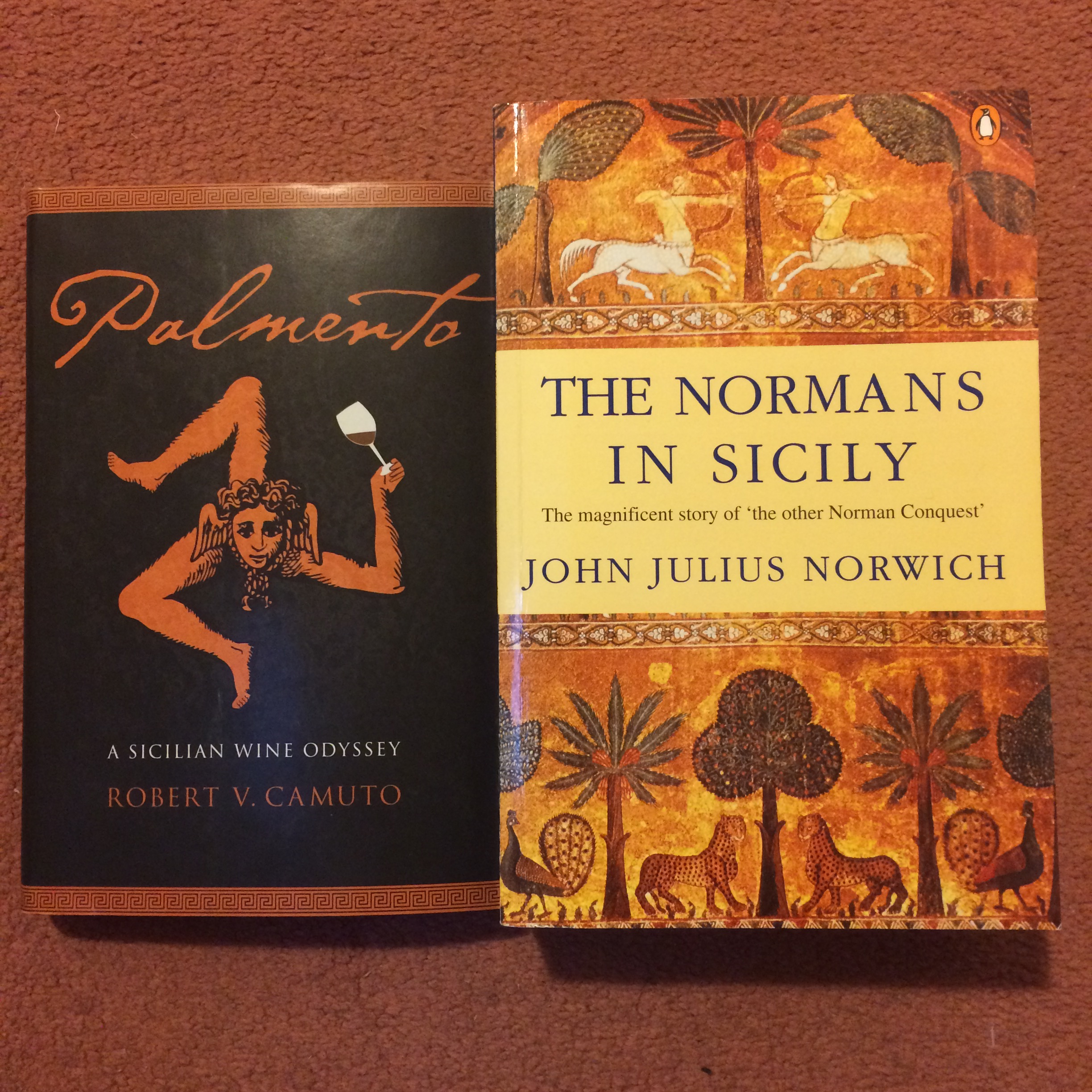
There seem no be no shortage of articles about Sicily in the wine press, but there is a little known book on the island’s wines and winemakers, which I have enjoyed enough to read three times. It’s a few years old now, first published in 2010, but as a cross between a wine and a travel book, anyone interested in Sicilian wine may find it worth seeking out. It’s Palmento – A Sicilian Wine Odyssey by Robert V Camuto (University of Nebraska Press). He visits most of the iconic producers as well as soaking up the food culture of Sicily, and the descriptions of his visits, and often the journey to get to them, are evocative enough to transport you there.

As usual, the photos are my own, but there are small glimpses in a couple of those photos of photographs  from an article on Etna by one of my favourite wine writers, Max Allen, which appeared in Gourmet Traveller Wine magazine, August/September 2015. Additional facts were gleaned from the Palmento book mentioned above, Hugh Johnson/Jancis Robinson’s World Atlas of Wine (7th edn, Mitchell Beazley) and from the various highly informative, book-like, catalogues of importer Les Caves de Pyrene.

All comments on the wines mentioned, and other opinions (and errors) are my own.

image

Posted in Italian Wine, Sicily, Wine | Tagged , , , , , , , , , , , , , , , , , , , , , | 5 Comments

Oddities #10

Yesterday’s Oddities Lunch at Rochelle Canteen was a landmark of sorts, our tenth in a line of exciting events which take place every two months. Over those months we’ve drunk around 150 bottles of so-called oddities, ranging from wines some might not think odd at all, like a few of Champagne’s less visible wines or an old Burgundy, to yesterday’s stranger offerings – from Bali and Namibia.

In December the bar was set very high. Christmas joy was in the air and a few quite special wines appeared: a 1978 Clos du Papillon, a 2000 Breg from Gravner, the unicorn Mythopia from Switzerland, and a stunning (against all odds) 1990 Chateau d’Arlay from Jura, alongside my offerings from Selosse and Equipo Navazos. But as these lunches prove, there is a long and meandering river of vinous treasures and I’m sure more will continue to flow. They may not always be the brightest jewels in the chest, but that should not distract from their lustre. Every wine yesterday was tasty, and I enjoyed them all. Some may have been better than others, but there was no wine I’d not take to a tasting myself, or a dinner party, so long as the other guests were as open minded as the people who come to these events.

Of course, it’s easy to ignore wines like these if you can afford to drink large. The wines of regions like Italy’s Oltrepo Pavese, or grapes such as Veneto’s Raboso don’t figure highly on many wine lovers’ bucket lists. And I’m sure many would snigger at drinking sparkling wine from Bali, perhaps choking at the thought of Namibian Shiraz. More fool the fools. The Balinese sparkler was well made and would offend few if served blind as an aperitif. The Namibian Syrah? Well, see below.

image  image

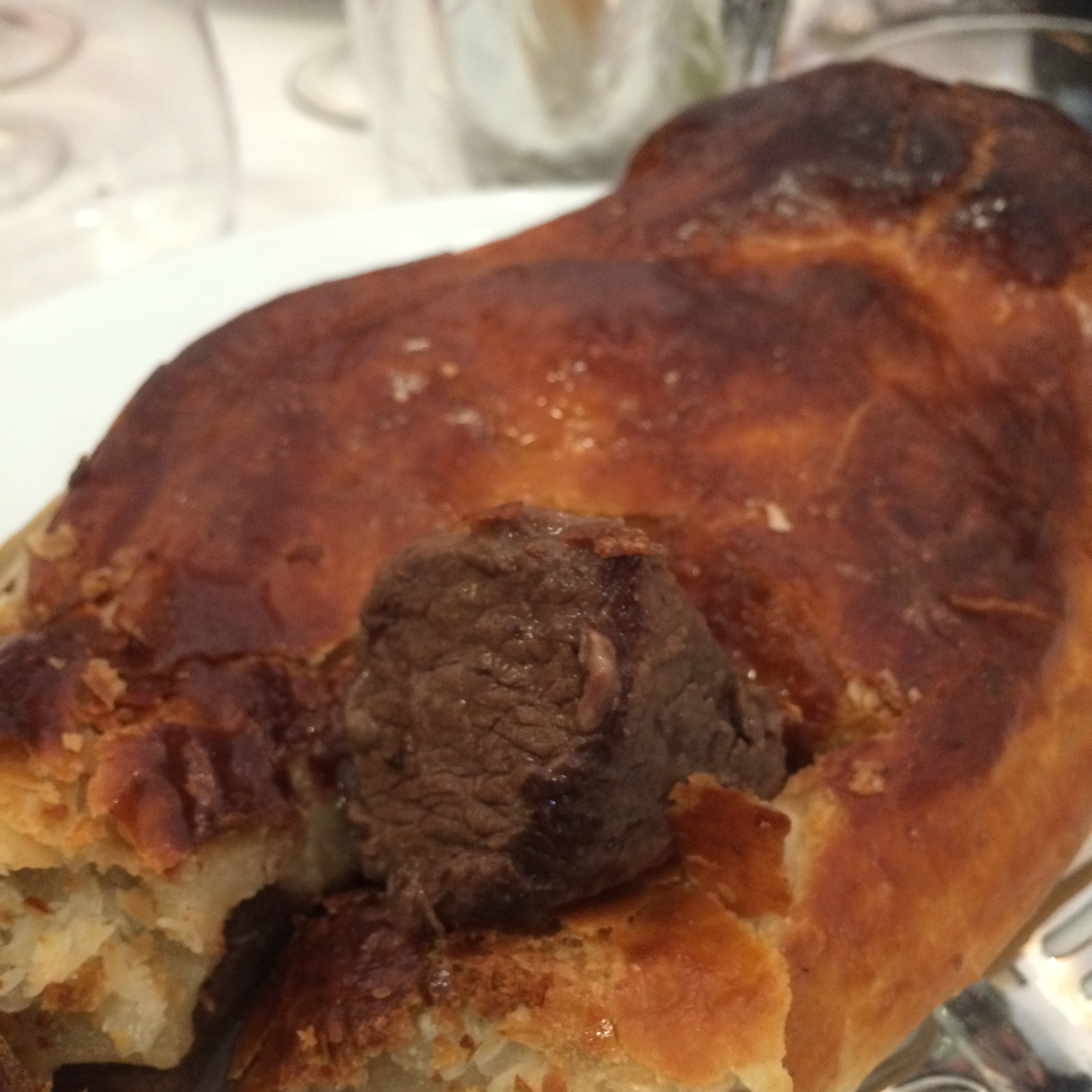
The Canteen                                                         Venison Pie

This month’s bunch

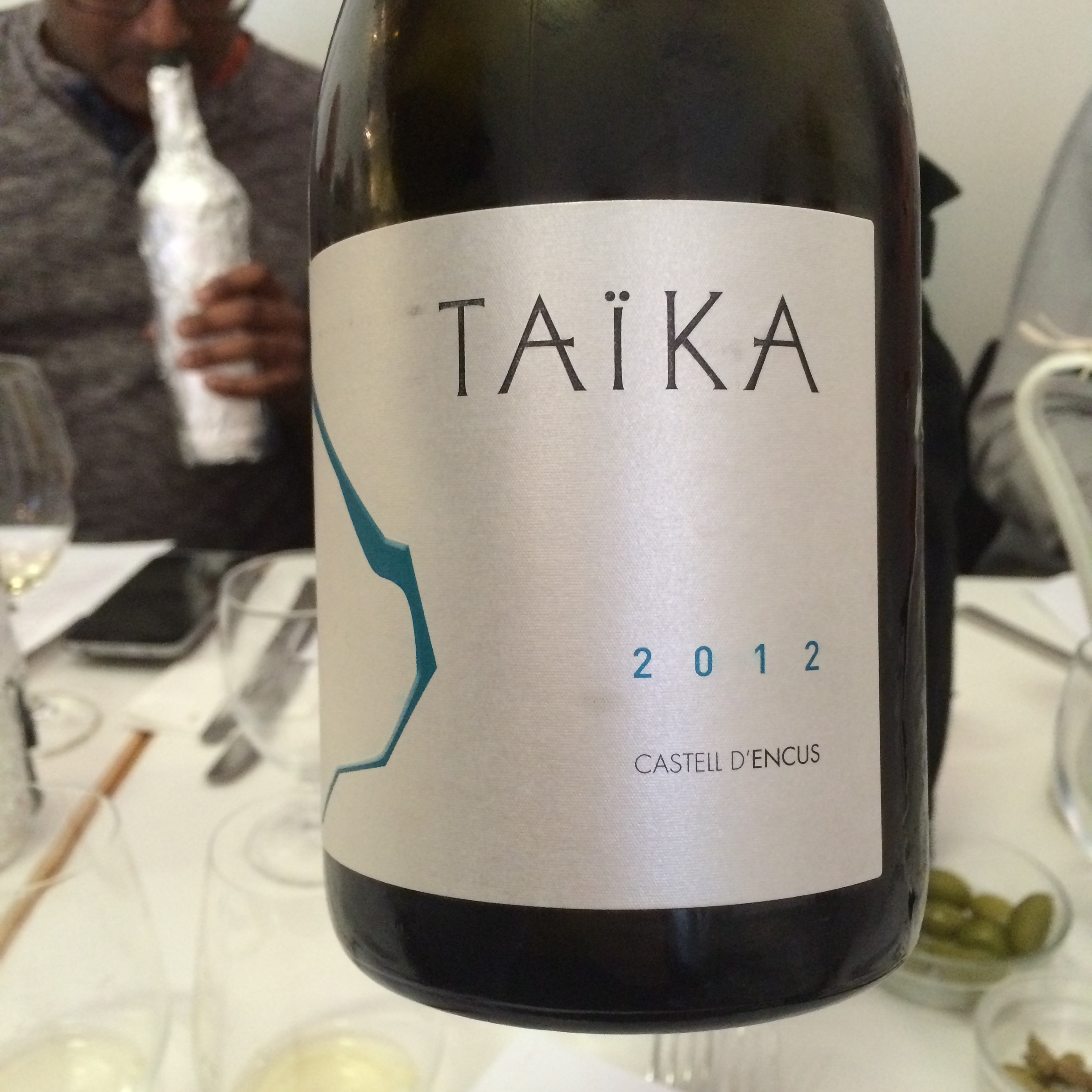
Taika 2012, Costers del Segre, Castell d’Encus – This is a sparkling Semillon/Sauvignon blend from grapes grown at 1000 metres altitude in the Penedès mountains of Costers. You might remember we had this estate’s glorious Pinot Noir at the post-Vinoteca Tasting lunch at Quality Chop, a few weeks ago. No UK distribution, but tiny production. This didn’t quite match the Pinot, but it’s a lovely wine.

image

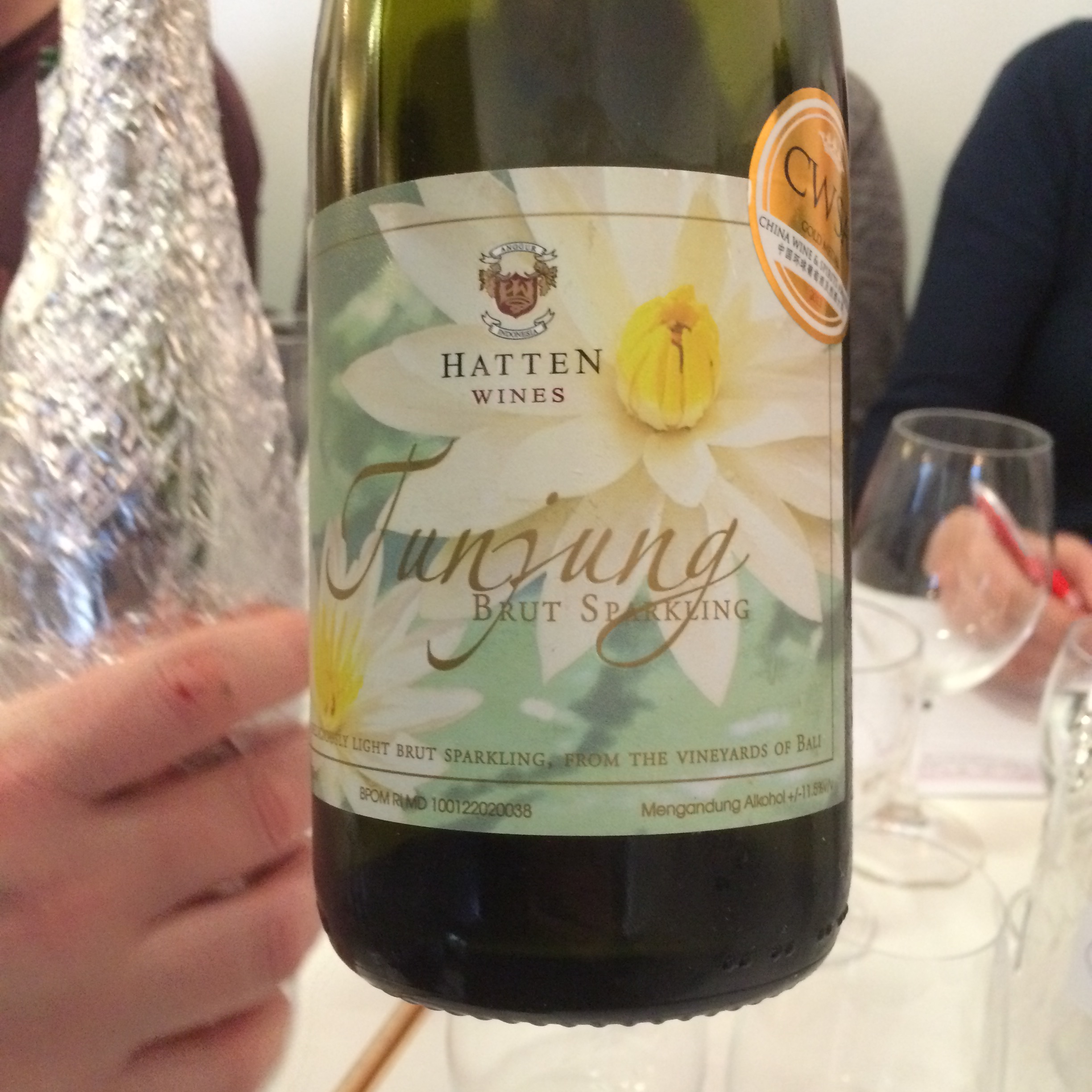
Tunjung Brut NV, Hatten Wines, Bali – The grape on the label of this sparkler claimed to be indigenous to Bali, but I’m assured it’s actually Chasselas, which I can well believe, after that fact was revealed. I won’t pretend this was as good as the Spanish sparkler which preceded it, but it was astonishingly well made in context. As I said above, you would be happy drinking it as an aperitif unless you were very mean spirited…or a wine snob. I’ve had many less appealing sparkling wines in my years of taking one for the team (aka vinous exploration). And it’s not even the first Balinese wine we’ve had at an Oddities!

image

Burg 2008, Marcel Deiss, Alsace – Sometimes I stray from the script of Oddities. The reason we serve the wines blind is for pure entertainment. Although I am happy to play the idiot by failing to spot a wine I know well, or coming up with the worst possible guess, I did nail this, at least as far as a Deiss field blend. I had no idea which one, and guessed 2004 – it did have a lovely degree of maturity but retained freshness. It was complex in a sort of unassuming way, as Deiss’s wines so often are, transcending grape variety. I love them, and it reminded me (I’ve said elsewhere I’m overdue another Alsace trip) that I’ve not drunk one for a while. One of my personal favourites on the day.

image

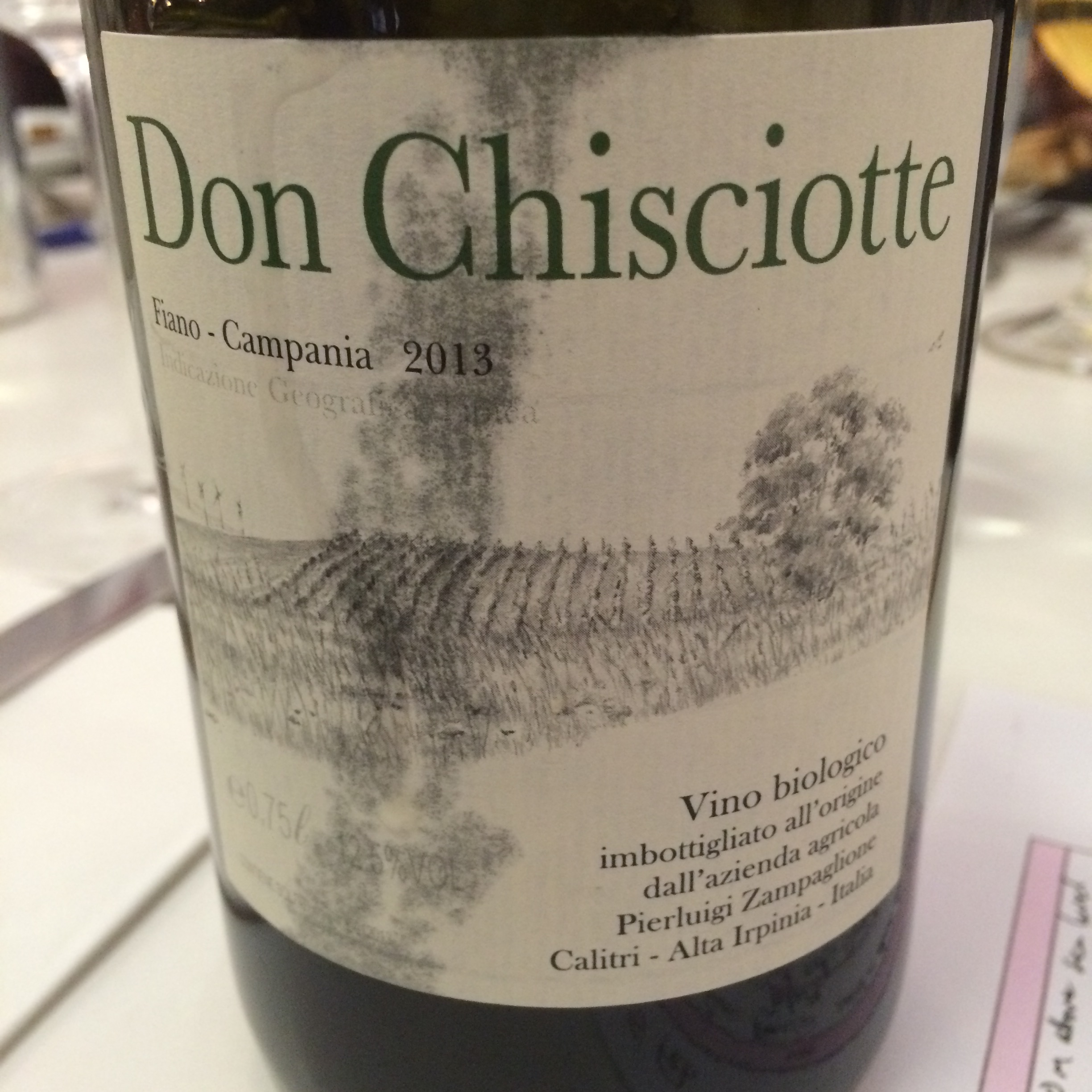
Fiano 2013, Don Chisciotte, Perluigi Zampaglione, Campania – This one was brought by one of our resident some-time winemakers, and was possibly the most distinctive wine of the day. Seven days skin contact has produced a wine of texture which is dry and almost tannic on the finish. More dark straw than orange, erring towards golden. I can almost smell its complex scents now. This is one wine I’d like to share an evening with, my idea of a Valentine wine actually. One you could really get to know better.

image

Watervale Riesling 2012, Clos Clare, South Australia – Clearly the least odd wine of the day on the surface, but scratch beneath. First, it’s a domaine many of us have heard of, yet is almost never seen in the UK. Second, it was to a certain extent slightly atypical. Although a few people guessed Watervale (especially our super-palate wine merchant, Mr Vintrepid), and we all guessed Riesling, it was more developed than many a fine example from this region. No searing acidity, but instead, lovely integration of all its elements.

image

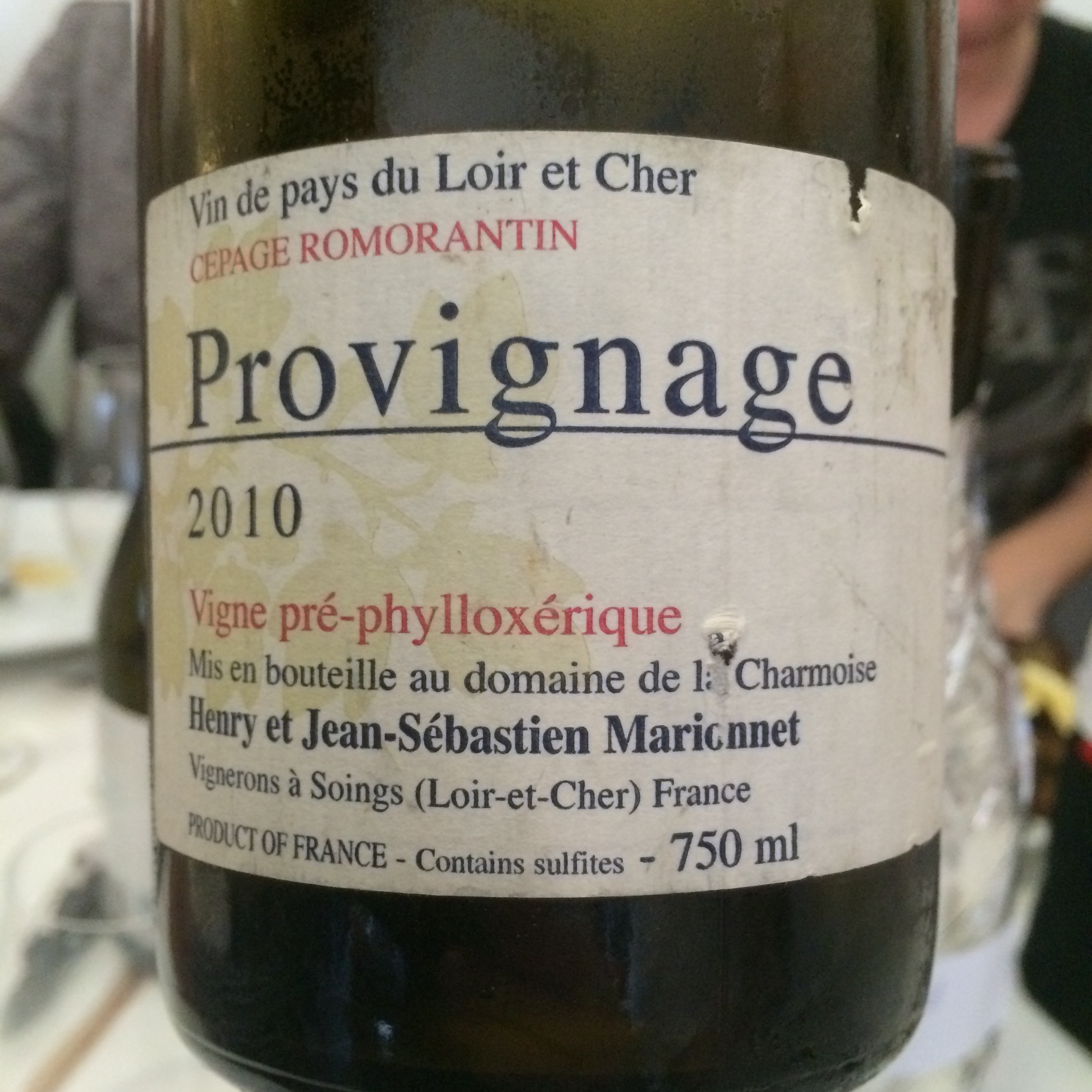
Provinage 2010, Henry & Jean-Sébastien Marionnet – Always a pleasure to drink this distinctive wine in its distinctively shaped bottle, always therefore embarrassing when I fail to spot it. Pre-phylloxera Romorantin which ages like Chenin in some ways, and is consequently hard to spot unless the relevant lobes are on top form. Jaqueline Friedrich talks (in WFW 50) of taking a different Romorantin to a dinner party. She mentions its acidity, which when young can be very pronounced. But with age, it softens. And this wine is not exactly from Cour Cheverny, but a little further west, and is labelled as a Vin de Pays du Loir et Cher. Being made from the fruit of ungrafted vines, it is one of a dwindling number of wines unique in this way. If you get a chance to drink it, grab it. It’s good, too!

image

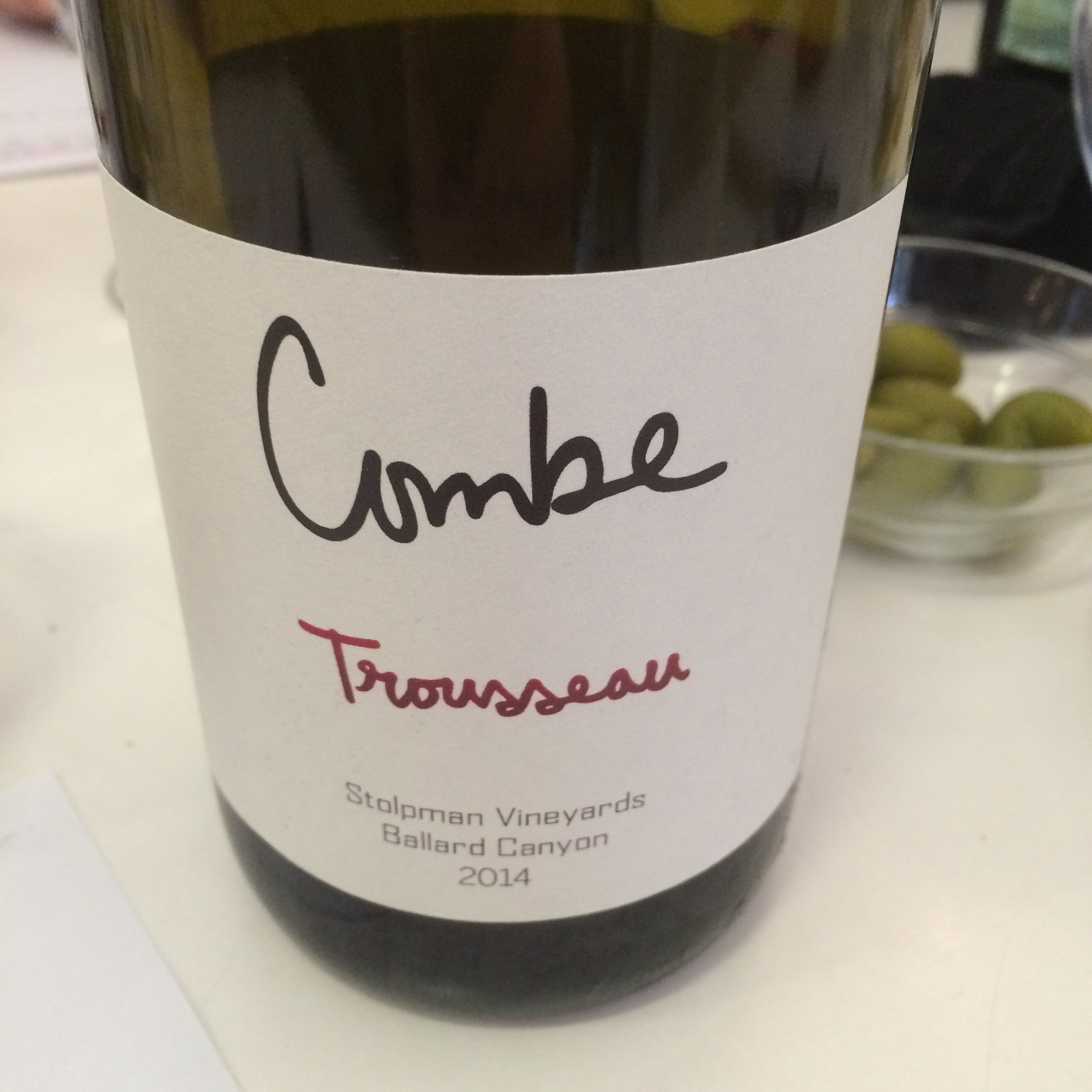
Combe Trousseau 2014, Stolpman Vineyards, Ballard Canyon, California – A Cali-Trousseau again. What a strange ring that phrase has. Not Arnot-Roberts this time, but one of Rajat Parr and Sashi Moorman’s collaborations. It was Parr who first convinced Peter Stolpman to bung in an acre of Trousseau, and a little more has followed, so much do the Stolpmans love it. As did we. A wine of the day contender, light and fruity but with an edge, reminding me a little of Frapatto. Bigger than a Jura, but paler, hiding its 13% alcohol well. Meant to ask where to find it? I know Sager + Wilde nabbed some. This sort of wine is Oddities in a nutshell. Different but brilliant.

image

Neuras Shiraz 2009, Namibia – Or Rande der Namib Wüste, as the label says. My guess here – old Rioja (don’t fall off your seat!). I think someone else tried Musar (a better guess, I admit). Neuras’ vines are planted by cold water springs, and although proximate to the Namib dessert, they get gentle Atlantic breezes. The netting, protection not from birds but from baboons, and even the leopards which sometimes stalk them, also cuts out 25% of uv light. The grapes avoid baking, and the wine is matured in French oak, bottled unfiltered. I think this wine would astound most people, and not only for the fact that it is made at all. Actually, I did guess Namibia after we had established the continent, but only as an educated guess from reading far too much about wine in my life. This was brought along by a French wine journalist/educator, so don’t say the French only know French wine again. How she got hold of it, I don’t know, but it was a real privilege to try it. Very good.

image

Montebuono 1990, Lino Maga, Oltrepo Pavese – Effectively from the other side of the Po from Pavia, a DOC blending Barbera with other grapes, in this case plenty of Croatina (aka Bonarda). My guess was Marzemino, which wasn’t too far wrong. Really a good example of how such unfancied varieties can age into a mellow wine with a good degree of complexity, and one especially food friendly (12.8% alcohol seemed perfectly balanced for this). This is a wine which, for me, doesn’t always show best in line-ups like this. You have to try to imagine what drinking it over a couple of hours would be like.

image

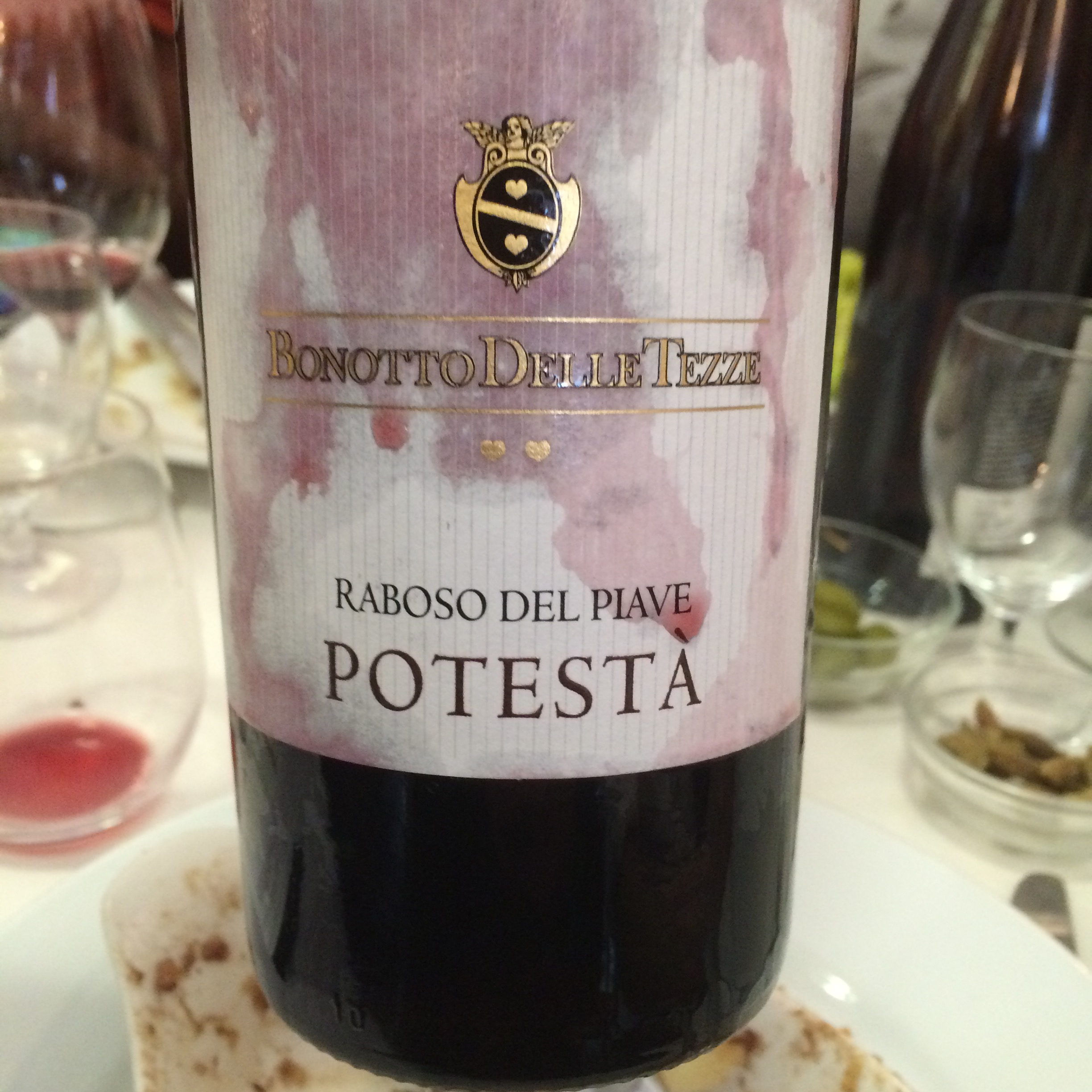
Raboso del Piave 2010, Bonotto Delle Tezza, Potesta – Another obscure Italian DOC, this one from Veneto. Piave produces plains wines from east of Venice and south of the Dolomites. There’s a lot of simple wine made from French varieties, but the the local grape is the Raboso. As with the Pavese wine above, you see the qualities of a well made local wine when it has the chance to take on a little bottle age. Another wine showing food friendly character.

image

Rubin 2010, Uniqato, Bulgaria – Rubin is a cross between Syrah and Nebbiolo. The obvious question is why bother? But for whatever reason it was done, you can’t fault the wine. Uniqato is a brand of the Damianitza winery. It comes from the Trakiiska Nizina region (not part of Bulgaria I’m familiar with, but I do remember Damianitza from the first time around, back in the 1990s). This has 14.5% alcohol and it’s quite big. The grapes are harvested at surmaturité (leaving 3.5 g/l residual sugar after fermentation) and popped into a mix of French and Bulgarian oak for ageing into a rich, smooth wine.

image

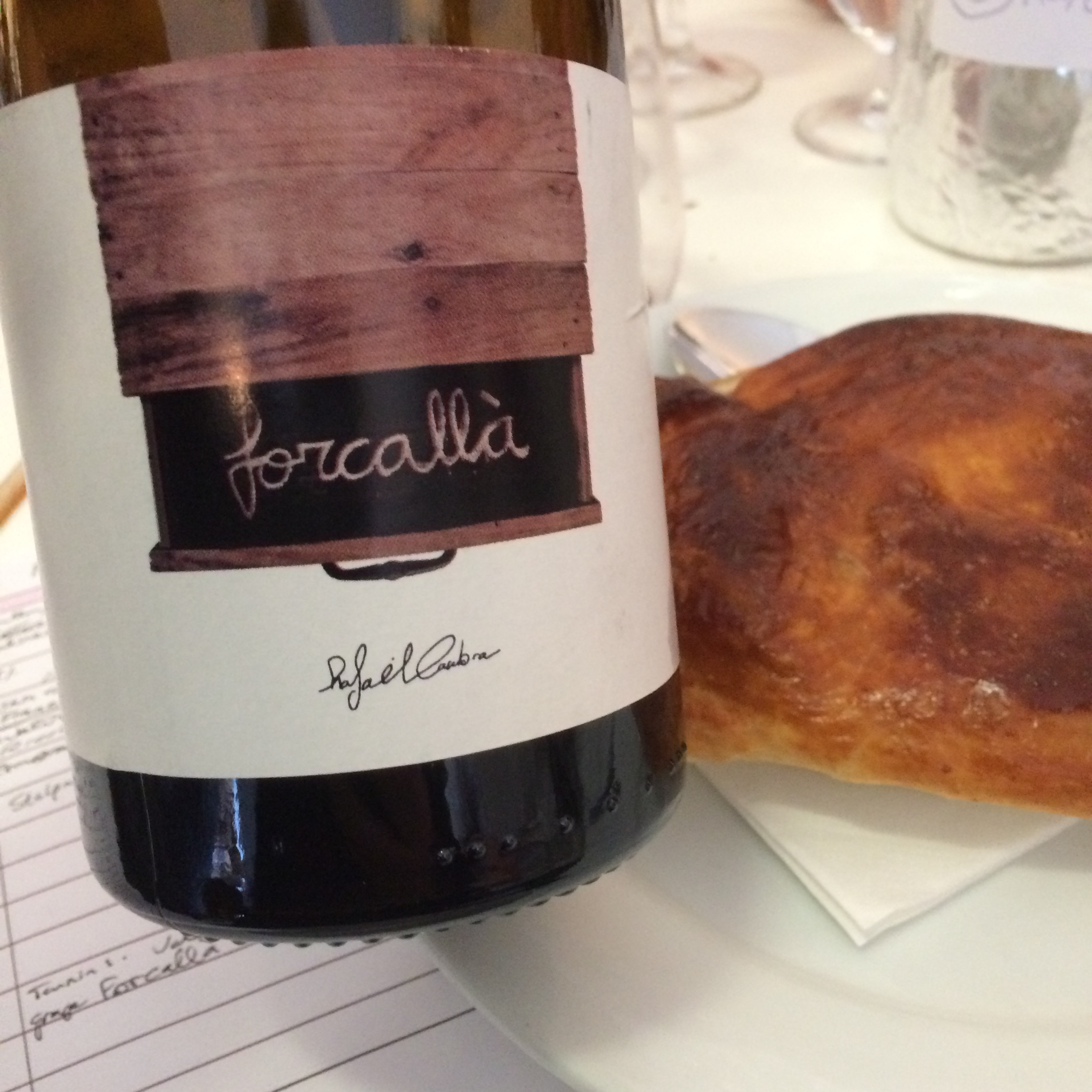
Forcallà 2013, Rafael Cambra, Valencia – A slight anomaly here. I can find this wine on sale at merchants in Europe, but can find no mention of it on the producer’s web site, nor on that of the company I believed import it (Indigo?). It’s a local Valencian grape variety, if my German is on form, which tasted to me like a modern Spanish wine. I don’t mean as if it were from International grapes, though it doesn’t surprise me that Cambra grows plenty of those, but it was modern in style. Quite a bit of tannic structure on a big frame, though a not over the top 13.5% alcohol kept it from any flabbiness. Could need time?

image

Passopisciaro 2008, Etna, Sicily – The Passopisciaro vineyards are in Contrada Guardiola, mainly on the northern side of Etna at between 550-1,000 metres above sea level. This is their entry level wine, made from mainly Nerello Mascalese which is vinified in stainless steel before ageing, and malo, in large oak. It’s a big wine, weighing in at 15% alcohol. Yet it’s balanced and, at over seven years old, showing good maturity. I think I’d like to see a bit less alcohol as it does show on nose and palate. But 2008 was, I think, seen as a very good year here, and the vines even for this cuvée are between 80-120 years old. Overall, it’s a classy intro to this top Etna producer, and more easily affordable than the vineyard designated wines, a step up though they often are.

image

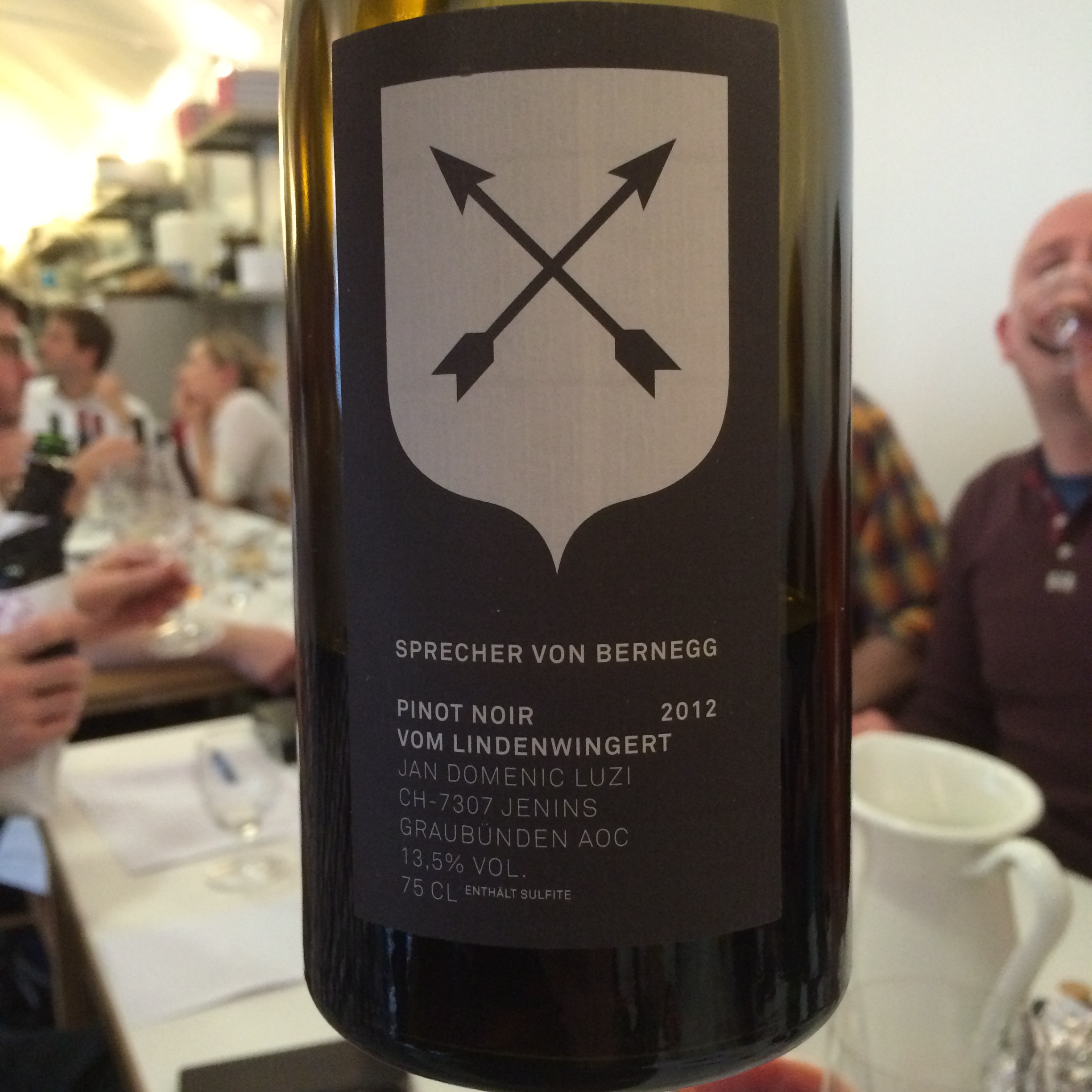
Von Lindenwingert Pinot Noir 2012, Weingut Sprecher Von Bernegg, Jan Domenic Luzi, Graubunden, Switzerland – We are onto the unofficial wines now. This always happens…”I just happen to have…”. I’m very glad this popped out of a bag. I’m a massive fan of Daniel Gantenbein’s wines from this bit of Eastern Switzerland, nestled below Austria’s Vorarlberg and Liechtenstein. But sadly his wines have doubled in price over six or seven years. I kick myself for not buying at £50/bottle for future drinking. It’s hard to find producers in the same class, although there are decent wines in this string of villages. Luzi has only been working his grandmother’s few hectares since 2008, and the sources I’ve read suggest he’s fanatical about quality. It shows. Not Gantenbein quality yet, but really one to watch. For me, another WOTD contender.

image

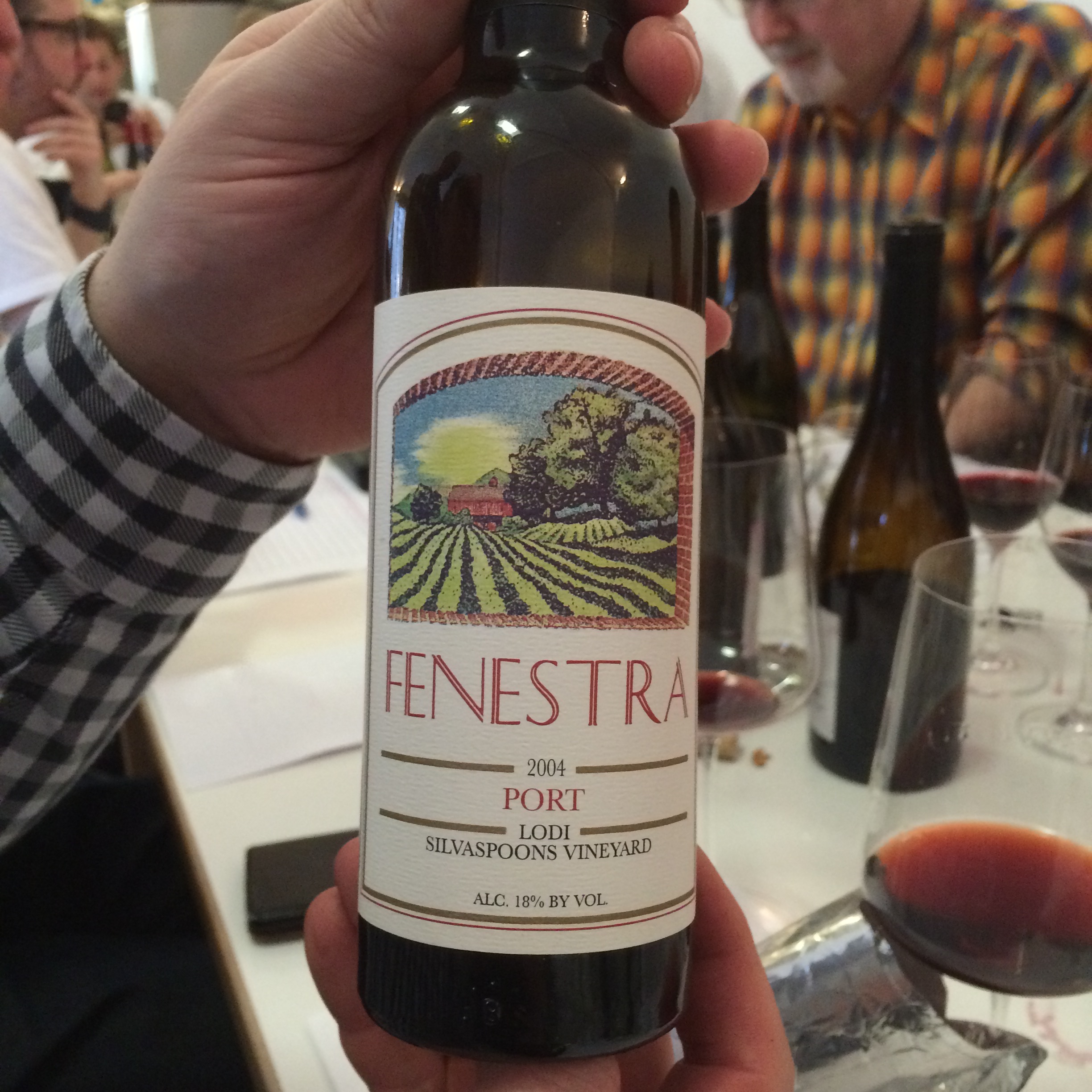
Fenestra Port, Silvaspoons Vineyard 2004, Lodi, California – I drank a half of this 18% alcohol, Touriga blend, last year, not that I spotted what it was. Smooth, rich, slightly sweet, it very much does what it says on the bottle. Not a wine of complexity, but at a decade it has a nice softness and warmth…but not too much – Lodi is in the Central Valley, but due to cooling breezes it is not a super-hot AVA by any means. I’d always encourage wines like this to be brought along to finish on nicely, although it was not quite all over…

image

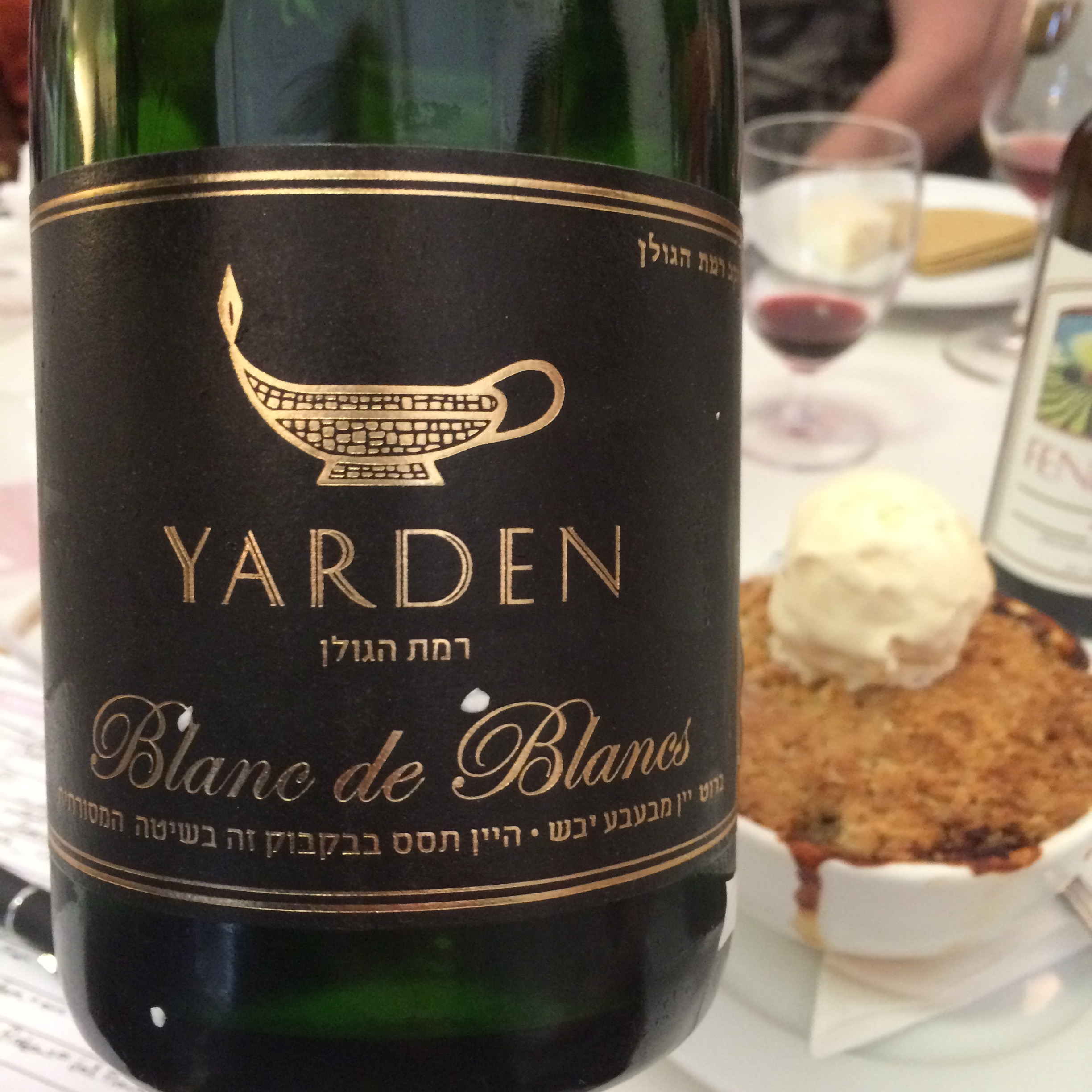
Blanc de Blancs, Yarden Winery, Golan Heights, Israel – We do see one or two Israeli wines at these events, and they are always well chosen. This is a classic BdeB made from Chardonnay. It helps that Golan possesses easily the region’s coolest vineyards (it sometimes snows up there in winter), and this has a profile typical of many Champagnes: 12% alcohol, fresh, zippy, acidity and a mixture of mainly apple with a touch of brioche. Not a fine wine to challenge the finest of France, but more than a creditable effort.

image

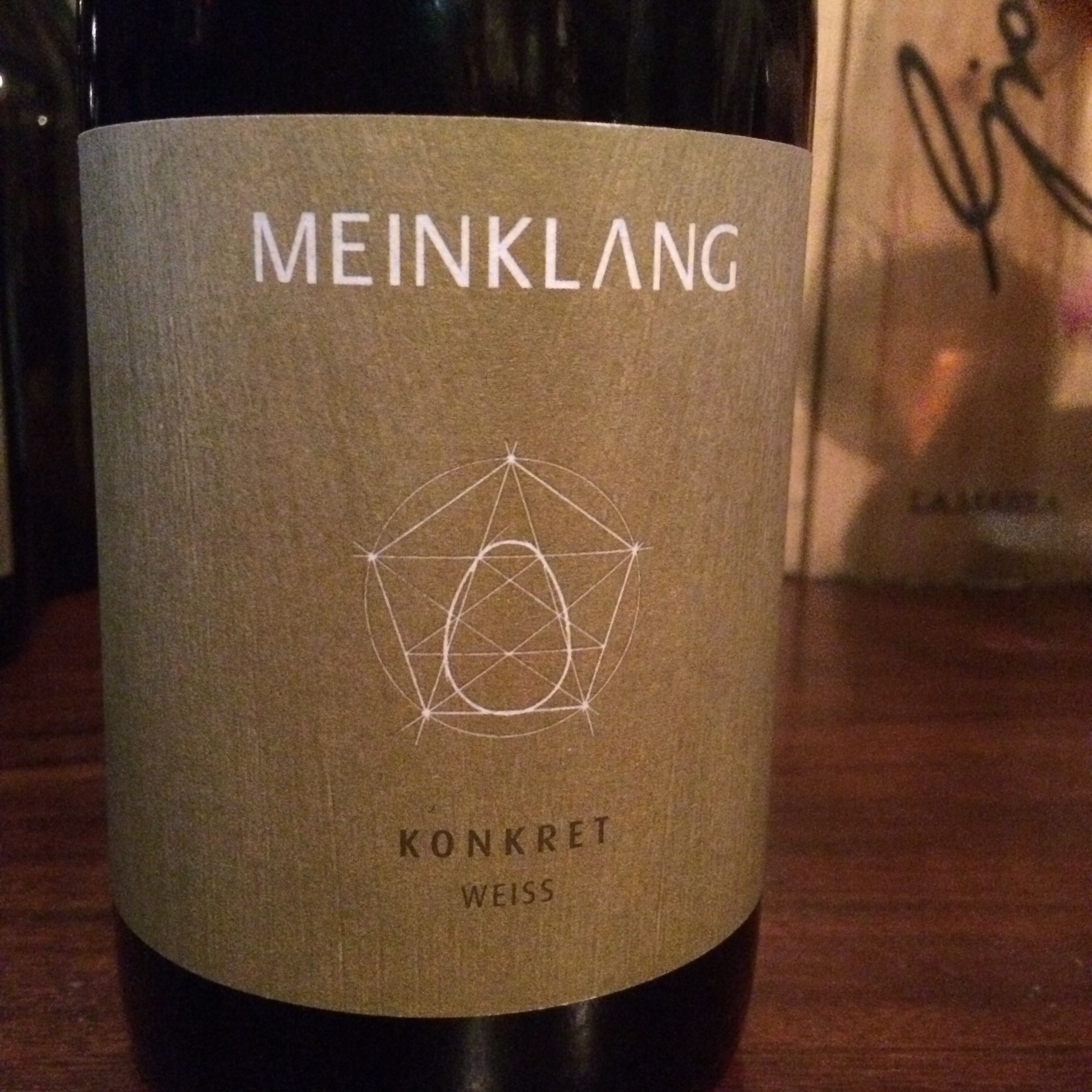
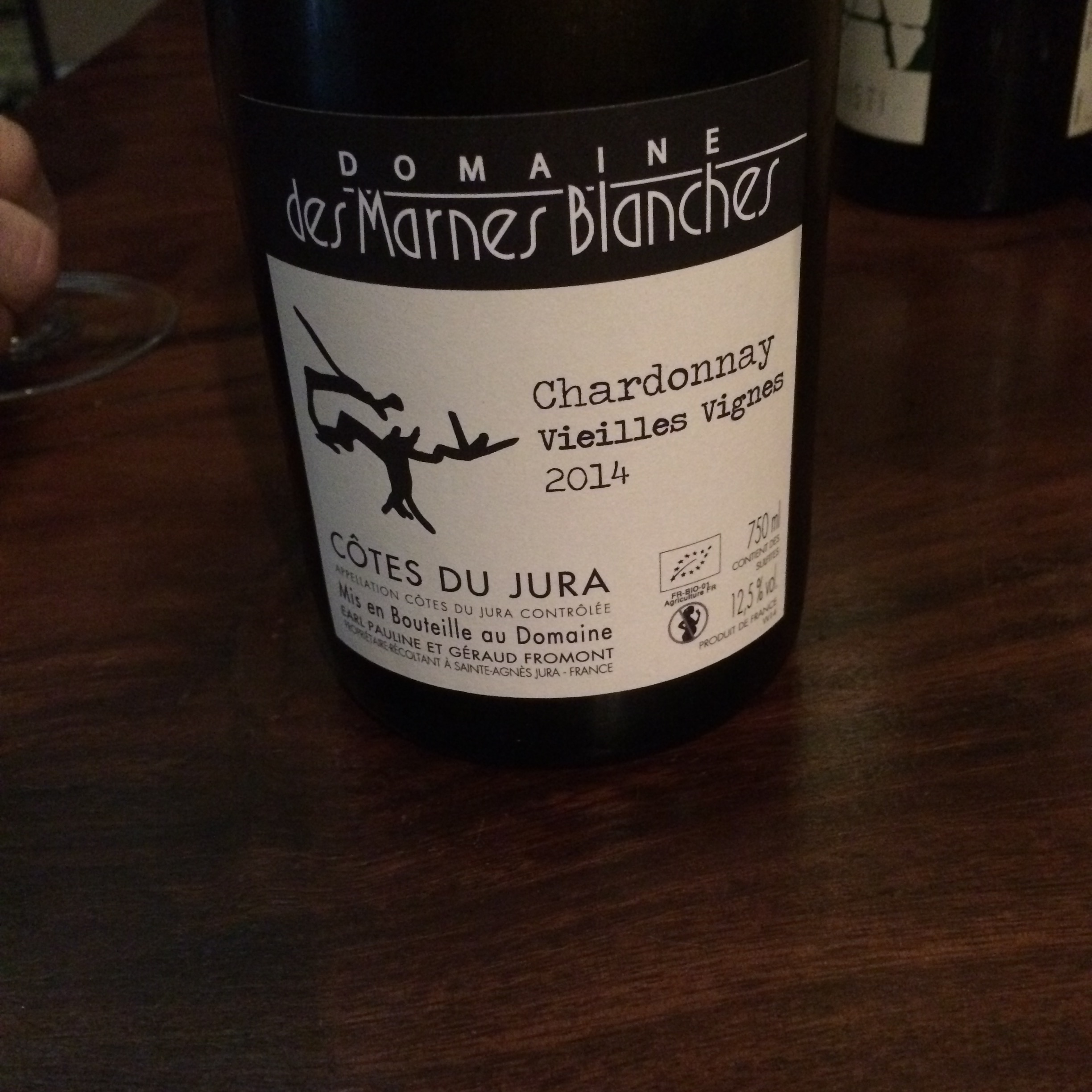
So you see, nothing disappointing at all. Half of us repaired to Winemakers Club, under the arches on Farringdon Street, where I was able to sample Vinochisti‘s E3 Dry Erbaluce, Meinklang‘s magnificent “Konkret” (a skin contact wine made in a concrete egg, cherry wood brown and really quite mindblowing), and the exquisitely fresh Chardonnay from Domaine des Marnes Blanches, rising star of the Sud-Revermont (that’s Jura). For me, that was the time to head towards the crowded, four carriage, train home. Anyone with a pad to lend me close to St-Paul’s…?

image  image

image

The only Grand Crew we saw all day (ouch!)

Posted in Oddities lunches, Wine, Wine Tastings | Tagged , , , , , , , , , , , , , , , , , , , , , , , , , , , , , , | 5 Comments

Sweaty Gym Shoes on Hot Tarmac

The Tasting Note as a form of wine critique is not new. It was around long before Michael Broadbent first published his detailed observations. He reputedly has over 90,000 of them in his famous notebooks. But Broadbent certainly established this concise analysis of a wine’s colour, bouquet and palate as the gold standard of wine criticism. Then, in the 1980s, we in Britain experienced a new form of tasting note from the extrovert vocabulary of Jilly Goolden, on BBC TV’s Food and Drink Programme. I must thank Tim Atkin, via an ancient Times article, both for the Goolden wine description which I’ve nicked as the title for this second piece on wine writing, along with the suggestion that British Food Writer Delia Smith had once called that show “the most disgusting programme on television”. Around that time, the most famous living wine critic, Robert Parker, was also honing the form, with his gobs of sweet berry fruit and his hundred point scoring system,

In my last Blog Post I tried to justify the existence of the Wine Blogger. As a species we are often writing about a breadth of wines which do not get much attention from many of the established wine writers, in the established wine press. There is a market for these wines, exciting wines of personality from outside the classic wine regions, and we are able to bring such wines to the attention of eager consumers, and to lead them to where they might make new discoveries. In this second part, I’d like to describe why this new world of wine requires a new kind of wine writing, and why the tasting note, as we know it, might be a moribund vessel for conveying the information the new consumer craves.

The new breed of wine consumer has an open mind. They are prepared to try anything which sounds interesting, and they have a glass half full approach to wine contemplation. It’s not about what qualities the wine might lack, it’s about the positives in the glass. The new consumer wants to be stimulated, occasionally shocked as well. Not for them the certainties of the same old thing, although she (and increasingly nowadays it’s she as well as he) is as interested in nuance and subtlety as any wine pro.

The tasting note form began, I think, as a personal observation which, when published, acted as a good little snippet of information which would help the wine lover know what to expect from their bottle and, they hoped, when best to drink it. It can work especially well when describing the same wine as it has evolved over time, in describing perhaps a vertical run of vintages of the same wine, and perhaps even a group of different but closely associated wines, in order to differentiate them. But over time it developed into something very different. It became an expression of the subjectivity of the critic. Not only was it shaped by the tastes and prejudices of the writer, but in its language, it expressed ever more complex organoleptic sensations. Whether the reader also found accacia blossom, or was it linden flower, who knows? I’m not sure some of the writers producing these works of High School poetry really cared. Bung on 99 points and your description would surely find itself on the shelf tickets of several wine stores. The tasting note became, in some cases, not so much about the wine as about the critic.

The tasting note, with its fruit compote of strawberries, raspberries and loganberries, was fine for those who wanted to be told what the wine tasted like. But it is tempting to wonder whether the “TN” would suffice for some instead of actually drinking the wine, and if one did drink it, then would we really get some of the more fanciful scents and flavours. Don’t misunderstand me. Some scents, like cherry for instance, are pretty easy to spot, although whether they are black, morello, or was it maraschino, who can say? But many tasting terms are fanciful to many readers – even my own description of Vin Blanc de Morgex, “like licking a pebble freshly taken from a mountain stream” (which I swear relates to a mouthfeel/texture thing, not minerality!). It’s purely subjective because, unlike me, the reader does not have a mountain stream filled with pebbles near at hand.

But there are good and bad tasting notes, as in all things. All of this is very abstract, so I’ll give some more concrete examples. TN number 1 talks of a “waxy, nutty nose…Creamy texture…concentrated peachy fruit…Ample body…clean, fresh, zippy finish…” Nothing wrong with that. It’s descriptive without verbosity. Yet what does it really tell us about the wine? It comes from Decanter’s 2016 Italy Supplement, and an article about sparkling wines. Maybe it was an over zealous sub, but look at the wine’s name – Fongaro, Lessini Durello, Metodo Classico Brut. Nothing here tells me anything about the wine’s composition, nor the producer, nor exactly where it comes from, unless I’m a smart alec who knows Lessini Durello is a sparkling wine DOC covering Verona and Vicenza provinces.

Another style of tasting note appears on page 154 of World of Fine Wine 50 (December 2015). It’s written by that poet of the vine, Andrew Jefford. I can’t quote much of the note as it takes up a whole page column. It tells me nothing, in either a technical sense, nor in a plainly descriptive sense, about what its subject, Château Latour 2000, actually tastes like. But boy, is it writing! “…a kind of velvet bomb, quietly ticking inside…Quarternary rivers have come and gone…The great coffee-coloured serpent of the Gironde…no ten minutes at Latour is like any other…Congratulations then on spending your money on half an infinity of chances”. I think many of us can spot Jefford’s finest without attribution. You read it in awe of the words, and he paints a picture like Turner. You almost wallow in writing like that. You become as if curled up on the sofa with a hot mug of coffee, no, a glass of old Boal, a log fire roaring in the grate. But there’s another kind of tasting note, too.

TN number 3 and we are back in Decanter’s Italian Supplement. The first article there is by Monty Waldin, and it’s called Natural Heroes, focusing on the natural wine stars of Italy. It’s not really a TN as such, because the wine gets seven lines at the bottom of the page. But in a box above, Waldin uses four paragraphs in a narrow column to introduce its maker (in this case, Angiolino Maule from Veneto). He talks about Maule’s struggle to buy his vineyard, his philosophy, his methods, and his belief in the future of the natural wine movement.

One page later, TN4: Waldin does the same for Stefano Belloti from the Monferrato sub-region of Piemonte, whose A Demûa Monferrato Bianco I bought on the basis that a wine merchant told me it was her favourite orange wine of 2015. But if you read Waldin’s story of how Belloti left the city for a tiny plot of his grandfather’s land in the Tassarolo Hills, eventually creating a farm as close as possible to a self-sustaining living organism, then I reckon you’d be tempted to try a bottle.

What we have here is a different kind of writing, one which tells the reader a story. It’s a story about a place, about people, about a particular way of life, with its struggles. It tells us why the people have persevered, and what they have created as a result. It matters little that, in Belloti’s case, that blend of Timorasso, Verdea, Bosco, Chasselas Musqué and Riesling, fermented on skins of grapes picked from vines over 100 years old, tasted of nuts, flowers and herbs with a salty-citrus aftertaste.  “But they might not like it”, you say. “We need to tell them what it tastes like so they don’t waste their money”. But the modern wine lover simply seeks the adventure of discovery. Their questions are not “what does it taste of?”. They want to know “is it an honest expression of the land on which the grapes were grown?”, and “was it made according to a particular philosophy by an individual with a love and passion for what they are doing”? If so, if they like the story, then they will want to undertake the voyage of discovery. Sometimes, drinking a wine for the first time can be a little like hearing some wonderful music for the first time, or seeing a great film. You don’t always want a spoiler. Have you ever tasted a wine you know nothing about and been stopped dead in your tracks, thinking Wow!?

My own belief, based on spending far too long with other wine lovers who have a similar sense of wine being a wonderful adventure, is that they want to feel…like I felt the first time I arrived in Tokyo, or Kathmandu. Like I felt the first time I heard Aladdin Sane, or the last moments of Gotterdammerung. Wine is capable of moving us, even if on a level that’s trivial in comparison to life’s really important issues. And what pleasure we get if we have a story about the wine with which to enhance our pleasure, rather than some example of banal verbosity which says nothing, albeit with a flourish.

Wine writing is about one thing – communication. The critic tastes the wine, and then must describe the essence of it to the reader. But what is that essence? Is it a string of similes or something else? I agree with Mike Steinberger, who in that same (and current) World of Fine Wine, says that “(t)he worst wine writing, of course, typically takes the form of tasting notes”. And I’m just like Terry Theise in an article which follows in the same edition, when he says that in “contemplating the billions of words written about wine” he wants to “understand what it all amounts to, and whether it is helpful or illuminating”? Theise’s conclusion – “I can’t shake a dogged suspicion that it’s chasing its own tail”.

Do all those long lists of fruits, flowers, spices and minerals, appended with a mark of certainty, a score out of a hundred, actually mean anything to the average wine consumer? Perhaps to some, if they have no opinion unless it’s one validated by the critic. Do you never enjoy a film that the critics disliked? Or a book? Or a record you love, but which was panned because it happened to be out of fashion? When we take our head out of the proverbial, well okay, ground (to be polite), might not people just want a story, the truth without fanciful embellishment – The Story. I’m certain that it’s what the modern consumer desires.

Posted in Wine, Wine Writing | Tagged , , , , , | 3 Comments

Video Killed the Radio Star

The New Year is a good time to reflect, a good time for manifestos too. At the back end of 2015 there seemed to be a lot of talk on two topics. First, we saw some negativity towards wine bloggers from some of the more senior members of the wine writing fraternity (using that word deliberately). At the same time, a few writers, especially in North America, were asking questions about the future of wine writing, and wine criticism. I think the two subjects are linked, and I’ll tell you why. In this first part I’ll tell you why I think animosity towards, and criticism of, wine bloggers is misplaced. In part two I will tell the wine critics why I think much wine writing is dull and outdated, and where the way forward lies. As a clue, it doesn’t involve the tasting note as we know it. Nor scores. I didn’t say it wouldn’t be controversial.

The Internet, and the Wine Blog as part of that, has revolutionised the way people read and learn about wine. The old criticism of this democratised space has always been that you can have anyone spouting forth on wine, and we just don’t know how much knowledge they have. How do we trust the wine blogger? Wine writing used to be a small, closed shop. Highly regarded individuals had all the print sources sewn up – book deals, newspaper and magazine space. Occasionally, a newcomer appeared. Jancis, and Robert Parker, were both new kids on the block once, hard as that is to imagine.

After a brief proliferation of wine writing in the 1980s and 1990s, on a scale never seen before, many of these opportunities to write about wine sadly dried up, along with some fine newspaper wine columns. So those who had made it found even less work to go around than before. Many of the most prominent took their readers into the new realm of cyberspace. Jancis was without doubt the most successful in terms of critical acclaim, via the wonderful Purple Pages. Robert Parker went from wine guru to Internet brand as well. But established writers like Clive Coates (Burgundy), and John Livingstone-Learmonth (Rhône) also migrated some content to their web sites in order to supplement their print work.

Then along comes the wine blog. It was, to be fair, a natural extension of what some of the most prominent wine writers had created, as the Internet went mainstream. Successful web sites, with their tasting notes, articles and discussion forums, proved there was, and is, an appetite for wine on the web. At first, a few highly knowledgeable individuals merely took part of that format and ran with it. Jim Budd‘s Loire expertise via Jim’s Loire, Chris Kissack‘s Loire and Bordeaux knowledge via The Wine Doctor, and Wine Terroirs (Bertrand Celce), the first place I began to read about the natural wine movement in France, were just three. The wine blog was born.

Perhaps the exemplar of successful wine blogging has been Wine Anorak, Jamie Goode. With his scientific background, and easy writing style, he was eventually able to give up the day job and go full time. He’s now considered one of the major wine influencers in Europe and beyond. Books and judging wine competitions, along with a column in a national newspaper, supplement a web site which includes one of the most readable blogs on wine.

But for every blogger of Jamie’s stature, there are several more people writing without the same deep knowledge of the subject. Some are aware of their limits and are just doing it for fun, others perhaps not. None of us has the right to ignore the charge of vanity. But I don’t think the professional wine critics who are so exercised by the proliferation of wine writing on the Internet can tar a whole genre with that brush. Readers are perfectly capable of working out who has a deep knowledge to share, and who merely has a passion for the subject, with perhaps more to learn.

What I think has changed in wine over these past few years, and has perhaps gone unnoticed by some of the wine writers, is how the market for wine is splitting. When I was younger, if you became interested in wine, you became interested in the classics. People bought fine wines from a relatively small wine world, compared to today. This was without question true before California and Australia kicked off the New World wine revolution.

Now, those classic regions, at their best, are producing wines which only a relatively small cross-section of society can afford to buy, whether to drink or to invest in. This hasn’t stopped younger wine lovers developing a passion for the subject. Lucky for them, this has coincided with the greatest single effect of that New World wine revolution. Wine growers all over the world have seen that if you make good, interesting wine, you can sell it at a profit, and at the same time gain great satisfaction, perhaps even fame, from doing so. I don’t write about the outer reaches of the wine world in order to satisfy those who seek the obscure. I do it to highlight the fantastic wines which are increasingly being made all over the world, from all sorts of grape varieties once considered useless – because no one had thought to devote any care and attention on them before.

People new to wine have grown up in a world where the Internet and Social Media are at the centre of their daily lives. My son and daughter can hardly imagine the world I grew up in – three TV channels, no mobile phones, Internet, or Facebook. By contrast, I wonder how many young people today use a library, or in some cases even, read books in print form? These people turn to electronic media first. They are savvy at seeking out what interests them. What interests them is new and exciting wines which taste like they have their own personality.

Luckily our cities are full of a new breed of wine seller, independents who are adventurous enough to stock these sort of wines. What people want is to read about them. These consumers can’t afford Chateau Palmer or Rousseau Clos de Bèze, but they can afford Ar. Pe. Pe., Ganevat and Foillard. They want to be introduced to Gut Oggau and Julie Balagny, not Screaming Eagle or Grange. They also want something to blow their mind like Clos d’Ambonnay, or Cristal, but at fifty quid a bottle – Bérêche, or Cédric Bouchard, perhaps. They want somewhere they can read about these wines, not merely a commercial Chilean Chardonnay or Argentinian Malbec as a sop to their sub-£50 price range. And they can indeed read about them. Social Media, whether it be the Blogosphere, Twitter, Facebook or Instagram, is awash with wine, and the appetite for discovering wine has never been so great.

So, many wine blogs are fulfilling a need which is only satisfied occasionally in the National Press, or in wine magazines. Of course, I am far from suggesting that there aren’t any established wine writers filling these gaps. There are, and increasingly so. The more astute can see how the wine world is developing, in the same way that some of our most prestigious merchants, like Berry Brothers, have transformed and widened the range they offer. But there is an inescapable perception that many are not, or at least are not fully committed to the cause. There’s still a great deal of prestige to be gained by writing about the gods of wine, as we saw a couple of weeks ago when the great and the good flocked, brandishing their valuable invitations, to taste the new release from Krug (2002). Good luck to them. There’s less prestige to be gained by suggesting wine regions like Beaujolais, Jura, Penedes, Collio, or the less fashionable parts of California, are among the most exciting places on Planet Wine right now.

So what’s my point here? Criticise poor writing by all means – whether in print or online. Criticise my own opinion, if you will. But please don’t criticise wine bloggers as a species. There are many who have a lot to talk about, and the knowledge to do so with authority. There’s not enough work in print, and it’s hard to break into remunerative wine writing. But the reason we bloggers have an audience, and some blogs have a fantastic audience, is that we are able to service the needs of that audience without recourse to advertising, or subscriptions. This means we can write about the sort of things which no magazine wishing to attract full-page ads from major producers will cover (though there are exceptions). We can also use our detailed knowledge in specialist or niche areas to be ahead of the game in a way that the writer constrained by the annual round of Bordeaux and Burgundy tastings and visits just cannot. We can see the potential for Gruner Veltliner in Marlborough, or the chance that Savoie might just follow Jura into mainstream acceptance in a year ot two. And if our readers are excited by the wines we write about, we can tell them where to buy them.

In the next part I will tell you why I think a lot of wine criticism has become moribund. The tasting note, once the wine critic’s main tool for enlightening the masses, has surely had its day in a form which lists endless fruits and spices, wrapped in a little technical jargon. Perhaps now, we need a different way of writing about wine which will interest and engage the reader. Wine writing which, instead of instructing the neophyte as to what they will experience if they purchase any given wine, will merely inspire the reader, through the story told, to just go out and try it. In other words, adventurous wine writing to satisfy the adventurous wine consumer. This person is out there, and, with growing confidence in their own tastes, they are increasing in number. And there are already wine writers who know that.

Posted in Wine, Wine Writing | Tagged , , , , , | 1 Comment

Waterloo Fish-n-Fino

A group of wine lovers from the Wine Pages forum used to partake in dinners we called “Fizz & Chips”, combining that traditional English stalwart, fish & chips, with sparkling wine (okay, to be honest it was most often very fine Champagne). One of the earliest venues for these events was what is arguably London’s finest fish & chip shop, Masters on the Waterloo Road, a short walk from the station.

We were back there on Friday to try a different pairing, “Fish-n-Fino“. Well, we also had a few Manzanillas, the odd dry Pedro-Ximenez, and a couple of Palo Cortados to round things off, in place of dessert, but you get the idea. Most of us chose the simple option of cod and chips, both delicious and fresh. The more adventurous added a side order of mushy peas. Thirteen wines were to accompany, almost all hitting 15% alcohol. I didn’t see anyone stumble out at 3.30pm, but I can’t in all honesty say that my own liver was feeling on top form by the time I got home, not drunk but feeling a touch tired.

But the serious part of the event, to see whether this wine style is a good accompaniment to this food, was a resounding success. First, I think we were all quite surprised at just how different to each other pretty much all the wines proved to be. Second, we were thrilled (but not surprised) at the very high quality of the wines. Sherry never needs to prove itself to most wine lovers once they have got to know it, yet one can’t fail to be very pleased when such a large bunch of wines perform so exceptionally well. And finally, not only did the wines, taking out the two Cortados we saved for post-prandial conversation, prove a great match for the food, I think most of us would say that they provide a better match for fish & chips than Champagne does.

The thirteen wines we drank are listed below. How to write something interesting about each one is always difficult without sounding dull (I really must write on the death of the tasting note), but I’m sure you’d like to see which wines were brought along by the participants. I have a suspicion we shall repeat this later in the year, though I’m in favour of limiting us to one bottle per person next time. Buy these wines with confidence, unless you just can’t get on with the style.

1. Gonzalez Palacios Solo Palomino 2013 – A dry table wine to begin with, unfortified at 13.5% alcohol. It comes from the town of Lebrija, one of the outlying towns still within the Marco de Jerez (about 30km north of Jerez itself).  Lebrija is known as the capital of Flamenco, so I’m told, more than for Sherry production, but the wines from here do often show a distinctive style. Palomino table wines have improved to the point where they are worth seeking out. If you can’t find Equipo Navazos’ Florpower series, this wine is a more restrained example, less complex but refreshing.

image

2. Bodegas Malaga Virgen Fino Lagar de Benavides – Malaga Virgen is the bodega. This comes from Montilla-Moriles (not Malaga), is 100% Pedro-Ximenez (for which Montilla is best known), and spent eight years in solera. This wine registers 15% alcohol, yet it is unfortified, and a good example of dry PX, something which seems to have almost disappeared from the UK market except in specialists. Montilla being generally warmer than Jerez, and PX being a variety which ripens easily, this is the reason these wines do not require fortification. It is what makes them unique in comparison to Jerez finos, and therefore well worth trying to find.

image

3. Valdespino Inocente Fino – This was probably the first fino I began buying regularly. It comes from one of Jerez’s great historical firms. There’s evidence of the family making wine as far back as 1430, though Valdespino is now owned by the equally important (for the future of Sherry) Grupo Estévez. Inocente is reputedly the last Sherry to undergo cask fermentation. The great chalky flavours of the Macharnudo vineyard northwest of the town combine with the wine’s rich, yeasty character to produce something quite unique. I could think of fanciful comparisons of the type often used for winey Champagnes, but I’m sure most readers know this wine. If you don’t, then try it now.

image

4. Lustau Puerto Fino – Lustau was formed in 1896, but its fame is more recent, perhaps dating from the 1990s when their Almacenista range gained fame and popularity in the UK and USA. This Puerto Fino hails from what has, to some, become the other Sherry town, El Puerto de Santa Maria. It’s certainly reminiscent of the sea, with a real iodine note, crisp, light and elegant. Some people attribute Riesling-like qualities. This bottle was a perfect example, and although it doesn’t always top lists of the finest wines of the region, it was an excellent match for the battered cod. Quite fortuitous that this is the photo with the food in the background.

IMG_0797

5. Bodegas Tradicion Fino – You don’t often find these wines in the UK, but it’s a sort of secret that London’s upper class grocer, Fortnum & Mason, uses Tradicion for its own label range (indeed, the whole of their own label range uses some highly distinctive producers). This wine has a much bigger, rounder, nose than the Lustau, and although we all said that the former went so well with the cod, we agreed that this one needs food. Tradicion’s wines are all released with twenty years age, at least, and it shows. Though the irony, given the name, is that this bodega has only been releasing wine for a dozen years. A true wine of personality, but then aren’t they all!

image

6. Emilio Hidalgo La Panesa Fino Especial – This was one of my favourites, a wine I’d never tried before. Round, smooth and delicious, the longest finish so far. It’s a 15-y-o fino and they work hard to keep the flor alive. It was certainly the oldest fino on the market, at least before Equipo Navazos came along. This shows in its sheer complexity. It hails from a Solera begun in 1961. Many have called this the greatest fino being made today, sitting on the outer edge of the style, not quite breaking into fino amontillado territory. It is released with no interventions (filtering or clarification). There’s little more I can say. It was a real treat. It doesn’t come cheap, but really, it’s a bargain in comparison to other fine wines.

image

7. Equipo Navazos La Bota de Fino 54 – This hails from the Inocente solera at Valdespino, the grapes from the Macharnudo Alto vineyard. Many will have followed this Sherry negociant since they began releasing selections privately, in 2005, and later commercially. The whole purpose of the venture appears to be to highlight the wines from individually special soleras. Every wine has not only a distinctive character, but I would say that they go beyond distinctive, they stamp their personality in ways which Sherry drinkers have rarely experienced before. Some EN releases appeal to me more than others, but I have yet to try one (they now approach sixty releases under the EN label, not all traditional wines of Jerez any more) which is not world class. The 54th release is a saca of June 2014. It’s fine and precise, just showing a touch darker colour than the Innocente. A fino of genuine personality, not shy and retiring, but solid and outgoing.

image

8. Gonzalez Palacios Flor de Lebrija Frasquito En Rama – En Rama wines are bottled directly from the cask, unfiltered. The style is becoming increasingly popular, so much so that Gonzalez Byass now release an En Rama version of their famous Tio Pepe brand. This is another wine from Lebrija, where Bodegas Gonzalez Palacios is based. They can’t label this as a Manzanilla, but whereas Sanlucar gets the winds off the sea, this bodega, set on top of a hill, also gets the breezes which stimulate the activity of flor, and keeps it alive. This fascinating wine has a sort of savoury-sweet quality and a touch of umami.

image

9. Hidalgo-La Gitana Manzanilla En Rama – The first of our real Manzanillas, this one also bottles en rama, and this is the latest (2015) bottling. The straight La Gitana bottling is one of Sherry’s great success stories, yet it is a fairly young wine. One London merchant has called the en rama version “La Gitana on steroids”, though I’d argue not in the traditional sense when we usually describe wines. There’s still restraint here, and it has the classic nuts and citrus zest, plus Sanlucar’s ozone. Just amplified a bit. En Ramas are worth seeking out, and the versions of both La Gitana and Tio Pepe are very good wines. Wine experts often counsel consuming all biologically aged (under flor) styles of Sherry soon after bottling, and even more so with en rama bottlings. On the experience I have with Equipo Navazos bottlings, I would say this is not always the case by any means. But perhaps here, the freshness and lively texture is at least as attractive as any complexity which might follow with time.

image

10. La Medallas de Argüeso Manzanilla – This wine, averaging around four years of age, is a very high quality Manzanilla of genuine freshness. There’s both citrus and a little apple complexity, and the nose is soft. Although easy to lose when in the company of so many big personalities, it is this wine’s gentleness and freshness which you notice. I can’t help but think this would suit me on a hot summer’s evening. I also can’t help but mention the label, indicative of this 19th Century producer. It seems to mirror the wine perfectly.

image

11. Equipo Navazos La Bota de Manzanilla 55 – saca of November 2014 from Miguel Sanchez Ayala, the same bodega where Jesus Barquin and Eduardo Ojeda drew their first bottling of an Amontillado which began the majestic Equipo Navazos story. The average age of the solera is 6-7 years. The colour is dark and there’s little sign of really pronounced acidity. Instead it’s mellow, complex, a little saline, certainly intense, which befits an exclusive wine. Truly beautiful, but perhaps beyond our expectations of normal Manzanilla. For me, and this is a very personal opinion based on my relationship with this wine over several bottles, Manzanilla #55 is quite profound.

image

12. Lustau Palo Cortado, Berry Bros & Rudd – Like Fortnums, another source of fine own label bottlings. We are into a different territory here with dark wines hinting at caramel and butterscotch, where the intense richness is balanced by still-fresh acidity. Just a slight touch of spirit. But I can’t tell you a lot about this bottling, nor its age. Berry Bros seem to be selling an own label Cortado from a different producer now. It tastes old in its complexity, but retains a certain youthfulness.

image

13. Pedro Domecq Sibarita Palo Cortado – This is very old Sherry, the average age of the bottled wine reputedly 60 years old. It is also rare, only fewer than 400 cases having been bottled for each year of production (I believe that this was eventually made into an oloroso brand and that it now sits in the Osborne stable, after the breakup of Pedro Domecq’s Sherry holdings). As such, it is very intense blending caramel along with orange citrus into a wine of great complexity yet genuine smoothness. There is almost something sweet about it. This bottle was so sedimented that it was not far removed from the grounds in a cup of Turkish coffee, though after the meal and all those wines I don’t think it upset anyone. Indeed, it rather made up for the lack of dessert. A fascinating finish to an enjoyable lunch.

image

* Of invaluable assistance in factual research for this article was Sherry, Manzanilla & Montilla by Peter Liem and Jesus Barquin (Manutius, 2012). This is essential reading on these wines, a mine of information which also manages to convey the authors’ passion for the subject as well as deep scholarship.

For purchases see liquidcuriosity.ie (UK and Ireland) and sherryguide.net (elsewhere), as well as the usual sources.

Posted in Sherry, Wine Tastings | Tagged , , , , , , , , , , , , , , , , , , , , , , | 3 Comments

Bugey Wonderland

I remember a very long time ago playing a game when travelling around France. It involved trying wines which back then had almost never made their way over to the UK. Entraygues-et-du-Fel, Crépy, Irouléguy, Ripaille, Saint-Pourçain or Aprémont, for example. The keen-eyed among you will notice that three of those are Savoie wines. I’ve said many times that Savoie is set to follow Jura, into fashionability, it’s just a matter of time. But now it seems that Savoie’s younger sibling is not too far behind, albeit on a massively smaller scale.

The dispersed region of Bugey lies in France’s “first” département, Ain (the one without the “s” and the “e”), roughly between Bourg-en-Bresse in the west and Chambéry in the east, with the long Lac du Bourget and the town of Seyssel (well known for its AOC sparkling wines) forming a firm eastern boundary. It’s a land of traditional polyculture, more dairy than vines. In fact, the viticultural area numbers only around 500ha of vines, most on glacial deposits on the slopes of narrow valleys, in what we might call the pré-Alps. Vines have been planted here supposedly since Roman times, but the region became VDQS in 1957, and AOC only as recently as 2009.

Traditionally, Bugey was made up of eleven individual Crus, but today you are only likely to find three of note. That said, Montagnieu (which you may find with an “x” appended in older writings), Cerdon and (to a lesser extent) Manicle are all making waves in ways which you would not expect from what many still see as something of a rural backwater, and everything is being done by a little more than a dozen serious producers.

The Cerdon Cru, lies in the north of the region, west of Bellegarde (the last Autoroute exit before you hit Geneva, providing access to the south-eastern side of the Jura chain). The most interesting production comes from a regional speciality, the gently sparkling wines made by the Méthode Ancestrale.

A little way to the south of Cerdon lies Montagnieu. This is perhaps the best known of the Crus, making the greatest variety of wines. It is also home to the producer making the biggest splash in export markets, Franck Peillot (the link is to a piece on the wineterroirs blog from 2010), whose 6ha domaine is just outside the village of Montagnieu itself. Here, in this Cru, you will find the whole range of Bugey wines – sparklers made by the Méthode Traditionelle, an array of whites from Chardonnay to Altesse, and several reds made from Gamay, Pinot Noir, and the very interesting Mondeuse, a speciality of nearby Savoie.

Manicle tends, from the little I have seen, to be primarily focussed on white wines.

The future for Bugey may lie in two directions. The first is with the Reds from Mondeuse. Although there are some good reds from Gamay, and the beginnings of some remarkably fine Pinot Noir, it is this characterful Savoie grape which the region will hopefully make its own. The best Mondeuse I’ve tasted is from Franck Peillot, the bottle I drank last night being the catalyst for this article. Peillot also makes exceptional Altesse (the true Roussette), along with Pinot Noir and Chardonnay. Although the region is not as similar to the various Savoie Crus as you might imagine (in terms of micro-climates, geology and altitude), Peillot clearly has an affinity for the Savoie varieties, and it would be fair to say that proud as Franck is with his Pinot, most critics rate his Mondeuse as the top wine (and they rate it highly). The Altesse doesn’t come far behind.

image

The other direction is a little more obscure, yet from a wine much abused in the past, it has become almost a cause célèbre of Bugey. It is made by the Méthode Ancestrale, a form of bottle fermentation without disgorgement. Sounds familiar? It is the method made popular by dozens of tasty pét-nats from Touraine to Jura. Much Bugey-Cerdon is Demi-Sec and more pétillant than fully sparkling. Made with either Gamay or Poulsard, or a blend of both, it’s a light and refreshing wine which, for comparison, brings to mind Italian Brachetto from Acqui.

So who are the names to look for? Certainly Franck Peillot for Montagnieu wines, and these have been available in the UK at forward thinking merchants like Winemakers Club. For Bugey-Cerdon, the best I’ve tried was from Cécile and Vincent Balivet who farm at Mérignat (just south of Cerdon itself), though the wine in the photo below was purchased in France.

image

Patrick Charlin is another Montagnieu producer whose name gets mentioned, especially for very high quality Pinot Noir, as well as sparkling Montagnieu Brut, which is also a speciality of Yves Duport (one of the region’s several biodynamic domaines – something which seems to be a characteristic of the most quality conscious and successful producers). For more Cerdon wines made by the ancestral method, also look for Patrick Bottex, Raphaël Bartucci and Domaine Guinet-Rondeau. Jean-Christophe Pellerin’s name has come up a few times, but I can’t claim to have caught sight of his wines yet.

There are also some larger producers. One, Maison Angelot, now run by Eric and Philippe Angelot, was the source of the first ever Bugey wines I purchased in an autoroute service station near Bresse. Their black labelled Mondeuse is a wine which seems to turn up at a lot of restaurants in the wider region, and we always order it when dining in the village where Geneva friends have a weekend/summer place. It may not match Peillot’s Mondeuse, but it’s a serviceable (like the restaurant Bois Joli itself) intro to the region’s reds.

image

You might also come across Domaine Monin, who became known for something which was once one of Bugey’s big sellers, Roussette de Bugey. There isn’t actually much of the white grape, Roussette, left in Bugey now, and the name came over time to describe a wine style, not the grape variety. In fact, Chardonnay became its common base. I’m not sure where this stands now, in the post-AOC regime? **[edit: Wink Lorch has kindly added clarification to this question, see in particular her comments of 04/08/2017]. It sounds a bit to me like Australian White Burgundy, Californian Chablis, or (if you are ancient enough to remember it), Spanish Sauternes. I’m pretty sure that any Roussette de Bugey you see today will be made from that grape variety, aka Altesse. Monin now major on Chardonnay, Gamay and Pinot Noir. The region also boasts a number of small co-operatives.

image    image

Finally, there is another anomaly, the fate of which I have not been able to ascertain – Pellin Rosé. Made by another well known regional producer, Varichon & Clerc (who own, or owned, the well known Royal Seyssel sparkling wine brand found in many a French hypermarket in my youth), Pellin proclaims it’s origins in the Méthode Ancestrale. But according to Wink Lorch’s chapter in Wine Report 2007, it is (or was) made from Gamay grapes bought in, and presumably not necessarily from the region. Again, there was nothing wrong with the wine itself when I tried it many years ago, but I can’t see that it would fit in with the AOC regime without locally sourced fruit.

image

It took a long time for Bugey to achieve AOC status for its wines, and there were a few hiccups along the way. There is no doubt that achieving the AOC has been a positive influence, enabling the best producers to be taken more seriously in France just at the time when a raft of never before heard of wines were starting to establish themselves. The Bugey wines were an ideal fit in the new wine bars of Paris, and in some commentators’ opinions it pretty much saved the region, surely one of France’s most obscure.

Cerdon, especially, is precious to those who make a fine version (fine in the quality and typicity sense, because there is no attempt here to make fane wane). A lot of so-called Cerdon was, according to several writers, made by the infamous “bicycle pump” method, whereby cheap still wine is made fizzy by the introduction of carbon dioxide, rarely leading to fine bubbles, nor fine quality. As we begin to see more Bugey-Cerdon on export markets, protected by its AOC status, I hope that this lovely, if pleasantly frivolous, wine will gain more friends.

So, as they say here in corny-ville, let’s Bugey!

Posted in Sparkling Wine, Wine | Tagged , , , , , , , , , | 8 Comments