Howard Ripley 2018 GGs and ’17/’16 Pinot

No one in the UK has a range of German Wines that outstrips that of Howard Ripley Wines. Although they could not supply all my German requirements, if I had to I could live off Ripley Riesling (and Spätburgunder). They import and sell some of my absolute favourite producers. I’ve always had a passion for the purity of the Kabinett wines, and sometimes for the concentration of the sweeter Prädikatswein, yet every time I attend this particular tasting I’m more and more impressed with the dry whites and reds.

I was not slow in coming to appreciate and enjoy the Grosse Gewächse wines, unlike some of my friends, who remain passionate for the Prädikats. These are wines of stature and structure, at least at their best. But many will know by now that I have also not been slow to trumpet the Pinots, or Spätburgunders, if that is what you prefer to call them (there’s a logic as to which name to use, if only the producers would follow it). The best thing about the tasting in London last Thursday was that a number of producers had made a genuine step up, in fact in one case I’d suggest a leap, in quality. So we start on a big positive.

Don’t come looking for “Burgundy”. There is no single iteration of German Pinot Noir, and you can find light and shade, or perhaps perfume, fruit and structure, if not always in the same wine. But don’t be taken in by the myth that Spätburgunder is expensive. Some are, reassuringly so one might add, but the cheapest here can be had for £54/6 bottles in bond. I’d be happy drinking that, though the cheapest Howard Ripleys sell is £45. I would be more than happy to buy the Schloss Lieser for just £75/6, although my favourite wines in the whole tasting were a little more expensive.

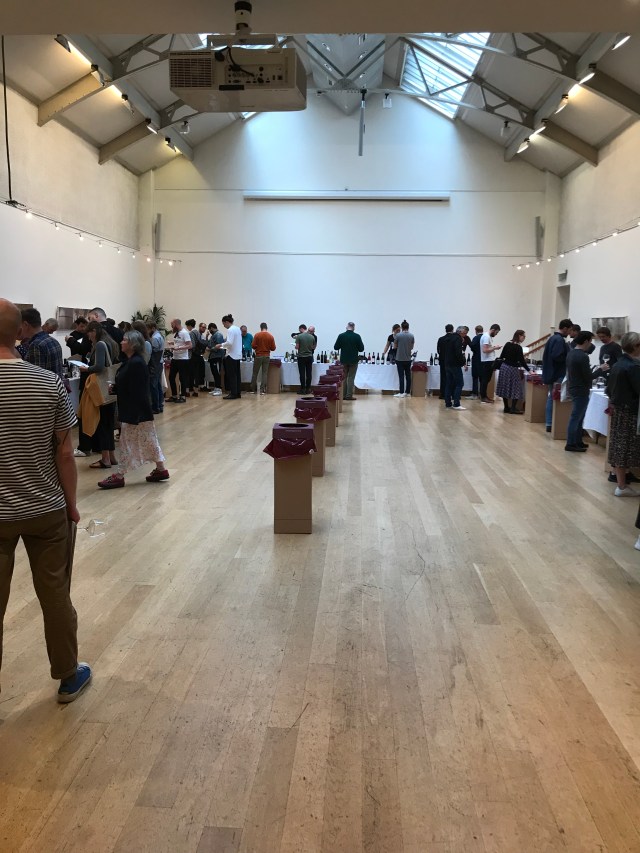
A note on what I didn’t taste. I’ve had a very busy few days and this event, at The Army & Navy Club on Pall Mall, was the most relaxing afternoon I’ve spent for days. I decided not to taste the wines of JJ Prum. From Graacher Himmelreich Kabinett up to the Auktion wines, these are for me amongst the finest wines of Germany (and trust me, I do adore the more fashionable producers as much as the next man). I have more JJ Prüm in my cellar than any other producer. If you love German Prädikat wines, you don’t need me to tell you to buy them.

Well, I lied a little. Before I left I did persuade my palate to take a couple of sips of the JJ Prum Wehlener Sonnenuhr Auslese LGK Auktion wine, close to the pinnacle of  sweet, glorious, concentrated grape juice. I can never buy this so I count it a privilege to taste. I did not spit. It would have been both rude and disrespectful.

Equally, I didn’t taste the selection of VDP Auktion Wines on show (Trier 2018). Only the finest and rarest wines are sold at the VDP Auctions. These barrels are something different. There are people I know, surprisingly a fair few, who buy these and know them as I know perhaps Jura Wine or Burgenland. I frankly don’t have the experience to assess them in any way useful to my readers, and I suspect there are not many of you who would be able to buy them.

The Vintages:

2018 – is the vintage of almost all the Grosse Gewächse white wines shown. It has been categorised as a warm year, one “where the sun shone from April to October”, but as always, one should not believe any generalisations. As with Burgundy, German Riesling is always about the producer. There were wines here with the zip you’d expect from a cooler year. There were equally some big, savoury, Rieslings, and indeed one or two that were quite plump and less “dry” (I mean “tasted less dry”) than one might have expected. I personally found some glorious wines, approachable but ageable. Acidities varied a lot, and one would need to match the wines with one’s own tastes. Personally, I like the acids.

2017 – The majority of the reds were from 2017 (with a smattering of 2016s). 2017 appears to be shaping up as one of those years where all sorts of producers excelled. I have long seen a positive trajectory in the quality of German red wines, as exemplified by the tasting of only the red wines Howard Ripley put on in London a couple of years ago. But I would argue, on the basis of the red wines tasted here, that 2017 has provided an opportunity for some to make something more than merely an incremental advance, and a few have taken that chance.

THE WHITES – Grosse Gewächse 2018

The wines here are mostly Riesling, with a few exceptions at the beginning and the end. Prices are per case of six bottles in bond. Take it as read that the wines I review are the wines I liked most, although sometimes I will show a preference within those of a particular producer.

Himmelspfad Silvaner GG, Rudolf May (Franken) – May now has 14 hectares at Retzstadt, north of Würzburg. He’s included here because Rudolf undoubtedly makes some of Germany’s finest Silvaner off very poor soils, rich in fossils. Winemaking here is organic, and with minimal interventions at every level. This wine has real depth with tamed acids. It’s even a little biscuity, stony, bitter on the finish, but there’s a good helping of yellow fruit to balance. £150

Rothlauf Silvaner GG, Rudolf May (Franken) – This is a cooler site with sandstone mixed in with the fossil-rich limestone of the previous wine’s terroir. It’s a bit more racy, very much to my taste. The mineral element comes through as a nicely defined spine to the fruit which hangs off it. It is aged in a mix of stainless steel, concrete, wood and egg, but it seems to me to be nothing if not a wine of the specific place where its grapes were grown. My favourite of the two, and impressive. £150

Saarfeilser Fass 13 GG, Peter Lauer (Saar) – Florian Lauer is one of my favourite three producers in the wider Mosel Region. He farms 9 ha at Ayl, on that big bend in the Saar, where it turns sharply southwest, and then north, towards Trier. If I say this is Florian’s warmest vineyard, you are going to expect ripeness. That would be true – to anyone who knows these wines it’s perhaps not as racy as usual. But there is minerality with the fruit. This seemed dangerously popular, as all of the Lauer wines seem to have become, for which in part I must blame myself. £132

Schönfels Fass 11 GG, Peter Lauer (Saar) – For me, this sits stylistically between the wine which precedes it and that which follows. It has a lemon freshness and a whiff of classic gunflint slatiness, and a bit of salinity as with the Fass 18 below. This might be the most elegant wine of the three here, and possibly, as a result, in some ways the one with the most restraint (well, to me it was perhaps less fruity?). £132

Kupp Fass 18 GG, Peter Lauer (Saar) – This wine seems fresher. The citrus acidity is evident, but it does also have weight and texture. This comes through as a hint of crisp apple underneath the characteristic yellow plum. What you also get, which I think you don’t in the Fass 13, is some saltiness, not a lot but it’s there. Very nice balance, for my palate. £132

Herrenberg GG, Maximin Grünhaus (Ruwer) – As I never stop mentioning, the lovely man that is Carl von Schubert was instrumental in getting me back into German wines a long time ago, since when I’ve tried to hide my secret passion from all my hip amigos. The estate at Mertesdorf is quite large (34 ha), divided into its famous parcels, with the old monastic manor sitting below the duvet of vines like a sleeping head on a pillow. But I digress, wistfully…the Herrenberg is a dry, textured wine of only 12.5% abv. It is mineral, salty and dry, with less fruit than most of the Mosel wines. But that does bode well for the table. £138

Abtsberg GG, Maximin Grünhaus (Ruwer) – The Abbot’s parcel has older vines. The acidity is a little more defined and its salinity just outweighs the fruit. For me it is also more savoury, and I preferred it a little. I’m not sure why both parcels are the same price? £138

Juffer Sonnenuhr GG, Schloss Lieser (Mosel) – Thomas Haag is another of my favourite German producers, and his wines are in no way reminiscent of the dark and brooding Schloss on the banks of the Mosel a little upstream from Bernkastel. Thankfully Thomas lives in something less oppressive and grand. The wines have become stars since he purchased the estate in 1997, and it’s a miracle how such quality is achieved, considering his now 24 ha of vines are spread around 180 diffefent parcels. This example is pale and expressive with a floral nose, elegant but restrained citrus acidity, and a fine mineral finish. £144

Wehlener Sonnenuhr GG, Schloss Lieser (Mosel) – This site rarely fails to get my pulse racing, whether drinking it or merely gazing wistfully at the sun dial down the river from Bernkastel. This is another wine brimming with elegance in a warm vintage. For me, the main added extra here is its saltiness, adding to the intense minerality. Perhaps there’s also a little more gras. £144

Niederberg Helden GG, Schloss Lieser (Mosel) – Undoubtedly less famous than the Sonnenuhr, this is Thomas Haag’s biggest vineyard. It sits as a slope above the river just to the east of the village of Lieser and at a guess rises to about 250 metres. I’ve stayed in Andel, across the river, so I remember it well. It’s the source of some of my favourite Lieser wines. Sybille Kuntz also has vines here. Somehow this wine combines lightness and intense concentrated stony power at the same time, hinting at real complexity to come. I love it. £144

Himmelreich GG, Willi Schaefer (Mosel) – Christoph and Andrea Schaefer may farm a mere four hectares at Graach, but they have a fanatical following. Rightly so, because especially in recent vintages, the wines from this estate have been pretty universally praised as stunning. The labels may look old fashioned but the wines are not. All musts receive the gentlest of handling here, and the aim is to make wines of pristine clarity. This is Christoph’s first dry GG since 2012, but in this warm year he felt the acidites were not too high. Auslese’s loss is Grosse Gewächse’s gain. Creamy and juicy yet salty and mineral. So tempting. £132

img_7205

Ellergrub “Grosse Eule”, Weiser Künstler (Mosel) – Konstantin Weiser and Alexandra Künstler set up their estate in 2006, having purchased an Ellergrub parcel whilst working at Immich-Batterieberg. They still farm fewer than five hectares of vines, yet their Mediterranean-blue label is gaining quite a reputation. This is quite a structured wine with slate, salt and citrus. It’s really vibrant, and the acidity is at the higher end. However, these are wines built for ageing, though if you do love the freshness you could just throw it into a carafe or decanter for earlier drinking, giving it time to breath. £135

img_7206

Uhlen-Laubach GG, Heymann-Löwenstein (Mosel) – I’ve not drunk a wine from H-L for a very long time. I used to pick them up at the Berry Bros Factory outlet (as we used to call it) outside Basingstoke, mainly wines like the Von Blauem Schiefer. Uhlen, right up near where the Mosel joins the Rhine at Koblenz, has some of the steepest vineyards on the whole river, yielding wines of smoky minerality from its fossil-rich slate. The small slices of terracing look frankly frightening, but the wines are worth it. This is superbly balanced and I reckon the quality here has risen even more in recent years, on the basis of this wine (a step up from the slightly less expensive Uhlen-Blaufüsser Lay). £180

img_7207

Felsenberg GG, Schäfer-Fröhlich (Nahe) – Tim Fröhlich has farmed these 24 ha for around 36 years. He still looks impossibly young, though he was only nineteen back then. His Rieslings, from the Upper Nahe at Bockenau, are among Germany’s most graceful. This style is evident in the wine here, less powerful than some 2018s. It’s vibrant, lighter, quite zippy even, with a spine of lime and grapefruit. A star, for me. £210

Stromberg GG, Schäfer-Fröhlich (Nahe) – The vines here, on volcanic soils, are Tim’s oldest, many over 85-years-old. The wine seems drier, with a grapefruit zip to it, but also a smoky intensity. You get a long mineral finish here. £228

Felseneck GG, Schäfer-Fröhlich (Nahe) – This is probably the pinnacle of the Schäfer-Fröhlich holding, a source not only of fine Grosse Gewächse wines, but also Trockenbeerenauslese when nature provides. The GG is both floral and herbal. Right now you could say it’s tightly wound, but it is mineral, saline, ripe and the epitome of elegance. What length! £246

Dellchen GG, Hermann Dönnhoff (Nahe) – There may be geographical distance between the Dönnhoff estate and Tim Fröhlich, but sometimes it’s hard to judge any quality difference these days, although the Dönnhoffs certainly possess the fame among most Riesling lovers I meet. I think that fame has led me to buy fewer wines than I should. The holding here is 25 ha, and spread widely as the vineyards are, I believe Helmut and his son Cornelius have eight sites able to produce Grosse Gewächse. Dellchen is generally a lighter wine and this has nicely weighted yellow fruit, but it does finish with an almost crunchy mineral bite with a sprinkling of sea salt.

Hermannshölle GG, Hermann Dönnhoff (Nahe) – I’m getting peach fruit here. There’s more weight and a mineral texture. It’s often one of my favourite Dönnhoff dry Rieslings. Despite the weight it also has a liveliness that lifts it and it’s the tension between those two traits which makes it quite thrilling for me.

Ölberg GG, Kühling-Gillot (Rheinhessen) – Carolin Spanier-Grillot is in charge here. “Here” is Bodenheim, in that part of the Rheinhessen closer to the river, southeast of Mainz, and neighbour to Nackenheim, as opposed to the more southerly part of the region, closer to Worms, home to Keller, Wittmann et al. She controls 12 ha (only 60% of which is Riesling). On the famous Roter Hang limestone, between Nackenheim and Nierstein, Carolin has some of the finest Riesling sites in the Rheinhessen (including this Nierstein vineyard). This is a very steep, almost south facing, slope which generally gives dry wines of some body. Yet this wine has a lightness of touch and is both fruity and refreshing. Very appealing. £180

Hipping GG, Kühling-Gillot (Rheinhessen) – I can never fail to picture Hugh Johnson when I taste this vineyard (I bet a few of you know why). It is above all a lovely terroir wine, more floral on the nose, but on the palate it is saline and citrussy. It’s hard to explain how very expressive this wine is. £216.

Aulerde GG, Weingut Wittmann (Rheinhessen) – Philipp Wittmann converted this estate to biodynamics from 2004 (Demeter Certified), and has never looked back. There are 25 ha, with two-thirds planted with Riesling. I adore this producer, but I only currently own some Weisser Burgunder (which is superb). The village is Westhofen, with the famous Kirchspiel to the north and Morstein to the northwest. Aulerde is Kirchspiel’s eastern neighbour. This Riesling is nice and dry with mineral texture from what is an early ripening site on deep clay, and a good price for very old vine fruit. £162

Kirchspiel GG, Weingut Wittmann (Rheinhessen) – Unfortunately, for those after a bargain, which Aulerde may be, this is a definite step up in structure and everything. There is limestone in this vineyard and the wines tend to be more defined, and perhaps spicy. A wine of true stature. £204

Morstein GG, Weingut Wittmann (Rheinhessen) – And so to Morstein, a south facing site rising to just under 300 metres on limestone with overlying clay, but rocky in parts. It’s hard to describe a wine like this but it kind of has everything you dream of from dry Riesling, even in a warm vintage (remember, producer means everything). The price jump to £258 is justified, though the site’s fame plays a part. If you can afford it then buy and age. If not, the other two will not disappoint, unless you are already very familiar with the Morstein, of course.

Jaspis Gutedel 10 hoch 4 Alte Reben 2016, Ziereisen (Baden) – Something different to finish the whites on, and a 2016. This cuvée is called “ten to the power of four”, referring to the dense planting achieved by interplanting between the original rows in this part of the Steingrüble vineyard. So don’t fear, the wonderful “Gutedel” (aka Chasselas) you know and love hasn’t suddenly taken off in price, although I think Hanspeter once told me that in the early 20th Century the Gutedel here achieved a higher price than Mouton-Rothschild. Ziereisen is in the far south of the Baden wine region, in the hills around Efringen-Kirchen, just a few kilometres from Basel.

All the vines are at least 40-years-old and the wine is a gorgeous savoury surprise, all umami, juniper and bitters, but there’s apple-fresh fruit too. The texture is likely from lees ageing (the normal Gutedel usually has eleven or so months on lees) and also a little skin contact pre-fermentation. It’s quite extraordinary, and I think only Dominique Lucas (south of Lake Geneva) makes comparably fine Chasselas.

img_7218

THE REDS – PINOT NOIR/SPÄTBURGUNDER 2017 AND 2016

Pinot Noir Niederberg Helden 2017, Schloss Lieser (Mosel) – So this site has some red grapes! I don’t know how this wine is made but I do know that Thomas Haag usually likes to use stainless steel. This is a pale, light, wine with strawberry and raspberry scents. It has a lightness and freshness, and after the plush gentle fruit you do get a little bite. I always love this cuvée, when available. It’s a fun wine, just 12.5% abv, and only £75 per 6 IB.

img_7219

Spätburgunder 2017, Jülg (Pfalz) – Jülg is at Schweigen, right on the border with Northern Alsace, opposite Wissembourg, and like Fritz Becker, they have vineyards in both Germany and France. In the past I’d have put Becker a clear head above Jülg, but I am reassessing my views. This entry level wine is relatively simple, with a bit of bramble and more colour (and a degree more alcohol) than the Lieser, and whilst nice it is well worth going up the range here. But the price…just £54

Pinot Noir Herrenstück 2017, Holger Koch (Baden) – Koch’s 8.5 ha of vines sit on the Kaiserstuhl, the famous volcanic lump to the east of the Rhine, near Freiburg-im-Breisgau, and in fact pretty much over the border from Colmar, in France. Holger’s great task has been to replant the family vineyards with better clones, and this he has achieved. This wine shows quite pale fruit but with concentrated sour cherry as well as strawberry purity. Very interesting, quite spicy as my wife might say. There is some tannin, but it feels much more velvety, with a lovely mouthfeel. £72

Talrain Spätburgunder 2016, Ziereisen (Baden) – Ziereisen is my favourite red wine producer in Germany. You should know that in case my objectivity is called into question. But I’m pretty confident in recommending this wine on the basis of both quality and price. This vineyard is quite high (up to 500-metres), surrounded by forest, but it gets the prevailing wind up through the Mulhouse Gap, which helps negate disease. It sees 24 months in 225-litre oak, but it comes out with just 12% alcohol. It may be quite concentrated (almost plump) and dark on the fruit side (even a touch of unusual blackcurrant), but it is also racy and refreshing, the limestone element giving great freshness. It should be noted that Hanspeter is actually a big fan of Swiss clones for Pinot, and has replaced many of his French clones with Swiss. £75

img_7222

Spätburgunder Sonnenberg 2017, Jülg (Pfalz) – Johannes Jülg has had an interesting education, working at Clos des Lambrays in Burgundy, and with Fritz Keller. His time in Burgundy, and probably his experience at home, made him determined to replant with French clones, and with denser vine spacing. It’s interesting because neighbour Fritz Becker has a more nuanced view on clones, French and German, but at Jülg there is absolutely no doubt in my mind that as newer vineyards have matured then quality has really taken a leap forward. There’s finer to come, but this wine from the German side, off loam and limestone, is very tasty with deeper fruit and a step up from wine number two, above. £93 *Note to readers…if you visit Schweigen, then the Jülg Weinstub is the place for lunch.

Spätburgunder Sonnenberg “WB” 2017, Jülg (Pfalz) – This is actually made from one of the French vineyards. The German producers here are not allowed to use the French vineyard names, so “WB” is used to denote Wormberg. There’s an ongoing battle between local producers and the authorities over this, which periodically flares up with some muscle flexing and producer bashing. This wine is more red-fruited, strawberry dominating, but with a little spice, minerality and tannin. Keep a while. £114

Spätburgunder Sonnenberg “KB” 2017, Jülg (Pfalz) – The “Kammerberg” is one of the most famous sites in the area, a steep slope above the (French) Abbey of Wissembourg. I think the French clones here have improved since replanting and they produce a wine which has even more potential than in the past. The best thing about this wine is its savoury spice on the bouquet. The fruit almost appears sweet and it is approachable, but it’s a classy wine that will gain in complexity with time, if you let it (please). £174

Rhini Spätburgunder 2016, Ziereisen (Baden) – This is an even more protected parcel than Talrain, in a limestone dell in the forest which has some influential ferrous deposits in its soils. It is made via whole bunch fermentation and then goes into oak (Hanspeter is continually reining back the percentage of new oak). The result is a wine which needs ageing. The fruit is beautifully smooth and rich, and the tannins seem perfectly judged. There’s both freshness and depth, a wine which truly does have iron in the soul. £144

img_7225

Pinot Noir 2017, Shelter Winery (Baden) – Relatively new to me, I’ve only been aware of Shelter Winery for a couple of years. Hans-Bert Espe and Silke Wolf bought what is now 5 ha on the Kaiserstuhl in 2005. As well as Pinot Noir, they also have Chardonnay, possibly because Hans-Bert did a stint in Oregon. They have crept under the radar until recently, but Howard Ripley has picked up and run with them. This wine is pale but has a standout smokiness, coupled with a silky mouthfeel and a slightly bitter and grippy edge to the finish. Although the winery is only fourteen years old, they are playing with 40-y-o vines, a big advantage. £156

img_7226

Pinot Noir *** 2017, Holger Koch (Baden) – The three stars show this is the finest Pinot Noir here, off volcanic soils on the terraced Halbuck, where the fruit ripens later than most other local sites.. This is quite pale, with hi-toned cherry fruit. The finish is, once more, very savoury. Right now, the new oak (50%?) is prominent, but this really is a wine to keep for at least a decade, I think. It is impressive. £174

Jaspis Pinot Noir 2016, Ziereisen (Baden) – This cuvée is possibly the one that made me take notice of German Pinot Noir. It is made from old vines which, if my memory serves me right, were planted in the 1950s and 1960s. It is fairly restrained on the nose, because we are dealing with a fine wine made to age. The fruit is quite chewy but class shines through. It’s a mix of mainly raspberry with a little cherry, dense and heading towards complexity, but it will be a long road. If you can’t wait, buy the Talrain. If you are young and rich, then buy the usually astonishing Alte Reben Jaspis cuvée (the best barrels). But otherwise, this should satisfy most fanatics of this glorious red grape variety. £180, a price I double checked. It’s pretty good value if you compare it to the price of good Premier Cru Burgundy.

img_7228

Spätburgunder “Opus Oskar” 2017, Jülg, Pfalz) – I’d kind of thought nothing would challenge the last wine, but here we have the evidence for how far Jülg has come, especially over the past couple of vintages. This is admittedly a “selection”, coming from the best parcels on the Kammerberg. It has more smoky depth, silky sensuous fruit and breadth of bouquet and flavour…from Pinot Noir’s raspberry spectrum to almost Syrah-like violets. If you are able to go with £450 for a six-pack, in bond, then Ripleys say “will reward cellaring”. It would be pretty silly not to cellar a wine like this. I’d truly love to be able to try a bottle in fifteen-to-twenty years.

img_7229

Another great tasting finished. I used to feel ever so slightly smug that I appreciated both of the styles on show here, dry whites of “Premier and Grand Cru quality”, and the once dismissed Spätburgunders. But every year this tasting seems to gain more support, and more minds have become open to these wines. I suppose one could say that this is the future of German wine (well, to be frank, it sort of has been for a fair while), but it just proves that the country really just has something for everyone. How things have changed…for the better.

Posted in Fine Wine, German Wine, Mosel, Wine, Wine Merchants, Wine Tastings | Tagged , , , , , , , , , , , , , , , , , , , , , , , , , , , , , , , | 1 Comment

New Wave South Africa 2019

The New Wave South Africa tasting was held on Tuesday this week, at The Vinyl Factory, the basement under Phonica Records in Poland Street. As always, there was a buzz going around long before this event, as there always is these days when the South Africans come to London. However, I don’t think the organisers were quite expecting not far short of a thousand trade registrations. It meant those of us arriving around mid-day had to queue, but that did mean that the venue’s fire capacity was adhered to, the consequence being that there was at least room to breath down below ground.

Despite the initial crowds and the rather high level of background noise, the tasting certainly lived up to the hype. Fifty-plus producers had turned out, some being established superstars and some being people I hadn’t even heard of before, let alone tasted their wines. In some extreme’s producers showed well over a dozen wines (Pieter Walser had lined up closer to twenty), whilst at the other end of the scale Sam Lambson (Minimalist Wines) lived up to his label’s name by bringing just one (but what a wine, see below).

I reckon I tasted a little over a quarter of the producers. If I missed your favourite, I’m sorry. Whilst at one or two tables I didn’t try every wine, once you get into a conversation it’s hard not to go with the flow. I think that if I mention every wine I tasted the article would just become a boring list. I hope that what tasting notes there are will generate a flavour of it all. What I really hope to convey is the excitement inherent in the wines.

Each producer was asked by the organisers which three records, one book and one single luxury item they would take to a desert island. Quite a nice window into their tastes. I’m going to share at least one record/band for every producer, so you can see how cool these guys and ladies are.

NEWTON JOHNSON

This is a family setup located in the Upper Hemel-en-Aarde Valley, south of Caledon and north of Hermanus, on the Southern Cape Coast (near Walker Bay). It’s effectively a cool climate terroir and winemaking here is described as being “as natural as possible”. A beautiful range of wines is made, and their reputation precedes them these days, but I do think that they make truly outstanding Pinot Noir.

Resonance 2016 is a blend of 75% Sauvignon Blanc and 25% Semillon, under the Walker Bay appellation. It’s a good place to begin, a blend we used to see a lot from Australia but one which works so well in cool climate South Africa. The Semillon sees some wood so it adds depth to the freshness of the Sauvignon’s grassy citrus acidity.

Family Vineyards Chardonnay 2017 is a very good example of what you can get for under £30 from this producer. Off decomposed granite and clay comes elegance, a blend of lemon and lime acidity and nutty nascent complexity. Rich but not fat, the steely acid structure lifts it nicely, and grounds it at the same time.

There are a range of Pinots. The equivalent Family Vineyards Pinot Noir 2018 is deliciously fruity but equally has good grip. It’s a very nice bottle, but the two single vineyard Pinot Noir I’ll come to next are quite sensationally good.

Seadragon Pinot Noir 2018 is noticeably bright and has a remarkable balance between fruit and acidity. 2018 is only the second vintage for this pair. It is a nice contrast with the Windansea Pinot Noir 2018. Both come from hillside locations in the Upper Hemel-en-Aarde Valley, but this latter wine is Newton Johnson’s highest vineyard, at around 350 metres above sea level. The soils here are darker clays, and the wine has the vivacity and freshness of a cooler site with added structure. It has more bass notes.

Bevan and Gordon, Dave Johnson’s two sons, were on hand to pour. They chose records by The Pixies, The Black Keys and Linton Kwesi Johnson, so that’s three points, plus a bonus point for LKJ, taking them right to the top of the coolness chart.

UK Importer – Dreyfus Ashby


Bevan Newton with his rather classy lineup of wines

THE FOUNDRY

Chris Williams was on hand to show The Foundry wines, and this is another beautiful range. I began with the Viognier 2018 from Stellenbosch (all the wines are from Stellenbosch, with the exception of the next wine, which comes from Voor Paardeberg). The thing I like about the Foundry Viognier is its acids. Although it hits 13.5% abv, it retains genuine freshness. It both smells and tastes fresh and avoids the blowsy weight of a lot of Viognier found outside the Northern Rhône. Maybe not quite as elegant as a Clonakilla but a lot cheaper.

The whites here are worth exploring. Chris wasn’t showing Chenin, but there was a Grenache Blanc 2018 and a Roussanne 2017. The former, fermented in older oak, was paler than expected but had some depth to it. I liked the bitter twist on the finish. The Roussanne was quite waxy with rounded fruit showing through, again good acids, and just enough weight.

The reds are all a little more expensive than the whites, and they possibly lack those wines’ freshness, but they do all have the kind of acids and tannins which will help them to age. Even the Grenache Noir 2017 was still tannic. Fermented half in older oak and half in concrete, it is quite a big wine (14.5% abv) but it does show nice high-toned fruit.

Tasting two vintages of The Foundry Syrah was instructive. 2016 was aged in oak, around 10% new oak. Compared to the Grenache, it has less weight and is still pretty youthful. 2012, bottled in September 2013, had developed a lot more fragrance, but it is still tannic and needs several more years unless you like your Syrah quite grippy. I felt this 2012 benefited from half a degree less alcohol here (14%), but that might just be my own sensitivity and reading of balance.

Chris went for Talking Heads, Pink Floyd and Bach (cello suites), a solid set of options. His luxury item was a telescope, which hopefully is suggestive of his vision being wide.

The UK importer/agent is, once more, Dreyfus Ashby.


THE LIBERATOR

The Liberator is a label put together by Richard Kelley MW, who is the man behind Dreyfus Ashby. So far these past twelve months I’ve managed to drink a couple of these wines, both very enjoyable. They tend to be small but interesting batches Rick picks up or hears about when he’s out on tour around The Cape. They all have the added bonus of really well thought out labels, some of them being hilariously funny, at least to me…I’m not sure Johnson and Gove would fully appreciate the humour of “Episode 23” (see below).

I’m going to skip through all nine of the wines on show because, well, they are all worth a plug. Most retail around the £20 mark, with a couple of exceptions, and all provide a talking point at the table. Episode 16 (“Perfectly Flawed) was not shown, but if you spot one of the few thousand bottles of this Tulbagh Chenin aged under flor, grab one swiftly.

Excuse me giving you a label photo for every wine…I just love the labels as well.

Episode 11 – Homage to Catalonia 2016 is Viura from Franschhoek, the first crop of fruit from Solms Delta. It’s waxy with simple pear and quince, but long and tasty. Just 672 bottles made. It may possibly be the first varietal Viura (aka Macabeu) out of The Cape.

img_7081

Episode 19 – Teeth of the Dog 2017 This Chardonnay from Paarl-Simonsberg almost tastes like it is blended with 50% Chenin. This is very good but also a little different. 300 cases came from Glen Carlou, originally destined for their Cellar Club until a change of ownership. The name is, of course, a nod to a certain vineyard on the Côte de Beaune, though the wine’s richness is more Meursault than Chassagne, as Rick is happy to acknowledge.

img_7083

Episode 23 – The Odd Couple 2012 This is your Gove/Johnson label, the name channelling the Jack Lemmon/Walter Matthau classic of 1968 (nice choice, Rick) . The blend is Sauvignon Blanc and Chardonnay, not completely unknown but still rare. The bouquet is more Chardonnay for me, and it’s another waxy wine with acidity just on the right side of thrilling.  The blend is 60:40 in Chardonnay’s favour and Nederburg is the source, in the Western Cape. I want a couple of these, at least in part for the label, but there are a mere 672 bottles, or at least there were when bottled.

img_7085

Episode 18 – PS I Love You 2016 Petite Syrah (aka Durif) from De Morgenzon in Stellenbosch. 650 cases here. The label painting is by the American Impressionist artist, Julian Alden Weir. The wine is deep and bright, very fresh on the nose and palate, with nice fruit and the added complexity of a savoury finish. Only 13.5% abv, ie restrained for the variety.

img_7086

Episode 20(/20) – Lies, Damned Lies and Statistics 2016 This Stellenbosch Cabernet Sauvignon, the most expensive of the “Episodes” I’ve found, is an elegant and classy cuvée of just 300 bottles made at Vergelegen (so no wonder it’s not cheap). It is in fact a classic savoury Cabernet (with 10% Merlot). It has 14.5% alcohol on the label but in this case it honestly doesn’t really show. What does show is the skill and contacts that have enabled Richard Kelley to get hold of this very posh wine for his own label. The name does not relate to brexit skulduggery, in case you wondered after Episode 23, but rather to “score inflation”, a subject close to both Rick’s, and my, heart.

img_7087

Look, Rick gave it 110 points, LOL!

Episode 21 – MSG 2017 550 cases of Swartland Mourvedre (80%), Syrah (10%) and Grenache (10%) from Lammershoek. Quite pale, rounded smooth fruit dominates here. The cuvée was assembled in 2018 and bottled in June this year, and it has a lovely freshness right now. Rick says it goes well with Chinese food. I think that is a joke!

img_7090

Ooooops, blurry, sorry…

Episode 22 – Blood and Chocolate 2003 This is the label that worries me most, largely because of my career before wine writing. The blend is 40% Cabernet Sauvignon and 60% Syrah, made again by Nederburg in the Western Cape. 372 cases nod towards one of Rick’s musical heroes, Elvis Costello, but you can’t deny that it does taste pretty much of chocolate (of a rich and dark nature, perhaps a little creamy). For some reason this cuvée was destined for a Nederburg Auction Lot, but never made it. It now has a new life with a classic red and gold label.

img_7091

Episode 12 – Napoleon Bona Part 2 2018 Muscat de Frontignan is the grape variety, 1,300 half bottles which came from Nederburg, another batch destined for the Auction before it passed into industry hands. It’s an intensely sweet wine, low in alcohol (9%) but rich in barley sugar and honey…it’s also nice and long. The Napoleon connection? The wine was made in the classic Constantia style by Nederburg winemaker, Günter Brözel, a master of these wines. Of course we all know that during his exile on the island of Saint-Helena, Napoleon Bonaparte drank a bottle of Constantia every day (allegedly). I think it was the wallpaper which poisoned him, not the wine. There is also a “Part 1”.

img_7092

Episode 9 – The Bishop of Norwich 2016 This is a Cape Vintage wine made in the Port style from a large blend of “Portuguese” grape varieties. Its creators are Carel and Margaux Nel of Boplaas. Based in Calitzdorp, they are true specialists in the genre. This has a deep smoky bouquet, is sweet but also concentrated, and it will age. “Do you know the Bishop of Norwich?” is a euphemism for bl**dy well hurry up and pass the port, will you! Those tiny glasses used to get drained swiftly…I know.

No pic of the bishop, damn, how did that happen?

I’m hoping that the long section above does give some idea of the fun behind these wines, but don’t ignore the fact that they are also very good indeed. Richard Kelley MW knows how to sniff out good wine.

Rick imports his own wines. He chose The Beatles, Tom Waits and Joe Jackson, an atlas (book) and a record player (luxury…bet his wife will be mad after reading this!). Kudos for the music and book, though.

img_7088

Rick and Sarah (who I’m sure he’d take, really)

THORNE & DAUGHTERS

John and Tasha Seccombe set up their label in the Western Cape in 2012, and are possibly best known in the UK for their Rocking Horse Cape Blend, named after their daughters’ toy rocking horse they made for them. I drank a glorious 2014 vintage of that wine back in June, and it ages magnificently. The daughters are now eight and ten, and the wines have moved on too. The following three are highly recommended.

Tin Soldier 2018 is a Swartland skin contact Semillon Gris, as lovely as the variety is obscure and rare. The vines were planted in 1964. A week on skins, the wine is savoury and textured, and also very dry. To pick out two flavour descriptors, I’d go with waxy lemon peel and marzipan, but there’s more. If I saw it on a shelf it would be a definite purchase. Paper Kite 2018 is the more common Semillon Blanc variety, from Swartland (like the Semillon Gris). It’s an old vine cuvée, made from heritage vines well over fifty years old. Again, it is savoury, fresh and smooth, with the faintest hint of oily gras. There’s a biscuity and nutty element, with a bit of pain d’épice too.

Wanderer’s Heart 2018 is a Cape Red Blend, here 34% Grenache, 26% Cinsaut, 17% Grenache Gris, 13% Mourvedre and 10% Syrah. The savoury nature of the whites carries through in this red and you get plums for fruit, with fig and classic fresh wood aromas. It’s labelled Western Cape, the grapes coming from a variety of plots from Voor Pardeberg, Bottelary, Bot’s River and Wellington, off varied soils including granite, shale, limestone, and a clay/gravel mix. It’s my first taste of a Thorne & Daughters Red and I like it.

John’s main coolness points come from his choice of something by The War on Drugs, and selecting coffee as the luxury item.

Imported by Dreyfus Ashby.


The real Thorne (John Seccombe) with the red. There were a hell of a lot of Thorne & Daughters t-shirts being worn by exhibitors for some reason.

MINIMALIST WINES

Minimalist Wines, minimalist entry, because Sam Lambson currently only makes one wine, called Stars in the Dark (expansion is planned, fear not). It’s 100% Syrah made simply via whole bunch fermentation in large format old oak. Both fermentation and malo are spontaneous, and the only addition is a touch of sulphur in winter.

The wine is rich, savoury, fine, and fundamentally stonkingly good! Only 800 bottles were made in 2018, although I was told that 600 are for the UK. We are looking at perhaps 1,500 bottles for 2019. Sam wants to focus on cool site Shiraz and to this Elim cuvée will be added fruit from Elgin and Stellenbosch.

Every time I see Colin Thorne at a tasting (he’s a buyer at Vagabond Wines) he seems to tip me a wink towards a real star. He did that again here. Thank you Colin, both for your great palate and your generosity, much appreciated.

Imported by Dreyfus Ashby, records selected are by Chilli Peppers, Bob Marley and John Mayer, very sound.

img_7176

img_7175

JESSICA SAURWEIN

No, never heard of her. Why? Jessica comes from a family with a great winemaking heritage in Austria, but her career took off in sales and marketing. She began making wine part time in 2015, and then went full time only in 2017. There are just three wines here. One is a lovely Riesling, the other two are sensational single vineyard Pinot Noirs.

Chi Riesling 2019 is from Elgin fruit, sourced close to the ocean off rocky loam. It’s fashioned in a fruity and crisp style, avoiding petrol notes deliberately. The nose and palate have a citrus core. The bouquet has a hint of geranium and ginger spice and the palate is quite lemony. Just 12% abv.

The first Pinot Noir I tasted was Om 2018, a wine named for universal peace (something most people in wine hope for). The vines are at 700 metres ASL on granite, with clay. They are relatively young, planted in 2006, mostly on the Hemel-en-Aarde Ridge. The bouquet is red fruited with rose and cherry, but the palate has darker fruits, beetroot and a bit of tannin.

The similarly named Nom Pinot Noir 2018 is from Kaaimansgat Vineyard, Elandskloof Valley, Villiersdorp, and is mostly shale, but at a similar altitude. This is very concentrated and aromatic (orange citrus, coffee, cherry), is darker fruited and has clear umami elements. “Nombulelo” means gratitude in Xhosa. Nomkhubulwane is a forgotten African goddess of Agriculture.

I was pretty blown away at this table. The importer is Swig Wine. Jessica’s musical tastes don’t exactly accord with mine, but never mind, the wines emphatically do.

1a9bed3a-36a8-4763-87bb-a1acfd0b97c2

img_7172

METZER WINES

Another recently established label, Metzer Family Wines began in 2006 in Somerset West. Wade Metzer makes half-a-dozen wines, including a petnat from old vine Chenin which disappointingly wasn’t on taste. There were three glorious wines which all look good value for money despite hardly being cheap as chips..

Maritime Chenin Blanc 2017 is from a vineyard of old bush vines planted less than 5km from the ocean at False Bay. It has a salty bite, whether auto-suggestive or not. The soils are sandy and they yield an aromatic Chenin.

Montane Chenin Blanc 2017 is from vines planted higher, at 250m ASL. The vines were planted in 1964 so they have a nice age to them. The bouquet is apple and ginger but the palate has a mineral spine. It kind of combines a floral element with some stone fruit as well. It gains texture from eight months lees ageing in barrel (10% new).

Shiraz 2017 is sourced from a Helderberg parcel of old vines on a windy site with complex soils which led to a picking of four tries over two weeks. It’s an oak aged wine (11 months, 10% new oak) which tastes good now, although it does have potential to age if you let it. Wade called it a “feminine Shiraz”, which to an extent I suppose it is, if that sort of analogy is your thing. But it is both supple and subtle.

Metzer Family is imported by Indigo Wine. Here we have yet another Beatles fan with a penchant for The Rolling Stones and QOTSA!


MULLINEUX & LEEU

I’ve known the wines of Chris and Andrea Mullineux for a long time. I still have a single bottle left from what I believe was their first vintage (though for the life of me I can’t find it), and only last year drank my last 2006s from Chris’ previous stint at TMV (Tulbagh Mountain Vintners). Since those early days they have moved on. To the original wines have been added “Kloof Street”, the limited production “Granite” and “Schist”, and the “Leeu Passant” pair.

Schist Syrah 2017 is from that famous Swartland fruit which has seen Chris become one of the finest winemakers in South Africa. The wine off the schist has real bite, with a graphite mineral core. It is reassuringly very expensive though. Granite Syrah 2017 seems to me to have more amplitude. It’s a very powerful wine (14% abv, but that’s not what I meant) yet loaded with bags of fruit and mineral freshness. Both are magnificent wines, but they are too expensive for me to buy and age, now.

At a little over £50/bottle the next pair are perhaps a little more affordable. Leeu Passant Chardonnay 2017 is still remarkably classy. It has weight yet it is approachable. However, it should be given the chance to age to get the most out of your money. It was barrel fermented, 20% new, which will integrate with time as it is on its way to doing now. Only 700 cases were made, though.

Leeu Passant Dry Red 2017 is deeply coloured Cabernet Sauvignon with the addition of some Cinsaut (a more generous 1,100 cases here). It’s a smoky wine, quite big and needing time, but it has classic structure. The Leeu Passant wines are made at Chris and Andrea’s winery in Franschhoek (the original winery is still at Riebeek Kasteel in Swartland) and are a collaboration with Analjit Singh. They are multi-regional blends (hence Western Cape designation) which nod towards the classic, ageworthy, South African wines of particularly the 1960s and 70s.

I couldn’t pass by on a sip or two of Mullineux Straw Wine 2017. I’ve consumed quite a few of these half bottles in the past, some young and some old. My conclusion is that they are possibly better young, when they are full of vibrancy. It’s basically sweet Chenin, very rich and with around 240g of residual sugar. The key to this wine is that it always has good acidity, and the grapes are dried outside but in the shade, so the process is slower. You get peach, apricot and marmalade. Classic, very concentrated and long.

Importer is Fields, Morris and Verdin. Chris likes Bob Marley, a South African favourite among a certain generation, I feel.


Chris and his wines, a man I’ve not seen for many years and at the top of his game

AA BADENHORST

It is often difficult to get close to the AAB table at any tasting, and this was no exception. Anyway, I know the wines pretty well. The Secateurs wines are some of the most remarkable value bottles from SA and I’m not averse to grabbing a few. However, my tasting intentions were quite specific.

First of all I wanted a taste of Sout van die Aarde Palomino 2018. In some ways Palomino seems one of the grapes of the moment. Whether by this name, or as Listán Blanco, we are starting to see some stunning examples. This one is delicious, quite fruity (more so than most), with plenty of fruit acids.

My other desire was to try a particular pair of Cinsauts (the usual SA spelling loses the “l” of the French). Ringmuur 2018 is fragrant, pale, yet plush. The fruit is dry but you think it’s sweet at first, know what I mean? Then the finish, an unexpected bitter twist. Ramnasgras 2017 (2018 in the tasting book but 2017 on the bottle) has a bit more spice, but these are basically one gorgeous pair.

I’m drinking more and more SA Cinsaut. Most, like my precious 2014 Pofadder (which I’d love someone top tell me when to open?) is resting. This former workhorse grape (cliché) is now coming into its own and I wanted to see what a master does with it in Swartland. Well, plenty, but you probably knew that. I’d say that for around forty quid, these are still good value, as I think is every wine made here.

Swig Wines import AA Badenhorst. We get Paul Simon, and a little more from the left field, Edith Piaf as the music choices.


BLANK BOTTLE 

Pieter Walser’s Blank Bottle Winery is a frequent visitor to the pages of wideworldofwine. If you want to read a longer piece about him, assuming you haven’t already, then follow this link here to a recent article from June this year. Okay, blowing my own trumpet, but it’s worth it. Pieter is one of wine’s great story tellers. I told him he ought to write a book and I truly mean it. Each wine has a tale to tell.

You can find out all you need to know in that article. Pieter had fifteen wines listed, and more under the table. How he makes them all so different I genuinely have no idea. All I shall say here is that I tried the delicious B-Bos II 2018 Semillon (the creepiest spider story ever) which is beautifully textured and savoury and a deceptive 14% abv. I tried the very different Semillon, Epileptic Inspiration 2018 which has always been one of my favourite Blank Bottle wines from the beginning. Then I tasted Nothing to Declare 2018, which hints at Pieter’s relationship with authority. It’s a Western Cape blend of the Rhône classics, Marsanne and Roussane.

Im Hinterhofkabuff 2012 is, you will note, a well aged Riesling, weighty (again, 14%) and dry, tasting as if it’s blended with Chenin (it isn’t), pale but almost tannic with texture. Stern Magazine wrote a piece about Pieter living in an old shack (not exactly true), that’s where the name comes from. Last up, Searching for Le Strange, a new wine to me (unlisted, and I didn’t get the vintage). It’s another example of stupendously good SA Palomino, in this instance made on skins in a beeswax-lined clay pot.Ever the innovator, this wine is a must-buy for me. But I do love all of the Blank Bottle output, despite my general fear of wines that make my legs give way after a bottle.

Swig Wines is the importer once more. Pieter chose Leonard Cohen and Nirvana, plus his wife as a luxury item (well said, sir, but who has the kids?)…but if his wife wasn’t allowed, then his surfboard.

If you are flagging, well only five more producers to go. I did consider splitting this, but then September is a busy month.


LUKAS VAN LOGGERENBERG

Lukas has only been making wine since 2015, but he’s beginning to get noticed and is seen by many as one of the rising stars in south Africa. I tasted four out of five wines listed (not sure how I missed the fifth, but never mind) and they tended to prove that he is indeed very talented.

Kameraderie 2018 is the current vintage of the first wine he ever made, named for the great help given to get his label up and running by his friends. It’s a single vineyard Chenin Blanc, from fruit planted way back in the 1960s. It sees some oak and it has great freshness, but the old vines do give it bags of depth.

Break a Leg Blanc de Noir 2019 is a savoury rosé made from slightly younger Cinsaut, planted 1992. It’s not all fruit, having some of that ethereal tea-like quality which a few more savoury pink wines around the world can exhibit (aged Rosé des Riceys, for example).

Geronimo 2018 is also Cinsaut, bright red in colour and in a fresh style, not really showing it had nine months in oak (so presumably old wood). It’s a nice wine, very nice indeed and well priced for the quality (c £25). Much as I am loving SA Cinsaut, there’s an even better wine to come.

Lukas is a big fan of Loire Reds, and he made a trip there in 2014 which in part inspired him to make wine. Breton 2018 is Cabernet Franc which saw eleven months in wood. It definitely reminds you of Loire, not Bordeaux. It’s a lighter style, quite fragrant, fruit driven but with crunchy tannins. A wine with a strand of crispness running through it. “Breton” is, of course, a Loire synonym for Cab Franc.

Lukas likes War on Drugs (never knew this band were big in SA but well done), Nirvana and Muddy Waters. Imported by Dreyfus Ashby.


img_7125

ALHEIT VINEYARDS

The first wine I came across from Chris and Suzaan Alheit was Cartology, and it’s fair to say that it has become a South African wine more and more people know. Its fame is deserved, but after starting out in 2011, Chris has built an even more impressive portfolio. Part of his success has been helped by using South Africa’s great grape detective, Rosa Kruger, whose knowledge of the topography of The Cape vineyards is probably unequalled. But you have to allow those grapes to express their place in the winery, and that’s what this couple do so well.

Cartology 2018 is mainly Western Cape Chenin Blanc (with Semillon) with brightness and zip, one of the most “alive” wines in the room. Huikrans 2018 is effectively a single vineyard expression, from grapes grown at 450 metres ASL on the Citrusdal Mountain. It has much more depth. As Jamie Goode said once in an article, the points givers need to be careful what they give Cartology or they’ll soon run out of points for the rest (or something like that).

Magnetic North 2018 is made from ungrafted vines at 550 metres, above the previous plot. It simply oozes presence and concentration. But if you think the Alheits are all with the Chenin, don’t forget the Semillon. La Colline 2018 is made from old vine fruit, planted in 1936. It’s just simply the epitome of a complex white wine yet tasting modern at the same time.

Winemaking here is identical for all wines. No enzymes, no sulphur during winemaking, whole bunches, neutral vessels (whether eggs, clay pots or old oak), and everything gets bottled after 12-to-14 months with no fining, nor filtration. There may be a tiny bit of sulphur at bottling but only if they deem it absolutely necessary. So you just get the terroir and the fruit of these old vines in a bottle. It’s like magic.

Dreyfus Ashby is again the lucky importer. Chris chose an interesting and thoughtful selection of music: Bon Iver, Sufjan Stevens and Bruce Springsteen. He’s another winemaker who would take his wife as a luxury item.


As you can see, the photos go downhill a little. The light wasn’t good in this part of the small studio annex.

RALL WINES

Donovan Rall is a giant, not just physically (though he is), but a winemaking giant too. A relative newcomer, he began making wine in Swartland in 2008, a location so many young winemakers have gravitated towards, on account of some lovely old but under-appreciated (and therefore relatively cheap) vine stock. The Swartland Revolution, as it came to be called, was not however built on cheap vineyards. Rather, it was built on young winemakers paying over the odds for this great fruit, as a way of ensuring the old timer farmers didn’t rip up all those wonderful bush vines.

Donovan Rall is always described, in almost everything you read about him, as being “well-travelled”. That may be, but in the old vines of Swartland, it is South Africa’s viticultural heritage which interests him.

All of the Rall wines are exceptional, but I will pick out four here. Cinsault Blanc 2018 (French spelling here) is fragrant, with grassiness, herbs, waxy citrus and white flowers. Not a mere oddity, cépage-wise. Ava Chenin Blanc 2018 is a cuvée of 1,340 bottles showing real presence and amazing purity.

Red 2017 is a Syrah/Grenache/Cinsault/Carignan blend off mostly shale and sand. It has a cherry red colour, 14% abv, and a real purity. I don’t know a lot about the winemaking for this, but I’m guessing that despite the alcohol, the fruit was picked early, or perhaps stems were included. You get a very appealing freshness with this wine.

Ava Syrah 2018 is off straight schist and is aged in oak (second fill, I think). Just 1,273 bottles were filled. The nose is quite stunning, big but all pure fruit. It tastes big too, but the alcohol is a nicely balanced 13.5%. It’s quite majestic, though it will set you back over £50 (so, as with all the more expensive wines here, it was a privilege to taste it).

Chris’s musical tastes are loud(ish): Nirvana, Offspring and Smashing Pumpkins (Mellon Colie… is certainly the best Pumpkins album, Donovan). Another coffee lover too.

Indigo Wine imports Rall.


MOTHER ROCK/JH MEYER

The Mother Rock label now has many, many, fans in the UK, and along with Craven it’s also one of the South African labels I find most natural wine lovers seem familiar with. Johan Meyer makes the Mother Rock wines as a collaboration with Indigo Wine founder, Ben Henshaw. Five of these were shown, along with three wines under the JH Meyer Signature label.

The Mother Rock fruit is sourced in Swartland, and Johan is another winemaker who values his very good relationships with his growers. There are three Mother Rock wines labelled “Force Majeure” which exemplify the value of these relationships, “value” very much crossing over into price. We get a Chenin Blanc, Semillon and Cinsault, all 2018 and all worth trying. The delicious Chenin is only 12% abv, the Semillon is clean and tasty and the Cinsault is really refreshing with good acidity (some might even say high acidity, but just try drinking this a little chilled).

There’s also a single vineyard Chenin Kweperfontein 2017 and a Mother Rock Grenache Noir 2017. The latter has nice juicy fruit but a bit of grip too.

In the Signature Range we get Palmeit Chardonnay 2017 which was one of the cleanest and brightest Chardonnays of the day; South Coast Pinot Noir 2017, which like the Chardonnay, is made from Elgin fruit and is a bright cherry-flavoured wine with a good backbone, classy; and the slightly more up-market Elands River Pinot Noir 2016 – this last wine is from a mountain behind Franschhoek, off sandstone. It’s quite pale, 100% whole bunches, a few weeks on skins then into 2,000-litre foudres and bottled with no added sulphur.

In fact, no wines have had any added sulphur since 2017 here. For relatively inexpensive wines they show bags of personality and charm. A beautiful range at all levels.

Imported by Indigo Wine.

Johan’s musical tastes are largely beyond my knowledge, aside from Springsteen. Imagine Dragons and Vem Daysel, anyone? He does seem to have a thing for thick lamb cutlets, though (his luxury item).


We end this long article with one more producer. Yes, I know there are some glaring omissions, from the great value wines of Mick Craven to the delights of Crystallum, personal favourite Boekenhoutskloof (no, not left out because it’s a b*gg*r to spell), Porseleinberg and Reyneke (to mention a few). But time and the crowds worked against me.

DAVID AND NADIA SADIE

David Sadie is a Swartland native. He met his wife Nadia at Stellenbosch University, where he was studying Viticulture and Oenology and she was studying Viticulture and Soil Science, a nice combination. They take half of their fruit from their Paardebosch farm, and buy the rest from close contacts in the region. They made their initial wines in 2010, but it became a full-time project for David in 2013. Nadia, who he married in 2009, joined her husband full time in 2016.

img_7166

Aristargos 2018 is a Cape Blend based around Chenin Blanc (just over 50%) with Clairette, Semillon, Roussanne, Viognier and Marsanne making up the rest. Much of the vine material here is on either granite or clay, but it includes the oldest Chenin vineyard they work with, planted in 1962 on schist underlying a gravelly and sandy river bed. It’s smooth, svelte and surprisingly complex for a wine that’s not very expensive compared to many tasted on Tuesday. Aristargos means something like “the best leader” in Greek.

Chenin Blanc 2018 is waxy with quince flavours and shows a different side of the variety. This comes from a mere seven vineyards (the previous blend is, I think, fifteen) and just ten different pickings. Again, we get a range of soil types (granite, shale/schist, clay and iron-rich soils) but they are all old bush vines (1962-1982). It sees eleven months in neutral oak, which keeps its freshness and fruit driven qualities.

Skaliekop Chenin Blanc 2018 is a glorious single vineyard expression with vines planted on an outcrop, or “hill of shale”, surrounded by granite on the home farm. The vines were planted in 1985, and David and Nadia have been farming them since 2013. This is just such an exciting wine, full of presence, tension and depth and breadth of fruit. Amazing.


The first red was the varietal Grenache 2018 off granite and clay. Palish, it has a nice soft strawberry flavour. It sees four weeks on skins before and during fermentation, with 60% whole bunches, then into neutral 500-litre oak for a year.

Elpidios 2017 is a blend of five varieties – Grenache, Syrah, Carignan, Cinsaut and Pinotage. Grenache is described as the lead variety, though in this 2018 we get almost as much Syrah (31% versus 30%). It does get a little more age (18 months), but otherwise it’s made pretty much the same as the straight Grenache. Its differentiation comes through the subtle influence of the other varieties, which do add nice complexity, but it’s also another delicious, soft-fruited, red.

Topography Pinotage 2018 is made from a variety I almost never buy, but if I do have prejudices I think they should have been jettisoned long ago. This wine scores for its fragrant bouquet which leaps from the glass. It has a nice cherry palate too, and it finishes well. The bush vines were planted both at the beginning and the end of the 1990s, on pure granite higher up the mountain and on decomposed granite further down. Fermentation (with 20% whole bunches) was split between a vertical wooden foudre (4,000 litre capacity) and concrete tanks. Another similar foudre was used for ageing, and 5,695 bottles were produced.

The importer for David and Nadia Sadie is Justerini & Brooks. David plumped for Bruce, Eagles and Cat Stevens (I Can’t Keep It In – a real blast from the past on which to finish).


~ Well, that was a great tasting, perhaps as tiring to do as it has been to write about. I hope you didn’t find the article too long. After typing it over eight hours I didn’t really see the point of splitting it. After all, I’m off to taste some Germans tomorrow, and I know some people appreciate me getting these things out as swiftly as I can. The tasting has certainly increased even further my appreciation of these wines, and whetted my appetite to drink more. But I came away with something else…what an amazing, kind, friendly and supremely talented bunch of people are making wine in south Africa today. It’s proof that a nation can, at least in part, turn itself around. Perhaps there might be hope for us here, one day.
 

Posted in Artisan Wines, Fine Wine, Natural Wine, South African Wines, Wine, Wine Agencies, Wine Tastings | Tagged , , , , , , , , , , , , , , , , , , , , , , , , , , , , , , , , , , | 2 Comments

Koppitsch Summer Update

I’ve been drinking a few of the new wines from Alexander Koppitsch recently, in fact three of them in only the last month. I thought rather than save them for my “Recent Wines” article, I’d write a short stand alone piece. Not only does it help me in my choice of wines to write about when the September tasting schedule allows, it also means I can give them a bit of a plug.

Alexander Koppitsch farms five-and-a-half hectares of vines around Neusiedl-am-See, a small town (or large village, perhaps?) just north of the Neusiedlersee, in Burgenland. I can’t imagine any regular readers are unaware of the Koppitsch family, because after meeting them a few years ago at Raw Wine I have followed them, and indeed got to know them very slightly. My biggest regret is that despite having been at Neusiedl last summer, I wasn’t able to visit (I’d planned to do so on a trip in January/February of this year, but in the end we met up in Vienna: see “Koppitsch Party” here).

“Yeah! You do seem to write about these guys a lot”. It’s true, but then a few years ago I was shamelessly plugging the Rennersistas, and a few years before that the incredible wines of Gut Oggau. There is hardly a village around the Neusiedlersee now where someone isn’t doing something special, and I just like the vibe here. It’s as much about the philosophy as the wines, if I’m honest, but these are very much “honest” wines, very pure.

f37b7d29-9ca7-49f2-9eee-67f0a1cf3204

Alex and Maria in Vienna, O’Boufés, January 2019

Alex took over his family’s vines in 2011, and immediately began to bottle himself. His mission, largely based on his wish to make a safe environment for his young children to grow up in, was to do away with synthetic chemical treatments (which his father had pretty much rejected) and to pursue minimum intervention viticulture and vinification. Biodynamic methods are followed here, and I definitely get a sense that nature has a spiritual side for the Koppitsch family.

There has always been in effect two main ranges of wines produced here. There are what I might call the more serious wines (perhaps a very poor choice of word, but they are wines which will benefit from age), and the fun wines. The former undergo a more lengthy fermentation and are bottled free of added sulphites, and are still known as “Perspektive”. The latter is an updated range, with fun, pastel but bright, labels which reflect the glugging qualities of the wines. These are, or were, called “Authentisch”.

A friend described one of them as “smashable”, a phrase I actually like to stand up and defend. It is perfect for a wine you are happy to knock back with friends and then order another bottle. The opposite of a wine you have to describe in a voice which sounds as if you’ve got a cork wedged somewhere uncomfortable. It’s four of these wines, which all have Hungarian names in order to give a nod towards the Hungarian heritage here by the lake, that I’m going to describe. A petnat, a rosé, a white and a red. There are more wines in the range, some of which, if you click on the link in the second para, above, you will find.

Pretty Nats #1 [2018]

I’ve seen this called “Pretty Nuts” because the u/a is actually an inverted “v”, and pretty nuts is indeed what this pink petnat is (in a good way). It’s made from an equal proportion of Blaufränkisch and Syrah grown on rubbly, sandy, soils. After harvest fermentation starts in fibreglass tanks before transfer to the bottle. There’s no temperature control, but in the early spring the bottles are taken outside to benefit from the cool nights before hand disgorging. No sulphur is added. 11% abv.

It’s a good rich coral pink in colour (less red to my eye than the photo below suggests). The bouquet is dominated by strawberry fruit, but bearing in mind both of the grape varieties, you expect that small hit of black pepper on the back palate. Otherwise, the fine bead gives a hint of minerality and it finishes dry. It’s a fun wine, but at the same time its joyfulness does make it something special. It needs to be drunk in sunshine, but I suspect it might cheer any of us up in the rain. It also comes with four different labels. I’ve only managed to find two of them, but more of that later.

e79c75a5-2706-4fcd-a0a3-a83a334ea40b

Rosza [2018]

You’ve probably sussed that the vintage date is in square brackets because these are all bottled as Table Wines (Wein aus Österreich) and Alex doesn’t use any sneaky Lot Code to let us know which vintage is. That said, production isn’t enormous for these wines and I don’t think there’s a lot of chance any of these will be left on the shelf by the time the 2019s come on tap.

Rosza is another wine made from relatively youthful vines (if 25-year-olds sound youthful, in vine terms). This blend of Zweigelt and Blaufränkisch (both 40% each) with 10% St-Laurent and 5% each of Pinot Noir and Syrah comes from pretty much all of the family’s vineyard sites, off a mix of clay, limestone and sandstone. Whole bunches are co-fermented and the only addition is a tiny bit of sulphur.

This is probably the most beguiling still rosé I’ve drunk this summer. It’s light with soft red fruits and it goes down just like fruit juice (though there is a beautifully balanced 11% of alcohol in there). It’s another happy wine. There were 6,000 bottles of this produced in 2018. Despite its simplicity, which for me is very much a positive, it is a great calling card for Alex and Maria.


Homok [2018]

I believe this wine comes from one site, with limestone underlying sand. It’s a white blend made up of three varieties: Grüner Veltliner (60%), Sauvignon Blanc (30%) and Weissburgunder (10%). There’s about four hours skin contact before direct pressing, and then fermentation lasts about seven days. Three different kinds of fermentation vessel are used – acacia for the Grüner, stainless steel for the Sauvignon, and fibreglass for the Pinot Blanc. The wines stay in the same vessels they were fermented in for nine months before the three cuvées are blended together. As always, there’s no fining or filtration, and I believe that unlike the Rosza no sulphur was added.

The best way I can describe the taste of this, and the closeness in flavour is uncanny, is like alcoholic pear juice. It’s a glorious wine. Immediately on drinking it, it was my “favourite”, though on reflection I believe all of these four to be just as good as each other. 3,600 bottles, 11% abv.

9fa75e96-c152-4ae3-952c-cc164eb69d5e

Rét [2018]

Rét is mainly comprised of Zweigelt (80%) with Saint Laurent (20%). Both varieties make gorgeously fruity natural wines on the sandy rubble around the northern side of the lake (cf Claus Preisinger and Rennersistas). The grapes are fermented, with a few hours initial skin contact, for ten days before being pressed into a mix of acacia and stainless steel, where the must sits on its gross lees for fourteen months. Sulphur addition is tiny, alcohol is, again, a moderate 11%. I think they also made 3,600 bottles in 2018.

The result is a slightly brambly, cherry juice, red with just a bit of acidity, bite and texture. As a perfect summer red serve it quite cool, and in autumn, just a little cool. This emphasises the bags of freshness. It’s the wine a friend called smashable. The alcohol, acidity and fruit are in that perfect balance which makes a simple wine so wonderful to enjoy.

img_7070

Now the slightly more difficult bit – how to get hold of some. If you are in Vienna you will see these wines around, especially on restaurant lists. They are pretty well represented in the USA as well. Jascots was the first to import Koppitsch in the UK. I’ve not bought from them, and they want the whole name, rank and serial number thing to look at their Wine List, which just puts me off.

I’ve made a couple of Koppitsch purchases from the very nice people at Fresh Wines, up in Kinross (Scotland) and they’ve given me excellent customer service. However, they are a very small operation and their web site currently shows them as being out of stock of these wines (I understand I managed to snaffle their last couple of bottles of the petnat). There, when in stock, they retail from around £16 (Rosza) up to £21 (the petnat). I hope they will get some more in stock soon, but they are only a small company, fairly new, run by a couple called Neil and Kristen. See the contact page at freshwines.co.uk .

I did spot a bio for Alex on The Wine Society’s web site but no wines on the list. Perhaps someone can tell me whether TWS is importing Alexander Koppitsch. I’m not going to bother Alex and Maria with an email during harvest. If you do manage to find a bottle or two, I hope you enjoy them as much as we did. The 2019 harvest looks to be going well.


Posted in Austria, Austrian Wine, biodynamic wine, Natural Wine, Wine | Tagged , , , , , , , , , , , | 3 Comments

Victoria Torres Pecis – The New Star of the Canaries

A couple of years ago a friend visited La Palma, the most northerly and one of the smaller Canary Islands. At the time I had no idea any significant wines were made on the rather barren looking volcano of La Palma, but I was very much excited by the prospect after a few years previously gaining something more than a mere interest in the stunning wines being produced on the largest island in the archipelago, Tenerife. That friend knows his wine, and when he came back praising the wines of “Vicky Torres”, I knew I’d go out of my way to taste them one day.

That’s exactly what I did on Tuesday this week. Hearing only on Monday evening that her UK importer, Modal Wines, was going to open each one of the new releases he brings in, I hastily changed my plans and headed up to Covent Garden’s 10 Cases. Last year, Nick Rizzi managed to get minuscule quantities of these wines out of La Palma. This year he has a little more (not a lot more), despite 2017 being a vintage of very low yields (mainly hail, the same old story). There’s still very little to go around, but I warn you…the wines are quite astonishing.

e462d500-6a32-4096-b5c9-8f26e56b8ec8

The saintly glow of a man who imports Victoria Torres Pecis

First, an introduction to the Canary Islands. Most Europeans will probably be aware that this is an island chain (seven islands, to be precise) in the Atlantic Ocean, approximately sixty miles off the coast of Morocco, and ruled by Spain. Producers such as Envinate and Suertes del Marqués have made the islands famous in the past decade or so, but they make their Canary Island wine on Tenerife.

La Palma is at the far west of the chain, more recently formed than those islands in the east (Lanzarote and Fuertaventura). It is perhaps even more obviously volcanic than some of the other islands, much of it being covered in black ash. From the air it looks like one large volcano, but in fact a ridge runs along the island’s spine which is pock-marked with craters, and it is, like the whole archipelago, still classified as “active”. The last major eruption was in 1971, and actually took place during the harvest. The island has somewhere close to just 600 hectares of vines in production.

Victoria Torres Pecis took over from her father (Juan Matías Torres) when he passed away in 2014, so 2015 was her first solo vintage. Reassuringly, she had been working with her father for some time before. The estate used to be called Matías i Torres, but I understand that discussions took place with the Catalan producer, Torres, whose lawyers approached everyone using that name in their estate. As a consequence, the wines formerly labelled Matías i Torres now bear no estate name on the front label, although the back label does state “Produced and Bottled by Victoria E Torres Pecis”. The older sweet wines available will still bear the older domaine name on their original labels.

The “Torres” bodega is at Fuencalliente, at the very southern tip of La Palma, on that pure black volcanic ash. However, Victoria farms vines all over the island, all ungrafted (phylloxera never reached The Canaries) and consequently very old (the oldest being more that 130 years of age). The vines are also at greatly varying altitudes, with the highest at 1,500 metres above sea level.

I was stunned to be told that the harvest takes up to three months because of the varying altitudes and micro-climates. I was equally surprised to hear that there are eighteen people producing wine on the island, but Victoria Torres Pecis is the only one being exported outside Spain. She farms a little under five hectares of vines herself, around two-fifths owned and the remainder, rented. There are also some bought in grapes, from farmers with whom she works very closely.

What about the grape varieties? Winemaking on the Canary Islands began with the discovery, by Europeans, of South America (the islands made an ideal victualling station) and really took off in the nineteenth century. However, the islands were originally famous as a source of Sack, a name derived possibly from the Spanish “saca”, meaning to draw out, now used to describe bottlings from a Sherry solera.

The white grapes in use at the Torres Pecis domaine are familiar both from the Canary Islands as a whole, and indeed from southern Spain. These are Listán Blanco (aka Palomino in Jerez) and Malvasia. The main red variety is Negramoll (aka Tinta Negra Mole in Madeira). There is also, unsurprisingly, some Listán Prieto, perhaps better known as a variety which has recently been revived in South America, where it is called Païs (Chile), or Criolla (Argentina), having been loaded on the ships of the first conquistadores.

Victoria possesses one of only three working pine wood lagares on the island, dating from 1885, about which more later. That does suggest that she follows a traditional winemaking methodology. Indeed, her sweet wines taste quite traditional, and she does follow pretty much a natural winemaking philosophy as well (she does use sulphur, but sparingly, the maximum in any wine being under 40 mg, and usually far less). However, her dry wines do combine tradition and modernity. With one (perhaps deliberate) exception, they don’t appear remotely rustic.

Eight cuvées were opened by Nick Rizzi, three dry whites, three dry reds and two sweet wines. This tasting was well worth changing my plans for. The wines are quite amazing, and I think special. I’m doing myself no favours in saying this because I’m yet to get hold of a few bottles for myself, but I just can’t help sharing my excitement. These wines are one-offs, unique in so many ways. Victoria appears to know exactly what she is doing, but at the same time she hasn’t really been exposed to a breadth of international winemaking. That has certainly helped allow her wines to retain a personality of their own.

And so, the wines…

Las Migas 2017

This is made from Listán Blanco. The name means “the crumbs” and the grapes derive from fifteen plots, all on black volcanic ash at a range of altitudes. The grapes take three months to harvest at optimum ripeness, and they are added to the concrete fermenting vat as they come in. The result is a pale wine, intense and linear, but it has a lovely long mineral finish, and a texture born out of nine months on lees. Just 2,600 bottles were made and few of them have made it to the UK. 12% abv. Circa £30 retail (all retail prices quoted here are my own very rough estimates).

img_7033

Monte 2017

There’s a plot Victoria usually bottles as a single site wine, called Las Manchuqueras, but in 2017 it yielded too few grapes, so she decided to promote “Monte” to single vineyard status. This is a vineyard pretty much on the southern tip of La Palma, immediately below the winery, comprised of more Listán Blanco. Again, we are on black ash, and a hot site (I’m told pineapples grow here). Just one barrel was produced, but the vines here are 120 years old, naturally all ungrafted, and it shows. It has greater depth than “Las Migas”, and astonishing energy. It’s a beautiful wine. Maybe around £38-£40 retail.

img_7035

Malvasia Aromatica 2017

This is the top wine. It’s made in a restrained style from Malvasia vines up to 130 years old, again in the south of the island. The key bit of winemaking information you need here is 48 hours skin contact. It doesn’t really colour the wine, which is pale and glinting brightly, but it does add weight and some texture. The bouquet begins quietly, although these wines do need a little time to allow them to open out. The palate, however, is explosive. What you get is even more minerality than the Listán whites, and salinity too. A saline note pretty much runs through all these wines, but here it is quite pronounced. Stunning! 13.5% abv. Should be on the shelf, albeit briefly, at around £45.

img_7036

Negramoll 2017

This isn’t quite a single varietal wine because 15% Listán Prieto (Criolla/Païs) is added here. The grapes are sourced from sites all over the island, at altitudes ranging from 300 metres to almost 1,500 metres. The wine is aged in forty-year-old American oak and comes out pale, fruity and very fragrant. It has that lovely haunting quality, but that really isn’t to discount the fruit in there as well. It has a lovely lightness. 13.5% alcohol and approximately £34-£35-ish retail.

img_7039

Sin Titulo 2017

This is the cuvée which comes with the red jeep on the label which perhaps makes it more recognisable than some of this producer’s more restrained labelling efforts. Victoria makes a “Sin Titulo” bottling every vintage, but the wine is always a one-off. In 2016, Sin Titulo was an oxidative white, but in 2017 it is a red made from Negramoll. The idea is to blend grapes from the first plot harvested (August in 2017) and then from the last plot picked (October/November). The first goes into oak barrel and the second into stainless steel. Both see nine months on lees, where they pick up some colour and texture. The fruit is high-toned cherry, raspberry and a touch of cranberry bite, all with what I’d describe more as “mouthfeel” than tannin. A super-gorgeous wine which weighs in at 13% abv. There were a mere 300 bottles of this, and to own one will take, in addition to real haste, a mere £36 or so.

img_7041

Vino de Mesa 2017

When Modal’s Nick Rizzi helped with the harvest in 2018 he noticed a 600-litre barrel at the back of the winery which restaurant owners appeared to come and take wine from. He asked whether he could have it bottled. It’s not usually part of the Victoria Torres Pecis range, but she gave him what she had as an exclusivity. I think he managed 250 bottles, which is a massive amount compared with his other allocations.

It’s another Negramoll, a table wine outside the La Palma DO. It’s basically fairly simple, fruity, and showing a bit of volatility, yet it is very tasty, has the advantage of greater availability, and should cost around £28 or less. I would not say it’s wholly representative of Victoria’s wines, stylistically, but it is a nice glugger. Everyone around the tasting table when I was there said they liked it, despite its difference to the other dry wines.

img_7043

Malvasia Naturalmente Dulce 2013

The two older sweet wines here are labelled from when Victoria’s father was still alive (Matías i Torres). This first bottle is what I suppose would be called the traditional wine of the island, or at least certainly in the style of centuries past. Malvasia grapes raisin on the vine, usually with just a touch of botrytis. The grapes are destemmed and then foot trodden. Here it is in a traditional pine lagare called a Tea. Traditionally, Vino de Tea was sold straight from the barrel on the island, but there are now only three of these troughs in use. The problem is that if they are not used every year they dry out. Luckily the one at Victoria Torres Pecis has been in constant use since 1885. Traditional, or what?

The grapes only receive a few days maceration before they are pressed. Foot treading actually helps to rehydrate the grapes, which in turn assists the slow fermentation. Where the wine departs from tradition is in the next stage, where the must goes into stainless steel. Fermentation stops naturally, when it feels like it. What you get is richly sweet, but also salty, with quite a thick texture. 14.5% abv, bottled as 50cl, and if it really costs what my maths tell me, you’d be looking at £80. I say “you”! It’s out of my league, but needless to say, I didn’t spit. A privilege to taste.

img_7045

Negramoll Naturalmente Dulce 2013

The sweet Malvasia is made every possible vintage. This red sweet wine is a one-off. A heatwave in 2013 left a parcel of Negramoll a bit over ripe to make a dry red table wine from, a hazard of having such a wide spread of plots at different altitudes. The decision was made to allow the grapes to ripen further, and one barrel of sweet red was the eventual result. It is made just like the Malvasia, except for that change of vessel. What it lacks in complexity it makes up for in richness and depth. For a sweet wine it has bags of character. Just 470 half-litre bottles were made. It might not be quite as sensational as the sweet Malvasia, but it is very good indeed, and can be had for a more affordable £44-£45, or thereabouts. 15% abv for those who are interested.

img_7047


Posted in Artisan Wines, Natural Wine, Spanish Wine, Volcanic Wines, Wine, Wine Agencies, Wine Tastings | Tagged , , , , , , , , | 2 Comments

Basket Press Returns to Plateau

I wrote about Basket Press Wines first back in February 2018. I remember that cold winters night, at Plateau in Brighton, and being warmed inside by my first full tasting of Czech wines. Eighteen months later and I’m back in the same room, listening to Jiri take us through another selection of the wines he imports, in this case four Czech wines and one from Slovakia.

When I was growing up what was then Czechoslovakia was firmly under Soviet Russian rule, and the country’s wine industry was geared up for mass production through high yields, to supply Russian workers. The great traditions of winemaking which had been encouraged by the Romans, and had grown under Bohemian dominance under the Austro-Hungarian Empire, had been crushed in favour of industrial methods of wine production.

After the Soviet Empire broke up vineyards began to be returned into private ownership, and some of those traditional wine regions started to re-establish themselves. Whilst Bohemia, the province of Prague, is best known for beer, there is some wine worth seeking out. But the major areas for viticulture are in the south of what is now two separate countries. Czech wine has its real focus in Moravia, south of the provincial capital, Brno. The vines are concentrated from there towards Austria (the wine region they border is Austria’s Weinviertel).

The Slovenská Republika’s viticultural heart sits adjacent to Moravia, to the southeast, around the national capital, Bratislava (which, should you wish, you can visit from Vienna on a day trip, by boat on the Danube). Although Slovakia possibly had a greater wine tradition before communism, Moravia has developed faster in the past three decades. This may in part be down to the more affluent market around Prague (it’s only very recently that export markets have come to realise how good some of these wines are).

Another undoubted reason for the success of Moravian wine is the influence of winemaking education in Moravia. In particular, we are talking about the influence of one man, Jaroslav Osička. We shall taste one of his wines later, but as a teacher at the local wine school, he introduced dozens of young winemakers to the theory and practice of low intervention, traditional, winemaking. He’s known to many as the “godfather of Moravian natural wine”.

Of course, being Plateau we know that we are in the territory of natural wine, wine made without the addition of synthetic vine treatments, and without chemical interventions in the winery. I won’t explain natural wines here, assuming most readers actually read this blog because I write mostly about natural wines. But I will mention that reading Wink Lorch’s Wines of the French Alps (a review of it is my previous article), yet again we read there about several vignerons who turned away from agro-chemicals after suffering illnesses which they put down to their use of chemical sprays as disease treatments.

The wines imported by Basket Press are some of the most interesting I’ve been introduced to over the past few years, and I do put my money where my mouth is by purchasing them. Remember that, as with my monthly roundups of wines drunk at home, I’m way beyond pretending to assess quality per se. I prefer to judge each wine as I drink it. How much am I enjoying it? Tasting something new and different, so long as it’s enjoyable, is way more exciting than tasting something I’ve drunk dozens of times before…usually. If you follow my philosophy, then trying these wines should be exciting. If you prefer big, oaky, wines made more conventionally, then perhaps less so!

CRÈME DE PARC NATIONAL 2017, DOBRÁ VÍNICE (CZECH MORAVIA)

This first wine is a petnat, bottle fermented without the yeast sediment being removed by disgorging. The park in question is the Podyji National Park, near Znojmo. The winemaker is Petr Nejedlik, using some biodynamic methods on his 15 ha of vineyards. The domaine’s name translates simply as “the good vineyard”. Petr is noted for introducing Georgian qvevri to Moravia for some of his other wines.

This petnat is made from a blend of 60% Müller-Thurgau, 30% Welschriesling and 10% Rhine Riesling. It’s fresh, dry, with a fine bead of gentle bubbles, and a cloudy haze, and comes in at 12% abv. It probably wasn’t universally appreciated on my table, and petnats can seem a little unusual to those not used to them, and with this wine, its savoury nature might not at first appeal to anyone used to a little residual sugar. For me, as a great lover of this style (I probably buy more petnat than I need every year), it was a great thirst quencher. Simple, not complex, but a nice palate cleanser with which to begin the evening. Delicious.

img_6997

PINOT BLANC 2017, PETR KORÁB (CZECH MORAVIA)

Our first still wine of the evening was smooth and quite rich, richer than its 12.5% alcohol suggested, yet with a streak of lemon acidity to balance. The Koráb wines always have a hallmark of balance, and Petr is an established top producer despite his relatively small operation. He began making wines in 2006 and currently farms around 4 hectares (biodynamically). In addition he has sheep and goats, and keeps bees, all part of a desire to work at one with the environment.

Petr is a member of the Authentiste group of growers, a key movement in Moravian natural wine, and one which many of Jiri’s portfolio belong to. Fermentation is generally in open-topped wooden tanks and the wines have plenty of contact with their lees whilst resting after fermentation. Minimal sulphur is added, in compliance with the group charter.

This Pinot Blanc saw a year on lees in acacia barrels before bottling. Petr believes that the acacia gives less spice, vanilla sweetness and buttery flavours, than oak. Although this has a summery side to it, I think it is well able to be paired with creamy and richer dishes. It’s a versatile white wine, as I’m increasingly finding with good, well made, Pinot Blanc from all over Europe. A neglected variety in the past, I think.

Jiri told us about the wine festival which he’s just come back from. It takes place in early August in Petr Koráb’s village, Boleradice. It’s called Autentikfest (self explanatory, given the wine styles we are talking about), and the village square is full of stalls for tasting. It does sound like a fantastic event, perhaps I’ll make it one day. In the meantime, at least we can enjoy the Koráb wines in the UK now.

img_6996

RIZLING VLAŠSKÝ 2016, VINO MAGULA (SLOVAKIA)

Here we move southeast to the Little Carpathian Mountains in Slovakia, and to a producer whose wines are very quickly gaining a cult following. The family farms ten hectares of vines on deep loess soils around their village, Soucha Nad Parnou. It’s an area of relatively low rainfall and the striking and easily recognisable label, a cut-out of a vine delving deeply towards the bedrock to seek out moisture and nutrients, is pretty apt.

The grape is our old friend Welschriesling, and it’s a genuine terroir wine that it makes here. The stony soils are reflected in the mouthfeel, although six month on lees does, if truth be known, create texture too. There’s nothing added here, except a tiny bit of sulphur at bottling, after the wine has spent a year ageing in old oak. The first thing you feel, aside from the texture, is the real vibrancy of the liquid in your mouth. Zip and zing sums it up. Its low (11%) alcohol makes it a refreshing summer white, yet it would be versatile with food, especially more substantial salads.

This producer is the first time Basket Press Wines has dipped into Slovakia, and much as I love the Czech wines they import, I can strongly recommend Vino Magula. They are probably going to become as cult as Strekov 1075.

img_6995

FRANKOVKA 2017, TOMÁŠ ČAČÍK (CZECH MORAVIA)

As one of the first wines from the Czech Republic I tried, it was genuinely awful to hear that Tomáš passed away on New Years Eve 2018. Jiri has confirmed that his wife, Zdena Cačikova, will continue to make the wine here. When you taste this lovely Frankovka you will be pleased to hear that.

Tomáš began making wine in the Moravian village of Kobyli, in Eastern Moravia, by using modern methods, but he wasn’t at all happy with the results. On turning to more traditional farming and winemaking he started to feel his wines were more “authentic”. This Frankovka (aka Blaufränkisch) certainly illustrates what he meant by authentic. It’s palish, light, very juicy, not as heavy or serious as some Austrian Blaufränkisch can be. I think the two words which sum it up are fruity and fragrant.

The variety is very expressive of terroir, much as Pinot Noir is. It is sometimes called the “Pinot Noir of Central Europe”, but it’s only when tasting wines in this style that such a statement has any meaning. It comes off a mix of clay and limestone. It’s almost not worth mentioning vinification because you will surely guess: organic grapes fermented with indigenous yeasts, neutral oak, and as little preserving sulphur added as he could get away with. Chill it ever so slightly and enjoy this 2017 vintage this summer or next.

img_6993

MODRÝ PORTUGAL 2016, JAROSLAV OSIČKA (CZECH MORAVIA)

Modry Portugal is none other than the grape variety more commonly (sic) known as Blauer Portugieser in translation, but you knew that, didn’t you (if not, then you do at least now know one colour in Czech). It’s a variety which often gives deeply coloured wines, yet also gives good acids. It originated, it is thought, in Slovenia, where it migrated through Austria and Hungary (it was sometimes part of the “Bull’s Blood” blend) and into Germany. It fell out of favour in Germany, where it was planted mainly in Rheinhessen and Pfalz, because the high yields it was cropped at generally produced less interesting wines.

Jaroslav Osička is known as the godfather of Czech natural wine, and we met him in the introduction to this article. His influence can’t be under estimated. Jaroslav’s region is Velké Bílovice, where there are nine hundred farmers, generally with small holdings of vines, making wine. He tends just 3 hectares himself, claiming he’s merely a shepherd trying to balance man and nature, both in the vineyard and in the glass. He’s a big fan of the wines of The Jura, which naturally earns him points from me, and he is a big believer that if wines see oxygen during the winemaking process they are “strengthened” and are less likely to oxidise later. It’s a philosophy or methodology now fairly common among the natural wine making fraternity.

Here, he’s made a red wine full of fragrant cherries on the nose (very fresh, not oxidative at all, I should emphasise), mirrored on the palate, which is a bit more crunchy. The colour is indeed darker than the previous wine, but the alcohol is only 12%. The fruit being destemmed before fermentation and seeing old oak for just eight months, followed by three-to-four months in fibreglass before bottling, the wine does indeed retain a “lightness of being” that is far from unbearable. In fact it’s yet another delicious example of what the Czech Republic is putting out today.

img_6994

Plateau in Brighton lists a decent selection of wines from the portfolio of Basket Press, though as quantities are small, not necessarily exactly the wines tasted here. It’s a wonderful natural wine bar and restaurant, and hardly a hardship to reach from London of an evening. But remember to book as it’s pretty popular. Don’t forget to peruse the takeaway wine list. The prices are generous.

If you want to buy a mixed case or more, contact Basket Press Wines via zainab@basketpresswines.com , or visit their web site here.

750335a8-47da-4ecf-86dd-4df94ed32327

Jiri of Basket Press Wines.

Posted in Artisan Wines, biodynamic wine, Czech Wine, Natural Wine, Slovakian Wine, Wine, Wine Agencies, Wine Bars, Wine Merchants, Wine Tastings | Tagged , , , , , , , , , , , | Leave a comment

Wink Lorch’s Wines of the French Alps

It is five years since Wink Lorch self-published her Jura Wine. Over those five years since publication this award winning book has proved an invaluable guide to a region which has gone from backwater to trend setter over less than two decades. Even as someone who has been visiting that region for many years, Jura Wine has been more than well thumbed, and accompanies me every time I stay in Arbois. The depth of knowledge within its pages is astonishing.

Now, with a few rocks strewn along the way, Wink has created another potential masterwork, one which will surely do more than anything before to raise the profile of France’s Alpine Wines and viticulture. I know how hard the task has been. It’s not merely that covering such a disparate set of vineyards, stretching from Bourg-en-Bresse and Lac Léman in the north down to Die and Gap in the south, would be as physically demanding as it is intellectually. Wink also suffered a very personal loss during the work’s creation, as readers of the book will be made immediately aware on noting its Dedication. That she has soldiered on to finish Wines of the French Alps, and to produce something of such quality, deserves more than just credit.

img_6934

Before we look at what Wink has created this time, I’d like to give a little background to my own interest in French Alpine Wines. I suppose like so many of us, the first Alpine wines I drank were on skiing holidays. As a wine lover I avidly tried all the different sub-regions and grape varieties, but I wouldn’t say the wines were often particularly good. The larger producers and co-operatives saw the ski crowd as a captive market, and those who saw themselves as wine aficionados probably didn’t touch the stuff. So the incentive towards quality wasn’t there.

Yet there were people making good wines, often called Dupasquier, Quénard or Berlioz. Discovering some of these producers whetted my appetite, that and my penchant for pursuing the obscure and difficult. A few wine writers did touch on these outposts of quality, and I remember devouring the Savoie chapter in Andrew Jefford’s The New France (Mitchell Beazley, 2006), and trudging round wine shops in Annecy and elsewhere trying to find bottles he’d recommended. I was particularly interested in this guy called Michel Grisard due to Jefford’s description of him as a “leading exponent of biodynamics”, but sadly I never found any of his wines back then.

With friends in Geneva we used to try to find wines from places close by. I became a certified weirdo bringing back to the UK bottles from Crépy (a slightly more mineral version of Vinho Verde, made from Chasselas, might be a loose description), Marin (an error in acidity, at least back then) and Ripaille (from the lovely lakeside village and it’s château, close to Thonon-les-Bains and Évian). I also recall that the Château d’Apremont’s white from the zone of the same name was fairly ubiquitous in the hypermarkets of the region.

Then there is Bugey. Why I grew interested in these wines, I don’t really know. Those Geneva friends have a house in France and in their village is one of those Logis et Auberges hotels with a good value menu and simple wines. If a red was required, we always chose a local Bugey-Mondeuse. For sparkling, Bugey-Cerdon (a méthode ancestrale demi-sec sparkler, coincidentally covered in my previous article here, Recent Wines July 2019), or maybe a Montagnieu.

In the UK back in the 1990s and early 2000s finding Savoie wine was very difficult. I became a fairly regular buyer of the wines from Domaine de L’Idylle which Yapp’s (Mere, Wiltshire) still sell today, but that was about it until Les Caves de Pyrene began to develop that section of their list described as Jura/Savoie. Of course there were a few more commercial wines from the Alpine regions available, particularly Clairette de Die and Royal Seyssel, a bottle fermented sparkling wine once made by Varichon & Clerc, and now revived by Gérard Lambert, whose great grandparents were grape suppliers to the brand at the beginning of the 20th Century.


Wink’s book is published at a moment of massive change in the French Alps and surrounding Sub-Alpine wine regions. A couple of decades ago these wines were merely an opportunity for a wine geek to discover something new. I would never have suggested that these wines were remotely among the very finest of France (don’t forget, no Grisard yet), but my whole approach to wine is one of discovery, not complacency. Give me something new against a readily available old favourite any day.

As I write today there are now a host of Alpine producers up there in the vanguard of French wine. New ideas and philosophies, new (more sustainable) methods and a new focus on absolute quality, are apparent. Among my favourites, which I believe would belong to this vanguard, I would mention Dominique Belluard (Ayze), Dominique Lucas (of Les Vignes de Paradis (Ballaison)), Jean-Yves Péron (Albertville), Domaine des Ardoisières (Fréterive), Domaine Giachino (near Chapareillan/Apremont) and, of course, Michel Grisard’s Prieuré Saint-Christoph.

Grisard may possibly have made the finest wines in Savoie, almost certainly the longest lived, but he retired (like Jacques Puffeney in Jura) after the 2014 vintage. His vines, and label, are in good hands with the Giachino brothers. Thankfully, all of these producers are available in the UK, though tiny quantities mean you need to keep your ear to the ground in some cases.


Where to find Alpine Wines in the UK? Les Caves de Pyrene currently list just three Savoie producers, but importantly, those include the two Dominiques (Belluard and Lucas). Dynamic Vines is a key source, with four producers including Giachino/Prieuré Saint-Christophe. Try Gergovie Wines for Jean-Yves Péron. Paris is a place where you should look out for them. On my recent Paris trip I even managed to drink two Savoie wines in two different locations on the same day.

Alpine Wines in Idle, Yorkshire (online only) has a few Savoie producers as well, although surprisingly few given the name of the company (their wonderful specialities would be Swiss and Austrian wines). I suspect that number will increase following the publication of this book.

Vine Trail (in Bristol) has a very good selection from Savoie (L’Ardoisières included), along with Franck Peillot from Bugey. I’ve also picked up a few Bugey wines at Winemakers Club, although none appear among their core producers.

I guess you want to know a little about the book? Wines of the French Alps is divided into four parts, which will be completely familiar to those who have read Jura Wine. The format is the same, and we also get Mick Rock, of Cephas, as the main professional photographer. So Part 1 sets the scene with a history of French Alpine Wine, and introduces the movements and people who have been instrumental in its development.

Part 2 is called “All About the Wines”. This is where we get an overview of the different appellations and their sub-regions, terroir, the unique grape varieties produced here, viticulture and winemaking. Wink has her finger on the pulse and identifies the more sustainable approach which the region is experiencing today, which very much includes biodynamics and natural wines. Grape varieties Altesse, Bergeron (aka Roussanne), Gringet and Mondeuse are all capable of making wines of genuine quality, whilst Jacquère, Persan and Chasselas are equally capable of producing wines that really make you sit up and take notice.

There are many more varieties from other French regions which are now planted in Savoie and beyond. Bugey specialises in Gamay, Mondeuse, Pinot Noir and a little Poulsard for reds. Chardonnay is the most planted white variety, but we also see Altesse, Aligoté and Jacquère in some quantity (relatively speaking), the latter quite common in the region’s sparkling wines.

img_6940

Part 3 is the meat of the book for those wishing to visit the regions as it contains all the producer profiles, listed by Savoie, Isère, Bugey, Le Diois and Hautes-Alpes (approaching 120 of them, which would take me a lifetime of trips to dent). The end of Part 3 contains an interesting three page look into the future for these producers, and it does sound a positive one. At last these wines may come out of the shadows and claim a prominent place among France’s much loved wine esoterica.

img_6938

Part 4 gives a wider perspective on how to get the most out of visiting these regions, via pieces on how to enjoy the wines, local cheeses and other specialities, and those famous and occasionally frighteningly alcoholic Alpine liqueurs which surely none of us can resist. Finally we get the invaluable section which in Jura Wine proved so useful to so many visitors: hotels and auberges, restaurants and wine shops close to the vines and in the major population centres, the latter being a wonderful addition for those who can’t drive the often long distances between the producers themselves.

As usual, we finish with a set of appendices which outline the AOP/AOC rules, a glossary, and a succinct but focused bibliography (unlike some books which seem to list everything ever written on the subject, this one contains the stuff you might actually be tempted to refer to).

Jura Wine was so important back in 2014, a book on a French wine region which had burst seemingly from nowhere to become perhaps the place everyone was talking about. How much as a result of that book do we see dozens and dozens of Jura wines on wine shop shelves in the UK now? Wines of the French Alps has the potential to create the same waves, and I hope it does. It is important for those who love to discover something a little different. Juicy reds, crisp and pure whites, and some fine sparkling wines are there to grasp.

It is also important for Wink Lorch that this book succeeds. She is the most knowledgeable and experienced writer on the wines of Eastern France. This volume took a lot of work, not least with the added burden of self-publishing via Kickstarter funding. She has yet again created something which combines scholarship with readability, and a book which looks so professionally produced as well. The photography in particular really helps make it special. It’s a book to read and digest, but then to take with you as you explore these spectacularly beautiful vineyards. We are only in August, but so far Wink has given me my “wine book of the year”, yet again. Let’s see if it remains so. It should really bring these often lovely wines to a wider audience.

I thoroughly recommend Wines of the French Alps to anyone even remotely interested in what these regions are producing. It is self published via Wink’s Wine Travel Media. It is currently available on winetravelmedia.com for £25**. Doubtless it will appear in book shops soon, especially in the wine regions. It is also up for the same price on Amazon, though Wink says that copies are not currently available on that platform. Presumably if you buy it direct from Wink’s site she gets all of the money.

**Note that Wink has kindly offered a discount code for readers of this article. Enter KS1219 at the checkout on the above link to get 20% off, ie for £20 per copy, until the end of the year.

What next, Wink? I have my own ideas, but perhaps you’d like to wait a while…

img_6951

Posted in Artisan Wines, Savoie Wine, Wine, Wine Books, Wine Travel, Wine Writing | Tagged , , , , , , , , | 9 Comments

Recent Wines July 2019 #theglouthatbindsus

July has been an unusually quiet month on the blog in terms of articles published, with relatively few exciting tastings, but I’ve still been drinking interesting wines at home, and that’s what this monthly roundup is all about. There are a few truly stunning bottles here, but equally valid are the wines which, although they may not set all of your pulses racing, are nevertheless worth reading about. Okay, there’s a relatively obscure bottle from Bugey-Cerdon, and red “cider”, but the bottle that perhaps exemplifies most the emphasis on “interesting” is the red Bordeaux you’ll find two-thirds of the way through this summer dozen.

TEMPRANILLO, VINOS AMBIZ (SIERRA DE GREDOS, SPAIN)

Fabio Bartolomei is no stranger to these pages. The Italian, whose restaurant owning parents came originally from near Lucca, in Tuscany, moved to Scotland where he grew up before winding up in Spain twenty years or so ago. In 2013 he took over the derelict co-operative, strewn with terracotta Tinajas, in the High Grédos village of El Tiemblo. Fabio makes very pure, and wild, natural wines from whatever grapes he has to hand.

The back label spends several dozen lines telling you what is not found in his wine and what has not been done to it. It may just be the finest wine manifesto there is. To enjoy his wines you need to open your heart, but it’s worth the effort. I won’t lie…I have a very soft spot for Fabio’s wines, and I’m full of admiration for this man.

You’ll see from the photo that the front label gives nothing away, so you need to take my word for it that this is carbonic maceration Tempranillo. It’s as far from DO as you can get. As for vintage, who knows. But this is fruity (strawberries and some dark fruit notes), and also a little spritzy. I’d suggest that more than half of you would think it faulty. What exactly is “faulty”? It’s certainly refreshingly tasty and unbelievably hits 14% abv. It’s also certainly thrilling, and the wildest wine I’ve drunk this year. So approach with caution if you are of a nervous disposition, and embrace it if you are not.

Available in the UK via Otros Vinos.

2bd114e3-3ea0-4090-806a-0c39e1ca5d78

CÔTE DE NUITS-VILLAGES 2012, DOMAINE DAVID CLARK (BURGUNDY, FRANCE)

For many of you, the name David Clark will mean nothing, but for others a tear of nostalgia will linger as you read this. David Clark is a lovely, gentle, Scotsman who used to work, once-upon-a-time, for the Williams Formula One team. He caught the wine bug in California and eventually set up a very small domaine based in Morey-St-Denis, on the Côte de Nuits. From tiny beginnings with a few rows of “Bourgogne Rouge”, he expanded a little to include a Passetoutgrain blend, Morey and Vosne village wines, and this “Villages”.

This 2012 vintage was David’s last. Unfortunately, he decided that ten years of backbreaking solo vineyard work was enough and he moved on. I remember having both lunch and dinner with him soon after that decision, and although the day was one I won’t forget easily for having eaten and drunk far too well, I will equally never forget feeling very sad that this clearly talented individual no longer wanted to make wine. I’m positive I have a few bottles of the Morey…somewhere in that mess of a cellar, but I’m equally sure this was the last of this cuvée.

Regrets? No, drinking a last bottle shouldn’t be a sad occasion. This wine is joyful. The red fruit flavours are intense, combining both crispness and a velvet texture. The key here is very low yields and great care during vinification. I think it’s ready now but not falling off the plateau, so no massive hurry to drink up. I think there was, indeed I’m sure there still is, something of the genius about David. I wish I knew what he is doing now.

David Clark was imported by Berry Bros & Rudd.

755c1610-dd8c-4307-b088-5ab8ff44f8ee

CHAMPAGNE GUY CHARLEMAGNE “LES COULMETS” BLANC DE BLANCS 2012 (CHAMPAGNE, FRANCE)

This excellent, if occasionally overlooked, Grower in Le Mesnil has been producing wine since the late nineteenth century, Philippe taking the helm in 1988. He farms 15 hectares, not just on the Côte des Blancs, but in the Vitryat and on the Côte de Sézanne as well, two islands of vines south of Epernay and north of Troyes.

Les Coulmets is a single site in Le Mesnil-sur-Oger, with vines approaching fifty years of age. As a BdeB, it is 100% Chardonnay, which has seen nearly four years on lees, and a dosage of just 6g/l. This bottle begins with mineral freshness and citrus flavours (lemon, but with a hint of orange), before developing hazelnut on both nose and palate. It shows the indelible finesse of a wine made from first pressings fruit and only released in the finest vintages.

There’s no doubt that complexity is building here. Right now, its minerality and freshness makes it so drinkable, but there’s no denying that I popped the cork too soon, and failed to give it time to build more complexity. I’d say two years minimum in the cellar, but better five.

This particular bottle came to me via a friend, but I think you can pick one up from Gerrard Seel (Warrington) for a discounted £35.70 (reduced from £42) right now. For the quality it is a bargain.

878f58d2-2cf5-486c-a4b0-6e07e303456c

ROSZA [2018], ALEXANDER KOPPITSCH (BURGENLAND, AUSTRIA)

Alexander and Maria Koppitsch have been one of the producers from the northern shore of the Neusiedlersee who have been inspiring me over the past few years. Based in Neusiedl-am-See (handily placed, less than an hour from Vienna by train), I have watched, and tasted, as their wines have got better and better. It does help that, like Stefanie and Susanne Renner in next door Gols, or Emilie and Alexis Porteret at Domaine des Bodines in Arbois (and countless others), they are such fantastic, and warm, people.

Rosza is part of their new range of wines to drink on release. The new wines don’t just have eye-catching labels but they are intended to reflect both the Hungarian heritage of their region (“Rosza means pink in Hungarian) and the couple’s increasing desire to make gluggable natural wines.

This pink is a blend from all of the family’s 5.5ha of vineyards. The majority is made up of 40% Zweigelt and 40% Blaufränkisch, with the addition of 10% St-Laurent and 5% each of Syrah and Pinot Noir. The grapes are pressed as whole bunches, co-fermented in a mix of stainless steel and fibreglass tanks, and then the wine rests on gross lees for six months before bottling. A tiny amount of sulphur is added at this stage.

It’s probably the most beguiling rosé I’ll drink all summer. It’s light, simple (not a negative in my book, especially when the parasol is up and the sun shining). With soft red fruits and a bit of zip, it goes down like fruit juice (and comes in at just 11% abv). Delicious.

This came in my second Koppitsch order from their new Scottish importer, Fresh Wines (Kinross), at £15.99 (damn the plummeting pound).  I know I was lucky to get the last two bottles of their lovely petnat, and I do hope that these wines can get decent distribution via Fresh Wines, something I’m not sure they were achieving here before. Alex’s wines are gaining a very good reputation in Austria and the USA and I don’t want to see us missing out.

99694c71-4c52-4c5d-a08c-61ff2859fa5d

b0df35a6-fe52-45fb-882c-4afb5967ad65

LE CHARDO GAI [2016], TONY BORNARD (JURA, FRANCE)

Tony Bornard is, as I expect you know, the son of Philippe Bornard, the now retired Pupillin vigneron whose tasting room is close to Le Grapiot, the village’s excellent restaurant (and both of which you pass on one of my favourite Jura walks as you come down from the hills). Tony has pretty much taken over winemaking at the Philippe Bornard domaine, but at least for now continues to make wine under his own label. I think that’s because those wines I’ve tasted from Tony do have a distinct style. And there’s still a cheeky fox on the label, if you look carefully.

This is hand picked Chardonnay (stating the obvious, perhaps) which undergoes a spontaneous fermentation. Nothing synthetic is added in the vineyard, nor is anything added in the winery. Some of the gasses given off during fermentation are preserved at bottling, and this in turn helps preserve the wine without the addition of sulphur. This means you do really need to let it breathe on opening. There’s no vintage on the label because it’s a Vin de France, but this is a 2016, so not so young.

What you get is glorious, and actually has a touch of Riesling about it. It’s vibrant, fresh and has a spine of acidity you won’t find in much Chardonnay. The citrus which dominates has a nice bitter-savoury twist on the finish. I said Tony’s own wines (this is my third bottle) are distinctive. Although this is firmly in the gluggable camp (and only 12.2% abv), it has the fresh acids to cut through quite rich food. And before I make it sound too much like a freak Riesling, it does have some nice buttery gras that floats in as it sits on the palate.

This came from Les Jardins St-Vincent in Arbois (beware and check limited opening times). I’m not sure whether Tony’s own label has a UK distributor, though the Domaine Philippe Bornard wines are imported into the UK by Les Caves de Pyrene.

img_6682

PERFECT STRANGERS BRUT NATURE, CHARLIE HERRING WINES (HAMPSHIRE, UK)

Perfect Strangers does perfectly reflect the contents of this red cider made by Tim Phillips with fruit from the orchard beside his walled vineyard near Lymington, on the edge of the New Forest. Tim does remind me just a little of David Clark, and although Tim won’t like me saying this, that does include a sprinkling of genius. Tim has achieved a lot, but he makes wine, cider and beer on such a small scale down in Hampshire that it is frustratingly hard to get hold of the fruits of his labours. It doesn’t help that, in an admirable spirit of perfectionism, Tim tastes and tastes and tastes again, and only releases something when he’s convinced it’s ready…and he takes a lot of convincing.

Anyway, enough waffle. I’ve written about Perfect Strangers before, but if you don’t know, the strangers are apples (actually dessert, not cider, apples), fermented as cider, and then coloured with a splash, if that, of Tim’s South African Syrah. This gives the juice a beautiful glowing red colour. It’s very dry this time round (it isn’t vintage dated but the Lot Number suggests when bottled), and seems to have the finesse of a sparkling wine, more than what you’d expect from an artisan cider. In fact I’d call it the Rolls Royce of artisan ciders, except that bike enthusiast Tim would, I don’t doubt, rather I said Ducati. Well, it’s almost the right colour. 7.5% abv.

Very limited distribution is the issue here. Les Caves gets some, as do a few independents. Locally to Tim, Solent Cellar (Lymington) is a good bet, but as I said, availability for Tim’s efforts is extremely limited (and with the cider, seasonal).

3be4995b-d5d5-468d-8d2b-7395af3d7604

d56905d9-241e-4d34-9b38-7e54c98a824b

ROT No 6: TRAUBEN, LIEBE UND ZEIT [2015], STROHMEIER (STYRIA, AUSTRIA)

Franz and Christine Strohmeier farm ten hectares of vibrantly bio-diverse land in Styria, mostly on mineral rich gneiss. If there are a handful of producers outside of Burgenland that I’m desperate to visit, this couple make that list. Their region is famed for its Blauer Wildbacher grape variety and the piercing Schilcher wines it makes, wines which appeal more to a select band of lunatics like me than the general wine drinking public (which I think, nevertheless, may just have discovered Schilcher Sekt).

Sustainability and very low intervention has always been the mantra here, and the wines are singular in a number of respects. As well as being some of the most lovely in the region, and being perhaps a little outside the regional norm, they all have very striking individual personalities. “TLZ6” was made in 2015 and blends Zweigelt with around 25% Blauer Wildbacher. You get dark fruits with blackcurrant and blackberry, combining nicely with a softer blueberry strand. Fresh, tingly (like just ripe blackcurrant) and concentrated (yet light at the same time), this is ideal to serve slightly cool. It’s a truly heart-warmingly lovely wine that lifts the spirits as it lifts a tired palate. There are producers I yearn to share with others, and this is one.

Strohmeier is imported by Newcomer Wines (Dalston Junction/Hackney).

aeb459c1-9a23-4479-8139-9056b0032f5f

DOMAINE DE JULLOUC 2016, BLAYE CÔTES DE BORDEAUX (BORDEAUX, FRANCE)

So here’s the story. My son-in-law begins a tour of France in Bordeaux (you may have seen my Paris article). Flying in after playing a festival in Czech Republic, the band has a day in Bordeaux. They are being entertained by a French group they are touring with, and somehow they end up at a farmer’s market. My son-in-law would not claim to be a wine connoisseur, but he’s unquestionably a man of taste, and after tasting a few samples chose this bottle as a gift for me.

What is remarkable is that this Red Bordeaux, from the sub-regional AOP of Blaye, and made by Didier Eymard at Saint-Ciers-sur-Gironde (a little north of Blaye itself) is listed on the domaine’s web site at around 7€. If I were to pay a tenner in an English supermarket, or a French hypermarket for that matter, I doubt very much I’d get a wine like this.

What this is not is a vin de garde. In fact it is described as being a wine to drink (not keep). They say “plaisir immédiat!”. I’m not wholly sure what the grape blend is, but one can surely taste that it is Merlot-heavy…though not heavy at all. It still has 13% alcohol, but there’s a lightness as well as a plumpness to the fruit, a bit of zing, and a savoury edge. It’s well made (a vin biologique/organic wine) and just smooth and easy to drink.

I think that the vintage is an asset, perhaps, and they do make an oak aged version. But this wine is how all “ordinary” Bordeaux Rouge ought to taste. If more of it did, or we had greater access to such everyday wines of decent quality, then our wider opinion of the region as one for the rich, might change.

Acquaintances in the region are forever telling me that wines like this, at prices like this, do exist, and this proves them right. I’m not saying that we should all rush out and buy it, though if I were at that farmer’s market I’d be in for a case. It’s just that easy drinking, savoury, genuinely tasty, Red Bordeaux at under £10 is so rare to find. Thank you!

9b240043-9444-4c23-9f57-80ca2d26cddb

MANZANILLA PASADA BOTA NO 83, EQUIPO NAVAZOS (SANLUCAR, SPAIN)

My Equipo Navazos obsession can be unhealthy at times. It means I drink far too narrowly from the Sherry well, and I’m beginning to have to eek out my EN supplies as I’ve not had the opportunity to stock up for a while. This means I’m sipping less Sherry this summer than usual, and I need to put that right before summer flashes by.

Bota 83 comes from a series of butts at Hijos de Rainera Pérez Marín which had never been bottled until EN discovered them just over a decade ago. Since then they have raided them several times, but this particular saca, of May 2018, came from a single cask which had aged with such complexity. Labelled as a “Pasada”, the most accurate description would be a Manzanilla Amontillada, a term which although banned from labels now, does tell the purchaser what to expect.

The key character trait with this wine is its almost unique flor character. The butts were topped up more than usual, so the layer of flor remains thin, thus is more easily kept alive, yet it provides less of a barrier than usual with the air chamber. So the result is noticeably more “biologically aged” than many wines of the type. Yet at the same time, the wine’s age, and alcohol (16.5%) make it quite powerful. It’s dark and oxidatively nutty, and deep within it you get a host of spices (especially ginger and nutmeg).

Just 900x50cl bottles were available, and as with all EN bottlings, don’t ask me the price, nor where to buy it (I’ve yet to see 83 in the UK, but that doesn’t mean it’s not out there). It is long, complex and fine, and for my palate it is, even by Equipo Navazos standards, stunning.

Alliance Wine imports Equipo Navazos, although I didn’t spot Bota 83 on their web site.

e529f535-c678-46f9-bc2a-a843b6ecc0ec

BUGEY-CERDON MÉTHODE ANCESTRALE, VINCENT & CÉCILE BALIVET (BUGEY, FRANCE)

We have Geneva friends who have a small flat in the city and a house just inside France, and in their village is a restaurant where I was long ago introduced to the wines of Bugey. Maybe twenty years ago I used to play a game of trying to find Bugey wines outside of the region, but I never did very well (although a service station on the Autoroute towards Lyon usually had a bottle or two). I remember foolishly suggesting a couple of years ago that after the rise of Jura wines, Bugey was set to follow.

Okay, to be fair, I did begin to see a few wines from Bugey in London retailers (thank you John at Winemakers Club). The problem is, there just aren’t that many producers. But as some of you out there sit waiting for Wink Lorch’s Wines of the French Alps to drop through your letterboxes, the opportunity to learn more about this most obscure of French wine regions is not far away.

Vincent Balivet is one of the few producers in the region who at least farm organically, and with an environment protecting outlook. The family are in the village of Mérignat, in the Ain Valley, in the Bugey sub-region of Cerdon. The speciality here is for lightly sparkling demi-sec wines with low alcohol, made by the méthode ancestrale. This wine is made from a blend of mostly Gamay with a little Poulsard, which are partly fermented and then bottled with a mushroom cork and cage. There’s usually enough sugar to increase the alcohol by a couple of percent in bottle (in this case to 7%), but not all the sugars are consumed. So you get a demi-sec with the yeast sediments/lees at the bottom.

The fruit is very pure, all strawberries and raspberries. The demi-sec nature of the wine might not be to everyone’s taste, but for me on a warm evening picnic it makes a delicious light aperitif. Fruit salad would be a perfect pairing, especially if it’s dominated by red fruits. It’s a refreshing and slightly unusual wine that only the most pompous of wine aficionados would sneer at.  Stylistically, it reminds me a little of Brachetto d’Acqui, though with a different fruit profile.

I usually pick up a bottle or two of Balivet Bugey of one sort or another at Epicurea, the brilliant wine and cheese shop in Poligny (Jura), and that’s where I bought this back last December. As a slightly esoteric wine I reckon it could find a following here. It does have distribution in the USA, and in Austria too. Imagine it with strawberries at Wimbledon…

ed867e63-749d-4a44-8e02-3db10d8239ec

PINK BULLES XVIII [2018] VIN DE FRANCE, JEAN MAUPERTUIS (AUVERGNE, FRANCE)

Jean Maupertuis makes truly lovely wines in his home village of Saint-Georges-sur-Allier in Central France. He tends under four hectares of vines, mostly Gamay (Gamay d’Auvergne, different to the Beaujolais strain), plus some Pinot Noir, a bit of Chardonnay for white wine and a unique local variety called Noirfleurien. His vines are very old, some over a century in age. The wines are all bottled as Vin de France. As this is co-operative country, anything unfiltered, let alone low in sulphur, is at serious risk of being denied the AOP. Blockheads!

Pink Bulles is a classic petnat, made from Gamay d’Auvergne, all the vines being over 50-years-old. All of the bouquet and flavours are around the red fruits spectrum (red cherry and strawberry), though it’s not just a fruity wine as such. That is perhaps suggested first by the colour, a sort of orange-pink. It has a good firm spine of acidity kept together by very fine bubbles, and there’s plenty of texture. It comes in at 12.5% abv. Pink Bulles has become a wine I’d want to drink every summer now and it would probably find its way into my petnat top-dozen, for sure.

Imported by Les Caves de Pyrene, this bottle coming from Solent Cellar.

img_6893

CHARDONNAY “LES NORMINS” 2015, CÔTES DU JURA, DOMAINE DES MARNES BLANCHES (JURA, FRANCE)

Pauline and Géraud Fromont are at Saint-Agnès, south of Lons-le-Saunier. They are close to Gilles and Christelle Wicky and situated just a little north of that band of superstars near to Rotalier. In fact after many years avoiding the limelight, except perhaps through J-FG, this southern sector of the elongated Jura region has begun to wake up and scream out quality these past seven or eight years.

Whilst other names down in the Sud-Revermont may be better known outside of the region, the Fromonts, along with Peggy Buronfosse at La Combe, are making wines which easily rival the so-called best of the region, and are among my favourite Jura wines. They have ten hectares of vines, half of which is Chardonnay, which actually makes for a sizeable holding here in this rolling mixed-farm countryside. Most of their vineyard is planted with old vines, with some centenarians, many atop white marl and limestone outcrops rich in marine fossils.

“Les Normins” is a single vineyard wine, and one of the first vineyards they owned (at Cesancey, just northeast of St-Agnès). The vines are all over 75-years-old and after fermenting the wine sees around two years in old, used, oak. It is made in the ouillé style, ie topped-up, although the domaine also makes exquisite biologically aged, oxidative, wines.

This 2015 is a rich Chardonnay and it shows 14% abv on the label. That said, you don’t really notice that level of alcohol. It does have body and smoothness, but it’s floral as well as nutty, and has lime citrus along with the more exotic fruits within. It is all enfolded in super-fresh, bright, fruit acidity, balancing the overall impression perfectly, rather like a confident tightrope walker. The salinity of this wine, doubtless coming from the fossil-encrusted terroir lifts the wine and gives it real vivacity. It’s a wine that’s both impressive, but also genuinely fun to drink. Not always an easy thing to pull off.

I buy all my Marnes Blanches wines from Winemakers Club, under the bridge on Farringdon Street, London.

763b1735-bbb3-4b0e-b25e-6bf2a0123a3e


Posted in Austrian Wine, Bordeaux Wine, Champagne, Cider, English Cider, Jura, Natural Wine, Rosé, Sherry, Sparkling Wine, Wine | Tagged , , , , , , , , , , , , , , , , , , , , , , , , , , , , , , , , , , , , , , , , | 1 Comment

Staying Cool at The Glasshouse

It was pretty hot in London on Tuesday. I think The Glasshouse in Kew is hot too, but in a different way. This is often regarded as “the other” Nigel Platts-Martin restaurant by some people I know. If it were true, then I’m sliding down the list, having begun by dining with some frequency at The Ledbury, and a little less so at The Square (now in different hands), and with a little less frequency still at the excellent La Trompette in Chiswick, before becoming a once or twice a year man here. But I’ve come to love The Glasshouse for its food, the near perfect service (which is absolutely spot on in all of Nigel’s restaurants) and for its always relaxed ambience. And this week, I was particularly grateful for its perfect air conditioning.

img_6847

Eight of us had arranged to have lunch in Kew, a group who go by the name of the “Tuscan Raiders”, which may sound clumsy here, but these are guys who worship all things Tuscan, and some of whom make fleeting wine-fuelled dashes over there once a year together. I usually manage to join them for lunch once or twice a year and this time, for a pleasant change, the door was thrown open for any Italian wines.

We had no idea it would turn out to be the hottest day of the year/decade/century, although it seems that as I sat typing yesterday it was even hotter. With an incredible sparkler and some nice whites, and no reds which tasted too heavy, we were lucky. Note to the organiser – make sure the next Brunello lunch is timed for winter.

That opening sparkler (all the wines were served blind) set the tone for the next four hours. Franciacorta Rosé Riserva Cuvée Annamaria Clementi 2005 Extra Brut, Ca’ Del Bosco is quite possibly the best Italian sparkling wine I can remember drinking, though doubtless that conclusion was not hindered by the cold tingle of fine bubbles which the tongue welcomed in thirty degree plus temperatures as if it were a shower of snow on Christmas Day.

The colour of this wine is truly beautiful to begin with. Is it rose gold, or copper, or bronze? It all depends on the light. What I crave in all good sparkling wine is harmony between freshness and depth, and it has both. The intense savoury, umami, which comes through in time, is just so well balanced. It was disgorged in the autumn of 2013, so had eight years on lees and around six post-disgorgement, and it came in at 12.5% abv. A good start! We all guessed Franciacorta because what else could be this good!

img_6848

That remarkable beginning to our lunch continued with the first white wine. Tabarrini is an Umbrian producer based in Montefalco, to the south of Perugia and Assisi. Giampaolo Tabarrini took his generations old Azienda to the next level when he began bottling the estate’s own wines in the 1990s. He’s generally been regarded for some years as perhaps the rising star of the region, especially for his intense single vineyard Sagrantinos, which are now Gambero Rosso favourites. Bianco dell’ Umbria “Adarmando” 2014, Tabarrini, named after Giampaolo’s maternal grandfather, is an IGT-designated wine made from Trebbiano di Spoletino grapes (note: not the same as Trebbiano Toscana/Ugni Blanc).

The vines were planted in 1921, long before the idea of a quality white wine from these hills was born. Planted at around 3,000 per hectare at the time, they are at 350 metres above sea level. The vine training system is really interesting. Called “Sylvoz” (from Silvanus or Silva), the vines are usually trained high on a wire, a little bit like “Geneva Double-Curtain”, a system popular in the Veneto, but with more foliage. But some vines here are not wired, so that at harvest these plants look more like a plum tree than a grape vine. The fruit is harvested on ladders, and then fermented in stainless steel, where wine stays for 12 months on lees before a further six months ageing in bottle, prior to release. There is a reasonably plentiful 8,000 bottles of this, which The Good Wine Shop still had one or two remaining.

Freshness coats a fine line of textured fruit which ends with a quince-like finish. There are hints of Chablis, of Chenin and of the Veneto (I initially wondered whether it was a very fine Soave, and was not alone on that track). A wine I’ve never come across, but exceptionally, perhaps surprisingly, fine. £30/bottle.

img_6852

The first of the two wines I managed to guess blind on the day was Etna Bianco Superiore “Pietramarina” 2002, Benanti. There’s no real mystery to guessing a wine blind. You need to have drunk the wine many times, unless it is so singular that it stands out in one’s memory. This is a wine I’ve been drinking literally from the moment an Etna craze hit the more open minded reaches of UK wine obsessives. Carricante, as a grape variety, usually has a certain profile, which many would call “zesty”, but in Pietramarina there’s a lot more smooth depth, and this late-ripening grape variety’s aromatic qualities come to the fore.

It opens with the gentle fruit of ripening yellow peach, before you notice a citrus note, not on the top of the palate, but buried away, almost hidden. You get a distinct touch of almond too. It doesn’t take very long to start to notice the wine’s salinity. This does dominate a little, perhaps the reason why it wasn’t universally as popular as the previous white. But to me, this was classic “Pietra”, even though it hails from a period before Giuseppe Benanti’s sons, Antonio and Salvino, brought new acclaim to the estate when they took over in 2012. The key to this wine is old vines. In 2002 they were already averaging around eighty years old. Otherwise, the regime is a simple one, stainless steel for an extended two years after fermentation.

I used to buy this from The Sampler but no results come up for them now. Astrum Wine Cellars appears to import Benanti. They have one of those slightly annoying sites where you need to sign up and log in to see prices, but I think (do correct me if I’m wrong) that you might need to shell out around £50 for a current vintage these days.

img_6854

These wines accompanied a starter of veal tartare with truffle cream, white peaches, artichokes and green almonds. I don’t propose to say much about the food. It was so well judged for the meal, and the day. Very fine ingredients and a sprinkling of magic in the kitchen form dishes of undoubted Michelin standard. The number of stars is irrelevant if the style appeals.

img_6850

The first red wine was my humble offering. I say humble, but I was glad to have this rather singular wine for an occasion such as this. Il Guercio Toscana Rosso IGT 2015 is the first wine Sean O’Callaghan made once he’d decided to bring to an end his long, 25-year, tenure at Riecine (he actually left in 2016).

Sean now farms around 15 hectares owned by the Egger family of Tenuta di Carleone, in Radda, but Il Guercio (Sean’s nickname, “one-eyed bandit”) comes from Sangiovese planted in a vineyard right up at 700 metres above Giaole. The grapes, 25% whole bunches, are fermented in stainless steel and then aged in ceramic eggs (five months on skins). The wine comes out at a perfectly balanced 12.5% abv. I’d slipped a cooling sleeve over this for transport and it was served nicely cool. This helped highlight the crunchy cherry fruit and it’s touch of peppery freshness. It was a fine match for the middle course of tomato salad with baked violetta aubergines, smoked paprika aioli and wild rocket.

img_6857

img_6856

My other blind tasting triumph of the day was only won through a very deep knowledge of this producer’s wines. Palari’s Salvatore Géraci farms vines on that northeastern peninsula of Sicily, not far from Messina, and from Berlusconi’s grand bridge to the Italian mainland. Faro is the DOC, although Palari makes a very fine Rosso if the budget is tight.

Palari’s wines were among the very first purchases I made from Les Caves de Pyrene (it is with some sadness that I say that I don’t think they list these wines any more) and Faro is long etched in my memory. The grapes here are Nerellos (Mascalese and Cappuccio). Although the varieties share a stem, they are not entirely similar. Nerello Mascalese has some real class about it. Somewhere between Pinot Noir and Syrah, it can make wines of supreme elegance, but with an animal side. Cappuccio is more of a blending variety, adding alcohol and oomph!

Here we were tasting Faro 2005, Palari, perhaps from a glass a little smaller than I would use. Think aged Burgundy from a warm vintage but with a hint of animal fat, like in a Côte Rôtie, just popping in to say hello. At 13.5% this still retains elegance, but it’s more than anything a wine of depth. You want to take in the bouquet for minutes before experiencing the smooth, rounded, plalate. Gorgeous. The man who brought this bottle picked it up in Catania. For UK readers, try winebuyers.com (it’s pricey now).

img_6859

The last wine of this flight was another Sicilian, but this time new to me (although not the man behind it). Vinding Montecarrubo 2008 is a Sicilian Syrah from Peter Vinding-Diers and his sons. My first taste of Peter’s wine was a White Bordeaux from Graves, of some acclaim, bought in the 1980s. In 2005 he moved with his wife, Susie, to Sicily and now farms bush vine Syrah and stunted olive trees at 150 metres on top of a small extinct volcano. Last year Peter told Drinks Business that Sicily “is the undiscovered terroir” for Syrah. If the potential seen in this wine is fully realised, he may be right, much as I favour the wonderful autochthonous varieties Sicily offers us.

We get sweet peppery fruit here at a balanced 13.5% abv. The freshness of the volcanic terroir comes through, seeming to give the wine extra edge. It’s an exceptional wine, which can be had via importer Swig for just under £30. More recent vintages appear to have an extra half degree of alcohol.

img_6860

The next flight proposed three very different wines…and then somehow a fourth red made an appearance, I’d never have guessed. We began with an Aglianico, Terre di Lavoro 2002, Roccamonfina IGT, Galardi. Galardi is based at Caserta, a provincial capital on the Campanian plain at the foot of the sub-Appenines, north of Naples. This is another wine/producer I know nothing about, though it’s always good to try an Aglianico. Generally performing well on volcanic terroir, Aglianico tastes full-bodied but usually combines this with genuine freshness. For me, the result is rarely, primarily, elegant, but it can have crunch and lift. Aglianico is certainly an under rated variety.

This one is definitely meaty and very savoury. You’ll be getting Bovril and nutmeg and a lot of depth from ageing. I’d suggest this bottle is peaking, but you have to enjoy the evolved nature of the fruit. If you can find a bottle of 2002 (some retailers in the USA still have it) expect to pay £80-to-£100.

img_6863

Barolo “La Serra” 1997, Marcarini was a lovely contrast. I think we all guessed Nebbiolo from the colour alone, but the bouquet was more fruity than classic tar and roses stuff, despite its age and the vintage. 1997 was generally hot in Barolo, the hottest since 1990, and the resulting wines have had a bad rap in some circles. Marcarini may be seen as a “reliable” producer, but this very nice wine was a little more than merely reliable. It is relatively mature, smooth, long and quite gentle. A wine which lingers like the smoky mist of a Langhe morning. Even on a scorching day we were transported to the hills, with the scent of autumnal truffles almost breaking through the bright sunshine. Loved it, actually.

img_6864

Another fine Barolo followed. Bricco Bussia “Vigna Colonnello” 1989, Aldo Conterno comes from a period when I was just beginning to appreciate the wines of the Langhe Hills (my first visit to the region was in 1988, but the first genuinely fine Barolo I bought was one of Aldo’s, a 1985). This “selection” comes from the Colonnello site, located within Bussia Soprana. Off sandy soils, this has intense liquorice and a hint of coffee grounds. It is currently showing more restraint than the younger Marcarini, a wine of elegance despite Aldo Conterno’s so-called modernist credentials. Wow!!! What depth.

img_6866

That extra red which popped out from the bag of our man from Norfolk was Brunello di Montalcino “Vigna Schiena d’Asino” 2004, Mastrojanni. This is clearly a mature wine and despite being younger than the two Barolos, for me it is pretty much ready to drink. Mastrojanni is usually described as “traditional”. I believe the estate dates from the 1970s, which aside from the likes of Biondi Santi, is pretty early in the story of Brunello. This single vineyard (“donkey’s back”) sees very low yields now. The regime includes 42 months of ageing in large French Allier oak, resulting in around 5,000 bottles of smooth Sangiovese Grosso. The fruit is mainly intense black cherry with ripe plum at the edges. Deeper tertiary notes include tobacco. A fine wine, but pushing the Glasshouse air conditioning to the full at 14.5% alcohol.

img_6874

That flight accompanied a stupendous main course of lamb saddle and glazed neck à la Niçoise with olive oil creamed potatoes. I’ve not tasted lamb as good as that for a while, and it would have been my dish of the day were it not for the dessert, which half way through 2019 is currently my dessert of the year. Warm chocolate croustade with milk ice cream and roasted nuts sounds pretty simple, doesn’t it. Well it was not simple. It was remarkable.

img_6862

img_6873

To wash down this wonder we ended our lunch with a dessert wine I’ve not drunk since those heady days of Oddbins‘s first incarnation (late 1980s), with its fine wine store located where we now enjoy the cool delights of Winemakers Club. Even back then it was rare to see a full 75cl bottle of this wine, Dolce Torcelato 1988, Maculan. This sweet gem comes from Breganze, where the casual visitor will probably be more interested in seeking out a few Palladian Villas, and perhaps a glass or two of Grappa, than unctuous sweet nectar.

Fausto Maculan set up a winery to make more than Torcolato, but it is this wine that he became known for all over the world. The single grape variety for Torcolato is Vespaiola, grown on volcanic and tufa stone hills. The fruit is harvested ripe and dried in long strings of grapes in a special, ventilated, room for four months, during which the grape flavours and sugars concentrate. Ageing is in barrique, of which one third is new and two thirds second fill.

I have never found this wine the most complex of stickies, but where it scores is in its amazing concentration which is balanced by a spine of acidity that holds it together. The wine is golden and honeyed. There’s still a touch of wood, almost cedar perhaps. It’s that acid which, whilst far from dominating, grounds the intense sugar rush.

Although a dessert wine, this is also a good choice for cheese, and it did a stint with our unplanned but welcome cheese course, which included the best English Sharpham I’ve tasted (a brie-style from South Devon), and a washed rind cheese where Calvados was seriously to the fore. At which point someone called for Vin Jaune.

Vin Jaune Jean-Louis Tissot 2008 leapt off the wine list. Jean-Louis, not to be confused with Stéphane and Bénédicte, is based in the hamlet of Vauxelles (up the hill from Arbois, towards Montigny-les-Arsures), bringing back nostalgic memories of the place where my family rented a tiny cottage on our first Jura holidays in the 1990s.

My scribble tells me it was good, if a little young for a VJ pedant like me, but to be quite honest, the next thing I really remember was getting on an Underground train at around 7.00pm. Well, I wasn’t that drunk in truth, but I’d completely forgotten we drank this until my notes and the photographic evidence proved we did consume it, which does rather suggest we saw the edge and jumped. Of course, we left the restaurant much sooner than 7.00pm, but I believe lager was involved after lunch, essential re-hydration in thirty-three degrees of glorious, if global-warmingly scary, summer heat.

The Glasshouse is at 14 Station Parade, Kew, almost opposite the Underground station (Kew Gardens, on the District Line, but on the same side as the trains heading back to Central London). It’s also two minutes walk from the Kew branch of The Good Wine Shop (unmissable selection, don’t go to Kew without looking in).


Posted in Dining, Italian Wine, Piemonte, Restaurants, Sicily, Wine | Tagged , , , , , , , , , , , , , , , , , , , , , , , , , , , , , , , , , , | 8 Comments

More from Paris

I left you yesterday on Monday evening, so to speak, leaving Septime La Cave following a few glasses and some rather good Comté (see previous article, below), heading for a bar/restaurant which was completely new to us. We had walked past Le Mary Celeste several times in our few days in Paris and it looked lively and busy on each occasion. After realising it was on the Raisin app for natural wine we decided to book. I should mention that everything I’ve read suggests booking here is essential (online booking only, no phone). Walk-ins are possible but apparently you are likely to end up in the basement. I’ll also point out that more like London than Paris, we were given a two-hour slot for the table, though excellent service didn’t make that an issue.

LE MARY CELESTE

Le Mary Celeste has been around for at least six years, I think, but although we must have passed it before on our way to the Marché des Enfants Rouge and one of our favourite bookshops on the Rue de Bretagne, that has probably been in the daytime. At night, with the floor-to-ceiling glass opened out, the buzz of the place spills onto the trottoir, and there are tables outside too. This is perhaps a bar more than a restaurant. It’s famous for cocktails as well as that natural wine list, and the food tends to be based on small plates, in a style that some reviews call “fusion”, whatever that really means. I find myself for the second article in a row quoting Aaron Ayscough, because a quote from his blog, Not Drinking Poison in Paris, appears on the Paris by Mouth web site. Back in 2013 he called this place “the flagship of Paris’ re-invented bar scene…”.

img_6814

We ate a mix of vegetarian dishes and a couple (for me) with meat/fish. Courgettes with black rice, lemon confit and nori was really good, but the aubergine rôtie with romanesco sauce and lots of sage was even better. Ris d’agneu frit (with mayo, tarragon and airelles, aka cranberries) was excellent bar food, with a fresh breadcrumb coating reminding me of the best scampi of a distant past. The lamb melted in the mouth. Pommes de terre grenailles d’Île de Ré are “pommes de terre primeurs” from the isle of that name. Imagine a Jersey new potato, and just as good. They were served with smoked herring, red onion, crumbled hard boiled egg, Crème d’Issigny and fennel top.


The wine list was pretty good, but after Septime we were always only going to drink one bottle. The choice was difficult but made easier by the presence, near the top of the list, of Domaine Belluard “Les Perles de Mont Blanc” (55€). I’m sure Belluard is well known to many of you. Their wines are sure to be even harder to source once Wink Lorch’s book on the Wines of the French Alps comes out this year, but this méthode traditional sparkler is pretty much impossible to find in the UK in any event.

Domaine Belluard is based in Ayze, a tiny sub-appellation in the valley of the River Arve, near Bonneville and the town of a similar spelling, Ayse. It is coincidentally the closest top Savoie producer to Wink’s Alpine base. Dominique Belluard farms around ten hectares of very old vines, and something of a speciality here is the wonderful and unsung Gringet variety. Those lucky enough to try this rare grape will probably have done so in its still wine iterations, Les Alpes and Le Feu. Interestingly, Gringet has always been a traditional variety in this part of Savoie for sparkling wine, and this is a cracker.

Grown on chalky scree with glacial deposits, at approaching 500 metres altitude, this 100% Gringet sees two years on lees before disgorging. The bouquet starts out quite floral before a touch of biscuity autolysis character pops up. The palate is crisply mineral, so as the wine broadens out in the glass it retains the freshness you want. This was thoughtfully (I presume) served in a tall, and thin-glass, wine stem rather than a flute. Initially the bubbles were quite prominent, meaning you just wanted to sip it. As the bubbles diminished the vinous character of the Gringet came through, and I thought it was a good match with every element of the meal, even including the desserts.


We were pretty stuffed full after the four savoury plats, but the dessert menu was irresistible. I’m a sucker for anything with green tea in it, so I enjoyed matcha meringue sabayon with large dark cherries and cassis, but this was probably marginally eclipsed by a choux croquant au chocolate with noix de muscade (nutmeg) and white peach (and boy were the white peaches from the markets amazing this year).

Le Mary Celeste is at 1 Rue des Commines (which is the westward extension of Rue Oberkampf). Nearest Métro – Filles de Calvaire (or Oberkampf for a seven minute walk).

LE TAGINE

We were taken to Le Tagine by friends last year, and we weren’t going to miss a chance to go back. There are plenty of North African/couscous restaurants in the area, especially up towards the Rue de Bretagne around the Enfants Rouge market, which itself has plenty of stalls where you can feed two for 15€ take away (or eat in). Le Tagine has one advantage over a cheaper meal at the market – not merely Aesop liquid soap in the loo, it also has a small but good, mainly natural, wine list (Foillard and Arena are regulars). It’s also on the Raisin app.

img_6744

I don’t need to go through the menu. It’s just worth bearing in mind that the tagines are served without couscous, and the couscous dishes are in a separate section. The couscous “speciale” comes with four meats (koftas, lamb, merguez and chicken). The lamb is elsewhere on the menu described as agneau de lait des Pyrénées. With that you get a veritable mountain of fine grain couscous, a bowl of large vegetables in stock, fresh harissa, and small sides of chick peas and raisins, and harissa-infused carrot. It comes with a warning that you’ll need carrying home. It was certainly the most I ate at any meal this time, but then I didn’t have to finish it. Nor needed I indulge in Moroccan pastries with the post-prandial caffeine shot, but I saw the edge and jumped anyway.


The wines are available by the glass or bottle, but also in 50cl carafe, useful for two people lunching who fancy a white and a red, though we were meeting friends mid-afternoon and so had to stay awake. We drank Syrah du Maroc “Tandem”, AOG Zenata 2016, Alain Graillot, a smooth and fruity red from one of Crozes-Hermitage’s finest, which didn’t suffer from the increasing spoonfuls of harissa I kept adding to my vegetable stock (well, some people are addicted to nutmeg, and I like my harissa). Yapp Brothers is Graillot’s UK importer, who generally have this available.

img_6742

Le Tagine is at 13 Rue de Crussol, also in Paris 11 (same Métros as Le Mary Celeste). We didn’t book, and it was fairly quiet on Bastille Day, but I understand they do prefer you to reserve a table. It’s just half a kilometre from the Picasso Museum, where we had just seen the excellent Calder-Picasso Exhibition (on until 25 August). I’m a big fan of Alexander Calder.

LE POTAGER DU MARAIS

This restaurant is a treat for vegans visiting Paris, but I’d also suggest it’s just as much a treat for non-vegans dining with vegans. Le Potager has apparently been here since 2003, but I’d never been here until a friend of our daughter took us on our first night. The restaurant aims to adapt traditional French cuisine to “the vegan style…[to make] a bridge between the two cultures.” This it does remarkably well.

I ate a vegan “bourguignon” which frankly tasted just like a boeuf version, with chunks of seitan, carrot and onion, marinaded and cooked in red wine. The only difference lay in the texture of the seitan. Seitan does take on some of the texture of meat when cooked, so the difference isn’t as big as you might expect, but no one would think they were eating beef. For dessert I ate a vegan tarte-tatin. I’ll give a plug to my wife, who I think does vegan tarte-tatin even better, but this was pretty good. Other vegan versions of classic French cuisine that sounded tempting included cassoulet and crèpe sarrasin. That crème brûlée, which others on our table chose for dessert, tasted amazing.


We drank a biologique Pinot Noir from the Pays d’Arles of all places, produced by Domaine Attilon. This is a large (90 ha) estate run by Renaud and Odile de Roux, between Craux and the Rhône. I know very little about it, except that they grow their vines organically. This was an enjoyable, medium-bodied, Pinot with light cherry and raspberry fruit. Not pointing to greatness, but more than serviceable. Also pretty cheap, if I recall.

e388b40b-7cea-42b2-8cc1-6c681e13df7b

Le Potager du Marais is definitely my favourite vegan restaurant in Paris now. It’s at 24 Rue Rambuteau in the heart of the Marais (Paris 3). It’s also highly rated on veganfoodandliving.com.

What else did we do in our four nights/three-and-a-half days in Paris? A visit to my favourite Parisian wine shop, La Cave des Papilles (35 Rue Daguerre, corner of Rue Lalande, Paris 14, Métro – Denfert-Rochereau) is always de rigueur. They stock an excellent range of natural wines, and this time I came out with a couple of bottles of Emmanuel Lassaigne‘s Champagnes and some Domaine L’Octavin from Jura. They stock a good selection of Lassaigne’s cuvées from his Montgueux vineyards (he makes the Papilles own-label Champagne and has become one of my favourite Growers over the past few years), and they have an even more impressive Jura selection.

img_6725

We also went to several Parisian café-bars, whether for food, an early evening beer, or a morning coffee. I suppose people tend to think of them as expensive, possibly touristy, and I guess by London standards 4,50€ for a small black coffee is expensive. Especially as coffee is not always Paris’ strong point. But you are paying for the right to sit and watch life go by. The food is, however, usually pretty good value in these places so long as you stay away from the real tourist centres. We had lunch with “the band” near the Saint-Paul Métro and perfectly enjoyable onglet with salade and frites was just 13€. Where can you find steak and chips in London for £13?

Probably the most touristy thing we did was after a visit to the Marché St-Pierre, the concentration of fabric shops near the foot of Sacré-Coeur. The steps up the road on the left hand side of the multi-floor “empire of fabric” called Dreyfus leads to a small square, around half way up. We had a long and relaxing two-hour lunch sitting outside at a café called L’Eté en Pente Douce (8 Rue Paul Albert). We ate typical Parisian fare (duck salad in my case), and drank Kirs and Viognier. It’s not so much the food you go for in these places, but the atmosphere, a buzzing throng of all Parisian life and, in this case, no cars. Montmartre may be tourist central, but it has enough atmosphere to make it worth a nostalgic visit every couple of years, for me at least. The views from the terrace below the church are half the reason for climbing up to the top, although you almost need to queue for a spot at the balustrade.

Anvers is the closest Métro for the Marché St-Pierre, which is worth a look even if making clothes is not your forté (that’s me, but I appreciate the skill of those who do it). Barbès-Rochechouart, being on a different line, is also close enough (and better if you are staying out east).

“The band”? Nepal’s finest Death Metal Band, Ugra Karma were in town for the final date of their French Tour, after playing the Obscene Extreme festival in the Czech Republic. The gig was at Le Klub (14 Rue St-Denis) on Bastille Day, and was naturally the highlight of our trip.


Himalayan Death Metal at Le Klub – “as their frosty death [metal] comes near, laughter on the winds they hear”


Alexander Calder – Musée Picasso (5 Rue de Thorigny, Paris 3) until August 25th

48812a28-3cc3-4e38-8a66-df030df602a8

Place des Vosges, traditional picnic venue

img_6724

Posted in Natural Wine, Paris, Restaurants, Wine, Wine Bars, Wine Shops, Wine Travel | Tagged , , , , , , , , , , , , , , , | Leave a comment

Septime La Cave

My favourite part of Paris is that around Oberkampf, and one of the most interesting streets is Rue Popincourt, which tracks down from Boulevard Voltaire, just south of Oberkampf Métro Station, until you are almost as far south as the Opéra-Bastille, but about half a kilometre to the east. Once, the whole area from The Bataclan to Bastille was actually better known as Popincourt, and it’s a fascinating area to explore.

Small businesses abound today and the area mixes a vibe of diversity with hidden alleys of workshops and antique yards. This used to be an area full of small industry, when the immigrant population was largely Auvergnat, who brought their metal working skills to the capital, something that has not wholly disappeared today. It was also an area known for radical politics, especially anarcho-syndicalism and unionisation.

When Rue Popincourt reaches Avenue Ledru-Rollin it becomes Rue Basfroi, and when you reach the end of Basfroi as it hits the Rue de Charonne, you will find my favourite natural wine bar in Paris, Septime La Cave. I missed out coming here last year, so this time I was determined to pop in, even if only for a late afternoon visit.

img_6781

Every capital city I know has a number of wonderful natural wine bars, but Paris is so awash with them it’s ridiculous. My annual visits, lasting usually three or four days, give me little time to visit old friends, many of which are within very little walking distance of Oberkampf Métro. Everyone has their own favourites.

La Cave de L’Insolite in Rue de la Folie Méricourt was my first love, the first natural wine place I visited, around a dozen years ago. Naturally Verre Volé, up on the Canal Saint-Martin, has been everyone’s favourite at some point, but to go on would be to list more than a dozen other worthy names in the top tier. Aaron Ayscough is a wine writer based mostly in Paris, with his finger on the pulse,  and he reckons Chambre Noire, also in Rue de la Folie Méricourt (achingly close to Oberkampf Métro) is the liveliest, but lively isn’t always what you want (though it does look like a place to bump into winemakers and wine writers).

What, for me, makes for the perfect natural wine bar to turn up to for a drink is pretty simple. The wine has to shape up, whether hard to find classics or new discoveries (take a look at the random photos from the red wine shelves, below). Then the staff have to be friendly and welcoming. This excludes those places where you are told that a choice bottle on the list is not available (reason – it’s reserved for mates and I don’t know who the hell you are), though to be fair having all your unicorn wines hoovered up by one-time visiting tourists is understandably a pain, and I know of one bar where a friend was allowed to buy a bottle so long as he promised not to put a photo on Instagram, honestly, it’s true.

I did read one comment on the Raisin app from someone who said they’d experienced unfriendly service as an English-only speaker, but I must stress that my friends and I have only seen the super-friendly side of Septime La Cave. It doesn’t have an air of insularity that some people feel in other places. For a start, the clientele is pretty international. When we were there on Monday there were several Scandinavians, Americans and others, but no English. However, if there’s anywhere in Paris I might expect to bump into someone I know who has headed out for a few glasses right after stepping off Eurostar, it is likely to be this place.

Another advantage Septime La Cave has is its opening hours. They open at 4.00pm every day (easy to remember), and at this sort of time the place isn’t packed. If you want a relaxing glass or two, then around five-ish is a good time to come. It’s also good for a few nibbles if, as in our case, you are heading off to a restaurant later in the evening, although there’s enough in the way of calories (cheese and charcuterie etc) to keep you going if you decide to hang in for the duration (they close at eleven).

So what did I order to accompany, first, some olives, and second, some gorgeous 30-month Comté? I love to try new things, and when I asked Pernille what they had open in the way of petnat she pulled out something I’d never tried before. La Barbaterre Besmein Capolegh Frizzante Rosé  (a NV, yet in reality a 2017 vintage, with 11.5% abv) is a lovely gently sparkling wine made from Marzemino, a variety from which I’ve only previously drunk still red wine. This is a wonderful shade of radioactive pink. Besmein is local dialect for Marzemino.

La Barbaterre is based in Emilia-Romagnain Lambrusco country in fact, up in the hills at around 350 metres above sea level. The philosophy here extends beyond natural wine. They have an Agriturismo, and all the electricity used there and at the winery is generated on site. The restaurant looks as if it has wonderful panoramic views of Emilia’s rolling landscape, bucolic…tempting!

What about the wine? I mentioned the colour. There’s something so appealing about a vibrant pink wine on a hot afternoon, when the desire to quench your thirst with something mildly alcoholic yet refreshing takes hold. This fitted the bill absolutely perfectly. Here, one is not looking at drinking sophisticated fane wane, just a beverage that hits the spot, and that’s exactly what this did.

img_6784

The red fruits here are soft, but concentrated, and they are lifted by exquisite fruit acids, giving just the right degree of sharpness. The bubbles accentuate that perception on the tongue, and multiply the refreshment potential several times over. You could glug this like a fruit juice, but the bubbles make it pleasant to sip. The fruit sweetness didn’t clash with the bitterness of the olives I was eating. If anything, even though it’s only frizzante, I think the bubbles had diminished in a bottle that was only a third full, but I don’t mind that. I’ll happily enjoy Champagne on day two, when the bubbles become just a gentle prickle.

I couldn’t resist the Comté, even though in retrospect I was not doing myself any favours for later, but what to accompany it? I was tempted to go orange, but the Georgian they had open was from Pheasant’s Tears, and I know it too well. I spotted another wine on the BTG list that I know, but hadn’t drunk for many years…so I went for Domaine Plageoles Mauzac Vert, Gaillac Premières Côtes 2016.

Domaine Plageoles (aka Domaine Tres Cantou) is based in the Southwestern French AOP of Gaillac, a small region not far from the beautiful town of Albi, with its famous fortress cathedral from the times of the crusade against the Cathars. The Plageoles family is famous for having been one of the first in Gaillac to take autochthonous grapes seriously. Robert Plageoles planted more than a dozen rare varieties on the silex, limestone and clay soils of the region, to increase the family holdings to around 30 hectares of vines, pretty much all of which were on their own roots, the vineyards having been spared a visit from the phylloxera louse. This included seven different varieties of Mauzac (Blanc, Vert etc). He even had to search out wild vines in the woods. I remember tasting my way through a number of them back in the early days of Les Caves de Pyrene, who I hope still import from this producer.

This Mauzac Vert (I’ve never tasted any other, but I believe they exist) is made from bush vines which are at least 50-years old, some quite a bit older. The fruit undergoes whole bunch pressing with a cuvaison in fibeglass-lined concrete tanks, and is then softened through full malo. The result is unusual. At first it doesn’t shout out at you. It seems softly spoken and a little reticent. Then you begin to notice its apple freshness, as if someone had put a few concentrated droplets in a glass of mineral water. Next, is a finish that has just a hint of quince, and a similar hint of chalky texture. Is that the argilo-calcaire soils this cuvée comes off?

img_6789

It’s a gentle wine. It doesn’t have the nuttiness of the Savagnin that we’d usually pair with Comté, but it doesn’t fight the salty, strong, flavours of the well-aged cheese. And surprisingly, nor does the cheese dominate the wine. Florent and Romain Plageoles (Robert’s Grandsons) continue the family tradition of making wine that surely reflects the place it comes from. Indeed, they call themselves “Terroirists” here. Yes, that’s what this wine does, reflects the terroir. But it doesn’t shout silex, nor growl granite. It is restrained and modest, although that refers emphatically to character, not quality. It was a perfect note on which to saunter home for a half hour rest before dinner.

img_6792

To be continued…

Septime La Cave is at 3 Rue Basfroi, Paris 11. Opening hours: 16.00 to 23.00 every day of the week (though presumably not 365 days a year). Septime, the restaurant, is close-by at 80 Rue de Charonne.

img_6795

Pernille and Lea – Super Friendly people

Nice “by-the-glass” list. Anything from Emmanuel Lassaigne for 12€ is going to be a good shout, but that Argile Rosé from Domaine L’Ardoissières looked really interesting. Never seen their pink before.


Posted in Artisan Wines, Natural Wine, Paris, Wine, Wine Bars | Tagged , , , , , , , , , , | Leave a comment