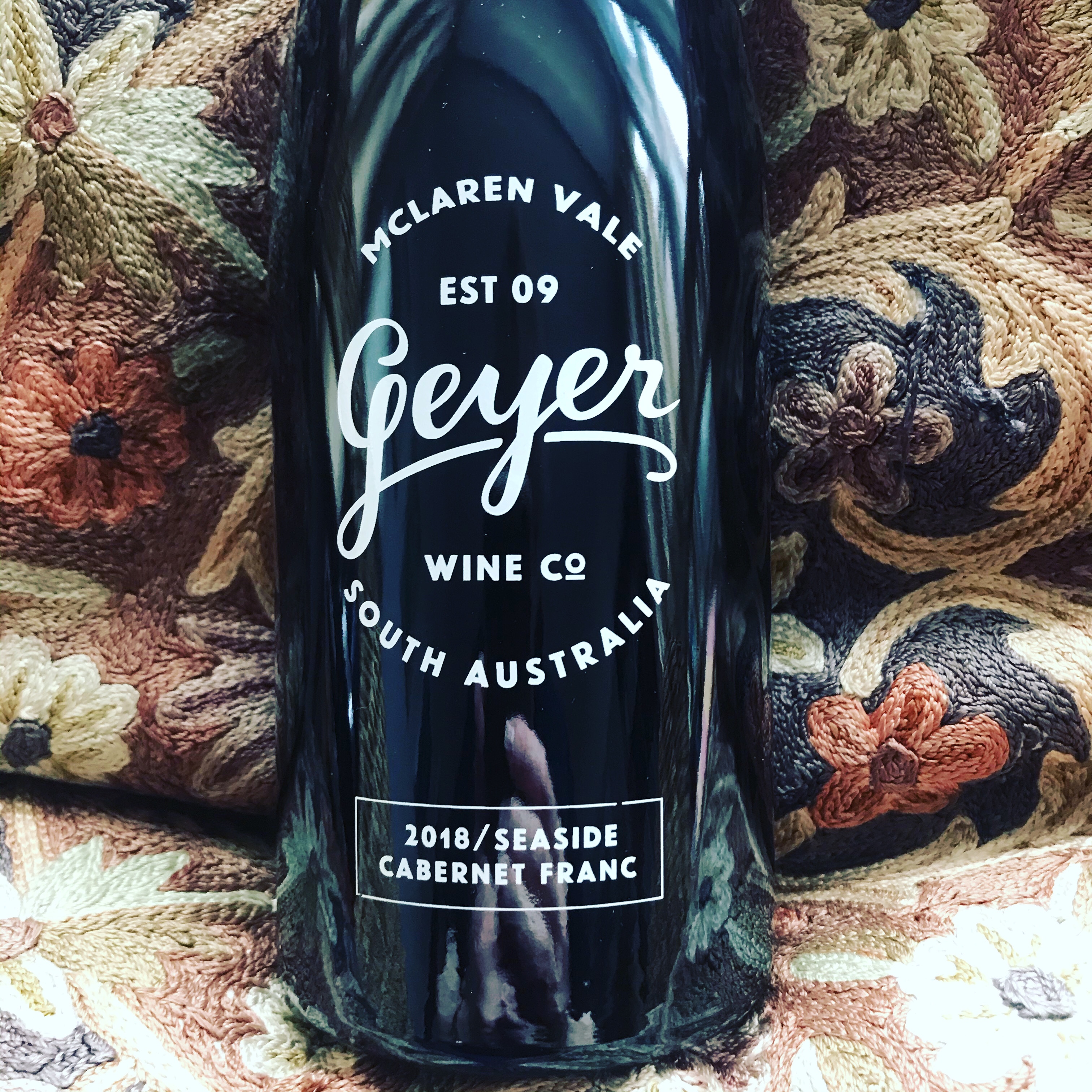
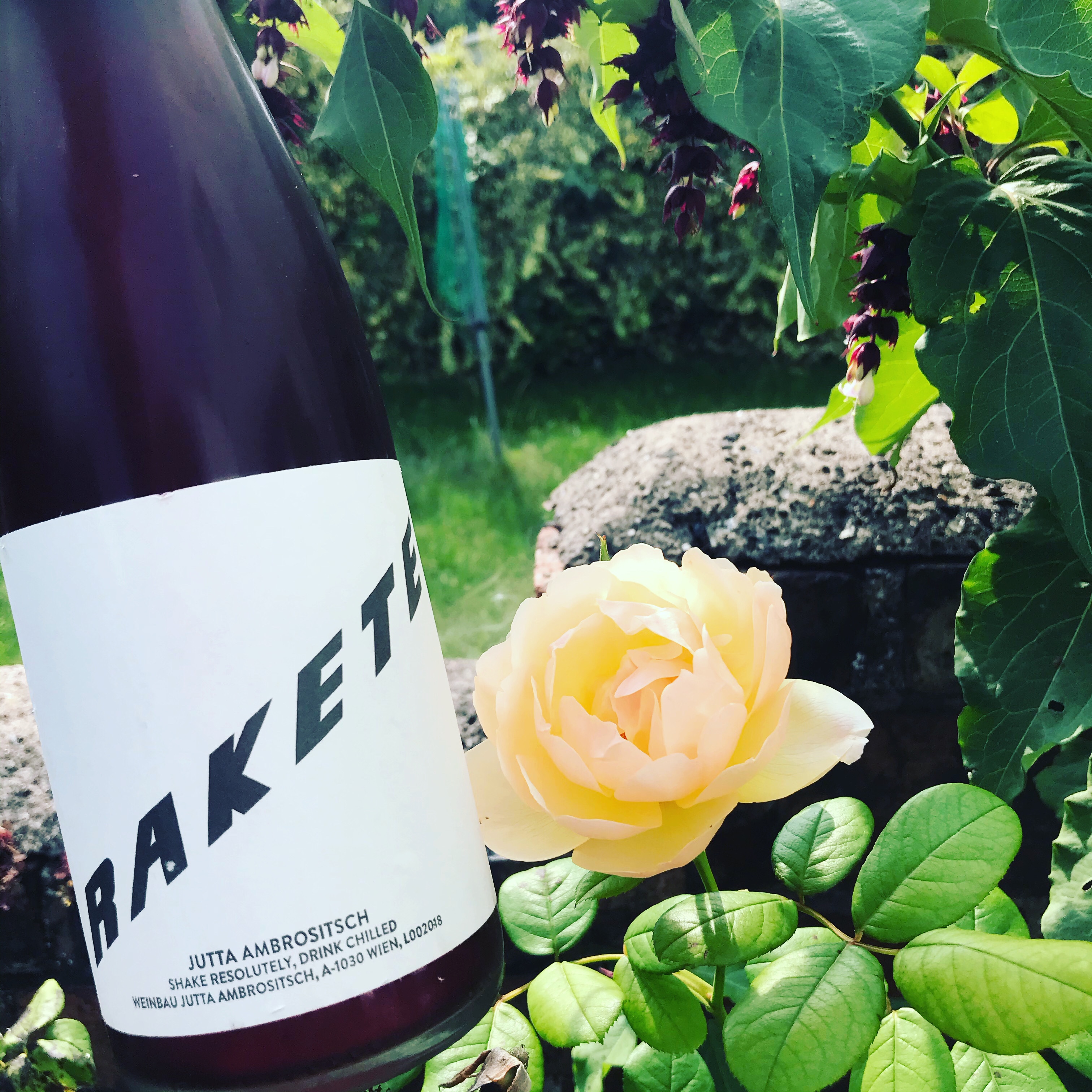
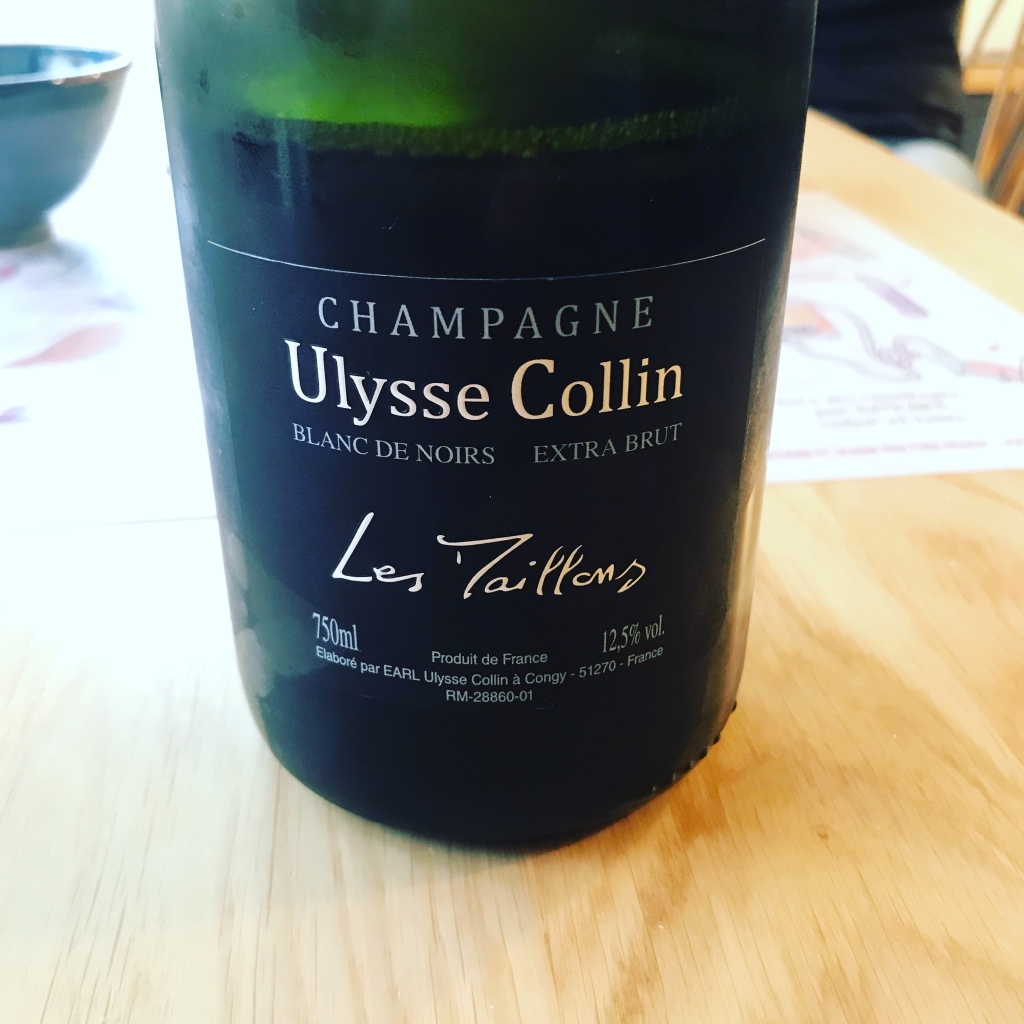
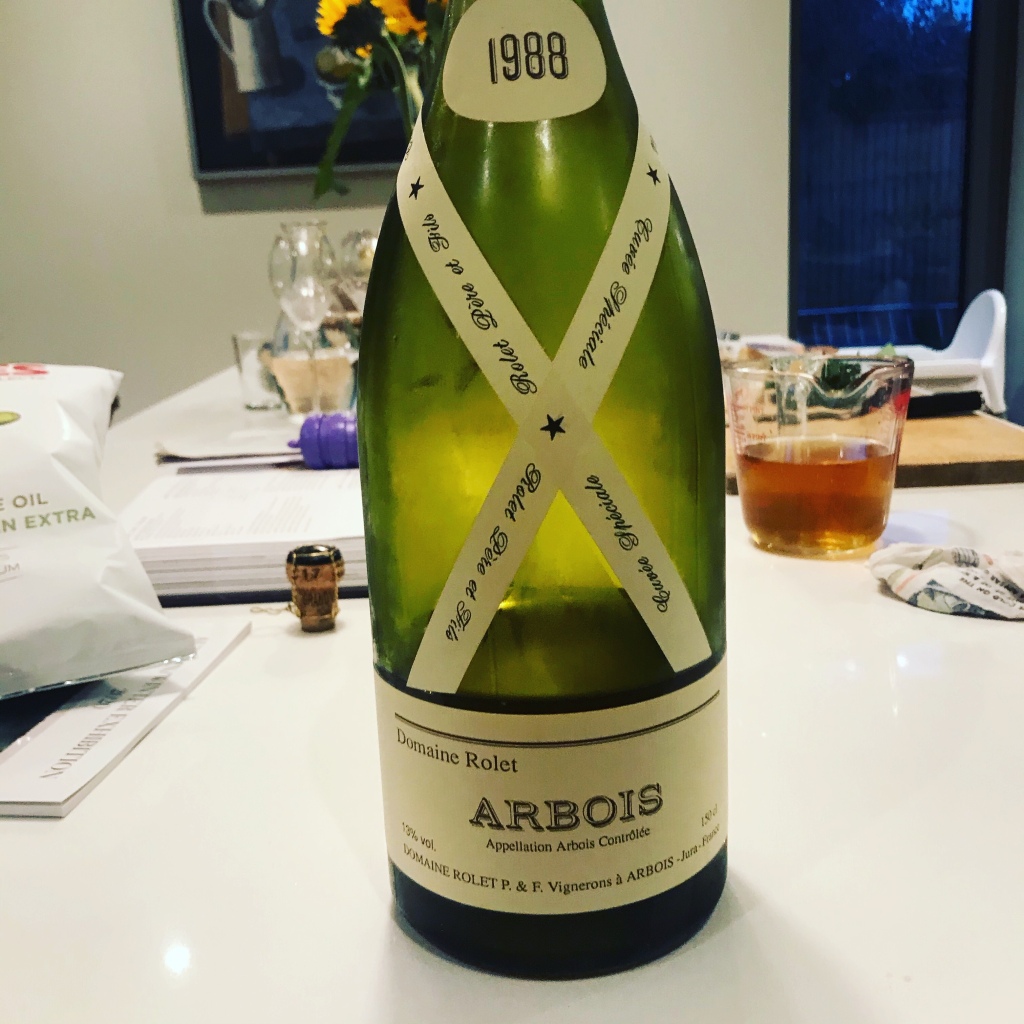
Recent Wines November 2020 (Part 2) #theglouthatbindsus

Continuing to the second selection of wines I drank at home during November, we start out with a rare treat from New Zealand, then a South African favourite, before settling down to Burgenland, Jura’s Sud Revermont, Monmouth in Wales, Champagne, Beaujolais and Alsace. I am no different to many other people who say they have been drinking better than ever during the pandemic, but I really think there are some spectacular wines in this selection. Let’s hope the treats keep coming.

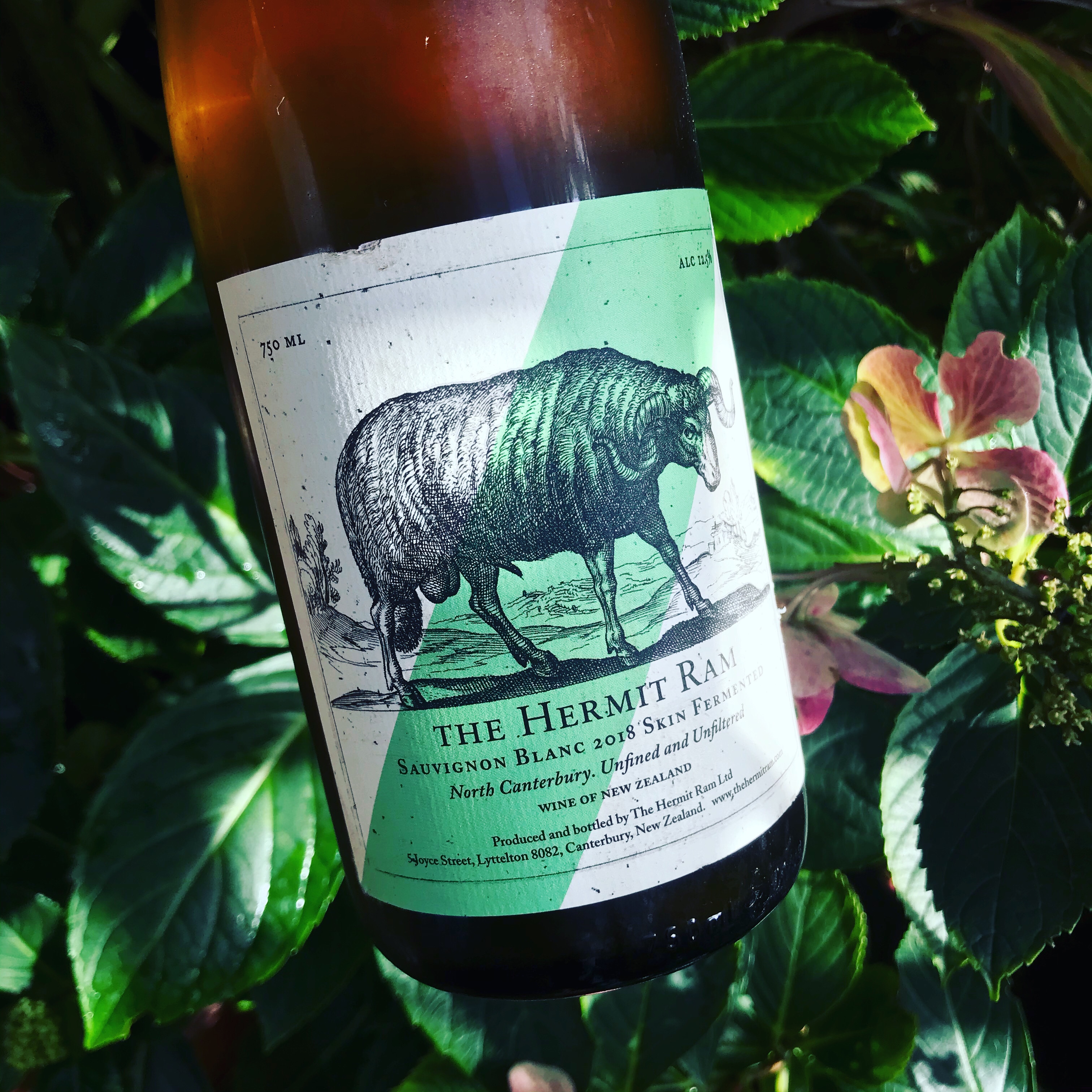
SKIN FERMENT SAUVIGNON BLANC 2018, THE HERMIT RAM (North Canterbury, New Zealand)

Theo Coles farms the “Limestone Hills” vineyard and other tiny blocks in North Canterbury, the rapidly up-and-coming wine region on New Zealand’s South Island. This beautiful landscape has, in Theo’s case, remained untouched by chemical sprays, and he makes natural wines here perhaps like no one else in the country. Other more “natural” winemakers still manage to make wines which taste very “NZ”. Theo doesn’t lose that identity but he’s prepared to push the envelope just a bit further. He’s a wizard with Pinot Noir, and he makes a shockingly good Muller-Thurgau (once quite prevalent in NZ before Sauvignon Blanc came along). But if you really want to see what sets him apart, maybe this signature Sauvignon is one to try.

Fully destemmed fruit sees six weeks on skins. It undergoes malo in barrel after which it is immediately bottled with no added sulphur. It pours out of the bottle between straw and gold in colour and despite a kind of “skin contact” texture on the nose, its bouquet is pure NZSB, but after time it gets more complex. The palate has texture too and there’s a little bitterness. This isn’t over extraction, merely a of bit added flavour riding on the edge of vibrant fruit, if that makes sense. For me, it’s a brilliant wine, the like of which I don’t think New Zealand has seen before. As someone said to me online recently, forget SB in new oak. Skin contact is the way to go. It sure is.

The Hermit Ram is available from Uncharted Wines. They are one of the many importers who have opened an online shop for private customers during the pandemic, giving us all a chance to order wines which are often only to be found in restaurants.
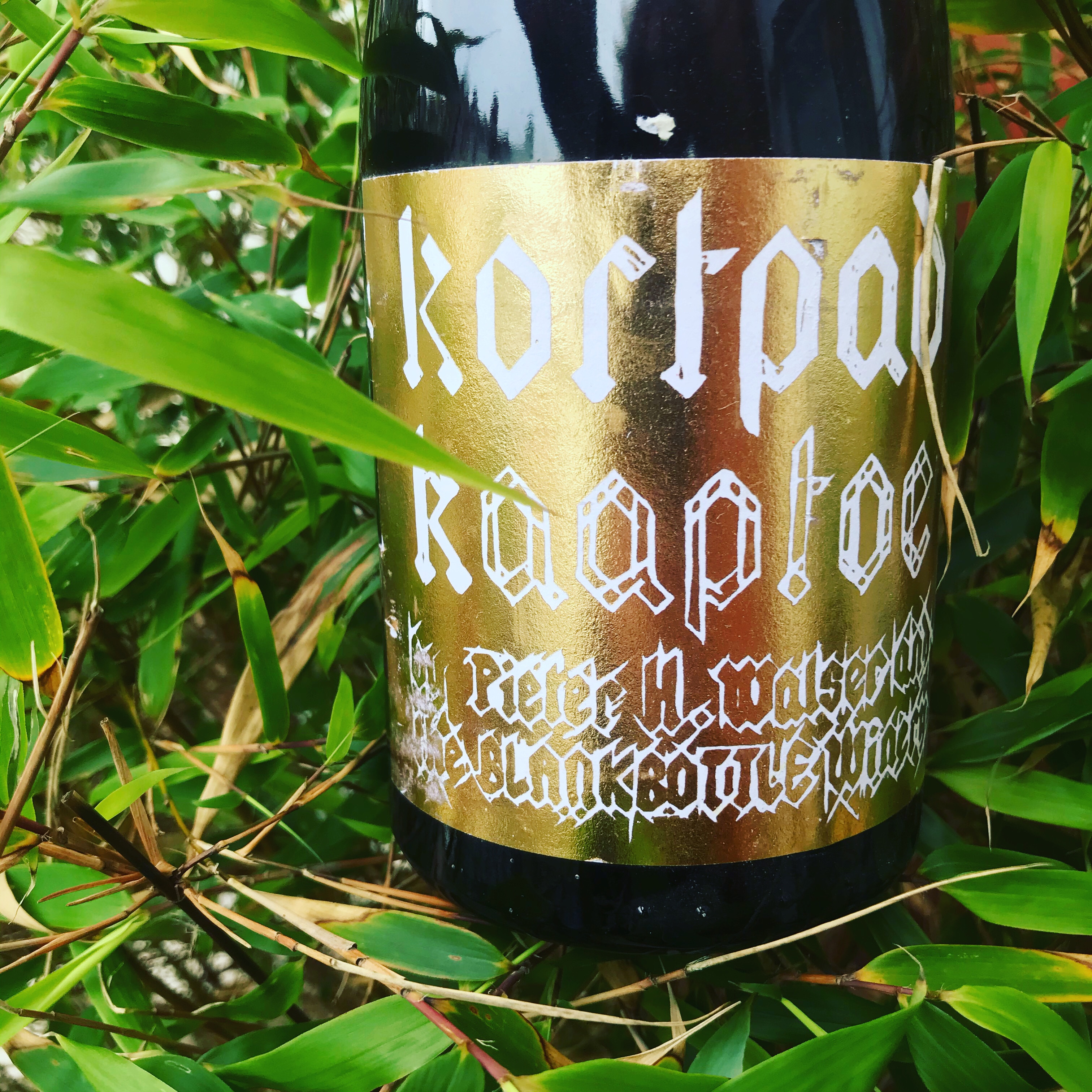
KORTPAD KARPTOE 2016, BLANK BOTTLE WINERY (Swartland, South Africa)

I’d managed to keep a bottle of Pieter Walser’s Fernão Pires (aka Maria Gomes) for a couple of years and it proved a good move as this has aged magnificently. Pieter always has a story for every wine. The name here translates from Afrikaans as “by the fastest route” (he tells us). When asking for directions a grape grower told him “take a right after the Shiraz and Carignan and then left at the Fernão Pires”. Fernão what? On investigation the owner, a Malmsbury producer, didn’t really want this variety. He told Pieter he could have it if he took it all. As with all of Pieter’s stories, they sound a tiny bit surreal, but once you know the man you invest them all with truth (even when they involve fighting off sharks). Anyway, it turns out that these are the only Fernão Pires vines in the Cape.

Pieter fermented the grapes simply, in tank. The result hits you with a nice fresh lemon zippiness before a more honeyed side comes through. It has the sort of texture of honeyed (more than oily) Viognier via its apricot stone fruit. It’s a kind of sunshine richness. Then the faintest hint of butterscotch (or perhaps salted caramel, these things are rarely that precise) lingers before ginger comes through on the finish. Once it has warmed up each mouthful is a journey across that spectrum of flavours, from citrus to saline and savoury. You don’t really notice it cracks 13.5% abv because it retains a vivacity not always seen above 13%. As with all the Walser wines, it seems to manage to be both quite lively and stately at the same time. It’s an oddity which I genuinely think people should seek out.

Blank Bottle is imported by Swig Wines. They regularly get Pieter over to the UK to do events around the country (as well as trade tastings). I went to one such event at Butler’s Wine Cellar in Brighton back in 2019. I couldn’t have wished for a better morning, entertained like never before at such a tasting. He’s one of the nicest and most engaging people in wine I’ve ever met. The owners of Butlers are good mates with Pieter and he’s made a few exclusive bottlings for them, excellent value wines. They are one of the retailers always well provided with Blank Bottle cuvées.
ZWEIGELT 2017, HEINRICH (Burgenland, Austria)

Gernot and Heike Heinrich are yet another biodynamic operation based in the wine village of Gols (also including Claus Preisinger, Rennersistas, Judith Beck and more), to the north of the Neusiedlersee. They took over from Gernot’s parents in 1985. This is an estate where incredible attention to detail has created wonderful living soils and a diverse ecosystem. Conversion to biodynamics was certified in 2006, the Heinrichs being one of the founder members of the Austrian “Respekt” organisation. The wines are all treated as individuals here and from cheapest to more expensive they all have something different to say. There are numerous reasons why their wines don’t always appear on the most fashionable wine lists in London, but they are incredibly well loved by people, like me, who write about wine.

This Zweigelt was described by the Heinrichs as displaying the delicacy of a cut diamond. In a different vein, Jancis Robinson said the 2015 had sufficient acidity to counter the heartiest Tafelspitz (which did make me yearn a little for some of those traditional Viennese Beisl restaurants serving hearty traditional dishes). Those very different notes sum up this lovely wine.

The grapes are harvested from all three vineyard zones by the lake, from the flat gravels closer to the reed beds on the Parndorfer Plain up to the limestone and pockets of schist on the Leithaberg. It was given two weeks post-fermentation on skins in both wood and stainless steel, before thirteen months in old wood (vats and 500-litre barrels). It’s quite serious Zweigelt, dark coloured, smooth and rich, yet only 12% abv. It majors on concentrated cherry fruit cut with red fruit acidity. It’s very elegant as well. It’s way too under the radar. Gernot and Heike are well noted for being one of the first Burgenland producers who really took Zweigelt seriously, and their reds, especially off the wonderful terroir of the Leithaberg which just seems to bring life to the wines, are so vibrant…but please don’t neglect their whites.

Heinrich is imported by Indigo Wines.

POULSARD “SUR CHARRIÉRE” 2013, DOMAINE LABET (Jura, France)

Domaine Labet was one of the Jura producers which set me off on my journey down that particular rabbit hole. Back in those days Alain and Josie worked the land. Today it is their children, led by Julien, who farm somewhere in the region of seven hectares in what is known as the Sud Revermont, near Rotalier. This is the far south of the Jura region, but despite its distance from Arbois, it is another centre for world class producers, as you may well know.

I have to say, because it is something I feel strongly about, that Domaine Labet should be every bit as famous as their neighbours, whether that be the established J-F Ganevat or the superstar newcomer, Domaine des Miroirs. Or indeed any producer in the wider region. I feel that it’s only now that the wines of this wonderful estate, whose vines have never seen any chemical sprays or additions, are getting their just acknowledgement as some of the finest natural wines in France.

So, to the Poulsard. It’s from Labet’s “Parcelles Rares” series. Very old vines, planted in 1969, and a little planted in 1994, from a plot of just 46 ares (sic) on marnes bleus soils at 350 masl, make up the cuvée. The wine is simply made and sees no sulphur added. The result is now, after seven years, brick red, almost the colour of an aged Nebbiolo. It has a mere 10.4% alcohol, but it doesn’t lack body. It has mellowed nicely into a truly complex wine, indeed profound and magical. There’s just something about it. It has a haunting quality that makes the wine float on the palate, but it hasn’t lost that core of concentrated pomegranate or cranberry fruit.

This bottle came from Winemakers Club. Labet can also be purchased through Vine Trail.

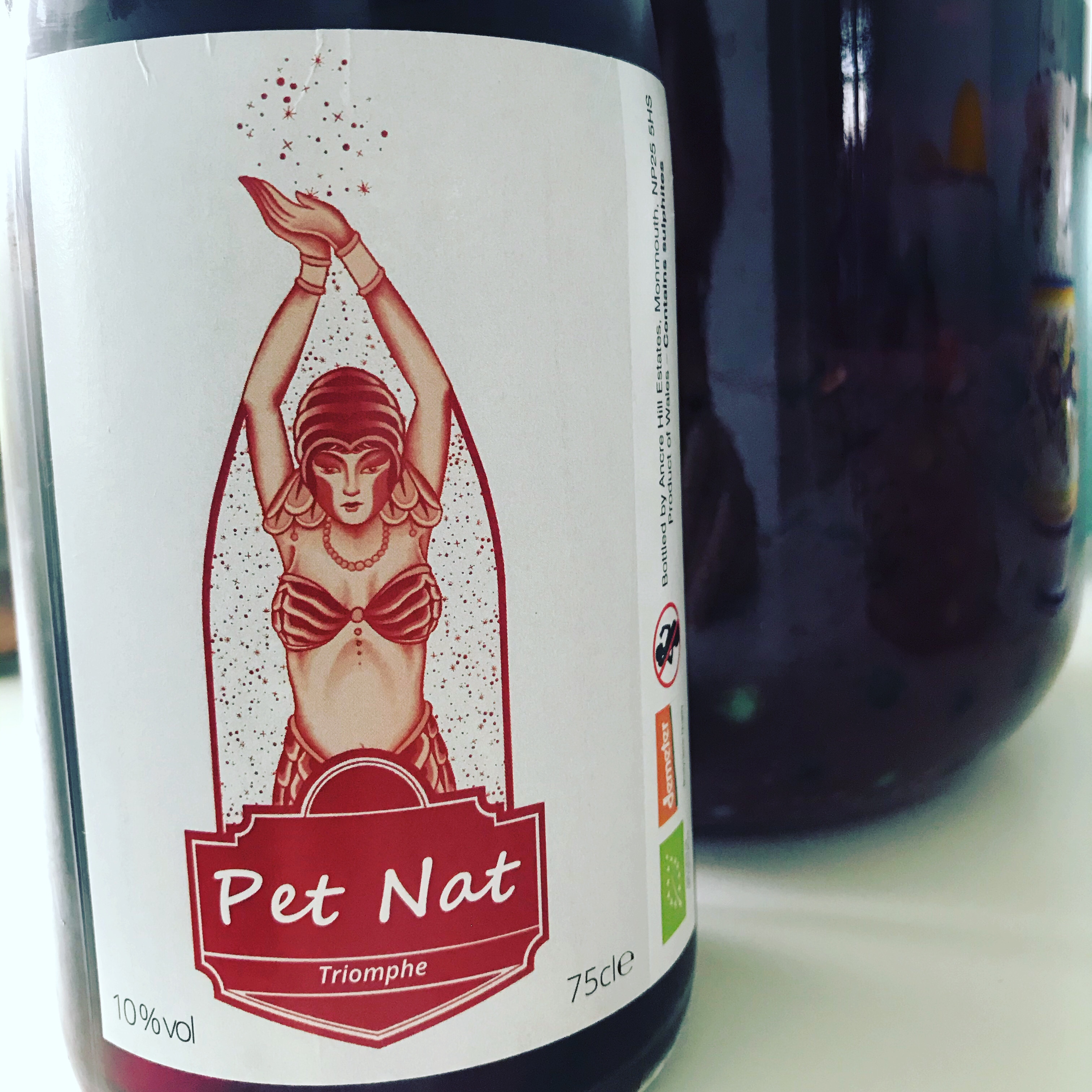
TRIOMPHE PETNAT, ANCRE HILL ESTATE (Monmouthshire, Wales)

Richard and Joy Morris planted vines just outside of Monmouth in 2006. Intuition might tell you that surely Wales is too wet for viticulture, but this is a particularly dry part of the country. Although they have some Triomphe [d’Alsace] planted, they have managed to grow Chardonnay, Pinot Noir and Albariño, over 12 hectares, to great effect, establishing a reputation as a pioneer of low intervention viticulture and winemaking in Great Britain. The estate is now openly up for sale as Richard and Joy want to retire. If you have a spare £15 million and want to get into biodynamic (Demeter certified) grape farming in Great Britain, here’s your opportunity (contact Savills Estate Agents).

Triomphe was developed as a hybrid cross (between an American variety and a vinifera) in 1911, in a Colmar then still under German rule following annexation in the war of 1871 and the Treaty of Frankfurt. It grows well even in a cool climate, though you need to really keep on top of canopy thinning to avoid mildew when wet. The wine produced in this case is deep coloured and gently fizzy (almost frizzante with only 2-to-3 bar pressure) and very frothy. It’s a multi-vintage wine whereby the juice from the new vintage is added to the base wine, its sugars reinvigorating a second fermentation. The result is very simple, yet it does exactly what any petnat should. It provides a “smashable” juice which refreshes all the parts…in this case, being a red wine, through pure raspberry juice with a hint of Ribena (that’s blackcurrant to those not familiar).

Ancre Hill wines are to be found through the Les Caves de Pyrene network of independent wine shops. I bought a selection of Ancre Hill wines in an order from Butler’s Wine Cellar of Brighton, source of the Breaky Bottom sparkler which appeared in Part 1. Definitely worth a look for English and Welsh wines.
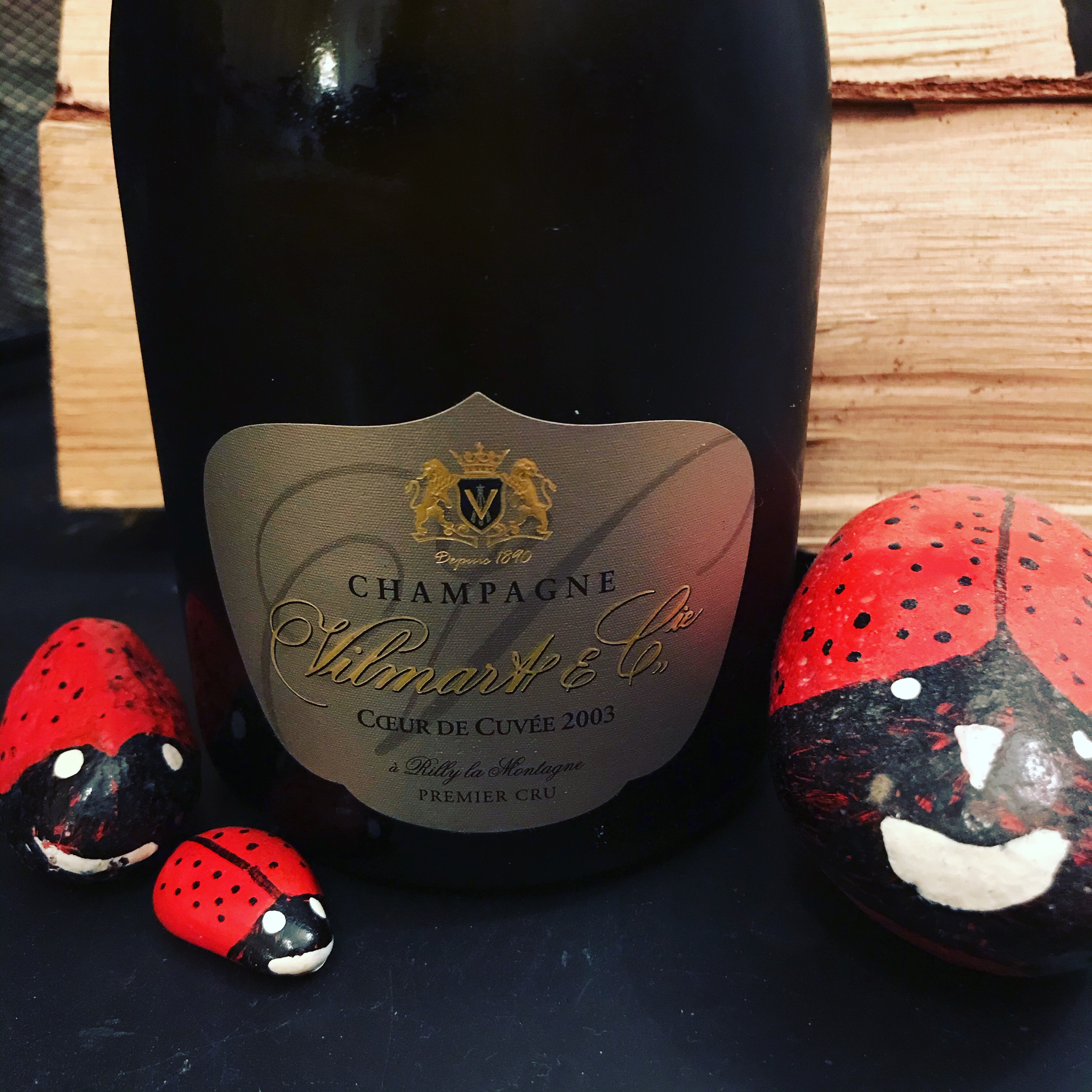
CHAMPAGNE VILMART COEUR DE CUVÉE 2003 (Champagne, France)

Vilmart & Cie is tucked away in Rilly-la-Montagne on the crest of the Montagne de Reims, just west of both Chigny-les-Roses and the main D9 road from Reims to Epernay. Vilmart was the first “Grower Champagne” I became enamoured with, before I even knew that “growers” existed, or at least as producers of cuvées like this one, to match the very best produced by the Champagne Houses.

Laurent Champs runs this perfectionist operation, with a winery filled with some of the most beautiful wooden barrels and vats, matched by the stunning beauty of the stained glass created by Laurent’s father, René. The vines are “only” Premier Cru, but they are old (most are around 50-years of age) and the top cuvées really do make a mockery of the Grand/Premier Cru distinction which in most other cases holds relatively true.

Coeur is made from the heart of the cuvée, the first gentle pressings. The grapes are unusually fermented in barrique and like any wine thus made, it demands a long period of post-disgorgement bottle age for it all to come together. Then, like any fine wine, it can be magnificent. It is usually made up of around 80% Chardonnay with just Pinot Noir added, but I don’t have the exact blend for this vintage. What I am able to say is that this ’03 is now complex and magnificent. It is obviously made with great care and attention to detail, but it also has genuine soul.

Laurent has an odd knack of producing some magnificent bottles from what the critics term less-good vintages. In fact, I’d like to try a better 2001 than Vilmart’s Couer de Cuvée of that disastrous year. This is much better than the 2001 though, a lovely wine drinking so well now. It’s my last 2003 Coeur, though I do have a few 2002 left. But it is now probably beyond my pocket to purchase newer vintages, as are most prestige cuvées from Champagne. Sic transit gloria mundi.

This was purchased on a visit to the domaine in April 2012, as the 2003 had just been released.
FLEURIE “CHAVOT” 2014, JULIE BALAGNY (Beaujolais, France)

Julie is a Parisian who is very much more at home in the countryside. She began working for wine producers in France’s southwest, but managed to make a home with three hectares of vines surrounded by woodland, around Fleurie. Julie has since added a further 2 ha in other locations and she has started to supplement her estate wines with a few negociant cuvées (one of which I bought this week).

I have had so many really good bottles of Beaujolais from 2014, and indeed this is my last of three (or four?) of this cuvée. Not only have they all been superb, but this is still going strong, drinking nicely but not sliding down the hill. As with all the Balagny wines, this sees whole berries undergo a semi-carbonic maceration. The juice is never manipulated by pumping over or pushing down. No additives, including sulphur, make this the purest of natural wines in both senses.

Cherry juice of the most concentrated (but light as a feather) kind is the core. There’s a tasty twist of pomegranate acidity dancing over the top, and a little bit of earthy texture sitting underneath. Overall, it’s smooth fruited and, it’s true, alive. I’d say it’s mature but has perhaps as much as four or five years left in the tank. Who says natural wines cannot age? I think this actually might be the best bottle of the batch, a case shared with a couple of friends.

Tutto Wines is the importer for Julie Balagny. I don’t think there is any “Chavot” remaining on their list, but they do show five Balagny cuvées from the 2019 vintage, only one of them currently on their online shop, Tutto a Casa.

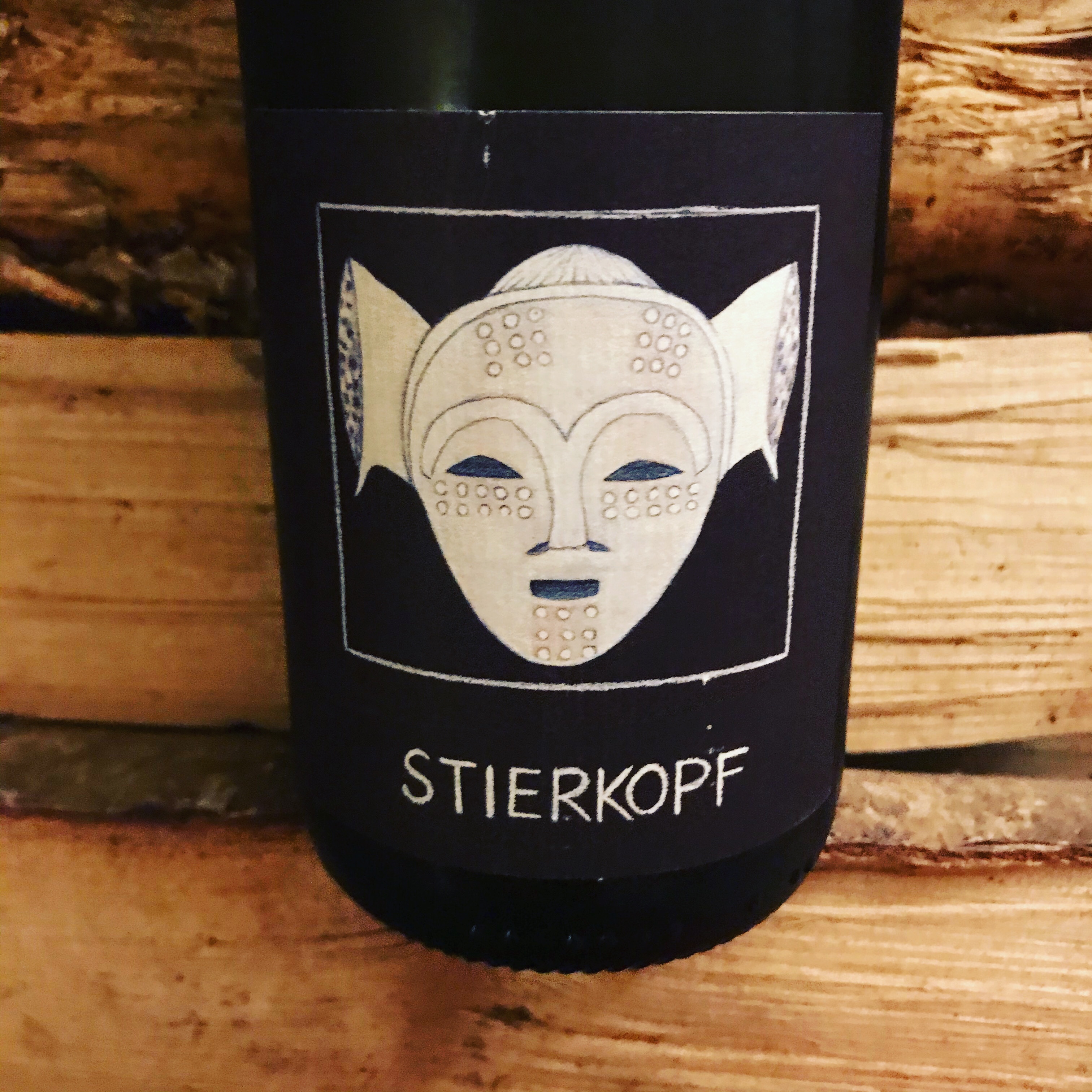
AUXERROIS “STIERKOPF” 2016, DOMAINE RIETSCH (Alsace, France)

Jean-Pierre Rietsch is one of the most respected producers in Mittelbergheim, hotbed of innovation in the Bas Rhin. He’s the seventh generation of his family to farm here, although they have not always been wine growers, his parents having begun vine cultivation in the 1970s.

Stierkopf is a south facing slope of limestone and sandstone at Mutzig, perhaps ten kilometres to the north of the Rietsch base at Mittelbergheim. It’s a particularly warm site on which Jean-Pierre also grows amazing Pinot Noir. The wine began a spontaneous fermentation after which it was left in vat, on lees, for eleven months. It is allowed to go through malolactic. It shows just 12 mg/l sulphur on analysis. It was bottled in August 2017.

There’s a mineral structure backed with striking salinity, but there’s also fruit to match, generous pear and quince. Looking at the wine as a whole, standing back a moment, it looks like a wine bound together with a certain tension yet that tension is relieved at the edges by sunshine. I guess that means I think the wine reflects its terroir. It certainly shines brightly, an exemplary wine. I know I am lucky to own a reasonable number of Jean-Pierre’s wines, but they are getting drunk rather quickly. A visit to Alsace this year had to be postponed, only exacerbating the situation, but although this bottle came from a previous visit to the domaine, Jean-Pierre Rietsch is imported into the UK by Wines Under The Bonnet. Fill your b…onnets, as they say.
Posted in Artisan Wines, biodynamic wine, Natural Wine, Wine | Tagged , , , , , , , , , , , , , , , , , , , , , , , , , , , , , , , , | 3 Comments

Recent Wines November 2020 (Part 1) #theglouthatbindsus

November’s “Recent Wines”, the most interesting wines drunk at home last month, kicks off in Rust and a winemaker whose wines were among the first from Burgenland I drank. We then continue our journey via Sussex, Hungary, the Mosel and back to Burgenland, before we head over into Slovakia. We are then back in Sussex but for something completely different, before ending Part 1 in California.

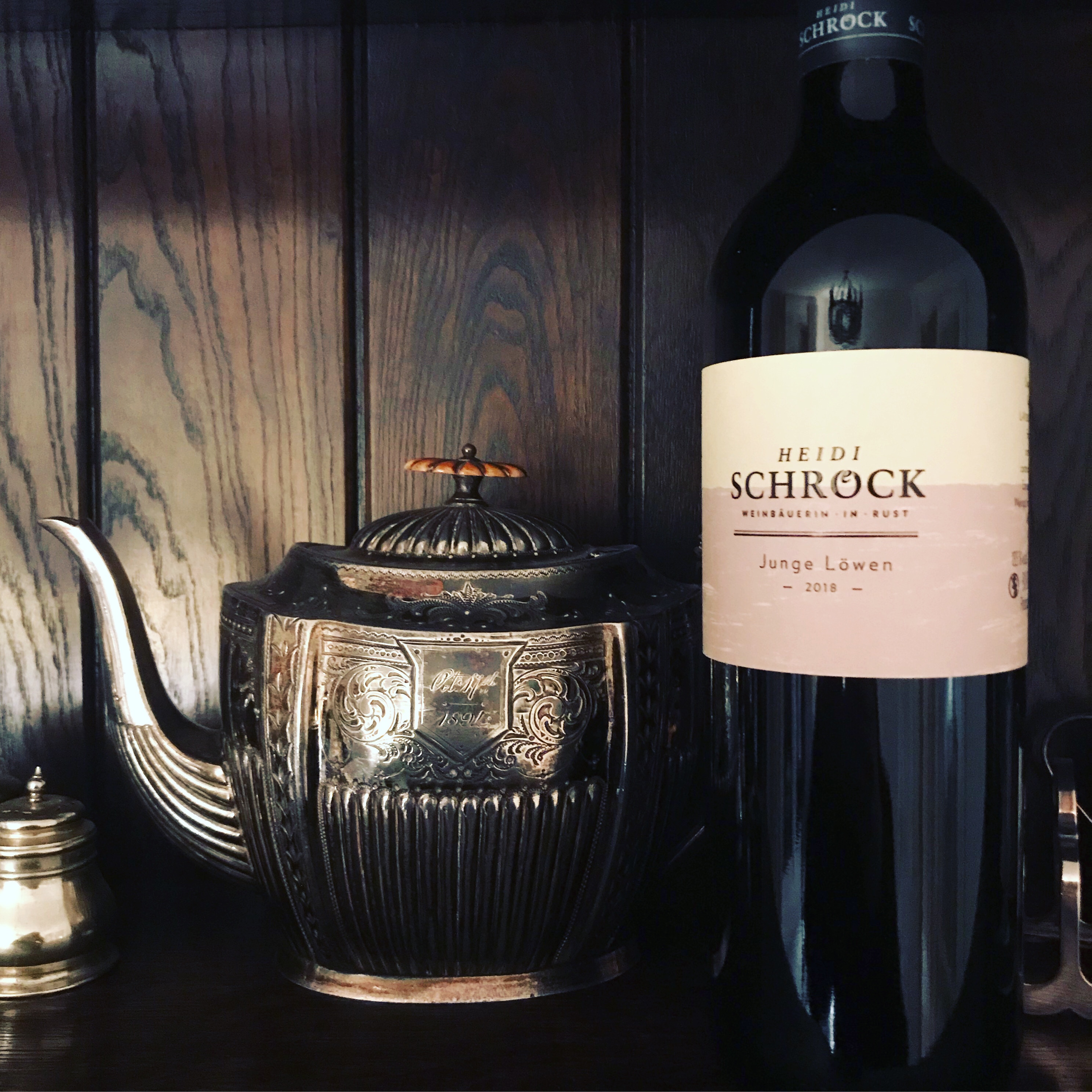
JUNGE LÖWEN 2018, HEIDI SCHRÖCK (Burgenland, Austria)

Heidi’s old family cellars are situated right on the square in the beautiful town of Rust, right on the western shore of the Neusiedlersee. Whilst the focus these days is rightly on the younger generation of natural wine producers around the lake, we shouldn’t forget that there are a group of women who have been making biodynamic or low intervention wines around here for many years. These include Birgit Braunstein, Judith Beck, and of course Heidi Schröck.

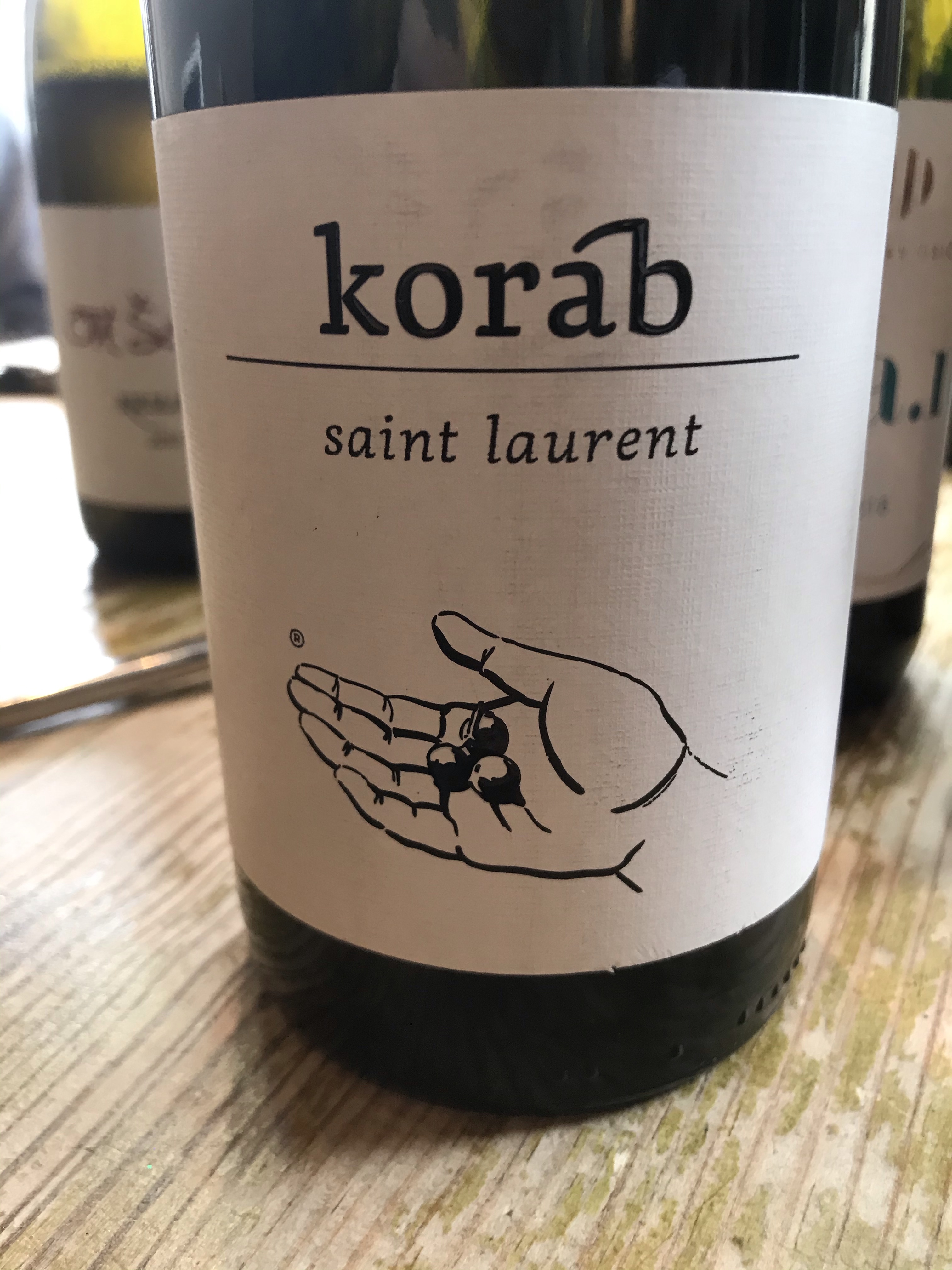
Junge Löwen does what it says on the label. It’s a tasty drinking red under screwcap, a blend of 85% Blaufränkisch and 15% St-Laurent. It smells of bright dark fruits with a lovely smooth palate made interesting by a slightly mineral edge. It’s simple, but an excellent introduction to Heidi’s very pure wines, and great value. Although her reds step up from here, via Rusterberg and Ried Kulm, this is just as enjoyable in its own way for its accessible sappy fruit.

I’ve mostly bought Heidi’s wines from Alpine Wines over the years, apart from a few bottles purchased in Heidi’s cellars, but this bottle came from The Solent Cellar via Liberty Wines, who seem to have the three red wines mentioned and halves of her Beerenauslese.

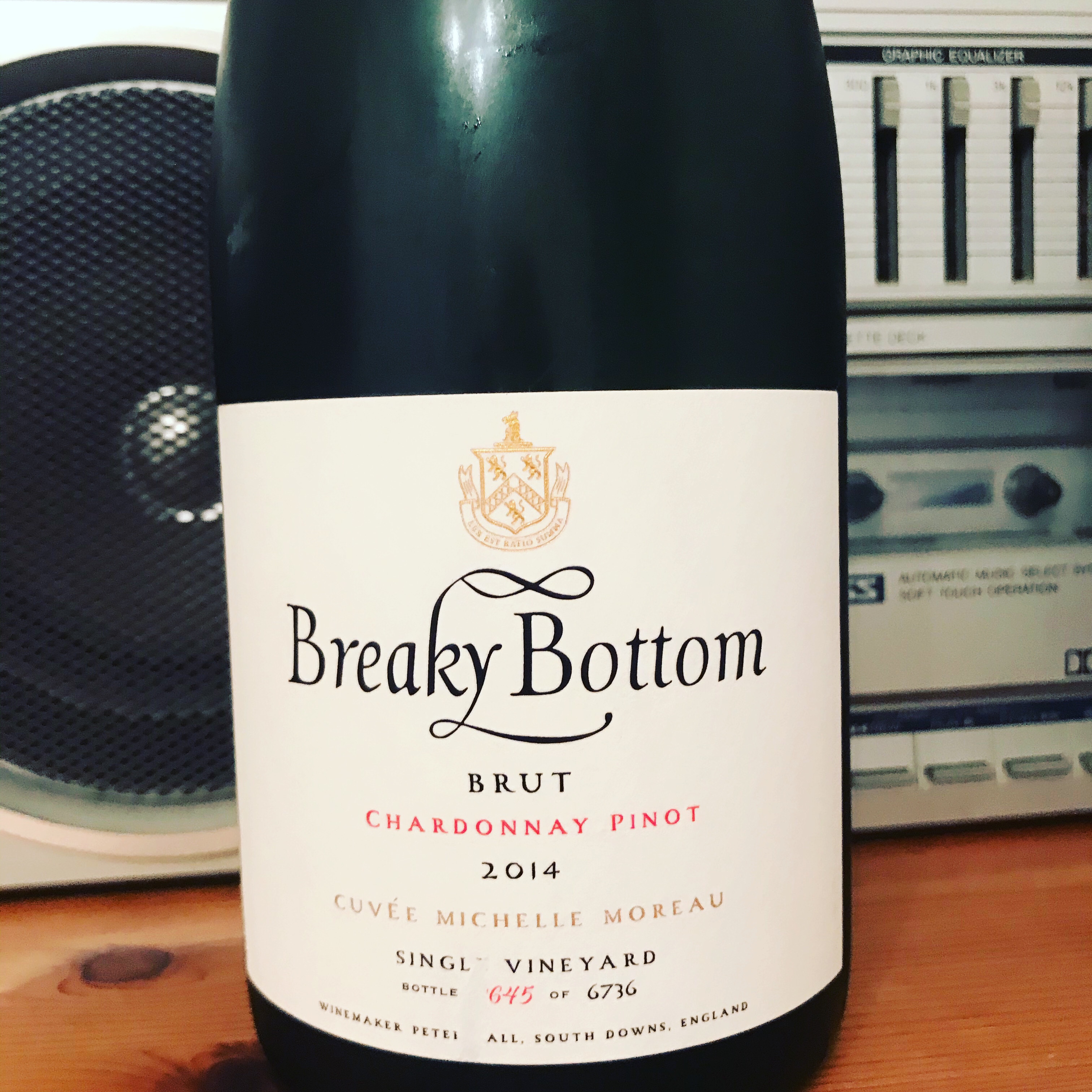
CUVÉE MICHELLE MOREAU BRUT 2014, BREAKY BOTTOM (Sussex, England)

Breaky Bottom is kind of hidden away in the Sussex countryside south of the County Town of Lewes. The six-hectare estate, founded by Peter Hall when he planted a vineyard near Rodmell in 1974, is one of the longest-standing quality producers of English Sparkling Wine, and perhaps one of the few to make very good Seyval Blanc. This cuvée, however, is made from a more traditional blend of 70% Chardonnay, 15% Pinot Noir and Meunier.

“Michelle Moreau” (a poet, dancer, writer, inveterate traveller and a close friend of the Halls) is an award winning cuvée of just 6,736 bottles which at £35.50 is as much a hidden classic as the estate is hidden away in the folds of the South Downs chalkland. It’s bright and classy with a little bite of acidity, but it also shows that bit of bottle age which adds depth and complexity. I’m sure it will improve further, but it is drinking so well now. Sort of lively, but stately. I definitely want to get some more.

This comes from the estate via Brighton wine merchant The Butler’s Wine Cellar, which is something of a specialist when it comes to English (and Welsh) sparkling wine, whose owners have a close connection with the estate.

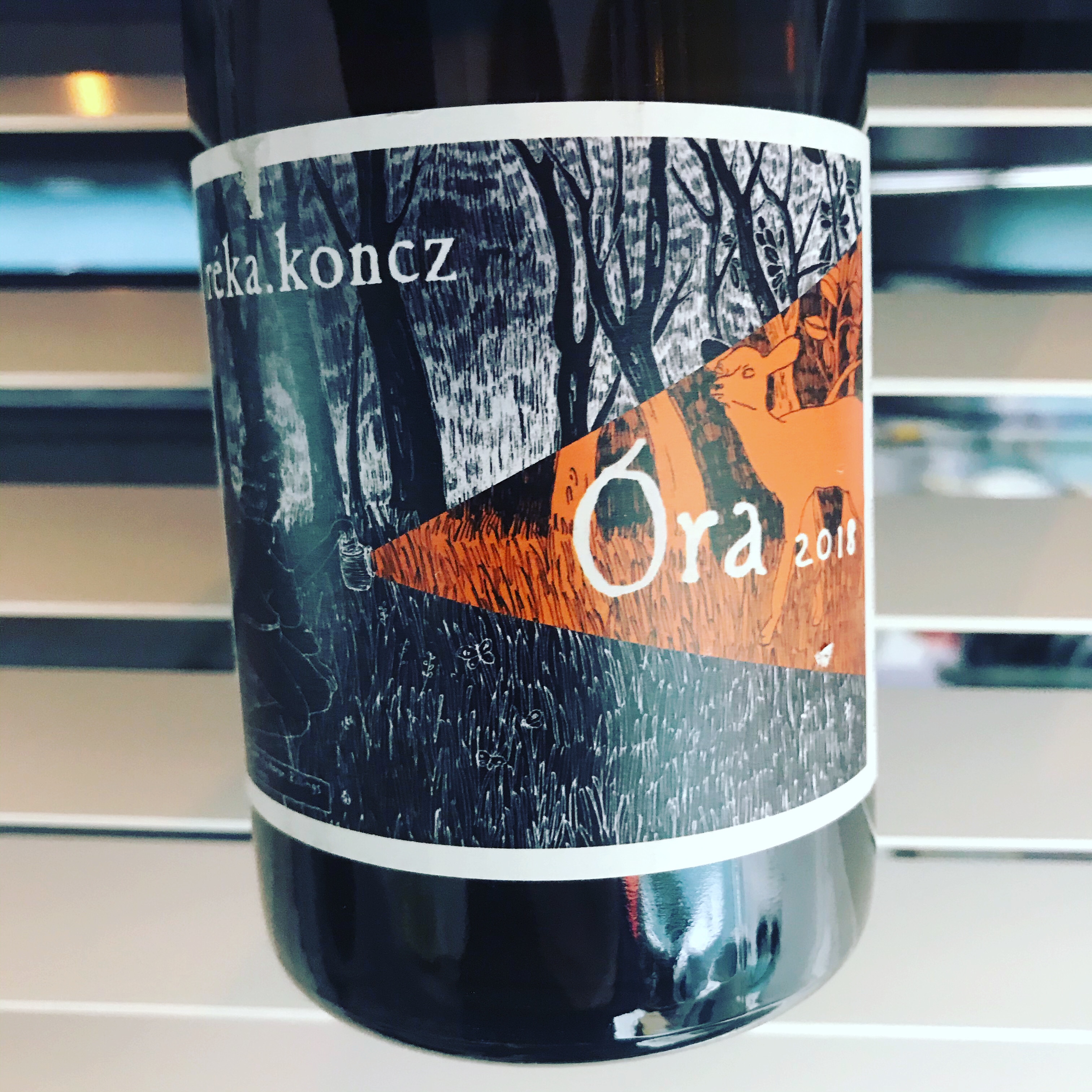
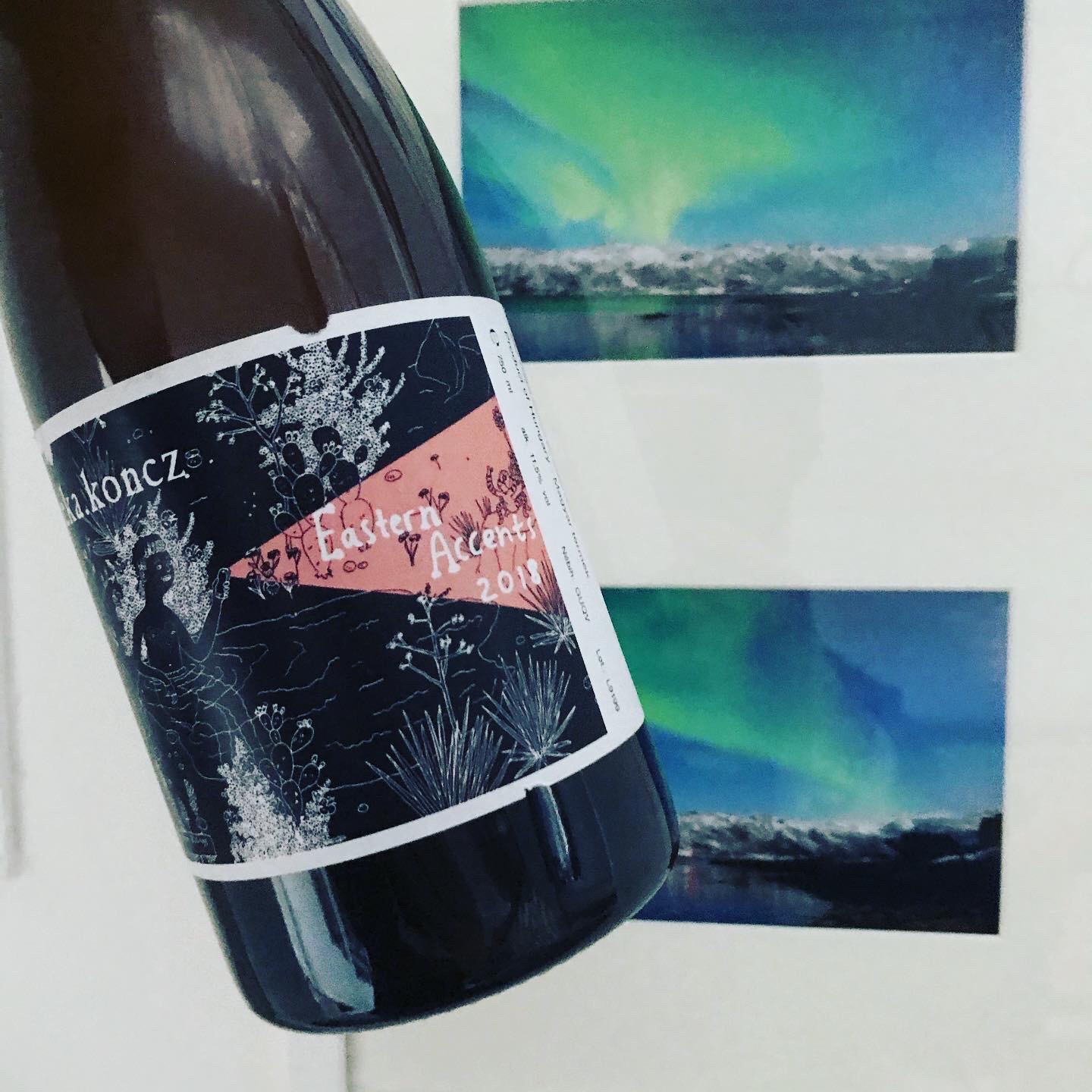
ORA 2018, RÉKA-KONCZ (Eastern Hungary)

Annamária Réka is too much of a regular in these monthly revues for me to go over her background yet again, as I work my way through my first batch from her range (after this one I have just one more of her wines currently in the UK to write about). She makes mostly wines from white grapes with differing degrees of skin contact in the very far east of Hungary, right up by the border with Ukraine. She will certainly get a mention in my Review of the Year in a few weeks.

Ora is a field blend based on a local and rare autochthonous variety called Királyléanyka, which Annamária is intent on keeping alive. The blend also contains some Rhine Riesling, Hárslevelü and Furmint (probably among others, as is the way with traditional field blends all over Central Europe). It sees a five-day maceration of destemmed grapes in open cask before finishing in tank.

The wine has some protecting C02 which makes it gently spritzy (not fizzy) on opening. I should warn that it was the most “cidery” wine I’ve tried from this producer, though I’d describe it as the best cider I’ve ever drunk. But it is a little out there. Within the context of what I’ve just said this was gorgeous, if for the more adventurous.

There are plenty of more straightforward (if that’s really a fair word to use) wines in the Réka Koncz range. They are imported by Basket Press Wines and you can check out these wines (and their whole range, from mostly Central Europe) at their popup shop throughout December, at 188A Hackney Road (almost opposite Sager + Wilde). See my article of 23 November for more details.

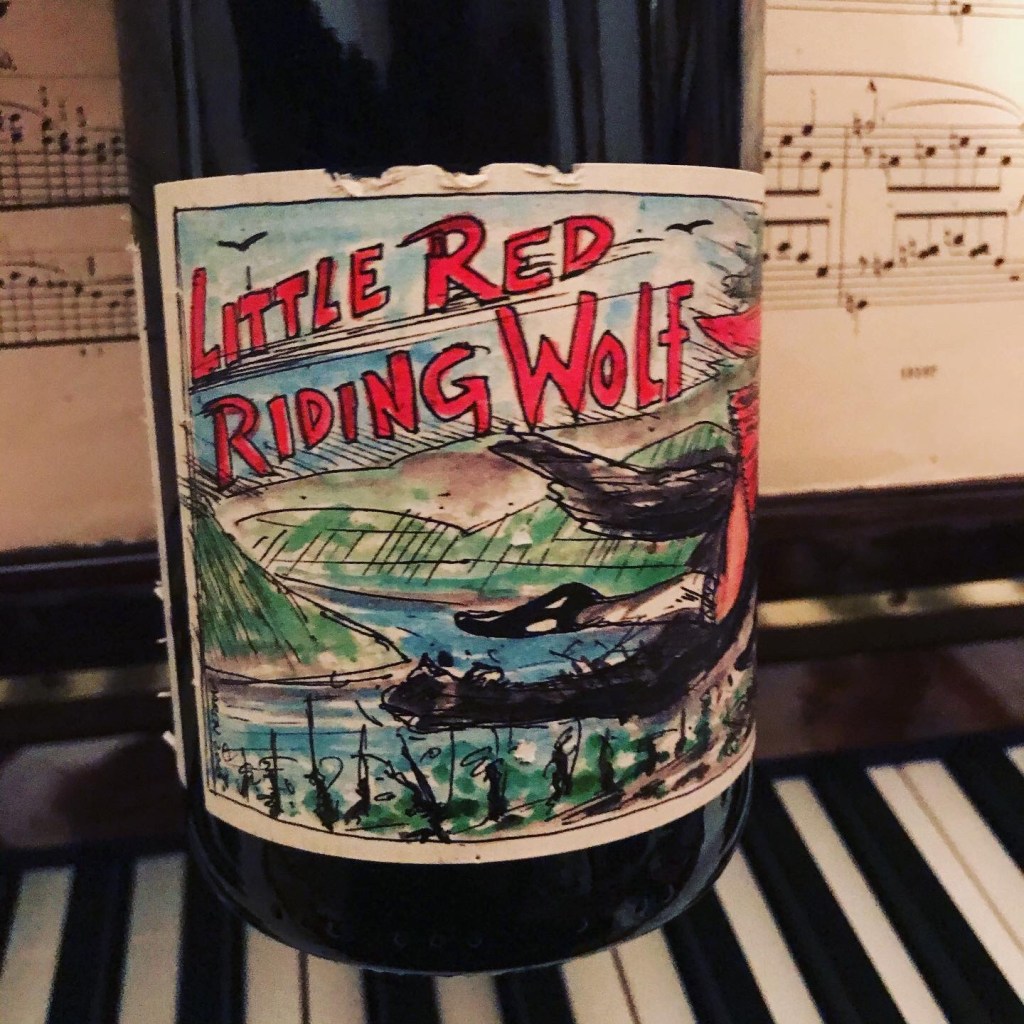
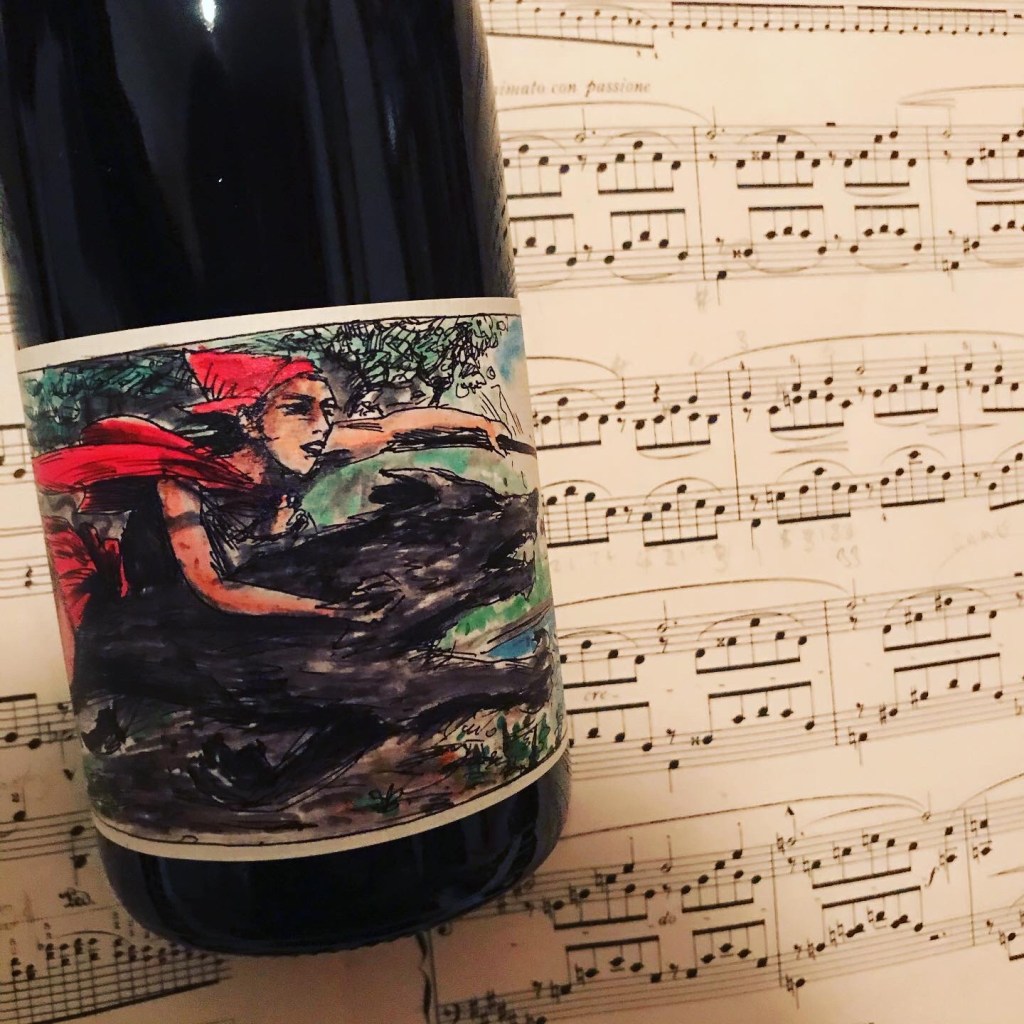
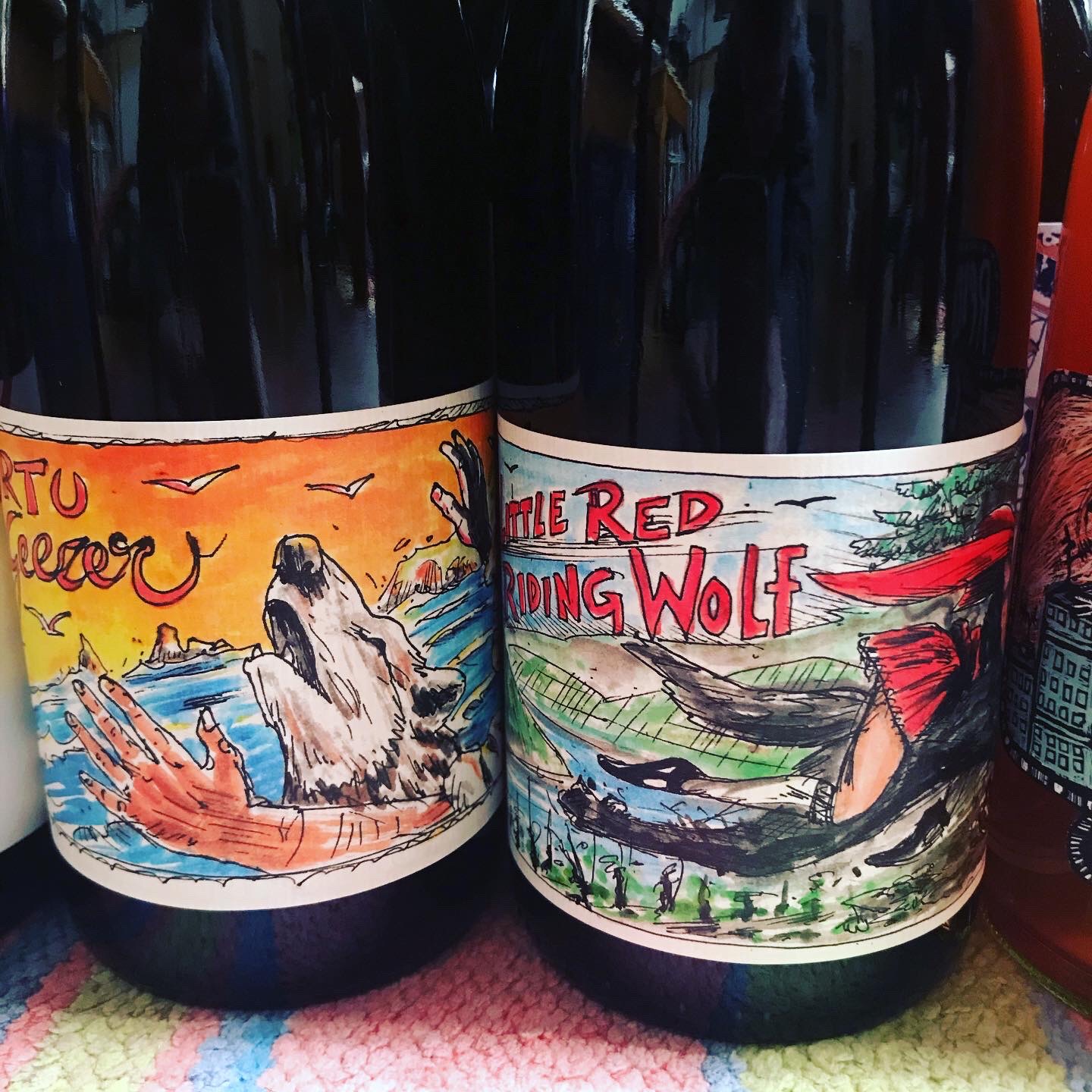
LITTLE RED RIDING WOLF [2019], JAN MATTHIAS KLEIN (Mosel, Germany)

JMK is the man behind Staffelter Hof and this is one of his Landwein, which sport contenders for the most modern and perhaps most exciting wine labels in Germany today. You’d hardly guess that some of these wines hail from the traditional vicinity of Kröv, on the most famous stretch of the Mosel. This red is made from Pinot Noir with zero added sulphur, equally unfined and unfiltered.

What hits you first is mouthfilling cherry fruit. That’s enough, although a little earthy texture makes the wine food friendly. At a balanced 12% abv it is truly gluggable, but it doesn’t seem light or lacking weight on account of that concentrated fruit. One of the best German reds for drinking bottle after bottle in an unashamedly natural wine style without an excess of funk.

Imported by Modal Wines.

INTERGALACTIC 2019, RENNER & RENNERSISTAS (Burgenland, Austria)

The Renner establishment is on the right-hand side of the road as you drive (or cycle in my case) into Gols coming from Neusiedl-am-See, at the top of the lake. Gols sits in the middle of vineyards which slope both above the village and below it, more gently down to the reed beds of the Neusiedlersee. The Renner revolution is well underway, and Stefanie and Susanne are now joined by brother Georg. Although their father, Helmuth, has been a noted producer of the serious “Pannobile” wines of the region, the three siblings are all well versed in the ways of natural wine production (the sisters trained with Tom Shobbrook and Tom Lubbe).

Intergalactic is a new wine in the range, a white field blend of Grüner Veltliner, Welschriesling, Gewurztraminer, Muscat Ottonel and Chardonnay. When I visited at the time of the 2018 vintage Stefanie told me how, having seen how their individual varieties perform on their own and getting to know them, their interest now really lies in creating the best possible blends.

This cuvée sees a little skin contact over four days before ageing on lees in old oak. It only shows 11.5% abv, which gives it a lightness, but at the same time there’s definitely something in the blend which adds a little plumpness or gras. The overall effect on the texture is very positive.

This wine is firmly in the unfiltered camp, so it really does need a day or two standing up, but it’s a glorious field blend. Planet Gols is taking us to the outer reaches of the furthest galaxies. Please don’t stop.

Renner & Rennersistas are imported by Newcomer Wines and are also available at littlewine.co , and I’ve bought this from both so I’m not sure which one this bottle came from.

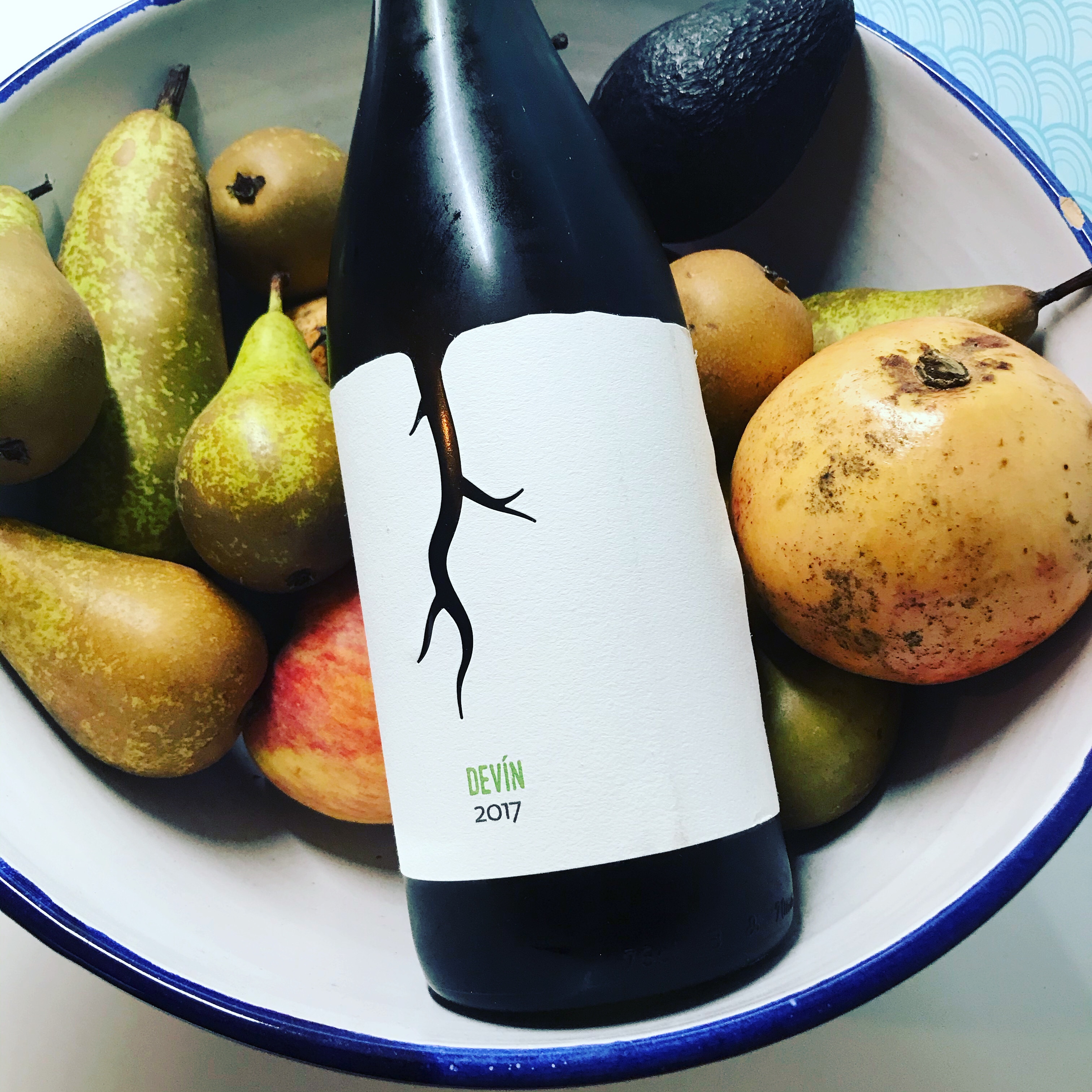
DEVIN 2018, MAGULA (Sovakia)

Magula is among the best three or four producers I know in Slovakia, and is equally one of my favourites in the whole of Central Europe. It is a ten-hectare family estate (second generation) at Sucha Nad Parnou in Southern Slovakia. Biodynamic wines are made in a dry valley (hence the vine on the labels, forced to go deep) from loess soils with a high mineral content, especially calcium, which you will see clearly affects the flavour.

Devin is a local cross between Gewurztraminer and Roter Veltliner. It combines a texture somewhere between peach juice and olive oil but the bouquet and palate give fresh lime citrus and peach with hints of spices and a saline twist. It’s a lovely variety for anyone seeking something very different to what they may have tasted before, yet don’t want anything too out there. In some ways it reminds me a little of Viognier, but if you don’t like Viognier don’t be put off. Everything blends together nicely, so that the wine is neither complex nor simple (or maybe it’s both at the same time).

Another bottle from Basket Press Wines which you could pick up at the importer’s popup shop (188A Hackney Road) during December.

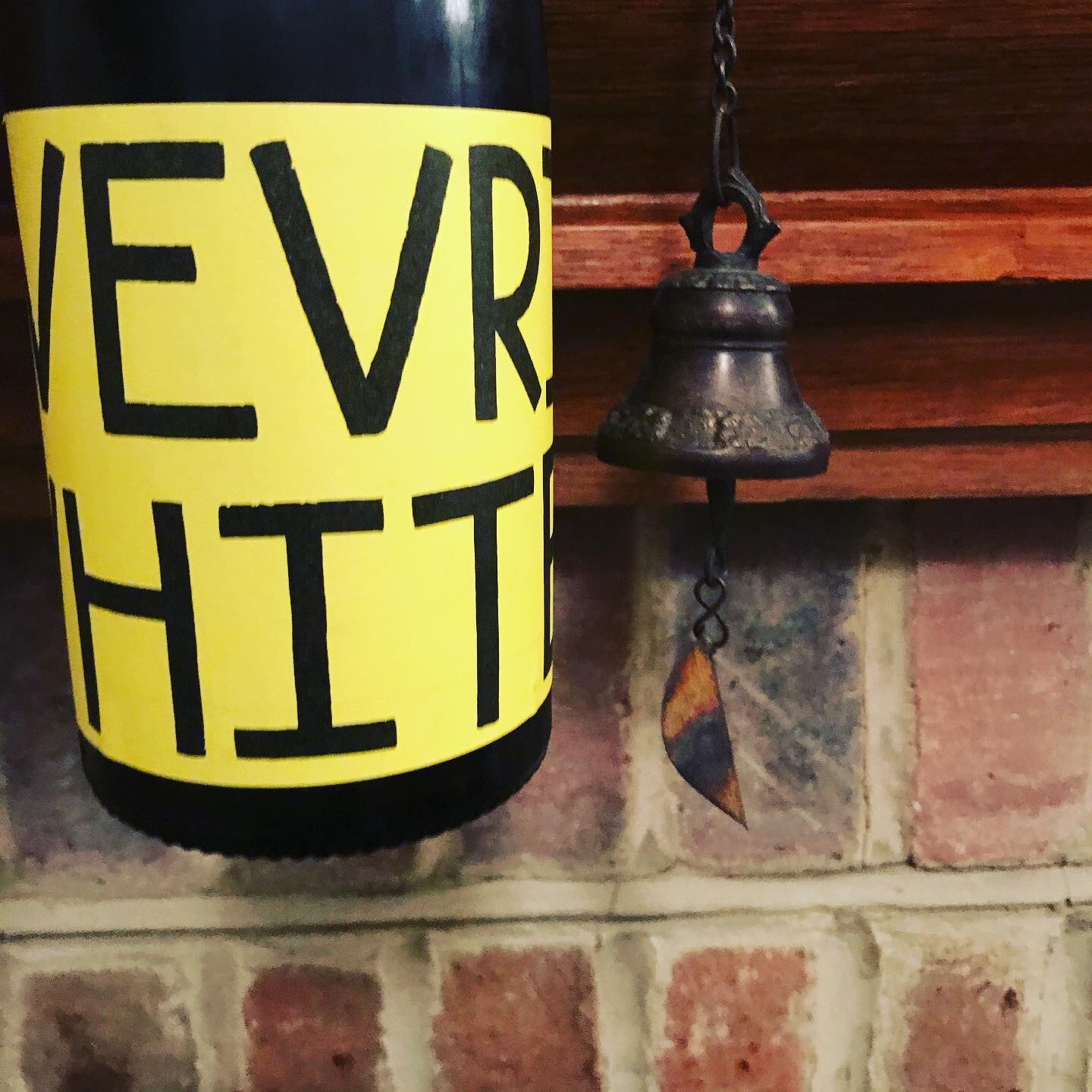
QVEVRI WHITE 2019, TILLINGHAM WINES (Sussex, England)

Ben Walgate’s change of direction, from running a well-known English Sparkling Wine specialist to artisan winemaker pushing the boundaries of English wine at its fringes, is proving to have been a good move. The myriad wines made just inland from Rye are all of interest, or should be, to anyone interested in (or writing about!) the wines of Great Britain. One of the most out-there decisions Ben made was to import a couple of qvevri from Georgia. More have followed, and his cuvées of qvevri wine and cider are among the most exciting crafted at Tillingham.

This cuvée is a blend of Bacchus and Pinot Blanc, from two separate qvevris, whole bunch pressed with four months on skins in the buried clay vessels. You’ll be pushed to find another wine like this in England. It’s very cloudy (wholly unfiltered) but it tastes remarkably clean with grapefruit freshness cutting through the palate. It’s a versatile wine too. You might think it a summery glass but the texture adds palatability with food, and we actually drank it with a spicy curry.

This bottle came from the shelves of The Solent Cellar but it’s worth remembering that the Tillingham shop is currently open from 10-4 on Saturdays during Lockdown (Dew Farm, Dew Lane, Peasmarsh), and presumably for longer after 2 December (check the web site). They sell the full Tillingham range on site, along with a great selection of other mainly natural wines from the restaurant cellar.

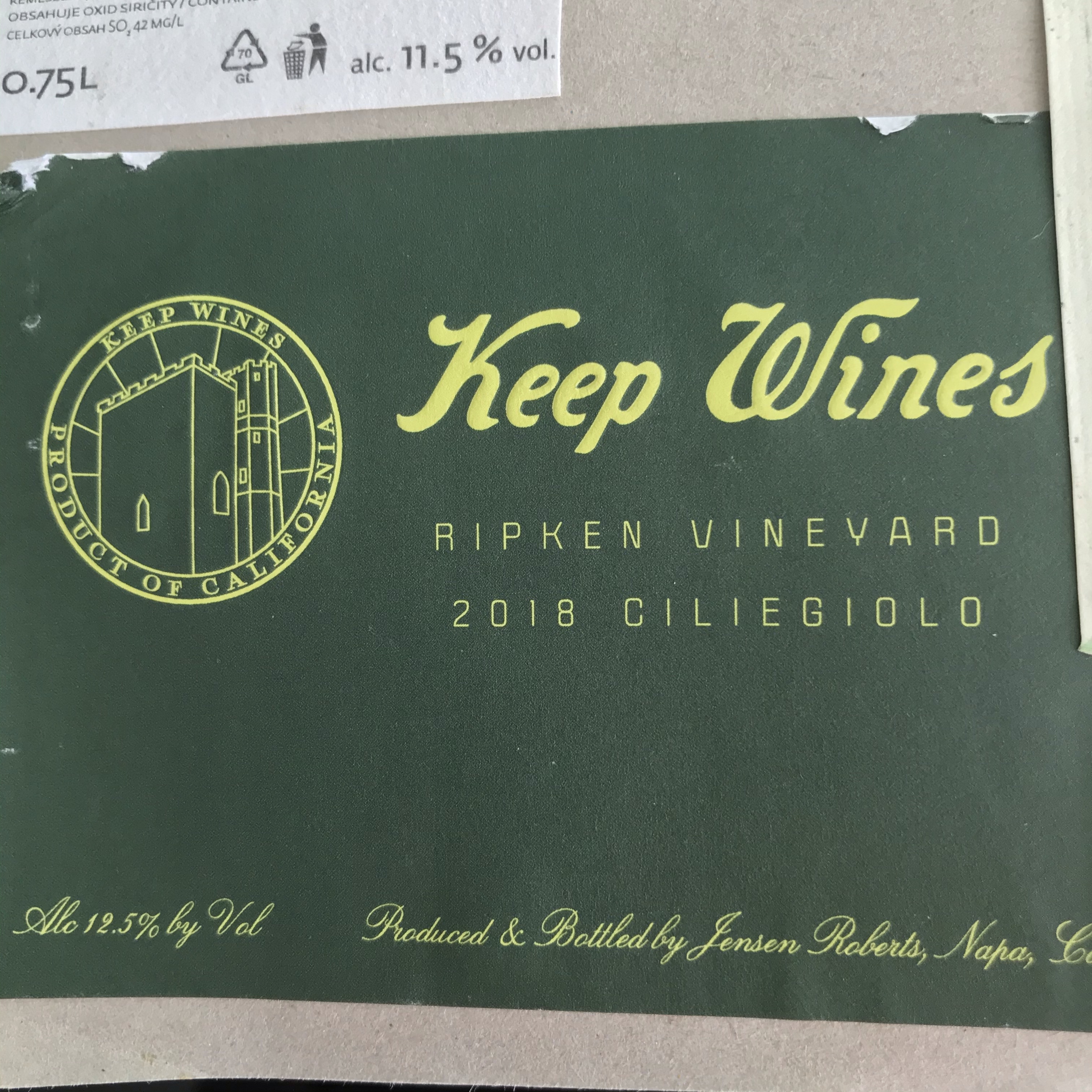
RIPKEN VINEYARD CILIEGIOLO 2018, KEEP WINES (California, USA)

The story of how Jack Roberts met his future partner, Johanna Jensen, on the Englishman’s first day in the USA is very romantic. Both moved into high quality wine making, Johanna with Abe Schoener’s Scholium Project and Broc Cellars, and Jack with Matthiasson Family Wines. Jack was Matthiasson’s vineyard manager until last vintage, when he finally felt able to devote all his time to his own family’s project.

Ciliegiolo is a little-known Tuscan variety, a minor component in Chianti, which has gained some recognition in recent years both in Maremma on the Tuscan Coast and in Umbria. Its name comes from the Italian for cherry, which pretty much explains the grape. Someone saw fit to plant some, whether deliberately or thinking it was something else, twenty years ago on the Sacramento River Delta. Jack and Johanna seem to have a passion for finding these less well-known varieties around wider Napa (I drank their delicious Counoise back in May), and every single time they get the very best out of them, as if they have a Midas touch.

The grapes are fermented in stainless steel with no stems. You get ripe, dark and zippy cherry fruit, concentrated but coming in at just 12.5% alcohol. This seems to make for perfect balance and maximum refreshment. A remarkably beautiful glass of alcoholic cherry juice which, if I dare say it, is the best Ciliegiolo I’ve ever drunk (and yes, I’ve had a few from Italy). Personally I would pick up any wine made by this pair.

Keep wines’ UK agent is Nekter Wines, a specialist in excellent under the radar Cali producers, as well as the likes of Matthiasson.

Sometimes even I forget to photograph the bottle…but at least I kept the label
Posted in Artisan Wines, Natural Wine, Wine | Tagged , , , , , , , , , , , , , , , , , , , , , , , , , , , , , , , , | Leave a comment

The Goode Wine Guide (Review)

I’m hoping I’m not too late here to recommend a great little stocking filler for the wine obsessive in your life. This came out in September but my Lockdown reading pile has grown somewhat tall, and I’ve only just read it. I was just a little worried that its relatively small size would mean that the print was tiny, but that turned out not to be a problem. I guess that at just under 230 pages I zipped through it pretty quickly, and if it has any downside that is it. Easily remedied though, I am following it with a book which weighs in with over 500pp.

The Goode Wine Guide is the umpteenth book of Dr Goode’s I’ve read, and it’s a little different to the others. But it’s not at all what you might think. Jamie doesn’t give you a list of wines you should drink from every region or country he can think of, like most books with a similar title. Instead he provides a sort of manifesto for wine lovers. A kind of “this is what I think…you may agree with me or you may not”.

Jamie is that rare wine writer, a genuine scientist. He often jokes about people with letters after their name, but he has them fore and aft (Dr and PhD). His discipline is biology, and he is keen to remind us that winemaking is down to biology more than chemistry (unless you are a particular type of winemaker). He is also a little bit of an iconoclast, but again in a very different way to what we usually see. But that will come out as we go through the book.

The Goode Wine Guide is divided into 55 chapters, which is only an average of four pages each, but some chapters are even shorter. When Jamie makes his points, they are usually succinct, but in one or two cases I was yearning for him to go a little bit further. I’ll give you a taster of the sort of areas he’s discussing. Sometimes it’s winemaking or farming, sometimes it’s about the people who sell wine, and sometimes it’s about those who write about it. Quite often however it’s just highlighting an approach to the subject which is just a little out of kilter with the mainstream. A philosophy of wine perhaps, if that doesn’t sound too serious for a book that is above all, fun. He’s not so much an evangelist though, more someone who likes to prod us out of our stupor…our tendency to take things at face value and believe all the old clichés. He may like to tear down the odd stubbornly held belief, but he’s not smashing all the statues in the temple.

An example, perhaps. Chapter 6 dives into two opposing approaches to the subject, which he calls “reductionist” and “holistic”. He reminds us that our wine education teaches us to break down a wine, in our tasting notes, into its constituent parts. By “marking” a wine for elements such as brightness, bouquet, texture (for example) we can build up a brick by brick quality picture. Jamie asks us to look at the whole experience. He asks whether “if we rush too quickly to words we might miss out on the experience”. This really gets to the heart of Goode’s (and my) philosophy. If we reduce wine down to three points for this and five points for that, we are able to score the wine. But are we on a different planet to the people who buy the bottle to “enjoy” (my question, not his)? As Dr Goode says, “we need to dwell with it, experience it…”.

Chapter 11 is called “Mouthfeel Matters”. It’s only about a page long (plus a rare half-page footnote). We place so much store by how a wine smells, its bouquet. Of course we do. Most of us realise the importance of aroma the first time we smell a really fine Red Burgundy, if we’ve not already come to see half the pleasure in wine is its nose before that point. But there’s something else we tend to forget. The key to this vignette is a quote from Nick Mills of Rippon Vineyard in Central Otago. I won’t spoil it by giving you the full quotation, but it begins “Terroir is issued through shape and feel, not smells and flavors (sic)”. It’s so important to understand that a wine is not merely a list of summer fruits on nose and palate.

Chapter 14 is one after my own heart. Its title, Beauty is not the Absence of Flaws, illuminates a topic Jamie has touched on before in his book on wine faults. After you have read this chapter you will pine for Japan (if you’ve been before) and at the same time perhaps to listen to a record on which there is a real drummer, not a drum machine. I’m sure many of you will see where he’s going with this idea.

I’m pretty sure you want to know what the doctor thinks of scores? He discusses them in Chapter 20, which runs to almost five pages! His view is nuanced, as you’d expect from a man forced to use them in wine competitions. He accepts that they do have a limited value, but he perhaps looks over rather wistfully at those with the freedom to reject them (like myself). But one sentence sums up my own feelings. “[Scoring wine] is an attempt to make something diffuse and indefinable into something focused and precise”. My own view is that those who are truly enthusiastic about scoring wine are to me like someone who takes an opposing view to mine on Brexit. They are, in most cases, implacable. Trouble is, score inflation ruins any argument that scores are objective. Can people not see that in order to get your name on a shelf sticker you just have to score a wine 98-100 points? Because if you don’t see it, your rival can.

Chapter 27 says “Stay Critical but Remember There’s Room for Everyone”. Oh! how some wine critics have embarrassed themselves by allowing their mouths to froth over natural wine. Jamie wrote a letter to these people, which he published on his Wine Anorak blog, and reproduces here. It’s very funny, unless you have a very reactionary bent when it comes to people wishing to avoid using synthetic chemicals on their vines and a range of other interventions and manipulations in their winemaking. He’s not saying that people who make wine the other way are wrong. He’s by no means a natural wine fundamentalist, far from it. He’s just asking why people get so upset about natural wine? Personally, I consider them a bit like those who say “why do we have an international women’s day and not one for men?” In other words, they don’t quite get it.  Just let people do their own thing Mr very traditional wine writer. They are not hurting you! How many of us feel challenged, even diminished, by new thinking?

It’s nice to see someone who is (otherwise) very positive about the world of wine today, especially in terms of quality. As Jamie rightly says, there’s so much less bad wine than there used to be. I can attest to that fact, having been alive a little bit longer that the author. There’s a chapter on this point, but it ties in with another, on those wine writers who profess to be consumer champions. There are a few of those around today, all born perhaps from one man who told us we don’t need to pay more than average supermarket prices to be happy.

Jamie gets mildly upset when people suggest that the world of wine is peopled by rip-off merchants trying to push inexcusably expensive bottles to the public, and worse than that, decrying the cheaper brands as rubbish. Again, I won’t spoil it, but Chapter 42 is called “Beware the Consumer Champions”. ‘Nuff said! Needless to say, I’m firmly with those who cherish the expertise and passion of the wine trade in this and every other country I buy wine in. Naturally people in the independent wine trade want to make a living, but just like indie record stores and book shops, they do it because of their passion, and their desire to pass that passion on to you and me.

If you think that only one type of wine writer comes under scrutiny, think again. Chapter 53 is called “How to succeed at wine writing by writing boring articles”. This is where Jamie’s surely not afraid to make enemies. The story he reveals is one which happens so often. The writer is invited on an expenses-paid press jaunt. He or she may get to visit the odd artisan producer, but it’s clearly more about the bigger guns, who are after all stumping up the cash to bring the journos over. Back home they go and they are expected to knock out something which puts everyone in a good light, for their few hundred quid fee, making sure to mention anyone who might like to advertise on the opposite page.

Now spin it however you wish, but this is true in so many cases. It’s the way the wine world works, and it’s the way wine publications survive in some (not all) cases. There is a retort, which in fact a well-known wine writer highlighted in a conversation with me the other day. They said that if editors didn’t ask for formulaic articles like this, they wouldn’t get written, which is a fair point from someone whose work published in book form is very far from being formulaic or boring. However, they also said that no magazine or journal pays for really good wine writing. Perhaps those who have been lucky enough to write for World of Fine Wine have found an exception. Others are lucky enough to have the chance to express themselves in books. I, for one, feel very lucky that I can say what the hell I like here, and publish it.

Do I have any criticisms of The Goode Wine Guide? No. The book is not intended for anyone looking to learn about wine in a factual way. Very few times does the author mention any specific wine or wine region. But it is illuminating in other ways. Who would read it and why?

Certainly, anyone in the wine trade should not only enjoy it, but learn a little. We all get drawn into thinking about things through blinkers, and Jamie does nothing if not remove our blinkers. He reminds us that there is always another perspective. If we ignore or reject that perspective we risk missing out. For the same reasons this book is likely to be just as interesting to avid wine lovers, and those who are embarking on the journey towards a wine obsession. You might not have the same degree of interest or engagement as I did, in every single chapter, but there are fifty-five topics to grab your attention.

Only one quibble, Jamie. In Chapter 45 you exhort us not to be an all-rounder but to be a specialist. Well, it’s aimed largely at the wine producers of Great Britain. Their sparkling wines are so good that they shouldn’t go rambling on about their Bacchus, the author suggests. It’s not that my view is a bit more nuanced on this one (English and Welsh still wines are making great strides), but that in a footnote Dr Goode gives us a list of English Sparkling Wines he can recommend “to start with”. I’m sure your memory was shot when you wrote that footnote Jamie. It’s the only reason, surely, that we don’t see “Black Chalk” at the head of that list.

The Goode Wine Guide is published by the University of California Press (Sept 2020) at £15.99 ($18.95). It really would make a great stocking filler for Christmas and I can imagine sitting by a log fire, a glass of Palo Cortado in hand, with the need to read something both easy going yet stimulating at the same time. You may well find it hard to put down and be near the final chapter by the end of the Bond movie on TV which you’ve seen nine times before. I was going to say “a great way to avoid playing charades” but I guess there won’t be much of that this Christmas.

Posted in Philosophy and Wine, Tasting Wine, Wine, Wine Books, Wine Science, Wine Writing | Tagged , , , , , , | 3 Comments

The Christmas Popup You Mustn’t Miss (Basket Press Wines on Hackney Road)

I don’t know if you are like me but I love browsing. Record shops, book shops and yes, wine shops. I find it remarkably difficult to enter one of these establishments and to leave without a purchase. But aside from the pleasure of spending time looking at the shelves I find that physical stores actually encourage me to try new things. Something always leaps out at me that I did not enter with the intention of buying, and quite often that something is a book, record or bottle that I didn’t even know existed. In the age of online shopping the pure pleasure of browsing is being lost to many of us.

There’s another great thing about these physical stores, and especially a wine store. Many of us would like to be adventurous but don’t necessarily know where to begin. Nowhere is this more obvious than wine regions which are new to us and hardly seen in your run of the mill store. This is why you really need to get down to Hackney Road during December.

If you are someone who reads this blog avidly, or even dips in from time to time, you will have spotted that I have a developing interest in the wines of Central Europe. It’s a kind of natural progression from my passion for Austria and her wines. Maybe my relatively regular bottles littering my “Recent Wines” posts may have whetted your appetite, but you have not been tempted to order online. Your prayers may be answered if you might consider dipping your toe in with just two or three bottles, and you’d like a bit of advice in selecting them. Basket Press Wines is opening a popup shop in East London during the month of December. I would suggest that you get down there if you possibly can to check out what’s going on in this exciting wine scene.

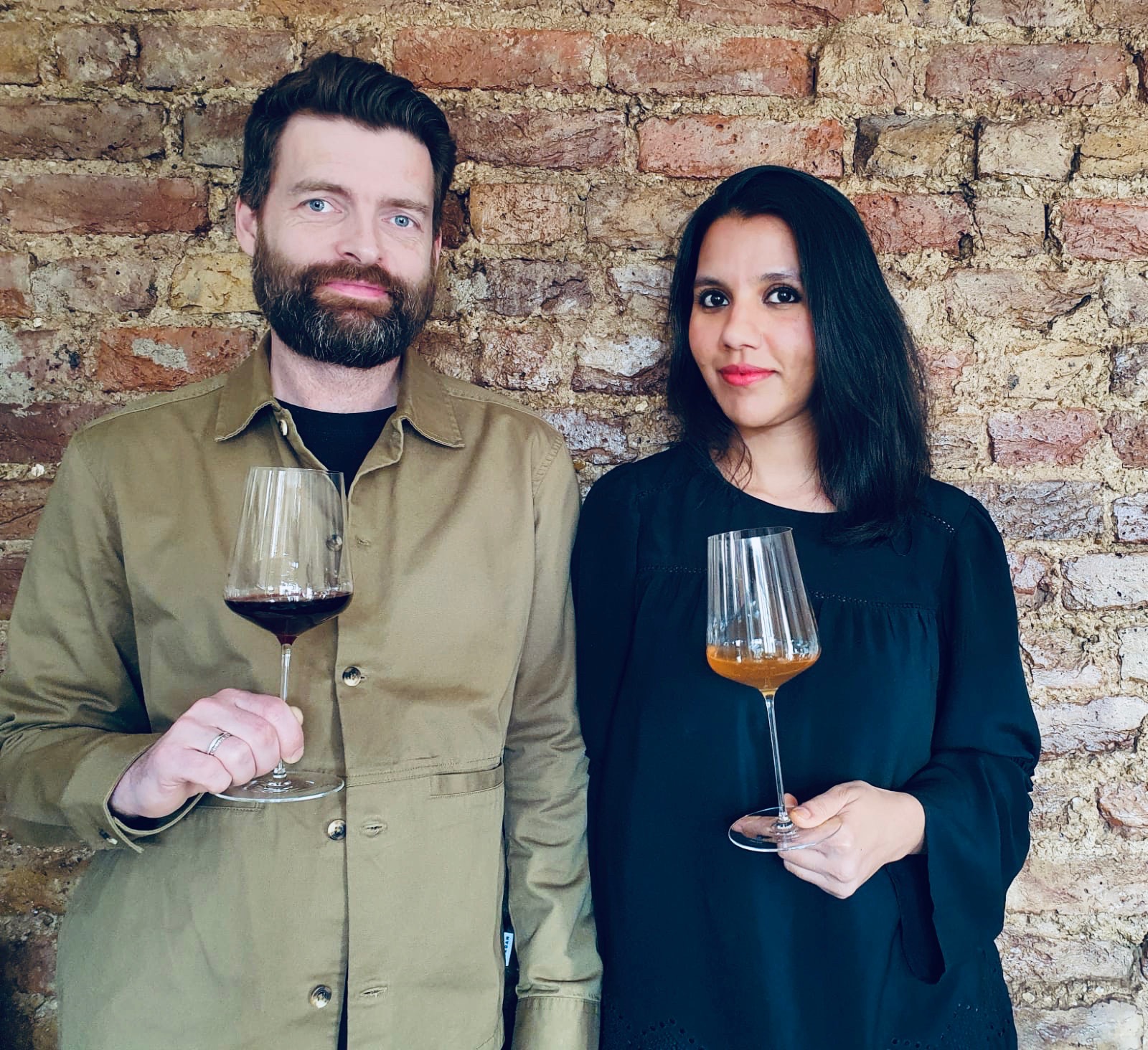
Jiri Majerik and Zainab Majerikova

Basket Press are specialists in the wines of the Czech Republic (or Czechia if you prefer). This isn’t surprising as Jiri Majerik is a Czech national. But they don’t stop there. They also cover top producers from Slovakia as well as dipping into Hungary, Slovenia and Germany.

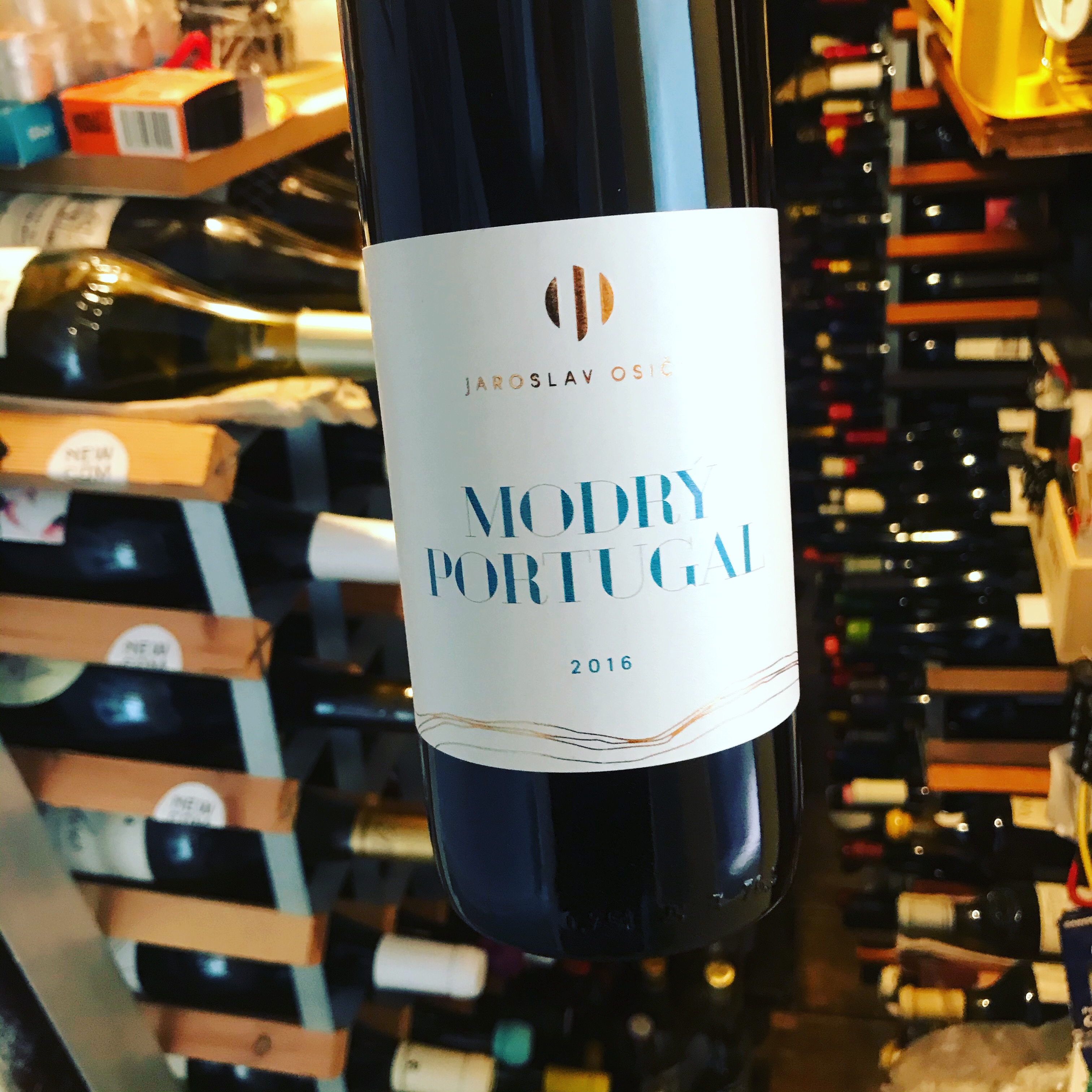
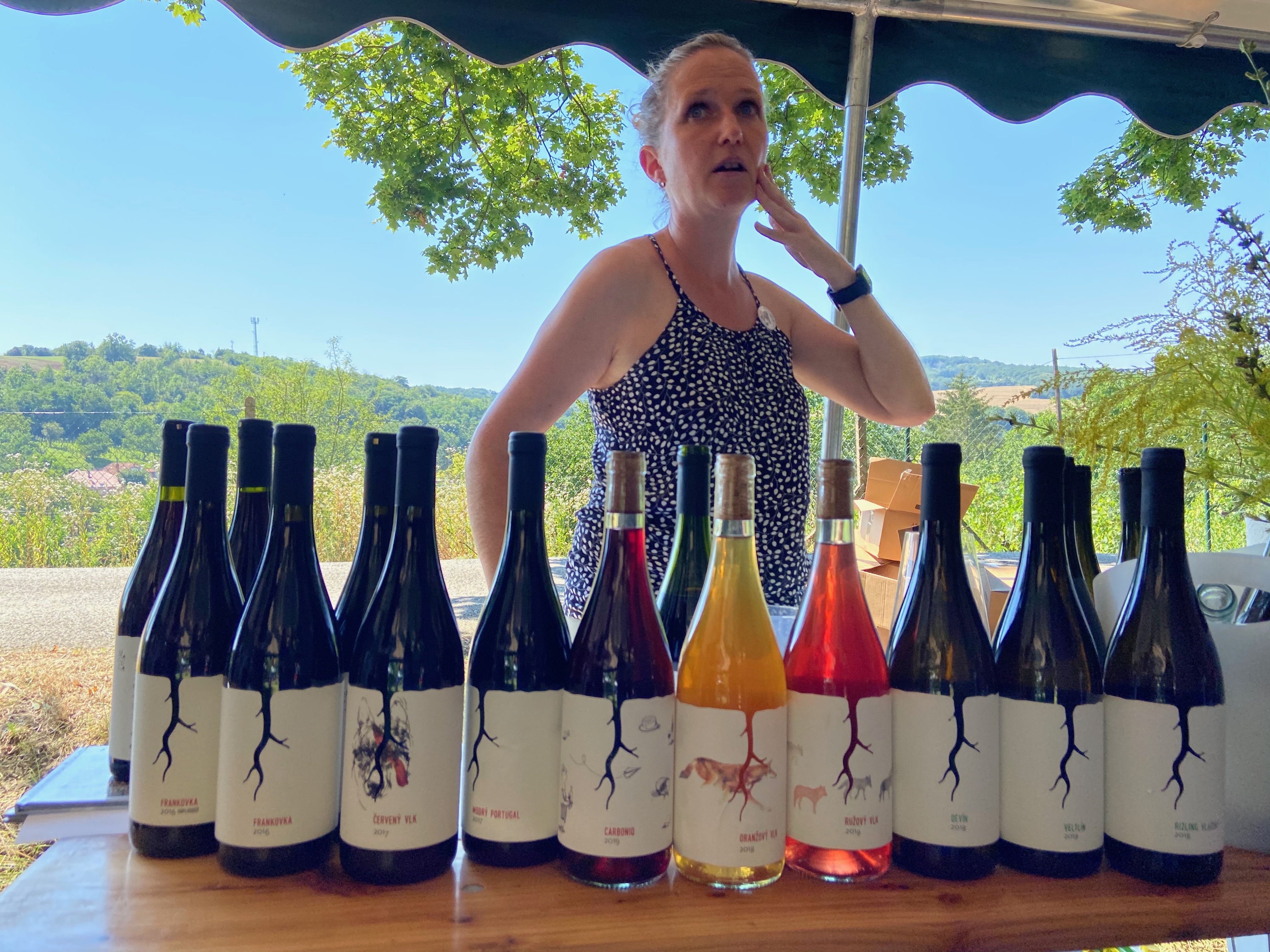
Czech Moravia has a long tradition of winemaking but is poorly served in our wine literature (it warrants around 200 words in the new (8th edn) “World Atlas of Wine”). It has around 16,500 hectares of vines which spread southwards, in a kind of triangle, from the apex of the region’s largest city, the regional capital of Brno. It is a hotbed of high-quality natural winemaking, led perhaps by Jaroslav Osicka, one time teacher at the local wine college. The region has its own movement, called Autentiste, with its own festival, Autentikfest, every August. It is this band of winemakers which Basket Press focuses on for the core of their list. Their portfolio is not exclusively “natural”, but all of their producers are either biodynamic or at least organic, with low intervention at the heart of what they sell.

Jaroslav Osicka

Grape varieties to look out for do include the better known varieties like Veltliner, Frankovka (aka Blaufränkisch) and Pinot Noir (planted here originally in the 14th century), but also regional specialities like Modry Portugal (Portugieser) and Cabernet Moravia (a high potential Zweigelt-Cabernet Franc cross). I would especially recommend checking out the region’s many interesting petnats. Petr Korab is perhaps the king of Moravian bubbles, for my subjective taste, but he’s not alone.

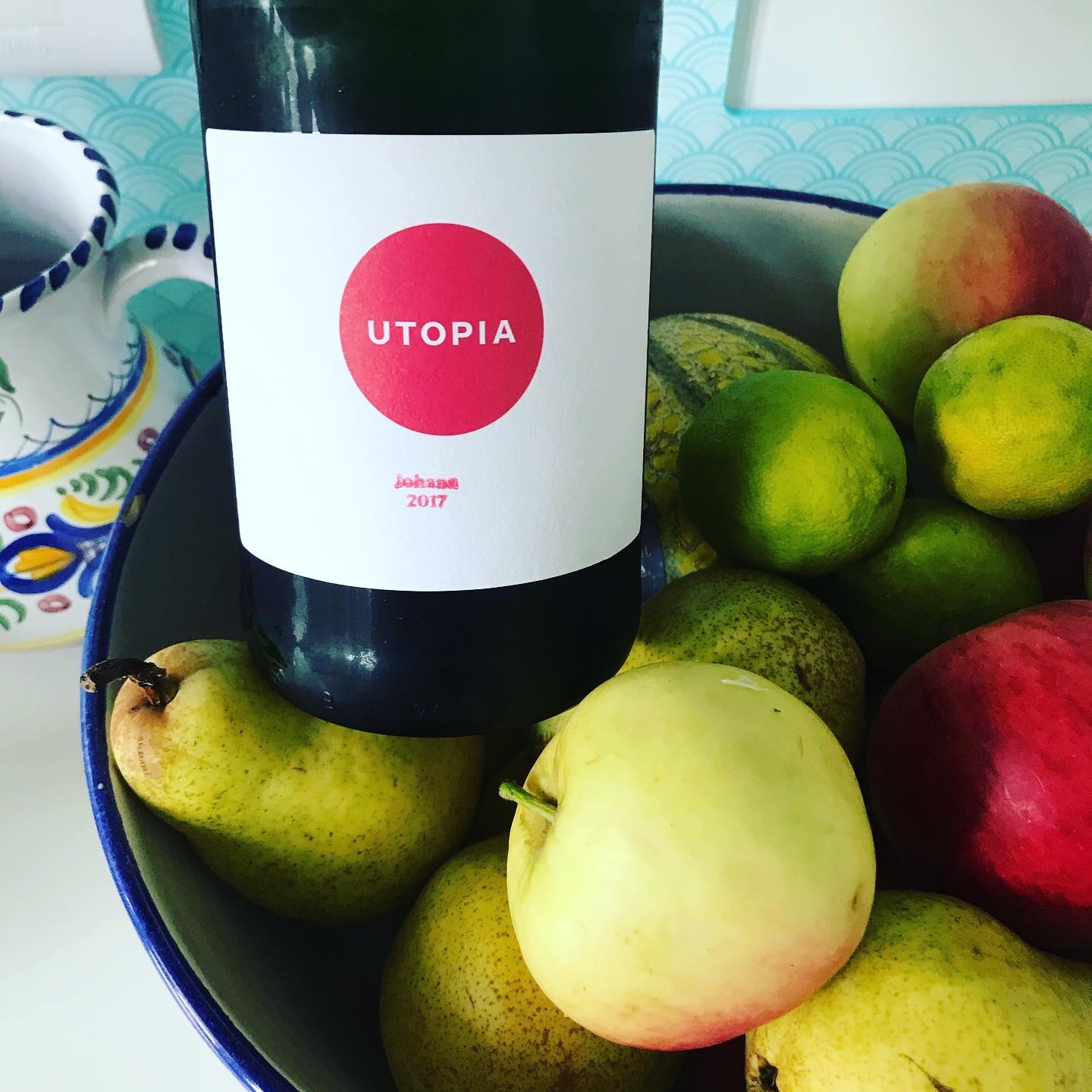
In addition to the above you will find on their list the wonderful Czech natural ciders of Utopia, as well as wines from Slovakia (do not miss Magula), Hungary, Slovenia and Germany. Jiri and his wife Zainab have just made their first excursion into Germany, having taken on Max Sein Wein from Franken. It’s an estate which is certainly part of the “Alt-Germany” movement, with interesting blends, very old-vine Silvaner, and the rare Schwarzriesling (that’s Pinot Meunier to you and I).

Another star in the portfolio is their Hungarian producer, Réka-Koncz. Annamária Réka makes wines in the very far east of the country, so some of her vines are even technically in Ukraine. They are natural wines made most often with varying degrees of skin contact, and with a strong focus on autochthonous grape varieties. These are sensational wines for anyone with a true sense of vinous adventure, not easy and perhaps challenging for those whose palates may be of a more conservative bent, but I’m not alone in recognising their magic. Do ask advice in-store if you want to try one of the less extreme cuvées, though perhaps you might just go straight in.

Réka-Koncz

So, to the details. The Basket Press Wines Popup will be open from 1 December at 188A Hackney Road, London E2 7QL. It will be easy to find for many, situated across the Road from Sager+Wilde, Morito and The Marksman Pub.

Opening will be from 1 December to 31 December, Wednesday to Saturday from 12pm to 8pm and Sundays from 11am to 5pm. The Christmas exceptions will be Christmas Eve (24th) when they will open from 12pm until 3pm and then they will remain closed from 25th to Monday 28th inclusive. The shop will then reopen on 29th to 31st December from 12pm until 8pm.

Delivery will be possible, and in any case Basket Press Wines offers a very good next day mail order service throughout the year at basketpresswines.com . However, for the month of December you have the opportunity to browse, and to chat with Jiri and Zainab. Do not miss this chance to acquaint yourselves with these interesting and often genuinely thrilling wines if Hackney Road is within reach. Hopefully during this time we will be allowed to enjoy some of the other fantastic watering holes in the near vicinity as well (lunch sorted).

I should just add, as it is fairly unusual for me to promote something like this, that I am neither being paid or bribed to do so. These wines fascinate me and I’m keen to promote them, and to get people to try a few. There are other very good importers who sell one or two wines from this wider region, but Basket Press has the largest concentration of them in the UK at the moment. I think it’s a good move for them to go for a popup and I hope it introduces many more inquisitive wine lovers to what these regions have to offer.

Posted in Artisan Wines, Christmas and Wine, Czech Wine, Hungarian Wine, Natural Wine, Slovakian Wine, Slovenian Wine, Wine, Wine Agencies, Wine Merchants, Wine Shops | Tagged , , , , , , , , , , , | Leave a comment

All I Want for Christmas…(from the importers, please!)

There was a time when the UK was acknowledged the best place to buy wine in the world. As we didn’t (as the received wisdom at the time went) have a “proper” wine industry of our own, you could by way of compensation buy anything you wanted here. Well, now we make our own world class wines, but if you still think we have the best market for wine in the world, you probably need to get out more. Other markets have woken up just as our own has begun to prove, for several reasons, not just “Brexit”, a little less attractive to exporters.

What other markets are lapping up is that which is new and exciting. How many UK wine merchants have been happy to fall back on yet another Crozes-Hermitage, Sancerre or Rioja of middling quality? I know wine shops abroad which have never sold such wines. Admittedly my wish list here is for wines which are not going to appeal to the mass market, but they are cutting edge wine regions which produce wines which are already entering markets which still have their finger on the pulse.

I try, generally, not to come across as if I’m blowing my own trumpet but I do know for a fact that there are wines available in the UK as a result of me having written about them. There are one or two producers who owe me a bottle, not that I’ve ever been sent one (which at least helps maintain my independence). But the boundaries are forever pushing forward and I think it’s about time that the British public were introduced to wines which the coolest markets in the world are starting to enjoy.

I’ve always been one of those awkward customers. It was probably my third visit to a Majestic Wine Warehouse in the 1980s when I asked whether they had any wine from Oregon. I gave up on ever seeing Jura wine here until, miraculously, Wink Lorch came along and assisted the journey to cult status for that small region in Eastern France. If you read this blog even sporadically you will know my tastes are not mainstream. I’d like to think I’m just a restless explorer seeking out tomorrow’s stars, but there’s plenty I can’t find in the UK. This article lists a few regions I’d like to be able to buy without an expensive trip overseas.

Japan

I’m starting with the most difficult of all. It was only on my fourth trip to Japan that I first visited a wine region, although long before that I could not fail to notice how Japan had embraced wine, especially natural wine. The region wasn’t Yamanashi, where the big names have been producing often excellent bottles of Koshu which could be found in the UK if you looked really hard (or, for a while, merely visited Marks & Spencer’s wine departments). No, it was Nagano, where some of the most exciting wines are being made on the slopes below the Japan Alps.

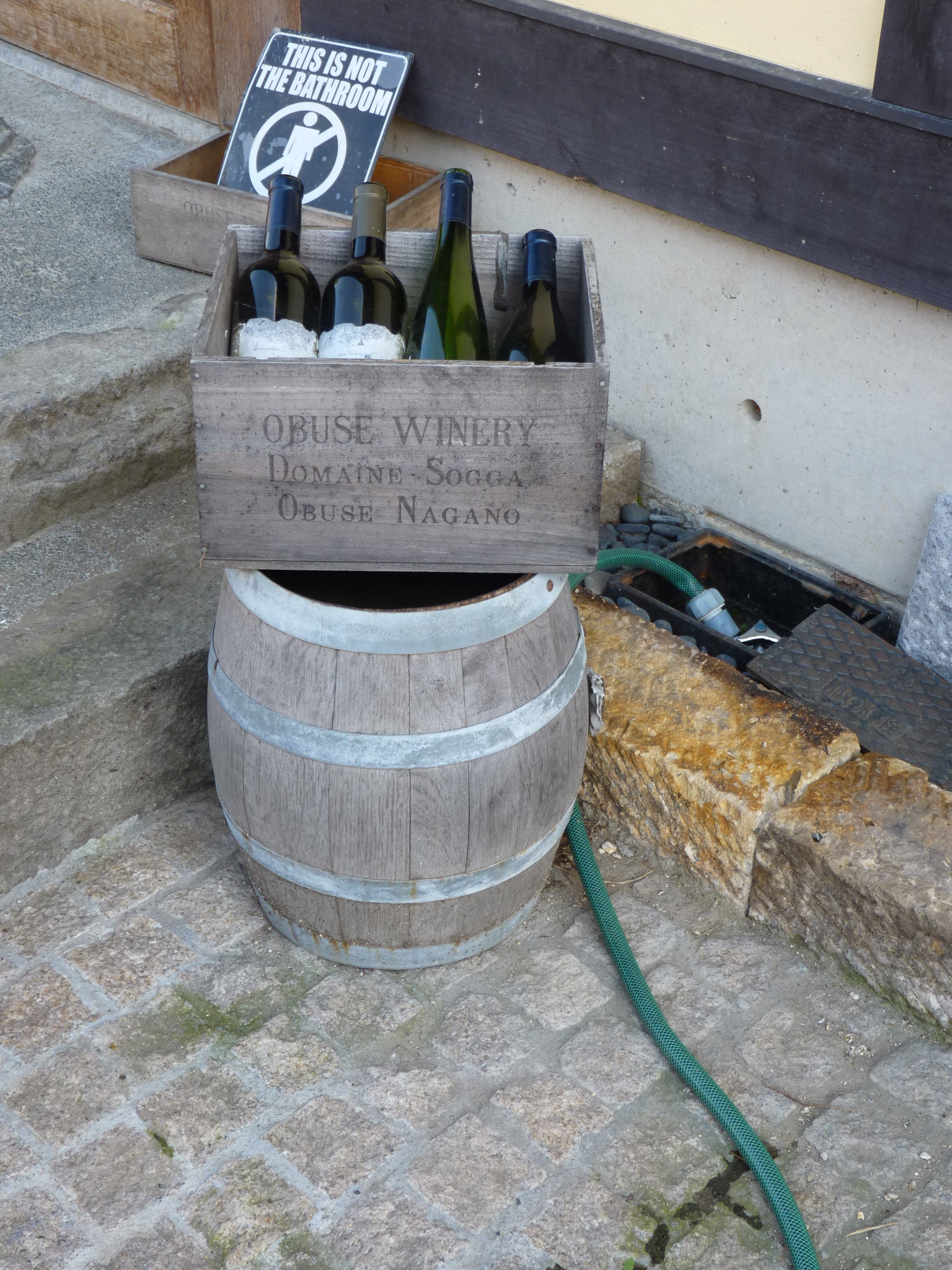
Nagano is drier (relatively) to Yamanashi and perhaps a little higher. All the classic French grapes excel in places, but the outliers are more exciting in many cases. I’ve tasted remarkably good Albariño, for example, from one of Japan’s finest winemakers, Akihiko Soga (one g) at Domaine Sogga (two g’s) in Obuse, which Jamie Goode described last year as Nagano’s finest winery. But there’s a lot more besides.

Japanese winemakers, many but not all introduced in Anthony Rose’s excellent “Sake and the Wines of Japan” (Infinite Ideas, 2018), have taken to natural wine (to a degree) despite a difficult climate because of the philosophy behind it. Minimal intervention and purity suit the Japanese psyche…and in Japan a well-designed, bright and modern graphic label goes a long way too. Most Brits, let’s face it, may hardly be aware Japan has a vibrant wine industry. As a result it will take a lot to get these wines to the UK but Jamie Goode has built up expertise from visits there, as well as Rose, and those are sources to tap. I shall be carrying on my research as soon as the Clampdown allows. Some of these wines would be a good fit for the European wine bar scene.

In the meantime, if you want to know where all those unicorn wines which you used to find in the UK have gone, explore the wine bars of wider Tokyo.

The Auvergne

This remote region of Central France has made wine for decades. I recall Yapp Brothers (Wiltshire) used to tap into the value wines of the co-operatives there (doubtless they still do). But it has become “natural wine central” by dint of the affordable land, which just happens to be great volcanic terroir for glouglou reds in particular. Gamay and Pinot Noir are often the most favoured varieties.

One or two UK wine importers are onto this, if I’m fair. Gergovie (London) is one, and you can usually find a good example or two at their 42 Maltby Street restaurant (a place which no one should need an excuse to visit). But I mention the region here because in France you can even buy a book about the Auvergne’s natural wine stars. It’s the second in the series “Entre Les Vignes” by Guillaume Laroche and others. Sadly it’s not, as far as I know, available in English (the first book, on Burgundy, is), but it does help illustrate, because there’s a market for the book, that the wines of the Auvergne are thriving.

Bugey

Bugey sits to the west of the wine regions of Savoie and south of Jura in France’s first department, Ain. Bugey was, until recently, almost unknown in the UK, which will not surprise anyone once they realise it has fewer than 500 hectares of vines in production. I was introduced to the region long ago by friends who live close to Geneva, both to the still wines and the strange méthode ancestrale sparklers which were, in many ways, the model for the modern petnat explosion. Nowadays Bugey is at least on the wine map, and a couple of producers have hit UK shelves, if sporadically.

The other day a wine friend who lives in France said to me that he’d heard Bugey was going to be the next big thing. I think I said that eighteen months ago, but I was aware that this was unlikely. Despite being beautifully highlighted in Wink Lorch’s second book (Wines of the French Alps, 2019), the vineyards are dispersed, covering a wide area and there is little cohesion at AOP level. Nevertheless, the wines can be quite thrilling, and the most exciting are not on the radar (as far as I’m aware) of UK wine merchants.

Probably the producer considered at the top of the tree is Renardat-Fâche. Elie and Christelle farm almost thirteen hectares at Mérignat, the best known of the villages for the sparkling Bugey-Cerdon. They already export their small production to a dozen countries yet I’m not aware anyone in the UK has them. It’s a shame because I know someone who consults for them and they’ve been praising the wines vociferously to me for several years.

The friend mentioned in the second paragraph above made his comments after drinking the wines of Caroline Lédédenté. Her first vintage was only in 2018 and after finding more vines to purchase last year, now has two-hectares to her name. All the same, she’s obviously swiftly gaining a name in France. She trained with Grégoire Perron, a star of sulphur free wines in Bugey, labelled Vin de France, under the “Combe aux Rêves” label at Journans. He in turn had worked for Ganevat, so a lineage is established.

Bugey remains small and obscure, but exciting. Plenty of equally small and obscure producers are imported from other tiny regions by “Les Caves” and others, so why not Bugey? Vine Trail should be given credit for importing both Peillot and Balivet, both names I go for when dining or scouring the shelves in the wider region. Bugey could become a “mini-Jura”.

Deutschschweiz

For years Alpine Wines (formerly Nick Dobson Wines) was pretty much the only place to source Swiss wines in the UK. Why people never really explored Swiss wine was a mystery, but one easily solved. The argument went along the lines that Swiss wines were expensive, but as author on Swiss wines, the late Sue Style once said, the only expensive Swiss wines are the poor ones.

The other reason we saw so few Swiss wines in the UK was that the Swiss drank most themselves. Switzerland still only exports around 3% of its production, but as the home market is shrinking this is changing. I’ve been writing about Swiss wine for years, but if one thing frustrates me, it’s the difficulty in exploring the wines of German-speaking Switzerland. It is time we saw a few of these over here, not just wines from Vaud and Valais with a few from Geneva and Neuchâtel thrown in.

Graubunden has rarely been an issue. Daniel and Marta Gantenbein’s winery at Fläsch, in the far east of Switzerland close to Liechtenstein and Austria, is acknowledged as truly world class, and their fame has rubbed off on others locally. We see a few producers from the country’s far east on our shelves, occasionally. If Gantenbein’s wines are rare and expensive (Howard Ripley has an offer right now), then the likes of Fromm (at The Sampler) are a little more affordable.

But Deutschschweiz is not merely Graubunden. It is also sixteen more cantons, in which the regions of Aargau, Schaffhausen, Thurgau, Bundner Herrschaft and Zurich are all making wines gaining a name for themselves in the thriving Zurich wine bars and beyond. I’ve written before about the young winemaker grouping, JungeSchweiz-NeuWinzer. This is no longer limited to the German speaking cantons, but it certainly revived the fortunes of quality wine production within them. With varieties such as Räuschling (once as maligned as Müller-Thurgau) and the rare but potentially brilliant Completer, complementing often excellent Pinot Noir, there’s a lot to explore. I’ve been banging on about these wines for a year or two and I’m hoping to see results soon.

North America

There are other wines we really should be seeing in the UK from outside of Europe. New York States’s Finger Lakes region is one. I bought a Finger Lakes Riesling from The Ten Cases (Covent Garden, London) once. That’s all. With Canada incredibly well covered these days, it’s time that the wines of this albeit small US East Coast wine region should be represented in the UK. There are plenty of wines mentioned in the literature. The Rieslings in particular sound pretty good. If we can find excellent wines from Long Island, and perhaps not quite so excellent wines from Virginia, at least in London if rarely beyond, then we should also have access to Finger Lakes.

Central Europe

There are places which are gaining fans quickly but are reasonably represented. Czechia has its champion in Basket Press Wines, and those who have discovered the wines from this small Central European country have been more than impressed. Next door Slovakia has a few top wineries imported, as does Slovenia. I think this trio will gain more ground very quickly, once more led by the dynamism of the younger natural wine crowd. Hungary has potential too, though the industry is split between tradition and innovation. We just need to broaden their base, from the small importers selling mostly to restaurants, to listings on the shelves of indie wine merchants, where without restaurant mark-ups consumers may be persuaded to try them. Quality is there, without question.

New Germany/Alt-Germany

Austria has driven ahead of what I’d call “Alt-Germany” (named thus after the small “Alt-Mosel” movement). Much as I worship at the altar of German Riesling, I cannot get over the exciting wines being made from less favoured varieties, both white and red. To an extent I think the next generation in Germany, and also dozens of producers with no previous background in wine, have taken note of what the younger generation in Austria are achieving. They are also challenging, under the Landwein designation, Germany’s propensity to legislate artisan experimentation out of the picture.

My frustration here is not that the wines are not coming into the country, but that our small independent wine shops are rarely stocking them. Even those which put Austrian Rotgipfler and Roter Veltliner on their shelves. Come on, folks. Check out importers like Newcomer Wines or Modal Wines and order up some bottles.

Then There’s Greece

Anyone remember Oddbins? That’s the original Oddbins. Back in the 1990s (I think it was) they introduced some fabulous Greek wines to the UK. Then it went very quiet. Today there are a couple of importers who specialise in Greece, and a few more import the odd domaine. Nowadays Greek wine covers the famous (Santorini, Gouménissa/Náoussa, Nemea etc) and the almost unknown. Crete too has undergone a renaissance and her wines are usually great value. Current economics makes export desirable but drinkers here need to catch up. I am convinced that it is merely lack of familiarity which holds people back from stocking one or two.

Of all the wines I’ve mentioned above, they almost all share one quality. They are not “modern” wines in the sense that they are clean and characterless. They certainly have bags of personality. But they are wines for a “modern palate”, especially the natural wines. Wines which lack that seriousness which leads people to pontificate over them. They are instead wines for drinking, and often where alcohol levels are low, in the kind of quantity which relieves a thirst (within reason, of course). It’s just that in being a little unfamiliar the wines, merchants and retailers may have to work a little harder to sell them. But just think how your customers will thank you for introducing the more adventurous among them to these delicious new flavours.

So, if you feel smug that you have put your first wines from Burgenland or Arbois on your list, that’s good. But there’s a way to go. These less well-known wines (I refuse to allow esoteric) are not going to fly off shelves or wine lists, unless you make the effort to promote them. But doing so will help you stand out from the crowd (and the wine trade in Great Britain is quite crowded, is it not?).

If you are merely reading this as a consumer don’t be afraid to ask for wines like these. You may not fall in love with all of them, but I’m pretty sure that with an open heart and mind you’ll really enjoy a good many of them. Whilst many traditional wine regions are, for the most part, resting on their laurels, these lesser known producers need to work really hard to get your attention. And they are doing just that.

What I’d really like for Christmas is the chance to see mountains and vineyards again, and to see close family who live overseas. But as I said in my recent article on “Far-Flung Grapes”, you can at least manage a little vicarious travel via some adventurous wine selections. Maybe when stocking up for Christmas ask your favourite wine shop for something a little different.

Posted in Artisan Wines, Czech Wine, German Wine, Greek Wine, Japan, Natural Wine, Swiss Wine, Wine, Wine Merchants | Tagged , , , , , , , , , | 3 Comments

Recent Wines October 2020 #theglouthatbindsus

Regular readers will note that there is no “Part 1/Part 2” for October’s wines drunk at home. This is because I managed to fracture my ribs. Three weeks on and I’m on the way to recovery, but the painkillers I had to take initially meant no alcohol for a couple of weeks. It did have its positives. First, it wasn’t that hard, so maybe I’m not an alcoholic. Secondly, I don’t have to feel too bad about rejecting “Sober October” and “Dry January” (but let’s face it, that really was not going to concern me one bit). But on the bright side, I probably have a case of wine in the cellar which would not otherwise have been there.

So for October we have our usual eclectic spread of wines, from Spain’s Bierzo, Neuchâtel in Switzerland, The Mosel, Alsace (2), Jura (2), and Czechia (or Czech Republic if you’re old school) plus a lone Piemontese.

GODELLO “VO Cal” 2017, VERONICA ORTEGA (Bierzo, Spain)

I first tried the wines of Veronica Ortega at Viñateros this year, and subsequently put a couple of bottles in a mixed case. Someone I follow on Instagram suggested I leave the red for six months, so this is the first of Veronica’s wines I’ve drunk since the tasting. They made a big impression on me.

She made her first vintage in 2010 after stints in Priorat (Clos Erasmus and Alvaro Palacios), New Zealand (Burn Cottage), Douro (Niepoort), Burgundy (Comte Armand and DRC) and the Rhône Valley (Domaine Combier), but fell in love with Bierzo during a stint with Raúl Perez. As I said in my original review, an impressive CV.

Veronica farms just five hectares near Valtuille de Abajo and the vines for this 100% Godello are around 40-years-old or more. Planted in an old limestone quarry (“Cal” stands for limestone), the wines have a very low ph so require very little sulphur, in this case none was added. The wine, aged partly in used oak and partly in amphora, has a beautiful bouquet of grapefruit and pear with ginger and nutmeg spice. There’s a little texture and salinity on the palate which gives it a freshness enabling us to drink it now, though I am guessing it will age for three or four years. But you don’t need to resist. Gorgeous stuff.

Veronica Ortega is imported by Vine Trail.

AUVERNIER GOUTTE D’OR 2016, DOMAINE DE MONTMOLLIN (Neuchâtel, Switzerland)

The vines of Neuchâtel sit in the lee of the Jura Mountains off the Autoroute which heads north from Lausanne towards Basel, at the point where you would climb eastwards towards Pontarlier if you are taking the scenic route through Eastern France.

Auvernier is an historic village on the western shore of the lake, now administratively part of the municipality of Milivignes. The domaine, of 50-hectares, is currently run by the younger generation, Benoît and his sister, Rachel. It was their father who converted the domaine to biodynamics but the family have been viticulteurs here since the 17th century. There are ten different varieties but they specialise in the local oeil de perdrix rosé (Pinot Noir) and Chasselas, of which there are many cuvées.

This 2016 has an extra touch of bottle age, and the producer does recommend a window of 2-3 years, but it has retained a little petillance, perhaps a touch softer than in its youth. It’s still fruity though and has a kind of stately flavour which young Chasselas rarely exhibits. A floral bouquet precedes lime and mineral texture on the palate. Satisfying but I wouldn’t keep it any longer myself. The various cuvées of Chasselas from this domaine, including their early release unfiltered bottling, are recommended for exploration, along, of course, with the pale oeil de perdrix.

The importer is Alpine Wines.

TROSSEN ROT 2018, RUDOLF & RITA TROSSEN (Mosel, Germany)

This isn’t the first time I’ve written about this wine, but it deserves another plug. The Trossens of Kinheim-Kindel are rightly lauded for their natural “Purus” cuvées, almost cult wines among many aficionados of the region. Yet their other wines fit their natural wine ethos perfectly, and equally hit the flavour spot.

Here we have a blend of Pinot Noir and Dornfelder. The flavours may be quite simple but they are pure concentrated and vibrant, dark fruits as fresh as if they were picked straight off the bush. In the mouth they explode like a party popper. Despite its easy drinking nature, this is, for me, a standout wine. Why? I think some lovers of expensive fine wines just never experience this particular kind of thrill. Too simple they say. Dornfelder, no way, they say. I merely smirk.

Try littlewine.co or Newcomer Wines.

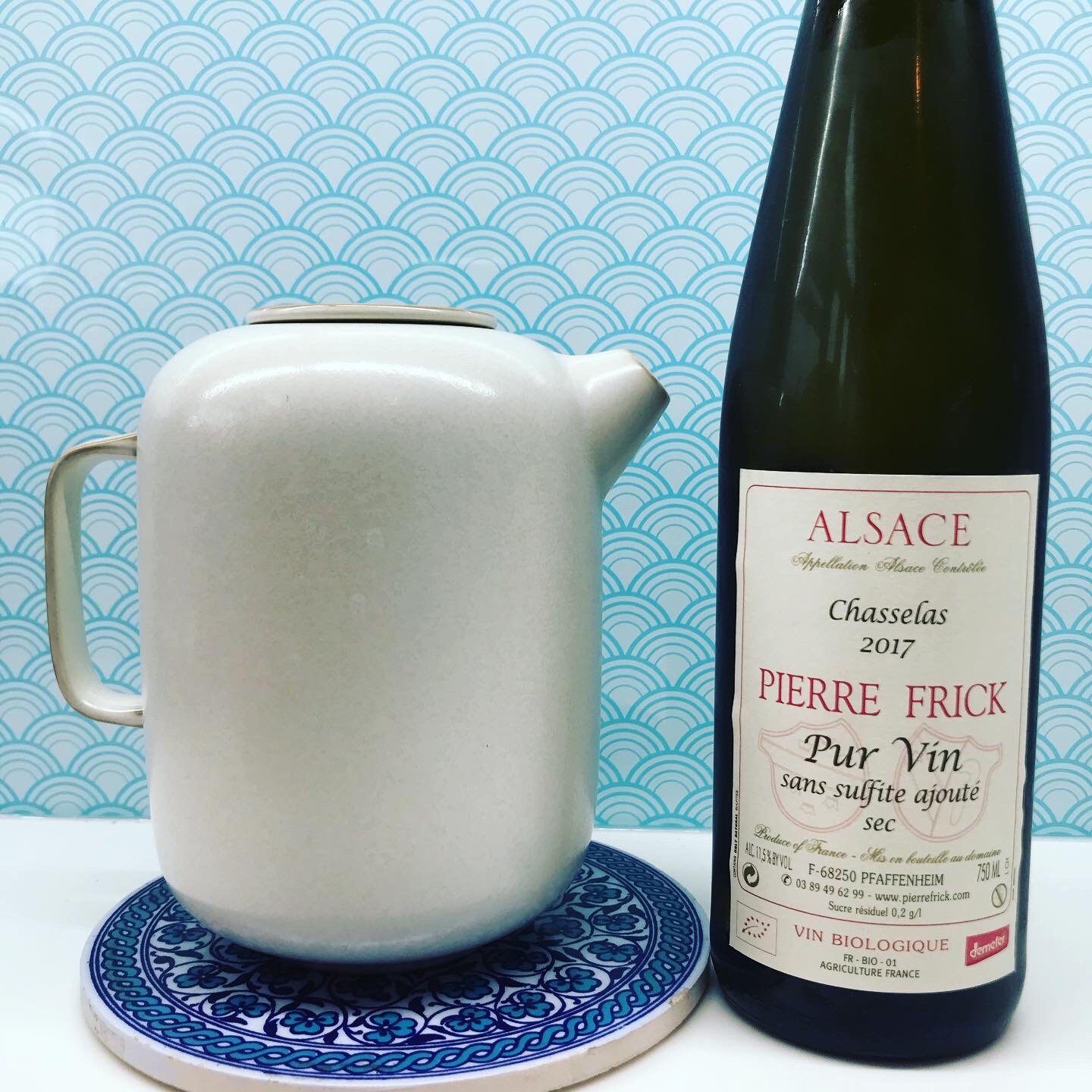
CHASSELAS PUR VIN 2017, PIERRE FRICK (Alsace, France)

Jean-Pierre and Chantal Frick cultivate something like 12-hectares of vines around the village of Pfaffenheim, south of Colmar in Alsace’s Haut-Rhin department. They have long been one of the pre-eminent domaines at the forefront of the Alsacien natural wine movement, as well as exponents of boidynamics (Demeter certification since 1981). As David Neilson, Back in Alsace writer and Raisin App team member writes, they are “activists in many areas of the ecology movement in Alsace” as well as being members of the so-called Alsace “Gang of Four” (original naturalistas, along with Christian Binner, Bruno Schueller and Patrick Meyer).

Jean-Pierre is one of those growers who makes you wonder where he finds time to tend the vines, but the old adage “…ask a busy man” holds true here. The wines remain exemplary. This cuvée is a little unusual in that it is a zero sulphur bottling of a grape hardly seen in Alsace these days, although it seemed a little more prevalent when I first visited the region at the end of the 1980s.

I’m grateful to David again for identifying the exact source of this rare Chasselas, the Carrière site, a tiny half-hectare plot producing sometimes just 1,000 bottles. As I have never had difficulty in sourcing this zero sulphur wine, I had been totally unaware that all of it is exported (London and Quebec, apparently). I feel pretty lucky.

It is pure, mineral and clean, something of real beauty and for me, probably the best Chasselas in France (but feel free to tell me I’m wrong). Forget that it isn’t the “best” wine in the Frick portfolio, nor certainly the most expensive (far from it). Just flip off the cap, forget “points” and enjoy it.

This bottle came from littlewine.co but you can also try Les Caves de Pyrene.

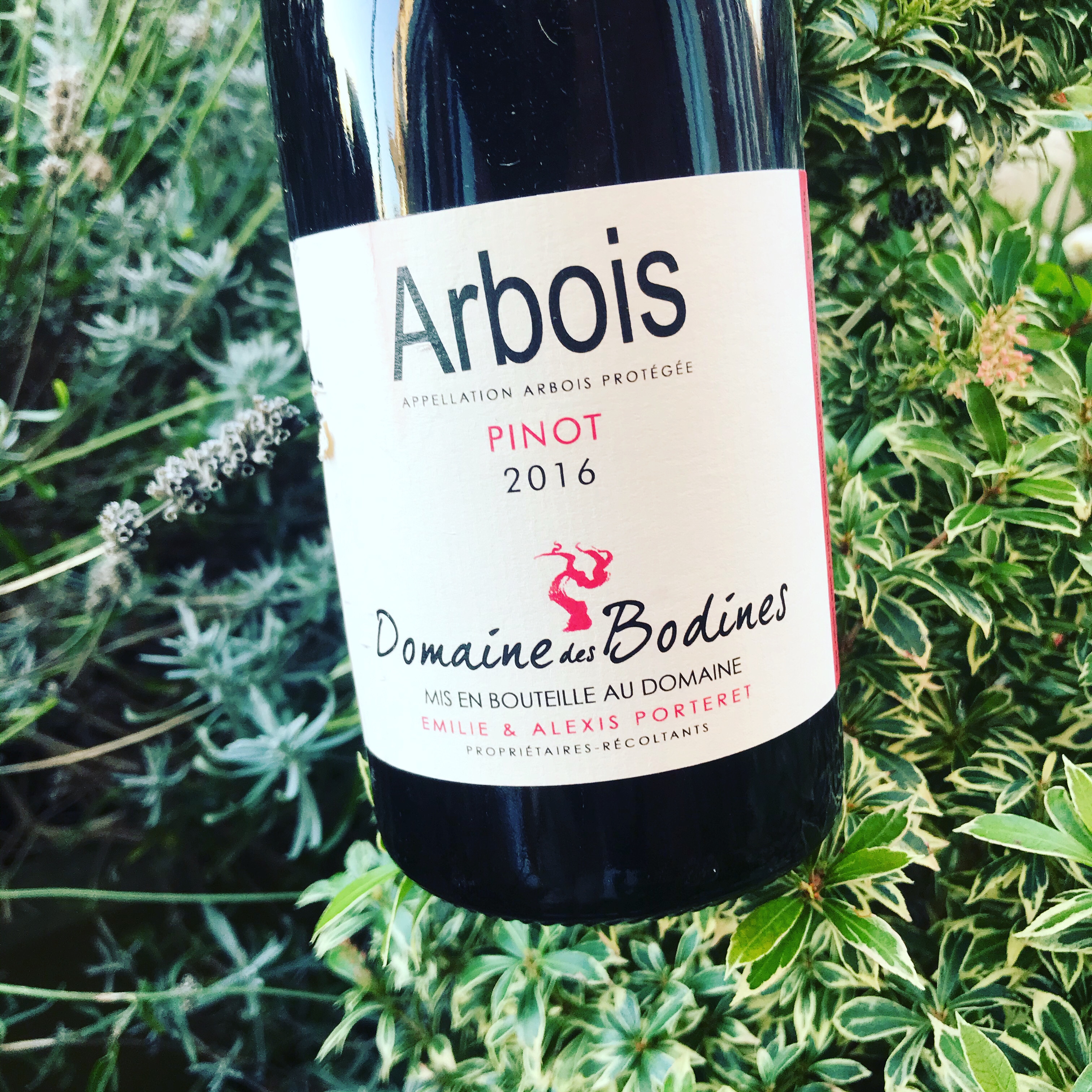
PINOT NOIR 2016, DOMAINE DES BODINES (Jura, France)

I’m sure many of you know that Bodines is close to my heart. I love a tale of a very young family striking out with a small vineyard, slowly growing their vine holding and their reputation at the same time. The reputation is for honesty in their wines and honesty in every aspect of what they do. Their first vintage was 2011 (from which a lovely Vin Jaune was released a couple of years ago), so they now have a little experience under their belts and their wines seem to get better with every vintage.

They seem to excel with the Burgundian varieties (Chardonnay and Pinot Noir). The 2016 Pinot is quite dark in colour with a very spicy bouquet overlaid with sweet scented red and dark fruits. It smells almost autumnal. The palate is also spicy with some tannic structure suggesting it may still be quite young. It was certainly less evolved than the 2015, the last vintage we drank. It was showing strongly, but for those who would wish to keep it, the wine will evolve further. It’s always the big dilemma with natural wine, because when the fruit sings, you want to drink it. No additives, including no added sulphur.

Purchased from the domaine, but try Les Caves de Pyrene for Bodines in the UK.

NEUBURGER “UNFILTERED” 2019, PETR KÓRAB (Moravia, Czechia)

In my recent article on less well known varieties I mentioned the resurgence (albeit slight) of Neuburger, but that was largely directed at Austria, where the natural wine producers have rediscovered its qualities. The Kórab brothers founded their winery in 2006, at Boleradice. Petr, now sole winemaker, is intent on keeping alive the region’s small, old, vineyards, adding diversity via sheep, goats and beehives. Some of the vines are gnarled old 75-year-olds with tiny, almost uneconomic, yields but quality is very high indeed across the whole range. I rarely buy a case from the importer without it containing some Kórab.

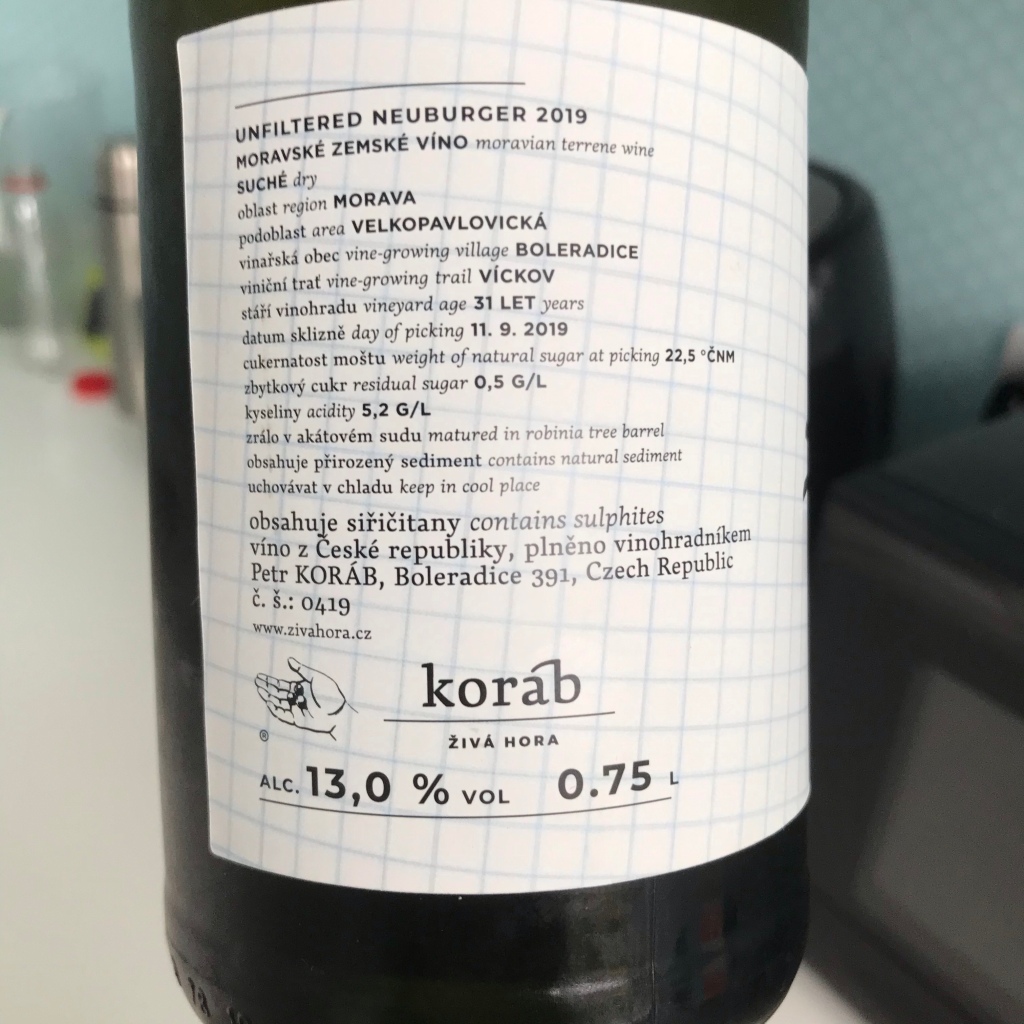
The wine is more complex than you would expect from such a so-called “lesser” variety, and it has texture, weight and freshness. The latter comes from its tarte au citron lemon acidity, but it plumps up as it warms in the glass. This was picked on 11 September with 0.5g/l of sugar and 5.2g/l acidity and was aged in robinia (aka false acacia), a medium commonly used for barrels in Moravia’s Velkopavlovická region. Understated yet really rather good, and it went very well with a rice and roasted vegetable/cashew dish we knocked up.

Petr Kórab is imported by Basket Press Wines in the UK and according to their web site this wine is not quite sold out.

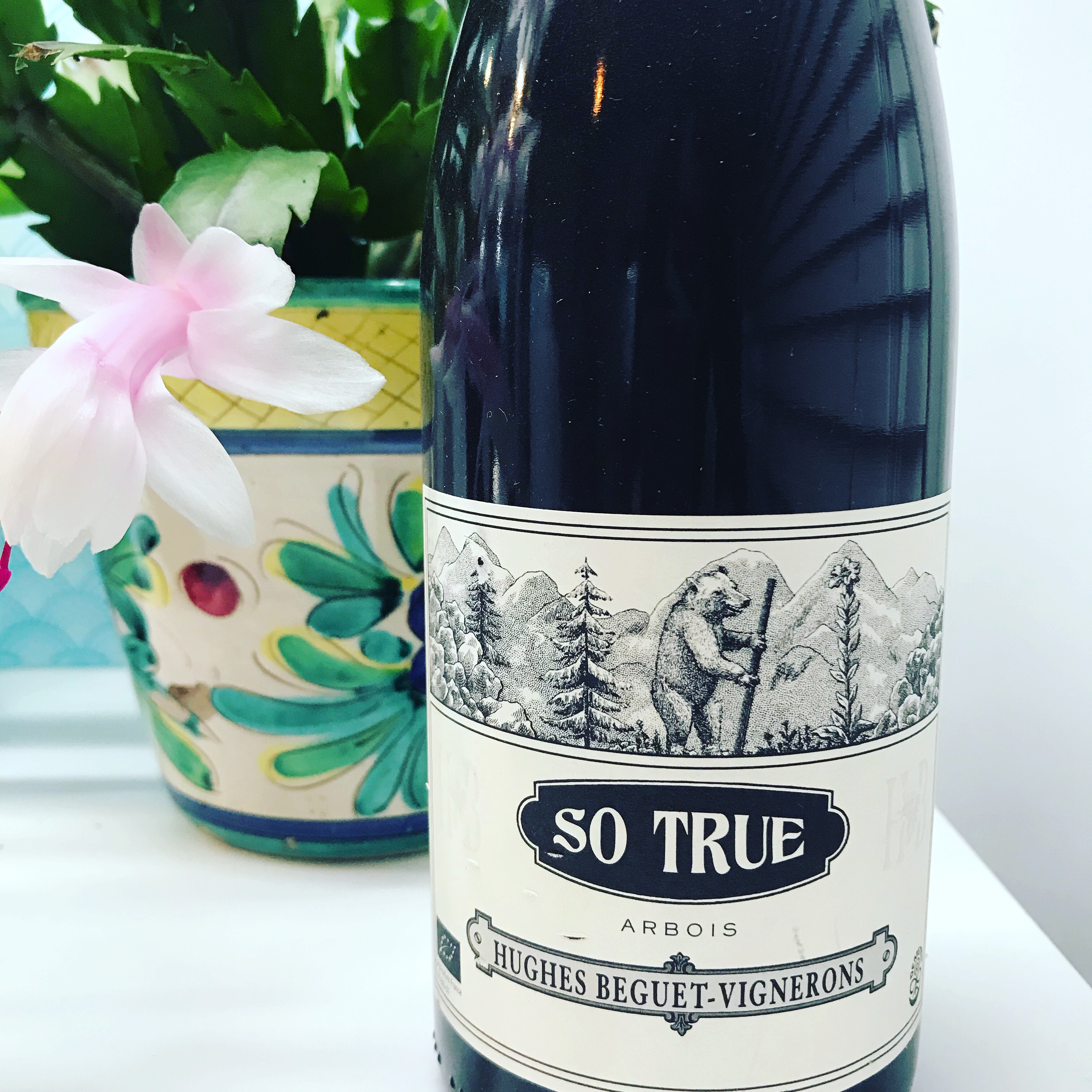
“SO TRUE” 2015, ARBOIS, HUGHES-BÉGUET (Jura, France)

I’ve not visited Patrice Béguet for a few years, but lucky for me I went reasonably long on the 2015s. It was, at the time, Patrice’s most successful vintage to date, and one in which he was able to achieve his dream of zero added sulphur across the range. Based slap bang next to the church (with an increasingly precarious bell tower, it must be said – I’m sure that crack is getting bigger) in the village of Mesnay, walking distance from Arbois, he farms vines outside the village, and over on Pupillin’s famous Côte de Feule.

“So True” is obviously (I hope it’s obvious) made from the region’s pre-eminent red variety (Trousseau). This is a gentle, fairly pale, Trousseau exhibiting the true quality of the year. This wine also sports what at the time was one of his new labels, featuring a lithograph designed to adorn his grandfather’s “gentiane” liqueur.

This has that slightly gamey note of maturing Trousseau, along with a tiny bit of tannin and more than a tiny bit of brightness. The grapes come from both the aforementioned Côte de Feule and a little from a small parcel Patrice farms in Les Corvées, on the edge of Arbois. Part of the cuvée is made by carbonic maceration, giving the wine its fruitiness. So pure, so true.

Although this is another bottle purchased at the domaine, Patrice Béguet’s wines can occasionally be found via Les Caves de Pyrene.

“GRANITE” 2018, LUCAS & ANDRÉ RIEFFEL (Alsace, France)

Lucas Rieffel is one of the key members of the Mittelbergheim School (well, to be fair, every member is equally prominent), which in itself is a group of some of the most exciting names in the Bas-Rhin department. This is another of the region’s old domaines, boasting around five hundred years of viticultural history, before it came to prominence in the 1990s. This really is a “school” because the group of five members are continuously tasting and learning together, all striving towards perfection in all they do. You can read more about the Mittelbergheim School elsewhere on my site, or on David Neilson’s “backinalsace.com”.

“Granite” is a biodynamic blend of Pinot Blanc and Pinot d’Auxerrois from the Gebreit lieux-dit, one of several in the vicinity which may ultimately end up as “Alsace Premier Cru” when all the work is done. It sits above the steep Kastelberg on a flatter plateau, weathered granite as opposed to Kastelberg’s slate.

This is, once more, the zero added sulphur cuvée (there’s also one which sees a small dose). The vines are old, up to fifty years, and the wine is aged in barrel, which makes for a serious drop. I often say I choose Pinot Blanc for lunch when dining out in the region, but this is several levels above what I’m expecting on those occasions. Almost bitingly mineral, yet with a rondeur which allows the texture and bite to blend in perfectly. At this age the fresh acids burst to life, and some might like it with a bit more age. Not me though. As a fully signed up acid hound, this is just glorious. It’s easily the best Alsace Pinot Blanc or Auxerrois I’ve drunk in a very long time, from a producer I was slow to get to know, but whose whole range I can’t resist (some may have spotted the Instagram photo of the six-pack which arrived today, including more of Lucas’s Pinot Noir).

Yet another bottle from littlewine.co.

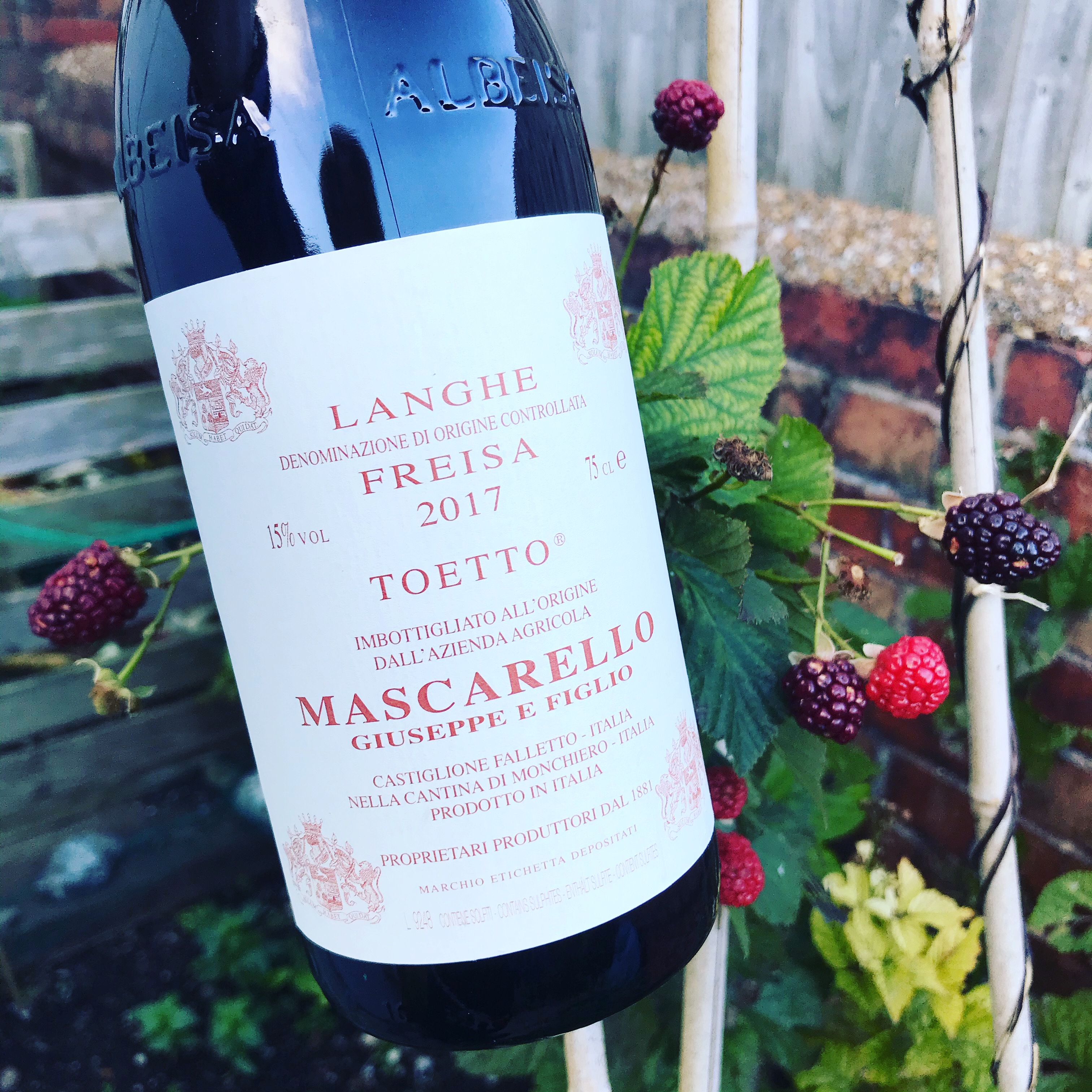
LANGHE FREISA “TOETTO” 2017, GIUSEPPE MASCARELLO (Piemonte, Italy)

This is of course one of Barolo’s most famous producers, based in the village of Castiglione Falletto. Freisa is, however, not a grape which many Barolo drinkers will have seen very often, nor perhaps pursued too vigorously. In the past it frequently made a light red, more often than not frizzante and with no attempt at seriousness. This wine isn’t one of those. The grapes, from Castiglione’s Toetto cru, were harvested late, in early October. The selected fruit was what they call traditionally fermented, with a maceration of twenty days, then aged in Slavonian oak before settling in tank prior to bottling.

A deep ruby red, but on the darker side of that spectrum, the wine is spicy, slightly chewy with some tannins, and very concentrated. It is superbly made, and I reckon I was opening it a little too young. They have made a wine here to age, I would guess, perhaps five years in this vintage. The level of concentration and extraction is exemplary and this is top stuff. The alcohol level did shock me a little (15%), but the wine is balanced, and I must say, it’s a cracker. Maybe split the bottle though.

Purchased from The Solent Cellar.

Posted in Alsace, Arbois, biodynamic wine, Czech Wine, German Wine, Jura, Mosel, Natural Wine, Spanish Wine, Swiss Wine, Wine | Tagged , , , , , , , , , , , , , , , , , , , , , , , , , , | 2 Comments

Far Flung Grapes – A Different Kind of Wine Travel

“ The Whale that wanders round the Pole is not a table fish. You cannot bake or boil him whole, nor serve him in a dish…”

Hilaire Belloc

I’ve always loved this poem and I remember writing this first verse in my diary before I went off travelling for a couple of years in my younger days. I felt like a whale who couldn’t be pushed into the square hole my career had waiting for me and I just wanted to swim away, unmolested by so-called normality. How many of us who end up with a passion for wine have similar sentiments? It seems to me a more obtuse variant on something I heard more recently: Life is like a book. If you never travel it’s like staying on the same page, forever. It took me a while to escape that square hole, but I got there in the end.

Most people I know who have something of an obsession with wine would not contemplate a life without wine-related travel. Vineyards, aside from giving us a taste of nature, and as well as providing the calm green views we may crave, bring to life the wines which they produce. It’s no cliché to suggest that we can learn a lot about a wine from merely standing on the rock and soil which made it. We feel the sunshine, observe the slope, the way that the sun glints on the river or lake, we smell the scent of garrigue. These are just a handful of things we experience.

Then there’s the place of the wine in the local community. We discover the temperament of the people who make it, we eat the local food which goes with it, and we experience, if we are lucky, the conviviality which usually comes with sharing the joie de vivre it brings.

Of course, those who are lucky enough to live such a life must never forget we are in a tiny minority. In fact, when I began my life of wine travel a great many of the people whose wine I was tasting had not had the same opportunities to travel as I had. They weren’t flown around the world like superstars to pour their wines in London, Tokyo or New York, but equally it was a time before their whole lives were dominated by strings of wine trade employees turning up at their door and hoping to taste every cuvée they produce, no matter that being a “farmer” is of itself a full time job.

Yet during 2020 many tasting rooms have remained silent, and even if in some countries they are open for visitors once more, there are plentiful reasons why many of us are not yet clocking up our air miles. Now do not think that I am oblivious to privilege, but when you had planned a year’s worth of vineyards to visit it is somewhat dispiriting to have that ripped away. Austria in April, Alsace and Jura in July and Australia in November. Even vineyard visits in my own country have been at least postponed due to the semi-lockdown before harvest.
There is more than one way in which we can travel, at least vicariously. We can, of course, do it through wine books, but except for one or two very recent additions to the genre, 2020 has not really provided a lot of new wine literature to read. I can tell because I’ve been reading a lot more books about music this summer. We can, however, also travel by trying new grape varieties. New varieties, perhaps more than merely new wines, can take us somewhere completely different. Those taste differences, which can often be a shock, even to those of us whose palates crave new flavours, can really connect us with an unfamiliar terroir, wine region, or perhaps even country.

So, after a lengthy introduction I’m going to try to provide a little map which, should you so choose, you can follow to experience some new flavours. With luck, from the comfort of your arm chair or table (or wherever else you like to sip your wine) you might travel in the mind to places which, if and when life ever gets back to normal, you may even wish to visit yourself. In my case this has certainly happened, specifically with the wines of Moravia in the Czech Republic (which I had also hoped to visit this year).

This article does not have the space to take us around the world so I will start in Eastern France and head east, through Germany, Switzerland, NE Italy and Austria, and into Central Europe. There are, of course, wonderful grape varieties to try further west. What life could be lived without Fer Servadou, Sumoll and Hondarrabi Zuri, but another time, perhaps.

No Jura here. When I first visited Arbois I’d hazard a guess that around 5% of the wine trade in England or the US (and 1% in Paris) had tasted Savagnin, Trousseau and Ploussard? I’d also suggest that most of that 1% from Paris would have dismissed them with a patrician sneer. Many still do. But let’s face it, Jura is a contemporary star and if you have never drunk at least one of those varieties you probably would not be reading this article. We need to go a little deeper.

Alsace is different. I don’t mean to suggest Sylvaner/Silvaner, because that has truly come into its own both in France and Germany this past decade. I would, however, suggest that you try Klevener though. That’s Klevener, not Klevner (a different grape entirely). Klevener de Heiligenstein is a speciality of a village of that name in the Bas Rhin (northern) segment of Alsace, just north of Andlau/Mittelbergheim. It’s actually a synonym of Savagnin Rose. It’s not directly related to Jura’s Savagnin, but it is a member of the Traminer family all the same. Less aromatic that Gewürztraminer, it has been tamed by world class producers like Jean-Pierre Rietsch (Mittelbergheim) and others. Obscure rating:10 and a solid start.

Germany is awash with varieties we never knew could make classy wines…because no one ever treated them right. I think for the adventurous Germany can reward those seeking sappy reds combining fruit with, if you are lucky, a bitter twist. Let’s stick with Dornfelder, Trollinger, Lemberger and Frühburgunder.

Dornfelder is a crossing (1955) of two obscure varieties, Helfensteiner and Heroldrebe. It is mostly found in the Ahr Valley, the Pfalz and Rheinhessen, but not exclusively. There are 425 ha planted in the Nahe, but more than four times as much in Rheinhessen and almost ten times as much in the Pfalz (which is quite a lot considering we see little of it on the UK market). I first tasted Dornfelder as a varietal from Lingenfelder (Pfalz) in the 1990s, but it is used to great effect, along with Pinot Noir, in Rudolf and Rita Trossen’s generic “Rot” (Mosel). It also makes Bolney Estate’s “Cuvée Noir” English sparkling red, a wonderfully sappy wine if you want something different.

For Trollinger and Lemberger you really have to hit Württemberg, where there is a true tradition for these varieties. Trollinger is Südtirol’s Schiava, whilst Lemberger is Austria’s Blaufränkisch. The former may generally have the better wines right now but that’s because Lemberger has rarely been taken seriously. If you take a look at the wines of Bianka and Daniel Schmidtt (Rheinhessen) you will discover its untapped potential. Frühburgunder is more difficult to track down in its homeland because it has often been mistaken for Schwarzriesling (Pinot Meunier, aka Müllerrebe, in parts of Germany). It is better known in England as Pinot Noir Précose, but some of you will know I grow a little, and prefer the German name. Look to the Ahr to see some examples where it feels loved.

If a theme is emerging, it is that these once-called “lesser” varieties, abused by the industrials for high yielding plonk, are most often taken seriously by young producers aiming to make gluggable juice, perfect for the modern wine bar scene, often using low intervention methods and reasonably small yields, which can transform the wines into something of personality.

We are seeing this in Switzerland, where wines from big yields made for an older palate are being replaced by lower yields and wines of quality for discerning drinkers, and even (shhhh!) export markets. Suisse Romande has a host of excellent autochthonous varieties, many of which I have written about at length. The majority come from the Valais (Cornalin, Humagne Rouge and Blanc, Amigne and especially the wonderful Petite Arvine, as well as various renditions of Jura’s Savagnin, via Heida and PaÏen). There are many even more obscure varieties. If you want to go totally hors-piste I suggest you look for Plant Robert (Vaud) and, better still, Completer (Graubünden), or a Vin de Glacier made from Rèze, aged in larch barrels in (for example) the Val d’Anniviers, near Sierre. Rèze is perhaps plain odd. Completer makes super wines, though at a price.

My own exploration of Swiss wines is now more focused (if importers will help me here) on the German speaking cantons (Deutschschweiz). There is a real renaissance in the east, aside from the already world class Pinot Noir and Chardonnay of Graubünden. The driving force has once again been the young growers, here via the Junge Schweiz, Neue Winzer organisation (JSNW). The group has developed to cover a wider geography, but its nascence derived from the desire to prove that the German speakers can also make quality wine.

Jauslin (Basel, for Müller-Thurgau and Gutedel), Tom Litwan (Aargau, also for “Riesling-Sylvaner”, the name erroneously given to Müller-Thurgau outside of the Canton of Thurgau, though Pinot is his passion), Urs Pircher (Zurich, for the increasingly rare Raüschling) and Nadine Saxer (also Zurich, who makes three different” Riesling-Sylvaner” bottlings). All of these producers pretty much make a living from Pinot Noir and have fun with the other varieties. Is that not so often the way?

Italy of course presents a number of avenues to pursue, but if we stick to its northern regions, Aosta offers up several gems. Of all the Aostan grapes surely Fumin has to be the one which stands out. Look for Les Crêtes or Cantina di Barró. Rouge du Pays is another mainstay red variety worth trying. White varieties are abundant too, although the region’s top white wine is generally considered a Chardonnay (from Les Crêtes), but this producer makes a Petite Arvine to match anything from Switzerland’s Valais (which is after all just over the St-Bernard Pass to the north). Ottin is another top producer. Aosta is truly worth researching because the only reason its wines are rarely seen outside of the region is that production is tiny – it’s Italy’s smallest wine region.

Northeastern Italy has the aforementioned Schiava, and Lagrein for red varieties. Oddly enough the last Lagrein I drank was from Australia (Vinteloper, Adelaide Hills). A lovely rendition with juice, bite and grip, from a variety which which isn’t always this ripe in Italy, yet shows the variety’s potential.

But South Tirol also shows some lovely renditions of Germanic white varieties, and here I shall single out two, from one producer. The abbey of Neustift/Novacella, founded in the 12th century, is a few kilometres out of Bressanone/Brixen, where ancient routes split north to the Brenner Pass, into Austria, and east up the Isarco Valley. A magnificent place to visit, it is also famous for its wines. The top of the range wines, called “Praepositus”, are exceptional. There’s a Müller-Thurgau that would surprise anyone, but the star (indeed, chosen to appear in “1001 Wines to Drink Before You Die”) is the Praepositus Kerner, harvested up to 930 metres above sea level.

There are some wonderful producers in Alto Adige (Peter Pliger, Tenuta Falkenstein etc) but they focus on varieties such as Riesling. But before we cross into Austria, I must mention Georg Ramoser for Lagrein and Weingut Niklas for Schiava. Though I’ve not drunk these wines for many years, they have provided some delicious bottles.

Austria is obscure grape central, and really deserves an article on its own. Aside from the varieties most of us will know, I’d suggest all of the following white grapes are worth a punt if seen as a varietal wine, or in a blend (often the Gemischter Satz field blends, not just of Vienna). The figure in brackets is the estimated current planting in hectares: Frühroter Veltliner (400); Gelber Muskateller (200) though as “Muscat à Petits Grains it is perhaps hardly obscure, yet Austrian versions are so different; Neuburger (550); Roter Veltliner (200); Rotgipfler (130) and Zierfandler (80).

The latter two are specialities of Gumpoldskirchen (Thermenregion). Despite its proximity to Vienna I’ve never visited, largely because it isn’t well served by public transport, but its wines are worth seeking out. The wines of Johanneshof Reinisch are fairly easy to find in my home country, the UK.

Neuburger has halved its plantings since the 1950s, when it was a high-cropping workhorse, but we are once more seeing a revival brought about by dynamic young producers. The Rainer Wess/Somm in the Must collaboration (Krems) is definitely worth a taste, but I recently drank a Neuburger from Petr Koráb (Czechia), a crown-capped, unfiltered, natural wine. It was rather good. I’m sure Neuburger has an interesting future.

I mentioned Frühroter Veltliner above. What more obscure variety could I suggest? How am I ever going to find this, you ask? Well at one time Modal Wines imported Niburu’s Kamptal cuvée made from this grape. I don’t think they have any right now, but we live in hope.

I wish I had time to journey into Czechia, Slovakia and beyond, because varieties such as Devin and Modry Portugal (to name only two) truly deserve to be tasted by adventurous and open-minded wine lovers. Devin is a Traminer x Roter Veltliner cross originating in Slovakia, whilst Modry Portugal is a clone of Blauer Portugieser which has made a home for itself in Moravia.

I really cannot leave without returning to Austria and admitting my secret shame. There is a grape variety which, as an inveterate acid hound, I adore. It’s (you may have guessed) a speciality of Weststeiermark, and goes into the regional Schilcher. It is, of course, Blauer Wildbacher, of which Austria only has around 400 ha remaining. Schilcher is traditionally a dry Rosé with searing acids and a lethal concentration of dark black fruit.

However, Blauer Wildbacher is so much better rendered in sparkling form, and increasingly producers are coming around to this idea. I never leave Austria without a bottle of Schilcher Sekt, but the best version in my opinion is a “frizzante”, made by Franz and Christine Strohmeier. It has a passing resemblance to Belgian Kriek beer in a funny sort of way and rocks out at just 10.5% abv. It’s also occasionally available in the UK (Newcomer Wines).

I’d better not mention Uhudler though, because not only is that made from a vitis labrusca grape variety, Isabella, it would also definitely be one for the polar explorer among us, but if you want to experience that “foxy” aroma…

A little journey like this can be nothing more than superficial, a tiny snapshot and I hope mildly entertaining. You know, like those coach tours of Europe which an Australian family member bravely took a couple of years ago. Several cities in a day and hardly more than a night in each country – in fact it was twelve countries in twenty-four days to be accurate. It might just give a flavour, though, enough to inspire some deeper practical research. If you think you know wine surely it is worth knowing what’s at the fringes as well as what is at the epicentre. The heart and soul of a country’s wine encompasses both. And I can promise you an adventure, not least because I have only scratched the surface here. Or you could, alternatively, just read the same page of that wine book over and over again.

Oh, what about Chasselas, Furmint, Zweigelt, you ask? Well varieties like these are pretty mainstream now, aren’t they? If not, search my site. There’s a whole article on Chasselas/Gutedel posted in August, and likewise on Blaufränkisch/Kékfrankos. If you got to the end of this article, you might enjoy them. And then there’s Greece…

Posted in Austrian Wine, German Wine, Grape Varieties, Wine, Wine Travel | Tagged , , , , , , , , , , , , , , , , , , , , , , , , , | Leave a comment

Recent Wines September 2020 (Part 2) #theglouthatbindsus

This follow-on from Part 1 (last week) highlights another eight wines drunk at home during September. It’s an eclectic mix which, as always, pays scant attention to the vagaries of the weather, as it does to the norms of civilised wine snobbery. We start in Switzerland before travelling through the French Alps, Rheinhessen, Slovakia, Canberra District in Australia, the Pfalz, and a walled garden in Hampshire, before finally heading to Alsace, which is frankly where I rather wish I was right now. But I can’t complain. I have wine to drink and food to accompany it. More than many.

PINOT NOIR 2014, DOMAINE DE BEUDON (Valais, Switzerland)

Switzerland’s Valais is one of the most stunning vignobles in the world. It is also blessed with an extraordinary amount of sunshine, so that vines don’t just cling on, climatically, but thrive at quite high altitude. Domaine de Beudon is at Fully, close to where the Rhône hits a barrier and swings northwest towards Lake Geneva, at Martigny. Jacques Grange-Faiss (Jacky Grange) was the man who was synonymous with Beudon and he called his domaine “les vignes dans le ciel”.

You can read about the precarious old wooden cable car by which you access most of the Beudon vines (unless you prefer serious trekking) in the early pages of Jason Wilson’s “Godforsaken Grapes” (Abrams Press 2018, but now in p/b). Sadly Jacky died in a tragic vineyard accident back in 2016, but from 1971 he had created a wonderful, if until recently fairly secret, biodynamic domaine. His work is being continued by his wife and two daughters, one of whom I was lucky enough to meet (along with a very switched on young granddaughter) in February this year.

This Pinot is typically biodynamic. By which I mean that the fruit sings through so clearly. Vibrant cherry is the order of the day, but there is equally some maturity here. A little brick colour to the rim and a bit of funkiness (not too much but it could worry the traditionalists). The wine is unfiltered so you get a little lees-induced texture, but there’s no tannin. Despite the fruit, the wine finishes with a savoury flavour. It comes in at just 12.6% abv, so there’s a lightness, without the wine being insubstantial. Lovely stuff.

Domaine de Beudon is brought in to the UK by Dynamic Vines.

CHIGNIN “CUVÉE CLÉMENCE” 2016, DOMAINE DU CELLIER DES CRAY (Savoie, France)

Adrien Berlioz is the man behind this domaine, which he started in 2006. He’s distantly related to the famous Gilles Berlioz, and Berlioz is one of two or three family names you will see frequently on wine labels from this part of the Combe de Savoie (as the area southeast of Chambéry, with south facing slopes above the River Isère, is known). Wink Lorch (Wines of the French Alps, 2019) informs us that he dropped the “Cellier” name in 2018 in favour of merely Domaine Adrien Berlioz.

The variety here is the classic from this part of the region, Roussette de Savoie (Altesse), grown organically around the village of Chignin, where Adrien has his winery. This is most definitely a mountain wine, no mistake. It is mineral and dry with a little texture, but also a little unexpected gras. The bouquet has honeyed hazelnuts, a touch of quince, pear and bergamot for me, more than the herby notes some people find. With a few years in bottle this 2016 has retained its mountain freshness, yet it has put on a few grams of weight, which adds a bit more interest on the palate, and gives it a wider repertoire of potential food matches.

Sourced from The Solent Cellar. They import direct.

GRÜNER SILVANER 2018, KELLER (Rheinhessen, Germany)

If Klaus Peter Keller is one of Germany’s most famous winemakers, it is often forgotten that his interests extend far beyond eye-wateringly expensive, world famous, Rieslings. For one thing, he has a genuine passion for Spätburgunder, but he’s also fascinated by some of the so-called obscure varieties he has planted and wouldn’t dream of ripping them out. Despite the fame of Keller’s Rieslings only 75% of his 16 ha of vineyard is planted to it. Of all the varieties found in small parcels on the Keller estate around Flörsheim-Dalsheim, the Grüner Silvaner has in the past been one of the most difficult to track down for me.

As far as I can tell, Grüner Silvaner is merely the official name for Silvaner in Germany, not some odd mutation. Dry and mineral is pretty much all you need to sum up how this wine smells and tastes…just so long as you remember that this is a Keller wine, no matter that it costs under £20. It has the clean bite of a frosty February morning, and then, after a pause, the fruit slips in, like the sun rising above a vine clad slope, slightly warming the palate. Although you’d be tempted to call this a summer wine, I’ve been lucky enough to eat sorbet outdoors in winter in Russia and China (indeed, the Russian one was laced with warming vodka) and this might have a similar effect (though only at 11.5% abv).

Although Justerini’s import some posh Kellers, this Silvaner comes from the Howard Ripley list, which does also have KP’s top Silvaner “Feuervogel” (£156/6 IB). It came from Solent Cellar (and I think is still on their web site).

FRANKOVKA MODRÁ “UNPLUGGED” 2015, MAGULA (Slovakia)

Vladimir and Lucia Magula farm at Suchá nad Parnou, close to Trnava, northeast of the Slovakian capital, Bratislava. They have around ten hectares of vineyard, on fairly dry terroir, which has been biodynamically farmed for many decades now. The lack of rainfall encourages the vines to throw down deep roots, and it is those roots which are depicted on the domaine’s eye-catching labels. The variety is that which we know as Blaufränkisch in Austria, and “Unplugged” refers to the fact that this wine has seen no machinery in its making. The grapes are foot-trodden and the only additive is a tiny 10mg/l of sulphur added at bottling, after a couple of years ageing in older oak.

The bouquet smells of cherries with a hint of spicy green pepper, slightly wild, herbal and smoky. The fruit was picked quite late, in November, so there’s a richness and ripeness, and the overlain spice is perhaps the varietal character and the terroir coming through. It also has a nice sappy juiciness which makes it slip down well, along with a perfect balance of 12.5% alcohol. It’s one of my favourite wines from this variety, not just from Magula. It’s superb.

Imported by Basket Press Wines.

CANBERRA DISTRICT VIOGNIER 2017, CLONAKILLA (Canberra, Australia)

The Kirk family were not the first to begin making wine in the Canberra District, close to Lake George, but they have surpassed all the others in fame. Clonakilla is deservedly one of the icons of the Australian wine industry, but it is generally for their astonishing Syrahs (with a little added Viognier in a nod to Guigal’s Côte-Roties) that they are known. But when you go to visit (they are at Murrumbateman, 40km north of Canberra) as I was lucky enough to do last year, you will see a far wider list of varieties available.

I began my Viognier journey in Condrieu, of course, buying Georges Vernay’s wines from Yapp Brothers in Mere, having been entranced by this great saviour of the grape one morning at the end of the 1980s, beside the Rhône. But young vine Viognier has less complexity (and, for me, appeal) than when made from mature vines, and mature vines seem to add on a degree-or-two of alcohol with every passing decade. I know there is vibrant Viognier made on the Rhône (Mark Haisma, Stéphane Ogier etc), but Clonakilla makes a similarly dynamic and electric version in Australia, which is hard to beat.

The Clonakilla signature with white wine is “steely” (as a prematurely opened Riesling showed back in Australia in 2019). The Viognier, made since 1998, is also textured too, and it certainly benefits from time in bottle, after which it begins to take on more savoury elements. The cool climate of the Southern Table Lands’ granite terroir is the reason for the pleasant shiver you can get from a Clonakilla white. But 2017 was also an unusual vintage. Winter was unusually wet, as was early spring, but summer and harvest were warm, in the end giving a ripe crop of good size.

The bouquet here is defined by stone fruits and fresh ginger, but the palate has fresh acids and steely minerality. If you gaze on the granite up there you can almost taste the terrain (although when we were up there it was extremely windy and bush fires were raging rather closer than we might have liked, necessitating constant recourse to the essential “Fires Near Me” app on our phones). It’s one of those wines which will certainly age, and certainly add some complexity, yet at three years it had what seemed to my own palate to be a good balance between tingle and taste. It was actually so nice to drink this wine again after not having done so for two or three years.

I always buy Clonakilla Viognier from Fortnum & Mason, the Piccadilly department store, which does have a remarkable wine department. In the more distant past I bought it directly from Liberty Wines, Clonakilla’s UK agent.

RIESLING KASTANIENBUSCH GG 2007, ÖKONOMIERAT REBHOLZ (Pfalz, Germany)

Hansjörg Rebholz makes wines which don’t always quite conform to what some see as the norm from what can often be Germany’s warmest and sunniest wine region. He farms a healthy twenty hectares of vines on the Südliche Weinstrasse (which Stephan Reinhardt once pointed out is rather disparagingly sometimes called the Süssliche Weinstrasse) from his family’s base at Siebeldingen, about thirty kilometres (or a half-hour drive) north of the French/Alsace border at Wissembourg.

Kastanienbusch is the Rebholz flagship, a Grösses Gewachs “Grand Cru” facing steeply south. The 3 ha of vines Rebholz farms on this site are on complex soils of granite, slate and a porphyritic volcanic composite rock containing feldspar, called melaphyre. The vines are farmed organically and clover is sown between rows to help slow erosion on the steep slope. Kastanienbusch is one of the last vineyards Hansjörg harvests, but the wine is bone dry (coming in here at 13% abv). There’s about a 24-hour maceration before fermentation in stainless steel, and then it is kept on lees until bottling in the following spring.

I’m so glad I kept this a good long time in the cellar. It had benefitted in exactly the same way as the 2007 Domaine Weinbach, from Alsace, which I wrote about last week. The bouquet is faintly herbal, reflecting its gentle green-gold colour. The acidity has softened somewhat and the wine is now quite mellow, but it is still dry and rich. The bouquet has a touch of lemon/lime and petrol. The mouthfeel is rich enough that it almost hints of sweetness yet the texture grounds it in the firmly dry camp. In other words, it expresses so well the vintage year (warmer) without losing any of its dry GG poise and class, Gorgeous, and quite a little sophisticated.

This was purchased (don’t be shocked) from the Laithwaite’s shop in Stoney Street (near London’s Borough Market). It’s actually the only wine I’ve ever bought from there, but on the basis of this wine, more fool me. If indeed they are still open there?

“A FERMAMENT” SAUVIGNON BLANC 2017 (SKIN CONTACT), CHARLIE HERRING WINES (Hampshire, England)

Back in June I wrote about an exceptional wine from Tim Phillips made from Sauvignon Blanc in 2018. It’s one which I would stick away for a year (as I have done with my remaining bottles). Some of the Sauvignon Blanc Tim harvested in the previous vintage went to make a very different experimental cuvée with skin contact. I bought a few 50cl bottles, in which some of it appeared.

The regime seems simple – three months on skins, fourteen months in barrel, bottling in September 2019 and not released until July this year. Tim is an obsessive perfectionist when it comes to his wines and he tastes them constantly. This is how he knows exactly when his wines are ready to move to their next stage and when they are ready to release. His imperative is the wine, not commercial considerations, which is why the words “cult English winemaker” increasingly precede his name when he’s written about.

Colour-wise, it’s a classic “orange wine” which smells, oddly enough, just like COS’s amphora white, Pithos. There’s deep, deep, orange peel and bergamot, slightly dusty on the nose and certainly textured on the palate. It has an autumnal hue and an autumnal demeanour. First taste is redolent of a mist rolling in around sunset on a dry and unseasonably warm October day. And like that perfect sunset, it lingers just long enough before fading. It has its wild side, but one which is somehow constrained…very Tim (if he isn’t offended by that, it’s a compliment Tim). It may actually be the best wine Tim has made, although I personally long to get hold of his next sparkling Riesling release (and more of it than the last one!).

Charlie Herring Wines are available in tiny quantity from Les Caves de Pyrene and selected independent wine shops (including some fairly local to his walled vineyard near Sway…I know Solent Cellar had some a week ago). I purchased my bottles direct from Tim. It’s about £26 for 500 ml.

PINOT NOIR “NATURE” 2018, LUCAS RIEFFEL (Alsace, France)

One of the leading lights of the Mittelbergheim School, a group of winemakers (including one from next village south, Andlau) who follow biodynamic and/or natural wine principles. Rieffel is literally a short stone’s throw down the village’s main street from Jean-Pierre Rietsch. He shares Rietsch’s passion for labels designed by local artists, and you can’t fail to spot the Rieffel bottles in the window of Lucas’s tasting room as you walk past.

Mittelbergheim’s vineyards produce glorious wines, proving that the old distinctions between the more southerly “Haut Rhin” and the more northerly “Bas Rhin” are long outdated. Mittelbergheim is without question one of the most exciting wine villages in Alsace, and as the vineyards even further north begin to get a reputation, it should be seen as firmly established. Its best producers (there are twenty or so winemakers in the village in total) are amongst the very best Alsace now has to offer. They also, to a man and woman, make cracking Pinot Noir for which Mittelbergheim is equally famed.

This “Nature” cuvée (I think Lucas makes three Pinot Noir bottlings) comes from various village sites and is aged in old oak. It undergoes no manipulations, nor additives, including sulphur. Lucas does use carbon dioxide to shield the wine from oxidation, and you will find that a little remains dissolved in the bottle. There are no bubbles, but there is a prickle on the palate on first sips. The result is a lively, zippy, fruit-packed red, with medium weight and glouglou-like concentration. It’s a lovely wine, it really is, which I will certainly buy again.

This was a recent purchase from Littlewine (littlewine.co) which I was unable to keep my hands off for long.

Posted in Artisan Wines, Natural Wine, Wine | Tagged , , , , , , , , , , , , , , , , , , , , , , , , , , , , , , , | 3 Comments

Recent Wines September 2020 (Part 1) #the glouthatbindsus

The usual format again, we have here eight wines consumed, in fact relished, at home during the first part of September. Actually, one of these is a cider (Czech), so seven actual wines (ha!), which came from Alsace, Arbois, Alto-Piemonte, Catalonia, Eastern Hungary, South Australia and Vienna.

“JOHANNA” 2017, UTOPIA CIDER (Josafat Valley, Czechia)

Eva and Ivo Laurin farm orchards near Tábor in the north of the Czech Republic, around an ancient fortification called Sudkuv Dul. This is a mixed farm, perhaps untypically including carp, hens and bees. The whole philosophy is as natural as it gets. The cider apples include old Czech heritage varieties (and the trees are unusually old as well, some 80 years), and some English varieties planted to see how they go, all on two-hectares of orchard. There is no spraying, just horse manure. The ciders are fermented to dryness and all of the named cuvées are aged in well used 225-litre casks for twelve months. They bear the names of women who have inhabited Fort Sudkuv Dul over the centuries.

Utopia ciders are perhaps the closest pure ciders to wine I’ve ever tasted (putting aside those ciders such as Shobbrook or Charlie Herring, where a touch of red wine is added to the apple or pear juice). “Johanna” is mellow and golden, like an autumnal evening. It is clearly made from apples, almost as if slightly bruised, and does have a bit of bite, but it is also unquestionably a little different. I think it is an extremely versatile cider, food-friendly and one which should appeal to wine lovers…perhaps even more than your average cider drinker.

Utopia Ciders are imported by Basket Press Wines.

“TOUT NATURELLEMENT PÉTILLANT” 2019 , BECK-HARTWEG (Alsace, France)

Florian and Mathilde Beck-Hartweg farm eight hectares at Dambach-la-Ville in the increasingly exciting Bas Rhin, the northern half of the Alsace wine region. They are both in their 30s, but they are the 16th generation of the family at a domaine which was originally founded in the 1500s. Their approach is biodynamic, with total respect for nature and their terroir. Both of them are fans of Masanobu Fukuoka’s wider philosophies (Fukuoka, who died in 2008, was a proponent of natural farming, including “no till” and “no herbicide” methods which are often misleadingly described as “do nothing farming”). The terroir is something rather special as the soils around Dambach sit on pink granite.

This petnat comes from vines planted at the foot of the slopes, for this cuvée 40% Pinot Noir with a similar proportion of Muscat and 20% Pinot Gris. It’s an unusual combination which undergoes a light maceration before bottle fermentation, which gives beautifully fine bubbles and a firm spine. It’s bottled with no added sulphur, which surely enhances both the overall freshness of this 2019, and the vibrant fruit. The finish has an intriguing bitterness, which I like a lot. It would make a great aperitif, but we drank it with chick pea flour frittatas and salad. Of all the petnat wines I’ve drunk this year, this is definitely one I hope not to forget to order once the next vintage becomes available. Loved it.

Imported by Vine Trail.

“ALÉAS” 2017, DOMAINE LES BOTTES ROUGE (Jura, France)

A few years ago Jean-Baptiste Ménigoz was a quiet vigneron working just outside Arbois, in a village, Aubergement-le-Petit, which nobody visited…at least before Bottes Rouge hit the bars of Paris, London, New York and Tokyo. He’s certainly one of a group of seven or eight young Arbois producers who have attained their fame via the showcase for the region’s natural wines that is Le Nez dans Le Verre (held annually, except in times of plague, since 2011). There are only 4ha at this small domaine, which I think are all still rented, but the vines do have the advantage of being pretty old.

In 2017 the region suffered from considerable frost damage, affecting most producers to some extent, as in Eastern France generally. The result for Jean-Baptiste was that he was forced to make a single red wine cuvée. The result, however, was a triumph. This wine is smooth and fabulously fruity (total glou) but with a savoury, umami, note taking it that one step beyond. Light as it tastes, its 13.5% alcohol gives it a little weight and presence, albeit as surreptitiously as one could imagine. It went down very well.

I think this may have been a purchase from The Solent Cellar whose owners are very big Jura fans, so whilst they might not have this cuvée any more they will have something to take your fancy (you may need to ask!). Imported by Les Caves de Pyrene.

CAREMA CLASSICO 2016, PRODUTTORI NEBBIOLO DI CAREMA (Piemonte, Italy)

I suppose it cannot be a total surprise that as the famous wine regions of Piemonte, Barolo and Barbaresco, become increasingly expensive and sought after by collectors priced out of Burgundy, the lesser sub-regions are starting to get noticed. Whether we are of the view that there were always bargains to be had outside the two “B”s (as I am), or whether we think it’s just desperate hype, we are definitely seeing a lot more of names many of us only vaguely knew. To be fair, Roero began to get noticed a decade ago, and DOCs like Carema and Gattinara have always been there, in the background.

The Carema co-operative was founded in 1960 with around a dozen members (there are now more than eighty). They make wines which are remarkably good if you have never tried them, their reputation being similar (to a degree) to the more famous Produttori of Barbaresco. I believe the Classico is 100% Nebbiolo (85% is the legal minimum for the appellation). Fermentation is in stainless steel with twelve days on skins. Ageing is 12 months in tank, then six months in bottle.

The colour has that lovely brick orange at the rim, garnet in the centre. The bouquet is spice (mostly nutmeg) and orange peel. The palate does have red and dark fruit but is much more redolent of spice and herbs. There’s definite structure (I also bought some 2016 Riserva which I will definitely keep) so it will last for sure, but it was very enjoyable now. Would quite like some more for autumnal dishes.

Also from The Solent Cellar, this time via Astrum Wines. I’ve noticed that independents like Solent Cellar are beginning to stock a few Nebbiolo wines from outside the two classic zones. Time to explore.

SUMOLL RESERVA FAMILIA BLANC DE NOIRS BRUT NATURE, CLOS LENTISCUS (Catalonia, Spain)

It sometimes seems as if the most exciting Spanish sparkling wines are no longer labelled “Cava”. I guess we could all come up with a few names responsible for that shying away from this designation, but in the UK at least, it was the desire of supermarket giants to drag down prices (first of Cava and then Prosecco), which led to producers going along with it and of necessity thereby trashing quality for price, and ultimately harming the Cava brand itself.

This is a wonderful family producer based at St Pere des Ribes, founded in 1939. They make wine as naturally as they can. They are remarkably unusual among Spanish producers of Metodo Classico bottle fermented wines in using indigenous yeasts, and honey from their own bees to make the dosage for the second fermentation. If that were not enough, they use the remarkable, rare, but in my opinion wonderful, autochthonous grape variety, Sumoll, for this magical Blanc de Noirs.

The colour is not so much tinged with pink, but orange, certainly with this bottle where the base vintage was 2013. It was disgorged in February 2017, so it has seen a further three-and-a-half years post-disgorgement ageing. With zero dosage I wondered whether I had left it a little too long (my cellar gobbles up sparkling wines, which live in the furthest, darkest corner (common sense)). I needn’t have worried. It sings with bright biodynamic red fruits, but with such an individual character. Its philosophy and choice of variety (which, like Pinot Noir, truly seems to thrive for both red and sparkling wine) makes it a wine of real personality, not remotely like a simple Cava from the well known enterprises in the region.

Clos Lentiscus wines are not easy to source in the UK. In fact a friend has brought me some back from the region, and this bottle may have come from Barcelona. But the great little Spanish deli in Dalston, Furanxo (only five minutes from Newcomer Wines) has had bottles the past two or three visits (do check first but you’ll find their small range of wines, many (but not this one) from Otros Vinos, is worth the walk and an extra-large suitcase).

A CHANGE OF HEART 2018, RÉKA-KONCZ (Eastern Hungary)

Here we go again…Annamária Réka, who makes wines at Barabas near the Ukrainian border, has appeared pretty much every month during this pandemic era, but I make no apology for that. Each wine is new, and none have yet failed to reach the same heights as the previous bottle.

This wine is her red, made from Kékfrankos (aka Blaufränkisch). The unique soils on which it is grown are loamy loess underlain with volcanic ash which has cooled and hardened to form perlite, often described as a sort of volcanic glass. There is a two-week maceration, 20% whole bunches, but the methodology is simple and hands-off. The result is a wine which sings of bright red cherries, like a rousing chorus. The vibrant acidity just lifts it to a crescendo. At 12% abv it is perfectly balanced, so darkly drinkable that one wishes it came in magnums.

There were a mere 711 bottles in the 2018 vintage. I bought the 2019 the other day, and there are, it seems, a more reasonable 1,633 bottles from that vintage. Still, I suggest getting in early to avoid disappointment. From Basket Press Wines. Restaurant/sommelier interest in Réka-Koncz does make it harder for any tardy private customers who have never used starting blocks.

SEASIDE CABERNET FRANC 2018, GEYER WINE CO (McLaren Vale, Australia)

Dave Geyer set up his wine company in Tanunda, in the Barossa Valley. This is another guy who as well as farming chemical free tries to follow a philosophy of not tilling the soil where possible. Not using a plough or rotovator may be quite unusual but an increasing number of farmers (not just in wine) are looking at the advantages of this system.

The Seaside Cabernet Franc, however, is (so I am told) not from Barossa. It comes from the cooler Sellick Hills (Adelaide Hills/McLaren Vale Region). True to form the vinification is a little strange. The first half of the blend is straightforward enough, a skin ferment for ten days. The other half of the blend was a Rosé, back blended before bottling.

The result in some ways is astonishing. The bouquet is discernibly Cab Franc, violets to the fore, but so “lifted” is the scent that it hits the very top of the nasal passage. Very refined, sweet almost. The palate is a cracker of ripe cherry fruit with bright red fruit acids hitting like a ray of light (excuse me, listening to some Hawkwind and getting carried away). It’s an easy-to-drink, medium-bodied wine where the 12.8% abv on the label for once seems spot on accurate. Joyful stuff.

I’ve enjoyed this wine regularly at tastings over the past few years but I am so glad I finally got around to buying a bottle. Definitely one to buy again. Imported by Nekter Wines.

“RAKETE” 2018, JUTTA AMBROSITSCH (Vienna, Austria)

Jutta and her partner farm a few precious hectares on the slopes on the edge of Vienna which comprise the most beautiful near-urban vineyards I know. A highlight of my visits to the Austrian capital is always to take a bus from outside Heiligenstadt Station, along the Grinzinger Strasse and up to the Gnadenkapelle in the hills above the city. After coffee and cake at the chapel cafe, the path by the bus stop leads downhill, first through silent woods, then to the vineyards which spread from the Nüssberg hill, east towards the Danube and west to the low slopes above Grinzing. The popup heurigen which dot the route in summer offer perfect refreshment stops along the way, and as it’s mostly downhill the odd glass won’t hurt.

Jutta is one of a bunch of truly intuitive women winemakers (like Annamária Réka, Victoria Torres, Veronica Ortega, Stephanie Tscheppe-Eselböck and the Renner sisters…I could go on), who are no less on top of the technical side of making clean and pure natural wines. She is also a fan of the traditional Viennese field blends, Gemischter Satz, and this wine is indeed a red field blend. It’s based on Zweigelt, but the other varieties here include St Laurent, Blauburger, Rotburger and some Merlot, all co-planted at Kahlenberg (north of Nüssberg, close to the river as it swings northwest to Klosterneuburg, with its famous abbey).

Grapes underwent four days of maceration in stainless steel, the only medium used for both fermentation and a short period of ageing. However, this natural wine was neither fined nor filtered and a bit of a shake before drinking (or lay it down in the fridge) will bring out the lees texture. The result is like drinking pure, pressed, cranberry juice, enhanced by those fine lees. It may be a pale red, but it has presence, poise and perfect summer fruit. It would certainly rank as one of my top summer wines this year, even though the 2019 became available a month or so ago.

Jutta’s wines are imported by Newcomer Wines from whom I bought this 2018, although I did (of course) buy some 2019 as well, from Littlewine.co.

See you soon, I hope, for Part 2.

Posted in Artisan Wines, Cider, Natural Wine, Wine | Tagged , , , , , , , , , , , , , , , , , , , , , , , , , , , | 2 Comments

Celebration

Occasionally a group of wines come together where each and every one is of astonishing quality. Most people expect to assemble a great selection for a significant birthday, anniversary or other special event. Actually, birthdays in our house are more often than not pretty low-key. One might also quite rightly ask that if this lot wasn’t drunk to mark a special event, then what on earth were we doing celebrating anything in 2020. I might agree, but perhaps when there is absolutely nothing to celebrate that might actually be the time that a celebration of sorts is most welcome. Whatever you think of that nugget of non-wisdom, this is what four friends drank over two nights on the wettest weekend in memory.

If you are going to drown your sorrows, or perhaps shall we say raise a glass to a more optimistic future, you may as well do it well. I can say that the wines below were exceptional, each and every one of them.

“LES MAILLONSBLANC DE NOIRS EXTRA BRUT, ULYSSE COLLIN (Champagne, France)

At one time I used to be able to stretch to Selosse, and then Prévost, and when they became rather expensive I took solace in an emerging talent, Olivier Collin. Olivier worked at Selosse before starting his own venture in 2004 at Congy, on the Côte de Sézanne. He began with just one parcel, adding more so that he is now able to harvest almost nine hectares. “Maillons” was I think his second wine, first vintage 2006. It comes from the vines of Barbonne-Fayel, whose soils are rich in iron and packed with fossilised coccoliths (clusters of single-cell algae), just off the main D951 south of Sézanne itself.

This cuvée, disgorged in March last year, is one of the finest Champagnes I’ve drunk for a few years. Even better than I ever remember this wine. It has taken on a little colour from the red grapes, giving it a hue that seems to match the burst of full-bodied red fruits on both nose and palate. This initial hit is followed by a stately tailing off of flavours with autolytic character. When you put the glass down it feels like the conductor has just lowered the baton at the end of a thrilling symphony. Almost perfect, except perhaps for its price. Expect to pay £105 to £115 for it today. The quality fully justifies it.

RIESLING CUVÉE THÉO 2007, DOMAINE WEINBACH (Alsace, France)

Although today I’m only buying the wines of the exciting new natural producers in the region, my cellar still holds some classics. “Théo” is named after the husband of Colette Faller and her daughters Catherine and Laurence, who brought the domaine to prominence after Théo died in 1979 (sadly Laurence died in 2014, aged only 47, and was followed in 2015 by her mother, Colette). The domaine goes back to the seventeenth century, based around the 5 hectare monastic Clos des Capuchins, but Théo’s father purchased it in 1898 and grew the estate to around 30 ha, all on fine sites. Domaine Weinbach is unquestionably one of the region’s very top estates.

The fruit for Théo comes both from the Clos des Capuchins itself, and also usually supplemented by the fruit of younger vines on the Grand Cru Schlossberg. I’d say that the 2007 is pretty much fully mature now, though not on a downward trajectory. In fact it would be hard to find a more majestic example of mature Alsace Riesling. It simply has great complexity, presence and weight (though that weight is not remotely overbearing, nor fat). The alcohol is in perfect balance at 13%. At this age you get truly magnificent length. It is the only bottle I had, purchased long ago at The Sampler in London. I have more nice, elderly, Alsace but it will be hard to beat this bottle.

DOMAINE GRANGES DES PÈRES 2006 (Languedoc, France)

The birth of this estate at Aniane in the Hérault (not far from Daumas Gassac) was the life’s ambition of Laurent Vaillé, who had prepared by training with Gérard Chave, Éloi Dürrbach (Trévallon) and Jean-François Coche-Dury. His first vintage was 1992, of which there were a meagre 250 cases. I bought this estate’s red wine regularly throughout the 1990s and into the next decade, which enabled me to take part in a GdP vertical dinner covering every vintage, at the original 28-50 restaurant (fondly remembered) in London’s Fetter Lane. I was a little shocked, though not remotely surprised, to notice that this wine will now, in a current vintage, set you back £100. I’m so glad I was there near the beginning, and I was so grateful to relive some memories on Friday night.

The blend of the red (there is a rare white wine) is classic Aniane, ie giving Mourvèdre, Syrah and (here) a dash of Counoise a large boost of Cabernet Sauvignon. This 2006 was described by “noble rotter” Mark Andrew (in an article on the Roberson Wine web site in 2010) as “…in an awkward stage…as though it is yet to fully integrate…” Well, GdP needs time and at four years old I’d have expected as much. At sixteen years it is rich and smooth, with chocolate and hints of coffee. It is also very long. Hard to say how long it will last but at least one can say that it is fully integrated now. A treat in several senses.

BAS-ARMAGNAC CHÂTEAU DE GAUBE “UNIQUE COLLECTION” 1971, DARROZE (Gers, France)

This is a perfect example of a beautiful estate Armagnac, a spirit which knocks on the head any ideas the old guys had that it was inferior to Cognac. Chàteau de Gaube is at Perquie, in the Bas Armagnac. This bottling was made there and aged until it was taken on and bottled by the Armagnac firm of Darroze in 2017, 46 years later.

Bottled at 42%, this is a gorgeous old Armagnac, amber gold and bright in the glass with complex notes of coffee and toffee, with deep orange citrus rising above. The palate is textured, earthy even, but smooth and it’s also refined, not heavy. The lightness it almost ethereal but the alcohol is adequate warning that one glass, albeit a large one, is enough.

CAMPANIA REMENSIS 2013, BÉRÊCHE (Champagne, France)

Champagne Bérêche is fronted by the rather sophisticated Raphaël, and his brother Vincent, having been founded at Craon de Ludes, right atop the Montagne, originally back in 1847. In that time they have gained more than 10 ha of vines, on the Montagne de Reims, and down in the Marne Valley. They have also developed a small negociant line from excellent sources all over the region. In their cuvée “Reflet D’Antan” thay have one of the finest Champagnes made from a réserve perpetuelle, and they also make some of the region’s very finest still red wine. They were one of the early uptakers of nature-friendly farming among the mainstream growers, and they have also come to be known for their insistence on using cork rather than crown caps for the time spent during second fermentation.

This latter method is well exemplified in this Rosé. It leads to finer bubbles, but also a little more ingress of oxygen. This makes the Bérêche style ever so slightly more oxidative than some, for which those wholly averse to oxygen find problematic (including one Champagne expert who I otherwise respect greatly). Making the rookie error I am always accused of, I cannot pretend that over the whole range I have a greater passion for any other Champagne producer. My heart is constantly broken by the choices I have to make now these wines have doubled in price since I first knew them.

This pink from vines on the Montagne on the slopes below “Le Craon” is bottled Extra Brut with just 3g/l dosage. It is a 2013 vintage wine disgorged in March 2017, so with more than three years further ageing. I think this was a single bottle of “Remensis” left over from a domaine visit rather than a more recent purchase from Vine Trail. It bursts with soft red fruits, which perfectly complement a beautiful peachy salmon pink hue. The finish tails off to a creamy sour note which brings alive the savoury aspect of an otherwise fruity wine, doubtless the product of age to a degree. A wine with which to celebrate either sunset or sunrise, full of magic.

ARBOIS CUVÉE SPÉCIALE 1988, DOMAINE ROLET (Jura, France)

Rolet, once the largest family domaine in the Jura, has recently moved out of family ownership, the children of none of the four siblings who ran the estate having wanted to take over (crazy people). Rolet quietly went about their business, which included a whopping 65 ha of vines (Arbois, Côtes du Jura and a parcel at Étoile, further south) and a shop in Arbois, on the Rue de l’Hotel de Ville, next to Jeunet, without exciting the followers of the town’s trendy new names. Rather like biodynamic Domaine de la Pinte, their efforts never quite received the accolades and respect they deserved overseas when the Jura fixation hit the world’s wine bars. Wink Lorch called their range “exemplary, if unadventurous” (Jura Wine, 2014). I know exactly what she meant, but in such a big range there are definitely gems as well as the merely exemplary.

This wine, served from magnum, was a real treat, a wine so much better than the followers of Ganevat and Overnoy could imagine. It is the colour of a skin contact orange wine, a blend of Savagnin under flor with Chardonnay. A fine spine holds together rich umami with a lemon and caramel apple (tatin) palate. It smells simply divine. Great length too. Inspiring, quite difficult to find I think, but one of those hidden gems a few people deeply into the region know about.

It was the first time I’d drunk this wine, and I don’t mean to damn Rolet with faint praise (I go back a long way with them), but this was by far and away the best of their wines I have ever tasted. The added excitement in this case was the vintage. 1988 was the year I first visited Arbois, a fortuitous day trip from the Côte de Beaune which led to a lifelong love affair with the town, the region and her wines.

CÔTES DU JURA CHARDONNAY 2014, DOMAINE MACLE (Jura, France)

As you can see, this is becoming a bit of a Jura night, and you may even have guessed that Coq au Vin Jaune aux Morilles was on the menu (unquestionably the finest version I’ve eaten outside of Arbois itself). For a contrast with the Rolet we moved further south for the first of two wines from the village of Château-Chalon. Macle was always the most famous producer of the yellow wine from this special village, but in recent years has become much better known for their table wines as well.

Jean Macle founded the estate in the 1960s, and they currently boast a moderate 12 ha around the village, now farmed by Laurent, his son. The AOC Côtes du Jura Chardonnay is often blended with 10-15% Savagnin, but this 2014 is 100% Chardonnay from argilo-calcaire soils, aged sous voile in 228-litre barriques. The vines are fifty years old and although it bears the 2014 vintage it wasn’t in fact bottled until April 2018 (according to Vine Trail). It’s an elegant wine. The flor effect is definitely apparent but not so pronounced as with a lot of flor-aged Savagnins. Chardonnay can sometimes trick you into thinking it’s Savagnin in the Jura, a result of the soils and the ageing. Not here. There’s an elegance, and a certain lightness. Citrus comes to the fore, but there is also a savoury note with a bit of earthy texture to go with the walnuts. The finish is a stud of glorious salinity, you can almost crunch a couple of sea salt crystals between your molars. It makes it super-refreshing.

CHÂTEAU-CHALON 1999, BERTHET-BONDET (Jura, France)

Jean and Chantal Berthet-Bondet have always seemed very much a team. Jean wasn’t from a wine family. He shares a passion with me, Nepal, in that he worked there, volunteering, before finding his métier back in France in the early 1980s at Domaine Macle. Jean and Chantal set up their own domaine with just 3 ha of vines in 1984, though they have since grown this to 11 ha. The old vaulted cellar for Château-Chalon ageing at their home on Rue de la Tour dates back to the sixteenth century.

Berthet-Bondet Château-Chalon has a reputation for being one of the most elegant around, no doubt assisted in great part by the dry and airy cellar conditions (damp cellaring or a warm loft often leads to a fuller style of “Vin Jaune”). The bouquet is lifted with scents of citrus, Indian spices and a hint of malt whisky cask (definitely not used). I’d not call it light (as some VJ wines can be), more “refined”. This current bottle has sufficient age to it that its complexity shows through, with honey, lemon linctus, walnut and hazelnut on the palate. Whilst it will certainly age further, its elegance makes it highly enjoyable now.

The caveat is that almost all of the Vin Jaune/Château-Chalon wines the likes of you and I are likely to drink should be opened preferably twelve hours or more before consumption, and drunk at room temperature (unless you are blasting out the central heating or have the wood burner on full).

CAPOVILLA SATURNO PEACH GRAPPA

The choice for ending the evening, and in fact the weekend, was either my old favourite, Monsieur Roulot’s “Abricot”, or this. It just seemed like the purity of a fine Grappa was the right way to go. Capovilla was only founded in the mid 1980s but their reputation for making very fine distillates completely knocks on the head the yawn-inducing notion that grappa is some sort of rough drink for the unsophisticated.

This Distillato di Pesche Saturno (those flat peaches) is twice distilled in a copper still, only the heart being used. For grappa the pure peach fruit here will almost shock you, and the 41% alcohol (brought down by cutting with spring water) won’t, it being very refined. There’s a sweetness, countered with a more bitter dried citrus peel edge. It’s a grappa that far from giving me a headache seemed to wake me up at the end of a satisfyingly big meal. I slept like a log. You could probably drink this until death ensued, not advisable, obviously, but it’s that good. I’ve seen it retail in London for £85/500 ml. Worth every penny for grappa fans. Imported by Astrum, I believe.

Posted in Alsace, Arbois, Champagne, Fine Wine, Jura, Languedoc-Roussillon, Premium Spirits, Spirits, Wine | Tagged , , , , , , , , , , , , , , , , , , , , , | 6 Comments