Bojo Rising Part 1 – The Masterclass

Thursday saw the annual trade tasting for Inter Beaujolais, organised to perfection once more by Westbury Comms at The Trampery on Old Street. In my second article (to follow) I plan to provide an overview of the 2016 and 2017 vintages by highlighting the (er, my) best wines at the tasting. There will be rather a lot of those – my own outlook is very positive, because although quantities were affected by hail (especially in 2016 in some crus), the wines generally show a return to classical elegance after the riper wines of 2015.

I thought it better to focus my first article on Jamie Goode’s excellent Masterclass on some of the new faces in Beaujolais. This gives me an opportunity to paint a picture of the revival taking place in the region. Jamie’s introduction could have been written by myself, so aligned is our take on what has been happening and where Beaujolais, as a wider region, might go.

8CF7C206-8408-4BB3-B987-F63FB4182DE7

From the post-industrial Nouveau era there has been a quiet revolution in Beaujolais, fittingly started by the Gang of Four (some might actually call it the Gang of Five: Lapierre, Breton, Thévenet, Foillard, and some would add Yvon Métras) under the influence of Jules Chauvet, a negoce and research chemist who many would call the father of the French natural wine movement.

From small beginnings and a storm of negativity from the establishment this movement encouraged a host of young people to change their whole approach to winemaking, and with it they changed the way that wine is drunk and appreciated all over the world. Low intervention wines are in many cases replacing (or at least becoming equal to) beer as the preferred recreational drink in bars the world over. Gluggable, smashable and glouglou are descriptions replacing collectable and fine wine (pronounced fane wane) for so many younger drinkers who identify more with the hard-worked, soil-encrusted, hands of young vignerons rather than the grey suits and Hermès ties of the estate owners (rarely winemakers) of the unaffordable classics, in the post-Parker era.

Young winemakers have populated regions with affordable land over the past decade or so, and for a time Beaujolais could be so-described. It saw an influx of new producers along with the children of established producers, increasing this century, as indeed did Jura and The Loire, as the natural wine movement grew. This has coincided with an influx of investment from the wine regions between which Beaujolais is sandwiched, Burgundy and the Northern Rhône, for the same reasons, vineyard prices having blasted off the planet in the classic regions (especially neighbouring Burgundy) during that time.

Of course not all of the great wines of the region are natural wines, but what the natural wine movement has done is create a dynamism that is benefiting everyone. All this comes at a time when the old norms of heavy oaking and big, jammy, fruit are becoming less fashionable in the wine world as a whole. People are looking for lighter wines, fruity, digestable, and (to use one of Jamie’s favourite descriptions) smashable. As the Goode doctor said, Beaujolais is a region whose time has come. You have the talent and the wines, and now you have the market too.

Gamay (wow, it took me a long time to mention the grape variety) lends itself so well to carbonic, or semi-carbonic, whole bunch fermentation, yet this is not the only method of winemaking employed in the Beaujolais region. Many young producers are using what some would call more “Burgundian” techniques, with pumping over and crushing. What is very clear is that the move to either zero, or minimal, sulphur additions is becoming popular with all of these young producers, whatever techniques of winemaking they use. This philosophy, and indeed low intervention winemaking as a whole, requires absolute focus on clean grapes (sorting out any damaged or diseased berries is essential), and a spotlessly clean winery.

Doing less, as Jamie pointed out, actually takes more skill and effort. What low sulphur wines appear to give you, along with the lifted fruit of carbonic maceration, is a wonderful texture somehow absent in more interventionist wines. This texture is in my view enhanced (and this doesn’t only apply to the Beaujolais region) by a return to using cement and concrete (either the old style of tanks or modern eggs and suchlike). All of this just seems to make Beaujolais at all levels so much more interesting. It’s ironic that by adding a little complexity through grip and texture the wines become, counter-intuitively, more pleasurable to knock back.

It also increases the wines’ versatility. You can drink them on their own, slightly chilled in summer and at room temperature at other times, but they go well with modern bar food (charcuterie, cheeses, rillettes etc), and many accompany a simple onglet (with frites, of course) to absolute perfection.

What next for Beaujolais? We have seen the rejuvenation (should that be “reju-vin-ation?) of the Crus, and the beginnings of the same thing happening in the Villages and straight Beaujolais appellations. There is now exciting wine being made as Beaujolais tout-court which costs very little and gives a lot of pleasure. We have also seen the revival of Beaujolais Nouveau in the past few years. Not of the mass produced semi-industrial product, but wines made in relatively small quantity by those new producers. Gamay makes a perfect early release primeur if it is done with love and care.

Another notable development comes in the number of lieu-dit or single vineyard parcel wines being released. When we talk about the diversity of terroirs in Beaujolais, even within the crus where it’s certainly not remotely all granite as some books might suggest, there is no better way to highlight this than by releasing named parcel wines. After all, we all know Morgon’s Côte de Py. There are many more worthy sites which will appear on labels more often over the next vintages. The fact that the wines do taste different vindicates this approach.

Jamie also recognises the potential for Chardonnay in the region. Back in the 1990s I remember buying a mixed case of wines from Jean-Paul Brun, whose estate is far south of the famous Crus of the region. One of those wines was his Terres Dorées Chardonnay, and I loved it immediately. I sadly see all too little of it these days, but Jamie rightly identifies the still inexpensive limestone-marl sites, mainly down in the thus far unfashionable south, as one of the great potential growth areas for Beaujolais.

The future looks bright, if in fact more red and white than orange here. Let’s hope that the appalling weather events which have struck Beaujolais in recent years don’t spoil the party. As Inter Beaujolais’ Geoffrey Bénat told me, the thing they need to work on is to raise the profile of the region enough so that, without becoming expensive and unaffordable (like Burgundy, for instance), the producers can get a little more money for their wines, so as to make the rejuvenation of the Beaujolais region sustainable. I for one hope in this he succeeds.

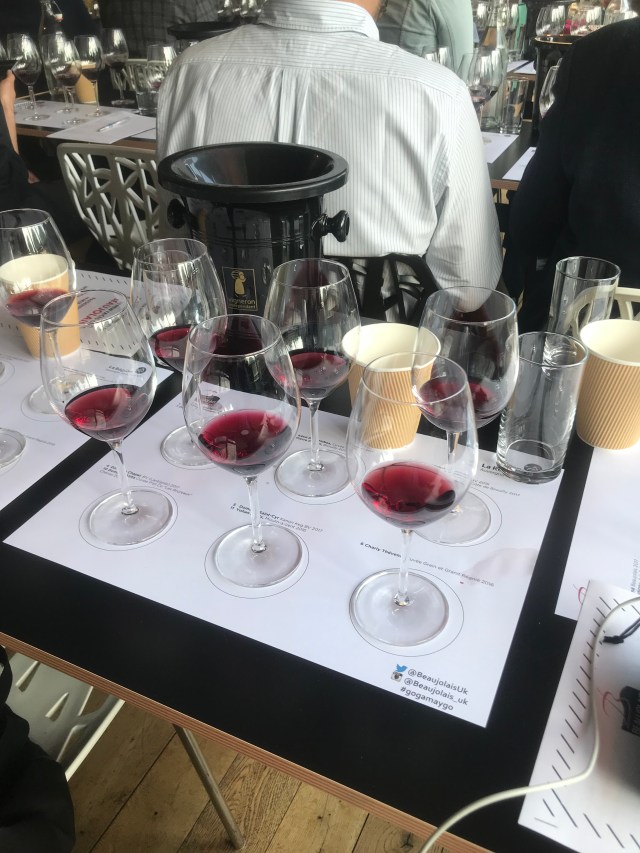
Jamie’s Masterclass allowed the crowded room an opportunity to taste eleven wines from some of the fresher faces of Beaujolais, and I shall run through them relatively swiftly. Many will get a second mention in my next article.

28936017-BC90-4EF5-8E2A-B652DEA8E80F

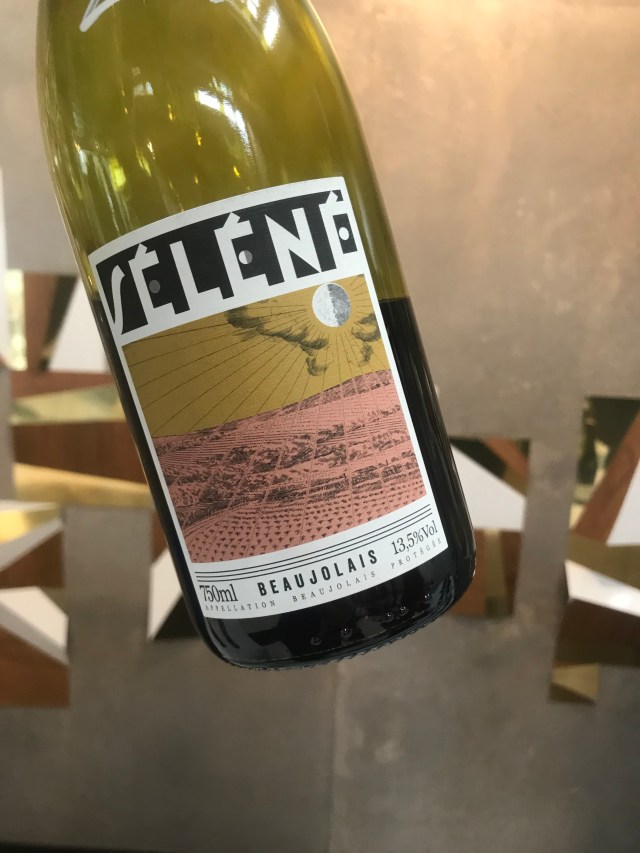
Domaine Séléné Beaujolais 2017 – I tasted this quite early on in the main room and immediately identified this producer as interesting, both for the wine and for their packaging. The New Beaujolais usually comes with more inspiring labels which will appeal far more to a younger audience than the more traditional style. Something producers should note. Whole bunch fermentation, with the addition of 1g/litre of sulphur and nothing else. Fruity, with that lovely grainy texture. Glouglou but not at all soft and simple, and it should cost less than £15.

261C6F68-C031-4AFC-A65D-0B0BD06F86DC

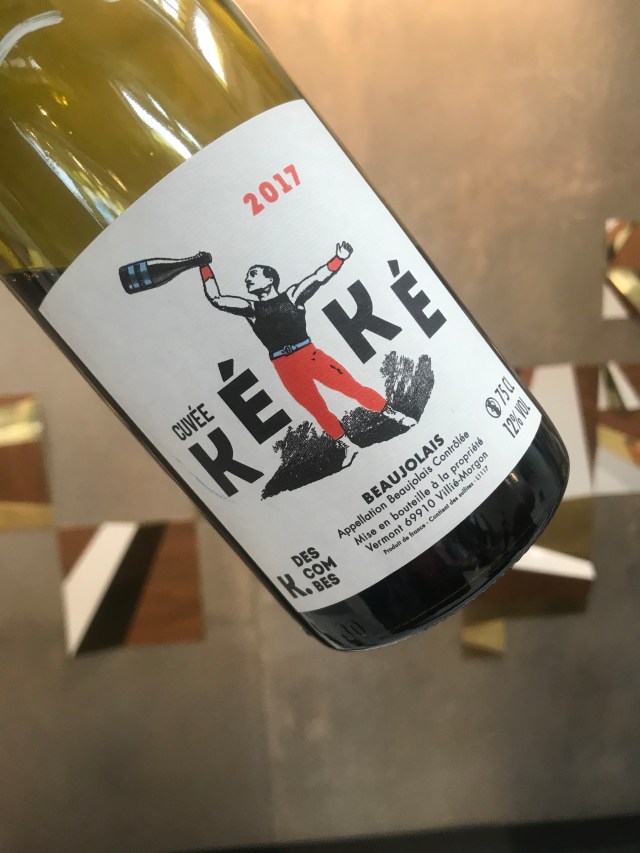
Kéké Descombes Beaujolais-Villages “Cuvée Kéké” 2017 – Kewin has a famous father (George), but has gone in a slightly different direction. His wines, some of which I have already bought (from Solent Cellar via Red Squirrel), are one of my discoveries of the past year. This wine, from “Courcelles” off granite, is made by semi-carbonic vinification. You notice immediately how bright this is, with drive and focus, yet with structure too. There’s a tiny bit of volatility, but for me this is a small enough amount to add personality.

41521EDC-0EF7-4170-B78F-78168BC370E5

Clotaire Michal Beaujolais-Villages “Napoléon” 2016 – This wine comes off sandy soils. Westbury’s Christina Rasmussen had created a wonderful display of Beaujolais rock types in the main tasting room, which illustrated so well the complexity of the different sub-strata and soils throughout Beaujolais. It’s biodynamic with plump fruit, quite pronounced fresh acidity, and more of that texture we so love. From Totem Wines.

Domaine Chapel Beaujolais-Villages 2017 – David Chapel has been based in Lantignié since 2015, probably the most likely village to gain cru status in the future. He didn’t have a wine background, being a former Sommelier and resident of New York, but his father had gained three Michelin stars in France (one of only nineteen chefs with that honour back in 1973) and is credited as one of the fathers of Nouvelle Cuisine.

This Villages comes from three named parcels at 380 metres altutude on decomposed granite, using high-density planting, and is made via whole bunch fermentation, aged in cement. It is very expressive, light in colour but lively, elegant and harmonious too.

I’d been keen to try the wines being imported by Rupert Taylor’s new Uncharted Wines venture, and this didn’t disappoint.

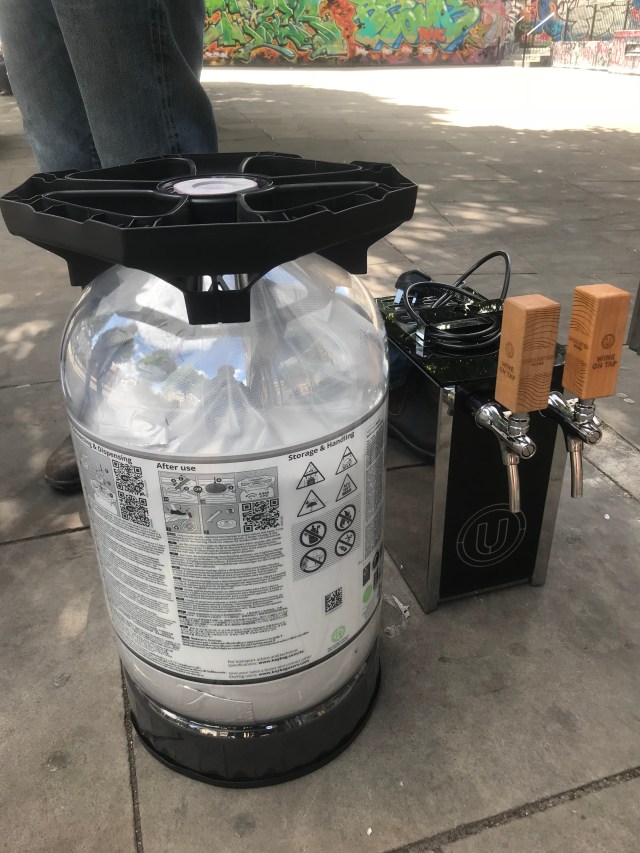
Romaine Saint-Cyr Beaujolais-Villages “Kanon Keg” 2017 – A young vine cuvée off clay-limestone made with 100% whole clusters and cold carbonic maceration. It sees eight months ageing in concrete tank. The wine is “bottled” in kegs and this method of delivery is the new and exciting way of serving wine “on tap” in bars which several producers have been experimenting with (most notably Andrew and Emma Nielsen’s Du Grappin label over previous vintages, and here from Uncharted Wines).

This is a simple wine, the fruit reminding me a little of a Fox’s Glacier Fruit sweet, very cherry, but very much made for quaffing in a bar, and in that context (and with just 12.5% abv), just right. Only 150 kegs produced, though.

82A690FF-64D0-410E-BDF4-0202E4DF8415

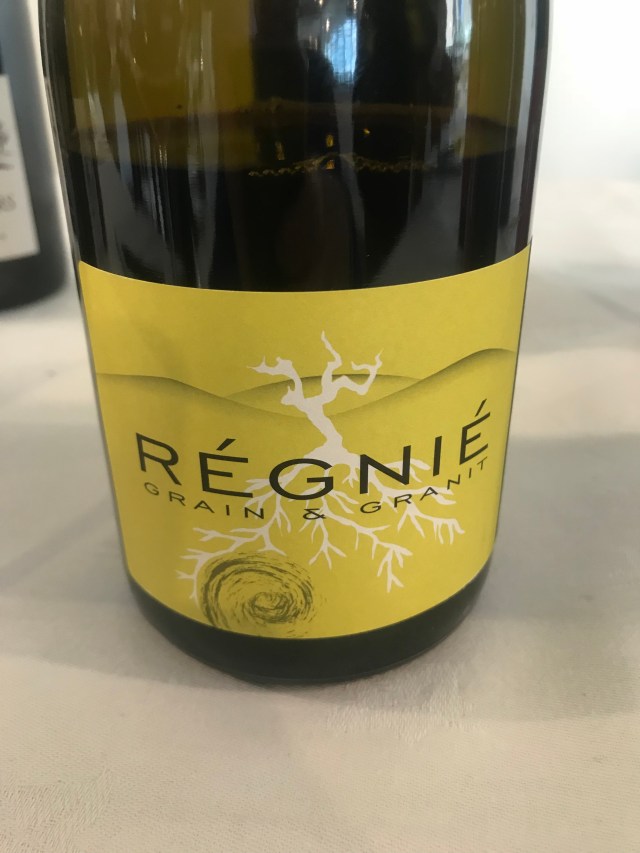
Charly Thévenet Regnié Cuvée Grain et Granit 2016 – Charly needs little introduction, hailing from one of the great Beaujolais families, but he also had the good fortune to work for a while with his father’s friend, Marcel Lapierre. He started with three hectares of Regnié vines in 2007 and set out to build his own reputation. There are rumours that father and son may get back together again very soon, but in the meantime this particular wine has been just so good in recent vintages that I pray it continues to be made.

The grainy structure is very evident in a wine from 350 metres altitude on granite/clay with alluvial stones. The grapes are chilled before carbonic maceration, followed by ageing in old Burgundy barrels. Thick cherry fruit with a touch of tea leaf make this quite distinctive…and delicious. One of the best wines of the day. Roberson bring these into the UK.

F4A97264-3A06-48E6-9F84-85EED20A52C2

Domaine Chardigny Saint-Amour “A la Folle” 2017 – this is a domaine run by two brothers, Pierre-Maxime and Victor-Emmanuel Chardigny. You rarely see Saint-Amour wines retail in the UK (it was once a Valentine’s Day fixture, but Saint-Amour is in fact the second smallest of the ten Beaujolais Crus). This one is made distinctive by super high density planting (12,000 vines per hectare) on mainly clay/alluvium/limestone, and winemaking includes long vatting of two-and-a-half weeks with two pumpovers a day…so a far more “traditional” vinification, but of course not traditional for Beaujolais. It produces a more extracted style of wine, which highlights the diversity in the region.

Pierre Cotton Brouilly 2016 – Jamie painted a picture of Pierre Cotton’s cellar, a hotchpotch of very old barrels which looks kind of terrible, yet hides one of the region’s rising talents. Cotton’s Regnié performed very well at the main tasting, and the samples others tasted from here appeared very good judging by the reaction of the room. It was just that, sadly, the sample I tasted from was diagnosed as slightly faulty (not just by me but by several of those around me). But I am excited by Pierre Cotton’s project and I will not let one possibly not quite perfect bottle stop me trying more. Kiffe My Wines imports Cotton. See Part 2 for his Regnié.

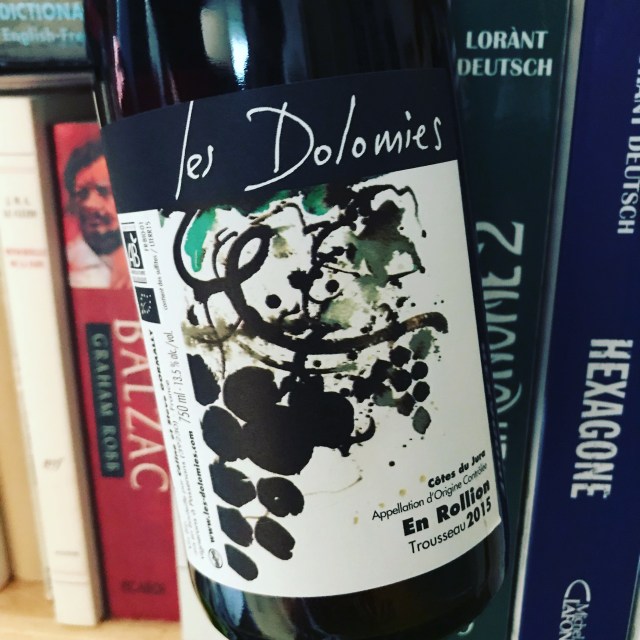
David Large Côte de Brouilly “Heartbreaker” 2017 – Like Pierre Cotton, David Large has his labels well sorted. You can’t beat a bit of nostalgia for the cassette tape! David’s vines on the Mont de Brouilly are on Piedmont soils. I was informed that these are in fact “diorite”, with which I’m more familiar. Diorite is a soil type apparently not “volcanic” (as I had thought) but formed from volcanic activity, and the “mont” is not, as I had wrongly assumed for decades, an extinct volcano.

Yields are very low and the wines undergo a semi-carbonic maceration in concrete tanks for 14 days, after which the must is pressed, and finishes fermentation in fibreglass vats. Sulphur is added, but just 2g/litre. The wine is focused and fresh with very nice fruit, and I’m not sure why this guy is still looking for representation in the UK?

Domaine Anita Chénas “Cuvée P’tit Co Les Bureaux” 2017 – Anita Kuhnel is yet another very new Beaujolais vigneronne, starting out in 2015. Vinification here is uncomplicated, with semi-carbonic maceration over ten days, followed by eight month’s ageing in cement tanks. This cuvée is very purple in colour with carbonic fruit character on the nez. It tastes fruity and easy going with less texture than most of the wines here, but it is none the worse for that. You would only pay €6 ex-cellars for this, and Anita is currently looking for UK distribution. Possibly worth popping in here if you are in the region.

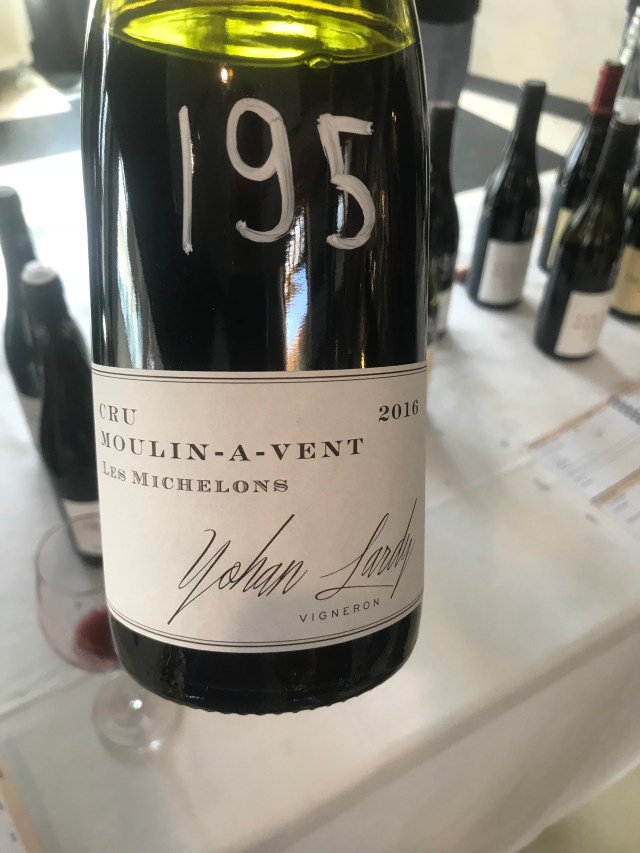
Yohan Lardy Moulin-à-Vent 2016 – This wine comes from southerly exposed vines in a lieu-dit called Les Michelons. This is a classic example of why we should see more vineyard names on labels. Here, Lardy and his group of likeminded growers possess 85-year-old bush vines (gobelet pruned), whose grapes undergo a low temperature carbonic maceration followed by ten months in wood of various sizes. No sulphur is added.

The result is very much a natural wine, but the old vines really give depth to the very clean fruit. Really good. I need to pay more attention to Monsieur Lardy.

8140E586-012D-4D60-95CB-5EBE73506593

This is a mere snapshot of the new and younger names in Beaujolais. I could add a good many more, not least my own personal favourite Julie Balagny (whose wines may be a little too lively for the more traditional drinker). They show, I hope, a dynamic and vibrant region well on the way back to full health after years in the commercial doldrums. I hope that Beaujolais continues to grow its success. If it takes the lack of affordability in nearby regions (Burgundy, Rhône) to make people focus on Beaujolais once more, so be it. Don’t forget, his was once a region held in high esteem for just the kind of wines we are returning to again today.

Jamie Goode’s Masterclass went a long way to reminding us of what we are missing if we don’t encourage people to drink The New Beaujolais. Yet as the main tasting event proved, there are wines of no less interest from more traditional sources too, also a reminder of the breadth of diversity in the region, which can only be another strength.


Posted in Artisan Wines, Beaujolais, Natural Wine, Wine, Wine Agencies, Wine Tastings | Tagged , , , , , , , , , , , , , , , , , | 4 Comments

Meeting António Maçanita

There was a buzz being created around the Azores even before Sarah Ahmed wrote a revealing article in Decanter last summer, and that buzz has without doubt been created largely by one man, António Maçanita, the founder (with Paulo Machado) of the Azores Wine Company. Today I had the chance to meet António at Ten Green Bottles in Brighton, to listen to his story, and for the first time to taste the whole AWC range in one sitting.

49FE1A23-3F6C-483F-B09C-F5AA66890E17

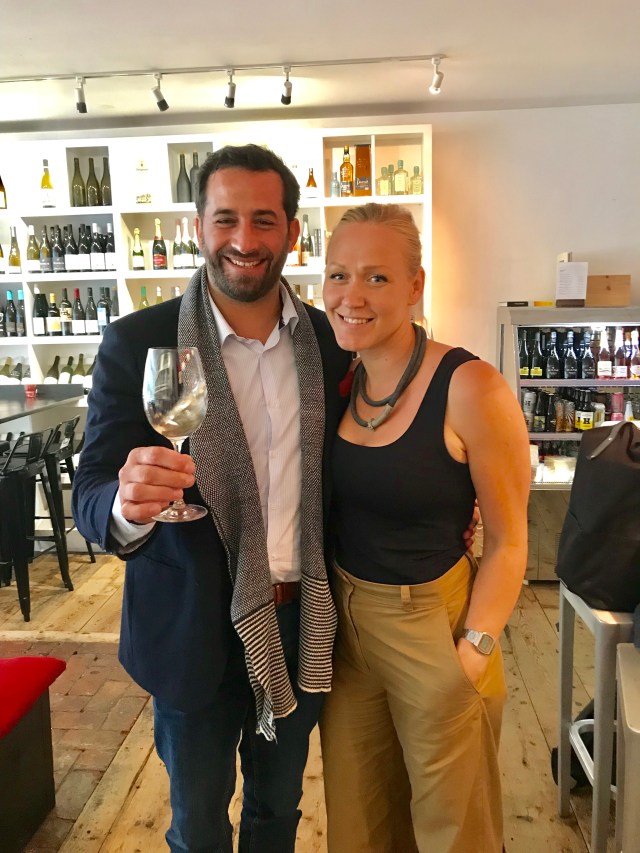
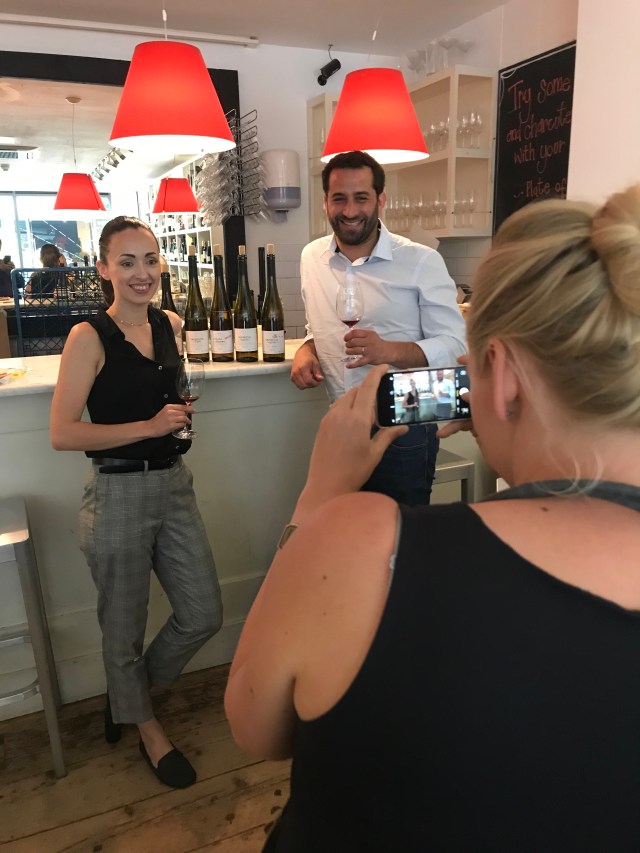
António Maçanita with Lisanna from Azores Wine Company’s UK importer, Red Squirrel

Most people are vaguely aware of where the Azores archipelago is situated, but perhaps many place it much closer to the Canary Islands, and Madeira, which have a warmer climate. The Azores actually sit almost a thousand miles west of mainland Europe, effectively a third of the way to America. They sit right on top of the North Atlantic Ridge, the great underwater fault line which splits the Atlantic Ocean. As America pulls away from Europe (at a rate of a couple of centimetres a year), magma is forced up through the split in the earth, and the Azores is a nine island consequence, made from pure volcanic rock.

Many of the islands which make up the Azores are very old, in most cases numbering millions of years. Fertile volcanic topsoils have formed, providing rich agricultural land. On Pico, the main island for viticulture, which is a baby of merely 300,000 years in comparison, there is almost no topsoil. The only productive agriculture on any scale is viticulture, but viticulture of a very unusual kind. Vines are planted in the cracks of the rock, from the very sea shore up to around 200 metres altitude. The clouds are drawn up the side of the 2,350 metre Pico volcano which dominates the island, leaving a sunny zone below. António repeated an old saying, “where the crabs are singing (in the sun) you find the best vineyards”.

If a sun-drenched island idyll is in your mind, you are wrong. António said it rains every day, perhaps an exaggeration, but with temperatures maintained around twenty degrees and a lot of rain, rot in the vineyard is a constant threat, yet there is a a determination to avoid synthetic vine treatments. The only answer is to raise the vines when they need ventilating, and to lower them behind protective walls when a storm is coming in. The threat of losing a whole year’s crop is constant and stressful.

The vines on Pico are protected from both the atomised sea salt spray, and the ocean winds which burn the vines, by low walled enclosures called currais. These structures are essential to any form of viticulture, and there are around 6,000 hectares of original vineyard protected in this way, an almost unthinkable feat for the early inhabitants to build. From aerial photos they look like the ruins of some ancient civilisation, but in reality they are a few metres more or less square, each adjacent enclosure protecting two or three plants. The only places I know of where vines are similarly protected would be in parts of the Canary Islands, and in parts of Santorini. Today there are just 150 hectares in production on Pico, and much much less on the other islands.

The story of Azores wine begins in the 1400s, even before the European discovery of  America, but after that event the islands became a regular stop on the slow transatlantic crossing. Prosperity followed, and Pico turned into an export economy, though much of the islands’ wines ended up in America labelled as Madeira. The golden age was in the early to mid-1800s, with the Azores producing twenty-five times more wine than Madeira. Then, in 1854, disaster struck, first in the form of powdery mildew, and then phylloxera in 1857. After the vineyards were decimated two thirds of the population emigrated to America, despite the switch from wine to whaling providing some subsistence for those who remained. Then the lights were switched off…

6514B714-25F7-4EB4-897E-CB1D0623112A

Until 2010 when António came to the islands, initially with his experienced consultancy hat on. But when only one winemaker employed him, he decided to start his own project and the Azores Wine Company was born. The first vintage was 2014, and the wines are imported into the UK by Red Squirrel. Quantities are tiny, and the prices are not cheap.

But remember the costs of production, the small scale, and above all, the fact that you are buying unique wines from a UNESCO World Heritage Site (this very special viticultural landscape attained a UNESCO Listing in 2004). These are wines which are a true reflection of the local volcanic soils, from remote vineyards lashed by the wild Atlantic. What true wine lover wouldn’t want to buy into a little part of that?

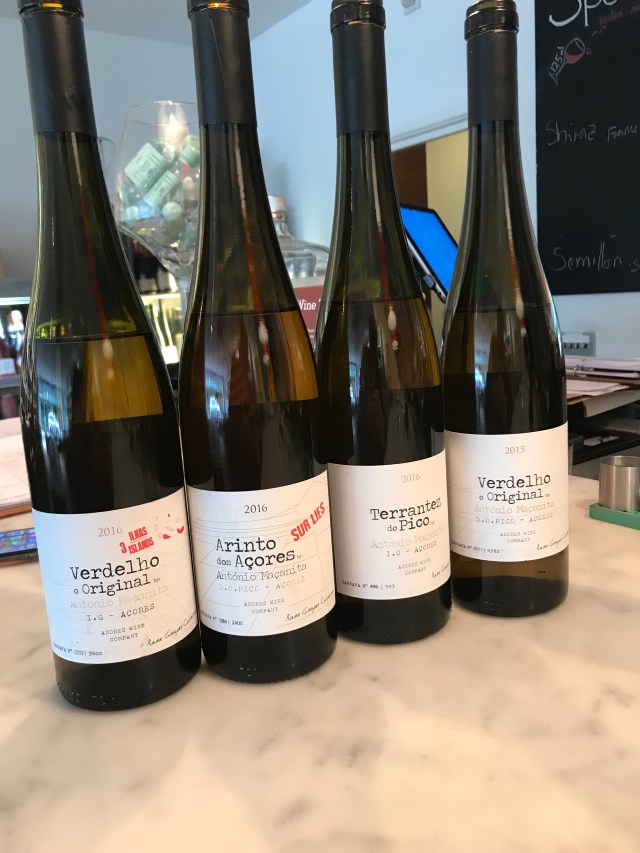
Verdelho Original 2015, DO Pico

Saline, herby and fresh, this is a cool climate wine off volcanic terroir pure and simple. With 13% abv it is slightly broader than the nose suggests, slightly closed, with a nice stony texture and mouthfeel. You immediately understand that you don’t want to serve these wines too cold, just cool. The development in the glass as the wine opens is very noticeable.

6EDDE4E7-6909-460C-807B-10F2CDFFDF6D

Verdelho Original 2016, DO Pico

The 2016 is a slightly brighter version of the 2015, and is a “three island blend” due to a very small 2016 harvest. Acidity is a touch fresher and it is more open for business from the off. António called it “seductive”, and it certainly is. Which of the two do I prefer? Hard to say. The 2016 is perhaps more immediately appealing, but I do have a bottle of the 2015 at home, as yet unopened. I’m looking forward to pairing it with food, where I think it will shine.

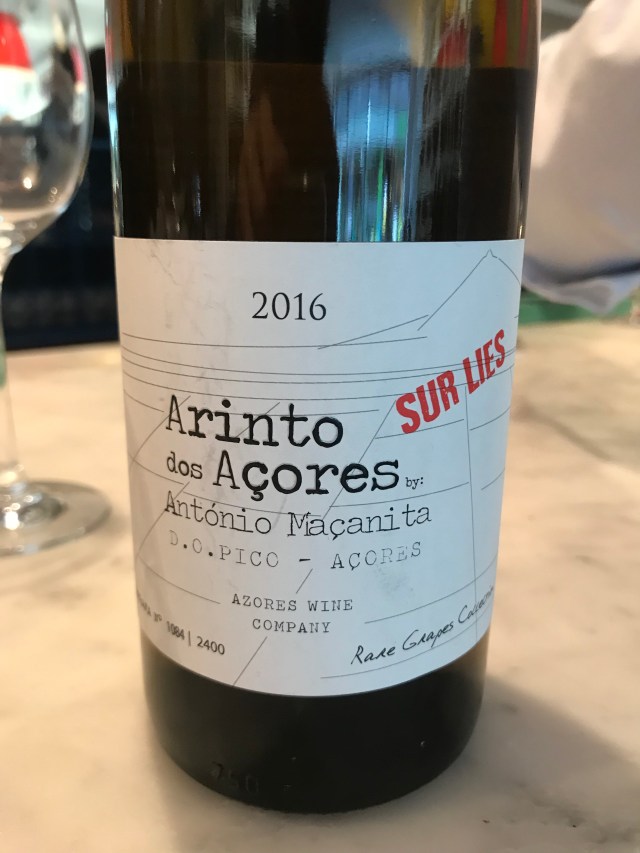
Arinto dos Açores “Sur Lie” 2016

This is also made from grapes from three islands, Pico, São Miguel and Graciosa (the latter of which only has around five hectares in production). This strikes a high note with its bouquet, very elegant and with a mineral whiff. The palate is more citrus than the Verdelho, but there is a very nice fruit to acid balance with the Arinto (a completely different grape to the Arinto found on the mainland). As a 13%er it has a little bit of muscle, but it is lightened and lifted by its acidity. Delicious. Arinto is the Azores’ most widely planted variety.

07F7D293-7E99-462B-AA2A-356AA117A643

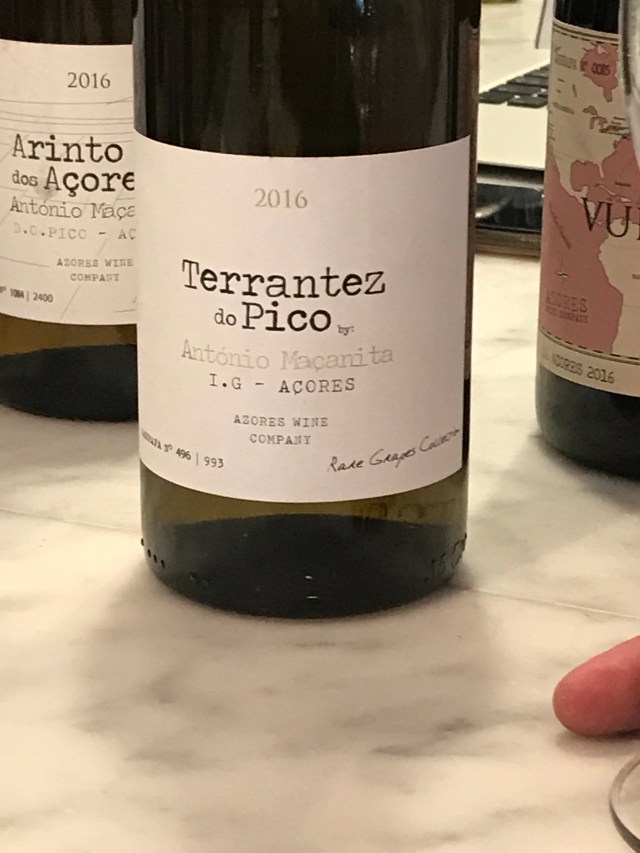
Terrantez do Pico 2016

As with Arinto, this is not the same grape variety as the Terrantez from Madeira. The nose here is immediately interesting, both herbal and mineral at first, and then as it broadens a gentle floral note comes through. Again, it is asking or indeed crying out, please, not to be served too cold, which would kill the subtlety.

Terrantez was almost extinct when it was revived from just 89 original plants by AWC. Now they have 3 hectares, propagated by massal selection, and they make between just 800 to 900 bottles. It is, thus far, the only Terrantez wine in the Azores.

2A76884F-D9EA-4C4E-9F05-063550D6DA85

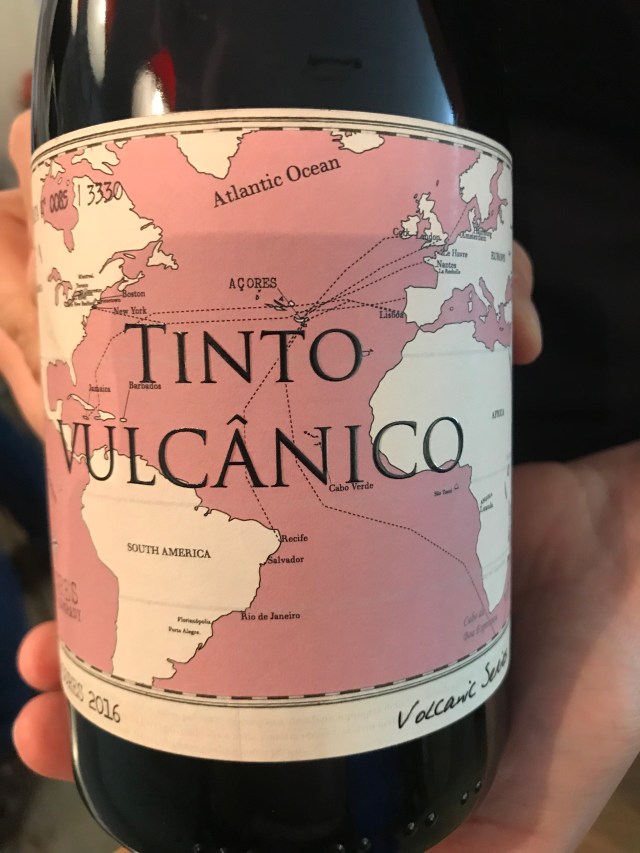
Tinto Vulcânico 2016 

This 11.5% abv red wine is a blend of many different local varieties. António and Paulo originally only planned to make white wine, but local growers would bring along their red grapes, and they decided to try out a red cuvée, almost as an afterthought. The blend changes every year, by its nature, and the grapes come from around thirty or so plots on the island.

The fruit in 2016 was destemmed and underwent a wild/natural fermentation, mainly in a single tank, with grapes arriving in small quantities at different times. It saw around twenty days in total on skins. The result is a simple wine in some respects, yet unquestionably one with character and personality.

The nose at first shows quite amazing fruit concentration, like that in just ripe blackcurrants, where the fruit is matched punch for punch by the acidity. But as the low alcohol suggests, this is by no means a big wine. There is some bitter extract which adds something over and above the fruit dimension, and the fruit flavours linger, carried on the back of the acidity. This wine is very appealing in what has become the traditional glouglou sense, among the seekers of adventure in wine. Nice, and explanatory, label too.

319BE3F7-DF8C-48D7-BF10-F03A38CF56E8

A Proibida [2013]

This final red wine has a bit of a chilling story. The grape variety here was thought to be Isabella, an American hybrid vine planted as a solution to that powdery mildew epidemic which devastated the original Azores vineyards in the mid-nineteenth century.

António found himself invited to a gathering of Azores wine people and an old farmer produced a jug of red wine. On tasting it, António thought wow! So he decided he had to make some. On placing the resulting wine on the market he was contacted by the authorities who pointed out that the Isabella variety is actually illegal within the EU, where American hybrid vines are banned. This is because, quite reasonably really, they don’t usually make wines of the same quality as vinifera varieties (although some hybrids are now making wine in the very north of America to challenge our preconceptions). He was told that if he did not remove the wine from the market he would face a fine and possibly prison.

António was forced to explain that Isabella was not in fact the varietal name, but the wine is named after Queen Isabella and made from a host of different, unknown, local grapes. It is now labelled with any mention of Isabella struck through, as if censored, and also stamped with the words “Autorizado com Cortes“, or “Authorized with Cuts”, which refers to the stamp used by the censors under Portugal’s Salazar dictatorship.

Why does this wine deserve our attention? Fine wine it certainly isn’t. Indeed, it more accurately represents the idea of a “tavern wine”. The first thing you would say is that this is a wine which speaks initially, and forcefully, through aroma. It has the so-called foxiness of a vitis labrusca hybrid, although perhaps not as strongly as some examples, and it also has a smoky note, which is not unpleasant. The palate is that perfect blend of high toned fruit and high acids (it is more acidic than any of the whites). If you don’t think it is possible somehow to combine notes of black olives and strawberries in a pleasant beverage, this is how to do it. Amazing!

I’m guessing that I’m not painting an immediately appealing picture, but unless your thing is high alcohol jammy Merlot, please persevere. António really hit the nail on the head when he called it a “twenty-second century wine”. If we want wine not to sip and admire, but to glug back as we might enjoy a beer, then this “tavern wine”, made with minimal intervention, is just the sort of thing we might want to try. If, like many people, you are re-evaluating what wine means to you, then this will not be your answer, but in appreciating something so different, it will help you on your journey. It paints a picture of what wine once was, and what, with a modern updating, it might be.

5C1DA560-AC16-420A-912B-EC0255FF779C

As an aside, Isabella (the hybrid, not the queen) is often preceded with something like the descriptor “notorious”. It is particularly despised in Europe, or at least was, because it is thought that it was on a batch Isabella vines that the phylloxera louse first came to Europe from America. Let’s not blame the vine for vastatrix.

Like the wines of the Azores as a whole, Proibida may not be the finest bottle you try this year. You may also think that the price is not inexpensive for what it is, and what it tries to be (the answer to which is that it doesn’t try to be anything). Yet with all of these wines, you are tasting a range of genuine character, where terroir expression is real, not just some marketing verbage. They are clearly and genuinely “volcanic wines”, created by a thoughtful and fully engaged, highly competent (and, I think, soulful) practitioner.

In fact I liked these wines ever since I first tasted them something like a year ago, but as so often happens when a small importer discovers a star producer, I liked them even more having met António Maçanita. After all, what we all crave today is not a repetition of some generic tasting note about blackcurrant, cigar boxes and vanilla oak, but a real story. The Azores comes up with a fine (and long) story, and the wines illustrate it perfectly. This is why they are important.

If you want to read more about the wines of the Azores, the best place to start is Volcanic Wines by John Szabo MS (£30, Published by Jacqui Small, an imprint of Aurum Press, 2016), a fascinating look at most of the wine world’s volcanic terroirs. If you can find a copy, Sarah Ahmed’s article in Decanter  (July 2017) is an excellent overview of what’s happening in the Azores today. Both cover other producers and wine styles on the islands, and Sarah’s article has some useful information for anyone intrepid enough to consider a visit (which does not sound as difficult as you might think).

The Azores Wine Company is imported into the UK by Red Squirrel Wines in London (call 020 3490 1201 or email hello@redsquirrelwine.com or visit their web site here). Quantities of these wines are fairly tiny.

D3F9EE4D-9217-42C6-8413-5E07AAAE69D8

Ten Green Bottles generously poured a few wines from “English Wine Week” for us to try. They have a nice selection of English wines on the shelves, and I must say the whole selection at TGB is looking very exciting at the moment. With more wines to come from Les Caves de Pyrene, now is a good time to make a visit to sunny Brighton. Don’t try to choose between Plateau and Ten Green Bottles, visit both.

Posted in Azores, Portuguese wine, UNESCO World Heritage Sites, Volcanic Wines, Wine, Wine Agencies, Wine Merchants, Wine Tastings | Tagged , , , , , , , , , , , , , , | 6 Comments

Modal Wines at Plateau – Nic Rizzi Talks Natural Wines and Terroir Wines

Last night, Nicolas Rizzi, founder of Modal Wines, undertook a tasting at Plateau in Brighton, introducing a few of the wines from his portfolio, and discussing how provenance affects the wine in the bottle. As well as importing a very exciting small range of wines, Nic is a very entertaining speaker, which led to a great evening of conversation, with an engaged audience, rather than just a lecture. These Plateau tastings are always really good (and amazing value at £20 with wines, water and nibbles included), and this was no exception.

04F718B1-342A-4629-AC88-AFC547277F77

Ania from Plateau and Nic from Modal, ready to roll

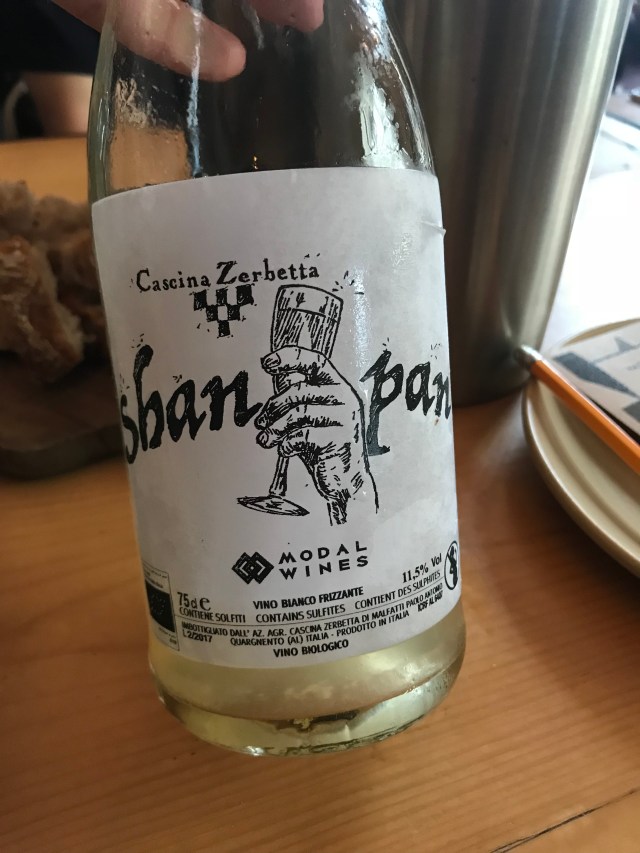
Shan Pan 2017, Cascina Zerbetta (Monferrato, Piemonte, Italy)

Shan Pan looks like a pétnat. In fact it looks like a Colfondo Prosecco. What it is could be described as unusual on two counts. The first is that this is made from Sauvignon Blanc, in a region where you would be more likely to find a string of other, local, white varieties, maybe Moscato, Arneis or Cortese. The second unusual fact about this wine lies in its production method, whereby late harvest grapes with high sugar content are added to create a second fermentation on lees, in bottle.

This is a natural wine with no added sulfites, bottled without filtration. The bottle therefore contains a lot of sediment. Some people prefer to allow these wines to stand for a day or so, enabling the yeast deposits to settle and the wine to be poured clear. Nic insists that you invert the bottle to mix up the contents, so that (rather like Orangina in the old days) the “bits” are distributed throughout the wine.

The result is a wine of texture, very cloudy, yet also showing purity. It has good acidity but is not too tart. The bubbles are very fine and intense. I jokingly described it as a breakfast wine. Only 11.5% abv means that is not completely fanciful. It is nice and dry, fun but not wholly frivilous.

22B72D7B-3CC2-4601-9A33-E52C93712B2A


Deviner 2015, Slobodne (Zemianske Sady, Carpathians, Slovakia)

Slobodne is an estate typical of the history of this region in Slovakia’s western hills, about an hour from Bratislava. During the Communist Era these vineyards were confiscated and put under state control. Their return to family ownership was the result of proof of ownership having been hidden away and fortuitously rediscovered on the fall of the Communist regime. The first vintage of the new era at this estate was only 2010, and immediately the family decided to go down a “natural wine” path.

Devin (note spelling) is a very special Slovakian grape variety. “Deviner” is a blend of Devin (whose parents are Traminer and Roter Veltliner) and pure Traminer. This is a skin contact wine, and in the 2015 vintage the blend is 50:50 of both varieties. Maceration time is actually six weeks, although the fruit is 100% destemmed, and yet the colour is more straw/pale gold than orange. The crazy aromatics, suggestive of sweet grapefruit with a touch of lime and peach, almost lead you to expect a sweet wine, yet it is bone dry.

At the London Wine Fair I tasted both the 2014 and 2015 vintages, the former containing 70% Traminer, and I said I preferred the 2015. Last night it was exceptional. This is a very fine estate in the making.


Primario 2016, Atelier Kramar (Goriska Brda, Slovenia)

We may require a quick geography lesson here. This estate lies near the western border of Slovenia, contiguous with the Italian region of Friuli. The political border splits what is really one geographical region, but the geology north to south is not identical. The Slovenian sub-regions run from Brda in the north, through the Vipava Valley, to Karso or Kras in the south (Carso in Italy). Brda doesn’t have quite the same chalky soils as Karso/Kras, but something called “Ponca“, Eocene sandstone marl with a high density of marine fossils.

The grape variety for this orange wine (and this one really is orange) is Rebula (aka Ribolla Gialla in Friuli). Said to have been brought to the region from Greece in the Thirteenth Century, it generally gives quite floral wines with good acidity. The soils of the region can perhaps be said to add a certain steely backbone to this wine, along with a noticeable touch of salinity.

It only sees three days on skins, but you can almost smell the texture. Fermented in stainless steel and then aged in large old slavonian (sic) oak, it remains an elegant wine, despite its structure. It has great length. Alcohol comes in at 13%. I think, personally, it would be a good choice to go with cheese.

This kind of wine for me is just so exciting, and indicative of how the whole of this region, both on the Italian and Slovenian sides of the border, is making distinctive wines of undoubted class. After all, we are not far from where Italy’s Josko Gravner made his famous u-turn and discovered Georgian qvevri, which arguably kickstarted the modern orange wine revolution less than twenty years ago.

The labels for Primario, and the rest of the range, are created by the couple who own Atelier Kramar, Katja and Matjaz (she a painter and he a sculptor, who met whilst creating art in Venice), so the labels express their art as well as their wine.

C8DAC9D2-9292-47E8-8288-1FC50C10A0C3


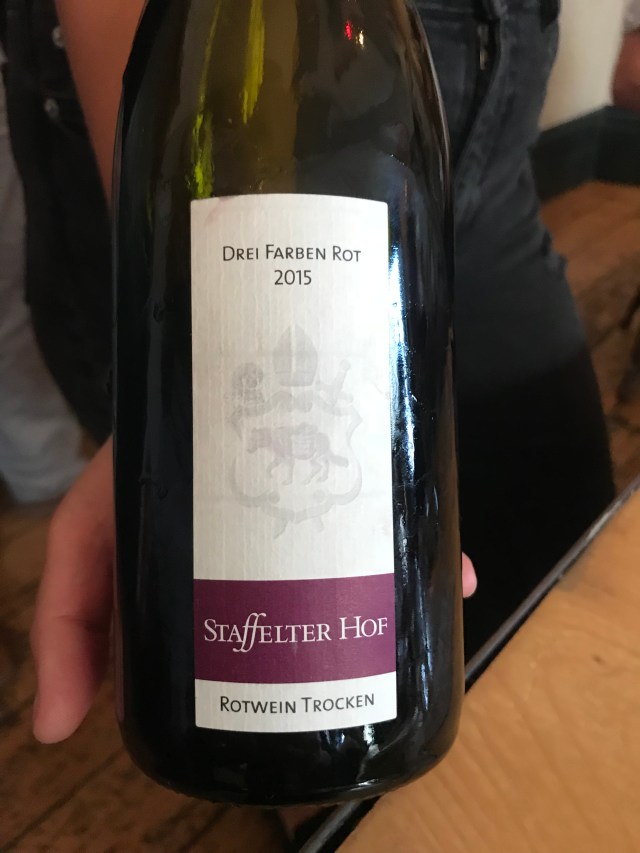
Drei Farben Rot 2015, Staffelter Hof (Mosel, Germany)

Staffelter Hof is in Kröv, on part of the famous stretch of the Mosel, between Erden and Taben-Trarbach. It’s a long established estate (with rooms to rent, it seems, though I’ve never stayed with them), founded in 1805 (purchased from Napoleon, no less, though I imagine he had come by it via means other than purchase).

Natural wine is not really so typical in the Mosel Region, so what happened? As is so often the case, the next generation simply wanted to move in a different direction. Taking over in 2005, the estate became organic in 2010 and experiments with minimal intervention wines have followed.

In such a classic region for traditional Riesling (which I must say I love, I’m not a fundamentalist over what I drink), it is not only unusual to see an established estate working naturally, but the region as a whole is also not so well known as a source of red wines in Germany (although there are some here). This was my first wine from this estate.

The three grape varieties in question (from the name) are Frühburgunder (50%), Spätburgunder (aka Pinot Noir, 40%) and Regent (10%). Regent can be found in the British Isles, as indeed can Frühburgunder, under the French version of its name, Pinot Précose. It is an earlier ripening, darker-skinned, mutation of Pinot Noir (as its name suggests, Spät…burgunder being the later ripening variety), and it is estimated that varying amounts of “Pinot Noir” in the UK could be Pinot (Noir) Précose.

All three grapes are picked and fermented separately for this cuvée, and the character of the Frühburgunder is said to add the nice touch of spice this wine has. If I say it is quite lean, that might give the idea I’m making a criticism. That could not be further from the case. Leanness here goes beside freshness, a nice edge and line of acidity, all underpinned with sappy, juicy, fruit. Perhaps I mean that it is quite taut. It’s a nice wine, and very clearly a natural wine without any signs of overt volatility. A very refreshing light-to-medium-bodied red for summer. Drink cool, perhaps, but not chilled.

DFA222A5-827A-4A45-B259-B85F9597EAFD


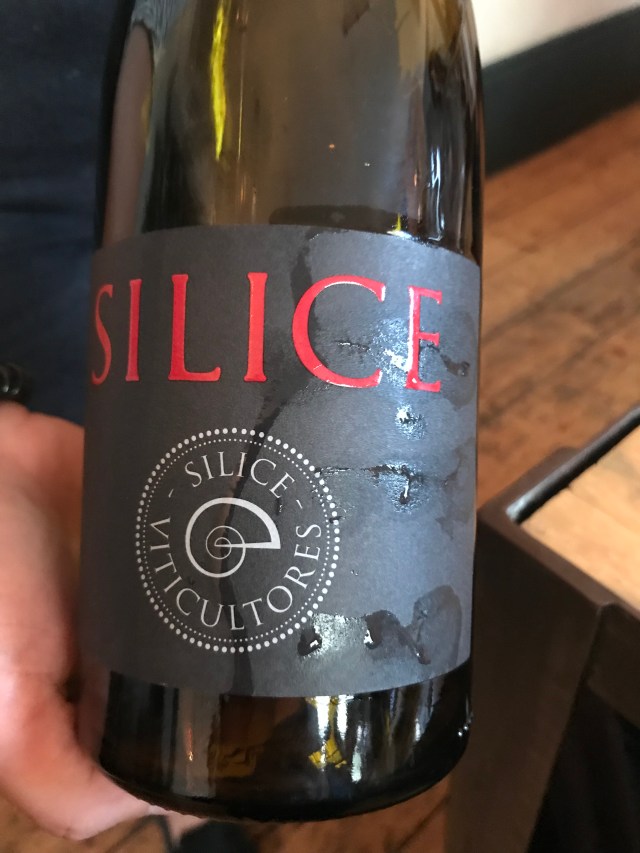
Silice 2016, Silice Viticultores (Ribera Sacra, Spain)

Ribera Sacra is the terrifyingly beautiful region of Galicia along the steep valleys of the Rivers Sil, Bibei and Miño in Northwestern Spain. It only became recognised as an appellation in 1996, but it is swiftly becoming fashionable, even more so in time than neighbouring Bierzo, perhaps. This wine exemplifies why.

Silice reminds me of the Mencia grape variety as it was when I first discovered it, fragrant, juicy, and not too heavy. Bierzo brought fame for Mencia, justly so as it is a lovely variety. But the big names in Bierzo seem to have increasingly opted for the oaked version of Mencia. In Silice, we have a wine of contrast.

Ribera Sacra is a land of small growers, many of whom have recovered once neglected vineyards of considerable age. But if you were to run your finger down a list of these producers, you’d be unlikely to recognise any without a degree of local expertise. Bierzo certainly has some (super)star names now. But if you were to select a trio of names who will become well known, it must be Fredi Torres, and Carlos and Juan Rodríguez (Rodríguez is a name which appears time and time again in this DO, and there are at least three other Rodríguez’s making very exciting wines here).

Silice is biodynamic, and made from around 80% Mencia, with 20% made up from several local varieties. The key is in vine age (sixty-to-eighty year old vines, with some up to 120 years old), and winemaking. Although winemaking is very much hands-off, the decision to harvest early when the skins are thinner, and to give the grapes a light extraction (no punchdowns, except by hand, gently, to keep the cap moist) gives us a wine which first of all strikes as so beautifully fragrant.

I said terrifyingly beautiful. The slopes here are ridiculously steep and high up, at altitude. The land can only be worked arduously, by hand. Few but the most dedicated will take these vineyards on, and these are generally people who would eschew synthetic sprays and winemaking additives anyway, but the truth is that few could actually afford them. We therefore benefit from wines of great purity in more than one sense of the word.

Mencia, handled like this, is capable of creating a bouquet of intense but almost ethereal violets with hints of rose petal. If you really get into it, it’s quite meditative. Add to that a low alcohol level of 12% and the fresh acids of grapes which have avoided excessive hang time, and the result feels like a long lost friend – Mencia as I first ever tasted it. I’ll be drinking more of this, for sure. Just a few quid over £20, almost a bargain.

8F9BB6F2-E829-42AF-9F1F-E062FC449B46


BFF 2015, Joiseph (Jois, Burgenland, Austria)

This estate, named partly after its location at the northern end of the Neusiedlersee, was created by Luka Zeichmann around two years ago. It is almost impossible to believe that this young twenty-six-year-old’s first vintage was at the age of twenty-four. This estate is relatively new to me, but I am keen to sample as much as possible of this young man’s wine.

Luka began with just one hectare of vines, from which he made five wines. He now, since 2017, thankfully, has managed to extend his holding to 3ha. But before things get better for those seeking his wines, they will get worse. The terrible frosts which hit Burgenland in 2016 reduced the whole production here to 660 bottles (in May 2016 there were six consecutive days when the temperature near Jois went below minus five Degrees Celsius, and almost no one with vines throughout the wider lakeside region avoided near devastation, as those of you who read my Gut Oggau Family Reunion piece last September will be aware.

I don’t know how this affected the morale of this unassuming, reluctant, star. His desire to keep things quiet even stretches to him professing a desire not to own a smartphone (although Nic has told him about how his bottles are all over Instagram, and I did notice he now appears to have a Facebook page).

What does BFF actually taste like, then? What makes it different and special? It is actually made from a slightly softer skinned clone of Blaufränkisch. It has deliciously tangy fruit, and is quite spicy, with classic black pepper notes. Some modern Blau can be over-oaked, over extracted and ponderous, not to mention in need of some tannin softening, via extra cellar time.

At just 12.5% alcohol (check out some of the more flashy examples around), this has great acidity and is relatively light on its feet by comparison. I am a firm supporter of this style of Blaufränkisch, not so much light as wonderfully balanced with a tension between sweet fruit and savoury spice.

Luka only exports to the UK and Sweden, so we are damned lucky to be able to grab some of these. Of course, you can travel to the usual natural wine bars in Vienna to seek out a bottle or two, or you can grab whatever you can from Modal. If you rock up in Jois, you may well be disappointed.

Just a note on the labels. The front label is always the same, simple and uncommunicative, at least in terms of text. The back label gives the explanation, and each cuvée has a colour-coded wax seal. BFF is bottled as a “Landwien”, a choice made by many of the local producers of natural wines, whose bottles are often quite different in style to those under the Burgenland DAC sub-regions.


I said I enjoyed the event, and I’m sure you can tell that I enjoyed the wines. I did put my money where my mouth is and order a few bottles, and I am back at Plateau for dinner on Saturday, when I am hoping to drink another Modal wine off the list. It was my second taste of a selection from Modal in as many weeks, as I had already tasted five out of these six wines at the London Wine Fair. I’m pleased that my favourable opinion was only reinforced at Plateau. 

Modal Wines is part of the Out the Box group of small, like minded, young importers and their next tasting event (for trade and press only) is at Shoreditch Town Hall on 25 September this year. Anyone entitled to go should try to make it. Along with Modal you can taste Red Squirrel, Basket Press, The Knotted Vine, Maltby & Greek, Uncharted Wines, Swig, and Nekter. That’s a lot of fantastic, innovative, unusual and downright shockingly good natural wine.

Posted in Artisan Wines, Natural Wine, Wine, Wine Agencies, Wine Bars, Wine Tastings | Tagged , , , , , , , , , , , , , , , , , , , , , , , , , | 4 Comments

London Wine Fair 2018 Part 2 – Drinks Britannia and the Trading Floor

In Part 1 of my review of the 2018 London Wine Fair I concentrated on the small importers in the Esoterica area, where you could find perhaps the real excitement of the event. If you haven’t already read Part 1, you can catch up here. Part 2 takes a look at what was happening on the large “trading floor” downstairs. One of the new additions this year was Drinks Britannia, devoted to a number of producers from the British Isles. This area proved a real success, I think, and is ripe for growth for the 2019 Fair. I will also briefly cover a few of the interesting wines I tasted from some of the larger importers down here. Then I’ll finish off with a few photos to give anyone who wasn’t there a flavour of the event…from the sublime to the (almost) ridiculous, as they say.

This large event, now in its fourth year at London Olympia, claims to present 14,000 wines from 40 countries. Despite a lot of concerns being expressed on the floor about how brexit will affect the drinks industry as a whole, the organisers reported 14,250 attendees over the three days, a massive 17% increase over 2017. Several new attractions certainly helped, including Wine Innovations (with some exciting new tech on show), some impressive Premium Masterclasses, and better communication via a dedicated Wine Fair App and a daily newspaper, plus the aforementioned Drinks Britannia (and the impressive Nyetimber drinks bus). On Tuesday 22nd there was also a Champagne Live event, which was open to consumers in the evening.

DRINKS BRITANNIA

The introduction to the Drinks Britannia area’s booklet claims, quite rightly, that “the country is undergoing a liquid revolution, delivering world-class sparkling wines, internationally acclaimed craft beers [and] outstanding gins”, to which I would also forcefully add, a resurgence of exciting craft ciders.

Just under twenty exhibitors packed this corner of the main Hall, and I am hopeful that the clear success of this small but beautiful new addition to the Fair will be further expanded next year. Those who did show ranged from the big boys (like Nyetimber) to the tiny (Starvecrow Cider, a current favourite, was there for the first time, and just on the Monday). It’s Starvecrow that I’ll begin with.

Starvecrow Cider

I discovered Starvecrow last year, after I met Ben Walgate, who I discovered I knew briefly many years ago. Regular readers will know about Ben, who has made a wonderful English petnat, PN17, from Dornfelder and a little Pinot Noir (distributed by Les Caves de Pyrene), and has the exciting prospect of some Ortega waiting in qvevri buried in his Peasmarsh Oasthouse in East Sussex, waiting to be bottled. His Tillingham Vineyard by coincidence is about to undergo some serious new planting next weekend, a future English wine star in the making, we hope.

Ben is helping to make a range of ciders under the Starvecrow label. These are truly artisan products, with production being a few thousand bottles of the two mainstays, and just a matter of a few hundred for the exciting new cider I shall mention in due course.

Of the three ciders (labelled “Cyder” here) on taste, the first is the gently effervescent Starvecrow Natural Cyder. Hand picked apples are pressed and fermented with native wild yeasts in old whisky casks. Unusually for cider, the varieties used are Golden Delicious, Jonagold and Braeburn, with Bramley adding bite and acidity.

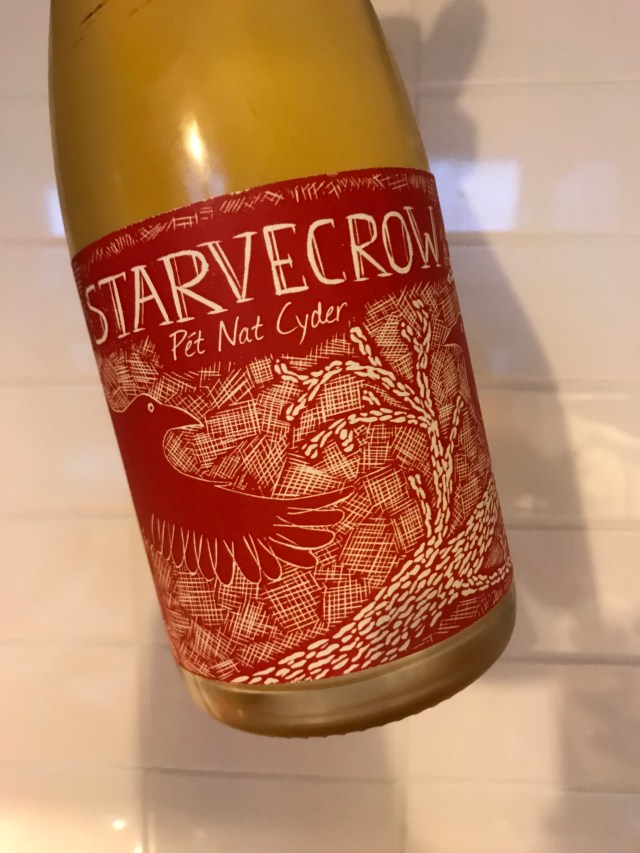
Much as I like the black label version, the red label Starvecrow Pét Nat Cyder is possibly even better. Its wild fermentation in bottle produces a cider with the real definition of a petnat wine, with great appley fruit. The bottles I’ve just finished all had a lovely crispness and acidity to them. Dry and brisk, and just 5.5% abv. The black Label comes in at 7%.

The new cider, so new that it doesn’t yet have a label (on the right, below), nor strictly a name, was made in one of Ben’s qvevri as a bit of an experiment. It has been bottled as a still cider (no bubbles) and has some of the texture and mouthfeel of an orange wine. It’s a truly innovative effort and I cannot wait to get some of it next month on release.


Nyetimber

Nyetimber keeps itself at the forefront of the English sparkling wine industry through very slick marketing, exemplified by the Nyetimber double-decker bus, which I must say makes an impressive bar space at festivals. All of that would mean very little, were it not for the fact that the wines are more impressive than ever.

Nyetimber has been perhaps the biggest name in English Sparkling Wine for nigh on twenty years, and has been around a decade longer than that, but their wines have not always impressed me as much as they do now, nor did in the early days. They claim “pursuit of perfection”, and under the ownership of Eric Heerema, this is no idle boast. All the wines come from estate grown Chardonnay, Pinot Noir and Meunier, and every parcel of grapes gets treated individually from picking to bottle.

There are five cuvées, of which “Classic Cuvée” sets the standard, and the Blanc de Blancs offers a more gastronomic option. I tasted the Rosé for the first time in a while. It’s a lovely “sunset pink” with strong hints of red fruits on nose and palate (on the palate it’s predominantly raspberries). The style is elegant, with a good backbone and definition. Certainly aperitif material, but also likely to pleasantly surprise anyone who pairs it with white meats, salmon or seafood

Believe it or not, I also had my first taste of Tillington 2013. This is their now famous single vineyard wine, the 2013 Vintage being launched at the Fair, which I only realised when I got to the front of the queue. It’s less easy to get hold of the technical details than from some producers, partly because of the noise around the bus (“busy” does not fully describe the crush), and partly because Nyetimber’s marketing materials are short on detail like grape varieties.

The 2013 is certainly dominated by Chardonnay, but whatever smaller proportion of Pinot Noir there is certainly makes its presence felt through beautiful, intense, summer fruits. You also get treated to soft brioche notes on the palate. It has genuine depth, more than the other cuvées, and real class. Lees ageing is around 37 months, followed by six months post-disgorgement ageing in bottle before release. At around £100 it isn’t cheap, and the price certainly acts as a marker for the industry. But it is a classy, very impressive wine. I’d be inclined to buy some, though it is a shame that unlike Comtes, and DP, I’m unlikely to find it in a supermarket “25% off six” offer.


Drinks Britannia had plenty more to offer, and I should mention a few other less impressively decked-out tables, which nevertheless had lots to offer in the taste department. Sparklers from BolneyExton Park, and Black Chalk Wines (the latter reviewed in Part 1) were all on the Wine GB tables (the new Association for the English and Welsh Wine Industry). There were more ciders, including those of Little Pomona Orchard & Cidery from Thornbury in Hertfordshire, and on a table of their own, Ambriel Sparkling Wines. Also at the event was the inimitable Julian Temperley and his Somerset Cider Brandy Company, whose range has now grown well beyond the cider I occasionally bought as a young man (with friends nearby), and his very fine Calvados replacement Cider Brandy.

There were also a few gin distillers (Manchester Gin and Pinkster, the latter made pink with raspberries from Cambridgeshire). There must be a real opportunity for the multitude of craft gins to market themselves at this event next year.

All of these are worth seeking out. I actually think Bolney Estate makes a range of still and sparkling wines which are very good value, and although not on show, their slightly crazy red fizz Cuvée Noir, based on Dornfelder, is something I always grab a couple of bottles of if I visit (also currently available in magnum, making a perfect barbecue option).


The vast “Trading Floor” at Olympia had stalls pushing everything under the sun, from countries like Uzbekistan to small wine merchants like Oakham’s Bat & Bottle. A lot of this wine might appeal more to those purchasing from the On-trade, or the supermarket, more than most readers of my blog (I saw some “Most Wanted” wines, see in photos below, in Sainsbury’s this week). But there were also some impressive wines to be found at some of the larger importers exhibiting here, nowhere more so than at Astrum Wines.

Here, I tasted a range of nice new wines from an estate called Tavignano, which specialises in Verdicchio, along with varietal white Pecorino, and reds from Rosso Piceno (Montepulciano/Sangiovese blend) and Lacrima di Morro D’Alba in the Marches. Particularly impressive was their Verdicchio dei Castelli di Jesi Superiore DOC “Villa Torre” 2017 with two months on lees, and the older Misco Riserva 2015 (Classico DOCG), aged in clay with twelve months on fine lees. Nicely textured and stony.

Next door, so to speak, Astrum was showing the wines of the Abbazia di Novacella (that’s Neustift if you are a local speaking the Austrian dialect). The wines in this part of the South Tyrol (close to Bolzano) claim a two-thousand year history, and the monks at Novacella/Neustift began their own viticulture in 1142. The two main ranges are the Classic Line (good wines for early drinking) and the Praepositus range. These latter wines are quite exceptional, especially the wines from less well regarded varieties such as Kerner and Sylvaner.

So Classic Kerner 2017 is fruity and clean, whilst Praepositus Kerner 2017 is much more stony/mineral, showing much more depth. Even Kerner here, grown at altitude (up to 900m) on poor soils with very small yields will age for ten years or more. Indeed the Praepositus wines rarely get the ageing they deserve. I would suggest that they merit the effort.

Praepositus Sylvaner 2017 is also very mineral, but with a touch more body than the Kerner. It still has the balancing acidity which will enable it to develop over time. Pinot Nero 2015 is a fruity, cherry-driven, wine with a touch of tannin. It comes from a late harvest in an already warm vintage, with low yields. It’s a little different.

Last, but not least, Moscato Rosa 2016 is a delight. Most wines in this style are generally bottled very sweet with low alcohol. This delightfully scented alternative has 12.5% abv and between 80-100g of residual sugar. It is deliciously sweet, but it is also textured, and much more substantial than the norm on the palate, without relinquishing the amazing floral bouquet which Pink Muscat grapes uniquely provide.


Astrum also imports the Austrian wines of, inter aliaJohanneshof Reinisch and Markus Huber, both of these estates being present to pour their own wines, which is always a treat. I drank the former’s Thermenregion Gumpoldskirchner Tradition a few weeks ago, a delicious blend including Rotgipfler and Zierfandler.

Also a “must try” from here are the rare Piemontese varieties from Montalbera, especially Grignolino and Ruché, if you’ve not already tried them. More perfect reds for summer drinking.


Seckfords is another stand which merited investigation, with one of Australia’s neglected Riesling producers on pour. Pikes (also with the Pike & Joyce label) were showing some of the best value Rieslings from South Australia. To be fair, Pikes is not only about Riesling, but with vines and a winery at Clare’s Polish Hill, that is obviously the first thing we come to think about.


A final mention goes to New Generation Wines, based in South London. They were showing the marvellous wines of one of my favourite South African producers, Boekenhoutskloof (Franschhoek). Their Syrah is world class, but the Semillon is also a classic not to be overlooked. Semillon 2015 was on show.

4D1DC6D8-D75D-485E-9611-C8C4697138BC

I hope that the photos below give a flavour of the wider event, as much as the text gives you some ideas of things to head out and discover. The event is both far more interesting, and also far more relevant, than the previous time I visited the London Wine Fair. I look forward to it being even better next year, and I’m positive that it will be, despite market concerns and uncertainty.


Posted in English Wine, Sparkling Wine, Wine, Wine Agencies, Wine Festivals, Wine Merchants | Tagged , , , , , , , , , , , , | 3 Comments

London Wine Fair 2018 Part 1 – Esoterica

It’s that time of year when the London Wine Fair comes to London’s Olympia. For anyone who has never been, it’s an enormous three day event, boasting 14,000 wines from 40 countries. The vast “trading floor” has many gems among the diaspora of larger producers, and I shall bring a flavour of those in Part 2, along with a look at the specialist section of the hall called “Drinks Britannia”. In this Part 1, I will concentrate on one of the areas in the upstairs gallery which I know will be of most interest to my readers, Esoterica.

As the special brochure for this area states, the UK remains “the most diverse wine market in the world…Esoterica offers a snapshot of [that] passion for diversity”. I could not have put it better. If you want to find bravery, passion for wine, excitement and almost a sense of pure altruism towards the wine loving customer seeking new experiences, then the sixty-plus small importers in the Esoterica area offer exactly that. I have chosen just short of a dozen to profile here and all of them are doing great things. Check them out. As there are so many wines, I’ve not written more than a thumbnail sketch of each one, but their selection is a signal of my approval, so to speak.

RED SQUIRREL WINE

The Red Squirrel portfolio was apparently described by The Wine Gang as “most imaginative”. I thought that it was me that said that…well, you get the drift. An innovative range is something all of the merchants here possess, but Red Squirrel have a real eye for both new regions and new producers from old ones. I had to select eight wines to taste at their double table, missing out on some of their well regarded producers like Bellwether, Martin Diwald and Dal Zotto. I think you’ll enjoy what I selected.

Black Chalk (Hampshire, UK)

I should perhaps have included these wines in Part 2 as winemaker Jacob Leadley was down in Drinks Britannia, but this is where I tasted them. It’s another new English sparkler, from Hattingley Valley’s winemaker. Brut 2015 is 50% Meunier plus equal proportions of Chardonnay and Pinot Noir with 17 months on lees and a hint of oak to round it out. Rosé 2015 has elegant and vibrant fruit and very good definition. Two very nice new English wines.

Champagne A Levasseur (Marne Valley, France)

David Levasseur makes out of the ordinary Champagnes from 4.2 hectares planted by his grandfather, Albert, in Cuchery and Châtillon-sur-Marne. As far as I’m aware he makes five terroir-distinct cuvées, and I tasted Noir de Terroir Extra Brut. It is labelled non-vintage, 100% Pinot Noir, but as with many Grower wines, it is actually fruit from a single vintage, in this case 2012. It has seen 42 months on lees and has real complexity, with hints of spice as well as apricot/stone fruit and red fruits. Very classy stuff, and quite a gastronomic wine, I’d say.

Pasaeli Wines (Turkey)

Sidalan is a rare variety, even in Turkey but it’s really interesting. Sidalan 2017 combines a soft bitterness here with a lick of refreshing acidity. This is a fascinating producer and this is something a little different. Red Squirrel imports several Pasaeli wines, some of Turkey’s most interesting.

Azores Wine Company (Azores, Portugal)

It is great credit to Red Squirrel that they have taken on importing wines from these volcanic, rocky, vineyards on the island of Pico in the Azores. Arinto dos Açores Sur Lie 2016, made by Antonio Maçanita, is as pure an expression of this rocky terroir, where vines are planted in the cracks in the rock, as you can get. Citrus, grapefruit, stony, and saline, fresh like the ocean winds that sweep the island and the waves that lash it. Not complex, not fruity, just purity in essence. An oddity for sure, but a heritage which needs to be preserved.

Kewin (Kéké) Descombes (Beaujolais, France)

Kéké is one of the region’s rising stars and I have to confess I bought a few bottles of his 2016 Morgon from Solent Cellar only a week or so ago. Cuvée Kéké 2017 is my first taste of his latest vintage. It is wilder than the Morgon, for sure, although it will only scare the more sensitive souls among us (I understand it might be more restrained than the ’16 version). Fruity but with a bit of substance, it’s on my list to buy. A new fave producer in the Beaujolais pantheon.

Black Elephant Vintners (Franschhoek, South Africa)

Someone sent Kevin Swart to the wrong region, but he ended up in Franschhoek rather than Swartland for a reason. This often forgotten region produces fruit capable of showing the more aromatic side of South African wine, and these are seriously different to what some have decided is the norm for other regions (like Swartland).

Kevin is passionate about music (as you will see in the photos, where you’ll also recognise his sense of humour). Five wines were on show, but I’m just going to highlight two blends. Timothy White 2016 and Nicholas Red 2015 both reflect the personalities of Kevin’s children (see labels, one a sporty early riser and one who is more laid back and chilled).

The white blends old vine Chenin, Sauvignon, Semillon and Viognier into a wine which has 13% abv, yet is fresh and elegant. The red, 45% Syrah plus Carignan, Mourvèdre and Petite Sirah (sic) jumps to 14%, but isn’t heavy. An “easy” wine, but it retains that amazing freshness. Definitely pleased I tried this range and got to meet Kevin, a top bloke.

MODAL WINES

Modal is run by Nicolas Rizzi out of North London. I first met him at the Out of the Box Tasting, which serves a likeminded group of importers of low intervention wines. The small range is nevertheless broad, and includes wines from Slovenia and Slovakia, some of which I tried.

Cascina Zerbette (Monferrato Hills, Piemonte, Italy)

Sauvignon Blanc from the Monferrato? This Shan Pan 2017 is seriously tasty. It’s not really a normal petnat, the second fermentation having been started by the addition of late harvest must. The nose seemed a little neutral but the palate made up for it. Fresh, as these sparklers should be, and with nice definition. Steely fizz with bags of flavour.

Atelier Kramar (Gorizka Brda, Slovenia)

Primario 2016 is Rebula with three days on skins before ageing in old oak for six months. A golden wine with massive flavours and a tiny bit of grounding texture. Bohem 2015 is a blend of Tocai Friulano with Malvasia. Here there is 30 days skin contact then six months in barrel. Golden once more, this is also fresh and sappy. Both are very good.

Slobodne (Zemianske Sady, Lesser Carpathians, Slovakia)

Devin is a variety I’ve tried before via Basket Press Wines. It’s a cross between Roter Traminer and Grüner Veltliner. Slobodne’s Deviner 2014 blends this local variety with 70% Gewurztraminer, fermented in stainless steel and aged in two-year oak. Very nice, but I liked Deviner 2015 even more. This has 50% of each variety blended together with six weeks on skins. Just smell it!

Silice Viticultores (Galicia, Spain)

Silice 2016 is a Mencia as we remember them, before the producers went down the “oak” route. Lighter than many, and aromatic, a style I believe that the variety best expresses itself through. Good value if you can find it for £20 or so on the shelf.

Joiseph (Burgenland, Austria)

Among the many Burgenland producers I taste, I rarely come across these wines, but on trying BFF 2015 I should look harder. They are made by a 24-year-old guy who doesn’t own a smart phone and concentrates on making natural wines from a tiny plot near Jois, at the northern end of the Neusiedlersee. Vibrant colour, quite a bit of fruit concentration plus structure without any hard edges.

If you want to catch Nicolas Rizzi and his Modal Wines portfolio, then head down to Brighton’s amazing natural wine bar and restaurant, Plateau, on 30 May (6.30pm, but do book tickets).

BASKET PRESS WINES

Regular readers will know Jiri’s wines by now, at least from my descriptions, but here we have a selection of new additions and wines I’ve never tasted.

Dobra Vinice (Jizní, Moravia, Czech Rep)

Crème de Vin is a pale gold and very fruity petnat from the town of Znojmo. Fourteen months on lees gives it just a little body but it’s basically a fun wine, made principally of a blend including Pinot Noir and Riesling. I’ve enjoyed this producer’s Kambrium white blend before.

Domaine M (Czech Republic)

Cuvée Weinperky 2015 is a smart blend of Grüner Veltliner, Grüner Sylvaner and Rotgipfler made half in old oak and half in a small (250 litre) concrete egg, which has mellowed with a touch of age. Expect a little texture from the skin maceration, but also a really interesting savoury flavour.

Zdenek Vykoukal (Czech Republic)

Veltlinské Zelené 2014 is from a tiny 1.5 hectare plot just outside Brno, right on the edge of the Austerlitz battlefield. You get bags of fruit here and a bit less of the pepper. Austria’s neighbours, Hungary and Czech Moravia, are starting to show that Grüner is not just at home in one country.

Petr Kočarík (Moravia, Czech Rep)

Kočarik Pinot Noir 2016 is from another tiny holding of 2 hectares, from another producer new this year to Basket Press. Lightish in colour but also quite smooth, with just a pleasant grainy touch. It actually reminded me immediately of a good Alsace Pinot Noir from a warm year, which from me should be taken as praise.

Dva Duby (Czech Republic)

Impera 2015 is another smartly packaged new wine, which arrived just a month ago. The blend here is more typical of Austria, being Blaufränkisch and St-Laurent, the latter making up 70% of the blend. It’s pale and smokey with lots of fruit on the nose, really lovely, pretty.

There were lots of wines I’d already tried and written about, reminding me just how good I think this range from (mainly) Czech Moravia and Slovakia really is. I hope they gain a wider appreciation in 2018. Especially as they are nice people here too.

THE KNOTTED VINE

David Knott is another member of the Out of the Box group, with a small list of minimal intervention producers.

Noelia Ricci (Emilia-Romagna)

Bro Forli 2017 is 100% Trebbiano, but the Emilia clone, different I’m assured to “Toscana”. This doesn’t taste like the dull stereotype of the Tuscan variety, not remotely. For starters it’s very fresh, with decent acidity. It also has a nice salinity. Godenza 2015 is Sangiovese with lifted fruit. It seems to combine texture and smoothness at the same time, somehow. It’s quite a big wine at 13.7% abv, but it’s also very juicy so can take it.

Koerner (Barossa Valley, South Australia)

Pigato Vermentino 2017 is how this is listed. It comes from the south end of the Clare Valley, and is suitably nice and tightly wound. It sees ten months in what I believe is a ceramic egg after a three week maceration in open top fermenters. It’s richer than most Ligurian versions, but still fresh, and leaner than many Aussie whites. I do like this producer.

David Franz (Barossa, South Australia)

You may recall that David Franz is Barossa royalty, being the youngest son of Peter Lehmann. Long Gully Ancient Vine Semillon 2015 actually comes from the Barossa Hills rather than the Valley, and when they say ancient vines they are not lying. They are 130 years old. This is probably why this is so concentrated and poweful, yet loses neither fruit nor zing. This is Aussie Sem’ as we like it.

La Violetta (Great Southern Region, Western Australia)

I was persuaded to try this Up! 2014 and I’m glad I did. It’s a good old sweet fruited, savoury, Syrah but as with many wines from this region, it’s not over the top.

MALTBY & GREEK

Maltby & Greek is one of three specialist importers of Greek wines I shall cover here. They work out of the Apollo Business Park down behind London Bridge Station, around where you can find several other wine businesses (Dynamic, Gergovie, to mention just two). They actually claim to represent all the country’s main regions and grape varieties, and their range is unmatched. Add to this, the fact that there is a building impetus and buzz around Greek wines this year, and they are an importer on the up.

Domaine de Kalathas (Tinos, Greece)

There is no question about it, Kalathas is one of my favourite half-dozen Greek estates. They are based on the beautiful island of Tinos, which lies between Andros and Mikonos, to the southeast of Athens. Obéissance 2016 is an unusual blend of Aspro and Potamisi-Rozaki, which are usually considered table grapes. It’s a foot-trodden natural wine with 14% alcohol, and after the malo 20% of Rozaki, fermented later, was blended in. There is 8g/l of residual sugar, and the low acidity and high alcohol make it taste a touch off-dry. But it also has a sea-salt salinity which makes it a singular wine, even for £40-a-bottle.

Rouvalis Winery (Peloponnese, Greece)

Tsigelo 2017 is actually a varietal Mavrodaphne, but this grape is AOP for sweet wine (from Patras) and as this is dry, it can’t include the grape name on the label. That said, Tsigelo is actually the name of the best clone of Mavrodaphne. Antonio and Theodora have made a fantastic wine here, one of several favourites of the day. It’s part made in amphora (30% in 2017, next year they plan 50% as they were very happy with the amphora batch). It’s just a lovely blend of quite concentrated fruits and balanced with a bit of texture.

Alpha Estate (Greece)

Alpha Estate makes wines all over Greece, and can claim to be one of the country’s most famous quality producers. Two wines were on show, Xinomavro Rosé 2016 and Hedgehog 2013, the latter a Xinomavro with some age from the Amyndeon PDO. Maltby & Greek stock a wide range from Alpha Estate and with just the odd exception, they all retail around the £20 mark, and as such, provide a really good ratio of quality and price.

Nopera Winery (Samos, Greece)

Hardly new to me, but I couldn’t pass up the opportunity to sip Nopera Sweet Muscat of Samos again. I didn’t catch the vintage as this was off-list, but last time I drank a 2013. It’s made from sun-dried Muscat grapes which reach 13.5% alcohol, but the wine still retains plenty of residual sugar, and indeed doesn’t lack acidity either. Nineteen months in French oak rounds it out. Honey and Bergamot spice notes dominate a rich palate of unctuous sweetness. More classy than most Samos Muscat I’ve tried.

INDIGO WINE

I chose seven wines from Indigo, most being new vintages of wines I’ve tried before, with a couple of newcomers thrown in. The Indigo portfolio is as diverse as any I know, and, if you read my recent article, packed with vegan wines as well. But whether you are bothered about what’s in your wine or not, this is one of a handful of the best lists in London.

Bengoetxe (Basque Country, Spain)

Indigo’s Spanish offering might be their strongest suit, and they have included a Txacoli that is a bit more classy and dare I say, serious, than many around. Txacoli 2017 from Bengoetxe isn’t one of the more frivolous versions, and I can’t really see it being poured from a great height into a tumbler, so much as more gently, into a Zalto Universal. But saying that it does have that appley freshness you expect from the genre in a blend of Hondarrabi Zuri and Gros Manseng. It’s just more nicely rounded and less angular than the norm, which for many, buying this to drink in the UK rather than in a San Seb’ bar, is a plus.

Bodegas Ponce (Castile-La Mancha, Spain)

Ponce is one of the names of the moment in Spanish wine. Juan-Antonio Ponce is now in his mid-thirties and has been making biodynamic wines in this unfashionable part of Spain since 2005. Reto 2016 comes from Manchuela and is fresh and lovely, and a perfect intro to Juan-Antonio’s wines. It’s made from Albilla grapes from vines planted in the 1960s on chalky soil. Ageing is eight months in large, 600 litre, old oak. Really lovely, and a name to actively seek out.

Weingut Georg Breuer (Rudesheim, Rheingau, Gernmany)

One of my favourite German domaines, Jo from Indigo confided that Theresa Breuer’s Rauenthal Nonnenberg Riesling GG is one of her favourite German wines. She has good taste!. But as entry level wines go, Rudesheim Riesling 2016, the “village wine”, is a pretty good introduction to the wines of one of the most passionate winemakers I know. It has breadth and also definition, a classic Rhein wein, yet with its own personality. And for around £20-a-bottle.

Bio Weingut Birgit Braunstein (Burgenland, Austria)

Like her friend Heidi Schroeck in Rust, Birgit makes often under-appreciated biodynamic wines on the western side of the Neusiedlersee (Birgit is a little further north than Heidi). She makes a range of some breadth, including wines in amphora buried in her garden, but the new vintage of Rosé, 2016, is just gorgeously fruity. I can recall with clarity the first time I realised that Zweigelt makes really good rosé. This has some Blaufränkisch blended in as well, and should be in everyone’s garden this summer.

Delinquente Wine Company (Riverland, Australia)

Most people dismiss Riverland fruit, but I had a chat with Brad Hickey (of Brash Higgins) about it a while ago and was put right. There’s plenty of decent stuff growing there, it’s just about control, and using it right. In the case of Roxanne the Razor 2017 it’s Nero d’Avola with 25% Montepulciano giving lots of fruit and a little texture to make a simple, juicy, inexpensive, glugger made in stainless steel. And let’s face it, it has a great label.

Antoine Sunier (Beaujolais, France)

Morgon 2016…freshness, yes! Beaujolais 2016 is delivering. Antoine shows that 2016 Morgons are quite different to the 2015s from this Cru, although to be fair, I thought Antoine, and Julien, Sunier made some of the best wines from that hot vintage.

Fossil Valle de Capucha (Lisbon, Portugal)

The Fossil name comes from the terroir in the Torres Vedras appellation near Lisbon, where the soils are limestone and Kimmeridgian clay rich in marine deposits (not dissimilar to Chablis), and the heat you might expect here is tempered by breezes off the Atlantic.

I’ve met Pedro Marques a couple of times and he always seems somewhat taciturn, but his wines are nice. I worry in the past that his lack of warmth has led me to under-praise his wines, so I thought I’d put that right. He makes a very good Branco, but Indigo had the red Fossil Valle de Capucha 2015 on taste yesterday. The blend comprises 60% Touriga Nacional with 30% Tinta Roriz and 10% Syrah. Fermentation is in concrete and ageing in old oak. Smokey and mineral, it’s a very nice lighter to medium-bodied red for cold meats etc.

H2VIN

Champagne Dehours (Champagne, France)

I’m sorry to say that I only tasted two wines here, towards the end of the day. Both are excellent Champagnes, though. Champagne Dehours Extra Brut Rosé “Cuvée Oeil de Perdrix” NV (disgorged July 2017) has the faintest hint of partridge eye colour to it. Zero dosage with extended lees ageing, Pinot Meunier dominates a blend (with Chardonnay) which has bright red fruits and, as Peter Liem says about all Jérome Dehours’ wines, clarity and expression. I would add elegance and presence.

I’ve never tried this Dehours cuvée before, nor seen it on their web site, but here we have it, at H2Vin. The fruit is from the Marne Valley around the village of Cerseuil. It’s a lovely wine, and perhaps not as difficult to find as his single vineyard bottlings. Again I will quote Peter Liem: ” If you do [find them], you should buy them without hesitation”.

Larmandier-Bernier (Champagne, France)

Larmandier-Bernier Non-Dosé 1er Cru Blanc de Blancs “Terre de Vertus” is the first Champagne from this house I ever bought, many years ago now. It was in fact part of my introduction, along with Pierre Péters and Egly-Ouriet, into the world of Grower Champagne. Most of their vines are in the northern half of the Cote des Blancs, but this singular cuvée comes from just north of the small town of Vertus at the southern end of the Cote. It’s very pure-flavoured Chardonnay grown on chalk with little topsoil, and yet again, it is a wine of real presence (in fact, more so than the Dehours above). A true classic of the region.

SOUTHERN WINE ROADS

This importer of organic Greek wines is based in Orpington, Kent. They didn’t have a list of the wines on taste, just a blank page in the brochure, so I had to taste the wines that a young assistant suggested whilst her boss was busy at the other end of the table.

I tried two wines from Glinavos EstateLefteris Brut 2012 is from Epirus, bottle fermented, made from the Debina of Zitska grape variety. It is quite broad, frothy, with apple and pear plus a bit of creaminess (18 months on lees). I think it’s good value at £22.50. Glinavos Traminer 2014 is an off-dry Gewurztraminer, 12% abv (50cl) also from Epirus. Aromatic with ginger, orange and pineapple, this was interesting, and nicely packaged.

I won’t argue these were my favourite Greek wines of the day, but they were interesting enough to make me think Southern Wine Roads has a good portfolio, which circumstances on the table towards the end of the afternoon (it didn’t help that I had to find a clean glass) meant I didn’t get to sample in greater depth.

ALPINE WINES

Alpine Wines has long since expanded its range of wines from just Switzerland, but they must be the first stop when looking for Swiss wines in the UK. And it would be true to say that if you are never looking for Swiss wines, then you are missing out. What puts people off Swiss wines is that they are never cheap, but I suggest you blame our economy and currency rather than the Swiss producers, who are not only notoriously generous, but equally, are rarely as rich as the Burgundians and Bordelais…because vine holdings in Switzerland are often tiny.

I sampled five Swiss wines and a couple of Austrian wines here. We’ll go first with the Swiss.

Domaine de Montmollin (Auvernier, Neuchâtel, Switzerland)

If Swiss wines are rare, it is even rarer to see wines from this northern Canton. Oeil de Perdrix 2016 is now seen as the classic regional style, so much so that producers elsewhere in Switzerland can no longer label their ultra-pale pinks “Oeil de Perdrix”, to the annoyance of many. Nowadays, £16-£17 for a rosé doesn’t actually seem too bad, does it? This is scented, light, Pinot Noir from free-run juice.

Very nice, but it was nevertheless surpassed by another wine from the domaine, Auvernier Non-Filtré 2017. This is 100% Chasselas. Now we’ve begun to see very classy Chasselas from Dominique Lucas on the French side of Lac Léman, and a few readers will know how good some of the wines from Lavaux’s steep terraces can be. This Neuchâtel version is stunningly good, for one of Europe’s most maligned varieties. Packed with flavour, it has a slight prickle on the tongue and finishes with a slight herby bitterness which adds a savoury quality. Ben at Alpine says this is the wine that turned him on to the variety. Again, at just under £20, who says Swiss wines are really expensive. I think everyone else just caught up.

Domaine Jean-René Germanier (Valais, Switzerland)

This winery in another of Switzerland’s most beautiful wine regions is now run by Jean-René and his nephew, Gilles Besse. It is among the region’s most highly regarded producers, making the whole range of the valley’s signature wines, from Dole to Cornalin.

The two wines tasted yesterday were Petite Arvine 2016 and Cayas Syrah Barrique 2015, both of which I’ve bought in Switzerland. Both are expensive, the Syrah around £60 now, and the Petite Arvine over £30, so it was nice to have a taste. The Petite Arvine is one of the best examples you’ll find available in commercial quantities of what is my favourite Valais white variety. Simply delicious, citrus and saline, with a creamy edge from partial malo.

I don’t normally go for Syrah soaked in oak, but there are one or two Valais versions I’m quite taken with. The oak sweetens the fruit here, and adds a touch of class. But I’m going to recommend the white, not least because it is a wonderful indigenous variety which deserves wider acclaim.

Cave La Cote (Vaud, Switzerland)

This is a large co-operative from the stretch of Lake Geneva’s northern shore between Geneva and Lausanne. Doral “Expression” 2016 is a varietal-named wine from a 1970 cross between Chasselas and Chardonnay, and oddly it almost tastes a little like a blend between the two. In fact, just a bit like Chardonnay with an unusual amount of acidity. It’s simple, but not lean. It’s just another example of the interesting stuff going on in Switzerland, even at a relatively commercial level. In creating a Chasselas with Chardonnay-like aromatics, it is quite successful. I wish it was closer to £15 than £20, but there you go.

Anton and Elfriede Waldschütz (Sachsendorf, Wagram, Austria)

This couple make reasonably inexpensive classic wines from Wagram and Kamptal fruit. Their son, Ralph, is slowly taking over and the wines are very good value. Riesling Classic 2017 has fruit and a mineral finish. Alpine describe it as “a lesson in crisp Riesling”. Here we are looking at just under £15, but the Reserve version is only £18. Sadly there was none of the Frühroter Veltliner which Alpine stock on taste. I must remember that one!

Stift Klosterneuberg (Vienna, Austria)

If you wander up above the vines of Vienna’s Nußberg and look north, away from the city, the large abbey that dominates the skyline is this one. There are a host of fine winemaking abbeys in Austria but these guys have been doing it longer than most. “Winemaking for 900 years”, they claim. The town of Klosterneuberg is also home to the Austrian Federal College of Viticulture, and the abbey wines are well respected.

All the white grapes here are grown in the vicinity of the abbey itself, but their red grapes are grown at Tattendorf, in Thermenregion. You won’t get bags of complexity for your twenty quid with the Raeflerjoch Pinot Noir 2011, but you do get a smooth, super-fruity Pinot with a bit of bottle age. This is another Austrian producer with a good selection of the less often seen grape varieties. Ripe for plunder.

266 WINES

Totally new to me, 266 grew out of The Sampler’s increased activities in importing their own wines. They aim to specialise in France, with depth in Champagne, along with some “pioneering” Californian, German and Spanish wineries.

Charles Dufour (Champagne, France)

Dufour established his domaine with around 6 hectares at Landreville in the Aube when his father died and the original family domaine was split amongst the wider family. He also has vines at Celles-sur-Ource and Essoyes. Bulles de Comptoir #6 “La Benjamine” (each numbered edition is given a name) is the non-vintage mainstay of Charles’ production.

It has at least a third Pinot Blanc, along with Pinot Meunier and Chardonnay, which makes it fairly unusual. Perhaps this is why it has quite forward fruit, and is probably not a wine for cellaring, yet it tastes just brilliant. A singular example of new directions in the region, combining sheer drinkability with high quality. Michiel Demarey at Champagnist.com calls Dufour “the Selosse of the Aube”, but don’t take that to imply an overtly oxidative style. At around £40 it’s silly not to, as they say, though sometimes I wish I kept my mouth shut.

Domaine des Enfants (Rousillon, France)

This Maury-based estate owns 23 hectares, which are all worked by horse and hand. Tabla Rasa 2016 blends four local varieties, Grenaches Blanc and Gris, Macabeo and Carignan Blanc, with tiny yields averaging just 9 hl/ha. The varieties are fermented and aged in wood of varying sizes for 12 months to produce a rich and complex white to rival the more trendy South Africans.

France Gonzalvez (Beaujolais, France)

France makes delicious Bojo, and I will admit that I’ve not bought any for a while. Cote de Brouilly 2016 has the indicative freshness of the vintage, well, compared to 2015. It is unusual in that France Gonzalves often gets along badly with the authorities and has to label much of her production as “Vin de France”, which with a name like her’s is no hardship. Maybe that’s why the moustachioed men in suits and berets relented here. Whatever the reason, its a delicious wine. Made in innox, with less carbonic maceration than usual, so giving a bit of structure, and no added sulphur. Simple.

Binet Jacquet (Faugères, France)

This domaine was founded in 1999, with vines on the schistous part of the appellation, with very thin topsoils. Faugères Réserve 2015 is a very impressive biodynamic wine, a mix of 60% Carignan with 30% Mourvèdre, along with a little Syrah and Grenache. The grapes are fermented gently in different types of vessel, including old oak, concrete tank and egg. It is deliciously fruity for a Languedoc red, but it also has that texture and slight smokiness you can get in wines off slate, which also gives a certain steeliness in the core of the wine.

ECLECTIC WINES

This is another importer of exciting Greek wines, giving adventurous wine explorers no excuse not to start discovering the wines of this mysterious Mediterranean country. Although Maltby & Greek claim they have the best Greek list in the UK, the Eclectic Wines portfolio does have a host of top names, Hatzidakis and Thymiopoulos to name two.

Domaine Hatzidakis (Santorini etc, Greece)

Although Hatzidakis is primarily known for its brilliant range of Santorini Assyrtiko, it makes equally exciting wines in other Greek regions. However, the red wine, Mavrotragano 2014, comes from Santorini itself, although the grapes also include bought-in fruit as this variety is so rare on the island. The grapes see a seven day extraction, 18 months in oak and then six months in stainless steel. The 2014 was actually released after the 2015 as it was felt it needed longer. It has smoky dark fruit and chocolate/coffee notes, and currently has some ripe tannic structure. I would guess it is serious enough to age for a decade, but will drink sooner with decanting.

Thymiopoulos Vineyards (Trilofos, Naoussa, Greece)

One of the most interesting estates in Greece because they make some wines of real quality along with what is arguably the best value Greek wine in the UK.

Thymiopoulos ATMA White 2017 comes from Macedonian fruit, a blend between Xinomavro (as a blanc de noirs) and Malagousia. It has stone fruit flavours and is simple but very refreshing.

Jeunes Vignes 2016 is a Naoussa red from pure Xinomavro, and it is that great value wine I mentioned above. Simple, sappy and juicy fruit with a smooth but mildly structured finish. It’s just £12 to £13 a bottle, and along with a handful of similarly priced Austrians, it makes the perfect wine to take to dinner or lunch with not especially wine obsessed friends. Something different that won’t frighten anyone.

Domaine Skouros (Nemea, Peloponnese, Greece)

The signature grape of Nemea is Agiorgitiko, otherwise translated as Saint-George, and that is how this wine is labelled, Nemea St-George 2014. I think Nemea has always been my favourite red wine region in Greece, perhaps as it’s one of the few I’ve visited. The wines are often not very complex, but this, like the best, has a bit of body and spice. It’s basically a tasty fresh red wine.

Semeli (Nemea, Peloponnese, Greece)

The second Agiorgitiko here is Semeli Nemea Reserve 2012. It’s a bit more serious, having 18 months in French oak followed by 30 months ageing in bottle before release. Although it is fairly tannic, the bottle age has added some complexity already. I’d still age it further, though. An impressive red.

Tetramythos (Peloponnese, Greece)

Eclectic Wines do sell an Agiorgitiko from Tetramythos, but I finished here with a rather special version of that bane of many a teenager’s stomach, Retsina.

Actually, I drank some Ouzo with Greek friends last weekend, but I didn’t drink a whole bottle, and it was well chilled with ice. The same friends gave me a really nice Mastic liqueur once too. Maybe as you get older you can appreciate these drinks more, without excess.

Tetramythos Retsina Nature 2017 is a wholly different beast. For a start, it is totally an artisan product. Roditis grapes grown at 800 metres altitude are hand harvested and fermented in clay amphora. The pine resin is collected by hand from the pine forest which surrounds the vineyard. There is no sulphur added to the wine at any stage. The resinous notes just don’t dominate the bouquet as they usually do. The wine is textured and quite soft. It hardly seems like Retsina, but as you savour it, the resin begins to come through…just a little. Remarkable.

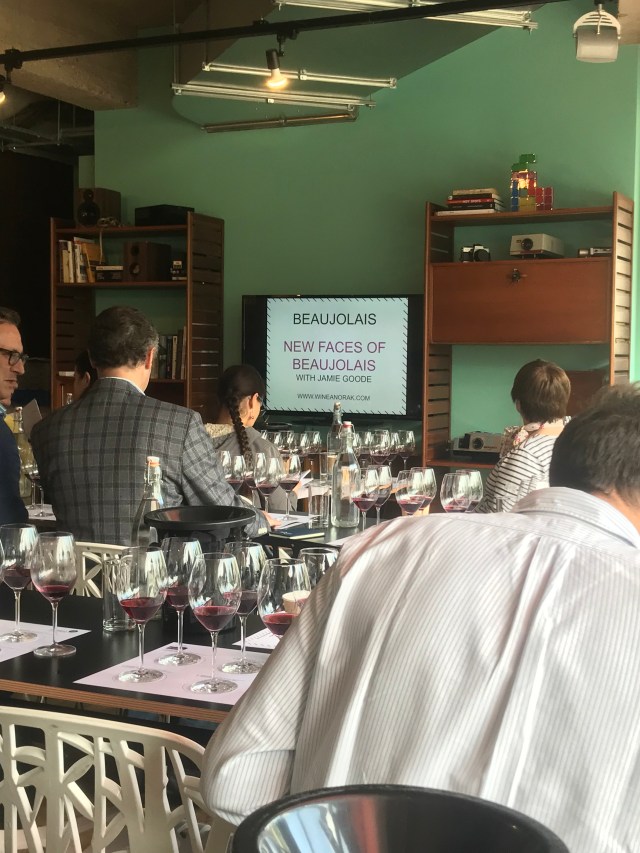
Posted in Artisan Wines, Czech Wine, Natural Wine, Swiss Wine, Wine, Wine Agencies, Wine Festivals, Wine Merchants, Wine Tastings | Tagged , , , , , , , , , , , , , , | 4 Comments

Canada House

Canada House, not a dance music sub-genre, although a few readers might not be too surprised if I went off on a different subject, but the venue yesterday for the Taste Canada 2018 event, organised wonderfully well by Westbury Communications. It featured thirty-seven producers from British Columbia, Ontario, Nova Scotia and (one from) Québec. It was the largest Tasting of Canadian wines I’ve been to so far, and the quality on show was exciting.

I would guess that most of us don’t know a lot about Canada. We think of it as an enormous country, northern in climate, nice people but perhaps not really all that well known for wine? This isn’t quite true on two counts.

Canada may be “up north somewhere”, but the wine growing regions lie between 41 degrees and 51 degrees latitude. That’s not too different from Morocco to Kent and Sussex. Of course, that means relatively little. The climate is very different, with different climatic influences, but even so, there are parts of the Canadian vignoble, specifically Niagara, which even lie further south than parts of the USA.

Readers old enough to remember the 1990s will have experienced the first wave of Canadian wines to hit our shores in the UK. Icewine, mostly coming from Southern Ontario’s Niagara Peninsula, and principally made from the French hybrid vine, Vidal (as well as some fine Riesling), had an impact based on its sweet concentration and tingling acidity.

Now there is another major player in Canadian wine, British Columbia’s Okanagan Valley, east of Vancouver. Here, it is mainly European vinifera vines which dominate production, of which the most successful seem so far to be the Burgundian and Bordeaux varieties (though I’m making a pitch for Riesling too). Okanagan has some very special and specific conditions which, as we shall see, make this long valley ripe to become, potentially, one of the world’s sources of very fine wine.

There is also a nascent industry (though “industry” isn’t really the right word) in the far east of the country, in Nova Scotia, which might have a good future for sparkling wine. But there are only around 300 hectares here. Québec has more vines, but the only producer on show from Québec yesterday uses apples, albeit to make a wonderful “Ice Cidre”.

I can’t write about each and every one of the thirty-seven producers showing. I tasted most of them, but my own favourites might not tally completely with those of other commentators. Read through my notes and seek out what takes your fancy.

BCFDC2B2-853E-4F45-BA41-F5D8750DB315

Okanagan Crush Pad Winery (Okanagan Valley, BC)

This is the Canadian producer I’ve written about more than any other, and I suppose the fact that I like their wines so much is attested to by them having quoted some of my writing in their marketing brochure. But that doesn’t detract from what I genuinely think about them. One or two other wine trade luminaries seem to have the same views, although I should add that one or two of the older and more conservative tasters yesterday apparently found the life and energy in these wines a little hard to handle. A bit too “natural”. That shocks me a little.

Seven wines were on show and as I have written about them so frequently I won’t dwell here. But the Haywire Vintage “Bub” 2013 does need a few more words. A bottle-fermented Pinot Noir/Chardonnay, an equal blend of both, with 52 months on lees, it was only bottled (with zero dosage) and released two weeks ago. Dry, mineral, well balanced between weight and acidity, this is very attractive. They also plan to release a reserve version at seven years old.

Which is my favourite of the Sauvignons is hard to pin down. Haywire Waters & Banks 2015 is made in concrete (concrete eggs are a fixture here). It has beautiful aromatics (citrus and herbs), and has an elegance which hides 13.5% abv very neatly. Free Form White 2016 is Sauvignon Blanc made in stainless steel and is really different. The palate is bone dry, but you get an amazing sweet-fruited bouquet which shouted yuzu fruit!

Gamay is always a favourite here. Haywire Gamay Rosé 2017 has a nose which reminds me pleasantly of confectionery, but the palate is dry with red fruits. Haywire Gamay Noir 2016 sees a 4-week maceration before 6 months in concrete. So there’s some grounding texture under the cherry fruit.

Haywire Freeform Red 2016 is Pinot Noir with 9 months on skins in amphora, no filtration and no added sulphur. This has a lot of texture right now and needs a little time, but it is a singular iteration of Pinot Noir, which in this case I think has translated well to amphora (the amphora wine experiments at OCP are rejected if they feel they haven’t worked).

Wines available via Red Squirrel.

Norman Hardie Winery (Niagara Peninsula and Prince Edward County, Ontario)

Norman Hardie’s vines sit on both shores of Lake Ontario, Niagara in the southwest and Prince Edward County (a newish VQA) in the northeast. He’s one of Ontario’s most renowned producers and the wines exude class. They are the products of the microclimates of the lake, where breezes moderate the temperatures in summer, and also of the fine limestone soils (and glacial deposits in Niagara) which dominate the geology, although Prince Edward can suffer harsher winters.

I began by trying the excellent Riesling 2017. Quite restrained at first, then a touch of florality and minerality came through. Nice presence and texture, coming from fermenting with a lot of solids. Expect to pay around £16 for this, excellent value.

Three Chardonnays were all clean and fresh, with the Cuvée des Amis 2015 showing best of all. This comes in at just under 12% alcohol but following 24 months elevage it has genuine personality, with a touch of butter and nuts. The Chardonnays here do see oak, but mostly used wood in larger formats.

Both Pinot Noirs tasted were attractive but different. Prince Edward County Pinot Noir 2016 is pale and bright with nice young cherry fruitiness. Niagara Peninsula Pinot Noir 2016 is also pale but with lovely, elegant, cherry high notes.

This is one address to seek out, wines stocked by The Wine Society and Bibendum.

Norm conducting for his audience, juggling several tasters at once with aplomb

Megalomaniac (Niagara Peninsula, Ontario)

Sébastien Jacquey makes some excellent wines with both the Niagara designation, and labelled from the Twenty Mile Bench, one of a dozen sub-appellations already designated on the peninsula.

Everyone was enjoying Bubblehead NV, a bottle-fermented pink sparkler made from Pinot Noir. Whole clusters see six hours skin maceration, then fruit is pressed gently to preserve lovely aromatics. It only gets two months on lees, before 18 months further ageing before release (bottled sulphur-free at 6g/l dosage). A frothy, fun wine, but not entirely frivolous. It’s seriously tasty as well.

The Bespoke reserve series of wines includes Chardonnay 2016 which comes off shallow soils. Whole clusters see barrels for fermentation (10% new, larger, puncheons) and there is no lees stirring and no maloCabernet Franc 2015 is lovely and floral for a red. It’s very concentrated. Ontario saw a slightly less hot 2015 than BC, but it followed two bad winters where many vines dies, and yields were consequently lower. Pinot Noir 2015 is from a 25-year-old block (like the Cab Franc, from Twenty Mile Bench) with almost no topsoil. Thirty-five days skin maceration sees extraction slowed down as time proceeds, and then 16 months in barrel (15% new). Sébastien says he “builds the bones first and then adds the fat”. It exudes freshness.

There’s also a serious Bravado Cabernet Sauvignon 2015 which is purple, sweet fruited, and in need of more time, plus a very sappy Cabernet Franc called Frank (also 2015) which is not extracted but weighs in at 14%.

A producer to watch carefully. I don’t think they have a UK importer. Sébastien was one of the most engaging producers in the room.

Mission Hill, Martin’s Lane & CheckMate (Okanagan, BC)

This group of three wineries are all owned by Darryl Brooker, but have different winemakers. Mission Hill is one of the oldest and better known in the valley, and from here we tried a very aromatic Reflection Point Pinot Noir 2016 and Vista’s Edge Cabernet Franc 2015. The fruit for the latter comes from right down on the US border. Red and dark fruits both dominate the bouquet, and it reminded me of a nice Loire from a ripe year. You don’t realise it has a shockingly high level of alcohol, at 14.9% (you really don’t).

Martin’s Lane also showed two wines, a Riesling and a Pinot Noir. Simes Vineyard Riesling 2015 was another version of the grape which made me wish I’d seen more Riesling. This is a dry (13% abv) version with perhaps a slight nod to the Pfalz.

CheckMate Artisanal Winery provided perhaps the most interesting wines of the three. Attack Chardonnay 2014 is in a richer style (with 14% abv), made in large 1,500 litre foudres. One is new and the other is a second year cask. It sees just one racking in 14 months. Despite being a bigger wine (a Californian style Chardonnay, perhaps – winemaker Philip McGahan is an Australian born lawyer, turned winemaker, who spent 4 years at Williams Selyem), it still shows freshness.

Opening Gambit Merlot 2014 is a big boy at 14.5%, and indeed is tannic too. But unlike some of Saint-Emilion’s modern monsters, it seems to share that freshness.

On that Okanagan freshness: It does seem a genuine trait of the valley. Alcohol levels can look quite high in these wines, and particularly fruit grown at the southern end of the valley is easy to ripen. Yet other climatic and geographical factors seem to mitigate loss of acids, and the wines seem almost always to taste “fresh”, even in a hot vintage here, like 2015.

It seems that the alignment of the mountain ranges allows breezes to become a major factor in cooling the vineyards. This is coupled with big diurnal temperature variations. Add in long sunny autumns for a longer and slower ripening cycle, and cold winters which close down the vines, and you have a fairly unique set of circumstances which help develop complexity. It is perhaps only a matter of time before the vineyards become more mature, and quality increases even more.

LaStella Winery & Le Vieux Pin (Okanagan, BC)

Another pair of wineries run by one person, in this case Severine Pinte, who was on hand to run through the bottles. LaStella (like Checkmate, no space) is Severine’s “Italian-style” winery, and makes two impressive but pretty big wines. Fortissimo 2016 is her professed nod towards the supertuscans, mainly Merlot (79%) with both Cabernets and Sangiovese. Although fairly tannic, and 14.3% alcohol, it is savoury and classy, and will be food friendly when mature. Allegretto 2014 is, despite the Italian name, 100% Merlot off sandy soil and planted on its own rootstock. Maybe she has Bolgheri in mind? This wine comes in at 14.7%, but like most Okanagan Merlots, seems to be balanced despite that. Both wines require cellaring.

Le Vieux Pin might fool you into thinking this is Severine’s homage to Bordeaux’s Right Bank, but the grape varieties tell you not so. Ava 2016 is based on 50% Viognier with Roussanne and Marsanne. Stone fruit is fresh and aromatic, and the palate is dry and textured (13.9%). The three Syrahs contrast a hot year (2015) with a cooler one (2014), and one in between (2016).

Cuvée Violette 2016 is easy drinking, even for a wine at 14.4% alcohol. Some Viognier is blended in, and it has lots of lifted fruit on nose and palate. Cuvée Classique 2015  (14.3%) has a deeper, warmer, bouquet of plum and violets and the palate has an unexpected lick of fresh acidity, though it has plenty of tannins at this stage too. Equinox Syrah 2014 ironically has more alcohol for a cooler year. It’s quite rich and smooth as well. But it’s a barrel selection, about ten barrels from 150. It will be long-lived, I think.

Severine Pinte’s properties are imported by Flint Wines.

Liquidity Wines (Okanagan, BC)

Liquidity is one of eight Okanagan wineries (including Okanagan Crush Pad) which this year formed the Okanagan Wine Initiative to promote the excellence of Okanagan wines outside of BC. They make some lovely wines, with vineyards once more right down at the southern end of the valley, near the US border.

There’s a good, dry, Viognier 2017, which was followed by two good Chardonnays. Estate Chardonnay 2016 is barrel-fermented (15% new oak) with ten months on lees after malo. It is creamy, and so far, the most aromatic Chardonnay of the day. If it lacks anything, perhaps a touch more acidity? But it is relatively inexpensive (£16 rrp).

Reserve Chardonnay 2016 is a step up. It sees 25% new oak, and is more complex, currently more restrained, and finer than the Estate wine. Quite subtle, I’d say, but with dormant power too. It won top wine in the Chardonnay du Monde 2018 competition in Burgundy, apparently, whatever store one gives…but the wine is certainly very impressive.

Reds included a Bordeaux blend, Dividend 2015, and two Pinots, the entry level version being nice and fruity, and Pinot Noir Equity 2015 being more serious: older vines, and emphasis on clone 828, 35% new French oak and 15 months in barrel. Deeper, a little more earthy, yet polished too. Keep it for five years.

Sadly they didn’t think to bring their Dornfelder-Zweigelt pink! At least they know how to have fun.

Next, a couple more Okanagan wineries, friends with the folks at the Crush Pad, to wind up our British Columbian element.

Painted Rock Estate (Okanagan, BC)

This producer had four reds on show, three of them from 2015, which was the hottest vintage ever in this part of BC. “Dark and Inky” was a frequent note here. You might wonder why I’d write about a bunch of wines coming in at between 14% and 15.3%, but it’s that bizarre freshness that makes them irresistable. The vines here are sheltered by a low mountain range, just a little way up the valley. The vineyards have a gentle slope averaging 6% and the cooling breezes sweep down through the vine rows, blowing the heat off the grapes.

There was a Rhônish Syrah 2015 nodding a little to Cornas in texture, a concentrated and ripe Cabernet Franc 2015, and a Merlot 2014, from that cooler vintage. Red Icon 2015 contains a blend of the five Bordeaux varieties, with 45% Merlot dominant. It has a classic profile of what really seems to be becoming an equally classic Okanagan “Bordeaux blend”.

Had to include the swirly decanter here, which supposedly works. Fascinating, hypnotic even!

Poplar Grove (Okanagan, BC)

Poplar Grove is the friendly neighbour of Painted Rock. Tony Holler’s estate is at Penticton, on the Naramata Bench, but with vines down on the border as well. Tony was one of the most fun people to taste with, truly enthusiastic but not over serious. He makes some tasty wines too.

Chardonnay 2016 is lightly oaked and aromatic for Chardonnay, with melon and pineapple, plus citrus on the finish. A fruity wine which should retail for £15-£16. This aromatic freshness seems to follow over into the reds, especially Cabernet Franc 2014. This despite 13.9% abv. In this case Tony puts it down to the slow maturation of the grapes in the region’s long autumns. The equally alcoholic Merlot 2014 and Syrah 2014 are in a similar style. Legacy 2013 with and extra year in bottle is another classic Bordeaux blend, this time build around 44% Cabernet Sauvignon.

All the reds see oak (a third new, a third one-year-old and a third two-year-old), followed by 18 to 21 months in bottle before release. Classical in style, and once again, although you would expect Canadian wines to be fairly expensive, most are around the £15 to £20 mark, the Legacy rising to around £25.

7AA04DEC-8A59-420A-A2D8-DF24A952E8DF

Hidden Bench Estate Winery (Niagara Peninsula, Ontario)

We now skip back to Ontario, and Hidden Bench, another reasonably well known producer even outside of Canada. Harald Thiel’s wines are certified organic, and he follows biodynamic methods, and these are serious bottles. The winery is just outside of Beamsville, and part of the Beamsville Bench sub-appellation.

This was another producer of a tasty Riesling, Estate Riesling 2016, fruity with 11g of residual sugar. I was more taken with this than with the Fumé Blanc 2016, but that is doubtless more down to style than quality with me. A single vineyard Felseck Chardonnay 2014 is directly off the Beamsville Bench and hopefully helps to show why the land here is so sub-divided (largely down to geology). It sees 14 months in oak (20% new) and then 8 months in stainless steel to settle, and it undergoes partial malolactic. The result is complex already, and nicely rounded.

There is also a Felseck Pinot Noir 2015 from the same site, which is quite serious too, and contrasts nicely with the pale and vibrant (if slightly leaner) Estate Pinot Noir 2015.

The growing season in Niagara is ostensibly somewhat shorter than that in Okanagan, and it is particularly impressive to see Pinot Noir doing well here, but it may be that climate change is having an effect, as producers report longer summers than usual in recent years (though winters can still be frighteningly cold, despite the ameliorating effects of the water in Lake Ontario).

Harald looking serious for his serious wines

Inniskillin Wines (Niagara, Ontario)

Inniskillin must be the most famous wine producer at the Tasting. In the 1990s it was their Icewines which won Trophies at the major Wine Competitions, and put Canadian wine on the map. True to form, for those of us planning to taste the ultra sweet dessert wines towards the end of the day, they were almost all gone, and the table was unmanned.

The main grape for Icewine production, as I’ve already said, is the French hybrid vine, Vidal. Inniskillin make a still Vidal, and a sparkling version, which I rarely taste and had very much wanted to on this occasion. Riesling is made in generally smaller volumes, but perhaps the least well known Icewine variety is Cabernet Franc.

Cabernet Franc Icewine 2016 was the only bottle left with any wine inside. I was tempted to liberate that bottle, but thought better of it. Suffice to say that these are fine wines, and they combine concentration with a nice acid balance. The grapes are picked frozen, and as with European Icewine/Eiswein/Vin de Glace, that intensifies the sugars as the frozen water is removed in pressing. The wines are refreshing, due to their acidity, but boy are they sweet.

BAB1E07C-719A-4BDF-A8D6-945CC9CAABAD

Mainly empties at Inniskillin, sadly.

Pillitteri Estate Winery (Niagara, Ontario)

This producer makes a range of inexpensive (and quite good value) dry wines, red and white, but was also showing a couple of Icewines. Typically, as Pillitteri are more or less unknown in the UK, the bottles still contained plenty of wine. A Reserve Vidal 2014Reserve Riesling 2013 and a Reserve Cabernet Franc 2015 were delicious examples of the genre. Perhaps not with the concentration that I remember with Inniskillin, but not far off. These wines had slightly more alcohol than those of that better known producer (11% abv, as opposed to 9%), and they both come from the more specific Niagara on the Lake, where you will also find the more well known producers Jackson Triggs, Peller, Stratus and Southbrook Vineyards.

BBD2B98E-3F37-4757-8FFA-B9A20AA84B5C

Lightfoot and Wolfville Vineyards (Annapolis Valley, Nova Scotia)

We now come to three quite different producers in one of Canada’s new wine frontiers, Nova Scotia. Peter Gamble, who was pouring the wines, has been creating a bit of a frontier ruckus, being largely instrumental (and vocal) in the formation of Nova Scotia’s Tidal Bay appellation (2012). The estate produces nice Chardonnay and Pinot Noir which shouldn’t be discounted, but I was especially impressed with the Lightfoot Woolfville Blanc de Blancs Extra Brut 2013, Annapolis Valley.

Commentators say that Nova Scotia’s climate, cool but moderated by the Atlantic Ocean, is a shoe-in for sparkling wines. This one is  biodynamic Chardonnay with four years on lees, bottled at 5g/l dosage. Just right, it balances fruit with crispness. As the Winery Association of Nova Scotia declares, “acidity is the signature attribute of Nova Scotia Wine”.

Benjamin Bridge (Gaspereau Valley, Nova Scotia)

Gaspereau Valley, which lies south of the Annapolis, is described as a “valley within a valley”. The Bay of Fundy moderates the climate producing a longer than expected growing season, with a “longer hang time” for mainly “Champagne varietals” (sic). This is why Benjamin Bridge is able to claim to be “Canada’s most acclaimed sparkling wine house”. I only mention this producer briefly to signal that if you do see any Nova Scotia sparklers, they are worth picking up.

Luckett Vineyards (Gaspereau Valley, Nova Scotia)

Sophie Luckett was reasonably sure she’d met me before. I don’t believe that is the case, but I have certainly drunk one of the Luckett wines before, back in October 2016. It was their Buried White 2013. The grape variety is the hybrid L’Acadie, and it is conceptually interesting because it is fermented in Hungarian oak which is buried in the vineyard where the vines for this cuvée grow. Only around 200 bottles were produced.

Four Luckett wines were on show, all of them really quite exciting in their own way, because they show a different side of Canadian wine (and they don’t cost all that much money).

Phone Box Fizz 2016 is a tank fermented fizz made from L’Acadie again, with Muscat and Traminer. A floral nose gives way to crunchy grapefruit on the palate, but it is bottled with 25g/l of residual sugar. It’s a simple but refreshing summer wine. The name? There’s a London phone box in the middle of the vineyard. Random!

Tidal Bay 2016 is the appellation wine, but from fruit still sourced in the Gaspereau Valley. Production of this wine, along with the Tidal Bay appellation generally, is seeing rapid growth. This is another wine based on L’Acadie (which covers around 25% of Nova Scotia’s vignoble), this time blended with Seyval Blanc, Muscat and Ortega (the great hope for Kentish white wine). I think you would also describe this as a light, summery, wine, think seafood.

Phone Box Red 2015 is also a blend of a few hybrids based around one of Nova Scotia’s leading red varieties by volume planted, Marechal Foch. It’s quite dark in colour and sees 12 months in French oak. Quite sappy.

Rosetta was an under the counter special and I didn’t spot the vintage. By this stage I admit I was tiring, but it perked me up no end. A simple, fruity, pink but none the worse for that.

It seems that Luckett Vineyards is well geared up for wine tourism, with a restaurant and lovely views which remind me a little of pictures I’ve see taken from New Zealand’s Waiheke Island. I’d love to visit…though Toronto and Vancouver do beckon forcefully.

One more time with feeling: Sophie Luckett communicating with tasters until the bitter end

Domaine Neige (Hemmingford, Québec)

Domaine Neige was the first producer of Ice Cidre in Canada, producing this delicious product from mainly MacIntosh apples planted on 100 acres. I suppose that with the apple-friendly climate, and perhaps, if fancifully, the connection Québec has with Normandy settlers, an apple product which mirrors Canada’s famous Icewine is not unusual.

There are two versions which were on taste yesterday. Both were very fine products, and both reminiscent of Icewine, but with apple clearly the source fruit. Neige Première 2014 is quite light, though 12% abv, with a fresh zip and a touch of apple skin bitterness to counter the sweetness. The fruit here is picked in September and the apples are stored and frozen before pressing. The nectar is then put into tank for fermentation.

Neige Winter Harvest 2008 was quite different. The fruit here is picked in December when the apples are frozen on the tree, just like a true Icewine’s grapes are frozen on the vine. It has a richer and deeper flavour, something akin to toffee apples. You get more complexity but no loss of fresh fruit above the deeper toffee/caramel notes. I’ll tell you, if the guy had a bottle to sell I’d have bought one.

Suggested partners are cheeses (especially cheddar), which funnily enough I’d not thought of, but would work well, I imagine. Or cocktails, it says on importer Cellartrends‘ web site. I’d try cheese, or just drink as a digestif. The winter version has just 9% alcohol. Both should retail at about £26/half, a little expensive to drown in a cocktail.

This was an excellent Tasting, and as with the wines of other countries not sufficiently represented in the UK, Canada should be on the Wine Lists of far more merchants and restaurants. The quality is generally very high. Canada’s profile is growing, and this tasting definitely helped cement the reputation of its major producing appellations and regions.

Posted in Canadian Wine, Wine, Wine Agencies, Wine Tastings | Tagged , , , , , , , , , , , , , , , , , , , , , , , , , , , , , , , , , | 1 Comment

Vegan Wine…What?

Yes, Vegan Wine. As my family is vegan, I eat a largely plant-based diet, although the fundamentalists among them are still horrified that I am prone to lapses when out at wine functions, or in desperate need of cheap chocolate. This means I also get to field fairly frequent questions about vegan wines, or rather, wines suitable for vegans. But as often as I am asked these questions, I’m also just as likely to be met by a blank look when I mention the subject myself.

You see, whilst some vegans are vaguely aware that all wines are not suitable for vegans, just as many, if not more, are wholly unaware that there are any issues. I may eat the (very) occasional Kitkat but do you ask the bar tender whether the beer you have just ordered is vegan, or the host when you go round for dinner and get poured a Chilean Merlot?

It’s something that has been niggling away at me for a long while, but I decided to write about it because the subject has been getting a bit of coverage elsewhere of late. In fact Indigo Wine, the importer of artisan wines, who I have written about several times, recently, posted a whole piece on their blog dedicated to this very subject: Smell something fishy? Clarifying the vegan wine debate (25 April 2018). This pretty much tells you all you need to know, but I probably have a few things I can add (and indeed give the subject a slightly wider readership).

IMG_0565

Can I make one thing plain, this is an attempt to clarify issues around wine for vegan readers, and others interested in the subject. I am not passing any judgements on individuals, and I hope you won’t do the same on me. As my vegan daughter put it once, whether you give up meat and dairy for Veganuary, or just for one day a week, you are making the world a little better for both animals and the planet. I can see the health benefits of a plant-based diet, and I am concerned for animal welfare, but I’m no saint. Equally, I have never lost a friend over the subject and hope not to do so now.

Why on earth are some wines not vegan? 

The problem is that whereas vegans generally know quite a lot about animal husbandry or slaughter, what drugs animals are habitually given, or the dairy industry’s methods, they know nothing about how wine is made. Why should they!

The main actions in making wine which might affect a wine’s vegan credentials take place in the later stages of the production process, where animal bi-products can be used to finish a wine before bottling. Specifically, we are looking at how (and whether) a wine is fined and, to a lesser extent, filtered.

Fining is the process whereby solids are removed from the wine to make it look bright and clean in the bottle. We know that non-specialist wine consumers in particular don’t like “bits” floating around in their glass. Even harmless and natural tartrate crystals are approached with suspicion by many of them. So often wine producers, especially those who are not close enough to their customers to be able to explain wine deposits and solids, just get rid of them.

How? Well, there are many agents they can use for this, but the ones we are concerned with from a vegan perspective are egg whites, isinglass (from fish bladders), gelatin (from a range of animal sources) and casein (milk product). Fining agents attract/repel particulate solid matter in the wine as they are passed through it. The agent usually attracts or repels particles by way of a natural electrical charge, dragging the solids in suspension down to the bottom of the vat, where they can then remain as the wine is drawn off for bottling.

If wine is further filtered at the end stage, the producer can ensure (if he/she wishes, depending on mesh size) that not even the finest particulate matter can follow the wine from the vat.

I think a lot of vegans, and indeed perhaps a few non-vegans, might be somewhat surprised at this range of additives. It has to be said that when these are used, only a trace (at most) is left in the wine, but that is still a trace large enough to make a difference to many vegans. Irrespective of whether any residues are left, it matters to many that these products were used at all (though others might take it in the same way as a food labelled “made in a factory which …”, where the food doesn’t contain milk etc but other milk products are used in the same factory, but this appears a minority view in my experience, once people become aware).

How do I avoid these ingredients/additives?

It’s not quite as difficult as it seems. First of all, many producers these days, largely those in the artisan category, don’t fine their wines. Whereas the larger “vino beverage” producers see a need for clarity in their bottles, many wine makers feel that fining and filtration strips away elements of the wine which give it character and personality. They might argue that such a process deprives the wine of its potential to show another dimension. If your winemaker doesn’t do this, then they won’t have added these non-vegan ingredients. Wines are quite often labelled to state that they are not fined/filtered.

The biggest problems come with wines which give little information as to production methods, and also so-called fine wines. It was once habitual in Bordeaux, for example, to fine with egg white, although this is now restricted to some of the finest (pun intended) properties. It is time consuming and expensive, but it is still undertaken by some.

Of course, there are now synthetic fining agents in use as alternatives. They are potentially cheaper and you certainly don’t need to break and split dozens of eggs from their yolks. The problem is that you just don’t know what the producer is using without better labeling, another (wider) subject worthy of debate .

So where will I find vegan wines?

Over the past few years you will have been able to find wines labelled as vegan at the many Vegan Fairs springing up (Vegfest is one you may have come across in several major UK cities). But let’s be honest, one of the problems is that, just as was the case when wines started to be labelled “organic”, we want to buy wine because it tastes nice, not just because it is vegan.

What about the supermarkets? Well, you will indeed find wines labelled as “vegan”, or “suitable for vegans”, on the shelves at most of the major supermarkets now. You just have to take a punt. As with all supermarket wines, some will be good and some will be quite ordinary. In the early days of “vegan recognition” you’d probably find a wine with “Vegan” on the front label, but it would usually be at the lower end of the range. Things are improving. Waitrose has a symbol for vegan wines in its free wine list (and on shelf stickers), and as you flick through the List you may be surprised by just how many they sell, including Waitrose own label Champagnes.

The sector of wine we call natural wine is usually a safe bet because these producers are broadly against the use of additives, whether synthetic or animal, during winemaking. Although what makes a natural wine natural is infamously unregulated, you can be sure that a producer who claims to be a natural winemaker will not use the ingredients listed above. Most natural wines are going to be vegan, and indeed it is only my caution about people trying to jump on the natural wine bandwagon, and the lack of enforceable standards, which stops me short of being more decisive than stating “most”.

The “Indigo” wines in the photos below are guaranteed vegan by the importer, just a tiny selection. Hopefully one day they will all say so on the label.

You haven’t mentioned viticulture though?

Well spotted. This is a more tricky area. Animals are often used in the vineyard, especially the more “eco-friendly” ones (horses for ploughing, sheep for manure and even “pruning”), but that’s not what I mean. Fertilizers may well contain bone meal, and occasionally other animal bi-products, although again, it is unlikely that natural wine will be made using such products.

This producer uses sheep to prune and mow, and the wine from this vineyard is additive free, the only issue being that the sheep will eventually get eaten!

What about biodynamic wine? I know that no cows are killed specifically for the purpose, but all those cow horns in which biodynamic preparations are buried must come from somewhere. Some people might be concerned by that.

Most people, however, are happy to confine the idea of vegan wine to wines where no animal bi-product is used in wine making. If you think your views are more fundamentalist, and you are concerned about the viticulture aspects I’ve mentioned, then I can only recommend further research. But if you are happy to focus on winemaking, then either the increasing use of “vegan friendly” labeling, or looking further into natural wines, is the way to go.

Shouldn’t there be more help out there from the retailer?

Indeed there should, and this is increasing. This is where we return full circle to Indigo Wine. Indigo has an excellent list. They are one of the best small wine importers in the UK. They now state on their Trade wine list which wines they sell are vegan. But the ironic thing is, they almost shouldn’t bother because around 99% (according to one Indigo employee) are in fact vegan.

Veganism is now, like natural wine in fact, far more than the “fad” some observers would prefer it to be. Vegan food has, over the past couple of years in particular, moved from the specialist shops into mainstream supermarkets. Less and less do we see “vegan” paired with “diet”, a kind of double entendre gag implying it lives with the other latest weight loss fads of the moment. Veganism is a choice based on either the health benefits of a plant-based diet, animal welfare issues, or both. To call it a lifestyle choice is equally demeaning. But the major food manufacturers and retailers are not stupid. Vegan food is one of the fastest growing markets today. Vegan substitutes for meat, cheese and milk etc are some of the most profitable lines for both.

Vegan wine is playing catch up as far as labeling and marketing goes, but that doesn’t mean there isn’t plenty of great vegan wine around. You just have to look for importers like Indigo (their range is so good you could almost say “look no further than”) who have their finger on the pulse as to what information consumers want. And you have to push your local wine shop into finding out which wines they sell are vegan.

One final observation, Beer. Beer is just as likely, if not more so, to require caution if you are vegan. For starters, many vegans will go and grab a beer at a bar without even thinking of putting their vegan hat on. But ironically this is a market where labeling is perhaps more advanced than wine. Many beers on supermarket shelves are labelled “vegan”, and I’ve drunk own range beers from several major UK supermarkets that are labelled vegan/suitable for vegans.

There are also a number of specialist beer wholesalers (like Biercraft in London, founded by ex-Liberty Wines man Nick Trower in 2013) which specialise in a range of true craft beers where additives are used to a minimum, and where pretty much everything will be vegan-friendly. Like natural wine, “craft beer” is a very wide, and often misused, category, yet true craft beers are made with the same kind of values as true natural wines. If you don’t want to chat to a specialist like Biercraft (who, incidently, are close friends with Indigo and share similar values), then you just need to stop and look at the label more often.

So, the answer is that if you are vegan there’s a whole new set of shelves where you need to spend the time reading the small print on the back labels. If you want to get advice from someone who knows, the alternative is to ask a specialist retailer…your local wine shop. They ought to know, and if they don’t you may just prompt them to learn.

Hopefully, more people like Indigo Wine (and I must say, others) will come forward with this information to help consumers. Many list wines as being “organic, biodynamic, natural” and I’m sure “vegan” will be a welcome addition, if they can obtain that information. I think it will happen quickly. And as a final suggestion, if they don’t know about vegan wines, then ask them if they have any natural wines. They should be a safe bet, but I would not wish to be the one to guarantee that one hundred percent. At the end of the day, what we really need is better wine labeling.

Some of the places you can find vegan wines: The Raw Wine Fairs (London, San Francisco and Berlin); and wine bars like Jaja Berlin (top right) and Plateau in Brighton (bottom). Les Caves de Pyrene is the biggest importer of natural wines in the UK, and is another good source for vegan wines.

Posted in Natural Wine, Vegan Wine, Wine, Wine Agencies, Wine and Health | Tagged , , , , , | 8 Comments

Otros Vinos, Spring 2018: Spain’s Wild Frontier

Over the past few years there has been a genuine widening of what wine lovers are prepared to consider exciting and ground breaking in the world of wine. The natural wine movement has drawn attention to hundreds of small time artisans making wine without recourse to many of the teachings of the big wine schools. Commercial production and artisan winemaking are moving apart. This is probably also true of the kind of cerebral wine which collectors favour and the “glouglou” glugging wine favoured by the younger frequenters of the kind of bars that are doing so well in the world’s most vibrant cities.

Rather like politics in Europe, there seems to be less of a consensus, in this case as to what wine should be, and those who hold tightly to the certainties of the post-1982 Parker era often get very upset at all the “faulty” wines being glugged by “ignorant” young people in those city bars throughout the continent. But even in the natural wine world there are extremes. A few brave merchants in the UK, like Tutto Wines and Gergovie, have been brave enough to explore the fringes, where natural wine means “additive free”, and additive free means a very strict attitude to sulphur additions.

We all know that Spain is one of the exciting frontiers of European wine. A country which promised so much, but really failed to deliver something genuinely new when focused on “modern” techniques. Yet in its “new” old regions and its young winemakers, it has begun to forge a massive reputation for natural wine. This is where the importer under the spotlight here has stepped in.

Otros Vinos may be a relatively small importer of wines, mainly from Southern, Central and Northeastern Spain, but it is right at the forefront of that new frontier. It is hard to argue against the suggestion that this is one of the most adventurous lists in the UK. The producers are not doing anything particularly unusual. Okay, some are utilising Amphora and Tinajas, but just as many work with stainless steel. Equally, there are a few grape varieties you won’t have heard of, but there are plenty of “international” varieties as well, including lots of good Syrah and Cabernet, not to mention Viognier and Chenin. Sulphur is certainly banned by many. But more than anything, these wine producers all make wines of genuine character and personality. That is what you find here, in abundance.

Eleven producers were shown at the Otros Vinos Spring Portfolio Tasting at Duck Soup in Soho (London), some old favourites and some new. There was a good spread of regions and sub-regions, with clusters of producers close to Barcelona, and around Granada in the broader Sierra Nevada, dominating the show.

VINOS AMBIZ (Sierra de Gredos, Madrid)

Gredos has been a bit of a secret for many decades, and the high altitude vineyards of Spain’s central plateau, perhaps made famous by Daniel Landi and friends, and their Comando G project in particular, have only recently joined those to the southeast (near Toledo, where the Marques de Griñón’s Dominio de Valdepusa is now a pago) as somewhere to watch carefully.

I’ve written many times about Fabio Bartolomei’s domaine in the village of El Tiemblo. Brought up in Scotland of Italian parents, Fabio works mainly  (but not exclusively) with some pretty rare local varieties. His wines are some of the most singular in the Otros Vinos range.

We begin with the darkish coloured, smooth, Airén La Carabaña 2015, which like several wines to come, proves just how much personality can be extracted from one of the wine world’s most disparaged varieties (along, perhaps, with the likes of Ugni Blanc/Trebbiano Toscano).

Doris 2016 made from Doré is more fragrant with a touch of bitter pineapple. The label is exquisite. I’ve enjoyed a bottle of this quite recently, but yesterday I was feeling the love for the next two wines.

Malvar Tinaja 2016 is fermented in clay jars (which are plentiful in El Tiemblo as there was a tinaja factory there until the 1950s). It’s a pinkish-orange hue with a real “skin contact” nose – you can almost smell the clay and the tannins. Lovely.

Tempranillo 2016 is a total contrast, in grape variety and production – it’s made by carbonic maceration. It has a vibrant light red colour, like raspberry when in the glass, which is where the fruit is heading until a little bitter note creeps in to ground it. Concentration and fruity acidity rule, a classic summer tipple you’d think. Indeed, you are going to knock this straight back, but do beware. The abv reads 14%.

BODEGA CAUZÓN (Graena, Granada)

Ramón Saavedra is a cult figure in Spanish wine, perhaps in some ways in the same vein as Stefano Bellotti in Italy’s Gavi region. All you really need to see is a photo of the snow up here at 1,000 to 1,200 metres in winter to know that this is extreme winemaking in every sense. Saavedra is a bit of a guru (I know he’d be cross at me saying this) who makes wines with genuine soul.

Cauzón Blanco 2017 is a nice blend of varieties, including Macabeo, Sauvignon Blanc, Garnacha Blanco, Chardonnay and Torrontès. Whilst I’ve most often concentrated on the reds here, this was my Cauzón wine of the day, 2017 being a brilliant rendition, the best so far.

Mozuelo 2016 is a pale cherry bomb with a luminescent pale red colour to die for. Duende 2016 is made from macerated Syrah which just sees stainless steel, and has more weight. Pinoir 2016 (Pinot, of course) is a 12% cherry glugger with a touch of tannin. It’s another thing altogether, not remotely “Burgundy”. For me, Cauzón Tinto 2015 is still a little tannic (revisit next time).

The top red on show was Iradei 2017. This is a blend from the oldest ungrafted vines. In the past Ramón has aged this in old wood, but the 2017 is the first time he’s opted for stainless steel. It is smooth and rich, but equally, restrained. It should age nicely.

CLOT DE LES SOLERES (Piera, Barcelona)

I sampled these wines last at Raw London, and if anything they were showing even better yesterday in the lovely cool basement at Duck Soup. This producer makes some nice sparkling and white wines, but unusually with this producer it was a pink(ish) wine and two reds which grabbed my attention on this occasion.

Cabernet Rosat 2013 reminds me a little, in its scent and bouquet, of the orange-coloured Fox’s Glacier Fruit sweet, which I admit may not strike a note of immediate recognition for most readers, but perhaps will provide a pleasant Proustian moment for a few. It is just off dry, and age has given it some gentle complexity. It hit the spot, flavoursome but also thought-provoking.

Cabernet Sauvignon Amfora 2014 is a lovely wine, with the added interest of treating Cabernet to a totally different upbringing to what we usually see from this grape. Latour it isn’t, but you won’t find many Cabernets which taste like this. It only sees twelve days on skins though. Cabernet Sauvignon 2011 is made and then aged in stainless steel for a year before further extended bottle ageing, but it gets a longer twenty days on skins. The year in stainless steel seems to impart a freshness that passes into bottle, so that it is quite sprightly for a wine which is just short of seven years old. There is lovely sweet Cabernet fruit here too.

D7F82356-B89B-4F1E-883B-E9B6A31426D5

LOS COMUNS (Priorat, Tarragona)

In many cases I love the slate terroir of Priorat but balk at the alcohol levels, which even the freshness of the wines cannot always counter. Ever since my introduction to the region, via the wines of Scala Dei back around 1990, I have found it hard to get to grips with. These wines are a little different. They do seem more “alive”, but that’s not to say that you don’t notice the alcohol in some bottles.

Estrem 2016 is a blend of “Carinyos” (Carignan, 30%) and “Petxanga” (Garnacha, 70%). It’s a dark wine weighing in at 14.5%, but half of the cuvée is made via carbonic maceration. There is certainly some tannin in this young wine, but freshness too. I preferred it to what is a more expensive parcel wine, Bateta 2015, which undergoes a normal maceration over ten days. Torts 2015 is a little out of my comfort zone (Carignan and Cabernet Sauvignon coming in at 15%), whereas the tasty Carinyos 2015 from the same vintage is noticeably lighter at 13.5%.

Of all the Otros Vinos wines on show, these are the ones least to my own personal taste, yet they are rightly proving extremely popular with those looking for a bit of heft with accompanying freshness, so do taste them for yourselves.

84FA373B-DED8-4F81-965C-36D306E01708

COSTADOR TERROIRS (Conca de Barbera, Tarragona)

This might not be the smallest producer in the portfolio, but it has consistently proved one of my favourites. I cannot really conceive of buying wine from Fernando without including some from Costador. This makes an objective assessment difficult, but I will begin by mentioning a wine I’ve never bought, Xarel-lo “1954” 2015. As you will have guessed, this is made from very old vines. There is white Xarel-lo, and the rare red version, in the mix, harvested from two plots both within 2km of the sea. The method here is direct press of whole bunches, then ageing in acacia. It’s massively fresh, yet the old vines seem to add another dimension.

The Metamorphika range comes in clay flagons. The idea is that as the wines are made in amphora, they should continue to grow in the same medium. As Fernando says, the idea is slightly whimsical because the clay “bottles” are in fact glazed inside. But as with some of the Austrian wines which use the same idea, they do look amazing. Thankfully they also taste wonderful too.

There are white amphora (“Brisat”) cuvées made from the rare Sumoll Blanc, Chenin, Viognier, Muscat and Macabeu. Of these, I always love the Sumoll Blanc Brisat (2015 on show), and yesterday the Chenin Blanc 2015 spoke to me in a way it hasn’t done before.

Metamorphika Sumoll Negro 2015 was just about my pick of the two reds. It has lovely fruit and length. There’s just something about Sumoll I love. But the savoury Carinyena Amfora 2016 isn’t far behind. If you buy some of these you will never want to throw out the empties. Buy them you should.

VIÑA ENEBRO (Bullas, Murcia)

This is a producer I’ve not tried before. Two very nice wines were on show. El Batiburrillo 2016 is a frothy pink sparkler made from Monastrell, which probably needs to settle down a bit (a lot of the new wines were shipped about two weeks ago), but I think it will really hit the spot. Acidity is restrained, there’s a bit of body, but the fruit is light and easy.

Blanco de Negra 2016 is a very fresh white, freshness achieved with direct pressing of whole bunches to avoid skin contact. Forcallat is the variety. I’d never heard of it, but it certainly produces a lovely aromatic wine. Juan Pascual López is a young man to watch.

The Enebro pair with a couple of Ferrer gate crashers

VINYA FERRER (Terra Alta, Tarragona)

Otros Vinos’ newest producer is based in the south of Catalonia. Childhood amigos Marcel Carrera and Ramón Viña came together to make wine around their home village of Bot. They only have a couple of hectares or so and everything is done simply. Plastic containers for fermentation and ageing in stainless steel, and production is tiny, just a couple of thousand bottles or so.

All the wines were lovely, Nar i Tornar Blanc 2017 especially. Nar i Tornar Roig 2017 is a parcel of very clean tasting Garnacha, and it is a close run thing whether I like this more than Bye Bye 2017, a light but textured red of which I can find pretty much no information, but it speaks well enough for itself – fruity, but with texture and a slightly savoury/bitter quality, plus a bit more grip. Although the reds are mainly Garnacha, there is also a little Cariñena and Morenillo, a very rare local variety which a few Terra Alta producers are trying to revive. It may be no coincidence that those who are doing so are those that also have a reputation for quality. Perhaps Morenillo may become the local “Sumoll”?

MARENAS (Montilla, Cordoba)

Eight wines were on show from Marenas, a producer I often forget to buy (my loss), and I’m going to mention four of them. Here in Montilla the grapes get their character from the sandy clay soils and the Atlantic breezes which come in off the coast. These breezes are all that ameliorate temperatures which can reach 50 degrees in summer (harvesting takes place between 2.00am and 8.00am at Marenas). José Miguel Márquez fashions quite remarkable wines in these conditions, but at least disease is not something he often has to contend with. This is why he is able to make the most natural, non-intervention, wines possible.

Mediacapa has often been my favourite wine here. It is made from 100% Pedro-Ximenez (PX). The 2015 is tinged pale orange and it is just off-dry. Whole bunch pressing into stainless steel makes this a very refreshing wine, very different from most other PX table wines in so many ways. Delicious.

Laveló 2015 is 100% Tempranillo, quite tannic and 14% abv, but it has a bit of zip to it as well as the grip. Vides Bravas 2006 shows what this terroir is capable of. Okay, it also manages 14% of inebriation inducement, but it is maturing beautifully and is ridiculously cheap for the quality (£12 to trade). Only 4,950 bottles were produced of this Tempranillo-Syrah blend.

I’ve previously tasted a sweet Muscat from Marenas, and Asoleo 2016 is in a similar vein. Sweet Syrah at just 9% alcohol. It’s smooth, very sweet indeed, almost without structure, but not at all heavy and totally, and decadently, moreish. The texture of cough medicine, but with none of the yuck! On the contrary!

VINOS PATIO (Mota del Cuervo, La Mancha)

Samuel Canos is a fourth generation winemaker in charge of his family’s 35 hectares in La Mancha. The region had a reputation as Spain’s wine lake workhorse, and Airén is certainly Spain’s workhorse grape (still covering about 30% of the country’s vignoble).

Nine wines were on show. Of the four Airén with black labels in the photos below, I most liked the Aire en el Patio “Salvaje” 2011-2015. The “vintage” can be explained by the fact that this is a solera wine. Only 200 bottles are filled every year from a solera started in 2011, and this is from the 2015 batch. As time passes, the wines in the solera will get older. This is very fresh, with just a touch of soy.

The oddest wine of the whole tasting was Aire en el Patio “La Tarancona” 2016 which, for me, had notes of digestive biscuit and the weird Japanese Umeboshi pickled plums you get for breakfast there. Fernando agreed that this is a bit weird and needs time to settle down.

My pick of the Patio wines was Atardecer en el Patio Rosé 2017, made from Tinto Velasco (the V is pronouced as a B, as one does down there). It is beautifully scented, gently floral. The palate blends a raft of savoury notes with underlying fruit of the purest kind.

Paeriza 2015 comes mainly (80%) from the same variety and is zippy, with sour notes adding a savoury quality. Into the Tinto Velasco is blended 20% of Syrah, Graciano and Petit Verdot. It sees a year in cement. The same blend (roughly) makes up Patio 2015, but this is more structured through a year on skins.

There are two sweet wines here. Another dessert Syrah, Atardecer Al Sol Del Patio 2015 has amazing scents and a hint of maturity, but in my view it was eclipsed by Atardecer Al Sol Del Patio “Airén” 2016, a wine harvested in December. Wow! 6% alcohol, pineapple, peach, a hint of fig, and rather a lot of sunshine, with great length. Luscious in the extreme, it probably should be censored and banned.

PURULIO (Marchal, Granada)

Another great name of Granada viticulture, Torcuato Huertas, is behind this label. Here we are back to the tiny production of 3 hectares of mountain vineyard on the north side of the Sierra Nevada, between 900-1,050 metres above sea level. There are two plots, the higher of the two being very exposed. Days in summer are hot, but nights are cold. That’s where you get the purity which these wines have in abundance.

Fernando showed just two wines. Purulio Blanco 2016 has the colour of a skin contact white wine, but with unusual delicacy, made from an array of different white varieties (there are 21 grape varieties planted in these two tiny plots). It’s a wine I really should buy, but I’m more often swayed by the reds. In fact Purulio is one of three producers I knew before I discovered Otros Vinos, and that was what drew me to Fernando’s portfolio.

The red which was not shown, Purulio Tinto, drinks nicely when young, made from grapes in both of Torcuato’s vineyards. But Jaral (2013) comes just from the highest plot, up on the windswept plateau. Seeming to blend the scents and flavours of two very different fruits, pomegranate and blueberry, it is a wine rarely given enough chance to mature. This 2013 is tasting good now, with a savoury undertone, but there is structure and tannin. I’ve cellared a bottle of 2012 which I bought a year or so ago to see how it develops.

2F1B3504-7158-4CDC-BF16-30985B33EE62

VERDEVIQUE (Cástaras, Las Alpujarras, Granada)

Anyone who has visited Granada and had the opportunity to drive into the Alpujarra Mountains will know that it is one of the most attractive landscapes in Europe. Visiting here is the only reason I would ever be stupid enough again to take a car into Granada (where car parking knocked me back €50-a-day).

The Garcia family has a fairly decent 22 hectare holding here, with vines, many up to 110 years of age, planted between 1,100 and 1,400 metres altitude. Some of the very highest in Europe. Rainfall is very low, but altitude, along with the proximity of the Mediterranean, means that temperatures don’t get as high as you might expect, not as high as at Purulio, further north.

In some respects my favourite wine here has always been their delicious 11%, bottle fermented, Brut Nature “Garcia de Verdevique”. This 2012 is more weighty, and perhaps serious, than much Cava, and its orange tinge is unusual, but it is also very fresh (and dry). It’s made from a really interesting autochthonous variety which Verdevique champions, called Vigiriego. Also grown in the Canary Islands, Vigiriego was often used as a table grape, but there can be no argument that it makes a really interesting wine.

Verdevique also makes a couple of interesting still whites, from Jaen (nicely scented, smooth, but 14%) and Vigiriego. Vigiriego Barrica 2015 merely adds to the interest in this variety. The wood seems to add colour but is not, to my mind, intrusive. The reds (Tinto Cosecha 2015 and Tinto Crianza 2010) were both a little tannic for me, but then age will mellow them.

All of these wines, like in fact the whole Otros Vinos portfolio, are remarkable value, especially as so many of them are made in such tiny quantities. I kind of feel it is my mission to get people to try these wines, and more importantly, to stock them. The best retailers to try (best telephone for availability) are Burgess & Hall in Forest Gate, Theatre of Wine (Greenwich, Tufnell Park and Leytonstone) and Furanxo in Dalston. A list of restaurants which may list some of them appears on the Otros Vinos web site (see below). Outside London you might find it tough to track them down, but if you have a sense of adventure (both private customers and trade), and if any of the wines I’ve described sound exciting, do contact Fernando.

Web: https://www.otrosvinos.co.uk

e-mail: info@otrosvinos.co.uk

Posted in Natural Wine, Spanish Wine, Wine, Wine Agencies, Wine Merchants, Wine Tastings | Tagged , , , , , , , , , , , , , , , , , , , , , , , , , , , , | 1 Comment

Nepal – A Month Drinking Differently

Take a fish out of water and it stops breathing, but what happens if you place an avid wine drinker into an environment where there frankly isn’t much wine, or at least not the kind of wine readers of this blog might want to drink. Nepal is many wonderful things, truly, but it is not yet a mecca for great wine.

First of all, there are a few local drinks to slake a thirst for an alcoholic beverage. I’ve written about Tongba before (Tongba: A Study of Emptiness), but this millet-based brew is more mildly hallucinogenic than alcoholic. Okay, I’m exaggerating somewhat, but a session usually ends with me lying on the floor hardly able to move, without feeling the slightest bit drunk. Actually, as an aside, the article linked to, posted in January 2016, still gets several hits every week.

Another Nepali home brew is Chang (sometimes written Chaang). It’s not the well known Thai beer brand you can find in Tesco and other UK supermarkets, but is a traditional “rice beer” drink of the Newari people (sometimes Newar), who are the original inhabitants of the Kathmandu Valley.

It’s made by fermenting rice, usually in a series of large, purpose made, metal containers, although home brew versions as often use plastic. As with Tongba, water is progressively added to the brew, and so the first batch tends to be the most alcoholic, with the third batch (the weakest) often being given in small amounts to children as well as the still thirsty adults. It’s milky to look at, like cloudy sake, and it tastes mild and very pleasant. Of course, it smells of rice, a bit like sake without quite so much of the alcohol punch.

The alcohol content of Chang is quite low (not that anyone measures it). Like Tongba, it produces more of a warm glow, though in my case without the mild paralysis. Any inebriation comes from the tradition of drinking it in fairly large quantity. Because it tastes mild and pleasant, this is not hard to do over an afternoon session, but I had no negative effects from the few cups I drank, no hangover. The reason it is allowed to children is because it is said to have health giving properties. It is also said to help stave off the cold in winter.

Drinking Chang at the famous Bisket Jatra festival in Bhaktapur. Chang fermenters bottom left

Beer is ubiquitous in Nepal, and reasonably cheap (less so as time goes by). There is always a selection of international beers, from Carlsberg to Duvel (Belgian monastic beers are very popular). Tuborg is so common that many Nepali people seem to believe it is a Nepalese beer, not Danish. I prefer the real Nepali beers, and my two favourites are Gorkha and Sherpa, the latter describing itself as a craft beer.

Nepalese brewing is taking off and there are always new brands. My son-in-law has been commissioned to design the label for another new one, with a suitably Nepalese themed name. I probably shouldn’t disclose the details, but I love the playful design and will be looking forward to trying the new beer next year.

When you get to the heart of a Nepali man you realise just how popular spirits are in the country. If whisky is the most popular, the Old Durbar brand is seen almost everywhere. This has at least been partly made in Scotland, with (they claim) English Grain Spirit blended with “glacial water from the Himalayas”. A bottle of 8-year-old Old Durbar costs around £14 in a supermarket or liquor store. Old Durbar “Black Chimney” is a smokier version, a few pounds more expensive, still with around eight years ageing in American oak.

A lot of Indian-produced whisky found in Nepal is actually made largely with spirit distilled from fermented molasses with around 10% or so added malt whisky. Rum is very popular in its own right, with Khukri one of the best easy to find brands, an oak vatted dark rum made in Kathmandu. Khukri comes in three versions: XXX, Coronation and “Spiced”. The Coronation, launched in 1974 to commemorate the Coronation of that year, comes in a 375ml bottle shaped like a traditional Gurkha knife, the kukri. Expect to pay around £40 in the UK for the dagger bottle if you can find one. My daughter told me that apparently it was on sale in a London bar for £300. The XXX will set you back a whole lot less in Nepal.

If you happen to be in Kathmandu and you want a really good, friendly bar (I’m not talking smart hotel bars here but somewhere that tourists and locals mix in more gritty surroundings), look no further than Sam’s Bar in Thamel. You’ll need to ask for directions, but it’s pretty central in this backpacker district.

Sam’s Bar, Thamel, Kathmandu

But what of wine, you ask? Wine is popular in Nepal, of course. It’s on sale in all the smarter restaurants, and even in the tiny liquor stores which appear every hundred metres or so on the main roads and in the smaller neighbourhoods. That said, I don’t think the Nepalese get a great deal when it comes to wine. The big brands sit in the sun-soaked shop windows (if you think the spot lighting in some European wine stores is bad for the wine, think what a Kathmandu summer is like). As you will see in the photo, you get French, Spanish, Chilean and lots of Australian branded wines, plus of course the Indian brand, Sula. I found a big pile of empty Lindeman’s bottles hidden away in an otherwise beautiful village in the hills, which I annoyingly forgot to photograph.

B772E65A-E913-4702-BA4C-91FEB982F81A

There’s nothing intrinsically wrong with these wines. I’m no wine snob. But these beverages don’t necessarily provide great value, especially when import taxes are piled on. I’ve not seen any “fakes” yet, despite the proximity of Nepal to China, which is at least one source of relief (though maybe I’m not looking hard enough).

Wine knowledge in the country is fairly low, but there are attempts to rectify this. Sometimes the best intentions are slightly askew, as in the helpful poster below, where Pinot Noir is described as a grape variety/wine from “US West Coast, Germany, Australia” (poor Burgundy, and I’m confused by some of those fruit indicators). And as with storage issues, vintage issues are a serious problem. In a shop specialising in French and Italian products not far from the French Embassy, I spotted a magnum of Moulin-à-Vent from the Hospices de Romanèche-Thorins. I was almost tempted, until I saw it was a 2008, which might actually have tempted me (around £12) in a cool French wine shop, but in Kathmandu I was more cautious.

A98C2F15-2E91-4DC7-81A6-9EB86DF1E67F

All is not lost on the Nepalese wine front, though. If you have been reading my blog for a long time you will know that wine is made in Nepal. If you want to read more, follow the link here to Is This the Outer Edge of the Wine World? and scroll down about half way. Pataleban Vineyard is, so far, Nepal’s only commercial vineyard. It was founded in 2007 with outside help and investment from Japan, and at first they concentrated on hybrids and crosses which would work in the climate of the Kathmandu Valley (where winters can be cold and summers steamy…not forgetting monsoon season). But as we saw during our trip to Japan last year, European varieties can also be successful in difficult climatic conditions.

Dave's iphone 747

Now one of the benefits of living in a part of Kathmandu where there are embassies is that the affluent Westerner does get catered for (although there are plenty of affluent locals with their Range Rovers secreted away in smart gated developments). Just up the road from where we were staying (in Lazimpat/Pani Pokhari) there is a very good Saturday farmer’s market. You can buy some delicious local produce (including various yak cheeses), and after an hour’s shopping at the stalls, retire for brunch in a smart cafe set in a Tokyo-esque low rise square of nice shops.

One of the stalls at the market was selling Pataleban wines. I picked up a bottle of their Chardonnay-Sauvignon Blanc white blend. They also had a Cabernet-Merlot, but we only made it there on our last weekend and I was cautious about bringing some home, being unprepared for wine transportation. This means I can’t share the experience with anyone, which is a shame: the wine is actually pretty good, so long as you are not expecting Puligny. I’ve certainly drunk worse in Burgundy in the past.

First of all, it is not difficult to spot the varieties. The Chardonnay is identifiable on the nose, slightly buttery, clean and a little nutty. The Sauvignon Blanc adds freshness but isn’t especially acidic. When I arrived home I reached for my last bottle of the De Moor’s Melting Potes, which blends Grenache Blanc, Clairette and Viognier. We all love this wine, don’t we, but it makes no claims to complexity, just freshness and, yes, glouglou. It struck me that Pataleban’s white blend is the same sort of thing. At £10/bottle at the market I’d not hesitate to buy some more. Had my suitcase not contained a few things I couldn’t risk getting ruined I’d have brought back a couple of bottles to introduce to the world. I kind of wish I’d risked it now.

There is at least one other vineyard project close to Kathmandu, and we had hoped to get out to see it. It will have to wait for another time. But home made wine is no less popular in Nepal than anywhere else. The plum wine below tasted like a sweet Ruby Port with a rich fruitiness and a touch of spirit on the back of the throat, if a tiny touch of oxidisation as well (it was hand bottled and stoppered with, I suspect, corks cut down to make three from one). Now you will say that I’ll drink anything, and to a degree that is true (or, at least, I will try anything…in the name of research). But this was rather palatable (and reasonably alcoholic, though no one was measuring).

Perhaps some palate adjustment on my part will be necessary over the coming days. Normal service should hopefully resume. Next week Otros Vinos has its portfolio Tasting at Duck Soup in Soho. The following week there’s a big Canadian Tasting in London, and on May 21-23 it’s the London International Wine Fair, where I shall mostly be inhabiting the “Esoterica” area. I shall also be trying to fit in a piece about Vegan Wines (which have been getting a bit of publicity all of a sudden), and a visit to Ben Walgate’s setup, Tillingham Vineyard. I want to finally stick my nose into his qvevris.

Himalayan sunrise. Go on, you know you want to…


Posted in Nepal, Wine, Wine Travel | Tagged , , , , , , , , , , , | 1 Comment

Recent Wines (March/April 2018) #theglouthatbindsus

For my last article for around three weeks I am going to clear the decks with some more fascinating recent wines. What to leave out proved difficult, so there are fourteen here. I’ll try not to waffle too much. I’ve drunk some really cracking wines (and a cider) these past few weeks, so there’s plenty to rave about.

Österreichischer Sekt 2010, Ebner-Ebenauer (Weinviertel, Austria) – the keen-eyed reader will recall that I went rather overboard about this wine when I tasted it at the IOD Advantage Austria Tasting back in February. A friend kindly brought me a couple over from Vienna after a Roberson employee intimated that the couple of cases they get are snapped up by restaurants. However, another friend did manage to bag a bottle from Roberson, so it’s worth a  try.

This is a zero dosage traditional method (bottle fermented) wine made from 100% Chardonnay, which had extended lees ageing of almost seven years. The Gault & Millau Austrian Wine Guide made it their Sekt of the year for 2018, and I’m told that Stephan Reinhardt has described it as Austria’s finest sparkling wine. He’s not wrong. It’s elegant, fine and long, with a freshness which belies its age. A sophisticated wine, which is not cheap but is good value at around €60. Stunning, honestly. I hope to make the trip up to Poysdorf to see Manfred and Marion later this year if I can work out a simple way of getting up there from Vienna.

8F274A8C-C917-460D-9014-0A120F388246

Manzanilla Pasada Bota 80 (Bota Punta), Equipo Navazos (Jerez, Spain) – Sourced from Hijos de Rainera Pérez Marín in Sanlúcar, this latest Manzanilla Pasada release is stunning. This wine has previously been released as the “Bota” numbers ending in zero (10 through to 70), but the 80th EN release takes it to another level of complexity. Slightly darker, it is incredibly fresh and intense. Dry nuttiness dominates the palate, with underlying citrus gently adding zing. It is very long indeed. It does come in at 16.5% abv, which one observer commented on, but it doesn’t worry me. I don’t think elegance is lost, but there is, as I say, great intensity (which EN fans will adore).

This wine is unique. The butts had been filled to more than the usual level and the result was that the layer of flor was thin. This has enhanced the oxidative effect on the wine, and this also probably helps account for the quite pronounced saline character Bota 80 displays, and the higher than usual alcohol. It needs to open out, so give it air, don’t over chill it and, as EN recommends, use reasonably large glasses. It comes in 50cl bottles.

Watch out for the next “Florpower” release, which, will use up the rest of this source, if my information is correct, in an unfortified table wine. I really can’t wait. Alliance Wine is the UK agent for Equipo Navazos.

80ED15AF-0D05-47E3-915B-DBCC7CE8D63A

Sylvaner “L’Hermitage” 2015, Domaine Julien Meyer (Nothalten, Alsace, France) – Nothalten is a little to the south of Andlau, where I was staying in October last year. There is no doubt that my first visit to Alsace in five or six years has really reinvigorated the love I had for the region’s wines. I picked up this bottle from the remarkable takeaway list at Plateau, Brighton’s excellent natural wine bar/restaurant.

Patrick Meyer’s Sylvaner vines are planted on Nothalten’s Zellberg, not a Grand Cru but nevertheless a fine site in its own right. For Sylvaner there’s a touch of unexpected richness (the vintage, perhaps), and the freshness and acidity one expects comes in to act as a nice balance. To say this is full of life is not a cliche, but true. Patrick Meyer is making some lovely biodynamic wines, and this really shows how interesting, and good, Sylvaner can be. A domaine I must explore further on my next visit.

656B9D02-1F6D-44FF-B0F8-1531880B5715

“Dynamitage” Vin de France, Baptiste Cousin (Loire, France) – Domaine Le Batossay is the name for the wines made by young Baptiste Cousin, who is now making the family’s Gamay and Grolleau south of Angers, in Anjou, whilst Olivier now concentrates on the Cabernet Franc. This Gamay comes from the vines from which Olivier made “Yamag” (so obviously Gamay backwards, oh how these poor vignerons have to circumvent French wine bureaucracy).

The label is quite plain and gives little idea of what’s inside. It’s not your standard Loire Gamay, for sure. Sulphur free, it’s packed full of blackberry and blueberry fruit (rather than cherry) from whole clusters, aged in barrique. Enormously concentrated, I suggest that if you grab a bottle you will be in for a gorgeous surprise. Just 11% abv, Loire Gamay at its very best. I think (the label is not very illuminating) that this is a 2015. Imported by Les Caves de Pyrene but possibly available at Noble Fine Liquor and  Solent Cellar among other good independents.

186C9DCD-570A-4001-AA69-4942119158ED

Ce Marrin 2016, Vin de Pays d’Allobrogie, Les Vignes de Paradis (Savoie, France) – Dominique Lucas makes wines in Savoie and Burgundy, but this is from his 7.5ha near Ballaison, just south of Lac Léman. Ballaison is in the Crépy AOC, which used to be known for slightly spritzy (crépytant as the local negoces used to call it) but anonymous wines made from Chasselas. Such wines are generally over-cropped, under-ripe and heavily chaptalised. Lucas’ wines are somewhat different in every respect.

Only 4,000 bottles of this Chasselas were produced and it is a lot more concentrated than the commercial versions of wine from this variety, from both sides of the lake. Although Dominique is based at Ballaison, the grapes for this cuvée come from the Marin cru, which is further round the lake near Évian. It has promising colour and is softly herby with just a touch of citrus acidity, yet with plenty of mouth texture (the vines are planted on glacial moraine over granite).

This is without doubt the best wine I’ve drunk so far from any of the terroirs south of the lake, whose wines (sometimes for my sins) I know pretty well. In fact all the Marin I’ve previously drunk has been quite close to battery acid. Dominique still makes wine in Burgundy, in the Hautes Côtes above Pommard, but he is surely the king of French Chasselas. I think I have another one, made from older vines on different terrain, to drink at some point. But do also look out for some amphora Savagnin, and the astonishing (if rare and expensive) Kheops Chardonnay, fermented in a concrete pyramid. 🕉

I picked up a mixed pack of the Lucas wines recently from Solent Cellar and they are another producer imported by Les Caves.

A8B6EBDF-0852-4A95-B85E-B001C42B4B27

Foam 2014, Meinklang (Neusiedlersee, Austria) – This is an unusually old Foam which had been hidden away in the mess that is my pétnat pile on the floor of my wine stash. It’s a Grauburgunder (Pinot Gris) made from fruit grown in Meinklang’s Pamhagen vineyards near the Hungarian border, just south of Austria’s most famous lake.

It’s fairly orange in colour, certainly cloudy (unfiltered), but it still has the zip of fine bubbles and a persistent bead, not having lost its fizz as quite a few older pétnats can. It has a certain edge to it, which I wonder whether results from the wild graupert vines Meinklang own (I’m loathe to say “cultivate”), from where the fruit is sourced.

It’s quite a wild wine in fact, and whilst it still has the “lightness of being” which you look for in pétnat wines, there’s a bit of depth in there as well. Naturally the vintage has moved on, but if you can find Foam anywhere, it will likely be at Winemakers Club.

4C6F6BF4-66AC-4EDC-A64C-D064FD541E7A

“Doris” [2016], Vinos Ambiz (Sierra de Gredos, Spain) – Fabio Bartolomei goes very much his own way at El Tiemblo, with his high altitude mix of rare, Spanish and international varieties, mainly made in amphora which he scoops up from around the village (there used to be an amphora factory there until the 1950s).

Doris is made from the Doré grape variety (which may be Chasselas Doré) . A massive twenty-four hour hailstorm in July 2016 took around 50% of the crop and Fabio said he was only able to make around 700 bottles of Doris. It’s a unique wine, and one which I suggest is for advanced students only. It’s cloudy (unfined and unfiltered) with no additives. If you’ve ever bought an Ambiz wine you will know that the back label is one very long list of what Fabio doesn’t do to the wine. In fact, the wine gets crushed/pressed, racked and is only clarified by gravity. It is fresh, with a very bitter orange peel note. You’d never guess it tops out at 13.75% abv, it’s so fresh.

It really is something very different, but lovely. Don’t let me put you off with a cautionary warning that this is a wine which will make you stop and think. If you can find one of those 700 bottles, it has one of the most exquisitely pretty labels anywhere. Mine came from Burgess & Hall, imported by Otros Vinos.

7C630954-AA35-4BDB-9017-4AAC6AA21E33

Riesling Trocken “Faß 16” 2015, Weingut Peter Lauer (Saar/Mosel, Germany) – Florian Lauer’s Faß 16 is so named because he tries to use the same casks every year for the same wine. The Faß numbers originated when the 1970s German Wine Law removed the right to use the long-existing individual vineyard names, and at Lauer the practice has stuck.

This may be entry level but this really is the dry German Riesling (12%) you want to grab a case of for the summer (I think that the current 2016 is even racier than this 2015). It’s quite intensely fruity, and just so fresh, although it doesn’t have the rapier-like acid spine you can get from many a dry Saar wine. In fact, there’s even a hint of richness in 2015’s ripe Riesling fruit.

This is a truly lovely wine, but it is also something of a bargain at around £15 for the 2016, from Germany and Burgundy Specialist, Howard Ripley.

See below for photo

Loibner Gelber Muskateller Auslese 2011, Weingut Knoll (Wachau, Austria) – Knoll is one of the producers that sparked my interest in Austrian wines many years ago. Perhaps, as I’ve found new interest in Austria’s natural wines, I’ve been purchasing fewer Wachau wines of late, but I still enjoy them just as much.

This Auslese in 50cl format is a bottle I picked up a few years ago at Vinothek Hubert Fohringer in Spitz. The shop, right on the Danube by the ferry stop, is the best wine shop I know in the region, really worth a visit upstairs. It’s on the Wachau cycle trail and if you hire bikes, be sure to get ones with a basket between the handlebars! But you can also visit the Knoll restaurant in Unterloiben, on the same trail, where the Knoll wines can be sampled in the warmer months outdoors with excellent food.

All the Knoll wines seem to share a common trait. They are always quite tightly wound expressions of their terroir. This Muscat à Petit-Grains is not especially Muscat-like. It tastes drier and more mineral than you might expect, with plenty of fresh acidity. Would I know it was a Muscat? Well, just about. But it’s more “a Wachau”, which is actually what makes it so attractive.

This might be impossible to find, but it should encourage you to think outside of the Riesling-Grüner box in the Wachau. Impressive.

67605F9A-80B0-4F34-A10F-F84E0BB84E57

Malvasia Rose Frizzante “Il Mio” 2016, Camillo Donati (Emilia, Italy) – This is dark pink with a hint of an orange tinge (like you can get in a negroni). It’s basically a simple dry frizzante with only a little mousse and visible bead (drunk from a Zalto Universal), but the palate is packed with secret CO2, which combines with a touch of bitterness to make a very refreshing glass. When it goes down it’s another case of not really noticing 13.5% alcohol, but as it goes down so easily, it does creep up on you (alcohol with bubbles!). This wine has become a classic now, and I’m sure many readers will have tried it. If you want to smell summer roses and spring blossom along with a hint of tea leaf, this may be the place to look.

Doug says that their Lambrusco “would happily unite Klingons…” but I can tell him that the chance of The Klingons reforming is pretty much zero! England’s loss, I’m afraid. Imported by Les Caves de Pyrene and hopefully available at many of the retailers who buy from them.

83283EDF-E156-4315-85CD-0BE3144A992A

Starvecrow Pét Nat Cyder (East Sussex, England) – Many years ago I used to be a frequent visitor to Normandy. I used to bemoan the fact that I was going to a part of France that didn’t make wine, but in the land of the apple I soon developed a taste for Normandy’s sparkling cider (and Calvados, so often to my cost). There really does seem to be a renewed interest in Cider/Cidre in Europe once again, and this is being driven by the “naturalistas”, especially by the success of Eric Bordelet’s Sidre from north of Le Mans in France, and the Cidrerie Le Vulcain, near Fribourg in Switzerland, both of whom make some of the finest ciders in the world.

Ben Walgate is one of the people behind this cider made at Clayton Farm, Peasmarsh. Fashioned like a petnat wine, bottled during its “wild fermentation”, it’s made from an interesting blend of apples, not your normal cider varieties (from Bramley, Golden, Jonagold and Braeburn). It’s unfined, unfiltered, and importantly, unsulphured.

If you like your sparkling cider dry and brisk you should go out and grab this. At just 5.5% abv it’s instantly refreshing. Appley aromas combine with the spine of acidity you get with (good) cool climate Riesling. I grabbed several bottles from Butler’s Wine Cellar in Brighton. Les Caves take Ben’s petnat Dornfelder/Pinot Noir, PN17, so they might have some. This is the red label. The black label “Natural Cyder” has 7% alcohol and was made in old whiskey casks. It has a bit less of the zip and is slightly broader, and less fizzy. Both are good, but this one’s my favourite. It has a lot in common with a petnat wine, but for a mere tenner a bottle.

DAA0EC03-5804-42E4-BB34-B7C740003F1C

Chardonnay 2011, Riverby Estate (Marlborough, New Zealand) – I’ll ‘fess up here that Kevin Coutney, who owns Riverby, is someone I’d count as a mate now. He’s a generous bloke. If you are passing by you should tell him I sent you to see him, and try his wines. I’m sure not many readers will know them, but whenever people try them in Tastings in the UK, opinions are almost always way more than just positive. They are indeed some of Marlborough’s hidden gems. That said, his sweet botrytis Rieslings are well-lauded, and awarded, in New Zealand, among the country’s very finest dessert wines.

This single vineyard Chardonnay, from fruit grown on the gravels of the Opawa River which was diverted in the 1930s, has a bit of bottle age, yet it was so fresh. Lean (almost sinewy) but not mean. Even our non-expert guests knew the variety, but unlike some examples from the region it’s devoid of overt fatness, oakiness and sugariness. You get just a touch of butter, but not “slapped on”. It’s also quite pale. It does pack 14%, yet it seems light, well, relatively speaking.

Riverby Estate doesn’t have that wide a UK distribution, but their importer is Black Dog Wine Agency, a small importer specialising in New Zealand wines, based in Cheshire, who you can contact for direct sales or a list of stockists. Riverby does a wide range of varietal wines, including good Pinot Noirs and equally interesting Grüner Veltliner. Their Chardonnay is most often my own favourite from the dry wines (the ’14 is another winning vintage), but the sweet Rieslings are sensational.

42C0479A-F9A1-48BE-A70B-AFB61C84A892

Côtes du Jura Trousseau “En Rollion” 2015, Les Dolomies (Jura, France) – Céline and Steve Gormally farm  around 4ha at Passenans, to the southwest of Poligny, and just north of Château-Chalon (where they have some vines, but only classified as Côtes du Jura). This glowing bright light red smells of concentrated red summer fruits (raspberry, strawberry, cherry), is smooth, but really lively on the palate, and probably the most gluggable bottle of 13.5% alcohol red wine you’ll find in a region where gluggable wines abound. Amazing stuff.

My bottle came from the region. The Cave des Papilles in Paris is often a good bet for Les Dolomies. I noticed that last year Vine Trail in the UK began to list the domaine (along with two other excellent choices, Marnes Blanches and Domaine de La Touraize), but not this particular cuvée. US distribution is very good. If you come across any of the Gormally wines, grab one.

D4F86C00-AFA2-4156-A0C1-8493AF58B53F

La Bota de Florpower 44 (LMMX), Equipo Navazos (Jerez, Spain) – I make no apology for listing another Equipo Navazos wine. In some ways drinking this, just a couple of days ago, was a sad moment for me. Bota 44 was the first Florpower, EN’s Palomino table wine, and this was my last bottle. 2010 was the first vintage of a wine sourced mainly from Jerez’s Pago Miraflores, plus a few other sites in the Sherry Region. It was fermented in stainless steel and aged eight months in butts before blending into steel again for bottling in July 2013.

Visually, this looks old, quite dark. It smells of flor and nuts, and tastes quite nutty, with a saline lick on the finish, like salted almond with a touch of deeper hazelnut. What you don’t expect is its retained freshness, emphasised with a little lemon citrus on the finish. It’s also quite chalky in texture as it trails off, very long and clean.

Florpower is an amazing wine, really. So eminently drinkable, but with real personality. The most recent release is Bota 77, although as I mentioned above when discussing the Manzanilla 80, watch out for the next Florpower which should hit the UK in the next few months, via Alliance Wine.

2DA44FD3-745D-4BA0-8BF2-147CC350B8B4

See you in May (you can follow me on Instagram)


Posted in Artisan Wines, Natural Wine, Wine, Wine Agencies | Tagged , , , , , , , , , , , , , , , , , , , , , , , , , , , , , , , , , , , , , , , , , , , | 1 Comment