Blank Bottle at Butlers – Pieter Walser fills us in.

Blank Bottle Winery was established in an old shack (a hinterhofkabuff, so the “story” goes, see later on) in Somerset West, South Africa, …something like  maybe fifteen-or-so years ago, according to legend (bare with me here). I will briefly relate the “story” (you might know it) of how Pieter Walser had a woman come and ask him for some wine, “anything but Syrah, I hate Syrah”. All Pieter had at that point was some unlabelled Syrah, but she tasted it, loved it and bought it, filling her boot. He never told her. It’s a good story. Is it true? As I’ve got to know Pieter a little, I’m very much inclined to believe it is.

You see, Pieter Walser is the best story teller in wine. His Winery is called Blank Bottle in part because of that story, but also because Pieter refuses to put the grape varieties on his label. He wants people to approach the wine without prejudice, but that does mean that nuisance wine writers like me are going to mess it all up for him. There’s not really any way I can get around telling you the grape varieties in each wine. But like the woman in the story, you can be sure that the wine won’t taste remotely as you might expect.

Furthermore, each wine has its own little histoire, a little story about its origins most likely. I’m not kidding, but you could listen to Pieter all day telling his stories. People would pay good money to listen, and I reckon his UK importer, SWIG Wines, is missing a trick. This tasting, though “tasting” hardly describes it, took place for various trade customers at the Kemp Town store of Butlers Wine Cellar in Brighton. Butlers has a special connection with Blank Bottle, because Pieter has made some special cuvées exclusively for them.

The Blank Bottle portfolio now contains something like forty-five wines. Some wines are made every year, but a lot aren’t, either because Pieter gets the opportunity to purchase batches of grapes from random sources, occasionally as a one-off, or sometimes because interesting parcels of less popular varieties which estate owners were happy to get rid of are increasingly ripped up by the money boys to be replaced with international varieties. People like Pieter are keeping alive some of South Africa’s old bush vines by paying good money for grapes few of the big boys would otherwise condescend to pick, or blocks which some old timer farmers would otherwise grub-up if they were only getting the going rate.

* Any prices given below are Butlers’ retail prices. Butlers (no apostrophe) is probably one of the biggest retail stockists of Blank Bottle wines in the UK, although they don’t nearly have them all. I’ve reviewed just nineteen of them here (if I can count). I think the prices are pretty reasonable for the level of excitement in the glass.

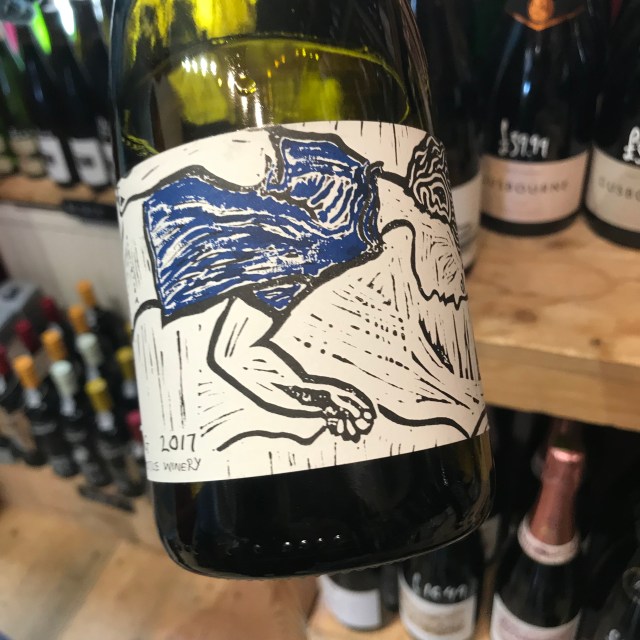
Offspring 2017 is an interesting wine to begin a tasting with. If you know that the name means something, and that it doesn’t refer to the 1980s/90s Californian “punk” band (not a possibility to be dismissed, knowing Pieter), then you begin to wonder what it means. This is a cuvée which is habitually made from all the bits and pieces Pieter hasn’t crafted into other wines. It’s his big experiment, the offspring of everything left in the cellar each vintage.

So at least for this first white wine, I won’t be elaborating all of the grape varieties. I do know there’s some Darling/Wellington Chenin, Verdelho from Voor Paardeberg and Elgin Semillon, but that’s all, blended together only at bottling, with minimal added sulphur. It’s a multi-varietal white grape blend, very bright, amazingly so, and a well chosen wine for a 10.30 am opener. The bouquet has fresh, fragrant citrus and stone fruit, and the palate has a nice waxy and stony texture. A simple, refreshing, wine, and at £17.49 just sneaks in as, I think, the second cheapest in the range.

img_6456

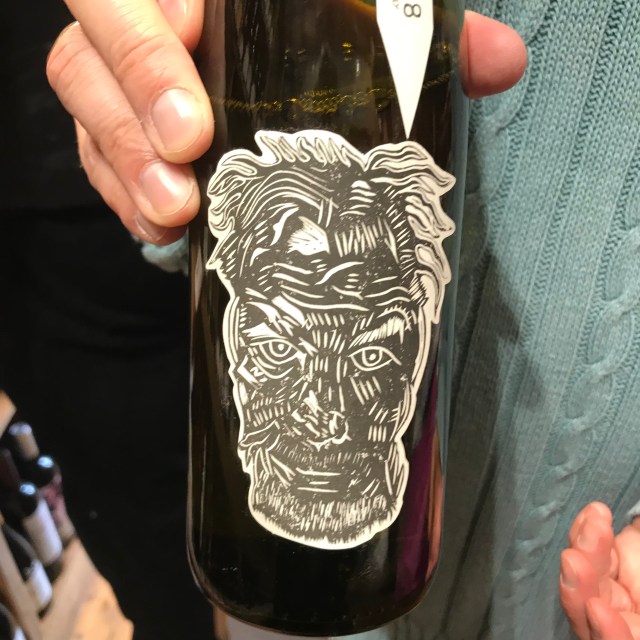
Orbitofrontal Cortex 2018 is made from fruit from the Western Cape, never the same from year to year, but simply a choice by Pieter of his favourite white wine of the vintage. This vintage the wine contains Verdelho and Palomino from Robertson, Chenin, Háslevelü, Riesling and a few other bits and pieces. It has pale green glints reflected in the light of a low morning sun. We have a complex array of taste components here – hay, baked apple, pear, richness, yet only 12.5% alcohol. Everything is grounded by a crunch of texture and balanced acids. £24, a total bargain (as they say).

The story of the name relates to an experiment about taste perceptions, which involved Pieter being connected up to a brain scan whilst he made subconscious blend selections of his wines, which were then compared to a consciously selected control sample. It sounds very complicated, but I think Pieter managed to prove that his focused palate works differently to the selections of a group of scientists who used the data from his subconscious to suggest blends. Well, Pieter tells it better, but I’m sure he had loads of fun with the experiment, and he got a cracking, and I’m sure soon to be iconic, label idea for his pains.

img_6457

It’s worth elaborating a little bit on how Pieter works. Grapes often come to him by word of mouth. He drives thousands of kilometres around harvest time in order to collect fruit, harvesting at optimum ripeness (definitely not over ripeness), often driving up to a farm having heard the grower has a batch for sale. He pays good money, and people get to hear that, and it works in his favour, usually. Because everything is in small batches, he can get the grapes back to the winery swiftly. Almost everything is fermented in small French oak with no additives, other than a bit of sulphur at bottling. Pieter claims he’s way too busy not to let the wines just make themselves, and he realised early on when he had little money that you just don’t need all the chemicals the wine schools suggest that you require.

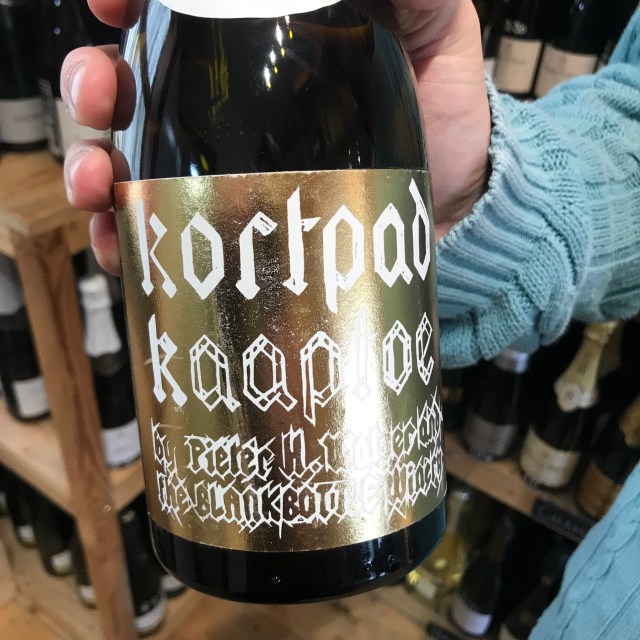
Kortpad Kaaptoe 2018 The name means “fastest route possible” in Afrikaans. Asking for directions from a farmer, they were “take a right after the Shiraz and Carignan, and then left after the Fernão Pires”. Fer…what? he thought. The grapes were his now! This was the first of Pieter’s wines I ever bought.  The variety is Portugal’s Fernão Pires (aka Maria Gomes), planted by a producer in Malmsbury who then decided he didn’t want it. Pieter has a deal to buy the whole lot. This wine, unusually at Blank Bottle, is fermented in tank. It’s another wine that majors on vivacity, with lemony zip over more than just fruit. You get all those savoury elements you might find in a Portuguese white, but with, unquestionably, a touch of sunshine richness as well. £21

img_6458

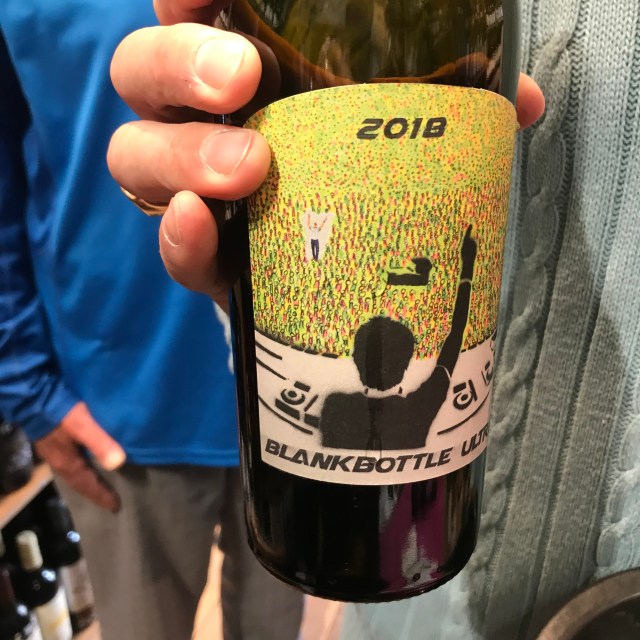
Ultra 2018 There once was a pot maker, famous for his artistic work. But one day he was persuaded to make some amphora-like pots for a wine producer. He layered the clay, building up the vessels in the traditional Georgian way, placing ring upon ring. This way a large pot can be made that would be too big to throw on a wheel, but it takes a long while to form each pot. Several of them ended up leaking, and the producer was angry. It upset the potter so much that he never made a pot again. Pieter had one or two of the pots, which he’d eventually persuaded the producer to sell, and then after a long tale of detective work, tracked the pot maker down to a hermit shack. Pieter is a persuasive guy, and now he has a great relationship with the potter, who is not only making more amphorae for Pieter, but for other producers too.

This wine is a juicy Chenin, all full of unmistakeable orange marmalade fruit (but it’s dry). The farmer who owns the vines is three hours out of Jo’burg, in the sticks. He’s a quiet, unassuming, guy who has a secret. At the weekend he heads for the city where he goes to raves. Pieter said his neighbours have no idea about this guy’s secret life. The label depicts the farmer, in the crowd, at a rave. The wine occupies the amphorae , and it has the texture and salinity that conjures up the outside of the vessel that gave birth to it. £24

img_6459

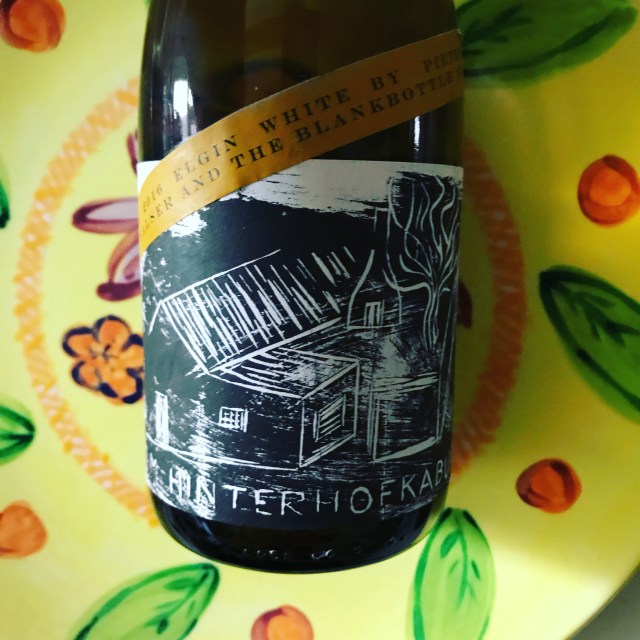
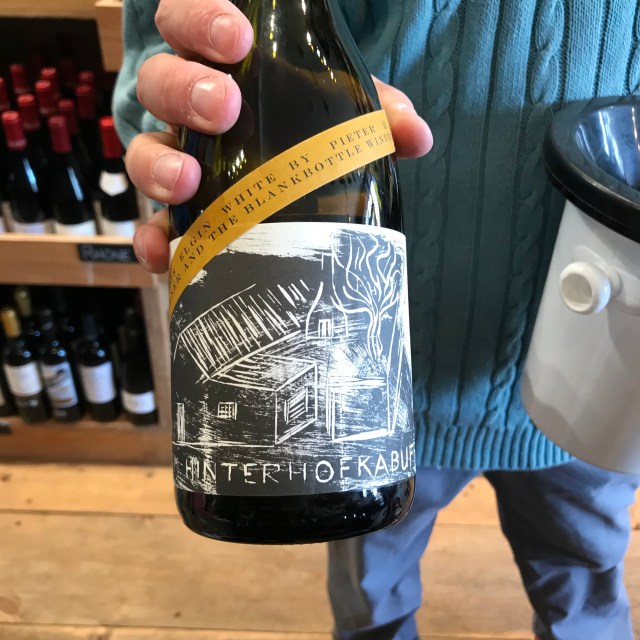
Hinterhofkabuff 2018 I can say honestly that I like every one of Pieter’s Blank Bottle Wines that I’ve tried, but I do have my favourites. This is one, so much so that I drank a bottle of the 2016 vintage a week ago, you may have seen my Instagram picture. This is Riesling from Elgin, off a steep slope with very rocky soil. The wine has breadth, and relatively high alcohol (that 2016 reached 14%), but there’s depth too, and as with any good dry Riesling, there’s plenty of acidity to balance everything nicely. £27.50

Pieter did an interview with the German magazine, Stern, in which the writer described his office-cum-winery as a backyard shack (hinterhofkabuff), so Pieter latched onto this for the name of this stunning wine, and the shack, or maybe an imagining of it in Pieter’s head, appears on the label.

img_6462

Pieter enjoys drawing the labels for his wines, but he’s increasingly getting his kids to do it. He pays them, sensibly not until he finally gets paid for the wine himself, so it can be a nice little pocket money earner. The only problems arise over who gets to design for the bigger cuvées. He pays a royalty, not a flat fee, and if one of his children gets a lot more money he might need a rethink.

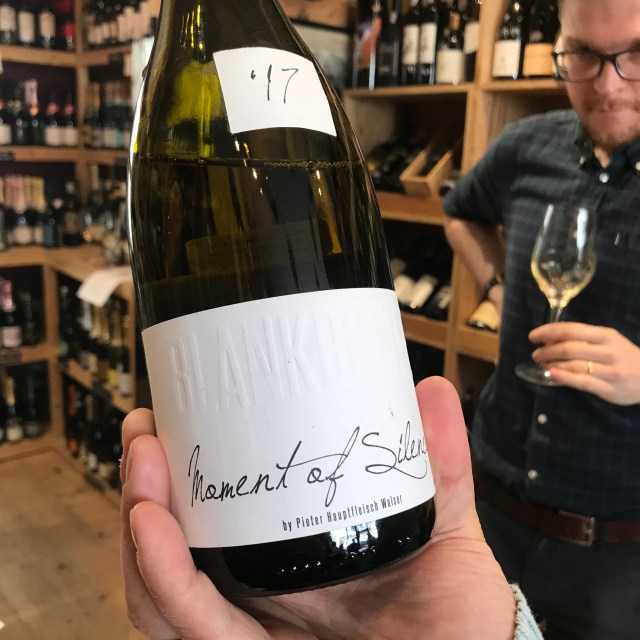
Moment of Silence 2017 Pieter first made Moment of Silence in 2007, and it’s currently the wine he’s been making longest. It’s also his wine with the biggest production. There’s a very strange connection between Pieter and this wine. Although none of his parents’ generation are involved in wine, Pieter discovered that his family actually owned the farm where these Wellington grapes come from 240 years ago. There are four blocks of old vine Chenin in here, plus one block each of Grenache Blanc and Viognier. The result is ripe, tropical (mango), creamy and zesty, massively refreshing, but with a nice smooth mid-palate. £17

img_6463

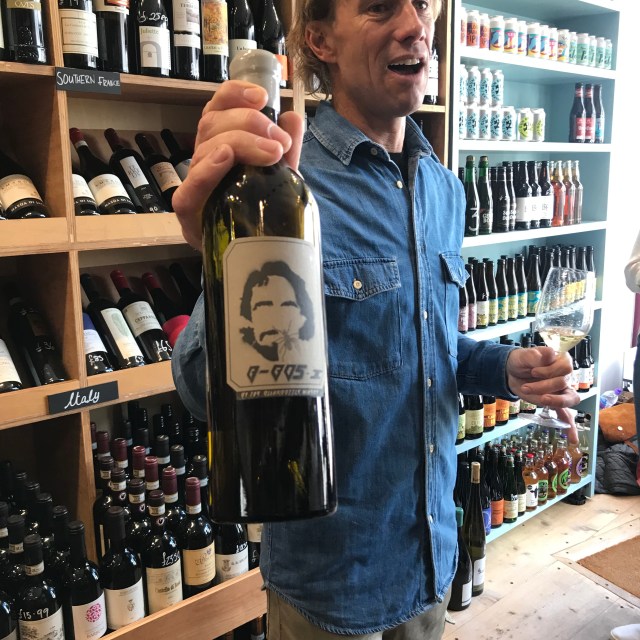
B-Bos I 2018 Sauvignon Blanc with some Semillon, both from Cape Agulhas, makes this wine, or rather it very much made itself. It’s a cool climate wine with good acidity, and great potential ageability. The alcohol is up at 14.5%, but with all of these wines, you really can’t tell, unless you drink a whole bottle and try to get up, which Pieter did once after disbelieving the lab analysis.

The wine is great, but the story is just as good, if perhaps the most offputting of all of Pieter’s tales. There’s a spider which particularly infests the town of Baardskeerderbos, much as the Funnel Web infests Sydney. This spider has the nickname B-Bos. It’s an ugly orange thing which builds its nest from human hair, allegedly creeping into bedrooms at night to steal hair from men’s beards. The label below is Pieter’s take on the ordeal. £24

img_6464

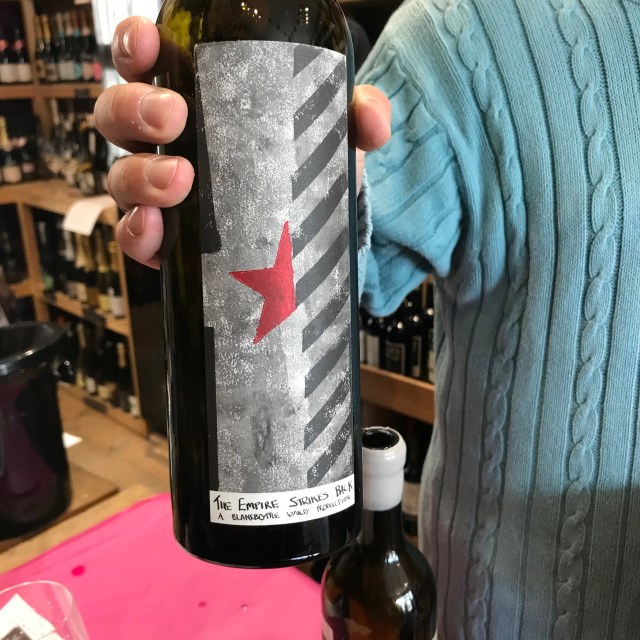
The Empire Strikes Back 2018 A white blend of Verdelho (35%), with more or less equal parts Chardonnay, Viognier, Pinot Blanc, Chenin Blanc and Sauvignon Blanc in 2018, all from Stellenbosch. You’d be reasonably likely to nail the origins of this, a satisfying, ripe fruited, slightly textured blend of flavours with a decent dollop of acidity. The label has a red star for the “Swartland Revolution” (the Swartland Rhône guys) and the stripes representing the Empire of South African Wine, Stellenbosch. Pieter felt it was time that the bastion of SA conservatism hit back with something edgy, though this wine isn’t really out there at all, but it is dynamic…and different. £24

img_6466

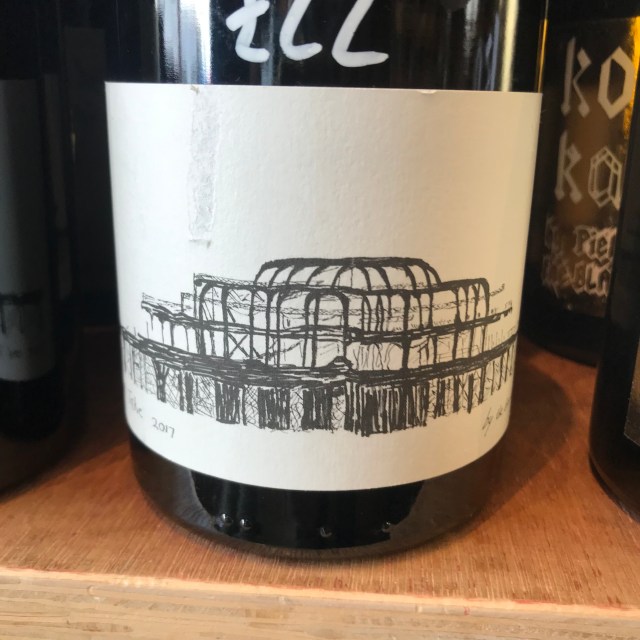
Give and Take 2017 This is one of the wines exclusive to Butlers. The grape variety is Pinot Blanc from Stellenbosch which has had a year in 400-litre French oak. It’s fairly rich, with a bit of weight, and at 14.5% is not the shy and retiring type, but it has a great savoury quality which makes it ready for food. Pieter wanted to get hold of some Pinot Blanc but the winemaker told him the estate owner had said he wasn’t allowed to sell grapes to him. A bit random, and Pieter has no idea why. However, the winemaker needed some more Semillon and a “swap” could take place under the radar. Hence the name. The label depicts Brighton’s iconic ruin of the West Pier. £22

img_6451

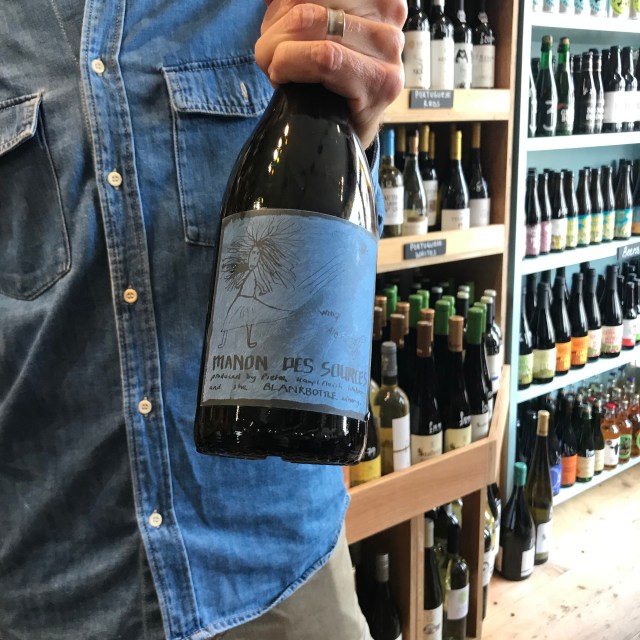
Manon des Sources 2010 “Manon des Sources” is the nickname of Pieter’s daughter. She drew the label, a self-portrait, aged seven. The grapes are Riesling, Semillon, and Sauvignon Blanc which comes in at an eye-watering 15.6% abv, so why does this not taste especially alcoholic? The answer lies with more than just acidity. Picking hours before supposed optimum (sic) ripeness may be key, and the low sulphur regime may also play a part. It just seems to be able to handle the alcohol. It’s a bottle to share, though, and maybe between three in this case. I have to say that “Manon” deserves her royalty for the label. £21.99

img_6467

69.99999 2016 is, here, a magnum of a wine made by Pieter since 2014, and which has now changed its name to Oppie Koppie because the wine always got named by the percentage of stems used to make the wine (depending on their ripeness…ie almost 70% in 2016, but 80% in 2017). Customers sadly found it hard to cope with a name change and a long number every year. The label depicts a camera photographing the stems. This is majestic 100% Syrah from Paardeberg (Horse Mountain) near Kimberley, site of a famous Boer War battle in 1900 but now site of some fine viticulture. This wine is all about structure and tannins, though the tannins are ripe and elegant. There’s more than a hint of Northern Rhône to this, and putting my money where my mouth is, I lugged one home with me, a thing of beauty. Bottle of 2017 = £25, Magnum of 2016 = £50

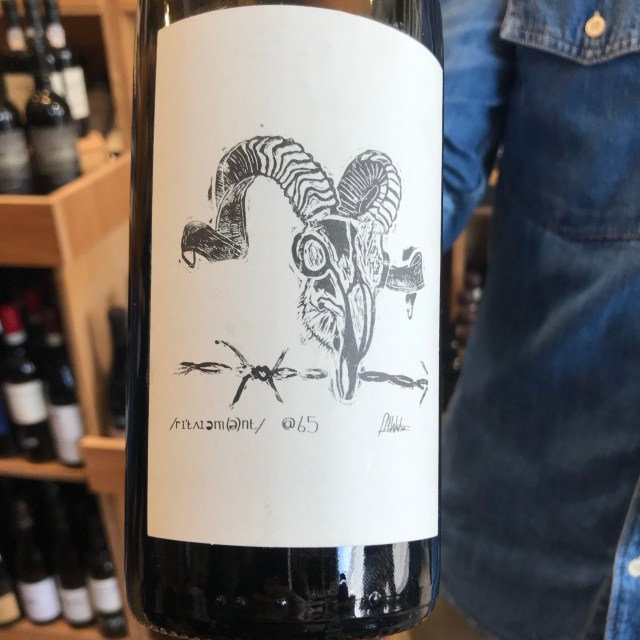
Retirement @65 2018 This is a quite different red. The main variety is Cinsaut from 65-year-old bush vines on a mountain slope at Darling. For the new vintage 2018 a tiny dash of Syrah was added. The wine is a little rustic, in a good way. Dusty, perhaps, certainly savoury with some herbs in with the black fruits. A lighter red, which could be best served cool. Pieter reckons Cinsaut is a challenging variety but I’m increasingly finding that more and more South African winemakers are able to rise to the challenge. I think it has an interesting future in the Cape. The label? The first crop Pieter was going to buy was eaten by birds, so he invested in nets, only to find a flock of sheep got in and ate most of the grapes the following year. £27

img_6472

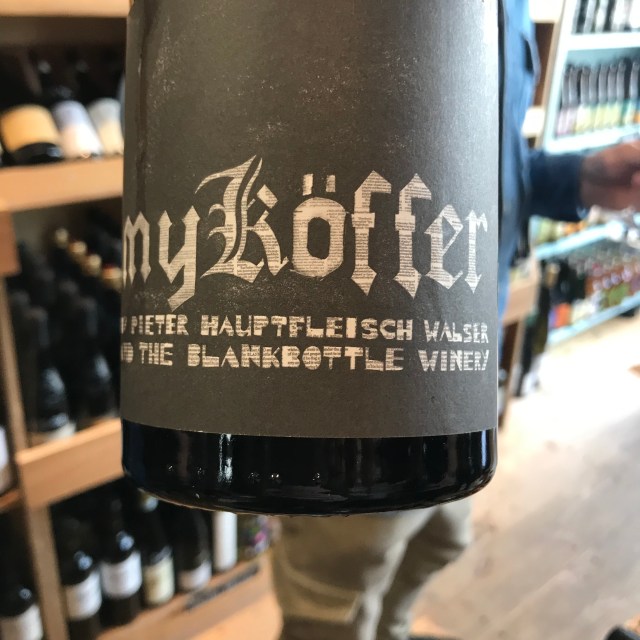
Myköffer 2017 “My suitcase”, signifies a suitcase full of memories. The first guilty pleasure of wine over indulgence for Pieter, as a student, was Tassenberg, a commercial red of which over 4 million litres is made each year. Cheap but quite decent, I’m told. His first winemaking job involved actually producing it, where he discovered that the sweet strawberry fruit component he loved as a student was the Cinsaut variety. Pieter had bought that variety on several occasions after setting up on his own, but he could never find Cinsaut with the same profile. That was until he discovered a vineyard in the relatively unknown area of Breedekloof (Darling), up in the mountains east of Paarl, where the grapes had previously been going to a large co-operative.

The vineyard itself is comprised of former bush vines, since raised up on wires and trained on low trellises, on a flat and rocky river bed on the valley floor. Pieter exercised forty pickers to selectively choose ripe bunches in a vineyard that would otherwise have produced quantity over quality. The pale juice went into open top fermenters as whole bunches for foot treading,  before ageing for one year in French oak. The result is a juicy wine with up-front fruit and 13.5% alcohol. It really is another delicious Cinsaut, with a bit more body than Retirement @65. £26.50

img_6473

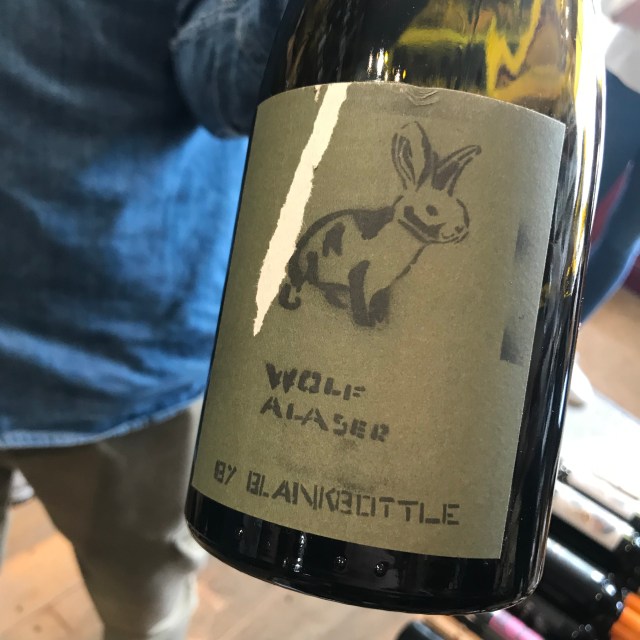
Wolf Alaser 2017 This is very possibly a one-off cuvée. Pieter reckons he’s not sure what fruit went into this wine, perhaps 20% being Syrah from Oppie Koppie. It’s odds and ends that were used for topping up other cuvées, from which a single barrel was left, just 300 bottles. It was pretty tasty with nice sappy fruit and whilst you might wonder at the higher price if it really is merely some odds and ends Pieter threw into a barrel, you just need to taste the result. And, of course, it’s pretty rare stuff. The label was designed by Pieter’s son, who invented “Wolf Alaser” as a graffiti tag. £35

img_6474

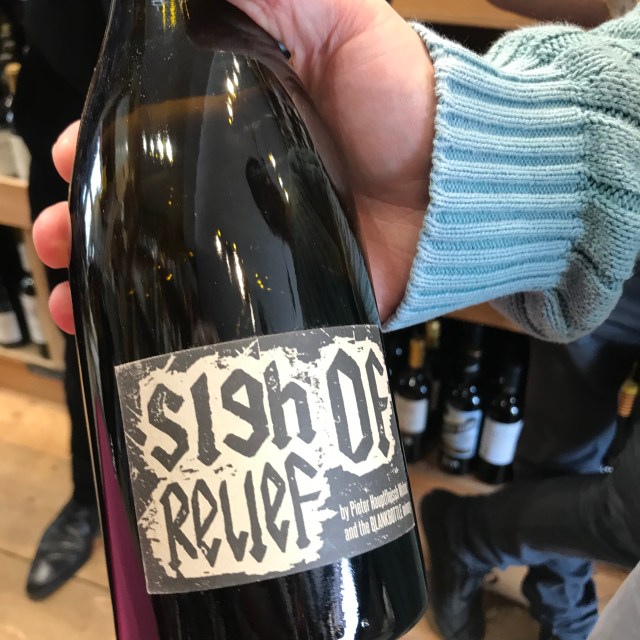
A Sigh of Relief 2017 This is the second to last vintage of this cuvée, because the vineyard has been grubbed up. Why? The owner bought a “Merlot” vineyard on Helderberg Mountain, but it turned out that the top part of the site was actually Cabernet Franc, as discovered by a well known viticultural expert who noticed the vines’ bronze growth points in the morning sun, something unique to Cab Franc. I’d have rejoiced, but not so the owner. The nursery probably received a rude email.

The first thing you notice is the amazing bouquet, essence of ethereal violet. There’s a little bit of Malbec and Cabernet Sauvignon in here too, but this is in essence a Stellenbosch Cabernet Franc, of both power, concentration and elegance. £23.99

img_6476

It is What It is 2016 The second of the wines exclusive to Butlers is based upon another now ripped out Stellenbosch vineyard, pulled up by their owner on a whim in just one day. I think it’s important to say, for a second time, at this point that there’s a part of the South African wine industry, based on money, which follows wine fashions. This is leading to the destruction of valuable old vine stock capable of making lovely wines.

This one is not aiming at greatness, nor profundity. It’s just a super-interesting mix of Tempranillo from that site, with some Nebbiolo from Goudini in the Breede River Valley, plus a bit of Tulbach Carignan. Aside from being a nice glass, it’s stuff like this, an unusual if not a unique blend, that excites the vinous explorer in me. It’s like discovering a new plant in the Himalayas, or a new species of moth in Uzbekistan. But it’s never going to be repeated, so it is what it is. The label depicts Henry Butler. I think Pieter has captured his essence there…£22

img_6453

Pinotage 2018 Actually, this wine doesn’t have a name yet (nor a label, hence the photo of the wine instead). It will be the next of the exclusive Butlers bottlings. I will admit I’ve not been a fan of Pinotage in the past. I grew up on all that burnt rubbery stuff. This is just fruity and juicy. Pieter says the key is to treat it like Pinot Noir (Pinot Noir, of course, being one of the variety’s parents, along with Cinsaut). With this particular wine you might even think it’s a pure Pinot, with its high-toned  ripe fruit, powdery tannins and prickly acids. It suggests it might age well for a year or two, in the unlikely event it gets the chance to.

The fruit here is from Darling, and grows below the vineyard from where Pieter sources Retirement @65. This is old vine Pinotage grown on decomposed granite with a year in oak. I shall look forward to this wine arriving, hopefully, by the autumn. I don’t know the price yet. It should provide a replacement for the Tempranillo blend, though I think there’s still some of that left to grab if you are swift.

img_6477

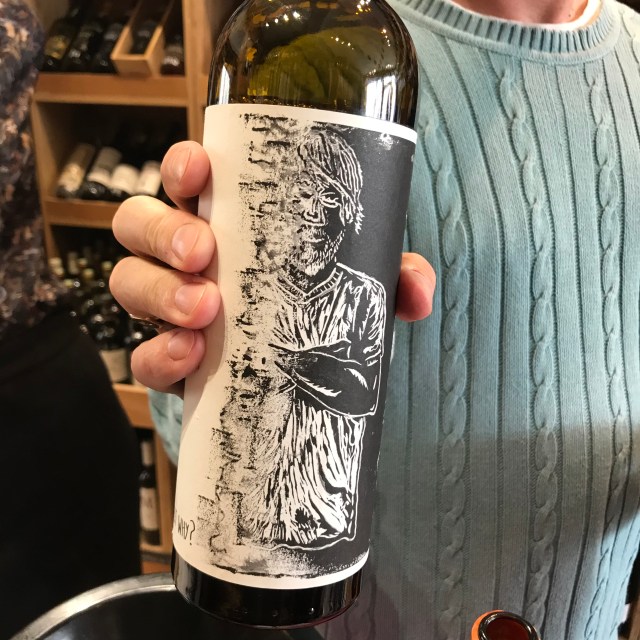
But Why? 2016 The penultimate bottle from this long and extensive tasting is a Cabernet Sauvignon, which grows on sandy soils just below the 750 metre contour in Stellenbosch. The first thought that might come into your head is how on earth they ripen Cabernet at 740 metres above sea level? Temperatures can indeed be low, but the key is the unbelievable levels of radiation (sunlight), way higher at the top than at the bottom of the mountain. The vines do indeed produce mature fruit, but with lower alcohol levels, the result of slow sugar accumulation from a long hang time. There’s no greenness either. The sand adds to the wine’s elegance. There will be no Cabernet Sauvignon from this site in 2017 due to smoke taint, but the vines survived the bush fire and But Why? will make a return in 2018. No price available.

img_6478

Jaaa Bru!!! 2017 We finish with one of Pieter Walser’s most captivating wines to look at. It comes in a stumpy bottle with a label depicting a fearsome open mouth with a protruding tongue. The variety is Malbec, which by coincidence translates in Afrikaans as “crazy mouth”. “Ja Bru” is a common Afrikaans greeting, “yes brother”. It’s Stellenbosch Malbec, picked early so that it only reaches 13.5% abv (!). It has a real minty, eucalyptus, profile over dense and darker fruit. Quite a big wine, but uniquely South African. I really like it…really. And of course I love the bottle too.

img_6479

I hope I was able to convey just a little of the ambience at the tasting. Around twenty wines were sipped (and spat, but I was next to the spittoon and it didn’t see a lot of activity) in a little over a couple of hours. I really can’t begin to tell ’em like Pieter does, so if you ever have the opportunity to listen to him, take it.

He’s not the most socially extrovert person making wine in the Cape. I think he’s far more at home trekking after grapes, or out on the surf. But he has a canny knack for marketing, and if you produce thirty different wines each vintage you need a bit of sales patter. I know that really he does enjoy telling these stories, and I can think of no one better at doing it.

I’ve not even related his best story, which has nothing to do with wine. Ask him whether when out surfing he’s ever met a shark!

For what it’s worth, I think he’s a great guy and fantastic company when mixing with people who truly appreciate wine. As for his wines, how would it be possible to read this and (aside from the stories) not conclude that Blank Bottle Winery is making some of the most exciting wines in South Africa today? That’s a pretty big claim from me. You just need to try a few bottles to see if I’m on the mark.

Butlers Wine Cellar has two shops in Brighton, at 247 Queen’s Park Road, BN2 and 88 St George’s Road, Kemp Town, BN2. See their web site here and check the Contact Page for opening hours.

Other retailers see SWIG‘s Blank Bottle page here.

Wine labels as shirt cuffs, a first for me but Henry’s a stylish guy.

Posted in Artisan Wines, South African Wines, Wine, Wine Merchants, Wine Tastings | Tagged , , , , , , , , , , , , , , , , , , , , , , , , , , | 4 Comments

London Wine Fair 2019, Part 2

My coverage of the London Wine Fair 2019 continues here in Part 2. If you did happen to miss Part 1, you will find it (along with any introductory and more general comments) here. This second part covers some wines from Red Squirrel, Modal Wines and The Knotted Vine, along with the new Rhône estate I mentioned in Part 1, and a brief visit to the Nyetimber Bus.

RED SQUIRREL WINE

Although only founded as recently as 2012, Red Squirrel has made a very big impact on the market. Their portfolio, growing all the time, has topped fifty producers. There’s no specialisation of country or region here, but they are pretty good at finding stars that have not yet been discovered, such as their Etna producer below.

Black Chalk Wild Rose 2016 (Hampshire, UK) I’ve got more than a soft spot for Black Chalk, which is why I’ve written about them a few times. It’s hard to believe they only launched at LWF2018, and one year on they are garnering praise as one of England’s best up-and-coming new wine ventures. The inaugural Black Chalk Classic 2015 was on show, but I wanted to try the new vintage Wild Rose 2016.

The grapes for both the Black Chalk wines are selected by Jacob Leadley from local friends, all off Hampshire chalkland sites. The breakdown is 41% Pinot Noir, 38% Meunier and 21% Chardonnay for the 2016 Rosé. Fermentation is in a mix of oak and stainless steel, after which it spends 20 months on lees in bottle. It was dosed at 7g/l after disgorgement in November 2018, so it has a little post-disgorgement bottle age too.

There are gorgeous ripe red fruits on a wave of crisp acidity. Freshness and elegance helps this pink stand out. It’s not remotely clumsy. Retail you should pay around £40. Some may suggest English Sparkling Wine is getting close to Champagne pricing, but we should remember that the costs of making sparkling wine in the UK are at least as high as doing so in France, probably more. And in any case, the quality definitely warrants it. For me, this is worth a premium. A lovely, lovely wine.

img_6389

Beaujolais Cuvée Kéké 2018, Kewin Descombes (Beaujolais, France) Kewin “Kéké” Descombes is one of the new breed of Beaujolais winemakers (I think he’s still under thirty) who have a family history in the region. In fact few could claim ties as strong as Kewin’s, being the son of Georges Descombes (of Gang of Four fame), and the half-brother of Damien Coquelet, another feted young producer. He farms around six hectares in the vicinity of Morgon.

This Beaujolais cuvée comes off a 1.2 ha site Kewin rents, farmed organically like all his vines. Winemaking is simple, full carbonic and almost no sulphur. The result is a magically fruity and ultra-fresh Beaujolais at a just perfect 12.5% abv. I’ve liked this cuvée since I first tasted it, but this new 2018 is really good. Sells for around £24.

img_6395

Etna Rosso “Navigabile” 2016, Ayunta (Etna, Sicily, Italy) Filippo Mangione rescued a mere three quarters of a hectare of vines on Etna’s northern slopes above the town of Randazzo. The grapes for this Etna Rosso are mainly the pair of Nerellos, Mascalese and Cappuccio, with other stray varieties in a traditional field blend. Fermented in open topped vats, the wine is then aged 14 months in a mix of oak and cherry casks.

The wine has red fruits, cherry and strawberry to the fore, with herbs and the faintest touch of something more meaty (not volatility). It’s moderately tannic for now, but it has the bright acidity to allow this to age for a year or too, and it’s not jammy as some Etna Rosso can be. Alcohol is a balanced 13.5%. For just over £30 this is really outstanding. I described this producer as my find of the day at the last Red Squirrel portfolio tasting.

img_6396

PN/16, Adelaide Hills Pinot Noir 2016, Vinteloper (South Australia) David Bowley set up as a winemaker in the Adelaide Hills in 2008. He has around 3.5 hectares to farm and his reputation hit the starry heights when he won the People’s Choice Award of best Pinot Noir in Australia at Pinot Palooza 2016. He was runner up again in 2017. Although a self-confessed Pinot Noir obsessive, David does make other wines, including (I must mention) the brilliant little stubbies called “Park Wine”. David’s wife, Sharon, designs all the beautiful labels.

Looking at PN/16 you would have to call it one of the palest wines of the day, even in an era where pale Pinot is quite the rage. Crushed by both hand and foot, you’d be surprised, I think, to be told this sees eleven months in oak, of which a third is new. So the wine has some structure, but less than you’d expect. The fruit is complex already, mainly in the cherry spectrum, but you get tagine-like spices coming through, and that seems an apt description for a wine which also has something of smokey merguez sausage about it. I hope I’m not putting off the vegans among you. It’s a lovely wine, and at 14% abv it probably needs something substantial to accompany. Mechoui agneau, perhaps?

img_6397

MODAL WINES

Modal is another non-specialist when it comes to countries or regions, but Nic Rizzi does specialise in hunting down some quite unique wines. He’s not hung up on winemaking methods, yet because he has an eye for wines of freshness, personality, and above all, drinkability, the wines he imports tend to be low-intervention wines.

Oranzista 2017, Slobodne Vinárstvo (Lesser Carpathians, Slovakia) You might have seen what I’ve written about a number of Slobodne wines from Zemianske Sady in Slovakia over the past couple of years. I drank the Cutis Deviner quite recently, and Slobodne does list a Cutis Deviner orange version, but this one is brand new to me.

Oranzista is made from Pinot Gris. The 2017 vintage saw five weeks on skins during a semi-carbonic fermentation and then one year in tank. The result is not the tannic sandpaper cuvée that some skin contact wines can become. It’s altogether gentler, which makes it an ideal summer wine with a good range of food pairing options that you might eat outdoors. The flavours are an unmistakable mix of peach and tangerine, with zesty fruit and zippy acidity. Alcohol is a restrained-tasting 13%. I’d like some of this.

img_6402

Funàmbul Cava Brut Nature NV, Entre Vinyes (Catalonia, Spain) Maria Barrena has a new organic Cava project from her family’s vineyards close to Barcelona. The vines are over 50-years-old, some up to 80-years, on deep clay and limestone at around 300 metres altitude. The varieties in the blend are the Catalan classics, Parellada, Viura and Xarel-lo. The wine is bottle fermented with about 20 months on lees, with zero dosage.

A glorious bouquet leaps from the glass here, very pure. The dry palate is layered with apple acidity with nuanced stone fruits (peach and apricot). It’s not massively complex, majoring on freshness and liveliness. The alcohol level is just 12%, but its dryness does mean it will accompany food. This is a really good organic Cava, new to Modal.

img_6400

Kröv Steffensberg “GeGe” 2015, Staffelter Hof (Mosel, Germany) So, as you will surmise, this is Staffelter Hof’s dry Riesling from the Steffensberg site at Kröv, between Erden and Traben-Trarbach. This is perhaps the most famous stretch of the Mosel, although the site isn’t one of the most famous on the river. Nevertheless, this wine, and those made there by Daniel Vollenweider, are bringing it to the attention of Mosel lovers.

Jan Mattias Klein took over from his father, aged 28, in 2005. He has since moved from the classic Mosel style to a more minimalist, low intervention model, which includes minimal added sulphur in the wines. Why “GeGe”? The wine is bottled as a QbA yet it has the sugar and acidity of an Auslese Trocken. It’s a play on the “GG” (grosses gewächs) classification for dry wines from top sites for members of the German VDP wine association.

This is built like a wine from a top site, and deserves some years in bottle to age. The ripe grapes give the wine a tropical dimension, lots of peach, but also, as it’s more complex than that, salinity, minerality, florality and spice. That said, it is starting to drink now, so opening and drinking it with food would not be a terrible idea. Although I don’t know the producer that well yet, it tastes like a top Riesling.

img_6403

Naturaleza Salvaje Blanco 2018, Azul Y Garanza (Navarra, Spain) This organic Garnacha Blanca is grown in the foothills of the Pyrenees, in Navarra, at San Isidro del Pinar. The thirty year old vines are planted around 550 metres above sea level on calcareous limestone. It’s very dry here, hot during long summer days, but with contrasting cool nights. The wine is made naturally, with no synthetic additives in the vineyard, a spontaneous fermentation and minimal added sulphur, you know how it goes by now. The fermentation lasted ten days, five days of that on skins. Then the interesting bit…ageing was in amphora for six months.

For White Garnacha, this is very aromatic. The fruit is concentrated but the wine is crisper than you’d imagine for the variety, down presumably to those cool nights. Although you get “fruit” here, greengage and yellow plum perhaps, there are also notes of sweet almond blossom and almond, with a green herbal texture, slightly waxy. It’s a wine that works on two levels, both refreshing and multi-dimensional.

Müller Thurgau “Kids Version” 2016, Nibiru (Kamptal, Austria) Julia Nather and Josef Schenter began collaborating on their Nibiru project in Austria’s Kamptal Region in 2015, working out of Josef’s parents’ winery at Schönberg Am Kamp. Nibiru is, according to Sumerian legend, the name of a planet which appears in our solar sytem every 3,600 years with an orbit around our sun in the opposite direction to all our other planets. That appealed to the philosophy of Julia and Josef.

The cuvée name? The grapes were foot trodden by “the kids”, all five of whose names appear on the label. They love this grape variety here, using skin contact to make a dry and waxy wine which has more than one dimension, and is totally unlike the Müller Thurgau of old. In fact this couple have everything in common with the new breed of MT producers in Germany. Think more “Hermit Ram” than sugar water. It’s clean and crisp and (for the variety) has really nice length and mouthfeel. It helps that we are tasting old vines cropped at low yields and made with “natural wine” methods (including very little sulphur). This is a wine of great purity, and a gastronomic wine as well. Both exciting and interesting.

img_6406

Safràn 2016, Cascina Zerbetta (Piemonte, Italy) This estate is at Quargnento, in the Monferrato Hills, west of Alessandria. Paolo Antonio Malfatti and Anna Maria Zerbetta farm just three hectares of formerly abandoned vineyard using biodynamic methods. Their main crop is Barbera, for which Monferrato is justly famous, but they also grow Sauvignon Blanc.

From this variety they make a sparkling col fondo wine called Shan Pan, which I’ve both drunk and written about at least twice in the past twelve months. This wine is also a Sauvignon Blanc, but is very different. It’s a late harvest wine, aged in a one year old barrel. It fermented to 15% abv naturally, after which the fermentation stopped of its own accord, leaving some residual sugar.

The colour is darkish red-brown, but bright, like cherry wood. It’s aromatic, with oxidative, nutty, notes on the nose, but also plenty of freshness. A quite unique bouquet. It’s sweet, but not as sweet as you might think. Yes, gently sweet, slightly nutty, with a hint of caramel on the palate, not remotely cloying. Worryingly moreish with that alcohol.

img_6407

THE KNOTTED VINE

David Knott imports minimal intervention wines which he will happily say are aimed at “wine geeks” obsessed with purity. He’s not especially focused on any one country, although the Australian part of the portfolio always throws up some genuine gems that most people have never heard of.

Druida Branco Encruzado Reserva 2017, Vinos Mira do Ó (Dão, Portugal) The grapes for this wine are grown on a 500-metre high plateau on the right bank of the River Dão. As the name “druid” suggests, there’s an air of mysticism to the project. The grapes are crushed in a stone building in the midst of the vines, something like a traditional Sicilian palmento, I imagine. The rock here is granite, and the wine has a fresh bouquet and a fresh mineral texture on the palate, with a touch of salinity. The overall impression is of a well rounded wine with the textured rough edges of, well, granite.

Ageing is in old oak for nine months, and like a traditional, artisanal, Dão this has a touch of austerity to it. It’s certainly not fruit driven, especially with all that citrus and mineral texture. Yet in being so different, it draws you in. You realise you need to pay attention. You realise pretty soon that this is a wine that has the structure to age and all the components to become more complex over time, as those individual parts spread out into a broader palette of flavours.

img_6408

Long Gully Road Semillon 2017, David Franz (Barossa, South Australia) Peter Lehmann’s son is making increasingly beautiful wines in South Australia, but they still fly a bit under the radar in the UK. Take this Semillon. The variety has had a tough time on the UK market, the result of all those “South Eastern Australia” Semillon-Chardonnay blends which flooded in during the 1980s and 90s.

This wine is made from 130-year-old, dry farmed, vines grown by Steve and Rebecca Falland in their Long Gully Road Vineyard in the Barossa Hills (Eden Edge). The intention with this wine every year is to pick at exactly the right moment, where ripeness does not diminish acidity.

Here the success of that policy is plain to see. The wine has a brightness. That’s what hits the nostrils first. It’s grassy enough to warn hayfever sufferers, but then the waxy lemon hits, more Mediterranean than Barossa. It has a classic Aussie Semillon profile with lemon on the attack and hints of honey on the finish, with something herbal in between. It’s about textures and depth, with the ancient vine fruit giving the wine some class. And length.

img_6410

A Veredas Blanco 2016, Bodegas Nestares Eguizàbal (Rioja, Spain) This is not your average White Rioja in that it is a blend of Chardonnay and Sauvignon Blanc, not the traditional white varieties of the region. The grapes come from a single vineyard in Rioja’s Ocón Valley, near the village of Galilea. It’s certainly a far cry from the dull and oxidised version of white wine we have known from some of the bigger producers, yet neither is this wine something that comes across as a bland, modern, substitute.

A Veredas was fermented in, and then spent eight months ageing in, new French and American oak before both lots were blended. Bottling was without any added sulphur. The fruit is predominantly textured pear with herbs and a little gentle spice, from the wood. It is oaky, for sure, but the fruit is delicious. I still think it needs time for the fruit and oak to integrate, but I think it will before long.

This is, I have to say, a wine style I don’t normally go for. A relatively oaky white in an equally relatively inexpensive price bracket. What impressed here was the brightness and depth of the fruit, and the proof that very good white Rioja is becoming more widely available from more than a handful of producers now.

img_6411

A Bright Red Blend 2018, Rasa Wines (Barossa, Australia) Andy Cummins makes small batch wines at Angaston, starting formal training after a long love affair with wine led to a job at Barossa Valley’s famous Rockford Wines, following a couch-surfing tour of Europe’s vineyards. The blend in this 2018 is Cinsault (67%) and Grenache (33%) from Tanunda. The fruit comes from old vines, between 80-years-old for the Grenache and 95 for the Cinsault. I think the blend in 2017 was very different.

This is a pale red with a sweet fruit fragrance smelling of amazing raspberry cream. The fruit on the palate is plump and rounded, with great acids, a little bit of crunch on the finish, plus a lick of savoury salinity. It has a nice restrained 12.3% alcohol, not always common in the region, and it’s an altogether perfect summer refresher of a wine. Looks good, smells even better and tastes fantastic. This should arrive on our shores some time in June. It should be here just in time to establish itself on the pavement tables and in the parks of London, assuming the sun returns.

Grenache 2017, Ministry of Clouds (McLaren Vale, Australia) Ministry of Clouds is a virtual winery, a moveable feast when it comes to sourcing grapes, but their broad focus is on fruit from Clare Valley, Tasmania and McLaren Vale. The “they” here  is Julian Forewood and Bernice Ong. If you haven’t heard of them, they have certainly garnered enough top level plaudits in Australia to suggest you should.

Dry farmed Grenache can be very special grown in The Vale, tending to have accentuated fragrance and a succulence of fruit that is synonymous with the region. This wine comes off two blocks of 80-year-old Grenache bush vines, going into old open top fermenters, ageing in three-year-old hogsheads and larger oak tanks. The old vine fruit responds with purity, floral beauty, and a bit of structure, accentuated by nice dusty tannins which turn this into a perfectly balanced wine for the table.

Like every wine I taste from this producer, it is both impressive and highly enjoyable at the same time. There’s just something about this that oozes class, so if you like juicy Grenache, try some. It’s one of those perfect examples of a wine with reasonably high alcohol (13.9% on the label) that nevertheless tastes fresh and if not exactly light, in no way heavy. Grenache done well has that almost magical quality.

Atractylis 2014, Floris Legere (Aragón, Spain) Villaroya de la Sierra is a tiny village near Calatayud, inland from Valencia and Tarragona, and due west of Zaragoza. It’s the unlikely place in which wandering Frenchman Ludovic Vino (this must be the best bit of nominative determinism yet) settled down to farm a small plot of 70-year-old Garnacha and Syrah.

This wine is a pure Syrah, aged 15 months in second- and third-year French oak barrels. The wine has a scented cherry bouquet with darker fruits and a Syrah peppery spice note coming through later. There’s power here, but without compromising real elegance. I think that with the oak regime this will benefit from some age, but I also think the wine has the potential to be quite astonishing after a few years. We shall see.

img_6417

Famille De Boel (Rhône, France)

In Part 1 I mentioned the “Wines Unearthed” section, up on the gallery floor opposite Esoterica. It was here that I was nudged towards Famille (Nelly and Arnaud) De Boel. Working with other Rhône wineries from 2011, they managed to start their own domaine in 2016, based at Lemps, a little north of Tournon, on the right bank of the Rhône. They own vines at Cornas and Saint-Joseph, and in the Côtes-du-Rhône-Villages Appellation (old vine plots at St-Cécile-des-Vignes).

The vines are farmed biodynamically, and typical of many young winemaking couples who have small children, they are completely focused on not only making low intervention wines but also on encouraging biodiversity in the vineyards. Nelly and Arnaud are also great food lovers, a passion they share, and so they aim to make gastronomic wines at each level. I tasted three wines, a Côtes-du-Rhône-Villages from Uchaux, a Collines Rhodaniennes, and their Saint-Joseph. Their Cornas vines are not yet mature enough to produce wine.

Côtes du Rhône Villages Massif d’Uchaux “Aleph” 2018 comes off silex/slate in hills surrounded by woodland. It’s a blend of Syrah and Grenache. The micro-climate is relatively cool and the wine has nice berry fruit (blackcurrant, mainly) and black olives, with great freshness, plus a little bite. It’s a really nicely made CDR.

Collines Rhodaniennes “Les Voraces” 2018 is pure Syrah off granite, a plot right beside the family home, with its élevage in stainless steel. No oak is used, so this is refreshing Syrah with zip to it. But it still retains a bit of grip. Not complex but vibrant and lively, helped by a sprinkling of black pepper spice.

img_6424

Saint-Joseph “Rue des Poulies” 2017 and 2016 The 2017 was a sample as the wine is not yet bottled. It comes from a south facing vineyard on the purely granite soils of the best part of the appellation, and after fermentation it is aged half and half in stainless steel and used wood (six to seven years old). The fruit is both red and black, the wine deeply coloured, but the overall impression is of the dominance of crisp minerality with ripe tannins. The 2016 bottle was more of the same, but with a touch greater depth and suppleness around the fruit. There’s plenty of body, so this is a fairly serious St-Jo.

I said in my introduction in Part 1 that I liked everything here – the wines, the people (well, Nelly, at least, who I chatted to), and the overall philosophy. For what it’s worth I also liked the labels too, each of which depicts something specific. The Uchaux for example is called Aleph, which is the first letter of the Phoenician alphabet and means “beef”. That label shows a print which depicts the “Ceremony of Beef” where the butchers paraded their oxen.

It is not easy to asses a range from a brief encounter, but I thought, at least on first acquaintance, that on the basis of what I tasted these wines really deserve some UK representation.

img_6425

Nyetimber (West Sussex, England)

Nyetimber is a very old estate, named in the Domesday Book as “Nitembreha”. Nine hundred years later it has established itself as probably the most famous wine estate in the UK, producing award winning classic sparkling wines from the rolling green sand and chalk hills of the South Downs. Cherie Spriggs is Chief Winemaker, assisted by her husband Brad Greatrix, and a focus on quality has allowed the brand to go from strength to strength over the past decade or so.

One of the unmissable sights at London Wine Fair now is the famous Nyetimber Bus, a refurbished old double-decker from which samples are dispensed, parked-up in the newish part of the Fair called Drinks Britannia (with its focus on sparkling wines, gin, craft beer and all things artisanal). I don’t envy those working on the bus, as the queues are pretty long for most of the day, and they must get through a fair number of bottles, generously poured for what is, for most people, more a free glass or five than perhaps a serious attempt to taste the wines.

I tasted, and spat (despite the near impossibility of pushing through the throng to find the awkwardly placed spittoon) five wines. The Blanc de Blancs 2013 comes from Chardonnay vineyards in Hampshire and West Sussex and sees four-and-a-half years on lees. The colour is gently golden, from a bit of age, and the initial citrus and floral notes are lovely. That lees ageing results in a toasty brioche finish. The BdeB has consistently been my favourite wine at Nyetimber, although I don’t count the single vineyard wine (below). I’ve only tried it two or three times.

Rosé NV is currently a blend of Pinot Noir (61%) and Chardonnay (49%) which smells of summer pudding with cream and shortbread biscuits. It’s a lovely aperitif wine whose qualities, above all, shout “refreshing”.

The Nyetimber most people know nowadays, the wine poured on Brighton’s i-360 and at Glyndebourne, is the Classic CuvéeClassic Cuvée is a multi-vintage blend of all three classic “Champagne” varieties, and is very much Nyetimber’s flagship. Bottled with 10g/l residual sugar, it’s an easy drinking wine which has now achieved a high level of consistency. There’s fresh apple fruit, spice notes and honeyed “sweetness” (the wine is obviously dry but the dosage is slightly higher than many passionate wine lovers may be used to these days). The most exciting thing is to taste this from magnum. The magnum effect does work here, so much so that the larger format would be a strong recommendation from me.

Tillington 2013 Nyetimber’s single vineyard wine is produced in small quantity when the vintage warrants it. The 2013 was a run of somewhere between 5,000-to-6,000 bottles, I’m told. This wine blends around three-quarters Pinot Noir with Chardonnay from a fine single site in West Sussex. It sees almost six years on lees, which does explain its price, often grumbled about but perhaps without foundation for one of the finest English wines on the market.

The wine still has a fairly high dosage of around 9.7g/l, but there’s a genuine elegance to the predominantly red fruits with citrus, which overlays vanilla and very gentle caramel. You would definitely say it is Pinot Noir-driven. As the wine lingers on an impressively long finish, you get that autolytic character, with arrowroot biscuits and fresh brioche.

Finally I tasted Cuvée Chérie, Nyetimber’s Demi-Sec multi-vintage, designed originally to accompany “delicate British desserts”, though we are perhaps less wholly patriotic to suggest restricting its use just to home grown fare. It’s 100% Chardonnay and benefits from around 20% reserve wines. From what I know, or have been told, about Nyetimber, it is the building up of reserve wines which has transformed the quality at this producer. Any serious English Sparkling Wine needs the addition of some reserve wines to make a multi-vintage blend which can transcend the ordinary, unless the fruit of a given vintage is really special. The addition of even a small amount of reserve wine adds depth.

Chérie balances its sweetness (38g/l r/s) with its fresh orange and lemon acidity and a nice mineral texture, with even a tiny hint of salinity, which results in just the faintest savoury touch. I can see why they recommend “fragrant and gently spiced dishes” as a food match along with the desserts, although “gentle” and “spiced” are not words which are normally paired in my kitchen. “Generously spiced” is more the order of the day, and I don’t think this wine is meant to go with three or four red chillies.

The Nyetimber Bus is great fun, but I must try to taste some of these wines in circumstances which less resemble the Crush Bar at the ROH during the short interval some time. But that’s not what the bus is really there for. Nyetimber should be noted for their generosity in pouring so much stock into the cuckoo chick mouths of thirsty and expectant UK wine trade stalwarts.

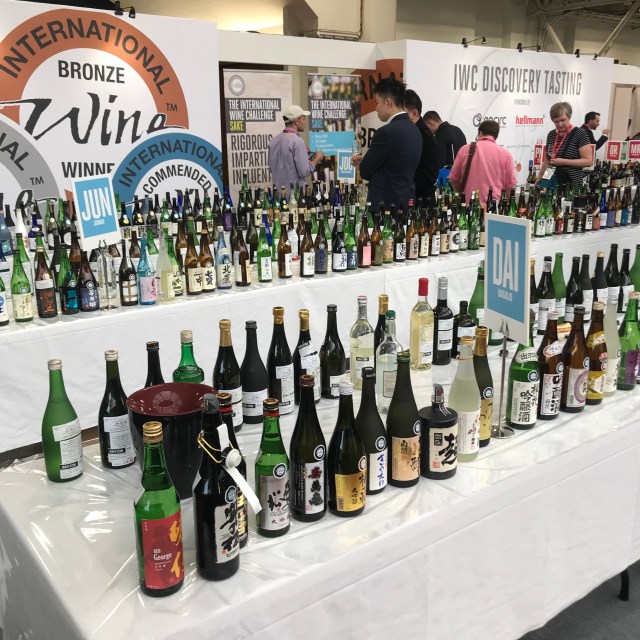
I like to end my LWF coverage with a few pics from the rest of the fair. I may not toil around the main floor very much, but largely that’s because time just doesn’t permit it. I’d love to go for a second day, and maybe one year I’ll manage to. I would have loved to spend a morning at the IWC Sake Pavilion. Next year, perhaps. Regrets…I had a few. Not tasting at the Château Musar stand, and having too little time to hit the New Wave of South Africa tables were my biggest, but when you get home and discover a host of other delights you missed you understand why some people do go for all three days.



Posted in English Wine, Wine, Wine Agencies, Wine Festivals, Wine Merchants, Wine Tastings | Tagged , , , , , , , , , , , , , , , , , , , , , , , , , , , , , , , , , , , | Leave a comment

London Wine Fair 2019, Part 1

London Wine Fair is a large affair, to say the very least. It’s the largest of the wine events I attend every year, but that doesn’t mean it’s where I taste the most wines. With a few exceptions, the main trading floor is, as its name gives away, where some of the bigger players do their commercial business. Many of the areas down there are devoted to larger producers and importers, alongside a healthy smattering of national and regional pavilions.

The event is also famous for its masterclasses and industry briefings, but if like me you are there for just one of the three days this time, then there’s no time for all that. I have begun to hang out, increasingly, up on the gallery floor at Olympia, in the section named Esoterica. The name betrays a certain pejorative attitude, rather like the old “Country Wines”, used to gently put down a wine from outside the classic regions. I think they should change the name to “The Exciting Bit”, but I guess those paying for the event via their lavish pavilions downstairs would get upset.

I’m only joking, though. This is a very important event for the UK wine trade, which is far more valuable, economically, than the selection of small importers I follow. I’m grateful that the event recognises the part these innovators will play in the UK market’s future. Downstairs discovers the trends, whilst upstairs we are discovering the groundbreaking new wines.


Even in the “Esoterica” section there are more than fifty tables, occupied mainly by small wine merchants/importers. It is a number of these which I shall focus on in my coverage of LWF 2019, with only a few diversions into other areas. On the opposite side of the gallery there is a section called Wines Unearthed. This is where you can find producers who are hopeful of finding UK distribution. After tasting the stars of the Esoterica tables it can range from tiring to, occasionally, soul destroying (no, I’m being too harsh) to taste through these wines. But I did find a very interesting Rhône producer here (for inclusion in Part 2), admittedly because of a tip from a wine merchant friend. One of those domaines where you like everything…the wines, the philosophy and the person.

img_6428

NEKTER WINES

As with all of these people in Part 1, I have tasted the wines of Nekter already this year, but there are always new wines and new vintages, and I do specifically ask to taste things that are new to me. I don’t think I’ve written about any of these wines before.

Pret-a-Blanc 2018, Schmölzer & Brown, King Valley (Victoria, Australia) This region of North East Victoria comprises the high hills along the King River Valley as it flows from Australia’s Alpine National Park. Tessa Brown (ex-Kooyong and Sorrenberg, eyes immediately light up), along with her husband Jeremy Schmölzer, have recently planted 2 ha of vines at Beechworth, but the bulk of their production comes from a neighbour’s vineyard over the road whilst the couple’s vines come on stream.

This is a blend of 70% Riesling with Pinot Gris and Gewurztraminer, whole bunch pressed into stainless steel. It’s an aromatic wine, a genuine Aussie take on an Alsace blend. There’s a floral (jasmine?) element to the bouquet, and the palate is soft, dry, saline and mineral, the latter via a slightly dusty texture. This is really good, and a very nice start at the Nekter table. The 2017 UK allocation of this all went to The Fat Duck, I believe. There will hopefully be some 2018 for the rest of us.

Brunnen Pinot Noir 2017, Schmölzer & Brown (Beechworth, Victoria) This comes off Beechworth’s Ordovician mudstone and shale, the grapes being destemmed and macerated for three days. They then hit the basket press before seeing French oak, six barrels of which one was new. The wine is pale and smooth, scented with strawberry and cherry, and some earthiness on a very long finish. Very fine. Not cheap (£46), but yes. impressive. Everyone is predicting stardom for Schmölzer & Brown, so perhaps it’s worth getting in quick here.


Voetstoots Old Vine Chenin Blanc 2016, Stand Alone (Stellenbosch, South Africa) Alexander (Xander) Grier’s own personal project makes wines using traditional methods with as little manipulation and intervention as possible. It’s a contrast to his day job with Villiera Wines, where he makes wine in somewhat greater quantity. This is his first own label Chenin from a very old block. He gives the fruit six hours on skins after which it follows the time-worn route of basket press to old oak. This is a beautifully fresh wine with so much depth, which will surely increase over a year or two. It’s not heavy, but it does have a bit of weight, assisted by a lovely texture.

img_6363

Stand Alone Gamay Noir 2018 (Stellenbosch) This is the only Gamay I currently know of in South Africa, and it is far more than a mere rarity. Just three barrels of this were made, after layering the bunches in the tank alternately, destemmed and with stems, to create a more complex carbonic fermentation. This is the wine’s first vintage, and the bottle was an under the table jobbie which is not yet up on Nekter’s web site. Grippy cherries, zesty acidity, but also, unquestionably, serious stuff, 13% abv. I would recommend snapping this up as I reckon it will fly out.

img_6365

“The Bear” 2016, Donkey & Goat (Berkeley, California, USA) Jared and Tracey Brandt make these natural/biodynamic wines in Berkeley, taking appropriately grown grapes from Napa, Mendocino and Sierra Nevada. The Bear is a single site wine from the Fenaughty and Lightner Vineyard, at altitude in the El Dorado AVA (Sierra Nevada foothills). The grapes are all loosely Rhône/Southern French varieties, Counoise, Cinsault, Mourvèdre, Grenache and Roussanne. We get both dark blackberry and red strawberry fruit with gentle nutmeg spice. It’s basically a pale wine packed with flavour and just enough grip. Excellent.

img_6367

Seaside Cabernet Franc 2017, Geyer Wine Co (Adelaide Hills, South Australia) Fascinating to taste an Aussie Cab Franc after all those excellent Canadian versions I tried a few days before LWF. Dave Geyer’s take comes specifically from the Sellick Hills area. Half of this wine was originally intended to be a rosé, fermented accordingly. The other half was treated to ten days on skins. Liquorice, blueberry tart, saltiness and a fresh sprinkling of newly sharpened pencil lead, this wine majors on freshness and elegance and tastes remarkably Loire-like in some ways, especially the violet and lavender bouquet. The 13% alcohol doesn’t show at all.

img_6368

Charbono 2015, Calder Wine Company (Napa, California, USA) Rory Williams is Frog’s Leap’s Vineyard Manager, using his middle name for his own small scale wine project. Charbono is a synonym for Bonarda, a grape which originated in Savoie, but may be better known to readers from the satellite DOCs of Northern Piemonte. This first vintage (the vines were planted by Rory himself in 2008) was fermented with 25% whole bunches for twelve days and matured 18 months in French oak (25% new). You get plum and cherry concentration in a fairly light red, with a minty freshness. The fruit has amazing concentration, enormous, seriously. There are (or maybe were by now, it has been a week) a thousand bottles of this. £38 for an obscure variety? In this case, a definite yes.

img_6369

SOUTHERN WINE ROADS

Southern Wine Roads is a specialist importer for Greek wines, with a focus on small estates making wine from autochthonous varieties. Their portfolio seems to me to be improving every time I taste here. I’m not an expert on their whole range yet, not by a long way, but as with Alpine Wines (below), I’m convinced that we have here a small importer who it’s time to take a little more notice of.

Assyrtiko “Unfiltered” 2015, Papaioannou Estate (Peloponnese, Greece) The fruit for this white comes from Nemea, known for its often lovely red wines from the Agiorgitiko variety, but it is labelled PGI Peloponnese. It’s very different to the better known Santorini style of Assyrtiko, which is off volcanic terroir. In Nemea the soils are on clay and limestone, usually either side of the 300-350-metre contour line. This is scented with lovely fruit, a certain softness and a bit of mineral texture. It is aged for twelve months in new French oak, which stamps its mark, but I still found it oddly very attractive.

Assyrtiko 2018, Gavalas Winery (Santorini, Greece) You probably don’t often get to taste two completely different Assyrtikos together? Nor do I. But doing so allows you to understand what elements of the grape relate to terroir, and also what a great variety Assyrtiko can be. The vineyard here is claimed to be the oldest currently in Greece, some vines reputedly five hundred years old. These vines are trained in the traditional way, curled and furled into protected balls of wood which crouch low to avoid being blown away. The wine is tank fermented, exhibiting a wild freshness that must come from the sea breezes and rocky volcanic soils of that beautiful island. Pear and lemon with a delicious tropical fruit juice finish.


Litani 2013, Afianes (Ikaria, Greece) Ikaria is an island in the Southern Aegean about ten miles or so southwest of Samos. It’s a small Island but it rises over 1,000 metres in the centre. Its small population inhabits mainly fishing villages on the coast, but winemaking is getting a reputation via this quality estate, run by local pharmacist, Nikos Afianes.

The single variety for this white is Begleri, indigenous to the island. It comes off granite and sand at 400 metres altitude from very old vines (some more than 120-years-old). Made by foot stomping in a granite trough, it is fresh and herby, stony, mineral and with a twist of lemon zest. In fact it’s just as you would imagine a really good wine from the Greek Islands might taste.

There’s also a brilliant red wine which I tasted later but I’ll include it here, Icarus 2014, which is made from another variety peculiar to Ikaria, Fokiano. It’s made in mixed oak with 12 months ageing. It runs out at 14% abv, but it’s pale and has the most beautiful scent of aromatic cherries and red fruit. It’s very dry and it needs time, like a good Barolo needs time. I was genuinely surprised just how much I liked these Afianes wines. This red was one of my wines of the day, but I wouldn’t recommend trying to knock it back alone, in one go.

img_6374

img_6381

Paleokerisio 2016, Glinavos Estate (Epirus, Greece) We are up in Northwestern Greece here, on the mainland. I’ve tasted some Glinavos sparkling wines before, but this one is a bit different. It’s an off-dry, semi-sparkling, orange wine. The grapes are equal parts Vlachiko and Debina, the latter being a major variety for this producer’s wines. It’s a bronze skin contact wine with a mineral texture accentuated by the gentle bead, smelling and tasting of oranges, herbs and exotic Middle Eastern spices. The spice element grows on the palate as the fine bubbles fade. In one respect it’s really weird, yet it’s more than just interesting. If you, like me, are also adventurous I reckon you might actually adore this.

img_6377

Lola 2017, Aoton Winery (Attica, Central Greece) This unique wine is labelled PGI Peania. The grape varieties are Mandilaria, Savatiano and Roditis. They are picked in the cool night air to preserve freshness. The Mandilaria has pine resin added during its separate fermentation, but the resinous flavours you usually get in a retsina (which this technically is) are somehow swallowed in the vat and you are left with the merest hint of pine. The result is just about pink, and really quite delicate. It’s dry too. Only around 4,000 bottles are made.

img_6379

Naoussa 2015 and Paliokalias 2013, Dalamara (Naoussa, Greece) This is an old estate, dating from the 19th Century, in Northern Greece’s most famous, and perhaps traditional, PDO, but one where the new generation is beginning to raise its reputation even further. Naoussa makes deep reds from Xinomavro. The unfiltered entry level wine is made in quantity (in a Greek context, around 10k bottles), but after a year in oak it even has a touch of seriousness to it. It’s dry, savoury and herbal. The Peleokalias is a single vineyard wine which is showing greater depth and complexity, but leave it to age. It’s pale and quite Nebbiolo-like, but has heightened fruit as well. Another stunning wine.

This was my best tasting yet with Southern Wine Roads, and the best overall selection from them I’ve tasted. I know that they were selected for me as the best wines on the table, but if I were to buy a half case I’d be seriously pushed to leave out any of the eight wines above, certainly choosing all the reds, Lola, the Paleokerisio semi-sparkling orange wine, and the Litani, but then the Assyrtiko…

img_6382

ALPINE WINES

Alpine Wines sells wine from several countries and regions which are broadly Alpine, or maybe Sub-Alpine at a push, but although this includes a good range from Austria, they are the only really decent source for Swiss wine in the UK if you need a fairly wide selection.

I keep ramming it down people’s throats that they should try Swiss Wine. I know the best is expensive. Even the second best is expensive. But it’s usually different, not the same old same old. I’m tempted to say that it’s no more expensive than a bottle of good Burgundian Chardonnay, except that if that’s all you drink then your palate may not be ready for a Heida, a Petite Arvine, or a Fendant. Yet in truth they are not remotely scary. For starters, whilst some Swiss wine is natural wine, most is not. Just unfamiliar is what I’d suggest. Most of the wines I tasted here were Swiss, with a couple of ringers thrown in. The first of these is from Vienna.

Weissburgunder “Der Vollmondwein” 2017, Rainer Christ (Vienna, Austria) Christ’s wines are less well known overseas than his larger neighbour on Bisamberg, Fritz Wieninger, but he runs a reasonably sized operation. I had to try this a week last Monday as I was aware that several people I know tasted at his place last week. This Pinot Blanc is grown on limestone on the individual Bisamberg cru of Ried Falkenberg, one of the higher sites on the side of the hill facing the city and the Danube. Harvested under the full moon (Vollmond), this is beautifully fresh and vibrant, lemony with a textured, bitter, finish. Yet for all that freshness it does not lack body, and in fact packs 13% abv, so it has a Chardonnay-like weight. A food wine.

img_6384

Petite Arvine 2017, Jean-René Germanier (Valais, Switzerland) If you read my blog regularly you’ll have come across this producer before. Jean-René and Gilles Besse make their wines above the Rhône Valley, between Martigny and Sion, close to Vétroz. Petite Arvine is the Valais white grape par excellence, out of several fine competitors. It’s one of the Germanier wines I didn’t see at the Swiss Tasting I went to near London Fields back in April. This pale yellow/golden wine reflects yellow fruits and lemon freshness. My notes say “dry, dry, dry” but it is also unquestionably thirst-quenchingly fruity. The dryness balances it out.

img_6385

“Les Murailles” Rouge 2013, Badoux Vins (Aigle, Vaud, Switzerland) Aigle is in that part of the Canton of Vaud which lies to the east of Lac Léman, off to your left after you leave the lakeside if you are following the motorway towards Martigny. Badoux is a well known company which makes, in the white (Chasselas) “Murailles”, perhaps the most widely recognisable label in the country. This red version, similarly attired, is made from Pinot Noir. Actually I’m told 95% Pinot, but I have no idea what grapes make up that other 5%. A bit of the ripasso technique is used here, and the semi-dried Garanoir/Gamaret grape skins used add weight, and possibly alcohol (13.5%). So we have a wine that is not typical Pinot, especially on the nose, but overall the fruit is much darker, and richer. Quite a big wine really, so something different. Around £33.

img_6386

Syrah Réserve 2013, Domaine des Muses (Valais, Switzerland) This is a top domaine at Sierre, further up the river Rhône than Sion, and sitting below the ski resort of Crans-Montana. I tasted the 2016 of this wine at the Swiss Tasting I mentioned above. I said 2016 was young, so the chance to try the 2013 was welcome. It still has the bite and structure of new oak, but as with the Canadian Cabernet Francs in my previous article, it has that signature freshness of Valaisin Syrah. There is still the same spice and liquorice I found in the 2016, whilst the plum and darker fruits are a little more juicy and softer. But being a reserve wine, one should expect to age it.

Sonntaler Grauvernatsch 2017, Kellerei Kurtatsch (Südtirol, Italy) Kurtatsch is about half way between Trento and Bolzano/Bozen, in Italy’s dual-language northeast (so it is also alternatively known by some as Cortaccia). This is one of Italy’s great co-operative wineries (Kellerei or Cantina, take your pick), and to be sure, that adjective is not misplaced in this part of the country. Grauvernatsch is also known by another name, Schiava Grigia in Italian.

The wine is a palish red with high-toned, concentrated, raspberry fruit, acidity and grip. Not a complicated wine, it nevertheless has a delicious savoury side, a finish of decent length, and a moderate 12.5% alcohol level. If some of the wines above are “finer” (and indeed all of the wines from the producer who follows), then this simple wine is nevertheless one I’d buy, and enjoy, for what it is. And hey, it’s Grauvernatsch and I bet you’ve never tried one!

img_6387

Marie-Thérèse Chappaz (Fully, Valais, Switzerland)

Marie-Thérèse is unquestionably one of Switzerland’s foremost and most famous winemakers. Her wines are appreciated by the points-spouting classicists, who habitually spout a lot of points at her, and by lovers of artisan biodynamic winemaking, in equal measure. She has won more awards than she has had the time to attend their ceremonies, but she is a member of the highly regarded organisation of top Swiss estates, Les Artisans de la Vigne et du Vin, which she helped found in 1999.

I tasted four Chappaz wines at the Fair, and I know that Joelle at Alpine Wines brought them along, with her Coravin, in part for my benefit. I’ve never tried more than one of these wines at a time before, and they are sufficiently rare and expensive that I’ve never had more than one at a time in my cellar either.

Grain Nature Champ Dury 2017 is a truly gorgeous blend of Pinot Noir (90%) with Gamay off limestone and made in old oak. The “young vines” are around 25 years old. It is redolent of bright quetsch plum and cherry, big fruit and firm minerality. There’s no added sulphur, and in this case it’s absolutely bright and beautiful. £50 a bottle.

Dôle “La Liaudisaz” 2017 Dôle is much maligned, as perhaps is Bourgogne-Passetoutgrain, which conceptually it resembles. The best Dôle, like this one, will blend 85-90% Pinot Noir with the legally required Gamay component. The wines are rarely complex, but Chappaz does make a wine that is several steps up from the norm. Limestone soils and very low sulphur add an almost magical degree off freshness, in what is otherwise a simple wine. The fruit is crunchy, but there’s a meaty edge to the Pinot which transforms the wine when it kicks in. There’s no fireworks, just hard work resulting in a strangely satisfying bottle. Circa £31, cheap for Chappaz.

Grain Ermitage 2017 This is one of the stunners in the range. It’s made from 100-year-old Marsanne vines on one of the steepest slopes in the region, and an homage to the Northern Rhône, the French wine region way downstream. The wine is big and waxy, with lemon and lime acidity, and it weighs in at 14.5% abv. This means you need to be wary of it, but a little goes a long way, and like Hermitage Blanc, you don’t need to drink it all at once. If I was to try to say how it differs from that French region’s whites, I’d say this has a touch more fruit and perhaps less of the herby thing going on. It sees 18 months in oak.

I don’t think you need to give it the very long ageing that a White Hermitage requires, but you should nevertheless give it the due respect of ageing, a decade perhaps. I think Joelle’s recommendation to partner it with cheese is a very good one, though a perfect match might also be found with a Poulet de Bresse (maybe herbs and lemon, and roast potatoes). £69.


Grain Noble 2016 Marie-Thérèse is best known for her sweet wines, though I refuse to accept that the best of the dry reds and (especially) whites are any less good. The grape here is 100% Petite Arvine. I think the grape is one of the great underrated varieties for sweet wine in the world, and this is a world class wine. The old vines yield tiny quantities of grapes, which are picked berry by berry, with some botrytis. Spontaneous fermentation takes place, after which it is aged in old oak for 24-to-30 months.

The fruit is exotic, complex and complicated (you really don’t want a list of everything that’s in here). What’s more important is the minerality, and the fact that I’ve never come across this degree of freshness in a Swiss sweet wine before. Added to the fruit, it’s explosive, but not “shouty”. 12% abv means it’s neither light nor heavy but a wine with heavenly balance. But before you get too excited, you only get 500 ml for your £75.

img_6423

Don’t despair though. The Dôle I tasted earlier, and her Fendant President Triollet (which is my sole representative) both sit just either side of £30, and are both very good wines, if lacking the ability to quite scale the heights of the top wines. These wines are exported in tiny quantity, a bit like the low yields of the Petite Arvine above. Alpine Wines has recently taken a delivery and their web site, at the time of writing, lists eleven Chappaz wines. You may even be too late if the Michelin-starred boys have pounced, but do check out their wider Swiss range. They don’t give me anything for my kind words, of course, but my passion for some of these wines makes me continue to plug them vociferously.

Part 2 will follow later this week, with more Esoterica, the “Unearthed” Rhône estate I promised, and the Nyetimber Bus. You have to visit the Nyetimber bus at London Wine Fair (and I’ll tell you, everyone does!).

img_6356


Posted in Artisan Wines, biodynamic wine, Greek Wine, Swiss Wine, Wine, Wine Agencies, Wine Festivals, Wine Merchants, Wine Tastings | Tagged , , , , , , , , , , , , , , , , , , , , , , , , , , , , , , , , , , , , , , , , , , , , , , , , , , , , , | 1 Comment

Taste Canada 2019

Taste Canada is now an annual event put on by the Canadian High Commission in London to showcase, in 2019, two-hundred wines from British Columbia, Ontario and Nova Scotia. Forty producers were present, so the seven profiled here provide a mere snapshot of the event. But I hope that this short article does manage to convey some of the excitement being generated by Canada’s various wine regions and styles.

I began my coverage of this event with a profile of the producer I personally find the most exciting and innovative in the country, Okanagan Crush Pad. You can read about them here. Although my coverage of Taste Canada may be shorter than last year (fifteen producers in 2018 with some overlap, but take a look here if you are interested), there’s plenty to enjoy.

NORMAN HARDIE WINERY (WELLINGTON, ONTARIO)

These are some of the most renowned vineyards and wines in Southern Ontario. Norman Hardie is based in Wellington, with vines in both Prince Edward County and Niagara. The terroir here is principally limestone, which is especially good for Chardonnay and Pinot Noir. Hardie specialises in these varieties, but he also makes damned good Cabernet Franc as well. Canadian Cabernet Franc first came to my attention from the Okanagan Valley (BC), but Ontario seems to be able to make something special out of the variety, at least if this and the next producer are anything to go by.

The climate in Southern Ontario is usually described as “cool”. Come on folks, -30 Degrees Centigrade in winter in Prince Edward County isn’t cool, it’s remarkably cold. After all, in Vermont to the east they are using hybrids (see La Garagista in my recent coverage of Real Wine Fair 2019 on this site). The reason that vitis vinifera vines can thrive in Southern Ontario is in part down to climate change, but also because they often utilise the technique of burying the vines in winter in Prince Edward.

Niagara is by far the most important region for vines in Ontario, with more than 80% of that province’s vineyards. Niagara is cooler in spring and warmer at the end of the growing season, due to the effect of the Great Lakes, especially Lake Ontario. Budbreak is later and ripening can take longer. The water does help to modify winter temperatures too, and cooling breezes off the lake help stop temperatures rising too much in summer. Without this great body of water there would be no wine. With it, a lot is possible, as the ever improving wines show.

Chardonnay 2016, Niagara Peninsula VQA The vines here grow on dolomitic limestone . Ageing is just ten months in oak and only a little sulphur is added at bottling, without filtration. Norman is no young hipster, but his methods are based on minimal intervention. The nose is fresh, and suggests a lighter wine than that which creeps up on the palate (it has just 12.6% abv though). It’s perfectly balanced, and a genuinely lovely Chardonnay to start with.

County Chardonnay 2016, Prince Edward County VQA This is a different wine to the Niagara, and I think they key is the cooler Prince Edward climate discussed above. The palate has a slightly leaner edge, although the alcohol here is up a touch at 12.8%. Both of these wines are nice but different expressions of individual limestone terroirs.

Cuvée Des Amis 2015, Prince Edward County VQA This Chardonnay comes off five Prince Edward County sites all within a kilometre or two of the winery. In 2015 devastating frosts meant that the crop was tiny and so the sites were blended. The grapes were pressed gently into horizontal stainless steel fermenters, and then the juice was moved into 500-litre oak (25% new then an equal split of 2nd, 3rd and 4th-year fills) to complete fermentation. It was then aged on lees in oak for 12 months, then stainless steel, still on lees, for ten more. Bottling saw a minimal dose of sulphur. It’s nicely rounded out in the glass with a bouquet of citrus and bready notes, the palate being saline and a little savoury, with citrus peel acidity. The bottle says 11.9%.

Pinot Noir 2016, Niagara Peninsula VQA This is off four Niagara sites, the grapes being given a cold soak for a week with two daily punchdowns. They use a small basket press for the Pinot, after which the fermented juice goes into traditional 228-litre French oak for nine months. The result is bright and pale. You get red fruits and cherry, plus dusty tannins and a crunchy acidity which makes it crisp and savoury, but the ripe cherry fruit gives it just a bit of beefiness. There’s a mere 11.4% abv.

County Pinot Noir 2016, Prince Edward County VQA It seems that 2016 was a hot and dry year in Ontario, but the alcohol levels of these wines are low. Despite that, they all have a real presence, and this is no more so than with this wine. It saw 25 days on skins, the first seven as a pre-fermentation cold soak. It went through the small basket press and then into the same oak regime for, in this case, ten months. The rocky limestone soils create a wine of elegance, but the nose seems a little deeper than the Niagara Pinot. It has a little more weight in the mouth too, more of the ripe cherry notes. It’s also a bit more velvety too. Suave, in a good way.

County Cabernet Franc 2016, Prince Edward County VQA I suppose, to the degree that I knew Norman’s wines, I’d kind of seen him as a Pinot Noir and Chardonnay specialist, but that’s not all he makes by any means. In fact I’d love to try his Zweigelt. But he also makes several Cabernet Francs (including a cuvée with no added sulphur). This County Cabernet Franc comes from a good year, thankfully, following a difficult one, as late frost killed off 85% of the crop in 2015 (see Cuvée Des Amis, above).

Ageing is in oak again, 25% new after a reasonably long time on skins (22 days). The overall impression, a very positive one, is of a wine with freshness and bite. The bouquet gives nice red fruits and a little pepper, with a palate at this stage showing grainy tannins, bright acidity and balanced, rich, red fruits. It’s a very impressive wine, one of my top four on the Cabernet Franc Focus Table, and one that will age in the medium term, despite its obvious approachability. It wouldn’t be a disaster if you opened this for Sunday lunch next week, but I’m sure holding off will bring rewards.

PEARL MORISSETTE (NIAGARA, ONTARIO)

François Morissette studied at Dijon and worked with Frédéric Mugnier, Christian Gouges and Jean-Marc Roulot, but this is as far removed from a copycat Burgundy operation as you could imagine. These are very much Niagara terroir wines, in terms of varietal selections. They are also wines of low intervention and very low sulphur. Production is small, with each wine being made in quantities between 500 to 2,000 cases. Their base is around Jordan on the edge of the Niagara Escarpment, and close to Twenty Mile Creek, which hits Lake Ontario at Jordan Harbour.

Irrévérence 2017, Niagara Peninsula VQA Riesling (64%), with Chardonnay and Gewurztraminer. The Gewurz was fermented on skins in qvevri (6 months),  the Riesling in innox, and the Chardonnay in concrete and then into foudre for six months. The result is a very aromatic but textured wine with a very beautiful bouquet (I’m tempted to use that word “shimmering” again), fruity and floral. The palate is a mirage of different elements which seem to interweave into a fairly complex yet gastronomic whole.

Metis Blanc 2017, Niagara Peninsula 100% Chardonnay from young vines of which some of the fruit goes into concrete and the rest into old Alsace foudres. After fermentation the two elements are blended for ageing. On top of the profile you find white flowers and on the bottom, a little buttery mouthfeel. It’s a fresh wine, but with a degree of depth.

Metis Rouge 2017, Niagara Peninsula is a blend of Pinot Noir, Cabernet Franc and Gamay. This is a lovely, pure tasting, blend, quite zippy on the acidity front, yet with plush fruit filling it out. It also has a smidgeon of that Niagara crunch. Very nice.

Cuvée Dix-Neuvième 2013, Twenty Mile Bench VQA This increasingly well regarded viticultural zone, one of twelve now designated in Niagara, runs west to east, parallel to the lake and just south of Jordan, and in the middle of the Niagara Escarpment. The soils are a mix of sand and glacial deposits, and the area is cut by streams. So whilst the escarpment protects the vines from cold south-westerly winds, there are multiple different hillside exposures for the vines.

This cuvée is the estate’s Chardonnay, from older vines. It is a nice pale gold with green glints, round and smooth, with depth of fruit but also citrus acidity. The back palate shows a little bit of texture, and that helps the flavours linger in the mouth. The alcohol here is 13.5%, half a percent more than the young vine Chardonnay.

Cuvée Black Ball 2013, Twenty Mile Bench This wine did pass the “VQA exam” in 2013, but not in 2014, I believe, the problem being the usual shortsighted, or petty minded, “lack of typicity”. It’s a skin contact Riesling which is both fermented in 60-year-old foudres from Alsace, and then aged on lees in the same vessels. It has zesty high notes of lime and white flowers and a mere hint of petrol on the nose. It’s clean and dry, with a sour note on the very finish, and it’s bottled without the addition of any sulphur, but as protection it is bottled under a little pressure, creating some dissolved CO2. I can just imagine the VQA judges…”ooh err missus”!

Cuvée Madeline 2013, Twenty Mile Bench A Varietal Cabernet Franc from a coolish, classic, vintage on the Bench. Despite the conditions in 2013 it has no greenness at all, though it does seem to have what I’d like to call a glorious restraint. Cuvée Madeline 2012 is a little darker, has just over one percent more alcohol (13.6%) and a bigger nose, more violet than 2012’s red fruits. It’s super plush, but still grippy and tannic. This vintage was warmer, of course. Both of these wines were among my favourites of the Canadian Cabernet Francs on show. The 2013 has a restrained intensity, whilst the 2012 seems to have an effortless elegance. I think I’d choose the 2012 if pushed, but there’s a £10 price difference (it appears), and not in my favour.

LIGHTFOOT & WOLFVILLE (ANNAPOLIS VALLEY, NOVA SCOTIA)

Peter Gamble poured the wines last year, a well know viticultural consultant and one of the key players behind Nova Scotia wine. This year the wines were poured by Rachel Lightfoot. We first explored three of their several sparkling wines, and then three still wines (two Chardonnay and one Pinot Noir) from the Ancienne label. Lightfoot is the family and Wolfville is the town near which (along with Avonport) the family’s 35 acres of vines are situated. The viticultural climate here is assisted by the Minas Basin, which ameliorates the temperatures. The vines are all grown biodynamically on glacial till and sandy loam, in places over water retaining clay.

The sparkling wines come as a Brut Nature with zero dosage, a late disgorged Blanc de Blancs, and a straight Brut. Blanc de Blancs Brut Nature 2012 is 100% Chardonnay fermented in wood, where it underwent partial malolactic before resting on lees for five years before disgorging in January 2018. You get mouthfilling frothy freshness with notable lees development and a filigree spine of acidity. Of course, it finishes nice and dry, with salinity. Sadly they only made 130 cases.

Blanc de Blancs Extra Brut Late Disgorged 2013 had only four years on lees with, again, the base wine (Chardonnay) initially kept in oak. This was dosed at a low 3.5g, so it has a little bit more plumpness and gras, but not too much. It does, however, retain the refreshing quality of the first wine.

Blanc de Blancs Brut 2014 also saw four years on lees, and again is 100% Chardonnay, although they now have some Pinot Noir and Meunier planted for sparkling wines which came on-stream in 2014. It’s pale and quite restrained. It tastes more youthful and the acidity is fresh here. There’s less bottle development, but at this stage the cuvée is amazingly bright. There’s definitely some salinity, again. I would suggest this needs a year or four in bottle to develop.

Nova Scotia, and Annapolis Valley in particular, is tipped as an exciting new source for sparkling wines. Lightfoot & Wolfville is definitely proving that to be true. They don’t currently have UK distribution, and the wines are not going to reel customers in by price, but these are nevertheless lovely sparkling wines which deserve a wider audience. Benjamin Bridge is another Nova Scotia producer who, although not featured here, makes very good Méthode Classique sparkling wines (often claimed to be the best in the province) in the Gaspereau Valley, south of Annapolis. A region to seek out.

Ancienne Chardonnay 2015 and 2016 show another potential winner for the Province. The Chardonnay here comes from the Home Vineyard at Wolfville, off well drained soils with the temperature ameliorated by on-shore breezes. The 2015 was barrel fermented in French oak (20% new) and underwent full malolactic. There is good concentration from low yielding vines, and although the oak is only 20% new (80% “neutral”), there is a bit of vanilla in there. There’s also what I call nice line and length.

2016 was also aged in French barriques (same proportion new). It is less developed and more chewy now, with a recommended drinking window of 2020 to 2023. We are probably looking at £26-to-£30 retail for these, if someone takes the plunge to bring them in. A fair price I think for the quality.

Ancienne Pinot Noir 2016 This is the product of low yielding vines in a good, dry, vintage, the dryest that the Lightfoot family has known at Avonport, where their Oak Island Vineyard, from which this cuvée is sourced, is located. The style is lighter, with the wine a pale and vibrant cherry red. The fruit smells like high-toned cherry bonbon with a floral note wafting through on one of those offshore breezes (it really soars). There is the kind of acidity which is well balanced with the fruit, making for a lovely Pinot in the lighter style. Very nice.

OSOYOOS LAROSE (OKANAGAN VALLEY, BRITISH COLUMBIA)

This project goes right back to 1988, when Bordeaux (Groupe Taillan) and Canada (Constellation) formed a joint project to make a brave new red wine at Osoyoos, in the South of the Okanagan Valley. They were pioneers in quality viticulture at the time. The vines make use of the flat mountain benches again. The rainfall here is low, and freezing winter temperatures are offset by the warmth generated by Lake Osoyoos.

The first release of a Bordeaux blend, using all five classic Bordeaux varieties, Merlot, Cabernet Sauvignon, Cabernet Franc, Petit Verdot and Malbec, was in 2001. The wine won immediate acclaim and fourteen vintages later the Grand Vin has established itself as, perhaps, a Canadian icon. The winemaker is Catherine Schaller, who has previously worked in Southwest France with a spell in Chile, before arriving in 2017. The previous winemaker, Matthieu Mercier, who of course made the wines on show, still works for the company in Europe, and he was the man pouring the wines to taste.

Pétales 2015 is a Merlot-dominant Bordeaux blend with high toned, stylish, smoky fruit with a bit of grip. It’s a nice approachable wine, which is exactly what is intended. Recommended drinking is within three years of vintage. If anything, I think consumers would only note that it is fairly expensive, at perhaps £25.

Osoyoos Larose 2015 This was a warm vintage here and the Merlot-dominant blend (71% with both Cabernets forming 20% between them and Petit Verdot and Malbec making up the last 9% of the blend) is pretty ripe. The aromatics are nice, and indeed classic for the varieties. You get dark fruits and a fresh graphite note on the nose. The wine was aged in French oak, a significant 60% new and 40% second fill. Alcohol levels seem high, and 2015 reaches 14%. But with Okanagan freshness, in this case it doesn’t show. The tannin is to the fore, but that’s expected.

Osoyoos Larose 2008 Here we were given an opportunity to try a more mature wine. In fact, with a recommendation to cellar these for 8-to-10 years, this should be peaking. The varietal proportions in the blend were a little different in 2008, Merlot only comprising 60%. Cabernet Franc jumps to 25% on its own, whilst the remaining three varieties split the remainder in proportions too small to worry about the detail. There’s still plenty of fruit left in this vintage, but there are certainly more tertiary elements, which for me comprised hints of leather and coffee. It’s certainly getting more complex.

The Grand Vin is very much in the Bordeaux mould. Some might say that the resemblance is too close to make this something different to that French region. But the famous Okanagan freshness does make it stand apart. If my sheet is right, the 2008 contains 14.9% alcohol. That’s quite a lot, and I wouldn’t want to consume a bottle all to myself. But sipping a small sample, you would not say that the alcohol truly dominates, probably because of that fruit and freshness combination. The Grand Vin is indeed a Canadian classic.

img_6320

INNISKILLIN ESTATE WINES (NIAGARA, ONTARIO)

Inniskillin actually has an estate in the Okanagan Valley in British Columbia, but here we will just look at some of the Icewines made in Niagara. Based off the main highway between St-Catharines and Niagara-on-the-Lake, in the sub-region of Niagara-on-the-Lake, Inniskillin claims to be Canada’s “first estate winery”. They have certainly been making wine here for 35 years. It is fair to say that this may be the Canadian wine estate best known in the UK, and it is via their Icewines, which have garnered top medals almost continuously in international competitions since the 1990s. It is also probably arguable that no single wine producer has done more to put Canada on the map. That wine map is changing, as we have seen already in this article. But Icewine is still a very important flagship for the country. It’s a completely different kettle of fish to German Eiswein, but the WSET lecture ends here…

All four wines below are VQA Niagara Peninsula.

Sparkling Vidal Icewine 2017 Vidal is a hybrid variety, a cross between the vinifera Ugni Blanc and another hybrid called Rayon d’Or, more commonly in Europe called Seibel 4986. It is a thick skinned, winter hardy, variety, so suitable for the Niagara climate, especially forty years ago. It was the original Icewine variety to find favour on export markets.

Sparkling Icewine, like the sparkling sake I drank a couple of nights ago, is the kind of drink you might rarely buy, but when you try it you like it and wonder why maybe you don’t own a bottle at least.

This is made by the Charmat method, about which we can be quite rude here in Europe, effectively fermentation in a closed tank rather than on lees in bottle. The wine is quite golden in colour, richly sweet (tropical fruits, honey) but the sweetness is diminished on the palate by the acidity. The bubbles accentuate this perception. So it’s sweet and refreshing with a little intensity. It’s not really meant for laying down, and it would be quite a versatile wild card with food: appetizers, Asian-style fish and seafood, cheeses and desserts. It might come as a bit of a shock if you wheel it out in the aperitif slot.

Riesling Icewine 2017 I can give you an idea of how Icewine is made by noting that the harvest of frozen berries for this wine took place on 5 January 2018, when temperatures in the vineyard had dropped to -10C. Pressing takes place swiftly, fermentation lasting 18 days. You obtain a wine in this case with 246 g/l of residual sugar balanced by 12.74 g/l of total acidity and 9.5% alcohol. Without the acidity the wine would undoubtedly taste cloying, but it retains freshness. Fruit flavours cover several spectra, as in tropical, stone fruits and rich honeyed elements. The acidity comes across as fresh lime and lime zest.

Gold Vidal Icewine 2017 The Vidal Icewines don’t have quite the class of the Riesling (for me), which does suggest that varietal character is not at all subsumed by the style. But Vidal is successful in some ways because of the relative simplicity it can bring to the table. This wine has 250 g/l of residual sugar, yet it tastes really quite refreshing, and actually might appeal more to anyone who doesn’t know the style.

Cabernet Franc Icewine 2017 So this is my favourite, obviously because I like the obscure, and I’m difficult. But to be fair, it will cost $100 Canadian for a half-bottle (though it also comes as 200ml and 50ml), so it is priced as the best. I’d be more than tempted to grab the small size for $15-or-so if I saw one in a wine store.

The colour is bright bronze-pink, it has lovely thick legs, and smells like a sweet red should. I get cherry brandy/kirsch and sweet strawberry fruit, but it is still only 9.5% abv. The profile is little different to the other wines, with 245 g/l residual sugar and just over 10 g/l of total acidity. Traditionally we are told to pair this with chocolate desserts, the obvious choice, but I’m sure that red fruit desserts and tarts would go just as well. It is the one Icewine from Inniskillin that I might be inclined to age, were it not likely I’d drink it pretty soon after purchase.

Inniskillin is imported by Liberty Wines.

PELLER ESTATES (NIAGARA, ONTARIO)

Andrew Peller came from Hungary in the 1920s, establishing his first winery in British Columbia’s Okanagan Valley. The company, now run since 1989 by third generation grandson, John Peller (with the fourth generation in place to succeed him), has vineyards all over the country. The Niagara operation is becoming one of the foremost names for signature Canadian Icewines, not just in Canada, but now on international markets.

John Peller’s wines are rapidly gaining a reputation alongside Inniskillin, as evidenced by the large number of awards his wines won at the International Wine Challenge 2019. The winery, with its attached restaurant, large tasting and events programmes, all make a big contribution to Niagara wine tourism, education being very much part and parcel of the Peller philosophy, as well as promoting Icewine as a treasure of Ontario. They are based at Niagara-on-the-Lake, right opposite Youngstown and the US Border.

Once more, all the wines are labelled VQA Niagara Peninsula.

Ice Cuvée Sparkling Wine NV is a blend of Chardonnay (70%) and Pinot Noir (30%) with the dosage for the second fermentation provided by the juice of their Vidal Icewine. If there is any complexity it is perhaps in the shadow of the wine’s intensity with regard to sweetness and acidity, but the key here is to experience the wine young and fresh, I think.

Ice Cuvée Rosé Sparkling Wine NV is remarkably pale and is redolent of fresh orchard fruits and red fruits. As you may have guessed from the description of the white sparkling icewine, Peller uses the traditional “bottle fermentation” method for these icewines. The main ingredient in the blend is Pinot Noir (70%), with Chardonnay (26%) and a little Gamay. You might see that there’s some Cabernet Franc in here as well, depending on who you read.

The wine tastes more “off-dry” than actually sweet, at least initially, because of the very fresh acidity. The fruits, largely strawberry, raspberry and cherry, are lifted and light. You notice the sweetness as the wine lingers in your mouth, with, oddly, definite hints of ripe peach (my notes say emphatically). I reckon it would be quite versatile with food.

Riesling Icewine 2017 is the first of the still wines. There’s less of the overt freshness of the sparkling wines, but perhaps more depth. There’s certainly less acidity than a traditional German Eiswein would give you, and I’d argue less ageability. In truth that probably makes it more appealing to all but the real aficionado of wines made from frozen berries. These wines do give a wide array of flavours, but for me orange and lemon stand out. As well as the usual pairing recommendations (Cheddar and blue cheeses, fruit desserts) Peller recommends using it as a mixer in an Icewine Martini, which I think would be interesting (but for their misguided suggestion of vodka instead of gin, of course).

Vidal Icewine 2017 This has a different fruit profile, of tropical fruits, peach and lemon. It tastes more simple, as was the case at Inniskillin with their Vidal, but there is that concentration. It’s hard to think of anything more user-friendly if you want a sweet wine. The alcohol here is 11% (remember Inniskillin’s had 9.5%), so what you lose in a certain delicacy you gain with just a touch more weight.

Cabernet Franc Icewine 2016 The colour here is more full-on bronze and this is the biggest of all the icewines tasted. In fact it comes in at 11.5%, which may be at least partly why. It’s interesting that this is a 2016 because it does appear to have developed some tertiary notes. I’d describe them as caramel-like, but it’s only a hint which you pick up after the red fruits. It seems to accentuate the sweetness (I don’t have an analysis of the sugar/acidity balance for these wines as the Peller web site doesn’t provide more technical details).

This is a newer name to try in the UK for Canadian Icewine, imported by Enotria & Coe.

REBEL Pi (PENTÂGE WINERY, OKANAGAN VALLEY, BRITISH COLUMBIA)

Rebel Pi is a private label, founded last year by an incredibly successful businesswoman and entrepreneur, Janet Fast, who came to London from Canada as a backpacker in the early 2000s and created a multi-million pound sponsorship company. After selling that company, she was also, incidentally, a contestant on the BBC TV Show, The Apprentice in 2018, where she made it to week nine before being fired by Lord Sugar.

Janet’s Icewine label currently has just a single product, a Roussanne Icewine 2016. It is the only Icewine in the world made from the Roussanne grape variety. That in part was what drew me to taste it, but the marketing is professional and slick (the label is by British graffiti artist Jimi Crayon) so you do take notice…it stands out in a room. Of course all that would mean nothing to readers of this article were it not any good.

Janet is also pushing the recent trend for using Icewine as a cocktail base, as I mentioned in the Peller entry above. There’s no doubt this is a good idea, though a pretty expensive one. Canada exports less than 300,000 litres of Icewine per year, a tiny fraction of that exported by other major sweet wine appellations. Without knowing the production figures for Rebel Pi, I’m guessing its a tiny proportion of that. As you will understand very soon, this wine is not aimed at mass consumption.

Rebel Pi is actually made by Pentâge Winery based in the Okanagan Valley, with vines overlooking the small Skaha Lake, south of Penticton, planted in what was previously an abandoned orchard. The winery is certainly boutique, producing around 5,000 cases per vintage and specialising in Icewine, and in more unusual Icewine varieties. I first discovered Pentâge Icewine when my wife brought back a bottle from a work trip to Vancouver ten years ago, a blend of Viognier, Semillon, Sauvignon Blanc, Muscat and Chardonnay (and no Vidal in sight).

Rebel Pi is indeed quite unique among the Icewines I have tasted. Roussanne is a fairly unique variety anyway. There’s tropical fruit flavours here, with lemon and orange as the luscious primary fruit, then something akin to sweet caramel, which blends into savouriness, a characteristic I’m not sure I’ve really come across in Icewine made from white grapes before. It’s certainly sweet initially, and very long on the palate, its 11% alcohol giving it a similar weight to the Peller Vidal, but with enough acidity to balance it out. It’s unquestionably very attractive. If the retail price of £139 for a half-bottle doesn’t put you off, you should be able to find it in some fairly salubrious retail outlets in London (try Handford Wines in South Kensington).

Rebel Pi won a Silver Medal (92 Points) at the International Wine Challenge 2019. Actually, I think it deserved Gold, but I’m not a judge there. Roger Jones was one of the judges who tasted it, and as a result, presumably, I understand he has it on his list at The Harrow, Little Bedwin. I’d love to tell you what he charges but my computer won’t allow me onto The Harrow’s web site. It must know. I probably won’t stretch to a bottle. I mean, that’s a litre and a half of Stéphane Tissot’s Tour de Curon I’d be foregoing. However, I’m very glad I tasted it, and I hope Janet makes a great success of the wine. Maybe it’s my age, but it does seem a shame to waste it in a cocktail

Posted in Artisan Wines, Canadian Wine, Wine, Wine Tastings | Tagged , , , , , , , , , , , , , , , , , , , , , , , , , , , , , , | 1 Comment

Canada Crush

The Canada House “Taste Canada” event took place this year on 16th May. It was my second year at the tasting. In 2018 I was frankly blown away by some of the wines. The 2019 event was, if anything, even better. It is taking a relatively long time for my peers to cotton on to just what an impact Canada should be making as a wine producing country. Most people probably think about Icewine when they think about Canada, and Icewine still continues to interest people, and of course win medals internationally, doing much to raise Canada’s wine profile. But alongside increasingly good dry white wines it is surely the reds which are truly exciting.

In my next article I shall cover a range of producers, from British Columbia to Ontario and even one from Nova Scotia. But in this article I am going to focus on just one operation, Okanagan Crush Pad Winery. This British Columbia producer, which began as a custom crush facility but soon morphed into something much more, has been the source of my favourite Canadian wines ever since I tasted with co-founder Christine Coletta. It was a few bottles on an upturned barrel at Winemakers Club several years ago now, wines which at the time made me sit up and take notice.

Since then the Crush Pad has gone from strength to strength. Today they are certainly seen as one of the leading wineries in the valley, but without doubt I think they are the Okanagan Valley’s greatest innovator. I tasted eight of their wines at Canada House, but although I have written about Okanagan Crush Pad before, I shall begin with a bit of the back story.

Christine came to wine in the Vancouver restaurant industry, before graduating to head-up, as executive director, both the BC Wine Institute and Wines of Canada. With her husband, Steve Lornie, they built a winery on their Switchback Vineyard in Summerland in 2011. The winery has a 40,000 case capacity and even now, there are many wine producers in Okanagan who don’t have their own winemaking facility, for whom the crush pad model works well. They are based right in the middle of this beautiful 120 mile long valley which reaches from the US Border near Osoyoos (east of Vancouver) to Lake Country in the north. It’s a classic cool climate region for vines, which are established mainly on the benches which overlook the valley’s many lakes. The geology is varied, with glacial deposits and river silts on the valley floor.

img_6319

Christine Coletta

The south of the region contains Canada’s only dessert, but by the time we reach Summerland temperatures are usually not more than 35 Degrees in summer, and annual rainfall across the valley is around 8 to 16 inches, June being the wettest month. The revelation with Okanagan wines in general is their freshness. It’s a word bandied around a lot, especially by me because it’s a trait I love in wine. But people tasting Okanagan for the first time always remark on that freshness.

The team at OCP is made up of chief winemaker Matt Dumayne, an Aucklander who has also worked in Margaret River, Australia and Napa Valley. He is ably assisted by two rather famous names, consultant Alberto Antonini and renowned viticultural guru Pedro Para, who Christine told me once could always be relied on to look at a terroir and recommend exactly the right grape variety to thrive there.

Winemaking is what one might call “natural”, or additive free. The whole OCP philosophy runs from creating biodiversity out in the vineyards which they own or manage, to a continuous search for improvement in the winery. This has led to much experimentation, and techniques like skin contact, along with the use of amphorae and concrete tanks are the norm, not the exception.

The range is split broadly into three: Haywire, Narrative and Free Form, labels which aim to present different aspects of the purity of the valley’s cool climate from a range of individual terroirs. People often describe these wines as “game changing” in the Okanagan context. They all share the trait of purity. The eight wines below provide a snapshot of what I think is almost certainly the most exciting range of wines from any single Canadian producer today. You can find more expensive Canadian wines, more established ones, certainly ones with a more inflated reputation on the international stage, but Crush Pad bottles speak gently of a thrilling new place in the world of wine.

Haywire Vintage Bub 2013 Sealed with a crown cap and at just 11% abv, this blend of equal parts Pinot Noir and Chardonnay was first bottled in January 2014 and spent 52 months on lees. It’s effectively a Brut Nature, with zero dosage. This lees aged wine has already gained some autolytic character and development, building the kind of complexity you don’t usually see under crown cap. There is a nuttiness which is overlain with crisp apple zip. An impressive wine which you probably can’t believe can be had for less than thirty quid.

img_6317

Haywire Secrest Mountain Chardonnay 2017 is an interesting example of what the future may hold for white wine more widely in the Okanagan Valley VQA. As implied, the grapes are grown at a reasonable altitude for the valley, here at just under 500 metres on a flat mountain bench of alluvial deposits. The berries are whole bunch pressed into concrete egg fermenters, after which the juice goes through its malolactic. The wine is surprisingly rich, and even a little buttery, but it has a bright purity which is assisted by very nice acid balance, giving a tiny bit of crispness too. Alcohol seems well balanced at 13%. A very impressive Chardonnay.

Free Form Vin Gris 2017 is 100% Pinot Noir from the Heckman Family Vineyard at Summerland. The grapes were harvested quite late, at the end of October, and again saw whole bunches pressed into (this time) large concrete. The wine is certainly fruit forward, a mix of tropical and floral elements (not very Pinot Noir, I know) all driven along by great acidity. It’s not an especially complex wine, yet it does have an extra element: texture. This comes from the concrete fermentation. Not a lot of texture, but enough to add interest. It certainly is an interesting wine.

Haywire Gamay Rosé 2018 OCP makes lovely Gamay, the red kind, and this pink version is an extension of that wine. This is made with fruit from near the town of Oliver, further south in the valley. Although it’s warmer down there, we are still looking at fruit grown on another mountain bench at 500 metres above sea level. So the wine, which sees a mix of concrete and stainless steel for its vinification, is basically delicious fruit juice. You get zippy, concentrated fruit and mouth licking acidity. Here comes the summer.

img_6316

Haywire Pinot Noir 2017 This originates from the same Secrest vineyard as the Chardonnay, farmed by Duncan Billing, although Christine and Steve now own the property. So it is high altitude Pinot. As well as the alluvial deposits with sand and loam, there’s also limestone up here, which I’m sure enhances some of the wine’s flavour elements described below. The vinification is interesting. After destemming, some grapes (with skins) went into two small clay amphora where they spent nine months macerating. The rest went into two large Nico Velo concrete tanks. After those nine months all the juice was blended together prior to bottling.

The wine is all about concentrated cherry, both on the nose and on the palate. It has a real brightness, but also spice elements. And, of course, a lovely graininess, a blend of dusty tannins and skin contact texture.

img_6318

Haywire Secrest Mountain Gamay 2017 The grapes here were partly destemmed and partly whole bunch fermented in both open top and closed concrete fermenters. Ageing was carried out in larger concrete tanks for around eight months before bottling. The profile is quite different to a lot of French Gamay, and quite a surprise when you first try it, but Gamay has become one of my favourite of Matt’s wines. It has more lifted red fruits rather than cherry, but there’s an additional dimension added by what might be chocolate, mocha or even coffee. Unlike many Gamays, you get a lick of grippy tannin too. It’s a lovely wine which to me speaks of a different terroir.

There was a focus this year on Cabernet Franc at Taste Canada. I was thrilled about this because Canada is really establishing itself as a source of amazingly fresh but ripe Cabernet Franc. Okanagan Crush Pad make two and they were both on my list of the best from a Cabernet Franc tasting table set up outside the main hall.

Narrative Cabernet Franc 2016 This comes from another pair of vineyards down south at Oliver, on Black Sage Bench and Golden Mile Bench. The simple vinification and ageing for nine months took place in concrete tank. There’s abundant ripe red fruits on the nose, and real elegance on the palate, which finishes with a solid grip. It comes from the 2016 vintage, but will probably enjoy a little more time in bottle.

img_6314

Free Form Cabernet Franc 2017 is quite different. The destemmed grapes were split between two amphorae and three large wooden fermenters. A slow fermentation didn’t finish until spring 2018, and the wine had seen eight months skin contact by the time the juice was pressed in June. It went into large concrete to settle and was bottled in mid-August 2018. The fruit here is darker, more black fruits complemented with spice notes, coffee and herbs. The finish has the characteristic slightly bitter, savoury or bramble note that fine Cabernet Franc can often have when young. It’s a wine with structure to age, and is a little bit more expensive than the Narrative version.

Okanagan Crush Pad wines are imported into the UK by Red Squirrel.

img_6480

Large concrete tanks at Okanagan Crush Pad (photo credit and © okcrushpad)

Posted in Artisan Wines, Canadian Wine, Natural Wine, Wine, Wine Tastings | Tagged , , , , , , , , , , , | 1 Comment

Real Wine Fair 2019, Part 3

This will be the final part of my Real Wine Fair 2019 coverage. Here we have a few North American producers of the highest order, a couple of very fine Friulians, and an inspirational trio of Sicilians, nine producers in all. If you have not yet looked at my previous two articles you will find Part 1 here, and Part 2 here.

Before hitting the last nine winemakers I would like to make one observation. As I reflect on Real Wine 2019 I realise just what a wonderful event it is and has become, and how much we all missed it last year. And of course it’s not just two days. We are in Real Wine Month, and events are still going on all over the UK. One very famous and senior wine writer commented on the sheer joy of the event, and most of the producers did seem to be enjoying themselves as much as the visitors. I was tasting some of the most exciting wines available in the UK. Not the poshest, not the most expensive, but absolutely the most exciting.
La Garagista Farm (Vermont, USA)

Talking of excitement, Deirdre Heekin and Caleb Barber must surely run one of the most exciting wineries on the planet, and the beautiful thing is that you can laugh in the face of those of a more conservative bent as you enjoy their wines all made from North American hybrid vines. If Real Wine is about exciting wines, and wines of purity, then there are none more so than those created by Deirdre and Caleb.

La Garagista Farm is located on Mount Hunger, in Barnard, Vermont. It’s a mixed farm. The aim is to look after the land so it looks after them and the community. They use permaculture, organics and biodynamics to achieve this, but Vermont, with its cold winters, is not the easiest place to grow vines. This is why they have nurtured the local hybrids developed at the University of Minnesota. Most of the winemaking is carried out in open-top fibreglass vats, and most varieties undergo some kind of skin contact.

Grace and Favour 2017 This is a petnat which I’ve written about before, but briefly, the name comes by way of the grape variety’s history – La Crescent is descended from the large Muscat d’Ambourg vine at Hampton Court, Henry VIII’s palace outside London, where apartments were given to Royal favourites and Ladies in Waiting as “Grace and Favour”, a tradition which still continues today.

The wine is so bright and fresh, like well chilled sparkling mineral water, though the bouquet is sweet fruited. The acidity is breathtaking, yet the wine is in perfect balance. It’s actually one of the finest (in more than one sense) petnats you can buy…if available. I’m not sure why but the 2018s, which we were meant to taste at the Fair, were stuck in customs. so hopefully they will be with Les Caves de Pyrene soon.

Ci Confonde Rosé 2017 is a pink petnat. I say pink, but the colour is more of a beautiful bronze. The variety is Frontignac Gris and it smells like a dry version of Irn Bru (I apologise to non-British readers who may not have the first idea what I’m talking about). It’s grown on clay with a lot of limestone and is quite ferrous, fizzy and fresh, which I guess is what you need from a petnat. 

Lupo in Boca Rosé 2017 is also from Frontignac Gris, exactly the same juice as Ci Confonde but a different vinification. Some grapes went in as whole clusters, some were destemmed and fermented on skins. The result is a wine with quite an ethereal bouquet, but also brooding. Alongside the fruit I detected the merest hint of caramel.

Loup d’Or 2016 Probably 90% of people at the Fair will never have tasted a wine made from Brianna before. I believe this wine is made in glass demijohn. You get fresh pear and more exotic fruits, and there’s a real Muscat quality (interesting because I read that Muscat and Grenache Blanc figure in Brianna’s past). All the above suggests richness, which there undoubtedly is, yet there’s also zippy acidity which helps the wine slip down (were I not spitting, of course). Its mere 12% alcohol helps.

Damjeanne 2016 Marquette is the hybrid vine base for this red wine. You can tell it’s a hybrid. I think that slightly foxy quality shows more in the reds than whites on my palate. But I love it. The fruit sits on two levels, enormous and concentrated cherry on the base, with fresher pomegranate sitting on top. It only reaches 12.5% abv, but that helps it to retain freshness. The wine has real presence.

Sadly there was no Stolen Roses Petnat Cider to taste, because cider is another speciality of the farm. La Garagista is an amazing project run by two great individuals, although many people, probably among those reading this, won’t thank me for making that more widely known.

Caleb with his wines whilst Deirdre was off tasting 

Kelley Fox Wines (Oregon, USA)

Kelley is totally focused. She strives for perfection in her wines, and despite strong competition I truly believe she is making some of the very finest Pinot Noir in North America, from her base in the Dundee Hills. Of course she has great vine material, particularly in two heritage sites, Maresh Vineyard in the Dundee Hills and Momtazi Vineyard at McMinnville. Viticulture and winemaking are biodynamic, and the vines are all dry-farmed, no irrigation. It may have been Doug Wregg who called these wines “silent living songs”. Such a beautiful, and apt, description.

Maresh Pinot Gris 2017 This wine, and the Pinot Blanc which follows, are not (in Kelley’s eyes) what she is really about. But I would argue, respectfully of course, that to a degree she’s wrong, because both are basically so damned good, and individual wines with real personalities. The bouquet on this PG is a little tropical and there’s an unusual buttery texture on the finish, but it is user friendly and, above all, joyful. Freedom Hill Pinot Blanc 2017 is just nicely fruity, but then a friend commented later how good Kelley’s Pinot Blanc was. It’s a wine that still gets noticed among the Pinots which follow.

Mirabei Pinot Noir 2017 is a barrel selection across all blocks. It strikes as pale and light but Kelley says it puts on weight as it ages, and like all of Kelley’s wines, it is a wine to keep. But with that delicate lightness of being, I thought it is actually delicious now. I shall try to keep mine, but it will be hard. It has such a lovely label too.

Hyland Pinot Noir 2017 is from a new vineyard. There’s high-toned cherry fruit on the nose and the palate has slightly sour cherry with a grippy, savoury/bitter finish (but sour fruit, not stems).

Momtazi Pinot Noir 2016 Has a slightly darker colour and is a bit more tannic right now. The vines are on hard bassalt, close to the ocean, and the structure here is perhaps to be expected. However, the wine still has an elegance and that quality of being light on its feet.

Maresh Pinot Noir 2017 There’s a step up in price here of more than 25% for the wine from this old vine (planted 1970) site on its own roots. It’s characteristically pale, almost transparent at the moment, assisted by the fact that 2017 in Kelley’s sites was a welcome cooler vintage. Serious strawberry fruit dominates, with spice towards the finish. It’s just so wonderfully elegant and, although very expensive in some ways, clearly great value for the quality this will show when mature (in ten or fifteen years, at a guess).

img_6177

Ruth Lewandowski (California and Utah, USA)

Evan Lewandowski named his winery after his favourite book in the Bible, but his winemaking is, might I suggest, even more inspired. I believe his line of thought was about the acceptance of outsiders, but also very much the cycle of birth, life, death and redemption. These are completely natural wines, no additives. Evan has planted vines on Utah’s pebbly and rocky sandstone soils, convinced that great wines are possible. But whilst he awaits their maturity he is also able to truck from California to his Utah winery, to provide the materials for the label in the meantime.

Elimelech Riesling Cuvée Zero 2017 is packed with great fruit and freshness with a distinct savoury quality. The grapes are from Mendocino and there’s a lovely line of vibrant citrus through this, set off with herbal hints.

Naomi White Cuvée Zero 2017 is 11.5% Grenache Gris from Gibson Ranch in Mendocino’s McDowell Valley. It’s whole bunches into egg fermenters here. The wine is at first floral and then reminiscent of ripe peach on the nose, with stone fruit and a waxy texture on the palate. Exquisite.

Mahlon 2017 Lowell Stone planted a host of Italian varieties in California (near to Hopland, again in Mendocino, close to Russian River), and this Arneis comes from his family’s Fox Hill Vineyard. It has a lot in common with the Piemontese version. Fermentation was in what for shorthand we can call plastic eggs. It is very refreshing, just 12.7% abv. You get florality, spice and orchard fruits, a lightness but with real personality.

Chilion 2017 Cuvée Zero could be my favourite wine here. It’s also from Fox Hill, but Cortese here, the white grape of Southeastern Piemonte and Gavi. It is made in a mix of plastic egg and old barrique, skin contact lasting six months. It’s an amazing wine because there are so many levels to it. There’s the pear/apple/quince and stony mineral element, then the candied orange peel (the “orange wine” bit), and also a sort of creaminess too. Not sure where that comes from, though it does go through malolactic. The alcohol on the 2017 comes in at 13.1%.

All the Cuvée Zero wines signify nothing has been added. Other wines just have minimal sulphur.

Feints 2018 is a wine I’ve had a few times in earlier vintages. This is a blend of Arneis, Dolcetto, Barbera and Nebbiolo, all from Fox Hill once more. Is it really a “red”? Who cares. It’s very pale, the fruit has a ripe sweetness but the acidity is crisp. Chilled, this is a delicious vin de soif at just 12% alcohol. It’s so moreish you can drink it like fruit juice. If you love stuff like Claus’ Puszta Libre, or Jutta’s Rakete, try this.

Boaz Red Cuvée Zero 2016 Has a different feel altogether. There is about 80%+ Carignan here, with close to equal parts of Grenache, then Cabernet Sauvignon. Although the grapes are not Italian, the Testa Vineyard was planted by Italian immigrants Gaetano and Maria Testa in 1912, at Calpella (also on Mendocino’s Russian River, six miles north of Ukiah). This is a glass-stainer of a red, the fruit (from the very old vine Carignan) is concentrated and there’s tannin aplenty too. Evan suggests pairing it with either duck cassoulet or lamb tagine, both of which I agree with enthusiastically. Bring it on.

Martha Stoumen (California, USA)

Martha is a brilliant winemaker who leases vineyards in Northern California, liking to work alone creating biodiversity in the vines and natural wines of real beauty. I met Martha back in 2017, but she was not on her table when I went to taste the wines at Real Wine 2019.

All of Martha’s wines have a lightness to them, perhaps exemplified by the name of one of her cuvées: Varietally Incorrect Zinfandel. My favourite wine from her stable remains Post Flirtation Red, the 2016 vintage of which I managed to find several bottles from a couple of sources. The new 2017 vintage seems darker than the previous one. The blend is 55% Zinfandel and 45% Carignan, which I think was the other way around in 2016. It also has a little more grip than the 2016, but it does retain that wonderful lightness and smoothness of fruit, a wine that screams that it is alive through its vibrancy.

img_6207

Dario Prinčič (Friuli, Italy)

Dario was strongly influenced by Stanko Radikon, who was one of the group who became close friends with, and were mentored by, Josko Gravner. It was Stanko who encouraged him to begin making macerated wines at the end of the 1990s. Dario is based in Oslavia, in the Gorizia Province of Friuli, close to the border with Slovenia, where he farms ten hectares of vines on steep hillsides. The soils here are the famous friable limestone marls with clay and sandstone. Fermentations are in a mixture of large oak and chestnut casks, with ageing (for up to two years) in a wide mixture of oak casks and barrels. Dario’s niece, Katia Ceolien, was there to take us through the wines.

img_6185

Bianco Trebez 2014 blends Chardonnay and Sauvignon Blanc macerated for 15 days, with Pinot Gris which sees just five days on skins. The fermentation is then completed with all three varieties in large oak. The colour is golden, the wine rich and smooth, and slightly smoky.

Ribolla Gialla 2016 is the most macerated of the Prinčič cuvées, 35 days on skins. The variety’s skin is so thick that it requires this long. Nevertheless, the wine has bags of texture and structure, yet remains astonishingly fresh. The citrus acidity has real zest to it, and this lays over a palate of more exotic and tropical fruits. It has great length which really goes on forever.

Bianco Jakot 2016 is the thinly disguised “Tokay Friulano” variety which was forced to lose its “Tokay” part due to Hungarian lobbying in Brussels. The disguise is the only thing about this wine which is manipulated. With 22 days maceration, it has a deep golden colour and deeper, darker tones beneath a fresh exterior. In other words, it’s long and very complex, even though it’s still a baby. 2016 was a brilliant vintage here, and this exceptional wine has a great future.

Pinot Grigio 2016 is actually going to be released under the name Sivi. It’s Slovenian for “spicy”. The Italian wine authorities don’t like the idea of a wine like this going under the varietal name. It’s not remotely bland enough for them. It only sees eight days on skins, but the colour is still erring towards a pinkish mahogany on account of the colour pigment in the grapes. No temperature control is used so the temperature gets quite high in fermentation, and they prefer a fairly quick extraction. The wine itself is rather delicate in some respects, surprising as there is 14% alcohol here. Then, after a bit of time in the mouth, the structure and concentration kicks in. It’s unique.

Merlot 2007 is not a wine that is made every year at Prinčič. They only farm a little bit of Merlot, less than 10% of their production being red wine, but it does give them the opportunity to make a red (they also had some Cabernet Sauvignon for many years but they grubbed it up). The vintage reflects the fact that this had very long ageing, nine years, in French barrique (not new, but 3-year-old wood). There’s just so much depth to this wine. You can really tell it’s Merlot, young and fresh Merlot at that, remarkably, for a very nearly twelve year old wine. The acidity is plentiful, and it doesn’t taste low in alcohol either. But the bouquet does show a little maturity, and although there are ripe tannins, the palate shows velvet fruit, rather like a very fine Pomerol…though of course it is no copy. It’s a beautiful example of this particular Friulian terroir.

img_6184

Zidarich (Friuli, Italy)

Benjamin Zidarich’s wines are emblematic of Carso. The village of Prepotto is in fact near the town of Duino Aurisina. We are on that strip of land south of Gorizia that leads down to the city of Trieste. The soils in the Zidarich vineyards are on limestone, but are in fact red and iron rich, the vines planted on terraces originally reclaimed from forest. The white grapes are mostly Vitovska and Malvasia, and the wines are made using skin contact. There is Teran planted too (aka Terrano, a red grape from the Refosco family). Most of the region is famous for its rough, hard, limestone, and Zidarich is one of several local domaines whose cellars have been excavated from the rock.

img_6346

Limestone vat (photo credit © Zidarich). See the “Kamen” Cuvée, below

Carso Vitovska 2016 is a deep and savoury wine off the Karst (limestone) rock on that border near Trieste. Two weeks on skins in large wood to ferment, and then two years in bottle results in a wine with incredible umami flavours.

Malvasia 2016 is also from that same wonderful Carso vintage which has provided some of the best wines of the decade so far. The vinification is similar to the Vitovska but this is more pear-like with a strong mineral core. In fact it seems to get more mineral as you taste it, finishing textured and with a bitter twist.

Carso Teran-Terrano 2016 Terrano is from the Refosco family. It’s a deep purple red, a genuine Highway Star, with lifted bitter cherry on the nose. In this case we get a month on skins and two years in oak and the result is big and juicy.

Vitovska “Kamen” 2016 This is the wine vinified in the stone vat pictured above. After one month on skins in limestone the texture even comes through in the bouquet, which is almost brutal. But both on the nose and on the palate this is balanced by really amazing freshness and something akin to red iron, from the iron-rich soil on which the vines for this cuvée grow. Kamen is a unique, fine wine, and a singular expression of this amazing terroir.

Arianna Occhipinti (Sicily, Italy)

We move from Italy’s north to her extreme south, and to be precise, to Fossa di Lupo in Vittoria (Sicily), made famous by other members of the Occhipinti family. Arianna farms largely red varieties, Frappato and Nero d’Avola, but her ten hectares do include a single hectare of white Muscato (sic) and Albanello. These are terroir wines, the red sandy soils giving great freshness. Although the daytime temperature soars in summer, nights are cool, giving the diurnal variations needed to make elegant wines. I didn’t taste the “SP” wines this time, going straight for two reds before hitting the three Single Contrada wines, which I must say are stunning (if pricey).

Frappato 2016 is a blend of vineyards and it has that lightness and lovely ripe red fruit that we now come to expect from the variety. Imagine a cream scone with strawberry jam, except it’s dry, of course.

Il Siccagno 2016 is Nero d’Avola. It is in that fresher style I prefer, and only 12% abv. It’s a blend of fruit and without doubt one of the nicest varietal Nero d’Avola from Eastern Sicily.

Fossa di Lupo 2016 is the first of the Single Contrada, single varietal, Frappatos. These three wines are all new releases from the 2016 vintage, and so it was my first time tasting them. This wine comes from younger vines with an average age of around 15 years. The soils here are about 40 cm of sand over hard white limestone. You can see the step up in quality. The Frappato is still vibrant, obviously influenced by the limestone, but there’s more depth than the straight Frappato, in fact quite a bit more.

Bombolieri 2016 is totally different terroir. There is about 15 cm of white clay over white limestone, and the rock pushes up through the soil in some parts of the vineyard. The vines are a little older, averaging 25 years, and the main step change with this wine lies in fruit concentration.

Pettineo 2016 has the oldest vines of the three, 58-year-old bush vines. The layer of sand in this vineyard is down to around 7 cm, and the underlying rock is softer Tufa. The wine is maybe a little darker, with smooth fruit assisted by very ripe tannins.

Which was my favourite of the three? Very hard to say because they are all wonderful. Pettineo is stunning, perhaps more serious (maybe on account of the old vines). Fossa di Lupo‘s freshness appealed a lot, but I loved the personality of the Bombolieri, which if pushed would be my very personal choice. But one feels that Arianna is right at the top of her game here.

I Vigneri/Salvo Foti (Sicily, Italy)

Here we are in the presence of one of Etna’s true stars. Actually, Simone took me through the wines, but his father was on hand to contribute a few comments. Salvo is perhaps the man most responsible in helping to revive Etna’s viticulture over the past fifteen years, with not only new plantings of traditional varieties, but also rescuing old vineyards. What were once seen as worthless hillside vineyards are now prized and envied in, it seems, equal measure. But Salvo forges on, using traditional methods and with a passion for the beauty he is lucky enough to have around him. He works with a consortium of growers (I Vigneri) to bring to life the magic mountain through his wines.

img_6213

Vigna Aurora 2018 is a white blend of Carricante and the lesser known Minnella. The vines are at around 850 metres altitude, and that adds to the freshness of the wine. It’s a singular, fine, white just bottled but exuding a liveliness which Sicilian whites don’t always display to quite this level. As a starting point for tasting Foti’s wines, it switches on the light bulb.

Vigna di Milo Carricante 2015 is quite different. It is 100% Carricante which is fermented in large wood, aged in different barrels (still old wood) for six months, and then allowed a year in bottle before release. It has real texture and (with apologies to those who hate the word) minerality. It’s that mixture of stony texture and salinity, with a little more savouriness than the first wine.

Vinudilice Rosato 2017 comes from the same vineyard as the final wine below (the Spumante). The colour is immediately attractive. The bouquet is actually more reminiscent of apples and orchard fruits than anything else. It is refreshing and summery. It’s not your average cheap rosé at all, but a wine for people who can take the genre seriously (though it’s a fun wine, not trying to be clever or anything).

Rosso IGT 2018 is a deep and concentrated Etna red which blends the two most traditional of the Etna grape varieties, Nerello Mascalese and Nerello Cappuccio. It’s not a heavy wine, though. As with all the Foti wines, there’s elegance, which I think is their key to greatness. They seem effortless, and the fruit is so alive. I often wonder how some winemakers achieve this whilst others don’t (we all know some Etna reds can err towards the ponderous). I think some winemakers just know when to do nothing and let the wine make itself, without additives, of course.

Vinupetra Rosso 2016 is also made from the two Nerellos, but with some added Grenache here. The fruit is so exquisitely concentrated. The fruit is all plum and cherry, but there’s spice too, and just a little dash of creaminess. We haven’t mentioned the volcanic soils yet. I suppose it’s self evident that this is what we are working with but I should point out, and this wine demonstrates the point well, that whilst we have all this prominent fruit, which here is so concentrated it’s almost sweet, we also have a certain structure to the red wines, which the terroir provides.

Vinudilice Spumante Brut 2015 is in many ways a remarkable wine. Don’t dismiss it because of its bubbles. This is a field blend of ten varieties, both white and red, all co-planted together at 1,300 metres altitude. It falls within the Etna Rosso DOC, though you’d call it a Sparkling Rosé, made by the classic bottle fermentation method. It may not have enormous complexity but it does have such beautiful and elegant strawberry fruit, with perhaps a touch of cranberry. I think it has a tiny production, but like all of Salvo’s wines, it is genuinely, heart-stoppingly, lovely.

Vino di Anna (Sicily, Italy)

Anna Martens and her partner Eric Narioo (who is, of course, a founder of Les Caves de Pyrene) make wine from organically farmed vines on the northern slopes of Etna. The vineyards are old bush vines of around sixty to one hundred years old, all at between 750 to 900 metres up the mountain. Many are fermented in their traditional, 250-year-old, palmento (the traditional stone troughs used for treading the grapes, and incidentally Palmento is the name of a very interesting book by Robert Camuto about Sicily and its winemakers (Univ of Nebraska Press 2010)). Palmento is also the cuvée name of some of the wines Anna makes.

Palmento Bianco 2018 is a field blend of autochthonous varieties, harvested usually in September. Most of the grapes are whole bunch fermented in stainless steel, with the exception of the Grecanico, which is macerated for a week on its skins. It is neither fined, nor filtered. You end up with a fresh, stony white with a very nice little bit of texture.

Jeudi 15 Rosato 2018 is a pink wine made from Nerello Mascalese blended with some white grapes, Catarratto and Inzolia. The result is a 12% stunner with a deep rosé colour the French would probably call clairet, and pure red strawberry fruit. It saw six months in qvevri and then a further month in stainless steel.

Palmento Rosso 2018 is 90% Nerello Mascalese with some Nerello Cappuccio and Alicante plus a few white varieties. It sees a five day maceration with ageing in a mix of qvevri, stainless steel and old cask for six months, before it is all blended in stainless steel. This was only bottled the week before the Fair, but it was not showing any signs of bottle shock, a wine with just amazingly fresh cherry fruit and a pleasantly low 12.5% alcohol.

Etna Rosso Jeudi 15 2017 The vineyard, at Monte La Guardia, is at 800 metres altitude and it shows in the wine. This time we have 95% Nerello Mascalese from very old bush vines. The grapes are 70% destemmed by hand, the rest going in as whole bunches with stems. When I say “going in”, here it is half into stainless steel and the other 50% into old wood. The colour is a glowing crimson red, and the fruit is a real blend of every red berry you can imagine. But it also has great fruit acidity, some grip and tannin. It does want to rest a bit, but I’m pretty sure it will be amazing.

Qvevri Don Alfio 2016 comes from another very old vineyard (up to 100-year-old vines) at 900 metres, at Rovitello, the source of one of my first ever Etna wines from Benanti very many years ago. This particular vineyard is small, just six tenths of a hectare on very ancient terraces built into black volcanic rock. This is just made from Nerello Mascalese (95%) and Nerello Cappuccio, which is all hand-destemmed into three buried Georgian qvevri to ferment with around a two-month maceration, before spending a further year ageing in a single large qvevri. The beauty of this wine is that it combined floral scents, and deeper notes of morello cherry with acidity, texture and tannins. The terracotta clay vessel enhances the volcanic terroir of Etna without dominating. It’s a very well judged cuvée.

And that is it. I’ve by no means been able to give anywhere near an exhaustive review of Real Wine 2019, but I hope that my snapshot has at least been well chosen. As always, this event gets a massive number of readers, showing just how interested wine lovers are in wines which, as I said in my opening paragraph, put excitement over poshness and points. I hope it was as successful for all the producer attendees as it was for the trade, press and public who turned out to taste. We’d be a lot poorer for wine, if less poor in the pocket, without the Real Wine Fair.

1bd2a672-579e-4da3-ba1d-6fb69b7d91b4

Posted in biodynamic wine, Italian Wine, Natural Wine, North American Wine, Volcanic Wines, Wine, Wine Festivals, Wine Tastings | Tagged , , , , , , , , , , , , , , , , , , , , , , , , , , , , , , | 2 Comments

Real Wine Fair 2019, Part 2

If you have not seen Part 1 of my coverage of the Real Wine Fair 2019 you can check it out here. That is where you will find any introductory blurb, for what it’s worth. This is the second of three articles on the Fair that took place at Tobacco Dock in London on 12 and 13 May. The articles are not structured in a way which separates countries, so here I cover some European and Australian wineries, and in Part 3 I shall include North America and Sicily. It just adds a bit of variety, I hope.

Bodegas Cota 45 (Sanlúcar, Spain)

Ramiro Ibáñez Espinar and Maria Rosa Macías Peña founded Cota 45 in 2012 with the aim of showing the qualities of the white albariza soils of Jerez in a slightly different way. Of course, using the grape variety Palomino Fino for table wine is a trend we have seen over the past decade, the exemplar perhaps being Equipo Navazos’ “Florpower” releases. What this couple are aiming to do is to make wine in the style of the 18th and early 19th centuries, which effectively means without fortification with grape brandy.

The wines here fall into three distinct categories. Those made biologically (ie under flor) are labelled “UBE”. The oxidatively aged wines are labelled “Agostado”, whilst their sweet wines come under the “Pandorga” designation.

img_6285

UBE Miraflores 2017 Comes from this well known site (or pago) within a short distance from the ocean, near Sanlúcar, whose cooling influence is said to be strong here. This, according to Liem and Barquin, means later ripening and lower alcohol, which seems self-evident perhaps, but they do suggest that the smoothness and harmony of the musts from these sites close to the sea are much prized by winemakers. This wine is dry, with a lovely softness, although it is less like a Fino, or maybe I should say Manzanilla, than you might expect.

UBE Maina 2016 has had an extra year in bottle. The site (which I think is also spelled as Mahina) is 9km inland, further from the ocean. It’s a hill, under threat it appears from the need for wind turbines as it is exceptionally windy. But again citing Liem and Barquin, its pure white but complex albariza soils provide some of the finest grapes around Sanlúcar. This wine has a little more structure (muscular, even) than Miraflores, but also tastes fresher, or maybe more chalky, or “oyster shell”. It’s all those marine fossils.

img_6282

Agostado Palo Cortado 2016 only contains 10% Palomino, the rest being a blend of old Sherry varieties hardly seen these days, like Mantuó Castellano, Mantuó di Pillas, Beba and Perruno. This is a lovely wine, quite stunning in fact. It has all the elements of a fortified Palo Cortado, yet an amazing lightness as well. Remarkable, although that might be just too many superlatives for one paragraph.

Pandorga PX 2017 comes, like the wine that follows, in a 50cl bottle. The Pedro Ximenez grapes are dried in the sun for ten days, and then get gently pressed for a long fermentation. The 2017 finished up with 310 g/l residual sugar and 8% alcohol. It’s a lovely golden brown colour. It doesn’t have the weight, and perhaps intensity, of fortified PX, but it does major on elegance and, even now, complexity.

Pandorga Tintilla de Rota 2017 This variety is in some ways a real example of what Cota 45 is all about. The variety is native to the town of Rota in Cádiz Province. It gives small berries which ripen late but give a lot of sugar. In the 18th and 19th centuries it had great fame, but almost disappeared until a revival later last century. Several bodegas make wine from Tintilla de Rota, including Lustau and González Byass (certainly Lustau still have casks, not sure about GB), but no one I am aware of makes a wine quite like this.

Here you get a tiny bit less sugar, 300 g/l, although it doesn’t show. There’s also a good touch more alcohol, which maybe you can tell (9.5%). Although it isn’t quite as elegant as the PX, it is smooth, rich and sweet. In Sherry terms it doesn’t taste heavy because it has not been fortified and the alcohol is still relatively low, but it does taste rich. Another genuinely remarkable wine.

Spain produces hundreds of star wines which are well under the radar in so many of her regions. Go to a specialist importer tasting and you will be amazed. It is true that some people were unsure about the wines of Cota 45, perhaps because they confound expectations. Personally, I think they were one of the stars of the Fair. Most of their wines cost more than £30 for a bottle, which is possibly more than most people have traditionally expected to pay for wines from Jerez. But as with Equipo Navazos, these are something special, for the aficionado maybe, but then we should all be aficionados of this region, for sure.

Alice & Olivier de Moor (Chablis, France)

Alice seemed quite subdued on Monday afternoon, and as she has been so lively and friendly on other occasions when I’ve met her it came as a shock. It only matters because these wines are without any doubt my favourites from Chablis, and in the years since Alice and Olivier have been supplementing their frost-hit yields via their Vendangeur Masqué label, I have tried to follow everything they are doing (and their Caravan blend was one of the three wines I purchased in the shop even before I tasted it).

Caravan Vin de France, Le Vendangeur Masqué 2017 blends Clairette, Chardonnay, Sauvignon Gris, Pinot Blanc, Riesling and Aligoté, all organically grown and sourced from several regions and a number of grower friends. I’ve seen other blends listed for the 2017 online, but the back label clearly states the above. I’m not sure whether there are multiple Caravan cuvées? I think this is a lovely wine. It’s fresh and fruity, but I am sure it could age a year or two (unlikely in my case as it’s that gorgeous freshness I want to tap into).

Bourgogne Aligoté 2017 This has been a de Moor staple in my house for several years, one of a handful of the best (and best value) versions of this variety in Burgundy (and there are indeed one or two very good Aligotés in the Auxerrois). As always, there’s real freshness in this 2017. Note that I don’t specifically use “acidity”. Of course there is acidity, but not as in typical Aligoté acidity. The freshness is in the fruit, and that really comes through and makes this wine so delicious.

Chablis 1er Cru Mont de Milieu 2017 There is a Chablis available under the Vendangeur Masqué label, and very nice it was too. But here I want to focus on the Premier Cru. In part this is because a de Moor Chablis from their own frost-prone vineyards is quite rare these days, but at the same time, this particular wine was another one of the undoubted stars of Real Wine 2019. It somehow manages, and remember that this is a young wine, to combine mineral crispness which smacks the lips and palate with refreshment, with a later sensation that it is fulsome and very long. This was astonishingly good, the kind of quality you will have to pull out big notes for, but you’re worth it.

Domaine de L’Achillée (Alsace, France)

Here we reach Alsace, where I shall cover three of the four producers at the Fair. I only miss out Jean-Pierre Frick, whose wines I love, because I tasted them just a few weeks ago (at the Newcomer/Vine Trail Common Ground Tasting at Fare on Old Street). I tasted here at L’Achillée largely because two or three friends recommended them throughout the morning. It’s always great to get tips like this, although there are always too many recommendations to follow them all through. I’m glad I did in this case.

Yves, Pierre and Jean Dietrich have vines around Scherwiller (north of Colmar, just outside Sélestat and, if you like my obscure music references, overlooked by the Château de Ramstein but unfortunately with only one “m”). Pierre and Jean only took over from father Yves in 2016, at which time they decided to stop sending grapes to the cooperative and to bottle everything themselves. Unusually for a cooperateur, however, the vineyards had been farmed biodynamically by Yves since 2003.

img_6262

Crémant d’Alsace Dosage Zero 2016 is made from 50% Riesling with Chardonnay and Pinots Blanc and Auxerrois comprising the rest of the blend. It’s dry, obviously, having zero dosage, but as well as a steely, crisp, attack which seems to last right down the wine’s spine until it finishes long, there’s nice white peach and orchard fruits. It’s really mouth filling but not heavy. This 2016 was made from the first grapes of the brothers’ new venture.

Alsace Blanc 2017 is a blend of all the white varieties they have planted, from different plots around their 18.5 hectares of vines. This combines fruit and a certain smoky quality, a bit different. Not complex but a great utilitarian white, for me for lunch time drinking.

Riesling 2017 is also a fairly simple version of the variety (none the worse for that), a blend from different soils. Imagine varietal character but in a more easy going, slightly lighter, style. Riesling Hahnenberg 2016 is from a hill with more sandstone, and from a single site on the Hahnenberg where there is rare granite underlying the strata. There’s also, unusually, acacia forest up there, which at least shelters the vines if not directly influencing the Riesling’s florality. A closer influence is the biodiversity the brothers encourage. Up here there are, they claim, 168 different varieties of plants. The wine is plusher than the Riesling blend, and calls for some ageing. Impressive.

Pinot Noir Libre 2017 is bottled with just 1g of sulphur. The 2016 had no sulphur added, hence the name. They decided the ’17 needed a little, but the 2018 will probably have no sulphur added. This is a very tasty red, with plump sour cherry fruit. That’s all you need to know…glou!

**Crémant Quetsches Alors 2018** This is something different, and I might also add, I think, something marvellous. As well as their vineyards, the domaine has six hectares of fruit trees. They decided to experiment, and last year made 4,000 bottles of plum crémant. The plums are macerated and foot trodden, the juice is fermented naturally, and then the second fermentation in bottle is made with a liqueur from grapes used for the Riesling Hahnenberg.

The result is a fruity, sparkling, plum drink bottled in a sparkling wine bottle, with 5.5% abv and great fruit sweetness balanced by nice acidity. What an amazing idea and what an amazing, refreshing, light drink. Not much to go around so far, but with six hectares of fruit perhaps this will take off. It was really popular on the day so I hope Les Caves will stock it. Let me know if you do, Doug, and save me some.

img_6263

Christian Binner (Alsace, France)

Christian owns eleven hectares of vines around one of Alsace’s famous villages, Ammerschwihr, at the heart of the Haut Rhin. The area around Colmar is famous for one fact – it has the lowest rainfall in France, something known by every WSET wine student. The wines can be quite big, some varieties quite alcoholic in the days of climate change, but Christian’s biodynamic regime keeps the vines in balance, especially helping with water stress.

I bought the Binner wines many years ago when Les Caves de Pyrene first began importing them. Whether down to the low sulphur regime or not, for me the wines have been up and down. The wines tasted on Monday were lovely, and show Binner to be at the top of his game, perhaps producing the best range that he ever has.

Côtes d’Amourschwihr 2014 is a “village wine” made from a co-planted range of varieties fermented together (rather like an Austrian gemischter satz blend). Like many of these Alsace blends which update the old Edelzwicker (or Gentil as some prefer these days) tradition with more of a focus on quality rather than bulk, it is quite light and zippy, with, in this case, some white pepper spice, just a touch. Simple and refreshing is exactly what it sets out to be.

Riesling “Le Champ des Alouettes” 2016 is big on fruit, not necessarily the fruit you expect. White peach and yellow plum for me. A wine that will be enjoyable if you open it now, on its refreshing fruit, but one that will age too.

Riesling Grand Cru Schlossberg 2016 is clearly a step up and a vin de garde. As the Wiesbach flows eastwards from the Vosges towards the Rhine, the Schlossberg hill faces due south looking down on the road from Kientzheim to Kaysersberg. The slopes are steep, rising to over 400 metres, and this lieu-dit has a great reputation as one of the Grand Crus worthy of that designation. This wine from that site is aged on fine lees for eleven months and that gives it some texture, to go with the body and structure it already possesses. 2016 generally gave quite classic wines in Alsace, wines that are refined and less plump than the previous vintage. That can be said of Binner’s Grand Cru, a fine wine for at least mid-term, if not longer, ageing. Elegance awaits.

Si Rose is, in this case, a blend of 35% Pinot Gris and 65% Gewurztraminer, from both the 2016 and 2017 vintages (half from each). It was bottled in spring 2018. The bouquet has classic Gewurztraminer traits, floral with lychees, but far more rose petals (hence the name, “Rose” not “Rosé”).  The wine is not otherwise complex, perhaps more orange than pink, but its beauty (and there is beauty here) lies in that scent. It is otherwise clean and fresh.

Pinot Noir “Béatrice” Non-Filtré 2016 is Pinot from this cooler vintage. It results in a wine which is pale red, cloudy (unfiltered) and extra-fruity. The acidity is zippy but it isn’t as light as you might expect from what I’ve written thus far. It comes in with 13.5% abv! I have thoroughly enjoyed Christian’s Pinot Noir in the past and I’d love to grab a bottle of this to try with food. Despite the alcohol, I think that chilling it a little would work well. It had been in the ice bucket on the table.

Muscat SGN Hinterburg 2003 Sélection des Grains Nobles is, as I’m sure you know, the designation for the sweetest wines of Alsace, where a selection is made of nobly rotten berries. Hinterberg is a site to the south of Ammerschwihr, just outside the village of Katzenthal. It’s not a Grand Cru, but lies between the GC vineyards of Sommerberg and the famous Wineck-Schlossberg. It is quite renowned for producing noble rot and sweet wines in the right vintage.

This Muscat is given 12 months in 100-year-old foudre. The colour is a magnificent green-gold. It has mellowed with age, so that the bouquet is light but heady with muscat florality and the acidity has softened somewhat. There’s concentration here, but the wine is at the same time delicate. It’s sweet, for sure, but not cloying. Not an everyday wine, but who wouldn’t like to be able to produce a half bottle of this at a wine dinner.

Domaine Durrmann (Alsace, France)

I’m sure a good few readers will recall my notes on a visit to the Durrmann estate back in 2017. Two things have happened since then. First, the wines began to come into the UK via Wines Under The Bonnet. Secondly, the name “Yann” has been added to “Anna & André” on the label, their son now effectively being in charge of the domaine.

There used to be a split between the more conventionally made wines and those labelled “Naturé”, but Yann is moving to a completely natural approach, as are most of the better known estates in Andlau, where the domaine is based, and neighbouring Mittelbergheim. Monday was the first time I had met Yann.

img_6276

Pinot Blanc Nature 2018 This is the Durrmann cuvée that I’ve drunk the most of, though in previous vintages. I bought it at the domaine and since then I’ve both drunk it, and bought it from the takeaway list, at Plateau in Brighton. Of course it’s a simple wine, quite high on acidity, but a summer refresher. Better than the old non-natural version in the eyes of several people I know.

Riesling Grand Cru Kastelberg Nature 2012 hails from a pretty decent vintage in Alsace, warm but not a scorcher, and with reasonably average yields. It also comes from the Grand Cru vineyard whose slope dominates the large village of Andlau. This wine shows how GC Riesling ages at the Durrmann domaine. It is soft, a gentle wine with some depth and length. It tastes possibly slightly more mature than I expected, probably down to the softness (which could be a trait of the more serious wines chez Durrmann).

Zegwur 2018 is Gewurztraminer, which in the article on my visit in 2017 I described as “new old school”. It is lighter and lower in alcohol than the Gewurztraminer wines which climate change has made big and blowsy. It is also floral, and yes, soft. The palate has unusual pear with a quince-like finish. I think a wine to divide opinion. I’ll have to try the 2016 I have soon. That was slightly off-dry when originally tasted and this tasted a bit dryer, perhaps aided by that finish.

Pinot Noir Nature 2018 is just like the Durrmann Pinot I’ve drunk before, plush, juicy and fruity. It comes off sandstone (which is all over the hills and in the walls of the several ruined châteaux you can walk to from Andlau). This red reaches 13% alcohol in 2018. The days of puny Alsace Pinot are probably over. There was also Pinot Noir Sur Schistes 2018, which was pretty rammed with soft red fruits, and Pinot Noir Rosé Nature 2018 which also reaches 13%, so carries a bit of weight unexpected in an Alsace rosé.

Yann is clearly still finding his feet and establishing the direction he wants to take the domaine. André made a good beginning, with his ecologically sensitive beliefs, and his experiments (biodiversity of flora and fauna, using sheep in the vineyards, planting trees and encouraging bird life). I’m sure that in the next few vintages Yann should be able to take Domaine Durrmann to the next level.

Gentle Folk Wines (Adelaide Hills, South Australia)

Gareth and Rainbo Belton farm seven hectares in the Basket Ranges and environs. The grapes are grown organically, and unusually (but increasingly necessary with water rights an issue here) the vines are dry-farmed. Everything in the winemaking process lives up to the name – gentle manipulation. The wines are bottled with no added sulphur. Not only are the wines from this relatively new label interesting, they are also some of the loveliest new expressions of Adelaide Hills fruit to hit our shores.

img_6202

Clouds Riesling 2018 was picked from one of the highest vineyards in the Hills, Scary Gully Vineyard. It was fermented and aged on lees in barrel and allowed to go through full malo. The acidity is toned down but the flavours are all lemon sherbet, almost frothy (the flavour, not the wine, which is clean).

Schist Sauvignon Blanc 2018 was picked from what Gareth calls the back paddock of the Scary Gully site, and I understand that this will be the last wine from this paddock as the owner has grubbed up the vines to make way for cattle (sad on so many levels). It’s super mineral, fresh and quite steely for an Aussie Sauvignon Blanc.

Rainbow Juice 2018 is a blend in several ways. First, it includes grapes from all of their sites. Second, it blends some rosé, some skin contact orangey white, and some direct press white juice. It is indeed mighty fresh, a light wine, but 12.5% alcohol gives it some presence. A wine to enjoy…a lot.

Vin de Sofa 2018 is also from Scary Gully. It’s mainly a blend of Pinot Noir and Cabernet Franc, co-fermented by carbonic maceration, except that they threw in some Gewurztraminer skins. That is no doubt why the bouquet has a rose petal note alongside the red fruits. The fruit on the palate is so appealing, but there’s a little grip as well. Very successful.

Blossoms 2018 is a pure Pinot Noir from a new vineyard for Gentle Folk at Norton Summit. The vines are aged around 25 years old, farmed organically from the off. A short whole bunch fermentation gives bags of sour cherry fruit, stunningly drinkable and easy to swallow swiftly.

Village Pinot Noir 2018 is another simple Pinot, and we are back at Scary Gully for this, a wine which has seen a few months in old oak. Slightly darker, but still a light wine, Gareth describes it as one “for drinking”, and I would add possibly in pints. Smash…

Tiersman Syrah 2018 There’s a lovely explanation of the name of this wine on the Gentle Folk website. Apparently in the 1830s after the proclamation of the Colony of South Australia the Adelaide Hills were known as the Tiers (I bet you know the Tiers Chardonnay from Petaluma). The Tiersmen were people from society’s fringes, those who’d jumped ship, bush rangers, timber cutters and a slew of escaped convicts from the Eastern States. Erinn Klein grew this Syrah at Ngeringa Farm, Mount Barker.

The vinification could hardly have been more simple. Two weeks of foot treading and then into old puncheons with nothing done over winter. The colour is deep purple (drang!), the juice is glass coating stuff but still just 12.5%. There’s a bit of spice over the fruit on the bouquet, sweet fruit packing the palate, and a nice line of ripe but grippy tannins to add food-friendliness. It’s one of the freshest tasting South Australian Syrahs (not Shiraz) you will find. Hey, Penfolds!

Castagna Wines (Beechworth, Victoria, Australia)

There were several brilliant Australian producers on show, but I had to chat with Julian Castagna. He’s one of the nicest blokes in Australian wine, and he was joined on the stand by his sons this year, but I felt honoured to be given a very personal tasting by the boss, especially as it is a few years since I’ve seen him.

img_6192

There were, as always, a lot of wines to get through, so I shall try to be more brief in their description, but it is worth saying a little about Beechworth. For some reason it is probably the best terroir for Syrah (in my humble opinion) in Australia. My only real regret is that it is just too far for me to reach by car when I’m in Melbourne later this year.

The soils are on decomposed granite with high quartz content on a base of clay, and many of the vineyards are at an altitude of around 500 metres. No wonder Beeechworth Syrahs always seem to share that fresh quality, though few are fresher than Castagna’s. These soils give the wines great depth too, without question. Julian farmed biodynamically from the beginning (he’s been going over 20 years here) and the wines are effectively “natural”. The aim, with which I think they succeed magnificently, is just to express the terroir. What the land gives is what you get, which for me is what wine should be all about.

Adam’s Cider Adam is Julian’s eldest son, who towers over his father, Julian, like a giant, and he has a great big personality too. This cider is made with pears and is just 6% alcohol. If ever you see any please don’t hesitate to buy some. It’s truly delicious, so refreshing.

img_6189

Pet Nat Allegro 2017 is sparkling Syrah in the petillant naturel style. Better to use the Syrah name because it is not remotely similar to Sparkling Shiraz. It’s not sweet and it’s not massively alcoholic. Unusual for a petnat, it had four years on lees to develop, and only one gram of sugar in the dosage. It’s fruity and a little herby, but also dry, fresh, ever so slightly bitter and steely…and rather amazing.

Allegro Rosé 2017 has, unusually for a rosé, texture, structure and grip. I drank a 2010 not all that long ago. It confounds by almost requiring ageing, as a Rosé de Riceys does, albeit very different wines. A wine for (excuse the cliché) spicy food. It really is. Allow it to develop from fruit to umami.

img_6190

Savagnin 2016 This was once though to be Albarino, but as Julian says (I make no apology for being a Jura fanatic myself), “Savagnin is just a lot more interesting”. This is a topped-up wine, of course, so the nose is clean with no oxidative notes. However, it does display that varietal nuttiness and there’s a lot of that depth here (and 14% abv).

Harlequin 2016 is a Chardonnay/Savagnin blend with some Riesling. Those varieties spent 30 days on skins. Additionally there is also Roussanne and Viognier added, which were vinified without skin contact. It’s green-gold, highly aromatic, with “skin contact” texture (on the nose too) and a savoury flavour which fills the mouth. Julian says decant it. I want some!

Growers Selection Quasibianco 2017 (magnum) also sees 30 days skin contact, but is 100% Riesling. You can identify the variety and you can identify the skin contact. A fantastic wine which brought to mind Mathieu Deiss’s “Artisan”, which I drank in December last year. I can tell you, that magnum looked majestic.

Adam’s Rib The Red 2015 is mostly Nebbiolo with around 12% Syrah. The colour and bouquet shout Nebbiolo whilst the palate shows slightly plusher fruit, suggestive of Syrah. Whilst most Aussies refuse to blend Nebbiolo, it is not unknown in Italy, outside the two B’s. The Syrah here works rather like the Viognier in Côte-Rôtie. Usually this wine has around 30% Syrah, but in 2015 the Nebbiolo was just so ripe it didn’t need more. Probably the best Australian Nebbiolo wine I’ve tried (and I have tried a good few).

Un Segreto 2015 is 60% Sangiovese and 40% Syrah. The bouquet is mainly plums and cherries with a little bit of an earthy touch. The Sangiovese hits the front palate and the Syrah comes through on the back. It’s amazing when you realise just how it’s working, and the blend does work really well. I remember when French grapes came into Chianti and I always thought that Syrah was usually a nicer blending grape than Merlot, for complementing the Sangio.

img_6191

Genesis Syrah 2015 We are now with the real deal. All the Castagna wines range from brilliant to brilliant, none fall below that measure for me. But Genesis has foxtrotted its way into being one of Australia’s finest wines, so I should single it out. There is a little Viognier in the blend, and I think Côte-Rôtie fans will tell. It’s beautifully rich, with notes of aniseed and liquorice as well as the fruit. The tannins are firm but ripe and smooth, but of course this demands long ageing to reach the heights for which it is destined.

img_6196

Sangiovese La Chiave 2015 This is like a really fine Brunello, but with extra life and freshness. It’s quite pale and the bouquet is quite extraordinary, lifted cherry mainly. My notes call the bouquet “shimmering”. I’ve never said that about the smell of wine before, but maybe you know what I mean. Like heat haze on tarmac. But the wine coats the mouth in grippy tannins which cannot fail to warn you that it wants to be left alone, like Marlene, for ten, possibly more, years. The guys back in Beechworth are currently on the 2002!

Sparkling Genesis Syrah 2009 You might ask why take one of Australia’s finest reds and add bubbles? This is unquestionably the finest Sparkling Shiraz/Syrah in Australia. The fruit has real depth under the fizz, a result of six years lees ageing (how many sparkling red wines get that long?). But it doesn’t taste remotely of massive autolysis, in fact it tastes as fresh as if it were just bottled. Its dryness is a result of having 4g of residual sugar. Most Sparkling Shiraz is in the region of 20-30 grams. Don’t chill it down too much.

Aqua Santa NV There were also two Castagna vermouths on show, which I wanted to try but knew my palate would be shot if I did. I did sip this sweet wine, and I spat less than half. It’s not really a Vin(o) Santo, as it is mostly Viognier and made in a solera which was started in 2006. The fruit is harvested late and dried. The wine is rich but with an elegant lightness. The nose and palate mix such an array of exotic and candied fruits that I couldn’t possibly list them all, but mango and pineapple are there. Right at the finish there’s a lick of mocha coffee.

img_6195

A long tasting with Julian but not a minute was wasted. Such amazing, brilliantly conceived, wines. I could have done with a coffee myself, but time to press on. I’m at a Canadian Tasting tomorrow, and at the London Wine Fair and more next week, so Part 3 will follow in a few days. The schedule is pretty packed at the moment and it’s impossible to keep up, and I’m glad to get the first two parts finished. But I promise you, Part 3 will have some real treats, not least the extraordinary wines of La Garagista, the classiest Pinots of Kelley Fox, and the equally extraordinary wines of Salvo Foti, among others no less wonderful. Please bear with me whilst I taste some more wine.


Posted in Alsace, Artisan Wines, Australian Wine, biodynamic wine, Natural Wine, Wine, Wine Agencies, Wine Festivals, Wine Tastings | Tagged , , , , , , , , , , , , , , , , , , , , , , , | 2 Comments

Real Wine Fair 2019, Part 1

After an absence of a year the Real Wine Fair returned to London’s Tobacco Dock, and visiting yesterday, I overheard so much ecstatic praise for the event. The venue is spacious and airy, and especially the large hall enables tasters to feel less crowded out than at some large events. The food court offers a wide range of food and (essential for post-tasting palate refreshing) beer, and there are also spaces to retreat into for a few moments of quiet relief and programme consultation.

One of the best additional attractions at the Fair (mirroring Raw Wine) is the shop, where it would be rude not to pick up a few bottles to take home. Many readers probably saw on Instagram the Kelley Fox, De Moor and Joiseph bottles I managed to nab for takeaway. I think a massive round of applause is due to Doug Wregg and the Les Caves de Pyrene team for organising the Fair, and indeed bringing it back for such an enthusiastic audience.

I was only able to manage one of the two days this year, yesterday’s Trade and Press Day. It was probably slightly less crowded, though still busy, but arriving at ten o’clock on the dot enabled me to crack on with the work (I suppose you think it’s easy). I was so busy tasting that it was past one-thirty before I realised I needed lunch. I think I tasted through the wines of twenty-three producers, and I can honestly say I wish I could have tasted at least four times as many. I’m going to split my coverage into three parts perhaps, I’ll see how I go.

I tried to visit people whose wines I don’t know well, and where I did visit favourites I tried to taste wines I’ve not reviewed before. That said, with new vintages it’s still a lot of wines, and one thing to bear in mind is that by the end of the day some wines had run out, some wines were a bit tired, and one or two producers seemed somewhat tired as well (perfectly natural in the circumstances – I’d been tasting for seven hours with a twenty minute break and they’d been on their feet for just as long).

I probably should also mention that whilst most winemakers were there to take us all through their wines with enthusiasm, a few had gone AWOL for long periods leaving visitors to pour the wines themselves and come to their own conclusions. If there’s no photo of a producer with their wines, you can assume that in almost all cases I was unable to talk to them. In one case, a winery whose wines were right up near the top of my list to try (Momento Mori) did not even appear to have turned up on the second day, leaving an empty table.

But that must not detract from the fact that this was a brilliant day’s wine tasting, at what for me is an unrivalled opportunity to taste through the Les Caves portfolio plus the wines of a range of smaller natural wine importers. I hope you enjoy my notes, which I will try very hard to keep reasonably succinct.

Weingut Andreas Tscheppe (Sudsteiererland, Austria)

Like Franz and Christine Strohmeier from the same part of Austria, I didn’t see Andreas Tscheppe on his table at any time when I passed by. I really adore the Strohmeier wines, but I’ve drunk those of Andreas Tscheppe fewer times, so I decided to take myself through the wines on the table. A good decision.

Andreas and Elizabeth cultivate their vineyards biodynamically, with a focus on sustainability and biodiversity, as mirrored in the insects which adorn their beautiful labels. These insects are drawn to the grasses and wild flowers which fill the rows of vines in what is effectively a meadow up at 500 metres altitude in Southern Styria (a region I ache to visit). The fermentation and ageing here is all in older oak, with up to two years spent there before bottling. When bottling comes around, some wines have no sulphur added, others just a little. There are no rules, it’s all based on their analysis of the wine’s needs.

Blue Dragonfly Sauvignon Blanc 2017 is very floral and fruity too. There’s a lovely range of unusual notes, like fresh mint, pear and hawthorn. A bright wine, one to bring joy and pleasure. It was my own favourite of the two Sauvignon Blancs on show (the other being  Green Dragonfly 2017, which is a bit more intense, structured even).

Stagbeetle Earthbarrel Sauvignon Chardonnay 2017 is both lovely and also very interesting. The blend, of which Sauvignon is the larger component, is fermented in wood on skins, then racked to another barrel, which is buried in the vineyard, under the stars, for six months (effectively over winter). The the barrel is brought into the winery for a further 18 months before bottling. The Chardonnay contributes a roundness, as no doubt does the long ageing. Yet the wine is still bright and fresh on the palate, before the smooth fruit gives way to a bit of bite on the back of the tongue. A brilliant wine, both concentrated yet also thought provoking.

All the wines here were really singing, but I’m going to select Snail Pinot Noir Rosé 2017 to finish. I’m not sure that Les Caves has this in stock but it is a perfect wine for summer. 10.5% alcohol, pale, bottled under crown cap (although the expected fizz had largely dissipated when I tried some). It has a touch of sweetness and nicely ripe fruit and was just lovely. I’d have liked to discuss this wine and find out more. Preferably among all those wild flowers that I can almost smell every time I read about this estate.

Joiseph, Luka Zeichmann (Burgenland, Austria)

So you’ve probably begun to hear about Luka by now? I, for one, have been raving about this small producer with vines around Jois at the top end of the Neusiedlersee, and I was thrilled to be able to meet him for the first time at Real Wine. This project is in fact a collaborative effort, but Luka is the talented young winemaker. Their initial hectare of vines has grown to 3 ha for the 2017s and they tease a miraculous eight cuvées out of them. The only thing holding them back from superstardom might just be their tiny production, but these wines are beginning to be sought out. If you saw the Joiseph “BFF” I grabbed from the shop (photo on Instagram yesterday), it was the very last bottle.

img_6248

Tasting just the wines that were new to me (Nick Rizzi of importer Modal Wines has taken me through many of these a couple of times already this year) I began with Mischkultur 2017. This is Luka’s entry level white wine. It’s a field blend with the grapes all picked together (from different sites) and co-fermented, effectively a gemischter satz. It’s fresh, tongue-prickling and simple, yet full of energy and zip.

Rosatant 2018 is Blaufränkisch from the same vineyard as BFF and we were tasting a tank sample as none of the 2018s have been bottled yet. It has a remarkably peppery nose, very fruity, although Luka says the fruit will tone down a bit. It is strikingly pale and as the wine has no label, you get a photo of how pale it is in the glass, below. Delicious. Look out for it soon.

img_6245

Tannenberg 2016 is the top red at Joiseph. The hill it is named after has the profile which appears on the anonymous front label of all the Joiseph wines. I will nail my colours to the mast and say that this is one of the two, perhaps three, best Zweigelts I know, or at least one of my two favourites. It comes from an island of schist over limestone, a very rocky, dry, terroir with poor soils. The colour is so vibrant and deeper than many varietals from this grape. It has stunning fruit and real depth, all with just 12.5% abv.

I finished with another new wine, Muscat Ottonel 2018. This sees two weeks on skins. The bouquet is beautifully aromatic enough to get a physical exclamation from me, wow! It’s a lively wine with nicely balanced acids, but the skin maceration adds noticeable texture, adding depth. I think this particular cuvée might not be for everyone, but that would merely make it easier to obtain for people like us.

img_6246

Claus Preisinger (Burgenland, Austria)

It does seem like a long time since I visited Claus, and indeed Stefanie Renner, in Gols last summer on the first day of harvest. It was gloriously hot, but the wind from over the Pannonian Plain, across the shallow waters of the Neusiedlersee, into which we were cycling most of the morning, was doing its bit to cool the grapes. Funny what you can learn about a particular terroir from the saddle.

If Claus has been deprived of sleep with his new(ish) baby, it wasn’t showing. Even towards the end of the day he had the energy to take me through the range, so the wines all deserve a note, even if cursory. The first bottle of wine I bought from Newcomer Wines’ old shipping container at Shoreditch Boxpark was one of Claus’, and since then his stature has risen even further. This is one of the best producers in Burgenland.

Kalk und Kiesel Weiss 2017  is a four grape blend (Weissburgunder, Grüner Veltliner, Welschriesling and a little Muscat Ottonel) off chalk and pebbles. It is part fermented in wood and part in amphora, and it retains a texture and slightly bitter (or savoury) feeling, without any loss of freshness. That texture comes from its vinification, ageing on lees, and bottling without fining, nor filtration. Lovely.

Kalk und Kiesel Rot 2017 blends (mostly) Pinot Noir and Blaufränkisch. The grapes are vinified in several different ways before ageing in 500-litre oak. Lightness, texture, fruit and acidity make this a complete and harmonious red with, again, a lick of texture making it food-friendly.

Grüner Veltliner ErDELuftGRAsundreBEN 2017 is not my keyboard rebelling (though it often does that, with the pounding I give it), but is a clue to the vineyard which Claus is not allowed to put on his non-DAC label, Edelgraben. It is pure schist, giving the wines intense character, whether red or white. The Grüner has an unexpected softness, like you would imagine a soft mineral rock would taste, rather than hard schist. The texture is to the fore. This is accounted for by the limestone that appears with the schist, the fermentation in amphora, and the extended skin contact of around five months.

The Weissburgunder 2017 of the same name (which can also be read as “grapes, earth, air, grass and vines” is similarly textured, dry and vivant. They are not so much varietal wines as wines which, despite long skin macerations, elaborate the terroir/site beautifully. They are not wines to select if you are after varietal typicity, more wines to choose for a journey into the poetry of wine. “Intense” is a good word to describe them, yet they don’t impose rudely on the conversation with them.

Blaufränkisch ErDELuftGRAsundreBEN 2017 has very strong cherry notes. It’s interesting that this is an easier variety to guess, or easier than the two white (orange) versions from the same site. The variety has its common brightness and spice, but the cherries really dominate, and you can also imagine you are sucking the last flesh from a cherry stone on the finish.

As for finishing, there was no Puszta Libre on show (I forgot to ask Claus whether he made any in 2018), but I was able to cleanse my palate with the ever beautiful Ancestral, in this case the 2018. It’s a pale salmon pink petnat (around 6-bar of pressure) made using St-Laurent from the gravelly Goldberg site, just 10.5% alcohol and hauntingly fruity. Gorgeous stuff.

Rennersistas (Burgenland, Austria)

I feel a little sorry for Susanne at home, presumably with her young one, whilst husband Claus and sister Stefanie enjoy the beautiful sunshine and exquisite bonhomie of the Real Wine Fair in London (also read “work their ankles off”). But it was good to see Stefanie again, and this time to taste a few wines off-list which I had not yet seen in the flesh.

As you will surely know by now, the wines the Renner sisters have fashioned from some of their father’s vineyards at Gols have created something of a sensation. The wines seem to remarkably reflect (excuse the split infinitive here) the personality of these two young women who, however tired, bring a smile to any occasion. They learnt their trade not in the conservative environment (at the time) of  Northern Burgenland, but with Tom Lubbe (Matassa) and Tom Shobbrook (South Australia). 2017 is just their third vintage, and every year their winemaking grows more assured. They are one of the most sought after producers on the shelves at Newcomer Wines. It’s in no small part due to the ever generous nature, and innovation, of their makers.

img_6231

Waiting For Tom White 2017 is a blend of Weissburgunder and Chardonnay. It’s a lovely savoury wine, and I assume the Chardonnay is picked quite early (?). I think the texture here probably comes from the Pinot Blanc. Overall it’s quite simple, yet it has presence. I can’t wait to get some.

Chardonnay 2018 saw two weeks on skins with whole bunches. It’s a fresh and mineral Chardonnay with some savoury and umami notes, very much emblematic of the Rennersistas style. Oh dear, another for the list.

Superglitzer 2017 is what I’d been waiting to taste ever since I saw the buzz around it from Austria these past weeks. It’s a blend of all the red varieties they have planted (Zweigelt, Blaufränkisch, St Laurent, Pinot Noir and Roessler – that last variety you may have come across at Gut Oggau). What I didn’t know was that it was originally intended as a rosé, but it turned out darker, despite whole bunch fermentation and direct pressing. It’s a massively attractive, fruity, blend and I can see why people have been excited by it. Nice version of the Rennersistas label too.

Zweigelt 2017 brings out the fruitiness of the variety, and is another of my favourite Zweigelts, which I have now tried in each of its three vintages. There’s that savoury touch beneath the fruit, a little density, and a bitter finish, but the fruit remains dominant in a wine perfectly balanced at 12.5% abv.

Iago Bitarishvili (Kartli, Georgia)

The keen-eyed regulars will know I drank one of Iago’s wines at Silo two weekends ago, and I was keen to taste further and meet the great man himself. It was no disappointment. The wines were great, and Iago lived up to his reputation as a super-friendly guy. He’s based in Chardakhi in the Mtskheta part of Kartli, in Eastern Georgia. His 50-y-o, two-hectare, vineyard gives him good base material. He harvests ripe, and that means stems too. He uses the traditional qvevri method for the skin contact wines, where whole bunches and stems go in without pressing. The stems naturally filter the wine as it settles and no sulphur is added. There’s only about 5,000 bottles made each vintage, so grab one if you see it.

Iago Chinuri 2018 (without skin contact, Green Label) shows a wonderful grape in all its glory. Chinuri here gives a very refreshing wine with quite exotic fruit, but there’s also what I have discovered is a real Chinuri trait, softness. Even with the Iago Chinuri 2018 (with skin contact, Yellow Label) the softness is still there despite the texture which extended skin contact brings (mostly a little less than a year macerating). As I said of the 2016 I drank at Silo, it is “smooth and gentle” rather than “tannic and textured”. There had been a 2017 on show, but it was all gone by the afternoon. A pity as I’d have made it a hat-trick of vintages.

Marina Mtsvane 2018 had a very lovely bouquet that I couldn’t quite put my finger on, a little like a smoky grapefruit. Made with skins and stems in qvevri again, it has a nice texture but is alive and fresh with good grip and bite. I finished on a Marina Mtsvane 2017 with an extra year in bottle. There’s greater depth, as much texture, and a palate of pineapple and stone fruits now (a peachiness, perhaps). This has 13.5% alcohol.

Slobodne (Zemianske Sady, Slovakia)

Slobodne is based at Hlohovek in Slovakia’s western hills about an hour’s drive out of Bratislava. As I said recently, the country’s wines are just beginning to truly establish themselves after we have seen a natural wine revolution in neighbouring Czech Moravia. The family here began a new era after recovering their vineyards following the fall of communism, their first vintage being in 2010. This estate is more than just about wine. As with many producers here at Real Wine, they care about biodiversity and the ecosystem, and spent twenty-five years preparing their land before launching their wines.

Veltlina 2017 is a nice wine to kick off with. It’s a simple wine, soft and with a bitter textured finish for food accompaniment. Then I moved on to a couple of very interesting whites. Interval 103 is a Riesling from the 2015 vintage. It has a Riesling steeliness which is just starting to soften. Interval 104 is the same wine from 2016. It has more structure and needs more time to age, but 103 gives a hint at the trajectory it will follow. Both are exceptional Rieslings from a lesser known wine region.

Malý Majer 2015 is a blend of Blaufränkisch and Cabernet Sauvignon which is a soft and plump red. Rebela Rosa 2018 with its attractive label is also a blend of the same grapes (Blaufränkisch is known as Frankovka here) which sees no manipulation and no added sulphur. The idea behind it is to get as close as possible to the taste of the fresh new wine in the cellar. This makes the wine interesting and different, very natural, not for everyone but chilled down, a refreshing alternative. Bottled before all the sugar is subsumed, it has a faint spritz and a pale pink colour, with haunting strawberry fruit. Annoyingly I failed to note the alcohol. Sources online suggest 13%, quite a bit higher than I’d imagined.

pArtisan Cru 2015 (sic) is a premium red and is largely a blend of Blaufränisch and Cabernet again, given a few days skin contact. It’s another soft wine with good concentration and length. Alternativa 2015 is another wine which shows the benefit of a bit of bottle age. It’s a pure Frankovka (Blaufränkisch) off the loess and clay soils of the Trnava Region. Fermentation is in open clay tanks, prolonged over six weeks, before it goes into old oak to age for a couple of years before bottling. It’s a very peppery wine with vibrant cherry fruit and, as expected, a good turn of fruit acids on the palate to keep the flavour going long after swallowing (well, spitting in my case).

It’s an over used cliché, but the Slobodne wines are quite unique. Their experimentation with skin contact styles, and the variety of wines they produce, puts them right at the forefront of Slovakian wine, not just natural wine. Some have suggested that there are no wines like these in Europe. That might err towards hyperbole, but they are certainly following an interestingly different path to most. Well worth exploring, via importer Modal Wines. You can search for other Slobodne wines I’ve drunk over the past year or so.

Tillingham Wines (East Sussex, England)

Ben Walgate is no stranger to these pages. His promising winery at Peasmarsh, near Rye in East Sussex, not only has fields of newly planted vines, but he makes cider, and looks after a range of livestock (some goats having been introduced recently to go with the sheep and cows). There are rooms being built in which visitors will be able to stay overnight, and an on-site restaurant and shop will make this a unique English wine and gastronomic venue by the end (hopefully) of summer 2019. Ben, as a former director of Gusbourne Wines, was described by Doug Wregg a year ago (the-buyer.net) as “on a steep learning curve”. Well, he’s learning, and the number of exciting wines coming out of Tillingham in small batches is quite astonishing.

I’d say that any adventurous wine lover could (and should) take any of Ben’s wines in the knowledge that they will be fun to drink and mind expanding in terms of what English Wine has the potential to be, outside of the commercial vineyards producing wines using chemical treatments. Ben is using biodynamic methods and minimal sulphur, although at the moment it is from bought in grapes (whilst his own vineyards come on tap). This is an artisan operation, but with high end goals.

I want to concentrate on two new wines here, because I’m most interested in what Ben is doing in Georgian qvevri. He began with two buried vessels, from which he made a qvevri cider and his Qvevri Artego (shh, Ortega). Now he has (I believe) fourteen of them. We have a Qvevri Pinot Blanc bottled recently but not yet on sale. It is massively fresh and fruity. I think Ben is great at coaxing freshness from his cuvées, a freshness which goes above and beyond acidity and only seems present in the wines of a handful of English (and Welsh!) producers. None of that confected acidity from under ripe but chaptalised grapes.

Then we have Qvevri Rülem. This is Müller Thurgau with a 21-day maceration on skins. Ben’s getting braver and this wine is just desserts for his efforts. It’s cloudy and leesy, still fresh but something really different. I wonder whether he’s tasted Hermit Ram Müller Thurgau from New Zealand? This is not the same but there’s a resemblance, for me, although the Tillingham is lighter, and very fragrant.

Kmetija Mlečnik (Bukovica, Slovenia)

There really should be more Slovenian wine here in my Real Wine review, and indeed in the UK too. For decades Slovenia has been producing world class wines without most of the UK wine trade taking any notice, except for Les Caves, and a few others. Valter Mlečnik farms nine hectares at the western end of the Vipava Valley, tight up to the Italian border, with mainly local varieties plus Chardonnay and some Merlot. As is traditional in the region, the whites are made with skin contact. Just two (white-ish) wines were on show, though, with Valter’s son, Klemen, on hand to pour and explain.

Ana Cuvée 2012 is a blend of Rebula (Ribolla Gialla), Chardonnay, (Istrian) Malvasia and Friulano. It has a five day maceration on skins in open vats before two years in large oak for ageing. After time in bottle, this 2012 is quite smooth, very concentrated, with a little richness. There’s fruit there, but that’s not what the wine is primarily about. We have secondary and emerging tertiary notes, complexity and a lovely presence which I promise in most people will encourage you to ponder what’s in the glass long and hard.

Rebula 2013 is a 100% varietal wine from this regional speciality grape. This cuvée has three days skin contact and two years in barrel (and a mere 11.5% abv). Both wines have a lovely bright golden colour and real concentration. There’s tannin and texture, but not as much as in many orange wines, as the short maceration times might corroborate. Both are exceptionally long.

I learnt from Simon Woolf’s Amber Revolution that Valter Mlečnik was one of the group of winemakers originally mentored by Joško Gravner in the late 80s/early 90’s, but as Simon points out, and as we see from his son Klemen’s explanations here, the tradition in Vipava Valley has always been for a relatively short maceration on skins, and that is what they stick to. Any way you want to look at it, these are beautiful, elegant, orange wines of world class.


Posted in Artisan Wines, biodynamic wine, Natural Wine, Wine, Wine Agencies, Wine Festivals, Wine Tastings | Tagged , , , , , , , , , , , , , , , , , , , , , | 3 Comments

Recent Wines April 2019 #theglouthatbindsus

I’m cutting any introductory waffle this month. You probably know the score by now. There are twelve wines, and something a little different (a cider) to make up a baker’s dozen. These are the most interesting wines I drank at home in April, and their interest is accentuated by their origins on this occasion. We have wines from Germany’s Mosel, Georgia, Switzerland (Geneva, Ticino and Neuchâtel), Burgenland in Austria, Goumenissa in Greece, Slovakia, Sicily (well, Lipari to be more accurate, a very good new discovery) and (of course) Jura. Here we go now…

DHRONER HOFBERG RIESLING KABINETT 2013, AJ ADAM (MOSEL, GERMANY)

Dhron isn’t one of the famous villages on the Mosel, situated as it is, half way between Trittenheim and Piesport, which get a little more attention. The Hofberg vineyard is unusual in that it does not face the Mosel itself, but is oriented towards the southwest, following the right bank of the river Dhron, an eastern tributary of the larger river.

Andreas Adam managed to take back his family vines which had previously been rented out, and has now established himself as a successful winemaker, if perhaps still a little under the radar in the UK. This 2013 is a product of a vintage hit by poor flowering, which led to a very small crop (50% in some cases). It was, nevertheless, lauded as an exceptional year and this Kabinett has aged very well.

There’s a richness, almost a sweetness, which suggests ripe fruit, but it is matched by an intensity. The scorers have not gone overboard about this wine, but I think Adam’s wines are always good, and this is no exception. It has just 8% alcohol and is very elegant for a ripe wine. The bouquet is lime and grapefruit citrus, with grapefruit and a touch of exotic pineapple on the palate. It finishes with a wet stone, slate, texture, but just a hint, which grounds it nicely.

You can often find the wines of AJ Adam at branches of The Sampler. 

51be9e29-518c-4a1a-b111-a864b0091118

MTSVANE 2016, OKRO’S WINES (KAKHETI, GEORGIA)

John Okruashvili has around five-and-a-half hectares of vines near Sighnaghi in the Kakheti Region, in Eastern Georgia. He returned to his native country after a career in telecoms and IT, presumably with some cash to sink his qvevris beneath the floor of his new tasting room in the centre of town. But this is not a slick marketing operation. John is making wonderful traditional wines with a rather old fashioned feel.

This 2016 saw a long skin maceration, being bottled in April 2018, and I purchased this one from Les Caves de Pyrene soon after it arrived in the UK. The colour is deep orange, as one would expect from the long skin contact in qvevri. It is dry and you notice the tannins, but I love its earthy nose, and deep citrus palate. In fact you get the orange flavours, but there’s apricot too. It actually starts off bitter but opens out (don’t chill it much, if at all). It’s already complex and changed a lot by the second day, so it might be a bit young. If I’ve drunk a more interesting Mtsvane I don’t remember it.

img_5786

INFINI “LES PASSIONNÉS” 2014, LA CAVE DE GENÈVE (GENEVA, SWITZERLAND)

The first of three Swiss wines this month, not only prompted by the recent Swiss tasting I went to (See Time for More Swiss Wine, 11 April) but also because I got some Swiss wines for Christmas. This wine came to me, via friends who live in Geneva, a few years ago, since when it has been resting in my cellar. I’m not going to claim greatness for this wine, but it is a good example of the work the Geneva wine Cooperative is doing.

This is a fairly standard Bordeaux blend we have here, Cabernets Sauvignon and Franc with Merlot, grown on the gently hilly terrain to the west of the city. If you are staying in Geneva and can get the use of a car, it’s really worthwhile getting out to the vineyard villages, particularly around Dardagny and Satigny (the coop is in Satigny), and especially to taste at the Portes Ouvertes events.

This barrique-aged wine has dark fruits running through it (blueberry and blackberry especially, with cherry), is smooth now with just a little tannin and still decent acidity. It’s not complex but is well judged, I suspect more so for having allowed the wood to integrate. As someone who does not seek out Bordeaux blends from outside Bordeaux, I found this enjoyable, both for its flavour, and for being something a little different.

As far as I’m aware this wine is not imported into the UK but it can be purchased in Satigny for a little under CHF23 (approx £17). Although Swiss wine tends to be pretty expensive, especially after sterling’s recent falls, the wines of the Cave de Genève remain decent value. Last time I visited they didn’t take credit card payments, but that may have changed.

31dc534e-c0c7-4ecf-a4a4-7fd3bd36e85e

MALAGOUZIA “ORANGE” 2015, KTIMA TATSIS (GOUMENISSA, GREECE)

I tasted some of Stergios Tatsis’ wines at Raw Wine 2019 and was impressed, by the wines and by the man. Although the region here is Goumenissa, close to the slightly better known Naoussa in Northern Greece, this wine is labelled PGI Macedonia. Malagouzia is the grape variety, grown here biodynamically, on gravelly clay. As it says in English on the label, it’s an orange wine, its skin maceration taking place in old oak, not amphora. It is bottled without any added sulphur.

When I tasted this at Raw I called it “flawless” (hence Jamie’s book in the photo). It has texture and tannin, as you’d expect, but if you don’t serve it too cool (which will accentuate the tannins) then a smoothness comes through with lovely fruit as well. Its journey is from citrus to marmalade in the glass, though without sweetness, of course…it’s bone dry. Its fragrant bouquet is in perfect harmony with the palate.

The importer for the UK is Southern Wine Roads, but I couldn’t find it on their web site on checking. Give them a call. My bottle came from the Burgess and Hall shop at Raw Wine.

7326c1e2-0b7a-4f93-8710-7a93ad6142a6

ARBOIS-PUPILLIN “JURASSIQUE” 2016, DOMAINE DE LA RENARDIÈRE (JURA, FRANCE)

Jean-Michel Petit and wife Laurence farm seven-and-a-half hectares in and near Pupillin, working organically but using some biodynamic preps. Sulphur is added to the Renardière wines, but in relatively low quantities. Everything is done by hand where possible at the domaine, and Jean-Michel’s own hand on the label is a reminder of that.

Their winery is on Pupillin’s Rue du Chardonnay, apt for this cuvée which is made from Chardonnay grown on Jurassic limestone. Aged in older barrels, it is clean and very mineral, with classic limestone brightness. There’s another Chardonnay, “Les Vianderies”, which is off the local marnes with gravel, which has greater depth but less “zing”. I like this leaner wine. The fruit is still svelte, not chubby, which gives it a frame and a little structure. For me it drinks nicely with a touch of age but not too much, and this 2016 highlights the terroir very well.

I purchased this from Solent Cellar in Lymington. I believe the importer is Thorman Hunt.

cbe542fe-4312-4fa5-b966-a9c618315bba

PERFECT STRANGERS, CHARLIE HERRING WINES (HAMPSHIRE, ENGLAND)

This isn’t a wine, although in some respects it’s not exactly a cider. Tim Phillips makes this artisan cider from his dessert apple orchard right next to his walled vineyard, just outside of Lymington. The twist is that he adds a little red wine. This gives colour and acidity which the dessert apples lack. The only other similar cider I know is that which Tom Shobbrook makes from pear cider and a splash of Mourvèdre in South Australia.

I’ve written before about how Tom and Tim know each other via Sean O’Callaghan in Tuscany, and I’ve also written at greater length about this cider. But I have to include it again here because, well, it’s pretty sensational for cider. This newest vintage is so fresh but fine and elegant. It shares more than just a Champagne bottle with that great sparkling wine in that respect, though I personally love it young, and I’m not sure autolysis and time will have the same effect as it can on Champagne.

This is pretty difficult to track down and Tim always sells out, but a little persistence can pay off. It costs around the price of a fairly average bottle of wine, and I reckon it provides at least three times the pleasure. Not to mention the imaginative labels. Brilliant stuff that (I hardly dare say it) would challenge most petnats and at perhaps a third of their price.

29c674b3-5d32-449a-865f-8a4dea5a3120-1

BIANCO DI MERLOT “RUNCHET” 2010, CARLO TAMBORINI (TICINO, ITALY)

Okay, I won’t argue that this is the finest wine in this roundup, but white wine from Merlot grapes is a bit of a speciality in Ticino, and if you don’t try these things then unwarranted prejudice may well linger.

Tamborini is not a small artisan producer, but a fairly large company for Switzerland, with 25 hectares in various locations in Ticino, where Merlot is, of course, ubiquitous. This bianco is made in a modern way with a gentle extraction to avoid tannins, but at least as important, to avoid colour.

The result is really interesting in two respects. First, the wine is very fruity, but I can’t quite put my finger on the slightly exotic fruit that’s there on the nose. The palate is easier – stone fruit, pear and quince. It’s slightly plump but it does have some respectable acidity left.

That brings me to the second point. This is a 2010 vintage, and the recommendation on the Tamborini web site is that it should be drunk young. But it seems to be showing few signs of age. It’s still a palish yellow-straw colour, smells fruity not oxidative, and as I said, retains decent acidity. I won’t suggest it is complex, and I won’t suggest it’s a sensational wine, but it’s remarkably good for its age, and I’m glad I became acquainted with it.

This came from Alpine Wines. They don’t have it on their web site any more, but they do have other Ticino producers.

14d95b79-69bf-4299-b4d8-92efc1f5126d

ROSÉ AUTHENTISCH 2017, ALEXANDER KOPPITSCH (BURGENLAND, AUSTRIA)

I’ve known Alexander and Maria for a few years but this is the first bottle (from a mixed half-dozen) I’ve been able to purchase here in the UK, as opposed to in Austria, or at tastings such as Raw Wine. The Koppitsch family farms just over six hectares on the north shores of the Neusiedlersee, from their winery in the small town of Neusiedl-am-See (a short train ride from Vienna). They took over Alex’s parents’ vines in 2011. Although the family has a very long history of winemaking, this couple are the first generation to bottle and sell their own wines. Alex works long hours in the vineyard, another farmer who likes to do everything by hand, whilst Maria (wo)mans the office and is a lively and warm advertisement for these lovely natural wines.

People ask me what I see as special in the Koppitsch wines, and that’s not too hard to answer. We are not dealing with “greatness” in any traditional sense. The wines are in some ways humble, like their maker, although they also have a youthful zest for life. The winemaker is very much a part of the “terroir” equation here. Truly lovely people doing their best to make tasty wine. In the past year or so they have gained a little celebrity, and earlier this year at an event in Vienna (see here) Maria told me, surrounded by young admirers with their bottles lined along the side of the bar at O Boufés, that they had never looked for any degree of fame. They just wanted to make a nice life for their children, free from stress and free from chemicals.

Authentisch Rosé blends Pinot Noir, Blaufränkisch, Zweigelt and St-Laurent. It’s unfiltered, but otherwise tastes like many other fruity Austrian pink wines. But you can detect that extra life and zest, although I’d challenge anyone to pick it out as a natural wine in terms of unusual odours or flavours. It’s just a well made and deliciously refreshing wine that brings joy.

Alexander Koppitsch has two UK importers. The discounted mixed six-bottle case I purchased came from Fresh Wines in Kinross, Scotland.

6f09703e-f39c-45de-9ba7-8ae1b17139af

L’UVA ARBOSIANA 2016, DOMAINE DE LA TOURNELLE (JURA, FRANCE)

Close to the centre of Arbois this wonderful producer has a small bistro right on the river, where you can enjoy simple food and the Tournelle wines, along with those of some of their friends. Pascal and Evelyne Clairet have a lot of friends, in truth, because since the 1990s they have given a great deal of help to so many young Arbois vignerons starting out on the winemaking road. It’s a long time since I first bought wine from them, and when I did, some Uva Arbosiana Ploussard was in the mix. It was one of the first natural wines I drank.

As for this bottle, to be fair it wasn’t the best I’ve had over several years. I’ve had them with a few years age on them before and they can age nicely. They take on tea leaf aromas which remind me of wines like Horiot’s Rosé des Riceys and Cédric Bouchard’s Creux d’Enfer Champagne. But the colour was just turning from pale red to an orangey, brownish tinge. The Clairets do counsel keeping L’Uva under fourteen degrees because this wine receives no added sulphur, although I think they are playing it safe.

But if you have carried on reading this far I’m going to get positive. If you didn’t know this wine, I’m sure you’d have preferred it on its primary fruit. If you do know it, you’d be fascinated by the development of more savoury tea and soy notes, with the added spice of ginger and nutmeg, which I’ve never really tasted in L’Uva before. And I don’t want you to think the fruit has gone as the cranberry is still there as well. As we are interested in what’s in the glass here, not what isn’t, this provided an insight into a different side to a wine I know pretty well. It remains one of my favourite Ploussards.

Domaine de la Tournelle wines are available from importer Dynamic Vines, and from Antidote Restaurant off Carnaby Street, in which the Clairets have an interest. Antidote has just opened a new retail shop upstairs from the bar/restaurant at Newburgh Street. Dynamic Vines is usually open to the public on a Saturday morning at the Discovery Business Park, Bermondsey.

df8c1e43-6f48-4edf-8d3e-f123370ae62c

DEVIN 2016, MAGULA (LITTLE CARPATHIANS, SLOVAKIA)

Whilst the revolution in Czech Moravian viticulture has reached the UK and the USA, Slovakia’s slower rise as a worthwhile wine producer has been taking longer to get out, but two or three importers are onto it. This is one of the country’s top producers with ten biodynamic hectares near Sucha Nad Parnou in the Lower Carpathians.

The Devin grape variety is a cross between Traminer and Roter Veltliner. This version has a straw colour and a bright attack (Riesling-like). It was initially served a bit too chilled, but on warming it came into its own. The acidity gives the wine focus, but underneath there’s a lot of spice. After that initial hit, the wine fades slowly and majestically, with a long finish.

The variety is clearly a bit of a discovery, as I’ve also drunk it in Slobodne‘s Deviner blend (Devin blended with Traminer, Modal Wines). I noticed that Magula’s 2015 Devin had 14% abv on its technical sheet, but this 2016 is only 12%, and is perfectly judged. A lovely wine, and definitely one to seek out.

The 2016 is still available, via Basket Press Wines. This small importer, based in West London, has an exciting portfolio of Czech wines, and Vina Magula is their first Slovakian import.

369d1980-3743-4b7c-85fb-b69bac488ab4

BIANCO POMICE 2017 IGT TERRE SICILIANA, TENUTA DI CASTELLARO (LIPARI, ITALY)

Lipari lies off the coast of Sicily, but it is closer to the North African coast than the Italian. It’s one of the seven volcanic Aeolian Islands which come, administratively, within the wider wine region of Sicily. Lipari is most famous, perhaps, for Carlo Hauner‘s Malvasia delle Lipari passito wine, which I remember buying from Liberty Wines decades ago.

Bianco Pomice is a dry white which is a blend of 60% of the Malvasia delle Lipari clone with 40% Carricante. The soils are of course volcanic, with plenty of sand. Direct pressing of the grapes allows the wine to stay fresh and fruity, and after fermentation it goes into barrels, where the lees are stirred, for just six months.

This 2017 is pale and fresh, elegant, lively, as its mere 12.5% alcohol might suggest (an achievement for this location). The palate has stone fruits, white peach and apricot, plus some orange citrus which, right at the finish, hints at marmalade (which I also remember from that Hauner wine). You know I hate “points” but I was surprised to see Parker’s team give it 92.

This wine was recommended to me by Simon Smith at Solent Cellar, and it is a brilliant example of how you should trust your wine merchant. This was just a bottle tacked on to an order, and only £26, but it turned out to be a brilliant choice. There’s also a red, Nero Ossidiana, which I intend to try because several people said how good it is after I mentioned drinking the Pomice.

399c394d-f2f4-49e9-ad29-eb9b569de791

BLAUFRÄNKISCH KULM 2012, HEIDI SCHRÖCK (BURGENLAND, AUSTRIA)

The main reason I first visited Rust on the Neusiedlersee’s western shore a few years ago was to see Heidi Schröck. Heidi was one of the first Austrian producers beyond the Danube whose wines I grew to love, and I think she acted as a spur to get to know so many more producers around the lake. It’s perhaps a coincidence (perhaps not) that Burgenland has so many able women winemakers (Birgit Braunstein, Stefanie and Susanne Renner and Judith Beck being my favourites). Both Heidi and Birgit, who are friends, seem to make soulful wines which have really struck a chord with me.

The Kulm site is on the amphitheatre of vines to the west of Rust, a sun trap which is helped by the lake’s ameliorating effect on temperature. The vines are fairly old, planted in the mid-1950s, long before Heidi took over the family estate in 1983. The grapes are fermented on skins for a couple of weeks and then go into large old Austrian oak for fourteen months (for this 2012).

The colour is fairly dark ruby red, and the bouquet is lovely intense cherry with a whiff of Sichuan Pepper brightness and intensity. The palate is smooth and rich and that peppery bite comes back on the finish. It’s in a really good place right now, especially with food, mature but not losing that lovely freshness Heidi’s wines so often show.

Heidi Schröck is imported by Alpine Wines.

c40f3742-a2b1-41b4-8f77-859cc1222ab7

BLANC AUVERNIER NON-FILTRÉ, DOMAINE DE MONTMOLLIN (NEUCHÂTEL, SWITZERLAND)

Montmollin is a long established domaine (since the 1600s) in one of Switzerland’s less well known regions for wine. For those who don’t know it, we are in the northwest of the country, on the shores of the Lac de Neuchâtel and the Bielersee. The speciality here is the palest of pale oeil de perdrix Pinot Noir, but Chasselas is also grown alongside other varieties of minor importance. Many producers, as in this case, have begun to release their Chasselas early and unfiltered, which gives them a point of difference with some other Chasselas-growing parts of Switzerland.

Auvernier is a lovely medieval lakeside village just southwest of Neuchâtel itself, on the northern shore of the lake of the same name. It is said to be the most beautiful village in the Neuchâtel region, and it certainly produces some of the best Chasselas, off clay/limestone soils. This zippy 2017, aged on lees and bottled unfiltered, is crisp and mineral-textured, a blend of herbs and citrus on the palate with the addition of slightly more exotic fruit on the nose.

This is usually recommended as an aperitif, and at a mere 11% abv it does make a delicious vin de soif, but equally it would match Asian cuisine that is mildly spicy, and will definitely cut through cheese in a fondue or raclette. I’m a fan of Chasselas in the right circumstances and on the right occasion, so the more cynical among you might want to be wary of my enthusiasm. It comes from many years of drinking these wines in Switzerland. But if I’ve encouraged you to try and enjoy Viennese Gemischter Satz, then this style of white might also be for you.

This is another from my Alpine Wines Christmas case. Although everyone complains that Swiss wines are expensive, you might catch this on special offer if you are quick, £16.24, down from £19. The 2018 will be fresher, but this 2017 isn’t lacking freshness right now.

e5da3eaf-69fc-458a-81d7-33f27b880d4e


Posted in Artisan Wines, English Cider, Natural Wine, Rust, Slovakian Wine, Swiss Wine, Wine, Wine Agencies | Tagged , , , , , , , , , , , , , , , , , , , , , , , , , , , , , , , , , , , , , , , , , , , | Leave a comment

More From Silo

In the world of wine there are lulls and there are storms. In the following few weeks, in the way that people somehow always organise everything together, there are some big events in London. After the Real Wine Fair over next Sunday and Monday we have the big annual Canada House Tasting, followed by the London Wine Fair the following week. I’m already struggling, finding it impossible to attend an unmissable tasting of New York wines on 15th, but I do at least get to meet Blank Bottle Winemaker Pieter Walser again at a private tasting. But before that I have a few articles to send your way, including this short snippet on Silo.

You might have read about the lunch I ate at Silo in Brighton’s North Laine at the beginning of April. On Saturday we returned for dinner, most likely our last visit before they close at the end of the month, planning to reopen in (they hope) August at East London’s The Crate Brewery (Hackney Wick, E9). I just can’t resist showing you a little of what lies in store. All the food below follows Silo’s zero waste philosophy, with almost all of the ingredients sourced locally (except for things like olive oil, which nevertheless have impeccable provenance).

The wines at Silo, all natural, made without additives except in some cases small sulphur additions, are chosen by Ania Smelskaya. I was involved in an online conversation this weekend about how snooty sommeliers can spoil a meal by trying to up-sell, or indeed if they deem you not worthy to order a choice bottle from the wine list, down-sell. Ania is one of a band of intuitive and genuine wine managers in whom you can put your trust. Ania chose the wines to accompany this meal herself, from the small but beautiful list she has put together. Whilst I’m not over fixated on getting exactly the right wine for each dish, these wines “by the glass” were thoughtfully selected to go with our set menus.

We began with a couple of dishes from the “snacks” list. The raw kabu (aka Tokyo turnips) served with humous were fresh, sweet flavoured, nutty and a little earthy, and great dipping fodder. The kimchi rolls, wrapped in hispi cabbage, really are good (an under statement) and stood out, quite spicy, and although made with a local twist one bite is enough to transport you to the Far East.


The first course from the set menu was spring tomatoes on a curd base with borage, marigold, cornflower, wild rocket and mustard leaf, the foraged ingredients adding real flavour interest, not mere decoration. Tiny bits of pickled rhubarb added acidity. The green tomatoes were exquisite.

img_6101

I was in heaven on dish two. I am happy to eat green asparagus (as I did last night), but I have a passion for the white stuff, which I almost never see in shops here. These spears were quite small, incredibly fresh and tender, but crunchy. They were cooked to perfection, which means not over cooked, and were served with sea kale, wild garlic flowers, and a carrot seed sauce sprinkled with aromatic alexander seeds and angelica seeds.

img_6105

My main course of pan fried pollock (also sometimes called coley when locally caught off our coast) with rainbow chard, pickled samphire, mushroom powder and rosemary was a petite dish of complex flavours, perfectly judged. The fish was quite firm with a nice flavour and texture.

img_6107

Dessert came as an incredible chocolate salted caramel ice cream, streaked with thick caramel. I say “incredible”, but actually, the vegan menu has green pumpkin seed ice cream, which I’ve had before and is at least as good. This dessert course was accompanied by a small and very well chilled espresso vodka martini, with Silo’s own coffee and Blackdown Sussex Vodka (distilled and charcoal-filtered seven times at the Blackdown Distillery in West Sussex).


It may seem odd to leave the bread until last. Well, first let me praise the dinner. It was the best I’ve had this year. Inventive flavour combinations, great technique in the frankly small open kitchen, and of course the results of the whole Silo philosophy, especially the locavore aspects, make the food exciting. Food to savour, not to wolf down. But Silo’s sourdough bread, however, requires a special mention.

It is made naturally, from flour they mill on site, without an added yeast proving/rising agent. There is in my humble opinion no better bread in the UK. If it has its match, it is in the bread from the Hedone Bakery in Vauxhall (and also sold at Dynamic Vines on a Saturday morning, when they open up their warehouse to the public). Silo might consider following Hedone Restaurant in opening their own bakery when they open in London. They would be queuing around the block and down to Stratford.

img_6099

As an aperitif we drank the same delicious col fondo we had at lunch a few weeks ago. Rio Rocca Frisant Bianco, Il Farneto is a lees aged Sauvignon Blanc/Spergola blend from Emilia-Romagna, the second fermentation in bottle created with some of the original must. As I can’t put it better I’ll repeat what I said last time – it is fragrant, light and dry. I will add that the freshness is really to the fore, and the bubbles prickle nicely. At 11.5% abv but tasting lighter, it’s a fantastic summer picnic option.

img_6096

I like a sommelier that is not afraid to give you a second sparkling wine in a “by the glass” menu matching flight. In this case it was a wine I like a lot, but haven’t had yet this year. Fuchs & Hase Vol 1 2018 is an Austrian petnat from this exciting Kamptal winery, a joint project between already well known winemakers Alwin Jurtschitsch and Martin Arndorfer. Volume 1 blends three varieties: Grüner Veltliner, Müller Thurgau and Sauvignon Blanc. The palate has orchard fruits with a lick of citrus acidity, and I think this new vintage seems to have a little more depth than the previous. Always a pleasure to drink.

img_6102

More adventurous pairing came with the asparagus, Chinuri, Iago’s Wine, Kartli Region, Eastern Georgia. “Iago” is Iago Bitarishvili, founder of the now essential “New Wine Festival” in Tblisi, and maker of some of Georgia’s most highly regarded orange/skin macerated qvevri wines. Chinuri is not as well known as some other Georgian grape varieties, but it is an important variety in Kartli. If Simon Woolf, author of The Amber Revolution, reckons Iago is the grape’s best exponent, I’m inclined to agree with him. This was bottled in July 2017 (no vintage on label but the Lot Number has a “16” in it), a run of only 5,000. This is certainly an orange wine, but it is smooth and gentle, not super tannic and textured. An inspired match which I would never have considered.

img_6104

The adventure continued with the pollock, although for me, a red wine was not at all a shocking pairing. The idea of pairing a wine made from a blend of Syrah, Grenache and Mourvèdre from Languedoc-Roussillon might have been, but Domaine les Arabesques “Ocarina” 2016 is not your average Roussillon blend. It does come in at 13% abv, yet doesn’t remotely seem that alcoholic, perhaps on account of the whole bunch fermentation. It is fairly light on its feet, fresh, elegant and full of zesty fruit, but you also get a nice umami flavour which works well with the mushroom powder and the pickled samphire.

Saskia van der Horst originally found a passion for wine as a sommelier in London. Since 2013 she has farmed just less than five hectares of old vines (aged between thirty to sixty years) at Montner and Latour-de-France (not far from Perpignan). Fermentation is in fibreglass, ageing in wood, with only a little SO2 added at bottling. I’d never drunk this before, and hadn’t even heard of the producer. I’ve definitely been missing out. Kiffe My Wines is the importer.

img_6106

Silo has some special events on with which they will end their time in Brighton. Check their web site here for details and for their limited opening. Check out Crate Brewery here. Follow Silo on Instagram – @silobrighton . Lunch at Silo was here.


Posted in Artisan Wines, Dining, Natural Wine, Restaurants, Wine, Wine and Food | Tagged , , , , , , , , , , , , , , , , , | 3 Comments