Staying Cool at The Glasshouse

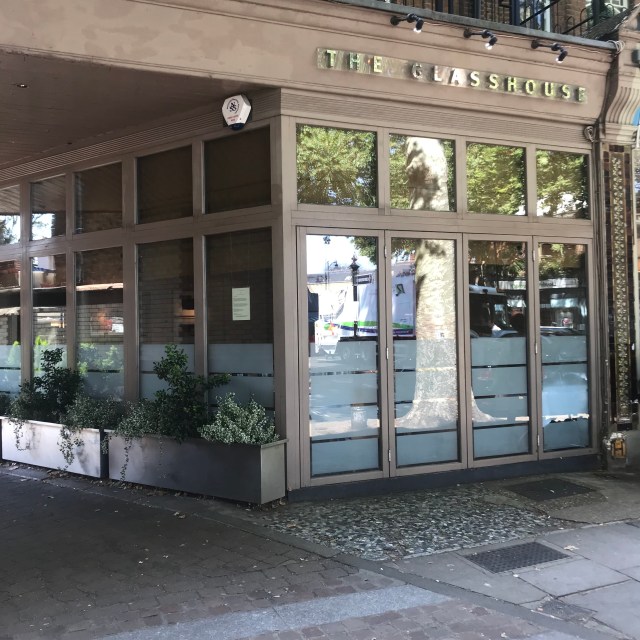
It was pretty hot in London on Tuesday. I think The Glasshouse in Kew is hot too, but in a different way. This is often regarded as “the other” Nigel Platts-Martin restaurant by some people I know. If it were true, then I’m sliding down the list, having begun by dining with some frequency at The Ledbury, and a little less so at The Square (now in different hands), and with a little less frequency still at the excellent La Trompette in Chiswick, before becoming a once or twice a year man here. But I’ve come to love The Glasshouse for its food, the near perfect service (which is absolutely spot on in all of Nigel’s restaurants) and for its always relaxed ambience. And this week, I was particularly grateful for its perfect air conditioning.
img_6847

Eight of us had arranged to have lunch in Kew, a group who go by the name of the “Tuscan Raiders”, which may sound clumsy here, but these are guys who worship all things Tuscan, and some of whom make fleeting wine-fuelled dashes over there once a year together. I usually manage to join them for lunch once or twice a year and this time, for a pleasant change, the door was thrown open for any Italian wines.

We had no idea it would turn out to be the hottest day of the year/decade/century, although it seems that as I sat typing yesterday it was even hotter. With an incredible sparkler and some nice whites, and no reds which tasted too heavy, we were lucky. Note to the organiser – make sure the next Brunello lunch is timed for winter.

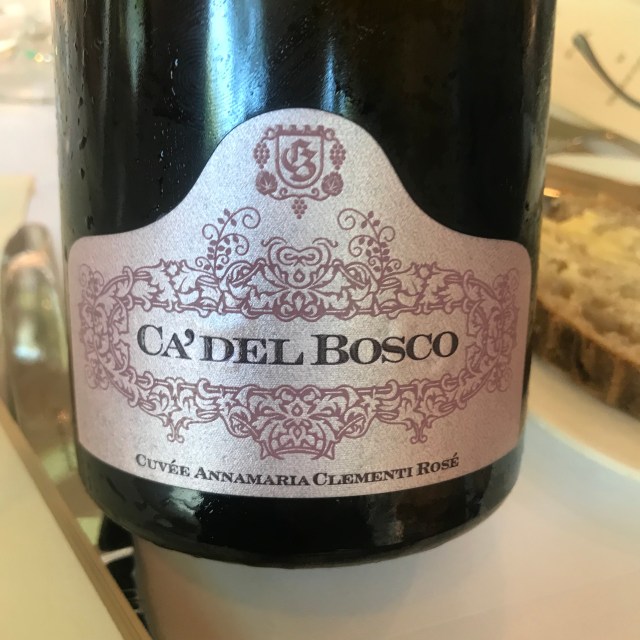
That opening sparkler (all the wines were served blind) set the tone for the next four hours. Franciacorta Rosé Riserva Cuvée Annamaria Clementi 2005 Extra Brut, Ca’ Del Bosco is quite possibly the best Italian sparkling wine I can remember drinking, though doubtless that conclusion was not hindered by the cold tingle of fine bubbles which the tongue welcomed in thirty degree plus temperatures as if it were a shower of snow on Christmas Day.

The colour of this wine is truly beautiful to begin with. Is it rose gold, or copper, or bronze? It all depends on the light. What I crave in all good sparkling wine is harmony between freshness and depth, and it has both. The intense savoury, umami, which comes through in time, is just so well balanced. It was disgorged in the autumn of 2013, so had eight years on lees and around six post-disgorgement, and it came in at 12.5% abv. A good start! We all guessed Franciacorta because what else could be this good!

img_6848

That remarkable beginning to our lunch continued with the first white wine. Tabarrini is an Umbrian producer based in Montefalco, to the south of Perugia and Assisi. Giampaolo Tabarrini took his generations old Azienda to the next level when he began bottling the estate’s own wines in the 1990s. He’s generally been regarded for some years as perhaps the rising star of the region, especially for his intense single vineyard Sagrantinos, which are now Gambero Rosso favourites. Bianco dell’ Umbria “Adarmando” 2014, Tabarrini, named after Giampaolo’s maternal grandfather, is an IGT-designated wine made from Trebbiano di Spoletino grapes (note: not the same as Trebbiano Toscana/Ugni Blanc).

The vines were planted in 1921, long before the idea of a quality white wine from these hills was born. Planted at around 3,000 per hectare at the time, they are at 350 metres above sea level. The vine training system is really interesting. Called “Sylvoz” (from Silvanus or Silva), the vines are usually trained high on a wire, a little bit like “Geneva Double-Curtain”, a system popular in the Veneto, but with more foliage. But some vines here are not wired, so that at harvest these plants look more like a plum tree than a grape vine. The fruit is harvested on ladders, and then fermented in stainless steel, where wine stays for 12 months on lees before a further six months ageing in bottle, prior to release. There is a reasonably plentiful 8,000 bottles of this, which The Good Wine Shop still had one or two remaining.

Freshness coats a fine line of textured fruit which ends with a quince-like finish. There are hints of Chablis, of Chenin and of the Veneto (I initially wondered whether it was a very fine Soave, and was not alone on that track). A wine I’ve never come across, but exceptionally, perhaps surprisingly, fine. £30/bottle.

img_6852

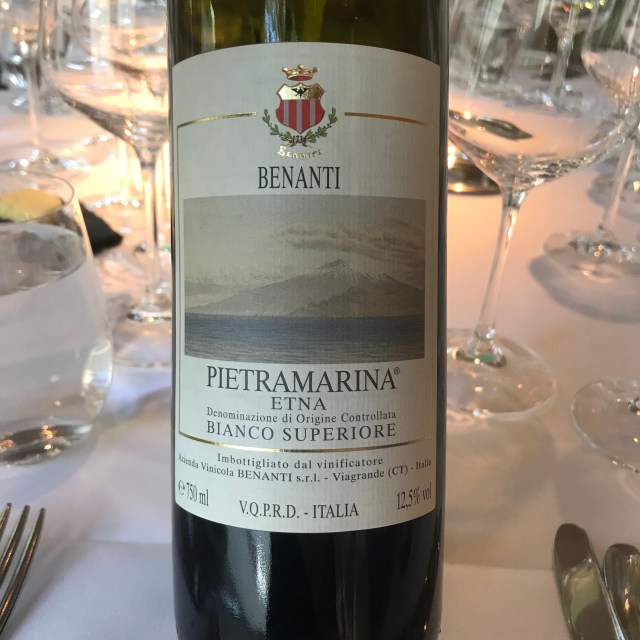
The first of the two wines I managed to guess blind on the day was Etna Bianco Superiore “Pietramarina” 2002, Benanti. There’s no real mystery to guessing a wine blind. You need to have drunk the wine many times, unless it is so singular that it stands out in one’s memory. This is a wine I’ve been drinking literally from the moment an Etna craze hit the more open minded reaches of UK wine obsessives. Carricante, as a grape variety, usually has a certain profile, which many would call “zesty”, but in Pietramarina there’s a lot more smooth depth, and this late-ripening grape variety’s aromatic qualities come to the fore.

It opens with the gentle fruit of ripening yellow peach, before you notice a citrus note, not on the top of the palate, but buried away, almost hidden. You get a distinct touch of almond too. It doesn’t take very long to start to notice the wine’s salinity. This does dominate a little, perhaps the reason why it wasn’t universally as popular as the previous white. But to me, this was classic “Pietra”, even though it hails from a period before Giuseppe Benanti’s sons, Antonio and Salvino, brought new acclaim to the estate when they took over in 2012. The key to this wine is old vines. In 2002 they were already averaging around eighty years old. Otherwise, the regime is a simple one, stainless steel for an extended two years after fermentation.

I used to buy this from The Sampler but no results come up for them now. Astrum Wine Cellars appears to import Benanti. They have one of those slightly annoying sites where you need to sign up and log in to see prices, but I think (do correct me if I’m wrong) that you might need to shell out around £50 for a current vintage these days.

img_6854

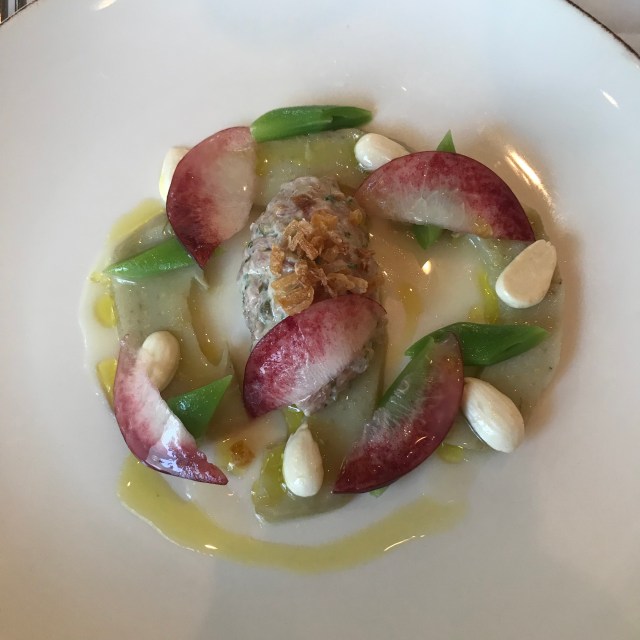
These wines accompanied a starter of veal tartare with truffle cream, white peaches, artichokes and green almonds. I don’t propose to say much about the food. It was so well judged for the meal, and the day. Very fine ingredients and a sprinkling of magic in the kitchen form dishes of undoubted Michelin standard. The number of stars is irrelevant if the style appeals.

img_6850

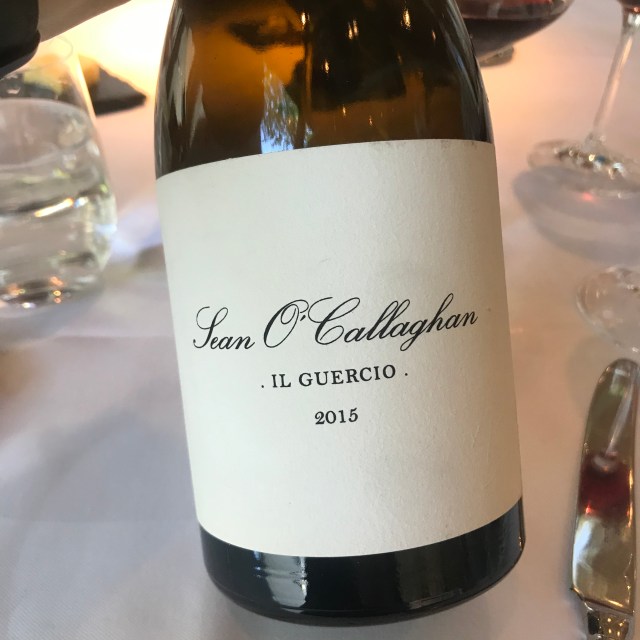
The first red wine was my humble offering. I say humble, but I was glad to have this rather singular wine for an occasion such as this. Il Guercio Toscana Rosso IGT 2015 is the first wine Sean O’Callaghan made once he’d decided to bring to an end his long, 25-year, tenure at Riecine (he actually left in 2016).

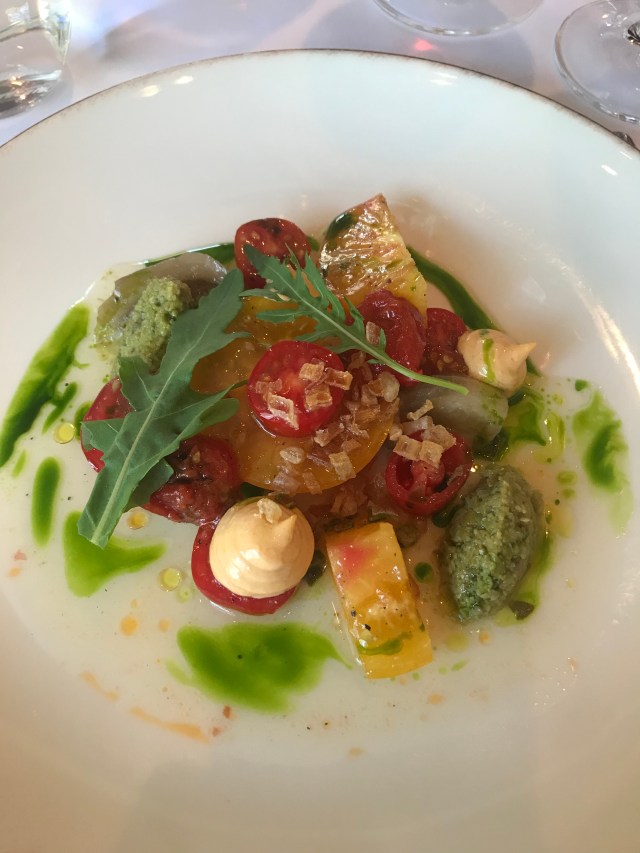
Sean now farms around 15 hectares owned by the Egger family of Tenuta di Carleone, in Radda, but Il Guercio (Sean’s nickname, “one-eyed bandit”) comes from Sangiovese planted in a vineyard right up at 700 metres above Giaole. The grapes, 25% whole bunches, are fermented in stainless steel and then aged in ceramic eggs (five months on skins). The wine comes out at a perfectly balanced 12.5% abv. I’d slipped a cooling sleeve over this for transport and it was served nicely cool. This helped highlight the crunchy cherry fruit and it’s touch of peppery freshness. It was a fine match for the middle course of tomato salad with baked violetta aubergines, smoked paprika aioli and wild rocket.

img_6857

img_6856

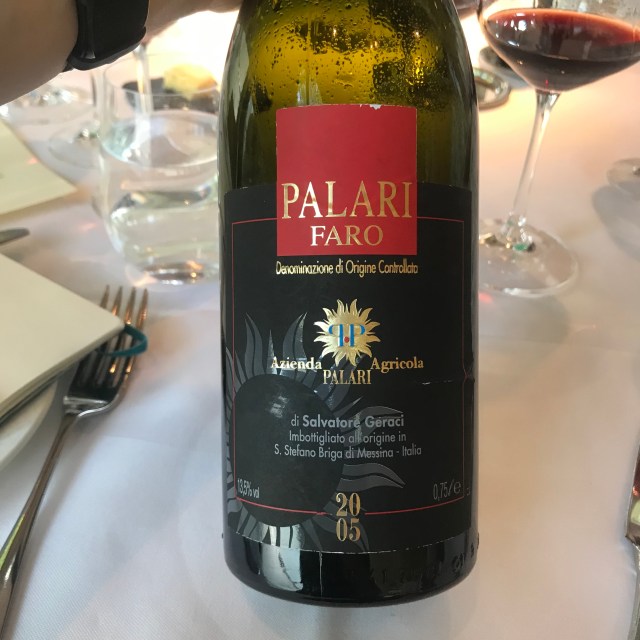
My other blind tasting triumph of the day was only won through a very deep knowledge of this producer’s wines. Palari’s Salvatore Géraci farms vines on that northeastern peninsula of Sicily, not far from Messina, and from Berlusconi’s grand bridge to the Italian mainland. Faro is the DOC, although Palari makes a very fine Rosso if the budget is tight.

Palari’s wines were among the very first purchases I made from Les Caves de Pyrene (it is with some sadness that I say that I don’t think they list these wines any more) and Faro is long etched in my memory. The grapes here are Nerellos (Mascalese and Cappuccio). Although the varieties share a stem, they are not entirely similar. Nerello Mascalese has some real class about it. Somewhere between Pinot Noir and Syrah, it can make wines of supreme elegance, but with an animal side. Cappuccio is more of a blending variety, adding alcohol and oomph!

Here we were tasting Faro 2005, Palari, perhaps from a glass a little smaller than I would use. Think aged Burgundy from a warm vintage but with a hint of animal fat, like in a Côte Rôtie, just popping in to say hello. At 13.5% this still retains elegance, but it’s more than anything a wine of depth. You want to take in the bouquet for minutes before experiencing the smooth, rounded, plalate. Gorgeous. The man who brought this bottle picked it up in Catania. For UK readers, try winebuyers.com (it’s pricey now).

img_6859

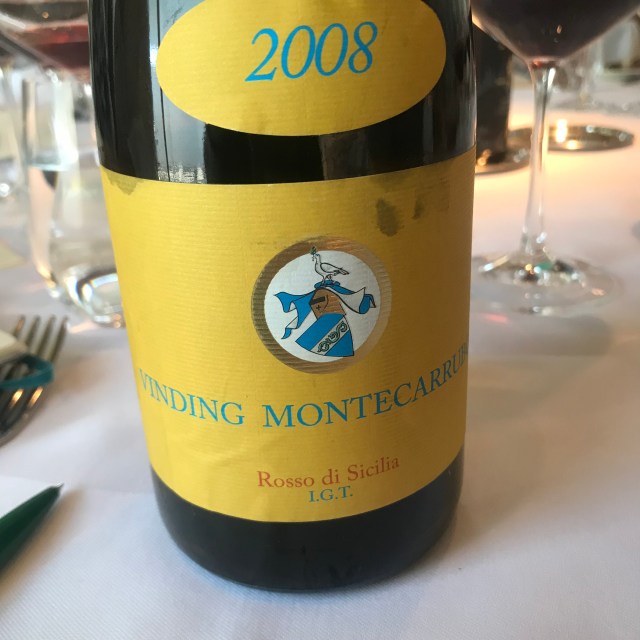
The last wine of this flight was another Sicilian, but this time new to me (although not the man behind it). Vinding Montecarrubo 2008 is a Sicilian Syrah from Peter Vinding-Diers and his sons. My first taste of Peter’s wine was a White Bordeaux from Graves, of some acclaim, bought in the 1980s. In 2005 he moved with his wife, Susie, to Sicily and now farms bush vine Syrah and stunted olive trees at 150 metres on top of a small extinct volcano. Last year Peter told Drinks Business that Sicily “is the undiscovered terroir” for Syrah. If the potential seen in this wine is fully realised, he may be right, much as I favour the wonderful autochthonous varieties Sicily offers us.

We get sweet peppery fruit here at a balanced 13.5% abv. The freshness of the volcanic terroir comes through, seeming to give the wine extra edge. It’s an exceptional wine, which can be had via importer Swig for just under £30. More recent vintages appear to have an extra half degree of alcohol.

img_6860

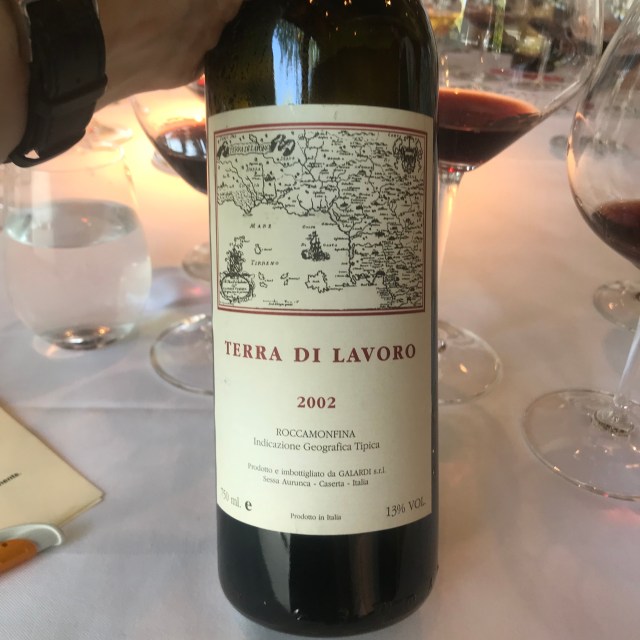
The next flight proposed three very different wines…and then somehow a fourth red made an appearance, I’d never have guessed. We began with an Aglianico, Terre di Lavoro 2002, Roccamonfina IGT, Galardi. Galardi is based at Caserta, a provincial capital on the Campanian plain at the foot of the sub-Appenines, north of Naples. This is another wine/producer I know nothing about, though it’s always good to try an Aglianico. Generally performing well on volcanic terroir, Aglianico tastes full-bodied but usually combines this with genuine freshness. For me, the result is rarely, primarily, elegant, but it can have crunch and lift. Aglianico is certainly an under rated variety.

This one is definitely meaty and very savoury. You’ll be getting Bovril and nutmeg and a lot of depth from ageing. I’d suggest this bottle is peaking, but you have to enjoy the evolved nature of the fruit. If you can find a bottle of 2002 (some retailers in the USA still have it) expect to pay £80-to-£100.

img_6863

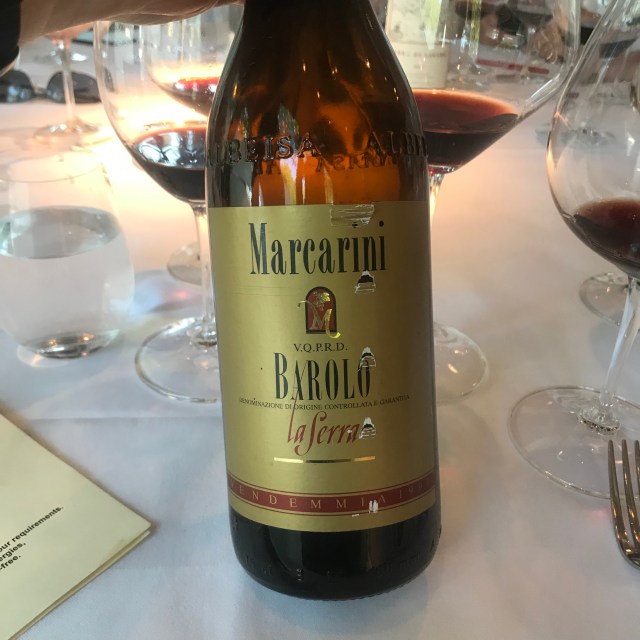
Barolo “La Serra” 1997, Marcarini was a lovely contrast. I think we all guessed Nebbiolo from the colour alone, but the bouquet was more fruity than classic tar and roses stuff, despite its age and the vintage. 1997 was generally hot in Barolo, the hottest since 1990, and the resulting wines have had a bad rap in some circles. Marcarini may be seen as a “reliable” producer, but this very nice wine was a little more than merely reliable. It is relatively mature, smooth, long and quite gentle. A wine which lingers like the smoky mist of a Langhe morning. Even on a scorching day we were transported to the hills, with the scent of autumnal truffles almost breaking through the bright sunshine. Loved it, actually.

img_6864

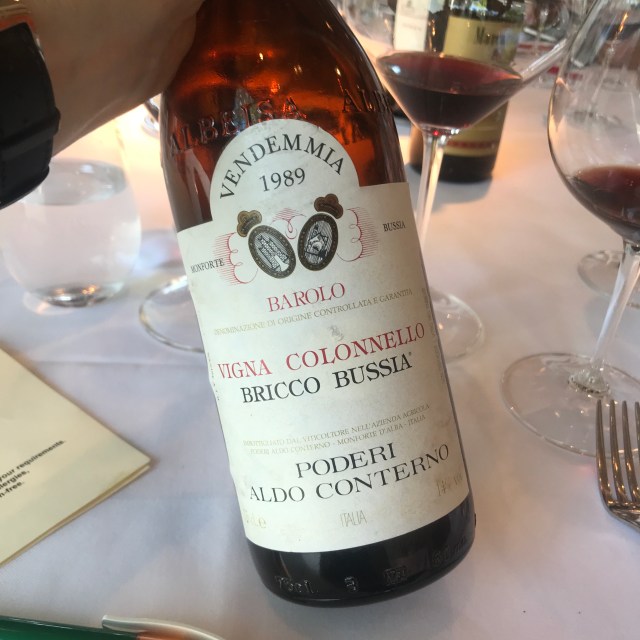
Another fine Barolo followed. Bricco Bussia “Vigna Colonnello” 1989, Aldo Conterno comes from a period when I was just beginning to appreciate the wines of the Langhe Hills (my first visit to the region was in 1988, but the first genuinely fine Barolo I bought was one of Aldo’s, a 1985). This “selection” comes from the Colonnello site, located within Bussia Soprana. Off sandy soils, this has intense liquorice and a hint of coffee grounds. It is currently showing more restraint than the younger Marcarini, a wine of elegance despite Aldo Conterno’s so-called modernist credentials. Wow!!! What depth.

img_6866

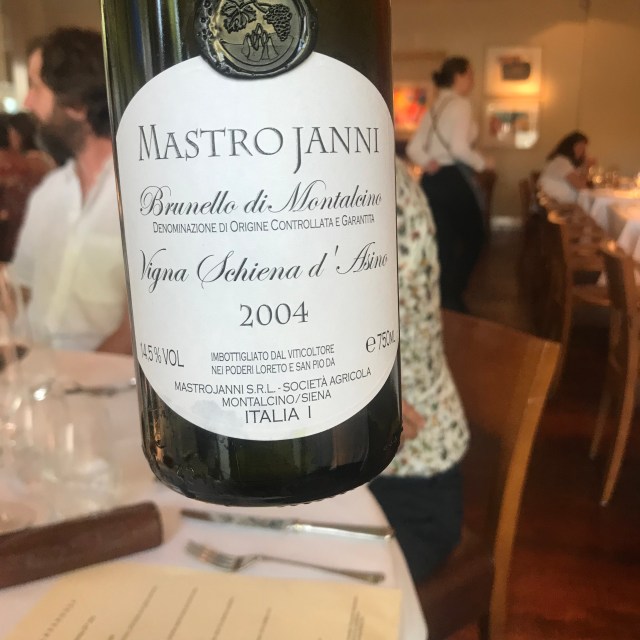
That extra red which popped out from the bag of our man from Norfolk was Brunello di Montalcino “Vigna Schiena d’Asino” 2004, Mastrojanni. This is clearly a mature wine and despite being younger than the two Barolos, for me it is pretty much ready to drink. Mastrojanni is usually described as “traditional”. I believe the estate dates from the 1970s, which aside from the likes of Biondi Santi, is pretty early in the story of Brunello. This single vineyard (“donkey’s back”) sees very low yields now. The regime includes 42 months of ageing in large French Allier oak, resulting in around 5,000 bottles of smooth Sangiovese Grosso. The fruit is mainly intense black cherry with ripe plum at the edges. Deeper tertiary notes include tobacco. A fine wine, but pushing the Glasshouse air conditioning to the full at 14.5% alcohol.

img_6874

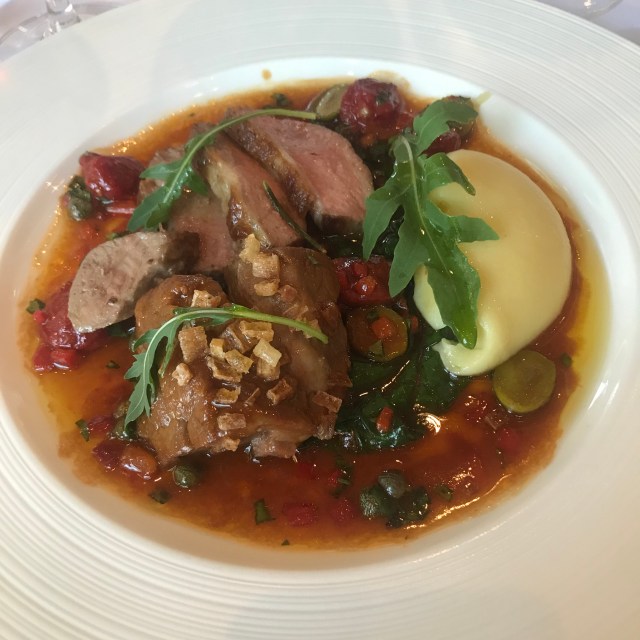
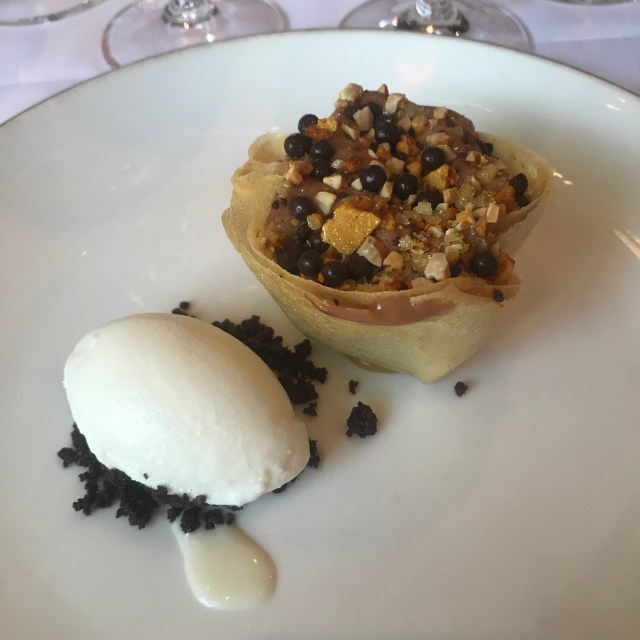
That flight accompanied a stupendous main course of lamb saddle and glazed neck à la Niçoise with olive oil creamed potatoes. I’ve not tasted lamb as good as that for a while, and it would have been my dish of the day were it not for the dessert, which half way through 2019 is currently my dessert of the year. Warm chocolate croustade with milk ice cream and roasted nuts sounds pretty simple, doesn’t it. Well it was not simple. It was remarkable.

img_6862

img_6873

To wash down this wonder we ended our lunch with a dessert wine I’ve not drunk since those heady days of Oddbins‘s first incarnation (late 1980s), with its fine wine store located where we now enjoy the cool delights of Winemakers Club. Even back then it was rare to see a full 75cl bottle of this wine, Dolce Torcelato 1988, Maculan. This sweet gem comes from Breganze, where the casual visitor will probably be more interested in seeking out a few Palladian Villas, and perhaps a glass or two of Grappa, than unctuous sweet nectar.

Fausto Maculan set up a winery to make more than Torcolato, but it is this wine that he became known for all over the world. The single grape variety for Torcolato is Vespaiola, grown on volcanic and tufa stone hills. The fruit is harvested ripe and dried in long strings of grapes in a special, ventilated, room for four months, during which the grape flavours and sugars concentrate. Ageing is in barrique, of which one third is new and two thirds second fill.

I have never found this wine the most complex of stickies, but where it scores is in its amazing concentration which is balanced by a spine of acidity that holds it together. The wine is golden and honeyed. There’s still a touch of wood, almost cedar perhaps. It’s that acid which, whilst far from dominating, grounds the intense sugar rush.

Although a dessert wine, this is also a good choice for cheese, and it did a stint with our unplanned but welcome cheese course, which included the best English Sharpham I’ve tasted (a brie-style from South Devon), and a washed rind cheese where Calvados was seriously to the fore. At which point someone called for Vin Jaune.

Vin Jaune Jean-Louis Tissot 2008 leapt off the wine list. Jean-Louis, not to be confused with Stéphane and Bénédicte, is based in the hamlet of Vauxelles (up the hill from Arbois, towards Montigny-les-Arsures), bringing back nostalgic memories of the place where my family rented a tiny cottage on our first Jura holidays in the 1990s.

My scribble tells me it was good, if a little young for a VJ pedant like me, but to be quite honest, the next thing I really remember was getting on an Underground train at around 7.00pm. Well, I wasn’t that drunk in truth, but I’d completely forgotten we drank this until my notes and the photographic evidence proved we did consume it, which does rather suggest we saw the edge and jumped. Of course, we left the restaurant much sooner than 7.00pm, but I believe lager was involved after lunch, essential re-hydration in thirty-three degrees of glorious, if global-warmingly scary, summer heat.

The Glasshouse is at 14 Station Parade, Kew, almost opposite the Underground station (Kew Gardens, on the District Line, but on the same side as the trains heading back to Central London). It’s also two minutes walk from the Kew branch of The Good Wine Shop (unmissable selection, don’t go to Kew without looking in).


Posted in Dining, Italian Wine, Piemonte, Restaurants, Sicily, Wine | Tagged , , , , , , , , , , , , , , , , , , , , , , , , , , , , , , , , , , | 8 Comments

More from Paris

I left you yesterday on Monday evening, so to speak, leaving Septime La Cave following a few glasses and some rather good Comté (see previous article, below), heading for a bar/restaurant which was completely new to us. We had walked past Le Mary Celeste several times in our few days in Paris and it looked lively and busy on each occasion. After realising it was on the Raisin app for natural wine we decided to book. I should mention that everything I’ve read suggests booking here is essential (online booking only, no phone). Walk-ins are possible but apparently you are likely to end up in the basement. I’ll also point out that more like London than Paris, we were given a two-hour slot for the table, though excellent service didn’t make that an issue.

LE MARY CELESTE

Le Mary Celeste has been around for at least six years, I think, but although we must have passed it before on our way to the Marché des Enfants Rouge and one of our favourite bookshops on the Rue de Bretagne, that has probably been in the daytime. At night, with the floor-to-ceiling glass opened out, the buzz of the place spills onto the trottoir, and there are tables outside too. This is perhaps a bar more than a restaurant. It’s famous for cocktails as well as that natural wine list, and the food tends to be based on small plates, in a style that some reviews call “fusion”, whatever that really means. I find myself for the second article in a row quoting Aaron Ayscough, because a quote from his blog, Not Drinking Poison in Paris, appears on the Paris by Mouth web site. Back in 2013 he called this place “the flagship of Paris’ re-invented bar scene…”.

img_6814

We ate a mix of vegetarian dishes and a couple (for me) with meat/fish. Courgettes with black rice, lemon confit and nori was really good, but the aubergine rôtie with romanesco sauce and lots of sage was even better. Ris d’agneu frit (with mayo, tarragon and airelles, aka cranberries) was excellent bar food, with a fresh breadcrumb coating reminding me of the best scampi of a distant past. The lamb melted in the mouth. Pommes de terre grenailles d’Île de Ré are “pommes de terre primeurs” from the isle of that name. Imagine a Jersey new potato, and just as good. They were served with smoked herring, red onion, crumbled hard boiled egg, Crème d’Issigny and fennel top.


The wine list was pretty good, but after Septime we were always only going to drink one bottle. The choice was difficult but made easier by the presence, near the top of the list, of Domaine Belluard “Les Perles de Mont Blanc” (55€). I’m sure Belluard is well known to many of you. Their wines are sure to be even harder to source once Wink Lorch’s book on the Wines of the French Alps comes out this year, but this méthode traditional sparkler is pretty much impossible to find in the UK in any event.

Domaine Belluard is based in Ayze, a tiny sub-appellation in the valley of the River Arve, near Bonneville and the town of a similar spelling, Ayse. It is coincidentally the closest top Savoie producer to Wink’s Alpine base. Dominique Belluard farms around ten hectares of very old vines, and something of a speciality here is the wonderful and unsung Gringet variety. Those lucky enough to try this rare grape will probably have done so in its still wine iterations, Les Alpes and Le Feu. Interestingly, Gringet has always been a traditional variety in this part of Savoie for sparkling wine, and this is a cracker.

Grown on chalky scree with glacial deposits, at approaching 500 metres altitude, this 100% Gringet sees two years on lees before disgorging. The bouquet starts out quite floral before a touch of biscuity autolysis character pops up. The palate is crisply mineral, so as the wine broadens out in the glass it retains the freshness you want. This was thoughtfully (I presume) served in a tall, and thin-glass, wine stem rather than a flute. Initially the bubbles were quite prominent, meaning you just wanted to sip it. As the bubbles diminished the vinous character of the Gringet came through, and I thought it was a good match with every element of the meal, even including the desserts.


We were pretty stuffed full after the four savoury plats, but the dessert menu was irresistible. I’m a sucker for anything with green tea in it, so I enjoyed matcha meringue sabayon with large dark cherries and cassis, but this was probably marginally eclipsed by a choux croquant au chocolate with noix de muscade (nutmeg) and white peach (and boy were the white peaches from the markets amazing this year).

Le Mary Celeste is at 1 Rue des Commines (which is the westward extension of Rue Oberkampf). Nearest Métro – Filles de Calvaire (or Oberkampf for a seven minute walk).

LE TAGINE

We were taken to Le Tagine by friends last year, and we weren’t going to miss a chance to go back. There are plenty of North African/couscous restaurants in the area, especially up towards the Rue de Bretagne around the Enfants Rouge market, which itself has plenty of stalls where you can feed two for 15€ take away (or eat in). Le Tagine has one advantage over a cheaper meal at the market – not merely Aesop liquid soap in the loo, it also has a small but good, mainly natural, wine list (Foillard and Arena are regulars). It’s also on the Raisin app.

img_6744

I don’t need to go through the menu. It’s just worth bearing in mind that the tagines are served without couscous, and the couscous dishes are in a separate section. The couscous “speciale” comes with four meats (koftas, lamb, merguez and chicken). The lamb is elsewhere on the menu described as agneau de lait des Pyrénées. With that you get a veritable mountain of fine grain couscous, a bowl of large vegetables in stock, fresh harissa, and small sides of chick peas and raisins, and harissa-infused carrot. It comes with a warning that you’ll need carrying home. It was certainly the most I ate at any meal this time, but then I didn’t have to finish it. Nor needed I indulge in Moroccan pastries with the post-prandial caffeine shot, but I saw the edge and jumped anyway.


The wines are available by the glass or bottle, but also in 50cl carafe, useful for two people lunching who fancy a white and a red, though we were meeting friends mid-afternoon and so had to stay awake. We drank Syrah du Maroc “Tandem”, AOG Zenata 2016, Alain Graillot, a smooth and fruity red from one of Crozes-Hermitage’s finest, which didn’t suffer from the increasing spoonfuls of harissa I kept adding to my vegetable stock (well, some people are addicted to nutmeg, and I like my harissa). Yapp Brothers is Graillot’s UK importer, who generally have this available.

img_6742

Le Tagine is at 13 Rue de Crussol, also in Paris 11 (same Métros as Le Mary Celeste). We didn’t book, and it was fairly quiet on Bastille Day, but I understand they do prefer you to reserve a table. It’s just half a kilometre from the Picasso Museum, where we had just seen the excellent Calder-Picasso Exhibition (on until 25 August). I’m a big fan of Alexander Calder.

LE POTAGER DU MARAIS

This restaurant is a treat for vegans visiting Paris, but I’d also suggest it’s just as much a treat for non-vegans dining with vegans. Le Potager has apparently been here since 2003, but I’d never been here until a friend of our daughter took us on our first night. The restaurant aims to adapt traditional French cuisine to “the vegan style…[to make] a bridge between the two cultures.” This it does remarkably well.

I ate a vegan “bourguignon” which frankly tasted just like a boeuf version, with chunks of seitan, carrot and onion, marinaded and cooked in red wine. The only difference lay in the texture of the seitan. Seitan does take on some of the texture of meat when cooked, so the difference isn’t as big as you might expect, but no one would think they were eating beef. For dessert I ate a vegan tarte-tatin. I’ll give a plug to my wife, who I think does vegan tarte-tatin even better, but this was pretty good. Other vegan versions of classic French cuisine that sounded tempting included cassoulet and crèpe sarrasin. That crème brûlée, which others on our table chose for dessert, tasted amazing.


We drank a biologique Pinot Noir from the Pays d’Arles of all places, produced by Domaine Attilon. This is a large (90 ha) estate run by Renaud and Odile de Roux, between Craux and the Rhône. I know very little about it, except that they grow their vines organically. This was an enjoyable, medium-bodied, Pinot with light cherry and raspberry fruit. Not pointing to greatness, but more than serviceable. Also pretty cheap, if I recall.

e388b40b-7cea-42b2-8cc1-6c681e13df7b

Le Potager du Marais is definitely my favourite vegan restaurant in Paris now. It’s at 24 Rue Rambuteau in the heart of the Marais (Paris 3). It’s also highly rated on veganfoodandliving.com.

What else did we do in our four nights/three-and-a-half days in Paris? A visit to my favourite Parisian wine shop, La Cave des Papilles (35 Rue Daguerre, corner of Rue Lalande, Paris 14, Métro – Denfert-Rochereau) is always de rigueur. They stock an excellent range of natural wines, and this time I came out with a couple of bottles of Emmanuel Lassaigne‘s Champagnes and some Domaine L’Octavin from Jura. They stock a good selection of Lassaigne’s cuvées from his Montgueux vineyards (he makes the Papilles own-label Champagne and has become one of my favourite Growers over the past few years), and they have an even more impressive Jura selection.

img_6725

We also went to several Parisian café-bars, whether for food, an early evening beer, or a morning coffee. I suppose people tend to think of them as expensive, possibly touristy, and I guess by London standards 4,50€ for a small black coffee is expensive. Especially as coffee is not always Paris’ strong point. But you are paying for the right to sit and watch life go by. The food is, however, usually pretty good value in these places so long as you stay away from the real tourist centres. We had lunch with “the band” near the Saint-Paul Métro and perfectly enjoyable onglet with salade and frites was just 13€. Where can you find steak and chips in London for £13?

Probably the most touristy thing we did was after a visit to the Marché St-Pierre, the concentration of fabric shops near the foot of Sacré-Coeur. The steps up the road on the left hand side of the multi-floor “empire of fabric” called Dreyfus leads to a small square, around half way up. We had a long and relaxing two-hour lunch sitting outside at a café called L’Eté en Pente Douce (8 Rue Paul Albert). We ate typical Parisian fare (duck salad in my case), and drank Kirs and Viognier. It’s not so much the food you go for in these places, but the atmosphere, a buzzing throng of all Parisian life and, in this case, no cars. Montmartre may be tourist central, but it has enough atmosphere to make it worth a nostalgic visit every couple of years, for me at least. The views from the terrace below the church are half the reason for climbing up to the top, although you almost need to queue for a spot at the balustrade.

Anvers is the closest Métro for the Marché St-Pierre, which is worth a look even if making clothes is not your forté (that’s me, but I appreciate the skill of those who do it). Barbès-Rochechouart, being on a different line, is also close enough (and better if you are staying out east).

“The band”? Nepal’s finest Death Metal Band, Ugra Karma were in town for the final date of their French Tour, after playing the Obscene Extreme festival in the Czech Republic. The gig was at Le Klub (14 Rue St-Denis) on Bastille Day, and was naturally the highlight of our trip.


Himalayan Death Metal at Le Klub – “as their frosty death [metal] comes near, laughter on the winds they hear”


Alexander Calder – Musée Picasso (5 Rue de Thorigny, Paris 3) until August 25th

48812a28-3cc3-4e38-8a66-df030df602a8

Place des Vosges, traditional picnic venue

img_6724

Posted in Natural Wine, Paris, Restaurants, Wine, Wine Bars, Wine Shops, Wine Travel | Tagged , , , , , , , , , , , , , , , | Leave a comment

Septime La Cave

My favourite part of Paris is that around Oberkampf, and one of the most interesting streets is Rue Popincourt, which tracks down from Boulevard Voltaire, just south of Oberkampf Métro Station, until you are almost as far south as the Opéra-Bastille, but about half a kilometre to the east. Once, the whole area from The Bataclan to Bastille was actually better known as Popincourt, and it’s a fascinating area to explore.

Small businesses abound today and the area mixes a vibe of diversity with hidden alleys of workshops and antique yards. This used to be an area full of small industry, when the immigrant population was largely Auvergnat, who brought their metal working skills to the capital, something that has not wholly disappeared today. It was also an area known for radical politics, especially anarcho-syndicalism and unionisation.

When Rue Popincourt reaches Avenue Ledru-Rollin it becomes Rue Basfroi, and when you reach the end of Basfroi as it hits the Rue de Charonne, you will find my favourite natural wine bar in Paris, Septime La Cave. I missed out coming here last year, so this time I was determined to pop in, even if only for a late afternoon visit.

img_6781

Every capital city I know has a number of wonderful natural wine bars, but Paris is so awash with them it’s ridiculous. My annual visits, lasting usually three or four days, give me little time to visit old friends, many of which are within very little walking distance of Oberkampf Métro. Everyone has their own favourites.

La Cave de L’Insolite in Rue de la Folie Méricourt was my first love, the first natural wine place I visited, around a dozen years ago. Naturally Verre Volé, up on the Canal Saint-Martin, has been everyone’s favourite at some point, but to go on would be to list more than a dozen other worthy names in the top tier. Aaron Ayscough is a wine writer based mostly in Paris, with his finger on the pulse,  and he reckons Chambre Noire, also in Rue de la Folie Méricourt (achingly close to Oberkampf Métro) is the liveliest, but lively isn’t always what you want (though it does look like a place to bump into winemakers and wine writers).

What, for me, makes for the perfect natural wine bar to turn up to for a drink is pretty simple. The wine has to shape up, whether hard to find classics or new discoveries (take a look at the random photos from the red wine shelves, below). Then the staff have to be friendly and welcoming. This excludes those places where you are told that a choice bottle on the list is not available (reason – it’s reserved for mates and I don’t know who the hell you are), though to be fair having all your unicorn wines hoovered up by one-time visiting tourists is understandably a pain, and I know of one bar where a friend was allowed to buy a bottle so long as he promised not to put a photo on Instagram, honestly, it’s true.

I did read one comment on the Raisin app from someone who said they’d experienced unfriendly service as an English-only speaker, but I must stress that my friends and I have only seen the super-friendly side of Septime La Cave. It doesn’t have an air of insularity that some people feel in other places. For a start, the clientele is pretty international. When we were there on Monday there were several Scandinavians, Americans and others, but no English. However, if there’s anywhere in Paris I might expect to bump into someone I know who has headed out for a few glasses right after stepping off Eurostar, it is likely to be this place.

Another advantage Septime La Cave has is its opening hours. They open at 4.00pm every day (easy to remember), and at this sort of time the place isn’t packed. If you want a relaxing glass or two, then around five-ish is a good time to come. It’s also good for a few nibbles if, as in our case, you are heading off to a restaurant later in the evening, although there’s enough in the way of calories (cheese and charcuterie etc) to keep you going if you decide to hang in for the duration (they close at eleven).

So what did I order to accompany, first, some olives, and second, some gorgeous 30-month Comté? I love to try new things, and when I asked Pernille what they had open in the way of petnat she pulled out something I’d never tried before. La Barbaterre Besmein Capolegh Frizzante Rosé  (a NV, yet in reality a 2017 vintage, with 11.5% abv) is a lovely gently sparkling wine made from Marzemino, a variety from which I’ve only previously drunk still red wine. This is a wonderful shade of radioactive pink. Besmein is local dialect for Marzemino.

La Barbaterre is based in Emilia-Romagnain Lambrusco country in fact, up in the hills at around 350 metres above sea level. The philosophy here extends beyond natural wine. They have an Agriturismo, and all the electricity used there and at the winery is generated on site. The restaurant looks as if it has wonderful panoramic views of Emilia’s rolling landscape, bucolic…tempting!

What about the wine? I mentioned the colour. There’s something so appealing about a vibrant pink wine on a hot afternoon, when the desire to quench your thirst with something mildly alcoholic yet refreshing takes hold. This fitted the bill absolutely perfectly. Here, one is not looking at drinking sophisticated fane wane, just a beverage that hits the spot, and that’s exactly what this did.

img_6784

The red fruits here are soft, but concentrated, and they are lifted by exquisite fruit acids, giving just the right degree of sharpness. The bubbles accentuate that perception on the tongue, and multiply the refreshment potential several times over. You could glug this like a fruit juice, but the bubbles make it pleasant to sip. The fruit sweetness didn’t clash with the bitterness of the olives I was eating. If anything, even though it’s only frizzante, I think the bubbles had diminished in a bottle that was only a third full, but I don’t mind that. I’ll happily enjoy Champagne on day two, when the bubbles become just a gentle prickle.

I couldn’t resist the Comté, even though in retrospect I was not doing myself any favours for later, but what to accompany it? I was tempted to go orange, but the Georgian they had open was from Pheasant’s Tears, and I know it too well. I spotted another wine on the BTG list that I know, but hadn’t drunk for many years…so I went for Domaine Plageoles Mauzac Vert, Gaillac Premières Côtes 2016.

Domaine Plageoles (aka Domaine Tres Cantou) is based in the Southwestern French AOP of Gaillac, a small region not far from the beautiful town of Albi, with its famous fortress cathedral from the times of the crusade against the Cathars. The Plageoles family is famous for having been one of the first in Gaillac to take autochthonous grapes seriously. Robert Plageoles planted more than a dozen rare varieties on the silex, limestone and clay soils of the region, to increase the family holdings to around 30 hectares of vines, pretty much all of which were on their own roots, the vineyards having been spared a visit from the phylloxera louse. This included seven different varieties of Mauzac (Blanc, Vert etc). He even had to search out wild vines in the woods. I remember tasting my way through a number of them back in the early days of Les Caves de Pyrene, who I hope still import from this producer.

This Mauzac Vert (I’ve never tasted any other, but I believe they exist) is made from bush vines which are at least 50-years old, some quite a bit older. The fruit undergoes whole bunch pressing with a cuvaison in fibeglass-lined concrete tanks, and is then softened through full malo. The result is unusual. At first it doesn’t shout out at you. It seems softly spoken and a little reticent. Then you begin to notice its apple freshness, as if someone had put a few concentrated droplets in a glass of mineral water. Next, is a finish that has just a hint of quince, and a similar hint of chalky texture. Is that the argilo-calcaire soils this cuvée comes off?

img_6789

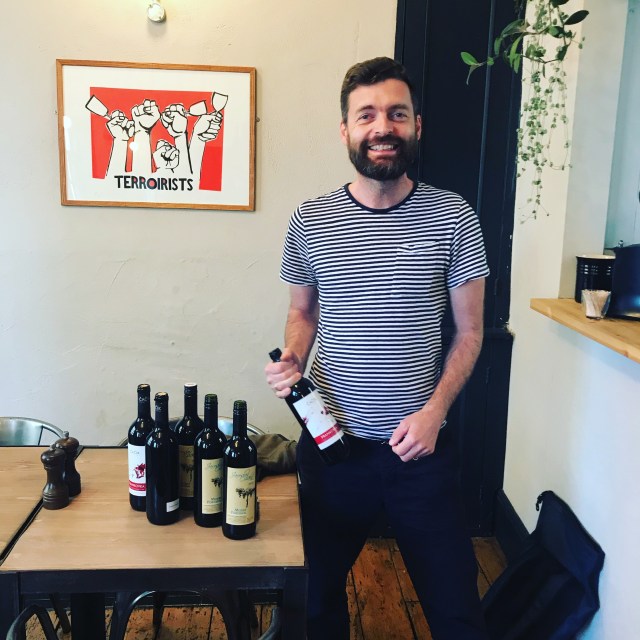
It’s a gentle wine. It doesn’t have the nuttiness of the Savagnin that we’d usually pair with Comté, but it doesn’t fight the salty, strong, flavours of the well-aged cheese. And surprisingly, nor does the cheese dominate the wine. Florent and Romain Plageoles (Robert’s Grandsons) continue the family tradition of making wine that surely reflects the place it comes from. Indeed, they call themselves “Terroirists” here. Yes, that’s what this wine does, reflects the terroir. But it doesn’t shout silex, nor growl granite. It is restrained and modest, although that refers emphatically to character, not quality. It was a perfect note on which to saunter home for a half hour rest before dinner.

img_6792

To be continued…

Septime La Cave is at 3 Rue Basfroi, Paris 11. Opening hours: 16.00 to 23.00 every day of the week (though presumably not 365 days a year). Septime, the restaurant, is close-by at 80 Rue de Charonne.

img_6795

Pernille and Lea – Super Friendly people

Nice “by-the-glass” list. Anything from Emmanuel Lassaigne for 12€ is going to be a good shout, but that Argile Rosé from Domaine L’Ardoissières looked really interesting. Never seen their pink before.


Posted in Artisan Wines, Natural Wine, Paris, Wine, Wine Bars | Tagged , , , , , , , , , , | Leave a comment

Recent Wines June 2019 #theglouthatbindsus

That was certainly not the warmest June I can remember in the UK. In fact much of the month was wet and unseasonably cold. That means one thing…that we have not cranked our petnat consumption up to usual summer levels yet, although as we moved into July the vermouth has begun stepping up at aperitif time.

There’s only one Jura wine in June’s selection (oh, but what a wine). Otherwise, there are a couple of South Africans, a couple from Alsace (including the only petnat here, and coming right at the end of June), a couple from wider Burgundy, and also in the mix a rare sighting of a Brunello (yes, it was that chilly at times). I’m already getting very excited about July’s treats, but I hope you enjoy this selection first – the most interesting dozen from the wines I drank at home last month.

GUMPOLDSKIRCHNER TRADITION 2016, JOHANNESHOF REINISCH (Thermenregion, Austria)

Thermenregion is possibly one of Austria’s least known wine regions, but it’s only a half hour drive south of Vienna. Johanneshof Reinisch is a well known family company making wines around the villages of Tattendorf and the much better known Gumpoldskirchen.

The “tradition” here in Gumpoldskirchen is the combination of two rather obscure but nevertheless wonderful grape varieties. In fact these two would merit much wider coverage than Austria currently has planted. There are around 130 hectares of Rotgipfler in Thermenregion and 80 hectares of Zierfandler (50% of it planted in Gumpoldskirchen). Reinisch harvests and ferments the two varieties separately before blending into a large cask for four months.

The aim is for freshness, yet with a little exotic fruit. Apricot, peach and mango come through in a wine that is dry but shows really sweet, ripe, fruitiness. This is balanced by lowish alcohol (12.5%) and a crispness which has a mineral texture and a bit of salinity. It’s not a complex wine, not in the way we usually describe complexity, but it’s in a good place (the producer counsels ageing three years). A wonderful chance to try these two varieties blended together.

It would go with many dishes, but with either a simple schnitzel, or some mild kabuli pulao, would be good and certainly with some Wishbone Ash (Blowin’ Free…in a corn field…). This is occasionally stocked by Butlers Wine Cellar in Brighton. Astrum Wine Cellars is the UK importer.

img_6516

“GIVE & TAKE” 2017, BLANK BOTTLE WINERY (Stellenbosch, South Africa)

I’ve told the story of the grapes for this wine before, but it bears repeating. Pieter Walser always comes up with a name that reflects the wine’s story, and here Pieter wanted to buy some Pinot Blanc from a winemaker at a more wealthy address. For some reason unknown to him, the winemaker told Pieter that the owner had told him not to sell any grapes to the bloke in the shed. However, Pieter had some Semillon going which the winemaker needed, so they managed to do an under the radar swap without the owner’s knowledge.

Give & Take is 100% Pinot Blanc, aged for a year in oak, which adds a certain texture. It’s rich and mellow with nice stone fruits lingering long on the palate. At 14.5% you do need to approach with caution, because like most of the Blank Bottle cuvées, you absolutely don’t notice the alcohol until you attempt to stand up. It’s evil, but I love it. This is one of Pieter Walser’s exclusive bottlings for Butlers Wine Cellar (Brighton), and for the label Pieter has drawn the skeletal ruin of the iconic Brighton West Pier. A mere £22 whilst it lasts.

74b43405-578f-47f4-b014-c30aa5f6d6f7

XINOMAVRO JEUNES VIGNES 2016, THYMIOPOULOS ESTATE (Naoussa, Greece)

This is one of my go-to everyday wines, and many agree with me that it’s one of a handful of top value crackers that Greece seems to produce at a great price alongside her more expensive gems. Naoussa, in the very north of mainland Greece, is normally the source of long-lived, inky, Xinomavro which has earned the region’s wines the epithet of the “Barolo of Greece”. This young vine bottling is nothing of the sort. I reckon it’s closer to a young Burgundy than a Barolo, and drinks like a Beaujolais. But despite all those “B”s, it’s very much a product of its own place, and in possession of its own personality.

Here we have a wine with lightness belying 13% abv, and a faint sense of something more ethereal shimmering above the youthful juicy biodynamic red fruits which make the wine so drinkable. As this is a young vine cuvée, the fruit comes from several vineyards, some at altitude, off schist, granite and limestone. Fermentation of destemmed fruit is in stainless steel with short ageing, a few months, in concrete.

I usually pick this up from Duncan Murray Wines in Market Harborough (Leicestershire), but it’s pretty widely available. I happened to see a news item on the Harpers Wine & Spirits web site that Berkmann Cellars has taken on distribution of Thymiopoulos in the UK (June 2019).

654ee251-2030-4356-9414-97e73abf28a8

BRUNELLO DI MONTALCINO 2004, POGGIO SAN POLO (Tuscany, Italy)

Although I drink mainly more natural wines these days, I’m not a fundamentalist, and I have no intention of jettisoning wines cellared for years. In any case, there’s no way these wines shouldn’t be judged on their merits, by which I mean judged on their organoleptic properties rather than their manifesto. I would imagine that a classic wine like this would appeal to many people I know who would find the next red in this selection a lot more challenging.

San Polo is a 16 hectare vineyard located in the northeastern part of the Brunello zone. It was purchased in 2006 by Marilissa Allegrini, and she has done a lot of work to revive it. Back in 2004 it might not have had the same cachet, but age has done this wine many favours. The Sangiovese Grosso grapes come from fairly young vines, at this stage probably no older than 14 years. They were grown at around 450 metres above sea level, so how did it come across?

It’s a dark wine, but with a luminous, almost golden-bronze, tint. The bouquet is quite rich and there’s very nice development of tertiary elements in a wine whose bouquet suggests it’s close to maturity, if not perhaps there already. The wispy violets on the nose are in contrast to the more plump cherry fruit of the palate. There’s a nice bit of decayed leaf and tobacco, with a hint of soily mushroom and coffee grains. Altogether this is a really nice mature Brunello, lacking the spectacular depth and concentration of the last wine I had from the DOCG, but then that was a Soldera Riserva. This San Polo was very satisfying.

I hadn’t realised that this was quite such a Butlers Wine Cellar month, but I purchased this bottle from them quite a few years ago now. Expect to pay around £40+ for a current vintage. The UK importer is Liberty Wines.

96b4e3c4-c0bc-4acd-a265-cc1d3793a299

CHAMPAGNE DEHOURS TERRE DE MEUNIER EXTRA BRUT (Champagne, France)

Mareuil-le-Port and its surrounding villages, on the left bank of the Marne, is a source for some lovely Meunier, made all the more so by the age of the vignoble here. It is the source for some of Vincent and Raphaël Bérêche’s best Meunier, and also the source for this excellent varietal wine from Jérôme Dehours. Since Jérôme took over the family estate in 1996 he’s been steadily improving the wines and winemaking, and now his single vineyard wines rate alongside the best growers.

Terre de Meunier is a non-vintage selection, fermented in stainless steel with a small addition of reserve wines kept in oak. It is lightly dosed (I can’t find an exact figure, but I think we are looking at around 2 g/l), having spent a couple of years on lees. It’s a wine which majors on fruit, making it more of an aperitif style than a gastronomic Champagne. But don’t let that put you off. This has extra spicy notes, some freshly baked bread and a little earth as well. It’s a classic Marne Valley Meunier and eminently satisfying. Expect to pay either side of £35 for this, which makes it pretty good value Grower Champagne. If you’d like to buy Prévost but can’t scrape together a loan, then this is worth a try for that varietal Pinot Meunier experience.

I thought this came from Solent Cellar, but I see that their web site currently only lists the Dehours Oeil de Perdrix (also excellent, £40).

1607cd04-8575-46fa-ac11-1fd238e95632

“CARAVAN” VIN DE FRANCE [2017], LE VENDANGEUR MASQUÉ (Chablis, France)

Le Vendangeur Masqué is, of course, the label Alice and Olivier De Moor use for the wines they make from bought in grapes, a trend that is the result of catastrophic vintages in recent years in their Chablis vineyards (frost and hail). This wine is a multi-varietal blend of organic grapes, namely Clairette, Chardonnay, Sauvignon Gris, Pinot Blanc, Riesling and Aligoté, hailing from a diverse array of friends in Southeastern France, Burgundy and Alsace. The grapes are all fermented separately and only blended together after a year in older oak barrels.

The wine has a simplicity to it, in a way, but a better description would perhaps be “purity”. It’s very fruity, with a certain richness as well, but balanced by a glowing brightness on the palate. The texture is deftly judged but grounds it nicely. I tasted this at the Real Wine Fair earlier this year, but the bottle drunk last month was even better. A lovely wine which I was happy to share among five of us, though that left a mere glass for me to savour.

Imported by Les Caves de Pyrene.

img_6555

PINOT NOIR D’ALSACE 2016, DOMAINE GÉRARD SCHUELLER (Alsace, France)

Bruno Schueller makes increasingly lauded wines from his base at Husseren-les-Châteaux in the south of the region, close to Eguisheim. Of the ten hectares of vines he’s farmed since the age of eighteen, just one hectare is Pinot Noir, off clay-limestone soils that give a unique freshness.

On the whole, Alsace produced very light Pinot Noir in the past, much of it pale red that could be marred by high acidity and lack of any real concentration, though there were fine exceptions. This was down to fairly industrial methods and very high yields. When the Alsace Grand Cru regulations were originally drawn up this noblest of varieties wasn’t delimited for any of the Grand Cru sites, so that those who did produce a fine Pinot Noir were required to come up with a fantasy name, most often a single letter (as in Muré’s “V” for Vorbourg).

Bruno Schueller is trying to do something different. He’s not trying to ape Red Burgundy, as some Pfalz or Baden producers might do. He wants to retain that Alsace lightness, so he makes a Pinot that’s light and fruity. It’s very much a natural wine, with hints of fresh apple, along with very zippy red fruit acidity. No sulphur is added. It’s a super-refreshing wine that benefits from being served cool, even ever so slightly chilled when it’s hot outside. But do take note of the alcohol level. At 13.5% it may not be as gluggable as it tastes. You may need a snooze after emptying the bottle.

Widely available, this bottle probably came from Plateau (Brighton), but I’ve equally picked it up in Paris (both Verre Volé and Les Papilles).

6461fab3-3ef0-4342-acde-2d2183bf9ab7

BOURGOGNE ALIGOTÉ 2017, DU GRAPPIN (Burgundy, France)

Makers of very fine Côte d’Or micro-negoce wines, the Nielsens are building no less of a reputation for some of their wines that come from further south. Top of the list are their Aligotés. The vineyard from where Andrew sources the fruit for this Aligoté is Perelles le Haut in the Macon village of La Roche-Vineuse. These are ancient vines, over 80-years-old, off white Bathonian limestone marl.

The berries are special, orange-tinged grapes from vines producing very tiny yields, unwanted by most producers down here. Andrew’s team hand harvest them and crush by foot back in his cool Beaune cellars under the city walls. It is aged for six months on fine lees (no skin contact at fermentation for this cuvée) and is bottled unfined and unfiltered.

Aligoté always tended to be dry, acidic, and fruitless, that sharp acidity slicing up any fruit like a fine Japanese chef’s knife. Here, we have bags of fruit, mostly gentle lemon and peach. It has a softness, but don’t think that it doesn’t have balancing acidity. It does. Just perhaps not quite the acidity you may expect from an Aligoté. It is one of the most soulful versions of this increasingly popular grape variety you will come across. Possibly atypical but perfectly judged, especially the 11.5% alcohol. This bottle came as a direct purchase from the producer, available via mail order with UK dispatch, but small quantities.

img_6574

ROCKING HORSE CAPE WHITE 2014, THORNE & DAUGHERS (Elgin, South Africa)

John and Tasha Seccombe set up Thorne & Daughters only in 2012, in South Africa’s Western Cape. They met at Stellenbosch University, but studying computer science and fine art, not wine. After working in London and Edinburgh John decided to learn winemaking at Plumpton College in Sussex. They returned to the Western Cape in 2008, where John worked at Thelema and Iona, before Thorne & Daughters came into being.

The Rocking Horse white blend, named after a rocking horse they made from old barrel staves for their daughters, is their classic estate signature wine. The varieties are Chenin Blanc (from Bottelary and Swartland, off granite), Roussanne (Voor Pardeberg, clay with decomposed granite), Sauvignons Blanc and Gris (Franschhoek, alluvial soils) and, unusually,  bush vine Chardonnay (off clay/shale). All the vines are 20-35 years old except the Roussanne, which is about ten.

All the grapes are pressed as whole bunches and fermented in old oak. The result is quite rich but well structured. The bouquet is largely orange citrus, peach and herbs at this stage, the palate kicking in with more stone fruit, more tangerine and a quince finish. That finish is also textured and saline. I think it really needs a couple (or so) more years, but the acidity lifts it and you won’t want to lose that. I really enjoyed this, as I continue to move from admiring to falling in love with Cape white blends.

Richard Kelley MW (Dreyfus Ashby) imports this wine, and that (I think) was the original source for this bottle which came from Solent Cellar (now out of stock). Nevertheless, it is quite widely available (Swig, H2Vin and Lay & Wheeler among others). Priced somewhere between £20-£25, it represents great value, but don’t let the price put you off giving more recent vintages a little bottle age.

33c62cb6-ad39-4175-8ea5-57689328e73e

ALADASTURI 2017, RAMAZ NIKOLADZE (Nakhshirgele, Georgia)

Ramaz Nikoladze founded what I assume to be the name of his company, Nikoladzeebis Marani, in 2007, in the distant days of our appreciation of Georgian wine. He might be best known for his qvevri wines made from Tsitska and Tsolikouri grape varieties, which he farms at Nakhshirgele, in Western Georgia, but he also farms red grapes from some allegedly old guy called Didimi, some say his father-in-law (the stories in Georgia can become complicated and I’m told its because you are always too drunk/hung over to remember them).

Ramaz is actually a big name in Georgian wine. He co-founded Tblisi’s first natural wine bar, and he’s president of Georgia’s Slow Food Chapter. His winemaking is often portrayed as rustic, but that would be quite misleading. Certainly “traditional”, but Nikoladze clearly knows what he wants to achieve with every cuvée.

This vibrant, pale, Aladasturi red showed a little reduction on opening, but once this protection had blown off the fruit burst through. Its lightness of colour and weight belies the intensity here. It combines red fruits (strawberry) and black fruits (mainly softer blackberry), with a sprig of mint to season. The acidity on the finish makes you think of a slight brambly bitterness.

A truly exciting wine, which I suggest you try as well as his better known orange wines. Every month that passes finds me wanting to visit Georgia/Tblisi more and more, despite what I’m reliably told might happen to my liver. It’s without doubt the wine producing country I’ve not visited that I want to go to most (closely followed by Czech Moravia), though I’m not sure how easy independent wine tourism would be without a guide? Thankfully we can at least find an increasingly wide selection here in the UK., thanks to strong interest and promotion by Nikoladze’s importer.

Les Caves de Pyrene import Ramaz Nikoladze. This bottle came from the same mixed selection of Georgians I picked up late last year, and which I’ve been drinking my way through. Every one so far has made it onto these pages, but this might be the best so far, much as I worship at the altar of the god of skin contact. And look at that 10.5% alcohol. That’s “down in one” territory for some people, but of course I’m far too civilised…

d727d0e8-770c-4674-9f1f-fcedee9ae12c

ARBOIS “TERRE DE GRYPHÉES” 2013, DOMAINE DE LA TOURNELLE (Jura, France)

Domaine de la Tournelle remains one of my three or four favourite Jura producers, even though I’ve been unable to visit for a couple of years. Based in the centre of Arbois, they have one of the most lovely bistros I know, outdoors on the bank of the River Cuisance. It was as a sort of celebration for the annual opening of this “summer only” bistro that I popped the cork on this Chardonnay.

It was a mistake. No, it wasn’t corked, nor was it too young. The error I made was that it truly deserved to be shared among more passionate Jura lovers. This beautiful wine was one of my whites of the year so far, and as we are already half way through 2019, that is praise indeed.

Gryphées comes from two separate plots of biodynamic Chardonnay off early Jurassic grey marl. The fruit goes through a gentle pneumatic press, ferments in tank, and is then aged in used 228-litre oak for two years, on lees, and topped up (normal practice elsewhere, but in Jura you need to be clear about this).

The depth of fruit here is what impresses, but also the sheer life in the glass. It has a rich nuttiness, but the counter-balance comes by way of grapefruit freshness, and when you put these together you get balance and length, oh what length. This is outstanding.

Dynamic Vines imports Domaine de la Tournelle, but several of their wines are also available at Antidote Wine Bar, in their new shop (above the bar) near Oxford Circus. Evelyne and Pascal Clairet have a partnership interest in Antidote and they are proud to stock a good selection from the domaine.

edbde48f-ea9d-4703-9919-0569021f879a

PET EN L’AIR 2017, CLÉMENT ELISA AND FRANCINE KLUR (Alsace, France)

Clément Klur’s family has been making wine in Katzenthal (not far from Turckheim, northwest of Colmar) since the Seventeenth Century, but I guess that’s not all that unusual in Alsace. Clément has been at the domaine for twenty years, farming around seven hectares, and he’s been biodynamic for the past fifteen.

I’ve been a regular buyer of the Klur Crémant d’Alsace for a few years, always enjoying it. I couldn’t resist this petnat as an addition to my summer bubbles. It’s a blend of Riesling (70%) and Muscat (30%) off granite. Following very gentle pressing the must goes into bottle after three weeks, so before fermentation is completed, along with its lees, and with no added sulphur.

There’s a floral Muscat bouquet, with a dry and refreshing palate where there’s acidity, but of a softer shade. If Muscat dominates the nose, Riesling perhaps dominates the tongue. It’s a wine of delicate but intense flavours. This was enjoyed around the table outside on our first really late dinner en plein air this year, as the bats swooped above us and the incense burned. It just proves that summer and petnat are made for each other. The Klurs suggest it will drink well from breakfast to bedtime, but unlike many petnats, this one pushes out 13.5% alcohol. Call me a lightweight, but that’s just a bit too much for breakfast in our place.

This came from Solent Cellar (£25), via Alliance Wine.

img_6651

And my two albums of the month – Gong’s legendary 1973 set, “Live au Bataclan”, and the brilliant Gary Clark Jr’s latest, “This Land”.


Posted in Aligoté, Alsace, Arbois, Artisan Wines, Austrian Wine, Jura, Natural Wine, South African Wines, Sparkling Wine, Wine | Tagged , , , , , , , , , , , , , , , , , , , , , , , , , , , , , , , , , , , , , , , , , , , , , , , , , , , , , | Leave a comment

Pipette and Other Vinous Writing

Having reached its third Issue in what seems like no time at all, it’s about time I reviewed Pipette, an independent magazine running to three issues per year, coming out in February, June and October (Issue 4 is scheduled for November according to the web site) and devoted wholly to “natural wine”. That forms the first part of this article, but there are a couple of other magazine publications which also deserve being brought to your attention.

Root + Vine is a spin-off from Root + Bone, with a focus on what I might call some of the more interesting parts of the wine world (ie not DRC or Mouton). Vin.s La Passion des Terroirs is a relatively new French publication with a fairly wide remit to cover terroir wines. Root + Vine is cheaply produced, but well designed, relying on enticing articles from writers you really want to read. Vin.s has production values somewhere between RVF and World of Fine Wine.

Finally we will take a small step into Wine “BD”, and then into infinity (if not beyond) with Doug Wregg’s long awaited first novel publication.

PIPETTE

Rachel Signer, a former New York resident who is now based in South Australia, and who was a leading member of the team that brought out Terre Magazine, is the lady behind Pipette. Terre had quite a wide remit. I recall an article on cannabis consumption in Issue 2, but Rachel has made natural wine the sole focus for Pipette and it continues where Terre left off with more fabulous articles which somehow cover the producers, or wine bars etc, you really want to read about. That’s the first thing I’d say about the magazine…it has its finger firmly on the pulse.

So what do we get in Issue 3? Articles on Pineau d’Aunis (desert island wine), Le Verre Volé, Clos Lentiscus, Daniel Sage, Sam Vinciullo, Claus Preisinger, and François Saint-Lô, among others. You get writers like Aaron Ayscough whose intimate knowledge of Beaujolais and the Gamay grape is translated here to Mont Pilat in the Ardèche, and we have young and talented photographers like Ania Smelskaya, who might be better known for creating innovative natural wine lists at Plateau and Silo in Brighton (UK), following her stint at Sager + Wilde, yet here creating the feel and mood of the articles: professional but still fun.

In addition, every issue from now promises a city guide, and Pipette’s guide to where to imbibe natural wine in London is an obvious place to start (don’t worry Paris, Tokyo, Berlin and SF, your time will come, as I hope will Vienna’s).

Pipette is pretty close to Terre in terms of production (same layout, same quality paper and certainly a publication where photography and graphic design are considered important). It’s very easy on the eye, and I love the format, close to A5 and perfect bound, which makes it pretty easy to carry around for planes, trains and automobiles.

Issue 3 runs to 92pp, with just one or two unobtrusive ads, and I paid £18.50 for it in a specialist magazine shop. I think the price might surprise a few people, those accustomed to paying less for wine material, but I’d argue that the price is justified. That’s not just because of the quality. I’m told Rachel believes in actually paying her contributors, far from being a given for writers on wine, I can tell you.

The production quality is very good, irrespective of the fact that the writing easily matches it. And finally, if you do take a nose around a specialist magazine shop like the one where I bought this issue (see http://www.magazinebrighton.com ) you’ll soon realise that in order for a relatively specialist magazine like Pipette to survive they, like others, just have to charge this much, relying on the consumer to pay for quality.

There aren’t many opportunities to read about natural wines in English, and even in French we pretty much only have the more narrowly focused Le Rouge et Le Blanc, so I would recommend supporting Pipette without any hesitation. Subscriptions are available via pipettemagazine.com. The cover art was created by Justine Saint-Lô (see Pur Jus, below).

img_6636


ROOT + VINE

Root + Vine is an offshoot of Root + Bone, an independent rag that has a wider focus on food and drink. It doesn’t give away some of its secrets lightly. I know that I grabbed the first “Root + Vine” published separately to Root + Bone, and that it was actually published at the end of 2018. It was hard to track down once I’d been alerted to its existence by not one but two of the contributors. The suggestion that I might find it at Berry Bros London shop proved fruitless (none left), but then I stumbled upon a copy at Winemakers Club later that same day.

Whether there will still be copies knocking around, and whether there will be any more Issues, I’ve no idea, but it was well worth the paltry (in wine media terms) £5 I forked out for it. It runs to fourteen articles, and these include Mark Haisma on the challenges he’s faced in Burgundy, Miquel Hudin on making wine in amphora, Ben Walgate on his Tillingham project, Aaron Ayscough (he crops up all over) on Beaujolais’ furthest flung satellite village, Joss Fowler on Wine Crit, Henry Jeffreys on En Rama Sherry, Simon Riley on urban wineries, Doug Wregg admonishing us to stop dissing, Wine Carbooter Ruth Spivey on wine in London, and Tom Cannavan on wine forums and the great institution known as “WIMPS”. If you’re anything like me, you’d shell out a fiver for just a couple of those.

EDIT: I’ve since been informed that Root + Vine is still available and individual copies can be bought here for £7 delivered (effectively £2 p&p);

Well worth it in my opinion.

img_6642


VIN.S LA PASSION DES TERROIRS

I also picked this up at the back end of last year in France, a brand new (Issue 1 – Novembre) French wine publication which seems to originate with Groupe EBRA (Le Dauphiné Libéré).

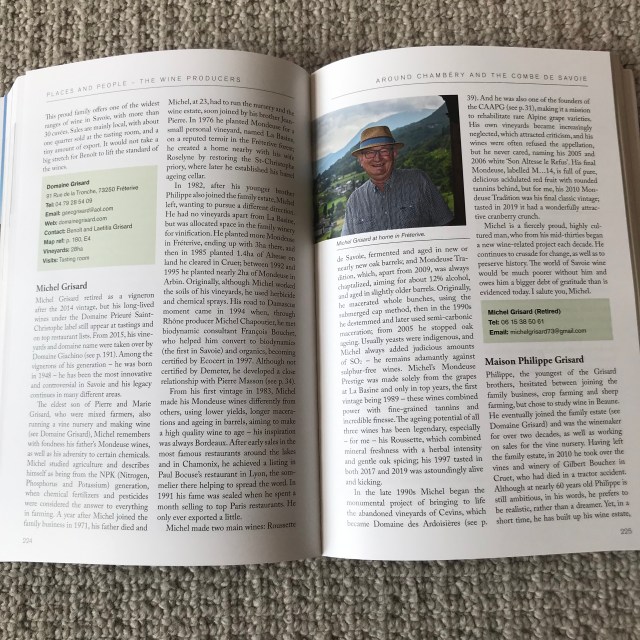
Issue 1 is a perfect bound magazine running to 226pp. It begins with news items, accessories, ways of buying wine, etc, before getting into the meatier features. This is why I bought it. A section on Champagne includes an article on Delphine Richard-Boulard (Champagne Francis Boulard). Other regions include features on Domaine Weinbach (Alsace), La Famille Lapierre (Marcel Lapierre, Beaujolais), Lyonnais Bistronomie, Michel Grisard (Savoie), Pierre Overnoy (Jura), and Gramenon and Chapoutier (Rhône).

Each region has other features, including recipes from a local chef and recommendations from a local caviste. The photos are pretty good, many approaching World of Fine Wine standard, and it only costs 8,50 €. I’d say that if your French is just about acceptable, it’s well worth flicking through the current Issue if you see one in a Tabac or Librarie that sports a selection of wine mags.

img_6645


WINE BD

It’s probably also a good place here to mention some wine-related Bon Dessiner. “BD” for wine lovers sort of took off when the Japanese graphic novel “The Drops of God” was translated into French (and initially into English, but I believe that the English translation only made it to five volumes…do please let me know if I’m mistaken). The Drops of God by Tadashi Agi and Shu Okimoto was first published in Japan back in 2005 (English Language edition 2011, Vertical Press, New York). It was described, probably with good reason by Decanter Magazine as “Arguably the most influential wine publication for the past 20 years” at the time.

At the same time I bought the Vin.s magazine mentioned above (Jura visit, December 2018) I picked up Pur Jus Vinification. This is the second volume of Justine Saint-Lô and Fleur Godart’s Pur Jus graphic series on natural wine (Marabout, August 2018). The first volume, on vine growing, is called Pur Jus Cultivons L’Avenir dans les Vignes.

Both work on the same format – visit twenty or more natural wine producers of note, discuss their philosophies and techniques, and render these interactions into a graphic work filled with facts, ideas and humour.

To list all the producers here would be tiresome, and you probably know almost all of them. A few names give a flavour – de Béru, Albertus, Riss, Cotton, Coutelou, Porteret, Overnoy, Péron and Grappe.

In some respects you need slightly better French to read this than Vin.S, because of the colloquial language. The graphics convey the humour…yet at the same time they can be quite surreal. But if you do feel up to giving it a go (I don’t claim fluency) then you can access a nice bunch of lighthearted interviews with some of natural wine’s leading lights.

img_6655


If you quite like the idea of wine translated to the graphic novel format, there are a couple in English translations you can look out for. Michel Tolmer is probably the funniest of those writing (and drawing) on wine right now. His adventures of Mimi, Fifi & Glouglou published by Les Éditions de L’Épure describe the wonderful, often pretentious, always amusing, wine tasting scrapes of three obsessives. The stories are always tongue in cheek and afford a wry look at how we ourselves can become ever so slightly ridiculous on our chosen subject. As Jamie Goode suggests in the Introduction, we are all ripe for satire.

Mimi, Fifi & Glouglou – A Short Treatise on Tasting was first published in French in 2013, but an English translation by Doug Wregg (2016, £22) is available. I originally picked this up at the 2017 Real Wine Fair (Michel was signing copies), but I would guess that Les Caves de Pyrene will be able to point you towards a copy.

The Initiates is one of my favourite wine stories in graphic format. It’s a tale of a comic artist and an artisan winemaker changing jobs. It’s written by Étienne Davodeau, and he is that artist who goes to learn about wine from Richard Leroy. They visit vignerons and writers, as each is initiated into the world of the other. It’s a graphic novel all about inspiration, motivation, and a surprisingly similar world view.

This English Language Edition was published by ComicLit, an imprint of NBM Publishing Inc, New York (USA), in 2013, and I still spot it in places which have a good Food & Drink section.

I’m currently reading The History of an Unusual Wine Company in 10 1/2 Chapters by Sir Douglas Wregg, and I suppose if I don’t mention it here I shall misplace the moment.

img_6658

What exactly is is, you ask? Well, one of the “Mr Les Caves de Pyrene”s has written a history of the UK’s first, and major, importer of natural wines. Except that it’s less John Julius Norwich and more a cross between Ulysses and Gabriel Garcia Marquez, with a little added soupçon of Shelley, Shakespeare and probably Shakespeare’s Sister. It’s published to look like a university dissertation (though thankfully minus the two hundred pages of footnotes at the end, which Doug is doubtless capable of adding if not physically restrained).

I only know Doug a little, but I make no apology for suggesting he is one of my wine heroes (in fact, there aren’t all that many of them). Through his various writings (via blog and wine list) I’ve learnt more about natural wine than from anyone else. I have also shaped my whole wine philosophy around the crap (I mean astute words) he has spouted forth over the decades.

So for me, this ten pound tome has been essential reading, and I promise it’s not because I, to my surprise, found I get a mention deep within. The prose (or is it poetry?)…well, I think the phrase “off at a tangent” (aka AWOL) was invented for this lovely human being. But the tangential exposition is always entertaining and a little bit illuminating. I’m guessing that with the chance to expand, Doug took it and did a Mo Farah twenty-six miler with it. It’s a history of Les Caves…sort of.

Running to 320+ pp it is ironically pretty much the same length as Julian Barnes’ original (the first edition h/b of course), but the Wregg is weightier than the Barnes. This isn’t merely a comparison of towering intellects, albeit with different wiring, but the Wregg is in a soft A4 cover, most likely printed on a HP Photosmart C4780 inkjet, albeit with a new cartridge. If your English is up to it, you can probably still get a copy from Les Caves (I paid a tenner at Real Wine 2019, but I cannot speculate whether, like stocks and shares, it has gone up or down in price since then).

I love it Doug, I really do. Thousands of fans of Mr Robert Parker might not. I hope you sell half as many as Mr Barnes’ second most famous novel.


Posted in Natural Wine, Wine, Wine Books, Wine Writing | Tagged , , , , , , , , , , , , , , , , , | 3 Comments

Bruno Paillard at Hedonism

I have a bit of a thing for Bruno Paillard Champagne. I may spend a lot of my time drinking the Growers these days, but what I am looking for, always, is wine with a soul, wine which reflects its maker, and wine which even more importantly reflects where it comes from. This can very much be a blended wine from different locations because those locations are still perfectly capable of making their mark in a cuvée.

I had the opportunity on Wednesday to attend the launch of the new 2009 “Assemblage” at Hedonism Wines in London’s Mayfair. Assemblage is a beautiful portrait of the vintages which this small house decides to bottle (it’s not made every year). The icing on the cake was that Alice Paillard was not only showing the 2009, but had brought along the 1999 and 1989 vintages (in magnum) to show alongside it.

Champagne Bruno Paillard has been around since it was founded by Bruno in 1981, after he had been working as a Champagne broker previously. He has since become one of the most highly regarded individuals in, and servants of, the Champagne region, and I sometimes wonder whether his de Gaulle-like height has been a distinct advantage in establishing himself as a natural Leader among his fellow producers.

There are certain aspects of the house which don’t tally with normal preconceptions of a Maison de Champagne. There are bought in grapes, but yet at least 70% of the wine is from vineyards they own. Where the grapes are purchased, they are via a large number of contracts where quality can be easily monitored. A particular obsession here is the desire to have deep rooting vines, vines which can seek the nutrients in the soils, vines which can express their terroir.

Also, production across all the Bruno Paillard wines is not high. I know that a decade ago, total production stood at a few hundred thousand bottles, and I doubt it has increased significantly.

The point of all this is quality. We expect a Marque to have prestige bottlings, and, in many cases, more run-of-the-mill cuvées. At Bruno Paillard the focus is on quality, and for Assemblage that focus is rigorous, which is the reason it isn’t released every vintage.

img_6610

ASSEMBLAGE 2009

I think most people would agree that after the beautiful 2008 vintage, 2009 had its challenges. A wet spring and early summer was followed by what some thought at the time was vintage-saving hot weather in August. But the heat continued and so growers risked surmaturité if they didn’t get picking just right.

Paillard harvested early, beginning on 10 September with the Chardonnays on the Côte des Blancs, working north to Mailly at the top of the Montagne, where Pinot Noir was harvested ten days later. They also have some vines down at Les Riceys, in the Aube, but I’m not sure whether any of these grapes went into this “ten village” blend. The fruit was certainly more mature than in many vintages, but acidities were wholly in line with the past ten years.

There is no set blend for Assemblage, but for 2009 equal parts Chardonnay and Pinot Noir were used, with no Meunier. Around 20% of the grapes were fermented in barrel, and Paillard only uses the first pressing. This vintage saw ten years ageing before release this week. Seven of these years were on lees, the wine being disgorged in September 2017 (date always stated on the back label), with 5g/litre dosage, making it, as usual, an Extra Brut.

The 2009 was served from 75cl bottle, for reasons I hope would be self-evident for a brand new release. The wine is a lovely bright gold. At first the bouquet hits with freshness, and it shows a characteristic elegant bead. As it opens, the red fruits of the Pinot Noir show first, then some lemon citrus, developing honey after a few minutes. Finally, within the time frame one gets at a tasting, a savoury/umami note appears, which with my limited experience is a trait found in Assemblage, probably in part the result of the long cellar ageing it receives (you might merely find this takes longer to develop from magnum and/or in a cooler vintage).

As a reflection of the vintage, and of the long ageing this wine has had before release, one would expect that the majority of people who will consume it immediately will be very happy. That will certainly be the case. But this is a wine that should retail at around £70, £150 for a magnum. What happens when you age it?

Well, before we have a look, I should just mention the label art. Assemblage has a commissioned artist label each release. Indeed, the 1996 was illustrated by one of my favourite contemporary artists, Sandro Chia, who also happens to own Castello di Romitorio, producing Brunello di Montalcino with his son.

The 2009 vintage label was created by Swedish artist, Anna-Lisa Unkuri. She worked on the theme of “Invitation au Voyage” (the label always has a phrase or sentence which reflects the vintage too). The result seems to fit the feel of a wine which is perhaps a little exotic and invites the senses to travel to the East. For the artist, travel is both a physical experience, and an experience enacted through memory, which fits nicely with the way we can continue to enjoy a wine we feel has a profound impact long after the last drop has been swallowed (or mostly deposited in the crachoir in this case).

img_6611

ASSEMBLAGE 1999

The 1999 hails from another warm vintage, and not one to have been regarded as remotely classic in most quarters. It was disgorged in November 2011, so it has had more than seven-and-a-half years of post disgorgement ageing (and as stated, served from magnum, which is the format for all of the Maison BP private reserves). It also had the same 5g/l dosage.

First of all you notice the freshness, which might perhaps be a little surprising if you were merely thinking of the vintage by way of generalisation. In fact that initial freshness (I got there early and tasted the wines very soon after opening) is suggestive of the care that goes into these blends. There’s quite a bit of texture here. It’s chalky texture, but hard chalk. There’s also a touch more structure overall from the magnum. There is a savoury element which develops in this wine too, but I’d characterise it more as minerality, and perhaps a bit of salinity, rather than pure umami.

Interestingly, the blend of varieties in this 1999 is quite different to the new release, and we have a wine dominated by Chardonnay (42%) with equal parts Pinot Noir and Meunier (29%).

This is an impressive wine. A lot of people would drink this now. It has everything that you would generally want from a prestige cuvée of twice the price, yet the next wine opens a new dimension, and a window into the possible.

img_6612

ASSEMBLAGE 1989

Another varietal mix entirely, the 1989 (yet another warm vintage) was made up from 60% Pinot Noir and 40% Chardonnay. It was disgorged in 2008 (October, I think), so it has had a long old time ageing in bottle. This showed in its darker gold colour, yet it remains beautifully bright.

The first thing we noticed was a whiff of oxidation. This caused a discussion…I am not at all averse to a bit of oxidation on Champagne so long as two things follow. First, it must not be oxidative to the exclusion of all else, and second, there must also be other elements which can at least match those oxidative notes. In time these other qualities ought to come to the fore.

Actually, other qualities appeared swiftly, and most interesting they were. I got a touch of fresh apple, and then something a little deeper resembling delicious sweet caramel. It wasn’t the full tatin, but a very tiny hint of butter was there as well. Then, as it opened further there were red fruits, honey and beeswax.

For me this extremely complex, and indeed vinous, Assemblage is a wine for the table, and I’d like to try it with partridge or quail, or something like that. I’d also like to see how it unfurls further. It’s certainly a mature wine, but the possibility of discovering how this wine tails off would be rather like the chance to witness a dying star out there in the Galaxy…just think. Not that I’m ever going to sit down around a table with a magnum of this, I don’t suppose, but then what are dreams for? And as with Anna-Lisa Unkuri’s painting for the 2009, I can travel through my memory of it.

img_6613

So this was a lovely tasting, and it also provided an opportunity to chat with Alice again. I don’t know what she makes of the particular way I assess and look at the wines, which is not at all focused on some finite number of points to express quality, rather looking at whether the wine has soul and personality. In any event, I like Alice. How could I not, she drinks Rosé des Riceys.

It also afforded the opportunity to have a little look around Hedonism, which is as much a wine museum as a wine shop to enthusiasts, not least those of us who like to find difficult to source and obscure wines. They also have a very good selection of Bruno Paillard in the sparkling wine section to the right as you enter the store.

Champagne Bruno Paillard is imported into the UK by Bibendum. They are represented here by Relish PR/Sally Bishop (sally@relish-pr.co.uk) .

Hedonism Wines is at 3-7 Davies Street, Mayfair, London W1.

img_6619

71eb8e89-65b8-49c3-aa3e-729ab78ea05d

I also had the chance to make my first visit to the upstairs wine shop at Antidote Wine Bar near Carnaby Street that same afternoon. The shop has been open for about three months but I hadn’t yet had time to go to take a look. I grabbed a couple of wines.

Gut Oggau fans will be especially pleased to see they have the new Maskerade cuvées from this favourite Burgenland producer. There’s a red and a white blend, both bottled as litres, and priced at £35. For those aware of the story, they wear masks on the label hiding their identity (we are not told the varieties in the blends). The reason – these are young vineyards which are yet to reveal their true personalities.

These wines have just arrived and are exclusively available at Antidote, at least for now. Don’t hang about.

Antidote is at 12A Newburgh Street, London W1.

Posted in Champagne, Fine Wine, Sparkling Wine, Wine, Wine Shops, Wine Tastings | Tagged , , , , , , , , , , , , | Leave a comment

Sake and the Wines of Japan by Anthony Rose (Book Review)

Of all the countries outside Europe I would say my favourite has to be Japan. Somehow I find I have an affinity with so much about Japan (though certainly not every aspect of Japanese society). It might surprise British readers who have never visited that so much about this country, however exotic it might seem from a distance, feels not all that removed from the many aspects of our own society. It’s also a country which is far less difficult to navigate, at least in a literal sense, than you would think. But in another sense, Japan is two countries. There is an amazing welcome waiting for you as a tourist, but there is also a very private Japan, where the tourist is unlikely to penetrate without a strong connection.

Sake is a little like that. I’ve visited Japan four times, and every time I’ve got to know sake a little better, yet as with the Japanese language, when it comes to anything deeper than superficial knowledge I have made slow progress. I’m a little further ahead with Japanese wine. After all, wine is my background, and ever since I was aware of Japanese table wines on the UK market I went out of my way to find them. In Japan my first efforts were tentative, hindered once more by my inability to read Japanese script, but now I have broken through the barrier to visit my first vineyards. I hope to do more on my next trip.

You will imagine how happy I was when I heard that established wine writer, Anthony Rose, himself something of a sake expert, has written a book on both subjects. I read this eagerly a month ago, and it has only now found a slot in my schedule for me to write a review.

img_6600

On first sight this paperback/softbound book looks rather like a textbook. As part of the Infinite Ideas Classic Wine Library, a relatively new series with approaching twenty titles currently, its production values could be described as “no nonsense”. Photos and diagrams throughout are all in monochrome, save for a nice eight page insert of colour photographs in the middle. But the text is clearly set out.

Where the book scores is that as well as containing at least three of four times as much information as your average coffee table book on the subject of sake, Rose writes in an engaging and easy-to-read style. As well as being a British expert, he’s so obviously a massive enthusiast. That enthusiasm comes through, and it is central to helping the reader assimilate some complex and difficult knowledge…as well as unfamiliar language and culture.

img_6602

As you would expect, there’s a good bit of welcome history, an explanation of what exactly sake is and how it is made, along with explanations for the myriad styles of this rice alcohol (you’ll learn a lot about rice along the way). Naturally there is also the obligatory chapter on how to enjoy it. But there’s also a lot of up-to-date information about “Sake‘s New Wave”, the movement making sake great again (including the debunking of certain snobbish attitudes towards sake and its different styles prevalent both inside and outside Japan). There’s also a chapter containing details of sake production outside of Japan, in Australia, the UK, Norway, Spain and the USA (I’ve yet to visit London’s sake brewery, Kanpai, in Peckham, but it’s on my list).

A large part of the book, around a third, is taken over by entries for the main sake breweries in Japan. As well as providing essential information for the visitor, I suspect the real interest here for the reader who is unlikely to spend as much time visiting breweries as Rose, is reading about those breweries whose sakes we can find and taste in our own country, especially as this beverage is currently generating something of a surge on export markets, just as it is finding its renaissance in Japan.

There is a highly useful glossary of terms at the back of the book. To get to grips with this drink you really need to know your Daiginjō from your Junmai and your Nigori from your Genshu. I’ve written myself a list to learn.

The section on the Wines of Japan at first looks a bit like an add-on, but that is not the case. There are still around ninety pages on grape wine in a book of 340+ pages, plus appendices. This section is divided into a useful short chapter on history, grape varieties etc, including very useful paragraphs on visiting Japan’s main wine regions, something you really should try to do if you have the chance – where I have been they are as beautiful as any in Europe, especially those near Nagano on the edge of the Japan Alps.

The rest of the wine section is made up of profiles of the major Japanese wine producers, from the larger companies making wine that you might have found in a UK supermarket (Sol Lucet Koshu in Marks & Spencer), to small boutique producers making wine of superb quality which fly under the radar outside Japan, if indeed they have international distribution.

The Japanese wine industry is going through rapid change right now. First of all, increasingly, quality is being recognised. Japan grows a lot of hybrid varieties (vinifera and labrusca crosses on the whole, such as Delaware, Concord plus the home grown Muscat Bailey A, a red variety, and Kyohō), but a surprising number of European vinifera grapes make (generally) far more successful wine. Some of these are proving successful as site identification improves.

Chardonnay now makes up 5% of plantings and has a bright future, but other less well known varieties are making exciting wines in pockets. Look out for Kerner, Zweigelt, Merlot and (as I have tasted) rather good Albariño and Petit Manseng at Domaine Sogga (Obuse, Nagano). Rose also nicely identifies the potential for Cabernet Franc.

That said, anyone wishing to explore Japanese wine cannot fail to seek out Japan’s native grape variety, Koshu. It’s without doubt the vinifera variety people associate with Japan. It has a thick pink skin, and was originally prized as a table grape (Japan does table grapes oh so well, as any visitor to a Tokyo food store will notice). It takes up 16% of the Japanese vineyard but that is still just under 500 hectares, most of which are in Yamanashi Prefecture (in the Chūbu Region, southwest of Tokyo).

If seriously over-cropped, Koshu can be pretty dilute and nondescript. I’m also not convinced that new oak is the way to go. But when the site is well chosen and yields are within reason (which may not mean “low” in a European context), it makes a lovely fresh, dry wine with nice, almost exotic, fruit concentration. Expect a little salinity as well, to add a touch of complexity, but if you are holding a good glass it will almost certainly possess a genuine purity which you notice.

Koshu has real potential because it can turn its hand to a variety of styles, including sparkling wines, which have only really taken their first steps in Japan, as indeed has sparkling sake. 

There are plenty of experiments with organic and biodynamic viticulture and winemaking in Japan (cf the aforementioned Domaine Sogga, run by the self-deprecating but supremely talented Akihiko Soga…for some reason his name has one “g” and the domaine two). There is massive interest in natural wines in Japan, and in Tokyo you will find plenty of European unicorns. The Japanese are the masters of discerning food and drink consumption, and there are bound to be more experiments in this direction.

IMG_0348

However, the enemy is the climate. For example, if you visit vineyards in summer you will marvel at thousands of small waxed paper umbrellas which cover every bunch of grapes. These protect the grapes from harvest rains, and in fact without them rot would be far more rife. This means, inevitably, that synthetic chemical applications, and indeed chaptalisation, is widespread. There’s also an unhealthy worship of the new barrique in some quarters. Yet given all that, there’s massive potential in Japan and the Japanese are innovative enough that we can be sure of some very exciting discoveries to come.


These are the rather beautiful waxed paper umbrellas which protect grapes from the summer rains in most of Japan’s major vineyard regions.

In summary, I can’t recommend this book highly enough. Of course, if you plan to visit Japan I’d say it’s essential reading for any drinks lover. There is, I should add, a really useful “Guide to Japan” (Chapter 10), which includes an illuminating introduction (Navigating Japan) and a guide to Tokyo restaurants, bars etc, for finding sake and Japanese wine. It’s more focused on the sort of places you and I would enjoy than those in more general guidebooks. But at the end of the day it’s as much an enjoyable read as a source of invaluable information. It joins that select bunch of drinks books which I know I shall read again, certainly before what I hope will be my fifth visit to Japan in 2020.

Sake and the Wines of Japan by Anthony Rose is published by Infinite Ideas (2018, 380pp, £30).

If you want to discover sake of all styles in the UK it has become far easier in the past five or six years. I began my journey at The Japan Centre, near London’s Piccadilly Circus, but a number of wine merchants and department stores in the capital stock a selection. Quantities of the best sake are not high on export markets, and neither are prices low, but there’s a small selection out there. Some London wine merchants, including small independents, are getting on the sake bandwagon, although some stick doggedly to Japanese spirits. I think we’ll see many more in the next year or so.

img_6432

This was the enormous sake table at the recent London Wine Fair. The IWC’s International Sake Challenge takes place in Tokyo every year and Anthony Rose is Co-Chair. I would have needed a whole day to make inroads on these.

At least quantities for sake are not quite so tiny as they are for the best Japanese table wines. You may need to search hard for these, but you can find some of the wines from the larger producers without too much aggravation. I mentioned that Marks & Spencer sold a Koshu (Sol Lucet from Kurambon Winery, Yamanashi) which apparently went down well with customers, but I don’t see it right now on their web site. It may be ever so slightly pedestrian, yet it’s a perfect bottle with which to dip your toe in, and I hope they haven’t delisted it.

For around double the price Selfridges usually have one of Grace Wines’ Koshus, Kayagatake (£22). For other wines I’m loath to recommend any companies which I’ve not dealt with. Aside from Selfridges, the places you might expect to find some (Hedonism, Harrods, Fortnums) all fail to list any.

If you want to get to learn more about sake then I understand that Anthony Rose and Christine Parkinson run occasional courses at Sake No Hana in St James’s Street, London (where Christine is Group Head of Wine for the Hakkasan Group). The next Masterclass is on 20 July, with a final event for 2019 on 19 October. Frustratingly, I can’t make either, but I do plan to attend one as soon as dates work out. Cost is currently £72 per person, and includes a tasting of various sake styles, lunch and a gift bag of goodies. If interested, follow the link here. Then follow the link within that page for more information.

img_6603


Posted in Japan, Sake, Wine, Wine Books, Wine Travel | Tagged , , , , , , | 5 Comments

Mastering Food and Wine Pairing at Masters Superfish

This is a wine blog, and I suppose that when I write about a restaurant I concentrate on the wine…and the food too, of course. But this piece isn’t primarily about either, but rather a musing on “lunch” in a wider sense. Long-term readers will have been, at least vicariously, to Masters before. What is arguably London’s finest “fish & chip restaurant” has been the venue for several notable BYO lunches, which have gone under the banner of fizz and chips (Champagne/sparkling) and fish and fino (Sherry). Both are wonderful accompaniments to Britain’s most traditional dish, but this time we felt like widening it out. A kind of bring what you like lunch.

Masters is something of a London institution. Of course, the capital has other contenders, but Masters, for me, is the place to go for fish & chips, and this is surely backed up by the number of Japanese tourists I always see there. Which other nation is so clued-up about the genuinely best places to eat in any given foreign city?

The fish was particularly good last week. A friend quite rightly pointed out that Masters is always that percentage point better than its usual excellence when it is extremely busy, as it indeed was. The oil will be really hot, which makes a difference. But the full Masters experience is not just the fish. A full lunch comes with plump shell-on prawns and a plate of pickled onions and gherkins the size of a courgette. We couldn’t resist adding in a couple of portions of whitebait, one portion being sufficient for three extremely hungry stomachs.

The chips are lovely, dry, fluffy pieces of properly fried potato. I ordered Haddock on this occasion. One of the diners said it was “certainly the best fish I have had in the UK”. He’s a discerning bloke, and as an Aussie knows a thing or two about fish. It really was that good, although it’s fair to say that it was even a small step up from the wonderful fish I’ve had there previously.

So we’ve established that the food is good. I’m sure we all enjoy our fine dining experiences when they come along, but to eat a simple dish so well done makes one realise that fish and chips is not a national joke. I suppose it’s the equivalent of grabbing some cold meats, paté and a good cheese platter in a Parisian bar.

Such a lunch might be deemed to call for simple wines, but in fact we drank the full range, from inexpensive and simple to frighteningly expensive and complex. It was rather odd that we found that every single one of them went perfectly with the food. The essence of a good wine lunch is naturally good food, good company, and just the right number of wines. This is why, wonderful as our various sherry lunches usually are, you frankly get a bit too inebriated. There is always the journey home to be negotiated.

I think the key to the success of this particular lunch was not too many people, and a group who all know each other, but who in most cases hadn’t seen each other for a little while. The food was by no means anonymous compared to the wines, and neither strove to outdo the other, as can happen if you take a dozen different 1982 Bordeaux to a Michelin Two-Star.

I can think of many places where I’ve had spectacularly successful wine lunches. They range from The Ledbury and The Sportsman (Seasalter), through Noble Rot to The Draper’s Arms and Rochelle Canteen (the list is very far from exhaustive). But my point is that this lunch was no less enjoyable, and it’s hard to imagine that is possible from a venue where I paid £20…that includes £5/bottle corkage and a healthy tip.

I imagine that before we go you’d like me to elaborate on what we drank. Five bottles, from a bottle for the rich to a bottle for the poor. You get them in the order we drank them.

Vouvray Pétillant NV, Huet (Loire, France) – These days this wine is usually vintage dated, but this non-vintage bottle is around a decade old. I don’t remember exactly where I bought it, originally thinking it came from the region, but it may have been a bottle I bought from RSJ, the sadly no longer extant Loire-focused restaurant behind London’s South Bank, and the scene of several wonderful wine dinners back in the day.

As a “pétillant”, this wine has lower atmospheric pressure than a fully sparkling crémant, so the bubbles are finer and a little less profuse. The colour here is dark straw, sowing the signs of bottle age, but this is a wine which will normally go ten or twelve years. It is made, of course, from simply Chenin, and from the younger vines at the estate. This gives acidity and freshness, but around three years in bottle before traditional disgorgement allows it to start down the road of complexity, a journey completed when its owner gives it further cellaring.

If I’m honest I wasn’t expecting it to taste quite as fresh as it did for its age, but I was expecting that hint of tarte tatin that came in after the fresh apple and pears of the attack. It’s a dry wine, but the kind of dry wine that gets you wondering whether there’s just a hint of sugar (I don’t know the dosage, but there’s richness from the tertiary elements). A lovely wine. Armit Wines imports Huet into the UK.

img_6557

Dom Pérignon 2002 (Champagne, France) – So, Dom with fish & chips. To some it will sound decadent, to others a waste of a fine wine. I can’t answer for the first (except to thank the remarkable generosity of the man who brought it along), but I will say without hesitation that it was a superb match for my haddock.

I don’t really need to tell you about Moët’s remarkable prestige cuvée, even more remarkable considering the quantity in which this wine is produced. The 2002 has always been, for me with less experience than others, a lovely DP. I had a couple of bottles of ’02 but I’m pretty sure I drank them. Well, this 2002 was still relatively youthful in some respects, certainly in its freshness and a certain steely quality initially. But when it opened out so much seeped out and amplified. The floral bouquet gave way, eventually, to some beguiling, and almost exotic, stone fruit flavours. Oxidative hints? Hmm, not sure, perhaps the faintest little glimmer.

Elegant, long, glorious of course and ready to drink now without any need for unbecoming haste. Very widely available if you have the disposable income. Occasionally worth an early visit to a Waitrose “25% off all wines” promotion (giving away my secrets).

390fab1a-5606-4a4b-a595-94384425a6dd

Chardonnoir 2012, Bodegas Re (Casablanca, Chile) – This is a blend of 60% Pinot Noir and 40% Chardonnay from a single site, with the dry-farmed vines mostly at least 60-years-old off steep red clay slopes. Both varieties are vinified and aged in French oak, the Pinot Noir vinified as a white (pressed early and gently), but there is a little colour from the red grape skins, more peachy than pink.

Bodegas Re is a fairly large, 72 hectare family operation. The Morandé family farms some of the best of these two varieties in Casablanca and also in the Maule Valley. The aim here is to make something akin to a still Champagne (as the man who brought it explained). It’s a lovely wine, with both weight and elegance, good acidity and the structure to age further. Acidity plays an important part in the structure, and it does taste like a wine that has not gone through malolactic. But at the same time, it does not lack for absolutely the right amount of weight. Very impressive.

Bodegas Re wines are imported by Berry Bros & Rudd, although I didn’t spot this on their web site when trying to find a price.

img_6564

Hortas do Caseirinho Frisante (Vinho Verde, Portugal) – Now this is something completely different, although it was no surprise to me, nor the person who brought it, that it was a heavenly match for our food. I told the story at lunch of my first efforts to find and try red Vinho Verde, in Oporto, longer ago than you need to know. A guy in a bar actually tried to persuade me not to drink it. The acidity was ramped up to eleven. Today, things are a little different.

This semi-sparkling red is a blend of Touriga Nacional, Vinhão, Espadal and Touriga Franca. It’s a non-vintage wine, but the grapes saw an eight day cold maceration before temperature-controlled fermentation. It’s a cheap wine that doesn’t taste cheap. The dark purple colour is reflected both on the bouquet and palate. You get plum and the zest of concentrated black fruits. There’s a little soft tannin. It tastes very concentrated yet light, and it only packs 10.5% abv. The fresh fruit acidity cut through the batter on the fish perfectly. I’m told that this is literally cheap as chips in Portugal.

The Wine Society sells this wine’s branco brother for £7.25. If you can find the red version anywhere I’d grab some. Perhaps the person who brought it along might let us know where he found it. I know he generally reads my articles. An ideal breakfast wine too, if such a thing is required.

img_6565

‘T Voetpad 2016, Sadie Family Wines (Swartland, South Africa) – Without in any way downgrading the majesty of the DP, we did finish up with something very special. ‘T Voetpad (the footpath, which has connotations with the expression of the landscape) is one of Eben Sadie’s “Old Vine Series” wines. Old vines is no lie here. The vines which make up this white Cape blend are all between 90-to-130 years old, planted on original rootstocks on a site which claims to be one of the Cape’s oldest vineyards.

This classic blend is based on Semillon (both Blanc and the rare Gris) with Palomino, Muscat (d’Alexandrie) and Chenin Blanc, all part of a field blend from this single vineyard. The 2016 is quite rich and packs 13.5% alcohol. The wine has a very interesting profile. Stone fruits such as peach probably dominate, but the outlying elements make it special. Orange citrus, quite unusual, gives a nice edge, accentuated by a little salinity, but I won’t go on.

It is typical of a great field blend in that it tastes, however, like one harmonious whole. I say this, and it was true of this 2016 last week, but we were still drinking a baby. This has a good decade before it if you want to give it free rein to show what it can do. Nevertheless, it was also magnificent young, and I’d be just as tempted myself if I owned a bottle. Sadly I can only offer Pofadder.

Where to find it? Uncorked used to be a rare source for some of the Old Vine Series, but I’m pretty sure they don’t have any now. The UK importer to contact is Fields, Morris & Verdin.

img_6566

Masters Superfish is at 191 Waterloo Road, about a six or seven minute walk from Waterloo Station (when you pass The Old Vic Theatre you are more than half way). Pre-arranged corkage is £5/bottle, but they do have their own inimitable wine list. If you take your own wine I recommend you take your own glasses too. They also serve beer, and in the finest Whitby tradition, English tea, if you wish to go native.

img_6558


Posted in Artisan Wines, Champagne, Dining, Loire, Portuguese wine, Restaurants, South African Wines, Sparkling Wine, Wine, Wine and Food | Tagged , , , , , , , , , , , , | 2 Comments

Recent Wines May 2019 #theglouthatbindsus

Although May’s weather wasn’t perfect, it was somewhat better than June has been thus far. That might account for the inspiration to drink once more from the wide brimmed cup. We also drank deeply, I should perhaps say with a degree of shame, so even though I have stuck to fourteen wines here, there were many I hated leaving out. I’d like to mention Champagne Soutiran Blanc de Blancs 2006Von Buhl Forster Jesuitengarten 2009 (lovely mature trocken GG Riesling from the Pfalz) and Tillingham PN17 (I only omit my last bottle of that because I’ve mentioned it many times before, but the ’17 is still lovely).

ZWEIGELT AUTHENTISCH 2016, ALEXANDER KOPPITSCH (Burgenland, Austria)

Alex and Maria tend vines by the shore of Burgenland’s Neusiedlersee, based in the town of Neusiedl-am-See, which conveniently has a railway station with a bicycle hire place right next door to it. I only mention this because I think that the cycling here, around the lake, is wonderful…as are the Koppitsch family wines. They are not complex and serious, more soulful and fun, and they reflect the energy and kindness of their makers. There really is something in the air around this large, shallow, lake of reed beds, water fowl, and vines.

On opening, this Zweigelt showed slight reduction, which was easily sorted with a bit of air. It developed that lovely dark bramble fruit palate that makes the variety so eminently gluggable when people don’t try to over work it. Because of this, when the bouquet drifts in, the strawberry perfume is irresistible. At a well balanced 12.5% abv, serve this cool and enjoy. Wines like this can, in their enjoyable simplicity, profoundly change the way you look at wine, and at what supposedly makes a wine “fine”.

Purchased from Fresh Wines of Kinross, Scotland.

19a1f051-27a5-4cc0-adb8-12b85704cfec

λ’13 CUVÉE EXPERIMENTALE, DOMAINE LIGAS (Pella, Greece)

Thomas, Jason and Meli Ligas make and sell some of the most profound wines in Greece, on the slopes of Paiko Mountain in the north of the country. Here, their vines grow to their own rhythm without intervention, via permaculture, bar a little shoot repositioning now and again. I’ve never visited, but photos always show a profusion of wild flowers which remind me of how Alpine meadows raise Alpine summer cheeses to unimaginable heights. I wonder whether the flora has a similar effect here.

λ’13 (or Lamda ’13 if you prefer) is cloudy (unfiltered), so although light and fresh, it has texture. That lightness hides 13% alcohol. This is one of Ktima Ligas’ small batches of experimental wines, in this case a blend of pergola trained Assyrtiko and Roditis. The overall impression is of a zesty wine with citrus notes (lemon and grapefruit), the texture (from 3-5 days skin contact) giving an ever so slightly bitter edge to a nice finish. If I were to find a style to compare it to, I might (at a stretch) suggest Swiss Chasselas.

Purchased from the takeaway list at Silo, Brighton. For availability contact Dynamic Vines, Bermondsey.

42ec25dc-f79e-47be-b1cd-103b39c8e910

CHAMPAGNE EXTRA BRUT 2007 “LES PAPILLES CUVÉE”, EMMANUEL LASSAIGNE (Montgueux, France)

Emmanuel Lassaigne, of Champagne Jacques Lassaigne (his father), makes wine in that tiny outpost of the Champagne Region between the Côte des Blancs and the Côte des Bar, close to Troyes. The slopes are all south facing and see more sun than their northern counterparts, but Emmanuel farms with some of the strictest standards in Champagne, he’s fanatical about quality.

He owns 3.5 hectares and buys grapes from a further 2.5 hectares over which he has full control, and I’m presuming it is from those parcels that this cuvée comes. It is made from Chardonnay (90% of the Montgueux vignoble is Chardonnay), for his friends at Paris’ La Cave des Papilles (in the 14th). It’s a nice dark straw colour which gives a hint that there’s lovely depth here. No ordinary “house wine”. It’s actually quite spicy and also vinous…a gastronomic wine if you wish. Lassaigne surely makes some of the best Grower Champagnes around, wines that are seriously under rated among Champagne consumers, but I think not among aficionados. This excellent cuvée is a good way in. Pick one up next time you visit, as I know you surely will.

The current vintage is 2014 (ridiculously inexpensive at €31). Lassaigne also makes Les Papilles Insolites 2016 (€53) for the store, unusually for Montgueux, a Pinot Noir, and the shop lists eleven of his wines in total, right up to La Colline Inspirée (€152).

31c4b824-1d74-4837-b06a-939b6ae6a3eb

MINERAL CHARDONNAY 2013, FRIEDRICH BECKER (Pfalz, Germany)

Fritz Becker Junior (Kleine Fritz to his family and friends) farms vineyards which straddle both the German Pfalz at Schweigen and Alsace, in France, where the ancient monastic vineyards slope steeply down to the Abbey of Wissembourg. I’ve written before mainly about Fritz’s Pinot Noirs from those sites, but this Chardonnay, which I picked up on my visit in 2017, comes from the German vines around Schweigen itself.

This is seriously good, honestly. It has an elegant mineral-tinged nose and it tastes not unlike Chablis, although I’m thinking Tasmania too. It has that chalky citrus freshness, and restraint, but there’s firmness and strength too. As it unfurls you get grapefruit, and even a little butter, on the palate. I suspect I was drinking this too soon, although I don’t recall it being too expensive. I bought more Pinot on that visit and just grabbed some odd bottles of his whites. I really wish I had more.

I have an idea someone brings Becker into the UK, but I can’t think who? Perhaps someone will illuminate me. I think I might have bought Becker at Hedonism in Mayfair (London) some years ago.

530dfd01-f0d8-4d83-8aad-a1c050434c10

I WISH I WAS A NINJA 2018, TESTALONGA EL BANDITO (Western Cape, South Africa)

Craig and Linda Hawkins make what for me is probably the most exciting, simply-styled, sparkling wines from The Cape. This is a wine that I’m assuming many of my readers will know, but for those who don’t, this Swartland Colombard petnat fizz is exotically fruity (apple, kiwi fruit, peach), with a palate that is dry but soft. It also tastes more frothy than intensely sparkling. To top it all, it only puts out 9.5% alcohol, so you need a couple of bottles between two…ideally.

Solent Cellar via Les Caves de Pyrene. Around £20.

166640ba-b6cc-40c8-85c3-496802b7935d

MONTLOUIS “LES TUFFEAUX” 2009, FRANÇOIS CHIDAINE (Loire, France)

This is the most “classic” of the wines from May’s selection, but I’ve loved Chidaine’s wines for many years, and I never fail to visit his excellent wine shop if I’m in Touraine (it doesn’t just sell Chidaine wines) on the left bank of the Loire at Montlouis.

Chidaine sources this cuvée from some of his oldest plots of Chenin Blanc, off soils dominated by the region’s famous yellow limestone, aka Tuffeaux, and from vines up to almost a hundred years old in some parcels.

This ’09 is almost golden in colour, and at a decade old you still get a piercing whiff of quince on the nose. It’s slightly off-dry, or perhaps “rich” is a far better description, although at 13.5% abv it is in perfect balance. This is because a counterpoint to the richness is a gripping mineral bite and a texture that just reminds you of the terroir, whatever the scientists might claim. So, a classic(al) wine, but one so redolent of place.

Purchased from the domaine.

5c45ebd9-74b2-45cf-a8e1-b2c27f37ad51

DIVÝ RYŠÁK 2016, RICHARD STÁVEK (Moravia, Czech Republic)

Richard Stávek makes remarkable wines at Němčičky, in Czech Moravia not too far from the Austrian Border. He has a mixed farm of around 14-15 hectares of which 4.5 ha are devoted to vines. Richard is one of the pioneers of the new bunch of biodynamic and natural winemakers in the region, where he’s been growing grapes since the mid-1990s.

This wine is probably best described as a light red, but even better as a wine which is fairly unique. The blend is complicated. Modry Portugal, Frankovka (aka Blaufränkisch) and St-Laurent are the red varieties, Grüner Veltliner and Welschriesling the white, and Isabella the French-American hybrid which you can find planted as widely as Vermont, British Columbia, the Azores and Southwestern France.

If I were to use one word for the colour it has to be “luminous”. It looks right out of Chernobyl. “Clairet” would be more polite, but you can’t ignore its rather special vibrancy. A red fruits bouquet leads to a palate with fairly zippy acidity. It both drinks like a white wine, and like a wine with 10.5% abv, rather than the 12.5% on the label. It’s just so fruity and refreshing, an exquisite summer red. It’s a wine to enjoy, not to ponder over, but such enjoyment, if that is what you are looking for.

I have a friend who buys very fine wine. I won’t shame him by giving any more details, but I recall him quite recently talking about having received some Czech wine that would probably go “into the cooking”. I said nowt, but I can’t help finding Czech producers in this part of the country every bit as exciting as the other hubs of European natural wine making. Some of the wines may be eccentric, but boy do they deliver some thrills. Serve this one cool or slightly chilled.

Basket Press Wines is the importer, a wonderful small specialist in Czech wines and those of the wider region.

562043df-2b03-48a0-bf2c-c71e4fb7af0e

HEIDA RÉSERVE SPÉCIALE 2014 “MAITRE DE CHAIS”, PROVINS (Valais, Switzerland)

Provins is one of the larger and better known producers at Sion in the Swiss Valais. They produce a large range of wines, all of good quality. Heida is one of the traditional grapes of the high mountain slopes here, but it is none other than a synonym for Savagnin (and sometimes known as Païen). This part of the Rhône Valley is very sunny, but whilst the light is bright, the altitude of the vineyards, some of Europe’s highest, ameliorates the temperatures.

The wine which results here is clean-tasting, without the nutty signature of Jura-grown Savagnin. Think of the “Traminer” style some producers in Eastern France come up with, but perhaps with a little more weight (13.5% abv). As it has aged the fruit has become a little more exotic, but for me yellow plum is my overall lasting impression. I’d like to say that you also get a hint of Alpine meadow, and I know you’ll think I’m going off on a flight of fancy. But what is wine for if not to allow you to float away to a beautiful location?

People bang on about how expensive Swiss wine is, and they are right, of course. But this can be had for not much more than thirty quid from Alpine Wines, who sell a wide range from this producer among their fine Swiss range.

a8409008-c6ba-4798-8de1-184a5bcc56ea

PINOT NOIR 2011, DENIS MERCIER (Valais, Switzerland)

Madeleine, Anne-Catherine and Denis Mercier farm at Sierre, just a little further up the Rhône Valley from Sion. Denis and his wife began their 7.5 hectare estate in 1982, and have recently been joined by their daughter, Madeleine, a trained oenologist. They have long had a reputation for producing some of the region’s most harmonious and lovely wines. They fly under the radar in the UK, but I do recall my very old edition of “1001 Wines You Must Try Before You Die” featuring their Cornalin, so someone knew their stuff back then.

The difficulty with cellaring wines like this is that I really don’t know when they will peak. This 2011 is stunning right now. It is a perfect garnet-to-ruby red colour, the bouquet is red-fruited with the additional scent of violets, but it is unquestionably developing tertiary nuance through a savoury element. The palate is just gorgeous, silky and sensual. And yet the current vintage of this wine (2017) could have been picked up at the cellar last summer for CHF20. My bottle came from Lavinia in Geneva, and doubtless will cost you more. You may save on petrol but miss the scenery.

a4f3a082-a4f6-44a3-b218-b299ff39f98f

CREMANT DU JURA, A&J-F GANEVAT (Jura, France)

Jean-François Ganevat makes an astonishing array of cuvées these days (someone told me more than 100 now), both from the domaine and with his sister under the A&J-F negoce banner. Some are easier to find than others, and thankfully the Crémant du Jura is one of the former. 100% Chardonnay, the grapes are picked early to preserve acids. The wine is fermented in large old oak demi-muids and then gets a decent 24 months on lees before disgorging. No dosage is added.

It’s one of those wines that is hard to describe in a way that does it justice. It’s not actually my favourite bottle-fermented sparkling wine from Eastern France, not even from the Jura, but I do love it. It’s totally dry, and has a bit more breadth than most Champagne, yet the acidity keeps it in a moderately tight corset. The thing that might give away its producer to better palates than I possess is its salinity, which for me is more important in this wine than any fruit. It also has a certain purity which I guess comes from J-F’s experience and philosophy.

I try to buy the odd bottle of this whenever it’s on the shelf, which I’m not sure it is right now. Another wine from Solent Cellar via Les Caves de Pyrene.

eeb0dcbe-844c-4212-ad1c-da96f109c8b0

BRUTAL CUVEE 15/16, DOMAINE L’OCTAVIN (Jura, France)

Unlike Ganevat’s Crémant, this cuvée from Alice Bouvot in Arbois is hellishly difficult to source. The unusual blend for the Octavin “Brutal Wine Corp” label consists of whole cluster Gamay from 2015 with fifteen days skin contact, and Chardonnay from 2016.

Is it a pale red or a rosé? It’s another luminous wine, and surely such colour brings joy even before you taste it? The raspberry and strawberry fruit is gorgeous, the acidity is tart (verging on brutal for some), but it’s so refreshing and juicy. Don’t let me forget to warn you it’s going to be a little bit cloudy by the time you reach the final third of the bottle. No added sulphur, no filtration. It won’t likely convert a single conservative drinker, but if you want to find the essence of glou, then look no further. There are two possible reactions to this…tears of joy or tears of despair. I hope most of you are with me and unbridled joy. There are actually far more frightening wines than this, folks.

Purchased in Arbois in 2018.

b23f0b73-6d89-48bc-a28c-17cabb31b81e

LES BARRIEUX 2014, JEAN-YVES PÉRON (Savoie, France)

Savoie has come a long way in the past decade, even since I remember nagging Wink Lorch to write a book about the region just as her Jura book was being published. That book is hopefully due to see the light of day later this year, and I’ve been trying to hold back a good stash of wines from that disparate amalgamation of terroirs with which to celebrate its publication. But a friend was finishing a wonderful stint at a wonderful restaurant and I thought I’d open this (and the L’Octavin) to help us mark it.

Jean-Yves farms biodynamically at Conflans, near Albertville, by the confluence of the Arly and Isère rivers. His vines, especially the white varieties, are up to 120-years-old, situated between 300 metres and 600 metres altitude. The estate seems relatively new on the scene, yet is now in its nineteenth year. Jean-Yves specialises in very small production vins parcellaire.

“Les Barrieux” is a skin maceration wine made from white grapes Jacquère, Roussanne and Altesse in the “orange” style. What is most unusual about this singular wine is not the two weeks skin contact, but the fact that it ages under a thin layer of flor. This might shock the unsuspecting. The bouquet is a mixture of orange citrus and rusty metal. The texture is pronounced, and the structure is firmish on the attack, but then you get this extremely long finish which has an entirely unexpected gentleness to it.

In some ways I’d say this is a difficult wine, but for me, genuinely satisfying getting to understand it. I think this came from Gergovie Wines, unless I bought it in France.

ccc80916-e66b-4f66-9daa-304828f10086

HINTERHOFKABUFF 2016, BLANK BOTTLE WINERY (Elgin, South Africa)

Pieter Walser is a Stellenbosch boy, but this is Elgin Riesling from a small block, crafted in Pieter’s inimitable style. It’s obvious what the variety is, and you even get a little bit of petrol on the nose to confirm it. But this weighs in at 14% abv, and although Pieter’s wines never appear as powerful as this would suggest, it does boast a weight and breadth you rarely (if ever) find with Riesling.

It’s so enjoyable that it ought to come with a warning on the bottle. You won’t be doing any work if you drink this for lunch, but you’ll have a warm glow as you snooze it off. Instead you get Pieter’s wonderfully demented rendition of the winery shack (hinterhofkabuff) described by a German journalist in a Stern article, which inspired the cuvée’s name. If you didn’t read my article on a man who is very possibly South Africa’s most interesting winemaker, indeed interesting on so many levels, and one of wine’s finest story tellers, then check it out (Blank Bottle at Butlers – Pieter Walser Fills us In – 3 June 2019).

Blank Bottle is imported by SWiG. This (blank) bottle came from Butlers Wine Cellar down in Brighton.

59c58a1f-4f06-4ddb-8b9f-d311590ded2c

“SIMONE C’EST MOI” VIN DE FRANCE (2014), JULIE BALAGNY (Beaujolais, France)

Very sadly this was my last bottle of Simone. I only really comment on that because I love Julie’s wines and this was a particularly interesting, as well as enjoyable, bottling at every stage I’ve opened one. It is in effect declassified Fleurie, declassified because it took too long to ferment. It’s pale with the most adorable fragrant cherry bouquet, with additionally raspberry fruit on the palate. Light, fresh, quite acidic and with a tiny whiff of volatility (which I think gives it a racy excitement).

For once I think someone has described Julie’s wines far better than I can, so I hope UK importer Tutto Wines doesn’t mind me quoting them. “Like all great wines, there is something about Julie’s not easy to put into words. They are marked by gorgeous aromatics, their delicacy and an almost ethereal quality…” All three poignant observations take the words right out of my mouth. If an artisan could also be described as a poet you have her here.

df951961-ee78-4c4b-ab24-1f2ce5749158


Posted in Arbois, Artisan Wines, Austrian Wine, Beaujolais, biodynamic wine, Champagne, Czech Wine, German Wine, Greek Wine, Jura, Loire, Natural Wine, Savoie Wine, South African Wines, Swiss Wine, Wine, Wine Agencies | Tagged , , , , , , , , , , , , , , , , , , , , , , , , , , , , , , , , , , , | Leave a comment

Wild Flor Hove

I was recently lamenting Brighton’s loss (soon to be London’s gain) of one of the city’s leading restaurants, but true to form as one door closes another door opens. Wild Flor in Hove has been open about four weeks, and we managed to get down to try it out on Sunday evening.

The young team behind Wild Flor (Olie Darby leads the kitchen, whilst Rob Maynard, Faye Hudson and James Thomson head front of house) boasts experience from Brighton & Hove’s Ginger Group of Restaurants, with an ex-Butlers Wine Cellar employee in charge of the wine. I say “young team”, because you can see that extra touch of entrepreneurial spirit and innovation in the cooking and the wine list, but one grounded totally in sensible ideas about what will work, commercially. Olie Darby knows that his food needs to have something extra, because Wild Flor is on Church Road, Hove’s restaurant mecca. There are well know places to eat like Forth & Church and Café Malbec among dozens of others within a few hundred metres.

The food is traditional but with innovative touches, and the wine list is extensive, covering most bases. The weight is towards classics (in the widest sense), but Rob Maynard has the kind of depth of knowledge, coupled with a sense of adventure, which has helped him seek out the names that will excite wine lovers like me. Perhaps the wine we drank, from the long by-the-glass list, will show what I mean.

We started out with what might be, in my eyes at least, the best aperitif by the glass in Brighton right now, Pierre Péters Blanc de Blancs. This is unquestionably one of my very favourite Champagne producers on the Côte des Blancs, at Mesnil-sur-Oger. The fruit comes from four classic villages, Le Mesnil-sur-Oger, Oger, Avize and Cramant. Bottled as an Extra Brut at just 2g/l dosage, it is dry, with floral and citrus notes giving way to a little toasted hazelnut, and a nice creamy palate has more toast on the finish. It’s such a good wine. I think £14/125ml glass is not outrageous for such a good Champagne, and I’d rather pay that than see something disappointing listed for £9.

img_6517

On Sundays at Wild Flor you get a set price menu with two courses for £28 or three courses for £33, but this includes a selection of hors d’oeuvres. These are currently crispbread with romesco, sea bass brandade with Arbequina olive oil, and brisket with spiced tomato and cumin. You could pretty much call this an extra course.

img_6518

For my starter (entrée, if you insist, but thankfully they go with the former) I went for citrus cured Loch Duart salmon with fennel and orange, which I paired with François Cotat Sancerre Rosé 2016. This is is such a lovely example of pink Pinot Noir. François Cotat only makes a little rosé, from less than half a hectare at Chavignol. It has a good bit of colour (salmon pink), scents of light raspberry, contrasted with a broader palate of peach and raspberry, with a sprinkling of spice. I don’t know how they tracked down this wine, but putting it on the by-the-glass list was a great idea, and generous. £10/glass.

img_6521

My main course was effectively a choice between hake, a mushroom risotto or roasted baby artichoke, or a traditional roast (beef or pork), which is a specific Sunday option (lunch and dinner through the rest of the week offer a wider selection of dishes) . Feeling hungry I went with the roast (beef option). This was accompanied by two reds, a Lignier Gevrey and a Brezza Barolo, again by the glass.

Gevrey-Chambertin “La Justice” 2012, Hubert Lignier is from a lieu-dit to the east of the village, on flat but well draining soils. This has a lovely colour and a scent of intense raspberry, which is just starting to turn with the introduction of a slightly gamey note. The palate is not yet completely mature, with fruit still dominant, but it isn’t tannic. Drinking beautifully now, but good for four or five years I think. £16/glass.

Barolo “Sarmassa” 2011, Giacomo Brezza Brezza has this southwest facing site at around 300 metres altitude, on sand and silt at Barolo itself. The grapes are given a long maceration and a traditional ageing in old wood. Initially you notice, after the fragrant bouquet, that the tannins are soft and smooth. This wine does indeed appeal early in most vintages, but it is quite structured. Cherry and spice dominates the palate. I think this is a really good Barolo, but even though 2011 was quite a hot vintage my own preference would be to drink this after maybe another year in bottle. Still, 99% of drinkers would enjoy this now. £15/glass.

Both reds illustrate one of the pleasing things about the wine list here. There are some bottles with a bit of age. So often you peruse a list and your eye hits on a name you fancy, especially among the classics, only to find that it’s the latest vintage and it’s not ready to drink. The Gevrey was drinking now, and the Barolo too for most people’s tastes.

img_6523

img_6524

I drank most of the Barolo with my cheese course. You can select one of four cheeses as part of the set menu (in place of a sweet dessert), or take all the cheeses with a £10 supplement. I was too full for that, so I went for Comté (I had to restrain myself from being super geeky and asking the age and affineur – only where there’s a Michelin Star is that perhaps acceptable outside of Jura). It came with biscuits, grapes and jelly.

img_6525

Wild Flor also offers a vegan menu (the two extra hors d’oeuvres in the first food photo above were part of the vegan package), which my wife was extremely impressed with. The food was really good all round, and I’m not sure how they manage to offer such a large list of wines by the glass, which are also available as a carafe (twenty-three, plus several good beers). Although the wines we drank were towards the more expensive end of the by-the-glass list, you can drink decent Muscadet at £5 and Saladini Pilastri Rosso Piceno for the same.

The longer by-the-bottle list contains some gems. I would have been tempted by Peter Lauer’s 1988 Sekt on another occasion, and if you see that as one of the sparkling wines listed you really know that the person in charge of the wine knows their stuff. Other names on the list include Goisot, Wittmann, Craven, Montenidoli, Keller, Argyros Estate and Guiberteau (the only typo I found on the list). There’s also a cellar selection, one that actually includes two Lopez de Heredia whites (Gravonia and Tondonia), which again shows a knowledge of wine which I sincerely hope doesn’t exceed the demands of their customers down in Hove.

Oh, and even the music was good!

I think it’s fair to say that we shall look forward to going back, and hopefully before too long. Maybe there will even be some of that Sekt left that I so stupidly mentioned. We spent £140+ including service, but the food (one three course menu and one vegan three course menu) came to £61 of that, so you can easily do dinner for a lot less. Two courses of very good food and a glass of wine for £33!

Wild Flor is at 42 Church Road, Hove. They are closed Tuesday and Wednesday. Check out their menus and opening times here.

Posted in Dining, Restaurants | Tagged , , , , , , | 1 Comment