Up the Junction

Thirty years ago I lived less than ten minutes’ walk north of Dalston Junction. This part of London was very different back then. There was no spanking new Overground Station where there are now two. There were certainly no “luxury flats” on Kingsland Road, advertising their roof-terrace views of the city skyline, now fully visible to the south. There was, and long may it survive, one of London’s least well known but most vibrant street markets on Ridley Road. And now we have food, wine and vegan dining. After my third time back in the area in recent weeks, I thought I should let a few others in on the secret.

I’m sure some of you read the first part of my article on the recent Tasting at The Vaults (home of Winemakers Club on Farringdon Road). It focused solely on Otros Vinos, the small importer of wild Spanish wines. Quite a few of their wines are retailed out of the equally tiny Spanish deli, Furanxo, which I mentioned in that article, run by Manuel Santos (Santos & Santos Imports) and Xavier Alvarez (chef and co-owner of Tagállan in Stoke Newington). I decided to head over to Furanxo, to meet up with Otros Vinos’ Fernando Berry and to bring back a stash of wines.

Furanxo is like a traditional Sevillano Albaceria, selling a selection of Manuel’s artisan food products and a selection of well chosen (don’t they say carefully curated these days) Spanish wines. The shop is tiny, but there’s an impressive array of cured meats off the bone, mainly acorn fed Iberico hams. The cheeses are unpasturised gems from small Spanish farms. Manuel is adamant about supporting traditional farmers. The rest of the shop is filled with high quality tinned fish, bottled vegetables and fruits, and even hand gathered and dried Galician seaweed (four different varieties). We left with several items.

As well as the food store, Furanxo is also a bar in the evenings, where you can go for a tapas and a glass or two of wine. There’s a basement room which is used for culinary workshops and other events. Then there’s the wines themselves. Not all of the wines on the shelves come from Otros Vinos, but take a look here for a roundup of what I tasted at The Vaults.

Fernando popped the cork on something cold to lubricate our conversation. I’d tasted and liked three wines from Marenas at The Vaults. It’s José-Miguel Márquez’s six hectare estate on the sandy-clay soils of Montilla. Montepilas is an old indigenous grape variety, pretty much almost extinct. It ripens very late, in October, where it still only makes a wine of around 12% abv, so it’s ideal for table wine. Freshness is retained because the vines are grown at higher elevations which cool dramatically at night.

IMG_3052

Marenas Montepilas from Montilla

Viticulture is about minimal intervention, and soil health is everything to José-Miguel. His neighbours think he’s insane not to plough, nor treat his vines. He just uses a tiny bit of copper, and a tiny bit of sulphur in the vineyard (none during winemaking). The Montepilas has a lovely sun-kissed yellow-gold colour, but there’s no skin contact, and it is aged in stainless steel. It’s nicely aromatic and soft on the nose, but the palate is bone dry and has a slight steeliness coupled with a chalky (ahem, mineral) texture. It’s surprisingly long, with a haunting, ethereal, finish.

IMG_3079

My Otros Vinos stash (suitcase not shown)

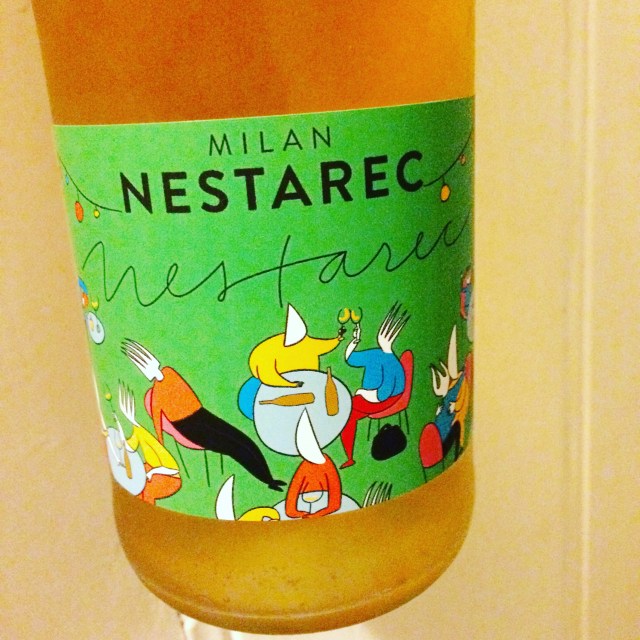
Furanxo is a small shop, and good as it is, some people who don’t live near Dalston would not be persuaded to venture into the wild east without a few more enticements, perhaps. But just a few minutes’ walk away, right opposite Dalston Junction Station, is Newcomer Wines. I’ve written about Newcomer recently right here. Newcomer originally set up in Shoreditch Boxpark, selling Austrian wines out of one of the shipping container units there. They moved over to more permanent, and larger, premises in Dalston last year. They have expanded their offering beyond Austria now, whilst keeping their original focus at the core of the range. But you can find a lot of hidden gems, like the Czech wines of Milan Nestarec, or the newly added wines of Swiss maestros, Mythopia, alongside some of Austria’s newest producers and most exciting wines.

Newcomer Wines

Newcomer becomes a bar in the evening as well, with a selection of Austrian inspired small dishes. Now the summer is arriving in style, they have opened up the outdoor area at the back. They have one of the most exciting ranges of wine in London now, and they are more than worth checking out if you like what is happening in Austria’s winelands.

Round the corner from Newcomer, on Kingsland High Street (on the outside of Dalston Cross Shopping Centre) is one of London’s absolute best vegan restaurants. If you want something more substantial, head here, but do book in the evenings, and turn up early for lunch if you want to dine on spec without a reservation. Like all the best vegan restaurants, Fed by Water serves great food, whatever your tastes and tolerances. It calls itself “Italian Vegan”, and that’s its focus. There are plenty of pasta dishes, pizzas and great desserts, but they serve a mean calzone, for which a good appetite is recommended.

Fed By Water, with calzone, bottom right

Your journey back to the City, the West End, or further afield, should not happen until you’ve taken a stroll down Ridley Road Market. It hasn’t really changed since I used to wander down in the early 1980s. You still get the loud and friendly banter from the stall holders as they try to lure you into making a purchase.

The shops along the roadside are not for the faint-hearted (nor perhaps for true vegans). They sell meat of every description, from pig’s trotters to unidentified offal. But the stalls are largely a blend of fruit and veg, bolts of bright Caribbean-inspired fabrics, clothing (one stall sold just bras, all loose on the table) and groceries. Look for the fruit and veg stalls with their produce in clear plastic bowls. Each one is £1, and may contain anything from five long red peppers, to enough ginger to last three or four weeks. My guess is that they are around 75% cheaper than the supermarket. You could probably get a week’s supply of veg for a fiver, same for fruit.

Ridley Road Market

On a very sunny Thursday lunchtime the whole scene is at once both relaxing, and redolent of vibrant London at its best.

Furanxo is at 85 Dalston Lane, London E8 (turn right, round the corner from the far end of Ridley Rd Market). See Santos & Santos.

Newcomer Wines  is at 5 Dalston Lane (opposite Dalston Junction Overground)

Fed By Water is at 64 Kingsland High Street (on the outside of Dalston Cross Shopping Centre)

Ridley Road Market is on Ridley Road and is open Monday to Saturday

This part of Dalston can be accessed via the London Overground, to either Dalston Junction or Dalston Kingsland Stations. Several buses come up here via The City, from where it will take about 20 to 30 minutes.

Not wine related, but on the way back we jumped off the bus at The Barbican to see the exhibition The Japanese House: Architecture and Life After 1945 at The Barbican Art Gallery. Highly recommended, runs to 25 June. Check it out here.


Posted in Austrian Wine, Dining, Natural Wine, Spanish Wine, Wine, Wine Agencies, Wine Shops, Wine Travel | Tagged , , , , , , , , , , , , , | 2 Comments

Senorans at The Shipyard

I was back at Lymington’s wonderful Shipyard Restaurant last week for a dinner with Javier Izurieta, Export Director of Pazo Senorans. The Shipyard is getting a reputation for wine, and in fact they have a tasty looking event on 4 May with Olivia Barry (Jim Barry, Clare Valley), which will doubtless include a taste of their much anticipated Aussie Assyrtiko, the first one from down under.

The Shipyard is a few minutes away from Lymingtom Quay, within the famous Berthon Boatyard. Close to Lymington Harbour, on the Lymington River, they are attached to The Fish Market, purveyors of fresh fish of real quality, which also supplies the restaurant. The Shipyard put together a Galician menu featuring octopus with padron peppers and chorizo, roasted cod fillet with olives and patatas bravas, and a wonderfully executed Tarta de Santiago, with a home fashioned stencil for the traditional icing sugar topping. A wonderful meal is guaranteed here, and the people are unimaginably friendly (and more than happily compliant with any special dietary requirements).

                      The Shipyard, Lymington

Pazo Senorans is acknowledged as one of the very top producers in Galicia, some would say the top producer. They have a very simple mission – to produce the finest Albariño in the world. They do this in one of the most beautiful, rugged, parts of Spain. The landscape is granite, very Celtic, and topsoils are poor and thin. Formed largely of this decomposed granite, they are also very acidic. The antithesis of our idea of the Spanish climate, it is a green land, washed by Atlantic winds and waves of rain which swirl down the Bay of Biscay. It was one of Europe’s poorest regions up until the end of the 20th Century.

Winemaking is not complicated at Pazo Senorans. They eschew oak as they believe it masks the Albariño grape variety, but they are great believers in using the lees, which Javier passionately told us bring “life” to the wine. The Bodega is in the historic town of Pontevedra, at the head of the Ría of the same name. The town is the provincial capital, allegedly founded by the Greeks, and has a wealth of arcaded houses with glazed balconies, along with a host of architecturally interesting religious buildings, and a Templar castle (I passed through very briefly a long time ago).

IMG_3016

Javier Izurieta of Pazo Senorans

We tasted the entry level Albariño 2015, the Pazo Senorans Colección 2013 and 2009, and their complex Selección de Añadas from 2008 and 2007 in bottle. We finished dinner with the Añada from 2006 in magnum. These bottles range in price from around £17 for the current vintage to around £23 and £40 respectively for the two more expensive cuvées (only available from the domaine, or perhaps speak to their UK agent, Alliance Wine). The Tasting was organised through Solent Cellar, Lymington’s classy wine shop, who (if you are swift) may be able to source some of the wines for you.

Pazo Senorans Albariño 2015 is the current vintage of Senorans’ standard release. It’s no mere “standard” wine though, fresh and delicious with genuine character. It’s amazing value, and drinking now, but it really will age and improve, perhaps over three more years.

IMG_3008

Pazo Senorans is all about proving the ageability of the Albariño grape variety. The Colleccíon 2013 clearly has greater depth. It has an extra herby character and superior length as well. If it is available, it’s only a relatively small step up in price over the straight 2015. The 2009 Colleccíon has a beautiful nose, with a limey “sweetness”. The (bone dry) palate is still fresh, and there’s more clean acidity than you might expect. It’s a lovely wine.

Añada is a big step up. The 2008 is surprisingly pale still. The nose is quite appley (one taster insisted Cox’s Orange Pippin). It has spent three years on lees before going back into small stainless steel tanks for a while before bottling, thereafter spending at least a year in bottle before release. There is genuine depth here and it’s hard to imagine any finer aged Albariño.

2007 seems to have a bit more dry extract than 2008, but it still shows that lovely rounded citrus freshness which is the hallmark of the Senorans wines, and a touch, almost, of the Riesling about it. It also has a mineral feel on the palate. The vintage variation is a positive for me. Naturally some people expressed a preference, but such variation just emphasises that these are wines of personality and character, not some industrial product with only a commercial imperative.

We finished on the 2006 Añada from magnum, an impressive wine for several reasons, not least in showing Albariño’s ability to age. More of that classic freshness and pale colour, green-gold, with great legs (glycerol), plus lees-induced texture. Proof, if proof were needed, not only of this producer’s position at the pinnacle of Albariño production, but also of this grape’s place as the queen of Spanish white varieties.

IMG_3010

A few pictures of our dinner, below, will hopefully whet the Friday evening appetite.

The Shipyard Bar and Kitchen is at Anchor House, Bath Road, Lymington, Hampshire: see web site here . Their website is very colourful and is well worth scrolling through.

Contact The Solent Cellar for availability of wines on 01590 674852.

Alliance Wines is the UK Agent/importer for Pazo Senorans.


Posted in Spanish Wine, Wine, Wine and Food, Wine Tastings | Tagged , , , , , , , , , | 4 Comments

Crémant – More than Mere Froth

Following The Vaults Tasting last Monday, I was back in London for an interesting little tasting the following day. Organized once more by Business France, Crémant presented twelve producers of this category of sparkling wine from five out of the eight French wine regions designated for Crémant production. Sadly there were no individual producers of Crémant de Savoie, nor Jura, both of which are making some particularly interesting wines at the moment and, ironically, both of which I’m particularly fond. Nor was there any for Crémant de Die. But this did allow me to focus on the other production zones. I didn’t taste the wines of Les Grands Chais de France. They are the UK’s largest supplier of Crémant (they also own brands like Calvet and JP Chenet), and have a presence in every French sparkling wine production zone.

The tasting was at the Edel Assanti Gallery in Newman Street, Fitzrovia, and its white walls provided a good visual environment for the wines. It was a little hot, but the wines were well chilled and the organisers ensured there was plentiful, constant supply of ice.

IMG_2963

So What is Crémant? – A Brief Introduction

Crémant is the designation for the finest sparkling wines of France outside of Champagne. Well, that’s the theory. All grapes for Crémant must be hand harvested, and rules for gentle, whole bunch, pressing apply (as do rules on maximum yields, grape varieties pertinent to each region, etc). The production method is effectively the same as Champagne, using the Méthode Traditionelle, which means that the wine undergoes the second fermentation in bottle.

There are currently eight designated production regions, or AOPs, for Crémant. Apart from the aforementioned Savoie and Jura, these are Alsace, Bordeaux, Bourgogne, Die, Limoux and Loire. The last on that list, Crémant de Loire, was the first to be designated, in 1975.

There are a couple of basic differences with Champagne. One is bottle pressure. Although the term “Crémant” was once used for Champagnes of a lower pressure (now often called Perle by some growers), modern Crémant can in fact still sometimes have a lower pressure than most Champagne. Champagne usually has a pressure of between five and six atmospheres (famously the sort of pressure you’d find in a tyre on a London Bus). But the Crémant category does allow for a lower pressure (I know, for example, that the rules for Jura stipulate a wine above 3.5 atmospheres). But generally, the consumer will be unable to tell the difference.

A more important difference relates to ageing on the lees of the second fermentation, in bottle. Lees ageing is the key to quality in sparkling wine, and long lees ageing gives Champagne its characteristic autolytic complexity. Non-Vintage Champagne must spend a minimum of 15 months on lees, but the best has much longer, and Vintage Champagne even longer still. You might have read about Weingut Peter Lauer’s Reserve Sekt in my last article, wine which spent 24 years in bottle – an exception, and probably not intentional (Florian’s father forgot about it!), but the wine is truly astounding in its complexity (and fresh too).

When you read the notes on the wines here, you will notice that most of these Crémants see just 12 months, maybe 18 months in some cases, in bottle before disgorgement. As the effects of autolysis really kick in from 18 months onwards, it becomes clear that these are not often wines of massive complexity. Instead, they are wines to celebrate for their fruit and freshness. As one producer said, that’s a nice way to enjoy sparkling wine.

Does the Future Look Bright, and What do we Do with Crémant?

In the past people have tried to compare Crémant with Champagne, and invariably it has come off worse. That’s not always right. Many readers will have been given Champagne of dubious quality, especially if purchased from one of the supermarket Christmas offers, where they knock out something with an unknown name for a tenner. At the same time you might have tried a bottle of Stéphane Tissot’s Crémant du Jura BBF, or his Indigène, where complexity and interest rivals a top grower Champagne. So, within the category there’s a lot of variety.

Where Crémant scores highest is surely value for money. In the UK we drink oceans of cheap Prosecco. Crémant tends to cost more than the kind of Prosecco we cart home from our supermarkets, but it’s still a lot cheaper than fine Champagne. Instead of seeing Crémant as a rival to Champagne for the big celebration, why can we not acknowledge it as the perfect wine for summer, especially for picnics and outdoor dining. Even for the barbecue. I mean, why do we insist on drinking 14.5% Shiraz or Malbec when its 25 degrees and the coals are nudging it up to thirty?

If I learnt anything from this tasting, it’s that there’s a lot of pleasure to be had from what are largely, except for the special cuvées, fairly simple wines which are nevertheless long on fun and pleasure. Look at how much pét-nat is glugged by young people, at least in London and Metropolitan Britain. Crémant, when well executed, should fit into that demographic. Okay, some Crémant might taste good, but it is made in industrial quantities, you say. True, some is, but this is generally a quality category, sparkling wine made from decent quality handpicked grapes, vinified traditionally. And the volumes do help to keep the price down.

The problem for Crémant on this particular export market lies perhaps with other rivals from the New World, especially Australia, New Zealand, South Africa and Chile. These wines are well established in the UK, and are often keenly priced in supermarkets and wine chains. Not all are bottle fermented, and it is unclear whether consumers really know, or care.

THE PRODUCERS

Domaine Zinck, Crémant d’Alsace, Equisheim

Alsace is the largest production zone for Crémant (more than 20% of Alsace wine is sparkling, though vast quantities are made by the tank method). It’s a little known fact that the region is planted with quite a bit of Chardonnay, used only in sparkling wine, yet most Crémant d’Alsace is blended from among the four Pinots (Blanc, Auxerrois, Gris and Noir), plus a little Riesling.

Domaine Zinck was established by Paul Zinck in 1964 and today comprises 20 hectares producing both still and sparkling wines. There are two Crémants, a white Brut and a Rosé, and both were available to taste in bottle and magnum.

Crémant Brut is a blend of 60% Pinot Noir, with 30% Chardonnay and 10% Pinot Blanc. The current bottling is from a 2014 base with 20% reserve wines, mainly 2013 with 5% from 2012. You can see, if you are au fait with Champagne releases, that the wine is younger than many current releases from that region. But there’s still a bit of a biscuity note here in the Brut, along with crispness and freshness.

The pale salmon-coloured Rosé is also sold as a non-vintage. It’s 100% Pinot Noir, largely from 2014 again, with 20% reserves from 2013. It’s crisp and fruity, with quite high acidity, which the fruit copes with.


The Magnum Effect

One story of the Tasting involves the “magnum effect”. Generally it is true that wines age better in magnum. This doesn’t just apply to premium cuvées of Vintage Champagne, and certainly not exclusively to bottle fermented sparkling wine. The theory is that with twice the wine and no more air ingressing into a magnum than a standard bottle, the wine ages more slowly and achieves greater complexity. This is unquestionably true of long lees aged Champagne, but is it true of Crémant?

Every producer brought at least one wine in magnum, and there was a thread through the tasting. I didn’t find one wine which didn’t taste better in magnum, including those Zinck wines above. One reason might be that the magnums currently on the market had actually been aged for longer than their 75cl counterparts. Or maybe they just looked more impressive! With a magnum of Crémant often costing the same as a bottle of Champagne, there are certainly occasions where, let’s face it, “impressive” is no bad thing.

IMG_2973

The Magnum Tasting Lineup

Domaine Schwach, Crémant d’Alsace, Hunawihr

Schwach has 19 hectares in the region, which François Schwach began purchasing in the 1950s and 60s. The company is run today by the third generation of the family, Sébastien. Schwach makes a wider range of Crémant cuvées than Zinck, and six cuvées were on show.

Four white bottlings cover Blanc de Blancs (Pinots Blanc, Auxerrois and Gris); Blanc de Noirs (Pinot Noir); Chardonnay and Riesling. The Chardonnay is dosed with a low 4g/l dosage, but is still quite creamy compared to the other bottles. The Riesling is very mineral and almost chalky. There’s also a fruity Rosé.

Crémant d’Alsace “S” is the special cuvée. It’s a blend of equal parts Pinot Noir and Chardonnay with one year on lees, bottled at 8g/l liqueur. It’s a vintage wine, and this bottle was a 2011. It’s the last vintage Sébastien’s father made, and he named it “S” after his son, who was about to take over. It has a degree of extra complexity on the nose, and more personality.

IMG_2969


Domaine Joseph Gruss & Fils, Crémant d’Alsace, Eguisheim

This is a slightly smaller estate, at just over 16 hectares, split into more than 50 plots on differing soils around Eguisheim, one of my favourite Alsace villages. I liked the wines here, doubtless swayed by the amiable winemaker, André Gruss, who was on pouring duty. André said he is aiming for balance, purity and elegance, so let’s see how he did.

Crémant d’Alsace Brut is a Pinot Noir with extended lees contact (15 to 20 months depending on vintage) and the wines go through malolactic (which many crémants avoid, to retain freshness). This is more fruity than some, easy going but well made.

Extra Brut Classic is different. 80% Pinot Blanc with 20% Riesling, a little less time on lees (12 to 15 months) and no malo. Dosage is 3g/l. Despite being served a little cold, there’s a biscuity arrowroot nose, plus good fruit. The palate has a fruity acidity, with some citrus from the Riesling, and a fine spine running through it.

Brut Prestige blends 60% Pinot Blanc with equal proportions of Chardonnay and Pinot Noir, with no malo again, and 5g/l dosage. Longer lees ageing (up to 30 months for each year, but at least 24), but very fresh. All of these wines will drink well now, which is how André likes them, young and fresh.

Cuvée Prestige is the same wine as above, but with a minimum of 30 months in bottle on lees, and bottled in magnum. This one had undergone malolactic, and was disgorged in November 2016. It was the most impressive wine so far, and one of my favourites on the day.


Célène, Crémant de Bordeaux, Haux (Entre-Deaux-Mers)

Célène has been making sparkling wine in Bordeaux since 1947, a fact which might surprise those who have little idea Bordeaux even had a sparkling wine industry. And Célène make a lot of wine – 1.3 million bottles a year. There are two ranges, going under the “Ballarin” and “Célène” labels.

Several of the wines contain Semillon, which, counter-intuitively perhaps, makes for quite an interesting flavour profile. Ballarin Noble Cuvée blends Semillon with Muscadelle and Cabernet Franc (vinified white). The oddly named Black Pearl White Brut blends the same varieties, but with a bit more precision and freshness.

A couple of other wines proved equally interesting. Célène Saphir Rosé is 85% Cabernet Franc plus Merlot. The finish had quite a nice bitter touch. I preferred it to Perlance Brut Méthode Traditionelle, blending Colombard and Sauvignon Blanc. Just nine months on lees and dosed at 10g/l, this would make a decent aperitif if well priced.

The most interesting wine was Célène Opale Blanc de Blancs Crémant de Bordeaux, a blend of 60% Semillon, 30% Muscadelle and 10% Sauvignon Blanc. This gets 12 months ageing on lees in the company’s cold underground galleries. Quite delicate and floral on the nose, there are exotic fruits on the palate, and plenty of lingering flavour. It makes a nice point of difference to the many Crémants made from the traditional Champagne varieties.

IMG_2974


Moutard-Diligent, Crémant de Bourgogne

Moutard will not be unknown to Champagne drinkers. They are one of the producers from the Côte des Bar (Aube), which by coincidence is just across the regional border north of Chablis/Irancy. They have been making still wines from those appellations for some years, but only started producing Crémant de Bourgogne, from vineyards around Tonnerre, since 2015, so this is a new venture. The wines are only just on the market this year.

There were six wines on show, all well made and showing the expertise of a well regarded Champagne House. There’s a Brut, Brut Nature with zero dosage, a cuvée vinified in oak, a Brut Rosé from Pinot Noir, and a 3 Cépages cuvée (Chardonnay, Pinot Noir and Aligoté).

Of the six, the most interesting, though certainly the most expensive one would assume, is the cuvée Les Vignoles. This is from a selected parcel, or lieu-dit, a plot at Molosmes, just east of Epineuil. 100% Chardonnay, there’s more complexity. The fruit is citrus, with some tropical flavours, but overall there’s a nice line of fresh acidity. With a touch more presence than the other wines, this will certainly accompany food – paté to seafood and (as Moutard suggest) sushi. It will be interesting to see how they price this one.


Veuve Ambal, Crémant de Bourgogne

This company is the largest producer of Crémant de Bourgogne (they make 40% of the AOP), based in the Côte Chalonnaise, at Rully. They have been operating for more than a century, and are also responsible for the still Burgundies of André Delorme.

There were several sparkling wines on show, but they were showcasing a new “product”, Veuve Ambal Expression. It’s a Crémant de Bourgogne with a “random bottle design”, so that the pattern on every bottle is different. Now one could be cynical about all that, but to be fair the wine tastes fine, no, more than fine. The blend is 90% Pinot Noir with the addition of Gamay. Dosed at a friendly 11 g/l, it has plenty of fruit on the nose and it’s not all that dry (to a Champagne drinker). You’d call it a crowd pleaser, and if that, along with the bottle design, encourages novices to try a Crémant de Bourgogne, that is a good thing.

Maude Metin, who was on the stand, told me she thought it would retail around £15. If she’s right, they may have the potential for success. Too much more and I think you are getting into territory where people want something a bit more serious, where the colourful bottle could be a hindrance.


Victorine de Chastenay, Crémant de Bourgogne, Beaune

This Crémant House is part of the La Chablisienne Group, but has made around 6,000 h/l of sparkling wines since 1995. The three basic cuvées are all well made (BrutRosé and Blanc de Blancs). These are wines which will provide satisfaction for someone wanting well made fizz without the expectation of complexity.

The two Vintage bottlings are a step up. Blending Chardonnay and Pinot Noir. 2011 was served in magnum, and had some complexity. It’s surrounded by the typically florid marketing you expect from these larger producers, who no doubt have the budget to pay marketing companies. The language doesn’t always translate well for the British market. But it’s the wines which matter in the end, and this magnum, with an extra year of age (over the 2012), was very good. Another example of the magnum effect.

The 2012, less complex than the 2011, was nevertheless fresh and attractive. As a range, these wines were all attractive for what they are. The Vintage 2011 in magnum vied with the Moutard Vignolles as my favourite of the Crémants de Bourgogne.


La Compagnie de Burgondie, Crémant de Bourgogne

This grouping comprises the Caves Bailly-Lapierre (for Crémant), Vignerons de Buxy (Côte Chalonnaise still wines) and AVB (Beaujolais). Rully claims to be the birthplace of the Crémant de Bourgogne AOC.

Bailly-Lapierre showed four non-vintage Crémants. The best of these is labelled Chardonnay. This bottling gets an extended three years ageing, and can quite rightly boast of its finesse.

The white Vintage, made only in the best years, is made from the best Pinot Noir and Chardonnay at their disposal. I preferred the 2010 Rosé to the 2009 Blanc. It’s a nice salmon pink colour with good fruit. It sees three years on lees. Both are called “Vive-la-Joie. Pinot Noir Brut 2013 is much paler, with just a wink of colour from the press of the grapes. Served from magnum, the mousse and bead was subdued, but it had a nice vinosity.


Domaines Auriol, Crémant de Limoux

Domaines Auriol is owned by the Vialade-Salvagnac family, but they make wine all over the South of France, at a number of estates. Their Limoux wines come under the Maison Vialade label, but are made at an estate called Terres Blanches, which the family acquired in the 1980s.

Crémant de Limoux is not one of the better known Crémants, but has an increasingly good reputation based on one or two up-and-coming estates. The terrain can be hilly and the best fruit is grown at elevation, benefiting from cooler night time temperatures. This version, 70% Chardonnay with 20% Chenin Blanc and 10% Mauzac, is very fruity but with an elegance which I’d put down to Limoux Chardonnay (which in the region’s best still white wines can be exceptional). The wine gets 15 months on lees and it has genuine character.

Auriol were the only people to sneak in some still wines. I couldn’t resist trying two unusual IGP Aude wines, a white Albariño and a red Marselan under the “Jardin des Vignes Rares de Ciceron” label. The Albariño had a lovely nose and was a good example of an easy drinking version of the Galician grape. The Marselan (a Grenache-Cabernet Franc cross) was purple in colour with sappy fruit. Both good gluggers.


Ackerman, Crémant de Loire, Saumur

Ackerman began life in 1811, so they have a history comparable to many of the Champagne Houses. They also own 366 hectares of vineyard. So their importance to the Loire economy cannot be underestimated. They specialise in both Crémant de Loire and sparkling Saumur, which has its own AOP,  with a different (mainly Chenin Blanc) grape mix, and its own regulations on yields etc.

Of the several Crémant de Loire cuvées on show, Cuvée 1811 Brut Rosé was one of my two favourites. The grape blend is unusual for a pink sparkler, being Cabernet Franc with Grolleau. Fifteen months on lees gives a wine with elegant red fruits on the nose, and ripe fruits on the palate.

Crémant de Loire Cuvée Louis-Ferdinand Brut 2013 is a special prestige cuvée. Just 3,000 bottles were produced of the 2013, and the liqueur for dosage is the sweet Coteaux de Layon. Three years on lees gives a buttery, toasty wine of some elegance. Very interesting.

As was the magnum offering from Ackerman, X Noir Brut Rosé, made with the Pineau d’Aunis variety. Very aromatic with red fruits, definitely a wine to pair with food (fish or fowl).

Ackerman may be large but they are not scared to experiment. Saumur L’Esprit Nature Brut is made from Chenin Blanc, 12 months sur lattes, it’s pale gold in colour, fresh, fruity…and has no added sulphur. A creditable experiment which I hope succeeds.


Caves de Grenelle, Crémant de Loire, Saumur

Slightly younger than Ackerman, but nevertheless founded in 1859, it does remind us that sparkling winemaking in the tufa caves of Saumur goes back a long way. Another seven cuvées were on show, and this House is making nice wines, most with a lifted, floral character, from the fairly easy going Cuvée Si made by a variation on the Méthode Ancestrale (with just three weeks on lees), to the more complex Cuvée 3/7.7.4.

That strangely named cuvée is made from three grapes: 7 parts Pinot Noir, 7 parts Cabernet Franc and 4 parts Pineau d’Aunis (which explains the name). It’s a Blanc de Noirs. They call it “chiselled”, with reason. There’s red and stone fruits, with a nice berry nose. Pretty, elegant, and savoury on the finish, it probably needs six months to settle but I think it will be impressive. I liked it, anyway.


If I want to make a couple of conclusion, I think they would be first, as I said at the beginning, these wines need to be assessed on their own merits, not as some kind of second class Champagnes. But equally, whilst those made using some of the traditional grape varieties of the Champagne region can be very nice, don’t be put off trying some of the interesting wines made using other varieties. Each company at this Tasting produced at least one wine, and in most cases more than one wine, which I think even a reasonably fussy wine aficionado would enjoy.

Many of the producers above are still looking for a UK importer. For further information, contact Business France.


Posted in Burgundy, Loire, Sparkling Wine, Wine, Wine Tastings | Tagged , , , , , , , , , , , , , , , , , , , , , , | 4 Comments

Return to the Vaults Part 4 – Howard Ripley

In this final part of my article on March 2017’s Vaults Tasting I want to concentrate on the wines of Peter (Florian) Lauer, imported by Howard Ripley, but of course there were some other wines I had to try among the many crowding their table, one or two of which will merit a mention.

Weingut Peter Lauer is now under the management (since 2005) of Florian Lauer, and he was on hand to pour. I’ve been a very big fan of his wines for a few years, and I was thrilled to meet him. His estate, at Ayl in the Saar, is producing a range of some of the finest wines currently coming out of the Mosel-Saar-Ruwer.

This might seem a step change from the “natural wines” I’ve been largely writing about in Parts 1 to 3, but I try to attend all of Howard Ripley’s German Tastings. For me, sulphur or no sulphur, German Rieslings are among the purest tasting wines on the planet.

In his 2012 book The Finest Wines of Germany, Stephan Reinhardt calls the wines from this estate “some of the finest, most classic Rieslings in Germany: pure, precise, piquant, racy, mineral and chiselled, but also ripe”. After that, you won’t require any tasting notes from me. It does encapsulate what Florian’s wines are all about.

One of Florian’s secrets is the estate’s sparkling wines. By law they are Sekt, by style they are Riesling Crémants. The very well priced NV has three years on lees (for a French Crémant you’d expect 12 months, maybe 18). It’s very good, of course, and I recommend it wholeheartedly, but for double the price (somewhere over £40) you can buy a Vintage 1991 or 1992. Whilst the 1991 (disgorged 2015, not on taste last Monday) is a softer wine, 1992 is bottled with no dosage. This wine is little short of amazing. It has had 24 years (years, not months) on lees in bottle, and has aromas of nuts, spice and salt. It’s dry, the acidity is a pure rapier thrust (gets to the heart without tearing), and it sits there, complexity building as it warms.

Apparently these vintages, made by Florian’s father, were discovered in the Lauer cellars, and Florian has released them, all 3,000 bottles, into the world. In my next article, by coincidence, I’ll be writing about French Crémant, and suggesting that it is probably unfair and unnecessary to compare the genre to Champagne. But this wine is for lovers of the finest Champagne, just so long as zero dosage Champagnes don’t upset you. If you can get just one bottle!

At the lower end of the Peter Lauer portfolio there is a Saar Riesling Fass 16, here shown in the 2015 vintage. Michael Schmidt, writing on Jancis Robinson’s Purple Pages, wrote in May last year that 2015 might be the real deal, the “vintage of the century”, and in such years the so-called lesser wines from the best estates invariably provide a lot more pleasure than their relatively modest prices might suggest. This might be a “basic dry Riesling” but here you are still getting a wine from the steep slopes of Ayl. It comes in at around the £15 mark all in, but the smart drinker will opt for magnums at little more than double that.

Kupp Fass 18 Riesling GG 2013 is the dry “Grand Cru”. It comes from part of the famous (or is it infamous) Ayler-Kupp vineyard, near Biebelhausen. This has rich fruit but is mineral driven. It shows the finer side of the Grosses Gewächs, that balance between ripe fruit and Riesling’s taut steel line. Great length already, but it will improve over a decade.

Schonfels Fass 11 Riesling GG 2012 is also from site which is part of Ayler-Kupp, sadly subsumed by the 1971 Wine Law. It’s a smaller site than the Kupp, the fruit is a little richer and there’s a touch of spice. But there’s a lightness too, and it often drinks earlier. Yet the vines here are 100 years old and yields are low. Neither are wines for the uninitiated, nor perhaps those who prefer Germany’s Prädikatswein, but their complexity repays those who come to love them.

But do not worry if the Prädikats route is your preference. Florian is a fan of these wines too, especially at Kabinett level. Ayler Kupp Fass 8 Riesling Kabinett 2013 has everything you want from a Kab. Elegance, freshness, minerality (or whatever you prefer to call it), plus a touch of sweetness. That sweetness comes on the mid-palate. The finish is dry. It’s so good, truly. At 7.5% abv you have to restrain yourself. I know, I bought some in Germany and it won’t last this summer, fact.

IMG_2946


Now for the other wines I want to mention. Perhaps you’ve read my articles on previous Howard Ripley German Tastings (usually held twice a year in the Hall of one of Legal London’s Inns of Court), so you know that I’m more partial than many for German reds. One producer I’m consistently buying, albeit just odd bottles, is Ziereisen.

Weingut Ziereisen can be found down in the south of the Baden wine region, almost at the gates of Basel, at Efringen-Kirchen. Their vineyards are protected by the the Vosges Mountains of Alsace and the Black Forest. The micro-climate is therefore warm, but is ventilated by the Belfort Gap, to the west at the bottom of the Vosges, which means that growing black grapes is not as risky as you might think.

Whilst Ziereisen is well know for its reds, the first wine I tasted, true to form, was their Gutedel “Heugumber” 2015. Gutedel is none other than France and Switzerland’s Chasselas variety, of which I’ve written a fair bit in the past month or so. This may not light the fire of the average Mosel aficionado, but it’s a nice dry white, perfect as an aperitif, maybe with a bowl of salted nuts, or with cheese dishes. It has a bit more presence and a little less acidity than many examples from the French speaking regions, and in fact their top Gutedel bottling, Steingrüble, spends almost a year on lees.


Ziereisen grow a fair bit of Pinot Noir, but if you wish to go right off-piste with them, you have to try one of their Syrahs. Jaspis is the impressive top bottling, and it is the one I know best. But if you prefer to go in a rung below, around Burgundy Premier Cru in terms of price, then Syrah “Gestad” 2012 won’t disappoint.

The vines are younger here (Jaspis is old vines, but both are grown on a barren, steep, limestone vineyard with high density planting). Ageing is in oak (25% new). There’s still scope for more ageing in bottle, but this is very good. I know not many will go right out and buy a German Syrah (the Germans lap these up, anyway, so some might think the price is quite steep for the quality), but do try to taste them if you can. The Jaspis Pinot Noir Old Vines cuvée is pretty damn good too.


Before tasting the reds, I tried several other Rieslings from estates which you would almost buy blind – Schäfer Fröhlich (Felsenberg GG), PJ Kuhn (Rheinschiefer) and Zilliken (Saarburger Rausch) in particular, but as the Howard Ripley tag says, “We like Riesling – and when that runs out we drink Burgundy”. There is one particular Burgundian grape which has always been a little unfashionable, perhaps the Gutedel of the region, Aligoté. It really seems to be making a comeback, not doubt because Burgundian Chardonnay is so expensive now, but also because in some cases yields have been lowered and the acidity tamed.

IMG_2949

There has always been very good Aligoté. I don’t just mean Coche-Dury’s marvel (if you age it), or Aubert de Villaine’s Bouzeron. Goisot, at Saint-Bris, have always made a super version, and people as diverse as Alice and Olivier De Moor in Courgis (Chablis, but they have Aligoté at Saint-Bris) and Sylvain Pataille (single vineyard versions from Marsannay/Fixin) are really creating a stir with the grape. It seems to have a new lease of life.

I’m trying every Aligoté I can, and Howard Ripley import Jérôme Castagnier Aligoté 2015. The domaine is in Morey-St-Denis, but has vines in Gevrey and Chambolle too, including  parcels in Charmes-Chambertin and Clos-St-Denis. This relatively modestly priced Aligoté is very nice, without the acidity one came to expect of old (Aligoté really did only seem fit as the base for a Kir at one time). It even has a bit of texture from two months on lees. You’ll pick this up for under £20, if you want to explore the grape further, especially as the Goisots seem to have no wine to sell right now, and it’s a lucky man (or lady) who can source a few bottles of De Moor.

IMG_2950


Before finally signing off from this marathon that was The Vaults VI, I should mention that there are always a few purveyors of other victuals on hand. Androuet were there with a table of very fine cheeses, as befits their status as one of London’s top cheesemongers, Urban Farmhouse were there, showing their sour and farmhouse beers, and so was The Charcuterie Board, who wholesale and retail fine British cured meats (also representing Moons Green and Native Breeds, two of the UK’s foremost charcuteries).

If you are a member of the Trade, or Press, do try to devote some time to The Vaults next time they are showing. It’s one of the best wine gigs in town for the sheer variety of wine we get to taste. But guys, try not to hog the tables and give others a chance to taste.


Posted in German Wine, Wine, Wine Agencies, Wine Merchants, Wine Tastings | Tagged , , , , , , , , , | 1 Comment

Return to the Vaults Part 3 – Winemakers Club and Gergovie Wines

By splitting my article on the March 2017 Vaults Tasting into four parts, I hope I’m making it more manageable. If you really want to skip anything, it makes it easier, but to do so would be a mistake. I don’t mean because of my elegant writing, merely that all of these importers have a raft of exciting wines on their lists, and plenty of these were on show on Monday this week.

THE WINEMAKERS CLUB

I do write about Winemakers Club (John has decided to forego an apostrophe) with some regularity, but even if I cull a few perenial favourites (like Meinklang), there are still too many here to mention.

One producer I’ve not written much about is Királyudvar in Tokaj, Hungary. Their Furmint Sec 2013 is harvested late with low yields. Spicy apple, almost strüdel, on the nose, with really vibrant fruit, nice acids, and dry.

Relatively new to Winemakers is an Alsace producer I’d never heard of until a few months ago. La Grange de L’Oncle Charles can be found at Ostheim, close to Riquewihr and Ribeauvillé. As I’ve mentioned elsewhere before, Jérôme François began making wine here in 2014, and this Sittweg 2015 is just his second vintage. The boy done good. Sittweg is a lieu-dit planted with 40-year-old Riesling and Pinot Gris, blended together here. It’s in the commune of Ammerschwihr, comprising  a north facing granite slope sitting just below the forest, right next to the Kaefferkopf Grand Cru. It’s a textured beauty which is as terroir focused as you can get, in the new tradition of Alsace blends, placing site above grape variety. It has some rocks on the label!

IMG_2920

Serbian wine isn’t something you have an opportunity to drink every day. Oszkár Maurer makes wine in Northern Serbia, at Szeremi. The Collective 2015 is Yellow Muscat, known in Serbia as Sárgamuskotály, or Muscat Lunel to aficionados of Southern France. Here, it is treated to two weeks on its lees. The nose has that sweet, grapey, Muscat florality. It’s rich, with texture. More than just an oddity, it’s here because it deserves to be.

IMG_2921

Back to viticultural normality, Domaine des Hauts Baigneux is in the Touraine-Azay-le-Rideau Appellation, and is run by Nicolas Grosbois and Philippe Mesnier. The wine I tasted is simply listed as Chenin Blanc 2015 but as the back label shows, it does hail from that AOP. It’s very much a traditional old oak Chenin, clean and precise at this age, but there’s a nicely restrained richness under the surface (the vintage, perhaps?). Just 12.5% abv. Yet another lovely Chenin – 2017 seems to be shaping up as a year for discovering them.


I’m rarely drawn to a wine labelled Côtes du Rhône unless for a good reason, there are just so many of them, but Pascal Chalon Petite Ourse 2015 is interesting. It’s made from 40% Syrah and 60% Grenache and coming in at 14% alcohol, it’s very rich. There’s also a “Great Bear”, La Grande Ourse, which has a darker savoury quality and more weight (there is the addition of Mourvèdre and Carignan). Both are reasonably inexpensive for wine of this quality. The domaine and its vines are mainly around Visan (somewhat to the north of Rasteau in the Vaucluse).

There were some other wines I can’t really leave Winemakers Club without mentioning, even though they’re probably well known to most readers. Domaine des Marnes Blanches Vin Jaune 2008 is a wine I’ve written about before, but I don’t own any so I had to have a glug (I didn’t spit, sorry). The ’08 is very young, of course, but I’ve noted before how this is one of those Vin Jaunes where, although a shame to waste its potential, it is (hopefully) not going to put you off Vin Jaune if you drink it now.

I’ve drunk quite a few of Karim Vionnet‘s Beaujolais wines in the past twelve months, and lots of them have been below Cru Village level (I had his 2016 Nouveau a week ago and it was still fresh and alive). They are just so amazingly fruity. When I last tried his Moulin-à-Vent 2013 it was still youthful. Not that surprising, as it is made from 60-year-old vines. Now it has come out of a little slumber and is waking up. Lovely, and with a serious side.

I’m really falling for the wines of Hegyi-Kaló. Ádám and Júliá are lovely people and it’s hard not to. They make wine in Hungary’s Eger Region. I wrote about their wines at the Great Exhibition Tasting back in January here . I was only able to try their Kekfrankos 2015 on Monday. Kekfrankos is, of course, better known as Austria’s Blaufränkisch. At that last tasting it was my favourite red, and it was on good form on Monday, beautiful, pale, with a haunting nose and concentrated sappy flavours, with that characteristic intense, slightly peppery, fruit.

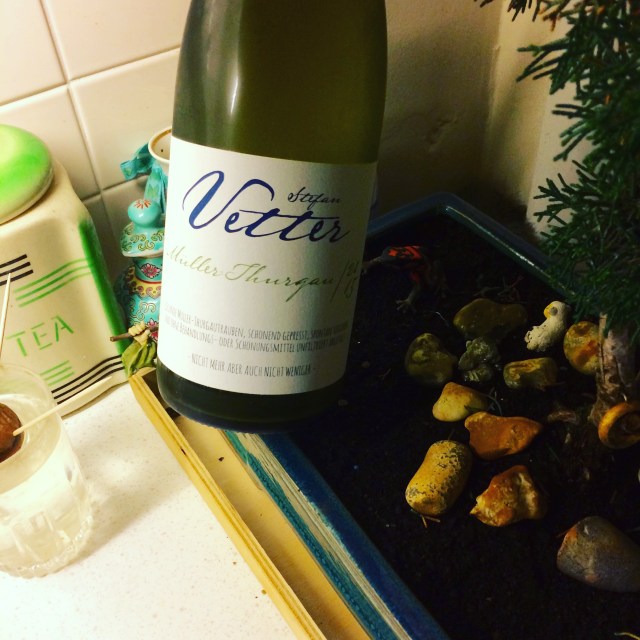
Finally, Stefan Vetter.  Stefan is Winemakers’ new Franken producer, based at Iphofen, southeast of Würzburg. I drank a bottle of his Müller-Thurgau 2015 only a week or so ago, and if I’d had time to write one of my “Recent Drinking” articles it would certainly have made the cut. Now, Müller-Thurgau is the infamous grape of much changed Liebfraumilch and other bottles of 1970s/80s sugar water which nearly did for German fine wine. I’m not suggesting M-T is a noble grape, though there are some very good (and famous, even) versions in NE Italy and Switzerland. Vetter’s is another which will make people reassess the variety, if they are prepared to fork £30 for a bottle. His Silvaner is even better…and even more expensive.

IMG_2869


GERGOVIE WINES

Gergovie are based not far from London Bridge Station, on the same site as their bar, the eponymously named 40 Maltby Street. This is another sulphur free zone, with a portfolio boasting names like Bobinet (Loire), Barmès-Buecher (Alsace), and the ever hard to find Barranco Oscuro (Alpujarras).

Another Alsace producer was the first I tasted at the Gergovie table. Nothalten is a village in the norhtern sector of the region, known as Bas-Rhin. Once unfashionable, in the last decades of the 20th Century, the area around Mittelbergheim and Andlau became a hotbed of excitement, especially for young growers. Some of that excitement has moved even further north for the true aficionado, but Patrick Meyer of Domaine Julien Meyer came to cutting edge production late. He is now one of the names to look out for if travelling around there.

Patrick took over from his mother (Julien was Patrick’s father, but died when he was young), having been taught the “new ways” at wine school. He blitzed the vines and, somewhat famously in natural wine circles, realised what he had done. The old ways of his mother had created a healthy domaine, the biodiversity of which he managed to ruin. Thankfully he could see that, and now he works biodynamically, and all his experiments (including the ubiquitous concrete eggs and his love for Sylvaner) come from a desire to implement everything possible to rectify what his costly errors have taught him was misguided.

Crémant d’Alsace 2013 is a blend of Pinots Blanc and Auxerrois, which has more depth than most examples you’ll find. Fresh arrowroot notes on the nose combine with appley freshness on the palate, with a mouth-coating texture, perhaps from the lees.

Nature 2015 blends Sylvaner and Pinot Blanc. Appley freshness is again to the fore. There’s good acidity but it doesn’t dominate. If he’s aiming for purity he hits it on the head. Two delicious wines.


Le Petit Domaine de Gimios is a Minervois domaine, more specifically from the hamlet of Gimios, near Saint-Jean-de-Minervois, run by Marie and Pierre Lavaysse. Marie farms biodynamically and yields are insanely low, down to 8 hl/h. Muscat Sec 2015 is made from basket pressed fruit without skin contact. Dry…ish, it has that richness which suggests a tiny bit of sweetness.

Rouge de Causse 2013 is made from 100% ungrafted vines (actually planted in 1880). It’s a real field blend of untrained bush vines on a rocky site: Carignan, Aramon, Cinsault, Grenache, Terret, Oeillade and Alicante Bouchet to name some of them. They aren’t even planted in blocks, just random vines, so they all get vinified together, though in 2013 about a third of the cuvée was made from the Carignan. You almost get a sweetness on the nose here. It’s pure fruit. The wine itself is quite structured, some might say “old fashioned”, in once sense, but the fruit adds a roundness which softens that side of it. In the end, both facets combine into a lovely complexity.


Gilles and Catherine Vergé make Macon, near Viré. That’s one simple statement which may paint a certain picture. Then try this one by Aaron Ayscough, from his Blog Not Drinking Poison in Paris, about one of their several Vin de France cuvées: “…like white Burgundy that’s been raised by wolves in the forests of Arbois”. So we’ve established these wines are different.

L’Ecart [2008] is also a Vin de France. It’s made from ninety year old Chardonnay vines grown on Jurassic limestone. This is a 2008 (from before you could put a vintage on a Vin de France). It was bottled in 2013. The wines here are all totally “natural” with no chemical additions and as few interventions as possible. Not cheap, but what a wine! Amazingly complex, juxtaposing fruit with a sour and savoury quality, very different from most White Burgundy you’ll come across.

IMG_2910


Klinec Ortodox 2006, Brda, Slovenia is mainly Verduzzo (60%) with Rebula, Malvasia and Friulano. It’s orange. Aleks Klinec only makes orange wines now. Each variety is macerated separately and elevage is in a mix of mulberry and accacia wood. It’s from a site called Medana, which before the Communist era was mapped to be a Premier Cru (the listing appears in faded text from an old document on the label below).

There is fruit (apricots and plum), but you also get caramel, orange peel, and even salted nuts, along with a bit of tannic texture (each variety gets individually up to two weeks skin contact). It’s all wrapped in 14.5% abv. Seriously impressive, as the best Slovenian wines increasingly are.

IMG_2911


Finally from Gergovie, a couple of wines from small but very much up-and-coming French wine regions. Jérôme Jouret Pas-à-Pas 2015 is a wine from the Southern Ardèche. The grape mix is unusual for the region, perhaps: Carignan, Alicante and Grenache. The Carignan (65% of the blend) undergoes whole bunch fermentation and the result is crunchy but soft fruit, accompanied by a very concentrated fruit compôte nose. Delicious. Jérôme makes half a dozen wines from 12 ha. No chemicals are used at all, yields are kept low and the wines see no wood, just stainless steel. A vigneron to keep an eye on, making beautifully crafted but very drinkable wines.

Cross the Rhône and head northeast and you come to the foothills of The Alps. As that river flows past Seyssel, southwest, out of Lac Léman, it eventually turns northwest, on its way to meeting the Saône at Lyon. The land in the crook of that elbow is Bugey, and like the Ardèche, it is a hotbed of viticultural excitement, albeit on a small scale.

La Vigne du Perron is one of a number of domaines creating interesting wines in a relatively unknown region. Les Etapes 2014 is a pure Pinot Noir from a scree slope near Villebois on the western side of the region. Fermentation is by carbonic maceration in truncated oak vats, and ageing is one year in old oak. There’s a little tannin but very concentrated fruit. A very nice wine with which to finish Part 3.

Posted in Natural Wine, Wine, Wine Agencies, Wine Merchants, Wine Tastings | Tagged , , , , , , , , , , , , , , , , , , , , , , , , , , , , , , , , , | 2 Comments

Return to the Vaults Part 2 – Tutto and Vine Trail

Part 1 of my March 2017 Vaults Tasting Article covered the exciting new importer of Spanish wines, OtrosVinos. Part 2, here, covers Tutto Wines and Vine Trail. Winemakers Club and Gergovie get a shout in Part 3, and finally, Part 4 will cover the wines of Peter (Florian) Lauer, imported by Howard Ripley. I had four hours at Farringdon Street, and that means this time I didn’t get to taste at the Carte Blanche and Clark Foyster tables. This was partly down to time and partly down to the press of people bunched around the tables chatting to their friends on pouring duty. Better luck next time. I am wholly to blame for not getting to Wines Under The Bonnet, especially as I’ve had several of their 2Naturkinder wines and have been pretty impressed. I’ll be looking out for any future chances to taste their portfolio.

TUTTO WINES

Tutto have an excellent range of very natural, sulphur free, wines, with a good spread around Italy and The Loire, with diversions into Beaujolais and Slovenia among others. Like all the best wine importers (those here), they really do put in the leg work, literally, to seek out great wines.

Again, there were crowds around this table and during the whole time I was stretching my arm for Damiano to charge my glass there was a young couple blocking half the table and the spittoon. Etiquette, daahlings, etiquette. I still managed to try most of the wines.

Of the non-Italians on the Tutto list, I adore the wines of Marko Fon, and the Vitovska 2014 is the place to start. It comes from Kras, an area of limestone strewn with herbs in the region of Slovenia which borders its better known Italian counterpart, Carso. Vitovska is a delicate wine, orangey in colour, with extract and texture from the skin contact to be sure, but with refinement and elegance.

IMG_2931

One of Tutto’s core growers is Jean-Pierre Robinot from the Loire outliers of Jasnières and the Coteau du Loir (sic). There’s no better wine to begin with than their Bistrologie (2014). This is made from younger parcels, but ha! These Chenin Blanc vines are still 40 years of age. It sees about a year in old wood, and it’s mouthfillingly fresh and alive.

IMG_2932

It’s hard to really chose the best from Tutto. Their wines are often edgy, but always exciting. I’ve selected half-a-dozen of the Italians here, but I didn’t taste anything I didn’t like (I’m more tolerant of a nose that needs to settle down or be rectified with a carafe than some tasters, but I do have experience handling such wines).

Matej Skerlj only has two hectares and this is only the second time I’ve tried his wines. He’s in Carso, so just over the hills from Marko Fon. As I suggested Fon’s Vitovska I’m going with Malvasia here. Orangey again, with a lick of citrus and wild herbs. Fresh acidity too.

IMG_2933

Testalonga is one of the best producers in Liguria. This is real garage winemaking, literally. The vines are over a hundred years old (Antonio Perrino reckons some of his olive trees are a thousand years old), and the resulting red and white show it. I’ve chosen his red because you don’t often see Rossese di Dolceacqua. A pale cherry colour, the wine itself is all red fruits. It will age, but it’s already a perfect candidate for the description “ethereal”.

Barraco was a fairly new producer to me (I’d only tasted their very good Zibibbo back in October last year). We are in Sicily here, around Marsala, so the grape variety in Alto Grado 2009 is Grillo. This, apparently, is Nino’s first Marsala proper. The grapes are late picked, fermented, and then left in 1,000 litre old oak for six years, under flor. Bronze in colour with a sherry nose and complex nutty flavours. Quite astonishing.

ArPePe is pretty well known in natural wine circles, and they are probably, now, the most sought after wines from Valtellina. It’s that hidden stretch of “Nebbiolo” vineyard in the bit of Northern Italy hardly any of us go to (east of Lake Como, on the Adda River, near the town of Sondrio). The Rosso di Valtellina 2014 on show at The Vaults is grippy and pleasantly bitter/savoury. Nebbiolo here is called Chiavennasca (after the nearby village of Chiavenna). This is hot country. The slopes are steep and south facing, and Valtellina even has its own Côte Rotie, a cru called Inferno. This wine hails from another of the Valtellina crus, Sassella. It’s also another wine for which “entry level” is quite misleading. The vines are 50-years-old.

I get the impression that Babacarlo is close to the heart of the guys at Tutto, and one or two customers too. Lino Maga makes wine on slopes surrounded by forest, near Broni in Oltrepó Pavese (the Pavia Province part of the River Po, in Lombardy). Try Lino’s Montebuono 1986 (not a typo). This bottling is a blend of Croatina, Uva Rara, Ughetta (obscure grape of the day) and a touch of Barbera. You get fruit that seems both sweet and bitter. High acids make it unquestionably a food wine, but imagine a nice savoury Barolo. This doesn’t taste the same, but the experience is similar. Expensive, though. This quality doesn’t come cheap, even from Oltrepó Pavese.

Not too far from Barolo is the underrated Piemontese region of Roero. There are many unsung estates here, making increasingly attractive wines (in both flavour and price, as the two “B”s get ever more expensive). Luca Faccenda, of Valfaccenda, makes  a very attractive Roero Nebbiolo 2014 near Canale. Don’t expect a Barolo lookalike exactly. It comes from a vertiginous, but sandy, slope surrounded by woodland, and the wine is made the old way – stick it in old oak and more or less do nothing (no punchdowns or pumpovers or anything). There are tannins, for sure, but freshness underneath, and the perfume of a much more expensive Nebbiolo…which means you’re half way there.


VINE TRAIL

Vine Trail import French wines from small domaines, all sought out by themselves. They have a good nose and import a couple of my favourite Champagne Growers in a list which includes Domaine Sainte-Anne (Bandol), Léon Boesch (Alsace), Jean-Philippe Fichet (Burgundy) and Daniel Bouland (Beaujolais) to name a few.

Here, I’d like to concentrate on the Savoie wines of Gilles Berlioz. It’s not the first time I’ve tried to plug the wines of France’s Alpine region, suggesting (perhaps optimistically, but you never know) that one day they will be as fashionable as Jura. Gilles and Christine Berlioz are, in any event, one of the producers you must try, though they have not yet reached the popularity (and consequent scarcity) of Belluard. They founded their domaine in the sub-region of Chignin, south of Chambéry on what is known as the Combe de Savoie in 1990, and they soon began organic conversion. Today they are moving towards biodynamics.

Chignin “Jaja” 2013 is made from the Jacquère variety, often considered the workhorse of the region. The Berlioz plot consists of 30-year-old vines on clay over limestone. It has the usual lemon zest of the variety but the older vines add a chalky, saline quality. A touch of crisp apple and “ice” finishes it off nicely.

Roussette de Savoie “El Hem” 2013 (named after Gilles’ Moroccan-born lawyer friend) is made from pure Altesse. It is quite exotic, with a bit more weight than the Jacquère. Think ripe peaches with a hint of spice or quince.

Chignin-Bergeron “Les Filles” 2013 comes from Chignin’s special cru. Biodynamic Roussanne (the Rhône variety) is fermented in fibreglass and given a short ageing before bottling in spring. This wine shows extra dimension in elegance, greater depth, and is more mineral too. The fruit here is reminiscent of ripe apricots. It’s a lovely wine which will not hurt if kept a year or two.

Gilles makes a version of the region’s signature red grape, Mondeuse “La Deuse”. This 2013 Mondeuse has the addition of around 10 to 15% Persan, and the nose is very concentrated. You can buy pretty nice, sappy, Mondeuse for half the price, but the Berlioz version is very concentrated on the nose. The fruit is dark, the acidity fresh, and it’s long too. It’s hard not to imagine it coming from a site covered in glacial moraine, however much such fancies have been “scientifically disproved”. This is a romantic wine anyway. At just 10% alcohol it does, as Vine Trail say, hark back to another time.

I wasn’t going to leave the Vine Trail corner without a taste of Champagne. Agrapart Terroirs NV is a Grand Cru Blanc de Blancs Extra Brut based on 2011 and 2012, made from 50% Avize fruit, plus grapes from Oger, Cramant and Oiry. Winemaking here is quietly biodynamic, Pascal Agrapart following the phases of the moon for all tasks. This cuvée was bottled in March last year after three years in bottle on lees. It’s this long lees ageing, sur lattes, which really creates the quality and complexity of fine Champagne. But Agrapart has a kind of House signature, at least for me. It’s a mineral texture and a very pure line of acidity, perhaps enhanced by the lowish 5 g/l dosage here, which also helps make this Champagne taste bone dry.

Raphael and Vincent Bérêche make my favourite Grower Champagnes. Instagram users might spot that I managed to scoop some more of their special Reflet d’Antan on Thursday, just one more precious bottle. The Bérêche Brut Réserve NV is one of the most impresssive entry NV blends you can find. This new edition (my first taste of it) has equal proportions of each of the three Champagne grape varieties, with a fifth of the wine seeing oak, bottled at 7 g/l, from a 2014 base with 2013 reserves. It was disgorged in September. Wow! Fresh, precise and ever so slightly saline. And, considering the fame that Raphael and his brother seem to have gathered in the past five years or so, this remains remarkably good value (around £30). Drinking now, if a little tightly wound, but it will open in the glass so long as you choose a good one.

Posted in Champagne, Italian Wine, Natural Wine, Wine, Wine Agencies, Wine Merchants, Wine Tastings | Tagged , , , , , , , , , , , , , , , , | 2 Comments

Return to the Vaults Part 1 – Otros Vinos

Back in the last century it was pretty simple if you liked wine. You had your own “wine merchant”, a decent fellow, one hoped. If you wanted “claret” then you took what he recommended, what he had. Likewise Hock, and Burgundy, and Champagne, and that was about it. The 21st Century Schizoid Man (or woman) has a multitude of problems not faced back in those days. There are now so many really interesting importers that loyalty to even half a dozen, let alone just one, is impossible. Just when you think you have your wine purchases limited to a just about manageable dozen or so, another comes along whose wines you just cannot resist. Otros Vinos is one of those. I knew three of their producers already, so at Monday’s Vaults Tasting (at Winemakers Club, Farringdon) they were the first table I hit.

IMG_2907

OtrosVinos is a very small outfit. They only have ten or so growers, and are based over in East London. They have their wines in a number of  smart restaurants around the capital, but their main retail outlet is Furanxo, the Dalston deli co-owned by Xavier Alvarez, chef and himself co-owner of Tagállan, the increasingly well regarded Spanish restaurant in Stoke Newington, and Manuel Santos (Santos & Santos Imports). OtrosVinos piqued my interest because, as I said, I already know three of their producers (from both Raw Wine, and my trip to Granada last summer).

The three I know already are Ambiz, Fabio Bartolomei’s wonderful estate from El Tiemblo in the Sierra de Gredos (see Part 2 of my 2017 Raw write-up for my most recent comments on this producer), and two Granada names, Cauzón (from Graena) and the excellent back to the future wines of Purulio (Torcuato Huertas’ 2.5 hectares of magical terroir near Marchal, on the north side of the Sierra Nevada). The wines I tasted on Monday proved that the rest of the portfolio is just as good. If you like wild wines from Spain…and they are quite wild! Anyway, I’m putting my own money where my mouth is…

Clot de les Soleres – This is a small biodynamic producer from Piera, close to Barcelona (about 45 minutes by jeep). The soils are limestone with quartz, and like so many of the producers here, altitude and the cool nights it brings, helps to ameliorate daytime temperatures, further assisted by sea breezes off the Med.

Xarel-lo Ancestral is a delicious pet-nat style of gentle sparkler with a nice line of mineral freshness, but just a little residual sugar too. It’s a fantastic wine, one of the best in the pet-nat style I’ve drunk this year. And only 10% alcohol.

Macabeu (Macabeo in Spanish) is the entry level still white. In contrast to the sparkler, where only 400 bottles were made of the 2015, this 2014 is more plentiful. It’s aged purely in stainless steel, but it does have texture along with an appley freshness (but not too much acidity).

Cabernet Rosat  is Cabernet Sauvignon, made from a gentle whole bunch direct press. There’s a slight effervescence, and it’s more orange than pink (or at least appeared so in the relatively dark light of The Vaults). This wine has really nice texture, and a sort of sweet and bitter thing going on for the finish (almost honeyed, but dry). The flavours linger.

Costador Terroirs Mediterranis – This is a producer in Conca de Barberà, near Tarragona. Old vines (60-110 years old) and altitude (400-800 metres) produce grapes which retain their acidity. Old oak and amphora are the preferred vessels for ageing.

Metamorphika Sumoll Blanc/Brisat 2015 blends two rare grapes (I know the red Sumoll grape variety well, and love it, but the white version is almost extinct). The Sumoll Blanc here are 80-year-old bush vines, pressed as whole bunches in amphora for just six weeks (as with whole bunch fermentation in Beaujolais, the grapes on top press the grapes on the bottom by their sheer weight, which also adds a touch of skin contact). Following that, the wine spends seven months in 500 litre oak foudres. This is a fairly complex still wine with real personality despite its youth, but even after the skin contact and amphora fermentation, it tastes very clean.

Metamorphika Moscat/Brisat has a floral, Muscat grape, nose but tastes dry on the palate. Tasted blind, this is not only exceptional, but again has real character. Not your usual simple Muscat. Then, when you see the bottle…(the one below, on the left).

IMG_2903


Marenas – makes wines in one of the hottest parts of Spain, Montilla. José-Miguel Márquez has six hectares of vineyards on the sandy clay soils of this part of Córdoba Province. You get around 3,000 hours of sunshine in a year here, and temperatures can reach fifty degrees centigrade. But there are cooling breezes (without which the flor on the traditional Sherry-like Montilla wines would not form), and by harvesting in the early hours, freshness can be retained.

I tasted Mediacapa 2015, made from 100% Pedro-Ximenez. The wine is aged in stainless steel without skin contact, yet seems to have lots of dry extract. It’s dry on the nose, but there does seem to be a tiny bit of residual sugar on the palate, adding a touch of richness. Alcohol is a very creditable 12%. The colour might look a bit dubious for a still, unfortified, wine (see photo to the right of the Clot de les Soleres wines above), but think of Equipo-Navazos Florpower. That should be enough to tempt some of you.

Cerro Encinas is 100% Monastrel given ten days’ maceration with stems. A smoky wine with hints of dark fruit and liquorice, but retaining a crispy freshness. Finally, Asoleo is a Moscatel, picked early in July, after which the berries are dried. Then the grapes are fermented in stainless steel before spending a year in 200-year-old oak. It comes in a half-bottle. A stunning wine with great concentration without losing freshness. There’s caramel and toffee, but it isn’t cloying, and there’s only 8% alcohol, which results in that lifted lightness above the concentration. Very sensual.

OtrosVinos import six other wines from Marenas, a list worth exploring further.

Cauzón – Ramon Saavedra farms around six hectares at around 1,100 metres or so altitude near Graena, on the northern side of the Sierra Nevada range. The soils are mineral rich sandy loam, and although the summers are hot, the seasonal melt from the snows, which make these mountains so stunningly beautiful throughout the year, helps to provide essential irrigation. Nevertheless, yields are very low. I met Ramon a couple of times in 2016 and he’s a great guy, quite a force of nature (in a good way), as are his wines.

I just tasted one wine from Bodegas Cauzón on Monday, Cabronicus. This is an earthy red made, as the name suggests, by carbonic maceration from a very windy high altitude vineyard (1,200 metres) on red sand. I said “earthy”, but it’s also light and fruity.

Have a look at Ramon’s Blog here. One of the fascinating things you’ll see in the photos are the traditional caves where wines were habitually made in the past, perhaps some of the first attempts at a version of cool fermentation!

IMG_2905

Verdevique – this is another Granada Province producer, based at Cástaras in the beautiful Alpujarras. The García family farm 22 hectares at between 1,150 and 1,400 metres altitude (famous for being among Europe’s highest vineyards). This elevation means that, contrary to what you might think, temperatures rarely exceed the low 30s centigrade. The soils up here are pure slate, with almost no organic matter to bind the roots, which survive by burrowing deep and, again, waiting patiently for the melting snows to bring life.

This is an estate which champions rare autochthonous varieties, but Tinto Cosecha (2014) is their entry level red, made from a blend of 60% Tempranillo and 40% Garnacha. But the twist is 25 days’ skin contact, which gives a wine which is full in the mouth, with grip and presence, softened with sappy fruit (and reaching 14.5% alcohol, but you would never know until, presumably, you stagger a little on finishing the bottle).

Purulio – Torcuato Huertas has a very interesting social media profile. He appears to be a prolific poster on Instagram (where I’ve followed him for some time), although Fernando at OtrosVinos did point out to me that it’s not him who does the posting – I’d guessed as much. It’s hardly surprising when, without appearing to insult Torcuato’s considerable abilities, you see him in these photos. You can tell that he is completely wedded to his tiny plots of vines and to making some special wines. His family traditionally made wine in the once again fashionable terracotta tinajas, but he prefers to age his own wines in oak.

OtrosVinos import three wines from Purulio: a Blanco, a Tinto, and the red Jaral made from the highest parcels of vines which are often covered in snow in winter. Fernando was showing just the Purulio Tinto 2014, which is blended from vines in both of Torcuato’s plots at 500m and 950m. The wine is a blend of seven co-planted varieties which undergo 25 days on skins before spending around nine months in old oak. Wine like this is not intended for lengthy, complex, tasting notes. It’s fruity with grip, simple as that. I’ve tried several Purulio wines and they are all very much alive. Old fashioned in some ways, perhaps, but they don’t conform to any preconceived idea of what wine from Southern Spain tastes like. They speak of their beautiful but tough surroundings, and of a life in which their bringing to fruition is frankly tough as well.

IMG_2906


Posted in Natural Wine, Spanish Wine, Wine, Wine Agencies, Wine Merchants, Wine Tastings | Tagged , , , , , , , , , , , , , , , | 2 Comments

The Return of Fizz & Chips!

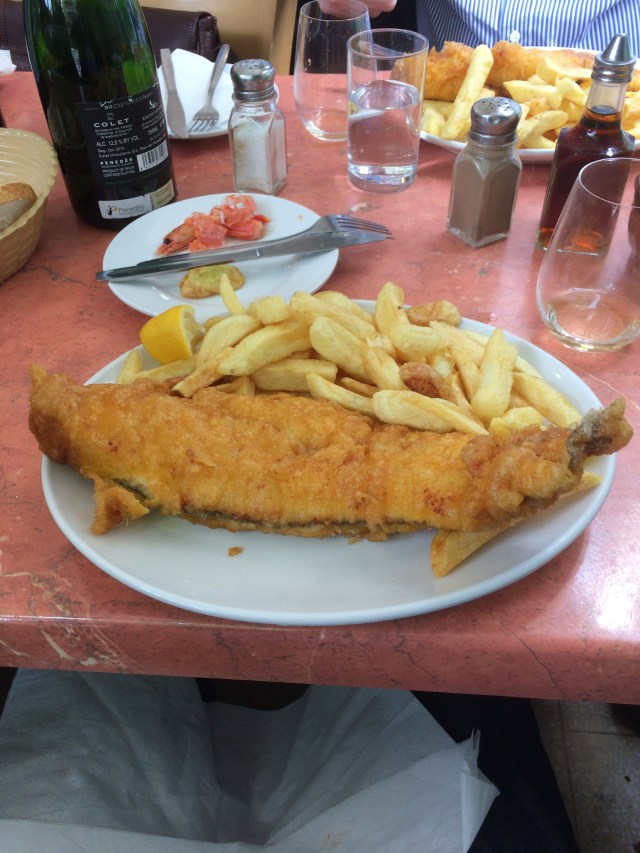
Before there was Fish & Fino there was Fizz & Chips. Latterly this took place at Fish Club in Clapham Junction, before they got fed up with us…and then closed down. But Fizz & Chips began as an irregular but very well attended event at Masters Superfish, in Waterloo, about two or three minutes down the road from the Old Vic.

I’d been very much looking forward to the revival of Fizz & Chips, and it must be said that the fish at this wonderful chippie is very good, possibly unrivalled in the Capital. The events of the day before in London did take the edge off the idea of drinking lots of phenomenally good Champagne, a wine usually associated with celebration. There was not a lot to celebrate in London last Thursday…except perhaps the resilience of the city itself. But in the end I was glad it went ahead, that those who had thought about pulling out didn’t, and that the hard work of the organiser of this event (Chris Hambleton, of Champagne Tuesdays and Bacchus Wine Auctions) resulted in a wonderful evening of fabulous wine.

The (ostensible) purpose of this particular gathering was to compare two Champagne vintages, 2002 and 2004. Both have reputations as fine vintages. 2002 was the first great vintage of the new millennium. The 2002 wines also have a reputation for being concentrated, some might say opulent. 2004 has a very fine streak of acidity, and many call it a “classical” vintage, but at the same time it was a record crop in most parts of the region.

As with all such events, vintage generalisations are proved, more or less, to be wide of the mark. First of all, house style needs to be accounted for. There are cases where the mark of the producer seems to outweigh that of the vintage, or at least to temper vintage influence. A stated aim with non-vintage Champagnes, it is often no less true with vintage wines to some degree. It was also pretty evident that most (not all) wines of both vintages needed more time. There was complexity aplenty at this exalted level, but equally, plenty more to come.

THE WINES

Pierre Péters Cuvée Les Chétillons 2002 – This is the old Cuvée Spéciale, pure Grand Cru Chardonnay, which Rodolphe Péters has now relabelled to reflect its source,  from this fine Le Mesnil lieu-dit. It would rank in my top dozen desert island bottlings, and this 2002 is just pure elegance encapsulated. There’s a lot of finesse and freshness, which makes it appear lovely now. But it is still remarkably young, a fact that two people who know this wine had told me before I opened this, my first bottle.

That said, much as I hate to crow about a wine I brought along myself, I ranked this as my wine of the night, despite strong competition. Awesome, in fact. It expresses that fine Le Mesnil mineral line so well, and this seems to hold back any vintage gras. What little I have left will ideally rest for a further five years, if I can resist.

IMG_2878


Vilmart “Coeur de Cuvée” 2002 – Vilmart’s “Coeur” is another wine firmly pencilled in on my desert island dozen. It’s a wine which can do remarkable things in off-vintages, but here we have it in a very fine year. Vilmart is based at Rilly-le-Montagne, with around 11 hectares of premier cru vines in the surrounding villages. Laurent Champs runs the company, formerly headed by his father, René, who is responsible for the wonderful stained glass which adorns the winery. Coeur de Cuvée is made from the heart of the first pressing of grapes. The wines here are all fermented in 225 litre oak.

This bottle was remarkably cold to begin with. “Coeur” is notorious for needing large glasses (not flutes), and benefits from splashing into a carafe (quite fashionable in top end restaurants a few years ago). It also has a reputation for being pretty oaky for its first decade, and there was clearly some wood still to be taken up by the 2002 wine, even at almost fifteen years of age. It has weight, but also a real zip to it. There is a sense of real complexity behind the slight burliness. As it opened out it became really beautiful. Keep and reap!

IMG_2879


Pol Roger 2002 – This was very different from the two previous ’02s. Still young, but slightly squat. The fruit appears quite sweet and plumpish, and several of us noticed a bitterness on the finish which one person put down to “underdeveloped extract”. Although I said this is young, and it does need more time, I’m not really sure where it will go?

We did have a Pol Roger Blanc de Chardonnay 2002 but this was very corked indeed. A shame. I drink a lot less Pol than I used to but always have a certain affection for this cuvée, which may have been lighter and more lemony. But corked wines can’t be helped. A fascinating discussion about corked Champagne followed, with quite a few attendees bemoaning a worse record than mine on this score (long may that continue when it comes to wines in this price bracket).

The other table had a Pol Roger 2004, which I didn’t taste, but which was generally preferred for drinking now, or  certainly sooner than the 2002.


Bollinger 2002 and Bollinger 2004 – Bollinger, one of the greatest names in Champagne, has a string of great sites around its home of Aÿ. This is another proponent of ageing in wood, perhaps the great wood ageing Champagne House.

My thoughts on the two Bollinger vintage wines, or “Grande Années”, is first that our perceptions were probably clouded by the quality of some of the other wines tasted. You scribble notes, but then some bigger or greater wines come along and you lose that sense of what you’ve just drunk. The 2002 was described, quite accurately, by someone as “very Bolly”.  Grande Année is certainly a wine, like Dom Pérignon and Krug Grande Cuvée, which an aficionado will probably spot on the nose without too much trouble. The 2002 had a richness to it, whereas the 2004 was slightly harder (and still big), but also layered with toast and nuts, citrus, and above all, a floral note coming through gently.

When you see tasting notes for both of these wines, they invariably give a drinking date from 2020, so we are really just dipping a toe in here. I expected the 2002 to be more evolved than it was, to be honest. Whether these wines are as good as those near legendary Grande Année vintages of the 1990s, I’ve no idea, but they will go the distance, I think.


Moët & Chandon 2004 – I’d been tempted into trying one of these some time ago. It tasted younger on Thursday than I remembered the previous bottle to be, yet it was one of the most evolved of the wines we tasted. I will also say (though don’t assume prejudice) that it was better than I’d expected it to be, with a certain meatiness, yet balanced by a degree of finesse. But that broadness has led some people to suggest it might not be a vintage for the long haul here.

IMG_2887


Veuve Clicquot 2004 – This was also quite forward, though not so much so as the Moët, with a probable peak drinking date of around 2020 or just before. There was a maturity and a softness on the palate, and it was one of the first wines to show biscuit, and also something toffee-like. Veuve has been making some very fine vintage wines, but I’m not sure to what extent this particular bottle fired peoples’ imagination.

IMG_2893


Veuve Fourny “Clos Notre Dame” 2004 – I’ve known this wine as “Clos Faubourg Notre Dame” for so long I couldn’t say when the “Faubourg” dropped off the label. This is a monopole walled Clos at Vertus, at the very southern end of the Côte des Blancs, made from Chardonnay vines over sixty years old. It’s aged in wood, and generally sees around nine years in bottle before release.

The nose here is maturing, probably in part due to the long bottle ageing and wood treatment. I’d put its prime drinking window somewhere between 2020 and 2025, so it’s approaching maturity but with a little more to give. There’s nougat and almond (almost essence) on the nose, but not overpowering. The palate is pretty complex. It’s only Premier Cru fruit, but it’s those old vines. I really love this cuvée, and I might therefore be a little subjective. But what I like is a certain understated complexity, which without doubt grows as it sat in my Riedel Riesling glass. A wine whose subtlety can be lost among bruisers, yet it does have a certain power as well.

IMG_2897


The next pair of wines naturally got everyone talking. We were expecting Dom Pérignon 2004, but someone kindly brought along a 2002 with which to compare it. The 2002 was very unique. There’s hay and hazelnut, but a very real (and complex) note of ginger as well. Quite forthright. The 2004 was not altogether different on the nose, though for me definitely Chinese spices, if more muted. The palate of the 2004 was ever so slightly muted too, giving little away at first. It then began to build towards a crescendo of nascent complexity coupled with growing freshness too, but it never reaches it’s apogee – there’s a lot more to come.

Both Doms are young. I’ve had the 2004 a couple of times. It’s always amazingly generous when people open them, but it has to be said the vintage is not ready. Ultimately it will be truly tremendous, and I will try to save my own small stash. It was one of my wines of the night for the sheer potential in the bottle. I hope I’ve read it correctly.


That was the end of the wines on our table, but a couple were sent over by our neighbours. Paul Bara 2004 from magnum was a big wine, full of appley richness, softness and power. I do like Bara. I’ve been enjoying the Special Club 2002 this year, which is approaching maturity (one of those slightly more forward ’02s). My guess is that this vintage 2002 would be the same in bottle, although the magnum effect will give it longer life in this incarnation. The man who brought it suggested some people found it lacking subtlety. For me, it was just a really good vintage wine from a very good grower, stamped with the personality of the maker more than the vintage.

IMG_2891


The final wine I got to try from the other table was Taittinger Comtes de Champagne Blanc de Blancs 2004. “Comtes” is a sure fire contender for best value prestige cuvée Champagne. It first appeared in the 1952 vintage, when it was formed from old vine Grand Cru Chardonnay. It has its off-vintages, but rarely. Another of my desert island wines, I love it for the way it harmoniously blends a streamlined acidity, mineral presence, and finesse, all beneath a rich layer (or three) of leesy fruit.

In youth there is citrus, as here. It makes the wine immediately refreshing, and gives it an elegance which the underlying richness can’t hide. There’s always pleasure in a bottle of Comtes, for me anyway. Probably my number two on the night, with Vilmart, Dom ’04 and the Veuve Fourny up there too. But such comparisons are slightly unfair. If we’d been comparing those straight vintage wines falling outside my list of favourites with Non-Vintage bottles, the story would have been different. In true fizz & chips fashion, it was some night. Immensely enjoyable, even if comparing 2002 and 2004 proved less simple than we’d hoped.

IMG_2888

IMG_2894


Posted in Champagne, Dining, Sparkling Wine, Wine, Wine Tastings | Tagged , , , , , , , , , , , , , , , | 2 Comments

The Fightback? Bordeaux Grand Cercle 2016

On Wednesday evening I attended the Tasting of Primeurs 2016 from the Grand Cercle des Vins de Bordeaux, thanks to an invitation from Business France, at Le Méridien Piccadilly Hotel in London. Now I’m quite sure that many readers will wonder what I was doing drinking Bordeaux? Well, it is true that I don’t write an awful lot about the region, though I did write extensively about my stay at Pichon-Baron in 2015. But that lack of interest has not necessarily resulted from the wines themselves…well, not completely.

I do have plenty of Bordeaux in the cellar, but I admit that I have bought very little over the past several years. There are four reasons why that is the case. First, price. The finest wines of Bordeaux are just way too expensive. Second, if image seeps into the subconscious, then the corporate image of Bordeaux does grate a bit, and with it the idea that image and marketing somehow come first. Thirdly, for someone brought up on Bordeaux, there’s no doubt that the rest of the world of wine has just overtaken it, and left it behind, when it comes to sheer excitement. And finally, Bordeaux has been, with some notable exceptions, rather slower than most in engaging with sustainable farming and winemaking, such as organics, biodynamics and even natural wine. Of course, the above statements are not completely true, but there is an element of truth in them.

If Bordeaux still has something to offer beyond the two polar opposite markets of the wealthy Collector and les grandes surfaces, a Tasting like this should be just perfect in order to demonstrate that the region is addressing those four points above.

IMG_2862

Le Grand Cercle des Vins de Bordeaux is an amalgamation of Le Grand Cercle Rive Droite (founded 2002), and Le Grand Cercle Rive Gauche (founded 2013). There are currently 164 members from both Left and Right Banks of the Rivers Garonne/Dordogne, and the organisation’s stated aim is to show that there is a wealth of quality Bordeaux at reasonable prices. All members have to undergo two obligatory tastings every year, which includes a blind tasting by independent experts for each new vintage.

The vintage here is 2016. It follows a very successful year for Bordeaux, especially in terms of marketing and hype. But there is no doubt that 2015, bearing in mind that I do not like generalisations, is a vintage with two disadvantages. With the wine writers calling it the best vintage since the highly acclaimed 2010, it sparked enough interest to make it look quite expensive. On top of that, it has something in common with 2009. Some may talk of the forward, very ripe, fruit. Others may point to that tiny number in the corner of the label measuring (I use that term lightly) alcohol content.

The 2016s faced a very different growing season to the previous year, and one which initially had the châteaux owners worried. The first six months of the year were very wet, indeed much of the region saw twice as much rainfall as in a “normal” year. But come July and beyond, it suddenly became very dry. The vines got through these dry months simply because of the wet first half of the year. Even so, drought became a worry until, just at the right moment in mid-September, a little rain fell. This saw the vines move back into growth and ripening, which got them through to a generally problem-free harvest.

In prospect then, this promised to be a very good tasting. I don’t claim to be an expert at tasting wines en primeur. The tannins are the biggest problem. Not that they disguise the wine, because when the fruit is there, and ripe, and when the grapes were healthy, you can still taste that. Equally, when a wine is over extracted, or the oak is spread like thick blackcurrant jam on a thrice toasted crumpet, that will not be hidden. It is merely the fatigue factor. Practice makes perfect, and to be fair, the Saint-Chinian Tasting prepared me a little. But after a while the tannins take their toll. Bordeaux expertise is definitely earned the hard way.

CONCLUSIONS

I have to say that I was very impressed with the wines I tasted. Some were estates I’ve known since my early days in wine. Some were estates I’d only heard of by reputation, and some I’d never tasted before. Every property showed their 2016 vintage, and generally I liked them a lot. I think that if one can make any broad generalisations, 2016 is likely to appeal to me on account of its freshness. Freshness, meaning fruit which was ripe, more than over ripe, coupled with a nice lick of balancing acidity at a level which I felt should remain when the wines enter their drinking window. Perhaps retaining freshness was possible because although the vintage may have been very dry in it’s second half, temperatures never reached heatwave conditions, and night time temperatures dropped.

Some people liken 2016 to 1990, which might be a step too far. Others point to technical similarities with 2010. Yet others point to the very high tannins measured, even in the Merlot, and remind us that a sustained dry period before and during harvest does not always bode well. I am certainly not the one to make pronouncements other than my own personal pleasure at tasting these wines, but I can say with some confidence that I experienced a good degree of consistency across the best of the wines here.

Did the Grand Cercle address my issues with Bordeaux? Certainly these are not estates which mimic the Grand Cru Classés in aloofness and self-satisfied superiority (although the aristocratic uniform of the Bordelais was occasionally in evidence on certain older, patrician looking, grey haired, gentlemen). Whatever their outfits, a greater sense of modesty was more evident than perhaps I expected.

Naturally prospective prices were not given for these wine samples, but it is clear that prices are generally reasonable. The suggestion that Bordeaux is over priced does not fairly apply in most cases here. The grander wines of the region dominate our consciousness to such a degree that it is easy to forget that these wines may often be a good bit cheaper than the fashionable Jura, Bierzo, Adelaide Hills or Swartland wines we buy.

And whilst natural wine is a rare (though not non-existent) phenomenon in the greater Bordeaux region, organics is now fairly widespread, and even biodynamic practices, once the domaine of a few like Pontet-Canet, are on the rise. Producers, often where a younger generation has taken over (these being predominantly family estates), are also re-thinking many of the vineyard and cellar practices brought in during the era of bold and brassy wines designed to please a market whose pendulum is starting to swing in the opposite direction, as palates gain in sophistication once more. One of the stated tenets of the Grand Cercle relates to ethical practices, which apply equally to the vineyard, the winery and to the business of selling the wine.

You never know, but in a few years we will probably all be talking about experimentation and innovation becoming rife in Bordeaux. There’s already a little, if you know where to look. Producers just need the confidence to make themselves stand out in one of the largest viticultural regions on the planet.

As I said above, each wine producer showed their 2016, and generally chose one other vintage to highlight how their red wines develop. Some also showed a white wine. I’m not going to write extensive notes for each producer I tasted. Those are the bits I generally skip when Decanter has its vintage overview. Too many identical adjectives, or if not, increasingly strained attempts to find different ones, would be my result. So if I’ve got something worth saying, I’ll say it, especially about whatever additional vintage was shown. I think you’ve got the idea that I enjoyed stretching myself and, as a result, that the wines were appealing. Where no vintage is stated I am discussing the 2016 red wine.

FRONSAC

Ch Dalem (Saillans) – Brigitte Rullier-Loussert has run Dalem since the 2003 vintage. There is a maximum of 50% new oak, the estate is certified organic, and the 2016 was fresh with a certain lightness, which was appealing (though of course the colour is dense). The tannins are not harsh in any way.

Haut-Carles (Saillans) – The Droulers family farm just seven hectares, almost all Merlot (with 5% Cabernet Franc and more recently planted Malbec). This tasted more tannic and structured than the Dalem, despite the Merlot, and the tannins were certainly mouth coating, but it had a lovely nose, very attractive.

Ch De La Rivière (La Rivière) – The most famous estate in Fronsac, and one I recall being able to purchase in French hypermarché in the 1990s. This is altogether a larger estate with around 67 hectares planted, most of that being to red varieties. The 2016 white was very refreshing and herby, a nice blend of 67% Sauvignon Blanc and 33% Sauvignon Gris. I liked it a lot. The 2016 red had nice concentrated Blackcurrant fruit. The fruit in the 2011 was surprisingly juicy and sweet scented, and very drinkable.

Ch Villars (Saillans) – The tannins were quite tough on the 2016, yet the fruit was nicely soft. The 2015 was rounder and fatter on nose and palate, but the same softness in the fruit was evident. The aim here is elegance, and although the ’15 is labelled as 14.8% alcohol, the 2016 is expected to be more like 14.4%.


BORDEAUX SUPÉRIEURE

Ch Sainte-Barbe (Ambès) – This is a 27 hectare property run by the De Gaye family, currently seeking a UK importer. There is a real château here, an attractive chartreuse built in 1760, designed by Victor Louis, who designed the Grand Theatre in Bordeaux. The vignoble is mainly planted to Merlot, with a little Cabernets Sauvignon and Franc, plus Petit Verdot. Ambès is actually situated right on the tongue of land between the Dordogne and the Garonne as it forks into the Gironde Estuary.

Sainte-Barbe is not currently organic, but aims to follow sustainable viticulture. The 2016 red was fruity and pleasant, and not very tannic. A red from the 2012 vintage still quite dark in colour, but had a lovely pure scent and was very satisfying. Drinking now, but will improve over five years, for sure.

Production here is around 45,000 bottles. It’s the kind of Red Bordeaux which I think would pass under the radar of most wine critics (I suppose if it didn’t they’d have a UK agent). I think that such an estate is doing very well to be part of the Grand Cercle, standing beside some illustrious names. These are really just the sort of wines Bordeaux needs to promote. It sounds patronising to call it good honest Bordeaux, because that is once how such a phrase would have been intended. But this is a well made “petit château”, and it should be credited as such.


POMEROL and LALANDE DE POMEROL

Clos Vieux Taillefer (Libourne) – A good 2016, but a very attractive 2014 too. That wine had a nice bright colour, a nice Merlot nose and was remarkably soft. It is fair to point out that each producer chose which second vintage to bring, but the 2014s tasted here were all attractive. Having just read the notes from the 2014 Cru Bourgeois Tasting in Decanter this month, I think there will be much pleasure to be had from this less fancied vintage.

Ch Vray Croix de Gay – A Pomerol estate which some pundits have rather ignored in the past, this estate, and its more widely seen but less famous sister, Château Siaurac (in Néac, Lalande de Pomerol) have converted, or are under conversion, to biodynamics (since 2014 for the 3.67 hectares of the former, with a slower conversion for the 46 ha of the latter). “Vray Croix” had nice, plump Pomerol fruit, whilst Siaurac seems to echo this, albeit not quite so concentrated.

Paul Goldschmidt still owns a majority stake in these properties, but François Pinault’s Artemis Group are an investor. The estates also benefit from the technical direction of Penelope Godefroy (ex Latour agronomist) with help from Jean-Claude Berrouet (ex Pétrus, but with considerable experience of biodynamics from his own Irouléguy estate). These properties seem to be moving forward quite quickly, in quality as well as in viti-vinicultural philosophy.


SAINT EMILION GC/GCC

Ch Rol Valentin (Saint-Emilion) – This is another quite small vineyard, just 7.3 ha run by Alexandra and Nicolas Robin. Merlot here accounts for 90% of the blend, supplemented with Cabernet Franc, which they like a lot. As well as a promising 2016, the 2014 was interesting. Labelled at 14.5% alcohol, it was nevertheless balanced.

Ch Le Prieuré is another wine in the Goldschmidt/Artemis stable. Following the move to biodynamics at their other properties, here they hope to implement biodynamics fully over the 6.24 ha  at Le Prieuré by the 2018 vintage. The vineyard is not large, but is quite spread out, which has certain advantages, if making it harder to work. The proportion of Merlot in the 2016 is 80%, with the rest being Cabernet Franc. I found softness and spice under quite big tannins (depending on vintage this wine spends between 12 to 16 months in oak, 50% of which will be new).

Ch Yon-Figeac (Saint-Emilion) – This had a very dense colour and glycerol legs as thick as a tree trunk, with big tannins, quite big in the attack, coating the tongue thoroughly. 14.5% alcohol too. But the 2014 was paler and had a lovely fruit-driven bouquet. There was elegance there, and only 13.5% alcohol. Perhaps my lack of experience is affecting my judgement if I say I really enjoyed the 2014 but found the ’16 harder to assess?


MÉDOC/HAUT-MÉDOC and MARGAUX

Ch La Cardonne and Ch Ramafort (Blaignan) – La Cardonne was one of my earliest Bordeaux experiences. It used to be an old Oddbins favourite in their glory days. It’s a largish estate, 35 ha, about half of which is Merlot and the remainder Cabernet Sauvignon, with a little Cabernet Franc. The château is situated just north of Potensac, and southwest of Blaignan, about four or five kilometres north of the border with Saint-Estèphe and the Haut-Médoc.

The wines of this part of the region are often criticised on two counts – over extraction and poor oak handling. I wouldn’t level that criticism at La Cardonne. The tannins here coated the mouth and tongue more than some, but there was definitely good fruit underneath. I also thought the 2010 was very good. Mind you, two of the most eminent voices on Red Bordeaux tasted at this table before and after me. I’d have loved to know what they thought?

Ch de Villegeorge (Avensan) – This estate is run by Marie-Laure Lurton, who was on hand to pour the wines, along with those of her Margaux property, Ch La Tour de Bessan.

I thought the 2016 Villegeorge was very well made and attractive. Soft and gentle, but not lacking personality. The varietal split, 56% Merlot/44% Cabernet Sauvignon, is more even than at La Tour de Bessan (where in 2016 Merlot makes up 77%, and the remainder is Cabernet Sauvignon with a tiny but significant dollop of Petit Verdot). There’s a certain lightness here which does not indicate lack of substance, more elegance.


Ch d’Arsac (Arsac) – is a Margaux estate run by Philippe Raoux. It’s a large estate of more than fifty hectares, a couple of which are planted to Sauvignon Blanc for white wine. The 2016 white has a certain simplicity from being 100% Sauvignon Blanc, but it has a lovely nose and a little weight and gras, so it is not at all one-dimensional. The 2016 red is quite dark and has a very strong scent of Merlot on the nose, more plum, even cherry, than blackcurrant. The 2014 was also attractive again, here.

Philippe Roux is also responsible for the “Winemakers’ Collection”. Every year a winemaker is invited to create a wine, without any restraints or conditions, from Arsac fruit. Previous invitees have included both Michel and Dany Rolland, Denis Dubordieu, Zelma Long and Alain Raynaud (who is now President of the Grand Cercle), to name but a few. For 2016 we have Winemakers’ Collection Saison 11 – Hubert de Boüard. De Boüard probably needs no introduction and he will be familiar from his flowing locks and his significant achievements at Château Angélus in Saint-Emilion.

Here, he’s fashioned a very nice fruity white made from Sauvignon Blanc, and a dark coloured red which currently has a brooding nose, but a gentler palate, not as big, nor tannic, as the nose perhaps suggests, and with a smooth velvet texture already. Both are pretty successful, with the Winemakers’ Collection 2016 red being somewhat more powerful to my palate than the d’Arsac from the same vintage.


GRAVES and PESSAC-LÉOGNAN 

Ch Roquetaillade La Grange (Mazères) – This estate, at the southern end of the Graves, comprises what were once the original vineyards of the imposing Château Roquetaillade. Château Roquetaillade, which I have visited, was completely restored (sic) by Viollet-le-Duc and one of his pupils, a M. Duthoit, in the 1860s. The restoration is characteristically heavy, but the château is nevertheless a brilliant example of the famous Viollet-le-Duc style, and the interior is very impressive in that context.

I recall having some wines from Roquetaillade La Grange many years ago. Since then a lot of work has been undertaken in these vineyards by the three members of the owning Guignard family, Bruno, Dominique and Pascal. The white here is an interesting blend of 60% Sémillon, 20% Sauvignon Blanc and 20% Muscadelle. The latter variety is quite rare in Bordeaux dry whites now, and I’d guess that 20% is a reasonably high proportion. It suffers if over cropped, but when well grown it adds a nice white peach note, as it does here.

The 2016 red is quite light, with Cabernet Sauvignon dominating Merlot, both in the blend and on the nose. The 2009 was pleasantly lower in alcohol than some wines of this vintage, just 13%. Whatever issues of ripeness this could signal in cooler vintages, this was a refreshing ’09. I’m not trying to puff up these wines more than they are worth, but I was pleasantly surprised.

Ch Haut Lagrange (Léognan) – A small (7.5 ha) vineyard run by Francis and Ghislain Boutemy, producing around just 6,000 bottles of white wine and 40,000 of red per year. The 2016 white, an equal blend of Sémillon and Sauvignon, was presented as a cloudy sample, the only one of the day. It had a very unusual nose, intriguing, and was nicely fresh on the palate. It sees 20% new oak, but this seemed to add something, rather than detract.

The red was almost bright cherry in colour, very vibrant, with a nose of very fresh red and black fruits which were almost crunchy on the palate. Its alcoholic content somehow tasted lower than the 13.5% I was told the sample probably contained (a turn up for the books – producers are more often inclined to under estimate alcohol these days).


SAUTERNES

Ch de Myrat (Barsac) – Although Barsac is technically a separate appellation, its wines are entitled to be labelled as Sauternes, and De Myrat was classified in 1855 as a Cru Classé of Sauternes. It may not be the most well known of the Sauternes and Barsac crus but it is amazing value.  One might go so far as calling it ridiculously cheap, as almost all but the most famous wines from this appellation invariably are. Both 2016 and 2010 showed freshness, rather than any unctuous botrytis character. Tropical fruits with honey, but very fresh rather than heavy or very concentrated. Sémillon dominates just 8% Sauvignon Blanc, and 4% of 25-year-old Muscadelle.

These are generally considered wines to drink after perhaps a decade, if you want to keep them. But the 2010 seemed very nice, and the 2016 refreshing, albeit a shame to open on release. It was a nice way to end the Tasting. Living with someone who does not really like botrytis wines, I forget how marvelous Sauternes (and Barsac) can be, though I don’t think this wine would fail to please if you are looking for freshness over concentration.


IMG_2823


Posted in Bordeaux Wine, Wine, Wine Tastings | Tagged , , , , , , , , , , , , , , , , , , , , , , , , , | 9 Comments

Raw Wine 2017 – Part 2


On 14th March I published Part 1 of my article on the London Raw Wine Fair 2017. You can read it here. Part 2 covers several European producers, from Italy, Spain, France, Slovenia and Greece. As I said in Part 1, one day at Raw is not really enough, and I noted more than thirty producers I would have liked to have tasted and which I couldn’t get round to. But they were all either big names, or people I know quite well. Hopefully, those covered here will for the most part be new to many readers.

ITALY

Azienda Vitivinicola Selve (Donnas, Aosta)

When I began Part 1, I started with a producer who was new to me, the Rennersistas from Austria, who I identified as one of my highlights of the day. I’m beginning Part 2 with another star of the show. Selve is a very special family estate, situated right at the bottom of Italy’s smallest region, at Donnaz (Donnas in dialect), on the border with Piemonte. The grape variety, as is common around Donnaz, is Picotendro, which is simply the local name for Nebbiolo.

If you’ve been reading my Blog for a while, you may know about my love for the Aosta Region, and its wines. I’ve had a good few Aostan Nebbiolos, mainly from the Donnas Co-operative, whose top bottling is always pretty good, and amazing value. In all my visits to Aosta I’ve never come across this estate.

Selve has always been a natural wine domaine since its establishment in 1948, insofar as no chemicals have been used on the vines, nor in the winery. All the vines are grown on steep sites, trained on pergolas arranged on steep terraces which all face south, their walls soaking up the sun and releasing it in the evening.

First, I tasted wines from 2011, 2012 and 2013. A Selve Picotendro “Cru Minin” 2011 aged in old oak was pale with haunting scents and lovely smooth length. Minin is regarded as the finest of five sites owned by the Nicco family here.

For 2012 I tasted both a version aged in oak and a version aged in chestnut (the oak-aged wines have white writing on a black label and the chestnut wines have red on black). The chestnut version was a revelation. Slightly plumper, I felt, but the scent here is just beautiful, and both these wines have great length. It is no criticism to say that, like the very best Barolo (and Burgundy), the bouquet is at least half of the pleasure.

Selve Picotendro Riserva “Pantheon” is released only in the finest vintages (in the 2000s it is 2003, 2004, 2006 and 2009 so far). 2003 is typical of this release. Harvested at the end of October, everything is done gently and by gravity. It sees at least three to four years in wood. Quite old fashioned Nebbiolo, but really lovely.

Selve.Zero 2010 is a special Riserva for a special year. Aged in chestnut, its name comes from the fact that the Italian Ministry of Agriculture tested the wine for any chemical or animal residues and found less than 0.01% (doubtless down to animal excrement in the vineyard, thinks Jean-Louis Nicco, grandson of the estate’s founder). Selve wines are some of the very first in Italy to declare themselves Vegan.

The current releases have a long life ahead of them. The older wines are magnificent. They are imported by OW Loeb, and I implore the folks there to save me a bottle or two before everyone scoops them all up. I know of at least three or four people who felt the same way about these wines.


Valdonica (Grosseto Province, Maremma, Tuscany)

Valdonica produces around 50,000 bottles of wine near Sassofortino in the Maremma, southwest of Sienna and in sight of the Tuscan coast. There are three grape varieties planted – Sangiovese, Ciliegiolo and Vermentino, from some of the highest vineyards in Coastal Tuscany (500 metres), on mainly volcanic clay, rich in quartz. The wines here are made by Tim Manning, who readers will probably know from the brilliant wines going under his own Vinochisti label, or as Assistant Winemaker at Chianti Classico producer, Riecine, under Sean O’Callaghan during his time there.

Valdonica’s owner Dr Martin Keres was on hand to pour at Raw, and he’d brought six wines to show. Of the two pure Sangiovese wines, Saragio (2012) spends 18 months in barrique, half new and half second fill. It’s a nice dark cherry scented wine with ageing potential.

Baciòlo (2012) is a Riserva version, also pure Sangiovese, aged in new wood. It retains a pleasant pale colour, although it’s an altogether bigger wine, concentrated and with some grip and quite impressive. It’s made from a selection, spends an extra six months in oak, and surely requires some time in bottle.

Mersino is the first of the Vermentinos. The 2014 has a genuine freshness to it. Aged on lees in tank, this gives the citrus-fresh juice a touch of richness, with stone fruit flavours.

Ballarino (2012) is quite a step up in complexity, spending two weeks on skins. It is split between tonneau and steel before blending back after a year. It has a touch more colour, and adds herbs and a good dose of mineral texture to the citrus elements. I liked both wines, but this is the more complex, with ageability. This was described as the top Tuscan Vermentino by Wein-Plus (German Wine Guide).

Arnaio 2013 is a blend of Sangiovese and a grape which seems to be finding a successful home in the Maremma, Ciliegiolo. It’s tank aged, all bright cherry flavours with a lovely scent. Pale, light on the palate, but by no means insubstantial. A very successful wine for everyday drinking, with its own personality.

There is a pure Ciliegiolo (2013) which sees 24 months in new tonneau of 500 litres. This is a darker cherry colour, with good spice and grip. Plenty of tannin at the moment, but they are very ripe tannins. It’s a powerful wine, quite dense, as it comes from a selection of the estate’s best Ciliegiolo. Now it’s not a style that many who know me might assume I’d like, but I do have a soft spot for this  Tuscan/Umbrian native grape variety, and I was quite taken with it. But it does need age, and it does need food. Wild boar, preferably.

The key across all these wines is freshness and purity, which is what won me over. For me, the wines avoid the pitfalls of new oak. In some vintage conditions, or with more alcohol, I imagine they would need to be careful, but Tim knows what he is doing. The Valdonica whites are excellent, and unlike at some Maremma properties, no mere afterthought.

Valdonica is imported by Red Squirrel.

SPAIN

Vinos Ambiz

Only one Spanish producer gets a look-in this time, but to be fair you did get rather a lot of Spanish wines to digest from Viñateros the other week. It’s my old friend Fabio Bartolomei from El Tiemblo in the Sierra de Gredos. I’ve drunk Fabio’s wines both in the UK and in Spain. What attracts me to them is a quality so often lacking in wines of an amber hue – fruit.

Fabio grows Garnacha, Albillo, Airén, Malvar, Tempranillo, Doré, Chelva, Villanueva and Sauvignon Blanc. I think that qualifies as an eclectic mix. No chemicals are used, either on the grapes, nor in the winery, other than the droppings of the sheep which travers the vines. Last year I reproduced Fabio’s back label which tongue in cheek lists all the things which are not in his wine, stating that he makes “wine made from grapes”. They are aged in a mixture of steel tanks, amphora and old wood in the large old building of the now defunct El Tiemblo co-operative.

The consequence of Fabio’s singular approach is that these are wines on the edge. Sometimes the wines can be a little challenging, as was “Doris” to one person tasting beside me. The whites (well, whitish, mainly amber) often have quite exotic notes of mandarin or quince. The reds, which I know less well, are just the epitome of freshness. Newly fashionable Garnacha truly excelled in both the 2014 and 2010 versions shown here.

My last bottle of Ambiz was drunk on a typically scorching summer’s evening looking across to the Alhambra Palace in Granada last year. Refreshing and thought provoking. You will love them if you have a spirit of adventure like me. They are some of the purest wines in Spain. But be warned, they do love to walk a high tightrope which some palates may find gives them vertigo. But who wants boredom?

The Ambiz wines are distributed by Otros Vinos, who also import into London a couple of other favourite Spanish (very) natural wine producers, Cauzón and Purulio (both Granada Province).


FRANCE

Eric & Bérengère Thill, Jura

Eric Thill, originally from Alsace, was on hand to pour at Raw, but such is the popularity of Jura wine right now that all he had left by mid-afternoon was a few dregs of reds. His neighbour on the next table, Laura from Domaine de la Pinte (who I covered in one of my Jura trip articles last year), had run out of wine even earlier.

Eric farms a little over five hectares at Trenal, near Gevingey, in the southern sector, south of Lons le Saunier and five kilometres north of Rotalier. It’s the land of Ganevat and Labet. Eric and Bérengère (who is a viticulture consultant) can only vinify about three hectares, so the surplus goes to the co-operative.

The white wines had all gone, a shame as Wink Lorch (in Jura Wine, 2014) says that these are the most successful at the domaine. I managed to try literally the last centimetres from a Poulsard and a Pinot.

Poulsard 2014 is very pale with an almost orange tinge. It only finished malolactic three months ago (yes, it really is a 2014). We had a great discussion about this because I know a young Jura vigneron just starting out who had a similar issue. All the old guys told him “just wait, it will come round eventually”. Eric’s did. A beautiful nose on an ethereal wine with a hint of bitters on the finish.

Pinot Noir 2016 was a sample, due to be bottled this week. Aged in epoxy tank with 30 days on skins, to be bottled with neither sulphur, nor protective CO2. Pale cherry colour, a nice fruity red, but with a touch of extra complexity from the skin contact.

Eric pulled out his Liqueur de Chardonnay to finish. Like a Macvin, but fortified using fine de Chardonnay (which is distilled from the unbottled wine in the vat, known as “clair de lie”), not marc (traditionally distilled from the skins and pips). The distillate is added to pure and unfermented Chardonnay juice (the must is just beginning fermentation, but the spirit mutes any desire the juice has to ferment).

Now I’m not generally a Macvin fan, although some of my favourite Jura amis make a lovely version for which I can always find time for a glass before dinner. But they have to work to persuade me to buy a bottle. This version, made from fine, is very elegant, almost light, and I liked it. Unlike Macvin it sees no oak, and it also has an alcohol level of 16.5%, ie at the lower end of the 16-22% required for that product. It is merely labelled as a “Vin Blanc Doux Muté.

The spirit respects the fruit and juice. Where Macvin is made using marc which does not see the same care and attention as the producer’s wines (it must originate from the producer but it is often distilled into spirit elsewhere), there often seems a mismatch. It is something to be wary of.


Le Vignoble du Rêveur/Mathieu Deiss (Bennwihr, Alsace)

Mathieu Deiss is indeed the son of a very famous father, and that may be the reason he’s given his domaine a different name (“Dreamer’s Vineyard”). The vines he farms, the “Mischler Vineyard” at Bennwihr, north of Colmar, come from his grandfather and maternal uncle. Mathieu is experimenting with different macerations, vinifications (including amphora) and unfiltered bottling with no added sulphur.

Three cuvées were on show. Unfortunately I didn’t get to meet Mathieu, and the employee of the importer pouring the wines for some reason showed a little disinterest towards me – I had to request a pour on each occasion and information was slow in coming or non-existent. The wines, however, were pretty amazing.

Singulier 2015 is a maceration wine, blending Riesling with Pinots. Vibration 2013 is pure Riesling, with the emphasis on pure. Imagine freshness, but with a firm backbone. You can’t avoid that old chestnut, “mineral”. The third wine is Pierres Sauvages (2013), another blend, this time of the three Pinots, with Pinot Gris the dominant variety on nose and palate (I’m not sure of the exact proportions in the blend). It’s aged for a year on fine lees, which add texture and richness.

The domaine is biodynamic and the wines really shine. They are totally separate to Mathieu’s father’s wines but they are vinified at the Deiss facility on the edge of Bergheim. Mathieu’s range is brought into the UK by Roberson. I look forward to trying these by the bottle. It was a shame not to meet the man himself.


Domaine Chandon de Briailles (Savigny-lès-Beaune)

This old Burgundian estate has been in the same family for seven generations, but what is less well known is that they are yet another Burgundian domaine which follows biodynamic principles (biodynamic from 2005, certified by Demeter since 2011).

This has been a source of excellent Burgundy over many years, exemplified by one wine which is acknowledged as one of the bargains of a bargain-free region. It’s the Pernand 1er Cru, Île-des-Vergelesses. The 2014 was on show here, very attractive, but tannic (albeit elegant and silky), needing five years minimum. In the much-maligned 2007 vintage this particular wine provided me, and several friends, with gorgeous drinking which has not diminished, even today.

Savigny-lès-Beaune “Les Lavières” 1er Cru 2014 had a lovely gentle softness on the nose and very nice Pinot fruit. Quite floral, violets with a touch of smokiness, on the nose. Good fruit on the palate with a mineral structure, but perhaps less than the Île. Nice freshness.

I also have a few of their red Corton wines in the cellar, and here I had a chance to try Corton Bressandes Grand Cru 2014. It comes from four parcels totalling just over a hectare on the mid-slope. There’s far greater density here, but the wine retains that genuine freshness which probably comes from the estate’s biodynamic viticulture.

I know this domaine’s red wines so well, yet rarely get to taste any whites. Corton Blanc 2014 was a rare treat. Very pure tasting Chardonnay, the fruit almost has a sweetness to it at this stage, though it finishes dry without giving a lot away. Honeyed and peachy, you might think it sees new oak or lees stirring, but it sees neither. It is unusual in that the 0.6 hectares of Chardonnay comes from soils usually planted for red wine (most is in Bressandes). Naturally in its youth right now, this is already very impressive. Wouldn’t mind a bottle myself.

Imported by both Goedhuis and Lay & Wheeler


Les Vignes d’Olivier (Argelliers, Hérault, Languedoc)

Olivier Cohen got interested in wine via spells working in some of the natural wine bars of Paris and Nice (including the seminal La Part des Anges), but was lucky enough on his travels to get to work under several well known winemakers, including Thierry Allemand (Cornas) and Philippe Valette (Chaintré, Macon).

Rond Noir 2015 blends Syrah and Grenache, whole bunch fermentation (as with all the wines here) and one week’s maceration. Rond Vert 2014 adds in Carignan and Merlot to a base of Syrah. Brambles, cherries, round plump Merlot plums, with an extra year in bottle this is quite delicious. 2014 was Olivier’s first vintage, and he was lucky to take over quite mature vineyards (30-40 years old) in a cool micro-climate.

VO 2014 uses the same grapes as Rond Vert, but undergoes two years élevage.  The scent of the bouquet is ethereal, haunting, and the flavours are quite unique with very fresh and sweet fruit (in a dry wine). There is also a “Bagnum” (to borrow from Burgundy’s Le Grappin), a 1.5 litre bladder full of light and fresh (100%) Merlot. It’s not like the usual soupy Merlot you might find as a Vin de Pays down here. Three-to-four days maceration in fibreglass tanks and whoosh! Glug it up!

Olivier Cohen is imported by Kiffe My Wines Ltd. The man behind them, Jimmy, worked for Olivier and asked to be paid in grapes. He has fashioned a couple of light and juicy wines, simple but refreshing in the vein of Olivier’s. Pur Kiffe Mourvèdre 2015 and Pur Kiffe Cinsault 2015 (bottom right, below) are real summer wines, perfect on a picnic, or outdoors in the garden. The Cinsault is the lighter of the two, the Mourvèdre being even fresher, but with a little grip.


Mas d’Alezon and Domaine de Clovallon (Faugères, Languedoc)

Catherine Roque used to be the well known owner of Faugères star, Domaine de Clovallon. This is now run by daughter Alix, whilst Catherine focuses on the region’s traditional and ancient varieties at Mas d’Alenzon. The estate consists of around 7 hectares on the region’s famous blue schist. Biodynamically farmed, Catherine uses concrete eggs and large chestnut barrels.

Monfalette 2014 is made from the classic Faugères blend of Mourvèdre, Syrah and Grenache. Where it differs from some of these blends is in avoiding high alcohol and hard extracted tannins (often aged in new oak). The biodynamic freshness is a strand through all Catherine’s wines.

Le Presbytère 2016 is also a Faugères Rouge, but from Cinsault and Carignan. It’s a gorgeous wine, using “simple” as a compliment. Just 12.5% alcohol, and so tasty, even at this stage, before release. Just the sort of thing I was kind of hoping to find at the recent St-Chinian tasting I covered.

Cabretta 2016 is Faugères Blanc, made from Clairette, Grenache Blanc and Gris, and Roussanne. Clean nose, an elegant white at just 12.5% alcohol again.

Catherine also poured Alix’s Clovallon 2016 Vin de Pays d’Oc, an appealing fruity Pinot Noir.

All of these wines are very good. They are imported and distributed in the UK by Terroir Languedoc.


Batic (Vipava, Slovenia)

I’ve drunk a couple of wines from this producer, most recently a wonderful rosé which surprised me with its depth and complexity, so I had to stop by here to taste. Miha and Ivan Batic make wine about as far west as you can get in Slovenia, with 19 hectares in the Vipava region.

Sivi Pinot 2015 is Pinot Gris, a young wine which is still developing. Zaria (I tasted 2007) is a field blend of seven varieties which is given 35 days on skins. It has developed a bronze colour, and a nice texture balanced by good smooth fruit. Complex but tasty.

The Vipava Rosé I’d bought previously was a 2014, a blend of 97% Cabernet Sauvignon with Cabernet Franc, made from high density plantings (12,000 vines/hectare) on the clay-marl soils of the Vogrsko vineyard at Brajda. It had real body and presence, combined with genuine drinkability, dry but very fruity. The 2016 at Raw was a bit lighter, with the fruity freshness of youth, but a 2008 (100% Cabernet Sauvignon) was amazing. Real complexity for a rosé without losing any of that freshness.

Angel is the estate’s signature wine, or Grande Cuvée, named after Miha’s son. It comes from a vineyard situated at the point on the estate where Alpine and Mediterranean climates meet, hot and cold air circulating around a site surrounded by forest, keeping pests and disease away. The vineyard has never been treated with pesticides. The 2011 here was served from a 3 litre double magnum.

A field blend of seven varieties makes up Angel: Pinela, Malvazija, Rebula, Laski Rizling, Zelen, Vitovska, and ooh, Chardonnay (I think). These vines, all over 20 years old, make a wine amber in colour, with scents and flavours of apricot and peach. The finish is smooth and sophisticated. An unusual wine of real quality.

Batic is imported by World in Bottles. Anja Panic set up the company after missing the wines of her home country, and she specialises in Slovenia. I purchased the 2014 Vipava Rosé I mentioned above from Pacta Connect in Brighton.


Domaine Ligas (Yiannitsá/Giannitsá, Northern Greece)

Domaine Ligas is situated on the Paiko Mountain, northwest of Thessaloniki, on the Greek mainland, in the region called Pella. It is run by Thomas Ligas, who studied oenology in France, aided by Jason and Meli. It was Meli who was on hand to pour the wines and tell the Ligas story. They use (insofar as is possible) permaculture in the vineyard, and a methodology within permaculture known as Fukuoka.

Masanobu Fukuoka, who died aged 95 in 2008, is famous in Japan for a philosophy of non-intervention or “do nothing” farming. For Fukuoka, this “natural farming” had an important spiritual element to it, with nature finding balance at its centre. A bit like those Graupert vines at Meinklang which I wrote about in Part 1, in a sense. The Fukuoka philosophy fits into permaculture (which was developed in the late 1970s) because that way of farming is all about simulating the features observed in natural ecosystems and applying them to human agriculture, leading to a more sustainable way of producing food or, in this case, grapes.

Permaculture which follows Fukuoka’s philosophy is apparently notoriously difficult to implement, but Domaine Ligas is blessed with a fairly windy mountainside location, which, just as with Batic’s Angel vineyard above, helps to discourage disease and pests.

Kydonitsa Barrique 2015 is a “Vin de Table” which receives three weeks on skins, but there is also a little flor which forms over its year in barrel. There’s bags of complexity, about 13% alcohol, and the potential to gain complexity over four or five years. But it will taste gorgeous now. And I can’t help adding that the label is gorgeous too (top left, below).

Le Rosé 2015 is a Vin de Pays made from Xinomavro. It has vibrant red fruits with a touch of pomegranate, very refreshing.

Roditis Barrique 2015 is labelled as IGP Macedonie. The oak here is not new, and the wine is clean and fresh with citrus and herbs. The nose is lovely, very perfumed.

Another IGP Macedonie, Pata Traya 2015, is much more exotic. Perhaps herbs and citrus is what one might expect from a Greek wine, but here we are given pineapple, lychee and truffle on the nose. It’s so good, but quite a shock. Very pure.

Xi-ro 2015 comes from one of the experimental vineyards, planted with Xinomavro and Roditis, and is pure concentrated cherry with a finish which was hard to identify (it has been identified as tomato leaf by others with more analytical palates). It’s a great natural wine which would benefit from being served quite cool. Drink young.

Roditis “Maceration” 2015 has more colour than the previous wine of this grape variety. Texture too.

Domaine Ligas is imported by Dynamic Vines. Greek wine is a little under the radar, and in general they deserve to be much better known in the UK. This particular domaine impressed me a lot and I will be looking out for some to buy for myself next time I’m down at Dynamic. An excellent group of wines with which to sign off from Raw Wine for another year.


IMG_2794


Posted in Aosta, biodynamic wine, Natural Wine, Wine, Wine Agencies, Wine Festivals, Wine Tastings | Tagged , , , , , , , , , , , , , , , , , , , , , , , , , , , , , | 2 Comments