That Georgia’s on my Mind – For The Love of Wine (Book Review)

img_9584

I can’t recall how many years ago it was, but I do recall trudging around several of the Marks & Spencer’s stores in Central London trying to find a particular bottle of wine. Now M&S, as this chain is known here, has had some surprisingly interesting bottles in the past, or at least surprising for those of us who like wine at the fringes. But this wine was in a league of its own. It was Georgian, and made in a qvevri. 

I was certainly aware of Georgian wine back then, and I knew what a qvevri was, but I’m not sure I’d ever tasted a bottle made in one, or at least not from Georgia. I was certainly an old hand with amphora wines, starting out early on the wines from Sicilian stars, COS. By the second decade of the century there were certainly Georgian wines in the UK, and there were even more skin contact, or “orange”, wines from other places available in the UK. But if a British supermarket chain was importing one, then it had to signal something significant was happening in the world of wine. Georgia has an 8,000 year history of winemaking, and the buzz of excitement around the qvevri tradition signalled that it was finally about to leap into the spotlight on the international stage for the first time in those eight millennia.

img_9591

Where the journey began for me, Tblivino Qvevris 2011 (Marks & Spencer)

This particular wine was called simply Qvevris and was produced by Tbilvino, a Tbilisi-based winery which was established in 1998 by the Margvelashvili brothers on the site of a facility which had produced wine in the Soviet era but which had since gone bust in the post-communist era of the free market economy. The wine was a varietal Rkatsiteli, Georgia’s most planted white grape variety, and it had seen six months on skins in these ancient and traditional terracotta vessels. It was good, although it wasn’t an earth shattering wine in terms of quality, but on so many other levels it was, for me, revelatory. All of a sudden I went from thinking I knew a little, even a lot, about wine to realising I had a whole world suddenly to explore.

My first job was to taste Georgian wine, which I should probably mention right now is not by any means all made in qvevri, and is not by any means all of the quality made by those producers who have gained a name on export markets (as illustrated by the resumption in more recent years of the export trade to Russia). Now there had been plenty of opportunity to do so, at the bigger natural wine fairs, where the Georgian contingent was becoming famous for its capacity to party. But with my myriad specialisations already diverse (Austria, Jura, Savoie, Grower Champagne, Alsace, Switzerland, Czechia and more), then Georgia just seemed a bit too much when faced with a single day at these events. So I was slower off the mark.

I had been buying more and more odd bottles to sample, but about three years ago I bought a mixed case from the largest importer of Georgian wine here, Les Caves de Pyrene, with currently eight producers listed: Niki Antadze, Okro’s Vinos, Iago Bitarishvili and his wife, Marina Kurtanidze, Ramaz Nikoladze, Zurab Topuridze, Sister’s Wine and Pheasant’s Tears, the latter being probably Georgia’s most internationally famous operation on account of one of its founders, American born John Wurdeman. If it were not for Wurdeman’s help in getting the word out, Georgian wine probably would not enjoy the super-fashionable status it has for a certain sector of the wine buying public.

Iago Bitarishvili (or just Iago) at the Real Wine Fair, London (organised by Les Caves de Pyrene)

Although I visited Russia during the Gorbachev years, I didn’t really have a burning desire to return there after the fall of Communism, and perhaps initially that blunted my desire to travel very far behind the former Iron Curtain as well. But as the 2000s progressed into their second decade I knew people who had been to countries like Romania. Aside from the natural beauty I knew existed (from years of receiving trekking brochures from companies like Exodus and Explore), I was seeing photos of beautifully restored towns and churches, and hearing of an emerging food and bar culture.

By the time I read Simon Woolf’s “Amber Revolution”, my Wine Book of the Year for 2018, I was already harbouring a desire to visit Georgia, but whilst that was slowly  getting a little closer to becoming a reality the likelihood of getting there any time soon has now, perhaps for obvious reasons, receded a little. This is a shame because my first “Lockdown” wine book was For the Love of Wine by Alice Feiring. The book had been lying on a pile of nine or ten as yet unread books since I can’t remember when, but all I can say is that it found its perfect time. With three wine trips, to Austria, Alsace and Jura, cancelled for this year I was in dire need of some vicarious wine travel.

Alice Feiring first visited the former Soviet Republic of Georgia (I make this point because even famous Americans have been known to assume that one means the State of Georgia in the southeast of the USA, always a problem when the Rugby World Cup comes around) in 2011, to attend the First International Qvevri Symposium. She was partly there because her second book, “Naked Wine”, was due to be translated into Georgian. This was a sign that the government there, through the country’s wine authorities, were encouraging the renaissance in traditional winemaking. As my first Georgian wine was that 2011 I like to think that perhaps she may even have passed the very qvevri it came from if she made a visit to Tblivini whilst she was there.

In many ways the qvevri tradition and natural, low intervention, winemaking methods go hand in hand (though not always). Whilst viticulture in the Soviet era was based on the napalm death approach, massive yields achieved through equally massive application of agro-chemicals, Georgian families had been allowed to retain a few rows of vines for personal use, and even if they had wished to, synthetic chemicals were just too expensive. This chemical free environment didn’t always lead to good wine, but it did at least allow the qvevri tradition to be kept alive…just.

The essence of Georgian wine, aside from unique terroirs, lies in grape varieties and in particular the rather special autochthonous varieties, many of which are not seen elsewhere. Estimates vary, but the country boasts more than 500 indigenous varieties (some say 525). The ones we know best on export markets today (Rkatsiteli, Mtsvane, Chinuri, Saperavi, Kisi etc) are just scratching the surface. Pheasant’s Tears is just one producer trying to keep many of these varieties going, and their Poliphonia red cuvée contains, apparently, 417 different varieties, many sourced from their vine library in Kakheti Province.

Alice’s book, published in 2016, details in a little over 160 pages, a subsequent visit to Georgia. Since 2011 much had changed, not least the adding, in 2013, of the traditional qvevri vessel to the UNESCO list of Intangible Cultural Heritage. It also seems, and I get this from other visitors too, that Georgia has experienced something of a full on renaissance, and not just in wine.

After the collapse of the Soviet Union Georgia declared independence in 1991 and was in almost immediate conflict with Russia, which backed ethnic Russians within Georgia’s border provinces (which was mirrored more recently by Russian action in Ukraine). This resulted in the Russo-Georgian War of 2008 and a subsequent ban on wine imports into its former monopoly market. This could have been crippling to the industry. But necessity being the catalyst to invention, the Georgians discovered that rather than a market for bulk wine, one existed in the West for quality wine, and wine at that which could be sold for a much better price.

By the time of the visit detailed in this book Georgia’s wine, and her most famous personalities, were known in Europe and America, as were their wines. That is in no small part down to the author. What Feiring achieves in this book is not to set out information about Georgia’s delineated wine regions, nor to list her producers, outlining the varieties and winemaking methodologies they use. This is a travelogue, and all the better for that. Feiring journeys with her winemaking friends, those who have mentored her in Georgian wine, and who obviously have a high degree of affection for her, which I think must come from more than merely the fact that she has been by far the loudest champion for Georgian wine in the United States (and internationally) over the past decade.

Feiring naturally spends most time with winemakers, and in many different parts of the country, some of which she hasn’t visited before. She also visits some of the last qvevri makers, and these visits are fascinating if you don’t know the skill, and especially time, which goes into creating every pot. But one of the most interesting people she visits is not connected with wine.

Lamara Bezhashvili could loosely be described as a silk weaver and wise woman. She crops up more than once in the book and obviously has a profound effect on the author. The time they spend together seems to give deeper insights into a country where the connection between people and the land, with its medicinal herbs and folklore which seems to work, has not been completely and irrevocably severed. Such moments remind the reader that this is not merely a wine travelogue. Wine and culture in Georgia are inextricably linked. You don’t take one without the other.

I could detail any number of stories from the book. Most involve eating and drinking prodigious quantities, in a country where hospitality is a religion (literally, it appears). There are sleepless nights occasioned by the requirements of feasting and there are mad dashes which bring to life the enthusiasms of Feiring’s guides (one particular excursion I enjoyed was her trek through mountain undergrowth to see an ancient wild vine).

We also hear about the near mythical Eastern Orthodox Alaverdi Monastery in the Kakheti wine region. Founded originally in the sixth century, it is where Bishop David has led the rebirth of the monastic winemaking tradition since the mid-2000s in a place which is not only the cradle of Georgian wine, but very close to the cradle of European viticulture itself. I guarantee that if you look up some photos of this place (or indeed take a look at those in Simon Woolf’s Amber Revolution book) you will be itching to visit this amazing complex.

Personally I didn’t want to book to end. I also wanted to be able to visit this wonderful country right now, although I know I won’t have adventures like these if I do finally manage to get there. I should mention one aspect of the book, aside of course from the recipes at the end of each chapter, wholly appropriate for a book about one of the most food obsessed countries in the world. Alice Feiring is very open. What I mean is that she reveals an awful lot about herself and her life (directly and indirectly). You will understand that she’s passionate, emotional, perhaps unyielding in her beliefs and focus.

Before I wrote this article I decided to read a few reviews and comments about the book, something I wouldn’t normally ever do. Some people don’t really seem to get on with this side of Feiring’s personality, and perhaps those people number more of her fellow countrymen than those outside of America. In her home country she is, of course, well known for her antipathy towards the effects of their most famous wine guru, Robert Parker. Perhaps that affects the perceptions of her there among a certain type of wine lover, or maybe Europeans are more open to the heart on the sleeve approach Feiring takes than our American cousins. Whatever the truth, I think Alice is generally held in a high degree of affection in the UK and Europe, and especially within the natural wine movement, which itself has plenty of detractors. Her openness and honesty didn’t bother me at all, though I imagine she is not one to suffer fools.

As I said, I finished the book wishing it was longer, which is my only criticism really. I wanted to know more, and I was in a happy state for a week as I travelled vicariously through Georgia’s wine country. What a treat it would be to travel with Alice, as indeed some lucky individuals did from time to time throughout the narrative. There are, of course, other books on Georgia and Georgian wine, but I can’t imagine anyone has a greater knowledge of, and a greater empathy for, Georgian Wine.

If I might leave you with one quotation from For the Love of Wine, it is one which inspires me to visit Georgia, and indeed to drink plenty more Georgian wine:

What I had come to learn during my travels – six visits in and hopefully many more to come – was that there is no other place on earth so plaited with wine, where that vibrant transformative drink is considered so noble, so spiritual that a country would die for its right to grow it and make it in the way it wants to – naturally, with no additives, even with some irregularities, as long as it gives pleasure“.

A manifesto to be proud of. Whether Georgia can stave off the so-called progress being peddled there by the purveyors of what Feiring calls “powders and potions” on the same page should be a matter of concern not just for the author, but for all of us. We should explore Georgia’s natural wines and support her traditional wine makers.

Alice Feiring’s For the Love of Wine was published by Potomac Books, an imprint of the University of Nebraska Press (2016, 167pp) and costs £16.99 rrp in the UK.

Further reading on Georgian wine must include the aforementioned Amber Revolution by Simon Woolf (2018), which has a whole section dedicated to Georgia, past and present, as well as twenty-four mini producer profiles in the recommended producers section at the end of the book.

img_3381

Of course this book will also give the reader a very broad picture of skin contact wine production in most parts of the world, although it was written a little too early to detail some of the English exponents of the qvevri, like pioneer Ben Walgate at Tillingham Wines (East Sussex). Nevertheless, it’s one of the most important books written on wine in the past twenty years (in my humble opinion, of course), and very enjoyable too.

The qvevri shed at Tillingham Vineyard, East Sussex, UK (Tillingham’s Ben Walgate left and Tim Phillips of Charlie Herring Wines, centre)

As far as I’m aware the latest book on Georgian wine is Lisa Granik MW’s The Wines of Georgia (Infinite Ideas Classic Wine Library, December 2019) which is available direct from the publisher via infideas.com, rrp £30. I have not yet read this.

The new 8th edition of the World Atlas of Wine (Mitchell Beazley/Octopus 2019, Johnson, Robinson et al) boasts a double page spread on Georgia. The map which takes 25% of that space covers the most important of the country’s wine districts, Kakheti, in reasonable detail. The accompanying text gives a good introduction to the country and its traditions.

By coincidence today I noticed that an article called Skin Contact – Orange Wine 101 has appeared on the Littlewine site (littlewine.co), which gives a broader and basic run-down of skin contact/skin maceration wine in general. Definitely worth reading, especially for anyone not very familiar with this style of wine. Link to the article here.

On the subject of maps, Alice Feiring’s book does contain a fairly simple one, which at least shows the geographical location of Georgian wine regions in relation to the capital, Tbilisi, and sets the country within the context of the Caucasus Region, between the Black Sea and the Caspian Sea, bounded to the north by Russia, and to the south, west to east, by Turkey, Armenia and Azerbaijan.

The photographs scattered below show some of the Georgian wines and other terracotta-made or skin maceration wines I have most enjoyed over the past two or three years. Just a few. I am rather partial to this style as the wines go so well with food. The hand written label is one of my own efforts, but sadly I no longer have access to white (Seyval Blanc) grapes which went into it. But as you can see from the abv, the experiment didn’t really work, although oddly it tasted pretty decent.

img_1396

Qvevri winemaking first left Georgia for France’s Loire Valley, with a helping hand from Thierry Puzelat, but it has now reached the UK’s shores, with several producers taking up the style. I’ve already mentioned Tillingham, above, but even Ancre Hill Vineyard in Wales has made an orange wine, with a stunning “Clockwork Orange” influenced label. The qvevri joins other users of terracotta winemaking vessels of different types, such as amphora and tinajas, traditional in Italy, Spain, Greece, Portugal, and indeed most parts of the Mediterranean world.

img_5401

Orange Wine from Wales! Ancre Hill, no less

img_3538

Modern terracotta awaiting installation at Claus Preisinger, Gols (Burgenland)


Posted in Artisan Wines, Eastern European Wine, Georgian Wine, Natural Wine, Wine, Wine Books, Wine Travel, Wine Writing | Tagged , , , , , , | Leave a comment

Beyond Natural Wine

img_5980

As many of you know, the French Wine Authorities (shall we call them?) have recently acceded to a legal framework and definition for “natural wine”. For many years wine drinkers, mainly through social media and mainly those who bear some degree of antipathy towards natural wine, have used the lack of definition of what makes for “natural” as a stick with which to beat a different winemaking philosophy.

Whilst natural wine has captured the imagination of many, and has perhaps revitalised wine drinking and wine bars for a younger generation of consumers, and indeed for many of us has made us reconsider everything we believed about definitions of “quality” in wine, it has also created a heavy backlash from those who cannot contemplate its charms. Some people strike out angrily, as they would against anything they don’t understand, or against anything which appears to threaten their long-held belief systems, and these people, to be frank, probably don’t consider some of these beverages to be wine at all.

Many makers of wine without synthetic interventions etc have been forced to make their wines outside of regulated appellations. This has not usually been the fault of the winemaker. In France the appellations all have tasting committees, primarily made up of other producers plus so-called experts. These committees have been instrumental in excluding wines which “don’t fit in” from the club.

I think the first time this struck home for me was with the lovely wines made by Magali Tissot and Ludivic Bonelle at Domaine du Pêch. This domaine should be making wines in the Buzet AOP but they were excluded on, I believe, the grounds of lack of typicity (or was it because it was unfiltered, so potentially cloudy, I forget). The resulting cuvée became named “Le Pêch Abusé”. If you have ever tasted this wine against one of the standard offerings from the Buzet co-operative you may be inclined to raise an eyebrow.

Anyway, back to the rulemakers. The INAO, France’s governing wine body, was working on backing a natural wine definition as long ago as 2016 and this year it has given the green light to a Charter. I won’t say much about it because the details are not important for what I have to say here. What we have is called “Vin Méthode Nature“. It’s a Charter with a trade body and a label addition (in fact two, one for wines with less than 30mg/litre of total sulphites (that means both added and pre-existing) and one for zero sulphur addition, or “sans sulfites”). The label is not compulsory but the stickers may be used by signed-up Charter members.

When the Charter was announced it was clear that although a good number (several dozen) of French vignerons were happy to sign up, there was equally a good deal of resistance. This opposition to a charter seems to fall into several camps. There are those independently minded winemakers who just hate the idea of coming under the control of the man, of bowing to authority (on anything other than food safety, of course). There are equally those who habitually go beyond the Charter, and scoff at how it will make natural wine just another category.

I imagine that a good few natural winemakers suspect that some of those who are in favour of the Charter are larger producers who see a fast buck (a fast several bucks judging by the average bottle prices for natural wine) to be made from introducing and  marketing wine in this category. There is clearly gold in them there hills and some of the big boys are doubtless eager for a nugget.

I have to say that initially I had a lot of sympathy for the views expressed in the paragraphs above, and I was probably slowly siding with those opposed to the Charter. In any case, I am naturally drawn to those winemakers who are doing things at the outer limits of wine. I see progress as being forced on by creative people working at the margins (often across disciplines), and of course this does not just apply to wine, but to everything, surely.

Yet as the debate has developed I began to step back and look at the situation from further away, and as I did so my perspective began to change. One of the first catalysts for that was the brand new wine web site which I have written about recently, littlewine.co, but more of that later. My own developing opinions were brought most sharply into focus by an excellent article on Simon Woolf’s “Morning Claret” web site. As the writer of my Wine Book of the Year 2018, Simon’s site has become essential reading for me (if you want to know why, then read his own recent article on Japanese skin contact wines – where else will you get to read stuff like this, folks?). On 21 April he published an article by Hannah Fuellenkemper titled “Natural Wine is no Longer Enough”.

As Simon writes in his introduction, “Hannah argues that the new natural wine charter is a missed opportunity to make a radical statement – about how natural wine can push forward to the next frontier”. Hannah addresses the elephant in the room with natural wine. The definition is not only NOT one of quality, but equally importantly the Charter does not address all of the other issues around biodiversity and sustainability. Hannah puts it clearly when she points out that if natural wine producers are idealists, then why are they (and we) not asking for more than just a non-interventionist winemaking label?

Hannah says, quite rightly, that “sticking a label on something is rarely a way to generate change”, but she goes a lot further in identifying other issues which, in our post-Greta world, anyone in any production chain who professes care for our environment and ecology, and for the long-term health of humanity, should also be addressing.

I will begin by mentioning water. If, like me, you have made visits to countries like Australia (but equally in your case it could be California, South Africa etc), you will be aware that for many years water and water rights have been a big issue. Even back in the early 2000s I recall seeing a demonstration in Melbourne where farmers were complaining that the city was taking all the water they needed for crops (including vines, which are particularly prevalent all around Melbourne) and livestock.

That’s one perspective. Another, on the other side of the coin, so to speak can be ascertained from looking at just how much water is required to make wine, not merely for irrigation but for winery use (cooling and cleaning to mention two). In fact estimates vary but generally it can take six gallons of water to make one gallon of wine except where the producer is careful with this precious commodity.

Certainly there are parts of Australia, such as the Murray River and Riverland regions, where water use is so high that it will soon become unsustainable, despite the apparent end to the great Australian drought this year. Many Aussie winemakers are trying hard to adapt, often through seeking out grape varieties more suited to their warming climate. Italian, Southern Spanish and Southern French varieties can often be dry-farmed now, but for how long?

Water use is a major issue, but the author cites many more areas where producers need to step up and think about their wider production. Bottle weight, whether to use alternative packaging, plastic tape on cartons and other plastics uses, and cleaning products get a mention.

There are indeed many producers who are thinking about all of these issues, and have been doing for a long time. Some of the most empathetic winemakers I have met are thinking along these lines (people like the Koppitsch family, and indeed a host of other Burgenland producers, or the Porteret family at Domaine des Bodines in Arbois). It’s funny that so many of them seem to have small children, which perhaps focuses the mind.

I do remember way back in the 1990s an Italian producer in Emilia saying that he’d gone organic because he didn’t want his children breathing in agro-chemicals from the vines around the house. I probably shouldn’t mention the number of times I have read suggestions that breathing in synthetic sprays has had a terrible health effect in southern France among so-called paysan vignerons.

In the vineyard it is not unusual to see things being done to tone down the impacts of vine monoculture. There has been a rebirth in nature writing this century, picking up on the tradition of Gilbert White (one of our first nature writers from the nineteenth century) and WH Hudson and Edward Thomas (20th century), whose beautifully written books may not be about wine at all, but evoke an age when man was subservient to nature. A book which has had a great influence on me is Wilding by Isabella Tree. Few books have stopped me in my tracks in recent years as her book about the rewilding of the Knepp Estate in the south of England.

Of course you can’t rewild a vineyard, what is essentially a form of monoculture. But you can adapt it, and live in harmony with it. Whether this be with cover crops, allowing wild flowers and weeds to grow, or through planting trees in the vineyard, putting up bird boxes, introducing pest-eating insects, or even introducing sheep to graze. Indeed some farmers even make little effort to keep deer and wild boar (even bears in California) out of the vines, allowing others to share the bounty of the grapes. This takes a certain attitude, certainly to profit. It’s a lifestyle choice.

0b0559b7-221e-4cca-bc55-ba72336e15e7

Roos visiting the vineyard in Central Victoria

Those who allow grasses and wildflowers to grow between the vine rows have always received snide remarks from the napalm death producers whose soils are as dead as the soil in a nuclear winter, and usually compacted by heavy machinery, nutrient free. People like Jeff Coutelou in Languedoc and the late Stefano Bellotti in Piemonte both experienced vandalism from neighbours after the simple act of planting trees on the edge of their vine rows with a view to increasing a vineyard’s biodiversity.

However, it’s not all blind subservience to nature. Steve Matthiasson told a group of us recently that whilst he leaves the area between the rows to do their own thing, he does strim around the base of the vines. He does this to remove the cover which mice and other rodents like to use to nibble at the top of the roots, which causes problems beyond which a balanced vineyard ecosystem can deal with.

Yet have you seen some of the stunning ecosystems some farmers have created? If you visit, or meet, Bruno Schloegel of Domaine Lissner (in Wolxheim, Alsace), he will show you some wonderful photos of the extreme form of biodiversity he follows in the vineyard, where the only intervention ever is to reposition a few buds. His methods are similar to those of Jason Ligas, who loosely adheres to the teachings of Japanese biodiversity guru Masanobu Fukuoka in his vines on the slopes of Mount Paiko in Northern Greece. Or take a look at Meinklang’s Graupert vineyards in Southern Burgenland. These vines do their own thing as well, virtually growing wild, but the wine they produce is amazing.

img_5487

Some mindful wines

These are only a handful of examples of producers where the “bio” means not just biodynamics, but true biodiversity. A few years ago I saw my first ever vineyard full of sheep at first hand when I was taken out by André Durrmann (Domaine Durrmann, Andlau, Alsace). Here’s a guy who along with the sheep has planted trees among the vine rows, and owns two electric vehicles (one for vineyard trips and one for Paris, although I should add that neither is a Tesla because making enough money to own one of those isn’t on the Durrmann agenda).

img_0849

Part of the Durrmann flock, Andlau

I think these people have pretty much got the vineyard side sewn up, to the degree that it is possible to do so. No one is perfect. I mean I do know of people who harvest fruit from wild vines, in places as diverse as Georgia and Gascony, but they’re not making a living from it, nor indeed enough wine for personal consumption. These are people who try to live in harmony with nature, as much as is possible.

There’s an interesting parallel here. We were in Australia in November last year and as you may have read, we experienced the bush fires, though not to the extent that family did a matter of weeks after we had left. Bruce Pascoe in his famous book Dark Emu elaborates on how the indigenous peoples of Australia had learnt to co-exist with nature. This was not, as the colonialists argued as a way of claiming they had no rights to the land, as itinerant peoples, but as farmers who used the land in a different way.

This included their methods of burning back brush and undergrowth in order to lessen the affects of big fires, which were a problem as far back as the time of white European settlement in the eighteenth century (the First Fleet landed at Botany Bay in 1788). The refusal of the Europeans to learn from aboriginal practices almost caused the colony to starve before it had got off the ground. We appear to believe that nature is there to wage war against (as we speak of waging war against everything, Coronavirus included).

For a very long time before we imposed civilisation upon our world, which undoubtedly allowed us to produce enough food for growing populations, and freed people to work in areas other than food production, we had the knowledge of how to work in harmony with nature. This knowledge was retained for a long time, in Australasia, the Amazon, and on the Tibetan Plateau and the Mongolian Steppe, but we have lost it rapidly. In Isabella Tree’s book she speaks of conducting a survey of attitudes towards the Knepp project. Many middle-aged people didn’t like the wild landscape, but the elderly remembered that this is exactly what the land looked like in the early 20th Century.

Fascinating. Our idea of “the countryside” is a twentieth century construct and guess what, it’s the same for vineyards in most places. Of course, there were famous swathes of vineyard in the past but most viticulture was conducted as part of a polyculture, one of mixed farms, until very recently. Nowadays farmers plant whatever makes them money. Asparagus, apricots, vines.

Apricots is a case in point. You still find the best apricots in Europe in famous wine regions, the Wachau in Austria, and the Valais of Switzerland. Did you know that a very similar wine region in terms of topography, the Northern Rhône, was once famous for its apricots. Auguste Clape remembers when they were more lucrative than vines. Now they are more or less gone.

You still find winemakers who run mixed farms. The late Stefano Bellotti is one of the most famous, but Austria abounds with natural wine producers who keep some livestock, some chickens and a few crops or fruit trees. For most of them it’s a lifestyle choice.

As for in the winery, there is still so much to do. Water recycling and use can be tackled to a degree by anyone, as can plastics use, heavy bottles, chemical cleaning agents and the rest. Did you know that some wax used on bottle necks contains plastics? One thing that is more problematic is transportation. The impact of transporting wine is significant in a global market, and whilst producers can avoid heavy bottles by using lighter glass, or go down the route of the “bagnum” (Le Grappin), or kegs (Uncharted Wines et al), I think we all know that bringing wine over to the UK on a sailing ship is probably more a token gesture.

One thing we don’t hear a lot about, perhaps unsurprisingly, is producer travel. Natural winemakers are usually no better than any others when it comes to clocking up the Air Miles. I know, they have to promote their wares, and many slog around the tastings and on customer visits on foreign shores and in difficult time zones as hard as any young rock musician on tour. It’s no easy life for many, and the hangover from the regulation late night dinner perhaps not much less debilitating than the rock star’s usual excesses.

Yet many do see it as a perk of the job. Being feted by their importer makes a welcome change to the solitary months spent in the vines in all weathers. I read only recently a quote from Christian Tschida of Illmitz who said something along the lines that he only feels like a winemaker during harvest. For the rest of the year he feels like a poor farmer, except for the time around Christmas, when he feels like a “hippie on a road trip in a movie”.

I am in no way criticising any winemaker for the amount of travel they do. Customer contact is often essential for building personal relationships with clients, and this is even more important for struggling young winemakers than it is for those whose wines sell on allocation, and where an audience with the owner is sought like a knighthood among some wine lovers (those who would almost kill for a visit with Aubert). But at the same time I know many travel lovers who now say that at least in relation to flights, they will no longer do it. With family overseas on more than one continent I feel some degree of guilt, for sure, for not exactly committing myself fully to a flight moratorium.

So effectively what Hannah Fuellenkemper is advocating, with intelligent argument, is a new start. Okay, we’ve done “natural”, so now let’s take this to another level entirely. Let’s finally tie wine in with the whole subject of ecology, climate change, biodiversity and futureproofing the drink we all love. Sustainability.

Sustainable vineyard, Nepalese style

In the debate on social media Alice Feiring, one of the world’s fiercest proponents and most effective advocates for natural wine, did make a very valid and important point. She said “It should be kept in perspective that it took 35 years of waving the same old flag to be taken seriously and one should never be dismissive of that. The next step is the next step. So step up…it is indeed time for the next one”.

As others have said, the natural wine movement has been “transformative”. We who believe in these wines owe a great debt of gratitude to Alice Feiring, and indeed to people like Doug Wregg (Les Caves de Pyrene), Isabelle Légeron and others who have worked so tirelessly, facing ridicule and even hate in some instances (yes, the real anger merchants know who they are, especially the French and American ones whose language has often seemed to me to go beyond mere disagreement). But the time has probably come to move forward, to take another leap. Hopefully to put wine at the heart of the argument for a totally sustainable future.

So finally I come back to Littlewine, the new online venture from Christina Rasmussen and Daniela Pillhofer, as realised through littlewine.co. This is a new wine forum, which I’m sure most of you will be aware of, so much so that I won’t even bother to add a link to the article I posted up on 14th April (I’m assuming that most readers of this article were among the several hundred who read it in the couple of days post-publication). The word Christina and Dani use to describe the kind of winemaking they focus on is “mindful”.

b49af1d5-da5c-448e-88f7-c5a25a6c72cc

Mindful Meinklang (photo courtesy of Littlewine)

It’s not a perfect term, and I wouldn’t argue that all the producers they feature on the site are on top of all of the issues Hannah Fuellenkemper mentions in her Morning Claret article (which naturally I suggest you read in full at themorningclaret.com). But littlewine.co does provide a platform geared up for the discussion and promotion of approaches to wine that go beyond natural wine, beyond biodynamic. “Mindful” as a term may have certain connotations to some, but it does encompass a basis and framework for what needs to be discussed, advocated for, and ultimately achieved.

Everyone mentioned in this article, myself included, wants all of the issues of sustainability in wine to be addressed. As Hannah herself says, it’s not “either/or”, it’s a journey and a dialogue (as I try to point out to my children, with varying degrees of success, when it comes to my eradication of meat and dairy from my diet…but that’s not a subject for public discussion right now, if you don’t mind).

I accept that in some cases radical and immediate change is required, and in some cases revolutionary zeal is justifiable. However, I do believe that the most effective and long lasting change comes from building from the bottom up, from dialogue. As Alice Feiring will point out when looking at natural wine, it’s a long old slog, and the effort to engage and effect change on that subject alone is still far from over. Yet now does seem the time, post-Greta and during this global pandemic (which is of itself teaching us a multitude of lessons) to move the debate onwards and upwards. So it begins, Hannah.

As a final postscript, I am aware that not everyone will necessarily agree with me. Aaron Ayscough, someone I respect enormously, makes a good point (and I hope, Aaron, that I have not misunderstood your comments on Twitter). He says we have asked a lot of natural wine producers already. He suggests that what Hannah brings up are “the same whataboutist arguments regularly used by chemical winemakers to sow doubt about natural wine…”. I fully take this on board. It is equally true that many “chemical” winemakers do address other environmental issues that some “natural” winemakers don’t.

What I think Hannah is asking, and what I am looking for in the future, is for all wine producers, as part of a broader agriculture, to look at ways they can work both with nature and for a better environment. Biodiversity and sustainability. For me it’s not a question of asking “too much of natural wine”, its asking “enough” or “sufficient” of everyone, but bearing in mind that as Hannah and I both say, it’s a journey and a dialogue. But one we are due to begin in earnest, I hope.

The photo at the top of this article is from Bruno Schloegel’s tablet showing biodiversity in his beautiful, unregulated, vineyard (Domaine Lissner, Wolxheim, Alsace).

Hannah Fuellenkemper’s Article “Natural Wine is No Longer Enough” is published on Simon Woolf’s Morning Claret website, http://www.themorningclaret.com .

I would like to recommend to anyone who has not read it the book I mentioned written by Isabella Tree, “Wilding” (Picador, 2018). It’s certainly one of the most enlightening books I’ve read in the past few years.

For those who having seen the photographs of Nepalese vineyards have been interested in my several articles on wine and other alcoholic beverages in, and more generally on, Nepal, you might be interested in one of Isabella Tree’s earlier books, “The Living Goddess” (about the Newar child goddess known as The Kumari in Kathmandu)(Penguin, 2014).

img_4770


Posted in Artisan Wines, biodynamic wine, Natural Wine, Philosophy and Wine, Vegan Wine, Wine, Wine and Health | Tagged , , , , , , , , , , , , , , , | Leave a comment

Lockdown Guilt or Isolation Inspiration

Are you enjoying Lockdown? I am guilty of moments where I feel more relaxed and, dare I say it, quite happy to be stuck at home. It’s stressful worrying about loved ones, but then there just isn’t the stress of rushing for trains and that endless driving around, near and far, which seems to fill my life. Easter felt like a genuine holiday because usually we are busy a good three weekends out of four, often more in the warmer months. We have a moderately sized house full of food, music, books, and of course wine.

We have a small garden, but if I may say so, a beautiful garden. Blessed by summer weather in April we’ve been enjoying rare opportunities to sit outside with a coffee or a glass of wine, just watching things change and unfurl every day. That said, hardly a moment goes by without remembering how privileged and lucky we are in comparison to many, indeed to most, people who have far less of everything.

I mentioned the wine, didn’t I. We probably have a couple of years or more supply of wine, and that’s at current consumption. We could easily drink less. But whilst we’ve found we are spending less on what usually eats up our income generally, I have been spending more on wine. The reason is simple. I’m under no illusion that what I spend can save a small importer or independent wine shop from the difficulties they face at this time, but it does show that I care, and if we all do our bit the end result might just be to help preserve the great, perhaps unrivalled, diversity of wine we can buy in the UK.

My strategy has been simple, although it hasn’t forced me to buy wines I don’t want. First I’ve tried to buy a little wine from small specialist importers. So far these have been Basket Press Wines, Uncharted Wines, Nekter Wines, Modal Wines and Newcomer Wines. I’ve also bought a case of wine, beer and olives from Solent Cellar. In supporting these operations we are also supporting small artisan winemakers who are often reliant on these UK merchants for a good chunk of their income. Remember, most cellar doors are closed right now so that is a major income stream temporarily cut off.

Many indie wine merchants have been rushed off their feet delivering wine locally and packing up mail order cases. However, as most of these indies rely on bars and restaurants for their bread and butter, orders consisting a mixed case of cheap wines or a six-pack of Rosé for local delivery don’t quite match what they are losing there.

Don’t forget too that restaurants and bars are closed and wine merchants of all descriptions will be awaiting payment for orders long past delivered. We will all be hoping that those establishments are able to reopen and pay their debts, but perhaps not all of them will. A restaurant going bust without having paid for a lot of stock can cripple a wine merchant whose margins are somewhat thinner than my exercise-poor body right now.

A lot of the bigger wine merchants are also opening up their lists to private customers. There are big advantages. Plenty of so-called unicorn wines are usually earmarked exclusively for restaurants or wine bars. This is a rare opportunity to grab a few bottles which you might never be allowed so much as a sniff at in normal circumstances. But there’s one good reason to buy retail if you can. If you buy from a wine shop the retailer can re-order from the importer, and this way everyone in the chain benefits. This has thus far been my attitude towards the wines of Les Caves de Pyrene, to buy them retail.

Some bigger merchants have leapt to sell to private customers. This is okay just so long as their longstanding retailers don’t miss out as a result, and so long as they don’t undercut those retailers by charging wholesale prices to private clients. The temptation to do this might be strong in some cases, in order to push cash flow, but it can only be damaging to everyone in the long run…even to the customer. You benefit now but when everything hopefully gets back to normal and those importers stop selling direct, we want to see the retailers open and thriving, not going to the wall.

This all makes it sound like buying wine is like giving to charity, which it so obviously isn’t. However, this pandemic has taught me a lesson, one that I was beginning to learn anyway, but which all this has brought into focus. It’s all part of supporting local or small businesses. Whether that’s the local indie record store, book shop, baker, grocer, farm shop or corner shop, you may pay a little more but you’ll miss them when they’re gone. In fact you’ll miss them when the next wave or pandemic hits.

It’s amazing just who is delivering locally. At a time when the supermarkets haven’t really got themselves into gear, and when even a month in, managing to get a supermarket delivery slot is as complex as planning a long overseas holiday, we are getting fruit and vegetables delivered from a local source, and a local wholesale baker is keeping us in lovely bread. Coffeemongers, a Lymington-based business, sends us supplies of coffee beans at a click of the mouse and several local caterers are delivering everything from national award winning vegan pizzas, Greek food and Chinese dumplings that go a little way to satisfy my cravings for Nepalese Momos. Yes, we are truly very lucky.

For the first part of this article I thought I’d show you what I’ve been buying. Then I shall tell you what I’m most looking forward to when we are allowed, and when I can summon the courage (which is unlikely to be as soon as the first of those), to go out socially. I suppose I’ve spent quite a bit, but then the last time we went out for dinner was on 16 March (I’ll come back to that), and if I add up what we both would have spent eating in restaurants, travel to and from London and the attendant victualling resulting from tasting wine all day, I think the two are comparable.

BASKET PRESS WINES

Basket Press specialises primarily in the wines of Czech Moldavia, but sneaks into neighbouring and nearby countries for a few of their producers. Four of these wines are from one of my discoveries of 2020. Just before the Lockdown I accompanied Basket Press to a tasting at Brighton’s Plateau, and two of Annamária Réka-Koncz’s wines were on show. Stunning stuff, so I bought one of each wine they import. Probably all gone now, judging by the social media reaction, but I’m sure there will be more to come from Eastern Hungary’s new star.


UNCHARTED WINES

Uncharted Wines sells the most eclectic range of these small specialist importers, and of course they are perhaps best known for developing keg wines. In fact Rupert Taylor can probably claim he started the whole wine in keg revolution in the UK when, working for another importer, he began to persuade genuinely top producers to bottle some of their wine in keg for selling on tap in London’s wine bars. It changed the image of wine on tap completely. Uncharted sells plenty of fine wine in bottle, and I will single out Hermit Ram (NZ), Sybille Kuntz (Mosel) and Domaine Chapel (Bojo) as star buys. One of the Westwell wines served me well for the English and Welsh Wine Friday online event, back on Good Friday.


NEKTER WINES

Nekter specialises in three countries: The USA (primarily California), South Africa and Australia. I purchased something from each of those, but I can’t deny that I am particularly enamoured by Jon’s Cali selection. We leap in big with Matthiasson, but Keep Wines is also a favourite, as is Benevolent Neglect. The wine in the middle, to the left of the Matthiasson Rosé, is their Counoise (Keep Wines also make a fabulous Counoise but here I went for their Ciliegiolo). The Swartland Chenin is a fairly cheap version I fancied trying, and “The Beast” (black/brown label) is a stunning skin contact Verdelho from the Hunter Valley. I’ve tasted Geyer many times but never bought any, and I fancied their McLaren Vale Cab Franc.


MODAL WINES

Nic Rizzi imports another eclectic selection of natural wines from a wide variety of countries. Unfortunately he was sold out of Victoria Torres Pecis’ wines, but this was no hardship. I grabbed a couple of wines from Jan Matthias Klein (Krov, Mosel), Fredi Torres/Lectores Vini Priorat and another Spaniard, Garnacha from Navarra. Rebela Rosa is an on the edge Slovakian from Slobodne, whilst the other crown-capped bottle with minimalist label is from Joiseph, Burgenland’s new star. It’s Luka’s Mischkultur, a Gemischter Satz field blend.


NEWCOMER WINES

It was something of a relief to find that Newcomer are delivering nationally. It’s a difficult place to get to, at Dalston Junction, for me, but I persist in doing so because they sell so many of my favourite producers. It’s a great shop to browse in because there’s a ton of new stuff every visit. But you will see here that I’ve not stuck rigidly to their Austrian specialisation, with a pair from Rita and Rudolf Trossen, and a Pinot from Weingut Roterfaden from Germany ranged against a pair from Jutta Ambrositsch in Vienna and the obligatory Renner, “Superglitzing” its way into the box.


The biggest omission for me here is Dynamic Vines, but I did buy some wines from them before the Lockdown. If I’m honest there are plenty more small importers I’d like to make a purchase from. Fear not, because it’s far from over, is it!

THE SOLENT CELLAR

These folks in Lymington (Hampshire) have become one of my major sources for interesting bottles. They supply me with wine from several importers, the major one, but not exclusively, being Les Caves de Pyrene. They are always happy to add a few things into their next CdP order for me, although that doesn’t stop me from trying to get up to Pew Corner once a year, for old times sake.

I began shopping here almost by accident. We visit Lymington regularly for family reasons. This attractive Georgian town on the edge of the New Forest is best known for its yachting types. It’s the kind of place you can’t abide if stuck there as a teenager, but as you grow older its charms become apparent, not least because the New Forest has become a major foodie destination this past decade or so. The town itself has a very good Saturday Market.

I’d pass Solent Cellar, just past St Thomas’ Church, and turn my gaze away because it was hard enough being marginally loyal to other wine shops without a new one intervening. And what kind of wine would a Lymington wine shop sell anyway? I was so wrong on that assumption. I’m not sure why I first went in but what I found was something resembling a very good London independent down in a sleepy town on Hampshire’s south coast. Of course nowadays a wine retailer selling really interesting stuff in some obscure location is nothing new, but back then it was.

If you are tempted by a trip to the New Forest do try to hit Lymington in the morning on market day, and do try to peek into this wonderful shop. You want fane wane, they have it, you want natural wine, they have it. You may even be lucky and fine Equipo Navazos in magnum or something equally out there. Just let Simon know the kind of thing you are interested in. But they turn stuff around quickly, so a fair bit of the range changes almost monthly. They import quite a bit themselves, and the good stuff (Ganevat etc) can often be snaffled by London restaurants, so frequent visits are fruitful.

Stop, that’s enough of a plug, but they do have exceptionally good taste and a degree of bravery in what they buy for such an apparently conservative town. Here’s what I bought this time. The rest of the case was filled with beer and tins of Perelló olives (if you know, you know).


I mentioned earlier the last time I went out to dinner in a restaurant, on March 16th. It was at Wild Flor, Hove’s much awarded new restaurant which before the Lockdown had celebrated surviving and thriving for one year. It was actually the night that our Prime Minister announced that restaurants must close. We were actually putting our shoes on to leave when we heard the announcement and we didn’t intend to cancel, especially as we were dining with a friend who rarely sets foot in this part of the country. We had a faultless meal, as always, in a room where a number of tables had been removed to allow proper social distancing. We were a little nervous back then, but one month ago now seems like an age.

You know what the first thing I want to do will be once we are allowed our freedom? Thought so. I shall look forward to supporting them, and indeed to stuffing my face with some delicious food. I know it won’t be any time soon, but I hope it won’t be too long. When we turned up on that last Monday of normal life we were made to feel like we were truly supporting this young team who have worked so hard to create a superb place to dine, on many levels. Well, to Rob and the team, the pleasure is all ours. Hope to see you soon.

52204f80-73dd-4fa0-bf8a-36f2dcd201f9

So, to finish, but mainly for my friends to see what I have been doing these past few weeks, some isolation inspiration, mostly eating and listening. Along with the drinking it’s all stimulation of the senses, to keep us from falling into the kind of post-pandemic stupor which will make us all forget our promises to live life at least a little differently when we wake up from this bad dream…I already know what I want to do…

                      Food


                     Music (but spot the bookmark)


Posted in Artisan Wines, Californian Wine, Czech Wine, Dining, Hungarian Wine, Natural Wine, Wine, Wine Agencies, Wine Merchants | Tagged , , , , , , , , , , | Leave a comment

Recent Wines March 2020 (Part 2) #theglouthatbindsus

As we are all doubtless drinking a little more at home during the Lockdown you may recall that last month’s “recent wine” roundup has been split into two parts. Part 1 is a mere short scroll down if you haven’t yet perused it, but in Part 2 we have another eight wines drunk at home (of course) during March. Below we have three wines from Spain, one from Burgundy, two Jura, one Georgian and one from Switzerland. Just trying to keep things fresh.

ARROBA 2018, BODEGAS GRATIAS (Manchuela, Spain)

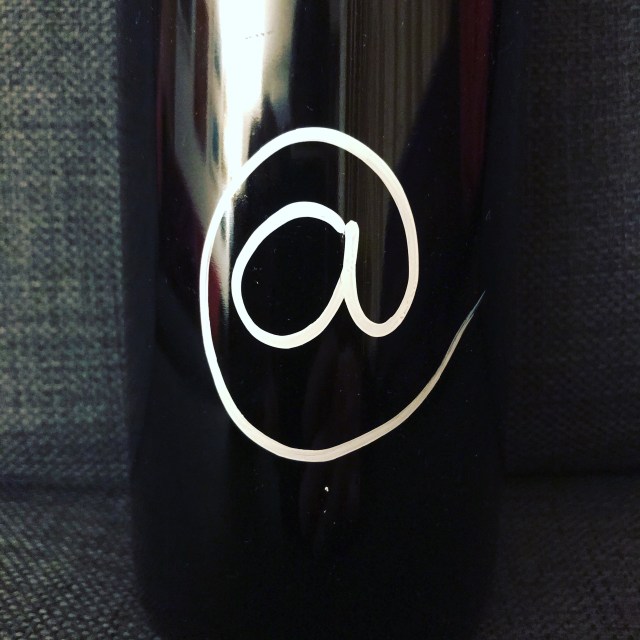
If we are working our way down a list of the unusual grape varieties we have tried I wonder how many of us would get to Pintaillo? Among Spain’s many obscure autochthonous grapes, Pintaillo (also spelt Pintailla by Bodegas Gratias) is very obscure indeed. It grows not on its own but co-planted among the Bobal in Manchuela, and it isn’t very easy therefore to make a single varietal wine from it, but that’s what Bodegas Gratias does. It turns out that the effort is surprisingly worthwhile. It’s worth explaining that the “@” symbol you see on the label is called an arroba in Spanish.

It also turns out that Pintaillo/Pintailla was planted on Manchuela’s poor chalky soils for a reason. Bobal is quite prone to late frosts, but Pintaillo is a more hardy variety, so it’s an insurance policy. Not much of one because they are only able to make a small number of bottles, 560 of them in 2018. The juice is therefore fermented in small 500-litre containers and then is gently pressed into demijohns. It’s a completely natural wine with no additions.

You may not have come across this variety before, I certainly hadn’t, but it’s quite remarkable. Pale red in colour from minimal skin contact and gentle pressing, it has fresh acidity, and red raspberry fruit to the fore. That raspberry is so amazingly concentrated, though there’s also a herbal element sitting beneath the fruit. Tannin?…well maybe a tiny bit. I was very much taken with it. Sadly it is currently sold out, but it was well worth £30 from Solent Cellar(Lymington). In an order which arrived yesterday I grabbed a bottle of the same producer’s Bobal.

c6cb8ffd-4730-4883-a1f9-e3eef6cc9d4c

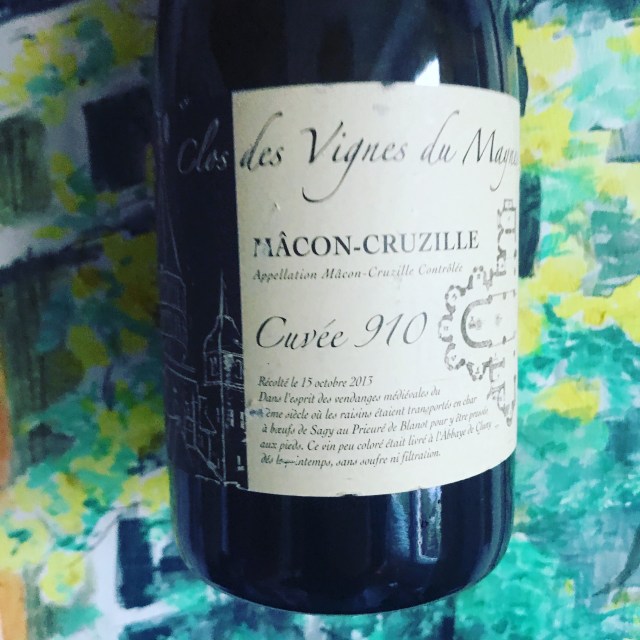
MÂCON-CRUZILLE “CUVÉE 910” 2013, CLOS DES VIGNES DU MAYNES (Burgundy, France)

I suppose one could justifiably call the Cuvée 910 legendary. The Guillot family set out to make this Mâcon red from Gamay and Pinot Noir in an old clos that has reputedly never seen synthetic chemicals, and where the vines have been propagated by massale selection. Julien Guillot’s intention was to vinify this cuvée as it would have been in medieval times, when the wines from this site were made by the monks of the great Benedictine Abbey of Cluny.

Founded in 910 CE but now largely a ruin, albeit a rather large one, Cluny can properly be described as the beating heart of Burgundian, and perhaps even European, viticulture. It was partly as a reaction to the luxurious life of the inhabitants of Cluny that the Cistercian Order was formed indirectly, from one of Cluny’s satellite abbeys (Molesme), by Bernard of Clairvaux in 1098 CE. The Cistercians followed a shall we say more pious regime, where hard agricultural work was central. I think we all know the rest of the story, the monks of that first Cistercian monastery at Cîteaux (near Dijon) spreading the vine around Europe, re-establishing more intensive viticulture following the retreat of Rome and the so-called Dark Ages.

The gimmick perhaps is that not only is this wine made completely without any additions or manipulations, including no added sulphur, but the grapes are transported to the winery on a bullock cart, to mimic the oxen of old. After that they are foot-trodden. But obviously, oxen aside, the important thing is whether the wine’s any good, and it is very good indeed, always. I tend to buy this every few years and it has always been excellent, with the proviso that it does taste more “natural” than some natural wines from Burgundy. I don’t mean volatile, or faulty, but perhaps a little on the edge at times.

Purity is what we concentrate on with Cuvée 910. Purity of fruit. If I say the wine has an edge, it is certainly very much cleaner than when the Cluniac monks made it, so you don’t need to be concerned. Remember too, this is a 2013, but it doesn’t taste at all old. The fruit purity comes through unhindered. That fruit is raspberry and strawberry, light on the palate and tingling with energy. You have that “is it Pinot, is it Gamay?” feeling. Biodynamic brilliance, perhaps.

This bottle was purchased at Fromagerie Vagne in Poligny (Jura).

710ccc06-7590-4ded-a536-f0b223ae6795

CÔTES DU JURA CHARDONNAY “LES GAUDRETTES” 2015, DOMAINE PHILIPPE BORNARD (Jura, France)

Philippe Bornard was not all that long ago one of the new names in Pupillin, the village just outside Arbois made famous by Pierre Overnoy and Manu Houillon. Philippe’s father had previously sold his grapes to the local co-operative, but it was Overnoy who mentored Philippe when he decided he wanted to begin bottling himself. Winemaking at the domaine has recently been taken over by Philippe’s son, Tony, who has started to gain a fine reputation in his own right, but his father, Philippe, had certainly established Domaine Bornard as one of the finest domaines, not only in the village but in the region.

Les Gaudrettes is an interesting wine which I’ve had many times from several vintages. I’m also led to believe that this wine has also appeared bottled as a Vin de France, from the same vintage, which I have also drunk under that label. I won’t deny that it has a different effect on different people, very much depending on your reaction to natural wines. It tends to be a “marmite”, or love/hate, reaction. Whilst I am absolutely in the “love” camp, and am a big fan of Philippe’s wines, I can see why some might wonder how it managed to gain the appellation. I have even wondered that myself.

Can you tell it’s Chardonnay? Well, yes, but it is very much in that lighter, fresh apple, spectrum. I say lighter, but it comes with a remarkably well disguised abv of 13% in 2015. Some might think it more reminiscent of cloudy apple and pear juice with maybe a hint of hazelnut forming a base. The limestone and marl soils give it a particular minerality and the lees give it some texture. The acids are are zippy, and the wine is nothing but pure glou. It’s just so refreshing…yet alcoholic. What not to adore, open your heart and soul.

Bornard is imported by Les Caves de Pyrene.

74aec647-ccde-4a9d-99ee-0eba90904e88

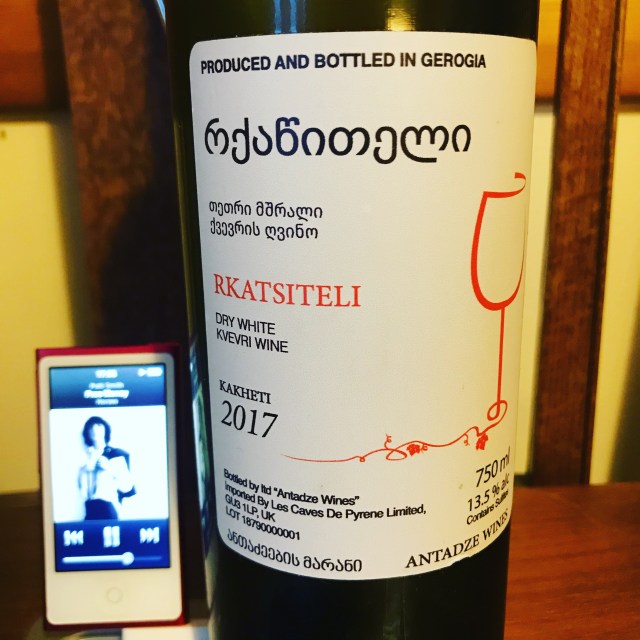
RKATSITELI 2017, ANTADZE WINES (Kakheti, Georgia)

Niki Antadze makes wine at Manavi in Georgia’s eastern region of Kakheti, where qvevri winemaking is at its most traditional, and indeed Niki is one of the people central to both keeping alive this ancient winemaking tradition, and ensuring not only its survival but its journey out into the world. He farms around three hectares of Rkatsiteli, Mtsvane and Saperavi at around 750 metres asl. The vines range between fifty to one hundred years old, all farmed organically, without additives.

Although we read about people like Joško Gravner in Italy, and John Wurdeman’s Pheasant’s Tears in Georgia itself, Niki Antadze along with a handful of others have been equally instrumental in promoting Georgia’s traditions to the outside world. It’s why wine has gained a sixth category after red, white, pink, sparkling and fortified: orange wine. He has also made wine with Laura Seibel from the Jura, who I first met when she worked for Domaine de la Pinte in Arbois. Actually, Laura has a habit of involvement with some really interesting wine producers, and if you see her name it’s well worth exploring the wine.

This is a classic example of Georgia’s best known white variety vinified in qvevri (or “kvevri” as I think Niki likes to spell it). Although it’s a skin contact wine, around 80-to-90% of the grapes are gently pressed and the remainder go in as whole bunches. The result is stone-fruited, with citrus, but majoring on texture. It’s mellow and smooth and I think it would easily age further. I think I probably opened this at the beginning of its drinking window, but it’s already showing depth. It’s certainly one of the finest Georgian wines you will come across, though I should say that the wine is unfiltered and therefore liable to be cloudy. As with many such wines, I think it actually tastes best with the sediment disturbed, but that’s a matter of personal taste.

Imported by Les Caves de Pyrene, who sell the widest range of Georgian wines in the UK.

Major typo alert…see label…

7bdcfe0c-7e72-4a97-8849-2a178ede7be9

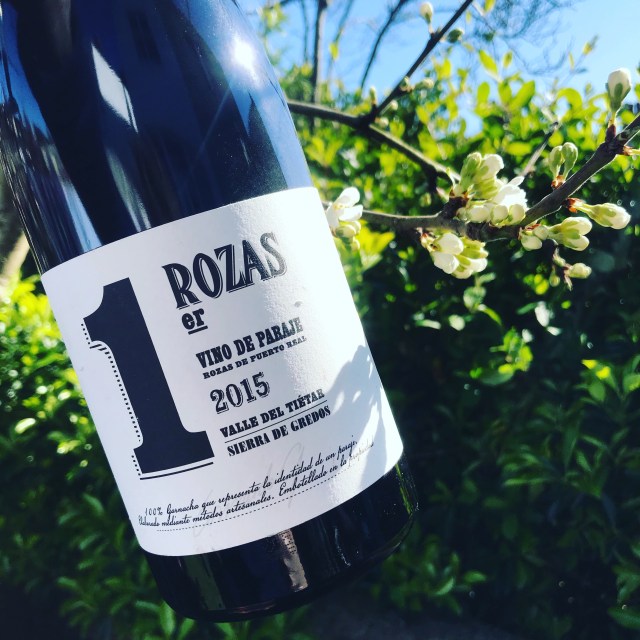
ROZAS 1er 2015 VINO DE PARAJE, VAL DEL TIÉTAR, COMANDO G (Gredos, Spain)

Comando G is one of the projects instigated by friends Daniel Gómez Jiménez-Landi and Fernando Garcia (along with Marc Isart, but he has since gone his own way, though not through any disagreement) in what these amigos have made, more than any other winemakers, one of Spain’s most exciting viticultural regions this century: the Sierra de Gredos.

What the Gredos Mountains have become known for is very fine Grenache. There are several things which make Gredos Grenache special. First the mountains themselves, especially the altitude. Most of these old bush vines begin to grow at the 600 metre line, and go up as far as 1,200 metres. The soils are mostly on hard granite (with some clays and sand). But when the grapes come in they are fermented as whole clusters, so that when you taste these wines you sense altitude, granite and a particular type of winemaking which emphasises freshness and pure fruit. I talk about purity a lot, I know, maybe it gets a little boring, but these are quite without doubt some of the most pure fruited wines you can taste, from anywhere.

Dani and Fernando have adopted a kind of Burgundian heirarchy for their cuvées. At the base of the pyramid you have the regional wine, then the village wine. Above this there’s Premier Cru and the tiny production “Grand Cru” bottlings which are truly out of this world.

This wine, clearly a “1er”, comes from the village of Rozas de Puerto Real in the Valle de Tiétar (one of the two major rivers which have cut their valleys through the Gredos Mountains). The vines for this particular cuvée are planted at around 900 metres asl. The wine combines a smoothness with just a little bright mineral texture. Whilst the palate shows really explosive strawberry fruit, the bouquet is subtly floral with violets. I would say that this really is the Comando G wine to go for in terms of value for money, possibly the closest to the so-called Grand Crus, yet in some cases at almost half the price.

I would recommend looking out for the 2016s from Comando G, which are perhaps even better, and I was also able to taste a range of the 2017s and 2018s at Viñateros in London earlier this year. The Rumbo Al Norte 2017 was sensational, although you will pay near enough £200 for it. The village wine, La Bruja de Rozas, can be had for as little as £22 and I think this 1er Cru was perhaps £30+.

Les Caves de Pyrene imports Comando G, but it is also worth noting that Dani Landi’s own Las Uvas de la Ira project is imported separately by Indigo Wines.

77786909-7dd6-4a4e-8831-5479c70218af

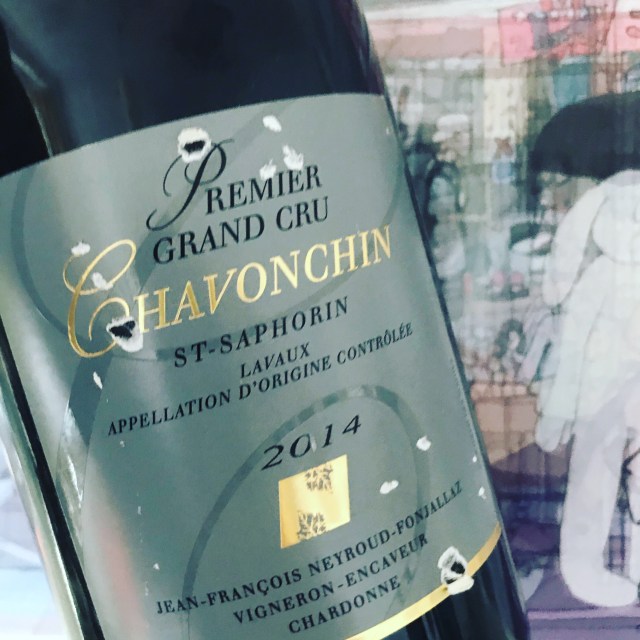
SAINT-SAPHORIN “CHAVONCHIN” 2014, J-F NEYROUD-FONJALLAZ (Lavaux/Vaud, Switzerland)

St-Saphorin is one of the Crus of Lavaux. Situated between Lausanne and Montreux on the northern (mostly) Swiss shore of Lac Léman, these UNESCO World Heritage vineyards are amongst the most stunning in Europe, narrow terraces cascading down steep hillsides into the water below. The lake acts as a big heater, just like the Mosel in Germany or the Douro in Portugal, radiating warmth and reflecting sunlight onto those slopes in what otherwise would be a cold sub-Alpine climate.

The grape variety here is Chasselas. This is neither the first time, nor will it be the last, that I will point out how Chasselas unfairly (in my view) gets a really bad rap. I will accept that quite a bit of Chasselas from Switzerland is over cropped and quite tasteless (it makes around 60% of Swiss white wine), and some of the most guilty wines come from the Canton of Vaud. Yet those who dismiss the variety out of hand really don’t show they have tasted very deeply. If yields are kept lowish by artisan winemakers it has an uncanny knack of reflecting its terroir.

Saint-Saphorin is grandly described as one of the “Premier Grand Cru” villages of Lavaux, and whilst such a description might appear uncharacteristically boastful for the Swiss, it is fine terroir. According to José Vouillamoz it is also likely the variety’s place of birth (there’s a Consevatoire Mondial du Chasselas preserving the variety’s clonal diversity at nearby Rivaz, and as this is Switzerland there’s a well signposted trail through this conservatory).

If there are two kinds of Chasselas, the distinction is between thirst quenching versions to drink as soon as it’s bottled, and wines intended to age. This wine is the latter. The producer, Neyroud-Fonjallaz, is based in the very nearby village of Chardonne. This wine is straw-scented with citrus and herbs. It’s USP is not fruit, but a dry mineral texture. Its mellowness would probably lead some to think it not exciting enough. For those who appreciate subtlety occasionally, this would be of interest. As you know, I’m always keen to proselytise in favour of Swiss wines. If Switzerland’s finest wines come largely from the Valais, Lavaux also has a lot to offer, and you can easily get to these vineyards (including Rivaz, for the Conservatoire and Vinorama, see below), as a day trip from Geneva, including by train if you have no car.

I purchased this at the Lavaux Vinorama, a modern vinoteque tasting room (also at Rivaz, Route du Lac 2) not far from the Conservatoire. They do have a very wide selection of Lavaux wines and various tasting packages. If you like rare grape varieties then try to taste some Plant Robert, a version of which is also made by this producer.

e61b6144-8476-48fa-abc9-f6ae2d351968

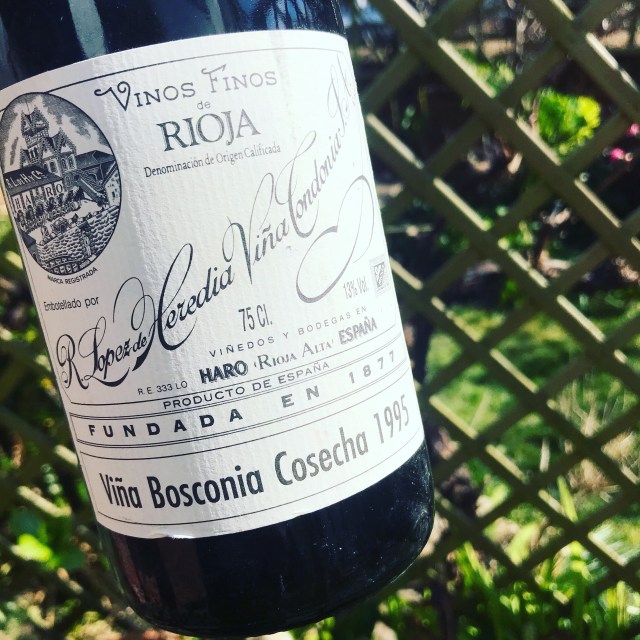
VIÑA BOSCONIA RIOJA GRAN RESERVA 1995, LOPEZ DE HEREDIA (Rioja, Spain)

There’s no doubt in my mind that R Lopez de Heredia in Haro makes my favourite traditional style of Rioja, wines which will age magnificently for decades if stored in perfect conditions. This producer is so old they must be due for their 150th Anniversary before long. However, I have probably drunk eight or nine bottles of their red Viña Tondonia for every bottle of Bosconia, so I was especially looking forward to this, which had been lurking as a single bottle in my cellar for many years.

Bosconia is made both as a Reserva and a Gran Reserva. This GR is a blend of 80% Tempranillo and 15% Garnacha, the remaining 5% a mix of Graciano and Mazuelo, all estate grown. Initially it sees ten years in oak before bottling and then further age before release. Generally it is suggested by the producer that its ageing potential is “more than 10 years”. Not quite as short a period of ageing, I would suggest!

So we begin with the bouquet. The first notes are vanilla, although ageing is in French, not the old Rioja tradition of American, oak barrels. But the oak seems deep within the wine, not top-heavy like an oaky wine in youth, nor indeed like the almost vanilla essence of more commercial Riojas, such as those I remember from the 1980s. There’s fruit here, but that’s not really what this wine is about. It’s cherry fruit, but it’s kind of clafoutis cherry with that hint of alcohol. There’s a tiny woody note too, possibly a well seasoned log, or a roll-up, not that I smoke myself.

This is just so smooth and complex. It has fresh acidity and although the tannins are low, it’s not mature by any means. This will go years if not decades. I wish I had a couple more bottles to be honest. But saying that, it might well be the finest classical wine I shall drink this year, or close. Such an impressive bottle. I genuinely cannot recall where I bought it. Possibly The Sampler?

a78930a0-f77b-4056-bbc3-c2acd5aabc72

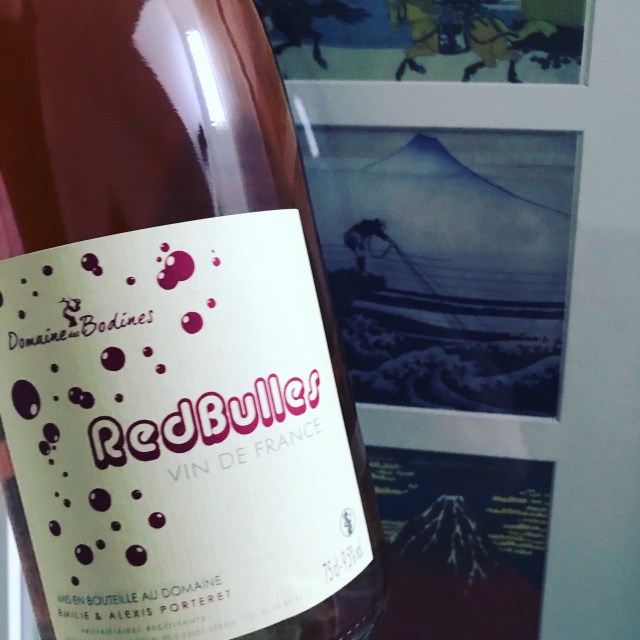
“RED BULLES” PETNAT, DOMAINE DES BODINES (Jura, France)

I would say I’m one of Alex and Emilie Porteret’s biggest fans and before I had ever drunk any of their other wines it was this delicious Pétnat which had started my journey. Ironically, on the occasions I’ve visited Domaine des Bodines, right on the edge of Arbois, on the road to Dôle, they have never had any Red Bulles to sell. Thankfully one of the shops selling natural wines in Arbois or Poligny generally has had a bottle or two left. This young couple farm a mere three hectares, most of it literally in their backyard.

The first vintage at Bodines was only in 2011. Neither Alexis, nor Emilie, had worked in wine before but Alex had mentored for a couple of vintages with Pascal Clairet at Domaine de la Tournelle, and he was working part-time for Domaine de la Pinte until just before I last saw him in December 2018, before a full-time shift to Bodines. La Pinte was the first biodynamic domaine in Arbois, and Alex would love to be fully biodynamic, but for now he’s content to have fully converted their vines to organics. They have been experimenting with horse power in their home vineyard, though Emilie did tell me it was proving surprisingly expensive. There have certainly been some small harvests here, due to hail and frosts, in recent years but the wines all continue to impress me so much.

The name of the Pétnat is accurate enough, the wine being (pale) red and bubbly! It’s made from Poulsard grapes, which give that almost luminous light red colour which people never fail to remark on before anything else. The bubbles are plentiful, and they hit the nasal passages in a riot of fresh raspberry, pomegranate and cranberry. The palate has a dryness very reminiscent of pomegranate juice, with its slightly firm finish.

Most noticeable is the spine which runs through the wine, like brittle glass that will not shatter. The acidity is quite emphatic, but it is such a refresher. I do wish it was bottled in litres or magnums, and it is after all only 9.5% abv, so you could share a magnum between two without cause for concern. I do love Bodines, and I’m sure that as well as the quality of the wines here, it’s partly because of the warmth I sense in the family too. They remind me somehow of the Koppitsch family at Neusiedl in Burgenland.

This bottle would either have come from Vagne in Poligny or Les Jardins de St-Vincent in Arbois.

1321fa57-053d-45ec-b9f9-fac547ee5d8e


Posted in Artisan Wines, Natural Wine, Wine | Tagged , , , , , , , , , , , , , , , , , , , , , , , , , , , , , , , , , , , , , , , , , | Leave a comment

Littlewine with Big Ambitions

As the Lockdown in Europe continues towards its second month my guess is that many, perhaps most, readers will have begun to find it quite normal behaviour engaging with wine on an online platform. Like me, you will perhaps be joining in with Zoom events, Crowdcasts and even more likely via the dozens of Instagram live broadcasts, as indeed I’ve written about here, as a way of keeping in touch with your favourite wine merchants and the producers of some of your favourite wines. Maybe you already chat on one of the long-standing wine forums too.

On 1 April something new arrived, something which was not just swiftly brought about as a result of the Coronavirus pandemic, but which had been in the pipeline since two entrepreneurial wine trade professionals had an idea back in January 2019. That idea has become Littlewine, or more precisely littlewine.co .

LW_homescreen

Littlewine describes itself as “your online destination for exploring the story behind the bottle”, but it indeed promises much more than that. Since January last year Christina Rasmussen and Daniela Pillhofer have been working on what could be the most exciting wine web site, at least for people with my tastes, for very many years.

Christina had been working for Westbury Communications, and as a freelance writer with considerable travel notched up around the world’s wine regions, as well as more recently having made wine too. She has some of the widest connections in the trade of anyone I know. Daniela had been one of the founders, with Peter Honegger, of Newcomer Wines. They had begun importing Austrian wines, initially selling them from one of the shipping containers that formed Shoreditch Boxpark before moving out to premises at Dalston Junction. Here, along with their bar-style restaurant and import business they developed one of London’s most exciting wine shops.

Daniela Pillhofer and Christina Rasmussen

Both Christina and Daniela’s passion was not merely for wine as such, but for the kind of wine that is made in partnership with, not in conflict with, nature and Mother Earth. This is exactly how my philosophy had evolved over the years. I became an enthusiastic customer of Newcomer Wines, who happened to import almost all of my favourite Austrian new wave producers, and at the same time I was becoming, as an emerging writer, a frequent visitor to the events Christina was organising. I say this because I’m going to sound pretty impressed with what these two ladies have come up with but I suggest you head over to the site to check it out for yourselves if you doubt my objectivity.

The Littlewine platform aims to combine education and e-commerce. The focus is firstly on what the founders call “mindful winemaking”, which basically means a low-intervention approach to viticulture and vinification, and the creation of what I guess many people might call natural wine, although if this term is used on the site I’ve yet to spot it. As I said before, all the winemakers featured on the site make wine through working with nature, not against or at war with it.

SaveOurSoils_Meinklang_Biodynamics

Biodynamics at Meinklang (Burgenland)

The overall aim is to bridge the gap between “the farmer…and the consumer”. The web site aims to do this via editorial (part of the site’s free content) and via winemaker features and recorded interviews, but also via the media of audio and film. High quality mini-documentaries will feature as core parts of the subscriber “access all areas” content on the site. From what I’ve seen of the film clips so far, they are informative, but equally artistically pleasing, and innovative too. Perhaps only Jonathan Nossiter, in his film length documentaries, comes close to what Daniela and Christina are trying to achieve. Of course the production values are similar to those of the promotional videos for any major winery, but in this case with editorial independence.

A quote from Christina sums up what they want to achieve pretty well: “Learning about wine shouldn’t be like going back to university; it should be more like watching David Attenborough on TV!”.

RedWine101_AlicanteBouschet

The editorial content sets out to promote knowledge for everyone from the novice to the professional, and indeed for the philosophers of wine among us, through “Out of the Box” articles to come. Whilst much of the content will be provided by the founders, principally by Christina as Head of Content (who also directs the films), a number of experts are lined up  to make contributions as well. These include Jamie Goode, Rajat Parr, José Vouillamoz and Aaron Ayscough, all of whom could be described as being among the very best in their particular field.

The core content behind the paywall will consist of a number of winemaker profiles. Featured winemakers already include Pierre Cotton (Beaujolais), J-F Ganevat (Jura), Jaimee Motley (California), Claus Preisinger (Burgenland) and Silwervis (Swartland). The aim is to add two winemaker profiles (with interviews etc) every week, creating one hundred profiles in the first year. There are said to be 300 winemakers lined up for future inclusion.

The all access pass will cost a seemingly very reasonable £24-per-year and this will unlock exclusive content. You will be able to meet the winemakers through narrative, audio and film, as well as joining global events such as webinars. Additionally, there will be exclusive wines in the online shop.

The Littlewine online shop will sell wines, presumably largely but not exclusively, from the featured winemakers. In fact having checked out the online store, as well as several wines from each of the winemakers mentioned above, there are also bottles from Christoph Hoch, Anne-Sophie Dubois, Angelino Maule, Selvadolce and Raphaël Saint-Cyr, but I get the impression these will be added to. I think the idea is that rare cuvées and bottlings will be available to subscribers, with perhaps some wines even being exclusive to Littlewine.

“Fanfan” and Claus

Although there will, as I have already suggested, be information useful to novices, the main target audience is certainly those with a firm interest in the subject. This includes what they call “ambitious wine professionals, curious wine consumers and inquisitive winemakers”. Together these people will create a likeminded wine community, somewhere for everyone who effectively believes in the ideals of low intervention wine.

Who knows, perhaps one day the site will also develop a members online forum, a kind of cross between Winepages and Purple Pages but without the negativity, even occasionally aggression, towards natural wines that some more general wine fora can exhibit. Maybe there will be “offline” get togethers (tastings perhaps), even vineyard trips. Such speculation is for the future.

I think I can begin to conclude my mere introduction to Littlewine by quoting the words of Daniela Pillhofer. She says that the site will “highlight the people who deserve more attention”. This statement goes to the heart of the Littlewine philosophy. Small is beautiful. Making artisan wines, not wine on an industrial scale, is what this resource is all about, and it supposes that those who choose to go down this path as consumers will naturally be interested in a certain level of detail hitherto unavailable in one good source.

With a blend of editorial guidance and our own research we will, I hope, become more educated as to the methods and philosophies behind some of the world’s great artisan wine producers. It is a little ironic that Littlewine has been released at this time. I don’t mean simply because it provides us with yet more online content at a time when we perhaps have a little more of that precious commodity on our hands.

What I mean is that we have reached a point where those of us that were beginning to question certain ways of living are starting to think more seriously and more urgently about what we do with the rest of our precious time on earth, and what we can do in order to ensure that our generation begins to bring our planet back from the brink of destruction, at least as regards our own species’ survival along with that of our planet’s great biodiversity.

Certainly one of the obvious places to start is with what we consume, and a key part of that aspect of our lives is what we eat and drink. Drinking wine made with as little impact on nature as possible is pretty easy to achieve in 2020, in some ways perhaps easier than with what we eat (though I am not ignorant of the fact that it is the kind of choice that the privileged and reasonably affluent are able to make much more easily than most people).

At the time of this great global pandemic, perhaps Littlewine, in respect of one small part of our agtriculture, is here to give voice to a way forward which perhaps we should all embrace. Do check out what is on the site already. The free content should give some idea of whether you feel inclined to invest the moderate annual subscription for the access all areas pass. Personally I shall look forward to further exploration over the coming months and to seeing how this resource develops.

Littlewine’s free content can be accessed here. Subscriptions currently cost £24 per year.

All photographic materials in this article courtesy of Littlewine.

OLYMPUS DIGITAL CAMERA

Posted in Artisan Wines, biodynamic wine, Natural Wine, Wine, Wine Writing | Tagged , , , , , , , , , , | Leave a comment

Recent Wines March 2020 (Part 1) #theglouthatbindsus
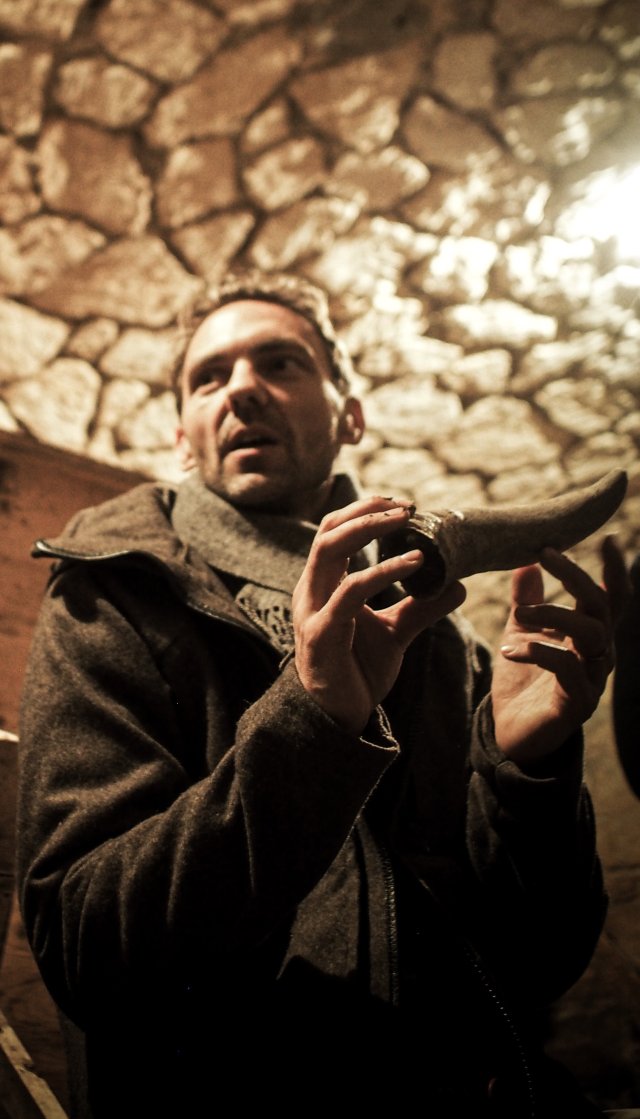
Right now we seem to be drinking more at home, I wonder why? Actually, although the current clampdown seems to somehow encourage drinking, we have tried to rein it in just a little, but as we are not dining out then the “home drinking” has naturally increased a bit. Rather than hit you with all of March’s worthwhile bottles in one go, I thought I’d split it over two parts. So just eight wines to begin with, I hope as eclectic a selection as usual.

CHAMPAGNE VAL FRISON “GOUSTAN” BLANC DE NOIRS (Champagne, France)

Valérie Frison began farming her family’s vines at Ville-sur-Arce on the Côte des Bar in the late 1990s, under the label Demarne-Frison (with her former husband, Thierry de Marne). The estate was renamed only in 2015, but it is ironically since this date that Valérie has come to the attention of the connoisseurs of Southern Champagne. Valérie was mentored, significantly I think, by one of the region’s great growers, Bertrand Gautherot (Vouette & Sorbée).

I believe Valérie only makes three wines and I have never come across Elion, her pink. The two I know are the white wines, Lalore (Blanc de Blancs) and this Goustan, which is 100% Pinot Noir. The former is a single vineyard wine, which I have often cited as my favourite of the two, but I’m lucky enough to have drunk both wines a reasonable number of times and now I can’t be sure I have any peference. Goustan is a blend of parcels.

This bottle was disgorged in March 2016 from a 2013 base. It therefore has seen longer post-disgorgement ageing than it had on lees, but it has aged well. By that I mean that it has lovely matured (softish) red fruits but a distinct minerality which allows it to keep a beautiful freshness. There seems, in a certain light, to be just a hint of red to the colour. In a way it’s a fairly easy going Champagne but it has nice length and lovely acid structure. These wines are not flashy or demonstrative, but they sure are tasty…and indeed this wine made its way through dinner pretty easily, like a Sunday afternoon stroll. Definitely a producer worth seeking out if you haven’t tried them.

Purchased from Les Papilles in Paris.

5fbed91f-a3dd-4af1-9438-eb614833e242

PATRIMONIO VERMENTINU 2018, CANTINA DI TORRA (Corsica, France)

Cantina di Torra sounds like a cooperative, but rather it is one of the labels of Nicolas Mariotti Bindi. Nicolas was a lawyer who changed direction and after stages with people like Antoine Aréna, one of Corsica’s great winemakers, he began to farm and make wine at Oletta, which lies close to Bastia in the north of the island. The di Torra wines come from north-facing slopes, on fairly pure limestone (called locally “carcu”) with a little clay, within the Patrimonio Appellation.

This is classic quality Corsican Vermentino (spelt with a “u” on Corsica) made as a natural wine except for 50mg/litre of sulphur added, but it has a fairly classic profile and taste. Vermentino is often accused of having less flavour than many varieties but despite this wine’s mere 12.4% alcohol, it has a lot more presence than you’d expect. It doesn’t come across as in any way fruity, but instead it is smooth, savoury and saline. The chalky texture blends with moderate acidity and good length to make it a very interesting discovery. Good with fish sounds a pretty bland suggestion, but sometimes if someone spouts such a cliché you can only say “yeah, I know just what you mean”.

A recomendation from Simon at The Solent Cellar.

22bf6834-0402-42f5-893a-e82c123569d9

LE CLOU 34 ALIGOTÉ VV 2017, CLAIRE NAUDIN (Chablis, France)

This Naudin-Ferrand “Le Clou 34” is no ordinary Aligoté, being made principally from a parcel, Le Clou, planted in 1934 (we do get some younger fruit…from vines planted between 1935 and 1953). So old vines means old vines. It’s made simply, fermented in tank. It’s the old vines which make this special, and as a known lover of Aligoté I would suggest that this indeed special. It saw only a light pressing and just a touch of sulphur at bottling.

The result is very mellow, deep and classy, like few versions of this variety used ever to achieve. I would not say, for example, that this is a particularly acidic wine. It does have acidity, it’s just that all its other qualities cause you not to notice it. Fresh and textural more than anything, this is a wine which stands up on its own, irrespective of grape variety, and I’d say it will certainly go another five years if you wish.

Widely available.

image

LANGHE NEBBIOLO “ROSSO DI ROCCA” 2018, ALBINO ROCCA (Piemonte, Italy)

In the first two months of 2020 I’d been lucky enough to drink more than my usual share of excellent fine Nebbiolo, starting on the last day of 2019 with Mascarello (Giuseppe e Figlio) Barolo and finishing just before we were exhorted to remain at home, at the end of February, with Mascarello (Bartolo) and Giovanni Canonica. But you can’t drink the best stuff all the time, and you don’t need to because good producers in Piemonte make a range of wines. This Albino Rocca is a good example.

The wine comes from a vineyard on the left bank of the Tanaro at Magliano Alfieri, with some extra volume from Barbaresco (where Albino Rocca is based), mostly on marls with some limestone and sand. This is mainly Nebbiolo (97%), but with the inspired addition of 3% Cabernet Franc. Clever. Albino Rocca only recently purchased the vineyard in 2016, but some of the vines go back to 1967, undoubtedly adding depth.

Initially this was a little tight, showing some tannins, but the 14.5% abv on the label didn’t seem to show up on the palate (thankfully). The bouquet was uncannily pure strawberry, lifted by a gentle florality. Below the tannins the palate is rich and smooth, no doubt riding on the alcohol to a certain extent. The wine is grounded by a typical savoury side to it. This is an all round excellent value Piemontese.

Just £20 from Solent Cellar.

image (1)

MONDEUSE “LA DEUSE” 2013, GILLES BERLIOZ (Savoie, France)

Gilles is the senior Berlioz at Chignin, currently farming around five hectares of vines, just one of which is planted with Mondeuse. Gilles farms biodynamically (he only received Demeter certification in 2018), and he long ago rejected wood in favour of fibreglass tanks and, recently, eggs.

La Deuse isn’t necessarily what you’d expect from the variety. A clue might be the alcohol content, astonishingly just 9.5% (some vintages it does get a little higher). It does have some depth to the colour, but the bouquet is floral. I won’t lie, I’ve tried other vintages which have had a touch of volatility, though not in this bottle. We are talking strawberry and mulberry with a faint whiff of beetroot! The whole bouquet soars gently, like wood smoke into the Alpine sky.

The palate is fairly delicate, not surprising considering the wine’s age and low alcohol, making it gentle to sip. It doesn’t lack a certain structure though. I may have made it sound slightly unappealing but that is not my intention. I think it’s an unusual wine, yet one that I think people will enjoy and warm to. It’s easy drinking yet with its own personality.

From the 2016 vintage Gilles’ wines are made under the “Domaine Partagé” label, instigated so as to better reflect their philosophy of sharing more than for any other reason.

This 2013 was purchased at The Winemakers Club in Farringdon.

fb337dbd-0377-4c67-aa42-dbb0a1c351e7

GRINGET “LES ALPES” 2016, DOMAINE BELLUARD (Savoie, France)

Two Savoie in a row, quite right too! Dominique Belluard is probably my favourite Savoie producer, and has been for many years. Although the youngest of two brothers originally working at a family estate at Ayze (on the Arve’s right bank, close to Bonneville, as the river flows towards the western end of Lac Léman), Dominique effectively became winemaker in 1986 (he later bought out his brother after their father passed away). Since then he has quietly become known as the saviour of the Gringet grape variety, although he has some Altesse and a little Mondeuse among his ten or so hectares of vines.

The mainstays of the Belluard production are two very fine Crémant sparkling wines from this variety, and two still wines. “Le Feu” is the masterpiece, from a small and very steep slope, whilst “Les Alpes” is the junior wine, a blend of different parcels on marls. The grapes are initially fermented and aged in concrete eggs (some of which are diamond-shaped with a horizontal egg inside). Those winemakers who use these eggs feel the wines benefit from the natural lees circulation that their shape encourages. Ageing lasts one year, and is finished in more classical stainless steel vats.

Wink Lorch, who knows these wines well, suggests that “Les Alpes” begins to open at three years old, and “Le Feu” at five (Wines of the French Alps…2019, Wine Media Travel). That seems pretty much spot on to me. There’s real “alpine” freshness of course, but this vintage is also beginning to develop rondeur and spice notes. The texture is stony, and certainly evokes the terroir. Even though we are not at the pinnacle of Belluard’s range, we have a degree of complexity. It’s a truly beautiful wine. One would call Gringet the forgotten star grape of Savoie, were there not a couple of other contenders. I’ve never been able to buy any of Dominique’s wines made with the other varieties, but the Gringet wines I know well. In all its forms, still and sparkling, Belluard’s Gringets are unmissable.

Imported by Les Caves de Pyrene.

1adfeb6b-b4d7-4ed9-8600-bbb2b20ab2bc

TROUSSEAU DES CORVÉES 2014, DOMAINE DE LA TOURNELLE (Jura, France)

Domaine de la Tournelle sits in the heart of Arbois, tucked away at the top of the tiny Petite Place, close to the Michelin two-star restaurant Maison Jeunet. Here you will find their summer tasting room and their increasingly famous bistrot, where you can sample the domaine’s wines (and those of a few friends) with a cold plat by the river. Evelyne and Pascal Clairet began their domaine in 1991, and it wasn’t that long before I discovered them, initially via their delicious Uva Arbosiana Poulsard.

I saw Pascal recently at the Dynamic Vines portfolio tasting, but I foolishly bought no Tournelle wines in my last Dynamic purchase, thinking I’d be sitting by the river in Arbois this July, possibly chatting with Evelyne over a glass before lugging a box back to the Chambre d’Hôte. Triste.

Trousseau des Corvées comes from one of the better known vineyards just outside the town itself, below the road to Montigny-les-Arsures. As you drive towards that village, as you certainly will wish to if you visit Arbois, or better still, go there on foot through the vineyards, you will see the clay slope of Les Corvées with its rocky limestone here and there peeking through, just below the Tour de Curon, made famous by Stéphane Tissot.

This is paler than some Trousseau, but it is astonishingly vibrant and energetic, tasting like a wine made by a young couple, not (slightly) older hands who have helped mentor and support many of the town’s current stars. At six years old we have a smooth-fruited wine, mature now, yet with its very own wild side. No sulphur is added. This is wonderful “natural” Trousseau, and perhaps it’s the ideal wine (this or Tissot’s quite different “Singulier”) with which to delve into the grape variety for the first time. This bottle of 2014 is right on the button.

Available via Dynamic Vines, or try the wine shop at Antidote Wine Bar (Newburgh Street, Soho).

18c55297-eaf4-4811-98c2-f1296cdc6d3f

VELTLÍNSKÉ ZELENÉČ 2 2017, JAKUB NOVÁK (Moravia, Czechia)

Jakub Novák has a mere one hectare to farm, but you wouldn’t know it as this cult winemaker gets his distinctive labels all over social media. He does buy in a little organic fruit from other producers, but not a lot. He’s apparently a very shy guy who studied under Jaroslav Osicka before establishing himself at Tasovice, and Jakub is a member of the famous “autentiste” group of natural winemakers.

Vinification and ageing is in wood, always a mix of oak and acacia. There’s a period of skin contact, usually a couple of days, but the wine ages on its lees with regular stirring/batonnage for the remaining eleven months of its élevage. You get a bit of colour from the skin contact, stone fruits and more ginger spice than your usual Veltliner pepper. Add to this a touch of richness, creaminess even, from the lees stirring, with a hint of pear, and you get an immaculately crafted wine. Jakub is one of the emerging stars of this fascinating Czech natural wine movement.

Importer: Basket Press Wines.

a798dbc8-e7b9-4081-9672-1460972398b3

Posted in Natural Wine, Wine | Tagged , , , , , , , , , , , , , , , , , , , , , , , , , , , , , , , , , , , | Leave a comment

Isolation Inspiration Part 2: A Glass With…More Moravia

We’ve had Zoom and we’ve had Crowdcast, but by far the most popular form of wine communication during the lockdown is the Instagram broadcast. Some are just random with no scheduled time or content, whilst other originators are trying to keep to a schedule or theme. Even those who are following this better (well, more helpful to we viewers) course are not necessarily doing as much as they could to publicise in advance their plans and schedule.

So a plea from the viewer: we want to see your stuff but contrary to what you might think we are not sitting here watching our phones for something to appear. So please give us some warning. Maybe even put a schedule on your web site, as Newcomer Wines has done for their Kiffe my Wines collaboration Crowdcasts. Heck, they even put up accompanying photos etc to go with the chats.

Last Tuesday afternoon Basket Press Wines broadcast what I hope will be the first in a regular series called “A Glass With…” (now renamed wine banter, I’m informed, because another wine pro has nabbed the “glass with” moniker). The first one to share a glass with Zainab (one half of Basket Press Wines) was Alexandre Freguin, whose main claim to fame, I guess, is that he won the Taittinger UK Sommelier of the Year in 2018. Alex is a very knowledgeable guy, a delight to listen to, and I think he was chosen because he’s actually visited Moravia (lucky bloke).

Billed as “a glass with…”, but actually we got two for the price of one. Alex was sipping on Zdenek Vykoukal’s Cabernet Moravia and Jaroslav Osička’s P.A.N. Both wines are made in part, or wholly, from varieties peculiar to Moravia, and both of the varieties involved make highly creditable wines in the hands of the best producers. The importance of heritage varieties was central to the Newcomer Wines talk on Furmint last week, and although the two varieties involved here don’t have the history of Furmint, they nevertheless deserve to find their place in Moravian viticulture.

Cabernet Moravia is a crossing between Zweigelt and Cabernet Franc, both seriously under rated varieties in their own right. Vykoukal is a station master by day, but tends a small 1.5 hectare vineyard, growing Grüner, Chardonnay, Neuberger, Riesling, St Laurent, Pinot Noir and Cabernet Moravia. The soils are almost pure limestone, which comes through magnificently as brightness and salinity. Add to this a flavour profile which is fleshy and juicy and you have a genuinely lovely wine adding a point of difference to the better known varieties in the region.

The vineyard’s site is pretty close to the location of Austerlitz, that bloody battle in the Napoleonic Wars where France’s Grande Armée defeated Russia and Austria (a battle cited as a tactical masterpiece by Napoleon, glossing over the fact that more than 100,000 men died in a day).

Next up we had one from the master. Jaroslav Osička is the godfather of modern Moravian low intervention viticulture and winemaking, having taught for thirty years at the local wine college. He’s one of the region’s mavericks, but in a good way, and his intuitive experiments have only taken the region forward. “P.A.N.” is a blend of Pinot Noir with André. This latter variety is so unknown, so rare, that it doesn’t even get its own Wikipedia entry, but it’s a 1960 crossing between Blaufränkisch and St Laurent…and it has a lot of potential. It takes a winemaker as intuitive as Jaroslav to recognise this.

Zainab called this wine a dance between Syrah and Pinot Noir, an interesting combination in itself, which I have, albeit rarely, seen in Victoria, Australia. Such a crossing is hardly that unusual, considering that we have Austria’s Weinviertel region just south, across the border. The wine itself is imprinted with cherry-like concentration which makes it an ideal bridge between preprandial glugging and food.

img_9259

These are relatively inexpensive wines, which retail direct from Basket Press for £21.50 and £16.50 respectively, and both would sit nicely in a selection from this Czech Wine specialist who is currently selling direct to private customers with a free delivery offer during the pandemic lockdown. Everyone who knows these wines I think sees them as Central Europe’s hidden gems. They show how far Czechia’s winemaking has come since the Communist era. This must primarily be down to the respect for the soil (ecology), and the vine (Moravia is a beacon for high quality grafting) which seems in-bred into these low intervention producers.

If Basket Press is to keep up the high quality of their broadcasts they will have to work hard to match this excellent chat, but on Thursday they went on a different tack, taking us to the beautiful home, the 14th/15th Century fortified farm of Sudkuv Dul, in the Josafat Valley in the north of Czechia, and Utopia Ciders. The spiel goes along the lines of “ciders like you have never known before – undisguised by forced carbonation and sweetening, addition of enzymes or additives”, and for once the hype is accurate.

Ivo Laurin and wife, Eva, don’t only make small batch artisan ciders, they live the dream in an idyll where they have geese, carp and sheep as well as their orchards. Their apples are mostly Czech heritage cider varieties, although they have planted some English seedlings as an experiment. I’ve written about Utopia recently, so I won’t repeat much of what I’ve said. There are four ciders, each retailing for £16.50, of which thus far I’ve tried only one (“Johanna”). I think the best way to describe these is to suggest that you approach them as if they had more in common with a natural wine rather than a traditional cider. They also make an ice cider (apple icewine), which I haven’t tasted, although I’ve tasted these from Quebec and they can be stunningly concentrated.

img_9248

What this kind of Insta broadcast hopefully brings to the table is to enable us to be transported to somewhere beautiful. Indeed, this would have proved a perfect bit of escapism had not my internet kept dropping out (all of a sudden dozens of people working from home in my road), plus being on cooking duty (when the screen looks so beautiful you do have to be careful with the Henckels, you don’t want a trip to the emergency department right now). But I saw enough to enjoy a different kind of “wine online”, a little bit of vicarious travel.

On Tuesday 7 April (tomorrow, 5.00pm) Zainab will be having a glass with, oops, I mean some “Wine Banter” with one of the UK’s most dynamic sommeliers, Ania Smelskaya. Ania transformed the list (both wine and cider) at the UK’s most cutting edge restaurant, Silo, first at their original home in Brighton and then at Silo’s new home in East London. Can’t wait, despite the inconvenient time slot for busy home chefs. I’d probably say that if you might consider tuning in to any of Basket Press’s broadcasts, then choose this one. Ania has known these wines for even longer than I have.

Last Friday Nekter Wines continued with their series of tastathons on Zoom with Keep Wines’ Jack Roberts and his wife JJ (Johanna Jensen). Jack was until recently Assistant Winemaker for the Matthiassons and JJ was with Broc Cellars and Abe Schoener’s Scholium Project. Everyone was tasting their Keep Wines Vermentino, but I’d opened their gorgeous Counoise 2018 (not just to be perverse, it was a far better match for the exquisite cottage pie my wife was cooking). I’ll give you a tip. Keep Wines, and indeed Benevolent Neglect, make amazing Counoise and they are both rather tasty. This new vintage 2018 Counoise from Keep is just so good and I can’t recommend it highly enough.

Wednesday afternoon at 3pm sees the return of the Newcomer/Kiffe Crowdcasts with Jutta Ambrositsch et al explaining what it’s like to make a career change to winemaking. For me personally, unmissable.

Posted in Cider, Czech Wine, Wine, Wine Agencies | Tagged , , , , , , , , , , , , , , , | Leave a comment

Isolation Inspiration Part 1: Furmint Crowdcast from Newcomer and Kiffe

I wrote earlier this week about the Zoom event hosted by Nekter Wines last Friday, an enthralling conversation with Steve Matthiasson focused on his Linda Vista Chardonnay 2017. It was the first of a series of Friday night slots from Nekter, and for me I think they’ve bagged the eight o’clock slot, unless BBC4 comes up with a documentary on contemporary Sludge Metal, or the Cleveland Scene. It was my first Isolation on-line event, and doubtless not the last.

In fact the websphere is alive with wine companies (importers, wine shops, journalists) all vying for our attention as they try to remind us of their existence. The best of these are proving to be of immense educational value. For some the technical issues still need to be overcome, and for some a little media training might help, but these are minor quibbles. I don’t plan to give you endless roundups of what is going down every week, though maybe some of these will get another plug when they have something especially interesting on.

I want to tell you about two events, very different to each other, and rather than write about them together, for this reason I’ll keep them apart, in two very short pieces (unusually short for me, you may be pleased to hear). The second will be on an Instagram broadcast in an emerging series called “a glass with…” from Basket Press, who I wrote about very recently covering a tasting held for wine bar/shop customers in Brighton. But here, I’m going to flag up the weekly series of Crowdcasts presented as a collaboration between Newcomer Wines and Kiffe my Wines. These will all take place at 3.00pm on a Wednesday afternoon (on the Crowdcast platform). I’ll print the schedule in brief here, but head to the Newcomer web site for more details.

  • What’s Old is New (Furmint and preserving heritage varieties) (which took place this week, see below);
  • How to become a Winemaker (Changing careers) – 8 April;
  • Back to Basics (Slow winemaking) – 15 April;
  • Jack of All-Trades (Winemakers who do everything) – 22 April; and
  • The Art of Balance (Winemaking as a physical, intellectual and political pursuit) – 29 April.

Reasons to look in? Each chat takes place with three winemakers. Next week (8 April) includes one of my wine inspirations, Jutta Ambrositsch (Vienna). Christian Tschida is a “jack of all trades”, doing it in his very unique style, and Rudolf Trossen is joined by Tom Lubbe (so long as we don’t have to wait for him) and Claus Preisinger for the political one at the end of the month (juicy).

It’s probably worth noting that some events on the web involve tasting a wine which you have bought in advance, and Peter Honegger of Newcomer Wines was very keen to make these chats open to people without any prior purchase, so if you are interested in these particular Crowdcasts, don’t be shy.

img_9391

Top left clockwise – Pierre Ménard, Peter Honegger, Michael Wenzel and Franz Weninger

Now I’m guessing most readers won’t be world authorities on Furmint, but there were three good reasons to tune in: the winemakers. We had Michael Wenzel (Austria) and Franz Weninger (who makes wine in Austria and Hungary), who both brought an interesting perspective to the grape. Michael was able to talk about the history of Furmint in the area around Rust, on the western shore of the Neusiedlersee, where it was once famous for Ruster Ausbruch. This sweet nectar was so famous in the pre-refined sugar days of the 17th Century that Rust became a Royal Free Town, and I’d recommend visiting (as I have written before) for several reasons, not least for its chocolate box, Mozart-era, houses, and the storks which nest on the chimneys thereof.

img_9389

Rows of Furmint slope towards Austria’s shallow Neusiedlersee

Furmint had disappeared from this part of Burgenland by the late 20th Century, but in 1984 Michael’s father managed to smuggle some cuttings through the iron curtain, doubtless by the route I have cycled down, because Austria’s border with Hungary is a mere half hour by pedal power down the road from Rust. Planted in 1985, the first Austrian Furmint of the new era yielded a crop in 1987.

img_9386

Ripening Furmint

Franz Weninger is replanting Furmint in once-famous Hungarian sites which had been abandoned after the Second World War. His father purchased vines in these historic vineyards near Balf, in the Sopron region, when Hungary first began to open up after the Communist era and the fall of the Iron Curtain.

It is interesting that Sopron is considered the birthplace of what we all assume to be an Austrian variety, Blaufränkisch, known in Hungary as Kékfrankos (though of course once part of Austria-Hungary, borders did not exist here for centuries). I mention the Blau-one because Furmint, like Kék-fränkisch, is very much influenced by geology (Susceptible to terroir is how they put it). Burgenland and much of Southeastern Austria has limestone, chalk and slate. Sopron is mainly Gneiss and Mica-Schist, quite different. This makes Furmint perhaps, to a degree, a white sibling for Blaufränkisch, which is also famously susceptible to showing the character of its terroir in the glass.

And then we had Pierre Ménard, who grows Chenin Blanc in Anjou. This is where it really gets interesting. Not only does Pierre see some synergies and comparisons between Chenin and Furmint. Not only has Pierre worked with Furmint in Tokaji. He also said that there is some Furmint planted in Roche aux Moines. That struck a bell with me and I’m sure I’d read this many decades ago, most likely in an old catalogue from Loire specialist, Yapp Brothers.

img_9390

Pierre’s Chenin Blanc vines in the Coteaux de Layon

img_9387

Shrivelled berries – Ruster Ausbruch Furmint or Coteaux de Layon Chenin, who can tell?

Newcomer had the foresight to put some materials up on their web site to accompany the event, comprising documents, photos and even mention of the Furmint variety in an old French wine book. This is where I stole the photographs from in this piece. I’ll leave you to imagine the chat and interplay between the participants, chaired by Newcomer Wine’s Peter Honegger.

If I am wholly honest I have a personal preference for the Zoom platform. One of the advantages of Zoom is that it can be a fully interactive conference. All the participants appear on screen, and with a microphone we can contribute to the discussion. As with an Instagram live feed, on Crowdcast you can make comments and pose questions by typing them, but it relies on a moderator to engage with what you are saying. That said, this is a minor point of preference, and when a great discussion is underway the Crowdcast format still allows for just as entertaining and educational discourse.

Full details of how to participate in Newcomer and Kiffe my Wines’ future events are available on the Newcomer Wines web site (newcomerwines.com). I shall be trying to catch up on as many as possible, hopefully all of them. As I intimated earlier, I shall look forward to next week’s discussion, and the final Crowdcast will be pretty unmissable, I think. If you follow the events link you might find a very nice short YouTube excerpt about Jutta Ambrositsch, as I said, one of the subjects of next week’s conversation.

img_9388

Tonight I shall be drinking Keep Wines Counoise (Napa Valley) and hopefully joining a Zoom conversation with Jack and Johanna at 8pm. Time flies in Lockdown.

Posted in Austrian Wine, Grape Varieties, Hungarian Wine, Rust, Wine, Wine Agencies | Tagged , , , , , , , , , , | 2 Comments

Luis Gutiérrez “The New Vignerons” (Book Review)

When Luis Gutiérrez’s book The New Vignerons was published back in 2017 I sat up and took note, but although I can stretch to struggling through wine books in French, I know my Spanish would not have got me past the first few sentences of the Introduction. When a second edition came out, in English , in May 2018 I trawled the usual bookshops (Foyle’s etc) known to have a decent Wine Section, but never saw it, and so it receded from my mind, because I’m always buying new wine books. However, when I saw it for sale at Viñateros London in February this year it was fairly easy to buy a copy, as indeed it was to collar Luis and cheekily get him to sign it.

Luis’ book was timely on first publication and has proved even more so in the years since. When I wrote my articles about that Viñateros Tasting I was at pains to stress how exciting Spanish Wine is at the moment, endorsing comments that Spain is “the new South Africa”. I’ve been drinking a lot more Spanish wine lately, which will filter into my “Recent Wines” articles in due course, so now seems a good time to write, if somewhat belatedly, about this enthralling book.

img_9376

Almost every piece you will read on Spanish Wine will likely begin by stating that Spain has the most vines of any country worldwide. The history of Spanish viticulture is relatively simple, allowing for two exceptions (Rioja, and for different reasons, Jerez). From modern man’s earliest recollection Spain meant, to the majority, red plonk, probably poured from the spout on an animal skin several feet above the receiving orifice. In the late 20th Century a number of producers set about to change that perception, but perhaps looking over the mountains towards Bordeaux, they felt the best way to achieve things was certainly with lashings of new oak and bottles the weight of which would put a man’s back out. Maybe throw in some international grape varieties for good measure.

That main exception (in that it had achieved some renown for quality), Rioja, had become pretty much a generic anachronism by the time I met it. I had no idea that gems existed, Lopez de Heredia being the prime example. The ones I tried if I’m honest tasted as if someone had emptied a number of those cheap tiny plastic bottles of vanilla essence into the vat. And when the so-called modern Riojas came along, I had no issue with their quality. It’s just that why would someone who was not Spanish buy them over Bordeaux, Burgundy and Barolo? Especially at those prices.

As for Ribera Del Duero, well aside from a lucky encounter with Vega Sicilia Valbuena in the 1990s, they were so oaky that it put me off for years until I came across Goyo Garcia Viadero (which wasn’t actually until 2017, when these wines stood out head and shoulders above anything else at a Consejo-organised London tasting). Oh, and let’s not forget Priorat. I was in early and bought some Scala Dei 1988, in the days when it was known as “Priorato”. That was a reasonable 13.5% abv, but when they started appearing at 15%, well even in my youth I baulked. Thankfully the Fredi Torres Priorat I bought this week is back to 13.5%.

Some of the producers now among Spain’s finest were part of this “Modern Spain” movement, but their winemaking was always more nuanced than those who saw a commercial opportunity, perhaps the same type of businessmen who saw fit to downgrade Cava to a generic supermarket sparkler for the masses, from which it has taken until now to recover from. That nuance, coupled with an appreciation of Spain’s great terroirs and great autochthonous grape varieties, is what has informed the next generation of Spanish winemakers. I think it has also informed, and given confidence to, those creating a revolution in Spain via low intervention and natural wines.

Gutiérrez is Robert Parker’s man in Spain. Now I think many of you will know that “post-Parker” began for me around the 1989 Bordeaux vintage, when I opened a wooden case of Saint-Emilion Grand Cru Classé to see it registered 14% abv, a far cry from the 11.5% attribution on the labels of Médoc châteaux I had begun to worship the god of wine through from vintages of the mid-to-late 1970s, with all their savoury goodness. But Luis is the man. In fact he was co-author, along with my friend Jesús Barquin and Victor de la Serna of what I had always rated by far the best book on Spain previously (The Finest Wines of Rioja and Northwest Spain, Aurum Press 2011, still well worth a purchase…sadly we never got Jerez and Southeastern Spain). Most importantly, Luis is in the game.

You’ll find the format of the book easy to understand because it is simply fourteen producer profiles of some of the most innovative, forward thinking, and indeed game changing names in Spanish wine. You can see all the names in the photo below, but they include the Envinate quartet, Dani Landi/Fernando Garcia, Eduardo Ojeda (Equipo Navazos), Rafa Bernabei, Sara Pérez/René Barbier and, of course, Telmo Rodríguez finishing it all off.

img_9375

7c997c26-e91f-408a-8a67-1c20d8616f8e

Eduardo Ojeda with Jesús Barquin (Equipo Navazos)

The book is published in, well I’m not sure of the size but it’s just a little smaller than A4, so it lends itself well to the beautiful photography of Estanis Núñez, who turned from photographing musicians to wine in his later years. In my opinion his photographs rank alongside Mick Rock (Wink Lorch’s books) and Jon Wyand (World of Fine Wine stalwart) as among the best in the business, and the photography certainly adds to the book.

I think Gutiérrez gets it right in his selection of names. Of course as I said, Luis is the man, and were I to write the same book I’d be writing about Partida Creus, Ambiz, Purulio, Victoria Torres Pecis, and so on, but then again, I am a big fan of Envinate, Señor Jiménez-Landi, and my all time Spanish heroes, Equipo Navazos. It was also nice to see people like Pablo Calatayud (Celler del Roure) included. But if one person really exemplifies what this book is all about, perhaps it is Telmo Rodríguez.

I first came across Telmo in the 1990s. That pioneer of true wine bloodhounds (UK Chapter), Simon Loftus, began to import the wines via the Adnams Brewery’s wine arm, which this young man was making around Spain’s (at the time) lesser known regions. I can’t recall the first Rodríguez wine I tried, other than his family’s Remelluri (in fact, their white Rioja). It may have been Al-Muvedre from Alicante, or possibly Dehesa Gago from Toro.

Both regions were wholly unknown in the UK at the time, and perhaps almost unknown in Spain, yet Telmo saw the true potential of the old bush vines. His foresight has been repeated and echoed down almost three decades as the stars of the New Spain seem to have sought out the same. I’m reasonably certain that if it were not for this man of action, ironically with a family ensconced in Spain’s most conservative (at the time) wine region, we might not have seen a true revival…of Galicia, Andalucia, Catalonia, and regions such as Toro, Bierzo, Sierra Nevada and more. His influence may be indirect in some cases, but he was the man who showed others the way.

It’s fascinating that Telmo discovered a lot of these old vineyards in his wanderings with Pablo Eguzkiza, with whom he works, along the old sheep trails (we call them droveways). They had been planning to write a book on the lost vineyards of Spain but never got around to it. That’s rather like me because I planned to write a book on the lost vineyards of France at the end of the 1980s. You know, Marcillac and the rest of Aveyron, the Ardèche, Jura, Bugey, Jurançon and Irouléguy. Back then even Condrieu was totally unknown to most people and only a very select few really knew Auguste Clape’s Cornas, Jacques Puffeney’s Arbois or Elian da Ros’s Marmandes.

But thankfully Telmo began a winemaking company and the rest is history. I get the impression that Telmo Rodríguez is in some ways the muse for this book, but I’m so glad he is. Instead of merely telling us about what had been lost, he began bringing some of it back to life, and in doing so he became an inspiration, with a small band of others (like René Barbier Ferrer, the founder of modern Priorat), for the new generation that is finally pulling Spain into the 21st Century, in the prominent position it deserves. This prominence is achieved by looking back at tradition, both in the vines and in the winery. Old values and methods reevaluated by people who can balance modernity with the past and in doing so produce such exciting wines.

Does the book have any flaws? Well the main one, no let’s be honest here, its only one, is it’s length, but that is merely me being greedy. I loved reading it, and I would have loved it to have gone well beyond its 270+ pages, and its fourteen producers. Maybe we need a second volume for the “young guns, but I’m not completely sure Mr Robert Parker would be writing the Foreword to that one. Highly recommended and timely.

The New Vignerons (sub-titled A New Generation of Spanish Wine Growers) by Luis Gutiérrez (2nd Edn in English) was published in May 2018 by Planeta Gastro (32,95€/£39.99 RRP.

img_9380

Luis’s book with Barquin and de la Serna – The Finest Wines of Rioja and Northwest Spain (2011)

Posted in Spanish Wine, Wine, Wine Books, Wine Writing | Tagged , , , , , , , | 5 Comments

Matthiasson, Linda Vista Chardonnay and Nekter Wines on Zoom

As the UK’s Coronavirus lockdown came into place you could hear the buzz of wine importers working out not only how to keep their stock moving and supporting their growers (by being in a position to sell more of their wine), but also how to connect with their public. There are some who have been swifter out of the blocks than others, and there are a few gigs lined up that will be worth tuning in to, for those who might have more time on their hands, or who have drained Netflix or Amazon Prime of stuff worth watching already.

Importers need to be quite picky about what they present to us. The offer needs to be well thought out, not only to grab our attention but also to make us come back next time. Nekter Wines not only happen to be hosts for the first of these interfaces I have been able to join in on, but also they have come up with something that may be hard to better.

They kicked off a series of web-get togethers on the Zoom platform through an hour with Californian demi-god (only joking) Steve Matthiasson (with a little input from Jill as well). The idea was initially to taste Steve’s Linda Vista Chardonnay, but in fact the hour was spent mostly listening to a raft of interesting stories, and insights, from Steve himself as he sat in the Californian sunshine with Mount Veeder as a backdrop. Around thirty people sat at home, mostly with glass in hand, to join in, with ample time for questions.

If you don’t know the Zoom format, you are sent a link to a virtual conference where each attendee appears in a box on the screen. You can choose to look at this screen or focus just on one participant. So in this case I could have Steve up full screen as if we were having a Skype call, or I could watch the whole room with their assorted pets and reactions to the dialogue.

I apologise that the photos here fall below even my usual average, but they hopefully convey a bit of the atmosphere more than my words on their own.

0a026e62-e97f-42d4-a5ac-b979d045b86b

I was originally just going to talk in general terms about the event, but Steve Matthiasson’s story is so interesting that it is worth regaling you with it in brief here. Steve and his wife, Jill Klein Matthiasson, farm around eleven hectares in Southern Napa, from their base near Oak Knoll. They own a couple of hectares and farm another nine on leases.

Steve doesn’t come from a wine background, although he remembers loving being up on a cousin’s farm in Canada as a child. He was quite open about the issues which led him to be unable to focus academically at school, but he loved being outdoors. As a ten year old he remembers Greenpeace coming to talk at his school (pretty liberal school I think) and being moved by their environmental message, and the wider environment remains at the heart of everything he and Jill do.

Somehow Steve ended up studying philosophy at college, whilst spending part of his time as a skateboarder punk (I would have loved to ask him about his favourite bands but I figured this maybe wasn’t the place), but he also worked as a community gardener. This led him to UC Davies (horticulture) and then to work on various organic programmes, where he first met Jill. He eventually ended up writing the Californian Guide to Sustainable Farming Practices, and as well as Matthiasson Family Wines, Steve is one of the state’s most highly regarded consultants, following the path of organic farming, low intervention and sustainable viticulture.

img_9357

Jill and Steve

Linda Vista Vineyard Chardonnay 2017 – Steve is perhaps better known for his white wines than his reds (not that the reds are any less beautiful), and if you ask your average wine journo to name a Matthiasson wine they adore they will almost always point to the blend called simply “White”. This mix of French and Italian varieties (or Bordeaux and Friuli to be slightly more specific) has been described by Mr Bonné in his book The New California Wine thus: “More than any other wine, Steve Matthiasson’s white blend has changed the conversation about Napa’s potential and about the possibilities for white wine in California”. It has been that influential.

However, whilst Linda Vista is (thankfully) a little cheaper than the white blend (we are looking at £37 as opposed to £50 from Nekter), in some ways it demonstrates exactly the same ideas. This vineyard is rented by Steve and Jill, but it is right up close to their home. It sits on what could very loosely be called the lower slopes of Mount Veeder. We are only at around ten metres above sea level, but the soils and bedrock are the same as this unique mountain. Whilst most of the other well know “mountains” (Harlan etc) around the valley are volcanic in origin, Mount Veeder is made from deep ocean rock pushed up via the fault which cuts right through the Matthiassons’ neighbour’s property.

img_9355

You can kind of see Mount Veeder, though the wide angle makes it look further away, but the blur in the foreground is certainly Linda Vista

Steve says that the marine soils give a brightness to the wine with apples and citrus when picked early. Another benefit aiding a certain brightness in this wine is the water retention of the clays, allowing dry farming for anyone who wishes to go down this route. Although too long and detailed to include here, Steve gave us a run-through of all the different flavours in his Chardonnay as it evolves through apple to, if allowed, finally more peachy and tropical flavours.

Naturally Steve picks to get these earlier flavours into the wine, but goes through the vineyard several times to get a range of flavours for obvious complexity. They pick during August and September, over two-to-three weeks, whereas bigger producers pick a whole vineyard in a day. Early picking was even more beneficial in years, like 2017, when fires raged around. With grapes safely (though not seemingly “safe” at the time) in the winery, they avoided the smoke taint others suffered.

The vineyard was originally planted forty years ago by Beringer and leased by the Matthiassons in 2011, but the Château Montelena Chardonnay which was the top scoring wine in the 1976 Judgement of Paris came from the same terrain. The lower end of the Napa Valley is much cooler than the north, perhaps by ten degrees in summer. This means a daytime difference of ten degrees (25° as opposed to 35°), and with noticeably chilly nights even in summer, allowing the grapes to benefit from significant diurnal temperature variation through preservation of their acids. 

The vineyard also has a direct link to the San Francisco Bay and the Golden Gate, thus benefiting from the famous morning fogs and afternoon sea breezes which flow in towards Oak Knoll, just north of the town of Napa itself. All of this helps the vines to be mostly free of disease. Powdery mildew is the main problem, for which they are developing natural oils. Clove oil works as a good weedkiller. Pests can cause problems, mainly mice, for which it is necessary to spray the oil around the base of the vines because the rodents are less prone to nibble where they can’t hide, but they leave the cover crops between the rows.

The wine is deliberately made, as you can tell, in a style which emphasises brightness and freshness. The wine is certainly easy to approach in youth. So, picked early for Napa (the Chardonnay is usually all in before neighbouring farmers begin with theirs, even taking account of that long picking cycle), and made in neutral used oak, we do not have the Napa Chardonnay cliché. It’s a wine of purity, a nice line of acidity usually making it difficult to place this as Napa, yet with the undoubtedly ripe fruit which the Californian sunshine usually guarantees.

img_9353

Not Jill!

The questions asked by those on-screen were all interesting, especially when Steve was asked to talk about influencers on his winemaking and indeed philosophy. Naturally Warren Winiarski, founder of Stag’s Leap, and for whom Steve worked for during eleven years, was described as his mentor. Winiarski had himself learnt at the hand of Californian Wine’s great originator, André Tchelistcheff. Paul Draper of Ridge also gets a mention.

In the “where have you enjoyed visiting” category, Hiyu Wine Farm in Oregon’s Hood River Valley gets a prominent plug. This is one of those “if you know, you know” kind of producers, and I’m certain many readers “do”. I’ve only had one opportunity to taste some of their truly amazing (and expensive) wines, and I can see exactly why Steve would give them name check number one.

So what was initially going to be a quick plug for what are going to be an entertaining series of hangouts at 8pm on a Friday evening has turned into a bit of a Matthiasson fest, but that surely demonstrates just how fascinating the whole experience turned out to be. It felt like being in a virtually private conversation with a winemaker who I personally admire above all others in the State of California.

If you would like to get involved in future Zoom get-togethers with Nekter Wines, contact them or watch out for their social media posts.

img_9354

Nekter supremo Jon, our evening’s host

…And More To Come…

Lots of people are getting in on the act. I will just mention two here right now. Many of you will have read my article about a recent tasting of Basket Press Wines carried out for Plateau and Ten Green Bottles in Brighton. Basket Press will be hosting a series of Live Instagram sessions called “A Glass With…”, every Tuesday starting this week at 4pm. The idea is to create a platform where people working in wine and interesting amateurs can learn mainly about the wines of Czech Moravia. The first “glass with” guest will be sommelier Alexandre Freguin, winner of the Taittinger UK Sommelier of the Year in 2018. Alexandre has visited Moravia, and is well placed to talk about the wines, the producers and the terroir. Follow Basket Press Wines on Instagram to discover more about these obscure (to some) wines I keep raving about.

If you need your diary to fill up further, something equally as interesting is going down with Newcomer Wines in partnership with Kiffe My Wines. Every Wednesday at 3pm these importers will host three of their Winemakers in conversation on a theme. On Wednesday 1 April they will have Michael Wenzer, Franz Weninger and Pierre Menard talking about preserving heritage grape varieties, specifically Furmint. Future discussions in the following weeks will centre on how to become a winemaker via a career change, slow winemaking, winemakers who do it all from farming to marketing, and on 29 April, winemaking as an intellectual, physical and political pursuit.

This last conversation will include the heavyweights of Tom Lubbe, Rudolf Trossen and Claus Preissinger, but other weeks you will listen to luminaries including Christian Tschida, Milan Nesterec, and Jutta Ambrositsch among my favourites. Watch out again on social media and via merchant newsletters.

One final plug, with 1 April in mind is for LittleWine (littlewine.co). LittleWine will launch as a platform for education, using words, film and audio, on the subject of a sustainable future as seen through the lens of sensitive, low intervention, grape farming and winemaking, or as the originators put it, mindful farming. The full details of the site will appear on release, but it looks as if a certain amount of content will be available free of charge, with documentaries and producer profiles behind a paywall, but the subscription of just £24 per year looks reasonable to me. The teasers I’ve seen look very professional (understatement), and I’d like to wish Christina and Dani the best of luck for the launch. I hope we don’t crash the site on its launch day because I know a great many wine fanatics worldwide will want to check it out.

A final note on the Covid-19 situation. A friend recently complained that Majestic Wine’s web site was not reachable and Waitrose couldn’t deliver and he had no idea where to buy some wine, until I pointed to a local indie merchant who was making deliveries. I even sent him a list of suggestions within his price range. At this time both small importers and independent wine shops are in need of cash flow. Interestingly, some of those wine shops I know have been very busy, but of course that initial peak in business may tail off once people have a case sitting in the wine rack. Equally, larger importers like Les Caves de Pyrene and Indigo, who you may know better as wholesalers, are making their magnificent portfolios available to the general public

I know these people are not charities, but I would ask anyone who is able to consider carefully the suggestion that we spread the love around the specialists, especially the smaller ones (including Nekter Wines, obviously), whether they have bricks and mortar premises or work out of a room in the suburbs. If we help them make it through, we will benefit in the long run…from having a wider and better range of wines to choose from when we hopefully come out the other side. My impact is small, but together we can keep hold of our wonderful, vibrant, wine industry. The one silver lining of all of this is that many wines which usually only find their way into restaurant lists are now made available to us mere mortals. That’s a thought to leave you with.

Stay safe and drink magnificently.


Posted in Californian Wine, Wine, Wine Agencies | Tagged , , , , , , , , | Leave a comment