April does seem such a long time ago now. Maybe it has something to do with the weather. I left Scotland towards the end of last month feeling it was quite warm, and London, and then Southwest France were even warmer (t-shirt weather!). Now winter seems to have returned, and those balmy spring days when the garden was blooming and the birds were singing, have hidden themselves away. Hopefully not for long.
If travel has relaxed me, perhaps that’s why I’d pretty much forgotten what we drank at home in April, but they do seem like “springtime wines” on the whole. Here, in Part 1, we have a Baden Spätburgunder, White Rioja, a stunning German Sekt, a sappy light red from Alsace, an English Chardonnay and, to mark the month’s half way point, a rather fancy Champagne.
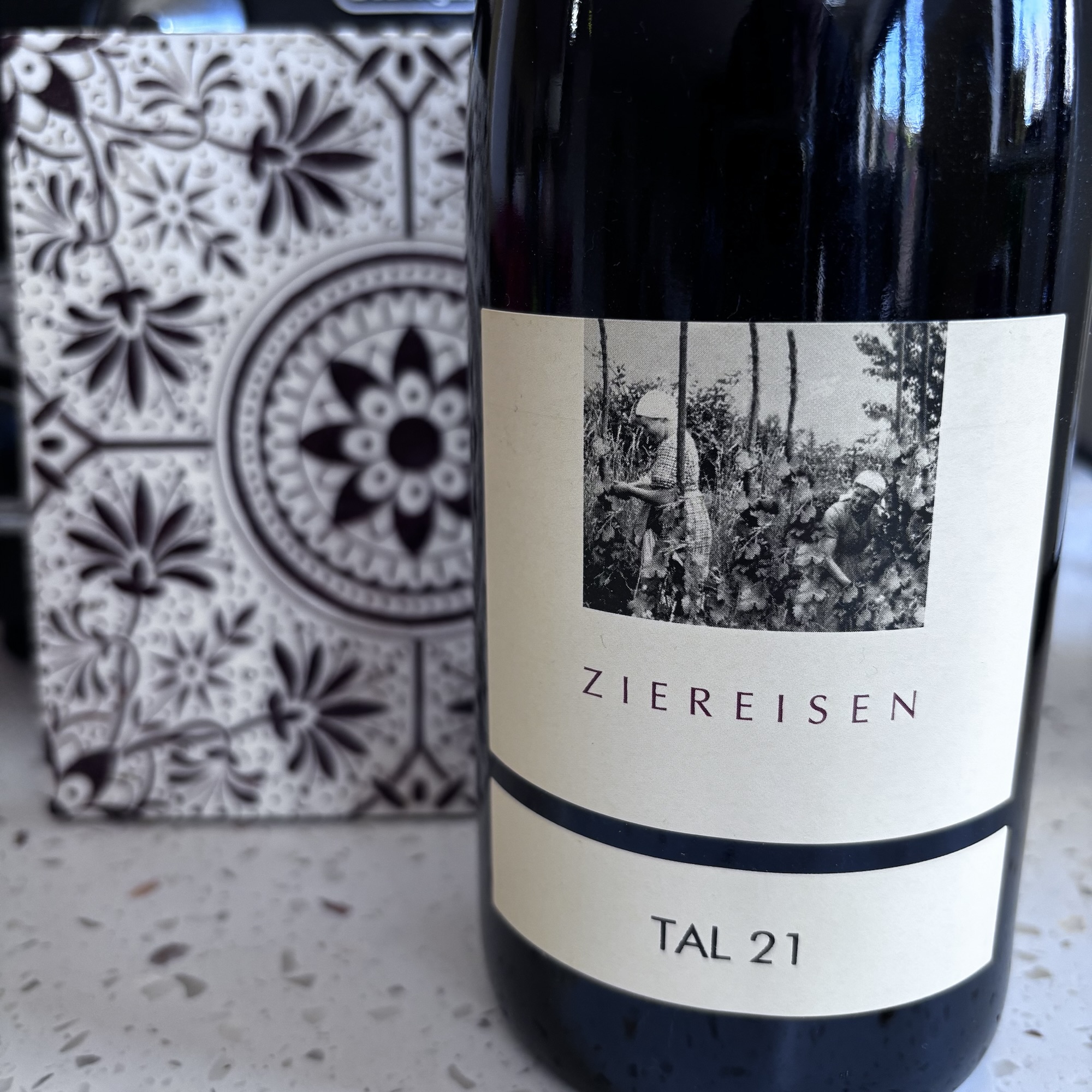
Talrain Blauer Spätburgunder 2021, Ziereisen (Baden, Germany)
I guess most people, when thinking of Baden, conjure up the vineyards around the Kaiserstuhl, near Freiburg-im-Breisgau, but the region stretches a long way north and a long way south. In that latter case, right down to the Swiss border. Here, we are in Markgraflerland. Hanspeter Ziereisen is based at Efringen-Kirchen, just kilometres from the borders of both France and Switzerland.
Hanspeter makes glorious wines, including in my humble opinion, the greatest Chasselas in the world (here called Gutedel). But it is his Pinot Noir reds which are the summit of his winemaking. Here, we have an example of why masters like Hanspeter make exemplary entry-level wines to sit alongside the greats.
Pinot Noir is grown at around 500 masl, below the forests, on iron-rich soils of limestone and clay. The forests are important for the terroir. They provide both a wind break and create a slightly warmer microclimate. This natural wine spent twenty months in oak and is of course bottled with no manipulations. The pure cherry red colour is beautiful, almost translucent. It is effectively a velvet cherry juice, with added richness, and the underlying oak gives almost a hint of sweetness. Yet we just have 12% alcohol, and it has more freshness than you’d expect from a wine nearly five years old.
I am a very big fan of Ziereisen, as many probably know. Hanspeter and Edel are such a fantastic couple that it would be hard not to like their wines, but they do happen to be one of my favourite German estates. Although the top wines are a lot more expensive than they were, one can be happy to find entry level wines as good as this. Ziereisen is imported to the UK by Ripley Wines but this bottle is from a selection I purchased from The Wine Society, where it cost me just £21.50.
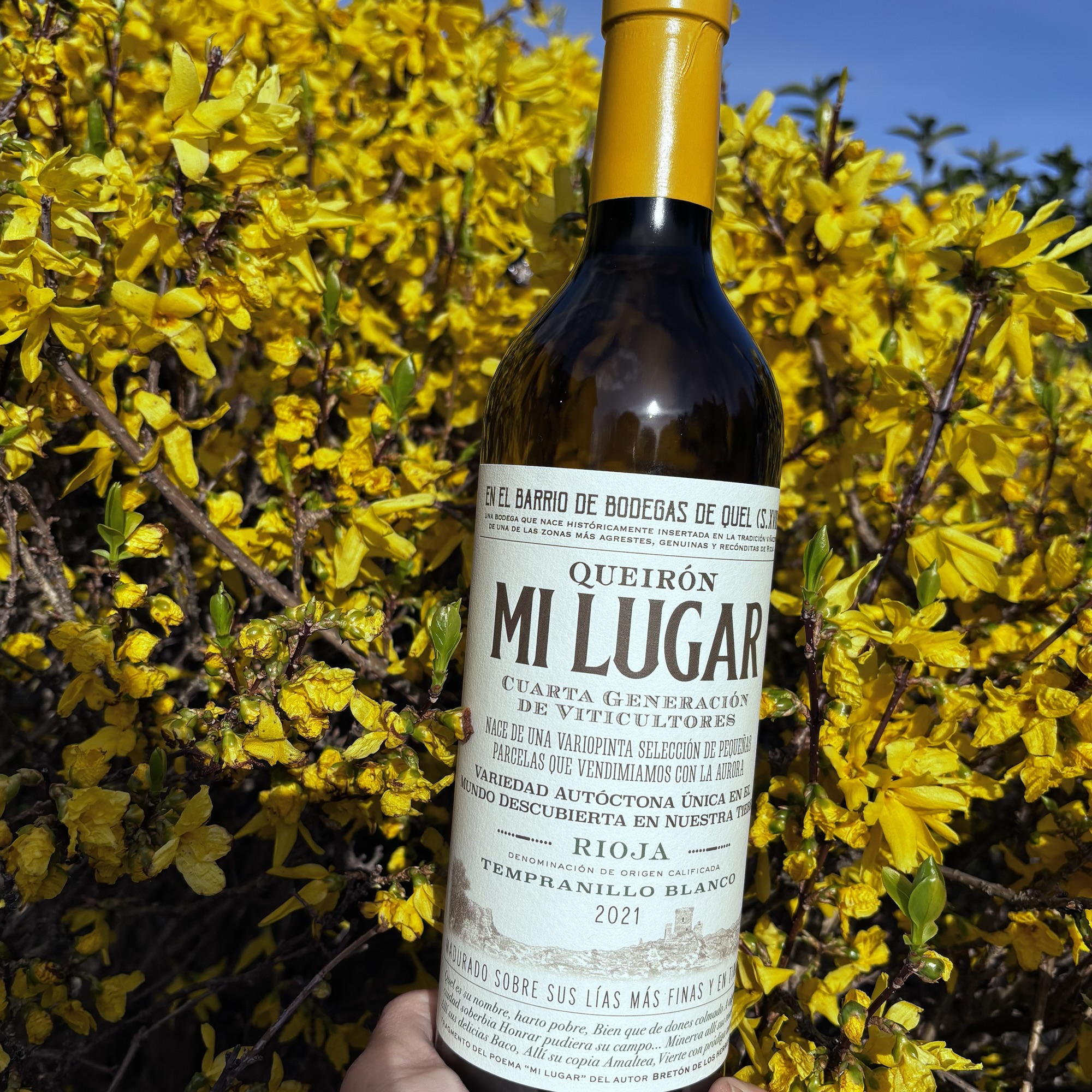
Rioja Blanco “Mi Lugar” 2021, Dominio de Queirón (Rioja, Spain)
This wine is also from 2021, as is the next. This, in fact, is a perfect example of the benefit of listening to a recommendation from a wine shop. When I was younger, I was a little wary of a recommendation from the shop floor. I perhaps cynically thought that sometimes there was a desire to shift a wine. As I’ve got older, I’ve come to know whose palate I trust, and in this case the wine was purchased in one of the half-dozen shops I can say has never given me a bad one.
Mi Lugar is 100% Tempranillo Blanco, which the label suggests was actually discovered, as a mutation, on the Queirón estate, run by Gabriel Perez in Rioja Oriental. This sub-region is always portrayed as being at lower altitude and warmer than the other Rioja sub-regions, but Queirón’s vineyards are at around 640 masl. This allows slower pipening, and the fruit is picked at dawn to retain the white grapes’ acidity.
Fermented using indigenous yeasts, the grapes see one week on skins and then one week as just free-run juice. Around 85% of the wine stays in barrel, ageing six months on the fine lees. The remaining 15% sees six months on lees in clay Tinajas. It is given a further six months in bottle before shipping.
Stone fruit aromas mingle with herbs (fennel and thyme for me). The palate has a lovely touch of honey with a bit of nuttiness. The oak is present but gentle. I liked it a lot, enough to buy it again for definite. £24 from The Solent Cellar via importer Boutinot.
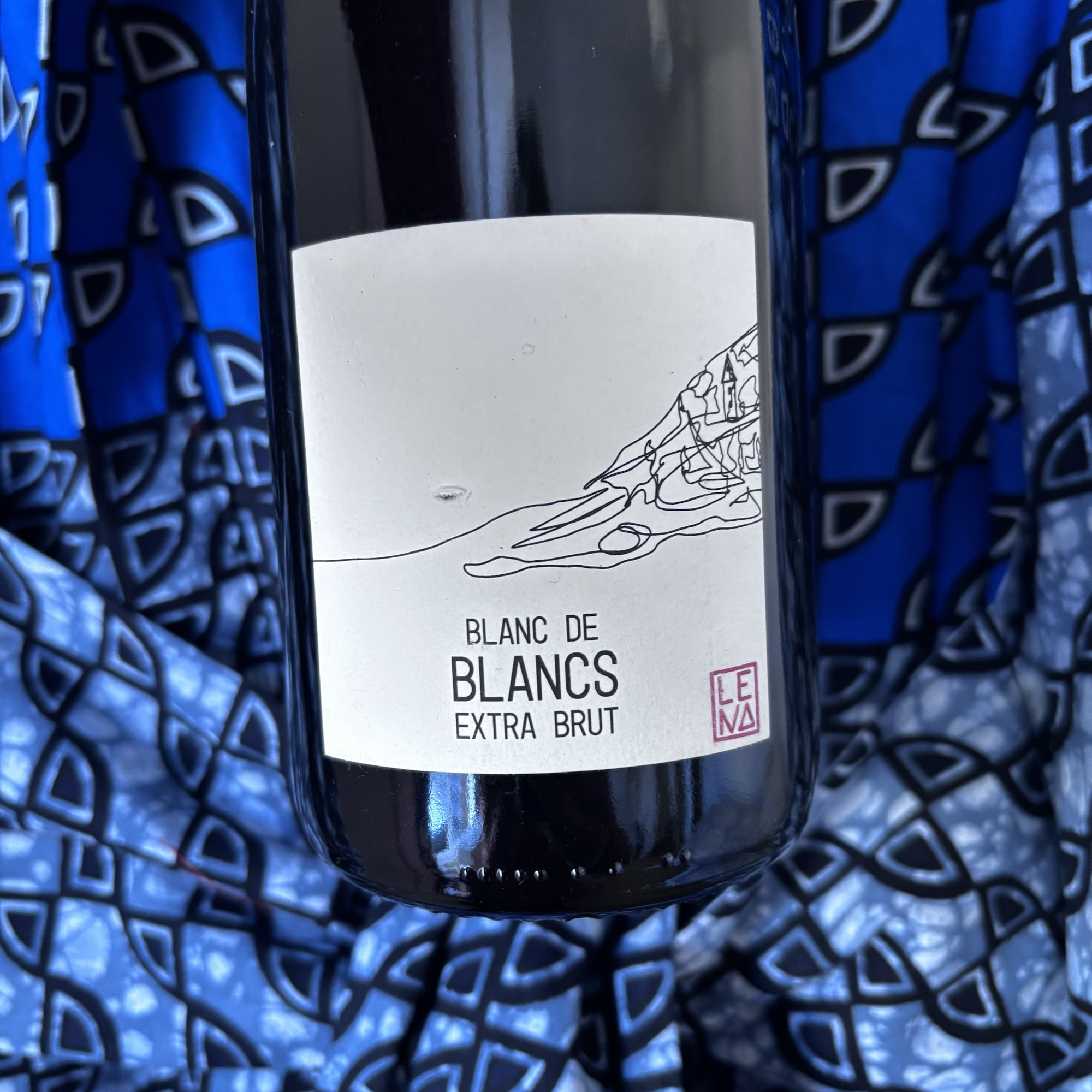
Blanc de Blancs Extra Brut 2021, Sekthaus Singer-Fischer (Rheinhessen, Germany)
It has been said a lot lately that there is something of a Sekt revival in Germany. It isn’t led by the big old sekt houses, but is rather being driven by winemakers, hence “Winzersekt”, the parallel to Grower Champagne. The similarity is perhaps accentuated on a number of levels. One being the use of some French labelling, the other in the number of these wines which focus on Chardonnay. Here, Chardonnay is blended with 20% Weissburgunder (aka Pinot Blanc).
Lena Singer-Fischer (aka lena-macht-sekt for Insta devotees) makes her sekt at Ingelheim, on the Rhine. This wine is dosed at just 2g/l and has spent a little under two-and-a-half years on lees (from bottling in August 2022 to disgorgement in January 2025), following a spontaneous fermentation.
This is frankly superb, an absolute joy to drink and very fine. It has a perfect balance of salinity and fruit, with a developing autolytic character. It is steely and dry, but will mature for sure. It is a natural wine, with no chemical inputs. It also has a boldness to it, perhaps because of its natural production with nothing to mask it. Lena has been described by friends who know German wine as a “rising star” and although this is my first of her wines, I have no reason whatsoever to doubt it.
Also from Solent Cellar. It cost around £32, but may now be out of stock. Whether they feel able to get more will largely be a reflection on their customer base, because I know Simon and Heather thought as highly of this as I did (and indeed a few writers on German wines who contacted me after it appeared on IG). Boutinot is once again the importer, perhaps worthy of note.
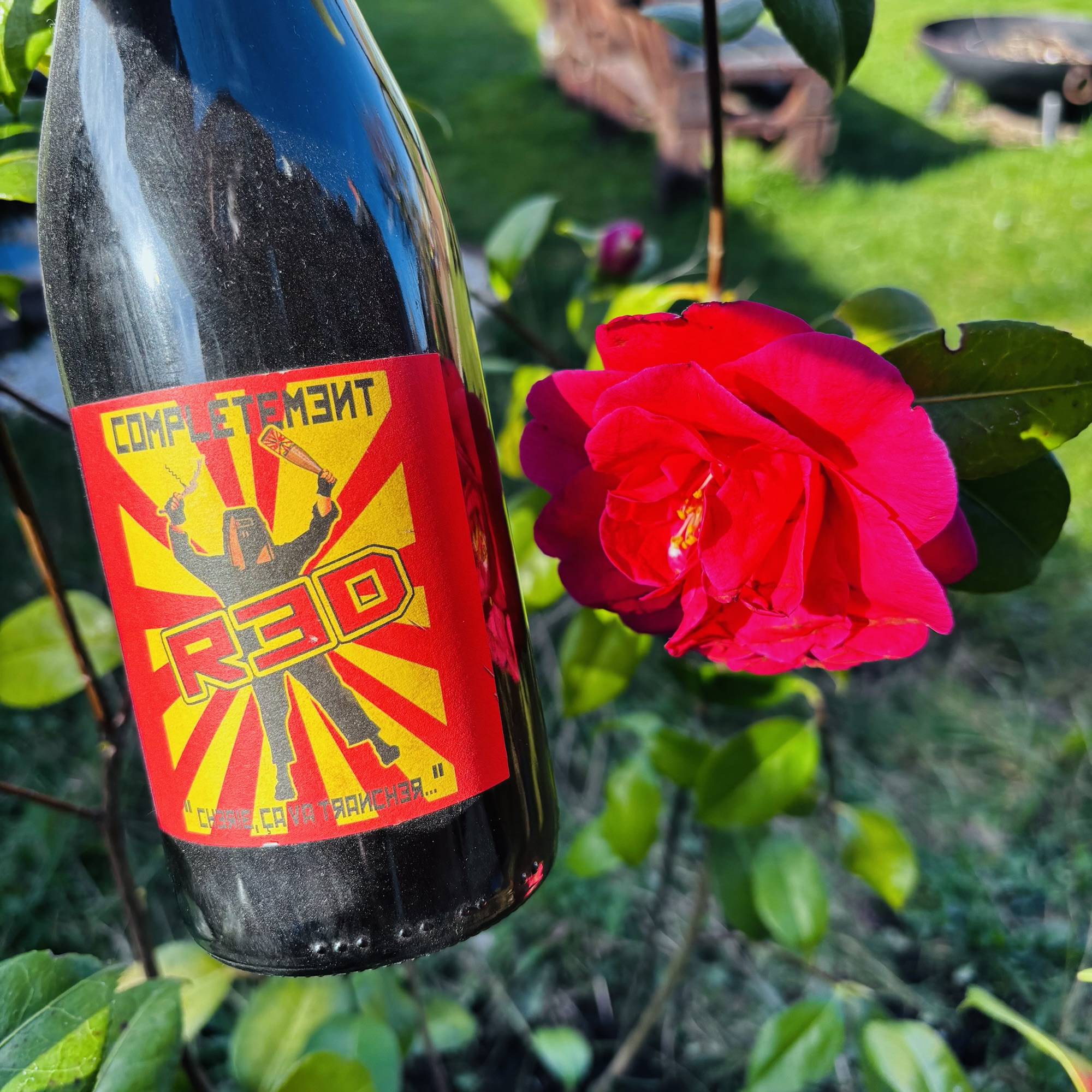
Complètement Red [XXIII], Lambert Spielmann (Alsace, France)
I have had to cut back on my Spielmann purchases…sadly. His wines are becoming as relatively expensive in the UK as olive oil has become in UK supermarkets in relation to its shelf price in Italy (cf recent comments on this subject by Luciano Berio). Still, when I see a bottle it’s hard to resist. Lambert’s Domaine in Black is very much at the cutting edge of the exciting Alsace natural wine scene.
This particular cuvée is 100% Pinot Noir, coming from 25-year-old vines on sandstone at Nothalten (west of Epfig, a part of Northern Alsace once derided by English writers). The grapes are whole-bunch fermented for ten days and pressed into demi-muids and vats.
One thing stands out in this wine, wild cherry. Lambert’s regenerative farming means his vines are surrounded by nature. The fruit is bright and concentrated, but the whole vibe of the wine, from bouquet to palate, says “wild”. There are a few more earthy notes and it remains just the right side of the volatility fence, but you would probably call it edgy…as well as thrilling.
Lambert uses zero synthetic chemicals, zero additives, including zero sulphur. For me, this is as wonderful as its bright label. The winemaker always recommends a track to listen to when drinking the wine (look for “à boire en écoutant…”). I wouldn’t say it will change your perceptions of what’s in the glass, but it’s fun and I always enjoy discovering new music, usually with a punky bent. This time it’s a track called “Creatures of the Night” by Canadian psychobilly band, The Creepshow.
Kindly purchased by Cork & Cask in Edinburgh, the next vintage (2024) is around £40 via importer Tutto Wines.
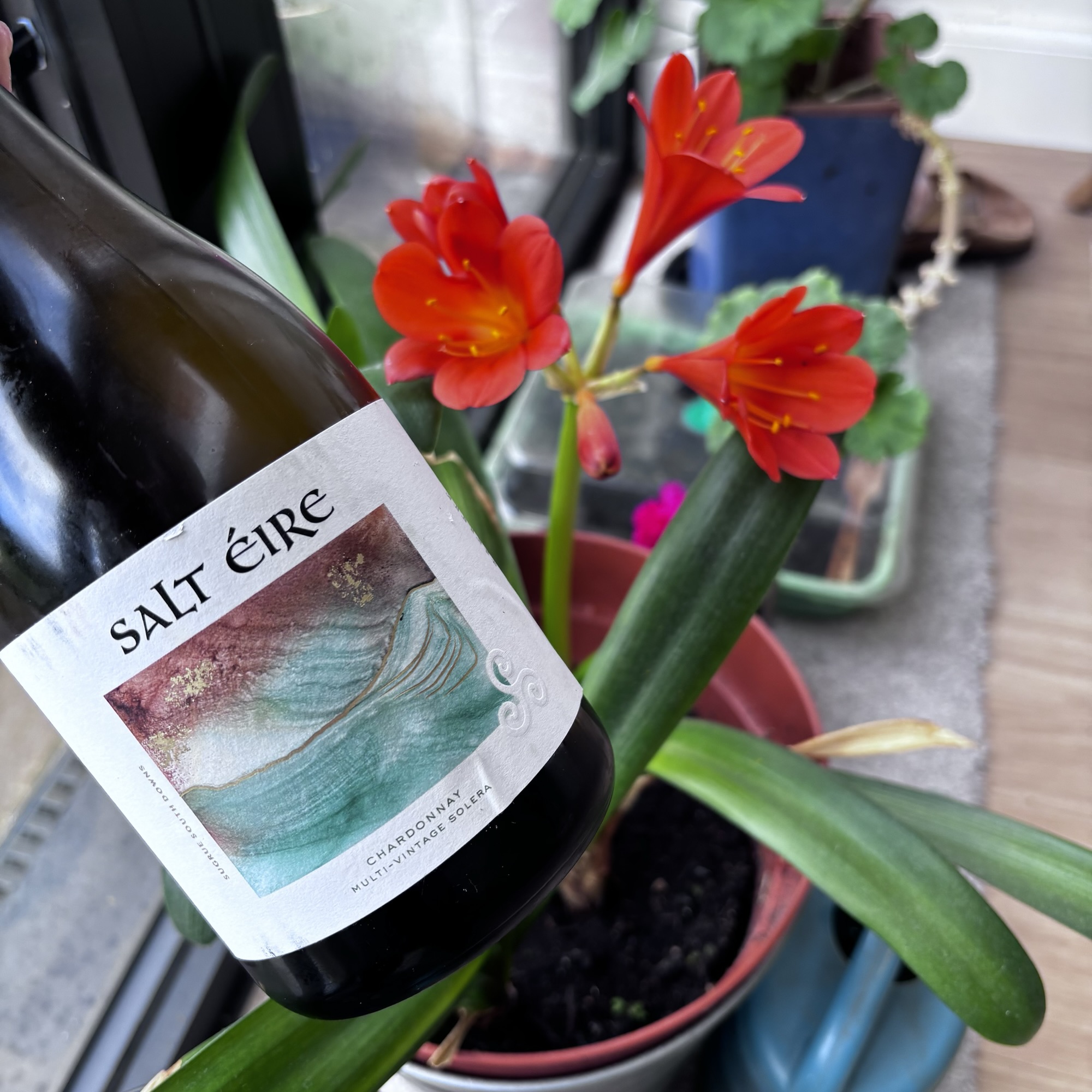
Salt Éire MV (2022/23), Sugrue South Downs (Sussex, England)
This is another collaboration between the Three Musketeers of Dominic Henshaw (Indigo Wines), Dr Jamie Goode and Daniel Primack (Zalto UK), their first with Dermot Sugrue at his new solo base in Sussex. It’s a multi-vintage Chardonnay, taken from a solera which I’m guessing will one day help create a remarkable future icon of English Sparkling Wine to rival Champagne’s finest, if I know Dermot.
Around 60% of this cuvée is from 2022, the other 40% from 2023. It comes from the Home Vineyard, which is near Wivelsfield (close to Hayward’s Heath, up over the South Downs). The colour is a pale yellow-gold. The nose has remarkable finesse, both in its fruit and lifted salinity. It’s the mineral salinity on the palate that hits first, but then the concentrated fruit comes in. Lemon-lime, nectarine, pineapple. It’s alive, vibrant, exciting and irresistible. It’s young, with a tautness I like, but it will mature, of that I am sure.
This cost me £30 from Communiqué Wines (Stockbridge, Edn). The agent is Indigo Wines and the current edition (which may be a second release) is listed by The Sourcing Table (Peckham Rye) for £31.
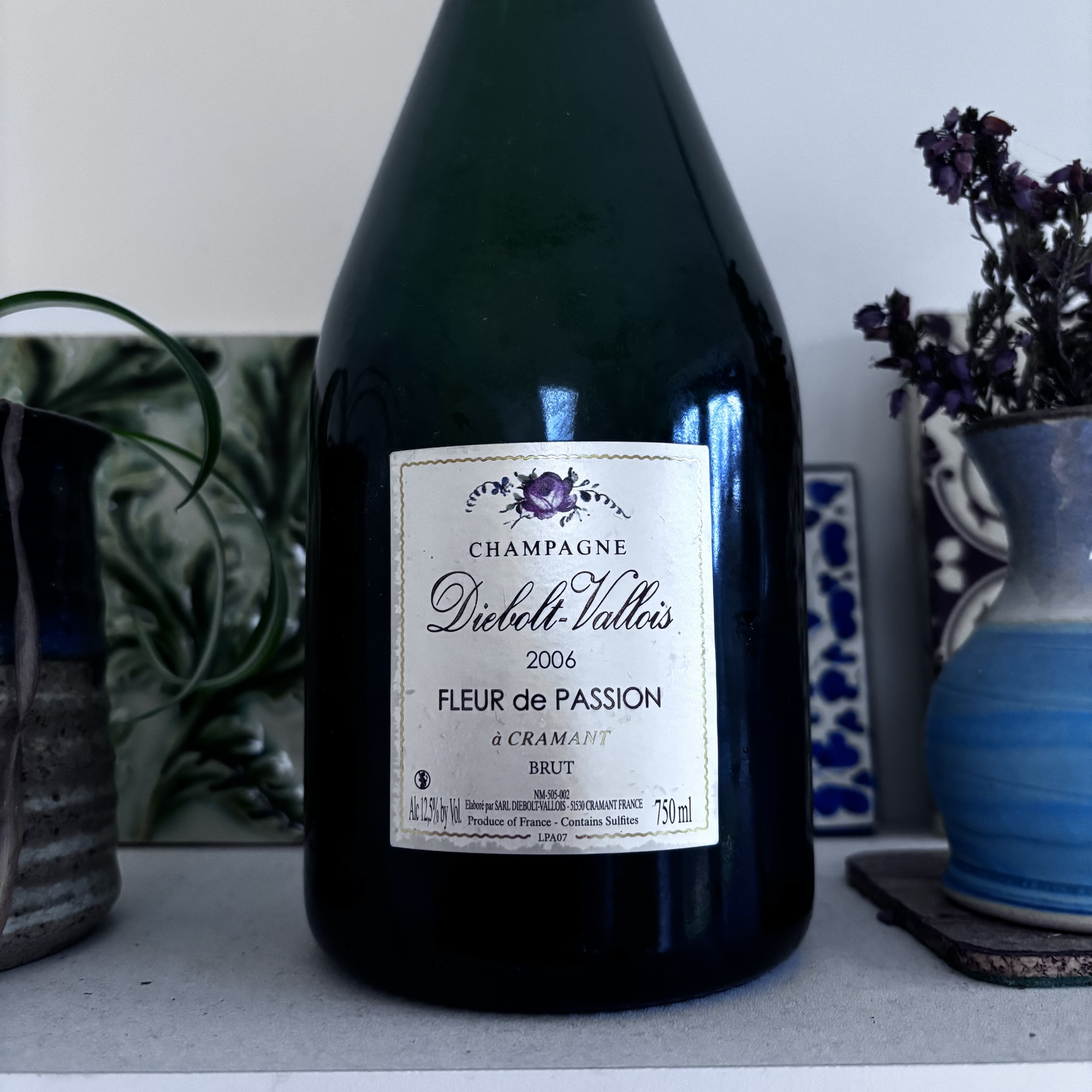
Fleur de Passion 2006, Champagne Diebolt-Valois (Champagne, France)
Jacques Diebolt is very much admired in Champagne as one of the original “Growers” whose wines established the idea that artisans could make wines every bit as good as the Houses. The family farms around ten hectares of vines based at Cramant, on the Côte des Blancs. In fact, records show them farming at nearby Cuis in the fifteenth century, and at Cramant since the late 1800s. Jacques is now joined by his children, Arnaud and Isabelle, who continue his work.
For some, the Diebolt-Valois hallmark is elegance and finesse, yet with the prestige cuvée we have a different approach. Stainless steel gives way to small oak for fermentation, and malolactic is avoided. The grapes themselves come from top sites within the estate. Although they will vary, lieu-dits such as Goutte d’Or, Bouzons and Gros Monts, and perhaps Pimonts, are usually present. All are fermented separately before final blending is decided.
The wood doesn’t make this a powerful wine. I’d say it retains elegance and finesse, although I’ve drunk a lot of wines from this vintage from the Côte des Blancs, and most started off so steely they needed a good time in the cellar. Among the subtle notes I found in this bottle were lemon, orange, honey and peach, and certainly complexity. Yet even at twenty years old, it will still age further. I found it fantastic, but then I am not drinking the shed loads of prestige Champagnes I perhaps once was, and I don’t doubt a certain nostalgia crept in for a different time (on the drinking front, I should stress).
This bottle was actually a replacement for a bottle that Feral Art & Vin (Bordeaux) was unable to supply last year (a generous replacement). If you want this vintage look at folks like Seckfords or Justerinis. In bond you might find a later vintage, I saw 2014 for about £100 a bottle (plus duty and tax).