Wines of the Rhône by Matt Walls – Book Review

Even most readers who know me reasonably well might be unaware that The Rhône was my first real passion in wine. I didn’t get to visit the north for a few years, but by the time I hit Ampuis in 1988 I’d already explored most of the South, from a base at Pernes-les-Fontaines for a couple of weeks, some years previous.

I’m not sure where my interest in the Northern Rhône sprang from. The South is clear. Around the time I was tasting my first oaked Australian Chardonnays I’d purchased a bottle of Châteauneuf-du-Pape, Le Vieux Télégraphe. I’ve no idea what vintage, and I’m very much aware that I was drinking it too young, but it made a big impression, as you’d imagine.

The Northern Rhône came via Yapp Brothers, whose attractive base at Mere in Wiltshire was a pleasant day trip when staying with my parents-in-law. A picnic taken by the fountain in the Yapp Brothers “Old Brewery” courtyard (a reproduction of the one in the Square at Châteaneuf-du-Pape) or at nearby Stourhead Gardens, a pint in “The George” pub up the road, a climb up Mere’s old castle mound and a haul of wine. One great day out.

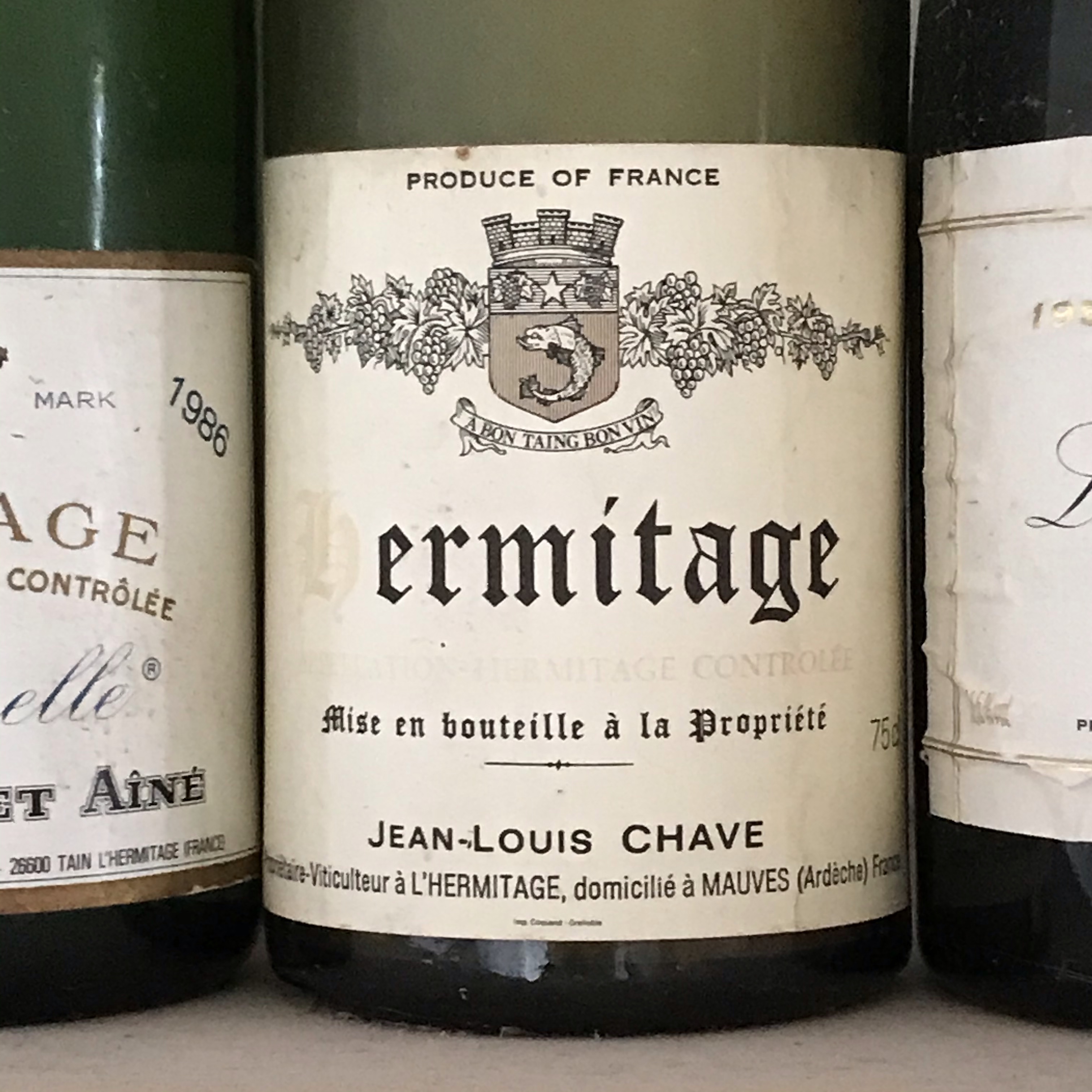
I recently mentioned to someone that I had been able to get into buying Chave Hermitage at £12.75 a bottle. Hard to believe. We are probably talking 1984 here. I tried to find evidence but all I could find was Yapp’s 1987 Price List, where the cheapest Chave vintage had risen to the dizzy price of £14. I’m sure Yapps won’t mind me reproducing some pages showing a few of the Rhône old-timers going for what seems like next to nothing. Of course, those wines were bargains, but £14 went a long way back then and they didn’t seem exactly cheap either. Yapp Brothers, via the exploits of Robin Yapp, generally got it right back in the day.

One of my truly happiest memories in wine occurred the next year, 1988. We were on a trip which was eventually to lead us to Umbria, but at Lyon we detoured south for a night in Vienne and then a day in the vineyards. We ate our baguette and cheese on top of the Hermitage Hill, drove up to Château Grillet, and after a further night in an aubèrge on the plateau we rocked up at Georges Vernay in Condrieu. Already being an avid purchaser of his wine for a couple of years this was an essential stop for me. It must be remembered at that time that Condrieu consisted of maybe a couple of dozen hectares at most, and as far as I’m aware, Viognier wasn’t planted anywhere else besides the environs of Ampuis/Condrieu. Vernay had almost single-handedly saved the Condrieu appellation, and the Viognier variety, just a few years before by working the steep slopes whilst everyone else seemingly preferred the greater ease of a factory in Valence.

We spent the morning with the great man himself, much of it going through very old photographs in the vines and winery, from a different age. His hospitality moved us. We couldn’t take a lot of wine on the road. We bought a couple of bottles, and knowing of our journey’s direction, Georges gave a us a couple of halves as a gift. I don’t recall what we used to drink it out of, but I do remember chilling one in a stream on the way east to Grenoble. Sometimes circumstances make a wine taste even more heavenly than you dream is possible.

Over the years I sort of left the Rhône behind a little. Southern Rhône and Châteauneuf trickled away some time back in the 2000s, largely because of high alcohol content. With Northern Rhône it was always price. The lovely 1991 vintage was the last year of my once-prized Chave red vertical, 1998 for the white. I have none left. I continued to buy Côte-Rôtie and a little Cornas, but my eventual Chave replacement, Stéphane Ogier, topped £50/bottle in the later 2000s and that saw me opt out as well.

There is one Rhône producer I do regularly look out for and that is Eric Pfifferling’s Domaine L’Anglore, based at Tavel. But otherwise, I do notice I’m not really buying much Rhône wine. I still have a dwindling supply of the old school producers (sadly no Chave, let alone from Gérard’s days), but the flame has not died. This is why I was keen to get my hands on Matt Walls’s Wines of the Rhône.

I’ve met Matt a few times on the circuit and at the occasional wine dinner/lunch, and he has always seemed to me one of the nicest guys in wine, as well as possessing a very good, and unusually ecumenical, palate. When I heard that he was taking his family off to France for a couple of years in order to write a new book on the whole region, I began to follow with interest his social media reports of his travels. The resulting book, another one in the Infinite Ideas Classic Wine Library, was published at the start of this year.

Wines of the Rhône is one of the fatter books in the series, running to around 375 pages, but thankfully (in my view) they chose to produce it in soft cover/paperback. Nevertheless, it still costs £30 full price. What I will say immediately, because I hate suspense, is that it is wholly and one hundred per cent worth investing in.

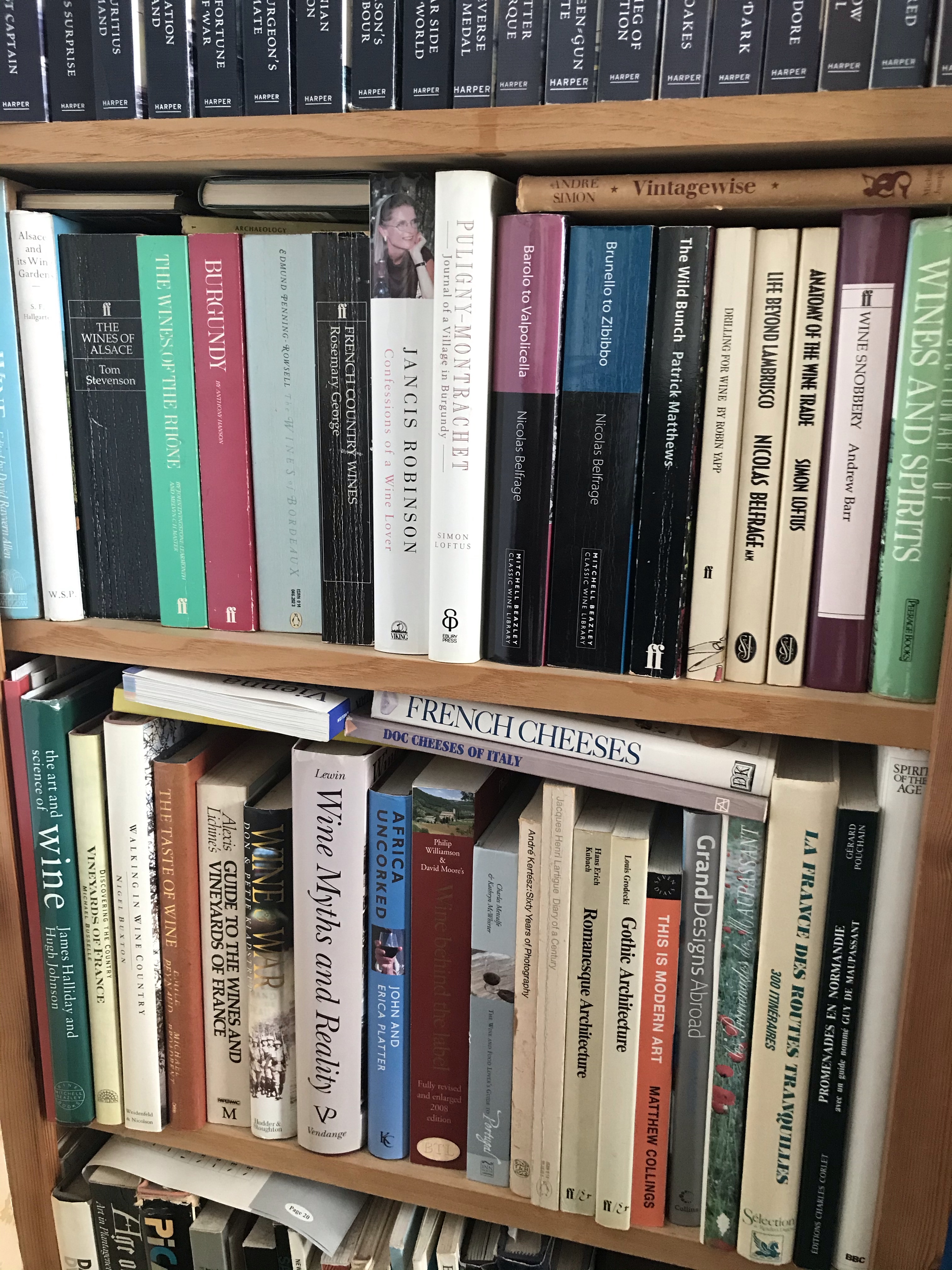
My extensive home wine library contains several books on the Rhône by a number of well-known authors, but they are bookended by one author’s books, a name that on its own means “Rhône”. Naturally I speak of John Livingstone-Learmonth. My Rhône section began with the 1983 reprint of his 1978 “The Wines of the Rhône” (Faber & Faber), written jointly with Melvyn Master. It ended (before Walls) with Learmonth’s 700-page epic, “The Wines of the Northern Rhône”. Published in 2005 by the University of California Press, even back then this formidable hardback set me back £42.50.

Of the other “Rhône” books I own, the most interesting would be Remington Norman’s “Rhône Renaissance” (Mitchell Beazley, 1995), but after 2005 I can find no other book on the region which has excited me enough to purchase. Nevertheless, Matt has big boots to fill, so it was encouraging to know that he was diving in deep.

Not only did the author go and live in the region in order to research his book, but early on, apparently, he made a significant decision. We know that the whole of the Rhône, north and south, is very complicated. Not only are there numerous layers of appellations, there are also an impossible number of wine villages and sub-sub-regions. Many of them attained named status long after I left the room, and many a long time after the last comprehensive work was published. In making the decision to visit every one of them the author struck gold. As he said in a social media conversation with me before I had read the book, it was so often in these small and almost unheard-of villages where some of the most interesting wines would turn up.

There are several reasons for this. The Côte du Rhône’s mountain fringes, or the terraces of the Massif d’Uchaux (to take two examples) are marginal to the story of the region, yet they offer relatively cheap vineyard land to committed and experimental newcomers. They often offer an opportunity to showcase less planted grape varieties (and especially allowing growers to focus a little on the potential for white wines). They also offer hope in the face of climate change which is pushing alcohol levels towards hard to sustain heights on the plain. Villages like Saint-Andéol. Only promoted to named village in 2017, Walls describes it as, in his view, one of the front-runners for conversion to full Cru status. It’s just one example of the great potential Matt identifies, all good for the future of the region.

There are other traits picked up upon too, and I think these include some of the reasons why this book will undoubtedly act as a catalyst for my re-exploration of both the Northern and Southern Rhône. First, he identifies a pendulum effect on alcohol levels. With the increase in temperatures and the change in rainfall patterns (as opposed to rainfall quantity) in the region, growers have seen that even if they felt the market was still quite as keen on high alcohol (which in the post-Parker era it clearly is less so), sustaining wines forever pushing well over 15% abv is unlikely to enable them to retain balance and quality. So, producers are finding different ways, whether by vineyard composition, viticultural practices, or winemaking, to dial back the alcohol (and often accompanying new oak) levels.

At the same time, there is a clear movement to either reduce or eliminate synthetic agrichemical inputs. There are many reasons for this, ranging from health (human as well as vines and, critically, soils) to costs (if the Mistral wind keeps the vines relatively disease free, why spend the money?). Many producers are going much further, and the younger generation is far more interested in biodynamics, and “natural wine” than most of their parents’ generation were. The increase in numbers of producers following these practices had, in the main, passed me by.

The format of the book is easy to follow. After the background issues and history set out in Part 1, the author begins his journey in the Southern Rhône. Starting around Avignon, which grants the opportunity to begin with the big guns of Châteauneuf-du-Pape, we then travel more or less in an anti-clockwise direction, via Ventoux and Luberon (the latter not always included in books on the Rhône) up to the mountains of the northeast. Then he crosses the river, into the Ardèche, to cover the west bank villages down to Lirac and Tavel, then as far south as Costières de Nîmes and Clairette de Bellegarde. The final chapter in Part 2 gives us an invaluable eight pages on the tiny, almost sub-Alpine, enclave of The Diois.

Part 3 takes us on a north-south journey through the Northern Rhône. We may only get two chapters, “Around Ampuis” and “Around Tain…”, but they are equally thorough. For example, this is the first time for a long while that I have read anything significant in print about Seyssuel, whose IGP wines are a very clear candidate for full appellation status (though the speed at which things move in Paris don’t expect any changes in the near future). Equally, in the south of this northern section, full coverage is given to the wines of Brézème and Saint-Julien-en-Saint-Alban (I know the former rather well, yet had never heard of the latter…Walls calls some of the wines and producers here “highly promising”).

Each chapter follows a format which explains the appellation in terms of history, viticultural politics, personalities, geology and climate, and then profiles the producers the author considers the most important/best/interesting. He calls them “Key Producers”. But you always get a good paragraph or three on “other good examples” as well. These may include promising new producers who only lack a track record, people doing interesting things in the vines or winery, or maybe someone with just one standout wine among a less interesting output.

Walls is incredibly good at spotting, and singling out, this kind of thing, and as a well-regarded judge of wine competitions (he’s Regional Chair for the Rhône at the Decanter Awards, and is also a Contributing Editor of the magazine) his palate is experienced but clearly open to the new. I especially like his open-minded approach to natural wine methods. Of Eric Pfifferling of Domaine L’Anglore, he says “Who are the greatest winemakers in the Southern Rhône? Perhaps it’s a matter of opinion, but I’d be surprised if Eric Pfifferling wasn’t in the Top 10”. That might surprise a few older traditionalists, but it’s a sentiment with which I wholly agree.

As with all the books in this series, there’s always the highlighted text box, which are scattered about each chapter. They cover all sorts of topics. I especially like the one on p295, called “Past masters”. It talks about the old guys, many of whom are no longer with us but whose wines live on, albeit usually at eye-watering prices and in tiny quantity. People like Auguste Clape, Robert Michel, Noël Verset and others. I could add more, but then I’m a bit older than Matt and I actually remember some of these folks. If you want to read more about the romantic era of Northern Rhône winemaking (generally pre-Parker), I can recommend the books of Robin Yapp. Vineyards and Vignerons (with wife Judith, 1977) and to a lesser extent Drilling for Wine (1988) contain vignettes of his early buying trips when pretty much no other British wine merchants were hitting the Rhône.

North American writers like Kermit Lynch and Englishman Simon Loftus have similar stories to tell. I think that as many older wine books become out of date as guides to specific wines and producers, those with more of a travel narrative nevertheless act as social history, for which there is an appetite among younger wine obsessives. The last chapter of Robin Yapp’s Drilling for Wine, titled just “Chez Chave”, is much more than a mere portrait of a then not quite so famous winemaker.

We end Matt’s book with two appendices. The first is a very good vintage guide, or sensibly two: separate ones for north and south. Initially I didn’t realise this but thankfully soon twigged. Appendix II is an abridgement of Simon Loftus’s quite famous visit to Rayas in 1979 (rewritten in 2019), when Monsieur Reynaud, well known for disliking visitors, hid in a ditch to avoid Loftus at the time of his appointment (Loftus was at that time running Suffolk brewer Adnams’ wine department).

If one thing stood out whilst devouring (as I did) “Wines of the Rhône”, it was just how easy it is to read, and equally enjoyable. As of necessity, the Rhône requires a lot of facts, and there are a lot of key producers. It would be easy to get bogged down in endless names and numbers. Equally, you don’t want a load of flowery prose when the detail is important. I’m not totally sure how the author manages to tread an almost perfect path between the two. One reads wine books to absorb knowledge. There’s an argument that if they are too easy to read you finish too quickly to retain that knowledge. In my case I do much of my reading in the hour or two before I turn out the light, and I don’t want to be sent to sleep prematurely. No chance of that here.

Are there any negatives? Well, the maps are okay but a little pedestrian. That’s not down to the author. You just need your copy of the World Wine Atlas to hand to scan the villages in just a tiny bit more detail (monochrome is never an easy medium for maps of overlapping vineyard appellations). I suppose some real enthusiasts may complain that the book is just too short and that there are not enough producers profiled in full. I guess a 360-page book at £30 will sell more than 700pp at what would now be considerably more than £42.50 today, I presume. I actually think that in aiming for the widest possible audience within what is undoubtedly a specialist area, the author has weighed the balance well.

As I have intimated before, I thoroughly enjoyed reading “Wines of the Rhône”. I don’t think there is any praise I can give higher than the fact that it really has reignited my interest in a wider region I used to buy from with great regularity, yet which to a significant extent had fallen off my radar in recent years, as I had begun to explore further and further east within Europe, and, for my Grenache-based wines, the higher altitudes of Spain. In fact, my next task is to try to seek out Grenache from the Rhône which hints at the excitement of what I have discovered this past decade from Spain, at hopefully a more advantageous price. As well as all the established classics, Matt Walls shows us that in parts of the Rhône we are possibly at the beginning of something. Perhaps a second Rhône Renaissance? So that’s an emphatic “Buy”!

Wines of the Rhône by Matt Walls was published in 2021 by Infinite Ideas Publishing as part of their ever-growing Classic Wine Library (rrp £30, though discount codes and cheaper sources may be sought for those unable to afford the full price).

The other older books and authors also mentioned can pretty much all be found at numerous online sources, often used copies. There’s a world of viticultural social history out there to explore.

A short personal Rhône timeline
Posted in Fine Wine, Rhone, Wine, Wine Books, Wine Writing | Tagged , , , , , , | 3 Comments

Field Blends and Gemischter Satz – Why Should we Get to Know Them?

Gemischter Satz, a wine that brings joy to my soul. Back in 2016 the UK wine trade magazine The Drinks Business asked whether Gemischter Satz will be the next big thing. Well, it hasn’t quite worked out that way but there’s no doubt that this wine designation is a lot more well known, and certainly appreciated among connoisseurs, if not the general public (who right now are more likely to be getting to grips with the delights of pink Prosecco). Those of you who read my Blog with some frequency will know that I have a bit of a thing for Gemischter Satz and I thought I should tell you why.

My journey to understanding and appreciating Gemischter Satz, and in particular, Wiener Gemischter Satz, began long before I ever set foot in Vienna. I started my journey in wine at a time when varietal labelling was really taking off. We Brits all think of Australian Chardonnay and Shiraz as the catalysts for our modern obsession with grape varieties, although our North American cousins had been developing their own obsession with varietal labelling even before those wines hit our shores. But there is one European wine region which stood out for varietal labelling despite being firmly seated at the Appellation Contrôlée table, and that was Alsace.

On my first visit to Alsace at the end of…well, a very long time ago, I fell in love with the region of course, but as an adventurous, and more impecunious, wine lover I drank a fair bit of Edelzwicker. This is Alsace’s traditional blend, certainly at that time the cheapest wine in the Winstub (though if you were Hugel and you made a really good one from a fine site, you called it Gentil). Not always a field blend, but often so, it seemed back then as if it were just a bunch of different grapes thrown together, what was left from the fruit set aside for the varietals, plus a bit of Chasselas, Sylvaner and Savagnin Rose (Klevener not Klevner) that no one wanted.

When Alsace designed its Grand Cru system in the 1980s it was only the more noble white varieties which were designated as being good enough for this supposedly terroir-specific super appellation. No Sylvaner, no Pinot Noir. The rising value of Grand Cru varietal wines saw the Edelzwicker blends fade away. Except there is always someone who will go against the crowd and that man was Jean-Michel Deiss. His views on the subject were, and are, forthright. He’s a great source of quotes explaining the philosophy, as he sees it, behind the field blend. Those below are from Andrew Jefford’s The New France (Mitchell Beazley, 2002).

“What is terroir? It is a matrix by which the possible can be uttered…History robbed us of our memory…we no longer knew what Ribeauvillé meant…we have to find out what is possible once more.”

“Before the arrival of Crus, varietal diversity was the only way in which Alsace’s terroir could speak.”

According to Deiss, the field blend is perhaps a truer expression of place than the imposition of a single variety on a named site?

If the Grand Cru system forced the region’s winemakers to focus on terroir in a different way, something was lost in regulating what grows best, and thereby what should be allowed to grow, on that terroir. But Deiss has ploughed his own furrow, and has resolutely stood up for the field blend, albeit with wines which are beautiful and fine expressions of terroir over gape variety (though he does also make varietal wines, it is his blends which shine brightest). Now is not the place to expound on the mistakes and the ills of Alsace’s Grand Cru system, but suffice to say that it was Alsace which highlighted the field blend when I was getting to grips with my single varietals.

What is more, I don’t recall field blends being a part of the picture in my WSET studies back then. It was doubtless seen as an irrelevance. Like the pergola, which I wrote about recently, part of a peasant tradition wholly rejected by the university-trained viticultural scientists of the 1980s and 1990s. I sometimes wonder whether these men in white coats ever gave a second thought to the cultural and historic significance of the field blend, let alone its potential efficacy for the wine producer, especially in more marginal climates.

It’s worth spending a paragraph explaining why the field blend had proved such an attractive option to winemakers in the past. In a less technological age without synthetic agrichemicals and with the perils of uncertain climate/weather to ripen the grapes, a co-planted site of different grape varieties was a good insurance policy. Varieties ripen at different times and some are susceptible to different pests and diseases. Planting different varieties together meant that in most years a farmer would get some healthy grapes and if he (usually he back then) co-fermented them together, some would be over-ripe and give alcohol, some under-ripe and give acidity…and all would be more or less well.

Now we skip forward to 2013. As a subscriber to World of Fine Wine, when I received my copy of Issue 40, I was about to read an article which I have never forgotten. “Wiener Gemischter Satz – Vienna’s Heart of Gold”, written by Alder Yarrow, told me everything I needed to know about a wine I’d heard of, and even drank once at that point, but knew almost nothing about.

Vienna is not the only region of Austria to make a co-fermented field blend called Gemischter Satz, and many would rival Vienna’s in terms of excitement (you all know Joiseph Mischkultur, I suspect) but Wiener Gemischter Satz is the only Austrian blend of this type to be awarded DAC status (AOC equivalent). As the only wine region lying truly within a major European city, the viticultural practices and the drinking traditions of Vienna loom large in any study of wine in a social context. The cultural significance of the field blend here is exemplified like nowhere else.

The slopes of the Nussberg on the northern edge of Vienna

The DAC rules require a field blend…of at least three varieties (often many more and I have encountered at least one wine with twenty-six varieties), where one variety does not exceed 50% of the blend. There are two types of “WGS”. All Wiener Gemischter Satz must be under 12.5% abv (an unusual stipulation) unless it comes from a single site, where it requires 12.5% abv or more. This has led to the development of two modern styles of the DAC wine, more or less replacing the rather old-fashioned wines destined for sale by the jug in the city’s buschenschanks and heurigen, which were somewhat analogous to the Edelzwicker of old in Alsace.

Some of the Wieninger Cru Wines

The heuriger is Viennese wine central and a visit to the city should involve the exploration of several if you are able. They started out as the most rough and ready bars set up by the farmers to sell their new wine in the lighter months and into harvest. In time they began serving simple (usually cold) food to accompany the wine, and were ascribed into law as “buschenschanks” under Josef II. The heuriger (plural heurigen) is usually larger than the buschenschank, inns or restaurants run on broadly similar lines (we’ll not go into the differences here) by the now famous winemakers of Vienna. Many are “pop-ups” in the summer, either in fixed locations up in the vineyards, or in the wine villages. Some have become year-round restaurants proper.

Whenever I visit Vienna, which seemed to have fortuitously become an annual trip before Covid intervened, there is one non-negotiable outing. It involves a metro train out to Heiligenstadt and then a bus (38A if you are interested) which passes through the wine village of Grinzing before climbing up above the city. We get off near the Gnadenkapelle (nice café inside the gate) and then walk back along a path right by the bus stop, through woods, then vines, winding our way down through vineyards with vistas of the Danube and city, via the popup heurigen in summer, to an inevitable refreshment stop (stürm, or himbeerstürm, depending on season) at the famous heuriger Mayer-am-Pfarrplatz, the old inn where Beethoven once lodged, but also reassuringly close to the bus stop on Grinzinger Strasse, back to Heiligenstadt.

Perhaps we should look at some of the producers. The biggest name in WGS is Fritz Wieninger, who for more than thirty years has been at the forefront of re-establishing Vienna’s traditional wines as a serious proposition. His family farms a whopping 70 hectares, split between both sides of the Danube. On the left bank is Bisamberg, above Stammersdorf, where the winery is located, and on the Nussberg (right bank). The single site wines here are ageable beauties, whether his Nussberg Alte Reben, Bisamberg, Rosengartel or Ried Ulm, the latter a pair of smaller parcels, more or less premier crus, on the Nussberg. These are serious wines with around 13.5% abv and the capacity to age.

Fritz Wieninger and his Vineyard Manager, Georg Grohs

I spent a whole morning with the team at Wieninger a couple of years ago. Even though I had wandered the vineyards on a number of occasions, nothing beat driving around, from site to site with Fritz Wieninger’s vineyard manager, Georg Grohs, discovering the changes in the terroir after an extensive tasting. None of the sites better illustrate the semi-urban nature of Veinna’s vines than the tiny half-hectare Kaasgraben, surrounded by the encroaching wealth of Sievering’s villas.

Ried Kaasgraben, Sievering

Alex Zahel makes some cuvées in a similarly serious style. This is one noted producer whose base is not on the hills north of the city (though they do own vines there), but at Mauer to the southwest, within the city area. Some of the Zahel wines, with labels designed by Alex’s American wife, Hilary, are equally serious. They unusually have some vines on the Goldberg site, but you are most likely to find their own “Ried Kaasgraben”. The Zahel vines overlook the Kaasgraben Church in a narrow side valley. More opulent than the zippy cliché of WGS, another serious bottle.

Zahel Ried Kaasgraben

There are some fascinating experimental wines being made now, such as the Hajszan Neumann amphora GS (this producer was taken over by Wieninger in 2014 but has kept its own identity), and one cuvée I have from Rainer Christ (at Jedlersdorf (Bisamberg)), called “Kraut & Rüben”, which has seen skin contact. These sit beside more traditional offerings from Mayer am Pfarrplatz (and their sibling Rotes Haus label, making a lovely Nussberg GS). Then there’s Michael Edlmoser, who has worked at California’s Ridge Vineyards. His wines can be heady expressions of the Mauer vines. Stephen Brook (The Wines of Austria, Infinite Ideas 2016, new 2nd edn now available) mentions a Sauvignon Blanc “Riesberg” 2013 which hit 15.5%, a real expression of Californian Zinfandel in Viennese Sauvignon Blanc, perhaps. I’ve not tried it.

Rainer Christ, entry level DAC wine

I’ll leave until last the producer who fits most neatly within my own favoured philosophy of low intervention winemaking, Jutta Ambrositsch. First mentioned by Alder Yarrow, I had to seek her out purely on the basis of what he had written about her, but having bought several of her wines from London specialist, Newcomer Wines, I didn’t meet her until a London tasting in 2018.  Jutta’s wines do not always conform to the restrictions of WGS, so they will be labelled most often as a table wine equivalent. Don’t let that put you off. Jutta left as career in graphic design and cajoled Fritz Wieninger into giving her a job as a volunteer stagiste. He became her mentor and helped set her up with some rented vines in 2002. Since then, she has acquired tiny plots of always old, often abandoned, vines and now farms around five hectares.

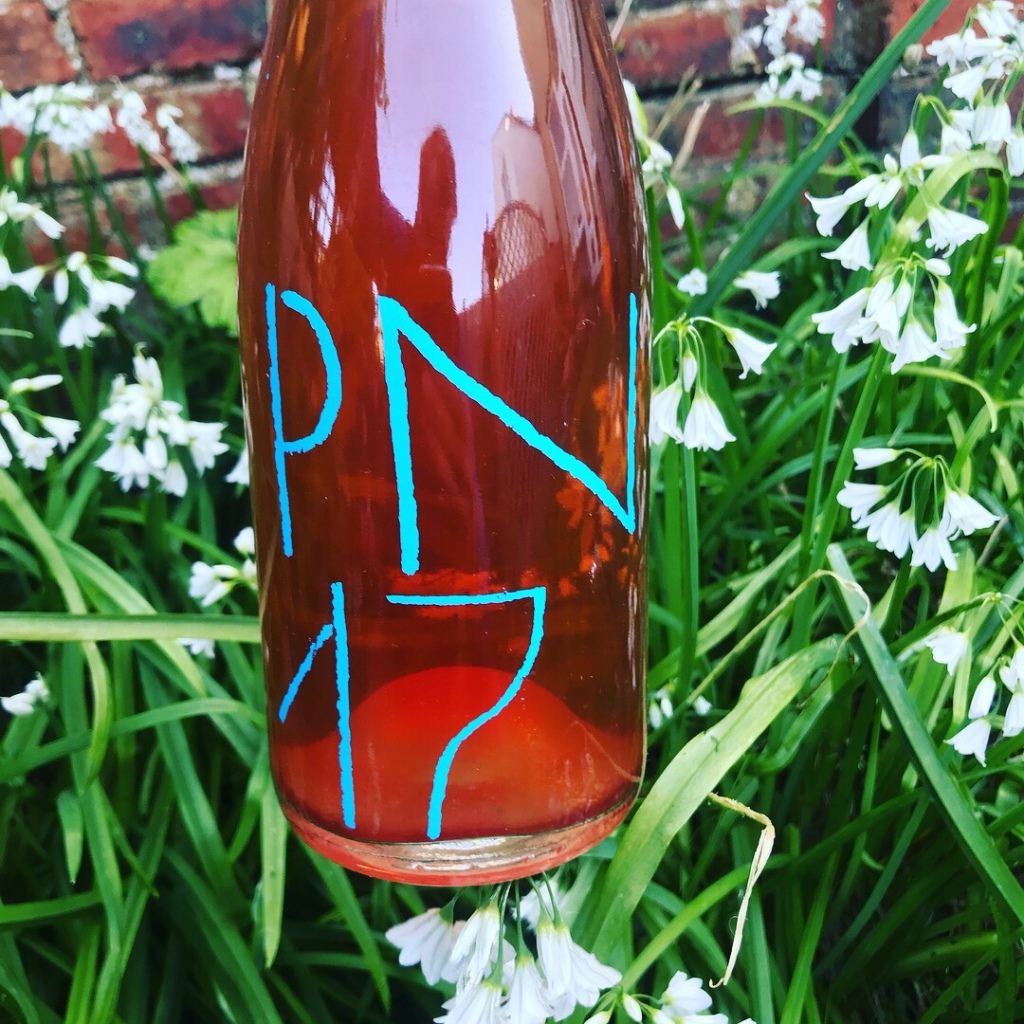
What she makes is wholly natural wine, vegan-friendly (as Jutta is, like most of my family, vegan herself), and she follows biodynamic practices to make wines which leap out of the glass, so alive are they. Try anything from her, but if you can, try to secure a few bottles of “Rakete”. It’s unusual as a pale red wine, a co-planted field blend of Zweigelt, St-Laurent, Merlot and Blauburger. The label suggests you “shake resolutely and drink chilled”. It takes us back from the serious wines of the single sites to the joyous beating heart of the Gemischter Satz tradition. I can think of no better modern interpretation of a time-honoured tradition. In better times you might find one of her wines as the house wine at the unmissable Weinbistro Mast in the city’s 9th District. She’s hard to track down because she doesn’t have her own winery premises, but every summer she will open a pop-up heuriger and may well be there, serving her wines with simple food.

Wiener Gemischter Satz is a wine of many facets, and there are many styles to explore. But the advantage for the wine lover who enjoys wine travel is that they are made in easily accessible vineyards close to a city whose attractions grow as you become more familiar with it. Vienna is not all Hapsburg conservatism. You certainly don’t need a car to explore here, and if you enjoy walking, you’ll enjoy the Nussberg in particular. But more than anything, Wiener Gemischter Satz gives any inquisitive wine lover a window on the wines of another time, updated to the present day through a philosophy which views following winemaking tradition as a valuable cultural goal. In doing so, these producers have created something here in Vienna which is quite unique…and beautiful.

Some facts:

Vienna has a little over 600 hectares of vines, about 80% of which are white varieties. The Nussberg is the largest single hillside block of vines with 200 hectares planted on its south or southeast facing slopes ranging in altitude between 150 to 350 masl. Bisamberg has 250 hectares but these are more dispersed between (on my count) 26 different sites to the northeast of the city. Mauer, mentioned above, is much smaller with 50 hectares.

Access to the Nussberg hill is, as explained, relatively easy. The swiftest route into the vines is via Grinzing. My suggested route is more downhill. Bisamberg involves a long tram ride out to Stammersdorf, but even then the vineyards are a little bit of a trek on foot.

I have written extensively on Vienna and her wines. The following articles may be of interest if you want more:

Wieninger and Wiener Wein

Heuriger, Heurigen, Buschenschanks and Popups – A Walk in the Woods and the Vines

The seminal article by Alder Yarrow was in World of Fine Wine, Issue 40 (2013).

Posted in Alsace, Artisan Wines, Austrian Wine, Vienna, Viticulture, Wiener Gemischter Satz, Wieninger, Wine, Wine Travel | Tagged , , , , , , , , , | 4 Comments

International Women’s Day

Today is International Women’s Day. The wine world seems full of women doing great things, but that doesn’t make it the slightest bit egalitarian, nor often very pleasant for them. It does not mean we work in an industry free of misogyny. This past year we have seen senior wine colleagues making inappropriate and hurtful comments towards fellow women professionals, women whose intelligence and powerful journalistic prose, drawing in a new generation to wine, might just threaten the position of a few staid old-timers who may have taken their finger off the pulse.

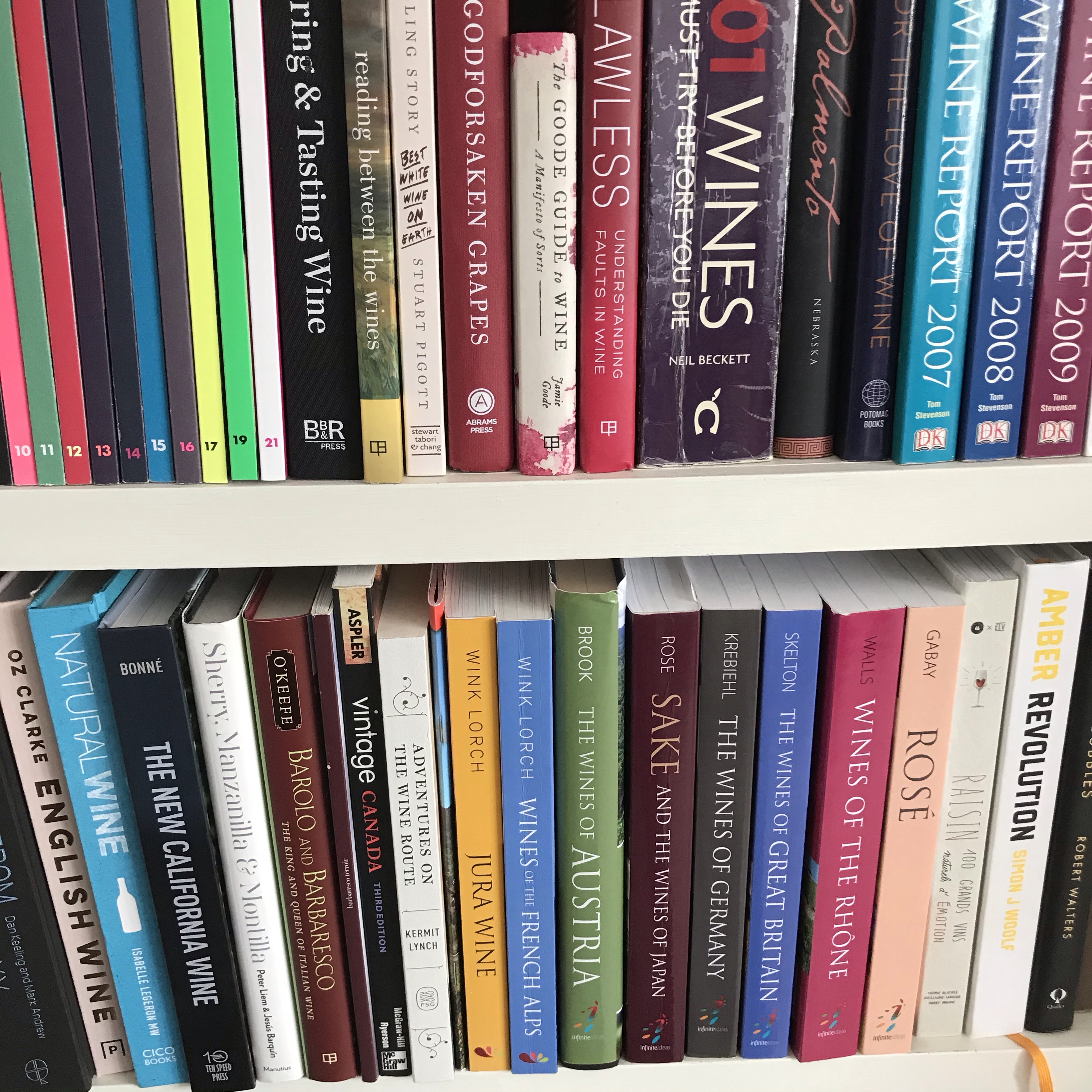
I cast an eye over my extensive wine library this morning. There are wine books written by women, including Wink Lorch, Anne Krebiehl, Alice Feiring, Rosemary George, and not forgetting a good number by Jancis. But the recognition which comes with authorship (and remember, Wink’s amazing and important books were self-published) is mostly granted to men.

In the world of the sommelier, we saw many reports of sexual harassment at the highest level through 2020. I’m not surprised. A young woman of my acquaintance was assaulted by her boss a few years ago. He was successfully prosecuted but yet perhaps typically, his colleagues blamed the victim for ruining his career. Such stories don’t always come to light as that one did, but they are there.

Women abound in wine retail, yet it is most often in the “ranks”, rarely in very senior management positions, and certainly not in proportion to their presence on the shop floor. There are, of course, exceptions. One is Littlewine.co (who naturally have a special pack of three wines to celebrate this day). Founded by two young female entrepreneurs, who completely share my own values over a range of issues, what they have taught me, and this came very much to light in the way they addressed discrimination within the industry, is that one must look for the positive. Positivity wins, negativity loses. So, I don’t intend to write any more on the ills affecting women in wine. Others with a real stake in the discrimination they face have done it with more authority than me. Today I want to celebrate the female contribution to wine, and in particular, that contribution to my own treasured bottles.

One area I have not yet touched on is women actually making and creating wine. I have met the majority of the women winemakers I’m going to be listing below, but I don’t know any of them well enough to know what difficulties they have faced as they set out to make wine in very much a male dominated profession.

The recognition of women winemakers as a distinct group is relatively recent. There have always been women making wine. We can go back a lot further than Lalou Bize-Leroy (of DRC and Domaine Leroy in Burgundy), who began her illustrious career in the mid-1950s, but there were few women taken seriously in the winery back then. One of the first women who caught my attention, because at the time I used to buy the first wines she made, was Caroline Frey.

Growing up in Champagne (her dad owned half of Billecart-Salmon), she studied oenology at Bordeaux and has since shot to fame making wine at La Lagune in Bordeaux and at Paul Jaboulet in the Rhône (and, on her own account, in Switzerland). Although her talents are considerable, and her positions (it goes without saying) deserved, she does have an obvious advantage in working for her father’s operations. But that doesn’t detract from her pioneering achievements in two bastions of conservative male domination.

My plan is to raise a glass to a number of women winemakers who, without any particular rhyme or reason, have become important to me. I find myself buying and admiring their wines more and more, wines which bring me intense joy. I don’t know why, but especially in the past few years that number has grown tremendously as indeed has the number of prominent women winemakers on wine lists around the United Kingdom. I resolutely refuse to say that they make feminine wines, or bring a “female touch” to winemaking. Nor that they are “intuitive” or “empathetic”. I believe in equality in the core of my soul. They are no “different” to men who make wine per se, but it is clear that these women make wines with a great deal more personality than many of those men.They have talent.

In the spirit of, and borrowing from, the contemporary jazz supergroup, Sons of Kemet, I would just like to raise a glass on International Women’s Day and say:

My Queen is…Jutta Ambrositsch

My Queen is…Veronica Ortega

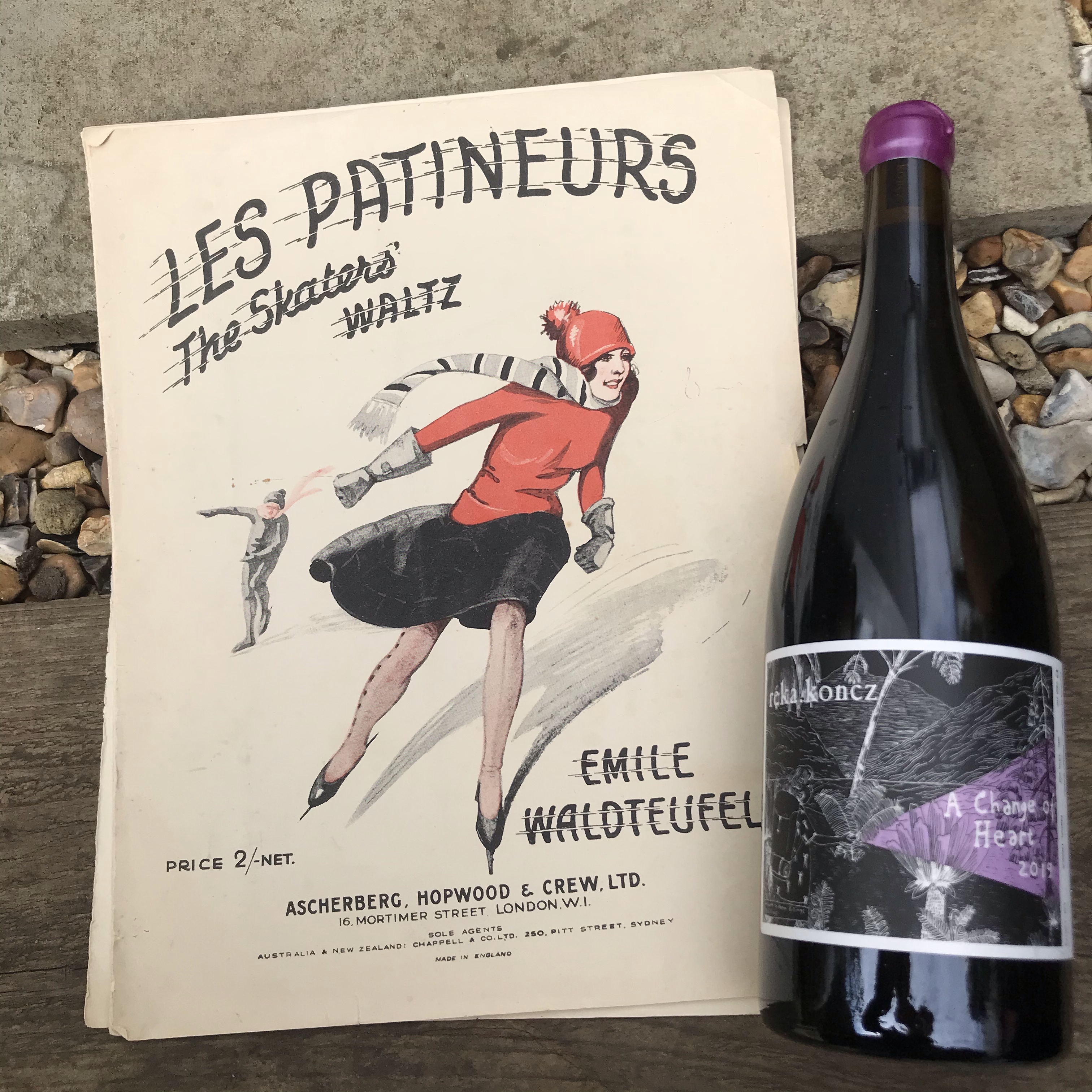
My Queen is…Annamária Réka-Koncz

My Queen is…Victoria Torres Pecis

My Queens are…Stefanie & Susanne Renner

My Queen is…Stephanie Tscheppe-Eselböck

My Queen is…Marie-Thérèse Chappaz

My Queen is Julie Balagny

My Queen is Alice Bouvot

My Queen is…Kelley Fox

…and many more, especially for some reason around the shores of Burgenland’s Neusiedlersee, but I’m not sure that it’s down to any mist of egalitarianism that drifts off those shallow waters. Thank you all for such glorious wines..

Posted in Natural Wine, Wine, Women in Wine | Tagged , , , , , , , , , , , , , | 2 Comments

Recent Wines February 2021 (Part 2) #theglouthatbindsus

February Part 2 begins with the entry level Champagne from a now established star Grower before heading to a part of the Loire, Cheverny, I’ve not now been to for too long. We have another wein from Max Sein, a natural wine from a region which is less “naturally inclined” than many in Austria (Kamptal), and a Nebbiolo from Valtellina but labelled as an IGT. This second part ends with a great Pinot with a decade on the clock from Martinborough in New Zealand and a Vin Jaune to finish after some friends kindly sent me a Mons Jura selection of Mont D’Or, Morbier and Comté (how else to truly honour such a generous gift).

BRUT RÉSERVE VIEILLES VIGNES CUVÉE NON-FILTRÉ, BÉRÊCHE (Champagne, France)

Bérêche used to be the one producer I would always try to visit no matter how short a time I had in the Champagne region, which would most often be just one night on returning from Eastern France. So I always feel my heart skip a beat of excitement as I crest the Craon de Ludes where their winery sits, surveying the plain towards Reims. Regrettably, due to Covid, it has been a while and my stocks purchased there have dwindled, though supplemented last year from their UK importer.

Raphaël and Vincent have vines on the Montagne and the Marne, which both contribute to this cuvée. The base here is 2014, disgorged September 2017 with a dosage of 7g/litre. The grape blend is 35% Meunier, 30% Pinot Noir and 35% Chardonnay, but the wine contains 35% reserves, quite a high proportion, from 2012 and 2013. It is, however, made from old vines and is not filtered.

As always, the Brut Réserve is pristine with a very clean attack. The bouquet has lovely orange peel (more than lemon) citrus and a touch of bergamot. The palate hints at hazelnut and honey and there’s a saline mineral texture on the finish. Sip it and hold it there in the mouth, this is a beautiful Champagne. I drink many of Raphaël’s Champagnes from a wine glass but for this cuvée I use Zalto Champagne glasses. They enhance the delicacy and minerality of this wine. Personally I do not know of a more crystalline and pure entry level Champagne. With the way Champagne prices are going for the other cuvées, this is just as well.

Bérêche’s UK agent is Vine Trail.

CHEVERNY ROUGE 2019, HERVÉ VILLEMADE (Loire, France)

Cheverny is a small appellation in Touraine, a little to the south of Blois. We are lucky to have friends with a family home in one of the hamlets near to the enormous Renaissance château at Cour-Cheverny, after which this AOP is named, so we know the region and its winemakers, although my early visits were to the tasting room at Jacky Blot’s Domaine de la Taille aux Loups at Husseau, and to the wine shop of François Chidaine on the river just east of Montlouis (highly recommended, they sell much more than merely Chidaine wines).

Cheverny is in fact two appellations. Cour-Cheverny is purely for wines made from the interesting but rare Romorantin variety. As a dry wine it can be acidic, but locally you may find some rare Moelleux versions which can be worth a punt ageing them. Cheverny tout-court makes plenty of white wine. Some authors suggest that the Sauvignon Blancs, often blended with some Chardonnay, are best and there are some interesting wines here made by a few locals. Increasingly, at least as interesting as the Sauvignon-Chardonnay blends, are the reds blending Pinot Noir and Gamay (similar to Passetoutgrains from Burgundy or Dôle from Switzerland’s Valais).

Hervé is perhaps the big name in Cheverny, yet all his grapes are grown organically and he’s been following a natural winemaking philosophy since the 1990s. This is his entry level red, a negoce wine made naturally from bought-in organic Pinot and Gamay fruit. It sees a fifteen day maceration followed by ageing in used oak. It’s a simple wine but absolutely packed with fruit and despite registering 14.5% alcohol you genuinely wouldn’t know, it’s in perfect balance. Concentrated cherry and a strawberry top note, with a liquorice twist on the finish. I think some people might initially place it as “New World”. It’s a versatile wine, so use it for barbecues or winter nights by the fire where it will be equally effective. This is only £19 folks.

Currently available via Littlewine.co .

« LES AUTOCHTONES » 2019, MAX SEIN WEIN (Franken, Germany)

I recently posted a review of Max’s white blend, “Trio Sauvage”, which I enjoyed immensely. This is a single varietal from old vines and a step up the ladder. Max has worked his way around before setting up at Wertheim-Dertingen, west of Würzburg, but for me it’s his stint working at Gut Oggau which piqued my interest. But he’s also worked in New Zealand, and with Judith Beck, also in Burgenland. He returned to take over 3.5ha of vines farmed before him by his father and grandfather.

There are two varieties Max seems to really like. The first is Silvaner, perhaps not a bad choice given that it thrives in Franken. The other is Schwarzriesling, which he prefers to call by its French name, Pinot Meunier. This particular wine is his top Silvaner from vines over sixty years old. The terroir is limestone with around 5% red sandstone and the wine has a racy mineral edge which is so common with these soils. It’s a very focused wine but there’s breadth here too. It has a very attractive savoury side to it, but more than anything, freshness. I suspect this may age well but I wasn’t at all sorry to have opened it. I suspect I shall really begin to learn Sein language over the next few months, unless his wines all sell out.

Max Sein Wein is the first German addition to the Basket Press Wines portfolio.

 GRUNDSTEIN BLAUER PORTUGIESER 2018, NIBIRU (Kamptal, Austria)

Nibiru is a collaboration between Julia Nather and Josef Schenter (of Weingut Schenter), who began making wine together at Schönberg-am-Kamp (to the east of Wachau and Kremstal) from the 2015 vintage. The name “Nibiru” reflects their philosophy – it’s a planet named by the Sumerians which apparently enters our galaxy every 3,600 years, travelling in the opposite direction to the planets in our own solar system…there may be little evidence for this planet, but the Nibiru Cataclysm is a predicted collision between Earth and a large planetary body which some believe will take place during the 21st century. Thankfully the lady who predicted this suggested the destructive event would take place in 2003.

But I digress…we have a very tasty natural wine here which is unlikely to wreak the destruction of mankind. Deep purple in colour, it is, like all the tastiest Blauer Portugieser, full of concentrated dark fruits with a bit of an edge, the product of what I call sharp fruit acidity. The alcohol content is a whopping…10%, which makes it qualify as an honorary fruit juice. It’s great fun and chillable for spring and summer. A great wine to pour a big glass on a Sunday afternoon whilst sitting outside with a good book. It won’t send you immediately to sleep.

Imported by Modal Wines.

NEBBIOLO “BOTONERO” 2018, IGT ALPI RETICHE ROSSO, MAMETE PREVOSTINI (Valtellina, Italy)

Alpi Retiche is the IGT label for the wines of Lombardy’s wider Valtellina region, which runs horizontally east of Lake Como, pushing up towards the Swiss border, enveloping the town of Sondrio. I am not wholly sure why this wine is not labelled Valtellina, as it is a 100% Nebbiolo (known here as Chiavennasca, but this producer uses “Nebbiolo”), so I presume it is outside the DOC.

The vines are still grown on steep terraces at altitudes between 300 and 700 masl, so this is a real mountain Nebbiolo. I looked at the Mamete Prevostini Home Page and it does look rather beautiful there. I’ve drunk lots of Valtellina but have never visited. This sees a six day maceration, followed by eight months in stainless steel, and then a further six months in bottle before release.

It’s not really like Piemontese Nebbiolo, nor indeed like most Valtellina I’ve drunk, but it does explode with red fruits to match its ruby red colour. It strikes initially as surprisingly like Beaujolais with cherries, then strawberries. There’s a little texture and tannin on the finish though, which grounds it. As an entry-level wine it doesn’t attempt complexity, just simple but sappy fruit. It’s a fun wine too, not expensive and something a little different. It oozes mountain air and sunshine.

This was £20 from Butlers Wine Cellar. The importer is Alpine Wines.

MARTINBOROUGH PINOT NOIR 2011, KUSUDA (Martinborough, New Zealand)

Hiro Kusuda was born in Tokyo and trained as a lawyer. He eventually became a diplomat working in Sydney before deciding on a dramatic career change…he went off to study winemaking at Giesenheim in Germany. Obviously a very intelligent and capable man, he must also have been very determined, and I believe something of a perfectionist. Why settle on Martinborough? It seems the moment of inspiration was tasting a 1992 Ata Ranghi Pinot Noir. Having drunk my last bottle of Ata Ranghi’s 2010 on New Year’s Day, I know what he means.

The Kusuda web site proclaims a goal “to make Pinot Noir with sheer purity and finesse”, and most people who taste his wines would agree he’s succeeded. Not that too many people get the chance because Hiro has become something of a cult winemaker back in Japan, where most of his bottles head.

The grapes are hand picked and handled gently at every stage of winemaking. The wine is aged 17 months in barrique, of which 22% (very precise) is new. Even at a decade old this shows really bright cherry fruit. In fact it’s all about brightness and lightness, which is lovely, but the abundant finesse floats over a smokiness (perhaps an oak influence?) and just a little remaining tannin. The alcohol level is 13%, which seems just perfect to add an extra dynamic, just a little weight. Wow, it is so long on the palate, lingering for ages. Drink now or don’t be afraid to keep longer.

I had to ponder hard to remember where this came from. I know my 2014 was a gift, but I’m pretty sure that this was purchased from Berry Bros & Rudd.

VIN JAUNE 2005, BENOÎT BADOZ (Jura, France)

Benoît’s family have been making wine around Poligny since 1659, which is very impressive, is it not? It was actually Benoît’s father who began making a name for the domaine, and his work has been carried on by his son. Domaine Badoz actually owns a ten hectare block of vines to the north of the town, unusual in a region parcellated over the centuries into often diverse and smaller plots. The soils are on the traditional Jura Marnes Bleus which make perfect terroir for Savagnin.

All the wines here are pretty low intervention, and historically so, with most vines never having seen pesticides. They make a full range of Jura wines, but I think it’s fair to say that their most famous product is their exemplary Vin Jaune. This 2005 sees the traditional six years plus ageing under a thin layer of flor (sous voile) which makes Vin Jaune so uniquely distinctive. It means that this wine isn’t quite as old, in terms of release, as it might seem, but neither is it a youngster.

I’d put this wine into a traditional, rather than modern, camp. That bouquet…you could sit smelling the glass for an hour and be perfectly satisfied. It has a palate dominated by a delicious nuttiness, with a fresh citrus acidity running through the middle of the palate. That acidity gives a zip to the wine which you might not expect from one of this age, but VJ takes a long time to mellow (we also drank a sample of a 1981 Château-Chalon Vigne-aux-Dames from the legendary Marius Perron the same evening and that had truly mellowed). The finish however became smooth and rounded on the finish. This is another wine of great length, as all good Vin Jaune should be. Classic old school, totally satisfying, especially with that Jura cheese selection (making me hungry as I type).

This bottle was purchased many years ago at The Sampler in London. The current vintage on their shelves is 2013, which at £45 is reasonable for good Vin Jaune these days.

Posted in Artisan Wines, Natural Wine, Wine | Tagged , , , , , , , , , , , , , , , , , , , | 3 Comments

Recent Wines February 2021 (Part 1) #theglouthatbindsus

February yields just fourteen wines. Partly, I guess, as it’s a shorter month and partly because we drank some wines I wrote about in early winter. We will still go for two parts, seven wines in each. In Part One I offer you an exquisite and quite rare Bourgogne, a Priorat with a difference and a tasty white blend from Burgenland, followed by an unusual red Piemontese, a Savoie which might possibly be my wine of the year so far, another equally fantastic Burgenland, red this time, from one of my most adored producers and, to finish, a classic older South Australian Riesling, hailing from a different period in my wine life.

BOURGOGNE CHITRY 2018, ALICE & OLIVIER DE MOOR (Chablis, France)

The De Moors are based at Courgis, southwest of the town of Chablis, beyond the large Premier Cru of Montmains. It is remarkable to think that they have now been making wine here for more than thirty years, because in this time they have gone from being the first example of truly natural winemaking in the Chablis region to being acknowledged superstars whose wines fetch ever higher prices (as a very recent purchase of Premier Cru “Mont de Milieu” showed me). My first ever bottle of De Moor was their Chablis “Humeur du Temps”, picked up on a whim in a discounted bin at Berry Brothers’ “factory outlet” near Basingstoke well over a decade ago. One bottle and I was hooked. I’d never quite drunk Chablis like it.

Chitry is one of the so-called minor Bourgogne appellations in the general Chablis region, or perhaps I should say the Auxerrois. There is a key difference. The grapes for Chitry are still Chardonnay and still planted on clay/marl soils also prevalent in Chablis. However, without the famous name, few estates have made much effort with these wines. You can count on the fingers of one hand those Chablis producers who do, although a few domaines (such as Goissot) have made a name purely from Auxerrois fruit. But the terroir suggests more is possible, and from De Moor, it is.

The De Moors lavish as much effort here as in Chablis, so this wine, never very easy to source, can be something of a hidden gem. It’s fresh, very mineral, saline, but yet it has that rondeur coming from ageing in older oak (the 2018 was aged in a large foudre). It’s apple-fresh but with the touch of weight and gras that suggests a more “serious” appellation.

Such purity and beauty. As the back label states, “I am only the fruit of a respected and beloved soil…I hope to bring you joy”. You sure did, and the De Moors always do.

If you are lucky you will find this at Les Caves de Pyrene. Tiny quantities.

PRIORAT “CLASSIC” 2018, LECTORES VINI (Priorat, Spain)

Priorat has something of a reputation in my house for very boozy, dense reds. Ever since I first bought a few bottles of Scala Dei back in the 1990s every bottle I have bought has perhaps seemed more impressive than enjoyable, very subjective I know. But on the tasting scene a few years ago I began to encounter Fredi Torres, who with Mark Lecha makes up Lectores Vini. After a long chat with him at Viñateros, one of the last tastings I went to in London in March 2020, I decided I needed to get a bottle to try at home. This was the first Priorat I’ve bought in many years, despite loving the wines of Spain more generally.

What stands Fredi Torres apart, as a Priorat producer, is the fact that he’s actually Galician. He’s also lived in Switzerland, Argentina, South Africa and Burgundy. His cosmopolitan winemaking activities cover Galicia (with Silice Viticultores) as well as Catalonia. What stands his Priorat apart is a much fresher style where acids play an important role. Although this “Classic” is made from only 70% Garnacha (with 25% Carignan and 5% Syrah), it has something in common with the beautiful new wave Grenache of Gredos et al. In fact, there’s even a splash of white Macabeo somewhere in here, and although it is raised in oak (around 15% new), it’s not oaky, even now at just over two years old.

It has an enticing bright colour with a purple rim. The bouquet is fragrant cherries which are translated to the palate where they sit happily with a twist of liquorice and a touch of tannin, both adding bite to the finish. This is a lovely modern Priorat. If these wines normally tire your palate, give this one a try.

Imported by Modal Wines.

INTERGALACTIC 2019, RENNER & RENNERSISTAS (Burgenland, Austria)

A new name for a new era, as the irrepressible Renner sisters have been joined by their younger brother, Georg, in what will be the next exciting phase at this Gols estate already brimming with exciting wines and ideas. The big change here is really the putting into practice of an idea which Stefanie told me about a few years ago, when she stated the aim first to get to know each individual variety and their terroir…but in the long term to focus on blends. It is blends which really hold the greatest interest for the siblings.

Intergalactic is one of the new wines they have developed, in this case a white blend of Chardonnay (well, a little), Gewurztraminer, Grüner Veltliner, Muscat Ottonel and Welschriesling. The grapes all come from one vineyard planted in 2017, as a part of that project. It’s a true field blend, but not one that is co-fermented. The grapes are macerated on skins for three to eight days, depending on variety, which adds texture and a little colour, but not really a significant amount.

Next, the wine sees nine months ageing on gross lees, some in 225-litre barrels and some in 500-litre larger oak. Bottling is, as always here, with as little sulphur as they feel able to get away with. The result smells of slightly floral mango fruit with orange, lime citrus and herbs. There are nice acids, a little texture and a palate which is bone dry despite the rather exotic fruit on the tongue. It’s another Renner beauty, and the label is next level too.

This can be found at both Newcomer Wines and Littlewine.co.

“68” 2019, CASCINA TAVIJN (Piemonte, Italy)

The area known as Alto Piemonte is becoming increasingly popular as prices for Barolo and Barbaresco become ever more Burgundian, but there’s another side to Piemonte, known as Alt-Piemonte. Here, in the Monferrato hills to the northeast of Asti, Alto- and Alt-Piemonte come together in an estate making truly individual wines.

Nadia Verrua may look very youthful, but her family has a century of farming these hills behind them. The estate measures ten hectares, but only half is planted to grapes. Their other main crop is hazelnuts. Things are done naturally, with zero chemical inputs (including no added sulphur). The grapes, in this cuvée a 50-50 blend of Barbera and the wonderful but rarely seen Ruché, are fermented together for a whole two months on skins (no stems) and are then aged in a whole gamut of different vessels, ranging from oak botti to cement and fibreglass.

The result is an absolute riot of red and dark berry fruits with a hint of violet on the nose, all kept bouncing in the glass by some fresh and zippy fruit acidity. It’s a wine for enjoying, not pondering over, and it really does illustrate how under-valued (if I might say so) Ruché has become in the Piemontese mix.

The cuvée is yet another wine named after a road number, which of course in Italy, whether north or far south, means the SP68.

This, and other wines from Cascina Tavijn, are available from Tutto Wines via their online Tutto La Casa.

CÔTILLON DES DAMES 2015 VIN DE FRANCE, JEAN-YVES PÉRON (Savoie, France)

Jean-Yves Péron has farmed at Conflans, close to Albertville, since 2004, right in the heart of the Haut-Savoie. His vineyards are on slopes of mica schist between 350 to 550 masl, and his parcels are tiny. Thankfully he manages to bring in some fruit from other like-minded (read fully organic) growers, including some cuvées in collaboration with growers in Italy’s Piemonte.

Côtillon des Dames is a name for different cuvées with the same characteristic yellow label. They include sometimes a multi-vintage blend, a Reserve and a vintage, and this is a nicely aged 2015 vintage wine. The grapes are Jacquere and Altesse, two of the region’s autochthonous varieties. They see enough skin contact to make this a genuine amber/orange wine.

This is pretty obvious from the colour, which might scare any more conservative readers, but it’s the bouquet which really grabs your attention. It is no less than explosive with orange citrus. I’ve been enjoying the season’s blood oranges right now, and that is exactly what I got here. That almost overpowering scent. The palate is certainly textured but there’s a heap of exotic fruit which is almost like the sweet and sour of a Chinese dish, but with a nice Seville Orange marmalade bitterness on the finish.

An extraordinary wine for the adventurous, contemplative, challenging, difficult for sure, but perhaps this is why this may be my wine of the year so far. Mind you, the next wine’s pretty damned good too…

A reasonable range of Péron wines are usually available via Gergovie Wines, who like Tutto above, specialises in wines made without added sulphur.

JOSCHUARI ROT 2011, GUT OGGAU (Burgenland, Austria)

So, we probably all know by now that Gut Oggau is a family winery and heuriger based in Oggau, a hamlet just a kilometre or two north of Rust, on the western shore of Burgenland’s Neusiedlersee. As Rust is highly recommended (for a host of reasons which I have written about before), the most effective way to visit Gut Oggau, and to be able to taste and drink, is to hire bicycles in Rust itself. Oggau is close enough that you can wobble home.

Joschuari sits in the middle generation of the Gut Oggau family of wines, a “parent”. He is a rather complex Blaufränkisch grown on the superb limestone terroir above the lake, vines being forty years old. That terroir drives the wine, as it does all of the fine examples of this variety from this location. Its signature is a racy mineral edge which is given more of an accent here with 50% of the fruit being fermented in concrete (the rest in oak). It is then aged 12 months in the same blend of the two vessels.

This is, for me, a wine to lay down, perhaps more so than Josephine, the other parent who I perhaps know more intimately. At ten years old this seems as fresh as the day it was bottled. It still has that characteristic dark tinge to the colour. This is reflected in a dark-fruited bouquet, where you can also almost smell the limestone (or is it a touch of that concrete-induced high note, or both?). The palate is beautifully concentrated and very long. It’s a serious wine, but its freshness makes it joyous to drink. Biodynamic, around 20 mg/l sulphur added, a life affirming bottle. I expected no less from the caring genius of Gut Oggau.

Imported by Dynamic Vines, Bermondsey.

SPRINGVALE WATERVALE RIESLING 2010, JEFFREY GROSSET (Clare Valley, South Australia)

Jeffrey Grosset knew he wanted to be a winemaker in his mid-teens, so on leaving school he went straight off to Roseworthy College, and after graduating wound up by his mid-twenties working as senior winemaker for a large-scale Australian wine group. But his future was obvious…that he’d go it alone. That he was able to do so was in large part down to help from his parents, both in helping to fund the purchase of an old dairy at the southern end of the Clare Valley, and from his dad’s physical labour in helping convert the grapes from a mate’s Riesling vines at Polish Hill into 800 cases of wine for his first vintage.

Jeffrey now farms 20 hectares over the valley, making much more than just Riesling. But if a lover of Australian wine thinks of Riesling, it is surely Grosset of whom they will think first. He’s still most famous for his Polish Hill Riesling, and people often therefore think of the Springvale, from fruit at Watervale, as a kind of second label. This most certainly isn’t the case. Springvale is merely different. The Watervale fruit is different, more generous than the Polish Hill, where the fruit comes off very poor soils on hard shale. Instead Watervale is mostly red limestone and loam with shale mixed in. Three different clones are grown organically, hand harvested from a six-hectare block.

As Jeffrey Grosset repeats so often, the idea initially was to blend the two sources but he soon found that didn’t work. He was one of Australia’s first voices in favour of the expression of “place” through wine, something the Clare terroir taught him. He was also, partly at the behest of his importer, David Gleave (Liberty Wines), an early exponent of screwcaps.

Whereas you really wouldn’t want to broach a Polish Hill too young, the Springvale can be drunk early. But even at more than a decade old, as this bottle was, it showed an attractive green-gold colour and on the nose, an expression of pure lime cordial, the palate revealing a firm backbone of acidity you don’t quite expect unless you know these wines fairly well. That palate is crisp, mineral and bone dry and (goes without saying) incredibly long. For a 13% Riesling it’s still very elegant too. I’d say that despite being a decade old it will surely go another seven-to-ten years minimum.

Grosset is usually available fairly widely in the UK, via importer Liberty Wines, but also through The Wine Society and Berry Brothers (among others). I happen to remember that my bottles all came from The Sampler (Islington branch), though nothing is currently listed there.

Posted in Austrian Wine, Burgundy, Italian Wine, Natural Wine, Neusiedlersee, Piemonte, Savoie Wine, Spanish Wine, Wine | Tagged , , , , , , , , , , , , , , , , , , , , , | 1 Comment

Wine and Cheese Anyone? Reviewing Oz Clarke’s English Wine with Ned Palmer’s A Cheesemonger’s History of the British Isles

This week you get two book reviews in one article and, I think for the first time, one of them isn’t about wine. Tempted as I’ve been in the past to review books on my other passion, music, I have sensibly refrained. But cheese, surely that counts for being so plainly associated with wine for centuries. It happens that I read these two books consecutively over the past two weeks, and they both have a common geographical focus, the British Isles. Of course, I’d not be reviewing a cheese book here unless I thought it was something special, and a little different. What I will say, before we move on, is that both books have a strong narrative, and so as well as informing they also entertain. Perhaps this is why I read them so quickly. Please take the time, if you can, to read both reviews.

First, to Oz. Oz Clarke’s book is called “English Wine”, though he explains in a reader’s note that this is in no way intended to upset the Welsh winemakers, of whom seven get a mention in an albeit short chapter. It is because, as Oz rightly remembers, “British Wine” is made from imported grape concentrate. He might have taken a leaf out of Ned Palmer’s cheese book’s title, but then he might have clashed with Stephen Skelton’s “Wines of Great Britain” (2019).

You kind of know what you might get from the cover, which sports a cartoon of Oz sitting atop the White Cliffs of Dover sipping a sparkling wine in a “flute”. These cartoons appear throughout. Beneath is the strapline “From Still to Sparkling…The Newest New World Wine Country”.

The book, which runs to 176 pages, begins with a little history, but thankfully only a little. Oz does mention the debate as to whether the Romans really did make wine from their English vines, and he does mention the vineyards of medieval England, whilst acknowledging that they were probably fairly insignificant compared to imports from the Gironde and later Portugal, not to mention beer (and small beer). But he doesn’t labour the point.

In fact, by the time we have reached page 40 we have covered more up-to-date matters like the importance of location for a successful vineyard, the planting spree of the 2000s and questions of what grape varieties to plant and what to make from them. It’s a shorter summary than you’ll find elsewhere, less detailed but more succinct.

The short middle part of the book, which ends the more general sections, covers Sparkling Wine, which Oz naturally calls British Bubbles. Even if you’ve done a stage at Taittinger you’ll still find this nine or so pages interesting, but most people reading this Blog will not learn anything new. That said, it does lead us in nicely to the main body of the book, effectively the last hundred pages, which is a “Tour of the Regions”.

As you can see from the Contents photo, England and Wales is broken up geographically, although Oz is not (I think) advocating regional PDOs (in a European sense) for English and Welsh wine (which at least one major producer in Sussex seems to advocate). In fact, Oz is rather good at simply describing the geology of the vineyards, which naturally doesn’t take any notice of County boundaries.

 He dismisses the idea that English vines have to be grown on Downland chalk, giving a shout-out for the Thames Valley gravel beds, for “greensands” in particular (another type of detritus-rich marine deposit), and even pointing out where vines have been successfully grown on clay in some places, that supposed “no-no” for serious viticulture in England due to its normally high water retention. In fact, he is also very adept at explaining other aspects of terroir throughout the book, especially slope orientation, rainfall and, very pertinent to where I live, wind, in a way that’s simple enough that you won’t forget the lessons.

I suppose it is this regional coverage in the book which is most relevant for readers who are not novices. The directory should give us an insight into the workings of the wineries and vineyards whose wines we are likely to find in the shops, and indeed if it does its job, this section will make us want to go out and try these wines. I do think it achieves this very well. You just need to read the entry for one of England’s very oldest (and smallest) commercial vineyards, Breaky Bottom (p84ff) and I challenge you not to want to go out and buy some (Give Butlers Wine Cellar in nearby Brighton a call as they are usually well stocked with Peter Hall’s different sparkling cuvées). Perhaps even his bottle-fermented Seyval Blanc for the more adventurous among you? Most should begin with the numerous cuvées made from Champagne’s traditional trio of varieties.

Breaky Bottom, nestling within the South Downs near Rodmell, Lewes (Mick Rock/Cephas), one of a few lovely photos in Oz’s book

We get all of the big players included here, and the entries are well written. They generally get right to the heart of what drove individuals to want to create wine in England as well as listing the more mundane aspects, such as planting ratios and maturation techniques. We also get a good number of the newer names on the scene, something I personally felt (obviously a subjective opinion) that Stephen Skelton’s 2019 “The Wines of Great Brtitain” (which I reviewed last year) failed to give us.

I guess you want examples? Skelton seems to ignore Ben Walgate’s Tillingham (at Peasmarsh near Rye, East Sussex). Ben is England’s great experimenter, and if like me you believe that those working at the fringes are most likely to push the envelope for everyone else, then Tillingham is an important place in English Wine (not to mention a serious venue for experiencing innovative vineyard hospitality through their smart accommodation and restaurants). Oz ends his one-page entry for Tillingham saying “…there’s no doubt that if biodynamic vineyards and natural winemaking are to play a part [in the future path of English wine], Ben Walgate will be leading the charge”.

So, Oz covers the whole range of British vineyards, large and small. He does it very well. I was disappointed to see some omissions, for example Westwell Wines on the North Downs of Kent, at Charing, where Adrian Pike is hardly less innovative than Ben Walgate. Then, on a more traditional note, there’s Jacob Leadley’s Black Chalk in Hampshire. I know Oz must have tasted Black Chalk as I’ve spotted him at the Wines of Hamphire Tasting at 67 Pall Mall on at least one occasion. It was pretty much on the back of the very first releases by Jacob that I identified Black Chalk as heading swiftly towards the top of the rankings for English Sparkling Wine, and I was not alone in that at least one prominent wine writer shared my enthusiasm. Black Chalk cemented its place at the 2020 Wine GB Awards, where they won “Best Newcomer”.

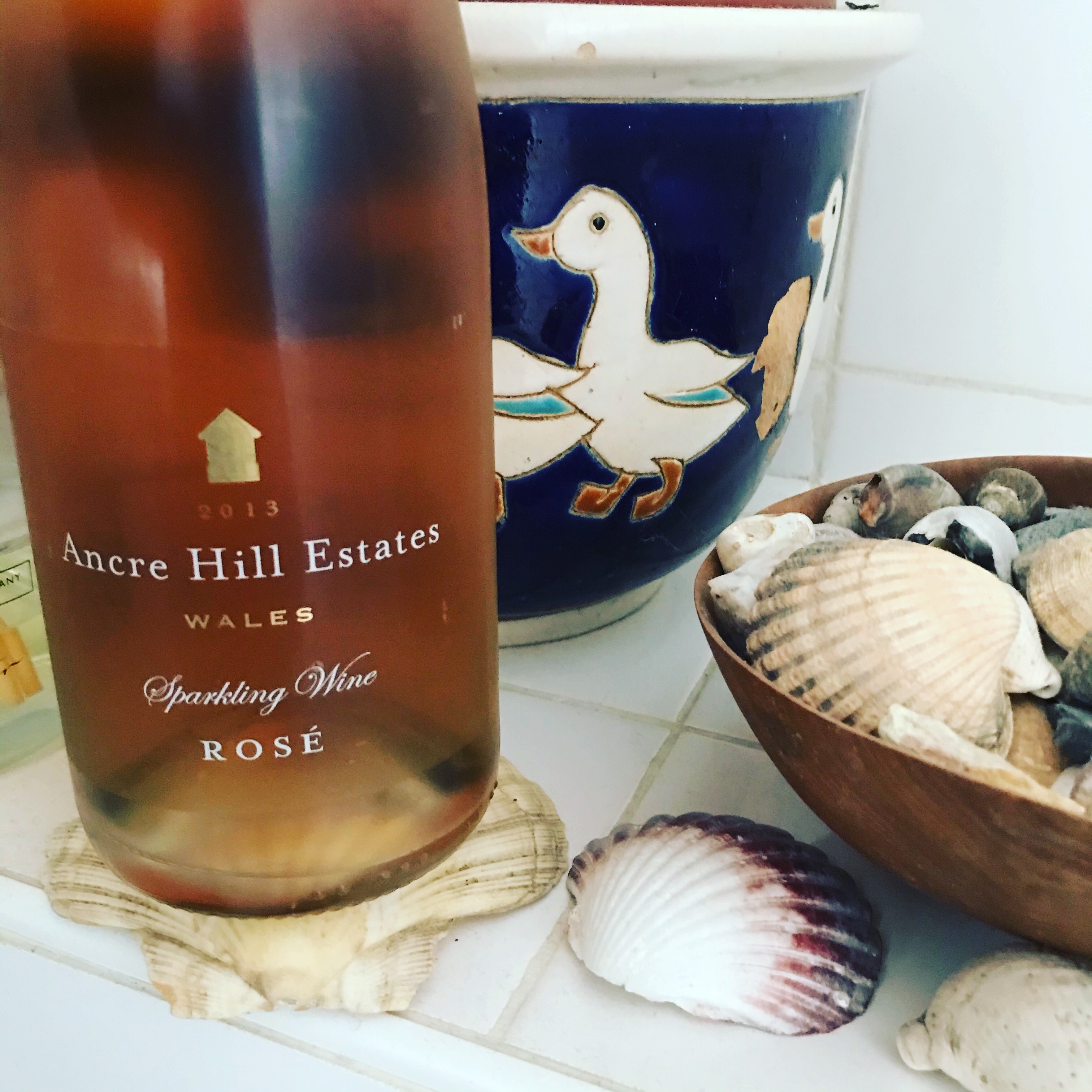
If I’m really picking nits, as well as omitting Westwell and Black Chalk, I would personally have liked a bit more than mere “directory” information for that other great innovator, Ancre Hill in Monmouthshire. Ancre Hill might well have become known a decade ago for some cracking Welsh sparklers, but having recently drunk their red petnat made from Triomphe and being soon to drink another bottle of their innovatively-labelled “Orange” (made from Albariño), I’d suggest this vineyard has a broad portfolio of exciting wines.

I must say that one thing I am very pleased about is that Oz doesn’t dismiss still wines. It might be pertinent to note here that just as the climate of at least England’s south coast is becoming remarkably similar to that experienced in France’s Champagne Region a decade or so ago, Louis Roederer has announced two new and rather expensive Coteaux Champenois still wines. I have no doubt that these trailblazing cuvées from a forward-looking Grande Marque will be followed in time with other still cuvées, to join those of the Growers (some of which are pretty good already).

As Champagne gets warmer, so does England. If the future may now so obviously look sparkling, we must understand that still wines will have a place in our wine story. Some do already, and as they are easier and cheaper to produce than classic method, bottle-fermented, sparklers, they provide tempting cash flow (as England’s massive investors, the Driver family at Rathfinny, astutely recognised, releasing their Cradle Valley Pinot Blanc/Pinot Gris blend as their first sparkling wines matured on their lees in Alfriston). Whilst Bacchus establishes itself as a genuinely English variety, in terms of the unique white wines it produces here, there is no doubt that many winemakers have already been hooked by the search for the holy grail of exceptional English red Pinot Noir. Some of you will know what I mean if I quote Hobo Johnson: “I woulda bought a Lambo but I’m not quite there yet” (from Subaru Crosstrek XV). But they will get there one day very soon.

How to sum up? I enjoyed Oz’s book immensely. If you want a lot of dry facts, perhaps you might want to look elsewhere. It’s relatively lightweight as far as hardbacks go, literally speaking. I’d not say it’s “lightweight” as regards content, but Oz is not writing a PhD thesis either. In fact, I’m sure this consummate entertainer is attempting nothing of the sort.

I’d say Oz will appeal to two kinds of reader. First would be perhaps my twenty-three-to-thirty-year-old self, getting interested more seriously in wine for the first time. The second type of reader is me now, a wine obsessive who wants to consume as much as possible about this new wine frontier. The book’s narrative drives the text along and frankly I could have read it all in one long, fully catered, duvet day. If I’d not enjoyed it, you’d not be reading a review. And as a subject, English (and Welsh) wine is something we all need to get to know pretty quickly.

English Wine by Oz Clarke is published by Pavilion (hardback, 2020, rrp £16.99 or US $ 24.95). I include the dollar price because for North American readers interested in seeing what all the fuss is about, this book is a great place to start.

Now please don’t stop reading because I would very much like to spend a few paragraphs telling you about a book which could almost be a companion to Oz Clarke, A Cheese-monger’s History of the British Isles by Ned Palmer (Profile Books, hardback 2019, this soft cover edn, 2020, rrp £9.99).

Ned Palmer, like most people involved in the renaissance of the fine cheeses of our islands, had no intention of such a career. This budding jazz pianist ended up taking a “temporary” job at Neal’s Yard Dairy in London’s Covent Garden before eventually, after a great deal of travels, cheesemaking jaunts and getting to know Great Britain and Ireland’s best cheesemakers, founding The Cheese Tasting Company in 2014.

I own a few books on cheese, but this one is a little (a lot) different, and that’s why I’m bringing it to your attention. Over ten long chapters, Ned gives us a highly entertaining overview of British and Irish cheesemaking throughout our history. He begins with our Neolithic past before moving towards our present-day real cheese revival, via the Romans, the Monasteries, Cromwell’s Commonwealth, the Victorians, the 20th century with its wars, right up to the present day. There is feast and famine, and the near destruction of craft cheese as an industry here, before signs of new shoots from the 1970s, and what we can genuinely call a renaissance since 2000.

Each chapter has a signature cheese, in some way relevant to the time period. Ned will usually take us to visit its finest proponents and we get a history lesson somewhere between a visit to the British Library’s darkest corners and one of those “Horrible Histories” books. This is another book with a narrative that keeps you reading until your eyes can no longer stay open (if like me you are reading a chapter a night in bed). It had one other effect too, in some ways not what you want, but certainly an indication of just how good a read this was: even after a good dinner, reading Ned Palmer’s prose made me genuinely hungry for the cheese in question. A real feeling in the stomach and an uncanny ability, on several occasions, to smell that cheese in the depths of my memory.

This is a brilliant book, and not surprisingly it won a Sunday Times Book of the Year Award, as well as being shortlisted for the André Simon Awards and for a Fortnum & Mason Guild of Food Writers Prize. It brought me two additional avenues of research, both of which I shall be pursuing.

At the end of the book Ned details some “favourite cheeses”, listed by type with a brief paragraph about them. Many are classics if you are an habitué of Neal’s Yard Dairy or Paxton & Whitfield. I was also led to Ned’s web site, www.cheesetastingco.uk ,where you can find a list of fine cheesemongers both in the capital and around the country. I was very happy to find one shop listed in the market town closest to where my parents live which I had not previously known existed, and which, by location, ought to sell the finest example known to man of my father’s favourite cheese. Another reason I can’t wait for Lockdown to end.

I put up a review of a cheese book on my wine blog because I thought it was absolutely brilliant. I’m sure it will rank among my books of the year, and if my few paragraphs explaining its format appeal to you, if of course you love cheese, and if of course you are not one of those with a pathological inability to appreciate the fine cheeses of our British Isles alongside the wonders of taste produced by our European cousins, then you might just feel the same way.

Posted in Artisan Wines, English Wine, Sparkling Wine, Wine, Wine Books, Wine Writing | Tagged , , , , , , , , , , , | 4 Comments

Pergola Taught

For me, there are a couple of very different burning issues to be addressed in the world of wine, and rather quickly. One of those is diversity, but important as that is, I’m not sure an old middle class white bloke like me can add a great deal to the mix, aside from a bit of mansplaining, and others far more qualified are doing pretty well at highlighting these issues. So, I’m not going to talk here about diversity, but I will point you towards one recent article, written by Christina Rasmussen on the Littlewine Blog. It highlights the issues starkly, but it is also full of positive thoughts. Not misplaced positivity, but the kind which echoes the belief that “positivity wins, negativity loses”. You can link to that article “Wine’s Diversity Activists” here: https://littlewine.co/blogs/editorial/wines-diversity-activists . Highlight the issues and then look for solutions, working together to make them work, is the tone of this piece of essential reading.

The other big issue for me is sustainability. In some ways wine makers are looking for solutions to the problems of climate change all the time. They are right at the sharp end, as anyone who tried to make Champagne in 2003, or Burgundy in any number of vintages in the last six or seven years might tell you (climate change, or perhaps more accurately climate chaos as some scientists prefer to call it, can bring high temperatures, but it also brings frost and hail which can have far worse consequences). They can see the likelihood of Syrah widespread in Germany and Merlot in Kent long before the wine drinkers who focus on what’s being made now.

The question is, how to focus on sustainability? One aspect of sustainability is how the whole of modern winemaking has left behind tradition, singling it out as somehow the practice of peasants in a time before agro-chemicals and modern winemaking science enlightened the grape growers of the world. This ties in very much with a strand of my Lockdown reading. I’m thinking in particular of three books. Dark Emu by Bruce Pascoe threw new light on indigenous farming practices which sustained aboriginal populations in Australia before the British took the land in the eighteenth century. Braiding Sweetgrass is a very important book by Robin Wall Kimmerer, which looks at the wealth of knowledge possessed by the native nations of North America, knowledge which so obviously would be of significant use to today’s ecologists and plant biologists. The third book, which I’m sure many of you will know, is Wilding by Isabella Tree.

These books tie in especially with the very different ideas of various writers on different types of cultivation, and initially I was thinking of writing about Masanobu Fukuoka (1913-2008), the Japanese farmer and philosopher and a proponent of natural farming. He is known for supporting no-till agriculture, which is being trialled on an ever-wider scale here in the UK now. His best-known work is “The One Straw Revolution” (1975, trans 1978) in which he sets out his natural farming philosophy and gives practical advice to those wishing to discover that path. One of his greatest influences has been on modern permaculture. He’s as important as Steiner.

You will find his methods being practised in viticulture from Alsace (Lissner, Beck-Hartweg) to Greece (Ktima Ligas), and echoes of his philosophy in the wild Graupert vines of Meinklang in Burgenland. But I was looking for something a little more practical, something more focused. And then there it was. In an article in Trink Magazine Volume 3 (trinkmag.com) David Schildknecht visits Weingut Abraham in the Alto-Adige, in Northeast Italy.

Ecology and the vineyard after Fukuoka, Domaine Lissner, Alsace

Martin and Marlies Abraham are a young couple who have thought deeply about what they are doing and, as Schildknecht highlights, have an approach which “is consciously oriented towards traditions that had gone neglected in the late 20th century”. One of those traditions is the pergola training system. Here we have it, a tradition whose purpose has been eroded by modern notions of viticulture, but whose purpose might just be suited to a sustainable approach to viticulture in this region’s high-altitude winemaking.

Viticulture was once wholly sustainable, part of an eco-system capable of sustaining life, not just for humans but for all the flora and fauna. Monoculture for the vine was largely a product of 20th century ideas about production and progress. As chemical treatments for pests and diseases became more readily available after the Second World War and the Vietnam War (some having first been developed for a military application), vineyard treatments went hand in hand with other ideas about modern farming, in particular mechanisation. Of course, mechanisation is not always possible in mountainous wine regions, but never mind. There was a lot of dollar to be made out of persuading farmers that their old peasant viticulture was backward and nice modern, wire-trained, vines would give you much better wines at less cost…once, of course, you’d spent a fortune on installing the new systems and bought all the chemicals.

To the right Timothée Stroebel’s organic vineyard in Champagne, to the left his neighbour, not organic (photo courtesy Christina Rasmussen)

The pergola is a shining example of all that is supposedly “peasant” about old time viticulture. A system which, I was taught, was made for high yields of dilute grapes. After all, pergola central, Northeast Italy, grew Vernatsch (aka Schiava and known as Trollinger in Germany), a notoriously prolific variety noted for vast amounts of weedy red wine before the vine consultants advised the producers of Trentino-Alto-Adige to rip it out as quickly as possible.

My notions of the pergola were pretty much confirmed when I first saw this system in operation, not in the Südtirol, which I have only visited once, but in Northern Portugal, in vineyards making both red and white Vinho Verde. The vines were grown around the periphery of fields sown with other crops, and the resulting wines, especially the reds (this is late 1980s), were thin and acidic. But then the Minho Region is pretty damp and wet, isn’t it!

The pergola is what we call a horizontal vine training system quite different to the vertical shoot position trellis systems like guyot, used in so-called modern viticulture. Other horizontal systems date back a very long time, for example the famous cordon trenzado of Tenerife in the Canary Islands. Just cast your eyes over any Roman mosaic or medieval manuscript depicting viticulture, however, and you will more often than not see a pergola.

Unlike the ground-hugging vines of Tenerife, or Pico in the Azores, or Santorini’s reclusive Assyrtiko vines, the vines on a pergola are raised above the height of a vineyard worker. They are back-breaking to work on, shoot-tying or pruning, and to harvest from (probably why it was generally a job delegated to the women). There are some scenes in Eric Newby’s book, A Small Place in Italy, which bring to life the sweat and toil of harvest in such a vineyard. So why were they developed?

It turns out that pergolas have a number of advantages, advantages which are amplified when the vines are growing on poor mountain soils on steeply angled slopes with lots of sunshine, but equally at times, lots of precipitation. The raised canopy above the grapes provides ample protection from sunburn. You think it isn’t baking hot in Alto-Adige summers? Try the famous apricots of Switzerland’s Valais to see how hot sunny steep Alpine valleys get in the month or so before harvest.

With all that canopy shade the ground stays several degrees cooler than using a modern, low wire, trellis system, which allows moisture retention, key to helping avoid vine stress. The grapes are also well ventilated on a pergola and whilst botrytis can be an issue with pergola systems, they can also provide the best protection against fungal diseases, especially powdery mildew. This is why you’ll see plenty of pergola-trained vines in Japan, with the grape bunches further protected by the wonderful waxed paper hats painstakingly placed as mini umbrellas covering the grapes, in a country where summer and harvest-time rains make viticulture more difficult.

There are in fact many kinds of pergola, and of course most are not strictly “horizontal” because the arms of the structure more often raise the shoots by around thirty degrees. The pergola type most people with a little wine education will have heard of is the tendone or “big tent”, a canopy made of wires rather than the wooden beams of the older generation pergolas, and which you will find widespread in many regions of Italy. It’s used by the famous producers of the Abruzzo, like Emidio Pepe. You see Tendone a lot in Bardolino, in Southern Italy, but also in South America, where it is known as Parral (Argentina) or Parron (chile).

Then there’s the double-pergola ubiquitous in the Veneto, which can be seen to good effect on the hillsides of Soave’s Classico zone. There are modern training systems which don’t look a whole lot different to these, to be found in the New World, and at one time occasionally in England. One example would be the Geneva Double Curtain, developed at the New York State Experimental Station at Geneva, NY, but with one very significant difference. GDC (as it is known) was developed to reduce shade, not increase it, and in doing so increases yield.

The most interesting pergola system I’ve seen is in a region I am pretty passionate about, Aosta, but despite several visits to that tiny region I can’t find a photograph. Here the pillars supporting the canopy are big fat concrete legs, tapered like some early, simple, classical columns. They are made from concrete, not marble, but painted white they are aesthetically attractive. And practical. Practical? Have you ever come across the Aostan wine called Enfer d’Arvier? Yes, these slopes may be Alpine but they get damned hot.

So why the terrible reputation for pergolas? Walter Speller has written about pergola training more than most, including articles on the subject on jancisrobinson.com: see Debunking the Pergola Myth, 26 May 2020 (where you might find a photo of those Aostan pergolas, as used by Azienda Selve in that case, which makes gorgeous natural wine Nebbiolo, known locally as Picotendro, near Aosta’s southern border at Donnas/Donnaz and which I first tasted and fell for at Raw Wine London in 2017).

I began a thread on Twitter a week ago which seemed to strike a chord and one of the contributions made by Walter a few days ago was a photograph of two pairs of bunches of Schiava/Vernatsch grapes. One pair was pretty large with bloated berries whilst the other pair looked, well, like normal bunches of grapes. The twist was that both bunches came off pergolas, but the large bunches had been irrigated, the smaller hadn’t.

On that one trip I made to Alto-Adige, many years ago, something surprised me. On the hillsides near Bolzano (Bozen) I saw sprays set up in the vineyards, big agricultural versions of those which we might see watering an English lawn, spraying water in a circular arc. In fact, if anyone still has a copy of Burton Anderson’s Wine Atlas of Italy (Mitchell Beazley, 1990) turn to page 99. Above the photo of the beautiful Abbey of Novacella/Neustift is a photo of the steep Santa Madelena Classico zone and if you look carefully you can spot exactly the same irrigation in place among the lush leaf canopy of summer vines, just beneath that famous old cable car climbing from Bolzano. I had once naively thought such practices illegal in a DOC vineyard.

So perhaps the bad rap suffered by the pergola is not the fault of the system itself, but of over-watering the vines to push up the yield? That would figure when we look back at those thin local wines drunk in tiny bars in Northern Portugal. The water in that case fell naturally from the skies, but it’s water all the same.

But we have a problem here. As Walter Speller points out in his article on Jancis’s site (behind the paywall), a large fortune has been spent in getting rid of pergolas in many of the Italian regions where they have always been traditional, and nowhere more so than Alto-Adige. It is also equally true that a smaller fortune, but a fortune nevertheless, has been spent in ripping out traditional Vernatsch vines and replacing them often with international varieties, albeit ones which may have a moderate history in the region.

Pergolas and flora at Kardaun, above Bozen, Alto Adige (photo Urban Plattner via Valerie Kathawala, with permission)

One of the saddest parts of this scenario is the loss of genetic material, not just old vines per se but genetic diversity from which a healthy vine population could rise again. And once the consultants, nurseries and vineyard construction companies have made their money, it would cost an even larger fortune to re-instigate the pergola, a cost beyond all but the most committed believer in tradition. It would certainly make little medium-term economic sense. Such believers exist, as David Schildknecht found when talking to Marlies Abraham. She says, when asked whether they would consider constructing a new pergola vineyard, “we could imagine doing it, but it would be an expensive investment”. Their pergola experiments have yielded even more benefits than those I’ve mentioned, but you should go and read the article in Trink Magazine to find out more.

When traditional ways of doing things are lost there’s also something else that disappears, part of a region’s cultural heritage. This is something that is less tangible than sunburnt grapes or moisture retention. It does include autochthonous grape varieties. After all, it’s a shame to visit a wine region and to be able to sample traditional food, traditional crafts and occasionally, traditional music, yet to find a region’s traditional grape varieties have all been replaced by Merlot, Pinot Noir and Chardonnay. But cultural heritage is more than this. It’s the sum of things coming together that give a place and its people an identity. Along with climate change we are seeing plenty of that kind of loss in our increasingly globalised world, and bringing us back to the “D” word, the only way globalisation can work on a human level is through diversity, not homogenisation.

As for the poor old pergola, as climate change becomes more evident, even in Europe’s higher vineyards, I think people may start to regret the hasty removal of these traditional vine training systems. We may then begin to understand that this old “peasant dogma” had efficacy after all. We can perhaps begin to comprehend this as part of the burning necessity of viewing our world in a very different way to that espoused by 20th century scientific knowledge. As we move through the 21st century we can see that understanding evolves. After all, what is culture but, in one sense, wisdom passed down from one generation to the next. Who would have thought that the pergola could have taught us that?

Posted in Artisan Wines, Japan, Philosophy and Wine, Vine Training, Viticulture, Wine | Tagged , , , , , , , , , , | 10 Comments

Raisin – 100 Grands Vins Naturels d’Émotion (Review)

Many readers who are deeply interested in natural wine will have the Raisin App on their phones. It is a forum for recommending natural wines to other enthusiasts, but it is perhaps more importantly indispensable, through its interactive maps, for locating producers and vineyards, bars, restaurants and wine shops wherever you are travelling. Although Raisin asks for donations, the App is free and there is no other resource like it.

To bring Raisin to an audience offline, the Guide’s authors Cédric Blatrie, Guillaume Laroche and Harry Annoni, put together a hard copy guide in 2019, called Raisin: 100 Grands Vins Naturels d’Émotion. It’s currently only available in French, but if, like me, your passable French improves dramatically when reading about wine, you will probably be interested.

Before you think this might be some thin tome, and why only 100 wines, I should begin by saying that you do get 350 pages. Unlike most wine guides you get colour photos, both of bottles and of producers, and plenty more besides. So, what does this guide consist of besides the recommendation of individual wines?

After a few introductory pages setting out the book’s raisin d’être (sorry, had to be done), we hit the ground running with regional chapters. We begin in the Jura, running through France via Beaujolais, La Loire, Auvergne, Alsace, Rhône, Bourgogne, “Languedoc Roussillon Bordeaux” and Champagne. Okay, perhaps it’s odd that Savoie and Bugey come under “Alsace”, but we can gloss over that. The focus is clearly on France, with just less than 80% of the featured producers being based there. The last chapter covers the rest of the world, via Italy (7 wines/producers), Spain (4), Austria (4), Germany (1), Switzerland (2), Slovenia (2), Australia (2), South Africa (1), USA (1) and Japan (1).

Emmanuel Lassaigne, Champagne

This is where some people will quibble. You might, for example, cry out that there should be space for Hermit Ram (New Zealand), Marie-Thérèse Chappaz (Swiss Valais), Tillingham (UK), Ktima Ligas (Northern Greece) or any number of other important natural wine stars. But I think the point is that you have to look at the guide for what it is. If we added all our lists of what we feel is missing together we’d have something approaching the weight of Robinson et al’s Wine Grapes. Here we have a selection chosen by three guys who are primarily embedded deeply in the French natural wine scene, and it is mostly here where new insights will be found.

You need not worry that you won’t find the stars of French natural wine. Overnoy-Houillon, Ganevat, Robinot, Sage, Durieux and Selosse etc are there. But you’ll find names which will be fairly new to you as well, or certainly in my case. I’ve never tried Aurélien Lurquin’s Coteaux Champenois, Mito Inoue’s Vespertine, nor Jérôme Saurigny’s Sakurajima. That’s what you want really, the greats, which let’s face it, it would be odd if they were all left out (some are), combined with new horizons which in all truth are probably the producers who really make the guide worthwhile.

Julie Balagny, Beaujolais

For each bottle selected per producer, there’s an alternative choice, often from a different producer, further expanding the selection. There’s also a small summary box for the main selection which as well as making sure we know exactly what we are buying (grape varieties, sulphur, price range) gives information as to where to find it (usually one shop and one restaurant), and a sentence or two on what makes the bottle in question unique.

I was initially surprised that no contact information was provided for the featured producers, and then my brain woke up and I remembered that, of course, I just need to search on the App itself for those details, and more.

Catherine Riss, Alsace

The other side to the Guide is the in-depth interviews, and these come in two forms. Some (but not all) chapters feature a longer piece on one or two producers from that region. For example, Jura gives us Emmanuel Houillon, whilst the “rest of the world” chapter provides more in-depth pieces on Fabio Gea and on Hans-Peter Schmidt of Mythopia. When I say “in-depth”, the last of those gives us about eight pages of text with several more pages of photos.

Mythopia Interview

There are also features on fifteen individuals who work in natural wine, but not as producers. We get pieces on the super-sommeliers Pascaline Lepeltier, Emily Campeau and Sév’ Perru, and on Edouard Thorens (perhaps better known as “The Winestache”), who runs “The Bottle Shop” in Zurich and is also described as an influencer, a description I generally hate but in his case it’s accurate. They all get to list their own “wines of emotion”, adding to the overall basket of wines to discover. It’s a nice touch. They all have something to add, widening the ambit of the guide.

Séverine Perru, Ten Bells (NYC)

All together this makes for, I would argue, the first truly useful guide to selecting natural wines since Isabelle Legeron’s “Natural Wine”. As that was first published in 2014 the Raisin Guide is able to provide a more up-to-date selection of wines at the cutting edge of minimal intervention winemaking, although it should be noted that Isabelle’s book is much more than a purchasing guide.

In concluding this short review, I would like to go back to the title, “100 Grands Vins Naturels d’Émotion”. What are natural wines, if not wines which feed the soul? They cannot be merely analysed, not in the way highly trained Masters of Wine and WSET Diploma students are taught to evaluate a wine sample. They are wines which shine as we enjoy them, preferably with friends. We need to give them time to blossom and develop in the glass (preferably a well-chosen glass to suit their attributes and character). We need to get to know their personalities over an hour or so, not the flicker of a first acquaintance on a tasting bench: sniff, sip, spit, points out of 100.

The authors state quite clearly that this is not some objective classification of the best of the natural wine genre. It is very much an emotional selection. If you want to know what this means, look to this quotation from one of the authors, Cédric Blatrie: “Unlike an oenologist’s wine, who thinks that a wine is perfect because there is nothing more to add, we think that a wine of emotion is a wine from which there is nothing more to take away”.

The wines in this guide are wines to get to know intimately. The guide gives us the kind of background we won’t find in the glass, but it also gives us something more. It’s that excitement when you read about a wine and what you read makes you go out and buy a bottle, a desire no less real than when a friend tells you about someone they know and you realise you just have to meet them. What I’m speaking of is “inspiration”. What do we wish for more than anything else from a wine guide? I think it’s inspiration. Whilst I find so many wine guides don’t give me that, this one certainly does. The entry for Daniel Sage is titled “Bulles Poétiques”. That sort of sums up the whole guide for me. The bubbles stimulate and the desire to drink the wines is like poetry. Even if my reading is stilted by lack of fluency. Dommage, mais c’est pas grave.

The Raisin Guide is available via the Raisin web site, www.raisin.digital and costs 22€ with free postage in France. I ordered my copy in late December and was slightly worried I might be asked to pay a tax supplement on account of Brexit, it not arriving until early January. That didn’t happen. It comes in softback with a nice matt finish. The typeface is easy to read for us non-native speakers and whilst the photography is not coffee table book standard, it is expressive, fun and more than adequate (in fact it’s something of a bonus to get a bottle pic in a wine guide, something surprisingly useful for spotting your target on the shelf of an unfamiliar wine shop).

Guillaume Laroche and Harry Annoni are behind ELV, publishing the Entre Les Vignes books. There are currently two, on Burgundy (available in French and English) and The Auvergne (French only), with a focus on these regions’ natural wines.

If you like natural wine, you’ll want to download the Raisin App if you don’t already have it. If you do, then the guide will certainly be of interest. I’d say that’s the case even if your French isn’t all that good. My French is always a level up when talking about wine simply because I know so much of the terminology and vocabulary, both for winemaking and for tasting. I’m sure many people reading this will have no idea there’s a wine guide like this. I hope that the few photos I’ve included, in my case not of very high quality, will give you enough visual information to help you decide to buy it. And, of course, purchasing the book all helps the team behind Raisin to keep adding to their maps and improving the best digital resource for locating natural wine in the wild.

Posted in Artisan Wines, Natural Wine, Wine, Wine Books, Wine Writing | Tagged , , , , , , , | 1 Comment

Recent Wines January 2021 (Part 2) #theglouthatbindsus

For Part 2 of the most interesting wines we drank at home during January we head first to Beaujolais before a massively contrasting wine made by an Englishman in South Africa. Next up a wine from Italy’s Cinque Terre, a region I drink all too rarely but a bottle which one of my contributors selected as their light bulb wine of 2020. If you have read my “Mein Burgenland” article you will know I am a fan of the next winemaker, but you will probably be more surprised at wine number five, a Bordeaux Cru Bourgeois. The home straight contains an amber wine from Czech Moravia, a Wiener Gemischter Satz in a more serious style, and to finish, an entry level Riesling from an inspirational couple making wine at a very old family estate in Dambach-la-Ville, Alsace.

MORGON 2016 KÉKÉ DESCOMBES (Beaujolais, France)

Kewin « Kéké » Descombes is the son of Georges Descombes, one of the famous Bojo Gang of Four who more or less kick-started the natural wine movement in Eastern France, and were certainly responsible for the current resurgence in the popularity of Beaujolais, after its status had been trashed by industrial quantities of Beaujolais Nouveau in the 1980s.

Kewin started out at the age of twenty-one, with three hectares his father gave him. That was almost eight years ago and he now farms 6ha around Morgon, producing this wine and two others. Only in his early thirties, he has already established himself as one of the region’s new wave of talent, making wines which are assured, but equally full of fun. Just how Beaujolais and Gamay should be.

The vines used for this cuvée are at reasonable altitude for the appellation, near to Vermont, Kéké’s home village, which is tucked away up in the northwest corner of the Cru, just south of Chiroubles. The wines here are generally a little lighter than those in the Morgon heartland of the volcanic Côte du Py, but not at all lacking intensity when made in this natural style, fruit-forward.

Aged in old foudres, the scent of purest Gamay cherry is mirrored on the palate. It’s a lively wine despite its age, singing with that fruit, yet there’s still just a bit of tannic structure remaining. In a good place. Less than 10 mg/l of sulphur was added which might account for why it shines so brightly.

Kéké Descombes is imported by Graft Wine.

“THE DURIF” 2010, CHARLIE HERRING WINES (Stellenbosch, South Africa)

Many people reading this will know Tim Phillips from his beautiful wines (and ciders) made from fruit grown in a magical walled vineyard on the Hampshire coast, near Lymington. If you wondered how Tim started out in wine, this bottle is part of the answer. Back in 2006 Tim planted a vineyard on the Blaauklippen Road in one of the best parts of Stellenbosch. Around three hectares were planted, most to Syrah but a half-hectare to Durif.

Durif is a 19th century crossing, by French botanist François Durif, of Peloursin and Syrah. It is more commonly called Petite Sirah in California where old vines are not uncommon. It is also found in old vineyards in Australia, and a little in South Africa. It has somewhat gone out of fashion because of the powerful style of wines it tends to produce, but of course Ridge Vineyard keeps the flame burning with their Petite Sirah from their Lytton Springs Estate in Sonoma, California.

Tim’s Stellenbosch vines produced a tiny crop in 2010, which he fermented in open vats and aged in 225-litre French oak for two years. This vintage was bottled, unfined and unfiltered, in 2012. It’s a powerful wine, for sure, possibly an under-statement. It is labelled at 14.75% abv and the colour is suitably inky! The bouquet is of big ripe blueberries and black cherry. That inky colour is transformed to ink on the tongue, both in its velvet texture and concentration, and there’s a pleasant bitter edge so you don’t get any jammyness from the deep, ripe, plum fruit. The palate is more savoury to the nose’s fruitiness. This means that it is a potential food wine rather than merely a sipper. The remaining tannins give it bite as well. It’s a wine built for long ageing and to be honest it will go another decade with ease. Such length. However, as the vineyard and crop were so small, only 800 bottles were made.
Because of the wine’s structure Tim kept back much of his stock, which was shipped to the UK when the vineyard was sold in 2011. It has been occasionally available to visitors to Tim’s Hampshire winery, and a word with Tim may well secure the odd bottle. The slightly more plentiful (3,722 bottles to be exact) Spotswood Syrah 2010, from the same site, is available from Littlewine for £28. I drank this wine last summer and it is very much in the same vein, a powerful, rich, Stellenbosch Syrah of some stature. Although what Tim is doing now is so very different, when you drink these reds you get another window on a man who is just such an accomplished winemaker.

“ER GIANCU”, AZIENDA AGRICOLA POSSA (Cinque Terre, Liguria, Italy)

Discovery Dozen was a December article where I asked twelve people in wine to name a bottle which had really made them sit up and take notice during last year’s social slumber. It was a wonderfully eclectic selection by a group of highly discerning professional palates. Nic Rizzi of Modal Wines selected this bottle. Possa is the estate of Heydi and Samuel Bonanini,  a producer based at Riomaggiore, west of La Spezia, in the DOC of Cinque Terre.

I’ve only been down there perhaps three times, always just passing through, but it has to be one of the most beautiful of Italy’s very many stunning wine regions. It’s also very small with just 100 hectares of vines in production. The vines grow on narrow terraces supported by dry stone walls constantly in need of rebuilding, and which are remarkably difficult to access. Anyone left making wine here is committed to a labour of love.

The best-known wines from Cinque Terre are made from Vermentino, often called Pigato in Liguria. However, this wine is a blend of two less well-known varieties, being 80% Albarola and 20% Bosco, from vines over forty years old. It sees a long skin maceration of 25 days, which really is the great determining factor in how this wine looks and tastes…a real amber or orange wine.

It starts off with a few reductive notes, but it opens out nicely with a swirl. I’d have used a carafe if forewarned. After breathing, it developed a unique but attractive smoky bouquet, but even more impressive was the palate. A distinctly mineral wine of both precision and beauty. Herbal, savoury, not so much complex, it has that life-affirming simplicity which makes it far more than simple. Does that make sense? Perhaps “purity” is the word I’m looking for. Remarkably good value for around £23, you can drink it now but it will certainly improve over a year, maybe longer.

Selected by Nic Rizzi, importer, of Modal Wines as his star of 2020.

“WILDWUX” 2016, BIRGIT BRAUNSTEIN (Burgenland, Austria)

Birgit Braunstein comes from one of the Neusiedlersee shore’s oldest wine families, who have been making wine around Purbach, north of Rust, for four hundred years. Birgit’s estate is quite large, 22 hectares, farmed biodynamically. She makes a wide variety of wines. Some use international varieties, some are made in amphorae buried behind her house. Wildwux is perhaps what you might call her most “natural” wine, though inputs and adulterations are as far as I can tell pretty much absent in all of her cuvées.

It’s a classic Burgenland red blend of Zweigelt, St-Laurent and Blaufränkisch, with a tiny splash of Merlot in some vintages, off soils rich in a mix of schist and limestone. The vines are growing at between 100 and 200 masl in her best sites, both close to Purbach and in the Leithaberg Mountains immediately to the west. There’s a five-week maceration on skins in open-top fermenters, followed by 18 months in used small oak. The cellar-mistress here is Adriana Gonzalez, who has been working with Birgit for many years. They make a wonderful team.

The palate is brimming with fresh red fruits accentuated by a definite mineral edge, most certainly a sign of the quite distinctive terroir of the hills around the lake. It’s a wine which has a serious side, yet is also so easy to drink. This is a wine of balance, finesse and purity, all of which may sound like one big cliché, yet I think Birgit doesn’t get as much recognition as many of her younger colleagues in the region. She’s making lovely wines and in quantities which could easily find a wide distribution.

The UK importer is Indigo Wines.

CHÂTEAU PHÉLAN-SÉGUR 2004, CRU BOURGEOIS, ST-ESTÈPHE (Bordeaux, France)

Currently owned by Belgian shipping magnate, Philippe Van der Vyvere, when this 2004 was made this large St-Estèphe Cru Bourgeois, at one time in the depths of Bordelais history attached to the Cru Classé estate of Calon-Ségur, was in the hands of the owners of Champagne Pommery, the Gardinier family. It was this family who re-established high quality at Phélan, bringing it up to what many believe is Cru Classé quality today.

Phélan-Ségur sits south of St-Estèphe itself, just to the north of Château Meyney, but less than 10 ha of a 70 ha vineyard (though more than 90 ha at the time of this vintage) is close to the château itself. One large block sits close to Montrose, and in fact 22 ha here was sold to Montrose in 2010. The current estate forms part of the once vast vine holdings of the famous Comte de Ségur, who also once owned Lafite, and the vines which eventually became Mouton and Latour.

So, to the wine. It is often touted as a label which deserves to be recognised as a Cru Classé, and in the ill-fated re-classification of Cru Bourgeois it was rated Cru Exceptionelle. In fact, when it was last sold it fetched a record price for a Cru Bourgeois of 90 million Euros. The Grand Vin (Frank Phélan is the second label) is around 60% Cabernet Sauvignon and 40% Merlot, but with tiny additions of Cabernet Franc and Petit Verdot. Vinification is in stainless steel vats of assorted size to allow for the fermentation of individual plots separately. The wine then goes into barrique, 50% new, but with a lighter toast.

It is generally suggested that Phélan Ségur should be drunk between 10 to 20 years old. The 2004 vintage is not portrayed as one of the finest at the estate, but nevertheless, neither was it a particularly poor one. The colour here was darker than I had therefore expected and the bouquet took some time to develop in the glass. Yet with time what developed was a very attractive nose which reminded me of the Christmas Pudding we had eaten not four weeks previously. However, the palate was fairly tight, the wine structured and closed. I found the fruit a little compressed, and we could doubtless debate the reasons for that. But it is fascinating to come back to classic wines like this after my usual fare these days.

This wine’s origins are lost in the mists of time. I can think of two possible sources which are either The Sampler (a decade ago I was still prone to grabbing the odd Bordeaux off their shelves), or very possibly Majestic Wine Warehouse. I’ve not listed Majestic on this blog before, as far as I’m aware.

“RESCH” 2017, VYKOUKAL (Moravia, Czechia)

You’ll have seen one or two wines from this producer in my Recent Wines articles over the past year or so. They are not one of the most glamorous Czech producers, and certainly the labels are dull by comparison to some, but Zdenek Vykoukal is only a small part-time winemaker and his wines have kind of sneaked up on me. This was the most interesting so far but all have been excellent.

Zdenek farms just 1.5 hectares of vines, planted mostly in 1953 at Hostêrádky-Resov in the Velpavlovická sub-region of Moravia. The variety in this cuvée is Welschriesling, planted at 240 masl on pretty unique soils. They are made up of loess deposits over tertiary limestone which once formed undersea cliffs.

Fermentation sees nineteen days on skins in open vats followed by 12 months on lees, ageing in old acacia barrels. The wine is then further rounded out in stainless steel for eleven months before bottling. The colour is certainly orange. It also has a bouquet of orange pith with a bit of rusty metal adding edge, so to speak. The palate is clean and precise on the attack, but the mid-palate brings out softer exotic fruit with which a savoury element mingles. I can’t quite put my finger on what that is. Whatever it might be, the wine is superb. It will undoubtedly age further but right now it has that edge of freshness which gives it real vitality. Pretty accomplished for a part-timer who spends his working week as a station master. But as a warning, it’s definitely in the orange wine camp. There is some texture, though balanced by all the other elements.

Vykoukal’s small production wines are imported by Basket Press Wines. Despite their somewhat less than eye catching labels (maybe it’s fairer to say more traditional) these wines, from the battlefield of Austerlitz, are apparently becoming highly sought-after. Retails for just over £25.

WIENER GEMISCHTER SATZ “RIED KAASGRABEN” NUSSBERG 2017, WEINGUT ZAHEL (Vienna, Austria)

Alex Zahel is the young fourth generation winzer in charge at this traditional family estate in Vienna’s vineyard. He’s assisted in the winery by his American-born wife, Hilary, who is an artist and was once a food editor, perhaps bringing a degree of creativity to the business. She designed the hand printed butterfly and wine vessel labels which adorn the Zahel bottles.

Ried Kaasgraben is a named vineyard, or “cru” on the larger Nussberg, which rises above Grinzing on the western side of the Danube just north of Vienna. Protected both by the woods above it, and the city below, it’s a terroir of complex differences and sub-plots which produce a surprisingly varied array of wines and styles, even given the traditional field blends which by law must make up the contents of the Wiener Gemischter Satz DAC.

Kaasgraben is a small site with its own microclimate in a tiny side valley close to Sievering, in Vienna’s 19th District, overlooking the Kaasgraben Church. The vines are all more than sixty years old and it’s worth listing the nine varieties in this field blend: Chardonnay, Riesling, Grüner Veltliner, Rotgipfler, Zierfandler, Neuberger, Gewurztraminer, Pinot Blanc and Pinot Gris. It’s an eclectic mix of the traditional and the international. Following a simple fermentation, the wine goes into stainless steel tanks for 12 months before bottling without fining or filtration.

The result is more opulent than you might imagine. It is not a simple spritzig Gemischter Satz for sure, and it weighs in with 13.5% abv, which is more than many show. But it does have something in common with Franz Wieninger’s top single cru wines, a more serious version of the tradition. For cellaring a few years rather than sloshing back in a wonderful Heuriger. The Zahel family would probably counsel one of their lighter wines for that purpose at their own heuriger. This particular single site cuvée should last at least a decade, but there’s a limit to how long I will keep them all.

This bottle was purchased from Butlers Wine Cellar in Brighton, and came in the same mixed case as the Alto-Adige Kerner featured in January Part 1.

DAMBACH-LA-VILLE RIESLING 2017, BECK-HARTWEG (Alsace, France)

Florian and Mathilde Beck-Hartweg are very much part of Alsace’s wonderful new generation. In their early thirties, they are the sixteenth generation of a family which has farmed on the unique pink granite soils of Dambach-la-Ville, north of the town of Sélestat, since the 16th century. Florian began working with his father in 2009 in preparation for his retirement a year later, when Florian and Mathilde took over.

 What makes them different to their forbears is that, like so many young vignerons in the region, the couple have fully embraced ecology in every sense. In particular, they follow the teachings of Masanobu Fukuoka, the Japanese farmer-come-philosopher whose “one straw revolution” I have previously written about in relation to terroirs as diverse as Alsace and Northern Greece (Domaine Lissner at Wolxheim follows the same principles, as do Thomas and Jason Ligas in Greek Macedonia). Although there isn’t space here to outline Fukuoka’s approach to cultivation, in his own way he ranks alongside Steiner, and his writing is well worth exploring.

After all that, I’m not going to say a great deal about this wine. I don’t need to. It is the entry level village Riesling at Beck-Hartweg. It’s off pink granite with some sandstone, and is fresh, zesty and saline. It’s fermented in foudre and aged just ten months. Really simple purity of fruit with terroir coming through. Floral bouquet, grapefruit dominating palate, literally pure and simple, as they say. As with all the wines here, no additives, zero sulphur. The 2016 was just as good for the money. My last bottle of Beck-Hartweg was their pétnat, “Tout Naturellement Pétillant” which was a glorious sparkling treat.

Beck-Hartweg’s wines, including their exceptional Grand Cru wines off Frankstein, are imported by Vine Trail.

Posted in Alsace, Artisan Wines, Austrian Wine, Beaujolais, Bordeaux Wine, Czech Wine, Italian Wine, Natural Wine, Neusiedlersee, South African Wines, Wiener Gemischter Satz, Wine, Wine Agencies | Tagged , , , , , , , , , , , , , , , , , , , , , , , , | 1 Comment

Recent Wines January 2021 (Part 1) #theglouthatbindsus

So, 2021 begins, although little has changed. I was going to say that we are getting used to the new normal, but that would not be true. It’s impossible to get used to our current geographically curtailed existence, not helped when you have family overseas who one can’t see, but who are pretty much able to lead fairly normal lives themselves, at least in contrast to our own. Another thing which hasn’t changed is the format of these monthly Recent Wines articles. We will be continuing with the two-part format because, let’s face it, I can’t limit my monthly highlights to just ten or twelve wines.

We begin this first batch with the two wines we drank on New Year’s Day (which seems so long ago), a Manzanilla and a New Zealand Pinot Noir, then moving on to a couple of Northern Italians (though not Piemontese), rounding off with wines from Catalonia, Alsace, Hungary and the Jura. So exciting are the wines we are drinking at home right now that I’d almost forgotten how good these wines from early January were. Nothing especially famous (well, maybe the NZ), but a selection of really interesting, excellent, wines.

LA BOTA DE MANZANILLA 55, EQUIPO NAVAZOS (Sanlúcar, Spain)

Bota 55 is a saca of 2014, another release from an old Miguel Sánchez Ayala almacenista from the back streets of Sanlúcar. This was my last bottle of 55, but there’s sense in saving some of these Equipo Navazos releases if you are lucky enough to purchase a few bottles. They do truly show that Sherry, or at least some of it, does not have to be drunk as fresh as possible, as the wine books will tell you. But these are fine wines, and of course far removed from that stale (sorry) cliché.

What you get with age is certainly a darker wine, dark straw in this case. What hits you is sheer depth. Perhaps it’s the nature of a fortified wine that it is possible, but there are few wines which can truly match these EN releases for depth. This is because the mineral freshness generated by the white chalk terroir, coupled with the extended biological ageing under flor, gives the tenor line to the baritone of time’s added complexity. You will also likely ask yourself how many wines give you such length? Of course, this all comes at a price for some who want merely delicacy, and perhaps less personality. There are people, I know one or two, who find these wines have just too much personality. For me, they are treasures, and this bottle is outstanding in all the ways described.

Equipo Navazos is imported by Alliance Wine and has a reasonably wide retail distribution among independent retailers.

MARTINBOROUGH PINOT NOIR 2010, ATA RANGI (Martinborough, New Zealand)

Ata Rangi (it means “dawn sky” or “new beginning”) is one of the most famous of New Zealand wineries. Clive and Phyll Paton planted vines on the edge of Martinborough village in 1980. Back then it was certainly not the famous specialist zone for North Island Pinot Noir that it has become. Since that time Ata Rangi’s Pinot has become one of the most sought-after wines in the country and, coinciding with this 2010 vintage, it was awarded with the inaugural Tipuranga Teitei o Aotearoa (Grand Cru of New Zealand).

Helen Masters has been the long-time winemaker here. She now makes three Pinots, being a single vineyard release, this estate wine, and an early drinking bottling. These, and the estate’s other varieties, are all farmed in a sustainable way and Ata Rangi was one of the prime movers of the sustainable movement, which is now ubiquitous among NZ grape farmers.

This 2010 benefits from the maturity of the original vines. The vintage was a cool one at the south of the North Island, but benefited from warm sunshine around harvest which brought on ripeness and sugar (we hit 13.8% abv here, so it can’t have been too cool). There’s certainly a lifted freshness which gives a kind of minty edge to the cherry fruit. The overall impression is a wine of focus and precision, but one which has a smooth and velvet finish despite evident backbone. At a decade old I’d put it around half way through its drinking window, indeed less…I reckon it will continue to give pleasure for another decade. Definitely a wine that was ahead of its time and I was so glad to have a bottle in the cellar.

I am not at all sure where I bought this single bottle. Possibly The Sampler in London, but that’s just a guess, and perhaps irrelevant today. I think London’s Piccadilly department store, Fortnum & Mason, may sell it (and that’s another possibility for my original purchase).

KERNER 2019, CANTINA VAL ISARCO (Alto-Adige, Italy)

If you are driving north from Verona to Innsbruck, when you reach Bolzano you arrive at the confluence between the Adige and Isarco rivers, the former running more or less northwest, and the Isarco running northeast. Not far from Bolzano is the Abbey of Neustift (Novacella), which has made the Kerner variety something of a speciality. Their “Praepositus” Kerner is one of the finest renditions of this grape, a beautiful wine from a beautiful place, a wine I had to seek out having read about it years ago in “1001 Wines You Must Try Before You Die”.

This Kerner comes from the Eisacktaller Kellerei (to use its alternative German-speaking name) at Chiusa. It’s not as fine as the Novacella Kerner, but it’s damned good. Kerner is a 1929 crossing between Schiava (aka Vernatsch or Trollinger), a red variety, and Riesling, to create an aromatic white variety. The result is usually a wine to surprise the uninitiated. In fact, I was fairly surprised myself at how many social media followers said “I love that wine” when I posted a photo in early January.

If I chose two words to describe this wine, they might seem kind of opposites, but nevertheless you do get freshness and power. Power through the 14% abv and the almost exotic fruit, peachy (a bit like Viognier), but balanced with freshness and zip. This is a northerly region with vines between 300 metres and 900 metres above sea level, but as with Switzerland’s Valais, there’s a lot of sunshine. The creamy, smooth, fruit is actually delicious, but its mountain freshness gives the wine another dimension entirely. Hard to believe many could fail to fall in love with this, especially as it can be had for just under £18.

I’ve been trying to seek out a number of sub-£20 wines (because I am apparently spending too much on wine), and this was one of the real successes of early winter purchasing. It’s hard to excite a wine fanatic in the sub-£20 price range, even one like me who jumps at trying the less well-known varieties, but this bottle did it for me. From Butlers Wine Cellar in Brighton (mail order available).

ROSSO DI VALTELLINA NEBBIOLO 2017, ARPEPE (Valtellina, Italy)

The Perego family have been winemakers near Sondrio since the mid-nineteenth century. They work with only one variety, the region’s signature “Chiavannasca”, which they prefer to call by its more common name, Nebbiolo, for this entry level cuvée. In this sun-swept valley immediately south of, and parallel to, the Swiss border, the vines can reach 700 masl. They sit on steep south- and southwest-facing granite (sfaldata) slopes which are worked by hand, being way too steep to mechanise. This producer is the key natural wine name in the region, making low intervention wines of spectacular quality.

Despite the entry level nature of this wine, the vines are still fifty years old, sited on the lower to mid-slope. Picked quite late, the grapes go into 50hl tini for an extended maceration before pressing, after which they are transferred to large chestnut casks and cement vats. After six months ageing the wine is bottled and kept back before release (in this case, it was shipped in spring 2019).

The colour is vibrant cherry and the bouquet is strikingly floral with just a hint of rust. Structured on the palate, it opens nicely in the glass, a lovely wine currently showing the vibrancy of youth. It’s that kind of Nebbiolo with a touch of ethereal lightness, grounded on a hard granite minerality. It would keep but I think this kind of Nebbiolo (as with some Aostan versions) is just so tasty like this. Any Nebbiolo lover needs some.

Imported by Tutto Wines.

SUMOLL “100% AMPHORA” 2015, LA METAMORPHIKA (Catalonia, Spain)

Metamorphika is the label Jean Franquet (of Costador Wines) uses for his wines bottled in flagons. Many are amber wines, made with extended skin contact, in amphora (“Brisat”). This is unusually a red wine, although a blanc (or perhaps I should say orange) de Noirs is made from the same variety. Sumoll Negre (there’s also a white Sumoll Bianco variety, not to be confused) is one of Catalonia’s, and Spain’s, great grape varieties in my opinion. It is often used to make magnificent blanc de noirs sparkling wine (cf Clos Lentiscus), and superb reds.

The vines are grown in mountain vineyards in Tarragona Province, near Conca de Barberà. Farming is organic but winemaking is low intervention with only small amounts of sulphur, nothing else, added if necessary, and always at the time of racking. This red is fermented in amphora at low temperature for eight weeks before ageing on lees for nine months in traditional clay tinajas. The tannins are integrated by now, but the terracotta gives the wine a characteristic texture which will be familiar to anyone who knows COS Cerasuolo di Vittoria from southeastern Sicily. Rising above this texture is deep red fruit. Superb.

These wines are imported by Otros Vinos and this one was purchased at Furanxo, the excellent little Spanish deli on Dalston Lane (conveniently five or ten minutes from Newcomer Wines).

“THIS IS MUSKA” VIN DE FRANCE 2019, LAMBERT SPIELMANN (Alsace, France)

Spielmann is a new producer to me, who came to my attention through David Neilson (Back in Alsace web site). You know, I’m sure, that my passion for music would not let me ignore wines with labels like these, but thank goodness the wines are really good as well.

Lambert is based at St-Pierre, close to Epfig, in the Bas-Rhin Department, once seen as the poor cousin to the Haut-Rhin, where all the big names are based. Any lover of Alsace wines will know that it is the Bas-Rhin where the excitement is most evident today, in large part because vineyard land has been slightly less expensive for young growers starting out. But it’s also true that a melting pot of natural wine producers has attracted others.

Lambert is one of these. His family are not winemakers so his two-hectare estate is a totally new venture. However, the vines had been previously farmed organically for more than twenty years, and Lambert is a convert to biodynamics, using Maria Thun’s calendar for vineyard work. If he has a method in the winery, it is to do as little as possible as gently as possible, and the results, on the evidence of this, my first of his wines, show in the bottle.

Three Muscats (Muscat à Petit Grains, Muscat Ottonel and Muscat Rouge) are co-planted on clay. Whole bunches are fermented over two weeks and then are pressed into vats for around nine months ageing. There’s a tiny tinge of pink to the colour of a wine which leaps out of the glass with classic Muscat perfume. The palate has fresh citrus zest, with a nice level of acidity not always found in Alsace Muscats. I’d call it zesty, textured and pointy (for want of a better word…angular would be wrong, I mean “pointy” in a good way).

The label was designed by Fred Bouchet and reflects the wine’s name. Spielmann likes to suggest a musical accompaniment (“à boire écoutant…”), in this case the Ska classic “Pressure Drop”, the cover version performed by The Specials.

Another fine discovery by Tutto Wines. Their online shop for the public doesn’t carry all the wines they import, which can be a nuisance (I was only able to purchase two of the Spielmann cuvées they import). However, the selections in the shop change regularly and of course if you want a case, or perhaps if you ask nicely? I reckon I’m going to try to get to know Lambert Spielmann a lot better.

“THE WIZARD” 2018, RÉKA-KONCZ (Eastern Hungary)

My Recent Wines articles have contained a wine made by Annamária Réka Koncz in most months since the summer of last year. I’ve been slowly working my way through all of her wines, at least those which are imported into the UK, from the 2018 vintage. This is the last of them, although I’ve begun to get in a few 2019s from the lady I described as one of my two discoveries of 2020 in my Review of the Year (posted 17 December).

I won’t repeat too much about Annamária, except that she’s a supremely talented winemaker farming right on the Ukrainian border in Eastern Hungary, in a region with a climate not too dissimilar to nearby Tokaj. She currently has, I think, three hectares of old vines, at an age of around forty-to-sixty years, on the Tipet Kaszony (Tipet Mountain, but more a hill) near the village of Barabás. She never set out to be a winemaker, but after a BSc degree in Horticultural Engineering at Debrecen University she did her Masters in Copenhagen. Here she discovered natural wine and tied it to her love of nature and ecology.

“The Wizard” is a dry, textural, white made from a four-variety field blend, based on the rare variety Annamária is keen to save and revive, Királyleányka (introduced into the region in around 1920), along with Rhine Riesling, Hárslevelü and Furmint. Simply made, it undergoes a one-day maceration in open cask, the fermentation finished in tank.
The wine has a fresh and bright minerality, salinity, texture and structure, probably reflecting the soils here because all of Annamária’s wines are off volcanic ash and lava which on solidifying forms perlite under a loamy topsoil. As with all of the Réka-Koncz cuvées, it really is lovely. It’s not her most “skin contact” style, so it would be one of the cuvées you could try if you want to dip a toe into the R-K water. But I must say that I’m not alone in my enthusiasm. Everyone I know who has tried these wines has come back with some variation of “wow!”.

Réka-Koncz is imported by Basket Press Wines. They are now selling the 2019 vintage, but I hope there are still some various bottles left unsold (especially as I will need to order at least something from this estate during February).

MELON À QUEUE ROUGE 2014, ARBOIS-PUPILLIN, DOMAINE DE LA PINTE (Jura, France)

Domaine de la Pinte was the pioneer of biodynamics in the Arbois appellation, something which few people are aware of, even if they know that the domaine has in the past been a prime mover and supporter of the region’s natural wine fair, le nez dans le vert, the Salon des Vignerons Bio du Jura held (in normal times) in March.

The Domaine dates back to the 1950s and in some ways it’s an archetype for the glamorous purchase of rich industrialists so common in France in the 1980s and 1990s. Except that although the Martin family were owners of the construction company, based at that time in the region, that built much of the early Autoroute system, the Jura was hardly glamorous back then (any glamour came perhaps not before the 2000s). They were simply committed to making quality wine in a traditional way. Wink Lorch (Jura Wine, 2014) notes that Roger Martin had a passion for Vin Jaune. The style has always been a speciality at La Pinte, and you can often purchase surprisingly old vintages at the Domaine, and occasionally at their shop opposite Maison Jeunet in Arbois.

The domaine also specialises in an unusual grape variety, Melon á Queue Rouge, of which it owns perhaps 1.5 hectares. It’s actually a natural mutation of Chardonnay mostly found in the Jura. It has a bright red stalk which converts to this colour some time after flowering, as the grapes ripen. Although the mutation is relatively rare as a varietal named on the label, it has become fashionable due to its evident quality and points of difference to most Chardonnay.

The only word which really describes this wine, although it would appear as if I’ve stolen it from Wink, is “exotic”. It has a lightness and bright freshness which, coupled with the lifted bouquet might make you suppose I’m describing a lighter wine, but yet it has flesh on the bones. This comes by way of fruit almost reminiscent of a peach and pineapple sundae. Despite that description, it retains its elegance and most tasters will single out the subtlety which is accentuated by some complexity in this six-year-old bottle.  I’ve only drunk this a few times, but every time it turns my head.

This was purchased at the Domaine. Visit by appointment, or visit their shop at 8 Rue de L’Hôtel de Ville in the centre of Arbois.

January would not be the same without a gallette des rois..or several
Posted in Artisan Wines, Natural Wine, Wine | Tagged , , , , , , , , , , , , , , , , , , , , , , , , , , | 2 Comments