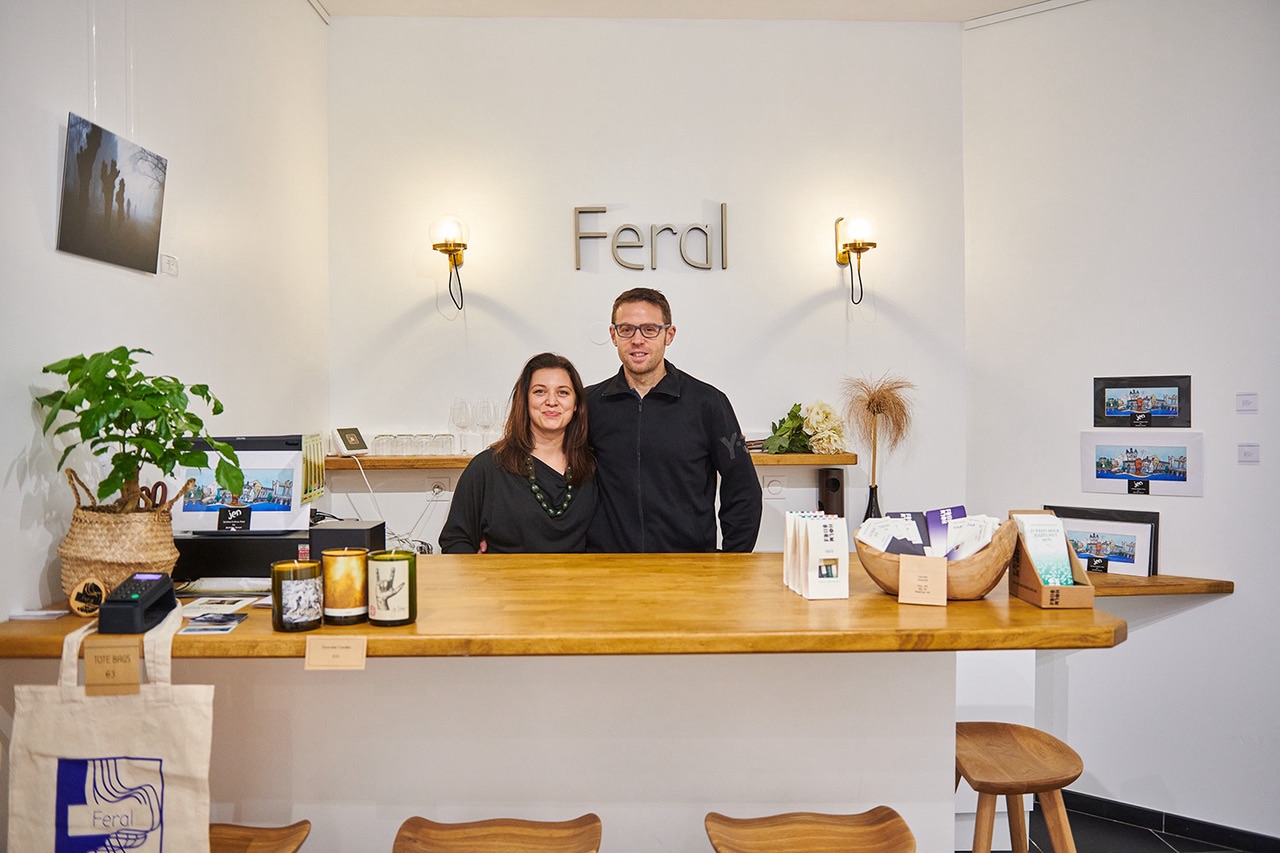
Modal Wines Edinburgh Tasting at Spry, November 2023

Modal Wines held their Edinburgh Trade Tasting on 6 November at Spry Wines which, at 1 Haddington Place, is at the top of Leith Walk. For anyone who doesn’t know Spry, it is a natural wine-focused bar and restaurant which serves very good food by way of small dishes, with an accompanying list of natural wines, dozens of which are available off the shelves at retail prices. Within a fifteen-minute walk from Edinburgh Waverley Station, and opposite Valvona & Crolla, Edinburgh’s fancy Italian deli, Vinyl Villains for second hand records and cds, and the famous Toppings for books, Spry is highly recommended for lunch or dinner (open Tues to Sun from 1-10pm, booking recommended).

Modal had Roman on hand to show 31 wines, ten as a free pour and 21 as a tutored tasting. I have chosen to mention seventeen wines, hoping to give you just enough information to entice you to try them. It’s not that I didn’t like the others, it’s merely that these are the ones which interested me the most. As far as I know, all the wines can be described as “natural”, although some will have what the producers describe as “minimal” added sulphur. In case it’s unclear, the format below goes producer, wine, region.

Possa, U Giancu 2021 (Liguria, Italy)

I’ve tried this producer many times and purchased their wines, so this is a nice one to start with. The grape variety is the autochthonous Albarola, grown right up on cliffs in the beautiful Cinque-Terre. Savoury, mineral and fresh with a little texture and a hint of the sea. Zero additives, including no added sulphur. Ligurian wines hide away but they are seriously worth trying.

Malinga, Hot Rot 2022 (Kamptal, Austria)

This is made from Rötburger, which you may recall from a recent article is the preferred synonym for Zweigelt among increasing numbers of natural winemakers due to the political leanings of “Zweigelt’s” creator in the nursery. It is blended with St-Laurent and a little Müller-Thurgau and Blauburger. It’s one of an increasing number of excellent “glugging” Zw…Rötburgers, full of cherry and strawberry fruit and deliciously fresh fruit acidity.

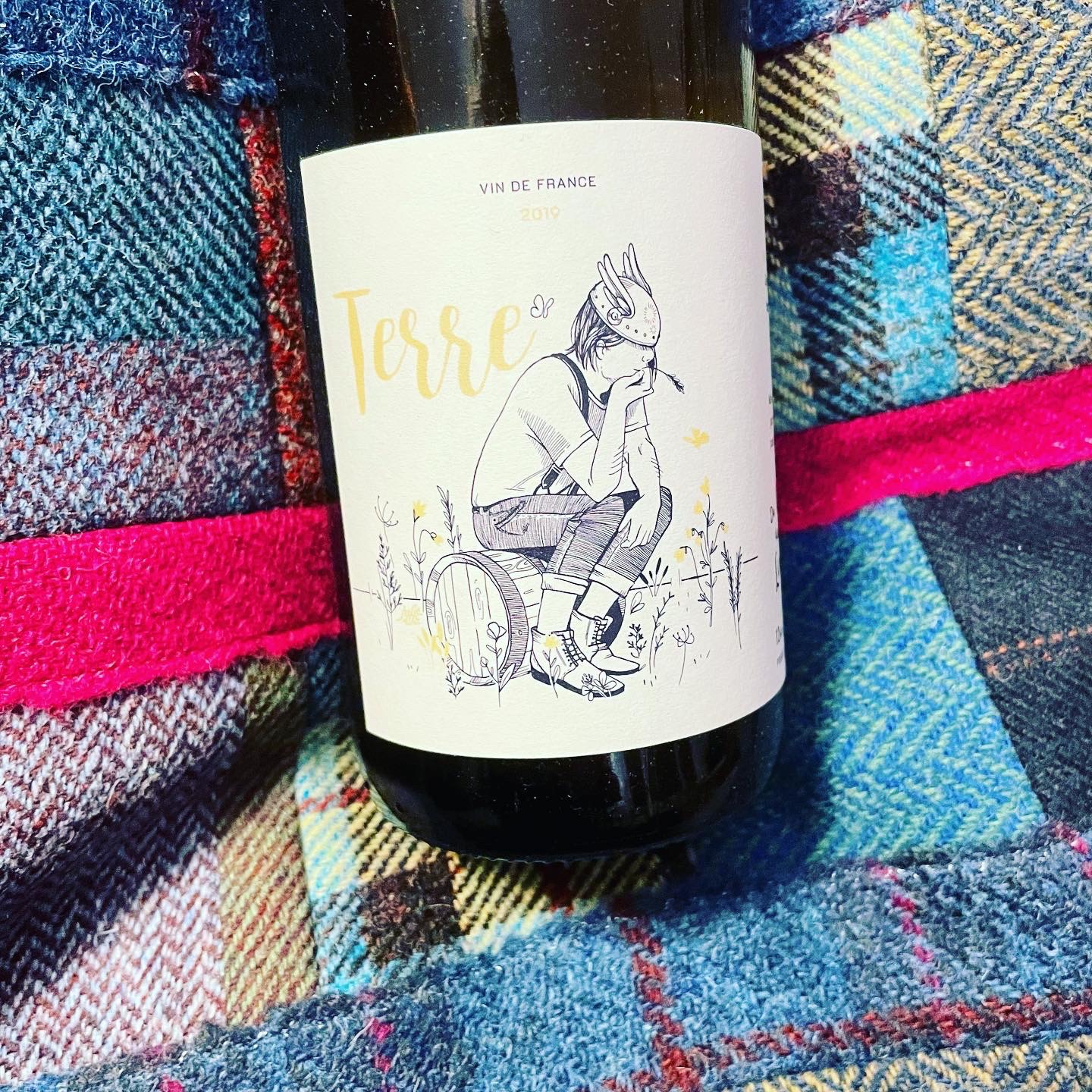
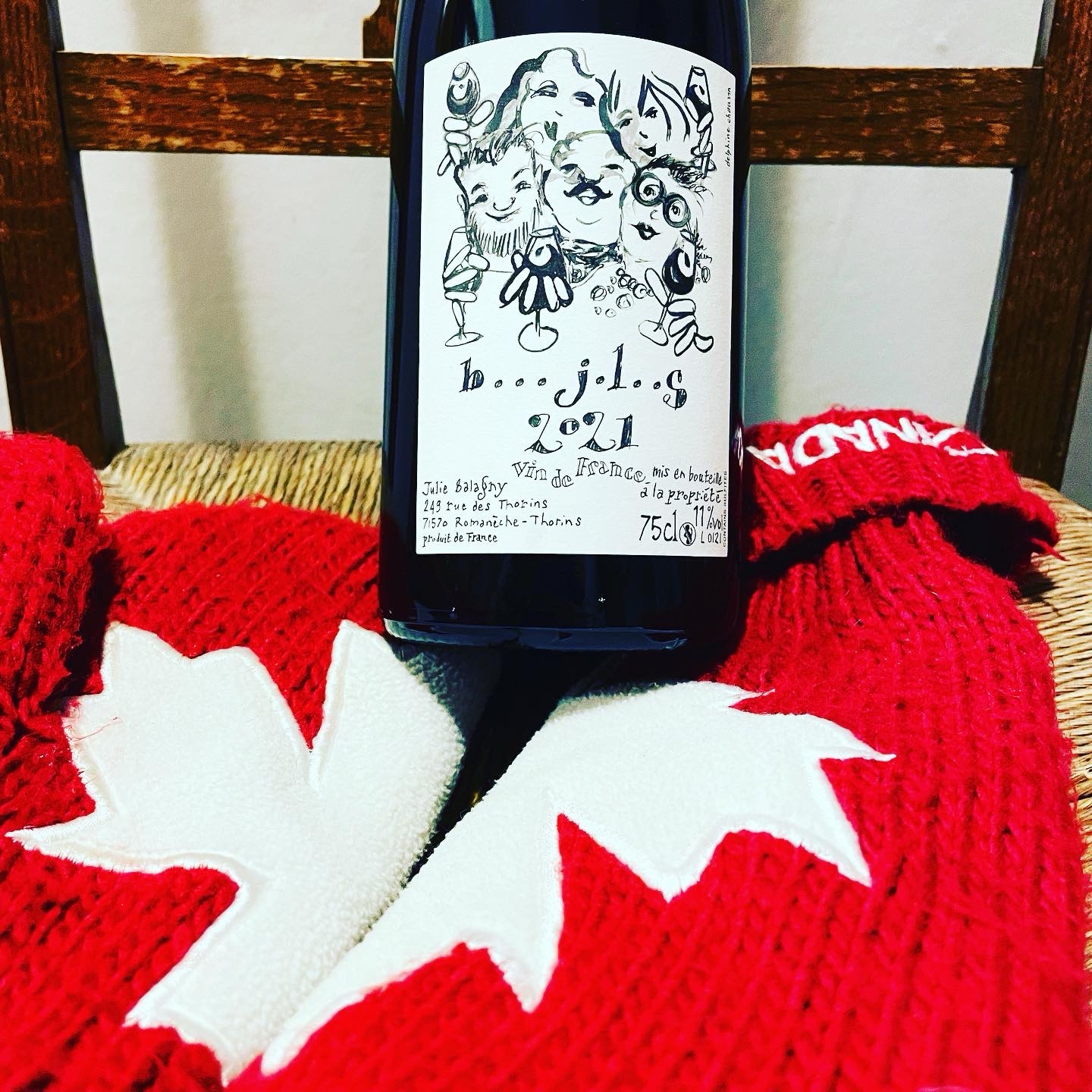
Domaine d’Ici Là, Au Replat Mondeuse 2020 (Bugey, France)

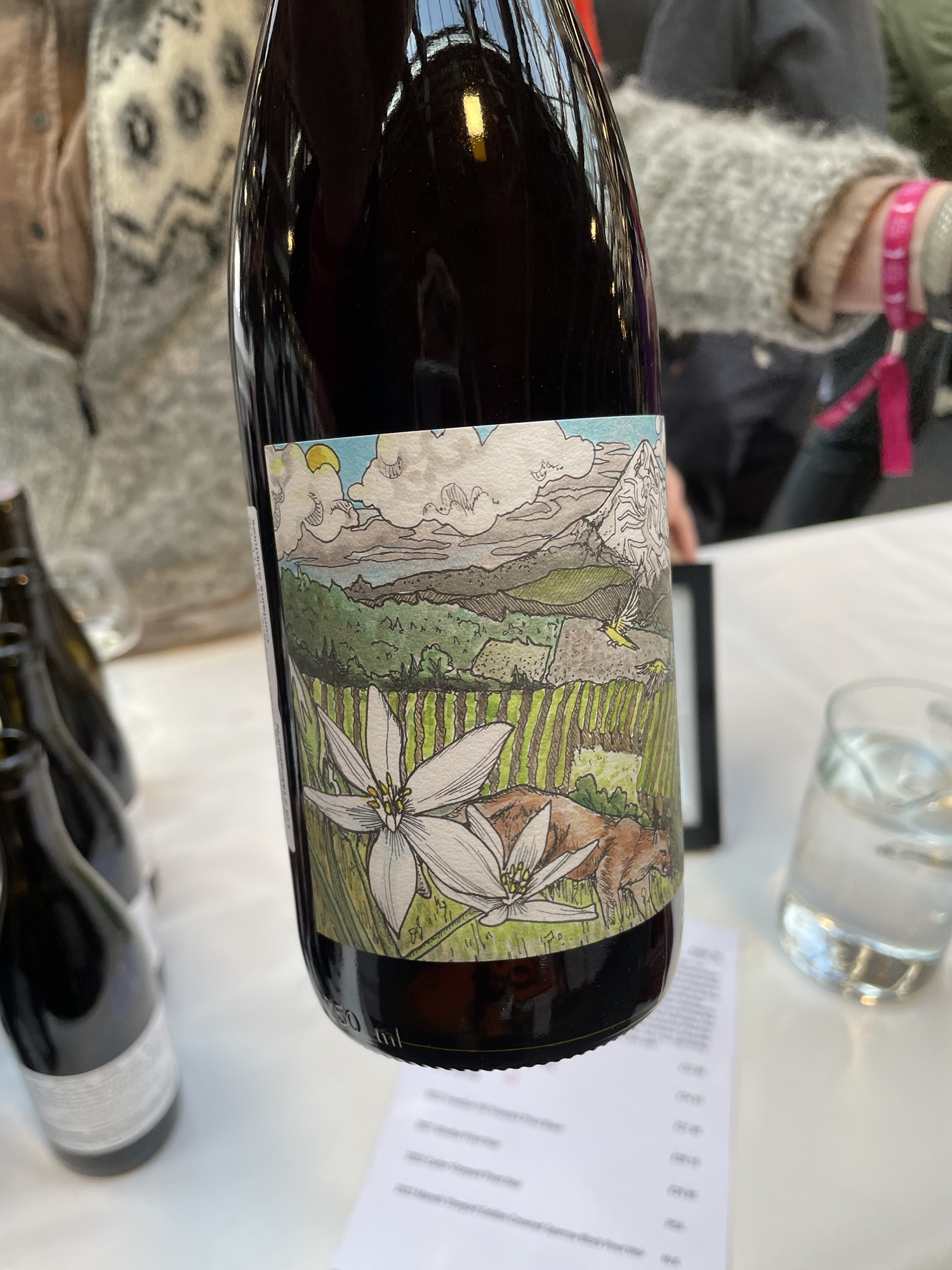
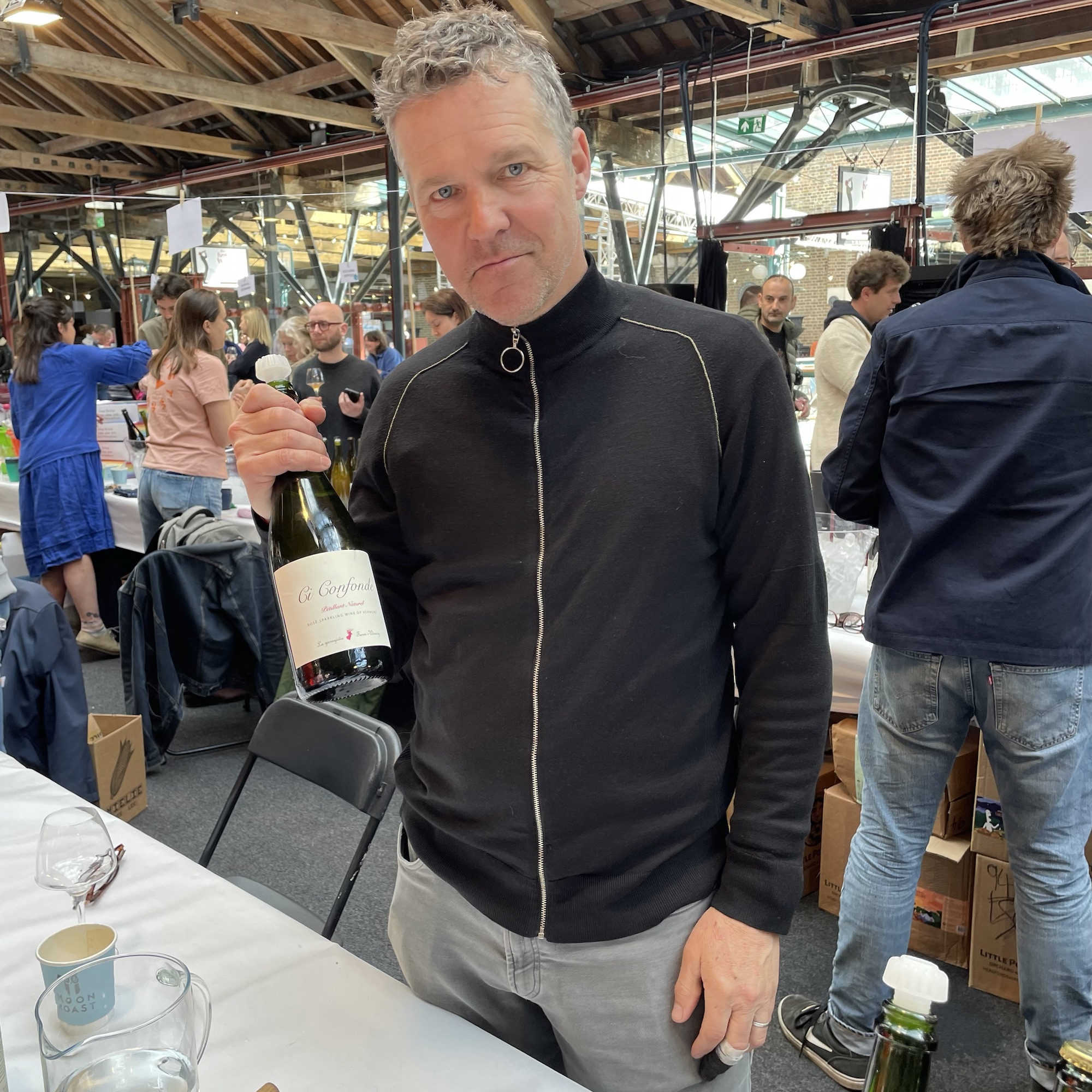
You know me and Bugey! This newish addition to the Modal portfolio was introduced to me via their Mondeuse Rosé this year.  A young couple, Florie Brunet and Adrien Bariol, run this 5ha domaine from Groslée-St-Benoît in the region’s southern sector. This red Mondeuse is whole-bunch fermented for fruitiness yet as the grapes come from a stony and rocky slope, perhaps this is why the wine nevertheless has structure, and mineral texture. Approachable but with a serious side. Lovely wine. I see Modal has half-a-dozen from this producer now, and I want more. This one should retail for around £35.

La Niverdière, Palimpseste 2018 (Loire, France)

Martine Budé is making lovely wines out of the Chinon appellation. She is a self-taught vigneronne working on her own on an estate founded in 2015. This is a delicate wine, the importer likening it to Pinot Noir in this respect. She uses an infusion technique for winemaking with a very light extraction, and ageing is all in concrete tank. This is silky and gentle, but 13% abv. A very interesting discovery. Also, around £36 I think (retail prices were not given at this tasting, but I will give an approximation where I can find one).

Casa de Mouraz, Vinho Verde Branco 2021 and Dão Branco 2022 (Dão, Portugal)

You may have read that I’m on the lookout for more Portuguese wines and Modal has long been a source for just that. It’s simply that when purchasing from Modal I’ve more often been drawn elsewhere, especially Austria, Germany and France. The biodynamic Vinho Verde was made unfiltered in 2021 especially for Modal, and was aged on lees for 18 months. You really do get some good lees texture and this has way more depth than most Vinho Verde.

The white Dão, also biodynamic, is a multi-grape field blend of twenty or more local varieties based on Encruzado. This ’22 spent a slightly longer 11 months in stainless steel and has energy, salinity and texture. A savoury white wine, around £25. Complexity is hard to come by for that price, but this has it.

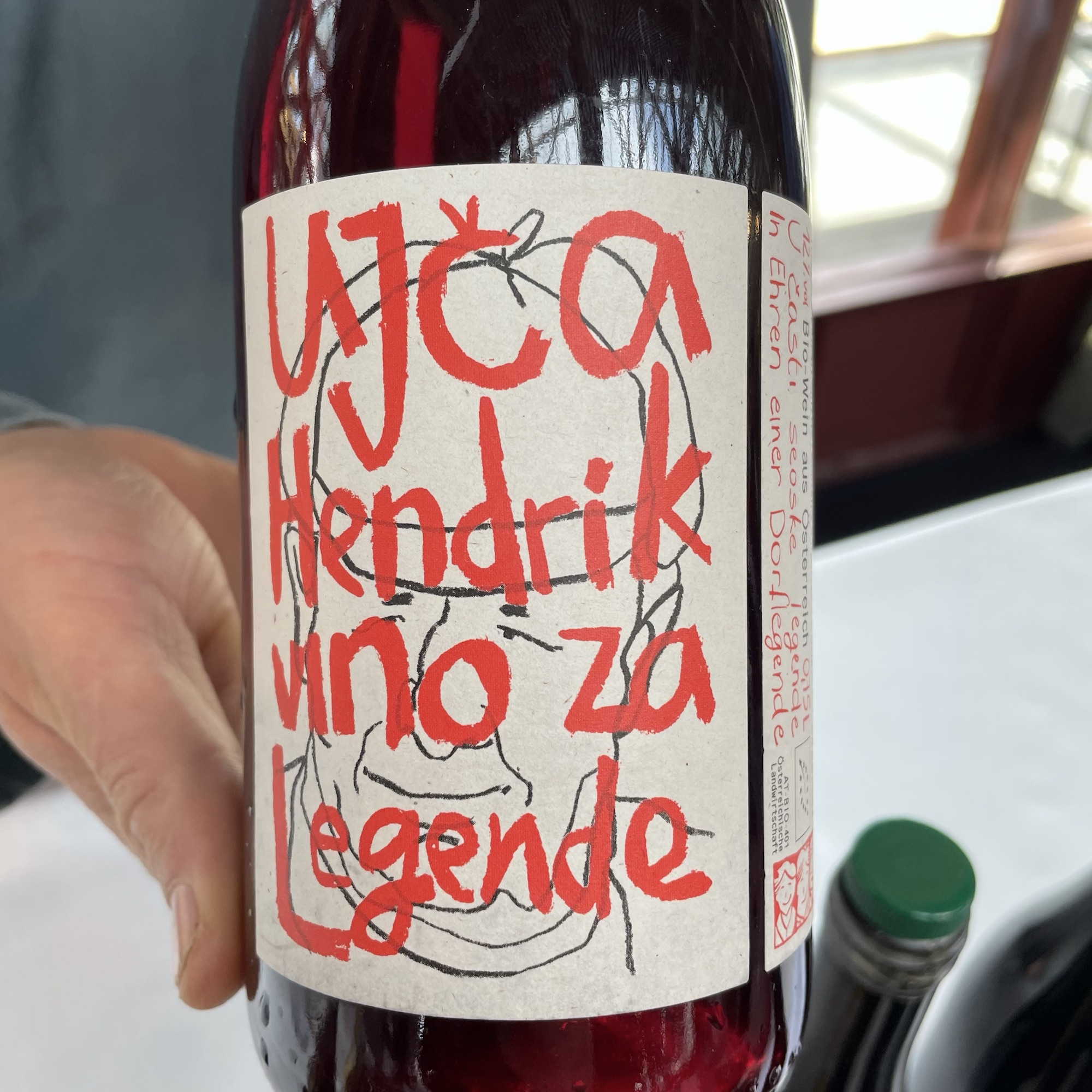
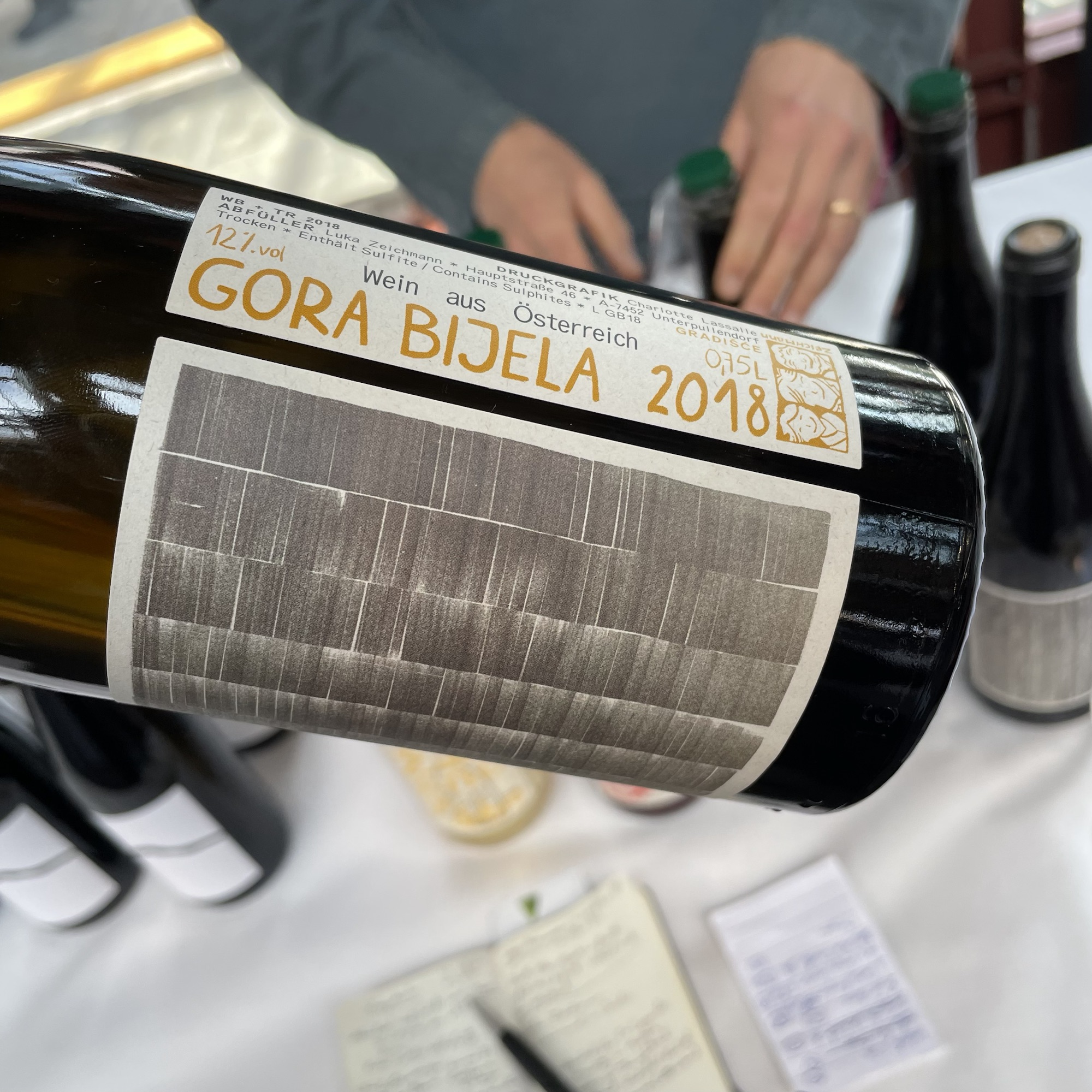
Luka Zeichmann, Zuto Vino Je Dobro 2022 and Ujča Henrik (Burgenland, Austria)

You may know Luka’s wines from the partnership that makes “Joiseph” from Jois. He has revived some old family vines about an hour further south, in Mittelburgenland, and also works with a few local growers now, to also produce his own wines. This is a small range of natural wines made in tiny quantity, but Modal has worked with Luka from the beginning, so has been lucky enough to secure some for the UK. I’m pleased to finally try them.

Dobro” is a blend of Chardonnay (two-thirds) and Welschriesling, with a little skin contact on the Chardonnay. It goes into a mix of 200-litre and 300-litre oak. Juicy, spicy and very drinkable, and at just under £30 retail I think this, and the wine below, may be the cheapest pair of Luka’s own range of wines.

Uncle Henrik (I think Luka is writing his labels in Croatian to highlight his family heritage, but I might be mistaken) is made from a blend of Blaufränkisch, Zweigelt, and Blauer Portugieser, the rest being a mix of ten more varieties, all co-fermented from a co-planted field blend. Lightly vinified, the result is pale but bright and vibrant. A cherry bomb on the nose, it’s zippy on the palate, but there’s more here than just glouglou simplicity. Not cheap at £28, but justified because Luka is such a fine winemaker.

Elodie Jaume/Domaine des Chanssaud, Côtes du Rhône « À En Perdre La Souffre » 2022 and Châteauneuf-du-Pâpe Rouge 2021 (Rhône, France)

Elodie Jaume has taken over her family domaine and is converting it to biodynamic, low-impact, farming. This Côtes-du-Rhône, which currently goes under her own label (there is also a domaine CdR) is a zero-added-sulphur blend of 80% Grenache and 20% Carignan, aged in concrete. Very pure red and darker fruits, lots of blueberry richness, and good body for a generic CdR. Impressive, but at the same time £30.

The domaine Châteauneuf (no photo) is 90% Grenache, some vines more than 100 years old, the other 10% apparently containing every other variety allowed in the appellation (now 18 varieties in all). This is another of those appellations where alcohol has reached astonishing levels for an unfortified table wine, but this wine is positively restrained, despite 14.5% on the label. It has some structure but plenty of elegance too. Black-fruited and spicy. Circa £40. From 2023 this estate will be known as Domaine Elodie Jaume.

António Madeira Branco 2021 and Tinto 2021 (Dão, Portugal)

One feels Modal Wines knows Dão. They have worked with this producer for some time. António moved back from Paris to farm in his grandparents’ village, on a mission to rescue Dão’s ancient grape varieties, regenerating old and often abandoned vineyard plots. This white wine, released under the Dão DOP, comes from the Serra da Estrela zone. A multi-varietal blend (15 varieties), it is made, after a cold soak, half in stainless steel, and half in tight-grained oak. It’s herbal, savoury, flinty and fresh. It has both a modern feel but also more than a nod to tradition.

The Tinto is made in a similar way, a mix of stainless steel and oak, from several small field blend plots in the same zone. It’s an earthy red which speaks of its terroir with grip, but I reckon you pair this with some cabrito off the fire and you are away. There are more expensive António Madeira offerings off Modal’s list, but this pair are a good place to start.

Schödl Family (Weinviertel, Austria)

Modal Wines now list quite a range of cuvées from this young family. Like the Renners in Gols (Burgenland), this domaine is now run by the three siblings (Viktoria, Mathias and Leonhard) who converted their parents’s estate to biodynamics and are now very much part of the Weinviertel revival. Roman poured four wines.

Grün Grün Grüner Veltliner 2022 is a blend of plots and a mix of fermentation and ageing vessels. The wine has an aromatic bouquet with a spicy, textured palate. A wine which one supposes will develop even more, given its pristine flavours, but holding just a little back. About £33.

Safari 2022 is a white blend which has a little skin contact. The colour is a pale orange, but it isn’t over-textured, being more “fresh and fruity”. I think this is a little cheaper, around £28.

Sankt Laurent 2022 – this is apparently the wine that did it for Modal. You don’t find too many single varietal Saint/Sankt Laurent cuvées and this does make you wonder why? It is fruity yet with a bitter edge. It has a Pinot-like elegance, and although most will be drunk now, it will age a year or two. £34.

Blanc des Blancs Brut Nature is a very impressive traditional method sparkling wine whose grapes (Mostly Chardonnay with 10% Weissburgunder (Pinot Blanc)) come from Loidesthal in Weinviertel. You think Austria doesn’t make great bottle-fermented fizz? Well one of the best sparkling wines you may ever drink will be a decade-old Chardonnay Sekt from Ebner-Ebenauer, made not too distant from Loidesthal, in Poysdorf. This may not quite reach those heights, but it’s really good and a lot cheaper.

Ten months in a mix of stainless steel and large oak, then twenty months on lees, zero dosage of course. Brioche, creamy, mineral and with a hint of oxidative development from the yeast autolysis. Unlike the other Schödl wines, this has a somewhat dull label, presumably intentionally traditional, but at £44 it could rightly be called very good value. As Champagne prices gouge deep, other sources like this are perfect for those who prefer what’s in the bottle to what’s on it.

Borgatta Lamilla 2016 (Piemonte, Italy)

This is quite a special wine, perhaps appropriately saved until last. Emilio Oliveri is in his mid-80s and has been working two-hectares with his wife, Marisa since the 1960s. Located in the Monferrato Hills, near Ovada, they are a half-hour drive east of what is the often forgotten town of Southern Piemonte, Acqui-Terme (with a weekly market to rival any in the region, and atrocious but fun outdoor opera in the summer…but I’m digressing).

This is a well-aged Dolcetto. Vines planted in the 50s and 60s, old school slow fermentation, aged for a minimum of four years, a little sulphur during fermentation but none at bottling. This is very different to most Dolcetto you will taste. Okay, lots of deep blueberry and cherry fruit, but it is also a structured wine, and quite powerful at 14.5% abv. Imagine it with a winter stew of venison or wild boar sausages. This is very much an echo of a traditional way of winemaking which you hardly ever see today, a past which is rapidly disappearing. And it is only £24 at the cheapest retailer I can find (up to £27.50 elsewhere). There’s also a Barbera at around £30.

This was an excellent tasting in near perfect surroundings, on the day the restaurant is closed. It was a great chance to taste some fantastic, affordable, wines. Now I just need to ask Nic from Modal where I can find them all.

Posted in Artisan Wines, biodynamic wine, Natural Wine, Wine, Wine Agencies, Wine Merchants, Wine Tastings | Tagged , , , , , , , , , , , , , , , , , , , , , | Leave a comment

Cork & Cask Winter Wine Fair 2023 (Part 3): Vine Trail, Southern Spain and Arran Whisky

Parts 1 and 2 of my selections from the Cork & Cask Winter Wine Fair contained wines from six small independent importers. Part 3 Shows some wines from Vine Trail, along with some delicious gems from Southern Spain poured on what I shall call the Cork & Cask table. Then we finish with some whisky and a rather nice liqueur from the Isle of Arran. That concludes this particular event. It should be said that everything on show, in all three parts, is stocked by Cork & Cask in their Edinburgh store (and available for UK delivery). That is an impressive, natural wine-focused, range.

It is pleasing to see that the natural wine offering in Edinburgh continues to grow, and that there is clearly a growing market for low intervention wines. My next port of call will be Spry Wines, where Modal Wines held their annual Scottish tasting for the trade a couple of days after the Cork & Cask Fair.

VINE TRAIL

Vine Trail has one of the most envied lists in the UK. Their focus is mostly France but with increasing diversity coming from Northern Spain and Sicily. They are especially strong (an understatement) in Grower Champagne, Burgundy, Alsace and Jura. To name a few of my all-time favourite producers which Vine Trail import, we have Champagne from Bérêche and Manu Lassaigne, from Alsace, Lissner and Tempé, and from Jura, Labet and Overnoy, to mention only two. That doesn’t even begin to scratch the surface.

Domaine Marc Tempé Riesling Amzelle 2019 (Alsace, France)

Marc and Anne-Marie Tempé farm eight hectares of vines at Zellenberg, all planted on a wide array of soils including limestone, clay, schist, various marls and sandstone. Established in 1993, by 1996 Marc had gone fully biodynamic (he was mentored by Léonard Humbrecht). Viticulture here is described as “fastidious” by his importer. Keys are very long lees ageing and minimal added sulphur (in the case of this cuvée, zero added SO2). These are terroir wines with concentration and ageability.

“Amzelle” Riesling has seen 24 months on lees in large foudres.  It has a floral bouquet and is rounded and rich, with great depth of fruit. Pear flavours appear on the palate, with a spicy finish reminding me of both ginger and cinnamon. The alcohol is up at 14%, but it seems balanced. I think the 2018 strode in at 15% and I’m always criticised for being wary of such toppy Alsace wines as that, but I liked this one enough to recommend it highly. £35

Domaine Bernard Gripa Saint-Joseph Blanc 2020 (Rhône, France)

One of the two most expensive wines I’ve written about from this tasting, but in my opinion worth seeking out. Fabrice Gripa (Bernard’s son) took over at this Mauves estate way back in 1997. He isn’t, of course, the most famous resident of the village, but he’s a star winemaker nevertheless. His reputation may rest with his St-Péray whites, but on this basis his St-Jo’ white is nearly as good.

Fabrice’s Saint-Josephs come off granite soils, whereas the St-Péray comes off loess, clay and limestone. The blend is currently 80% Marsanne with 20% Roussanne, from 30-year-old vines on slopes just to the north of Mauves. Aged in 800-litre demi-muids, of which approx. 10% are new, it is herbal and spicy with a hint of almond on the nose. Attractive now, it will certainly age, although drink one and you will find it hard to resist any other bottles you have…assuming you can afford £42, though I cannot fault the wine, nor the price. White Northern Rhône is altogether very much more impressive these days despite the fight to keep alcohol levels down below 15%.

Veronica Ortega Bierzo “Quite” 2020 (Bierzo, Spain)

I went to Bierzo once you know! It was 1988, the wines were then called “El Bierzo”, and we had to stump up for the Parador as there weren’t many tourists, bar those who passed through Villafranca del Bierzo on the Pilgrim Route to Santiago. Veronica is to the east of Villafranca, near Ponferrada (which we visited briefly) at Valtuille de Abajo, where she has around 6ha planted.

The list of famous wine estates where Veronica has worked is impressive but way too long to list (from Burn Cottage to DRC but that’s not even getting started), but this native of Cadiz (her dad was a bullfighter, apparently) chose the province of Léon to make her own wine. I met Veronica a few years ago in London and tasted her range. Massively impressed, I bought a number of her wines from Vine Trail and from Littlewine when they had an online shop. I went directly to Cork & Cask’s shop after the event, and this was one of the wines I bought.

Quite is 100% Mencia from organic parcels around Valtuille. The soils are iron-rich clay and sand. Winemaking is fairly straightforward, a 15-day cuvaison, then a nine-month spell ageing in a mix of second and third use oak, and amphora. It’s a fruity wine, dark fruits sitting on a deep mulberry bed. It’s also savoury and grippy, but will drink nicely now or keep a year or two. Mine won’t last too long. £24

Cédric Perraud Etna Rosso Goccia 2021 (Sicily, Italy)

I had a phase drinking a lot of Etna wines some years ago, but the best of them just became too expensive, and if truth be known, less good value compared to other regions. The winemakers became stars and prices shot up.

Cédric Perraud, who comes originally from Nantes, on the Loire, began working some old vineyards on Etna in 2014, on the northern and eastern side of the mountain. His own winery began production in just 2017. The grapes for this cuvée come from old bush vines around Randazzo, where Cédric lives.

Goccia Rosso is mostly comprised of the great grape of Etna, Nerello Mascalese, with a little Carricante and Minella. Fermentation lasts just ten days, but on skins, before resting in stainless steel until the following May, to give what is a fresh and fruit-driven wine despite a reasonable 13% abv. It has that brittle spine surrounded by fruit that you expect from the cooler parts of Etna, with a touch of mountain viticulture about it, with vines right up at between 600 and 850 masl. You can almost smell the wood smoke. Yet there is also body here, and some tannin, in what is a natural wine, although a little SO2 is added at bottling. £32

CORK & CASK TABLE

The shop’s own team were pouring a selection of wines on a couple of tables where their importers were in most cases unable to attend. On one of those tables I was particularly interested to try some rather unusual wines from Bodega Vinificante Mahara (Cadiz) which add another new dimension to the wines of wider Jerez. Then, staying with Jerez, I must mention the wines of Diatomists. These are fine Sherries without the price tag of some, which I devoted a whole article to last year (if interested you can search for it, article published 01/12/2022).

Bodegas Vinificante Mahara: Amorro Pet Nat, Blanco and Tinto (Jerez Region, Spain)

Mahara means “crazy”, and the crazy bodega, run by the “crazy brothers”, is situated in the town of San Fernando, with around 5ha of vineyards at Chiclana, Sanlúcar and Jerez, mostly on the white albariza soils.

The Pet Nat is made from Sanlúcar Palomino, which I would imagine will make a lot of readers perk up and take notice. About 9,000 bottles were made and they used the classic ancestral method, but with an unusually long time on lees: four years! It’s a natural wine with just a tiny amount of sulphur added at bottling. Very different, very cool, very nice and well worth grabbing to try if you are anything like me (a sucker for the unusual stuff). £24

Amorro Blanco is a white Vino de Mesa made from Palomino grown, I think, at Chiclana. It has a shorter ageing on lees and it is relatively simple, in essence a salty Atlantic-influenced white wine with all the character that entails. Good, but for me not quite as out there as the Petnat and the red below. But nicely priced at £22, the cheapest of the three.

Amorro Tinto This is a red wine made from Tintilla di Rota, a variety mostly used elsewhere to make simple sweet wines, here fermented dry and aged in fibreglass tanks. The fruit source is the fine albariza soils of Jerez’s Pago Balbaina. This table wine really does have a hint of the ocean about it. A five-day whole bunch fermentation creates a fruity wine, but one with a salty twang on its savoury finish. It is unusual for a Southern Spanish red, not that you see many reds from Jerez, tasting lighter than its 13.5% abv suggests. £23

Three wines here which stand out as unusual and super-interesting, but exceedingly drinkable, are all well-priced, and as in 2022 with Diatomists, Southern Spain has thrown up more little gems.

Diatomists (Jerez, Spain)

As I mentioned above, you can read about the Diatomists project in an article I wrote last year, published on 1 December. In that article I tasted their Manzanilla, Amontillado, Oloroso, Medium Sherry and PX. This time out there were just three on show, the dry Manzanilla, the dry and nutty Amontillado and the super-sweet Pedro Ximénez, possibly my favourites in the range, at least at last year’s tasting.

Manzanilla is from the lower part of the famous Pago Miraflores Baja. The solera is 30 years old, comprised of 500-litre chestnut casks. The wine is dry yet a tiny bit richer and less acidic than many Manzas. Very good, £15 for a half bottle (I do note that these have all gone up in the intervening year but let’s face it, others are to blame rather than the producer or retailer).

Amontillado from a solera that has been going a hundred years, although this wine is only around twelve years old. It is once more unusually fruity for a dry Amontillado, although it has that nuts and salt thing going on that cries out for some fine Brindisa Marcona salted almonds and Perello queen olives. Enough to make the Amontillado-haters change their mind. £20/half bottle.

Pedro Ximenez (PX) is a style very few wine lovers I know drink often, but perhaps Christmas will be the exception. Last year our Christmas Pudding wine, then going well with the leftovers, nuts and nibbles in the evening, was a Vin Santo. Have you seen the price of good Vin Santo now! This PX comes from Montilla Morilles and like most good PX, it has a powerful bouquet. What struck me last year was that this PX actually has some acidity. Okay, it’s really sweet, but it isn’t as overwhelmingly cloying as most. I just wish it wasn’t £20/half, but Isole e Olena Vin Santo is £60/half so I should shut up and stop complaining.

ISLE OF ARRAN DISTILLERIES

Arran is the southernmost of the larger isles off Scotland’s West Coast, although the Kintyre Peninsula and Campbeltown stretch further south, and it is also the largest island in the Firth of Clyde. Its proximity to, and accessibility from, Glasgow makes it a major tourist destination today, although before Arran’s own version of the “clearances” it was a remote island of subsistence agriculture. One is always sceptical of legends of illicit distilling but it seems in Arran’s case these were true and the “Water of Arran” was apparently revered throughout Scotland in the 18th and early 19th centuries.

Arran did have a licensed distillery during the first half of the nineteenth century but it closed in 1837. The new Arran Distillery opened only twenty-odd years ago, on the north coast at Lochranza. More recently, a new distillery under the same management was opened near the site of that 19th century operation, on the south coast at Lagg. In keeping with the island’s tourist potential, a much-awarded visitor centre welcomes those who wish to connect with this island’s whisky heritage. Close to 100,000 folks a year do.

As a rough rule of thumb, the Arran Distillery at Lochranza makes unpeated malts, said to be in the Speyside style, whilst Lagg is making a peated malt more in keeping with the island style of Islay. There has been a revamp of the packaging in recent years and the Arran single malts are very well presented. The Arran releases are of particular interest to wine lovers because they draw on some adventurous cask finishes.

First, look out for my favourite previous release. It’s an Amarone cask finish. Red wine casks are less common and I’ve never come across an Amarone cask before. It has a nice red label in the new Arran bottle and livery, and the cask influence can clearly be identified. I’d say you get cherry and chocolate on the nose and the palate has a very wine-like “red fruits” element. This release may be hard to find but it is still available and usually retails at around £54.

First up at the tasting was the Sauternes cask finish, which is one of my favourites currently on my whisky shelf. Again, although an amateur like me might not identify the cask blind, if you know what it is then there’s a real moment of recognition. For instance, you certainly get the sweeter notes of the whisky enhanced. The nose shows citrus and honey, and the palate has some vanilla. There’s a touch of apricot on the finish. Also, circa £54. These special cask finishes are released at a slightly higher abv, around 50%.

Arran lacked a fine reputation when it opened its doors, but I think these special finishes are lovely bottles. I’ve been hit hard on the Sauternes finish, being unable to steer guests away to other bottles, so I may need to buy another.

I also tasted the Sherry cask finish, called “The Bodega”, the latest release. It’s an 8-9-year-old whisky, and described as a return to the style of some of Arran’s earlier releases. Expect a slightly spicier whisky, but one which still has a nice aromatic sweetness and a little smoke. This cask finish fetish is a dangerous habit to develop. 55% alcohol (cask strength), c £60.

I mentioned the new distillery at Lagg. Here I tasted the Lagg “Corriecravie”. Just 300 cases were released. For this they use Concerto malted barley, and water from Lagg distilleries own borehole. It has been finished in Oloroso cask and was bottled at 55.8% abv. This bottling is more peaty, and more smoky, than the Arran releases, and at just four years old it does have a fiery side (it does taste like a young malt). However, given its age, it is surprisingly smooth as well, and certainly shows some complexity (and meatiness). Oak, smoke, nutty and chocolaty. It comes in at £68. For me, I prefer the Arran releases (and I’d like to try the Port cask finish some time), but I know others prefer the peaty style.

Before I leave Cork & Cask, I have to mention the Arran Gold Cream Liqueur. If, like me, you are partial to that other famous cream liqueur, if the occasion is right, of course, then you really should try this. It’s so many steps up it’s a whole damn staircase better…in my humble but sober opinion. It has enough whisky to bring it up to 17% abv, like its commercial rival, but I’d warrant that probably doesn’t have spirit of the same quality. The Arran is also smooth and creamy, with vanilla fudge on the nose. It actually has complexity, of sorts. I found this exceptional. I should emphasise, in case you are worried about my judgement, that despite all those wines I’d tasted, I was spitting.

Posted in Natural Wine, Sherry, Spanish Wine, Whisky, Wine, Wine Agencies, Wine Festivals, Wine Merchants, Wine Tastings | Tagged , , , , , , , , , , , , , , , , , , , | Leave a comment

Cork & Cask Winter Wine Fair 2023 (Part 2): Roland Wines, Element Wines and Modal Wines

Part 1 from the Cork & Cask Winter Wine Fair covered wines from Indigo Wines, Keeling Andrew and Dynamic Vines. Part 2 here follows the same path, with a selection from the wines poured by Roland Wines, Element Wines and Modal Wines. I didn’t really mention this in Part 1 but I have been trying to focus on wines which are at least under, or around, the £30 mark. Wine prices have shot, rather than crept, up over the past couple of years, and I think most people are looking for value. That there are three excellent wines here which retail for under £20 is a real bonus. One wine comes it at over £40, but I had never tried it before and it is rather good.

**As stated in Part 1, the prices quoted here are the retail price at Cork & Cask’s shop in Marchmont, Edinburgh. All wines will be available elsewhere but prices will not necessarily match.

ROLAND WINES

Roland Wines was founded by Roland Szimeiszter, initially to import the wines of Central and Eastern Europe (he grew up in Hungary). The list has now expanded although it remains compact, with 27 producers over seven countries. The list contains several cult estates, such as Strekov 1075 from Slovakia, and more recently, the wines of Alex and Maria Koppitsch from Burgenland.

Andi Mann Müller-Thurgau 2021 (Rheinhessen, Germany)

Andi is described as being a member of the new wave of German natural winemakers in the Rheinhessen region. Although I have a bottle of his Rötlich at home, this was my first taste of one of his wines.

This is denominated as a Rheinischer Landwein, so no regional appellation, perhaps because this is very natural, unfiltered and full of spark and energy. So not typical of much Rheinhessen. Andi’s family has been involved in wine around Eckelsheim since the beginning of the eighteenth century but Andi is taking the family domaine in a new direction.

This wine comes in one litre bottles and is just really easy to drink, like a fresh pineapple juice with a squeeze of lemon. The grapes come off limestone soils and are crushed and fermented on skins for ten days. The wine goes into very large oak for nine months. No sulphur is added. This results in a wine that is fruity but with a nice sour edge. It’s just 10% abv and it’s definitely the kind of wine you are glad comes in a litre. At this size and for £27 it is very good value glugging.

Johannes Zillinger Numen Fume Blanc 2021 (Weinviertel, Austria)

Johannes’s family has been following biodynamic practices is Velm-Götzendorf, right up near the Slovakian border, for thirty years. This is a holistic approach to wine, with composting and biodynamic preps made on the farm. Everything is done with immense care.

Numen is a Sauvignon Blanc from the limestone and loess soils of the Steinthal, at 150 masl. The vines date back to the establishment of the domaine by Johannes’s father, Hans, so are 30-years old. This really is a zero-intervention wine, intended “to let the wine emerge”. So, it was fermented in amphora as whole berries, with a gentle press after a few days, followed by a year on lees. No sulphur, no filtration.

The style is slightly oxidative but this 13% abv wine has a big personality. It may retail for £42 but I would recommend it as a leftfield version of a well-known variety. If you are bored with Sauvignon Blanc then this is really worth giving a chance. Austria does Sauvignon Blanc brilliantly, though usually in Steiermark (Styria), but this emerging region has some serious SB as well.

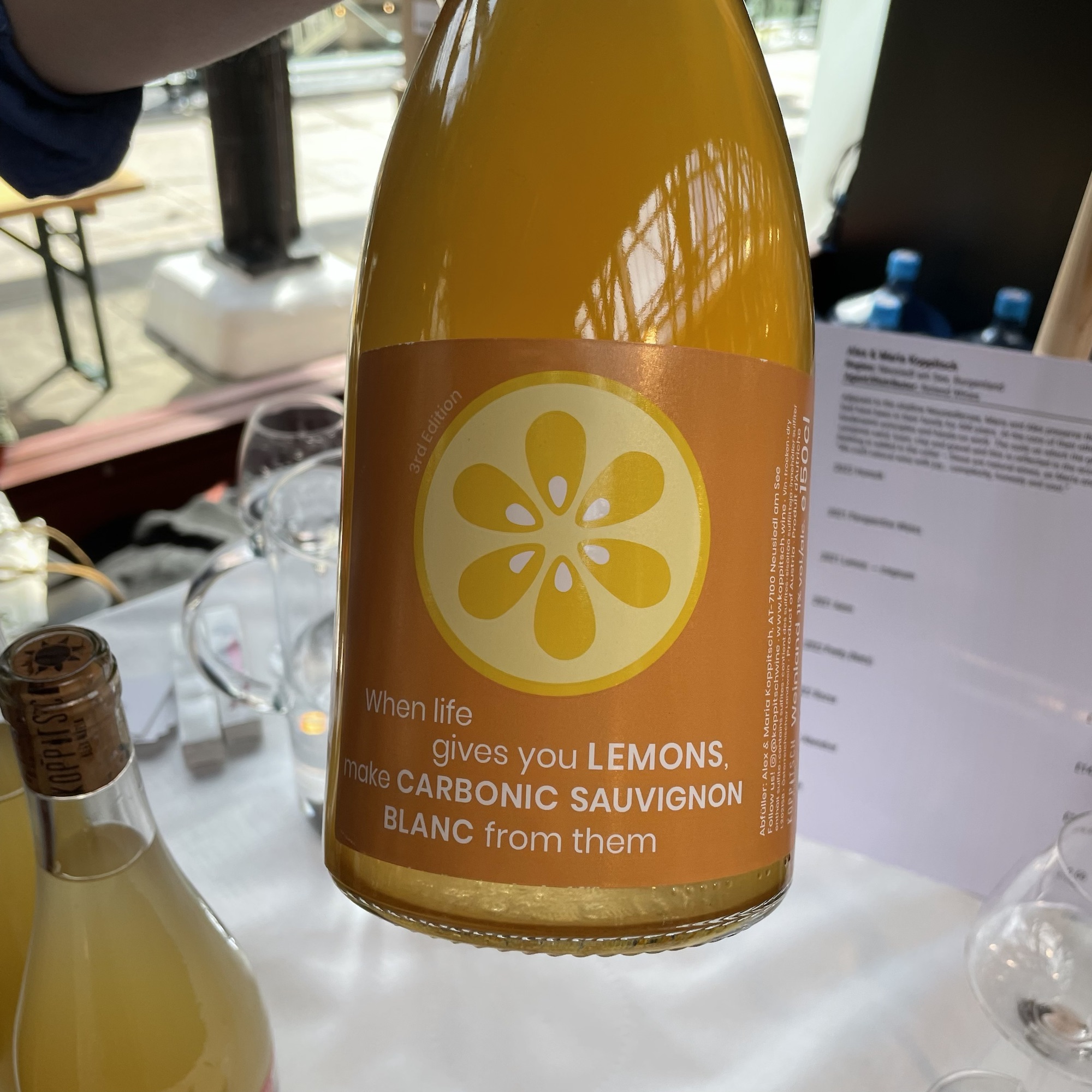
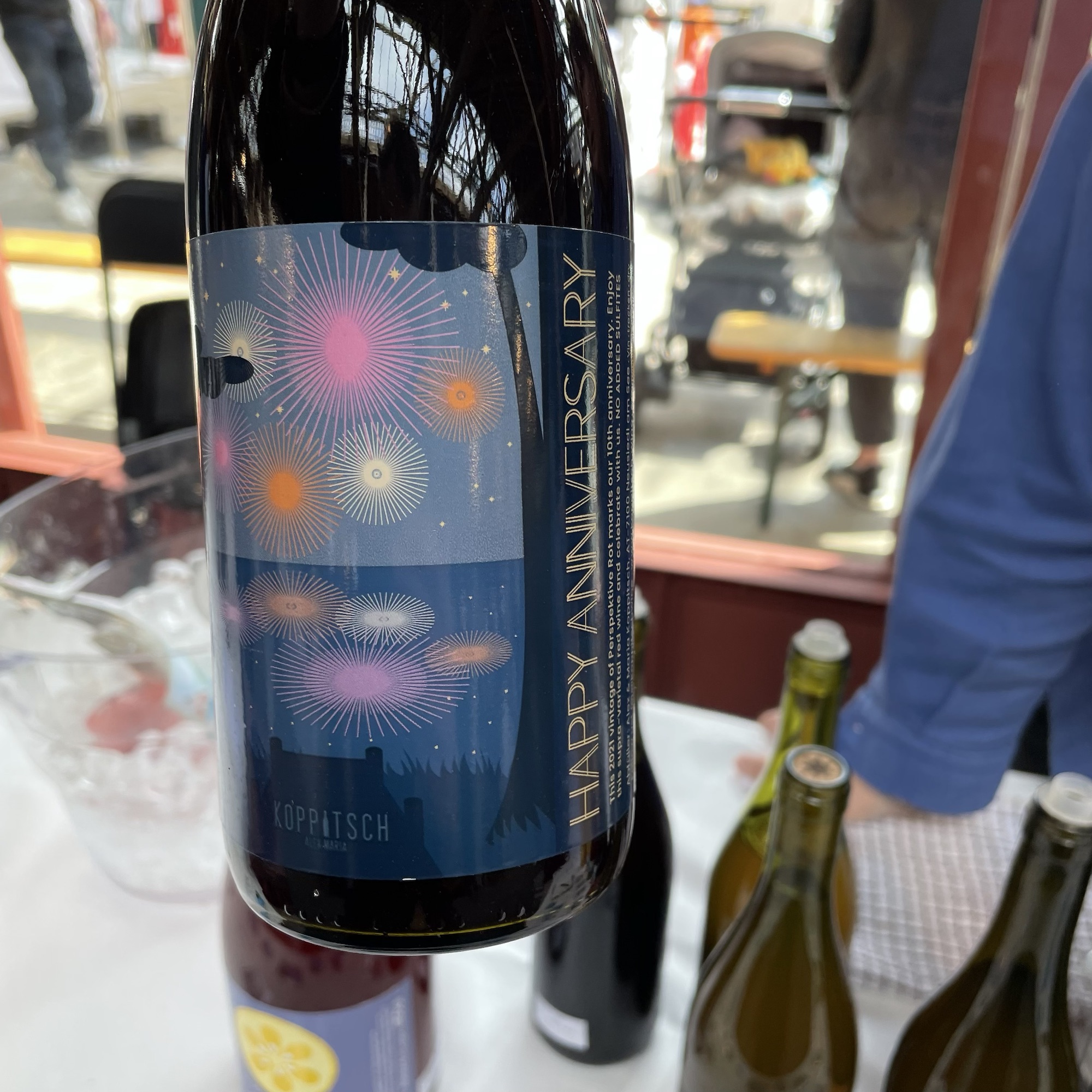
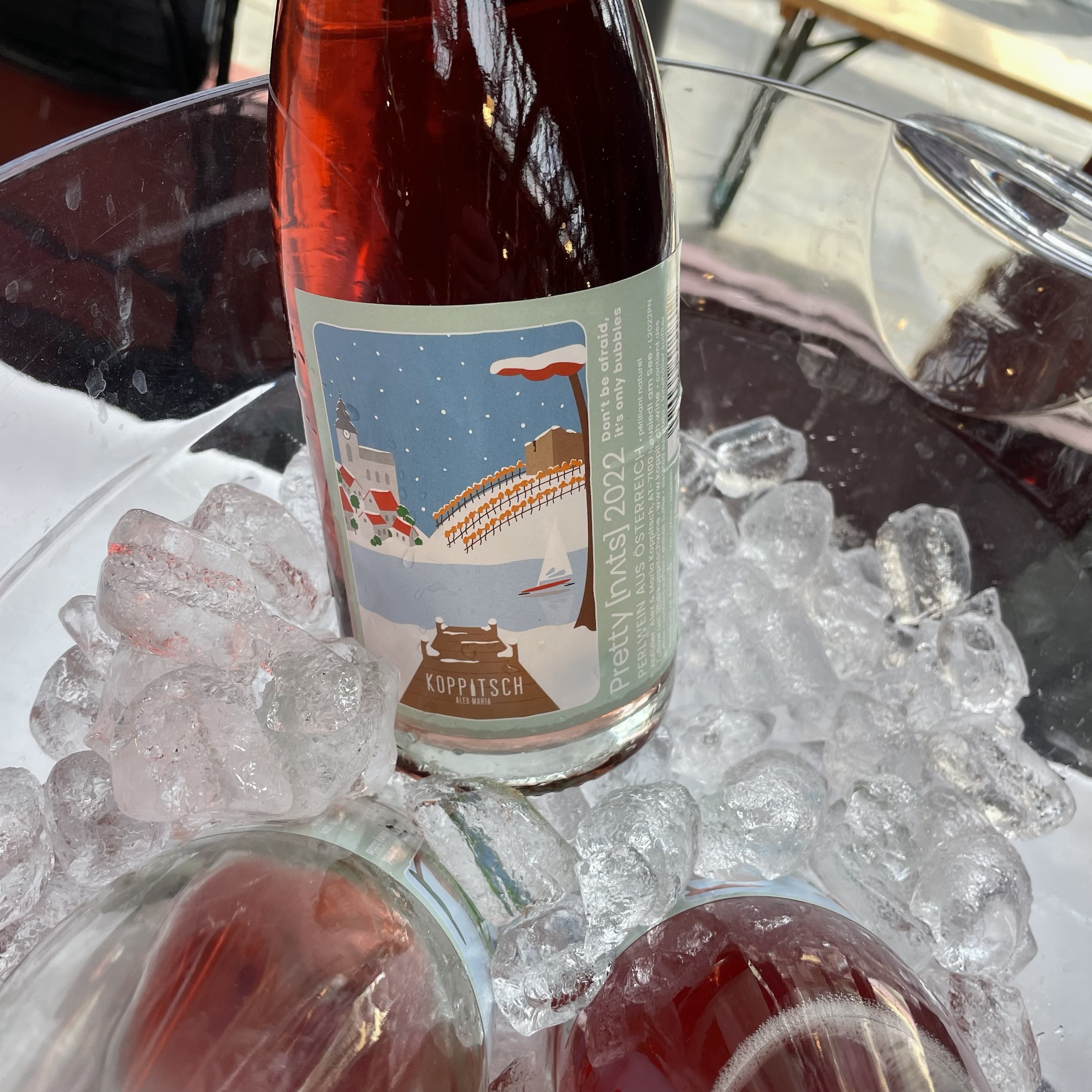
 Koppitsch Homok 2022 (Burgenland, Austria)

Many readers may know that I go back quite a few years with the Koppitsch family. I first met Maria at a Raw Wine tasting in London and immediately liked what they were doing. Over the intervening years they have become a bit of a cult producer, but it is only since Roland Wines grabbed the UK agency that their profile has started to rise in this market. They make natural wines which are easy to drink yet are expressions of their terroir, in this case the predominantly sand and gravel slopes down from Neusiedl am See to the lake, and the limestone hills which rise behind.

Homok translates as “sand” from Hungarian (although we are in Austria here, the whole region has a Hungarian heritage, which Alex and Maria are keen to keep alive). So, this cuvée comes off sandy soils from the Seefeld site, whose proximity to the Neusiedlersee (it’s the last bit of vineyard before the reed beds start) is self-explanatory, and which the label fancifully depicts.

We have 40% each of Grüner Veltliner and Weissburgunder (Pinot Blanc), with 20% Sauvignon Blanc. Whole bunches go into the outdoor screw press, the juice going into a mix of stainless steel, fibreglass and acacia barrels, mostly co-fermenting, everything being matured on gross lees for six months. No sulphur is added. You get a cloudy (unfiltered) wine full of vivacity and zest. A fun wine, 11.5% abv and £27.

Koppitsch Rét 2022 (Burgenland, Austria)

This wine also follows Homok with its name, Rét, but this doesn’t translate as “Red” as you might think, but as “grassland” or “meadow”. The grapes grow on gravel, in what was once a field for livestock, with views down to the lake.

The grapes are Rotburger (for some producers this is now the preferred synonym for Zweigelt) with 30% (approx.) St Laurent. The fruit was destemmed and macerated on skins for six days as fermentation began. It was then pressed into stainless steel (the St Laurent) and large acacia casks (Rotburger). Maturation was seven months on gross lees, no added sulphur. 10% abv.

Another fun wine with lively fruit and acidity, but also with some depth and, definitely, personality. This new 2022 is very nice and is slightly cheaper than the Homok, £24. Personally, I find the Koppitsch wines thrilling, and they are lovely, honest people who love their work.

Martin Obenaus Mo:Rot Zweigelt 2020 (Weinviertel, Austria)

This is another Weinviertel producer, from a region which has been rather ignored in the past, except perhaps for the wines of Ebner-Ebenauer, but which is now emerging from the shadows, especially of Burgenland to its south. Obenaus is based on the opposite, western, side of the region to Zillinger, at Glaubendorf, being close to Kamptal (which lies to the northwest of Vienna).

In many ways for those of us who like a lighter, zesty, red wine Zweigelt (or as we have seen previously, Rotburger to some – one of the more interesting debates so far as grape nomenclature goes) is often the perfect answer. A biodynamic wine, and as has become classic winemaking for many natural wines, a direct press into stainless steel. This has a very tiny addition of SO2 at bottling.

Crunchy fruit, mostly cherry, on nose and palate, with cherry skin freshness. Simple but a very nice package all round and one I will almost certainly buy myself. Quite well-priced at £18.

ELEMENT WINES

This is an Edinburgh-based importer which I’ve not come across before, importing “terroir-driven, responsibly made, low intervention wine”. Formed by Simon Lloyd and Steven Windsor, who claim forty years’ experience in the wine trade between them, they have been going since 2018 and perhaps have a slightly bigger presence in wine bars restaurants than they currently do in retail. Their focus is mostly Scotland and the North of England, but they have especially good coverage in Edinburgh.

Fangareggi Biancospino Lambrusco and Fangareggi Puro! Lambrusco Rosso (Emilia-Romagna, Italy)

Lambrusco has a terrible reputation, even today, with some wine lovers because in the 1970s and 80s it was a byword for a cheap fizzy beverage aimed at people who wanted alcohol in a sweetened package that didn’t challenge their tastebuds. Real Lambrusco is a different kettle of fish, whether very dry or with a touch of sweetness.

Biancospino” is organic and comes from a family vineyard north of Modena and just south of the Po. This is a tank-fermented white Lambrusco, and as such will never gain the complexity of a bottle-fermented wine. But that isn’t the point, because here you get sheer joy and pleasure made better by the wine’s simplicity and clarity.

The bouquet is gently floral, the palate has pristine yellow fruit, like plum and apricot, backed by just enough citrus acidity to give a very refreshing sparkling wine with only 10.5% alcohol. Slightly off-dry. £23.

The “Puro! Rosso” is a late harvest wine from the less well-known Lambrusco Salamino di Santa Croce sub-region. Viniviticole Fangareggi is, as the suffix makes clear, a producer which grows its own grapes to make its own wine, not a given for Lambrusco, but they also hand harvest the grapes (no machine harvesting here). Off-dry fruitiness leaps out of the bottle on the nose, all plums and dark berry fruit. By way of contrast the palate has that lovely almost bitter dryness that good Lambrusco exhibits. Also £23. Cork & Cask show only three left but if they get some more this could also appear in my cellar.

Finca El Molar Macabeo Skin Contact 2021 (Manchuela, Spain)

This isn’t, the alert among you will have noticed, the first Manchuela wine from this wine fair. Back in the day this region, to the east of La Mancha, used to make equally despondent attempts at wine but has woken up and come alive to the possibilities these unloved old vines offer.

In Part 1 we saw a wine from Ponce, which is one of the new stars of the region. This producer, which started out as far back as 1998, is also coming up on the rails and presented an excellent orange wine from a once-disregarded white variety, Macabeo. Farming is organic and “sustainable”.

The juice has a week on skins during fermentation after a week-long cold soak. The result is a smooth richness with some texture and a tea-like finish. It’s aromatic, with honey and peach on the nose, and it finishes long. Again, I thought this superb value for £18 and it’s another one for me to consider buying. Others may well have thought the same because, yet again, it’s showing only three in stock. Cork & Cask surely have to get some more!

Thörle Spätburgunder 2021 (Rheinhessen, Germany)

Thörle is a producer I know pretty well, having shot to greater prominence after the brothers Johannes and Christophe took over in 2006. This is an organic estate at Saulheim, west of the once famous Oppenheim. They are currently in conversion to biodynamics. The soils are limestone and so make excellent territory for Pinot Noir in particular (although what I love about German Pinot is the chance to try it off other soil types, such as the slate of the Ahr and the volcanic soils of Baden’s Kaiserstühl and the Pfalz).

Element Wines was also showing Thörle’s Dry Riesling, but it is their excellent Spätburgunder/Pinot Noir I thought I’d highlight. There are three limestone vineyards which provide the fruit for this cuvée, Saulheim’s Hölle, Probstey and Schlossberg. The fruit is cherry, on nose and palate, where it is nicely smooth. This wine has more delicacy than complexity but that isn’t a negative. It’s very appealing, so most will get drunk sooner rather than later. On past experience I think it will age a little. At £24 it’s a very good entry point to interesting German Spätburgunder.

MODAL WINES

Modal probably doesn’t need a lot of introduction to most regular readers. Nic and Roman don’t blow their own trumpet as loudly as some but I have enjoyed their well-considered and definitely eclectic range of wines for as long as I have been writing about wine. Their list includes personal favourites Joiseph, Staffelter Hof/Jan Matthias Klein, Slobodne and Victoria Torres Pecis. My latest Modal discovery is Domaine D’Ici La (Bugey).

Two days after the Cork & Cask event I attended Modal’s own trade tasting in Edinburgh, but the five wines I’ve highlighted here will not be duplicated when I write-up those notes.

Folias de Baco UIVO Rabigato 2022 and UIVO Curtido 2022 (Douro, Portugal)

 I’ve already formulated one New Year’s Resolution for wine, to drink more from Portugal. It must be said that I do know these wines quite well, but I often wrongly overlook them as they are so tasty and also so unrepresentative of their region of origin.

The grapes for the UIVO Rabigato come from the outlying sub-region of Cima-Corgo, right up at 500 masl on schist and granite. Rabigato is the grape variety, indigenous to the region, but perhaps not one that more conservative Douro lovers will have heard of. Average vine age is 20 years. The fruit was picked in early September and tank-fermented as whole clusters. Ageing was just six months on the fine lees.

Roman says this wine gives him a Muscadet vibe. It has a lively, Muscadet-like, acidity, but perhaps it has more floral aromatics than Muscadet, plus a little grapefruit on the nose as well. The palate is refreshing with some salinity on a nice, tapering, finish. £22

The UIVO Curtido is made from Moscatel Galego grapes grown in the same sub-region of Cima-Corgo but at the slightly higher altitude of 600 masl. The vines are also older here, 40 years of age. Whole clusters go into cement tanks and are macerated for four months, so it’s a skin-contact wine. These are both natural wines and no sulphur is added.

The Curtido tastes very much like an orange wine in terms of the aroma and fruit on the palate. Roses join lychee and orange on the bouquet, with definite zingy tangerine on the palate. However, it drinks easy with moderate tannins and only a hint of texture, just a beeswax texture on the finish. Super-tasty and it was going down very well with a group of younger drinkers at the table. Also £22.

Slobodne White Majer and Slobodne Red Majer (Slovakia)

We have here two interesting wines from one of Slovakia’s finest producers. Interesting because they are part of an experiment to make a range of multi-vintage, multi-varietal and multi-vessel wines. They try not to be too explicit about the exact blend (though we have ways of making them talk, because you always want to know) because they are intended to be terroir wines first and foremost.

Slobodne is a small, family-run, winery which had to re-establish itself after a rough time during the Second World War and the Communist era. The two sisters and their partners who run the operation were lucky to inherit untreated vineyards and continue to make “natural” wines with a focus on traditional skin-contact methods.

The white Majer uses most of the white varieties Slobodne grow. This means Grüner Veltliner, Sauvignon Blanc, Traminer and Devin. The vessels include a mix of barrels, larger vats, amphora and concrete eggs. The result is green-gold with the kind of nose which gives texture even before you taste it. There are also bags of exotic fruit to brighten your day – pineapple, mango, guava, kiwi and lime adding acidity. These are all replicated on the palate, more or less. Makes for a lovely intro to this fantastic estate.

The red version follows the same principle as the white, but the grapes are a blend of Cabernet Sauvignon, Frankovka Modrá (aka Blaufränkisch) and Alibernet (a crossing between the teinturier grape, Alicante Bouschet, and Cabernet Sauvignon, which adds both acidity and colour). I think this wine majors on its simplicity, but gives you refreshing and concentrated cassis flavours, with a bit of texture and spice on the finish.

Both of these retail at £25.

Fattoria di Sammontana Sangiovese 2020 (Tuscany, Italy)

This Sangiovese is from the Chianti region but who knows why it has been declassified to an IGT Toscana? Clues abound. It is a biodynamic wine, but more than this, it is a natural wine made without the addition of sulphur. It was aged, after a slow fermentation, in glazed cement tanks tanks, not the traditional oak, for eight months and kept in bottle for a further three months before release.

The producer occupies an estate once the property of the Medici Dukes. It is now run by the fourth generation of the Dzieduszycki family, which purchased it in the 1860s. There are 13ha of vineyards, and they also farm olives with 3,000 trees in production.

This is a pure Sangiovese, intended for drinking young. Although there is nice cherry fruit on the bouquet, it is also gently floral. The palate is fresh, fruity and zippy with nice fruit acids. Maybe you get a little texture but not real tannins. This 2020 is drinking well and it seems pretty decent value for £20. Just as well as I had already purchased a bottle.

Posted in Artisan Wines, Austrian Wine, German Wine, Italian Wine, Natural Wine, Portuguese wine, Slovakian Wine, Spanish Wine, Wine, Wine Agencies, Wine Festivals, Wine Merchants, Wine Shops, Wine Tastings | Tagged , , , , , , , , , , , , , , , , , , , , , , , , , , , , , | 4 Comments

Cork & Cask Winter Wine Fair 2023 (Part 1): Indigo Wine, Keeling Andrew and Dynamic Vines

November is tasting time, and my November kicked off with the Cork & Cask Winter Wine Fair, organised by one of Edinburgh’s most successful indie wine shops. The great thing about this tasting is that their suppliers tend to be small independent importers, many of whom come up from London. Most will be names you know, so it’s a chance for me to taste an unparalleled range of low-input wines I’d otherwise be tasting down in London.

Because there’s a lot to get through I shall, as last year, split this event into three parts. Part 1, here, will cover wines from Indigo Wine, Keeling Andrew and Dynamic Vines. Part 2 will cover Roland Wines, Element Wines (an Edinburgh-based small importer) and Modal Wines (whose solo tasting in Edinburgh I have also just been to). Part 3 will cover Vine Trail, some wines from Southern Spain on Cork & Cask’s own table, and some whisky from the Isle of Arran.

**Note on prices – prices quoted are retail from Cork & Cask. The same wines will be available from other retailers, possibly cheaper, but I have certainly seen some a few pounds more expensive.

INDIGO WINE

Indigo is certainly best known as an importer of Spanish Wine, and indeed it is hard to think of any Spanish specialist which could claim a better range, but they are nowadays so much more than Spain. In fact, one of their most recent additions is English superstar team Dermot and Ana Sugrue (Sugrue South Downs).

As with each of the importers profiled, I couldn’t write about every wine being poured, each merchant showing between ten-to-twelve wines, and to be honest all the wines selected were good. So, I have chosen what I thought were the best and/or most interesting. You will still have to read 2,500 words but I hope I have not been too verbose.

Gaintza Getariako Txakolina 2022, (Basque Country/Euskadi, Spain)

Txacoli is spritzy and dry, the classic Basque wine served traditionally from tumblers. It is massively thirst-quenching, but you generally need to be a fan of a bit of acidity to fully appreciate its undoubted charms. I guess in some ways it’s the wine geek’s Vinho Verde substitute, although that’s unfair to VV.

The sub-region is Getaria in the far east on Spain’s Atlantic Coast. Biscay winds cool an already often damp climate, and the vines (this is 100% Hondarrabi Zuri) are on limestone and clay at around 300 masl. Vinification is all in stainless steel. It’s not strictly a natural wine but is made with minimal intervention. It’s all fine spritz and apple freshness, a simple wine but in the very best sense, and I’m very fond of this well-selected version. Retails for just under £20.

Luis Perez « El Muelle de Olaso » Palomino Fino 2022 (Jerez, Spain)

Luis was winemaker at Domecq and an enology professor at Cádiz University. He set up a bodega with his son, Willy, just north of Jerez in 2002. Their whole modus is to explore the individual terroirs of Jerez, especially the soil sub-types. Making unfortified wine allows them, they argue (effectively) to express these soil types.

El Muelle is pure Palomino Fino, 80% of which was fermented cool in stainless steel, into which are blended 20% grapes which were sun-dried and fermented in seasoned oak. Ageing was six months  on lees. The result is frankly gorgeous. Very savoury with a saline minerality, this surely expresses the complex albariza soils from which it comes perfectly. Salty freshness and good length. A very good example of the new, and much-vaunted, style of unfortified Palomino. £20

Ponce Albilla 2022 (Manchuela/La Mancha, Spain)

Juan Antonio Ponce worked with Telmo Rodriguez before studying biodynamics in France. On returning to Manchuela he has become a vocal advocate for biodynamics in the region, one which was once only known for bulk wine. Ponce Blanco is made from a rare variety, Albilla, which gives zippy wines which are saline, citrussy and herbal. The key here is very old vines, grown at altitudes around 800 masl, and a semi-whole bunch fermentation followed by six months on lees in old oak. The grapes retain acids due to the cooler nights at this altitude, unlike the sun-baked grapes on the plains. The wine therefore gains freshness and gains complexity. Very good value for £22.

Terroir Al Limit Terroir Historic 2021 (Priorat, Spain)

This wine is part of the famous project begun by Dominik Huber in collaboration with Eben Sadie. Sadie returned to South Africa but the biodynamics Huber implemented paid off big time giving grapes with a ripeness and concentration to match the heroic conditions in the vineyards.

This blend of Garnacha and Carinyena/Cariñena/Carignan comes from vineyards in all nine villages of the Priorat appellation. Altitudes vary between 350 and 700 masl, but we are still talking mountain viticulture, and soils vary from the Priorat schist we’ve all heard about to soils of limestone and clay. The grapes are a mix of organically, and biodynamically, farmed fruit for this entry level wine. After a natural fermentation with a ten-day maceration, the wine is aged in large, 5,000-litre, concrete vats.

The result is one of the best examples of a “regional” Priorat. At 13.5% abv it is well balanced and still has a freshness without any jaminess or a surfeit of concentration and alcohol (which lesser wines can exhibit). In fact, it doesn’t taste as strong as it is, not something one can always say about Priorat. The bouquet is lovely, gentle violets, the palate savoury and textured. £29

William Downie Cathedral Pinot Noir 2021 (Victoria, Australia)

I had to include at least one wine not from Spain, and although I could have written about the excellent Tetramythos Antiphon red blend from the Northern Peloponnese in Greece, I had to choose this wine from Mornington star William Downie. Around 80% of the Pinot Noir fruit comes from the Mornington Peninsula close to Melbourne, whilst the rest is from the King Valley, where altitude makes the climate almost as cool as Mornington, except perhaps with a touch less vintage variation.

The terroir is based around red clay (lots in Mornington, there’s even a Red Hill, a nice town worth a visit if you are passing through) and loam. Fruit was 100% destemmed and fermented in a mix of wooden open-top vats and stainless steel. Ageing is partly in acacia, nice to see this increasingly used in Australia. For Pinot this is in the darker spectrum, dark cherries with spice, a very elegant Pinot, but one which I’d suggest could take some ageing in bottle. £32

KEELING ANDREW

Keeling Andrew is the importer arm of the company which set up the Noble Rot group of restaurants, the eponymous magazine and the wine shops, Shrine to the Vine (yes folks, they’ve opened another on Broadway Market). The wine shop I know in Lamb’s Conduit Street truly is a shrine to all that is great, and up-and-coming, and a perusal of the shelves will reveal some rarities and obscurities guaranteed to set my wine-obsessive heart racing. Naturally such wines are unicorns which can never gain wider distribution (remember that Lanzarote wine I bought, just 800 bottles for the world to enjoy). Here we have four slightly less rare wines, but they are rather good.

Koehler-Ruprecht Kallstadter Riesling Kabinett Trocken 2021 (Pfalz, Germany)

This is a producer with experience in making dry wines before they became fashionable. Perhaps this is why this dry Kabinett doesn’t display any of the bad habits many lovers of the traditional Kabinett style would often accuse the trocken version of. Releasing these wines under the pradikät with “trocken” on the label led to their leaving the VDP after being members for eighty years (the two cannot appear together). This is a natural wine too.

It’s also rather good. Most of the grapes come off the limestone-rich Saumagen site. It has acidity, I’m assuming you like acidity, but it also has more body than a traditional Kabinett, and this carries the 11% alcohol. It just lacks the richness of a Spätlese Trocken, but is still a versatile wine for aperitif or food. I like this a lot. Apparently so does Frank Cornelissen. £20

Combel La Serre « Le Pur Fruit du Causse » 2021 (Cahors, France)

Julien and Sophie Ilbert make this tasty Malbec in the Cahors region in Southwest France. The grapes come from altitude up on the Causses and the wine is intended to be a fresher rendition of the local variety, Malbec, one to drink rather than keep. A bright, deep, cherry colour in the glass, the scent is darker with bramble fruit on nose and palate. It’s a little grippy but is only 12.5% abv. I’ve seen suggestions you can chill it in warmer weather, but it’s simply a really good wine for any occasion. £22

Trediberri Barbera d’Alba 2022 (Piemonte, Italy)

Federico and Nicola Oberto founded Trediberri in 2007, based in La Morra, Federico having previously worked with Renato Ratti. They have vines on the hill at Rocche del Annunziata, plus 5ha at Berri. They ferment and age their Barolos with a nod to tradition, long and slow. Their Barbera is in the same mould.

Blueberry fruit and bright acids balance the body of a wine which comes in at 14.5%. There is a tendency for Barbera to be a little too alcoholic, but this is a wine I’ve bought before and like. The alcohol is there, and this is no light red, but it always seems pretty well balanced. Barbera is such an under rated grape variety as well. If this isn’t the cheapest example, I still think at £23 it’s pretty good value and it will accompany many rich winter dishes. My guess is that it will improve over a couple of years as well.

Suertès del Marques 7 Fuentes 2020 (Canary Is, Spain)

From the producer which more than any other made Tenerife a source of wonderful wines, blending tradition with a modern outlook. This is what Jonatan Garcia would call their “village” wine, usually containing fruit from all or most of their sites in the Orotava Valley, in the north of the island.

The composition is 95% Listàn Negro with 5% Tintilla, all off volcanic terroir, with a massive range of vine ages, between very young and over 100 years old. Fermentation is in a range of vessels, including concrete, older oak and plastic. This is simply a wine that relies on its purity of fruit, which it has in abundance. Suertès makes some world class wines but this is a pretty good entry point for just £23.

DYNAMIC VINES

Dynamic Vines has a warehouse in Bermondsey, a short trek from London Bridge Station. They have simply one of the three or four finest lists of biodynamic and natural wines in the UK, with a host of famous names and hard to source wines. Some of the best London tastings I’ve been to have been at their premises.

Matthieu Cosse Blaye Côtes de Bordeaux Blanc 2020 and Fronsac 2020 (Bordeaux, France)

Many readers will know Matthieu Cosse from his very well-regarded Cahors operation, Domaine Cosse-Maisonneuve, which Dynamic Vines have been representing for many years. I had caught wind of the project Matthieu was planning in Bordeaux, in collaboration with his friend Jérôme Ossard and here we have their first vintage. The wines come from special grape selections, and they are made in the Bordeaux region by a dedicated team, not back in Cahors.

The Blaye white is from a 7.5-ha single vineyard, and blends Sauvignon Blanc with Muscadelle. It’s a natural wine, of course, and it’s a real cracker. It has lots of fruit and the varieties complement each other, with acidity balancing a certain weight. The alcohol, at 12.5% abv, is just perfect. Very fresh now, and impressive, but it will age a year or two if you want. £23

The Fronsac is a blend of Merlot, Cabernet Franc, Malbec and Cabernet Sauvignon. The Cabernet Franc does seem to bring a lot of freshness, but along with the baby tannins I’d say this is an exemplary wine, but one which should preferably rest in bottle six to twelve months longer. It costs £29.

There is also a red Blaye at £23 which was not shown. I understand that Dynamic Vines took the whole production of these three.

Domaine Giachino Apremont 2021 and “Giac’ Potes” Mondeuse/Gamay 2022 (Savoie, France)

This is a domaine I’ve been buying for very many years, first in France, though it was Paris rather than Savoie where I first came across this producer. They are located in the Chartreuse Hills, with vines on the slopes of the famous limestone massif of Mont Granier. Viticulture is organic and increasingly very low intervention.

The variety in this Apremont is Jacquère, often seen as the basic grape of the region, but a good Jacquère can match any Savoie white variety in the right hands. Grapes undergo a gentle pneumatic press and the juice is clarified using temperature control, which helps avoid adding very much sulphur. The wine is lees-aged which adds texture and indeed personality. Malolactic either happens or doesn’t depending on vintage. The result has much more depth than your average Apremont, unsurprisingly from the domaine selected to take over the famous Prieuré St Christophe after Michel Grissard retired. £24

Giac Potes is of course a play on the domaine name and Blackjack, a card game popular in France but better known in the UK as Pontoon, and in the US as 21. This is based on Mondeuse, the classic black grape variety of Savoie. However, in the 2017 vintage they were short of Mondeuse and added some Gamay, and as it proved successful, they have continued to do so. The colour is deep cherry and the bouquet echoes that, with a hint of bonfire smoke and a richness somewhere between dark fruit and fruitcake. It’s a savoury wine which Dynamic counsel drink or keep. I’d say it is quite grippy and might be even better in a year. £32.

Clément Giachino’s « Prieuré St Christophe » is also available from Dynamic Vines for £54-£62.

Olivier Rivière “Rayos Uva” Rioja 2021 (Rioja, Spain)

Olivier is French, from the Cognac Region. He studied oenology at Bordeaux, becoming a proponent and practitioner of biodynamics and he originally intended to make wine in Southwest France. An opportunity to convert a vineyard to organics for Telmo Rodriguez led him to Spain, where he set up his own operation in Rioja in 2006. He has now grown his holding to 25ha, including vines in neighbouring regions, but he tends to stick to traditional varieties off what are very complex soil types. In terms of classifying his own wines, he follows a more Burgundian model of “generic, village, cru” rather than Rioja’s “Crianza, Reserva, Gran Reserva”.

Rayos Uva is a Tempranillo/Graciano blend off a sandstone/clay/limestone terroir. Fermentation and ageing are in large oak vats and the wine is savoury with soft but evident tannins. It is effectively a wine to drink rather than age, but it doesn’t lack substance. Definitely a very good introduction to a serious winemaker. £24

Jamie, India and team put on an amazing event, as usual. Although my article may highlight the importers, if you come to Edinburgh you really should say hi to these folks. Such a good wine shop, and I paid them good money for the privilege of writing that.

Posted in Artisan Wines, Natural Wine, Wine, Wine Agencies, Wine Festivals, Wine Merchants, Wine Shops, Wine Tastings | Tagged , , , , , , , , , , , , , , , , , , , , , , , , , , , , , | 1 Comment

Recent Wines October 2023 (Part 3) #theglouthatbindsus

The third and final part of my Recent Wines for October contains two very different Australian wines, one a multi-regional blend and one from a single site in the old Hunter Valley. Both very different but both exceptionally good. To accompany those, we have a Piemontese (my last selection from the Waitrose Loved & Found range), a serious Welschriesling from Moravia, and a very nice Austrian Furmint. Again, there are just five wines, as in Parts 1 and 2, but it has given me the chance to be slightly less succinct. I hope you enjoy my enthusiasm.

These Recent Wines may seem to have appeared quite early for regular readers, but there are some autumn tastings coming up here in Scotland, all small importers coming up to Edinburgh, and they will provide the bulk of my articles for the next couple of weeks. Last year I found some real gems.

Albarossa 2020, Waitrose Loved & Found (Piemonte, Italy)

My wine obsessions vary, as do places I neglect. I had noticed I have been neglecting Italy over the past year or so, but I have drunk a few wines, this being one, which have reminded me that there is such value to be found in Italy outside the so-called greats.

This wine is part of an excellent initiative by UK supermarket, Waitrose, to highlight the lesser (once again, so-called) grape varieties, and a good few of those elusive wines were sourced in Italy. Many of the varieties highlighted are not even “second string”, and some wouldn’t even qualify as “third string”. Albarossa is certainly in that category.

Albarossa was created in 1938 as a cross between Barbera and a French variety from the Ardèche which I had never heard of, Chatus. Chatus was originally grown in the Vivarais and most was uprooted after phylloxera as it was labour-intensive to manage and very tannic. I’m not really sure why it ended up as a cross with Barbera in Piemonte.

It was named after perhaps Piemonte’s most beautiful town, Alba. When I said this isn’t even a third string variety, well there are only ten hectares of Albarossa planted anywhere. The wine is apparently made for Waitrose by the large Mondodelvino Group, whose web site has a lot of information, but nothing I could find of any relevance to their access to Albarossa grapes.

No worries. The bouquet here is actually quite lovely, ripe cherry with a little blackcurrant. On the palate the fruit is sweet, though the wine is dry. If it lacks anything, the mid-palate is a little hollow, but don’t let that put you off. It has that Barbera bitter finish on what is otherwise a smooth wine. Of course, I have no idea how it was made, but you can probably assume it is not a natural wine. What it does have going for it is price and value for money.

This isn’t a wine to really go over the top about, but you do get a genuinely interesting wine for £8.99, that is if you can find any. I was surprised to get all of the Loved & Found cuvées I ordered back in the summer, but I have yet to see any of them on the shelves in a Waitrose store. Definitely worth a look if you are after something inexpensive yet better than just drinkable.

Ryzlink Vlašský 2019, Richard Stavek (Moravia, Czechia)

Stavek is one of the fathers of Moravian natural wine. Working out of Nemcicky he farms fifteen hectares, but only a third of his land is for cultivating vines. But I won’t bore you with too much background information, having only written about him as one of three important Czech winemakers in an article published on 26 October.

What I will repeat here is what a revelation visiting him in August 2022 was. Seeing his cellars, vineyards and house (where we had the tasting) were so informative, putting the wines in context with the surroundings. I felt as if I was able to delve into the soul of the wines, something which does happen from time to time, but certainly not always, when visiting a producer.

The majority of wines Richard makes are field blends. Varieties are harvested together in a way traditional throughout much of Central Europe, and the grapes are usually fermented together too. However, he does make single varietal wines and this is a gem. The grape on the label is the local synonym for Welschriesling. A closer synonym is Laški Rizling and those of us around in the 1970s may know the infamous Lutomer brand, from the former Yugoslavia, which was drunk by my parents quite regularly. I believe it is still available in some supermarkets today, but I’m sure that quality has increased and sulphur additions decreased.

Stavek’s version could not be more different. You will find very nice Welschriesling today, especially from Burgenland in Austria, no great distance from Moravia, but you will be hard pressed to find a more serious version than we have here. The vines were planted back in 1974, before Richard took over the vineyard. The soils are loess. Whole bunches went into open-top fermenting vats for a ten-day maceration. They were then foot trodden and the wine aged for just ten months in barrels made from local acacia wood, a favourite here at Stavek’s. No sulphur was added (of course Richard is very much committed to natural wine).

The result has texture, depth, fruit, a darkish hue, and it is savoury and saline. In fact, it has everything. It’s a soulful wine, almost hedonistic as well, but definitely (for me, its maker might disagree) intellectual at the same time. A serious wine from a magician/alchemist. It also evolves over time in the glass, as the best wines do. This sounds terrible, perhaps elitist, and it isn’t meant to, but it won’t be a wine for everyone, perhaps in the way that the fine Sherries of Equipo Navazos aren’t. It reminds me of them. Not in taste of course, but in the way you need to commit to them, to make an effort to crack the code. Not that it’s hard. This is just not a superficial wine. But I love it.

Purchased from Basket Press Wines but you may now have to wait for the next vintage.

Piggy Pop 2022, Tim Wildman Wines (Multi-Regional, Australia)

Some may have discovered the wines of English Master of Wine Tim Wildman, via his recent project to make sparkling wine in England from so-called English Heritage Varieties, many being crossings planted in the 1970s, or earlier, grape varieties suited to the wet and chilly (pre-climate chaos) climate of England and Wales. His work resulted in a petnet called Frolic, which harks back to a time when varieties like (inter alia) Huxelrebe, Reichensteiner, Madelaine Angevine and Gutenborner were the prevalent grape varieties of British viticulture, rather than Pinot Noir and Chardonnay. His “Lost Vineyard” project is important, creditable, and the wine is good (if not cheap).

Tim actually honed his winemaking skills long before he made Frolic, making ancestral method sparkling wine under the Astro Bunny and Piggy Pop labels in Australia. The 2022 version of Piggy Pop is just perfect. I don’t mean it’s the greatest wine on earth, but for what it is, and what it is meant to be, it could not be bettered.

Well, what is it? Piggy Pop is a pink petnat blended from five (I think) varieties from three sources. There is Zibibbo (aka Muscat of Alexandria) from Riverland, where incidentally Brad Hickey sources the same variety for his Brash Higgins amphora Zibibbo. Zibibbo is often underrated, but it is one of the oldest, genetically unmodified, varieties we have and when taken seriously can produce very interesting wines. Added to this Riverland fruit we have Lagrein and Arneis from the Adelaide Hills, and Nero d’Avola and Mataro (aka Mourvèdre) from the warmer McLaren Vale.

As a side note, these are often what the Aussies like to call “alternative varieties”, but as I’ve heard both Tim and Aussie wine writer Max Allen intimate, these are not “alternative” varieties but “appropriate” varieties for their terroir and it’s good to see more emphasis on these and less on the Shiraz/Cabernet/Merlot/Chardonnay crowd which used to dominate Australian viticulture to the exclusion of all else.

What we have is a great label, a beautiful pink colour, a wine scented like pure, unadulterated, raspberry and cherry juice, and tasting of pretty much the same except for the lick of liquorice as the palate tails off.  It is bone dry, and gently fizzy, and although it packs 13% abv (high for sparkling wine, perhaps thanks to the McLaren Vale element) it is so well balanced and so easy to drink, you’d never guess.

Versatile as many petnats are, we drank this as a BYO at our Sri Lankan vegan popup, for which we have to walk five minutes and pay £15/head approximately once a month. The importer suggests charcuterie, pizza and dark chocolate but I’d drink this with literally anything going. Tim really is a master not only of wine, but of the petnat style, and every single person I have ever poured this wine for (quite a few) have loved it. From someone who drinks little wine at all to someone who owns a wine shop and now sells it.

My bottle came from Lymington’s The Solent Cellar (c£26), but it is reasonably widely available at indie merchants via UK importer Indigo Wine.

Furmint 2019, Heidi Schröck & Söhne (Burgenland, Austria)

Okay, I have written about this very wine before, but that was almost exactly a year ago, and it has evolved enough to justify a second plug. Heidi was the first Burgenland producer I ever visited, and her warmth and generosity with her time left as much of a mark as her wines, which I already knew quite well. I was sure I had drunk a Furmint from her before that visit but she wasn’t making one at the time.

That was in 2015, which seems a lifetime away, and in many respects, it was, although thankfully I was in Rust again last year during my third and most recent Burgenland trip. Rust isn’t too far from Vienna, although unlike villages further north around the Neusiedlersee, you need to drive or catch a bus (easy enough to do) because there’s no train. The effort is well worth it because the town is beautiful and beautifully located. If you like to cycle and go on boats it’s worth several days of your itinerary.

Despite that proximity to Vienna, Rust is historically speaking a Hungarian town. It was granted a charter as a free city by the Hungarian Crown in 1681, and this was retained when Burgenland became part of Austria in 1921. Despite having only a couple of thousand inhabitants, Rust is Austria’s smallest administrative district, with a whole load of rights and responsibilities which come with it.

All of that is a long-winded way of suggesting why you will find a few growers who have Furmint in their Rust vineyards, and in fact a few who are actively re-introducing this traditional variety, as indeed are producers over on the eastern shore, which equally has a Hungarian heritage.

Johanne and Georg are the söhne in question, having joined their mother at this family domaine. They will have big shoes to fill when Heidi retires. Burgenland must have a very special water…there are quite a number of very talented women winemakers who live and work around the shores of this shallow lake famous for its nesting storks. Austria has many star winemakers who happen to be female, counter-intuitively for a country which outside of Vienna can seem very conservative, yet I do not know of anywhere that has quite the same concentration as Burgenland.

Let’s get back to the wine. The grapes come off complex soils of loam, sand, lake gravels and quartz. Fermentation and ageing is carried out in large acacia casks. The intense minerality of a year ago is still perhaps 80% in evidence, but the wine has put on a little weight. Right now, there’s excellent balance between the fruit, of which there is more than in some Furmints, and acidity. It is still fresh and clean, and it has certainly developed positively since I last drank it.

I’m not sure who is the agent for this particular wine, though it could be Liberty Wines. I have bought Heidi Schröck’s wines in the past from Alpine Wines, but they seem to have mainly older vintages of hers with her older labels (albeit including a different 2011 Furmint). This wine, sporting a label design I’ve not seen except for on this cuvée, but which seems to appear on her other wines as well now, came from Lockett Brothers, in North Berwick, and cost £19. It’s kind of sad that they still have this 2019 left, to be honest as it ought to have sold out, though as I suggest it is still drinking nicely. It’s a lovely wine at a good price.

Kiss Shiraz 2013, Andrew Thomas/Thomas Wines (NSW, Australia)

This is a limited release museum wine which I was lucky enough to purchase on my last visit to the Hunter Valley in 2019. It was the first time I had been back to the Hunter since 1989 and it has changed a great deal in that time. Aside from many more wineries present, we saw first a fall in the region’s popularity, one that was once at the heart of Australian viticulture, and exports in the 1980s, to a rebirth in recent years.

Old estates have been rejuvenated by new blood, but more importantly many new winemakers have come to what is still the closest major viticulture to Sydney. Among these new names are the stars who have pulled this beast, with its far from ideal climate for grape growing, back from the brink and towards a once-more bright future.

Andrew Thomas is at the forefront of this renaissance for the Hunter. Every wine guide under the sun uses language like “shining light”. Qantas Magazine actually called him “The superstar of the Hunter Valley”. Andrew grew up in South Australia’s McLaren Vale as part of a wine family, and went to study at Roseworthy. He began working for the late, legendary, Murray Tyrell (who may even have been not quite legendary when I was privileged to meet him in the 1980s). He did harvests overseas (USA, Italy and France), but because he wanted to make great single vineyard Shiraz, he chose Hunter Valley’s Pokolbin. This was the epicentre for historic Shiraz in Australia.

Andrew Thomas wasn’t trying to copy the old school, though. Those wines, especially with their “sweaty saddle” aromas (Brettanomyces, aka Brett) were long out of fashion. He may have felt there is no better Shiraz dirt on the continent, but he knew he could add something, a modern twist. His flagship red, Kiss Shiraz (which sits with his Braemore Semillon at the apex of his range) is a thoroughly modern wine with an aura of heritage.

The vineyard Kiss comes from, near Pokolbin, is clay and loam. The vines, planted in 1969, give very low yields now, but great care is taken of them. The grapes underwent a cold soak for 48 hours before being fermented on skins for seven days. Ageing is 16 months in French oak with bottling of the 2013 in July 2014. The wine was held until May 2015 for release. This flagship red is packed with red and darker fruits, especially blueberries, with savoury and spicy elements to the fore as well. The tannins are just beautifully integrated. At a decade old this wine is really only at the start of its drinking window and will go on for another decade, for sure. Wonderful now, but it will definitely shine even more brightly. Sadly, my suitcase only contained the one bottle.

Andrew Thomas is rightly acknowledged among Australia’s finest winemaking talents, yet I’m not sure how well known he is in the UK? I’m not sure that the Hunter Valley renaissance has reached our shores. This wine isn’t cheap. I think I paid a little less than the £75 it has been listed at currently (closer to £50, I think), but it is a remarkable wine that if I were at his winery again, I would be certain to buy in whatever vintage was available.

Andrew Thomas Wines has a very good tasting room and should definitely be on anyone’s Hunter Valley itinerary. My visit is recounted in an article published here on 18 December 2019, which you can find by typing Andrew Thomas into the search box.

Posted in Artisan Wines, Australian Wine, Austrian Wine, Czech Wine, Natural Wine, Neusiedlersee, Petnat, Piemonte, Rust, Wine, Wine Agencies | Tagged , , , , , , , , , , , , , , , , , , , , , , , | 2 Comments

Recent Wines October 2023 (Part 2) #theglouthatbindsus

For our second batch of wines drunk at home in February we dart all over Europe, starting out in Devon of all places, followed by the Rioja Region (but not Rioja), Faugères (an all too rare visit to Languedoc, I admit it), the Vallée d’Aoste (or Val D’Aosta if you prefer) and a wine from a Pfalz star I try to keep drinking.

Artefact 2021 Castlewood Vineyard (Devon, UK)

I must have been sleeping because I’d never come across this producer, and I’d know if I had, not least because of the very unusual bottle chosen for this Bacchus (sadly my inexpert photo fails to depict it in all its glory), which reminded me of those wonders SQN uses. Delving into my four books on English etc Wine, not a single reference, so I had to do some research online.

Castlewood began in 2006 on a south-facing slope overlooking the River Axe in East Devon, sited below the ancient Iron-Age hill fort of Musbury Castle. It was only in 2016 that they added a 2-ha plot of Bacchus, having concentrated until then on sparkling wines. The soils are largely clay-loam, the vines planted at low densities, and on a south-facing slope which is generally frost-free.

This is not a natural wine producer as such but they do follow sustainable practices, including the growing of cover crops between rows, and the vinification at least seems to follow natural wine methods. There does seem to be a serious focus on healthy grapes and carrying out strict selection of bunches at harvest, along with swift pressing as soon as possible after picking, any moving of the must/wine done by gravity with no pumping.

Artefact is 100% Bacchus, Clone GF1 (apparently), the 2021 being harvested in mid-October. Grapes were crushed and destemmed into four 300-litre Tuscan amphorae. Fermented with natural yeasts, they saw a 21-day maceration before the skins were removed, followed by a further eleven months on lees. All the wine was then transferred to stainless steel for three months to settle before bottling. The juice was neither fined, nor filtered.

You do get that classic Bacchus grapefruit bouquet, but with an extra dose of nice tropical fruits. The palate definitely has some texture, but nothing harsh, just firm-ish. The ample fruit is complemented by something slightly biscuity, and hints of leaf tea.

This bottle was purchased by friends from JJ Mellis, the cheesemonger in St Andrews, which seems to have a small but very nice selection of wines. I went there to try to buy some for myself but they’d sold out, which was a shame. It seemed very good value, £22. I reckon the bottle itself must have cost a fair bit. I have since discovered that only 1,000 bottles of Artefact were made. It was also made in collaboration with Luke Harbor, Head Sommelier at The Pig Hotels Group, who having helped out at the vineyard wanted to get involved in the winemaking (Luke is now doing his MW).

I’ve spotted some at Forest Wines (£26) for anyone interested, and The Pig Hotels list it of course (£62). It is sold out on the winery’s online shop. Maybe there will be some 2022?

Gran Cerdo Tempranillo [2022], Gonzalo Grijalba (Rioja Region, Spain)

This is one of those wines you may have seen around, and which is pretty cheap. It’s the sort of wine you might expect me to leave out of my monthly roundup, but this is definitely a wine worth buying for a party, to take to dinner, or to drink yourself. It cost a mere £12. I know, that’s not cheap for most people and it’s above the average price paid for a bottle of wine in the UK, but as this blog is mostly read by fellow wine obsessives who tend to spend far more of their income on wine than most people, and doubtless more than we can really afford in many cases, I’m not averse to highlighting a bargain when I come across it.

I’ll tell you something, the only bad thing about this wine is the over-the-top marketing which makes it sound as if you are about to drink a very posh Rioja, but of course the grapes are declassified from the DOCa. This is apparently because the fruit was cropped at over Rioja’s limit of 6 tonnes per hectare.

As a consequence, there’s little information on the label, other than a tirade against the banks which refused to finance Grijalba’s operation (he really doesn’t like banks, as the pig with a mouth stuffed with money on the label makes clear). No matter, this wine, completely unoaked, has nice red fruits on the nose, and a sweet-fruited, light, palate. It has a smooth palate too, but with just a little earthy texture. It’s simple and clearly a wine intended for consumption in the year after bottling, yet it’s remarkably good, as well as terrific value, for around £12. I’ve had far worse wines with “Rioja” on the label, and I bet you have too.

It’s a natural wine, and biodynamic as well. Sadly, Gonzalo’s father became ill from working with vine sprays in the 1970s causing the son to become implacably opposed to using synthetic treatments on his vines.

Gran Cerdo Tempranillo is pretty widely available, from the already mentioned Forest Wines in Walthamstow, The Solent Cellar, Natty Boy Wines, Roberson, Seven Cellars and many, many more. Chances are you’ve seen the label, and maybe even thought it too cheap. Definitely worth a try in these trying times.

Léonides 2019, Domaine du Méteore (Languedoc, France)

Domaine du Méteore is one of the most highly regarded estates in the Faugères appellation. It is named after a 200-metre-wide meteorite crater near the village of Cabrerolles in the foothills of the Haut-Languedoc mountains, west of Clermont L’Hérault and Pézenas. It’s a special region of schist and limestone with sand and chalky clay, having its own AOC since 1982. It’s also a region with a long reputation for organic and biodynamic farming and Méteore was in the vanguard.

Léonides is a blend of mostly Syrah, Grenache and Cinsault, with occasionally a little Carignan and Mourvèdre, from the crater site, which is surrounded by oak forest and garrigue. Made as a natural wine from low-cropping old vine stock, it sees a long, four-week, skin maceration which gives the wine a rich and deep colour. The ageing lasts 28 months in inert glass fibre tanks. The only addition is very small amounts of sulphur.

The bouquet is of concentrated dark fruit with cassis notes. These are accompanied by classic Languedoc herbs reminiscent of the local garrigue. I found a touch of graphite in there as well. The schist seems to impart a tannic structure, but also a vibrant freshness at the same time. The body doubtless comes with the 14% alcohol, though that freshness does balance any weight-related issues. It errs towards leanness more than plumpness, but I don’t mean that in a negative way at all, far from it. The vineyard is said to be quite breezy and you can imagine you are able to taste that. It’s certainly very nice to drink.

Not as cheap as the wine above, but at £17, still a welcome slice under the twenty-pound mark (I have seen it even a little cheaper). Again, this is quite widely available, imported by Les Caves de Pyrene. For fans of Brexit, this cuvée is generally around 8€ in France.

Torrette Superieur 2016, Vallée d’Aoste, Ottin (Aosta, Italy)

To clear up the labelling before we dive in, Val d’Aosta is Italy’s smallest province, but both Italian and French dialects are spoken because it forms part of the former territories of Savoy (Savoie). You will often see wines labelled in French as Vallée d’Aoste, although its wines are fully governed by Italian wine law (despite seeing AOC or AOP on the label in such cases, rather than DOC). Aosta hides its light well when it comes to wine, because as with Switzerland, little makes its way outside of the country. In Aosta’s case, little makes it out of the region.

Although, when it comes to red wine, there is a fair amount of Pinot Noir and sometimes extremely good Nebbiolo here, Aosta boasts two of its own specialities, Fumin and Petit Rouge. Fumin is often the most promising variety, making quite unique and ageworthy reds (contrary to what some established UK experts may tell you). Petit Rouge is also capable of making excellent wines if you get the right producer (and perhaps the “Superieur” form). Petit Rouge must form at least 70% of Torrette.

Elio Ottin began making wine near Saint-Pierre, above the Aosta Valley and the Dora Baltea River, at the age of just 23, back in 1989. A producer committed to sustainable viticulture, at this domaine even all the energy comes from renewables. Elio’s real love is farming and he has brought life to the mineral-rich, sandy, soils he tends.

The vineyards are at between 650-700 masl, so this is mountain viticulture, mostly on steep slopes, all south-facing for maximum sunlight. Farming is organic, with manure supplied by Ottin’s own cows. Vinification uses native yeasts, and for this Torrette a gentle skin maceration precedes fermentation. It is then aged for a year in large Austrian oak (20hl). Only 80% of the cuvée is Petit Rouge, with 10% each of Fumin and Cornalin (the latter variety better known over the Grand St Bernard in Swiss Valais). About 5,600 bottles were made of this Torrette in 2016.

You get a mix of red and darker fruits (strawberry, blackberry) with juniper berries, beetroot, pomegranate and pine all swirling around in a wine that isn’t really “complex” yet has plenty going on. It drinks easily but also goes very well with food, assisted by a spicy finish and 13.5% alcohol (in the Superieur version). The producer calls it “surly” and, as a positive, that’s actually a good description. I would add that I’d say this 2016 is fully ready for drinking now. I might not want to sit on it. Petit Rouge generally ages less well than Fumin here. Very tasty though.

£25 from St Andrews Wine Company.

Grauer Burgunder “Kalkmergel” 2016, Weingut Friedrich Becker (Rheinpfalz, Germany)

I make no apologies for once more extolling the virtues of a man I consider to be one of Germany’s greatest winemakers, up there with the other Becker, Keller, Lauer, Prüm and Erich Weber (among others). Of course, those who know Fritz’s wines will most likely know his remarkable Pinot Noirs, some of which come from the steep slopes on the Alsace side of the border, which roll down towards the beautiful French medieval abbey of Wissembourg, just south of the German town of Schweigen-Rechtenbach right at the southern end of the Deutsche Weinstrasse.

Without doubt it is those Spätburgunders (mostly labelled as Pinot Noir for the “Grand Crus”) which garner the plaudits, but Fritz also makes some fine white wines, especially Chardonnay and, as here, Grauburgunder (spelt Grauer Burgunder by this estate), as well as a little Riesling.

The wine in question comes off similar chalky limestone soils to the Pinots, although there is also clay in the Becker vineyards. Made with skin maceration, when younger this wine has a pink-orange hue, but with age it has become more orange. If I need to choose just three adjectives, they must be rich, mineral and spicy. The richness comes from intensely concentrated fruit with 13% alcohol, perfect balance. The minerality comes from the soils. The spice is, to be perfectly pretentious, yet accurate, cracked black pepper. I think this Pinot Gris is a really good example of the variety, showing richness without being either sweet or too alcoholic. It’s still pretty fresh too but it has old vine complexity and a distinct personality. It’s seven years old and will probably last at least another seven. Fabulous.

You know what makes me cry? This bottle came from the weingut, and I reckon it cost me about £15 equivalent. The only place I can see it in the UK now is Majestic Wine. Seriously. They have the 2021 for a shocking £24…but a very much more reasonable £16 as part of a mixed six bottles, at which price it’s a bargain (though the Majestic pricing model just looks odd to everyone except Majestic). Just make sure to cellar some rather than knock it all back as if it were some cheapie.

Posted in Aosta, Artisan Wines, English Wine, German Wine, Italian Wine, Languedoc-Roussillon, Natural Wine, Wine, Wine Agencies | Tagged , , , , , , , , , , , , , , , , , , , , | 4 Comments

Recent Wines October 2023 (Part 1) #theglouthatbindsus

With fifteen wines up for consideration here, I’m going to make October’s Recent Wines into three parts again. Only five wines in each, but easier to skim through. I’m doing this because it’s mainly regular readers who subscribe to Wideworldofwine who check out these wines and it means less time wading through. Part 1 features two from Arbois, plus Tuscany, Sanlúcar and Voor Paardeberg.

« Pinot » 2017, Domaine des Bodines (Jura, France)

I think plenty of you know I have a real fondness for the lovely couple, Alexis and Emilie Porteret, who founded this four-hectare domaine on Arbois’ very northern edge only as far back as 2010. That fondness is perhaps accentuated by the fact that Alexis was one of those vignerons mentored by the late Pascal Clairet (Domaine de la Tournelle).

This is a type of producer which is pretty typical of modern Arbois, which now boasts a profusion of small natural wine domaines, some of which have become highly sought after and others, making just as good wines, seeming to, somewhat unjustly in my opinion, fall just under the radar in the UK. That has been the case with Bodines, in part I think because they seem to sell out very quickly and rarely have much, if anything, to sell at the domaine. But I would never leave a bottle on the shelf if I were to see one.

This Pinot Noir was harvested in late August, and being direct-pressed it has retained its amazing raspberry and strawberry fruit even at six years old. 2017 was a harvest of reduced yields and there wasn’t a lot of Pinot, but what fruit there was proved to be of excellent quality. Freshness and purity are the name of the game, as with everything Emilie and Alex produce. It weighs in at just 12.5% abv and the lovely smooth fruit goes to make this a lovely “nothing added” wine. Soulful.

This bottle came, I think, from the domaine, in December 2018. Their wines can occasionally be found in the UK. Les Caves I think brought some in, but those really small merchants who specialise in artisan wines have sometimes been known to stock a bottle or two. A bit of research might be in order. If any London shops have any, please do let me know.

Torrione 2015, Val D’Arno di Sopra, Petrolo (Tuscany, Italy)

Petrolo is one of Tuscany’s famous estates, not least for being synonymous with the introduction into Tuscany of classic French varieties (Merlot for Galatrona, and Cabernet Sauvignon). The estate is in the Northern part of Tuscany, north of Florence. Torrione is often described as the “château wine” of Petrolo. This makes it sound grand but in truth it is somewhat less expensive than this producer’s more “prestigious” wines, being a blend from all of the estate’s vineyards.

The makeup of the blend for 2015 was 80% Sangiovese, taken from Bòggina, 15% Merlot from the Galatrona vineyard and 5% Cabernet Sauvignon from Campo Lusso. It is by no means a limited production wine, around 45,000 bottles are made, but it does share one thing with the Bordeaux Châteaux – it’s still very good.

Fermented with native yeasts in glazed concrete vats, it is aged in a mix of large French oak, barrique and concrete for a period of between 15-to-18 months. The colour is quite dark and this 2015 starts off still showing some grippy tannins. The fruit is however ripe and the bouquet is awash with red fruits with underlying hints of gaminess. If the fruit on the palate seems more like black cherries, the savoury note here is black olives. Although 2015 was a forward vintage here, this is holding up very well. I have since started to buy a few more Sangiovese wines, partly as a result of drinking this along with the Montevertine we drank back in August. It’s a variety I had neglected a bit, especially since moving to Scotland.

This was originally purchased (if my memory serves me) from Butlers Wine Cellar, though they no longer have any. They are definitely worth a look for Tuscan wines though, with some classics often with bottle age.

Agostado Cortado 2017, Bodegas Cota 45 (Sanlúcar, Spain)

This wine is effectively an unfortified Palo Cortado from Ramiro Ibáñez, whose Bodega Cota 45 was built out of an old boat repair shop overlooking the Guadalquivir River near Sanlúcar in Southern Spain. The name refers to the height above sea level where Ramiro suggests the finest of the region’s fine white Albariza soils are situated. It is his belief that when the region’s finest wines reflect the finest terroir, then those wines are truly world class. No one who knows the region would deny that Ramiro himself makes world class wines.

This wine is made not from solely Palomino but with the addition of the very rare Perruno and Uva Rey grapes (whether these are merely old clones of Palomino or are distinct varieties depends on the source you read). They are grown on a range of sites around Sanlúcar and picked at various levels of ripeness. Ageing is for 26 months in barrel under partial flor.

The result is a wine which has a hint of nutty oxidation, but which is very mineral, almost viscerally so. There is a little almond here but the palate is dominated by rich and slightly oxidative apple fruit and a whisp of fresh lemon. The alcohol comes in at 14%, though remember there is no fortification. It is a wine with a real presence, very complex, unquestionably world class.

I will say right now that this is one of the finest wines I’ve drunk this year. It should still be available from The Sourcing Table for £47. Les Caves de Pyrene is another option.

Chardonnay Vieilles Vignes 2021, Amélie Guillot (Jura, France)

Amélie started out with just under four hectares of vines at Molomboz, just nothwest of Arbois, and on the periphery of the appellation, in 1995 after completing her wine studies in Burgundy. Her modus is to work naturally without chemical inputs, whilst reserving the right to intervene if absolutely necessary. She uses minimal added sulphur too. This Chardonnay was made with just the addition of a little sulphur.

Following fermentation with native yeasts the wine saw twelve months in old oak, leading to a cuvée which is fresh and quite light (with just 12.5% abv allowing its fresher side to manifest). The bouquet is primarily citrus with some nice floral notes, but the palate is smooth with a lovely plump mouthfeel. The finish shows a mineral texture, ever so slightly grainy, and more citrus by way of lemon zest. This is an easy drinking style, even at two years old, but it does have presence. What it might lack in weight and complexity it makes up for in personality and its refreshing flavours. A nice wine.

This bottle came from Cork & Cask in Edinburgh and cost £34, but they have since sold out, as have The Solent Cellar, although they do appear to still have Amélie’s Vin Jaune. Cork & Cask list a good selection of Amélie’s wines, although I’m not sure how many of them remain on the shelf.

Art by @Tatt_art_Nepal

69.999999 2016 (magnum), Blank Bottle Winery (Voor Paardeberg, South Africa)

Pieter Walser and his Blank Bottle Winery have appeared regularly here over the years, though my own stocks are dwindling now. If I needed reminding what exciting wines this guy makes, this was certainly the bottle (all 1.5 litres of it) to do the job.

Pieter began his project twenty years ago, and his winery is on a farm just outside Somerset West, not far from the coast in the south of Stellenbosch, but the vineyard for 69.999999 is many miles to the north. Voor Paardeberg is a small region, often cited as being part of Paarl in the Western Cape, lying just south of the now far better known Swartland.

It’s a region often praised for the quality of its Shiraz in particular. Soils are predominantly granite, just like the Northern Rhône of course, and the climate is hot and dry, although the heat is ameliorated by the cooling winds off the Atlantic, which lies a little over 35km to the west. This helps to create a big diurnal temperature range with cool nights, allowing for slower ripening and greater aromatic intensity in the final wines.

This cuvée is a single block Syrah/Shiraz bottled exclusively in magnums. Peter found that the stems were ripe and extra-spicy in 2016, so fermented the whole bunches with stems to extract it. Pressed after four weeks, subsequent ageing was one year in used oak. Although many of Pieter’s wines tend to be one-offs, this is the third vintage of this particular cuvée.

It is indeed super-spicy, but it also has big plummy fruit too. I’d say it’s definitely Northern Rhône in style though, even if there’s none of the bacon aroma here yet. It is just all fruit and spice. A powerful wine at 14% abv, yet it tastes very much like an Old World Syrah from a moderate climate. It honestly is a fantastic wine and all the better for being bottled in magnum. The occasion came to drink it sat by an Aga cooker in a whitewashed cottage, literally on the Fife bank of the Tay estuary, less than two metres from the waves, a little west of Dundee.

The rather odd name relates to photographic exposure of the grape stem on the label. As with all his wines, Pieter has a tale to tell, and he tells them so much better than I can, so head to blankbottle.co.za for an explanation.

Blank Bottle Winery is imported by Swig Wines in the UK. This came from that great champion of Blank Bottle Winery and friend to Pieter Walser, Butlers Wine Cellar in Brighton, though I have cellared it for several years. I bought it directly after one of several inspiring tastings with Pieter over the years, and I’m so glad I did. Although it’s unlikely to be available now, I’ve never failed to enjoy a Blank Bottle wine. This was one of his best.

Posted in Arbois, Artisan Wines, Italian Wine, Jura, Natural Wine, Sherry, South African Wines, Spanish Wine, Tuscan Wine, Wine, Wine Agencies | Tagged , , , , , , , , , , , , , , , , , , , , , | Leave a comment

Czech Wines – Another Unashamed Plug

If you ask any deeply interested wine lover where is hot right now you may get a variety of answers, but I would argue that the place with the buzz is Czechia (or the Czech Republic if you prefer). It may not be the deafening buzz of a swarm of bees coming over the garden fence, or the buzz you get in your ears the day after seeing Napalm Death at the Electric Ballroom, but it’s a buzz for sure. Southern Moravia, close to the borders of both Austria and Slovakia, can make some fairly forgettable wines, but if you delve down to the level of the small artisans there has long been a solid cohort of a couple of dozen producers who are beginning to make waves in overseas markets.

Most readers will have drunk, or at least heard of Milan Nestarec, who has been exporting to Europe and the USA for some years. Some will have also come across the wines of Krásná Hora from Dolni Poddvorov, who have been supplying the well-known chain of Ottolenghi restaurants in the UK with some of their house wines. Stapleton-Springer are also making fine Pinot Noir but as they are the only Moravian winery mentioned by Jancis et al in the World Atlas of Wine (8th edn) we can presume they don’t need my help.

I’m sure those who subscribe to Wideworldofwine will know that I am an evangelist for Moravian wine, and will have read many tasting notes and descriptions of them because hardly a month goes by without me drinking something Czech. As it is more than a year since I wrote more generally on Moravia, that being when I visited the region in August 2022, I thought perhaps I could safely bombard you to try some Czech wine if you haven’t already done so.

It isn’t easy to select which Czech artisans to profile in a short article, but if truth be known, the following three winemakers sort of chose themselves. They offer a blend of tradition and innovation, with perhaps a hint of mysticism thrown in for good measure. The wines are exciting, stimulating, interesting and much more, but the three individuals also happen to be great human beings. Thoughtful, kind and committed to a more sustainable way of farming.

They are also part of a great tradition which goes back centuries, one only interrupted by the very different priorities of the communist era. When we speak of the Austro-Hungarian Empire we omit one major part, and influence. If that is most often considered to be Prague, and the culture of Bohemia, let us not forget Moravia as the kingdom’s agricultural heartland.

Yes, when we say “sustainable” these three gentlemen are making what we would call natural wines. This is something of a surprise in a region which has previously been known somewhat for covering wine faults with any chemical going, a practice which goes back to the former communist era and one which you will see today at many of the larger producers in the region, one which boasts more than 16,500 hectares of vines.

It might be a shock to some to discover that a more restrained way of making wine always survived in Moravia, certainly among pockets of home winemaking where agro-chemicals were neither available to a small farmer, nor affordable. So, there are pockets of untreated vines with healthy soils and ecosystems ready to be exploited, though “exploited” of course is completely the wrong word to use here.

If there is a father of Moravian natural winemaking it is Jaroslav Osička. Jaroslav works three hectares of vines around Velké Bílovice, but he taught for thirty years at the local wine college. Here, he was forced to teach conventional viticulture but he was always the maverick and drew around him a group of students who are now following his personal philosophy, creating a balance between man and nature. Some have called him the Czech Pierre Overnoy, which is ironic because he will tell you that it is the wines of The Jura which have most inspired him. He himself has inspired a generation of young Czech natural winemakers, which is where any similarities to Overnoy lie.

Biological sprays, low yields, the guy even puts out salt licks for the deer population, which most local wine growers would rather shoot. He believes the grapes are to share. In the winery fermentations are spontaneous and additions to the wine are limited to a little sulphur, but only if required, at bottling. Some whites macerate in barrel with the addition of whole berries and lees ageing is frequently used, and wines often spend a long time on lees. Tradition and innovation combine here.

Wines to try:

  • Milerka – A blend of Müller-Thurgau and Neuburger, full of exotic fruit with a freshness which is a genuine characteristic of Osička’s wines.
  • Modry Portugal – This is in fact a varietal Blauer Portugieser, taken way more seriously than most instances. Dark, sappy, berry fruit gives richness and concentration, but despite an air of seriousness it is still eminently gluggable.
  • Moravian Rhapsody – The new name for Akacia, Moravia being the southern Czech counterpoint to Bohemia of course. Mostly Rhine Riesling with around 20% Pinot Gris and 5% Neuburger in 2021. As Jaroslav described it, “no chemistry, just artistry”. I would say just purity. Not only for Queen fans.

In some ways Richard Stávek bears some similarities to Jaroslav Osička. They both appear to be very much “old school”, though looks are deceptive. I’ve certainly called them both mavericks, but Richard is also very much a magician-philosopher. The magic comes from thinking deeply about his wines, and every part of their creation and presentation. He seems to understand his vineyards and wines on both a practical, and perhaps a metaphysical, level. He seems a shy man, one not to make a fuss, but a tasting with him is absorbing and inspirational, and you will come away with a far deeper appreciation of what he is doing.

Richard farms fifteen hectares around Němčičky. Nearly five hectares are under vine, the rest are for goats (for cheese), apricots, cherries, vegetables, and honey. He uses the beeswax to seal his bottles too. Grapes are foot-trodden as whole bunches, gravity moves everything, fermentation is in wooden vats…this is a holistic approach to creating wine, one which often seems like alchemy. Even his cellars are magical, down a hobbit-like tunnel buried into the hillside which I believe is part of a UNESCO World Heritage Site. Water at the house comes from its own well. You get the picture. That said, Richard does have a less tolerant attitude to the local deer population, hardly surprising as I am told they ate most of his Welschriesling this year.

Wines to try:

  • Ryzlink Vlašský – The local synonym for Welschriesling, a variety which has always lived in the dark shadow of its Rhine counterpart, but you will do well to find a more serious version. Some texture, some funk to be sure, but a soulful wine which evolves great presence in the glass.
  • Veselý – A multi-varietal field blend comprised of seven varieties. A slow press gives a wine with some colour and quite extraordinary aromatics, a moving picture of floral and savoury scents. It has been listed at Noma!
  • Odměry – Richard tends to favour co-planted and co-fermented field blends, but this is a varietal Pinot Blanc, planted on a hill which has been a vineyard since medieval times. A ten-day maceration and twelve months in old oak produces just 11.7% alcohol and is a remarkable savoury version of a much under-appreciated variety.

Richard also makes some of the finest brandy I know, but that’s another story.

Hobbiton in Moravia, where Richard makes his wine

If we want to look for a contrast with our first two artisans of Moravia, we couldn’t find a greater one than Petr Koráb. Petr works out of a beautiful cellar above the village of Boleradice. He farms vineyards covering four hectares, some owned, some rented, but all old vines of Moravian clones with low yields. Viticulture is biodynamic, and in the winery there is no pumping of the must, and only partial racking. This all requires absolutely healthy fruit, about which Petr is meticulous.

If this young winemaker has one frustrating trait for some, it is that he rarely makes the same wines every harvest. You discover a favourite and never see it again. This is because he’s a restless innovator, but it does lead to a level of excitement you won’t find in many other cellars. You just need to trust in him to be thrilled, and occasionally challenged of course. Buy hey, we are explorers, are we not?

So, wines to try? I would suggest keeping an eye on my blog, wideworldofwine.co for some ideas, but of the bottles I’ve drunk in the past year I’d recommend snapping up any of his petnats (you will either love or hate the labels depending on how conservative you are about these things). Lemonade (from Welschriesling) is a super-refreshing example and Quasi-Crémant is another sparkler that seems to be available at the moment. Solar Red was a new addition this year, a light “summer red” for all seasons made from a blend of Pinot Noir, Karmazin (a local name for Frankovka/Blaufränkisch) and Zweigelt, the latter variety of which Petr is a master. He also made one of the most refreshing wines I drank last year, Raspberry on Ice (Pinot Noir and St Laurent). It was pure alcoholic fruit juice.

Petr’s cellars at Boleradice

Moravian wines are starting to appear on shelves and on restaurant lists, where they currently represent amazing value. Few wines are truly expensive but they are becoming better known. They are definitely worth serious exploration. I cannot fathom why more shops don’t try them. They often have a similarity, like cousins, with the popular wines of Burgenland in Austria, and they are without doubt priced better than Swiss wines, which a few very good wine shops stock whilst ignoring Czechia (come on guys!)

If you are anywhere near Moravia in August, then the local moveable feast that is Autentikfest, the festival of the Autentiste natural wine movement and charter, would be well worth attending. A good selection of Moravian artisan producers will be there, plus guests and a few interlopers from Bohemia (Dorli Muhr from Austria’s Carnuntum was there in 2022). But hopefully these wines will be popping up all over Europe, the USA, and Japan in the near future.

Southern Moravia is a short drive from the region’s main city, Brno. Alternatively, you can fly to Vienna and drive up from there. As wine regions go, the rolling hills are attractive, even more so some of the old wine cellars which often tunnel underground, seeming from another age. Hospitality, of course, goes without saying.

UK readers can obtain Moravian wines from their main UK importer, Basket Press Wines. Occasionally, you may find a wine is sold out (they are wines from small artisan producers), but check out Prost Wines too.  In the USA you will find a good selection of Czech wines at Jenny & François Selections.

Of course, Milan Nestarec, who I only didn’t mention because he has become easily the best known of the producers from Czechia and perhaps the producer you are most likely to have drunk, is brought into the UK by Newcomer Wines. Such is Milan’s fame now that you will find his wines in almost every country in Europe, along with North, Central and South America (including Canada, Mexico and Brazil), and further afield (including China, Japan and Russia, and more). An impressive achievement! It doesn’t seem too long ago (although in truth it is, time just passes swiftly as you get older) that Peter at Newcomer introduced me to my first taste of Czech wine, a couple of years before I’d met Jiri and Zainab from Basket Press.

I’ve mentioned three producers here, and I’d try any of their wines if you get a chance, not just my random selections. Equally, try any other Moravian wines. At one time or another I’ve sampled the majority in the Basket Press Wines portfolio and I can’t think of any that weren’t worth buying.

Posted in Artisan Wines, Czech Wine, Natural Wine, Wine, Wine Agencies, Wine Travel | Tagged , , , , , , , , , , , , | 15 Comments

The New Viticulture by Dr Jamie Goode (Book Review)

Back in June last year I reviewed a small book called Regenerative Viticulture by Dr Jamie Goode. It’s a fascinating work which, for those aware of one of winemaking’s buzz phrases, is pretty much self-explanatory in its title. In its introductory chapter the author plugs his future work, The New Viticulture. He says it will be “written in a style that’s accessible, but it will be a detailed, and quite lengthy book”. The former was the introduction, so to speak, to the current work which I think will prove to be profoundly important for any professionals working in wine, whether they make it or sell it, and to all serious students of the subject. It will also be of interest for all those like myself who are deeply emersed in a passion for not only wine, but the vineyards and cultures which create it.

This is a big work in several senses (160,000 words, I believe), and I can see why the author’s original stated aim, publication in late 2022, was a little ambitious. It finally saw publication in September this year (2023). I make no apology for only reviewing it now. In its four-hundred-plus pages there is a great deal of information, and a great deal of that information is science more easily understood by someone with greater knowledge of plant biology than I have (although Jamie has a PhD in plant biology, he told the truth about the “accessible style”, so don’t be put off by the science).

A detailed chapter-by-chapter analysis would be a very long exercise. What I plan to do is to identify some of the themes herein, some of which will be of great interest to the lay reader. I’ll also try to draw some of my own conclusions.

If you want to hear or read Jamie’s own words on what’s in the book you can easily see what he says on his web site, wineanorak.com . I hope I can add another perspective, especially as I am neither a scientist, nor someone involved in growing grapes, nor the making or selling of wine. I will also tell you why the majority of people who read Wideworldofwine fairly regularly will find The New Viticulture extremely worthwhile.

Viticulture has gone through some tough times since Neolithic cultures domesticated the vine, none more difficult than during the second half of the nineteenth century, when phylloxera and other vine pests and diseases almost wiped out the world’s vinifera vines. Today it is arguable that we are in an equally precarious period, caused primarily by Climate Chaos, but also the presence of a number of re-emergent vine pests and diseases, and by issues surrounding the use of synthetic treatments in the vineyard. These issues come on top of the economic woes facing vine growers and winemakers in general in a poor world economic climate.

The problems encountered in the latter half of the last century, which have only grown in their effect in the current one, have led to a new outlook from many wine producers, and an all-encompassing term of sustainability, or sustainable viticulture, is being used to point a way forward. This is not merely a term for people who want to save the planet. It is also a term equally as valid for those who wish to save their livelihoods. Self-preservation on a micro, as well as macro, level. It is perhaps within this context that we embark upon The New Viticulture.

Jamie gives us twenty-two chapters (apparently two further chapters had to be omitted “for space reasons”), beginning with his Introduction and finishing on page 439 with his Concluding Remarks. We begin by learning about this woodland tree climbing plant which was domesticated for its fruit and, quite possibly, fairly quickly after that, for its ability to make an alcoholic beverage both palatable and intoxicating.

After introducing the importance of climate to viticulture Jamie begins to go into detail about the nature of the vine and its interaction with the terroir in which it grows. One of the most topical parts of a vine’s environment is what the author describes as “the hidden half of nature”. As he states at the start of Chapter 4, “What is the biggest change in viticulture in the last decade? For me [and for me too, Jamie], the answer is clear. It’s the realization that soils matter”.

As he later quotes James Milton, not for the first time, “We’re not standing on dirt, but the rooftop of another kingdom”. The kingdom known as the rhizosphere must now be familiar to many for whom it meant little a couple of years ago, as we have come to understand more about what happens below ground and why this is of paramount importance to our ability to go on growing stuff.

The next few chapters cover rootstocks and grafting, ripening, yields, training and pruning and vine immunity. There’s a lot of science packed in here, and you’ll really develop a better understanding of things that you won’t even learn taking a degree in viticulture. But it’s not all pure science. For example, pruning and training is a fascinating subject within the context of climate chaos, something I’ve touched on myself in one of my most popular articles (Pergola Taught, 16/02/21).

Another super-topical chapter (11) is that on breeding new varieties (and rescuing old ones). If you want a re-evaluation of the once-derided hybrid varieties, this is a discussion encompassing all you need to know in summary, but the author goes on to discuss in greater detail still the new varieties most commonly known to us as PIWIs (easier on the English-speaking tongue, at least until we get used to it, than the long form Pilzwilderstandsfähige). These are the new grape varieties bred for fungal resistance promoted by PIWI International (there are other organisations carrying out similar work such as ResDur in France).

Much of this work has been carried out by Valentin Blattner in Switzerland, which is where I first came across PIWIs, but you can already find a few on the shelves, such as Nu.vo.té from the Languedoc, made from Araban, and Metissage (both red and white), made by the Ducourt family in Bordeaux.

So, as well as seeing more hybrid varieties re-emerging in the wines we drink (especially in England with grapes like Regent, Rondo, Solaris and Seyval Blanc, and in Northeastern USA with Catawba and Concord, to name two), along with a few of Japan’s interesting Koshu wines being imported by adventurous wine merchants, new resistant PIWI grapes like Cabernet Blanc, Sauvignac and the Frontenacs are appearing too.

But I mustn’t get bogged down in this particular little obsession of mine when there are other exciting areas to explore. Not least epigenics, which, raising my hands, I knew nothing of before last week. It is an area of molecular biology which studies how plants can change how they grow in response to a changing environment. It’s a short chapter, but enlightening nevertheless.

One further key threat to vineyards the world over is trunk disease, especially but not exclusively Esca, though that has perhaps become the most topical. One of the most interesting parts of the whole book concerns the role of pruning in escalating trunk diseases, and we get to read (p291) the incredible story of the work of Marco Simonit (Jamie’s sub-title for this section is “making pruning sexy” and he’s not far wrong).

It’s a lovely self-contained tale of how someone with an ordinary (sic) background developed a passion which enabled him to see the wood from the trees and develop a whole new understanding of the vine’s structure and topography. Simonit is now one of wine’s most highly respected and consulted experts on pruning and vine health.

There’s also a section in this chapter on trunk surgery which is equally interesting, and I noticed an article on Wineanorak.com called ”Curetage: vine surgery for Esca in action, with François Dal”, which Jamie published a few days ago. Definitely worth a look for my most ardent readers.

Even more pertinent, perhaps, if you want to read a properly balanced discussion of the herbicide Glyphosate (aka Roundup), you will find one at p305 in the chapter on weed control and regenerative viticulture, where we move from the chemical products habitually used in greater and greater quantity over the past century in viticulture to other approaches from organics, biodynamics right up to permaculture. Jamie mentions the work of Masanobu Fukuoka, whose The One Straw Revolution (on “do nothing” agriculture) I reviewed myself (18/08/21). It’s a book which is both soulful and illuminating, and definitely Fukuoka was an inspiring, intuitive, individual.

If you think regenerative farming is something for the hippies, think again. I was aware, even though the time I would have been able to afford to drink their wines has long passed, that Château Lafite is seriously exploring regenerative farming, and there’s another interesting snippet in the book, Jamie talking to Manuela Brando who leads research at Lafite and the rest of the Baron de Rothschild properties. Even if Lafite is now well off my personal radar (I’m more of a “Le Puy” kinda guy these days), I cannot help but be very interested in what one of the wine world’s great icons is thinking about their future, and in Bordeaux no less, last bastion of chemical application in a damp climate..

A selection of the photos and diagrams which illustrate the text of the full edition

I’ll begin to wind up now, but I have really only scratched the surface of this quite remarkable book. Not least have I failed to mention the thirty-plus pages of case studies which prop up the end of The New Viticulture. In some ways it’s like a textbook, but in others it’s like a travelogue through viticulture over time, a story of trials and tribulations, then successes, but with fear for the future very much present. Within its pages you will meet some of viticulture’s potential saviours, scientists who have devoted a life to the vine and for whose work we should be extremely thankful. However, you will be equally aware of the risks of complacency.

Aside from the very real threats to wine as we know it from the corporate greed of “big wine”, which would very much like to transform wine as we know it over the next decade, and not in a good way, artisan producers of fine wine, interesting wine, and diverse wine, face very real threats from climate, pests and disease.

This book both attempts and succeeds, to analyse those threats and, through explaining the science of viticulture, points to a way forward. This is ultimately why “wine lovers” in the real sense will be impassioned by this book as well as gaining a great deal of scientific knowledge. I will not pretend that I have absorbed it on a single read, but that is as expected. I will go back and read individual chapters, trying to take on board their contents more fully. I hope, as a result, that even though I feel I know quite a lot about wine, my knowledge will be greatly deepened.

Any criticisms? Well, one-and-a-half. The half is typos. The New Viticulture is not littered with them, and almost all are simple omissions, a final square bracket here, a failure to use a plural form there, or a misspelling of a name which is elsewhere spelt correctly. There are just a few more typos than you’d get in a book published by a traditional publisher, because this work is printed and published by Amazon, presumably (forgive me if I’m wrong) in a “print on demand” basis. However, any typos are easily identifiable and don’t obscure the meaning of any sentence.

Another result of the publication choice is that the cover, both front and back, curls up. Either the card is a little too thin or it’s an issue with the binding. Again, it’s no big deal. For me both of those issues are acceptable if it means that the author actually makes some money from the book by having kept production costs down and hopefully getting a better return than with a book deal (I’ve no idea how the Amazon thing works). Think of the hours Goode must have put into creating this. I can see why he thinks it’s his best work. I do believe it stands as an essential contribution to our contemporary understanding of modern viticulture.

The New Viticulture is available from Amazon in all regions. It comes in two print options. The full edition, which includes photos, charts and diagrams, costs £34. A “student” edition is available for £18. The latter has the same text, albeit reformatted, without the graphics and photos. Personally, I’m pleased to have the illustrated version. The photos, or at least those which are not of relevant individuals, are very helpful in illustrating the text, whether that be of vine diseases, viruses, vine training, soil structures and so on. The drawn diagrams are no less instructive. However, I can see why some would want to save money, and this book will indeed be very helpful to students from Sommeliers to WSET to MW, where I would hope it might be essential reading. So that’s a “Buy”! Definitely.

Dr Goode, somewhere nice as usual

Posted in biodynamic wine, Fine Wine, Grape Varieties, Natural Wine, Vine Training, Viticulture, Wine, Wine and Health, Wine Books, Wine Science, Wine Writing | Tagged , , , , , , , , , , , , , , , , , , , , , , , , , , , , , , | 7 Comments

Recent Wines September 2023 (Part 2) #theglouthatbindsus

To conclude September’s home consumption, we have five more delicious wines, all from Europe once more, I’m afraid, but I think they will still interest even those who read this blog regularly. They come from Bugey, Beaujolais, Sussex, Lanzarote, and Alsace.

Bugey Rosé Cépage Mondeuse 2021, Domaine D’Ici Là (Bugey, France)

When Wink Lorch published her Wines of the French Alps in 2019 Florie Brunet and Adrien Bariol had been in Bugey less than twelve months. Wink tells how this young couple managed to impress Patrick Charlin, a vigneron it must be said of some renown, to lease them his vines when he retired. To Patrick’s 1.3 hectares they have grown their holding to around 5ha, much at Groslée-St-Benoît, near Montagnieu in the region’s southern sector.

Whereas we see some “Jura” influence creeping into the style of wines from the north of Bugey (although Poulsard seems sadly to be heading towards extinction there), the very distinct southern sector is more influenced by Savoie, hence Mondeuse in the mix. Groslée is right on the border between the French Department of Ain (in which Bugey resides) and Isère, but it is also close to Savoie. The border between all three is formed largely by the Rhône as it undertakes an impressive change in direction (not for the first time in its course), from its southerly flow out of Lac Léman to a more northeasterly direction, towards its intersection with the Saône, at Lyon.

Adrien and Florie grow their Mondeuse on a steep slope near Groslée, the soils being chalky even in this Alpine setting. They are working organically and moving as quickly as they can towards a fully “natural wine” regime. They mostly vinify their Mondeuse as red wine, but I think this Rosé is a great addition to their portfolio.

The bouquet and palate are both dominated by red fruits, and cranberry comes through strongest. There’s a bit of texture too. After a few moments a softer element appears, raspberry. It’s a pale wine and lovely light scents rise from the glass giving a delicate bouquet. The palate has more presence than you might expect, although this cuvée has just 10% abv.

I purchased this from the bottle shop at Spry Wines in Edinburgh (a strong recommendation for lunch or dinner in Central Edinburgh) for just under £30. The importer is Modal Wines.

Beaujolais-Villages « Nature » 2021, Du Grappin (Beaujolais, France)

Andrew and Emma Nielsen may be more famous for their Côte de Beaune wines under their “Le Grappin” label, but they began making exemplary Beaujolais soon after they started out in Burgundy and they’ve not looked back. Always a success, whatever the vintage, their “Villages” should never be left on the shelf if you like the classic, fruity, expression of Gamay, perhaps here with a twist.

This cuvée comes from a vineyard called “Les Raisses” at Lancié. It’s a shallow slope of decomposed granite and schist right on the border with Fleurie. The vines happen to be fifty years old, trained as you’d expect in the traditional gobelet (bush vine) style.

There were no synthetic treatments used on the grapes and nothing added during vinification. They use carbon dioxide as a preservative to replace sulphur here and you will find some dissolved in the wine on opening. Andrew recommends a shake to dissipate it, but I don’t mind a faint CO2 prickle for the initial sips. Fermentation is as whole bunches in concrete, and ageing was for just six months in a large oak vat.

The result is, for me, as close to perfection as you can get for a rendition of “Villages”. The cherry-rich Gamay fruit is smooth, velvety, and seductive. The wine has a certain concentration but it is still light on its feet. There’s more than mere freshness, there’s real vivacity. Not complex, not serious, definitely glouglou, yet not very funky. It is lighter than some of those modern “villages” wines which try too much to emulate the crus.

Purchased at Smith & Gertrude, Portobello (£19), but reasonably widely available, and perhaps most easily purchased from legrappin.com (the web shop is currently closed during harvest but will reopen late October/early November).

Cuvée Sir Andrew Davis 2016, Breaky Bottom (Sussex, England)

Peter Hall was in at the start of the 1970s wave of British viticulture, but he saw the potential for English Sparkling Wine early on, and switched from still wine to bubbles. He’s never looked back. To be fair, Peter has experienced more than his fair share of trials and tribulations along the way, but we are lucky he has been able to keep going. English wine has no one more deserving of a Knighthood, except I can imagine what he might say to me for suggesting it.

Every year Peter makes two sparkling cuvées, so far always white wines and always named after a family friend. One will contain Seyval Blanc, either tout-court or in a blend. The second, of which this is an example, will be based on some combination of Chardonnay and the Pinots (Noir and Meunier). All these varieties seem to do well on the chalk soils in this exceptionally beautiful fold in the South Downs not far from Lewes.

The key to the success of this cuvée, as always at Breaky Bottom, is long lees ageing. There’s fresh apple and citrus here but the acidity, albeit bright, is mellowed just enough by time on lees. This 2016 has only been released a year or so. Although it’s a much-overused description, this truly is thrilling, and it is drinking magnificently well. 3,031 bottles were made. I shall cherish the memory of this bottle all the more because we drank it to toast my father’s 91st Birthday.

Sir Andrew Davis was, of course, Music Director at Glyndebourne Opera between 1988 and 2000. They became neighbours first and then close friends, Sir Andrew cultivating a love of the Breaky Bottom wines to match Peter Hall’s love of music.

You can find Breaky Bottom from the 2010 vintage if you care to splash out more, but the beauty of this wine is that I doubt you will find anything that comes close, in terms of both quality and sheer excitement, to this 2016 for the £35.50 I paid at Butlers Wine Cellar (still in stock). Corney & Barrow also sell Breaky Bottom. Without disrespect to some very fine English and Welsh winemakers, I personally think only Dermot Sugrue matches Peter Hall (although some others come close). Dermot’s wines are somewhat more expensive than Peter’s.

Titerok-Akaet Valle de Malpaso 2020, Juan Daniel Ramierez (Lanzarote, Canary Is, Spain)

I’ve been seeking out Lanzarote wine for well over a year and despite my knowing some of the producers from other islands in the Canaries quite well, this is my first taste of one from there. Titerok-Akaet means the red fiery mountain, and it is the grey volcanic ash soils from this volcano at the south of the island that line the Malpaso Valley.

Juan Daniel and his partner, Marta Labanda, have created a small estate out of two plots of vines rented from their family in the north of the island, where the vines grow within hollows of this volcanic ash, protected from harsh Atlantic winds by low dry-stone walls.

This is a blend of Malvasía, Listàn Blanco and Diego. The bouquet is of lifted white flowers, delicate jasmine I’d say. The wine has more weight than you might expect, unless you’d spotted the 13.5% abv. It has a lovely plump mouthfeel, but overall, it is dominated my quite intense minerality/salinity, for which the plumpness is a nice foil. It’s effectively a classic “volcanic wine”, but in this case it is also exceptional. It’s as good as the best from Tenerife, and loving the wines from that island’s star producers as I do, that is saying something.

This wasn’t cheap, £43 from Shrine to the Vine (the importer is Keeling Andrew & Co). However, there were just 641 bottles made so good luck. The Shrine did have this plus a varietal Listàn Blanco on the shelf and if you are lucky, they may have remained overlooked. Worth a detour, as they say.

Rouge de Pinot Noir Cuvée Nature 2021, Anna, André and Yann Durrmann (Alsace, France)

I have a fondness for the Durrmann wines going back to my almost accidental first visit to this previously unknown (in the UK, at least) Andlau domaine in autumn 2017, and the time André put into showing us around the vineyards and giving us a thorough tasting. In the intervening six years André and Anna’s son, Yann has fully taken over, and is building on the work André has done, especially in ecology, and has driven production even more swiftly towards natural wine. The Durrmanns can now also boast a UK importer, and one who supplies one of my two favourite Edinburgh wine shop. So that’s a win.

This Pinot comes off a mix of schist and sandstone. It doesn’t try to ape Burgundy, but instead you get a fruit-dominated wine which is pretty much summer in a glass. It spent four weeks on skins in stainless steel and was bottled unfined, unfiltered and with no added sulphur. The “Nature” wines are Yann’s purest expressions of natural winemaking.

It’s another glouglou glass of ripe fruit coming in at a gluggable 11.5% abv. It’s light and joyful, although the cherry, blackberry and plum finish is pushed into something a bit more interesting by a lick of black pepper spiciness. Whilst some Durrmann wines will age happily, this is built to thrill with its packed fruit, or at least that’s my interpretation. I happened to pick up some more Durrmanns, including the 2022 vintage of this wine just last week, and as they are just in the shops it’s worth having a look for them.

From Cork & Cask Edinburgh, imported by Wines Under the Bonnet.

Posted in Artisan Wines, Natural Wine, Wine, Wine Agencies | Tagged , , , , , , , , , , , , , , , , , , , , , , , | Leave a comment