
Back in 2022 Jamie Goode published a small but significant little book, Regenerative Viticulture. It detailed what was then a relatively new concept, based around a realisation that viticulture in its current form was depleting the soils in which the vine grows, to an extent that viticulture was becoming unsustainable. Add in “climate chaos” and the wine industry as we know it was (very probably is) heading for trouble.
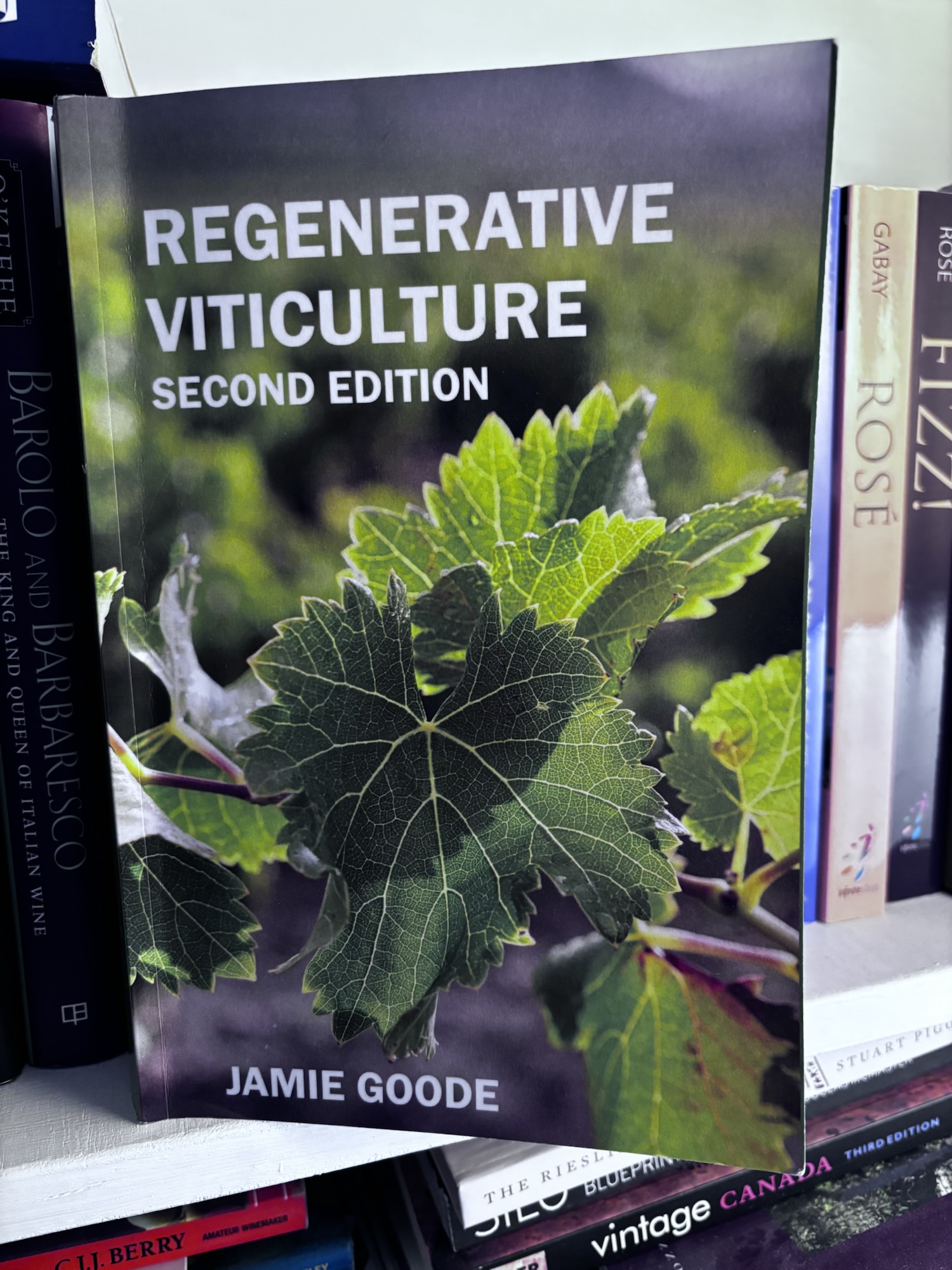
Dr Goode was well placed to write about regenerative viticulture, both as a plant biologist and as an experienced wine writer, judge and educator with an open mind to new developments in viticulture. Now, just under four years later, we have a second edition. I will describe the contents, and the hypotheses, of this second edition in due course, but I think in this case it is worth me revealing my conclusions first. This is to give those of you who own or know the first edition a reason to continue reading this review, and to make what might be a repeat purchase for this update.
RV2E, as I shall call it is a substantial re-write of RV1E. Jamie calls it “an almost completely new version”. Such a re-write was needed because since he wrote the first edition the world of regenerative viticulture has moved on quickly. We now have 250 pages, increased from 165 pages. As well as 85 extra pages, I would suggest we have greater focus in the text. This second edition is extremely well explained and as always, the author does not shy away from explaining difficult science to make it relatively easy to understand, but the content is always interesting and the science serves a purpose.
Another major part of the book are the case studies. These often involve winemakers/viticulturalists whose wines we may already know, adding an extra dimension to what we are learning from the book. Jamie has travelled extensively, often whilst making his TV streaming series winemasters.tv . Consequently, we get a very wide view of the science of regenerative viticulture and how it is put into practice worldwide.
I don’t want to spend a long time on the contents of Regenerative Viticulture, but I will elaborate further on what the book contains, expanding a little for some of the chapters. After his introduction, Jamie gives us a brief history of agriculture in general and a section on the origins of the “Regenerative” concept.
Section 2 sets out the principles: Soil Carbon and organic matter, and what makes for healthy soils, then a powerful description of the hidden kingdom beneath our feet. This section is fascinating, even if you have already read Merlin Sheldrake’s popular Entangled Life (Vintage, 2021). Mycorrhizal Networks are genuinely cool right now.
Section 3 is what the author calls “The Toolkit”. A précis list of its chapters is:
- Cover cropping
- Weed control and no-till
- Composting
- Biochar
- Agroforestry
- Animals in the vineyard
- Regenerative hydrology
- Powdery and downy mildew
- New grape varieties
The final chapter discusses the thorny issue of Certification, and looks at ways forward. At the end of the day, the only way forward is sustainability, and that very much includes the grape farmer/winemaker being able to continue to produce grapes and wine profitably. Regenerative viticulture not only has the purpose of allowing sustainable grape growing into the long-term future, by creating the best soils and environment for that purpose, but it also gives opportunities to cut long-term costs, such as for example chemical inputs, tractor use and diesel, and labour costs.
Regenerative Viticulture is part of Regenerative Agriculture, or “agroecology” as the French call it. The concept is simple – take something broken or misused and regenerate it. Modern agriculture, in particular the application of chemicals (but not solely) has depleted the soils to the extent that it fails to function in a way that makes profitable agriculture, or in our case viticulture, sustainable.
Regenerative farming borrows from permaculture, and to some extent from farming methods practised before mass industrialisation of farming took place, largely in the late 19th and 20th centuries. Quoting from p11, “Conventional viticulture sees the soil merely as a medium for vine growth”. Regenerative viticulture views the soil as the medium farmers must tend to, and keep productive in a sustainable way. Do this and healthy vines and grapes will, other factors taken into account, follow.
Okay, we’ve had organic farming, biodynamics, natural wine. Where does this regenerative lark fit in? We all know the temptation of the larger corporates to go in for a bit of greenwashing, but regenerative viticulture does focus on the soil beneath our feet as well as vine health (and all that entails above ground too, such as biodiversity). It is through the nine listed items of the toolkit that the goal of regeneration can be reached.
Some of these are endlessly interesting to me. I thought I knew something about cover crops, having spent years watching natural wine producers tend their plots in the Jura, but no, I didn’t! The weed control chapter is most useful for some discussion of the “G” word (the glyphosate story), and if composting is, to a degree, self-explanatory, then biochar (quite new to me) is something you want to get your head around.
Biochar is more widely used now than I had imagined. Kate Kingston of Griffith’s University in Australia describes its value well by saying “biochar is a six-star hotel for microbes”, which we will already know after reading this far, are rather important for plant and soil life. It’s also pretty good for water retention too.
I first came across both agroforestry, along with the use of sheep in the vineyard, on a visit to the Alsace domaine of the Durrmann family in Andlau, in 2017. Both are now quite widespread. In fact, this review is pertinent because in the last two of the next three related articles I plan to write next I shall visit two English vineyards where both ideas are, to different degrees, either in place or in planning. Both chapters will not only explain these two ideas to you, but I’m sure they will generate lots of enthusiasm to go out and see these ideas, which are part of the search for biodiversity, in action.
Examples of agroforestry include planting trees, sometimes incorporating productive fruit trees, both at vineyard margins and, increasingly (as at Domaine Durrmann) within the vine rows, and in extreme cases, at its home in Tuscany, or at the vineyard Nayan Gowda manages in Bolivia (Jardin Oculto), even allowing vines to climb the trees as they did when wild.
In some places agroforestry is embraced by the community, but not always. Sometimes it is merely scepticism, as experienced by Christine Pieroth (Piri Naturel) in Germany’s Nahe. Sometimes it’s worse. Whenever a certain well-regarded Languedoc vigneron I know plants trees or bushes some ignorant individual seems intent on burning them down.
Sheep and chickens are the animals most commonly found in a vineyard setting. The former eat the cover crops (actually, they do much more as Goode explains), as well as fertilizing the vineyard, which chickens do, just in a different way. Sheep are like tractors that don’t compact the soil, at least if you get the numbers and time spent in one location right. However, there are even instances of pigs and cattle being used. With cattle there have been issues of damage, but pigs are being used by, inter alia, Chapoutier in the Rhône, and by Filipa Pato in Bairrada where, of course, the pig is an iconic animal.
Regenerative hydrology tries to address water shortages by keeping as much water on the vineyard as possible, and where not possible, to channel excess water for later irrigation use. Regenerative hydrology was initially practised by an Australian farmer, PA Yeomans, who published his ideas in the 1950s. At the time, regenerative viticulture hadn’t been born, but Yeoman’s ideas were incorporated into permaculture, and in fact regenerative hydrology integrates that science along with concepts like rewilding, as Goode explains. As such, we see how everything is linked together in the search for sustainability.
I won’t say a lot about downy, and powdery, mildew, except that vinifera vines have no natural genetic protection against either. The only defence for this vine species which has been universally used, even by organic farmers, is copper/copper sulphate, which causes its own problems because copper is ultimately toxic to soils, even if the vine doesn’t accumulate toxicity harmful to humans because of spraying bans a certain period of time before harvest.
The EU has been contemplating banning copper, and as I write I have seen some suggestions that an outright ban could be in place by the end of 2027. This leaves organic producers with no immediate defence against these two US-introduced diseases.
This leads to the chapter that crowns the book, and perhaps the subject: Do we need new grape varieties. Central here are the new varieties which perhaps few of us had even heard of a decade ago (unless we were frequent or deep drinkers of Swiss wines). PIWIs (Pilzwiderstandsfähige, but I’m guessing the acronym suffices for all of us here) are crosses bred for their disease resistance, specifically to fungal diseases. They need to have a minimum of 85% vitis vinifera in their genomes.
Their advantage is that through their resistance to these diseases they need fewer rounds of spraying, and sometimes no spraying at all. This not only removes the risk of toxicity from both systemic and surface-coating agro-chemicals, but also helps to eliminate soil compaction caused by the tractors used to spray the vines (although targeted drone spraying is, as you’d expect, being developed on that front). Of course, money speaks to some more loudly than ecology, and spraying not only generates big profits for the chemical companies but also enormous costs for the grape farmer.
There is a great reluctance from viticulturalists to call these new disease-resistant PIWIs “hybrids”, because the consumer tends to have a negative attitude towards hybrid grape varieties. However, some producers have made acclaimed wines with older hybrids, including one favourite of mine, La Garagista, in Vermont (USA).
Hybrids have been planted in English and Welsh vineyards for a very long time. Why? Because back in the 1970s and 80s our vineyards were truly wet. My own attitude, certainly in the 1990s as the so-called Champagne varieties took off for English and Welsh sparkling wines, was that hybrids were inferior. Producers like La Garagista, and Ancre Hill in Wales, changed my mind, and other English artisans like Daniel Ham and Matt Gregory, have reinforced my view that excellent and exciting wines can be made from them. Read about Guillaume Lagger’s all-PIWI Wharie Vineyard in Hampshire here soon.
In moving from Sussex to East Lothian I have even gone hybrid myself, forsaking Frühburgunder for the Swiss PIWI Divico and Triomphe D’Alsace, which Ancre Hill makes into a delicious petnat (though in truth I’m not convinced either will thrive here).
As usual I have digressed a little, but only because my enthusiasm for regenerative viticulture knows no bounds. In that I mean the subject, but I think it’s pretty obvious that I mean the book as well. I can recommend buying this second edition even if you have the first. There’s more in it and it’s got a greater focus, and the potentially complicated concepts, and the science, which go into making up regenerative viticulture, are well explained.
As always, there’s another side to any coin, and one elephant in the room is the widely held belief, often demonstrated as fact, that the best wines come from the poorest soils, and the fertile plains give big yields of, for example, Marlborough Sauvignon Blanc (it used to be German Müller-Thurgau that we moaned about).
However, there’s a difference between dead soils and those with too much fertility for concentrated grape juice. But so-called poor soils are not dead soils, and a steep stony slope still needs all of those things described in the book: microbial activity, mineral-associated organic matter, worms, mycorrhizae, soil-binding elements and so on.
Although this is a “print on demand” paperback, both the binding and printing are of good quality. Colour photos, all taken by the author, genuinely enhance the text and bring it to life. The layout perhaps improves on the first edition, and the tweaked cover design is nicer as well.
Best thing, and certainly something which makes buying this second edition easier, is the price – around £16. This is via Amazon print on demand. Two things to note. First, an Amazon search threw out what was described as a “black and white” version, which was a mere 64p cheaper than the full-colour version I have. Also, don’t get the first edition by accident. This edition is 2025, the first edn 2022.
I am not sure whether Jamie Goode is selling this directly as well, but perhaps check out his wineanorak.com web site.
Anyway, some authors like to sell their books by saying it’s just the price of a bottle of wine. I suspect that the vast majority of those of us inclined to buy this book will likely spend a bit more than £16 on a bottle most days of the week, although I’m ashamed to admit that as with conventional viticulture, my £20-£30 a bottle norm is no longer sustainable nowadays. I hope this new Second Edition stimulates your knowledge and appreciation of regenerative viticulture as much as it has mine.

 David Crossley's Wide World of Wine
Great review David. Another one to put on the wish list!
LikeLiked by 1 person
Thanks Frank. Hope all is good over the water there. It’s a great book for wine insiders and not expensive.
LikeLiked by 1 person
Great review, thanks for the detailed rundown!
LikeLiked by 1 person