
Around this time of year back in 2021 I reviewed Camilla Gjerde’s first book (see article 27-10-2021, “We Don’t Want Any Crap in Our Wine”). Camilla, who was born in Norway but now lives in Sweden, has a Diploma in Wine along with a doctorate in political science. This work was a timely profile of nine women making natural wine at a time when women in wine were beginning to have a bigger profile for their work. It is a lovely book in terms of design, layout and content, far from being a throwaway frippery. Though a “feel good” book, the author translated the passion, and indeed success, of the participants, so we ended up feeling inspired, as, I must say, were her choice of women winemakers.
So, I have been looking forward to receiving Camilla Gjerde’s second book. The title is Natural Trailblazers, with a sub-title “13 ways to climate friendly wine”. This is an altogether more prickly topic to write about. Effectively, we are looking at what people in wine, whether making it or selling it, are doing to decrease their carbon footprint in order to do their own small bit to ameliorate climate change/climate chaos (substitute as you wish).

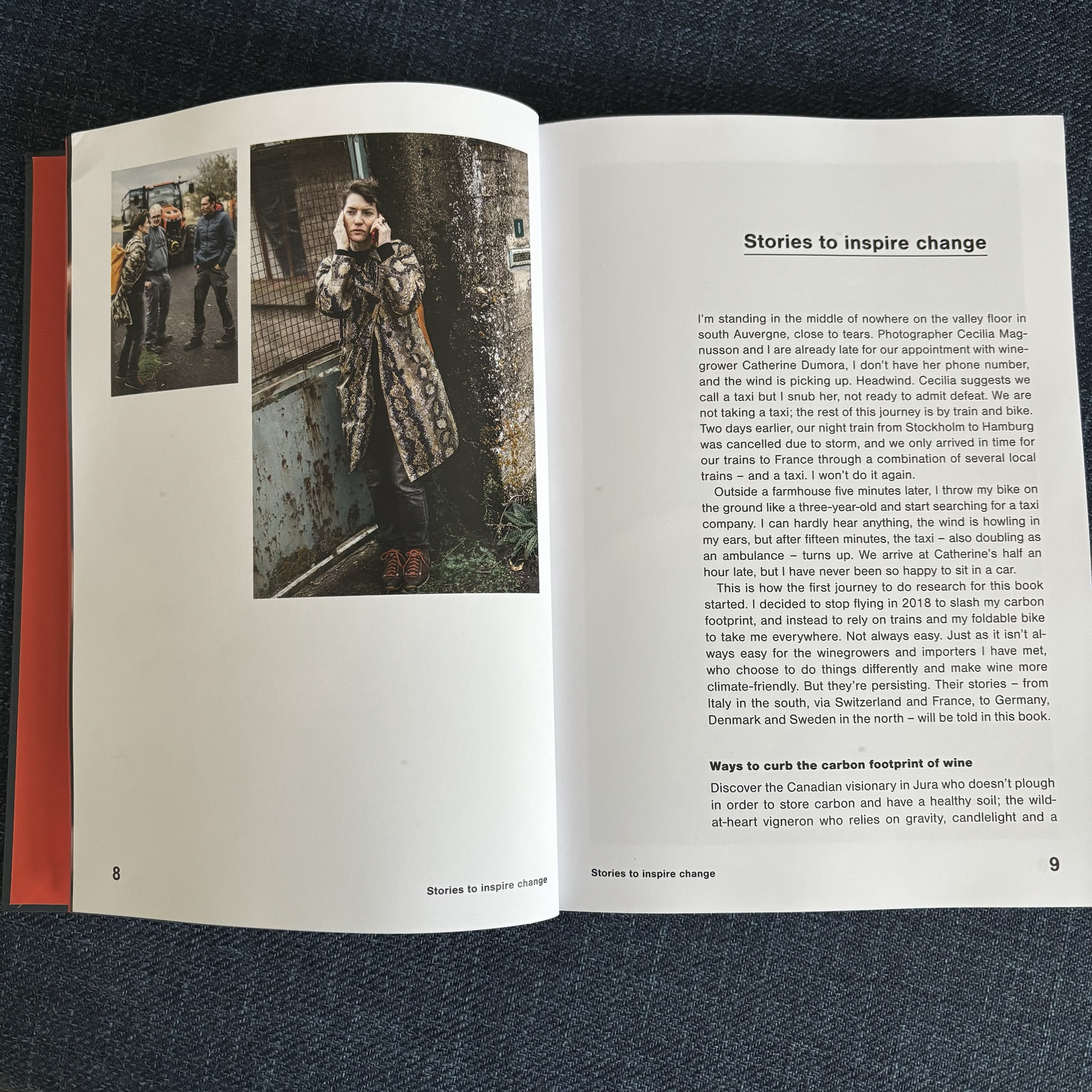
It would be a good place to remind readers who have already come across Camilla and her work before that we are here very much in an area that she believes in deeply. In fact, Camilla’s own contribution is that, as with her previous book, her journeys around Europe to visit the participants for this latest work are all undertaken by train with her trusty Brompton folding cycle. Well, barring the occasional necessity of getting in a car (a dash across Paris in a taxi to avoid missing a train connection is something that has been forced on many of us). It is poignant (and possibly deliberate?) that the last chapter is loosely based around a rising star of Alsace, Yannick Meckert, who has totally given up flying.
As with the first book, Camilla worked with photographer Cecilia Magnusson, who follows Camilla on her journeys, only visible by an occasional photo of two folding Bromptons. Cecilia works in Stockholm, mostly in portrait photography for magazines and advertising, but her sensitivity to nature is evident. She has taken some lovely photos which bring the text to life, although I would say that the matt finish on the printing does render a small percentage of them a tint too dark for me (though I think this is a trend I see in almost every wine book printed on otherwise superior matt paper these days).
The back of the jacket entreats us to buy a copy with the words “Meet thirteen visionaries of natural wine, who are each leading the way towards a low-carbon future”. Those visionaries are grouped into three areas: in the vineyard; in the winery; and on the move. Quite simply viticulture, winemaking and transport. The “Notes” referred to below allow full fact checking should you so wish. All assertions are evidence-based.

Before we begin our journey through the book, I would like to address one issue some readers might have. Isn’t this all too little and too late? I think the following quote, from Physical Chemist and Nobel Laureate Ilya Prigogine is worth contemplating:
“When a complex system is far from equilibrium, small islands of coherence in a sea of chaos have the capacity to shift the entire system to a higher order”.
Wine is quite a good example of outliers, rebels, experimenters, call them what you will, transforming the norms of viticulture and winemaking by bringing their work at the periphery into the mainstream.
In the vineyard we leap in with a visit to Katie Worobeck, a young Canadian who worked from 2017 at Ganevat. Her Maison Maenad, near Orbagna in the Southern Jura, had its first harvest in 2020. The first wine of hers I tried was De L’Avant, a 2021 Côtes du Jura Chardonnay from rented vines in Les Varrons, a famous site near Rotalier that certainly Labet fans will know. For me, this rang the bell of “star in the making”, and similar confidence has been placed in her by several Jura insiders, both in France and the UK. Luckily in 2022 she was able to finance the purchase of three hectares of her own from the sale of a house in Canada.
Katie is committed to agroecology and regenerative farming. She is quoted as saying “I think everyone should do something, and if you do something, you need to do the best you can.” This is surely the mantra of the whole book. Katie is inspiring, but she is also driven. Such strength, as exhibited by so many participants in this book, is astonishing (and that is both physical and mental strength).
Christine Pieroth (Piri Naturel) farms in Germany’s Nahe, a small and perhaps these days less well known than it once was wine region. It is named after a river between the Mosel and the Rhine, flowing through the Hünsruck Mountains to join the Rhine at Bingen.
Christine is already making quite a name as a wine producer but her first harvest was only 2018. She does have a whole seven hectares of vines though, farmed organically, inspired by permaculture. Her two areas of focus, at least for the purposes of this book, are hybrid vines and trees. Well, more than trees. A recurring theme is the introduction of trees, bushes and hedges into the vineyard.
Agroforestry (as it is called) is not new. I have mentioned it many times over the years but mixing trees and shrubs in with the vines is beginning to take off. Sadly, there are old-fashioned conservatives too dumb to see why forward-thinking viticulturalists are doing it. Pretty much every time Jeff Coutelou plants trees in his Languedoc vineyards some Le Pen-voting, chemical-ingesting, brain-free zone comes and burns them down.
Christine is also introducing PIWIs, the increasingly used German name for hybrid vines showing high resistance to fungal diseases. Some of these vine varieties, many pioneered in Switzerland and Germany, are beginning to be seen as one viable solution to the various effects of climate change, where “global warming” is also very much “global wetting”, as this past summer has illustrated. Humidity with rain is really a grape’s worst enemy in most situations.
Next, we visit Les Frères Soulier in the Gard, whose vineyards do not look like vineyards (no-till agriculture with animals), Catherine Dumora in the Auvergne (machine-free viticulture), and the wonderful Romaine and Hans-Peter Schmidt (of Mythopia in Switzerland’s Valais). Mythopia probably needs no introduction, but this chapter did make me sad, reading about the difficulties the Schmidts are facing. All I knew previously was that they make amazing wines, among Switzerland’s finest, if albeit increasingly unaffordable to ordinary worshippers like myself.
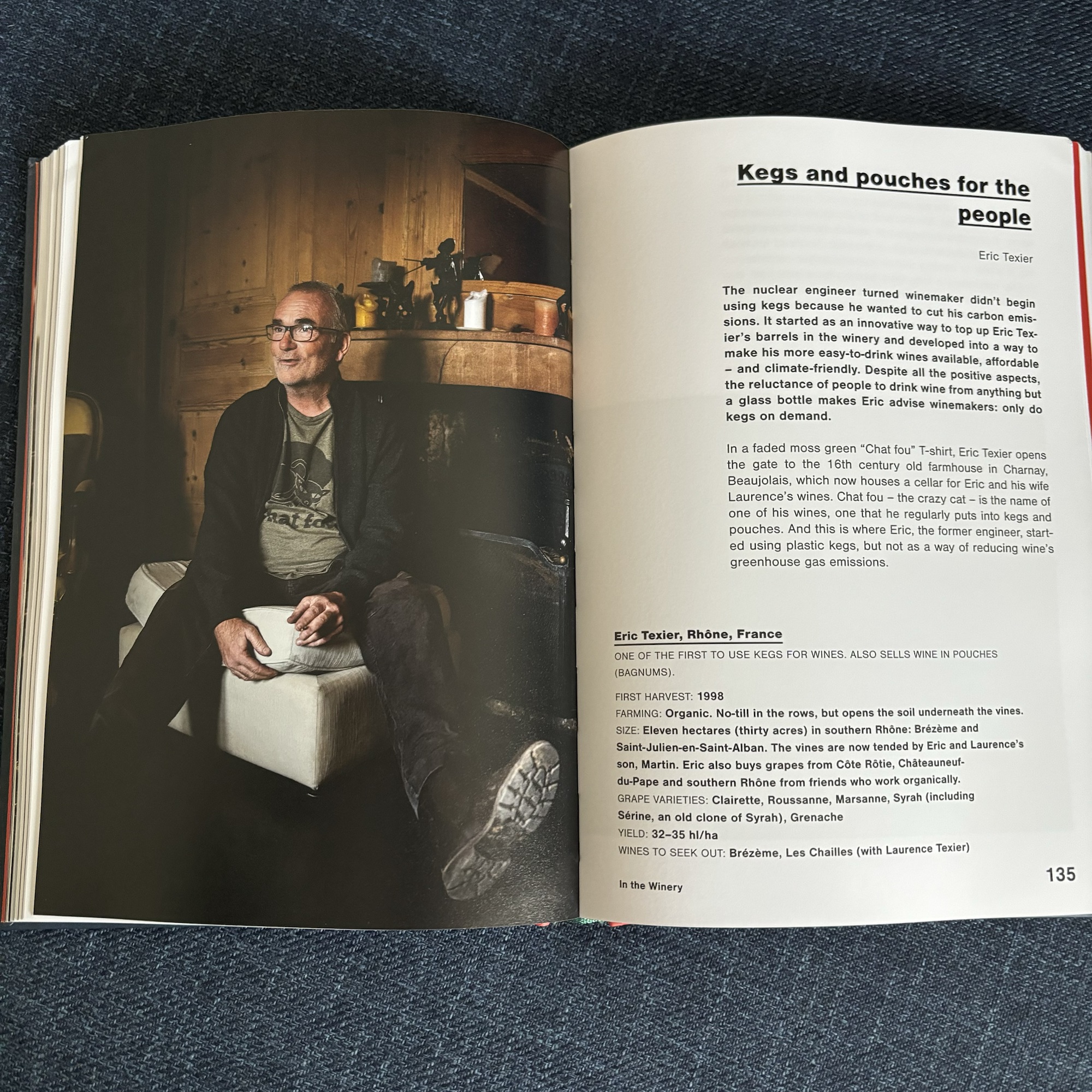
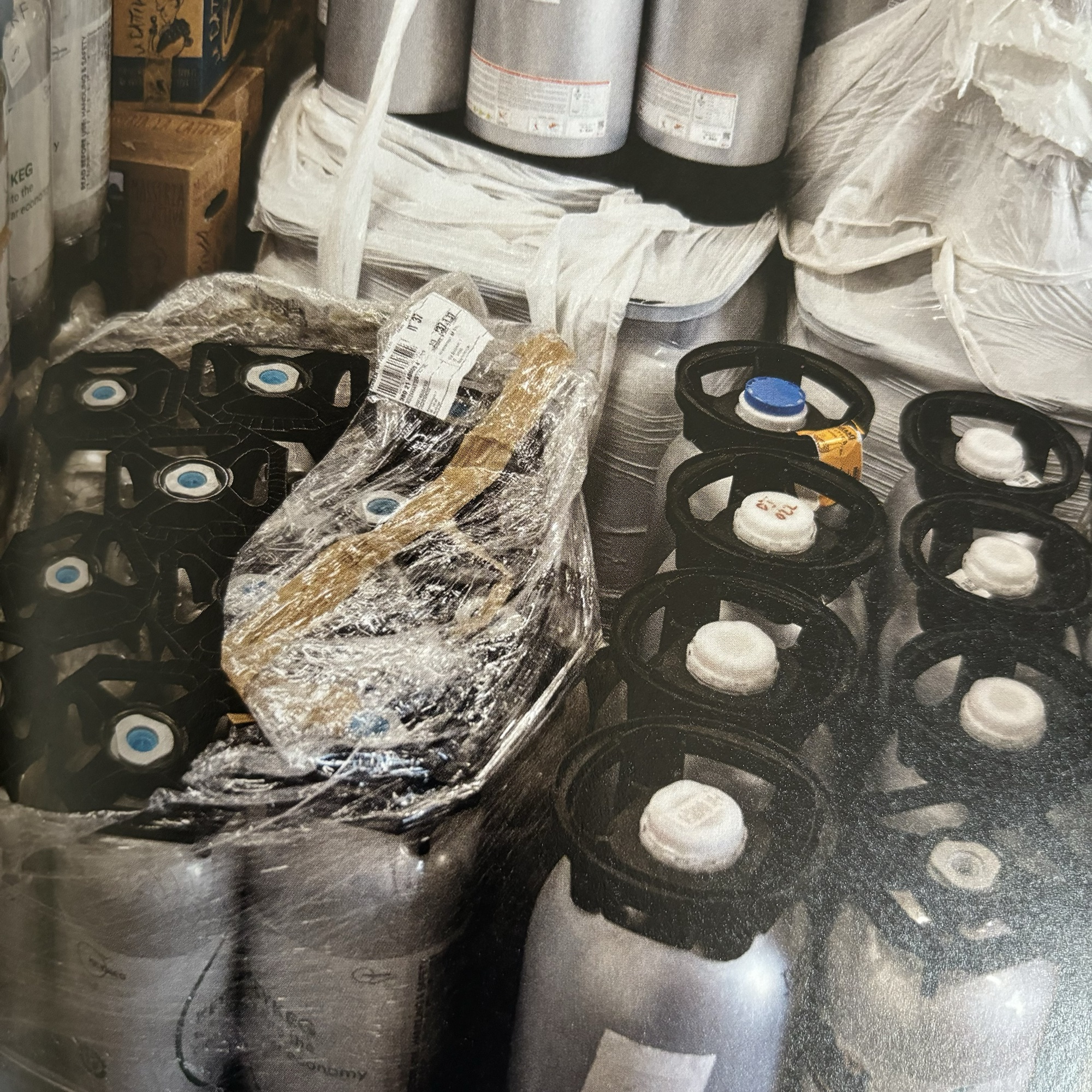
In the winery we meet Thierry Hesnault (Loire) for ancestral methods, Paolo Bertani (Puglia) for kegs and cans, Eric Texier (Rhône) for kegs and pouches, and Géraldine Dubois (Lyonnais) for keeping sales local, by bike.
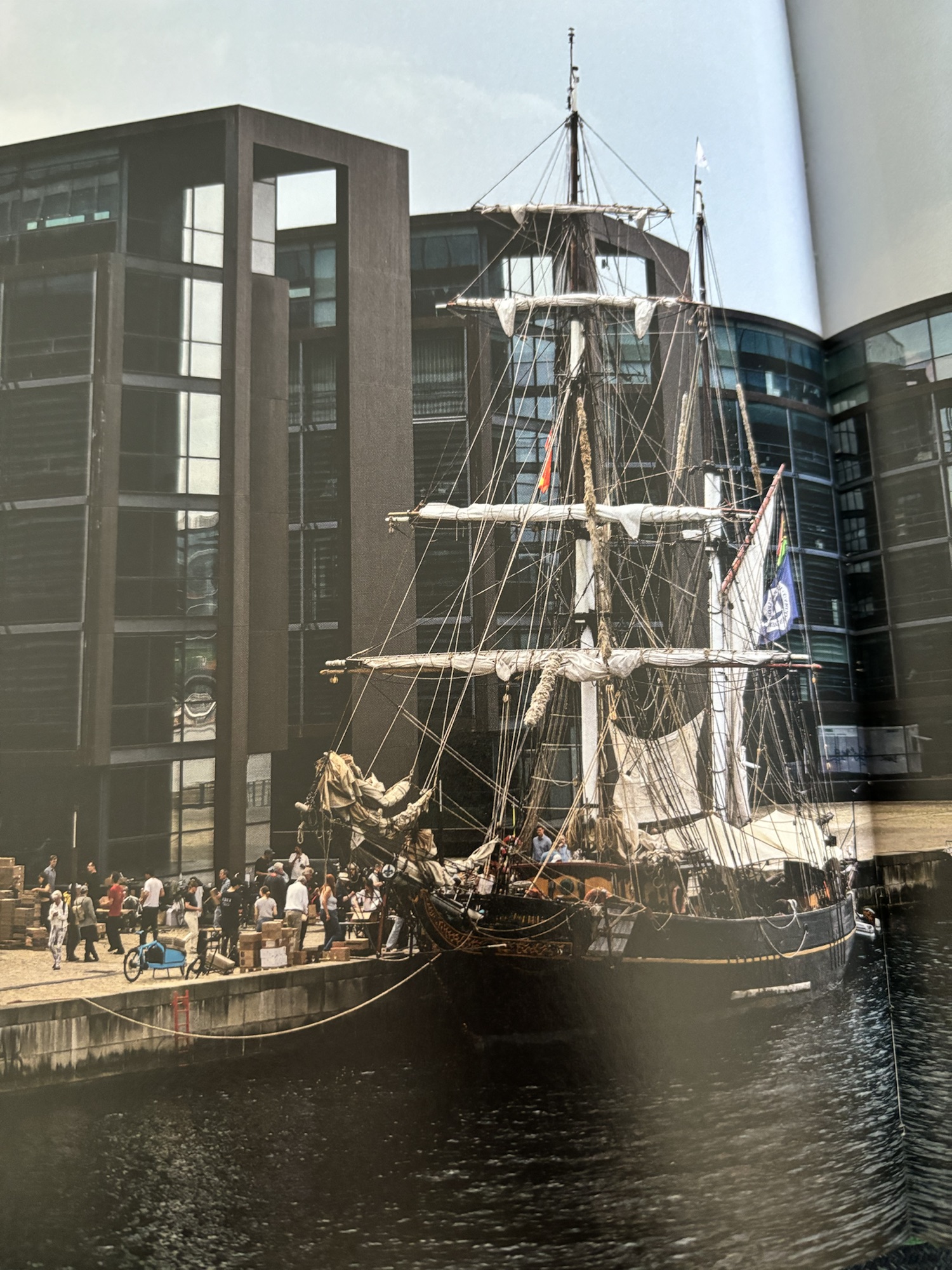
On the move gets very interesting. Many will have heard of Sune Rosforth one way or another. It was his idea to bring wines to Copenhagen (since 2012, no less) by sailing ship, aboard the lovely Tres Hombres (pictured). If Sune’s profile is quite large in natural wine circles, Christopher Melin is fairly unknown outside of Copenhagen, but he and his team deliver around 90,000 bottles of wine a year by cargo bikes (90% of his sales). Ida Sundqvist is fighting to get as much wine as she can transported to Sweden by train.
The final chapter, as I have already mentioned, takes us to Alsace. Alsace is, for me, the most exciting centre for natural wine in Europe right now. The movement once settled on Mittelbergheim, south of Barr, around the circle of winemakers surrounding Jean-Pierre Rietsch, but it is beginning to spread further and further north. In Alsace’s northern sector (the Bas Rhin), where once very little of note was reported by the more conservative wine press, we are now seeing an explosion of young and radical winemakers. Not only are their wines natural, they are also pushing the boundaries of viticulture, or rather perhaps pulling them in.
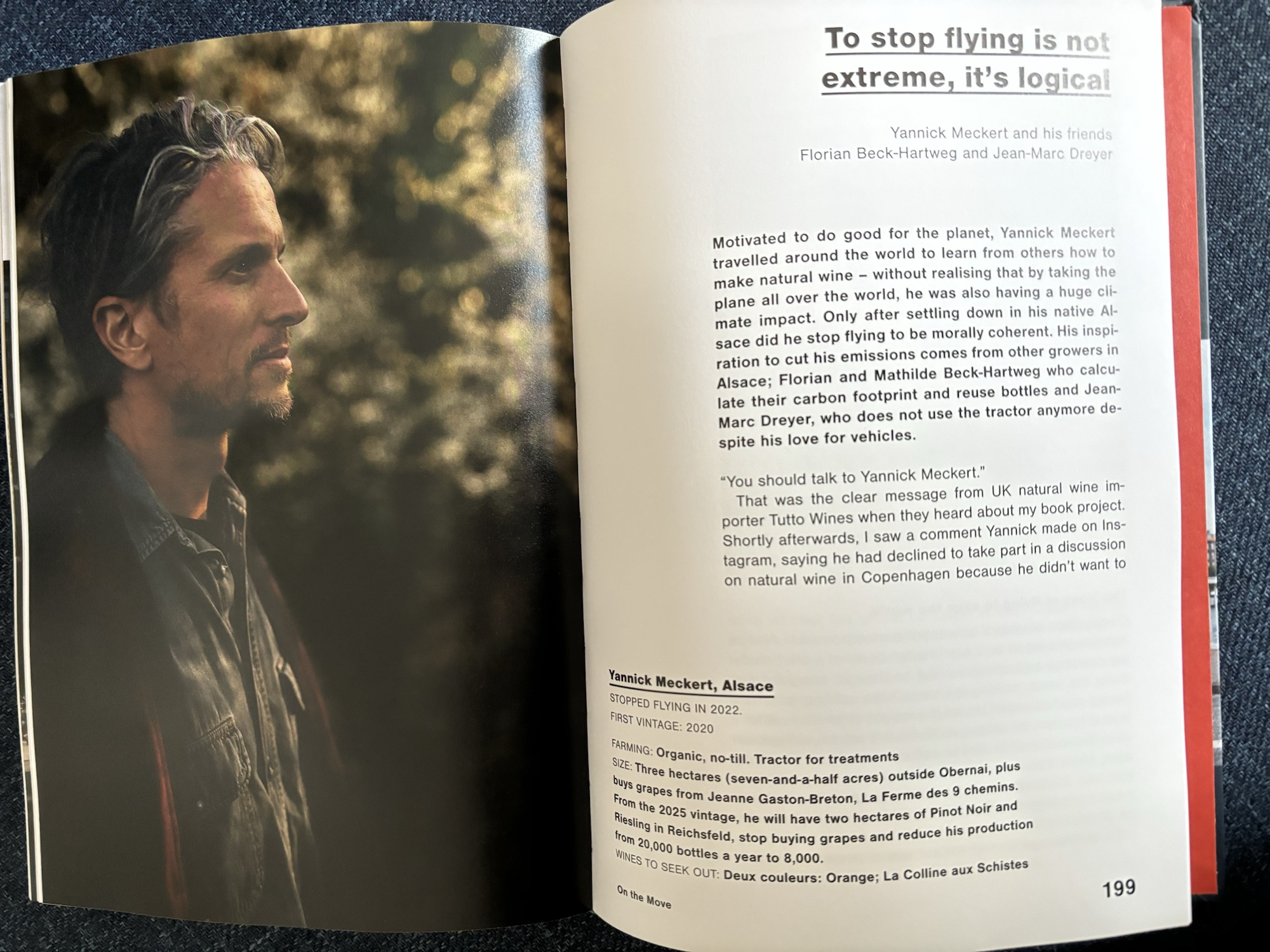
The participants in this final chapter are rising stars Yannick Meckert (organic, no-till and given up flying), Florian Beck-Hartweg (how many different ways to lower your carbon footprint and also increase carbon capture), and Jean-Mark Dreyer (“the grower who wants to wear snowshoes in the vineyard”). The latter assertion may or may not be entirely serious, but this Rosheim grower is both a zero-sulphur and a zero-tractor man of whom Yannick says “if a tree wants to grow in the vineyard, he lets it grow”.
Such a fascinating chapter. You may think some of the views expressed are too extreme. I think these guys are experimenting, finding what does and doesn’t work, but coming from a different philosophy to the standard capitalist model of make as much wine as you can and maximise revenues as well. Their philosophy is to tread lightly on the earth, work with nature to make a living without the desire to get rich, and to act as guardians of the land for future generations.
Some of you may think they are crazy, but I guess they are just making their small contribution to the collective solution to what is a massive problem we all face, and tellingly this is done with full acknowledgement that wine is a luxury. They are not tasked with feeding a hungry world, but as that gets harder by the day using current methods, we can’t afford to ignore the small progress these pioneers are making.
Do you remember when natural wine was at the periphery, raged about by some wine writers and wine producers? Today, when people outside the wine trade ask what I write about, a good eight or nine out of ten know what I’m talking about when I say “mostly natural wine”. Perhaps in five or ten years they will also have been buying wine from cans, pouches and kegs, will know about no-till farming and agroforestry, and will have modified, however slightly, their modes of transport.
As for this book, it’s not just a nicely put together good read, which it certainly is. It also highlights topics that are essential, not just important. In doing so it expresses how hard it can be to achieve anything in a world that often seems blind and deaf to the unfolding climate disaster of our global industrial world. Camilla has managed to do this in a way that is entertaining to read, not dry like a manifesto or a polemic.
But it also shines a beacon of hope. That beacon shines from individuals whose message is to do what you can. That every small step is a step in the right direction. As the natural wine movement grew from small beginnings, so too will the environmental movement in wine, and indeed it is already, self-evidently, doing just that. It is not as if the individuals profiled in this book are the only contributors to solving these issues, but they are certainly applying very different thinking to most individuals.
As Manda Scott says in an article in Permaculture Magazine (“Thrutopia – Permacultures of Intelligence and Wisdom”, No 119, Spring 2024, pp53ff), “No problem is solved from the mindset that created it”.
I definitely recommend this book to anyone who can see and hear!
Natural Trailblazers by Camilla Gjerde, with photography by Cecilia Magnusson, is self-published under the Now What Publishing imprint (2024) and runs to just over 230pp (hard cover). It is available in some book shops and wine stores, but perhaps can most easily be purchased from Camilla Gjerde’s web site www.camillagjerde.com (also accessed via her Instagram @gjerdecamilla ). The UK price is £26 plus standard UK shipping (I think this is £5.95).

 David Crossley's Wide World of Wine
I came across Camilla via IG just before her first book was published. Definitely felt her passion in it!
Bravo for including the Prigogine quote. Having always been one attracted to the odd ball item/person doing it differently, etc., it speaks to me.
Your review of the last chapter brings me back to the Prigogine quote. The outliers, the ones not afraid to believe in what they feel is the right thing.
I look forward to reading this book and exploring each of the ladies she discusses; the only one I’m familiar with is Worobeck.
Thank you for this well written and cogent review!
LikeLiked by 1 person
I came across Camilla via IG just before her first book was published. Definitely felt her passion in it!
Bravo for including the Prigogine quote. Having always been one attracted to the odd ball item/person doing it differently, etc., it speaks to me.
Your review of the last chapter brings me back to the Prigogine quote. The outliers, the ones not afraid to believe in what they feel is the right thing.
I look forward to reading this book and exploring each of the ladies she discusses; the only one I’m familiar with is Worobeck.
Thank you for this well written and cogent review!
LikeLiked by 1 person
Not only ladies in this second book of course, but yes Lynn, it speaks to me and should speak to us all.
LikeLike