Hampshire Wines 2 – Guillaume Lagger and the Wharie Vineyard

Guillaume Lagger is originally from Switzerland, studying at Switzerland’s best known wine university, the Haut Ecole de Viticulture et Oenologie, Changins, based on the edge of Nyon, the attractive small town in the Vaud on the north shore of the lake, between Geneva and Lausanne.

Guillaume worked at the Domaine Château du Crest. This large 25-hectare domaine is at Jussy, not far from Annemasse. Here we are on the south side of Lac Léman, just east of the city, in that part of the Geneva AOC known as Entre Arve et Lac.

However, Guillaume is quoted thus (on the web site of B58 Wines, for whom he is winemaker and oenologist): “I want to cultivate vines to their full potential by keeping my intervention to a strict minimum”. That is what Guillaume is doing at his own Wharie Vineyard at The Wharie Experience, on a small farm his wife’s family owns near Sway in Hampshire.

Guillaume has 1.8 ha of vines currently planted, plus 1 ha of fruit trees on the 6.5 ha farm. It’s a beautiful piece of land, bucolic not being too strong a description. Fields surrounded by mature trees, birdlife in abundance and a view of nearby Sway Tower from the crest of the vineyard. The vines are planted on free-draining gravels, avoiding the clays which are too soft and retain too much water. The vines went into the ground in May 2021, and the orchard was planted over the following two years.

Vines and Young Fruit Trees at Wharie Vineyard

Nine varieties are planted in all, and they are all PIWI varieties (pilzwilderstandsfähig to give their full name). These are the new hybrids bred mostly in Switzerland. They are all, by law, at least 85% vinifera, but they are crossed and bred for a resistance to fungal diseases, especially the two mildews (downy and powdery) which can blight grapes in a wet spring and summer, of which England still has many. For this, they use the genetic advantages of more resistant American and Asian species.

I’m repeating what I said about these grapes very recently in my review of Jamie Goode’s Regenerative Viticulture (2nd edn), but the whole reason for developing these varieties is to minimise, or even do without completely, the systemic and contact chemical sprays used to combat these diseases. The result, you hope, is that you get more sustainable viticulture through less poisoning and compaction of the soil, plus other environmental benefits (the sprays kill birds and insects, all beneficial, except where the birds eat your all grapes).

The nine varieties Guillaume has planted are (white varieties) Solaris, Muscaris, Sauvignac, Souvignier Gris and Soyhières, and (red varieties) Divico, Pinotine, Cabaret Noir (formerly known as Cabernet Noir), and Cal 128-a (known by number as it does not yet have a name).

The first harvest at Wharie was 2025, and Guillaume hopes to bottle around 8,000 units, including some contract-purchased fruit. He’s also making still wine for Chilcomb Valley Wines, near Winchester.

First the obligatory vineyard tour. This was instructive. The two main blocks of vines are on higher ground, sloping gently. They appeared well-drained. Where the fruit trees are planted, on the clay, the ground was quite moist, and boggy in places. We went down on the train so I was without wellies, but I got away with it…much of the New Forest is quite badly flooded but Wharie is raised just enough to avoid any pooling.

The vines are trellised on a Geneva Double Curtain (which I was seriously pleased to have identified to Guillaume). This takes the fruiting canes higher off the ground, to avoid the damp, and also spreads them sideways to get more light exposure. GDC (as it is known) used to be more popular than it is now in the UK. It had one advantage, being that it takes fewer man-hours work in the vines, but it can crop too high for many.

Stephen Skelton in The Wines of Great Britain (Infinite Ideas, now Académie du Vin Library, 2019) says that “I have never felt that the quality of fruit coming from GDC-trained vines was as good as that coming from VSP Guyot vines”, but he admits that may well be down to pruning, shoot positioning and leaf removal issues.

Guillaume has adapted his own GDC to a more classic (less widely spaced) planting density. That may keep yields per vine in check. He mows between the vines every other row, in rotation, during the growing season. He said that in five years he has only sprayed once, that with yeast extract (which could underline the effective resistance of the Piwis). He has never used any copper. His low intervention approach extends to sulphur, where he uses 30-40 mg/l at bottling, but he says he is currently using mostly commercial yeasts. Hopefully good yeast colonies will become established, but he is trying indigenous yeasts too, as you will see below. This is what he’s working towards.

In the Tiny Winery. As at B58 Guillaume likes his François Frères

We started off by tasting samples from barrel or tank of the 2025 wines, before sampling bottles from previous vintages, made if you remember from the bought-in fruit. I tried a lot of wines, so my notes will be very brief.

First the aforementioned Chilcomb wines. A Chardonnay which saw 60% oak-aged wine with 40% in stainless steel was picked on 10 October last year, and reached 13% abv. It had nice fresh apple and citrus notes. Another Chardonnay, from 2024, is to be used as base wine for a sparkler. That came in at just 9% so Guillaume decided to chaptalize half a percent. It should eventually reach 11%. It had a flinty reduction.

Of the Wharie wines we tried the Souvignier Gris first. It had seen one month in oak and this was actually fermented with wild yeasts, as was the very characterful Muscaris, a variety perhaps a bit out there for all but the obsessive oenophile like me. I liked it. It is a bit different, enough so to spark my interest. Solaris had six days on skins, which have given it a striking colour. Then a 2024 Bacchus orange wine, one barrel made. No grapefruit here, something even slightly savoury, but light and fresh.

The most extreme of the whites, though I agree with Guillaume that it is also the most exciting, is the Sauvignon Soyhières (aka Ravel Blanc). This is one of Valentin Blattner’s crossings from the Jura Canton (Switzerland), where this esteemed breeder has his nursery and lab. As well as resistance to fungal diseases it also withstands frosts quite well. Guillaume gave it 14 days on skins and it has an orange/gold colour. It is apparently not easy to grow, with lots of side shoots and many small bunches, but this displays the variety’s noted aromatics (baked spicy apple and honey) with a savoury palate. Again, some might find it a bit strange, others (like me) fascinating.

Shelf Needs Restocking

Finally, from the barrel, some later-harvested Pinot Noir, which Guillaume bought a ton of from Essex last November. He thought long and hard about it, because he’d already cleaned down the winery post-harvest. He made a good call, I think. This has potential, as you’d expect from a 2025 PN from Essex. It has good colour, plenty of freshness in the fruit, but also some nice tannins.

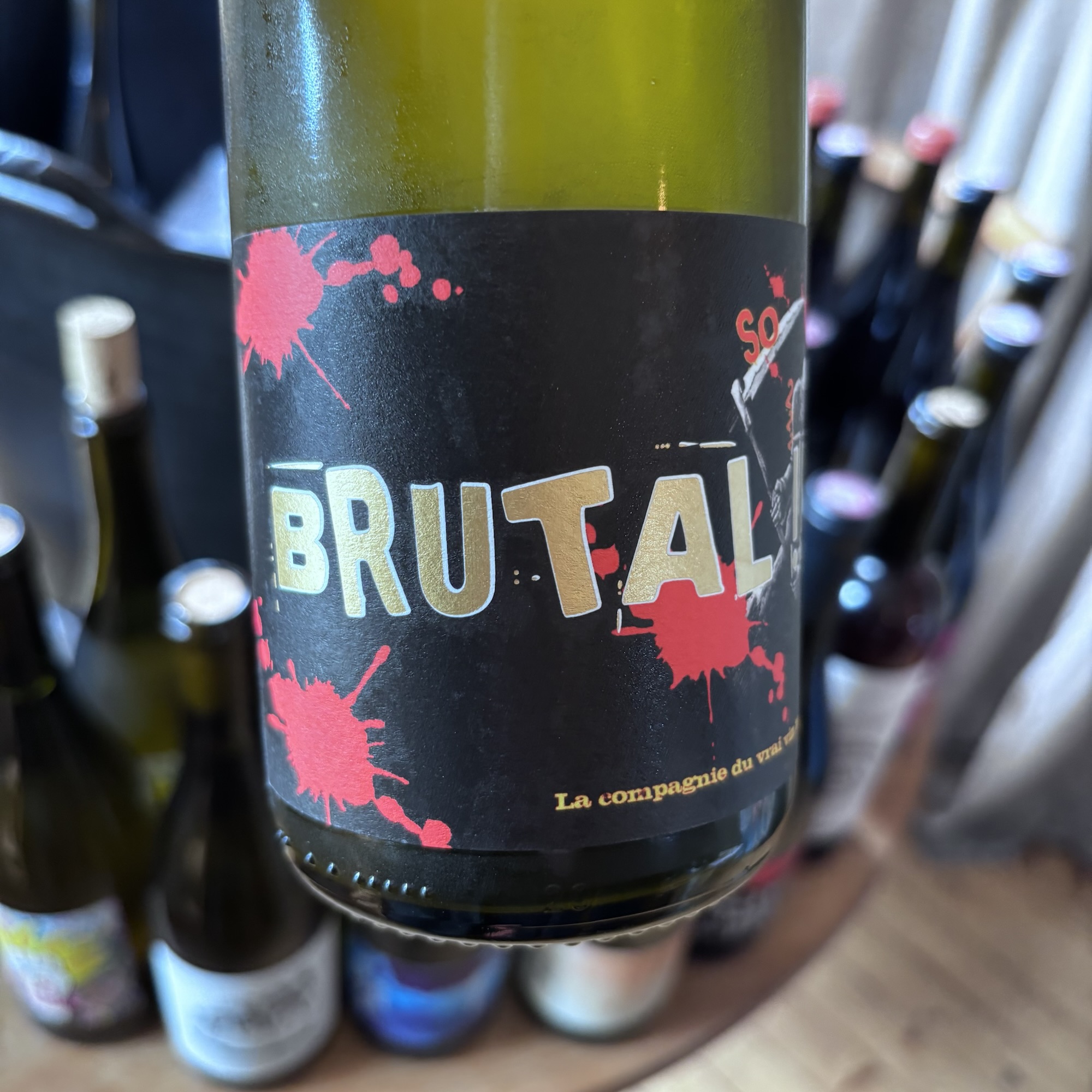
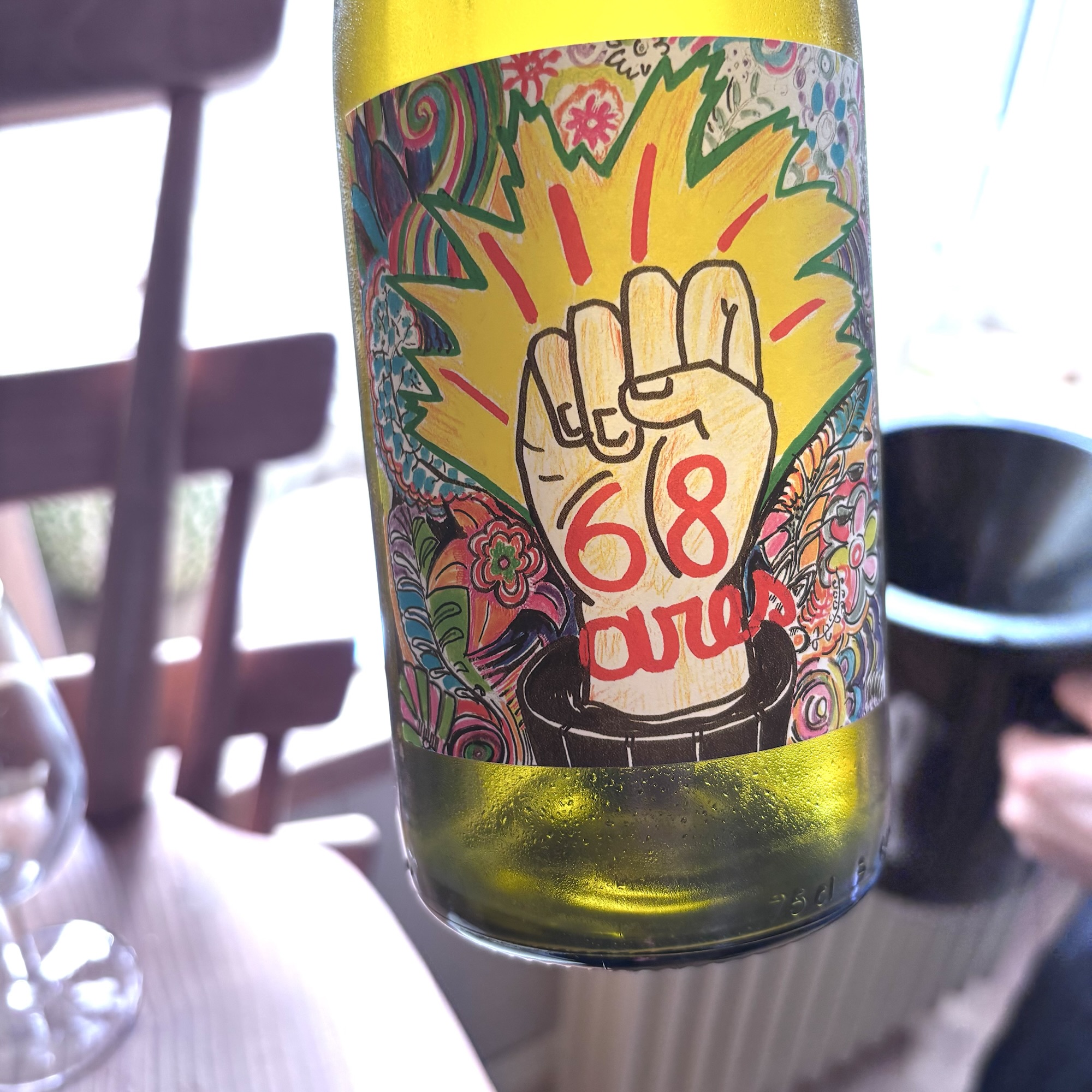
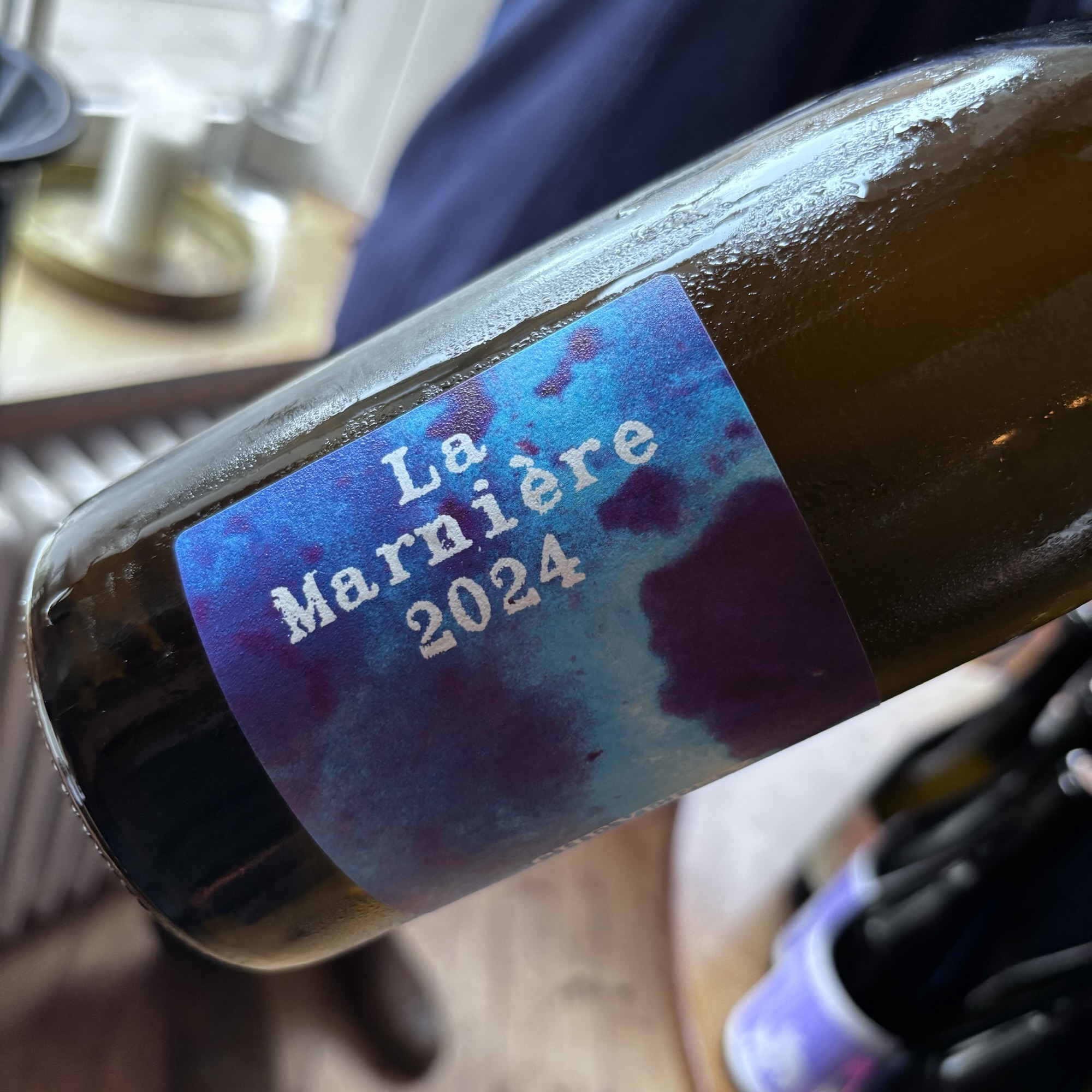
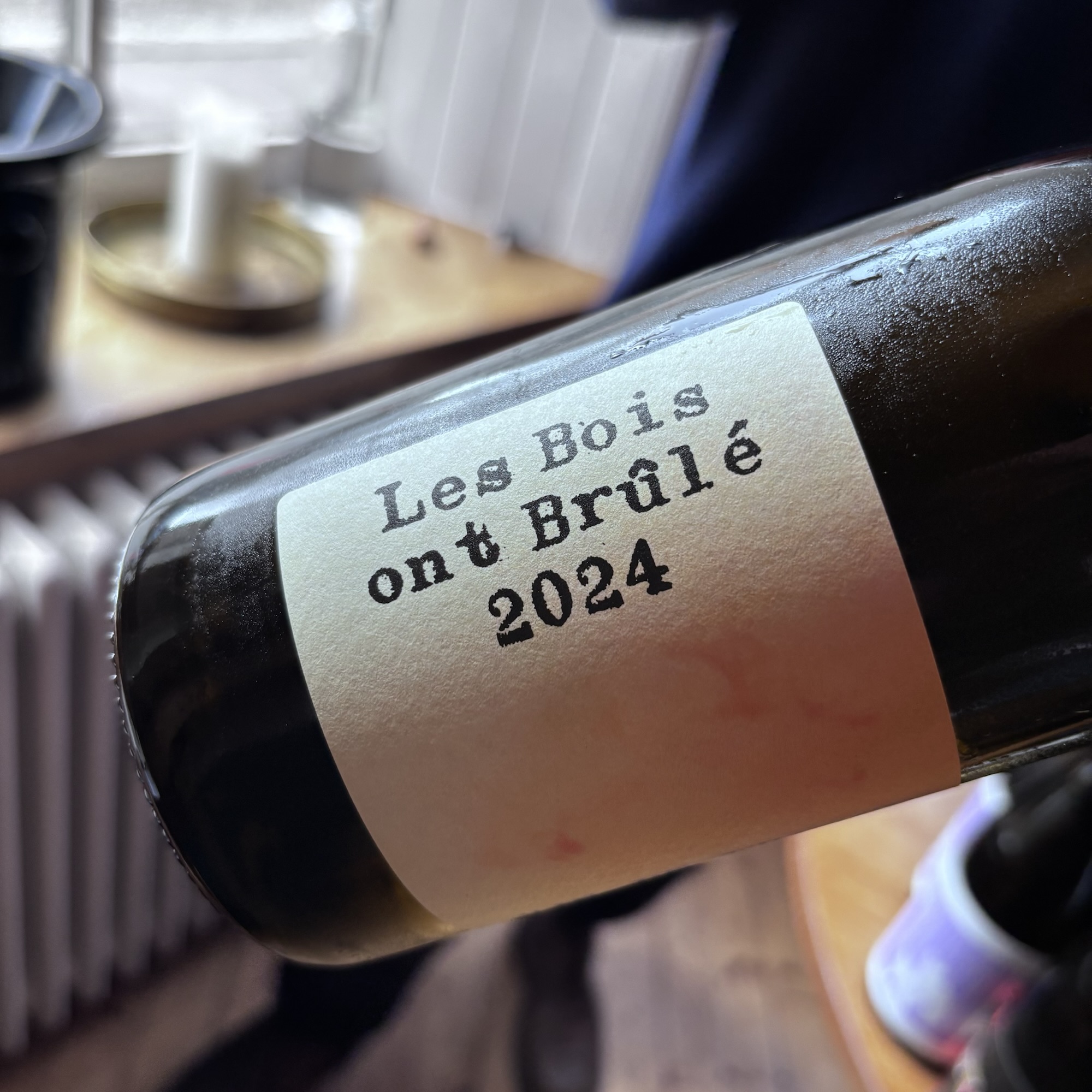
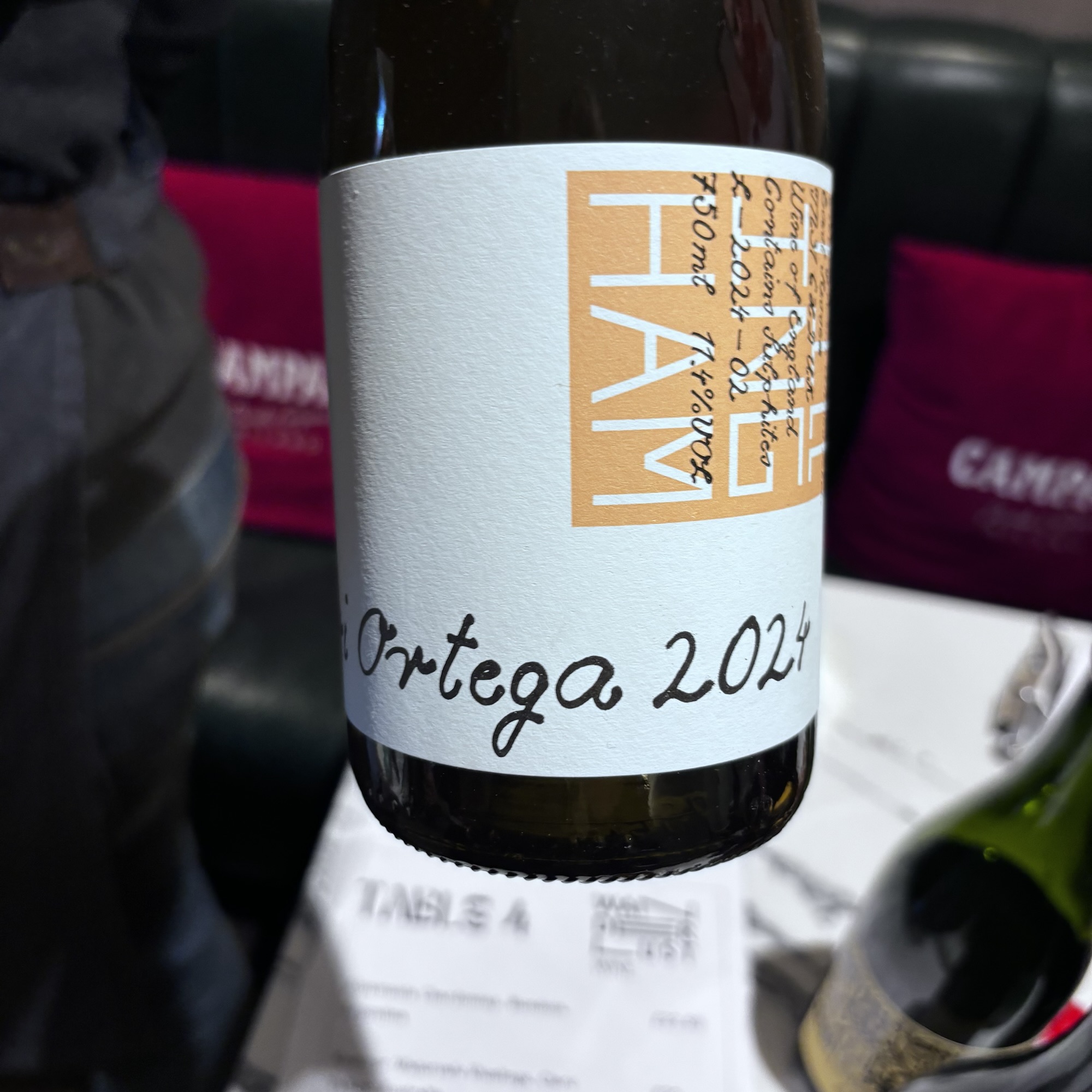
Now to the bottles. Guillaume is developing his entry level, blends priced accordingly, sub-£20. The white blends Chardonnay, Bacchus and Ortega, picking up a faint hint of colour from a barrel previously filled with Divico. The Rosé 2023 is mostly purchased Rondo and costs just £13.50. There’s a Rosé Reserve at £16.50 with an extra year in bottle (2022).

Guillaume Grabbing a Sample

Orion, an early German Piwi cross from the 1960s, between Optima and Vidal Blanc, was purchased from a vineyard at Bradford-on-Avon. It only hits 10% abv, but it is fresh and zippy. Ortega is much better known in the UK (Westwell makes a benchmark bottling). This one saw 100% oak, half on skins. It makes a nice summer wine with a savoury twist.

Guillaume’s best seller is his Bacchus Orange (here 2023). It’s a style Guillaume sticks to (if you read my previous article on B58 Wines, where he is the oenologist). Quite impactful…I mean that as a positive. I’ve said before, Bacchus can be a little one-dimensional, if admittedly super refreshing, but skin contact does have the potential to elevate it.

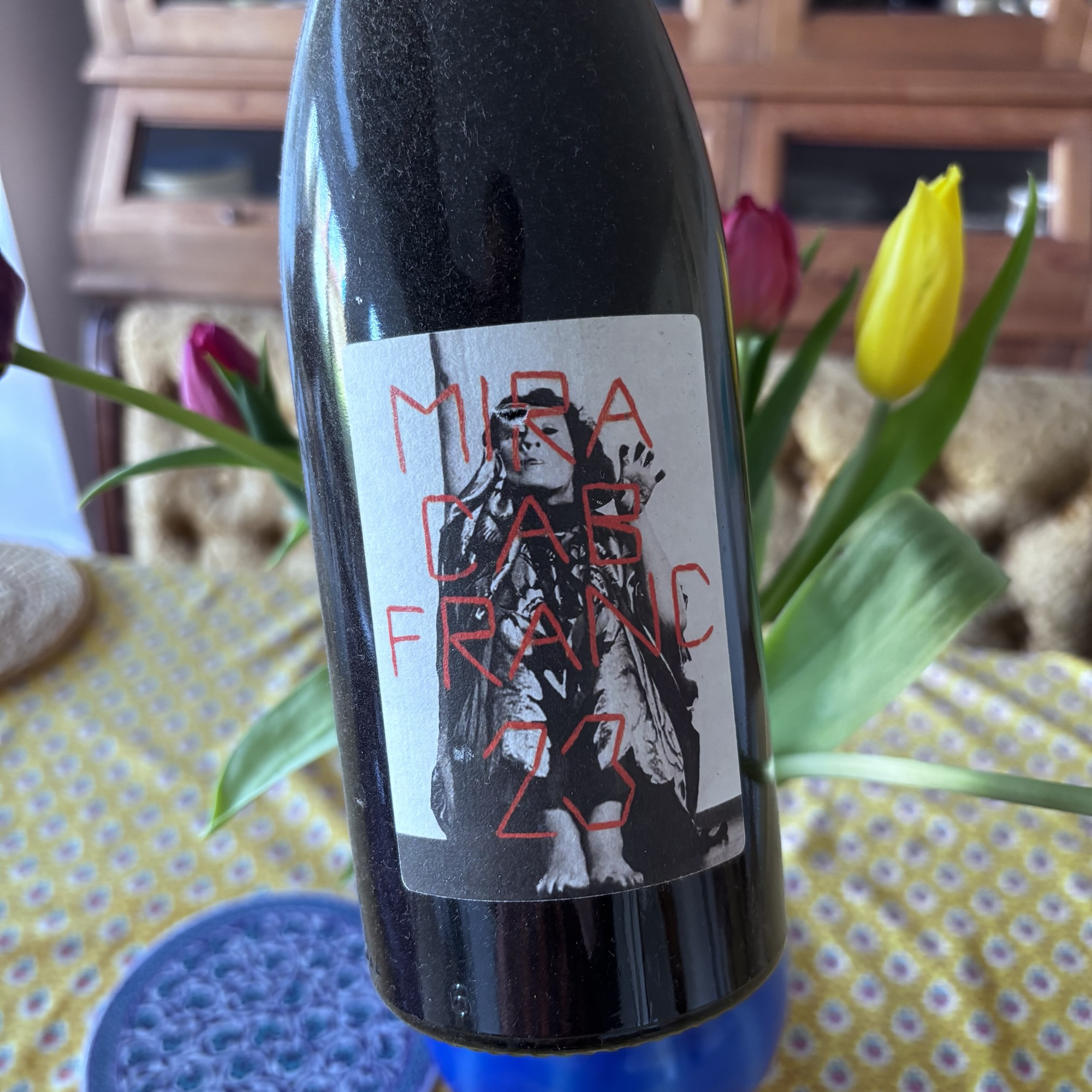
Some bottled reds to Finish. “The Red” 2023 is the third entry-level wine, after the white and pink, 85% Cabaret Noir (sic) with Rondo and Pinot Noir. There’s a 100% Cabaret Noir cuvée from the warmer 2022, which is a step up. It saw 100% new oak and shows blueberry and beetroot notes with nettle. Quite Genevois in style, perhaps? Fresh now, it will age, for sure. Certainly a grape variety with UK potential.

The last bottle was called Chou Chen No 1. It’s an apple and honey wine, Somerset apples blended with heather honey from nearby Hordle. Some was aged in an Islay whisky barrel, some in a Bourbon cask. I’m sure I got a little smoke and iodine from the Islay cask. It’s very moreish, and a nice note to end on.

Chou Chen – Sweet Apple & Honey

What Guillaume Lagger is doing here is early days, selling wine in bottle from bought-in fruit whilst waiting for wine from his own grapes to be ready to bottle. As to the latter, Wharie is one of the few places you can come (by appointment) to try a wide range of Piwi varieties in the UK. Guillaume is a very thoughtful winemaker, and what he is doing, like B58 but in a different way, is very interesting indeed.

I do wish this young guy every success, as he seems very much on top of both his winemaking and the viticulture here. When the orchard comes on stream he will, like Tim Phillips, who we shall visit next, have a supplement to his income. As Tim once said to me, it’s the cashflow from the cider that enables me to make the wines I want to make.

The Wharie Experience is on South Sway Lane near Sway. You can check them out via www.wharie.co.uk. The web site lists stockists, currently only local. They offer vineyard tours and tastings (cheese and wine), for a fee. Call 07517 492769. I travelled down with only a small suitcase, so I wasn’t able to head home with any bottles, but as with B58 Wines, I hope at some point I can get to buy some 2025s to taste from bottle later this year. Certainly the Cabaret Noir, Muscaris and the Soyhières might top my list, but the Bacchus Orange if I don’t get the one Guillaume makes at B58.

Posted in Artisan Wines, Grape Varieties, Natural Wine, Piwi Varieties, Vineyard Visits and Tastings, Wine | Tagged , , , , , , , , , , , , , , , | Leave a comment

Hampshire Wines 1 – B58 Wines Beaulieu

I’ve just been down to Hampshire, and would you know it, it has gone and generated a whole raft of articles. With my first tasting of the year coming up in ten days, and some delicious wines being drunk in January, I need to crack on. Three articles detail vineyard visits. These vineyards are all a little different. Article three will cover a visit to Tim Phillips’ Charlie Herring Wines, which you probably know I try to visit at least once a year, but I had a day out with Tim visiting B58 Wines and Wharie Vineyard.

Both offer a very interesting take on English viticulture. B58 grows vines in polytunnels, but do not look away yet. What they are doing is very interesting indeed, especially when you see, and taste as I did, the varieties they have in the ground. The winemaker at B58 is Swiss national Guillaume Lagger, and at his own Wharie Vineyard he has only PIWI varieties planted.

Having just read and reviewed the second edition of Jamie Goode’s “Regenerative Viticulture” (see previous article published 22 January), everything these producers are doing is well worth exploring. I shall talk about B58 Wines here, followed by articles about Guillaume and Tim. My Hampshire visit will end with some “holiday wines”, because we drank many, some of which you will definitely enjoy reading about.

B58 Wines is at East Boldre in the New Forest National Park. They would sanely be called Beaulieu Wines, Beaulieu Vineyard, or some variation, because it is located on the ancient Beaulieu Estate near to the village of Beaulieu. However, there is already a Beaulieu Vineyard in Rutherford, California, so I’m guessing no one wanted to upset any lawyers, or maybe Sandy Booth just loves the BMW B58 engine whose straight-six turbo still powers several models more than ten years after its introduction.

For the benefit of my American audience George de Latour founded Beaulieu in Napa in 1900. The Beaulieu Estate in the New Forest was founded over 800 years earlier, after the Norman Conquest (that’s William I, not Norman Mailer), but to grant Napa fair precedence, the first vines were only planted here at Hampshire’s Beaulieu, by Baron Montagu, in 1958.

Sandy Booth is a fruit farmer. He comes from an experienced family of fruit farmers who still farm a wee bit north of me, in Fife, the UK’s finest soft fruit terroir. Sandy grows five thousand tons of strawberries a year, very fine strawberries (and raspberries and asparagus too) if his customers are anything to go by. He was asked by the Beaulieu estate to take over management of their vineyard, which probably needed some TLC.

Now, the UK is full of interesting small vineyards, some big, some small, some farming conventionally, and some making natural wines. Sandy likes wine, but he’s happy to admit he’s a red wine man. He wondered whether he could bring his deep knowledge and expertise in fruit growing to viticulture, and he has done.

What you get at B58 is an operation centred around polytunnels, but that is only really the start. Sandy’s soft fruit is grown in beds of coir, the fibrous outer husk of coconuts, which we doubtless all know better when woven into matting than as a growing medium. It isn’t revolutionary to use it for horticulture as well.

The setup at B58 – these are Shiraz vines

For viticulture, coir is just the initial medium in which the vines are planted. The coir sits in beds on top of the soil, so as the vines grow, very soon they are delving down into the soil. By this method, for example, they are able to grow asparagus without chemical inputs. The coir also mulches down to create a healthy soil structure. They get plenty of worms to accelerate this.

Obviously, water comes from drip irrigation, a nifty little system like they use on the fruit. They also have robots as part of that fruit technology which I was told “spray light at night to combat mildew”, which they expect to be able to apply with viticulture.

Mulched-down coir (coconut husk)

The tunnels obviously (I almost said “naturally” but if misunderstood it could make some readers choke) raise the temperature by a few degrees, and so the varieties they can grow are varieties I have not seen elsewhere in the UK. These include Grenache, Tempranillo and Syrah, although their full list also includes Bacchus, Gewurztraminer, Merlot and Cabernet Franc, plus PIWI varieties Pinotin and Cabernet Jura. They plan to put in some Cortese, Viognier and Albariño, and forgive my excitement, but they already have some Nebbiolo in the ground, if not yet producing.

We paid a visit to see the strawberry and asparagus operations. Everything was, of course, winter dormant, but impressive, especially the Spanish system of a rotating growing zone for strawberries which doubles the growing shelves and saves the backs of the pickers. Fear not, they can’t replicate that for the grapes.

Strawberry racks – since my visit a million strawberry plants have been placed on the two-tier racks in bags

In very cold weather the soil in the asparagus tents, albeit covered for now, felt warmer than outside by several degrees. At least there was more to see in the vine tunnels, the vines standing tall with the nascent fruiting canes trained quite high.

Back inside the winery we had quite an extensive tasting, myself and Tim being joined by Sandy and his son, Adam.

B58 Winery

We started with a Rosé ’24 made from Tempranillo, Grenache and Cabaret Noir. The latter is a PIWI variety, one of the famous Valentin Blattner’s creations in his Swiss nursery (in 1991), but a red variety which generally does well in the UK. It’s worth commenting on the name. It was originally called Cabernet Noir, having Cabernet Sauvignon as one vinifera parent.

Bottle sample

I know, from Jamie Goode’s Regenerative Viticulture book that the French won’t allow Piwis to be planted that have the name of a vinifera variety included. In one respect I can see the issue around confusion, but if Cabernet vinifera varieties (Sauvignon, Franc) become untenable in their most famous regions of production, then that parental link may become useful marketing. Remember that these Piwis do contain 85% of their parent’s vinifera genes in the crossing.

Beaulieu Orange 2024 was only bottled in December, but a bottle sample won a Gold Medal at the Wessex Wine Awards last year. It had sixteen days on skins. I’m finding that skin contact adds a nice extra dimension to Bacchus when practised, and more people are doing it, and this is good.

The Orange was nice, but the dry white I liked most was a Gewurztraminer. That grape makes up 100% of the Beaulieu White which is not yet bottled (we tasted a sample), but we then tasted their Gewurztraminer 2023, which was definitely evolving some personality. Quite lovely, and dry too.

Onto the Reds. B58 is the name of the entry level red wine, a blend of Shiraz, Merlot, and Cabernet Franc from 2024, coming in at 12.4% abv. Quite easy going. The B58 2023 has had fifteen months in bottle and is up at 13.5%. Some dried grapes were added, appassimento-style I guess, and it shows how a richer wine can be made from the same three varieties.

Then we got onto tasting the 2025 reds from barrel. Here it gets interesting. 2025 was a good vintage in general for English red wine, but in the tunnels the temperatures were elevated by a couple of degrees.

All of the following three wines were interesting enough that I would buy a bottle when released. We are not talking top Rioja, Châteauneuf or Côte-Rôtie, obviously, but unless you are a fundamentalist over the polytunnels, you’d find them pretty good for English renditions of these varieties.

About 2,000 litres of the 2025 Tempranillo sits in barrel. It has some tannins and good, fresh fruit. The Grenache has quite elegant, delicate fruit at the moment. The Shiraz came out of a large foudre  (a lovely piece of kit from François Frères). It had quite a bit of reduction, much of which dissipated when given a ruthless shake. Underneath that initially reductive nose is another wine with the potential for lovely freshness. My own favourite on this showing of 2025 reds at this sample stage was the Tempranillo.

Tempranillo – nice colour

The last wine was a lovely surprise, and has the potential to make a big mark. It’s a Vin de Paille (2025), made from dried Gewurztraminer grapes. Ageing in oak, it probably won’t be bottled yet. It has a nice viscosity and combines good fruit with sweetness, but some balancing acidity too. I’m rather hoping they bottle it in halves because Sandy estimated that in 375ml it might cost around £22-24 but in bottle we are looking at double, so from affordable to much harder to shift. I would 100% be trying to get a half of this.

You might well dislike the idea of wine grown under plastic, finding it somehow inauthentic. I know many natural wine fundamentalists who would, and I make no judgement there. My own take is twofold. First, it is genuinely interesting for me to try grape varieties rarely seen commercially in the UK. That the wine tastes good is an even more interesting observation. Second, Guillaume Lagger, B58’s winemaker is passionate about low intervention wines. Can polytunnels have an acceptable place in English viticulture, or should we just stick to what grows in open vineyards? That, you have to decide, but when the 2025 wines are released I shall endeavour to explore that question further, from the bottle.

So, we end the first of three interesting visits on a damp, but thankfully not especially wet, January morning. After grabbing some of the dried strawberry and raspberry snacks, a sideline of Sandy’s New Forest Fruit Company, we headed off to Wharie Vineyard (or “The Wharie Experience” as it appears on Google Maps). This is the personal vineyard of the B58 Wines winemaker, Guillaume Lagger.

Alex and his dad, Sandy

Posted in Artisan Wines, English Wine, Grape Varieties, Vine Training, Viticulture, Wine | Tagged , , , , , , , , , , , , , , , | Leave a comment

Regenerative Viticulture 2nd Edition by Jamie Goode (Book Review)

Back in 2022 Jamie Goode published a small but significant little book, Regenerative Viticulture. It detailed what was then a relatively new concept, based around a realisation that viticulture in its current form was depleting the soils in which the vine grows, to an extent that viticulture was becoming unsustainable. Add in “climate chaos” and the wine industry as we know it was (very probably is) heading for trouble.

Dr Goode was well placed to write about regenerative viticulture, both as a plant biologist and as an experienced wine writer, judge and educator with an open mind to new developments in viticulture. Now, just under four years later, we have a second edition. I will describe the contents, and the hypotheses, of this second edition in due course, but I think in this case it is worth me revealing my conclusions first. This is to give those of you who own or know the first edition a reason to continue reading this review, and to make what might be a repeat purchase for this update.

RV2E, as I shall call it is a substantial re-write of RV1E. Jamie calls it “an almost completely new version”. Such a re-write was needed because since he wrote the first edition the world of regenerative viticulture has moved on quickly. We now have 250 pages, increased from 165 pages. As well as 85 extra pages, I would suggest we have greater focus in the text. This second edition is extremely well explained and as always, the author does not shy away from explaining difficult science to make it relatively easy to understand, but the content is always interesting and the science serves a purpose.

Another major part of the book are the case studies. These often involve winemakers/viticulturalists whose wines we may already know, adding an extra dimension to what we are learning from the book. Jamie has travelled extensively, often whilst making his TV streaming series winemasters.tv . Consequently, we get a very wide view of the science of regenerative viticulture and how it is put into practice worldwide.

I don’t want to spend a long time on the contents of Regenerative Viticulture, but I will elaborate further on what the book contains, expanding a little for some of the chapters. After his introduction, Jamie gives us a brief history of agriculture in general and a section on the origins of the “Regenerative” concept.

Section 2 sets out the principles: Soil Carbon and organic matter, and what makes for healthy soils, then a powerful description of the hidden kingdom beneath our feet. This section is fascinating, even if you have already read Merlin Sheldrake’s popular Entangled Life (Vintage, 2021). Mycorrhizal Networks are genuinely cool right now.

Section 3 is what the author calls “The Toolkit”. A précis list of its chapters is:

  • Cover cropping
  • Weed control and no-till
  • Composting
  • Biochar
  • Agroforestry
  • Animals in the vineyard
  • Regenerative hydrology
  • Powdery and downy mildew
  • New grape varieties

The final chapter discusses the thorny issue of Certification, and looks at ways forward. At the end of the day, the only way forward is sustainability, and that very much includes the grape farmer/winemaker being able to continue to produce grapes and wine profitably. Regenerative viticulture not only has the purpose of allowing sustainable grape growing into the long-term future, by creating the best soils and environment for that purpose, but it also gives opportunities to cut long-term costs, such as for example chemical inputs, tractor use and diesel, and labour costs.

Regenerative Viticulture is part of Regenerative Agriculture, or “agroecology” as the French call it. The concept is simple – take something broken or misused and regenerate it. Modern agriculture, in particular the application of chemicals (but not solely) has depleted the soils to the extent that it fails to function in a way that makes profitable agriculture, or in our case viticulture, sustainable.

Regenerative farming borrows from permaculture, and to some extent from farming methods practised before mass industrialisation of farming took place, largely in the late 19th and 20th centuries. Quoting from p11, “Conventional viticulture sees the soil merely as a medium for vine growth”. Regenerative viticulture views the soil as the medium farmers must tend to, and keep productive in a sustainable way. Do this and healthy vines and grapes will, other factors taken into account, follow.

Okay, we’ve had organic farming, biodynamics, natural wine. Where does this regenerative lark fit in? We all know the temptation of the larger corporates to go in for a bit of greenwashing, but regenerative viticulture does focus on the soil beneath our feet as well as vine health (and all that entails above ground too, such as biodiversity). It is through the nine listed items of the toolkit that the goal of regeneration can be reached.

Some of these are endlessly interesting to me. I thought I knew something about cover crops, having spent years watching natural wine producers tend their plots in the Jura, but no, I didn’t!  The weed control chapter is most useful for some discussion of the “G” word (the glyphosate story), and if composting is, to a degree, self-explanatory, then biochar (quite new to me) is something you want to get your head around.

Biochar is more widely used now than I had imagined. Kate Kingston of Griffith’s University in Australia describes its value well by saying “biochar is a six-star hotel for microbes”, which we will already know after reading this far, are rather important for plant and soil life. It’s also pretty good for water retention too.

I first came across both agroforestry, along with the use of sheep in the vineyard, on a visit to the Alsace domaine of the Durrmann family in Andlau, in 2017. Both are now quite widespread. In fact, this review is pertinent because in the last two of the next three related articles I plan to write next I shall visit two English vineyards where both ideas are, to different degrees, either in place or in planning. Both chapters will not only explain these two ideas to you, but I’m sure they will generate lots of enthusiasm to go out and see these ideas, which are part of the search for biodiversity, in action.

Examples of agroforestry include planting trees, sometimes incorporating productive fruit trees, both at vineyard margins and, increasingly (as at Domaine Durrmann) within the vine rows, and in extreme cases, at its home in Tuscany, or at the vineyard Nayan Gowda manages in Bolivia (Jardin Oculto), even allowing vines to climb the trees as they did when wild.

In some places agroforestry is embraced by the community, but not always. Sometimes it is merely scepticism, as experienced by Christine Pieroth (Piri Naturel) in Germany’s Nahe. Sometimes it’s worse. Whenever a certain well-regarded Languedoc vigneron I know plants trees or bushes some ignorant individual seems intent on burning them down.

Sheep and chickens are the animals most commonly found in a vineyard setting. The former eat the cover crops (actually, they do much more as Goode explains), as well as fertilizing the vineyard, which chickens do, just in a different way. Sheep are like tractors that don’t compact the soil, at least if you get the numbers and time spent in one location right. However, there are even instances of pigs and cattle being used. With cattle there have been issues of damage, but pigs are being used by, inter alia, Chapoutier in the Rhône, and by Filipa Pato in Bairrada where, of course, the pig is an iconic animal.

Regenerative hydrology tries to address water shortages by keeping as much water on the vineyard as possible, and where not possible, to channel excess water for later irrigation use. Regenerative hydrology was initially practised by an Australian farmer, PA Yeomans, who published his ideas in the 1950s. At the time, regenerative viticulture hadn’t been born, but Yeoman’s ideas were incorporated into permaculture, and in fact regenerative hydrology integrates that science along with concepts like rewilding, as Goode explains. As such, we see how everything is linked together in the search for sustainability.

I won’t say a lot about downy, and powdery, mildew, except that vinifera vines have no natural genetic protection against either. The only defence for this vine species which has been universally used, even by organic farmers, is copper/copper sulphate, which causes its own problems because copper is ultimately toxic to soils, even if the vine doesn’t accumulate toxicity harmful to humans because of spraying bans a certain period of time before harvest.

The EU has been contemplating banning copper, and as I write I have seen some suggestions that an outright ban could be in place by the end of 2027. This leaves organic producers with no immediate defence against these two US-introduced diseases.

This leads to the chapter that crowns the book, and perhaps the subject: Do we need new grape varieties. Central here are the new varieties which perhaps few of us had even heard of a decade ago (unless we were frequent or deep drinkers of Swiss wines). PIWIs (Pilzwiderstandsfähige, but I’m guessing the acronym suffices for all of us here) are crosses bred for their disease resistance, specifically to fungal diseases. They need to have a minimum of 85% vitis vinifera in their genomes.

Their advantage is that through their resistance to these diseases they need fewer rounds of spraying, and sometimes no spraying at all. This not only removes the risk of toxicity from both systemic and surface-coating agro-chemicals, but also helps to eliminate soil compaction caused by the tractors used to spray the vines (although targeted drone spraying is, as you’d expect, being developed on that front). Of course, money speaks to some more loudly than ecology, and spraying not only generates big profits for the chemical companies but also enormous costs for the grape farmer.

There is a great reluctance from viticulturalists to call these new disease-resistant PIWIs “hybrids”, because the consumer tends to have a negative attitude towards hybrid grape varieties. However, some producers have made acclaimed wines with older hybrids, including one favourite of mine, La Garagista, in Vermont (USA).

Hybrids have been planted in English and Welsh vineyards for a very long time. Why? Because back in the 1970s and 80s our vineyards were truly wet. My own attitude, certainly in the 1990s as the so-called Champagne varieties took off for English and Welsh sparkling wines, was that hybrids were inferior. Producers like La Garagista, and Ancre Hill in Wales, changed my mind, and other English artisans like Daniel Ham and Matt Gregory, have reinforced my view that excellent and exciting wines can be made from them. Read about Guillaume Lagger’s all-PIWI Wharie Vineyard in Hampshire here soon.

In moving from Sussex to East Lothian I have even gone hybrid myself, forsaking Frühburgunder for the Swiss PIWI Divico and Triomphe D’Alsace, which Ancre Hill makes into a delicious petnat (though in truth I’m not convinced either will thrive here).

As usual I have digressed a little, but only because my enthusiasm for regenerative viticulture knows no bounds. In that I mean the subject, but I think it’s pretty obvious that I mean the book as well. I can recommend buying this second edition even if you have the first. There’s more in it and it’s got a greater focus, and the potentially complicated concepts, and the science, which go into making up regenerative viticulture, are well explained.

As always, there’s another side to any coin, and one elephant in the room is the widely held belief, often demonstrated as fact, that the best wines come from the poorest soils, and the fertile plains give big yields of, for example, Marlborough Sauvignon Blanc (it used to be German Müller-Thurgau that we moaned about).

However, there’s a difference between dead soils and those with too much fertility for concentrated grape juice. But so-called poor soils are not dead soils, and a steep stony slope still needs all of those things described in the book: microbial activity, mineral-associated organic matter, worms, mycorrhizae, soil-binding elements and so on.

Although this is a “print on demand” paperback, both the binding and printing are of good quality. Colour photos, all taken by the author, genuinely enhance the text and bring it to life. The layout perhaps improves on the first edition, and the tweaked cover design is nicer as well.

Best thing, and certainly something which makes buying this second edition easier, is the price – around £16. This is via Amazon print on demand. Two things to note. First, an Amazon search threw out what was described as a “black and white” version, which was a mere 64p cheaper than the full-colour version I have. Also, don’t get the first edition by accident. This edition is 2025, the first edn 2022.

I am not sure whether Jamie Goode is selling this directly as well, but perhaps check out his wineanorak.com web site.

Anyway, some authors like to sell their books by saying it’s just the price of a bottle of wine. I suspect that the vast majority of those of us inclined to buy this book will likely spend a bit more than £16 on a bottle most days of the week, although I’m ashamed to admit that as with conventional viticulture, my £20-£30 a bottle norm is no longer sustainable nowadays. I hope this new Second Edition stimulates your knowledge and appreciation of regenerative viticulture as much as it has mine.

Posted in Geology and Wine, Grape Varieties, Natural Wine, Viticulture, Wine, Wine and Health, Wine Books, Wine Science, Wine Writing | Tagged , , , , , , , , , , , , , , , , , , , , , , , , , , , | 3 Comments

Recent Wines December 2025 (Part 2) #theglouthatbindsus

Part 2 of December’s Recent Wines begins with a gem of a wine from Swartland in South Africa. We then knock back what was currently my last bottle of Nepalese wine, before a star English sparkler. After an unusual “rancio” wine from near to Banyuls, we finish the month and the year with a great value Chablis, and a wine I hadn’t drunk for many years, from Bergerac. If January kicked off here with some stars, back in December I was lapping up more good value bottles, and one or two of them I would recommend very highly.

Elipideos 2018, David & Nadia (Swartland, South Africa)

The David and Nadia in question are of course David and Nadia Sadie. This is a veritable name to conjure with in South African wine, but this is a young couple who created their own label in 2010. The fact that David doesn’t use his surname on the label is very possibly down to not wishing to confuse anyone. This is not a project in any way related to Eben Sadie and his famous Sadie Family Wines from the same region.

All that said, David and Nadia have definitely established their own label as one of South Africa’s finest, as this Mediterranean blend, Elipideos, amply demonstrates. They make wine on their Paardebosch Farm in the Siebritskloof of the Paardeberg in Swartland, though they are pretty close to the Sadie Family winery. With AA Badenhorst between them, this is magical soil they sit on.

Elipideos blends Grenache and Syrah with around 12% each of Carignan, Cinsaut (sic) and Pinotage. They farm organically and make wine with minimal intervention. This cuvée is mostly aged in concrete with some of the blend going into older foudres. The wine also sees eighteen months in bottle before release, an admirable policy which is one reason I was able to pick this wine with bottle age off the shelf.

There are still some lovely grippy tannins here, but plenty of dark cherry and berries forming the bouquet are also mirrored on the palate. The wine is saline and spicy on a long finish. My first David & Nadia wine, other than at a tasting, I thought this was brilliant. It reminded me a little of a really good Châteauneuf-du-Pâpe, except with just 13% alcohol here, rather than the more usual 15% upwards the senior Southern Rhône often extracts these days. And almost certainly cheaper too!

My bottle came from Smith & Gertrude’s Portobello bar in Edinburgh. I think I paid £29. They currently have David & Nadia’s Grenache Noir and Aristargos Cape white blend for a similar price. Justerini & Brooks, who sell a whole range of this producer’s wines, usually have Elipideos for £172/6 (equiv £29).

Red Kaule 2020, Pataleban Vineyard Winery (Kathmandu Valley, Nepal)

Pataleban, Nepal’s first commercial winery, has a nice resort hotel not far from the western side of Kathmandu, just above the valley, off the route to Pokhara. It isn’t far from the capital at Chandragiri, although the traffic here can be like the M25 on a really bad day. The resort is surrounded by green hills with some pleasant, gentle, walking, and if the weather is good the views of the Himalayas from the terrace are exceptional. On a good day you may see Langtang, Ganesh, Manaslu, and Annapurna Himals and the Dhading Valley.

The winery is further west, and to be honest you will be hard pushed to find it without assistance from the team, who may drive you from the hotel (guests can book various vineyard and winery tours too). Pataleban’s vines are at four hillside locations, including Kaule, Kewalpur, and at the resort hotel. The latter is where the initial vineyard was planted with mostly hybrid vines, reflecting the assistance owner Kumar Kaki received from Japan in the early days from consultant Dr Okamoto Gora.

Now the vineyards contain 20 grape varieties, some hybrids but increasingly more vinifera. I can’t tell you which grape varieties are in this blend that comes from the Kaule vineyard, but it is a ruby red colour, with a mix of red fruit and some underlying blackcurrant on the nose. The palate perhaps stresses the darker fruit a bit more. There’s a little tannin but this is mostly smooth and fruity. Naturally half the excitement here comes from drinking a wine from Nepal, with the added pleasure that it’s pretty good considering how hard viticulture can be here (weather, logistics and bureaucracy). Compared to the branded wines I’ve drunk from India (which tend to be too expensive in comparison in Kathmandu), this also has personality.

Purchased in Kathmandu in November 2024, it cost around £8.

Blanc de Noirs 2018 Cuvée Noella, Breaky Bottom (Sussex, England)

As Peter Hall passed away last Autumn it was once more very poignant drinking one of his wines at Christmas. An obituary on Jancis Robinson’s site called him “one of the greatest, if not the greatest, British winemaker to have lived so far”, a sentiment that you all probably know I would agree with.

In the tradition of naming each Breaky Bottom cuvée after a family friend or relative, Noella was named after Peter’s first nanny. I’ve written a lot about this vineyard before (which should not be hard to search for). Suffice to say that once Peter shifted all his production to bottle-fermented sparkling wines he began to make English wine that became a benchmark for other artisans to follow.

For artisan wines are what we have here, from a small estate nestled within a fold of the South Downs, near Rodmell. It’s a site every bit as beautiful as the wines Peter made, and indeed as Peter and his wife, Christine, such wonderful people. Peter was a very special individual, certainly with an emphasis on individual. I think it takes individuality to make wines as majestic as Breaky Bottom wines undoubtedly are, though preferably when allowed to age.

This was the first time Peter had harvested enough black grapes, Pinots Noir and Meunier, to make a Blanc de Noirs. 2018 gave Sussex an Indian Summer. The free-draining chalk allowed for grapes of healthy ripeness, but with great finesse and the possibility of a special complexity in the finished wine. Fruity, but without loss of acidity. A wonderful wine within the pantheon of great BB wines, and one which will age further, for sure.

This is still available. £264 for six bottles direct from the vineyard/mail order. Corney & Barrow is the UK agent. My supplies come from great friends of the Halls, Henry and Cassie Butler, at Butlers Wine Cellar (Brighton). They may have sold out, but Fourth & Church in Hove, who they supply, may still have it by the bottle for £49. Of course, I would recommend you try any BB cuvée if you haven’t yet done so.

Matifoc Rancio Sec NV, Vin de Pays Côte Vermeille, La Cave de L’Abbé Rous (Roussillon, France)

This is one of those wines that this blog is made for, really. It’s what would be considered old fashioned by many wine drinkers, but it is a blessing, for the more adventurous among us, that wine like this still exists.

We have 100% Grenache Noir, harvested from the steep terraces near Banyuls-sur-Mer, close to the Spanish-Catalan border.  Very old bush vines soak up the heat on the rocky terrain, close to where the Pyrenees tumble into the sea. Macerated on skins, the wine is fermented dry and aged between eight and twelve years in glass demijohns (“bonbonnes”), outdoors in the sun.

Some fortified wine here is made within the AOP of Banyuls Vin Doux Naturel (VDN), with still, unfortified table wines, red and white, made under the AOC Collioure. This is an IGP wine, I suspect because it doesn’t have spirit added as “mûtage” (like Port and Banyuls), yet it is made oxidatively. Its 16.5% abv is natural alcohol, from super-ripe fruit fermented dry.

The result is oxidative, but closer to either a Palo Cortado or a dry Oloroso Sherry than most Banyuls. Light mahogany in colour, it is very dry with a mineral bouquet. On the palate it is nutty on quite a blunt attack, with bags of salinity. Then there’s that rancio earthiness, clearly oxidative, but very fresh and bright. It stops and makes you think, in part down to its uniqueness. It comes into its own with a cheeseboard, but was also a surprisingly good match, despite its dryness (maybe because of), with Christmas cake.

Another superb gift from a clever family member, it came from Cornelius in Edinburgh. I notice that you can also find it at The Solent Cellar for English readers (£18.99).

Chablis 2024, Famille Gueguen (Chablis, France)

Chablis has been much-maligned and much copied (and forged) in equal measure in the past. It is a relatively large region about 100km north of Beaune (note to North American friends, no, not in California). It is closer to the vineyards of Champagne than to the Côte d’Or, and yet it is very much considered Burgundy. However, the new breed of expensive still white wines from Champagne have a tendency to look towards Chablis for minerality, if towards Puligny and Meursault for occasional richness.

I won’t talk about terroir here. That is best saved for when discussing Chablis’ Grand- and Premier-Crus. However, it is worth noting that the much-quoted “Kimmeridgian” clay limestone is mostly found beneath the Crus, with Portlandian soils more prevalent outside those sites.

A few producers sell their various Chablis for a lot of money, but there are a good number of family domaines which lack such fame and fortune. The key is finding them. The Solent Cellar imports Céline and Frédéric Gueguen’s wines themselves (though I believe they are not the only UK source). They bring in a range of cuvées from various Chablis down to Aligoté, Saint-Bris, Bourgognes Côtes Salines (very good value) and Crémant.

This Chablis comes from a seven-hectare site at Préhy, on the edge of the AOC’s southern extension, but nevertheless on Kimmeridgian soils (I’m told). Viticulture is “lutte Raisonnée”. The fruit sees a slow press, fermenting on indigenous yeasts. Ageing is on lees and it does go through malolactic. Aged in stainless steel it just sees a light fining before bottling.

The colour is a nice yellow/greenish gold. The bouquet is white fruits with lemon-freshness, the palate is crisp and balanced. It isn’t some “fine wine” version of Chablis, and it isn’t a De Moor, BUT it is well made, has character, and is a nice wine. It is a proper Chablis for just £23, a price aided by importing it direct from a family that The Solent Cellar has built a good relationship with. I bought three bottles and it served well over Christmas. I shall undoubtedly buy more as it’s really useful for family gatherings, or for visitors for whom a decent Chablis would ring more bells than a natural Chardonnay from the Ardèche that costs twice as much.

La Gloire de Mon Père Côtes de Bergerac 2022, Château Tour des Gendres (Bergerac, France)

Back in the 1990s the De Conti family was always considered the name in Bergerac wine, or at least for those early customers of Les Caves de Pyrene, who back then specialised initially in the natural wines of Southwest France. I bought this particular cuvée, named after the famous Pagnol novel, several times from Les Caves, but I hadn’t done so for many years until I spotted a bottle when making up a mixed case from TWS.

It is made from a blend of roughly equal parts Malbec (once more commonly called Côt here), Cabernet Sauvignon and Merlot. The grapes are organic and winemaking qualifies as low-intervention The result is a bright and deep purple colour, very ripe dark fruit on the nose, with concentrated dark fruit on the palate. It has a bit of a crunchy bite on the finish, and is an exemplary example of what people used to call a “French Country Wine”, yet I use the term here as a compliment, rather than the dismissive intent with which some classicists used it back in the dark ages of wine appreciation.

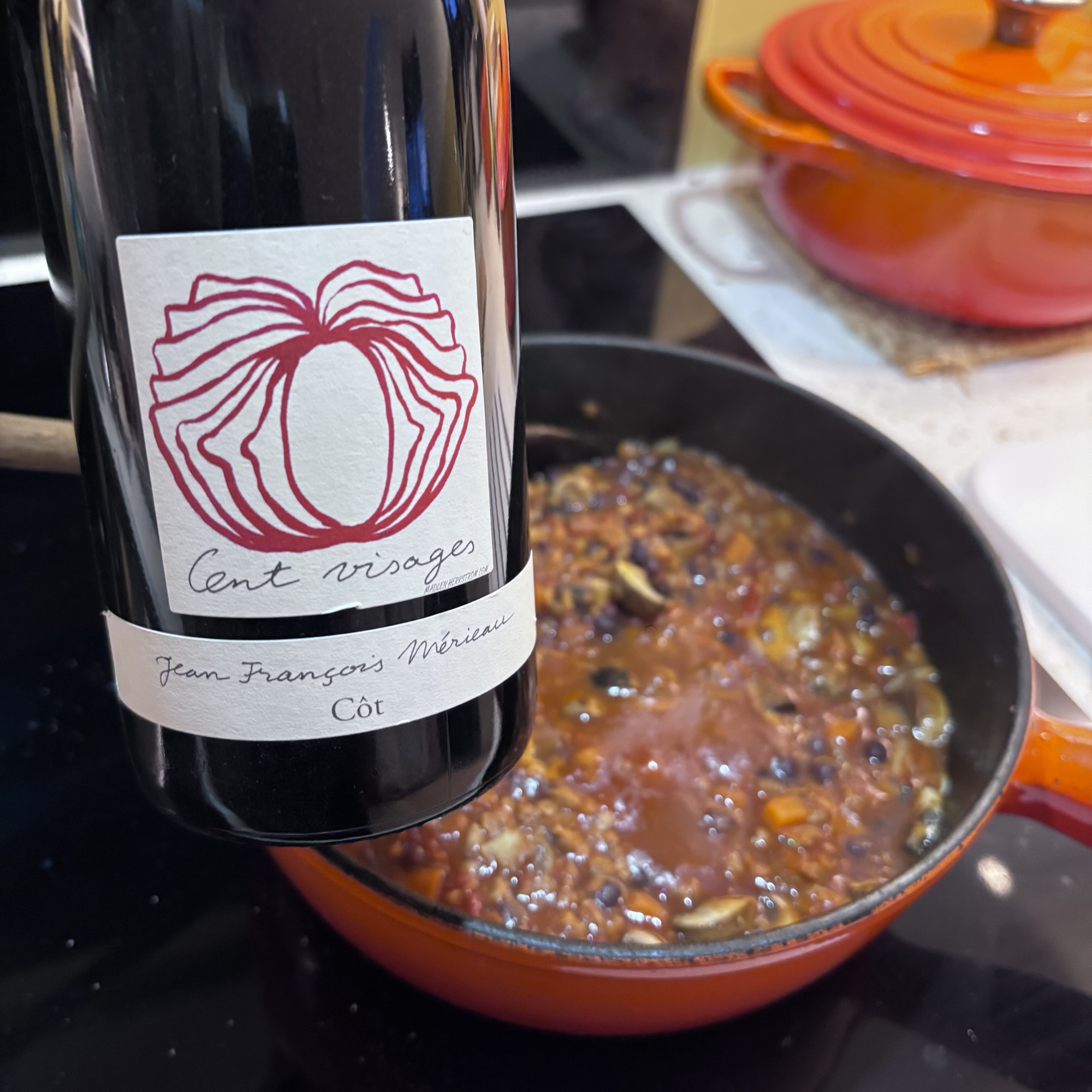
Mixing wine and cuisine, it went very well, perhaps perfectly, with the lasagne we make with added harissa to spice it up. This bottling is definitely more “meaty and chewy” than some lighter Bordeaux-copying Bergeracs you might come across, and the alcohol is up at a welcome (on this occasion) 14%. £15 from The Wine Society.

Posted in Artisan Wines, Chablis, English Wine, Languedoc-Roussillon, Natural Wine, Nepal, South African Wines, Wine, Wine Agencies, Wine Merchants, Wines of Southwest France, | Tagged , , , , , , , , , , , , , , , , , , , , , , , , | 1 Comment

Recent Wines December 2025 (Part 1) #theglouthatbindsus

It’s back to business as usual for my December wines. Whilst you will have read about the flashy bottles that were hedonistically consumed over Christmas and New Year in other places, here we have a selection which is more modest in price, though not really modest when it comes to quality and interest. Perhaps that’s no bad thing. In January you might wish to hear about good value bottles, rather than stuff you can’t afford even in the January Sales. Yes, I know they are sending you an email every day, but wine retailers really do not need a dry January.

Only one of the twelve wines which make up my two parts of last month’s Recent Wines costs more than £30, though if you are wondering what it is, it did make my “Wines of the Year” (it’s in Part 2 which follows). Here in Part 1, we have wines from Markgräferland (the southern part of Baden), Burgenland, Saint-Pourçain in the Upper Loire, Slovakia, North Canterbury (NZ), and the Vallée d’Aoste (to use this producer’s preferred labelling).

Markgräflerland Spätburgunder 2022, Martin Waßmer (Baden, Germany)

Most people are familiar with the central part of Baden north of Freiburg which embraces the Kaiserstuhl and Tuniberg, but the region stretches both north and south. In the far south, near to Basel and the Swiss border, we have Markgräflerland. Close to border at Efringen-Kirchen you will find one of my favourite German producers, Ziereisen. Around thirty kilometres to the north, between the Black Forest and the Rhine, at Bad Kruzingen, we have another excellent winemaker, Martin Waßmer.

Winemaking here is described as traditional, but it means indigenous yeasts, low intervention and oak ageing (though oak is not prominent in this wine). The overall impression is smooth cherry and strawberry fruit with darker notes beneath, complemented by a smoky finish. The fruit is ripe and alcohol is up at a balanced 13.5%, adding richness in the mouth. The wine isn’t especially complex, but it is very satisfying, and there is scope for development in bottle. You could keep some 3-4 years but it seemed a good choice for early December with the nights rapidly drawing in.

I think this counts as a genuine bargain. It cost just £16.50 from The Wine Society.

Grüner Veltliner 2024, Meinklang (Burgenland, Austria)

I go back a long way with Meinklang, largely through wines imported by Winemaker’s Club when they first opened. They were, and remain, at the centre of Austrian natural wine from their base at Pamhagen, where they have their famous “graupert” (unpruned) vines, a herd of prize cattle, and where they farm ancient grain cereals (from which they make a cracking beer if you ever see any). Pamhagen is close to the southeastern edge of the Neusiedlersee, and they also make fabulous wine further south, in Hungary, on the Somló Massif.

This Grüner Veltliner is from their entry level range, which I have mostly drunk before in restaurants. From the 2024 vintage, the fruit was spontaneously fermented following an early harvest, and direct-pressed before four months ageing on fine lees in stainless steel. It is softer than many Grüners, with apple and lemon with a little pear. Very easy to drink, but again, stunning value.

It was, in fact, a nice gift but it costs around £19, in this case from Cornelius in Edinburgh. It is also quite widely available throughout the UK, including at Cork & Cask in Edinburgh too. The importer is Vintage Roots.

Gamay 2023, Les Terres d’Ocre (Upper Loire, France)

This is one of a number of Loire wines which The Solent Cellar imports themselves (as they do wines from Chablis and Provence to name two more regions). All of them aim to combine quality and value from family estates. The result of them making the effort to ship the odd pallet is that we consumers get a bargain, so long as the wine lives up to its billing. This Gamay is made in the wider vine growing region of Saint-Pourçain, around the Allier tributary of the River Sioule, a very attractive part of the upper reaches of the Loire (into which the Allier flows, close to Nevers). It was a region which still felt pretty remote when I last visited its Yapp-imported cave co-operative in Saint-Pourçain itself.

Florent Barichard settled at Châtel-de-Neuvre, a ten-minute drive north of the town, in 2013. He works with partners Valérie and Eric Nesson. Florent has previous winemaking experience in New Zealand and South Africa. Together they make a range of wines, some I’ve had before and a Chardonnay/Tressallier (aka Sacy) blend which sits in my cellar. This Gamay is bottled as IGP, not AOP. The wine is organic, harvested manually, and made using native yeasts and sticking to a low sulphur regime.

The Gamay here is off local pink granite, which does give it, at least to my unscientific mind, some unique character. But of course, so do the amphorae (“jarres terre cuit”) it is made in. The bouquet has a nice freshness, with strawberry rather than cherry. The palate adds in some hints of dark fruits, combining with a little texture and spice. As I’m going through a bit of a reborn Gamay phase, I loved this. Just £12, from The Solent Cellar.

Jungberg Rizling Vlašský 2022, Vino Magula (Slovakia)

Magula is probably the estate I buy most wine from in Slovakia, although there are a couple which are better known. They are a fourth-generation family estate making natural wine at Suchá Nad Parnou, northeast of Bratislava in Southwestern Slovakia (close to Czech Moravia and relatively close to Vienna).

The grape variety here is one which we know better as Welschriesling. It is hand-picked from the single named site, Jungberg, and fermented in open vats on skins. The wine is a pale-yellow colour. The bouquet is a mix of floral elements and peachy fruit, whilst the palate is zesty and lively with a bit of peach stone texture, pear, herbs and even a hint of orange. Very refreshing at 11% abv, with less than 20mg/litre of added sulphur.

Magula is imported by Basket Press Wines. This cost me around £25. It may be currently out of stock, but they do highlight four excellent wines from this producer on their web site right now.
Pinot Noir “Zealandia” 2019, The Hermit Ram (North Canterbury, New Zealand)

For me, Theo Coles is one of New Zealand’s South Island star winemakers, making minimal intervention wines at North Canterbury, one of the country’s emerging quality wine regions. Canterbury is a large area around the South Island’s regional capital, Christchurch, but North Canterbury is over the Weka Pass from Canterbury’s best-known sub-region, Waipara (NOT to be confused with Wairarapa on the North Island, also a region producing fine Pinot Noir). North Canterbury is a sub-region becoming known for natural wines, the likes of Pyramid Valley and Bell Hill being established a little over 25 years ago. Theo arrived in 2012, to make Pinot Noir from Gareth Renowdon’s Limestone Hills Vineyard.

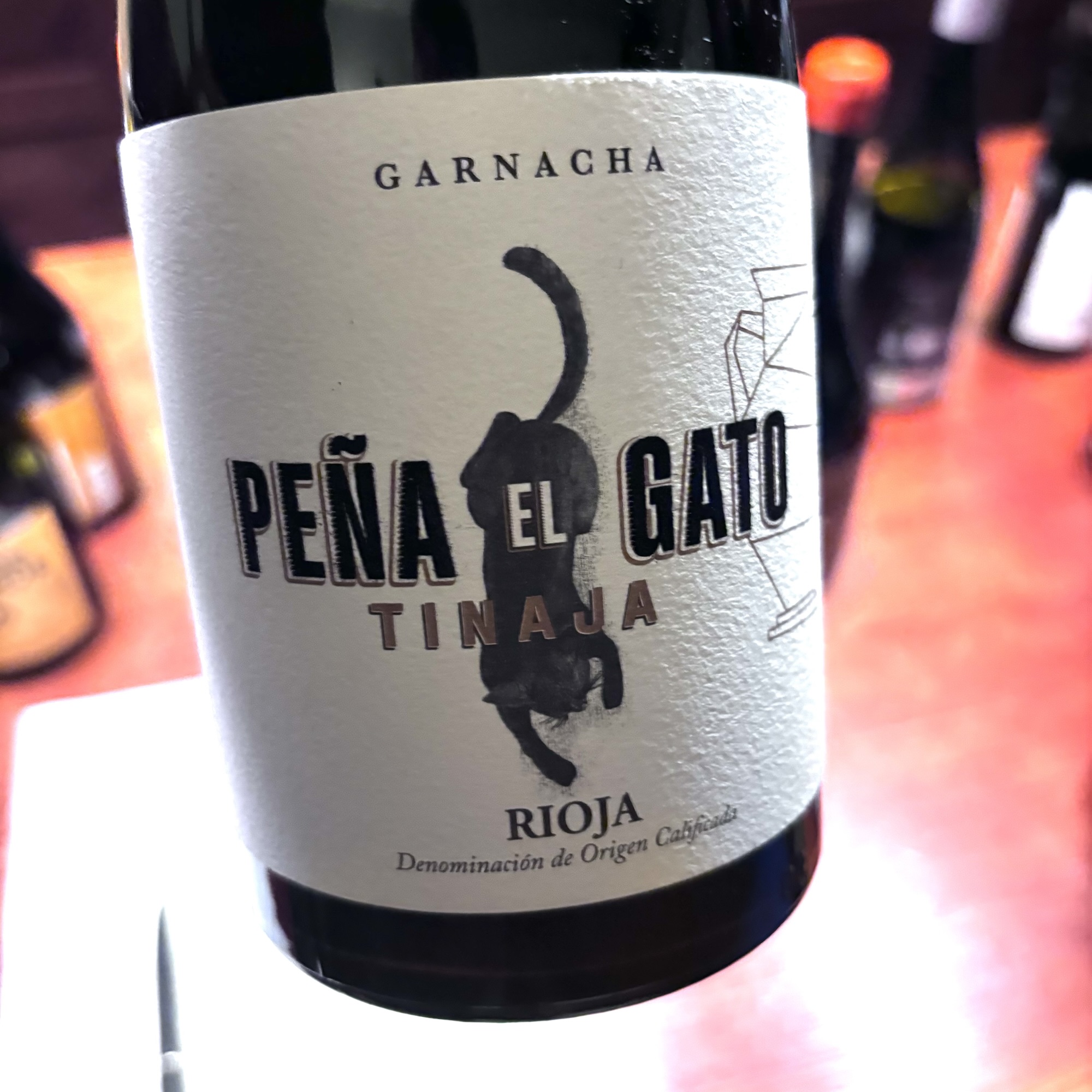
The Pinot Noir for Theo’s Zealandia cuvée comes from a number of organically farmed plots on limestone. The fruit is fermented with native yeasts after destemming. It sees six weeks on skins with only one punchdown. Ageing is in a lined Spanish clay amphora (“tinaja”), and it is of course bottled without fining or filtration, and with minimal added sulphur.

The colour is a striking, vibrant, violet. The bouquet shouts blackberry and blueberry. The palate is more of the same, textured (as with many wines which have seen clay vessels) and crunchy. Very “natural”, fresh, and if you noticed the vintage, no sign of tiredness yet. Theo really does craft magnificent wines.

Imported by Uncharted Wines, from whom you can buy direct, but mine came from Cork & Cask (Edinburgh).

Torrette 2022 Vallée d’Aoste AOC, Lo Triolet (Valle d’Aosta, Italy)

The dual language options available to winemakers in Italy’s Valle d’Aosta are evident here, but although this smallest of Italy’s appellations is very close to the French border, it always feels Italian to me. I will say that I have loved my visits here, both to Aosta itself (a town with several nice Roman era ruins and churches), and refuge walking up in the Gran Paradiso National Park, with its wonderful wildlife.

Torrette is made from Petit Rouge, a resolutely francophone grape variety ubiquitous in the western part of the valley. Marco Martin farms at Introd, not far from the exit to the Mont Blanc Tunnel. He began reviving his family’s old vineyards in 1988, first planting Pinot Grigio up at 800-900 masl, on sandy moraines of glacial origin. Viticulture is organic.

I am lucky to have drunk quite a lot of Aosta wines, having visited the region numerous times. Lo Triolet is the domaine I currently buy most of in the UK. At one time I’d have said I preferred their red Fumin and white Petite Arvine, but due initiallly to availability, the Torrette has risen in my estimation a great deal. This is definitely a mountain wine. It shows both red and darker fruits, nice unobtrusive tannins and a bitter bite on the finish adding a savoury quality. You probably wouldn’t guess this 2022 packs 14% alcohol. Calories very much needed in current temperatures, especially if you have been up in the mountains.

My bottle came once more from Solent Cellar. It cost a ridiculous £15 (I had to double check their web site). The abovementioned Pinot Grigio, sensibly labelled Pinot Gris, costs £22, and they have also stocked the Fumin and Petite Arvine in the past. Lo Triolet makes around a dozen different wines. Try any of them. The UK agent is Boutinot.

Posted in Aosta, Artisan Wines, Austrian Wine, German Wine, Loire, Natural Wine, New Zealand Wine, Slovakian Wine, Wine, Wine Agencies, Wine Merchants | Tagged , , , , , , , , , , , , , , , , , , , , , , , , , | Leave a comment

Wines of the Year 2025 #theglouthatbindsus

For those who may not know, or have forgotten, the format we have is a case of wine here, twelve bottles, one for each month. Each is carefully chosen. Occasionally a few rivals will get a mention. As with my “Recent Wines” articles every month (and December’s version in two parts will follow shortly), I’m listing what I think are the most interesting and exciting wines I drank each month, not necessarily the finest, although quality is a given.

So here below, twelve stimulating wines from twelve different regions. Those are Beaujolais, Vermont, South Wales, Mosel-Saar-Ruwer, Nepal, Savoie, Moravia, Burgenland, Vienna, Hampshire, Piemonte and East Sussex. That is twelve wines from the 145 I wrote about in 2025 in my Recent Wines articles. Aside from the fact that 145 bottles (plus those I omitted) represent a horrendous annual wine budget, it also represents a lot of tasting experience over a very wide world of wine.

If what you read about here seems a little different to the mainstream and piques your interest, you can be assured that you will likely get similar good value from these articles on wines we drank at home, which appear every month on wideworldofwine.co, alongside other pieces on the vineyard visits, wine tastings, book reviews and other wine- (and cider, whisky, etc) related adventures I get up to.

JANUARY

Beaujolais-Villages “Wild Soul” 2021, Julien Sunier (Beaujolais, France)

Drunk at the end of January, this “summer” Gamay was on top form. I chose this, a simple wine in many ways, for its life-affirming fruit (strawberry and cherry) and its soaring floral bouquet. A natural wine, though in no way challenging for more conservative palates, this is simply outstanding. The most exciting of a number of great Beaujolais I drank last year. Good Beaujolais just seems to deliver so much for so little money. It cost £23.50 from Berry Brothers.

FEBRUARY

Damejeanne Vermont Rouge 2019, La Garagista (Vermont, USA)

Deirdre and Caleb have been ripping up the rule book on hybrids etc for about sixteen years, as well as pursuing regenerative farming with admirable results. The grapes (90% Marquette with 10% La Crescent) are grown in the Champlain Valley in Vermont, the long north-south lake here extending into both New York State and Québec, Canada, as part of the St-Lawrence River drainage basin. Five weeks on skins for this cuvée, then aged in 25-litre demijohns. Another natural wine. Brambly, Alpine, but above all, very distinctive, very alive. From Les Caves de Pyrene at the last Real Wine Fair.

I might have chosen Dobrá Vinice’s Nejedlik Orange 2011, a stunning fine wine from Czechia which came from Basket Press Wines, but you won’t likely find a bottle now.

MARCH

TAM 2023, David Morris/Mountain People Wines (Monmouthshire, South Wales)

David of course used to make wine at his parents’ Ancre Hill. Since branching out alone, his wines have become even more dynamic. He is very talented. This Chardonnay is sourced from Somerset, but it is a dead ringer for Arbois. Fermented in a Stockinger barrique, then twelve months on lees, only 270 bottles saw the light of day. Zero added sulphur, very fresh, it reminded me of Stephane Tissot. This wine was available from Spry Wines and, via a different bottling and label, from Cork & Cask, for £37.

APRIL

Elbling 2021, Jonas Dostert (Mosel-Saar-Ruwer, Germany)

How come I chose this varietal Elbling over other April gems such as Laissagne’s “Le Cotet” and Stephane Tissot’s Amphore Savagnin? Well, Jonas is a rising star. His wines are hard to find in the UK because people have not quite cottoned-on to just how good he is…yet. And you know what they say – judge a great winemaker by his entry-level wines. His vineyards opposite Luxembourg are on limestone, not slate. Elbling is an unfairly maligned variety. The usual story, over-cropped and bulk produced in the past. The 861 bottles of appley, mineral refreshment created here show how unfair that assessment is. Brittle, but in a good way. Try Newcomer Wines (£29), or Feral Art et Vin in Bordeaux.

MAY

Rose Koshu 2024, Pataleban Vineyard Winery (Kathmandu Valley, Nepal)

It might seem a bit pretentious to include a wine that you really won’t have much chance of finding outside Nepal, but hear me out. Pataleban has a resort hotel with vineyards not far from the western edge of Kathmandu’s urban sprawl (nice food, nice walks), and a winery located further west (anything from thirty minutes to ninety depending on traffic). They grow a mix of vinifera and hybrids on a number of sites at between 750 to 1,600 masl. Koshu was planted in the early days following initial help from Japan. This is vinified as a Rosé (Koshu has pink skins). It’s possibly not the best wine they make, but it is massively fruity with a deliciously fresh mouthfeel, and a good example outside of Japan of a variety which can be so much fun. Worth seeking out when you head to Nepal.

JUNE

“Kheops” 2016, Les Vignes de Paradis (Savoie, France)

This is what I opened for a sommelier/wine consultant friend when they asked for something “electric”. From Savoie, close to Lac Léman, within the appellation of Crépy (but resolutely Vin des Allobroges IGP), this is the wine Dominique Lucas makes from biodynamic Chardonnay under a regime dictated by the planets in a replica, made from local materials, of the Pyramid of Khufu. Dry minerality, soft texture, lemony acidity and a vibrancy you will be hard-pushed to find anywhere. Just 690 bottles in 2016. Thankfully I have one more to share. £45 from The Solent Cellar, via importer Les Caves de Pyrene.

JULY                                                                                          

Black Horse 2022, Pétr Koráb (Moravia, Czechia)

Koráb makes some of the finest petnats I know, and he has a real knack with red ones. This was my last of three Black Horse, a blend of Amber Traminer, Karmazin (aka Blaufränkisch) and Hibernal, made by the Ancestral Method in a mix of robinia wood barrels and ceramic vessels. It’s not disgorged. It’s all strawberry, raspberry and cranberry, so a perfect summer sparkler. Fun but equally interesting for wine obsessives. Not sure whether Pétr will keep making this, he’s like that, but fear not. He’s a petnat genius and so anything he makes in that direction will likely be as stimulating. This cost just £26 from Basket Press Wines.
AUGUST

Josephine Rot 2017, Gut Oggau (Burgenland, Austria)

August was the hardest month to select a winner from. Hot (very hot) competition came from two Vin Jaunes (a 2010 Touraize and a 1986 Le Pinte), Duhart-Milon Rothschild 2000 and my last 2000 Clos des Goisses. Gut Oggau won because their wines are etched deep in my soul. Also, Josephine is a good bridge between excitement and stature in the GO “generations”, and it is also a good example of what Rösler can add to a blend. A purple wine off a south-facing limestone slope. The tannins have largely departed but the fruit intensity has not, nor its crisp freshness. Elegant, and so, so alive. Recent vintages will be in the range £60 to £70 from Dynamic Vines, or from Antidote Wine Bar (near London’s Carnaby Street, take away).

A mention in despatches must go to “Les Arceaux” 2021, a unique Rosé made from Grolleau Noir and Gris by Alice and Antoine Pouponneau at their Grange Saint-Saveur in Anjou. From a man who consults at Cheval Blanc, this was a genuinely remarkable find at Communiqué Wines in Edinburgh (via Thorman Hunt). This must rank as the most exciting Loire wine I’ve drunk for several years.

SEPTEMBER

“Rakete” 2022, Jutta Ambrositsch (Vienna, Austria)

I feel that 2025 saw me drink fewer Austrian wines than usual, yet two have made this selection (and others, like Knoll’s fine Wachau Ried Kellerberg 2011 haven’t had a look-in). Jutta makes my favourite wines from what is visually one of my very favourite wine regions in the world, the hills on the edge of Austria’s capital. This is a typical gemischter satz-type field blend, but is 80% Zweigelt. Five rows of vines fermented in stainless steel. A wine with a nice grainy texture and a grapefruit bite, chill well and shake up the sediment before pouring. Now around £25 to £30 from Newcomer Wines.
OCTOBER

Promised Land Riesling Brut Nature 2017, Charlie Herring Wines (Hampshire, England)

I did think twice about including a wine I consider still a little young, but the quality and the potential is off the scale, making me feel better about doing so. Tim Phillips grows his Riesling within his walled Victorian “Clos” just west of Lymington, the protection of the walls creating a micro-climate mirrored on a macro scale by the weather-break that is the Isle of Wight. There’s more fruit now it has aged a little, not so much on the nose, but the palate explodes with it. Thrilling to drink now for Winzer Sekt-loving acid hounds, but worth keeping that last bottle from a tiny production if you have one, most of which is snapped-up by trade insiders to be honest. £40 from the winery (open day is once a year), otherwise keep a lookout at The Solent Cellar or Les Caves de Pyrene.

I also have to mention the new “Village Chardonnay” from Westwell in Kent. Genius from Adrian Pike, and hardly over £20 at Cork & Cask, Edinburgh.

NOVEMBER

Barolo 2010, Giacomo Fenocchio (Piemonte, Italy)

Another exceptionally strong month with Lilbert 06, old Robert Michel Cornas, Lambert Spielmann and Alice Bouvot (her L’Octavin P’tit Pousset 2016 was sensational), but this Barolo topped them all. This is Giacomo’s entry level wine, yet it offers everything someone at my pay grade could want from Nebbiolo. Based at Monforte d’Alba, this is a producer others call a traditionalist, although the Barolo wars (trad v modernistas) were really just hype. However, this was certainly built for age, and even in late November there were still many more years of life in this 2010. There are still some tannins, but to highlight just one of this wine’s qualities here, these were the most beautiful tannins I have tasted in a long time. No longer available, I scooped a few of these from The Solent Cellar way back. The next bottle I will attempt to keep a few more years to see whether time adds something more haunting, but no question, this is a great fine wine now.

DECEMBER

Blanc de Noirs 2018 Cuvée Noella, Breaky Bottom (Sussex, England)

Although you won’t have read my notes yet on the twelve bottles I have selected for my “Recent Wines” articles covering December, you might not be surprised that I chose this one to represent that month. I’ll leave the details for now, but this was the first time that Peter Hall had been able to make a cuvée from only red grapes (Pinots Noir and Meunier). It is of course a wine of exquisite finesse, drinking nicely though with room to grow. We said goodbye to this humble man last year. No one had contributed to the soul of English wine like Peter. Breaky Bottom under his direction remains a beacon of artisan winemaking in England, where quality and beauty went hand in hand. Corney & Barrow are agents for BB, but all my supplies have always come from Peter’s great friends Henry and Cassie, at Butlers Wine Cellar in Brighton.

It only remains to wish everyone a Very Happy New Year and a wonderful 2026. It may have started cold, and perhaps a little frightening, but may we all find the strength to make the world a better place…whilst enjoying some more cracking wines like these.

Posted in Artisan Wines, Austrian Wine, Beaujolais, Czech Wine, English Wine, German Wine, Grape Varieties, Italian Wine, Natural Wine, North American Wine, Piemonte, Review of the Year, Savoie Wine, Welsh Wine, Wine, Wine Agencies, Wine Merchants | Tagged , , , , , , , , , , , , , , , , , , , , , , , , , , , , , , , , , , , , , | Leave a comment

Review of the Year 2025

My Review of the Year is really my time for a little self-indulgence. My Wines of the Year come later, maybe next year, making sure I don’t drink a killer wine after I’ve put finger to keypad and pressed the go button. Here, I get a chance to tell you what the most popular articles were (in case you didn’t read them), mention a few wine events and travels, try to come up with a Wine Book of the Year, and that kind of thing. Then I go off-piste.

First, some dull statistics. They may be dull but to be fair it’s the only time I get to blow my own trumpet (I do actually own a trumpet, which preceded the drum kit, but that’s another story from my past). As I write, in the week before Christmas, Wideworldofwine.co has had almost 62,000 views. That is 10,000 more than last year. However, China accounts for 13,000 views, and China only began looking at my site in earnest in late summer.

I’d love to know what this all means. Some recent fans? AI mining? I only seem unsure because some of those fellow wine bloggers I talk to mention the same thing. An enormous rise in hits from China. If anyone knows what it all means, fame and fortune or the end of the world, please enlighten me.

Only four Countries accounted for more than 5,000 views each so far in 2025. Those are, in descending order, UK, China, USA and Germany. France, Australia, and Nepal come next, not quite hitting the 5k, followed by India, Canada, Switzerland and The Netherlands. Then, deep down at the other end of the list, twenty-five countries which had just one view each, including Somalia, Papua New Guinea, Faroe Islands, Aruba, Palestinian Territories and a few of the ‘stans.

Whilst the biggest single number of views are of whatever is on my Home Page at the time (around 15,000 views), my most searched for pieces were (again in descending order):

  1. Tourist Jura -A Brief Guide…
  2. Tongba, A Study of Emptiness
  3. Extreme Viticulture in Nepal
  4. The New Viticulture by Jamie Goode (book)
  5. Pergola Taught
  6. Taste the Limestone…by Alex Maltman (book)
  7. Vin Jaune
  8. Manang Valley/Apple Wine
  9. One Thousand Vines by Pascaline Lepeltier (book)
  10. Timberyard Spring Tasting 2025
  11. Peter Hall – Breaky Bottom (eulogy)
  12. Jura Wine Ten Years on by Wink Lorch (book)

Peter Hall RIP (photographed on a social visit with Henry and Cassie of Butlers Wine Cellar)

You’ll notice quite a few book reviews, though all featured above were published before 2025, with the exception of Alex Maltman’s easy to read geology lesson.

So far this year I was almost shocked to see that I have so far published 67 articles. I think last year I managed 52 and I don’t promise to commit a similar number to the ether in 2026. But of those 67 articles, nine of them were book reviews.

Wine Book of the Year

As always, it isn’t easy to choose, but the abovementioned Taste the Limestone, Smell the Slate by Alex Maltman (Academie du Vin Library) is pretty much essential reading for serious wine lovers. It is easy to read and digest. It shatters many myths in some respects, but the poet and romantic in me still argues for subjectivity and imagination alongside the science.

The Academie du Vin Library, under the leadership of Hermione Ireland, does seem to be rejuvenating wine publishing (although it was nice to see good old Mitchell Beazley in the game with Rose Murray Brown’s well-conceived A Taste for Wine – if you want a really good “wine course” this is the one I’d recommend). The Academie du Vin has taken over the old Infinite Ideas list, and most recently released Nat Hughes’s wonderful book on Beaujolais, which fits into that series (among many other wine books in a significant year for them).

But the Innovation of the Year is surely their pocket-sized The Smart Traveller’s Wine Guide series. I read four of them in 2025, guides to The Rhône, Rioja, Bordeaux and Switzerland. I’m yet to read Tuscany and Napa, but those I have read I can highly recommend if you are heading off in one of those directions, or even if you just want a nice and light (in weight) holiday read. They are great for taking on the road, a mix of background info, wines to look for, and detailed wine routes alongside restaurants, wine bars, wine shops and more.

If I had any requests to Hermione and the team, it would be to commission guides to Austria, Piemonte, Alsace, Jura and the wider Mosel (-Saar-Ruwer), and not to try to do Australia in just one book. Whatever actually does come next will be eagerly awaited by me.

I’m also very much looking forward to reading Jamie Goode’s new edition of his Regenerative Viticulture book in January, which I believe is a substantial re-write, possibly based around his regenerative toolkit. With regenerative viticulture being pretty much the topic of the moment in professional wine circles I can’t wait to see what he says.

Tastings and Travel

The year is always peppered with tastings, too many to mention. I really should give a round of applause to those small importers who can be bothered to come up to Scotland, and a raised eyebrow to those who don’t. Special mention for regular effort to Newcomer Wines, Modal Wines and Basket Press Wines, plus all those who support the Cork & Cask events (covered in articles on the site).

I was pleased to get to Timberyard’s tasting (one of Edinburgh’s Michelin Stars but also the venue for the Wild Wine Fair usually every second year). The trade tasting in March featured a number of importers/agents (Carte Blanche, Passione Vino and Element), but I was most thrilled to get to taste the Welsh wines of David Morris (Mountain People). Although there is no “rising stars” feature this year, David would certainly warrant inclusion. Not least for a fine Welsh Chardonnay which could have been straight out of Arbois.

David Morris (Mountain People) up from Wales for Timberyard’s Spring Tasting

Cork & Cask continue to somehow find the energy to put on two wine fairs a year, summer and winter, winter having the greater wine content/focus. The Winter Wine Fair this year (November) was the best yet. The format… a load of importers come over from London, Glasgow and locally, all pouring ten or twelve wines each. If these fairs are a success, it is both down to the great team at C&C, driven by India Parry Williams and Jamie Dawson, and by the great wines they manage to put on the shelves, which in turn are tasted on the day. This is the event where I seem to make the most “new discoveries”. Both 2025 Fairs are on the blog, three articles alone covering the Winter edition.

Jamie Dawson is also one of the men behind Leith’s new indie whisky bottler, Blind Summit. I’ve really fallen for these beautifully packaged and more affordable (on account of bottling in 50cl) one-off gems, but package and branding aside, the whisky has to speak for itself, and it does, eloquently.

James Zorab, one half of Blind Summit, at the Cork & Cask Winter Fair in November

On the subject of Wine Shops, I have to mention Communiqué Wines in Stockbridge. For those who don’t know, Stockbridge is quite posh. You need to be somewhere like that if you want to stock the kind of wines Ali does. I see no compromise here. I love retail shopping for the things I love (wine, book and record stores for me make for an exciting day out). Just a couple of weeks ago I wandered in after a longer than usual absence and immediately found a Stéphane Tissot Patchwork Chardonnay and a J-P Rietsch Pinot Noir. It felt like I didn’t need any Christmas presents after that.

Edinburgh has plenty of great wine shops, too many for my meagre budget these days, but if you do come here as a tourist (and you really should), make sure to visit those mentioned above, plus Spry Wines (natural wine heaven from the shelf at a highly-recommended small restaurant), Smith & Gertrude (two great Edinburgh locations), Raeburn Fine Wines (an eclectic selection of stuff you rarely see), and Winekraft (hint hint: one of two locations is near the back of the free Botanical Gardens). For an amazing restaurant wine list, if you like natural wine, I have to add Montrose, a sister restaurant of Timberyard, but less Michelin. Montrose host many trade tastings and Milan Nestarec visiting with Peter Honneger from Newcomer Wines was a 2025 classic.

There’s no room for restaurant reviews, but two meals stood out in 2025 for different reasons. I dined solo at 40 Maltby Street, home of Gergovie Wines, back in January. I’d forgotten how their food truly warms the soul. More recently, last month, we dined at Kipferl in Islington. I felt as close as I could be to Vienna without getting on a plane. I definitely recommend Nekter Deli, a short walk from Liverpool Street Station (see article of 21 Oct), not least for the North American wines. Many are from what Jon Bonné recently called the 7%, ie the Cali wines made from varieties other than CCSPN.
All the above can be read about on the blog. Mountain Momo in Edinburgh (off Leith Walk) put into my mouth the finest food I tasted outside of my son-in-law’s cooking in 2025, but there’s no wine there, so no article.

The most innovative wine event of 2025 has to be the Clay Wine Fair. The brainchild of Isobel Salamon, who is probably Edinburgh’s supreme wine workaholic, this was a wonderful study in wines made in all forms of amphorae, terracotta eggs, jarres and tinajas etc. It took place at Sotto, a popular Italian restaurant in Stockbridge, Edinburgh, in February, and was very well attended by importers and public alike. In fact, it was so popular the venue probably proved a bit on the small side in the end. I could imagine this being a cracking success down in London.

If Wine Travel is to be included, I have to say that October saw my best wine trip to Switzerland yet. As well as some spectacular Alpine walking, we got to Auvernier/Neuchâtel, the Vaud’s Lavaux and the village of Dardagny on Geneva’s Rive Droite. Not a lot gets written about Swiss wine, a subject most UK wine drinkers are relatively ignorant of. My articles (four of them, published late October and early November) attempted to give a different focus to the excellent Smart Traveller’s Wine Guide to Switzerland published by the Academie du Vin Library, and which I road-tested on the trip. A beautiful country with some fantastic wines, not all of which are as expensive as we are led to believe.

Lavaux, Vaud

Now the indulgent bit, a plug for my other interests, in this case music and books (believe it or not, wine books only take up a part of my annual reading). The logic here is that if you like the same wines I like, then my taste in books and music might just interest you too.

Books of the Year

For my work of non-fiction, I have to choose what may well be the best music book I have ever read. And the Roots of Rhythm Remain by Joe Boyd (Faber, 2024, a whopping 929 pages) takes us through much of the world, exploring almost everything from almost every continent that has contributed to the music many of us listen to today under that wide heading “the Western tradition” (my words, intended to encompass classical, through jazz to rock (“n” roll)). Breathtaking scholarship, easy to read and digest, from a man who has seen more music created than most. A book you don’t want to finish.

As a work of fiction, I will choose The City and its Uncertain Walls by Haruki Murakami (Vintage, 2025, 449pp). I have been a fan of Murakami for much of his career, so there’s a degree of fandom, but I think this is one of his best. The narrative is great, though you need to seep yourself into the story. I was surprised how it began using quite simple language, almost clumsy (of course, I read it in translation, but Philip Gabriel is an old hand at Murakami), but then the main protagonist/voice is a teenager at the start of the book, and in his forties when it ends. This is also a book, like Maggie O’Farrell’s The Marriage Portrait, that ends leaving some big questions, yet where as a reader you find that satisfactory, not disappointing. Leaving something to the imagination is very Murakami. He expects you to have one…an imagination.

Records of the Year

I need to select two records here. It would be unfair to do otherwise. My son always buys me the best records that I know nothing about. For my Birthday this year it was the self-titled debut by Nusantara Beat (Glitter Beat GBLP180). A sticker says “The Amsterdam-based six piece…has delivered…a rich weave of Indonesian folk traditions, psychedelic rock, and vintage Indo-pop reimagined…”. Mostly quite laid-back grooves with rocky edges, sung mostly in Bahasa Indonesia, some songs sung in Sudanese, I think.

A complete change for my second choice, The Overview by Steven Wilson (Fiction/Virgin Records). Just two tracks (one per side), pensive, relaxing, spacey, it captures something, but you need to listen to see what you feel that is. Kind of Prog, but not in the sense some would use that term. That said, if Dark Side of the Moon had never been made, people might be talking more about this album.

The other two sleeve pictures below are albums discovered as a result of reading that Joe Boyd book. Tropicalia from Brazil had almost passed me by, aside from Astrid and Gil. There’s always, and I mean always, something new out there to be discovered. I live for such discovery.

Gig of the Year

I think a few of you know I like opera. As well as a few big nights in large houses, we went to the tiny Lammermuir Festival production Scottish Opera laid on, a double-bill of Ravel’s L’Heure Espagnol, unusually paired with Walton’s The Bear (never ‘eard of it). Front row at a very good production, and an intimacy you can’t get at Glyndebourne or the Staatsoper. We saw a wonderful concert of the Tango of Carlos Gardel at this festival last year. There’s always something spectacular.

However, I did say “gig”, and that was the wonderful Ezra Collective, playing in the big top at North Berwick’s Fringe by the Sea. God didn’t actually give me “…feet for dancing”, and there certainly was not “no-one” watching, but nevertheless I danced all night. It might not have been pretty but it felt so good.

Well, I hope I have entertained a little, both here and through 2025’s sixty-odd articles. I hope I have given some pointers to things you may not have read on the blog, given Edinburgh a wine tourism plug (I do not have room here to tell you about more of its amazing restaurants, apart from that plug for Montrose, I wish I did), and opened my soul on a couple of my other passions. The fourth passion, after Wine, reading and music, is travel, and I could regale you with tales of my journeys in this wonderful country of Scotland, but again, it’s not wine (it often is whisky, of course) so maybe I should curb my enthusiasm right here.

Mull is a magical place

What will 2026 hold? Well, health willing, there will be tastings (Greek Wines in February just dropped), wine travel (even further away than Switzerland), doubtless some more excellent wine books alongside Dr Goode’s which I already mentioned, and the cellar currently looks good for a few more years of “Recent Wines”, if luck holds. Keep your fingers crossed, as I will mine.

I wish everyone a Very Happy Christmas or a fun festive season, and a genuine hope that we shall all find good things, happiness and even a little prosperity in 2026. Certainly prosperity is something the wine trade and hospitality industry could do with.

Posted in Artisan Wines, Review of the Year, Wine, Wine Books, Wine Merchants, Wine Tastings, Wine Writing | Tagged , , , , , , , , , , , , , , | 2 Comments

Recent Wines November 2025 (Part 3) #theglouthatbindsus

Part Three of my “Recent Wines” for November is an interesting mix, even by my slightly weird (at times) standards. We kick off with another of those Geneva wines I’ve been sneaking in throughout the year. Wine two is a Czech sparkling wine, without doubt the best sparkling wine I can remember drinking from that part of the world. Wine three is a truly exceptional Barolo at fifteen years old, followed by an Austrian wine from equally deep in my cellar, hailing from my favourite Wachau producer. We finish with what is certainly the strangest wine of the year. Tasted literally blind, not only would you be lucky to get the grape variety and region, but you’d need a few guesses to pinpoint its colour.

That final wine warrants an aside about what we, meaning the kind of people who read this blog, are looking for in a wine. It was a gift from a close friend who was staying with us. The retailer had told her “no way” I’d have tried this. Well, I had of course, but only at a tasting. Our friend didn’t really like it. I presume that much of her reaction was down to the colour/grape combo. However, I was quite excited to drink half that bottle, whilst the others stuck with their first glass. It was interesting, entertaining, stimulating and I am pleased to have drunk it. That said, I won’t be heading out for a six-pack. Nevertheless, it definitely merits inclusion.

Pierres Noires 2022, Cave de Sézenove/Bernard Bosseau (Geneva, Switzerland)

Bernard Bosseau is based at Bernex. This village is next to better known Lully, directly to the west of, and close to, Geneva and to the south of the Rhône where it flows out of the lake. This wine is one of those interesting blends which Geneva does surprisingly well, considering they get little publicity overseas, where I am guessing most wine lovers hardly register that Geneva makes wine. This, despite that quality revolution here which I keep endlessly repeating.

The grape varieties involved are the classic Merlot and Syrah with one of the newer crossings Gamaret, and Ancellotta. Gamaret is probably known to many of my readers, but Ancellotta is fairly new to me. It’s actually a dark-skinned vinifera variety from Emilia-Romagna in Italy, where it is a rare blending variety in Lambrusco. Strong pigmentation means it has also been used as a natural food colouring. It has made inroads into Swiss wine for some reason, and I’ve had reason to mention it before in this context.

I don’t know a great deal about this producer either. Apparently, he was originally from Nantes, in France, but has been making wine at Bernex for twenty years. However, this wine from this vintage did manage a 90 Point rating in Falstaff Magazine, which placed this cuvée among the best 17 wines of the 2022 vintage in the Geneva AOC.

It is certainly dark in colour, the predominant aromatics being black cherry and toasty oak (it is aged 12 months in oak, 25% new). The tannins are fine-grained but it is youthful. The 13.5% alcohol helps add a sweetness/richness, and the fresh fruit acidity is attractive. It has good length too. Despite its youth I enjoyed drinking it, but it needs hearty cuisine. I suspect it will age quite elegantly.

Naturally you are unlikely to find this in the UK, where you will have to visit Alpine Wines online to sample a selection of other wines from Geneva (but not this one). I believe price is around CHF24 (roughly a 1:1 conversion rate for £).

Blanc de Noir 2020, Krasna Hora (Moravia, Czechia)

In Stary Poddvorov in Southern Moravia you can hardly miss the Krasna Hora winery. It is small but modern, sitting as many older winegrower’s buildings around it do, at the bottom of a vine-clad hillside that climbs to a wooded crest. The labels of many of the wines here look very modern, and to some extent they taste modern too. Yet these are natural wines, with tradition at their heart. This Blanc de Noir (sic) Sekt is one of the most traditional, and in some respects the one wine they make that cannot be called a “natural wine”.

There is one grape variety, Pinot Noir. It is made by the “traditional” method, that used in Champagne. There is no dosage and the wine is allowed 12 months on lees before disgorgement. No additives are used on the vines, and there are no synthetic chemicals used in the winery. There is some sulphur added, but in very small amounts. However, the intention with this wine is to create a Champagne lookalike, and so Champagne yeasts (rather than the ambient yeasts used for their other bottlings) are added to start the fermentation.

As you can see, I’ve aged this myself for a few years, and the wine has certainly benefitted from this. There is a fruity side to it, red fruits showing initially on the nose. Then more complex aromas and flavours kick in. I think it is developing some nice autolytic character. I get apples, a slight yeasty-mushroom element and some autumnal notes. It’s very good, and indeed extremely good value, I think around £33. Ageing it a little certainly paid dividends.

Purchased directly from importer Basket Press Wines.
Barolo 2010, Giacomo Fenocchio (Piemonte, Italy)

Kerin O’Keefe in “Barolo and Barbaresco” (University of California Press, 2014) unhesitatingly calls this a “cult winery”. They are based at Monforte d’Alba and Claudio Fenocchio now orchestrates 15 hectares of vines, of which around 7ha are in the Barolo DOCG. He has some fantastic individual sites used for his Bussia, Villero and Cannubi cuvées, but here we have his entry level Barolo. It’s still brilliant!

The wines here at Fenocchio all err towards what some like to call the “traditional” style. In this case we have a spontaneous fermentation using ambient local yeasts, taking place for the straight Barolo in stainless steel (oak fermentation is just for the Reserva). Ageing, however, is in Slavonian oak (both 35hl and larger 70hl casks).

Despite being fifteen years old, it might strike many as still a bit youthful (not young). The bouquet is shockingly fruity, but supplemented by some toasty/smoky notes on the nose. Finally, a hint of something floral, good old roses. The palate still has tannins, albeit soft and ripe tannins. It may be an odd thing to say, but they were the most beautiful tannins I’ve tasted for a long time. I decided not to decant, and I made the right choice because as a whole package it was wonderful. However, I do have another bottle, which I will try to keep three-to-five years.

This came from The Solent Cellar in Lymington. No idea what I paid, probably a lot less than it costs now, yet importer Armit Wines has the 2021 for around £41 (you can pay a fair bit more at one or two well known retailers). £40 is, in my mind, a bargain for a wine this good, so long as you are prepared to wait.

Dürnsteiner Riesling Ried Kellerberg Smaragd 2011, Weingut Knoll (Wachau, Austria)

Perhaps I should decode the label of this traditional Wachau Riesling. Ried Kellerberg is a single site in the village of Dürnstein. Sitting to the east of the Knoll winery (and excellent heuriger restaurant) at Unterloiben, the castle ruin above Dürnstein once acted as the prison for King Richard I of England after his capture by the angry Austrians on his rather foolhardy solitary return from the First Crusade. He suffered for his arrogance toward Austria’s Duke Leopold on campaign at the siege of Acre, and England was forced to pay a meaty ransom for it.

The Kellerberg sits at the top of the hill, to the east of the castle. Smaragd denotes ripeness. Federspiel wines are picked young, and generally drink young (though many can age). Picked later, Smaragd wines are dry but rich, and generally age well, especially if the wine is made by Emmerich Knoll.

As for the vintage, 2011 was a good year in the Wachau. A sunny, warm, growing season led into an Indian summer stretching well into October. The wines are ripe and complex. Though in youth they probably lacked the acidity of some vintages, they made up for it in extract. The dry late summer also meant little or no botrytis was created on the grapes destined for a dry style. At Knoll critics usually count 2011 among the top five vintages of the first two decades of this century.

We have 14% abv here, but the wine is well balanced. The bouquet has greengage with a hint of bergamot, yet the palate sings of apricots. There’s softness, richness and weight, yet I feel it is elegant too, perhaps in a “Dowager Countess” way. I can’t fault its length, which goes on forever.

I imagine few bottles will be around from the 2011s now. This bottle began its life, with a few others, in a basket on a hired bicycle. We were cycling the Wachau Cycle Trail (very highly recommended, the bikes were hired close to the station in Krems), and paid a visit to the wonderful Vinothek Föhringer wine shop on the banks of the Danube (near the landing jetty) at Spitz. We’d just had lunch at the riverside Gasthaus Prankl, followed by a climb up to the castle at Spitz, but if your legs are weary, I would suggest the aforementioned Heuriger, the Restaurant Loibnerhof owned by Knoll. Oddly enough it is now lunchtime and the thought of schnitzel or schweinsbraten with a bottle of Knoll Federspiel Grüner is making my stomach rumble something rotten.

« Never Odd or Even » Vin de France [2022], Chàteau Picoron (Bordeaux, France)

So, what is strange about this wine. Quite a lot, really. Okay, it’s a Merlot and it comes from Bordeaux, in fact from the wider Saint-Emilion sub-region, although Sainte-Colombe is technically within the Castillon-Côtes de Bordeaux AOC, named after the town it centres on, Castillon-la-Bataille. The battle in question took place on 17 July 1453 when the defeat of the English army under John Talbot (yes, that one), First Earl of Shrewsbury, led to the loss of nearly all English-ruled land in France, and finally ended the so-called Hundred Years War between the two crowns.

But this it isn’t red Merlot. It isn’t even white (they do make a white Merlot). But we are ahead of ourselves. Château Picoron is run by an Australian couple, Glenda and Frank Kalyk. The Château dates from 1570 and its vines, 4.5 hectares, grow in different plots surrounding it, one plot per cuvée. They only grow Merlot but they do manage to make a surprising number of styles of wine from it. I say “the wider Saint-Emilion region” because in terms of terroir, the Château sits, geologically speaking, on Saint-Emilion’s clay and limestone ridge. They do go for palindromes for the names of their wines, but that must be the least of the worries Bordeaux traditionalists have with this estate.

Never Odd or Even (they had to kill the English language for that palindrome, losing an inconvenient “n”) is what you might call a grey wine, though not a Vin Gris. In other words, it isn’t a wine tinged with pink as in oeil de perdrix. It is literally grey. The colour of a lemon squash like Robinson’s Barley Water, which will be familiar to British readers and fans of the Wimbledon Grand Slam. It’s also cloudy.

The bouquet was quite muted until pear and coconut welled-up in the Zalto. The palate was clean and direct, showing some acidity and a chalky texture (very fine grained, dusty). I saw a tasting note that said tahini. I didn’t get that myself but a good shout. I know what they meant.

So, this is unquestionably the strangest wine of the year. It was definitely enjoyable alongside being extremely interesting for any wine obsessive. It came from Winekraft in Edinburgh, and the importer is Moreno Wines. Moreno currently list seven Picoron wines and this isn’t one of them. Only 600 bottles of it were made, and I do wonder whether they decided not to repeat the experiment. Winekraft were brave to list it because there are not all that many people who like wine that’s this crazy in Edinburgh. Cork & Cask list a few of Picoron’s other wines, one of which I’ve previously written about here.
It also cost £30. We all agreed that £20 would have been a better price point, and that’s the problem with artisan wines like this. Producer etc costs are high, especially when the bottle run is just 600 units. I’ve no doubt the maths doesn’t work at £20, but £20 seems right for a crazy experiment like this. That said, lovers of the weird and wonderful should seek it out if any is left.

The next Recent Wines articles covering December will, of course, appear in January. I shall be trying to publish my Review of the Year before Christmas, whilst my traditional Wines of the Year will most likely appear as my first piece of 2026 (fingers crossed). Regular readers might be relieved that my recent prolific output will hopefully slow down a bit over the holiday period whilst I indulge in some well-earned hibernation, vinyl-spinning, weight gain through food and alcohol, and maybe a bit of exercise to burn it off.


Posted in Artisan Wines, Austrian Wine, Bordeaux Wine, Czech Wine, Italian Wine, Natural Wine, Piemonte, Swiss Wine, Wachau, Wine, Wine Agencies, Wine Merchants | Tagged , , , , , , , , , , , , , , , , , , | Leave a comment

Recent Wines November 2025 (Part 2) #theglouthatbindsus

We switch the vibe a little for Part Two of the wines we drank at home during November. Nothing from the likes of Albania and Ukraine, but instead four French wines and one from Austria. From France we have a brilliant Grower Vintage Champagne, and an even older Cornas, before switching to a natural wine Beaujolais, and a very natural Alsace blend. We stray east for the final wine, a very good zesty white from Kamptal.

Cramant Grand Cru Blanc de Blancs 2006, Lilbert et Fils (Champagne, France)

Lilbert is a top Grower based on the Côte des Blancs. The family has been farming here since 1746, and making Champagne since the early 20th Century. Bertrand Lilbert owns around 3.5 hectares at Cramant, Chouilly and Oiry. The vintage Blanc de Blancs is mostly Cramant Chardonnay from the oldest estate vines, some now approaching 100 years old. A little fruit from the Cuis side of Cramant is blended in.

People call this wine “ageworthy”, which is something of an understatement. Ageing is essential here. Tasting young wine at the estate on a cold morning at nine o’clock is a bracing experience. It’s a little like, I imagine, swallowing an icicle might be like. Here it is mature, wonderfully so. There is still the trademark acidity, but now it supports greater complexity, autolytic character, and a certain richness which is overwhelmed in youth.

Don’t make the mistake I made and be too impatient to drink it. I originally bought four of this Vintage, among a mixed case purchased at the domaine many years ago. It also included Bertrand’s Perlé NV, one of my two favourite “lower pressure” Champagnes (the other being from Péters), which I would also highly recommend. This was the last bottle from that case. I think that The Wine Society has the non-vintage Blanc de Blancs for £40 (a bargain) and the NV Perlé for £51. More recent vintages of the BdeB are knocking around at close to £75. Worth it if you can afford it and can age it.

Cornas “Cuvée des Coteaux” 2005, Robert Michel (Cornas, France)

Another classic from the cellar. The long-retired Robert Michel’s name lives on as one of the winemakers who helped put this small appellation back on the map. Cornas has not always been mentioned in the same breath as Hermitage and Côte-Rôtie, and it certainly wasn’t when I began to buy Rhône wines in the 1980s. That was a time when an appellation like Saint-Joseph was more or less considered equal, in some cases, to a wine like Gigondas, and both have risen inexorably in price and reputation since. Cornas was but a small step up back then, although Auguste Clape had gained a strong following through the support of Robin Yapp in the UK.

When Robert Michel took over from his father, Joseph, in 1975, aged 29, he was the only young winemaker in the village. He farmed just four hectares in Cornas, with a little in St-Joseph. Incidentally, for younger readers, it was Robert’s nephew, Vincent Paris, who took over the Michel family vines on Robert’s retirement, so this terroir lives on in more than capable hands. Robert Michel always made wines in the classical tradition, at least in my understanding, meaning partly destemming the fruit and ageing in used oak. That fruit here came from two lieux-dits, Chaillot and La Geynale.

For me, this is a supreme terroir wine. In 2005 the ripe fruit gave some quite intense wines in the Rhône, yet the balance here is mirrored in just 12.5% abv. You rarely if ever see that these days. In youth I have no doubt that this was nevertheless quite muscular. Now it has a gentler side, with smooth red plum, hints of darker fruit, and a smoky finish. Complex, yet aside from a tiny hint of texture rather than tannin, it is a wine that lingers happily on the tongue…for a very long time.

Summing up, it has a lovely fragrance and is more elegant, both than many Cornas I’ve tried, and certainly than many 2005s. I cannot recall what I paid for it. It was a long time ago. It came from Leon Stolarski Fine Wine, which I believe may have ceased trading this year. Although I bought little from Leon (I’m positive he mistook the reasons why), he was one of those wonderful specialists/small importers, perhaps before his time. Some of the wines he introduced to the UK ten or twenty years ago, especially from his main specialism of Languedoc-Roussillon,  are now established stars.

Beaujolais-Lantignié 2023 Beaujolais-Villages, Jean-Marc Burgaud (Beaujolais, France)

Jean-Marc started farming in Villié-Morgon in 1989, with just 3 hectares. Now he has expanded to 17.5 ha, and has become very well established as one of the top names in the region. He’s helped somewhat by having a whole 7 ha right on the top of Morgon’s famous Côte du Py with which to make a name.

J-M is definitely a viticulteur, and that is how he would see himself. In the winery he tries to be relatively hands-off, in the same way that his whole philosophy, as a wine grower and maker, is to make natural wine. He mostly practises semi-carbonic fermentations. For his more fruity offerings (which includes this “Villages” wine from Lantignié) there will just be a short maceration on the skins, here about a week, before pressing.

The result is pure-fruited and juicy, with just a little tannin to ground it at the moment. Natasha Hughes in her “The Wines of Beaujolais” (Academie du Vin Library, 2025) points out that Jean-Marc deliberately devotes as much attention to this wine as he does his top Morgons, which is of course always the sign of a top winemaker.

It is approachable from the off, and drinking very well indeed. A lovely wine and very good value, even though Beaujolais prices are creeping up (which they should, given the quality all round). £20 from Lockett Brothers (North Berwick), via importer Liberty Wines.
Marriage Plus Vieux XXIII Vin de France, Lambert Spielmann/Domaine in Black (Alsace, France)

If Beaujolais prices are rising, I fear that the cost of natural wines from the current cohort of exciting natural winemakers in Alsace is doing so even more quickly. At least from UK importers. Still, Alsace is very exciting. Thankfully the similar cohort of young Mosel natural wine stars lags a little way behind. I don’t begrudge winemakers turning a profit, don’t get me wrong, although UK prices obviously don’t translate to producer profit. It’s just that the affordability of “natural” Alsace seems to have been taken from my empty purse before its time.

Musician and winemaker is no longer an unusual combo. Natural winemakers all over Europe seem to spend their time playing in bands and I can certainly understand, from my own passions, why the two go together. Lambert perhaps wears his love of music on his sleeve more than most. Every cuvée comes with a recommended track to listen to, often in a punky-ska style. But maybe you should buy the wines first.

Lambert Spielmann has three hectares of vines in small parcels split between Dambach-la-Ville, Epfig, Nothalten, Reichsfeld and Obernai. He makes wines with no inputs, including zero sulphur, and follows the biodynamic calendar. This cuvée blends 80-year-old Sylvaner spiced with a bit of Gewurztraminer from mere 40-year-old vines. Most of the fruit is destemmed, with the Gewurztraminer seeing a two-week infusion before pressing into vats. It rests until the following spring before bottling.
It isn’t a pale wine, for sure, but it is so zippy and fresh with bright lemon citrus on the palate first. It’s such pure lemon, to which you find added a little ginger. It’s a wine of total purity, and exciting electric energy.

I am very grateful to Cork & Cask in Edinburgh for adding a selection of Spielmann’s wines to an order from Lambert’s UK agent, Tutto Wines. I’m not sure they felt they could hand-sell these wines, despite their wonderful labels. A shame in a way because if you told me I could only ever buy two Alsace producers, or bottles, ever again, Lambert Spielmann would sit beside Jean-Pierre Rietsch as my choices. Tutto flog this for £40, so hardly surprising it isn’t on any Edinburgh shelves. We’re not as well off as you South- and East-Londoners.
Grüner Veltliner 2023, Loimer (Kamptal, Austria)

There was a time, before I began visiting Austria and its wine regions, when I used to drink the odd wine from Fred Loimer. In fact, a Loimer Riesling would number among the very first Austrian wines I bought back in the late 1990s or early 2000s. But although I have visited the Wachau and Krems, I’ve never been to Kamptal.

The latest edition of the World Atlas of Wine says of Kamptal “it has been called the K2 of Austria (Wachau being Mount Everest)”. Its climate is protected by mountains to the north, and is influenced by the Danube tributary, the Kamp. Loimer is quite a large producer, with more than 85 hectares planted on mostly south-facing slopes with predominantly loess soils around one of the oldest viticultural centres of the region, Langenlois. However, the whole lot of this large holding is certified biodynamic (by Respekt). Fred took over in 1997, and is certainly responsible for the reputation the wines have today.

One key to the quality at Loimer is old vines. Even this entry-level Grüner Veltliner has some fruit from vines more than fifty yeas old. It has a zesty lemon nose as part of some nice aromatics, finishing with a whiff of white pepper, and a palate which majors on lemon and deeper stone fruit. Overall, though a wine that is simple in one respect, it is very fresh, and nicely direct. Clean but not bland.

Further up the Loimer range there are some very nice, and more serious wines, all with their minimalist modern label design. This wine is excellent value at £20. Like the Beaujolais from Burgaud above, same price, same importer (Liberty Wines) and also purchased at Lockett Brothers in North Berwick.

Posted in Alsace, Artisan Wines, Austrian Wine, Beaujolais, Champagne, Natural Wine, Rhone, Wine, Wine Agencies, Wine Merchants | Tagged , , , , , , , , , , , , , , , , , , , , | Leave a comment

Recent Wines November 2025 (Part 1) #theglouthatbindsus

In the month of November, we appear to have drunk quite a lot, but I blame the guests. It means we have three parts of Recent Wines for last month, even with a few less exciting bottles culled. We begin Part One with a Sherry style I drink rarely (note to self, drink more Amontillado). Then we have one of Alice Bouvot’s domaine wines from L’Octavin in Arbois, and a wine that was far more than a mere “oddity” in an excellent white wine from Albania. Then we go to the mountains of Macedonia in Northern Greece before heading well off the beaten track, to Ukraine. Lots of interest here, but quality alongside diversity and a little bit of obscurity.

Amontillado “I Think”, Equipo Navazos (Montilla-Morilles, Spain)

This is one of a series of wines made for Equipo Navazos’s UK agent, Alliance Wine. It’s a saca of June 2023 sourced from the bodega of Pérez Barquero in Montilla. The grape variety of this region just south of Córdoba is Pedro-Xímenez (PX) rather than the Palomino of the Sherry Triangle. It is usually the variety used in the sweet wines, many made by Pérez Barquero, that are relatively easy to produce in the more extreme climate of Montilla-Morilles, although PX has always been shipped over to Jerez for blending as well.

So, it is perhaps slightly unusual to see PX used to made a dry Amontillado style. One thousand half-bottles came from a single cask at the bodega, the wine being on average fifteen years old. This is unfortified, with 16.5% alcohol achieved naturally, through ripeness.

The bouquet is pure autumn, with mushrooms and leaf litter. The palate is bone dry and savoury, smooth, and also quite rich. It will pair with a wide variety of dishes, especially those with an autumnal feel. It did go particularly well with the roast kabocha we had cooked. One of those underrated wines which lubricates the palate, enriches the senses and satisfies the soul.

My half-bottle came from The Solent Cellar, but Alliance Wine imports Equipo Navazos. It usually retails between £20-£28.

P’tit Poussot Vin de France [2016], Domaine L’Octavin (Jura, France)

Made from estate-grown fruit from Alice Bouvot’s Poussot site at Arbois, this cuvée is usually made from Chardonnay young vines. Most of the cuvée is made by direct pressing of the fruit, but a small amount was macerated on skins for three weeks. Although the 2016 vintage has long disappeared from retail, and very little natural wine, especially wine with no added sulphites like this one, gets to see a decent age, this was a treat. Although this bottle has moved around a bit since I purchased it, at least its time in the cellar has been in a suitably cool environment and it certainly showed no negative effects. Don’t tell me natural wine doesn’t age.

Green-gold in colour, a colour as glorious as the wine itself, it is apple-fresh with hints of tropical fruit like pineapple on the nose. The palate gets fruitier the longer the wine sits in the glass (you might have expected the fruit to fade, but it does the opposite here). The acidity of youth is somewhat tamed, but not completely. It finishes long, and more savoury (nutty, but also a little quince perhaps) than the bouquet suggests. If you are making a natural wine from Chardonnay this is benchmark stuff.

You would be very lucky to find the 2016 now. Mine came directly from the domaine. Tutto Wines, Alice’s UK importer, had a recent vintage for £52. Russell at Feral in Bordeaux had some for 38€ but it looks like it has all gone, hardly surprising. Both sources are the go-to for L’Octavin wines though.

Shesh I Bardhe 2024, Kantina Lundra (Tirana, Albania)

This is a modern estate in the Lundra Hills, near to the Albanian capital, Tirana. Although described as “modern”, it is also a producer focussed on tradition. Modern here means above all a focus on quality fruit from the vineyard, and clean winemaking. As they put it, “we are for the land in an artisanal way”. The winery was founded on the fall of the isolationist communist regime, which kind of mirrors the changes being made that have all so quickly made Albania one of those top spots for semi-adventurous tourists. If there’s a lot of wine like this, they won’t have any complaints.

The old vineyards of the state co-operative, which is the origin of the vines Kantina Lundra farms, are a mix of both international and autochthonous varieties. This is a single varietal wine made from one of the latter. Shesh I Bardhë is, you can imagine, a variety I’d never come across before. It is usually said to make pale wines with high acids and a mineral bite. The vineyard here is at 220-250 masl, and was planted in 1988.

The colour is quite golden and the bouquet is both fruity and floral. The palate is very clean so the wine certainly tastes modern. The striking feature is some very attractive minerality. It combines with a freshness which reminds me both of lemon and crisp green apples. But there is also some breadth on the tongue, perhaps assisted by 13.5% alcohol.

I’d say that for my first Albanian wine, this is very good. It was brought back by some friends who went to Albania on holiday, actually the third couple I know to go there this year. This means I don’t think you can get it in the UK. Mind you, the way things are going at The Wine Society (see wine number five below), you may one day have the pleasure. I understand that there may be a sweet version of this wine but this dry rendition would definitely be more suited to our market.

Xi-Ro 2021, Ktima Ligas (Pella, Greece)

Thomas Ligas was responsible for reviving the indigenous grape varieties, and traditional viticulture, in this part of Northern Greece in the 1980s. His anchor was permaculture, and this is one of the prime examples of permaculture in viticulture in Europe. Making natural wine was also not merely a choice, but a necessity for Thomas, as he couldn’t afford the chemicals. Not that he’d have wanted to use them.

Pella is a little northwest of Thessaloniki, and close to the better-known vineyards of Gouménissa. Thomas Ligas worked for many years with his children, Jason and Meli. Although Jason worked the vines for some years, whilst Meli was living in Paris (hence my having met her several times at wine fairs), I understand that she is now back and running the estate.

Xi-Ro is made from Xinomavro, usually with a little Roditis (hence the name) but in 2021 we have a 100% Xinomavro. This is a quintessential mountain wine, redolent of wild herbs and tomato riding with the bouquet’s cherry fruit. The palate has bright cherries and other red fruit. Despite 13% abv, I’d call this a lighter style of Xinomavro than you might be used to. It’s freshness, and a judicious amount of acidity, that balances the alcohol. Very much a terroir wine too. Ligas wines really show what the Greek region of Macedonia can do. Without chemical inputs they just seem to paint a picture of this wild but beautiful landscape in the far north of the country. I’m sure the future of Ktima Ligas is safe in Meli’s hands.

Ktima Ligas is imported by Dynamic Vines. I found this bottle at the Futtle shop in Dundee, Futtle being an organic brewery at Bowhouse, just outside of St Monans on the East Neuk of Fife. I had a tip-off about this store, which has a very small but well-chosen shelf of natural wines alongside the beers, and so I sneaked a peek when we were over visiting Dundee’s outpost of the V&A, from which it is a mere six-or-seven-minute walk. Both proved worth the drive.

Chardonnay “Select Collection” 2024, Bolgrad Winery (Odessa, Ukraine)

The grapes are grown on the southwestern slopes of Lake Yalpug, one of Ukraine’s largest freshwater lakes. They benefit from the reflected sunlight off the water, as well as the maritime influence from the nearby Black Sea. Bolgrad is apparently Ukraine’s largest producer of still wines.

Made without oak, in steel tank, in 2024 this cuvée had a little Aligoté blended in. Oddly, if I had to guess I’d have gone with Gewurztraminer. You can tell it isn’t 100% Chardonnay. It’s an easy-going white wine. It isn’t a complex Chardonnay, but it’s fruity and unquestionably very good value at just £11. You get an apricot and lemon softness, and I found less crispness than some tasting notes have suggested. But I would say it’s a nice bottle to try. I would suggest it isn’t one to cellar though. Also, the vendor’s web site suggests this is sealed under screwcap. My bottle of 2024 was definitely under cork, as indeed I think the bottle in their photograph is.

Of course, it is a thrill to add Ukraine to the list of countries whose wine I’ve now tried (especially only four days after my first Albanian wine). How The Wine Society, and the winery, managed the logistics of exporting this, I have no idea…I mean not so much from Ukraine but specifically from Odessa. Although this won’t bring the wine critics running, it’s surely worth trying a wine from Ukraine, perhaps whilst we still can. You can’t expect a lot from £11, but I think you will find you get at least a little more for your money than you expected. It would also have quite wide appeal, but I dare say there’s not a lot of it in the country.

Posted in Albanian Wine, Arbois, Artisan Wines, Greek Wine, Jura, Natural Wine, Sherry, Spanish Wine, Ukraine Wine, Wine, Wine Agencies, Wine Merchants | Tagged , , , , , , , , , , , , , , , , , , , , , , | Leave a comment