
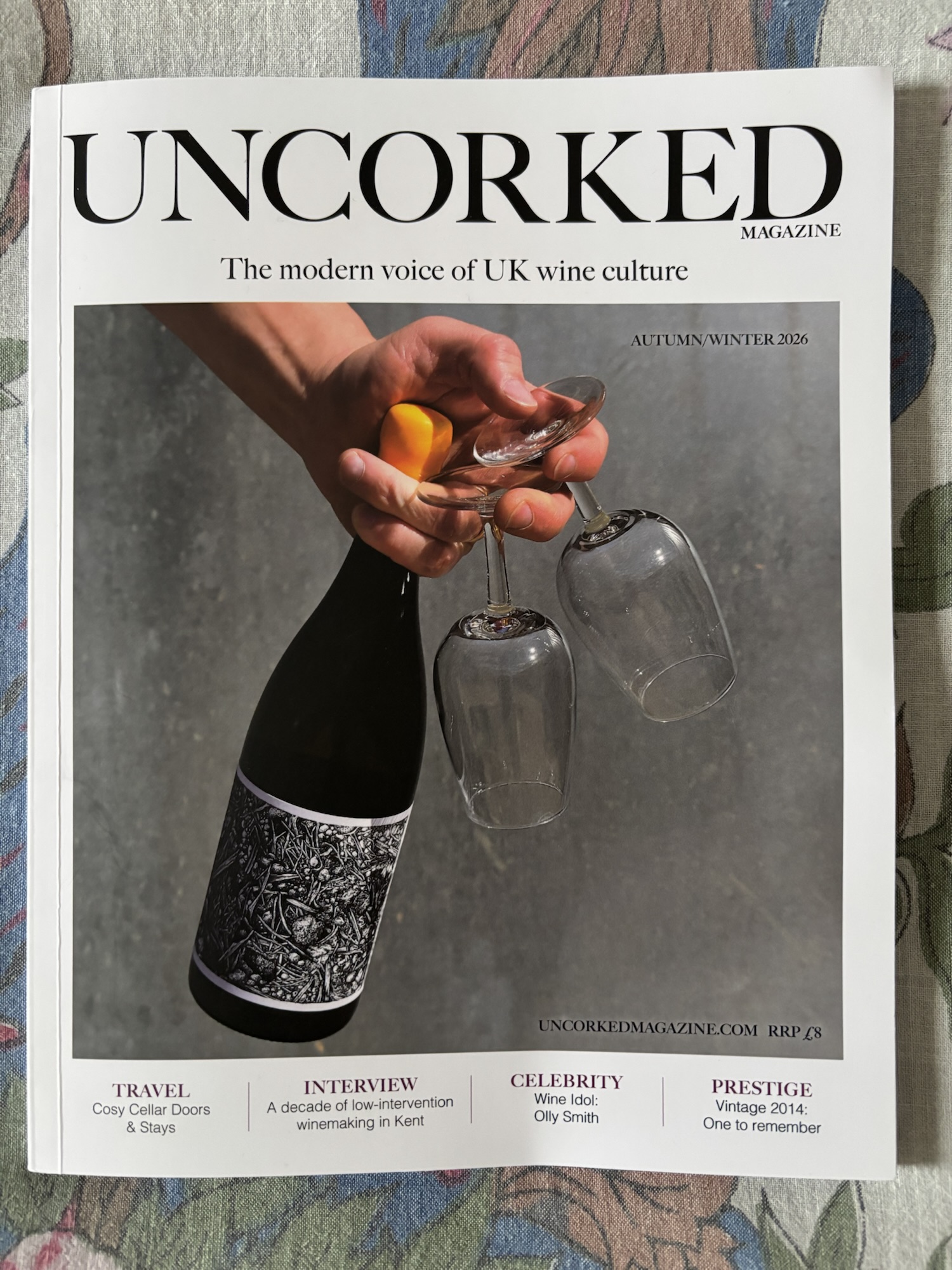
Many wideworldofwine.co readers will see the word “Uncorked” and immediately think of a fine wine shop close to London’s Liverpool Street station. Now we have another Uncorked, this time a magazine which describes itself as “the modern voice of UK wine culture”.
There is certainly a need for a voice like this, one which faces consumers, but might also appeal to wine professionals and winemakers alike. Sitting as I am, as a wine writer now based up here in Scotland, I get to hear little of what is going on down south, but to be honest how much less than when I lived, just a few years ago, in East Sussex? English and Welsh Wine has its marketing of sorts. The umbrella organisation, so to speak, is Wine GB, a trade association with 500 grower/producer members. The UK now has more than 1,150 registered vineyards, but Wine GB claims its membership covers 70% of UK vine hectares.
The UK Vineyard Guide covers around 770 vineyards and there are other online resources, one or two on quite old platforms with old-fashioned layouts. There is already The Vineyard Magazine, but that is really aimed at viticulturists. I could certainly do with the sit-on hedge trimmer I recently read about, but maybe this is not something for the average consumer.
The individual counties appear to have individual representation, although what kind of representation varies enormously. By far the most visible, to me at least, is Vineyards of Hampshire. This is a much smaller grouping of (at my last count) ten producers, including Black Chalk, Hambledon, Hattingley Valley and Exton Park. They hold a “Fizz Fest” at a different member vineyard every summer, and a Christmas Showcase in December. I remember them for their always much-enjoyed London trade tastings, surprisingly the only one of its kind.
So, it is clear that whilst the producers do get a voice, their priorities usually lie elsewhere, mostly trying to sell wine of increasing stature and quality within a legal and excise framework which is not designed to assist them. One thing that would help them in marketing their wine is a consumer-facing magazine with a reasonably high profile.
Whilst English and Welsh wine does get featured in the specialist wine press and magazines, it has to battle with wine from all around the world. It is now fashionable to write about UK wine in more general publications, newspapers and lifestyle magazines, yet the articles here are invariably written to an editorial brief which dumbs down the subject. The question is whether there is space for a consumer magazine which looks (almost) only at English and Welsh wine?
Uncorked’s first issue was published in October, and it will have two issues per year. The team behind it is Alice Griffiths (Creative Director) and Rebecca Pitcairn (Editorial Director). Alice (@alicegriffithswine) is a journalist, English and Welsh Wine ambassador, and like myself holds a WSET Diploma. Rebecca (@theenglishwinediaries) hosts the podcast of that name, and writes for publications as diverse as Business Travel Journal and Sainsbury’s Magazine.
One of the missions they set out in their first editorial is to connect people. That is to connect people working in viticulture and winemaking, but also, presumably, to connect the wider public to the vineyards on their doorstep. They are right to highlight the amazing talent that works in the industry, and to assume that by connecting consumers to these individuals they will gain a warmer, and long-lasting, appreciation for the wines they craft. How do they go about this?
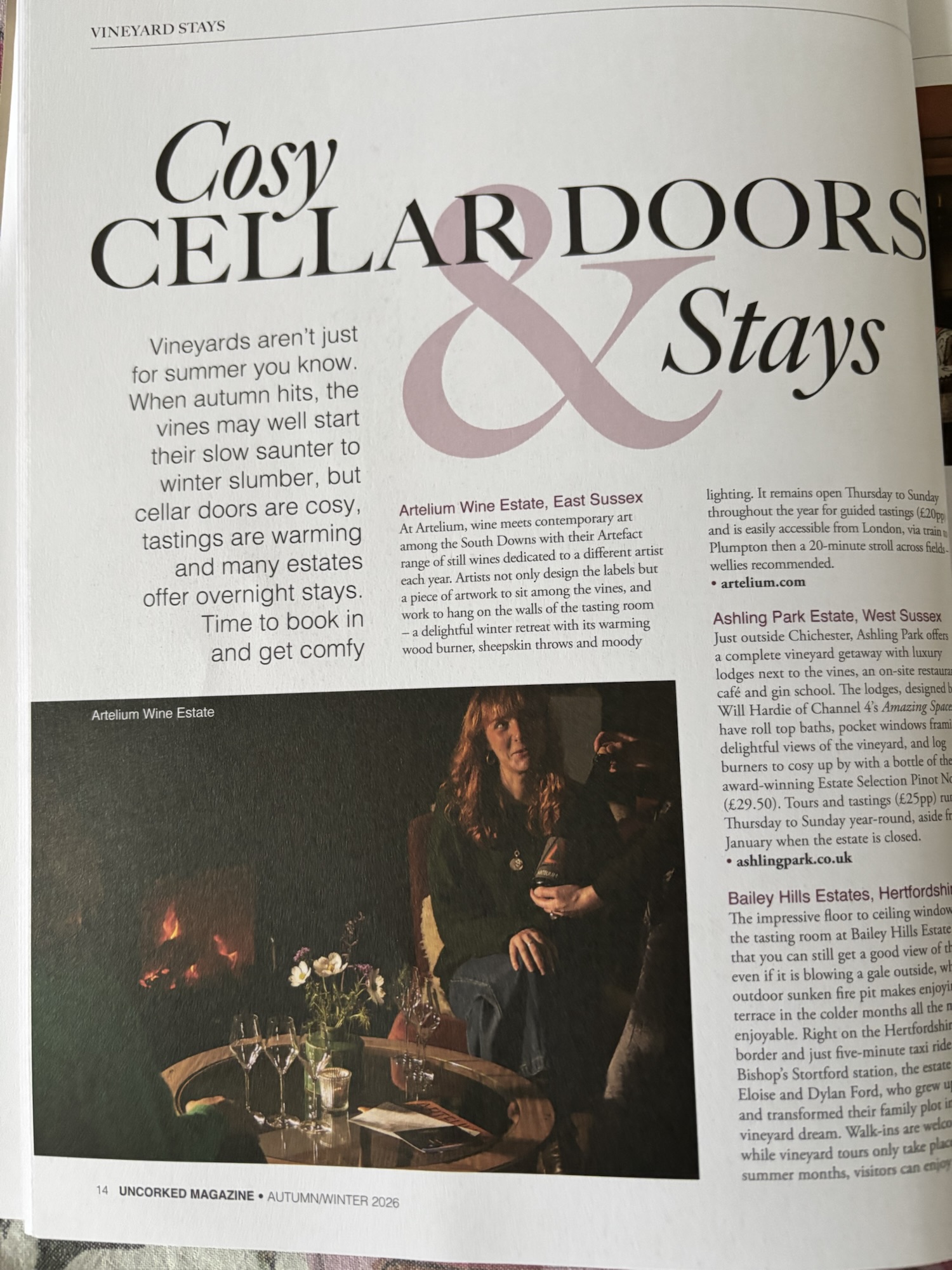
I think it is worth me skipping through the magazine’s contents because what emerges is a mix of wine tourism and a deeper look into the wines and winemaking itself. They start off with a few pages of “News & Views”, snippets highlighting interesting things happening in wine and wine tourism in the UK. This is followed by New Releases, as part of a wider Wine Reviews section. There’s a longer piece on vineyard stays (although boy, isn’t it expensive to stay on a vineyard these days!), with a special focus in this edition on the attractive Sussex town of Arundel as a base for vineyard visits.
There are several interviews at the heart of the magazine. One is with wine personality and now author Olly Smith. Another talks to Megan Spicer who, as Sommelier at Palé Hall in Snowdonia, is a champion of Welsh Wine (very interesting). My favourite features look at what Adrian and Galia Pike are doing at Westwell in Kent (both for English wine and for label design, Galia being the best label designer in the UK in my opinion), and with Tom Stevenson. Tom used to be known as Mr Champagne, but the Champagne & Sparkling Wine World Championships which he runs with Essi Avellan and George Markus have genuine standing in the world of fine wine. That English sparkling wines are now achieving great things at this competition shows how far these producers have come on the bigger world stage.
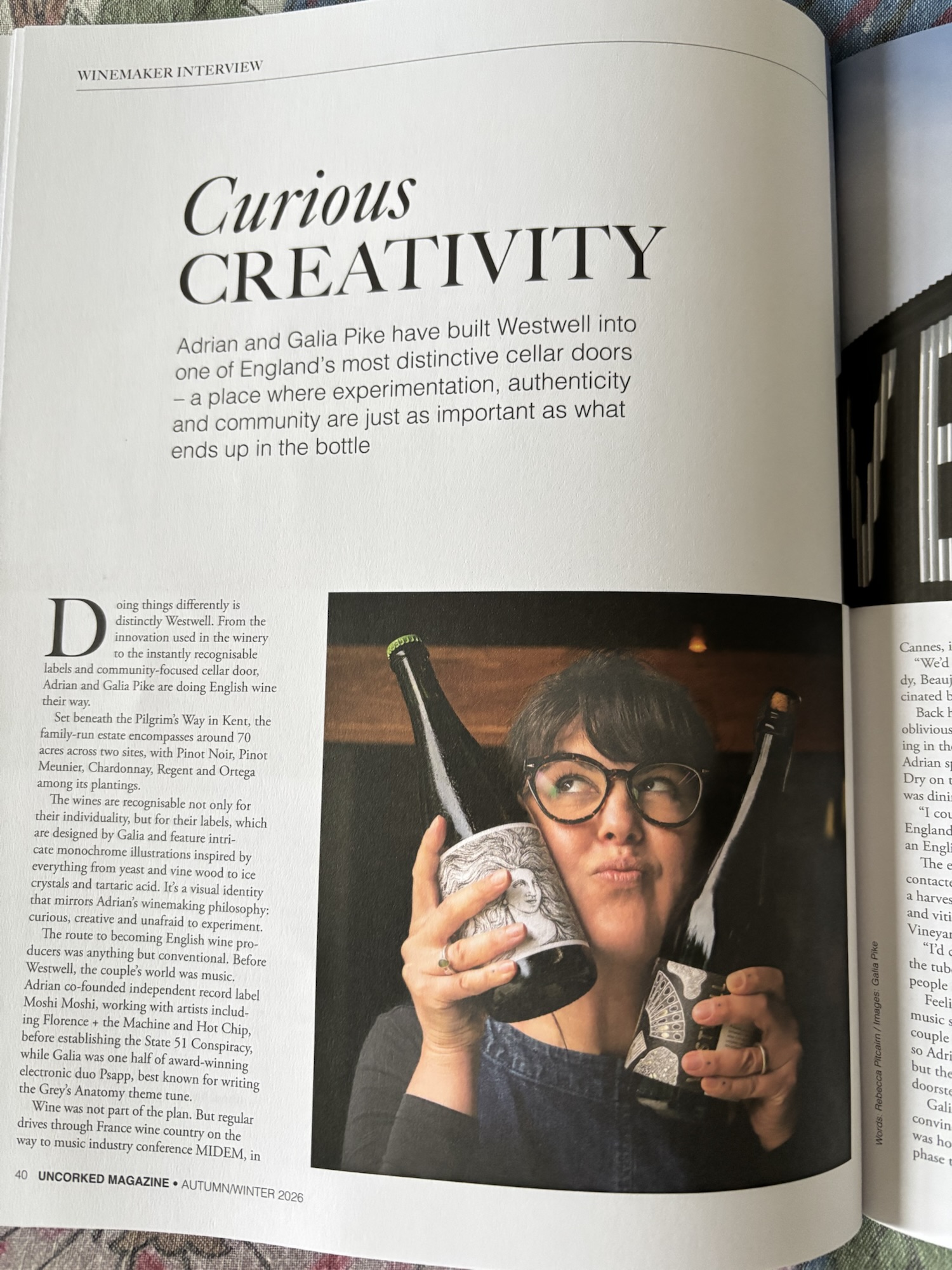
Whilst I love Adrian’s wines I also really love Galia’s labels
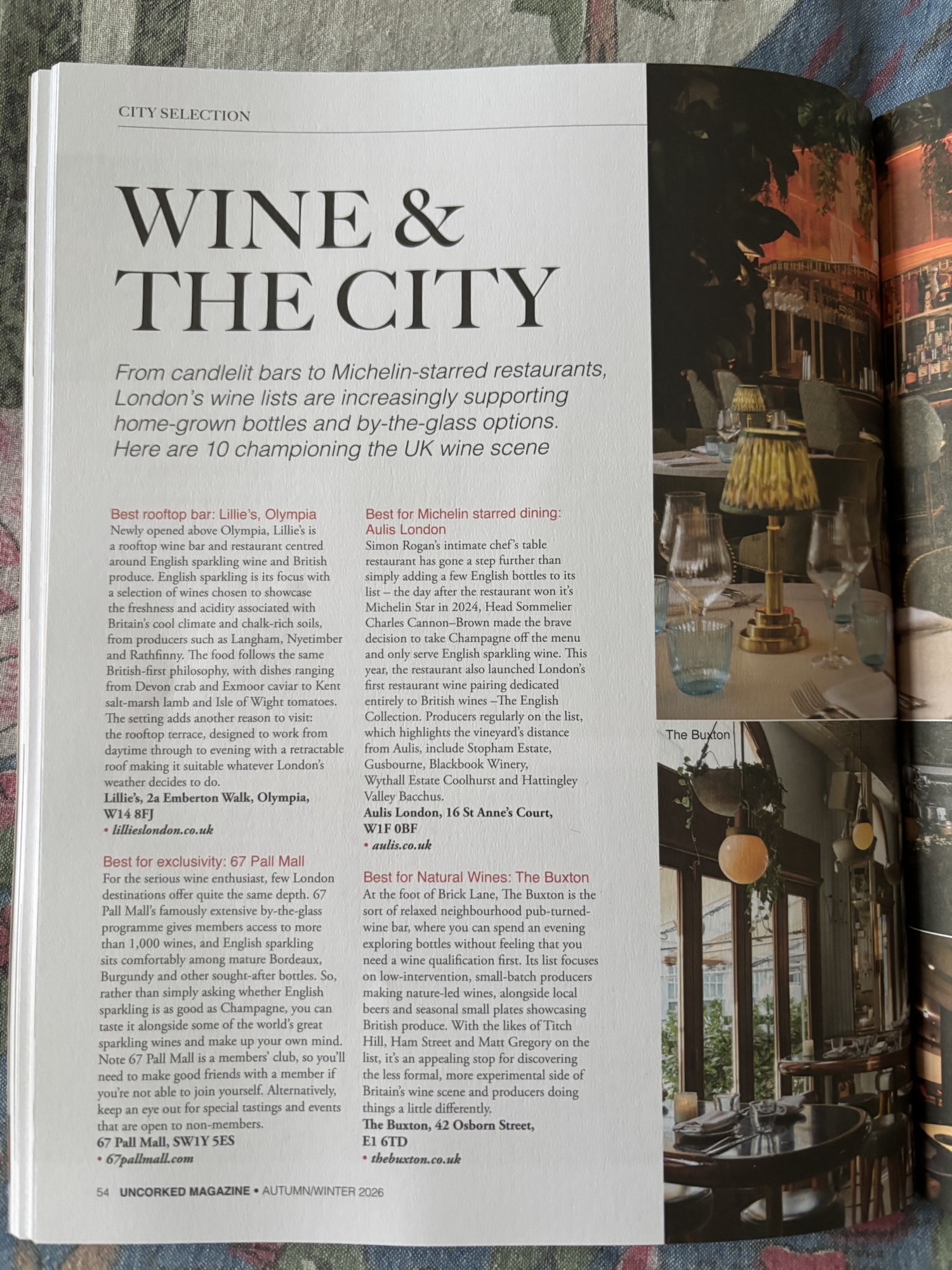
Two more features follow, one on Bolney Wine Estate, and one on bars and restaurants in London that are championing UK wines. The Bolney article is interesting because of the significant changes taking place there. The move to “Champagne varietals” shows an estate moving with the times, though a part of me will regret the passing of their red sparkling Dornfelder, now deemed part of a different era of English wine. Guys, it was a gem!
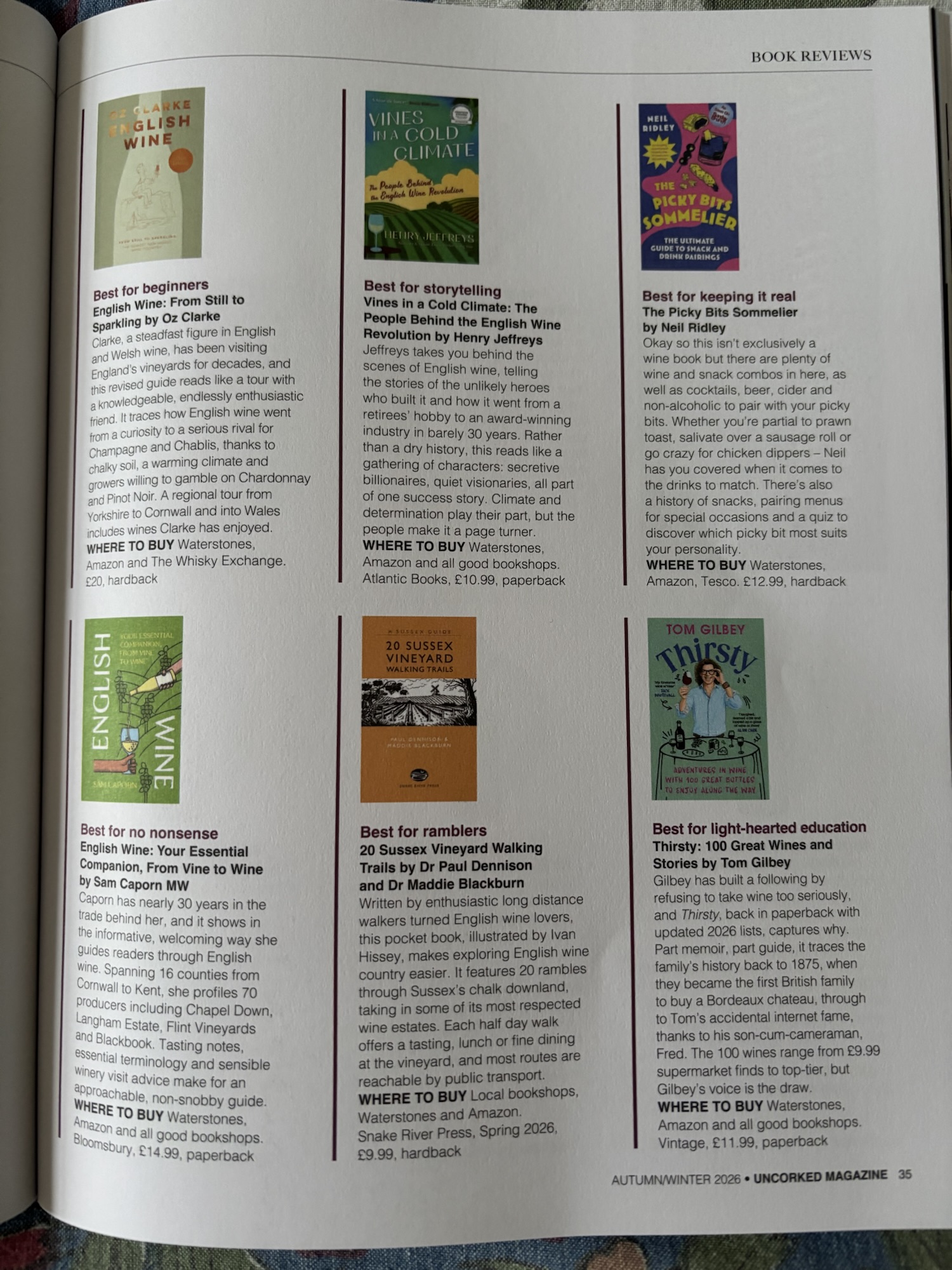
We have a section on (mostly) wine books, not exclusively on UK wines, although those which are not are what you would call a mix of wine at home suggestions and a supermarket wine guide. My favourite book on English and Welsh wine is featured (thankfully – it’s Vines in a cold climate by Henry Jeffreys…I believe I said as much on the back cover). There’s a short review of a book called 20 Sussex Vineyard Walking Trails which, if I still lived down that way, I’d be buying.
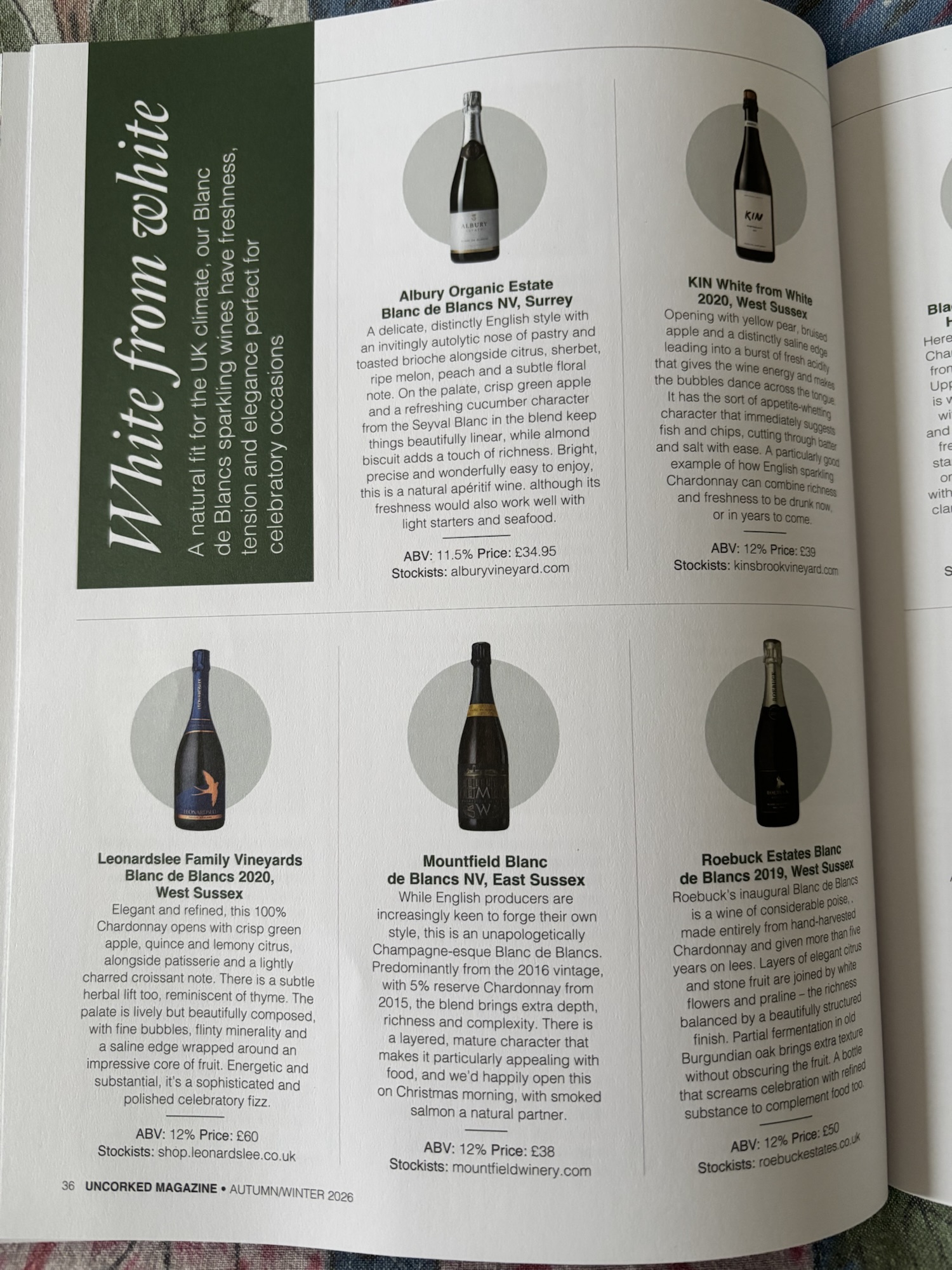
Then we get some more (white) wine reviews for blanc de blancs sparkling, and then a focus specificallyn on sparkling wines from the excellent 2014 vintage. This is followed by “The Directory”, a presumably paid-for listing for vineyards, so far just over thirty, providing contact details and a short paragraph provided to show what they do and what they offer the visitor.
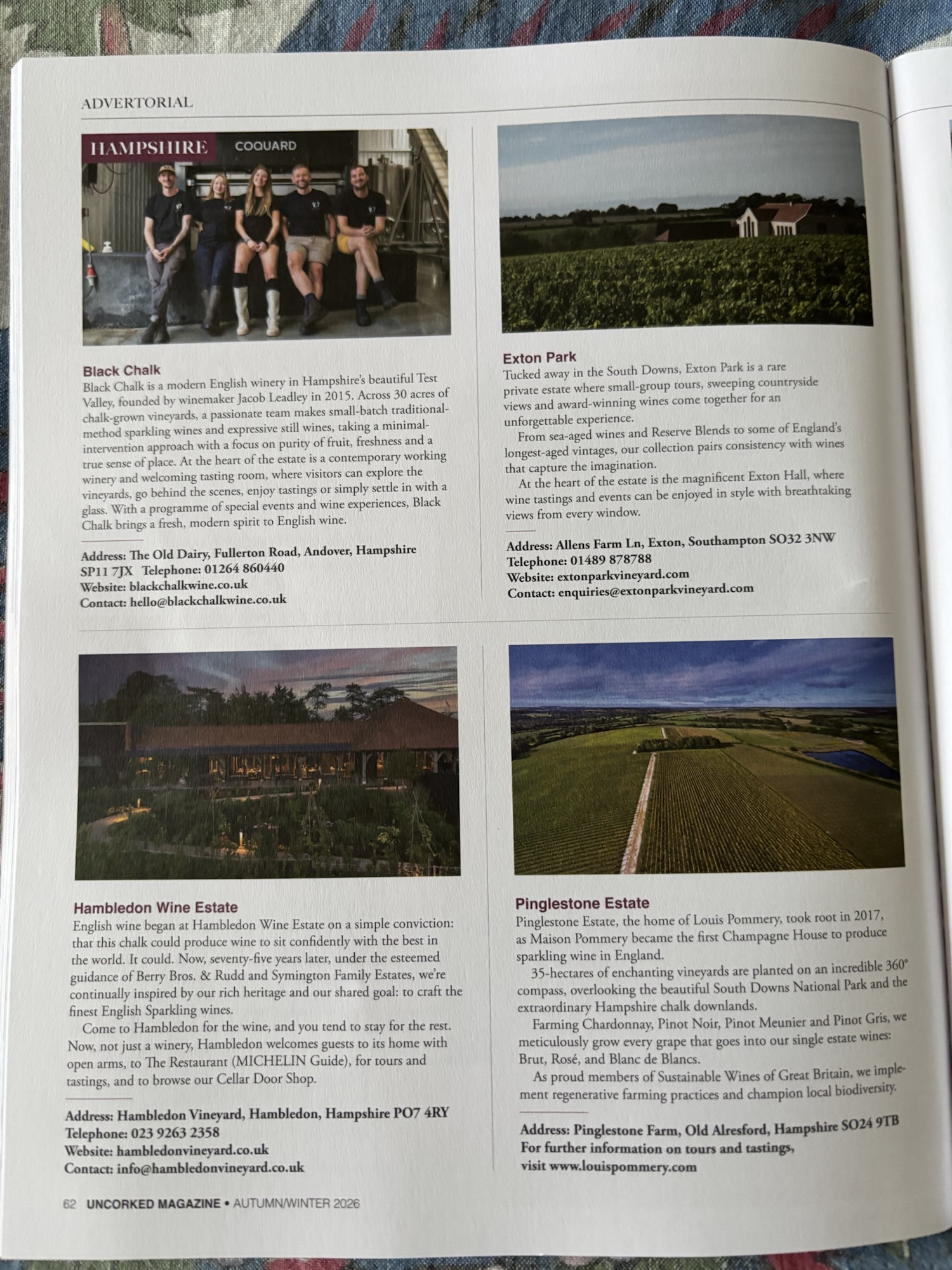
Part of the Directory (they are upfront by labelling it “Advertorial”)
This moves us on to the last part of the magazine, which is called “Wine Escapes”. The first of these highlights The Terrace Rooms & Wine in Ventnor on the Isle of Wight, but then we get some random suggestions for overseas destinations: short pieces on Alicante, Cerasuolo di Vittoria (Sicily) and Chianti Classico, plus a wine ski safari in the Dolomites. Some might wonder why they are there, but then, why not?
There’s a longer piece to close the magazine on visiting the Neusiedlersee. Now this is somewhere I can recommend highly. I’ve visited several times, both for day trips from Vienna (with bike hire, as you can not only cycle around the lake, but you can put them on the small ferries which cross it), and a couple of times staying in Rust. I would say that at least half-a-dozen or more of my favourite Austrian producers make their wines around this shallow lake, but sadly none feature among the recommended wineries to visit.
So, what are my conclusions? This is a magazine with high production values, printed on quality paper. It is well set out. My only production gripe is that the print for the bulk of the main text is incredibly small. I wanted to find the point size but I failed to find my old measure. For me, the whole product has a bit of the feel of World of Fine Wine, albeit smaller and thinner, which is certainly no criticism.
However, the magazine’s success will rest on the contents. It’s impossible to make any predictions merely based on the first issue, but one presumes the team wanted to open with their best shot. It is inevitable that they won’t be able to please all the people all of the time, and if you accept the necessity to reach as wide an audience as possible, I’d say they’ve done a pretty good job.
If I am personally less interested in reading about some of the expensive vineyard stays one can find, I’m sure others will find what they want for a short break or a longer stay. For someone with quite deep wine knowledge like me, I enjoyed the features on wine producers, and on Tom Stevenson (whose thoughts are always worth my attention). I also relished finding out about wines and producers I don’t know. If Wine GB alone has 500 members, there are very many I don’t know.
If parts of the magazine seemed superficial to me, that was well-compensated for by the greater part which I enjoyed reading. I’m sure many will pick up this magazine at a winery and find some of the content conversely above their heads, and it’s a fine balance the editorial team need to address.
There is much that could have appeared in this first issue, but longevity dictates that there must be articles in production for the next, and subsequent, issues. I would love to see articles on Dermot Sugrue, Breaky Bottom and Black Chalk. No doubt we will see articles to come on the still wine revolution, the next phase in the journey for UK wine, and certainly on our so-called English Burgundy (hyped, perhaps, but still…), Essex and the Crouch Valley.
I also hope that future editions will focus on some of the outliers of UK wine. A host of producers including Tim Phillips, Matt Gregory, Sophie Evans, Ben Walgate, David Morris and Daniel Ham (to name only a few) may be small, but they are all doing things at the fringes of UK wine which are undoubtedly pushing boundaries. What they are doing may be niche right now, but the future usually starts at the perimeters (take Ben Walgate putting in Qvevris when he was at Tillingham, not long before my first visit there in early summer 2016).
And going back to Bolney, their rejection of “heritage” varieties planted in the UK comes at a time when hybrids and PIWI varieties are getting reassessed in the case of the former, and enthusiastically planted by some producers in the case of the latter. Take another pioneer, Tim Wildman MW, and his work on preserving (and making wine from) some of the UK’s less-appreciated and fast disappearing heritage vine stock, which goes kind of hand-in-hand with his documentary series Sustainability: Countdown to 2030 and a film on regenerative viticulture.
I’m sure we shall read about many of these Topics in future issues.
Uncorked is published biannually and costs £8 for a single issue, £14 for an annual subscription of two issues. The cost is no more than that of many specialised magazines these days, and one hopes that it is a price they can maintain despite current inflationary pressures which doubtless affect production of the magazine as much as they affect our participation in its contents (especially at the level of one of the English sparkling wines featured, which costs £225 a bottle). One also hopes that the magazine yields up some interesting articles on the development of UK wine for many issues to come.


