I’ve already reviewed four of the Smart Traveller’s Wine Guides published by the Academie du Vin Library. They are another string to the bow of this publisher which has rejuvenated wine publishing since taking over the Infinite Ideas Library. I’ve recently taken delivery of three of their new wine books, so expect the diversity of what they are doing to appear on these pages over the next several weeks. I’m currently reading David Gleave’s magnificent tome on Barolo and Barbaresco.
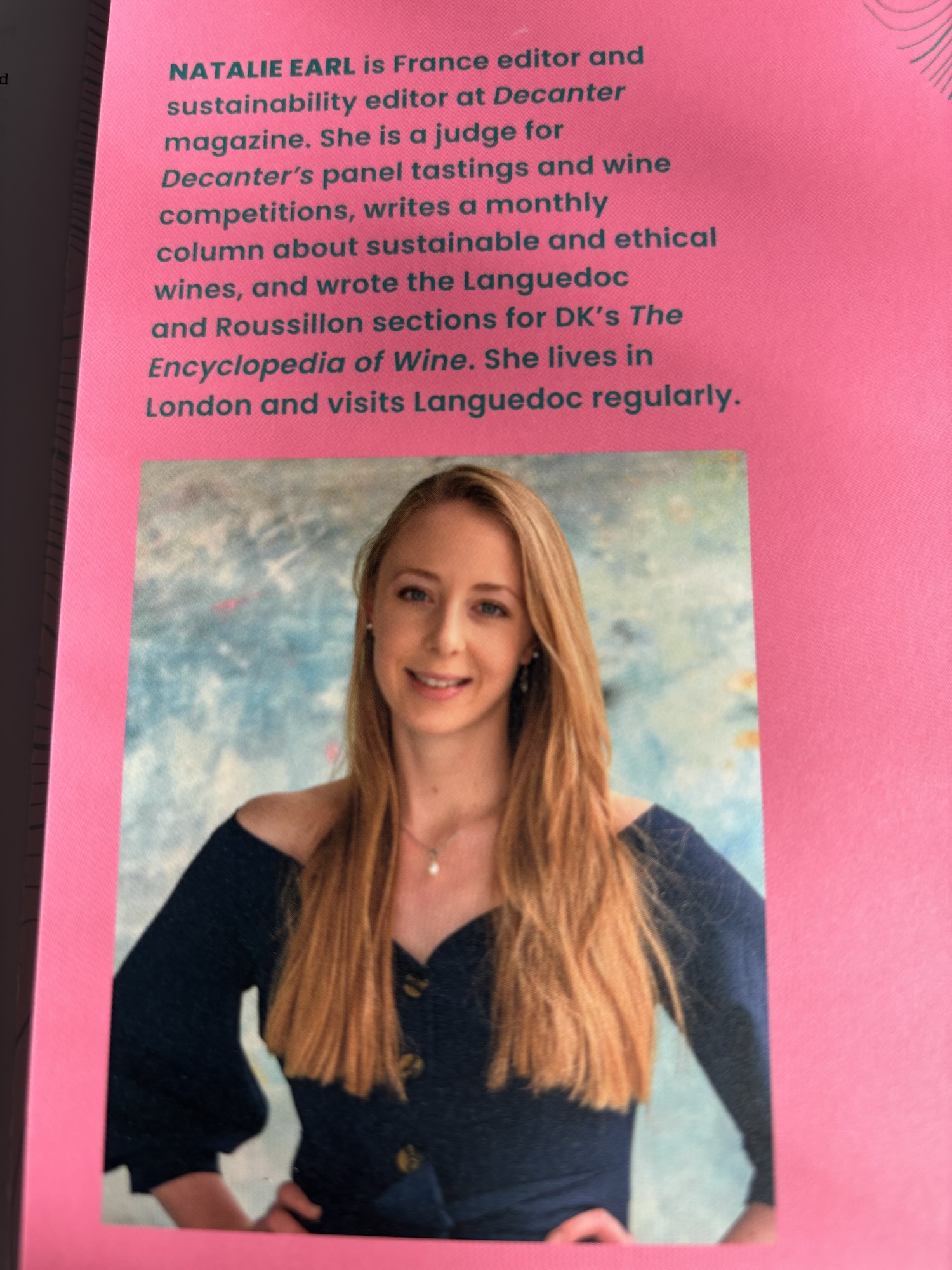
I’m starting with the Smart Traveller’s Wine Guide to Languedoc, written by Natalie Earl. Natalie will be well known to Decanter readers, she’s its France, and Sustainability, editor and also writes for the Decanter column “The Ethical Drinker”. Her latest venture is a podcast series with Paul Caputo called For Those Who Know the Loire (I think the first episode on Muscadet has just gone live).
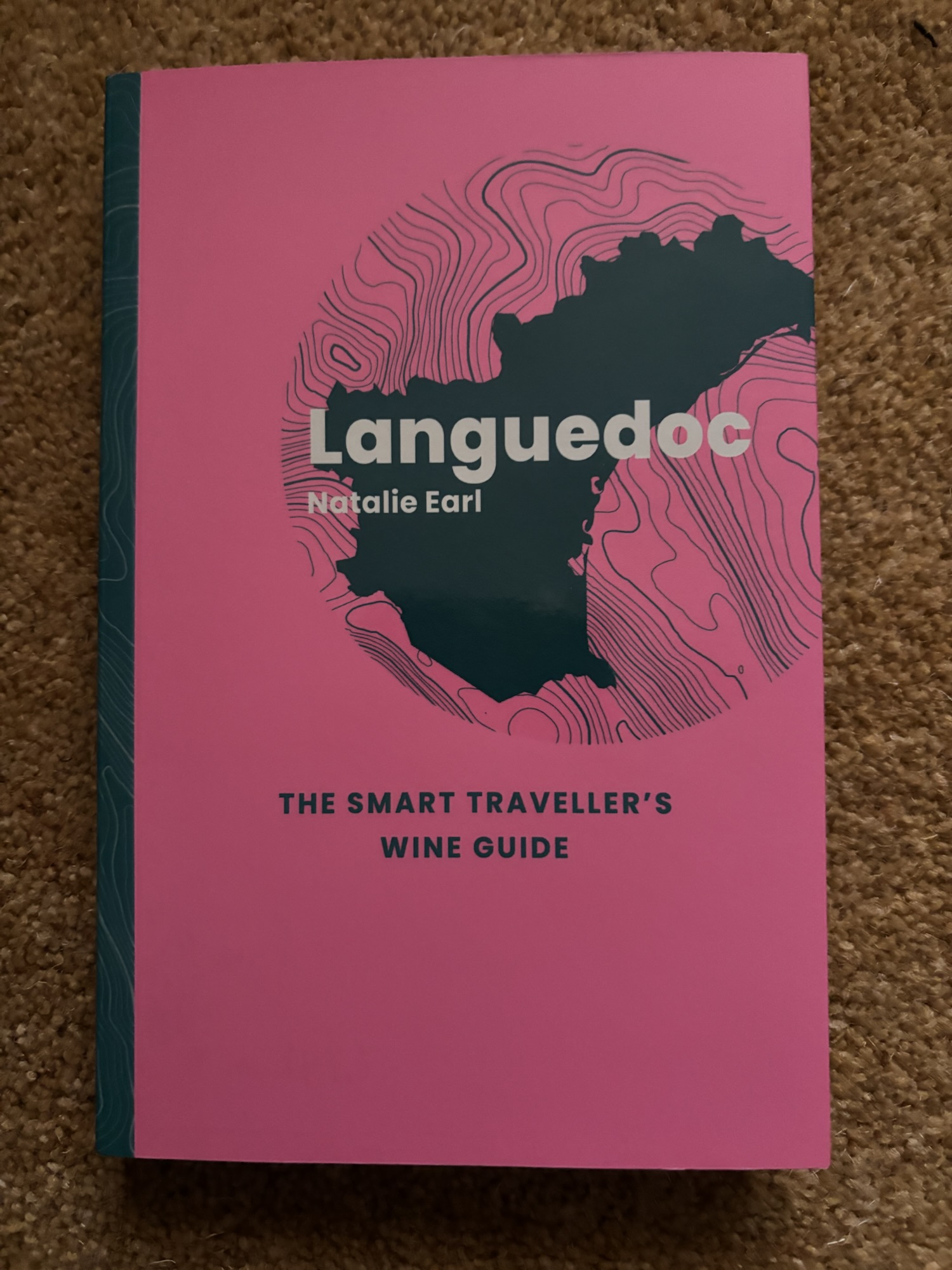
I have a long and chequered relationship with the Languedoc Region. If you treat Languedoc as separate to Roussillon, which this guide does, then it is probably my second least visited part of France, that’s in over forty years of visiting the country, indeed at least once every year between 1983 and Covid. Brittany is the only place I’ve visited less.
However, what makes this strange is that for many years I was a big fan of the region’s wines, from drinking Pech Redon La Clape in maybe 1984, through some interesting bottles from Oddbins and Majestic in the late 80s/early 90s, to discovering the likes of Daumas Gassac, Grange des Pères and Peyre Rose, largely through Adnams in the same period. By the mid-1990s I was as regular a customer at Les Caves de Pyrene as I could be, and it would take a whole article to list the wonderful Languedoc wines I discovered through Eric, Doug and company. I also bought wine a few times, not nearly as often as I would have wished, from Leon Stolarski Fine Wines, sadly missed but one time purveyor of the insider’s top list of Languedoc’s secret stars.
However, as my tastes moved more towards natural wines, I also found that my predilection for higher alcohol red wines waned, and my buying began to concentrate on cooler climes. The wines on the whole remained good value, especially compared to the likes of Bordeaux (which I abandoned because of prices as much as alcohol levels).
The pendulum always swings though. I think it is in part nostalgia. I found myself craving a nice Merlot-dominated Pomerol or Saint-Emilion the other day, though a restaurant isn’t the best place to have such a craving. I had to settle for a Lussac-St-Emilion satellite wine for £54. But my point is I’m definitely starting to drink more Languedoc wines again.
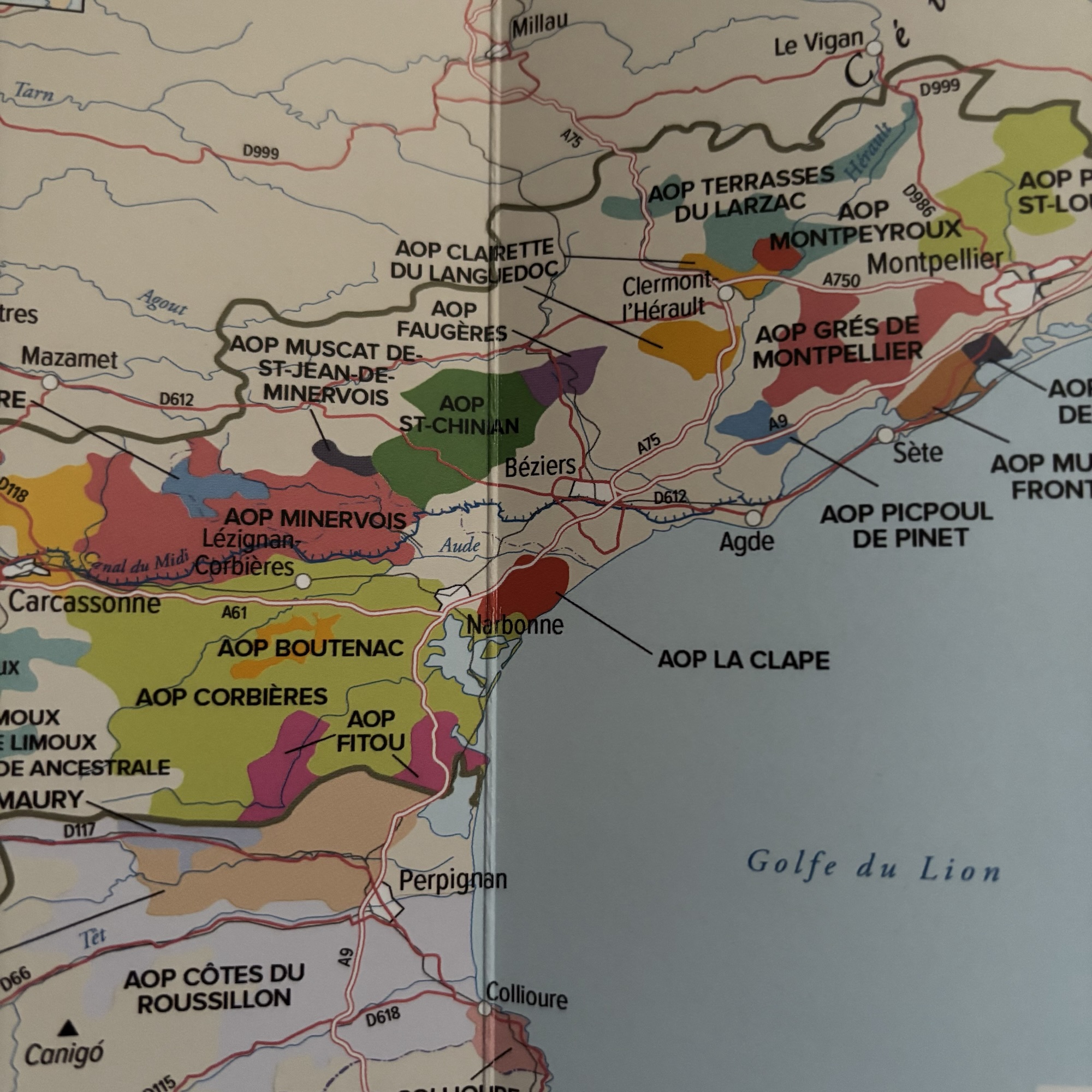
(Maps by Cosmographics)
Whilst some Languedoc reds remain powerful, many are lighter, not least those which form the so-called “blouge” category (lighter reds made from a blend of red and white grapes). And then there are the whites. The region is making fabulous white wines now, many with genuine depth and complexity at sensible prices. Hard-pressed consumers just need to taste them.
Another change for the better, in my opinion, has been a falling in love again, by the region’s quality producers, with Languedoc’s autochthonous grape varieties. I remember producers like Clos Centeilles making excellent whole-bunch style Carignan when everyone else seemed intent on planting Cabernet and Merlot on the plains. There’s no doubt that artisan wines made from autochthonous varieties are better than ever. The producers just need to find a market for them, and in the UK The Wine Society seems, on current form, to be trying hard to do that.
What is fascinating on reading Natalie Earl’s new book is just how many wines from my past, sometimes very long past, seem to be still going strong today, and before diving into the book itself, I would like to mention a few producers who were there at or near the start of my wine journey in the 1980s and 90s. Alongside the region’s star names, I also saw mention of Château Penautier, Mas Brugière, Domaine and Château Maris, Maxine Magnon (though slightly later), Mas (Jeff) Coutelou, Domaine de Cébène (since 2007), Mas Cal Demoura, Pech Redon, Châteaux La Baronne and Ollieux Romanis, and Clos du Gravillas, a list which is not exhaustive by any means. It felt good to see them still very much alive with (in many cases) reputations much enhanced from those earlier days.
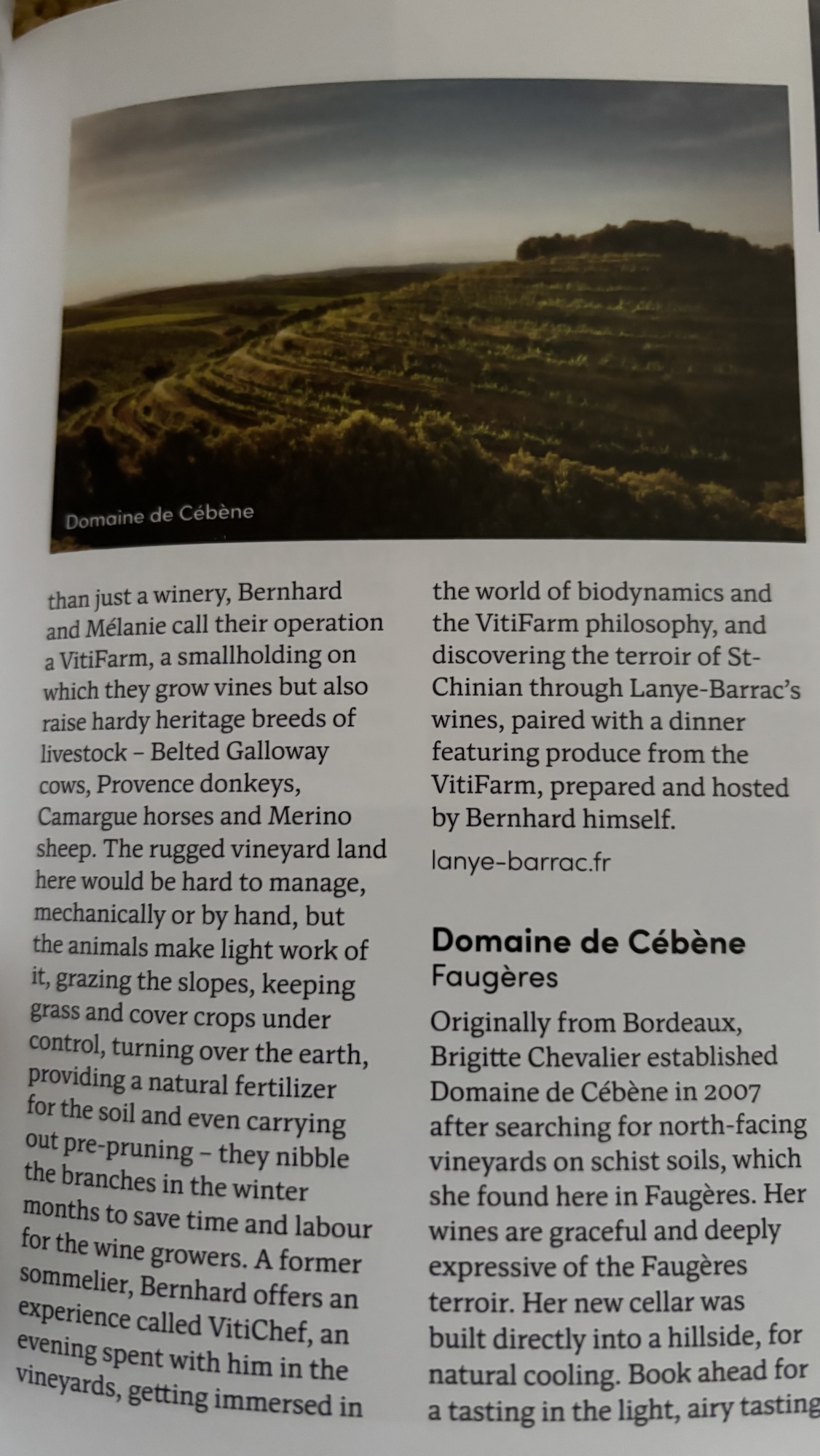
Brigitte Chevalier’s Domaine de Cébène has been one of my favourite Languedoc producers for close to twenty years now
So back to the beginning. These guides follow a broadly similar format, and remember that they are not guides to the region’s wines alone. They act as a travel guide, for wine lovers yes, but they do acknowledge that most wine lovers do not only want to visit wineries (try telling that to some wine trip organisers where four-to-six producer stops in a day are not unknown), and indeed wine obsessives more often than not may have a less enthusiastic partner in tow, and maybe some even less enthusiastic children.
We begin with a little history and geography/geology, before an outline of all the region’s appellations and wine styles, then grape varieties etc. The “Year in Languedoc” is a kind of what’s on by month, festivals wine related and otherwise plus seasonal foods and specialities. The “Things to See and Do” pages are where you will find your history and culture alongside a whole raft (and canoe) of different outdoor pursuits, before we come to the wine routes. In this guide there are just two itineraries, covering Eastern and Western Languedoc. However, each one suggests an eight-day tour, which adds up to as much travelling around as in the previous guides which have more shorter routes.
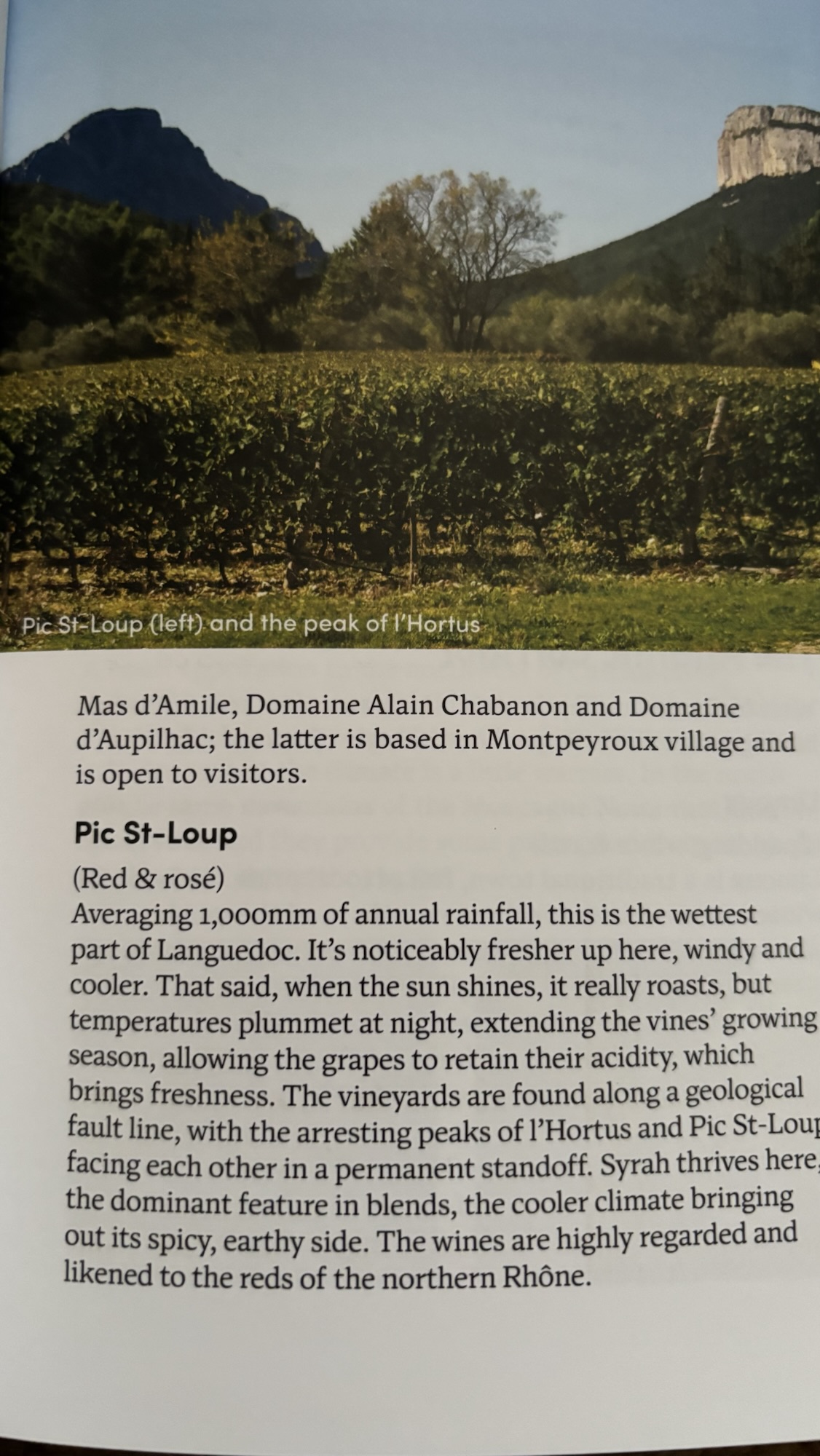
As quality became a focus in the region, smaller appellations were created with this in mind, here Pic St-Loup
Then we come to the part of the book called “The Guide”. The photo below shows a mini-contents. “Wineries to Visit” is useful to enable us to see those estates and domaines which are (best with an appointment) actually geared-up and happy to have visitors. Remember that many winemakers struggle to find the time to receive visitors, especially when there’s a lot to occupy them in the vineyards or winery. We do need to be a lot more aware of the time pressures those who make wines we love to drink are under, and temper our expectations that they might drop everything to open their meagre profits for the sale of a bottle or two.
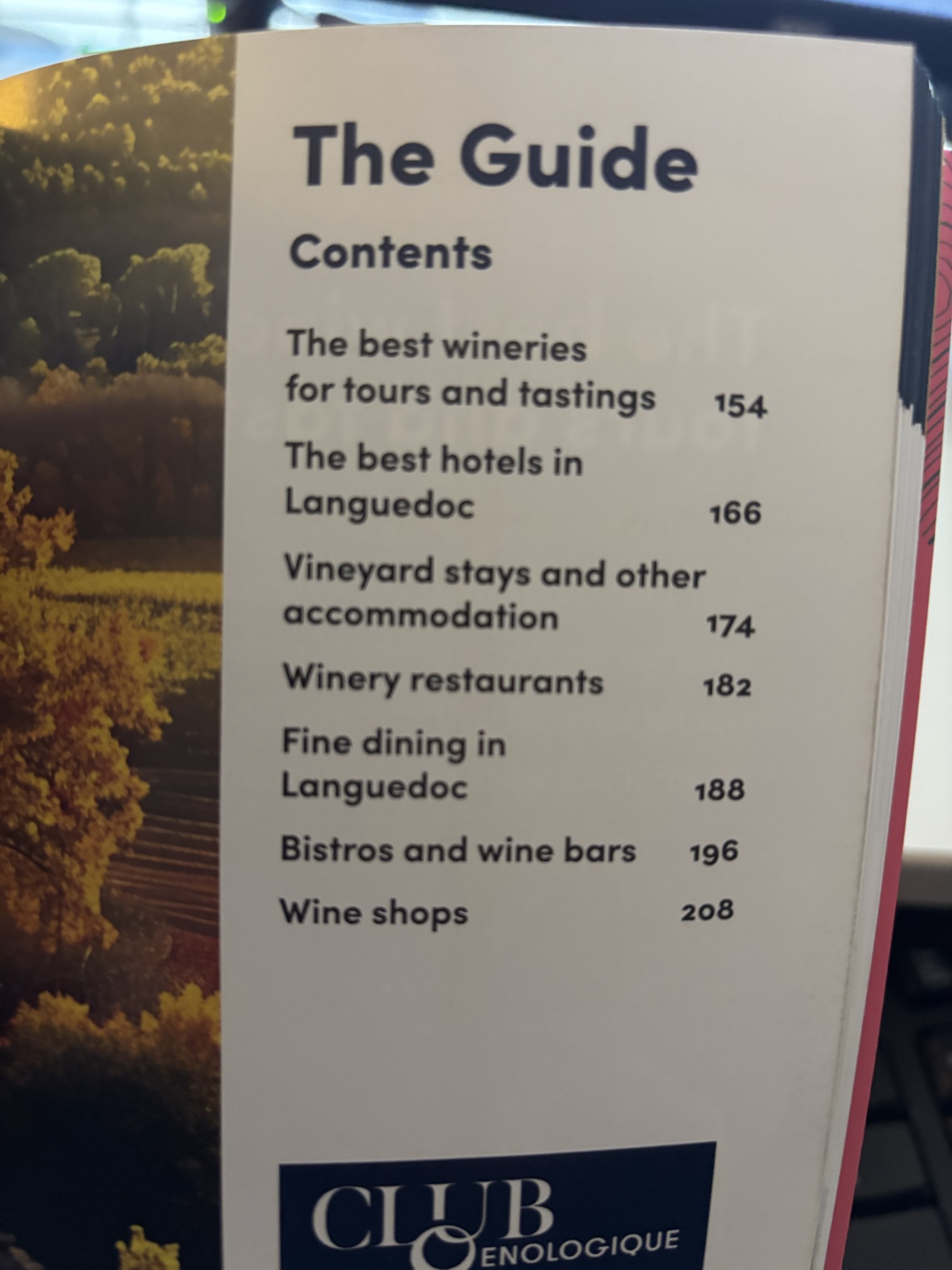
Plenty of hotels get a mention, but other types of accommodation are listed as well, including cheap camping and very expensive glamping. Although the region is full of places to stay, I would assume those listed here are going to be of interest to wine lovers, and some are close to specific vineyards, or even on a wine property.
For me, you can’t beat the insider knowledge when it comes to listings for both bistros and wine bars, and for wine shops. Natalie has spent a long time in the region, and many visits to family there. The recommendations here seem particularly strong. These places are, for me, the most useful. At my age, non-stop fine dining would not be great for my health, even if I could afford it, but a bistro with a glass of local wine at lunch and a market haul for dinner in the evening, where dining in allows the driver a more liberal quantity of wine, is my route to happiness these days. As with the previous guides in this series, plenty of winemakers have also been roped in to let on which are their favourite places to eat.
A good local wine shop sometimes allows you to take back a much wider range of wines than you will get from focussing only on buying from the domaines. A good number are mentioned and they all sound pretty inviting. Mind you, there are one or two producers I would be pleading for a tasting at (Mas Coutelou, Domaine de Cébène, to name two). But if you are buying a case at a couple of domaines, I imagine a wine shop or two will supply that variety which I’m sure you crave as much as I do.
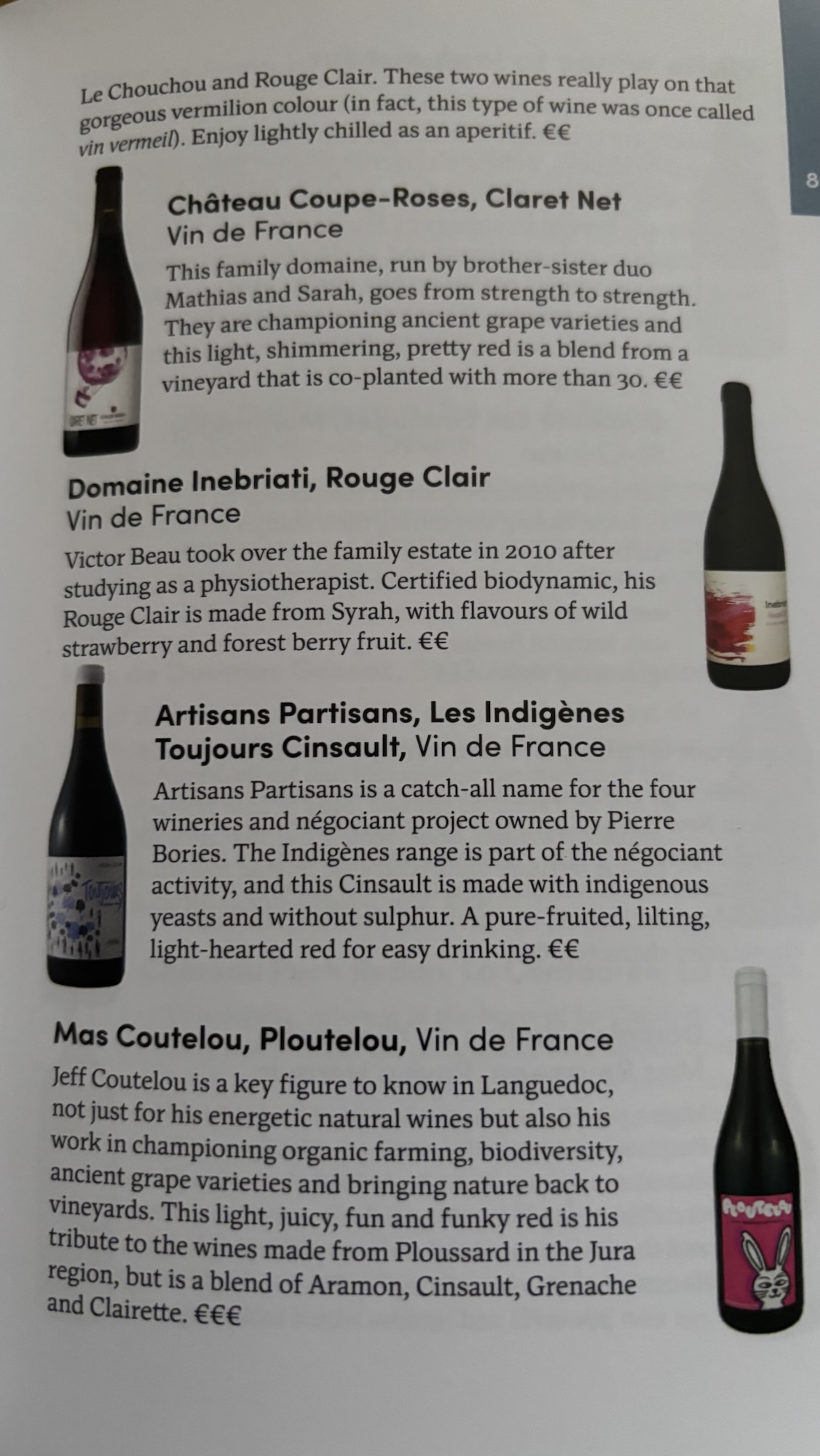
The selection of recommended wines includes Jeff Coutelou’s “Ploutelou” which typifies the kind of Languedoc wines I’m now drawn to – lighter natural wines
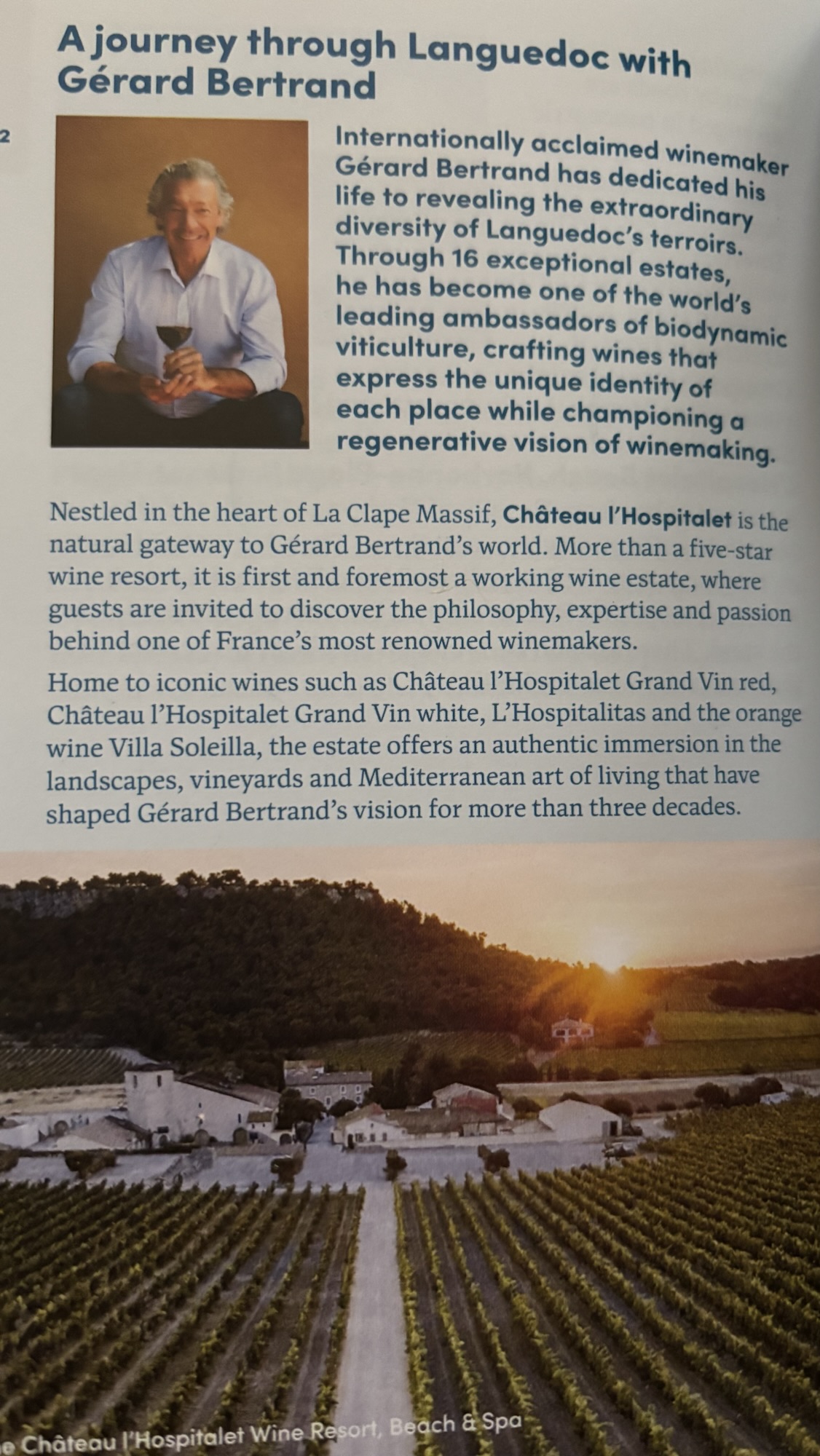
There are blue pages sections which are either paid for or promoted content. Most are just a two-page spread about a particular sub-region, eg Minervois with “content supported by AOP Minervois”. There is also a two-page spread on Gérard Bertrand (“Content supported by Gérard Bertrand”). There is no doubt that Bertrand is a major player in Languedoc, and that his fame as a wine producer now surpasses that which he experienced as an international rugby player. He does get a mention several times in the book, both for his wines and also for his hospitality initiatives. He also wrote the Foreword. However, he does certainly make some good wines, whether his fine wines or those which are a good introduction to the region. I have no experience of his Château L’Hospitalet resort project which gets a big plug, but I sure wouldn’t turn down a night or two there, were I a bit of an Insta influencer.
I count these guides a success if they both make me want to visit the region in question, and to drink more of its wines. Both are emphatically the case with this Languedoc guide. Natalie Earl combines good knowledge, much derived from her time spent in Languedoc, with an enthusiasm which comes across. When I reviewed the new World Atlas of Wine I remarked on there being a number of younger contributors on board, and how this can only be a positive thing. Same here. Natalie has the knowledge and ability to write that we need for the future of wine writing, and of course Decanter has long been a good proving ground for future wine writers.
Having a young person approach the region not only gives us new perspectives, and a definite sense of enthusiasm. I also get the sense, despite being less young myself, that this is the kind of guide that will appeal to younger drinkers as much as it undoubtedly appeals to me. I am also pretty sure that some of the older writers do not always have their finger firmly on the pulse of what is happening on the ground right now. As enthusiastic as I am for the new Wine Atlas, I usually find that the producers I think are pushing boundaries or creating a stir don’t get a look-in, more conservative names getting their obligatory mention. I can’t make that criticism here.
I suppose it is all relative and subjective though, but here you get a feel for a vibrant wine scene, even when the region, indeed the whole of Europe, is in something of a crisis of production versus sales right now. That’s all the more reason to support the best winemakers, where possible by buying their wines, or at least if you can’t, by telling people about them, the latter being something at least I am able to do.
I will quickly mention the photographs. Even in a small format book like this, the photos, whether of landscapes, buildings or food etc are excellent, and they really enhance the text. Those of the region’s many castles, Cathar and otherwiese, would make many readers determined to travel to the region for a holiday. Some were taken by Natalie herself. The maps were created by Cosmographics, who undertook the revisions and the new cartography for the newly published 9th edition of the World Atlas of Wine.
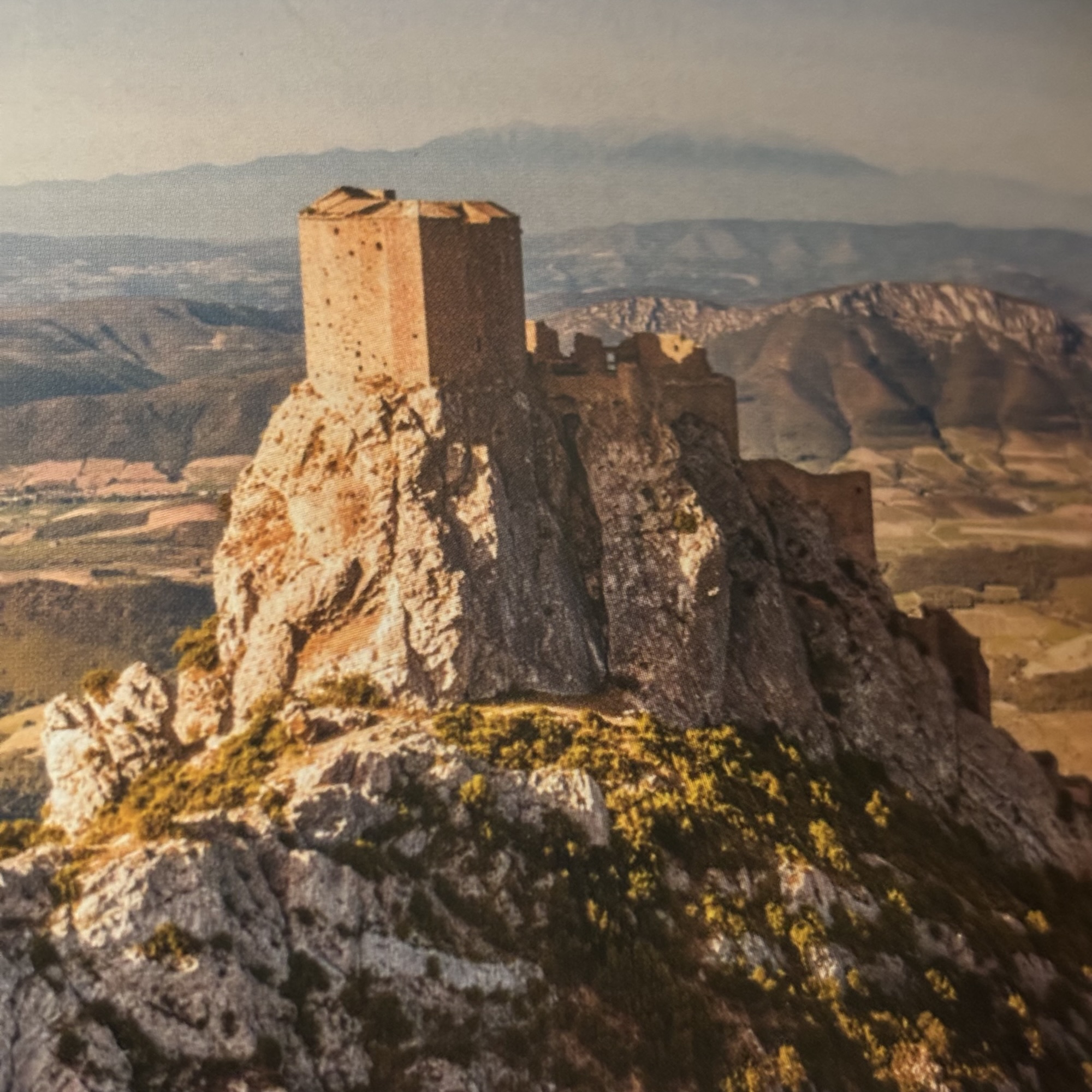
The Cathar castle of Qéribus near Cucugnan (Aude)
So, I hope my own enthusiasm for this book comes across. I’m very glad to own it and it will definitely go with me on my next long-planned viticultural road trip, whenever that will be. It will be one of several in the backpack, and who knows how many more of these travel guides will be published before then?
The Smart Traveller’s Wine Guide: Languedoc by Natalie Earl is published by the Academie du Vin Library (in partnership with Club Oenologique), priced £12.99 (US $17.95). Contact Académie du Vin to purchase and to see the other Traveller’s Guide titles at http://www.academieduvinlibrary.com .