Clay Wine Fair 2025 (Part 2)

In this second part of my article on the inaugural Clay Wine Fair (16 February 2025, organised by Isobel Salamon of Slonk Wines and hosted at Sotto Trattoria in Stockbridge, Edinburgh) I will cover a similar number of wines as in Part One, but from a few more importers.

As with Part One, the breadth of countries and regions which are represented is wonderfully wide, although there are still many parts of the world making wines in clay or terracotta vessels, from qvevri to talha and many variations in between that were not represented (including North and South America). But as I said at the end of Part One, none of the wines on show tasted at all like those early tannic examples of orange wine that we first discovered fifteen or twenty years ago.

Everything listed here I would be happy to recommend, although I have tried to suggest those wines which particularly stood out. As I also said in that first part of this article, the quality went from good to outstanding. If you missed Part 1 you can click on the link in the list of articles to the right, or type “Clay” in the search box. I hope that means the Clay Wine Fair was as much of a success as it appeared to be, and will be repeated again.

L’ART DU VIN/CLARK FOYSTER

Clark Foyster you will know, L’Art du Vin is a small agent stocking organic and biodynamic wines, I think based in Dunfirmline. This was a small table showing just four wines, two from Georgia and two from Portugal.

Orgo is the winery of Gogi Dakishvili in Telavi, Khaketi. Gogi is a well-known consultant but this is his “passion project”. The vines are on both banks of the Alazani River in the warmest part of Georgia, the Caucasus to the north acting as a rain shadow, but water is plentiful because of the mountain streams.

The Orgo Rkatsiteli is a 100% varietal wine both fermented and aged in buried qvevri for six months, all on skins. The bouquet has whisps of honey and yellow plum. The palate is smooth and gently textured, mirroring the bouquet in its flavours.

Orgo Saperavi (also 100% varietal) is a deep red full of freshness and gentle grip. Blackcurrant and dark chocolate dominate, and you can tell these are old (80-y-o) vines by the concentration.

Both wines retail around £25.

Na Talha Branco and Tinto from Gerações da Talha are a pair of Portuguese wines from the former talha stronghold of the Alentejo, where the art of making wine in these tall terracotta pots is being revived. The region’s clay soils mean the material to produce these vessels is right on hand. These are both organic wines, aged on lees with only the natural filtration provided by the “mother”, the solids sinking to the bottom of the talha.

The Branco is a light-bodied wine redolent of apricot and peach with a soft texture from the talhas. The Tinto is, like the white, a field blend, in this case of ten varieties, including Alfrocheiro, Trincadeira and Aragones (aka Tempranillo). Almost like the Georgian red above it majors on dark fruits with a chocolate note on the finish. The red is ready for sale on Saint Martin’s Day, November 11th, so treat it like a “Nouveau” (with the proviso that there’s no hurry to drink this up).

Both retail around £25.

PARCHED (formerly NATTY BOY WINES)

Natty Boy Wines say they grew up, so changed into Parched. I think they felt that producers would take them more seriously. They are still focusing on the same very natural wines (and other beverages) though. They still also have the shop and bar, Dan’s, on Tottenham Road, London N1.

First up, Domaine Gross from Alsace. Vincent Gross and his father, Rémy, work ten hectares around Gueberschwiller, in the warmer south of the region (Haut-Rhin). They follow biodynamics and for almost all of their wines now they are experimenting with longer macerations and, since 2021, using qvevri.

Domaine Gross “Tryo” 2022 blends Pinot Gris, Riesling and Sylvaner into a soft orange wine with a deceptive 13% abv. There’s a gentle pink colour from the PG skins and the wine is saline, mineral and savoury with notes of both oranges and tropical fruits. Delicious, especially at £23. My kind of skin contact Alsace, and the wine at this table I’d be tempted to buy first.

“Sonate” 2022 is a varietal Pinot Gris. I’m guessing this is slightly darker (tasting from the clay cup we had the interesting option to use it was hard to tell). There are more red fruits here, and a slightly earthy texture. It’s altogether more serious, possibly a wine to age, but impressive. It retails for £32.50. A friend in the region says Vincent is a nice guy, always a consideration.

Parched also showed a pair of Saint-Joseph wines from Domaine de L’Iserand, both very good indeed. Jean-François Malsert (another “Jef” like M.Coutelou) replanted his grandfather’s vines and released his first vintage in 2017. He has five hectares, all worked by two mules. He aims for freshness, so is a proponent of carbonic fermentation, but most wines are aged in either amphora or concrete (both here are amphora-aged). Definitely a producer to watch closely.

The white was a 2023 cuvée called “Rodeo”. It’s 100% Roussanne (or maybe not, sources differ as is often the case), aged 12 months in a mix of amphora and old oak. Quite floral with nice tension, just over £42. Beautiful. Loved it. The St-Jo Rouge “Viola” 2023 is a pure Syrah, spicy and herbal, very juicy and approachable. Just eight months in amphora here, young vines and carbonic or whole berry fermentation, showing nicely. Around £25.

Finally, a shout for Clos des Mourres “665 Jours” 2022, a white Côtes du Rhône Villages Roaix. Grenache Blanc, Clairette and Bourboulenc create a deliciously zippy, lemony white retailing for £28.50. The name is very obscure though. Apparently, it is the number of days between composting the vineyard and bottling, which I guess seems less random to the producer than it does to me. But as I said, quite delicious.

SEVSLO

Sevslo was founded by Séverine Sloboda, and the wines below, from one domaine in Beaujolais, were shown by her business partner, Liam Hanlon. I can’t believe it is two years since I met Liam and Séverine at their sister company, Made from Grapes, what is surely Glasgow’s most exciting wine shop.

The single producer they were showing was Domaine de la Sorbière. Jacques Juillard runs a domaine which has been in the family for several generations. His mother still makes her own wine today, in her nineties! Jacques took over six-hectares owned by the family of Bernard Pivot (president of the Goncourt Academy, and the man behind the “Apostrophe” talk show, for those who know French literature) in 2000.

Viticulture is organic, and vinification is in Tuscan amphorae, and sulphur additions are minimal or, in some cases, zero. Jacques is also on occasion a secret grape supplier to some, ahem, famous Jura names for their negoce wines. The domaine is in Quincié (outside of the Cru area, on the D9 southwest of Regnié). These are natural wines, so indigenous yeasts, no filtration etc.

Beaujolais-Villages Blanc 2023 is exactly what you want from Chardonnay grown in the Beaujolais region. Despite there being a fair bit of this famous Burgundian variety in the Beaujolais hills, not enough is usually made of its potential (J-P Brun excepted back in the 90s). This version sees 70% amphora and 30% new (yes, new) oak. Lightish but a touch of oak on the palate, very much classic Chardie on the nose, bit of texture but soft. Excellent for £24.50.

Terre de Roche 2023 is more dark-fruited than most Bojo. The Gamay fruit is de-stemmed and fermented in concrete before being aged in 5-hectolitre (the notes say “litre”, very small, maybe meant to be hectolitre?) terracotta barrels for four months, zero added sulphur. Nice, light, seems quite old school, and you can only just tell there’s no added sulphur. Circa £22.

The Gamaret is a 2022/2021 blend, also dark-fruited with chocolate notes, liquorice and violets, aged in amphora. I really wanted to try this crossing of Gamay and Reichensteiner which I only usually see in Switzerland, where it does quite well in the Geneva Canton. I would buy this for sure, for further research, although I would say that there was a touch of volatility on this bottle not present in any of the other wines.

The top wines were the Crus of Brouilly and Morgon. The Brouilly is a blend of three vintages, 2018, ‘19 and ‘20. Ten days on skins then ten months in different sizes of amphora depending on vintage. Dark berries, floral, and a serious side. £27 is a pretty decent price for the quality.

The Morgon, which costs the same, is a blend of 2020, ’21 and ’22. It’s a bit more tannic, concentrated, a bit of graphite in there, perhaps all due to the 50-year-old vines, the younger vintages in the blend and a longer (by a few days) maceration. This just needs more ageing. Many would go Morgon because of the name, I might plump for the Brouilly with that bit more age.

So, only one producer shown here by Sevslo, but worth exploring. A few Edinburgh retailers have some of these wines, and Winekraft also still lists their Beaujolais Nouveau 2024, very probably still going strong as natural wine Nouveau tends to (£22).

HALLGARTEN and NOVUM WINES

A good variety of wines on this table. I will highlight bottles from Languedoc-Roussillon in France, Greece, Tuscany and Portugal.

Château de L’Ou « L’Orange de L’Ou » is a Muscat Blanc from the Côtes Catalanes in Roussillon’s Pyrenean foothills. As I mentioned in Part One, this, and Catalonia/Catalunya over the border, are classic Muscat territories, and the amphora style is becoming very popular. The bouquet is orange-scented, the palate complex, with lemon, orange peel, ginger and stone fruit, the finish is textured and taut. Available from various retail sources for around £30.

Best-coloured wine of the day (which admittedly I could appraise properly only as it comes in a clear glass bottle) was Villa Noria’s “Amfòra” from the Coteaux de Bessilles (Hérault). Organic viticulture, and a natural wine with no added sulphur, this really smells very clearly of fresh orange. It’s quite fruity, quince and apple seeming to be mentioned in most people’s notes. I thought it was very nice, but I’m never drawn to wines which have a neck tag (here attached with string) rather than a bottle label. I guess I see it as a gimmick. However, it both looks and tastes lovely.

I know Gaia Wines’s “Assyrtiko Clay”. This is the version I would look for. 70-to-80-year-old pre-phylloxera-planted bush vines (trained low, in kind of nests, you’ve doubtless seen the photos). Vinification and ageing are in clay, as close as possible to the amphorae used in ancient times. Lots going on, with lemon citrus, honey, raisins and vanilla pod. A wine to age, for sure. £42/43. Crossed fingers for the people of Santorini.

Castello Vicchiomaggio is a well-known Tuscan estate where the Matta family makes fine Chianti in the Classico DOCG, at Greve in Chianti. “Amphiarao” is quite different, made from a blend of Cabernet Sauvignon, Petit Verdot and Sangiovese in the Maremma, to the southwest.

Vinification starts in small stainless-steel vats, but ageing is 12 months in 500-litre amphorae. It’s a wine of genuine intensity, dark and herbal with generous spice. I’d suggest this 2018 needs ageing further, but it is impressive. It costs just over £42.

Many readers will know Herdade do Rocim as the producer of the popular “Nat Cool” natural wines. Their base lies not far from Lisbon in the Lower Alentejo. It’s a big estate, 70-ha of vines with olive trees adding a second string. Big as they are, they are still pioneers of a return to using the traditional terracotta Talhas, said to have been brought to the region by the Romans.

Amphora White 2022 is a natural wine made from Antão Vaz (40%) with 20% each of Perrum, Rabo de Ovelha and Manteúdo (for obscure grape hunters). It has a bit more body than you’d expect for just 11.5% abv. Nothing added, no sulphur added. Definitely a very good, (relatively) inexpensive, orange(-ish) wine (about £27). There’s a red at the same price, but the white just did it for me. The “Nat Cool” red was also on show, £25 for a litre. Again, excellent value, but you probably know this wine already.

That concludes the second part of my article on the inaugural Clay Wine Fair. I certainly tasted no more than half the wines on show. Perhaps in a bigger venue I might have got to try more. However, those listed in both parts do represent a broad spectrum of clay/amphora wines available in the UK in terms of their geographical origin, and the overall quality is very high.

On a final note, I thought there are a few folks out there who would like to see this – Emidio Pepe pasta. Who knew? Cheaper than the wine, for sure. Locals can buy it from the deli shelves at Sotto Trattoria in Stockbridge. I wonder whether the UK agent for Emidio Pepe, Dynamic Vines, imports it?

Posted in Amber Wine, Amphora Wine, Artisan Wines, Beaujolais, Natural Wine, orange wine, Wine, Wine Agencies, Wine Festivals, Wine Tastings | Tagged , , , , , , , , , , , , , , , , , , , , , , , , , , , , , , , , | 2 Comments

Clay Wine Fair 2025 (Part 1)

On Sunday I was lucky enough to grab a space at the inaugural Clay Wine Fair at Edinburgh’s Sotto Trattoria in Stockbridge. The event, a celebration of wine made in amphora and other terracotta/clay vessels, was organised by Isobel Salamon. Isobel runs Slonk Wines, an international wine consultancy which provides a whole range of wine services (education, business and wine list development, sommelier services etc) to wine brands, distributors, retailers, other wine businesses and consumers. Isobel also works as a wine judge, writer and events organiser. That’s why elsewhere I called her Edinburgh’s wine polymath.

I’m going to divide my piece on the fair into two parts. There were more than one hundred wines to taste, from a surprising number of countries and regions, all at tables taken by wine importers and agents. I didn’t taste every wine, not so much through lack of stamina but more as time progressed the venue became a bit too full. At one particular table I waited in vain for ten minutes. With a one-hour trade-only slot followed by public access one has to expect table-hogging later on, but nevertheless the fair was a massive success. It was also simply much more popular than one might have imagined.

A quick word about stemware. There wasn’t any. We were given a lovely clay cup made by potter Claire Henry. I’ve seen similar cups to these being sold by natural wine shops in Australia and France and they seem a great idea for slugging natural wine from. They remind me a little of the sake cups one finds in Japan, and I was gutted to somehow manage to leave mine behind. They are lovely, though it has to be said that for professional tasting they do pretty much take away the opportunity to assess colour. I don’t think the cups (glazed inside) affect the palate, but I felt that the bouquet perhaps showed less well than from a glass. I could have procured a glass, as some trade members did, but I wanted to go with the pots.

In this first part I will cover the Slonk Wines table, along with Passione Vino and Raeburn Fine Wines. Part Two will cover L’Art du Vin/Clark Foyster, Parched (formerly Natty Boy Wines), Sevslo (Glasgow’s star importer) and Hallgarten/Novum Wines. I’m not giving you long tasting notes, have no fear. Just an overview and some pointers to follow, with a few amazing bottles highlighted. The overall quality was really good and there were a few special wines here that I’d like to seek out from sources I don’t usually buy from.

SLONK WINES

Isobel Salamon was representing a broad range of producers, but I want to especially highlight Ori Marani, a small artisan winery (est 2017) in Igoeti, a village in the Shida Kartli region of Georgia. I tasted a gorgeous Rosé petnat blend of 2021 and 2022 fruit, fragrant with strawberry and pomegranate, blending Chinuri with Mtsvane and Tavkveri, and a collaborative cuvée with Champenois’ Antoine and Maxime Bouvet from Mareuil/Ay (fermented in oak, 2022 vintage disgorged October 2023). These are imported by 266 Wines, who really do have a good number of very special bottles on their list. Get them in the shops, please!

Domaine Balansa “Aragon” threw me, not Spanish but a cuvée from Corbières. It’s an amphora Muscat (a great grape for these vessels all over the Mediterranean, but for me, especially over the border in Catalonia, where you look for “Brisat” to describe the amphora style). Just 4mg/l sulphur, rounded fruit plus a little texture. Texture is pretty much a given, of course, with all wines tasted at the fair.

Domaine Sauveroy is the work of Pascal and Quentin Cailleau, who are at Saint Lambert du Lattay in the Val du Layon. Their Anjou Blanc (Chenin) 2023, called Rivière Sauvage, is medium-bodied and already showing nascent complexity, plus minerality. I do love a good amphora Chenin, like this. The red version (Cabernet Franc, “Victoire”) comes off schist, and was a lovely surprise, with fruit, tannins/texture and tension. I haven’t found a UK importer?

Finally, a shout for an amphora wine from Piemonte. Enrico Rivetto’s Nebbiolo d’Alba “Lirano” 2022 comes from vines in that named hillside site at Sinio, on the border of the Barolo DOCG. This 14.5% abv Nebbiolo may not be a Barolo by name, but it is highly sought after. It’s really young right now, but it is potentially exceptional. Try Cambridge Wine Merchants. It costs just under £40, but Enrico’s Barolos start at around £60-65, and this will age like one.

PASSIONE VINO

I was especially wanting to taste at this table. I see no PV wines in Edinburgh (maybe I need to look harder), but the company’s only non-native Italian, Greg Turner-Deeks, took me through some super bottles. They are an Italian specialist with (as many readers from London will know) a wine bar on St Leonard Street (EC2A) between Old Street and Shoreditch.

First, I tried the wines of La Toretta in Lazio. A nice Bianco (2022) was trumped by a delicious frizzante from the same vintage, called Bolla de Grotta (100% Trebbiano).

Azienda Agricola Ronchi’s Langhe Arneis 2023 was a lovely expression of that variety in amphora, rounded mouthfeel but fresh, the acidity well-balanced and not too prominent.

The three Vermentino wines shown on Sunday really stood out. Bentu Luna’s “UNDA” comes from Sardinia’s west coast, whilst Il Torchio’s “Lunatica” (2019 shown) is from Liguria di Levante.

I Mandorli makes an amphora Vermentino in another hot spot for the variety, increasingly so, Suveretto in Tuscany. This is a hilly DOC southeast of Bolgheri, so slightly inland from the Tuscan Coast.

Nine months in amphora (three on skins, six without), this was very good indeed. Maybe my favourite of the three Vermentinos, though a close call. There’s lots of bright yellow stone fruit and herbal notes adding more interest. All three wines are expensive, the Ligurian and the Tuscan are £50 or more, but the quality really is up there.

If that wasn’t enough excitement, the last wine was from a very much lauded Brunello producer, Podere Giodo. I was told they came top in a recent Decanter Magazine Brunello tasting, but those wines are off-the-scale, if not for oligarchs then certainly London bankers. You might stretch to the £62 retail price for their “La Quinta”, a Sangiovese Toscana IGT 2022, that if I could afford it myself, I would find a happy substitute. You know, I’ve visited Montalcino a couple of times and used to drink the wines back in the day, but even £62 is over budget for a lot of poor wine writers these days.

Some exceptional wines here.

RAEBURN FINE WINES

Raeburn showed seven wines, and the quality was uniformly high. They were on what was probably the most inaccessible table, so I hope everyone got to try them.

First up, a Barossa amphora white which I’d love to buy, and may well try to next time I’m near their shop on Comely Bank. Wild Earth “Field White” 2021 is a blend of 95% Semillon plus several other co-planted varieties, fermented and aged in Georgian Qvevri. Smooth, savoury and textural, it was delicious.

I followed that with an equally delicious Timorasso “Losco” made by Cantina Mezzacane near Gavi. The variety made famous by Walter Massa is really taking off here, and this has seven months in amphora. The difference between the two? Merely price. £31 for the Aussie, £49 for this cracking white.

Bruno Dubois’s 100% Cabernet Franc Saumur-Champigny “Plume” (£22) is another good example of the increasing experimental use of amphora for red Loire wines, and Vallone di Cecione (in second photo, below) gave us an equally interesting Toscana IGT Malvasia Nera (£25), very different to examples I’ve tasted before with a sharpness that was thrilling rather than intrusive.

Our first Portuguese wine of the tasting was Sempar Alentejo-Portalegre DOC 2017. Dirk Niepoort is behind this gem which sees 36 months in amphora. It’s a multi-varietal blend based on Trincadeira, but one component is the teinturier variety Alicante Bouschet, whose red pulp helps make this wine dark and inky. Amazing value if the retail price given (£17) is correct.

Next up, two rather exceptional wines, one listed on the tasting sheet, the other not. La Nature de Durfort-Vivens 2019 is a wine that sees four months in oak and then 14 months in amphora, made by Margaux Second Growth, Château Durfort-Vivens, a Lurton family property. Bordeaux is secretly a hotbed of experimentation. Did you know that Feral Art et Vin, Bordeaux’s natural wine shop, has a host of customers from famous Bordeaux properties? This 100% Cabernet Sauvignon is very young still (2019 vintage), tannic of course, but I was very impressed and would certainly pay the £40 retail price, but of course I would age it a good while before opening.

Unlisted but there to pour was Gravner’s Ribolla 2016. Whacking out 14% abv, this is nevertheless very much a world class wine. It’s world class even now, at an early stage in its evolution, and I’d drink it given the chance. Age is what it really needs. There was a masterclass at the event which I didn’t stay for, but I was told they tried the 2009, which was, as one would expect, magnificent. The 2016 had an intensity like no other wine at the tasting. But be careful! This wine is actually quite widely available, and in a number of vintages, but prices vary wildly.

That brings to a close Part One. I hope it has whetted your appetite for the next selection in Part Two. The notes here are, as I said, brief, but we are already seeing the breadth of wines available in the UK made in terracotta/clay vessels. Part Two will add some more wines from Portugal, Georgia, Alsace, the Rhône, Beaujolais, Southern France, Greece and Tuscany. Not one single wine I tried from the whole event tasted like a tannic old-school orange wine. That’s a testament to the evolution of amphora winemaking since the 1990s/2000s.

As such, and as the style becomes better appreciated by a wider public, I can see Clay Wine Fair really taking off, though with no disrespect to the inaugural event’s wonderful hosts, Sotto, it may need a larger venue. In fact such a great idea would definitely go down well in London too.

Posted in Amber Wine, Amphora Wine, Artisan Wines, Natural Wine, orange wine, Wine, Wine Agencies, Wine Festivals, Wine Merchants, Wine Tastings | Tagged , , , , , , , , , , , , , , , , , , , , , , , , , , , , | 1 Comment

Recent Wines January 2025 (Part 2) #theglouthatbindsus

Part One, perhaps unusually, was quite heavily weighted towards France, only one wine coming from elsewhere (in that case, Australia). I go some way to redressing that, and trying to get my credentials for drinking widely re-established here in Part Two, though France never goes away. We begin with a wine from Elgin in South Africa. Then we travel to Baden in Germany, Etna on Sicily, and Colombia (for what may be one of the strangest wines I might drink all year). We do end our second half-dozen with two French wines, though, a Jura gem and another (as in Part One) beautiful wine from Beaujolais.

Frank 2022, Nomad Wines (Elgin, South Africa)

Kosie Van Der Merwe is a young South African winemaker based in Germany’s Mosel region right now. As his label, Nomad Wines, makes all too clear, he travels back to South Africa in an itinerant fashion for the Southern Hemisphere harvest. This rather tasty wine is part of his negociant project there.

Cabernet Franc appears to be a bit of a hidden gem in many South African situations, and it has excelled here in Elgin, which is a fairly cool climate region southeast of Cape Town. The climate is affected by Atlantic winds which come up from the Antarctic, making the harvest here the latest in South Africa. Vineyards were only really established at Elgin in the 1980s, following on from the success Tim Hamilton-Russell had growing Pinot Noir in the nearby Walker Bay region’s Hemel-en-Aarde Valley (north of Hermanus).

“Frank” is a wine which straight off shows a beautiful floral (violet?) bouquet with underlying cherry. The palate has a nice lick of acidity wrapping around redcurrant and cranberry fruit. Somewhere deep down you get a nice savoury note, adding another dimension. I’m sure many of you will have tasted some very nice South African Cabernet Francs, but this one is both approachable and very good value. I think importer Modal Wines has once more found a little gem of a wine.

My bottle came from Cork & Cask in Edinburgh.

“Rouge” 2021, Max Sein Wein (Baden, Germany)

Max Baumann worked with Judith Beck and at Gut Oggau in Burgenland (you probably know this by now), before returning to farm a few plots of family vines in Baden’s northern wilderness. Dertingen is where, on a choice sunny slope, Max farms about 3.5 hectares on the River Main. The domaine name, Max Sein Wein, translates as just “Max’s Wine”, I guess.

Max makes natural wines outside of any appellation (Landwein), which does allow him, inter-alia, to make no sulphur additions. He also has a penchant for labelling his wines in French. Perhaps this is nowhere more appropriate than with his “Rouge”, which is a blend of equal parts Pinot Noir and Pinot Meunier (which, like Max, I use rather than Spätburgunder and Schwarzriesling, as Meunier is known in Germany, though occasionally as Müllerrebe, echoing the “Meunier”/Miller derivation of the grape, which nods towards the dusty, flour-like, down on the underside of its leaves).

The grapes see an even split between direct press and carbonic maceration. Ageing is for between nine and ten months in used oak, and then six months in bottle before release. The colour is morello cherry, and there’s a lightness of delicious cherry fruit underpinned with hints of coffee and liquorice. Overall, it has real lift and is very refreshing, with savoury balance. These wines are great at around this age (three or four years) but with time the savoury side seems to get stronger.

Germany’s natural wine scene is thriving. It doesn’t always get the attention it deserves, rather like German Wine in general. Max Baumann is typical of the new wave of young German winemakers, not only because he is making low-intervention natural wines, with little or no added sulphur (somewhat the opposite of what used to be the case and what turned consumers off German wines from the 1970s).

The new wave is also making wines that are atypical for the country. Many more reds, not just made from Spätburgunder/Pinot Noir, but also wines using grape varieties, red and white, which were once considered inferior to Riesling and the occasional Grauburgunder. From Elbling to Lemburger, Schwarzriesling to Chardonnay, there is a lot to explore in the new German wine world. Get involved, as they say.

My bottle of Max’s “Rouge” came via importer Basket Press Wines. If you are reading this on mainland Europe, try Feral Art et Vin in Bordeaux (but be very swift).

Luna Gaia Nerello Mascalese 2022, Terre Siciliane IGT, Cantina Orsogna (Sicily/Abruzzo, Italy)

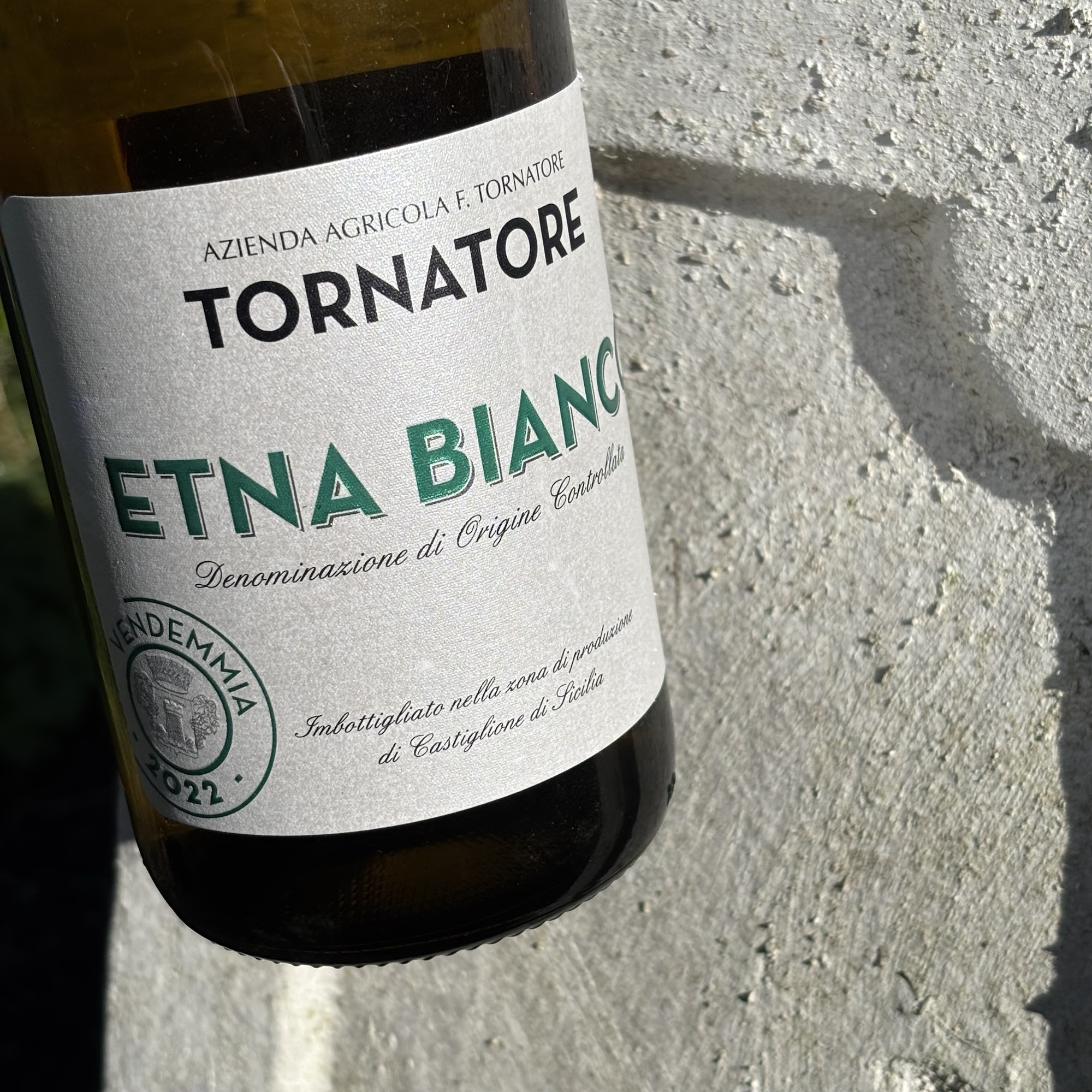
The wines made from the Nerello varieties from the slopes of Mount Etna have become rather famous over the past thirty years, and consequently somewhat expensive. That’s why I drink less Nerello than I did back in the day. This wine is a rare find, in that it is both tasty and cheap. It is also organic/biodynamic (Demeter Certified). It was a welcome Christmas present in 2023.

Grown on Etna’s volcanic soils, there’s definitely a mineral streak running through this, something I used to identify as iron filings when I first tasted such wines, but I have to admit it is an abstract interpretation. I’ve never tried licking a pile of them. You also get some richness and good acids, cherries with a herbal note, I’d suggest.

As to the producer, it turns out they are a co-operative in the Majella Hills of Abruzzo. I have been unable to discover why they are bottling a wine from Sicily, but it appears to be a partnership with a biodynamic grower there. Anyway, this is easy to drink yet with some depth, and everyone at the table enjoyed it (the label was much admired as well).

This wine is imported by Vintage Roots who now appear to be onto the 2022 vintage, but the price is the same, £15. Very good value for the money.

Vino Artisanal de Café (NV), Sol y Luna (Colombia)

Coffee is, of course, something of a big thing in Colombia. I well remember my first discovery of the pleasures of good, “real”, coffee was Colombian. It should be noted that this was in Barcelona, not Paris, where finding decent coffee is not impossible, but neither is it easy, even to this day. Café de Colombia was, at the time, the only sports team I know of named to promote a country’s most famous agricultural product, and I guess that as a big fan of professional cycling, the marketing worked. Last year some South American friends visited us, one from Bolivia and one from Colombia, and they brought this.

It may be one of the strangest wines I have tasted for a long time, that in itself being good qualification for inclusion here, but it reminded me a little to my reaction when I drink Barolo Chinato. That wine, aromatised with cinchona calisaya bark, rhubarb, gentian root and cardamom can be very pleasurable, but not all the time. The same applies here.

If coffee is a big thing in Colombia, then blending wine with coffee is certainly a thing. Apparently, you can potentially buy a “coffee wine” in the UK, made by that well-known, celebrity-powered, wine brand from…well, I’m not really sure? Are you? 19 Crimes is often associated with Californian celebs, but the company is registered in Melbourne. Anyway, they launched one, called The Deported, exclusively through Morrison’s supermarket chain in the UK in 2021.

It is still apparently available via Ocado for £10, though I did see someone was flogging it for £12.99 using a photo of a bag of Tate & Lyle sugar! The 19 Crimes is made from wine sourced in Australia’s catch-nearly-all “South-Eastern Australia” designation, though the coffee is from Colombia. This bottle doesn’t claim the wine to be Colombian as such, but it likely is. It states “elaborado en las montañas de Colombia”.

It smells strongly of sweet coffee and, to my nose, maple syrup. It doesn’t smell at all like wine, but you can clearly taste that it is wine. Wine with a mocha/chocolate smooth sweetness. It was oddly moreish and not hard to polish off a half-bottle. Oddly moreish, but it was hard to put one’s finger on why? I had drunk other wine first, with a meal, so I’m not claiming this was a sober interpretation. How to sum up my feelings for you, should you have an overwhelming desire to try it: I’d be happy to drink it again, but not too frequently, and a half bottle between four was enough. A brilliant gift, though.

By coincidence I know someone who is travelling in Colombia right now. I recommended they look out for some, but they said they don’t drink wine until the evening and don’t drink coffee after mid-morning as it keeps them awake. Fair enough, I have the same issue with caffeine these days too. But I am happy to make an exception if I ever get given some Colombian coffee wine again.

L’Etoile « QV d’Etoiles » 2019, Lulu Vigneron (Jura, France)

Woah! This is good. Since Covid, Brexit, and emigrating to Scotland put paid to my annual trips to the Jura region a whole raft of new producers has sprung up, and many of them have seen their wines achieve fame for them and fortune for those selling them on the secondary market. Some producers have firmly established their unicorn status, but a few others have come and gone in a flash.

Lulu is the nickname of Ludwig Bindernagel. I certainly didn’t know of Ludwig by name when I last visited the region, but I did know his domaine, because back then it was known as Les Chais du Vieux Bourg. Originally based at Arlay, the cellars are now in the town of Poligny. Back in the 2010s Ludwig was successful but not quite as famous as he quickly became once the “Lulu Vigneron” label replaced the old one of Les Chais.

Part of Ludwig’s holding is in the AOC of L’Etoile, which had been one of the region’s unsung terroirs until its potential was perhaps spotlighted by Domaine de Montbourgeau. The label “Lulu Vigneron” is new, and perhaps soon to disappear.

Like Montbourgeau, Ludwig makes natural wines with only a low dose of sulphur added. The blend in this cuvée is two-thirds Chardonnay and one-third Savagnin. It has a genuinely beautiful, rich, mouthfeel. Delicious fruit acids well up, smoky Savagnin fruit complementing ripe Chardonnay, all bound together with a little bit of chalky texture. There is also restrained power (alcohol is a nicely balanced 13%).

Ludwig is retiring this year, but his domaine is in safe hands. In 2024 he was joined by Roman Lawson and Ariane Stern. They have stages with Pierre Overnoy and Manu Houillon under their belts, and worked the last harvest with Ludwig. In fact, Ludwig, although he learned viticulture and winemaking at Beaune, worked with Julien Labet, from whom he says he learned far more of value than he did at wine school. [much of this information comes from Wink Lorch’s indispensable Jura Wines Ten Year On (Wine Travel Media, 2024)].

This is drinking superbly now. If you spot that label, grab it. My bottle was tracked down at Shrine to the Vine in London. No longer listed online, I don’t recall the price, but in any event a visit to The Shrine is highly recommended if you find yourself anywhere near the Holborn area in London. You are unlikely to leave empty-handed.

I’m so glad I got my bottle when I did. I’m also grateful to Wink Lorch for the information (same source, above) that Ludwig has retained about a third of a hectare of vines for his retirement. Perhaps, as 90% of his previous production was exported, we might see the odd bottle appear over here in the UK. Don’t hold your breath.

“Wild Soul” Beaujolais-Villages 2021, Julien Sunier (Beaujolais, France)

You’ll recall that in Part One I featured a wine from Lantignié in the Beaujolais, albeit one labelled as Vin de France. If I’m honest, I had been aware I wasn’t drinking a lot of Gamay, so we have another one here. I bought this quite recently, after having some very fond memories of the big Beaujolais Trade Tastings that Westbury Communications used to put on in London, and which did so much to raise the region’s quality profile in the UK. It was there that I first tasted the wines of the two Sunier brothers, Julien and (a separate domaine) Antoine.

Julien, and indeed his brother, got the wine bug from Christophe Roumier, a friend of his parents. But he also worked with Jasper Morris at Morris & Verdin. It was by total coincidence that I bumped into Jasper when I popped into Berry Bros to grab a bottle of this, prompted directly by seeing Jamie Goode taste a Sunier bottle on Instagram. Lots of circles joining together here.

Julien Sunier, though based in Avenas (pron: Avna) has been farming his own domaine since 2007, around 2 hectares in Fleurie, Regnié and Morgon. This cuvée is made from bought-in fruit from vines at Lantignié, which is becoming a bit of a Bojo hot-spot according to those in the know. The vines are farmed without any synthetic inputs and the wine is made to Julien’s usual high standards, as one would expect from a now-established star of the region.

If you need a one-word tasting note, I will give you “juice”. Fresh, lifted and lively red fruit juice. This is just one of those wines which won’t make claims to being fane wane, but are certainly life-affirming when you glug them. The bouquet has red fruits, but it’s all beautifully floral too. You’ll definitely notice sweet strawberry pretty quickly. The palate is fruity, combining a lightness with a velvet-smooth texture. Jamie would call it smashable and so I would too.

This isn’t a wine to upset or confound the “naturally-challenged”, with a low funk or feral rating. But its easy drinkability is why it’s such a winning wine. Bought from Berry Brothers & Rudd’s Pall Mall shop, this 2021 cost £24. My bottle was one of the last ‘21s and I think they are now onto 2022, same price.

Posted in Artisan Wines, Beaujolais, German Wine, Italian Wine, Jura, Natural Wine, Sicily, South African Wines, Wine, Wine Agencies, Wine Merchants | Tagged , , , , , , , , , , , , , , , , , , , , , , , , | Leave a comment

Recent Wines January 2025 (Part 1) #theglouthatbindsus

I thought I’d be starting the new year with a concerted attempt to drink some inexpensive wines, but whilst most of these wines (twelve bottles over parts one and two) are around my usual £30/bottle mark, there are a few bottles which cost less, one of them spectacularly so.

The half-case featured in Part 1 begins with a biodynamic blend from Alsace, and aged “sous voile”. Then we get what must be a quite rare Burgundy by now, followed by another very different Pinot Noir, moving from one of France’s most famous regions to one of her least known. A dramatic shift takes us to Australia’s Riverland and a grape variety I had never heard of, before our France-dominated first part takes in a Vin de France from the Beaujolais and a great value Chardonnay grown on the fringes of Chablis.

One minor apology. Taking photos of bottles next to Christmas decorations seemed like a good idea in the early days of January, before they get put away for another year, but I admit it does seem odd posting them four days into February.

“Lever le Voile” 2020/21/22, Charles Frey (Alsace, France)

This domaine is run by a family which emigrated to Alsace from Switzerland in the early 1700s. Charles Frey started Maison Charles Frey in the 1960s, based at Dambach-la-Ville. He was joined by his son, Dominique, in 1984. Dominique converted to organics in 1997 and Charles’s grandson, Julien, came on board in 2003. Together they farm 14 hectares of vines.

Whilst not a natural wine, all the domaine fruit is organic and this bottle is part of a range of biodynamic wines. The blend is Sylvaner and Pinot Gris off granite. A Sylvaner solera was started in 2020. This wine, comprising Sylvaner from the three years in the solera, and Pinot Gris from 2021, were aged sous voile (under flor).

The colour is yellow gold. The bouquet shows some flor influence, but by no means overwhelmingly so. It’s certainly milder than a Vin Jaune, or a Fino Sherry, by a long way. You will find peachy stone fruits on the nose, along with a stone fruit texture on the palate. There, you will also find grapefruit acidity, orange peel maybe erring towards marmalade, ginger, apricot and a touch of hazelnut. Or is it walnut? I don’t pretend I can always tell the difference in wine, unlike in “real life”.

Dry but with a certain richness, more than I’d expect in a wine of only 12.5% abv, it has pretty good length too. It maybe lacks the excitement and certainly the wild side of the most adventurous fully natural wines from the region, but it’s definitely a wine I enjoyed, very much so. Also, hey, Alsace under voile. You don’t see that every day! I liked it enough that I later bought a bottle of another Frey white blend to try.

Lever le Voile cost £36 from The Solent Cellar.

Morey-St-Denis “Les Porroux” 2011, Domaine David Clark (Burgundy, France)

David Clark was a formula One race engineer for the Williams team before he started a tiny artisan domaine in the village of Morey-St-Denis on the Côte de Nuits in 2004. He started out making Bourgogne-Passetoutgrains and then Bourgogne Rouge of exceptional quality, before “adding a barrel of Morey-St-Denis in 2006” according to Jasper Morris (Inside Burgundy, Berry Bros & Rudd Press, 2010).

Although David went on to add a little Côte de Nuits Villages and Vosne-Romanée village wine in the following years, ending up with a total production of around 4,000 bottles per year, this domaine was sadly short-lived. This meticulous and super-talented winemaker decided he’d had enough soon after and gave up, 2012 being his last vintage.

I was very lucky to meet David, although it was a very tough day. Lunch, with a stunning array of fine Burgundies, was in the boardroom at Berry Brothers, followed by a dinner at 28-50 in Marylebone, both in fact with Jasper Morris, for whom David Clark was something of a discovery. He was a lovely man, self-effacing and to my perception, ego-free. His wines were genuinely beautiful, even those of the lowest appellations. I do wonder what he is doing now.

This 2011 was my last bottle of David’s wine. As with everything he made, he didn’t use any chaptalisation, all old oak and everything was bottled by hand from the barrel. I don’t know what he used for pest and disease control though. The bouquet here is deep and evolves in the glass, slowly and gently. The fruit is, like the overall palate, velvet-smooth except for just a little texture on the finish. The acidity is pure fruit in nature, raspberry and red cherry.

Even objectively, this is extremely good, and drinking very well. Subjectively, the experience was bound up with a lot of memories, both of the many wonderful David Clark wines I have drunk, for that time I met him, and also for what seems almost a previous life, in London. I was reminded of that life when I unexpectedly bumped into Jasper in the Berry Bros shop in London just days later.

You can still experience this wine, at least in the 2012 vintage. Berry Bros has a six-pack of it for £500 in bond.

Pinot Noir “Petite Fin” MV, Maison Crochet (Lorraine, France)

I’m drawn to try the whole range of Crochet wines, partly because they come from an obscure region, though of course they are also good. There are two Pinot Noirs I have seen at this retailer (see below), and this is, by about eight or nine pounds, the more expensive.

Maison Crochet might sound like a negoce house, but it is in fact a five-hectare family domaine at Buligny, around 30km southwest of Nancy. If they wanted to be part of an AOC it would be the Côtes de Toul. The reason they opt out? In 2017 they began farming organically, and current incumbent Wilifried Crochet has now moved to making wines via biodynamics, and natural wines, which this small appellation’s policing committee presumably doesn’t get!

This cuvée is a single parcel, but it is a blend of two vintages, two-thirds 2020 and one-third 2021. Fermentation was in stainless steel with a ten-day maceration on skins. Ageing was fifteen months in a mix of old oak for the 2020, and around seven months in stainless steel for the ’21. A “tiny” amount of sulphur was added. Nothing else.

I guess I’d call this structured but generous. It has nice fruit. It may not have the class of the previous wine, but Wilifried Crochet is making really interesting and characterful wines somewhat off the beaten track. Also, they mostly happen to have some nice labels, although oddly the cheaper Pinot Noir, which I am yet to try, has a rather dull one. I shall still get round to trying it though, because it costs under £22 and this superior cuvée cost £30. Imported by Sevslo in Glasgow, my bottle was purchased at Cork & Cask in Edinburgh.

Aranel 2023. Berton Vineyards (NSW, Australia)

This is a wine sourced in New South Wales’s Riverina region for Waitrose Supermarket’s “Loved & Found” range. Has anyone else never heard of this grape variety? It appears to be a crossing of Grenache Gris and St Pierre Doré (France, 1961 by Paul Truel), the latter being allegedly a distant relation of Chardonnay (via Gouais Blanc, of course). In its native land it only really appears in the small, Upper Loire, region of Saint-Pourçain, although on my admittedly only visit to St-Pourçain I certainly didn’t come across any mention of it. They do have a fair bit of Tressalier (aka Sacy) up there though.

In Australia you will only find Aranel in Riverina, and within that region only Berton have taken it upon themselves to grow it. That is strange because most sources suggest it is a variety full of potential, good in drought but with equally good disease resistance, and with potential to produce grapes with both good sugar and acids.

I’m not sure why it hasn’t caught on? The wine is clean and fresh but it also has the body you’d expect from a wine of 13% abv, meaning it’s not big and overblown but there’s definitely a little weight. It combines attractive floral notes with broader peachy fruit in a simple smooth-bodied white.

As the marketing blurb says, it has a “refreshing dryness [and a] pithy finish”. It’s certainly by a good stretch both the nicest and the most intriguing cheap wine I’ve drunk for a long time, even better than the M&S Refosco I wrote about in December, though I wouldn’t want to go overboard. It’s no fine wine, simply a great drinkable, food-friendly dry white wine, but at £8.99 it delivers much more than I certainly expected. Certainly, the Waitrose buyers have done well enough to make me look out for more in the Loved & Found range when I’m next in a branch.

Joujou Vin de France 2022, Clos Bateau (Beaujolais, France)

This was a bit of a find, though it wasn’t me who actually found it. Instead, I’m grateful to Edinburgh wine polymath Isobel Salamon who found it and passed on the recommendation. I was later told by the retailer that the producer may not send any more to the UK, which would be a shame.

Sylvie and Thierry Klok-de-Visser started their five-hectare vineyard in Lantignié, in the Beaujolais region, in 2019. Their intention is to create a biodiverse ecosystem where vines play only one part in their eight-hectare farm, which also includes fruit and nut trees, sheep, pigs, and of course herbs for their biodynamic preparations.

Of that 5ha of vines, which are certified organic, they have 3.4ha in cultivated production, plus another 1.6ha of old wild vines, which they plan to keep as such. Joujou is made from Gamay taken from three small plots at around 330 masl. The fruit is fermented as whole bunches (some via carbonic maceration, some semi-carbonic and some direct press). Ageing was for ten months in what they describe as a large fibreglass dome. A run of 5,300 bottles was produced.

The result is a vibrant old vine bottling which has a beautiful, verging on soulful, bouquet of mostly cherry but it’s also floral. The fruit, off granite, quartz and clay, is elegant and combines Gamay deliciousness with something, how can I put it, intellectual? If I went too far there, it’s definitely classy. Although I’d never heard of it, nor the Klok-de-Visser family, apparently the wine is quite sought after in France.

This cost around £30 from Edinburgh’s Communiqué Wines, based on the edge of Stockbridge. The importer is Ancestrel Wines, based in London’s Forest Hill, where they have a bottle shop and bar. I had an excellent Swiss Petnat made by Matthias Orsett from them, via Spry Wines, a while ago (see Recent Wines October 2024) and their web site is full of interesting bottles.

Bourgogne Côtes Salines 2023, Céline & Frédéric Gueguen (Burgundy, France)

The Gueguen family, Céline and Frédéric, farms vines in and around Chablis, based in the village of Préhy, which is situated at the southern end of the Chablis AOC. Céline previously worked on her father’s estate but created her own domaine with her husband in 2013.

This Côtes Salines is Chardonnay made from vineyards on the same Kimmeridgian limestone as Chablis, over Jurassic clay with Burgundian limestone, but is just outside of the appellation. The vines are a very respectable 30-years-old or more. Aged in stainless steel (no oak) it spends ten months on lees before bottling.

This wine doesn’t pretend to be Chablis but it is a clean and fresh Chardonnay with a bouquet of delicate white flowers, and a palate which has a mineral and saline character, reflecting its name well. In fact, I haven’t been able to ascertain whether the Côtes Salines actually exists (presumably it does, otherwise it would not be allowed on the label?). I’d call this cuvée precise and modern but not lean (alcohol is 12.5%).

It’s a fairly low intervention wine, made with indigenous yeasts, but hardly a natural wine. For one thing, the grapes are machine harvested. However, it is very good for its price. Now you can pay up to £25 for this wine, but Solent Cellar in Lymington (Hampshire) imports a range of wines from Céline and Frédéric Gueguen direct (ten lines), and they knock this out for a very palatable £16.99. Other sources include Cockburns of Leith (Edinburgh, vintage listed as 2020) and The Good Wine Shop (London branches)(2022).

Posted in Alsace, Artisan Wines, Australian Wine, Beaujolais, Burgundy, Grape Varieties, Natural Wine, Wine, Wine Agencies, Wine Merchants | Tagged , , , , , , , , , , , , , , , , , , | 2 Comments

A Cheesemonger’s Tour de France by Ned Palmer (Book Review)

You might well ask why a wine blog has a review of a book about cheese? Then again, you might not. Cheese and wine do bear some notable similarities, in that whilst the majority of both cheese and wine are effectively industrial products, made on a large scale, their artisan counterparts are unquestionably products of their terroir, to a greater or lesser extent. Even more so in the case of natural wine, where minimal manipulation and a focus on minimal natural additives bears similarities.

That said, perhaps such an explanation is superfluous because it is certainly true that most lovers of interesting, artisan-made, and especially low-intervention wines will also have a similar interest in, and in many cases a passion for, those artisan cheeses.

Ned Palmer will be a name to jog the memory of subscribers to Wideworldofwine. It was way back in February 2021 that I posted a review of his book A Cheesemonger’s History of the British Isles. That book was brilliant, telling as it did a history of our islands through its cheeses, from Neolithic times to the cheese renaissance of the last quarter of the 20th Century. I must have liked it a lot (my review says it would surely be one of my books of the year) because I was fairly shocked when I realised it was a whole three years since I read it. No way does it seem that long.

Three years later I am reviewing Ned Palmers latest book, A Cheesemonger’s Tour de France. It follows a loosely similar format to the last book in that the main body of the book gives us eleven chapters on eleven French regions. Each has a main focus on one cheese, although plenty of others are mentioned peripherally. We begin in Seine-et-Marne with Brie, before learning in further chapters about Munster, Époisses, Comté, Salers, Roquefort, Buchette de Manon, Ossau-Iraty, Crottin de Chavignol, the new wave of cheeses from the one-time cheese-free pays of Brittany, and finally Camembert.

Each chapter gives us information about how the cheese is made and what it might taste like at different ages, but we also get history, social history and folk tales woven into the text. Of course, Palmer has a focus on artisan production, whether fermier, or in some cases laiterie, but industrial production is not ignored, even if only to elaborate its negative influence on the AOC regulations, and perhaps on our taste buds.

The author is ever present adding a personal touch. He has a wealth of knowledge and experience which comes through in easy to digest form. I occasionally raised an eyebrow at some of the wine-related comments, but then I know more about wine than Ned does, and he knows a hell of a lot more about cheese. This book reads as a personal travelogue, as he travels through France visiting standout producers in each region, and that makes it more appealing in my view.

The highlighted cheeses are well selected. Some, like Brie and Camembert, are so famous that we might often ignore them in the cheesemongers. That was brought home to me after I randomly decided to buy some truffled Brie de Meaux at Christmas, a contender for my cheese of the year! Others are only well known to those who are serious cheese fiends, like Salers. Others are so much more commonly seen in relatively disappointing industrial form that some might wonder what the fuss is about until they taste a true artisan version, such as Ossau-Iraty made from unpasteurised sheep’s milk up on the estives (high summer pastures).

The book finishes with a short chapter on the future of French artisanal cheesemaking before a directory describing in short fifty-five cheeses, principally those that get a mention in the book as well as those featured for each chapter, along with some further reading and a “how to buy fromage” add-on. I would only suggest “preferably not in a supermarket”, which applies to France, but you can find some edible cheese here, in Waitrose, if you really can’t find a cheesemonger.

In the UK cheesemongers of quality are now fairly easy to find. I am especially lucky to have access to two of Great Britain’s finest within striking distance of where I now live, in Scotland. Ned Palmer gained his stripes working for Mons in London’s Borough Market and at Neal’s Yard Dairy. At least I presume it was Mons as their French business gets many mentions throughout the book. Neal’s Yard Dairy may be better known to most readers, but Mons is truly worth a detour. I remember once being asked what I wanted to do on my birthday and the answer was a trip to Mons.

Any criticisms of the book? Well, no. I mean I risk sounding like a broken record if I mention typos. Editing ain’t wot it used to be. Some books start out all guns blazing but run out of steam, with the author trying desperately to find more to write about. If anything, this one starts sedately and builds up. Perhaps Ned just saved the best until last, as we might do with a cheese platter. I certainly felt he warmed up as he went along, but I’m not saying the early chapters weren’t good. They certainly were. Just perhaps that he got into his stride.

A Cheesemonger’s Tour de France does have some photos scattered throughout the text, but it doesn’t have a nice colour photo to show you what each cheese looks like. For that you would need to go elsewhere. The two books I have found most useful in this regard are:

  • French Cheeses (Dorling Kindersley, 1996); and
  • Cheese by Patricia Michelson (pub by Jacqui Small, 2010)

The Dorling Kindersley book is very visual, with only a small amount of information on each cheese. However, Charles de Gaulle famously said France was a country of 246 cheeses (I think?) and the DK book lists an impressive 350.

Patricia Michelson’s book doesn’t only cover France, but it is a beautiful book and I pull it out regularly (it’s a weighty tome so it probably helps my arm muscles as much as it delights my senses). It is more selective in its coverage, but a little more detailed than the DK, and you get to share in the knowledge and insights of another of London’s finest cheesemongers (Her shop, La Fromagerie, is in Marylebone).

However, these books would be entirely complementary shelf companions. Ned Palmer’s Tour is immersive, as any travelogue should be. It captures more of the essence of each of the cheeses featured by way of their terroir, their social history, and allowing us a glimpse into the lives of some of the characters who have the passion to make these cheeses, for being a cheesemaker is not an easy career choice and the best of them still face tough physical work, grinding bureaucracy and very considerable financial pressure.

Indeed, if there was a renaissance in French cheese at the end of the last century, the first half of this century risks seeing artisan cheesemakers going out of business, as seems to be the fate of hundreds of thousands of farms of all kinds across Europe.

Equally, if you are reading this in the UK and you have ever wondered why European artisan cheeses have increased so much in price, well, like wine, the hassles and paperwork involved in crossing our post-Brexit border (made worse in terms of form filling since 2024), have caused many smaller cheese producers, along with wine producers, to seriously question why they bother.

Still, if this book does anything, perhaps it might do for you as it did for me and act as a prompt to buy more cheese.

A Cheesemonger’s Tour de France by Ned Palmer is published by Profile Books (2024, hardback, 374pp, £18.99).

Ned’s book on British Isles Cheeses (an important distinction as Irish Cheese is included)

Posted in Cheese | Tagged , , , , , , , , , | Leave a comment

40 Maltby Street and Gergovie Wines

There’s a restaurant in London where the food warms the soul, where the staff are remarkably informal, and where you can access a wine list pretty much unique in London, because that restaurant is tied to an importer of zero-sulphur natural wines. It’s also a restaurant that doesn’t appear on Instagram anywhere near as much as some more fashionable names further east. It is, of course, 40 Maltby Street, and the importing arm is Gergovie Wines.

Gergovie is a plateau of the Massif Central in the Auvergne Region of France, named after a village of the same name, or Gergovia in its former incarnation as the chief oppidum of the Averni people. The fortified village is famous for a battle between the Gauls under Vercingetorix and the Romans under Julius Caesar in 52BCE.

As I hadn’t visited since before Covid I was keen to jump on this opportunity. I’m not usually someone who likes to dine alone, but my wife had an event in the City to go to and I was desperate to get back to 40MS, both for the food and the wine. With an anticipatory rumbling stomach, I was practically queuing outside the door, ready for their 5.30pm opening on a Wednesday.

The first change I noticed on arrival were the new retail wine shelves. A lot of restaurants and wine bars have begun to offer bottles retail as an obvious way to generate a bit of extra revenue. Winemakers Club has been doing it for years, and up here in Edinburgh I pop into Spry Wines or Smith & Gertrude more frequently to buy a bottle or two than I do to eat or drink a glass on the go (sadly).

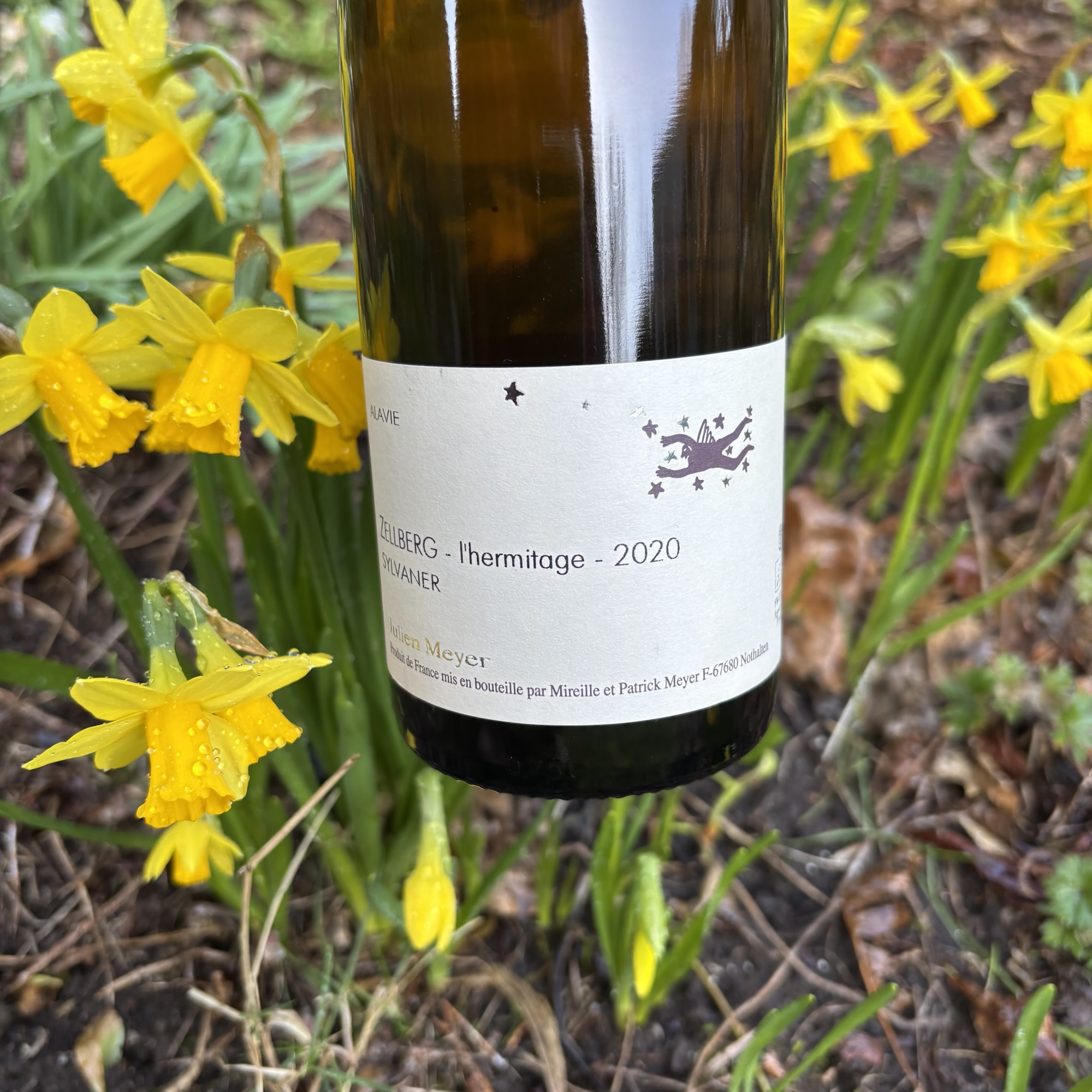
My reason for visiting 40MS was no less to grab a couple of bottles of Alsace wine (the Dreyer and the Meyer in the photo) than to dine. Gergovie does many things well, not least Auvergne and Ardèche, and Jeff Coutelou, and the list goes on…but I’d put them in the top three UK Alsace importers (natural wine, of course), along with Vine Trail and Tutto Wines. I keep telling people that Alsace is the most exciting region for natural wine in France at the moment, but I still have to travel far and wide if I want to pick and choose my bottles. Anyway, So-long as you check out the restaurant’s opening times you can access the Gergovie range from the shelves as you go in if getting a case sent to you doesn’t work for any reason.

I said above that 40 Maltby Street serves food to warm the soul, and perhaps you can make out some of the dishes on offer on the blackboard menu. I started off with a cheese platter (because they open at 5.30 on a Wednesday but the kitchen doesn’t really kick into action until 6pm).

The extensive Gergovie list is available, but dining alone I decided to go for a couple of wines by the glass, whatever they had open, just for variety.

First up, Eruption 2022 Domaine des Trouillères. This is Gamay d’Auvergne from, of course, the Auvergne, specifically the village of Martres-de-Veyre. Six hectares have been farmed here by Camille and Mikaël Hyvert since 2015. Off limestone/clay terroir on the Puy de Tobize, part of the Massif de Sancy, whole bunch maceration/fermentation, farming is biodynamic and “bon sens paysan” (I love that description). Initially lovely gentle fruit dominates, but this gives way to something blood-like and more savoury. A genuinely joyful wine, but a Gamay to accompany a cheese platter if you want to go red. £28/bottle from Gergovie.

Then Demontre 2021, La Gutina. This is a Garnatxa (Grenache) made by Barbara and Joan Carles Torres at Sant Climent Sescebes on the apparently windswept slopes of the Aspres des Alberes close to the French border. Grenache is their main baby, and it thrives on the poor granite soils. Their farm also grows olives, and of course everything is done with minimal intervention and zero sulphur. This is a medium-bodied wine full of lively fruit with mineral tension and brightness. A wine whose 13% abv (it says 12.85 online) hides beneath abundant fruit and zip. Lots of good Spanish Garnacha’s around, for sure, but this is a nice one and only £25/bottle.

Both wines were lovely. The Grenache/Garnatxa went especially well with the roast lamb, anchovy, bitter leaves and mint, a very tasty dish…I made the right choice. I topped off the meal with a blood orange sorbet and walked it off with an hour-long stroll through a misty City of London.

As far as 40 Maltby Street goes, if you know, you know, but if you don’t, then pay a visit. Closed Sunday, Monday and Tuesday, open 5.30 for dinner on Wednesdays, Thursday to Saturday they serve lunch 12-3pm and dinner 5.30-9.30, no reservations! I like no reservations. First come, first served and zero no-shows. It was quite busy even on a Wednesday by the time I left, around seven. I’m sure the kitchen cope. Everyone working there seemed very happy, with no visible stress. Also check out Gergovie’s portfolio in the on-site shop whilst you are there. I can’t imagine how anyone would not be tempted by a bottle or two.

Before I go, I want to just give you a few personal recommendations from the Gergovie Wines portfolio. Purely subjective as there are quite a few producers I’ve not tried, but all of these would be challenging for a place in a mixed case:

  • Anything, literally anything, from Alsace (Dreyer, Meyer, Ginglinger, Dirringer)
  • Jeff Coutelou (Languedoc)
  • Patrick Boujou & Justine Loisseau (Auvergne)
  • Dom des Trouillères (Auvergne)
  • Fabio Gea (Piemonte)
  • Julien Peyras (Languedoc)
  • Vincent Marie/No Control (Auvergne)
  • Lucy Margaux/Anton van Klopper (Adelaide Hills)
  • Sam Vinciulo (Margaret River)
  • L’Anglore/Eric Pfifferling (Rhône)
  • Jean-Yves Péron (Savoie)
  • La Vigne du Perron (Bugey)
  • Barranco Oscuro (Alpujarras)
  • La Gutina (Catalunya)
Posted in Alsace, Artisan Wines, Dining, Natural Wine, Restaurants, Vegan Wine, Wine, Wine Agencies, Wine and Food, Wine Bars, Wine Merchants, Wine Shops | Tagged , , , , , , , , , , , , | 3 Comments

Recent Wines December 2024 (Part 2) #theglouthatbindsus

Part Two of 2024’s last batch of the most interesting wines drunk at home begins with three wines which all, at the time of buying them, cost £26. Remember in Part One I suggested that £26 is the new £18? Doubtless by the time April comes along £26 will have crept to £30, but I think right now that £26 is a kind of sweet spot with natural wines. You won’t feel the earth move, but you’ll get a nice wine with personality. That said, I may be getting complacent because I’m sure that anyone drinking at least the first two wines below would sit up and notice, if perhaps for slightly different reasons.

So, those first three hail from Hungary, Rioja and Montlouis on the Loire. Next is a real oddity, a brilliant wine made by an old friend, so to speak, from other climes who has made a stunning and equally obscure wine on one of the islands off Madeira. Then comes an older vintage of the English Sparkling Riesling that was one of my 2024 wines of the year. We finish 2024’s wines with a lovely Moravian red wine which a friend designated wine of the day at a tasting we both attended in Edinburgh earlier last year.

Freiluftkino Brut 2019, Annamária Réka-Koncz (Barabás, Eastern Hungary)

I’ve had one or two bottles of Annamária’s Traditional Method sparkling wine before, but it has been a while (September 2022 my notes suggest) and I think, as much as I like her wines, I’d forgotten quite how good, and indeed interestingly different, it is.

The name means “open-air cinema”, though I have no idea of its significance, if any. It blends Annamária’s mainstay variety, Királyléanyka, with Furmint, Riesling and Hárslevelü, grown on a complex mix of rhyolite, andesite, dacite and tufa.

The grapes undergo a traditional natural double fermentation with the second taking place in bottle with the liqueur de tirage comprising must from the following vintage. It sees a year on lees in bottle before being disgorged by hand. Just 1,200 bottles were produced in 2019, sealed with a crown cap, not a cork (though to be clear this is not a petnat).

This small production does mean that the wine, like everything this producer makes, spends very little time on the shelves. Think how little comes to the UK. However, by cultivating a relationship with the importer, you can be sure to pick up some bottles of Réka-Koncz when they land.

At five years old, with a year or two in my cellar, it has become a little darker in colour but on the bouquet and palate there is a burst of freshness. Fresh apples seem to dominate the nose, minerality the palate. It’s not a wine with Champagne-like complexity, but it makes up for that with bags of personality and character.

Basket Press Wines is the UK importer for Réka-Koncz but they don’t appear to list any of this winemaker’s cuvées at the moment. My guess is that they will be shipping this spring or early summer. Zainab tells me possibly even as early as March so fingers on the buzzers, but she also told me they do have one or two bits which are not up on the web site. £26 at the time of purchase. We shall see what our import regime has done to the price next vintage.

Rioja “Rayos Uva” 2021, Olivier Rivière (Rioja, Spain)

This is a biodynamic joven-style Rioja made without oak. Olivier Rivière is, as his name suggests, originally from France, from the wider Cognac region, and he envisaged making wine there. He studied winemaking at Bordeaux but then wound up working for Telmo Rodriguez in Spain and never went back. Instead, he started his own operation, in Rioja in 2006, inspired by what Telmo has achieved. He now runs 25 hectares.

This easy-drinking cuvée blends traditional varieties Tempranillo and Garnacha off a terroir of sandstone, clay and limestone. It has grippy tannins with a fresh nose mixing fruit and a savoury twist. The palate definitely shows a savoury side as well as a mix of dark and lighter red fruits. I like the savoury element in a wine that is otherwise fairly uncomplicated. Again, at that £26 price point you get quite a bit for your money. I hesitate to say it but I just wish I could drink more Rioja in this style, saving the more oaky experience for more expensive wines bought to age for years in my cellar.

This is a wine I first tried at the Cork & Cask Winter Wine Fair in Edinburgh in 2023 and I have no idea why it took me just over a year to drink a bottle at home. If anything, I liked it even more than that first taste. Imported by Dynamic Vines.

Chenin Blanc Sec “Les Borderies” 2020, Domaine Les Terres Turones (Loire, France)

Terres Turones is run by Dominique Weiss and Philippe Ivancic from the well-known hamlet of Husseau, just east of Montlouis-sur-Loire. The retailer who sold me this bottle also has a cheaper generic cuvée with a very similar label, but at the price of this one, for £2.50 more, I’d trade up. This is from a 4ha single parcel on clay with flint over a base of tuffeau.

The domaine was only started in 2017 and was certified organic in 2022, but had been in conversion from the beginning. The vines for Les Borderies are thirty years old. Fermentation uses indigenous yeasts, ageing after fermentation is twenty months in demi-muid casks.

The bouquet is very expressive of the grape variety, showing pear, quince and a hint of almond paste. The palate has a little bit of a chalky-mineral texture, decent length and lively fresh acidity. It’s another very good value wine. I had noted that I paid £26 but checking today it appears to be listed at £24. My notes also suggest that it was if anything slightly youthful and might benefit from a little more age. I don’t mean decades, but I do see some potential. However, sometimes with a wine like this you just fancy enjoying it young.

Chenin Blanc is definitely a variety I keep telling myself to drink more of, and I’m forever failing to heed my own advice. The good thing about examples like this, thoughtfully made at a decent price, is that they do help to prod my wallet in the right direction. Same goes for Rioja with the wine above.

Purchased from The Solent Cellar online.

Tinta Negra “Dos Villoes” 2022, Vinho DOP Madeirense, António Maçanita and Nuno Faria (Porto Santo, Portugal)

Porto Santo is an island in the Madeira archipelago, just under 30 miles northeast of Madeira itself, in the North Atlantic Ocean. It’s a tiny island of only around sixteen square miles, with its highest elevation, Pico de Facho, a mere 517 masl. It has a population of around 5,000 people.

I have met António Maçanita twice, albeit quite a number of years ago now. Both times were with Red Squirrel Wines (now merged as Graft Wine), who imported his amazing wines of the Azores Wine Company, although I have also drunk his wines from locations on the Portuguese mainland. He gets around. Nuno Faria, a friend of António’s, is director and owner of the “Michelin three-star” restaurant, 100 Maneiras in Lisbon, but he was born on Porto Santo. This wine is a collaboration between them.

The grape variety is described as “the real Tinta Negra”. I’m not an expert, but I’m assured it is not the same variety as Tinta Negra Mole, that ubiquitous Madeira grape variety which replaced Sercial, Verdelho et al. It’s confusing though, because John Szabo, in Volcanic Wines (Aurum Press, 2016), uses the same name, Tinta Negra, for “by far the most important variety…accounts for 85 per cent of wine production”, here speaking of fortified Madeira.

I guess I’m digressing and it doesn’t matter exactly what variety we have, the wine is magnificent. Porto Santo boasts a mere 14 hectares of grapes today. They grow on dry, chalky soils. Grown organically with low intervention, the vines are over eighty years old and are trellised low to the ground, protected (as António’s vines are on Pico Island in the Azores) by low walls called muros de crochet. The windy slopes mean disease pressure is very low.

What interested António Maçanita here was whether a good wine could be made with a derided grape variety. The answer, certainly for me, is yes it can! The wine is ruby red with a nose of sweet cherry and a hint of liquorice. Both the bouquet and the palate have a great saline quality. Maybe there’s some thyme there too. It is slightly rustic, but in a good way.

I should also mention the bottle. It has that stencilled effect reminding you of an old Madeira. Quite astute as it does leap out from the shelf. Good marketing. Because of its origin it might need it, but not on account of the quality. This is very good indeed and just the kind of wine to interest anyone reading my blog.

Imported by Indigo Wines, my bottle was about £32 from Cork & Cask (Marchmont, Edinburgh), and I also saw it on the shelf at Communiqué Wines (Stockbridge, Edinburgh).

Promised Land Riesling Brut Nature 2014, Charlie Herring Wines (Hampshire, England)

If you are fresh from reading my wines of the year article you will have noticed that one of those chosen was the 2017 vintage of this wine. Some explanation is needed. The 2017 is young right now (though certainly very tasty), but it will blossom into a remarkable wine, another step on Tim Phillips’s journey towards his goal of making the best sparkling wines in the world.

The 2014 is more evolved. Perfectionist that Tim is, he wasn’t really all that happy with his 2014. Personally, and I hope you don’t mind me saying this, Tim, sometimes a winemaker can have a bit of an inward-looking focus on a particular vintage. It’s easy to see the things you don’t like. For me, this wine was extremely enjoyable, all the more so for being a decade old. I dare say the 2017 will be the better of the two vintages by 2027, but I suspect it may still warrant more time than that, ideally, to reach true greatness.

To recap, this is 100% Riesling grown inside the walled clos just inland from the bit of Hampshire coast that faces the Isle of Wight, west of Lymington. Traditional method from organic fruit, minimal intervention, four years on lees and another six years pda. The freshness level is still amazing for a sparkling wine of this age, albeit Riesling, with a balanced alcohol level of 11% abv. The fruit here is richer than currently showing in the ’17. If anything, that fruit is slightly broader than is usual in this cuvée. You get lots of citrus and very good length, to be sure. I think it’s gorgeous and was lucky to get what I think might be a rare bottle.

We opened it for an aperitif and then drank it with a vegan roast dinner (with vegan haggis) with a big storm brewing outside. It was comforting rather than bracing, as one might have said of a younger vintage. Perhaps I can say that it has an almost sensual quality that is rare in a Sparkling Riesling.

The 2014 may be unavailable, mine coming direct from the winery. Do ask Tim, or Les Caves de Pyrene. I grabbed a coffee with Tim about a week ago. He told me he is planning some vinification changes which will make his sparkling wines less available for a couple of years (reminds me of when Raphael Bérêche stopped Reflet d’Antan for a while to increase the age of the  perpetual reserve). Makes sense to hoover up anything going sooner rather than later.

Cabernet Moravia 2021, Vykoukal (Moravia, Czechia)

Zdenek Vykoukal is one of those perhaps under-the-radar Czech producers…hang on, aren’t almost all of the Czech producers under the radar? Well, he does make magnificent natural wines off terroir which once saw the horrific Battle of Austerlitz of 1805, known as the battle of the three emperors. The town of Austerlitz, under the Austrian Empire, is now in Czechia and was renamed Slavkov u Brna. Napoleon won a victory that at least led to the Peace of Pressburg and a brief respite in conflict.

I have no idea where the 24,000 dead from the battle ended up, but the terroir on which Vykoukal has his vines located is limestone. Cabernet Moravia, a 1960s crossing of Cabernet Franc and Zweigelt, seems to do especially well on these soils and in this climate, relatively warm and dry.

The wine ferments naturally and sees ten months ageing in used neutral oak followed by six months to settle in stainless steel tanks. This 2021 is gently maturing, by which I mean drinking nicely now but no hurry to drink up. It shows some peppery qualities, reminiscent of Cabernet Franc, but also expresses itself now as nicely rounded and smooth fruit.

You also get some darker bramble fruit acids, surely the Zweigelt/Rotburger element showing. I really like this slight tartness as it balances the smoother fruit which might otherwise come across as more simple-natured. There’s medium weight and I mustn’t forget the hint of dark chocolate on the finish.

My friend Alan March (some time Coutelou denizen) is the one I mentioned in my introduction who declared this his wine of the day at an importer tasting last year. He has a very good palate and appreciation of natural wines, and I think you can take his word for this wine’s quality. It has that chewy fruit, concentrated but not at all dense, which makes it highly versatile. A very satisfying Czech/Moravian natural wine, and not too challenging for anyone new to the region.

The importer is Basket Press Wines. I paid £30.

Posted in Artisan Wines, Czech Wine, English Wine, Hungarian Wine, Natural Wine, Portuguese wine, Spanish Wine, Wine, Wine Agencies | Tagged , , , , , , , , , , , , , , , , , , , , , , , , , , | 4 Comments

Recent Wines December 2024 (Part 1) #theglouthatbindsus

Does anyone actually remember December 2024? With the new year now upon us, 1st December, when I drank the first wine here, seems a very long time ago. That wine was a supermarket Refosco from the Veneto. Here in Part 1, it is followed by a Crémant from the Jura, something a little bit different from England, a salty white from New Zealand, a juicy Austrian red, and a majestic thirteen-year-old German Riesling. All are low intervention wines, except for that first wine. Its inclusion is on account of its interest, but more of that below. Part Two, with six more wines, will follow later.

Refosco 2023 Trevenezie IGT, bottled by Domus Vini for Marks & Spencer (Veneto, Italy)

This is an IGT established originally in 1995, and renamed Trevenezie in 2017. The large zone covers the same ground as the “Delle Venezie” DOC, meaning all of Fruili-Venezia-Giulia and Veneto. That’s around 5,000 hectares. The DOC has a focus on Pinot Grigio, so whilst the IGT may produce far less wine, those wines might be more interesting.

That is certainly is the case with this wine. It is part of UK supermarket Marks & Spencer’s “Found” range, which highlights what, to most people, are obscure grapes. Refosco is autochthonous to this region. I’m sure quite a lot of readers will have tried one before, but I’m equally sure most people generally haven’t.

We have a wine “bottled” by a presumably large wine company and it has no credentials for being organic, nor for its viticulture being sustainable, although it is reassuringly listed as “vegan” on the supermarket’s web site. The wine itself is dark as ink. The bouquet is mainly dark fruits. Blueberry is to the fore, but there’s dark cherry too. The fruit on the palate is dense, but we get texture and grip (I think the wine was aged six months, presumably in stainless steel). There’s also that typically Italian slightly bitter finish which gives a savoury element, and which I think makes such wines more food-friendly.

The winemaker was Giacomo Vedovato and he was using a particular Refosco clone called “peduncle rosso”. That’s probably meaningless for a large-production wine, except that this does have character and personality, expressed most through the wine’s wild edge. I didn’t hesitate to include it here because it has more personality than its price tag suggests. I think it will be a while before I drink a wine quite this cheap that I find worth bringing to wider attention.

That price is £8, available from Marks & Spencer as part of their Found Range. Waitrose supermarket has a similar range, called “Loved and Found”, and I’m about to drink something genuinely obscure from that – the Aranel variety, from Australia’s Riverina region.

Crémant du Jura « Indigène » Extra Brut, Domaine A&M Tissot (Jura, France)

If you read my “wines of the year” article published a week ago you will have come across my inclusion of this wine for the month of December. The rest of this first part, and the second part which follows, show just how much competition Stéphane Tissot was up against to claim one of my twelve spots, one for each month of 2024.

To clear things up, as we always do when it comes to this producer, Domaine A&M Tissot is named after André and Mireille, the parents of the now renowned Stéphane. Stéphane runs this domaine, located on a lane to the left of the church in Montigny-les-Arsures (close to Arbois) with his wife, Bénédicte. The biodynamic wines they make are as fine as any in the Jura, and one or two are as fine as any in France.

As with the various Dupasquier domaines in Savioe, there are other Tissot domaines in and around Arbois and some have a better reputation than others. I get annoyed when the occasional wine merchant importing the wines of one of the other Tissots uses just the surname in a confusing (to customers) way (rant over, but some do the same with “Overnoy”). Surely no one would argue against this particular Tissot being in a class of its own.

This Traditional Method sparkling wine is made from four varieties. We have 50% Chardonnay and 40% Pinot Noir, with a little dash, 5% each, of Trousseau and Poulsard. Ageing before bottling for the second fermentation is in oak. The unusual thing about this wine is that the prise de mousse was, at this time, made using the fresh must from his Vin de Paille, rather than a sugar solution. I’m not sure why but this wine, disgorged in June 2018, was one of the last Indigène to use this technique. Stéphane now uses frozen must.

So, this has seen six years post-disgorgement ageing, and it always shows as one of the finest wines to be labelled as Crémant in France. The acids are still fresh and the spine of the wine has a brittle delicacy, and yet there is that roundness of fruit from ageing, along with some more bready tertiary elements. You get richness, and you get a nuttiness. There is definitely plenty of yeast autolysis to get fans of aged “Champagne” excited. A gorgeous, complex, wine that surely Champagne afficionados would love as much as fans of Le Montrachet should love Stéphane’s Clos de La Tour de Curon Chardonnay.

This bottle was purchased at the domaine’s shop in Arbois. In the UK expect to pay around £40-£45, perhaps from Lay & Wheeler, Berry Bros, Oxford Wine Co, Shrine to the Vine, Gnarly Vines and The Sampler.

Little Bit 2023, Westwell Wines (Kent, England)

This is the wine that is a little bit different, excuse my pathetic pun. Westwell, as you may know, is one of my very favourite English producers, and for a while they have been making excellent still wines alongside their sparkling output from vineyards on the slopes of The Downs, along the old pilgrim route to Canterbury. This wine is something of an experiment.

When Adrian Pike and his team press the grapes for the Westwell sparkling wines they do so gently, in order to extract less of those elements which would intrude on those wine’s undoubted finesse. That leaves a fair bit of juice in the grapes that might go to waste. They have been experimenting with the juice of what is the third pressing of Pinot Noir and Pinot Meunier and in 2023 put this juice into stainless steel tank, where it underwent “a constantly evolving wild ferment”.

The result is to say the least both tasty and really interesting. The bouquet is gently floral and (red) fruity. The palate has plenty of red fruits from what in any case was a very fruity vintage, and there’s a little bit of texture too, which grounds it all. The alcohol is just 10%.

The resulting wine has the delicacy of a Rosé, matched by a pale pink/peach skin colour. There’s just a little grapefruit nip on the finish. It’s great fun, even more so as the price tag is just £16. I’m not sure how much they bottled, but this is a genuine bargain for a fun, delicate, natural wine. Westwell wines are always reasonably priced, compared to what some producers ask for their still wines in England, but this one is even more so.

This bottle came direct from the estate as a rare sample for me to try. My opinions here are genuine. I loved it for what it is. I haven’t been alone in saying positive things on social media.

Salty White 2022, The Hermit Ram (North Canterbury, New Zealand)

This is also something of an experimental wine, this time from Theo Coles, the master of NZ artisan natural wine from organically grown fruit. We have North Canterbury-grown Sauvignon Blanc, Riesling and Pinot Blanc fermented in a mix of stainless steel and amphora, with two barrels oxidatively aged, developing a layer of flor. It all sounds scarily “un-New Zealand”, doesn’t it, encouraging flor in a country whose wines began with the super-cleanliness of their dairy industry transferring to their modern wines. You wonder that this wine was allowed to leave the country.

The colour is quite deep gold. The first notes on the nose are pineapple, then tangerine. As you’d expect from the name, the wine is pretty packed with salinity. I’d say more so than any overt flor-induced nuttiness, yet there are some flavours of hazelnut which appear after a while, along with zippy acids and a pleasant hint of bitterness, or perhaps less bitter but just savoury.

The result is slightly away from the norm, certainly for New Zealand, but I think this is the most exciting of Theo’s always exciting wines I’ve drunk for a while. You might not immediately say “flor” but it does have a slightly oxidative feel under the fresh acidity.

This was £26 from Cork & Cask (Edinburgh), imported by Uncharted Wines. Excellent value in today’s market, though I’m tempted to say that in our post-Brexit, post-inflation, market, £26 is the new £18. The first three wines in Part 2 (to come) all cost £26 as well. I would say that all four represent a great price/quality ratio, or “bang for your buck” as others might say.

Malinga Rotburger 2021, Weingut Heiss (Niederösterreich, Austria)

Back in November 2023 I drank Christophe Heiss’s “Hotrot”, a blend of Zweigelt, St-Laurent and Blauburger. This wine is a varietal Zweigelt, but Christophe has chosen to label it with its alternative grape name, Rotburger. Herr Zweigelt, after whom this crossing between St Laurent and Blaufränkisch was named, seems to have had a dubious wartime reputation and I think more people are beginning to use the Rotburger nomenclature, except for export to America, where for some unfathomable reason it is a grape name that doesn’t appear to market positively.

The winery is at Engabrunn, in Kamptal, east of Krems and a little north of the Danube as it flows towards Vienna. Kamptal is not a region that comes first to mind for Austrian low-intervention wines, but there are a few great young producers now making natural wines here. Christophe Heiss is making some lovely wines with pristine and vibrant fruit as a theme.

What we have here is a simple wine, but that is by no means faint praise. Concentrated dark bramble fruit, ripe, but with a delicious bite to it like a good bramble (blackberry to you all down in England) jam. It is totally well balanced with 11.5% abv. Although it would be a great summer red wine, slightly chilled, it was equally good cellar-cold in December in our snug Scottish abode.

Modal Wines imports this. I keep drinking absolute cracking bargains from Modal. I’m not sure how Nic Rizzi does it, but he has a nose for bargains. It was purchased retail from Smith & Gertrude (Portobello, Edinburgh), but outside of Edinburgh contact Modal Wines direct for online sales. Both have sold out of this Rotburger, and the “Hotrot” (there’s still some Pinot Noir listed by Modal online), but hopefully new vintages will be available soon. Price perhaps around £25.  

Lorchhäuser Seligmacher Riesling 2011, Eva Fricke (Rheingau, Germany)

Eva is certainly one of the finest producers in the Rheingau and I have been lucky to have drunk several bottles of this lovely wine. As all things come to pass, this was my last bottle. It’s one of those wines which I would have loved to share with other lovers of German wine, but that never worked out. All the more reason I need to shout out loud for this.

It just so happens that 2011 was Eva Fricke’s first vintage of her own. It makes this wine all the more remarkable for its quality, not least because it is considered an entry level cuvée among her 17 hectares of specific sites that she farms. The quality comes from Eva’s international experience, plus her stint as chief winemaker at Leitz.

Of course, experience is one thing but it cannot alone explain the precision here, coupled with fruit and complexity and intensity in a thirteen-year-old wine. Stone fruit, white early summer floral notes and a squeeze of lime form a strong but elegant bouquet, lime leading the palate’s acidity beside mouth-filling peach, orange and a hint of lychee. It’s dry but not bone dry. It seems to me to perfectly express the terroir’s high concentration of quartz in its mineral edge.

This is thrilling wine which seems to combine a lightness of acids dancing on the palate with a more solid fruit core (and 12.5% abv). It’s in a very good place right now. My bottles are from too far back to remember their origin. I would try Lay & Wheeler or Berry Brothers, where you may find some for around £120 for six in bond, which once more is nothing for the quality here.

Posted in Artisan Wines, Austrian Wine, English Wine, German Wine, Italian Wine, Jura, Natural Wine, New Zealand Wine, Wine, Wine Agencies | Tagged , , , , , , , , , , , , , , , , , , , , , , , , , | 2 Comments

Wines of the Year 2024 #theglouthatbindsus

In the “Recent Wines” articles I publish each month I always stress that the wines I include are not the most expensive, smartest and poshest wines but the wines I find most interesting, and hopefully thrilling. This means you might get a supermarket Refosco next to an Overnoy Savagnin next to a bottle of Dom Pérignon, all of which really did get drunk at home last year.

Following the same rule my wines of the month are the ones I found the most thrilling. Sometimes, they are the first wine I drank from a new producer, when you get that incomparable feeling of “oh boy, this is good!”.

You just have to remember that I am not afraid to let a degree of subjectivity enter the equation, but then you don’t read me for white coat analysis and points out of 100, do you! If I was going all “wine competition” on you then perhaps I’d be hard pushed to justify every one of my choices, but on the grounds of wines that really made me sit up and take notice, I certainly can.

We do see a few regions cropping up more than once. Czechia and Alsace get a couple of mentions each. England gets three, perhaps a first but why not? Despite my deep love for the Jura, I have perhaps not gone overboard on their inclusion in previous years. I think 2024 blows any such restraint out of the water. I even had more Juras screaming to be included, including a wine from one of my producers to watch in 2025, Maison Maenad/Katie Worobeck (see my Review of the Year, published 30 December). In an attempt at just a bit of variety, there’s a Burgundy, both a Mosel and a Moselle, one wine from Oregon, and a Piemontese to complete the team.

JANUARY:

Cabernet Franc 2022, Mira Nestarcová (Moravia, Czechia)

One of my winemakers to watch for 2025, all of Mira’s wines are at the very least on a level with her famous husband’s. Unpruned vines, dark-fruited concentrated zippiness here. One of four cuvées imported by Basket Press Wines, around £30. They are all wonderful, but I would also recommend the Sauvignon Blanc. You’ll be surprised.

I also want to give a shout to Artefact 2021, Castlewood Wines (Devon, England). Luke Harbor (Pig Hotels) is behind this amphora Bacchus collaboration, and it surely wins best packaging for both the bottle shape and label. The most recent label is even better, but the wine is really good too, which is what counts.

FEBRUARY:

Beaune 1er Cru “Les Grèves” 2015, Le Grappin (Burgundy, France)

Andrew and Emma Nielsen continue to deliver some of the best value wines in Burgundy and this white Chardonnay from one of the often-unloved Premier Crus of Beaune itself is no exception. Forty-five-year-old vines, six barrels made so gently (no lees stirring etc), salinity galore, depth, a bit of texture…this was magnificent. My last bottle of three, purchased direct as a primeur. Now circa £60, I think.

MARCH:

Chien Noir/Chat Blanc 2021, Lambert Spielmann (Domaine in Black)(Alsace, France)

Always get a Lambert in, I say. Rising star Spielmann has a few hectares mostly around Epfig. Pinot Auxerrois off clay, the juice was infused with Pinot Noir skins from the previous vintage for a week before pressing. Think cranberry juice with strawberry and raspberry, refreshing, definitely exciting. Imported by Tutto Wines, this one purchased from the much-missed Noble Fine Liquor.

APRIL:

Promised Land Riesling Brut Nature 2017, Charlie Herring Wines (Hampshire, England)

Whether Tim Phillips’s 2017 Promised Land is better than the 2014 I drank very recently I’m not sure, but traditional method Sparkling Riesling of this quality is hard to find in Germany, let alone England. Four years on lees, minimal sulphur, at this stage it’s for acid hounds like me, but of course the acid backbone is far from all there is to this wine, which is also as delicate as the frost on my drive. Emotionally, my favourite Charlie Herring cuvée. Try Solent Cellar, Les Caves de Pyrene, or one of Tim’s open days.

MAY:

Chardonnay 2021, Jonas Dostert (Mosel, Germany)

Jonas is a star among rising stars of Germany’s wider Mosel region. German Chardonnay can be much underrated but this was just so good. Large used oak, almost zero intervention (minimal sulphur only if needed), this balances poise and charm with just the right amounts of freshness and fat on the bone. €28 from Feral in Bordeaux, Newcomer Wines began importing Dostert this year but I’m yet to see the Chardonnay in the UK.

JUNE :

Elbling “Roches Liquide” 2022, Racines Rebelles (Moselle, Luxembourg)

Kaja Kohv farms the opposite slope over the river (though in Luxembourg) from her friend, Jonas Dostert, which is indirectly how I came across this talented newcomer who worked with Giaconda (Beechworth, Vic) before Abi Duhr, Luxembourg’s best-known vigneron. Elbling is a totally maligned variety, but the key to Kaja’s is low cropping old vines and long lees-ageing (likewise Dostert’s Elbling, which I think may be available in the UK). For lack of traditional complexity, it makes up for with appley freshness and total glou. €24 from Feral Art & Vins, Bordeaux.

June also gives a shout to Morgon “Courcelette” 2010, Jean Foillard (Beaujolais, France), perhaps the most remarkable of the Foillards I glugged and sipped-through in 2024. We drank some genuinely great wines for our anniversary (a significant one) but this was my favourite. Now, for the current vintage, it will probably cost you around £40, still a relative bargain.

JULY: A tie, I’m afraid. I can’t separate these two

Freedom Hill Vineyard Pinot Blanc 2022, Kelley Fox Wines (Oregon, USA)

Kelley’s Willamette Valley wines are among my favourite in North America. We so often see her Pinot Noir cuvées lauded, but I have a real soft spot for this, one of the finest Pinot Blancs in the world. The soils (marine sediment) play a big part, as does Kelley’s intuitive winemaking. There is also a sensual quality to this wine (maybe the hints of tropical fruits). As it opens, not too cold, it builds a surprising degree of complexity if you let it. Imported by Les Caves de Pyrene.

Dark Horse Brut 2022, Petr Koráb (Moravia, Czechia)

Petr Koráb so often seems to provide the best petnat of the year, and we also have another Czech wine, which only goes to illustrate what most wine buyers are missing when they have none on their shelves. In fact, I’m beginning to think having one or two Moravians is the sign of a wine shop at the cutting edge…and increasing numbers are onto it. This is a red petnat, blending Amber Traminer, Karmazin (aka Blaufränkisch) and Hibernal, showing zesty red fruits and a bit of an edge. Quite intense, a petnat with attitude. Basket Press Wines imports, good luck in finding any.

AUGUST: In holiday mood, I’m going to mention three astonishing wines. The second and third are famous, the first is for me in the same class. All come from a region (Jura) I first visited in the 1980s but which has since become so famous that many of its wines are beyond my pocket, even when offered for sale to mere mortals.

Vin Jaune 2015, Domaine de La Loue (Port-Lesney): Catherine Hannoun is an exceptional winemaker and, from what I have been told, an exceptional person too. This is the first VJ of hers to pass my lips. The most elegant one I had drunk in quite a while, I’d say. Having suffered “significant grape theft” in 2023 (cf Wink Lorch, JWTYO p64), Catherine deserves our support.

Savagnin Arbois-Pupillin 2012, Domaine Houillon-Overnoy (Pupillin): This is beyond world class, a sensational wine on any table, among any lineup, but not for the narrow-minded. A long list of found ingredients would clog the page, the level of complexity immense. Almost certainly the finest wine drunk in 2024.

Vin de Paille 2011, François Mossu (Voiteur): Alexandra is the talented public face of the domaine these days but for the sake of nostalgia it is wonderful to still be able to drink the remarkable straw wines of her father, the “Pope of Vin de Paille”(said to be retiring but still there, behind the scenes). Chardonnay, Savagnin and Poulsard inhabit this half-bottle, turned by the magician’s hand from mere grape must into essence of fig, nutmeg, curry spices and ginger (and more).

All of these wines will be very hard to source in the UK now, in our post-Brexit reality. If you have deep pockets, you may be lucky.

SEPTEMBER:

“Lamilla” [2016], Cascina Borgatta (Piemonte, Italy) 

Emilio Oliveri and Maria Luisa Barizzone have farmed at Tagliolo Monferrato since the 1960s and are now in their 80s. Their now reduced domaine of just 2ha of vines dates from the 1940s to 1960s. Old vines and old-fashioned wines, as with this concrete-aged Dolcetto. Sold as a table wine, this is rich and complex, and also a chunky 14% abv. Only released when deemed ready, quite unique. From Cork & Cask, Edinburgh via importer Modal Wines.

OCTOBER:

Ortega Tradition 2023, Westwell Wines (Kent, England)

This is one of Westwell’s more inexpensive wines, yet it is among the very best value wines made in the UK. Why does this beat off a selection of very good wines from super-obscure regions and countries to take the accolade for this month? Because the essence of this wine is purity and its single purpose is to bring a few moments of joy in a glass, and for less than £20. Adrian Pike has surreptitiously worked wonders here, simplicity at its very best without frills. We even drank another on Christmas Day, among the four bottles I took to a big family lunch. Also from Cork & Cask, this time via Westwell’s agent Uncharted Wines.

NOVEMBER:

Quand Le Chat N’est Pas Là 2021, Domaine Jean-Pierre Rietsch (Alsace, France)

Pinot Gris off the sand and limestone of Mutzig’s Stierkopf, whole berries macerated nineteen days (giving colour) in J-P’s Mittelbergheim cellars, aged in foudre, zero added sulphur. Quite delicate, a lovely ethereal nose of red fruits, and with 12.5% abv, so balanced. Around £30, Cork & Cask smashing it again, imported by Wines Under the Bonnet.

DECEMBER:

Crémant du Jura “Indigène” Extra Brut, Domaine A&M Tissot (Jura, France)

I first met Stéphane Tissot when he had just returned to his parents’ (André and Mireille, hence the domaine name), taking over winemaking in (I think) 1990. He was introduced by a proud mother and father because he’d been working some vintages overseas when few if any Jura folks did. He’s since become one of the region’s most famous sons. His range is big, but this traditional method sparkling wine (50% Ch, 40% PN with 5% each Poulsard and Trousseau) was at the time (disgorged June 2018 after six years on lees) given a prise de mousse from Vin de Paille must instead of a sugar solution, a practice no longer carried out by Stéphane and Bénédicte. Rich, nutty, very complex (some wood ageing). Today the same cuvée will cost around £45. Try Shrine to the Vine/Keeling Andrew occasionally, Gnarly Vines, or The Sampler.

So, rather more than twelve wines of the year. This list gives only a tiny glimpse of the breadth of my drinking. I don’t set out to be obscure but I am a voracious devourer of the unusual and quirky, and by my standards the wines listed for 2024 are quite “normal”. It’s always frankly almost impossible to choose a single wine from each month, as looking back for this article shows me. That said, I’m proud to be able to recommend all of these wines. The classic, posh, wines I drank in 2024 will have plenty of advocates without me.

I avoided naming a single “Wine Book OTY” in my Review of the Year, but here, as I intimated earlier, the WOTY (short drum roll but no interminable pause like you get on opiate television) was the Houillon-Overnoy Savagnin from 2012, drunk and worshiped in August. I’ve no idea if or when another wine from this legendary address will pass my lips, but even “infrequently” may be a touch optimistic. I won’t forget this one in a hurry.

Stay adventurous.

Posted in Alsace, Arbois, Artisan Wines, Beaujolais, Burgundy, Christmas and Wine, Czech Wine, English Wine, Fine Wine, German Wine, Italian Wine, Jura, Mosel, Natural Wine, North American Wine, Piemonte, Wine, Wine Agencies | Tagged , , , , , , , , , , , , , , , , , , , , , , , , , , , , , , , , , , , , , , , | 1 Comment

Review of the Year 2024 #theglouthatbindsus

In looking back at 2024, the format follows previous years. Here, I will give you a few boring statistics before mentioning the highlights of my year. I like to mix it up, some wine things (wine books, tastings, rising stars to watch, that sort of thing) and some music (my other passion), both listening to and reading about. It gives a flavour of my 2024.

My wines of the year will follow in a separate article. In theory there’s a wine for each month, and twelve clear winners get a plug, but sometimes there is another wine which runs it close, or perhaps a classic, well-known, wine that perhaps didn’t get WOTM purely for that reason, so they get a mention. That article comes soon.

I said we shall begin with some boring statistics, but actually I think readers are interested in some of these, especially finding out which articles have been the most read in the year. We have seen a different selection in 2024, with some old favourites, and some long-time chart toppers still proving popular. If any take your fancy, check them out.

The figures are skewed because by far the most hits are on my home page, and therefore whatever has most recently been published at the time. The following dozen are therefore articles, or search terms, which have been specifically looked for. So far this year I have written fifty-two articles including this one, and my site has had just over 52,000 views (as of 30 December). That is pleasingly close to my best year so far (2021) which saw 52,809 views. I am not sure how close I shall get to that by midnight on 31 December, but I’m happy that writing all this stuff is apparently worthwhile.

  1. Tourist Jura: Although I added a paragraph pointing out the things that are now out of date in this 2020 article, it continues to prove popular.
  2. Tongba, A Study of Emptiness: Low alcohol Tibetan fermented millet drink that empties body and mind. Oddly enough it has less effect the higher the altitude (2016).
  3. Extreme Viticulture in Nepal: Pataleban Estate (2019 visit).
  4. Vin Jaune: A homage to one of my favourite wine styles (2023).
  5. Jura Wine Ten Years On by Wink Lorch (Book Review)(August 2024). Only published in August and still the fifth most searched article of the year. Well done, Wink, it’s a great book.
  6. Pergola Taught: Yes, we can learn a lot from Pergolas, on several levels (2021)
  7. The Solent Cellar: one of my series looking at great independent wine shops, this one in Lymington, Hampshire (April 2024).
  8. The New Viticulture by Jamie Goode: (Book Review)(2023). Jamie’s big one…how we do it and what we can achieve when we do things differently is my take on this important work.
  9. Rewilding Bordeaux, Feral Art et Vin: Russell and Sema Faulkner’s amazing natural wine shop in the centre of Bordeaux’s old city (February 2024). Compare their prices to ours in the UK and you may cry, and what taste they have!
  10. Butlers Wine Cellar: Another wonderful indie wine shop, this one a Brighton institution (March 2024)
  11. Wines of the Aveyron: I first visited this old wine region in 1989. Since then, it has crept onto the wine map and into our natural wine consciousness (2020).
  12. Paradise Lost: A eulogy for two much-missed winemakers, Pascal Clairet of Domaine de la Tournelle (Arbois, Jura) and Dominique Belluard (Domaine Belluard, Savoie). Both are missed (2021).

My Blog, Wideworldofwine, was read by people in 119 countries in 2024. Around 32,700 views were from addresses in the UK. The USA follows (5,100), then followed by France, Australia and Nepal (the latter with 1,300 views). Eighteen of those 119 countries had just one hit apiece, but I’d love to know what those solitary readers from places like Vanuatu, Ethiopia, Laos, Kyrgyzstan and the Aland Islands read? I was a little disappointed to see only two views from Bolivia, seeing as I know two people living or working there.

I wrote six book reviews about newly published wine books in 2024. I’m going to part with tradition this time and not name one Wine Book of the Year because all of these books warrant a place on the shelf of any serious wine geek.

I’ve already mentioned Wink Lorch’s Jura Wine Ten Years On, an essential read for any Jura fan, and a well-timed and much needed update. So much has happened there in ten years. Camilla Gjerde gave us another excellent people-focused book, Natural Trailblazers. It features a group of people who are tackling the big issues in wine, but they are not all winemakers. Some get a mention further on in this article.

Natural Wine, No Drama by Honey Spencer is a real feelgood read about the natural wine movement, which she has been at the heart of for many years (despite her young age). It ranges from cutting edge producers to ways to enjoy natural wine. Max Allen is my favourite author writing on Australian wine, and having shouted loud that we are no longer seeing enough Australian artisan wines on the UK market in 2024, this book, Alternative Reality (about the Australian Alternative Varieties Wine Show) was timely. There’s an awful lot of great wine we never see.

Just before Christmas I reviewed two contrasting books. Pascaline Lepeltier’s (translated into English) One Thousand Vines is definitely a very important work. For its scope, detail and future perspective, it requires a focused read but will act as an important reference for many years to come. By way of contrast, Jamie Goode on Wine is a lighter read than his last, equally important, book. For a tenner you get forty-plus essays on everything from viticulture and winemaking to more philosophical questions. It’s the perfect size and price and will provide thought-provoking entertainment on wine’s bigger picture in easily digestible pieces.

During 2024 I went to several tastings and met some new wine people, some of whom you will doubtless hear more of in 2025. I do really miss my old wine friends from London and the South of England, which is why it was so good that there was a Real Wine Fair in 2024. What Les Caves de Pyrene, and Doug Wregg and the team, put on here is incomparable. I get to taste the best natural wines available in the UK and to meet most of those friends. The fun continued for me at Noble Rot Soho, for an equally incomparable small after party. Poulet and morilles in Vin Jaune was the star. That was my best meal of 2024 (Reviewed 20 June, following three Real Wine articles).

The best of the Edinburgh tastings in 2024 saw Newcomer Wines show their wares at Montrose (Timberyard’s new sister), whilst Modal Wines and Basket Press Wines both hit Spry Wines at the top of Leith Walk for their trade tasting venue. All of 2024’s tastings were good (Jamie Goode’s Bulgarian masterclass at the Hotel du Vin, Bergerac’s Maison Wessman at Tipo and Ally Wines in Stockbridge come to mind), but for one or two fabulous new discoveries, especially from Spain’s Gredos mountains, from Portugal (various regions) and from New South Wales, Graft Wine’s tasting at Hawksmoor in October would be hard to beat.

I did miss some big ones whilst being away. Tutto had a trade tasting, and Timberyard hosted their famous Wild Wine Fair once again. Equally, having been to Cork & Cask’s Winter Wine Fair in 2022 and 2023, I was sorry to be on holiday and miss that. I hope the small indie merchants and importers keep plugging away at the Scottish market. Their wines deserve to be in the shops.

As an aside, if anyone from Tutto reads this, could you let me know who is taking wines from you up in Edinburgh, as I know you can’t deliver to private customers here.

As for the wine shops, well a few of those I try to order from have featured in my most read articles. I did also write about Edinburgh’s Cork & Cask in October, and they remain the Edinburgh retailer I have bought most wine from in 2024. However, I must thank Smith & Gertrude, Spry Wines, Valvona & Crolla, Winekraft, and a new discovery, Communiqué Wines, for the wonderful bottles you are introducing to Edinburgh, and in most cases to budding fans of natural and low-intervention wines up here. Spry, the restaurant, and Montrose are smashing it with food and natural wine’s symbiotic relationship.

You may have read a few reviews of cider, or at least a few more than usual this year. That follows a couple of visits to Aeble Cider Bar and Shop over at Anstruther (Fife). I shall hope to continue to visit them in 2025.

I want to mention some STARS OF 2024. These five winemakers were all discoveries I made during 2024, when I first tasted their wines, the exception being the last one below, whose now solo output found a UK importer this year. They all have an extremely bright future if economics and harvests favour them.

  1. Mira Nestarcová (Moravia, Czechia): Mira makes her own wines, and if you think she is in the shadow of her more famous husband, Milan Nestarec, you are wrong. She fashions a small range of varietal wines from unpruned and low intervention vines which are so exciting. From Basket Press Wines.
  2. Las Pedreras (Sierra de Gredos, Spain): First tasted at Graft Wine’s Edinburgh tasting in October, a friend visited them subsequently. A real find by the Graft team because these people are stars of tomorrow.
  3. Maison Maenad (Jura, France): Canadian-born Katie Worobeck has an impeccable CV and practises regenerative viticulture in Jura’s south, near Orbagna, not far from Ganevat, with whom she worked on moving to the region. Read about her in Camilla Gjerde’s book (mentioned above, books of the year). I was introduced to her by Russell at Feral (Bordeaux).
  4. Racines Rebelles (Moselle, Luxembourg): Kaja Kohv was originally from Estonia but is now making outstanding and original wines on the banks of the Moselle (as the Mosel is called there). Another introduction from Feral in Bordeaux, Kaja was introduced to Russell there by that rising star of Germany’s wider Mosel region, Jonas Dostert.
  5. Yannick Meckert (Alsace, France): I was introduced to Yannick’s wines when he was in partnership with Vanessa Letort (Du Vin aux Liens, imported by Sevslo Wines in Glasgow). Yannick has since gone solo, making wine near Obernai. He was swiftly pounced on by the astute Tutto Wines, who now import his wines, which he will find increasingly expensive now, on the UK market, where quite a few of us have realised his potential. Again, head for Camilla Gjerde’s “Natural Trailblazers” (p199) to read more about Yannick, along with friends Florian Beck-Hartweg and Jean-Mark Dreyer.

Indulge me a little with the non-wine stuff. If I had to give up either wine or music, I’m afraid it would have to be wine. I don’t only read about wine and music but two of my best reads of 2024 were music books.

Bass Culture by Lloyd Bradley (Penguin, 2001) for some reason had passed me by until I saw a friend was reading it. It’s effectively a history of Jamaican music, including ska, reggae and beyond, made in Jamaica and in England as well. It goes deep and it truly re-ignited a musical passion I had in the 1970s. Thankfully I still have almost all of those 70s albums as they are hard to get hold of in some cases today.

Rebel Music – Music as Resistance by Joe Mulhall (Footnote, 2024) is a reminder that in an increasingly nasty world, some things are worth fighting for, and that music has played its part in a number of struggles of one kind or another. In a few cases it still does.

My son bought me Rebel Music. My daughter is well known for her ability to find all kinds of wonders in charity shops. Aside from many items of clothing, she found Electric Wizards – A Tapestry of Heavy Music. Its scope is far wider than you might think. Written by JR Moores (2021).

As for listening to music, I was introduced by my son to a new record label this year, Analog Africa. Through them I’ve discovered disco guitar bands from Somalia and Cumbia Amazonica from Peru, but topping the list has to be an artist called Bitori whose recording “Legend of Funaná” was put out on Analog Africa in 2016, but which I discovered this year. Hot, danceable, accordion music from Cape Verde (AALP 081). It really is that good.

Joint record of the year, and equally exciting, was a Christmas present from my son. The band is Bab L’Bluz and the album is called “Swaken”. It’s like psychedelic blues rock meets Moroccan/North African trance rhythms. Recorded and released this year on Realworld, LPRW259.

Also, in 2024 we saw the release of Romance, the new record from Fontaines DC, which vies with Skinty Fa (2022) as their best so far (IMHO). XL Recordings, XL1436LP.

Another ’24 favourite is the latest release from BBC3 New Generation Artist and Mercury nominee Fergus McCreadie. A local boy, I saw him this year in Edinburgh with his jazz trio and friends to promote this album, and then later playing the Tango of Astor Piazzolla and others with an amazing ensemble in a small market town as part of the Lammermuir Festival. The album is called “Stream”.

Finally, I’m a big fan of ace bassist Stanley Clarke. My son-in-law’s brother lives in New York and he found a double live album, “I Wanna Play for You”, for just $14.99 second hand. I have temporarily stolen it. It seems to go for over £100 in the UK, which perhaps shows how crazy vinyl prices are here. I guess there’s just more vinyl over there, and less of a frenzy. Anyway, the LP includes musicians such as Jeff Beck, George Duke, Steve Gadd, Stan Getz and many more. You can get this on CD but I’m told some of the best tracks from this double album have been removed. I have until mid-January to make the most of it on vinyl and then I might just cave and buy it on CD.

Unusually I made no trips to overseas vineyards this year, though visiting Tim Phillips’s vines in Hampshire is always a genuine treat that cannot be beat. I wrote about that in “The Wonderful World of Charlie Herring” (23 August). Otherwise, my visits were to Nepal, plus a couple of trips north, to the vine-free Highlands. However, if you like wine travel I published two articles back in October choosing my favourite wine regions from a tourist perspective.

I’m not sure what 2025 will bring, but I hope that fellow wine lovers get to drink some fabulous bottles. Hopefully those that I drink and write about will give a little vicarious pleasure too. Remember, I don’t get paid for this so even a little feedback means a lot.

Posted in Artisan Cider, Artisan Wines, Natural Wine, Review of the Year, Wine, Wine Agencies, Wine Books, Wine Merchants, Wine Shops, Wine Tastings, Wine Writing | Tagged , , , , , , , , | Leave a comment