For the second part of April’s wines, we begin with three very different French classics, a Condrieu, an Alsace Riesling and a Saint-Emilion. Then we repeat Part 1 with another Baden Spätburgunder (a different producer), followed by a wine from California’s Napa Valley (from a producer I like a lot but drink too little from), and to round it off, another fun wine from the Mantler family in Austria. It might not be in quite the same league as the wines which precede it, but I need to find more wines like this if I am to keep buying the odd bottle of the Californian, or suchlike, which comes before it.
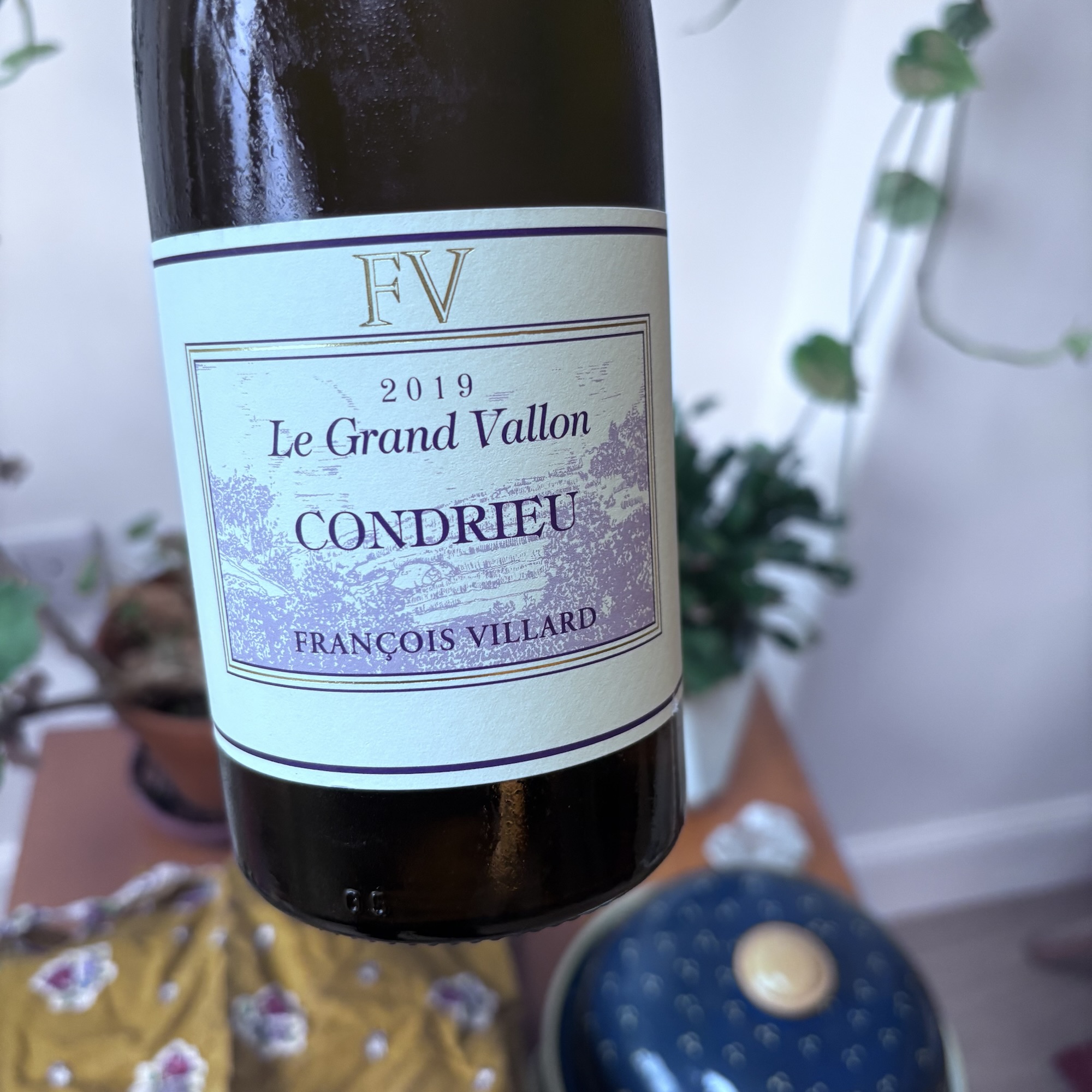
Condrieu “Le Grand Vallon” 2019, François Villard (Northern Rhône, France)
I definitely had a crush on Condrieu in my twenties, largely because, having discovered the wines of Georges Vernay via Yapp Brothers, I got to spend a morning with Georges at his winery on my first visit to the Northern Rhône. Viognier usually makes wines which are rich and flamboyant, at least it did back then. Just the thing to catch the palate of someone new to the breadth of flavours out there to discover.
François Villard first came to my attention somewhat later, when he started the operation called Les Vins de Vienne, along with Yves Cuilleron and Pierre Gaillard, producing wine initially from Seyssuel, that lost enclave of viticulture north of Vienne, where the schist slopes mirror those of the Côte-Rôtie a little further south.
I moved away from Condrieu when the alcohol began to rise to a level where, by the 1990s, I felt that the wines could be quite out of balance. There were always people who made less assertive wines from the Viognier grape, but they were often entry level varietal wines like Stéphane Ogier’s Côtes du Rhône version, but I think nowadays the pendulum has swung back more generally, bringing more freshness and less flab.
Villard now farms a whopping 40 hectares in total, not bad for someone who began life as a chef, not a winemaker, finding his oeuvre in this profession in 1988. Around 7.5ha are in Condrieu itself. Everything is organic and all of his wines have a real focus, I find. Vallon is a vineyard in the south of the appellation at St-Pierre-de-Boeuf. It has an East-Northeast aspect, which makes it cooler. Granite with Gneiss gives the wine extra precision, and like it or not I’m going to say that this cuvée majors on minerality. It has a lovely poise. Thing is, this does rock 14% alcohol, but you don’t think about that. Everything is nicely balanced.
This was unquestionably a lovely bottle, which I would say seems to be approaching full maturity. This vintage will no longer be available, but for a more recent one try Lay & Wheeler.
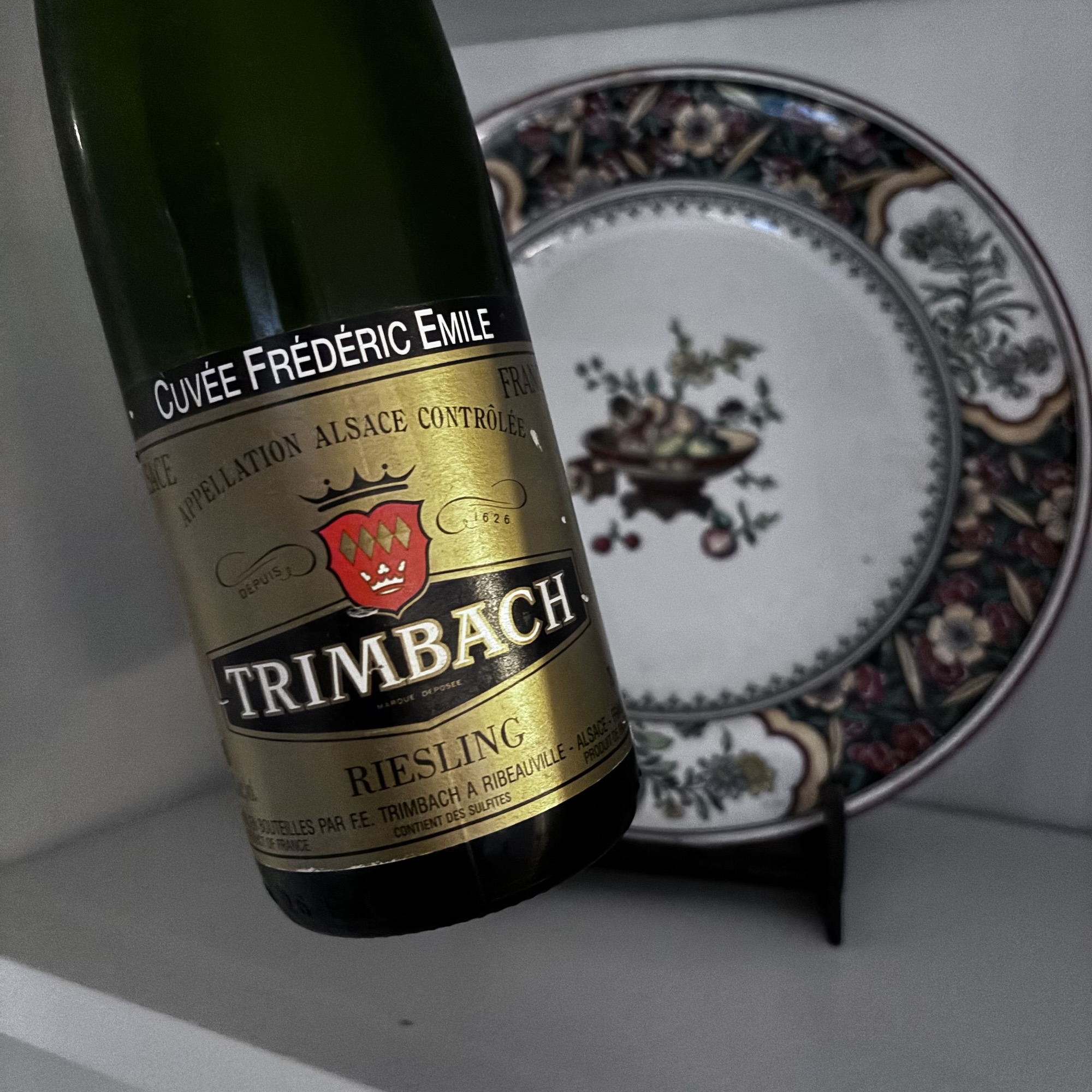
Riesling Cuvée Frédéric Emile 2005, Maison Trimbach (Alsace, France)
This is sadly the last of a string of CFE which I bought many years ago, which had made a fairly decent horizontal. Without fail they have been lovely wines, whatever the vintage. I have a cellar which has never had so few wines from Alsace right now, and yet they are among my favourite wines from France. The reason? I think a combination of the fact that Alsace doesn’t seem to ring the bell for a lot of younger retailers who are not as enthused about the new wave of exciting growers as the old school were about the classics, of which Frédérick Emile is undoubtedly one. They used to say Alsace was the wine beloved of the trade only, but even the trade seems largely disinterested (with notable exceptions like Tutto, Gergovie and Wines UTB).
It comes from two sites within the Osterberg and Geisberg Grand Crus, both which sit above Ribeauvillé, on steep slopes once carved by the now far smaller Strengbach stream. The Riesling vines grow on a mix of marl, sandstone and limestone. The wine is mellow on the nose. We have scents of stone fruit and lime citrus, with just a faint hint of petrol. The palate is dry but with a touch of rounded honey on the finish.
This 2005 is probably at or around its peak for those who want to experience a mellow, aged, Alsace Riesling, but I wouldn’t be surprised if it were capable, in a good cellar, of longer ageing. Certainly, it is showing tertiary elements and complexity but perhaps it has a little more to give.
If you are tempted to look for some ’05 try Hedonism in Mayfair (£110). All my CFE has come from Berry Brothers so check them out too.
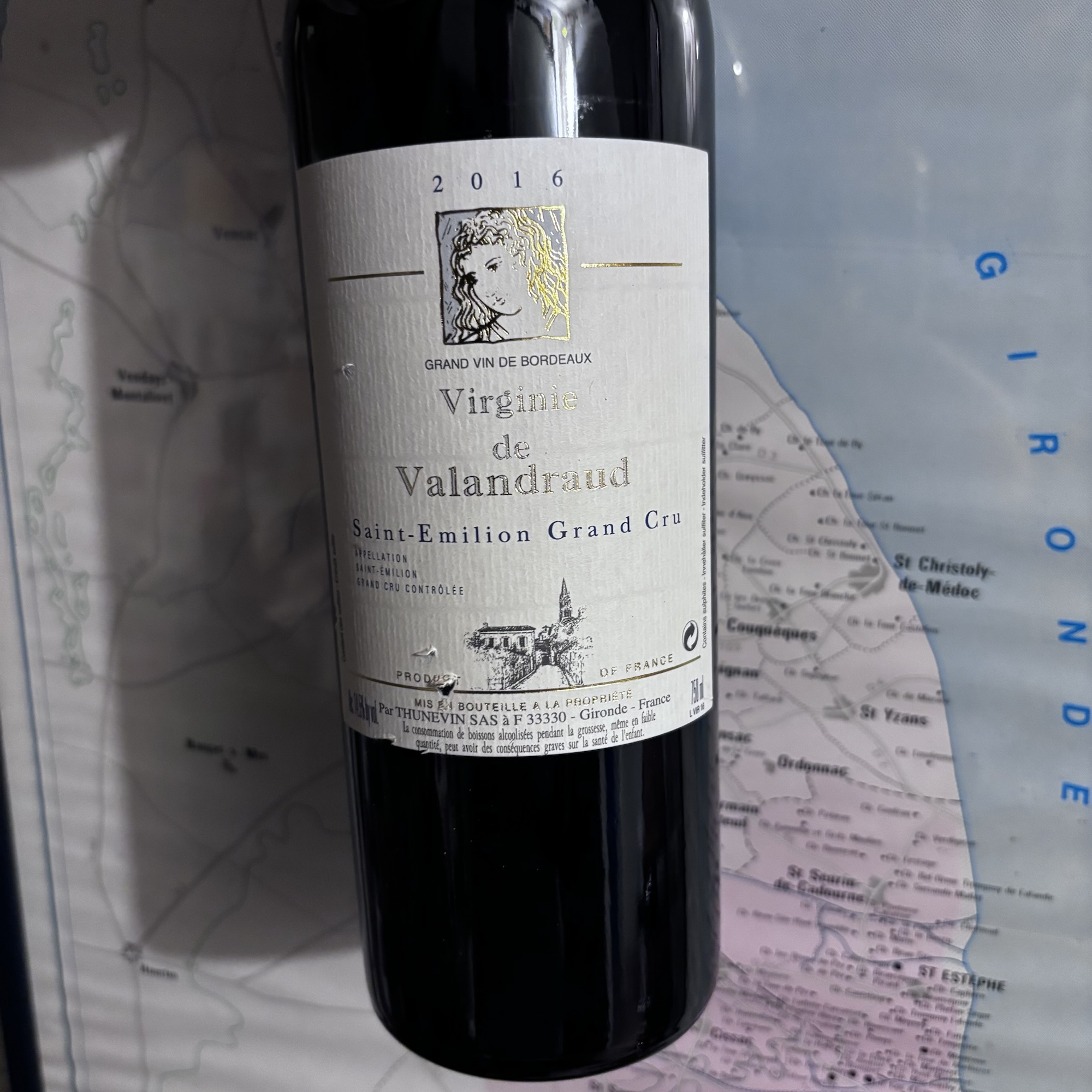
Virginie de Valandraud Saint-Emilion Grand Cru 2016 (Bordeaux, France)
It’s funny how nostalgia grabs you as you get older, listening to music from your teens or re-reading books you read back then. I wasn’t exactly drinking Saint-Emilion in my teens, but I guess you could say I drank a lot of it in my “wine teens”. My first visit to the town and region was probably around the age of twenty-four, maybe twenty-five, and it was already a red staple at home by then. Oddly enough, a lot of it was labelled as “Grand Cru”, despite the relative meaningless statement that is, neither denoting a specific vineyard as in Burgundy, nor even a specific level of quality.
This wine is altogether different. Château de Valandraud was the original Saint-Emilion garage wine, created from a 0.6 hectare-plot and made in a shed, at a time when Parkerisation was at a peak and the “va va voom” of souped-up Merlot was highly sought after. At the time it was easy for those brought up on the savoury qualities of 11% Haut-Médoc to turn our noses up. Yet…
The Valandraud estate today boasts a little under nine hectares of vines across Saint-Emilion. Jean-Luc Thunevin created what is effectively Valandraud’s second wine in 1992, with help from the late Michel Rolland, and naming it after his daughter, Virginie. It is mostly made from Merlot (around 65% in 2016), with the remainder Cabernet Franc (25%) and Cabernet Sauvignon (5%). This vintage the final 5% was 4% Malbec and 1% Carmenère. Since 1997 all the grapes have been sourced from Valandraud’s own vines.
It is a wine, true to type, aged in 100% new French oak. It is velvet-smooth, fruity and rich (with 14.5% abv). The fruit is dark (Blueberry and blackberry) and is lifted by the scent of violets. From a very good vintage here, at ten years old this tastes rich, but elegant, if perhaps a little linear. It has had good reviews. Generally, people would say that it is still young, though drinking it now does reveal an attractive wine and perhaps it was not too young to enjoy it. Another decade will doubtless reveal more nuance, but then again, that Merlot fruit is tasty. À la récherche du temps perdu for me, and in that respect, I enjoyed it very much.
Hedonism sells the 2019 for £42 and the 2015 for £130. Vinatis lists this 2016 for £45. This bottle came, via a friend, from Lay & Wheeler. I can’t see the ’16 listed, but the 2009, right at the end of its drinking window, is online at £50/bottle.
It’s worth stopping a moment to think about those prices. A lot of Bordeaux is greatly over -priced, yet £50 or not far off is what you can pay now for some brand new but very hyped natural wines from winemakers who arrived at a winery only yesterday. Natural wine is usually priced according to the economics of a tiny production, along with demand (even if that demand is somewhat dictated by hype). This particular wine isn’t what I’d call cheap, but it only goes to illustrate how confusing wine prices can be.
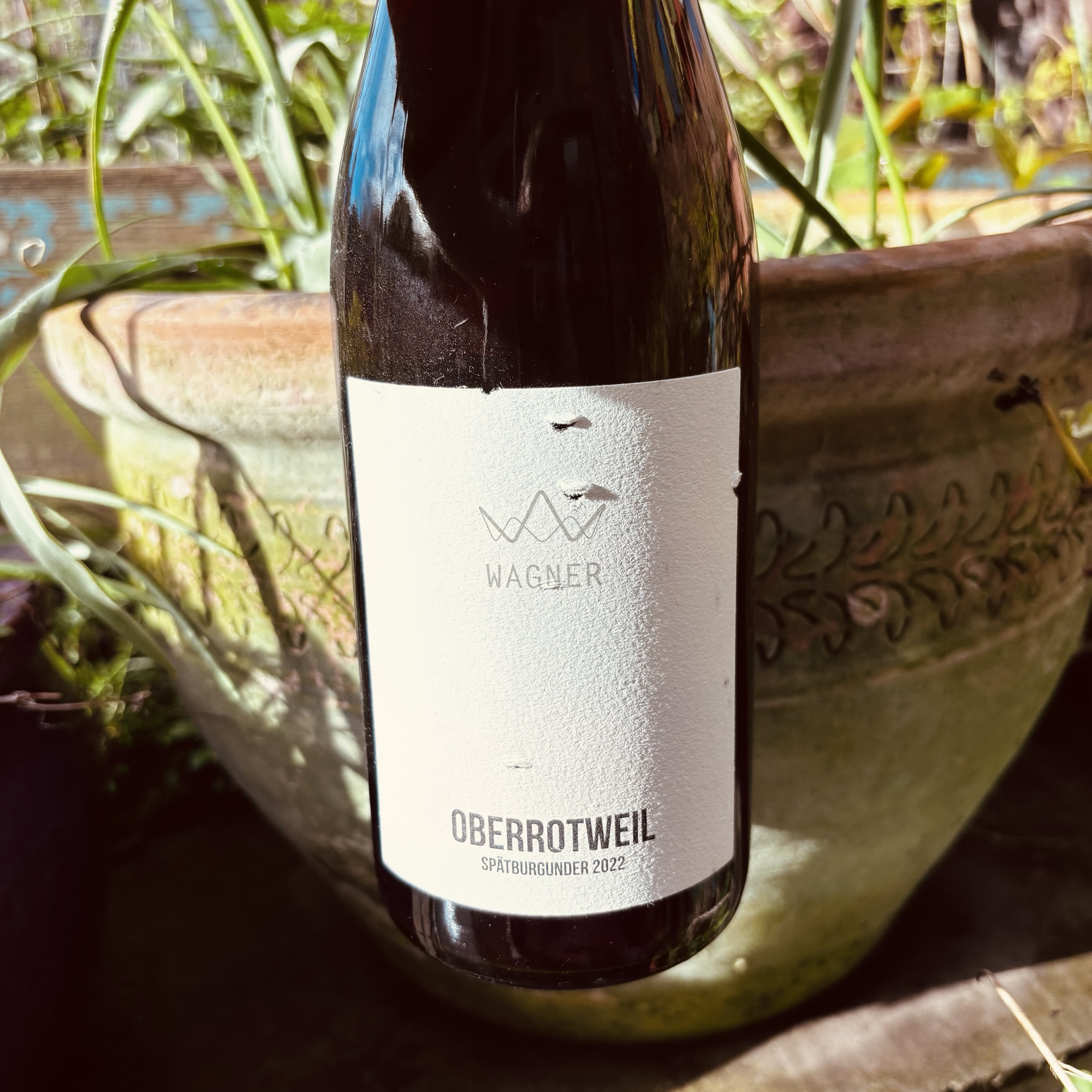
Oberrotweil Spätburgunder 2022, Peter Wagner (Baden, Germany)
Peter Wagner is based at Vogtsburg-Oberrotweil, where he farms eight hectares at the heart of the Kaiserstuhl. This is a famous outcrop of volcanic terrain which sits above the Rhîne near Freiburg im Breisgau on the German side of the river, and broadly opposite Colmar in Alsace. A decade ago, Wagner started out with just one hectare of vines, and he has been able to grow because of the success and reputation he has achieved through his careful biodynamic methods.
He is now an unashamedly natural winemaker in a region where such methods were slower to take off than in some others. This is a “village wine”, made using 40% whole bunches in the fermentation. Ageing is in oak for around sixteen months on the lees.
It has a genuine freshness, but also structure which suggests it may be a few years away from maturity. That said, what you get now is delicious cherry and raspberry fruit, smooth and sensual, but kept on the track through good acidity. There’s also a tasty twist on the spicy finish. In many ways, Germany seems to do so well at this level and Baden is well capable of providing more for your money than Burgundy now in the £20-£30 range.
This bottle came from Feral Art & Vin in Bordeaux. Ripleys is the UK importer and last time I looked they had it for £28. It seems increasingly rare to see wines comparably priced in the UK and France. Shocking almost.
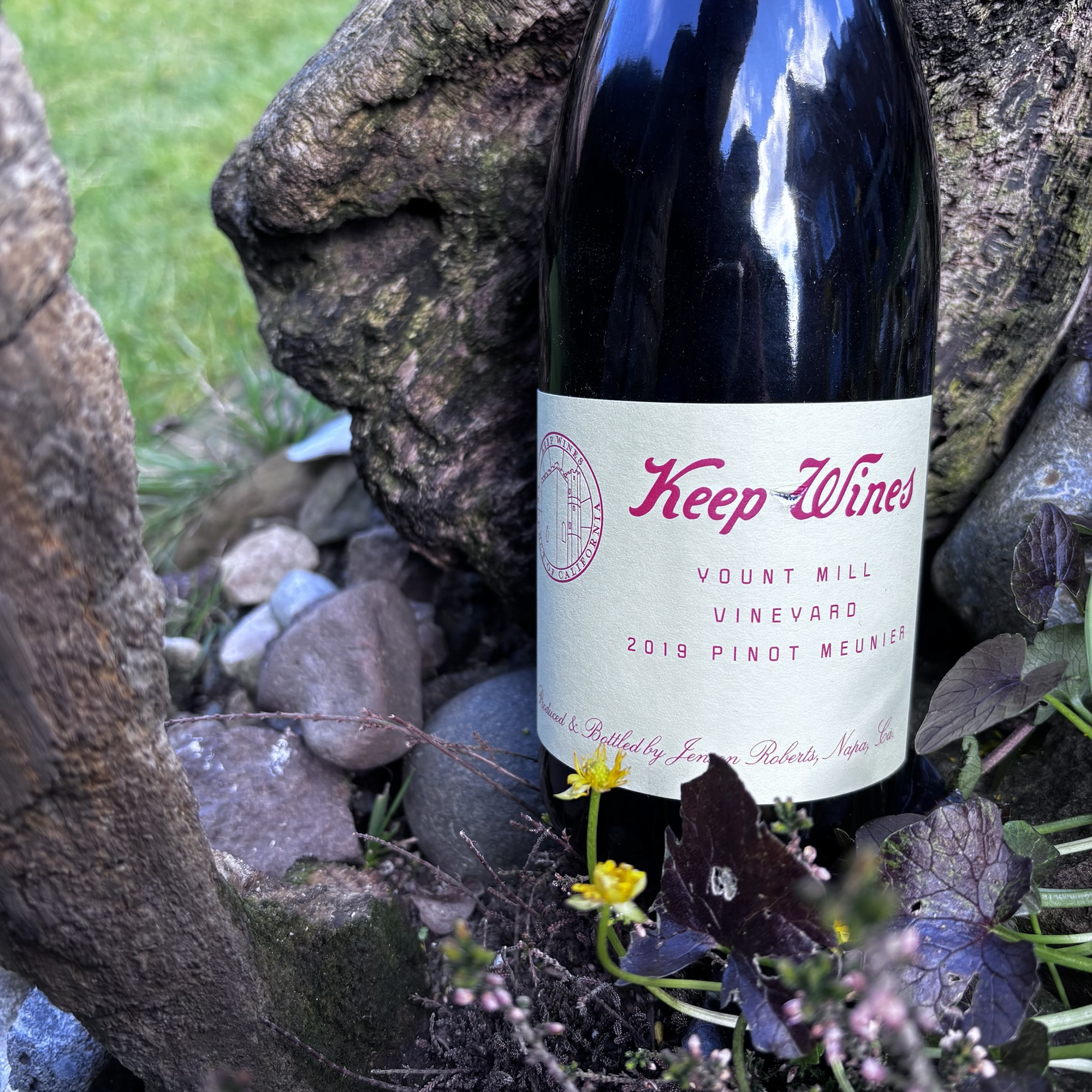
Yount Mill Vineyard Pinot Meunier 2019, Keep Wines (California, USA)
Keep Wines may be based in Oakville, right in the centre of the Napa Valley, but they do not make typical “Napa” wines. This isn’t really surprising. The team here is Jack Roberts, who worked at Matthiason, and his partner Johanna Jensen (ex-Scholium and Broc Cellars). These are minimal input natural wines. Frankly I’d recommend anything they make, but I have a soft spot for their Pinot Meunier. Mind you, it’s a while since I’ve had one.
I doubt that Meunier is abundant in Napa. The grapes come from a well-known site (Yount Mill) on alluvial soils. It’s made with 20% whole clusters, gently pressed into neutral oak. Natural here means all the usual restraints (no fining or filtration etc), and just a tiny addition of sulphur.
It’s an undeniably gentle wine which would surprise many, although the 12% on the label is a big clue. The acidity comes by way of delicious fruit acids which are very concentrated with raspberry, redcurrants and sweet ripe cherry. That’s all set off with a bouquet of violets and lavender. Stunning, seriously so. I’d recommend serving it cool.
The UK importer for Keep Wines is Nekter Wines. I was lucky to be able to pop into the new Nekter Deli not far from Liverpool Street Station last October, where I grabbed this for £37. Not cheap in real terms, but pretty well priced for a quality Napa wine. I can highly recommend this bottle, and also the great range they have in the deli, both to drink in with food, or to take away. Plenty of wines you’ll be pushed to find elsewhere. Nekter has a focus on mostly what people used to call New World wines, but their Californian range is especially worth mining.
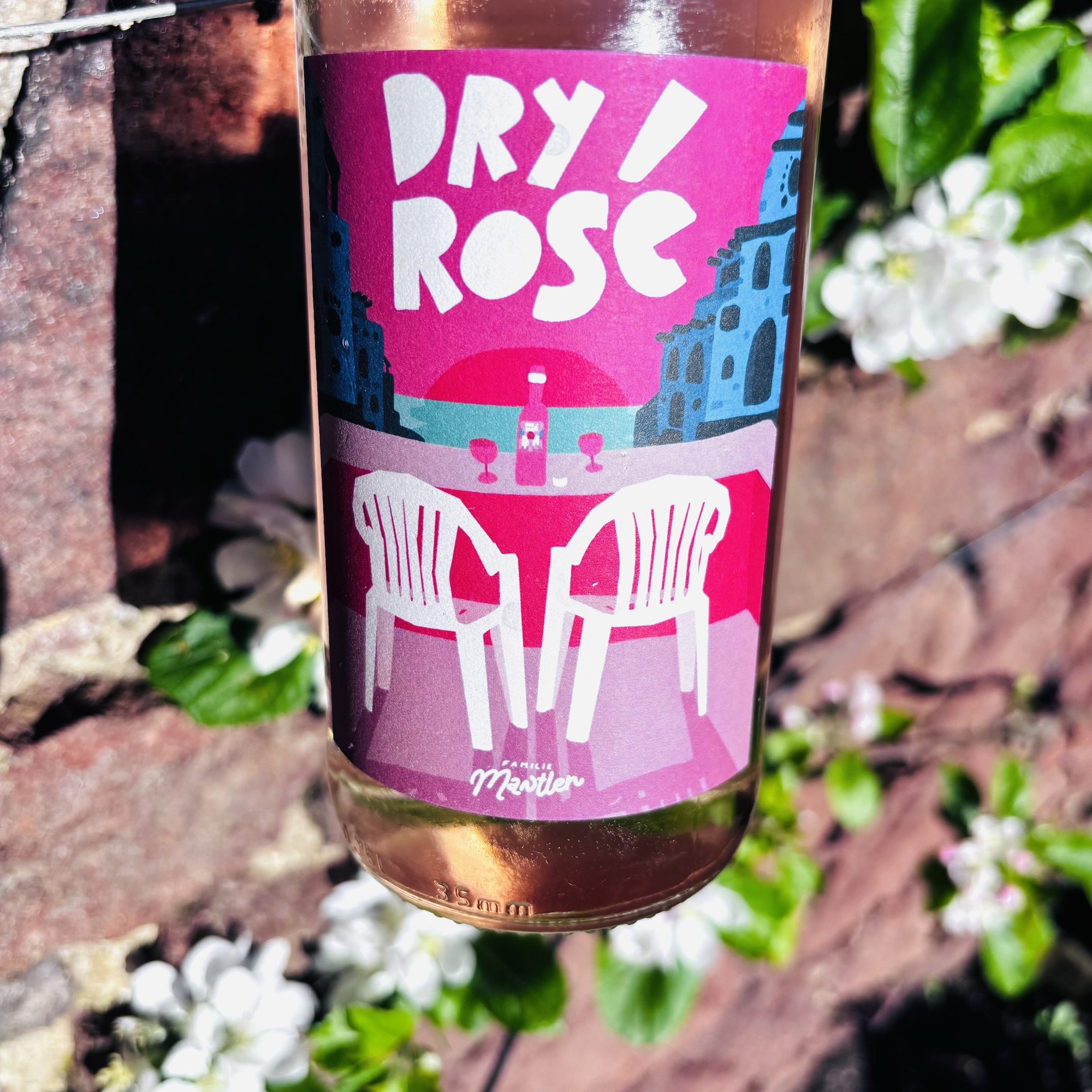
Dry Rosé 2025, Familie Mantler (Niederösterreich, Austria)
And now for something completely different, as they say. In March I tried the Mantler Family Gemischter Satz blend, and it was pretty tasty, despite a few raised eyebrows from parts of the wine fraternity, who mostly wondered what they had to spray the vines with to knock out a wine like that for under a tenner. Someone working for the importer, however, suggested I try this Rosé as well, and I could hardly refuse. I’m not afraid to admit that anything remotely pleasurable at that kind of price is most welcome in my house in the current economic climate.
So, does this pink match expectations based on that white blend? I’d say it more than does. It’s a varietal Zweigelt made from fruit grown across Northeastern Austria, although the family’s base is at Ebersbrunn, near the eastern border of Kamptal. It is labelled as a simple Qaulitätswein, and makes no claims to be in any way a natural wine. This might make all the difference to some readers, which is fair enough. But it notably does state “vegan-friendly” on the bottle.
Let’s not go overboard here. It is crisp with a little bit of a CO2 prickle. It does seem to burst with very nice and pretty concentrated strawberry fruit. Not complex, of course, but it gives the kind of pleasure you’d expect from a Vinho Verde or a Txacoli from the Basque Region. Or indeed a Gemischter Satz supped at a Heuriger on a long summer’s evening on the edge of Vienna. I will never forget a simple but appealing Zweigelt Rosé supped with lunch on the terrace of the Gasthof Prankl, overlooking the Danube at Spitz. I’m no wine snob, and wouldn’t be even if the wine budget were bigger. This is just what you want for a picnic, and at only 11.5% it has other advantages too. You can drink a bottle each.
This cost me £9.50 from The Wine Society and right now it’s still in stock.