
Between 2010 and 2016 I subscribed to wine’s perhaps most serious journal, World of Fine Wine. On occasion I was able to see my own words on their pages, but back then it was, mostly if not entirely, a bastion of classical thinking, at its most extreme in the quarterly tirades against natural wine which French wine luminary Michel Bettane gave in his column. It was probably the cost of the journal which led me to allow my subscription to lapse after six years, but good old Michel didn’t help matters. Despite all of Michel’s musings, World of Fine Wine was, and remains, at the cutting edge of commentary and research on the wide world of wine.
I am grateful to World of Fine Wine for introducing me to two writers whom I might never have otherwise come across. One was Barry Smith, whose work on sensory perception has been of genuine importance to the world of wine, and Alex Maltman, a geologist whose equal passion for rocks and wine goes back to his student days. He now has twenty vines from which he makes wine in his garden in Wales, where he remains Emeritus Professor of Earth Sciences at Aberystwyth University.
Alex has become wine’s geologist, so to speak, so intertwined have his passions become. He has contributed to both seminal works The World Atlas of Wine and the Oxford Companion to Wine. This is his second “wine book”, the first being Vineyards, Rocks and Soils… (OUP 2018). Professor Maltman has become the leading exponent of bringing a reality check to the notion that rocks are directly ingested by vines, and so the direct taste of bedrock cannot be sensed in the glass. Or, as the aforementioned Professor Smith more bluntly put it more generally, “The idea that you can taste minerals from the soil is absolute rubbish” (quoted in Simms, Grape Expectations, New Scientist May 2015).
People once thought that vines lived by effectively eating the soil. The discovery of photosynthesis blew that idea out of the water. As for the soils in a vineyard, they usually bear little relation in time or place to the underlying bedrock, having been deposited, eroded (for example by ice age glacial action), and then deposited anew, much later. And anyway, we know as fact that most rock is neither soluble, nor can it form a gas (via vaporisation). So, we can’t taste or smell it. Even flint, when it strikes in a flintlock rifle, because what we smell (not that I suppose many of us ever smell the discharge of a flintlock these days) is the gunpowder, not the flint.
Nevertheless, one of wine’s fashionable obsessions at the moment is “minerality”. Maltman points out that geology was almost never mentioned by wine writers until relatively recently. I don’t know who began our rush to describe “minerality” in wines, but I do clearly remember Rhône specialist John Livingstone-Learmonth’s “STGT” (soil to glass transfer) club, which he describes (Wines of the Northern Rhône, UCP 2005) as producers like Auguste Clape of Cornas, where “For years, their wines have quietly brought forth the truth about their vineyard…”.
Today, minerals, rocks and strata get a mention in almost every tasting note I read (and indeed many I write myself). Just this week, an Instagram post by my favourite Swiss producer, Marie-Thérèse Chappaz, mentioned an article by Roberto Sironi highlighting the granite her vines rest upon (Fully e Martigny, L’enclave granitica del Valese). But if you read this book, and I hope you will because it’s one of the most exciting and stimulating books I’ve read on any subject for a while, many of your preconceived notions about rocks and wine will be questioned. Just don’t expect the outcome to be simple.

The contents of the book follow a fairly broad approach comprising introductory thoughts followed by a more detailed look at the range of bedrock types on which vines grow around the world. Granite, Tufa and its soundalikes, Shale/slate/schist, clay, and of course limestone.
If you think about it, there are many famous European wines which are completely synonymous with certain types of rock in popular perception. The Mosel and slate, Champagne and chalk (to a degree), Burgundy and limestone, Sancerre and Pouilly and flint, Central Baden’s Kaiserstuhl and volcanic rocks. Of course, let’s not forget Sherry on its white albariza soils, often described as chalk in some articles, but it is in fact “white, marly soils rich in calcareous plankton” called diatoms.
We tend to forget that these certainties often differ outside of Europe, and in any case, to use one example, more Champagne vineyards sit above rocks that are not chalk. To give another example, we often pair Syrah and Gamay with granite. In the Northern Rhône, Hermitage is by no means all granite, neither is Côte Rôtie granite (though Condrieu, planted exclusively to Viognier, is). By far the larger part of the Beaujolais region is not granite, that so-called perfect match with Gamay, although in general it does predominate in the Crus. Such pairings are not wrong per se, but we need to be careful of generalisations.
The content of the book is in places detailed, and we do learn plenty of science, but Alex always expands our knowledge outwards too. The author is able to combine academic rigour with a wider perspective coming from his deep knowledge of wine (viticulture and winemaking). I guess what I’m trying to convey is that Alex writes well, and taking on the science is no burden at all.
We also learn about many of the people who made the discoveries that took geology and viticulture forward. There’s a whole chapter on James Busby, who most wine lovers who have visited Australian vineyards may well have come across (along with those well-versed in New Zealand history). This chapter, however, perhaps tells us more about what he didn’t actually achieve (the man and the myth). Another fascinating story of how wine myths can emerge.
I would also highlight the chapter called “Winescape UK”. All of my readers in Great Britain will certainly find Maltman’s geological journey through our islands extremely helpful, perhaps especially in detailing the mixed geology underpinning Southern England’s sparkling wine production (including the chalk versus greensand debate), and some pointers as to why places like the Crouch Valley in Essex might be that sought after Grail for red wine. You won’t taste the thick layer of London Clay in your Crouch Valley Pinot Noir, but many of its properties combine with the warm, sunny and dry climate here to make red wine production qualitatively profitable.
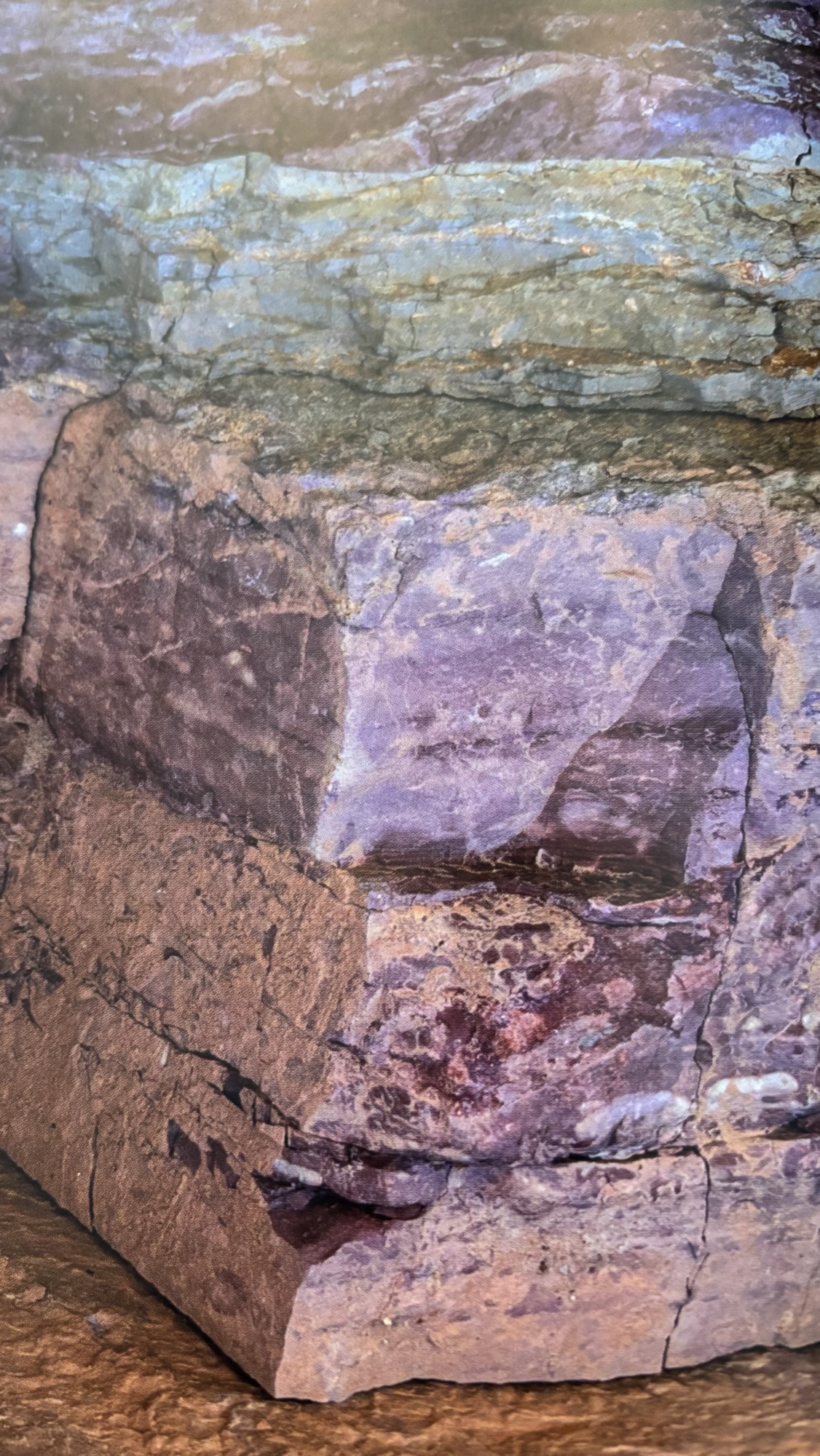
For rock fans: the book is littered like scree with photos like this
As is typical in this book, it’s not all about the bedrock. Kaolin (continuing the clay theme) is a specific type of clay, and it is perhaps most famous for its use in making fine porcelain, the first European samples having been smuggled out of “Kaulin” in China’s Jiangxi Province by Jesuit priests. It later turned out, fortuitously for the English, French and German fine porcelain industries, that the same clay could be dug up in Haute-Vienne, Cornwall and near Meissen.
But kaolin also has many cosmetic applications. For vines, the spraying of comminuted kaolin particles onto vine leaves not only acts as an effective sunscreen in regions with high ultraviolet radiation, but it also helps promote more even ripening. In Australia’s Granite Belt (Queensland), where an estimated 15% of the crop can be lost to sun burn, it has proved invaluable.
To further question the arguments of those who suggest rocks influence wine’s flavour, the chapter “Four Elephants in the Wine Room” looks at what it says on the tin, four factors which have a major impact on wine taste. These are soils, rootstock selection, choice of yeasts, and ambient factors affecting taste perceptions, all of which could be argued have a far greater impact on the taste of wine than the underlying vineyard geology.
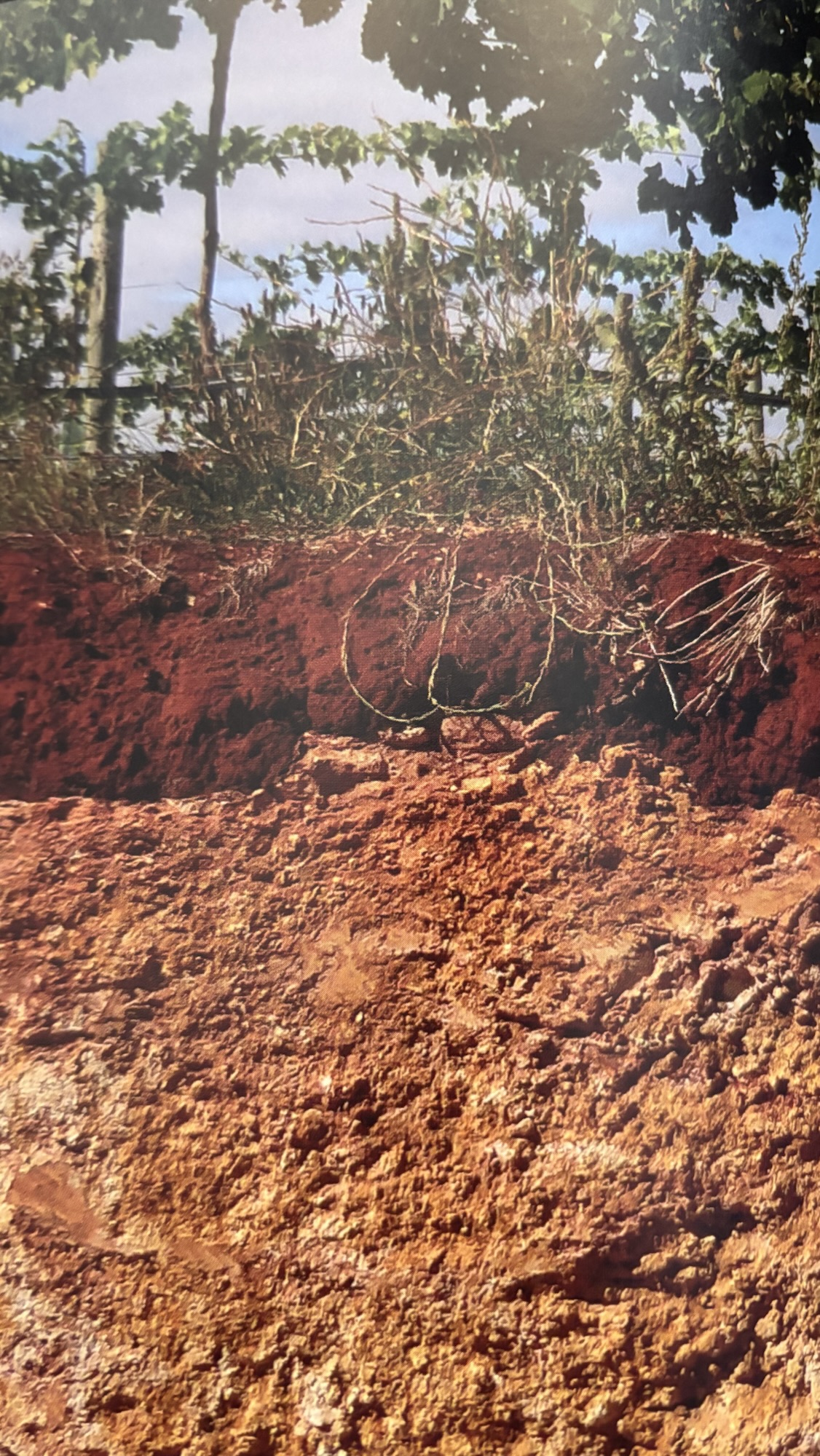
A slice of Coonawarra Terra Rossa
Nevertheless, as writers, we persist with the geology. Perhaps weirdly named rootstocks and commercial yeasts are far less exciting for our readers than rocks, and personally I do think vineyard geology does capture the imagination. It helps paint a picture of the landscape, irrespective of any effect on the grapes grown above it, and today I believe readers are more interested in a wine’s story than in a tasting note. This is, at least, my own modus for writing about wine, by-and-large. If a wine sounds interesting enough, then I feel sure my readers will go taste it for themselves.
All of this said, geology is far from irrelevant, despite science telling us that vines take more life and vigour from gasses in the air, from sunshine and from judicious watering (by rain or irrigation). Geology naturally has a major impact on water retention and availability for the vine, and in some cases soil matter and rain can react with bedrock to exploit fissures and cracks, enabling vines to delve deeper to find moisture. This is especially true in vineyards underpinned with limestone and some clay.
Whilst nutrients from below come via humus in the soil rather than direct transfer of minerals from rocks, there is also the question of mycorrhizal networks (the symbiotic association between a fungus and a plant, the fungus giving the plant moisture and nutrients in exchange for sugars from those plants).
The study of the workings of these networks is in its relative infancy. However, for such networks to thrive, or even exist, you do need to have “living soils” of the type more likely found in a vineyard which has not been sprayed by synthetic pesticides and herbicides, and where the soil hasn’t been compacted by heavy machinery, so that the creatures that keep the soil living can exist and thrive, as opposed to a vineyard the subject of napalm death.
So why do we persist in explaining which rocks vines are planted on top of almost every time we describe a vineyard? The idea that we can taste those rocks is scientifically unlikely at best, but yet there is the power of metaphor. This is what I feel validates the use of descriptions of minerality in all its forms in a tasting note.
We say wines smell of cherries or grapefruit, or taste of quince and melon. Naturally they do not contain these fruits, but at least here there is a scientific basis for such descriptions in the compounds shared between these fruits and the finished wine. Minerality is a more nuanced metaphor, usually coming from either something we find hard otherwise to describe as a smell, and certainly as texture on the palate.
One obvious and often used metaphor, one I remember from my own childhood, is the smell of blackboard chalk in the classroom, something I suspect has been confined to the past by modern classroom technology. It would be easy to suggest that when we say a wine is “chalky”, perhaps we are thinking of a vague recollection of “chalk dust” from a blackboard duster often directed, as a projectile, in anger at a child unable to answer the teacher’s question sufficiently quickly (the least painful of many classroom punishments in the arsenal of our teachers back then). I bet you don’t know that classroom chalk is made from the mineral gypsum (calcium sulphate), so it isn’t chalk in that sense at all. The rock called chalk is not dusty.
To justify my use of mineral allusion I always wheel out my experience, one I will never forget (or perhaps be allowed to) whilst hiking up to a mountain refuge in the Val d’Aosta. For me, this is my own justification for utilising mineral descriptions, despite accepting that you cannot “taste” a rock. You might have read it before, but it’s an oldie and a goodie and so worth wheeling out again.
We had a bottle of local wine, Vin Blanc de Morgex et de la Salle, made from the Prié Blanc variety. Stopping for a picnic lunch, which certainly contained some artisan Fontana cheese, I wedged the bottle in a cold mountain steam which tumbled down from what was an ever-shrinking (on every visit) small glacier. It didn’t take long to chill. Morgex doesn’t have a particularly big bouquet, merely herbal, and it tastes (pleasantly, I should state) like a herb-infused mineral water. However, the wine had a texture which reminded me of the pebbles on which the bottle sat. I couldn’t resist taking a smooth pebble from the water and proving my theory by licking it.
I was not tasting the pebble as such, but my tongue was experiencing a texture. Lucky that the base of the stream wasn’t flint, or I’d probably have cut my tongue. It was also fortuitous that being at some altitude meant the water was less likely to have been contaminated by the local (and then considerable) marmot population. But I think this experience does shine a light on how rocks may have at least a tenuously valid place in wine tasting. I was able to relive that moment with Proustian perfection just last month, on opening a bottle of Morgex I’d fortuitously picked up at Raeburn’s.

“It’s been a long time since I rock and rolled” (Geological Time Chart on p169)
In summary, I feel I need to repeat what I have already said near the beginning of this article. This is a brilliant book. I have to declare an interest in geography and geology. Not only was Geography (along with History) one of my two favourite subjects at school (with associated field trips to areas like the limestone scenery of the Yorkshire Dales and the Jurassic Coast of Dorset very much enjoyed), but I was brought up close to the remains of an extinct volcano, lived for twenty-eight years on the chalk and flint of the South Downs, and now live among more volcanic rocks and sandstones of some complexity in Scotland.
All of that said, I’d go so far as to say that this book would be a stimulating read even for those wine lovers with, on the face of it, much less of an interest in geology than my own. I’d venture you don’t have to be a total wine geek like I am to find it a stimulating read either. In my own case, it’s difficult to contain my enthusiasm. I think a lot of my readers would enjoy it, and I mean “enjoy”, not merely find it illuminating (which, of course, they will).
Taste the Limestone, Smell the Slate by Alex Maltman has just been published (2025) by the Academie du Vin Library, and is available through good independent book shops, via the popular online sources (if you must), or direct from the publisher via their web site at www.academieduvinlibrary.com for £35. It’s a nicely produced hardback of just over 300pp with quality binding and some lovely photos.
My copy was kindly provided by Academie du Vin Library for review, but I hope my genuine enthusiasm speaks for itself. For me it will unquestionably be one of my wine books of 2025.

 David Crossley's Wide World of Wine
This sounds fascinating, I’ll search it out so thanks for the recommendation David. Some sharp writing too if I may say so.
LikeLiked by 1 person
Thank you, Alan. Encouragement welcome right now.
LikeLike
I use the very same argument of fruit / leather not being present in the wine, but somehow acceptable descriptors whereas any suggestion of a mineral induces hysteria in some people.
Interestingly , I found 2 very distinct flavour profiles in the Riesling in Clare Valley, which the producers pointed out, coincided from the 2 different soil types on each side of the valley.
More interesting is the acid that some believe causes one of the more common perceptions of “minerality”. A hormone emitted when the plant is nutrient deprived and flips from vegetative growth to fruit production. This has been found in Santorini and Etna I believe. I would assume also in the Canaries (and wonder if also in Colli Tortonesi)
LikeLiked by 1 person
Pingback: Taste the Limestone, Smell the Slate – Alex Maltman (2025) – Tessender