
July marks the start of the second half of the year, and also, finally, the arrival of nice weather in our sunny corner of Scotland. It’s strange, though, how my drinking doesn’t substantially change between summer and winter. I drank a powerful red with 14.5% alcohol here, but it was perfect with a steak barbecued by an American (ie properly) on the same evening as the most beautiful sunset of the year so far. It was one of three reds and three whites which make up Part One, the same colour split to follow in Part Two. But here we have wines from Aosta, Penedès, Sussex, Bergerac, Jura and Alsace.
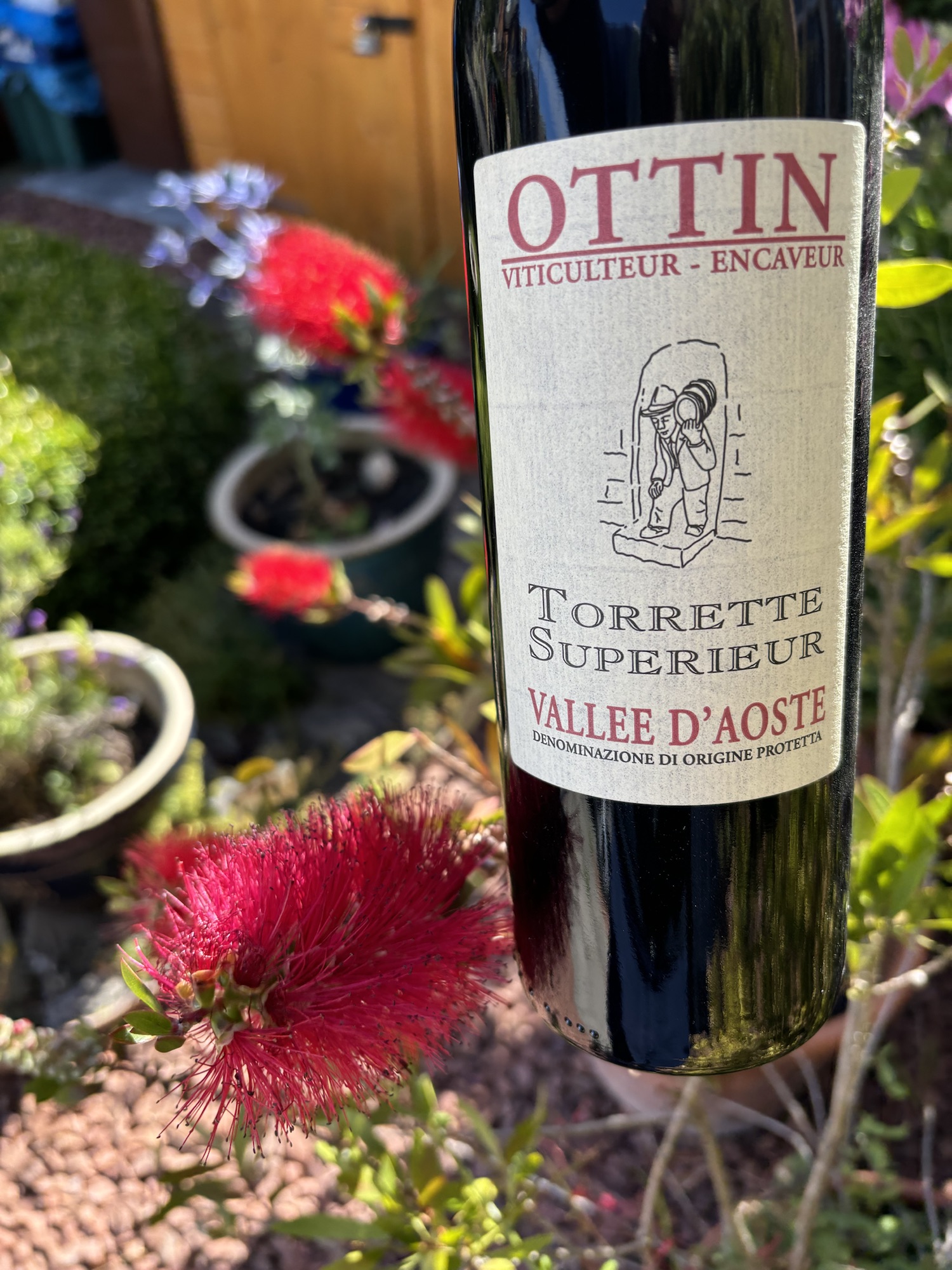
Torrette Superieur 2016, Elio Ottin (Aosta/Aoste, Italy)
Aosta is a tiny region, and like another tiny region whose wines I love (thinking of Bugey here), although their wines are hard to find, they’re not as hard to find as they were five years ago. Elio Ottin’s wines have been around in the UK for quite a while though, and bottles appear on random shelves a couple of times a year.
There is a unique beauty about Aosta, crammed into one river valley, the Dora Baltea, and a few decidedly Alpine side valleys, filling a tiny, mostly French speaking, bit of Italy between the Mont Blanc Tunnel and the Grand Saint-Bernard Pass in the west, and Piemonte’s northern reaches to the southeast.
Elio Ottin started working his estate in 1989, which was not all that long before I first visited Aosta, falling in love with its wines through the tutelage of the now retired owner of the tiny Hotel Perret at Bonne, just above Valgrisenche. It was an amazing auberge back in the day, where there was no menu, second helpings were always offered, and frequently guests arrived with crampons and backpacks as often as by car.
First visit I think I ordered Brunello (Bruno was an experienced sommelier in his younger days) but over the years this kind man tutored me well in Aostan wines, and latterly I’d carry home some of the region’s amazing dessert wines (Malvasia Flétri and Moscato Passito), well-aged in his cellar, along with an axle-crunching selection of other local wines foraged among the villages and from Aosta itself. I do so miss that place.
Ottin was only twenty-three when he began farming grapes, converting to organic viticulture. He was intent on reviving the steep vineyards (at 650 to 700 masl) at Saint-Christophe. He forged out, bottling his own wine, in 2007. The red Torrette grapes here are cooled to receive a short maceration before fermenting (spontaneously with ambient yeasts). This wine is aged 12 months in old Austrian oak.
This is an eight-year-old wine made from a variety one would hardly call “noble” by any stretch of the imagination of those writers and critics who made their fame in the 1980s by preaching the gospel of uniformity. But this is very much hitting its stride and full of interest. Quite dark in colour, yet bright, you get both dark and red fruits making up a bouquet which also gives hints of pine needles. The palate has a little tannin, not a lot but enough to add texture.
I wouldn’t call it complex, but it has 13.5% abv and is a good food wine. I think the altitude helps retain freshness and acidity, so there’s a brightness to it. It went very well with a roast vegetable (butternut squash, cauliflower and padron peppers) risotto. £26.75 from St Andrews Wine Company, but I think it could have been one of those last bottle situations. That said, they always have something on the shelf that grabs my wallet’s attention.
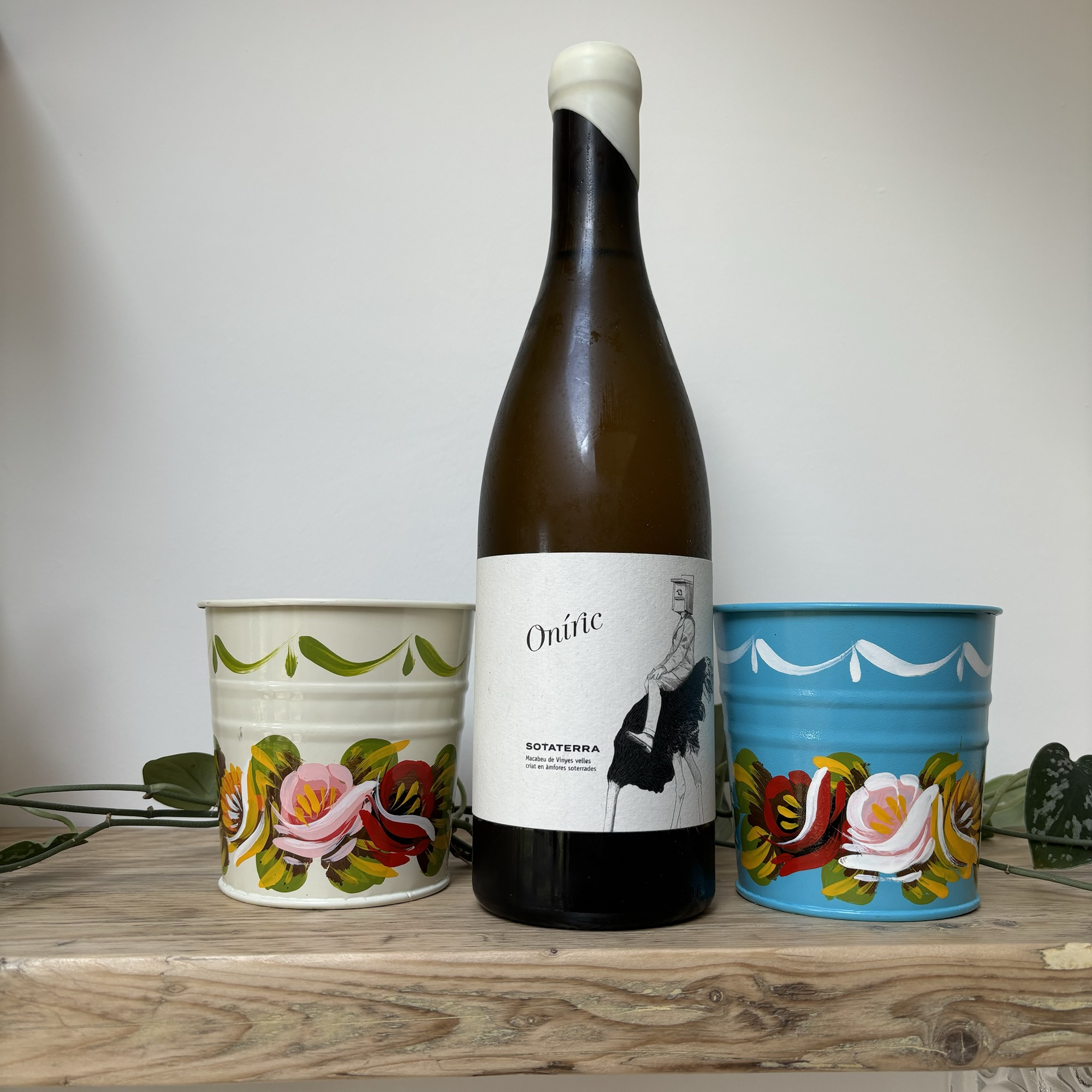
Sotaterra Oníric 2021, Celler Entre Vinyes (Penedès, Spain)
I think I recounted before how two people recommended this producer independently but on the same morning back in March this year. One was fellow blogger and Coutelou alumni Alan March, and the other was a wine buyer who I asked to recommend just one estate from her list. It took me a while to track down some bottles, and I managed to grab a couple of different cuvées a couple of months ago.
Entre Vinyes was started by a very young couple who took over some old and neglected parcels of vines in the Penedès appellation in Catalonia in 2012. At the same time, they converted a derelict chicken coop and pigsty into a winery. As you will imagine, they were determined to follow a path of natural wine and a regeneration of their land, and by all accounts they have succeeded wonderfully. I get the impression that a lot of people with their fingers on the pulse are either raving about these wines or trying to keep them secret.
This is an amber/orange wine. Macabeo, planted in 1935, saw fourteen days on skins and nine months in total in amphora that are buried in the ground. The result is certainly a skin contact wine, but lightly textured, boasting only 11% abv and real freshness. Yes, there is texture, but it is soft texture, not harsh or rasping. It has peachy fruit that runs deep, with an overlay of orange peel, but that freshness I mentioned is the freshness of a lighter white wine. Maybe I can describe it as nimble. It’s really lovely, and elegant too. My other bottle is a white wine without skin contact. I doubt it will see out August, so watch this space.
I found this at Smith & Gertrude (Edinbugh – Stockbridge and Portobello) for £23.50. Modal Wines is the UK importer, from whom you can buy direct if you are not lucky enough to have a S&G close by.
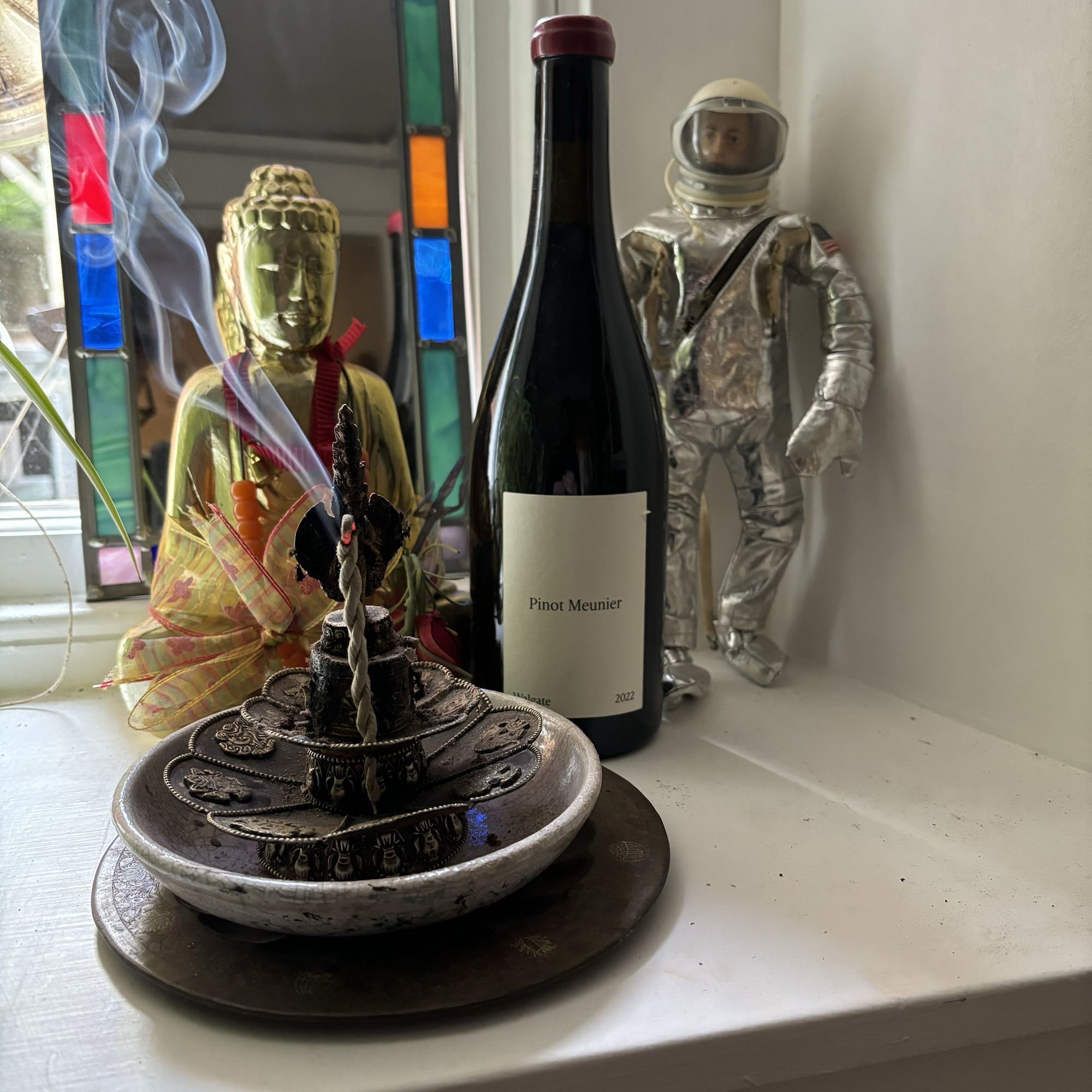
Pinot Meunier 2022, Walgate Wines (Sussex, England)
I was glad to catch up with Ben for the first time in ages at the Real Wine Fair in London this spring. Now that Ben is working out of his own winery in the beautiful town of Rye on the Sussex coast, he is searching for top fruit. Here, I think, he has struck gold, wherever this Meunier was sourced (though I believe he brought his own wine with him from Tillingham).
This bottling is mostly Meunier, but with a dash of Pinot Noir, Ben told me. It saw whole bunches macerated for three weeks in concrete before transfer to stainless steel and oak. The fruit on this is enormous. The back label mentions cherries and pomegranate, and that’s certainly what you get, but the language is too pedestrian for such an explosion of fruit on both nose, and especially, on the palate. It paired magnificently with a fricassée of mushrooms in a cream sauce with a dash of wine to finish.
Ben sure knows how to make wine, and I do hope his new venture allows him the freedom to make the wines he wants. I know that competition for fruit sources is far greater now than when he had his vision for Tillingham, and the fact that there are now a lot more small operations looking for grapes is in good part down to him and a few other artisans who pushed the boundaries back and gained a reputation for their wines. Ben’s wines shown at Real Wine were going down well, his Rosé especially, but this “Pinot Meunier” is, in my humble opinion, even better.
Agent in the UK: Les Caves de Pyrene.
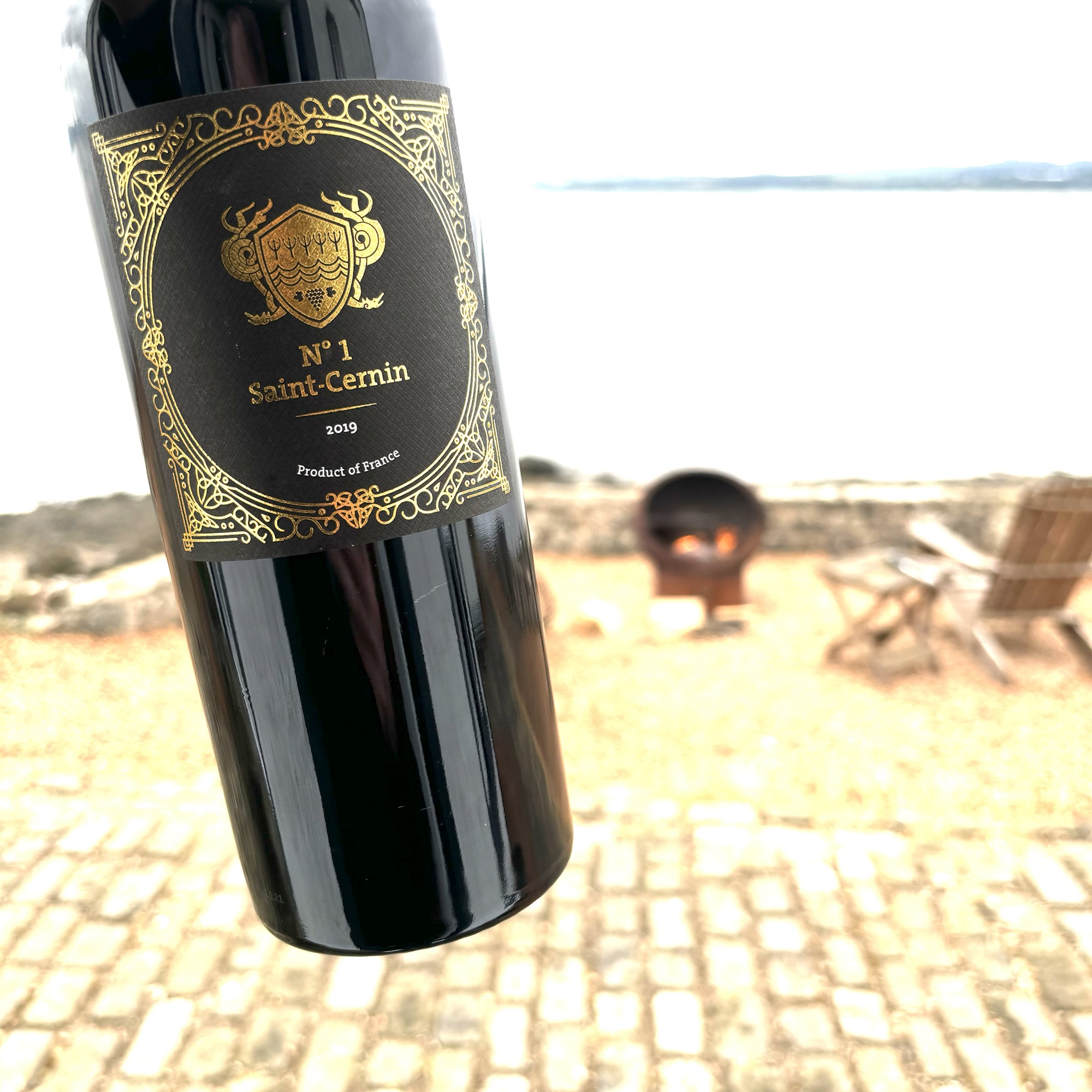
No 1 Saint-Cernin 2019, Maison Wessman (Bergerac, France)
Usually, I pay for what I drink, but I should declare here (as I always will) that everyone who attended the Maison Wessman tasting and lunch at the beginning of July this year went home with a goodie bag containing a couple of bottles. I’m hoping you will forgive me a very rare perk and trust that I’m being honest about the wine. I should mention though, as I did in my article about the tasting (published on 4 July 2024), that Bergerac was randomly the first wine region I ever visited, so I will not deny the dose of warm nostalgia that the event brought with it.
Maison Wessman is the umbrella name for several estates in Bergerac and Limoux. These include the vineyards of Château de Saint-Cernin, the French home of Robert Wessman, situated on some fine and fairly unique limestone terroir near Issigeac, south of Bergerac and the Dordogne, for which there are moves to get a specific appellation. The vines are farmed with “a commitment to eco-responsible and sustainable viticulture”. Although I always find it hard to interpret that kind of language, what I am certain of is that Wessman have a serious commitment to quality.
Here we have a blend of 60% Merlot and 40% Cabernet Sauvignon. It’s a prestige selection, and comes in a far too heavy bottle, and packs 14.5% alcohol. But it has a smooth elegance, concentration and power. Those things don’t always come at the same time, as some Napa drinkers will know. We get cherries, blackcurrant, truffles, tobacco leaf and spice. Theres a little texture rather than harder tannins in a wine that has almost five years post-harvest age, and a bit of evolving complexity.
Now aside from the heavy bottle, this is both impressive and enjoyable. I found myself a little nostalgic for the Cabernet/Merlot blend, so perhaps the pendulum of taste is swinging back. What helped was that it was drunk as the evening began to cool alongside a barbecued steak, done just right by an American friend on the banks of the Tay. A great food match always elevates a wine, as the wine elevates the food.
I looked around for the price and availability of this wine. As such, Maison Wessman is looking for a UK importer, though Hedonism Wines did appear to show the 2018 (previous vintage) for £50. But French prices are more like 26€ for this 2019. Interested in importing these wines? Contact Westbury Communications.
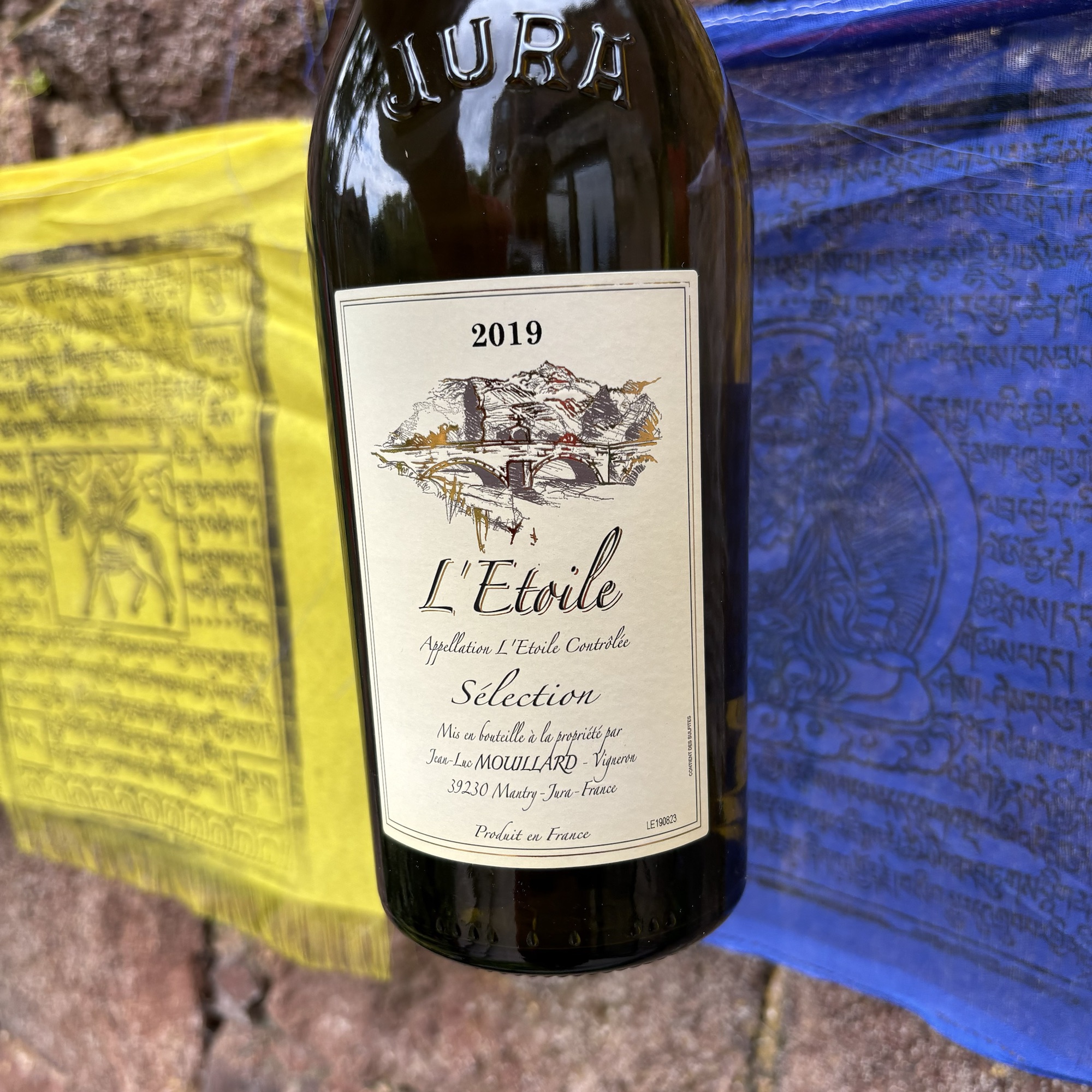
L’Etoile “Selection” 2019, Jean-Luc Mouillard (Jura, France)
L’Etoile is one of the least-seen appellations in the Jura Region, the village of the same name being close to Lons-le-Saunier and southwest of Château-Chalon. It is a marl-based terroir, but the name may derive from the star-shaped fossils found in the appellation’s limestone, which is mixed in with the marls in the best parts of the vignoble.
There are fewer “names” here. Château de L’Etoile used to appear from time to time, especially in Parisian wine shops. The best known today (a natural wine and a bit of a bargain) would be Domaine de Montbourgeau, in L’Etoile itself.
Jean-Luc Mouillard is based way to the north, in a village called Mantry, in the AOP Côtes du Jura, but the majority of his vines are in and around L’Etoile. This producer appeared on the list at the retailer named below after they paid a visit earlier this year. I asked Simon Smith which was the best from the selection they have, and he suggested this one, for which I am grateful.
The assemblage for this “Selection” is Chardonnay and Savagnin, the wine being aged two years sous voile. It’s another fairly big wine, boasting 14.5% alcohol, but the balance is very good, with the flor elements to the fore, coupled with good acids. The nascent complexity is illustrated by lemon citrus, hazelnut, lime, mango, paprika and ginger. It’s almost as if all that alcohol can carry all that flavour. The more it opened up, the better it got. The flor element is pretty evident, but it doesn’t dominate.
This producer isn’t all that well known, and Wink Lorch (Jura Wine, 2014) suggested that at least back one decade ago Jean-Luc was mostly selling to the passing public and a few restaurants. Perhaps he’s a little better known now? I’d certainly enjoy drinking this again, and his straight Chardonnay from vines at Mantry might be lighter and also sounds interesting. Wink says the reds are much improved too.
This was £30 on recommendation from Solent Cellar, via importer Dudley-Jones Fine Wine.
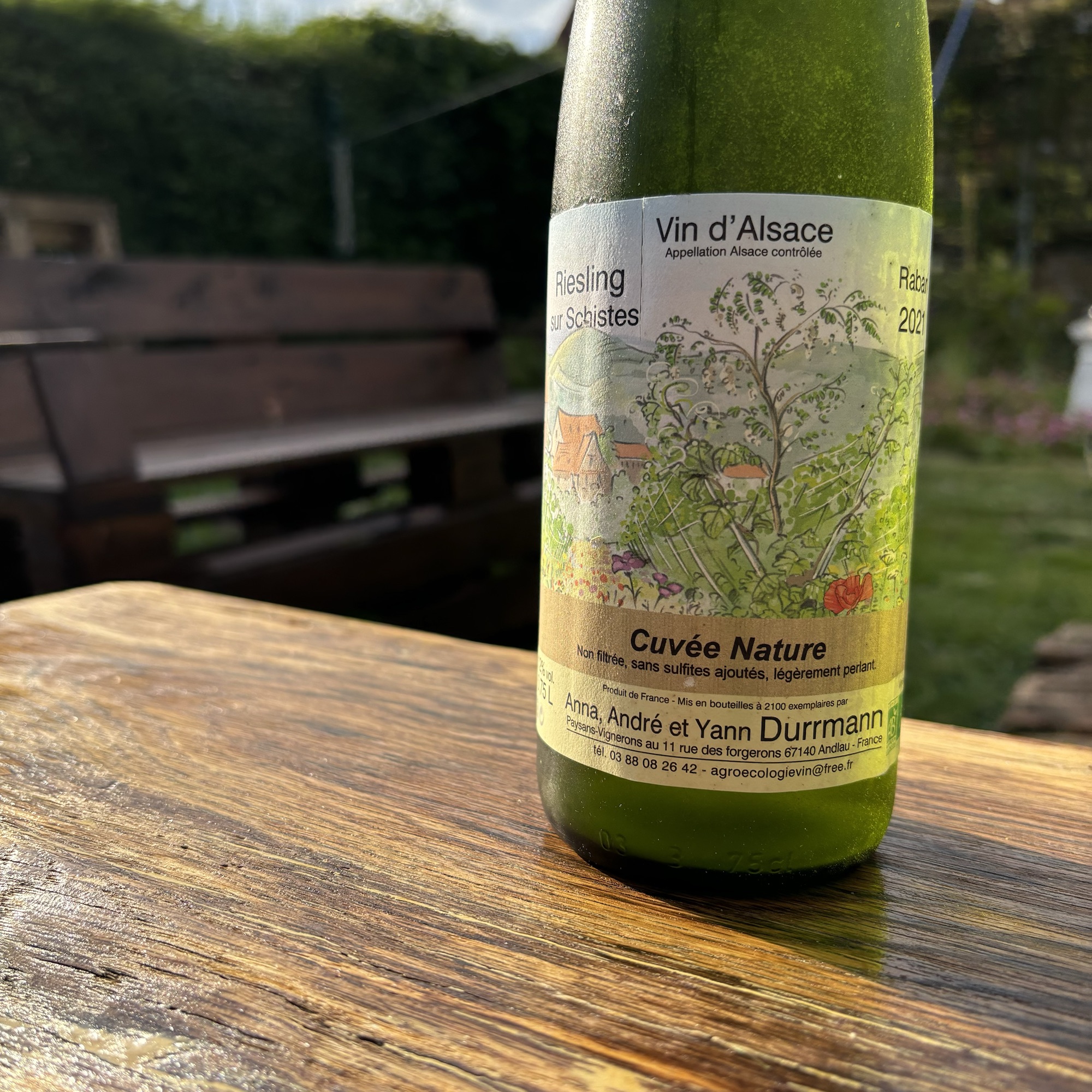
Riesling Sur Schists Cuvée Nature « Rabari » 2021, André, Anna and Yann Durrmann (Alsace, France)
My soft spot for the wines now made by Yann Durrmann at Andlau stems from my discovery of the domaine, almost by accident, on the first evening when staying in the town back in 2017, before these wines had a UK importer. I try to buy three or four bottles every vintage. André grew the domaine in the 1980s and established its credentials for “natural wine”, sustainable viticulture, biodiversity and so much more. Son, Yann, has taken the domaine one step further, eliminating the last additive from the wines, sulphur, via the Cuvées Natures.
This is definitely a terroir-driven cuvée. The Riesling is taken from a single, very steep, parcel on schist. The grapes are gently pressed over ten-to-twelve hours and fermentation and ageing take place in stainless steel.
A salty, citrus, bouquet leads to a palate that hits you with its minerality. A faceful of schist! It also has electrically charged acidity. But I mean this as a positive, a call to acid hounds. Nothing of the battery acidity you’d find in this estate’s all-electric vehicles. The lack of sulphur is ameliorated by the addition of CO2, and so you get tiny bubbles (though it is emphatically not fizzy) which carry the minerality. It has almost the lightness of a Mosel (or more specifically Ruwer) Kabinett, but it is very dry. Maybe a bit like a Kabinett Trocken, but very sprightly.
It’s a wine that is genuinely thirst-quenching on a hot day, with 12% abv just right for the fruit. It was the right bottle to open on what, back then (mid-month) was the warmest day of July so far. I’m pleased that the Durrmann wines are getting a bit of recognition, thanks in large part to Yann’s efforts, and I’m pleased to see it up here in Scotland. I got this from Cork & Cask (Edinburgh) for around £28. Domaine Durrmann is imported by Wines Under the Bonnet.

 David Crossley's Wide World of Wine
Glad the Entre Vinyes went well, phew
LikeLiked by 1 person
More than well, can’t wait for the next one.
LikeLike