
To conclude September’s home consumption, we have five more delicious wines, all from Europe once more, I’m afraid, but I think they will still interest even those who read this blog regularly. They come from Bugey, Beaujolais, Sussex, Lanzarote, and Alsace.
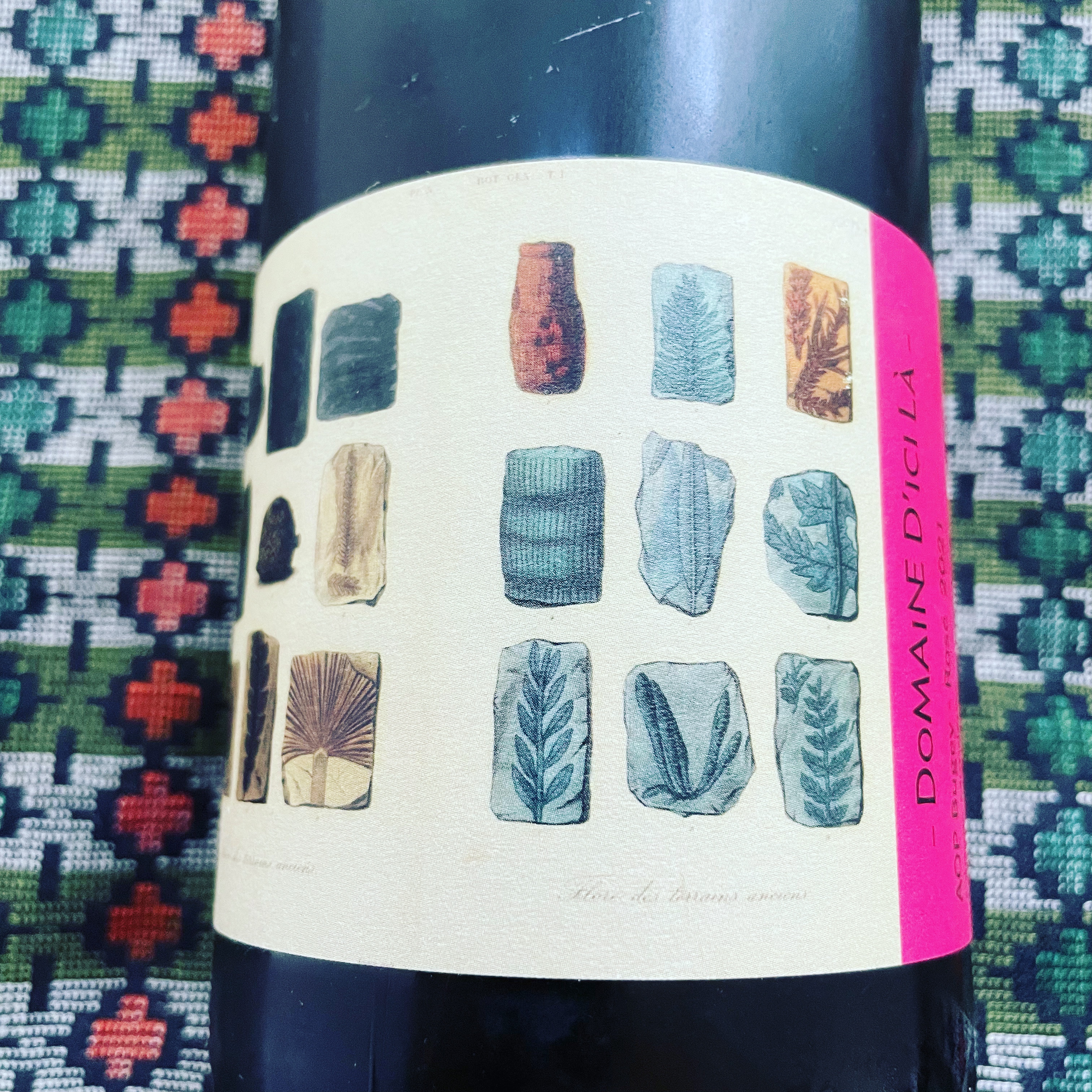
Bugey Rosé Cépage Mondeuse 2021, Domaine D’Ici Là (Bugey, France)
When Wink Lorch published her Wines of the French Alps in 2019 Florie Brunet and Adrien Bariol had been in Bugey less than twelve months. Wink tells how this young couple managed to impress Patrick Charlin, a vigneron it must be said of some renown, to lease them his vines when he retired. To Patrick’s 1.3 hectares they have grown their holding to around 5ha, much at Groslée-St-Benoît, near Montagnieu in the region’s southern sector.
Whereas we see some “Jura” influence creeping into the style of wines from the north of Bugey (although Poulsard seems sadly to be heading towards extinction there), the very distinct southern sector is more influenced by Savoie, hence Mondeuse in the mix. Groslée is right on the border between the French Department of Ain (in which Bugey resides) and Isère, but it is also close to Savoie. The border between all three is formed largely by the Rhône as it undertakes an impressive change in direction (not for the first time in its course), from its southerly flow out of Lac Léman to a more northeasterly direction, towards its intersection with the Saône, at Lyon.
Adrien and Florie grow their Mondeuse on a steep slope near Groslée, the soils being chalky even in this Alpine setting. They are working organically and moving as quickly as they can towards a fully “natural wine” regime. They mostly vinify their Mondeuse as red wine, but I think this Rosé is a great addition to their portfolio.
The bouquet and palate are both dominated by red fruits, and cranberry comes through strongest. There’s a bit of texture too. After a few moments a softer element appears, raspberry. It’s a pale wine and lovely light scents rise from the glass giving a delicate bouquet. The palate has more presence than you might expect, although this cuvée has just 10% abv.
I purchased this from the bottle shop at Spry Wines in Edinburgh (a strong recommendation for lunch or dinner in Central Edinburgh) for just under £30. The importer is Modal Wines.
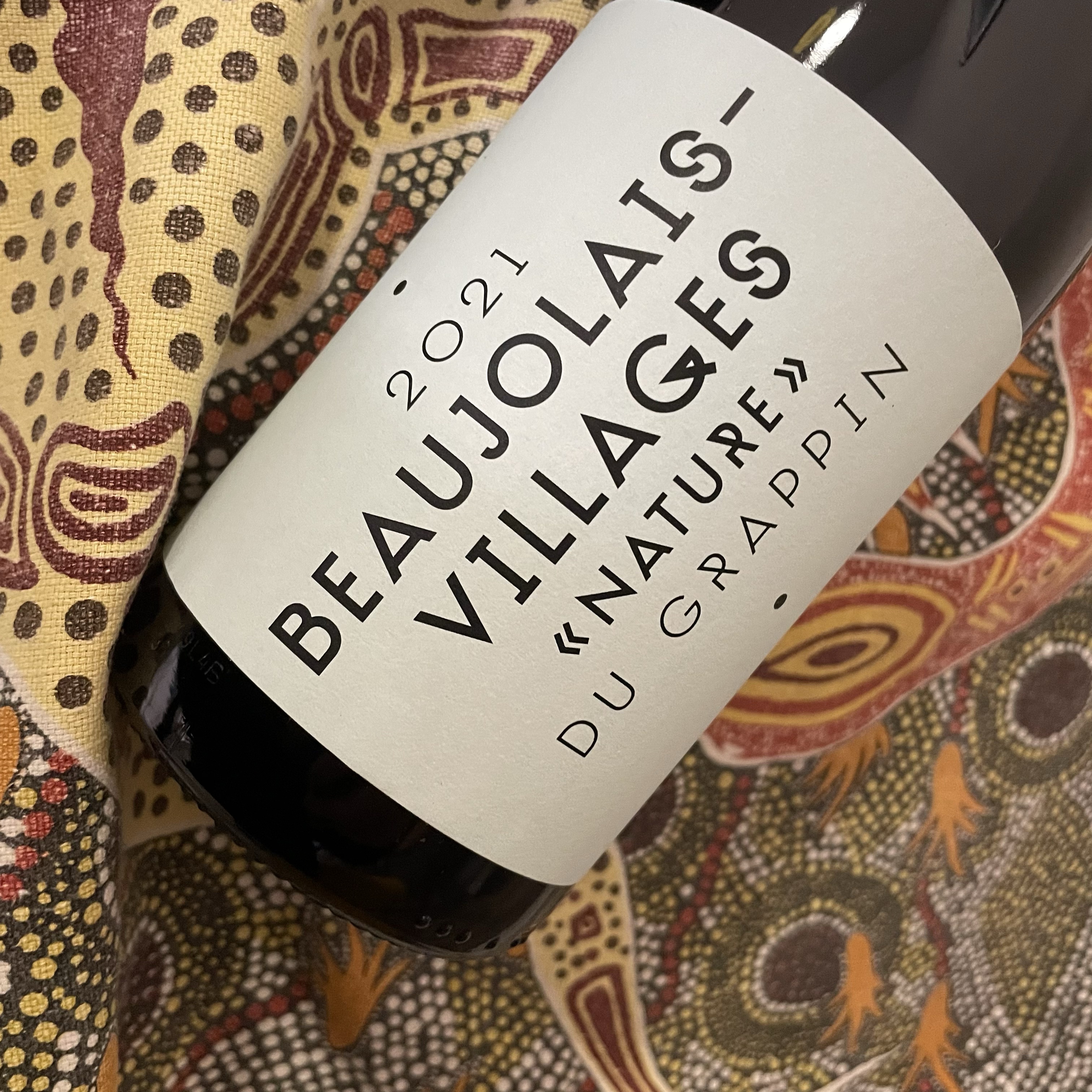
Beaujolais-Villages « Nature » 2021, Du Grappin (Beaujolais, France)
Andrew and Emma Nielsen may be more famous for their Côte de Beaune wines under their “Le Grappin” label, but they began making exemplary Beaujolais soon after they started out in Burgundy and they’ve not looked back. Always a success, whatever the vintage, their “Villages” should never be left on the shelf if you like the classic, fruity, expression of Gamay, perhaps here with a twist.
This cuvée comes from a vineyard called “Les Raisses” at Lancié. It’s a shallow slope of decomposed granite and schist right on the border with Fleurie. The vines happen to be fifty years old, trained as you’d expect in the traditional gobelet (bush vine) style.
There were no synthetic treatments used on the grapes and nothing added during vinification. They use carbon dioxide as a preservative to replace sulphur here and you will find some dissolved in the wine on opening. Andrew recommends a shake to dissipate it, but I don’t mind a faint CO2 prickle for the initial sips. Fermentation is as whole bunches in concrete, and ageing was for just six months in a large oak vat.
The result is, for me, as close to perfection as you can get for a rendition of “Villages”. The cherry-rich Gamay fruit is smooth, velvety, and seductive. The wine has a certain concentration but it is still light on its feet. There’s more than mere freshness, there’s real vivacity. Not complex, not serious, definitely glouglou, yet not very funky. It is lighter than some of those modern “villages” wines which try too much to emulate the crus.
Purchased at Smith & Gertrude, Portobello (£19), but reasonably widely available, and perhaps most easily purchased from legrappin.com (the web shop is currently closed during harvest but will reopen late October/early November).
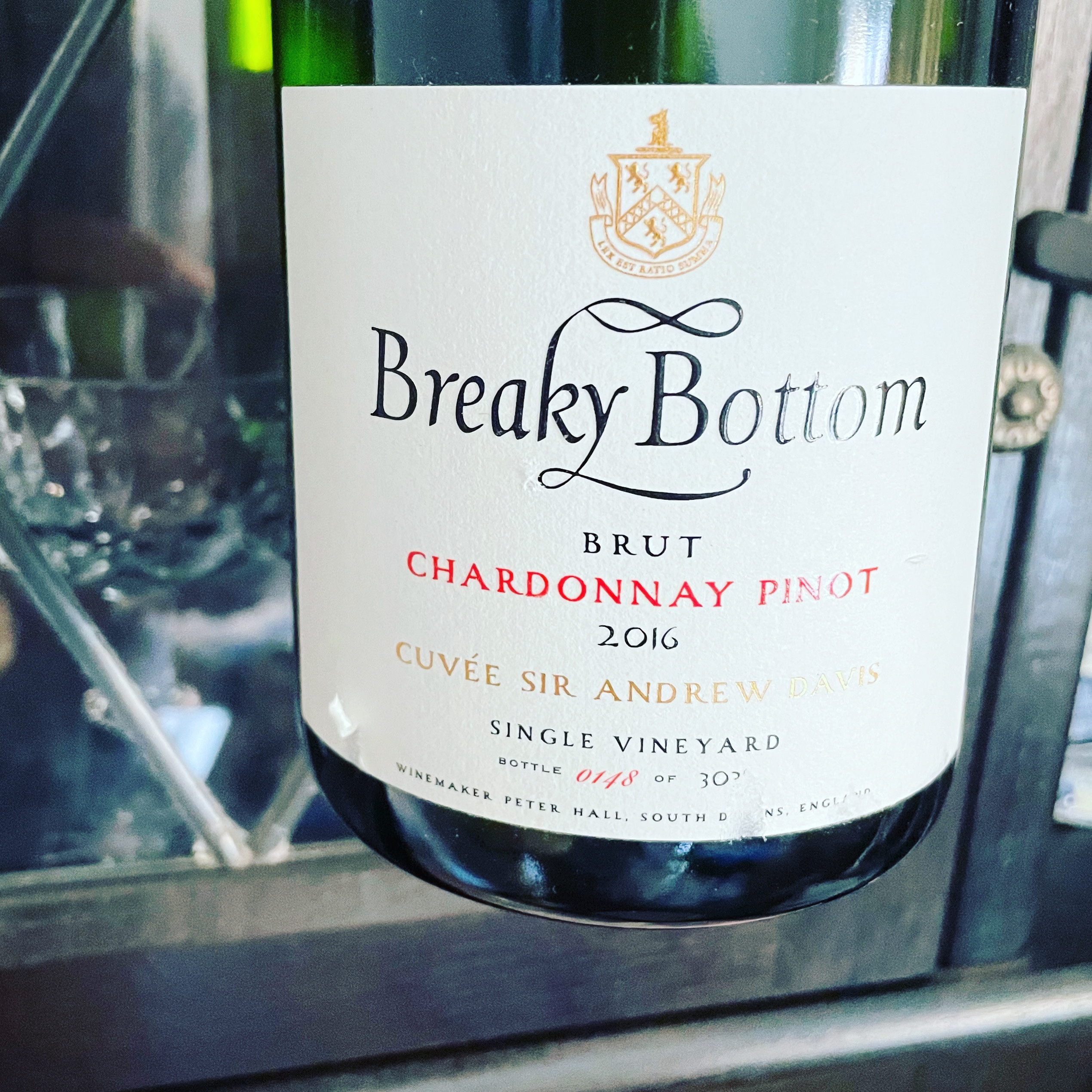
Cuvée Sir Andrew Davis 2016, Breaky Bottom (Sussex, England)
Peter Hall was in at the start of the 1970s wave of British viticulture, but he saw the potential for English Sparkling Wine early on, and switched from still wine to bubbles. He’s never looked back. To be fair, Peter has experienced more than his fair share of trials and tribulations along the way, but we are lucky he has been able to keep going. English wine has no one more deserving of a Knighthood, except I can imagine what he might say to me for suggesting it.
Every year Peter makes two sparkling cuvées, so far always white wines and always named after a family friend. One will contain Seyval Blanc, either tout-court or in a blend. The second, of which this is an example, will be based on some combination of Chardonnay and the Pinots (Noir and Meunier). All these varieties seem to do well on the chalk soils in this exceptionally beautiful fold in the South Downs not far from Lewes.
The key to the success of this cuvée, as always at Breaky Bottom, is long lees ageing. There’s fresh apple and citrus here but the acidity, albeit bright, is mellowed just enough by time on lees. This 2016 has only been released a year or so. Although it’s a much-overused description, this truly is thrilling, and it is drinking magnificently well. 3,031 bottles were made. I shall cherish the memory of this bottle all the more because we drank it to toast my father’s 91st Birthday.
Sir Andrew Davis was, of course, Music Director at Glyndebourne Opera between 1988 and 2000. They became neighbours first and then close friends, Sir Andrew cultivating a love of the Breaky Bottom wines to match Peter Hall’s love of music.
You can find Breaky Bottom from the 2010 vintage if you care to splash out more, but the beauty of this wine is that I doubt you will find anything that comes close, in terms of both quality and sheer excitement, to this 2016 for the £35.50 I paid at Butlers Wine Cellar (still in stock). Corney & Barrow also sell Breaky Bottom. Without disrespect to some very fine English and Welsh winemakers, I personally think only Dermot Sugrue matches Peter Hall (although some others come close). Dermot’s wines are somewhat more expensive than Peter’s.
Titerok-Akaet Valle de Malpaso 2020, Juan Daniel Ramierez (Lanzarote, Canary Is, Spain)
I’ve been seeking out Lanzarote wine for well over a year and despite my knowing some of the producers from other islands in the Canaries quite well, this is my first taste of one from there. Titerok-Akaet means the red fiery mountain, and it is the grey volcanic ash soils from this volcano at the south of the island that line the Malpaso Valley.
Juan Daniel and his partner, Marta Labanda, have created a small estate out of two plots of vines rented from their family in the north of the island, where the vines grow within hollows of this volcanic ash, protected from harsh Atlantic winds by low dry-stone walls.
This is a blend of Malvasía, Listàn Blanco and Diego. The bouquet is of lifted white flowers, delicate jasmine I’d say. The wine has more weight than you might expect, unless you’d spotted the 13.5% abv. It has a lovely plump mouthfeel, but overall, it is dominated my quite intense minerality/salinity, for which the plumpness is a nice foil. It’s effectively a classic “volcanic wine”, but in this case it is also exceptional. It’s as good as the best from Tenerife, and loving the wines from that island’s star producers as I do, that is saying something.
This wasn’t cheap, £43 from Shrine to the Vine (the importer is Keeling Andrew & Co). However, there were just 641 bottles made so good luck. The Shrine did have this plus a varietal Listàn Blanco on the shelf and if you are lucky, they may have remained overlooked. Worth a detour, as they say.

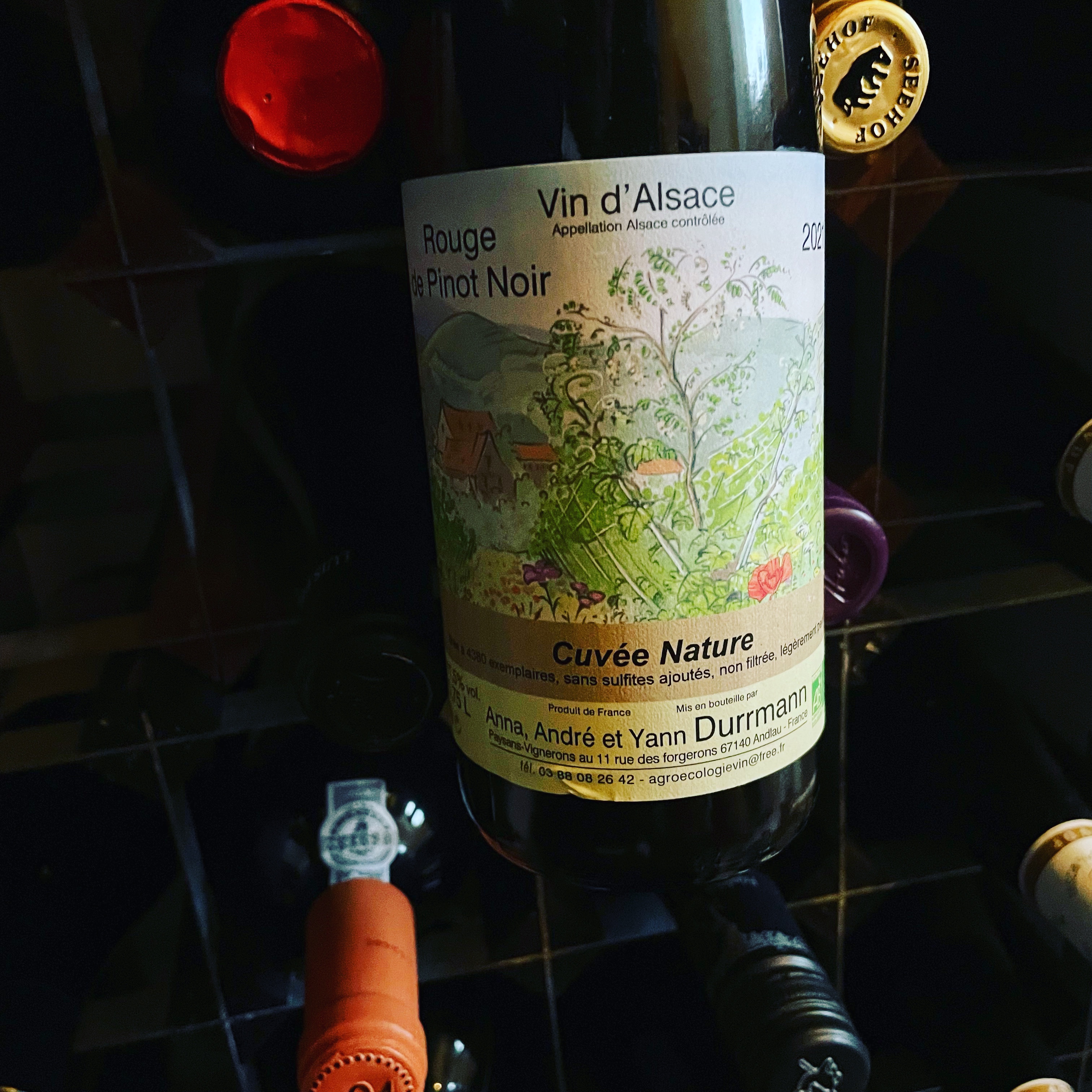
Rouge de Pinot Noir Cuvée Nature 2021, Anna, André and Yann Durrmann (Alsace, France)
I have a fondness for the Durrmann wines going back to my almost accidental first visit to this previously unknown (in the UK, at least) Andlau domaine in autumn 2017, and the time André put into showing us around the vineyards and giving us a thorough tasting. In the intervening six years André and Anna’s son, Yann has fully taken over, and is building on the work André has done, especially in ecology, and has driven production even more swiftly towards natural wine. The Durrmanns can now also boast a UK importer, and one who supplies one of my two favourite Edinburgh wine shop. So that’s a win.
This Pinot comes off a mix of schist and sandstone. It doesn’t try to ape Burgundy, but instead you get a fruit-dominated wine which is pretty much summer in a glass. It spent four weeks on skins in stainless steel and was bottled unfined, unfiltered and with no added sulphur. The “Nature” wines are Yann’s purest expressions of natural winemaking.
It’s another glouglou glass of ripe fruit coming in at a gluggable 11.5% abv. It’s light and joyful, although the cherry, blackberry and plum finish is pushed into something a bit more interesting by a lick of black pepper spiciness. Whilst some Durrmann wines will age happily, this is built to thrill with its packed fruit, or at least that’s my interpretation. I happened to pick up some more Durrmanns, including the 2022 vintage of this wine just last week, and as they are just in the shops it’s worth having a look for them.
From Cork & Cask Edinburgh, imported by Wines Under the Bonnet.

 David Crossley's Wide World of Wine