
I’ve just been down to Hampshire, and would you know it, it has gone and generated a whole raft of articles. With my first tasting of the year coming up in ten days, and some delicious wines being drunk in January, I need to crack on. Three articles detail vineyard visits. These vineyards are all a little different. Article three will cover a visit to Tim Phillips’ Charlie Herring Wines, which you probably know I try to visit at least once a year, but I had a day out with Tim visiting B58 Wines and Wharie Vineyard.
Both offer a very interesting take on English viticulture. B58 grows vines in polytunnels, but do not look away yet. What they are doing is very interesting indeed, especially when you see, and taste as I did, the varieties they have in the ground. The winemaker at B58 is Swiss national Guillaume Lagger, and at his own Wharie Vineyard he has only PIWI varieties planted.
Having just read and reviewed the second edition of Jamie Goode’s “Regenerative Viticulture” (see previous article published 22 January), everything these producers are doing is well worth exploring. I shall talk about B58 Wines here, followed by articles about Guillaume and Tim. My Hampshire visit will end with some “holiday wines”, because we drank many, some of which you will definitely enjoy reading about.
B58 Wines is at East Boldre in the New Forest National Park. They would sanely be called Beaulieu Wines, Beaulieu Vineyard, or some variation, because it is located on the ancient Beaulieu Estate near to the village of Beaulieu. However, there is already a Beaulieu Vineyard in Rutherford, California, so I’m guessing no one wanted to upset any lawyers, or maybe Sandy Booth just loves the BMW B58 engine whose straight-six turbo still powers several models more than ten years after its introduction.
For the benefit of my American audience George de Latour founded Beaulieu in Napa in 1900. The Beaulieu Estate in the New Forest was founded over 800 years earlier, after the Norman Conquest (that’s William I, not Norman Mailer), but to grant Napa fair precedence, the first vines were only planted here at Hampshire’s Beaulieu, by Baron Montagu, in 1958.
Sandy Booth is a fruit farmer. He comes from an experienced family of fruit farmers who still farm a wee bit north of me, in Fife, the UK’s finest soft fruit terroir. Sandy grows five thousand tons of strawberries a year, very fine strawberries (and raspberries and asparagus too) if his customers are anything to go by. He was asked by the Beaulieu estate to take over management of their vineyard, which probably needed some TLC.
Now, the UK is full of interesting small vineyards, some big, some small, some farming conventionally, and some making natural wines. Sandy likes wine, but he’s happy to admit he’s a red wine man. He wondered whether he could bring his deep knowledge and expertise in fruit growing to viticulture, and he has done.
What you get at B58 is an operation centred around polytunnels, but that is only really the start. Sandy’s soft fruit is grown in beds of coir, the fibrous outer husk of coconuts, which we doubtless all know better when woven into matting than as a growing medium. It isn’t revolutionary to use it for horticulture as well.
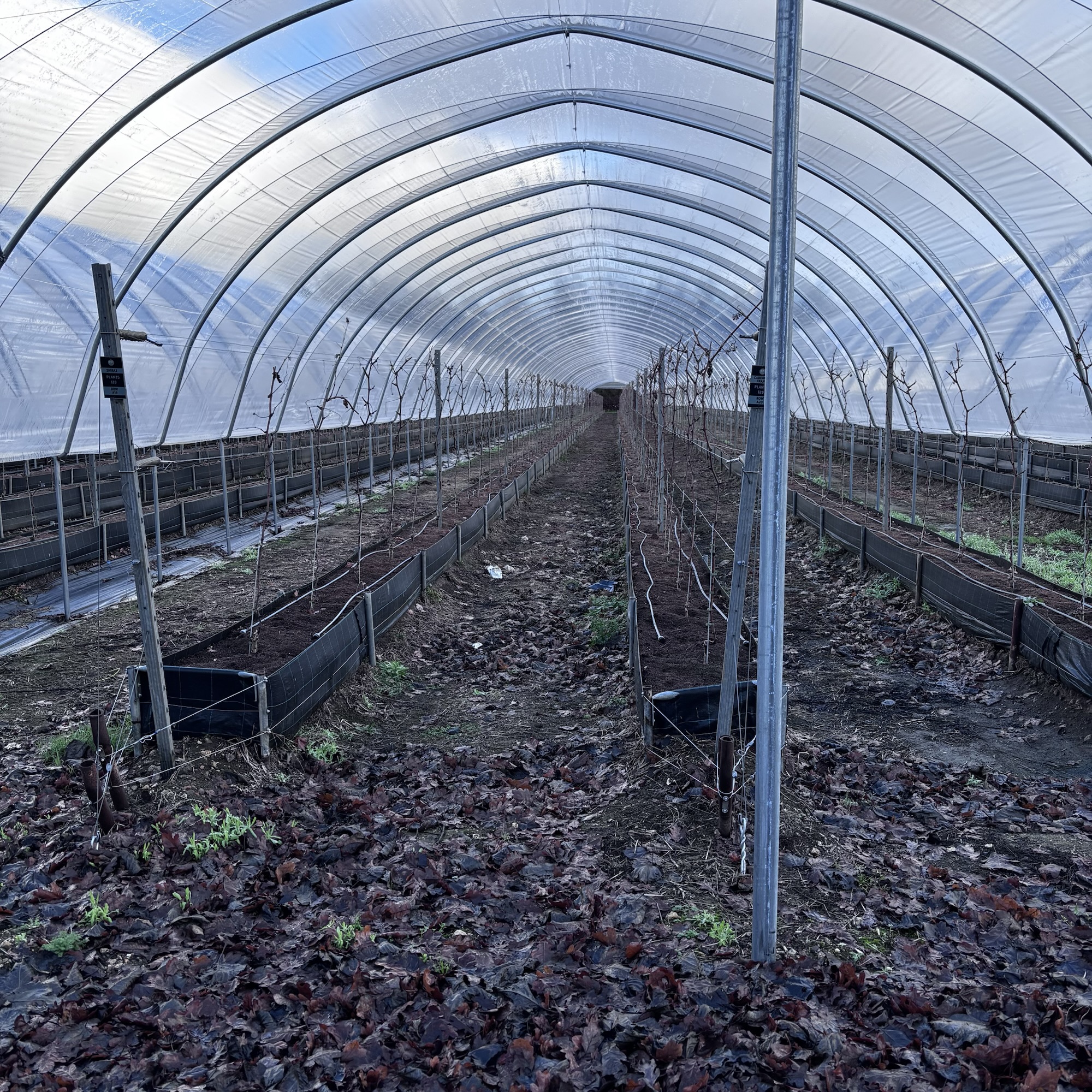
The setup at B58 – these are Shiraz vines
For viticulture, coir is just the initial medium in which the vines are planted. The coir sits in beds on top of the soil, so as the vines grow, very soon they are delving down into the soil. By this method, for example, they are able to grow asparagus without chemical inputs. The coir also mulches down to create a healthy soil structure. They get plenty of worms to accelerate this.
Obviously, water comes from drip irrigation, a nifty little system like they use on the fruit. They also have robots as part of that fruit technology which I was told “spray light at night to combat mildew”, which they expect to be able to apply with viticulture.
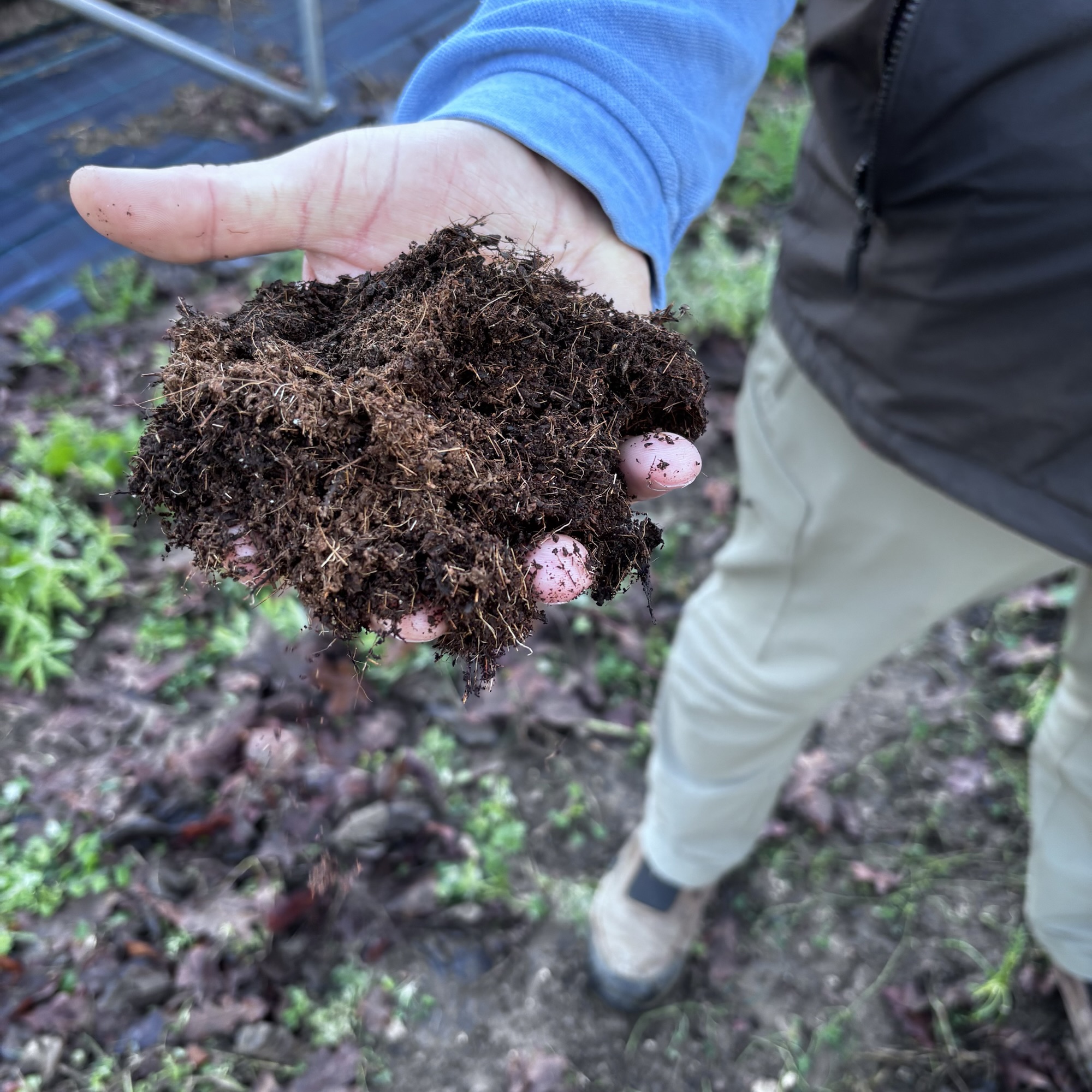
Mulched-down coir (coconut husk)
The tunnels obviously (I almost said “naturally” but if misunderstood it could make some readers choke) raise the temperature by a few degrees, and so the varieties they can grow are varieties I have not seen elsewhere in the UK. These include Grenache, Tempranillo and Syrah, although their full list also includes Bacchus, Gewurztraminer, Merlot and Cabernet Franc, plus PIWI varieties Pinotin and Cabernet Jura. They plan to put in some Cortese, Viognier and Albariño, and forgive my excitement, but they already have some Nebbiolo in the ground, if not yet producing.
We paid a visit to see the strawberry and asparagus operations. Everything was, of course, winter dormant, but impressive, especially the Spanish system of a rotating growing zone for strawberries which doubles the growing shelves and saves the backs of the pickers. Fear not, they can’t replicate that for the grapes.
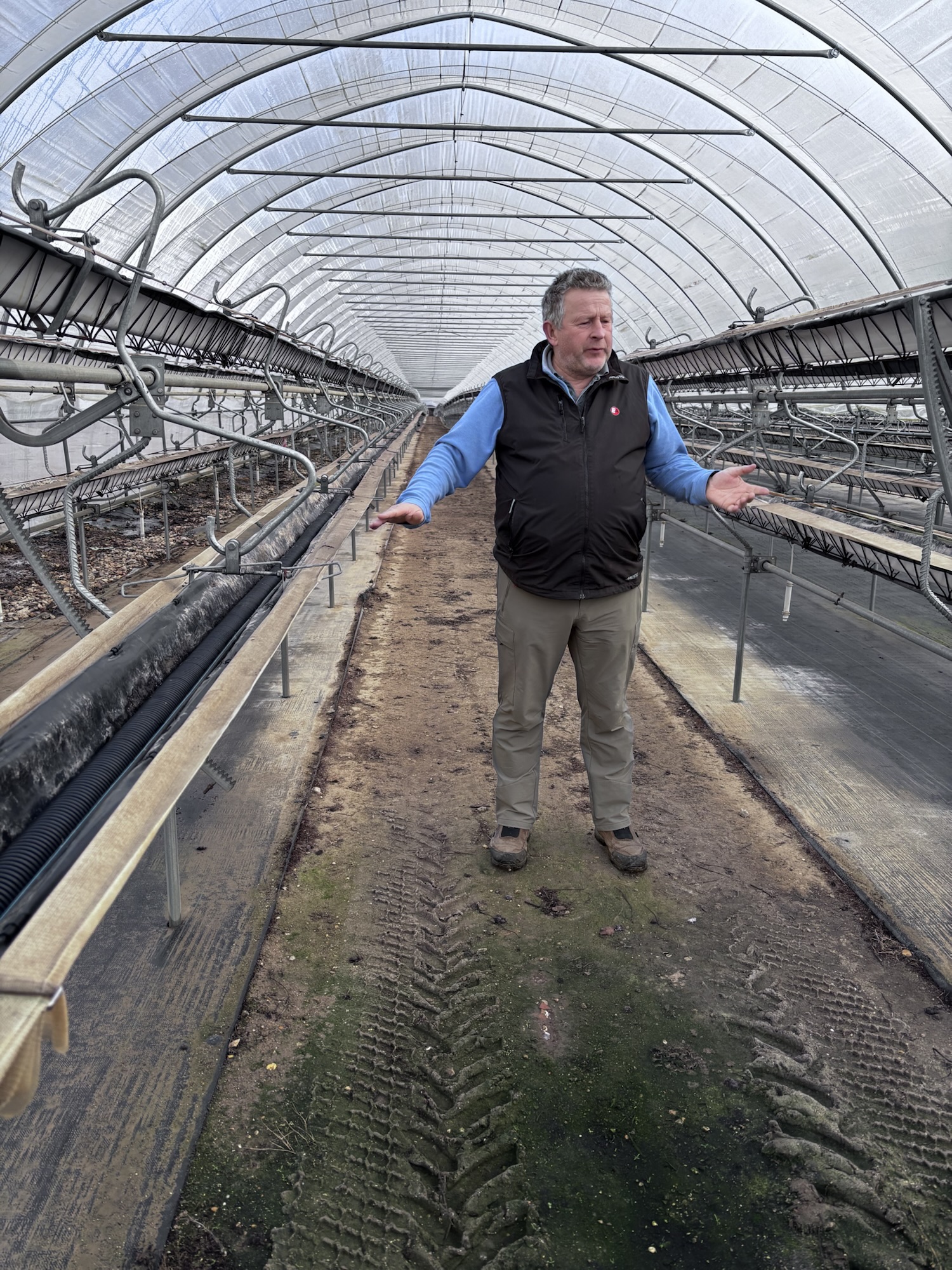
Strawberry racks – since my visit a million strawberry plants have been placed on the two-tier racks in bags
In very cold weather the soil in the asparagus tents, albeit covered for now, felt warmer than outside by several degrees. At least there was more to see in the vine tunnels, the vines standing tall with the nascent fruiting canes trained quite high.
Back inside the winery we had quite an extensive tasting, myself and Tim being joined by Sandy and his son, Adam.
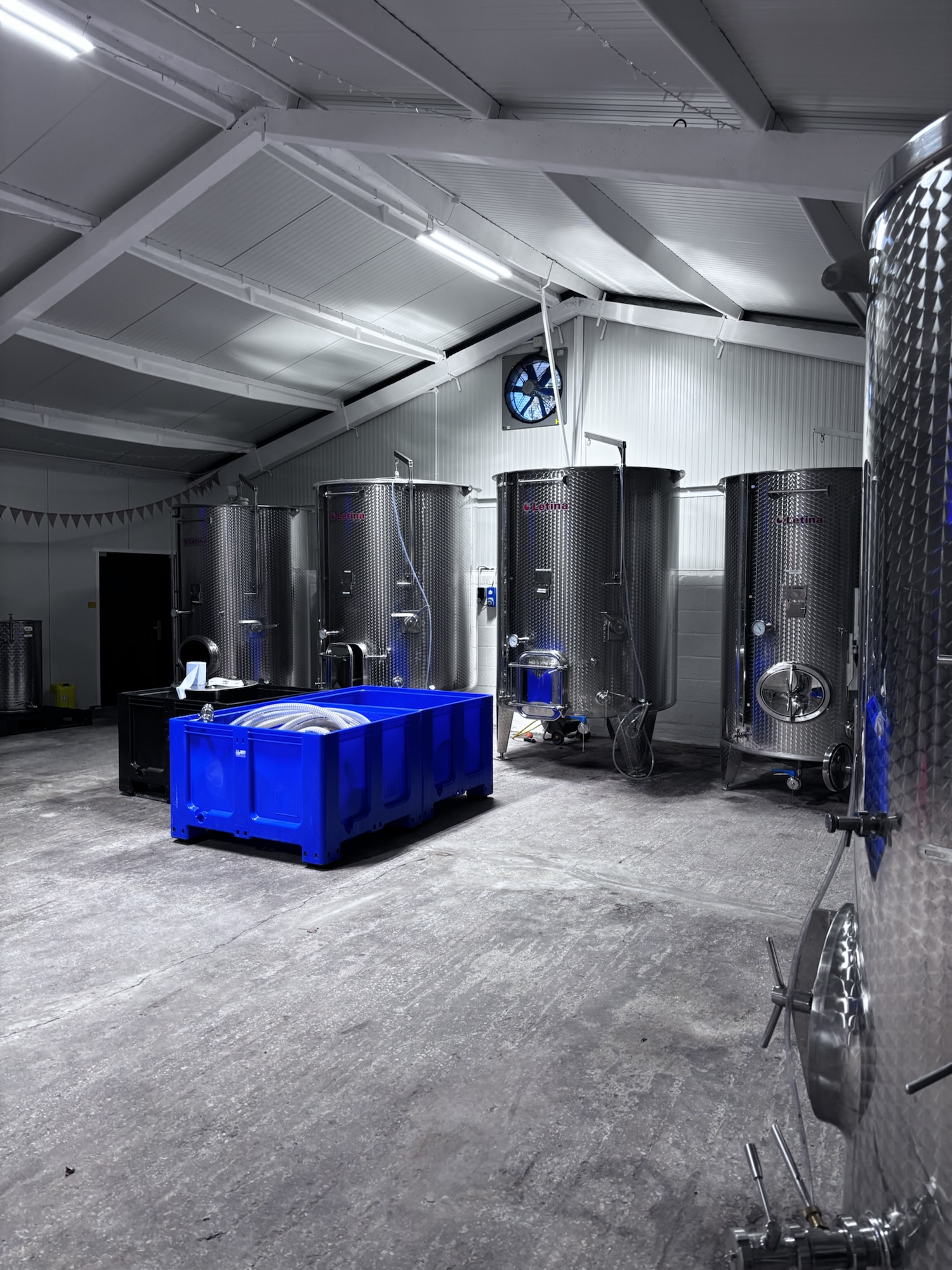
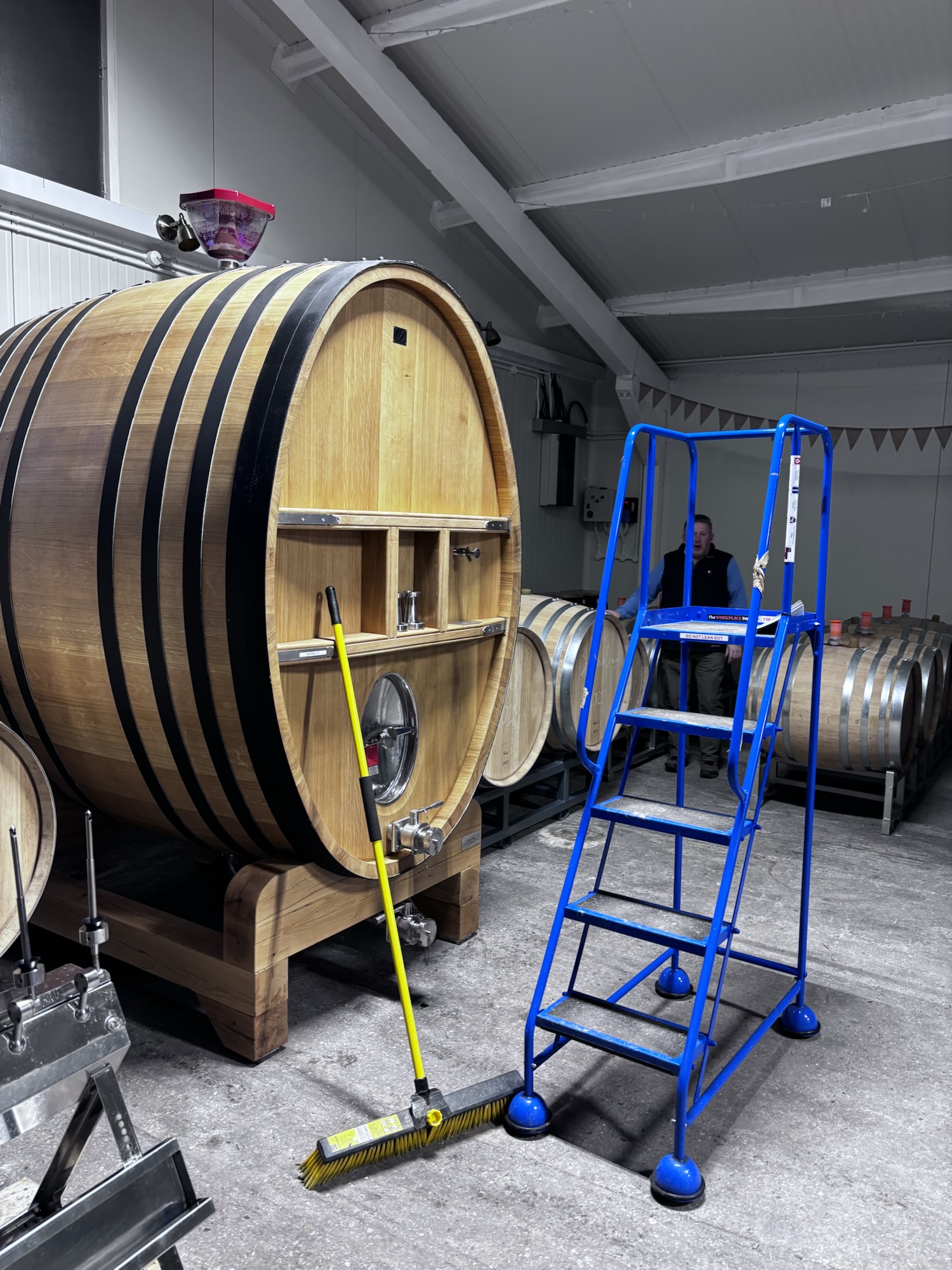
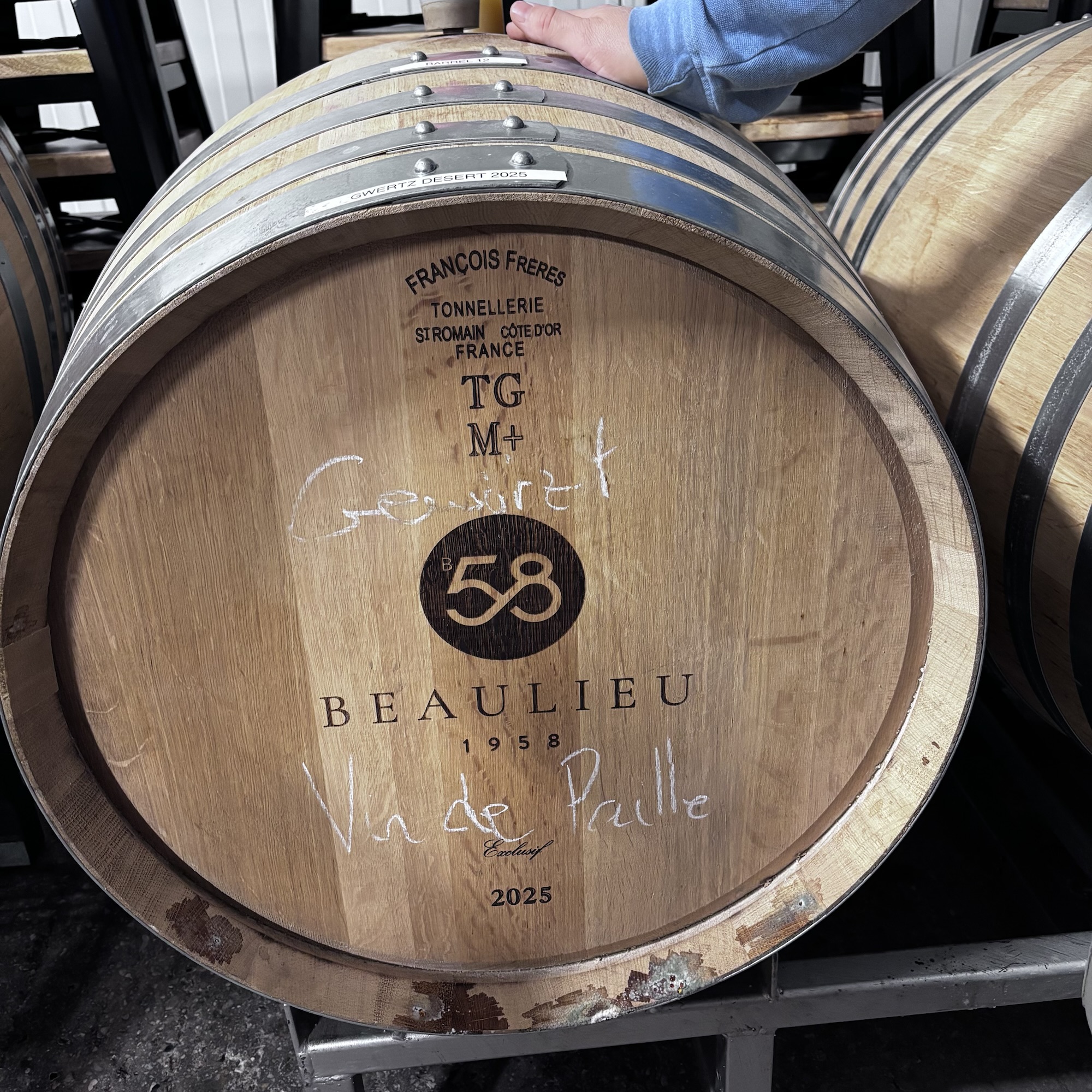
B58 Winery
We started with a Rosé ’24 made from Tempranillo, Grenache and Cabaret Noir. The latter is a PIWI variety, one of the famous Valentin Blattner’s creations in his Swiss nursery (in 1991), but a red variety which generally does well in the UK. It’s worth commenting on the name. It was originally called Cabernet Noir, having Cabernet Sauvignon as one vinifera parent.
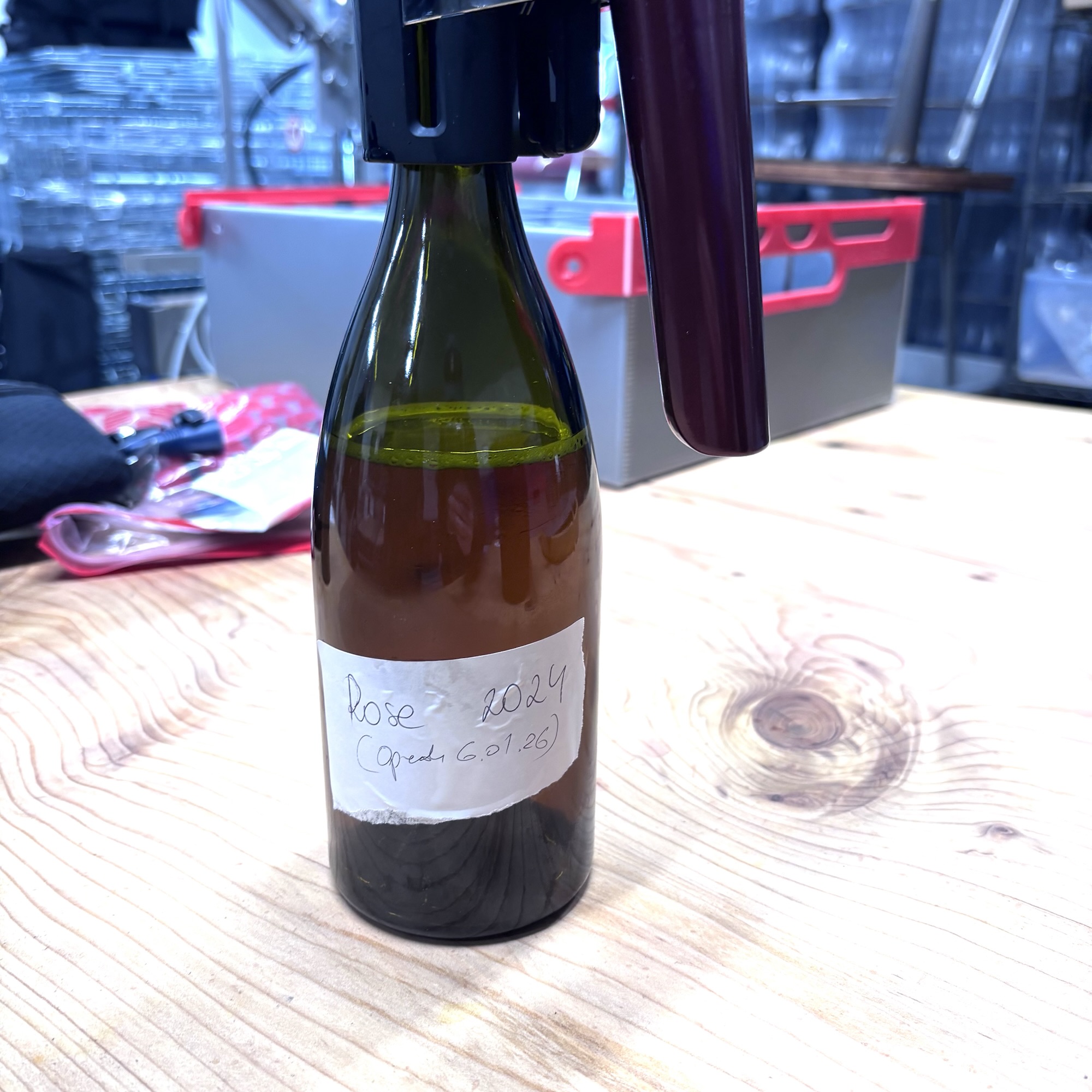
Bottle sample
I know, from Jamie Goode’s Regenerative Viticulture book that the French won’t allow Piwis to be planted that have the name of a vinifera variety included. In one respect I can see the issue around confusion, but if Cabernet vinifera varieties (Sauvignon, Franc) become untenable in their most famous regions of production, then that parental link may become useful marketing. Remember that these Piwis do contain 85% of their parent’s vinifera genes in the crossing.
Beaulieu Orange 2024 was only bottled in December, but a bottle sample won a Gold Medal at the Wessex Wine Awards last year. It had sixteen days on skins. I’m finding that skin contact adds a nice extra dimension to Bacchus when practised, and more people are doing it, and this is good.
The Orange was nice, but the dry white I liked most was a Gewurztraminer. That grape makes up 100% of the Beaulieu White which is not yet bottled (we tasted a sample), but we then tasted their Gewurztraminer 2023, which was definitely evolving some personality. Quite lovely, and dry too.
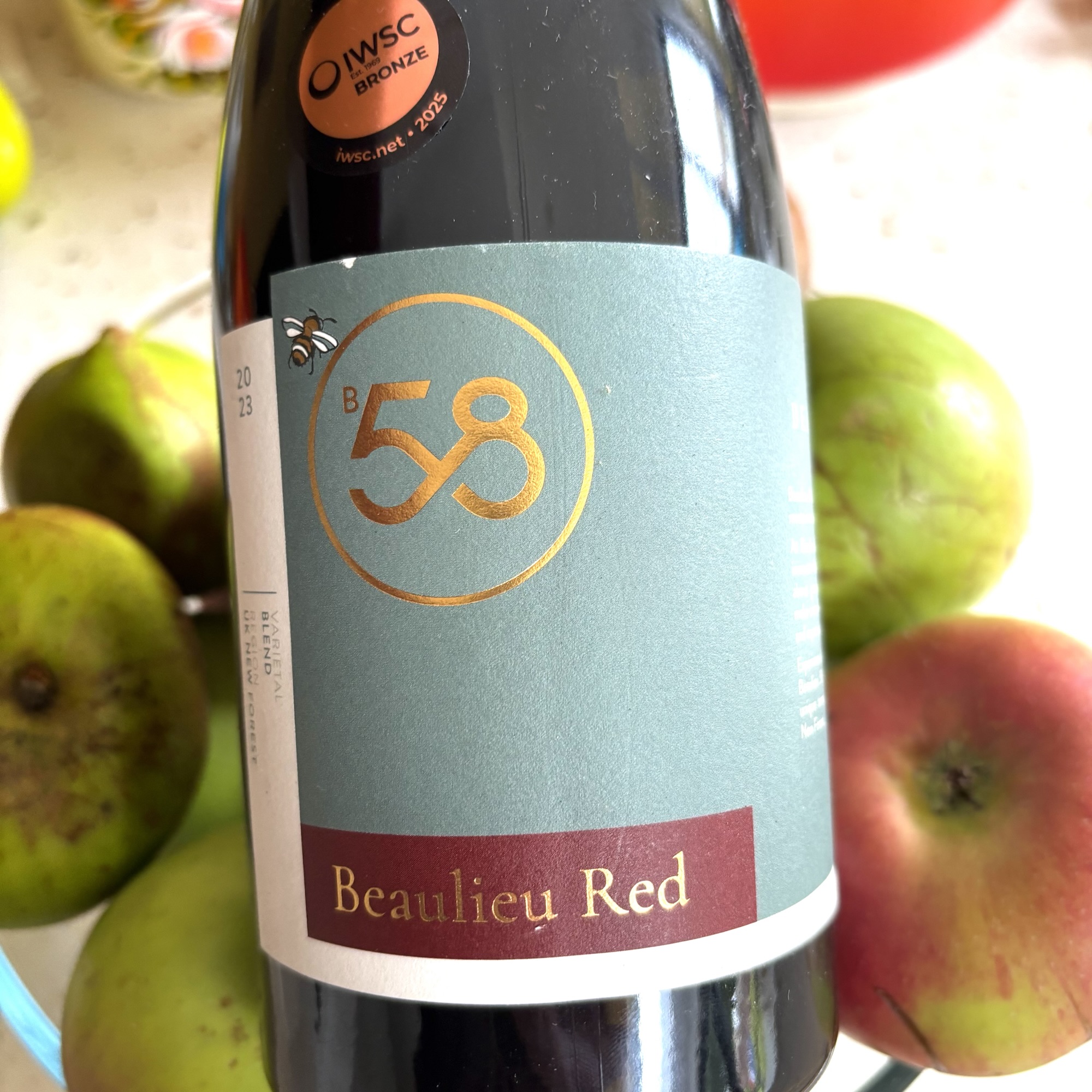
Onto the Reds. B58 is the name of the entry level red wine, a blend of Shiraz, Merlot, and Cabernet Franc from 2024, coming in at 12.4% abv. Quite easy going. The B58 2023 has had fifteen months in bottle and is up at 13.5%. Some dried grapes were added, appassimento-style I guess, and it shows how a richer wine can be made from the same three varieties.
Then we got onto tasting the 2025 reds from barrel. Here it gets interesting. 2025 was a good vintage in general for English red wine, but in the tunnels the temperatures were elevated by a couple of degrees.
All of the following three wines were interesting enough that I would buy a bottle when released. We are not talking top Rioja, Châteauneuf or Côte-Rôtie, obviously, but unless you are a fundamentalist over the polytunnels, you’d find them pretty good for English renditions of these varieties.
About 2,000 litres of the 2025 Tempranillo sits in barrel. It has some tannins and good, fresh fruit. The Grenache has quite elegant, delicate fruit at the moment. The Shiraz came out of a large foudre (a lovely piece of kit from François Frères). It had quite a bit of reduction, much of which dissipated when given a ruthless shake. Underneath that initially reductive nose is another wine with the potential for lovely freshness. My own favourite on this showing of 2025 reds at this sample stage was the Tempranillo.
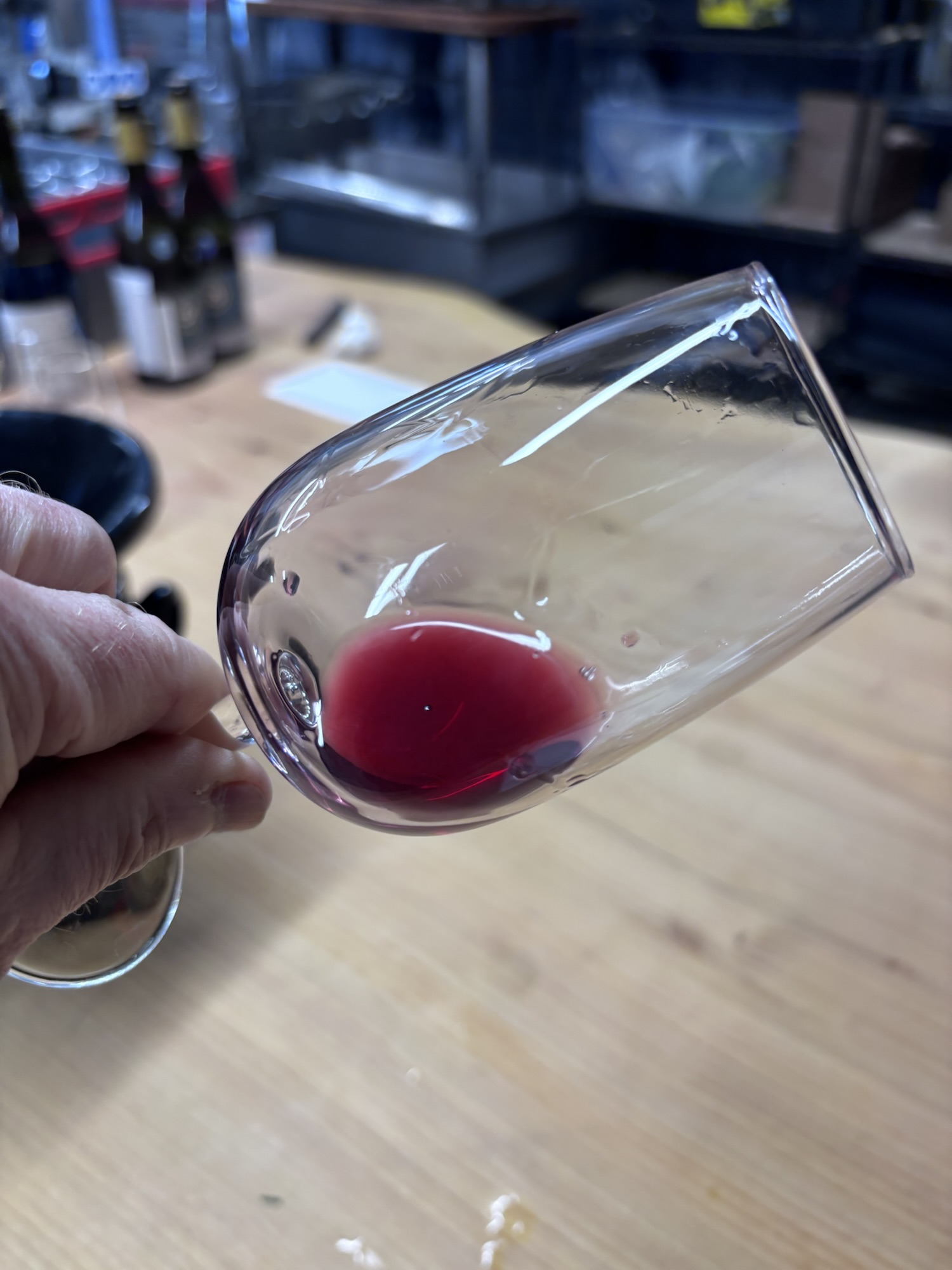
Tempranillo – nice colour
The last wine was a lovely surprise, and has the potential to make a big mark. It’s a Vin de Paille (2025), made from dried Gewurztraminer grapes. Ageing in oak, it probably won’t be bottled yet. It has a nice viscosity and combines good fruit with sweetness, but some balancing acidity too. I’m rather hoping they bottle it in halves because Sandy estimated that in 375ml it might cost around £22-24 but in bottle we are looking at double, so from affordable to much harder to shift. I would 100% be trying to get a half of this.
You might well dislike the idea of wine grown under plastic, finding it somehow inauthentic. I know many natural wine fundamentalists who would, and I make no judgement there. My own take is twofold. First, it is genuinely interesting for me to try grape varieties rarely seen commercially in the UK. That the wine tastes good is an even more interesting observation. Second, Guillaume Lagger, B58’s winemaker is passionate about low intervention wines. Can polytunnels have an acceptable place in English viticulture, or should we just stick to what grows in open vineyards? That, you have to decide, but when the 2025 wines are released I shall endeavour to explore that question further, from the bottle.
So, we end the first of three interesting visits on a damp, but thankfully not especially wet, January morning. After grabbing some of the dried strawberry and raspberry snacks, a sideline of Sandy’s New Forest Fruit Company, we headed off to Wharie Vineyard (or “The Wharie Experience” as it appears on Google Maps). This is the personal vineyard of the B58 Wines winemaker, Guillaume Lagger.
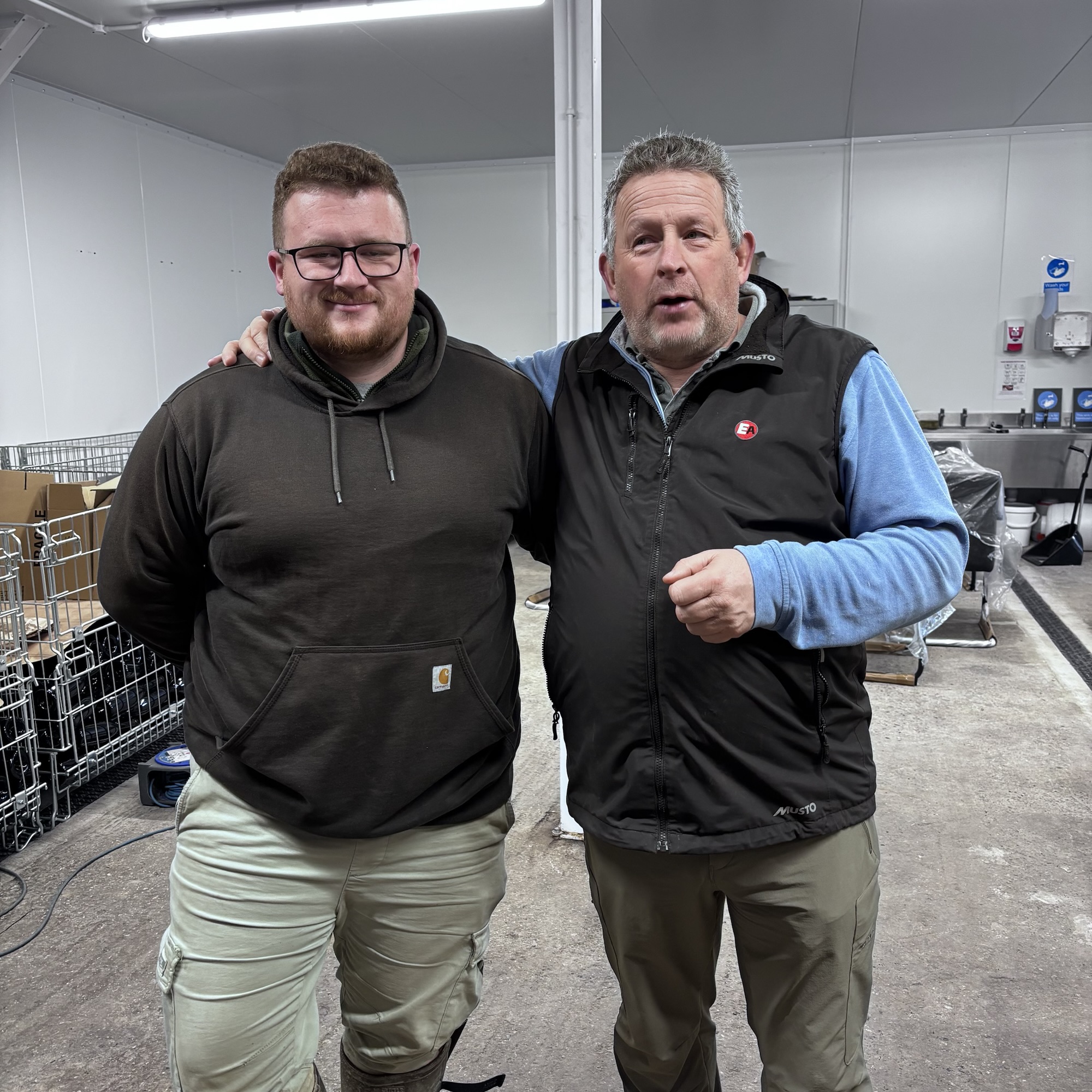
Alex and his dad, Sandy

 David Crossley's Wide World of Wine