
We switch the vibe a little for Part Two of the wines we drank at home during November. Nothing from the likes of Albania and Ukraine, but instead four French wines and one from Austria. From France we have a brilliant Grower Vintage Champagne, and an even older Cornas, before switching to a natural wine Beaujolais, and a very natural Alsace blend. We stray east for the final wine, a very good zesty white from Kamptal.
Cramant Grand Cru Blanc de Blancs 2006, Lilbert et Fils (Champagne, France)
Lilbert is a top Grower based on the Côte des Blancs. The family has been farming here since 1746, and making Champagne since the early 20th Century. Bertrand Lilbert owns around 3.5 hectares at Cramant, Chouilly and Oiry. The vintage Blanc de Blancs is mostly Cramant Chardonnay from the oldest estate vines, some now approaching 100 years old. A little fruit from the Cuis side of Cramant is blended in.
People call this wine “ageworthy”, which is something of an understatement. Ageing is essential here. Tasting young wine at the estate on a cold morning at nine o’clock is a bracing experience. It’s a little like, I imagine, swallowing an icicle might be like. Here it is mature, wonderfully so. There is still the trademark acidity, but now it supports greater complexity, autolytic character, and a certain richness which is overwhelmed in youth.
Don’t make the mistake I made and be too impatient to drink it. I originally bought four of this Vintage, among a mixed case purchased at the domaine many years ago. It also included Bertrand’s Perlé NV, one of my two favourite “lower pressure” Champagnes (the other being from Péters), which I would also highly recommend. This was the last bottle from that case. I think that The Wine Society has the non-vintage Blanc de Blancs for £40 (a bargain) and the NV Perlé for £51. More recent vintages of the BdeB are knocking around at close to £75. Worth it if you can afford it and can age it.

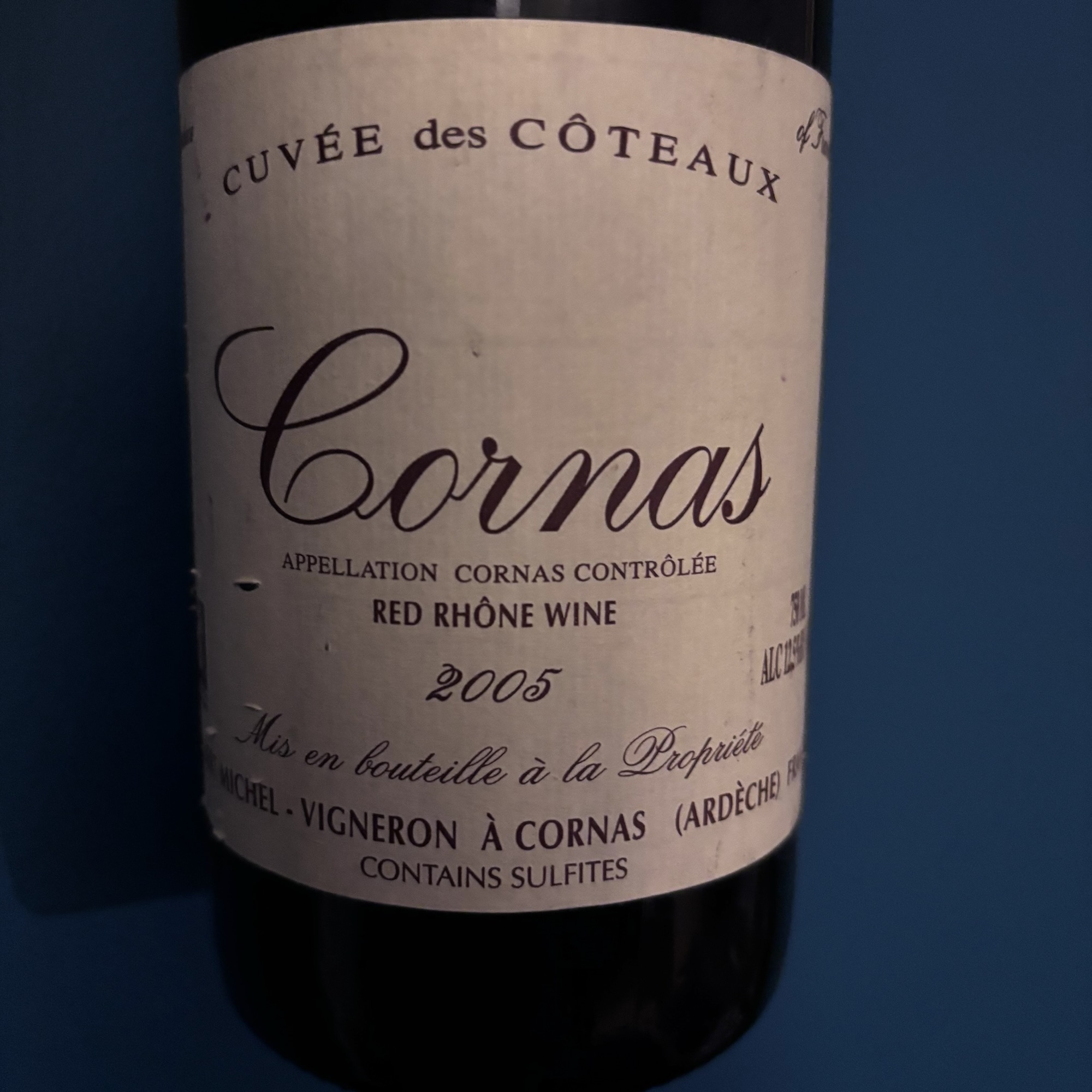
Cornas “Cuvée des Coteaux” 2005, Robert Michel (Cornas, France)
Another classic from the cellar. The long-retired Robert Michel’s name lives on as one of the winemakers who helped put this small appellation back on the map. Cornas has not always been mentioned in the same breath as Hermitage and Côte-Rôtie, and it certainly wasn’t when I began to buy Rhône wines in the 1980s. That was a time when an appellation like Saint-Joseph was more or less considered equal, in some cases, to a wine like Gigondas, and both have risen inexorably in price and reputation since. Cornas was but a small step up back then, although Auguste Clape had gained a strong following through the support of Robin Yapp in the UK.
When Robert Michel took over from his father, Joseph, in 1975, aged 29, he was the only young winemaker in the village. He farmed just four hectares in Cornas, with a little in St-Joseph. Incidentally, for younger readers, it was Robert’s nephew, Vincent Paris, who took over the Michel family vines on Robert’s retirement, so this terroir lives on in more than capable hands. Robert Michel always made wines in the classical tradition, at least in my understanding, meaning partly destemming the fruit and ageing in used oak. That fruit here came from two lieux-dits, Chaillot and La Geynale.
For me, this is a supreme terroir wine. In 2005 the ripe fruit gave some quite intense wines in the Rhône, yet the balance here is mirrored in just 12.5% abv. You rarely if ever see that these days. In youth I have no doubt that this was nevertheless quite muscular. Now it has a gentler side, with smooth red plum, hints of darker fruit, and a smoky finish. Complex, yet aside from a tiny hint of texture rather than tannin, it is a wine that lingers happily on the tongue…for a very long time.
Summing up, it has a lovely fragrance and is more elegant, both than many Cornas I’ve tried, and certainly than many 2005s. I cannot recall what I paid for it. It was a long time ago. It came from Leon Stolarski Fine Wine, which I believe may have ceased trading this year. Although I bought little from Leon (I’m positive he mistook the reasons why), he was one of those wonderful specialists/small importers, perhaps before his time. Some of the wines he introduced to the UK ten or twenty years ago, especially from his main specialism of Languedoc-Roussillon, are now established stars.
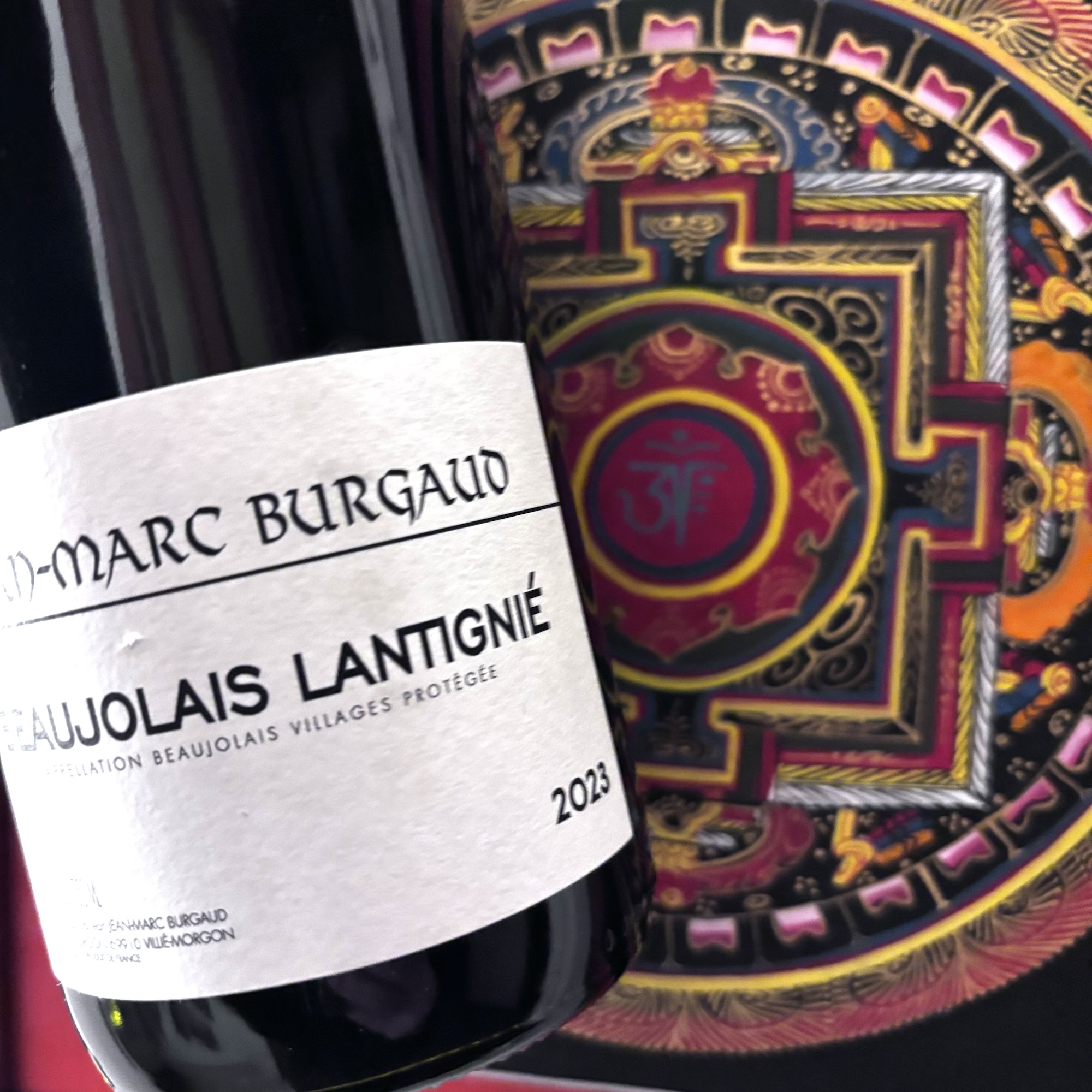
Beaujolais-Lantignié 2023 Beaujolais-Villages, Jean-Marc Burgaud (Beaujolais, France)
Jean-Marc started farming in Villié-Morgon in 1989, with just 3 hectares. Now he has expanded to 17.5 ha, and has become very well established as one of the top names in the region. He’s helped somewhat by having a whole 7 ha right on the top of Morgon’s famous Côte du Py with which to make a name.
J-M is definitely a viticulteur, and that is how he would see himself. In the winery he tries to be relatively hands-off, in the same way that his whole philosophy, as a wine grower and maker, is to make natural wine. He mostly practises semi-carbonic fermentations. For his more fruity offerings (which includes this “Villages” wine from Lantignié) there will just be a short maceration on the skins, here about a week, before pressing.
The result is pure-fruited and juicy, with just a little tannin to ground it at the moment. Natasha Hughes in her “The Wines of Beaujolais” (Academie du Vin Library, 2025) points out that Jean-Marc deliberately devotes as much attention to this wine as he does his top Morgons, which is of course always the sign of a top winemaker.
It is approachable from the off, and drinking very well indeed. A lovely wine and very good value, even though Beaujolais prices are creeping up (which they should, given the quality all round). £20 from Lockett Brothers (North Berwick), via importer Liberty Wines.
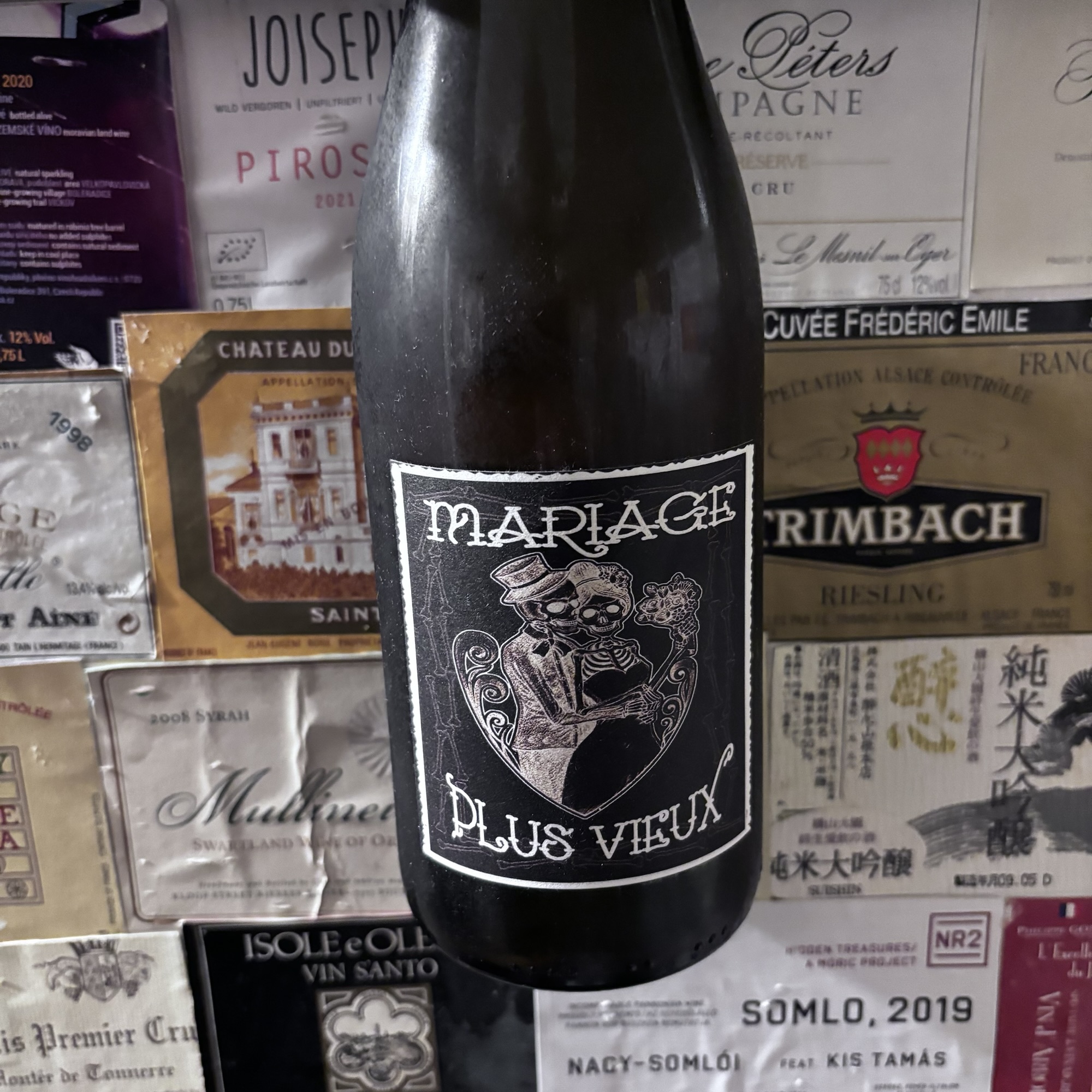
Marriage Plus Vieux XXIII Vin de France, Lambert Spielmann/Domaine in Black (Alsace, France)
If Beaujolais prices are rising, I fear that the cost of natural wines from the current cohort of exciting natural winemakers in Alsace is doing so even more quickly. At least from UK importers. Still, Alsace is very exciting. Thankfully the similar cohort of young Mosel natural wine stars lags a little way behind. I don’t begrudge winemakers turning a profit, don’t get me wrong, although UK prices obviously don’t translate to producer profit. It’s just that the affordability of “natural” Alsace seems to have been taken from my empty purse before its time.
Musician and winemaker is no longer an unusual combo. Natural winemakers all over Europe seem to spend their time playing in bands and I can certainly understand, from my own passions, why the two go together. Lambert perhaps wears his love of music on his sleeve more than most. Every cuvée comes with a recommended track to listen to, often in a punky-ska style. But maybe you should buy the wines first.
Lambert Spielmann has three hectares of vines in small parcels split between Dambach-la-Ville, Epfig, Nothalten, Reichsfeld and Obernai. He makes wines with no inputs, including zero sulphur, and follows the biodynamic calendar. This cuvée blends 80-year-old Sylvaner spiced with a bit of Gewurztraminer from mere 40-year-old vines. Most of the fruit is destemmed, with the Gewurztraminer seeing a two-week infusion before pressing into vats. It rests until the following spring before bottling.
It isn’t a pale wine, for sure, but it is so zippy and fresh with bright lemon citrus on the palate first. It’s such pure lemon, to which you find added a little ginger. It’s a wine of total purity, and exciting electric energy.
I am very grateful to Cork & Cask in Edinburgh for adding a selection of Spielmann’s wines to an order from Lambert’s UK agent, Tutto Wines. I’m not sure they felt they could hand-sell these wines, despite their wonderful labels. A shame in a way because if you told me I could only ever buy two Alsace producers, or bottles, ever again, Lambert Spielmann would sit beside Jean-Pierre Rietsch as my choices. Tutto flog this for £40, so hardly surprising it isn’t on any Edinburgh shelves. We’re not as well off as you South- and East-Londoners.
Grüner Veltliner 2023, Loimer (Kamptal, Austria)
There was a time, before I began visiting Austria and its wine regions, when I used to drink the odd wine from Fred Loimer. In fact, a Loimer Riesling would number among the very first Austrian wines I bought back in the late 1990s or early 2000s. But although I have visited the Wachau and Krems, I’ve never been to Kamptal.
The latest edition of the World Atlas of Wine says of Kamptal “it has been called the K2 of Austria (Wachau being Mount Everest)”. Its climate is protected by mountains to the north, and is influenced by the Danube tributary, the Kamp. Loimer is quite a large producer, with more than 85 hectares planted on mostly south-facing slopes with predominantly loess soils around one of the oldest viticultural centres of the region, Langenlois. However, the whole lot of this large holding is certified biodynamic (by Respekt). Fred took over in 1997, and is certainly responsible for the reputation the wines have today.
One key to the quality at Loimer is old vines. Even this entry-level Grüner Veltliner has some fruit from vines more than fifty yeas old. It has a zesty lemon nose as part of some nice aromatics, finishing with a whiff of white pepper, and a palate which majors on lemon and deeper stone fruit. Overall, though a wine that is simple in one respect, it is very fresh, and nicely direct. Clean but not bland.
Further up the Loimer range there are some very nice, and more serious wines, all with their minimalist modern label design. This wine is excellent value at £20. Like the Beaujolais from Burgaud above, same price, same importer (Liberty Wines) and also purchased at Lockett Brothers in North Berwick.


 David Crossley's Wide World of Wine