
In the month of November, we appear to have drunk quite a lot, but I blame the guests. It means we have three parts of Recent Wines for last month, even with a few less exciting bottles culled. We begin Part One with a Sherry style I drink rarely (note to self, drink more Amontillado). Then we have one of Alice Bouvot’s domaine wines from L’Octavin in Arbois, and a wine that was far more than a mere “oddity” in an excellent white wine from Albania. Then we go to the mountains of Macedonia in Northern Greece before heading well off the beaten track, to Ukraine. Lots of interest here, but quality alongside diversity and a little bit of obscurity.
Amontillado “I Think”, Equipo Navazos (Montilla-Morilles, Spain)
This is one of a series of wines made for Equipo Navazos’s UK agent, Alliance Wine. It’s a saca of June 2023 sourced from the bodega of Pérez Barquero in Montilla. The grape variety of this region just south of Córdoba is Pedro-Xímenez (PX) rather than the Palomino of the Sherry Triangle. It is usually the variety used in the sweet wines, many made by Pérez Barquero, that are relatively easy to produce in the more extreme climate of Montilla-Morilles, although PX has always been shipped over to Jerez for blending as well.
So, it is perhaps slightly unusual to see PX used to made a dry Amontillado style. One thousand half-bottles came from a single cask at the bodega, the wine being on average fifteen years old. This is unfortified, with 16.5% alcohol achieved naturally, through ripeness.
The bouquet is pure autumn, with mushrooms and leaf litter. The palate is bone dry and savoury, smooth, and also quite rich. It will pair with a wide variety of dishes, especially those with an autumnal feel. It did go particularly well with the roast kabocha we had cooked. One of those underrated wines which lubricates the palate, enriches the senses and satisfies the soul.
My half-bottle came from The Solent Cellar, but Alliance Wine imports Equipo Navazos. It usually retails between £20-£28.

P’tit Poussot Vin de France [2016], Domaine L’Octavin (Jura, France)
Made from estate-grown fruit from Alice Bouvot’s Poussot site at Arbois, this cuvée is usually made from Chardonnay young vines. Most of the cuvée is made by direct pressing of the fruit, but a small amount was macerated on skins for three weeks. Although the 2016 vintage has long disappeared from retail, and very little natural wine, especially wine with no added sulphites like this one, gets to see a decent age, this was a treat. Although this bottle has moved around a bit since I purchased it, at least its time in the cellar has been in a suitably cool environment and it certainly showed no negative effects. Don’t tell me natural wine doesn’t age.
Green-gold in colour, a colour as glorious as the wine itself, it is apple-fresh with hints of tropical fruit like pineapple on the nose. The palate gets fruitier the longer the wine sits in the glass (you might have expected the fruit to fade, but it does the opposite here). The acidity of youth is somewhat tamed, but not completely. It finishes long, and more savoury (nutty, but also a little quince perhaps) than the bouquet suggests. If you are making a natural wine from Chardonnay this is benchmark stuff.
You would be very lucky to find the 2016 now. Mine came directly from the domaine. Tutto Wines, Alice’s UK importer, had a recent vintage for £52. Russell at Feral in Bordeaux had some for 38€ but it looks like it has all gone, hardly surprising. Both sources are the go-to for L’Octavin wines though.

Shesh I Bardhe 2024, Kantina Lundra (Tirana, Albania)
This is a modern estate in the Lundra Hills, near to the Albanian capital, Tirana. Although described as “modern”, it is also a producer focussed on tradition. Modern here means above all a focus on quality fruit from the vineyard, and clean winemaking. As they put it, “we are for the land in an artisanal way”. The winery was founded on the fall of the isolationist communist regime, which kind of mirrors the changes being made that have all so quickly made Albania one of those top spots for semi-adventurous tourists. If there’s a lot of wine like this, they won’t have any complaints.
The old vineyards of the state co-operative, which is the origin of the vines Kantina Lundra farms, are a mix of both international and autochthonous varieties. This is a single varietal wine made from one of the latter. Shesh I Bardhë is, you can imagine, a variety I’d never come across before. It is usually said to make pale wines with high acids and a mineral bite. The vineyard here is at 220-250 masl, and was planted in 1988.
The colour is quite golden and the bouquet is both fruity and floral. The palate is very clean so the wine certainly tastes modern. The striking feature is some very attractive minerality. It combines with a freshness which reminds me both of lemon and crisp green apples. But there is also some breadth on the tongue, perhaps assisted by 13.5% alcohol.
I’d say that for my first Albanian wine, this is very good. It was brought back by some friends who went to Albania on holiday, actually the third couple I know to go there this year. This means I don’t think you can get it in the UK. Mind you, the way things are going at The Wine Society (see wine number five below), you may one day have the pleasure. I understand that there may be a sweet version of this wine but this dry rendition would definitely be more suited to our market.

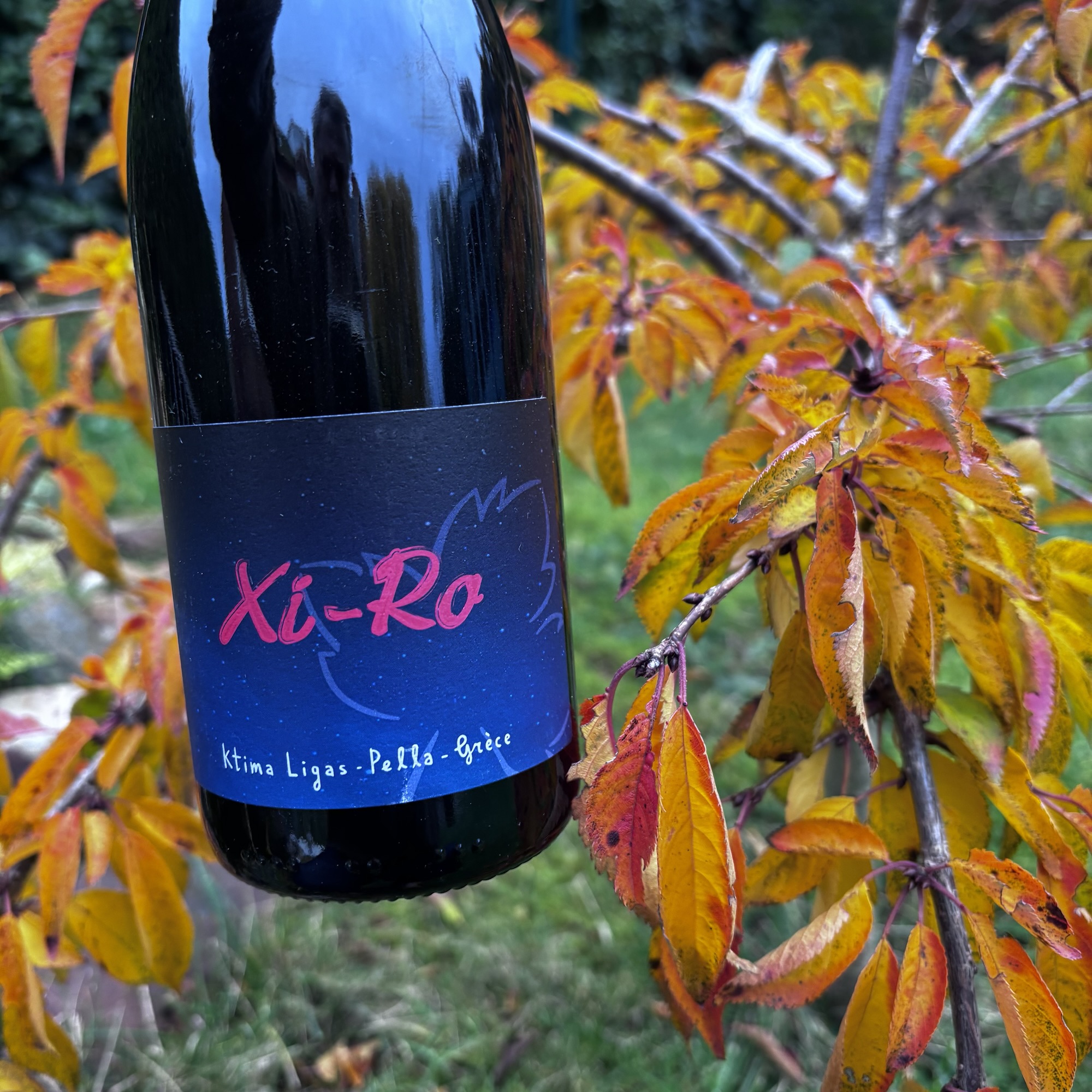
Xi-Ro 2021, Ktima Ligas (Pella, Greece)
Thomas Ligas was responsible for reviving the indigenous grape varieties, and traditional viticulture, in this part of Northern Greece in the 1980s. His anchor was permaculture, and this is one of the prime examples of permaculture in viticulture in Europe. Making natural wine was also not merely a choice, but a necessity for Thomas, as he couldn’t afford the chemicals. Not that he’d have wanted to use them.
Pella is a little northwest of Thessaloniki, and close to the better-known vineyards of Gouménissa. Thomas Ligas worked for many years with his children, Jason and Meli. Although Jason worked the vines for some years, whilst Meli was living in Paris (hence my having met her several times at wine fairs), I understand that she is now back and running the estate.
Xi-Ro is made from Xinomavro, usually with a little Roditis (hence the name) but in 2021 we have a 100% Xinomavro. This is a quintessential mountain wine, redolent of wild herbs and tomato riding with the bouquet’s cherry fruit. The palate has bright cherries and other red fruit. Despite 13% abv, I’d call this a lighter style of Xinomavro than you might be used to. It’s freshness, and a judicious amount of acidity, that balances the alcohol. Very much a terroir wine too. Ligas wines really show what the Greek region of Macedonia can do. Without chemical inputs they just seem to paint a picture of this wild but beautiful landscape in the far north of the country. I’m sure the future of Ktima Ligas is safe in Meli’s hands.
Ktima Ligas is imported by Dynamic Vines. I found this bottle at the Futtle shop in Dundee, Futtle being an organic brewery at Bowhouse, just outside of St Monans on the East Neuk of Fife. I had a tip-off about this store, which has a very small but well-chosen shelf of natural wines alongside the beers, and so I sneaked a peek when we were over visiting Dundee’s outpost of the V&A, from which it is a mere six-or-seven-minute walk. Both proved worth the drive.
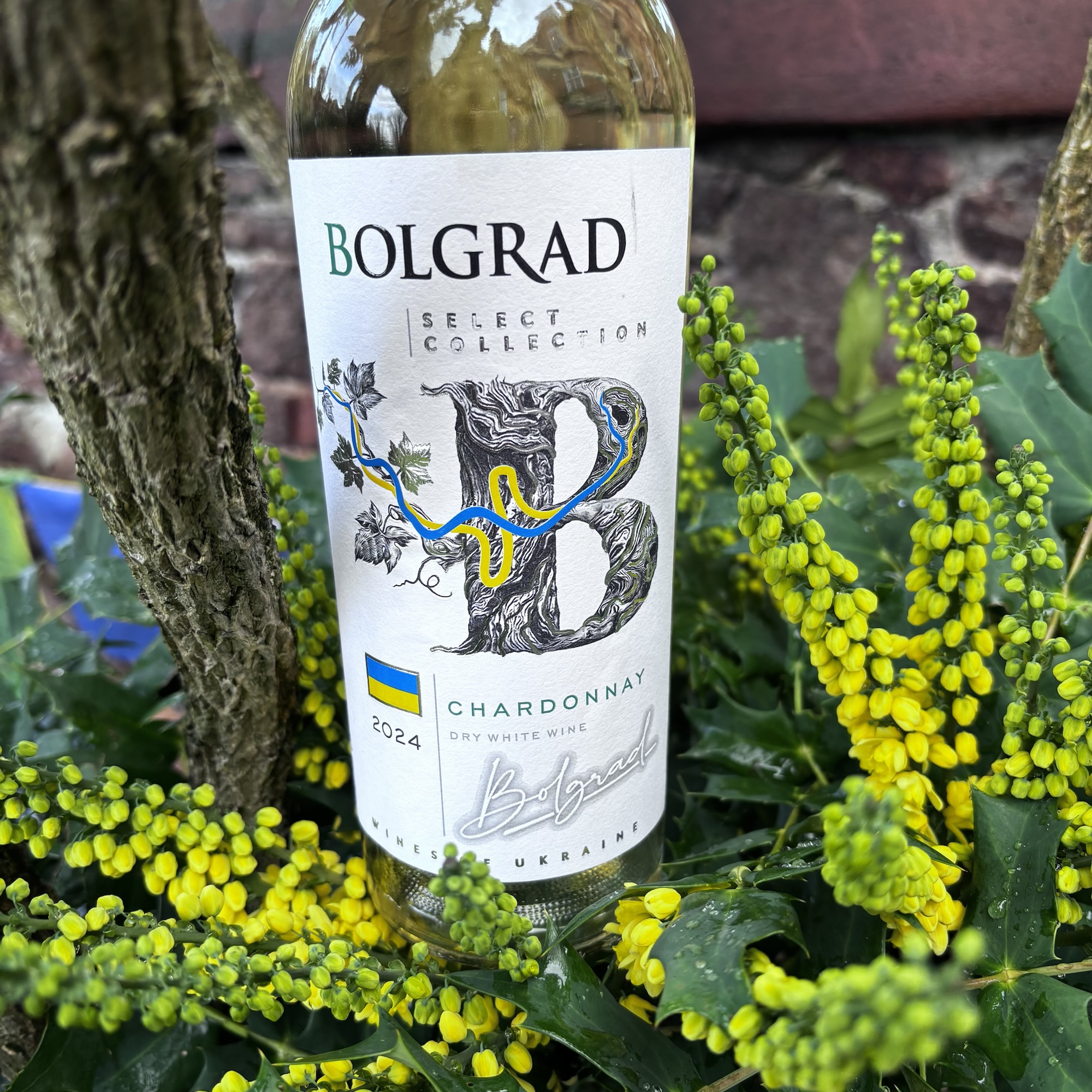
Chardonnay “Select Collection” 2024, Bolgrad Winery (Odessa, Ukraine)
The grapes are grown on the southwestern slopes of Lake Yalpug, one of Ukraine’s largest freshwater lakes. They benefit from the reflected sunlight off the water, as well as the maritime influence from the nearby Black Sea. Bolgrad is apparently Ukraine’s largest producer of still wines.
Made without oak, in steel tank, in 2024 this cuvée had a little Aligoté blended in. Oddly, if I had to guess I’d have gone with Gewurztraminer. You can tell it isn’t 100% Chardonnay. It’s an easy-going white wine. It isn’t a complex Chardonnay, but it’s fruity and unquestionably very good value at just £11. You get an apricot and lemon softness, and I found less crispness than some tasting notes have suggested. But I would say it’s a nice bottle to try. I would suggest it isn’t one to cellar though. Also, the vendor’s web site suggests this is sealed under screwcap. My bottle of 2024 was definitely under cork, as indeed I think the bottle in their photograph is.
Of course, it is a thrill to add Ukraine to the list of countries whose wine I’ve now tried (especially only four days after my first Albanian wine). How The Wine Society, and the winery, managed the logistics of exporting this, I have no idea…I mean not so much from Ukraine but specifically from Odessa. Although this won’t bring the wine critics running, it’s surely worth trying a wine from Ukraine, perhaps whilst we still can. You can’t expect a lot from £11, but I think you will find you get at least a little more for your money than you expected. It would also have quite wide appeal, but I dare say there’s not a lot of it in the country.

 David Crossley's Wide World of Wine