
I’m now ready to turn my attention to a recent trip to London. I’ve got a great restaurant discovery and recommendation which will be of special interest to anyone who loves Austria (or subscribes to Trink Magazine), but before that, a few notes from a small private tasting given to me by Basket Press Wines of the latest shipment from Annamária Réka-Koncz. As you will know, I’m something of a fan of the wines Annamária makes in Eastern Hungary, from her own vines at Barabás (near, in fact very near, to the border with Ukraine), and from fruit grown by friends further north and west.
All the grapes are certified organic and regenerative practices are taken seriously here. The estate itself is small, just six hectares of which 1.3ha are not quite yet in production. The vines which are producing grapes are generally between 40-to-60-years old.
Like the wines of Mira Nestarcova from Czechia, these are wines which usually disappear within a few weeks of arriving in the UK. It is not unusual for wines to have been long sold out by the time I drink my stash, with suitable time to rest after delivery and an understandable desire to eke them out through the year. Well, the good news is that Annamária’s wines have only just arrived, as indeed have Mira’s. If anything tasted here takes your fancy you will hopefully be able to get an order in. I have already received mine.
I am not sure these wines have made it up onto the Basket Press Wines web site yet, at least at the time of writing. I would suggest contacting them if you want some. All the wines cost between £20 and £30.
*All of the information re viticulture and vinification here was dictated to me and I was taking notes very quickly. Apologies if I get anything mixed up. The tasting notes, of course, are all my own…
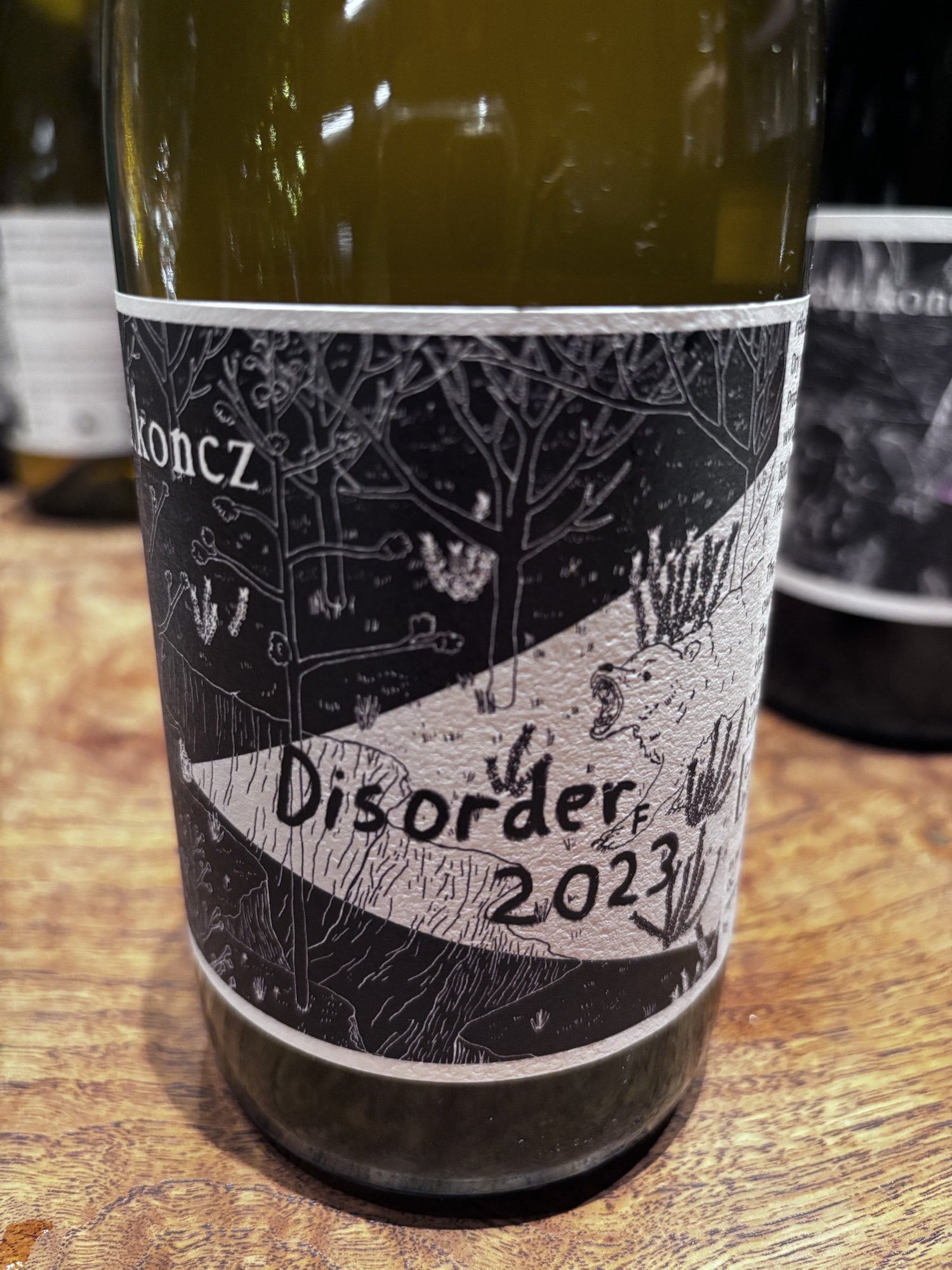
Disorder 2023 – This is made from Furmint sourced from three sites in Mád, in the Tokaj region. The fruit comes from 20-30-year-old vines off clay soils sitting on volcanic rock. As you doubtless know, despite the best efforts of academia to persuade us otherwise, when we think Furmint we think mineral, especially Mád Furmint.
Vinification, never totally straightforward with Annamária (whose attention to detail may well be the reason why these so far underrated wines are often so spectacularly good) is 50% whole clusters and 50% destemmed fruit, the latter gently pressed in a basket press. No skin maceration takes place. Fermentation was in individual concrete eggs and they were blended together in autumn 2024.
The fruit here is pristine and amplified. The texture is rocky more than grainy. The wine has a clean nose with a little smoke and length is long. Personally I think the 2023 needs just a little more time though. At least I intend to age mine a little, if only a year.
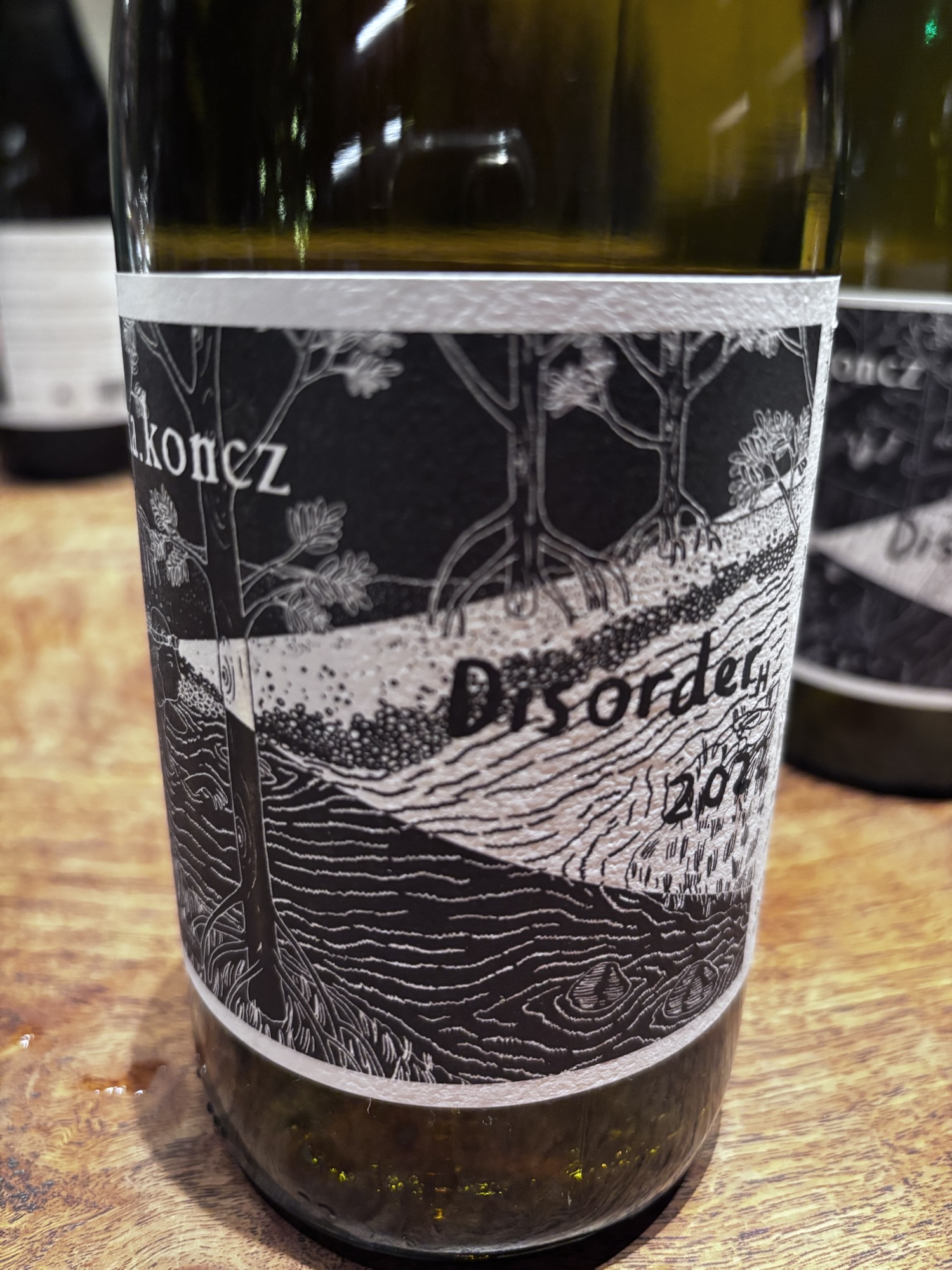
Disorder 2022 – This is very different. I’m relying on the information read out to me at the tasting, as the Réka-Koncz web site is never kept all that up-to-date (it’s hard for someone working on their own, I guess). This 2022 is apparently not Furmint, but 100% Harslevelü, made 50% in amphora and 50% in eggs. Again, this is made without skin contact.
Whatever the contents, the fruit in this 2022 is more direct than the 2023. The acid balance is perfect and the freshness of the wine is beautiful. It just feels all lifted-up. I already have some of this in my cellar and it seems ready to drink, so I bought the 2023 intending to age it, as I said above. I’m a big fan of Furmint, but to drink now, this is lovely.
Eastern Accents 2022 – This was described as a blend of 65% Harslevelü and 35% Furmint. These are younger vines, 12-15 years old, from the Mátra region. This is a mountain range in the north of the country, home to Hungary’s highest peak, and close to the town of Eger (which you might perhaps have heard of).
Again, it is all certified organic fruit. Fermentation is a mix of whole clusters and some broken bunches to release some juice. The Harslevelü is fermented in closed vats. Some fruit is fermented on skins, only for about a week, but that’s a little longer than the previous vintage. Some stalks are also kept in, which give a little tannin (remember this is a white wine).
The beauty of this wine is the way its freshness strikes you. It’s not the freshness of simple acidity, it’s more than that. As if the whole wine is alive. In fact, this seems a good place to comment on why I think Annamária’s wines appeal to me so much. We so often judge wine quality in terms of complexity. That misses wines which, in their sheer electric presence, thrill you. It’s a sensual response, one of excitement, rather than an intellectual one. But as I’m getting carried away, I should mention the texture, because this is so much a part of the experience. It’s drinking so well right now.

Óra 2023 – This wine is made from a field blend of Annamária’s own vines at Barabás and some Furmint from Mád. The four varieties which go into Ora are Királyléanyka, Riesling, Harslevelü and Furmint. The Furmint vines are 20-30 years old, the rest are vines planted in the 1970s. The Furmint was destemmed and fermented two weeks on skins, some in eggs. Annamária’s winemaking is always exacting and I sometimes get the details wrong but I hope this is correct.
The wine was blended in autumn 2024. The colour is quite orange/amber. It is pretty complex already and it is knitting together. It will age well, though. The fruit is ripe, so it offsets the tannins, although they will soften (not that they are harsh at all). It has big legs, though at only 12% abv, it seems well balanced.

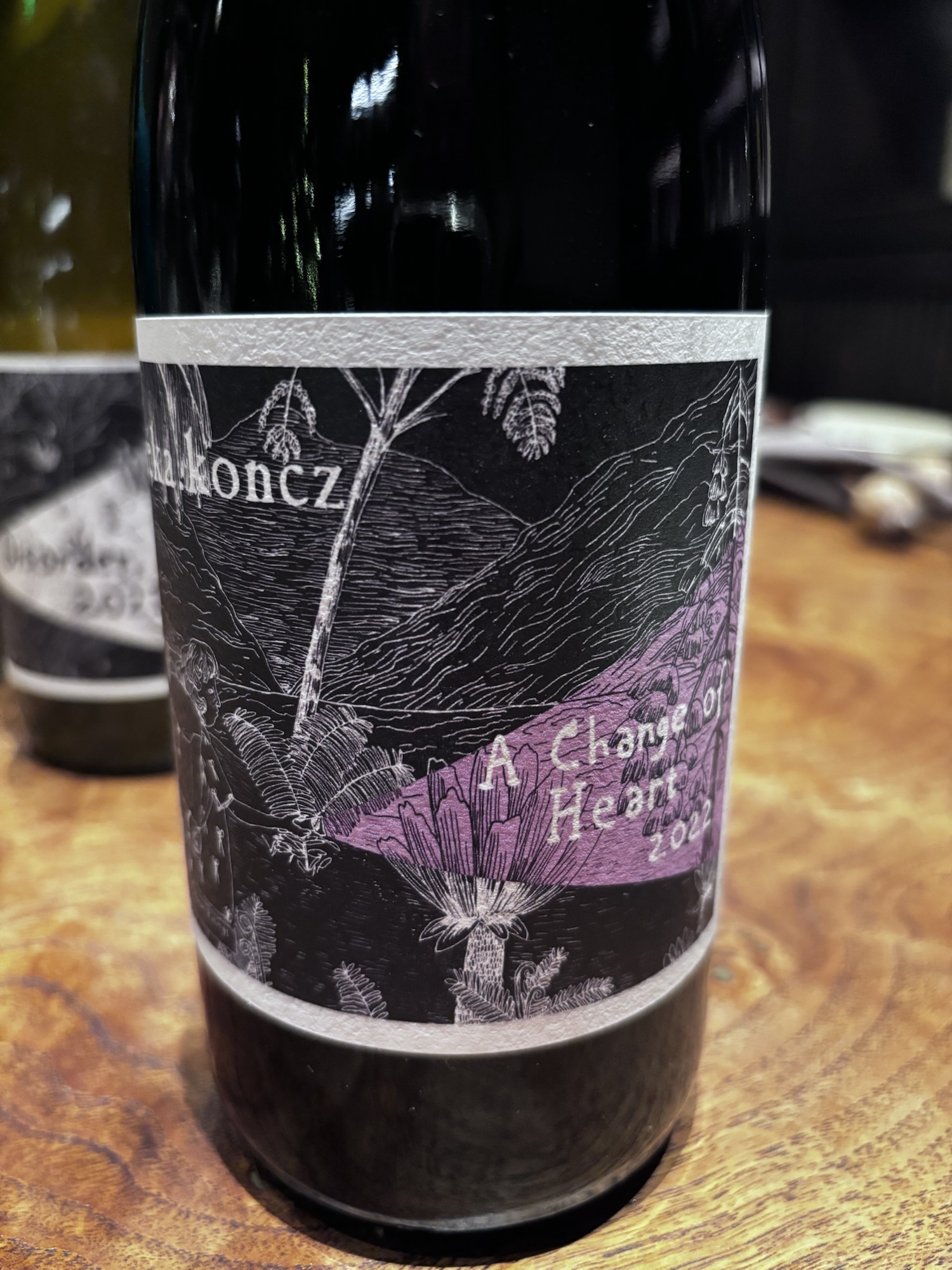
Change of Heart 2022 – I don’t know whether Annamária makes more than one red wine, but this is the only one I see. It is 100% Kekfrankos (aka Blaufränkisch, or Frankovka) from the volcanic soils of Mátra, again. In fact, the geology here is complex, with andesite as well, and a loamy topsoil. 50% whole bunches see five days with stems, fermenting in fibreglass. The other 50% is layered with the former for a fourteen-day maceration before maturation in vat.
Some will know this method, used by some Beaujolais producers, especially for the Crus, as a more complex form of semi-carbonic maceration. It allows for some intra-cellular fermentation and some crushed grapes in the vat fermenting as free-run juice as it drains to the bottom. Or at least that’s how I think it works. The result, in theory, is different simultaneous types of extraction, bright and juicy aromatics without loss of tannins and colour, and a cooler fermentation (assisted by the stalks/stems). The wines always have far more complexity than a normal carbonic fermentation as a result.
Like all of the Réka-Koncz wines, only a tiny amount of sulphur is added, here 15mg/l. The colour is bright and luminous red, very appealing. There’s equally bright cherry fruit on both the nose and palate. The tannins are grippy rather than prominent, giving the wine a bit of structure to go with the rather attractive, quite concentrated, fruit. I think that was the whole intention, and if so, the winemaker has succeeded admirably.
It does remind me a little of a Beaujolais Cru. Of course, the grape variety is quite different, but you get all that cherry fruit allied to a bit of depth which signals that it might age really well. If you order this, get two, one for now and one for later.
As far as I know, these are the wines shipped this winter by Basket Press Wines, so I haven’t tasted the new sparkling wines. The last one I had of those was the petnat “Robin” (in Part 2 of my Recent Wines post for October 2025, of 17/11/25). I do always look forward to getting hold of some of Annamária’s wines and I endeavour to get my order in early. This time you can join me, should you feel moved to do so. The wines have their own personality but they are not in the slightest bit scary as natural wines go, and not especially funky. I have seen a much greater awareness of this producer over the past couple of years, especially in Scandinavia. It’s perhaps a good idea to discover them now.
Thank you Zainab from Basket Press Wines for the tasting and to Hide Restaurant for providing the venue.

 David Crossley's Wide World of Wine