
I promised last time out that April would be a bumper month. We had a couple of lots of wine-loving visitors which nudged the total of wines for the month to above twenty, and the eighteen that made the cut will be covered in three parts, six wines in each. There’s plenty of diversity as usual, from inexpensive refreshment to stately old classics. Here, in Part One, we have a qvevri wine from the Barossa, a superb Savoie Jacquère (a merchant recommendation), a long-forgotten Dão rediscovered, a Martinborough Pinot Noir over ten years old, one of my favourite Alsace wines and a Carricante white wine from Etna.
I hope some of these bottles pique your interest, but I promise that there will be some stunning wines in Parts Two and Three to follow.
Field White 2019, Alkina (Barossa, South Australia)
Alkina is based at Greenock, and their mission is to make “terroir wines” over in the Western Barossa Ranges. Alkina is an indigenous Australian name meaning “moon” or “moonlight”, which they say embodies their respect for the land and the forces of nature. The farm was established by Argentinian vintner, Alejandro Bulgheroni, working with winemaker Amelia Nolan, in 2015. The farm is based on old 19th Century buildings and a vineyard planted in the 1950s. There are 43 hectares, farmed organically.
Field White is made from old vines, those 1950s plantings, fermented on skins with natural yeasts in a 700-litre Georgian qvevri (the estate also uses a lot of Italian amphorae for other wines, so they like clay/terracotta, and I believe some of this wine may have been made in amphora as well). The blend is primarily Semillon, but with 5% comprising Riesling and Doradillo (known as Doradilla or occasionally Jaén Blanco in its native Spain). Post-fermentation, the qvevri was topped-up and sealed. A small addition of sulphur was made immediately prior to bottling.
This is clearly an “orange wine” judging by its deep and luminescent amber hue. The bouquet strikes as lime and green apples, but the palate shouts salinity. The finish is textured and I’m now nervous of calling it a slate-like texture (see my previous article), but it does have a sharpness of texture which I would not describe as acidity. There are acids but they are juicy/fruity acids. Smooth fruit over a textured base.
It seems to me that this bottling is quite unique in Australia in that I could mistake it for a Georgian wine. It does, on second glance, have a Barossa feel, perhaps the 13.8% alcohol (the label says) assists us there. It’s a very good wine. It impressed me enough at the “Clay Wine” tasting in February to go out and grab a bottle. It isn’t really a wine for knocking back, though, more for contemplative sipping. The label art is by traditional artist Damon Coulthard of the Adnyamathandha Nation.
I purchased this retail from Raeburn Fine Wines in Edinburgh, who also import Alkina. Expect to pay between £30-£40.

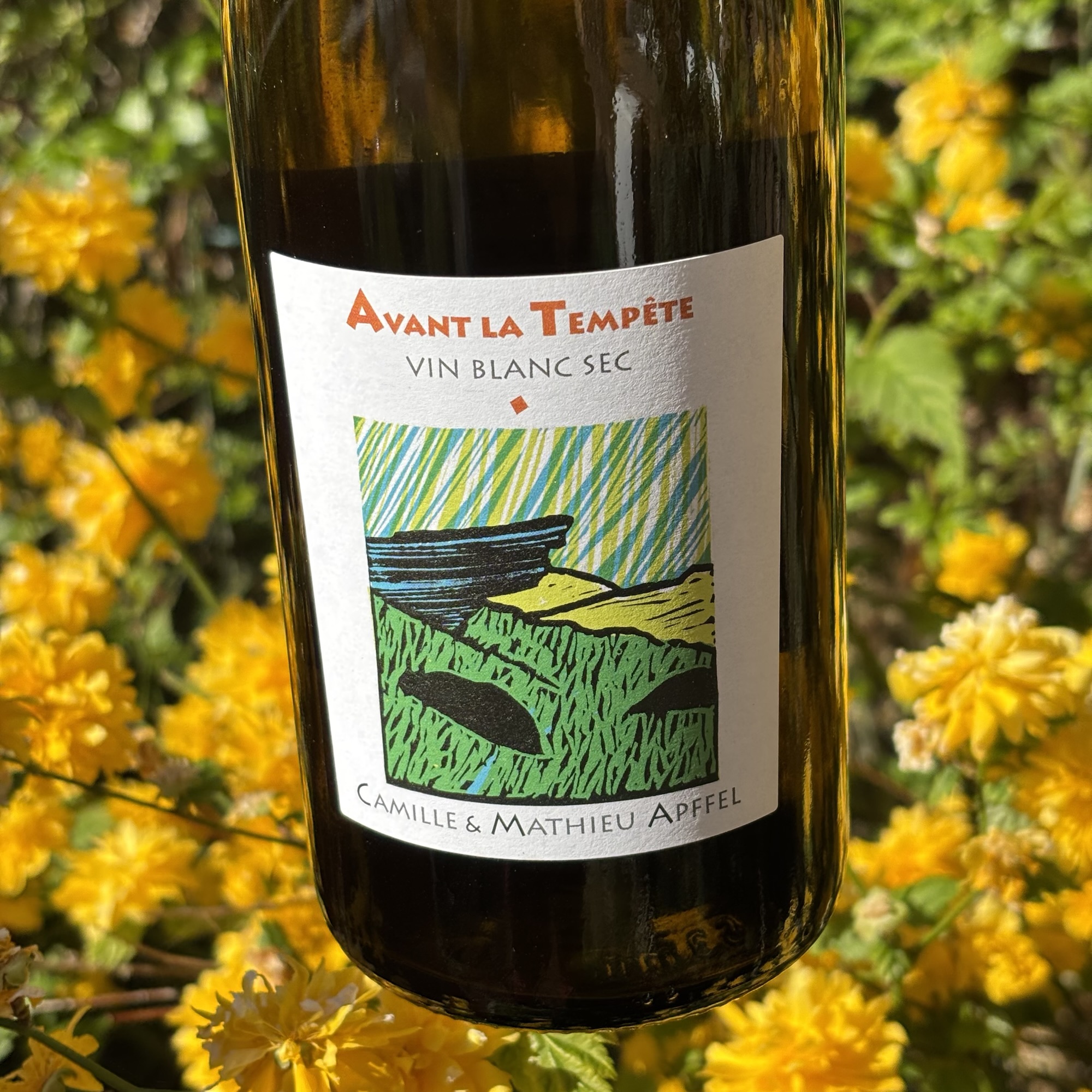
Avant La Trompête 2022, Vin de Savoie, Camille & Mathieu Apffel (Savoie, France)
I can’t speak for everyone, but I’ve learnt to trust the recommendations of certain wine merchants, one’s who appear to know my tastes. This is a wine from a producer I’d never come across, but I bought it on such a recommendation, and of course I didn’t regret it.
This couple are based at St Baldoph, which is just north of the AOC Aprémont, or if you prefer, just south of Chambéry. Mathieu took over the cellar of a retiring winemaker (Denis Fortin/Domaine de Rouzan) in 2017, Camille joining in 2020. They farm 3ha in Aprémont and a couple of hectares in the Combe de Savoie. Mathieu is a Jura native and worked at Domaine Pignier (one of whose wines we shall meet in Part 2).
Jacquère was always seen as the boring, sometimes workhorse, grape of Savoie but that has changed, and it is mostly through natural winemaking that this has happened. Mathieu converted to organics in 2018 and is now making natural wines with minimal intervention. I don’t know about all his cuvées, but this one has zero added sulphur.
Even from the first sniff you suspect that this has a certain Alpine dryness, and you also get some characteristic herbal notes. Speaking of character, there’s an inordinate amount of it in this wine, way more than you might expect from the variety. Doubtless it’s down to careful viticulture and those methods which leave the wine alone to do its own thing. The wine has some texture, and a lot of tension. It’s a genuinely gorgeous wine, taut but hinting at a restrained opulence.
This was recommended and sold to me by Spry Wines in Edinburgh (£33). Newcomer Wines is the importer. As Newcomer expands outwards from Austria, increasingly into France, they are finding some gems.
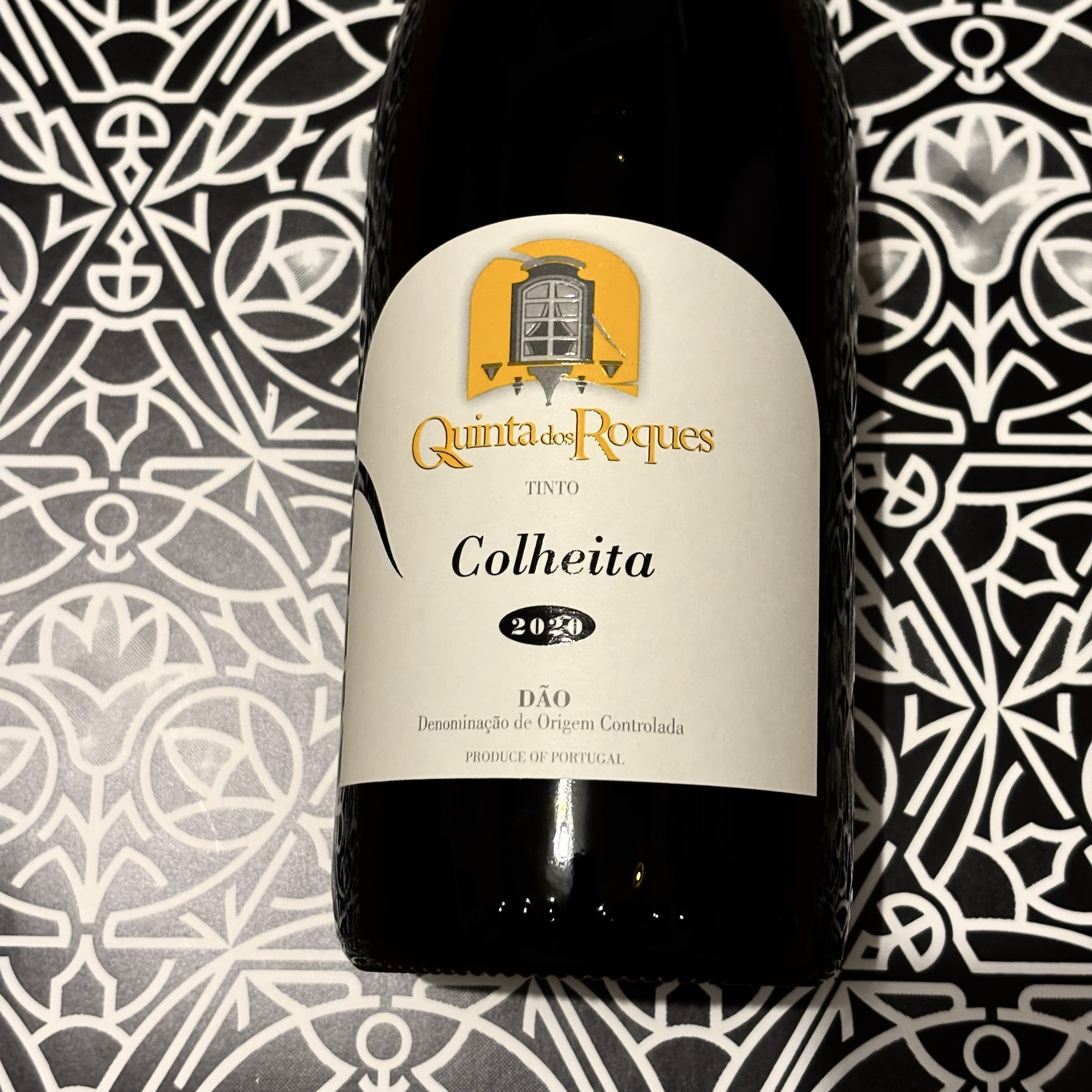
Dão Tinto Colheita 2020, Quinta dos Roques (Dão, Portugal)
This is an estate whose wines I drank many years ago, but I haven’t purchased any since perhaps ten or more years ago. I spotted this on the shelf of a wine shop I occasionally pop into (as one does), having failed to find a couple of wines I usually gravitate towards in there. I’m very glad to reacquaint myself with this producer.
The estate, ten kilometres south of Mangualde, was effectively founded, in wine terms, at the end of the 1970s by the Roques de Oliveira family. They persisted with local varieties despite pressure at the time to go international, and their commitment to quality has led to most commentators hailing them as being a major part of the Dão renaissance, along with sustainable and regenerative viticulture in Portugal’s oldest appellation.
Luis Lourenço, a former maths teacher, is now in charge and he has updated the winery but kept the old stone lagares in place alongside the computerised cooling and other modern additions.
This Tinto is a blend of Touriga Nacional, Jaen, Alfocheiro, Tinta Roriz and Tinto Cão, from vineyards at the heart of the region, both physically and metaphorically, on granite for what it’s worth. This red is I suppose an entry level wine. It is fermented in tank and aged in wood, barriques mostly, of which some are new and some older.
You get deep flavours of dark fruits, and intense but silky texture, with a good bit of grip. We drank this with Lebanese-style flatbreads, spiced and with Greek-style yoghurt and pomegranate seeds. It was a very good match. It proves that Portuguese wines are really such good value too.
Much as I try to buy new and different wines, I’m finding it quite hard to stop myself going back for more. Just £21-ish from Lockett Brothers. Quinta dos Roques wines are available through Raymond Reynolds, and I’ve seen various cuvées at Oxford Wine Co, Hedonism, Fortnums, and The Wine Society. I used to buy them from Butlers Wine Cellar in Brighton, who are known (like Raymond Reynolds, of course) as a Portuguese specialist, and they currently list three wines from the same stable.
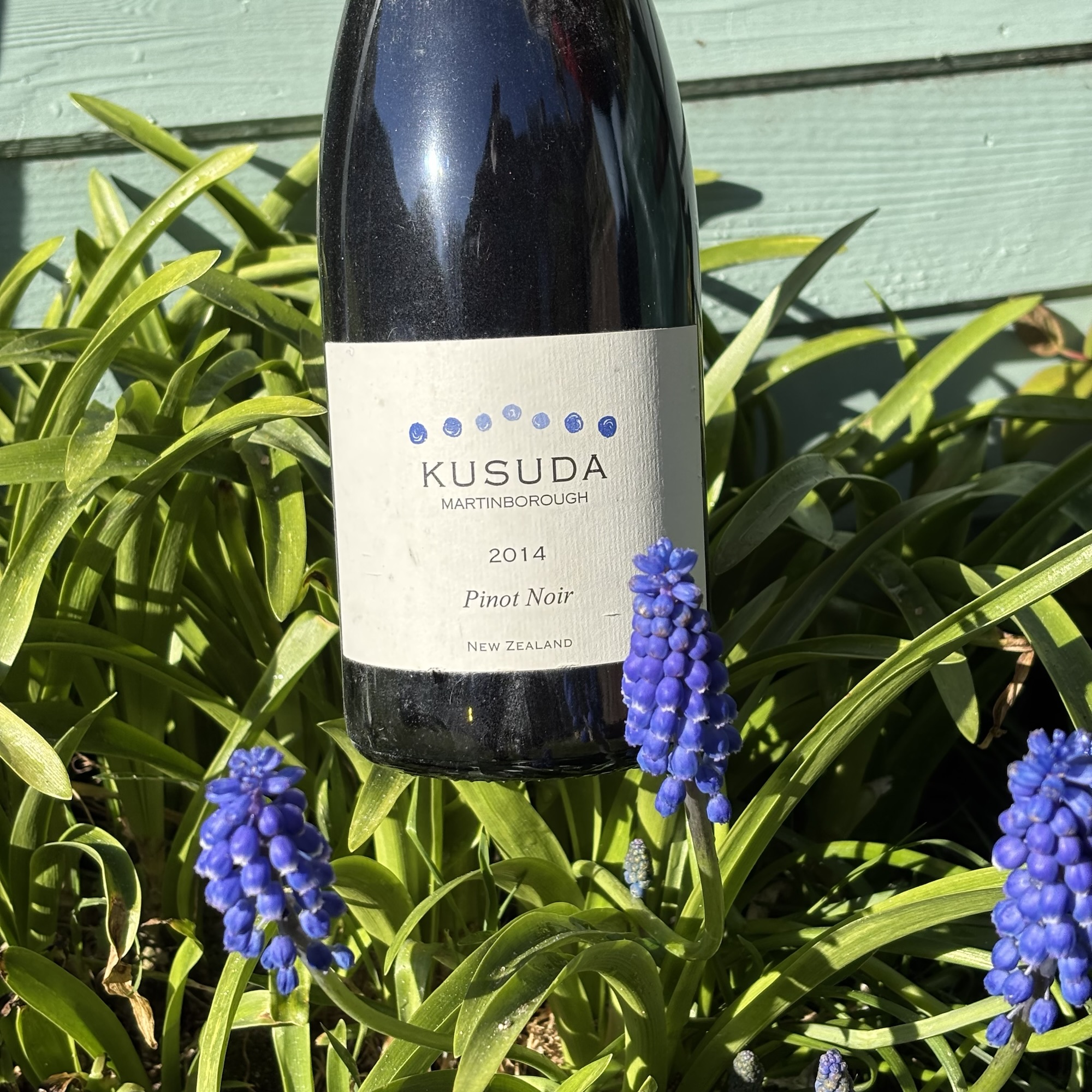
Martinborough Pinot Noir 2014, Kusuda (Martinborough, New Zealand)
This is a wine I’ve cellared a long time. Hiro Kusuda studied law and then went to work for Fujitsu, but a corporate life was not his dream. He trained at Geisenheim in Germany but decided to settle in New Zealand in 2001, establishing himself in Martinborough, at the southern end of the North Island.
At the time, this region was beginning to get a reputation as the place to watch for Pinot Noir, the original Martinborough Estate (est 1980) blazing a trail to stardom in the preceding decade, along with Clive Paton’s Ata Rangi. Both estates took good advantage of the reasonably low rainfall (for North Island, where Martinborough is its dryest part) and well-drained gravel/shingle terraces.
What perhaps singles Hiro Kusuda out is that he was, as far as I can recall, the first Japanese winemaker to make a big splash on the world wine stage. He shares with a number of his compatriots working internationally a determination to make world class wines. For Kusuda, his real interest was Pinot Noir, of which he has around 4-ha to play with.
Viticulture is really meticulous and at harvest the fruit is sorted berry by berry. This 2014 was aged in French barriques for fifteen months (26% new) and for this vintage he produced 6,221 bottles. Colour-wise, it’s in the paler spectrum for the variety, but not too pale. The bouquet is magical, ethereal, a mix of red fruits, maybe a hint of something darker, and plenty of savoury elements. The palate still has structure but the fruit is smooth and silky. Very long, very impressive. Well worth ageing.
You can still find this vintage around. Mine probably came from Berry Brothers (no idea of the price), who still list some by the case. Lay & Wheeler seem to have bottles (£165). If you do buy a more recent vintage, I presume it will age well if you let it.
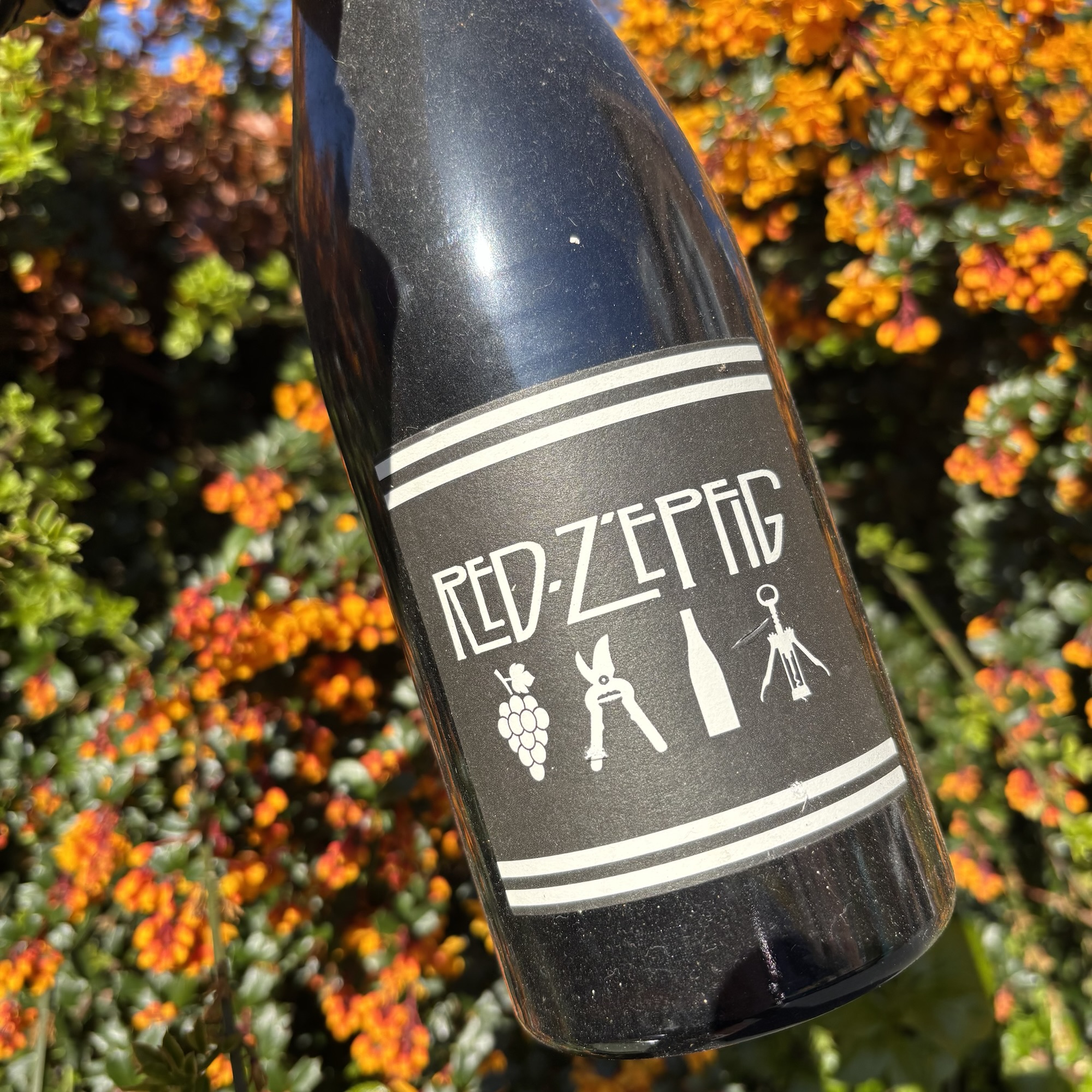
Red Z’Epfig 2020, Lambert Spielmann/Domaine in Black (Alsace, France)
As this is one of my favourite Alsace wines from one of my favourite producers, I find it hard to let my last bottle go. Thankfully an order via Cork & Cask in Edinburgh furnished me with some 2023, so this was popped with friends to spread the joy. Lambert has a small domaine of around three hectares at Epfig, with further small parcels at Dambach-la-Ville, Obernai, Nothalten and Reichsfeld.
Most of these parcels are surrounded by nature and Lambert’s focus is very much on things like biodiversity and regenerative farming. He’s also one of the young vignerons in Alsace with an interest in agro-forestry, which I first saw for myself in 2017 at Domaine Durrmann.
This red, despite its allusion to Led Zeppelin, is not heavy. It’s a light and juicy blend of equal parts Pinot Noir and Pinot Gris, a blend which has become somewhat fashionable among the younger producers. You can see why, it’s total glouglou gorgeousness in a glass.
The vines are 30 years old. All the fruit was co-fermented as whole bunches for ten days before pressing into used oak. Ageing therein was for just nine months. It really is all about those vibrant red fruit flavours, which are explosive on both the nose and palate. There’s just enough texture to hold it down on the ground, rather than allowing it to take off like a balloon into the sunset.
If you are wondering how feral it is, yes, a little bit. Not one for the naysayers. But for me it is merely close to the edge, not leaping over it. Also, this is proof that natural wine can age and last as well as conventionally-made wines with all their life-inhibitors.
Lambert’s track to listen along with (there’s always one on the back label, him being a musician as well as winemaker) is Maggy Bolle’s “Les Enculés”. My 2023 from Cork & Cask cost £30. Tutto Wines is the importer.
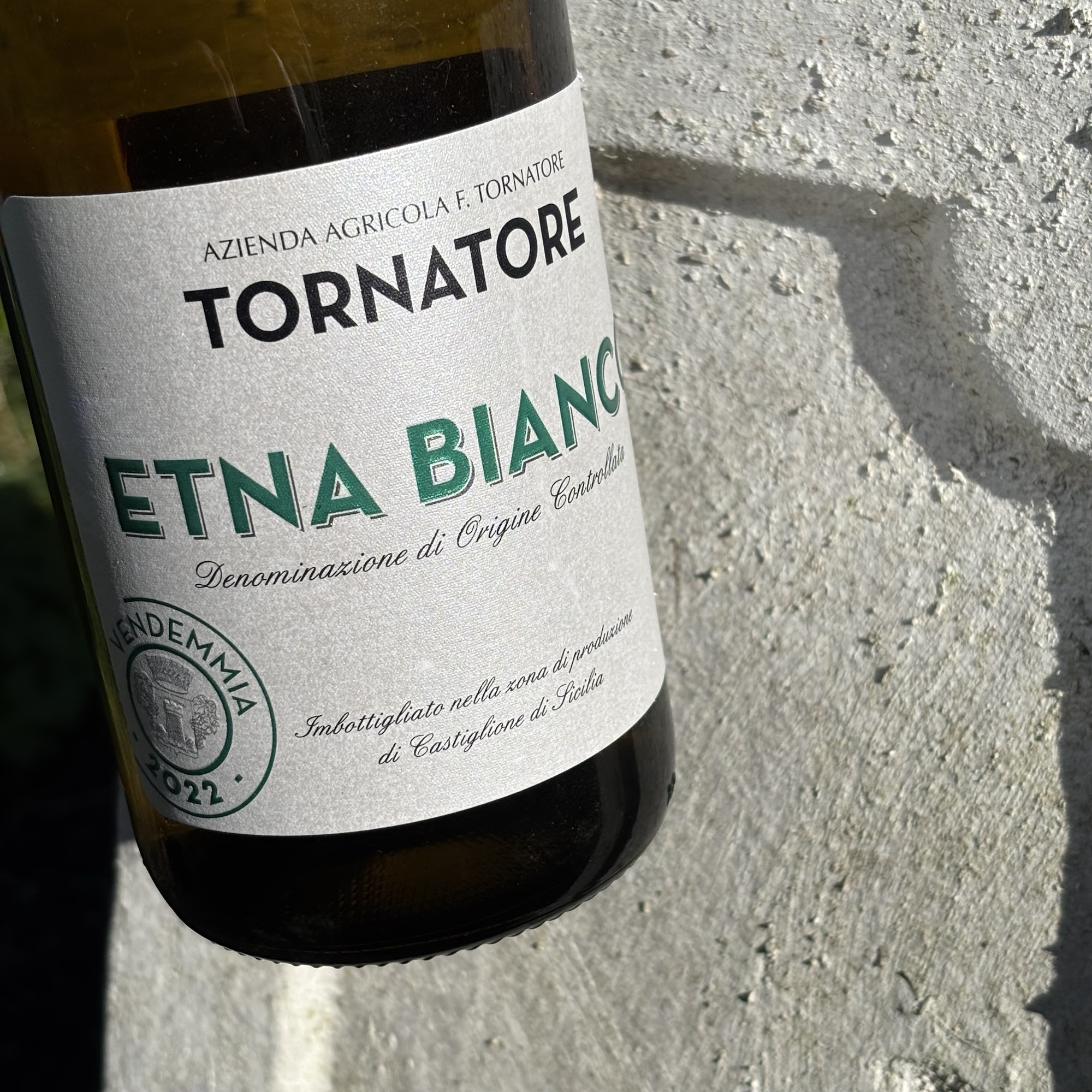
Etna Bianco 2022, Az Ag Tornatore (Etna, Sicily, Italy)
This is a large producer, the largest estate on Sicily, so its not at first glance the sort of wine you’d expect me to write about. I took a fancy to it in a well-known Italian emporium, in part because I’d not really spotted any Etna white wine for ages. Whilst we are well aware that red wines of genuine class are made on the mountain’s volcanic slopes, the white wines often get ignored.
Tornatore farms a massive one hundred hectares of vines, but this producer, founded back in 1850, claims a commitment to sustainable viticulture which includes renewable energy as well as the usual biodiversity, lower interventions etc.
This bianco is made from 100% Carricante, a variety so autochthonous to Etna that it is claimed to have been growing on its slopes for more than a thousand years. It’s quite rare to find Carricante outside of Sicily. Although it can produce acidic wines from high yields, it is at its best at altitude, and the grapes for this wine come from above 650 masl, near Castigliano di Sicilia. This quality improvement is due to the diurnal temperature variations at this altitude, which allow for a slower and longer ripening cycle, where acids are retained into a later harvest, but are not dominant.
This cuvée undergoes harvest by hand off the slopes of Etna. The grapes are destemmed before a slow and gentle crush. Post-fermentation the wine spends three months on the fine lees. Pale straw in colour, the bouquet has grapefruit, crisp green apple and herbs. The palate is crisp, and others have described it as particularly mineral, with savoury touches, but it also has a little honeyed and creamy texture to it, assisted by that time spent on lees. It’s not a heavy wine (just 12.5% abv) but it isn’t insubstantial.
So, this isn’t a natural wine, and it isn’t an artisan wine, but I did enjoy it and thought it very good value. And I like Carricante. Hence its inclusion here. I can no longer afford to drink £350+ worth of wine per month, and at £22.50 from Valvona & Crolla (Edinburgh) this was worth the punt.


I occasionally fancy a beautiful Pinot noir splurge thus an happy to learn about Kusuda and this wine. On the flip side, a ‘close to the edge’ wine causes that too. With your stellar description “…just enough texture to hold it down on the ground, rather than allowing it to take off like a balloon into the sunset.” I couldn’t pass on this, which should be easier to find. Wines for a range of moods and occasions here in Part I!
LikeLiked by 1 person
Thanks Lynn. Your feedback is genuinely appreciated.
LikeLiked by 1 person