
For our second batch of wines drunk at home in February we dart all over Europe, starting out in Devon of all places, followed by the Rioja Region (but not Rioja), Faugères (an all too rare visit to Languedoc, I admit it), the Vallée d’Aoste (or Val D’Aosta if you prefer) and a wine from a Pfalz star I try to keep drinking.
Artefact 2021 Castlewood Vineyard (Devon, UK)
I must have been sleeping because I’d never come across this producer, and I’d know if I had, not least because of the very unusual bottle chosen for this Bacchus (sadly my inexpert photo fails to depict it in all its glory), which reminded me of those wonders SQN uses. Delving into my four books on English etc Wine, not a single reference, so I had to do some research online.
Castlewood began in 2006 on a south-facing slope overlooking the River Axe in East Devon, sited below the ancient Iron-Age hill fort of Musbury Castle. It was only in 2016 that they added a 2-ha plot of Bacchus, having concentrated until then on sparkling wines. The soils are largely clay-loam, the vines planted at low densities, and on a south-facing slope which is generally frost-free.
This is not a natural wine producer as such but they do follow sustainable practices, including the growing of cover crops between rows, and the vinification at least seems to follow natural wine methods. There does seem to be a serious focus on healthy grapes and carrying out strict selection of bunches at harvest, along with swift pressing as soon as possible after picking, any moving of the must/wine done by gravity with no pumping.
Artefact is 100% Bacchus, Clone GF1 (apparently), the 2021 being harvested in mid-October. Grapes were crushed and destemmed into four 300-litre Tuscan amphorae. Fermented with natural yeasts, they saw a 21-day maceration before the skins were removed, followed by a further eleven months on lees. All the wine was then transferred to stainless steel for three months to settle before bottling. The juice was neither fined, nor filtered.
You do get that classic Bacchus grapefruit bouquet, but with an extra dose of nice tropical fruits. The palate definitely has some texture, but nothing harsh, just firm-ish. The ample fruit is complemented by something slightly biscuity, and hints of leaf tea.
This bottle was purchased by friends from JJ Mellis, the cheesemonger in St Andrews, which seems to have a small but very nice selection of wines. I went there to try to buy some for myself but they’d sold out, which was a shame. It seemed very good value, £22. I reckon the bottle itself must have cost a fair bit. I have since discovered that only 1,000 bottles of Artefact were made. It was also made in collaboration with Luke Harbor, Head Sommelier at The Pig Hotels Group, who having helped out at the vineyard wanted to get involved in the winemaking (Luke is now doing his MW).
I’ve spotted some at Forest Wines (£26) for anyone interested, and The Pig Hotels list it of course (£62). It is sold out on the winery’s online shop. Maybe there will be some 2022?

Gran Cerdo Tempranillo [2022], Gonzalo Grijalba (Rioja Region, Spain)
This is one of those wines you may have seen around, and which is pretty cheap. It’s the sort of wine you might expect me to leave out of my monthly roundup, but this is definitely a wine worth buying for a party, to take to dinner, or to drink yourself. It cost a mere £12. I know, that’s not cheap for most people and it’s above the average price paid for a bottle of wine in the UK, but as this blog is mostly read by fellow wine obsessives who tend to spend far more of their income on wine than most people, and doubtless more than we can really afford in many cases, I’m not averse to highlighting a bargain when I come across it.
I’ll tell you something, the only bad thing about this wine is the over-the-top marketing which makes it sound as if you are about to drink a very posh Rioja, but of course the grapes are declassified from the DOCa. This is apparently because the fruit was cropped at over Rioja’s limit of 6 tonnes per hectare.
As a consequence, there’s little information on the label, other than a tirade against the banks which refused to finance Grijalba’s operation (he really doesn’t like banks, as the pig with a mouth stuffed with money on the label makes clear). No matter, this wine, completely unoaked, has nice red fruits on the nose, and a sweet-fruited, light, palate. It has a smooth palate too, but with just a little earthy texture. It’s simple and clearly a wine intended for consumption in the year after bottling, yet it’s remarkably good, as well as terrific value, for around £12. I’ve had far worse wines with “Rioja” on the label, and I bet you have too.
It’s a natural wine, and biodynamic as well. Sadly, Gonzalo’s father became ill from working with vine sprays in the 1970s causing the son to become implacably opposed to using synthetic treatments on his vines.
Gran Cerdo Tempranillo is pretty widely available, from the already mentioned Forest Wines in Walthamstow, The Solent Cellar, Natty Boy Wines, Roberson, Seven Cellars and many, many more. Chances are you’ve seen the label, and maybe even thought it too cheap. Definitely worth a try in these trying times.

Léonides 2019, Domaine du Méteore (Languedoc, France)
Domaine du Méteore is one of the most highly regarded estates in the Faugères appellation. It is named after a 200-metre-wide meteorite crater near the village of Cabrerolles in the foothills of the Haut-Languedoc mountains, west of Clermont L’Hérault and Pézenas. It’s a special region of schist and limestone with sand and chalky clay, having its own AOC since 1982. It’s also a region with a long reputation for organic and biodynamic farming and Méteore was in the vanguard.
Léonides is a blend of mostly Syrah, Grenache and Cinsault, with occasionally a little Carignan and Mourvèdre, from the crater site, which is surrounded by oak forest and garrigue. Made as a natural wine from low-cropping old vine stock, it sees a long, four-week, skin maceration which gives the wine a rich and deep colour. The ageing lasts 28 months in inert glass fibre tanks. The only addition is very small amounts of sulphur.
The bouquet is of concentrated dark fruit with cassis notes. These are accompanied by classic Languedoc herbs reminiscent of the local garrigue. I found a touch of graphite in there as well. The schist seems to impart a tannic structure, but also a vibrant freshness at the same time. The body doubtless comes with the 14% alcohol, though that freshness does balance any weight-related issues. It errs towards leanness more than plumpness, but I don’t mean that in a negative way at all, far from it. The vineyard is said to be quite breezy and you can imagine you are able to taste that. It’s certainly very nice to drink.
Not as cheap as the wine above, but at £17, still a welcome slice under the twenty-pound mark (I have seen it even a little cheaper). Again, this is quite widely available, imported by Les Caves de Pyrene. For fans of Brexit, this cuvée is generally around 8€ in France.

Torrette Superieur 2016, Vallée d’Aoste, Ottin (Aosta, Italy)
To clear up the labelling before we dive in, Val d’Aosta is Italy’s smallest province, but both Italian and French dialects are spoken because it forms part of the former territories of Savoy (Savoie). You will often see wines labelled in French as Vallée d’Aoste, although its wines are fully governed by Italian wine law (despite seeing AOC or AOP on the label in such cases, rather than DOC). Aosta hides its light well when it comes to wine, because as with Switzerland, little makes its way outside of the country. In Aosta’s case, little makes it out of the region.
Although, when it comes to red wine, there is a fair amount of Pinot Noir and sometimes extremely good Nebbiolo here, Aosta boasts two of its own specialities, Fumin and Petit Rouge. Fumin is often the most promising variety, making quite unique and ageworthy reds (contrary to what some established UK experts may tell you). Petit Rouge is also capable of making excellent wines if you get the right producer (and perhaps the “Superieur” form). Petit Rouge must form at least 70% of Torrette.
Elio Ottin began making wine near Saint-Pierre, above the Aosta Valley and the Dora Baltea River, at the age of just 23, back in 1989. A producer committed to sustainable viticulture, at this domaine even all the energy comes from renewables. Elio’s real love is farming and he has brought life to the mineral-rich, sandy, soils he tends.
The vineyards are at between 650-700 masl, so this is mountain viticulture, mostly on steep slopes, all south-facing for maximum sunlight. Farming is organic, with manure supplied by Ottin’s own cows. Vinification uses native yeasts, and for this Torrette a gentle skin maceration precedes fermentation. It is then aged for a year in large Austrian oak (20hl). Only 80% of the cuvée is Petit Rouge, with 10% each of Fumin and Cornalin (the latter variety better known over the Grand St Bernard in Swiss Valais). About 5,600 bottles were made of this Torrette in 2016.
You get a mix of red and darker fruits (strawberry, blackberry) with juniper berries, beetroot, pomegranate and pine all swirling around in a wine that isn’t really “complex” yet has plenty going on. It drinks easily but also goes very well with food, assisted by a spicy finish and 13.5% alcohol (in the Superieur version). The producer calls it “surly” and, as a positive, that’s actually a good description. I would add that I’d say this 2016 is fully ready for drinking now. I might not want to sit on it. Petit Rouge generally ages less well than Fumin here. Very tasty though.
£25 from St Andrews Wine Company.

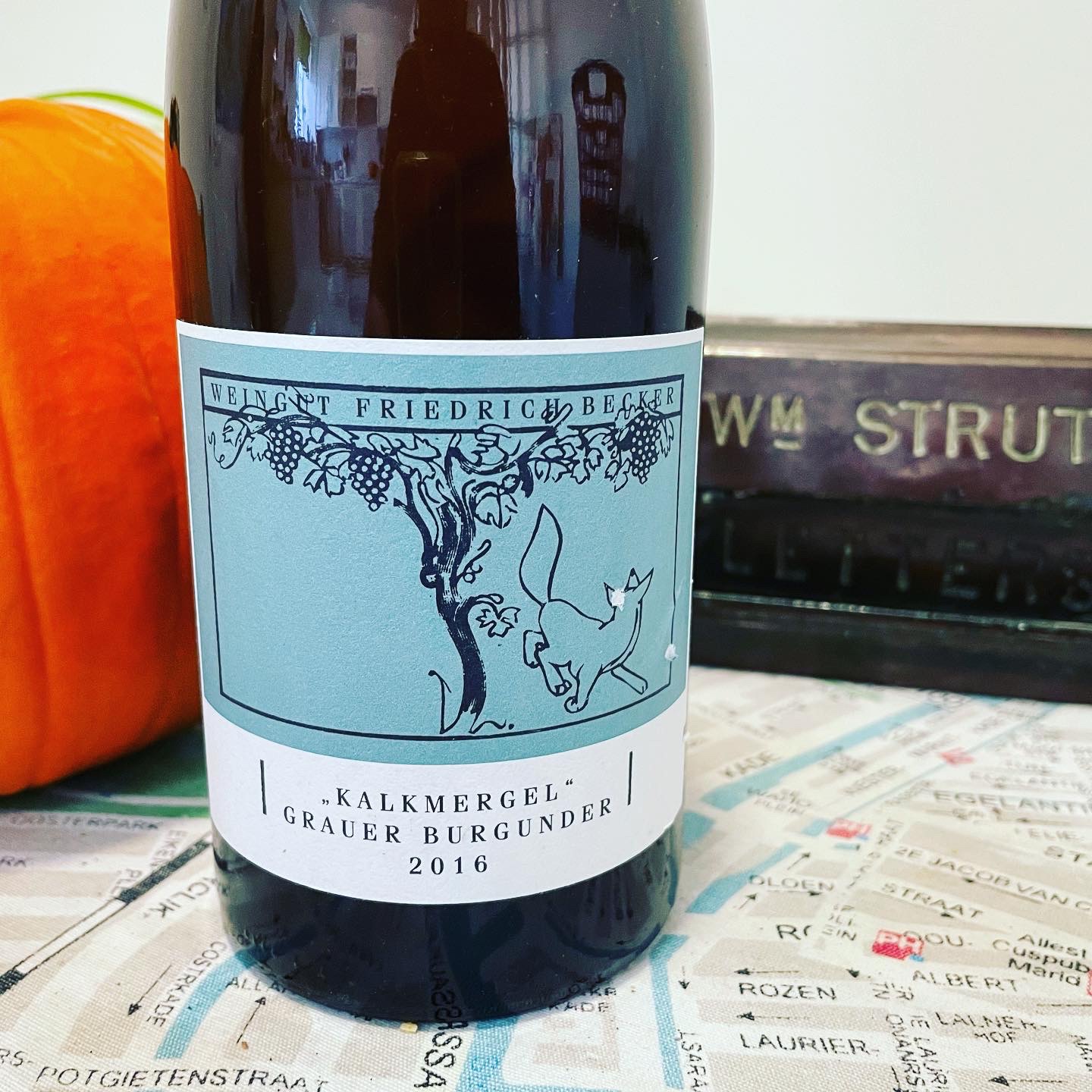
Grauer Burgunder “Kalkmergel” 2016, Weingut Friedrich Becker (Rheinpfalz, Germany)
I make no apologies for once more extolling the virtues of a man I consider to be one of Germany’s greatest winemakers, up there with the other Becker, Keller, Lauer, Prüm and Erich Weber (among others). Of course, those who know Fritz’s wines will most likely know his remarkable Pinot Noirs, some of which come from the steep slopes on the Alsace side of the border, which roll down towards the beautiful French medieval abbey of Wissembourg, just south of the German town of Schweigen-Rechtenbach right at the southern end of the Deutsche Weinstrasse.
Without doubt it is those Spätburgunders (mostly labelled as Pinot Noir for the “Grand Crus”) which garner the plaudits, but Fritz also makes some fine white wines, especially Chardonnay and, as here, Grauburgunder (spelt Grauer Burgunder by this estate), as well as a little Riesling.
The wine in question comes off similar chalky limestone soils to the Pinots, although there is also clay in the Becker vineyards. Made with skin maceration, when younger this wine has a pink-orange hue, but with age it has become more orange. If I need to choose just three adjectives, they must be rich, mineral and spicy. The richness comes from intensely concentrated fruit with 13% alcohol, perfect balance. The minerality comes from the soils. The spice is, to be perfectly pretentious, yet accurate, cracked black pepper. I think this Pinot Gris is a really good example of the variety, showing richness without being either sweet or too alcoholic. It’s still pretty fresh too but it has old vine complexity and a distinct personality. It’s seven years old and will probably last at least another seven. Fabulous.
You know what makes me cry? This bottle came from the weingut, and I reckon it cost me about £15 equivalent. The only place I can see it in the UK now is Majestic Wine. Seriously. They have the 2021 for a shocking £24…but a very much more reasonable £16 as part of a mixed six bottles, at which price it’s a bargain (though the Majestic pricing model just looks odd to everyone except Majestic). Just make sure to cellar some rather than knock it all back as if it were some cheapie.

 David Crossley's Wide World of Wine
Love the love for Friedrich Becker – especially is swoon-worthy Pinots of all stripes. I’ll look for the Kalkmergel, though I know I’ll be lucky if I find anything close to a ’16 here in the states!
LikeLiked by 1 person
It is a wine that I kept in the cellar because I knew it would age into a magnificent beast.
LikeLiked by 1 person
I got some of the Grauburgunder at Majestic, it’s very good and I’m really annoyed you’ve highlighted it before I restock!!
LikeLiked by 1 person
Sorry, but think of me. The only Majestic I can get to is Central Edinburgh, which rules out driving and makes buying six bottles via the train less attractive. I’d get a couple but not at their single bottle price.
LikeLike