
With fifteen wines up for consideration here, I’m going to make October’s Recent Wines into three parts again. Only five wines in each, but easier to skim through. I’m doing this because it’s mainly regular readers who subscribe to Wideworldofwine who check out these wines and it means less time wading through. Part 1 features two from Arbois, plus Tuscany, Sanlúcar and Voor Paardeberg.
« Pinot » 2017, Domaine des Bodines (Jura, France)
I think plenty of you know I have a real fondness for the lovely couple, Alexis and Emilie Porteret, who founded this four-hectare domaine on Arbois’ very northern edge only as far back as 2010. That fondness is perhaps accentuated by the fact that Alexis was one of those vignerons mentored by the late Pascal Clairet (Domaine de la Tournelle).
This is a type of producer which is pretty typical of modern Arbois, which now boasts a profusion of small natural wine domaines, some of which have become highly sought after and others, making just as good wines, seeming to, somewhat unjustly in my opinion, fall just under the radar in the UK. That has been the case with Bodines, in part I think because they seem to sell out very quickly and rarely have much, if anything, to sell at the domaine. But I would never leave a bottle on the shelf if I were to see one.
This Pinot Noir was harvested in late August, and being direct-pressed it has retained its amazing raspberry and strawberry fruit even at six years old. 2017 was a harvest of reduced yields and there wasn’t a lot of Pinot, but what fruit there was proved to be of excellent quality. Freshness and purity are the name of the game, as with everything Emilie and Alex produce. It weighs in at just 12.5% abv and the lovely smooth fruit goes to make this a lovely “nothing added” wine. Soulful.
This bottle came, I think, from the domaine, in December 2018. Their wines can occasionally be found in the UK. Les Caves I think brought some in, but those really small merchants who specialise in artisan wines have sometimes been known to stock a bottle or two. A bit of research might be in order. If any London shops have any, please do let me know.

Torrione 2015, Val D’Arno di Sopra, Petrolo (Tuscany, Italy)
Petrolo is one of Tuscany’s famous estates, not least for being synonymous with the introduction into Tuscany of classic French varieties (Merlot for Galatrona, and Cabernet Sauvignon). The estate is in the Northern part of Tuscany, north of Florence. Torrione is often described as the “château wine” of Petrolo. This makes it sound grand but in truth it is somewhat less expensive than this producer’s more “prestigious” wines, being a blend from all of the estate’s vineyards.
The makeup of the blend for 2015 was 80% Sangiovese, taken from Bòggina, 15% Merlot from the Galatrona vineyard and 5% Cabernet Sauvignon from Campo Lusso. It is by no means a limited production wine, around 45,000 bottles are made, but it does share one thing with the Bordeaux Châteaux – it’s still very good.
Fermented with native yeasts in glazed concrete vats, it is aged in a mix of large French oak, barrique and concrete for a period of between 15-to-18 months. The colour is quite dark and this 2015 starts off still showing some grippy tannins. The fruit is however ripe and the bouquet is awash with red fruits with underlying hints of gaminess. If the fruit on the palate seems more like black cherries, the savoury note here is black olives. Although 2015 was a forward vintage here, this is holding up very well. I have since started to buy a few more Sangiovese wines, partly as a result of drinking this along with the Montevertine we drank back in August. It’s a variety I had neglected a bit, especially since moving to Scotland.
This was originally purchased (if my memory serves me) from Butlers Wine Cellar, though they no longer have any. They are definitely worth a look for Tuscan wines though, with some classics often with bottle age.

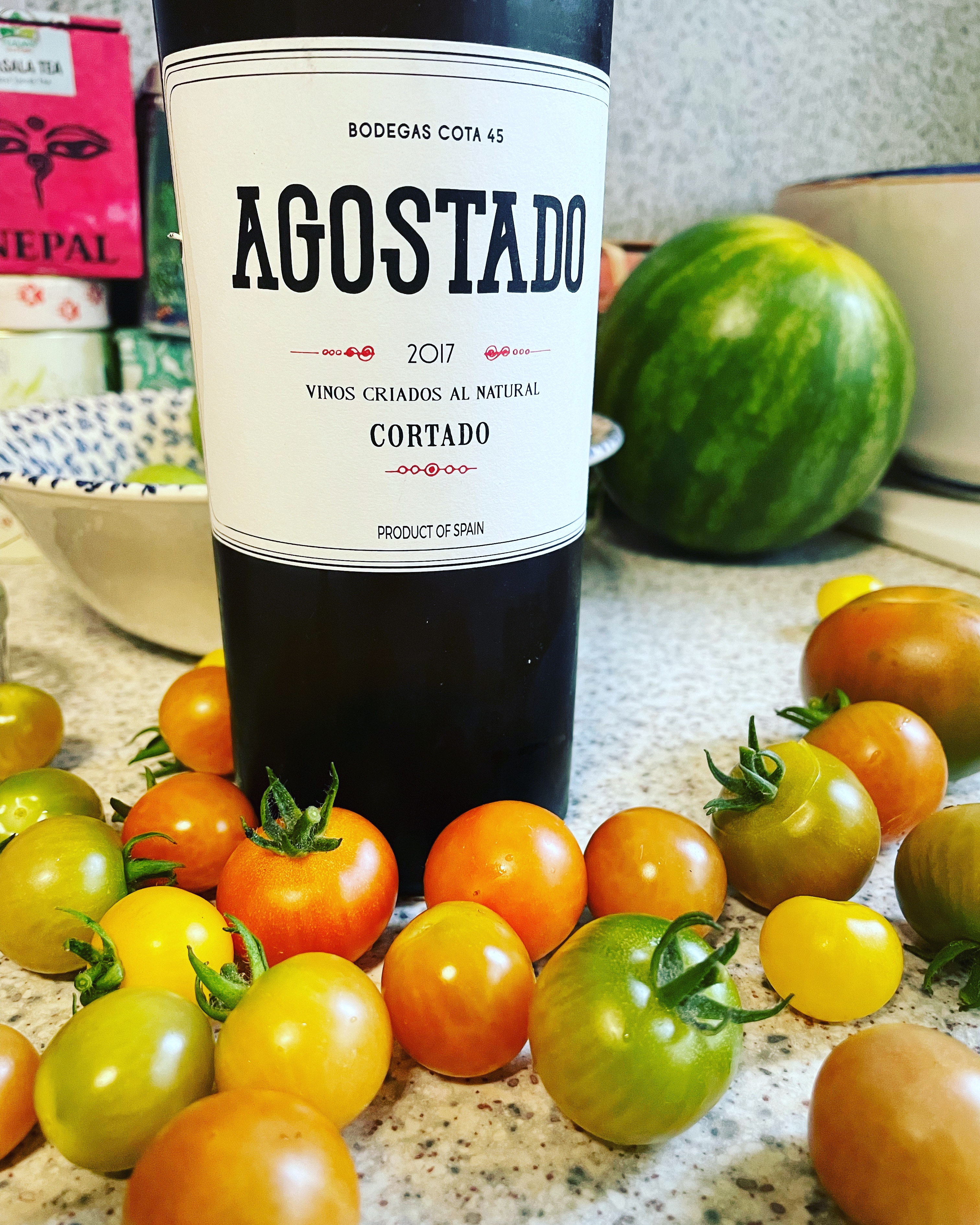
Agostado Cortado 2017, Bodegas Cota 45 (Sanlúcar, Spain)
This wine is effectively an unfortified Palo Cortado from Ramiro Ibáñez, whose Bodega Cota 45 was built out of an old boat repair shop overlooking the Guadalquivir River near Sanlúcar in Southern Spain. The name refers to the height above sea level where Ramiro suggests the finest of the region’s fine white Albariza soils are situated. It is his belief that when the region’s finest wines reflect the finest terroir, then those wines are truly world class. No one who knows the region would deny that Ramiro himself makes world class wines.
This wine is made not from solely Palomino but with the addition of the very rare Perruno and Uva Rey grapes (whether these are merely old clones of Palomino or are distinct varieties depends on the source you read). They are grown on a range of sites around Sanlúcar and picked at various levels of ripeness. Ageing is for 26 months in barrel under partial flor.
The result is a wine which has a hint of nutty oxidation, but which is very mineral, almost viscerally so. There is a little almond here but the palate is dominated by rich and slightly oxidative apple fruit and a whisp of fresh lemon. The alcohol comes in at 14%, though remember there is no fortification. It is a wine with a real presence, very complex, unquestionably world class.
I will say right now that this is one of the finest wines I’ve drunk this year. It should still be available from The Sourcing Table for £47. Les Caves de Pyrene is another option.
Chardonnay Vieilles Vignes 2021, Amélie Guillot (Jura, France)
Amélie started out with just under four hectares of vines at Molomboz, just nothwest of Arbois, and on the periphery of the appellation, in 1995 after completing her wine studies in Burgundy. Her modus is to work naturally without chemical inputs, whilst reserving the right to intervene if absolutely necessary. She uses minimal added sulphur too. This Chardonnay was made with just the addition of a little sulphur.
Following fermentation with native yeasts the wine saw twelve months in old oak, leading to a cuvée which is fresh and quite light (with just 12.5% abv allowing its fresher side to manifest). The bouquet is primarily citrus with some nice floral notes, but the palate is smooth with a lovely plump mouthfeel. The finish shows a mineral texture, ever so slightly grainy, and more citrus by way of lemon zest. This is an easy drinking style, even at two years old, but it does have presence. What it might lack in weight and complexity it makes up for in personality and its refreshing flavours. A nice wine.
This bottle came from Cork & Cask in Edinburgh and cost £34, but they have since sold out, as have The Solent Cellar, although they do appear to still have Amélie’s Vin Jaune. Cork & Cask list a good selection of Amélie’s wines, although I’m not sure how many of them remain on the shelf.

Art by @Tatt_art_Nepal
69.999999 2016 (magnum), Blank Bottle Winery (Voor Paardeberg, South Africa)
Pieter Walser and his Blank Bottle Winery have appeared regularly here over the years, though my own stocks are dwindling now. If I needed reminding what exciting wines this guy makes, this was certainly the bottle (all 1.5 litres of it) to do the job.
Pieter began his project twenty years ago, and his winery is on a farm just outside Somerset West, not far from the coast in the south of Stellenbosch, but the vineyard for 69.999999 is many miles to the north. Voor Paardeberg is a small region, often cited as being part of Paarl in the Western Cape, lying just south of the now far better known Swartland.
It’s a region often praised for the quality of its Shiraz in particular. Soils are predominantly granite, just like the Northern Rhône of course, and the climate is hot and dry, although the heat is ameliorated by the cooling winds off the Atlantic, which lies a little over 35km to the west. This helps to create a big diurnal temperature range with cool nights, allowing for slower ripening and greater aromatic intensity in the final wines.
This cuvée is a single block Syrah/Shiraz bottled exclusively in magnums. Peter found that the stems were ripe and extra-spicy in 2016, so fermented the whole bunches with stems to extract it. Pressed after four weeks, subsequent ageing was one year in used oak. Although many of Pieter’s wines tend to be one-offs, this is the third vintage of this particular cuvée.
It is indeed super-spicy, but it also has big plummy fruit too. I’d say it’s definitely Northern Rhône in style though, even if there’s none of the bacon aroma here yet. It is just all fruit and spice. A powerful wine at 14% abv, yet it tastes very much like an Old World Syrah from a moderate climate. It honestly is a fantastic wine and all the better for being bottled in magnum. The occasion came to drink it sat by an Aga cooker in a whitewashed cottage, literally on the Fife bank of the Tay estuary, less than two metres from the waves, a little west of Dundee.
The rather odd name relates to photographic exposure of the grape stem on the label. As with all his wines, Pieter has a tale to tell, and he tells them so much better than I can, so head to blankbottle.co.za for an explanation.
Blank Bottle Winery is imported by Swig Wines in the UK. This came from that great champion of Blank Bottle Winery and friend to Pieter Walser, Butlers Wine Cellar in Brighton, though I have cellared it for several years. I bought it directly after one of several inspiring tastings with Pieter over the years, and I’m so glad I did. Although it’s unlikely to be available now, I’ve never failed to enjoy a Blank Bottle wine. This was one of his best.


 David Crossley's Wide World of Wine