
Guillaume Lagger is originally from Switzerland, studying at Switzerland’s best known wine university, the Haut Ecole de Viticulture et Oenologie, Changins, based on the edge of Nyon, the attractive small town in the Vaud on the north shore of the lake, between Geneva and Lausanne.
Guillaume worked at the Domaine Château du Crest. This large 25-hectare domaine is at Jussy, not far from Annemasse. Here we are on the south side of Lac Léman, just east of the city, in that part of the Geneva AOC known as Entre Arve et Lac.
However, Guillaume is quoted thus (on the web site of B58 Wines, for whom he is winemaker and oenologist): “I want to cultivate vines to their full potential by keeping my intervention to a strict minimum”. That is what Guillaume is doing at his own Wharie Vineyard at The Wharie Experience, on a small farm his wife’s family owns near Sway in Hampshire.
Guillaume has 1.8 ha of vines currently planted, plus 1 ha of fruit trees on the 6.5 ha farm. It’s a beautiful piece of land, bucolic not being too strong a description. Fields surrounded by mature trees, birdlife in abundance and a view of nearby Sway Tower from the crest of the vineyard. The vines are planted on free-draining gravels, avoiding the clays which are too soft and retain too much water. The vines went into the ground in May 2021, and the orchard was planted over the following two years.
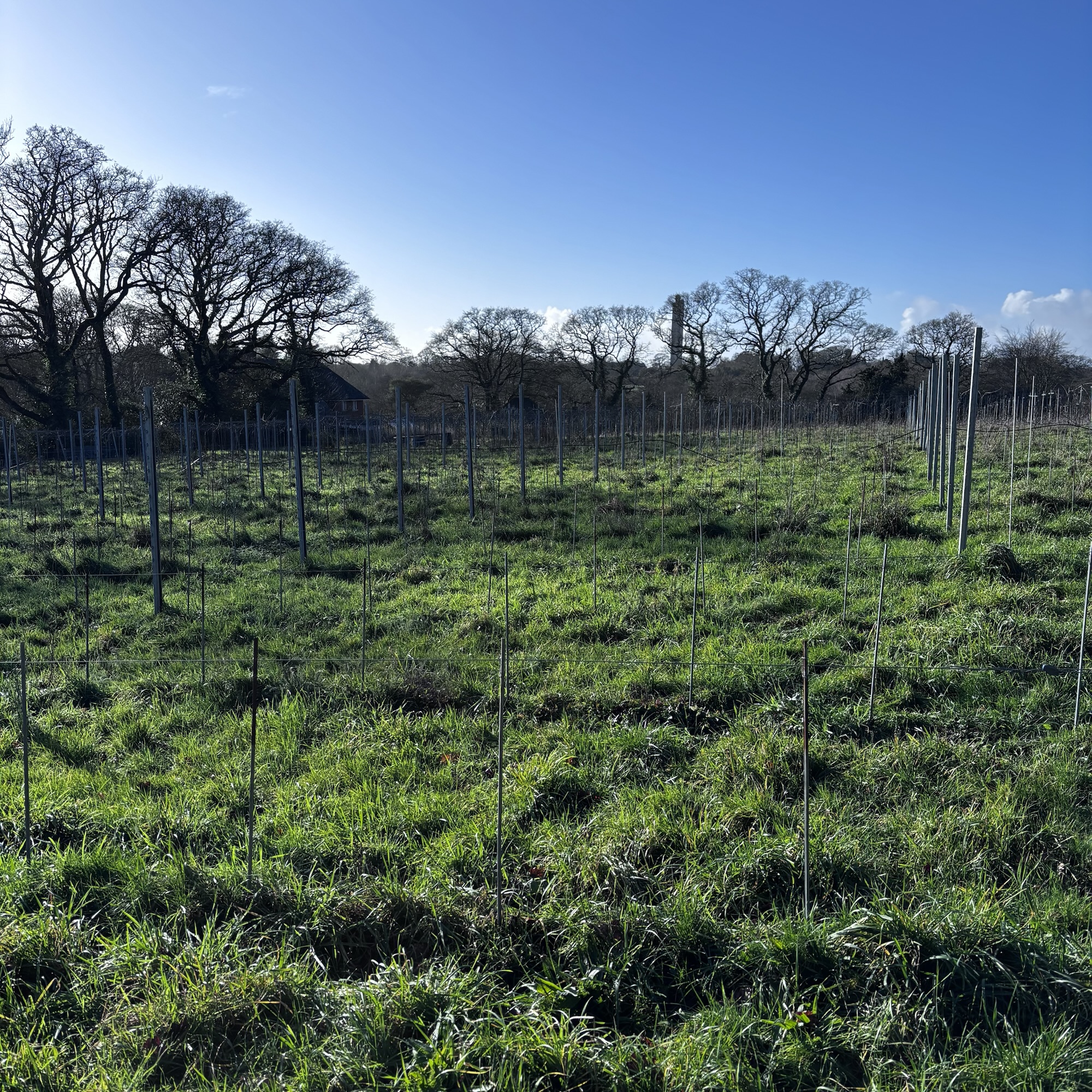
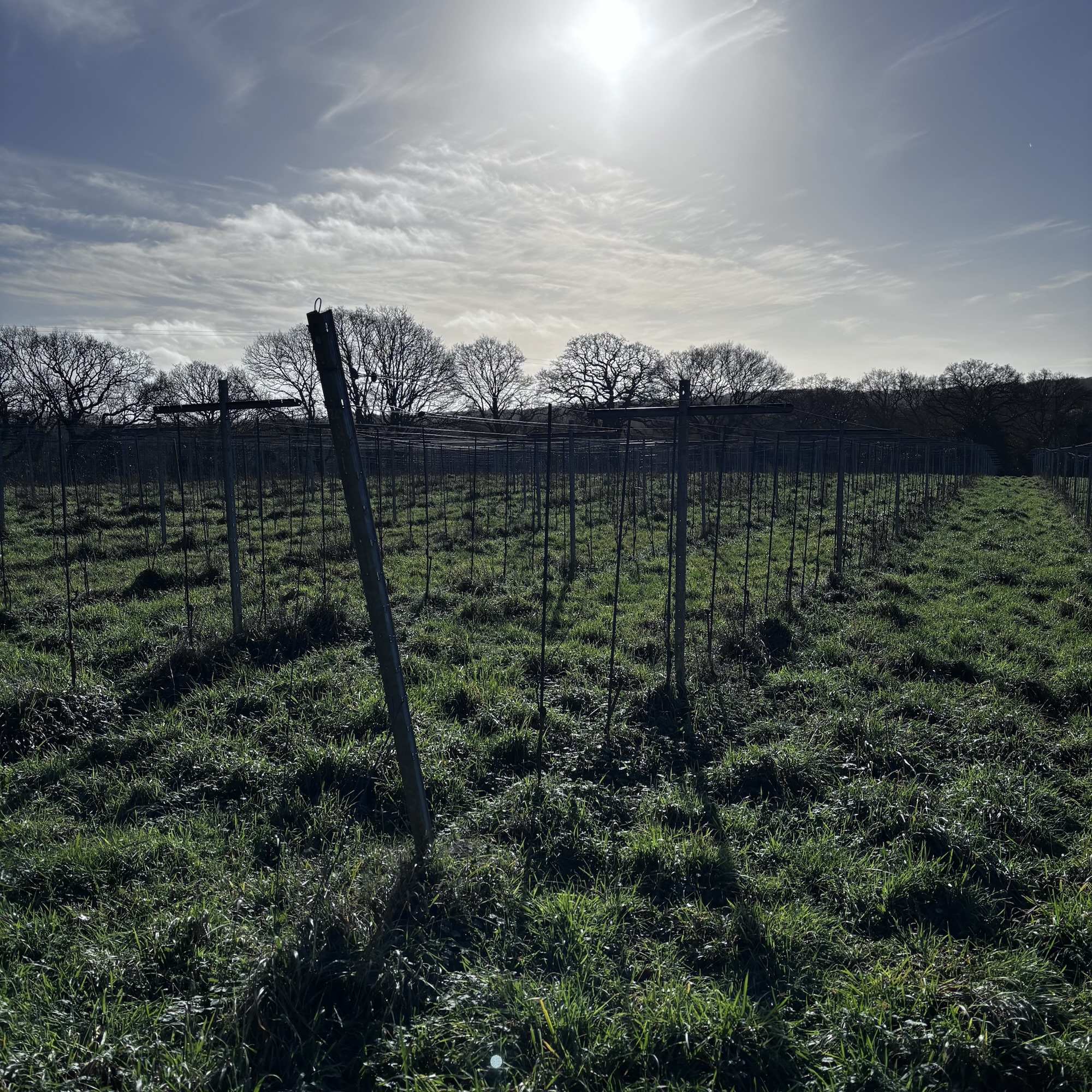
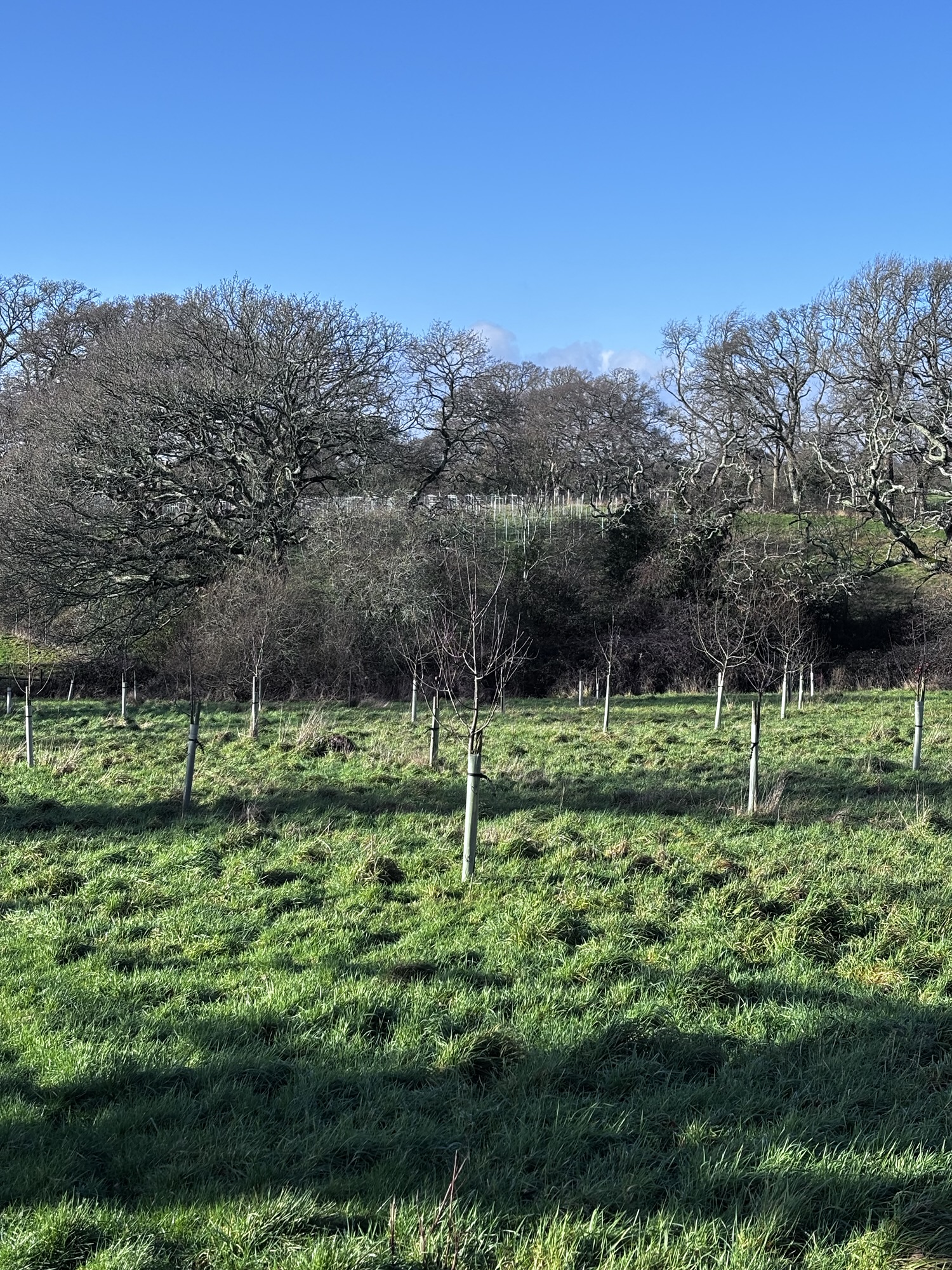
Vines and Young Fruit Trees at Wharie Vineyard
Nine varieties are planted in all, and they are all PIWI varieties (pilzwilderstandsfähig to give their full name). These are the new hybrids bred mostly in Switzerland. They are all, by law, at least 85% vinifera, but they are crossed and bred for a resistance to fungal diseases, especially the two mildews (downy and powdery) which can blight grapes in a wet spring and summer, of which England still has many. For this, they use the genetic advantages of more resistant American and Asian species.
I’m repeating what I said about these grapes very recently in my review of Jamie Goode’s Regenerative Viticulture (2nd edn), but the whole reason for developing these varieties is to minimise, or even do without completely, the systemic and contact chemical sprays used to combat these diseases. The result, you hope, is that you get more sustainable viticulture through less poisoning and compaction of the soil, plus other environmental benefits (the sprays kill birds and insects, all beneficial, except where the birds eat your all grapes).
The nine varieties Guillaume has planted are (white varieties) Solaris, Muscaris, Sauvignac, Souvignier Gris and Soyhières, and (red varieties) Divico, Pinotine, Cabaret Noir (formerly known as Cabernet Noir), and Cal 128-a (known by number as it does not yet have a name).
The first harvest at Wharie was 2025, and Guillaume hopes to bottle around 8,000 units, including some contract-purchased fruit. He’s also making still wine for Chilcomb Valley Wines, near Winchester.
First the obligatory vineyard tour. This was instructive. The two main blocks of vines are on higher ground, sloping gently. They appeared well-drained. Where the fruit trees are planted, on the clay, the ground was quite moist, and boggy in places. We went down on the train so I was without wellies, but I got away with it…much of the New Forest is quite badly flooded but Wharie is raised just enough to avoid any pooling.
The vines are trellised on a Geneva Double Curtain (which I was seriously pleased to have identified to Guillaume). This takes the fruiting canes higher off the ground, to avoid the damp, and also spreads them sideways to get more light exposure. GDC (as it is known) used to be more popular than it is now in the UK. It had one advantage, being that it takes fewer man-hours work in the vines, but it can crop too high for many.
Stephen Skelton in The Wines of Great Britain (Infinite Ideas, now Académie du Vin Library, 2019) says that “I have never felt that the quality of fruit coming from GDC-trained vines was as good as that coming from VSP Guyot vines”, but he admits that may well be down to pruning, shoot positioning and leaf removal issues.
Guillaume has adapted his own GDC to a more classic (less widely spaced) planting density. That may keep yields per vine in check. He mows between the vines every other row, in rotation, during the growing season. He said that in five years he has only sprayed once, that with yeast extract (which could underline the effective resistance of the Piwis). He has never used any copper. His low intervention approach extends to sulphur, where he uses 30-40 mg/l at bottling, but he says he is currently using mostly commercial yeasts. Hopefully good yeast colonies will become established, but he is trying indigenous yeasts too, as you will see below. This is what he’s working towards.
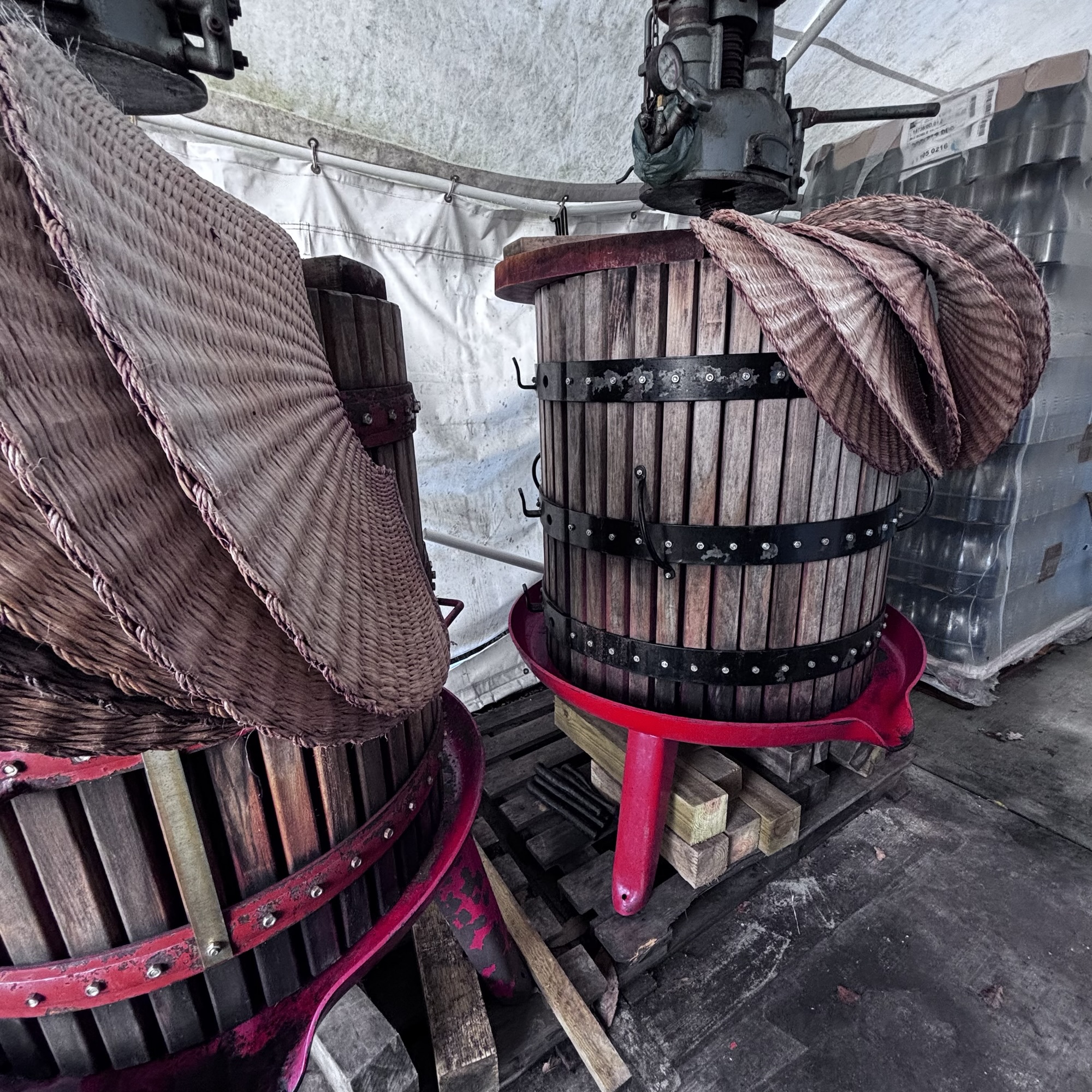
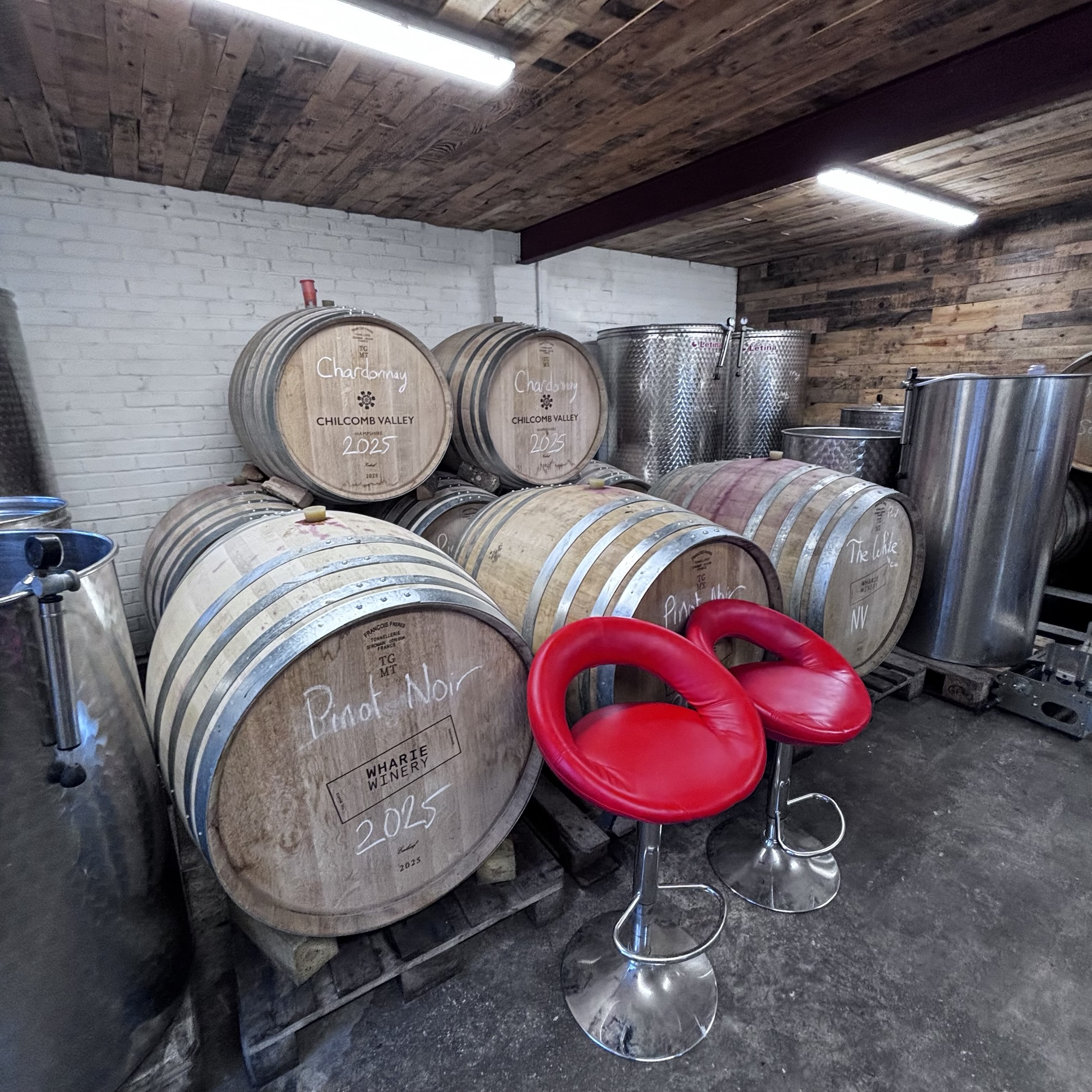
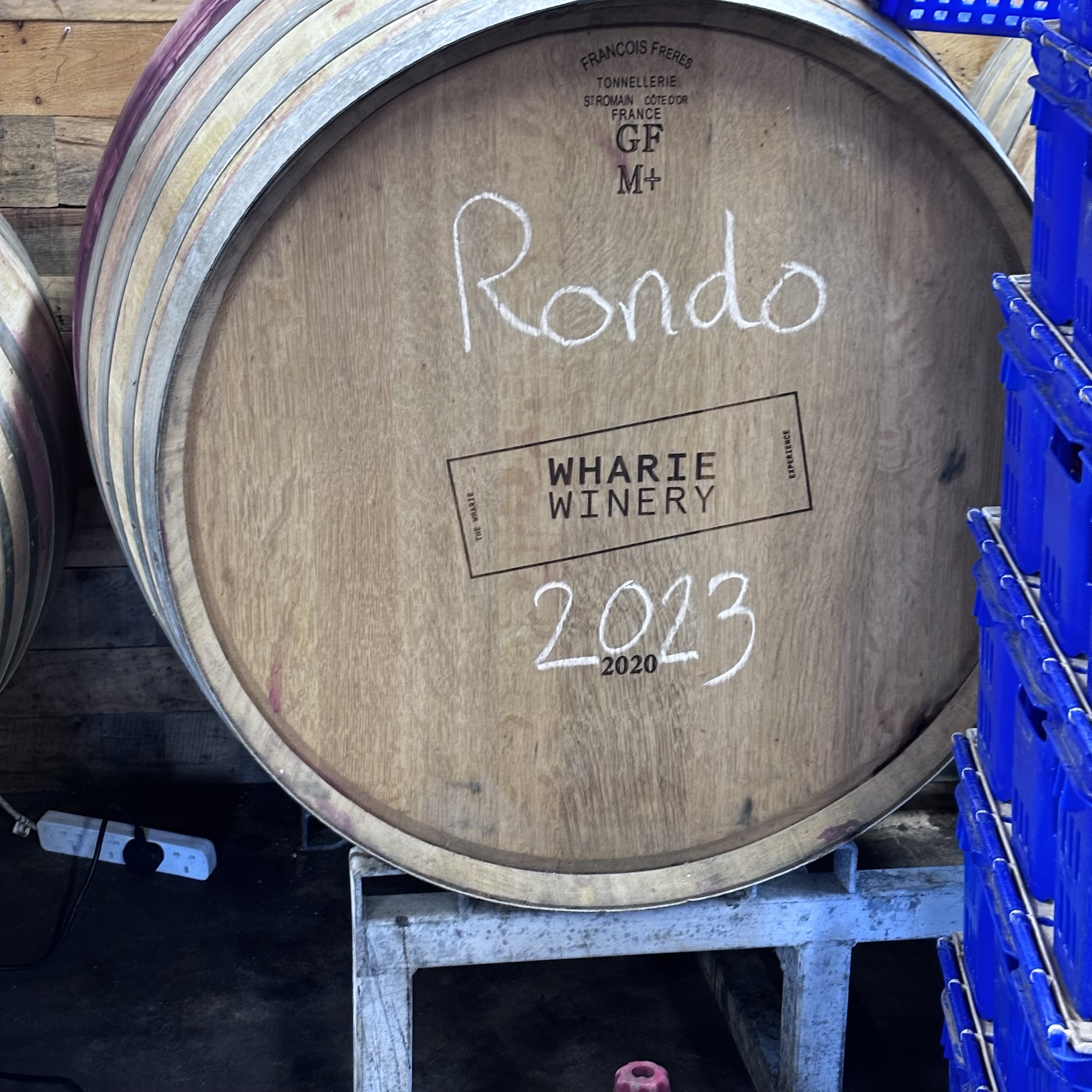
In the Tiny Winery. As at B58 Guillaume likes his François Frères
We started off by tasting samples from barrel or tank of the 2025 wines, before sampling bottles from previous vintages, made if you remember from the bought-in fruit. I tried a lot of wines, so my notes will be very brief.
First the aforementioned Chilcomb wines. A Chardonnay which saw 60% oak-aged wine with 40% in stainless steel was picked on 10 October last year, and reached 13% abv. It had nice fresh apple and citrus notes. Another Chardonnay, from 2024, is to be used as base wine for a sparkler. That came in at just 9% so Guillaume decided to chaptalize half a percent. It should eventually reach 11%. It had a flinty reduction.
Of the Wharie wines we tried the Souvignier Gris first. It had seen one month in oak and this was actually fermented with wild yeasts, as was the very characterful Muscaris, a variety perhaps a bit out there for all but the obsessive oenophile like me. I liked it. It is a bit different, enough so to spark my interest. Solaris had six days on skins, which have given it a striking colour. Then a 2024 Bacchus orange wine, one barrel made. No grapefruit here, something even slightly savoury, but light and fresh.
The most extreme of the whites, though I agree with Guillaume that it is also the most exciting, is the Sauvignon Soyhières (aka Ravel Blanc). This is one of Valentin Blattner’s crossings from the Jura Canton (Switzerland), where this esteemed breeder has his nursery and lab. As well as resistance to fungal diseases it also withstands frosts quite well. Guillaume gave it 14 days on skins and it has an orange/gold colour. It is apparently not easy to grow, with lots of side shoots and many small bunches, but this displays the variety’s noted aromatics (baked spicy apple and honey) with a savoury palate. Again, some might find it a bit strange, others (like me) fascinating.
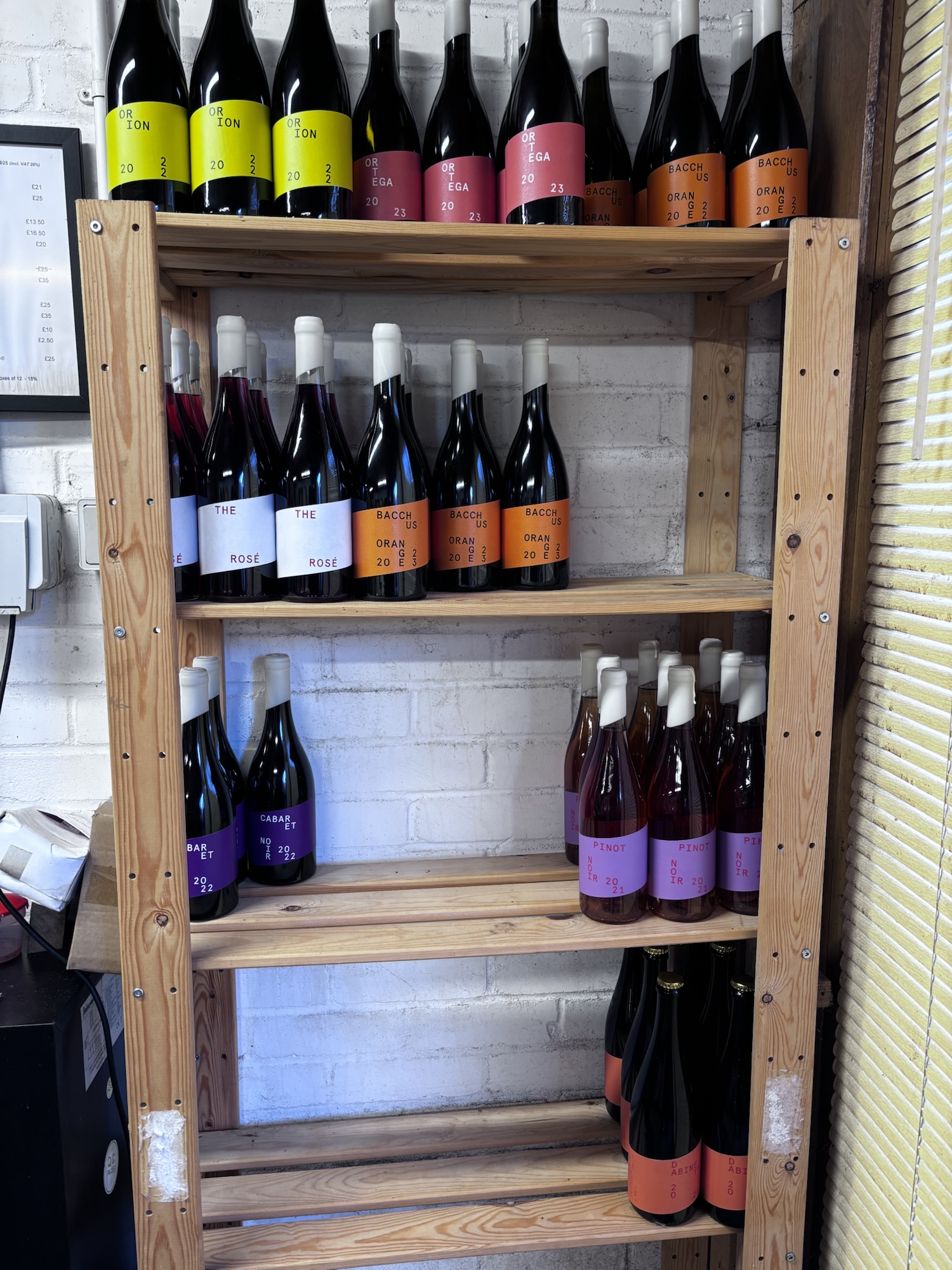
Shelf Needs Restocking
Finally, from the barrel, some later-harvested Pinot Noir, which Guillaume bought a ton of from Essex last November. He thought long and hard about it, because he’d already cleaned down the winery post-harvest. He made a good call, I think. This has potential, as you’d expect from a 2025 PN from Essex. It has good colour, plenty of freshness in the fruit, but also some nice tannins.
Now to the bottles. Guillaume is developing his entry level, blends priced accordingly, sub-£20. The white blends Chardonnay, Bacchus and Ortega, picking up a faint hint of colour from a barrel previously filled with Divico. The Rosé 2023 is mostly purchased Rondo and costs just £13.50. There’s a Rosé Reserve at £16.50 with an extra year in bottle (2022).
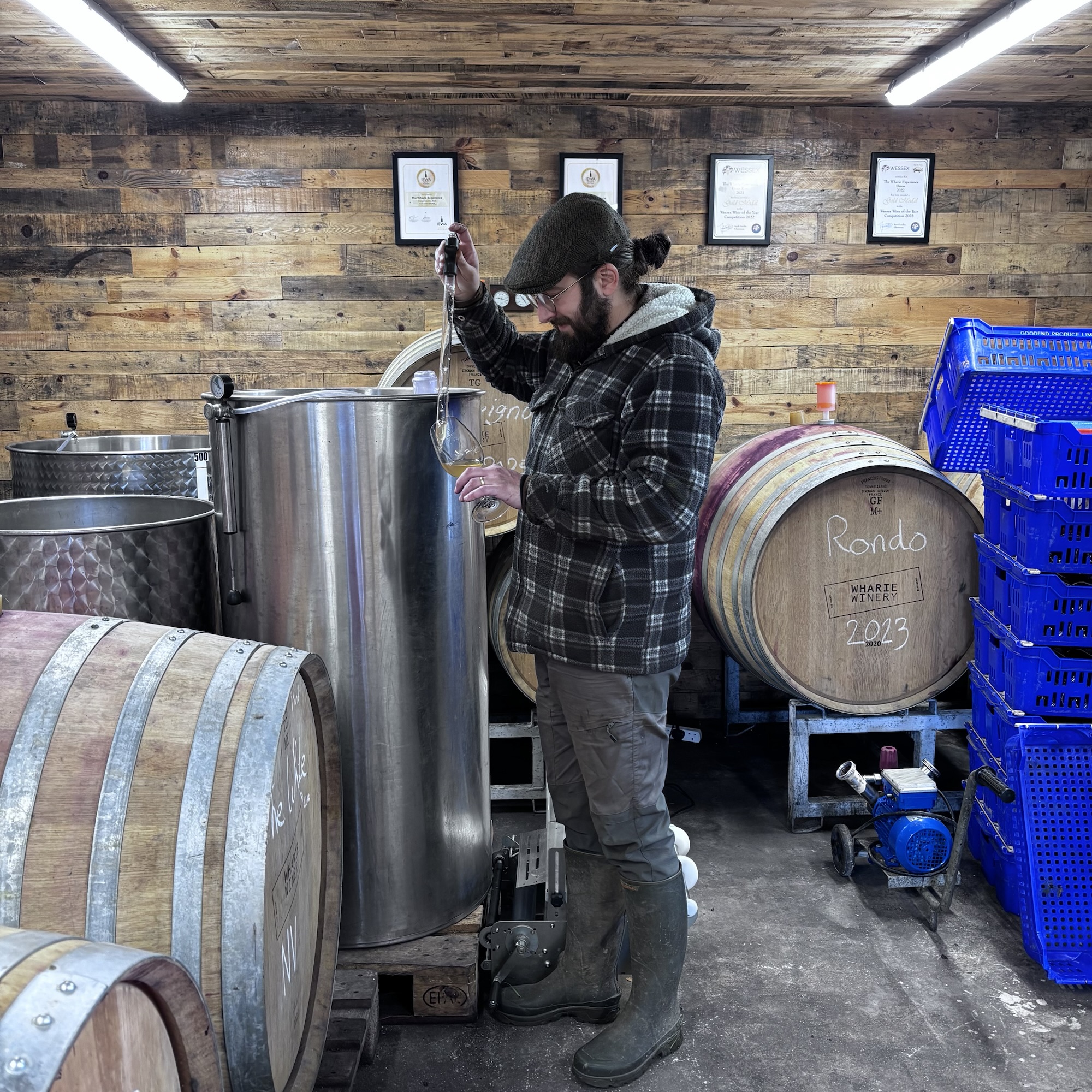
Guillaume Grabbing a Sample
Orion, an early German Piwi cross from the 1960s, between Optima and Vidal Blanc, was purchased from a vineyard at Bradford-on-Avon. It only hits 10% abv, but it is fresh and zippy. Ortega is much better known in the UK (Westwell makes a benchmark bottling). This one saw 100% oak, half on skins. It makes a nice summer wine with a savoury twist.
Guillaume’s best seller is his Bacchus Orange (here 2023). It’s a style Guillaume sticks to (if you read my previous article on B58 Wines, where he is the oenologist). Quite impactful…I mean that as a positive. I’ve said before, Bacchus can be a little one-dimensional, if admittedly super refreshing, but skin contact does have the potential to elevate it.
Some bottled reds to Finish. “The Red” 2023 is the third entry-level wine, after the white and pink, 85% Cabaret Noir (sic) with Rondo and Pinot Noir. There’s a 100% Cabaret Noir cuvée from the warmer 2022, which is a step up. It saw 100% new oak and shows blueberry and beetroot notes with nettle. Quite Genevois in style, perhaps? Fresh now, it will age, for sure. Certainly a grape variety with UK potential.
The last bottle was called Chou Chen No 1. It’s an apple and honey wine, Somerset apples blended with heather honey from nearby Hordle. Some was aged in an Islay whisky barrel, some in a Bourbon cask. I’m sure I got a little smoke and iodine from the Islay cask. It’s very moreish, and a nice note to end on.
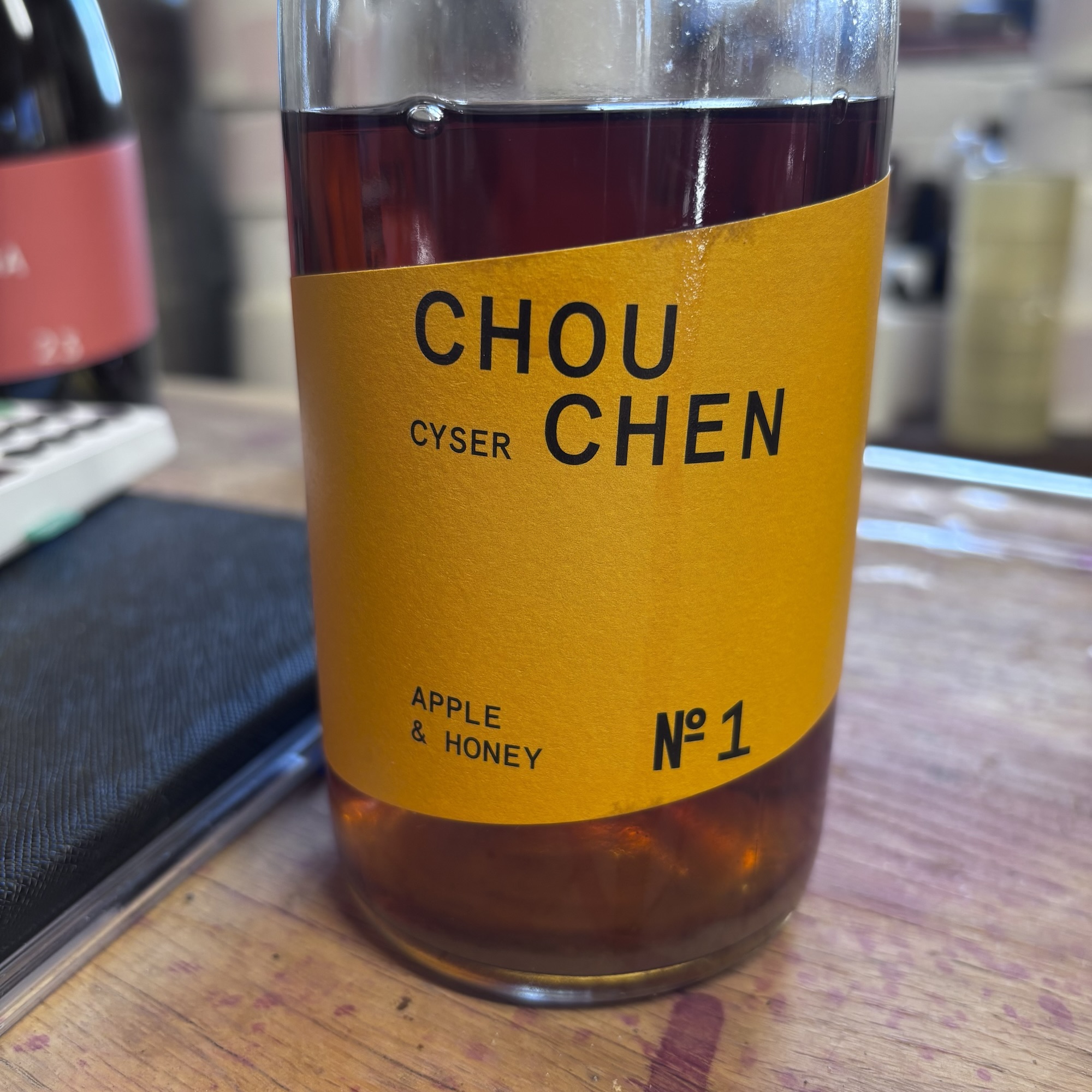
Chou Chen – Sweet Apple & Honey
What Guillaume Lagger is doing here is early days, selling wine in bottle from bought-in fruit whilst waiting for wine from his own grapes to be ready to bottle. As to the latter, Wharie is one of the few places you can come (by appointment) to try a wide range of Piwi varieties in the UK. Guillaume is a very thoughtful winemaker, and what he is doing, like B58 but in a different way, is very interesting indeed.
I do wish this young guy every success, as he seems very much on top of both his winemaking and the viticulture here. When the orchard comes on stream he will, like Tim Phillips, who we shall visit next, have a supplement to his income. As Tim once said to me, it’s the cashflow from the cider that enables me to make the wines I want to make.
The Wharie Experience is on South Sway Lane near Sway. You can check them out via www.wharie.co.uk. The web site lists stockists, currently only local. They offer vineyard tours and tastings (cheese and wine), for a fee. Call 07517 492769. I travelled down with only a small suitcase, so I wasn’t able to head home with any bottles, but as with B58 Wines, I hope at some point I can get to buy some 2025s to taste from bottle later this year. Certainly the Cabaret Noir, Muscaris and the Soyhières might top my list, but the Bacchus Orange if I don’t get the one Guillaume makes at B58.

 David Crossley's Wide World of Wine