
I’m sure I’m not alone in having a “wine library”, in my case five shelves of about a metre in length, perhaps too many books on wine you may think, but whenever I get rid of some there’s usually something I regret parting with. Books go out of date, but a second or third edition is very rare in wine writing. If a new edition is forthcoming, then the dilemma is whether to pay a lot of money, in many cases, for mostly words I have on paper already with a small proportion of the text updated, and which in another three or four years will be less useful once more.
What Wink Lorch has done with Jura Wine Ten Years On is genius, and as far as I know, hasn’t been done before. If I’m right, it’s so obvious I don’t know why everyone doesn’t do it, except of course that Wink effectively self-publishes so she’s free to do as she pleases. So, Ten Years On is very much not a second edition of Jura Wine (2014). It is, as the author states in her introduction, a companion volume.

The intention is to read it as a stand alone if you want an update on the past decade in this greatly changed wine region. But for new and older Jura lovers, the bulk of the relevant background information, especially the history, the wines and much else, can be found in that original volume, and here’s the great thing about it, Wink has given page references there for further research, reading and exploration.
The great value of this new volume is that so much has changed in a decade that it genuinely warrants another look. The Jura is now no longer considered a wine backwater. Instead, it has become one of France’s most important wine regions. Not in volume terms, because it produces a tiny percentage of French wine, but in terms of influence, in terms of a place where young new growers are starting out, and in terms of awareness and desirability among wine lovers, especially those in search of natural wines, Jura is second to none.
The dramatic rise in popularity of Jura wines has now started to cause some very serious problems, the greatest being that of supply and demand. For many estates, they could sell their annual harvest many times over, although the ridiculous speculative end price of many bottles doesn’t see its way back to the farmer. The grey market means super-profits are made by people selling on their allocations, which includes restaurants and a few agents. Whereas in Burgundy, there’s often a smart “Sunday car” parked in the garage, behind the white vineyard van, Jura winemakers live much more modest lives.
Add to this the efforts of nature, through climate chaos, to deprive the region’s winemakers of a living, mostly through late frosts, but also via grape-shattering hail, and I know that many have been pushed towards the wall. I think that the relatively good and plentiful 2023 harvest was a life-saver for many in the region, but sadly we are looking at another poor harvest in 2024, it seems. The Jura’s weather has not been any kinder than that which we have experienced in the UK, and the vintage looks like being potentially even less productive than the disastrous 2021.
The past decade has sadly taken its toll in other ways. There have been rather too many instances of Jura winemakers who have passed away, and a number have taken their own lives since Wink published Jura Wine in 2014. I don’t want to dwell on this, but I learnt of one or two more on reading this new volume. Likewise, divorces and breaking partnerships. Again, some I knew about, but I had no idea that a couple I really liked, and last visited in 2018, have split. The consequence is that their domaine is no more, and the bottle of Vin Jaune, their first release, which sits in my cellar, and their labels papered to my cellar wall, are all I have left as a memory of Domaine des Bodines. Still, I’m glad it was Wink who broke the news, of which I might otherwise have remained embarrassingly ignorant.
This does lead me on to say one more thing in general about this work before I detail a few specifics. When Wink Lorch published Jura Wine in 2014 she quite rightly says that she was the only person writing regularly on the region. Ten years on she is not alone in that, yet her knowledge of The Jura (and indeed Savoie and Bugey) remains unrivalled. In detailing the changes that have taken place, both many, varied and turbulent, no one would know half the things she is able to tell us, her finger remaining on the pulse more than any other writer today. She’s still the boss.
Below, I shall tell you what’s in the new volume, but I guess I should set out who I think needs it. If you were interested enough to buy the original Jura Wine, then I guess you were lucky enough to be an early fan of the region. I doubt that you will think twice about grabbing a copy of this new work, if you have not already done so via Wink’s Kickstarter campaign.
Like me, you will want to be on top of changes which will affect your next visit, or the wines you are buying. Wink quite rightly gives a shout for the names who have not become the platinum superstars. If we can’t afford Ganevat and we can’t persuade a merchant to sell us a bottle of Miroirs, or Houillon-Overnoy, there are plenty of producers well worth exploring in depth, and guess what, Wink whets our palate for their wines.
If you have come to Jura later, and do not yet own the original Jura Wine, then seriously consider the offer package of both volumes bundled together. If you like the wines, both books are essential, and you will notice that the information in Wink Lorch’s two volumes cannot be easily brought together online without flitting between a multitude of sources. One’s research is not helped by the fact that many smaller producers don’t have the time, nor often the inclination, to keep web sites up-to-date or to post on social media.
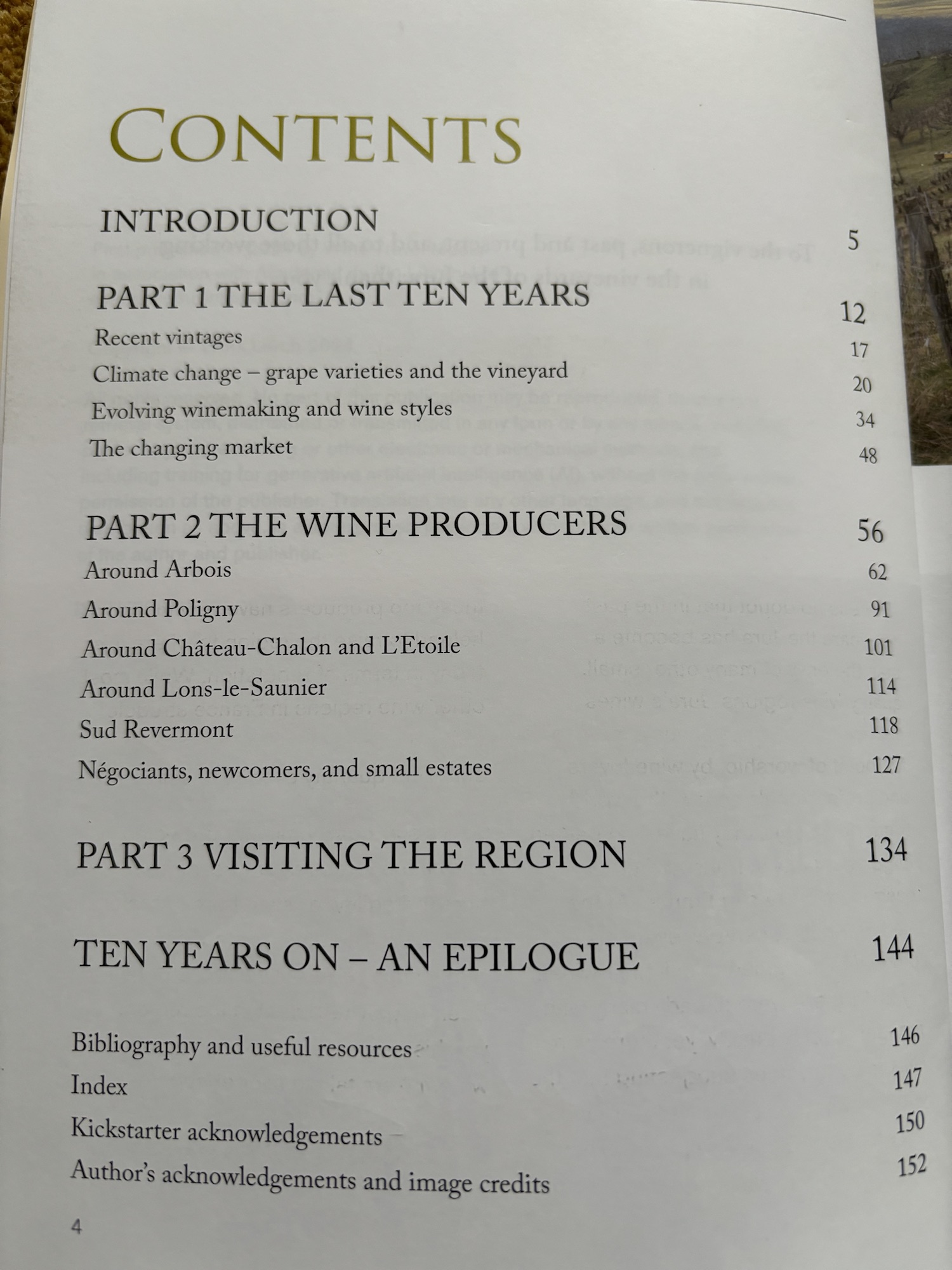
After Wink’s Introduction, which helpfully (inter alia) explains how to get the most from the book, the first chapter gives an overview of “The Last Ten Years”, covering the chase for land, greater appreciation of the different terroirs, followed by a rundown of vintages from 2014 to 2023, with comments of a worrying nature on the one about to be picked. This chapter is interspersed, rather fittingly, with a feature on variétes d’intérêt à fin d’adaptaion (VIFA). These are varieties which the INAO will allow to be planted experimentally, and which may include vinifera varieties from other regions (eg Aligoté, Gamay, Chenin Blanc).
Hybrid varieties (older vinifera crossings with other, more resistant, grape families, Seyval Blanc proving quite popular with some producers) and the specially bred varieties which we have come to know as PIWIs, crossings which have been re-crossed many times and developed in order to eradicate as far as possible specific diseases (mildew being a main one) are also being planted, or in the case of the older hybrids, revived and looked after a bit more. Of course, these are not allowed in AOP wines, only in wines labelled Vin de France (without varietal labelling). That’s fine for those producers who don’t put any wines before the tasting committees any more, happy that they can sell their wines without AOP recognition.
Of course, as all over France (my opinion, not Wink’s I should stress), the grapes of a few old vine hybrids planted among the vinifera varieties undoubtedly creep into some wines, perhaps with an AOP. It’s not like the authorities are really on top of it. Those growers (a few) who trained in Switzerland have shown most interest in the PIWIs, and in that country, I think PIWIs have begun to really take off. This is a topic central to the future climate-proofing of Jura wine, a concern to everyone, whether they make AOP wines or Vin de France.
One other vein of interest is in the ancient Jura varieties which one sees rarely but which may have a future. These include Petit Béclan, and especially Enfariné. I published a whole article dedicated to Enfariné and Jura’s other old varieties in January 2019 because a Jura friend, Marcel, has a couple of rows of the variety. At the time it really piqued my interest. It seems that the same can be said for quite a few Jura producers now looking for a red grape with good acids and good disease resistance.
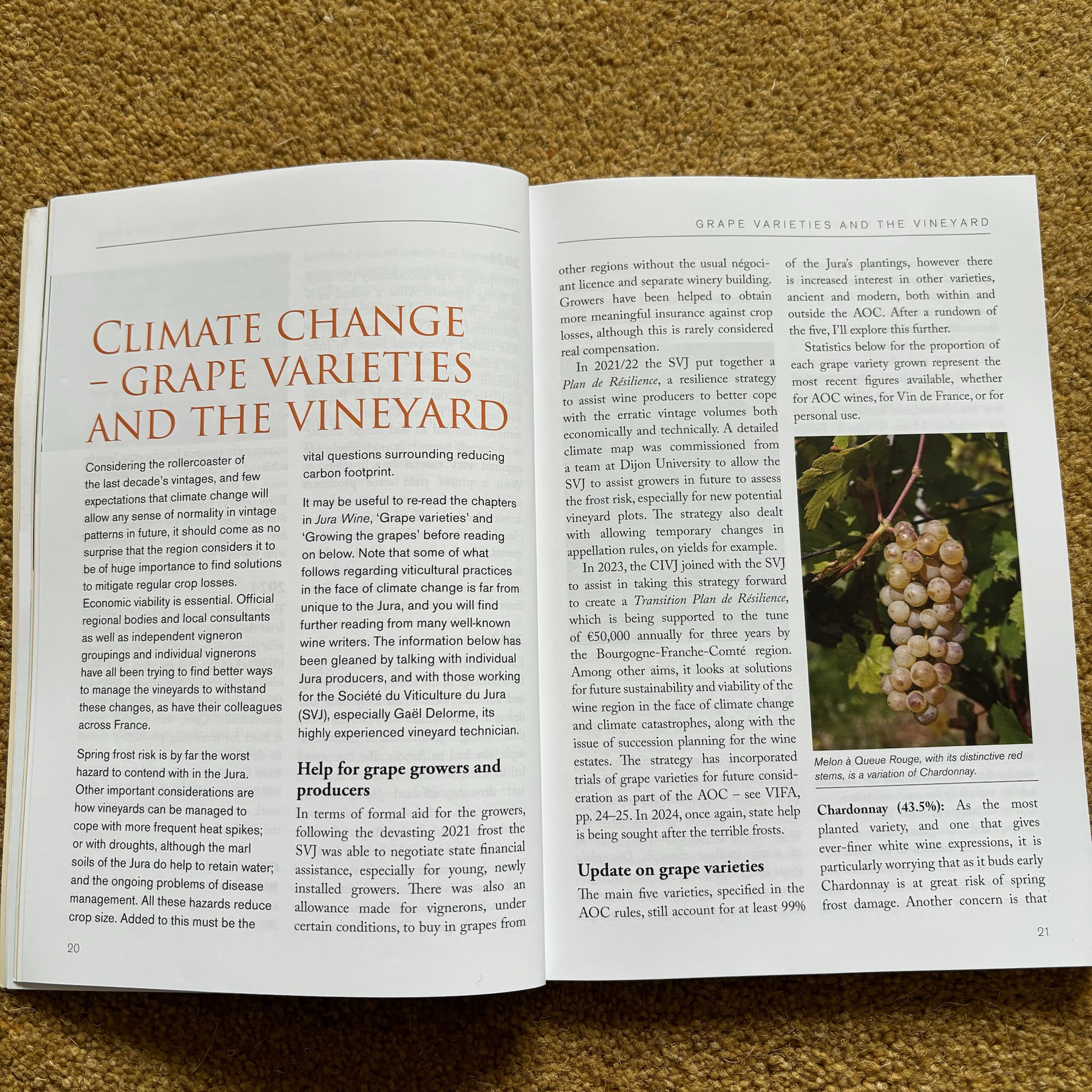
The chapter ends with a number of paragraphs on different aspects of vineyard management, taking us nicely on to the next chapter on “Evolving Winemaking and Wine Styles.” The evolving styles have a lot to do with climate, but they also stem from the popularity of natural wine. Although some of the real pushing of boundaries in natural wine may have moved on to other locations (perhaps nowhere is more radical than Alsace right now), Jura was, along with The Loire, probably in the vanguard of natural wine in Europe after the original work of the Gang of Four in Beaujolais in the 1970s/80s.
The last of the general chapters, before we hit the winemaker profiles, covers the market for Jura wine. Naturally this highlights the increased appreciation, or more like worship in my view, of Jura wines globally, and so it also deals with the speculation that has led to passionate Jura lovers being unable to source wines that were once there to be pulled off a wine shop shelf. Sic transit gloria mundi for many of us!
The sad thing is that this speculation doesn’t benefit the producers in any way. I know many would rather sell me a bottle, which I will treasure and share with appreciative friends, than to a speculator in London, St-Petersburg, New York or Beijing, but they are now way too busy to entertain the likes of me anymore, where once I could make an appointment and leave with a mixed case.
Ironically, if you asked me where are the best places to drink Jura natural wine nowadays I’d say in a Tokyo Jura-specialising wine bar, or at Les Claquets and other restaurants in Arbois and Poligny, bearing in mind the caveat for the latter “on a good day” (when the host/hostess is feeling generous). In Paris you can more or less forget it, unless you have under-the-counter access.
You can also usually find at least some great Jura wine (though rarely the top stars) in the wine shops of the region, of which thankfully there are more than there used to be. Certainly, they are a better bet, on the whole, than most UK retailers (though with notable exceptions). The UK retailers also have to charge more because of the insufferable costs now of importing the wines, and the equally greedy rents and business rates they have to pay. The phrase “fill your boots” literally fits perfectly here, if you are driving down to Arbois and beyond, even with the cost of petrol/recharging.
Pages 57 to 126 provide the main producer profiles. At sixty-nine pages this is only a little shy of half the book. These profiles cover changes since 2014 at producers featured in the original volume, where deemed worthy of mention (although there are many such changes, and as I have already mentioned in relation to Bodines, very often significant ones).
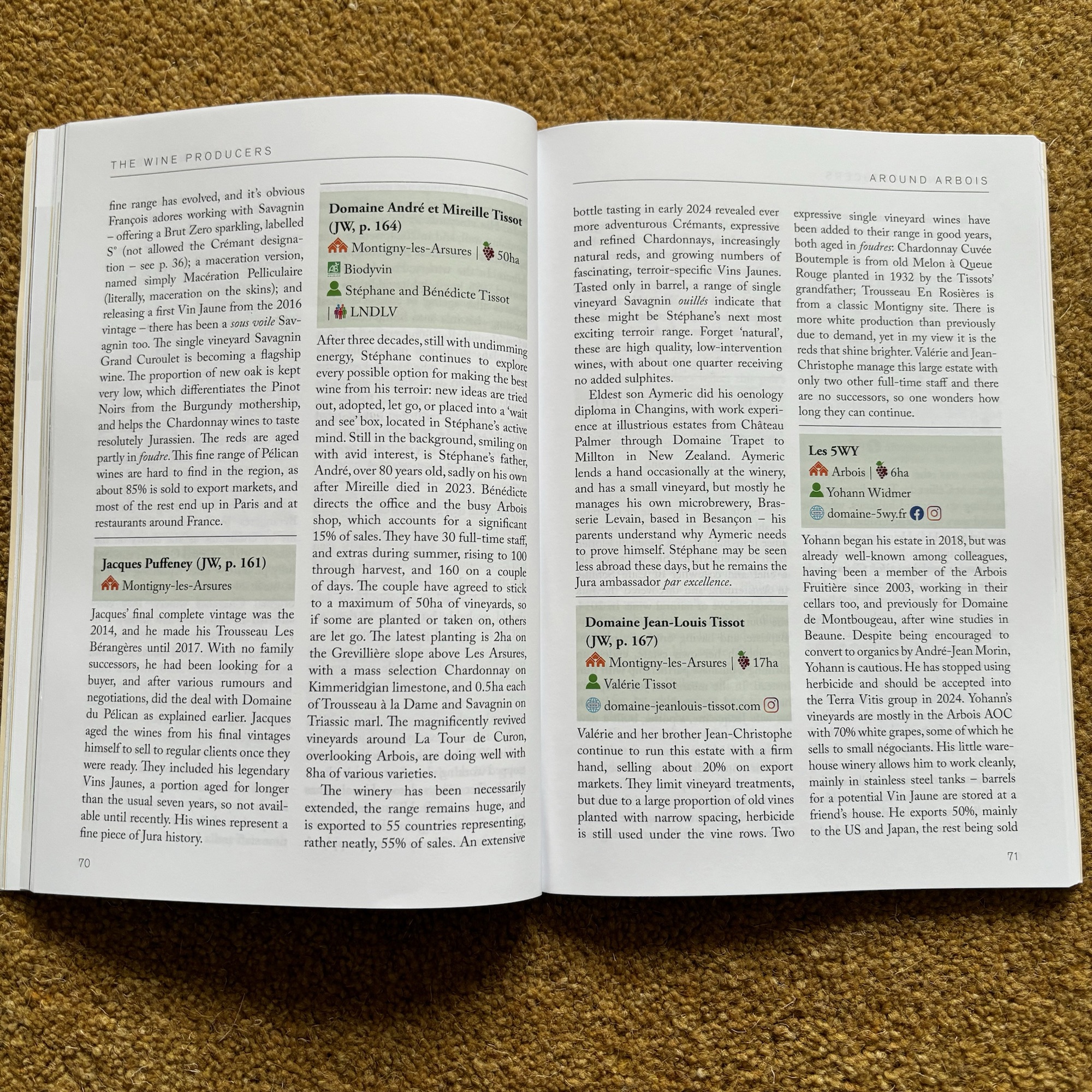
Whilst there are major producers included who didn’t feature first time round, either because they are new or for a host of other reasons, the author provides a page reference (as throughout the book) to a domaine’s original entry in Jura Wine 2014. These new profiles are not the in-depth ones of the original book, so you will wish to use these cross-references to reacquaint yourself with a lot of background information.
Pages 127 to 133 cover just over thirty “Négociants, Newcomers and Small Estates”. Like me, I will bet that most of these are new to you and very often you will be looking for the first time at a name whose wines we shall all come to seek out in the future…if not immediately. Many farm perhaps a hectare or so, but most are looking to expand a little and some have vines waiting to come onstream soon.
The final chapter, as in Wink’s original, is called “Visiting the Region”. The changes here are as great, if not greater, than those affecting the region’s wines. If old stalwarts like the Hirsinger bakery/chocolatier are still going strong (with, I discovered, a vending machine now to help when you fall victim to their rather unusual opening hours), then the region has not only lost my favourite restaurant (La Balance), but also its famous Michelin Two-Star (even the re-named Maison Jeunet has gone, the site I believe being currently closed). And that’s not the half of it.
However, on the other side of the coin Arbois, and the wider region, has many new places to stay, eat and buy wine, and Wink lists many, a list which you won’t find anywhere else. For the latter (buying wine), I would say that especially as it is now difficult to visit producers, even some of those with tasting rooms either closing them completely or limiting their opening hours, it is very good news that we have more wine shops. Even more so with the future of Les Jardins de St-Vincent, Arbois’ premier natural wine store, in some doubt for several years.
All of this does remind me I must add a note to my perennially popular article “Tourist Jura, a Brief Guide to Arbois and Beyond” (29 July 2020), because there is a lot in there which is dated or plain incorrect now, and it is very often the most read article on my site on any given day. What is not out of date, alongside much general tourist and walking information, is that on the wine shops owned by some producers. I always recommend the shop on Arbois’ Place de la Liberté owned by Stéphane and Bénédicte Tissot, and that of Domaine de la Pinte, a few minutes’ walk down the Rue de L’Hôtel de Ville.
The book ends with an epilogue, and I would like to repeat a few of Wink Lorch’s pleas to readers. I think they should be Commandments for any true Jura lover.
- Celebrate the region’s wine diversity, both in styles and producers. As I have found with producers like Domaine Mouillard and others, when the philosophy changes, or when one of the younger generation takes over, the quality of the wines can change dramatically, or at least the market’s perception of them. Domaine de la Touraize, for example, was pretty much unknown seven or eight years ago when I first tasted their wines and now, in some forward-thinking markets, they are highly sought after. Trust the region and try other producers’ wines.
- Please do not badger the producers. I wrote an article on this (“The Visitor”, 26 August 2021). I said pretty much what Wink says, if in a wider context. The small producers do almost everything themselves. If they are not working in the vines or cellar, they are well deserving of some time out. In any case, they are nowadays quite unlikely to have any wine to sell you. Make use of the increasing number of retail shops where the wines will be priced fairly, and especially those tasting rooms that are advertised as being open. Some winemakers do still welcome visitors by appointment, but far fewer than was the case before Covid.
What more can I say in summary? This is a wonderful addition to the wine library of anyone who loves Jura wines and the region in general. I’d say that it is essential for anyone who professes to be a fan. I will repeat that it is a genuine companion to Wink Lorch’s original 2014 volume, and so I would obviously recommend owning both. It might only run to 152pp, but those pages are almost exclusively packed with new information. There is none of the endless repetition of the “new editions”, where we pay £30 or more for a few added sentences and perhaps a new conclusion with a few vintage updates. Nothing could be further from what this book is.
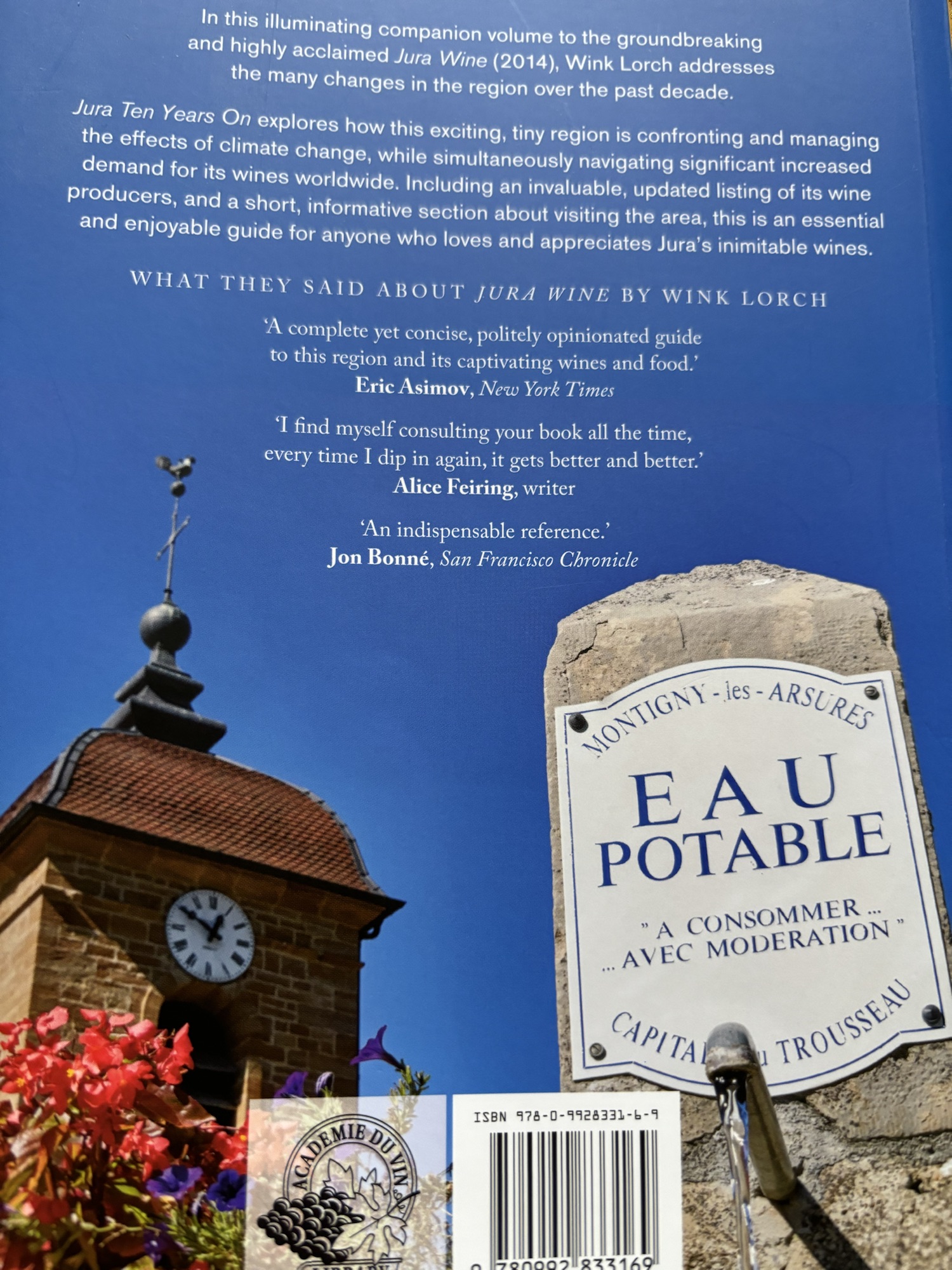
The format is slightly smaller than the original volume, but the design, layout and typeface etc match the original, thus enhancing its feel as a companion volume. This is mirrored in the exemplary photography, much of it taken once more by Mick Rock (Cephas). The matching cover tone was chosen, of course, to match Jura’s iconic Vin Jaune, the wine that first drew me to the region, and which should not be forgotten (nor Vin de Paille, as Wink Lorch pleads) amid all the petnats and ouillé Chardonnay (remarkable as much of the latter is turning out to be).
On a personal note, I am aware of the hard work, blood, sweat and tears Wink has put into this new volume. I know that in the past few years the cost of Jura wine has spiralled, and so have the costs of publishing. That said, Jura wine is so popular that it is extremely important that books like this exist, and I hope that this essential little tome achieves all the success it deserves. One used to say “this costs no more than a bottle of wine”, but of course these days you’d be hard pushed to get a bottle of Jura Wine for fifteen quid, or anywhere near.
Jura Wine (2014) won the André Simon Drinks Book of the Year Prize (and was shortlisted for the Louis Roederer). This book is at least as important. More so for me. It contains much more information that I didn’t know than the last one.
Jura Wine Ten Years On by Wink Lorch is published by Wine Travel Media (soft cover, 2024). It can be purchased from the Académie du Vin Library for £15, shipping from 2 September, though Kickstarter backers will be getting their copies now. There is also the option to bundle it with Jura Wine (2014), and also for these two books plus Wink’s equally good Wines of the French Alps (2019). See academieduvinlibrary.com . For more on the author, Wink Lorch, see her own winetravelmedia.com . I understand that it will not yet be available on a major platform for a while, possibly (this is mere conjecture on my part) becausethey don’t give the author a decent cut and Wink has to cover costs. In any event, wine writing of this calibre needs supporting.


 David Crossley's Wide World of Wine
Pingback: New Book – Jura Wine Ten Years On Released – Wine Travel Media