
I know that I have written quite a bit about Blind Summit Whisky recently, but I couldn’t help myself when I saw that Jamie Dawson, one of the partners behind this new, young, independent bottler was doing a tasting at Lockett Brothers in North Berwick a couple of weekends ago. Not only were some new releases up to taste (and we are talking extremely generous pours here), but he was also unveiling a Lockett Brothers exclusive.
I would not call myself a whisky expert, far from it, but I am a whisky enthusiast. My knowledge has increased exponentially since arriving here in Scotland just over three years ago. Whisky now challenges wine and vinyl on almost equal terms when it comes to discretionary spend. As with wine, you learn much more from repeated and regular tasting than merely from books. It’s just that there’s so much more opportunity to taste wine than there is to taste whisky, so you can see why I jumped in here.
Blind Summit is a partnership between Jamie Dawson, who I got to know through his day job as wine and spirit buyer for Cork & Cask in Marchmont (Edinburgh), and James Zorab, who manages a cask maturation warehouse in Glenrothes. The pair are long time friends who first worked together at good old Oddbins back in the 2000s.
Based in Leith, Blind Summit purchases single malts from a range of distilleries and further matures or finishes them in the most interesting casks Jamie can get hold of, with provenance being central to their philosophy. All of the whisky below are single malts with the exception of the first, a very highly recommended blended malt.
All the labels which help create the very distinctive and modern branding are collaborations with local artists. Each whisky comes in a 50cl bottle. This means that you can much better afford a taste of something really good, and distinctive. The production runs are tiny. With the exception of the Lochend Blend below (320 bottles), each whisky is only available in around 200 bottles.
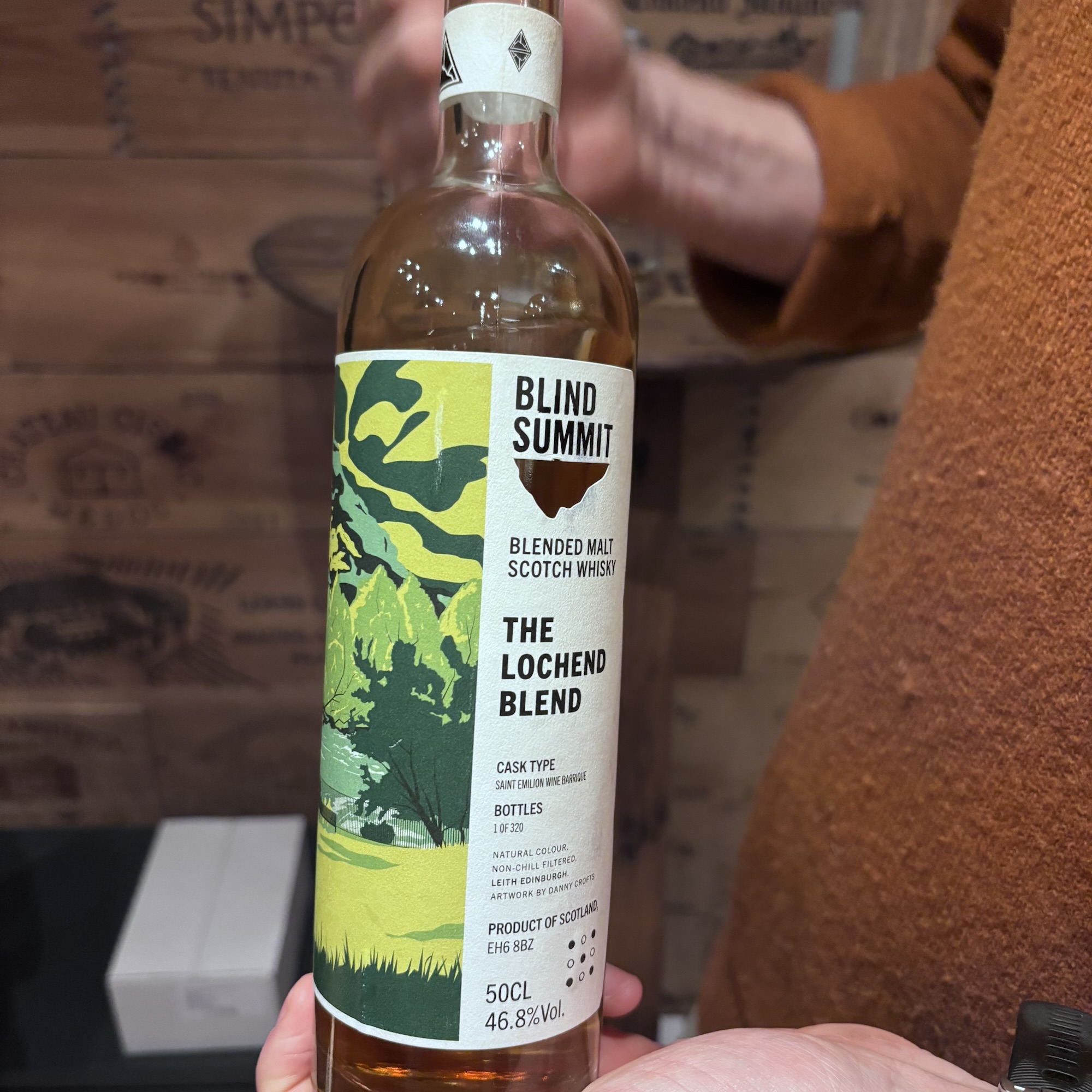
Lochend Blend
The Lochend Blend, named after an Edinburgh location close to Leith, is well described by the team as “a coastal and fruit-forward blended malt”. This current Volume II (its second release) is made from five single malts married together in a Saint-Emilion cask. It is a little lighter than the individual single malts, and this is reflected in its lower alcohol (46.8% abv), but everyone who tastes it seems to like it. Especially when they see the price, but also its sheer drinkability. This is an absolute bargain at £35, when you think that is the price of many supermarket bottles, albeit they will have the quantity.
Tamnavulin 11yo “The Law”
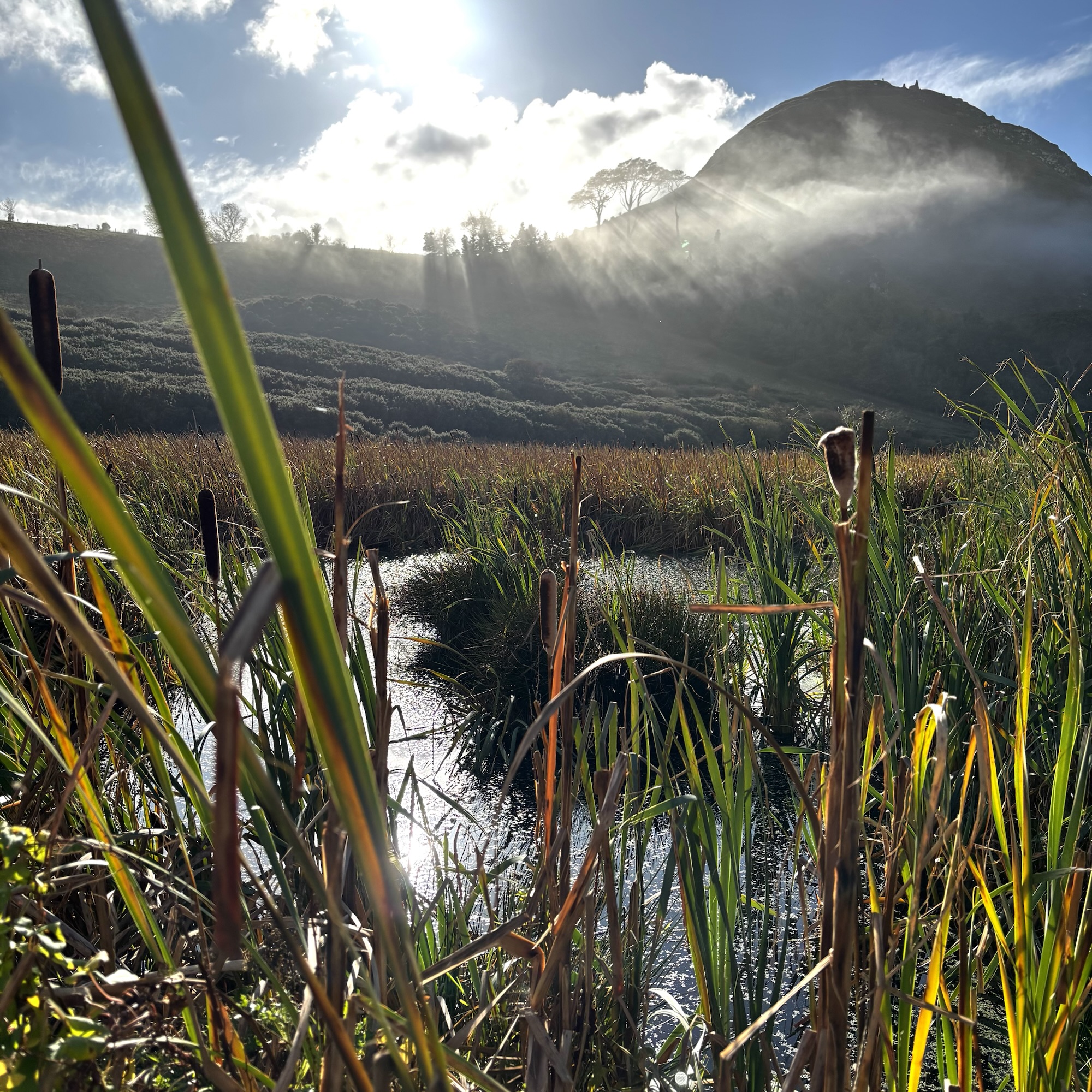
Named after North Berwick Law, the volcanic plug that rises south of this scenic small town on the Firth of Forth, this was selected by, and bottled exclusively for, the town’s distinguished wine and spirits retailer, Lockett Brothers. They already boast one of the best and widest whisky selections in Lowland Scotland.
Tamnavulin is a Speyside distillery at Ballindalloch (Moray), built originally as a partner for Glenlivet. It sits in the steep glen carved by the River Livet. Ending up under Whyte & Mackay, they were sold in 2014 to the brandy producer Emperador who are based in the Philippines. This cask seems to come from the time of that acquisition.
It originated in a bourbon cask and was finished in a Barbados Rum cask. The label was designed by North Berwick artist, Kyle Lunneborg. Bottled at a natural cask strength of 58.8%, it is creamy and spicy, with notes of coconut, apple and ginger coming through for me. 216 x 50cl bottles, £65 exclusively from Lockett Brothers.


Glencadam 14yo
Glencadam distillery is on the east side of the Highlands, just outside of Brechin in Angus. Originally founded in 1852, it was sold to Hiram Walker in the 1950s. As with most Scottish distilleries it changed parent a number of times, including a spell with Allied Lyons, eventually coming to Angus Dundee (based neither in Angus, nor Dundee, but London). They finally released Glencadam as a single malt from 2005.
This 14-year-old was put into a bourbon barrel, and bottled at 53.6%. It has lifted flavours which mix bright apple fruit with a butterscotch base, quite creamy-textured. 178 bottles, £75.

Miltonduff 14yo
Miltonduff (founded 1824) is another Speyside distillery, situated south of Elgin (Moray). After the usual string of owners, it now falls under the Pernod Ricard brand and their subsidiary, Chivas Bros. A major refurbishment is due to be finished this year.
The cask choice here is a used Red Bordeaux barrique, sourced from a Médoc Cru Classé thanks to Jamie’s wine contacts. It’s a whisky with real depth and a smooth bass note. There’s even a hint of wine tannin, and it has a reddish hue (as does the next whisky). Everyone at the tasting seemed to have their own favourites, but I grabbed one of these (one of three bottles procured on the day) in part because of its contrast to the others. 52.1%, 228 bottles, £70.

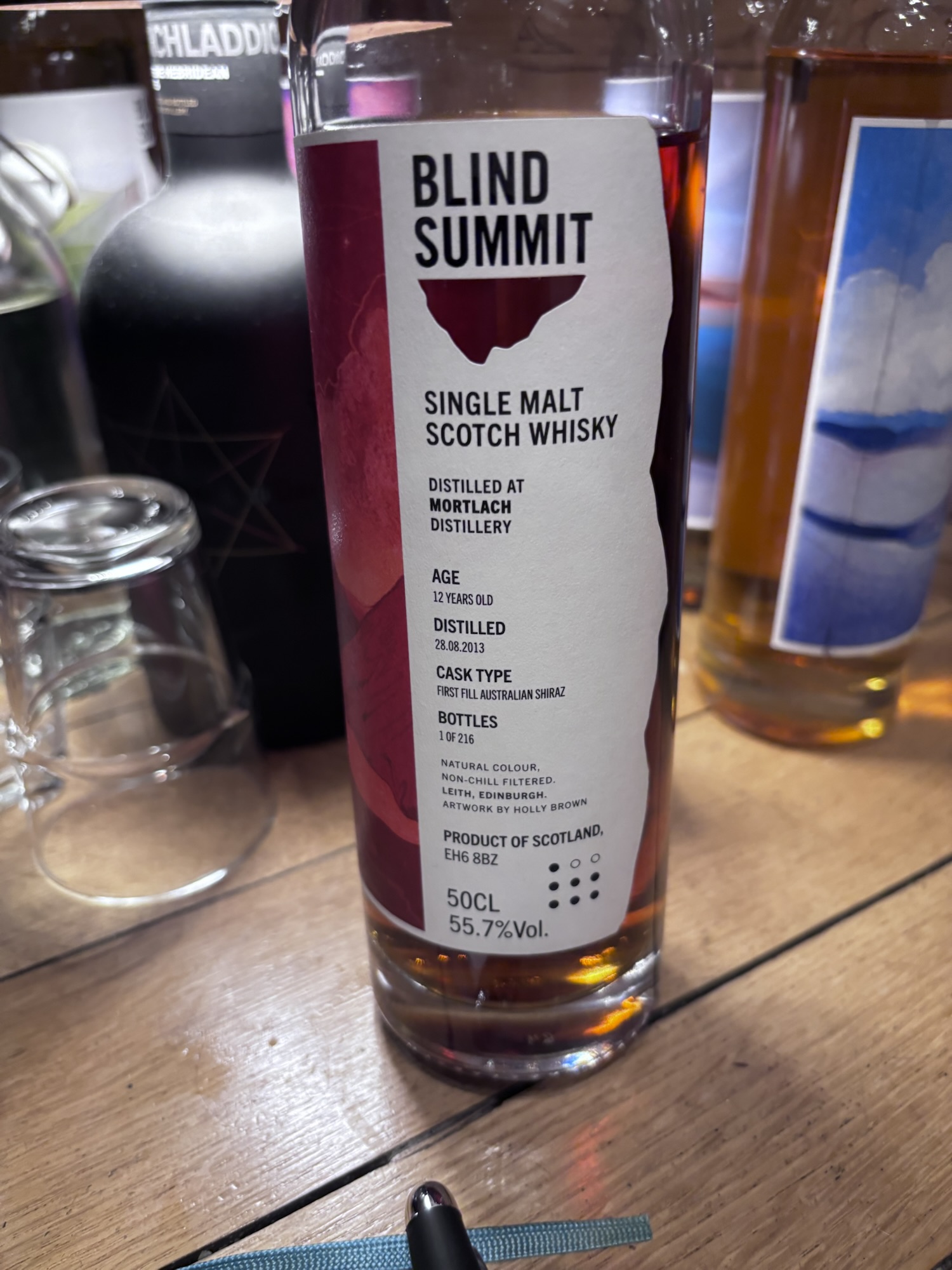
Mortlach 12yo
Speyside again, you will find Mortlach at Dufftown (Moray). Although founded in 1823, most of the current buildings date from the 1960s. It’s a famous distillery known for its malt quality, which is why it became an important component in Johnnie Walker (under Diageo ownership now), only recommencing to release single malts in 2014 (including a 25-year-old).
This is a very distinctive dram, and I’d say it was the absolute favourite for a number of folks at the tasting, but mostly among the men (it was good to see an almost equal number of ladies at the tasting with their own clear preferences). It was also the most expensive bottle on show. It saw the inside of an Australian Shiraz barrel, and this has imparted a definite deep red colour. In fact, “depth” is the word I’d choose to describe the whisky, but fruit-wise, definitely red apples/apple peel. 55.7%, 216 bottles, £85.
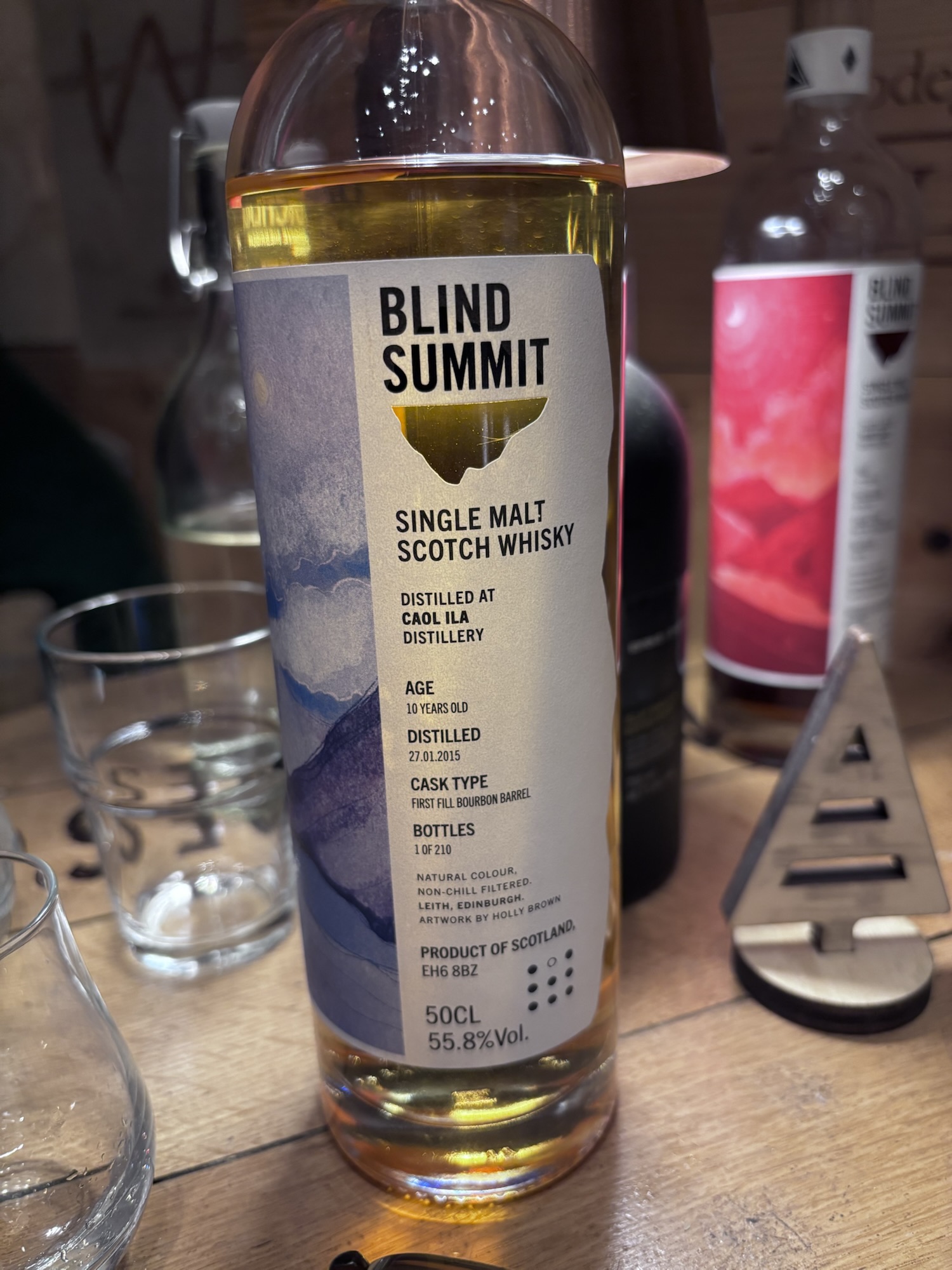
Caol Ila 10yo
“Cull-eela” is at Port Askaig on Islay, and the name is gallic for the Sound of Islay, the narrow stretch of water which runs between Islay and Jura to the north, and out over which the distillery looks. Built in the 1840s, it is now another old distillery under Diageo’s care, the parent having spent millions on upgrading both the distilling capacity (it is Islay’s largest distillery) and a modern visitor centre. Islay is now, after all, pretty much tourist central for the whisky industry.
Caol Ila makes a classically peaty island malt (though not quite up there with Lagavulin for peatiness). This first-fill bourbon cask bottling by Blind Summit, bottled just two weeks before the tasting, was quite smoky, but very elegant. I’d say it had the most appealing bouquet of the tasting and the bottle in my cupboard has interestingly gone down quite swiftly in the days since I got one. It tastes, to me, more complex than most 10-y-o malt. 55.8%, 210 bottles, £65.
Highland Park 7yo
Highland Park distillery overlooks Kirkwall on Orkney’s “Mainland”, and thereby describes itself as the most northerly whisky distillery in the world. Distilling allegedly began here in the late 1700s, albeit illicitly and illegally. Through the 1980s Highland Park established its name as a single malt and it is owned by the Edrington Group. As a more mature malt, this is a whisky I already like.
This youthful seven-year-old, from an Oloroso Hogshead (one of those very strange British sizes, usually 52.5 UK gallons or 54 gallons for beer, or if you prefer, 238.7 litres/245.5 litres) has peaty depth with a softness to it. The nose reminded me of ripe pears, though I should point out that I had one of those at lunch and it is lingering on my mind. Others detect roasted nuts and orange peel. The palate is nutty and oily. It’s remarkably good, even at seven years old. That is obviously why it has been released now. 56.5% abv, 190 bottles, £60.

At pain of repeating myself, these whisky bottlings are all very distinctive, and different. You pay your money and make your choice, but the choice is easier, at least for me, in the 50cl format. You can buy two bottles for not necessarily an awful lot more than you might pay for one full bottle. I just love the interesting take these guys have and how they are really thinking about their releases, both their choice of whisky and how they are further maturing and finishing them.
I’ve seen some bottles heading down to London, I think, so you might spot them down there. However, retailers like Cork & Cask and Lockett Brothers are geared up to ship across the UK. Blind Summit is definitely one to explore, whether you have already got a good knowledge of indie bottlers and what they bring to the whisky table, or whether you are just tempted to dip your toe in. With Blind Summit it doesn’t cost a fortune to do that. If you are a retailer reading this (as I know many of you will be), I hope you agree that they will stand out on the shelf.
If you are interested check out blindsummitwhisky.com . If you are a retailer, contact Jamie or James via hello@blindsummitwhisky.com .


 David Crossley's Wide World of Wine