
As this is the fourth of these Smart Traveller’s Wine Guides I have read and reviewed, you will probably surmise that I am rather taken with them. They are portable, quite inexpensive, and offer the wine lover not only some background and an inside track on the wines of the region, but as intended, they offer the wine-loving visitor a host of other options when visiting there. These range from hotels, restaurants, wine bars and wine shops, to the best wine producers and estates who welcome visitors. There is much more in these guides, as I shall elaborate below.

As with Fintan Kerr, author of the Rioja guide in this series, I have met this guide’s author a number of times, so I kind of know him, though certainly only as an acquaintance. It does mean that I can relate the contents here to more than just the text.
The first thing to tell you about Matt, other than the fact that he’s a really nice, down-to-earth, bloke, is that he has lived in the Rhône with his family, something he did whilst researching his Wines of the Rhône (Infinite Ideas, now Academie du Vin Library, 2021). This gives me confidence that what he writes about is translated from real experience.
In fact, this particular guide is keen to acknowledge that wine lovers might actually have small children in tow on their holidays, and makes an effort to include child-friendly activities and places to visit, as well as more adult (ie wine-obsessed) options.
It is interesting that in the three other Smart Traveller’s Wine Guides I have read, the actual “Guide” part of the book, all the listings, were prepared by between four and five others in addition to the author. In this Rhône Guide, it merely says “Listings prepared by Matt Walls”.
I mentioned Matt’s Rhône tome above. This Guide has, unlike those I’ve read before, a further reading section. Matt generously mentions John Livingstone-Learmonth, always considered the man with the greatest knowledge of the Rhône, along with Robert Parker, who if you didn’t know, was rather fond of the region. What I would suggest is that Matt Walls has written, in that 2021 work, the most up-to-date, relevant, book on the region. His finger is really on the pulse, especially with up-and-coming villages and producers.
All the above give me reason to feel confident in trusting Matt’s recommendations herein.
I have visited the Rhône a number of times. My first trips were in the 1980s. I was young, and certainly a neophyte when it came to wine. It led me to buy some less than exceptional bottles from the few places geared up for wine tourism, although there were notable exceptions.
In 1989 I spent much of a morning with the late Georges Vernay, who at that time had a tasting room of sorts on the main road through Condrieu. He was a winemaker whose bottles had already delighted me, as Georges was one of a number of exceptional Northern Rhône names on the books at Yapp Brothers, whose then premises were in the beautiful Old Brewery at Mere in Wiltshire. I used to be a frequent visitor there. Times, economies and generations change. George showed us his collection of very old photos of an appellation he was instrumental in saving, a wonderful history lesson.
At the other end of the vinous scale, I remember a visit to a co-operative in the Côtes du Ventoux, where we found a “petrol pump” nozzle with which to fill a plastic container with a very simple red wine straight from the tank, and free baseball caps all round. Drinkable wine for a pittance.
Back in those days, however, wine tourism was very different to today, and very different in the Northern Rhône than the Southern. I have never really counted Lyon as part of the Rhône. Matt doesn’t either, but he sensibly covers its hotels, restaurants and wine shops etc, because it offers so much more than the villages and towns immediately to the south. In the 1980s and early 1990s there were few decent restaurants among the vineyards of the north (anybody remember Beau-Rivage, Condrieu, anyone?).
Vienne still has La Pyramide, of course. Often considered the finest restaurant in France in the 1950s and before, under Fernand Point, it was perhaps not at its best back when we were there, but it has now retained two Michelin Stars since bought by chef Patrick Henriroux in 1989/90. However, by way of contrast I also remember staying at a very strange auberge up in the hills on the right bank once, where most of the clientele were lorry drivers and the food was created accordingly (hearty and plentiful, washed down with some very ordinaire red wine).
The south, of course, has Avignon. If places like Tain and Tournon have developed their offerings for wine lovers, and indeed most of the other appellation villages have something to offer the hungry and thirsty (and I’m not ignoring Valence, but I’ve never been in Anne-Sophie Pic’s league), Avignon has always had reasons other than wine to attract tourism (a big Papal palace for starters). But these days, the Southern Rhône is not all about Avignon.

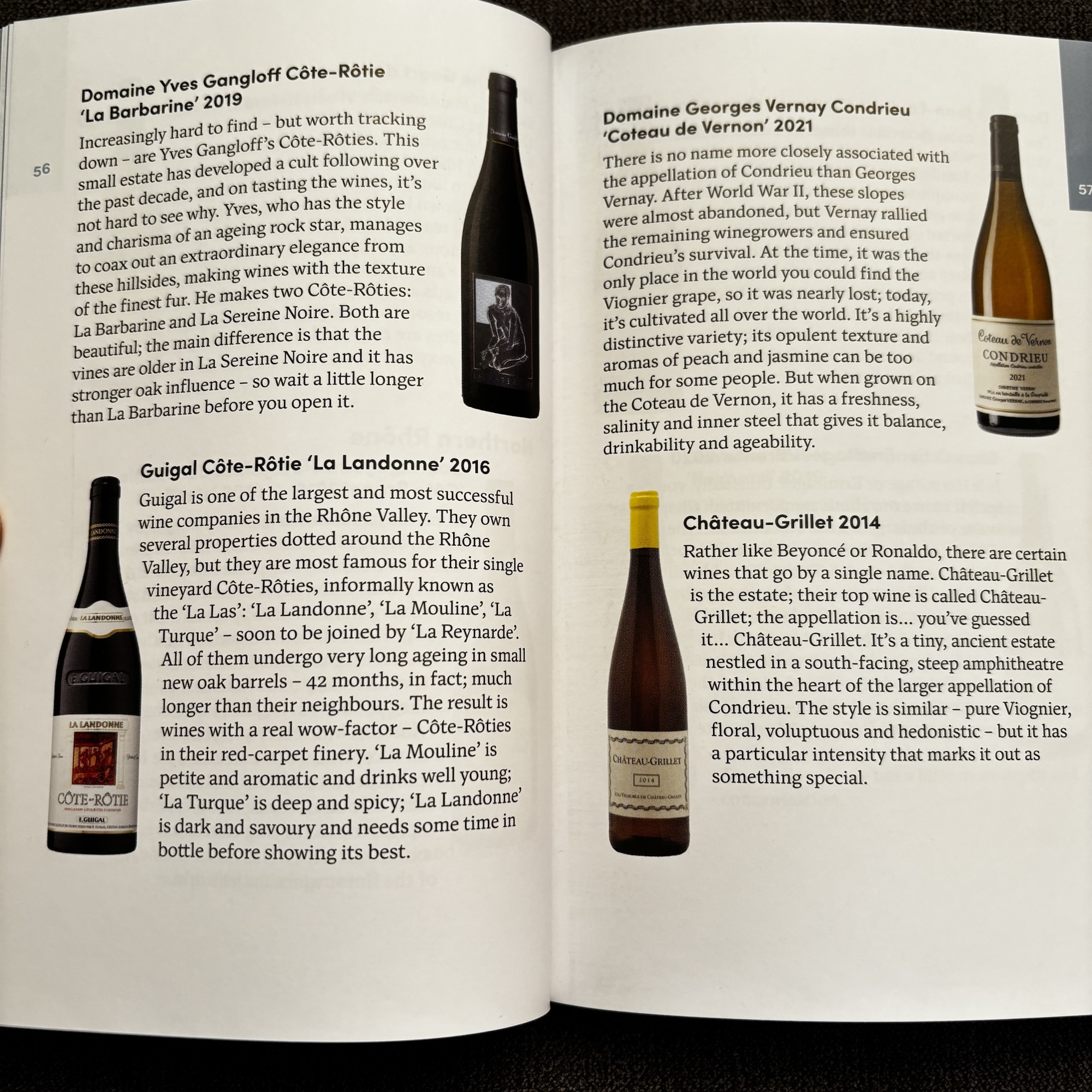
Let’s break from the discourse to run through what is actually crammed into this little book. History and geography (naturally with maps), info on grape varieties and wine styles, and, before some explanation of this wide region’s appellations (with all its satellites), the customary (here, fourteen) author’s selection of “the greatest wines of the Rhône Valley”.
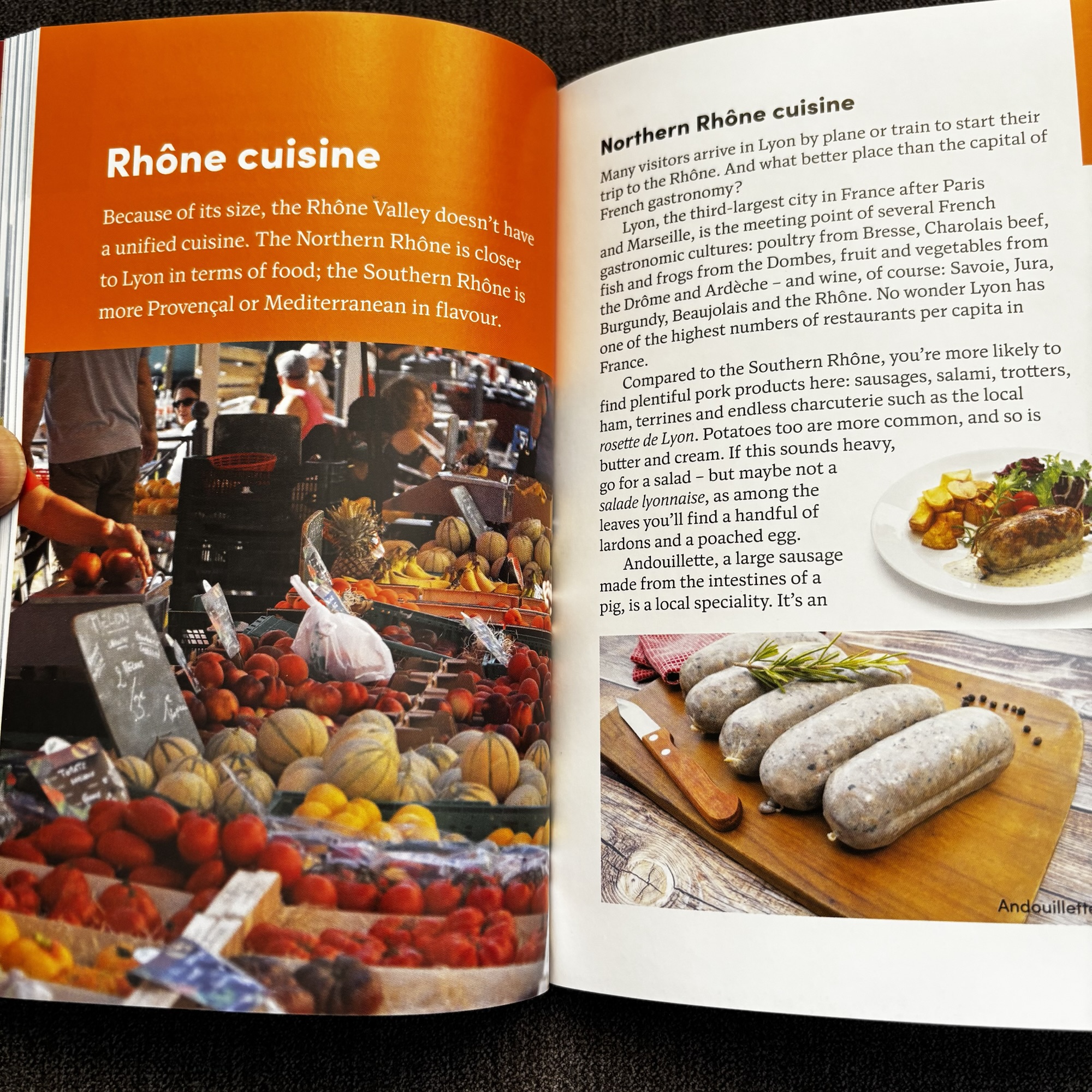
We then move on to a section on the region’s cuisine (more like two regions, with the cooking of the north as different to that of the south as are their respective wines). We get plenty of good visitor information and perhaps more “wine routes” than in the other guides I’ve read so far. I doubt many readers will follow these wine routes to the letter, but they offer a plethora of ideas.
I don’t know about you, but we always leave time on any trip for the unexpected, as we did just recently on the Isle of Mull. An impromptu decision to take the short ferry over to Ulva led to some serious yet amazing walking and a visit to a very nice little café-restaurant on the island, ending up as one of the best days of the holiday. Read these itineraries, and the “Things to do in Avignon” section which follows, and you may find something similar, whether out on the wine route, or in Avignon or Lyon.
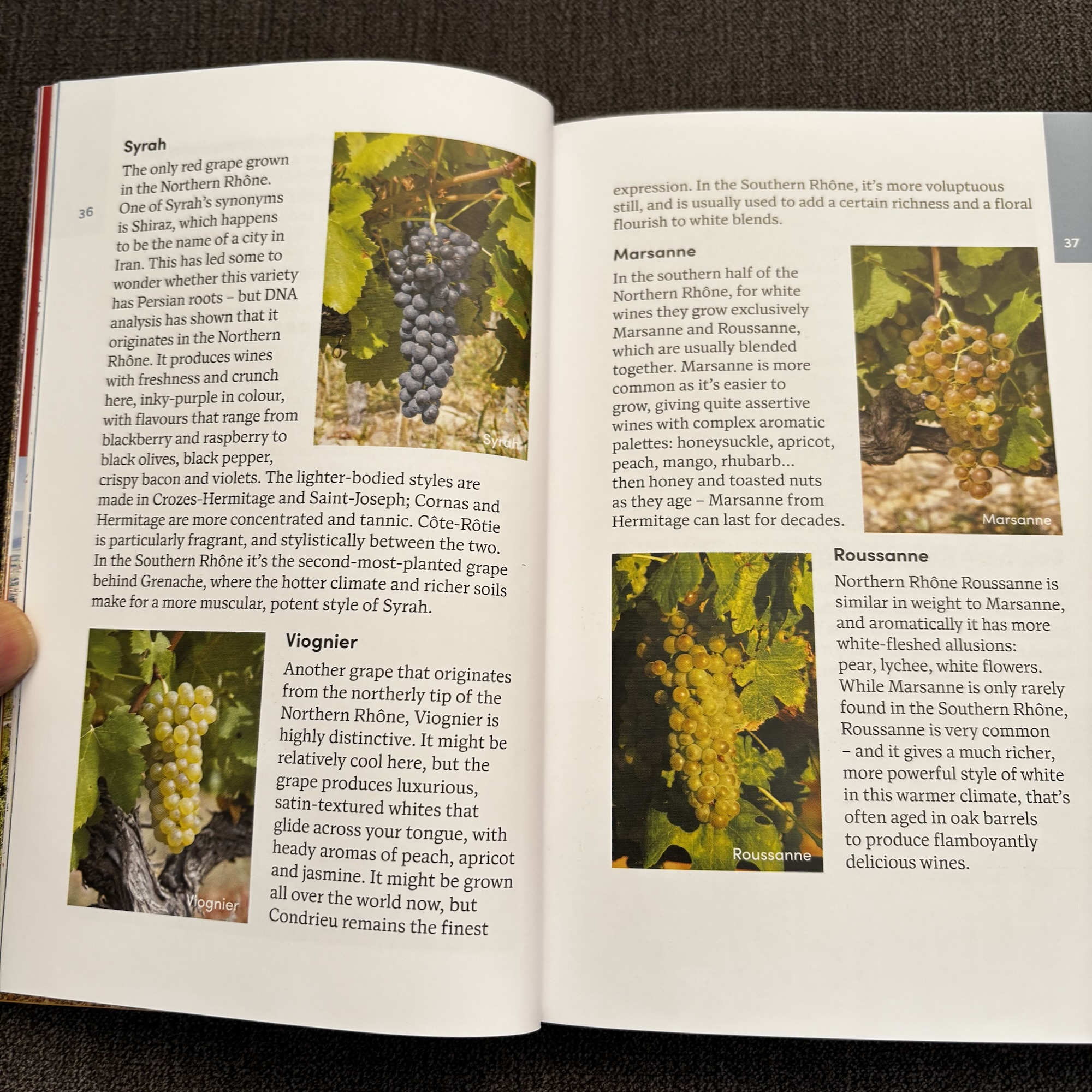
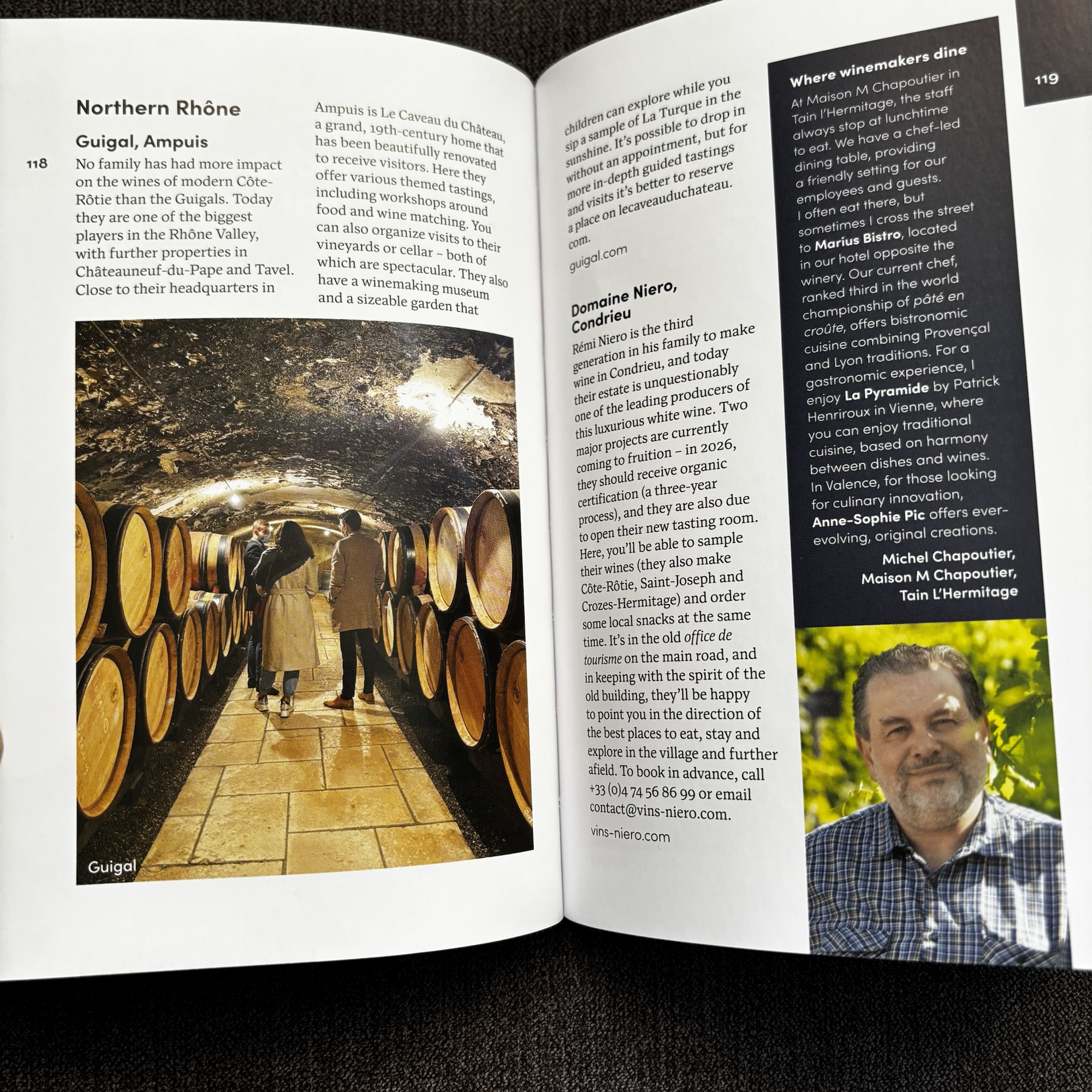
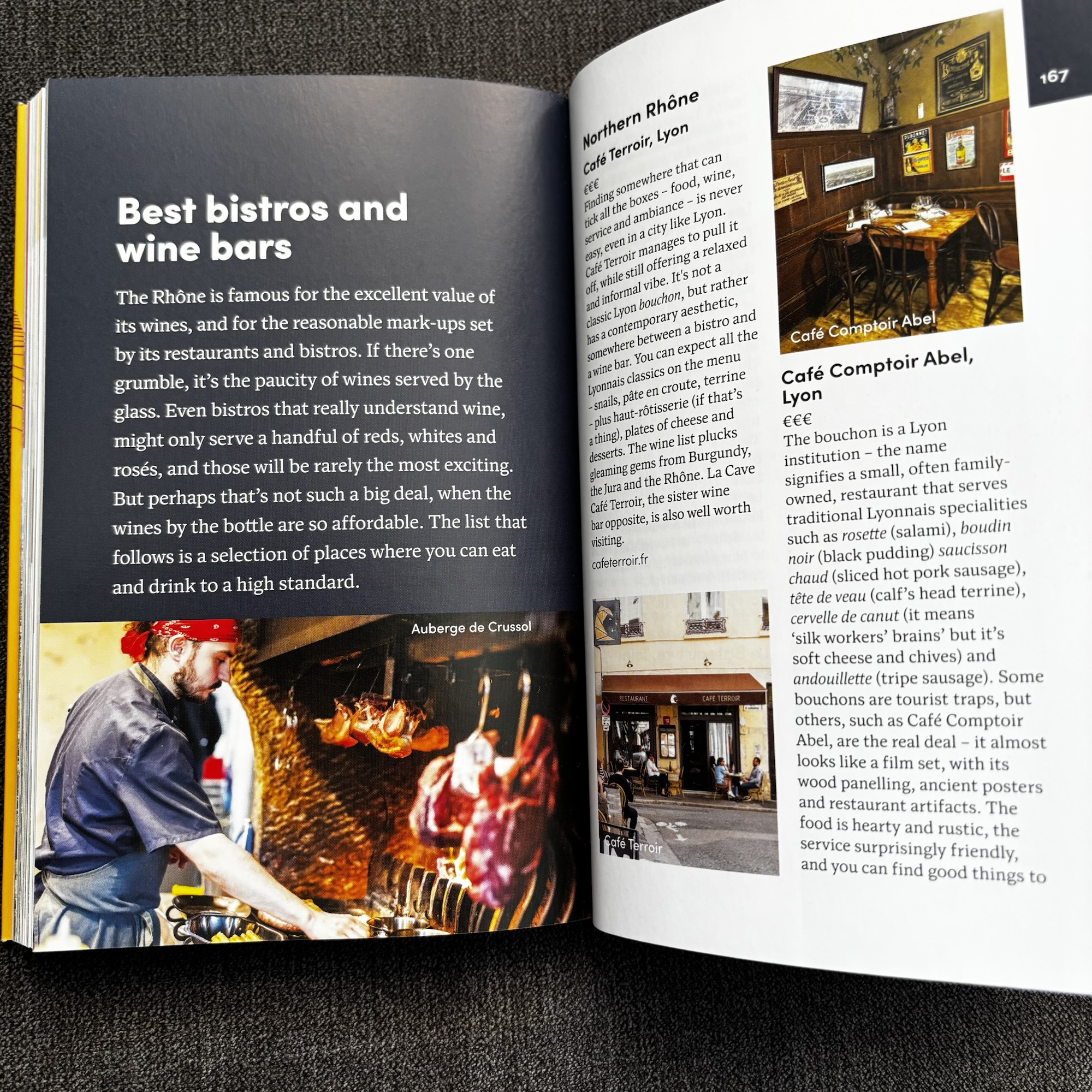
“The Guide” part of the book, as it is described, lists the producers, hotels, vineyard accommodation, fine dining, bistros, wine bars and wine shops through the whole region. Restaurant recommendations are supplemented, as in all the guides, by the input of some of the wider region’s notable winemakers, who list two or three of their favourite places to dine (see Michel Chapoutier’s thoughts, above).
Some guides stay very much at the top end for accommodation and dining, and it is refreshing to see that Matt Walls covers all of the bases. Irrespective of cost, you really do not want to dine Michelin every night of a one or two-week holiday, do you? I’ve reached an age where I’m thinking about my health and the desire to go on wine holidays for many years to come makes a feast every lunch and dinner a definite no!
I don’t know about you, but another big off-putter with fine dining at lunch time when on the road, or outside of walking distance in the evening, is that if you are a driver, you just cannot sample the wonderful bottles Matt describes at these establishments. Far better somewhere you can enjoy a single glass and, following a post-prandial walk, be legal to drive (the old days of a couple of bottles to accompany a six-or-seven course dinner followed by a drive home are long gone…aren’t they?).
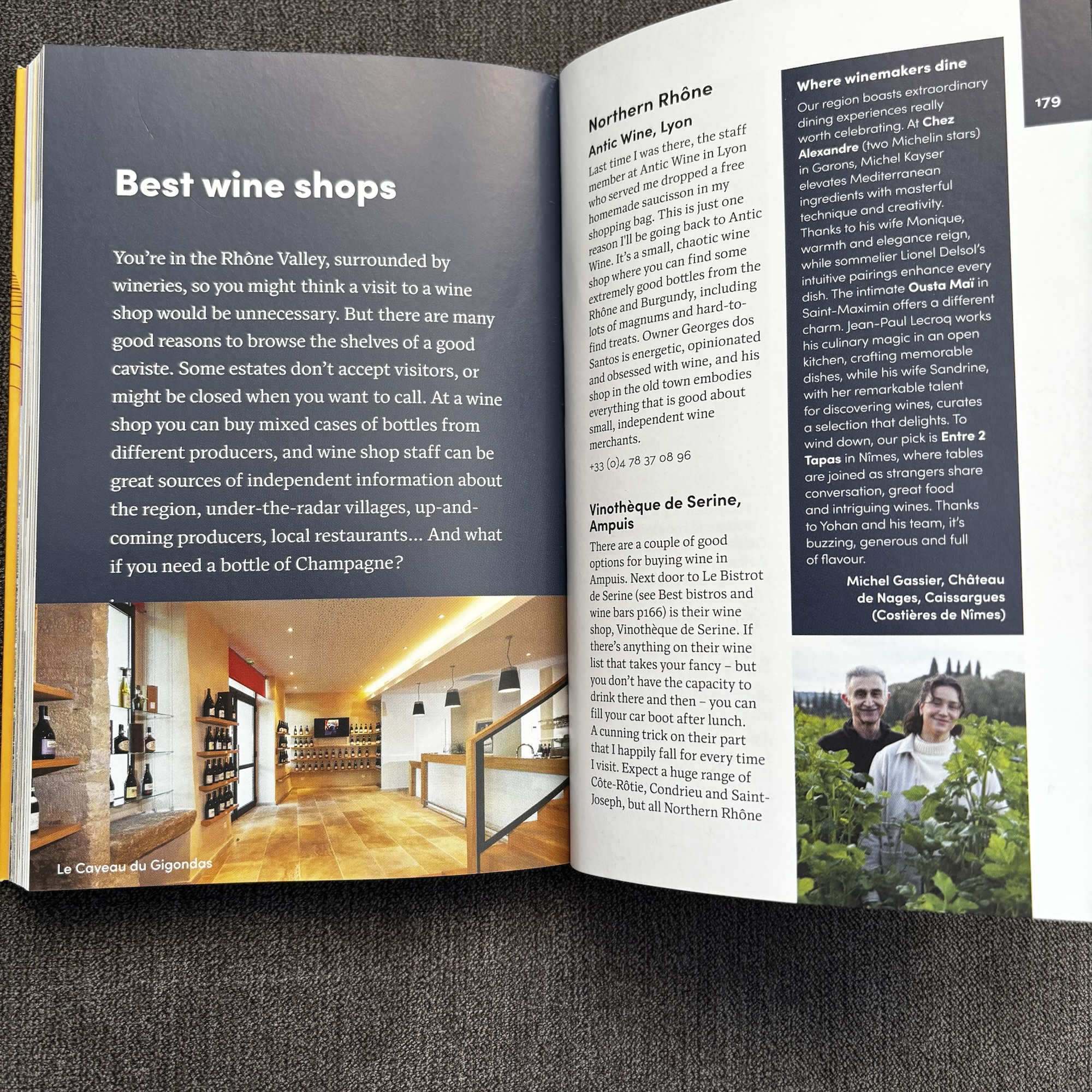
Matt also hits the nail on the head when he justifies including wine shops in a region where you can buy from the producer, possibly cheaper too (though please note, not always!). Actually, he gives a few reasons why wine shops are worth heading to, but top of the list must be buying bottles from producers that only the exalted names of the wine trade will get to visit (though it should be noted that some top producers do have their own wine boutiques).
I will also add that a knowledgeable caviste will, if you are lucky, be able to suggest one or two up-and-coming names you may well not have heard of. Some may even have well-stored examples of wines now sold out at the domaine.
Any negatives? No. I mean, I did find a few more typos in this guide than in previous. Things like a word or two missing a letter, Paris appearing twice in a list, but nothing annoying, or misleading. There are obviously places I have been and enjoyed that don’t really get a mention. I loved the market at Carpentras, and I enjoyed the various antiquities of Vienne. But there are other places both Matt and I consider well worth a visit, not least Isle-sur-la-Sorgue, which I got to know when staying for a week at nearby Pernes-les-Fontaines (it has a great market, lots of places to eat, and an inordinate number of antique shops if you like old stuff).
Also, Matt, you managed to write a whole book on the Rhône without mentioning the wines of Eric Pfifferling of Domaine L’Anglore. Maybe that’s no bad thing, don’t want all and sundry looking for them. On that note Matt does have a refreshingly open mind when it comes to natural wines so for those who share my preferences, there are lots of recommendations there.
I was especially pleased to read about Avignon, on which there is plenty of detail scattered through the guide. I’ve only been there once, and I liked it a lot. It now seems to have even more to offer. I’ve always fancied going down there by train, and with Châteauneuf-du-Pâpe seemingly accessible from the city by public transport in around 45 minutes, it might just be a short break for some warmth worth considering.
So, another success. How I measure success in large part is whether one of these guides really whets my appetite for a trip to that region. I already have a trip to Switzerland planned, and I had been expecting to go to Bordeaux earlier this year. I haven’t been to the Rhône, north or south, for ages, and it is even longer I think since I’ve passed through Rioja, but all of these guides so far, and certainly this one, have done just that.
The Smart Traveller’s Wine Guide to the Rhône Valley by Matt Walls is just published (autumn 2025) by the Academie du Vin Library (in partnership with the Club Oenologique and Rhône Valley Vineyards). It cost £12.99 (US $17.95). Note that I ordered this book direct from the publisher alongside the Swiss Guide and was only charged postage for one book (these are small and light, but nevertheless it saved me a few quid). You can, of course, find these guides at third party suppliers online if you so wish.
I’m kind of getting addicted to these, and I will probably get Tuscany next. I hope they do well as I would love to see a whole raft of them hitting my book shelves, although the same publisher is about to launch an eagerly-awaited larger book on Beaujolais, by Natasha Hughes, which will probably be the next wine book I read.
Meanwhile you can check out these guides along with the new autumn releases at info@academieduvinlibrary.com . If that sounds like a free plug, it is. The more they sell, the more chance they will publish more of them.


 David Crossley's Wide World of Wine