
January tends to be a quiet month for many in wine, although I seem to have heard more “Try January” than “Dry January” this year. Of course, I’m trying new stuff all the time, almost as if it is my wine raison d’Être, but some might say I’m not trying hard enough in Part 1 of my Recent Wines for January. I mean, two Alsace, a Jura, a Rioja, a Burgenland sweet wine and a Savoie Mondeuse do not seem very out there compared to my usual drinking. Well, if you are drinking these six wines you won’t be going wrong, “every 1’s a winner baby” as they said back in the decade of nostalgia…and anyway, Part 2 will kick of with Poland and Crete, so hopefully everyone will end up satisfied.
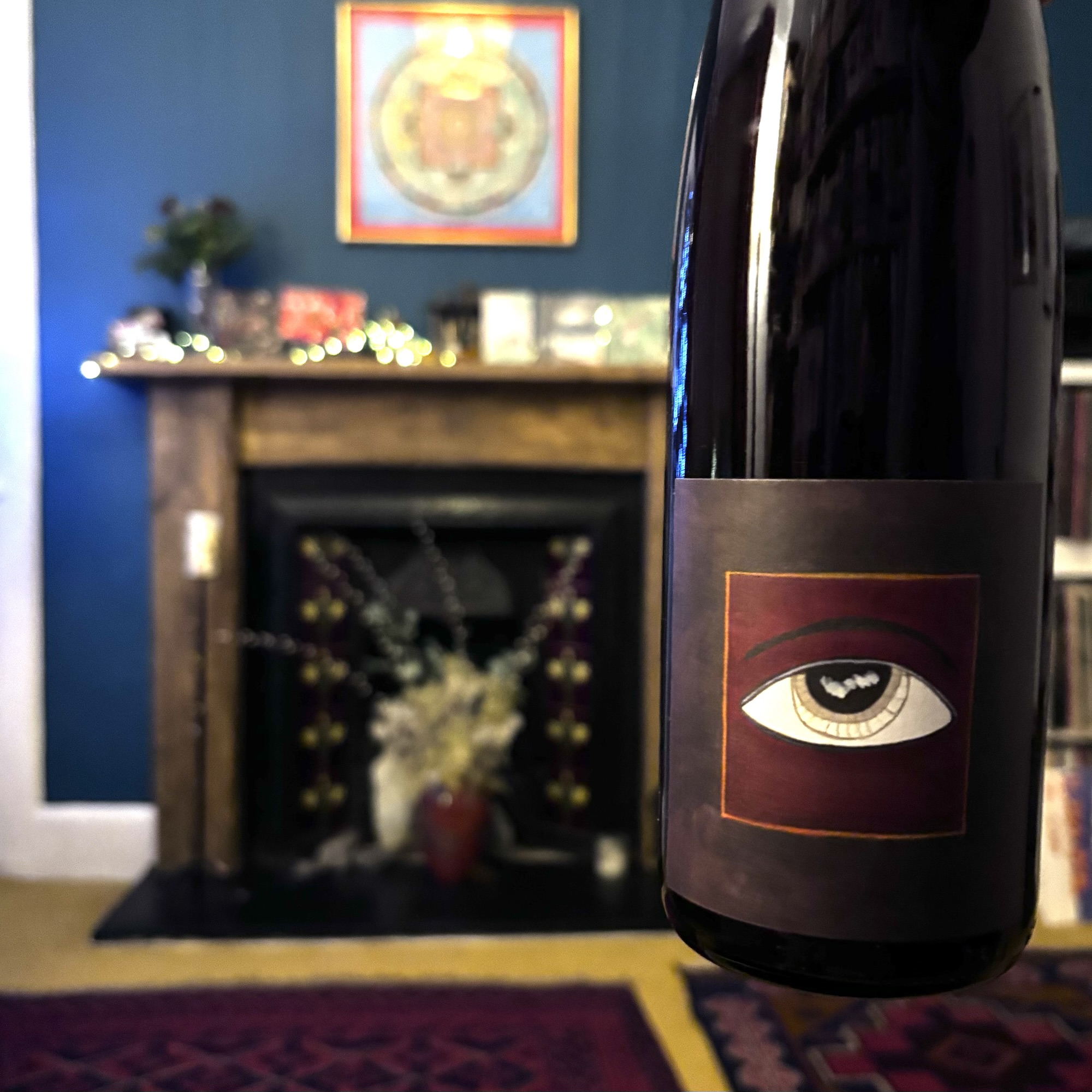
Pinot Noir 2024, Jean-Pierre Rietsch (Alsace, France)
I was thrilled to find this on a shelf in Edinburgh a little before Christmas, and even more thrilled that it was my recommendation which apparently put it there. Jean-Pierre has his cellar in the middle of Mittelbergheim and if you can get an appointment there is not one single address in the region that I can recommend more highly.
The fruit here sees a fifteen-day maceration of whole bunches, with a spontaneous fermentation using indigenous yeasts. As with all Jean-Pierre’s wines, it is “natural”, with the only input being a very small addition of sulphur. It saw only eight months ageing in tank after fermentation.
The result is a pale wine with just 11.5% abv. The bouquet is all bright strawberry fruit, with a little cherry, which expresses itself more on the palate. When you taste it, you can’t help thinking “wow!”. Light and easy to glug, but zippy with concentrated fruit acids. Not a wine for those who habitually drink South American Malbec (though of course there’s a place for those wines as well). This is more of a subtle fruit juice of a wine. I love it.
The importer is Wines Under the Bonnet, my bottle coming from Communiqué Wines in Stockbridge (Edinburgh), for £32. Normally I’d comment on the price, because £30+ is quite a lot for a glouglou bottle, but as it’s JPR, as with wines from folks like Alice Bouvot or the Renners, I shall just suck it up.
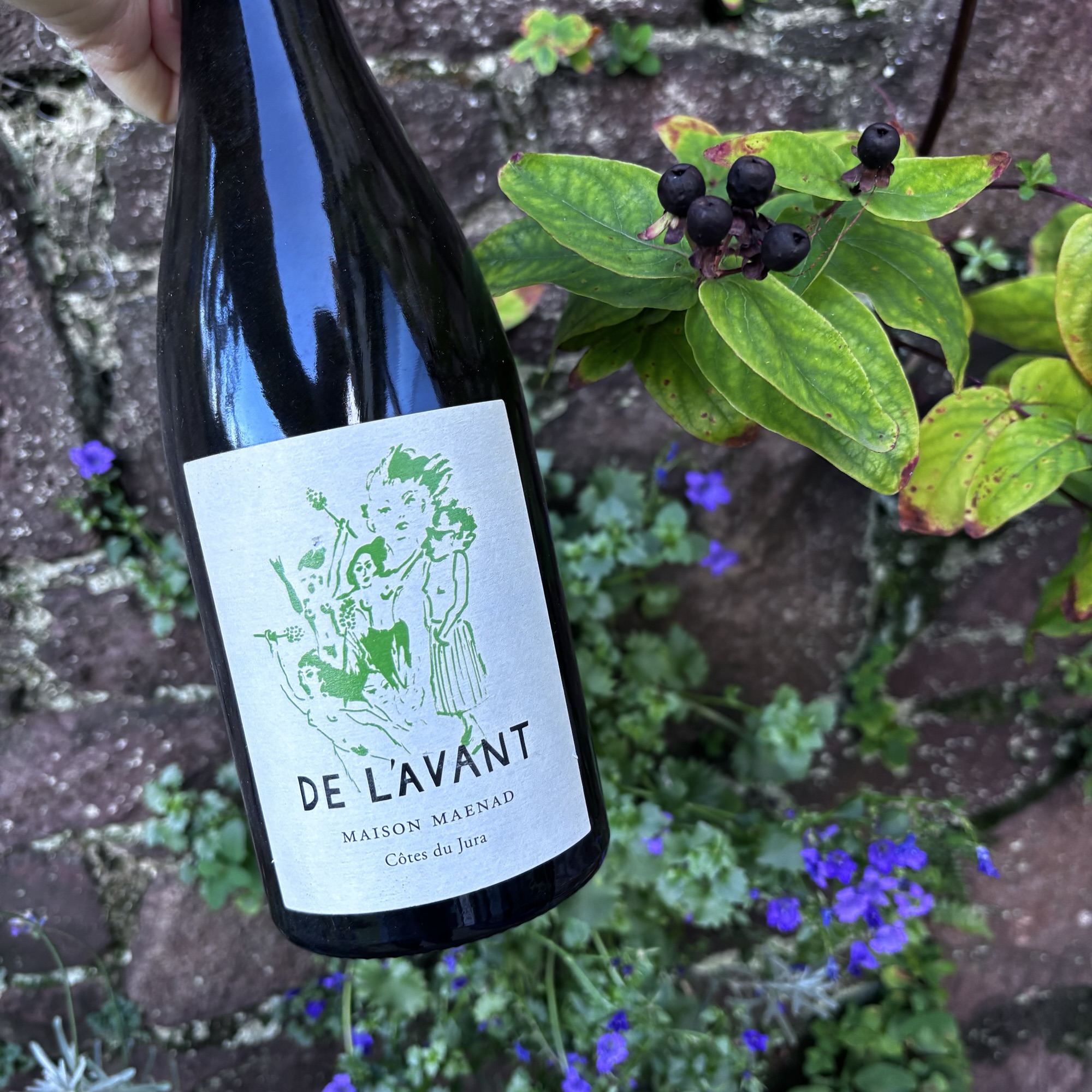
Côtes du Jura “De L’Avant” 2020, Maison Maenad (Jura, France)
If you can’t drink wines from your favourite regions at New Year, when can you drink them? This is only my third bottle of this cuvée and also it is the only cuvée I’ve been able to try so far from Katie Worobeck, who tends around three hectares on limestone near Orbagna and Grusse. We are in the south of the Jura region, known as the Sud Révermont. Katie moved there from Canada to work with the Ganevats and now makes her own sought-after natural wine in the cave under her home in Orbagna, whilst taking her “natural” approach to the next level through agroecology and regenerative farming.
De L’Avant is a Chardonnay made from vines over forty years old growing in a site called “Au Carré” in the hills above nearby Grusse. Winemaking involves direct pressing of the fruit, maturation using a mix of demi-muid and foudre for two years.
You can tell Katie is a winemaker with a gentle touch. This is delicate and nuanced, especially with some bottle age. It is no lightweight though, picking up 13% alcohol. 2020 was a warm vintage and that seems to have been managed perfectly because the result has bags of finesse. The fruit is mainly in the apples and melon spectrum, but it also has a lot of minerality. Acids are there, but more gentle in nature than you might expect. The salinity is soft. The wine is brilliant!
In the UK you should be able to pick this up from importer Tutto Wines. I think it may be around £75. Feral Art et Vin in Bordeaux had a range of Maenad cuvées but I think they are mostly gone. They are still listing a brilliant deal of De L’Avant paired with Alice Bouvot’s L’Octavin “P’tit Poussot” for €100, but before you grab a cheap flight, in any event worth doing to visit this amazing natural wine shop in the centre of the old city, they are closed right now until 26 February. Always check their web site.
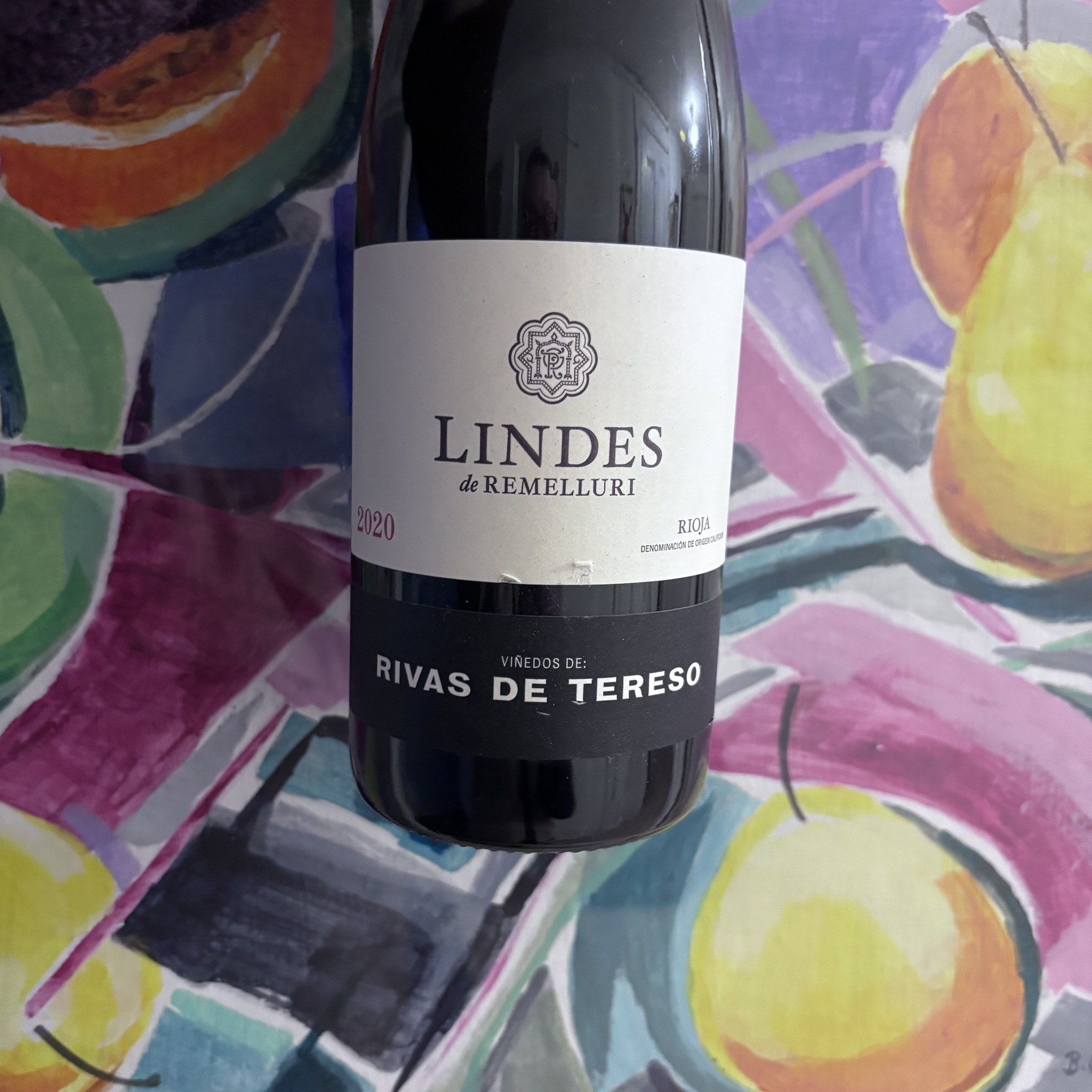
Lindes de Remelluri Rivas de Teresso Rioja 2020, Remelluri (Rioja, Spain)
Telmo Rodriguez’s « Lindes » wines focus on growers around the Remelluri estate who are farming, in the words of Telmo, traditionally. “Rivas” is a blend of Tempranillo and Garnacha, farmed organically, off a mix of clay and limestone. Vines aged between 30-to-90 years old are sited up at between 634-702 masl. Fermentation, using indigenous yeasts, is in stainless steel, with twelve months ageing in French oak.
Rivas de Teresso is a hamlet close to the tenth century hilltop fortress town of San Vicente de la Sonsierra, from where tourists can walk to see 1,000-year-old stone wine presses of Zabala carved from the rock. As an aside, from the same place I read about the wine troughs, Fintan Kerr’s dining rec (from his Rioja Smart Traveller’s Guide, Académie du Vin) for dining in San Vicente is Casa Toni. Do not “roasted pig’s feet, sausages, potatoes and chorizo” just make you want to head there now?
At the moment this 2020 is still grippy and quite youthful, but red cherries and violets on the nose make it very expressive. The tannins are pretty silky and there’s a bit of texture beside the tannins too. The wine is, metaphorically speaking, dark and deep, and gorgeous with food, which can be quite rich. Especially as the alcohol is 14% abv, although don’t let that put you off. This is very good.
This wine, imported by Indigo Wines, has reasonably good distribution. My bottle came from Communiqué Wines in Edinburgh, but I’ve also seen it (no longer in stock, I think) at Cork & Cask. In London, The Sourcing Table seems to have some. Pay circa £30. I’d definitely buy this again.
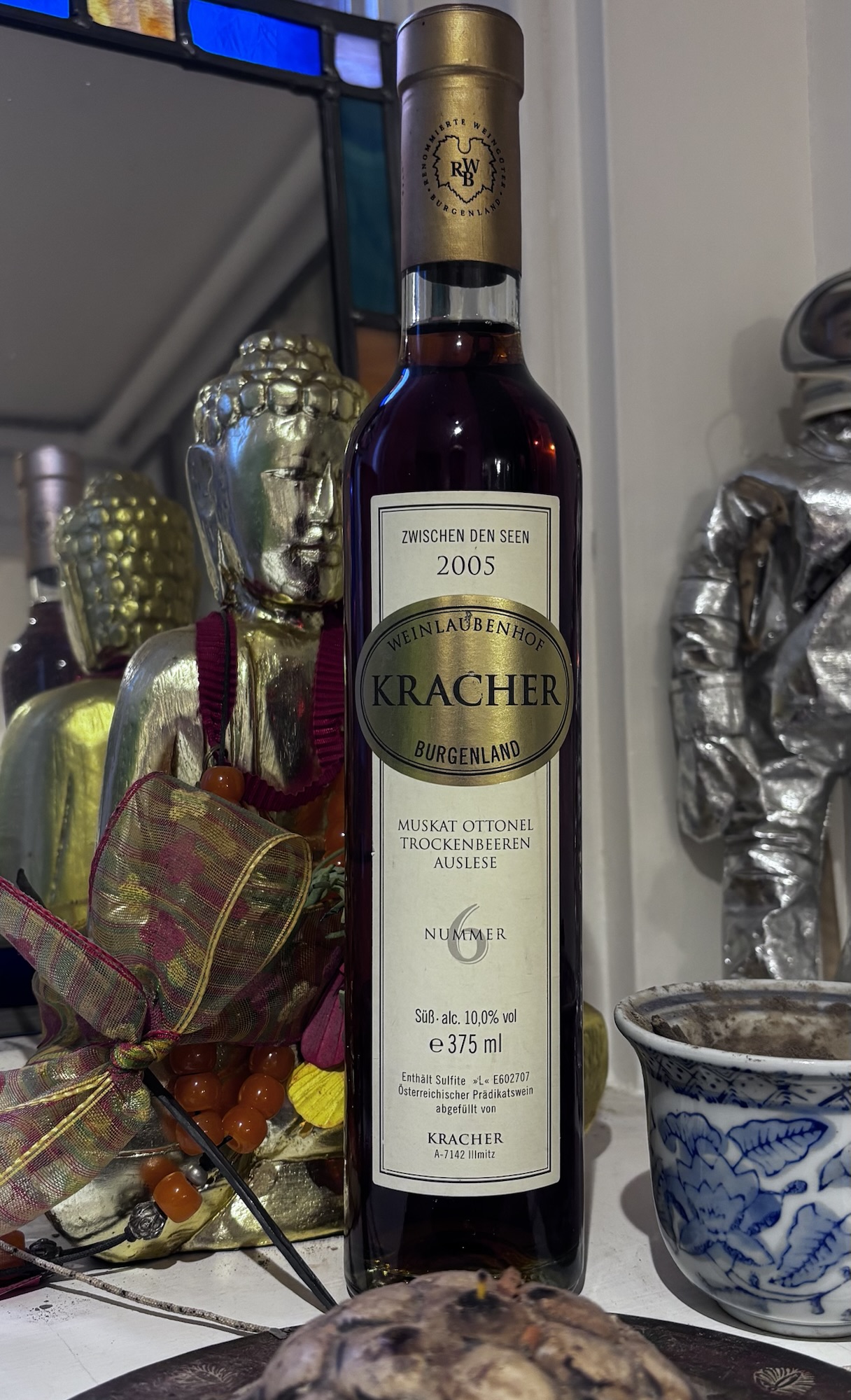
Muscat Ottonel TbA Nummer 6 Zwischen den Seen 2005, Kracher (Burgenland, Austria)
This is a blast from the past, being my penultimate bottle of a load of Kracher wines I bought many years ago in Brighton. The Kracher Winery was founded in 1959, on the eastern shore of the Neusiedlersee at Illmitz. Alois Kracher took over from his father in 1970, and made this estate perhaps Austria’s most famous producer of sweet wines.
The number of cuvées developed in the Alois years was almost bewildering, with different sweetness levels (this wine here is Trockenbeerenauslese), different styles (Zwischen den Seen for stainless steel or old neutral oak, Nouvelle Vague for new oak) and different grape varieties. Then there are the numbers, principally on the TbA’s (here we have 6) which denote concentration and sweetness, and can go up to at least 10.
The grapes grow close to the lake and its famous reed beds, creating the right degree of humidity and heat to ripen the grapes. 100% botrytized fruit is harvested by hand in several passes. This wine spent 18 months in stainless steel. Gerhard Kracher, Alois’s son, has now taken over the domaine, assisted by his wife, Yvonne.
This 2005 is quite dark in colour but the bouquet is lifted, concentrated, honey with orange marmalade, lemon curd and ginger. Nose and palate are pretty complex. It still has enough acidity to keep it going and to balance the richness that has developed. Time brings complexity, and more complexity here than I’d expect from Muscat Ottonel. 10% abv.
This came from Butlers Wine Cellar in Brighton. When I put a pic on Instagram Henry Butler did comment that these are long gone. He originally got them from Noel Young Wines. You might find some of the sweet wines, along with the newer Kracher dry wines Gerhard now produces, at Corney & Barrow.
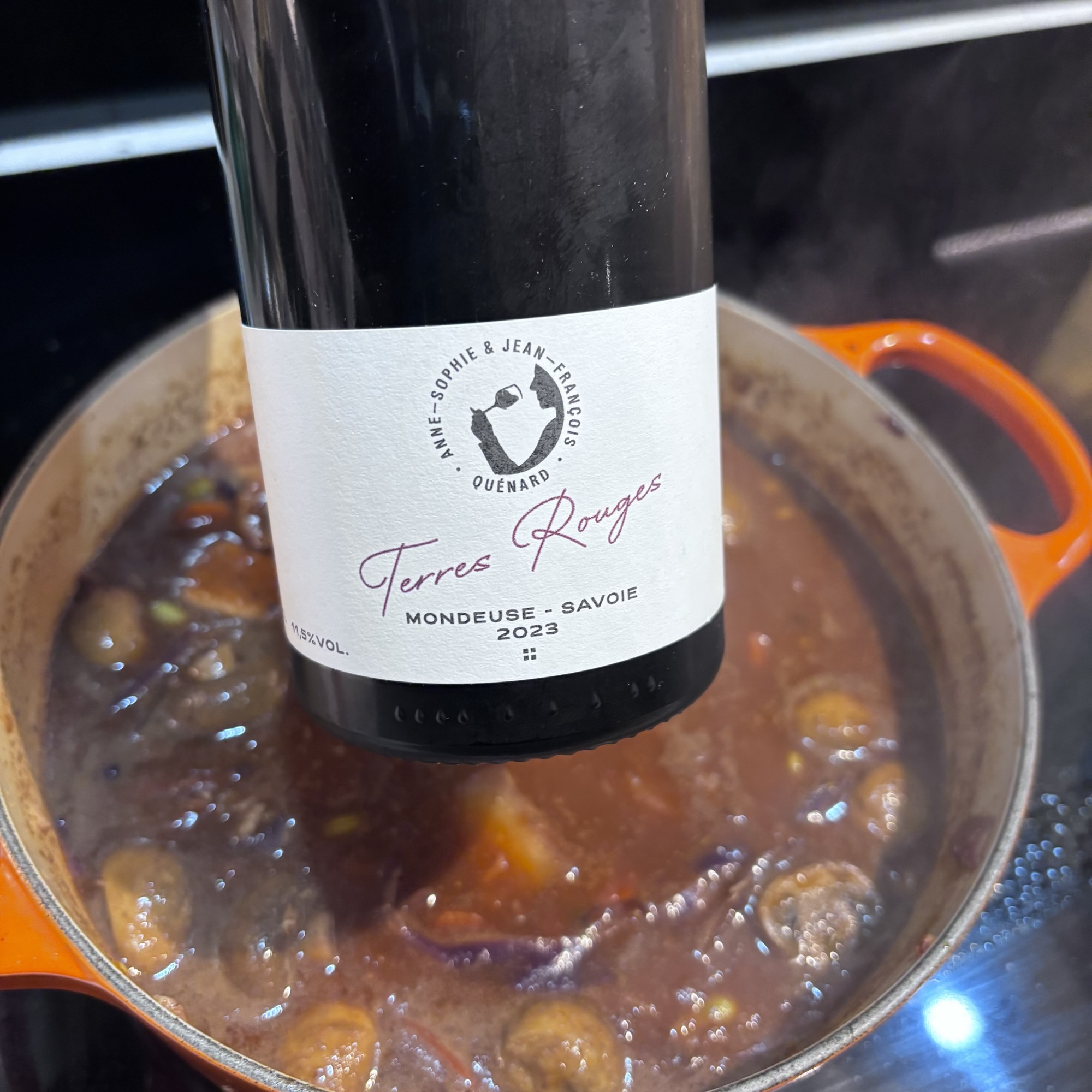
“Terres Rouge” Mondeuse 2023 Vin de Savoie, Domaine AS & J-F Quénard (Savoie, France)
There are quite a number of Quénards in Savoie, but most of them, and certainly all of those I’ve seen in the UK, are at the very least sound. This is a relief because it is only perhaps in Arbois and Burgundy where such profusion of winemakers with the same surname exists to confuse the unwary wine buyer. This domaine, with 22 hectares, is at Chignin, where vines grow on steep slopes close to Chambéry. The white Chignin-Bergeron here is worth seeking out, but so too is Mondeuse, the best-known of the autochthonous Savoie red varieties.
This is a low-intervention wine, organic fruit hand-harvested and vinified using indigenous wild yeasts. Aged in concrete egg (“béton” in fact means raw concrete), it has a low sulphur addition, and quite low alcohol (11.5% abv).
The result is a dark and savoury red, characteristic of the variety, with concentrated dark fruits on both nose and palate. This is one of those wines that has fruit concentration that is sappy and refreshing, no doubt assisted by that lowish alcohol. As easy to drink as a glass of Ribena, but obviously dry. Nice in winter, but could be served cool as a wild card too. Good value.
£21 from The Wine Society.
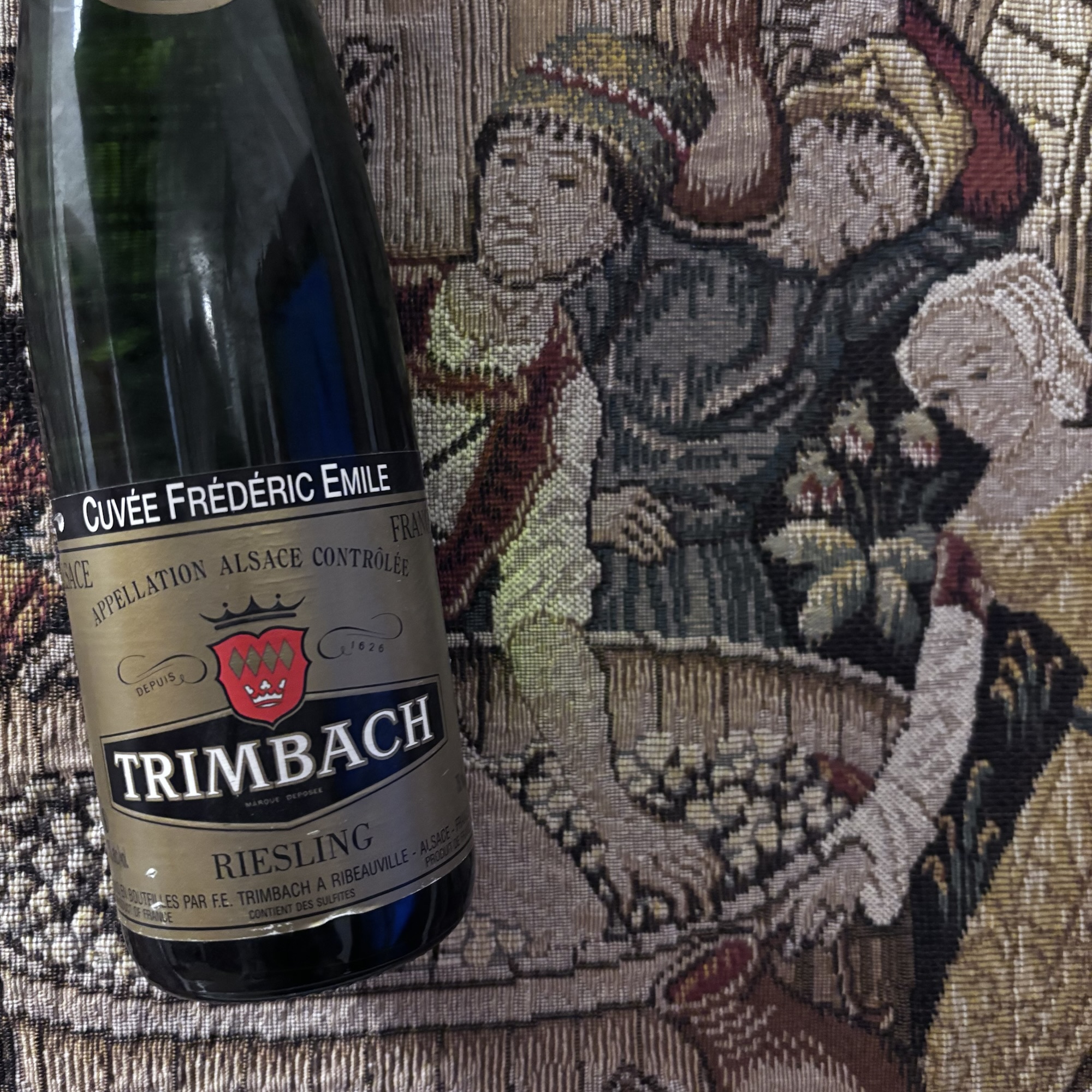
Cuvée Frédéric Emile 2004, Trimbach (Alsace, France)
Although Clos St-Hune, which I must admit I have never drunk, is Trimbach’s most famous dry Riesling, from the Clos near the famous fortified church at Hunawihr, their “CFE” is a flagship wine which combines quality, with a degree of slightly more accessible pricing by comparison. CFE comes from two Grand Cru sites, Geisberg and Osterberg, on the northern edge of Ribeauvillé. This is superb terroir.
Made from 100% Riesling, this is a wine famed for its steeliness, and that steely quality is still there even after 22 years. The bouquet is classic Riesling, but there is a peachy richness in this dry wine. Mineral texture and citrus acids can also be found in a wine which has retained much of that structure. Although this is now certainly a mature wine, I definitely take issue with the vintage charts which suggest 2004 is past its peak.
Finding a 2004 might not be easy. Shrine to the Vine recently had some 2006 and may still have 2001 (£190). Various classic sources have other vintages. The 2018 seems to be £120 at both Berry Brothers and, in Edinburgh, at Valvona & Crolla. The 2015 was listed for £77 at Hedonism a while ago, and they are still listing 1998 for £120. 2018 may be a classic because Valvona & Crolla also seem to have the 2019 for a mere £67. For a wine which was once very easy to find in the UK it seems somewhat harder now. Try Berry Brothers and VINVM.

 David Crossley's Wide World of Wine